

Author: Mike Blankenship

  • 13 Best Real Estate Podcasts For 2025

    13 Best Real Estate Podcasts For 2025

    12 Best Real Estate Podcasts of 2021

    Whether you’re at the gym, running errands, or going for a walk, listening to real estate podcasts is great for learning on the go.

    And in business, learners succeed.

    But of course, not all podcasts are equal in the value that they provide or even in the format in which they provide it.

    So that you don’t have to roll the dice, we’ve listed our 13 favorite real estate podcasts in 2025 below with descriptions of each, their iTunes ratings, and a few recent episodes for you to check out.

    Enjoy!

    1. The CarrotCast Podcast
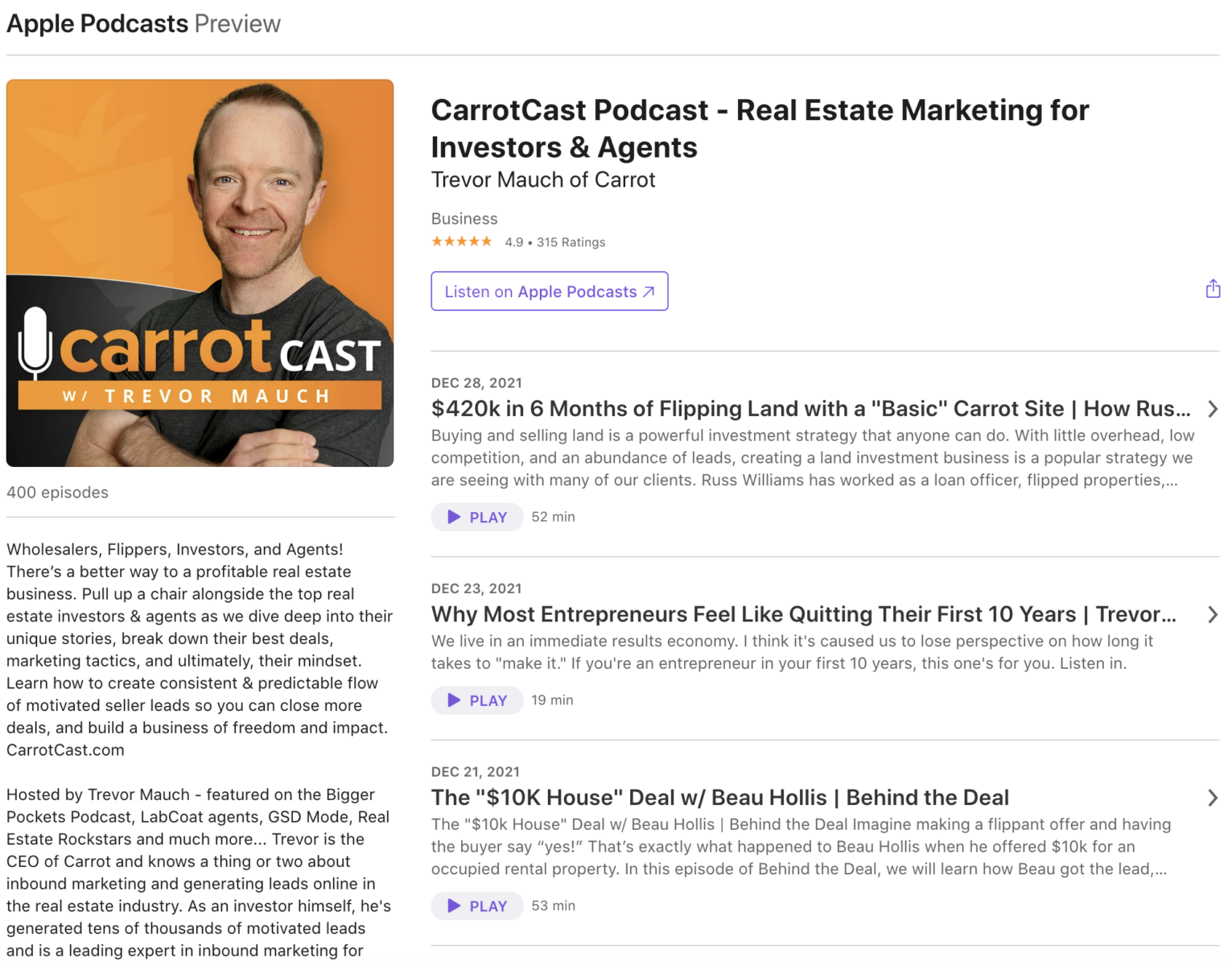
    Real Estate Podcasts - CarrotCast

    We couldn’t put together an article about the best real estate podcasts without mentioning our own! On the CarrotCast, Trevor Mauch discusses tried-and-tested online marketing strategies for investors and agents. He also interviews investors and agents who’ve built successful businesses — you can expect to learn about the mindset behind real estate and entrepreneurship as well as marketing strategies for building a business that’s predictable, sustainable, and profitable. Click Here to listen on your device.

    Apple Podcasts Description

    “There’s a better way to profitable real estate business. Pull up a chair alongside the top real estate investors & agents as we dive deep into their unique stories, break down their best deals, marketing tactics, and ultimately, their mindset. Whether you’re grinding away or on a beach vacation, learn how to create consistent & predictable lead flow, and close more deals, so you can finally build a business of real freedom and real impact.”

    iTunes Rating: 4.9/5

    Episodes

    2. The Tom Ferry Podcast Experience

    Tom Ferry Podcast Experience

    The Tom Ferry Podcast Experience is easily one of the most popular podcasts among agents and investors. Tom is a real estate coach who believes that everyone has greatness inside of them. The goal of his podcast is to help real estate entrepreneurs unlock their greatness so that they can fulfill their potential. Check out his most recent episodes below!

    iTunes Description

    “Greatness lives within us all. But have you tapped into yours – or is it stuck inside you? Top-ranked real estate and business coach Tom Ferry’s life’s work is all about helping people fulfill their vast untapped potential. The Tom Ferry Podcast Experience will give you the knowledge, support, motivation, and tools to succeed in business and achieve your true potential.”

    iTunes Rating: 4.8/5

    Episodes

    3. BiggerPockets Podcast

    BiggerPockets Podcast

    BiggerPockets isn’t just the top place for investors to gather online and chat about their real estate businesses, it’s also home to one of the best podcasts in the industry. The founders of BiggerPockets are notorious for sharing heavy-hitting advice about how to manage and grow an investing business… and their podcast is no different. Check out their most recent episodes below!

    iTunes Description

    “Imagine you are friends with hundreds of real estate investors and entrepreneurs. Now imagine you can grab a beer with each of them and casually chat about failures, successes, motivations, and lessons learned. That’s what The BiggerPockets Podcast delivers.

    iTunes Rating: 4.8/5

    Episodes

    4. The Close Weekly

    iTunes Description

    “The Close Weekly Podcast provides actionable advice about today’s real estate market for real estate agents. Hosted by top producing agent & broker Sean Moudry, this podcast features industry leaders who offer marketing and lead gen tips.”

    iTunes Rating: 5/5

    Episodes

    5. Rental Income Podcast

    Rental Income Podcast

    On the Rental Income Podcast, Dan Lane talks with successful real estate investors and landlords about how they’re generating passive income with rental properties. This is a great podcast to subscribe to if you’re interested in building a rental empire to acquire long-term wealth.

    iTunes Description

    “Inspiring interviews with landlords who are generating passive income by investing in real estate. In each episode, we talk to guests about how they generate cash flow with their rentals, and issues they face with property management, and managing tenants.”

    iTunes Rating: 4.8/5

    Episodes

    6. Bare Naked Agent

    Bare Naked Agent

    In Bare Naked Agent, Pat Hiban, New York Times International Best Selling Author of 6 Steps to 7 Figures, answers questions from his audience about building, growing, and managing a real estate business.

    iTunes Description

    “Bare Naked Agent is a show created for you: the Real Estate community. If you find yourself searching for answers, keys to success, or just new information, you need to tune in! Pat Hiban, a New York Times Best Selling Author, delivers in his biweekly show to help answer any questions that come his way.”

    iTunes Rating: 4.7/5

    Episodes

    7. The Max Maxwell Podcast

    The Max Maxwell Podcast

    Max Maxwell’s podcast is equal parts inspirational storytelling and practical real estate advice. He hosts a new guest every week who’s quit their W-2, grown their wholesaling business to 7 figures, or done something else significant. He drills them with questions about how they did it and you, the listener, benefit from their answers.

    iTunes Description

    “Max Maxwell is a Serial Entrepreneur and Real Estate Investor. In this podcast, we talk industry, from real estate to general investing practices and methods.

    Weekly guests ranging in backgrounds will show you there are endless ways to be successful in today’s society. Starting on the term of Wholesaling is common, but after you get your money from these deals, what do you do with it?”

    iTunes Rating: 4.9/5

    Episodes

    8. Keeping It Real

    Keeping It Real Podcast

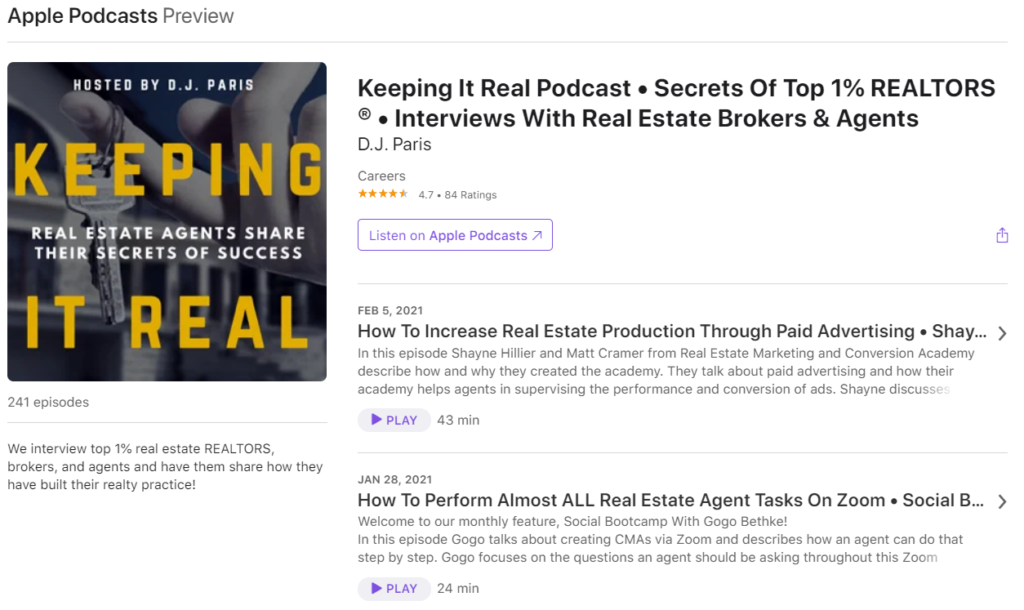
    On Keeping It Real, D.J. Paris interviews the top 1% of realtors, breaking down their stories and advice into practical lessons. Some of his most recent episodes discuss how to successfully run paid ads, how to perform tasks via Zoom, and how to brand a real estate business in 2025. Check out those episodes below!

    iTunes Description

    “We interview top 1% real estate REALTORS, brokers, and agents and have them share how they have built their realty practice!

    iTunes Rating: 4.8/5

    Episodes

    9. The Real Estate Guys Radio Show

    The Real Estate Guys Radio Show

    Since 1997, The Real Estate Guys Radio Show has been broadcasting (originally via radio) investment advice to its listeners. It’s hosted by Robert Helms and Russell Gray, who try to deliver lots of value and entertainment in every episode. Check out their most recent episodes below!

    iTunes Description

    “Fun and informative, this real estate investment talk show has been broadcasting on conventional radio since 1997. Hosted by professional investor Robert Helms and financial strategist Russell Gray, the show delivers no-hype education and expert perspectives in a fast-paced, entertaining style. Rich Dad Poor Dad author Robert Kiyosaki says The Real Estate Guys are wild and crazy, but they really know what they are talking about. The Guys talk investment strategy, economics, tax and asset protection planning, market and property due diligence, international diversification, and much, much more! Gain valuable insights from interviews with notable experts, industry leaders, and real-life investors. Discover proven strategies for making money with real estate in any market, how to avoid common and costly mistakes, and what is working in the real world right now.”

    iTunes Rating: 4.6/5

    Most Recent Episodes

    10. Real Estate Rockstars

    Real estate Rockstars podcast

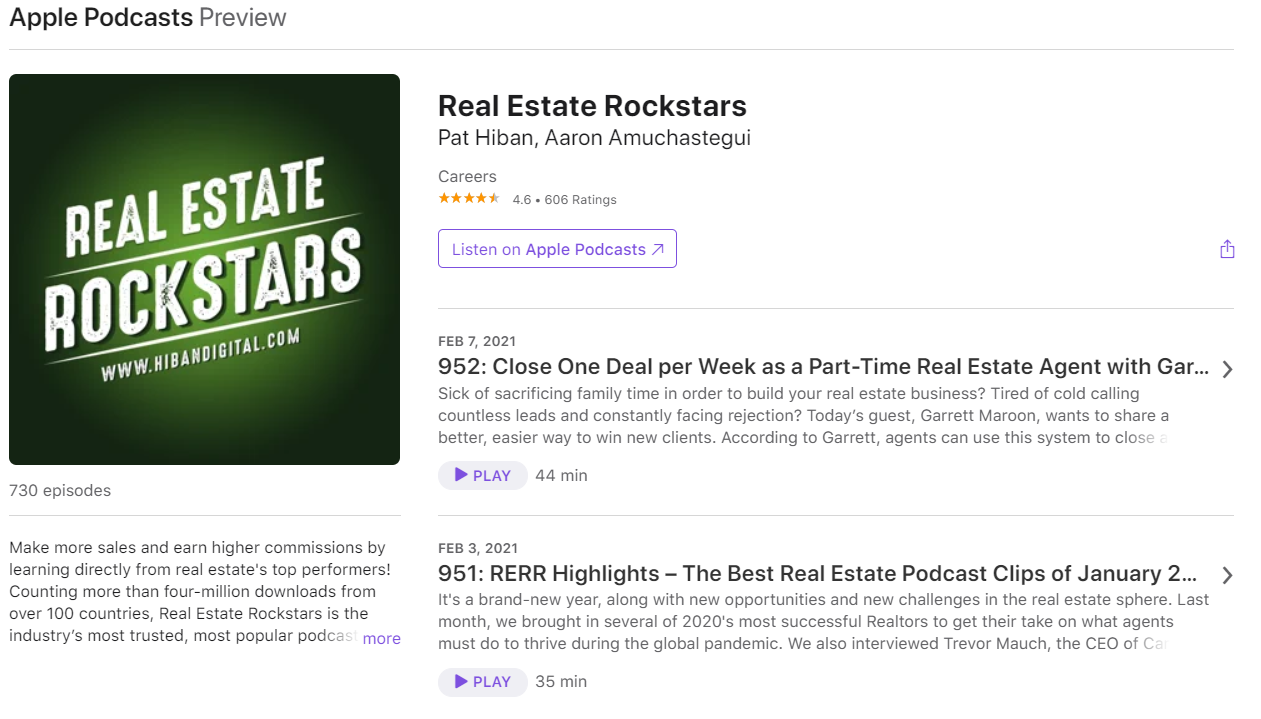
    On Real Estate Rockstars — a podcast that’s on its 953rd episode as of this article’s writing — Pat Hiban interviews expert real estate investors. Past guests include Robert Kiyosaki, Barbara Corcoran, and Ryan Serhant. The podcast has received more than 4 million downloads in over 100 countries. Check out the most recent episodes below!

    iTunes Description

    “Make more sales and earn higher commissions by learning directly from real estate’s top performers! Counting more than four-million downloads from over 100 countries, Real Estate Rockstars is the industry’s most trusted, most popular podcast. With a new guest on each episode, you’ll learn from up-and-coming agents, seasoned brokers, real estate investors, and more. Robert Kiyosaki, Barbara Corcoran, and Ryan Serhant are just a few of the many notable guests who have shared their industry expertise with the Rockstar Nation. Billion-dollar agent and best-selling real estate author Pat Hiban asks the questions that matter and uncovers actionable answers – no filler and no clichés. Implement the strategies you learn by listening to this tri-weekly podcast and start making more money in real estate. It’s that simple.”

    iTunes Rating: 4.6/5

    Most Recent Episodes

    11. Real Estate Coaching Radio

    Real Estate Coaching Radio

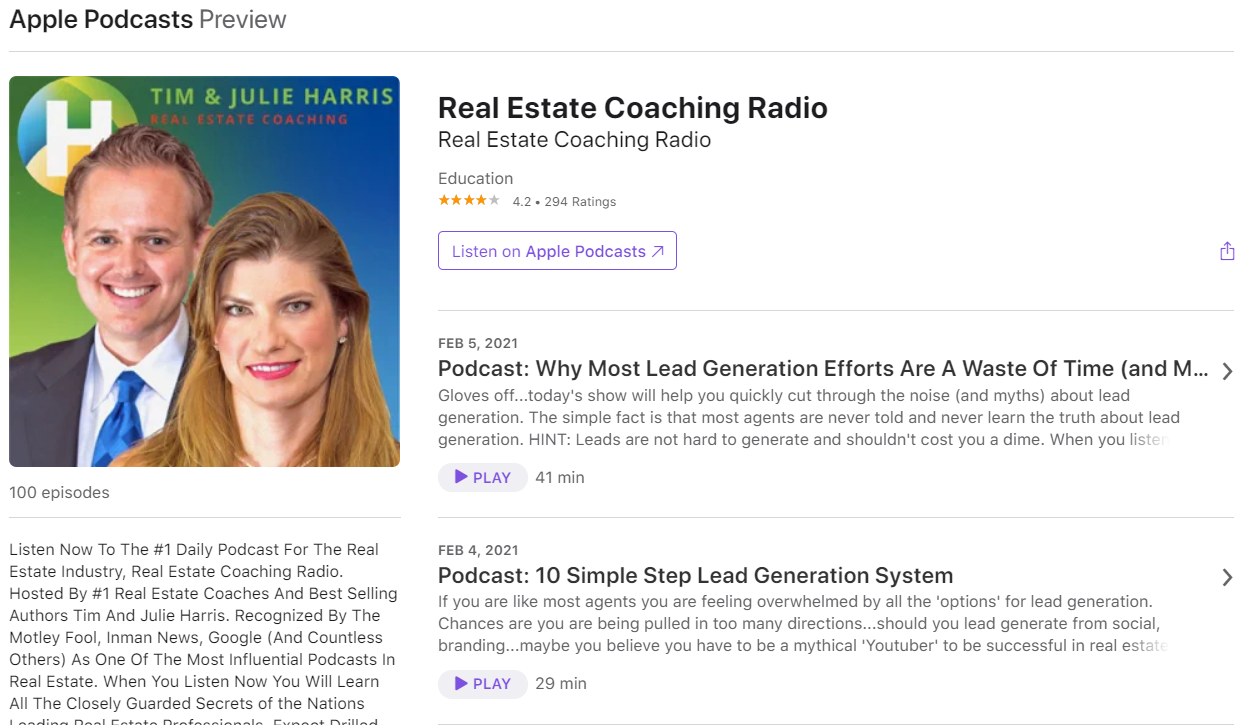
    On Real Estate Coaching Radio, Tim and Julie Harris, best-selling authors, experts real estate coaches, and entrepreneurs, share real-life advice from building their own businesses. Check out their most recent episodes below!

    iTunes Description

    “Listen Now To The #1 Daily Podcast For The Real Estate Industry, Real Estate Coaching Radio. Hosted By #1 Real Estate Coaches And Best Selling Authors Tim And Julie Harris. Recognized By The Motley Fool, Inman News, Google (And Countless Others) As One Of The Most Influential Podcasts In Real Estate. When You Listen Now You Will Learn All The Closely Guarded Secrets of the Nations Leading Real Estate Professionals. Expect Drilled Down, No BS, Fast-Paced Practical and Tactical Information to Get You Into Action Now Helping Others and Making Money.”

    iTunes Rating: 4.3/5

    Most Recent Episodes

    12. GSD Mode

    GSD Mode Podcast

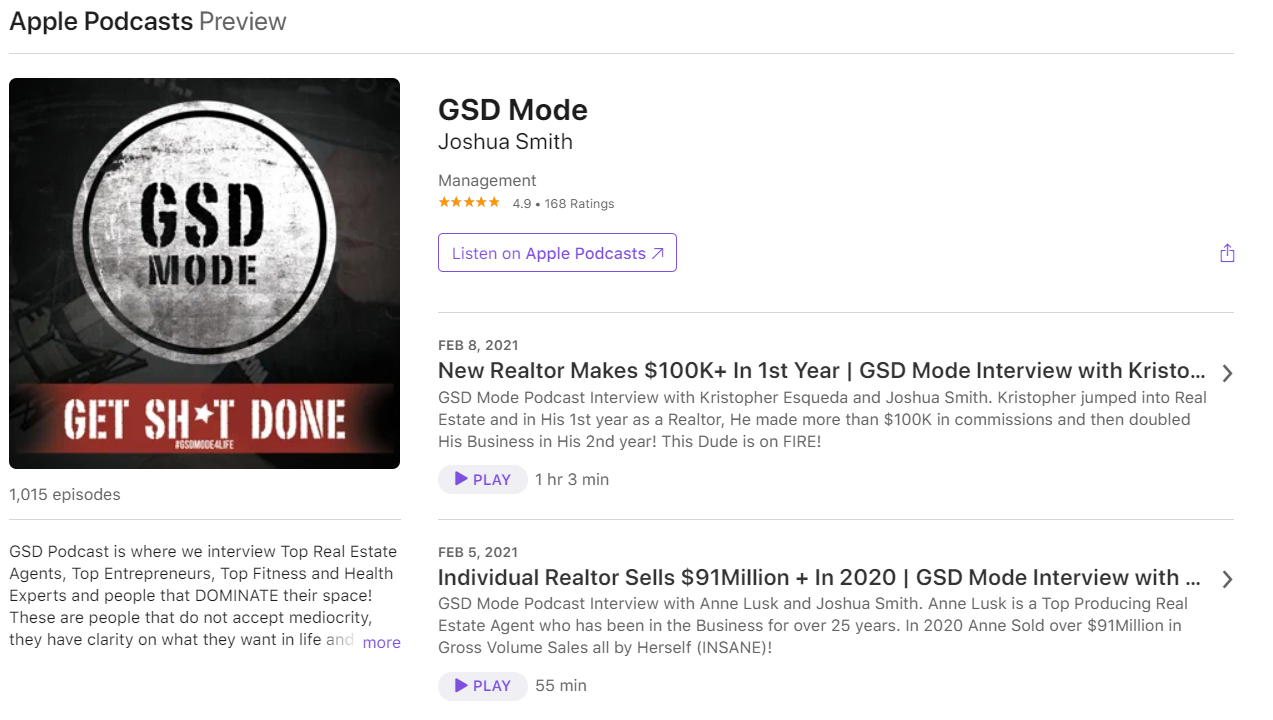
    GSD Mode shares the stories and advice of people who’ve built successful businesses, particularly real estate agents and health experts who “dominate their space.” This is a great podcast to check out if you’re a real estate investor, agent… or even if you’re just an entrepreneur. Check out their most recent episodes below!

    iTunes Description

    “GSD Podcast is where we interview Top Real Estate Agents, Top Entrepreneurs, Top Fitness and Health Experts and people that DOMINATE their space! These are people that do not accept mediocrity, they have clarity on what they want in life and they take massive levels of action to create their dreams into a reality! They create epic lives!”

    iTunes Rating: 4.8/5

    Most Recent Episodes

    13. Cash Flow Guys Podcast

    Cash Flow Guys Podcast

    On the Cash Flow Guys Podcast, Tyler Sheff teaches “busy people how to use what they have” and “get what they need in order to accomplish what they want.” Listeners will learn about real estate investing and increase their financial fluency. Check out their most recent episodes below!

    iTunes Description

    “The CashFlowGuys Podcast teaches busy people how to use what they have, to get what they need in order to accomplish what they want. Using tips and techniques from industry leaders in Real Estate Investing and Financial Services, the CashFlowGuys are on a mission to educate the public on all things involving real estate and financial services. Your host, Tyler Sheff interviews experts from around the globe to help people improve their financial intelligence.”

    iTunes Rating: 4.8/5

    Episodes

    Conclusion

    There you have it — those are our favorite real estate podcasts. Try them and see what you think.

    Do you have a favorite podcast that wasn’t on this list?

    Let us know in the comments and we’ll give it a listen!

    For more resources and real estate marketing materials, click on the link!

  • Carrot Vs. Other Website Builder Alternatives For Real Estate Investors: An Honest Comparison

    Carrot Vs. Other Website Builder Alternatives For Real Estate Investors: An Honest Comparison

    Carrot Vs. Other Website Builders For Real Estate Investors

    Searching for website builders for your real estate investing business?

    You’ve got quite a few options!

    We know a thing or two about real estate investor websites.

    Over 7,000 real estate investors and agents leverage Carrot’s platform to generate over 47,000 leads per month, not counting phone leads.

    We’re often asked questions such as… Carrot vs Minute:Pages or Carrot vs. LeadPropeller, which one is best?” Or, “Carrot vs. WordPress, which one is easier?”

    We wanted to provide an honest, high-level answer. To help you choose, we’ve rounded up all the best website builders for real estate investors. We’ve also included our analysis and pricing information.

    But before we dive in, let’s talk about some of the most mission-critical factors to consider when choosing a website builder.

    Watch this video before you read the rest of the article…

    Wholesaling Websites: Carrot vs. Wix vs. WordPress, Etc. | Real Estate Sites for Agents & Investors

    Factors To Consider When Choosing A Website Builder

    A real estate lead generation website should do more than help you get online. That’s table stakes these days. Everyone is online. Your real estate investing website should… 

    • Work amazingly well on mobile (speed and conversion).
    • Load web pages with superspeed (critical now in the Google Core Web Vitals age we’re in).
    • Have multiple high-converting designs to choose from (but not too many, with the #1 decision factor should be performance, not prettiness).
    • Back up the product’s performance with data. One lost deal as a real estate investor from an underperforming website could cost $10k, $20k, or more!
    • Allow you to integrate your website with other 3rd party systems (CRMs, Investorfuse, Zapier, email marketing systems, etc.)
    • Provide outstanding support so you can focus on growing your business.
    • Be built with content marketing in mind and have a blog and the ability to publish consistent, high-quality content.
    • Tracking and stats so you can see how your website is performing.

    “As an owner of an SEO company with many clients in the REI industry, I can say that Carrot is by far the best website solution that I’ve seen to date. It’s easy to work with for people who want to get up and running out of the gate and it’s flexible enough for experienced site builders and “SEO’ers” to really be able to get additional power out of it.

    Definitely worth the money (in my opinion); I have no connection with Carrot; in fact, we are “friendly competitors” in some areas… but the facts are the facts!!!”

    Michael Cardini

    The thing is, different people need different websites. There’s no “one-size-fits-all” solution. Many real estate investors need much more than the “minimum,”, especially in our high-margin service business.

    Again, one lost deal from an underperforming website could cost you well into the tens of thousands of dollars in lost revenue, so looking at performance over the long term vs. trying to save a few bucks today is a solid strategy. 

    But how do you pick the best website builder for your business? It’s not an easy choice, given the number of available options.

    To help you decide, we’ve done an in-depth comparison of the 8 best website builders for real estate investors on the market. You’ll find our top picks, honest customer reviews, and detailed feature lists and descriptions to help you work out which website to keep by your side.

    As we dive into the reviews and comparisons, we’ll point out who each service is ideal for (each has advantages and disadvantages) and why certain types of investors may or may not want to use a particular service. We’ll even tell you where Carrot isn’t a fit for many businesses.

    Let’s get started!

    Who Are The Top Website Builders For Real Estate Investors?

    There are many good website builders for real estate investors on the market. We picked 8 great ones.

    Here they are:

    • Carrot – We might be biased, but our testimonials and case studies speak for themselves. We’ve helped thousands of investors nationwide create a predictable flow of leads and build more sustainable businesses thanks to our high-performance websites (we call them Lead Gen Hubs), SEO content capabilities, and many more features that help you attract, convert, and close more deals than ever before.
    • REI Blackbook – REI Blackbook is for investors who need a better CRM and follow-up system.
    • WordPress – WordPress is a popular choice for those who are tech-savvy or have big budgets to hire a web designer.
    • LeadPropeller – LeadPropeller helps professionals hit their goals and deal with high-converting and SEO-focused websites.
    • InvestorPro – InvestorPro websites have been designed by investors and are created specifically for real estate businesses.
    • REI Leadz – REI Leadz offers a one-time, “done-for-you” website.
    • Minute:Pages – Minute:Pages is for real estate investors who want a user-friendly web design experience.
    • Wix – Wix is for real estate investors with a big budget to create a custom website… or investors with advanced web design experience.

    Let’s dig into the details…

    The 8 Real Estate Lead Generation Website Providers Comparison

    You’ll find detailed descriptions and feature lists for our top picks below. We cover price, design, and the tools and resources in each service.

    Carrot

    Why would you settle for less than the industry leader?

    In 2003, we built our first website to generate free, motivated seller leads. Since then, we’ve refined our marketing systems, website platforms, and overall strategy on what it takes to drive leads online.

    Now?

    We’ve brought in over 1,253,267 real estate-related leads in the past five years alone. Over 7000+ real estate investors and agents use Carrot’s real estate marketing platform to attract and convert more motivated leads. In fact,… not only do Carrot sites convert traffic into leads at a 44% higher rate than the industry standard, Carrot leads convert 7x better to deals and have 2.5x higher profits than non-Carrot leads. (averaging at about $14,000 profit per deal!)

    Carrot members generate 2.5x higher profits vs non-carrot members

    We stay ahead of the online game. When fast websites became part of Google’s core web vitals, we adapted… our websites are 68.9% faster than custom WordPress sites.

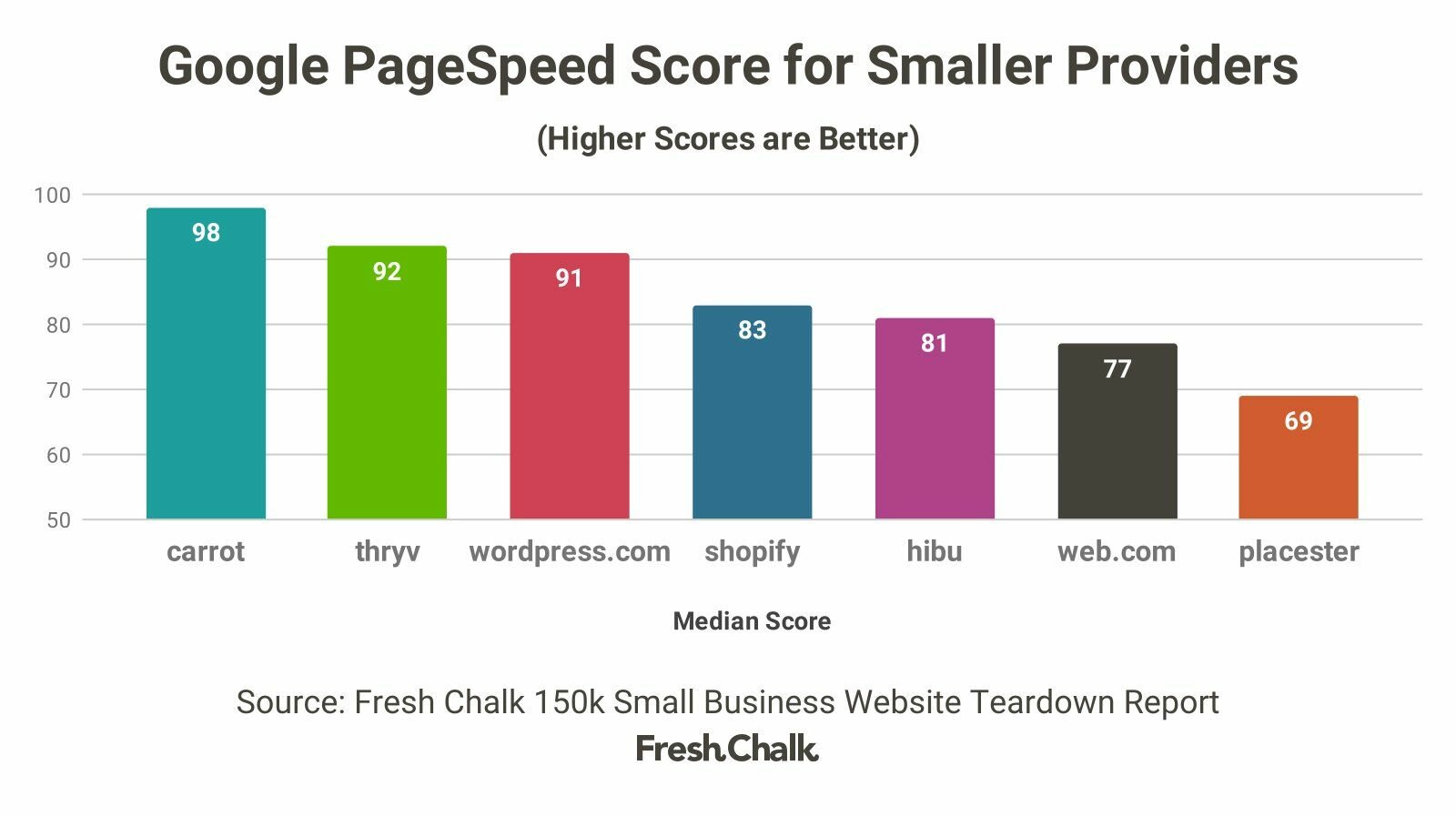
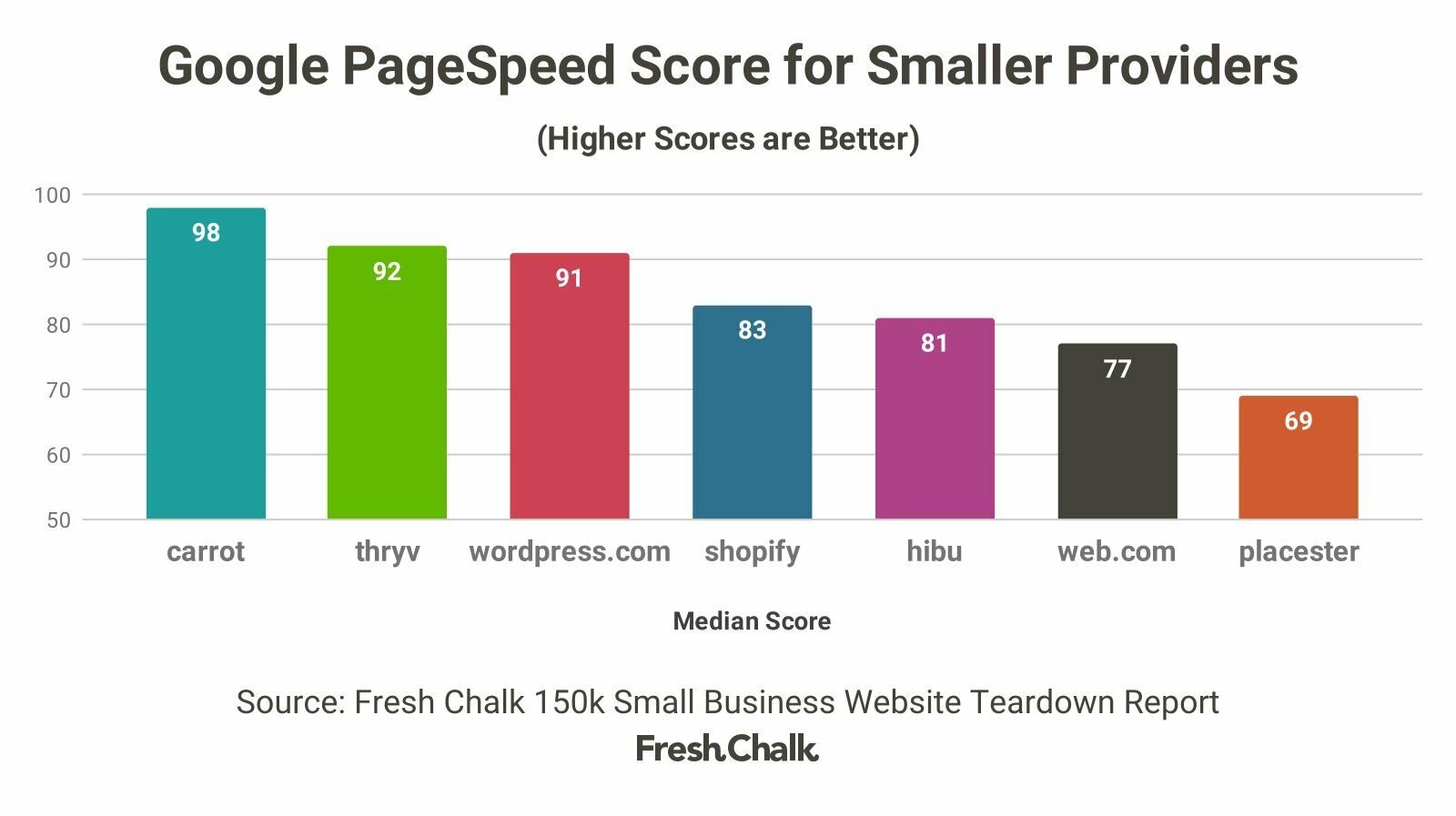
    Also, in an independent study of 150,000 websites, our Carrot tech stack outperformed Wix, Squarespace, WordPress, and more, scoring 98 out of 100 for web page loading speed!

    Google pagespeed score for small providers

    Our members generate more high-quality leads than their competitors and grow their businesses sustainably and predictably – using Evergreen Marketing.

    If you’re looking for an industry leader that will help you accelerate revenue, you’ve found it.

    Carrot is the top choice for “high-performance investors and agents.” Our software has helped more than 8,000 real estate investors create a consistent flow of leads and deals through our “Lead Generation Hub” and a process we call “Evergreen marketing.”

    Carrot members organic search leads

    We provide high-converting websites that rank in Google more easily than competitor website builders. Carrot websites capture >50% of all Rank #1, #2, and #3 mentions in 225 markets nationwide.

    Carrot websites rank higher thanks to our powerful content marketing tools, such as the monthly SEO-focused Content Packs in our Automated Content Library, Keyword Explorer and Tracking capabilities, and an amazing team to help our members grow their businesses.

    In short, Carrot’s is more than just a website builder. We’re a real estate marketing platform that helps you attract the right traffic with impactful SEO tools, convert visitors into high-quality leads in a high-performance Lead Generation Hub, and close more deals than ever.

    Don’t Take Our Word For It!

    See what others say about working with us. Check out our reviews.

    Carrot member review: Carter Steph

    What’s Inside Carrot

    What’s inside Carrot’s Starter plan?

    A high-performing website with everything you need to get online and convert traffic into leads.

    • 1 High Converting Website
      SEO Optimized
      Industry-leading Web Hosting
      Visual Editor
      + Add more any time @ $29/Month
    • Carrot Lead Manager
      Lead Source Tracking
      Integrated Google Maps & Streetview
      Immediate Email Alerts & Followup
    • Standard Marketing Tools
      Website Traffic Analytics
      3 Campaign Tracking Links
      3 Keywords To Track SEO Rankings
    • World-Class Support
      Chat & Email
      Weekly Group Training calls
      Written & Video Guides
      Facebook Community Group

    What’s Inside Carrot’s Plus Plan?

    Rank higher in Google with the ability to research, plan, and execute an effective SEO marketing strategy.

    Everything in Starter…

    Advanced SEO Tools & Tracking

    • On-Page Content Analyzer
      Optimize Your Content to Rank
    • Google Rank Tracking
      25 Keywords to Track SEO Rankings
    • Keyword Research
      SEO Competitive Analysis
    • Domain Overview Tool
      Track your website authority score
    • SEO Health Audit
      Monitor & Improve Site-Wide Issues

    What’s Inside Carrot’s Grow Plan?

    Save time and money by using marketing automation & SEO data to generate consistent leads.

    Everything in Plus…

    Content Automation Tools

    • Automated Content Library
      Pre-written and optimized blog posts
    • VideoPost
      Convert YouTube videos to blog posts
    • Niche Authority Builder
      Automate Targeted Lead Generation
    • AI Content Rewriting
      One-click Content Customization

    Premium Site Designs

    • Unique Layouts & Styles
      Drive Higher Conversions
    • Stand Out From Your Competition
      Differentiate Your Brand

    Both beginners and advanced real estate investors or agents want to grow their businesses through proven online marketing systems.

    How much does Carrot cost per month?

    • Starter – $89
    • Plus – $118
    • Grow – $176

    Check out our plans for real estate investors and agents, and learn more about Carrot’s real estate platform in a demo today!

    REI Blackbook

    Overall we think REI Blackbook is a solid product with great features. However, it’s a little more expensive and offers fewer features than some of the competition. It claims to have “Everything you need to run your real estate investing business. All in one place.

    Although it offers websites, REI Blackbook focuses on CRM and follow-up. Their focus on lead generation websites isn’t as refined as others. Their website approach is just that… a place to send clicks from online ads. Not as much big-picture thinking on the website “hub.” Their main purpose is to help track and follow up.

    According to customer reviews, REI Blackbook organizes and follows leads within their CRM system.

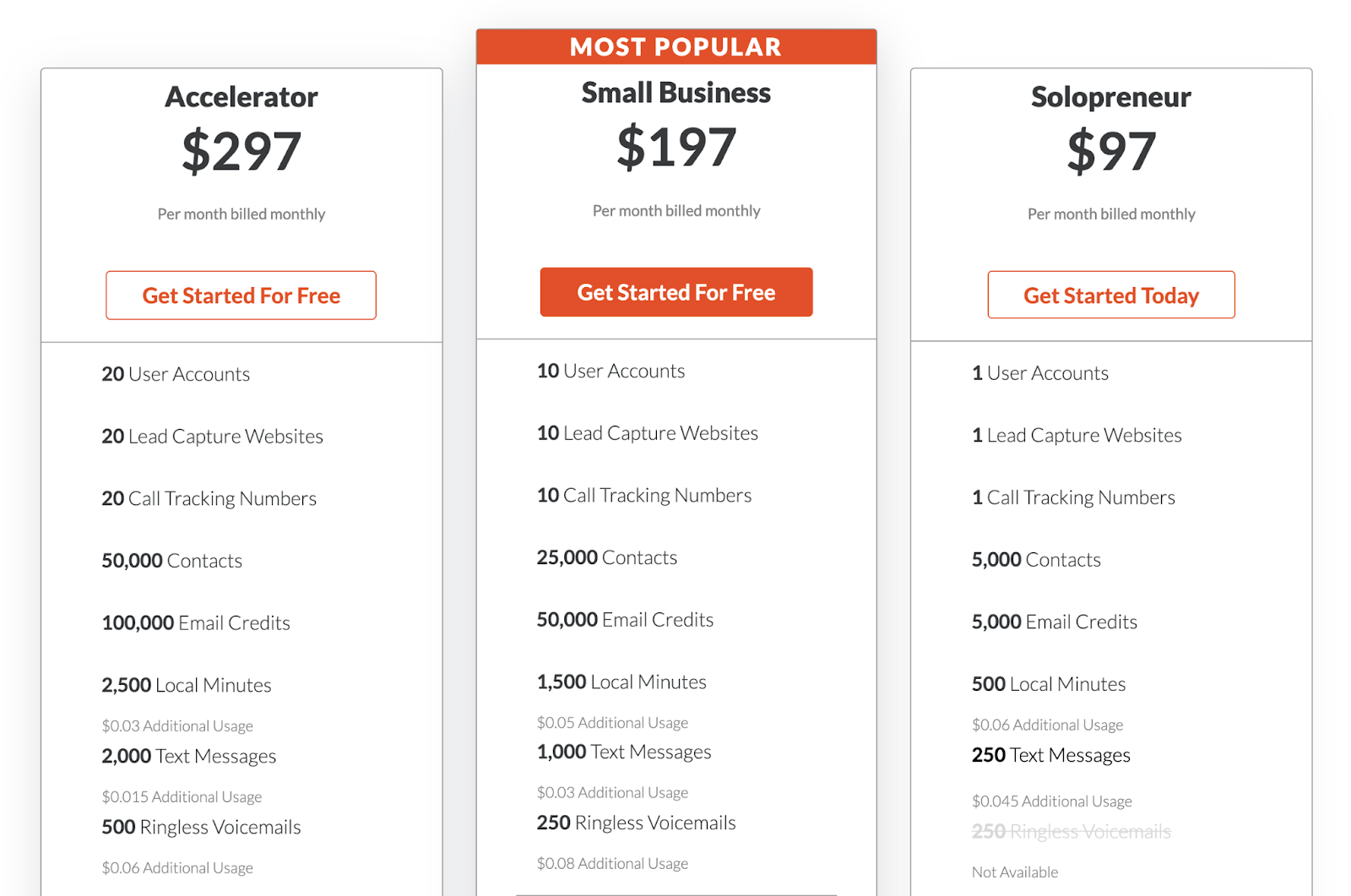
    What’s inside REI Blackbook’s “Solopreneur” membership?

    • 1 website
    • 1 call tracking number
    • 5000 contacts
    • 5000 email credits
    • 500 local minutes
    • 250 text messages
    • CRM

    Who is REI Blackbook for?

    REI Blackbook is for investors who need a better CRM and follow-up system. Great for tracking leads and planning follow-up, so possible deals don’t fall through the cracks. 

    How much does REI Blackbook cost per month?

    • Accelerator package – $297
    • Small Business package – $197
    • Solopreneur package – $97
    REI Blackbook pricing

    WordPress Websites 

    WordPress is a custom and versatile website builder. It allows tech-savvy web devs to create high-quality websites without the limitations of more user-friendly website builders. This may help if you have the knowledge, time, and proper planning to build your website.

    WordPress sites also have many customizable options. There are over 6000+ free WordPress themes that you can use. You can choose the theme of your real estate websites and personalize them. Although creating your SEO-friendly, high-converting content could be a huge shortcoming of WordPress.

    However, there are expenses for hosting and commercial plug-ins. There are also continuous updates for specific plug-ins. Those updates are built into most services that are real estate lead generation-specific.

    For example, premium plug-ins run anywhere from $47 to $200 and require education to install them correctly on your website. Additionally, if you plan to hire a web designer to build a custom website, you’ll probably pay upwards of $3,000 to $5,000 — plus maintenance fees whenever something goes wrong.

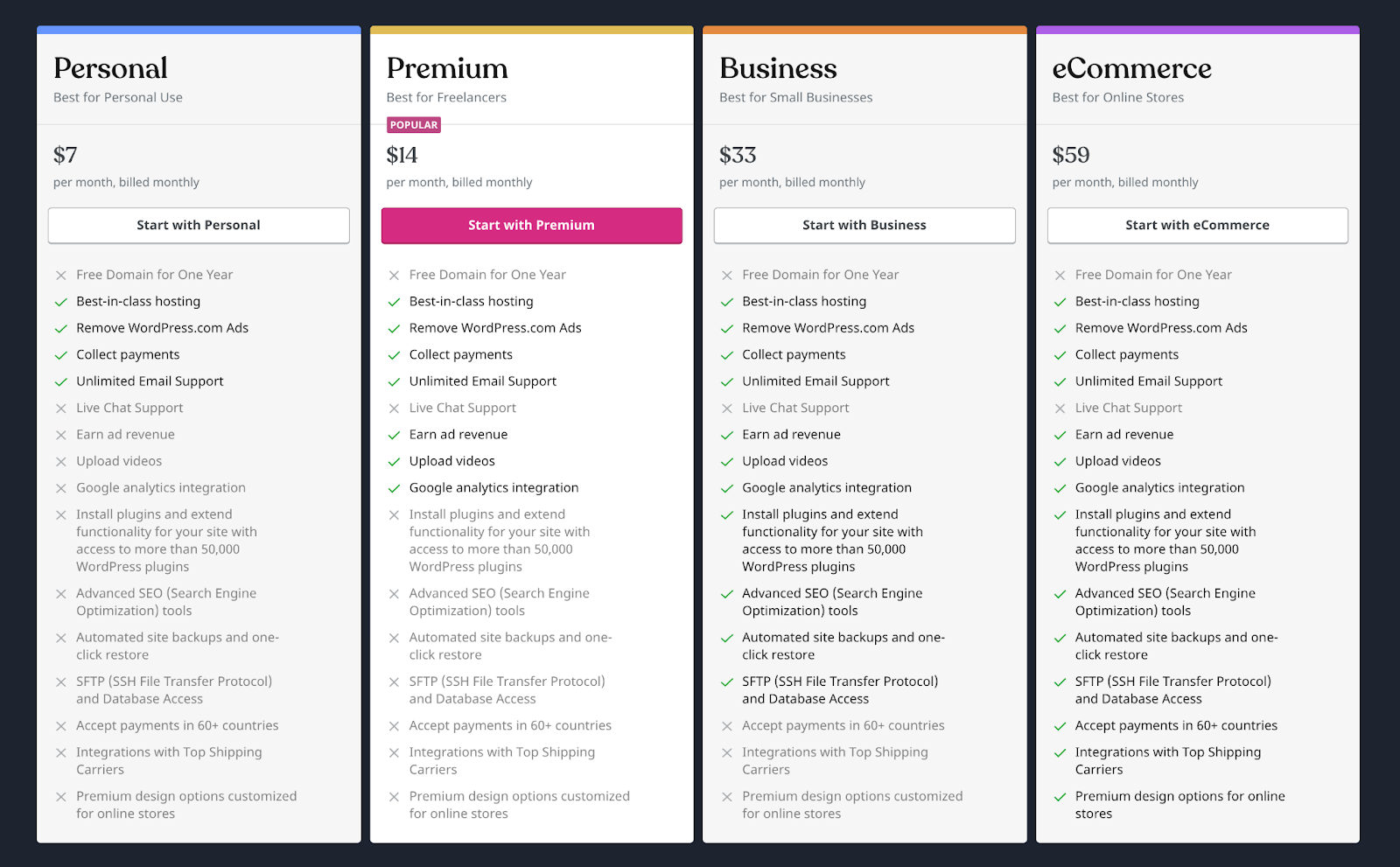
    What’s inside a WordPress website “Business” plan?

    • Best-in-class hosting (but Carrot has tested as faster in this study).
    • Upload videos.
    • Access to over 50,000 plug-ins.
    • Automated site backups.
    • SEO tools.
    • Google Analytics integration.

    Who is WordPress for?

    WordPress is for real estate investors with big budgets to pay web developers or those with the know-how to do it themselves. It’s useful if you know what you’re doing when creating a website and have the time to create it. It’s also great if you’re big on personalizing the design.

    How much does WordPress cost per month?

    • Most basic website – Free
    • Personal – $4
    • Premium – $14
    • Business – $33
    • eCommerce – $59
    • Optional Hosting – Starts at around $3.95/month
    • Optional Plug-ins – $47 to $200 (charges can be one-time or recurring)
    • Optional SSL Certificate – $17+
    WordPress pricing

    LeadPropeller

    Real estate investor Danny Johnson created lead Propeller. He created a real estate investor website service to remove the guesswork and create sites that drive leads. He’s been using his websites to buy houses for over 10 years. 

    LeadPropeller aims to provide an inbound marketing platform to achieve lead generation goals by focusing on SEO-optimized websites. 

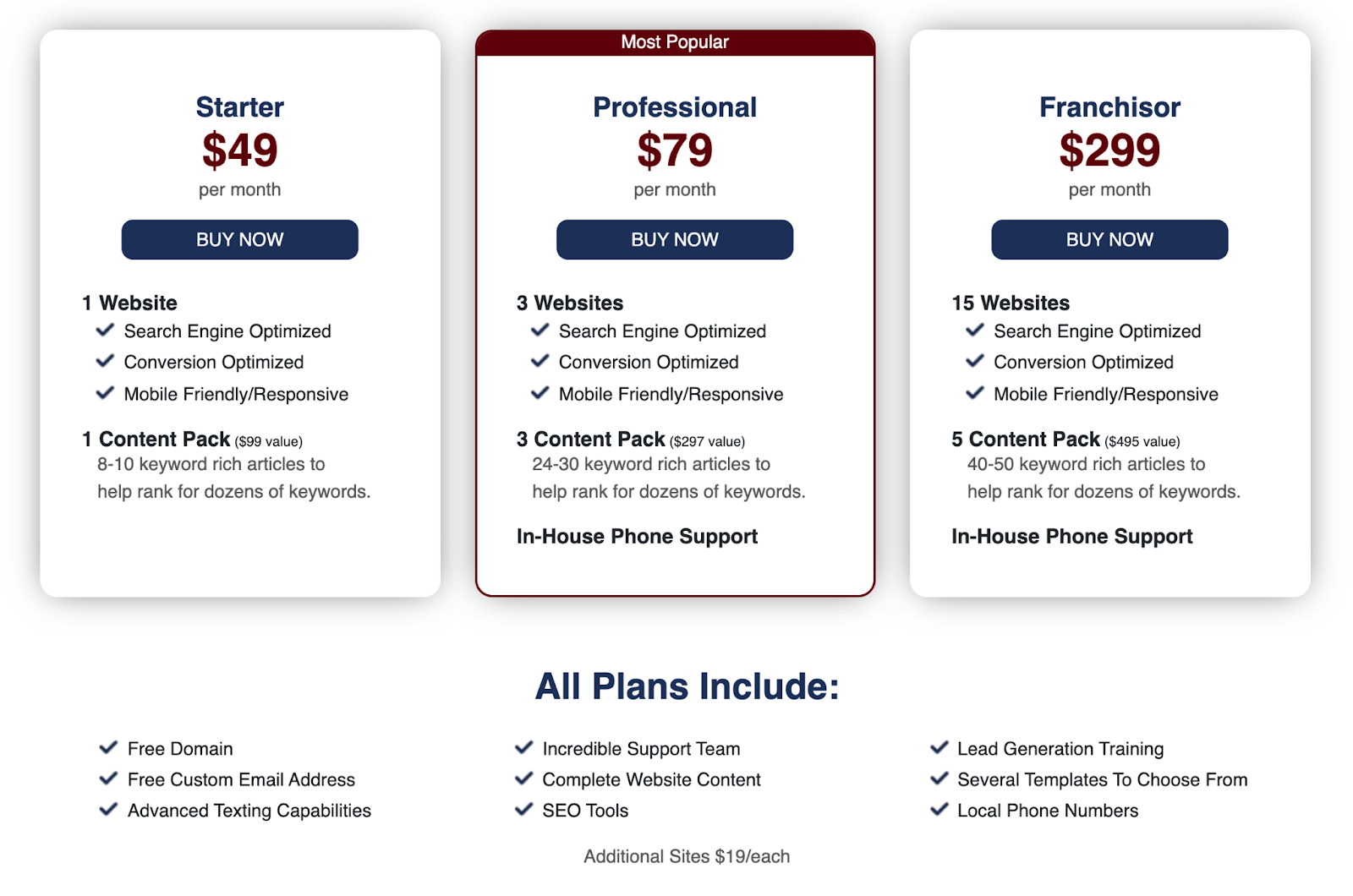
    What’s inside LeadPropeller “Starter” plan?

    • 1 website
    • SEO optimized
    • Automated content library
    • Free custom email address
    • Free domain
    • Local phone numbers
    • Support team

    Who is LeadPropeller for?

    LeadPropeller is for real estate investors who want to create a consistent flow of leads to their website.

    How much does LeadPropeller cost per month?

    • Starter – $49
    • Professional – $79
    • Franchisor – $299
    LeadPropeller Pricing

    InvestorPro

    Lynn and Tammy Hahn created InvestorPro to help real estate investors find motivated sellers and generate leads online. 

    They created their first website for their real estate investing business in 1999 after a seller asked them if they had a website. Over time, they “constantly massaged” their site until they got the desired results.

    What’s inside InvestorPro’s Gold Plan?

    • Customizable
    • Unlimited Domains
    • Pre-Made Templates
    • Mobile Compatible Websites
    • Search Engine Optimization
    • Automated Email Follow-Up
    • Internet Marketing Plan

    Who is InvestorPro for?

    Real estate investors who want a custom website design. 

    How much does InvestorPro cost per month?

    • Bronze Plan – Setup Fee of $395, Monthly Fee of $39
    • Silver Plan – Setup Fee of $495, Monthly Fee of $49
    • Gold Plan – Setup Fee of $595, Monthly Fee of $95
    InvestorPro Pricing

    REI Leadz

    REI Leadz is another website builder for real estate investors. Their sites are SEO-friendly, have no monthly fees, and give you complete control of your website. 

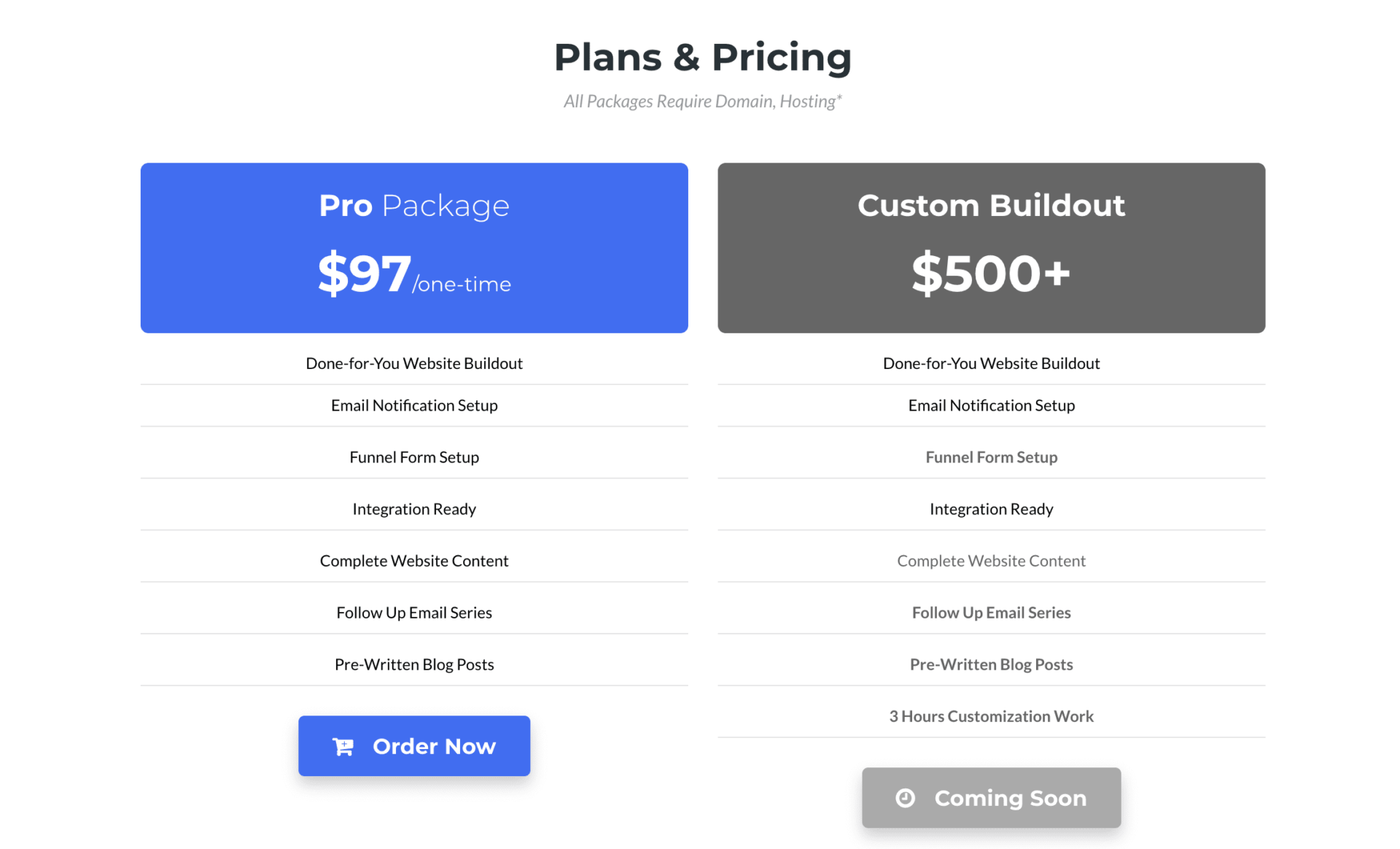
    What’s inside REI Leadz’ Pro Package?

    • Done-for-you website
    • Email notification setup
    • Funnel form setup
    • Website content
    • Follow-Up email series
    • Pre-written Blog Posts

    Who is REI Leadz for?

    Real estate investors who want a done-for-you website or a custom website with a one-time cost (vs. a monthly subscription).

    How much does REI Leadz cost per month?

    • Pro Package – $97
    • Custom Buildout – $500+
    REI Leadz Plans

    Minute:Pages

    Minute:Pages is a recent inbound real estate lead generation platform. 

    The main focus of Minute:Pages is to provide a lead generation website in “minutes.”

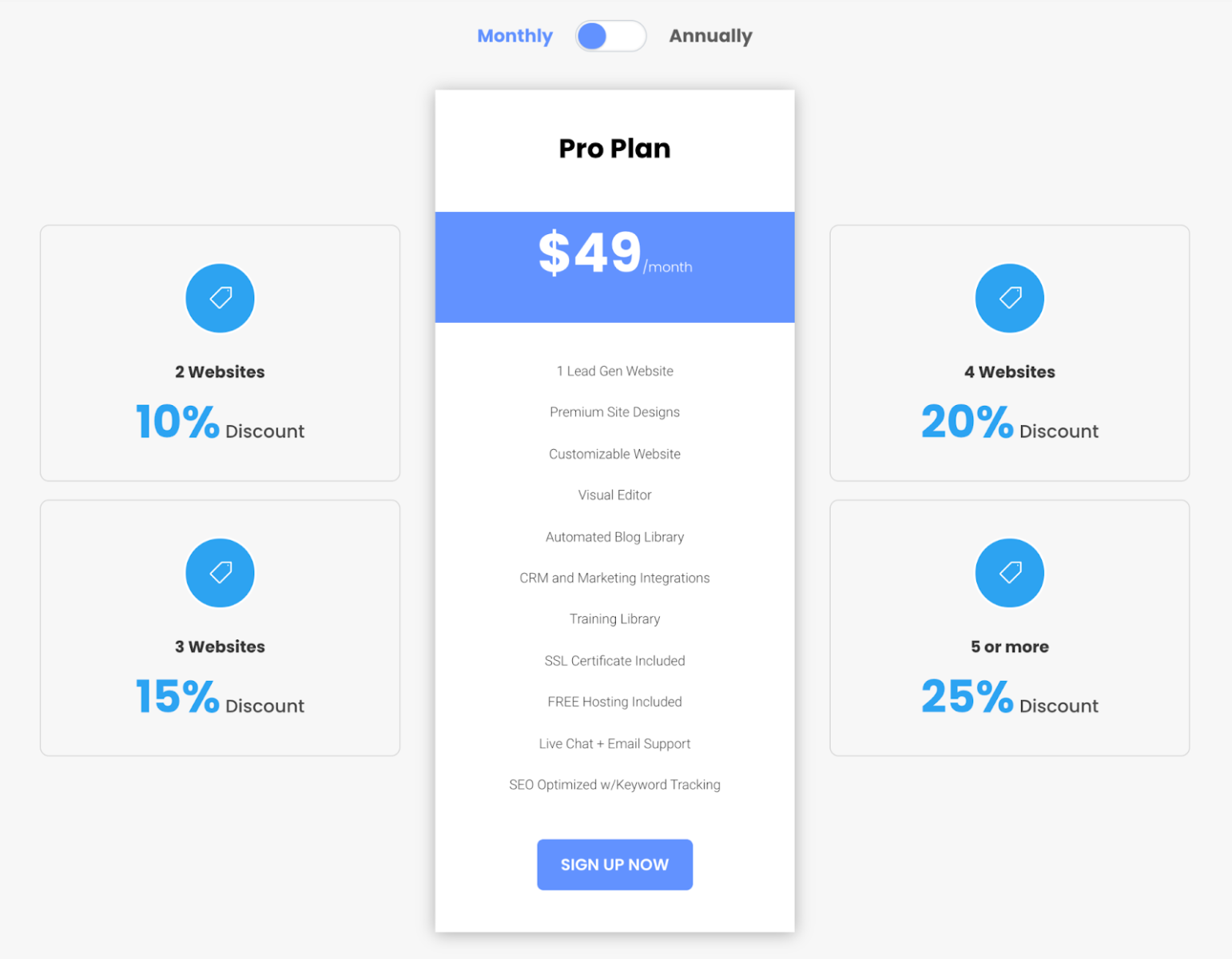
    What’s inside Minute:Pages “Pro Plan”?

    • 1 site for basic plan
    • Visual editor
    • Automated blog library
    • SSL certificate
    • Free hosting
    • Live chat
    • Keyword tracking

    Who is Minute:Pages for?

    Minute:Pages is for real estate investors who want a user-friendly web design experience.

    How much does Minute:Pages cost per month?

    • Pro Plan – $49 (1 website)
    • Additional websites can be added for 10-25% discounts the more you need
    Minute Pages pricing

    Wix

    Wix’s main selling point is its comprehensive approach to web design. Like WordPress, it allows users to build custom websites from scratch or by starting with a template. Users must understand how SEO, web design, and conversion optimization work to get the best results. 

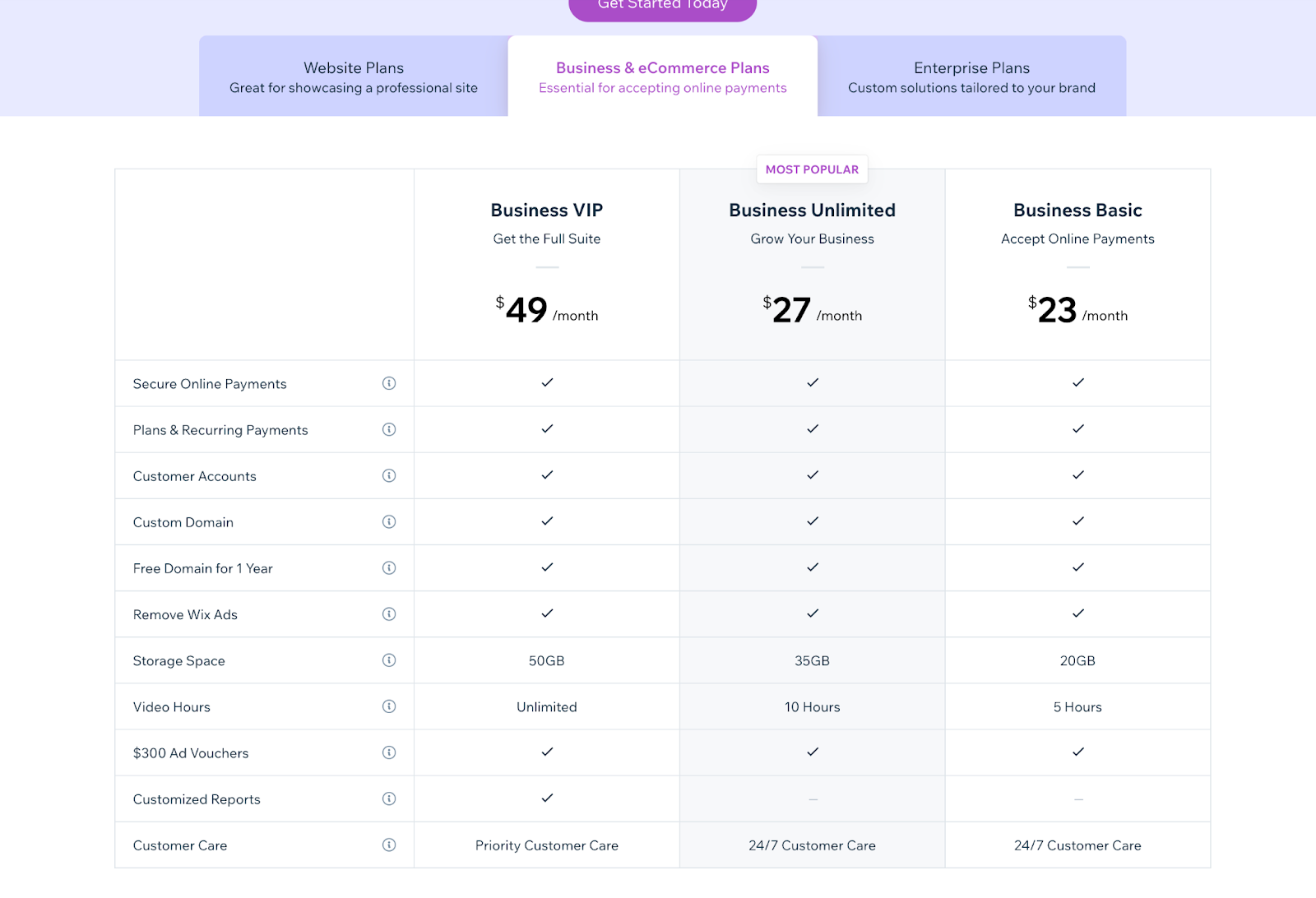
    What’s inside Wix’s “Business Unlimited” plan?

    • Accept online payments
    • Remove Wix Ads from your site
    • Replace the Wix favicon in the browser tab with your one
    • Change the free Wix URL to your custom domain (which can be purchased from Wix or another domain host)
    • Free SSL certificate
    • Advanced Shipping
    • Receive Wix Vouchers and Premium app coupons when purchasing a yearly subscription or higher
    • Upload up to 10 hours of video with Wix Video
    • Get up to 35 GB of storage and unlimited bandwidth
    • Get a professional logo and social media logos when purchasing a yearly subscription or higher
    • Events Calendar App – Free for 1 Year

    Who is Wix for?

    Wix is for real estate investors with a big budget to create a custom website… or investors with advanced web design experience. You’ll also need to understand SEO and conversion optimization best practices to get the best results.

    How much does Wix cost per month?

    • Business Basic – $23
    • Business Unlimited – $27
    • Business VIP – $49
    Wix Plans

    Conclusion

    There you have it!

    The top website builders for real estate investors.

    Carrot is the longest-standing real estate marketing platform and website builder for real estate investors and agents alike, with proven data to back it up. We guarantee you’ll have the tools and support to attract, convert, and close deals.

    However, we understand that we’re not the only options out there.

    For user-friendliness, we would say LeadPropellor and Minute: Pages are also options. 

    REI Blackbook is a good option for a solid CRM or follow-up system. 

    Lastly, consider something like WordPress or Wix to go the fully custom, high-cost route. 

    The choice is yours. But if you’re still unsure, we invite you to sign up for a 30-day risk-free Carrot account. We’ve made a massive difference in thousands of investors’ businesses. Can we make a difference in yours?

  • Busted! 10 Inbound Marketing for Real Estate Investors Myths that Some ACTUALLY Believe

    Busted! 10 Inbound Marketing for Real Estate Investors Myths that Some ACTUALLY Believe

    10 Inbound Marketing for Real Estate Investors Myths

    Inbound marketing for real estate investors is essential for business growth. BUT…

    … for some of you, false ideas and beliefs are holding you back.

    They disempower you from taking action and making progress — because when you believe something isn’t going to be worth it, then you’re not going to do it and, you’re certainly not going to invest in it. 

    And not doing something that would help your business grow is detrimental. 

    That’s why it’s essential, as real estate investors, that we examine our limiting beliefs for fallacious thoughts and ideas. 

    If you believe some of these myths… you’re leaving $1000s in potential deals on the table!


    Believe it or not… Here are the 10 inbound marketing for real estate investors myths

    The ideas that limit growth and hold you back from true success. 

    1. “I Get All of My Leads Offline, I Don’t Think I Need a Website”

    We’ve found that real estate websites can convert higher and are more profitable than offline leads.

    Plus, your website will be the central hub to track all of your marketing efforts. Even offline leads, from cold calling to direct mail.

    So, why do you need a website?

    The first is that you want to own your brand. You want to have a website to secure your name within your market, and a website is a perfect way to do this.

    You want to connect the website to your name, your company, and your brand since that’s what consumers are going to search for online, and you want to be sure that your website pops up and not a competitor’s.

    And this is true, too, about owning your name. You want potential buyers and sellers to Google your business name. Having a website will help to solidify yourself, your brand, and your company.

    Think about it: even when you give a seller a business card, they’re likely going to lose the card or not even look at it when searching for your company.

    You want them to be able to Google your name and find your website easily. Start with that fundamental assumption that they are going to Google you and that having a website to lead them to after this search will help you keep them in the long run.

    Besides lead generation and owning your brand, last but not least, a reason to have a website is convenient for you and your clients.

    Often, sellers, even if they’re very interested in working with you, will appreciate the convenience of filling out your contact form and then having you get back to them.

    Potential leads also like to search websites to call or reach out on their own time, which a website helps them do by providing them with contact information and on-site fill forms.

    So just having that simple convenience of looking you up whenever they want and for how long they want will increase the likelihood that they will engage with you.

    It’s essential to control the conversation around your brand.

    2. “Evergreen” Marketing Can’t Support My Business

    In this blog post, we talked about the difference between two types of marketing efforts.

    We called them…

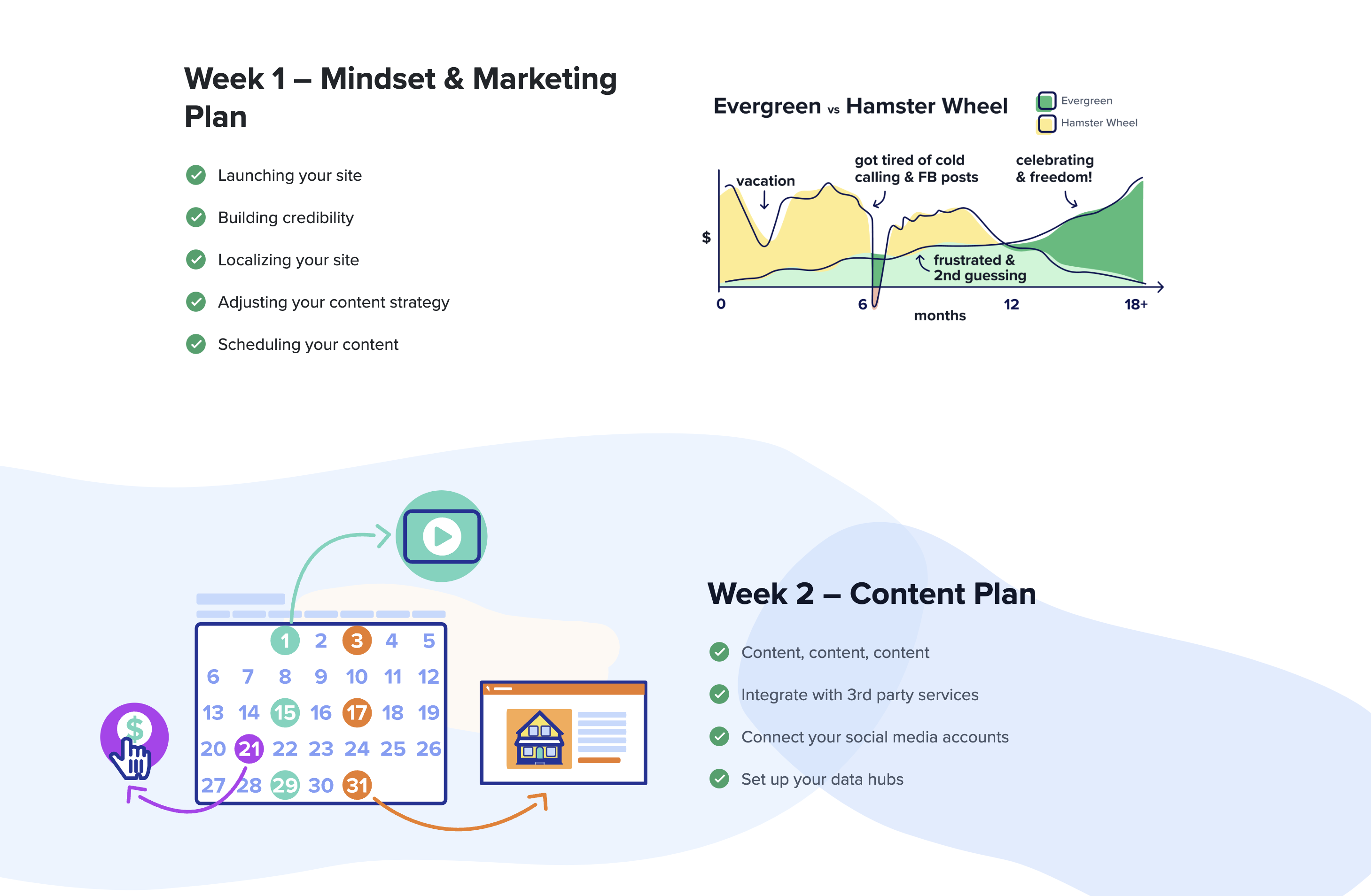
    1. Hamster wheel marketing
    2. Evergreen marketing

    Hamster wheel marketing refers to inbound marketing efforts that require you to keep working in order to get results. That includes running paid advertisements, sending direct mail, cold calling, and so forth. 

    These tactics are beneficial for real estate investors.. 

    But they’re not long-term or lasting

    They only work for as long as you work. 

    Evergreen marketing, on the other hand, refers to marketing efforts that have a lasting impact. You work on something today and it delivers results for years to come without any additional effort on your part.

    This includes building your website’s search engine rankings and creating a well-known brand in your community that generates word-of-mouth. 

    These strategies are what we help investors with here at Carrot.

    We know that businesses built on the foundation of Evergreen marketing are much more resilient, profitable, and predictable.

    Check out the video to learn more about this distinction…


    Evergreen Marketing: How To Finally Get Off Marketing Hamster Wheel and Convert Leads 2-4x Higher

    And we’re here to tell you that Evergreen marketing can support your business — thousands of our members have experienced the difference for themselves. 

    That doesn’t mean you won’t still do some hamster wheel marketing to fill in the gaps, but Evergreen can be the foundation and driving force for your business. 

    And when it is, everything changes.

    3. You Can’t Determine the ROI of Online Marketing

    Let’s think about online, inbound marketing, practically for a moment. 

    If we’re talking about word-of-mouth and SEO (Search Engine Optimization), how are you going to prove the ROI of your marketing efforts? 

    The ROI of SEO, for instance — the best Evergreen marketing tactic we know of — is inherently difficult to track.

    And if you hire a content writer, an SEO agency, and a custom website designer… then the cost will climb fast.

    Heck — it might take years to get a positive ROI from your investment. 

    That’s why we’ve made the process easier. 

    With specialized real estate website services, such as Carrot, you get…

    • A website that is built to rank in Google AND to convert visitors into leads. 
    • Done-for-you content every month that’s optimized for various keywords in your market. 
    • Keyword trackers that report your SEO rankings. 
    • An SEO tool that helps you easily optimize the content on each page of your website. 

    And more…

    This makes it easier to rank in Google, and it makes it easier to prove the ROI of your efforts. 

    Our highest-level plan is $199 per month — it includes all the goodies and features to get your website ranking as quickly as possible. 

    Per year, that’s $2,388. 

    How much is your average profit on a deal? $5,000? $10,000? 

    If you sign up for Carrot and get just one deal over the next 12 months from SEO… you will make at least double your money. 

    And chances are, you’re going to get more than just one deal through SEO.

    4. Online Marketing Lead Quality Isn’t That Good

    To some degree, SEO puts the power in the hands of the searcher and website visitor — they can browse, click, and read whatever they want. 

    And so you might be tempted to think that, since the power is entirely in their hands, lead quality is going to suffer. 

    The opposite is true.

    Lead quality can skyrocket when you focus on SEO.

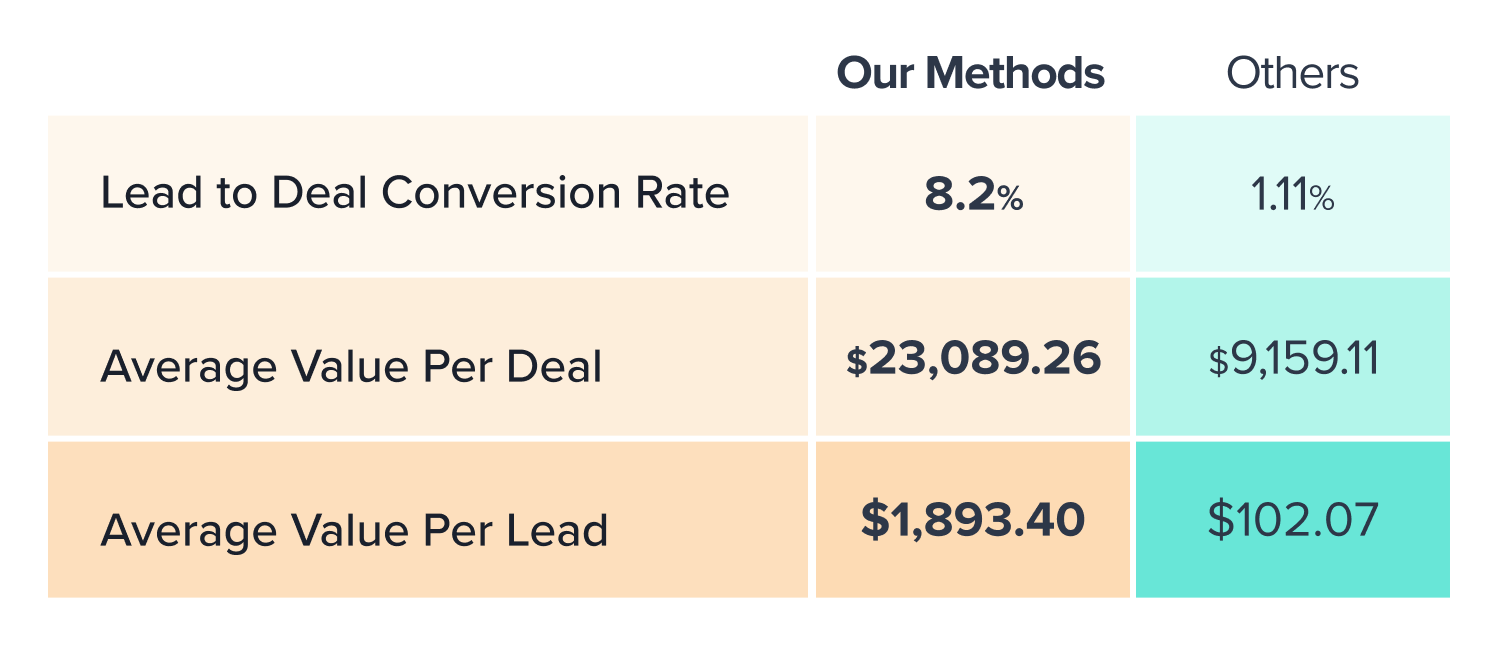
    Our members’ survey found that Carrot leads convert 7x better and are 2.5x more profitable than non-Carrot leads!

    carrot leads vs non-carrot leads

    That’s because “Carrot leads” often come through Google rankings. But, this can be from any website ranking on the top of Google.

    And it makes sense that Evergreen marketing leads would be higher quality than hamster wheel marketing leads. 

    Think about it… 

    Paid advertising, direct mail, and cold calling are all types of interruption marketing methods. You interrupt the person when they are doing something completely unrelated to what you want to talk to them about.

    (Which the exception of Google Ads)

    For SEO, however, the person is actively looking for your services

    Maybe they type in “Sell my house fast in ” or “Cash buyer in ”.

    Either way, those people are looking for your services and they’re going to…

    • Turn into deals more regularly
    • Be willing to accept lower offers

    These people are already looking for you online in your market… your job is to improve your website’s visibility so that you’re the one they come to visit.

    5. Online Marketing is Too Expensive

    This objection is very similar to the second objection we talked about — that you can’t prove the ROI of Evergreen marketing. 

    And it should be a concern if you plan to spend thousands of dollars per month on your Evergreen marketing efforts. 

    If possible, you need to make sure that that investment is paying off. 

    What if there were a less expensive and just as effective way to improve your rankings and drive results? 

    What if there were a way not to hire a web designer, an SEO agency, and a content writer?

    That’s what we, as well as other real estate services, offer — all of the above gets packaged into one affordable monthly plan. 

    Carrot gives you a high-converting website, monthly SEO-focused content, and all the tools you need to improve and track your rankings with ease. 

    And our plans start at just $69 per month

    6. My Business Just Relies on Word-Of-Mouth

    Maybe you don’t have a website, and you don’t think you need one.

    Maybe your business relies on word-of-mouth to generate leads and close deals.

    First of all, good work. Creating a business that generates word-of-mouth is an enviable feat — one that you should be proud of. 

    BUT…

    If you don’t have a website, then you’re missing out on…

    • Having a more streamlined business
    • Having a more predictable monthly income
    • Generating consistent leads and deals

    In fact, for five years, Robert and Ricky Grand — real estate agents and investors in Eugene, Oregon — depended on word-of-mouth to find deals. 

    And it was going okay. 

    But here’s what they said after joining Carrot…

    “I’m 100% all-in with Trevor and Carrot. They know what they are doing. Yes, they are a business with the goal to be profitable, but these guys care and are totally on our side.

    Honestly, working with Trevor and his team is refreshing. I trust them and don’t second guess anything. If Carrot gives us feedback, we implement it without wondering if there is a catch.

    Hope it helps to hear it from someone who is a customer. I happily spend the money to work with them.”

    – Ricky Grand, Grand Real Estate Investments

    In just four years, these guys transformed their word-of-mouth-based side-hustle into a full-time 7 figure business in large part because they dove headfirst into Evergreen marketing and supplementing with Google Ads.

    Check out their story here.

    7. A Website is a Website

    Maybe after reading that last section, you think that you do need a website.

    Your next thought might be, Well, I’m just going to keep it simple and build a basic website with WordPress or something. “I can get WP and hosting for under $10/mo or Wix for cheap.”

    Because a website is just a website, right? 

    Wrong. 

    Not all websites are created equal. There’s a lot of stuff that goes into building a high-converting website — from tech stack and page speed to sales copy and conversion optimization.

    There are many options, but services such as Carrot are designed for real estate professionals. We have proven data to back up our claims that we will help our members rank higher and produce more leads to close more deals.

    Everything from the fastest page speeds to custom-written SEO content and an automated content delivery system. They are guaranteed to help you rise above the competition.

    You don’t just need a website. 

    You need a website that…

    • Ranks in Google for high-value keyword phrases
    • Converts visitors into leads systematically

    That’s what we offer at Carrot. 

    We’ve spent over a decade studying the psychology behind motivated sellers. And we’ve taken what we’ve learned and baked that right into our website templates…

    … so your website is virtually guaranteed to convert better than your competitors. 

    real estate investor website conversion optimization

    And to give you a glimpse of just how much better our tech stack is than other popular website builders, check out this article.

    A third-party examination of 150,000 websites found that Carrot’s tech stack outperforms practically every other website builder…

    Google PageSpeed Score for Small Providers

    So no… a website isn’t just a website. 

    You need a high-performing website. 

    And at Carrot, we worry about that so you don’t have to. 

    “We couldn’t be happier with the site so far…What we have seen is a DRAMATIC increase in web leads.  Since switching to Carrot, the leads we are getting are converting to purchases at a MUCH higher level.  

    Things have been moving so fast that we haven’t had the opportunity to accurately determine the lead to purchase ratio, but I would estimate it is in the 25 to 35% range, which means the leads we are getting are significantly better than our historical average.

    Thanks for everything and we are now looking at expansion because of the success we have had in such a short time.”

    – Carter Steph, 18002SellHomes

    8. Paid Advertising is All My Business Needs

    Many real estate investors solely rely on hamster wheel marketing methods to keep their business afloat…

    • Direct Mail
    • Facebook Ads
    • Cold Calling

    And as we’ve said before, that’s not necessarily a bad thing. 

    We think that those tactics should be a part of your business — they’re a great way to build brand awareness and create a consistent flow of leads. 

    But should they be the foundation? 

    We don’t think so. 

    Because the moment you stop spinning the wheel is the exact moment that deals stop coming through your day.

    What if, instead, you could build a marketing system that generates traffic and leads for your business for years to come without any additional effort or budget? What if those leads were high quality and turned into deals at an exceptional rate?

    That’s the power of Evergreen Marketing. 

    You might not need it. 

    But “need” is just a matter of perspective…

    If you want to create a business with predictable monthly lead-flow, if you’re going to generate more high-quality leads and make more money on every deal… then yes, you need Evergreen marketing.

    9. My Website Doesn’t Need to Be Mobile-Friendly

    This is a myth that’s easy to knock down. 

    If you think that your website doesn’t need to be mobile-friendly, consider the following statistic we’ve pulled from our Carrot member’s sites — and keep in mind that these investors come from different places all over the nation…

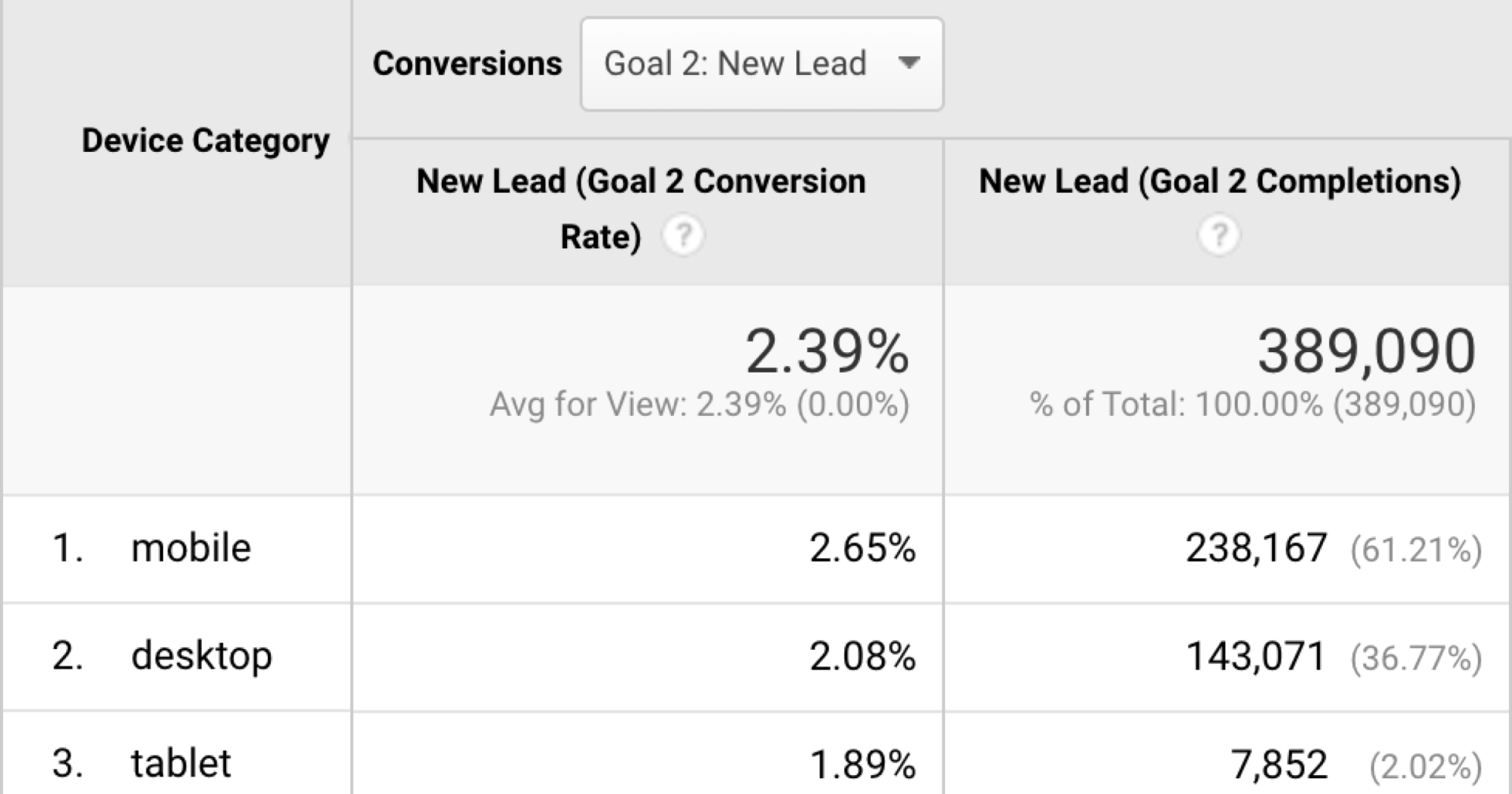
    Over 60% of our member leads come through mobile devices.

    Carrot member mobile leads

    So yes, your Carrot site does need to be mobile-friendly

    And lest you try to build your custom site and make it mobile-friendly — which will cost you a ton of money — every single one of our website templates is automatically optimized for both desktop and mobile. 

    Let’s take, for instance, one of the most recent Google Algorithm updates… Core Web Vitals. Page speed on mobile devices was a hot topic. If mobile page speed isn’t up to par, your Google ranking could suffer.  

    10. SEO Takes Too Long to See Results

    Maybe you think that you can build a WordPress site and just do a little bit of SEO research and then do a little bit of optimizing. 

    You could

    But should you? 

    Here’s what we know — if you do a little bit of SEO work, that’ll result in a little bit of SEO traffic (if you’re lucky). 

    Any reputable SEO agency will tell you the same thing, SEO takes time.

    And if you want a lot of SEO traffic, then you’ve got to put in a lot of work.

    While some can see quicker results, it is ultimately determined by different variables before seeing how rankings settle in 4-12 months.

    Some of these variables include:

    • Relevant keywords and topics
    • How much content you have relating to those keywords and topics
    • Quality of content
    • Age and speed of the websites and domain
    • Website design, including ease of use
    • The average time a user stays on the site
    • Geographical location
    • Competition
    • Level of social activity
    • Page-speed

    Again, we know this takes time and hard work. But, once your Evergreen – SEO marketing kicks in, you can sit back and reap the benefits. Highly qualified leads will come to you rather than you seeking them out.

    You could just get yourself a Carrot website and we’ll do it for you or check out our guide for real estate SEO.

    Overall, there’s no shortcut to ranking in Google. 

    Make These Myths a Thing of the Past

    Hopefully, you’ve acquired a new perspective on some of your limiting beliefs. 

    As we said at the beginning, having a misconception of inbound marketing for real estate investors can limit your business growth. 

    If you’re not a Carrot member yet and are curious to see if this can help you generate more leads online (motivated sellers, buyers, tenants, note sellers, etc.), take our demo and check out what Carrot has to offer.

    But enough from us — what limiting beliefs have you had to overcome in order to move forward in your business? We’d love to hear about it in the comments!

  • How TikTok For Real Estate Became a Legitimate Lead Source | An Agent’s Guide

    How TikTok For Real Estate Became a Legitimate Lead Source | An Agent’s Guide

    Every so often, a new social media platform one-ups existing platforms and drives a makes a spot for itself in the digital universe. That’s what TikTok for real estate has done.

    The platform launched in 2016 and now has over 1 billion monthly active users who open the app an average of 8 times per day and spend an average of 52 minutes per day scrolling.

    But what is TikTok, exactly? And how can it benefit you if you’re a real estate agent?

    That’s what we’re going to talk about in this guide — we’ll give a quick-and-dirty debrief on what TikTok is and how it works, we’ll explain why you might want to consider using TikTok, we’ll give you some other agents and investors to follow (for inspiration). Then we’ll finish with 10 tips.

    You’ll know how, when, and what to post about by the end of this post. Then it’s off to the races!

    A TikTok for Real Estate Debrief

    So, what is TikTok, and why is it so popular?

    Maybe you’ve heard that TikTok is a platform that’s just jam-packed with young people dancing — but while there is a fair share of dancing (don’t say we didn’t warn you), there’s also lots of value-driven content about various topics, including real estate.

    TikTok content comes in the form of short videos — anywhere from 15 seconds to three minutes. These videos could be funny, engaging, sad, or severe. The moment you get on the platform, videos start popping up, you start watching, scroll to see more, and wave goodbye to any delayed gratification you had left in the tank.

    Jokes aside, or maybe not, here are a few examples of different popular TikTok videos from 2021…

    @zachking

    They rejected my application to Hogwarts but I still found a way to be a wizard. 🧹#illusion #magic #harrypotter

    ♬ Zach Kings Magic Broomstick – Zach King
    @kisonkee

    You guys (literally) asked for this 😂 #comedy #fyp #wtbdijw

    ♬ original sound – Kison Kee

    But the easiest way to understand the platform is to try it out for yourself — you can get a free account over here.

    Okay, so the “million-dollar” TikTok videos are pretty silly. But there’s also a substantial TikTok “market” for real estate.

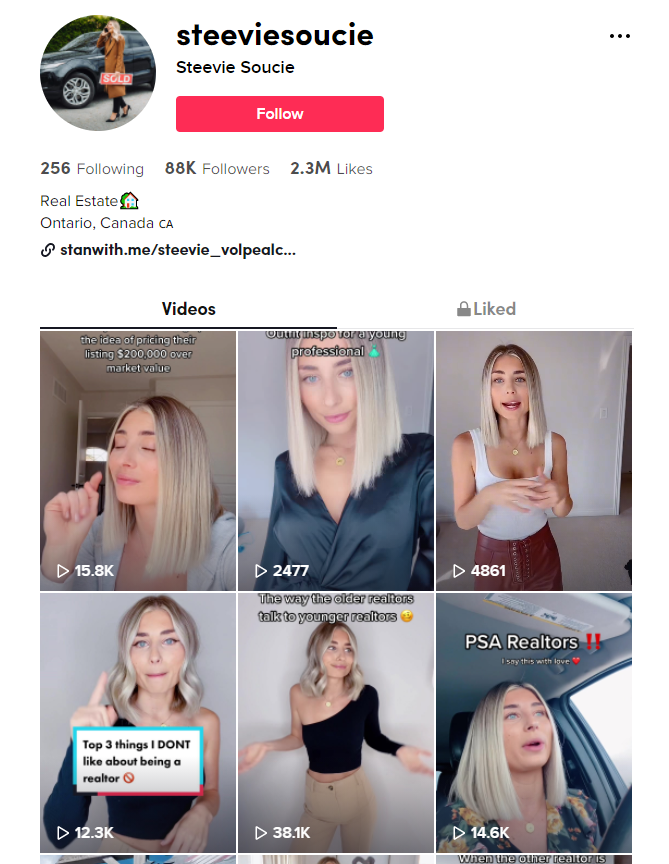
    Here’s Steevie Soucie talking about old homes vs. new homes to the tune of 324 “likes”.

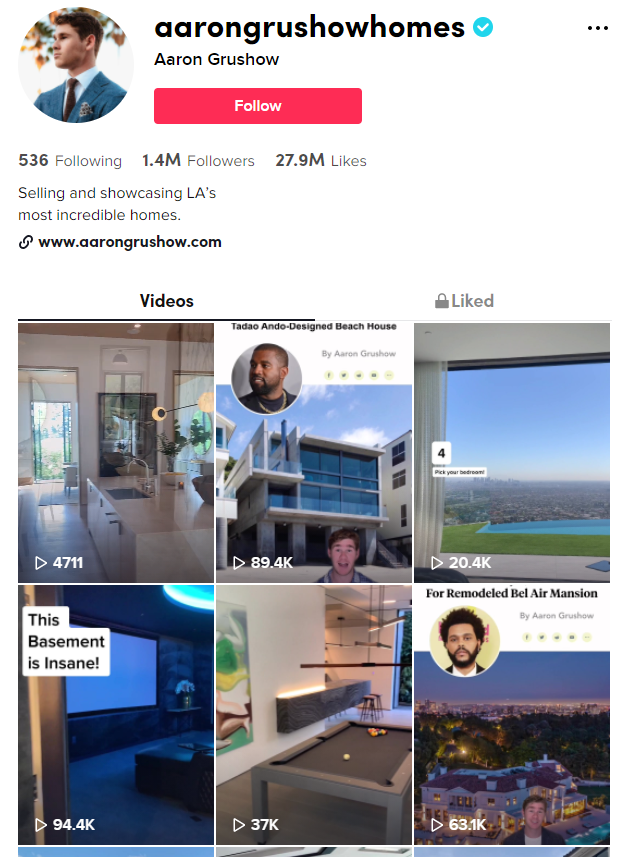
    And here’s Aaron Grushow walking through luxury listings (138,000 “likes”)…

    We’ll look at a lot more examples throughout the rest of this guide, but the point right now is two-fold:

    1. TikTok is super popular
    2. TikTok is great for real estate agents

    If you still need some more convincing on that 2nd point, then keep reading.

    Why Should Real Estate Agents Use TikTok?

    We’ve seen that TikTok is popular.

    But popular doesn’t necessarily mean profitable.

    The question is this: how is TikTok going to help you grow your real estate business?

    Well, an article from Insider titled, Real-estate agents are finding success by turning to TikTok: ‘It doesn’t seem to matter if the place is $2,000 or $600,000’, answers that question with real-life stories.

    Here are a few excerpts…

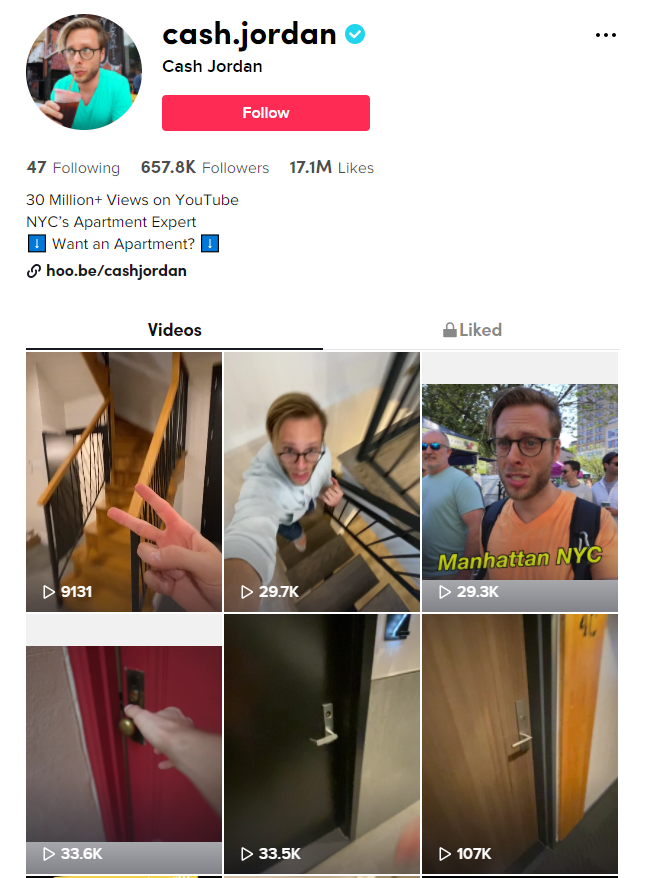
    “It doesn’t seem to matter if the place is $2,000 or $600,000, somebody out there on TikTok is big enough, and YouTube is big enough that people see it and are interested,” Jordan said.

    Jordan estimated using TikTok had doubled his number of clients.

    Here is one of Jordan’s videos…

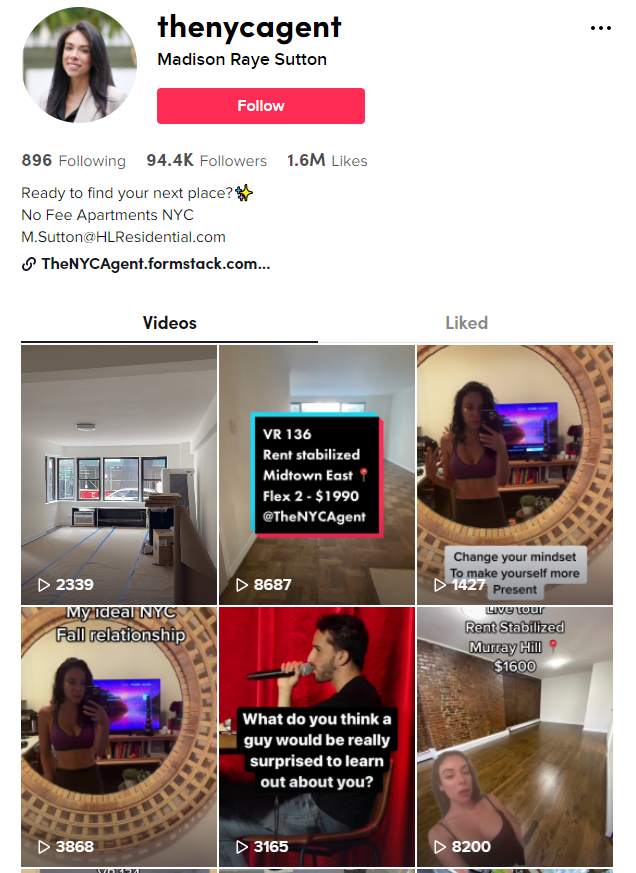
    Similarly, Madison Sutton, who posts on TikTok as @thenycagent, has 95,700 followers and has amassed 1.5 million total likes across her videos. Sutton, who works for Highline, found herself concerned about the safety and efficiency of in-person showings. So in October of last year, she turned to TikTok. “Where else in New York City can you see ten apartments in ten minutes?” she asked.

    Sutton, like Jordan, focuses primarily on rentals, and she says business is “five or six times heavier” compared to this time last year.

    Here is one of Madison’s videos…

    @thenycagent

    Reply to @deceased I want to move to NYC, when should I look? #nyc #nycfood

    ♬ original sound – TheNYCAgent
    What’s excellent about TikTok for real estate agents is that it’s surprisingly easy to go viral. Insider explains…

    Perry also said that TikTok is unique among social media platforms for how content reaches people and potentially goes viral. Due to the site’s algorithmic “For You Page,” she explained, “You don’t need to have a massive following for your videos to go viral and to be seen by hundreds of thousands of people.” Instead, content from new accounts appears in users’ feeds automatically based on their previous interests.

    In your case, virality means more views, which means more brand awareness, which means more clients organically.

    Additionally, TikTok prioritizes delivering content that is local to your area. So you’ll be seeing videos from other people in your city, and state and they’ll be seeing videos from you.

    That’s hugely beneficial for real estate agents.

    But, of course, as powerful as TikTok is, it’s not for every real estate agent — here are some questions you should ask yourself…

    1. Are you comfortable on camera?
    2. Are you willing to be silly, charismatic, and authentic?
    3. Are you able to commit to posting consistently?

    If you can say “yes” to all three of those questions, then TikTok is probably an excellent opportunity to grow your real estate business.

    Now let’s get some inspiration.

    Best Real Estate Investors & Agents to Follow on TikTok (For Inspiration)

    If you start posting on TikTok to build brand awareness and find clients, there will be times when you sit down and think… what the heck should I post about today?

    That’s why it’s a good idea to follow other popular real estate agents — you can use their posts as inspiration for your own. If they had a post perform well (lots of comments and likes), something similar might work for you.

    When you’re in a rut, you can browse their videos to get ideas.

    Here are 5 fantastic real estate agents to follow!

    1. Steevie Soucie

    tiktok for real estate agent - steevie soucie

    2. Aaron Grushow

    Aaron Grushow TikTok

    3. Cash Jordan

    Cash Jordan TikTok

    4. Madison Raye Sutton

    Madison Ray Sutton TikTok

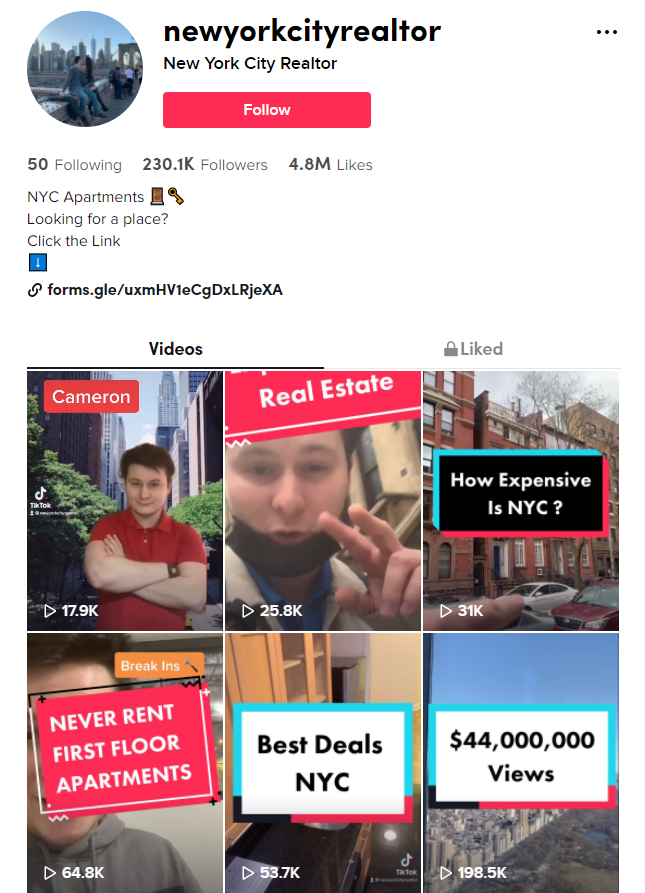
    5. New York City Realtor

    New York City Realtor TikTok

    10 TikTok Tips for Real Estate Agents

    Okay — we’ve given you a debrief of how TikTok works, we’ve shown you how TikTok can be powerful for your business, and we’ve shown you tons of real-life examples.

    So… how do you do it?

    That’s up next!

    Here are 10 tips for creating an engaging TikTok presence that’ll build brand awareness and deliver clients to your digital doorstep.

    1. Start With a High-Converting Website

    We’re talking about creating content on TikTok and getting engagement, but let’s not lose sight of what matters: generating leads and getting clients.

    We’ve got to ask how people will become a lead — how they will learn about us and get ahold of us — if they like what they see on TikTok.

    Well, assuming that our content is good and our profile is optimized (see the next tip), the person will probably click through to our website to learn more about us. And if our website is built to convert visitors into leads (by either getting them to call or snagging their contact information), then it all will have been worth it.

    But how do you build a high-converting website?

    We’ve done it for you — go here to get a 30-day risk-free trial.

    2. Optimize Your Profile

    If someone likes your content and wants to learn more about you, they’re going to click through to your profile — they’ll then read your bio, look at your profile pic, and maybe even visit your website.

    Then, your website needs to be optimized to build trust and rapport.

    Look at what Madison Raye Sutton does…

    Madison Ray Sutton TikTok for real estate

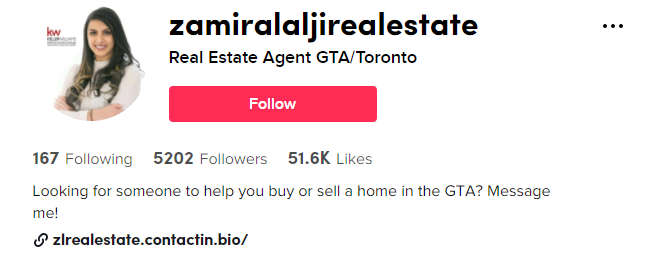
    She has a professional profile pic and a bio that promotes her services — “Ready to find your next place?” — with a link to her website.

    That’s ground-zero for what you need in your profile.

    This part is easy. Don’t overthink it.

    3. Pay Attention to Trends

    In some ways, the content on TikTok is collaborative amongst users; the primary way this crops up is in the form of various trends.

    A trend is what it sounds like. A video goes viral on TikTok and people copy the content in their way and use the same hashtag.

    What’s cool about trends is that A) it’ll give you ideas for what to post about and B) you have a higher chance of going viral by posting about recent trends.

    You can see a ton of examples of trends over here.

    Here are 5 real estate TikTok trends that you might consider joining in on — make sure to put your spin on it and use the right hashtag!

    Oh — and don’t be afraid to try and start a trend on TikTok!

    4. Use Hashtags

    Much like Instagram, hashtags are a huge part of posting popular content on TikTok.

    You can use hashtags to define what your post is about for the TikTok algorithm so that interested parties see it. And, as mentioned in the last tip, you can also use hashtags to associate your post with specific trends.

    5. Do Home Tours

    There are many different types of content you can post on TikTok, but since you’re a real estate agent, perhaps the lowest hanging fruit is doing tours of your house listings.

    You can make these videos informative, sexy, luxurious, etc.

    However you do it, get in the habit of posting home tours on TikTok whenever you get a new listing or want to draw extra attention to an existing listing. You never know where a client is going to come from!

    6. Offer Expert Advice

    When it comes to offering advice on TikTok, some content creators might not know what to talk about because they’re not an expert in anything specific.

    But you, dear reader, are an expert at real estate.

    And it would help if you showed that expertise on TikTok. Whether it’s…

    • Sharing homebuying tips
    • Explaining rehab costs
    • Discussing the state of the market
    • Sharing case studies of actual clients

    … and so on.

    In an article from Outfront, one real estate agent explains their strategy for coming up with TikTok content ideas…

    “If you were educating a homebuyers’ seminar that would typically take you an hour and a half, how could you break that down into 15 seconds each? Now you have a ton of content to share.”

    7. Show Your Personality

    “Our other social media is professional, and we can show more of our personality through our TikToks,” Palma says. “We make it entertaining, but also educational.”

    “I think it’s the new wave of experiential marketing,” Brush says. “I’m not that traditional broker who posts things online and waits for the buyer to come. The biggest thing that I bring to the table is just my energy. The best way to articulate that is through video so everyone can see and get to know me.”

    8. Track Engagement

    If your goal is to build brand awareness and get more clients by using TikTok, then the first step is to post videos that get engagement — specifically, we’re talking about likes, comments, and shares.

    And it’s essential to learn as you go.

    Track the engagement of your TikTok posts (you might even create a spreadsheet) and pay attention to what works and what doesn’t work.

    Then try to do more of what’s receiving engagement and do less of what isn’t.

    9. Create a Content Calendar

    If it’s not scheduled, it probably won’t happen.

    So if you’re serious about building out your TikTok presence, then create a content calendar. It should indicate how often you’re going to post and what you’re going to post about.

    Then stick to it.

    TikTok recommends posting 1-4 times per day, but if you’re new, you can do a little bit less than that.

    Challenge yourself to post once every other day for a month and see how it goes — you might be surprised by how much progress you make.

    10. Engage With Comments

    Our final tip is to engage with the comments you get. Since some of the people you’re interacting with might become clients down the road, it’s essential to start on the right foot.

    Final Thoughts

    TikTok is a popular social media platform with over 1 billion monthly active users. The platform also offers tons of potential for small business owners to build brand awareness, establish their expertise, and find clients — real estate agents included.

    We’ve discussed how TikTok for real estate works, why it’s powerful for real estate agents, and we even shared 10 tips for creating engaging content.

    But at the end of the day, you can’t know if it’ll work for you unless you try.

    So off you go! And good luck!

  • Top 3 Social Media for Real Estate Platforms for New Business Growth

    Top 3 Social Media for Real Estate Platforms for New Business Growth

    Social media for real estate agents is now an essential part of the marketing strategy.

    The 21st century has brought a lot of surprises with it — not least of all self-driving cars and monkeys playing pong with their minds (thanks, Musk) — including how real estate agents find clients and grow their businesses.

    A few decades ago, business cards and direct mail were all the rage. That was just about all an agent could do to find clients.

    The internet has changed that.

    Social media, in particular, has created a massive opportunity for real estate agents to build trust, display their expertise, and find clients… all without leaving the comfort of their sofa.

    How?

    That’s what we’re talking about here — why you should use social media, which platforms are best, what to post, how often to post, and how to optimize your profiles to attract clients.

    First things first!

    Why Should Real Estate Agents Use Social Media?

    So you’re looking for a way to find clients consistently.

    Maybe you’ve seen other real estate agents use social media successfully… or maybe you just got the idea without any prompting.

    Whatever the case — however you came about the idea of using social media posts for real estate to find clients — it’s a good idea.

    And you don’t have to take our word for it.

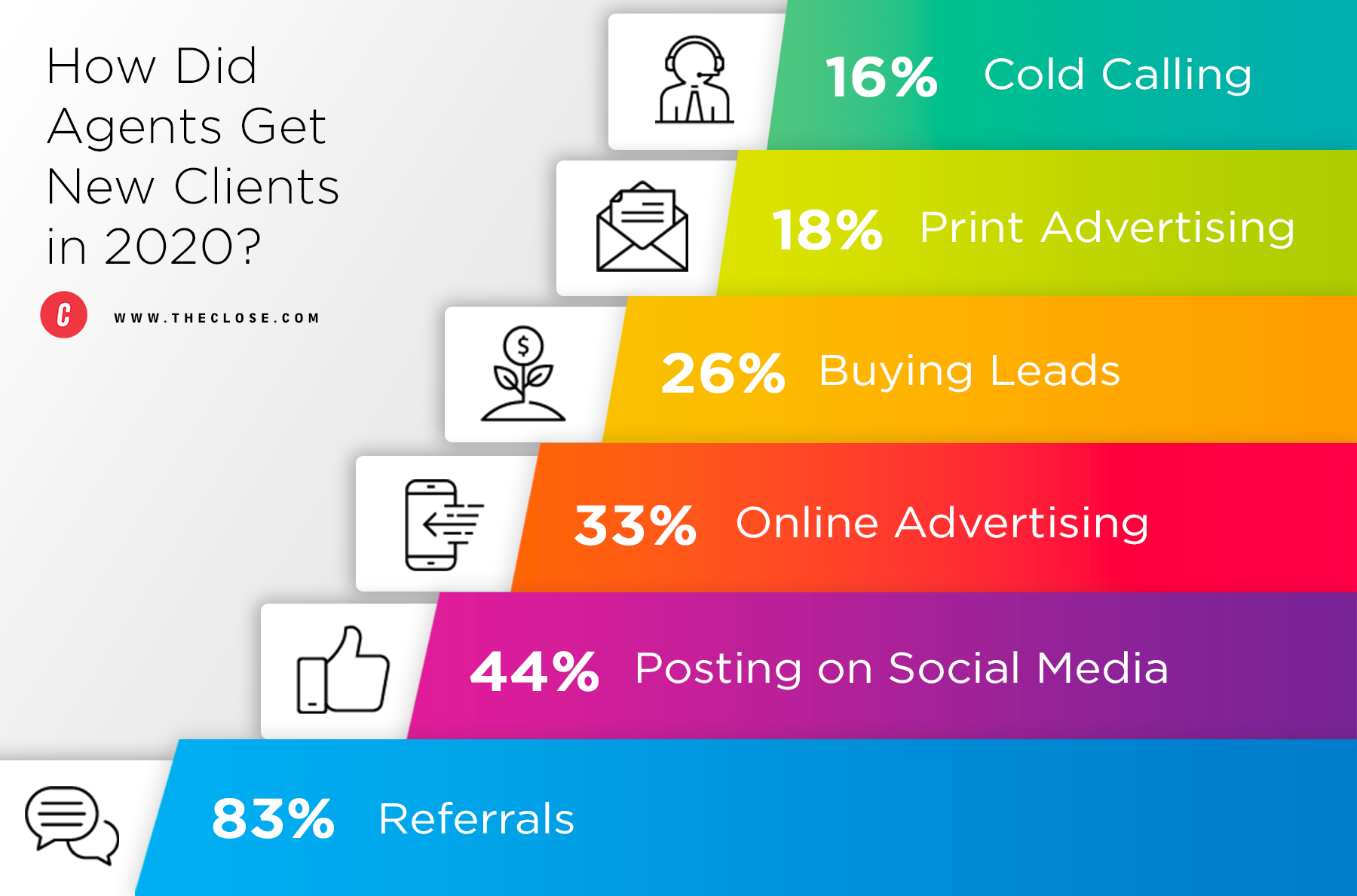
    SocialMediaToday published stats revealing how impactful social media has been for real estate agents. In 2020, 44% of agents said they found clients through social media…

    Social Media Real Estate Stats

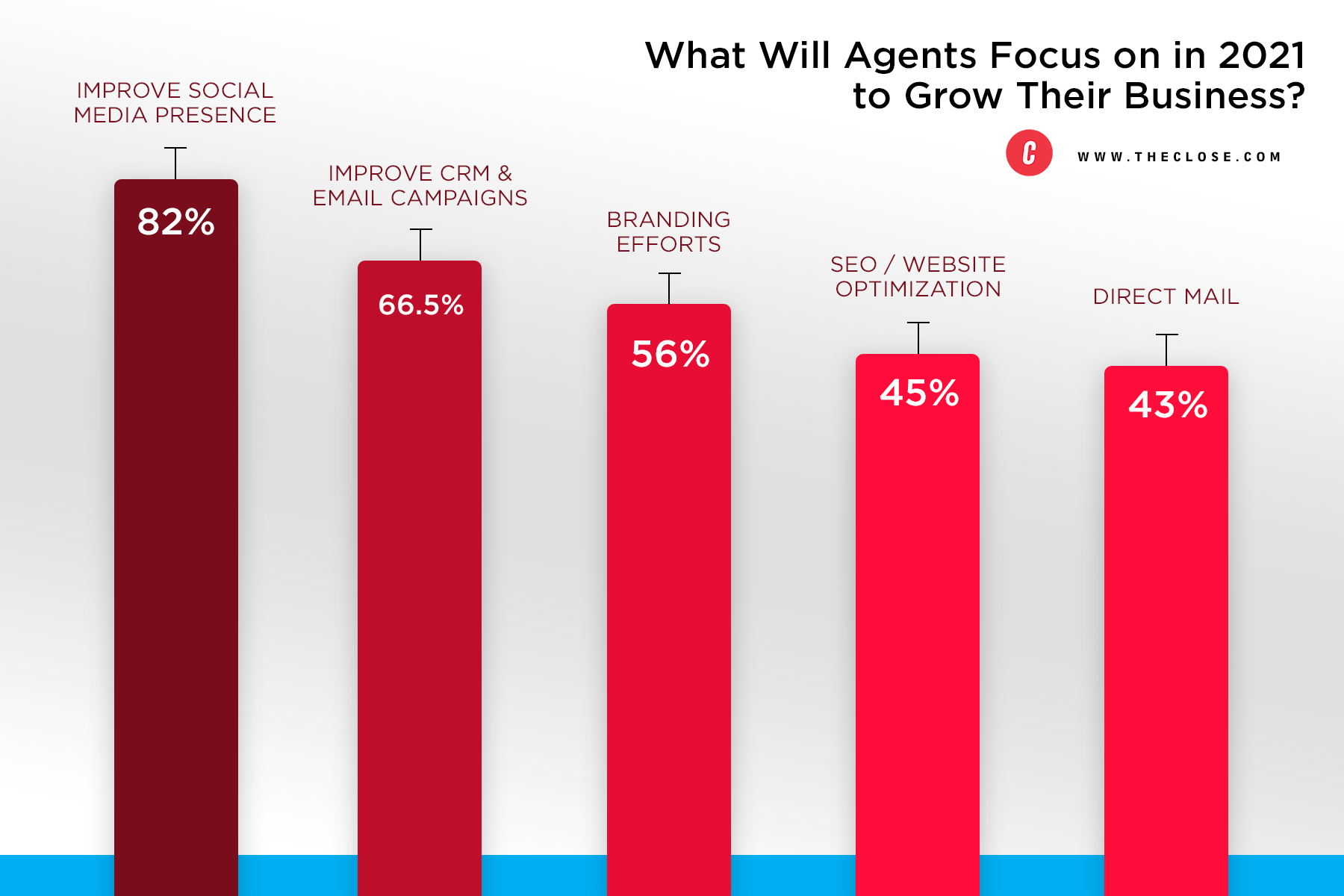
    Additionally, 82% of real estate agents said they would focus on improving their social media presence to grow their business…

    Social Media Real Estate Stats

    So there should be no doubt.

    Done right, social media marketing (both organic and paid) can be an extremely effective strategy for growing your real estate business.

    You can increase brand awareness, showcase your expertise and years of experience, build authentic relationships, and, most importantly, find clients.

    Now, let’s talk about which platform you should use.

    Which Social Media Platform is Best For Real Estate Agents?

    The bad news is that there are hundreds of social media platforms.

    The good news is that the vast majority — for our purposes, all but four — are obsolete.

    Most of them have too few users to be worth your time. And we can even eliminate many of the platforms that do have millions of users because they’re not very localized — Twitter, Pinterest, LinkedIn, etc.

    Every platform has a vibe.

    And what we’re really looking for is social media platforms where people expect to connect with other people in the same city. Because, as a real estate agent, local relationships will be the most valuable relationships.

    So, we’ve narrowed it down to three platforms: Facebook, Instagram, and TikTok.

    1. Facebook

    Facebook is an excellent platform for real estate agents because people expect to connect with people in their city — with “friends.” So both close friends and acquaintances won’t hesitate to accept your friend request.

    Here are some interesting stats about Facebook.

    • Facebook usage is high among U.S. adults, earning over $70k annually.
    • 70% of U.S. adults use the Facebook platform every day.
    • 69% of Americans use Facebook.

    Examples

    Here are some examples of Facebook posts from other real estate agents!

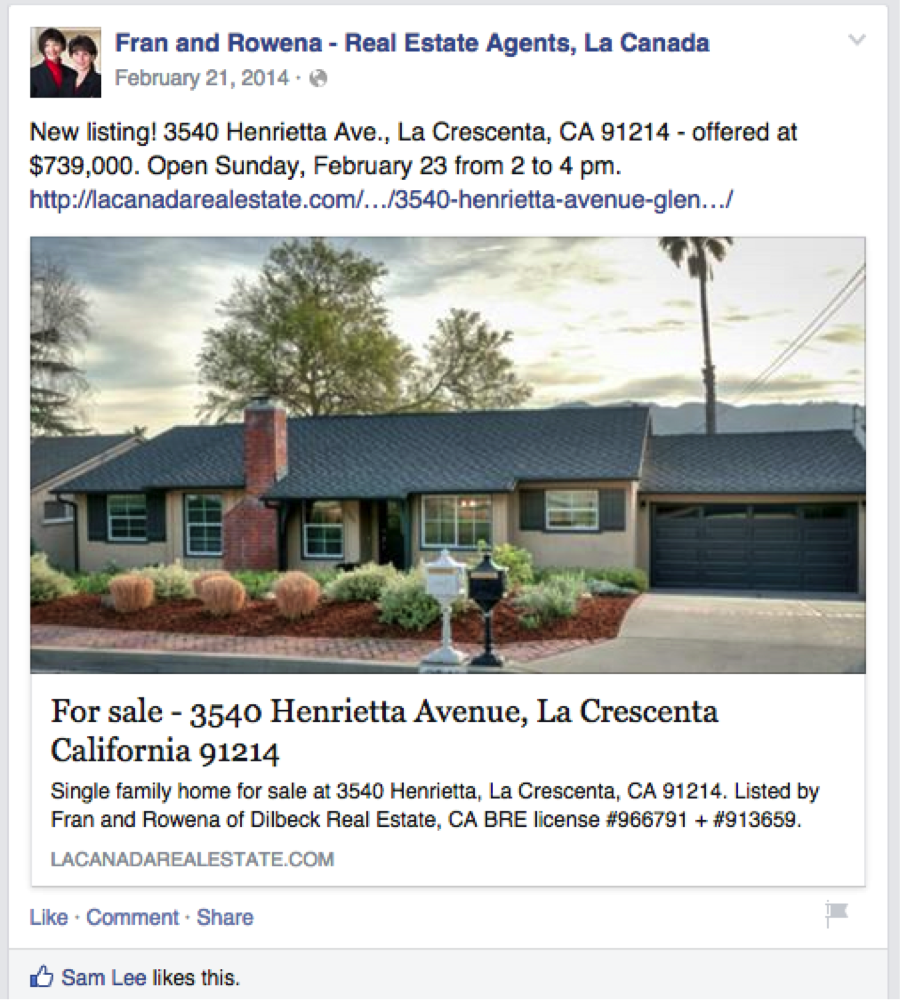
    Listing post…

    Example of a Facebook real estate listing

    Case study post…

    Example of a real estate Facebook success story post

    Behind-the-scenes post…

    real estate Behind-the-scenes Facebook post

    How Often To Post

    The experts at Hootsuite recommend posting 1-2 times daily on Facebook. This should help you stay present in the minds of your audience but not overwhelm them.

    Other Facebook Tips

    Here are some other tips when you’re posting on Facebook…

    • Be Authentic — Facebook users love authenticity. They want to get to know the real you… not necessarily the business. So don’t be afraid to discuss yourself or share your thoughts and opinions!
    • Don’t Oversell — On Facebook, you shouldn’t try to sell people with every post. You should also entertain people, give them free value, and offer free advice. Make sure you balance your listing posts with other, more personal, value-driven posts.
    • Stay Top-Of-Mind — The goal of Facebook is to stay top-of-mind and to build trust. It’s more about consistency, value sharing, and brand awareness and less about mindlessly posting all of your listings.

    2. Instagram

    Instagram is similar to Facebook in that people are open to following people they know locally. If it’s better than Facebook, that would be because it’s a highly visual platform. And obviously, real estate is highly visual.

    Beautiful house listings and before-and-after pictures do really well on Instagram. Let’s look at some examples…

    Examples

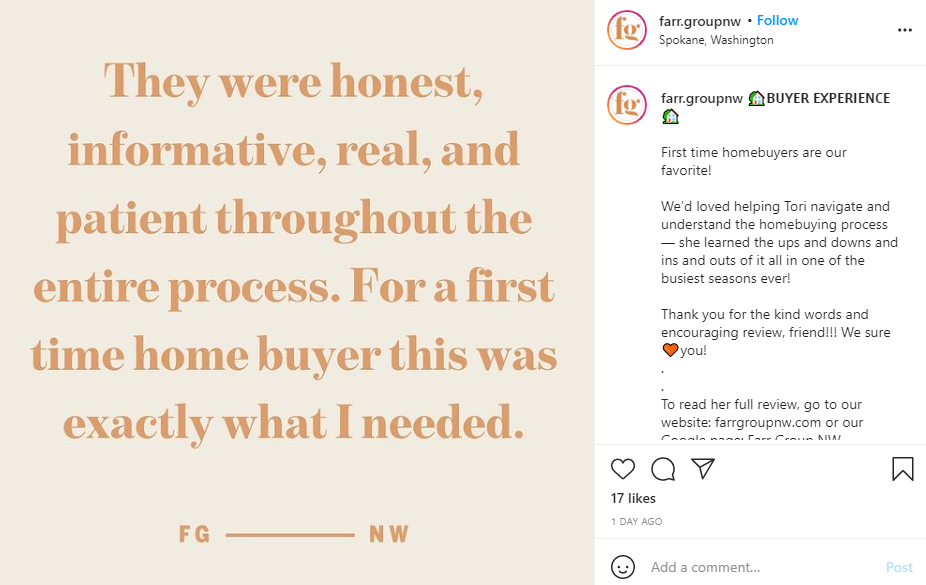
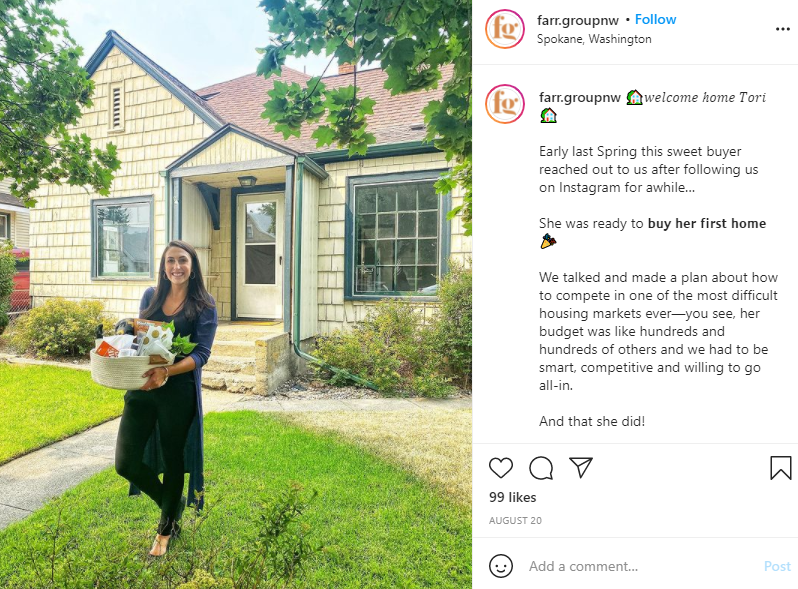
    Here are some great Instagram post examples from Krista and Aaron Farr from Spokane. So that’s where these examples come from.

    Testimonial post…

    Instagram Testimonial Post

    “Sold” notifications…

    Sold Notifications

    Storytelling post…

    Storytelling Instagram Post

    How Often To Post

    Hootsuite recommends posting 3-5 times per week on Instagram.

    Other Instagram Tips

    • Focus On Visuals — Instagram is a highly visual platform. So, focus on making the visuals eye-catching and beautiful. This should be easy if you already get professional photos for your listings!
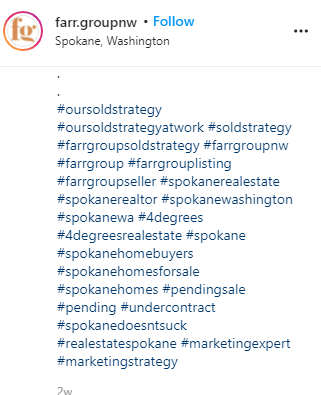
    • Use Hashtags — On every Instagram post, use as many hashtags as you can. That will increase the post’s visibility. Here’s a screenshot of all the Hashtags the Farr Group uses on one of their Instagram posts…
    Instagram real estate Hashtags
    • Create a Vibe — Your Instagram profile should have a “vibe” across all the posts. That is, they should use similar colors and have a similar “feel.” Check out the screenshot below to see what I mean…
    Instagram Profile Vibe

    3. TikTok for Real Estate

    TikTok is a relatively new social media platform with tons of potential for real estate agents. Like Instagram, it’s very visual. But instead of every post being an image or graphic, every post is a short, user-made video.

    The best TikTok videos are value-driven, authentic, funny, and entertaining. The best part is that TikTok localizes the content that people see — so if you live in Roseburg, Oregon, you’ll see content from people in Roseburg, Oregon.

    It also means that people in your city will see your content more than people outside your city — that’s good for business!

    Examples

    Here are some examples of content from real estate agents on TikTok.

    Why buy instead of rent…

    @zamiradunnetrealtor

    Listen up! Move towards buying instead of renting #ontariorealtor #realestatetips

    ♬ My House – Flo Rida
    What $800k will get you in Frisco, TX…

    Market update…

    How Often To Post

    You should post at least once per day on TikTok.

    Other TikTok Tips

    • Be Entertaining — Posts that perform well on TikTok are fast-paced and entertaining. So try to mimic what you see doing well. Be funny, provide tons of value, show interesting behind-the-scenes anecdotes, or tell a crazy story to keep people engaged.
    • Hop on Trends — TikTok is jam-packed with different trends. People doing the same dance, mimicking the same movie lines, or something else. While these trends are a little silly, they’re a great way to get more eyes on your content.
    • Post Often — On TikTok, you should post at least once daily. But more often is pretty much always better.

    Optimizing Your Social Media Profiles To Attract Clients

    Remember why you — a real estate agent — want to start using social media.

    It’s not to gain fame, to scroll your way into oblivion, or to connect with tons of random people…

    It’s to grow your business.

    One thing we’ve got to think about when it comes to growing your business through social media is what people will see when they visit your profile.

    After all, that’s the goal — that people will see your content, get curious, click on your profile, learn about you, and maybe, at some point, become a client.

    But people can’t just be impressed by your content; they must also be impressed by your profile! Or at least not unimpressed.

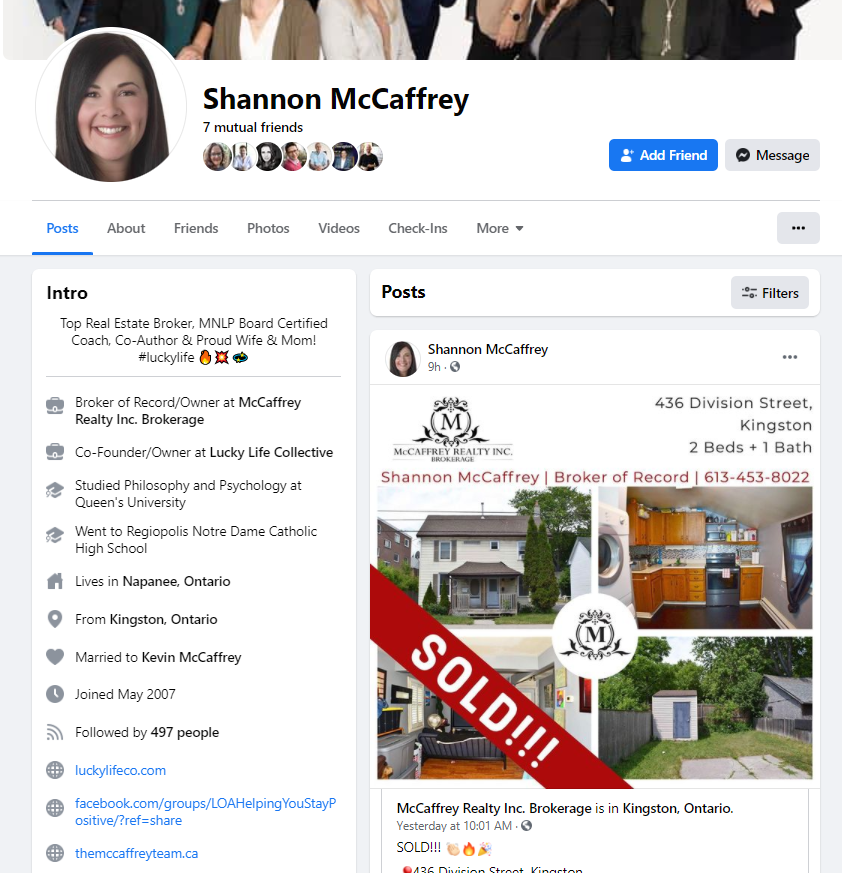
    There’s a baseline that you need to hit — so let’s look at great profiles on Facebook, Instagram, and TikTok and then muse about what makes those profiles great.

    Here’s the Farr Group profile on Instagram…

    Real estate agent profile on Instagram

    Here’s Shannon McCaffrey’s Facebook profile…

    Facebook Agent Profile

    And here’s Zamira Lalji’s TikTok profile…

    real estate agent TikTok profile

    Okay — so what do these profiles have in common?

    First, they don’t have to include custom logos and super amazing graphics… they can be pretty basic. The things that these profiles all have — and that YOU should include! — is…

    • Bio — Who are you? All of the above profiles answer that question quickly and clearly. Tell people that you’re a real estate agent, and tell them where you operate!
    • Credibility — The above profiles also build credibility. Are you a top 1% real estate agent? Have you won awards? How many people have you helped sell their homes? Try to build some credibility by using those stats in your bio!
    • Links — Finally, these profiles tell people where to go (via links) if they want to learn more. So don’t forget to include a link to your website.

    P.S. Don’t Forget Your Website!

    Let’s imagine someone clicks through to your profile because they are currently looking for a real estate agent — crazier things have happened!

    They are impressed by your profile and recent social media posts, so they click through to your website (via the link on your profile). Then what happens?

    Well, that entirely depends on how effective your website is at converting visitors into leads.

    Fortunately, conversion is a science — a science that we’ve mastered at Carrot. We specialize in building high-converting websites for real estate agents and investors. Click here to learn more and to try us out for yourself risk-free!

    Paid vs. Organic

    So far in this guide, we’ve talked almost entirely about organic social media marketing — posting content, building connections, and garnering a following.

    But it’d be a disservice to not briefly mention social media advertising, which can also be an effective (and more direct) way to generate real estate leads.

    So here’s a quick overview with links to learn more…

    The Paid Strategy

    Facebook and Instagram are probably the best places to advertise your services as a real estate agent — and since you’re paying to reach people, these posts can be much more direct.

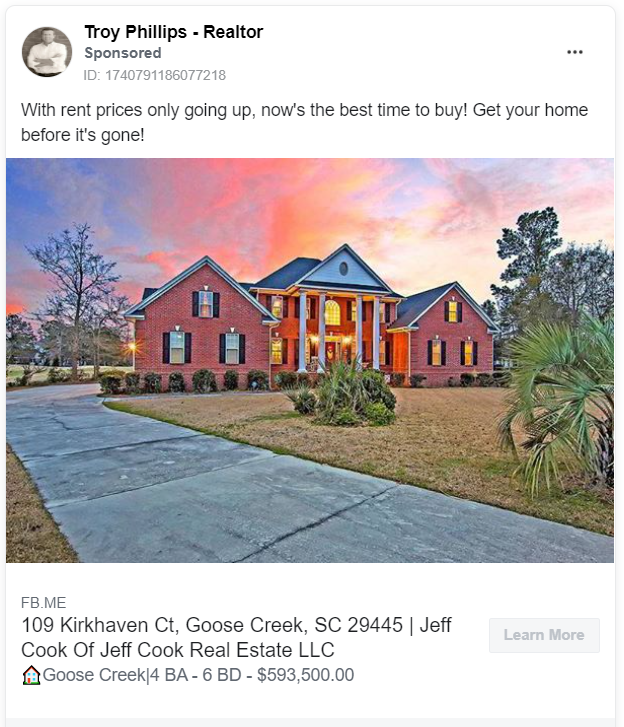
    Here’s an example.

    Real estate agent facebook ad

    And what’s really cool is that Facebook allows you to target people by zip code… so you’ll only reach people within your target market!

    Another helpful strategy is called “retargeting” — the Facebook Pixel allows you to track website visitors and then run advertisements to people who visited your website but who didn’t provide you with their contact information.

    Cool, right?

    Of course, ads cost money.

    You’ll want to track results to see if your spending gives you the needed ROI.

    To learn more about Facebook advertising, check out our interview with Josh Schoenly, where he shares his proven Facebook advertising framework!

    The Organic Strategy

    Organic social media marketing is what we’ve been talking about throughout most of this article.

    This means seeking out authentic connections, posting organic (non-paid) content, and perhaps most of all… being consistent. Getting followers, building trust, and becoming the go-to expert in your market via social media isn’t an overnight venture… it’s something that will take a lot of time and persistence.

    The more that people see your content and the more they like your content, the better.

    The best thing you can do is create a content publishing schedule and stick to it for at least the next 6 months — see what happens!

    52 Real Estate Content Ideas For ANY Social Media Platform

    Okay — now the rubber meets the road.

    You know you want to start using social media to grow your business. And you even know what platform you’re going to use and how often you’re going to post…

    But what are you going to post ABOUT?

    Normally, that’s the hardest part of social media marketing — knowing what to talk about.

    But we’ve made this super easy for you.

    We created this playbook with 52 marketing ideas for real estate agents— and you can easily turn each of these ideas into a social media post instead of a blog post. So click that link and bookmark the guide for when you’ve run out of ideas.

    As always, we’ve got you covered. ;-)

    Final Thoughts

    Social media is a powerful tool with tons of potential for real estate agents.

    And now you know where to start!

    Choose a platform — Facebook, Instagram, or TikTok — create a publishing calendar, stick to it, and bookmark this page to get inspiration and examples when you can’t think of something to share.

    Over time, you’ll increase your brand awareness, build trust, and find new clients. Don’t be tempted to automate this, the risks aren’t worth the reward!

    You’ll also have a competitive advantage over other real estate agents in your market — real estate agents who aren’t using social media.

    So it’s well worth your time.

    All that’s left now is action and consistency — off you go!

  • Think All Carrot Websites Look the Same? You’d Be Wrong! There Are 1000’s of Different Ways to Make Your Carrot Website Design Stand Out From Your Competition

    Think All Carrot Websites Look the Same? You’d Be Wrong! There Are 1000’s of Different Ways to Make Your Carrot Website Design Stand Out From Your Competition

    If you’ve ever thought…

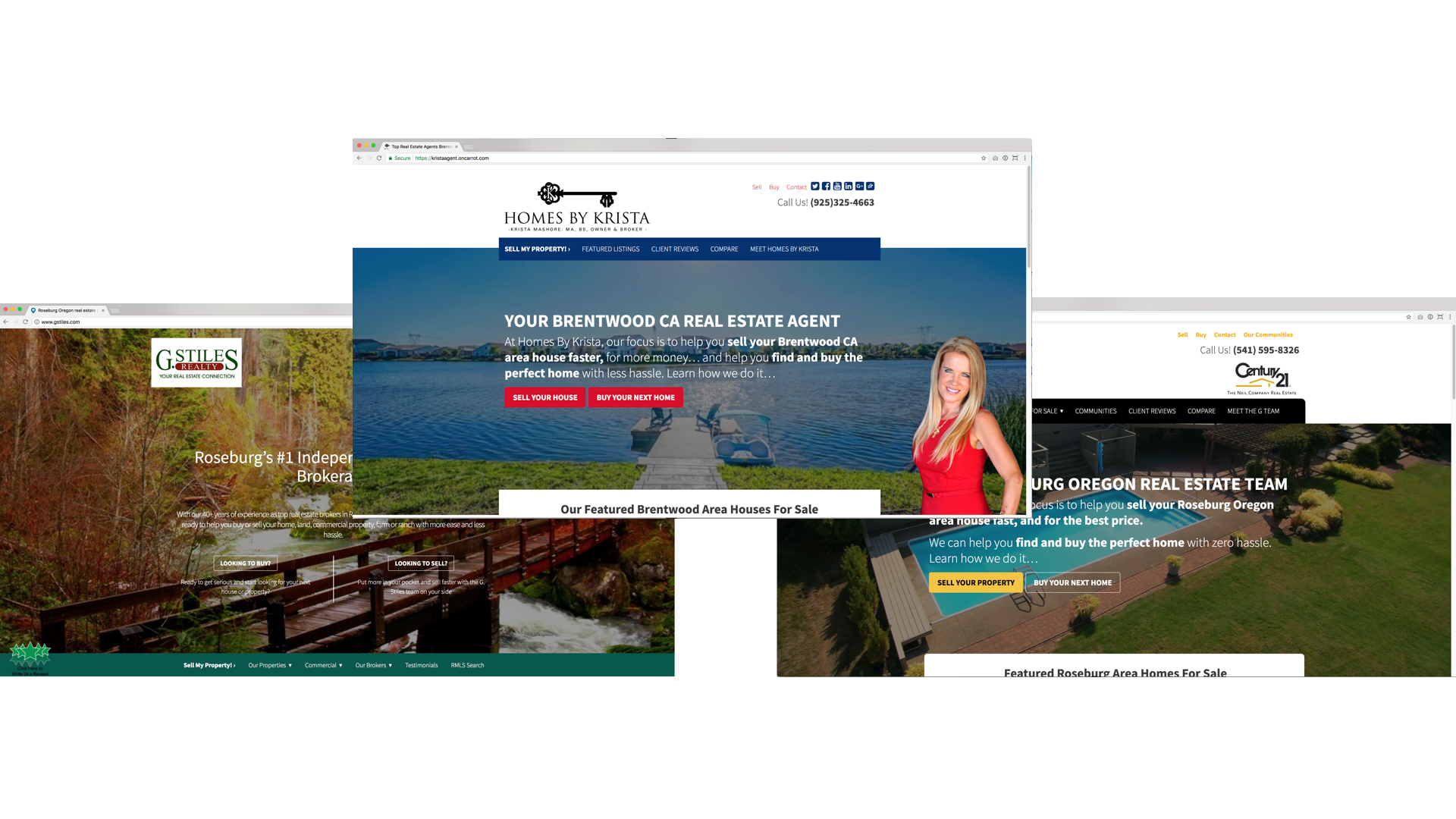
    “Geez, this looks like every other Carrot website design in my market – how can I make myself look different from the others while still maintaining the awesome conversion rate that Carrot websites provide?”

    Then, you’ve come to the right place! We have 1000’s of members, many of whom are in competitive markets and generate hundreds of leads monthly. They close multiple, multiple deals each month, as well.

    To the lead-converting glee of Carrot members, we prioritize conversion optimization over aesthetics. To some, that might seem like a bad idea.

    After all, don’t the two always go hand in hand?

    Not necessarily.

    Carter Steph is proof. Carter switched from an $8k “pretty” custom website to Carrot and saw his closing rate go from 7% to 20% within a few months. Read his story here.

    We have been in business for years and have always had a web presence. We switched to Carrot this month and have already seen a huge improvement in our click-through rate, but more importantly we have more leads being generated by form fills then we have ever received. And we’ve only had our new website up for 7 days!!

    Carter Steph, 1-800-2 Sell Homes

    Even conversion testing giant, Crazy Egg, claims that “ugly” websites often convert better than their prettied-up counterparts. That’s not to say that we’ll provide you with an ugly website that converts well; it’s simply to illustrate that conversion optimization should trump website aesthetics when choosing a website design platform.

    Fortunately, at Carrot, you don’t have to choose between the two – on our real estate investor websites and our real estate agent websites, we’ve found the perfect balance between conversion optimization and beauty.

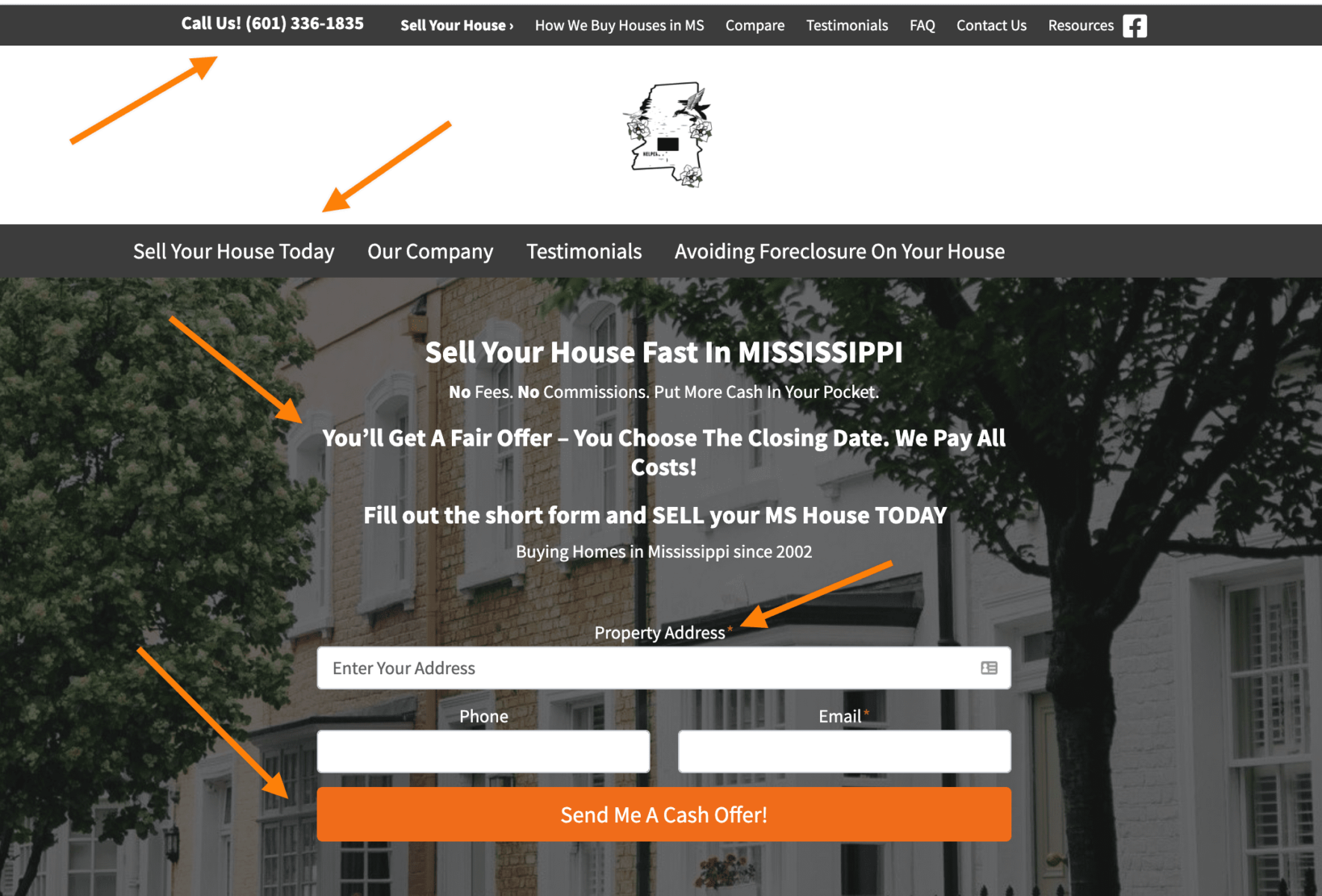
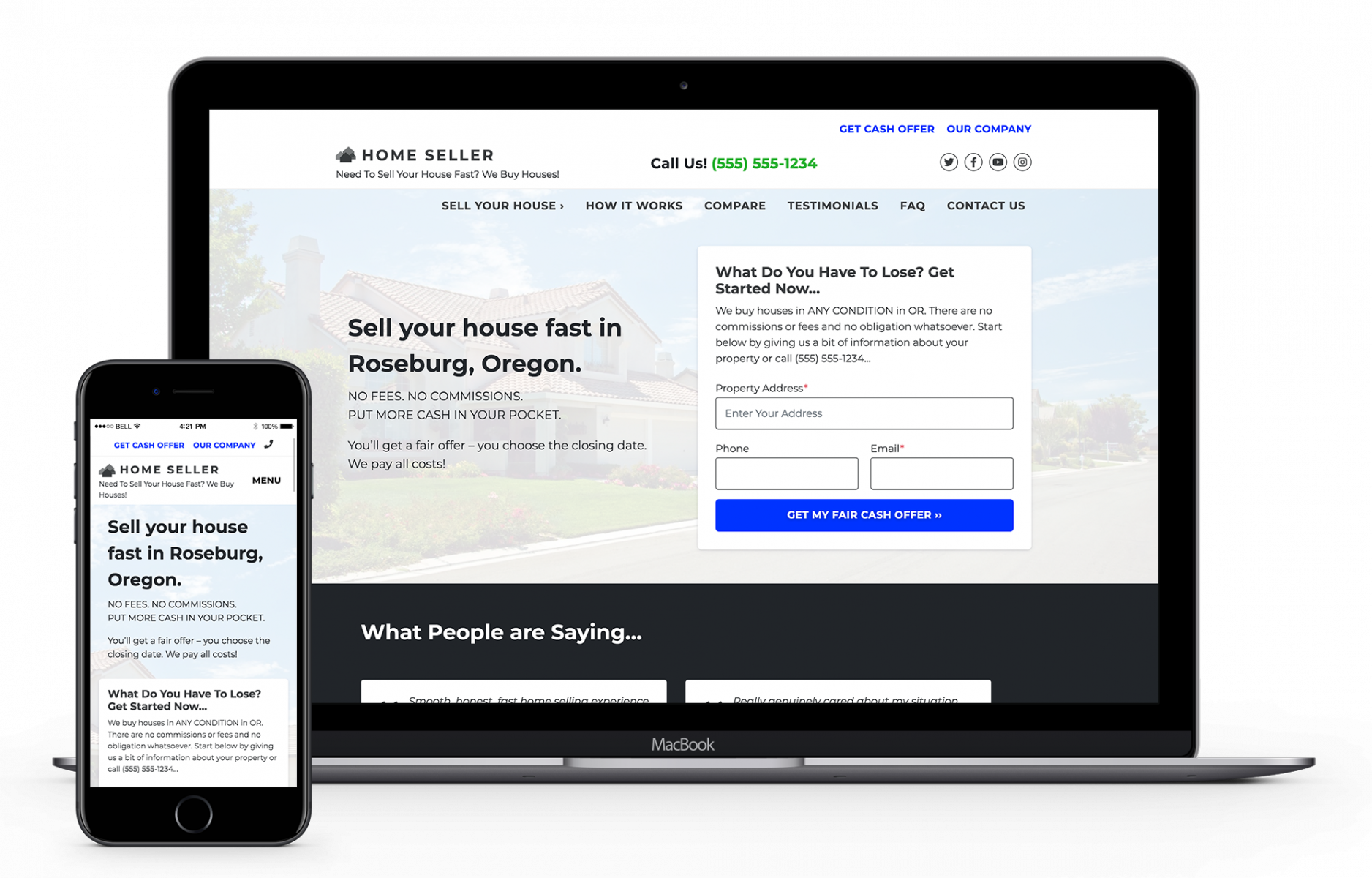
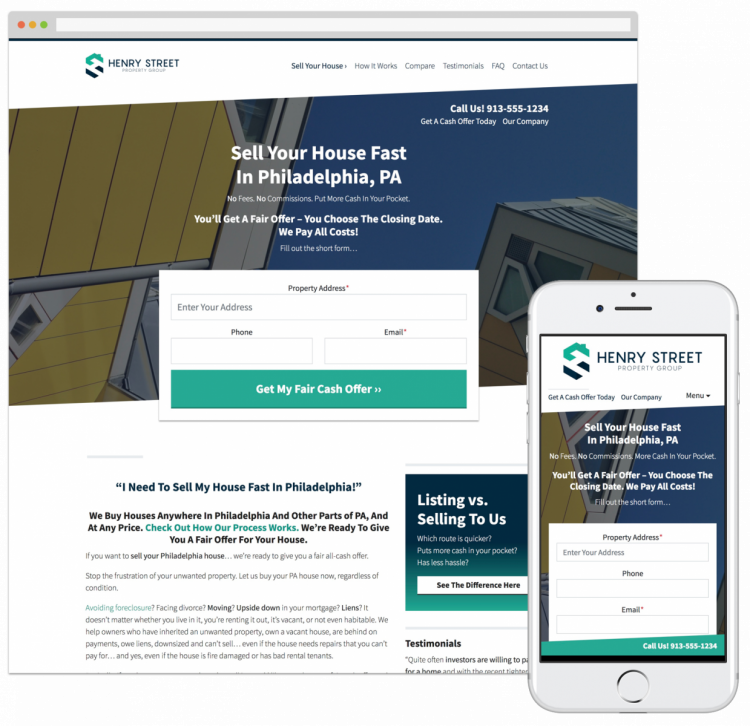
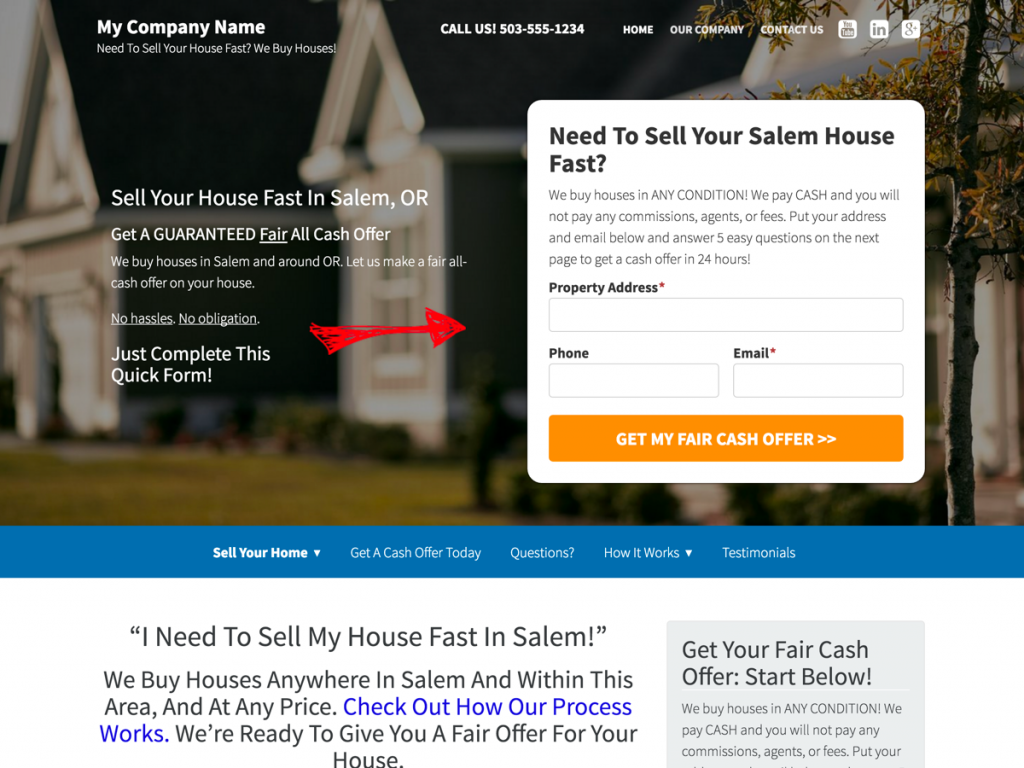
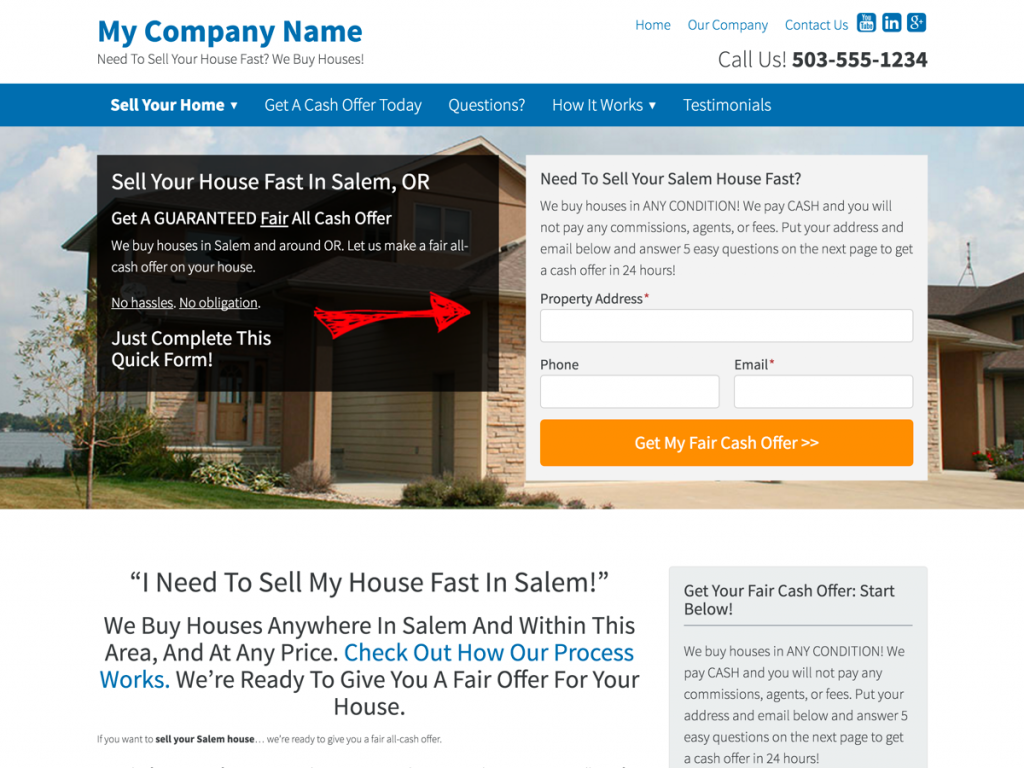
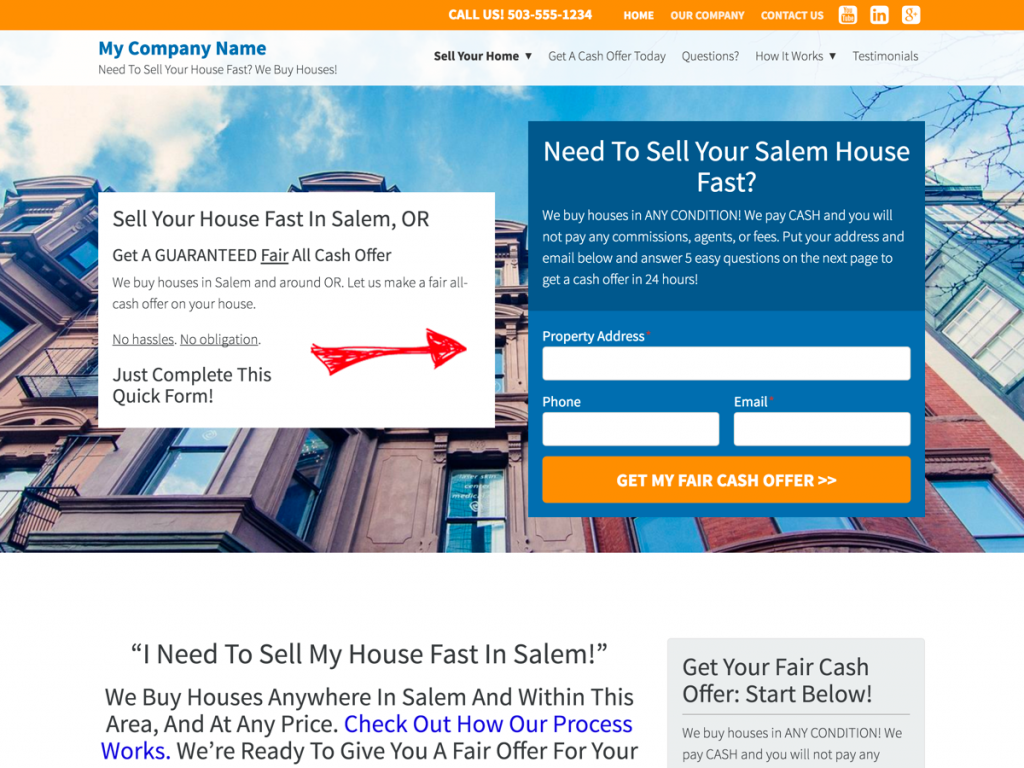
    Here’s a basic, nothing-fancy website with an “at-time” 25% conversion rate:

    But if tomorrow someone forced us to choose between giving our customers high conversion rates or designing beautiful websites, we’d immediately choose performance.

    Often, people choose a website based only on how it looks rather than how it converts, and we think that’s a massive mistake. You’re in business to make money, not just to look pretty, and, for our members, that’s what we help them do – build a sustainable and predictable business.

    We’re not Wix, WordPress.com, or SquareSpace—and our members, as well as we, are proud of that differentiation.


    We ran a test a few years ago and we had double the conversion on Carrot verses LeadPropeller and our custom site.

    – Jason Bible, Houston House Buyers

    “I blew $40k unfocused and doing all kinds of marketing in my first year… then I focused on Carrot and Evergreen marketing and after a year of focused work did my first $100k month.”

    – Adam Mitchell – Dallas, TX “Home Buying Guys”

    There are 100’s if not 1000’s of different ways to make your website stand out from others.

    We wanted to give you the top changes you can make (whether you’re an agent or investor) in about 10 minutes that will differentiate your business from the others in your market without sacrificing a high conversion rate. Check out our tutorial video or keep reading to learn more:

    Getting Started: 9 Simple Ways to Customize Your Carrot Website Design

    Note: This article is for real estate investors and agents. The differentiation recommendations below can be made to an Agent or Investor’s website. 

    Website Design Changes

    1. Choose a Website Theme 2 Minutes

    We have eight different website themes (or designs) for our members.

    All of these convert to our standards (we’ve tested each and every one thoroughly), and the one you choose should be a matter of preference.

    Here are your options. It takes less than 2 minutes to choose a new website theme.

    8 Different Design Templates to Choose From

    Mahogany – Our Latest Premium Design! (For Grow members)

    Stand out without losing the performance. Our latest Premium Design Mahogany features clean, modern lines, big, bold, easy-to-read text, and space to emphasize all of your content. Instantly separate yourself from others in your area with a few clicks.


    Mahogany design template

    Aspen Design (For Grow members) account for 5.14% of Carrot member websites

    We’re officially introducing a new, full-featured design for those of you who crave a distinguished, modern (and, yes, still high-converting) website.

    Carrot real estate website aspen template

    Hemlock (For Grow members) accounts for 11.31% of Carrot member websites

    A more modern “angle” on our highest-performing designs. Test this one to see if it inches your performance up and gives you that differentiation you’re looking for.
    To learn more about changing your website theme, go here.

    carrot real estate website hemlock theme

    Oak – Accounts for 3.49% of Carrot member websites

    It is a design with a striking image and a clear CTA area, and it is amazing on mobile. It’s the default design for Agent websites.


    Juniper – Accounts for 12.81% of Carrot member websites

    Our 2nd most popular design features a centered CTA area and outstanding mobile performance.


    Cedar – Accounts for 7.55% of Carrot member websites

    Large and striking hero image with our right-aligned CTA area, with the navigation below the hero. Ideal for people with a white, transparent background logo.


    Douglas – Accounts for 54.26% of Carrot member websites

    This is the default style for all investor websites, but it takes a few seconds to switch to one of the other ones on this page.


    Madrone – Accounts for 5.34% of Carrot member websites

    A different take on our Douglas design, just with a reimagined header design to freshen things up on mobile and desktop.


    Branding Changes

    2. Upload a Logo 4 Minutes

    Creating a clean and reputable logo can help differentiate your website from other Carrot members and add loads of credibility. As it stands, only 36% of Carrot customers have uploaded a logo to their website.

    This means that uploading a logo to your Carrot website design will help you stand out even more.

    The more unique and reputable your logo is, the more it will differentiate your website and build credibility.

    Here are a few examples of Carrot members who use a logo to build credibility and differentiate their website.

    Ashley Buys Houses
    GTeam
    Home Offer Kansas City
    Sell Now HomeBuyers…

    Here’s a gif showing how easy adding a logo to your website is.

    To learn more about adding a logo to your website, go here.

    3. Adjust Website Colors < 2 Minutes

    Colors have a deceptively significant impact on differentiating websites that – at their foundation – look similar. Just consider how different these Carrot websites look with the same theme but different colors.

    different website color combinations

    The Carrot members that differentiate their website the most don’t only change the color, but they match the color of their logo to the color of their website. In other words, they create their brand colors and then add them to their Carrot website design.

    We Buy Homes in Tucson
    Houston House Buyers
    Coachella Valley HomeBuyers

    And here’s a gif showing how simple it is to change the base colors of your website.

    To learn more about changing the colors of your Carrot website, go here.

    4. Use A Branding Icon 3 Minutes

    If you don’t have the time or finances to create a custom logo for your website, no worries—you can simply use our pre-made branding icons to differentiate your website.

    Plus, only 8.5% of Carrot’s websites use branding icons, so you’ll stand out from the competition quite well.

    Here’s an example of what it can look like.

    Here’s a GIF showing how you can add a branding icon to your Carrot website design in just a few minutes.

    5. Change Button Color < 2 Minutes

    Similar to the overall branding colors of your Carrot website, the button color can help differentiate your business and even increase the chance of conversions.

    We found, for instance, that changing the color of the button on one of our member’s websites from black to orange increased conversions by 29.55%.

    The trick isn’t to change your button color to orange but to a color that stands out relative to the other colors on your homepage. Choose a color for your button that is either sparse or nowhere else on your homepage.

    Something like this from House Heroes…

    Or Krista Buys Houses…

    And here’s a gif showing you how you can change the button color of your CTA.

    To learn more about how to change the color of your CTA button, go here.


    Imagery Changes

    6. Update Hero Section 5 Minutes

    The hero section image is the quickest and most significant visual update you can make. As a Carrot member, you can also quickly and easily customize the hero image on your website.

    We recommend avoiding stock photos if you want to stand out from other Carrot members. Try using a photo directly from your market – something your market will recognize and think, Okay, I’m in the right place.

    Consider the look and feel of these personalized hero photos on Carrot member websites.

    Townsend Realty Group

    Learn how Townsend Realty Group is achieving predictable business growth with Carrot at a 25% conversion rate.

    Example in Baltimore – Juniper Design Template

    Carrot Aspen theme

    Example in Louisville – Aspen Design Template

    Example in Dallas, Texas – Hemlock Design Template

    And here’s a gif that shows how easy it is to add your local image to your Carrot website design.

    To learn more about changing your hero image, go here.

    7. Add Local Images 10 Minutes

    Like the hero section on your website, avoid stock photos and generic images throughout the rest of your website unless you are adding local or USA maps. To build trust and credibility with your target market, try using real photos of houses in your market. Place them throughout the website to make it clear to visitors that they’re in the right spot and that you’re the person to help them. To enhance the visual appeal of these images, consider using a photo editor like Picsart to optimize and polish the photos before uploading them to your website.

    Consider how these Carrot members sprinkle personalized photos throughout their

    websites.

    The Beckham Group

    We Buy Homes In Tucson

    Sell Now Homebuyers

    To learn more about adding images to your website pages, go here.

    8. Adjust Your Hero Form Layout 3 Minutes

    As a Carrot member, you can customize your form section with two clicks of a button (literally). You can easily change to three styles, regardless of your selected website style.

    Column / Stacked / Inline

    Simply choose the one that best fits your brand image. Each will convert well (we’ve tested them), so the choice is yours.

    Go here to learn more about changing your form layout with a few clicks.


    Credibility Improvements

    9. Add a Credibility Bar 10 Minutes

    Adding credibility to your website, whether you’re a Carrot member or not, is critical for your conversion rate. This is especially true in the real estate industry, where consumers try to work with someone they can trust who won’t deceive them.

    Our credibility bar option is the perfect way to add a differentiating and trust-building flair to your website. You can use the credibility bar in several different ways on your Carrot website.

    7DaysCash

    Halo Home Buyers

    Go here to learn more about adding a custom credibility bar to your website.

    10. Add Testimonials 10 Minutes

    The Credibility bar isn’t the only place to add a past customer testimonial to your website – and it’s not the only place you should.

    You can also add testimonials to these spots on your website to build even more trust with visitors.

    Here are a few different looks, including using video testimonials.

    Ocean City Development

    GuaranteedCashOffer

    Sell Now Homebuyers – Video testimonial

    Frank Jr Buys Houses – Video testimonials

    If possible, your testimonials should have some, if not all, of these elements:

    1. Full name of the person.
    2. Professional title of the person.
    3. Image or video of the person.

    To learn more about adding testimonials to your Carrot website, go here.

    11. Personalize the “About” Page 10 Minutes

    When people visit a real estate website, our research shows that the “About” page is the third-most visited tab. You can further differentiate your website from the competition by writing up something personal, adding biographies and pics for team members, and casting company vision.

    For inspiration, consider how these Carrot members have customized their About Page.

    Carrot member about page

    Triple C Properties

    CR of Maryland

    12. Add Badges 10 Minutes

    Website badges that show what makes your company unique and different from the competition can be a great way to stand out online. For example, a website badge that says “Veteran Owned” or “100+ 5-Star Ratings.”

    Here are a few examples.

    Nextwave Homebuyers
    Warrior Property Solutions
    Kind House Buyers

    Consider your unique selling proposition for your business and create a badge that expresses that on your website.

    With this, you’ll sell or buy stronger and faster than the competition and quickly differentiate yourself from other clutter online.

    Easy Editing

    13. Visual Block Editor

    Like anything in life, there are trade-offs. The “big” low-cost website builders (think Wix, Squarespace, and WordPress themes) chose to go all-in on ease of use and sacrifice performance for their clients. You would save a bit of time, but it could cost you tens of thousands of dollars (or more) from underperformance.

    Performance and results and easy editing
    At Carrot, we have been all-in on performance since the beginning. We created the easy drag-and-drop Visual editing experience on our websites so that users can enjoy both benefits without sacrificing either.

    What the Visual Editor helps you do

    A few benefits you’ll enjoy with this powerful Visual Editor include…

    • No more switching back and forth from editor to page – now see all your edits in real-time, including your hero section, forms, and more!
    • Use Drag and Drop tools to easily create and edit pages with movable and reusable block patterns!
    • Make your website stand out visually without having to use any fancy code.
    • Enjoy the new “Full-Screen Mode” to have the most beautiful, clean, and simple editing experience possible… without the distractions (try this mode, you’ll love it!)
    • SEO Grader updates: 1) Your SEO grade for the page will update in real-time without you having to save the page, and 2) Now get SEO grades for multiple keywords for the same page! (this is huge)
    • No loss of page speed

      … and more

    Here are some examples of designs you can easily create with the visual editor…

    MRR Property Solutions

    Myrtle Beach Home Buyers

    Capstone Homebuyers

    To learn more about the Visual Editor, watch the tutorial video below or check out our Help Center.

    Getting Started: Editing a Page with Carrot's Visual Editor

    Content Changes

    14. Customize Content 10+ Minutes

    Your website’s blog represents a phenomenal opportunity to differentiate your business from the competition.

    Our Grow Carrot plans provide monthly content for your website, but sometimes it’s worth tweaking these blog posts to fit your market and business positioning better.

    Here are a few ways to quickly tweak them to fit your target market better.

    1. Localize the tips and advice.
    2. Add a bit of your advice.
    3. Add your tone of voice to the article.

    Consider Fox Realty Group – a Carrot member – and how they’ve customized their blog content without getting too complicated.

    Fox Realty

    So if you have more money than time, another way to differentiate your Carrot blog is by upgrading your plan.


    Conclusion

    We’re not going to sugarcoat this… Customizing your website takes work. Unless you outsource your website customization, you’ll need to invest time.

    You now know how to customize your Carrot website design without sacrificing aesthetics or conversion rate. Use these 14 ways to differentiate your website and stand out from the competition – even if that competition consists of other Carrot members.

    Many people don’t customize their website with the above simple changes, so if you do, you have a far better chance of standing apart and cutting through the online clutter – to be seen by your target market faster and more often.

    If you don’t have the time to make these changes, check out our Concierge Setup Service, where we’ll do it for you.

    Either way, happy customizing and happy converting.

  • 20 Real Estate Negotiation Tips from 3 Negotiation Experts + Free Scripts

    20 Real Estate Negotiation Tips from 3 Negotiation Experts + Free Scripts

    Real estate negotiation is a hot topic. Every month, according to Google, there are 700 searches for phrases similar to “how to negotiate the house price.”

    Couple that with 63.3% of businesses with no formal negotiation process having decreased net income… you have a MAJOR opportunity.

    how to negotiate house price google trends
    How to negotiate house price Google Search trends

    When it comes to negotiations, specific tactics work overtime. So we’ve compiled a list of some common real estate negotiation strategies.

    But we all know the price is not set before diving in. And neither is a seller’s immediate inclination to work with or not with you, the real estate agent or investor.

    They could call you ready to sell but a few days later lose interest. Or they could call skeptically and leave the call prepared to sign.

    How you negotiate with sellers and buyers determines these outcomes: what you say, what questions you ask… even how you talk.

    We spoke with some experienced real estate investors and agents and asked them how they negotiate with sellers to close more (and more profitable) deals. We threw in some of our advice from decades of combined experience.

    Keep reading to get real estate negotiation tips!

    Or you can download our real estate sales negotiation playbook by clicking below — it’s got proven-to-work scripts, six questions to ask on every call, and a fool-proof seller scoring system.

    The Pre-Negotiation: Base-Setting For The Verbal Negotiations

    The first thing we’d like to mention is the pre-negotiation before diving into the 20 real estate negotiation tips our three experts offered.

    Before you get on a call with a seller for the first time, they have some preconceived notions about who you are, what you do, and what your business is like. They’ve unknowingly gathered this information through your offline marketing materials (direct mail, bandit signs, etc.) and online marketing materials (your website and digital advertisements) and perhaps through referrals from a friend or family member.

    Maybe, they come in thinking that you’re desperate for deals. Maybe, they come in thinking that you’re trustworthy and level-headed. Maybe they come in having no idea about what you do but are curious about how you might be able to help them.

    Whatever they believe, for better or worse, it’s a direct result of the brand you’ve created.

    That’s why building a well-respected brand in your community is so important. It makes sellers more likely to trust your opinions, value your input, and answer your questions honestly, making your job as a salesperson much easier.

    But how do you set the stage for effective and profitable negotiations?

    Here are some quick tips…

    Add Credibility To Your Website — When someone visits your website, you want to build as much credibility as possible… as fast as possible.

    This means including testimonials from past happy sellers, emphasizing that you’re a local real estate investor, showing your online reviews, being honest about your process, and sharing your company’s vision and mission.

    Video testimonials are particularly effective. Here’s an example from a Carrot member (Carrot websites provide a lot of space for adding credibility and, for that reason, are the highest-converting websites in the industry!)…

    Set The Tone — With the colors, words, and font you choose for your offline and online marketing materials; you’re creating a tone of voice for your brand. Maybe it’s stoic and professional.

    Or maybe it’s casual and fun. Or maybe it’s kind and lighthearted. Or maybe it’s hasty and irreverent. Whatever the case, beware of the tone you create… because callers will expect that same tone when speaking with you on the phone.

    Be Honest — One of the best ways to differentiate yourself from the competition is to be upfront and honest. Being dishonest will almost always backfire. It’s better to tell people who you help and how you can help them so that the right people dial your number in the first place.

    20 Real Estate Negotiation Tips from 3 Negotiation Experts

    1. Don’t Ask For a Price Right Away

    This first tip comes from John Martinez, the founder of REI Sales Academy.

    To avoid spending too much time talking to tire-kickers, many real estate investors will ask the seller for their lowest price within the first five minutes of the call.

    John recommends not doing that. He suggests that investors focus on price only after you’ve sold the seller on yourself and your business (more on that in the next tip).

    Why?

    First, once you’ve spoken to the seller about your process and built some trust, the number they gave you will probably change… so why use it at all?

    Second, hearing a seller request a high price will usually make the salesperson (you or someone on your team) feel unmotivated to continue the call. They likely won’t operate at the same level of salesmanship.

    So while it might sound counterintuitive, it’s best to leave the price for last.

    2. Sell Them Before You Make an Offer

    This tip also comes from John Martinez, and it’s similar to the first tip… but about your offer.

    You don’t want to hear the seller’s number until a little bit later in the call (as mentioned above) to build trust before discussing the price.

    The other side of this coin is that you don’t want to make an offer until you’ve built trust and sold them on yourself and your business.

    The real lesson of these two tips is that you don’t want to talk about price until the seller trusts you — a discussion of price is virtually useless, and negotiations even more so if the seller doesn’t trust you.

    Additionally, holding back the price discussion will give you more time to gather valuable information on why the seller is selling, what motivates them, and why they’re selling to you. That information, in turn, will give you “ammunition” for the price discussion…

    “I know that price is lower than you were hoping for. But do you think getting out of your tough situation is worth it?”

    3. Be Open & Honest

    The more honest you can make the discussion between yourself and the seller — the more open they are to share pertinent information with you — the easier it’ll be to negotiate.

    Period.

    Have you ever negotiated with someone, for example, where it felt like there was no way you would agree… but you didn’t know why?

    Like there was some big unseen brick wall between the two of you?

    That’s usually because the seller hasn’t told you something — maybe they’re not the real decision-maker, maybe they need a certain amount of money to pay off additional debt, maybe they’re going through something that they haven’t shared, or maybe they’re too emotionally connected to the home.

    Whatever the case, most of those hurdles can be overcome if they’re out in the open… if you can discuss them honestly and with empathy for their situation with the seller.

    Here are some of the questions John recommends asking to pull out important (potentially hidden) information…

    • Ask the homeowner if they can hold the house for another 5+ years and what that will mean for them.
    • Can they make the repairs themselves to resell at a higher price? And what will that look like for them?
    • You’ll also want to address any concerns influencers bring up, including the seller’s family, CPA, attorney, etc.

    4. Allow The Seller To Squeeze Every Dollar Out Of You

    The seller wants to get as much money for their home as possible. And you want to pay as little for their home as possible.

    So it might sound counter-intuitive — and again, this is advice from John Martinez — to allow the seller to squeeze every last dollar out of the deal.

    But there’s a difference between getting hustled and allowing the seller to get as much money for their home as possible.

    After all, the seller wants to feel like they’re getting an excellent deal — like they’ve negotiated as far as possible and gotten the best home offer.

    For that reason, starting with your max offer is a bad idea.

    Instead, start by offering $20,000 or $30,000 lower than (depending on the value of the home) your max offer. Then if the seller balks, offer ways for them to increase their offer — maybe you give better deals to veterans, or maybe they get a better deal if they move out faster or if they sign papers within 24 hours, or maybe they get a better deal if they clean out the home before moving.

    “I can offer you an extra $10,000 if you sign the papers within 24 hours.”

    “I can offer you an extra $5,000 if you clean out the home before you leave.”

    This will give the seller room to feel like they’re negotiating with you and squeezing every last penny out of the deal when, in reality, you’re in control of negotiations the whole time.

    5. Don’t Provide Options; Give Your Expert Recommendation

    Maybe I’m alone in this, but I love when I go to a nice restaurant and ask for recommendations, and the waiter or waitress tells me what I should order.

    Better yet, when I go to restaurants with tastings menus, I don’t have to decide what to eat.

    I get to trust the food experts.

    Just like the seller gets to trust you, the real estate expert.

    Maybe you have a “menu” of real estate services that you offer — buying for cash, selling on the MLS, listing homes, etc. But just because you offer all of those services doesn’t mean you should offer all of them to everyone.

    You shouldn’t.

    There is such a thing as having too many choices (think of the last time you and your significant other were trying to decide where to eat for dinner), and you don’t want to put the seller in that position, giving them “analysis paralysis.”

    Instead, determine the service that would benefit the seller and only offer it to them (unless it later becomes clear that some other service would be more fitting).

    You’re the expert, after all.

    And they want your opinion about what they should “order.” Tell them your recommendation and leave your other services on the bench.

    6. Extract Information

    This next tip comes from Steve Trang, real estate investor, agent, and creator of The Perfect Seller Appointment Scoring System (which you can access inside our free guide!).

    In the last tip, we discussed offering the seller something that fits their situation.

    But that’s not something you’ll be able to do until you’ve asked questions and extracted pertinent information.

    This is your first goal on any call — to learn about the seller, why they called you, why they want to sell their home, what problems they’re facing, and how they think you can help.

    The more you know about the situation, the easier it’ll be to work with them.

    So ask a lot of questions.

    Top-performing salespeople ask questions more than they try to pitch or convince…

    Sales Stats

    Here are some top questions you should ask sellers (you can get a complete list in our free sales playbook!)…

    • How are you hoping I can help you?
    • This is a great home. Why would you consider selling to an investor like me?
    • Who else has input on the sale of your home?
    • Who will be impacted by the sale of your home?

    7. Set Rules

    So far, we’ve talked a lot about building trust with the seller, being honest and transparent, and asking questions to understand where the seller is coming from.

    But before any of that happens, Steve Trang recommends setting some “ground rules” for the discussion before the discussion begins — this will allow you to maintain control of the conversation and keep it progressing in a productive direction.

    What does he mean by “ground rules”?

    First, Steve will let the person know how the conversation will go and what they can expect. He’ll ask for their consent to continue the conversation and that they’re transparent.

    Here are a few of his rules…

    1. If I make you an offer, I ask that you’re comfortable with telling me “no” if the price doesn’t make sense.
    2. If you like my offer, you agree that you’ll put it in writing.
    3. Saying you need “time to think about it” is against the rules. Instead, you can tell me “no”.

    Additionally, if the client gets off-topic during the conversation, Steve will ask them to pause and to write down everything they were going to say. Then he’ll ask a new question to progress the conversation.

    This might seem intense.

    But it’s an effective way to progress the conversation and build respect. And if done right — with empathy and kindness — it can be highly effective for closing deals.

    8. Look For “No”

    It probably sounds a little odd to try and get the seller to say “No” to you, but according to Jim Camp, the author of Start With No, that’s precisely what you should do.

    Here’s how he explains it…

    “‘no’ gets you past emotional and trivial issues to essential issues. We want decision-based negotiation, not the emotion-based waste of time known as win-win.”

    And again…

    “Embrace ‘no’ at every opportunity in a negotiation. Don’t fear the word; invite it. You do not take it as a personal rejection because you are not needy. You understand that every ‘no’ is reversible.”

    When you allow the person to tell you “no”… when you try and get them to say “no,” you create opportunities to address their largest objections, to discuss the real worries and concerns that are stopping them from working with you.

    You allow for progress to be made in the negotiations.

    Price anchoring is just one example of this.

    That’s when you intentionally make the seller a massively low-ball offer to find their bottom price — for a home you’re willing to pay $100,000 for, you might start by offering $40,000 or $50,000 to see how they react…

    “Oh, heck no. I wouldn’t take a penny less than $80,000.”

    Works like a charm.

    9. Nail Your Branding

    Branding is an essential part of any marketing strategy.

    Just check out some of these stats from Oberlo

    • 86% of consumers say authenticity is crucial when deciding what brands they like and support.
    • 81% of consumers said they need to be able to trust the brand to buy from them.
    • Using a signature color can increase brand recognition by 80%
    • It takes about .05 seconds for people to form an opinion about your website.
    • The consistent brand presentation has been seen to increase revenue by 33%.

    Now those stats are mainly referring to the e-commerce industry.

    But if people care so much about working with authentic and trustworthy brands when buying a pair of sneakers online, how much more do they care about it when buying or selling a home?

    Real estate amplifies the need for branding.

    HOWEVER…

    That doesn’t mean you have to build a super professional and formal website so that people will think you’re the bee’s knees — remember that authenticity is one of the key things people care about.

    One of our favorite examples of authentic (and practical) branding comes from a Carrot member, Brian Rockwell — he’s an investor in Dallas and Fort Worth

    His homepage is clean, to the point, and semi-casual…

    Brian Rockwell Website

    And his “Our Company” page takes authenticity and personability to a whole new level, with a picture of him and his family and the company’s core values…

    Brian Rockwell About Page

    This might not be a direct negotiation tip, per se — but your online branding sets the tone for negotiations. It helps determine how much people trust you and see you as the expert before you speak with them. That’s super important.

    10. Use Scripts

    If you’re an expert salesperson who knows your target market extremely well and you’ve been doing this for a long time, then maybe you don’t feel the need to use scripts.

    That’s fine.

    But maybe you’re not a total expert yet… or you’re leading a team of salespeople who still have some stuff to learn.

    Either way, scripts can help.

    We’re not saying that you should stick to scripts even when the conversation takes some unexpected turns — as a salesperson, you need to be adaptable — but it’s good to have a script in front of you. That will help keep the conversation moving in the right direction if it gets off the rails.

    And you can click below to get your free negotiation playbook & scripts — stolen straight from the desks of expert investors and agents ;-)

    11. Avoid Negative Statements

    When negotiating with a seller whose home is in distress, you might think that pointing out the problems you’ll have to fix — smoke stains, broken windows, trashed lawn, etc. — will help the seller understand why your offer is what it is.

    And to some degree, that’s true.

    You want to be honest with the seller about your costs so that they have more realistic expectations for what you can offer them.

    However, it’s essential to be careful about bringing those things up.

    The homeowner is likely attached to their property — maybe they inherited it from now-deceased parents, or they used to live there themselves.

    Either way, there are emotions involved.

    So instead of saying, “Look — your home is in terrible condition” or something similar, stick to the facts and avoid emotion: “We estimate that we’re going to spend about $XX,XXX to fix up the home. That’s why our offer is what it is.”

    12. Trust The Follow-Up

    As a salesperson, people are going to tell you “no.”

    It’s bound to happen, so it’s best to become comfortable with that word.

    The good news is that most deals happen during the follow-up process, especially when you’re making lowball offers.

    People will say “no” initially because they’re surprised and upset. But then they’ll think about it. Maybe you send them a text message and an email or give them a phone call.

    After a few months, they still haven’t sold their house on the MLS.

    Now they’re ready to sell to you.

    And if you’ve followed up consistently (say, a couple of times a month), they know how to reach you.

    Ryan Dossey once told us that he closes 90% of his deals during the follow-up process, not during the first phone call.

    So follow up consistently and trust in the process — most of your deals are yet to come.

    13. Learn to Blank Slate

    This tip comes from Jim Camp’s great sales book: Start With No

    In that book, Camp suggests that every salesperson should have a “blank slate before entering into a negotiation.”

    Take a deep breath and let go of all opinions, biases, emotions, and preconceived notions about how the negotiations should go.

    He said…

    “Your ability to blank slate is directly related to your ability to rid yourself of expectations and assumptions, two very bad words in my negotiation system.”

    Why?

    Because expectations and emotions add an unnecessary wild card to the negotiation table — if you’re too emotional, you might make a bad deal… if you’re frustrated from something that happened earlier, you might lose your patience… if you’re too opinionated and outspoken, you might miss out on getting vital information from the buyer or seller.

    So before you negotiate, take a deep breath and remind yourself that you don’t need this deal and will just see how things go.

    There’ll be many more deals in the future.

    14. Understand The Numbers

    Of course, “blank slating” doesn’t equate to being unprepared.

    Before you negotiate with a buyer or seller, you should know the details of the deal as well as possible — how long the person has owned the home, how much equity they have, why they want to sell, your max offer, how much it’ll cost to fix up, etc.

    Those numbers are critical for real estate negotiation because they’ll help you negotiate.

    If, for example, the seller asks for an explanation of why your offer is so low, you can explain the math to them.

    Knowing why they want to sell and/or how much equity they have can give you insight into their behavior if they shy away from your initial offer.

    So yes, you want to blank slate.

    But you also want to be as prepared as possible.

    15. Include an Escalation Clause

    As a buyer’s agent, it’s important to be as efficient and effective as possible. Your clients don’t want to spend the next 6 months looking for a home…

    They want to find one that fits their desires, put an offer down, and close the deal.

    To keep your clients happy, it’s in your interest to help give every offer they make a good chance of being accepted.

    And that’s why you might consider including an escalation clause when the market is competitive — this says that if someone else offers more than your client’s offer, they’ll make a new offer that’s $5,000 or $10,000 more than the counter-offer.

    Of course, you’ll want to clear this with your client first.

    But it can be an effective way to help your clients secure a home.

    16. Try To Meet in Person

    Technology has made it super easy to “meet” with sellers.

    You can text them, email them, or call them.

    Heck — virtual wholesaling is now possible as well!

    But still, nothing is quite as meaningful or powerful for negotiations as meeting in person — that is (and will always be) the quickest way to build rapport and show buyers or sellers that you value their time and respect them.

    If you invest in a state where you don’t live, it might even be worth hiring a salesperson in that area to meet with sellers or buyers for you.

    There’s a lot of power in face-to-face interactions.

    So whenever possible, do negotiations in person.

    17. Leverage Closing Costs

    For real estate investors and agents, closing costs can be a helpful asset during negotiations.

    Since closing costs are immediate and relatively expensive, many buyers and sellers would like to avoid them.

    As an investor, reminding people that you will pay all closing costs can help push them over the edge. For example…

    “I know that the offer is a little bit lower than you want, but keep in mind that I’m going to pay all closing costs for you — that would usually be somewhere around $10,000 — also keep in mind that I’m going to buy your house as-is and close in just a couple of weeks. Real estate agents aren’t able to do that.”

    As a real estate agent, closing costs can be used during the negotiation phase between buyers and sellers to increase or decrease the home’s total price.

    Buyers might offer to pay closing costs for a slight discount on the price of the home, and sellers might offer to pay closing costs for a slight increase in the price of the home.

    It’s a vital real estate negotiation tactic to keep in mind.

    18. Use an Expiration Date

    Expiration dates are an effective negotiation strategy for agents and investors to keep in their back pocket.

    Agents can add expiration dates to offers or counter-offers to increase the buyer or seller’s response speed. And investors can use expiration dates to increase urgency around their cash offers…

    “If you sign the papers within a week, I will offer you $10,000 more. But you have to sign by Friday.”

    For humans, urgency is a powerful motivator.

    And offers without urgency result in people procrastinating on making a decision — or being wishy-washy with what they say.

    That’s why expiration dates are so helpful.

    19. Use Affirmative Language

    Salespeople with a positive outlook and attitude often achieve better results — so stick to the bright side as much as possible.

    InPower Coaching offers the following examples of “affirming language”…

    “I appreciate everything you have offered, especially [example concession they’ve made], and I’m glad you like [example concession I’ve made]. Would you be willing to include [request]?”

    “I understand you’re wanting X, Y, Z, correct? If this is true, I’m happy we can give you X and Y, but unfortunately, we cannot do Z for [reason].”

    Notice how those statements keep things optimistic?

    That’s because when you stay optimistic — and treat problems, concerns, or objections as though they’re overshadowed by more important benefits (in attitude, not in words) — the person listening to you will often follow suit.

    They’ll be more optimistic and start seeing the value of what you’re offering.

    So practice staying positive.

    20. Use Storytelling

    When someone has an objection, what do you say?

    Imagine, for instance, someone saying, “Well, how do I know that you’ll be able to close in two weeks?”

    You could look them in the eye and say, “Trust me. I will.”

    Maybe that’s persuasive enough.

    Maybe it isn’t.

    Another option is to get in the habit of telling stories to overcome objections.

    Here’s an example.

    If the seller says, “Well, how do I know you’ll be able to close in two weeks?” I could respond to that by telling a story…

    “Funny you say that. I was working with a homeowner last week who was in a real bind to sell. If he didn’t sell within two weeks, he risked getting his home repossessed by the bank. It was a huge mess. And reasonably, he asked me the same question. He said, ‘How do I know you’ll close in time so I don’t lose my home?’ — I’ll tell you what I told him.

    I’ve worked in this market for a long time- I’ve helped buy and sell hundreds of homes — and never once have I missed a deadline. The service I offer sellers like yourself IS selling fast… and if I can’t do that… well, I don’t have much of a business, do I?

    That’s a lot more convincing than just asking someone to trust you.

    So get in the habit of telling stories, and your negotiations will be far more effective and lucrative.

    Final Thoughts

    At least part of your success as a real estate agent or investor depends on your ability to negotiate, which means communicating clearly, listening well, building trust, and even knowing when to walk away.

    You can use the 20 real estate negotiation tips above to become a better negotiator. For more resources and real estate marketing materials, click on the link!

    Get Your FREE Sales Negotiation Playbook & Scripts!
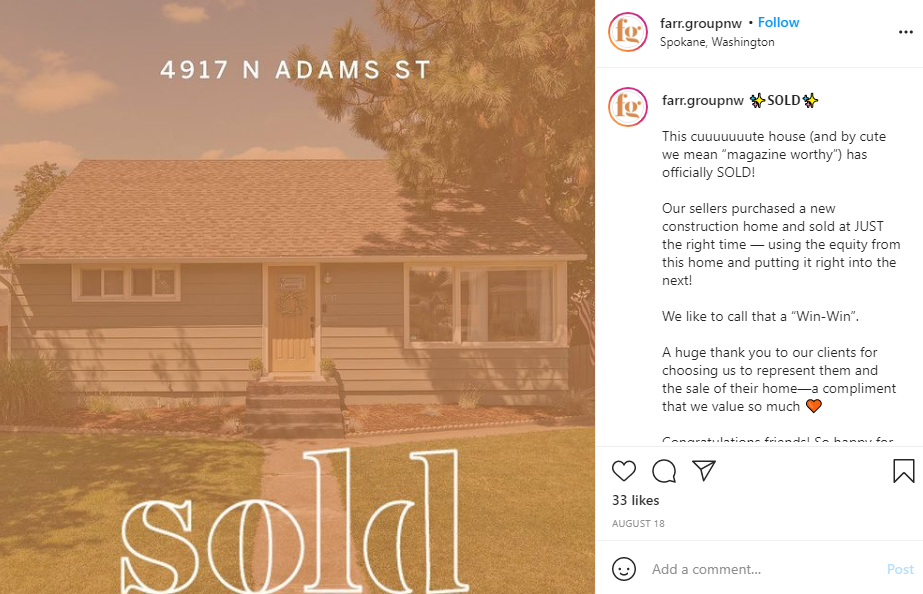
  • 30 Real Estate Agent Marketing Ideas to Win More Deals in 2025

    30 Real Estate Agent Marketing Ideas to Win More Deals in 2025

    real estate agent marketing ideas

    You’ll agree that sifting through endless real estate agent marketing ideas is challenging. It’s tough to determine which tactics will generate the highest volume of quality leads while keeping your sanity.

    When people think of buying or selling a home, you want them to think of your name. You want them to give you a call. And you want them to work with YOU.

    Of course, that’s easier said than done.

    Many other real estate agents in the area are fighting for the same attention.

    Fortunately, you don’t have to win all the attention to dominate your market – just most of it.

    And the best part is…

    You don’t even have to leave your computer to get started.

    30 Real Estate Agent Marketing Ideas to Win More Deals

    I will show 30 real estate agent marketing ideas for dominating your online market in this article.

    1. Market Yourself on Instagram
    2. Build a Real Real Estate Agent Website
    3. Shoot Facebook Live Videos
    4. Consistently Post on Social Media
    5. Collaborate with Other Real Estate Agents in Your Area
    6. Message 100 Friends on Facebook and Tell Them What You Do
    7. Set Your Email Signature to Explain What You Do
    8. Set Your Social Media Bio to Explain What You Do
    9. Listen to a Mindset-focused Podcast
    10. Optimize Keywords on Your Website for Search Engines
    11. Set a Budget and Invest in Facebook or Google Ads
    12. Enhance the “About” Page on Your Website
    13. Write or Record Weekly Blog Posts
    14. Record a Case Study Video with a Past Customer
    15. Make Your Phone Number Easy to Find on Your Website
    16. Use a Low-commitment Opt-in Form on Your Website
    17. Write Persuasive Sales Copy
    18. Publish High-quality House Photos
    19. Add IDX to Your Website
    20. Encourage Reviews on Your Company Facebook Page
    21. Create Location-specific Landing Pages
    22. Run Free Ads on Craigslist
    23. Create a Sales Script to Increase Close Rate
    24. Delegate “Busy Work” to an Executive Assistant
    25. Know Your Market Like the Back of Your Hand
    26. Use a Drone For Aerial Photography of Your Real Estate Listings to Create Visual Intrigue
    27. Create a Google My Business Account
    28. Create and Promote an Infographic
    29. Run a Webinar
    30. Create a Zillow Profile

    1. Market Yourself on Instagram

    Instagram is an incredible place to share your listings and get noticed! For real estate agents, Instagram provides a whole new world of opportunity.

    With over one billion monthly active users on the platform, there’s no better time than now for you to join in with all these people looking at beautiful pictures daily.

    Whether showcasing properties or providing helpful content like tips for staging homes, something here is suited ideally for you!

    Learn more:

    Unlock Your Instagram Marketing Knowledge

    Learn everything that Real Estate Agents need to know to get started with Instagram marketing.

    2. Create a Professional Website

    Examples of real estate websites

    Why does a real estate agent need a website?

    Most real estate agents become a part of the online “clutter” in their markets when they toss up a website that gets lost in the shuffle. Building a focused and optimized website will help you cut through that clutter with content marketing and adding your industry expertise.

    A website will attract more of your favorite clients by using it as an Evergreen Marketing tool.

    You can reduce or eliminate relying on cold calling, direct mail, Zillow, and the marketing that’s burning you out when done right.

    Having a website will also…

    • Increase awareness and online presence.
    • Generates quality leads.
    • Increases your credibility.
    • Service as an educational tool. Add community resources, FAQ, and contact information. Educating buyers or sellers and explaining how real estate agents provide their services can build trust and rapport and earn more business.

    Learn more:

    3. Use Facebook Live Videos

    Facebook’s LIVE video feature is useful for more than recording your kid’s birthday party. You can also use it to do a LIVE walkthrough of house listings you’re trying to get attention for.

    After all, one of the most time-consuming parts of your day is house showings, so why not show a house to your entire Facebook audience with a single LIVE video?

    Plus, 70% of homeowners want to list with a real estate agent who does some video marketing to sell their home. This might be your dead-simple, don’t-have-to-hire-a-professional way of integrating video marketing into your service.

    Just create a healthy cadence and get in front of your social media audience more regularly.

    The more people see your face online and hear you talk about their problems and your solutions, the more familiar your market will be with you.

    Video is increasingly important in content marketing for social media. More people are choosing to consume information through video.

    Here are some ideas for Facebook live videos to work into your real estate marketing:

    1. Host virtual open houses.
    2. Discuss your community market with a local specialist.
    3. Livestream auctions.
    4. Interview customers for success stories.
    5. Interview a partner or someone you work with… such as an interior decorator.
    6. Host a contest or giveaway.

    Learn more:

    4. Post on Social Media

    Why do real estate agents need social media?

    According to the National Association of Realtors, social media has become a significant way to acquire clients and close deals. Here’s a snapshot of their report:

    • 77% of realtors actively use social media for real estate in some capacity.
    • 47% of real estate businesses say social media results in the highest quality leads vs. other sources.
    • 99% of millennials and 90% of baby boomers begin their online home search. As opposed to in-person referrals.

    It’s powerful. Perhaps there’s no better way to generate consistent word of mouth around your brand name and service than by staying in front of your audience.

    Posting on social media consistently allows you to stay in front of your audience without leaving your desk chair’s comfort.

    Where to post:

    • Facebook posts
    • Facebook ads
    • LinkedIn
    • Instagram

    What you should post:

    • Property photos
    • Success stories
    • Milestones
    • Market news
    • Renovation and home tips
    • Events

    Learn more…

    5. Partner with Other Real Estate Agents in Your Area

    As the market gets increasingly competitive and the economy takes a slight downturn, collaborating with other professionals in your market might separate the winners from those who starve.

    Don’t be afraid to collaborate with other real estate agents and investors in your area to make the most of the market that you find yourself in.

    Sometimes, the best way to dominate your market is to team up with those already dominating it.

    Learn more:

    6. Message 100 Friends on Facebook and Tell Them What You Do

    If you want to generate word of mouth, send messages to your friends on Facebook and tell them about what you do. Maybe you’re offering a new service that you can announce to people, or perhaps you want to say to people that you’re currently looking for new clients.

    Either way, a Facebook message can go a long way in generating word-of-mouth for your business within your target market – especially if you personalize each message.

    Learn more:

    7. Set Your Email Signature to Explain What You Do

    If you’re like me, you send at least 3-5 emails daily. Believe it or not, every one of those emails is an opportunity to gently advertise what you do and who you are.

    By automatically setting your email signature to populate with business-card style information, you remind people of your company every time you send an email.

    Learn more:

    8. Create a Social Media Bio

    Like your email signature, your social media bios are waiting to be exploited for market domination. When someone clicks on your profile to find out more about you (and trust me, they do), you want them to quickly know who you are and what your business does.

    A quick bio that describes your real estate expertise ensures you don’t miss lead-gen and word-of-mouth opportunities on your social media profiles.

    Learn more:

    9. Listen to a Mindset-focused Podcast

    You might be thinking… “why would listening to a podcast help your online marketing?”

    Often, becoming the most successful real estate agent in your market is simply believing you can do it and believe you are the best.

    I know it sounds cheesy, but the mindset is crazy powerful for building the business of your dreams and pulling in more leads than you can handle. And a podcast is a great way to regularly test and refine your mindset.

    Here are some benefits of listening to podcasts:

    • Your imagination kicks in.
    • You learn new marketing tactics.
    • Your multi-tasking skills will be enhanced.
    • Your listening skills grow.
    • You can learn more about people and gain empathy as an agent.

    Learn more:

    10. Optimize Keywords on Your Website for Search Engines

    The most thorough way to dominate your market is to be the first result prospects see when they type “real estate agent” or “sell my home fast” into Google.

    If you’re not on the page when people do that, you have a very small chance of being a significant force in your market.

    real estate agent website keyword rankings
    Carrot SEO Keyword Ranking Tracker

    People go online to find everything, including a real estate agent to work with. You need to show up at the top of Google results. And to do that, you need to optimize your website to rank in search engines via strategic keyword placement.

    Carrot members can easily track their rankings using the Carrot SEO Ranking Tracker.

    Learn more:

    11. Invest in Facebook or Google Ads

    If you want to increase the number of leads and deals you’re getting quickly and have some money to invest, then PPC might be a great option.

    Whether you choose Facebook or Google Ads (the two most popular options), PPC can generate more leads immediately, increasing your business profitability and market authority.

    Learn more:

    12. Optimize Your “About” Page on Your Website

    Did you know that any website’s “About” page is the third most-viewed page? People don’t just want to know what you do or how you do it; they also want to know who you are.

    By spending a little time on your “About” page bio – adding core values, a mission statement, and personal pictures – you’ll stand out from competitors who didn’t spend extra time on their “About” page.

    Learn more…

    13. Write Blog Posts

    Weekly (or monthly) blog posts on your website give you and your audience something to discuss. They give you something to share on your social media pages and give your audience something to discuss.

    That’s good – the more interactions you have with people in your target market, the more people will view you as the real estate expert in their area.

    Plus, publishing consistent blog posts can also help with your Google rankings and build trust with people who arrive on your website.

    Don’t have time? Hate writing? No problem! Create a VideoPost! You could have amazing content to share in 10 minutes.

    Upload a video and receive a transcription for your content. Creating content that helps you stand out from the crowd is easy.

    See it in action here… How to Create Real Estate Content in Under 10 Minutes with Carrot’s VideoPost

    Learn more:

    14. Record a Case Study Video with a Past Customer

    SF Real Estate Agent Testimonial - Beverly Barnett, Top Realtor

    Case studies, or we like to call them, “customer success stories,” are powerful. When prospects arrive on your website, they ask themselves, “Can I trust this person to solve my problem and have my best interest in mind along the way?”

    How they answer that question will greatly determine whether they decide to work with you.

    The good news is that you can help them answer that question by filming and publishing case study videos of people you’ve worked with in the past and their good experiences.

    Learn more:

    15. Make Your Phone Number Easy to Find on Your Website

    When someone on your website is ready to take action, the last thing they want to do is send them digging for your phone number. To avoid losing leads who want to call you on the phone, put your phone number somewhere on your website that makes it easy to find.

    This alone might not dominate your entire market. But when you’re playing against big competitors, details matter.

    Learn more:

    16. Use a Low-commitment Opt-in Form on Your Website

    real estate agent website marketing website form

    When someone arrives on your website, you want to make it easy for them to take the first step.

    At Carrot, we’ve found that a simple form like the one above with address, phone number, and email is a great starting place. It’s enough to qualify the person (having three different fields) but not so much that it’ll stop someone seriously interested in your service.

    By putting a form like this on your website, you decrease the amount of lost quality leads to your website and increase your market domination – even if just slightly.

    Learn more:

    17. Write Persuasive Sales Copy

    Words matter. And perhaps nowhere do words matter more than when you’re trying to convince someone who doesn’t even know you to work with you.

    Often, the real estate professional who writes the best sales copy and speaks directly to their target market will win the day. Consider spending more time on your website’s sales copy to ensure every word is compelling and persuasive.

    Learn more:

    18. Publish High-quality House Photos

    If you’re a real estate agent, posting high-quality photos on your website, Facebook page, and house listings is critical. Several studies have shown that high-quality photos can increase how quickly a home sells and what price it sells for.

    It will take more than pictures to sell a house, but this is one piece of marketing that can’t be overlooked.

    Many real estate agents miss the importance of taking quality pictures. This is one simple way you can beat your competition.

    Learn more:

    19. Add IDX to Your Website

    Real-estate-agent-website-idx

    If you’re a real estate agent, when someone arrives on your website, there’s a good chance they want to see some house listings.

    One, because that means you’re actually a real estate agent and not some poser.

    And two, because everyone loves browsing house listings (most of all, your target market).

    Your high-performing competitors are using IDX, so you should be, too.

    Learn more:

    20. Encourage Reviews on Your Company’s Facebook Page

    People trust reviews just as much as they trust recommendations from friends. Think of your own experience: before you buy a movie, eat at a restaurant, stay at a hotel, or buy a book, you read the reviews.

    And how much BIGGER of a decision is buying or selling your home? Sure – people won’t decide entirely if they will work with you based on your reviews, but your reviews (or whether you have them) will play a big part during the prospect’s early decision-making process.

    Facebook is a great place to collect and advertise those reviews.

    Learn more:

    21. Create Location-specific Landing Pages

    One of the best ways to convince people that you’re the best person to solve their problem amidst a whole sea of competitors is by targeting them specifically. Rather than simply having a website that targets your city, create different landing pages that target different parts of that city.

    There’s probably an entire pool of prospects interested in river-side houses, houses by the golf course, wooded homes, or mountains.

    By niching your market down even further with market-specific landing pages, you can speak directly to those people and increase their chances of working with you.

    Learn more:

    22. Create Free Ads on Craigslist

    Craigslist is a great place to find buyers and sellers. Mainly because it’s one of the first places that many people go when they start looking for a piece of real estate to buy. Plus, the ads are free to post.

    Post consistently with pictures of the homes or property you’re marketing; voila, you’re battling on one more front that your competitors are probably ignoring.

    Learn more:

    23. Create a Sales Script to Increase Close Rate

    A sales script for your phone calls and email follow-up doesn’t just increase efficiency; it can also increase sales. By thinking about your prospects’ pain points and what makes them tick before getting on a call, you can avoid losing a deal because you forgot to say something important until after the call.

    Phone calls are still a big part of the real estate marketing strategy, and how you handle yourself on the phone (with efficiency and salesmanship) is critical to your success.

    Tom Ferry shares five proven sales scripts for every real estate agent who needs to gain confidence and win more business.

    The BEST 5 Scripts Every Agent Needs in Today's Market | #TomFerryShow

    Learn more:

    24. Delegate “Busy Work” to an Executive Assistant

    If you want to build a company beyond solopreneurship, you must delegate “busy work” to someone else. “Busywork” is the stuff that has to be done, but it doesn’t need to be done by you. Someone else can take it over relatively quickly and have the same impact.

    To grow your business and focus on more important things, outsource the “busy work” to a VA or in-person assistant.

    Learn more:

    25. Know Your Market Like the Back of Your Hand

    The one who knows their market best dominates the market.

    The truth is the agents and investors who know their market the best – who they are, what they like, how they think, how they talk, and where they hang out – are the ones who will dominate their market.

    Why?

    Those people will most easily sell their services to the market. They understand the market’s pain and strategically position their service to serve it.

    Study your market if you’re at a loss for beating your competition. Visit forums, Facebook groups, and pages, or make phone calls and ask relevant questions.

    Once you know it, establish credibility and connections by posting market snippets on social media or an email newsletter campaign.

    Learn more:

    26. Use Drone Photography

    There’s no better way to inject child-like life into your marketing strategy than purchasing a remote-controlled toy.

    Drones aren’t just great for having well-deserved fun; they’re great for business. 83% of people selling their homes prefer to work with an agent that uses drones. High-volume realtors use drones 3.5 times more than their low-volume counterparts. Lastly, homes with aerial images sell 68% faster than homes with basic images.

    Really, that’s no surprise when you glance at the beautiful photos these flying playthings can capture.

    But which drone should you buy? There are many options, and you want to get the best bang for your buck.

    Truthfully, I don’t know. I’ve never bought a drone, so I hesitate to tell you which one to buy before I’ve tried it out.

    But what type of drone should you use? Here is a list to get you started. Remember that that article probably has affiliate links throughout the list, so take those recommendations with a grain of salt.

    Ultimately, I’d trust Amazon reviews above all else (they’re harder for people to tamper with).

    27. Create a Google Profiles Account

    Most of you have probably already created a Google Profiles account.

    But if you haven’t, you might miss out on easy-to-capture SEO traffic. For example, these are the results that Google Profiles can generate for your website.

    Perhaps the best part about these results is that they draw the eye even more than normal top-of-page Google results. It’s a great way for your business to cut to the front of the SEO competition, especially if you have more five-star reviews than anyone else.

    BONUS TIP: Generating reviews for your Google Business Profiles account is another marketing strategy you might consider implementing. Contact your past customers and ask them to review you on your Google Business page.

    If you don’t already have a Google Profiles account, go to the landing page and click “Manage Now” to get started.

    28. Create an Infographic

    More than likely, you’re not a designer.

    But that doesn’t mean you can’t dip your toes in design. In fact, it can be fun to try something you’ve never done — especially when that something has as much lead-generation potential as an infographic.

    Here’s an infographic describing why visual content is so powerful.

    Said more simply, people love visual content. And an infographic is a more visual and easy-to-digest blog post. Here, for instance, is an infographic that some real estate agents created.

    But how the heck do you develop an idea for your infographic? And how do you actually design it?

    Well, it’s all easier than you think.

    Once you’re done creating it, promote it on your social media channels, email list, and blog.

    Learn more:

    29. Host a Webinar

    You might think running a webinar is just for the world’s self-proclaimed B2B coaches and gurus, but it doesn’t have to be. Running a webinar on a topic that appeals to your audience is a great way to build digital relationships and start relevant discussions about how you can help people buy or sell a home.

    Accordingly, here’s a far-from-exhaustive list to get you started hosting your very first webinar.

    • What not to do when buying your first home
    • X tricks to sell your house for its highest possible value
    • Should you list your house with a real estate agent?
    • How to stage your house to sell crazy fast

    Remember, though, that most people prefer to watch a webinar for only between 30 minutes and 45 minutes. So try to keep yourself to that time limit and advertise it as being that long in the first place. 

    In terms of technical webinar setup, this guide by SmartBlogger will show you how to do it for free (skip to the “How to Run Webinars Like a Pro (Without Spending a Dime)” part).

    And before you actually do your webinar, test everything and ensure it’s all working how you want it to. There’s nothing quite as embarrassing or frustrating as technical difficulties during a webinar presentation.

    Once you’ve assembled your webinar, start collecting sign-ups via Facebook ads, emails, and maybe even guest posts on other blogs.

    30. Create a Zillow Profile

    You can’t afford to miss out on the opportunity of Zillow. With over 245 million unique monthly users, it gives you an audience for your business that is much larger than any other solution in this space!

    You need a profile because when potential clients find listings they are interested in and see that no one has listed them yet at their contact information, chances are high they’ll want to reach out with questions – which means if you’re not sharing those listings through profiles on sites like Zillow. Someone else will be getting all these new leads instead.

    Learn more:

    Conclusion

    To dominate your market, you have to change what you’re currently doing – what you’re doing to generate leads and revenue is great for where you’re at, but it’ll never take you where you want to go.

    That’s the truth about everything in life. If you want to go somewhere new, you must make some changes.

    And these 30 real estate agent marketing ideas will get you on the right track to dominating your market.

    What do you think? What has been key for your real estate agent marketing? Which tools and strategies do you use? Please share your thoughts, knowledge, and questions in the comments below!

  • 15 Real Estate Direct Mail Tips from Experts | Find Out How to Effectively Use Direct Mail in Your Marketing Campaigns

    15 Real Estate Direct Mail Tips from Experts | Find Out How to Effectively Use Direct Mail in Your Marketing Campaigns

    15 real estate direct mail tips featured

    Real estate direct mail marketing is one of the most tried and true methods for investors and agents to generate leads and find deals.

    Unfortunately, some mail ends up in the trash without a second look.
    Mailboxes have become so overcrowded that unopened envelopes get pushed to the side.

    The average mailbox is packed with junk mail, bills, and other correspondence from various sources telling you about deals or offering their services. It can be easy for an envelope containing information on real estate opportunities to land in one corner, forgotten amongst all this noise – which means missing out on potential leads!

    Your only chance of sending successful direct mail is to target the right audience at the right time with the right message.
    How?

    Let’s not waste any more time. Here are 15 tips for getting the most out of your real estate direct mail campaign.

    Table of Contents

    15 Real Estate Direct Mail Tips from Industry Experts

    Tip 1: Define Your Target Audience

    Importance of Defining Target Audience: Defining your target audience is the foundation of any successful marketing campaign, including real estate direct mail. Understanding who your ideal recipients are allows you to tailor your messaging and design to resonate with them.

    By targeting the right audience, you can increase the effectiveness of your direct mail efforts and maximize your return on investment.

    Advice on Identifying and Segmenting Target Demographics: Conducting thorough research and analysis is crucial to define your target real estate direct mail audience effectively. Start by examining your current customer base and identifying common characteristics, such as demographics (age, income, location), behaviors, and preferences.

    Additionally, consider the specific properties or services you offer and the unique needs of your target market.

    Once you understand your audience, segment them into distinct groups based on relevant criteria. This segmentation allows you to create personalized messaging and offers that speak directly to the needs and interests of each segment. Utilize data analytics tools and CRM systems to track and analyze customer interactions, preferences, and feedback, further refining your targeting strategy.

    By defining your target audience and segmenting them effectively, you can ensure that your real estate direct mail campaigns reach the right people with the right message, increasing the likelihood of engagement and conversion.

    Tip 2: Craft Compelling Messaging

    Creating Engaging Content for Direct Mail: In real estate direct mail, the content you deliver to your audience is paramount. Your messaging serves as the primary vehicle for communicating your value proposition, highlighting property features, and ultimately convincing recipients to take action.

    Engaging content captures attention, sparks interest, and drives desired behaviors, making it a critical component of any successful direct mail campaign.

    Tips on Writing Effective Copy and Headlines: When crafting messaging for your real estate direct mailers, it’s essential to focus on clarity, relevance, and persuasion. Here are some expert tips to help you write compelling copy and headlines:

    1. Know Your Audience: Tailor your messaging to resonate with your target audience’s needs, preferences, and pain points. Use language and tone that speaks directly to their interests and aspirations.
    2. Lead with Benefits: Highlight your properties or services’ unique benefits and value propositions. Focus on how your offerings can solve problems, fulfill desires, or improve the lives of your audience.
    3. Keep it Concise: In direct mail, brevity is key. Capture attention with concise, punchy headlines and copy that get straight to the point. Avoid unnecessary jargon or fluff and aim for clarity and simplicity.
    4. Create Urgency: Incorporate language that instills a sense of urgency or scarcity to motivate recipients to act quickly. Limited-time offers, exclusive deals, and time-sensitive incentives can encourage immediate responses.
    5. Use Compelling Headlines: Your headline is the first thing recipients will see, so make it count. Craft attention-grabbing headlines that pique curiosity, evoke emotion or address a specific pain point or desire.
    6. Include a Clear Call to Action (CTA): Every piece of direct mail should include a clear and compelling call to action that tells recipients exactly what you want them to do next. Whether visiting a website, scheduling a showing, or contacting you for more information, make your CTA prominent and easy to follow.

    By following these expert tips and techniques, you can create compelling messaging that resonates with your audience, drives engagement, and ultimately leads to successful real estate direct mail campaigns.

    Tip 3: Use Eye-Catching Design

    The Role of Design in Direct Mail Success: In real estate direct mail, design captures recipients’ attention and conveys your message effectively. Your mailers’ visual appeal can significantly impact their effectiveness and determine whether they are opened, read, and acted upon.

    A well-designed direct mail piece grabs attention and communicates professionalism, credibility, and value, instilling confidence in your brand and offerings.

    Advice on Creating Visually Appealing Mailers: When designing your real estate direct mailers, there are several key principles and best practices to remember. Here are some expert tips to help you create visually appealing mailers that stand out:

    1. Focus on Branding: Ensure that your direct mailers reflect your brand identity, including your logo, colors, fonts, and overall aesthetic. Consistent branding helps reinforce brand recognition and trust among recipients.
    2. Choose High-Quality Imagery: Incorporate high-quality images that showcase your properties or services in the best light. Use professional photography to highlight key features, amenities, and unique selling points.
    3. Utilize White Space: Don’t overcrowd your mailers with too much text or imagery. Utilize white space strategically to create balance, clarity, and visual interest. White space helps draw attention to key elements and prevents the design from feeling overwhelming.
    4. Prioritize Readability: Ensure that your copy is easy to read and understand at a glance. Use legible fonts, appropriate font sizes, and a clear hierarchy to guide recipients through the content effortlessly.
    5. Add Visual Elements: Incorporate eye-catching visual elements such as icons, illustrations, or graphics to enhance the appeal of your mailers and reinforce your message. Visual elements can help break up text, highlight important information, and create visual interest.
    6. Experiment with Formats: Consider experimenting with different formats, sizes, and folds to make your mailers stand out in the mailbox. Unique formats can grab attention and intrigue recipients, increasing the likelihood of engagement.
    7. Test and Iterate: Don’t be afraid to test different design elements, layouts, and formats to see what resonates best with your audience. Continuously gather feedback, analyze performance data, and iterate on your designs to optimize results over time.

    Following these expert tips and principles, you can create visually appealing real estate direct mailers that captivate recipients, communicate your message effectively, and drive desired actions.

    Tip 4: Personalize Your Mailers

    Personalization in Direct Mail Campaigns: Personalization is a powerful tool in real estate direct mail campaigns, allowing you to tailor your messaging and offers to individual recipients’ specific needs, preferences, and interests.

    Personalizing your mailers can create a more meaningful and relevant experience for recipients, increasing the likelihood of engagement and conversion. Personalized mailers demonstrate that you understand and care about the recipient’s unique circumstances, fostering a stronger connection and sense of trust with your audience.

    Tips on Incorporating Personalization Tactics: Effective tactics and strategies are needed when personalizing your real estate direct mailers. Here are some expert tips to help you incorporate personalization into your campaigns:

    1. Use Recipient Names: Address recipients by their names in your mailers to create a more personal and engaging experience. Including the recipient’s name in the headline or greeting can grab attention and make the mailer feel more tailored to them.
    2. Segment Your Audience: Segment your mailing list based on relevant criteria such as demographics, location, interests, or past interactions. By dividing your audience into distinct groups, you can create more targeted and personalized messaging that resonates with each segment.
    3. Tailor Offers and Recommendations: Customize your offers, promotions, and recommendations based on the preferences and behavior of individual recipients. Use data analytics and customer insights to identify relevant offers and incentives likely to appeal to each recipient.
    4. Include Personalized Content: Create personalized content that speaks directly to the recipient’s needs, challenges, or aspirations. Highlight relevant property listings, neighborhood information, or market trends specific to the recipient’s interests and preferences.
    5. Incorporate Dynamic Content: Utilize dynamic content and variable data printing to personalize elements of your mailers, such as images, headlines, and offers, based on recipient data. Dynamic content allows you to create highly customized and relevant mailers at scale.
    6. Follow Up with Personalized Communication: After sending out your mailers, follow up with personalized communication to further engage recipients and nurture leads. Use personalized emails, phone calls, or direct mail follow-ups to continue the conversation and provide additional value.

    By implementing these expert tips and personalization tactics, you can create more impactful and effective real estate direct mailers that resonate with recipients personally, driving engagement and results.

    Tip 5: Offer Valuable Content

    Providing Value to Recipients: Providing valuable content is essential in real estate direct mail campaigns as it helps to establish trust, credibility, and authority with recipients. By offering valuable information, insights, and resources, you position yourself as a helpful and knowledgeable resource in the eyes of your audience.

    Valuable content captures attention, keeps recipients engaged, encourages interaction, and fosters positive associations with your brand. Whether it’s educational content, market insights, or helpful tips, providing value demonstrates your commitment to serving the needs of your audience and can ultimately lead to increased engagement and conversions.

    Advice on Types of Content to Include: Several effective approaches and content types must be considered when offering valuable content in your real estate direct mailers. Here are some expert recommendations on the types of content to include:

    1. Educational Guides and Resources: Create educational guides, e-books, or resource kits that provide valuable information and insights about buying, selling, or investing in real estate. Topics could include home buying tips, seller’s guides, neighborhood profiles, market trends, and investment strategies.
    2. Market Updates and Insights: Share relevant market updates, industry trends, and local market insights to keep recipients informed and empowered. Provide analysis and commentary on key market indicators, such as home prices, inventory levels, and interest rates, to help recipients make informed decisions.
    3. Property Listings and Showcase: Showcase your available properties or listings in your direct mailers, highlighting key features, amenities, and photos. Include detailed property descriptions, virtual tours, and interactive elements to engage recipients and encourage them to explore further.
    4. Client Testimonials and Success Stories: Share client testimonials, success stories, and case studies to demonstrate your track record of success and the value you’ve delivered to past clients. Highlight positive experiences, outcomes, and testimonials to build trust and credibility with potential prospects.
    5. Helpful Tips and Advice: Offer practical tips, advice, and how-to guides on topics relevant to your audience’s interests and needs. Provide actionable home maintenance, staging, landscaping, and renovation tips or advice on navigating the buying or selling process.
    6. Exclusive Offers and Promotions: Provide exclusive offers, discounts, or promotions to incentivize recipients to take action. Offer special deals on services, incentives for referrals, or limited-time discounts on properties to create a sense of urgency and encourage engagement.

    By including valuable content in your real estate direct mailers, you can provide recipients with useful information, insights, and resources that demonstrate your expertise, build trust, and drive engagement. Offering value enhances the effectiveness of your direct mail campaigns and strengthens your relationship with your audience over time.

    Tip 6: Include Clear Calls to Action

    Guiding Recipients to Take Action: Clear calls to action (CTAs) are essential in real estate direct mail campaigns as they guide recipients on what action to take next. Whether scheduling a showing, visiting a website, or contacting you for more information, a well-crafted CTA prompts recipients to engage with your brand and move closer to conversion.

    Without a clear CTA, recipients may be unsure of what steps to take, resulting in missed opportunities and ineffective campaigns. By including clear and compelling CTAs in your direct mailers, you can encourage recipients to take the desired action and drive results for your business.

    Tips on Crafting Effective Calls to Action: Effective calls to action require careful language, placement, and design consideration. Here are some expert tips to help you create compelling CTAs that drive action:

    1. Be Clear and Specific: Your CTA should clearly state the desired action and specify what recipients should do next. Use actionable language such as “Call Now,” “Schedule a Tour,” or “Visit Our Website” to prompt immediate action.
    2. Create a Sense of Urgency: Incorporate urgency into your CTAs to motivate recipients to act quickly. Use phrases like “Limited Time Offer,” “Act Now,” or “Don’t Miss Out” to create a sense of urgency and encourage immediate responses.
    3. Highlight Benefits: Communicate the benefits of action to incentivize recipients to engage. Whether saving time, finding their dream home, or accessing exclusive offers, emphasize the value proposition of taking action.
    4. Make it Visually Stand Out: Ensure your CTA stands out from the rest of the mailer. Use contrasting colors, bold fonts, or visual elements such as arrows or buttons to draw attention to the CTA and make it easy to find.
    5. Keep it Simple: Keep your CTA concise and easy to understand. Avoid using overly complicated language or multiple CTAs competing for attention. Focus on one clear and compelling action that you want recipients to take.
    6. Place it Strategically: Position your CTA in a prominent location where it’s highly visible and easily accessible. Place it near the top or bottom of the mailer, and consider repeating it throughout the content for maximum impact.

    By following these expert tips and best practices, you can create clear and compelling calls to action that prompt recipients to take action and drive the desired results for your real estate direct mail campaigns.

    Tip 7: Test Different Formats and Messages

    Benefits of A/B Testing: A/B testing, or split testing, is a valuable strategy in real estate direct mail campaigns that allows you to compare different formats and messages to determine which resonates most with your audience.

    By conducting A/B tests, you can gain insights into what elements of your mailers most effectively drive engagement and conversions. Testing different formats, messages, designs, and offers enables you to optimize your campaigns for maximum impact and ROI.

    A/B testing provides valuable data and insights to inform future campaign decisions, helping you refine your approach and improve results over time.

    Advice on Testing Strategies and Tools: Implementing effective A/B testing strategies requires careful planning, execution, and analysis. Here are some expert tips and tools to help you conduct successful A/B tests in your real estate direct mail campaigns:

    1. Define Clear Objectives: Define clear objectives and hypotheses for your A/B tests. Determine what specific elements you want to test (e.g., messaging, design, offer) and what metrics you will use to measure success (e.g., response rate, conversion rate).
    2. Test One Variable at a Time: When conducting A/B tests, focus on testing one variable at a time to isolate the impact of each element. This allows you to assess individual factors’ effectiveness and avoid confounding variables.
    3. Split Your Audience: Divide your mailing list into random, equal-sized segments to create test and control groups. Send different variations of your mailers to each group and track their performance separately to determine which version performs better.
    4. Track and Analyze Results: Monitor the performance of your A/B tests closely and track key metrics to measure the impact of each variation. Use analytical tools and software to collect and analyze data, identify trends, and draw meaningful insights from your test results.
    5. Iterate and Optimize: Use the insights gained from your A/B tests to iterate and optimize your future mailers. Implement changes based on successful variations and continue to test and refine your approach over time to improve results.
    6. Utilize Testing Tools: Take advantage of A/B testing tools and software available to streamline the testing process and gather actionable insights. Tools like Google Optimize, Optimizely, and Mailchimp’s A/B testing feature offer robust functionality for designing and analyzing experiments.

    By incorporating A/B testing into your real estate direct mail campaigns and following these expert strategies, you can gain valuable insights, improve campaign performance, and optimize your marketing efforts for success.

    Tip 8: Integrate Direct Mail with Digital Marketing

    Integrating Direct Mail with Digital Channels: In today’s digital age, integrating direct mail with digital marketing channels is essential for maximizing reach, engagement, and conversion opportunities.

    By combining the strengths of both offline and online channels, you can create cohesive and multi-dimensional marketing campaigns that resonate with your audience across various touchpoints. Integrating direct mail with digital channels allows you to leverage the unique benefits of each medium while complementing and reinforcing your messaging for greater impact.

    From driving website traffic and capturing leads to nurturing prospects and tracking campaign performance, cross-channel integration enables you to create a seamless and immersive brand experience for your audience.

    Tips on Cross-Channel Marketing Strategies: To effectively integrate direct mail with digital marketing channels, consider implementing the following expert tips and cross-channel marketing strategies:

    1. Consistent Branding and Messaging: Ensure consistency in branding and messaging across all channels to create a cohesive and unified brand experience for your audience. Align your direct mailers with your digital assets, such as your website, social media, and email, to reinforce your brand identity and messaging.
    2. Use QR Codes and Personalized URLs (PURLs): Incorporate QR codes and personalized URLs (PURLs) into your direct mailers to seamlessly bridge the gap between offline and online interactions. QR codes can direct recipients to specific landing pages or digital content, while PURLs can track individual responses and personalize the user experience.
    3. Promote Social Media Engagement: Encourage recipients to connect with your brand on social media platforms by including social media icons, handles, or hashtags in your direct mailers. Drive engagement by promoting user-generated content, hosting contests, or sharing exclusive offers on social channels.
    4. Retargeting and Remarketing Campaigns: Implement retargeting and remarketing campaigns to re-engage recipients who have interacted with your direct mailers but have not yet converted. Use digital tracking tools and cookies to deliver targeted ads and personalized content based on user behavior across digital channels.
    5. Email Follow-Up Sequences: Create email follow-up sequences to reinforce your direct mail messaging and nurture leads through the sales funnel. Send personalized emails to recipients engaged with your direct mailers, providing additional information, offers, or incentives to encourage further action.
    6. Track and Measure Campaign Performance: Utilize tracking tools and analytics to monitor the performance of your cross-channel marketing campaigns. Measure key metrics such as response rates, website traffic, conversion rates, and ROI to assess the effectiveness of each channel and optimize your marketing efforts accordingly.

    You can enhance the reach, effectiveness, and overall success of your real estate marketing campaigns by implementing these cross-channel marketing strategies and integrating direct mail with digital channels.

    Tip 9: Monitor and Analyze Results

    Tracking and Analyzing Campaign Performance: Monitoring and analyzing campaign performance is crucial for evaluating the effectiveness of your direct mail efforts and optimizing future marketing strategies.

    Tracking key metrics allows you to assess your campaigns’ impact, identify improvement areas, and make data-driven decisions to achieve better results.

    By analyzing campaign data, you can gain valuable insights into customer behavior, campaign effectiveness, and ROI, enabling you to refine your approach and maximize your marketing investment.

    Advice on Key Metrics to Monitor: When monitoring and analyzing direct mail campaign results, focusing on key metrics that provide insights into campaign performance and effectiveness is essential. Here are some expert-recommended metrics to monitor:

    1. Response Rate: Measure the percentage of recipients who respond to your direct mail campaign by taking the desired action, such as visiting a website, calling a phone number, or making a purchase. A higher response rate indicates greater campaign engagement and effectiveness.
    2. Conversion Rate: Track the percentage of recipients who complete a desired action, such as making a purchase or scheduling a consultation, as a result of your direct mail campaign. A higher conversion rate indicates that your campaign effectively drives desired outcomes and generates tangible results.
    3. ROI (Return on Investment): Calculate the return on investment for your direct mail campaign by comparing the cost of the campaign to the revenue generated or cost savings achieved. A positive ROI indicates that your campaign generates value and contributes to your bottom line.
    4. Cost per Acquisition (CPA): Determine the cost per acquisition by dividing the total campaign cost by the number of new customers or leads acquired due to the campaign. Monitoring CPA helps you assess the efficiency and cost-effectiveness of your acquisition efforts.
    5. Customer Lifetime Value (CLV): Evaluate the long-term value of acquired customers by calculating the average revenue generated from a customer over their lifetime. Monitoring CLV helps you prioritize high-value customer segments and tailor your marketing efforts accordingly.
    6. Response Attribution: Analyze response attribution to understand which channels, messages, or offers drive the most responses and conversions. You can optimize future campaigns for better results by identifying the most effective tactics.

    By tracking and analyzing these key metrics, you can gain valuable insights into the performance of your direct mail campaigns, identify areas for improvement, and make informed decisions to enhance your marketing strategy and drive success.

    Tip 10: Use High-Quality Materials

    Using Quality Materials for Mailers: The quality of materials used in your direct mail campaign can significantly impact its effectiveness and perception among recipients. High-quality materials enhance the visual appeal of your mailers and convey professionalism, credibility, and value to your audience.

    Investing in premium materials demonstrates your commitment to delivering a superior experience and reflects positively on your brand reputation. Additionally, durable and well-crafted materials are more likely to withstand handling and transportation, ensuring that your message reaches recipients intact and leaves a lasting impression.

    Tips on Selecting Materials and Printing Options: When selecting materials and printing options for your direct mail campaign, consider the following expert tips to ensure optimal results:

    1. Paper Quality: Choose high-quality paper stock that is thick, durable, and has a professional finish. Opt for paper with a weight of at least 100 lbs to give your mailers a substantial feel and prevent them from appearing flimsy or cheap.
    2. Finish and Coating: Select a finish and coating that enhances your mailers’ visual appeal and tactile experience. Glossy finishes can add color, shine, and vibrancy, while matte finishes offer a sophisticated, understated look. Consider incorporating special coatings such as UV coating or spot varnish to highlight specific elements and add a touch of elegance.
    3. Printing Technique: Explore different printing techniques, such as offset printing, digital printing, or letterpress, to achieve the desired quality and effect for your mailers. Offset printing provides high-quality, consistent results for large-volume runs, while digital printing offers flexibility and customization for smaller runs and variable data printing.
    4. Color Selection: Use vibrant colors and high-resolution graphics to capture attention and create visual interest. Choose colors that align with your brand identity and evoke your audience’s desired emotions and associations. Consider incorporating color psychology principles to influence perception and response.
    5. Texture and Finish: Experiment with textured papers, embossing, or foil stamping to add depth, dimension, and tactile appeal to your mailers. These tactile elements create a sensory experience that engages recipients and makes your mailers stand out.

    By prioritizing quality materials and printing options in your direct mail campaign, you can elevate the perceived value of your brand, enhance engagement with your audience, and maximize the effectiveness of your marketing efforts.

    Tip 11: Leverage Data for Personalization

    Role of Data in Personalization: Leveraging data for personalization is essential for creating targeted and relevant messaging that resonates with your audience.

    Data-driven personalization allows you to tailor your direct mail campaigns to individual recipients’ specific needs, preferences, and behaviors, increasing engagement, response, and conversion rates.

    By harnessing the power of data, you can segment your audience, customize your messaging, and deliver personalized experiences that drive meaningful interactions and foster stronger connections with your prospects and customers.

    Advice on Leveraging Data for Targeted Messaging: To effectively leverage data for targeted messaging in your direct mail campaigns, consider the following expert advice:

    1. Collect Relevant Data Points: Collect relevant data points about your audience, including demographics, psychographics, purchase history, browsing behavior, and engagement metrics. Use internal and external data sources to build comprehensive customer profiles and gain insights into their preferences and interests.
    2. Segment Your Audience: Segment your audience into distinct groups based on common characteristics, preferences, or behaviors. Use segmentation criteria such as age, gender, location, buying behavior, or product interests to create targeted audience segments that allow you to deliver personalized messaging to each group.
    3. Dynamic Content Personalization: Implement dynamic content personalization techniques to tailor your messaging and offers to the unique attributes of each recipient. Use variable data printing (VDP) to dynamically generate customized content based on individual customer data, such as personalized greetings, product recommendations, or exclusive offers.
    4. Behavioral Targeting: Leverage strategies to deliver relevant messaging based on recipient actions, interactions, or engagement levels. Use data-driven triggers and automation to send personalized mailers in response to specific behaviors, such as website visits, email opens, or previous purchases.
    5. Predictive Analytics: Harness the power of predictive analytics to anticipate customer needs and preferences and proactively deliver targeted messaging before they even realize it. Use machine learning algorithms and predictive models to analyze historical data, identify patterns, and predict future behavior, enabling you to tailor your campaigns for maximum impact.

    By incorporating data-driven personalization techniques into your direct mail campaigns, you can create more relevant, engaging, and impactful messaging that resonates with your audience and drives better results.

    Tip 12: Establish a Consistent Schedule

    Consistency in Direct Mail Campaigns: Consistency is key to the success of your direct mail campaigns. Establishing a regular mailing schedule creates a predictable cadence of communication with your audience, which helps build brand recognition, trust, and loyalty over time.

    Consistent mailings ensure that your brand stays top-of-mind with recipients and reinforces your marketing message, increasing the likelihood of engagement and response.

    Additionally, a consistent schedule demonstrates professionalism and reliability, positioning your brand as a trusted authority in your industry and enhancing your credibility among customers.

    Tips on Setting Up a Regular Mailing Schedule: To effectively establish a consistent mailing schedule for your direct mail campaigns, consider the following expert tips:

    1. Define Your Frequency: Determine how often you will send out mailers to your audience based on your campaign objectives, audience preferences, and budget constraints. Consistency is key whether you mail weekly, bi-weekly, or monthly. Aim for a frequency that strikes the right balance between staying top-of-mind and avoiding over-saturation.
    2. Plan Ahead: Create a comprehensive content calendar outlining your mailing schedule for the upcoming weeks or months. Plan your mailings to ensure a steady flow of content and avoid last-minute scrambling. Consider seasonal trends, holidays, and special events that may impact your campaign timing and messaging.
    3. Stick to a Routine: Stick to your established mailing schedule religiously to maintain consistency and reliability. Set deadlines for content creation, design, printing, and mailing to ensure the timely execution of each campaign. Establishing a routine helps streamline the workflow and ensures that your mailers go out on time, every time.
    4. Monitor and Adjust: Regularly monitor the performance of your direct mail campaigns and adjust your mailing schedule as needed. Analyze key metrics such as response rates, conversion rates, and ROI to determine your schedule’s effectiveness and identify optimization opportunities. Experiment with different frequencies and timing to find the optimal cadence that maximizes engagement and response.
    5. Communicate with Recipients: Keep your audience informed about your mailing schedule and set expectations for when they can expect to receive mail from you. Use email or other channels to communicate upcoming promotions, special offers, or important updates to ensure recipients know your mailings and anticipate them eagerly.

    By establishing a consistent mailing schedule for your direct mail campaigns, you can maintain a steady flow of communication with your audience, reinforce your brand message, and drive better results over time.

    Tip 13: Follow Up with Recipients

    Importance of Follow-Up Communications: Following up with recipients after sending out direct mail is crucial for nurturing relationships, driving engagement, and maximizing the impact of your campaign.

    While your initial mailer may capture recipients’ attention, follow-up communications allow you to reinforce your message, address any questions or concerns, and guide recipients toward the desired action.

    By staying engaged with your audience through follow-up efforts, you demonstrate your commitment to their needs, build trust and rapport, and increase the likelihood of conversion.

    Advice on Follow-Up Strategies: To effectively follow up with recipients after sending out direct mail, consider implementing the following expert strategies:

    1. Multi-Channel Approach: Leverage a multi-channel approach to follow up with recipients through various touchpoints, such as email, phone calls, social media, or personalized landing pages. By reaching out through multiple channels, you increase the chances of connecting with recipients and engaging them on their preferred communication platforms.
    2. Timely Follow-Up: Follow up with recipients promptly after sending out your initial mailer to capitalize on their interest and keep your brand top-of-mind. Aim to follow up within a few days to a week to maintain momentum and reinforce your message while it’s still fresh in recipients’ minds.
    3. Personalized Outreach: Personalize your follow-up communications to resonate with individual recipients and address their needs, preferences, and interests. Use recipient data and insights from your initial mailer to tailor your follow-up messages and offers for maximum relevance and impact.
    4. Provide Value: In your follow-up communications, offer additional value or incentives to incentivize recipients to take the desired action. Whether it’s exclusive discounts, bonus content, or personalized recommendations, adding value encourages recipients to engage further with your brand and move closer to conversion.
    5. Persistent Engagement: Be persistent in your follow-up efforts without being pushy or intrusive. Follow up multiple times over a reasonable timeframe to increase the chances of getting a response or conversion. Use a mix of follow-up tactics, such as reminder emails, follow-up calls, and targeted ads, to maintain consistent engagement with recipients.

    By implementing strategic follow-up strategies, you can extend the reach and impact of your direct mail campaigns, nurture relationships with recipients, and drive higher conversion rates over time.

    Tip 14: Stay Compliant with Regulations

    Adhering to Legal Regulations: Compliance with legal regulations is essential when conducting direct mail campaigns to ensure ethical practices, protect consumer privacy, and avoid potential legal repercussions. Direct mail is subject to various regulations and laws governing consumer privacy, data protection, advertising, and marketing practices.

    Failure to comply with these regulations can result in fines, penalties, damage to your reputation, and even legal action against your business. By staying compliant with regulations, you demonstrate your commitment to ethical conduct, build trust with your audience, and safeguard your business from potential risks.

    Tips on Compliance and Best Practices: To maintain compliance with regulations and adhere to best practices in direct mail marketing, consider implementing the following expert tips:

    1. Understand Applicable Regulations: Familiarize yourself with relevant regulations and laws governing direct mail marketing in your jurisdiction, including the CAN-SPAM Act, GDPR (General Data Protection Regulation), CASL (Canadian Anti-Spam Legislation), and industry-specific regulations. Stay updated on regulation changes and seek legal guidance to ensure compliance.
    2. Obtain Consent and Permissions: Obtain explicit consent and permissions from recipients before sending them direct mail, especially for marketing communications. Ensure that recipients have willingly opted in to receive your mail and provide clear mechanisms for opting out or unsubscribing from future communications.
    3. Respect Consumer Privacy: Respect consumer privacy rights by handling personal data responsibly and transparently. Safeguard sensitive information, such as names, addresses, and contact details, and adhere to data protection principles when collecting, storing, and processing customer data.
    4. Honor Opt-Out Requests: Honor opt-out requests and unsubscribe requests promptly and efficiently. Provide recipients with easy-to-use opt-out mechanisms, such as unsubscribe links or preference centers, and respect their communication frequency and content preferences.
    5. Disclose Relevant Information: Disclose relevant information in your direct mail communications, including your identity, contact information, and the purpose of the communication. Provide recipients with clear and accurate information about your products, services, offers, and terms and conditions.
    6. Monitor Compliance: Regularly monitor your direct mail practices to ensure compliance with regulations and best practices. Conduct internal audits, review your processes and procedures, and implement controls to mitigate compliance risks. Stay informed about industry standards and emerging trends in direct mail marketing to adapt your practices accordingly.

    By staying compliant with regulations and following best practices in direct mail marketing, you can build trust with your audience, protect consumer privacy, and maintain the integrity of your brand while maximizing the effectiveness of your campaigns.

    Tip 15: Continuously Improve and Adapt

    The Need for Ongoing Optimization: In the dynamic landscape of direct mail marketing, continuous improvement and adaptation are essential to staying competitive, maximizing results, and meeting evolving customer needs and preferences.

    By continuously optimizing your direct mail campaigns, you can identify areas for improvement, refine your strategies, and enhance the effectiveness of your marketing efforts over time. Ongoing optimization allows you to stay ahead of the curve, capitalize on emerging trends, and maintain relevance in an ever-changing market environment.

    Whether refining your targeting strategies, improving your messaging, or adopting new technologies, embracing a culture of continuous improvement ensures that your direct mail campaigns remain effective and impactful.

    Advice on Staying Ahead of Trends and Changes: To stay ahead of trends and changes in direct mail marketing and continuously improve your campaigns, consider implementing the following expert advice:

    1. Collect and Analyze Data: Gather data from your direct mail campaigns, including response rates, conversion rates, and customer feedback, to gain insights into their performance. Use analytics tools to analyze this data and identify patterns, trends, and areas for optimization.
    2. Test and Iterate: Implement A/B testing and experimentation to test different variables, such as messaging, design, offers, and timing, and determine what resonates best with your audience. Iterate your findings and refine your strategies based on the results to improve campaign performance.
    3. Stay Informed: Stay informed about industry trends, best practices, and emerging technologies in direct mail marketing. Keep abreast of changes in consumer behavior, regulatory requirements, and technological advancements that may impact your campaigns. Attend industry conferences, workshops, and webinars, and engage with thought leaders and experts to stay ahead of the curve.
    4. Embrace Innovation: Embrace innovation and leverage new technologies and techniques to enhance the effectiveness of your direct mail campaigns. Explore options such as variable data printing, augmented reality, personalized URLs (PURLs), and interactive mailers to create engaging and impactful experiences for your recipients.
    5. Seek Feedback: Solicit feedback from recipients, customers, and stakeholders to gain valuable insights into their preferences, needs, and expectations. Use this feedback to refine your campaigns, address pain points, and deliver a more personalized and relevant experience for your audience.
    6. Stay Agile: Remain flexible and adaptable in your approach to direct mail marketing, and be prepared to pivot quickly in response to changing market conditions, customer feedback, or competitive pressures. Adopt an agile mindset and embrace change as an opportunity for growth and innovation.

    By continuously improving and adapting your direct mail campaigns, you can stay ahead of the curve, drive better results, and maintain a competitive edge in the market. Embrace a culture of experimentation, innovation, and learning to unlock the full potential of your direct mail marketing efforts.

    Best Real Estate Direct Mail Providers

    If you’re a beginner at real estate, you might wonder what tool you should use to create and send your direct mail.

    Here are the four of the best direct mail providers:

    Direct Mail Advice From Carrot Members

    Given our reader’s interest in sending direct mail, we thought it appropriate to discuss what direct mail strategies work for our clients today.

    And then we thought to ourselves, “Hey, we know a lot of real estate investors” (also known as all our AMAZING clients).

    So, we asked them what strategies they use when sending direct mail. This is a compilation of their techniques, results, and advice. Here’s what they’re doing.

    Frequency

    real estate investor - Brad Chandler
    Brad Chandler

    Brad Chandler, a real estate investor at Express HomeBuyers, sends direct mail to prospects monthly. To manage high volume, he splits their mailing list into groups and sends a batch of mail to one group each week.

    This is a postcard that Brad sends to his list.

    Front:

    Real Estate Investor Direct Mail Strategy Example

    Back:

    real estate investor direct mail letter
    Real estate investor - Daniel DiGiacomo
    Daniel DiGiacomo

    Daniel DiGiacomo, owner and investor at Baltimore Wholesale Property, sends 10,000 pieces of direct mail every month. Additionally, he sends between 1,000 and 1,500 yellow letters each month. On the yellow letters, he has them designed to look like they’re written by hand.

    These are some pieces that Daniel sends regularly.


    real estate direct mail strategy example

    baltimore wholesale property we buy houses direct mail strategy

    baltimore wholesale property direct mail letter

    Need to sell your home direct mail letter example

    Response Rate

    Emphasizing that direct mail is a numbers game, Brad said,

    “Sending out a couple hundred postcards probably won’t get you a deal. We typically see response rates of 0.5%-1.5%. Our leads convert at around 3%.”

    Those percentages aren’t uncommon in the direct mail world, with the average across all industries at 4.25% for postcards.

    Daniel has somehow surpassed the average response rate with his direct mail campaign. He sees a 7%-10% response rate on his postcards and a 20% response rate on his yellow letters. Appropriately, Daniel claims that his success comes from choosing his mailing list wisely.

    Build a Quality List

    “List quality is the most important part of direct mail,”

    says Daniel,

    “I like to target absentee, out of state owners that are likely older (55 and up).”

    As for Brad’s list, his data suggests that the best performers are homeowners with 70% and higher equity, out-of-state homeowners, and probate.

    Also worthy of note, Brad says,

    “Response rates will be highest when you first mail a list. There will be a lot of people asking to be removed from mailings. As you continue to mail the list, response rates will decrease but you will get high quality leads.”

    Quality Leads

    real estate investor - edward beck
    Edward Beck

    As a tip, real estate investor Edward Beck from Quick Sell Buyers explains why quality leads are more important than quantity of leads.

    He says,

    “The main difference I have from all the others is that my stuff is honest and not smoke and mirrors.”

    He believes that honesty matters to prospects today because, in the marketing world, they see so little of it.

    “I’m not leading the seller to believe I’m going to pay full price or that they would get a better deal not having a middle man (agent). I believe this is the biggest shortcoming with other mail pieces.”

    Indicating that dishonest marketing techniques bring in low-quality leads, he continues,

    “Yes they will have a higher response rate but when they make an offer the sellers are in a different frame of mind… The market is flooded with [dishonesty] and I believe [prospects] can smell it.”

    Test & Iterate

    As with all marketing, testing is key. You can test the copy, images, and postcard style for direct mail.

    For A/B testing, Brad explains that sticking with a single postcard makes it much easier to test accurately.

    “We think it is smarter to stick with one postcard. The reason is that sticking to one postcard makes it easier to A/B test new ideas.”

    But it’s not just testing that counts. The application of the test’s findings makes the difference. On this, Brad says,

    “We continuously iterate our copy and design to improve the conversion rate of the winning postcard.”

    Supplemental Marketing

    Don’t forget to follow up your direct mail campaigns with Facebook Ads, phone calls, and whatever outreach is appropriate.

    Having several marketing touchpoints is critical with direct mail. As Brad explains,

    “When you target prospects through direct mail, you also want to target them on other marketing channels. To do this, make sure you get emails and phone numbers with your lists. Have VA’s call the prospects right after the mail is delivered. Also, upload your lists onto Facebook as custom audiences spend some money running Facebook ads to your mail lists.”

    Additional Real Estate Direct Mail Resources

    The real estate direct mail masterclass playlist. Four videos with direct mail experts, Todd Swaggerty of Yellow Letter HQ and Christina Krause of Postal Impact.

    Play for the Long Run

    All marketing endeavors, including direct mail, are a long-term play. You won’t send your first postcards and overnight spike your sales. But you will steadily increase your brand awareness and lead generation.

    Like anything worth doing, it takes time.

    Keep that in mind as you apply these tips to your direct mail campaign.

    Even though your mail will get thrown in the trash, it’s what happens immediately before that counts.

    Namely, whether they read before they toss.