It’s crucial to say what you do and do what you say… your personal reputation is too important.
Jack Bosch
Jack Bosch is the expert when it comes to land. In 17 years of flipping land, he has successfully flipped over 4,000 lots, and plans to flip about 15 deals PER MONTH this year!
2019 has been his best year ever and he’s going to share why now is an amazing time to start and how you can break into the market with a few tips and tricks.
Learn how to create cash flow that provides generational wealth and get the knowledge, capability, confidence, and courage to succeed.
Listen to the CarrotCast Podcast:
[podcast-subscribe]
The Conversation
4:03 – Jack’s background in Real Estate – His main game is land flipping, but his team also deals in multi-family and other markets.
8:46 – Creating cash: Using the wheel of wealth to reduce expenses and invest it into assets.
23:21 – The 3 types of land Jack goes after and exactly how to find land buyers and sellers that turn into the best deals.
27:46 – Jack Bosch’s top tips on how to start buying and selling land.
35:30 – Breaking down the math behind Jack’s investments. How much revenue are his deals generating?
42:30 – Jack’s marketing mix for finding buyers and sellers. How direct mail and online are working together.
47:27 – Top resources for where to find buyers for land. Carrot.com with PPC and, LandWatch, Lands of America, LandFlip, Facebook Marketplace, Craigslist, RedFin, and Zillow. Start with free resources and amplify them with paid marketing.
EP 57: You Can Achieve Financial Freedom and Build True Wealth w/ Jack Bosch: CarrotCast
EP 47: Flipping Vacant Land: How Gary Horton Pivoted His Wholesaling Business In A Tough Market To Be On Track To Flip 100 Pieces Of Bare Land In 2017: CarrotCast
EP 36: What’s Your Credibility Score? The Top 5% Of Earners Are Doing These “Simple” Things To Build More Credibility In A Cluttered Market w/ Trevor Mauch: CarrotCast
We want to hear your thoughts on the podcast! Drop them in the comments section below or hit us up on Facebook or Instagram
Listen to the CarrotCast Podcast and Subscribe Below!
Focus on progress, not perfection.
Trevor Mauch, CEO of Carrot
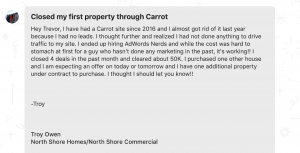
Meet Troy. Troy is a 10-year real estate investor, so he kind of knows his stuff. One day while driving to work, Troy thought
“I’m not getting any leads through my Carrot website, I think I’m just going to cancel.” But Troy’s not a quitter, so he decided “Ya know what, I actually like making money. Maybe I’ll give it another shot.”
So Troy started ramping up his marketing through PPC and got some help from the Carrot folks. It turns out his work paid off… Troy made over $50k last month by closing 4 deals he got through his site.
Now Troy is getting results. Now Troy is ramping up his business. Now Troy is happy! Here’s how he did it…
[podcast-subscribe]
The Conversation
2:29 – Troy’s started out 10 years ago as a real estate investor and house flipper in Milwaukee, Wisconsin. Right now, he’s averaging about 8-10k per PPC deal and closing roughly every 1 in 5-10 leads. Get in touch with the PPC experts he used HERE.
8:41 – What one thing is costing you the most money? Lack of follow-up with your leads. Consistent follow up is key to closing your deals. Sometimes we think we’re bugging people by calling, texting, and emailing him. Without his persistence through 8-10 phone calls, Troy would’ve missed out on $30k from someone who wanted to sell their house.
13:12 – How he plans to ramp up his marketing this next year. Doubling down in online, optimizing his website, and committing to larger direct mail campaigns.
17:32 – How much can you afford to spend per deal? Figure out your max cost per lead and max cost per deal by watching this video: https://carrot.com/blog/max-cost-per-lead/
18:16 – When something is not working, make a mindset shift and ask yourself “Have I truly given this a real chance?” Troy knew his time could be better spent on getting deals done so instead of going the DIY route with his website and marketing, he outsourced it and hired experts, and switched to Carrot’s advanced marketer plan.
21:15 -Suggestions for success from a Carrot customer. Commit to finding a way to drive traffic to your website. There’s a reason why we repeat ourselves at Carrot… the model works! Implement and educate, implement and educate.
The Secret To True Happiness For Ambitious Entrepreneurs w/ Seth Buechley: CarrotCast
My Struggles And 8 Success Lessons Learned… From Paying Taxes With My Credit Card To Multi-Million Dollar Businesses:CarrotCast
What’s Your Credibility Score? The Top 5% Of Earners Are Doing These “Simple” Things To Build More Credibility In A Cluttered Market w/ Trevor Mauch: CarrotCast
We want to hear how we can make our products better and what we can do to help you! Drop them in the comments section below or hit us up on Facebook or Instagram
Listen to the CarrotCast Podcast and Subscribe Below!
We had no advantages. We had ups and downs just like everybody else. I think that’s what you know a lot of people in this real estate game don’t show that other side of the downside and we stuggle everyday. I mean it’s not easy. Max Maxwell
What’s up CarrotCast community. It is the end of a week right now as at the time I record this. I’m actually getting ready to head out to North Carolina and Tampa on Sunday for my last, last, last trips of the year for business.
It’s been … It’s definitely been cramming a lot of stuff in this past month and a half, it’s been all amazing stuff. Just meeting a lot of amazing people. I’ve talked about it in recent episodes of the CarrotCast and different masterminds and high level. I’ve been in boardrooms with two multi-billion dollar companies, their CEOs, different masterminds with just amazing, amazing people.
Speaking of North Carolina, the guests I’ve gotten today’s episode of the CarrotCast, they were actually out here from their home in North Carolina. They were here at CarrotCamp and it’s actually Max Maxwell and Tony Robinson. Max and Tony had been friends for … Shoot for decades and are going way, way, way back.
I think everyone in the industry knows that Max has been kind of taking the industry by storm with his YouTube channels, podcasts, his Instagram following. He’s just building a big, big, big movement. And it’s cool. I love seeing what he’s doing because he’s just sharing what he’s doing as an investor. And originally the whole aim was hey, how can I get from $20K a month to $100,000 a month? And he passed that, and here at CarrotCamp, he’s talking about doing some amazing, amazing things. They’re already doing crazy, crazy great things.
Anyway, we had a chance to kind of, hole away at CarrotCamp in my office, I pulled them to the side and I said, guys, everybody knows Max’s journey from the past two years. Everybody knows how he was broke and how he dove in and started tackling real estate investing and really nailed cold calling and really nailed PPC with Carrot and is doing great. Everyone knows that story.
But, one thing that hasn’t been told is the backstory before that, what happened 10 years, 20 years prior. What happened with their relationship? How did they get to know each other? And how did they support each other through the ups, through the downs?
So we sat down for this candid interview going all the way back to when they were 12 years old and they met, and through the struggles, through a jail stint, through both of them going broke at times, but opposite times through Tony making millions and then losing it all and going to jail.
It’s just crazy, crazy things during the story, but the cool thing I want you to guys to notice is what made these guys who they are today.
People see the success of the past two years as instant, just overnight success, but it wasn’t. It was success decades in the making and I’m insanely proud to sit down with these guys, they’re making an impact, so proud to call them a Carrot customer, Carrot member, Carrot client, and I’m just pumped to be able to see them again and see the impact they’re going to make on more people.
So listen in to this candid conversation with myself, Max Maxwell and Tony Robinson, his business partner, as they discuss their journey and their path that led them to a multi-million dollar real estate business.
Also, please give us a rating on iTunes and listen to other episodes of the CarrotCast!
Listen to the CarrotCast Podcast
[podcast-subscribe]
The Struggles, Lessons, Failures, and Keys That Led to a Multi-million Dollar Real Estate Business
1:55 – Tony and Max’s backstory. How they came together and their relationship. 3:15 – Their high school years and how those years impacted their success. 6:00 – Trevor’s brief backstory about a period in his life when he was introverted. 7:40 – Where Tony and Max ended up after high school. One to the NFL and the other to the Military. How they helped each other during this time and how it ties into their real estate business now. 16:40 – Failed businesses and following the entrepreneurial spirit. Their route to real estate. 21:15 – The ups and downs of 2016 and starting the wholesaling business. 25:00 – Stop trying to duplicate what “gurus” are doing. 26:35 – How Max started creating a YouTube and Instagram following and starting their first meet up. 28:50 – How their business is shaping out to be in 2018. 30:10 – How they get over the fear of having a partnership while being best friends.
LINKS TO ADDITIONAL RESOURCES FROM THIS EPISODE
$15M++ Revenue in 5 Years… How Raul Bolufe Has Built the Momentum to Crush Wholesaling in a Very Competitive Market: CarrotCast
Closing 25% of His Leads: How Max Maxwell Leverages Online Marketing and Inspirational Storytelling to Close 1 in 4 Leads:CarrotCast
Need Inspiration? Jason Is Almost Single-Handedly Renovating His Small Ohio Town by Investing… One Building at a Time w/ Jason Duff:CarrotCast
Your real estate landing pages could be costing you $10,000, $20,000, $50,000. That’s only one lost deal.
Relative to other popular 21st century industries (e-commerce, info product selling, affiliate marketing, etc) real estate is unforgiving. In many of those other industries, one lost deal might amount to $10 or $1,000 lost. But in real estate, players tackle each other on the pavement…
Without knee pads…
Or helmets…
Or teeth guards…
You get the point – one lost deal hurts. And it hurts bad.
But, that also means that one gained deal has an equally massive impact. And the fewer deals you lose to savvy market competitors, the more deals you gain.
In other words, you can turn that lost-deal dilemma into massive cash flow by transforming your real estate landing pages from an underperforming duds into a visitor-converting machine.
This is exactly why I’m going to show you how to optimize your real estate landing pages for conversion.
Follow these rules in your own market.
But first, a quick note about why your website isn’t converting as you want it to (the answer is simpler than you think).
What are Real Estate Landing Pages?
A real estate landing page is a standalone page, created specifically for a marketing campaign. It’s where a buyer, seller, or partner “lands” after they click on a link in ads, emails, or possibly organic SEO rankings.
The anatomy of a real estate landing page is pretty simple. You might be thinking:
Is there a specific design that always works the best?
How can we tell if a landing page is really working well?
What do I use to build my own real estate lead pages?
First, no, there isn’t a specific design that always works the best. What works really well for your real estate business and your market may not work as well as another design (or message) on another real estate website. But, there are elements that usually work well.
A clear and concise headline at the top of the page
A short description of what they’re about to get in exchange for their email address
A few bullet points listing out benefits of what they’ll get when they “opt-in”
An opt-in (a box where people can put their information in and submit it to you)
Really, those are the only elements that are extremely important and pretty much are needed on any landing page. Yes, you can use pictures and videos. Definitely test the video versus just the text with no video because you might find the one with just the text converts works better.
Are Your Real Estate Landing Pages Missing the Mark?
Someone arrives on your website…
Let’s imagine that they’re your ideal client.
They need the service you offer, they’re motivated, and they’re just looking for the right person to work with. After all, selling or buying a home is a big decision and they don’t want to make a mistake.
So they’re browsing around your website.
One of two things will happen in the end.
They’ll leave your website and find someone else to work with.
They’ll work with you.
Those are the only two options.
Assuming that this person needs your service, they’re going to work with someone.
Only one question remains to be answered, then…
Will that someone be you?
Or will it be your competitor?
How will that person make a decision?
Well, someone who needs your service – a motivated buyer or seller – is going to ask only a single question:
“45% [of consumers] said they have found something in an online search that made them decide not to do business with the person.”
If your business never gains trust, it’ll never get off the ground. If your business gains trust and then loses it, it’ll die a swift death.
But if your business gains trust and keeps it, the competition won’t stand a chance.
Not only will word-of-mouth springboard your business into next-level revenue, but online case studies and testimonials will create the same buzzing effect online – where growth potential is multiplied many times over.
More than likely, though, you’re having a different problem.
Namely, website visitors don’t trust you. They spend time browsing around your website and decide internally, “I’m not convinced.”
The good news, though, is you’re not doomed to repeat that trust-killing mistake over and over again.
There are tried-and-proven ways to build more trust, faster on any landing page.
6 ways, to be exact…
The 6 Rules of High-converting Real Estate Landing Pages
Rule Number 1 – Write an “I Have to Read More” Headline
Copyblogger reports,
“On average, 8 out of 10 people will read headline copy, but only 2 out of 10 will read the rest.”
If you’re going to convince someone to work with you, then you have got to start with a compelling headline. It’s the first thing website visitors read and it might be the last thing they read (especially if it sucks).
But, what constitutes a “good” headline?
Well, of course, a headline that makes people read more – that makes them feel like they have to read more.
To do that, your headline needs two elements.
Ambitious problem-solving offer.
Believable enough that your offer doesn’t sound too good to be true.
Strike those qualifying chords and visitors will keep reading.
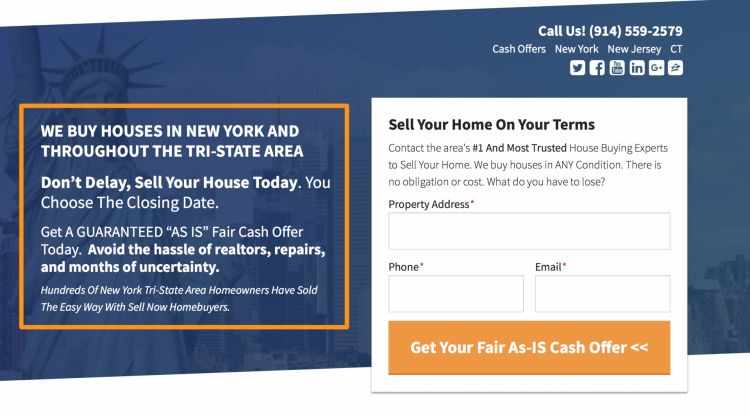
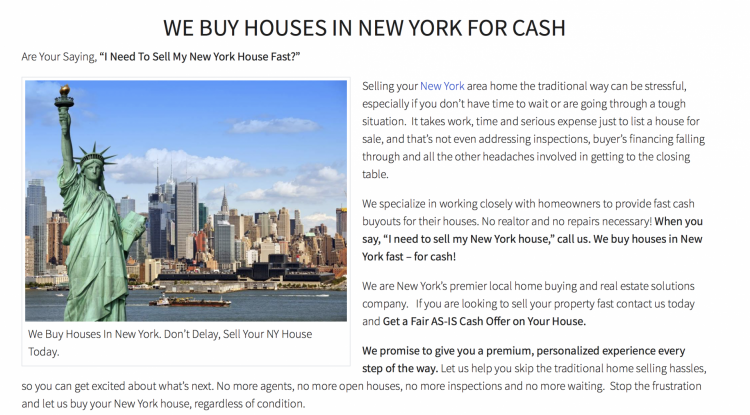
Phrases like “You choose the closing date” and “Get a guaranteed ‘AS IS’ fair cash offer today” keep the headline ambitious and problem-solving enough to maintain the visitor’s interest, while phrases like “We buy houses in New York and throughout the Tri-state area” and “Hundreds of New York Tri-state area homeowners have sold the easy way with Sell Now Homebuyers” keeps it believable enough that the person will continue reading (or opt-in immediately).
It keeps interest and avoids the too-good-to-be-true curse of many other landing pages.
We do the same thing on our website.
Ambitious problem-solving: “Stop losing leads” and “Our real estate investor websites drive more qualified leads than any other platform.”
Believability: “Our members generated 60,088 real estate leads last month”
Don’t breeze by your headline without thinking much about it.
This is the most important part of your entire landing page. So make sure you include these two critical elements: ambitious problem-solving and believability.
Rule Number 2 – An Iconic Local Video or Image
Put yourself in the shoes of your target market for a moment.
Imagine that you type into Google, “Sell my house fast in Western Oregon.”
You click the first result and browse through the landing page. But something odd catches your eye…
There are pictures of palm trees…
And you know – being from Oregon – that there aren’t many palm trees here.
Is this person even from Oregon? you think to yourself.
Trust. Dead.
Well, the same thing can happen on your website, even if it’s not as big a mistake as putting palm tree pictures on an Oregon-based real estate website.
Something as simple as pictures that are irrelevant or unfamiliar to your target market can kill trust. This is why, for every city, you operate in, set up a new landing page with market-specific sales copy, images, and videos.
This is exactly what Dave Brown does on his website…
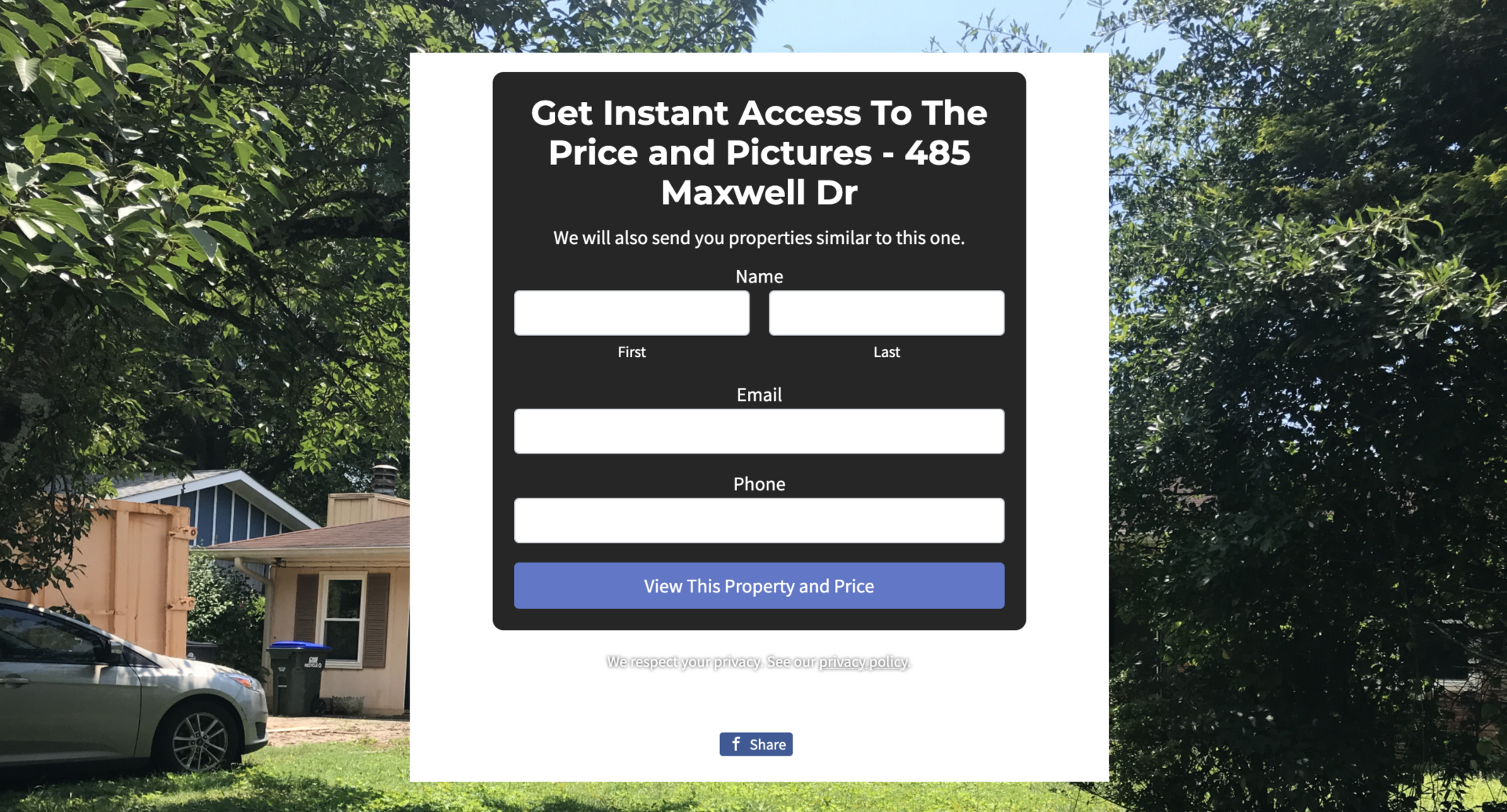
Or, here’s and real estate listing example. They use an image of the actual property as the background…
Even if you don’t live in the area, you operate in it.
And when people arrive on your website, they want to know that you’re familiar with the local market and capable of helping them in their specific situation.
City-specific images, videos, and landing page copy build far more trust than their vague or outright irrelevant counterparts.
Rule Number 3 – Sales Copy that Won’t Let the Reader Stop Reading
Your headline isn’t the only line that should make your visitor keep reading.
All of your sales copy should be like a slippery slope that people feel they have to keep sliding down. Each line leads to the next like meal cuisine at an Italian restaurant.
You just keep wanting more.
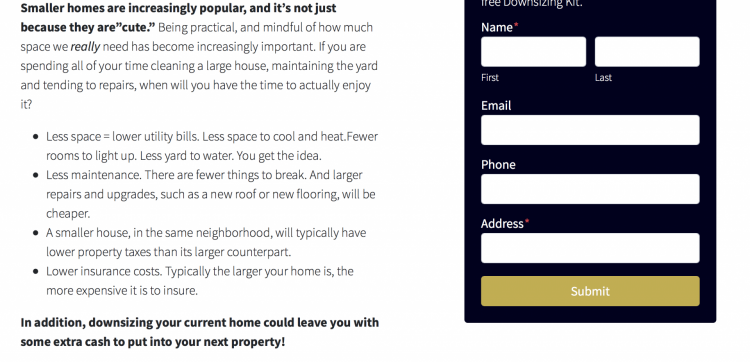
Here’s what this looks like on Home Downsizing Solution’s (another Carrot member) website:
Each phrase leaves the reader with a question… which naturally guides them into the following sentence… which then does the same thing. So on and so forth.
Before the reader knows it, they’ve read all of your sales copy and they’re convinced to work with you.
If you’re writing the words on your landing page and you start to get bored, so will your reader.
Change it up – use a surprising word or phrase, use a funny metaphor, or ask a compelling question.
Whatever you do, don’t let the website visitor lose interest.
Rule Number 4 – Big-promise Bullet Points
Everyone loves bullet points. In fact, a website’s visitors’ eyes tend to spring right to these helpful nuggets the moment they’re on screen.
Because, traditionally, bullet points tell us exactly what we’re going to get and that’s really what we all want to know when we’re going to open our wallets for something…
Okay okay… but what am I going to get?
Well, your target market is wondering the same thing.
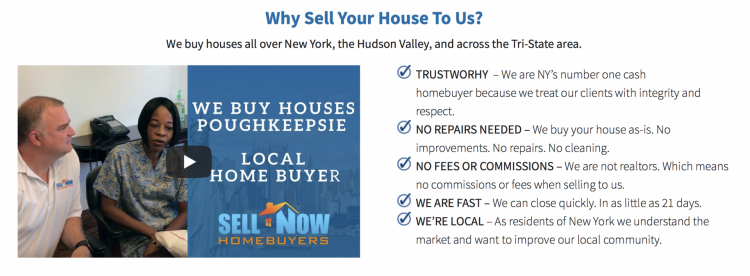
This is why bullet points like this are so darn effective…
And this…
These easy-to-add (but crazy effective) black dots and blue checkmarks build massive credibility and make ambitious promises.
Remember, people, visit your website because they need a problem solved. And a bulleted list is one of the best ways to tell them how you’re going to solve their problem and why they should work with you.
Rule Number 5 – Proof of Concept
With a bulleted list, a compelling headline, and some unstoppable sales copy, you’ve made some big promises. Promises that – so thinks your target market – won’t be easy to keep.
Which is where proof of concept comes in.
You need to prove to your website visitors that the way you work, the promises you make, and the business you’ve created are all worthy of trust.
How do you do that?
Well, the best way is by using a past customer testimonial (video is best, but writing will do).
Consider, as an example, Dave Brown’s case study video… (WATCH)
Skip this step at your own risk.
The truth is… you can make all the ambitious promises in the world, but if you don’t back up those claims with cold, hard facts, people won’t believe you.
People are bombarded by more than 4,000 ads per day, which puts your target market’s trust for marketers at an all-time low. Everyone is making big promises and few people are keeping those promises.
Put another way, proof of concept is likely the most vital part of every single landing page you’ll ever create (in conjunction with a great headline).
Don’t skip this step.
Rule Number 6 – Include a Clear and Low-risk CTA
According to Protocol 80, Inc, 90% of people who read your headline also read your CTA (call-to-action)…
Because here’s the thing: after people know what you’re offering, they want to know what to do.
How do they take action? If they want what you have, how do they dive right in?
And a low, or no, risk CTA is exactly what they’re looking for. They don’t want to spend hundreds of dollars. They want to get started without pulling out their wallets and probably without even giving you a call…
Baby steps…
That’s why, at Carrot, we recommend a CTA that is something like this…
When someone fills this out, our system will send a lead notification via SMS text message straight to your phone. Then you can call the person and close the deal.
But you won’t be able to close much of anything if people land on your website, learn to trust you, and don’t opt-in because there isn’t a clear and risk-free CTA.
You can gain people’s trust all day long…
But that trust isn’t gonna make you any money until you ask those committed prospects to take action in your favor.
Conclusion
One, two, three lost deals…
It all hurts in the same way that gambling away $50,000 hurts…
Except you’re not gambling – you’re running a business.
And fortunately, running a business is far more predictable than visiting the casino. At least, it should be.
Remember, selling is science. And all you have to do to give your website a selling boost is add these 6 trust-building elements to each landing page, whether you’re a Carrot member or not…
But if you’re not…
We can get you moving in the right direction by giving you a high-converting website right now…
It’s already been two years (2016) since Google first released Expanded Text Ads. Ads expanded by 50% and the possibilities for new ad copy generated excitement.
But, as with most things, the newness has subsided. As well as search patterns and the devices we use to search with. More people are using mobile devices with larger displays. A trend that will continue into 2021.
That is why Google Ads (previously Google AdWords) is once again improving your expanded text ads by giving you the opportunity to add more ad copy. You now have an option of an extra headline and an extra description (of 90 characters now) to all your expanded text ads! Here is what you need to know for your real estate campaigns.
What Options are Now Available in Your Ads
The improvements to your expanded text ads give you more character space and, importantly, the OPPORTUNITY to cut through the clutter and stand out from your competition. You now can have three 30-character headlines. Compared to two headlines previously.
Also! Google is adding a second description line and increasing BOTH descriptions to contain 90 characters! Compared to just one 80 character description. Ads now give you the opportunity to be nearly twice as large, giving you up to 300 total characters.
You Might Be Thinking “Are My Old Ads Going to Go Away?”
No. At least not in the immediate future. The ads you are running today will not go away or stop showing.
But! As more of the competition starts to adopt the new ad format, the old, smaller, ad formats could be holding you back. So now is the time to start updating your ads.
What Does This Really Mean to You
We can safely assume that Google has found these larger ads to attract more clicks than the previous ad formats. I don’t think Google would release a feature if it wasn’t in the interest of higher click-through rates.
The migration to the new ad format can be time-consuming. Yes, the new additions are great, but they also might not flow with your current ad copy. So, there might be a need to create a fresh batch of ads. Even if this is not the case, adding in an extra headline and description will take time. You can save some by using the Google Ads Editor.
You need to text. Just because there is extra space, doesn’t necessarily mean your real estate ads are going to perform better. Start by testing out batches of “old” vs. “new” ad copy in select ad groups and move on from there.
You Might Also Be Thinking “Will My New Expanded Text Ads Always Show All 3 Headlines and 2 Descriptions?”
Nope. There is not enough space for a 300-character ad on small screens, so your ad may not show the third headline or second description area. But, your ad will shot the first and second headlines and first description just like they do now.
IMPORTANT: With that in mind, be sure to craft your ads with two compelling headlines and one compelling description. Create the mindset that you can now use the third headline and second description to reinforce your messaging.
Wondering What These New Ads Might Look Like?
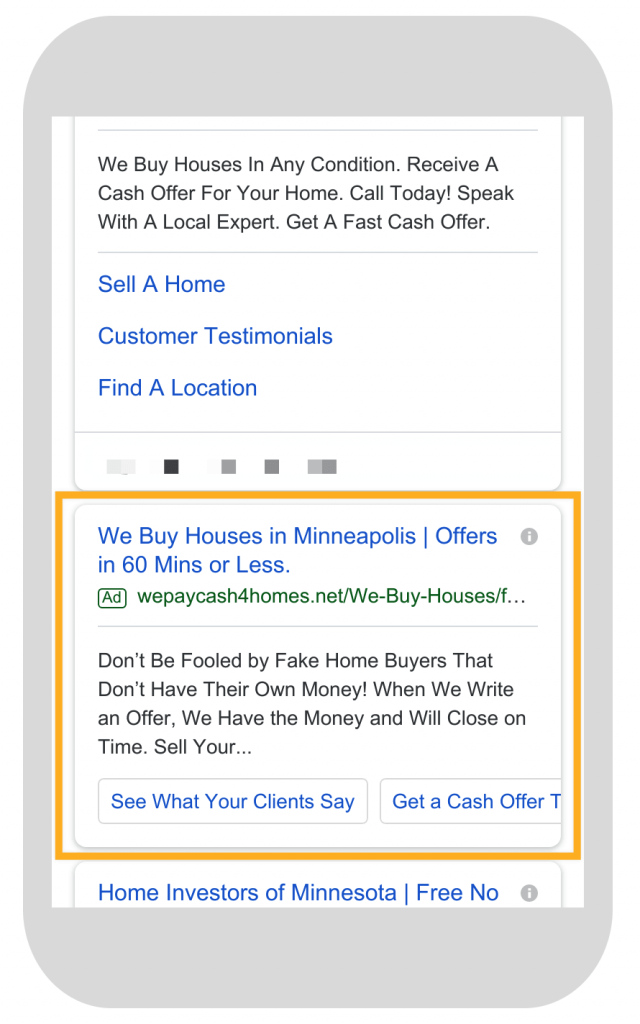
You’ll receive more ad copy on mobile. Check out the example highlighted in ORANGE.
Example of a real estate investing Google Ads ad on a mobile device using the latest expanded text ad format.
On desktop devices, you’ll be at the mercy of how Google Ads will display your ad.
Example of a real estate investing Google Ads ad on a desktop device using the latest expanded text ad format.
This news might be an exciting opportunity, it also may be a daunting task to some. Have fun with this opportunity to create different offers and call-to-actions. Just be sure to will always follow general ad best practices.
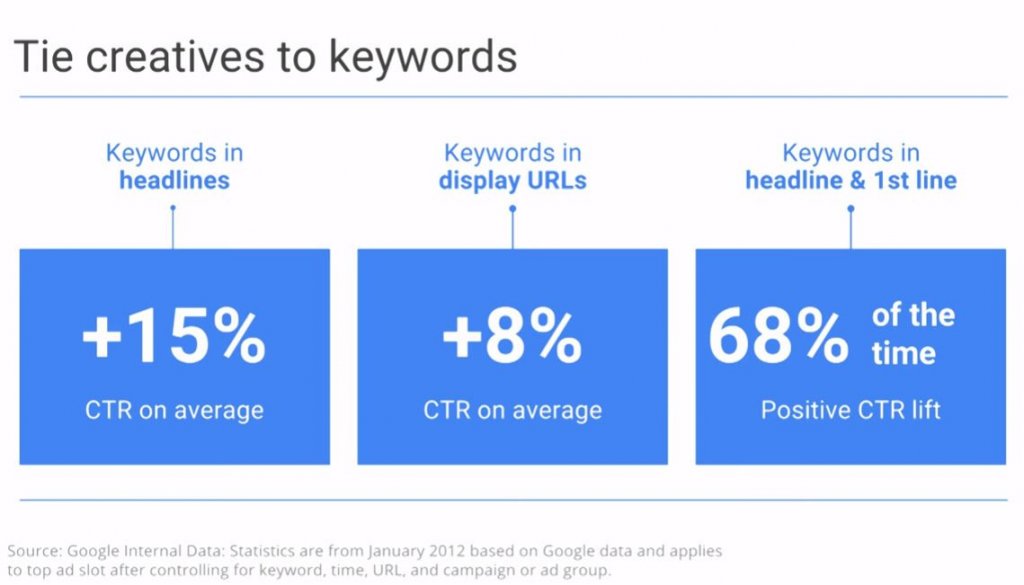
With expanded test ads remember to include your keyword in your ad text. According to Google, including your keyword in a headline increases CTR by 15%.
Also, continue to take advantage of ad extensions with your new ads. If you are not using extensions, you need to start. Expanded text ads take up more space on the search engine page. You can stake a claim to even more real estate using the combination of ad extensions and the extra copy.
Expanded text ads offer a great opportunity for more visibility and increased click-through-rate. But, they don’t guarantee an improvement. So, keep testing and tweaking your ads and take a cautious approach with the new features.
Listen to the CarrotCast Podcast and Subscribe Below!
I dont’ do well if I set small achievable goals. That to me does not excite me. I need to have the large goal because in my mind, I can see what I need to do to achieve the large goal. RJ Bates
I’m pumped about this podcast today. One thing that I love to do and also I hear this feedback from guys all the time in iTunes reviews and the reviews everywhere else and emails and Facebook messages I get from everybody, that they love case studies. You guys love case studies. You love to hear someone else’s journey, their successes, their failures, the things that they went through, the trials, the tribulations and what got them to where they are.
So I’m bringing on another one of our amazing clients, RJ Bates with Titanium Investments, today. And RJ is one of the top investors in Dallas, Texas, but also he’s branched out into multiple markets. He’s in the Hawaii market, he’s in the Anchorage, Alaska market now, and one back Midwest. And we discuss his journey here and his journey, it’s one that was really interesting. I found it fascinating because he’s a guy who kind of found himself falling into house flipping and wholesaling.
He didn’t set out to do that. He actually was a roofing contractor, hustling, selling roofs. And then one of his clients said, “Hey, can you also fix this rehab house?” And he’s like, “Man, I think that’s a good business opportunity.” Before you know it, he’s running a $2 million plus a year wholesaling and house flipping company based in Dallas, Texas, but in four different markets. You’re going to hear his journey, you’re going to hear his trials. You’re going to hear the things that he failed on early on. You’re going to hear why he has a business partner and how they work together.
And you’re also going to hear what works best for him for his marketing mix. He uses online a lot. He uses Facebook a lot. He’s going to talk about that, but he also breaks down the other things that are working insanely well in this cluttered market for him, even when he enters into new markets. Last, how does he enter into new markets? Because he’s just one guy with a business partner in Dallas there. How is that he’s entering into these new markets? Well, he talks about how he’s finding his boots on the ground people, business partners in those markets and how he structures it.
Without further adieu, welcome in RJ Bates from Titanium Investments into this podcast.
How RJ Will Do $2M+ Flipping Houses In 2018 In 4 Different States!
2:15 – Who is RJ Bates and what locations he’s currently investing in. Two of which aren’t the typical locations. 4:50 – What his company looks like right now: Team and deal volume. 10:30 – From Pizza Hut delivery driver to Roofing Contractor. RJ’s amazing journey into real estate investing. 16:15 – He went all-in into wholesaling in 2014. All-in close enough to have $11 before closing his first deal. 17:30 – How RJ stumbled upon InvestorCarrot (Carrot) and Trevor’s backstory about building Carrot sites in 2014. 19:45 – RJ’s vision as an entrepreneur and how that has changed over time. 20:45 – Creating a passive income goal of $100k per month. Why that is his “magic” number and why he focuses on large goals instead of small achievable ones. 29:00 – Changing the mindset around having employees. Scaling business by hiring the right team. 31:15 – Some of the limiting beliefs RJ had to deal with when starting out and struggling a bit. 34:20 – KEY things that must be in place before RJ expanding into a new market. 38:30 – What type of marketing platforms are working right now in specific markets. 40:35 – Breaking down RJ’s cost per deal within certain markets. 43:15 – MINDSET SHIFT: Finding your monthly budget by calculating your max cost per lead. 46:05 – How having a Carrot website has helped drive RJ’s offline marketing. 51:10 – Unpacking what ads are working on Facebook right now. 56:30 – What RJ’s marketing budget looks like and how he’s able to do so much and stay within this mark. 58:15 – What he’s seeing since Facebook has started stripping away some features.
LINKS TO ADDITIONAL RESOURCES FROM THIS EPISODE
#1 PPC Metrics: You Need To Build Into Your Real Estate Marketing Strategy w/ Adrian Nez: CarrotCast
A client of ours reached out and had dropped $5,000 in Google Ads costs over a few months on a campaign he was managing himself, but it wasn’t performing as he hoped, and he had no clue what parts of his PPC marketing were working and what factors were costing him money.
Ready To Get More Leads & Close Your Next Deal? Take Your Business To The Next Level
In this post, we’ll walk you through the simple action we had him take that turned things around from $5k in losses to over $30k in profits… and the #1 mistake most newbie PPC marketers make that prevents you from knowing if your PPC marketing is working for your real estate investing business.
I get asked this question all of the time…
“How do I know which keywords and ads are generating leads?“
Here’s my answer: if you don’t have the proper recording sources and/or analytic tools, you won’t know. Google Ads campaigns will become a frustrating guessing game that may drain your budget.
I also hear that Google Ads is an expensive waste of time and won’t generate leads. That may be true… if campaigns are not created using an optimized campaign structure. If your PPC campaign is optimized, chances are you’ll be in the right position to be successful.
PPC management can test the skills and patience of even the most experienced ad managers. You may be thinking, “My campaign is doing OK right now,”
But if you take a deeper look…
Is it as effective as it can be?
Is it efficient and structured in a way that isn’t confusing?
Are you continuously enhancing your return on ad spend?
Are you data-tracking keywords and ads?
Without proper data tracking, knowing if your PPC campaign is working won’t be easy.
Unlocking Profitability: 3 Powerful Tactics to Determine the Success and Failure of Your PPC Marketing Ads and Keywords
Is PPC Good For My Real Estate Investor Business?
How do you know? Here are a few ways to track your conversions so you know that your money is being invested wisely and not just thrown down into a black hole.
PPC Tracking Tactic #1: Google Ads (Conversion Tag)
The BEST WAY.
A no-brainer is to set up your campaign using the Google Ads conversion tag. Without implementing this tag on your site, you’re measuring keyword and ad effectiveness with a gut feeling.
You or your account manager must know how a searcher landed on your site and what happened after they clicked on your ad. Did they fill in your lead form? Which keyword, ad, and/or ad group triggered the conversion? Those questions will help you build and maintain a quality Google Ads campaign.
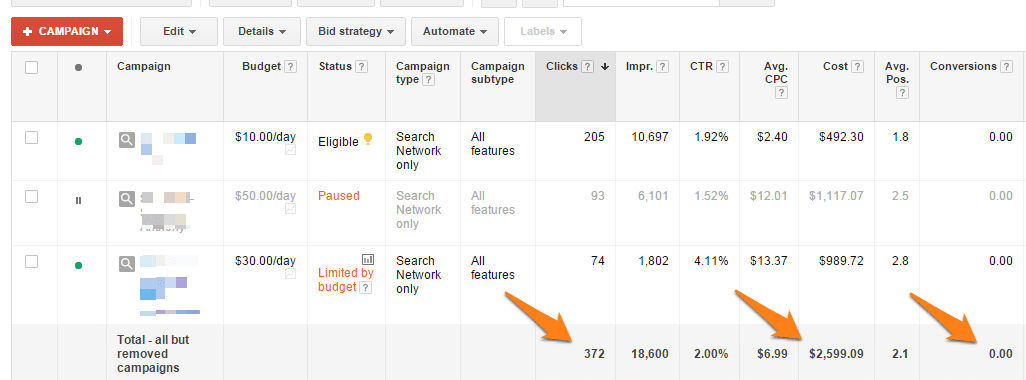
Here’s an example of a Google Ads campaign that does not use the Google Ads conversion tracking tag. It’s not that the Investor chooses not to because they choose to use a different company to host their website. This “other” web service prevents them from placing a conversion tag on their site. Carrot real estate investor websites are built with the high-achieving investor in mind, making it crazy easy to add your conversion tracking tags.
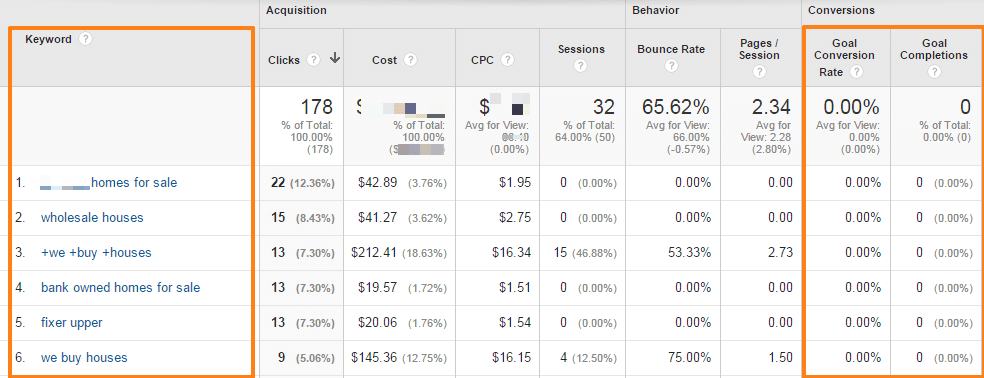
You can see there has been $2599 spent on 372 clicks and 0 conversions.
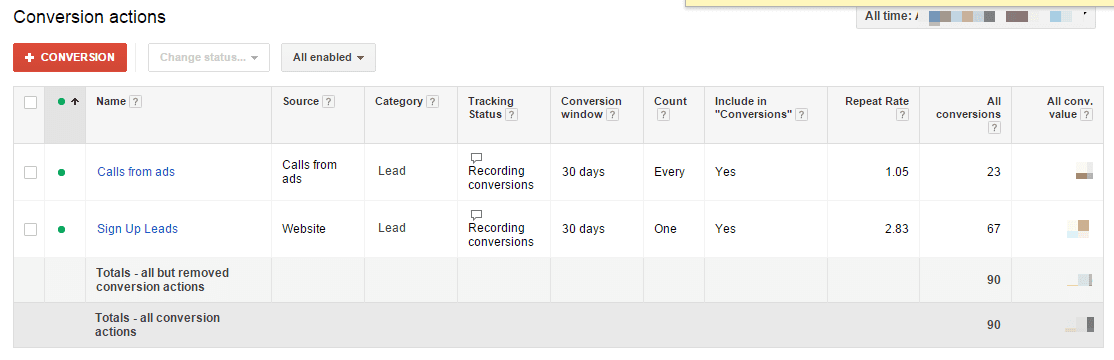
But… that’s not true. There have been 48 conversions (this Investor keeps track of conversions using their system)… $54 per motivated house seller lead! Not too shabby. But an account manager would have no idea which keywords have to lead to those 48 leads. We’re blindly leading the ship.
A Google PPC Campaign Without Conversion Tracking = Throwing Darts Blindfolded
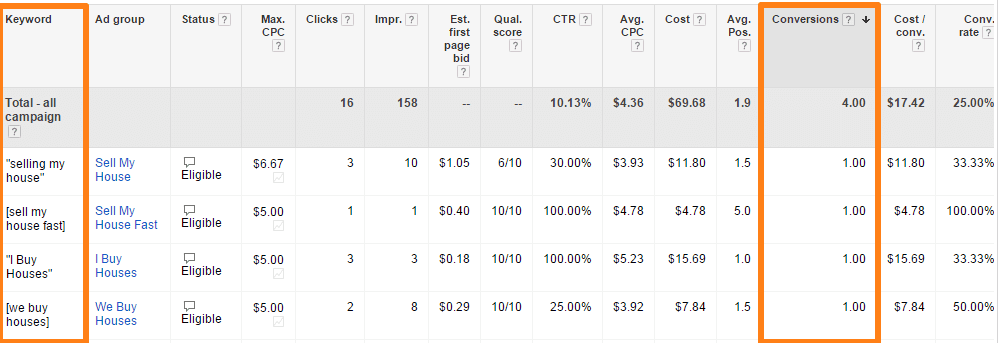
This is what a campaign’s keywords should look like when the Google Ads conversion tag is properly implemented. An account manager knows exactly what keywords need to be adjusted and tested.
A Google PPC Campaign Using Conversion Tracking = Strategic ROI-Based Marketing
The benefits of recording data — you will know which ads, placements, and keywords lead to conversions and are worth bidding on. You’ll also know the reverse, which ad, placements, and keywords to pause.
Pros and Cons Of This Tracking Method:
Pro: Helps you find exactly which ads, keywords, and ad groups are performing the best and worst so you can make smart decisions to drive up your return on investment
Con: Nothing… really. This method is highly recommended as long as your tag is installed correctly on your website and you record unique leads.
Be sure to create a conversion tracking tag for your PPC leads.
For Carrot members, you can place a conversion tracking tag on your “step-2” page to ensure tracking on all potential clients who have filled out one of your website forms. Tags allow you to definitively know when traffic has come from your PPC campaign rather than from SEO, direct mail, etc… it also helps you drill down on exactly which keywords are producing profitable leads and which aren’t.
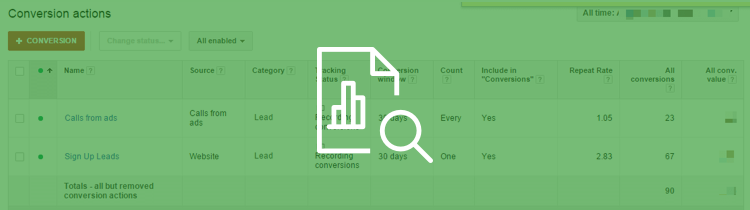
You can use the Google Tag Assistant to double check the tag is reading your step-2 page.
HOW CARROT MEMBERS CAN PLACE AN ADWORDS CONVERSION TAG ON THEIR CARROT SITE
PPC Tracking Tactic #2: Google Analytics
First… you’ll need to link your Google Ads account to your Google Analytics. While you will be able to track conversions in Analytics, you won’t be able to know for sure which keyword or ad generated the click. This isn’t the best way to monitor the performance of your PPC campaign but it can be used to track overall lead volume.
Pros and Cons Of This Tracking Method:
Pro: Gives you great aggregate data on the performance of your Adwords campaigns
Con: It doesn’t let you drill down too far into specific ads or, in some cases, specific keywords either, and doesn’t tell you exactly which leads came from where.
PPC Tracking Tactic #3: The Carrot Lead Source Feature
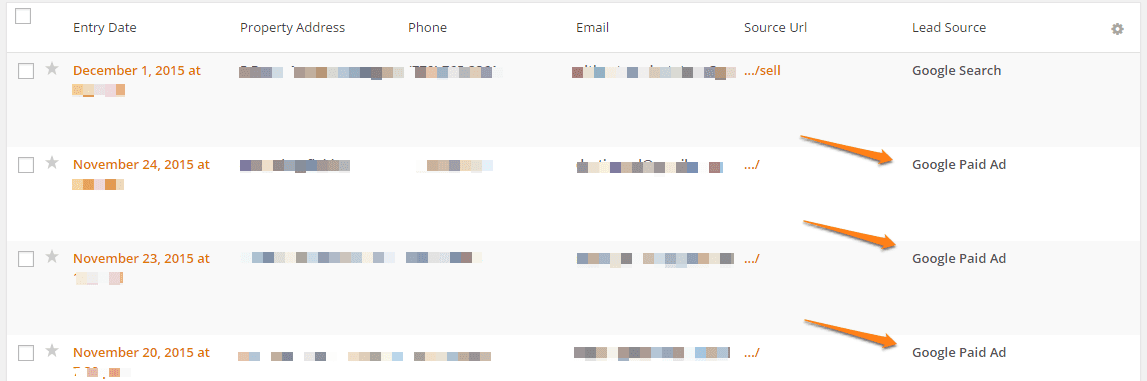
Like the information in Analytics, Carrot members can see which traffic source generated the lead, but again not a specific ad or keyword.
The Lead Source Tracking is automatically tracked for every single lead that comes into an InvestorCarrot site You don’t have to do anything to turn it on. Just head to view your leads, and it’s right there.
To find this info, log in to your Carrot site and view your leads. We’re currently working on a massive upgrade that will give more power and functionality to Campaign Tracking within your InvestorCarrot site. Keep an eye out for that release this spring!
Carrot Lead Source Tracking Built Right Into All Of Our Websites
Pros and Cons Of This Tracking Method:
Pro: This Lets you see exactly where each lead came from so you can track the true profitability of your marketing. This, combined with the Google Ads Conversion Tracking tag, is the ideal setup to give you the whole picture.
Con: This tracking doesn’t give you any data about the ad that drove the lead.
Key Strategies for Running a High-Quality Campaign and Positioning Your Ads for Maximum Impact
To measure the effectiveness of your advertising campaign, you should monitor your investor transactions, whether buyer or seller, and keep track of new customers, requests for information leads, phone inquiries, and even organic website traffic.
Here are some ideas that will help you not only determine the effectiveness of your ads but will also give you some new marketing ideas.
Additional PPC Marketing Optimization Tips
1. Compare your sales before, during, and after your ad campaign.
Keep in mind that internet advertising often has a delayed affect and can then grow steadily.
Transactions that result from your ads may not take place immediately. So be patient.
2. Use a dedicated phone number to track inquiries.
Create a phone call conversion tag for AdWords or other internet marketing options. Tags make it easy to identify and track phone leads positively.
3. Here are several more that will help squeeze out that extra profit and return on investment…
Set a PPC goal. This could be the number of leads per week, month, or even a cost-per-lead target amount. Whatever it is, though, write it down and constantly measure it.
Keep your campaign organized. A messy campaign can cause confusion, waste spending, and ultimately leave you unmotivated.
Target the right keywords and limit the number of keywords. Yes, you can have too many. The sound of 4,000 keywords might sound appealing. However, having too many keywords can lead to confusion and harm your campaign. Unless you are willing to create ad groups and ad text based around each keyword, AdWords potentially won’t give you a high enough quality score for ads to show in the highly regarded top three ad spots (41% of clicks come from the top 3 spots). You can also waste spending due to higher click costs and possible clicks from unrelated searchers.
Creating compelling ad copy. Make a searcher want to click your ad. Read our blog post here, where we write about that.
Testing…testing. Create numerous ads and be sure to test them to figure out which ones are more attractive. Even minor changes, such as removing or adding a word in the ad headline, can make all the difference.
Use quality landing pages. Landing page experience refers to the relevant, helpful, and original content. Read this post to learn how city-specific landing pages help you get more traffic. Landing pages must offer trustworthiness and be easy for customers to navigate. It also requires a quick loading page time and encourages customers to spend time on your site.
Make sure your call to action is clear. Tell the searcher what to do. Don’t make them guess.
Put the focus on your potential motivated seller or buyer lead. Let them know why you’re better than the competition.
Always implement a conversion tracking tag. Yes, you might be able to track lead sources, but if you look at your Google Ads account, you won’t know which keywords and ads generate ROI. It will become a guessing game as to which keywords to pause potentially and which to be more aggressive with.
Reasons Why You Should Start Conversion Tracking Today
You must start to gain insight into what’s working within your campaign. Without that knowledge, your Google Ads campaign won’t be completely optimized. This will limit you from being able to make the necessary changes to attract more leads.
You’ll also be able to improve your ROI.
Clicks are not valuable unless they are converting into leads that turn into profitable deals over time.
Tracking will reduce wasted ad spend, gain quality clicks, and improve ROI.
With the data gathered from tracking, you can perform a better test on your campaigns and grow them to get even more conversions.
Don’t Spend Another Dime On PPC If You Don’t Have Layers Of Conversion Tracking In Place
Once our client turned on conversion tracking, he could quickly see which ads and keywords were a complete waste of money and which were bringing him solid leads. He trimmed off the stuff that wasn’t effective and ramped up the stuff that was. Within four months, he closed several deals that have brought in over $30,000.
He possibly would have closed those deals without the tracking in place, but his profit would be far less because of the wasted marketing dollars he was spending before he had tracking in place.
Tracking is essential… not just a “luxury.”
Implement the Google Conversion Tag + make sure you’re using a website system that helps track your leads and tell you where each lead came from. That information alone could save you tens of thousands of dollars per year.
There are a lot of factors, including time of the year, the state of the economy, and geographic location, which can make it difficult to accurately measure the success of your ads if you don’t use the proper tracking techniques.
Compare the before and after advertising traffic from your Carrot website. Also, your PPC manager should be able to provide you with weekly and/or monthly PPC reports.
You can also be proactive. When talking with your leads, don’t forget to ask them the obvious question.
How did they find your website?
PPC might not be a cost-effective alternative in very competitive markets unless you can ensure a large enough marketing budget or be willing to limit your traffic if you’re using Bing… but either way… putting in place what you learned in this blog post is essential in competitive markets. Let your PPC be a great compliment to your SEO campaign.
PPC data tracking is one of the most important parts of your PPC campaign.
Interested in switching to Carrot so you can take hold of your online marketing once and for all and ramp up your ROI? Awesome!Take a demo and reach out if you have any questions!
Question: If you’re doing paid marketing, are you using conversion tracking? Let me know below in the comments section!
Pearson reports that 65% of the population are visual learners. Hubspot notes that an infographic is 30 times more likely to be read than pure text. And Massplanner explains that infographics are shared 3 times more than any other type of content.
But, how do you create your own infographics that are useful to your audience, convert the right people into leads, and don’t look hideious?
Well, that’s why you’re here.
Because you’re not a designer or a professional content marketer, you’re a real estate agent. But, as we’re going to see, that doesn’t mean you can’t put together some lead-generating real estate infographics.
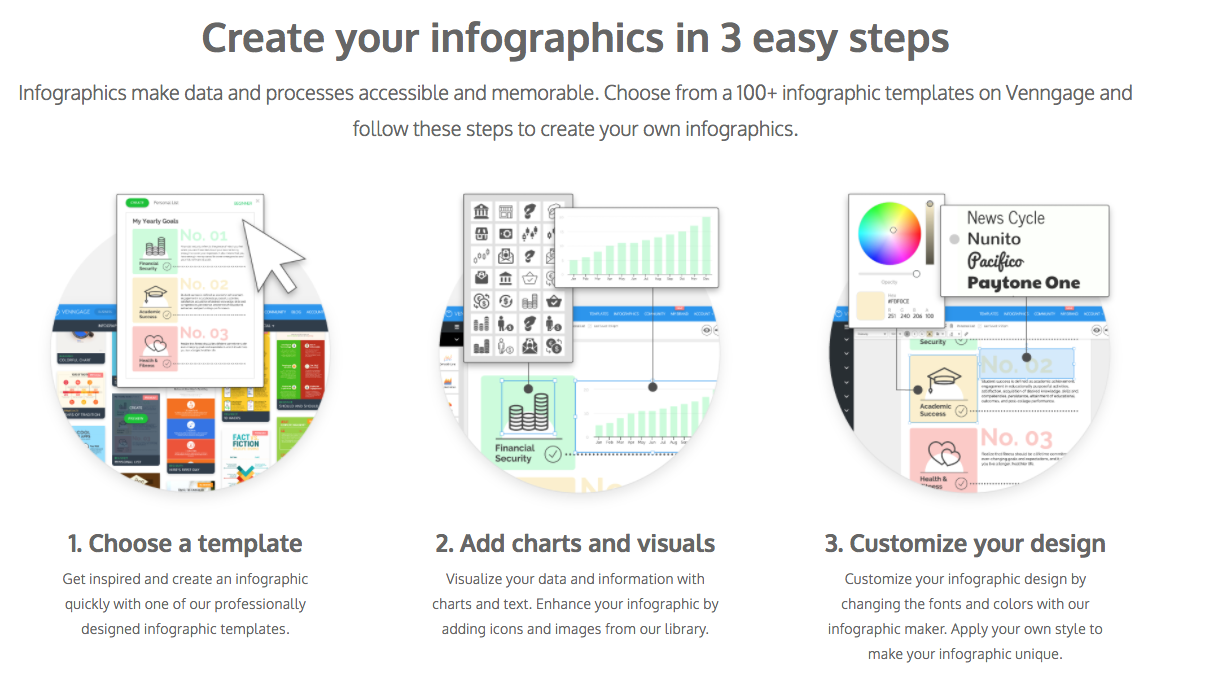
Here’s a three-step process for creating your very own real estate agent infographics: Choose an idea. Find your formatting. Use these tools.
Real Estate Agent Infographics – Pick an Idea
As with any piece of content, you need an idea. And brainstorming is the best way to dig up ideas. But since you probably don’t have a real estate infographic guru sitting next to you, and brainstorming on your own is boring, we’ve done the digging for you. Here are 5 examples of infographics that you, as a real estate agent, can steal ideas from.
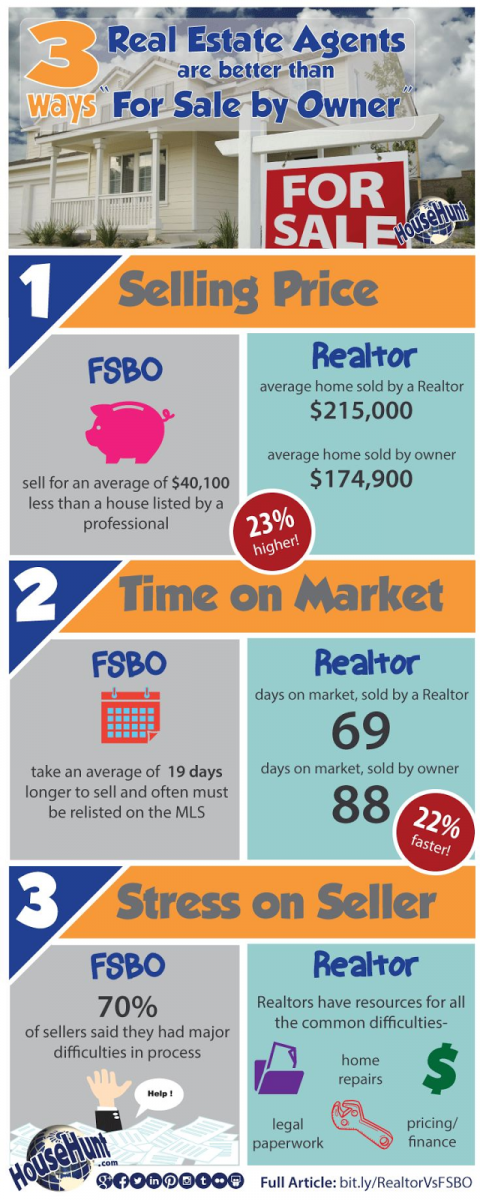
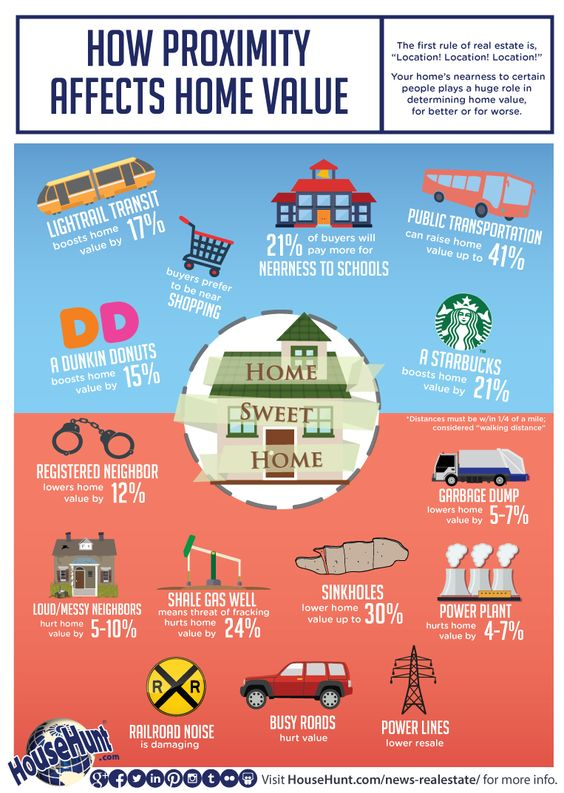
(1) 3 Ways Real Estate Agents are Better than “For Sale By Owner.”
The perks of explaining — in an infographic — why someone should use a real estate agent are obvious… especially if you are one. If prospects believe they need an agent to sell their house, and you’re the one who convinced them of that, they’ll likely be giving you a call.
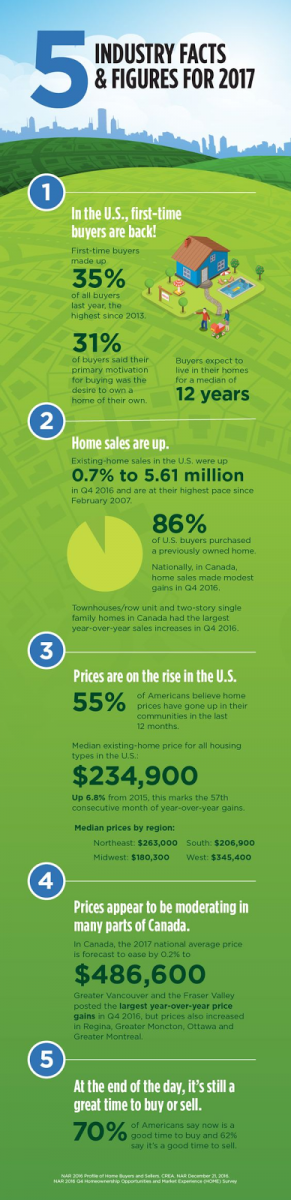
Creating an infographic that illustrates the market’s health is a benefit to homebuyers and sellers alike. Anyone looking to purchase or peddle a house is likely interested in the market’s current wellbeing. This will help inform prospects of a ripe market and — if you include your phone number on the bottom — of who to call for help.
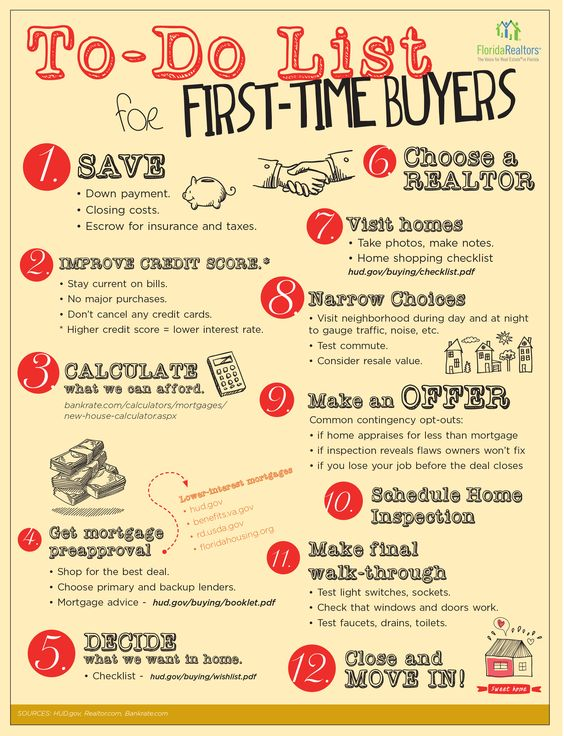
This infographic is wildly helpful for the person looking to buy their first home. Every first-time buyer has worries, concerns, and doubts about the buying process. Creating a piece of content that covers the steps of purchasing a house helps to dilute these uneasy feelings — making the procedure seem a whole lot easier.
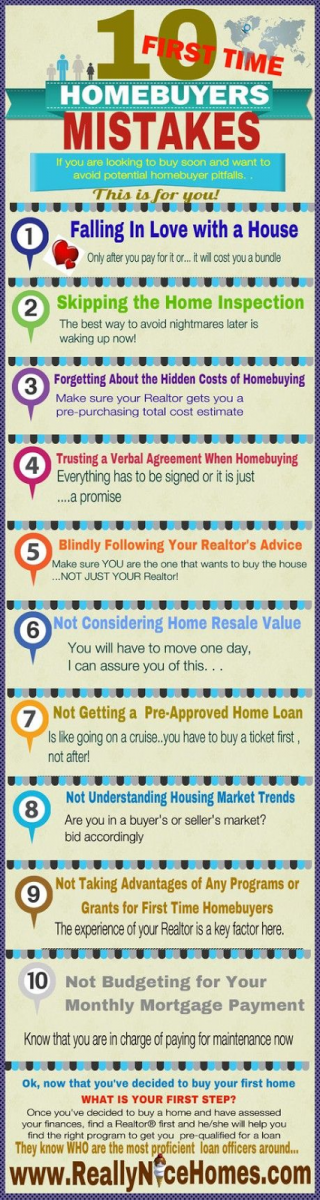
Nobody wants to walk into a pole — whether that’s physical or metaphorical. Homebuyers are filled with fears of what could go wrong in choosing a house, purchasing the house, picking a real estate agent, getting a loan, and moving in. The infographic above does a nice job of ensuring that these fears don’t paralyze a prospect.
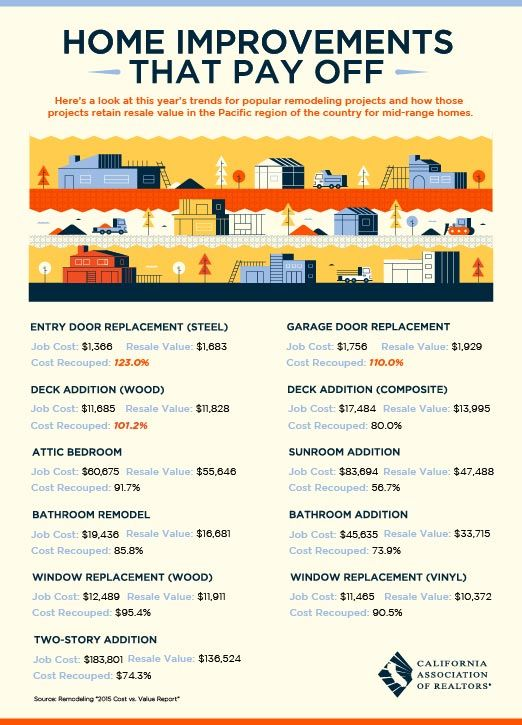
Ever wondered what pays off on house remodels? Sure you have. And so has your potential client. Make an infographic that has information on what sort of remodels are the best to pursue. Again, the idea is to aid the person looking for help. If you help them now, you’ll likely get to help them again when they need an agent.
Choose a Format
Infographics are able to illustrate concepts that words cannot. Because of that, it’s important to consider what kind visual formatting you should use. Above all, don’t get fancy.
The simpler your real estate infographic, the easier it is to understand and the more people who will engage with it. Here are some formats to consider from beautiful — but simple — real estate agent infographics.
The formats are organized from easiest to hardest in regards to their creditability. Don’t be afraid to start at the beginning.
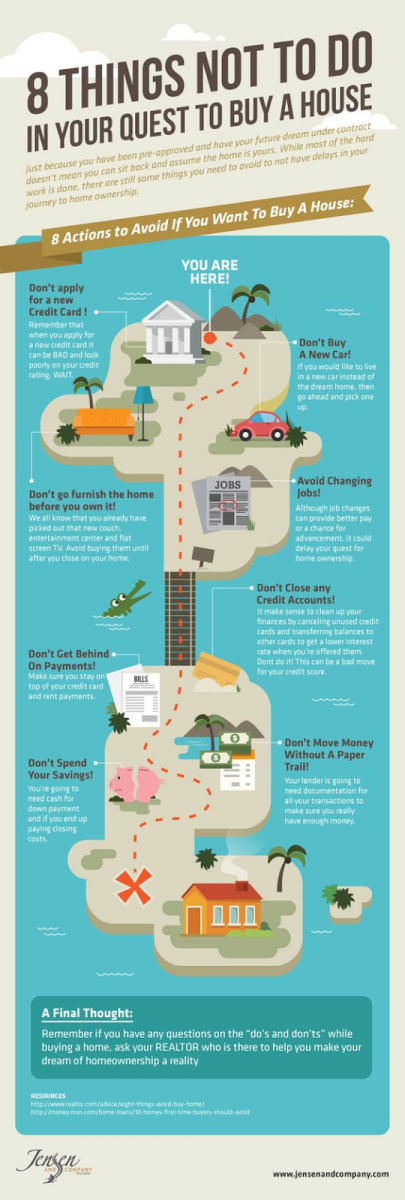
The numbered list format is common for a reason. It’s easy to read, effective at illustrating simple pieces of information, and guides the eye seamlessly from point to point. Simply choose a number of tips, don’t-do’s, or guidelines and fill in the blanks. Start here if you’ve never created an infographic before.
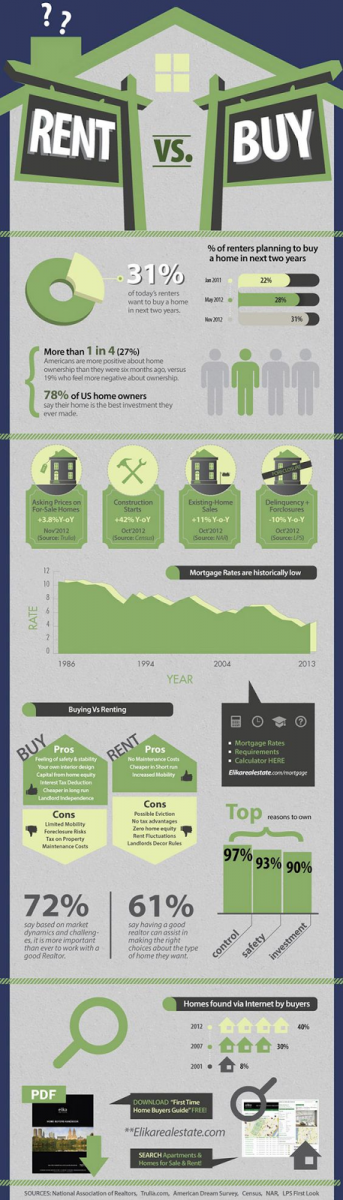
This infographic is nearly as simple as the numbered list format but requires a bit more research. Use the stat card format when wanting to provide useful information for the prospective client, such as when to sell, best house investments, or any other topic that’s data-driven.
Buying or selling a home is riddled with choices. How many beds and baths should I have? Am I getting my money’s worth? Should I rent instead of buying? Which is exactly why this format is fantastic for helping the prospect to make a decision.
Ask yourself what kind of questions clients have for you and then create a comparison infographic to provide the pros and cons of each option.
Building this kind of infographic requires some creativity beyond the previous templates. But the basic idea is allowing the infographic to guide someone from point A to point B.
Visually on the graphic, and contextually on the info, the piece gives the viewer an idea of what it will take to make the journey — whether it be from renting to buying, from owning to selling, or from selling to investing.
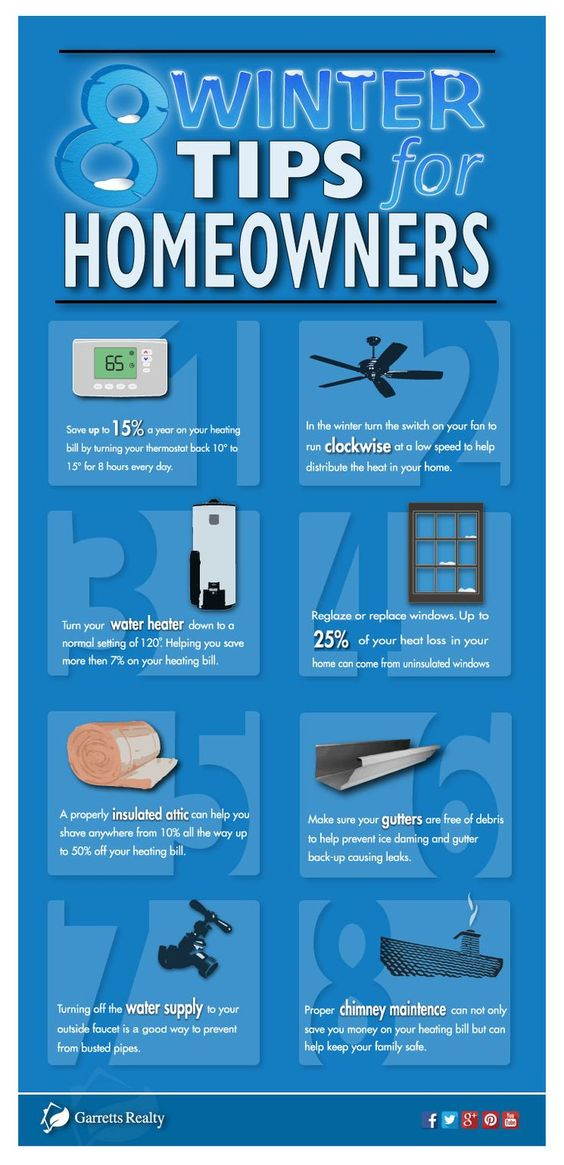
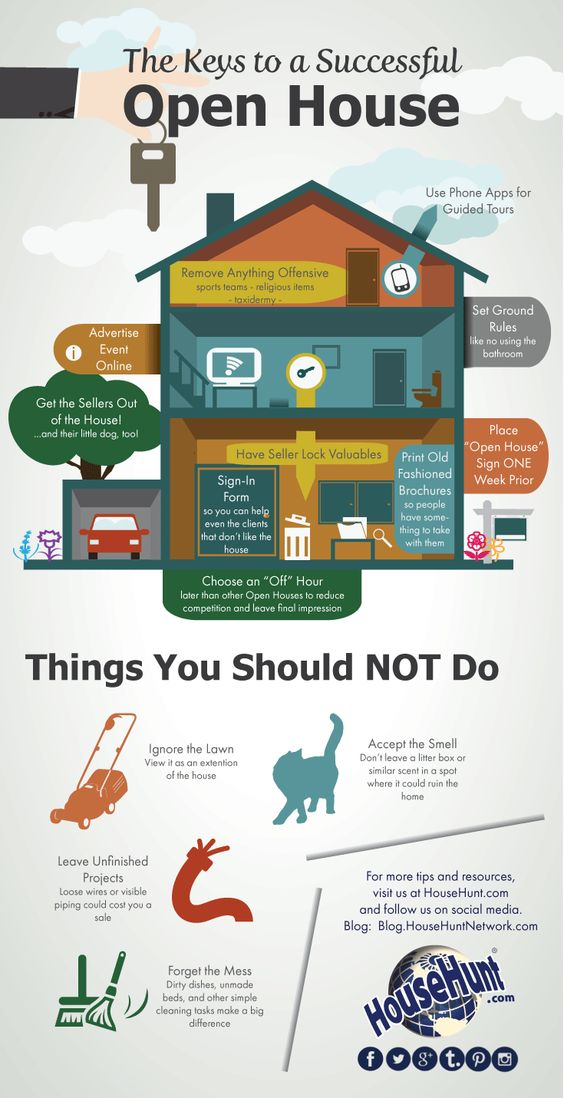
This format for an infographic is one of the most creatively demanding. As you can see in the image above, the tips are placed visually within a house. Thus, the form matches the function. While this kind of infographic is beautiful to look at, it’s unnecessary. Unless you have the creative power, time, or money to design this kind of brilliant, free-flowing infographic, don’t.
Use these Tools
Thinking up an infographic in your head is one thing. Creating it is quite another. But, lucky for you, in our age of digital stampedes and marketing masters, anyone — including a real estate agent — can become a graphic design artist. Here are two tools you can use to create your own infographic right now for free.
Just in case you think you’re too good for an infographic creator, be aware that huge companies including Google, Hubspot, Microsoft, and Forbes all use Venngage. In today’s world, a great tool is utilized by the small and the big alike. Venngage is such a tool. Join up for free and it will walk you through designing your very first infographic.
More versatile than Venngage — and still free to use — is Canva, a holistic graphic design platform. You can edit images, design a logo, and create banners, flyers, and infographics. Great for the inexperienced graphic designer.
A Final Tip
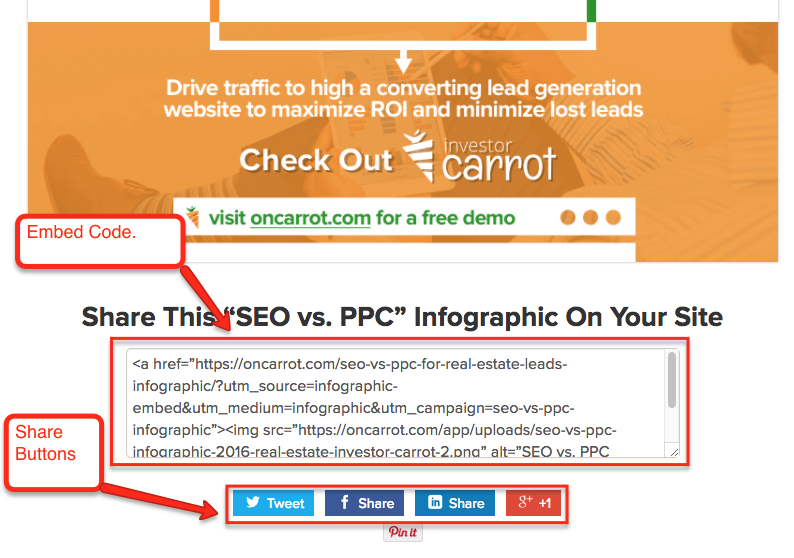
Yes. Your audience is three times more likely to share an infographic than they are to share any other piece of content. But, that’s only the case if you make your infographic easy to share. Whenever you post an infographic, always include the embed code so that people can easily share it to either social media or on their own blog. On our infographic explaining SEO and PPC, we included shareable buttons and the embed code, to maximize the size of its wings.
Keep it Visual, Fun, and Data-Driven
Visual content will continue to be powerful because human nature demands it. And real estate agent infographics, in particular, are powerful because they are a visual representation of helpful, inspiring, and insightful data. Plus, now that tools to create your own infographics abound, you’re out of excuses.
Remember, no first draft of content ever comes out perfect. So above all, just start. And keep in mind what you’ve learned here.
But you also need to schedule house visits, drive homebuyers to potential houses, meet with house sellers, solidify contracts, and do a whole lot more.
When the heck are you going to find the time to (1) come up with content marketing ideas for real estate agents and (2) create the content?
Well, that’s exactly what we’re talking about today: Real examples from real agents who’re using content marketing to catapult themselves to the head of the pack. Because potential customers aren’t just looking online… they’re making decisions based on what they find.
Content marketing is how you dominate search results, build trust, and attract new clients all before they even meet you.
Why? Because your strategy has to be built on your strengths … and loves:
This post digs into the details with two top-to-bottom examples of exactly how to execute your content marketing master plan and a host of supplemental examples along the way.
So, let me introduce you to our content marketing test case …
Judy Weiniger runs the Weiniger Group, a seven-person real estate agency in central New Jersey. She’s active on various platforms, including social media, Youtube, and her website.
But, Weiniger doesn’t do content marketing just about selling houses; she makes it about what someone buying a house in the area would need and want to know. In other words, the content she provides is not one promotion, listing, or sales pitch after another. It is useful information that helps her audience.
That is the pinnacle of great content.
7 Content Marketing Ideas for Real Estate Agents
1. Real Estate Content Marketing Ideas All Start With The Right Agent Website
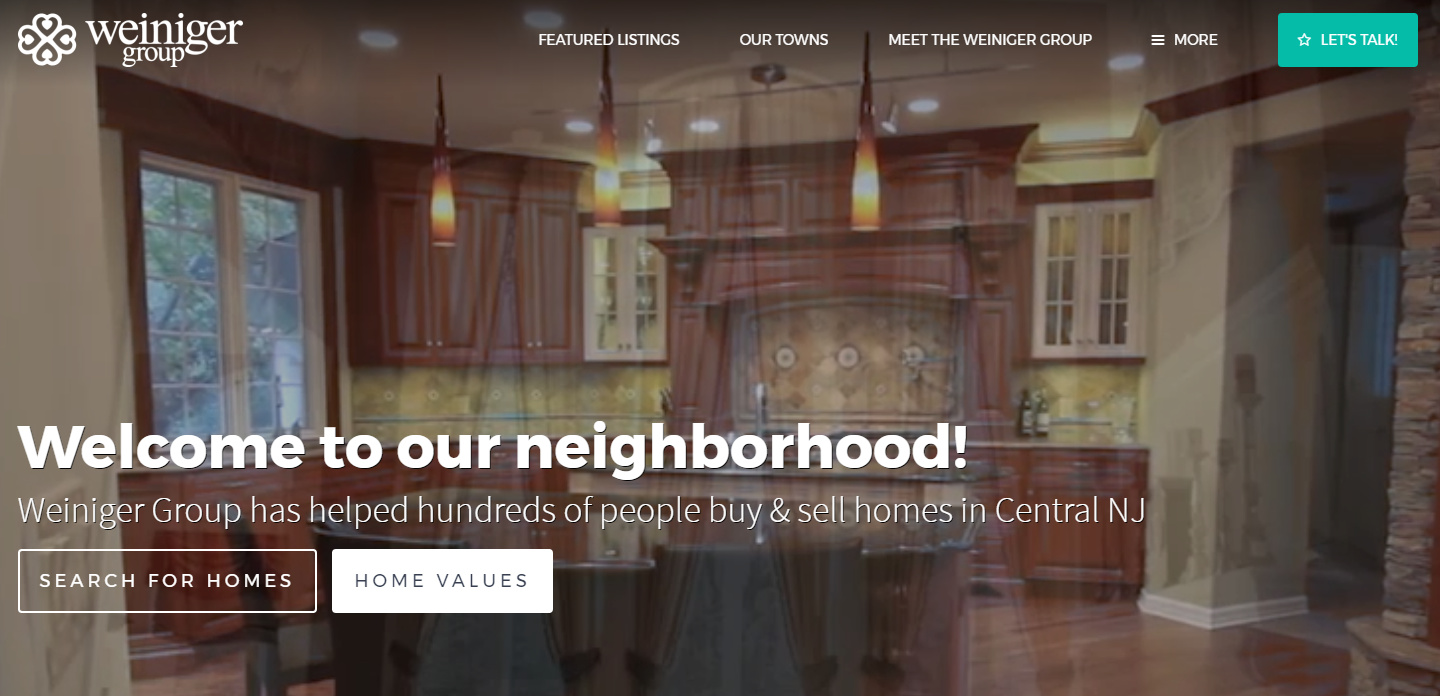
Let’s start by looking at her website. To begin, it’s gorgeous. You should click through to see the video background in the hero section; the following screenshots don’t do it justice.
Visitors are greeted with a friendly hello message — “Welcome to our neighborhood!” — followed by two CTAs directing them exactly where to go next.
While this isn’t connected to content marketing, notice that in the top right there’s a prominent “Let’s Talk” button for anyone wanting to connect directly.
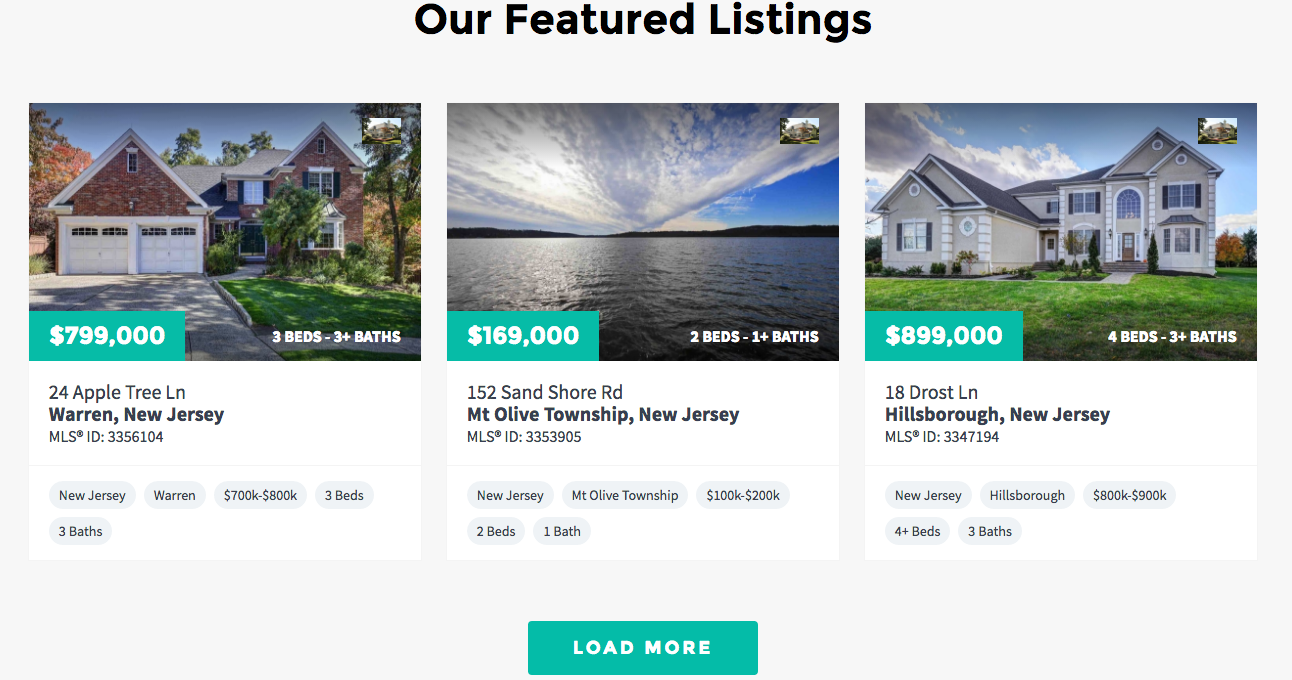
As you scroll down, you’ll see the type of content she’s releasing, and it’s just what home buyers want to see.
First, there are the featured listings.
If the prospective homebuyer is there to look at houses, this section lets them do that … immediately.
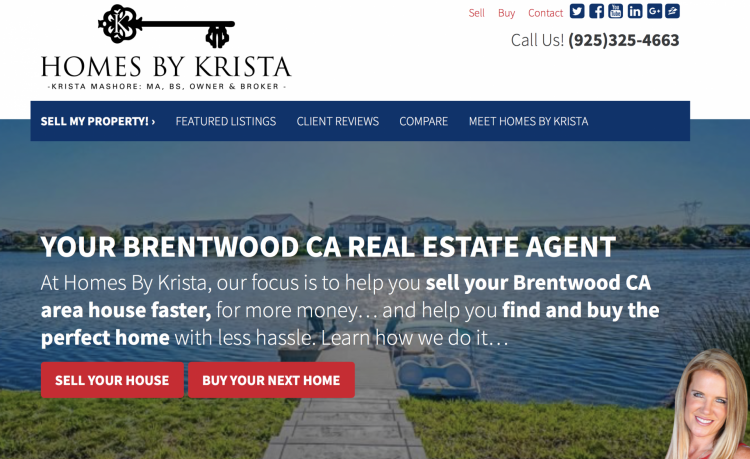
Homes By Krista (a Carrot customer) takes a similar approach. It opens with a beautiful hero image and simple problem-solving message: “Sell your house faster and for more money” and “Find and buy the perfect home with less hassle.”
To find out more about getting your conversion-optimized Agent website, go here!
In Weiniger’s case, after taking care of the low-hanging-lead-fruit, she turns her full attention to content.
2. Real Estate Agent Blogging Ideas That Are Way More than Just Listings
Rather than just featuring houses and soliciting sellers, Weiniger caters her blog to people who either don’t know if they want to move to central New Jersey yet or are looking to explore the area.
Want proof?
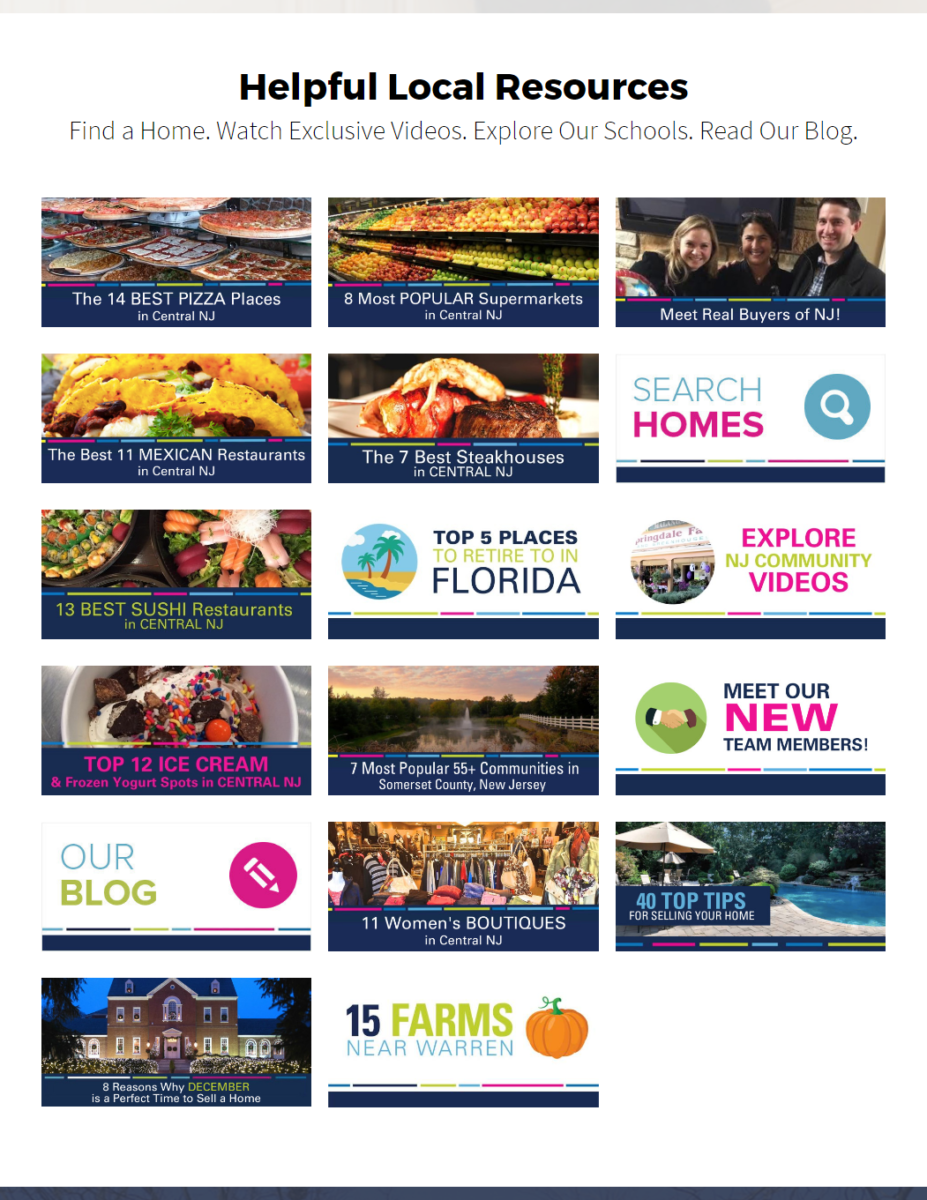
Scroll further down the homepage, and this is what you’ll see.
Weiniger doesn’t just play the part of a real estate agent — a home-finder and home-seller — she plays the part of friendly food citric, supermarket expert, school advisor, and more.
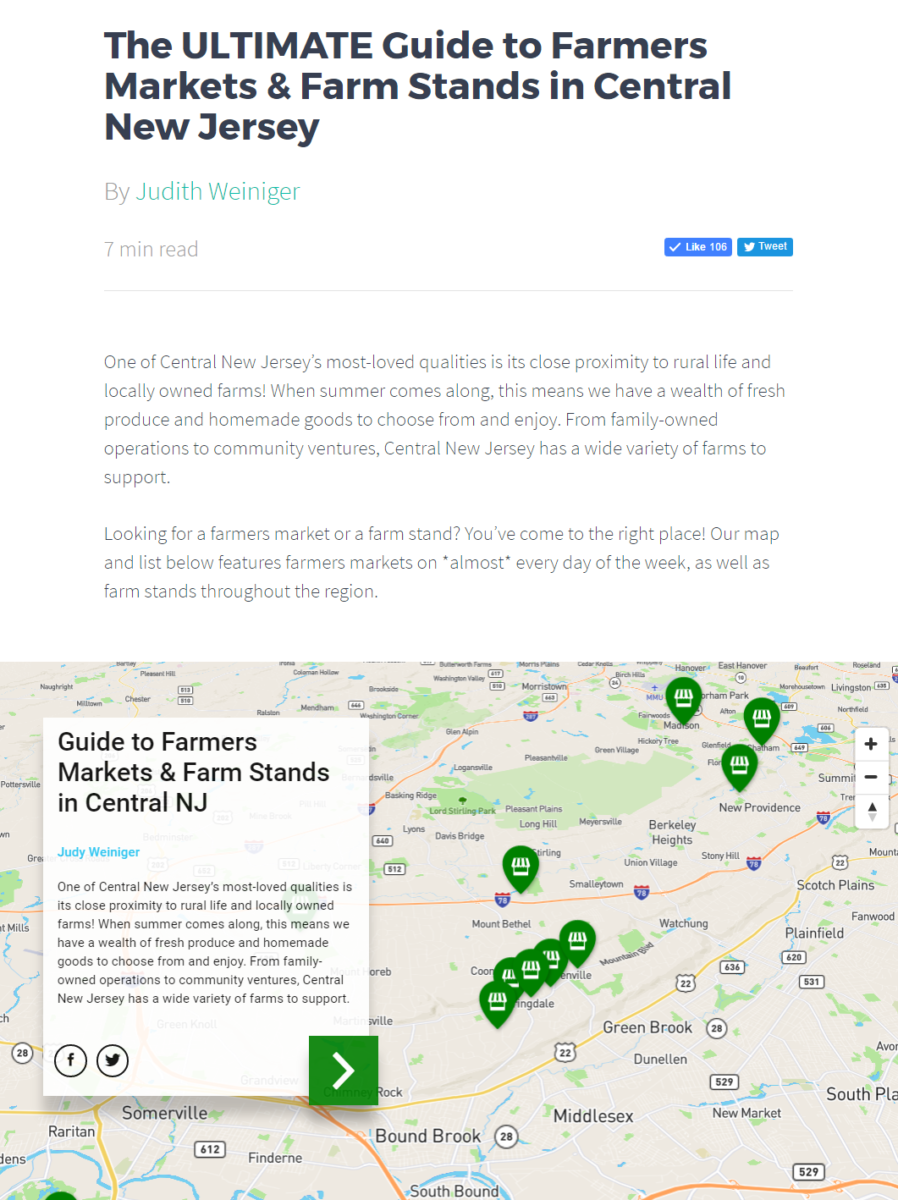
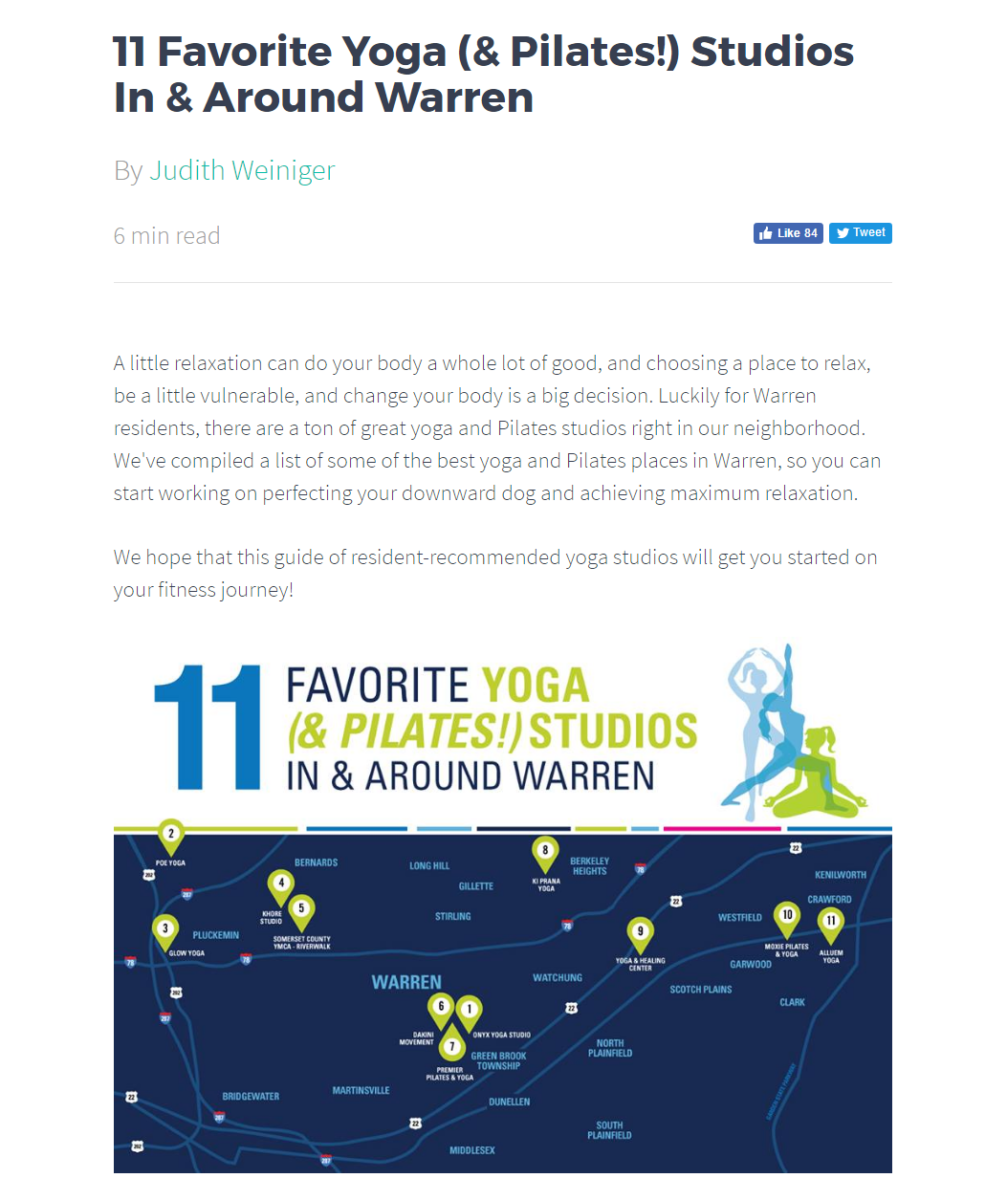
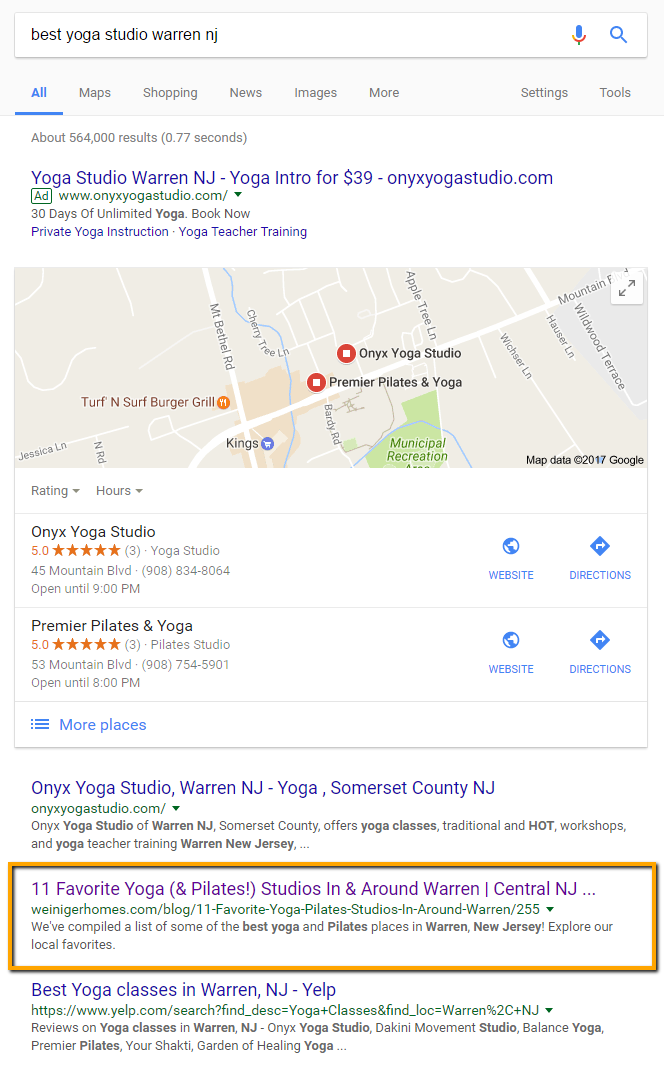
And they deliver. Two of Weiniger’s most popular posts at first appears to have nothing to do with real estate at all: The ULTIMATE Guide to Farmers Markets & Farm Stands in Central New Jersey and 11 Favorite Yoga (& Pilates!) Studios In & Around Warren.
But that “appearance” is exactly the point. Both articles answer the kinds of questions someone relocating or settling in would naturally have. When they take to the internet to find answers … guess who they find:
Weiniger occupies the second organic search result on page one of Google (the only result that beats them is an actual yoga studio and they even outrank Yelp). Plus, the posts are more than just words. They include embedded YouTube videos, direct links to all the mentioned resources, and interactive maps.
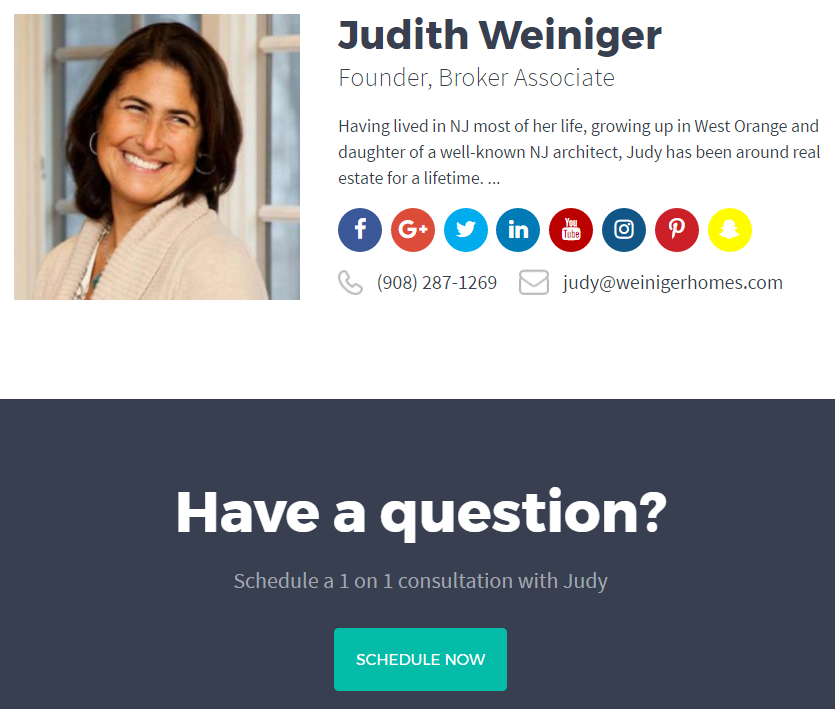
At the end of each post is Weiniger herself, her contact information, and a CTA to “Schedule Now”:
Naturally, once a visitor reaches the end of a post, Weiniger has positioned herself as an advisor. She’s helped them. She’s generated trust. And really… that’s the point.
Feel like that sort of design and technological integration is beyond you? It’s not because all those slick elements aren’t necessary.
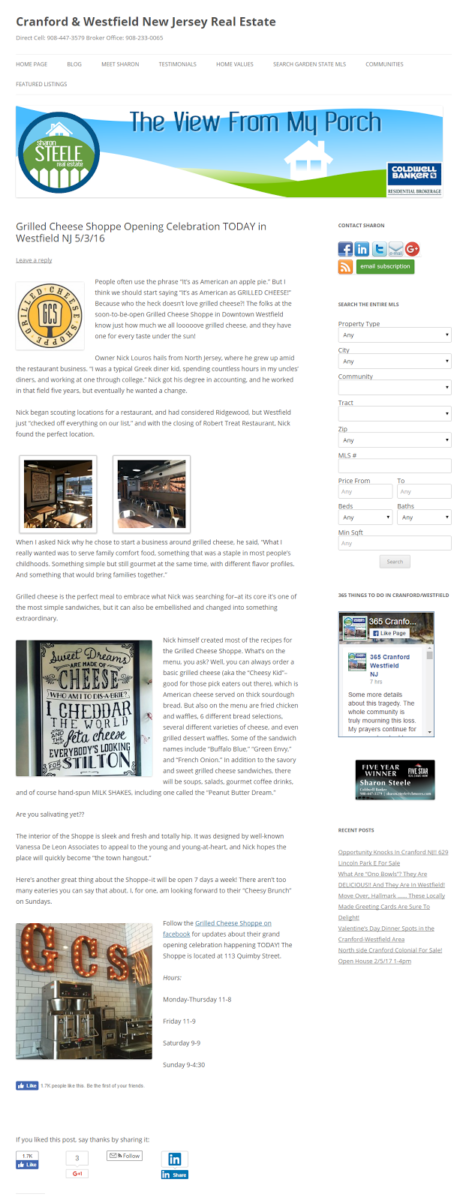
Cranford & Westfield New Jersey Real Estate’s blog follows a similar topic pattern, without all the visual bells and whistles. And yet, this post — Grilled Cheese Shoppe Opening Celebration TODAY in Westfield, NJ — has generated nearly 2k shares on social media and ranks on the first page of Google:
The point is: that every real estate agent can do this with their blog content. After all, real estate agents know the area they live in better than almost anyone else. Why not utilize this knowledge of your town like Weiniger has?
3. Real Estate Video Marketing Ideas Where You Aren’t The Star
If you didn’t notice on their homepage, Weiniger also has a box linked to her YouTube page. One of the reasons you might have missed it is because it’s not titled, “Real Estate Videos.” Instead, it’s enticing: “Explore NJ Community Videos.”
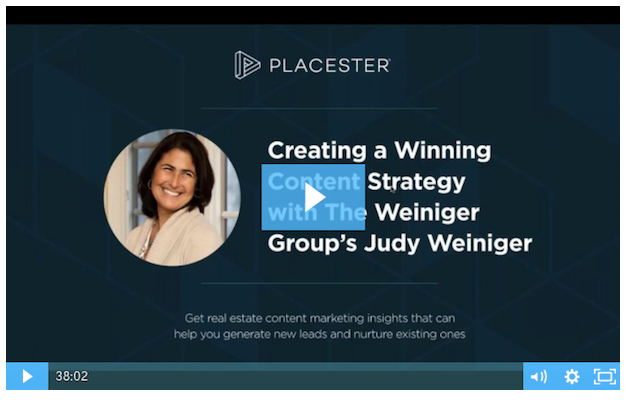
On her YouTube channel, Judy educates viewers about everything from New Jersey’s local pharmacy to great pizza, pasta, and seafood in the area.
She does this with short video clips introducing each industry.
Sight is our most engaging sense, and using video to leverage that fact is a great way to engage potential clients. 51% of marketers name video as the type of content with the best return on investment.
But rest assured, these don’t need to be cinematic masterpieces. All these videos have in common: they’re about serving their audience… not serving the agent.
And as a Carrot member, you can even turn your video content in long-form blog content with the click of a button using what we call VideoPost.
But what should you talk about in these videos? What kind of advice should you offer? Here are a few ideas…
Advice For First-Time Homebuyers — Show new homebuyers how to secure a low-interest loan, how to negotiate with sellers, what to look for when seeing a home for the first time, and tons more.
Advice For People Trying to Sell Their Home — Show home sellers how they can get top-dollar for their house, how they can stage their property on a budget, or what kind of renovations they should make before selling.
Testimonial Video For Your Business — Do you have a client who is exceptionally happy with your services? Ask them if you can record a short video of them giving you a recommendation. That will make for some great social media street-cred.
Community Videos — As a real estate agent, you know your community better than most people. Record a video showing potential buyers all of the great things about your city, where to eat, what to do, and the best places to live.
4. Real Estate Lead-generation Guides Worth Signing Up For
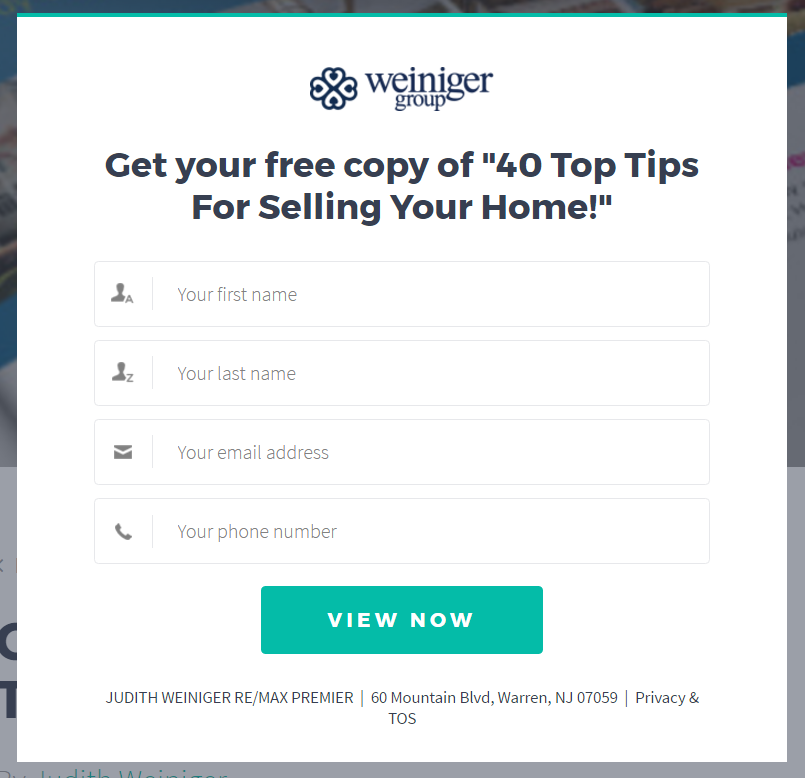
Also, on her homepage, Weiniger links to a piece of content that is real estate lead generation gold: a guide. In her case, it’s the “40 Top Tips For Selling Your Home!”
Because this guide goes above and beyond the typical blog post, it’s “gated,” meaning you have to signup for access:
This is precisely what you should do with your free guides — make it so people have to give you their contact information to receive the resource. That way, you’re simultaneously providing free value to your audience and generating leads for your business.
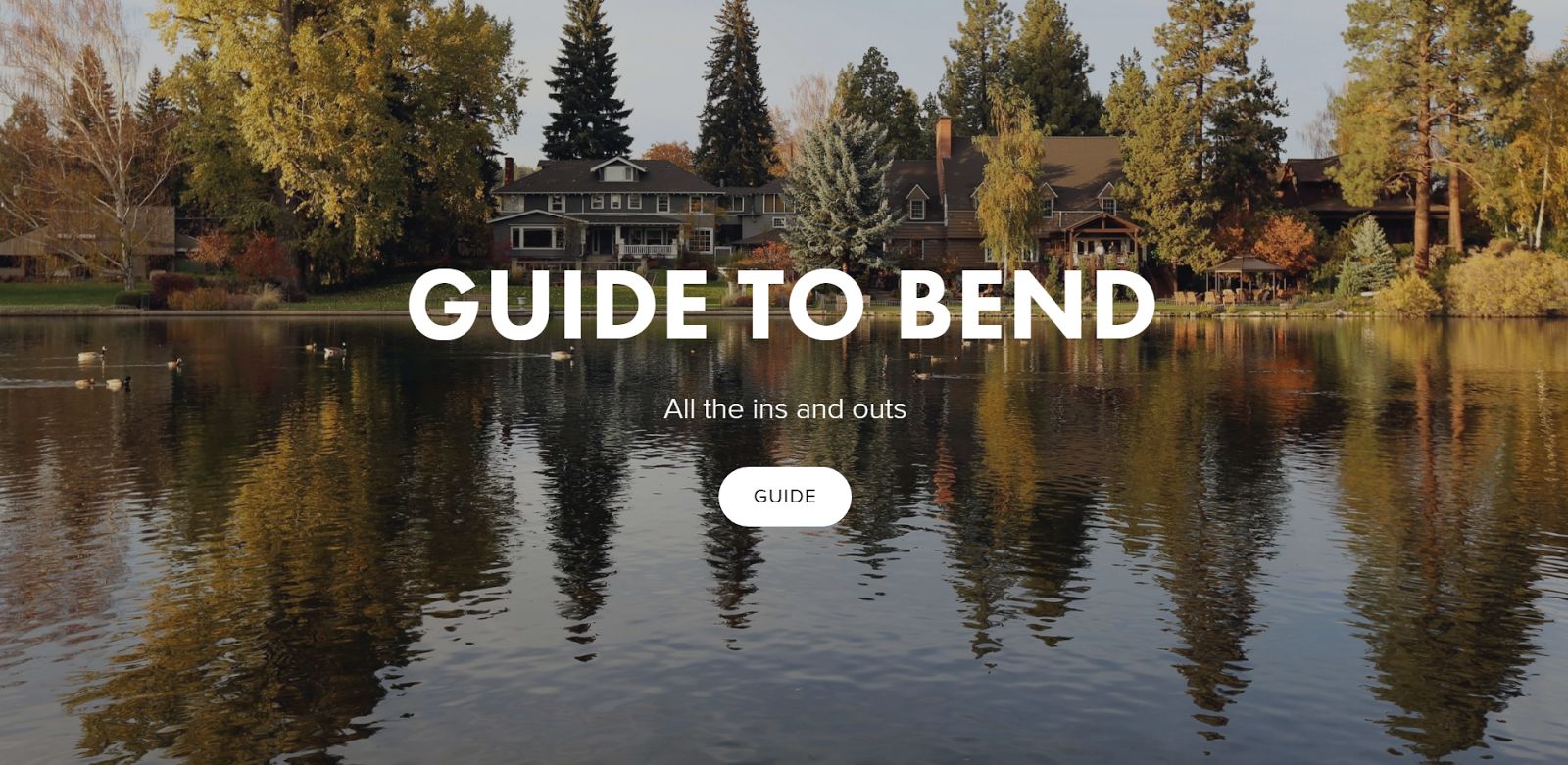
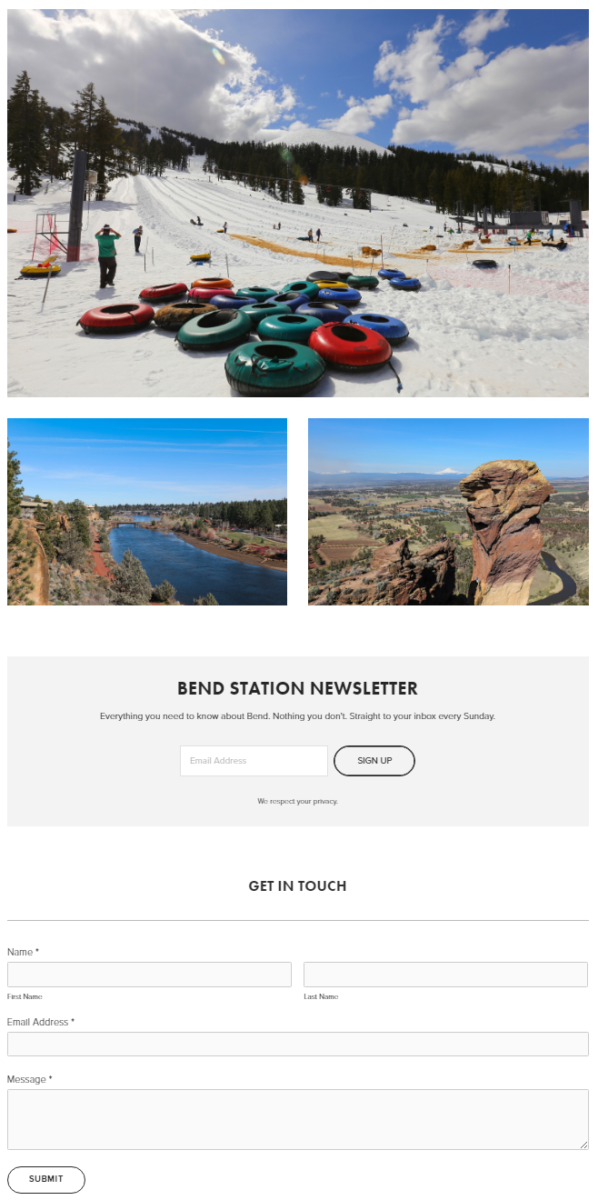
Bend’s Station takes the same approach, though they dedicate considerable online real estate to their guide on their homepage:
Inside is a beautiful and picturesque overview of the entire Bend area. And it ends with two opportunities to go deeper with Bend Station: (1) an email signup box and (2) a full form to “Get in Touch”:
Both guides major on the needs and wants of either prospective sellers or prospective buyers. They’re helpful and provide genuinely valuable content you can replicate for your local area (seeing a trend yet?).
5. Real Estate Agent Infographics Should Make Sense Of The Numbers
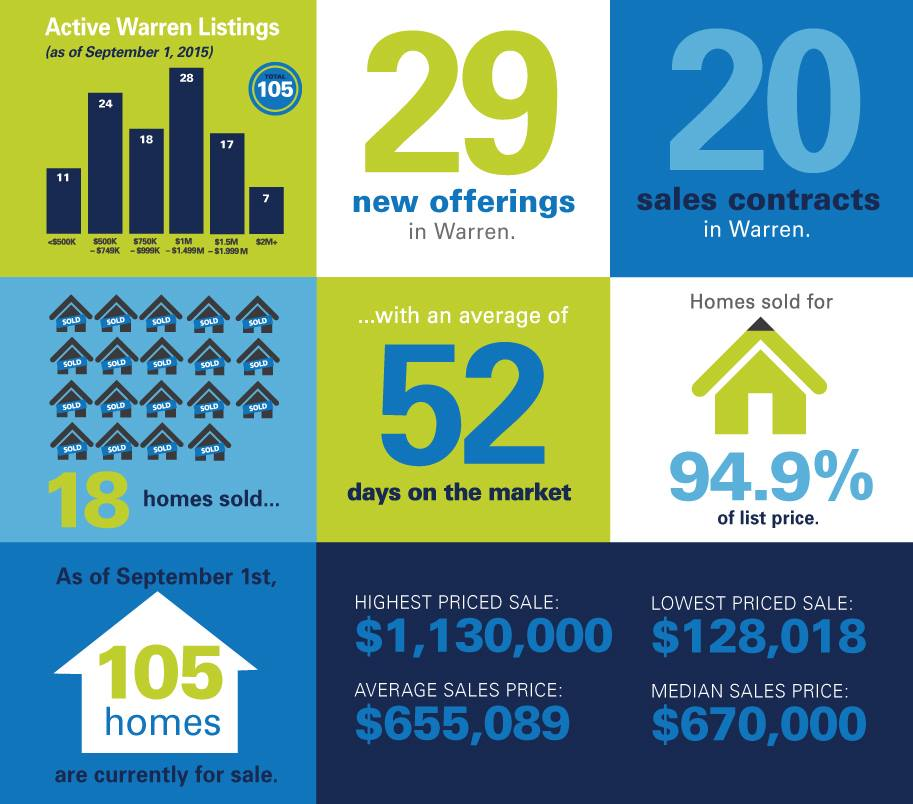
Speaking of beautiful and picturesque, also on Weiniger’s blog, you’ll find a series of Warren NJ Market Reports. Each one contains easy-to-understand (and easy-to-create) graphics summarizing the previous month’s real-estate financials:
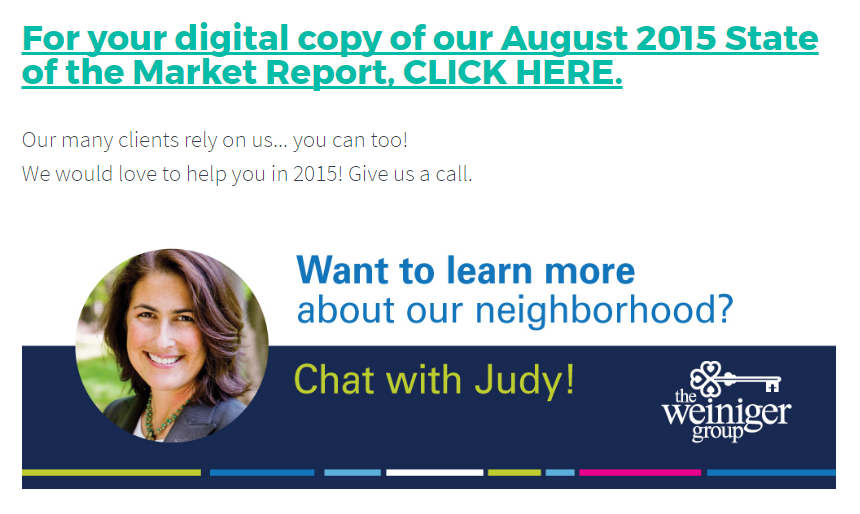
Each time they culminate is a powerful, one-two content punch: (1) access to a digital copy of the report and (2) a CTA to “Chat with Judy!”
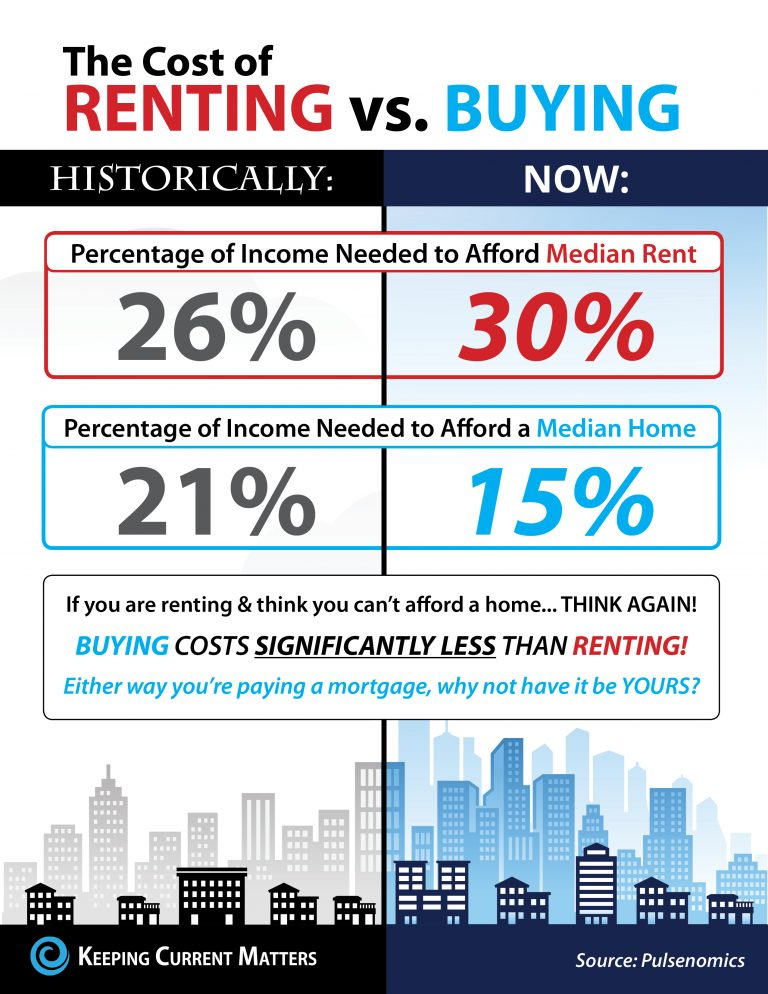
Keeping Current Matters follows a similar path with their simple, but wildly popular infographic that has been shared nearly 10k times:
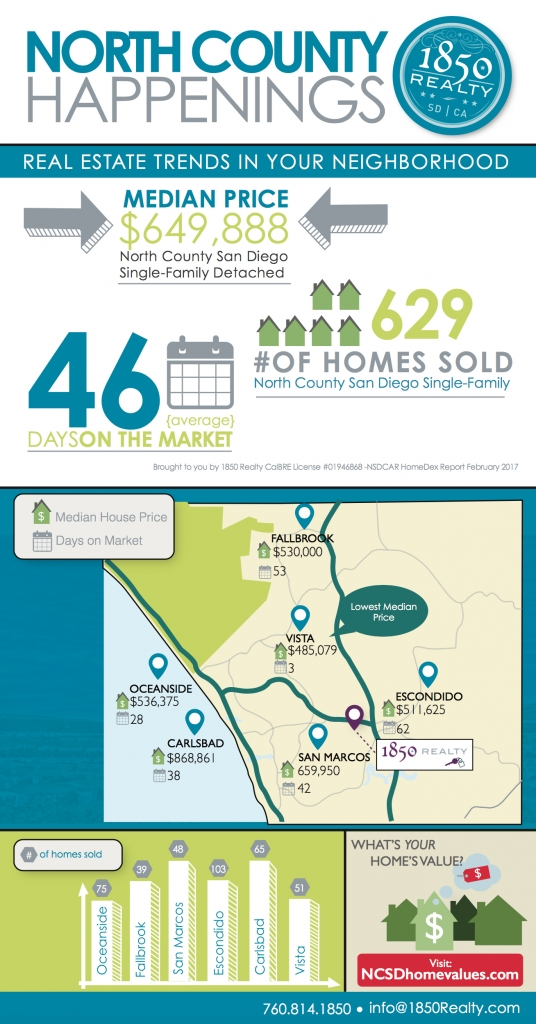
Likewise, 1850 Realty supplies local market trends in a visual form both on their blog and across their social media:
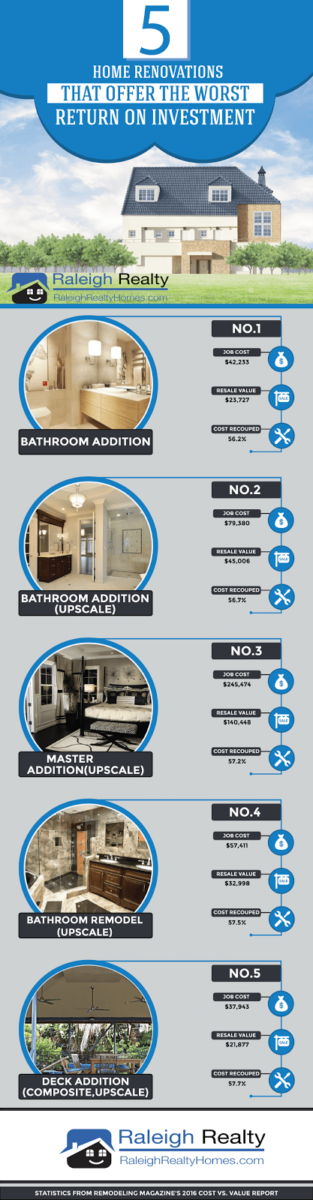
Raleigh Reality takes a good versus bad approach with their companion infographics:
6. Genuinely “Social” Content Marketing On Your Real Estate Social Media
Not surprisingly, Weiniger’s real estate content is all over social media. So we’ll take each one in turn.
Twitter
To start, she uses her Twitter account to do much the same thing she does with her blog and Youtube videos, but with less defined reason.
Her reason for creating the content I’m going to show you seem to be because she realizes that creating helpful content for everyone in central New Jersey is a great way to build rapport.
Plus, the more rapport you build, the more clients you’ll receive through word-of-mouth advertising; which no one needs to tell you is the most powerful form of advertising.
This Twitter post that leads to her blog is particularly engaging.
You might think that when you click on the link, it’s going to be featured houses for sale that she’s trying to trick you into purchasing with some well-placed click bait, but that’s not the case.
Click through, and you’ll see a very legitimate list of weekend activities for the everyday New Jersey family.
Or…
She also uses Twitter to direct traffic to her blog cleverly:
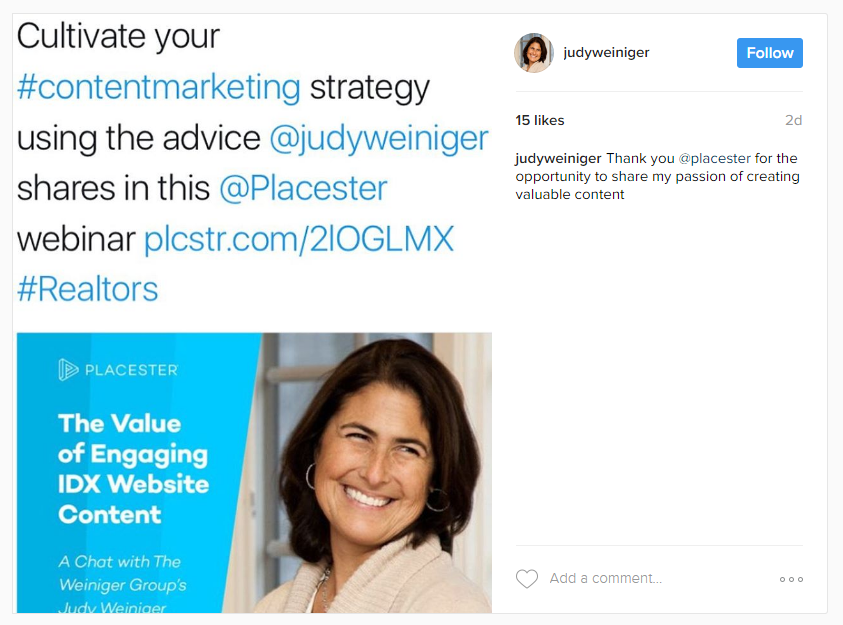
“I wanted to always lead with value and lead with trust. A better way for me to do that was providing content that really mattered. Valuable content that people couldn’t find elsewhere. As a local expert in my community, I was the perfect person to be able to create it and then distribute it.”
These agents prove that not all your content must be a sales pitch. Content that is not a sales pitch is attractive to everyone… including those you want to sell to.
Facebook
Weiniger’s Facebook account reveals how every realtor should use social media. One obvious application is posting pictures of houses that are for sale.
Because while you don’t want to be overbearing, you also don’t want to avoid talking about houses totally. People know you’re a realtor and they want to see what you have to offer. Pictures are a great way to do that.
Heck, even people who aren’t looking for a house might reconsider if they see some incredible pictures of an affordable home.
She also uses a Facebook page rather than a personal account which conveniently allows clients to review her.
Weiniger also posts fun, personable, and interesting videos of local restaurants. This video content benefits the local diner, people moving to the area looking for somewhere to eat, and — ultimately — your business.
You can even take inspiration from a real estate agent, Jim Walberg, and post quick tips for people living in the area. Because, if we’re being honest, real estate is nothing without a healthy dose of city and state pride.
Saddle up for a deeper look at Facebook Ads for Real Estate
Instagram is great for real estate agent content marketing because it’s a highly visual platform and, well… real estate is a highly visual product (house buyers love to look at pictures of houses).
Here’s a great example of a real estate agent’s post on Instagram…
Like this post, be sure to include your phone number and email address in every post so people can get ahold of you if they’re interested. Also, don’t forget to include relevant hashtags since that’s one of the best ways to get found out on Instagram (#housesforsale, for example).
I’d recommend using at least 10 hashtags on everything you post.
TikTok
TikTok is a new social media platform where users can view and share short video clips of just about anything — funny, serious, motivational… whatever!
And the platform is growing like a weed. It already has 500 million users, 41% of whom are aged between 16 and 24. Still, quite a few home-buying millennials and even some older folk visit the platform regularly.
You might be even more surprised to find out that many local businesses are finding great attention-grabbing, lead-gen success on Tik Tok — doctor’s offices, dentists, and even real estate agents are using the platform to spread brand awareness in their local area.
Here’s a great step-by-step video from a real estate agent talking about how you can use Tik Tok to generate leads for your real estate business.
7. Podcasting For Brand Awareness & Leads
Maybe you’ve never thought about creating a podcast before.
It’s probably not the first thing that came to mind when you considered creating a content marketing strategy for your real estate business.
But why not? There are plenty of buyers, sellers, and other agents who’d like to learn from an expert like yourself — why not be the one to teach them? Especially since doing so could result in tons of referrals and leads.
After all, when your committed podcast listeners here about someone who needs help buying or selling a home, who will they recommend?
That’s right, YOU!
And the best part is that creating a real estate podcast is as easy as pie in today’s world. You just need a decent mic (audio is one of the most important elements of any podcast) and some great content ideas.
Then, you can start recording your podcasts for free over at Buzzsprout — after some time, you’ll have to pay for hosting, but you can get started for no cost.
And for coming up with great content ideas for your first few episodes, consider…
Doing a few history lessons about the town where you operate. This can work to create interest in your local market and establish you as the go-to expert.
Tips and tricks for selling or buying a home. You know way more than most people about how to sell a home for top dollar or how to buy a home at a discount. Why not share what you’ve learned and by so doing, increase people’s perception of your expertise.
Real estate education. If you’ve ever thought about coaching other real estate investors or agents on how to build their own successful businesses, a podcast is a perfect place to do just that. Share what you’ve learned and, eventually, you might even get paid to consult up-and-coming agents or investors.
Weekly updates. People read the newspaper and look on social media to find out what’s going on in their local community… how about they listen to your podcast instead? Every week, you could give updates about scheduled events, political developments, and other items of local interest.
One thing’s for sure — your podcast won’t start itself! So grab a mic and get recording. You might be surprised at how much you enjoy doing it.
Content Marketing for Real Estate Agents: What You Can (And Should) Use
Content isn’t truly content unless it gives. At its heart, content is a mode of creation that offers something to someone else before expecting anything in return. It really comes down to one question: Does it add value?
Have fun. Look for inspiration anywhere and everywhere, even in industries that aren’t about real estate — like technology, B2B, SaaS (software as service), and ecommerce content marketing. Sometimes, that’s where you’ll the best and untapped ideas.
Write about a local pizza shop that is making a killing. Do a video interview with your community college about its success. Create an infographic discussing how safe the local public schools are.
Whether it’s a guide for PPC or a list of popular local restaurants, your content strategy needs to revolve around the homebuyer and home seller, not around your monetary gain.
Realtor’s who’ve found the balance between when to make a sales pitch and when to produce purely helpful content are the most successful realtors.
In other words, your real estate content marketing strategy shouldn’t focus on selling yourself, but on buyers and sellers themselves, the people behind the money.












 It’s already been two years (2016) since Google first released Expanded Text Ads. Ads expanded by 50% and the possibilities for new ad copy generated excitement.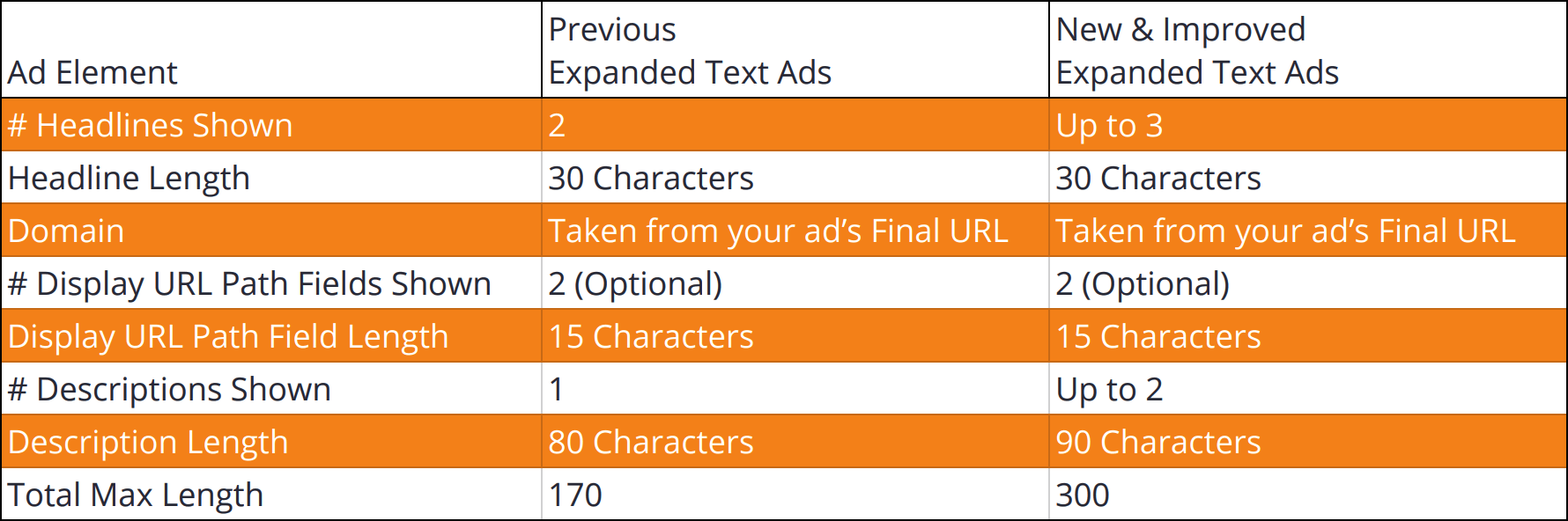




















![🔴 How to use TikTok for Real Estate Agents [ Step by Step TUTORIAL + Marketing Strategy ]](https://i.ytimg.com/vi/ggNl1mx8LS4/maxresdefault.jpg)