Search results for: “ppc”

  • Carrot Success Story: How Carter Steph Grew His Investing Business To $2 Million In Revenue

    Carrot Success Story: How Carter Steph Grew His Investing Business To $2 Million In Revenue

    How Carter Steph’s closing rate skyrocketed from 7% to 20% within a few months after switching from a custom website to Carrot.

    Carter Steph is a licensed broker for 20 years and in 2016, he purchased the real estate investing business that he now runs, which operates in Oklahoma City.

    Snapshot:

    • Industry: Investor and Agent
    • Location: Oklahoma City
    • Clients Served: 1000+
    • Year founded: Co-owner since 2016

    What I didn’t expect after switching to Carrot, is my lead to close ratio increased 50% on my offline leads!

    – Carter Steph

    Carter Steph is a real estate investor since 1992 and is also a licensed real estate broker in Oklahoma City.

    He’s also a practicing attorney for almost 20 years and has been the General Counsel at 1-800-2SellHomes since 2014 and co-owner since 2016. He’s no newbie to real estate. He and his team consistently generate seven figures per year in net profits, while closing on about 20% of their leads.

    The growth is steady and predictable.

    “You ask anybody in town and they know us,” he said in a CarrotCast interview.

    Read the tips below, taken straight from Carter Steph’s 7-figure growth strategy.

    The tools: Carrot features

    For Carter, Carrot is the central hub that brings all of his marketing efforts together. He’s running PPC ads to drive traffic to his site while leveraging Carrot’s easy content marketing tools and strategy to build his SEO for long-term lead generation.

    Since he’s driving traffic from all of his marketing efforts to his Carrot site, he can track performance across all campaigns and channels, giving him the clarity needed with his marketing strategy.

    Here’s how Carter is using Carrot as the central hub to tie together the marketing efforts they were once doing on their own to become the authority in their area:


    Switching from a custom website to a Get a high-converting website
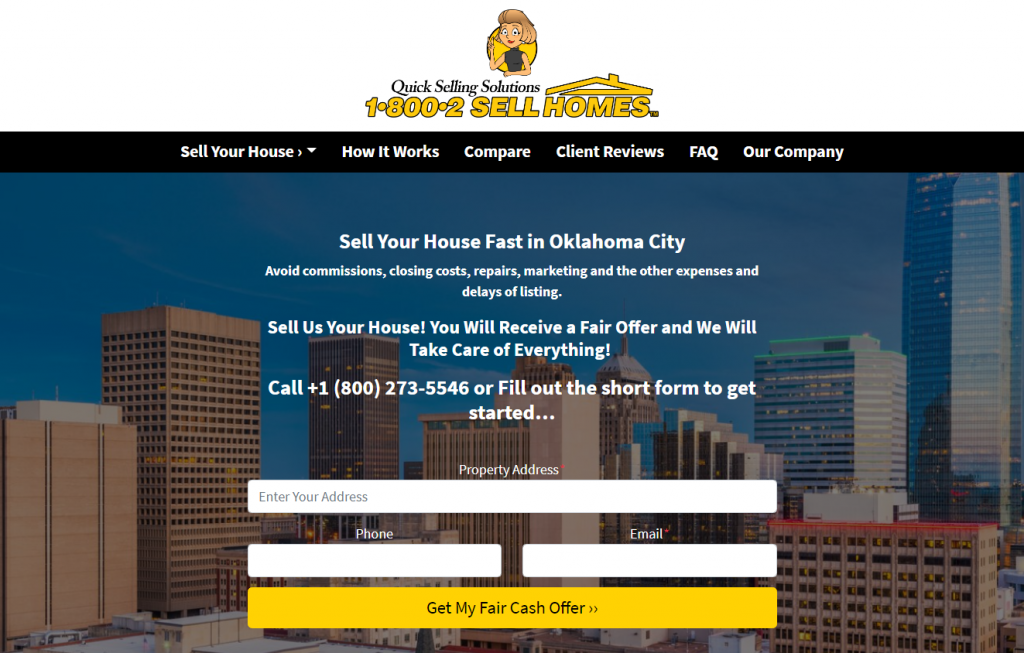
    Before Carter Steph went on his journey to $2 million in revenue in 2018, he was doing some things with his website very differently than he is now.

    In fact, with the powers of technology, I was able to dig up his several-year-old website for all of us to look at.

    Believe it or not, that custom website cost Carter and his business $5,000 upfront and $700 per month for hosting fees.

    That’s quite expensive.

    And it’s even more expensive when you find out that it had a terrible conversion rate and almost never generated any leads for Carter’s business — the leads it did generate weren’t very good quality and Carter’s close rate was only 7%.

    For that reason, they were spending $1,500 on PPC every month but $30,000 to $40,000 on TV ads.

    Then they switched to Carrot.

    The difference was immediate, Carter said. After just 2 days, their new Carrot site had generated its first high-quality lead. And within a few months, their close rate skyrocketed from the previous 7% to 20% because lead-quality increased.
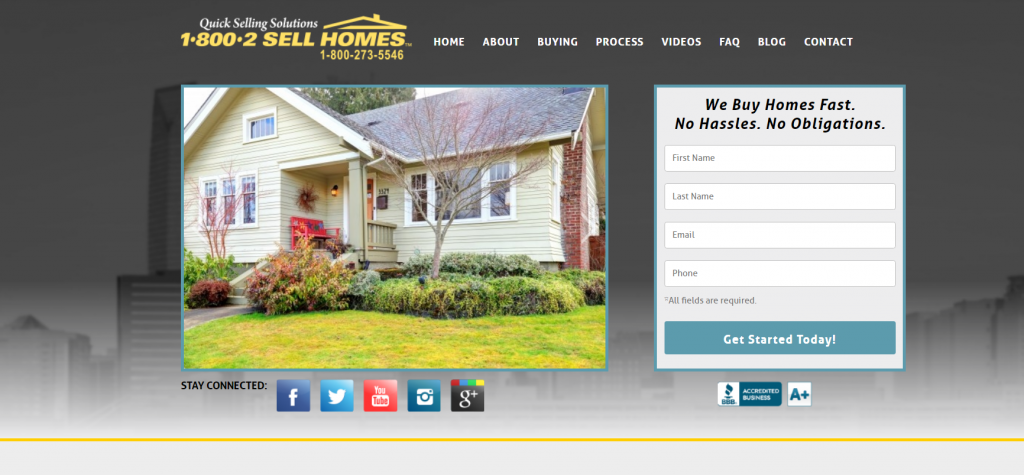
    Carrot Real Estate Investing Business Website

    After Trevor and Carter ran some estimations on the CarrotCast interview, they determined that Carter is saving between $20,000 and $50,000 every single month in lost lead-gen closing potential after switching from their expensive custom-made site to one of our Carrot sites.

    Wow!

    Now they close 20% of leads, their PPC budget is $8,000 per month (because their website is converting as it should be), and they’re growing like crazy. Sometimes, the small changes make a big difference. And at Carrot, small, iterative, conversion-optimization changes is exactly what we’re focused on. ;-)

    Evergreen Marketing
    In marketing terms, Evergreen is marketing you do once, and it works for years… not hours, days or weeks. Content relevant for a long time, that serves your best prospects, and gets in front of them where they’re searching online.

    Carter has organic leads grow over time using this exact marketing strategy.


    Automated blogs
    Content marketing is huge for businesses trying to establish themselves as an authority in their market. In order to do this, you have to create a lot of content, and Carrot makes it easy by providing pre-written automated blog posts that require very little time on your part!


    SEO Keyword Tracking
    By using our keyword tracking tool, Carter can readily track the search engine rankings of his web pages. We make it easy for you to quickly gain insight into which keywords are rising and falling in Google’s results pages so that you know where your web page stands relative to other sites on similar topics.

    The results:

    Quick Highlights

    2000+

    Leads

    20%

    Closing Rate

    8

    Top 3 Keyword Ranking

    Carter added $20k/mo in new profits by shifting from a fancy custom website into an
    “Authority Hub”

    “We couldn’t be happier with the site so far…What we have seen is a DRAMATIC increase in web leads.  Since switching to Carrot, the leads we are getting are converting to purchases at a MUCH higher level.  


    Things have been moving so fast that we haven’t had the opportunity to accurately determine the lead to purchase ratio, but I would estimate it is in the 25 to 35% range, which means the leads we are getting are significantly better than our historical average.

    Thanks for everything and we are now looking at expansion because of the success we have had in such a short time.”

    – Carter Steph
  • Case Study: Google Ads Traffic To Carrot Website Reveals The Most-Clicked Page On Your Site

    Case Study: Google Ads Traffic To Carrot Website Reveals The Most-Clicked Page On Your Site

    If you’re like most real estate investors, you’re already running paid advertising campaigns to your website (Carrot or otherwise).

    You’re running Google Ads or Facebooks ads or both…

    And every day, you wake up and check results. How many clicks are you getting? How many of those clicks turn into leads on your website? How many of those leads turn into deals? And do the results you’re getting justify the money you’re spending?

    Those questions are enough to give any marketer a migraine…

    But they are important questions to ask.

    You’re spending hard-earned money on paid advertising; you need to know if that’s money well-spent or not. If it is, great! If it isn’t, you’d best make some adjustments (advertise somewhere else, tweak the ad you’re running, or change where you’re sending traffic — Carrot converts out-of-the-box).

    To help you, we helped one of our members with their Google Ads campaign. We monitored their conversion rate and we even ran a nifty heatmap on their homepage which only tracked Google Ads traffic.

    Here’s what we found.

    The Case Study: Google Ads Traffic To Carrot Website Reveals The Most-Clicked Page On Your Site

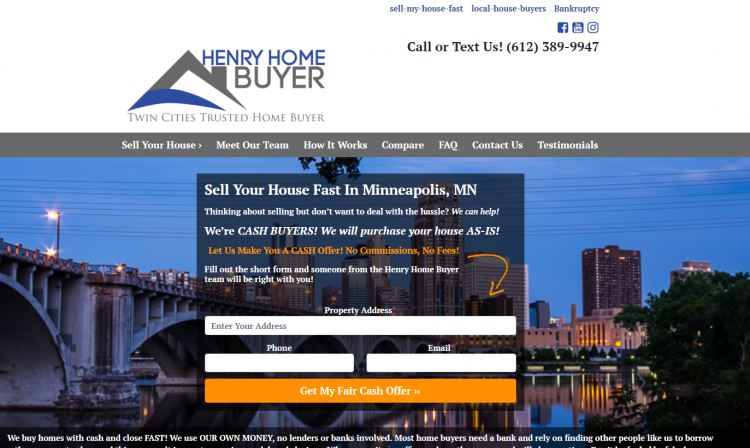
    The website/company that we ran Google Ads campaigns for is called Henry Home Buyers, a real estate investing company which operates out of Minneapolis, Minnesota.

    Here’s what their website looks like.

    From April 15th to May 15th, we drove traffic to their website via the below Google Ad campaigns. During that time, we tracked their PPC metrics, their website conversion rate, and even put a heatmap on their homepage.

    Here is an example of an which ran from April 15th to May 15th.

    google ads traffic ad example

    For the month, that Google Ad campaign received 127 clicks, which took visitors to there homepage.

    The conversion rate was an above-average, super healthy 16.54%, meaning that 21 of the 127 people who clicked also opted-in on Henry Home Buyers website to become a lead.

    real estate investor adwords stats

    Considering that most real estate investors need 20 or 25 leads to generate one deal, this one Google Ads campaign could have theoretically amounted to $10,000 or $20,000 (depending on the width of their wholesale fee) — we weren’t able to actually track how many of those leads turned into deals, so this is conjecture. But you get the point.

    A good Google Ads campaign can pay you back ten-fold.

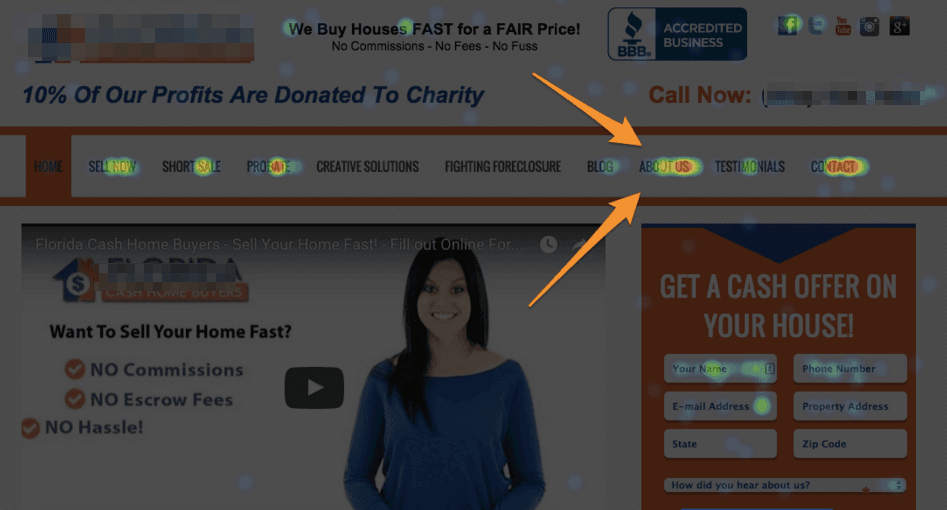
    Perhaps most revealing, though, is the heatmap we ran on their homepage during the test. Take a look.

    Google Ads Traffic most clicked on page
    Heatmap showing the most clicked on page… the “Our Company” or in this case “Meet Our Team” page.

    It doesn’t take an eagle-eyed human to spot that there’s two places lit up like a Christmas tree on the above heatmap — two places that people clicked more than anywhere else.

    1. Their high-converting Carrot opt-in form.
    2. And their “Meet Our Team” page (AKA, the “About” page)

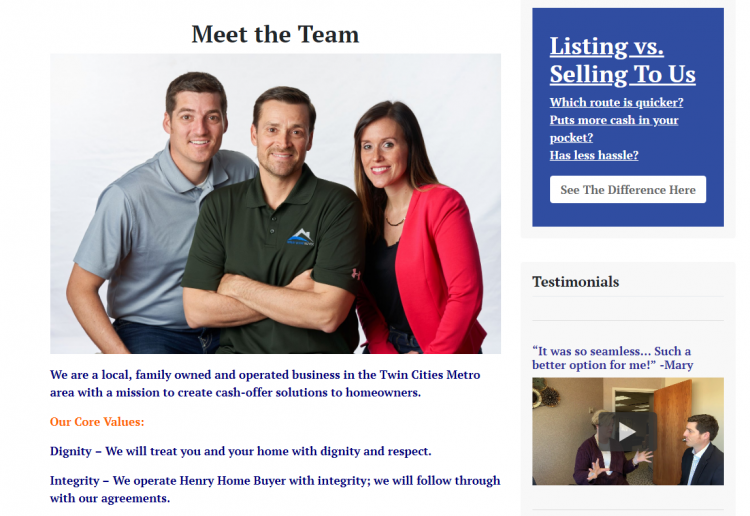
    Well, it’s a darn good thing they have such an awesome “About” page with a high-quality team photo, their company’s core values, and even a CTA at the bottom encouraging visitors to give em’ a call.

    real estate investor website about page

    (Image Source)

    Which leads us into the main takeaway from this test. And it really can’t be overstated…

    The Most-Clicked Page On Your Website… Do NOT Neglect Your “About” Page…

    We’ve said it a million times and we’ll say it again…

    Real estate transactions aren’t just expensive financially, they’re expensive emotionally and mentally. Because real estate transactions are so taxing, the average consumer must completely trust the person that they choose to work with. They must believe you can solve their problem or help fulfill their dream, and that you can do so expertly.

    They also want to know that you have their best interest in mind — you might just be building your business to make money and achieve entrepreneurial freedom, but they don’t want to know that.

    They want to hear about how you can help them, why they should trust you, and how easy the process is going to be.

    They want to know that you understand their situation completely.

    They want to know that you’ve helped other people just like them.

    And they want to know that you can help them, too.

    This isn’t just true on Henry Home Buyer’s website…

    It’s true on this real estate website…

    our company page hotspot on heatmap

    And this one…

    writing an effective about page for conversion boost

    And even our OWN website!

    how to write a good about page for your real estate website

    In fact, our Carrot research found that the “About” page is almost always the 2nd most-visited page on real estate websites (right after the homepage). This means that most people who visit your website browse your homepage for a few moments and then go directly to your “About” page.

    The best thing you can do, then, is treating your “About” page as a natural part of your visitor’s experience. You know they’re going to click there quite fast; what can you do to make sure your “About” page serves them well? How are you going to convince them to work with you even though they’ve never met you before?

    Here are a few ideas.

    • Include your core values & mission statement — Remember how I mentioned that your prospect only cares about themselves and how you can help them? This is where you get to list the values of the company and the mission that drives your company. That’s immensely powerful for building trust with your website visitors. For inspiration, check out Carrot’s mission statement and core values.
    • Use smile-y photos — If you’re looking for motivated sellers, then your prospect probably isn’t in a very good place; more than likely, they’re going through a stressful and difficult life situation. For that reason (and to increase your likeability) give a big authentic smile in your “About” page photos.
    • Add a few testimonials — Nothing helps build trust with website visitors quite like a testimonial. People don’t want to be the first one to work with you, they want to know that you’ve already helped other people just like them. Assure them that you have by adding one or two testimonials (video testimonials are the best, but written will do the trick) to your “About” page.
    • Include a CTA — Since many people will click right to your “About” page after visiting your homepage, you should craft your “About” page like it’s the most important sales page on your entire website. Put your phone number on it and include a CTA with an opt-in form at the bottom.

    Where are you sending your paid traffic?

    That’s an important question.

    Where are you sending paid traffic?

    Because where you send paid traffic determines (at least partly) how valuable that traffic is going to be for your business. If you send traffic to a low-converting WordPress website (not all WordPress websites are low-converting, but many of them are), then you’re going to lose money fast. If, on the other hand, you send paid traffic to a high-converting site (like Carrot), you’ll make a hefty profit, you’ll gain new confidence in your paid ad campaigns, and you’ll probably even dump more money into running those ads.

    (If you can make $2 for every $1 you spend, why not do that all day long?)

    But how do you make sure that you’re sending your audience to a high-converting website?

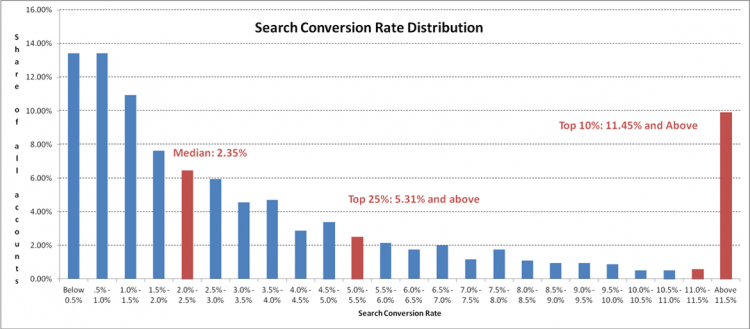
    What even qualifies as a high-conversion rate?

    Well, cross-industry, a high conversion rate is around 2% or 3%…

    (Image Source)

    And while we know that’s the average for many websites in the world today, at Carrot, we say bubkus…

    We are committed to higher conversion rates, to more opt-ins, to more closed deals for our members.

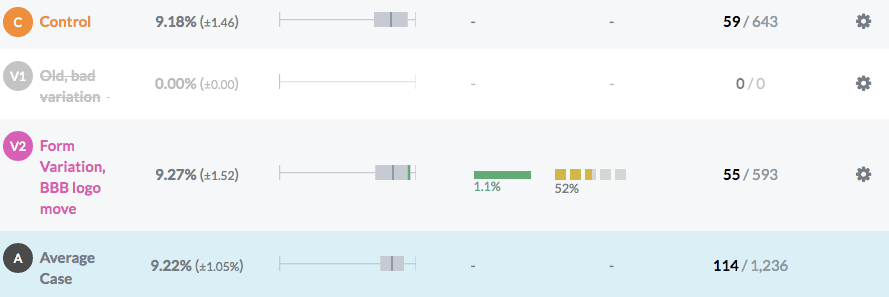
    Which is why, for Carrot members, an average conversion rate is around 10%…

    motivated house seller website conversion rate

    An excellent conversion rate is around 15%…

    using video to increase conversion rate on real estate websites

    And an incredible conversion rate is 20% or higher.

    real estate investing website conversion

    To be honest, if you’re not getting at least a 5% conversion rate with your website, then it might be time to rethink where you’re sending your paid traffic. Maybe you could try to re-work and optimize your landing page… maybe you need better targeting with your paid ads… or maybe you need a Carrot website ( ;-) shameless pitch).

    Whatever the case, do not settle for a low conversion rate. Work until you’re pulling as many leads as you need to run a healthy business that provides you with the predictable income and financial stability that you need.

    Conclusion

    The pressure is on.

    When you’re running paid ads, you’re watching the ROI of your campaigns like a hawk…

    You’re wondering if the amount of money you’re spending is going to pay you back like you hope it will (try using our calculator over here to set a realistic paid advertising budget).

    Unfortunately, I can’t give you the answer :(

    But I can (and did!) show you what other real estate investors are doing, what kind of results they’re getting, and what you should expect for your website conversion rate.

    I hope it helps you build a business that you’re proud of.

  • Real Estate Investor Success Story: 7 Dead-Simple, Secret Strategies That Lead To MS Home Buyer’s First $100k Month

    Real Estate Investor Success Story: 7 Dead-Simple, Secret Strategies That Lead To MS Home Buyer’s First $100k Month

    Real Estate Investor Success StoryWe recently had the opportunity to interview Adam Johnson and Brent Moreno on the CarrotCast, two partnered-up investors who finished their first $100k month back in March.

    On the episode, Trevor asks them about how they got to their first $100k month — exactly what marketing strategies they used and what mindset philosophies made all the difference.

    If you’d prefer to watch or listen, you can go here to view the full interview.

    Or below, I’ve compiled 7 of the duo’s dead-simple, secret strategies that they shared on the Carrot real estate investor success story. Want to learn how they got to their first $100k month and how you can, too?

    Read on.

    Dead-Simple, Secret Strategy #1: Making Uber Do Your Driving-For-Dollars

    Brent Moreno is likely one of the most innovative online marketers around.

    While he and his partner often use tried-and-true marketing methods (PPC, Facebook Ads, Direct Mail), Moreno isn’t afraid to think outside of the box in order to get a leg up on the competition.

    The way he used Uber drivers to find deals is the perfect example of this.

    Before his real estate investing days, Moreno was a part-time Uber driver. He’d drop his wife off at work and go drive for a few hours to make a little extra money. During that time, he started an Uber Facebook group. When he finally took the leap into real estate investing and gave up on Uber driving, he had an “aha!” moment…

    Uber drivers literally just drive around town all day… If I could get just a few of them to send me property addresses for vacant or distressed homes, they could do my driving-for-dollars for me.

    So he reached out to his Uber-driving pals in his Facebook group and asked them to do him a favor. One of them took him up on it and passed him 35 seller leads, 2 of which he was able to close on.

    That’s just the kind of marketing ingenuity that separates top investors from the rest. Feel free to steal his strategy and try this in your own market. Who knows? Could be a game-changer.

    Dead-Simple, Secret Strategy #2: Building Your Inner Circle

    In real estate, perhaps nothing is more powerful than long-term, meaningful relationships in your market of operation.

    And that is a truth which Adam Johnson doesn’t take lightly:

    I love to make people smile. I really do.

    In fact, he’s built so many meaningful relationships in his community that when he walked into the local courthouse (a place he regularly visits, giving chocolates, kind notes, or snow cones to the workers whenever he leaves) to check the title on a foreclosure, something amazing happened.

    He overheard one of the workers talking on the phone as they said something like this:

    I’m sorry Ma’am, I just don’t have the authority to offer discounts or lower your payments. There’s nothing I can do.

    After a moment, the worker noticed Johnson in the room, said

    Uhh. Hold on, hold on. Let me get someone else on the phone

    and gave Johnson the county phone to try and help this woman solve her tax problems.

    That random situation turned into a closed deal for Johnson.

    What’s more?

    Johnson literally has his own set of keys to every courthouse in the county because of the relationships he’s built. Don’t underestimate the power of consistent kindness to build meaningful relationships in your community — you never know where your next deal will come from.

    Moreno even goes so far as to claim that 50% of their success can be directly attributed to the relationships and rapport that they’ve built in their market.

    Dead-Simple, Secret Strategy #3: Using A High-Converting Website

    Home Buyers Lead Generation Stats
    90 Day MS Home Buyers Lead Generation Stats

    I won’t splice words here.

    Johnson and Moreno are Carrot members, and they love their Carrot website.

    ms home buyers real estate investor success story

    Making $100k per month, these are two people who could definitely afford their own custom website. But when Trevor asked them why they haven’t ditched Carrot and built their own website, this is what they said.

    Brent Moreno & Adam Johnson - I'm in the RE Buying Business

    Johnson explains their reasoning best:

    “Because I’m in the real estate business, I’m not in the website-building business.”

    And their Carrot site has been converting website visitors into leads since day one. Why change it if it’s working?

    Plus, Johnson, self-proclaimed at being tech-incompetent (he didn’t even have WiFi at his house until 2017) can use the site just fine. It’s easy to use and it converts like a charm. What’s not to like?

    If you’re on the fence about trying Carrot out for your own business, you can sign up with us risk-free for 30 days. Go here to find out more.

    Dead-Simple, Secret Strategy #4: Steal These Facebook Ads

    To be honest, I was kind of surprised that Johnson and Moreno were willing to give away their Facebook Ad copy for free. Now, with Facebook’s new ad library, anyone can view any page’s past and current ad campaigns (this is GREAT for studying your competition), but Moreno actually encourages other investors to steal his ad copy and try it in their own market: “Take it and try it out for yourself. It’s working for us.”

    So, in the spirit of mutually agreed upon theft (:D), here’s how you can go on Facebook and look at MS HOME Buyer’s Facebook Ads.

    Go to MS HOME Buyers Facebook page and click on “See More” next to “Page Transparency” on the right side.

    MS Home Buyers real estate FB page

    Click on “Go to Ad Library”.

    how to find facebook ad examples

    And voila! You can now look through the ads that these guys are running and they’ve given you explicit permission to copy them, so have fun!

    Facebook ad examples for real estate

    Oh! And if you’re needing to do competitor research or want to figure out what other investors in your market are doing with their Facebook Ads, use the above strategy — knowledge is power, after all.

    Dead-Simple, Secret Strategy #5: Don’t Give Yourself An Option To Not Finish The Job

    When listening to this interview, one of my favorite things that Johnson said was…

    Not to overplay the stereotype — being from Mississippi — but the truth is that when you grow up on a farm or in a rural area… you just gotta get the job done. There’s been plenty of times where we had to fix a fence and we didn’t have any extra fence and we just had to figure it out with what we had… I think that’s where people go wrong: they let not doing it be an option. The truth of it is, if you put yourself in a position where you don’t have a choice, then it’s a different mindset — it’s not ‘we don’t have this or we don’t have that,’ it’s just… you gotta make it work.

    I think that quote speaks for itself. When you don’t give yourself an option to quit or to not finish the job, you get it done with what you have; that’s all there is to it. And more often than not, just working hard with what you have at your disposal will grow your business, regardless of the resources available to you.

    Dead-Simple, Secret Strategy #6: Keep Your Business Simple, But Do The Simple Things Better Than Anyone Else

    The philosophy behind Johnson and Moreno’s business is to “Keep it simple, but work extremely hard on those simple things.”

    Many real estate investors (many entrepreneurs, for that matter) get caught up in the details of their business. They create over-complicated internal processes that unintentionally slow their businesses down. Or they use 10 different marketing strategies all at the same time, optimizing none of them.

    But the best way to grow a business is usually to let your internal processes and marketing strategies grow with your business. Always keep it as simple as possible to build a business that’s agile, and optimize the heck out of those simple internal processes, sales tactics, and marketing strategies.

    You can do 100 different things with mediocrity… or you can do a couple of things expertly well. For Johnson and Moreno, working really hard on the simple things has proven far more lucrative than trying to tackle everything at once.

    Dead-Simple, Secret Strategy #7: Don’t Underestimate The Impact Of Hard Work And Compounding Results

    The grind. The hustle. The day-in and day-out hard work of an entrepreneur.

    Over time, it can get exhausting and discouraging. You start to wonder if all this hard work will pay you back in the end. Well, Johnson firmly believes that it will:

    Don’t underestimate the legwork and then giving your efforts time to compound.

    Before you can build momentum for your business, don’t forget that you must first push the boulder up the hill — only then can it start rolling down the other side.

    And don’t quit before you reach the top of the hill; that’s where building a business gets fun.

    Conclusion

    We hope that this information has helped!

    Clearly, Johnson and Moreno are crushing it with their business. I imagine they’re well over $100k per month now that we’re half-way through the year. And we’d love to see you get to that same place.

    Maybe $100k per month seems so out of reach right now as to be ridiculous.

    Or maybe you’re right on the cusp of breaking through that threshold.

    Whatever the case, in addition to using the above tips, we’re willing to give you a risk-free trial period with our service which has generated over a million leads for real estate investors and agents.

    Find out more here.

    And happy investing!

  • Bing Ads For Real Estate: How To Create An Account The Right Way…

    Bing Ads For Real Estate: How To Create An Account The Right Way…

    We’ve already written about why Bing ads can be crazy profitable for real estate investors and agents. But how do you set up a Bing Ads account? Well here’s how…

    But first, we need to clear something up. In early 2019, Bing Ads was rebranded as Microsoft Advertising. In this article, we’re going to reference Bing Ads.

    Real estate investors can be very busy and sometimes don’t have the necessary time to research and create marketing campaigns, especially when it comes to pay-per-click advertising.

    We understand the requirement to streamline some of this process. That’s why we created this simple step-by-step guide to creating your own Bing Ads account. It’s for short-on-time investors needing to expand their online marketing.

    In a previous post, we covered why Bing Ads for real estate isn’t a waste of your time and should be considered as a viable advertising resource. But, just don’t take our word for it, check out this post from another highly regarded PPC company 25 Reasons to Use Bing Ads Now.

    Create A Bing Ads For Real Estate Account In 15 Minutes

    First, go to the  Microsoft Advertising (Bing Ads) sign up page.

    You’ll be given 2 options: Use an existing email address or create a new email address.


    Option 1: Use An Existing Email Address To Create An Account

    Go to the Bing Ads sign up page and enter an existing email address. Click Check availability to check if your email address is available to use.

    bing ads account creation

    Image: Bing

    If you have an email address you already use to sign in to Microsoft products (like Skype or Xbox LIVE), all you need to do is sign in and the transition will be complete. If you’ve never used this email to sign into a Microsoft product, you’ll be able to sign up for a new account.

    1. Click Next
    2. Sign into Bing Ads
    3. Enter Bing Ads account info
    4. Click Create Account.

    After you’ve created your Bing Ads account, you can set up your campaign by importing from Google AdWords (see below) or by creating a new campaign. You can also skip this step and click Continue. Enter your billing and payment information and click Next. You can also skip this step and enter your billing and payment information later by clicking Skip.

    Option 2: Create A New Email Address And Then Create An Account

    Go to the Bing Ads sign up page

    create a bing ads account 3

    Image: Bing

    Select Create a new email address and click Next.

    create a bing ads account step 4

    Image: Bing

    A Microsoft account is an email address and password you use to sign in to Microsoft services or devices. If you use an email address and password to sign in to services like Skype, Xbox LIVE, or Outlook.com, you already have a Microsoft account.

    1. Enter information for the new account
    2. Click Create account
    3. You’ll be taken to the Bing Ads Create Account page directly after creating your new Microsoft account and will already be signed in with your new account
    4. Enter Bing Ads account info
    bing ads account step 5

    Image: Bing

    1. Click Create Account
    2. Check your email inbox to verify your email address
    bing ads account email verify

    Image: Bing

    After you verify your email you’ll be Ready to go!

    bing-ad-account-email-verification-after

    Image: Bing

    You’ll be taken to the Bing Ads Create Account page directly after creating your new Microsoft account and will already be signed in with your new account.

    bing-ad-account-first-step-in-campaign-creation

    Image: Bing

    After you’ve created your Bing Ads account, you can set up your campaign by importing from Google AdWords or by creating a new campaign. You can also Choose Option 3 to skip this step. Once you choose your desired option click Continue.

    bing-ad-account-second-step-in-campaign-creation

    Image: Bing

    Enter your billing and payment information and click Next. You can also skip this step and enter your billing and payment information later by clicking Skip.

    bing-ad-account-skip-this-step

    Image: Bing

    You’ll be directed to billing.

    bing-ad-billing-options

    Image: Bing

    Setting Up Your Billing Information

    When you’re ready to go live with your Bing Ads campaigns, you’ll need to set up your billing information.

    bing-ads-billing-information

    Image: Bing

    Import Your Existing AdWords Account

    In Bing Ads, click Import Campaigns, and then click Import from Google AdWords.

    If you have imported from Google AdWords in the past 90 days, you will see a table that tells you the data and AdWords account that was imported along with:

    bing-ads-adwords-import-1

    Image: Bing

    1. Click Sign into Google
    2. Enter your Google sign-in information, click Sign in and then Accept
    3. Select the Google campaigns you want to import, then click Continue

    Under Choose Bing Ads account & import options, do the following:

    1. Choose the Bing Ads account you want to import to
    2. Choose the appropriate time zone
    3. Choose the appropriate options for “What to import”
    4. Choose the options you want for bids and budgets
    5. Click Import

    All this PPC advertising stuff can seem complicated, but that’s what we’re here for. The initial setup of your first campaign is not nearly as important as the long-term optimization of your account. Hopefully, this piece will help you create your Bing Ads account with as little pain and suffering as possible.

    The small amount of effort it requires to create a Bing Ads for real estate account is small in comparison to the long-term benefits that Bing Ads advertising can offer in addition to AdWords as part of a comprehensive, sustainable, and above all, profitable, online marketing strategy. So what are you waiting for? Create a Bing Ads account, and let’s get to work!

    Create Your First Campaign

    Create your first Bing Ads campaign

    Have You Had Success With PPC Advertising?

    Facebook, AdWords, Bing, Craigslist… Shoot those success stories through the comments box below. We’d love to hear!

    Also… be sure to dive into our Carrot blog to get insights on attracting and converting more inbound leads for your real estate investing business.

  • How to Create a Google Ads Account for Real Estate

    How to Create a Google Ads Account for Real Estate

    Are you ready to take the next step in your online real estate marketing? That step is creating a Google Ads account.

    Real estate investors face several challenges when it comes to generating leads. Traditional methods, such as direct mail and cold calling, can be time-consuming and yield low results. Even with a strong online presence, attracting qualified leads to your website can be tough.

    This is where Google Ads comes in.

    According to data, Google Ads can be a highly effective lead source for real estate investors. Without it, investors may struggle to compete in today’s crowded digital landscape. With Google Ads, investors can reach potential sellers and buyers actively searching for real estate solutions, resulting in a higher likelihood of conversion.

    Furthermore, without a strong online advertising strategy, investors may miss out on valuable leads. The data shows that 97% of consumers search for businesses online before making a decision. If real estate investors are not visible in these search results, they may be losing out on potential leads to their competitors.

    In addition to missing out on potential leads, not having a strong online presence can damage an investor’s credibility. With 78% of consumers saying they research a business before engaging with them, it’s crucial for investors to have a professional and user-friendly website. By using Google Ads to drive traffic to their website, investors can showcase their credibility and expertise to potential leads.

    Overall, real estate investors who neglect to utilize Google Ads may miss out on valuable leads, damaging their credibility and struggling to compete in today’s digital landscape.

    In preparation for creating a Google Ads account, there are a few important steps. While setting up the account itself is relatively straightforward, running effective Google Ads campaigns requires some groundwork.

    Before You Create a Google Ads Account

    First and foremost, ensuring that your website is relevant, user-friendly, and adds credibility is crucial. Your Google Ads account will drive traffic to your site, but once visitors arrive, it’s up to you to convince them to take action.

    To do so, you’ll need landing pages designed to motivate and engage visitors.

    Your advertising efforts will likely be wasted if your landing pages are disorganized, lack relevant information, or are otherwise not conducive to conversions.

    For guidance on creating effective landing pages that maximize the return on your PPC campaigns, we recommend checking out our land page best practices.

    Before Starting a Google Ads Account, You Need to Consider

    1. Planning. You need to have your real estate website dialed in with some personalization and credibility.

    Your Google Ads account (formerly known as AdWords) can help you to bring qualified visitors to your real estate website. Once they’ve made it to your website, it’s YOUR duty to convince them to convert.

    To make this happen, you must create pages that will compel your visitors to take action. If your pages are cluttered or lack relevant, credible information, you will have a leaky bucket and will likely be wasting money.

    Take the time to focus on customizing your website a bit, especially your “Testimonials” and “Our Company” pages. Check why these two pages are so important. Also, be sure your real estate website is mobile-optimized. All Carrot websites are mobile-friendly. Therefore you’re maximizing the potential of your Google ads account.

    2. Commitment. You must be willing to build Google Ads into your long-term financial and time plan.

    It’s practically impossible to see the full potential of your Google Ads account from the start. It’s essential to recognize that PPC is not a short-term venture. Establishing a strong structure, expanding your keyword lists, identifying negative keywords, and testing ads and landing pages takes time.

    Plus, you will likely start constantly changing keyword bids to fit your budget and keeping your ads in relevant, high-performing ad positions. Getting the first phase dialed in typically takes 1-3 months.

    3. Dedication. You must be willing to spend time or outsource your account.

    Your account is now up and running… you can sit back and relax. WRONG! There is still plenty of heavy lifting.

    If you haven’t managed a PPC account before, I recommend taking serious time to learn. You must be comfortable with the Google Ads dashboard and educated enough to make good decisions. Making the wrong choices can cost you money and cause your account to take a step back in productive data.

    Once you are comfortable to embark on the challenge, you must monitor your performance thoroughly. That hard work will well pay off in the end.

    Take time developing your strategy, identifying your goals, and calculating your cost per lead/deal. You must know how much you will spend on Google ads to close a deal. As we know, all market profits aren’t created equal. An investor in New York might need to spend more to get one deal closed over someone in Memphis. You must know your market.

    After you know your budget, you’ll need to have a solid keyword strategy in place. It’s a good idea, especially if you’re new to Google Ads, to start with highly targeted keywords and expand into broader terms as you get more comfortable.

    Creating a New Google Ads Account for Real Estate

    Step 1

    Head to www.ads.google.com to set up an account. When creating an account, you can create it under your existing Gmail account or set up a new one. I like to set up a new Gmail account ahead of time, which I use specifically for Google Ads management. This way, my personal email isn’t bombarded with emails from Google Ads.

    Step 2

    Now that your account has been established, you must complete a few housekeeping items, such as entering your business name.

    Step 3

    Enter your website URL.

    Step 4

    Review your website visual on mobile and desktop devices.

    Step 5

    Choose your main goal. For most real estate professionals, the goal will be to generate more leads.

    Step 6

    Google offers the opportunity to connect your Google Analytics account. If you do not have a GA account, you can choose to “skip for now.”

    Step 7

    Time to create an ad. Choose three headlines and two descriptions, and enter your phone number.

    Step 8

    Google will present different keywords based on a theme. You can always adjust your keywords later.

    Step 9

    Next, you’ll be asked to add your target locations.

    Step 10

    Set your daily or monthly budget.

    Step 11

    Review your campaign.

    Step 12

    Finally, you are prompted to set up billing information.

    Congratulations

    You are now ready to start creating your Google Ads campaigns for real estate.  We wish you the best of luck!

    Be sure to hit us up with questions in the comments section below. Also, if you’re a Carrot member, join us on our weekly Coaching Calls, where we cover many PPC topics, SEO, lead generation, website design, and much more!

    Not a Carrot member? What are you waiting for!? Check out our plans and get started today!

  • Announcing Carrot University! Learn Online Marketing for Free with Carrot

    Announcing Carrot University! Learn Online Marketing for Free with Carrot

    Carrot UniversityFor years, we’ve worked our bottoms off to provide you (our members, the people on our email list, and even those of you who’ve never worked with us) free, valuable, life-changing content.

    Every week for the past several years (with maybe a couple exceptions), we’ve published a new blog post and/or CarrotCast episode meant to help you build a bigger business, live a happier life, achieve financial freedom, and escape the horribly monotonous 9-5 grind.

    That is our passion: to help you regain time in your life for things that matter most — family, friends, hobbies, etc. 

    But there’s a problem — while we’ve consistently created content to help you build a business you can be proud of, our website hasn’t done the best job of organizing that content for you.

    You can click on the “Blog” tab at the top of our website and you’ll see our latest blog posts and CarrotCast episodes, but it’d take some real work to digest our content in any sort of chronological order… until now. :)

    Announcing Carrot University!

    Carrot University
    We’re launching Carrot University with our SEO 101 Courses!

    Carrot University is our (the content creator’s: Brendan, Trevor, and myself) effort to organize our content so that you can easily digest the most important lessons for your business. Want to learn about SEO? Here are 10 lessons to get you started off on the right foot! Want to learn about PPC?

    Here are 10 lessons to teach you everything you need to know to get started. Wondering which contracts you need for your real estate investing business? Here are some templates!

    Rather than choosing random pieces of content via Google and our blog, you can now go to a single place (Carrot University) and learn about those topics in chronological order — from beginner to advanced to ultra successful.

    Want to see for yourself?

    Check it out over here! Carrot University SEO 101.

    What is the Scope of Carrot University?

    We wanted to get Carrot University out to you as soon as possible, so we’re launching it with just one module of content: SEO 101 — basically, our beginner’s guide to understanding SEO and how it applies to your real estate website.

    BUT…

    There’s a lot more to come. ;)

    We have plans for content modules about PPC advertising, advanced SEO lessons, personal development, and even nitty-gritty business building best practices. Ultimately, we want Carrot University to serve YOU. We want it to be a place that you go to learn, grow, and challenge yourself.

    We want it to help you succeed.

    Go check out Carrot University now and let us know what you think! Carrot University SEO 101.

    And if you have any ideas for module topics we should cover in the future, let us know in the comments. :)

  • Introduction to Pay-Per-Click Advertising for Real Estate: A Beginner’s Guide

    Introduction to Pay-Per-Click Advertising for Real Estate: A Beginner’s Guide

     Intro to PPC for Real EstateIn 2018, PPC was the second highest lead generation medium for our members.

    Trying to rank on page one of Google can be a daunting task for some. It takes time and resources to invest in a full, all-out SEO strategy. Even then it could take months to notice.

    What can you do in the meantime?

    Well, many of our members make use of both PPC and SEO — using the former to generate short-term traffic and the latter to generate longterm traffic.

    In this intro to PPC for Real Estate, we run down what you need to understand if you’re considering this route. Including:

    • What is PPC for Real Estate?
    • How does PPC work?
    • What are the benefits of using PPC advertising for Real Estate?
    • Who should use PPC?
    • How to get started with PPC?

    Introduction To PPC For Real Estate

    What Is PPC For Real Estate?

    pay per click real estate advertising

    (Image Source)

    PPC is a broad term used for various cost-per-click platforms real estate professionals use to get in front of their target audience. These include Google Ads (AdWords), Bing Ads, Facebook Ads, and numerous retargeting options.

    Overall, PPC is a digital marketing strategy in which you advertise within a search engine’s sponsored results by bidding for the keywords, ad sets, and/or retargeting list connected to your real estate niche.

    Pay-per-click is exactly that… you pay each time your ad is clicked. Although, there are times you can be charged for impressions (number of times your ads are shown).

    Google Ads (Adwords) still reigns as PPC king for generating motivated seller leads. Facebook ads can also be an effective way to generate motivated sellers as well as buyer leads.

    Facebook cost-per-click is also considered a lesser amount compared to AdWords. It’s important that you understand where your leads are coming from and the value of your cost per lead to fully understand which platform works best for you.

    How Does PPC Work?

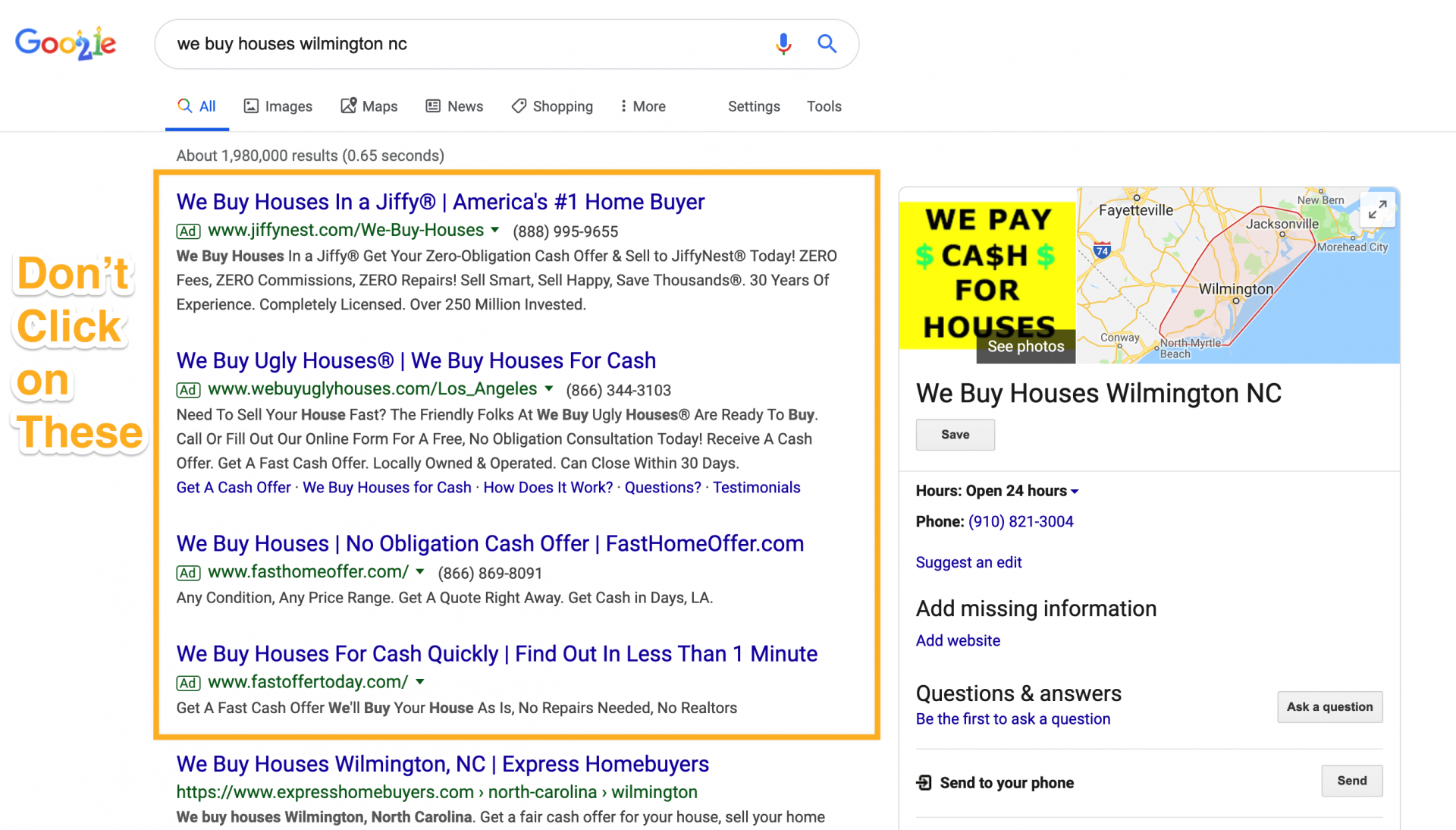
    Starting with the basics. When a motivated seller types a search query into Google, the search engines provide two sets of results: pay-per-click ads (sponsored) and organic results.

    As seen in the picture below, the first three results on top are sponsored ads (indicated by the green square around the word “Ad”).

    Google ads motivated seller search

    The other results below the ads are organic results. More than likely, the organic website results have climbed the rankings by executing a solid SEO strategy.

    With PPC, when the searcher clicks on one of the ads, you (the advertiser) is charged for that click.

    The price of that click will vary per the competition for that specific keyword as well as your target location(s).

    You can use specific tools to find keyword traffic estimates as well as the competition and cost-per-click estimates. Tools such as:

    What Are The Benefits Of Real Estate PPC?

    google adwords business infographic

    (Image Source)

    Advertising with PPC ads can have many benefits. Here are some of the top reasons you should consider using PPC as part of your online marketing strategy.

    1. You Have the Opportunity to Control Your Position on Page One of the Search Results

    PPC advertising allows you to gain the most valuable ad space on whichever PPC platform you choose to use. If that’s Google, then you have the ability to get on top of the first-page search results without having to dedicate the time and resources for SEO.

    Claiming ad space where most eyes will see them will increase your odds of getting solid lead generation and return on your investment.

    2. Place Your Ads in Front of YOUR Audience

    This is two-fold.

    First, you can use specific keywords in your PPC ads. This will allow you to reach a specific target audience based on your location. For example, using keywords such as…

    • “Sell my house fast in Baltimore”
    • “Sell my house in Chicago”
    • “We buy houses fast in Boston”

    This allows you to reach the local audience by choosing keywords that are targeting your audience location.

    Second, you have the ability to use geo-targeting to limit who can see your ads based on locations. For example, if you are searching for motivated sellers in Baltimore, it wouldn’t be smart to allow searchers in D.C to see your ads.

    You’d be would wasting your budget to allow searches from outside of your target areas to see and click on your ads.

    3. Control Your Budget

    Adverting with PPC ads offers you ultimate control of your money. You set your desired ad spend. If your budget runs low, platforms such as Google Ads will notify you that your budget is limited. This allows you to reassess your current PPC strategy and make the necessary adjustments to optimize your accounts.

    As mentioned above, the majority of your PPC campaigns will follow the model that you only pay when someone clicks on your ad.

    4. PPC is Immediate

    There’s no wait time! Unlike SEO, PPC is live the moment you decide to turn your campaigns live. If increasing your buyer list for your real estate website is your goal, PPC ads allow you to get in front of your target audience NOW rather than waiting the span of time it takes for an SEO campaign.

    5. Testing

    PPC ads are an excellent way to split test your website, ad copy, or images that resonate with your target audience.

    Using the A/B testing approach, you can test your ads and landing pages to see what form, color scheme, design… etc., are generating the best results. Once you gather enough date, you can use this information to make strategic moves to your campaigns to maximize your PPC ROI.

    6. Track Your Results to Maximize ROI

    Proving ROI is a major part of being a marketer today. Luckily, PPC ads allow you to track every aspect of your ad campaign to connect your efforts to your results.

    You can see how each keyword is performing. You can see how each ad is performing. And, you can see exactly where and when your leads are reaching you.

    You want to prove the worth of your PPC campaign. You’ll want to be sure your conversion tracking is linked to your website and for most of you, you’ll also want to be sure your lead source is relaying to your CRM.

    Then you’ll be able to track from click to deal to see your profits that have come from your PPC strategy.

    Who Should Use PPC?

    Google has more than 5 billion searches per day.

    Imagine how much traffic you’re missing out on!

    Plus, PPC website visitors are 50% more likely to purchase something than organic visitors (i.e. they’re more motivated).

    So, who should use PPC? Those who have the ability to plan, have patience, and are willing to spend money to get results.

    If you make well-informed decisions from the time you launch a PPC campaign, you will be able to increase traffic and leads to your website.

    However, PPC usually isn’t best suited for those who are looking to dabble. You need to have a mindset that provides enough strategy to sustain months and sometimes years. Those who have similar “go-get-em” attitudes have fared especially well with PPC advertising.

    Real estate also has a bigger advantage over other industries who utilize PPC. Profit margins can more than justify the costs associated with PPC.

    How To Get Started With PPC Advertising

    ppc advertising

    (Image Source)

    If you are looking for a simplified answer of how to get started with PPC advertising, it can be summed up into a relatively easy process.

    Here’s a simple look at how to plan your own PPC for real estate strategy:

    1. Conduct a competitor analysis.

    Identify the competitors who might be outranking you in your market. Analyze their search terms and search volumes using tools such as Google Keyword Planner and Ubersuggest as listed above.

    2. Choose the real estate keywords you want to advertise for.

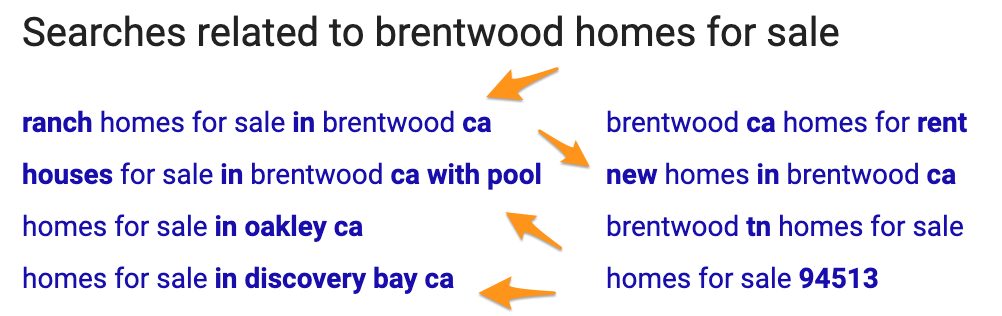
    Conduct keyword research to learn how your target audience is searching for your real estate niche. If you’re looking for buyers for your agent website, then use such terms as, “new homes for sale” or “homes for sale in”.

    3. Create ads based on thorough research.

    Develop ad copy that will resonate with your target audience. Looking for motivated sellers? Use ad copy such as “We Buy House in Any Condition” or “Sell Your House As-Is Fast”.

    4. Split test ad copy and/or landing pages to compare how different aspects of your PPC campaigns perform.

    For ad copy testing, track metrics like click-through rate and cost per click. For landing page testing, track metrics such as conversion rates to determine the success of your PPC campaign.

    You’ll also need to continuously manage keyword bids based your results. This will help you get the most ROI from your efforts.

    5. Optimizing beyond your ads.

    Real estate PPC campaigns are created from many parts beyond keyword bids and the ad copy. It’s important to think beyond the landing page and start to think about optimizing other pages that will help build credibility and connection with the searchers.

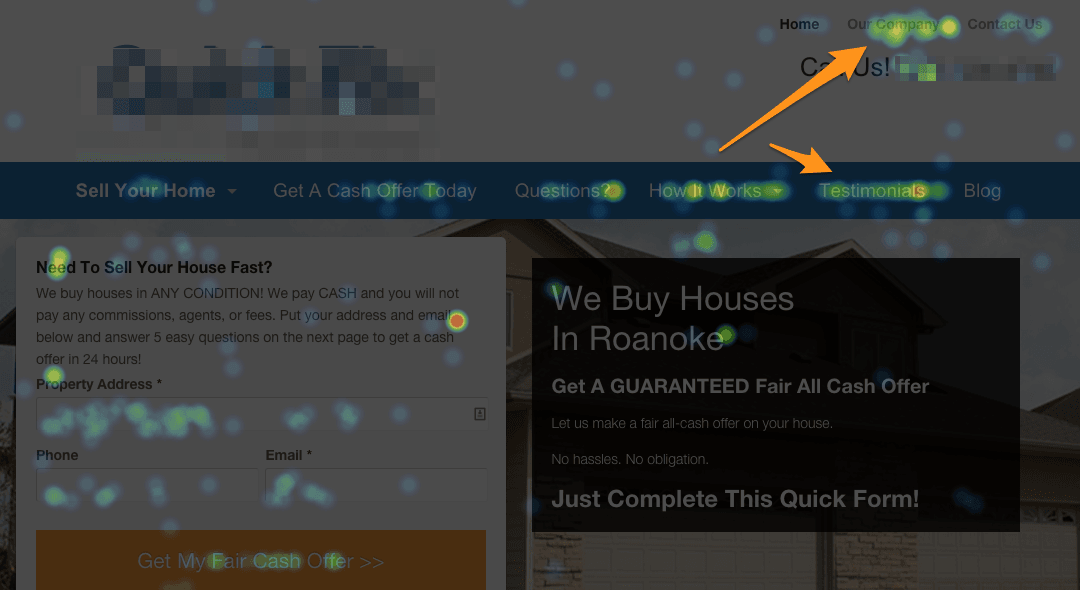
    Three important pages to consider optimizing are your “Our company”, “Testimonials”, and the “How it works” pages.

    This heat map from specific PPC traffic, confirms the need to optimize these pages. PPC traffic is looking for confirmation.

    Conclusion

    Don’t feel overwhelmed by this PPC intro. By having a sound strategy, educating yourself and putting in some time, you’ll be off and running with a successful PPC account. Or, consider hiring a third-party to consult or manage your account.

    Overall, PPC can provide immediate results and be a lucrative piece of your online real estate marketing strategy.

    Be sure to hit us up with questions in the comments section below. Also, if you’re a Carrot member, join us on our weekly Coaching Calls where we cover many PPC topics as well as SEO, lead generation, website design, and much, much more!

    Not a Carrot member? Whatcha waiting for! Check out our plans and get started today!

  • How To Track Your Real Estate SEO Performance And Improve Your Strategy

    How To Track Your Real Estate SEO Performance And Improve Your Strategy

    Ways to Track & Improve Your Real Estate SEO performance

    You want to generate more organic leads but you don’t know how to track your real estate SEO performance. That’s common.

    You want to pull more traffic to your website (with less money) and you want to convert that traffic into cash for your real estate agent or investing business.

    That’s good — you’ve chosen the right strategy: SEO. Since people who find your website all on their own are usually more motivated than those who see your ad on Facebook, SEO doesn’t just drive traffic but works to improve the conversion rate of your website. And with high-quality traffic and leads comes less time spent dealing with tire-kickers who’ll never convert, regardless of how hard you try.

    In other words, SEO benefits your business in a multitude of ways. Less time spent on the wrong leads, more time spent on the right leads, more website traffic, higher conversion rate, consistent lead generation, and even financial predictability.

    But there’s a problem…

    How do you know if your SEO strategy is working? How do you know that you’re SEO performance heading in the right direction?

    After all, SEO can take months or years to start having a tangible impact on your business, so how do you know you’re not just wasting your time?

    Here are 4 mission-critical SEO metrics to keep an eye on while you’re climbing your way through the rankings.

    4 Mission-Critical Real Estate SEO Performance Metrics You Need to Be Using

    1. Rankings

    This metric might be obvious to you…

    If you’re going to drive passive traffic to your website and you’re going to convert more leads without running more paid ads, you must get to the first page of Google.

    But that can take months, years even. How do you know you’re making progress?

    The simplest way to check is to open an incognito web browser window and type in the search phrase that you’re trying to rank for. Then click through Google’s results and see if you can find your website.

    Problem is, that’s time-consuming, especially once you’re trying to rank for 10 or 20 different keyword phrases. At that point, you don’t want to manually check all those rankings.

    This is why, at Carrot, we created our Keyword Ranking Tracker tool for our Content Pro and Advanced Marketer members.

    This tool tracks your rankings for specific keyword phrases in near real time. You can use it to quickly determine where your website is at for multiple keyword phrases you’re targeting. Every page in Google typically has 10 results, so 1-10 means you’re on the first page, 11-20 is second page, and so on.

    2. Domain Authority

    Another way to determine whether you’re making progress in the eyes of Google is to check your website’s domain authority.

    What is domain authority?

    It might sound complicated, but it’s actually pretty simple when you get down to it. Domain authority is the overall authority that search engines (Google, mostly) attributes to your domain. More authority is better and means that your website has a higher chance of ranking in results. Conversely, a low authority means that Google is unsure of whether you’re trustworthy or not (yet) and it’ll be more difficult for your website to get on the first page of Google’s results.

    But the more content you create, the more opportunities you’ll have to rank in search engines (each page or blog post has a chance to rank). This is why we include monthly expert-written content as a part of our (Carrot’s) Content Pro and Advanced Marketer Plans.

    Plus, the longer your website exists…

    (Image Source)

    …and the more backlinks you get…

    …the higher your domain authority will climb.

    Domain authority is measured on a scale from 1-100 (1 is low, 100 is high) and the higher your score, the easier it is to get rankings.

    You can check your domain authority over here — just type in your domain and click “Check Authority.”

    (Image Source)

    3. Traffic

    Not all rankings are equal.

    You might, for instance, get your website ranking for “real estate investors who run 6 miles per day”, but that ranking doesn’t do you any good if people aren’t already typing that phrase into Google — and not just anything, the right people.

    The reason that it’s so important to do keyword research before you start executing an SEO strategy is that you want to make sure that the phrase(s) you’re targeting isn’t a total waste of time.

    You can use Ubersuggest to check the search volume for any given keyword phrase.

    Just type the phrases you’re thinking of trying to rank for into the search bar and click “Search”. This will provide you with some information about how that keyword phrase performs in Google and with other keyword phrase ideas.

    [cta offer=”seobible” color=”orange”]

    But, back to website traffic.

    When you start ranking for your target keyword phrase(s), that’s when the rubber meets the road. Check your analytical information to see where your website traffic is coming from and if you’re actually getting more traffic from search engines.

    You can use Google Analytics (here’s how to set it up on your website) or you can look at your Carrot “Stats” dashboard if you’re a Carrot member.

    updated Carrot member stats dashboard

    Look at the “Traffic Sources” in the bottom right hand corner to determine where you’re website traffic is coming from and if you’re SEO efforts are paying off.

    If they aren’t and you’re already on the first page for multiple keyword phrases, then you might want to target a keyword phrase with higher search volume.

    4. Conversion Rate

    Imagine that you’re ranking on the first page of Google for several different keyword phrases. Let’s even imagine that those keyword phrases are driving passive traffic to your website every month — maybe a few hundred visits.

    When analyzing your SEO strategy, there’s only one more step in the funnel to make sure everything is working as it should: is that search engine traffic converting on your website?

    Because it doesn’t matter at all how much website traffic you get if none of that traffic is turning into leads or, when you call them, they have no interest in your services.

    So keep a close eye at how that SEO-based increase in traffic is affecting your overall business — are you getting more leads? Are you doing more deals?

    You should be.

    And if you’re not, then either something is wrong with your website (maybe it’s not building enough credibility or it loads too slowly — Carrot website’s are proven to be high-converting out of the gate) or something is wrong with the traffic you’re driving (they aren’t people with the right intention.

    If you’re a real estate investor in Idaho, you might be able to get your website ranking for “The best mountain biking trails in Idaho”, but that website traffic isn’t going to do your business a whole lot of good. Something like “Sell my house fast in Idaho” would be far better.

    Adapting Your SEO Strategy To Dominate Your Market…

    In the SEO series we’ve been working on over the last few months, we’ve laid out lots of different strategies to help you get ranking in Google.

    But here’s the thing: each market is different and different strategies will work better (or worse) in different markets. Some markets are more competitive and difficult to rank in while other markets will only require a few months of effort to see results.

    In the end, you need to do whatever is best for your business.

    Here are a few final thoughts that might change the way you approach SEO in your market:

    • Competitive Market — If you’re in a highly competitive market with lots of other investors or agents gunning for the same keywords that you’re trying to rank for, then you might be better off aiming for long-tail keywords to start. These are just long keyword phrases that tend to have a lot less competition (and are thus easier to rank for). Consider, for example, “Sell my house fast for cash easily in [location]” versus “Sell my house in [location].”
    • Uncompetitive Market — In an uncompetitive market, you might find that you can target more basic keyword phrases with higher search volume and still see results within a few months. In that case, take advantage of the market you’re in and create new content to rank for each phrase your possibly can.
    • Paid Ads VS. SEO — While we’ve talked a lot about SEO over the last few months, let’s not forget that paid advertising should be a critical part of your overall marketing game plan — especially when you’re just starting out. SEO will provide you with long-term success and financial predictability, but paid advertising works quicker and can get you leads by the end of next week. So use both as you need to to build a thriving business.

    Conclusion

    SEO has lots of benefits to offer your business if you put in the work to make your website rank.

    It’ll take time… but stick with it and you’ll pull it off.

    On your journey, you can use the above tips to track your progress and adjust your strategy based on your market.

    And let us know if you have any questions along the way — we’d love to help however we can. :-)

  • How Long Does it Take a Real Estate Website to Show Up on The First Page of Google?

    How Long Does it Take a Real Estate Website to Show Up on The First Page of Google?

    Real Estate Websites How Long Does it Take a to Show Up on the First Page of Google

    You want to rank your real estate website on the first page of Google.

    And you’re no SEO rookie — you understand that ranking on the first page for your target keyword phrase is going to take some time, it’s going to take some work, and it’s going to take some content creation.

    But just how long is it going to take you to rank on Google? When can you expect rankings and passive traffic to pay you back for all your hard work?

    That’s the question I intend to answer for you in this article.

    But first… just how powerful is the first page of Google anyways?

    The Power Of Google’s First Page…

    What is the primary reason that anyone — real estate investors and agents included — want to rank their website in Google?

    The answer is simple. Passive traffic. High-quality leads. And less money spent on advertising. With that, you can build a bigger business and establish yourself as the go-to real estate expert in your market. Financial predictability and businesses growth — that’s what high rankings promise your business.

    But here’s the thing… ranking in Google isn’t enough.

    Most online tools will consider your website as ranking if it’s within the first 100 results for your given keyword phrase. Answer me this, though: when has anyone ever clicked through 100 results after searching for something in Google?

    Yeah… never.

    Which is exactly why the first page of Google is the only place with significant click-through rates (1st position takes 35% of the clicks).

    (Image Source)

    If your result gets to page 2, 3, 4, or 5, the click-through rate is negligible. In other words, if you want to live the passive-traffic and high lead-gen dream that SEO promises, you must be on the first page. Nothing else will get you the results you’re looking for.

    Once you pull off getting your website on the first page of Google’s rankings, though, click-through rate isn’t the only benefit — the lead quality is typically much higher than those from paid advertising, meaning a high close-rate for pennies on the dollar.

    Here’s what Tyler Ford (a real estate agent and investor) has to say about this.

    Get Your Carrot Website Today and Start Generating Leads in No Time!

    How Long Will It Take You To Get To The First Page?

    Okay — so you know how valuable the first page of Google is. You understand that the lead quality is typically much higher, the leads are much cheaper, and they take much less work to generate (over the long term, of course).

    Note: This isn’t to say that you should ignore paid advertising altogether. Many Carrot members use PPC and direct mail to get leads immediately but then invest in SEO for their long-term business sustainability and financial predictability.

    But how long is it going to take you to rank on the first page of Google?

    Unfortunately, I can’t answer that question with a simple number of months. Generally speaking, though, you should expect to see some type of positive movement with your rankings within 3-12 months, depending on a few different factors.

    Here are the 4 biggest factors I’m referring to. Taking these into consideration, your website should take between 3-12 months to get near the first page of Google for your target keyword phrase, moving up and down that spectrum depending on…

    The 4 Biggest Ranking Considerations

    1. Keyword Competition

    The more real estate investors or agents that you have to compete with for page one of your target keyword phrase, the longer it’ll take to see the results you’re looking for.

    Of course, different keyword phrases will have different levels of competition. You can use Ubersuggest to check the competitiveness of various keyword phrases. While less competitive phrases usually also mean less monthly search volume (meaning less passive traffic), it is often easier to get your website ranking on the first page for those phrases.

    So, if you want a few first-page rankings under your belt faster, then try targeting some longtail keyword phrases with lower search volume and minimal competition. Over time, you should still focus attention on highly competitive phrases (such as “sell my house fast “) since those generally have a high payoff once you’ve reached the first page, but don’t be afraid to start with the lower-hanging fruit.

    real estate agent keyword competition

    (Image Source)

    Learn More: How To Find High-Intent Real Estate Keywords and Dominate Your Market’s SEO Rankings

    2. Content Creation Consistency

    create consistent content

    (Image Source)

    With more content comes more opportunities to rank in Google. Think of it this way: every page on your website get crawled by Google’s bot and has a chance to rank in search results. It logically follows, then, that with more content optimized for search engines on your website come more opportunity to rank for a variety of high-intent keywords.

    Often times, the real estate agents and investors who claim the first page of Google are the same ones who consistently publish new content… on their website, blog, and social media channels.

    The more stuff you create and put out there, the more that Google likes your website. And so long as the content you create is optimized for search engines, every single page is another chance for you to beat your competitors. The more content you create and the more consistently you create it, the faster you’ll reach the first page.

    Learn More: 4 Real Estate Content Marketing Strategies You Can Actually Use to Grow Your Business

    3. Backlinks

    What’s a backlink?

    A backlink is simply when another website links to a page of your website as shown in the diagram below.

    what is a backlink for real estate

    (Image Source)

    So long as the website that provided you with the backlink (Website A) is trustworthy in the eyes of Google (see the dangers of black-hat link building over here), that link will lend your rankings some additional gusto. The more quality backlinks your website has, the faster your pages will crawl their way to the top of Google’s rankings.

    In fact, there’s a direct correlation between the number of backlinks and ranking position.

    backlinks and google position

    (Image Source)

    That’s not to say, though, that you need 35,000 backlinks to see significant results from your SEO efforts — trying to rank for real estate keywords in your specific market is far less competitive than the demands of most online marketers.

    Sure, backlinks will increase how fast you rank your website, but they aren’t totally necessary for a beginning SEO strategy (citations are more important, actually — learn more over here).

    Learn More: How Many Backlinks Does it Take To Start Ranking Your Real Estate Website in Google

    4. Time

    At this point, this last consideration probably goes without saying… but I’m going to say it anyways: the longer that a page exists, the more authority it gains. Period. There’s a direct correlation between how old a page is and how high it ranks in Google. The average age, for instance, of a position 1 ranking is almost 950 days.

    average number of days before ranking in the top 10 on Google

    In other words, and if you take anything else away from this article, understand that SEO takes times — there’s simply no way to get around it. When you’re trying to get a page on the first page of Google, the reality is that Google has already chosen 10 results for that first page and you have to beat those results — that takes time.

    Related Video Content. Watch: “SEO for Real Estate Investors | How Long Does It Take to See SEO Results?

    It can be done, to be certain, and you will do it if you stick with it, but it’s important to know really what you’re up against. And the 4 above considerations should help give you a better idea of how long you should expect your website to take to get to the first page of Google.

    As always, though, if you have any additional questions, hit us in the comments!