It’s no secret that owning a small business is getting more difficult. With more competition, higher expenses, and clients tightening their spending, winning business is challenging.
One of the most effective ways to generate new business is with a great website. Traditional marketing methods like offline advertising, mailers, bandit signs, and even cold calling can still work. And modern approaches like being social-only have their place for some companies. But when it comes to local businesses and services, the majority of today’s consumers search online and use a business’s website to judge its credibility.
Let’s explore four data-backed reasons your local business needs a website.
Key Takeaways
- People not only search online for local businesses, they use business websites to decide who to trust. Even if you’re advertising elsewhere or are social-first, having a modern website can determine if a customer works with you.
- A website with easy contact options — like a clickable phone number and a short, easy-to-find form — lets you generate customers outside normal business hours.
- A good website is a foundational part of appearing in AI search results.
- Your website is the ideal place to showcase your work and customer reviews. Over 90% of consumers rely on reviews before making a purchase or working with a business.
Table of Contents
- Websites Give You Modern Credibility
- Show Up in Local Search (SEO) & AI Search
- Generate Leads & Get Customers — Even after hours
- Build Trust
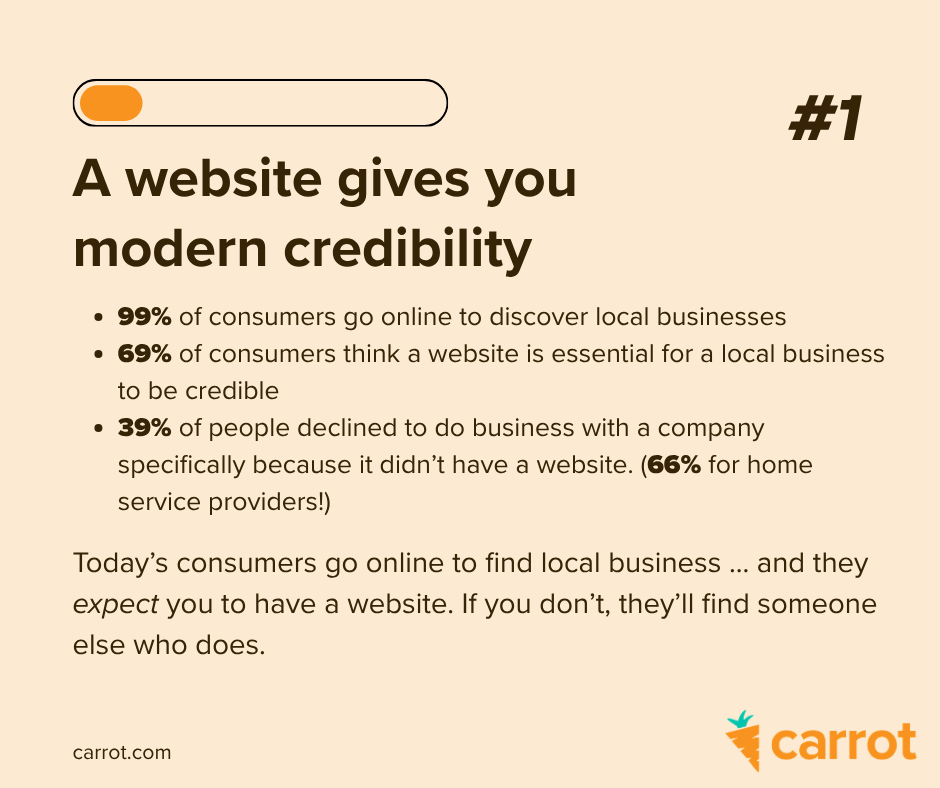
- 69% of consumers said a website is essential for a local business to be credible.
- Businesses with websites are perceived as 41% more trustworthy than those without.
- 45% of consumers say businesses without websites feel less “real.”
- 39% report they have declined to do business with a company specifically because it lacked a website. That figure jumps to 45% among consumers ages 18-44.
- 58% of people check a business website to confirm info they see on social or Google.
- Only 35% of consumers consider working with a company recommended by AI that doesn’t have a website.
- Having a good website is the second most important trust factor when judging a local business (only online reviews are more important). Social media came in third. Personal recommendations ranked fourth.
- Be hyper local — When people conduct a local search, they don’t want a business the town over. They want a business in their town. Make sure you target these searchers by clearly including your service areas on your website. Even better, have a dedicated page for each market you serve.
- Think (and speak) like a consumer — There may be a lot of technical terms in your industry, but your customers might not know them. When writing website copy, use the terms your customers are most likely to use. Essentially, speak like a human or imagine you’re describing what you do to your grandma.
- Instead of talking exclusively about “buying homes in probate,” create web content explaining how you help people “sell an inherited house.”
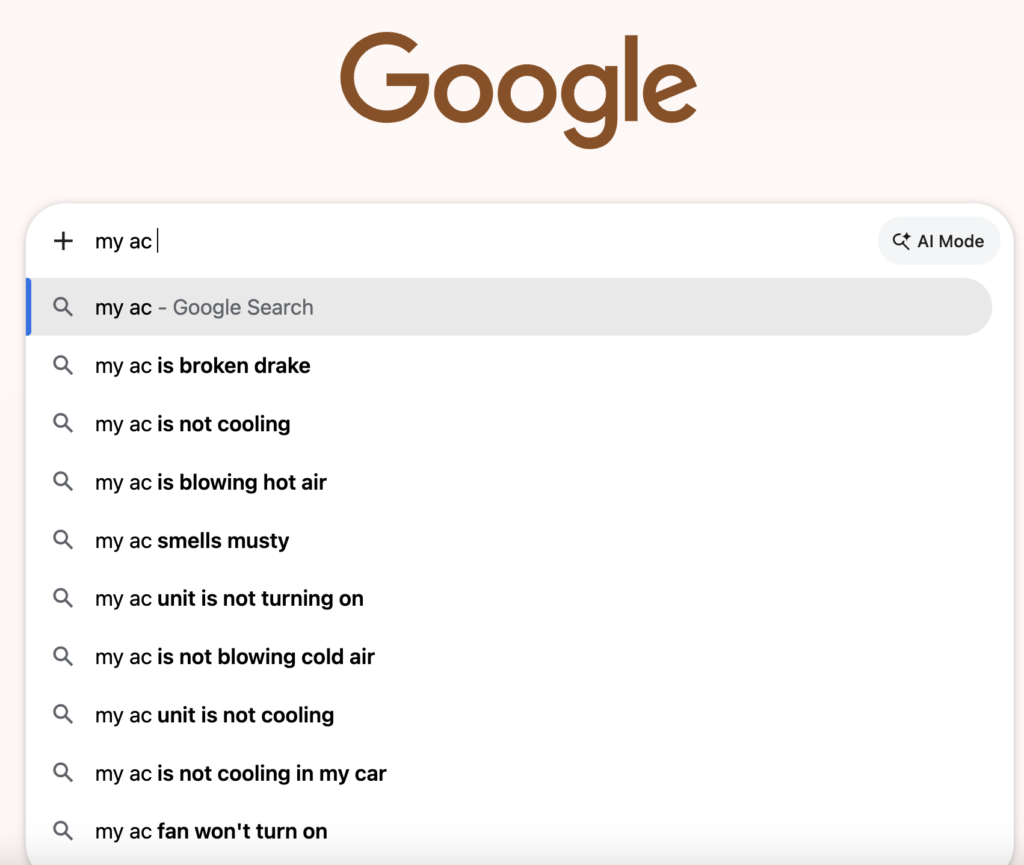
- If you’re an HVAC company, your customers might not know what a condenser is. They’re more likely to search for more generic, simple terms like “AC isn’t working” or “AC repair.”
- Answer their questions upfront — When someone is looking to sell their house fast, for cash, or is looking for a home service provider, they have a lot of questions. Answer their most common questions with FAQ sections on your webpages.
- Think about the questions your current customers ask you most often, these make great FAQs!
- Google’s auto-suggest feature is another great place to learn what people commonly search for and the phrases they use.
- A clickable phone number for people on mobile devices
- This is particularly important if you’re a service provider who offers 24/7 emergency services!
- A contact form in the hero (top) section of your website
- A simple contact form that doesn’t ask for too much information
- Our testing shows that more than 3 fields dramatically reduces the form completion rate, so keep your initial contact forms to only the information you absolutely need.
- Show before and after photos of projects
- Talk about your company’s history and ties to the local area
- Show real photos of your team
- Walk customers through your process
- Publish licensing information
- Highlight ratings from Google, BBB, and other review sites
- Post local media mentions (like local news appearances or sponsorships)

1. A Website Gives You Modern Credibility
I work for a company that helps local service providers launch a website, so I admittedly have a vested interest in you having a site. But statistics are also on my side. The fact of the matter is, people go online to search for local businesses. Not some people. A lot of people. Approximately 99% of consumers go online to discover local businesses. Yet 27% of small businesses think a website is irrelevant to their industry.
Those holdouts relying on recommendations, old school marketing methods, or social media platforms majorly miss out. Not only on search traffic, but on consumer trust. Having a professional-looking website lends your business credibility.
DreamHost’s 2026 Local Business Trust Index found that:
If you’re a home services provider, having a website is even more important. DreamHost found that 66% of consumers said they’re more likely to hire a contractor or home service provider with a website.
Even with people continuing to ask friends for recommendations and increasingly turning to social media or AI for searches, a website remains a foundational piece of business credibility. Here’s more from DreamHost:
The first website was created in 1991. Google Search has been around since 1995. Automatic delivery of the Yellow Pages began phasing out in 2011. Websites aren’t a fad. They’re how people find businesses — and decide which ones to trust — as we move further into the 21st century.
2. Show Up in Local Search (SEO) & AI Search
So people are searching online. How do you make sure you show up in those searches? One of the answers is having an SEO-optimized website.
72% of small to medium-sized businesses say SEO has a medium-high impact on their business, yet only 40% said they have a dedicated website. — Bright Local
Good SEO lets you target potential customers when they’re looking for a specific solution. Here are a few tips for good SEO that will help you rank in local searches:
These SEO best practices also help with AI search optimization.
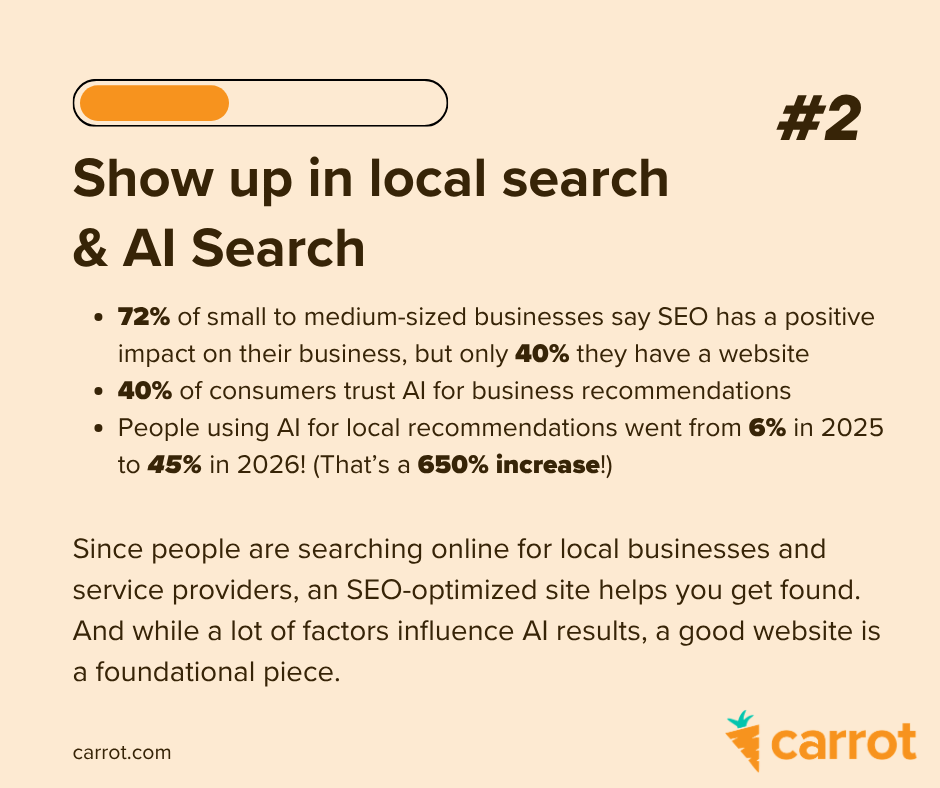
McKinsey & Company found that 50% of consumers use AI-powered search. BrightLocal’s Local Consumer Review Survey 2026 found that use of AI tools for local recommendations grew from 6% in 2025 to 45% this year (yes, you read that right, that’s a 650% increase!). AI engines are now the third most popular source of business recommendations, with 40% of consumers trusting AI to provide business recommendations.
To be found by modern consumers, you need to be online. And the best way to control your online presence is with your own SEO and AI-optimized website.
Want help optimizing your website for local AI search? Check out Carrot’s AI Visibility Challenge, built specifically for local services businesses and real estate professionals!
Or want someone to manage SEO for you? We can help!
3. Generate Leads & Get Customers — Even after hours
This one should seem pretty straightforward. People are looking online for a local business. Being online gives you a better chance of being found when (and where) they’re looking — especially if your site is SEO optimized.
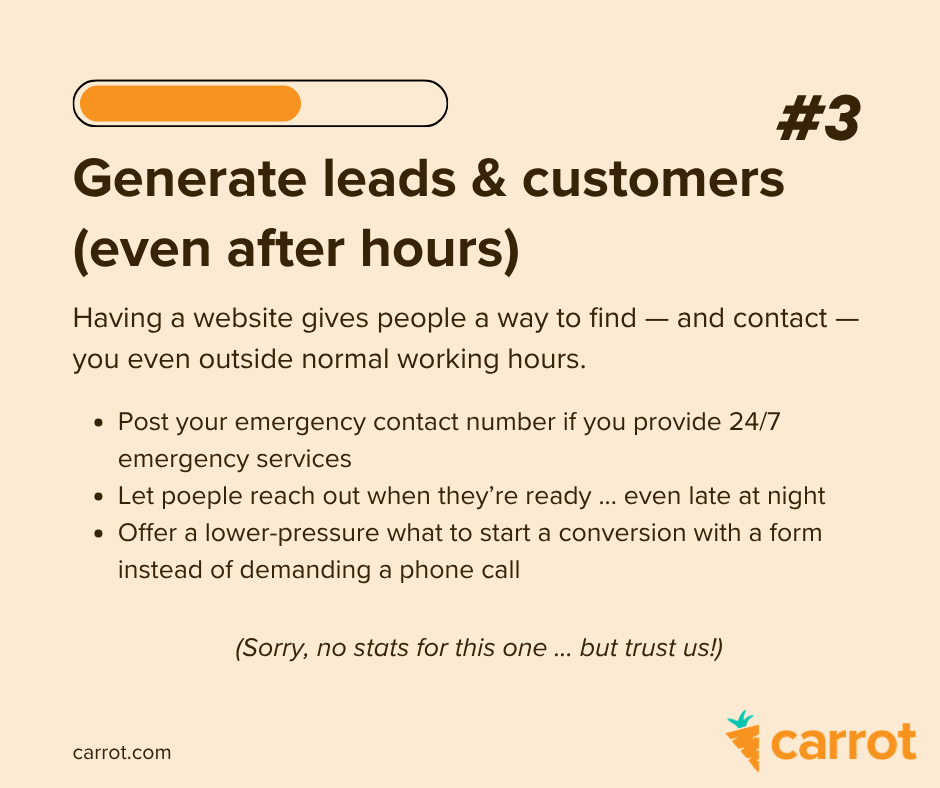
But it’s more nuanced than that. Your business (likely) isn’t open 24/7, but that doesn’t mean people only look for service providers during normal business hours. In an emergency repair situation, someone searching for a local service provider needs to get in touch with you quickly — no matter what time of day it is. In this case, research indicates they’ll look at your star rating, read some reviews, then go to your website to verify you can solve their problem and ultimately contact you.
Or maybe someone is contemplating a kitchen remodel or a roof replacement and only has time to sit down and do research in the evenings. These people are more likely to look closely at your website and do deep research before reaching out. They may not even want to talk to someone right away and be more interested in filling out a form for a quote instead.
This is a similar situation for real estate investors wanting to attract motivated sellers. The seller may be dealing with a stressful situation and hesitant to reach out directly. Or they may have limited time to dedicate to selling a property and need to fit it in when they can … even if you’re not immediately available. Offering them a free, fast cash offer via a website form can seem like a lower-pressure option for these visitors. (And using CarrotCRM’s autoresponder feature means you can respond to them immediately, even when you’re offline.)
Without a website, you limit potential customers to only the people who know about you without an online search and those who can get ahold of you when you happen to be available.
Here are easy contact methods you should include on your website:
4. Build Trust
I already mentioned that people consider businesses with a modern website more trustworthy. But having a website also lets you showcase your business and really build that trust.
When a potential client comes to your site, they want to make sure you can solve their problem and that you’re legitimate. The best way to put their mind at ease is to show them who you are, the work you’ve done, your credentials, and highlight happy past customers. Your website is the perfect place to:
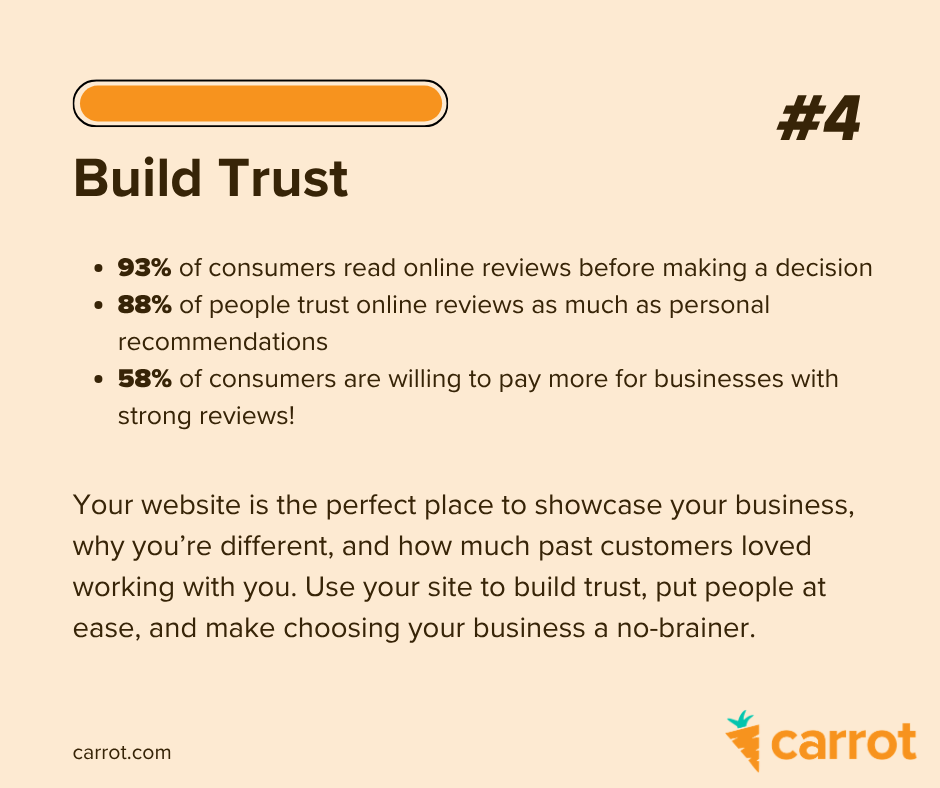
Most importantly, highlight real customer reviews on your website. SQ Magazine found that 93% of consumers read online reviews before making a purchase decision, with 88% trusting online reviews as much as personal recommendations. More importantly, 58% of consumers say they are willing to pay more for businesses with strong reviews!
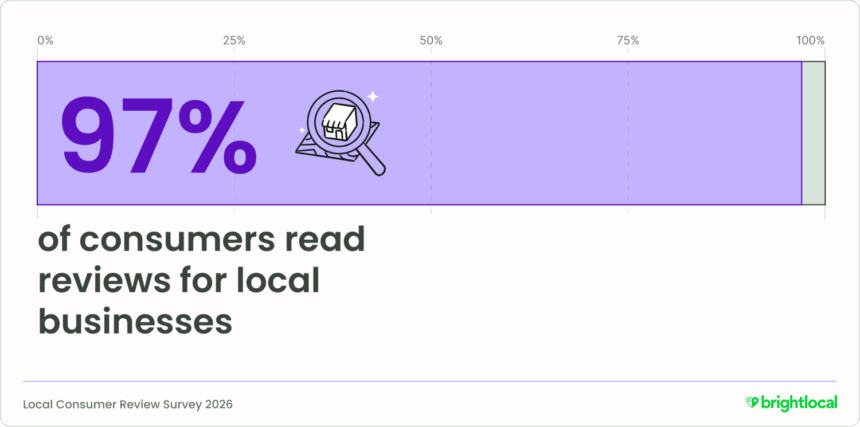
BrightLocal puts the number of people who read online reviews for local businesses even higher — at 97%. They also found that the percentage of consumers who “always” read reviews jumped from 29% last year to 41% in 2026.
When you finish working with a client, ask for a photo with them and a testimonial. Better yet, see if they’ll talk about your company in a short video. Putting a face to the review lets people know you didn’t make it up. If you want to use Google reviews on your website, take a screenshot of the review and put it on your site as an image for the same level of legitimacy. (Pro Tip: If you’re using images of reviews, type the content of the review into the image’s alt text so it can be crawled for SEO and AI search.)
Websites are a must for today’s local businesses
There’s no escaping the internet, and companies that try to ignore the need for a business website are only hurting themselves. No matter how small your business, who you target, or what you offer, people want to check you out online before they commit. If you’re a real estate investor or a local services provider (like HVAC, contractor, electrician, plumbing, roofing, etc), having a website with good local SEO is non-negotiable.
Zippia found that 81% of consumers conduct online research about a business prior to making a purchase, with 47% seeking information specifically from the business’s website.
People want information before working with a business, and they turn to the internet to find that information. If you’re not online, your business is effectively silent.