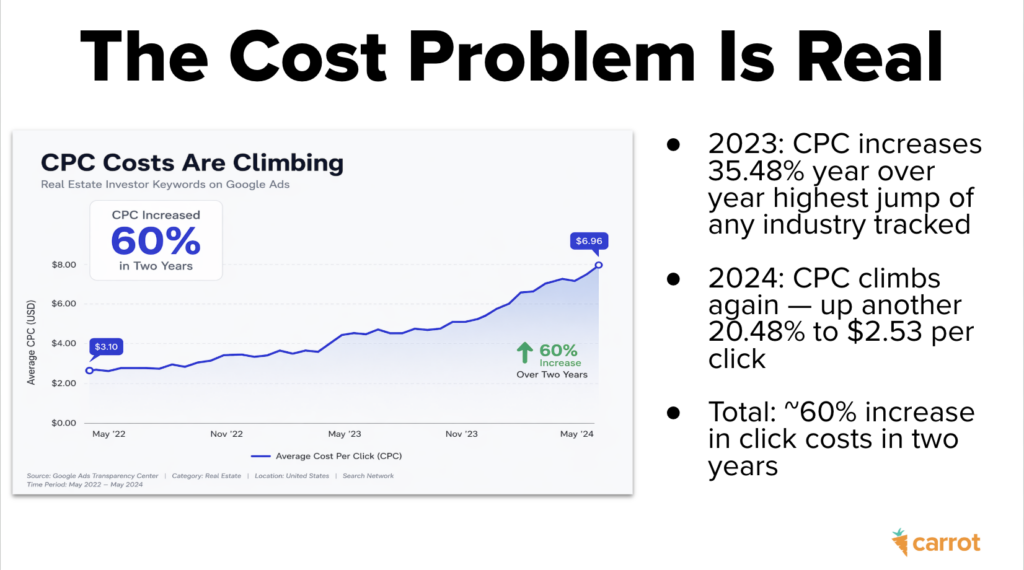
No matter what happens in the world of SEO (or GEO or AEO or AI search … or any other organic traffic source), paid ads remain a reliable source of leads for many real estate investors and local home service providers. But even PPC (pay-per-click) has seen some changes in recent months, namely increasing costs without a corresponding bump in leads. Or, if you want to keep your cost per click down, you might be experiencing reach creep well beyond the geography you actually need leads from.
So is PPC a bad marketing channel now? Not at all!
The key to getting the most bang for your buck is making sure your PPC landing pages are set up for success. You can have the best ads in the world, but if the landing page they point to isn’t great, you won’t generate leads. (And Google might actually charge you more to show your ads!)
For many businesses, the landing page is where they lose leads … not the ad itself. If you’re getting a good number of clicks, but none of them turn into a high quality lead or client, the issue isn’t with your ad, it’s with the landing page.
This blog teaches you how to fix your leaky PPC landing pages, based on teachings from Carrot’s webinar The 97% Blind Spot: How to Get 10x More PPC Leads Without Touching Your Ad Budget.
Key Takeaways
- The four common PPC landing page issues that could be costing you leads and making your ads less effective overall.
- Over 80% of PPC traffic comes from mobile, where users expect pages to load in under 3 seconds. Unfortunately, the average page load time in mobile is over 8 seconds. To improve your mobile load times, choose a website provider that pays attention to site speed.
- Make sure your Google ad quality score is high by matching the language and messaging of your ad to the landing page it links to.
Table of Contents
- PPC Problem 1: The Homepage Problem
- PPC Problem 2: The Writing Problem
- PPC Problem 3: The Mobile Blindspot
- PPC Problem 4: Google’s Secret Ad Scores
- Fixing Your PPC Landing Pages

Most Common Problems Hurting Your PPC Ads & Landing Pages
Nailing a PPC ad campaign can be tricky. You need the right message, the right copy, the right graphics, targeting the right people and areas … and sometimes it still seems like it’s not working. That could be for a few reasons that have nothing to do with your ads. Here are four common PPC landing page issues that could be costing you leads.
PPC Problem 1: The Homepage Problem
Where does your ad point to? If you’re like nearly 50% of people running PPC ads, the answer is probably your homepage. And that’s an issue. This is the biggest driver of wasted ad spend in PPC.
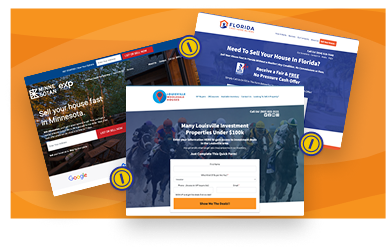
So why is pointing to your homepage bad? The simple answer is that the messaging in your ad needs to match the messaging on the page the ad links to (i.e. the landing page). Not kind of match. Match. If the ad says something like “Sell your house fast for cash, no realtor commissions,” the landing page that ad points to needs to reiterate all those points exactly the same way.
When someone clicks on your ad, it’s because whatever that ad promised was enticing to them. If they get to the landing page (where the action takes place) and they don’t see that same promise, they may lose interest or trust and not take action.
Google also puts a lot of weight on ad-landing page message match. (It’s a big part of Google Ad’s secret scoring.) If the language in the ad doesn’t match the language on the landing page, Google may decide that your ad is spammy or won’t give the visitor what you promise. If that’s the case, it won’t display your ad as often as the ones it deems high quality.
Recommendation: Does your ad offer something like a fast cash offer? Change your form button from generic “Contact Us” wording to language that better matches your ad, like “Get My Cash Offer.”
PPC Problem 2: The Writing Problem
A recent study found that an estimated 54% of adults in the United States read below a sixth grade reading level. On top of that, people don’t pay close attention to online ads. So the best way to grab their attention quickly and communicate your message in a way that makes them take action is to keep it simple.
And that goes for the copy on your landing page too. During the webinar, we shared that landing page copy written for a 5th-7th grade reading level converts at 11.1%, while copy written at a college reading level converts at only 5.3%. Word choice matters, and in this case, it’s best to keep things simple and clear. The last thing you want is for people to be confused or feel like this service isn’t for them. If you try to get fancy or too clever, you could be costing yourself leads.
PPC Problem 3: The Mobile Blindspot
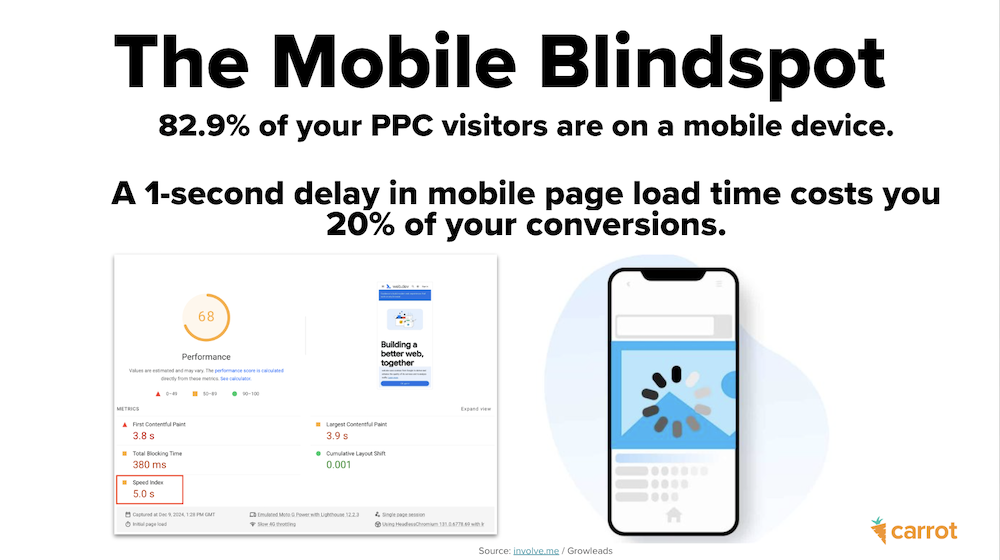
What’s one of the best ways to waste ad budget? Having people click on your ad only to abandon the page before it even loads. The accepted knowledge among marketers is that people will leave if your site doesn’t load within 3 seconds. … But that stat is from 2011 (I personally remember writing about it back then!). Imagine how much faster people expect load times to be today!
Today, more than 80% of PPC visitors are on a mobile device and, unfortunately, mobile load times are often slower than desktop. (BrowserStack puts the average mobile load time at a staggering 8.6 seconds.) That’s a lot of lost leads … and a lot of wasted budget.
Our data shows that PPC landing pages that load on mobile within 2.4 seconds convert nearly twice as effectively as slower-loading pages.
Keeping your PPC landing page simple and following best practices for page speed will improve your ad ROI by driving more leads. Choose a website provider (like Carrot) that natively pays attention to site speed and enables backend features to keep your site fast. Too many custom website developers focus on what looks good and ignore performance, which can quickly drag down your site. Pretty doesn’t convert leads, performance does.
Recommendation: Use pagespeed.web.dev to see how fast your site or PPC land pages load on mobile and desktop.
PPC Problem 4: Google’s Secret Ad Scores
It should be no surprise that Google has an algorithm to determine where your ads are placed, how often they show, and how much they charge you to show them. It’s called the ad quality score — the higher the score the better. (We explain how to find your ad’s scores around minute 34 of the webinar.)
How do you get a good Google ad quality score? Here are some tips.
Based on the theme of this blog, you shouldn’t be shocked to learn that the quality of your PPC landing page directly impacts the ad’s quality score.
Landing pages that Google deems “above average” not only have a higher click through rate (CTR), but see costs-per-click 36% below average … meaning Google charges them less for each click. If your landing page isn’t high-quality, Google shows your ad less often, shows other ads above it, and charges you more if someone clicks.
How do you make sure you have a high quality landing page? That’s where message matching comes in. Google crawls your ad and landing page specifically to see if they’re talking about the same things, using the same language, and have the same major messages. So make sure your landing page makes the same promises as your ad.
Want to see what good message matching looks like? Check out minute 38 of the webinar.
Fixing Your PPC Landing Pages
Those are some of the most common — and most impactful — mistakes made with PPC landing pages. Some are easy to fix (numbers 1 and 2), and some take a little more expertise (numbers 3 and 4). Working with the right PPC ad manager (or diving deep on ads yourself) can help, but you also need to make sure your website is set up to support high quality PPC landing pages.
In the next blog, we’ll dive into the five elements every high-converting PPC landing page needs (including the fool-proof formula to write a winning landing page headline). But if you don’t want to wait for that post to publish, you can check out the webinar replay now (it includes a lot more helpful information as well, including touching on SEO changes and how AI impacts lead generation).