
Search results for: “ppc”

  • EP 296: The “Top-Dollar Teardown” Deal w/ Keith Sant | Behind the Deal

    EP 296: The “Top-Dollar Teardown” Deal w/ Keith Sant | Behind the Deal

    Answer your phone.

    – Keith Sant

    The “Top-Dollar Teardown” Deal w/ Keith Sant

    Our new series is taking you behind the scenes of some of the most interesting and rewarding deals that our customers are closing. Keith Sant is a returning guest, avid Carrot Camper, and a trusted home buyer based in Tacoma, WA.

    Today we will learn how he found the lead and how the process went while answering all of your questions about the process. Join us every other Thursday at Carrot.com/deal

    Read the Full Show Notes Below…


    Keith Sant named his company Kind House Buyers for a reason. As we go behind this deal, you will see why. In this situation, Keith was able to not only go above the asking price but also make over $30k on the deal. Here’s how he did it… 

    Behind the Deal

    The lead came in from a PPC campaign, from someone who was doing their research on buyers in the area. Because Keith had a credible website and a strong reputation, he was one of the buyers she called.

    Keith answered the phone when other investors didn’t and he was able to immediately set up an appointment to see the property. 

    This property was a manufactured home, with plumbing and electrical problems. There was an unpermitted addition, which had also put a lien on the home.

    The property could not be listed in the traditional sense, and the family wanted to relocate their aging father who was living on the property. 

    Breaking Down The Numbers

    The family owed about $78k on the property and had also spent a good $10k on family-related issues. Keith knew he could easily sell the land alone for $100k.

    After crunching some numbers, he was able to offer more than what they owed, helping to reimburse the family and pay for relocation expenses. 

    Normally Keith would ear down the property and simply add a new manufactured home, He could then quickly resale it as a brand new home.

    However, because of the high demand fr mobile homes, he know this would take a while.

    So instead, he flipped the property to a fellow investor who had the tools and means to fix up the property. In this situation, everyone came out ahead. 

    Building Your Reputation

    There are many reasons why homeowners turn to Keith when they need to sell. One of those is the strong reputation he has built over the past 4 years. Keith regularly adds content to his website, adds customer reviews, and is completely transparent about how he works.

    Recently, Keith was even feated in an article in the Olympian which spoke of this deal in particular. So many times investors will be painted as vultures who are just after a quick buck.

    By being informative and getting his name out there, he is not only building trust but changing the perception of the industry for the better. 

    Tips That Actually Work: SEO Keyword Rank Check Tool

    If you are putting links out there online and not tracking them, how will you know where your leads are coming from? Our keyword tracking tool will help you see where your leads are coming from and which keywords they are searching.

    You will be able to make tweaks to your content to get more eyes on it, thus improving your rankings in Google search results. Look for more data to be added to the keyword tool in the months ahead!

    Join Us Live! 

    Join us every other Thursday on Facebook Live. We’ll be taking you behind the deal with some of the top guys and gals in the industry.

    Get answers to your questions live on air while learning the fundamentals of the business.

    Follow Our Guest: 

    Mentioned in This Episode:

    We want to hear your thoughts on the podcast! Drop them in the comments section below or hit us up on Facebook or Instagram!

  • Optimize Your Real Estate Marketing | A Strategic Whiteboard Training

    Optimize Your Real Estate Marketing | A Strategic Whiteboard Training

    Optimize Your Real Estate Marketing & Lower Your Lead Cost | For Investors & Agents

    Video Transcription

    What’s up y’all!

    As you’re planning out your marketing for the year ahead, you might have a couple of questions popping into your mind. You might be asking, how the heck am I going to reach my goals?

    You might even be asking what are your goals as a real estate agent or an investor?

    What I’m going to be walking through in this video is a simple five-step process, I use it here at our company, and I suggest you use it as an investor and agent as well, to plan out exactly what you need to do in your marketing in the year ahead to be able to reach your goals.

    The cool thing about this is, a lot of people, they’ll look at the goals, write a goal number down, it might be an income goal, it might be a deal number goal, and then you pull back and you say, what are the things that are going to help me get there?

    You might write down a few different projects, and I ran my businesses like this for years. I’d have a goal, and I’d go to the whiteboard and I’d say, what are some of the cool, exciting, fun things I might need to do this year?

    I’d write them down and then that would be my plan. The thing I would forget to do is what I’m going to teach you today, which is mapping down to your marketing channels, so you have an exact clear, ABC step-by-step plan to reach your goals in a fail-safe way.

    As soon as I started deploying this in my own businesses and teaching other investors and agents how to do it as well, you start to get more clarity on your plan.

    The cool thing is, I actually did a podcast on this, the cool thing is this becomes your strategy. The definition of a strategy basically, is a strategy is as much what not to do, as it is what to do.

    What we’re going to be diving into here on my iPad, is we’re going to show you exactly what you should do, so you can say no to so many other things in this year ahead. Work less, gain more freedom, make a greater impact.

    Let’s dive into the iPad now.

    The first thing I want you to do here is, there are five steps.

    The first step is we’re going to set your goal, and if you have to pause this video throughout, as you’re doing your annual planning, or if you’re watching this sometime in the midyear, amazing.

    Optimize Your Real Estate Marketing: Step 1

    You can still do the same thing if you’re not clear on what you need to do in your marketing to reach your goals as an investor or an agent.

    The first step is setting your goal.

    Okay, we’re going to pick an income goal, because deal numbers don’t really matter if you’re doing a bunch of low volume or low dollar deals versus if you do some high dollar deals.

    I always pick an income number because you can map that to the lifestyle that you want, or the freedom or impact you want to make.

    Next, we need to ask what is working? This is a big step a lot of people miss… they set a goal and then they just go, hey, what do I need to do next? We need to first ask what’s working.

    Optimize Your Real Estate Marketing: Step 2

    I’m going to give you a framework in here for exactly how to track and show what’s working in your business in a crazy, crazy, simple way.

    Then what we’re going to say is, what’s the difference between where we currently are to the goal that we’re going for?

    Optimize Your Real Estate Marketing: Step 3

    I call it the Delta.

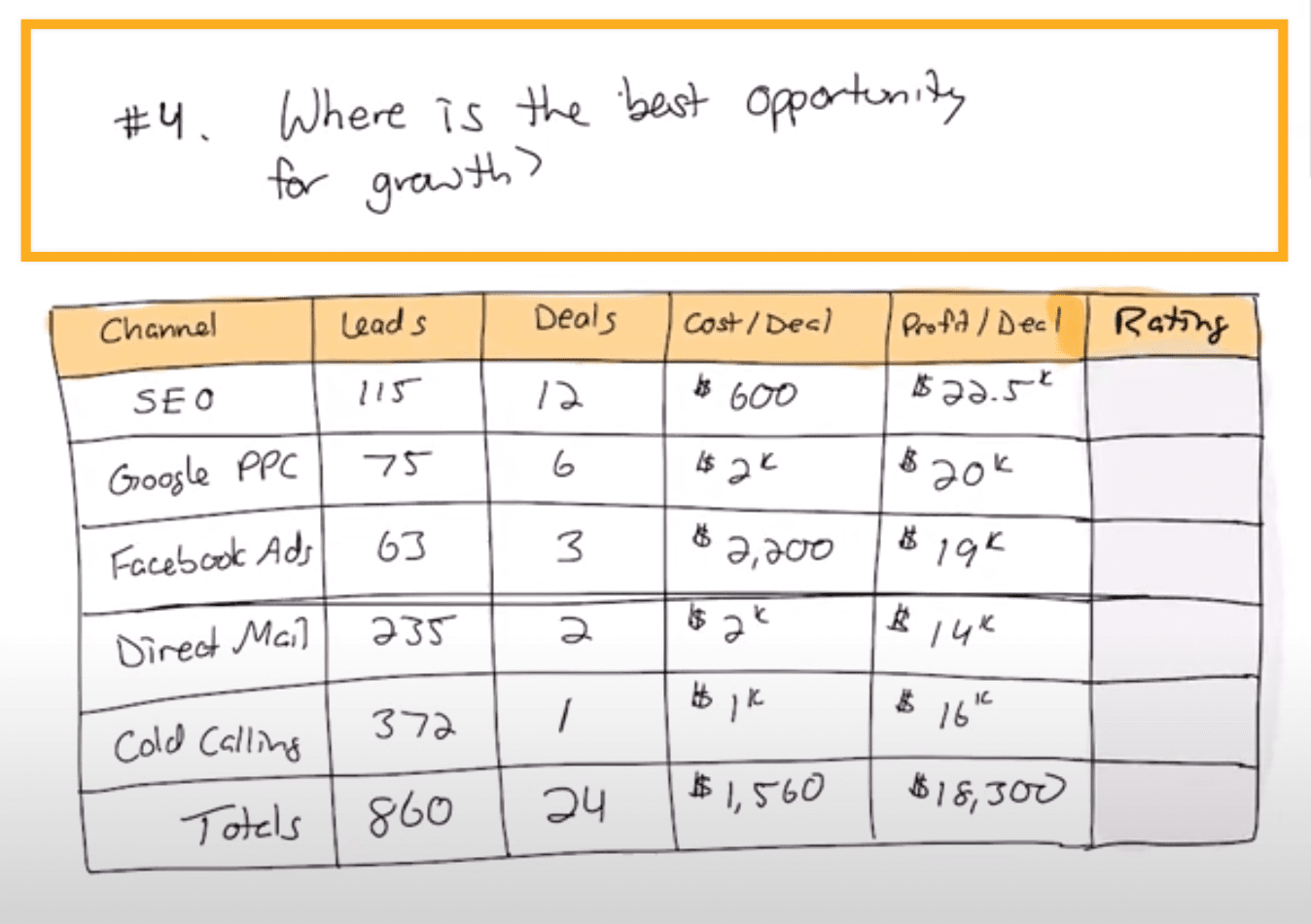
    Next, we’re going to say cool, now that we know the difference in what we need to make up, what are the biggest opportunities that we see, the one, two, or three max, to be able to hit our goal.

    Optimize Your Real Estate Marketing: Step 4

    Then last, we’re going to craft the plan in a really crazy simple one-page thing that you can use each and every quarter.

    Optimize Your Real Estate Marketing: Step 5

    Let’s go back up to the top.

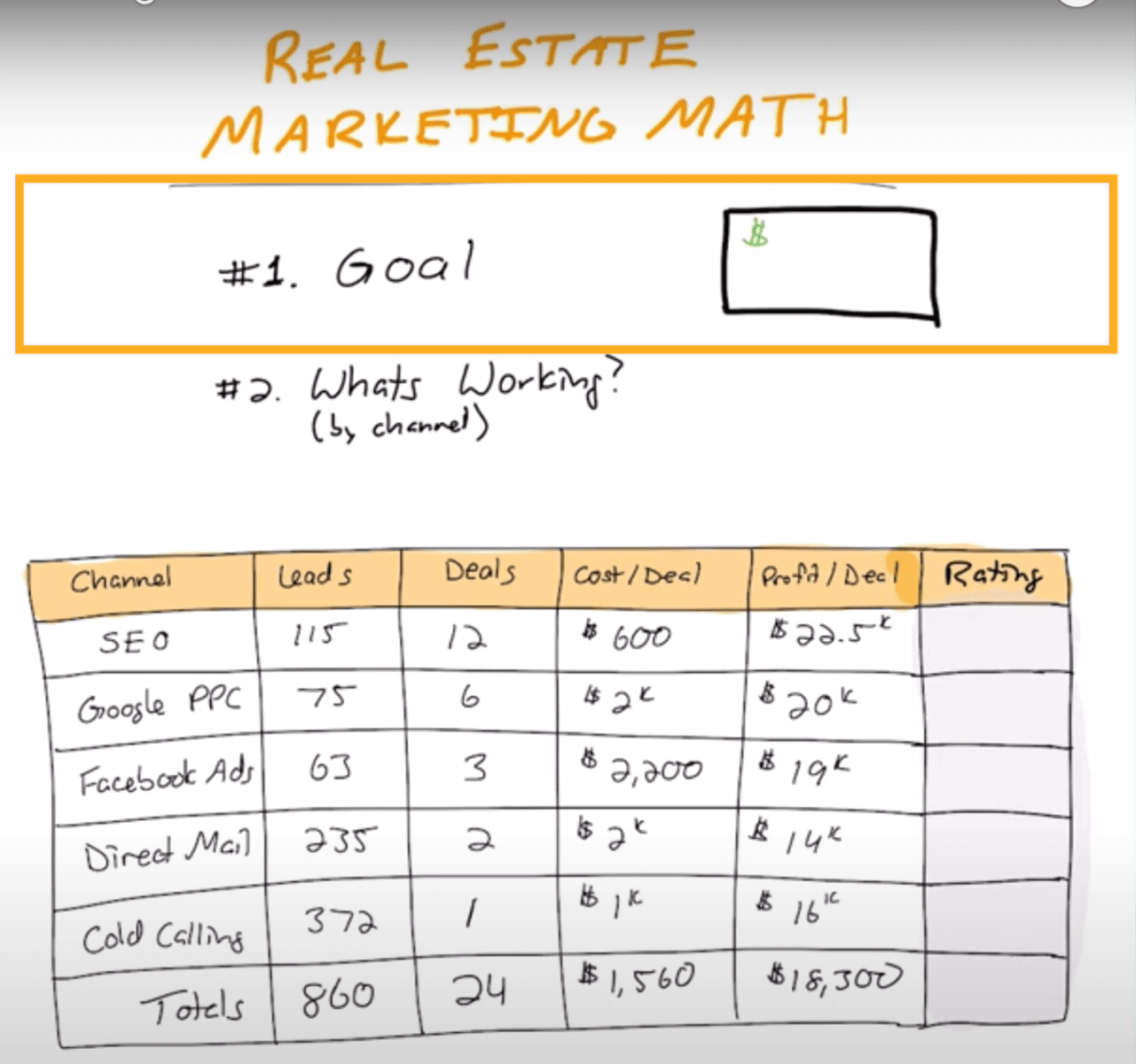
    For this example here, I’m going to be working with one of our clients who is an A player. They’ve already started to do some deals. They’re a hybrid agent investor, which is what we specialize here in at Carrot.

    The people who have their license, and their investor who can offer cash offers, maybe even flip homes. This person’s been doing deals for two or three years, and they want to get to a $750,000 profit goal.

    Okay, so that’s a big goal. If you are trying to get to your first $100,000, it doesn’t matter.

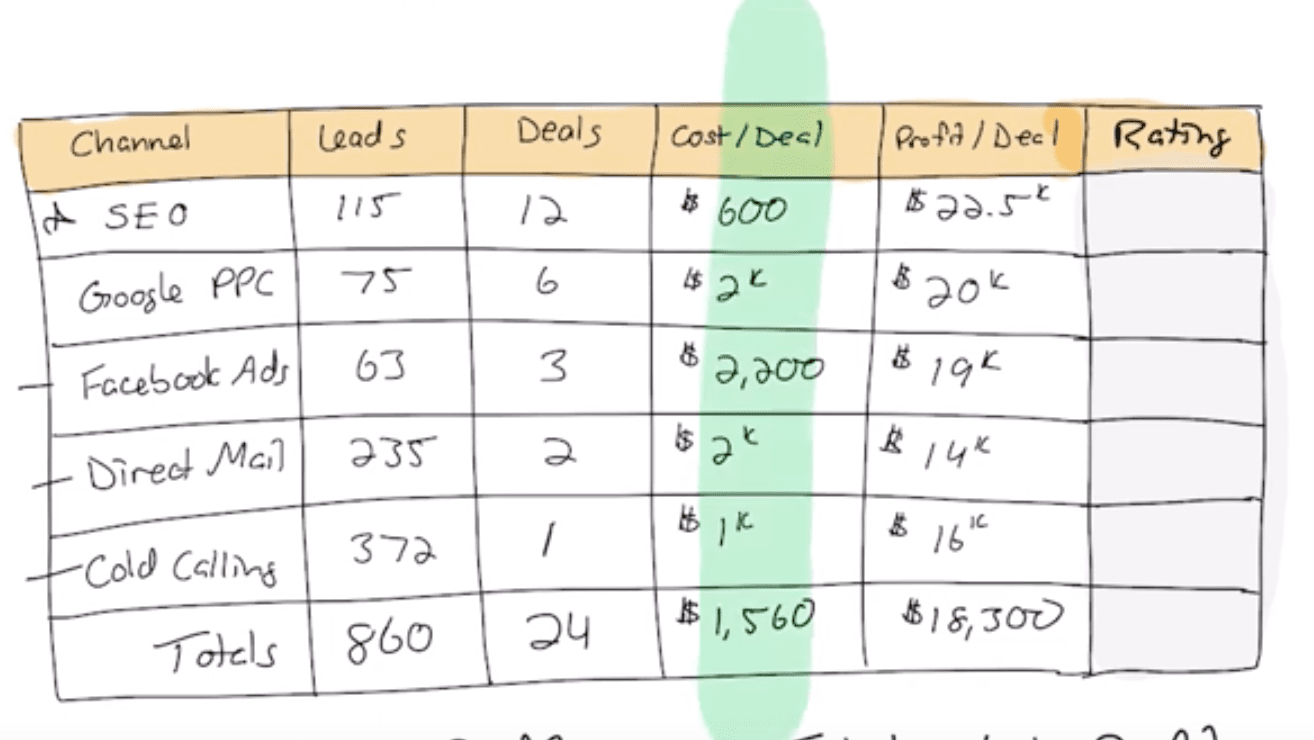
    Next what we’re going to do, is I want you to write down every marketing channel that you’re currently using to get leads and to close deals.

    Rating Your Real Estate Marketing Channels

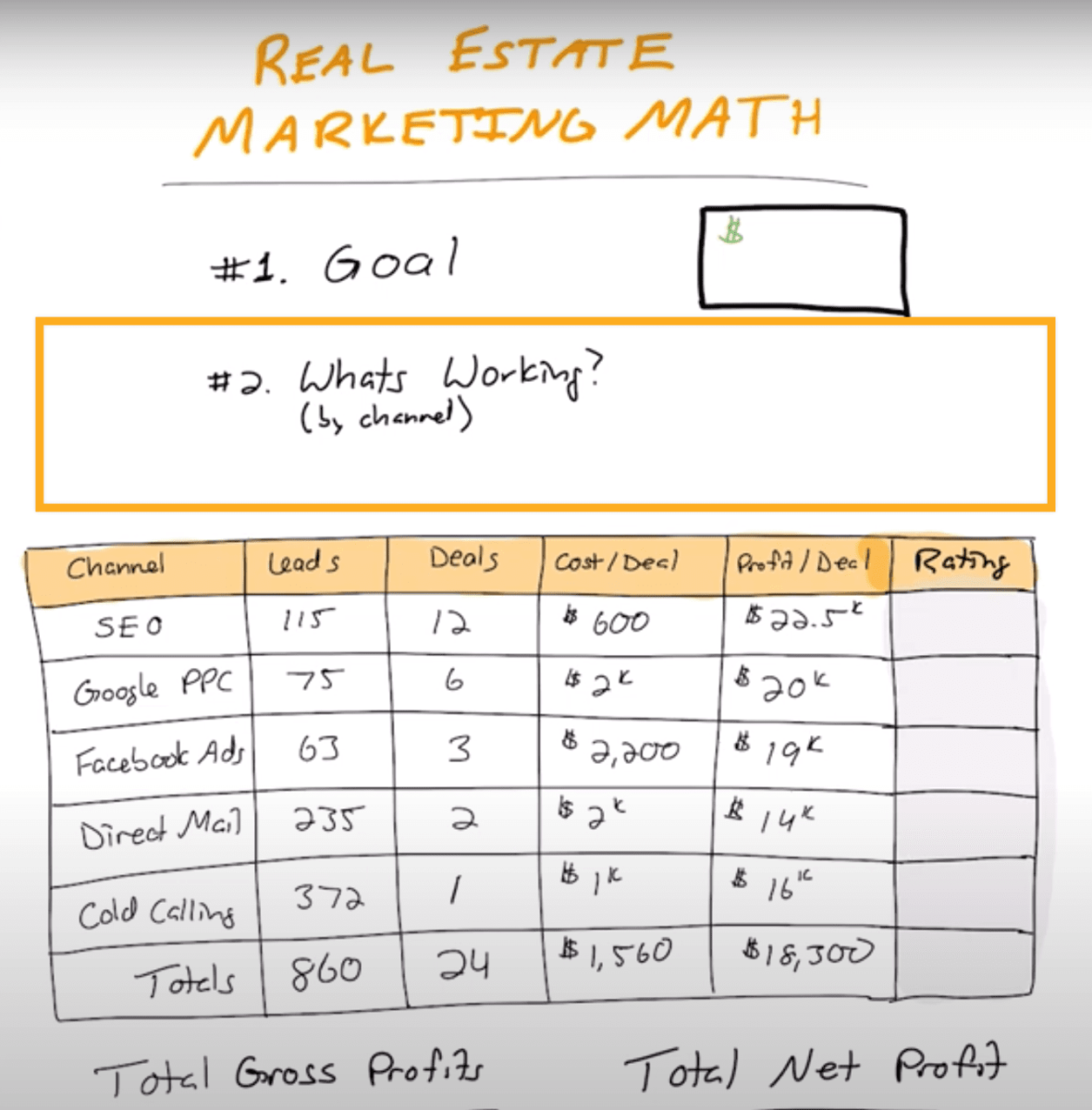
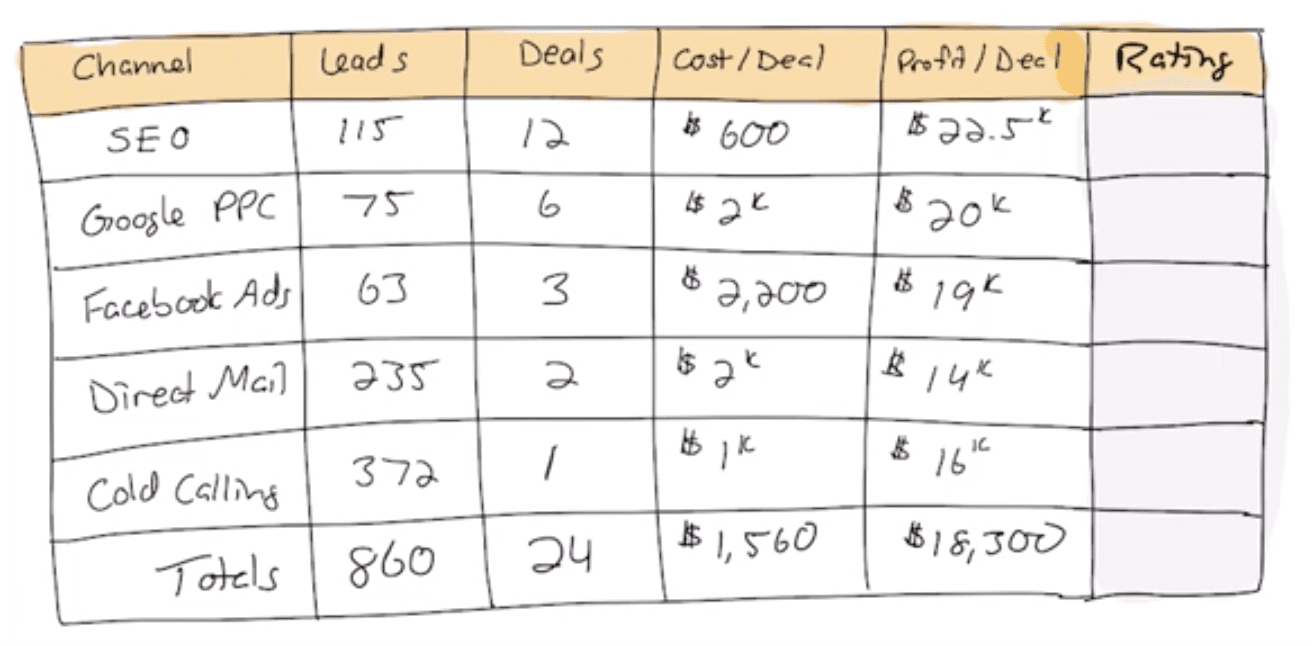
    In this example here, you might have SEO or Google pay-per-click, or Facebook Ads, or direct mail, or cold calling, or whatever it’s.

    You might be doing referrals as an agent, or you might be big, big, big on cold calling as an investor agent, whatever it is, write down the channels that generated your leads in deals this past 12 months.

    If you have to hit pause in this video, go ahead and do it. Write down the channels on the left side and come back.

    Next, I want you to pull back into your data. This might be one of those things where you might be going, I don’t know what the channels did, but one of the biggest keys that you can do as a marketer is you have to know and have clarity on what each marketing channel is doing for your business.
    One of the biggest mistakes that I find with people is they end up investing $5000, $10,000, $15,000 a month, and they say, I’m getting deals out of this, but I don’t know which channels are working and which channels aren’t working.

    So they keep on putting more and more money into the marketing, not knowing which half of their marketing’s working and not.

    This is going to help you save tens of thousands of dollars potentially in marketing every year, and help you grow your income in a more predictable way with less work, which is what we’re about here at Carrot. Helping you get more freedom.

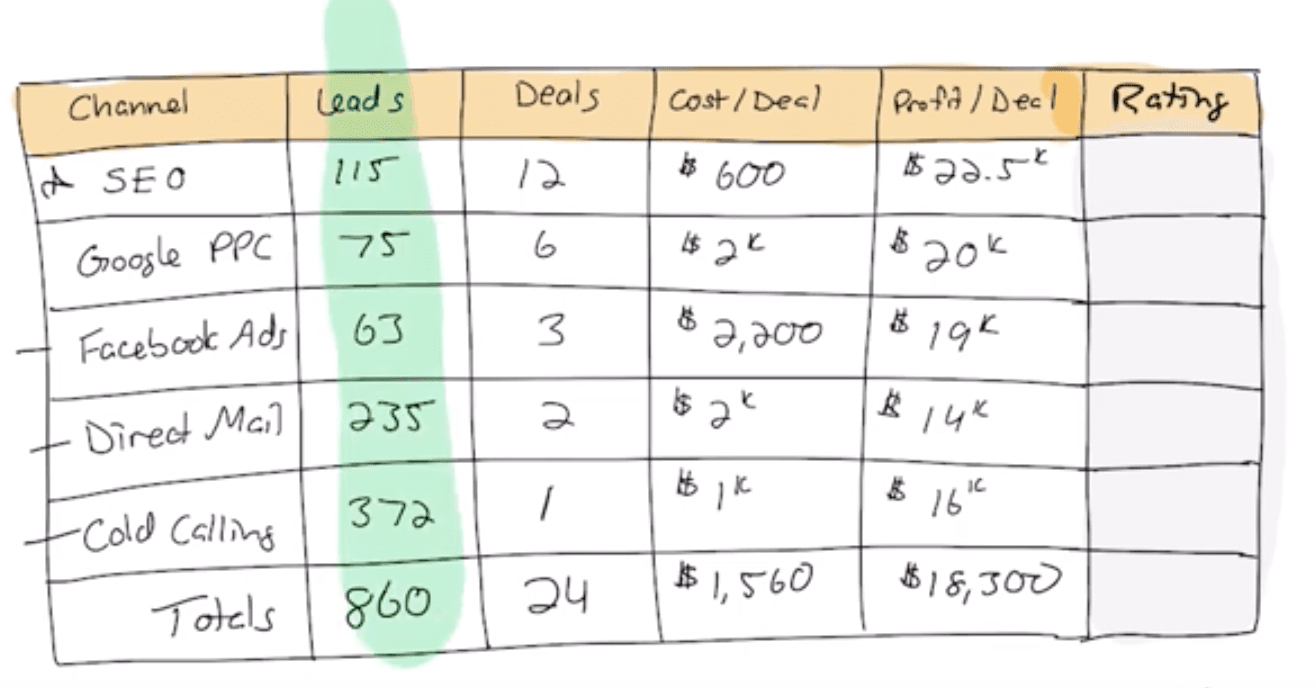
    What I want you to do next, is now write down what are your leads. How many leads did you get with that channel?

    Real Estate Marketing Channels: Leads

    In this example, we’re going to say the SEO channel got 115 leads this past 12 months, Google PPC, 75 Facebook Ads, 63, you get the idea. Write those down.

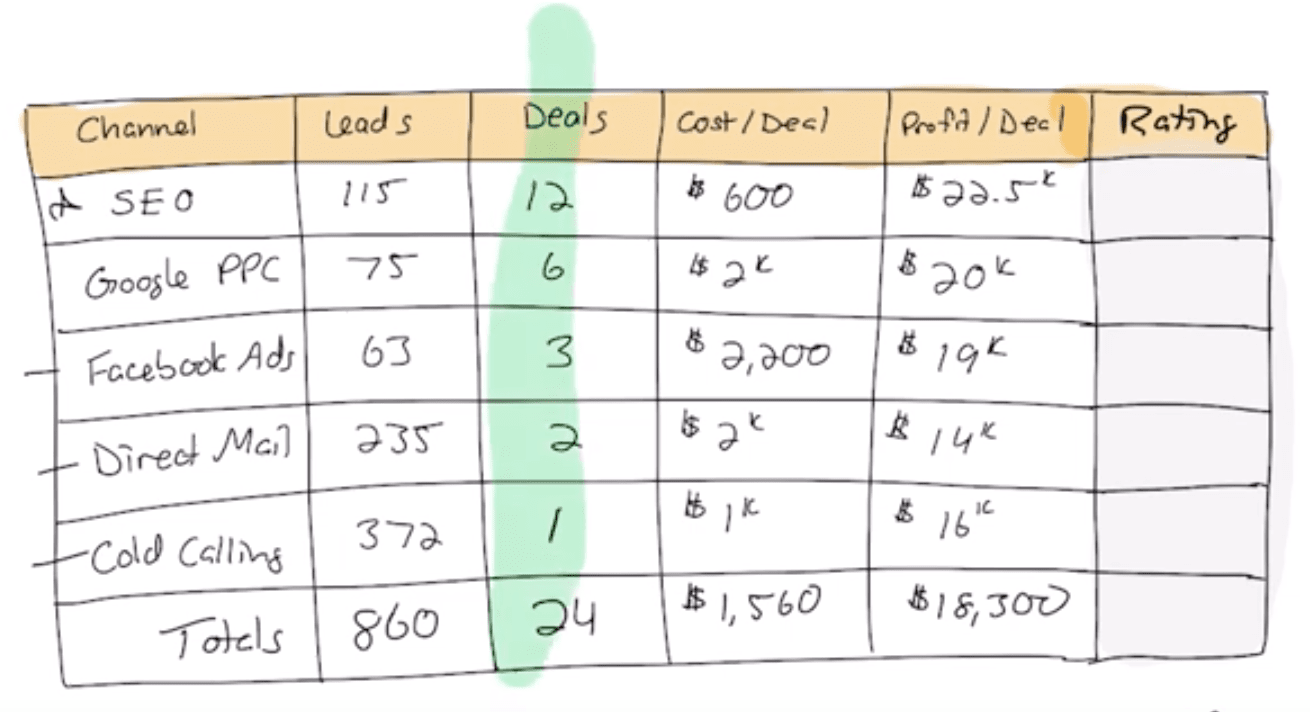
    Then we’re going to say with each channel, how many deals came out of those?

    Real Estate Marketing Channels: Deals

    Now you might be saying, I don’t know how to track how many deals came from the channels.

    Well, what we can do is if you’re using a system like Carrot, our system will actually tell you which leads came from SEO. It’ll tell you which leads came from a Facebook ad, or from a Google ad. It’ll tell you all of those things.

    You can leverage a tool like Carrot to use our campaign tracking links or to use our lead source tool, and it’s going to tell you all that.

    Now you’ll be able to know which leads and deals came from direct mail and cold calling because you want to use a different tracking phone number with each one of those marketing methods.

    You can always say if anyone called from this phone number, it’s from my direct mail, so you can track the leads and deals.

    Okay, now what I want you to do is dive even deeper.

    Real Estate Marketing Channels: Cost per Deal

    If you’re looking at this going, man, I don’t have this data.

    What I want you to know is number one, it’s simple data to track so you can get it, but number two, this is critical data if you want to grow your business, work less, make a greater impact.

    With each one of the channels, say, I’ve got 115 leads at the SEO this past year, 12 deals out of it. How much did you invest in doing SEO that year? Did you pay someone to do it? Did you do it yourself?

    Just take the entire amount of money you invested in the SEO that year and divide it by the number of deals that you did. In this case, we’re just going to say it was about $600 a deal, which was the average cost when we took that amount.

    If it was Google pay-per-click or direct mail same thing, take the entire cost of what you spent on direct mail this year, Google pay-per-click this year, or cold calling, or whatever it is, and then divide it by the number of deals you got to come up with your cost per deal.

    This can be an important number.

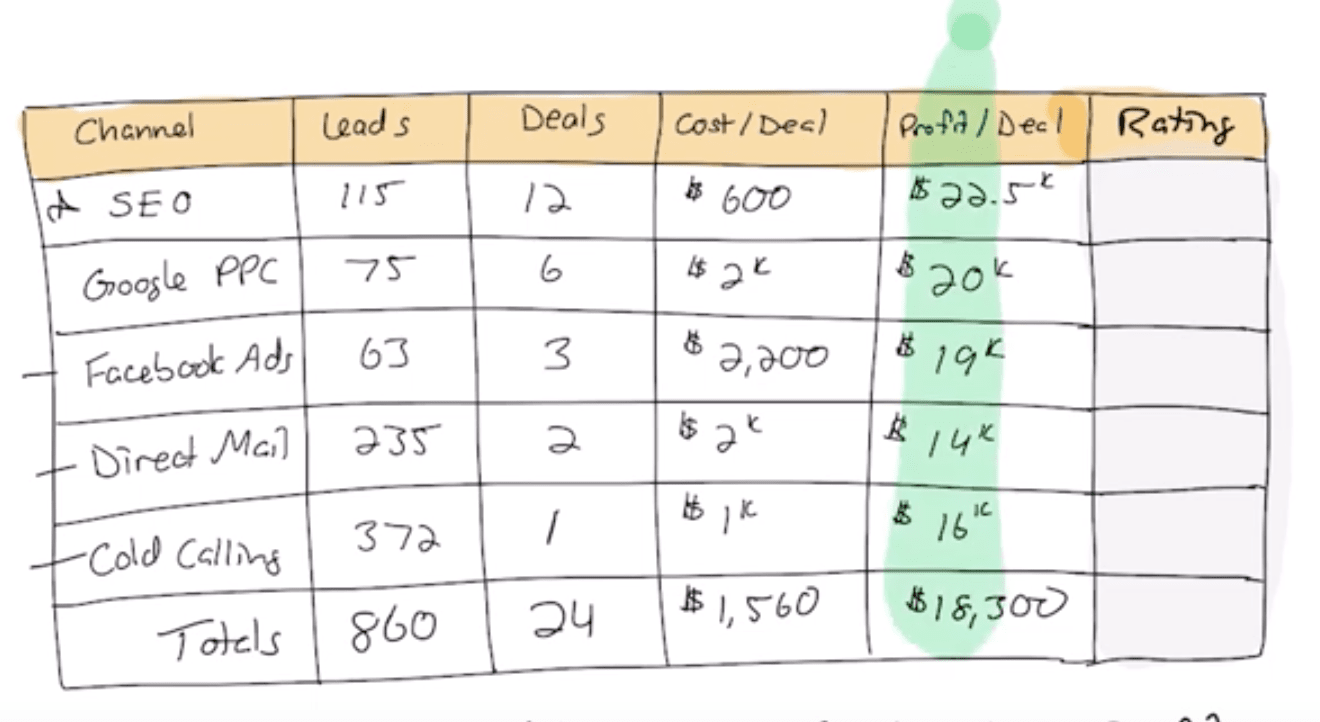
    Next, it’s the profit per deal. Do the same thing. Look at the lead sources. What were the profits on those?

    Real Estate Marketing Channels: Profit per Deal

    What were the total profits for the year for that channel, divided by how many deals you did, and fill out the profit per deal column.

    We’re going to end up coming up with these numbers down here in this section down here which is… what was our total profit for the year?

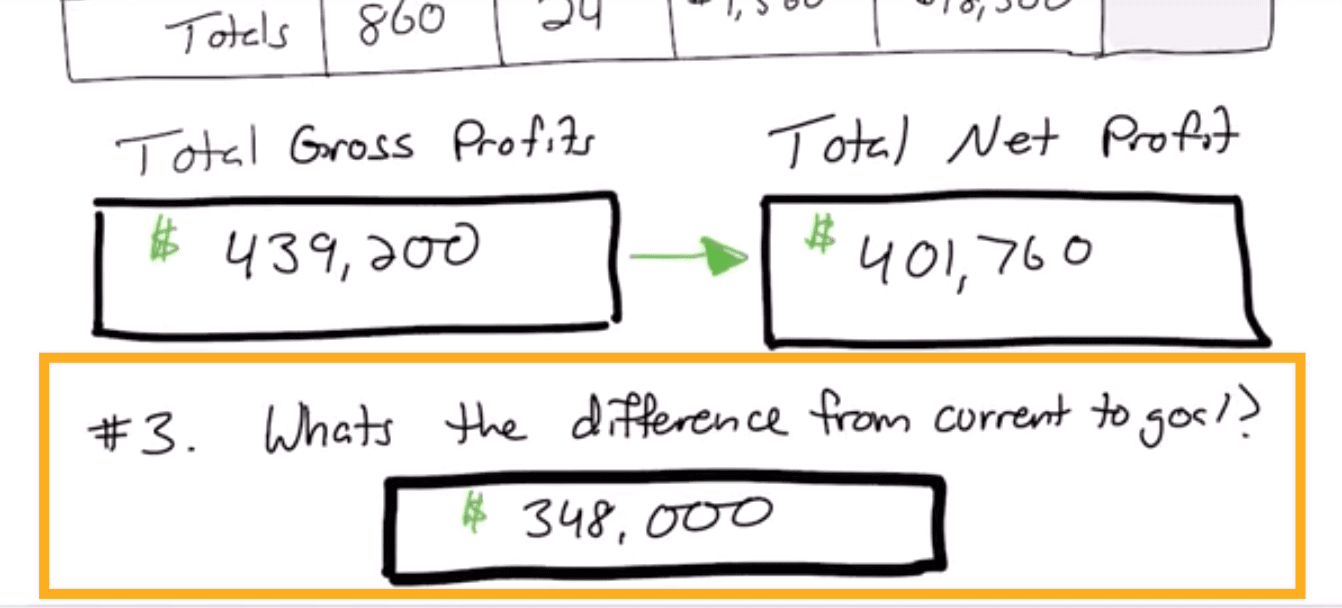
    If we add those up, our total gross profit in this example is about $439,000.

    If we take out the cost for those deals, let’s say it was about $401,000. We netted $401,000, that’s amazing. That’s a huge huge year.

    If your goal is $750,000, and we currently brought in about $439,000, the difference between those two numbers is $348,000, about $350,000.

    That’s the Delta we’re trying to make up in this next year with our plan.

    I’m going to show you guys exactly how to do that in about three to five more minutes in this video.

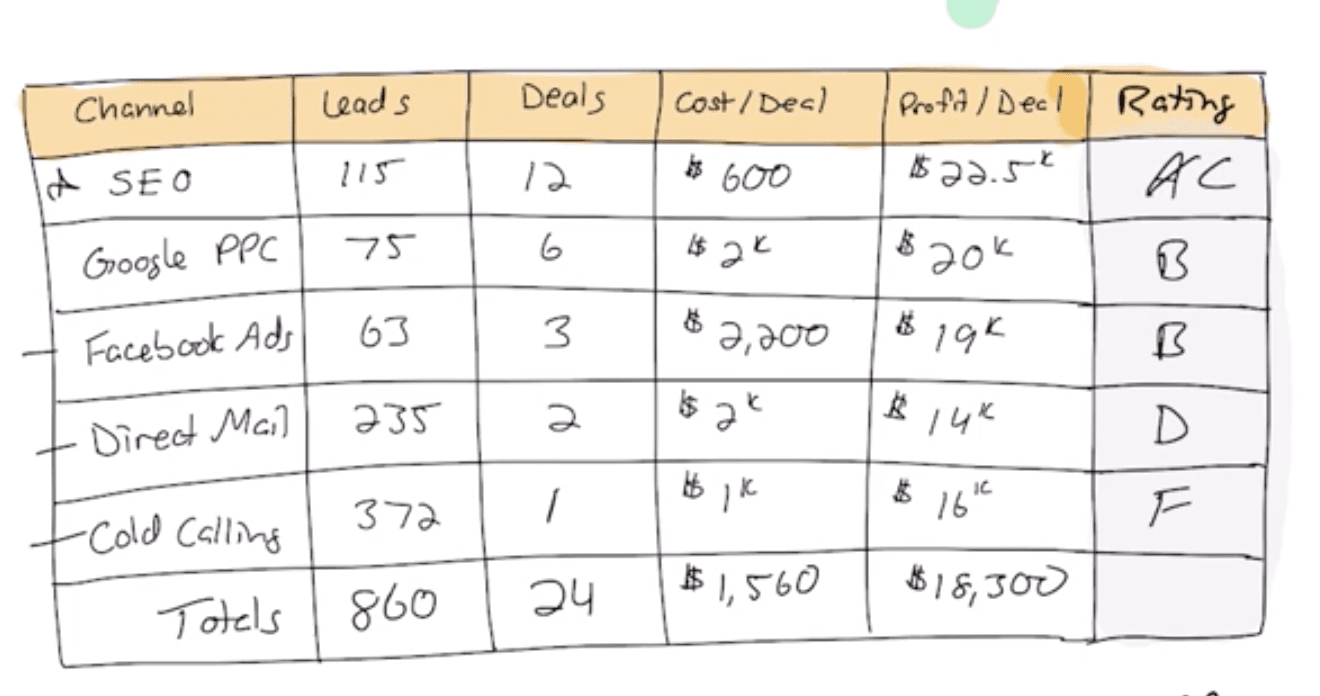
    The next step I want you to take here, is with each one of your channels, now the way that we decide what we need to do in the year ahead, is we look at each channel and we ask ourselves, let’s kind of give it a grade rating, an A through an F.

    An A means we’re executing it insanely well, and there’s probably no room for growth in this channel. We’ve maximized the channel.

    If you’re doing SEO, and you’re just in one market, and you’re dominating Google for all of your keyword phrases, you’re ranked number one in Google for all your keyword phrases, that’s probably going to be an A.

    There’s probably not a lot of room for improvement there if you’re dominating ranking number one in Google for all of your phrases.

    If you’re not ranking number one in Google for all of your phrases, you’re number six, number seven, number eight, you might be getting a couple of leads here or there, maybe that’s a C.

    Okay, give yourself whatever that rating is. Do the same thing with all of those.

    I’m just going to make up some numbers here. Let’s say we’re a B with Google PPC. It’s working pretty good.

    Let’s say direct mail, we’re a D on that, we tested it out, but we’re not really doing too great. Let’s say cold calling is an F, we got one deal, but man it wasn’t predictable. Let’s say, this is a B on the Facebook ads.

    What we’re doing is we’re asking ourselves, where do we see an opportunity for growth? If it’s an A, we’re saying we’re doing the best we can possibly do, expanded it at the best we possibly could, there’s no opportunity for growth.

    If it’s an F, it means we definitely haven’t maximized it, so it might be on the docket there okay.

    Now, let’s say Google pay-per-click and Facebook ads look awesome, and then I really want to get this direct mail thing working better, so I’m going to go I see an opportunity for growing Facebook or Google pay-per-click.

    Let’s say direct mail number two, and Facebook number three. If I think that there’s a lot of room for growth and we have the skillset to do so.

    Okay, I’m going to come down here now, with what we had just done with those ratings. We’re going to rate those out, and now we’re going to come up with some new goals for these.

    Let’s say the Google PPC, what we had been doing in the past was 75 leads, let’s say we want to increase that now and grow that to 150 leads.

    We want to double this so we can help to start to make up that Delta of about $350,000.

    We know with Google pay-per-click that we’re closing about one in 10 leads into a deal that gives us $20,000.

    That was six deals, now if we can double our Google pay-per-click if we see opportunity there, because we haven’t really stepped into it too much, or we can expand our keywords, that’s going to then take it to 12 deals.

    Let’s say the cost per deal stays about the same, and the profit per deal stays about the same.

    Now that’s going to make it to, rather than us bringing in about a $120,000 in Google pay-per-click that year, that’s going to bring in far more, that’s going to bring in, shoot, about $240,000 with Google pay-per-click that year.

    I’m just going to delete that puppy and let’s make this the goal.

    Let’s say $240,000 total is what we’re going to bring in, and we’re going to bring in $120K extra.

    What we’re determining is how are we going to make up this Delta of $348,000 bucks? Well, now we’ve made up right there $120,000 of it with the Google side of it.

    Now let’s look at Facebook. If we closed three deals last year from Facebook, and an average of about $20,000 profit per deal, how many more deals do we think we can get out of Facebook?

    How many more leads do we think?

    Can we double that? I don’t know. That’s for you to determine, go talk to someone who’s an expert, or you dive into it. Let’s say this doubles to six, and that goes from $60,000 to $120,000 now.

    It goes from $60,000 to $120,000 now, and that is in total. So the extra, the Delta that we’re adding is another $60,000. $120,000 plus 60, that’s about $180,000. You guys know where I’m going with this, right?

    Now let’s say direct mail. We see a lot of opportunities. We just did one test and we want to expand it out. Let’s say we want to take this and see if we can’t expand this to 10 deals this year. We want a 5x this year.

    How many leads do we need to get the whole thing? I’m not going to do all the math here, but you guys see where I’m going with this.

    The things that we want to focus on here, doing some quick behind-the-scenes math, is we want to figure out what channels do we need to expand it by, how much do we need to expand them to get to this number here? The $348,000 bucks.

    We’re going to speed up through TV time, and now let’s assume that we had picked our three or four channels, we’d worked the numbers and we have a plan.

    Let’s say the number one plan is the Google pay-per-click.

    We worked the numbers. We say, I think there’s more opportunity there, maybe we can bump this to 200 leads, and maybe we can bump this to 15 deals, and that’s a couple of extra deals. That’s $160,000, $170,000 there. Bam we found out our plan.

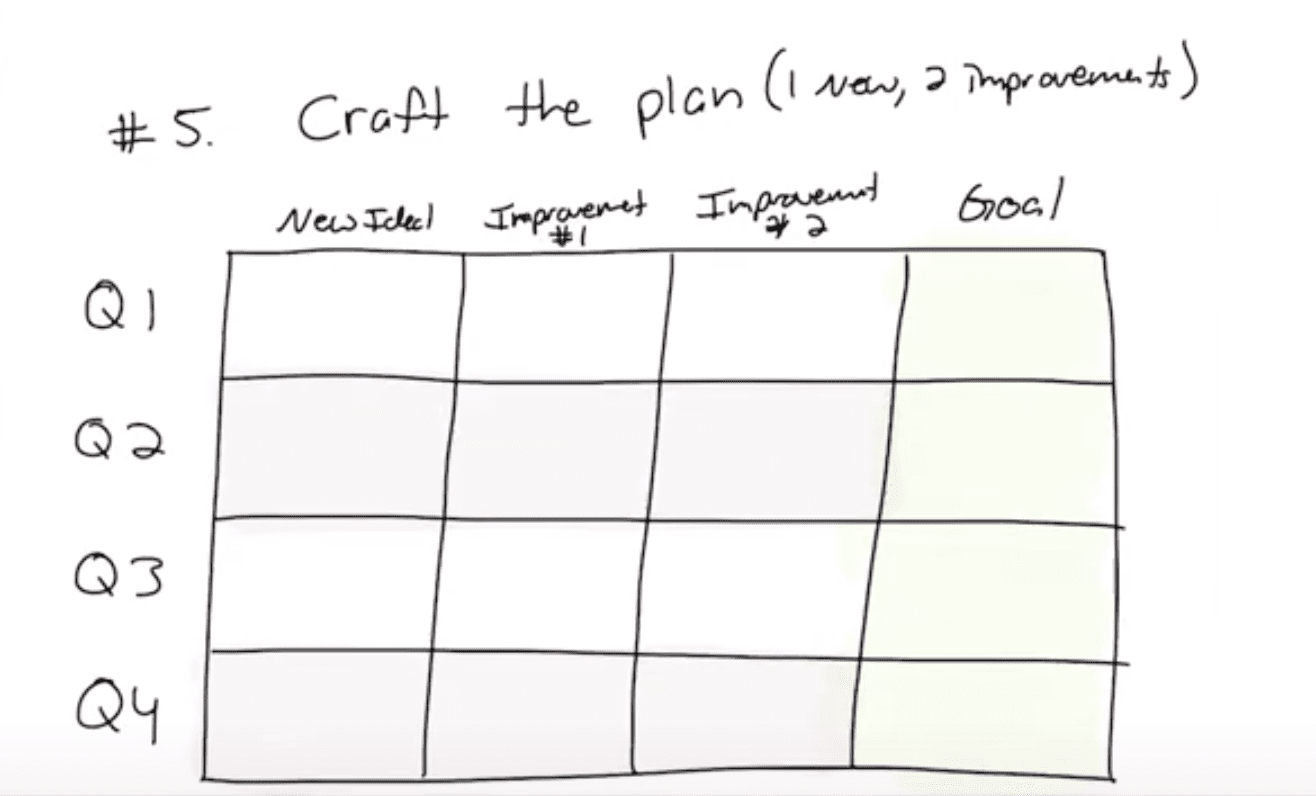
    Q1 now, I want you guys to do this.

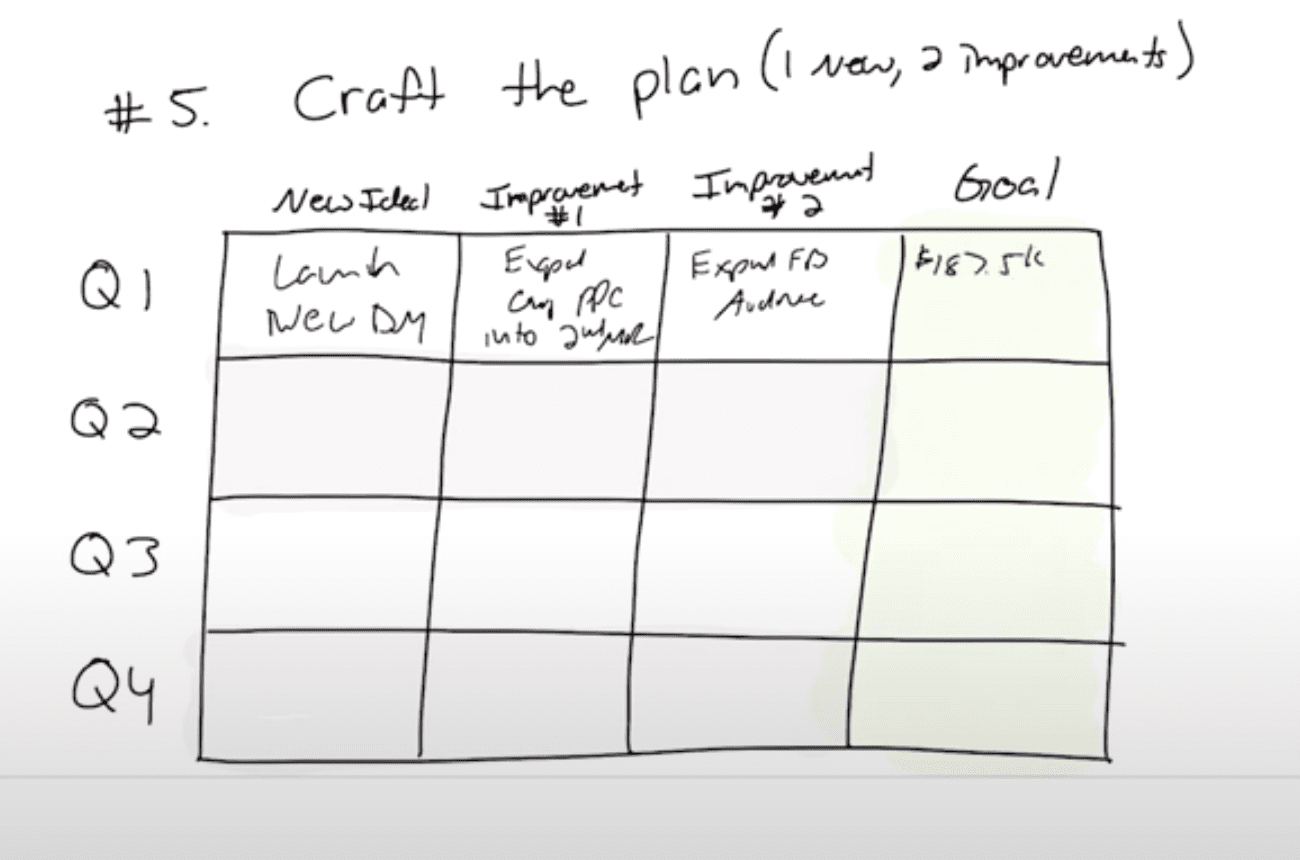
    Pick one new idea per quarter and two improvements per quarter. One thing that we oftentimes do is plan way too many projects. Just start one new thing per quarter, and two improvements per quarter.

    This here might be a new idea of direct mail. We barely dabbled in direct mail. We’re going to launch a new direct mail campaign. That’s the big new thing we’re going to do this year.

    Improvement number one is we’re going to expand Google PPC into the second market.

    That’s our improvement. We’re going to expand there. Improvement number two might be expanding Facebook’s audience.

    Then our goal, if our total goal is $348,000 in extra revenue, and our total goal for the year is $750,000. If we divide that out, how much money, how much revenue do we need to bring per quarter?

    I’m just going to grab my fancy calculator here really fast and show you guys this last little thing and we’ll wrap this video, and you’ll have a plan essentially. $750,000 divided by four equals $187,000 a quarter. $187,500 a quarter; $187,500.

    Real Estate Marketing Channels: Craft Your Plan

    You don’t have to make these all exactly the same per quarter, you can make them so you ramp up or whatever you want to do. It’s your plan. Each quarter I’m going to be planning out this.

    Then we say, hey our goal is $187,500 per quarter. You can break it down per month, and then you say, okay how much of this is going to come from our direct mail campaign?

    How much of it’s going to come from our expansion of Google pay-per-click and Facebook ads.

    Then spend the next 10, 15, 30 minutes going, if we did those in the first quarter, what do we need to do in the second quarter?

    It might be launching something else new here. It might be hiring an employee over here because now you’re having more leads.

    It might be now getting a dispositions manager or something like that. It might be adding Carrot in here is that big new project.

    Then each quarter you pick two things you can improve, one thing you can grow on that’s brand new.

    All right, guys. Let me recap this right now, block out about an hour to two hours possibly, as you’re heading into this next year, and this can help you get insane clarity in exactly what you need to do with your real estate marketing as an investor or agent.

    The first thing is you pick your revenue goal for the year. The second thing is you break out a scorecard like this that I’m showing you on the iPad, and ask what is working and break it down by channel.

    Dig into those numbers. If you don’t have them you really need them to grow.

    Then figure out what your profits are, and ask yourself what’s the difference between my goal and what I did this past year?

    Next, we need to say, what’s our greatest opportunity? We need to kind of grade our channels. An A is you’re doing the best you could possibly do, no more room for growth. An F is it’s terrible, and there might be room for growth.

    Then craft your quarterly plan, one new thing, two improvements per quarter, and then map those to your scorecard, which would be bringing in $187,500 per quarter or whatever your number is.

    Guys and gals, we’re going to have some amazing resources for you that are going to help you to do your planning better, that is going to help you to grow your business better.

    If you’re looking to expand your evergreen marketing and buy back more of your time, go to Carrot.com/evergreen, and check out our latest webinar on this topic so you can step into evergreen marketing, win more leads that are the highest margin, highest profit deals while you’re stacking your marketing with your other channels.

    Guys have an amazing rest of the week, plan your marketing, hit it hard, but buy back your time this year.

    Thank you!

  • Are There Less Real Estate Investor Leads In Holiday Months Than Summer Months? (Stats Inside…)

    Are There Less Real Estate Investor Leads In Holiday Months Than Summer Months? (Stats Inside…)

    Are There Less Real Estate Investor Leads In Holiday Months Than Summer Months?

    We’ve been getting some awesome questions from the Carrot community lately so we’re going to be answering some of them here on the blog in detailed posts to help you get an edge on your competition with your real estate investing website.

    The other day, one of our members from Indianapolis (one of the top turn-key rental property sellers in Indianapolis) asked…

    “Hey Jake, good morning, in general, are there less real estate investor leads in holiday months then in the summer months?”
    Francisco 

    (NOTE: This customer is in our Content Pro plan and saw their first leads in their market within the first 2 weeks after launching their sites and implementing a few critical steps.)

    We’ve monitored this trend over the years while also monitoring search levels on many of the top motivated sellers, cash buyers, private lenders, and tenant search phrases out there.

    Now… each type of searcher came up with slightly different seasonal search patterns…. so in this post, we’ll run through some of what we found so you can better prepare for fewer November and December lead volumes when leveraging SEO and traditional Google PPC specifically for motivated property seller leads and cash buyers.

    So… Are There Less Real Estate Investor Leads In Holiday Months Than Summer Months?

    When Are Motivated Property Sellers Searching Google?

    We pulled a chart of 25 of the top motivated seller SEO search phrases and found some really interesting stuff.

    First, let us look at the highest searched highly motivated real estate seller search phrase, “we buy houses”.

    Average Monthly Searches Of The Motivated Seller Search Phrase “we buy houses”

    Average "we buy houses" Searches In Google Per Month
    Average “we buy houses” Searches In Google Per Month: Notice the big ramp-up of searches in the summer and spring months. What’s this mean?

    That’s really interesting… but that doesn’t tell the whole story. So we took the average of the top 25 motivated seller keyword phrases to see overall… is there a seasonality for motivated sellers hopping online and searching for someone to buy their house.

    The graph below shows the average of the top 25 search phrases in the United States for highly motivated sellers on Google across the past 24 months.

    Average Monthly Searches Of The Top 25 Motivated Real Estate Seller Search Phrases

    Top 25 Motivated Real Estate Seller search volume
    Average Monthly Searches In The Past 24 Months: Highly motivated sellers searches on Google trend up in the warm months and down in the colder months… with December being the lowest each year.

    We see a similar ramp up in the warm months… and the number of motivated sellers searching Google with the common highly motivated search phrases dips in the winter months.

    On average… the summer months are getting nearly 30% more searches from motivated sellers than November and December.

    Now, we did cross-check this to make sure it wasn’t a “cold winter climate” vs. “mild winter climate” thing… and overall we still saw very very similar trends. So, for now, we’ve ruled out the climate being the major contributing factor to the seasonality of the motivated seller searches.

    Why Do Fewer Motivated Property Sellers Search Google In November And December?

    There are lots of reasons that could be causing this… but here are a few of my guesses…

    • Fewer people want to move in the winter… especially during the holidays
    • It’s COLD! (in lots of places) so they want to hang out
    • It’s the holidays and people don’t have the time to deal with something else or don’t want to disrupt the holidays
    • Generally, there are fewer properties on the market in general so many house sellers feel that “selling in the spring” is what you’re supposed to do to sell a house fast (even though some data shows houses that sell in the winter sell for higher prices and sell quicker)

    When Are Cash Buyers Of Real Estate Searching Google?

    Overall a cash buyer is in a different mindset than a highly motivated seller. Usually, a person who’s looking to buy investment property tends to look for properties when they are thinking about their financial future.

    There is a bit of seasonality to cash property buyer searches as well.  Fewer searches for the top 20 cash property buyer searches on Google in November and December than most of the other months during the year… but one key thing to take note of, if you’re selling investment properties or just looking to grow your cash buyers list in a bit way… is the single most searched month in the whole year is January.

    Average Monthly Searches Of The Top 20 Investment Property / Cash Buyer Search Phrases

    Investment Property / Cash Buyer Search Phrases
    January Is The Single Most Searched Month For Cash Buyers: This chart from Google search data shows January beating out all other months during the year for investment property buyers looking online for properties. What are you doing to get ready to build your cash buyers list in a big way in January?

    That’s pretty darn cool (and useful) eh?

    Find Seasonal Opportunities

    It shouldn’t be surprising that the real estate industry has seasonal patterns. To validate this… according to Realtor.com, homes are most popular in the summer months when people have their minds set on moving because it’s a peak season for inventory and sales.

    But, the winter months should not be discounted. For example, wintertime can provide a unique opportunity for investors because they know people want their houses sold fast!

    Winter Pro: Serious Sellers

    Winter is known to be the most profitable season for buyers. When it’s cold outside and snowing, there are many more “serious” sellers who want their home sold quickly so they can get on with life in warmer weather; conversely, this means that you’ll find some motivated sellers right when you need them.

    Winter Con: Low Lead Volumes

    Winter weather can be a major factor in the real estate cycle. Cold weather, including elements of rain and snow, can make it more difficult to find sellers. This can have an impact on the buying and selling process, as the limited potential sellers may have an overappreciated value of a home in cold months.

    What This All Means

    What this means to me is that people are looking at their financial goals at the start of the year and saying… “Man, I need to get my butt in gear and pick up some more investment properties to hit my goals this year”… so they dive in right after the holidays and start looking for properties.

    There may also be tax reasons that people are waiting until January to kick up their investment property search… either way… the data shows it’s the case… so now it’s time to act on it.

    So, if you know the single most popular month for investment property searches online is January each year… what are you doing to build your own cash buyer list for your real estate investing business?

    What Can You Do To Prepare Your Real Estate Investing Business For Seasonal Search Trends?

    Really, what this data shows is that there are seasonalities to the real estate investor leads you can expect from SEO for real estate investing and even PayPerClick marketing.

    So keep these things in mind as you’re generating leads for your real estate investing business through your website…

    • Winter months for both investment property buyers and motivated house sellers bring in lower volumes than the summer months (but not drastically lower… at the least… maybe 30% lower on motivated seller leads)
    • Now is the perfect time to start your Evergreen marketing campaigns if you haven’t already so your real estate investing websites rank higher in Google for keywords that matter when the spring and summer come around
    • If possible, try not to rely strictly on SEO or PPC for your only lead generation if you’re not in a larger market in the winter months if possible… so your marketing plan is well rounded and you’re getting leads coming in from places other than just the internet in slower lead months.
    • Get a cash buyer/investment property buyer campaign rolling asap so you can take advantage of the highest searched month of the year for people looking for investment properties. How? Start your Craigslist marketing… go to your REI club in January and start getting your buyers’ list built there… kick on some Google PPC campaigns if you have a bit of a budget to invest… Facebook ad campaigns are doing REALLY well to generate investment property buyers and tenant buyers… basically… get focused and leverage the January cash buyer traffic!!!

    If you’re a Carrot member, you know how well the Cash Buyer websites on our system are converting… so put it to use.

    Also, on the motivated seller side of things… having a real estate investing website with a high conversion rate (how many people land on your website and become a lead) is as important as ever in months with lower search volumes like December… so if your current website isn’t converting like it should… take a look at Carrot to see if it’s a fit for you.

    We’re the only company in the industry as focused on results and increasing conversions on our platform each and every month as much as we are… so you can just focus on growing your business… not fiddling with building websites and trying to learn conversion rate optimization in your “spare” time.

    Hit me with comments or questions below! And leverage these seasonalities in the Google searches to your advantage!!!!

  • How to Grow Your Real Estate Business Into Multiple Markets | Real Estate Strategy Whiteboard

    How to Grow Your Real Estate Business Into Multiple Markets | Real Estate Strategy Whiteboard

    How to Grow Into Multiple Markets as a Real Estate Investor

    Video Transcription

    If you’re a wholesaler or a real estate agent that’s looking for motivated sellers, I’m going to show you how to grow your real estate business into multiple markets, get leads for $20 to $30 per lead and cut your Google pay per click ad costs by 50% to 75% by going regional or national in this video right here.

    So guys and gals, a couple of weeks ago, I was talking with one of our clients that they were pulling in leads from Google pay per click for somewhere between $20 to $30 bucks a lead.

    Now, you can even, I’ve heard stories of $10 bucks a lead, $50 bucks a lead, the whole thing.

    The thing they did was they went from just being a local investor or local hybrid agent investor, looking for sellers in one market, to they expanded to national.

    So, now they’re using their Carrot website for national lead generation.

    So, what I’m going to do in this video is I’m going to walk you through it. We’re going to dive into my iPad.

    I will show you how to go from a local website with Carrot to regional or statewide.

    And then if you wanted to expand to national, they’re all completely different business models, so I’m not saying that you should do it because you have to then figure out, of course, all the different moving parts of how to turn those leads into deals, how to analyze deals in different markets, the whole thing.

    We’re not going to cover that in this video. We’ll cover that in some other videos. But let’s dive into the iPad because we’re going to show you exactly how to set up your Carrot website, depending on whether you’re local, regional, state, or national.

    Let’s dig in.

    How to Grow Your Real Estate Business Into Multiple Markets

    So, we’re right here on the iPad. The very first thing, this is where most of our clients are, most of our clients are in the local bucket. Meaning, you’re in one market, you’re in Cincinnati, you’re in Tampa, you’re in Roseburg, Oregon. You’re in Phoenix, Arizona.

    One market city real estate website strategy
    Single Market Real Estate Website Strategy

    Of course, the bigger the city, the more opportunity there is to pull more and more leads out of the city because the population’s higher.

    So, in a single city market, your website’s pretty much going to look like this. You’re going to have your homepage right here and it’s going to be, “Sell your house in city.”

    Pretty much those types of phrases. Over here, you’re going to have your standard, what we call authority hub pages, which is your “sell a house” page.

    It’s going to have a call to action on it. Your “how it works” page. Reviews page with testimonials to build trust and credibility, maybe some FAQ, and then you’re about page and contact pages. That’s what we call the core conversion pages here at Carrot.

    To be in one city, that’ what you need.

    That’s pretty much all that you need.

    You can use our tools and systems then add automated blog posts, or to use our video post feature, to build further trust and credibility. But that’s how you would lay it out.

    Your homepage is focused on the city at that point, sell your house fast in Cincinnati. And then you would talk about that, show Cincinnati pictures.

    Your location pages might be set up for different keywords in that city. So, maybe you set up a location page for cash home buyers in the city, or sell your inherited house in Cincinnati. That’s how you’d leverage that.

    So, let’s say now that we wanted to expand out beyond that one location. If you’re in a city, you can pretty much expect somewhere between 10 and 30 leads a month once you get the SEO and/or Google pay per click launched in that one area.

    It depends on the population and your market.

    If you’re in a 10,000 person city, then you’re probably going to be maybe three, four, five leads a month from Google PPC or SEO.

    If you’re in a two million person population market, you might be able to get 30 to 50 leads a month, if you’re ranking really in Google and doing some Google Ads.

    Regional or State Website Strategy

    So, now we’re going to move into the regional or state set up on your website.

    statewide real estate website strategy
    Statewide Real Estate Website Strategy

    The regional or state set up on your website is basically going to be kind of like this, the only real core differences are your homepage now, your homepages focus on the state.

    So, rather than your homepage focus on just one city, we’re going to focus on the entire state or the entire region that you operate in.

    If you’re in the entire state of Texas and you have four prime cities, Austin, San Antonio, Dallas, and Houston, as an example, then you’re going to have your homepage be, “Sell your house fast in Texas,” basically.

    Then you’re going to have pictures that have a broad array of pictures of the different markets that you buy houses in, or that you’re a real estate agent and/or an investor in.

    Then down at the bottom of your website, you’re going to have a link to your prime cities in that state.

    You might link up to five, six, seven, eight of your cities to those city location pages.

    Over on the left side, those are what we call location pages. So, you’re going to set up a new page for every single location or every single city in that state. Sell my house fast, Dallas. Sell my house fast, San Antonio. Sell my house fast, Katy, Texas. Whatever those cities are.

    city location page strategy
    City Location Page Strategy

    I want you to focus on just looking at those on a quarterly basis. Every quarter, do I need to add any new city pages or location pages within this state?

    Now, let’s say you’re in three, or four, or five states. You’re in a region. Your homepage would then be, “We buy houses in the tri-state area,” or look for tri-state investment properties.

    Then on the homepage, talk about the three states you do business in and maybe some of your primary cities. Then you would create pages for states and cities.

    Some advantages here, your homepage is focused on the state. You can start to rank really well at the state level and at the city level.

    Location pages for each city, like I said, now you can get those rankings in Google for each city. Your URL is going to look kind of like this, whatever it is .com, forward slash, sell your house in X, Y, Z city.

    Your PPC, this is where is where the lead costs get lower. If you’re marketing, doing Google PPC in just one market, your PPC cost is going to be the most it can possibly be because you don’t have a very broad targeting there.

    The broader you’re targeting, the lower your click cost tends to be.

    But once you start to get down in here into the state and region, and you’re marketing a wider audience, your PPC gets cheaper and your SEO momentum actually grows because now you’re setting up multiple pages in multiple cities, the 10th location page, 11th, 12th, 15th, ninth, whatever it is.

    As you built up the SEO and your overall domain name, each one of those is going to rank in Google faster and faster and faster.

    So, a lot of people ask, should I set up multiple websites? Should I have a website for every city?

    And my suggestion is, if it’s all for motivated house sellers and you are okay with having one unified brand that will work well in all those cities, then I would suggest setting up the one motivated house seller website that encompasses all of those cities because the SEO juice is going to feed into every location page you create, and they’re going to rank faster and quicker.

    National Website Strategy

    So, now let’s say you want to go to the national.

    national real estate website strategy
    National Real Estate Website Strategy

    We have a lot of our clients using Carrot to do national house buying, national investment property websites, things like that.

    The main difference that you’re going to do here is your homepage now is going to be more generic.

    So, rather than sell your house fast in Cincinnati or sell your house fast in Ohio, now it’s going to be “sell your house fast”, “how to sell your house fast for cash”, or “we will make you a cash offer on your home.”

    Then on that homepage, you’ll talk about that “we buy all around America” and then you might have a link to maybe some of your primary markets that you buy in.

    Link up to some of those states or some of the cities that are the primary markets that you buy in.

    Now what we’re going to do with our location pages is this, instead of creating location pages for a city at the root level, we’re going to create location pages for each of your primary states.

    state landing page strategy
    State Landing Page Strategy

    Let’s say you’re a national buyer, but you focus on 10 states. Create a location page for each one of those states. It could be “sell my house fast Florida”, or sell my house fast Georgia.” Basically, it’s “sell my house fast, insert state.”

    Now what you’re going to do is create city pages for each one of those states, which are the primary cities in the state that you buy in.

    If it’s Florida and your primary cities are Tampa, Orlando, and Jacksonville. You’re going to create a Jacksonville page, sell my house fast in Jacksonville. For Orlando, you’re going to create an Orlando page, sell my house fast in Orlando. You’re going to do the same thing for Tampa.

    Those would be underneath the state of Florida. This is what it would look like over here on the URL. It’d be your site .com, forward slash whatever that state is.

    So, that’d be Florida, forward slash Florida, and then forward slash sell my house fast Tampa.

    That would be the name of that page, sell my house fast Tampa. The name of that page would be Florida, or sell your house in Florida. That is your structure.

    Your PPC gets the cheapest here with this strategy. Now, this is where you’re going to start to get your $20 cost per lead. Your $30 cost per lead. Your $50 cost per lead in Google, in the exact same markets, that before you might have been paying $80 bucks, a hundred bucks, $150, $200 per lead in the exact same market.

    You might be saying, “Why is that? Why does the cost per lead in Google Ads get so much cheaper?” Or even Facebook if you go broader. Because you’re targeting a wider audience and when you target a wider audience, Google actually has more data to feed back into your campaign to get your click costs and lead costs lower.

    Your SEO scales way faster too.

    If you already have 10 20, 30 location pages, and you have some SEO juice on your website.

    When you set up that new page and that new market, it’s going to get ranked really, really fast, because you’ve already done all of this work.

    Creating this amazing national website with the state pages and the city pages, and you’re eight months in, a year in, two years in.

    Google loves your site. They see you as an authority, it’s got some great link juice. Every single page ranks faster now.

    At this level (national), you can expect 100 to 1,000 leads a month, depending on how well you’re doing the marketing. At the state and the region, you can expect between 30 and a hundred leads a month. Of course, depending on how well you’re doing your marketing and SEO and PPC.

    Recap: How to Grow Your Real Estate Business Into Multiple Markets

    Let me recap real quick.

    The best way to expand from local to national is to create a new cadence or new setup with your location pages.

    You go city and then state, and then also you start to scale out your Google Ads. Because as you scale out your Google Ads to more states, more locations, they get cheaper and cheaper.

    And that’s how the big lead generation services do it. That’s how our biggest clients do it and get way more leads at a way cheaper cost because they’re going national.

    Check out our other videos in this series and on our YouTube channel.

    Hit the subscribe button on our YouTube channel because every single month, we put out new content that teaches you how to be an investor or an agent, or a hybrid investor agent, and generate more leads more consistently in an evergreen fashion on the internet.

    You can finally get more freedom, finally, make a greater impact with your business. Go to carrot.com/evergreen to check out our webinar on the topic of evergreen marketing. If you enjoyed this video, we’re going to dive way deeper into that training.
    Go to carrot.com/evergreen. Have an amazing rest of the week, like and subscribe to this video, we’ll see you in the next video.

  • EP 286: The “56k Profit Moldy House” Deal w/ Beau Hollis | Behind the Deal

    EP 286: The “56k Profit Moldy House” Deal w/ Beau Hollis | Behind the Deal

    A lot of times when you prejudge people or their current situations, you just look at the outside. You can lose a deal quickly by judging what you see. 

    – Beau Hollis

    The “56k Profit Moldy House” Deal | Behind the Deal

    Welcome to another episode of behind the deal. This is where we take you inside of an actual deal, covering all of the details from start to finish.

    In this Livestream, we were back with Beau Hollis to learn about the marketing, follow-up, and specifics that went into this particular deal. 

    In this episode, Beau walks us through the world’s moldiest house. You’ll see exactly how he found this deal and how he walked away with a $56k profit.

    Be sure to join us every other Thursday when we go behind the deal live on Facebook and Youtube. 

    Read the Full Show Notes Below…


    Beau has been a friend here at Carrot for a long time. He recently walked us through a deal in which he bought a car right along with a house.

    This deal was quite a bit different. Most investors would run from a moldy house, but by offering the solution to a difficult situation made this a great deal for everyone involved.

    Here’s how it went down… 

    The Lead

    The lead came through a Carrot PPC ad at around 6 in the morning. It was a divorce situation in which each spouse had moved on and was living separately.

    There was a teenage son living in the home, but Beau was assured he’d be able to find other accommodations if the deal went through. 

    The Follow Up

    Almost immediately, Beau was on the phone with the owner and setting an appointment to see the home. She wasn’t local, but Beau was still able to arrange to see the house at 1 pm that same day.

    One of the reasons Beau is able to close 20-30 deals a month is because of his prompt follow-up. 

    What Made This Deal Unique

    Aside from the basement being filled with mold, Beau had to negotiate this deal over the phone. As someone accustomed to belly-to-belly sales, not seeing the person face to face made things feel more challenging.

    Luckily, when dealing with inbound leads, the motivation is typically much higher than with outbound leads. In fact, by 1 o’clock that same day, Beau had this house under contract. 

    The Numbers 

    Beau bought the home for $125k and was able to sell it for $182k. The house was worth about $240k so after the end buyer remedied the mold situation, they were still able to flip it for a $30k profit.

    This is another shining example of how a property investor can remedy a problem, helping everyone to come out ahead. 

    Tips That Actually Work: Campaign Tracking Links

    Because of campaign tracking links, Beau was able to see exactly where his lead came from, Google Ads.

    What are campaign tracking links?

    Campaign tracking links allow you to see exactly how many people click on the links you put out on the internet?

    For example, you can see how many people click the links in your email signature. Or, in Beau’s case, his Google Ads account.

    Carrot’s platform allows you to create a unique link for any piece of content on your site.

    Whenever this link is clicked it records the data in your account (if someone turned into a lead or not).

    This feature can increase your ROI by 10x if you know what is working and where you should be spending your budget.

    If you’re already a Carrot member, learn how to add campaign tracking links to your website. Not a Carrot member? Join today!

    If you have questions about this or have ideas for future Behind the Deal episodes, reach out to Brady directly at brady@carrot.com.

    Follow Our Guest: 

    Mentioned in This Episode: 

    We want to hear your thoughts on the podcast! Drop them in the comments section below or hit us up on Facebook or Instagram!

  • Carrot Leads Convert 7x Better & Are 2.5x More Profitable Than Non-Carrot Leads

    Carrot Leads Convert 7x Better & Are 2.5x More Profitable Than Non-Carrot Leads

    We recently surveyed our Carrot members about their lead-to-deal conversion rate — that is, what percentage of leads become deals. We also asked them about the source of these leads (Carrot leads or Non-Carrot) to determine which efforts provide the most high-quality leads and thus the most deals.

    The results were exciting. They indicated that Carrot leads convert 7 times better and are 2.5 times more profitable than non-Carrot leads.

    carrot leads vs non-carrot leads

    This is something we’ve known anecdotally for a long time — from all of the reviews we’ve received from our members. For example…

    “Carrot literally changed my life. Trevor and his crew are the best people on the planet. Get plugged into their system and culture, and you will start generating leads!” – Brian Rockwell


    “I have generated just over 200 leads in a little over 4 months using my Carrot site. I couldn’t be more thankful for the services they have provided. Thank you Carrot!” – Hank Tobler


    “Closed 3 deals exclusively from SEO leads / Carrot conversions. No PPC. No attribution to any Facebook ads. Just Google search results and credibility.” – Daniel DiGiacomo

    … but still, it’s refreshing to see the actual data.

    Let’s take a look!

    Not a Carrot member? Take a free demo…

    The Survey Data & What it Means

    To be clear, non-Carrot leads refer to any leads that didn’t come through an investor’s Carrot website. Maybe they called, texted, or emailed instead.

    Carrot leads, naturally, refer to any leads that came through the investor’s website. They visited and opted into a CTA that looks something like this…

    Carrot investor website hero section

    So, what exactly were the results?

    Well, we asked Carrot members for their lead-to-deal conversion rate and their average value per deal for both Carrot and non-Carrot leads.

    We then used those numbers to calculate the survey respondents’ average value per lead.

    Here are the Carrot vs. Non-Carrot results:

    Carrot lead vs non-carrot leads per deal

    Amazing, right?

    Carrot leads had an 8.2% lead-to-deal conversion rate, while non-Carrot leads had a 1.11% conversion rate.

    Even more surprisingly, Carrot leads that became deals had an average value of $23,089.26, and non-Carrot leads that became deals had an average value of $9,159.11.

    That makes the average value per Carrot lead $1,893.40. That is enough to pay for an entire year of our top subscription plan, by the way! And, the average value per non-Carrot lead is $102.07.

    Something is going on here, and let’s talk about that.

    But before we do, understand that we’re not saying you shouldn’t generate leads one way, but you should generate them another.

    Every real estate investor has to find what works for their business and their market, which usually is a mishmash of various marketing tactics.

    Here, we’re just looking at some high-level trends that might be helpful for investors to consider.

    Why are Carrot leads so much better than Non-Carrot leads?

    There are essentially two questions we have to answer.

    1. Why do Carrot leads become deals much more frequently than non-Carrot leads?
    2. Why do Carrot deals have much bigger profit margins than non-Carrot deals?

    And the first thing we need to examine is where these leads are coming from. After all, the source determines the quality.

    Non-Carrot leads is a broad term that includes a lot of different sources: cold calls, inbound calls from direct mail campaigns and door knocking, flyers, business cards, bandit signs, and so forth.

    You might not notice it at first, but all of those sources have a similarity: they all represent outbound marketing efforts.

    That is, you go out and try to find people who might be interested in selling their home. You offer them a fair cash offer and a quick turnaround time. You do this by sending them mail, knocking on their door, or calling their phone.

    Of the people who contact you via outbound marketing methods, it’s safe to assume that many of them are just curious. They’re not motivated to sell by any particular circumstances in their life, but your offer caught their attention, and so they call you to find out more.

    That’s how most non-Carrot leads are generated.

    Now let’s look at Carrot leads.

    We’ve built Carrot websites with wicked-fast load speeds, mobile friendliness, and a clean tech stack.

    Carrot sites rank for high-value phrases in Google more than any other site builder in the industry (terms like “sell my house fast in ” or “sell my house for cash in .”

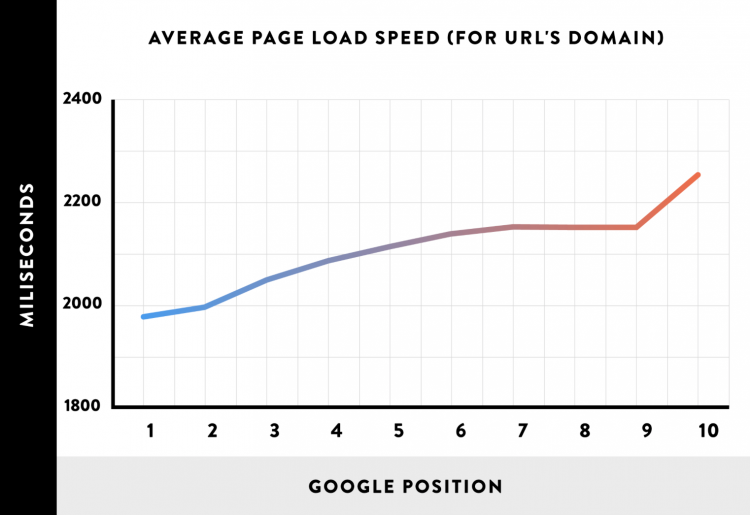
    Third-party data from Fresh Chalk pointed this out. Here are page speed scores for different website builders (a huge factor for Google rankings).

    Fresh Chalk pagespeed test results

    The same is true for Carrot’s mobile performance (which is now a huge part of internet traffic).

    This graphic represents the recent updates that Carrot developers have made to our member sites to get ahead of the latest Google Core Web Vitals update. Learn more about what this graphic means and the changes that we made here.

    Carrot website mobile speed Core Web Vitals Update

    But that’s only one of the many reasons that Carrot sites sit at the top of the rankings.

    The secret to quality lead mastery

    Our members also create Evergreen content for their blogs every single month, content that’s optimized to rank in Google.

    We also give our members the ability to:

    • Track their rankings right inside of their account. 
    • Ensure that every page and post is optimized to rank (via a simple checklist). 
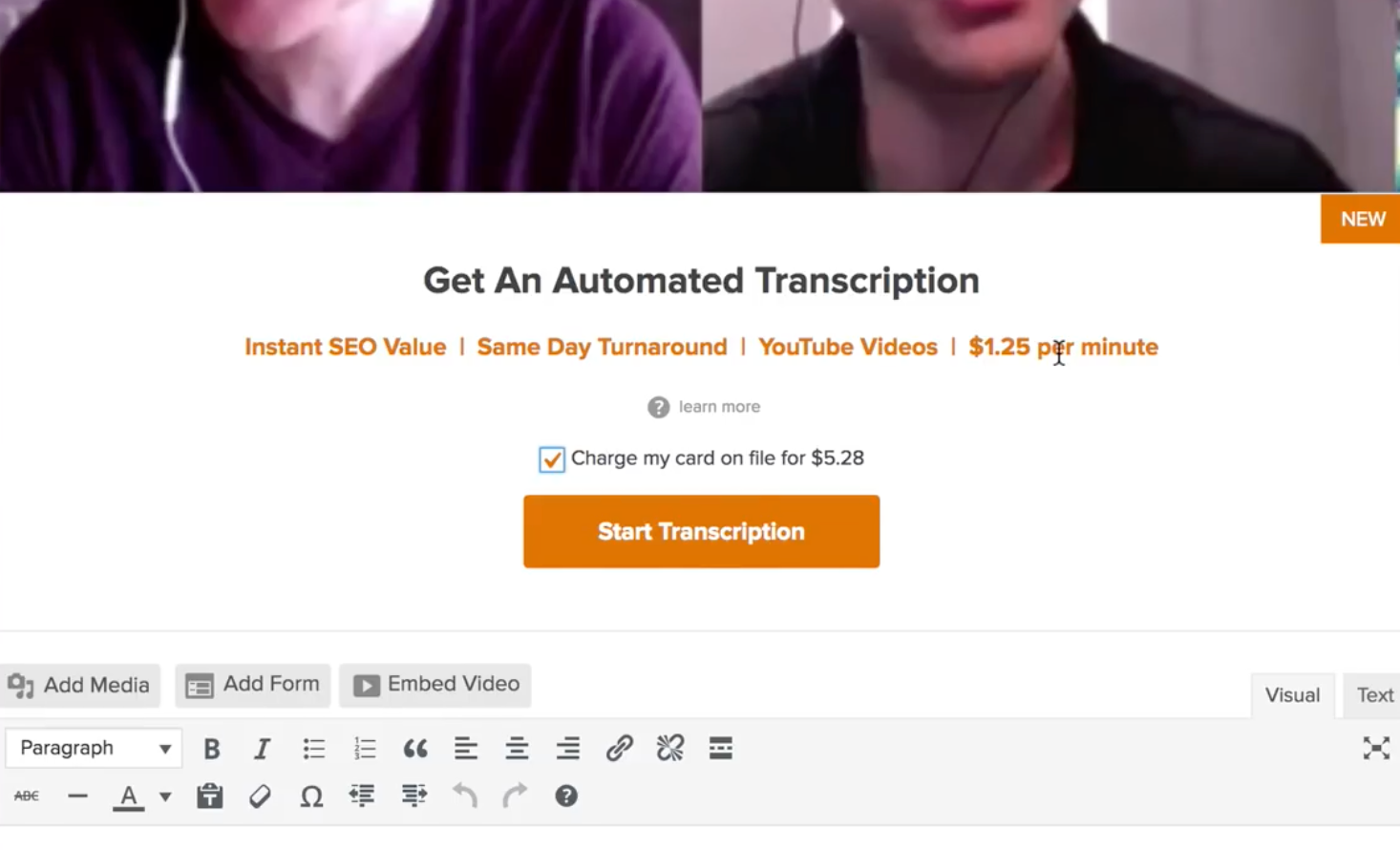
    • Create long-form evergreen content by transcribing video content with the click of a button (VideoPost). 
    • Publish weekly blog content with a click of a button.
    • And so much more!

    This is the difference between hamster wheel marketing

    “If you’re creating a piece of content and you just put it up on Facebook or Instagram, it’s going to be there for 24 to 48, maybe 72 hours before it gets pushed down, forcing you to get back on the hamster wheel and post again, and post again and post again, because the life span of that content is so short.

    The lifespan of that content is so short that you have to be on the hamster wheel continually.

    If you get off of the hamster wheel, if you stop doing those postings, if you stop doing direct mail, if you stop cold calling or doing RBMs, then your leads will eventually dwindle to a stop, and you’ve got to restart and get back on the hamster wheel.”

    … and Evergreen Marketing

    “Get into a routine of creating content. Another piece of content this week, another piece of content next week, a blog post next week, a video post, a video post, a location page, and eventually, you’re going to have a brick wall that does all of the work for you.

    Remember, it’s going to be slow going in the first three, four, five, six months potentially.

    But as long as you’re consistently stacking bricks of quality content that answers real questions from your market, you’re entertaining in your own way; you’re going to start to pick up that momentum.”

    At Carrot, we focus on evergreen marketing — consistent action that produces long-term results. 

    Evergreen marketing for real estate

    Now, why all of this information about Google rankings, page speed, and tech stack?

    Well, because of the way Carrot sites are built, they typically generate a good chunk of leads via evergreen marketing through search engines like Google — this means that motivated sellers find you rather than you trying to find motivated sellers.

    That’s called inbound marketing.

    And it almost always results in higher quality leads than outbound marketing.

    So that answers our first question.

    Why do Carrot leads become deals much more frequently than non-Carrot leads?

    There’s a high likelihood it’s because many of them are likely coming through search engines.

    When you think about it, it’s not all that surprising that outbound marketing leads tend to be lower quality than inbound marketing leads. It’s the difference between you looking for motivated sellers and motivated sellers looking for you.

    We get feedback about this difference all the time from our members…

    “I consistently get organic leads from my Carrot website. I have purchased my best deals to date through my websites. I highly recommend you implement training and tools available through the platform.” – Beau Eckstein


    “I’m getting 2x more motivated seller leads with my custom Carrot site than my old site, and the tools and content help me stand out in my crowded market.” – Tyler Ford


    “I am saving between $20,000 and $50,000 every single month in lost lead-gen closing potential after switching from my expensive custom-made site to my Carrot site.” – Carter Steph

    And it’s not just hearsay. When we take a peek at the source of traffic and leads for our members, we can see a good chunk coming from the organic content that Carrot helps to provide. So far, in 2021, organic traffic accounts for 25.8% of our member leads.

    carrot leads 2021 - organic

    But what about the second question: why do Carrot deals have more significant profit margins than non-Carrot leads?

    Part of the answer is likely the same as the first — since Carrot sites drive organic leads through search engines, investors don’t have to directly pay for those leads like they would have to with a direct mail campaign.

    This makes a big difference in per-deal profitability. But that’s not the entire story.

    Again, we have to look at where these deals come from.

    If someone receives your mailer and it makes them think about selling a property that they’ve owned for a while, and so they call you, they’re probably not going to be as willing or motivated to accept a lower offer.

    But if someone is actively looking for someone like you who can buy their home as-is for cash, they’re probably more motivated and thus more willing to accept a lower offer, which results in higher profit margins.

    And so that answers our second question…

    Why do Carrot deals have much bigger profit margins than non-Carrot deals?

    It’s because inbound marketing efforts are less expensive and generate leads that are more motivated to accept lower offers.

    Final Thoughts

    If there’s a lesson to be learned from all this, it’s about the value of inbound marketing.

    When you create an online presence that allows motivated sellers to find you, you can expect to generate much higher quality leads for less money and increase your per-deal profitability.

    That’s not to say that you should stop sending direct mail, cold calling, door knocking or driving for dollars. We are huge advocates of those strategies, and they support many Carrot member businesses!

    Perhaps a hybrid approach is best.

    Steadily invest in your online presence. Create a high-converting real estate website, start search engine optimization, create new content, and so forth to build a long-term source of lead generation.

    That will take time to start working.

    While you’re working on SEO and content, you can also run PPC ads and send direct mail to generate leads more immediately for your business.

    That’s the balanced approach that has worked for thousands and thousands of real estate investors, and there’s no reason that it won’t work for you, too.

    Click below if you’re ready to take the next step.

  • 30 Real Estate Agent Marketing Ideas to Win More Deals in 2025

    30 Real Estate Agent Marketing Ideas to Win More Deals in 2025

    real estate agent marketing ideas

    You’ll agree that sifting through endless real estate agent marketing ideas is challenging. It’s tough to determine which tactics will generate the highest volume of quality leads while keeping your sanity.

    When people think of buying or selling a home, you want them to think of your name. You want them to give you a call. And you want them to work with YOU.

    Of course, that’s easier said than done.

    Many other real estate agents in the area are fighting for the same attention.

    Fortunately, you don’t have to win all the attention to dominate your market – just most of it.

    And the best part is…

    You don’t even have to leave your computer to get started.

    30 Real Estate Agent Marketing Ideas to Win More Deals

    I will show 30 real estate agent marketing ideas for dominating your online market in this article.

    1. Market Yourself on Instagram
    2. Build a Real Real Estate Agent Website
    3. Shoot Facebook Live Videos
    4. Consistently Post on Social Media
    5. Collaborate with Other Real Estate Agents in Your Area
    6. Message 100 Friends on Facebook and Tell Them What You Do
    7. Set Your Email Signature to Explain What You Do
    8. Set Your Social Media Bio to Explain What You Do
    9. Listen to a Mindset-focused Podcast
    10. Optimize Keywords on Your Website for Search Engines
    11. Set a Budget and Invest in Facebook or Google Ads
    12. Enhance the “About” Page on Your Website
    13. Write or Record Weekly Blog Posts
    14. Record a Case Study Video with a Past Customer
    15. Make Your Phone Number Easy to Find on Your Website
    16. Use a Low-commitment Opt-in Form on Your Website
    17. Write Persuasive Sales Copy
    18. Publish High-quality House Photos
    19. Add IDX to Your Website
    20. Encourage Reviews on Your Company Facebook Page
    21. Create Location-specific Landing Pages
    22. Run Free Ads on Craigslist
    23. Create a Sales Script to Increase Close Rate
    24. Delegate “Busy Work” to an Executive Assistant
    25. Know Your Market Like the Back of Your Hand
    26. Use a Drone For Aerial Photography of Your Real Estate Listings to Create Visual Intrigue
    27. Create a Google My Business Account
    28. Create and Promote an Infographic
    29. Run a Webinar
    30. Create a Zillow Profile

    1. Market Yourself on Instagram

    Instagram is an incredible place to share your listings and get noticed! For real estate agents, Instagram provides a whole new world of opportunity.

    With over one billion monthly active users on the platform, there’s no better time than now for you to join in with all these people looking at beautiful pictures daily.

    Whether showcasing properties or providing helpful content like tips for staging homes, something here is suited ideally for you!

    Learn more:

    Unlock Your Instagram Marketing Knowledge

    Learn everything that Real Estate Agents need to know to get started with Instagram marketing.

    2. Create a Professional Website

    Examples of real estate websites

    Why does a real estate agent need a website?

    Most real estate agents become a part of the online “clutter” in their markets when they toss up a website that gets lost in the shuffle. Building a focused and optimized website will help you cut through that clutter with content marketing and adding your industry expertise.

    A website will attract more of your favorite clients by using it as an Evergreen Marketing tool.

    You can reduce or eliminate relying on cold calling, direct mail, Zillow, and the marketing that’s burning you out when done right.

    Having a website will also…

    • Increase awareness and online presence.
    • Generates quality leads.
    • Increases your credibility.
    • Service as an educational tool. Add community resources, FAQ, and contact information. Educating buyers or sellers and explaining how real estate agents provide their services can build trust and rapport and earn more business.
    Learn more:

    3. Use Facebook Live Videos

    Facebook’s LIVE video feature is useful for more than recording your kid’s birthday party. You can also use it to do a LIVE walkthrough of house listings you’re trying to get attention for.

    After all, one of the most time-consuming parts of your day is house showings, so why not show a house to your entire Facebook audience with a single LIVE video?

    Plus, 70% of homeowners want to list with a real estate agent who does some video marketing to sell their home. This might be your dead-simple, don’t-have-to-hire-a-professional way of integrating video marketing into your service.

    Just create a healthy cadence and get in front of your social media audience more regularly.

    The more people see your face online and hear you talk about their problems and your solutions, the more familiar your market will be with you.

    Video is increasingly important in content marketing for social media. More people are choosing to consume information through video.

    Here are some ideas for Facebook live videos to work into your real estate marketing:

    1. Host virtual open houses.
    2. Discuss your community market with a local specialist.
    3. Livestream auctions.
    4. Interview customers for success stories.
    5. Interview a partner or someone you work with… such as an interior decorator.
    6. Host a contest or giveaway.

    Learn more:

    4. Post on Social Media

    Why do real estate agents need social media?

    According to the National Association of Realtors, social media has become a significant way to acquire clients and close deals. Here’s a snapshot of their report:

    • 77% of realtors actively use social media for real estate in some capacity.
    • 47% of real estate businesses say social media results in the highest quality leads vs. other sources.
    • 99% of millennials and 90% of baby boomers begin their online home search. As opposed to in-person referrals.

    It’s powerful. Perhaps there’s no better way to generate consistent word of mouth around your brand name and service than by staying in front of your audience.

    Posting on social media consistently allows you to stay in front of your audience without leaving your desk chair’s comfort.

    Where to post:

    • Facebook posts
    • Facebook ads
    • LinkedIn
    • Instagram

    What you should post:

    • Property photos
    • Success stories
    • Milestones
    • Market news
    • Renovation and home tips
    • Events

    Learn more…

    5. Partner with Other Real Estate Agents in Your Area

    As the market gets increasingly competitive and the economy takes a slight downturn, collaborating with other professionals in your market might separate the winners from those who starve.

    Don’t be afraid to collaborate with other real estate agents and investors in your area to make the most of the market that you find yourself in.

    Sometimes, the best way to dominate your market is to team up with those already dominating it.

    Learn more:

    6. Message 100 Friends on Facebook and Tell Them What You Do

    If you want to generate word of mouth, send messages to your friends on Facebook and tell them about what you do. Maybe you’re offering a new service that you can announce to people, or perhaps you want to say to people that you’re currently looking for new clients.

    Either way, a Facebook message can go a long way in generating word-of-mouth for your business within your target market – especially if you personalize each message.

    Learn more:

    7. Set Your Email Signature to Explain What You Do

    If you’re like me, you send at least 3-5 emails daily. Believe it or not, every one of those emails is an opportunity to gently advertise what you do and who you are.

    By automatically setting your email signature to populate with business-card style information, you remind people of your company every time you send an email.

    Learn more:

    8. Create a Social Media Bio

    Like your email signature, your social media bios are waiting to be exploited for market domination. When someone clicks on your profile to find out more about you (and trust me, they do), you want them to quickly know who you are and what your business does.

    A quick bio that describes your real estate expertise ensures you don’t miss lead-gen and word-of-mouth opportunities on your social media profiles.

    Learn more:

    9. Listen to a Mindset-focused Podcast

    You might be thinking… “why would listening to a podcast help your online marketing?”

    Often, becoming the most successful real estate agent in your market is simply believing you can do it and believe you are the best.

    I know it sounds cheesy, but the mindset is crazy powerful for building the business of your dreams and pulling in more leads than you can handle. And a podcast is a great way to regularly test and refine your mindset.

    Here are some benefits of listening to podcasts:

    • Your imagination kicks in.
    • You learn new marketing tactics.
    • Your multi-tasking skills will be enhanced.
    • Your listening skills grow.
    • You can learn more about people and gain empathy as an agent.

    Learn more:

    10. Optimize Keywords on Your Website for Search Engines

    The most thorough way to dominate your market is to be the first result prospects see when they type “real estate agent” or “sell my home fast” into Google.

    If you’re not on the page when people do that, you have a very small chance of being a significant force in your market.

    real estate agent website keyword rankings
    Carrot SEO Keyword Ranking Tracker

    People go online to find everything, including a real estate agent to work with. You need to show up at the top of Google results. And to do that, you need to optimize your website to rank in search engines via strategic keyword placement.

    Carrot members can easily track their rankings using the Carrot SEO Ranking Tracker.

    Learn more:

    11. Invest in Facebook or Google Ads

    If you want to increase the number of leads and deals you’re getting quickly and have some money to invest, then PPC might be a great option.

    Whether you choose Facebook or Google Ads (the two most popular options), PPC can generate more leads immediately, increasing your business profitability and market authority.

    Learn more:

    12. Optimize Your “About” Page on Your Website

    Did you know that any website’s “About” page is the third most-viewed page? People don’t just want to know what you do or how you do it; they also want to know who you are.

    By spending a little time on your “About” page bio – adding core values, a mission statement, and personal pictures – you’ll stand out from competitors who didn’t spend extra time on their “About” page.

    Learn more…

    13. Write Blog Posts

    Weekly (or monthly) blog posts on your website give you and your audience something to discuss. They give you something to share on your social media pages and give your audience something to discuss.

    That’s good – the more interactions you have with people in your target market, the more people will view you as the real estate expert in their area.

    Plus, publishing consistent blog posts can also help with your Google rankings and build trust with people who arrive on your website.

    Don’t have time? Hate writing? No problem! Create a VideoPost! You could have amazing content to share in 10 minutes.

    Upload a video and receive a transcription for your content. Creating content that helps you stand out from the crowd is easy.

    See it in action here… How to Create Real Estate Content in Under 10 Minutes with Carrot’s VideoPost

    Learn more:

    14. Record a Case Study Video with a Past Customer

    SF Real Estate Agent Testimonial - Beverly Barnett, Top Realtor

    Case studies, or we like to call them, “customer success stories,” are powerful. When prospects arrive on your website, they ask themselves, “Can I trust this person to solve my problem and have my best interest in mind along the way?”

    How they answer that question will greatly determine whether they decide to work with you.

    The good news is that you can help them answer that question by filming and publishing case study videos of people you’ve worked with in the past and their good experiences.

    Learn more:

    15. Make Your Phone Number Easy to Find on Your Website

    When someone on your website is ready to take action, the last thing they want to do is send them digging for your phone number. To avoid losing leads who want to call you on the phone, put your phone number somewhere on your website that makes it easy to find.

    This alone might not dominate your entire market. But when you’re playing against big competitors, details matter.

    Learn more:

    16. Use a Low-commitment Opt-in Form on Your Website

    real estate agent website marketing website form

    When someone arrives on your website, you want to make it easy for them to take the first step.

    At Carrot, we’ve found that a simple form like the one above with address, phone number, and email is a great starting place. It’s enough to qualify the person (having three different fields) but not so much that it’ll stop someone seriously interested in your service.

    By putting a form like this on your website, you decrease the amount of lost quality leads to your website and increase your market domination – even if just slightly.

    Learn more:

    17. Write Persuasive Sales Copy

    Words matter. And perhaps nowhere do words matter more than when you’re trying to convince someone who doesn’t even know you to work with you.

    Often, the real estate professional who writes the best sales copy and speaks directly to their target market will win the day. Consider spending more time on your website’s sales copy to ensure every word is compelling and persuasive.

    Learn more:

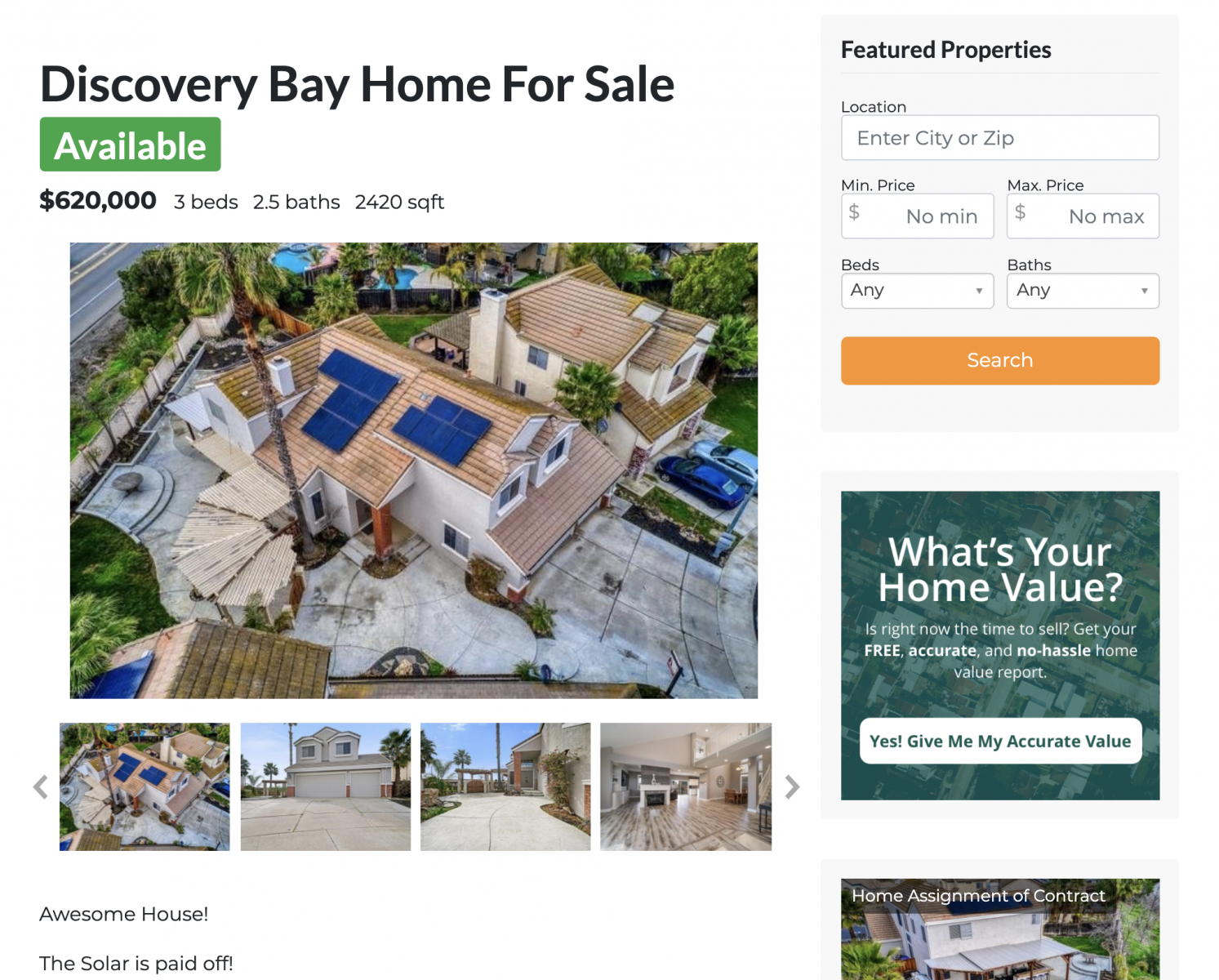
    18. Publish High-quality House Photos

    If you’re a real estate agent, posting high-quality photos on your website, Facebook page, and house listings is critical. Several studies have shown that high-quality photos can increase how quickly a home sells and what price it sells for.

    It will take more than pictures to sell a house, but this is one piece of marketing that can’t be overlooked.

    Many real estate agents miss the importance of taking quality pictures. This is one simple way you can beat your competition.

    Learn more:

    19. Add IDX to Your Website

    Real-estate-agent-website-idx

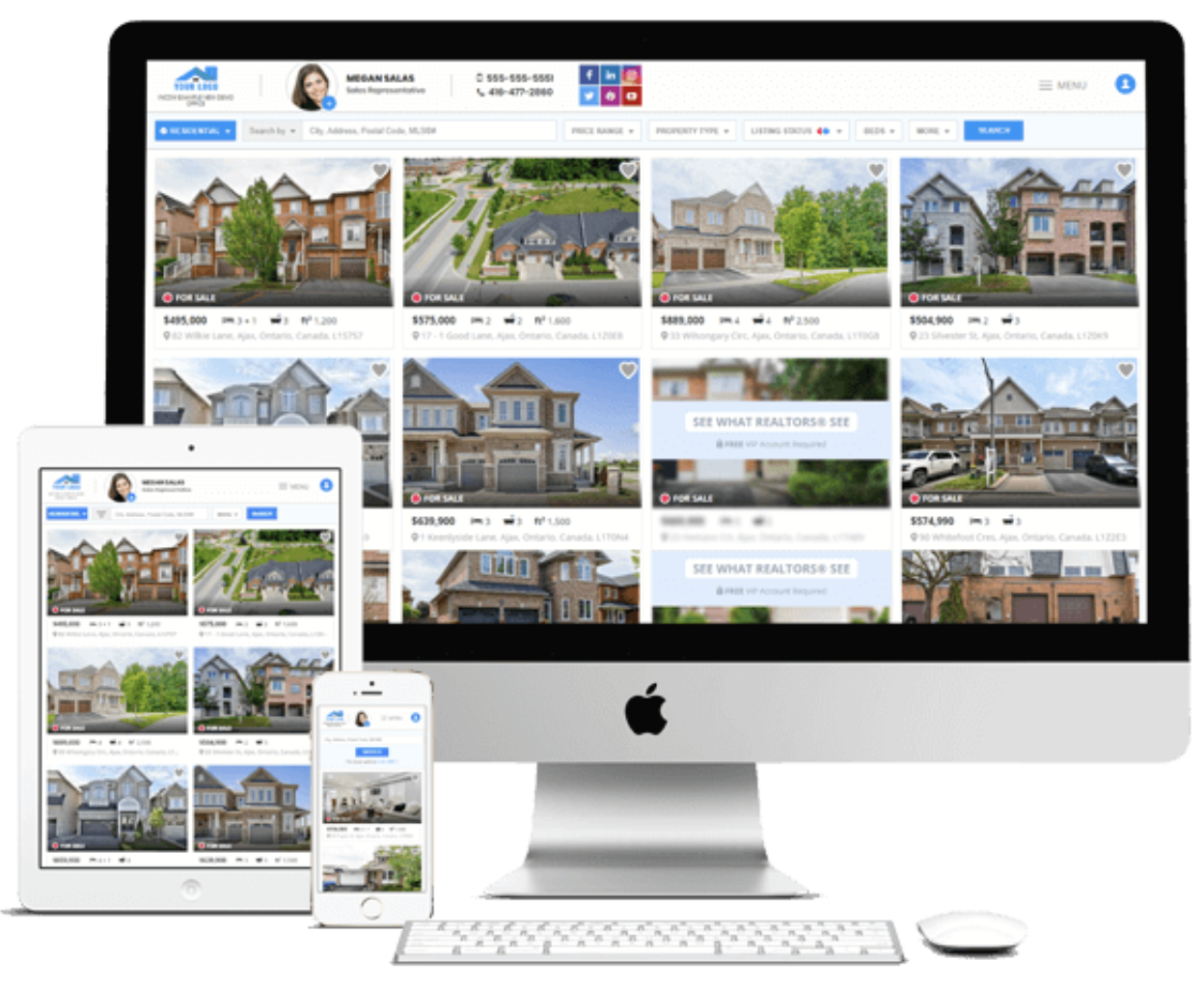
    If you’re a real estate agent, when someone arrives on your website, there’s a good chance they want to see some house listings.

    One, because that means you’re actually a real estate agent and not some poser.

    And two, because everyone loves browsing house listings (most of all, your target market).

    Your high-performing competitors are using IDX, so you should be, too.

    Learn more:

    20. Encourage Reviews on Your Company’s Facebook Page

    People trust reviews just as much as they trust recommendations from friends. Think of your own experience: before you buy a movie, eat at a restaurant, stay at a hotel, or buy a book, you read the reviews.

    And how much BIGGER of a decision is buying or selling your home? Sure – people won’t decide entirely if they will work with you based on your reviews, but your reviews (or whether you have them) will play a big part during the prospect’s early decision-making process.

    Facebook is a great place to collect and advertise those reviews.

    Learn more:

    21. Create Location-specific Landing Pages

    One of the best ways to convince people that you’re the best person to solve their problem amidst a whole sea of competitors is by targeting them specifically. Rather than simply having a website that targets your city, create different landing pages that target different parts of that city.

    There’s probably an entire pool of prospects interested in river-side houses, houses by the golf course, wooded homes, or mountains.

    By niching your market down even further with market-specific landing pages, you can speak directly to those people and increase their chances of working with you.

    Learn more:

    22. Create Free Ads on Craigslist

    Craigslist is a great place to find buyers and sellers. Mainly because it’s one of the first places that many people go when they start looking for a piece of real estate to buy. Plus, the ads are free to post.

    Post consistently with pictures of the homes or property you’re marketing; voila, you’re battling on one more front that your competitors are probably ignoring.

    Learn more:

    23. Create a Sales Script to Increase Close Rate

    A sales script for your phone calls and email follow-up doesn’t just increase efficiency; it can also increase sales. By thinking about your prospects’ pain points and what makes them tick before getting on a call, you can avoid losing a deal because you forgot to say something important until after the call.

    Phone calls are still a big part of the real estate marketing strategy, and how you handle yourself on the phone (with efficiency and salesmanship) is critical to your success.

    Tom Ferry shares five proven sales scripts for every real estate agent who needs to gain confidence and win more business.
    The BEST 5 Scripts Every Agent Needs in Today's Market | #TomFerryShow

    Learn more:

    24. Delegate “Busy Work” to an Executive Assistant

    If you want to build a company beyond solopreneurship, you must delegate “busy work” to someone else. “Busywork” is the stuff that has to be done, but it doesn’t need to be done by you. Someone else can take it over relatively quickly and have the same impact.

    To grow your business and focus on more important things, outsource the “busy work” to a VA or in-person assistant.

    Learn more:

    25. Know Your Market Like the Back of Your Hand

    The one who knows their market best dominates the market.

    The truth is the agents and investors who know their market the best – who they are, what they like, how they think, how they talk, and where they hang out – are the ones who will dominate their market.

    Why?

    Those people will most easily sell their services to the market. They understand the market’s pain and strategically position their service to serve it.

    Study your market if you’re at a loss for beating your competition. Visit forums, Facebook groups, and pages, or make phone calls and ask relevant questions.

    Once you know it, establish credibility and connections by posting market snippets on social media or an email newsletter campaign.

    Learn more:

    26. Use Drone Photography

    There’s no better way to inject child-like life into your marketing strategy than purchasing a remote-controlled toy.

    Drones aren’t just great for having well-deserved fun; they’re great for business. 83% of people selling their homes prefer to work with an agent that uses drones. High-volume realtors use drones 3.5 times more than their low-volume counterparts. Lastly, homes with aerial images sell 68% faster than homes with basic images.

    Really, that’s no surprise when you glance at the beautiful photos these flying playthings can capture.

    But which drone should you buy? There are many options, and you want to get the best bang for your buck.

    Truthfully, I don’t know. I’ve never bought a drone, so I hesitate to tell you which one to buy before I’ve tried it out.

    But what type of drone should you use? Here is a list to get you started. Remember that that article probably has affiliate links throughout the list, so take those recommendations with a grain of salt.

    Ultimately, I’d trust Amazon reviews above all else (they’re harder for people to tamper with).

    27. Create a Google Profiles Account

    Most of you have probably already created a Google Profiles account.

    But if you haven’t, you might miss out on easy-to-capture SEO traffic. For example, these are the results that Google Profiles can generate for your website.

    Perhaps the best part about these results is that they draw the eye even more than normal top-of-page Google results. It’s a great way for your business to cut to the front of the SEO competition, especially if you have more five-star reviews than anyone else.

    BONUS TIP: Generating reviews for your Google Business Profiles account is another marketing strategy you might consider implementing. Contact your past customers and ask them to review you on your Google Business page.

    If you don’t already have a Google Profiles account, go to the landing page and click “Manage Now” to get started.

    28. Create an Infographic

    More than likely, you’re not a designer.

    But that doesn’t mean you can’t dip your toes in design. In fact, it can be fun to try something you’ve never done — especially when that something has as much lead-generation potential as an infographic.

    Here’s an infographic describing why visual content is so powerful.

    Said more simply, people love visual content. And an infographic is a more visual and easy-to-digest blog post. Here, for instance, is an infographic that some real estate agents created.

    But how the heck do you develop an idea for your infographic? And how do you actually design it?

    Well, it’s all easier than you think.

    Once you’re done creating it, promote it on your social media channels, email list, and blog.

    Learn more:

    29. Host a Webinar

    You might think running a webinar is just for the world’s self-proclaimed B2B coaches and gurus, but it doesn’t have to be. Running a webinar on a topic that appeals to your audience is a great way to build digital relationships and start relevant discussions about how you can help people buy or sell a home.

    Accordingly, here’s a far-from-exhaustive list to get you started hosting your very first webinar.

    • What not to do when buying your first home
    • X tricks to sell your house for its highest possible value
    • Should you list your house with a real estate agent?
    • How to stage your house to sell crazy fast

    Remember, though, that most people prefer to watch a webinar for only between 30 minutes and 45 minutes. So try to keep yourself to that time limit and advertise it as being that long in the first place. 

    In terms of technical webinar setup, this guide by SmartBlogger will show you how to do it for free (skip to the “How to Run Webinars Like a Pro (Without Spending a Dime)” part).

    And before you actually do your webinar, test everything and ensure it’s all working how you want it to. There’s nothing quite as embarrassing or frustrating as technical difficulties during a webinar presentation.

    Once you’ve assembled your webinar, start collecting sign-ups via Facebook ads, emails, and maybe even guest posts on other blogs.

    30. Create a Zillow Profile

    You can’t afford to miss out on the opportunity of Zillow. With over 245 million unique monthly users, it gives you an audience for your business that is much larger than any other solution in this space!

    You need a profile because when potential clients find listings they are interested in and see that no one has listed them yet at their contact information, chances are high they’ll want to reach out with questions – which means if you’re not sharing those listings through profiles on sites like Zillow. Someone else will be getting all these new leads instead.

    Learn more:

    Conclusion

    To dominate your market, you have to change what you’re currently doing – what you’re doing to generate leads and revenue is great for where you’re at, but it’ll never take you where you want to go.

    That’s the truth about everything in life. If you want to go somewhere new, you must make some changes.

    And these 30 real estate agent marketing ideas will get you on the right track to dominating your market.

    What do you think? What has been key for your real estate agent marketing? Which tools and strategies do you use? Please share your thoughts, knowledge, and questions in the comments below!

  • 10 Ways to Audit Your Google Ads Motivated Seller Account During-COVID

    10 Ways to Audit Your Google Ads Motivated Seller Account During-COVID

    10 Ways to Audit 
Your Google Ads Motivated Seller Account Post
 COVID

    As we enter a year since the COVID-19 pandemic started, we’re still in a position where we’re not always sure what to do next.

    For most of us, both our personal and business lives were impacted on a level that we’ve never experienced before.

    This impact probably included your real estate marketing and advertising as businesses shifted from growth mode to survival mode.

    As we’re moving out of the peak of the pandemic (let’s hope) many homeowners are still proceeding with caution.

    The good news is, whether you’re starting a new account, reactivating an old one, or scaling up a current Google Ads motivated seller account, we’ve outlined exactly what you need to do to audit your account and move forward without hesitation.

    What State is Your Google Ads Motivated Seller Account In Now?

    Right now, you’re probably within one of these groups… 

    You paused everything in 2020. Now, you’re back in your account looking to start generating leads again. If this is you, then most of your work has already been done. The campaigns have been created. You just need to enable them.

    Or, you may have scaled back your motivated seller campaigns and now you’re looking to rebuild into a larger account structure. This provides an advantage because you have recent data still going for you to base your moves off of.

    Lastly, you might be starting out with a totally new account. This way you get to create the account with a new strategy.

    COVID Google Ads Motivated Seller Account Audit 

    If you have or have had motivated seller campaigns, you know that it’s important to take it slow and do the right thing to your account or you’ll end up wasting budget. 

    Let’s take a trip through the items of your account that you should revisit so you can get back up and running properly.

    1. Adjust Your Budgets

    What you’re looking to spend may be different from what your budget was pre-COVID.

    Take a little time to review what you spent pre-COVID, during the past year, and what your spend goals are going to be post-COVID.

    How do you know what you should set your budgets to now?

    First, you know your market better than anyone. If you’re coming into a hot market, then you might want to increase your budget. If you feel your market is still a little timid, then back it off a bit.

    Next, you can use Google’s Budget Recommendations, or use a recommended formula based on what your monthly spend expectations are for the year and projected ROI.

    Then you can break down how much you’ll have to play with for daily budgets by using Google’s calculation:

    Monthly Budget divided by 30.4 which is the average number of days in the month = Overall Daily Budget

    If you’re running multiple city-specific campaigns, you might need to create a shared daily budget or stick with one area as you get a back into the swing.

    2. Evaluate and Set Realistic Goals

    Your performance metrics might look a little different from previous years, therefore it’s valuable to evaluate where your account performance was and set realistic goals for 2021.

    Focus your review on what means the most to you. For most investors, lead volume and cost per lead are the two most valuable metrics.

    You can use that data to set some benchmarks to get an idea of where you should be landing in terms of future performance. Factor in market conditions and market confidence.

    You could come to the conclusion that you’ll need to expect less leads at a higher cost per lead for the near future.

    3. Make Sure Your Bid Strategy Aligns with Your Goals

    You’ll need to ensure that your campaigns have a bidding strategy that aligns with your goals and metrics.

    We’re still big on using manual bidding, but if you’re using one of Google’s automated strategies, here are some things to keep in mind.

    For example, it’s not wise to use one of the conversion-based strategies such as Target CPA if you don’t have recent conversion data for Google to optimize off of.

    Keep in mind that certain bidding strategies, like Target CPA, have a minimum historical data requirement in order to use them with some effectiveness.
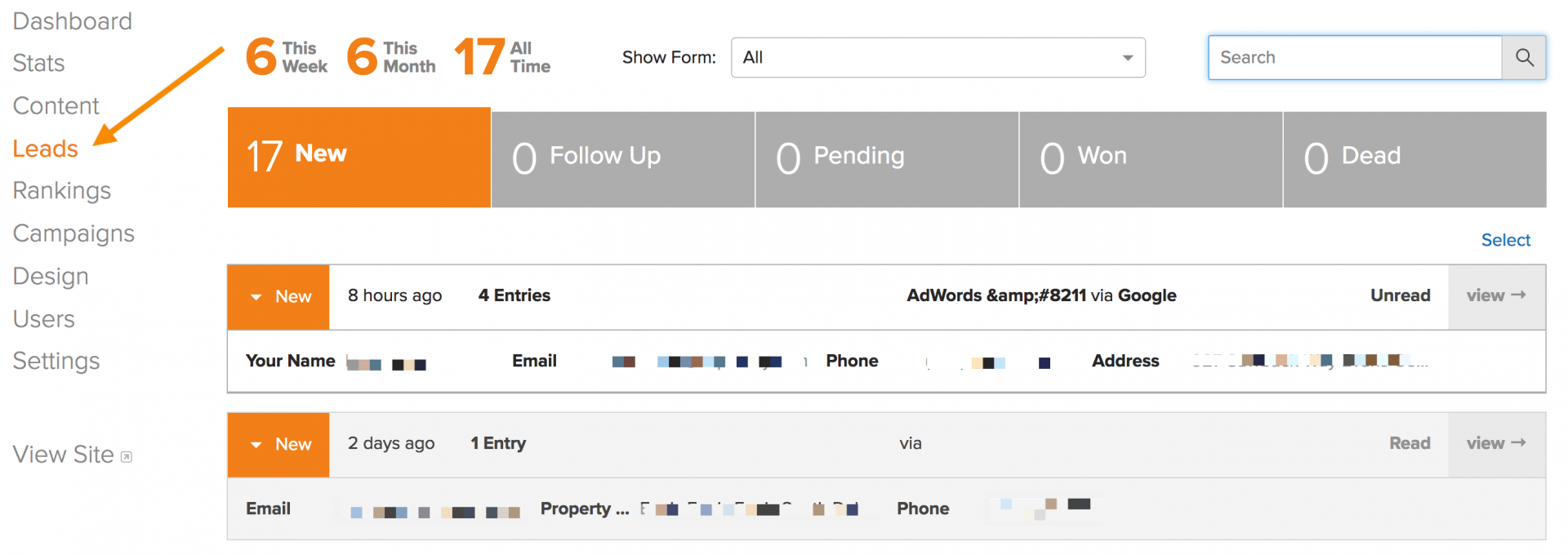
    If you’re starting out with a new account, with limited data, you should default to manual bidding or if you really want to use an automated strategy, stick with Maximize Clicks.
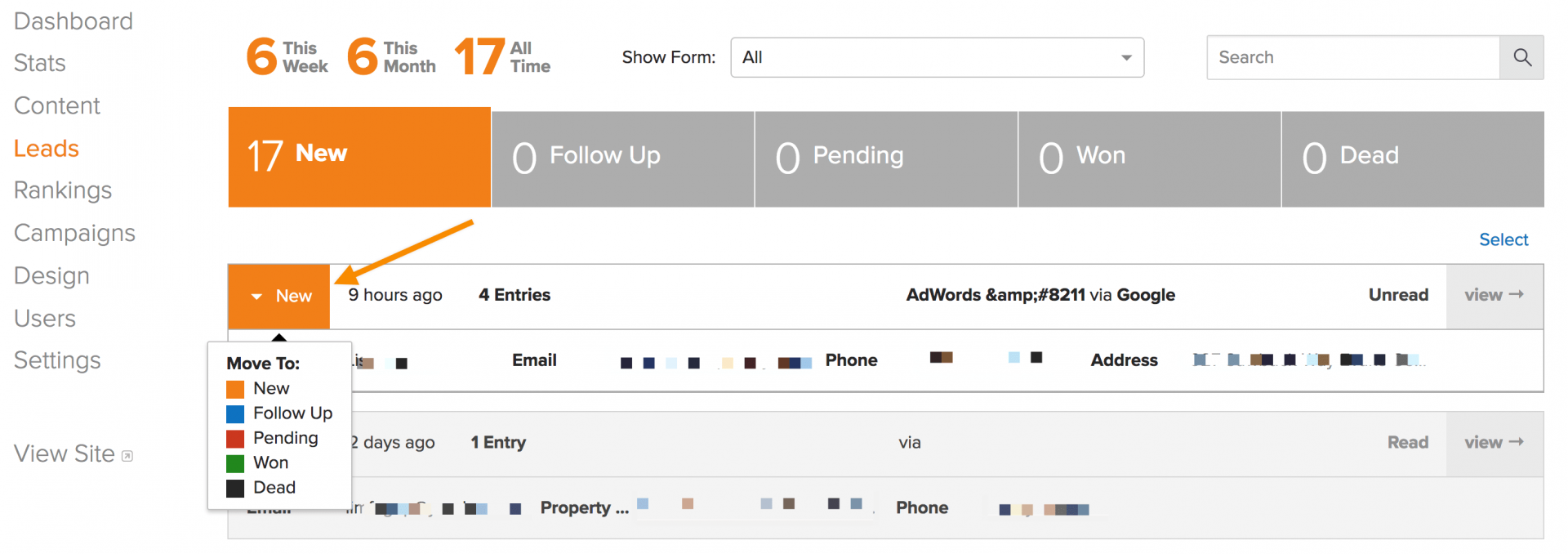
    4. Double Check Target Locations

    Where you choose to target will impact your reach as well as your spend. For example, if you were targeting all of a specific county before COVID when you had a higher budget, you might want to now scale it back to just a specific city within the county to align with a smaller monthly budget.

    Overall, you can restrict your location targeting based on your 2021 goals and budgets.

    5. Keyword Deep Dive – Pause or Add Keywords

    Don’t be afraid to pause keywords! We’re in times where some motivated seller keywords aren’t as hot as they once were or might be in the future. If your historical data shows keywords that drove leads in the past, but have become slow now, you can always revisit them at another time.

    In any market, every penny counts. No one likes to waste money but during uncertain markets, understanding your goals and how many leads are really possible, right now, will help you manage your keywords.

    So, pause any underperforming keywords and keep the keywords most relevant to your updated goals. This will help keep your accounts organized as well as ensuring that you are spending your money on the keywords that have the highest confidence levels.

    There could also be an opportunity to add keywords. You can use tools such as the Google Keyword Planner or as simple as Google Suggest. These two tools can be great places to check as you refresh your account so that you can keep your expectations as well as your bids working with your budget while using the top converting keywords.

    6. Edit Your Ad Copy and Messaging on Your Landing Pages

    Don’t forget your ad copy. In this current time, your market might present opportunities to test new ad copy. Align with your audience.

    For example, if your market currently has a “virtual” feeling, test something like “100% Virtual Sale” or “We Do Not Need to See Your House in Person”.

    In other words, take advantage of your market conditions and how people are thinking right now.

    If you have a new site or are using a past site, use that same language on your landing page as you do in your ads.

    Refreshing your ad copy and landing pages will not only bring things back up to date, but also give your audience a new look and messages that connect with them more than ever.

    7. Pause Underperforming Ads, Ad Groups, or Even Campaigns

    Similar to the keywords, you may want to look for opportunities to trim your account upon reactivating it. Pause any underperforming ads, ad groups, or even go as far as campaigns.

    Again, markets during COVID have looked different than before.

    You may experience heavy lead months followed by slow months. That’s why it’s important to use data and stay calm.

    If you have a good lead month followed by a bad month, it’s not necessarily a Google Ads issue. We have found that some markets have fluctuated heavily even month-to-month.

    Prioritize what aspects of your business are the absolute most important to advertise and pausing out anything that isn’t necessary.

    Find what is driving up your cost-per-lead and weed through those to ultimately get to the highest performers.

    8. Keep Adding Negative Keywords

    Between Google’s new match type changes and the always changing searcher intent, it’s important to stay on top of your negative keywords.

    Review the Google Search Terms report to see what queries you’ve shown up for and ensure you have your negative keywords added and up to date.

    We’ve seen some markets shift to more “sell my house fast online” and “sell house by owner fast” queries. Even though these seem to be motivated queries, some markets are noticing clicks going up but leads are not following.

    During COVID, when you see trends such as these, don’t be afraid to add a negative keyword to a good term. You can always remove it in more normal market conditions.

    Grab a free negative keyword list for motivated sellers.

    9. Double Check Your Conversion Tracking

    If you haven’t been dedicating time to your Google Ads account, then it might be a good idea to double check your conversion tracking as well.

    Possibly over the course of a year, you’ve made some changes to your website that could have impacted your tracking. Or, maybe you’ve changed your phone number so you’ll need to adjust that within your Google Ads account.

    Here’s how to be sure your Google Ads conversion tracking is set up correctly.

    10. Spy on Your Competition with Auction Insights

    Whether your account has been paused for a while or it’s currently active, you can also leverage the Auction Insights report of Google Ads to further investigate the climate of your market.

    Auction Insights breaks down who else is on the search results page most often along with you.

    So, if you’re wondering if new investors have emerged into your area since COVID-19 or if you’re curious to see who is outbidding you, this is the place to start.

    Auction Insights not only tells you who else’s ads are alongside yours but also where on the page they rank, above “Position Above Rate” or below you “Outranking Share.”

    Spy on Your Competition with Auction Insights

    Audit a current Google Ads motivated seller account or reactivate your account with confidence

    Whether you paused, scaled back, or are starting fresh, there are items to be evaluated with current or reactivated Google Ads motivated seller accounts during the pandemic.

    Let’s review the steps covered in this post:

    1. Adjust Your Budgets
    2. Evaluate and Set Realistic Goals
    3. Make Sure Your Bid Strategy Aligns with Your Goals
    4. Double Check Target Locations
    5. Keyword Deep Dive – Pause or Add Keywords
    6. Edit Your Ad Copy and Messaging on Your Landing Pages
    7. Pause Underperforming Ads, Ad groups, or Even Campaigns
    8. Keep Adding Negative Keywords
    9. Double-check your conversion tracking
    10. Spy on Your Competition with Auction Insights
  • 9 Real Estate Business Models To Consider with Rising Interest Rates or When Inventories Are Low

    9 Real Estate Business Models To Consider with Rising Interest Rates or When Inventories Are Low

    real estate business models for 2021

    It’s often said that more millionaires are made through real estate than any other type of business. But what real estate business models do they use?

    While it’s difficult to measure the validity of that claim, one thing’s for sure: there’s a lot of money to be made in real estate.

    Questions often raise about whether you should become a wholesaler, a flipper, an agent or broker, or even a hybrid agent/investor. As the real estate market changes and fluctuates (like it has in recent years), how do you make sure you choose the right investment specialty?

    But one thing’s for sure: People will always buy or sell houses.

    And investors who put their money into real estate — buying assets rather than liabilities — can create a lucrative future for themselves and their families.

    So the question is, how should you get into real estate?

    Here are nine popular real estate business models to consider.

    Table of Contents

    1. The Diversity of Real Estate Business Models
    2. The Main Challenge of These Real Estate Business Models
    3. Real Estate Agents
    4. Wholesaling
    5. Wholetailing
    6. Buy-And-Hold Investing
    7. House Flipping
    8. Remote Investing
    9. Listing Service For FSBO
    10. BRRRR
    11. More real estate investment business models (& a free planning template!)

    The Diversity of Real Estate Business Models

    There used to be just a few different real estate business models.

    If you had access to a lot of capital, you could place big bets with the fix-and-flip system and hope the market didn’t dip at the wrong time. You could also buy-and-hold real estate, steadily expanding your portfolio and net worth.

    You could become a real estate agent or broker without big money, netting 3% to 6% per transaction.

    Those were the options.

    Now things are much more diverse.

    Here are the real estate business models we will cover in this article…

    The good news is… there’s a real estate business model that works with any budget. So long as you have the discipline to get started and keep going, you can win at real estate.

    The Main Challenge of These Real Estate Business Models

    While the business models below present a ton of opportunity for entrepreneurs — we’ve seen many agents and investors build thriving businesses in just about every market — they’re not free of challenges.

    These challenges include hiring the right people, mathematically approaching every transaction, and building trust with buyers and sellers.

    But one challenge stands above all the rest: consistently generating leads.

    For agents and investors, having a consistent flow of leads makes your monthly income more predictable and allows you to grow your business more quickly.

    How do you do that?

    At Carrot, we specialize in helping investors and agents create simple, effective websites that rank in Google (and thus drive traffic) and systematically convert visitors into leads.

    We’ve generated over 2.5 million leads for thousands of investors and agents nationwide. Take a Carrot demo to see how it works!

    1. Real Estate Agents

    When someone thinks about getting into real estate, being a real estate agent or broker is usually the first business model they consider.

    Real estate agents make money by helping people buy and sell homes, usually pulling in between 3% and 6% of the sales price. A $250,000 home would net between $7,500 and $15,000.

    To become a licensed realtor, you’ll need to research the requirements and processes in your local market — typically, this will include taking some courses and passing a test. You might also need to get sponsored by a real estate brokerage.

    Pros

    • Low barrier to entry. Anyone with enough time, determination, and sales savvy can become a real estate agent.
    • Good profits on high-ticket homes.

    Cons

    • Requires expertise in sales.
    • It takes time to build a name for yourself.
    • The average transaction takes about 3 months to complete.

    2. Wholesaling

    Wholesaling is a real estate investing business model that’s cropped up over the last decade or so.

    As a wholesaler, rather than flipping real estate or buying and holding your properties, you work as a sort of “deal finder” for other cash buyers. Your job is to find good deals (motivated sellers) and get them under contract for a price you and your cash buyer can afford. When you pass the deal onto the cash buyer, you’ll typically make a $5,000 to $20,000 assignment fee.

    The most significant benefit to wholesaling real estate is that you don’t need a massive amount of money to get started — just a few thousand dollars to find and secure your first deal.

    Pros

    • May not require a license (check the state you’re wholesaling in).
    • Requires just a few thousand dollars in startup capital.
    • Good opportunity in most markets. (See the wholesaling opportunity in your market!)
    • Can make up to $20,000 or more per deal.

    Cons

    • Wholesaling has become highly competitive in many markets.
    • New regulations are being introduced in many states to regulate wholesaling.

    “Six wholesale deals this month if all goes through. $124k… 4 ppc, 1 organic, 1 Facebook retargeting. One has closed, the other 5 are under contract with a buyer and the last one is waiting on a buyer. Carrot system is still rockin!”

    – Brian Rockwell

    3. Wholetailing

    The word “wholetail” is a combination of “wholesale” and “retail.” In a wholetail deal, the investor buys a house for a low-ball price, makes just enough repairs so that it’s capable of selling on the MLS, and then sells it to a traditional buyer.

    It’s not unusual to make $50,000 to $100,000 on a wholetail deal, but without nearly as much work as flipping takes.

    We recommend wholetailing real estate when you’ve found a house that needs very few repairs, you can get it for a price that’s significantly under market value, and you have the cash (your own money or someone else’s) to purchase the home and make small updates.

    Pros

    • Wholetailing requires less work than a full flip, but has a big payoff.

    Cons

    • Wholetail deals are hard to come by.
    • Wholetailing works better as a supplemental investing strategy than it does a primary business model.
    • Requires access to large amounts of cash.

    4. Buy-And-Hold Investing

    Buy-and-hold investing is probably the best business model for increasing long-term wealth and net worth. In the buy-and-hold strategy, the investor buys properties (ideally ones that are a good deal), fills them with tenants to create cash flow, and holds.

    Buy-and-hold investing aims to collect as many properties as possible and build as big of a portfolio as possible.

    The hardest part of this business model is securing the cash to purchase properties consistently. We recommend seeking out private money or hard money to fund your deals.

    Pros

    • Great way to increase net worth.
    • Creates a ton of passive cash flow.

    Cons

    • Need to manage properties and deal with tenants.
    • Need access to a lot of capital to maintain momentum.

    5. House Flipping

    House flipping is the HGTV method of real estate investing and perhaps the most popularized way to make it big.

    What these TV shows don’t talk about, though, is how house flipping is also one of the riskier real estate business models. During the time between when you buy a house and when you sell it (often 6 months or so), you’re just crossing your fingers that the market doesn’t take a hit.

    Still, house flipping is a great real estate business model to add to your repertoire. It has higher risk, but also a higher payoff — often upwards of $100,000 for a single deal.

    Pros

    • Bigger cash payoff than any other investing model.

    Cons

    • Requires a lot of fixer-upper work.
    • Has a higher risk.
    • Requires a lot of upfront cash.

    6. Remote Investing

    Remote real estate investing has only become possible for the everyday investor in the last decade.

    Technology has advanced so that investors can generate leads, find deals, inspect homes, purchase properties, and more… all without even being in the same state as the property they’re purchasing.

    Check out our guide to learn more about virtual real estate investing.

    This is a great option for people who don’t want their businesses tied down to a single location.

    Pros

    • You can operate anywhere in the U.S., accessing the most profitable markets.
    • Gives you more time and freedom.

    Cons

    • It requires a lot of research before entering into a new market.
    • Requires you to buy properties site unseen.
    • You must build a business with clear-cut systems and hire trustworthy people you can depend on.

    7. Listing Service For FSBO

    What’s great about this business model is that once it’s set up, it can be almost entirely passive. Just hire a VA to manage some basic tasks and keep up with customer requests.

    Here’s how it works: you get your real estate license, set up a website attracting for sale by owner (FSBO) sellers who want to list their house on the MLS, and offer to do it for a flat fee.

    You can charge upwards of $250 per listing, for instance.

    And as mentioned above, you can train a VA to do a lot of the heavy lifting. So once you’ve built the website and found ways to drive traffic (paid ads and/or SEO), this will run almost entirely on autopilot.

    Pros

    • Easy to set up and easy to manage.
    • Decent money maker with very little work.

    Cons

    • Need a real estate license.
    • Will be competing with other FSBO listers.
    • Requires a good chunk of upfront work to get everything set up.
    • Need to find ways to drive traffic consistently.

    8. BRRRR

    The BRRRR method (Buy, Rehab, Rent, Refinance, Repeat) is a modified version of the buy-and-hold business model.

    BRRRR is an ongoing process by which real estate investors can purchase multiple properties with very little capital relative to the growth of their portfolios. First, the investor finds a good deal and buys the property using cash, private money, or hard money. Then they rehab the property and fill it with tenants to start the cash flow.

    After a seasoning period of 12-24 months, the investor does a cash-out refinance on the home — this is where a financial institution provides a new loan on the property and returns the cash that they used to purchase the property in the first place.

    Then the investor repeats that process with their original funds. If the investor plays their card right, they can purchase many properties with the same funds.

    Pros

    • Allows for faster portfolio growth.

    Cons

    • Requires the investor to secure upfront funding.
    • Requires very accurate math.

    9. Hybrid Real Estate Model

    The hybrid real estate model is a strategy where an agent is also an investor. As a hybrid agent/investor, you can offer sellers different options based on their need and your evaluation of the property.

    For instance, you can offer:

    If they’re looking to sell fast for speed and convenience and are willing to take a bit of a shave in equity, offer to buy the property yourself with a cash offer.

    Or, if they want top dollar, you can be their seller’s agent and list the property for a traditional sale.

    When you act as both the agent and investor, you can save yourself agent fees and avoid splitting your profits with an agent or investor partner.

    “I’ve always worked with wholesalers and investors from the sales side. I decided to start generating those leads myself since I already had the network.”

    – Mark St. Peter, a hybird agent/investor
    Learn how Mark generated $75K+ in deals on a shoe string budget

    Pros

    • Flexibility to work with different types of sellers.
    • Easier to adapt to market shifts.

    Cons

    • Requires agents to be open to learning more about investing.

    Carrot member, Anthony Beckham, is a hybrid agent/investor. His average profit per deal as an investor is around $20,000 to $30,000. His average agent commission is around the $7000 to $12,000 range.

    More real estate investment business models (& a free planning template!)

    There you have it! Nine of the most popular real estate business models.

    If you don’t have much starting budget, wholesaling or becoming a real estate agent are wonderful options. If you have more capital, then you might consider flipping or BRRRR.

    But they’re far from the only ones. With real estate investing, you can get as niche as you want. Other popular investment options are:

    Whatever you decide, there’s plenty of opportunity in each business model. Before jumping in, be sure to research any local regulations (especially with wholesaling or short-term rentals) and the overall competition in your market so you understand what you’re up against.

    When you’re ready to take the next step, snag the real estate business planning template to help you sort out your thoughts and set your business up for success.

    Good luck!

    Not a Carrot member yet? Take a free interactive tour now!