Category: SEO Education

  • Real Estate SEO Made Simple: 6 Easy Wins You Can DIY

    Real Estate SEO Made Simple: 6 Easy Wins You Can DIY

    SEO has a reputation for being hard to DIY. You’ve got checklists, keywords, content to write, and rankings to track — it can feel like a lot.

    The good news is, you don’t need to master everything to see results!

    A few focused actions can dramatically improve your rankings and help you attract more motivated seller leads. A great example is Mark St. Peter’s story, who did his own SEO and ranked #3 in competitive Arizona markets within just 6 months, generating leads daily.

    Table of Contents

    1. Start with Keyword Research
    2. Publish Original, Information‑Rich Content
    3. Nail the Basics of Technical SEO
    4. Build Location‑Targeted Pages
    5. Fix Your Image Alt Text
    6. Use Internal Links the Right Way
    7. Conclusion

    Key Takeaways

    • Don’t dump all keywords into one page. Match them to the right page type (landing page, guide, blog, FAQ).
    • When writing, add local proof: foreclosure stats, median prices, seller stories, neighborhood details.
    • Check your site with Carrot’s Site Audit Tool to fix quick wins like duplicate content, missing meta tags, or broken links.
    • Create city- or county-specific pages with local keywords in the URL (e.g. /sell-my-house-fast-roseburg).
    • Add alt text to images that describes the property or city (e.g. “3-bedroom house in Eugene ready for cash sale”).
    • Drop in internal links with keyword-rich anchor text (“sell your house fast in Portland”) instead of generic “learn more.”

    Real quick before we dive in – why does SEO even matter?!

    Because a tired landlord doesn’t flip through a phone book. Someone facing foreclosure isn’t waiting for postcards. Motivated sellers open their phone and type in exactly what’s on their mind: “stop foreclosure timeline in Oregon” or “sell my house fast in Roseburg.” Every one of those searches is a lead raising their hand. 

    Carrot websites are already built with SEO in mind, giving you a strong foundation out of the box. But if you want to maximize visibility in your market, the tips we’ll cover here will help you go from “just having a site” to actually generating consistent, high-quality leads from search.

    1. Start with Keyword Research

    Keyword research is really just trying to find the exact phrases motivated sellers, buyers, or landlords type when they’re hunting for help (“sell my house fast in Roseburg,” “probate house sale timeline,” “cash offer vs listing fees”). If you publish pages that match those real phrases (and actually answer the intent behind them), Google can put you in front of the right people. 

    If this is brand new to you, we walk through the process in the Real Estate SEO Bible, where you’ll see examples of the most profitable real estate keywords and how to apply them on your site.

    Brainstorm your seed keywords. 

    Start with obvious ones like “sell my house fast,” “cash home buyers,” or “buy houses in .” or you can list 5–10 problems you solve: behind on payments, inherited a house, probate, code violations, divorce, tired landlord, need cash fast, “sell as-is,” These are your starting points.

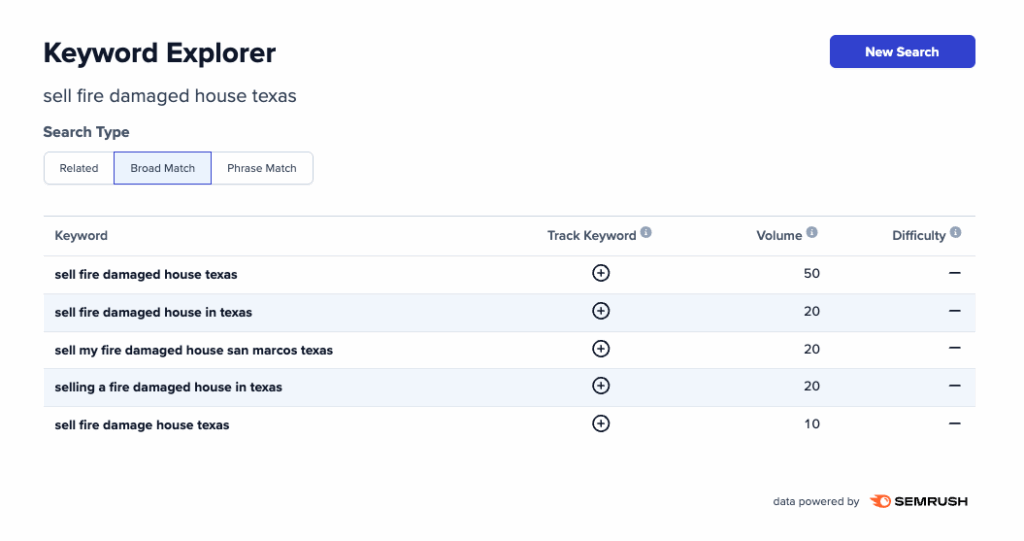
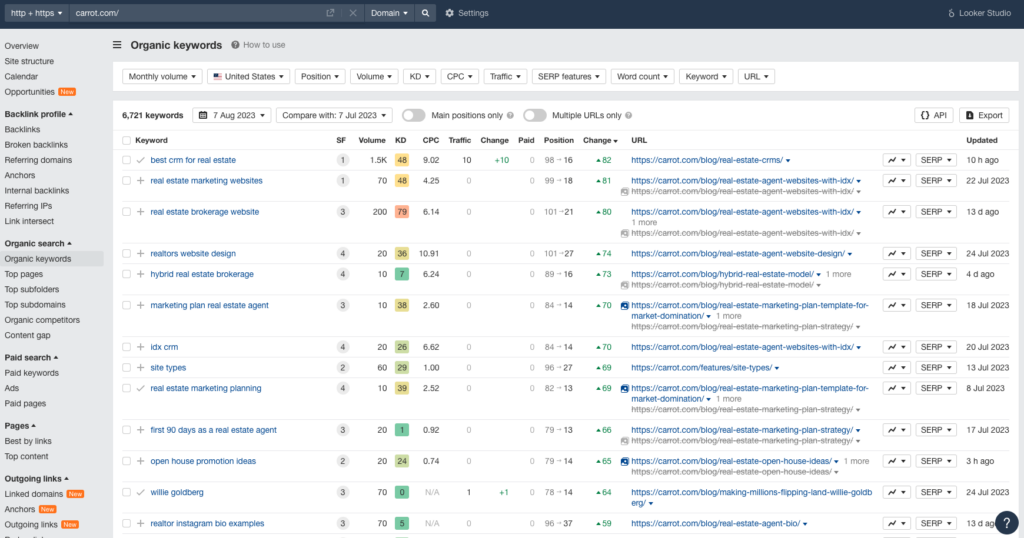
    You can also put in a competitor’s domain in Carrot’s Keyword Explorer to see what they’re ranking for. 

    Find related keywords

    This is where things get easier. Carrot automatically shows you related keyword ideas, their monthly search volume, and how tough (Difficulty level) it’ll be to rank for them. The low-to-mid difficulty, high-intent phrases are the sweet spot for solo operators.

    Choose your list of keywords to write on

    Don’t try to create content on every topic, even if it’s easy to do that with AI tools now. Here’s a simple sniff test that helps you pick winners:

    Relevance: Would a person searching for this hire you if they liked what they read?

    Difficulty: Are the current results beatable with a stronger, more local, more useful page?

    Demand: Enough people search this to be worth an afternoon of writing—even if it’s dozens per month, not thousands.

    Once you have that, 

    Decide what to do with them

    Once you’ve gathered a list of keywords, the next step is deciding what to do with them. A common mistake is treating every keyword the same — cranking out the same type of blog posts for everything, or trying to stuff them all onto your homepage. That’s not how Google works, and it’s not how motivated sellers search.

    Instead, match each keyword to the right kind of page. 

    Some keywords signal that someone is ready to act right now (“sell my house fast Roseburg”) — those belong on high-converting landing pages. Others show that the person is still researching (“stop foreclosure Oregon timeline”) — those are perfect for detailed guides or blog posts where you educate first, then invite them to reach out.

    Keyword ideaIntentPage typeNotes
    sell my house fast RoseburgTransactionalCity landing pagePrimary headline + form; add local proof & neighborhoods
    stop foreclosure Oregon timelineInformationalGuideInclude step-by-step timeline + options + CTA to call
    sell inherited house [county]Informational → TransactionalCounty page or blog + CTACover probate basics, taxes, and local court links
    cash offer vs listing ComparisonBlog/FAQShow math with local fees/days-on-market data

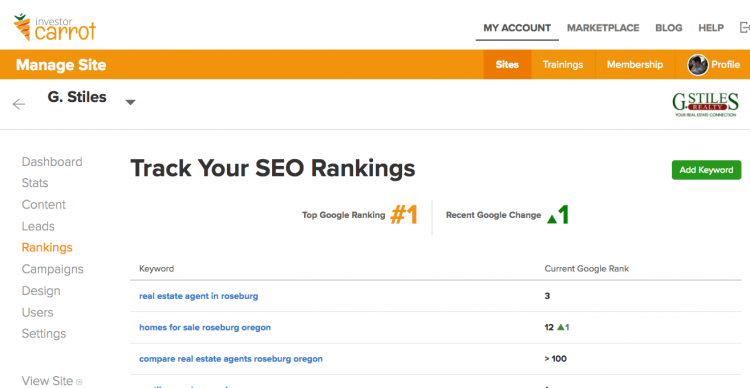
    Once you’ve created a handful of articles, add them to Carrot’s Keyword Rank Tracker so you can watch positions move as you publish. That feedback loop teaches you fast: which angles stick, which need more depth, and where an internal link or two will nudge you onto page one.

    2. Publish Original, Information-Rich Content

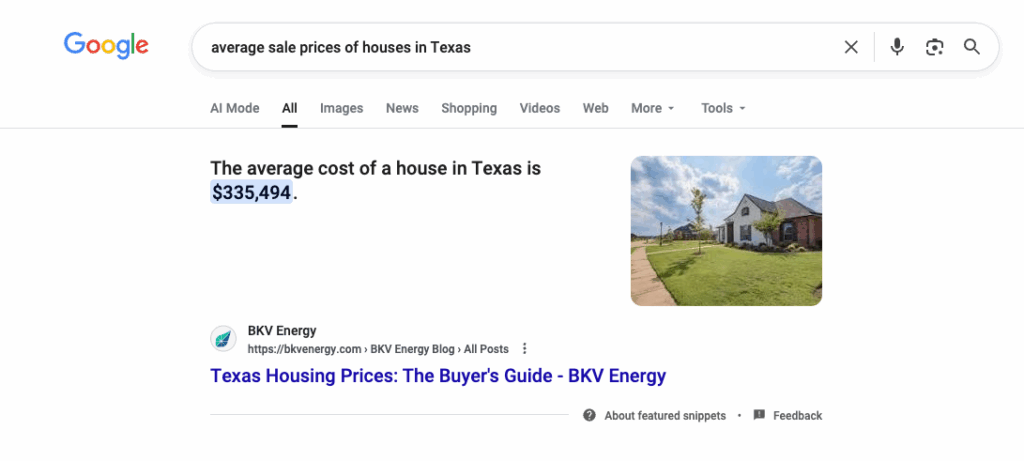
    Generic content is dying. With Google’s AI Overviews, searchers can get surface-level answers to broad queries without ever clicking a website. For example, a quick search for “average sale prices of houses in Texas” now produces an AI summary showing the median price ($335,494). That’s fast, neat, and complete enough that most people won’t bother scrolling further.

    What wins clicks (and trust) is specific, original information people can’t get anywhere else: local numbers, real timelines, first-hand process details, and outcomes from deals you’ve actually closed

    For example, instead of writing: “Foreclosure rates are high in our area.”

    You can back up with details, data, or real-life examples. That’s what makes your post worth reading, linking to, and trusting: “According to Douglas County court filings, foreclosure starts rose 14% in the past year. That’s one of the highest jumps in Oregon, which means more families here are scrambling to find fast solutions.”

    The first is just a claim. The second proves you know your market.

    Tips to create good content

    Here are a few practical ways investors can create content that gets read: 

    • Use local data. Add stats on median home prices, average days on market, foreclosure rates, or rental vacancy rates in your city or county. Even citing a recent Zillow or MLS report with your commentary makes the piece more valuable.
    • Explain the “why” behind seller pain points. Don’t just say, “Selling through an agent takes too long.” Spell it out: the average listing in [your city] takes 63 days to close, plus repairs and showings can add weeks more.
    • Show real stories. Share anonymized examples of sellers you’ve helped (“A retired couple in Springfield avoided foreclosure when we closed in 14 days”). These details connect emotionally and prove you’ve done it before.
    • Offer your perspective. Add your take on what these numbers or situations mean for homeowners. For example: “Yes, prices are dropping, but that can actually make cash offers more attractive because buyers with financing are pulling back.”

    Writing that kind of content from scratch every week takes hours you probably don’t have.

    That’s where Carrot’s Automated Content Library comes in. Instead of starting with a blank page, you can pull from a collection of expertly written, real estate–focused blogs that are already 90% ready to publish.

    Content Marketing Made Easier with Carrot's Content Tools

    All you have to do is add your personality, your market insights, or a quick local stat. And you’ll get content that stands out from the generic fluff AI is summarizing.

    3. Nail the Basics of Technical SEO

    Technical SEO sounds complicated, but it’s just about making sure your website is built in a way that search engines (like Google) can easily find, understand, and show it to people.

    Some key parts of technical SEO are:

    • Crawlable: Google’s robots should be able to move around your site and visit all your pages without getting blocked.
    • Indexable: Once robots read the pages, Google should be able to save them in its “library” so they can show up in search results.
    • Speed: Your site should load quickly, because slow sites make visitors (and Google) unhappy.
    • Mobile-friendly: Your site should look and work properly on phones and tablets, not just computers.
    • Clean URLs: Website links should be short and easy to read (like /about-us instead of /page?id=123).
    • Security (HTTPS): It’s when your website shows a padlock 🔒 in the browser, meaning the connection is safe and private. 

    You don’t have to become a tech expert to get it right. Most investors just want their sites to rank and bring in motivated sellers, not spend hours digging through settings or trying to decode SEO jargon. That’s exactly where Carrot helps.

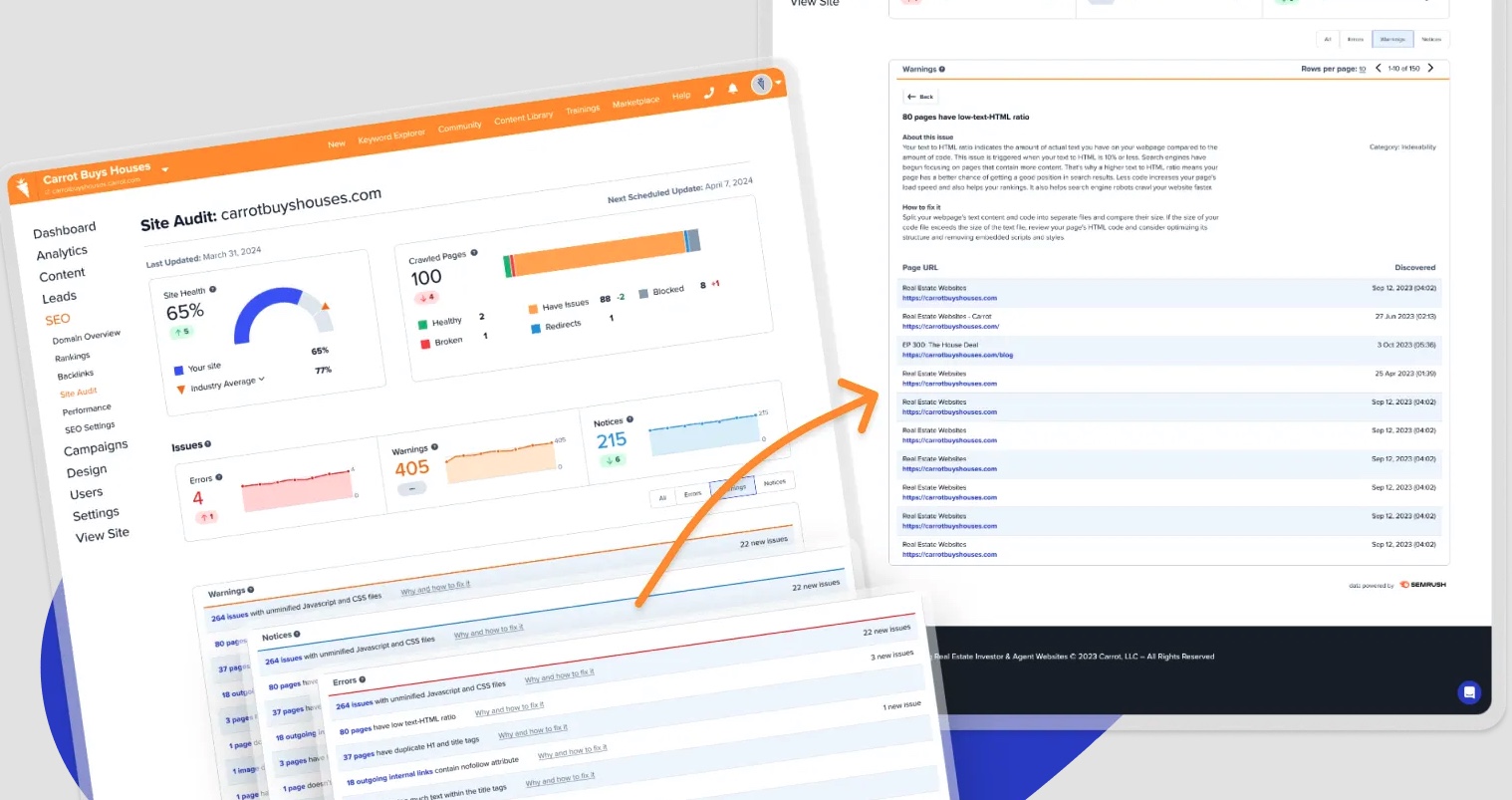
    With the Carrot Site Audit Tool, you can see what’s holding your site back from ranking in search engines. It checks for common issues like broken links, duplicate content, missing alt text, or low word count, and it explains what each issue means in plain English. 

    Every audit comes with step-by-step guidance on how to resolve issues, plus Carrot Support if you get stuck. It’s the same level of insight SEO agencies charge thousands for—without the high price tag.

    4. Build Location-Targeted Pages

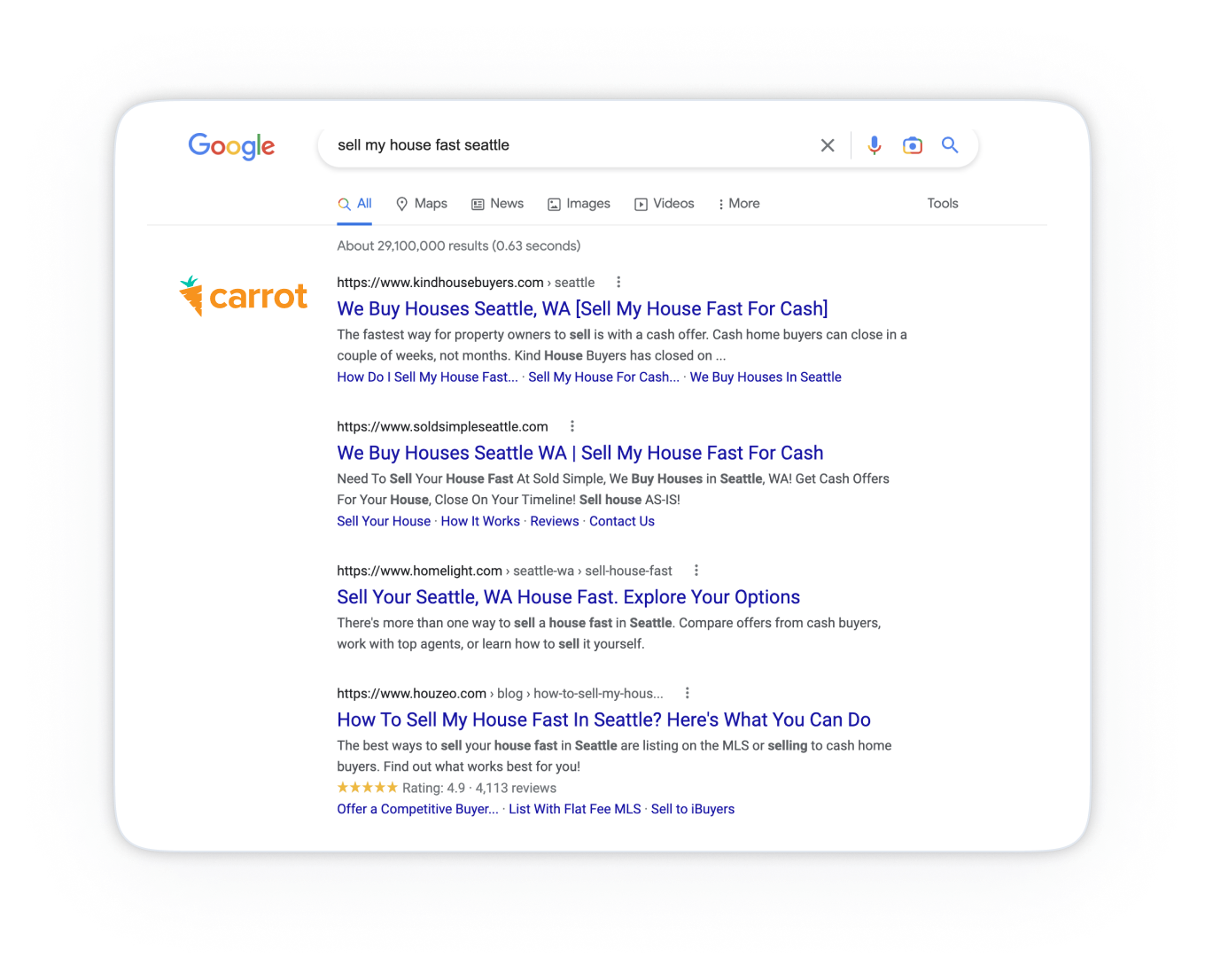
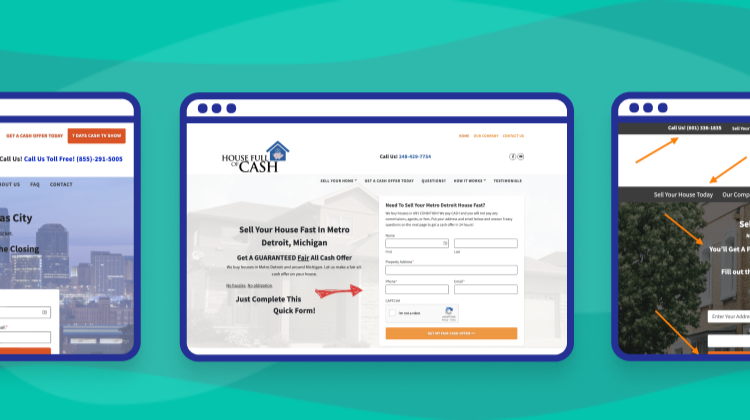
    When I searched for “sell my house fast in Queens,” I found one site with a generic landing page that says “Sell Your House Fast For Cash Today” but doesn’t mention any specific city.

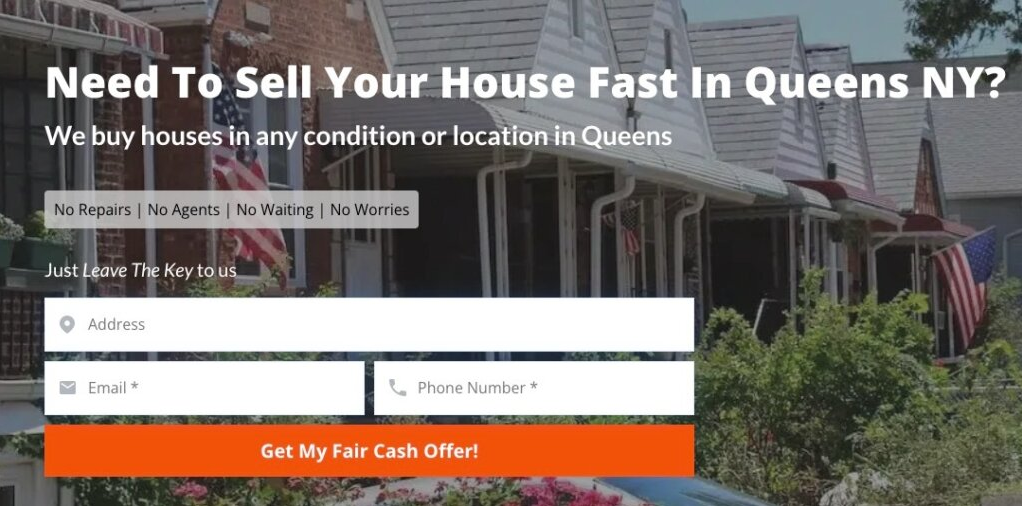
    Here’s another site with a Queens-specific page, headline, and all: “Need To Sell Your House Fast In Queens, NY?”

    Which one do you think Google and sellers trust more?

    The answer is obvious. 

    A local page that actually says “Queens” (or Brooklyn, or Roseburg, or wherever you invest) is more likely to rank for that search and more likely to convert the person who lands there. Because Google matches searchers with the page that seems most specific to their intent.

    That’s why, instead of one statewide page, build individual pages for each city or county you invest in.

    A strong location page isn’t just a block of text with the city swapped out. 

    URL of the page matters

    One of the most important elements is the URL itself. Adding local keywords to your URLs is a direct ranking factor. Instead of using something generic like /services/oregon, create URLs such as:

    • /sell-my-house-roseburg
    • /we-buy-houses-eugene

    This signals to Google exactly what the page is about and ties it directly to local keywords sellers are typing in. Pair that with a strong title tag like “Sell Your House Fast in Roseburg | Trusted Local Buyers” and you’ve got a page built to rank.

    From there, make the page feel genuinely local.

    Tips to create location-targeted pages

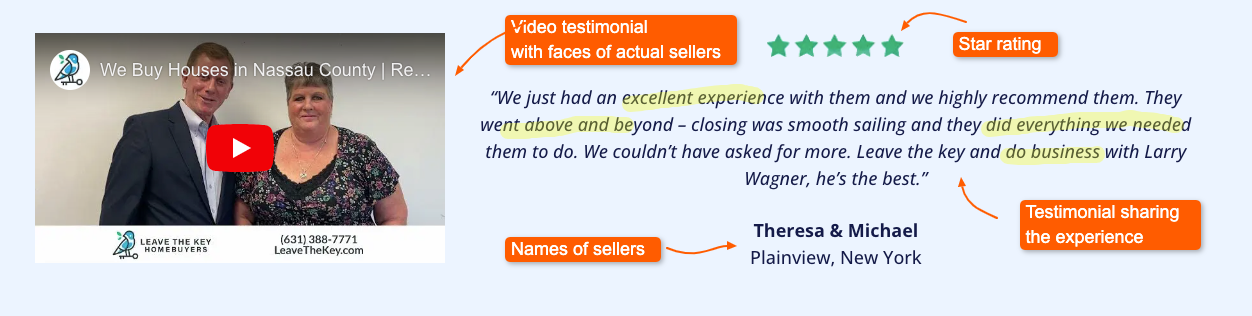
    • Add local details such as photos of houses in that area, maps of your service region, or even a testimonial from a seller in that market. These cues reassure people that you’re not some out-of-town buyer. 

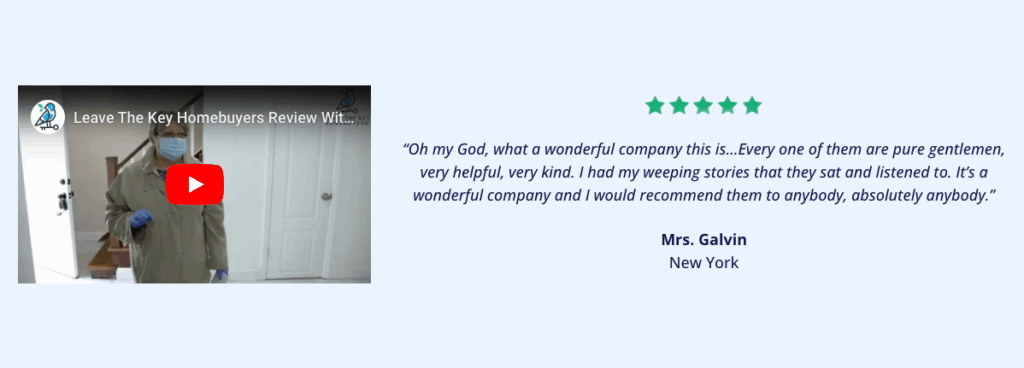
    For example, the page I found earlier (a Carrot site ranking #1 for “sell my house fast queens) has a local proof—a testimonial video from a New York homeowner who sold to that company.

    That’s exactly the type of content Google wants to see!

    • Phrases like “We can meet you anywhere in Eugene within 24 hours” or “We close deals in Medford faster than the typical market average” show you’re truly active on the ground.
    • If you sponsor local events, volunteer, or are part of a chamber of commerce, mention it. Sellers want to work with locals, not faceless companies.

    And if you’d rather have the heavy lifting done for you, Carrot’s Investor Concierge Setup Service is built for exactly that. Our team rewrites your content, personalizes your branding, and localizes your site with credibility signals and SEO tweaks that help you show up (and convert) faster. Instead of wrestling with endless checklists, you’ll have a high-performing site up and running in about 30 days, along with a clear strategy for what to do next. 

    5. Fix Your Image Alt Text

    Alt text (short for alternative text) is a short description you add to each image on your site. It helps Google understand what the image is about and how it relates to the page. Even if sellers don’t always search in “Images,” Google still considers those signals when ranking your page in regular search. It’s the simplest way to get optimized for on-page SEO. 

    For example, instead of leaving the alt text blank or using the default name of the image (img_123.png) you can write “3-bedroom property in Phoenix” or “sell my house fast Tucson cash offer.”

    How to write a good alt text for your image

    Here are some simple ways to write an alt text that helps you rank in search engines: 

    • Be specific: describe what’s actually in the photo, e.g., “2-story rental home in Dallas with brick exterior.” 
    • Keep it short: A few words or a short phrase is usually enough.
    • Skip “image of” or “picture of”: Screen readers or search engines already know it’s an image.
    • Leave decorative images blank: If the image doesn’t add value (like a divider or background), use an empty alt tag instead.

    Website builders, like Carrot, make it easy to add or edit alt text without touching code. Just upload your image, look for the “Alt Text” field, and type in your description. 

    Start with your motivated seller page, your cash buyer page, and any blog posts that already bring traffic. Those are the ones most likely to bring in leads.

    Internal links are simply links that connect one page of your website to another. They help visitors move around your site, but they’re also important for search engines. 

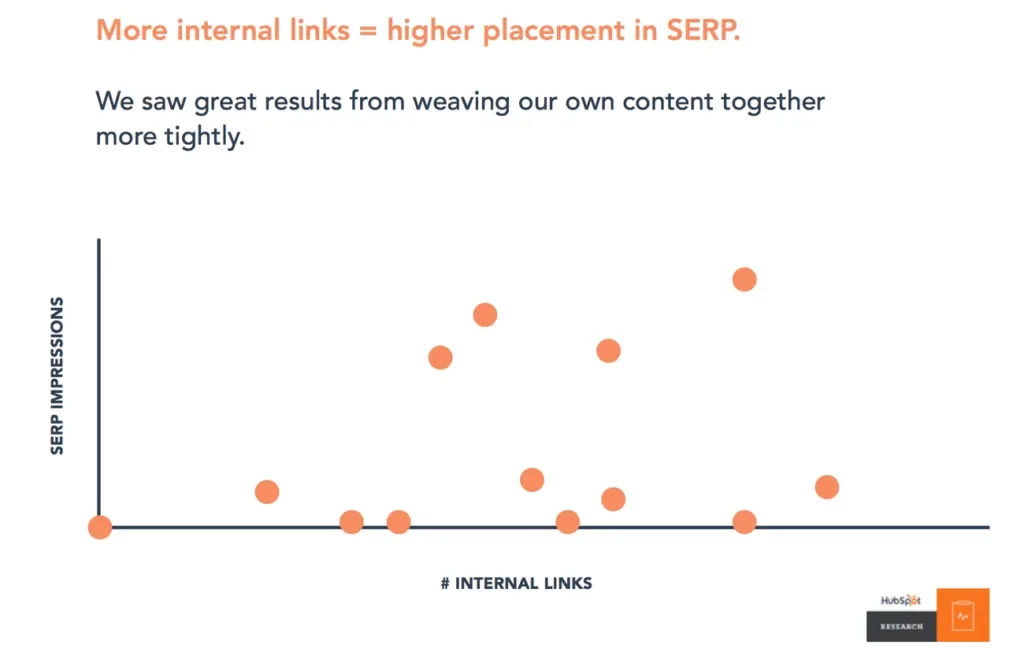
    Google uses them to pass PageRank (authority) from one page to another. If you link often to your motivated seller page, you’re telling Google it’s one of the most important pages on your site. That way it can show that page to visitors for relevant search queries. 

    In the Hubspot study illustrated below, they showed an average higher ranking in search engines based on the number of internal links in their content.

    But the one mistake people often make is not choosing the right anchor text for their internal links. 

    Anchor text is the clickable part of a link, and it gives Google context about the page you’re sending people to.

    Here’s a quick comparison:

    • ❌ Bad: Learn More
    • ✅ Good: Sell your house fast in Portland

    The first tells you nothing. The second clearly signals what the page is about and includes a local keyword. 

    When you’re writing a blog post or adding content, look for natural places to link back to those pages with descriptive anchor text. 

    For example, if you’re writing an article about foreclosure timelines, you could add a link that says “options to sell your house in foreclosure in Dallas” and point it to your Dallas foreclosure page.

    Another key is balance. 

    You don’t want to cram five links into every paragraph. Instead, place links where they make sense for the reader. One or two strong, descriptive links per section of content is enough. 

    Wrapping It Up

    You don’t need a huge team or endless hours to see results from SEO. By focusing on the basics:

    • Optimizing images with alt text
    • Building smart internal links
    • Tightening up your technical SEO
    • Publishing location-focused pages, and 
    • Creating original content

    …you can steadily move the needle. 

    These steps compound over time, and even solo investors can build a site that ranks, attracts motivated sellers, and generates consistent leads.

    👉 Start your Carrot site today and get SEO tools built specifically for real estate investors.

    👉 Prefer to DIY? Check out our SEO guide for step-by-step help on boosting results from SEO.

    👉 Looking for a trusted SEO vendor, specific to real estate investing? Check out our recommendations in the Carrot Marketplace!

    You might also like: https://carrot.com/blog/link-building-for-real-estate/


    FAQs

    1. Do I really need SEO if I already get leads from postcards, cold calling, or referrals?

    Yes. Offline marketing still works, but SEO captures the sellers who are actively searching for solutions online right now. When someone types “sell my house fast in [your city],” they’re raising their hand and looking for exactly what you offer. That’s why SEO is such a powerful and consistent lead source.

    2. How long does it take to see results from real estate SEO?

    SEO isn’t instant like paid ads—it typically takes 3–6 months to see measurable movement in rankings. However, because real estate searches are highly local, you can sometimes rank faster with well-optimized city or county landing pages. The key is consistency: publish relevant content, optimize your site, and track your progress.

    3. What’s the difference between keywords for landing pages and blog posts?

    Great question. Transactional keywords (like “sell my house fast ”) should go on high-converting landing pages, because the searcher is ready to act. Informational keywords (like “foreclosure timeline in Oregon”) work better as blog posts or guides, where you educate first, then invite them to reach out. Matching keyword intent to the right page type is one of the biggest SEO wins.

    4. Can I do real estate SEO myself, or do I need to hire an agency?

    You absolutely can do it yourself. With tools like Carrot’s Keyword Explorer, Rank Tracker, and Site Audit, most investors can cover the basics without hiring an expensive agency. If you can spare a few hours each month to optimize pages, write local content, and build links between your posts, you’ll see results without the overhead.

    5. How do I know which keywords are worth targeting?

    Start with a simple framework:

    • Relevance – Would someone searching this phrase likely hire you?
    • Difficulty – Can you realistically outrank the current top results with a better, more local page?
    • Demand – Even if it’s just dozens of searches per month, is it worth your time?
      Using this sniff test helps you prioritize keywords that drive leads instead of wasting time chasing high-volume terms that don’t convert.

  • 4 Reasons Your Real Estate Website Isn’t Getting You Leads (And How to Fix Them)

    4 Reasons Your Real Estate Website Isn’t Getting You Leads (And How to Fix Them)

    Every day, motivated sellers in your area search online for someone to buy their house. They visit websites, compare options, and choose who to call. But they’re not always calling you.

    It comes down to three critical factors: 

    • Sellers don’t know your website exists
    • If they find your website, you haven’t convinced them you’re trustworthy
    • They want to contact you, but technical issues make it too clunky

    These three factors break down into 4 specific, fixable problems that most real estate investors face. Let’s see what they are and exactly how to fix each issue.

    KEY TAKEAWAYS

    • Most sellers start with a Google search—your site needs to rank locally for “sell my house fast [your city]” to be in the running.
    • Visitors won’t convert if your site is confusing or overwhelming. Simplify your forms and make your CTAs pop.
    • Trust is built through third-party validation—use testimonials, real photos, Google reviews, and recognizable affiliations.
    • A clunky user experience or poor mobile usability and site reliability can quietly wreck your lead flow. Test your site often and prioritize page speed.

    Table of Contents

    1. Your Website Isn’t Showing Up in Google
    2. Your Website Isn’t Built to Convert Visitors
    3. Your Website Doesn’t Build Trust
    4. Your Website Has Technical Issues
    5. What You Should Do Next
    Carrot icon
    Lead generation, at its best
    Attract, convert & close more motivated leads
    Try Carrot Today

    1. Your Website isn’t Set Up to be Found on Top in Search Results

    When someone in your area needs to sell their house fast, what do they do? They don’t flip through the Yellow Pages or look on social media platforms for a buyer. 

    They grab their phone and Google something like “sell my house fast Chicago” or “sell my house for cash.” If your website doesn’t show up in those search results, you won’t get this lead. 

    You can test this yourself — search for the terms you’d want to rank for in your area and see where your website appears. The further down you are, the fewer leads you’re getting. 

    Some of the common reasons why you’re not ranking on top in Google searches (aka not SEO-friendly) are: 

    • Your website doesn’t use the words people actually search for – you say “real estate solutions” but sellers search “sell my house fast”
    • You’re not creating helpful content that answers seller questions like “how to sell a house quickly” or “what do cash buyers look for”
    • Your site doesn’t clearly mention your city or the specific neighborhoods you serve

    For example, this website says they’ll buy your house in America without mentioning any specific city or region.

    No one likely searches “sell my house America” unless they’re living overseas and want to sell a U.S. property. 

    Even then, they’d probably search for their specific state or city, like “sell my house fast in New York” or “sell house quickly in Miami.”

    How to Fix Your Website’s SEO Issues

    Update your website content to include these keywords naturally. Your homepage should clearly state “We buy houses for cash in [your city]” instead of vague phrases like “comprehensive real estate solutions.” 

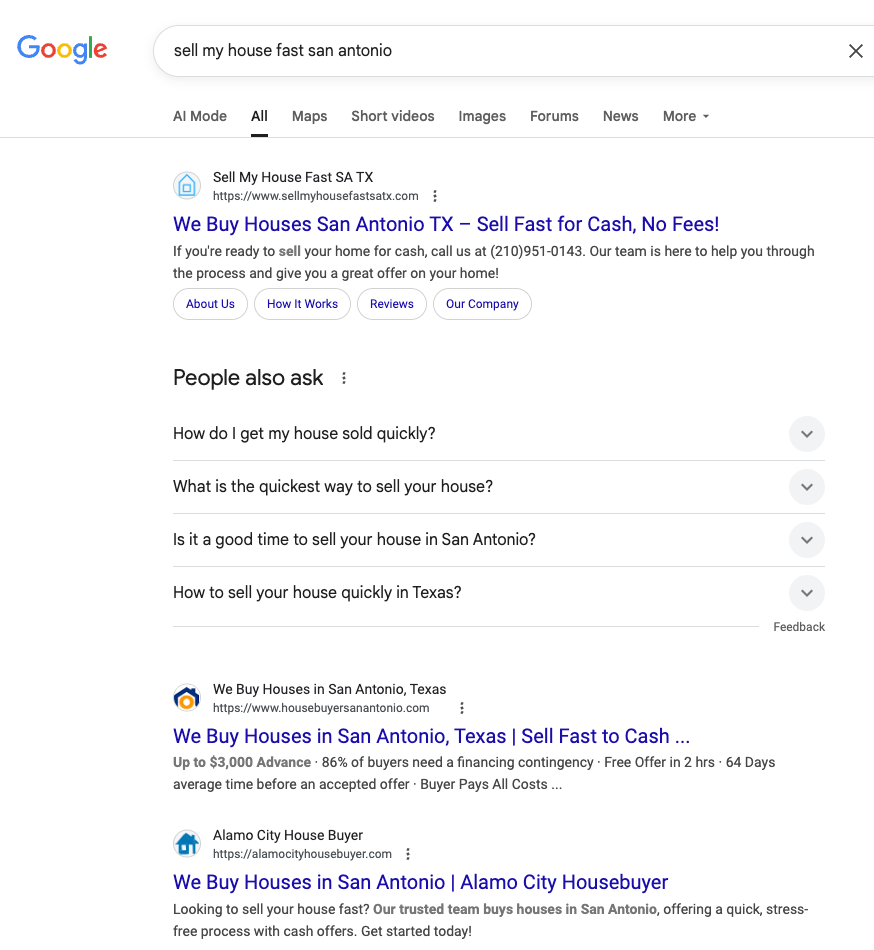
    For example, let’s look at the top result we get when we search for ‘sell my house fast san antonio’ 

    It’s this one… 

    Their website’s homepage clearly states “We Buy Houses In San Antonio, TX” right in the main headline and “SELL YOUR HOUSE FAST SAN ANTONIO” and similar terms throughout the page. They’re using the exact words & questions people search for, not fancy business language.
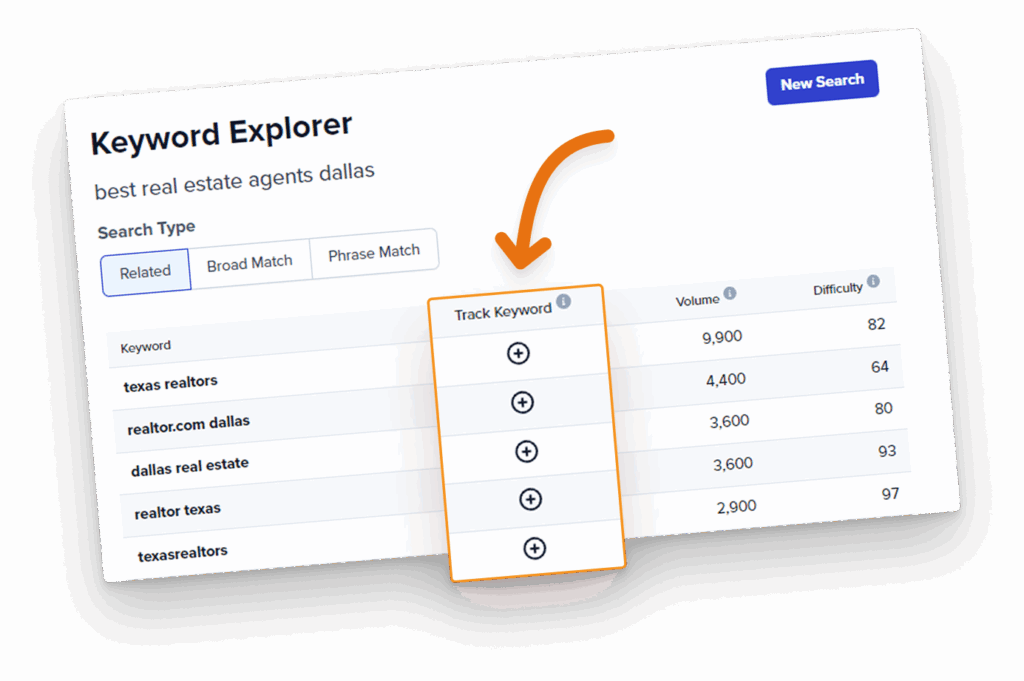
    To find the right keywords you can use Carrot’s Keyword Explorer. It shows you the exact phrases people type into Google when they need to sell fast, plus how competitive each keyword is in your market.

    Even if you use the right keywords, technical issues on your website can still impact your SEO. Things like slow page loading, broken links, or pages that don’t work properly on mobile phones will signal to Google not to prioritize your website. 

    That’s where Carrot’s SEO Site Audit tool can help. 

    It scans your entire website and identifies technical problems that could be dragging down your search rankings.

    SEO isn’t a one-time fix. Regularly publish helpful content, monitor your keyword rankings, and keep optimizing based on what’s working in your market.

    2. Your Website isn’t Designed for Conversion

    You might have hundreds of people visiting your website each month, but if they’re leaving without contacting you, you have a conversion problem.

    Conversion is getting visitors to take the action you want – whether that’s filling out a contact form, calling your phone number, or requesting a cash offer.

    Here are some of the biggest conversion killers sabotaging your website:

    (Keep reading, but if you want to dive deep into site conversion, check out this podcast.)

    7 Site Conversion Killers & 2 Credibility Boosters

    Your forms are asking for too much information 

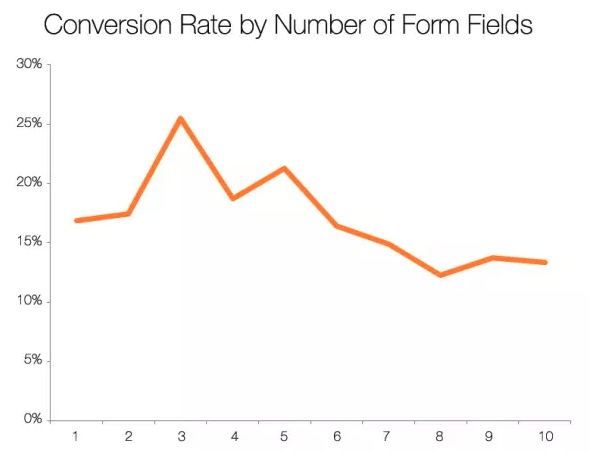
    When visitors see a long form, they get overwhelmed and abandon it. Research by Hubspot analyzing over 40,000 landing pages reveals that 3-field forms convert at 25%, while 10-field forms drop to just 13%. 

    Here is an example of how not to create a form — too many steps make people overthink and abandon the form: 

    Ask only the essentials: name, phone number/email, and property address (optional). You can gather additional details like timeline, property condition, and motivation during your phone call (or using the Autonomous Lead Manager).

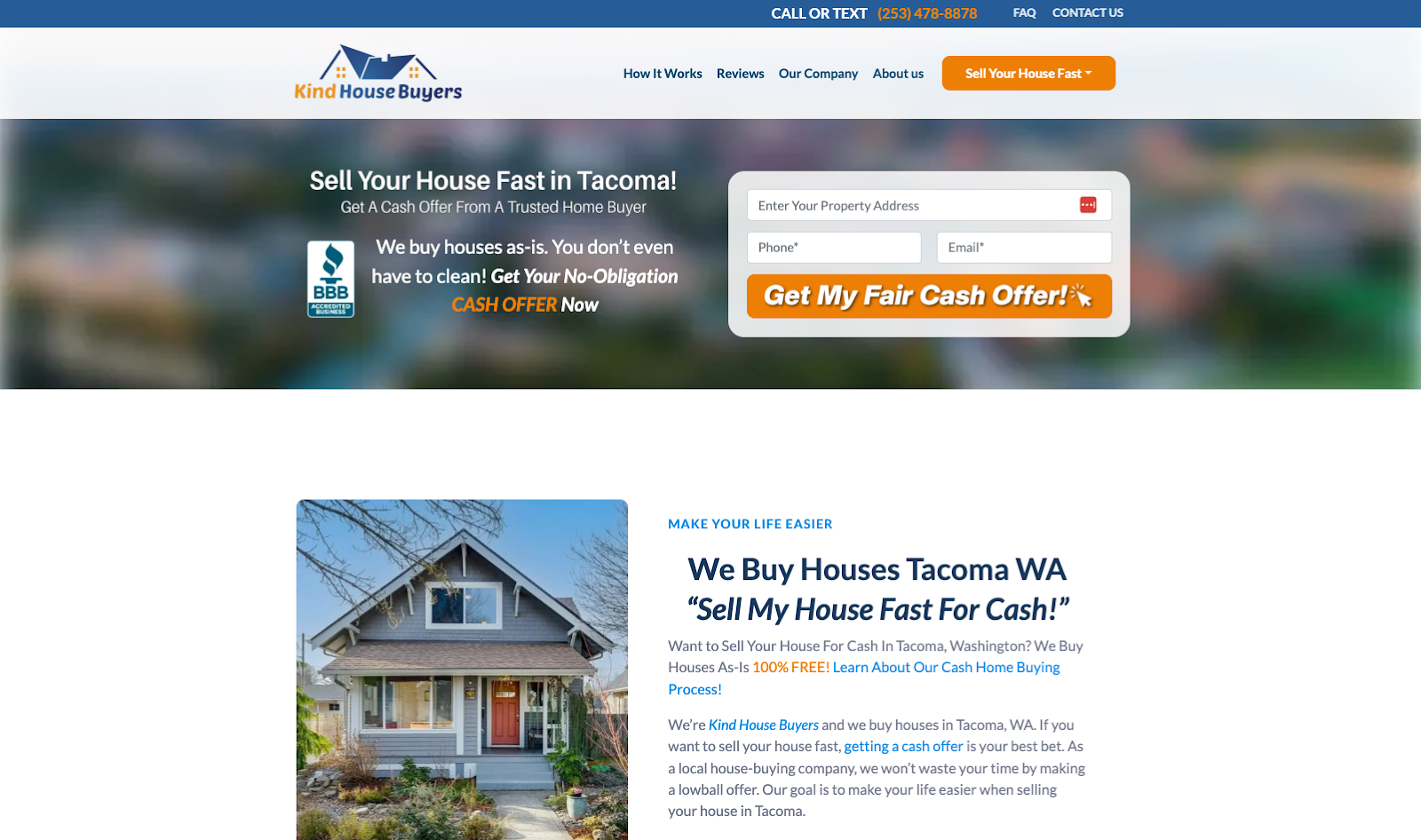
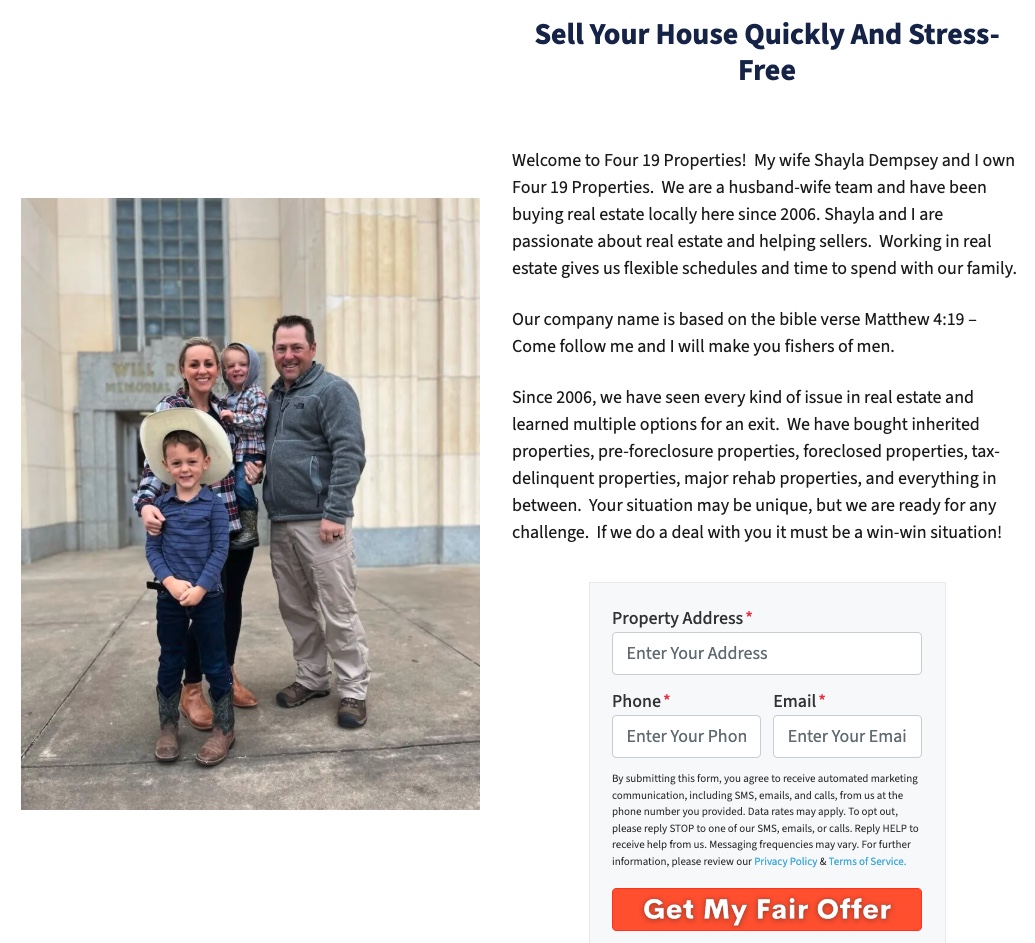
    Here’s a form on a Carrot site that converts visitors to leads at a high rate:

    Your call-to-action buttons are invisible or confusing 

    Your button should be the most prominent element on the page – use contrasting colors and specific language that tells visitors exactly what they’ll get.

    Notice the call-to-action (CTA) in the form image above. 

    • The bright orange “Get My Fair Cash Offer” button jumps off the page compared to the other colors, making it impossible to miss.
    • The copy is benefit-driven and specific – instead of generic text like “Submit,” it tells visitors exactly what they’ll get: their cash offer.

    At Carrot, we tested changing button text from “Click to Continue” to “Get My Fair Cash Offer” and saw conversions jump 49.5%. 

    Important elements are buried on your page 

    Don’t fall into the trap of making your website look beautiful at the cost of conversions. Your goal isn’t to get a “wow” when someone visits your site – it’s to get their contact information.

    This Forster Jones page looks sleek and sophisticated, but the tiny “Contact Us” link is buried in the top corner and easy to miss.

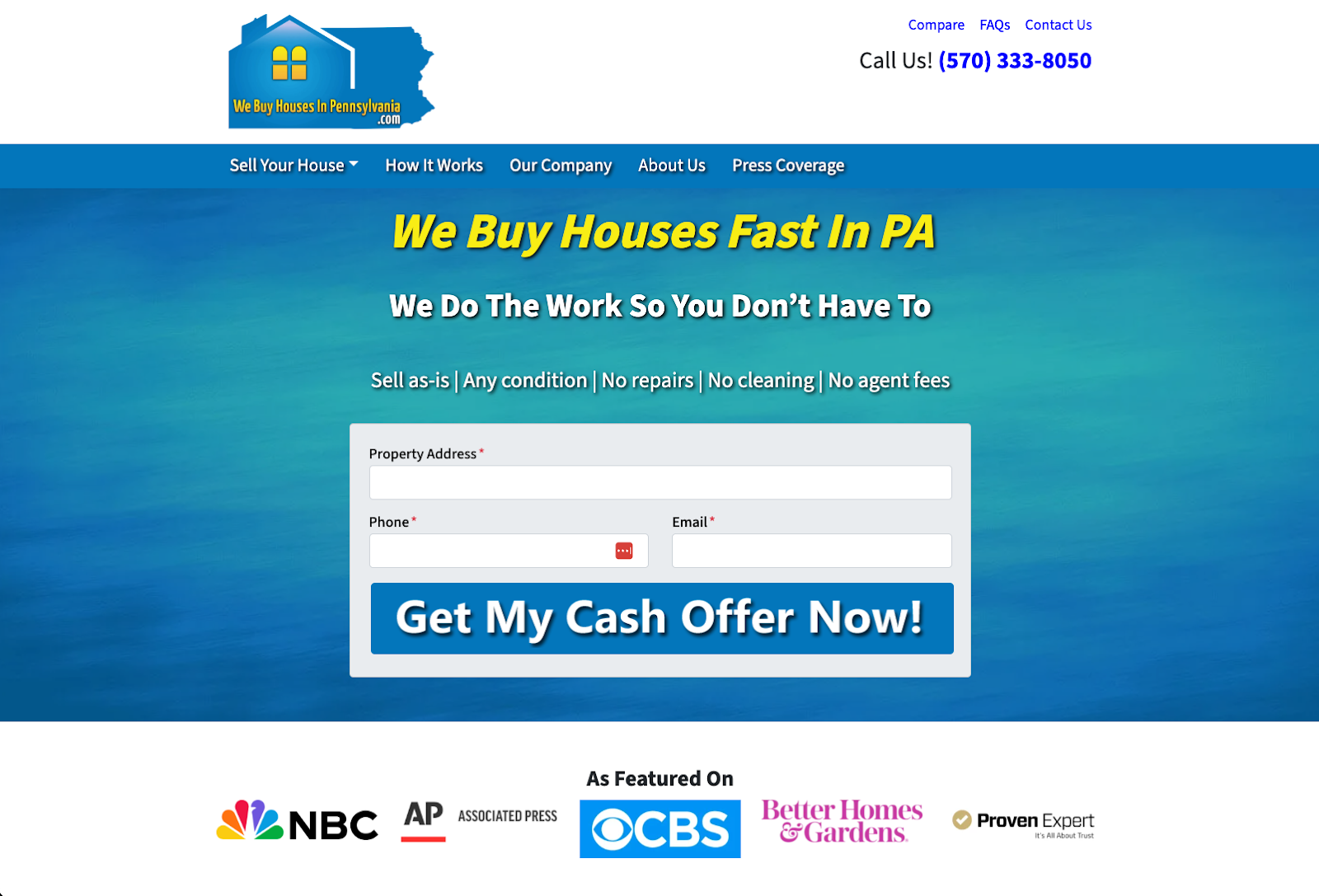
    Compare that to this investor’s homepage that prioritizes conversion over aesthetics (one of the highest converting sites in all of Carrot):

    This page has: 

    • A prominent headline that immediately tells visitors what they’ll get.
    • The contact form is clearly visible. It’s a simple 3-field form that people won’t hesitate to fill out. 
    • The blue “Get My Cash Offer Now” button dominates the page and can’t be missed.
    • Multiple contact options. The phone number is visible with “Call Us.”
    • Trust signals like recognizable publications they’ve been featured in are visible under the form.
    • Clear benefit statements — “Sell as-is | Any condition | No repairs | No cleaning | No agent fees” — address the main seller concerns upfront.

    We might suggest they test a different button color so it pops out even more. They could push their conversion rates even higher!

    3. Your Website Lacks Trust Signals That Convince Visitors You’re Legitimate

    People don’t trust businesses saying good things about themselves. 

    Instead, they look for validation from others who’ve been in their exact same shoes – past customers who needed to sell their house. When they see logos from authority websites, professional organizations, or credible third-party platforms on your site, trust builds naturally because these entities have nothing to gain by vouching for you. 

    You need trust elements on your website to show people that you can be trusted to do business with. 

    Some of the key trust signals are:

    • Real testimonials with photos: Not just “Great service! – J.K.,” but detailed stories with full names and pictures. Carrot found that sites with testimonials saw a 123% increase in leads compared to sites without them.


    Check out this video to learn how to ask specific questions that’ll get a house seller to give you a raving review that busts objections. 

    Getting Better Testimonials: Increasing Trust & Conversion for Real Estate Investor Leads


    • Your photo and company information: People want to see who they’re dealing with. A photo of you or your team and a personalized “About Us” page shows you’re real folks. 

    • Google reviews and ratings: Display your Google star rating prominently. 
    • Authority website logos and credentials: BBB accreditation, professional association memberships, industry certifications, or “As Seen On” logos from reputable news outlets all build instant credibility.

    4. Your Website has Technical Problems

    There’s nothing more frustrating than a motivated seller trying to contact you but giving up because your site doesn’t work properly.

    Does your website work properly on mobile?

    With over 93% of mobile searches happening on Google and most people searching for house buyers on their phones, a website that doesn’t work on mobile is essentially invisible. 

    Check if your site has these mobile killers:

    • You can scroll side-to-side, and the screen doesn’t adjust to phone size
    • Text becomes so small it’s unreadable on mobile
    • Buttons are too small to tap with a normal-sized thumb
    • Contact forms don’t work properly on phones or are hard to fill out

    Switch to a mobile-friendly real estate website design like Carrot to fix these issues once and for all. 

    Are your forms working correctly?

    Another common technical issue is: Broken forms. 

    A broken form doesn’t just mean it shows an error or won’t accept information. Sometimes forms appear to work perfectly but are actually failing in hidden ways:

    • The form submits, but visitors never see a “thank you” or confirmation message, so they assume it didn’t work and either try submitting again or give up entirely
    • You’re receiving the leads, but they’re going to your spam folder, so you never follow up
    • The form works on computers but crashes on mobile phones

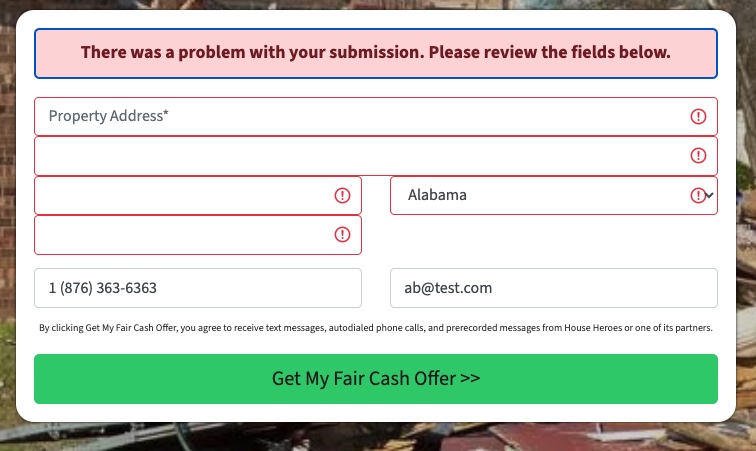
    Forms that don’t submit properly, error messages that don’t explain what went wrong, or confirmation pages that don’t load will frustrate sellers into calling your competitors instead.

    Here’s an example of a form that shows a clear error: 

    Test your contact form monthly by submitting it yourself. Make sure you see a clear confirmation message after submitting. Connect your forms to a CRM and add SMS alerts so you know immediately when someone contacts you.

    Is your website loading as fast as possible? 

    If everything else is working correctly, check how fast your page loads. A 10-second load time might not seem like much, but when people are online searching for someone to buy their house and they have dozens of options, they won’t wait around.

    Google has found that bounce rates increase by 32% when page load time goes from 1 second to 3 seconds. For real estate investors, this means every extra second your website takes to load is literally sending motivated sellers to your competitors.

    Our websites are built specifically to load fast, rank high in search results, and convert visitors into leads.. That’s why you’ll consistently find Carrot sites loading noticeably faster than the industry standard.

    You can test your website speed at Google PageSpeed Insights. (And check out a few more tips on page speed from our help center.)

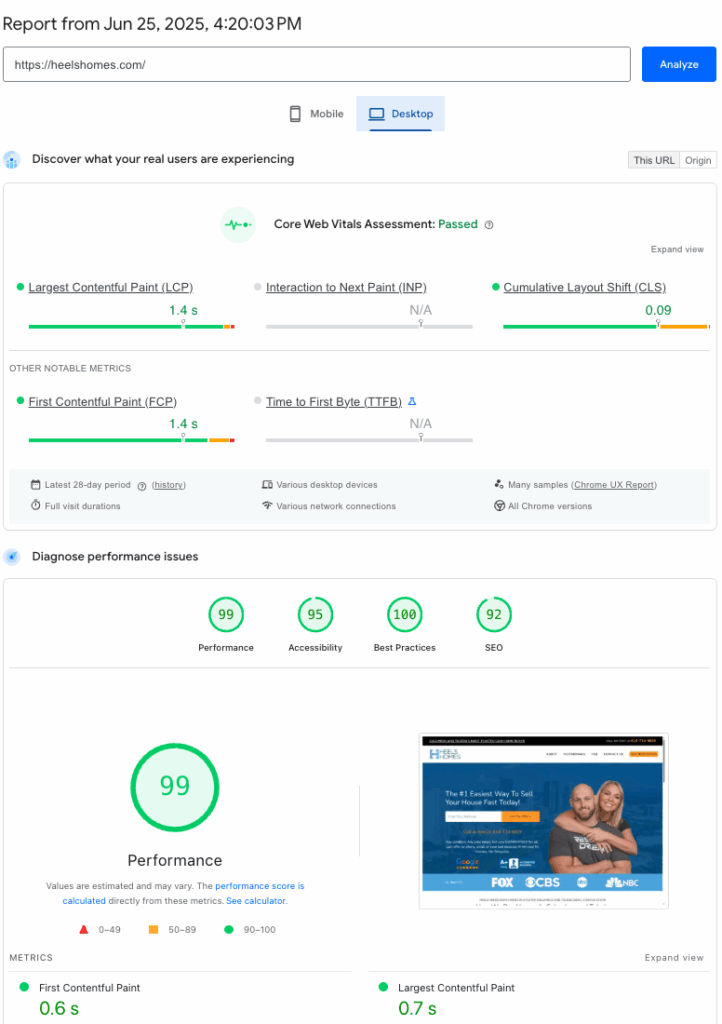
    The test below was done on Josh & Tiffany High’s Carrot website using Google PageSpeed Insights. Check out the score!

    If your site takes longer than 3 seconds to load, make sure your website is built with clean code from the ground up, your server is fast, and your images are in the proper size and format. We have all of that baked into our Carrot real estate websites.

    What Should You Do Next?

    These four issues are costing real estate investors thousands of dollars in lost deals every month. The good news is they’re all fixable.

    You can tackle them one by one, or you can use a platform like Carrot that’s designed specifically for real estate investors.

    Every Carrot website comes with the conversion elements we’ve discussed already built in: mobile-optimized design, fast loading speeds, strategic contact forms, easy-to-add trust signals, and SEO optimization. 

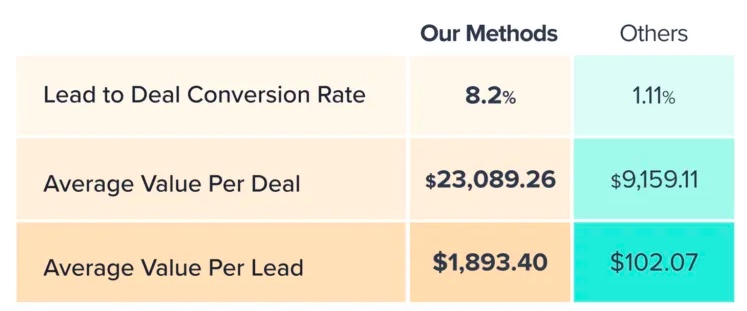
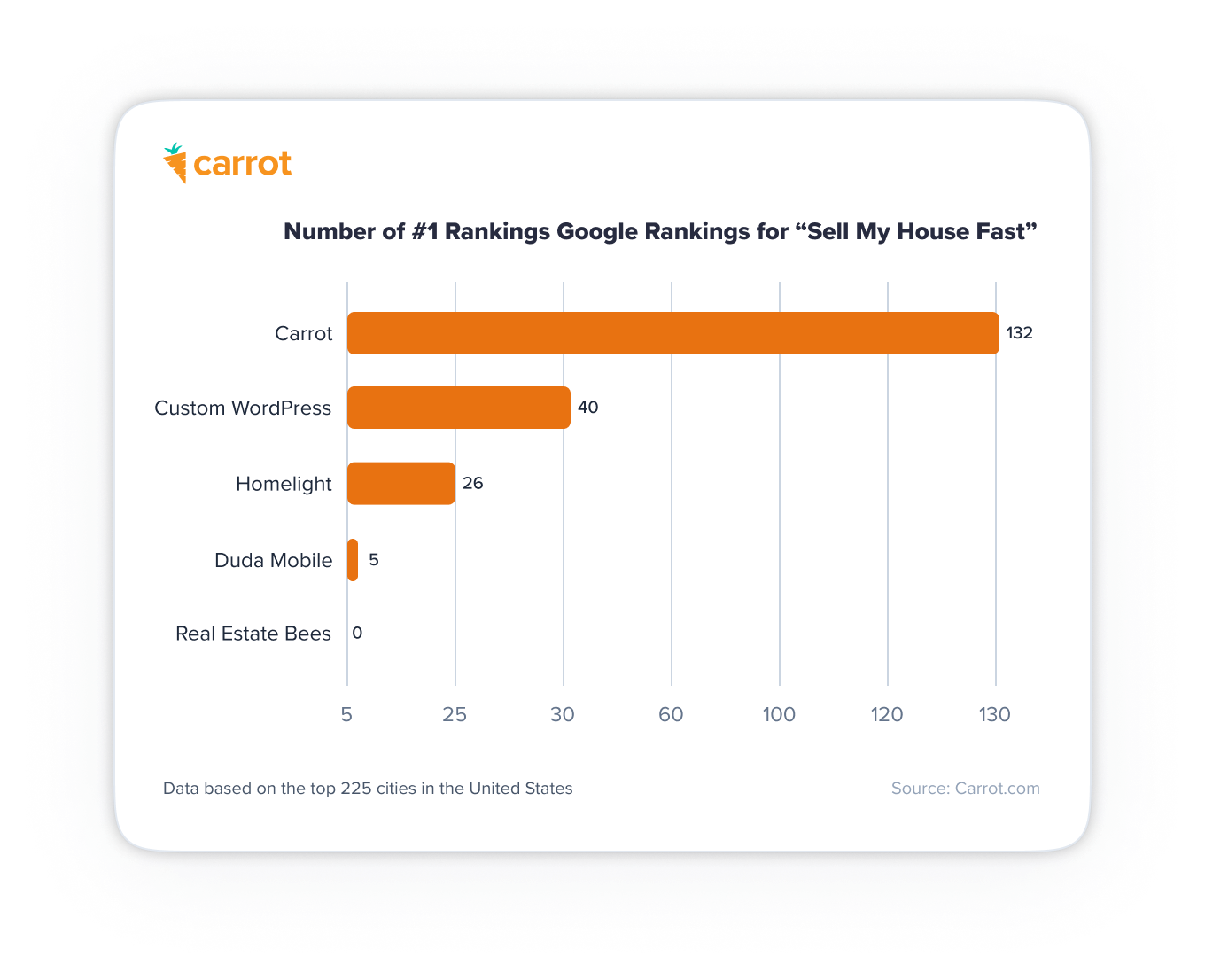
    Carrot websites generate 2.5 times higher profits per lead compared to other platforms. Members have generated over 1 million motivated seller leads, and Carrot sites hold 45% of the top search rankings in most U.S. markets.

    Check out a demo of Carrot today and see why thousands of investors choose it over building their own websites from scratch.

  • How AI is Reshaping SEO for Real Estate Investors: What You Need to Know in 2025

    How AI is Reshaping SEO for Real Estate Investors: What You Need to Know in 2025

    The search landscape has seen huge changes in recent years. If you’re a real estate investor who’s been watching your website traffic fluctuate or noticing fewer clicks from Google searches, you’re not imagining things.

    Google’s AI Overviews now appear in nearly half of all search results, and in May 2025, Google launched AI Mode for all US-based searchers. The era of traditional SEO strategies is rapidly evolving.

    For real estate investors who depend on their websites to generate motivated seller leads, these changes are business-critical developments that require immediate attention. When prospects search “cash home buyer,” “we buy houses,” or “sell my house fast,” Google increasingly provides answers directly in search results, pushing the #1 ranked website further down the page than we’re used to. So how should you adjust your SEO to make sure you still show up on top in 2025? Let’s cover some key strategies!

    KEY TAKEAWAYS (TL;DR)

    • AI Overviews are Dominating Search: Google’s AI-generated summaries now appear in nearly half of all search results, often providing “zero-click” answers, which means many searchers never leave the Google search results page.
    • Brand Authority is Key: Google’s algorithms now heavily emphasize brand recognition and mentions across the web, not just on your site. Backlinks are still important, but you’ll also want your company mentioned by name on trusted, relevant sites.
    • Unique Content is More Important Than Ever: Generic content is being de-ranked, and often even ignored by Google. Focus on providing your own unique and helpful expertise, local market insights, and real-world case studies that AI tools like ChatGPT can’t replicate.
    • Local SEO is Evolving: Optimize your Google Business Profile and target hyper-local keywords, as AI Mode prioritizes local intent.
    • Diversify Your Marketing: Reduce reliance on single marketing tactics by investing in omnichannel marketing, including social media, video content, and offline networking.

    Let’s get you up to speed on the most significant AI-driven changes impacting search in 2025 and beyond. In this guide, we’ll cover what these changes mean for your real estate investing business, and give you actionable SEO strategies to help you maintain and grow your online presence.

    Table of Contents

    1. The AI Revolution in Search: What to Know
    2. Building Brand Authority in an AI-Dominated Landscape
    3. Adapting Your Content Strategy for AI-First Search
    4. Measuring Success in the New SEO Landscape
    5. How to Stay Ahead: Real Estate Investor Marketing in the A.I. Era
    6. Your Action Plan: 15 Essential Steps to Future-Proof Your Marketing Strategy
    7. Conclusion
    8. Frequently Asked Questions
    Carrot icon
    Lead generation, at its best
    Attract, convert & close more motivated leads
    Try Carrot Today

    The AI Revolution in Search: What Real Estate Investors Need to Know

    Google’s AI Overviews Are Dominating Search Results

    The most dramatic change affecting real estate investor websites began in May 2024 when Google officially launched AI Overviews.

    By December 2024, these AI-generated summaries appeared in 47% of Google search results, and recent data shows they spiked even higher during Google’s March 2025 core update.

    Most recently at Google’s I/O annual developer conference in May 2025, they announced the rollout of AI mode to all users in the U.S.

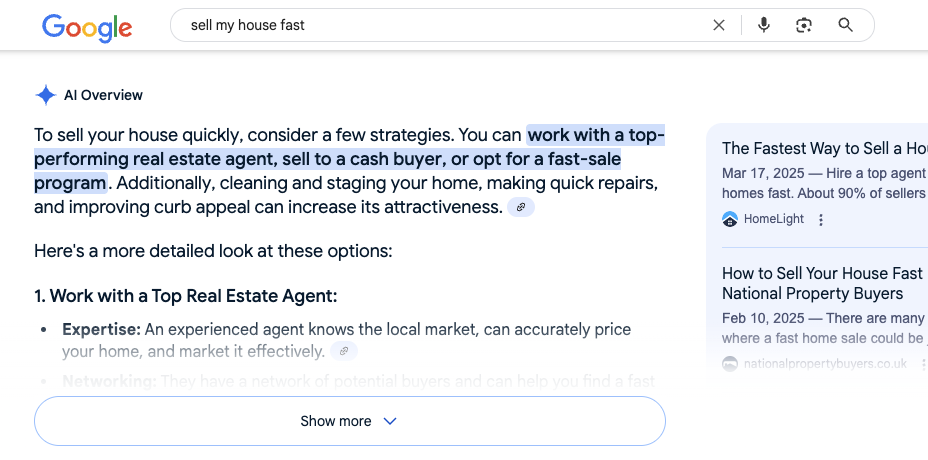
    Screenshots showing Google's AI overviews for a search of "sell my house fast".

    Here’s what’s especially challenging for real estate investors: AI Overviews show up heavily for broad, top-of-funnel queries—exactly the type of searches your potential sellers are making when they first consider selling their property. When someone searches “how to sell my house fast” or “cash home buyers near me,” they’re increasingly getting AI-generated answers without ever clicking through to your website.

    The numbers are staggering:

    • Research shows that nearly 60% of searches in 2024 resulted in “zero-click” outcomes, meaning users get their answers directly from Google without visiting any websites.
    • A study by Datos and SparkToro found that for every 1,000 searches on Google in the United States, only 360 clicks make it to non-Google-owned properties that aren’t paying for ads.

    The Rise of Forum Content and Video Results

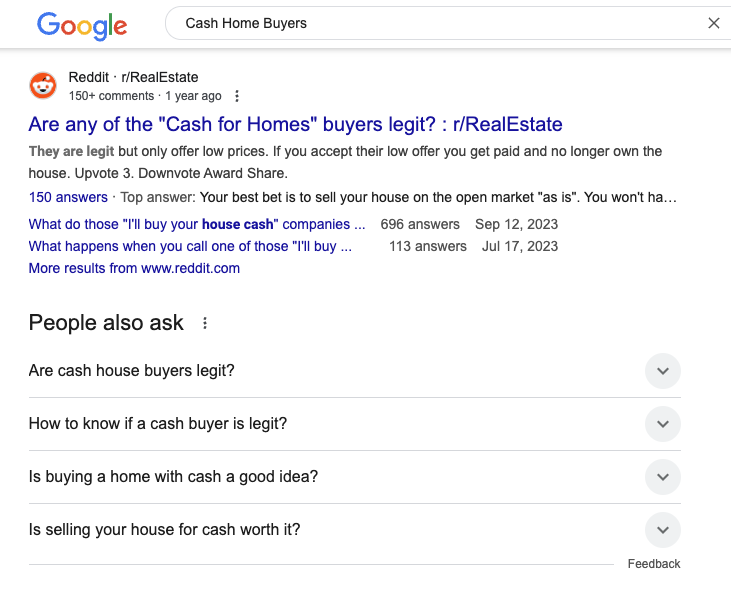
    Another significant shift impacting SEO strategies for small businesses is the increased prominence of forum content like Reddit and Quora in search results. This trend is particularly relevant for real estate investors because many forum discussions reveal the distrust and skepticism people have toward “cash home buyers” and the real estate investment industry in general.

    Screenshot showing Reddit forum answers in the Google search results.

    When potential sellers search for information about working with real estate investors, they’re increasingly finding forum discussions where people share both positive and negative experiences. This shift emphasizes the critical importance of reputation management and building authentic trust signals across multiple platforms.

    Video content is also showing up more often in search results, with both YouTube videos and short-form video content appearing more frequently. This presents opportunities for real estate investors looking to diversify their content strategy. Plus, research shows that websites with video content see 50% more engagement than those without.

    You can stay ahead of things by monitoring relevant forums and conversations in your local market area. Then develop content in both written and video formats that speaks directly to the concerns people have. Showcase the trustworthy, local people behind your company to combat the skepticism that some motivated sellers may have about cash home buyers.

    Building Brand Authority in an AI-Dominated Landscape

    The Growing Importance of Brand Mentions and Recognition

    One of the most significant revelations from the May 2024 Google algorithm leak was the emphasis on brand authority.

    In Rand Fishkin’s original analysis of the leaked Google Search API documents, his primary takeaway was that “brand matters more than anything else.” He commented:

    If there was one universal piece of advice I had for marketers seeking to broadly improve their organic search rankings and traffic, it would be: “Build a notable, popular, well-recognized brand in your space, outside of Google search.”

    For real estate investors, this means your reputation and brand recognition across multiple platforms now directly impacts your search rankings. Google measures brand mentions on YouTube transcripts, social media platforms, and across the web.

    The stronger your brand presence beyond your website, the better your chances of ranking well in traditional search results and being cited in AI Overviews. More than ever, off-page SEO isn’t just about building backlinks. It’s also about social media visibility and digital PR & publicity for your business.

    You can monitor referring domains, backlinks to your website, and your Authority Score with Carrot’s Domain Overview Tool. We also recommend adding your company’s business name to the Keyword Rank Tracker to monitor that your website ranks at the top of the search results when people search for your company by name.

    The Role of Engagement Signals in Rankings

    Google had insisted for years that they don’t use anything from Chrome for ranking, but the Google API documents leaked in May 2024 suggested that they actually do use Chrome and Android device data to understand how users interact with websites.

    Engagement signals are crucial ranking factors. Google looks at what happens after users click through from the search results to your website.

    Your website’s user experience directly impacts your search rankings. If visitors quickly return to Google after visiting your site (known as “pogo-sticking”), it signals to Google that your content didn’t satisfy their intent. However, if they spend time on your site reading content, watching a helpful video, or filling out a form, those engagement signals can play a role in how Google will rank your website in the future.

    Adapting Your Content Strategy for AI-First Search

    The Challenge of AI-Generated Content Saturation

    Google’s March 2024 core update, described as their “largest in history,” resulted in 45% less low-quality, unoriginal content in search results. The search engine giant is actively working to combat the flood of AI-generated commodity content that lacks originality and value.

    In January 2025, Google updated its Search Quality Rater guidelines to focus on spam and unoriginal content. Google expanded the definition of what it considers spam, and it called out low effort content in Section 4.6.6 of their guidelines:

    “The Lowest rating applies if all or almost all of the [Main Content] on the page (including text, images, audio, videos, etc) is copied, paraphrased, embedded, auto or AI generated, or reposted from other sources with little to no effort, little to no originality, and little to no added value for visitors to the website. Such pages should be rated Lowest, even if the page assigns credit for the content to another source.”

    Google’s quality raters are human consultants hired by Google to manually spot check the quality of Google search results and provide feedback to help Google improve their algorithms. The Search Quality Rater guidelines tell these consultants what they should look out for when evaluating the search results.

    Understanding Information Gain and Content Uniqueness

    Google’s “information gain score” patent, granted in June 2022, represents a fundamental shift in how search engines evaluate content quality. Rather than focusing solely on word count or how recently a page was updated, Google now measures how much new useful information your content provides that doesn’t exist elsewhere online.

    For real estate investors, this means that simply publishing generic content is not only unlikely to improve your rankings, it could actually hurt your search visibility. Instead, you need to consistently add your specific expertise, local market knowledge, case studies, and unique data that differentiates you from competitors.

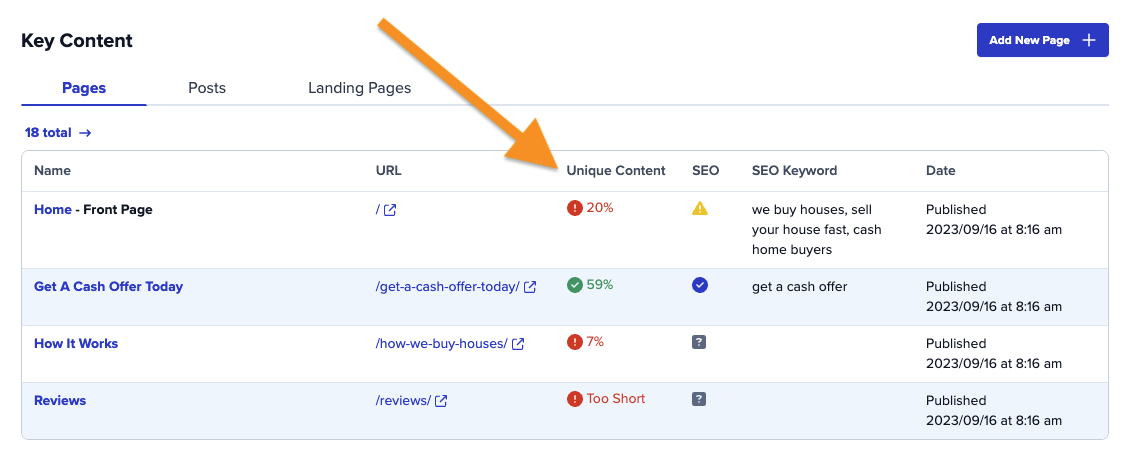
    This is why we’ve built our Unique Content Tool to help you see how different your edited content is from the original template. Plus, our updated AI Rewrite Tool makes personalizing your content easier than ever! You’ll still need to add your own insights, but our built-in tools can expedite your content creation process by making sure the AI-generated copy matches your unique brand — an excellent starting point.

    Screenshot showing Carrot's Unique Content Tool

    Creating Content That Stands Out

    The key to a successful content strategy in 2025 and beyond lies in combining AI efficiency with human knowledge and authenticity.

    Real estate investors have a unique advantage here—your direct experience with local markets, specific property challenges, and successful deal structures provides the exact type of unique information that both Google’s algorithms and your potential clients value most. You can still use AI tools to help you write, just be sure to add your own insights and flair. (Carrot’s Automated Content Library is a perfect example of this. It offers well-researched, pre-written blog posts that you can use as a starting point, then customize to your market and with additional insights and expertise you’ve honed over your career.)

    When you combine well-optimized website content with video marketing, you can build trust and credibility with local homeowners and increase your potential visibility in Google search results.

    Measuring Success in the New SEO Landscape

    Traffic Attribution and Traditional SEO KPIs are Changing

    The traditional SEO metrics that real estate investors have relied on for years—keyword rankings, organic traffic, and click-through rates—are becoming less reliable indicators of holistic marketing success. As Google’s search results pages continuously evolve with AI Overviews, video content, and forum results, these metrics don’t tell the complete story of your marketing performance.

    A critical issue affecting real estate investor websites is attribution of traffic sources. Research in 2024 showed that significant percentages of web traffic from social networks, messaging apps, and even AI chatbots are often lumped in under “Direct” traffic by Google Analytics.

    This “dark traffic” phenomenon means you might be receiving more referral traffic from social media, AI chatbots like ChatGPT, and other sources than your analytics show.

    The Rise of Brand Awareness Metrics

    In this new landscape, brand awareness metrics are becoming increasingly important. Brand mentions across the web, branded search volume, and your visibility in AI-generated responses are now crucial indicators of your market authority and future search performance.

    For real estate investors, this shift means monitoring how often your company is mentioned on social media, in local forums, and in AI chatbot responses when people ask about local home buyers. These mentions often lead to branded searches and direct traffic that may not be properly attributed in traditional analytics.

    We always recommend tracking branded terms (like your company name) in our Keyword Rank Tracker so you can make sure you are controlling the conversation around your brand.

    Aligning with Business-Critical Metrics

    More than ever, SEO success and marketing efforts need to align directly with business metrics that matter to your real estate investing operation. A decrease in organic traffic might be offset by higher-quality leads or better conversion rates from other sources.

    For real estate investors, this makes it even more important to focus on business metrics like revenue, lead quality, cost per lead and lead-to-close ratios rather than website traffic or rankings alone. (Make sure you have a strong, real estate-specific CRM to help you monitor these key metrics.)

    How to Stay Ahead: Real Estate Investor Marketing in the AI Era

    The changes we’ve seen in 2024 and early 2025 are just the beginning of AI’s impact on search and digital marketing. Google’s introduction of AI Mode with Gemini 2.0 in March 2025 shows even more sophisticated AI capabilities are coming, with particular emphasis on local intent and complex query handling.

    For real estate investors, this means the strategies that work today need to be flexible enough to adapt as AI becomes even more prominent in search results.

    The most successful real estate investors in this new landscape will be those who maintain competitive advantages that can’t be easily replicated by AI or competitors. This includes deep local market knowledge, strong personal relationships, proven track records, and authentic brand authority and content built over time.

    Your Action Plan: 15 Essential Steps for Real Estate Investors to Future-Proof Your Marketing Strategy

    Based on the major shifts happening in search and AI, here’s your comprehensive action plan to adapt and thrive:

    1. Optimize Content for AI Overview Inclusion – Structure your website content with clear, concise answers to common seller questions. Utilize dedicated FAQ block patterns, bullet points, and numbered lists to make information easily digestible for both human readers and AI algorithms. Ensure your content directly addresses user intent, making it a prime candidate for Google’s AI Overviews and featured snippets by providing direct, authoritative responses.
    2. Target Hyper-Local and Intent-Driven Keywords – Shift your keyword strategy from broad, competitive terms like “we buy houses” to highly specific, long-tail, and geographically focused phrases. Think “sell my house fast in [your specific neighborhood]” or “cash home buyer for inherited property in [your city].” Rather than old-school keyword stuffing, use entity-based SEO to provide context and meaning through synonyms and related words. This approach helps you capture niche local demand and signals to Google’s AI that your content is highly relevant to specific local queries.
    3. Prioritize Unique, Expert-Driven Content (Information Gain) – Move beyond generic advice and focus on creating unique content that provides genuine “information gain.” This means consistently adding your original expertise, local market knowledge, real-world examples, and proprietary data that can’t be easily found elsewhere or replicated by AI. Your direct experience with specific property challenges and successful deal structures is what will differentiate you from your competitors.
    4. Create Transparent Process Guides – Develop detailed, process-driven educational content that clearly outlines your actual methods for evaluating properties, calculating costs, and negotiating deals. Sharing your transparent approach builds significant trust with potential sellers, demystifies the real estate investment process, and positions you as an honest, knowledgeable authority in your local market.
    5. Cultivate a Consistent Multi-Platform Brand – Establish and maintain a strong, consistent brand presence across all relevant digital platforms. This includes not only your website but also YouTube, LinkedIn, Facebook, Instagram, and specialized real estate forums. Ensure your messaging, visual identity, and value proposition are consistent, building credibility for your brand and recognition across the web, which Google increasingly values.
    6. Engage Actively on Community Platforms – Proactively participate in online communities where homeowners discuss selling properties, such as Reddit, Quora, Nextdoor and local Facebook groups. Provide genuine value by answering questions, offering insights, and sharing helpful resources without being overly spammy or self-promotion. Focus on bringing your humanity into conversations, building trust, establishing yourself as a helpful expert, and driving referral traffic and brand mentions.
    7. Develop High-Value Video Content – Create diverse video content, including property walkthroughs, authentic seller testimonials, and educational videos explaining various aspects of selling to an investor. Optimize these videos with relevant titles, descriptions, and tags for YouTube and embed them strategically on your website. Simply upload your video and Carrot’s VideoPost will transcribe it into a blog post that’s optimized for search engines.
    8. Showcase Authentic Customer Success Stories – Document your successful deals and share them as case studies on your website, video testimonials, and social media success stories. These real-world examples provide powerful social proof, demonstrate your ability to solve problems for sellers, and build trust and credibility that generic AI-generated content simply cannot replicate.
    9. Optimize Your Google Business Profile for Local Dominance – Your Google Business Profile (GBP) is more critical than ever. It’s often the first touchpoint for local sellers and a primary data source for Google’s AI Overviews, especially for “near me” searches. Ensure your GBP is fully claimed, verified, and meticulously optimized with accurate business hours, services offered (e.g., “cash home buyer,” “fast house sale”), high-quality photos of properties and your team, and consistent updates. Actively encourage and respond to reviews, as these build trust and signal local authority to both potential sellers and Google’s algorithms. A robust GBP is foundational for appearing in local search results and being cited by AI.
    10. Proactively Monitor Brand Reputation – Set up comprehensive monitoring systems like Google Alerts and specialized social listening tools to track all online mentions of your company, key personnel, and brand. Actively manage your online reputation by responding to reviews, addressing feedback, and correcting misinformation. A strong, positive brand reputation is a crucial signal for Google’s algorithms and AI Overviews, influencing your visibility and trustworthiness.
    11. Align Marketing KPIs with Business Outcomes – Shift your focus beyond traditional SEO metrics like keyword rankings and organic traffic, which are becoming less reliable. Instead, analyze performance through the lens of core business metrics: lead quality, cost per lead, lead-to-close ratios, and revenue generated. Pay close attention to how AI Overviews impact branded versus non-branded searches, and track referral traffic from social media, forums, and AI chatbots, even if it’s initially misattributed. Make sure your marketing efforts are directly tied to tangible results for your real estate investing operation, even if traditional traffic numbers fluctuate.
    12. Focus on Brand Visibility & Public Relations – Actively seek out credible brand mentions for both your company and personal brand across various platforms. Engage in relevant forums like Reddit and Quora, and leverage PR platforms like HARO and Qwoted to secure publicity. Remember that mentions by brand name on third-party sites, including YouTube and LinkedIn, are just as crucial as backlinks for signaling authority and can significantly enhance your visibility within LLMs and AI Overviews, directly building trust and recognition in your target market.
    13. Establish Deep Local Authority (Offline & Online) – Build authentic local market authority by actively engaging with your community both online and in the real world. Attend local investor meetings, sponsor community events, and develop strong relationships with real estate professionals, contractors, and local businesses. These real-world connections increase your credibility, generate valuable word-of-mouth referrals, help you find off-market properties, and reinforce your local presence to Google’s algorithms.
    14. Embrace a Diversified Omnichannel Approach – Reduce your dependence on any single lead source by investing in a truly omnichannel marketing strategy. Diversify your efforts across search engine optimization, social media marketing, targeted direct mail campaigns (make sure your mailers include your URL or a scannable QR code!), email nurturing sequences, and in-person networking. This creates a resilient lead generation ecosystem that can withstand future shifts in search algorithms and consumer behavior.
    15. Leverage an AI-Powered CRM for Sales Efficiency – Integrate and fully utilize CRM platforms like Carrot CRM with embedded AI features to streamline your sales process and manage high-volume pipelines effectively. Carrot CRM’s newest features — Autonomous Lead Manager (ALM), AI Opportunity Summaries, and AI Lead Scoring — can automate follow-ups, prioritize leads, and provide real-time property analysis, giving your acquisition team improved clarity and speed without replacing the essential human touch.

    Conclusion

    The AI revolution in search represents both significant challenges and unprecedented opportunities for savvy real estate investors. While traditional SEO strategies are evolving, the fundamental principles of providing value, building trust, and solving real problems for homeowners remain as important as ever.

    Remember, AI is changing how people find information, but not why they need to sell their houses quickly or work with reliable investors.

    To be successful, you should adapt to changing technologies while focusing on what makes your real estate investment business unique.

    The same time-tested strategies are true both online and off:

    • Build lasting relationships and genuine brand authority with people in your local market.
    • Provide valuable solutions for motivated sellers, then share that know-how online (while providing “information gain” that sets you apart from competitors).
    • Diversify your offline and digital marketing channels, but remember that other human beings will make or break your success.

    By combining these timeless principles with modern strategies adapted for an AI-first world, you’ll be well-positioned for continued success.

    Ready to future-proof your real estate investment marketing? Analyze the competitive landscape in your local market area for free with Carrot’s Market Scout.

    Frequently Asked Questions

    Q: How do I know if AI Overviews are affecting my real estate investor website traffic?

    Monitor for declining organic click-through rates on informational queries like “how to sell my house fast” or “cash home buyers.” Review your Google Search Console Search Performance metrics to compare impressions versus clicks, and note if branded searches are increasing relative to non-branded terms. AI Overviews typically have the strongest impact on top-of-funnel and question-based searches where users might get their answers directly from AI summaries.

    Q: What’s the best way to optimize my real estate investor content for AI citations and overviews?

    Create content that directly addresses homeowner questions with clear, straightforward language. Implement FAQ sections, numbered lists, and headings that match natural search queries. Prioritize adding unique local market insights and specific methodologies that showcase your personal expertise and experience rather than generic advice that AI systems can easily synthesize and present without citing your website.
    Q: Should real estate investors still focus on traditional SEO strategies for local markets?

    Absolutely, but with strategic adjustments. Local SEO remains essential since Google’s AI prioritizes local intent, but you need to emphasize distinctive geographic content that positions you as the authoritative local expert. Combine traditional on-page SEO and local optimization with comprehensive brand development and off-page SEO across multiple channels to maximize visibility in both traditional search results and AI-generated answers. Incorporate video marketing to enhance SEO performance, strengthen brand recognition, and build credibility within your local market.

    Q: How can I track if my real estate investment marketing is working when analytics are becoming less reliable?

    Focus on connecting your marketing metrics to business KPIs such as revenue generation, lead quality assessment, cost per acquisition, and lead-to-close conversion rates, while still maintaining digital marketing performance tracking. Monitor your backlink profile and domain authority using Domain Overview, integrate Google Search Console data directly into your Carrot dashboard by connecting Search Performance, and implement campaign tracking links to accurately measure your marketing effectiveness.

    Q: What types of content should real estate investors prioritize in 2025 to compete with AI-generated information?

    Prioritize content that highlights your specialized expertise and intimate local market knowledge—comprehensive neighborhood investment analyses, detailed case studies of your actual transactions, transparent process walkthroughs with specific examples, and market insights that only an active local investor would possess. Complement this expertise-driven content with authentic video testimonials and success stories that establish trust and credibility. Learn more about creating unique content.

    People also read …

  • How AI is Reshaping SEO for Real Estate Investors: What You Need to Know

    How AI is Reshaping SEO for Real Estate Investors: What You Need to Know

    The search landscape has seen huge changes in recent years. If you’re a real estate investor who’s been watching your website traffic fluctuate or noticing fewer clicks from Google searches, you’re not imagining things.

    Google’s AI Overviews now appear in nearly half of all search results, and in May 2025, Google launched AI Mode for all US-based searchers. The era of traditional SEO strategies is rapidly evolving.

    For real estate investors who depend on their websites to generate motivated seller leads, these changes are business-critical developments that require immediate attention. When prospects search “cash home buyer,” “we buy houses,” or “sell my house fast,” Google increasingly provides answers directly in search results, pushing the #1 ranked website further down the page than we’re used to. So how should you adjust your SEO to make sure you still show up on top in 2025? Let’s cover some key strategies!

    KEY TAKEAWAYS (TL;DR)

    • AI Overviews are Dominating Search: Google’s AI-generated summaries now appear in nearly half of all search results, often providing “zero-click” answers, which means many searchers never leave the Google search results page.
    • Brand Authority is Key: Google’s algorithms now heavily emphasize brand recognition and mentions across the web, not just on your site. Backlinks are still important, but you’ll also want your company mentioned by name on trusted, relevant sites.
    • Unique Content is More Important Than Ever: Generic content is being de-ranked, and often even ignored by Google. Focus on providing your own unique and helpful expertise, local market insights, and real-world case studies that AI tools like ChatGPT can’t replicate.
    • Local SEO is Evolving: Optimize your Google Business Profile and target hyper-local keywords, as AI Mode prioritizes local intent.
    • Diversify Your Marketing: Reduce reliance on single marketing tactics by investing in omnichannel marketing, including social media, video content, and offline networking.

    Let’s get you up to speed on the most significant AI-driven changes impacting search in 2025 and beyond. In this guide, we’ll cover what these changes mean for your real estate investing business, and give you actionable SEO strategies to help you maintain and grow your online presence.

    Table of Contents

    1. The AI Revolution in Search: What to Know
    2. Building Brand Authority in an AI-Dominated Landscape
    3. Adapting Your Content Strategy for AI-First Search
    4. Measuring Success in the New SEO Landscape
    5. How to Stay Ahead: Real Estate Investor Marketing in the A.I. Era
    6. Your Action Plan: 15 Essential Steps to Future-Proof Your Marketing Strategy
    7. Conclusion
    8. Frequently Asked Questions
    Carrot icon
    Lead generation, at its best
    Attract, convert & close more motivated leads
    Try Carrot Today

    The AI Revolution in Search: What Real Estate Investors Need to Know

    Google’s AI Overviews Are Dominating Search Results

    The most dramatic change affecting real estate investor websites began in May 2024 when Google officially launched AI Overviews.

    By December 2024, these AI-generated summaries appeared in 47% of Google search results, and recent data shows they spiked even higher during Google’s March 2025 core update.

    Most recently at Google’s I/O annual developer conference in May 2025, they announced the rollout of AI mode to all users in the U.S.

    Screenshots showing Google's AI overviews for a search of "sell my house fast".

    Here’s what’s especially challenging for real estate investors: AI Overviews show up heavily for broad, top-of-funnel queries—exactly the type of searches your potential sellers are making when they first consider selling their property. When someone searches “how to sell my house fast” or “cash home buyers near me,” they’re increasingly getting AI-generated answers without ever clicking through to your website.

    The numbers are staggering:

    • Research shows that nearly 60% of searches in 2024 resulted in “zero-click” outcomes, meaning users get their answers directly from Google without visiting any websites.
    • A study by Datos and SparkToro found that for every 1,000 searches on Google in the United States, only 360 clicks make it to non-Google-owned properties that aren’t paying for ads.

    The Rise of Forum Content and Video Results

    Another significant shift impacting SEO strategies for small businesses is the increased prominence of forum content like Reddit and Quora in search results. This trend is particularly relevant for real estate investors because many forum discussions reveal the distrust and skepticism people have toward “cash home buyers” and the real estate investment industry in general.

    Screenshot showing Reddit forum answers in the Google search results.

    When potential sellers search for information about working with real estate investors, they’re increasingly finding forum discussions where people share both positive and negative experiences. This shift emphasizes the critical importance of reputation management and building authentic trust signals across multiple platforms.

    Video content is also showing up more often in search results, with both YouTube videos and short-form video content appearing more frequently. This presents opportunities for real estate investors looking to diversify their content strategy. Plus, research shows that websites with video content see 50% more engagement than those without.

    You can stay ahead of things by monitoring relevant forums and conversations in your local market area. Then develop content in both written and video formats that speaks directly to the concerns people have. Showcase the trustworthy, local people behind your company to combat the skepticism that some motivated sellers may have about cash home buyers.

    Building Brand Authority in an AI-Dominated Landscape

    The Growing Importance of Brand Mentions and Recognition

    One of the most significant revelations from the May 2024 Google algorithm leak was the emphasis on brand authority.

    In Rand Fishkin’s original analysis of the leaked Google Search API documents, his primary takeaway was that “brand matters more than anything else.” He commented:

    If there was one universal piece of advice I had for marketers seeking to broadly improve their organic search rankings and traffic, it would be: “Build a notable, popular, well-recognized brand in your space, outside of Google search.”

    For real estate investors, this means your reputation and brand recognition across multiple platforms now directly impacts your search rankings. Google measures brand mentions on YouTube transcripts, social media platforms, and across the web.

    The stronger your brand presence beyond your website, the better your chances of ranking well in traditional search results and being cited in AI Overviews. More than ever, off-page SEO isn’t just about building backlinks. It’s also about social media visibility and digital PR & publicity for your business.

    You can monitor referring domains, backlinks to your website, and your Authority Score with Carrot’s Domain Overview Tool. We also recommend adding your company’s business name to the Keyword Rank Tracker to monitor that your website ranks at the top of the search results when people search for your company by name.

    The Role of Engagement Signals in Rankings

    Google had insisted for years that they don’t use anything from Chrome for ranking, but the Google API documents leaked in May 2024 suggested that they actually do use Chrome and Android device data to understand how users interact with websites.

    Engagement signals are crucial ranking factors. Google looks at what happens after users click through from the search results to your website.

    Your website’s user experience directly impacts your search rankings. If visitors quickly return to Google after visiting your site (known as “pogo-sticking”), it signals to Google that your content didn’t satisfy their intent. However, if they spend time on your site reading content, watching a helpful video, or filling out a form, those engagement signals can play a role in how Google will rank your website in the future.

    Adapting Your Content Strategy for AI-First Search

    The Challenge of AI-Generated Content Saturation

    Google’s March 2024 core update, described as their “largest in history,” resulted in 45% less low-quality, unoriginal content in search results. The search engine giant is actively working to combat the flood of AI-generated commodity content that lacks originality and value.

    In January 2025, Google updated its Search Quality Rater guidelines to focus on spam and unoriginal content. Google expanded the definition of what it considers spam, and it called out low effort content in Section 4.6.6 of their guidelines:

    “The Lowest rating applies if all or almost all of the [Main Content] on the page (including text, images, audio, videos, etc) is copied, paraphrased, embedded, auto or AI generated, or reposted from other sources with little to no effort, little to no originality, and little to no added value for visitors to the website. Such pages should be rated Lowest, even if the page assigns credit for the content to another source.”

    Google’s quality raters are human consultants hired by Google to manually spot check the quality of Google search results and provide feedback to help Google improve their algorithms. The Search Quality Rater guidelines tell these consultants what they should look out for when evaluating the search results.

    Understanding Information Gain and Content Uniqueness

    Google’s “information gain score” patent, granted in June 2022, represents a fundamental shift in how search engines evaluate content quality. Rather than focusing solely on word count or how recently a page was updated, Google now measures how much new useful information your content provides that doesn’t exist elsewhere online.

    For real estate investors, this means that simply publishing generic content is not only unlikely to improve your rankings, it could actually hurt your search visibility. Instead, you need to consistently add your specific expertise, local market knowledge, case studies, and unique data that differentiates you from competitors.

    This is why we’ve built our Unique Content Tool to help you see how different your edited content is from the original template. Plus, our updated AI Rewrite Tool makes personalizing your content easier than ever! You’ll still need to add your own insights, but our built-in tools can expedite your content creation process by making sure the AI-generated copy matches your unique brand — an excellent starting point.

    Screenshot showing Carrot's Unique Content Tool

    Creating Content That Stands Out

    The key to a successful content strategy in 2025 and beyond lies in combining AI efficiency with human knowledge and authenticity.

    Real estate investors have a unique advantage here—your direct experience with local markets, specific property challenges, and successful deal structures provides the exact type of unique information that both Google’s algorithms and your potential clients value most. You can still use AI tools to help you write, just be sure to add your own insights and flair. (Carrot’s Automated Content Library is a perfect example of this. It offers well-researched, pre-written blog posts that you can use as a starting point, then customize to your market and with additional insights and expertise you’ve honed over your career.)

    When you combine well-optimized website content with video marketing, you can build trust and credibility with local homeowners and increase your potential visibility in Google search results.

    Measuring Success in the New SEO Landscape

    Traffic Attribution and Traditional SEO KPIs are Changing

    The traditional SEO metrics that real estate investors have relied on for years—keyword rankings, organic traffic, and click-through rates—are becoming less reliable indicators of holistic marketing success. As Google’s search results pages continuously evolve with AI Overviews, video content, and forum results, these metrics don’t tell the complete story of your marketing performance.

    A critical issue affecting real estate investor websites is attribution of traffic sources. Research in 2024 showed that significant percentages of web traffic from social networks, messaging apps, and even AI chatbots are often lumped in under “Direct” traffic by Google Analytics.

    This “dark traffic” phenomenon means you might be receiving more referral traffic from social media, AI chatbots like ChatGPT, and other sources than your analytics show.

    The Rise of Brand Awareness Metrics

    In this new landscape, brand awareness metrics are becoming increasingly important. Brand mentions across the web, branded search volume, and your visibility in AI-generated responses are now crucial indicators of your market authority and future search performance.

    For real estate investors, this shift means monitoring how often your company is mentioned on social media, in local forums, and in AI chatbot responses when people ask about local home buyers. These mentions often lead to branded searches and direct traffic that may not be properly attributed in traditional analytics.

    We always recommend tracking branded terms (like your company name) in our Keyword Rank Tracker so you can make sure you are controlling the conversation around your brand.

    Aligning with Business-Critical Metrics

    More than ever, SEO success and marketing efforts need to align directly with business metrics that matter to your real estate investing operation. A decrease in organic traffic might be offset by higher-quality leads or better conversion rates from other sources.

    For real estate investors, this makes it even more important to focus on business metrics like revenue, lead quality, cost per lead and lead-to-close ratios rather than website traffic or rankings alone. (Make sure you have a strong, real estate-specific CRM to help you monitor these key metrics.)

    How to Stay Ahead: Real Estate Investor Marketing in the AI Era

    The changes we’ve seen in 2024 and early 2025 are just the beginning of AI’s impact on search and digital marketing. Google’s introduction of AI Mode with Gemini 2.0 in March 2025 shows even more sophisticated AI capabilities are coming, with particular emphasis on local intent and complex query handling.

    For real estate investors, this means the strategies that work today need to be flexible enough to adapt as AI becomes even more prominent in search results.

    The most successful real estate investors in this new landscape will be those who maintain competitive advantages that can’t be easily replicated by AI or competitors. This includes deep local market knowledge, strong personal relationships, proven track records, and authentic brand authority and content built over time.

    Your Action Plan: 15 Essential Steps for Real Estate Investors to Future-Proof Your Marketing Strategy

    Based on the major shifts happening in search and AI, here’s your comprehensive action plan to adapt and thrive:

    1. Optimize Content for AI Overview Inclusion – Structure your website content with clear, concise answers to common seller questions. Utilize dedicated FAQ block patterns, bullet points, and numbered lists to make information easily digestible for both human readers and AI algorithms. Ensure your content directly addresses user intent, making it a prime candidate for Google’s AI Overviews and featured snippets by providing direct, authoritative responses.
    2. Target Hyper-Local and Intent-Driven Keywords – Shift your keyword strategy from broad, competitive terms like “we buy houses” to highly specific, long-tail, and geographically focused phrases. Think “sell my house fast in [your specific neighborhood]” or “cash home buyer for inherited property in [your city].” Rather than old-school keyword stuffing, use entity-based SEO to provide context and meaning through synonyms and related words. This approach helps you capture niche local demand and signals to Google’s AI that your content is highly relevant to specific local queries.
    3. Prioritize Unique, Expert-Driven Content (Information Gain) – Move beyond generic advice and focus on creating unique content that provides genuine “information gain.” This means consistently adding your original expertise, local market knowledge, real-world examples, and proprietary data that can’t be easily found elsewhere or replicated by AI. Your direct experience with specific property challenges and successful deal structures is what will differentiate you from your competitors.
    4. Create Transparent Process Guides – Develop detailed, process-driven educational content that clearly outlines your actual methods for evaluating properties, calculating costs, and negotiating deals. Sharing your transparent approach builds significant trust with potential sellers, demystifies the real estate investment process, and positions you as an honest, knowledgeable authority in your local market.
    5. Cultivate a Consistent Multi-Platform Brand – Establish and maintain a strong, consistent brand presence across all relevant digital platforms. This includes not only your website but also YouTube, LinkedIn, Facebook, Instagram, and specialized real estate forums. Ensure your messaging, visual identity, and value proposition are consistent, building credibility for your brand and recognition across the web, which Google increasingly values.
    6. Engage Actively on Community Platforms – Proactively participate in online communities where homeowners discuss selling properties, such as Reddit, Quora, Nextdoor and local Facebook groups. Provide genuine value by answering questions, offering insights, and sharing helpful resources without being overly spammy or self-promotion. Focus on bringing your humanity into conversations, building trust, establishing yourself as a helpful expert, and driving referral traffic and brand mentions.
    7. Develop High-Value Video Content – Create diverse video content, including property walkthroughs, authentic seller testimonials, and educational videos explaining various aspects of selling to an investor. Optimize these videos with relevant titles, descriptions, and tags for YouTube and embed them strategically on your website. Simply upload your video and Carrot’s VideoPost will transcribe it into a blog post that’s optimized for search engines.
    8. Showcase Authentic Customer Success Stories – Document your successful deals and share them as case studies on your website, video testimonials, and social media success stories. These real-world examples provide powerful social proof, demonstrate your ability to solve problems for sellers, and build trust and credibility that generic AI-generated content simply cannot replicate.
    9. Optimize Your Google Business Profile for Local Dominance – Your Google Business Profile (GBP) is more critical than ever. It’s often the first touchpoint for local sellers and a primary data source for Google’s AI Overviews, especially for “near me” searches. Ensure your GBP is fully claimed, verified, and meticulously optimized with accurate business hours, services offered (e.g., “cash home buyer,” “fast house sale”), high-quality photos of properties and your team, and consistent updates. Actively encourage and respond to reviews, as these build trust and signal local authority to both potential sellers and Google’s algorithms. A robust GBP is foundational for appearing in local search results and being cited by AI.
    10. Proactively Monitor Brand Reputation – Set up comprehensive monitoring systems like Google Alerts and specialized social listening tools to track all online mentions of your company, key personnel, and brand. Actively manage your online reputation by responding to reviews, addressing feedback, and correcting misinformation. A strong, positive brand reputation is a crucial signal for Google’s algorithms and AI Overviews, influencing your visibility and trustworthiness.
    11. Align Marketing KPIs with Business Outcomes – Shift your focus beyond traditional SEO metrics like keyword rankings and organic traffic, which are becoming less reliable. Instead, analyze performance through the lens of core business metrics: lead quality, cost per lead, lead-to-close ratios, and revenue generated. Pay close attention to how AI Overviews impact branded versus non-branded searches, and track referral traffic from social media, forums, and AI chatbots, even if it’s initially misattributed. Make sure your marketing efforts are directly tied to tangible results for your real estate investing operation, even if traditional traffic numbers fluctuate.
    12. Focus on Brand Visibility & Public Relations – Actively seek out credible brand mentions for both your company and personal brand across various platforms. Engage in relevant forums like Reddit and Quora, and leverage PR platforms like HARO and Qwoted to secure publicity. Remember that mentions by brand name on third-party sites, including YouTube and LinkedIn, are just as crucial as backlinks for signaling authority and can significantly enhance your visibility within LLMs and AI Overviews, directly building trust and recognition in your target market.
    13. Establish Deep Local Authority (Offline & Online) – Build authentic local market authority by actively engaging with your community both online and in the real world. Attend local investor meetings, sponsor community events, and develop strong relationships with real estate professionals, contractors, and local businesses. These real-world connections increase your credibility, generate valuable word-of-mouth referrals, help you find off-market properties, and reinforce your local presence to Google’s algorithms.
    14. Embrace a Diversified Omnichannel Approach – Reduce your dependence on any single lead source by investing in a truly omnichannel marketing strategy. Diversify your efforts across search engine optimization, social media marketing, targeted direct mail campaigns (make sure your mailers include your URL or a scannable QR code!), email nurturing sequences, and in-person networking. This creates a resilient lead generation ecosystem that can withstand future shifts in search algorithms and consumer behavior.
    15. Leverage an AI-Powered CRM for Sales Efficiency – Integrate and fully utilize CRM platforms like Carrot CRM with embedded AI features to streamline your sales process and manage high-volume pipelines effectively. Carrot CRM’s newest features — Autonomous Lead Manager (ALM), AI Opportunity Summaries, and AI Lead Scoring — can automate follow-ups, prioritize leads, and provide real-time property analysis, giving your acquisition team improved clarity and speed without replacing the essential human touch.

    Conclusion

    The AI revolution in search represents both significant challenges and unprecedented opportunities for savvy real estate investors. While traditional SEO strategies are evolving, the fundamental principles of providing value, building trust, and solving real problems for homeowners remain as important as ever.

    Remember, AI is changing how people find information, but not why they need to sell their houses quickly or work with reliable investors.

    To be successful, you should adapt to changing technologies while focusing on what makes your real estate investment business unique.

    The same time-tested strategies are true both online and off:

    • Build lasting relationships and genuine brand authority with people in your local market.
    • Provide valuable solutions for motivated sellers, then share that know-how online (while providing “information gain” that sets you apart from competitors).
    • Diversify your offline and digital marketing channels, but remember that other human beings will make or break your success.

    By combining these timeless principles with modern strategies adapted for an AI-first world, you’ll be well-positioned for continued success.

    Ready to future-proof your real estate investment marketing? Analyze the competitive landscape in your local market area for free with Carrot’s Market Scout.

    Frequently Asked Questions

    Q: How do I know if AI Overviews are affecting my real estate investor website traffic?

    Look for decreases in organic click-through rates for broad, informational keywords like “how to sell my house fast” or “cash home buyers.” Monitor your Google Search Console Search Performance data for impressions versus clicks, and check if you’re seeing more branded searches relative to non-branded terms. AI Overviews typically impact top-of-funnel, question-based queries most significantly.

    Q: What’s the best way to optimize my real estate investor content for AI citations and overviews?

    Structure your content to directly answer common homeowner questions using clear, concise language. Use FAQ sections, numbered lists, and headings that match how people naturally ask questions. Focus on adding unique local market insights and specific processes that demonstrate your own experience and knowledge rather than serving up only generic advice that AI can easily replicate.
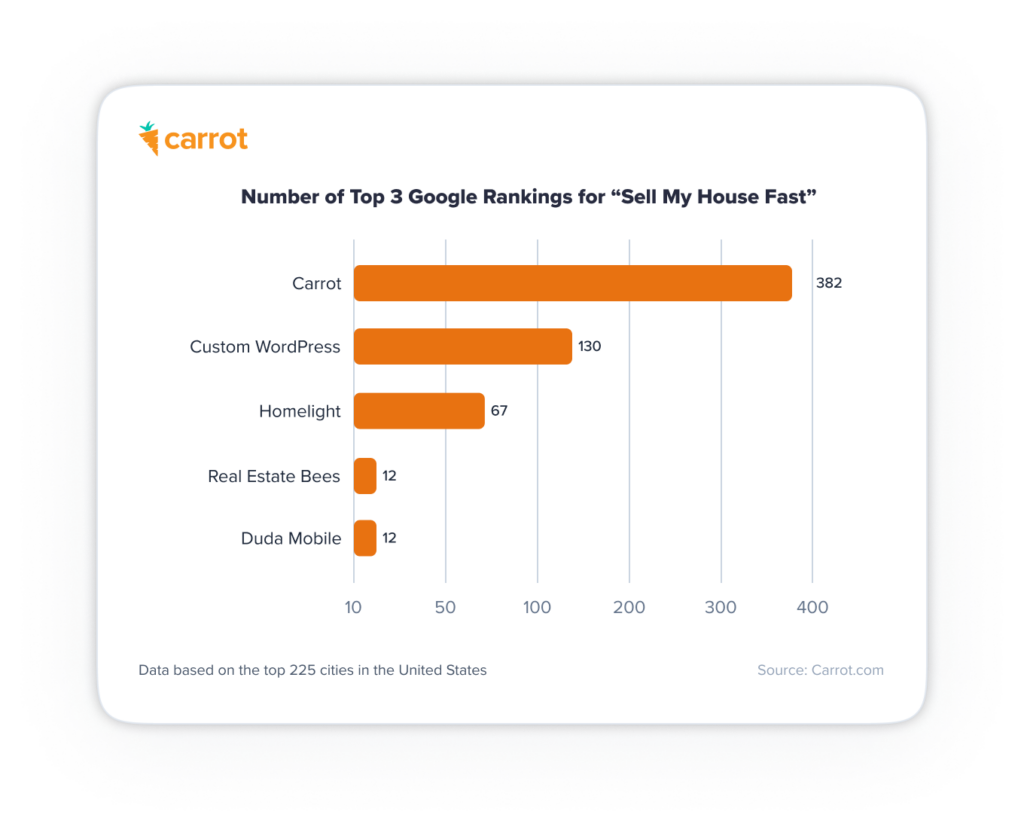
    Q: Should real estate investors still focus on traditional SEO strategies for local markets?

    Yes, but with modifications. Local SEO remains crucial since Google’s AI shows heavy local intent, but you need to emphasize unique geographic content and make it clear that you are a trusted local expert. Combine traditional on-page SEO and local SEO tactics with broader brand building and off-page SEO across multiple platforms to maximize your visibility in both traditional search results and AI-generated responses. Leverage video marketing to further boost SEO, brand visibility, and build trust with your local community.

    Q: How can I track if my real estate investment marketing is working when analytics are becoming less reliable?

    Align your marketing metrics to business KPIs like revenue, lead quality, cost per lead and lead-to-close ratios, but continue to track your digital marketing success. Track your backlinks and website authority with Domain Overview, pull Google Search Console data directly into your Carrot dashboard by connecting Search Performance, and use campaign tracking links to monitor your results.

    Q: What types of content should real estate investors prioritize in 2025 to compete with AI-generated information?

    Focus on content that showcases your unique experience and local market knowledge—detailed neighborhood investment guides, case studies of actual deals, process explanations with real examples, and market insights that only an active local investor would know. Combine this expertise-driven content with video testimonials and success stories that build trust and authenticity. Learn more about creating unique content.

    People also read …

  • August 2023 Google Core Update (Now Live) 

    August 2023 Google Core Update (Now Live) 

    Google Core Algorithm Update | August 2023

    August 7th – Early Signs of a Google Core Update

    There is a lot of chatter about early signs of a Google Core Update in the SEO community today. There hasn’t been an official confirmation from Google, but we haven’t had a major update since April (so we are definitely overdue for one).

    Here are some of the early indicators:

    • Our Sales Site has had 718 keywords jump in ranking by 10+ positions
    • We have also seen 806 keyword drop in rank by 10+ positions 
    • I’ve seen my personal website jump by 266 new keyword in the past week
    • SEO volatility trackers are going off the charts

    While nothing is 100% certain, there is something going with the SERPs and has been for at least the past few days. Big swings in ranking like this usually points to a Core Update, but we can’t know for sure until Google confirms it. By some reports, the volatility has been high since July 14th!

    Here’s what we are seeing on Carrot.com:

    Google core update ranking changes shown in Ahrefs.
    August 2023 Google Core update rankings.
    August 2023 Google Core Update affecting the SERP volatility in late July.
    MazCast showing SERP volatility from the August 2023 GoogleCore Update

    August 2023 Google Core Update Is Live 

    The latest Google Core Update officially started rolling out on Aug. 22nd and is expected to take 2 weeks to complete.

    At this time, the changes have been somewhat mild compared to other, smaller updates that have been happening over the past two months. While members are unlikely to be alarmed by any changes to their rankings at this time – that could change over the next 12 days. If anyone does reach out to you, warmly remind them that there isn’t any reactionary “fixes” that they can do to regain rankings until the next Core Update happens. Instead, they should stick to the SEO strategy that we teach in 30 Day Challenge and review the factors that contribute to EEAT.

    Once the update has finished rolling out, we will update this post with aggregate data from our 7,600+ member sites on how this Core Update affected the real estate investor industry specifically! Stay tuned.

  • Study Shows Carrot Websites Dominate Rankings For “Sell My House Fast”…

    Study Shows Carrot Websites Dominate Rankings For “Sell My House Fast”…

    Do you know… SEO has 2x-3x higher conversion over other online marketing channels?

    If you’re in the market for the most motivated leads, look no further than SEO. Search engine optimization is a powerful tool that helps real estate agents and investors improve their online visibility and ranking in search engine results.

    The question is, who’s ranking/winning?

    We recently surveyed the top 225 markets in the United States to see which companies rank on the first page of Google for one of the most competitive search terms… “sell my house fast [insert city].”

    In fact, according to Google’s keyword planner, “sell my house fast [insert city]” was searched 12,100 times per month in the United States in 2022. That’s also a 50% increase over 2021.

    It’s no secret that ranking on the first page of Google is crucial for businesses that want to attract qualified leads and drive conversions. With so many companies vying for a top spot, we wanted to see which successfully achieved page-one rankings for this highly competitive search term.

    The results of our study were fascinating, and we’re excited to share them with you. Keep reading to discover which companies, including Carrot, came out on top and how they achieved such impressive results.

    The Results

    Carrot websites rank #1 for “sell my house fast” in 132 out of 225 cities

    Carrot websites ranked in the top 3 positions 382 times within the 225 markets

    That’s 98% more times than the nearest competitor

    See the full results of the study here.

    Top Two Performers… Carrot vs. Custom WordPress

    Carrot and custom WordPress sites are popular for building and hosting a website, but they offer different features, advanced tools, and pricing plans. Carrot is known for its user-friendly interface, performance, and affordable pricing, while WordPress offers a broader range of theme options for building a website.

    Both providers offer options to choose from and include basic SEO tools. Carrot is an excellent choice for a more hands-off and cost-effective solution. At the same time, custom WordPress sites are more suited for businesses with more time and budget to learn how to create and manage a website.

    Quick Comparison Chart…

    And Pricing Comparison Chart…

    Also… Carrot template’s mobile performance scores are 60.01% higher than custom WordPress sites we tested.

    Learn more about Carrot’s performance and how our members report a 7x higher lead-to-deal conversion and an increase of $13,932 profit per deal while gaining consistency and predictability in their online leads.

    Keith Sant… how he got to the top ranking in Seattle

    “That 3 leads per day training paid off! Yesterday was my first 5 organic lead day! 2 SEO leads 1 Google My business lead, and 1 buyer lead. I’m so pumped and not slowing down.”

    Keith Sant, Seattle, Kind House Buyers

    Here’s how it looks… Google search “sell my house fast Seattle”… Carrot website ranking #1…

    Motivated seller lands on Kind House Buyers Carrot website…

    Organic SEO Leads grow…

    The importance of ranking first in search engine results and how it can benefit your business

    For several reasons, ranking first in search engine results can greatly benefit your real estate business. In a recent study, Backlinko reported the #1 result in Google has a CTR (click-through-rate) of 27.6%.

    CTR per Google Ranking 1-10

    Ranking first in search results can lead to an increase in traffic to a website. When users search for a particular keyword or phrase, the top-ranked results are typically the ones they click on first. As a result, a top-ranking can significantly increase the number of visitors to your website.

    Ranking #1 is significantly more valuable than any other position. The #1 result in Google has a 10x higher CTR than the #10 result.

    A #1 ranking can improve your website’s credibility and perceived authority. When a website ranks highly in search results, it can give the impression to users that your website is a reliable and trustworthy source of information. This can lead to an increase in the credibility of your website and the services you offer.

    Finally, ranking in the top 3 in search results can increase your business’s revenue. If your website can attract more qualified visitors as a result of its top ranking, it may be able to convert more of those visitors into deals. This can lead to a significant increase in revenue.

    Overall, ranking 1-3 in search results can significantly benefit your business, leading to increased traffic, improved credibility, and higher revenue.

    Ready to Learn More About SEO for Real Estate?

    Download our comprehensive keyword bible now and optimize your online presence for maximum visibility and success!

    SEO keyword Bible Cover

    The current state of competition

    The level of competition for top rankings in search engines can vary significantly depending on the market and the targeted keywords. In general, however, there is often high competition for top rankings in search results as investors and agents strive to attract as much traffic as possible from search engines, especially Google.

    There are a few factors that can influence the level of competition for top rankings in search engines:

    Market: Some markets are naturally more competitive in search engine rankings due to the higher demand for buyers or sellers. The real estate industry tends to be highly competitive regarding search engine rankings.

    Keyword difficulty: The difficulty of ranking for a particular keyword can also affect the level of competition. Keywords that are highly specific and have low search volume are usually less competitive, while more general and high-volume keywords are often more competitive.

    The number of competitors: The number of competitors targeting the same keywords can also impact the level of competition. If there are a large number of websites competing for the same keywords, it can be more challenging to achieve top rankings.

    Overall, the level of competition for top rankings in search engines can vary greatly depending on the market and keywords being targeted. It is important for businesses to carefully research their competition to determine the best strategies for achieving top rankings.

    Strategies for increasing number one rankings

    Several strategies can be used to increase the chances of ranking first in search results:

    On-page optimization: On-page optimization refers to optimizing individual pages to rank higher and earn more relevant traffic in search engines. This includes optimizing the content and HTML source code of a page. On-page optimization can include techniques such as using header tags, optimizing title tags and meta descriptions, and using internal linking.
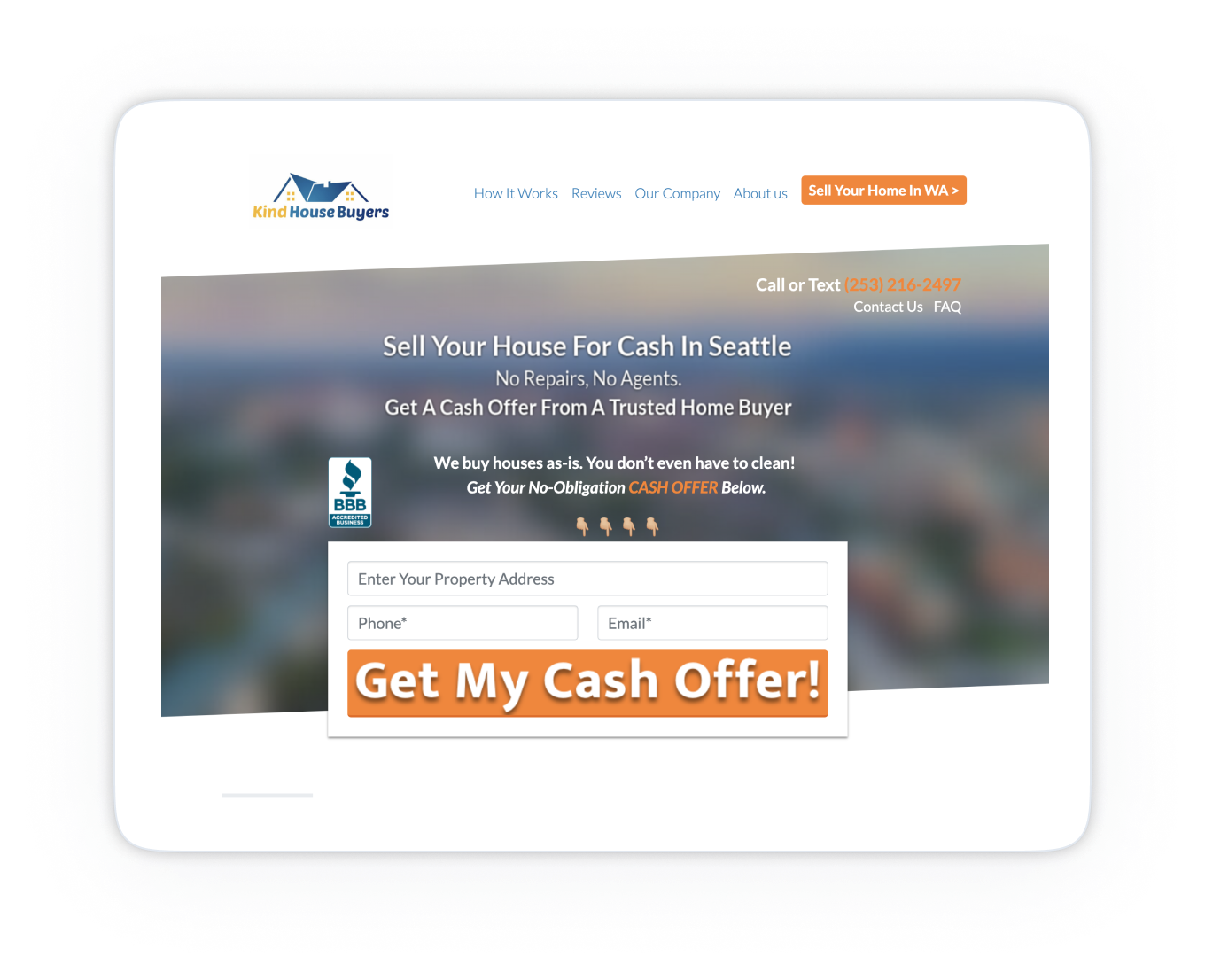
    Off-page optimization: Off-page optimization refers to activities performed outside of a website to improve its search engine rankings. This can include building high-quality backlinks from other websites and promoting the website on social media and other online platforms.

    Content marketing: Creating and promoting high-quality, relevant content on a website can help to improve its search engine rankings. This can include blog posts, articles, videos, and other content relevant to the target audience.

    Link building: Building high-quality backlinks from other websites is another important factor in search engine rankings. These links act as “votes” of confidence in a website’s quality and can help improve its rankings.

    Technical SEO: Ensuring a website is technically optimized can also help to improve its search engine rankings. This can include optimizing the website’s loading speed, mobile responsiveness, and security.

    Overall, a combination of these strategies can help to improve the chances of ranking first in search results. To stay ahead of your competition, continually monitor and optimize a website’s search engine rankings.

    Ready to Learn More About SEO for Real Estate?

    Download our comprehensive keyword bible now and optimize your online presence for maximum visibility and success!

    SEO keyword Bible Cover

    The role of keyword research

    Keyword research is essential to ranking first in search results, as it helps determine which keywords and phrases are most likely to drive traffic to a website.

    There are a few key factors to consider when conducting keyword research:

    Relevance: Choosing keywords relevant to a website’s content is important. This will help ensure that the website attracts qualified, motivated visitors interested in your services.

    Search volume: Choosing keywords with a high search volume can help to increase the chances of ranking first in search results. Keywords with a high search volume are typically more competitive, but they can also drive more traffic to your website.

    Competition: The level of competition for a particular keyword can also be an important factor to consider. If a keyword has a high level of competition, it may be more difficult to achieve top rankings for that keyword.

    Several tools available can help with keyword research, such as Google’s Keyword Planner. These tools can provide data on the search volume and level of competition for different keywords, which can help determine which keywords to target.

    Overall, keyword research is an important step in ranking first in search results, as it helps identify the keywords most likely to drive traffic to your website.

    How Do You Get These Results?

    SEO takes work but is essential for real estate professionals looking to generate more qualified leads. By optimizing website content, real estate businesses can ensure they appear in the top search engine results. This is especially important when targeting hyper-competitive terms such as “sell my house fast [insert city],” where it’s even more critical for a business to be visible on the first page of search results.

    Doing so can increase lead generation by up to 2-3x or more compared to businesses without SEO optimization. With the right approach and strategy, you can use SEO to increase lead generation and build brand loyalty among your target markets.

    If you’re already a member, here are some resources to help you learn more about SEO:

    Other free SEO resources:

    If you’re not a Carrot member, join today!

  • How To Track Your Real Estate SEO Performance And Improve Your Strategy

    How To Track Your Real Estate SEO Performance And Improve Your Strategy

    Ways to Track & Improve Your Real Estate SEO performance

    You want to generate more organic leads but you don’t know how to track your real estate SEO performance. That’s common.

    You want to pull more traffic to your website (with less money) and you want to convert that traffic into cash for your real estate agent or investing business.

    That’s good — you’ve chosen the right strategy: SEO. Since people who find your website all on their own are usually more motivated than those who see your ad on Facebook, SEO doesn’t just drive traffic but works to improve the conversion rate of your website. And with high-quality traffic and leads comes less time spent dealing with tire-kickers who’ll never convert, regardless of how hard you try.

    In other words, SEO benefits your business in a multitude of ways. Less time spent on the wrong leads, more time spent on the right leads, more website traffic, higher conversion rate, consistent lead generation, and even financial predictability.

    But there’s a problem…

    How do you know if your SEO strategy is working? How do you know that you’re SEO performance heading in the right direction?

    After all, SEO can take months or years to start having a tangible impact on your business, so how do you know you’re not just wasting your time?

    Here are 4 mission-critical SEO metrics to keep an eye on while you’re climbing your way through the rankings.

    4 Mission-Critical Real Estate SEO Performance Metrics You Need to Be Using

    1. Rankings

    This metric might be obvious to you…

    If you’re going to drive passive traffic to your website and you’re going to convert more leads without running more paid ads, you must get to the first page of Google.

    But that can take months, years even. How do you know you’re making progress?

    The simplest way to check is to open an incognito web browser window and type in the search phrase that you’re trying to rank for. Then click through Google’s results and see if you can find your website.

    Problem is, that’s time-consuming, especially once you’re trying to rank for 10 or 20 different keyword phrases. At that point, you don’t want to manually check all those rankings.

    This is why, at Carrot, we created our Keyword Ranking Tracker tool for our Content Pro and Advanced Marketer members.

    This tool tracks your rankings for specific keyword phrases in near real time. You can use it to quickly determine where your website is at for multiple keyword phrases you’re targeting. Every page in Google typically has 10 results, so 1-10 means you’re on the first page, 11-20 is second page, and so on.

    2. Domain Authority

    Another way to determine whether you’re making progress in the eyes of Google is to check your website’s domain authority.

    What is domain authority?

    It might sound complicated, but it’s actually pretty simple when you get down to it. Domain authority is the overall authority that search engines (Google, mostly) attributes to your domain. More authority is better and means that your website has a higher chance of ranking in results. Conversely, a low authority means that Google is unsure of whether you’re trustworthy or not (yet) and it’ll be more difficult for your website to get on the first page of Google’s results.

    But the more content you create, the more opportunities you’ll have to rank in search engines (each page or blog post has a chance to rank). This is why we include monthly expert-written content as a part of our (Carrot’s) Content Pro and Advanced Marketer Plans.

    Plus, the longer your website exists…

    (Image Source)

    …and the more backlinks you get…

    …the higher your domain authority will climb.

    Domain authority is measured on a scale from 1-100 (1 is low, 100 is high) and the higher your score, the easier it is to get rankings.

    You can check your domain authority over here — just type in your domain and click “Check Authority.”

    (Image Source)

    3. Traffic

    Not all rankings are equal.

    You might, for instance, get your website ranking for “real estate investors who run 6 miles per day”, but that ranking doesn’t do you any good if people aren’t already typing that phrase into Google — and not just anything, the right people.

    The reason that it’s so important to do keyword research before you start executing an SEO strategy is that you want to make sure that the phrase(s) you’re targeting isn’t a total waste of time.

    You can use Ubersuggest to check the search volume for any given keyword phrase.

    Just type the phrases you’re thinking of trying to rank for into the search bar and click “Search”. This will provide you with some information about how that keyword phrase performs in Google and with other keyword phrase ideas.

    [cta offer=”seobible” color=”orange”]

    But, back to website traffic.

    When you start ranking for your target keyword phrase(s), that’s when the rubber meets the road. Check your analytical information to see where your website traffic is coming from and if you’re actually getting more traffic from search engines.

    You can use Google Analytics (here’s how to set it up on your website) or you can look at your Carrot “Stats” dashboard if you’re a Carrot member.

    updated Carrot member stats dashboard

    Look at the “Traffic Sources” in the bottom right hand corner to determine where you’re website traffic is coming from and if you’re SEO efforts are paying off.

    If they aren’t and you’re already on the first page for multiple keyword phrases, then you might want to target a keyword phrase with higher search volume.

    4. Conversion Rate

    Imagine that you’re ranking on the first page of Google for several different keyword phrases. Let’s even imagine that those keyword phrases are driving passive traffic to your website every month — maybe a few hundred visits.

    When analyzing your SEO strategy, there’s only one more step in the funnel to make sure everything is working as it should: is that search engine traffic converting on your website?

    Because it doesn’t matter at all how much website traffic you get if none of that traffic is turning into leads or, when you call them, they have no interest in your services.

    So keep a close eye at how that SEO-based increase in traffic is affecting your overall business — are you getting more leads? Are you doing more deals?

    You should be.

    And if you’re not, then either something is wrong with your website (maybe it’s not building enough credibility or it loads too slowly — Carrot website’s are proven to be high-converting out of the gate) or something is wrong with the traffic you’re driving (they aren’t people with the right intention.

    If you’re a real estate investor in Idaho, you might be able to get your website ranking for “The best mountain biking trails in Idaho”, but that website traffic isn’t going to do your business a whole lot of good. Something like “Sell my house fast in Idaho” would be far better.

    Adapting Your SEO Strategy To Dominate Your Market…

    In the SEO series we’ve been working on over the last few months, we’ve laid out lots of different strategies to help you get ranking in Google.

    But here’s the thing: each market is different and different strategies will work better (or worse) in different markets. Some markets are more competitive and difficult to rank in while other markets will only require a few months of effort to see results.

    In the end, you need to do whatever is best for your business.

    Here are a few final thoughts that might change the way you approach SEO in your market:

    • Competitive Market — If you’re in a highly competitive market with lots of other investors or agents gunning for the same keywords that you’re trying to rank for, then you might be better off aiming for long-tail keywords to start. These are just long keyword phrases that tend to have a lot less competition (and are thus easier to rank for). Consider, for example, “Sell my house fast for cash easily in [location]” versus “Sell my house in [location].”
    • Uncompetitive Market — In an uncompetitive market, you might find that you can target more basic keyword phrases with higher search volume and still see results within a few months. In that case, take advantage of the market you’re in and create new content to rank for each phrase your possibly can.
    • Paid Ads VS. SEO — While we’ve talked a lot about SEO over the last few months, let’s not forget that paid advertising should be a critical part of your overall marketing game plan — especially when you’re just starting out. SEO will provide you with long-term success and financial predictability, but paid advertising works quicker and can get you leads by the end of next week. So use both as you need to to build a thriving business.

    Conclusion

    SEO has lots of benefits to offer your business if you put in the work to make your website rank.

    It’ll take time… but stick with it and you’ll pull it off.

    On your journey, you can use the above tips to track your progress and adjust your strategy based on your market.

    And let us know if you have any questions along the way — we’d love to help however we can. :-)

  • 9 SEO Tools For Easily Tracking and Improving Your Real Estate Website Rankings

    9 SEO Tools For Easily Tracking and Improving Your Real Estate Website Rankings

    9 SEO Tools For Easily Tracking and Improving Your Real Estate Website Rankings

    SEO takes time.

    Often, it takes at least 3 months to get a real estate website ranking on the first page of Google. And that’s if you consistently put the work in, creating content, optimizing that content, and targeting the best keywords possible for your business. Sure, it could take less than that or more than that depending on the density of competition in your market.

    But the point is, you’re not going to see results overnight. You’re going to have to put in some work and exercise some patience.

    (It will pay off, though, if you stick with it! Just see how SEO has completely changed Tyler Ford’s life)

    And to make that process as painless as possible, saving you time and money, here are 9 tools you’ll want to use along the way.

    9 SEO Tools For Improving Your Real Estate Website Rankings and Easy Tracking

    1. Carrot Ranking Tracker

    At Carrot, we optimize all of our websites to rank in Google. From the gate, we make our member’s websites wicked fast, fill them with quality sales copy, and build a tech stack meant to please search engines.

    But that’s not all we do. We’ve also spent hundreds of man-hours creating SEO tools to make your (our member’s) journey to page one as easy and seamless as possible.

    One of those fundamental tools we’ve created is our Carrot SEO Ranking Tracker. Wondering where your website is currently ranking in Google for specific keywords? With a Content Pro or Advanced Marketer membership, you can track your SEO rankings consistently and check in to see how you’re doing.

    After all, what good is an SEO strategy if you don’t know whether it’s working or not?

    2. Carrot SEO Tool

    Another tool that we’ve created for Carrot members is our custom SEO tool. On any page or post of your Carrot website, you can go into “Edit” mode, enter the keyword phrase that you want to target, and our SEO tool will tell you everything you need to do to optimize the page to rank for that phrase.

    Just go through this checklist whenever you’re editing a page or creating a new page and your SEO rankings will be in good hands. We couldn’t afford to have an SEO expert stare over your shoulder while you add content to your website, but this is the next best thing.

    3. Domain Authority Checker

    As you’re working to rank on the first page for a high-value keyword phrase, you’ll want to check in on your domain authority every now and again. This is a number (from 1 to 100) that ranks how much Google and other search engines trust your domain. The higher the number, the more authority you have in search engines (which means higher rankings).

    Ideally, your domain authority will gradually increase as you put time and money into ranking your website. But this is often a slow process — and the older your website, the more that Google trusts it. This tool will also tell you how many backlinks you have to your domain, which is a nice piece of info to have at your disposal.

    4. LSI Keyword Finder

    When you’re writing content that’s meant to rank in search engines (whether it’s a sales page or a blog post), one of the most important optimization-elements is including the right keywords on your page — that way, Google knows what your page is about and where they should rank it.

    (See point #5 for a keyword research tool)

    And once you know your primary target keyword phrase, it’s also a good idea to sprinkle LSI keywords throughout your content. This tool allows to quickly and easily type in your target keyword phrase and find the LSI keywords related to that phrase.

    5. Keyword Research Tool

    This is one of my favorite tools for keyword research (I use it all the time). It’s completely free and it’s remarkably thorough. When you’re trying to determine what keyword phrase to actually target, there are a few things you need to consider…

    1. Competition — How competitive is the keyword phrase? How long will it take you to rank for it? The more competitive it is, the longer it will take to rank.
    2. Search Volume — How many people actually type in the given keyword phrase per month? If no one is searching for it, then it isn’t worth your time to rank for it.
    3. Intention — Why are people searching for the given phrase? What’s their intention? What do they want when they type that in? Can you give them what they want? If not, your time is probably better spent working toward ranking for a different keyword phrase.

    Ubersuggest outright tells you competition and search volume for each keyword. For intention, you’ll need to draw some inferences based on the words within the actual search phrase. But this is a wonderful place to start your keyword research.

    Or, we’ve done the leg work for you. Grab your free real estate keyword bible.

    6. Backlink Finder

    Another tool you can use to track the effectiveness of your SEO efforts is a backlink finder. The more backlinks you have to your website, the better that Google will rank you, generally speaking.

    So long as those real estate backlinks come from trustworthy websites, Google will assume that you’re trustworthy and put you at the top of the rankings.

    To determine how many backlinks currently go to your website — and where they’re coming from — you can use the above free tool.

    7. Business Mention (Without Backlink) Finder

    Finding where your backlinks are is one thing, but finding mentions of your business without backlinks is even more important.

    Why?

    Because when someone mentions your business but doesn’t include a link, you can reach out and ask them to remedy that by linking to your website atop your business name. Most online websites will agree without too much back-and-forth.

    Of course, this tool only really applies to you if you have a well-known enough real estate business that other websites link to your website. If that’s you, then you can use the above tool — but it is a paid tool.

    8. Quality Writing Analyzer

    Good writing tends to rank better in search engines. Which makes sense — Google doesn’t want to rank content with terrible grammar and punctuation, since that often means the writer didn’t put much time into creating the content.

    (and thus the quality probably isn’t very good)

    To remedy that without being a pro writer, you can use a tool like Grammarly to quickly and easily check your writing for typos or grammatical errors and fix them before you publish.

    9. Mobile Responsive Checker

    Believe it or not, the majority of Google search happens on mobile devices — not on desktop or laptops. For that reason, Google actually prioritizes the domain authority and quality of the mobile version of a website before it does the desktop version.

    This means that if your website looks great on desktop but terrible on mobile, your rankings are going to suffer. In today’s SEO climate, you must have a website that’s built for mobile and desktop — not one or the other.

    You can use this tool to check whether your website adjusts to the device visitors view it on or not. All Carrot websites are optimized for mobile and desktop and tablet.

  • How Long Does it Take a Real Estate Website to Show Up on The First Page of Google?

    How Long Does it Take a Real Estate Website to Show Up on The First Page of Google?

    Real Estate Websites How Long Does it Take a to Show Up on the First Page of Google

    You want to rank your real estate website on the first page of Google.

    And you’re no SEO rookie — you understand that ranking on the first page for your target keyword phrase is going to take some time, it’s going to take some work, and it’s going to take some content creation.

    But just how long is it going to take you to rank on Google? When can you expect rankings and passive traffic to pay you back for all your hard work?

    That’s the question I intend to answer for you in this article.

    But first… just how powerful is the first page of Google anyways?

    The Power Of Google’s First Page…

    What is the primary reason that anyone — real estate investors and agents included — want to rank their website in Google?

    The answer is simple. Passive traffic. High-quality leads. And less money spent on advertising. With that, you can build a bigger business and establish yourself as the go-to real estate expert in your market. Financial predictability and businesses growth — that’s what high rankings promise your business.

    But here’s the thing… ranking in Google isn’t enough.

    Most online tools will consider your website as ranking if it’s within the first 100 results for your given keyword phrase. Answer me this, though: when has anyone ever clicked through 100 results after searching for something in Google?

    Yeah… never.

    Which is exactly why the first page of Google is the only place with significant click-through rates (1st position takes 35% of the clicks).

    (Image Source)

    If your result gets to page 2, 3, 4, or 5, the click-through rate is negligible. In other words, if you want to live the passive-traffic and high lead-gen dream that SEO promises, you must be on the first page. Nothing else will get you the results you’re looking for.
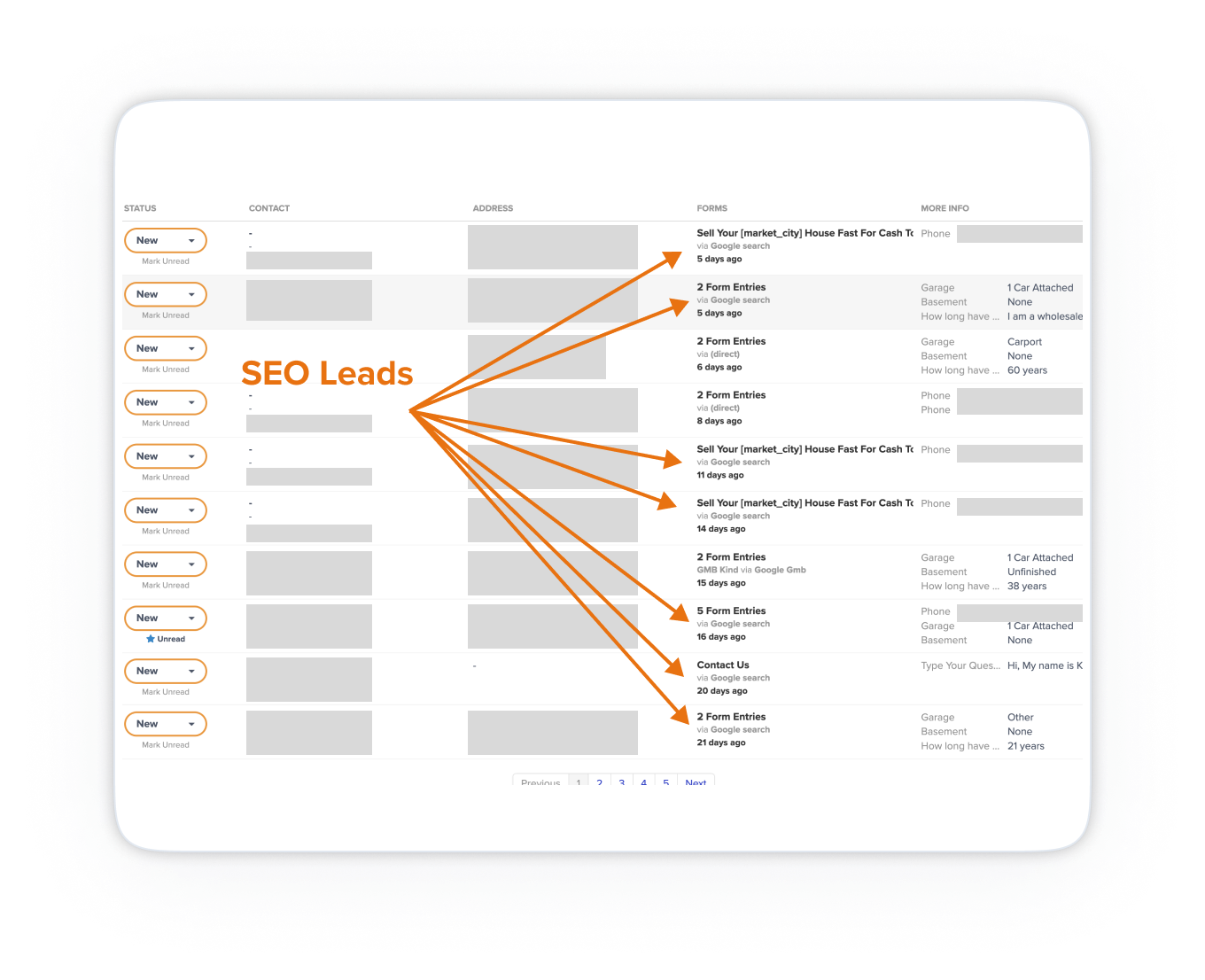
    Once you pull off getting your website on the first page of Google’s rankings, though, click-through rate isn’t the only benefit — the lead quality is typically much higher than those from paid advertising, meaning a high close-rate for pennies on the dollar.

    Here’s what Tyler Ford (a real estate agent and investor) has to say about this.

    Get Your Carrot Website Today and Start Generating Leads in No Time!

    How Long Will It Take You To Get To The First Page?

    Okay — so you know how valuable the first page of Google is. You understand that the lead quality is typically much higher, the leads are much cheaper, and they take much less work to generate (over the long term, of course).

    Note: This isn’t to say that you should ignore paid advertising altogether. Many Carrot members use PPC and direct mail to get leads immediately but then invest in SEO for their long-term business sustainability and financial predictability.

    But how long is it going to take you to rank on the first page of Google?

    Unfortunately, I can’t answer that question with a simple number of months. Generally speaking, though, you should expect to see some type of positive movement with your rankings within 3-12 months, depending on a few different factors.

    Here are the 4 biggest factors I’m referring to. Taking these into consideration, your website should take between 3-12 months to get near the first page of Google for your target keyword phrase, moving up and down that spectrum depending on…

    The 4 Biggest Ranking Considerations

    1. Keyword Competition

    The more real estate investors or agents that you have to compete with for page one of your target keyword phrase, the longer it’ll take to see the results you’re looking for.

    Of course, different keyword phrases will have different levels of competition. You can use Ubersuggest to check the competitiveness of various keyword phrases. While less competitive phrases usually also mean less monthly search volume (meaning less passive traffic), it is often easier to get your website ranking on the first page for those phrases.

    So, if you want a few first-page rankings under your belt faster, then try targeting some longtail keyword phrases with lower search volume and minimal competition. Over time, you should still focus attention on highly competitive phrases (such as “sell my house fast “) since those generally have a high payoff once you’ve reached the first page, but don’t be afraid to start with the lower-hanging fruit.

    real estate agent keyword competition

    (Image Source)

    Learn More: How To Find High-Intent Real Estate Keywords and Dominate Your Market’s SEO Rankings

    2. Content Creation Consistency

    create consistent content

    (Image Source)

    With more content comes more opportunities to rank in Google. Think of it this way: every page on your website get crawled by Google’s bot and has a chance to rank in search results. It logically follows, then, that with more content optimized for search engines on your website come more opportunity to rank for a variety of high-intent keywords.
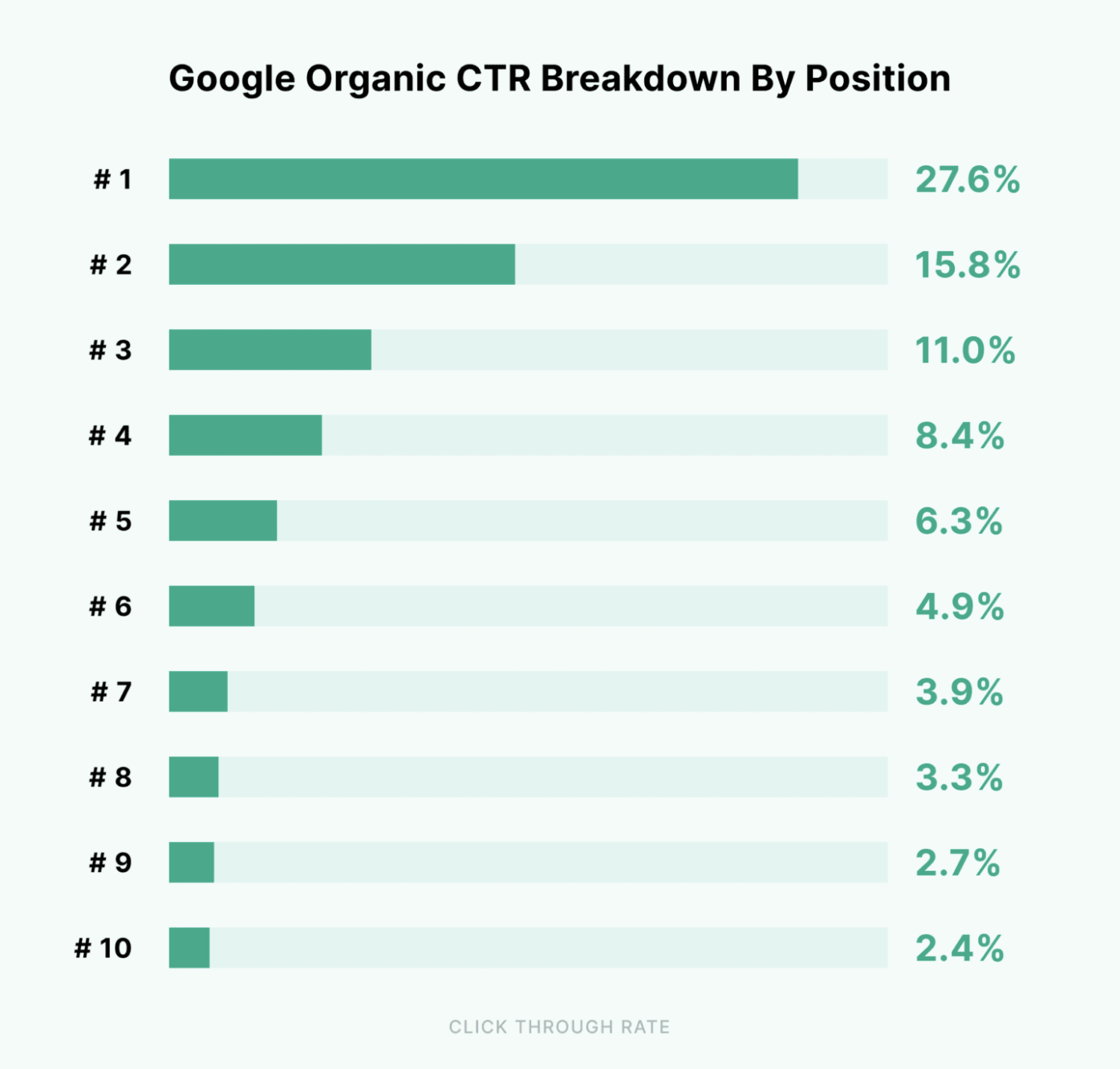
    Often times, the real estate agents and investors who claim the first page of Google are the same ones who consistently publish new content… on their website, blog, and social media channels.

    The more stuff you create and put out there, the more that Google likes your website. And so long as the content you create is optimized for search engines, every single page is another chance for you to beat your competitors. The more content you create and the more consistently you create it, the faster you’ll reach the first page.

    Learn More: 4 Real Estate Content Marketing Strategies You Can Actually Use to Grow Your Business

    3. Backlinks

    What’s a backlink?

    A backlink is simply when another website links to a page of your website as shown in the diagram below.

    what is a backlink for real estate

    (Image Source)

    So long as the website that provided you with the backlink (Website A) is trustworthy in the eyes of Google (see the dangers of black-hat link building over here), that link will lend your rankings some additional gusto. The more quality backlinks your website has, the faster your pages will crawl their way to the top of Google’s rankings.

    In fact, there’s a direct correlation between the number of backlinks and ranking position.

    backlinks and google position

    (Image Source)

    That’s not to say, though, that you need 35,000 backlinks to see significant results from your SEO efforts — trying to rank for real estate keywords in your specific market is far less competitive than the demands of most online marketers.

    Sure, backlinks will increase how fast you rank your website, but they aren’t totally necessary for a beginning SEO strategy (citations are more important, actually — learn more over here).

    Learn More: How Many Backlinks Does it Take To Start Ranking Your Real Estate Website in Google

    4. Time

    At this point, this last consideration probably goes without saying… but I’m going to say it anyways: the longer that a page exists, the more authority it gains. Period. There’s a direct correlation between how old a page is and how high it ranks in Google. The average age, for instance, of a position 1 ranking is almost 950 days.

    average number of days before ranking in the top 10 on Google

    In other words, and if you take anything else away from this article, understand that SEO takes times — there’s simply no way to get around it. When you’re trying to get a page on the first page of Google, the reality is that Google has already chosen 10 results for that first page and you have to beat those results — that takes time.

    Related Video Content. Watch: “SEO for Real Estate Investors | How Long Does It Take to See SEO Results?

    It can be done, to be certain, and you will do it if you stick with it, but it’s important to know really what you’re up against. And the 4 above considerations should help give you a better idea of how long you should expect your website to take to get to the first page of Google.

    As always, though, if you have any additional questions, hit us in the comments!