
Category: Real Estate Marketing

  • 101 Real Estate Blog Post Topic Ideas to Spark Your Creativity

    101 Real Estate Blog Post Topic Ideas to Spark Your Creativity

    Are you having difficulty coming up with great real estate blog post ideas? Generating new blog post topics can be a discouraging task. We have compiled a list of 101 real estate blog ideas you can write about today.
    Key Takeaways

    • “Evergreen” content is a blog topic that stays relevant and fresh for a long time. This is ideal for a website so that your content continuously attracts leads.
    • There are 10+ types of blogs. Understanding them makes it easier to come up with new blog ideas and write content that readers find helpful.
    • QUALITY content is more important than quantity. Make sure your blog posts show your experience, expertise, authority, and trustworthiness (E.E.A.T.).

    Read on to understand why publishing blog posts on your website is important, how to do it correctly, and get real estate blog topic ideas to get you started!

    Table of Contents

    1. Why Blogging Matters (& How to Do it Right!)
    2. Types of Blogs
    3. Real Estate Blog Post Ideas for House Buyers
    4. Real Estate Blog Post Ideas for Rehabbers & Flippers
    5. Real Estate Blog Post Ideas for House Sellers
    6. Real Estate Blog Post Ideas for Tenant & Property Management
    7. Real Estate Blog Post Ideas for Rent-To-Own Property
    8. Real Estate Blog Post Ideas for Foreclosures
    9. Real Estate Blog Post Ideas for Real Estate Agents
    10. Real Estate Blog Post Ideas for Real Estate Investors
    11. Real Estate Blog Post Ideas for Local Market Trends & Analysis
    12. Real Estate Blog Post Ideas for Land Buying & Selling
    13. Evergreen Marketing For Real Estate Investors Is Misunderstood…
    14. Here’s How To Provide Great Value To Your Ideal Prospects
    15. Here’s How To Read People’s Minds
    16. Writers Block? Get Started With These Real Estate Blog Ideas
    17. How Consistently Should I Post Real Estate Blogs?
    18. More Tips To Create Great Real Estate Content
    19. How To Get Content Written For You
    20. The Carrot Content Marketing System
    21. Get Your First (or next) Blog Posts Up!
    Carrot icon
    Lead generation, at its best
    Attract, convert & close more motivated leads
    Try Carrot Today

    Why Blogging Matters (& How to Do it Right!)

    As a real estate investor, your job is to gather more motivated sellers and cash buyers so you can do more deals. The more often you do that, the more deals you can do; the more you can automate that process, the easier it becomes for you (and the more you can scale without working yourself to the bone).

    Marketing your real estate investing business online means competing with other investors for just a few positions on the search engine results pages!

    And, the higher you appear in search results, the more likely people are to click on YOUR search result and end up on YOUR site. But once they’re on your site, your job isn’t over! You need to convince them to do business with you.

    That’s where content marketing comes in.

    Evergreen content is search-optimized content that is continually relevant and stays “fresh” for your target audience over a long period.

    Evergreen content marketing (done the right way) helps you get in front of more of your prospects online and capture the attention of the people you want to do deals with. Once those people are on your site, marketing builds credibility and authority for you and your business.

    Done right, evergreen content is perhaps the most significant edge you can get as an investor regarding the web.

    Blogging remains one of the most potent ways to connect with your audience and drive them to action. The blog ideas you choose to spend your time & resources on are important.

    Research shows that companies who blog with quality content get 67% more leads than those who don’t publish content.

    We’ve found that SEO inbound marketing close rates are 2 to 4 times higher on average than outbound selling efforts—making the right real estate blog ideas an investment that pays off big time.

    We’ve seen our members creating quality content from blogging and other page resources for 10+ years. We’ve learned a thing or two about how to develop content ideas that already have proven demand online for our members.

    To make it even easier, we broke this list down into topics and investment focus areas so you can find blog ideas that perfectly fit your needs.

    Types of Blogs

    Before diving in, let’s explore some of the most commonly used templates for blog posts:

    • Listicle: A numbered list, like “Top 5 Things NOT to Do When Selling a House for Cash.”
    • Case Study: Telling a story about a real experience. This is a great way to highlight your customer’s experiences with you and the results they got.
    • How-To Guide: Just like it sounds, an expert guide that helps people answer a question and learn how to do something.
    • Solutions Overview: Offer a service or product? Use a blog to explain what it is and (more importantly) how it helps!
    • Checklist: People working through a process — like selling a house they inherited, dealing with a home foreclosure, looking to sell for cash, buy land, etc. — need to know what steps to take. You’re the expert, so make them an easy-to-follow checklist.
    • Comprehensive Guides: Google loves expert content that explores a topic in depth, and your potential customers are looking for information. Prove your expertise, put customers at ease, and make Google happy with long-form comprehensive guides that dive deep into a topic. (Bonus: You can link to relevant checklists from your guide!)
    • Definitions Explained: If you’re in a particular niche area or there’s a term or concept that our customers always seem confused by, use that as an opportunity to educate others by explaining it on your website.
    • Statistical Analysis: People hear phrases like buyers or sellers market or other stats in your area, but they may not understand what that means for them. Dive into the statistics to explain the impact it could have for your customers.
    • Frequently Asked Questions (FAQs): Short, sweet, clear copy that quickly answers common questions. Pro Tip: Be sure to use the same words your leads might use.
    • Comparison Breakdown: Shoppers are always comparing products and services, so break down how your company is different from your competition or how selling/buying options differ.

    Real Estate Blog Post Ideas for House Buyers

    • Top problems buyers face when looking to buy for cash flow.
    • Where buyers can find money to do more deals (savings, mortgage loans, lines of credit, private money, etc.).
    • A comparison of the various ways to buy a home (mortgage, rent-to-own).
    • A checklist of qualifications that someone needs if they want to get a mortgage.
    • How a buyer’s agent can help you.
    • What are the pros and cons of different mortgage types? Ie…fixed, 15 year to 30 year?
    • What questions do I need to ask a seller before buying a home?
    • How to pencil in your home buying costs.
    • How to make an offer on a house.
    • # common mistakes homebuyers make.
    • # of things first-time homebuyers need to consider.

    Real Estate Blog Post Ideas for Rehabbers & Flippers

    • Top problems buyers face when looking for rehab properties.
    • Strategies to control costs on rehab properties.
    • How to negotiate with contractors and sub-contractors.
    • How to work with contractors and sub-contractors and get them to finish the work on time.
    • How to do due diligence when you can’t tear down every wall.
    • Top # tips for rehabbing a house.
    • What will rehabbing a house cost you?
    • What first-time flippers can expect.
    • How to rehab and flip an ugly house.
    • Should you use a contractor to rehab a flip?

    Real Estate Blog Post Ideas for House Sellers

    • Top problems sellers face when selling their property through traditional methods (and why selling their home for cash to you is much better).
    • Top ways that sellers can improve their home’s curb appeal before selling it.
    • How much should a seller ask for their home?
    • How long does it take to sell a home in the various ways (i.e., compare traditional, FSBO, or selling to an investor).
    • A step-by-step checklist that a seller can use to prep their home for sale.
    • Sell your home faster with these crafty tips.
    • What is a deed when selling your home?
    • Should you sign a trust deed when selling your house?
    • Who is responsible for title insurance?
    • Is Craigslist worth listing my house on?
    • Seasonal advantages or disadvantages of selling your house.
    • Why start preparing your home for sale years before selling it.
    • What is keeping your home from selling?
    • This is why your house isn’t selling.

    Real Estate Blog Post Ideas for Tenant & Property Management

    • Strategies to deal with tenant problems.
    • How to interview tenants and know when you’ve found the right one.
    • How to deal with tenants that cause property damage?
    • How to keep a good tenant?
    • How to protect yourself from bad tenants?
    • Top # property management mistakes.
    • How to solve the biggest property management issues.
    • Property management issues when renting out a condo.

    Real Estate Blog Post Ideas for Rent-To-Own Property

    • Top problems rent-to-own tenants face, and how working with you can solve those problems.
    • Step-by-step through the rent-to-own process.
    • What does someone need to qualify for rent-to-own?
    • What is renting-to-own?
    • Is there a growing demand for rent-to-own homes?
    • When rent to own – who is responsible for paying homeowners insurance?
    • Can someone be eligible for a lease-to-own contract if they have filed bankruptcy?

    Real Estate Blog Post Ideas for Foreclosures

    • Top problems faced by people in foreclosure.
    • How does the foreclosure process work?
    • What are the ways to avoid foreclosure?
    • If homeowners file for bankruptcy, can they stay in their property and avoid foreclosure?
    • What should I know about buying a foreclosed home?
    • Insider tips to buy a foreclosed home.
    • Potential downfalls for purchasing a foreclosed property.
    • # tips for buying a foreclosure.
    • Top # of mistakes made when buying a foreclosure.

    Real Estate Blog Post Ideas for Real Estate Agents

    • How to find the best real estate agent in your area.
    • How the commission structure works.
    • # of advantages/disadvantages of hiring a real estate agent.
    • Share an interesting story about a real estate deal.
    • Share an interesting story about a house listing (distressed, high priced…)
    • What are the pros and cons of holding an open house?
    • Why low commissions are bad for home sellers.
    • # tips to mitigate capital gains on real estate sales.
    • # Important things to know about appraisals and comps.
    • Find comps in your area to determine the potential appraised value.

    Real Estate Blog Post Ideas for Real Estate Investors

    • How to work with an investor – what to expect, how quickly they can help, who should be involved.
    • How investors can network with people to find private capital.
    • How to find a great property management company to work with.
    • How many cash-flowing properties do you need to retire early?
    • Ways to increase cash flow from your properties.
    • A step-by-step plan to build a portfolio of cash-flowing deals.
    • Share an interesting story about a real estate investing deal.
    • What to look for in potential homes to use as flips.
    • What to look for when buying an apartment complex?
    • What to look for when buying a condo?
    • What types of homes should I look for as a beginner investor?
    • What is the top # of things an investor should look for in an investment home?
    • # of real estate investment niches.
    • Different types of commercial real estate investments.
    • # Worst types of real estate investments.
    • How to attract investor-friendly real estate agents.
    • Overview of the Local Real Estate Market
    • Neighborhood Spotlight: Highlighting Local Communities
    • Market Predictions and Forecasting
    • Impact of Economic Factors on the Real Estate Market
    • Investing in Emerging Neighborhoods
    • Demographic Shifts: Understanding Population Trends and Their Influence
    • Infrastructure Development: Assessing the Impact on Property Values
    • Tourism and Hospitality: Analyzing the Effects on Vacation Home Markets

    Real Estate Blog Post Ideas for Land Buying & Selling

    • # Land buying problems to avoid.
    • # Reasons why you should be investing in land.
    • Things to consider before buying land.
    • How to sell lots and land.
    • How selling land is different than selling a home.
    • What do you need to do to get your land ready to sell?
    • Is the lending market for vacant lots and land difficult?
    • How to take good photographs of your land before selling it.

    Evergreen Marketing For Real Estate Investors Is Misunderstood…

    Content marketing is powerful … when done right. Many inexperienced investors turned on a relentless content marketing “machine” that churned out blog posts hour after hour or were thin pieces of content that lacked any real value or substance for the reader.

    They had heard the maxim that “content is king,” so they thought that creating more content would help them elevate to a higher level in search results.

    Unfortunately, many people chose to put content quantity over content quality.

    Google got wise to those quantity-over-quality efforts and made algorithm changes, adjusting the search results to show sites that only provided high-quality content. Suddenly, investors who had sunk thousands of dollars into creating low-quality blog posts (often through cheap services like Fiverr.com) found themselves in the Mariana Trench of search results…

    … and that’s NOT a good thing.

    These investors were short-sighted in another way:

    Aside from being punished by Google for poor quality, they also failed to realize that humans were reading their content!

    Earlier, I explained the TWO tasks that content marketing accomplished:

    1. To help them appear higher in search engines

    AND…

    2.  To help build credibility and authority to guide prospective buyers and sellers to do deals with you

    By choosing quantity over quality, investors might get a bump in search engine results (until Google changes its algorithm). Still, they weren’t doing a great job of convincing buyers of anything.

    Evergreen marketing needs to add VALUE to its readers.

    Here’s How To Provide Great Value To Your Ideal Prospects

    You need to provide great content for the people you’re trying to reach that attracts them and converts them into a lead… but how do you provide that content?

    How do you know what “good” content is? How do you package it for them so search engines see its value and attract the right audience?

    The good news is that you need to know one secret to provide great content for any audience… it works for EVERY audience you’re trying to reach.

    It doesn’t matter what kind of investing you do (wholesaler, rehabber, landlord, etc.). It doesn’t matter what audience you’re trying to reach (motivated sellers, cash buyers, probate deals, foreclosures, rent-to-own folks, tenants, contractors, or anyone else); this content marketing strategy will be true for you.

    Here’s the secret…

    Every search engine search is a question that your audience wants to ask or a problem they have (even if they don’t frame it as a question)

    Like…

    How do I sell my Detroit home?” – it’s easy to see how that’s a question.

    “I want to sell my house in New Jersey” – that’s a sentence, but there’s a question in there; they’re wondering something: “How?” or “Who?” or “What’s the process?”

    Real estate investments in Memphis” – there’s a hidden question there, too. “What are they?” or “Where in Memphis are they?” or “How much do they cost?” or “What’s the potential return?”

    What to do with a house I inherited in Michigan?” – This is where we get more narrow and focused on specific scenarios.

    Every Google search is a question and/or a problem.

    And, when you know that, you can create content on your website and in your YouTube videos that answer those questions.

    Answering questions (even the questions that searchers don’t realize they’re asking) will help you get in front of the right audience, and it will help you build credibility and trust through the valuable answers you provide.

    Then,… game over. You become a valued expert in your area… versus being seen as a fly-by-night operator like most competitors.

    Here’s How To Read People’s Minds

    This leads investors to a big question: “How do I know what people are searching for so I can answer their questions and get them to my website?

    There are many online tools, but the easiest way is to open up Google.com, start typing, and let Google do the rest!

    Google sees what you’re typing and makes some assumptions based on similar, popular searches, and it presents those assumptions to you as auto-complete options.

    Here are three examples.

    I started typing, and Google offered different ways to complete my search.

    See These Suggested Searches That Google Gave Me…

    columbusohiohomesforsale REI Post Ideas
    Blog Post Ideas For Real Estate Investors ATL
    memphisrealetateinvesting REI Blog Ideas

    While not all of these are relevant to my audience, I know that some of them are – they are questions that my audience wants to know!

    Write those down into an extensive list and build one or more blog posts around them.

    Writers Block? Get Started With These Real Estate Blog Ideas

    To help you further, here’s a list of 101 blog post ideas for real estate you can use to get you going. These blog post ideas are based on research that we quickly performed… and many of these are already built into our Content Marketing System that helps you do content marketing more efficiently (in our Content Tools).

    (Be sure to personalize these with your city and state to increase your chances of ranking well in your local area).

    As an example… “How does the foreclosure process work?”

    Localize yours for your area like… “How does the foreclosure process work in Florida?”.

    I found all of these just by doing what I showed you above… finding what my prospects are already typing into Google… and seeing what Google suggests.

    How Consistently Should I Post Real Estate Blogs?

    How often you blog ultimately depends on what you aim to accomplish with your blog.

    Many bloggers say more content is better, while others say less often. But remember, before you begin blogging, don’t forget it’s quality over quantity.

    You shouldn’t publish content just for the sake of having more posts. You should align your frequency to your content goals and resources.

    If you’re starting, aim for one blog post per week. You may increase it to twice a week as you get into a cadence.

    If writing becomes a challenge, you can use a video post tool like the one we offer at Carrot. Record a video blog and transcribe it into written content optimized for keywords.

    More Tips To Create Great Real Estate Content

    • Write valuable copy. That’s the most important step. Spend the time to create value for your audience.
    • Remember to answer the question that searchers consider when searching for your page.
    • Even if a topic doesn’t seem like it is relevant to you (such as a blog post like “Top ways to improve the curb appeal of your house before you sell it”), you can always pivot to talk about the benefits of selling the house to you rather than listing it instead.
    • Optimize your content for SEO by including search term keywords throughout the copy, including the title and any headers you use.
    • Real estate investing is a local business! Make sure your copy is fine-tuned for your town/city and state.
    • Include a clear and compelling call to action in every post.
    • Keep your posts “evergreen” whenever possible to always be relevant to your audience, even years from now.

    How To Get Content Written For You

    You’ve got many great ideas to get you started, but chances are, you probably want to focus on the deals and NOT on the actual writing. Of course, you can write some if you wish to, but there aren’t many investors I’ve met who want to do that.

    Outsourcing can be a powerful way to get your content written for you… if you find good writers who understand your prospect well and know how to optimize a blog post SEO.

    We’ve used these sites in the past to find decent writers:

    • UpWork.com (formerly Elance.com and Odesk.com)
    • Guru.com
    • TextBroker.com

    You can hire content writers on these sites to create content for you. Remember that you get what you pay for. Not all these writers can write well in English, nor will they be familiar with real estate investing. You need to do your due diligence.

    Working with topic experts (people who know our business and industry well) can be expensive, but the quality and results are 10x better. You get what you pay for.

    Or, Here’s An Even Easier Way – The Carrot Content Marketing System
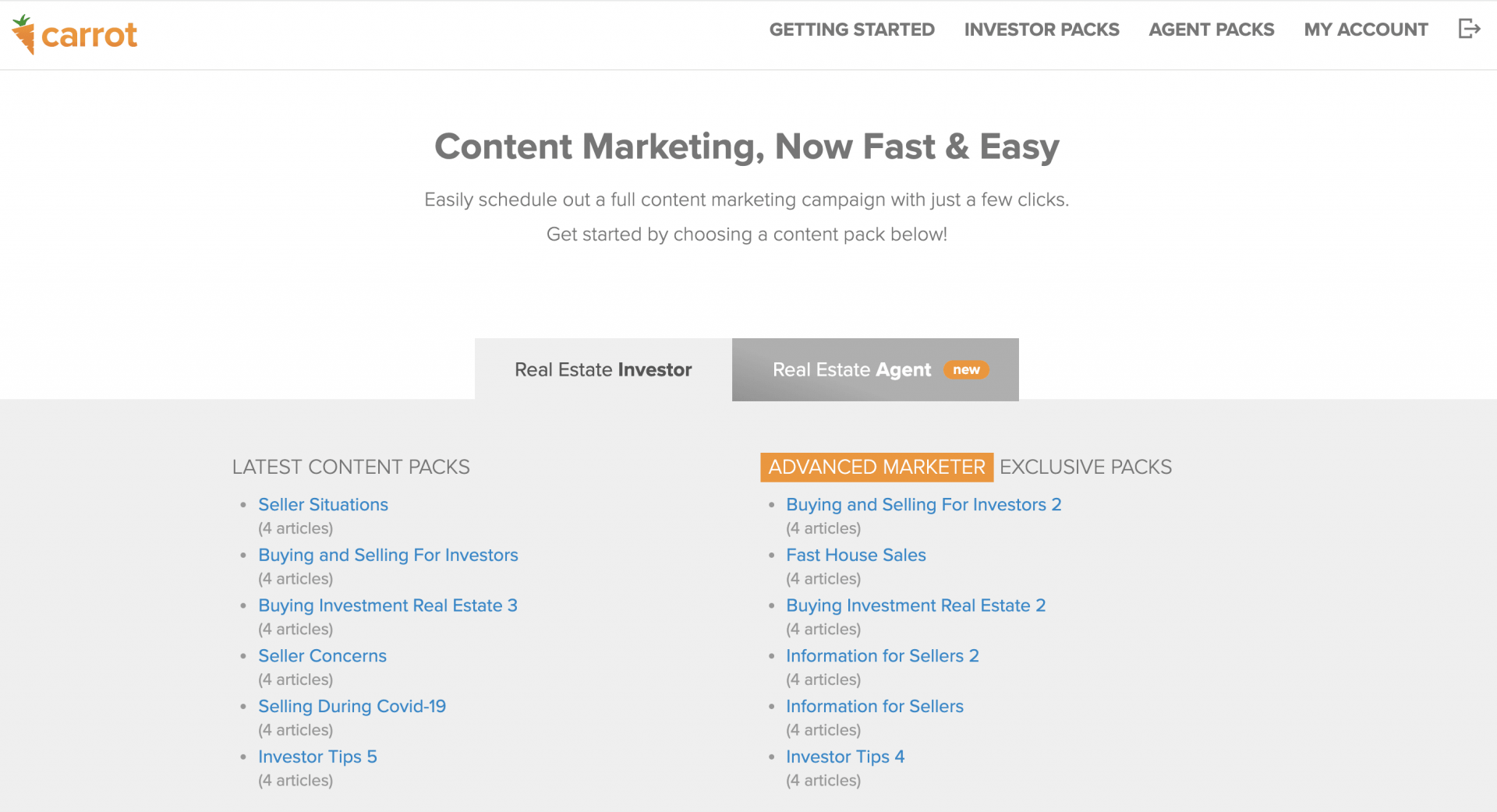
    Of course, you can hire someone, but did you know that the Carrot platform already has powerful content built into it?

    For Content Tools members, with our Automated Content Library, you get regular “content packs” of blog posts that are high quality (excellent for search engines!) and informative (great for humans!), plus they’ve been optimized with some of the most powerful search engine optimization strategies on the planet… then localized for your market.

    What’s the catch? We’ve done 80-90% of the work for you, but it’s up to you to update the content with your voice. We are saving you dozens of hours per month and hundreds of dollars vs. hiring out the writing and optimization… plus you can always edit these posts to put your spin on them before they publish.

    Best of all worlds.

    So, if you’re looking for some very powerful content marketing without much effort to write it (or manage writers), then be sure to check out our Content Pro level.

    So, Let’s Get Your First (or next) Blog Posts Up!

    If you’re not going to dive in and corner your market as an expert leveraging great content… your top competition will.

    So the choice is yours.

    Evergreen content marketing is how real estate investors (wholesalers, house flippers, etc.) can now get an edge online.

    The ones who understand how to do it well are setting themselves up for long-term success as Google shifts more and more toward preferring rich and fresh content on your website.

    In this blog post, you read about the strategies you need to implement to create great content, you got 100+ compelling real estate blog post ideas to get you started, and you even read some fast-track ideas to help you get going even sooner so you can focus on doing more deals now.

    So dive in and get your first blog post up today!

    Don’t over-complicate it. Just get something up to start, then improve from there.

    I suggest scheduling one post weekly and publishing it live Tuesday, Wednesday, or Thursday. Why? Our data shows overwhelmingly that most of the leads coming through our platform come in midweek… with Sunday being the worst day. So post that content when your best prospects are likely to see it.

    Enjoy!

  • How to Find Motivated Seller Leads for Real Estate Investors in 2024

    How to Find Motivated Seller Leads for Real Estate Investors in 2024

    Although there is no single most important trait, finding motivated seller leads can be one of the most critical skills in real estate investing.

    If there’s one thing that separates a struggling investor from most successful real estate investors, they have systems for generating leads. They have processes that work like clockwork day-in and day-out.

    These investors usually generate 20 or more high-quality motivated seller leads per month.

    Does that sound too good to be true? It’s not.

    In 2003, we built our first website to generate motivated seller leads. Since then, we’ve refined our marketing systems, website platforms, and overall strategy on what it takes to drive leads online.

    We’ve brought in over 1,253,267 real estate-related leads alone in the past 5 years.

    The lead generation options that we will teach you in this article have been proven. Although they can take a bit of upfront work, you can generate leads every month once the ball is rolling.

    Ready to learn how to find motivated sellers?

    Let’s do this.

    What We’ll Cover in This Post:


    When You Get Motivated Leads You Need to Close Them!

    Get the fool-proof strategies & step-by-step scripts used by real estate investing’s top closers.

    • We’re committed to your privacy. Carrot uses the information you provide to us to contact you about our relevant content, products, and services. You may unsubscribe from these communications at any time. For more information, check out our Privacy Policy.
    • This field is for validation purposes and should be left unchanged.


    What Are Motivated Sellers?

    A motivated seller is a property owner who needs to get rid of their property quickly and meets at least one of the following conditions:

    1. They are willing to sell at a 10-30% price below market value.
    2. They are ready to sell under specific terms. Including no money down and no interest.

    In an ideal situation, you’d want both conditions, but one advantage of working with motivated sellers is that they have reasons they need to sell fast. You’re there to help them solve it.

    Some common types of motivated sellers include:

    • Distressed sellers
    • Landlords
    • Facing foreclosure
    • Relocating
    • Bank in possession of REOs
    • Divorce
    • Inherited houses
    • Recent job loss

    How to Find Motivated Seller Leads

    Find Your List

    Many investors choose to buy lists of motivated seller leads. For example, you might have the option to purchase a probate list that is pulled from courthouse records. Or a list of pre-foreclosures who are likely to sell in the coming two to three months.

    Although finding this information can be time-consuming, if you don’t have the time, you can use services such as DataTree and ListSource.

    You must confirm the accuracy of the data. Some services may have data that is no longer relevant.

    Drive for Dollars

    Driving for dollars can be a great way to generate leads. You simply drive into your targeted neighborhoods looking for distressed or vacant properties.

    While driving, you can create a list of properties to contact.

    Another option is to use Google Maps Street View and apps such DealMachine. You can drive for dollars without leaving your house.

    Find Motivated Seller Leads Online

    SEO, PPC, and social media.

    Let’s start with SEO. SEO for real estate is what we consider the secret sauce of a real estate investing marketing strategy.

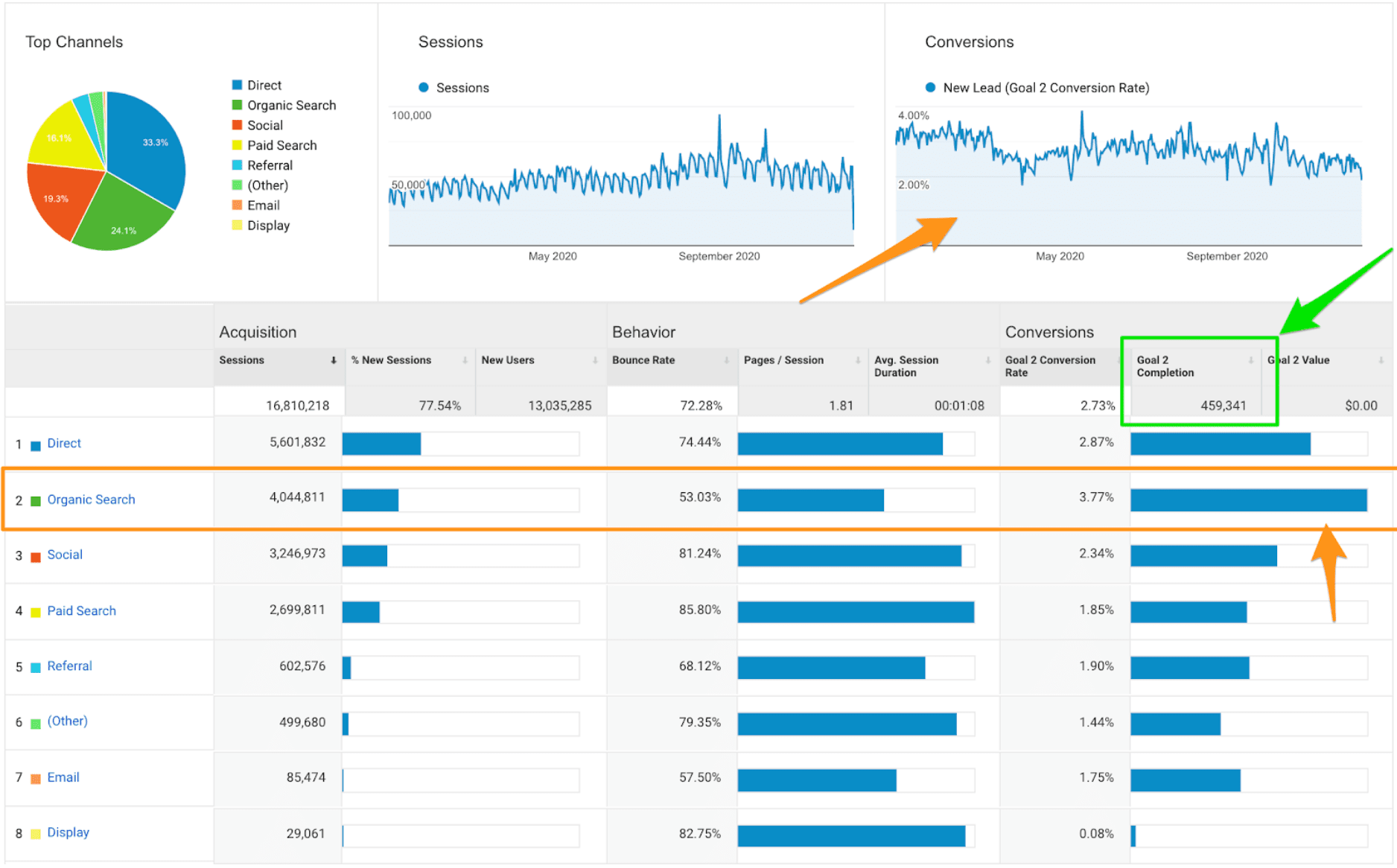
    Organic leads are where the majority of leads come from for our members.

    It’s not theory, here’s a real peek behind the scenes…

    Carrot member organic leads

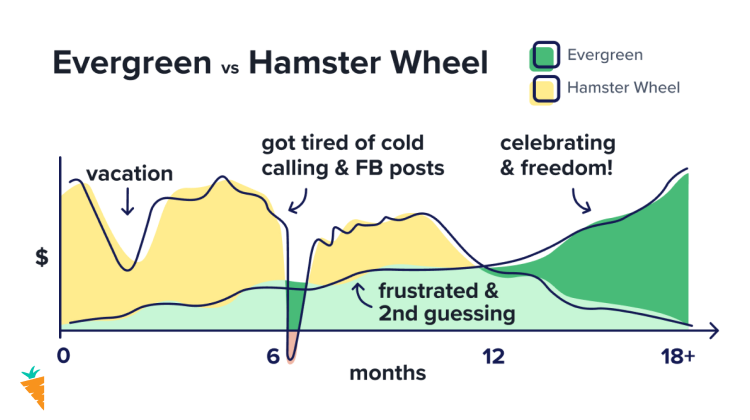
    We focus not only on SEO but also on how it builds into Evergreen marketing.

    Evergreen marketing to generate motivated seller leads

    How Would You Like More Motivated Seller Leads (with no paid ads) Using 1 Proven, Simple Marketing Strategy?

    Watch this Free On-Demand Workshop. We Breakdown Exactly How Our Members Generated Over 450,000 House/Land Sellers & Buyers Last Year


    The definition of Evergreen marketing is: “a: retaining freshness or interest: perennial. b: universally and continually relevant: not limited in applicability to a particular event or date.”

    In marketing terms, it’s marketing you do once, and it works for years… not hours, days, or weeks. Content relevant for a long time serves your best prospects and gets in front of them where they’re searching online.

    Results grow momentum over time = Freedom

    We then amplify Evergreen with paid marketing and even hamster wheel marketing.

    Hamster wheel marketing is defined as: “any situation that seems to be endless without goal or achievement.”

    In marketing terms, any marketing that works for a short time after you do has a limited life span. Then you have to do it all over again to keep results coming in.

    Cold calling, direct mail, posting on social, open houses, etc.

    Results stop when you stop = Stress

    Growing more and more into the Evergreen is where you create your consistency, freedom, and flexibility.

    You can make a more significant impact with your business, but also, that’s where your most valuable and highest converting leads come from.

    If you build a solid lead generation engine for your real estate business, you’ll have leads for life.

    It’s a big goal, but don’t be intimated.

    Here’s some proof…

    Tyler Ford has been getting 2x more motivated seller leads with Carrot than he did with his old site. The Carrot tools and Evergreen marketing content has helped him stand out in my crowded market.

    Here’s his story… Tyler Almost Quit Real Estate After 20 Years – That is, Until He Made these 8 Changes.


    While paid advertising can bring in motivated seller leads immediately and can help your business in the short-term… SEO can build momentum and help grow your business over the long term.

    But what is SEO?

    It’s pretty simple.

    When a motivated seller wants to sell their house fast for cash, many of them go to Google and type in the phrase “Sell my house fast in [MARKET CITY]”.

    Google trends for sell my house fast

    And when they do, Google shows them different websites that it thinks can help the searcher.

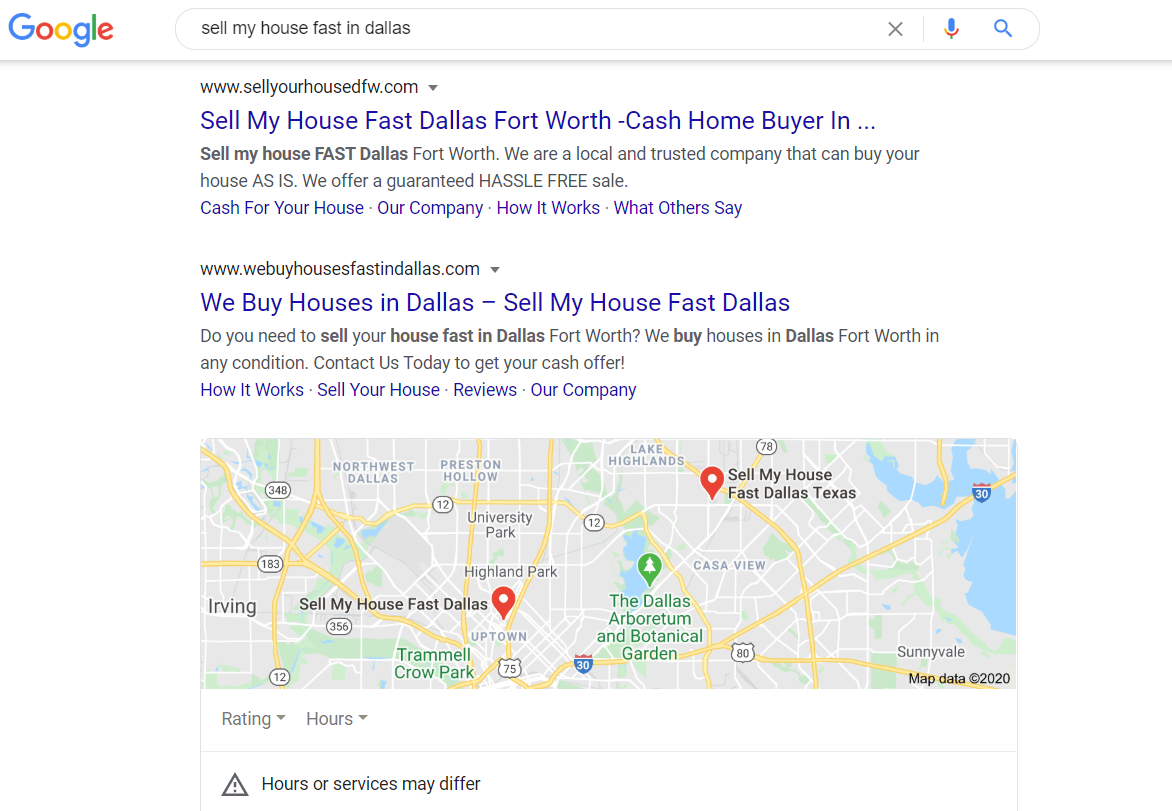
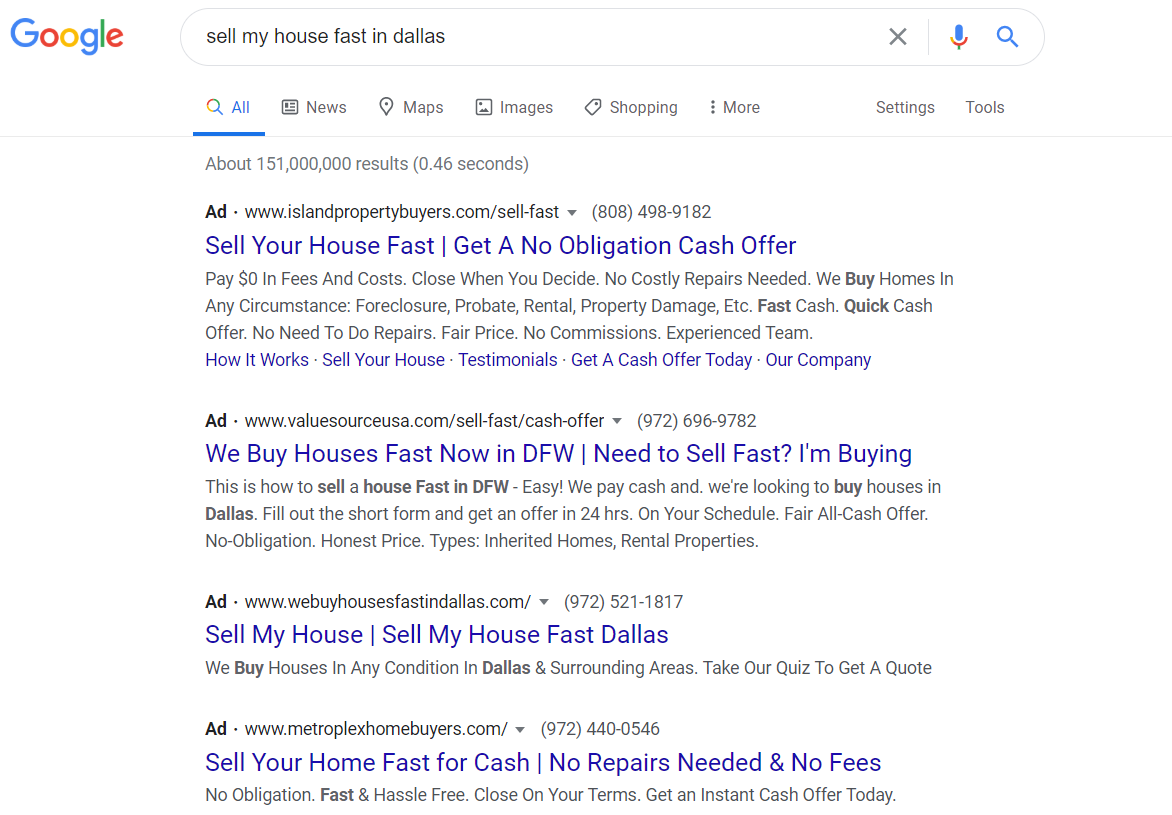
    If I search for “Sell my house fast in Dallas”, for example, Google thinks that these websites can help me out.

    Google search for sell my house fast in Dallas

    Now here’s the thing: those websites are getting clicks and traffic from motivated sellers every time someone types that phrase into Google… which is more often than you’d think.

    That traffic then turns into leads (so long as the investor’s website is optimized for conversion) and the investor generates deals every month through SEO.

    You can also pay to get in those search results…

    sell my house fast in dallas paid ads

    And that is a good idea when you’re starting. But it shouldn’t replace your SEO strategy.

    More than 90% of people click on organic results before clicking on PPC results.

    So here’s the question: how do you get Google to rank your website for a high-value keyword phrase.

    Well, it can take time and some patience.

    To start, you’ll need to put the correct title on your page, have a website that loads quickly, and do a few other things. Reference this SEO guide for help.

    And at Carrot, we have TONS of tools to help you.

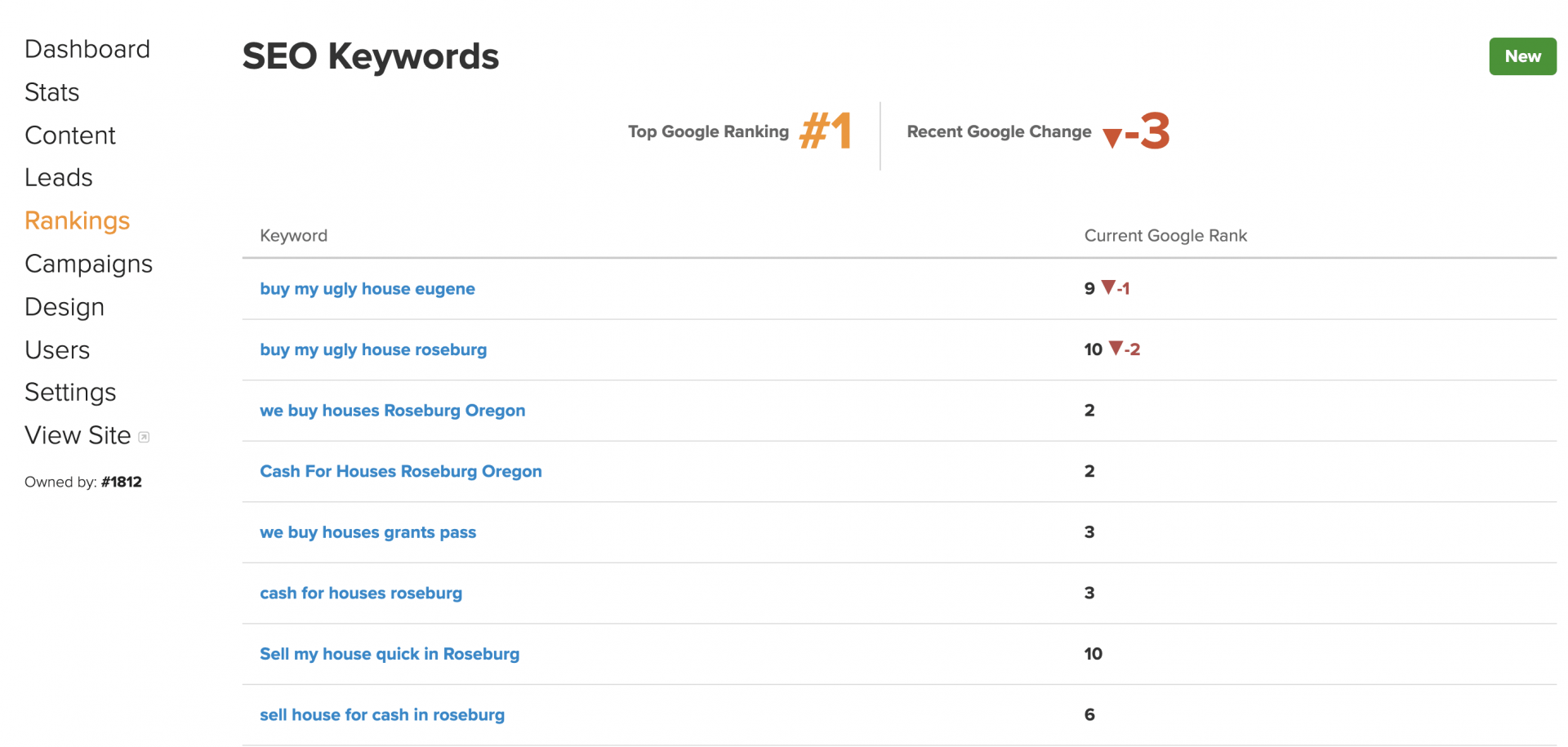
    We give you monthly SEO-optimized blog post content. Our websites have an SEO-friendly tech-stack. We also allow you to track your progress on target keyword phrases and alert you to optimizations that are missing on any given page.

    Carrot Keyword Ranking Tracker

    SEO for real estate investors couldn’t be any easier than with a Carrot site. :)

    PPC is another valuable asset to generate motivated leads.

    Google Ads can work so long as you have a solid strategy. Year after year, it’s one of our Carrot members’ top lead generation methods (behind organic leads).

    Our real estate investor members consistently get feedback that their Google Ads leads are closing between 1 in 10 to 1 in 15 leads per deal.

    Learn more about Google Ads for real estate investors in this ultimate guide.

    Direct Mail

    Real estate direct mail is one of the most tried and true methods for real estate investors to generate leads.

    Although, a portion of mail ends up in the trash without a second look.

    The average mailbox is packed with junk mail, bills, and other correspondence from various sources telling you about deals or offering their services. It can be easy for an envelope containing information on real estate opportunities to land within the other noise.

    Direct mail still works and offers different opportunities if done correctly.

    • It’s interactive.
    • It’s memorable.
    • It can have an extensive reach.
    • It offers a lot of ways to get creative.
    • You can pair social media and content marketing (websites) with direct mail for an enhanced customer journey.

    Learn more: Check out our Direct Mail Masterclass for Real Estate Investors

    FSBO Sites

    FSBO sites can be a great place to find motivated sellers for free. Sites such as Loopnet and Trulia are good sites to use and you can also find motivated sellers on Craigslist.

    On Craigslist look for deals that have been listed for a long time. This might be a sign of a motivated seller.

    Narrow your search by property type, price, location, and whether a broker or the owner is selling the home. You can also search for apartments, condos, and multi-family homes if it fits your niche.

    Bandit Signs

    Bandit signs are “old school” and not many new investors use them.

    They can still be a great way to find motivated sellers and cash buyers.

    One of the most significant issues with bandit signs is legality. Cities can have strict ordinances about putting them out. As a general rule, it’s a good idea to check with your city before.

    Here are some tips if you find it’s legal:

    • Don’t put your personal number on the bandit sign – rather use a Call Rail Tracking Number, A Google Voice Number, or any number that will not lead back to you if someone were to Google the number.
    • Take your sign down immediately if someone has issues with it.
    • Don’t post signs on private property.

    The Difference Between Inbound & Outbound Lead Generation

    We’ve shared a lot of different strategies on this blog for real estate lead generation: Traffic plus Conversions, and we’ve shown you a bunch of great strategies for building traffic. If you haven’t read those posts, click those links to check ’em out… I’ll try not to duplicate much here.

    Real estate investors can generate motivated leads using outbound and inbound (paid and organic) sources. Both are good ways to generate leads.

    Confused?

    Let me make it more simple.

    “Outbound” marketing are strategies such as direct mail, cold calling, and driving for dollars.

    “Inbound” marketing are Google Ads, Microsoft ads, and Facebook strategies. Also, with good content through organic search rankings or SEO.

    The Simple Motivated Seller Lead Generation Formula

    To generate more motivated seller leads for your business, you first have to understand the simple formula for lead generation.

    That is, how is a lead generated in the first place?

    Different investors will answer that question differently. Some will say that cold calling is how you generate leads, others will say direct mail, and still, others will say by personally connecting with people in the community.

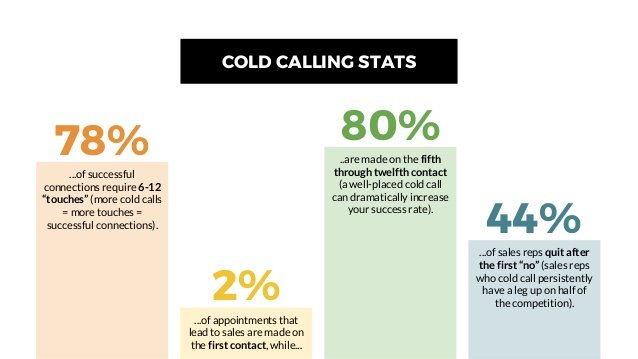
    cold calling stats

    And none of those answers are wrong.

    We know most successful investors also use direct mail and/or cold calling to generate consistent leads for their businesses.

    But they also do something that very few investors don’t do.

    They systematically generate leads by using the below formula…

    TRAFFIC + CONVERSION = LEADS

    Let’s break that down.

    Traffic is when people visit your website. They might come through paid advertisements you’re running (like Facebook Ads or Google Ads) or they might come organically through a search engine (Google) or a social media site (Facebook).

    Wherever they come from, one thing is for sure… you can’t generate leads on autopilot through your website if you’re not generating traffic.

    Paid ads effectively drive immediate traffic to your website while building your organic traffic takes a little more time (but the payoff is massive) — more on organic traffic or “SEO” here shortly.

    What about conversions?

    A conversion is when, after visiting your website, the person takes the action you want them to take. Usually, that’s filling out a form that provides you with their contact information or calling your business directly.

    And voila! You have a lead.

    Those are the two vital elements to generating motivated seller leads.

    You have to drive traffic to your website consistently and consistently convert that traffic into leads for your business.

    website traffic to conversion rate

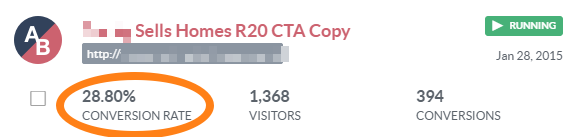
    And Carrot websites have the highest conversion rate in the industry (usually between 10% and 20%).

    Rent To Own Conversion Rate
    A conversion rate on one Carrot member’s website.

    That’s why we believe in our product so much.

    We know that if someone takes their organic traffic seriously and uses Carrot to create their website, they’ll have everything they need to build a winning business.

    The Magic of Conversion Optimization

    Remember the formula we talked about?

    Traffic + Conversion = Leads

    Well… you need both traffic and conversions.

    It’s not uncommon for us to see a real estate investor succeed at driving traffic to their website through paid ads or SEO… but to convert almost none of that traffic into leads.

    Why?

    Because their site isn’t set up to convert.

    Actually, there’s a big difference between a website that’s built to convert visitors and one that… isn’t.

    Let me show you what I mean.

    Imagine that you search in Google for the phrase “Sell my house fast in Dallas”.

    You’re probably pretty motivated — you want to sell fast for cash and you’re wondering how that’s possible.

    So you click on some results in Google.

    The first website you go to looks like this…

    motivated seller website with no form

    That’s not too bad, but there’s a lot of text to read on the first page… and you’re looking for a quick solution, so you leave the tab open but go to a different Google result.

    The next website you visit looks like this…

    High converting Carrot motivated seller website

    Now we’re talking!

    This site seems to be able to give you exactly what you want… and by just entering a few details, you can get your fair cash offer today — that’s perfect!

    See the difference?

    The first site doesn’t solve your problem immediately, but the second site does.

    Well… that’s because the second site is a Carrot site… and we’ve run hundreds of tests to determine what converts website visitors the best in the real estate industry. We’ve then taken what we’ve learned and baked conversion optimization into every one of our member’s sites.

    That way, as a Carrot member, you start out with a high-converting site.

    Most people who switch to Carrot are seeing a measly 2% or 3% conversion rate on their old site… and then get up to a 20% conversion rate on their Carrot site!

    Here’s a Carrot member with a 9% conversion rate (693 leads divided by the 7,661 visitors).

    Carrot member website motivated seller leads conversion rate

    Ultimately, you need traffic and conversions to generate consistently motivated seller leads.

    How to Negotiate with Motivated Sellers

    When it comes to negotiating with motivated sellers, there are some commonalities.

    We all know that price is not something that’s set in stone. And neither is a seller’s immediate inclination to work with or to not work with you.

    They could call you ready to sell but a few days later lose interest. Or they could call skeptical and leave the call ready to sign.

    Part of what determines these outcomes is how you negotiate. What you say, what questions you ask, and even how you talk could impact.

    So we spoke with some experienced real estate investors and asked them how they negotiate with sellers to close more deals.

    Learn more about negotiating by checking out this blog post and downloading our real estate negotiation playbook.

    Summary

    You now know what motivated sellers are and some common methods to find them.

    The process of finding motivated seller leads and negotiating with them looks doesn’t need to be complicated. Pick one or two quicker lead generation methods and start working on your Evergreen SEO.

    Be persistent with follow-up as you never know what will happen after the third, fourth, or sixtieth time around.

    Succeeding in the real estate investing industry is a matter of patience and persistence. Finding motivated seller leads and knowing how to contact them can take plenty of practice.

    Be consistent and you’ll be on your way to fulfilling your real estate investment career.


  • 9 Real Estate Follow Up Scripts to Close More Deals

    9 Real Estate Follow Up Scripts to Close More Deals

    If you want more deals and outgrow your competitors, you need real estate follow up scripts proven to close.

    You want to own one of your market’s most successful real estate businesses (whether agent or investor).

    There are a lot of things you could do. Sending paid ad traffic to a high-converting website, optimizing your ad campaigns for a better click-through rate, and creating sales scripts can make a massive difference in how many leads you generate and how many deals you close monthly.

    Following up on your real estate leads is one of the biggest determiners of success.

    If an agent or investor has a rigorous and consistent follow-up system, they are far more likely to be successful than those who assume a lead is dead if they don’t get a signed contract after the first phone call.

    But you don’t have to take our word for it.


    Hone Your Follow-Up Skills & Close More Deals

    Cover seller objections, use high-converting warm and cold touch scripts, and follow an easy touchpoint schedule to increase your lead-to-deal conversion.

    Download Now: Free Follow-Up Scripts


    Is Follow Up Worth Your Time?

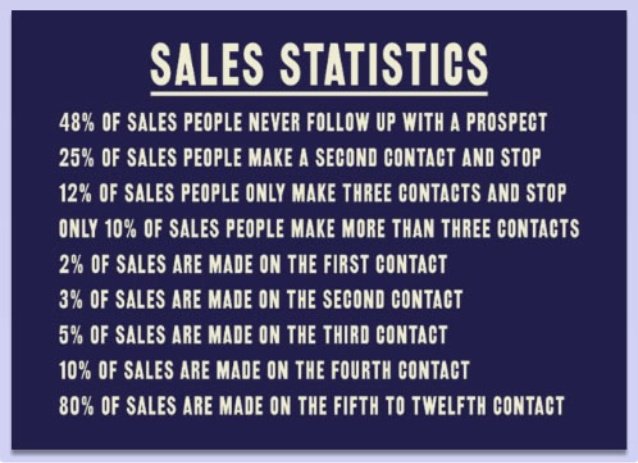
    We’ve mentioned this in other blog posts before, but the data is pretty clear about whether follow-up is worth your time or not…

    is lead follow-up important

    (Image Source)

    Think about that for a second…

    80% of sales are made between the fifth and twelfth contact.

    Let’s pretend that that is true for your business but that you only follow up once with each lead.

    That would mean that you’re giving more than 80% of your potential deals to your competitors — just outright handing them over.

    Because those leads aren’t just sitting at home waiting for you to pursue them, they’re calling other investors and agents in the area and examining their options.

    If you stop contacting them, they’ll forget about you and work with someone else.

    Over 80%!

    Sound crazy?

    Well, even if that percentage is 50% for your business, isn’t that too much?

    Even 10% is too much!

    Especially in real estate, an industry where one transaction often amounts to tens of thousands of dollars in profit.

    Look — you know there’s money in the follow up, but you still have some limiting beliefs about building a follow-up system for your business.

    So let me walk you through 3 of the most common myths of follow up in real estate.

    Three Real Estate Follow Up Myths

    Myth #1: “I need to have a complex CRM before building my follow up system.”

    Yes. Having a super fancy CRM will help you organize your lead flow, assign tasks to different team members, and ensure that you follow up with every lead, with the same messages, a pre-determined number of times.

    CRMs allow you to organize and automate your follow-up system, making the entire process much simpler.

    But CRMs aren’t always cheap.

    And they also aren’t always easy to use (some are better than others).

    If you think your lack of a CRM or your hatred of technology is an excuse not to follow up with your leads, think again…

    Just keep it simple, use an ESP like MailChimp or InvestorFuse (both of which integrate with your Carrot website), and schedule an automated follow-up campaign.

    Remember, some sort of follow-up strategy is better than no follow-up strategy.

    Myth #2: “Most deals come from first contact, not follow-up.

    Whether you’re an agent or investor, it’s easy to assume that most of your deals come from first contact.

    A motivated buyer or seller calls you on the phone, ready to take action now (they might even already know who you are and trust you), and that call effortlessly turns into a closed deal.

    That’s how many of your transactions happen now.

    But we have to ask the question… do most of your currently closed deals happen like that because if someone isn’t motivated from the get-go, then they won’t be motivated down the road?

    Or because you’re not following up and thus not capturing leads that might require more time and effort?

    The answer is clear.

    After all, no matter how motivated someone is to buy or sell their home, a reasonable person likely won’t just decide to work with you right off the bat — they’ll need to process, think about it, examine other options, and speak with you some more.

    And if you’re following up during that decision-making process, they might work well with you.

    Myth #3: “I don’t want to follow up too much or annoy my prospects.

    This “myth” isn’t false.

    Some real estate follow-up sequences are downright annoying to prospects.

    Suppose you’re sending the same thing every time — “Hey! I want to buy your house right now!” — then that’ll get old quickly.

    But this belief is a myth in that the follow-up sequence you create doesn’t need to be dull and drab — it can be interesting, engaging, and trust-building.

    How?

    Well, we think that one of the best ways to build trust and engage prospects with your follow-up sequence is by providing free value.

    Send them a link to an article on your website that might help them solve a problem. Give them a piece of advice specific to their situation. Or even offer to get on the phone and discuss their options.

    The better the relationship you build with them, the more dividends that relationship will pay you down the road.


    Hone Your Negotiation Skills & Close More Deals

    Get the fool-proof strategies & step-by-step scripts used by real estate investing’s top closers — all in one resource.

    Download Now: Free Negotiation Playbook


    What Is The Goal Of Follow Up?

    Sometimes, a lead follow-up system’s goal is to get your lead to take the next step for conversion — getting on the phone with you, receiving their cash offer, or going to an open house.

    Sometimes, though, the goal will be to get them to accept a cash offer you already made or to stay in contact with them if they become ready to use your services.

    Each business is different, and each prospect is different.

    What your follow-up system should look like depends on when you’re following up with prospects (what stage they’re at) and what action you need them to take.

    Typically, though, the goal of mastering following up is to get the prospect on the phone again so you can work your sales magic — a phone call can serve all purposes.

    The 3 Mediums Of Your Follow Up Strategy: Text, Email, and Phone Calls

    How you follow up with your prospects — whether through text, email, or phone calls (or, even better, all three) — will partly be determined by your target market and how they like to communicate.

    More than one investor, for example, has gotten on the phone with an elderly person looking to sell their home fast, only to find out that they have no idea how to work email.

    So adjust with your market’s tendencies.

    If you know, they don’t look at their emails and texts, then call them. If they don’t answer the phone, send text messages and emails.

    The more you adapt your follow-up strategy to the communication style of each prospect, the better.

    (But remember, progress, not perfection)

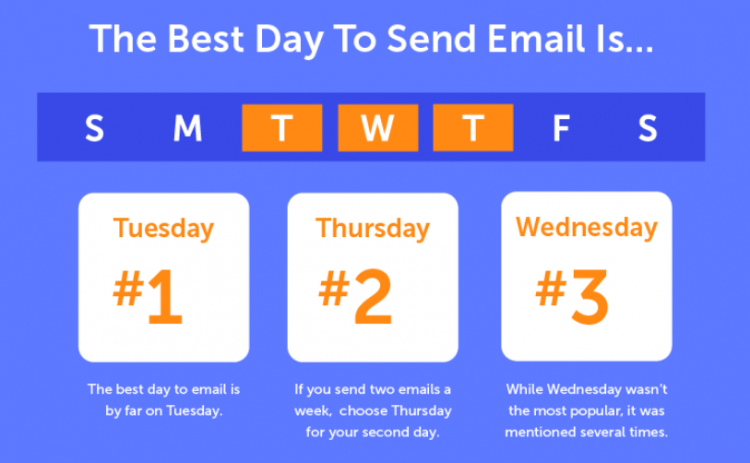
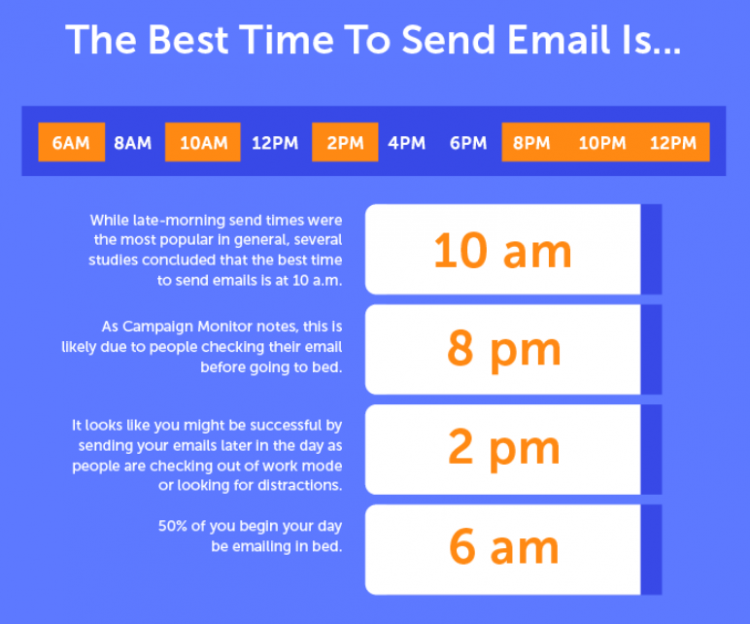
    Oh! And here’s the best time to email…

    best days to send a lead follow up email

    (Image Source)

    And the best time to send a real estate follow up email…

    best hours to send a lead follow up email

    (Image Source)

    In other words…

    best times and days to send a lead follow up email

    (Image Source)

    Real Estate Follow Up Timeline Calendar

    Following up is, of course, easier said than done.

    You need to figure out what to say and how to say it (covered in the next part of this article) and determine when you will follow up.

    So to help with the decision-making process, we’ve put together this free follow-up timeline calendar that you can steal if you like.

    Try it, see how it goes, and adjust it as necessary.

    When we put it together, we’d tried to put logical spacing between each text, call, and email so that you’ll sometimes need to use free-value-based follow ups…

    “Hey! I found something you might be interested in.”

    and sometimes, you’ll just be checking in…

    “Hey! Just calling to see if you’re still interested in my services.”

    Hope it helps!

    Note: This calendar is one month’s worth of follow-up for a given prospect who opted-in to your website on Sunday, the 1st. You can follow up more or less than the calendar suggests, but this is a good starting point.

    real estate lead follow up calendar

    Free Real Estate Follow Up Scripts

    To make your follow-up strategy even easier to implement, we will provide you with 3 follow up scripts whether you’re an agent or an investor.

    These scripts are written as if for an automated email campaign, but they can be adapted to fit any medium (including text and phone calls).

    One of the primary ways we recommend reaching out to your prospects is by offering value rather than just asking for the sale each time (which can get annoying quickly).

    How can you provide value?

    Well, if you have a blog on your website (check out our Content Tools add-on where we’ll provide you with expert-written blog content every month), then you can send over links to helpful articles that you’ve recently published, making you look like the expert that you are and keeping you top of mind.

    For agents and investors, here are 3 follow-up scripts you’re welcome to steal. :-)

    1. Hard Ask — Use When Trying To Close The Deal
    2. Soft Ask — Use When Trying To Get Prospect To Take Next Step
    3. Free Value — Use When Trying To Stay Connected With Prospect Simply

    6 Free Real Estate Follow Up Scripts For Agents (3 For Buyers & 3 For Sellers)

    FOR BUYERS

    Hard Ask

    This depends a bit on what you’re trying to do with the buyer. Here, I assume you want them to choose to work with you rather than another competitor.

    Hey [name]!

    Great chat the other day.

    I’ve spent some time thinking about your situation and I know that I can help you find the perfect home. If you’re okay with it, let me find some listings that I think are within your budget and we can go take a look.

    What do you say?

    Soft Ask

    Hey [name]!

    I hope you’re doing well.

    I know you mentioned that you’re interested in finding the perfect home for [purpose]. I’d love to help you with that. Do you have time to swing by my office this week?

    Free Value — Use When Trying To Stay Connected With Prospect Simply

    Hey [name]!

    I just published this article on my website and it’s all about [topic] — super relevant to what you’re going through.

    Anyways, I thought you might find it helpful!

    Hope you’re well. :-)

    FOR SELLERS

    Hard Ask

    Hey [name]!

    I was just doing some research on your home and I’m confident we can sell it for [$XXX,XXX] — want me to get started listing it?

    Soft Ask

    Hey [name]!

    I’d love to help you get top-dollar for your precious home so you can get moving with your big plans. How can I help you?

    Free Value

    Hey [name]!

    I just published this article on my website that talks about [topic] — I thought it’d be super relevant to your situation and you might get some value out of it.

    Hope you’re well!

    3 Free Real Estate Follow Up Scripts For Investors

    Hard Ask

    Hey [name]!

    Are you ready to sell your house fast for cash? I’m prepared to give you cash for what I offered you the other day.

    Money in your pocket and stress off your shoulders…

    Let me know!

    Soft Ask

    Hey [name]!

    I would really like to buy your house for cash. Want to hear my offer?

    Free Value

    Hey [name]!

    I just published this article on my website about [topic] and I thought it might help with your difficult situation. Give it a look.

    And call me if you think I can help you out. :-)

    Conclusion

    These nine real estate follow up scripts should help you get started down the path to more deals.

    Remember, some follow up is better than none. And this is going to get you moving in the right direction.

    Create a follow up system that works for you, your business, and your prospects. Then, you’ll reap the benefits of being a business that consistently follows up with its leads.

    If you’d like more real estate marketing materials like this, click on the link!

  • 13 Best Real Estate Podcasts For 2025

    13 Best Real Estate Podcasts For 2025

    12 Best Real Estate Podcasts of 2021

    Whether you’re at the gym, running errands, or going for a walk, listening to real estate podcasts is great for learning on the go.

    And in business, learners succeed.

    But of course, not all podcasts are equal in the value that they provide or even in the format in which they provide it.

    So that you don’t have to roll the dice, we’ve listed our 13 favorite real estate podcasts in 2025 below with descriptions of each, their iTunes ratings, and a few recent episodes for you to check out.

    Enjoy!
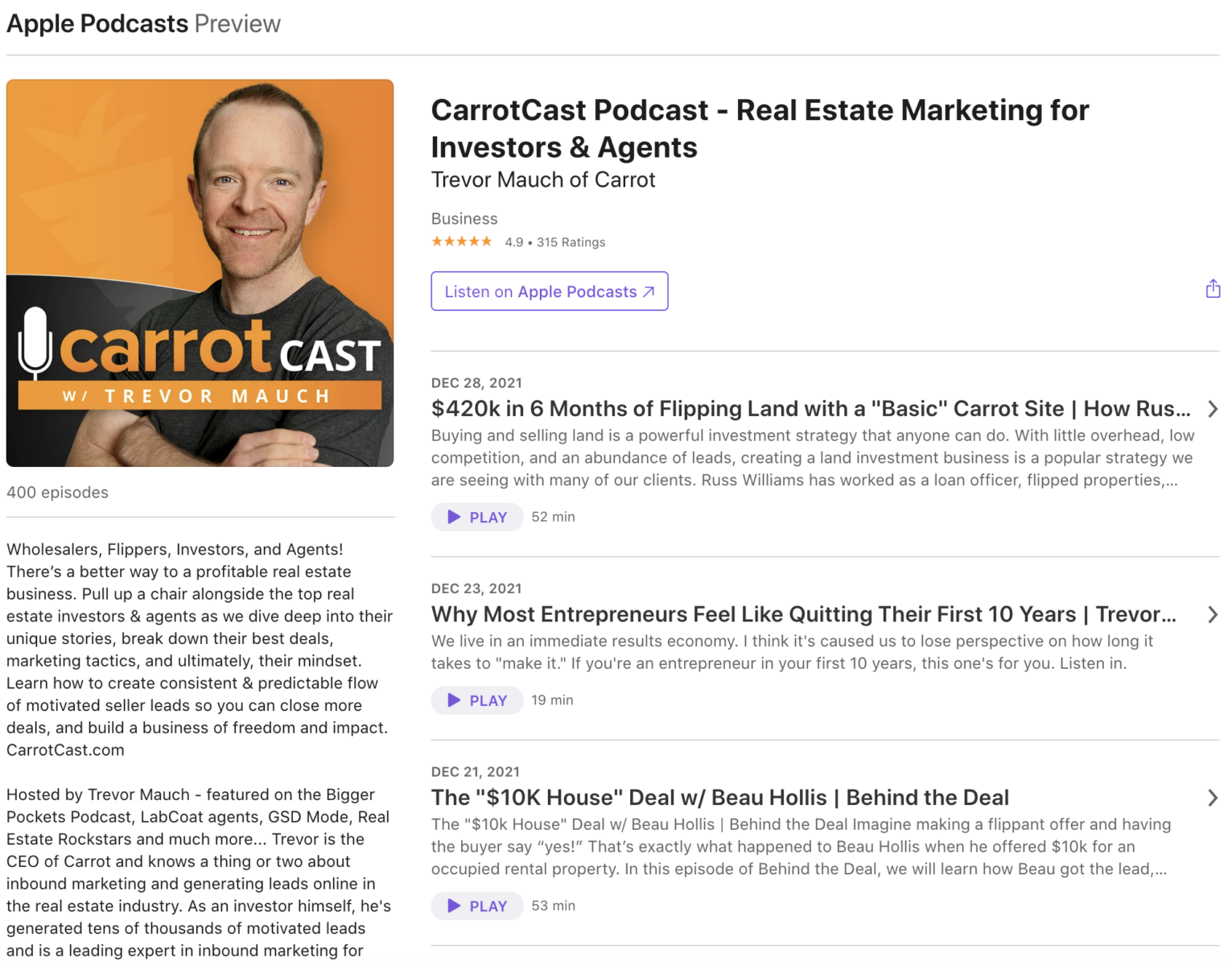
    1. The CarrotCast Podcast

    Real Estate Podcasts - CarrotCast

    We couldn’t put together an article about the best real estate podcasts without mentioning our own! On the CarrotCast, Trevor Mauch discusses tried-and-tested online marketing strategies for investors and agents. He also interviews investors and agents who’ve built successful businesses — you can expect to learn about the mindset behind real estate and entrepreneurship as well as marketing strategies for building a business that’s predictable, sustainable, and profitable. Click Here to listen on your device.

    Apple Podcasts Description

    “There’s a better way to profitable real estate business. Pull up a chair alongside the top real estate investors & agents as we dive deep into their unique stories, break down their best deals, marketing tactics, and ultimately, their mindset. Whether you’re grinding away or on a beach vacation, learn how to create consistent & predictable lead flow, and close more deals, so you can finally build a business of real freedom and real impact.”

    iTunes Rating: 4.9/5

    Episodes

    2. The Tom Ferry Podcast Experience

    Tom Ferry Podcast Experience

    The Tom Ferry Podcast Experience is easily one of the most popular podcasts among agents and investors. Tom is a real estate coach who believes that everyone has greatness inside of them. The goal of his podcast is to help real estate entrepreneurs unlock their greatness so that they can fulfill their potential. Check out his most recent episodes below!

    iTunes Description

    “Greatness lives within us all. But have you tapped into yours – or is it stuck inside you? Top-ranked real estate and business coach Tom Ferry’s life’s work is all about helping people fulfill their vast untapped potential. The Tom Ferry Podcast Experience will give you the knowledge, support, motivation, and tools to succeed in business and achieve your true potential.”

    iTunes Rating: 4.8/5

    Episodes

    3. BiggerPockets Podcast

    BiggerPockets Podcast

    BiggerPockets isn’t just the top place for investors to gather online and chat about their real estate businesses, it’s also home to one of the best podcasts in the industry. The founders of BiggerPockets are notorious for sharing heavy-hitting advice about how to manage and grow an investing business… and their podcast is no different. Check out their most recent episodes below!

    iTunes Description

    “Imagine you are friends with hundreds of real estate investors and entrepreneurs. Now imagine you can grab a beer with each of them and casually chat about failures, successes, motivations, and lessons learned. That’s what The BiggerPockets Podcast delivers.

    iTunes Rating: 4.8/5

    Episodes

    4. The Close Weekly

    iTunes Description

    “The Close Weekly Podcast provides actionable advice about today’s real estate market for real estate agents. Hosted by top producing agent & broker Sean Moudry, this podcast features industry leaders who offer marketing and lead gen tips.”

    iTunes Rating: 5/5

    Episodes

    5. Rental Income Podcast

    Rental Income Podcast

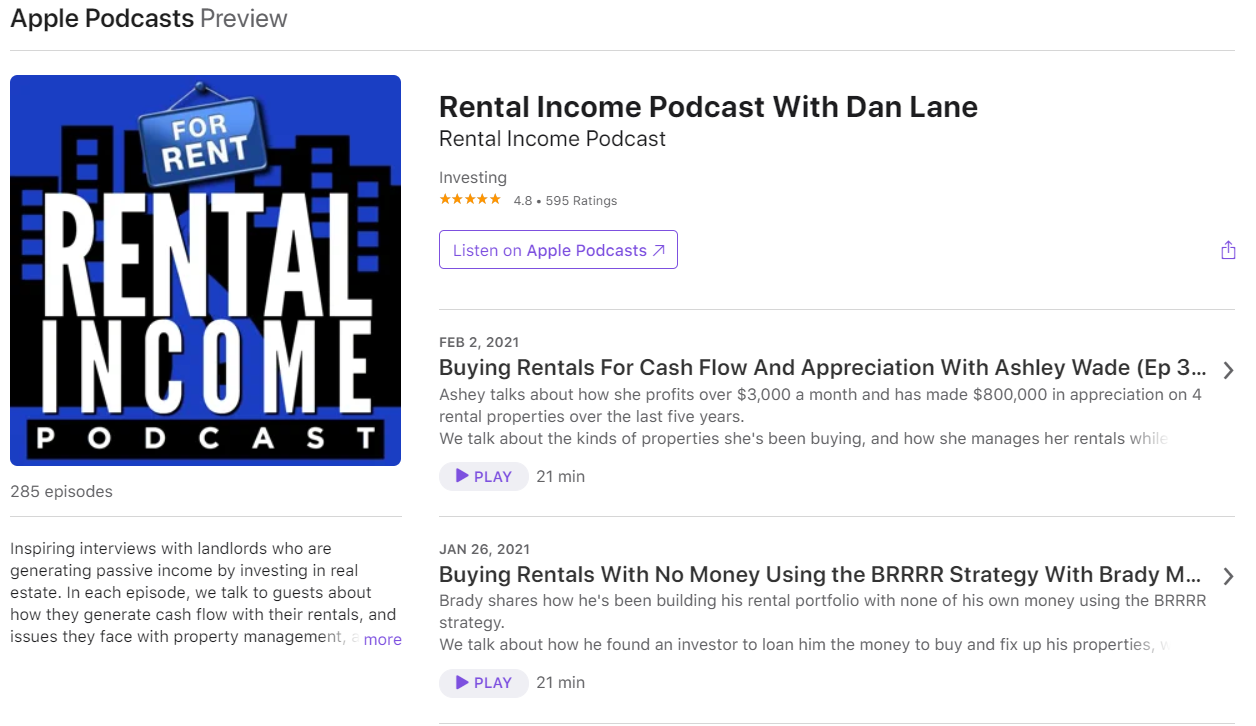
    On the Rental Income Podcast, Dan Lane talks with successful real estate investors and landlords about how they’re generating passive income with rental properties. This is a great podcast to subscribe to if you’re interested in building a rental empire to acquire long-term wealth.

    iTunes Description

    “Inspiring interviews with landlords who are generating passive income by investing in real estate. In each episode, we talk to guests about how they generate cash flow with their rentals, and issues they face with property management, and managing tenants.”

    iTunes Rating: 4.8/5

    Episodes

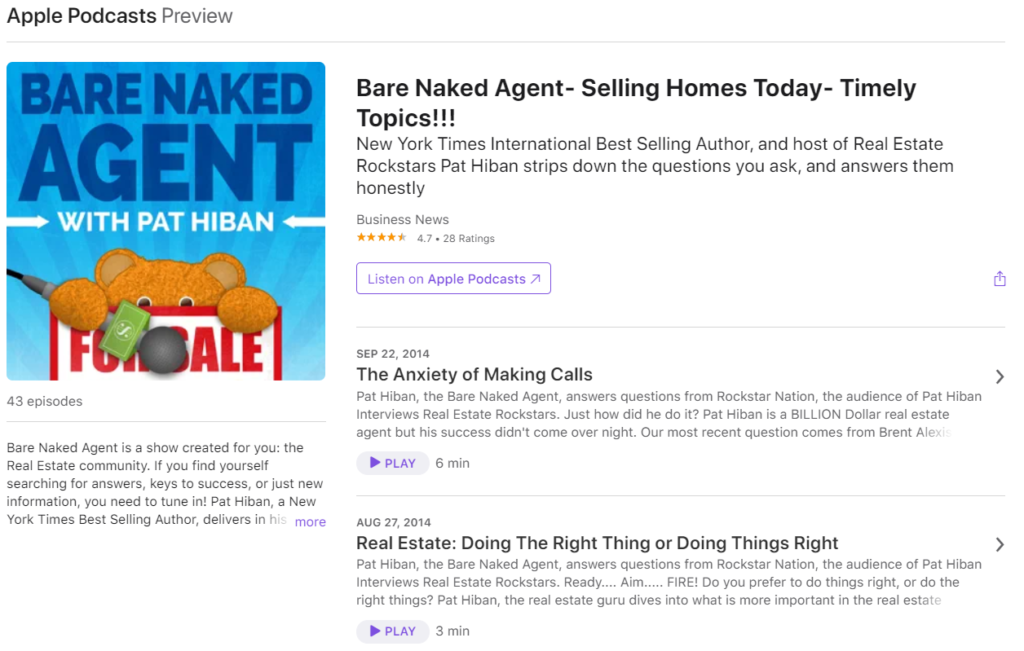
    6. Bare Naked Agent

    Bare Naked Agent

    In Bare Naked Agent, Pat Hiban, New York Times International Best Selling Author of 6 Steps to 7 Figures, answers questions from his audience about building, growing, and managing a real estate business.

    iTunes Description

    “Bare Naked Agent is a show created for you: the Real Estate community. If you find yourself searching for answers, keys to success, or just new information, you need to tune in! Pat Hiban, a New York Times Best Selling Author, delivers in his biweekly show to help answer any questions that come his way.”

    iTunes Rating: 4.7/5

    Episodes

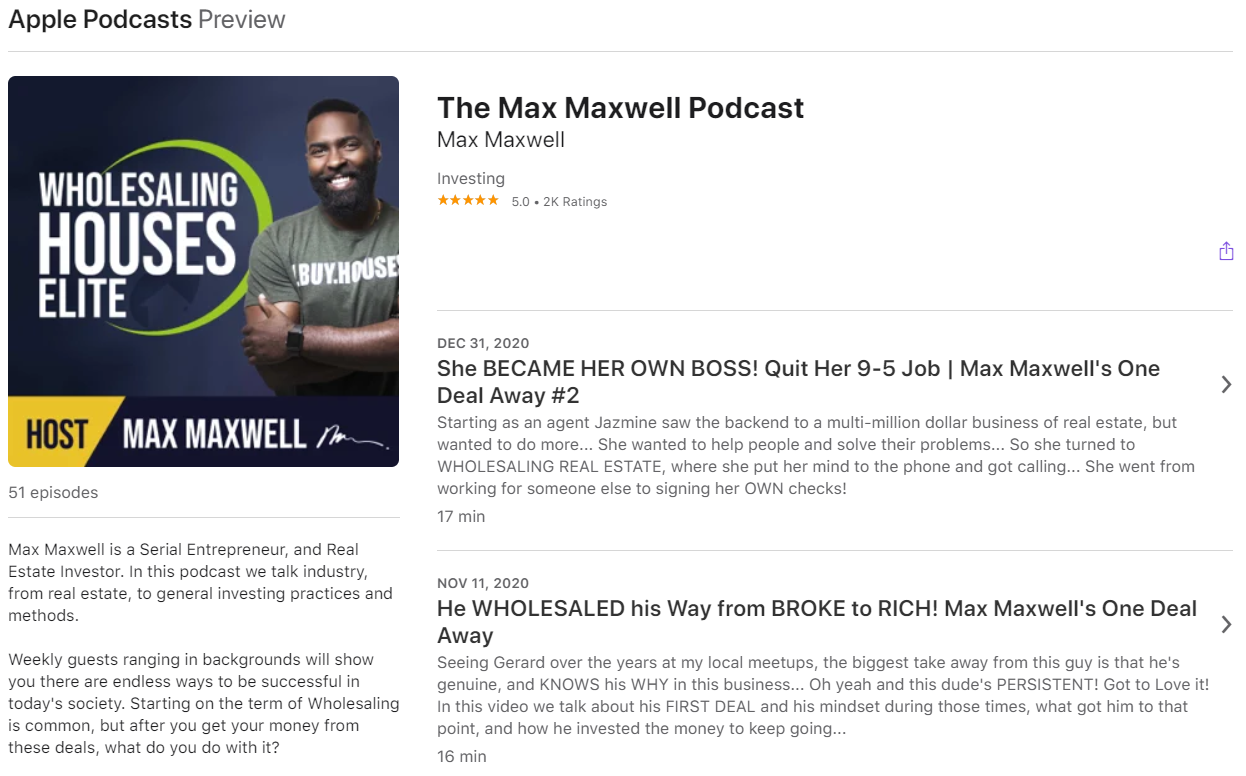
    7. The Max Maxwell Podcast

    The Max Maxwell Podcast

    Max Maxwell’s podcast is equal parts inspirational storytelling and practical real estate advice. He hosts a new guest every week who’s quit their W-2, grown their wholesaling business to 7 figures, or done something else significant. He drills them with questions about how they did it and you, the listener, benefit from their answers.

    iTunes Description

    “Max Maxwell is a Serial Entrepreneur and Real Estate Investor. In this podcast, we talk industry, from real estate to general investing practices and methods.

    Weekly guests ranging in backgrounds will show you there are endless ways to be successful in today’s society. Starting on the term of Wholesaling is common, but after you get your money from these deals, what do you do with it?”

    iTunes Rating: 4.9/5

    Episodes

    8. Keeping It Real

    Keeping It Real Podcast

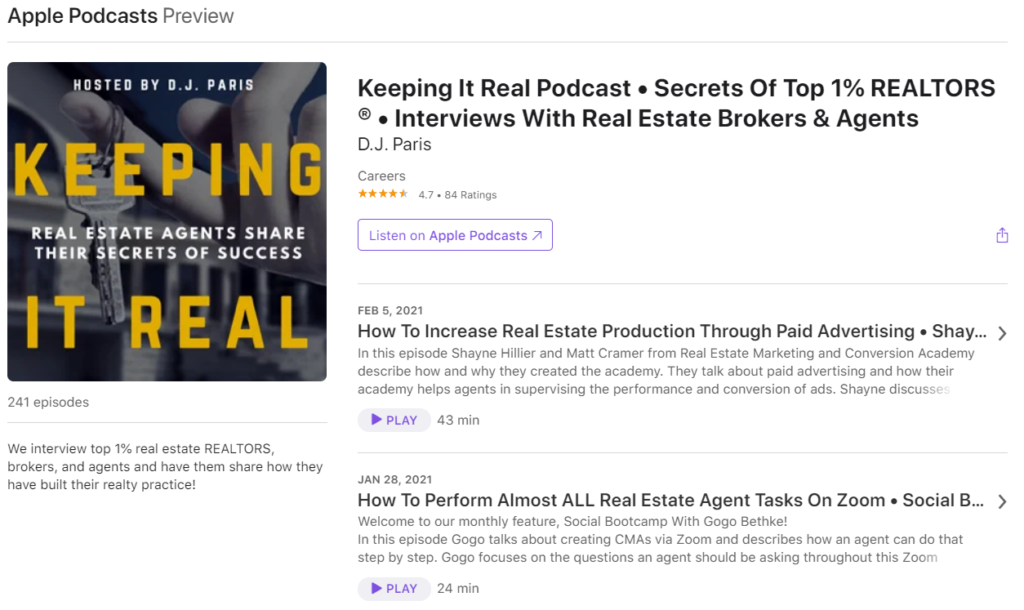
    On Keeping It Real, D.J. Paris interviews the top 1% of realtors, breaking down their stories and advice into practical lessons. Some of his most recent episodes discuss how to successfully run paid ads, how to perform tasks via Zoom, and how to brand a real estate business in 2025. Check out those episodes below!

    iTunes Description

    “We interview top 1% real estate REALTORS, brokers, and agents and have them share how they have built their realty practice!

    iTunes Rating: 4.8/5

    Episodes

    9. The Real Estate Guys Radio Show

    The Real Estate Guys Radio Show

    Since 1997, The Real Estate Guys Radio Show has been broadcasting (originally via radio) investment advice to its listeners. It’s hosted by Robert Helms and Russell Gray, who try to deliver lots of value and entertainment in every episode. Check out their most recent episodes below!

    iTunes Description

    “Fun and informative, this real estate investment talk show has been broadcasting on conventional radio since 1997. Hosted by professional investor Robert Helms and financial strategist Russell Gray, the show delivers no-hype education and expert perspectives in a fast-paced, entertaining style. Rich Dad Poor Dad author Robert Kiyosaki says The Real Estate Guys are wild and crazy, but they really know what they are talking about. The Guys talk investment strategy, economics, tax and asset protection planning, market and property due diligence, international diversification, and much, much more! Gain valuable insights from interviews with notable experts, industry leaders, and real-life investors. Discover proven strategies for making money with real estate in any market, how to avoid common and costly mistakes, and what is working in the real world right now.”

    iTunes Rating: 4.6/5

    Most Recent Episodes

    10. Real Estate Rockstars

    Real estate Rockstars podcast

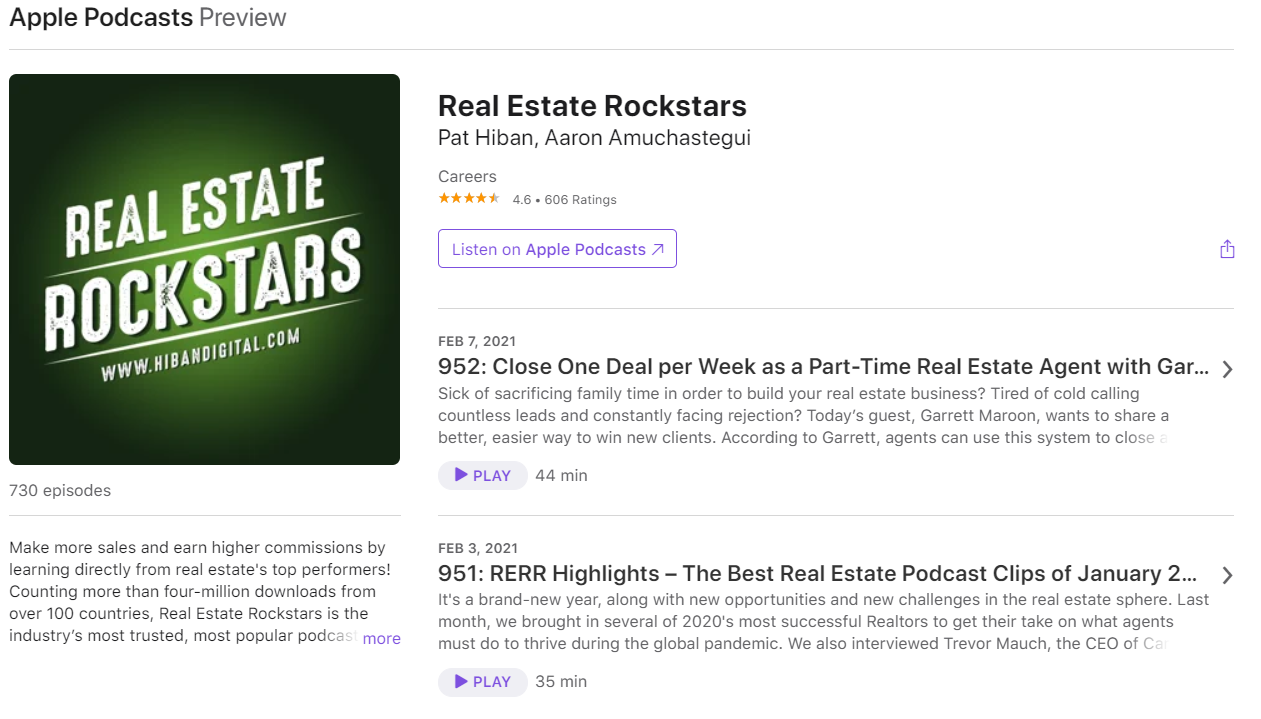
    On Real Estate Rockstars — a podcast that’s on its 953rd episode as of this article’s writing — Pat Hiban interviews expert real estate investors. Past guests include Robert Kiyosaki, Barbara Corcoran, and Ryan Serhant. The podcast has received more than 4 million downloads in over 100 countries. Check out the most recent episodes below!

    iTunes Description

    “Make more sales and earn higher commissions by learning directly from real estate’s top performers! Counting more than four-million downloads from over 100 countries, Real Estate Rockstars is the industry’s most trusted, most popular podcast. With a new guest on each episode, you’ll learn from up-and-coming agents, seasoned brokers, real estate investors, and more. Robert Kiyosaki, Barbara Corcoran, and Ryan Serhant are just a few of the many notable guests who have shared their industry expertise with the Rockstar Nation. Billion-dollar agent and best-selling real estate author Pat Hiban asks the questions that matter and uncovers actionable answers – no filler and no clichés. Implement the strategies you learn by listening to this tri-weekly podcast and start making more money in real estate. It’s that simple.”

    iTunes Rating: 4.6/5

    Most Recent Episodes

    11. Real Estate Coaching Radio

    Real Estate Coaching Radio

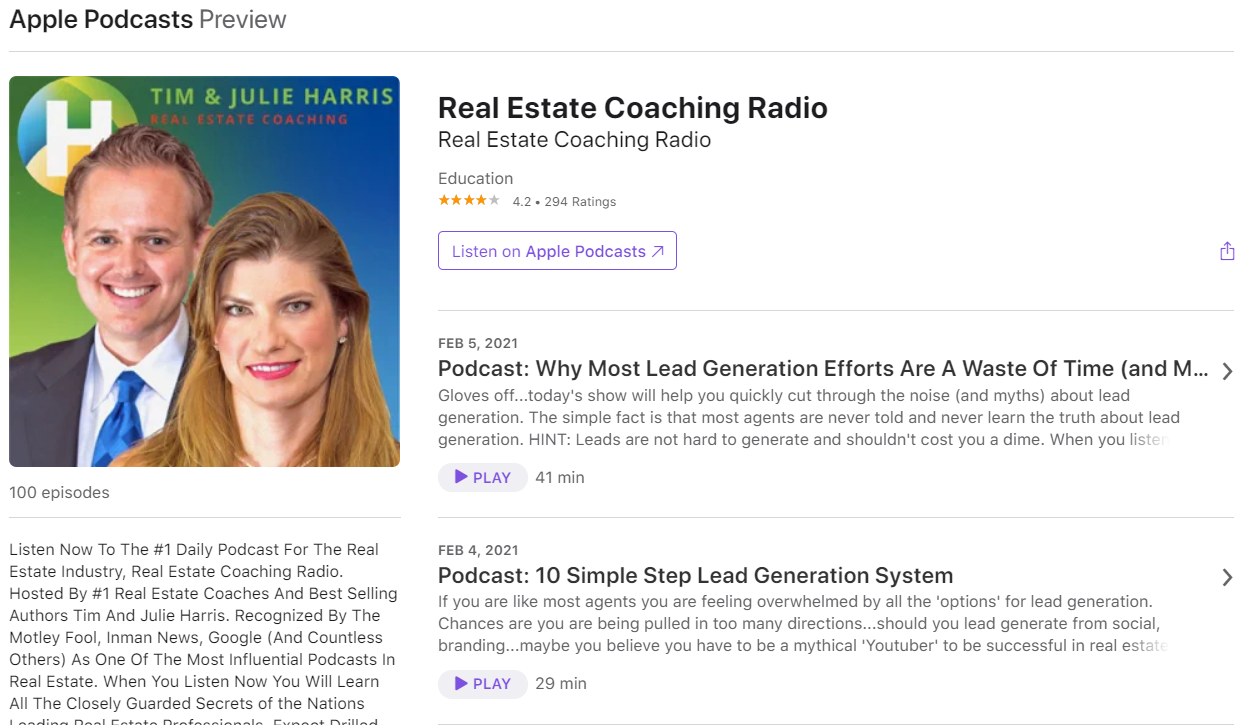
    On Real Estate Coaching Radio, Tim and Julie Harris, best-selling authors, experts real estate coaches, and entrepreneurs, share real-life advice from building their own businesses. Check out their most recent episodes below!

    iTunes Description

    “Listen Now To The #1 Daily Podcast For The Real Estate Industry, Real Estate Coaching Radio. Hosted By #1 Real Estate Coaches And Best Selling Authors Tim And Julie Harris. Recognized By The Motley Fool, Inman News, Google (And Countless Others) As One Of The Most Influential Podcasts In Real Estate. When You Listen Now You Will Learn All The Closely Guarded Secrets of the Nations Leading Real Estate Professionals. Expect Drilled Down, No BS, Fast-Paced Practical and Tactical Information to Get You Into Action Now Helping Others and Making Money.”

    iTunes Rating: 4.3/5

    Most Recent Episodes

    12. GSD Mode

    GSD Mode Podcast

    GSD Mode shares the stories and advice of people who’ve built successful businesses, particularly real estate agents and health experts who “dominate their space.” This is a great podcast to check out if you’re a real estate investor, agent… or even if you’re just an entrepreneur. Check out their most recent episodes below!

    iTunes Description

    “GSD Podcast is where we interview Top Real Estate Agents, Top Entrepreneurs, Top Fitness and Health Experts and people that DOMINATE their space! These are people that do not accept mediocrity, they have clarity on what they want in life and they take massive levels of action to create their dreams into a reality! They create epic lives!”
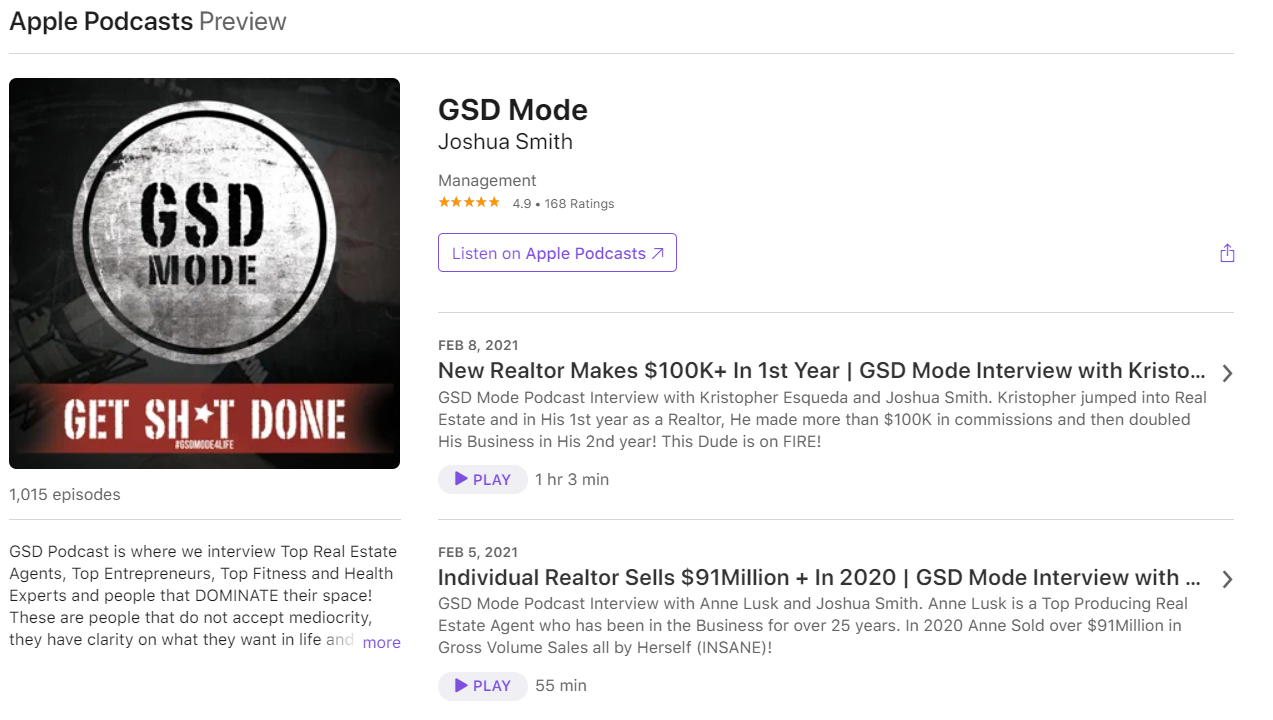
    iTunes Rating: 4.8/5

    Most Recent Episodes

    13. Cash Flow Guys Podcast

    Cash Flow Guys Podcast

    On the Cash Flow Guys Podcast, Tyler Sheff teaches “busy people how to use what they have” and “get what they need in order to accomplish what they want.” Listeners will learn about real estate investing and increase their financial fluency. Check out their most recent episodes below!

    iTunes Description

    “The CashFlowGuys Podcast teaches busy people how to use what they have, to get what they need in order to accomplish what they want. Using tips and techniques from industry leaders in Real Estate Investing and Financial Services, the CashFlowGuys are on a mission to educate the public on all things involving real estate and financial services. Your host, Tyler Sheff interviews experts from around the globe to help people improve their financial intelligence.”

    iTunes Rating: 4.8/5

    Episodes

    Conclusion

    There you have it — those are our favorite real estate podcasts. Try them and see what you think.

    Do you have a favorite podcast that wasn’t on this list?

    Let us know in the comments and we’ll give it a listen!

    For more resources and real estate marketing materials, click on the link!

  • Optimize Your Real Estate Marketing | A Strategic Whiteboard Training

    Optimize Your Real Estate Marketing | A Strategic Whiteboard Training

    Optimize Your Real Estate Marketing & Lower Your Lead Cost | For Investors & Agents

    Video Transcription

    What’s up y’all!

    As you’re planning out your marketing for the year ahead, you might have a couple of questions popping into your mind. You might be asking, how the heck am I going to reach my goals?

    You might even be asking what are your goals as a real estate agent or an investor?

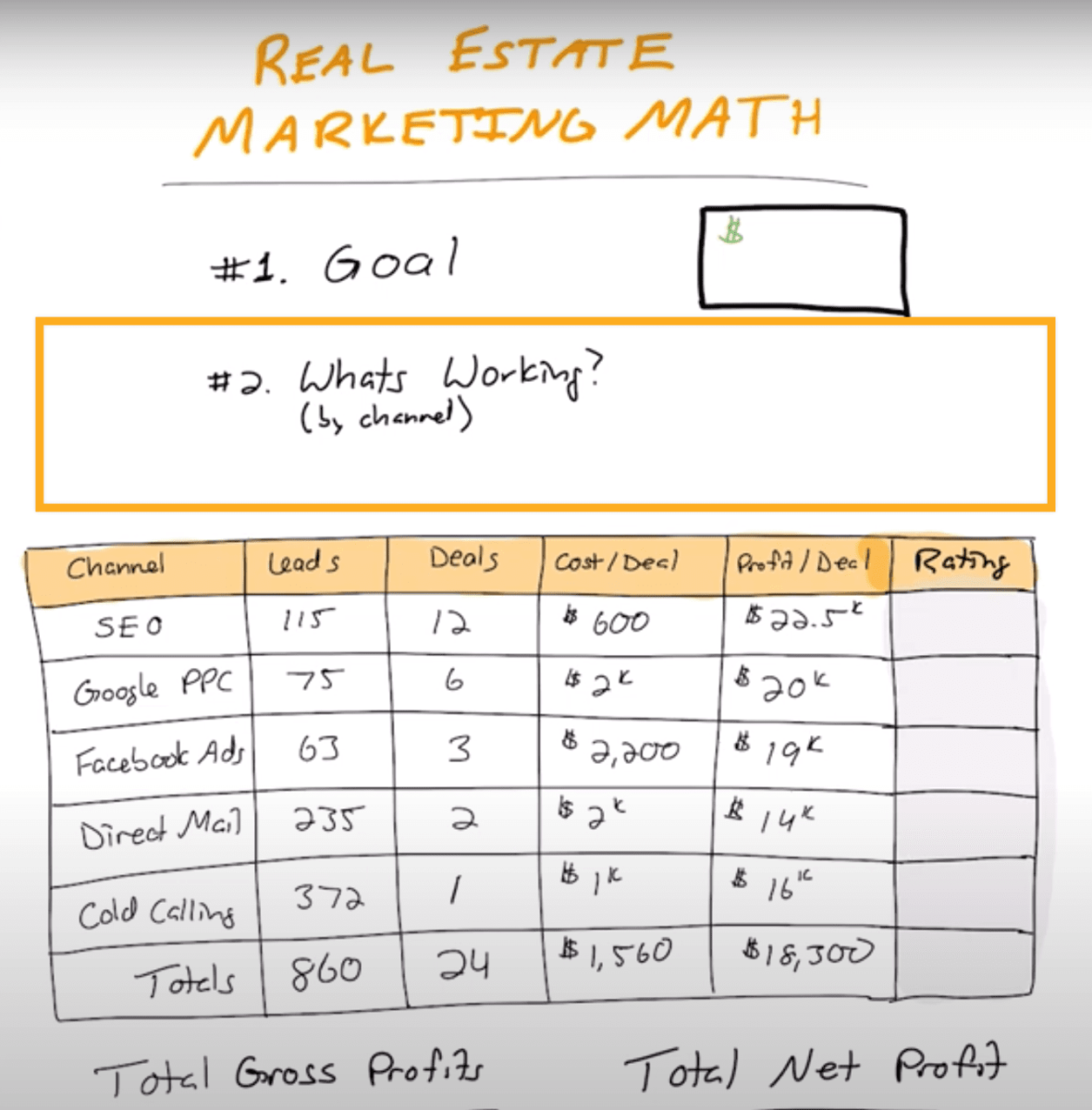
    What I’m going to be walking through in this video is a simple five-step process, I use it here at our company, and I suggest you use it as an investor and agent as well, to plan out exactly what you need to do in your marketing in the year ahead to be able to reach your goals.

    The cool thing about this is, a lot of people, they’ll look at the goals, write a goal number down, it might be an income goal, it might be a deal number goal, and then you pull back and you say, what are the things that are going to help me get there?

    You might write down a few different projects, and I ran my businesses like this for years. I’d have a goal, and I’d go to the whiteboard and I’d say, what are some of the cool, exciting, fun things I might need to do this year?

    I’d write them down and then that would be my plan. The thing I would forget to do is what I’m going to teach you today, which is mapping down to your marketing channels, so you have an exact clear, ABC step-by-step plan to reach your goals in a fail-safe way.

    As soon as I started deploying this in my own businesses and teaching other investors and agents how to do it as well, you start to get more clarity on your plan.

    The cool thing is, I actually did a podcast on this, the cool thing is this becomes your strategy. The definition of a strategy basically, is a strategy is as much what not to do, as it is what to do.

    What we’re going to be diving into here on my iPad, is we’re going to show you exactly what you should do, so you can say no to so many other things in this year ahead. Work less, gain more freedom, make a greater impact.

    Let’s dive into the iPad now.

    The first thing I want you to do here is, there are five steps.

    The first step is we’re going to set your goal, and if you have to pause this video throughout, as you’re doing your annual planning, or if you’re watching this sometime in the midyear, amazing.

    Optimize Your Real Estate Marketing: Step 1

    You can still do the same thing if you’re not clear on what you need to do in your marketing to reach your goals as an investor or an agent.

    The first step is setting your goal.

    Okay, we’re going to pick an income goal, because deal numbers don’t really matter if you’re doing a bunch of low volume or low dollar deals versus if you do some high dollar deals.

    I always pick an income number because you can map that to the lifestyle that you want, or the freedom or impact you want to make.

    Next, we need to ask what is working? This is a big step a lot of people miss… they set a goal and then they just go, hey, what do I need to do next? We need to first ask what’s working.

    Optimize Your Real Estate Marketing: Step 2

    I’m going to give you a framework in here for exactly how to track and show what’s working in your business in a crazy, crazy, simple way.

    Then what we’re going to say is, what’s the difference between where we currently are to the goal that we’re going for?

    Optimize Your Real Estate Marketing: Step 3

    I call it the Delta.

    Next, we’re going to say cool, now that we know the difference in what we need to make up, what are the biggest opportunities that we see, the one, two, or three max, to be able to hit our goal.

    Optimize Your Real Estate Marketing: Step 4

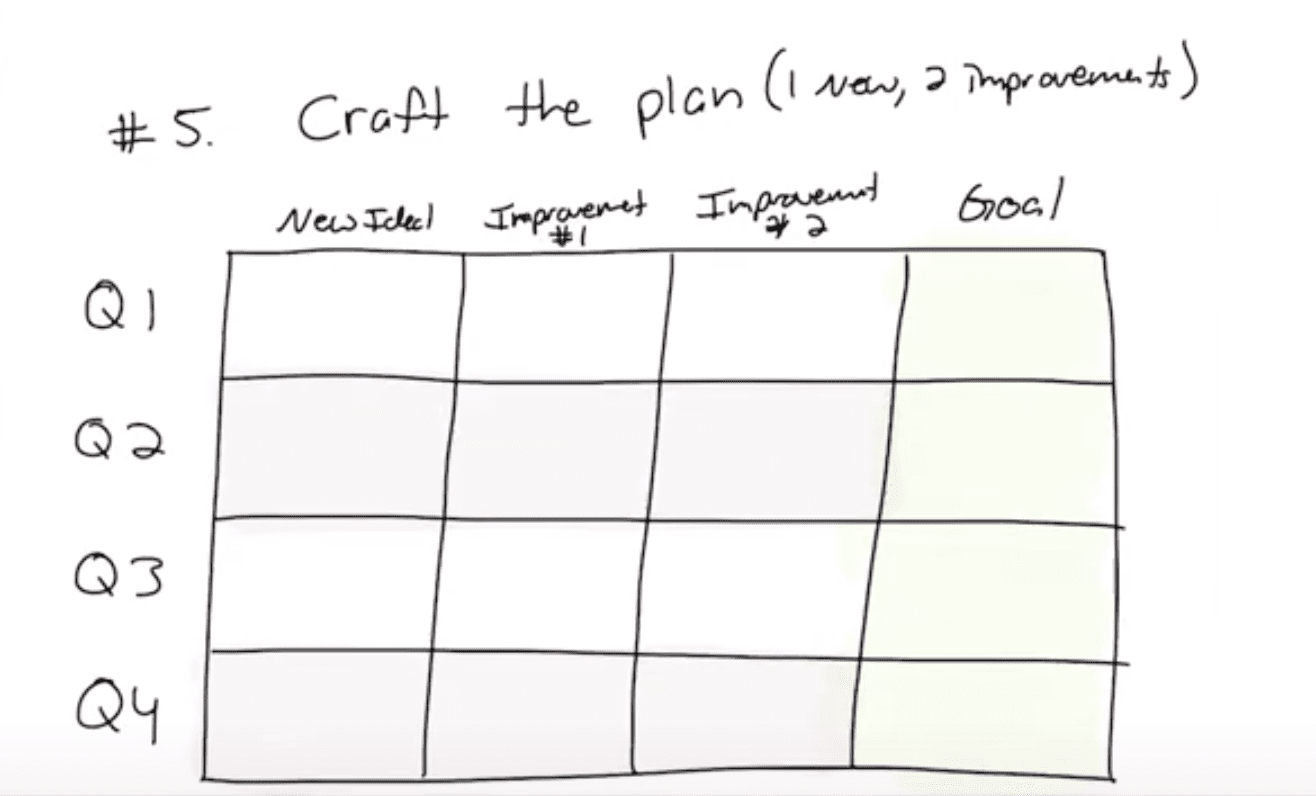
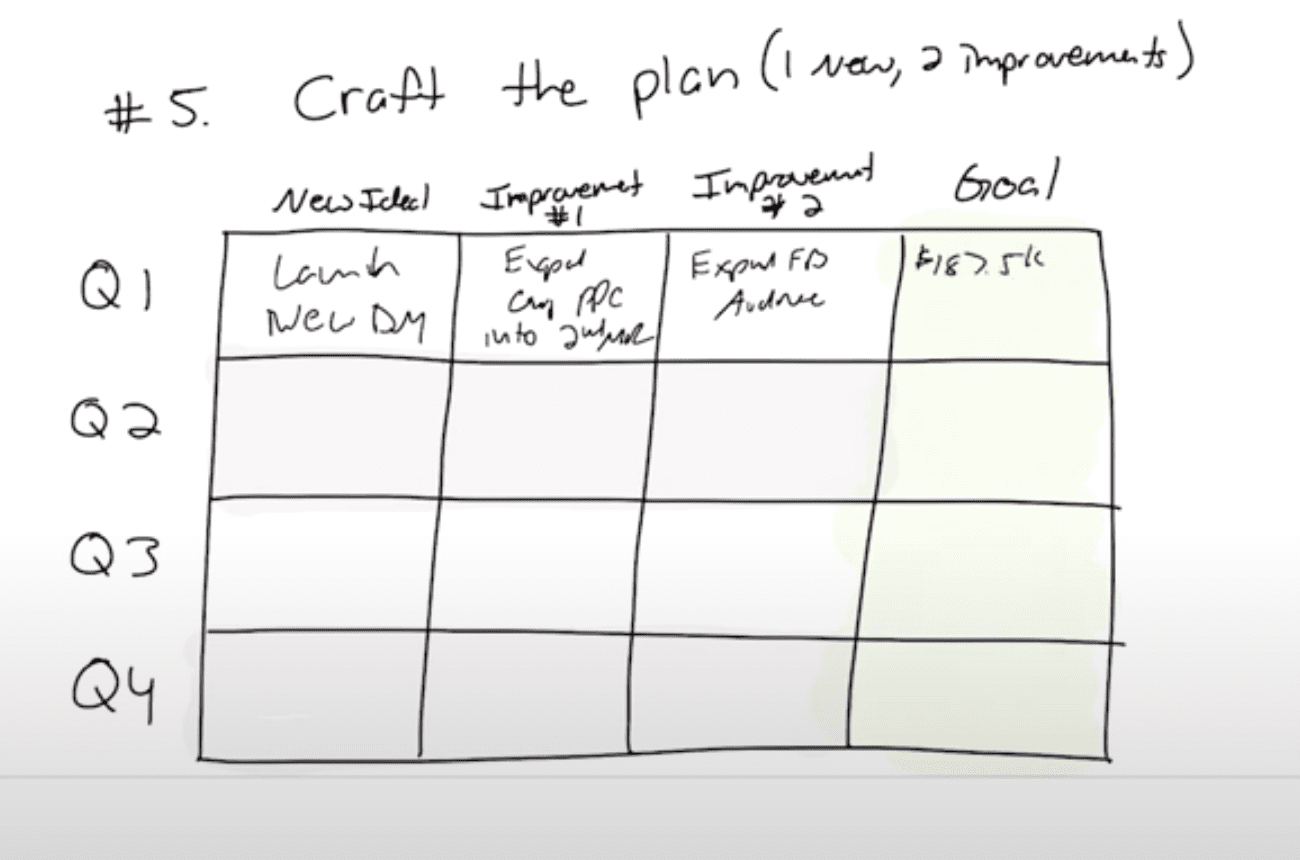
    Then last, we’re going to craft the plan in a really crazy simple one-page thing that you can use each and every quarter.

    Optimize Your Real Estate Marketing: Step 5

    Let’s go back up to the top.

    For this example here, I’m going to be working with one of our clients who is an A player. They’ve already started to do some deals. They’re a hybrid agent investor, which is what we specialize here in at Carrot.

    The people who have their license, and their investor who can offer cash offers, maybe even flip homes. This person’s been doing deals for two or three years, and they want to get to a $750,000 profit goal.

    Okay, so that’s a big goal. If you are trying to get to your first $100,000, it doesn’t matter.

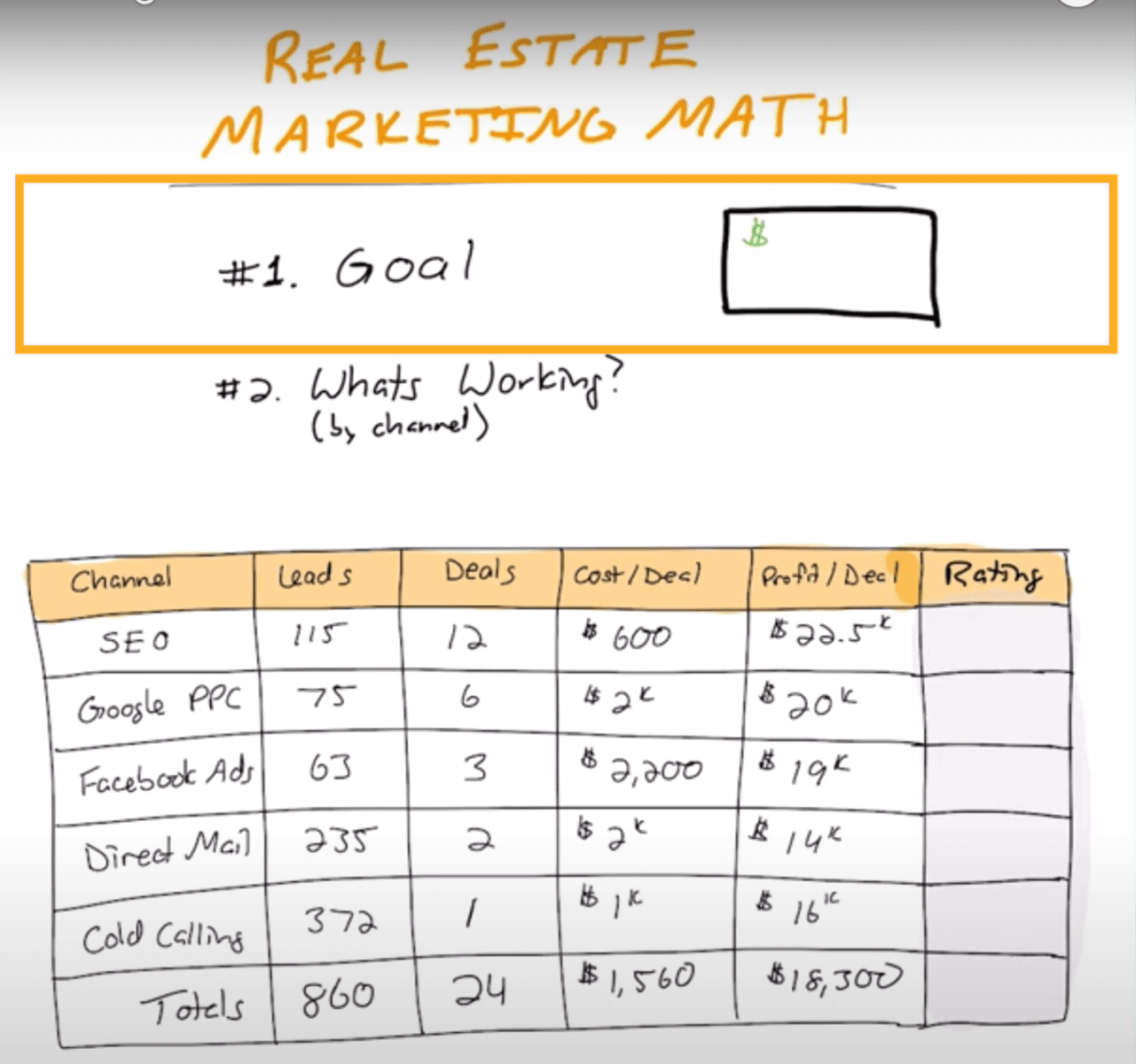
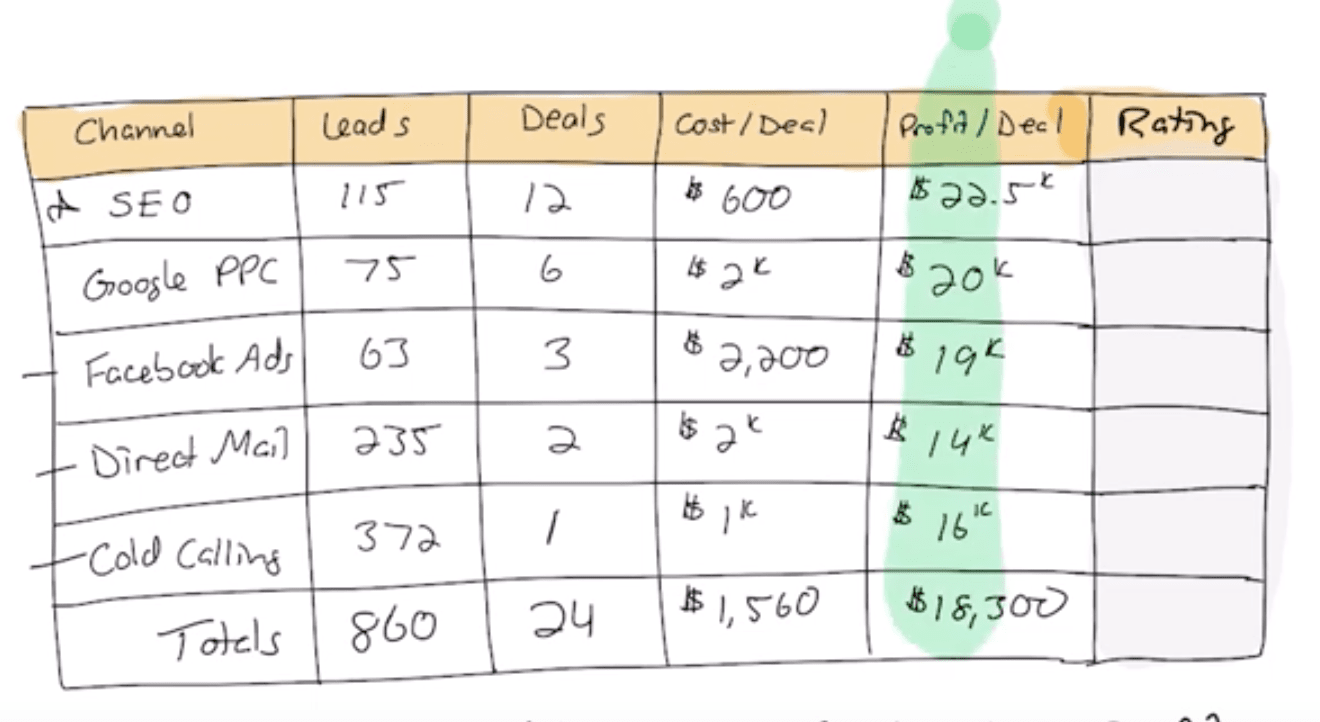
    Next what we’re going to do, is I want you to write down every marketing channel that you’re currently using to get leads and to close deals.

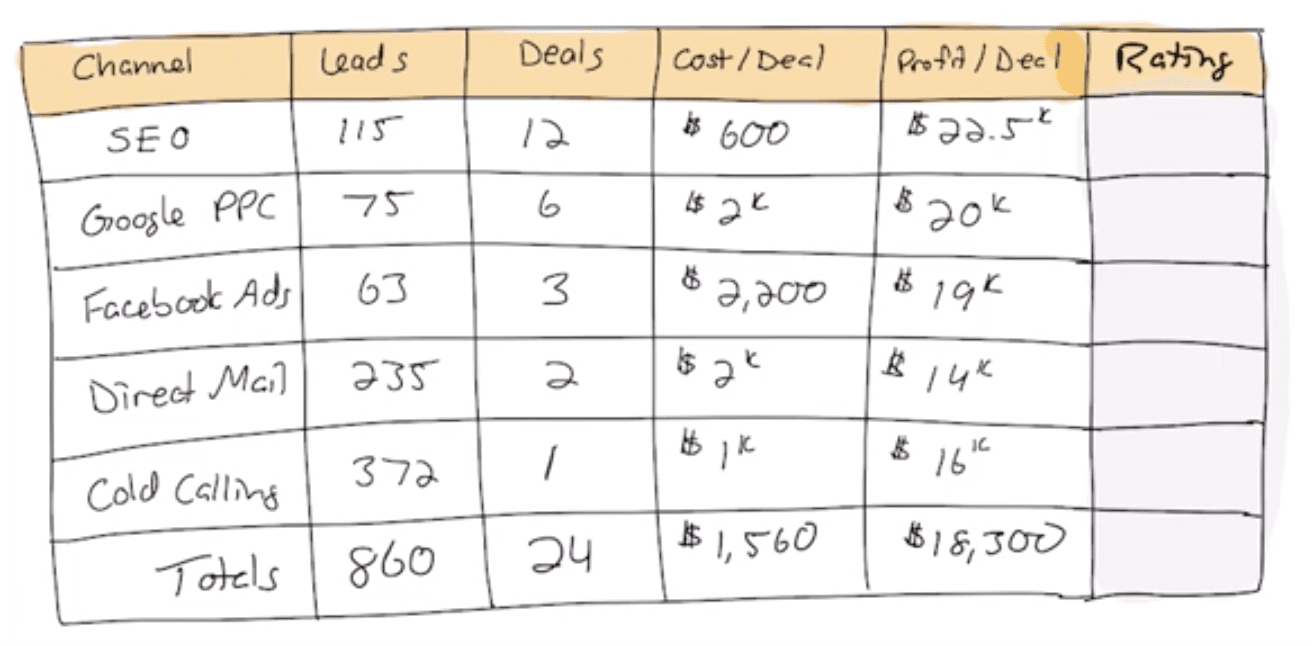
    Rating Your Real Estate Marketing Channels

    In this example here, you might have SEO or Google pay-per-click, or Facebook Ads, or direct mail, or cold calling, or whatever it’s.

    You might be doing referrals as an agent, or you might be big, big, big on cold calling as an investor agent, whatever it is, write down the channels that generated your leads in deals this past 12 months.

    If you have to hit pause in this video, go ahead and do it. Write down the channels on the left side and come back.

    Next, I want you to pull back into your data. This might be one of those things where you might be going, I don’t know what the channels did, but one of the biggest keys that you can do as a marketer is you have to know and have clarity on what each marketing channel is doing for your business.

    One of the biggest mistakes that I find with people is they end up investing $5000, $10,000, $15,000 a month, and they say, I’m getting deals out of this, but I don’t know which channels are working and which channels aren’t working.

    So they keep on putting more and more money into the marketing, not knowing which half of their marketing’s working and not.

    This is going to help you save tens of thousands of dollars potentially in marketing every year, and help you grow your income in a more predictable way with less work, which is what we’re about here at Carrot. Helping you get more freedom.

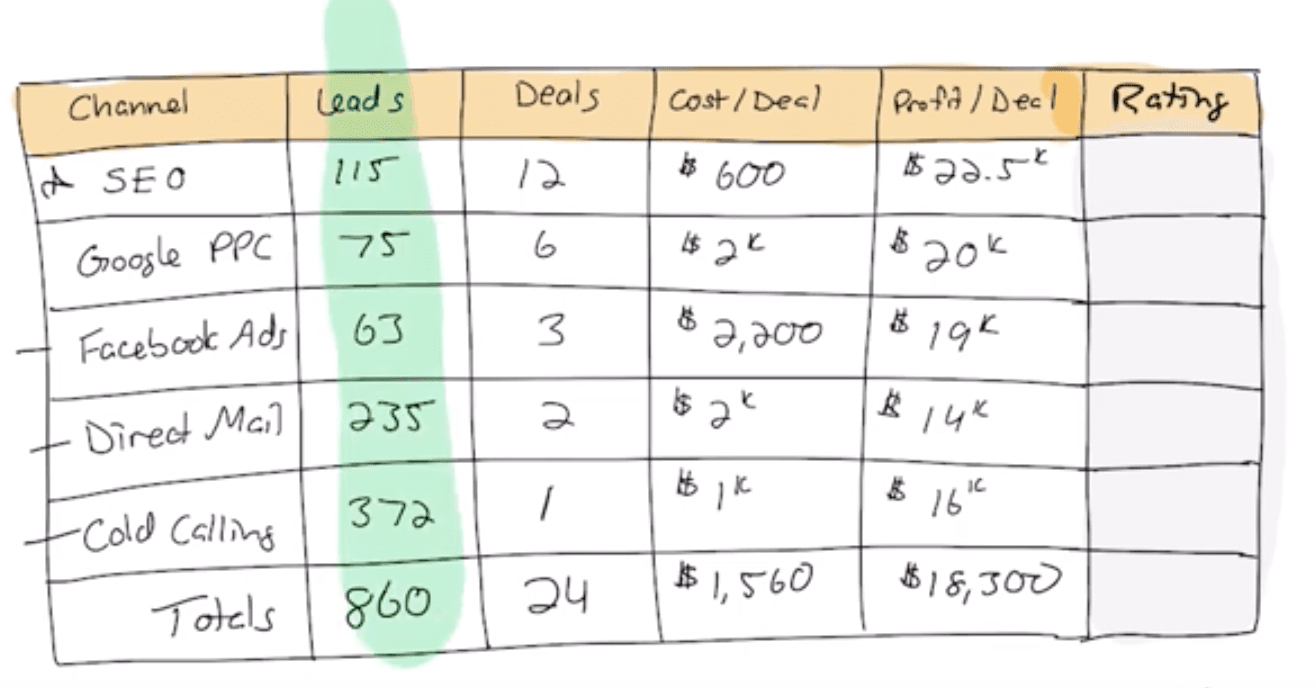
    What I want you to do next, is now write down what are your leads. How many leads did you get with that channel?

    Real Estate Marketing Channels: Leads

    In this example, we’re going to say the SEO channel got 115 leads this past 12 months, Google PPC, 75 Facebook Ads, 63, you get the idea. Write those down.

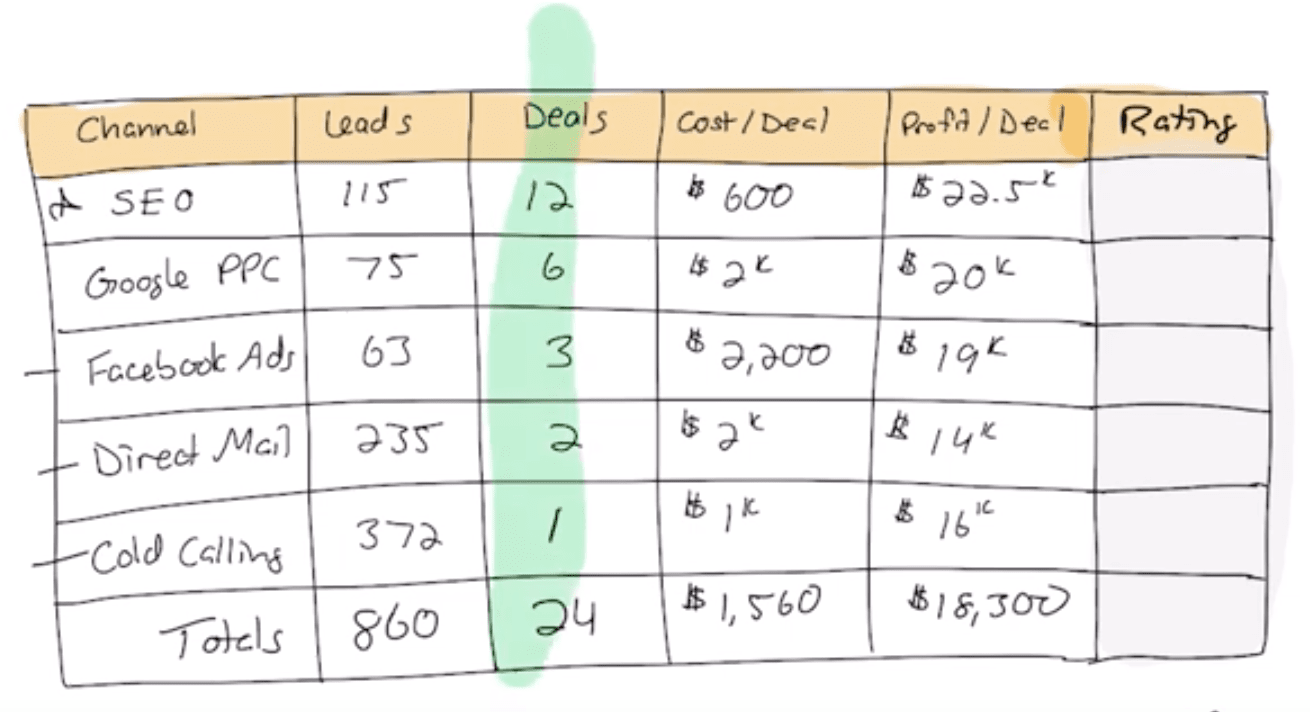
    Then we’re going to say with each channel, how many deals came out of those?

    Real Estate Marketing Channels: Deals

    Now you might be saying, I don’t know how to track how many deals came from the channels.

    Well, what we can do is if you’re using a system like Carrot, our system will actually tell you which leads came from SEO. It’ll tell you which leads came from a Facebook ad, or from a Google ad. It’ll tell you all of those things.

    You can leverage a tool like Carrot to use our campaign tracking links or to use our lead source tool, and it’s going to tell you all that.

    Now you’ll be able to know which leads and deals came from direct mail and cold calling because you want to use a different tracking phone number with each one of those marketing methods.

    You can always say if anyone called from this phone number, it’s from my direct mail, so you can track the leads and deals.

    Okay, now what I want you to do is dive even deeper.

    Real Estate Marketing Channels: Cost per Deal

    If you’re looking at this going, man, I don’t have this data.

    What I want you to know is number one, it’s simple data to track so you can get it, but number two, this is critical data if you want to grow your business, work less, make a greater impact.

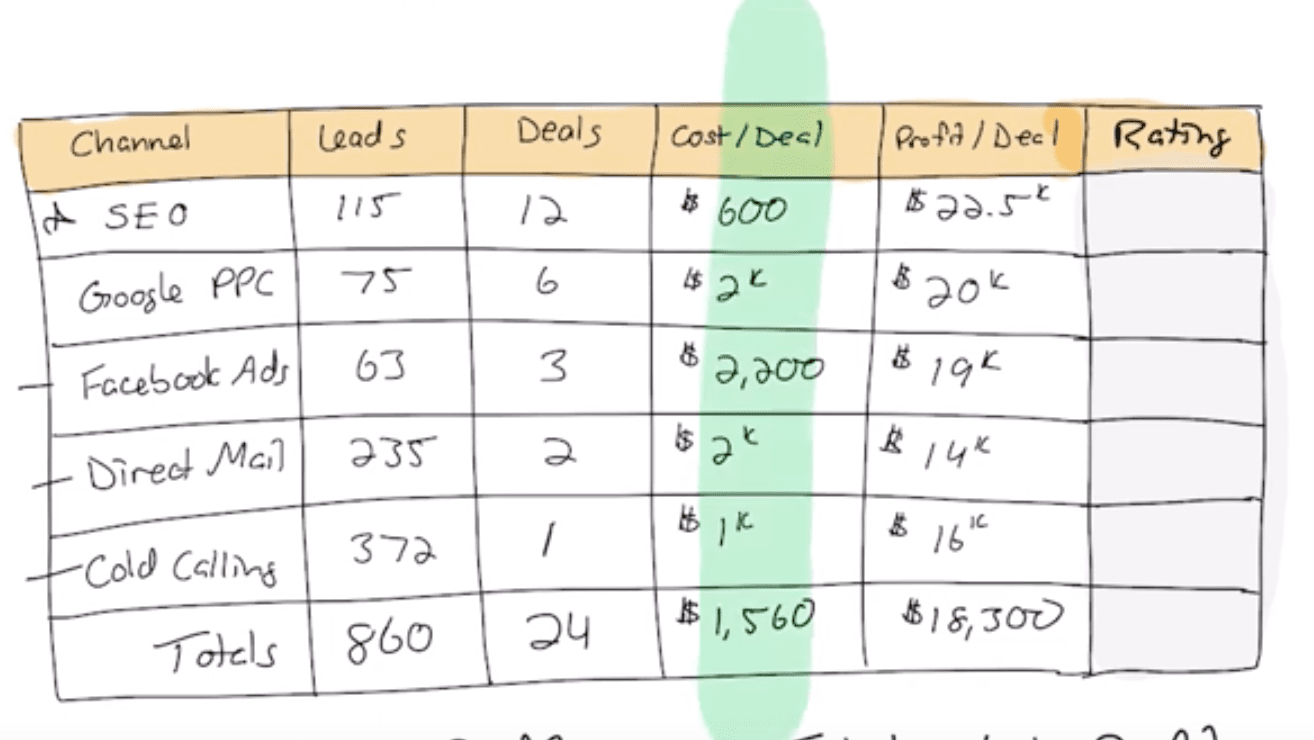
    With each one of the channels, say, I’ve got 115 leads at the SEO this past year, 12 deals out of it. How much did you invest in doing SEO that year? Did you pay someone to do it? Did you do it yourself?

    Just take the entire amount of money you invested in the SEO that year and divide it by the number of deals that you did. In this case, we’re just going to say it was about $600 a deal, which was the average cost when we took that amount.

    If it was Google pay-per-click or direct mail same thing, take the entire cost of what you spent on direct mail this year, Google pay-per-click this year, or cold calling, or whatever it is, and then divide it by the number of deals you got to come up with your cost per deal.

    This can be an important number.

    Next, it’s the profit per deal. Do the same thing. Look at the lead sources. What were the profits on those?

    Real Estate Marketing Channels: Profit per Deal

    What were the total profits for the year for that channel, divided by how many deals you did, and fill out the profit per deal column.

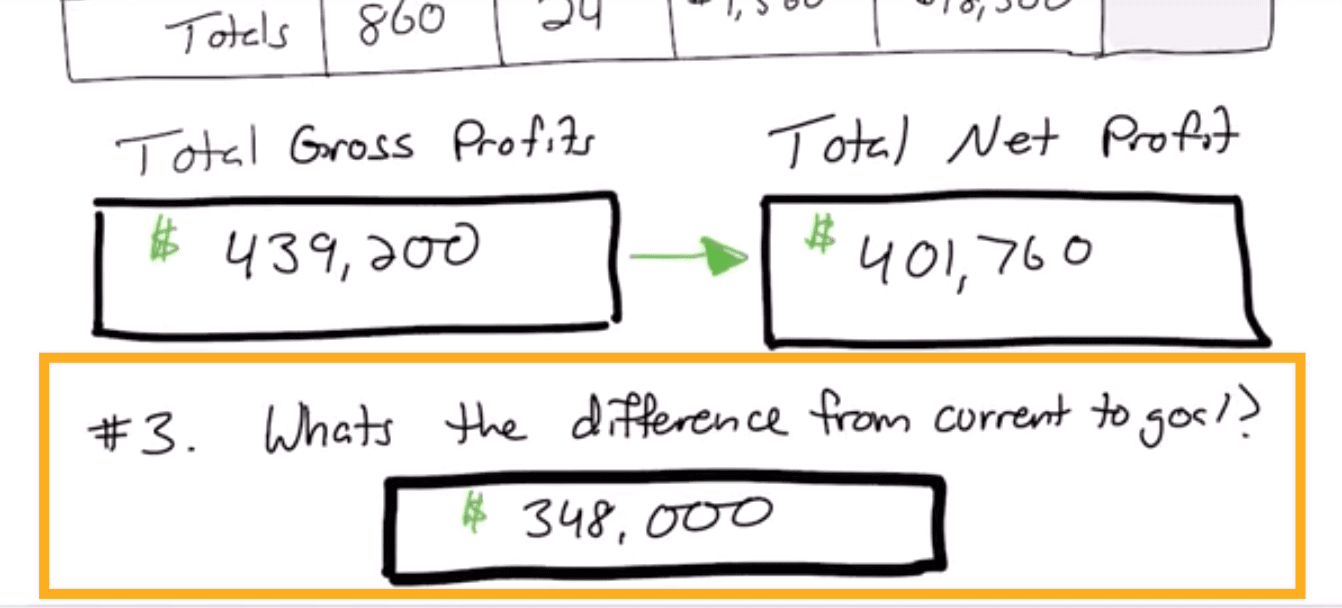
    We’re going to end up coming up with these numbers down here in this section down here which is… what was our total profit for the year?

    If we add those up, our total gross profit in this example is about $439,000.

    If we take out the cost for those deals, let’s say it was about $401,000. We netted $401,000, that’s amazing. That’s a huge huge year.

    If your goal is $750,000, and we currently brought in about $439,000, the difference between those two numbers is $348,000, about $350,000.

    That’s the Delta we’re trying to make up in this next year with our plan.

    I’m going to show you guys exactly how to do that in about three to five more minutes in this video.

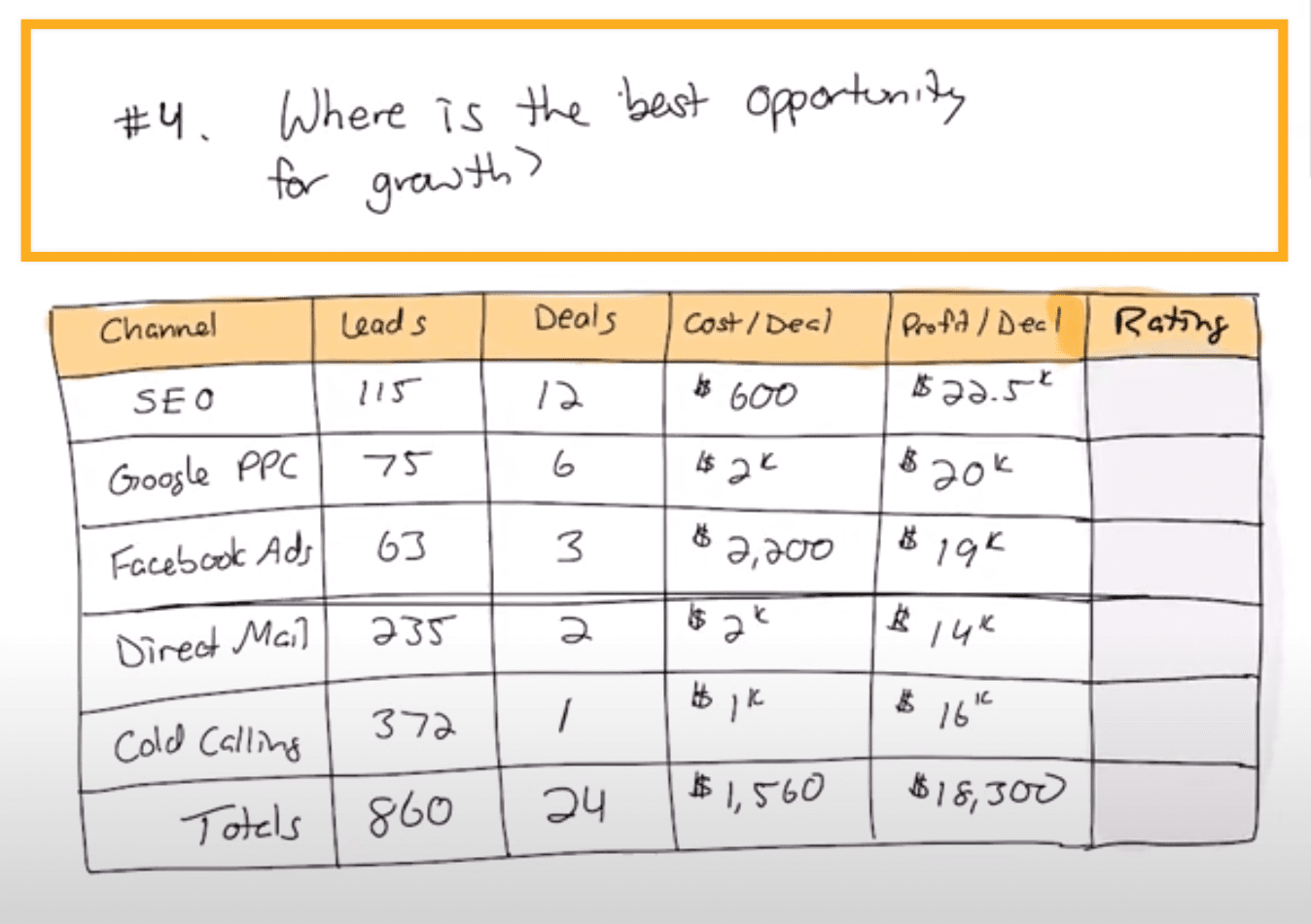
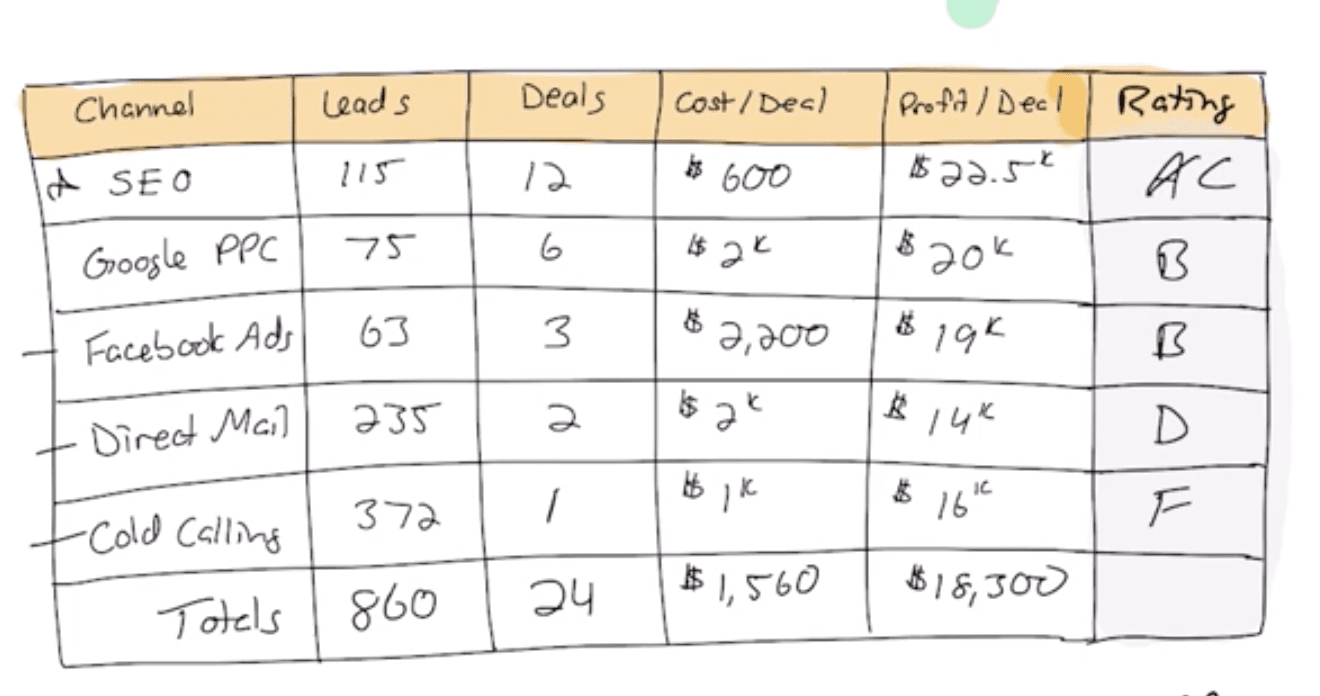
    The next step I want you to take here, is with each one of your channels, now the way that we decide what we need to do in the year ahead, is we look at each channel and we ask ourselves, let’s kind of give it a grade rating, an A through an F.

    An A means we’re executing it insanely well, and there’s probably no room for growth in this channel. We’ve maximized the channel.

    If you’re doing SEO, and you’re just in one market, and you’re dominating Google for all of your keyword phrases, you’re ranked number one in Google for all your keyword phrases, that’s probably going to be an A.

    There’s probably not a lot of room for improvement there if you’re dominating ranking number one in Google for all of your phrases.

    If you’re not ranking number one in Google for all of your phrases, you’re number six, number seven, number eight, you might be getting a couple of leads here or there, maybe that’s a C.

    Okay, give yourself whatever that rating is. Do the same thing with all of those.

    I’m just going to make up some numbers here. Let’s say we’re a B with Google PPC. It’s working pretty good.

    Let’s say direct mail, we’re a D on that, we tested it out, but we’re not really doing too great. Let’s say cold calling is an F, we got one deal, but man it wasn’t predictable. Let’s say, this is a B on the Facebook ads.

    What we’re doing is we’re asking ourselves, where do we see an opportunity for growth? If it’s an A, we’re saying we’re doing the best we can possibly do, expanded it at the best we possibly could, there’s no opportunity for growth.

    If it’s an F, it means we definitely haven’t maximized it, so it might be on the docket there okay.

    Now, let’s say Google pay-per-click and Facebook ads look awesome, and then I really want to get this direct mail thing working better, so I’m going to go I see an opportunity for growing Facebook or Google pay-per-click.

    Let’s say direct mail number two, and Facebook number three. If I think that there’s a lot of room for growth and we have the skillset to do so.

    Okay, I’m going to come down here now, with what we had just done with those ratings. We’re going to rate those out, and now we’re going to come up with some new goals for these.

    Let’s say the Google PPC, what we had been doing in the past was 75 leads, let’s say we want to increase that now and grow that to 150 leads.

    We want to double this so we can help to start to make up that Delta of about $350,000.

    We know with Google pay-per-click that we’re closing about one in 10 leads into a deal that gives us $20,000.

    That was six deals, now if we can double our Google pay-per-click if we see opportunity there, because we haven’t really stepped into it too much, or we can expand our keywords, that’s going to then take it to 12 deals.

    Let’s say the cost per deal stays about the same, and the profit per deal stays about the same.

    Now that’s going to make it to, rather than us bringing in about a $120,000 in Google pay-per-click that year, that’s going to bring in far more, that’s going to bring in, shoot, about $240,000 with Google pay-per-click that year.

    I’m just going to delete that puppy and let’s make this the goal.

    Let’s say $240,000 total is what we’re going to bring in, and we’re going to bring in $120K extra.

    What we’re determining is how are we going to make up this Delta of $348,000 bucks? Well, now we’ve made up right there $120,000 of it with the Google side of it.

    Now let’s look at Facebook. If we closed three deals last year from Facebook, and an average of about $20,000 profit per deal, how many more deals do we think we can get out of Facebook?

    How many more leads do we think?

    Can we double that? I don’t know. That’s for you to determine, go talk to someone who’s an expert, or you dive into it. Let’s say this doubles to six, and that goes from $60,000 to $120,000 now.

    It goes from $60,000 to $120,000 now, and that is in total. So the extra, the Delta that we’re adding is another $60,000. $120,000 plus 60, that’s about $180,000. You guys know where I’m going with this, right?

    Now let’s say direct mail. We see a lot of opportunities. We just did one test and we want to expand it out. Let’s say we want to take this and see if we can’t expand this to 10 deals this year. We want a 5x this year.

    How many leads do we need to get the whole thing? I’m not going to do all the math here, but you guys see where I’m going with this.

    The things that we want to focus on here, doing some quick behind-the-scenes math, is we want to figure out what channels do we need to expand it by, how much do we need to expand them to get to this number here? The $348,000 bucks.

    We’re going to speed up through TV time, and now let’s assume that we had picked our three or four channels, we’d worked the numbers and we have a plan.

    Let’s say the number one plan is the Google pay-per-click.

    We worked the numbers. We say, I think there’s more opportunity there, maybe we can bump this to 200 leads, and maybe we can bump this to 15 deals, and that’s a couple of extra deals. That’s $160,000, $170,000 there. Bam we found out our plan.

    Q1 now, I want you guys to do this.

    Pick one new idea per quarter and two improvements per quarter. One thing that we oftentimes do is plan way too many projects. Just start one new thing per quarter, and two improvements per quarter.

    This here might be a new idea of direct mail. We barely dabbled in direct mail. We’re going to launch a new direct mail campaign. That’s the big new thing we’re going to do this year.

    Improvement number one is we’re going to expand Google PPC into the second market.

    That’s our improvement. We’re going to expand there. Improvement number two might be expanding Facebook’s audience.

    Then our goal, if our total goal is $348,000 in extra revenue, and our total goal for the year is $750,000. If we divide that out, how much money, how much revenue do we need to bring per quarter?

    I’m just going to grab my fancy calculator here really fast and show you guys this last little thing and we’ll wrap this video, and you’ll have a plan essentially. $750,000 divided by four equals $187,000 a quarter. $187,500 a quarter; $187,500.

    Real Estate Marketing Channels: Craft Your Plan

    You don’t have to make these all exactly the same per quarter, you can make them so you ramp up or whatever you want to do. It’s your plan. Each quarter I’m going to be planning out this.

    Then we say, hey our goal is $187,500 per quarter. You can break it down per month, and then you say, okay how much of this is going to come from our direct mail campaign?

    How much of it’s going to come from our expansion of Google pay-per-click and Facebook ads.

    Then spend the next 10, 15, 30 minutes going, if we did those in the first quarter, what do we need to do in the second quarter?

    It might be launching something else new here. It might be hiring an employee over here because now you’re having more leads.

    It might be now getting a dispositions manager or something like that. It might be adding Carrot in here is that big new project.

    Then each quarter you pick two things you can improve, one thing you can grow on that’s brand new.

    All right, guys. Let me recap this right now, block out about an hour to two hours possibly, as you’re heading into this next year, and this can help you get insane clarity in exactly what you need to do with your real estate marketing as an investor or agent.

    The first thing is you pick your revenue goal for the year. The second thing is you break out a scorecard like this that I’m showing you on the iPad, and ask what is working and break it down by channel.

    Dig into those numbers. If you don’t have them you really need them to grow.

    Then figure out what your profits are, and ask yourself what’s the difference between my goal and what I did this past year?

    Next, we need to say, what’s our greatest opportunity? We need to kind of grade our channels. An A is you’re doing the best you could possibly do, no more room for growth. An F is it’s terrible, and there might be room for growth.

    Then craft your quarterly plan, one new thing, two improvements per quarter, and then map those to your scorecard, which would be bringing in $187,500 per quarter or whatever your number is.

    Guys and gals, we’re going to have some amazing resources for you that are going to help you to do your planning better, that is going to help you to grow your business better.

    If you’re looking to expand your evergreen marketing and buy back more of your time, go to Carrot.com/evergreen, and check out our latest webinar on this topic so you can step into evergreen marketing, win more leads that are the highest margin, highest profit deals while you’re stacking your marketing with your other channels.

    Guys have an amazing rest of the week, plan your marketing, hit it hard, but buy back your time this year.

    Thank you!

  • 20 Real Estate Negotiation Tips from 3 Negotiation Experts + Free Scripts

    20 Real Estate Negotiation Tips from 3 Negotiation Experts + Free Scripts

    Real estate negotiation is a hot topic. Every month, according to Google, there are 700 searches for phrases similar to “how to negotiate the house price.”

    Couple that with 63.3% of businesses with no formal negotiation process having decreased net income… you have a MAJOR opportunity.

    how to negotiate house price google trends
    How to negotiate house price Google Search trends

    When it comes to negotiations, specific tactics work overtime. So we’ve compiled a list of some common real estate negotiation strategies.

    But we all know the price is not set before diving in. And neither is a seller’s immediate inclination to work with or not with you, the real estate agent or investor.

    They could call you ready to sell but a few days later lose interest. Or they could call skeptically and leave the call prepared to sign.

    How you negotiate with sellers and buyers determines these outcomes: what you say, what questions you ask… even how you talk.

    We spoke with some experienced real estate investors and agents and asked them how they negotiate with sellers to close more (and more profitable) deals. We threw in some of our advice from decades of combined experience.

    Keep reading to get real estate negotiation tips!

    Or you can download our real estate sales negotiation playbook by clicking below — it’s got proven-to-work scripts, six questions to ask on every call, and a fool-proof seller scoring system.

    The Pre-Negotiation: Base-Setting For The Verbal Negotiations

    The first thing we’d like to mention is the pre-negotiation before diving into the 20 real estate negotiation tips our three experts offered.

    Before you get on a call with a seller for the first time, they have some preconceived notions about who you are, what you do, and what your business is like. They’ve unknowingly gathered this information through your offline marketing materials (direct mail, bandit signs, etc.) and online marketing materials (your website and digital advertisements) and perhaps through referrals from a friend or family member.

    Maybe, they come in thinking that you’re desperate for deals. Maybe, they come in thinking that you’re trustworthy and level-headed. Maybe they come in having no idea about what you do but are curious about how you might be able to help them.

    Whatever they believe, for better or worse, it’s a direct result of the brand you’ve created.

    That’s why building a well-respected brand in your community is so important. It makes sellers more likely to trust your opinions, value your input, and answer your questions honestly, making your job as a salesperson much easier.

    But how do you set the stage for effective and profitable negotiations?

    Here are some quick tips…

    Add Credibility To Your Website — When someone visits your website, you want to build as much credibility as possible… as fast as possible.

    This means including testimonials from past happy sellers, emphasizing that you’re a local real estate investor, showing your online reviews, being honest about your process, and sharing your company’s vision and mission.

    Video testimonials are particularly effective. Here’s an example from a Carrot member (Carrot websites provide a lot of space for adding credibility and, for that reason, are the highest-converting websites in the industry!)…

    Set The Tone — With the colors, words, and font you choose for your offline and online marketing materials; you’re creating a tone of voice for your brand. Maybe it’s stoic and professional.

    Or maybe it’s casual and fun. Or maybe it’s kind and lighthearted. Or maybe it’s hasty and irreverent. Whatever the case, beware of the tone you create… because callers will expect that same tone when speaking with you on the phone.

    Be Honest — One of the best ways to differentiate yourself from the competition is to be upfront and honest. Being dishonest will almost always backfire. It’s better to tell people who you help and how you can help them so that the right people dial your number in the first place.

    20 Real Estate Negotiation Tips from 3 Negotiation Experts

    1. Don’t Ask For a Price Right Away

    This first tip comes from John Martinez, the founder of REI Sales Academy.

    To avoid spending too much time talking to tire-kickers, many real estate investors will ask the seller for their lowest price within the first five minutes of the call.

    John recommends not doing that. He suggests that investors focus on price only after you’ve sold the seller on yourself and your business (more on that in the next tip).

    Why?

    First, once you’ve spoken to the seller about your process and built some trust, the number they gave you will probably change… so why use it at all?

    Second, hearing a seller request a high price will usually make the salesperson (you or someone on your team) feel unmotivated to continue the call. They likely won’t operate at the same level of salesmanship.

    So while it might sound counterintuitive, it’s best to leave the price for last.

    2. Sell Them Before You Make an Offer

    This tip also comes from John Martinez, and it’s similar to the first tip… but about your offer.

    You don’t want to hear the seller’s number until a little bit later in the call (as mentioned above) to build trust before discussing the price.

    The other side of this coin is that you don’t want to make an offer until you’ve built trust and sold them on yourself and your business.

    The real lesson of these two tips is that you don’t want to talk about price until the seller trusts you — a discussion of price is virtually useless, and negotiations even more so if the seller doesn’t trust you.

    Additionally, holding back the price discussion will give you more time to gather valuable information on why the seller is selling, what motivates them, and why they’re selling to you. That information, in turn, will give you “ammunition” for the price discussion…

    “I know that price is lower than you were hoping for. But do you think getting out of your tough situation is worth it?”

    3. Be Open & Honest

    The more honest you can make the discussion between yourself and the seller — the more open they are to share pertinent information with you — the easier it’ll be to negotiate.

    Period.

    Have you ever negotiated with someone, for example, where it felt like there was no way you would agree… but you didn’t know why?

    Like there was some big unseen brick wall between the two of you?

    That’s usually because the seller hasn’t told you something — maybe they’re not the real decision-maker, maybe they need a certain amount of money to pay off additional debt, maybe they’re going through something that they haven’t shared, or maybe they’re too emotionally connected to the home.

    Whatever the case, most of those hurdles can be overcome if they’re out in the open… if you can discuss them honestly and with empathy for their situation with the seller.

    Here are some of the questions John recommends asking to pull out important (potentially hidden) information…

    • Ask the homeowner if they can hold the house for another 5+ years and what that will mean for them.
    • Can they make the repairs themselves to resell at a higher price? And what will that look like for them?
    • You’ll also want to address any concerns influencers bring up, including the seller’s family, CPA, attorney, etc.

    4. Allow The Seller To Squeeze Every Dollar Out Of You

    The seller wants to get as much money for their home as possible. And you want to pay as little for their home as possible.

    So it might sound counter-intuitive — and again, this is advice from John Martinez — to allow the seller to squeeze every last dollar out of the deal.

    But there’s a difference between getting hustled and allowing the seller to get as much money for their home as possible.

    After all, the seller wants to feel like they’re getting an excellent deal — like they’ve negotiated as far as possible and gotten the best home offer.

    For that reason, starting with your max offer is a bad idea.

    Instead, start by offering $20,000 or $30,000 lower than (depending on the value of the home) your max offer. Then if the seller balks, offer ways for them to increase their offer — maybe you give better deals to veterans, or maybe they get a better deal if they move out faster or if they sign papers within 24 hours, or maybe they get a better deal if they clean out the home before moving.

    “I can offer you an extra $10,000 if you sign the papers within 24 hours.”

    “I can offer you an extra $5,000 if you clean out the home before you leave.”

    This will give the seller room to feel like they’re negotiating with you and squeezing every last penny out of the deal when, in reality, you’re in control of negotiations the whole time.

    5. Don’t Provide Options; Give Your Expert Recommendation

    Maybe I’m alone in this, but I love when I go to a nice restaurant and ask for recommendations, and the waiter or waitress tells me what I should order.

    Better yet, when I go to restaurants with tastings menus, I don’t have to decide what to eat.

    I get to trust the food experts.

    Just like the seller gets to trust you, the real estate expert.

    Maybe you have a “menu” of real estate services that you offer — buying for cash, selling on the MLS, listing homes, etc. But just because you offer all of those services doesn’t mean you should offer all of them to everyone.

    You shouldn’t.

    There is such a thing as having too many choices (think of the last time you and your significant other were trying to decide where to eat for dinner), and you don’t want to put the seller in that position, giving them “analysis paralysis.”

    Instead, determine the service that would benefit the seller and only offer it to them (unless it later becomes clear that some other service would be more fitting).

    You’re the expert, after all.

    And they want your opinion about what they should “order.” Tell them your recommendation and leave your other services on the bench.

    6. Extract Information

    This next tip comes from Steve Trang, real estate investor, agent, and creator of The Perfect Seller Appointment Scoring System (which you can access inside our free guide!).

    In the last tip, we discussed offering the seller something that fits their situation.

    But that’s not something you’ll be able to do until you’ve asked questions and extracted pertinent information.

    This is your first goal on any call — to learn about the seller, why they called you, why they want to sell their home, what problems they’re facing, and how they think you can help.

    The more you know about the situation, the easier it’ll be to work with them.

    So ask a lot of questions.

    Top-performing salespeople ask questions more than they try to pitch or convince…

    Sales Stats

    Here are some top questions you should ask sellers (you can get a complete list in our free sales playbook!)…

    • How are you hoping I can help you?
    • This is a great home. Why would you consider selling to an investor like me?
    • Who else has input on the sale of your home?
    • Who will be impacted by the sale of your home?

    7. Set Rules

    So far, we’ve talked a lot about building trust with the seller, being honest and transparent, and asking questions to understand where the seller is coming from.

    But before any of that happens, Steve Trang recommends setting some “ground rules” for the discussion before the discussion begins — this will allow you to maintain control of the conversation and keep it progressing in a productive direction.

    What does he mean by “ground rules”?

    First, Steve will let the person know how the conversation will go and what they can expect. He’ll ask for their consent to continue the conversation and that they’re transparent.

    Here are a few of his rules…

    1. If I make you an offer, I ask that you’re comfortable with telling me “no” if the price doesn’t make sense.
    2. If you like my offer, you agree that you’ll put it in writing.
    3. Saying you need “time to think about it” is against the rules. Instead, you can tell me “no”.

    Additionally, if the client gets off-topic during the conversation, Steve will ask them to pause and to write down everything they were going to say. Then he’ll ask a new question to progress the conversation.

    This might seem intense.

    But it’s an effective way to progress the conversation and build respect. And if done right — with empathy and kindness — it can be highly effective for closing deals.

    8. Look For “No”

    It probably sounds a little odd to try and get the seller to say “No” to you, but according to Jim Camp, the author of Start With No, that’s precisely what you should do.

    Here’s how he explains it…

    “‘no’ gets you past emotional and trivial issues to essential issues. We want decision-based negotiation, not the emotion-based waste of time known as win-win.”

    And again…

    “Embrace ‘no’ at every opportunity in a negotiation. Don’t fear the word; invite it. You do not take it as a personal rejection because you are not needy. You understand that every ‘no’ is reversible.”

    When you allow the person to tell you “no”… when you try and get them to say “no,” you create opportunities to address their largest objections, to discuss the real worries and concerns that are stopping them from working with you.

    You allow for progress to be made in the negotiations.

    Price anchoring is just one example of this.

    That’s when you intentionally make the seller a massively low-ball offer to find their bottom price — for a home you’re willing to pay $100,000 for, you might start by offering $40,000 or $50,000 to see how they react…

    “Oh, heck no. I wouldn’t take a penny less than $80,000.”

    Works like a charm.

    9. Nail Your Branding

    Branding is an essential part of any marketing strategy.

    Just check out some of these stats from Oberlo

    • 86% of consumers say authenticity is crucial when deciding what brands they like and support.
    • 81% of consumers said they need to be able to trust the brand to buy from them.
    • Using a signature color can increase brand recognition by 80%
    • It takes about .05 seconds for people to form an opinion about your website.
    • The consistent brand presentation has been seen to increase revenue by 33%.

    Now those stats are mainly referring to the e-commerce industry.

    But if people care so much about working with authentic and trustworthy brands when buying a pair of sneakers online, how much more do they care about it when buying or selling a home?

    Real estate amplifies the need for branding.

    HOWEVER…

    That doesn’t mean you have to build a super professional and formal website so that people will think you’re the bee’s knees — remember that authenticity is one of the key things people care about.

    One of our favorite examples of authentic (and practical) branding comes from a Carrot member, Brian Rockwell — he’s an investor in Dallas and Fort Worth

    His homepage is clean, to the point, and semi-casual…

    Brian Rockwell Website

    And his “Our Company” page takes authenticity and personability to a whole new level, with a picture of him and his family and the company’s core values…

    Brian Rockwell About Page

    This might not be a direct negotiation tip, per se — but your online branding sets the tone for negotiations. It helps determine how much people trust you and see you as the expert before you speak with them. That’s super important.

    10. Use Scripts

    If you’re an expert salesperson who knows your target market extremely well and you’ve been doing this for a long time, then maybe you don’t feel the need to use scripts.

    That’s fine.

    But maybe you’re not a total expert yet… or you’re leading a team of salespeople who still have some stuff to learn.

    Either way, scripts can help.

    We’re not saying that you should stick to scripts even when the conversation takes some unexpected turns — as a salesperson, you need to be adaptable — but it’s good to have a script in front of you. That will help keep the conversation moving in the right direction if it gets off the rails.

    And you can click below to get your free negotiation playbook & scripts — stolen straight from the desks of expert investors and agents ;-)

    11. Avoid Negative Statements

    When negotiating with a seller whose home is in distress, you might think that pointing out the problems you’ll have to fix — smoke stains, broken windows, trashed lawn, etc. — will help the seller understand why your offer is what it is.

    And to some degree, that’s true.

    You want to be honest with the seller about your costs so that they have more realistic expectations for what you can offer them.

    However, it’s essential to be careful about bringing those things up.

    The homeowner is likely attached to their property — maybe they inherited it from now-deceased parents, or they used to live there themselves.

    Either way, there are emotions involved.

    So instead of saying, “Look — your home is in terrible condition” or something similar, stick to the facts and avoid emotion: “We estimate that we’re going to spend about $XX,XXX to fix up the home. That’s why our offer is what it is.”

    12. Trust The Follow-Up

    As a salesperson, people are going to tell you “no.”

    It’s bound to happen, so it’s best to become comfortable with that word.

    The good news is that most deals happen during the follow-up process, especially when you’re making lowball offers.

    People will say “no” initially because they’re surprised and upset. But then they’ll think about it. Maybe you send them a text message and an email or give them a phone call.

    After a few months, they still haven’t sold their house on the MLS.

    Now they’re ready to sell to you.

    And if you’ve followed up consistently (say, a couple of times a month), they know how to reach you.

    Ryan Dossey once told us that he closes 90% of his deals during the follow-up process, not during the first phone call.

    So follow up consistently and trust in the process — most of your deals are yet to come.

    13. Learn to Blank Slate

    This tip comes from Jim Camp’s great sales book: Start With No

    In that book, Camp suggests that every salesperson should have a “blank slate before entering into a negotiation.”

    Take a deep breath and let go of all opinions, biases, emotions, and preconceived notions about how the negotiations should go.

    He said…

    “Your ability to blank slate is directly related to your ability to rid yourself of expectations and assumptions, two very bad words in my negotiation system.”

    Why?

    Because expectations and emotions add an unnecessary wild card to the negotiation table — if you’re too emotional, you might make a bad deal… if you’re frustrated from something that happened earlier, you might lose your patience… if you’re too opinionated and outspoken, you might miss out on getting vital information from the buyer or seller.

    So before you negotiate, take a deep breath and remind yourself that you don’t need this deal and will just see how things go.

    There’ll be many more deals in the future.

    14. Understand The Numbers

    Of course, “blank slating” doesn’t equate to being unprepared.

    Before you negotiate with a buyer or seller, you should know the details of the deal as well as possible — how long the person has owned the home, how much equity they have, why they want to sell, your max offer, how much it’ll cost to fix up, etc.

    Those numbers are critical for real estate negotiation because they’ll help you negotiate.

    If, for example, the seller asks for an explanation of why your offer is so low, you can explain the math to them.

    Knowing why they want to sell and/or how much equity they have can give you insight into their behavior if they shy away from your initial offer.

    So yes, you want to blank slate.

    But you also want to be as prepared as possible.

    15. Include an Escalation Clause

    As a buyer’s agent, it’s important to be as efficient and effective as possible. Your clients don’t want to spend the next 6 months looking for a home…

    They want to find one that fits their desires, put an offer down, and close the deal.

    To keep your clients happy, it’s in your interest to help give every offer they make a good chance of being accepted.

    And that’s why you might consider including an escalation clause when the market is competitive — this says that if someone else offers more than your client’s offer, they’ll make a new offer that’s $5,000 or $10,000 more than the counter-offer.

    Of course, you’ll want to clear this with your client first.

    But it can be an effective way to help your clients secure a home.

    16. Try To Meet in Person

    Technology has made it super easy to “meet” with sellers.

    You can text them, email them, or call them.

    Heck — virtual wholesaling is now possible as well!

    But still, nothing is quite as meaningful or powerful for negotiations as meeting in person — that is (and will always be) the quickest way to build rapport and show buyers or sellers that you value their time and respect them.

    If you invest in a state where you don’t live, it might even be worth hiring a salesperson in that area to meet with sellers or buyers for you.

    There’s a lot of power in face-to-face interactions.

    So whenever possible, do negotiations in person.

    17. Leverage Closing Costs

    For real estate investors and agents, closing costs can be a helpful asset during negotiations.

    Since closing costs are immediate and relatively expensive, many buyers and sellers would like to avoid them.

    As an investor, reminding people that you will pay all closing costs can help push them over the edge. For example…

    “I know that the offer is a little bit lower than you want, but keep in mind that I’m going to pay all closing costs for you — that would usually be somewhere around $10,000 — also keep in mind that I’m going to buy your house as-is and close in just a couple of weeks. Real estate agents aren’t able to do that.”

    As a real estate agent, closing costs can be used during the negotiation phase between buyers and sellers to increase or decrease the home’s total price.

    Buyers might offer to pay closing costs for a slight discount on the price of the home, and sellers might offer to pay closing costs for a slight increase in the price of the home.

    It’s a vital real estate negotiation tactic to keep in mind.

    18. Use an Expiration Date

    Expiration dates are an effective negotiation strategy for agents and investors to keep in their back pocket.

    Agents can add expiration dates to offers or counter-offers to increase the buyer or seller’s response speed. And investors can use expiration dates to increase urgency around their cash offers…

    “If you sign the papers within a week, I will offer you $10,000 more. But you have to sign by Friday.”

    For humans, urgency is a powerful motivator.

    And offers without urgency result in people procrastinating on making a decision — or being wishy-washy with what they say.

    That’s why expiration dates are so helpful.

    19. Use Affirmative Language

    Salespeople with a positive outlook and attitude often achieve better results — so stick to the bright side as much as possible.

    InPower Coaching offers the following examples of “affirming language”…

    “I appreciate everything you have offered, especially [example concession they’ve made], and I’m glad you like [example concession I’ve made]. Would you be willing to include [request]?”

    “I understand you’re wanting X, Y, Z, correct? If this is true, I’m happy we can give you X and Y, but unfortunately, we cannot do Z for [reason].”

    Notice how those statements keep things optimistic?

    That’s because when you stay optimistic — and treat problems, concerns, or objections as though they’re overshadowed by more important benefits (in attitude, not in words) — the person listening to you will often follow suit.

    They’ll be more optimistic and start seeing the value of what you’re offering.

    So practice staying positive.

    20. Use Storytelling

    When someone has an objection, what do you say?

    Imagine, for instance, someone saying, “Well, how do I know that you’ll be able to close in two weeks?”

    You could look them in the eye and say, “Trust me. I will.”

    Maybe that’s persuasive enough.

    Maybe it isn’t.

    Another option is to get in the habit of telling stories to overcome objections.

    Here’s an example.

    If the seller says, “Well, how do I know you’ll be able to close in two weeks?” I could respond to that by telling a story…

    “Funny you say that. I was working with a homeowner last week who was in a real bind to sell. If he didn’t sell within two weeks, he risked getting his home repossessed by the bank. It was a huge mess. And reasonably, he asked me the same question. He said, ‘How do I know you’ll close in time so I don’t lose my home?’ — I’ll tell you what I told him.

    I’ve worked in this market for a long time- I’ve helped buy and sell hundreds of homes — and never once have I missed a deadline. The service I offer sellers like yourself IS selling fast… and if I can’t do that… well, I don’t have much of a business, do I?

    That’s a lot more convincing than just asking someone to trust you.

    So get in the habit of telling stories, and your negotiations will be far more effective and lucrative.

    Final Thoughts

    At least part of your success as a real estate agent or investor depends on your ability to negotiate, which means communicating clearly, listening well, building trust, and even knowing when to walk away.

    You can use the 20 real estate negotiation tips above to become a better negotiator. For more resources and real estate marketing materials, click on the link!

    Get Your FREE Sales Negotiation Playbook & Scripts!

  • 15 Real Estate Direct Mail Tips from Experts | Find Out How to Effectively Use Direct Mail in Your Marketing Campaigns

    15 Real Estate Direct Mail Tips from Experts | Find Out How to Effectively Use Direct Mail in Your Marketing Campaigns

    15 real estate direct mail tips featured

    Real estate direct mail marketing is one of the most tried and true methods for investors and agents to generate leads and find deals.

    Unfortunately, some mail ends up in the trash without a second look.
    Mailboxes have become so overcrowded that unopened envelopes get pushed to the side.

    The average mailbox is packed with junk mail, bills, and other correspondence from various sources telling you about deals or offering their services. It can be easy for an envelope containing information on real estate opportunities to land in one corner, forgotten amongst all this noise – which means missing out on potential leads!

    Your only chance of sending successful direct mail is to target the right audience at the right time with the right message.
    How?

    Let’s not waste any more time. Here are 15 tips for getting the most out of your real estate direct mail campaign.

    Table of Contents

    15 Real Estate Direct Mail Tips from Industry Experts

    Tip 1: Define Your Target Audience

    Importance of Defining Target Audience: Defining your target audience is the foundation of any successful marketing campaign, including real estate direct mail. Understanding who your ideal recipients are allows you to tailor your messaging and design to resonate with them.

    By targeting the right audience, you can increase the effectiveness of your direct mail efforts and maximize your return on investment.

    Advice on Identifying and Segmenting Target Demographics: Conducting thorough research and analysis is crucial to define your target real estate direct mail audience effectively. Start by examining your current customer base and identifying common characteristics, such as demographics (age, income, location), behaviors, and preferences.

    Additionally, consider the specific properties or services you offer and the unique needs of your target market.

    Once you understand your audience, segment them into distinct groups based on relevant criteria. This segmentation allows you to create personalized messaging and offers that speak directly to the needs and interests of each segment. Utilize data analytics tools and CRM systems to track and analyze customer interactions, preferences, and feedback, further refining your targeting strategy.

    By defining your target audience and segmenting them effectively, you can ensure that your real estate direct mail campaigns reach the right people with the right message, increasing the likelihood of engagement and conversion.

    Tip 2: Craft Compelling Messaging

    Creating Engaging Content for Direct Mail: In real estate direct mail, the content you deliver to your audience is paramount. Your messaging serves as the primary vehicle for communicating your value proposition, highlighting property features, and ultimately convincing recipients to take action.

    Engaging content captures attention, sparks interest, and drives desired behaviors, making it a critical component of any successful direct mail campaign.

    Tips on Writing Effective Copy and Headlines: When crafting messaging for your real estate direct mailers, it’s essential to focus on clarity, relevance, and persuasion. Here are some expert tips to help you write compelling copy and headlines:

    1. Know Your Audience: Tailor your messaging to resonate with your target audience’s needs, preferences, and pain points. Use language and tone that speaks directly to their interests and aspirations.
    2. Lead with Benefits: Highlight your properties or services’ unique benefits and value propositions. Focus on how your offerings can solve problems, fulfill desires, or improve the lives of your audience.
    3. Keep it Concise: In direct mail, brevity is key. Capture attention with concise, punchy headlines and copy that get straight to the point. Avoid unnecessary jargon or fluff and aim for clarity and simplicity.
    4. Create Urgency: Incorporate language that instills a sense of urgency or scarcity to motivate recipients to act quickly. Limited-time offers, exclusive deals, and time-sensitive incentives can encourage immediate responses.
    5. Use Compelling Headlines: Your headline is the first thing recipients will see, so make it count. Craft attention-grabbing headlines that pique curiosity, evoke emotion or address a specific pain point or desire.
    6. Include a Clear Call to Action (CTA): Every piece of direct mail should include a clear and compelling call to action that tells recipients exactly what you want them to do next. Whether visiting a website, scheduling a showing, or contacting you for more information, make your CTA prominent and easy to follow.

    By following these expert tips and techniques, you can create compelling messaging that resonates with your audience, drives engagement, and ultimately leads to successful real estate direct mail campaigns.

    Tip 3: Use Eye-Catching Design

    The Role of Design in Direct Mail Success: In real estate direct mail, design captures recipients’ attention and conveys your message effectively. Your mailers’ visual appeal can significantly impact their effectiveness and determine whether they are opened, read, and acted upon.

    A well-designed direct mail piece grabs attention and communicates professionalism, credibility, and value, instilling confidence in your brand and offerings.

    Advice on Creating Visually Appealing Mailers: When designing your real estate direct mailers, there are several key principles and best practices to remember. Here are some expert tips to help you create visually appealing mailers that stand out:

    1. Focus on Branding: Ensure that your direct mailers reflect your brand identity, including your logo, colors, fonts, and overall aesthetic. Consistent branding helps reinforce brand recognition and trust among recipients.
    2. Choose High-Quality Imagery: Incorporate high-quality images that showcase your properties or services in the best light. Use professional photography to highlight key features, amenities, and unique selling points.
    3. Utilize White Space: Don’t overcrowd your mailers with too much text or imagery. Utilize white space strategically to create balance, clarity, and visual interest. White space helps draw attention to key elements and prevents the design from feeling overwhelming.
    4. Prioritize Readability: Ensure that your copy is easy to read and understand at a glance. Use legible fonts, appropriate font sizes, and a clear hierarchy to guide recipients through the content effortlessly.
    5. Add Visual Elements: Incorporate eye-catching visual elements such as icons, illustrations, or graphics to enhance the appeal of your mailers and reinforce your message. Visual elements can help break up text, highlight important information, and create visual interest.
    6. Experiment with Formats: Consider experimenting with different formats, sizes, and folds to make your mailers stand out in the mailbox. Unique formats can grab attention and intrigue recipients, increasing the likelihood of engagement.
    7. Test and Iterate: Don’t be afraid to test different design elements, layouts, and formats to see what resonates best with your audience. Continuously gather feedback, analyze performance data, and iterate on your designs to optimize results over time.

    Following these expert tips and principles, you can create visually appealing real estate direct mailers that captivate recipients, communicate your message effectively, and drive desired actions.

    Tip 4: Personalize Your Mailers

    Personalization in Direct Mail Campaigns: Personalization is a powerful tool in real estate direct mail campaigns, allowing you to tailor your messaging and offers to individual recipients’ specific needs, preferences, and interests.

    Personalizing your mailers can create a more meaningful and relevant experience for recipients, increasing the likelihood of engagement and conversion. Personalized mailers demonstrate that you understand and care about the recipient’s unique circumstances, fostering a stronger connection and sense of trust with your audience.

    Tips on Incorporating Personalization Tactics: Effective tactics and strategies are needed when personalizing your real estate direct mailers. Here are some expert tips to help you incorporate personalization into your campaigns:

    1. Use Recipient Names: Address recipients by their names in your mailers to create a more personal and engaging experience. Including the recipient’s name in the headline or greeting can grab attention and make the mailer feel more tailored to them.
    2. Segment Your Audience: Segment your mailing list based on relevant criteria such as demographics, location, interests, or past interactions. By dividing your audience into distinct groups, you can create more targeted and personalized messaging that resonates with each segment.
    3. Tailor Offers and Recommendations: Customize your offers, promotions, and recommendations based on the preferences and behavior of individual recipients. Use data analytics and customer insights to identify relevant offers and incentives likely to appeal to each recipient.
    4. Include Personalized Content: Create personalized content that speaks directly to the recipient’s needs, challenges, or aspirations. Highlight relevant property listings, neighborhood information, or market trends specific to the recipient’s interests and preferences.
    5. Incorporate Dynamic Content: Utilize dynamic content and variable data printing to personalize elements of your mailers, such as images, headlines, and offers, based on recipient data. Dynamic content allows you to create highly customized and relevant mailers at scale.
    6. Follow Up with Personalized Communication: After sending out your mailers, follow up with personalized communication to further engage recipients and nurture leads. Use personalized emails, phone calls, or direct mail follow-ups to continue the conversation and provide additional value.

    By implementing these expert tips and personalization tactics, you can create more impactful and effective real estate direct mailers that resonate with recipients personally, driving engagement and results.

    Tip 5: Offer Valuable Content

    Providing Value to Recipients: Providing valuable content is essential in real estate direct mail campaigns as it helps to establish trust, credibility, and authority with recipients. By offering valuable information, insights, and resources, you position yourself as a helpful and knowledgeable resource in the eyes of your audience.

    Valuable content captures attention, keeps recipients engaged, encourages interaction, and fosters positive associations with your brand. Whether it’s educational content, market insights, or helpful tips, providing value demonstrates your commitment to serving the needs of your audience and can ultimately lead to increased engagement and conversions.

    Advice on Types of Content to Include: Several effective approaches and content types must be considered when offering valuable content in your real estate direct mailers. Here are some expert recommendations on the types of content to include:

    1. Educational Guides and Resources: Create educational guides, e-books, or resource kits that provide valuable information and insights about buying, selling, or investing in real estate. Topics could include home buying tips, seller’s guides, neighborhood profiles, market trends, and investment strategies.
    2. Market Updates and Insights: Share relevant market updates, industry trends, and local market insights to keep recipients informed and empowered. Provide analysis and commentary on key market indicators, such as home prices, inventory levels, and interest rates, to help recipients make informed decisions.
    3. Property Listings and Showcase: Showcase your available properties or listings in your direct mailers, highlighting key features, amenities, and photos. Include detailed property descriptions, virtual tours, and interactive elements to engage recipients and encourage them to explore further.
    4. Client Testimonials and Success Stories: Share client testimonials, success stories, and case studies to demonstrate your track record of success and the value you’ve delivered to past clients. Highlight positive experiences, outcomes, and testimonials to build trust and credibility with potential prospects.
    5. Helpful Tips and Advice: Offer practical tips, advice, and how-to guides on topics relevant to your audience’s interests and needs. Provide actionable home maintenance, staging, landscaping, and renovation tips or advice on navigating the buying or selling process.
    6. Exclusive Offers and Promotions: Provide exclusive offers, discounts, or promotions to incentivize recipients to take action. Offer special deals on services, incentives for referrals, or limited-time discounts on properties to create a sense of urgency and encourage engagement.

    By including valuable content in your real estate direct mailers, you can provide recipients with useful information, insights, and resources that demonstrate your expertise, build trust, and drive engagement. Offering value enhances the effectiveness of your direct mail campaigns and strengthens your relationship with your audience over time.

    Tip 6: Include Clear Calls to Action

    Guiding Recipients to Take Action: Clear calls to action (CTAs) are essential in real estate direct mail campaigns as they guide recipients on what action to take next. Whether scheduling a showing, visiting a website, or contacting you for more information, a well-crafted CTA prompts recipients to engage with your brand and move closer to conversion.

    Without a clear CTA, recipients may be unsure of what steps to take, resulting in missed opportunities and ineffective campaigns. By including clear and compelling CTAs in your direct mailers, you can encourage recipients to take the desired action and drive results for your business.

    Tips on Crafting Effective Calls to Action: Effective calls to action require careful language, placement, and design consideration. Here are some expert tips to help you create compelling CTAs that drive action:

    1. Be Clear and Specific: Your CTA should clearly state the desired action and specify what recipients should do next. Use actionable language such as “Call Now,” “Schedule a Tour,” or “Visit Our Website” to prompt immediate action.
    2. Create a Sense of Urgency: Incorporate urgency into your CTAs to motivate recipients to act quickly. Use phrases like “Limited Time Offer,” “Act Now,” or “Don’t Miss Out” to create a sense of urgency and encourage immediate responses.
    3. Highlight Benefits: Communicate the benefits of action to incentivize recipients to engage. Whether saving time, finding their dream home, or accessing exclusive offers, emphasize the value proposition of taking action.
    4. Make it Visually Stand Out: Ensure your CTA stands out from the rest of the mailer. Use contrasting colors, bold fonts, or visual elements such as arrows or buttons to draw attention to the CTA and make it easy to find.
    5. Keep it Simple: Keep your CTA concise and easy to understand. Avoid using overly complicated language or multiple CTAs competing for attention. Focus on one clear and compelling action that you want recipients to take.
    6. Place it Strategically: Position your CTA in a prominent location where it’s highly visible and easily accessible. Place it near the top or bottom of the mailer, and consider repeating it throughout the content for maximum impact.

    By following these expert tips and best practices, you can create clear and compelling calls to action that prompt recipients to take action and drive the desired results for your real estate direct mail campaigns.

    Tip 7: Test Different Formats and Messages

    Benefits of A/B Testing: A/B testing, or split testing, is a valuable strategy in real estate direct mail campaigns that allows you to compare different formats and messages to determine which resonates most with your audience.

    By conducting A/B tests, you can gain insights into what elements of your mailers most effectively drive engagement and conversions. Testing different formats, messages, designs, and offers enables you to optimize your campaigns for maximum impact and ROI.

    A/B testing provides valuable data and insights to inform future campaign decisions, helping you refine your approach and improve results over time.

    Advice on Testing Strategies and Tools: Implementing effective A/B testing strategies requires careful planning, execution, and analysis. Here are some expert tips and tools to help you conduct successful A/B tests in your real estate direct mail campaigns:

    1. Define Clear Objectives: Define clear objectives and hypotheses for your A/B tests. Determine what specific elements you want to test (e.g., messaging, design, offer) and what metrics you will use to measure success (e.g., response rate, conversion rate).
    2. Test One Variable at a Time: When conducting A/B tests, focus on testing one variable at a time to isolate the impact of each element. This allows you to assess individual factors’ effectiveness and avoid confounding variables.
    3. Split Your Audience: Divide your mailing list into random, equal-sized segments to create test and control groups. Send different variations of your mailers to each group and track their performance separately to determine which version performs better.
    4. Track and Analyze Results: Monitor the performance of your A/B tests closely and track key metrics to measure the impact of each variation. Use analytical tools and software to collect and analyze data, identify trends, and draw meaningful insights from your test results.
    5. Iterate and Optimize: Use the insights gained from your A/B tests to iterate and optimize your future mailers. Implement changes based on successful variations and continue to test and refine your approach over time to improve results.
    6. Utilize Testing Tools: Take advantage of A/B testing tools and software available to streamline the testing process and gather actionable insights. Tools like Google Optimize, Optimizely, and Mailchimp’s A/B testing feature offer robust functionality for designing and analyzing experiments.

    By incorporating A/B testing into your real estate direct mail campaigns and following these expert strategies, you can gain valuable insights, improve campaign performance, and optimize your marketing efforts for success.

    Tip 8: Integrate Direct Mail with Digital Marketing

    Integrating Direct Mail with Digital Channels: In today’s digital age, integrating direct mail with digital marketing channels is essential for maximizing reach, engagement, and conversion opportunities.

    By combining the strengths of both offline and online channels, you can create cohesive and multi-dimensional marketing campaigns that resonate with your audience across various touchpoints. Integrating direct mail with digital channels allows you to leverage the unique benefits of each medium while complementing and reinforcing your messaging for greater impact.

    From driving website traffic and capturing leads to nurturing prospects and tracking campaign performance, cross-channel integration enables you to create a seamless and immersive brand experience for your audience.

    Tips on Cross-Channel Marketing Strategies: To effectively integrate direct mail with digital marketing channels, consider implementing the following expert tips and cross-channel marketing strategies:

    1. Consistent Branding and Messaging: Ensure consistency in branding and messaging across all channels to create a cohesive and unified brand experience for your audience. Align your direct mailers with your digital assets, such as your website, social media, and email, to reinforce your brand identity and messaging.
    2. Use QR Codes and Personalized URLs (PURLs): Incorporate QR codes and personalized URLs (PURLs) into your direct mailers to seamlessly bridge the gap between offline and online interactions. QR codes can direct recipients to specific landing pages or digital content, while PURLs can track individual responses and personalize the user experience.
    3. Promote Social Media Engagement: Encourage recipients to connect with your brand on social media platforms by including social media icons, handles, or hashtags in your direct mailers. Drive engagement by promoting user-generated content, hosting contests, or sharing exclusive offers on social channels.
    4. Retargeting and Remarketing Campaigns: Implement retargeting and remarketing campaigns to re-engage recipients who have interacted with your direct mailers but have not yet converted. Use digital tracking tools and cookies to deliver targeted ads and personalized content based on user behavior across digital channels.
    5. Email Follow-Up Sequences: Create email follow-up sequences to reinforce your direct mail messaging and nurture leads through the sales funnel. Send personalized emails to recipients engaged with your direct mailers, providing additional information, offers, or incentives to encourage further action.
    6. Track and Measure Campaign Performance: Utilize tracking tools and analytics to monitor the performance of your cross-channel marketing campaigns. Measure key metrics such as response rates, website traffic, conversion rates, and ROI to assess the effectiveness of each channel and optimize your marketing efforts accordingly.

    You can enhance the reach, effectiveness, and overall success of your real estate marketing campaigns by implementing these cross-channel marketing strategies and integrating direct mail with digital channels.

    Tip 9: Monitor and Analyze Results

    Tracking and Analyzing Campaign Performance: Monitoring and analyzing campaign performance is crucial for evaluating the effectiveness of your direct mail efforts and optimizing future marketing strategies.

    Tracking key metrics allows you to assess your campaigns’ impact, identify improvement areas, and make data-driven decisions to achieve better results.

    By analyzing campaign data, you can gain valuable insights into customer behavior, campaign effectiveness, and ROI, enabling you to refine your approach and maximize your marketing investment.

    Advice on Key Metrics to Monitor: When monitoring and analyzing direct mail campaign results, focusing on key metrics that provide insights into campaign performance and effectiveness is essential. Here are some expert-recommended metrics to monitor:

    1. Response Rate: Measure the percentage of recipients who respond to your direct mail campaign by taking the desired action, such as visiting a website, calling a phone number, or making a purchase. A higher response rate indicates greater campaign engagement and effectiveness.
    2. Conversion Rate: Track the percentage of recipients who complete a desired action, such as making a purchase or scheduling a consultation, as a result of your direct mail campaign. A higher conversion rate indicates that your campaign effectively drives desired outcomes and generates tangible results.
    3. ROI (Return on Investment): Calculate the return on investment for your direct mail campaign by comparing the cost of the campaign to the revenue generated or cost savings achieved. A positive ROI indicates that your campaign generates value and contributes to your bottom line.
    4. Cost per Acquisition (CPA): Determine the cost per acquisition by dividing the total campaign cost by the number of new customers or leads acquired due to the campaign. Monitoring CPA helps you assess the efficiency and cost-effectiveness of your acquisition efforts.
    5. Customer Lifetime Value (CLV): Evaluate the long-term value of acquired customers by calculating the average revenue generated from a customer over their lifetime. Monitoring CLV helps you prioritize high-value customer segments and tailor your marketing efforts accordingly.
    6. Response Attribution: Analyze response attribution to understand which channels, messages, or offers drive the most responses and conversions. You can optimize future campaigns for better results by identifying the most effective tactics.

    By tracking and analyzing these key metrics, you can gain valuable insights into the performance of your direct mail campaigns, identify areas for improvement, and make informed decisions to enhance your marketing strategy and drive success.

    Tip 10: Use High-Quality Materials

    Using Quality Materials for Mailers: The quality of materials used in your direct mail campaign can significantly impact its effectiveness and perception among recipients. High-quality materials enhance the visual appeal of your mailers and convey professionalism, credibility, and value to your audience.

    Investing in premium materials demonstrates your commitment to delivering a superior experience and reflects positively on your brand reputation. Additionally, durable and well-crafted materials are more likely to withstand handling and transportation, ensuring that your message reaches recipients intact and leaves a lasting impression.

    Tips on Selecting Materials and Printing Options: When selecting materials and printing options for your direct mail campaign, consider the following expert tips to ensure optimal results:

    1. Paper Quality: Choose high-quality paper stock that is thick, durable, and has a professional finish. Opt for paper with a weight of at least 100 lbs to give your mailers a substantial feel and prevent them from appearing flimsy or cheap.
    2. Finish and Coating: Select a finish and coating that enhances your mailers’ visual appeal and tactile experience. Glossy finishes can add color, shine, and vibrancy, while matte finishes offer a sophisticated, understated look. Consider incorporating special coatings such as UV coating or spot varnish to highlight specific elements and add a touch of elegance.
    3. Printing Technique: Explore different printing techniques, such as offset printing, digital printing, or letterpress, to achieve the desired quality and effect for your mailers. Offset printing provides high-quality, consistent results for large-volume runs, while digital printing offers flexibility and customization for smaller runs and variable data printing.
    4. Color Selection: Use vibrant colors and high-resolution graphics to capture attention and create visual interest. Choose colors that align with your brand identity and evoke your audience’s desired emotions and associations. Consider incorporating color psychology principles to influence perception and response.
    5. Texture and Finish: Experiment with textured papers, embossing, or foil stamping to add depth, dimension, and tactile appeal to your mailers. These tactile elements create a sensory experience that engages recipients and makes your mailers stand out.

    By prioritizing quality materials and printing options in your direct mail campaign, you can elevate the perceived value of your brand, enhance engagement with your audience, and maximize the effectiveness of your marketing efforts.

    Tip 11: Leverage Data for Personalization

    Role of Data in Personalization: Leveraging data for personalization is essential for creating targeted and relevant messaging that resonates with your audience.

    Data-driven personalization allows you to tailor your direct mail campaigns to individual recipients’ specific needs, preferences, and behaviors, increasing engagement, response, and conversion rates.

    By harnessing the power of data, you can segment your audience, customize your messaging, and deliver personalized experiences that drive meaningful interactions and foster stronger connections with your prospects and customers.

    Advice on Leveraging Data for Targeted Messaging: To effectively leverage data for targeted messaging in your direct mail campaigns, consider the following expert advice:

    1. Collect Relevant Data Points: Collect relevant data points about your audience, including demographics, psychographics, purchase history, browsing behavior, and engagement metrics. Use internal and external data sources to build comprehensive customer profiles and gain insights into their preferences and interests.
    2. Segment Your Audience: Segment your audience into distinct groups based on common characteristics, preferences, or behaviors. Use segmentation criteria such as age, gender, location, buying behavior, or product interests to create targeted audience segments that allow you to deliver personalized messaging to each group.
    3. Dynamic Content Personalization: Implement dynamic content personalization techniques to tailor your messaging and offers to the unique attributes of each recipient. Use variable data printing (VDP) to dynamically generate customized content based on individual customer data, such as personalized greetings, product recommendations, or exclusive offers.
    4. Behavioral Targeting: Leverage strategies to deliver relevant messaging based on recipient actions, interactions, or engagement levels. Use data-driven triggers and automation to send personalized mailers in response to specific behaviors, such as website visits, email opens, or previous purchases.
    5. Predictive Analytics: Harness the power of predictive analytics to anticipate customer needs and preferences and proactively deliver targeted messaging before they even realize it. Use machine learning algorithms and predictive models to analyze historical data, identify patterns, and predict future behavior, enabling you to tailor your campaigns for maximum impact.

    By incorporating data-driven personalization techniques into your direct mail campaigns, you can create more relevant, engaging, and impactful messaging that resonates with your audience and drives better results.

    Tip 12: Establish a Consistent Schedule

    Consistency in Direct Mail Campaigns: Consistency is key to the success of your direct mail campaigns. Establishing a regular mailing schedule creates a predictable cadence of communication with your audience, which helps build brand recognition, trust, and loyalty over time.

    Consistent mailings ensure that your brand stays top-of-mind with recipients and reinforces your marketing message, increasing the likelihood of engagement and response.

    Additionally, a consistent schedule demonstrates professionalism and reliability, positioning your brand as a trusted authority in your industry and enhancing your credibility among customers.

    Tips on Setting Up a Regular Mailing Schedule: To effectively establish a consistent mailing schedule for your direct mail campaigns, consider the following expert tips:

    1. Define Your Frequency: Determine how often you will send out mailers to your audience based on your campaign objectives, audience preferences, and budget constraints. Consistency is key whether you mail weekly, bi-weekly, or monthly. Aim for a frequency that strikes the right balance between staying top-of-mind and avoiding over-saturation.
    2. Plan Ahead: Create a comprehensive content calendar outlining your mailing schedule for the upcoming weeks or months. Plan your mailings to ensure a steady flow of content and avoid last-minute scrambling. Consider seasonal trends, holidays, and special events that may impact your campaign timing and messaging.
    3. Stick to a Routine: Stick to your established mailing schedule religiously to maintain consistency and reliability. Set deadlines for content creation, design, printing, and mailing to ensure the timely execution of each campaign. Establishing a routine helps streamline the workflow and ensures that your mailers go out on time, every time.
    4. Monitor and Adjust: Regularly monitor the performance of your direct mail campaigns and adjust your mailing schedule as needed. Analyze key metrics such as response rates, conversion rates, and ROI to determine your schedule’s effectiveness and identify optimization opportunities. Experiment with different frequencies and timing to find the optimal cadence that maximizes engagement and response.
    5. Communicate with Recipients: Keep your audience informed about your mailing schedule and set expectations for when they can expect to receive mail from you. Use email or other channels to communicate upcoming promotions, special offers, or important updates to ensure recipients know your mailings and anticipate them eagerly.

    By establishing a consistent mailing schedule for your direct mail campaigns, you can maintain a steady flow of communication with your audience, reinforce your brand message, and drive better results over time.

    Tip 13: Follow Up with Recipients

    Importance of Follow-Up Communications: Following up with recipients after sending out direct mail is crucial for nurturing relationships, driving engagement, and maximizing the impact of your campaign.

    While your initial mailer may capture recipients’ attention, follow-up communications allow you to reinforce your message, address any questions or concerns, and guide recipients toward the desired action.

    By staying engaged with your audience through follow-up efforts, you demonstrate your commitment to their needs, build trust and rapport, and increase the likelihood of conversion.

    Advice on Follow-Up Strategies: To effectively follow up with recipients after sending out direct mail, consider implementing the following expert strategies:

    1. Multi-Channel Approach: Leverage a multi-channel approach to follow up with recipients through various touchpoints, such as email, phone calls, social media, or personalized landing pages. By reaching out through multiple channels, you increase the chances of connecting with recipients and engaging them on their preferred communication platforms.
    2. Timely Follow-Up: Follow up with recipients promptly after sending out your initial mailer to capitalize on their interest and keep your brand top-of-mind. Aim to follow up within a few days to a week to maintain momentum and reinforce your message while it’s still fresh in recipients’ minds.
    3. Personalized Outreach: Personalize your follow-up communications to resonate with individual recipients and address their needs, preferences, and interests. Use recipient data and insights from your initial mailer to tailor your follow-up messages and offers for maximum relevance and impact.
    4. Provide Value: In your follow-up communications, offer additional value or incentives to incentivize recipients to take the desired action. Whether it’s exclusive discounts, bonus content, or personalized recommendations, adding value encourages recipients to engage further with your brand and move closer to conversion.
    5. Persistent Engagement: Be persistent in your follow-up efforts without being pushy or intrusive. Follow up multiple times over a reasonable timeframe to increase the chances of getting a response or conversion. Use a mix of follow-up tactics, such as reminder emails, follow-up calls, and targeted ads, to maintain consistent engagement with recipients.

    By implementing strategic follow-up strategies, you can extend the reach and impact of your direct mail campaigns, nurture relationships with recipients, and drive higher conversion rates over time.

    Tip 14: Stay Compliant with Regulations

    Adhering to Legal Regulations: Compliance with legal regulations is essential when conducting direct mail campaigns to ensure ethical practices, protect consumer privacy, and avoid potential legal repercussions. Direct mail is subject to various regulations and laws governing consumer privacy, data protection, advertising, and marketing practices.

    Failure to comply with these regulations can result in fines, penalties, damage to your reputation, and even legal action against your business. By staying compliant with regulations, you demonstrate your commitment to ethical conduct, build trust with your audience, and safeguard your business from potential risks.

    Tips on Compliance and Best Practices: To maintain compliance with regulations and adhere to best practices in direct mail marketing, consider implementing the following expert tips:

    1. Understand Applicable Regulations: Familiarize yourself with relevant regulations and laws governing direct mail marketing in your jurisdiction, including the CAN-SPAM Act, GDPR (General Data Protection Regulation), CASL (Canadian Anti-Spam Legislation), and industry-specific regulations. Stay updated on regulation changes and seek legal guidance to ensure compliance.
    2. Obtain Consent and Permissions: Obtain explicit consent and permissions from recipients before sending them direct mail, especially for marketing communications. Ensure that recipients have willingly opted in to receive your mail and provide clear mechanisms for opting out or unsubscribing from future communications.
    3. Respect Consumer Privacy: Respect consumer privacy rights by handling personal data responsibly and transparently. Safeguard sensitive information, such as names, addresses, and contact details, and adhere to data protection principles when collecting, storing, and processing customer data.
    4. Honor Opt-Out Requests: Honor opt-out requests and unsubscribe requests promptly and efficiently. Provide recipients with easy-to-use opt-out mechanisms, such as unsubscribe links or preference centers, and respect their communication frequency and content preferences.
    5. Disclose Relevant Information: Disclose relevant information in your direct mail communications, including your identity, contact information, and the purpose of the communication. Provide recipients with clear and accurate information about your products, services, offers, and terms and conditions.
    6. Monitor Compliance: Regularly monitor your direct mail practices to ensure compliance with regulations and best practices. Conduct internal audits, review your processes and procedures, and implement controls to mitigate compliance risks. Stay informed about industry standards and emerging trends in direct mail marketing to adapt your practices accordingly.

    By staying compliant with regulations and following best practices in direct mail marketing, you can build trust with your audience, protect consumer privacy, and maintain the integrity of your brand while maximizing the effectiveness of your campaigns.

    Tip 15: Continuously Improve and Adapt

    The Need for Ongoing Optimization: In the dynamic landscape of direct mail marketing, continuous improvement and adaptation are essential to staying competitive, maximizing results, and meeting evolving customer needs and preferences.

    By continuously optimizing your direct mail campaigns, you can identify areas for improvement, refine your strategies, and enhance the effectiveness of your marketing efforts over time. Ongoing optimization allows you to stay ahead of the curve, capitalize on emerging trends, and maintain relevance in an ever-changing market environment.

    Whether refining your targeting strategies, improving your messaging, or adopting new technologies, embracing a culture of continuous improvement ensures that your direct mail campaigns remain effective and impactful.

    Advice on Staying Ahead of Trends and Changes: To stay ahead of trends and changes in direct mail marketing and continuously improve your campaigns, consider implementing the following expert advice:

    1. Collect and Analyze Data: Gather data from your direct mail campaigns, including response rates, conversion rates, and customer feedback, to gain insights into their performance. Use analytics tools to analyze this data and identify patterns, trends, and areas for optimization.
    2. Test and Iterate: Implement A/B testing and experimentation to test different variables, such as messaging, design, offers, and timing, and determine what resonates best with your audience. Iterate your findings and refine your strategies based on the results to improve campaign performance.
    3. Stay Informed: Stay informed about industry trends, best practices, and emerging technologies in direct mail marketing. Keep abreast of changes in consumer behavior, regulatory requirements, and technological advancements that may impact your campaigns. Attend industry conferences, workshops, and webinars, and engage with thought leaders and experts to stay ahead of the curve.
    4. Embrace Innovation: Embrace innovation and leverage new technologies and techniques to enhance the effectiveness of your direct mail campaigns. Explore options such as variable data printing, augmented reality, personalized URLs (PURLs), and interactive mailers to create engaging and impactful experiences for your recipients.
    5. Seek Feedback: Solicit feedback from recipients, customers, and stakeholders to gain valuable insights into their preferences, needs, and expectations. Use this feedback to refine your campaigns, address pain points, and deliver a more personalized and relevant experience for your audience.
    6. Stay Agile: Remain flexible and adaptable in your approach to direct mail marketing, and be prepared to pivot quickly in response to changing market conditions, customer feedback, or competitive pressures. Adopt an agile mindset and embrace change as an opportunity for growth and innovation.

    By continuously improving and adapting your direct mail campaigns, you can stay ahead of the curve, drive better results, and maintain a competitive edge in the market. Embrace a culture of experimentation, innovation, and learning to unlock the full potential of your direct mail marketing efforts.

    Best Real Estate Direct Mail Providers

    If you’re a beginner at real estate, you might wonder what tool you should use to create and send your direct mail.

    Here are the four of the best direct mail providers:

    Direct Mail Advice From Carrot Members

    Given our reader’s interest in sending direct mail, we thought it appropriate to discuss what direct mail strategies work for our clients today.

    And then we thought to ourselves, “Hey, we know a lot of real estate investors” (also known as all our AMAZING clients).

    So, we asked them what strategies they use when sending direct mail. This is a compilation of their techniques, results, and advice. Here’s what they’re doing.

    Frequency

    real estate investor - Brad Chandler
    Brad Chandler

    Brad Chandler, a real estate investor at Express HomeBuyers, sends direct mail to prospects monthly. To manage high volume, he splits their mailing list into groups and sends a batch of mail to one group each week.

    This is a postcard that Brad sends to his list.

    Front:

    Real Estate Investor Direct Mail Strategy Example

    Back:

    real estate investor direct mail letter
    Real estate investor - Daniel DiGiacomo
    Daniel DiGiacomo

    Daniel DiGiacomo, owner and investor at Baltimore Wholesale Property, sends 10,000 pieces of direct mail every month. Additionally, he sends between 1,000 and 1,500 yellow letters each month. On the yellow letters, he has them designed to look like they’re written by hand.

    These are some pieces that Daniel sends regularly.


    real estate direct mail strategy example

    baltimore wholesale property we buy houses direct mail strategy

    baltimore wholesale property direct mail letter

    Need to sell your home direct mail letter example

    Response Rate

    Emphasizing that direct mail is a numbers game, Brad said,

    “Sending out a couple hundred postcards probably won’t get you a deal. We typically see response rates of 0.5%-1.5%. Our leads convert at around 3%.”

    Those percentages aren’t uncommon in the direct mail world, with the average across all industries at 4.25% for postcards.

    Daniel has somehow surpassed the average response rate with his direct mail campaign. He sees a 7%-10% response rate on his postcards and a 20% response rate on his yellow letters. Appropriately, Daniel claims that his success comes from choosing his mailing list wisely.

    Build a Quality List

    “List quality is the most important part of direct mail,”

    says Daniel,

    “I like to target absentee, out of state owners that are likely older (55 and up).”

    As for Brad’s list, his data suggests that the best performers are homeowners with 70% and higher equity, out-of-state homeowners, and probate.

    Also worthy of note, Brad says,

    “Response rates will be highest when you first mail a list. There will be a lot of people asking to be removed from mailings. As you continue to mail the list, response rates will decrease but you will get high quality leads.”

    Quality Leads

    real estate investor - edward beck
    Edward Beck

    As a tip, real estate investor Edward Beck from Quick Sell Buyers explains why quality leads are more important than quantity of leads.

    He says,

    “The main difference I have from all the others is that my stuff is honest and not smoke and mirrors.”

    He believes that honesty matters to prospects today because, in the marketing world, they see so little of it.

    “I’m not leading the seller to believe I’m going to pay full price or that they would get a better deal not having a middle man (agent). I believe this is the biggest shortcoming with other mail pieces.”

    Indicating that dishonest marketing techniques bring in low-quality leads, he continues,

    “Yes they will have a higher response rate but when they make an offer the sellers are in a different frame of mind… The market is flooded with [dishonesty] and I believe [prospects] can smell it.”

    Test & Iterate

    As with all marketing, testing is key. You can test the copy, images, and postcard style for direct mail.

    For A/B testing, Brad explains that sticking with a single postcard makes it much easier to test accurately.

    “We think it is smarter to stick with one postcard. The reason is that sticking to one postcard makes it easier to A/B test new ideas.”

    But it’s not just testing that counts. The application of the test’s findings makes the difference. On this, Brad says,

    “We continuously iterate our copy and design to improve the conversion rate of the winning postcard.”

    Supplemental Marketing

    Don’t forget to follow up your direct mail campaigns with Facebook Ads, phone calls, and whatever outreach is appropriate.

    Having several marketing touchpoints is critical with direct mail. As Brad explains,

    “When you target prospects through direct mail, you also want to target them on other marketing channels. To do this, make sure you get emails and phone numbers with your lists. Have VA’s call the prospects right after the mail is delivered. Also, upload your lists onto Facebook as custom audiences spend some money running Facebook ads to your mail lists.”

    Additional Real Estate Direct Mail Resources

    The real estate direct mail masterclass playlist. Four videos with direct mail experts, Todd Swaggerty of Yellow Letter HQ and Christina Krause of Postal Impact.

    Play for the Long Run

    All marketing endeavors, including direct mail, are a long-term play. You won’t send your first postcards and overnight spike your sales. But you will steadily increase your brand awareness and lead generation.

    Like anything worth doing, it takes time.

    Keep that in mind as you apply these tips to your direct mail campaign.

    Even though your mail will get thrown in the trash, it’s what happens immediately before that counts.

    Namely, whether they read before they toss.

  • Real Estate Video Marketing: The Ultimate Guide For Agents

    Real Estate Video Marketing: The Ultimate Guide For Agents

    real estate video marketing guide

    Video has completely taken over the internet. According to MechDope, there are 3.25 billion hours of video watched on YouTube each month.

    Video content is the most engaging and easily consumable form of content and can be very beneficial for building your credibility and brand within your market when used correctly. 

    In a world with smartphones, Facebook Live, GIF-, Vine-, and Boomerang-creation tools, the territory belongs to anyone who will claim it.

    And that includes real estate agents.

    As Hubspot reports, “90% of users say that product videos are helpful in the decision process.”

    And real estate is all about helping people make BIG decisions.

    As part of your agent content strategy, we’re going to cover 12 real estate video marketing ideas that you can easily replicate, no matter where you stand in your real estate journey.

    The examples we provide are far from mediocre, but don’t let their quality of them discourage you.

    You simply need to have videos that are high-quality for the stage you are currently at.

    The worst thing you can do is allow perfectionism to get in the way of producing content. Rather than use the examples as a standard by which to measure yourself, use them as a guide for inspiration, allowing technique, idea, and cadence to inform your own videos.


    The Real Estate Agent’s Video Marketing Playbook

    Attract your most motivated prospects in under 20 minutes a week, no gear or tech expertise is required.

    Includes Free Scripts & 52 Ideas


    What is Real Estate Video Marketing?

    In real estate, video marketing is the process of creating video content for the purpose of building brand awareness, generating leads, getting listings, and helping homebuyers.

    Video is currently the most popular form of content on the internet — and by executing a consistent video content marketing plan, real estate agents can rise head and shoulders above their competitors.

    How to Create a Real Estate Video Marketing Plan

    Soon we’ll give you 12 ideas for creating video content (with examples).

    But before we get into that, let’s talk about how you can create and execute a video marketing plan that works.

    Follow these five steps and you’ll be on your way to building more authority in you market.

    Step 1. Choose Your Platform

    There are a lot of different video content platforms.

    YouTube is the most popular, but video content runs rampant on TikTok, Facebook, and Instagram.

    And while you might publish your videos to all of those platforms, it’s still best to focus on just one.

    Which platform will be your main platform?

    It doesn’t matter which one you choose. But once you make a decision, you’ll want to optimize your content for that platform. If you’re doing TikTok videos, make them short and sweet. If you’re doing YouTube videos, create longer-form content that is still valuable but also entertaining.

    Step 2. Create Your Calendar

    Creating videos can be time-consuming. And if you’re not careful, it can quickly become overwhelming.

    That’s why it’s important to have a content calendar. This will help you batch your content creation so that you’re not trying to film, edit, and publish a video daily.

    Your calendar doesn’t have to be fancy. A simple Google Calendar will work just fine.

    Make sure you stick to the calendar you create. But if you miss a day, don’t try to make up for it by filming two videos the next day. This will only lead to burnout.

    Set aside days for creating lots of content and then schedule that content to publish periodically throughout the following weeks.

    Step 3. Document Your Journey

    Later we’re going to give you 12 ideas for video content.

    But here’s the best way to create content: simply document what you do on a daily basis.

    Did someone just sell their house? Pull out your phone and shoot a quick video to talk about it.

    Do you have a new listing? Drive by and shoot a quick video tour.

    Attend an interesting real estate event? Shoot some B-roll and get interviews with the attendees.

    The key here is to be consistent. If you can document your journey and share it with your audience on a regular basis, you’ll quickly become the go-to expert in your market.

    Step 4. Track Engagement

    Once you start publishing your videos, it’s important to track the engagement and leads they generate.

    There are a number of different ways to do this.

    If you’re using YouTube, make sure you have Google Analytics installed so you can track the traffic your videos generate.

    If you’re using TikTok, track the number of views and likes your videos get.

    If you’re using Facebook, track the reach and engagement of your videos.

    The key here is to track your progress so you can see what’s working and what’s not. This will help you adjust your strategy as you go.

    Step 5. Repurpose Your Video Content

    One of the best things about video content is that it can be repurposed into other types of content.

    For example, you can take a video you filmed of a listing and turn it into a blog post.

    (In fact, we have a super cool tool called VideoPost here at Carrot that will help you do that!)

    Or you could take an interview you did with someone in your market and turn it into a podcast episode.

    The key here is to get creative. There are endless possibilities for repurposing your video content. So don’t be afraid to experiment.

    Best Real Estate Video Marketing Gear

    If you’re just getting started, don’t overthink it.

    Use your smartphone to record video and upload it.

    But if you decide that you want to take your video content to the next level, here’s the gear we recommend getting.

    Microphone — Blue Yeti USB Microphone

    This microphone is affordable, easy to use, and great for beginners. It has omnidirectional sound settings so you can adjust from which direction the microphone picks up audio. Just plug it into your computer and get started!

    Here are some more details from Amazon:

    • Custom three-capsule array: This professional USB mic produces clear, powerful, broadcast-quality sound for YouTube videos, Twitch game streaming, podcasting, Zoom meetings, music recording and more
    • Blue VOICE software: Elevate your streamings and recordings with clear broadcast vocal sound and entertain your audience with enhanced effects, advanced modulation and HD audio samples
    • Four pickup patterns: Flexible cardioid, omni, bidirectional, and stereo pickup patterns allow you to record in ways that would normally require multiple mics, for vocals, instruments and podcasts
    • Onboard audio controls: Headphone volume, pattern selection, instant mute, and mic gain put you in charge of every level of the audio recording and streaming process
    • Positionable design: Pivot the mic in relation to the sound source to optimize your sound quality thanks to the adjustable desktop stand and track your voice in real time with no-latency monitoring
    • Plug ‘n Play: Set up the computer microphone in seconds with the included desktop stand or connect directly to a mic stand or boom arm and instantly start recording and streaming on Mac or PC
    Blue Yeti USB Microphone

    Camera — Canon PowerShot Digital Camera

    This camera is easy to use and great for shooting YouTube or other video content. Here are some details from Amazon:

    • The advanced video capabilities of the PowerShot G7 X Mark II camera can capture moments in the quality they deserve
    • Features a large 1.0 inch, 20.1 Megapixel CMOS sensor that helps capture high quality images and videos with a wide dynamic range. Autofocus system features tile autofocus and manual focus. Operating temperature is 0 to 40 degrees Celsius. Note charging time varies considerably depending on the remaining battery power
    • An aperture value of f/1.8 at the wide angle and f/2.8 when fully zoomed to a factor of 4.2x (24-100 millimeter), this lens equipped to capture a variety of situations with precision
    • High resolution, 3.0 inches LCD monitor that tilts up 180 degrees and down 45 degrees is ideal for self portraits and capturing pictures at high and low angles with ease
    • Built in WiFi for on the go convenience and the ability to easily post your images to select social networking and media sites
    • With the ability to shoot continuously at up to 8 fps, it can help you capture incredible images with nearly no time wasted
    • ADJUSTABLE, PACKABLE HOOD | Attached, adjustable hood can be rolled into collar when not in use
     Canon PowerShot Digital Camera

    Lighting — 10” Ring Light with 50” Extendable Tripod Stand

    Lighting makes a big difference in video quality. And this ring light will take your video quality to the next level.

    Here are some more details from Amazon:

    • Sensyne selfie ring light features a high sensitivity touch panel design that has a longer life than traditional mechanical buttons. It provides full control to easily adjust the 3 color modes (cool white, warm yellow and daylight) and 10 brightness levels to meet your different needs. Perfect for Photographers, YouTubers, Vloggers, TikTokers, etc.
    • The USB-powered control helps protect your safety while improving the ring light’s brightness. The phone holder is spring-loaded and extends up to 5.3″ wide, it is compatible with almost ALL smartphones with or without a case.
    • Extending from 15.7 inches to 50 inches, our tripod can be adjusted to any height within seconds as needed, short enough to stand on tabletop, tall enough to fit your height. This compact circle light set comes handy when you do makeup, artworks, beauty & fashion live streaming, video calls and more.
    • The pocket-sized Bluetooth remote allows you to take selfies or group photos easily from a distance up to 30 feet. Compatible with most Apple/Android smart phones like iPhone 8/7/6 Series, Samsung Galaxy Series, etc. No app download necessary.
    • We will provide you with a high quality after-sales, 12 months After-sale service. Please contact us anytime if any question.
    10'' Ring Light with 50'' Extendable Tripod Stand

    Video Editing Software — Shotcut

    Shotcut is free and easy-to-use video editing software that works on all different types of operating software.

    Shotcut video editing

    12 Real Estate Video Marketing Ideas

    What should your videos be about? Here are 12 ideas (with examples)!

    Real Estate Video Marketing Idea #1: Home Buyer Advice Videos

    The house buying process is not a simple one. At least, not for the inexperienced home buyer.

    While most homebuyers have some idea of what they want in a house, they don’t know the potential dangers they face, the kind of things that improve a house’s value, or the sort of timeline they should expect when purchasing a home. But… they would like to know those things.

    Short, informal videos offering advice to the homebuyer are not only helpful, but establish your brand as the expert to answer your prospect’s questions and, eventually, sell their house.

    Here’s an example of some on-the-job content from Andrew Lamb Real Estate Experts.


    Real Estate Video Marketing Idea #2: Home Seller Advice Videos

    House sellers want to know the best way to present their house in online photos. Of course, that’s only one example of what house sellers want or need to know before moving forward.

    Luckily, you have all (or most of) the answers.

    By providing valuable advice and information to homeowners, you can build rapport and nab more listings.

    In Beth Day’s video below, for instance, she uses her knowledge of what sells and what doesn’t to build a successful relationship with her potential clients.


    Real Estate Video Marketing Idea #3: Real Estate Whiteboard Videos

    The whiteboard video is for the coach, the person who enjoys illustrating ideas with a dry-erase marker in hand. At Carrot, whiteboard videos are one of our closest companions. Trevor Mauch, our CEO, puts these together, teaching on topics that range from optimizing your marketing budget to website design.

    The idea is the same as the previous one: you teach buyers or sellers something while illustrating it on a whiteboard.

    As an example to inspire your own, though, this is one of our favorites: Anatomy of a High Converting Real Estate Homepage.

    Anatomy of a High Converting Real Estate Homepage

    Real Estate Video Marketing Idea #4: Client Testimonial Videos

    Most of you are probably utilizing real estate testimonials on your website, but video testimonials pack an even stronger punch. Like any well-placed and reliable endorsement, the video version offers social proof — that sense of “this worked for someone else, so it will work for me too” — to combat the prospect’s doubts.

    Basically, a video testimonial is a shorter and less thorough version of a case study. But they’re just as powerful.

    From real estate agent, Beverly Barnett, this video testimonial offers a relatable, authentic, and reassuring foundation upon which new clients can stand. Yours should do the same.

    Here’s another testimonial example from Home By Krista.

    Todd Gives Us a 5 Star Review

    Real Estate Video Marketing Idea #5: Case Study Videos

    Everyone loves a good story.

    Not only are they powerful, but they’re also educational (and when they’re both, it’s lead generation gold). From the moment humans discovered fire, stories have inspired, evoked emotion, and driven decisions.

    As a real estate agent, case studies are just that: stories of clients who have fallen in love with your passion for helping, your drive for excellent service, and the solution that you offer. A case study is simply an overflow of the customer’s excitement about who you are and what you do. Much like a fire, it’s a spark to start more fires.

    Here’s an excellent example from REDX Real Estate Prospecting Solutions.


    Real Estate Video Marketing Idea #6: Neighborhood Videos

    From best parks to the top places to eat, what we’ve deemed Neighborhood Videos puts your city knowledge on the treadmill. As you well know, selling your city is just as important, if not more, than selling a house. If people don’t love your city, they won’t buy a house in your city.

    Neighborhood videos are your way of helping prospects fall in love with wherever it is you buy and sell houses.

    In StellarRealty NW’s video, Kaira West talks about bike paths, food pods, and taverns. Let this neighborhood overview video guide your own.


    Real Estate Video Marketing Idea #7: Community Videos

    Shemeika Fox of Fox Realty Group in Santa Cruz California does an amazing job with calling out her community by interviewing other local business owners. Use these videos to establish yourself as a friendly, interested, and involved real estate agent. Here’s one of Shemeika’s interviews with Sandy Novembre; Owner of Monarch Pilates in Santa Cruz.

    Interview with Sandy; Owner of Monarch Pilates in Santa Cruz

    One of the beautiful parts about video content is that it builds relationships.

    And while all types of content can be used as a friendly get-together, year-end review videos, in particular, are an opportunity to have some fun, be transparent about the local market’s health, and put your brand’s stamp on the coming year’s sales.

    In this example, notice how RISE Realty in Utah uses its video to strengthen their brand’s voice as a friendly and knowledgeable realtor.


    Related Content: How to Beat Zillow in Google Rankings Using Video [Case Study]


    Real Estate Video Marketing Idea #8: Market Update Videos

    When buying or selling a home, your clients want to follow the current local real estate market, but they don’t want to put in the work.

    Do your clients a favor, roll up your sleeves, and produce video updates of the housing market. Keep your presentation concise and easy-to-understand. Upload this content to your website monthly (or whenever you feature a new update) and keep an archive on your YouTube channel.

    As an example, we love the personability and knowledge that McDonald Residential presents in the video below.

    Seattle Real Estate Market Update | April 2021

    Real Estate Video Marketing Idea #9: Tips and Tricks Videos

    Tips and tricks videos can not only educate your audience but also boost your credibility within your market. Give your audience nuggets of wisdom each week or month and they’ll surely tune in for more.

    Tips & Tricks: Negotiation

    Real Estate Video Marketing Idea #10: Listing Videos

    You’re a real estate agent. No reason to hide it.

    Into your content, sprinkle an appropriate dose of house listing videos, beautifully displaying what you currently have for sale.

    This example from Pienovi Properties is of high quality. But don’t let that intimidate you. It’s okay to work with what you have.

    Invest in some basic editing apps, such as Filmora or iMovie. And check out Paradym visual tour. With these tools, you’ll be able to start creating your own house listing videos.

    Remember, just do the best you can.


    Real Estate Video Marketing Idea #11: “About Me” Videos

    Especially for smaller real estate businesses, this video should replace the Company Brand Promotional Video as the front and center introductory clip to your business.

    The most important thing to remember when recording your “about me” tape is that you’re not trying to sell anything… other than you. You’re not selling houses or an easy process or low rates. You’re selling a relationship. And that’s it.

    People want to know who they’re working with — the real person behind the curtain of business talk. This video is your way to show them.

    As inspiration, consider this professional, yet casual video made by Koki Adasi.


    Related Content: 43 Real Estate Lead Generation Ideas That Will Change The Way You Do Business


    Real Estate Video Marketing Idea #12: Promotional Agency Videos

    If you have peanut butter, you need jelly. And if you have a real estate business, you need a promotional video.

    On YouTube, this is your front and center introduction video. It’s the one that teaches prospects about what you do, who you are, and how you do it.

    The example we provide is a little formal, but don’t be afraid to de-formalize your promotional clip. Formality has its benefits, for sure, but so does casual speak. Depending on the brand image you want to create, your video could fall either way. Overall, make sure that you are consistent with the voice you’re using and the message that the tone is sending.

    Here’s the promotional video from NAN & Co. Properties where they articulate what they can offer and why anyone watching should choose them.

    Your Videos Don’t Have to Be Perfect

    With all these real estate video marketing examples, there are ways they could be improved. And with some of the above examples, there are LOTS of ways the video could be improved.

    But we can’t forget one important thing.

    Within that imperfection and lack of polish is something more sacred than any Steven Spielberg or Woody Allen blockbuster could ever produce.

    Authenticity.

    The wonderful thing about video in real estate marketing is that it offers a medium to cultivate relationships. It shows more of you than any other type of content. More of the genuine you.

    Videos allow people who are sitting at home a look into your life, your work, and, most importantly, you. The true, authentic, unedited you.

    Because, when all’s said and done, that’s really what you’re selling: the best version of yourself that you can possibly muster.

  • 9 Real Estate Business Models To Consider with Rising Interest Rates or When Inventories Are Low

    9 Real Estate Business Models To Consider with Rising Interest Rates or When Inventories Are Low

    real estate business models for 2021

    It’s often said that more millionaires are made through real estate than any other type of business. But what real estate business models do they use?

    While it’s difficult to measure the validity of that claim, one thing’s for sure: there’s a lot of money to be made in real estate.

    Questions often raise about whether you should become a wholesaler, a flipper, an agent or broker, or even a hybrid agent/investor. As the real estate market changes and fluctuates (like it has in recent years), how do you make sure you choose the right investment specialty?

    But one thing’s for sure: People will always buy or sell houses.

    And investors who put their money into real estate — buying assets rather than liabilities — can create a lucrative future for themselves and their families.

    So the question is, how should you get into real estate?

    Here are nine popular real estate business models to consider.

    Table of Contents

    1. The Diversity of Real Estate Business Models
    2. The Main Challenge of These Real Estate Business Models
    3. Real Estate Agents
    4. Wholesaling
    5. Wholetailing
    6. Buy-And-Hold Investing
    7. House Flipping
    8. Remote Investing
    9. Listing Service For FSBO
    10. BRRRR
    11. More real estate investment business models (& a free planning template!)

    The Diversity of Real Estate Business Models

    There used to be just a few different real estate business models.

    If you had access to a lot of capital, you could place big bets with the fix-and-flip system and hope the market didn’t dip at the wrong time. You could also buy-and-hold real estate, steadily expanding your portfolio and net worth.

    You could become a real estate agent or broker without big money, netting 3% to 6% per transaction.

    Those were the options.

    Now things are much more diverse.

    Here are the real estate business models we will cover in this article…

    The good news is… there’s a real estate business model that works with any budget. So long as you have the discipline to get started and keep going, you can win at real estate.

    The Main Challenge of These Real Estate Business Models

    While the business models below present a ton of opportunity for entrepreneurs — we’ve seen many agents and investors build thriving businesses in just about every market — they’re not free of challenges.

    These challenges include hiring the right people, mathematically approaching every transaction, and building trust with buyers and sellers.

    But one challenge stands above all the rest: consistently generating leads.

    For agents and investors, having a consistent flow of leads makes your monthly income more predictable and allows you to grow your business more quickly.

    How do you do that?

    At Carrot, we specialize in helping investors and agents create simple, effective websites that rank in Google (and thus drive traffic) and systematically convert visitors into leads.

    We’ve generated over 2.5 million leads for thousands of investors and agents nationwide. Take a Carrot demo to see how it works!

    1. Real Estate Agents

    When someone thinks about getting into real estate, being a real estate agent or broker is usually the first business model they consider.

    Real estate agents make money by helping people buy and sell homes, usually pulling in between 3% and 6% of the sales price. A $250,000 home would net between $7,500 and $15,000.

    To become a licensed realtor, you’ll need to research the requirements and processes in your local market — typically, this will include taking some courses and passing a test. You might also need to get sponsored by a real estate brokerage.

    Pros

    • Low barrier to entry. Anyone with enough time, determination, and sales savvy can become a real estate agent.
    • Good profits on high-ticket homes.

    Cons

    • Requires expertise in sales.
    • It takes time to build a name for yourself.
    • The average transaction takes about 3 months to complete.

    2. Wholesaling

    Wholesaling is a real estate investing business model that’s cropped up over the last decade or so.

    As a wholesaler, rather than flipping real estate or buying and holding your properties, you work as a sort of “deal finder” for other cash buyers. Your job is to find good deals (motivated sellers) and get them under contract for a price you and your cash buyer can afford. When you pass the deal onto the cash buyer, you’ll typically make a $5,000 to $20,000 assignment fee.

    The most significant benefit to wholesaling real estate is that you don’t need a massive amount of money to get started — just a few thousand dollars to find and secure your first deal.

    Pros

    • May not require a license (check the state you’re wholesaling in).
    • Requires just a few thousand dollars in startup capital.
    • Good opportunity in most markets. (See the wholesaling opportunity in your market!)
    • Can make up to $20,000 or more per deal.

    Cons

    • Wholesaling has become highly competitive in many markets.
    • New regulations are being introduced in many states to regulate wholesaling.

    “Six wholesale deals this month if all goes through. $124k… 4 ppc, 1 organic, 1 Facebook retargeting. One has closed, the other 5 are under contract with a buyer and the last one is waiting on a buyer. Carrot system is still rockin!”

    – Brian Rockwell

    3. Wholetailing

    The word “wholetail” is a combination of “wholesale” and “retail.” In a wholetail deal, the investor buys a house for a low-ball price, makes just enough repairs so that it’s capable of selling on the MLS, and then sells it to a traditional buyer.

    It’s not unusual to make $50,000 to $100,000 on a wholetail deal, but without nearly as much work as flipping takes.

    We recommend wholetailing real estate when you’ve found a house that needs very few repairs, you can get it for a price that’s significantly under market value, and you have the cash (your own money or someone else’s) to purchase the home and make small updates.

    Pros

    • Wholetailing requires less work than a full flip, but has a big payoff.

    Cons

    • Wholetail deals are hard to come by.
    • Wholetailing works better as a supplemental investing strategy than it does a primary business model.
    • Requires access to large amounts of cash.

    4. Buy-And-Hold Investing

    Buy-and-hold investing is probably the best business model for increasing long-term wealth and net worth. In the buy-and-hold strategy, the investor buys properties (ideally ones that are a good deal), fills them with tenants to create cash flow, and holds.

    Buy-and-hold investing aims to collect as many properties as possible and build as big of a portfolio as possible.

    The hardest part of this business model is securing the cash to purchase properties consistently. We recommend seeking out private money or hard money to fund your deals.

    Pros

    • Great way to increase net worth.
    • Creates a ton of passive cash flow.

    Cons

    • Need to manage properties and deal with tenants.
    • Need access to a lot of capital to maintain momentum.

    5. House Flipping

    House flipping is the HGTV method of real estate investing and perhaps the most popularized way to make it big.

    What these TV shows don’t talk about, though, is how house flipping is also one of the riskier real estate business models. During the time between when you buy a house and when you sell it (often 6 months or so), you’re just crossing your fingers that the market doesn’t take a hit.

    Still, house flipping is a great real estate business model to add to your repertoire. It has higher risk, but also a higher payoff — often upwards of $100,000 for a single deal.

    Pros

    • Bigger cash payoff than any other investing model.

    Cons

    • Requires a lot of fixer-upper work.
    • Has a higher risk.
    • Requires a lot of upfront cash.

    6. Remote Investing

    Remote real estate investing has only become possible for the everyday investor in the last decade.

    Technology has advanced so that investors can generate leads, find deals, inspect homes, purchase properties, and more… all without even being in the same state as the property they’re purchasing.

    Check out our guide to learn more about virtual real estate investing.

    This is a great option for people who don’t want their businesses tied down to a single location.

    Pros

    • You can operate anywhere in the U.S., accessing the most profitable markets.
    • Gives you more time and freedom.

    Cons

    • It requires a lot of research before entering into a new market.
    • Requires you to buy properties site unseen.
    • You must build a business with clear-cut systems and hire trustworthy people you can depend on.

    7. Listing Service For FSBO

    What’s great about this business model is that once it’s set up, it can be almost entirely passive. Just hire a VA to manage some basic tasks and keep up with customer requests.

    Here’s how it works: you get your real estate license, set up a website attracting for sale by owner (FSBO) sellers who want to list their house on the MLS, and offer to do it for a flat fee.

    You can charge upwards of $250 per listing, for instance.

    And as mentioned above, you can train a VA to do a lot of the heavy lifting. So once you’ve built the website and found ways to drive traffic (paid ads and/or SEO), this will run almost entirely on autopilot.

    Pros

    • Easy to set up and easy to manage.
    • Decent money maker with very little work.

    Cons

    • Need a real estate license.
    • Will be competing with other FSBO listers.
    • Requires a good chunk of upfront work to get everything set up.
    • Need to find ways to drive traffic consistently.

    8. BRRRR

    The BRRRR method (Buy, Rehab, Rent, Refinance, Repeat) is a modified version of the buy-and-hold business model.

    BRRRR is an ongoing process by which real estate investors can purchase multiple properties with very little capital relative to the growth of their portfolios. First, the investor finds a good deal and buys the property using cash, private money, or hard money. Then they rehab the property and fill it with tenants to start the cash flow.

    After a seasoning period of 12-24 months, the investor does a cash-out refinance on the home — this is where a financial institution provides a new loan on the property and returns the cash that they used to purchase the property in the first place.

    Then the investor repeats that process with their original funds. If the investor plays their card right, they can purchase many properties with the same funds.

    Pros

    • Allows for faster portfolio growth.

    Cons

    • Requires the investor to secure upfront funding.
    • Requires very accurate math.

    9. Hybrid Real Estate Model

    The hybrid real estate model is a strategy where an agent is also an investor. As a hybrid agent/investor, you can offer sellers different options based on their need and your evaluation of the property.

    For instance, you can offer:

    If they’re looking to sell fast for speed and convenience and are willing to take a bit of a shave in equity, offer to buy the property yourself with a cash offer.

    Or, if they want top dollar, you can be their seller’s agent and list the property for a traditional sale.

    When you act as both the agent and investor, you can save yourself agent fees and avoid splitting your profits with an agent or investor partner.

    “I’ve always worked with wholesalers and investors from the sales side. I decided to start generating those leads myself since I already had the network.”

    – Mark St. Peter, a hybird agent/investor
    Learn how Mark generated $75K+ in deals on a shoe string budget

    Pros

    • Flexibility to work with different types of sellers.
    • Easier to adapt to market shifts.

    Cons

    • Requires agents to be open to learning more about investing.

    Carrot member, Anthony Beckham, is a hybrid agent/investor. His average profit per deal as an investor is around $20,000 to $30,000. His average agent commission is around the $7000 to $12,000 range.

    More real estate investment business models (& a free planning template!)

    There you have it! Nine of the most popular real estate business models.

    If you don’t have much starting budget, wholesaling or becoming a real estate agent are wonderful options. If you have more capital, then you might consider flipping or BRRRR.

    But they’re far from the only ones. With real estate investing, you can get as niche as you want. Other popular investment options are:

    Whatever you decide, there’s plenty of opportunity in each business model. Before jumping in, be sure to research any local regulations (especially with wholesaling or short-term rentals) and the overall competition in your market so you understand what you’re up against.

    When you’re ready to take the next step, snag the real estate business planning template to help you sort out your thoughts and set your business up for success.

    Good luck!

    Not a Carrot member yet? Take a free interactive tour now!