There is nothing more important to a direct mail campaign than good sales skills and good follow-up.
Todd Swaggerty
Direct Mail Masterclass #3 | The Best Direct Mail Lists & Strategies (that you’ve never heard of) For Finding Motivated Sellers w/ Todd Swaggerty of Yellow Letter HQ
Welcome to part 3 of our 4-part series on direct mail for real estate. In the last episode, we sat down with Todd Swaggerty of Yellow Letter HQ and we talked about how to get started with direct mail for real estate no matter what sized budget you are working with. We discussed what you should be mailing, how often, and what should be on your mail piece.
Today, we are sitting down with Todd again to dive into lists and strategies for finding your ideal clients. We will share with you direct mail strategies you’ve never heard of before. Ready? Let’s do this!
Read the Full Show Notes Below…
Deleted:
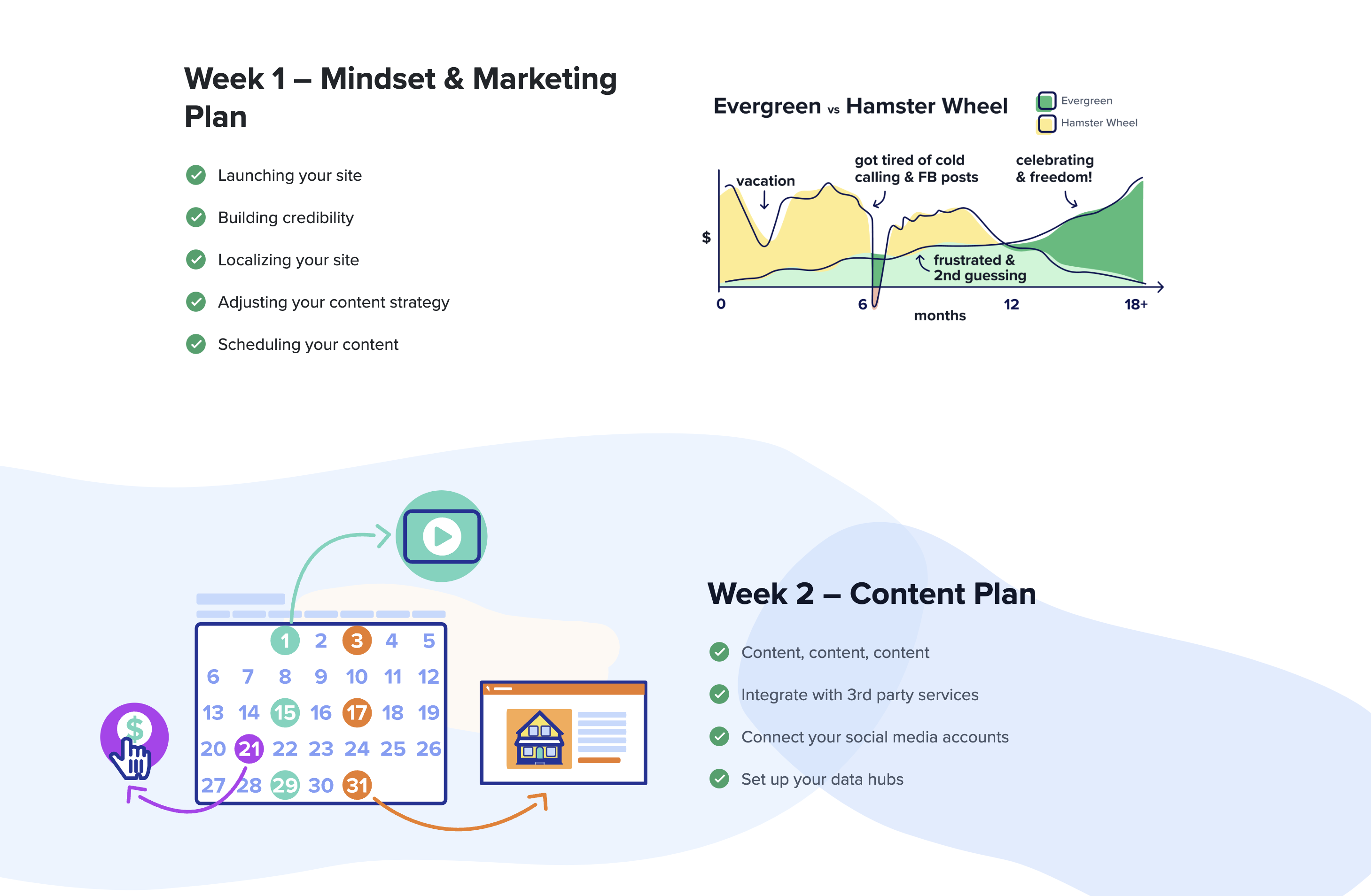
You might be wondering why we are doing a whole series on direct mail when we are web guys at heart. The easy answer to this is momentum. You’ll want to focus on consistency and predictability in order to gain momentum within your business. The more marketing channels you can add, the more consistency you will create as other things ebb and flow.
Direct mail marketing is proven to work.
There is nobody more qualified than Todd Swaggerty to share insight into direct mail marketing for real estate.
Who Are You Sending To? Direct Mail Lists
The first thing you’ll need to do when starting your direct mail lists campaign is determining who you should be mailing to. As we mentioned in the last episode, when you are first starting out, knowing where to look can feel like a challenge. Your sales skills may suck and instead of seeing things through, many investors end up giving up.
Knowing who to mail to is a progression that can take a little time. You may start by driving for dollars, then branch out into niche lists. A few niche lists to focus on include evictions, probate, inter-family transfers, divorce, and tax-delinquent homeowners. People in these situations are more likely to want to sell their homes. List Source and PropStream are two great sources for data.
Many investors will hire someone on Fiver or Upwork to do data scraping on their behalf. They should be looking for a full name along with the property address and mailing address. You’ll often find missing contact info when pulling data but don’t let that frustrate you. Companies such as Melissa Data can help you append the correct information to your mailing list. Compiling this data, with niche lists acquired over time, can provide you with a mailing list with an incredibly high response rate.
On the other hand, much of your competition may be taking the easier way out. Many investors find it easier to send out a broad mailing to a geographical area as opposed to the niche lists. This can be more cost-friendly upfront, but your response rate will be much lower.
How Often Do You Follow-up and When?
Not everyone is ready to sell the house the day they receive your first mail piece. However, several months down the road, they may be looking for a buyer. Keep in mind, some of your niche lists will have a shelf life.
You’ll need to be intuitive keeping in mind it isn’t practical to mail to people on a probate list or on a recently divorced list for more than a few months. On the other hand, you may find a list that works that you don’t change for years. You may end up sending them 6, 7, 8 mail pieces before they realize your solution is the answer they are looking for.
With direct mail being tangible – something they physically hold in their hand – it can be easier to keep your services right there where they will see them.
Direct Mail Is A Numbers Game
You’ve likely heard me ask how much are you willing to trade for a deal? We really focus on ROI here at Carrot. To do that, I will ask investors and agents what is their average profit per deal. It could be $10k for a flip or $6k in commission for a successful house sale. Next, I will ask them how many leads it takes to get one of those deals. This will vary based on the marketing method. Your SEO will provide more qualified leads, but it isn’t as easy to scale.
When determining how much you should be spending on direct mail for real estate, go in with the right expectations. You need to remove the emotion from the investment and really focus on math. Check this out…
Your average profit per deal is $10k
It takes you 30 leads to close 1 deal
You send out 10k mail pieces, costing $3,600
.5% of your recipients reach out
50 leads will end up costing you $72 per lead
So what would you trade to get that $10k deal? If you are only willing to trade $3k for a $10k profit, a list like this may not be sustainable for you. However, this is where you can tweak the numbers, find better niche lists, and do what it takes to make the math add up for you.
The Biggest Mistakes People Make With Direct Mail for Real Estate
When doing direct mail for real estate, it’s important to stay in your lane. Avoid absentee lists when you have no business mailing to them. The rule says you need to put time and energy into this process. It is no longer a spray and pray business. A truly great mailing list is calculated and done on purpose. Set the right expectations for yourself and your direct mail marketing.
A big problem Todd sees when investors and agents use direct mail for real estate is poor follow-up, untrained people answering the phones, and people thinking they can leverage a dollar when they should have spent $3.
In our next and final episode of this series, we will sit down with Christina Krause of Postal Impact to dive more into follow-up, scaling, and the best ways of training the people who are answering your phones.
Don’t be afraid to make it personal. Adding something about yourself disqualifies you from a nobody.
Todd Swaggerty
Direct Mail Masterclass #2 | Everything You Need To Start and Stand Out on Any Budget w/ Yellow Letter HQ Founder, Todd Swaggerty
Welcome to Part 2 of our awesome four-part series that will tell you everything you need to know about direct mail for real estate. We’re sitting down with some of the industry’s top marketing experts to demystify the direct mail process, to get tactical about your direct mail marketing, and to show you exactly how to get started on any budget.
We’ll let you know how to optimize, who to target, and what you should be paying attention to. We’ll teach you how to leverage your direct mail and walk you through how it relates to your marketing mix!
Today, we’re hanging out with Todd Swaggerty, founder of YellowLetter HQ. Todd got into direct mail while marketing his own business and realized he loved the strategy involved.
In 2015 he founded YellowLetter HQ which helps investors target the right clients with the right message. Today, we’re laying out everything you need to have success with direct mail on any budget. This is your game-plan. Ready? Let’s go!
Read the Full Show Notes Below…
Cut Through The Clutter With Direct Mail
Direct mail should be a part of any successful marketing mix. Todd Swaggerty learned this first-hand when he began creating direct mail campaigns for his own business back in 2009.
For 15 years Todd was a firefighter/paramedic. He started flipping houses in 2009 and threw himself all into the sales and marketing side of things. He mastered direct mail and recognized that he could do something really big for people in the real estate industry. From there, YellowLetter HQ was born and Todd hasn’t looked back since.
To create a business that is predictable and stable, you’ll want to make sure you have a great marketing mix. Think of your business as a stool. With one marketing channel, your business will stand. However, the minute you get up, the stool falls over.
Once you master one channel, adding 1-2 more will give you the stability you need. You won’t be working on marketing as much as it will be working for you.
Getting Started With Direct Mail on Any Budget
Direct mail works no matter what business you are in, plain and simple. Someone with a smaller budget may take a different approach than someone mailing out 500,000 letters each month. For both clients, it all comes down to the numbers game. How can you best leverage your marketing dollars?
Small Budget
When you are first starting out, it will be more about the hussle than what you are spending. This is where you need to do the work. When you have the time, but not the money, driving for dollars is the best thing you can do.
Once you have done the work and gathered the data, you can use a budget of $500 or so to begin targeting them with your direct mail campaign. Spending your money blindly, without doing the work, will not get you the results you are after. Stay in your niche and be true to yourself.
Todd has clients mailing out 3,000 or fewer pieces and making over $1 million per year. With the right targeting, they are able to mail based on quality, not quantity. If they were to mail out 40,000 pieces, their leads would likely be lower and they may not have the manpower to answer the calls they are receiving.
Medium Budget
When you have been in business for a while, you’ve likely built up some data and stacked some lists. You are able to touch on multiple pain-points your potential client may have. Now you can add more to your marketing stool by implementing other channels such as texting and SEO.
With a medium-sized budget, you will likely be mailing out somewhere between 3,000-10,000 mail pieces per campaign. These are the niche lists you have built from county records, probate lists, tax delinquent, water shut-offs, etc. Many of these lists are public information.
Once you find out how to get the data, you can have someone on Upwork go in and compile it for you. Your niche list will have a 1-2% response rate on average.
Large Budget
Once your marketing budget gets a bit larger, you’ll really be able to work that numbers game. You can add things like the Deal Machine app, a texting service, and email campaigns.
You can create direct mail marketing campaigns for leads that went dead who you’d like to reach out to again. With a larger budget, you will likely be sending out upwards of 20k mail pieces per campaign, with a sales team to back you on all the calls you will have coming in.
At this stage, you are leveraging the dollar more than the hustle. A broader list will have more volume, but a lower response rate – typically around .5%.
What To Mail, When To Mail, and What You Should Put On It
The first thing you need to focus on it how to get seen in your prospective client’s stack of mail. If your lead was found on a public list, you probably aren’t the only person mailing to them. While what you say matters, putting something on there to get them to stop and take notice, will give you the chance to get their attention.
Todd’s favorite mailpiece right now includes a street view of the person’s home right on the front of the postcard. This causes people to say “Hey, that’s my house!” On the back of the postcard, he has a picture of his family and a quick note about himself. While some people may ignore this part, for others it gives them a chance to feel like they already know something about him before they ever reach out and make contact.
One of the most popular pages on a website is the “About” page. People want to know who you are before they work with you. Todd has found that the postcards that appear to be personally handwritten do better than those that look formal and professional.
When sending out your direct mail campaign, 1st class mail is usually the way to go. Other methods may seem more cost-effective, but standard mail isn’t forwarded and it will take longer.
Postcards will cost somewhere between .36-.60 per piece, while letters are about .50-$1+. To add an even greater personal touch, Todd’s company uses actual stamps on the letter. It’s these subtle differences that make his mail pieces stand out.
I’m super excited about our next episode as we dive more into lists, how to scale, how to get better response rates, and how to best leverage your marketing dollars!
If you want all the details broken down step-by-step – what lists, where to find them, how much to mail, when to mail, what to track, EVERYTHING you need laid out in a path for you to follow, be sure to check out our extensive Free guide at Carrot.com/mail
You big volume will come from your offline marketing. Your most motivated leads will come from online and SEO. When you pair the two, you create a force of marketing, that will give predictibility and freedom.
Trevor Mauch
Want more motivated house sellers using direct mail? We’ve got you covered. Listen to real estate’s #1 experts in direct mail teach you exactly what thousands of investors and agents are doing to bring in more high-quality leads, at a lower cost, without the headache.
In this 4-part direct mail series, we answer all your questions on budgets, lists (including ones you never knew about), who to target, when to target, frequency, follow-up, mail pieces, testing, and more! Whew, that’s a lot! Can you even handle this??
Let’s dive in!
Read the Full Show Notes Below…
Why Direct Mail?
You might be wondering why we’re doing not just an episode about direct mail, but a whole series on the subject. The answer is simple: direct mail works. Direct mail for real estate is part of a larger marketing plan that will help you to build consistency within your business.
While Carrot helps you to stack bricks and generate inbound leads using SEO, direct mail and other offline marketing channels will help to activate the demand within your potential customers. In this series, we will answer all of your questions about direct mail for real estate including:
How often should I send my mail pieces?
How much should I spend on direct mail campaigns?
What should be on my mail pieces?
What shouldn’t be on my mail pieces?
How to build a great list?
How is your team handling calls?
When should I retarget my campaign?
When you are armed with the answers to these questions, you can easily close 5, 10, even 20 more deals per year! We’ll show you how just by making a few tweaks to the marketing you’re doing now, you will be able to close more deals without even trying!
Start With One Marketing Method
When you are building your marketing plan, you’ll want to find one channel and go all-in. Own it. Master it. Once you do, you begin to stack more and more channels, building consistency, predictability, and momentum within your business.
Our marketing plan generator is a completely free tool that will help you to get your marketing dialed in. All you have to do is answer a few general questions about your business, and you’ll gain some valuable insight no matter where you are in your business.
Add Some Legs To Your Marketing Stool
If you have your online presence down, start your offline marketing to generate the demand. If you have the offline thing down, amplify it with your online presence. SEO will help you attract the most motivated people, collect the most revenue, and close the most deals However, direct mail for real estate is all about the volume. When you have the two channels working together for you, you’re capturing leads from all angles
My Challenge For Your Direct Mail Marketing
Whenever someone gets a mailpiece that sparks their interest, more often than not, the first thing they will do is Google you. The same goes for cold-calling. When a strange number pops up, the first thing people do it look the number up to find out who is calling them. In most cases, looking up the phone number will lead to one of those “who called me” websites, often listing your phone number as spam.
My challenge to you is to take a look at a recent mailpiece and write down anything identifiable about your company. For example, the company name, your name, the phone number listed on there, and even your tag line. If you are using a number of different tracking numbers, make sure to have all of those phone numbers written out on your contact page.
Doing so will help your contact page start to rank for that phone number as opposed to just all of the “who called me” websites. You will be able to control the conversation when someone looks you up instead of a third-party website. By refining your marketing and amping up your online credibility, you’ll close more deals and generate more revenue.
Our Featured Experts
In this series, I am ecstatic to feature two of the top professionals when it comes to direct mail for real estate, Todd Swaggerty and Christina Krause. These are two people I have known and worked with for a long time, and frankly, they are both absolutely crushing it!
Todd Swaggerty is the CEO of Yellow Letter HQ. His company offers incredibly fast campaign turnaround through the use of personalized direct mail marketing.
Christina Krause is the owner of Postal Impact and through her extensive research, she has mastered direct mail for real estate and helped her clients create an awesome follow-up sequence to close more deals!
Guys, I am so excited for the next 3 parts of this series. We’re going to answer all of your questions about budgets, lists, and what goes into a great mail piece. Higher-quality leads and the ability to save money on your marketing? We’re in. Get your notebooks ready, the next three episodes of the podcast will change your business forever!
But it’s also one of the strategies that top investors like Max Maxwell and Tom Cafarella swear by.
Establishing fruitful connections and securing promising deals often hinges upon effective communication. Among the diverse array of strategies utilized, cold calling is a stalwart method for initiating meaningful dialogue and fostering mutually beneficial relationships within the industry.
Explanation of Cold Calling in Wholesale Real Estate
Cold calling within wholesale real estate involves contacting potential buyers, sellers, or other industry professionals without prior contact or established rapport. It is a proactive approach to engaging with prospects, presenting opportunities, and navigating the intricacies of the market landscape. Unlike warm leads or referrals, cold calling requires a deliberate effort to capture attention, convey value, and, ultimately, pave the way for productive transactions.
Importance of a Well-Crafted Script
Central to the success of any cold calling endeavor is the utilization of a meticulously crafted script. A well-structured script serves as a guiding framework, ensuring that each interaction is purposeful, persuasive, and poised for success. From the initial introduction to overcoming objections and securing commitments, a thoughtfully devised script empowers real estate professionals to navigate conversations with confidence, clarity, and compelling persuasion.
Overview of What the Blog Post Will Cover
This comprehensive guide will delve deep into the intricacies of cold calling within the wholesale real estate sector. From understanding the fundamental principles to crafting compelling scripts and mastering the art of effective communication, this blog post aims to equip you with the knowledge, strategies, and tools needed to excel in your cold calling endeavors. Whether you’re a seasoned veteran seeking to refine your approach or a newcomer eager to make an impactful entrance, join us as we unravel the secrets to unlocking success through cold calling in wholesale real estate.
Understanding the Wholesale Industry
In the intricate tapestry of real estate, the wholesale sector serves as a vital conduit for transactions, facilitating the movement of properties between various stakeholders. To navigate this dynamic landscape effectively, it’s essential to grasp the fundamental aspects of the wholesale industry, from its definition and scope to the key players shaping its trajectory.
Definition and Scope of Wholesale
At its core, wholesale real estate involves acquiring and subsequently assigning or selling properties to end buyers, often without extensive renovations or holding periods. Unlike traditional transactions, where properties are purchased for personal use or long-term investment, wholesale deals operate on a distinct model focused on swift turnover and profit generation.
Wholesale transactions typically involve three primary parties: the wholesaler, the seller, and the end buyer. The wholesaler acts as an intermediary, sourcing properties at below-market rates, negotiating favorable terms, and subsequently assigning or selling the contracts to interested buyers for a profit. This process enables wholesalers to capitalize on opportunities swiftly while providing sellers with a hassle-free exit strategy and connecting end buyers with lucrative investment prospects.
Key Players and Their Roles
Several key players drive transactions and shape market dynamics within the wholesale real estate ecosystem. These include:
Wholesalers: Individuals or companies specializing in sourcing and negotiating wholesale deals, often leveraging marketing strategies, networking, and market expertise to identify lucrative opportunities.
Motivated Sellers: Property owners seeking to offload their assets quickly and efficiently, often motivated by financial distress, inheritance, or a desire to liquidate investments.
End Buyers: Investors, rehabbers, or individuals looking to purchase properties for rental income, fix-and-flip projects, or long-term appreciation.
Real Estate Agents: While not always directly involved in wholesale transactions, real estate agents may serve as valuable resources for wholesalers, providing market insights, networking opportunities, and access to potential deals.
Service Providers: Professionals such as attorneys, title companies, and inspectors play crucial roles in facilitating wholesale transactions, ensuring legal compliance, and mitigating risks for all parties involved.
Trends and Challenges in the Wholesale Market
Like any segment of the real estate industry, the wholesale market is subject to evolving trends and inherent challenges. Some notable trends shaping the wholesale landscape include:
Increasing competition: As the allure of wholesale real estate grows, new entrants have increased competition for deals, requiring wholesalers to differentiate themselves through innovative strategies and value-added services.
Technological advancements: Technology integration, including online platforms, virtual tours, and digital marketing tools, has revolutionized how wholesalers source, market, and transact properties, streamlining processes and expanding reach.
Market volatility: Economic fluctuations, regulatory changes, and unforeseen events such as the COVID-19 pandemic can impact market dynamics, presenting opportunities and challenges for wholesalers navigating uncertain terrain.
In addition to these trends, wholesalers must navigate many challenges, including legal complexities, market saturation, and continuous adaptation to changing market conditions. By staying informed, remaining agile, and leveraging strategic insights, wholesalers can overcome these obstacles and thrive in the ever-evolving landscape of wholesale real estate.
Preparing for Cold Calling
Before embarking on a cold calling campaign within the wholesale real estate sector, thorough preparation is paramount to maximize effectiveness and efficiency. From researching your target market to fine-tuning your workspace, each step plays a crucial role in setting the stage for success.
Researching Your Target Market
Effective cold calling begins with deeply understanding your target market’s demographics, preferences, and pain points. By conducting comprehensive research, you can identify potential leads more strategically and tailor your approach to resonate with their specific needs and motivations.
Key aspects of research include:
Geographic area: Determine the regions or neighborhoods with high investment potential and align your efforts accordingly.
Property types: Identify the properties (e.g., single-family homes, multi-unit buildings) in demand within your target market.
Market trends: Stay abreast of market trends, such as property appreciation rates, rental demand, and economic indicators, to anticipate opportunities and challenges.
Segmenting Your Leads
Segmentation is a critical component of effective lead management, allowing you to categorize prospects based on criteria such as readiness to sell, investment goals, and budget constraints. By segmenting your leads, you can tailor your messaging and approach to address each group’s unique needs and preferences, increasing the likelihood of success.
Common segmentation criteria include:
Motivation level: Determine the urgency and motivation of each lead to prioritize follow-up efforts accordingly.
Investment criteria: Segment leads based on their preferences, such as fix-and-flip opportunities, rental properties, or commercial investments.
Communication preferences: Identify whether leads prefer phone calls, emails, or other forms of communication to engage with them effectively.
Setting Specific Goals for Your Calls
Clear, actionable goals are essential for guiding your cold calling efforts and measuring success. Before initiating calls, take the time to define specific objectives that align with your overarching business objectives and desired outcomes.
Examples of goals for cold calling in wholesale real estate include:
Securing a certain number of appointments with potential sellers or buyers.
Qualifying leads based on predetermined criteria, such as property condition, price range, or timeline.
Gathering market insights and feedback to refine your approach and strategy.
By setting specific, measurable goals, you can focus your efforts and track progress over time, enabling continuous improvement and optimization of your cold calling strategy.
Preparing Your Workspace and Materials
Creating a conducive environment for cold calling is essential for maintaining focus, professionalism, and productivity. Ensure your workspace is organized, free from distractions, and equipped with the necessary tools and materials to support your calls.
Key considerations include:
Comfortable seating: Invest in ergonomic furniture to support good posture and reduce fatigue during extended calling sessions.
Reliable technology: Ensure your phone, computer, and internet connection are reliable and functioning optimally to minimize interruptions and technical issues.
Script and talking points: Have a well-crafted script and talking points prepared to guide your conversations and maintain consistency in messaging.
Call tracking system: Implement a call tracking system or CRM software to record call outcomes, track follow-up tasks, and capture important lead information for future reference.
By proactively preparing your workspace and materials, you can streamline your cold calling process and maximize your effectiveness in engaging with prospects within the wholesale real estate market.
Crafting Your Cold Calling Script
Cold calling in real estate wholesaling demands a strategic and persuasive approach to engaging with prospects and navigating toward positive outcomes effectively. Crafting a compelling script is the cornerstone of this endeavor, guiding each interaction with purpose and finesse. Let’s delve into the essential components of constructing a powerful cold calling script.
Introduction: Making a Strong First Impression
The opening moments of a cold call are crucial in capturing the attention and interest of the prospect. Begin with a confident and friendly greeting, followed by a concise introduction that communicates who you are, your affiliation, and the purpose of your call. Keep it brief yet engaging, setting the stage for a fruitful conversation.
Establishing Credibility and Rapport
Building trust and rapport early in the call is essential to foster a productive dialogue. Share relevant credentials, experiences, or success stories that showcase your expertise and credibility in the real estate wholesale market. Additionally, demonstrate genuine interest in the prospect’s needs and objectives, listening attentively and empathizing with their situation.
Identifying Needs and Pain Points
Effective communication hinges on understanding the prospect’s unique challenges, goals, and motivations. Ask probing questions to uncover their specific needs, pain points, and aspirations related to real estate investment. By empathetically acknowledging their concerns and objectives, you position yourself as a valuable resource capable of addressing their needs.
Presenting Solutions and Benefits
Once you’ve identified the prospect’s needs and pain points, articulate how your wholesale services or investment opportunities can address their concerns and fulfill their objectives. Highlight the unique benefits and advantages of working with you, emphasizing favorable terms, swift turnaround times, and lucrative returns on investment.
Handling Objections Effectively
Objections are a natural part of the cold calling process and present opportunities to address concerns and objections proactively. Anticipate common objections such as pricing, timing, or skepticism, and prepare persuasive responses that alleviate doubts and reinforce the value proposition. Approach objections with empathy, understanding, and confidence, reframing them as opportunities to provide clarity and reassurance.
Closing the Call with a Clear Call to Action
As the conversation nears its conclusion, transition seamlessly into the closing phase by summarizing key points discussed and reaffirming the benefits of proceeding with your proposed solution. Clearly outline the next steps and guide the prospect towards a specific call to action, whether scheduling a follow-up meeting, exploring available properties, or committing to a purchase agreement. End the call positively, expressing gratitude for their time and reiterating your commitment to their success.
By meticulously crafting each element of your cold calling script, you empower yourself with the tools and strategies needed to engage prospects effectively, build trust, and ultimately, drive successful outcomes in the wholesale real estate market.
Tips for Effective Cold Calling
Practice Active Listening
Effective cold calling relies on more than just delivering a scripted pitch; it requires active listening to understand the prospect’s needs and respond appropriately. Focus on the prospect’s words, ask clarifying questions, and demonstrate empathy and understanding. By actively listening, you can tailor your approach to better resonate with the prospect and build a stronger connection.
Tailor Your Script to Each Prospect
While having a structured script is essential, it’s equally important to tailor your message to each prospect’s unique situation. Research your leads beforehand to understand their preferences, pain points, and objectives. Personalize your approach by incorporating relevant details into your script, demonstrating that you’ve done your homework and are genuinely interested in addressing their needs.
Keep the Conversation Natural and Engaging
Avoid sounding overly scripted or robotic during your cold calls. Aim for a conversational tone that fosters engagement and encourages open dialogue. Be genuine, enthusiastic, and personable, allowing the conversation to flow naturally. Remember to smile as you speak – it can be heard in your voice and help convey warmth and sincerity to the prospect.
Stay Persistent but Respectful
Cold calling can be a numbers game, but balancing persistence and respect for the prospect’s time and preferences is essential. If a prospect expresses disinterest or requests to be contacted later, respect their wishes and follow up accordingly. Persistence can pay off, but it should never come at the expense of alienating potential leads.
Continuously Refine and Improve Your Script Based on Feedback
Regularly solicit colleague, mentor, or prospect feedback to refine and enhance your cold calling script. Pay attention to what resonates with prospects and what doesn’t, and be willing to adapt your approach accordingly. Continuously refining and improving your script based on feedback ensures that you stay relevant, effective, and responsive to the evolving needs of your target audience.
Cold Calling Wholesale Scripts – Free Templates
Here are a couple of short and straightforward cold calling scripts for you. You can use these for your cold calling process and tweak them to fit your personality.
Remember, different strategies work for different salespeople, so change them as you use them and learn more about your tone of voice and how prospects respond to you.
We hope they help!
Cold Calling Motivated SellerWholesaleScript 1:
Hello, my name is [NAME] and I’m with .
[PAUSE]
How is your day going?
[PROSPECT RESPONDS]
Sorry to bother, but I came across your contact information when I was looking for people who might want to receive a cash offer for their home.
How does that sound?
[PROSPECT RESPONDS]
I’ll tell you what; let’s schedule a time to chat and I can do some research on your property. I’d be more than happy to make you a fair cash offer as soon as possible.
What’ya say?
Cold Calling Motivated Seller Script 2 CashHomes:
You: Hi, (Seller) this is Anthony, I’m wondering if you could help me for a moment?
Seller: Sure
You: I represent a cash buyer who’s looking to purchase just one house in your area. Would you happen to have any interest in selling?
Seller: NO!
You: Okay, well since were looking in your specific area would you happen to know anyone that might have any interest in selling?
Seller: Yes, how much will you pay me?
You: Well my finance director will give you a call shortly, I’m here today to gauge your motivation and to gather accurate information on your property so he can give you our highest and best offer.
Seller: Okay
You: Tell me a little bit about your situation? What would you like to get for the property?
(Trial Close) are you living in the property or is it rented out? What would be your timeline on moving out? • Month to month lease or loan lease? • How can I fulfill your obligations to sign on this deal today? (Try and figure out a situation and HELP THEM OUT) • Have you changed anything within the house? Any upgrades to the property? (Gather all info on the property)
If the shell isn’t cracked yet ask these questions: A. Why are you selling? B. What’s the most important thing to you about selling? C. What’s the most important thing you wanted to get out of this call today?
Tools and Resources
List Building
Before you can call anyone, you’ll need to get the motivated seller’s phone number.
It’s one thing to pull a mailing list with addresses and names; it’s another to find the phone numbers for those same people.
(If you do need help pulling a list, check out ListSource — that’s a common tool that real estate investors like to use for creating lists and finding potential leads)
Maybe you have a list of absentee owners, or maybe you have a list of people going through probate. Whatever the case, you have a list Now you need phone numbers.
(You can also consider driving for dollars to add more unique addresses to your list that other market competitors might be overlooking)
To get the phone numbers of people on your list, you’ll probably want to pay for an online tool to help you out (or a cost-free way is to go scrounging through an old-school phone book and match up names with numbers).
You can use a tool like Zabasearch. Just type in the name of the person you want a phone number for, specify which state they live in, and then use their middle initial and other unique identifiers to determine which profile is the right one.
Then click “View full profile” and sign up to get all the info for that person. Zabasearch charges $0.95 per profile that you access.
But that’s just one of many tools that help you find phone numbers for your motivated seller leads. There are many others, and it’s worth your time to research and figure out which service will provide you with the best bang for your buck.
Software and CRM Tools for Managing Cold Calling Campaigns
Dialing systems for increased efficiency and productivity
Analytics tools for tracking and analyzing cold calling performance
Training Resources for Improving Cold Calling Skills
Online courses and webinars on cold calling best practices
Sales training programs focused on effective communication and persuasion techniques
Workshops and seminars led by industry experts and seasoned professionals
Books, Podcasts, and Courses on Effective Sales Techniques Explore a wealth of resources, including books, podcasts, and online courses, that delve into the art and science of salesmanship, offering valuable insights, strategies, and tips for mastering the craft of cold calling in wholesale real estate.
Conclusion
Throughout this guide, we’ve explored the essential elements of cold calling in wholesale real estate, from crafting compelling scripts to implementing effective strategies and leveraging valuable resources.
As you embark on your cold calling journey, remember that success comes from knowledge and consistent practice, adaptation, and refinement. Implement the strategies discussed in this guide and adapt them to suit your unique style, market, and objectives.
Even If You’re Only Cold Calling – You Still NEED a Website! All marketing drives online demand.
You waste time and money if you don’t have a website. Even if you do, it must be appropriately optimized for success.
The more real estate marketing opportunities you use, the more you need to build your credibility and trust.
When you’re cold calling, people have no idea who you are. They’ll need somewhere to go to validate and verify you.
If you want to stand a chance, you need a website where you can not provide the necessary information to build credibility and trust. You’ll need a perfect about page, testimonials, core values, and a mission statement.
If you don’t, leads will bounce to your competitors, leaving you with lost time and money.
Leave us a comment below with your thoughts on cold calling. What you like, don’t like, might do differently, whatever. We’d love to hear from you.
Serious investors need to know how to find cash buyers. Why? Let’s say you hustled and got a house under contract. You ran the numbers and figured you could profit $10,000 or more on this one property! You’re excited, nervous, and ready to finish the deal.
But what now?
After all, having a house under contract isn’t enough. You also need someone on the other side willing to pay you cash for that property. And you can’t just have one buyer — you need a whole list of people willing to buy the properties you put under contract if you’re to turn your side hustle into a successful, growing business.
(One buyer probably won’t want to buy all of your properties)
And while finding cash buyers is typically easier than finding motivated sellers, it still takes some work.
To help, here are some tips you can use to find buyers, build a trusting, long-term relationship with them, and get them to purchase your deals in no time.
What is a Cash Buyer?
A cash buyer is an individual or entity (such as an LLC formed by a group of real estate investors) with the money to purchase a home outright without financing.
An actual cash home buyer will check these boxes:
Have proof of funds
A track record of successfully purchasing and flipping properties
Authentic positive reviews and testimonials
Willingness and ability to provide seller and professional references
A cash buyer offer will most likely land between low and high offers in the multiple offer situation. Experienced investors typically have similar pricing calculations.
Offers may not be the highest because investors know how vital an agreement is and don’t want to make false promises or fail to deliver.
Many sellers are looking to sell to a cash home buyer because they need to sell quickly and easily.
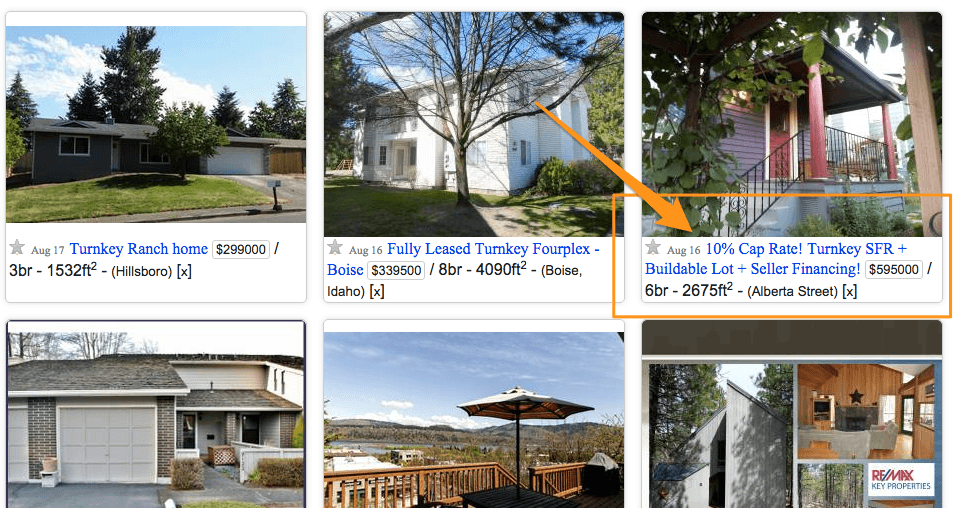
Because remember, the cash buyers you’re looking for are probably already looking for properties to buy, and Craigslist is one place that they’re going to look. If they see your ad, they’ll likely reach out to you and you can add them to your buyer’s list.
It’s a free and easy way to grow your buyer’s list. What’s not to like?
2. Utilizing Facebook Groups
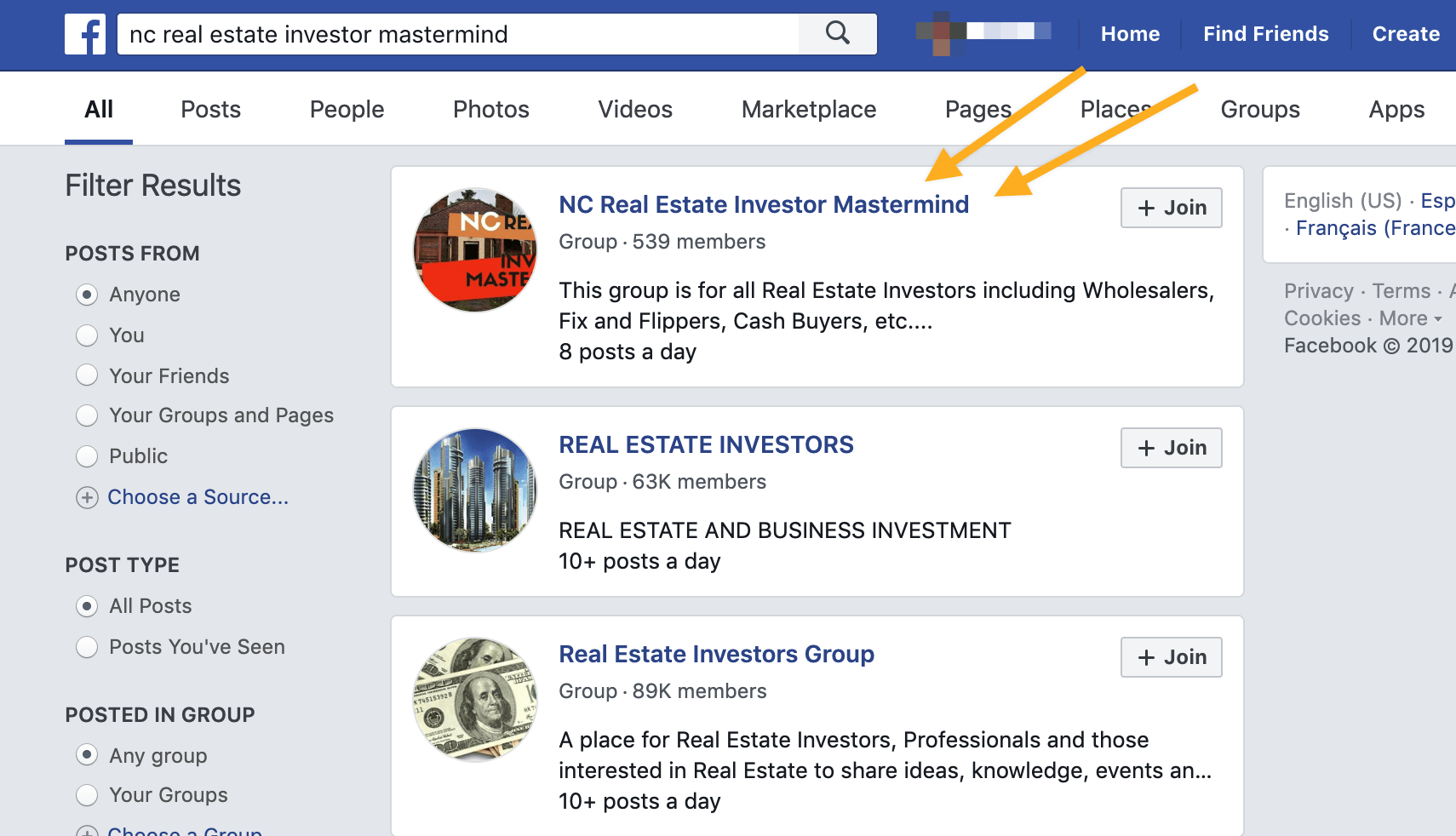
Facebook can a great place for finding local cash buyers. There are many local real estate Facebook groups that you can tap into.
Here’s an example of a local group.
Active groups are always posting their deals. Simply post within the group… “who’s dealing in [market city] area?”
Then wait to see who you can start building relationships with.
3. Call Real Estate Agents
Real estate agents usually have their fingers on the pulse of their market. They know how the housing market is doing, they are typically friendly, and they know tons of different people with different real estate interests — from first-time homebuyers to million-dollar cash buyers.
And that’s exactly why they’re such a great resource for you when you’re learning how to find cash buyers.
Make a list of 10 real estate agents in your area, call them, introduce yourself and what you’re doing, and ask them if they know anyone who might be interested in purchasing your properties.
You might be surprised at just how many names you get (heck! Some real estate agents are also investors looking for good deals, so you might even get some buyers that way).
4. Go To Property Auctions
Property auctions give real estate investors an opportunity to buy properties cheaply. But that might not be the only reason you want to attend these events — you can also use property auctions to meet cash buyers in your area.
After all, the only people who will go to the auction in the first place are people with enough cash to actually purchase a discounted property (i.e. the exact people who are perfect for your buyer’s list).
You can find the place and time of property auctions on your local government website and in the newspaper. When you attend, bring some business cards, mingle with the crowd, and allow relationships to form naturally.
When someone inevitably asks, “What do you do?” that’s the perfect segue into explaining your business and offering to add them to your buyer’s list.
5. Find The Rental Companies
One great way to find cash buyers with deep pockets in your market is to look for the big buy-and-hold companies, the companies with lots of rentals in your area.
Most of these companies are constantly looking to expand their rental portfolio and continue growing. More than likely, they would be open to you sending them deals.
The best way to find these companies is to search online for rentals, see who owns them, and look for the common denominator companies.
You can also take a drive and look for signs advertising rentals and then call those companies to see if they’d be interested in being added to your list.
6. Use SEO to Optimize Your Cash Buyers Website
At Carrot, we talk a lot about using SEO to find motivated sellers. By targeting phrases like “Sell my house fast for cash”, you can passively drive traffic to your website and convert those leads into deals.
Well, you can do the exact same thing with your buyer’s list.
You can build a landing page, optimize it for the keyword phrase you’re targeting — in this case, something like “buy investment properties in [market city]” would do the trick — and start collecting buyer leads.
You can get a Carrot site if you want to get your page ranking even faster — we optimize the tech stack for you :-)
7. Get a List Of Absentee Owners With Multiple Properties
Absentee owners are owners of properties who aren’t living in the property that they own. Sometimes this is because they aren’t doing anything with the property, waiting to sell, or because it’s a piece of junk.
But sometimes, people are absentee owners because they are landlords. And landlords are often looking to expand their rental portfolio as well. They just need access to cheap properties… which you can give them.
Usually, you can get a list of absentee owners from your local title company. Focus your attention on the absentee owners with multiple properties — those are the ambitious cash-buying real estate investors you’re looking for. The ones that, if you contact them, won’t have any problem with you adding them to your email list. If you’re just now learning how to find cash buyers, this is a great place to start!
8. Search On Google
It might seem like an obvious course of action to search on Google “How to find cash buyers.” So do it! Most cash buyers want to be found by motivated sellers, which you can use to your advantage.
By searching in Google for “Sell my house now for cash in [market city]”, you can find the cash buyers with the biggest online presence in your market — some of those results will be wholesalers like yourself, but some of them won’t.
Contact the companies and investors you find online and tell them what you’re doing. Then ask if they’d like to be added to your email list. If they’re trying to expand their investment portfolio, they have no reason to say “no.”
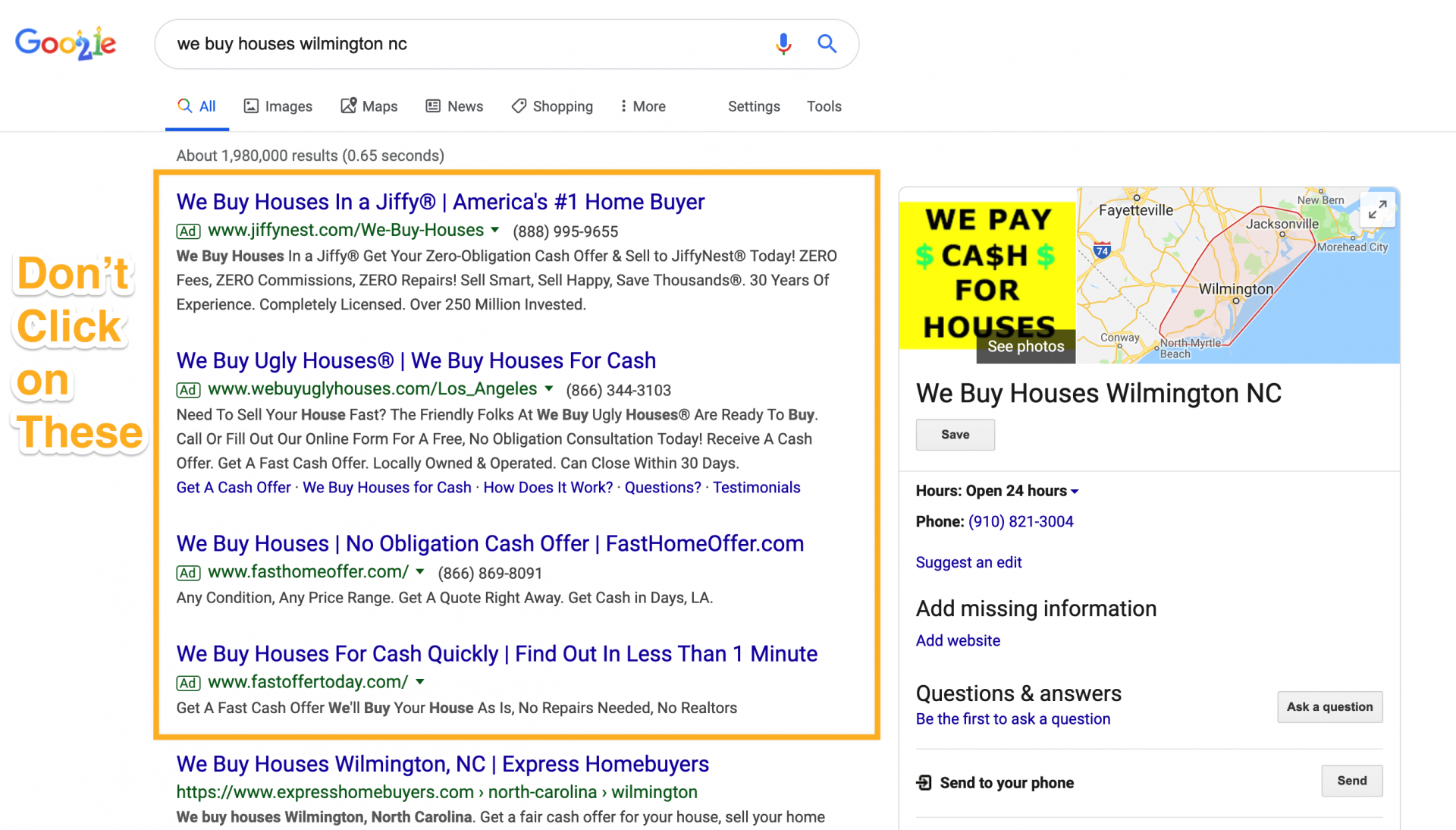
Note: It can be enticing to click on a Google Ad. BUT… costing the investor money per click. Don’t reach out to investors through ads. Not a good way to build a relationship.
Conclusion
If your business succeeds, you must have a list of high-quality cash buyers. You need access to people who trust you and are willing to buy your properties.
And you can use the above 8 ways to learn how to find cash buyers and create your list. We hope this helps you build a successful wholesaling business.
With less than 10 minutes of effort, you’ll have video and real estate content for your blog that will boost your SEO, help you stand out with more credibility, and convert more visitors into leads.
Featured Resource: Our Free Video Marketing Playbook For Investors And Agents!
Cool update, the videopost we walk you through within this blog post actually ranks in Google for the phrase we went after. It took a month, but it’s ranked #1 now!
Video Transcription
What’s up y’all. Trevor here with Carrot
Creating content for your real estate website as an agent is easier than you think. Today we show you how to shoot videos without any fancy cameras or lights, or scripts.
Many of you guys are not doing what I’m asking you to do and doing video posts.
Putting content online is critical for standing out and building expertise, building authority, and our tool called VideoPosts turns your short videos into written content that ranks.
In this video, I’m going to actually do one in real-time, show you how I ideate, find the idea, research it, do the video, get it uploaded, and optimize it, all in one. It’s a real video. I’m putting it on my own site.
So first thing right here: doing a videopost in real-time. I’m going to go through it really quick.
First of all, we’re going to pick the topic based on the niche that you’d like to own.
Next, we’re going to research it using Google suggest; it’s crazy, easy, free, simple, cheap.
Number three, shoot the video, under three to five minutes using this fancy, crazy expensive tool called a cell phone.
Number four, upload the video to YouTube from your cell phone.
Number five, optimize and create the videoposts in Carrot, all in under 10 minutes.
All right. The first thing we’re going to do here is … I’m in Roseburg, Oregon. I have an entrepreneur cowork space called The Loft.
I want to rank a video there for people that are looking to find a cowork space. I’m going to go to Google right here. I’m just going to type up phrases that I think someone might want to search if they’re looking for a cowork space.
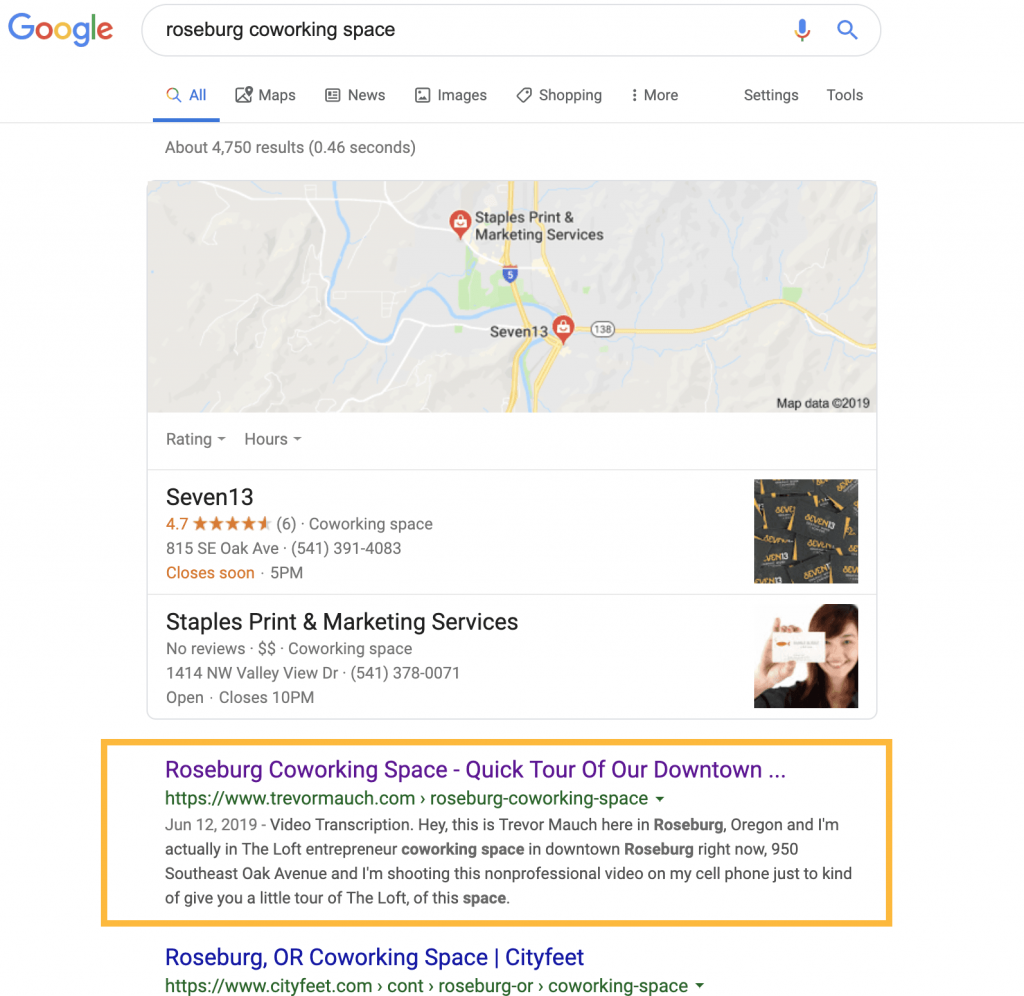
So Roseburg co … We’re at Roseburg cowork … Right there: Roseburg coworking space. Cool.
So that’s my title. I’m going to click this and see what’s ranking here. We’ve got this. The Loft Roseburg is there, but I want my personal website rank in there.
Okay? I want my personal website rank in there. So I’m going to create a video. I’m going to upload it. I’m going to optimize it for Roseburg coworking space.
I know that’s the phrase people like the search. I’m going to scroll down to see if there are any suggested searches at the bottom. That’s a pretty obscure search phrase so there’s not any there.
If there were, you can use those search phrases at the bottom.
Here’s an example. Let’s say it was North Umpqua river homes … Homes for sale.
You can use the suggested searches for ideas right here. These are ideas you can work into the words of your video.
One of the keys here, one of the keys right before I start to record this is you need to be saying the types of words in your video that people are going to be searching in Google.
So whatever you say is actually going to then get put in the video, which we’re going to yank the words out and put it in writing.
The way that you rank well with videoposts is to localize all of your content. I’m going to do it in real-time right here, doing a videopost to rank really high. We’ll show you the real results later for Roseburg coworking space.
[VideoPost Script Now Ranking #1 in Google]
Hey, this is Trevor Mauch here in Roseburg, Oregon. And I’m actually in The Loft in Downtown Roseburg right now: 950 South East Oak Avenue.
And I’m shooting this non-professional video on my cell phone, just to kind of give you a little tour of The Loft, of this space. So I just came out of my office right there. I’m going to flip the lights on here in a second, but this is our kind of general gathering room.
We have our gym right here. We have about 13 different companies all doing amazing things, innovative things here in Roseburg, a lot of people probably don’t know about.
Here’s our awesome content studio where Born And Raised Outdoors does podcasts. I do podcasts. Other people do videos and podcasts in this studio, available for Loft members.
Popping over here now, flip on some lights, we’ve got our kitchen. We’ve got our lounge. I’m going to take you over to the actual office space on the other side.
If you’re looking to get a cowork space here in Roseburg, Oregon, if you’re looking for an entrepreneur workspace, you want to have a space to work with other amazing people, The Loft is the heartbeat of entrepreneurship in Roseburg, Oregon.
We’re growing our company here, Carrot, a fast-growing software company in Oregon right here. This is our lounge, kind of a break area. Over there we have a lot of cool parties, lots of fun stuff. You can lounge right here and hang out.
I’m going to take you over to this side now and show you some of the more offices.
So what do we have here at The Loft? We have a gym. We have a studio. we’ve got our lounge, our bar, our kitchen. I think it’s about 13 offices, I should have flipped the lights on before I did this video also, of amazing people. Now currently, as I speak, we don’t have any availability but there might be availability. Or at the very least come and visit us and see what we’re doing here at The Loft.
Taking you in the boardroom now.
This is our boardroom, so if you are going to be working and you want to do meetings, you’ve got the white board, you’ve got the big meeting area right here. And I’m going to be coming in here and kind of showing some of the other Loft members.
We’ve got a one of our offices here. I’m interrupting my team. Mr. Josh back there. This is one of our offices here at Carrot. Right over there is where my office is, where I started this video.
And then we’re going to take you over here by the rest of the offices, then take you out front so you can see what our building here in Downtown Roseburg looks like.
And if you’re looking for office space in Roseburg, this is a good fit. Once again, we’re currently full right now but we have amazing offices all over here, a historical building.
And most of these people here in Roseburg, in The Loft, are creatives. It’s people who are creative. They’re doing marketing. They’re doing video work. Once you move into The Loft, you’re going to get a sticker up here to be able move in and out at your leisure.
And I’m going to take you out front. You’re going to see where we are here in Downtown Roseburg. And once again, if you’re looking for downtown office space, we are so passionate about, and we so love the Roseburg community here.
But this is where you’re going to see right here. We’re in beautiful Downtown Roseburg. We have the coffee shop right across the way. We’re there quite often. This is The Loft, right here. You’re going to see it. This is Oak Avenue. Right up here you Have Main Street.
And so I’m going to finish it with this. If you’re looking for a coworking space here in Roseburg, if you’re looking for an office space here in Roseburg, if you’re looking for a place downtown to call home, to grow your business, to have fellowship, to be there with other creatives that are doing amazing things from software, from graphics to IT security, marketing, YouTube stars, the whole thing, come down here to The Loft and check it out.
So what are some other things if you’re looking for food? We have a lot of amazing food down here. We’ve got Brix down there, we’ve got Old Soul right there. So that’ll kind of give you an idea of where we are.
Check us out at theLoftroseburg.com or come down here to 950 SE Oak Ave. There’s one of our downtown residents right there, the owner of Umpqua Sweets and Treats.
Come down here to 950 Southeast Oak Avenue and join The Loft and check us out. Even if you don’t want an office, just come visit us.
If you’re looking for an entrepreneur coworking space and if you’re looking for a place to rent an office here in Roseburg or whatever, you just want fellowship, come check us out.
Cool. So, you see, it wasn’t perfect. I stumbled a bunch, I didn’t know what words I was going to say sometimes, but you make it through it.
And while I’m heading back to the office, I’m actually going to upload that on YouTube in real time.
So the title for this one is just going to be Roseburg Coworking Space, probably put a “dash, The Loft.”
I’m going to click “upload.” It’s now uploading on my phone. It’s going to take them a minute or so. And then from there, I can take that and I can put it directly inside of my Carrot site.
So I’m now logged into my Carrot site, over here, and I’m going to show you where to go for video posts.
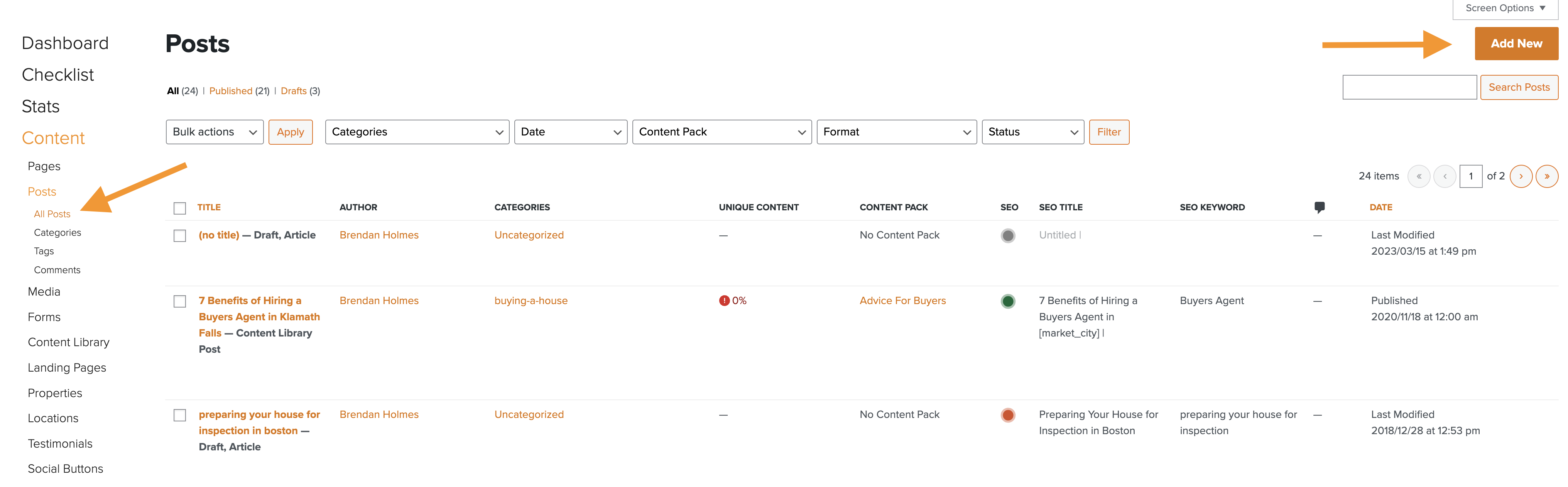
So right here I’m going to log into my account. I’m going to click “content.” And we’re doing some things to make this even simpler and quicker. And then we go to “posts.” Okay, and then just go ahead and click “add new.”
Just go ahead and start a new post.
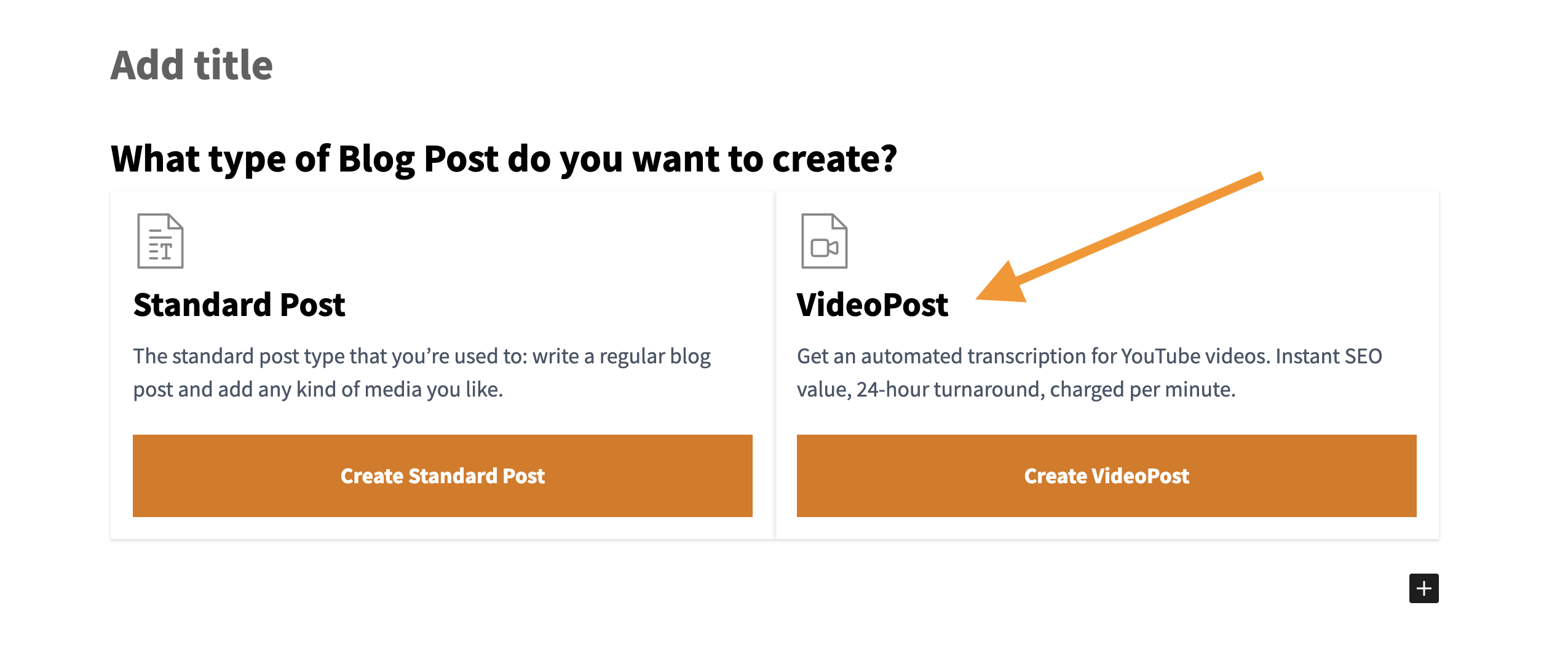
And there’s this little option right there that says “video,” okay? And what I’m going to do is I’m just going to go to my YouTube account … So YouTube.
So go to my channel. I’m not a professional on YouTube. I’m working my way through this as well. Okay, so right now this video is uploading. It’s crunching. It should end up here in my account here in a bit. I did mark it as unlisted, but you can see right there it’s still uploading right now. It’s about one minute remaining.
Once I get this video, what I’m going to do is I’m going to put it inside of video posts. I’m just going to take that URL. I’m going to paste it right there. It’s going to import everything in.
The title for video posts should be the keyword that I typed up into Google, which was Roseburg Coworking Space.
I’m going to maybe put a little bit of content on the back end of it so it’s not just this boring short title. it’s probably going to be Roseburg Coworking Space – The Loft.
Let’s go and do this. Roseburg Coworking Space, downtown offices at The Loft workspace.
That’s a long title. You have to make it like that. But you can see, I put my title right there. I’m waiting for my video to upload and start crunching.
Once I get the video in there, I’m just going to go ahead and paste the URL straight in there. Okay, I’m going to do it right there and then there’s going to be a button right here that you click and that’s it. That’s all you’re going to do.
So I’m going to take a video right now just for sake of time on this particular video, and I will put in my old Loft video.
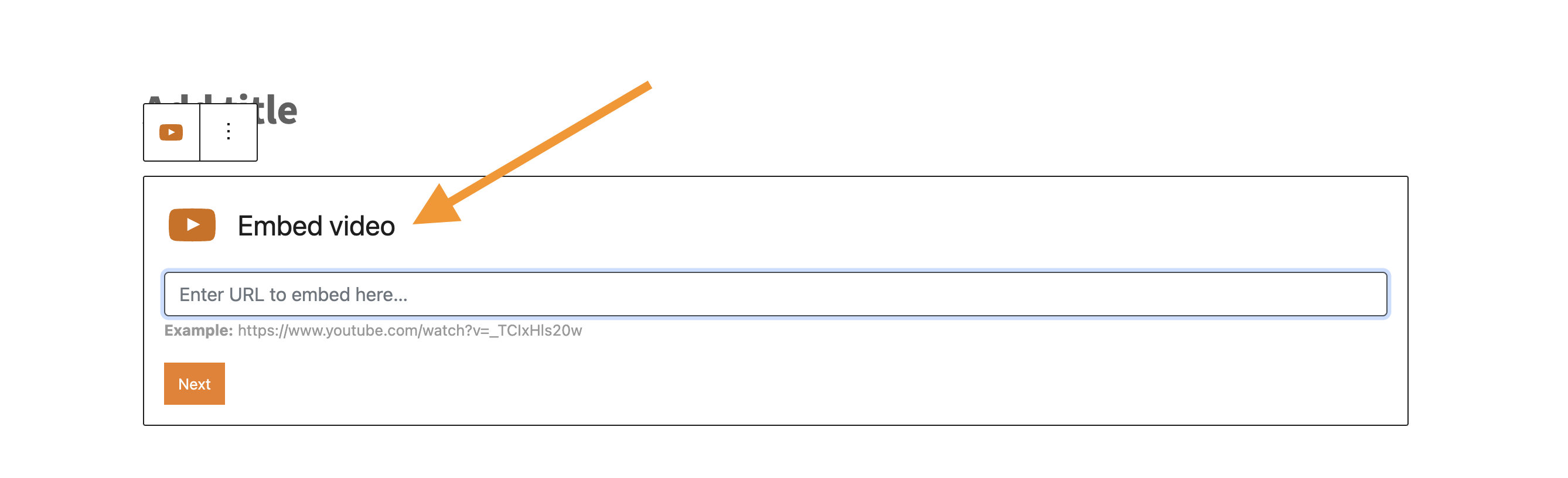
I’m just going to go edit right there, copy and paste the URL. You can see our system imported the whole thing in there. And then if I was logged into an actual Carrot account, there’d be a big callout there that says “embed video” add your YouTube video, and click next.
So I’m going to do that. We’re going to check back in in a couple of weeks and see where that video post is ranked in Google.
That’s it. The steps were this, let me review them:
Pick your topic, whatever your topic is going to be. In this case, I want it to rank well for coworking spaces. That’s one of my niches.
Research using Google Suggest to peg a title, just like I did. Just go to Google and start typing in what your prospect might type in, find other suggested phrases. That’s now you’re going to be your title. Pick the best one of those for your title.
Make sure you say those words in your video in natural spots multiple times. Say different words that are related to that.
Okay. The next step here is you go shoot the video. Make it a three to five-minute video. That video I shot was four minutes. Upload it to YouTube straight from your cell phone.
The title of that should be the word that you grabbed from Google. Throw that now into videopost with Carrot and you’re done.
All right, I want to challenge you to make your first video post. You saw this whole video, including flub-ups, including us, walking around, actually not producing the video post, is right around 10 minutes.
We know that you can do the same thing. My videopost was four minutes. It took me three minutes to upload it to YouTube, a minute to research it, four minutes to walk around filming myself, flubbing up words.
The people are going to love it and it’s going to rank well on Google. Do the same thing. Use videoposts!
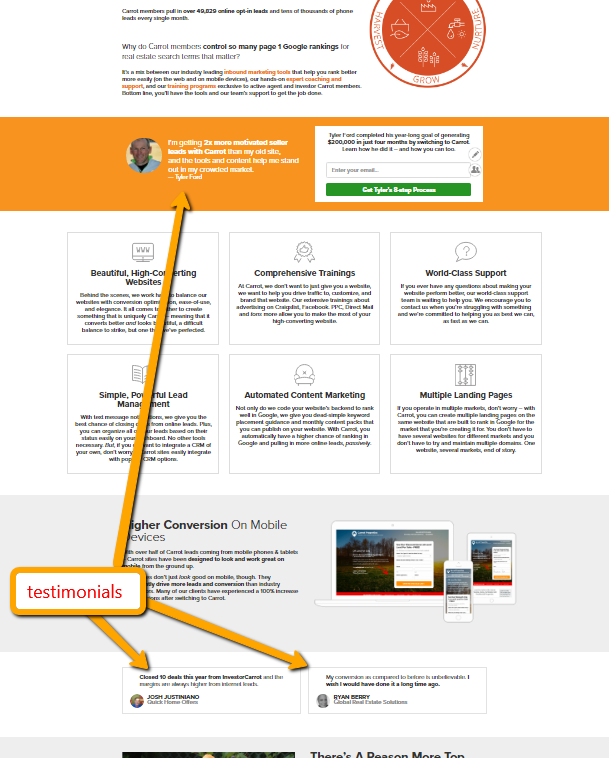
Testimonials: an element of any website which can build immediate trust and increase conversion rate. But we don’t just talk about it — we drink our own poison willingly…
Carrot homepage:
The truth is, those testimonials help convert more of our website visitors into leads (we’ve tested it). Remove them and our website’s conversion rate drops by several painful percentage points.
The same goes for your website.
But you don’t have to take my word for it.
Let’s talk about the data, but first watch our “Guide to Building Trust and Landing New Clients” to get some additional testimonial context.
Why are high-quality testimonials such a big deal?
If used correctly, testimonials do a few important things for website visitors (and for your conversion rate).
They can…
1. Completely eradicate concerns that prospects had about working with your business.
2. Build immediate trust for who you are and what you do.
And last but not least…
3. Convince prospects to convert (i.e. give you their information via an opt-in form or call you on the phone directly).
Consider that 85% of consumers claim that they read at least 10 reviews before deciding whether they can trust a company or not (and they have to trust you if they’re going to work with you) or that 88% of people trust online testimonials just as much as personal recommendations from a friend.
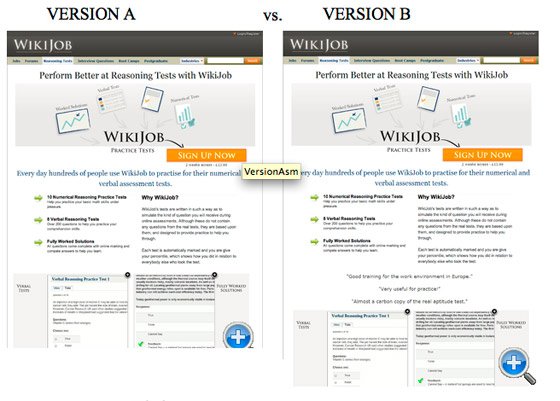
To prove just how powerful testimonials can be (at least the conversion rate side of things), Unbounce reports on an A/B test run on WikiJob’s website. Ideal for testing, Version A and Version B are identical save for one difference: Version B includes a testimonial above the opt-in form of the website.
In the end, Version B increased the conversion rate by 34%.
Let’s put that in perspective for a wholesalers website.
Imagine that you drive 1,000 website visits every month, generating 100 leads per month on your website (a 10% conversion rate — typical for Carrot websites) and that you close 1 in 25 leads. That means you’re doing about 4 deals per month, at, let’s assume, $10,000 profit per deal.
Boom — you add a glowing testimonial to your website and increase your conversion rate by 34%, from 10% to 13.4%.
Now, you’re going to get a little more than 130 leads per month with the same amount of traffic (1,000 website visits). And since you close 1 in 25 leads, you’ll now be doing a little more than 5 deals every month with the exact same amount of website traffic.
You just added $10,000 in monthly wholesale fees (from $40,000 per month to $50,000 per month) by putting a testimonial on your website.
And the same goes for real estate agents: you can increase your conversion rate and monthly income by adding awesome testimonials to your website.
Of course, I’m not promising that you’ll get exactly those results. I’m just trying to illustrate how powerful a small boost in your website’s conversion rate can be on your business revenue (at Carrot, we provide high converting websites out-of-the-box for our members)… and that testimonials can help you achieve that small, powerful boost.
But… all of this depends on using high-quality testimonials…
So what makes a testimonial great?
5 Qualities of a Great Testimonial
Here are five things that every testimonial should include:
1. It’s specific — Do not use painfully vague testimonials (i.e. “It was great!”). When a testimonial is ambiguous, it can work against building trust for your business and actually create unease in the prospect’s mind (If this testimonial is real, why isn’t it more specific?). Ask the testimonial-giver questions which will prompt answers specific to their situation and why they loved working with you. Just consider… what do you think is more powerful:
“Colby was a tremendous help!”
or
“Best Decision I’ve Ever Made!!! I was in a situation where I needed to get out of my house ASAP and Colby Hager came through for Me!!! Nobody else will ever beat his services and I’m relieved I don’t have the financial stress any longer!!! I will forever be grateful for what he did for me!!!”
2. It’s less than 100 words — If your testimonial is too long, there’s a good chance that website visitors won’t read it (especially if they’re on a mobile device). So try to aim for under 100 words and use ellipses to focus on the important parts if necessary.
3. It addresses one common objection — Going back to the importance of specificity, each testimonial should address one common objection of your target prospect. Ideally, each testimonial will address a different objection that is probably going through the prospect’s mind. A few common objections include:
Can I trust you?
How do I know you’re actually going to make me a fair offer?
How much work will I have to do to make this happen?
Can I sell even if my property is in terrible condition?
4. It’s authentic — I know. It’s tempting to just write your own testimonial under an alias name and throw it on your website to increase conversion rate. It sure would take a lot less time, and if you’re a great writer, it might even boost your conversion rate.
But chances are, the testimonial you’ll receive from someone who authentically loves your service will be far more powerful (and conversion-boosting) than something you throw together yourself. Plus, people can usually tell when a testimonial is fake.
5. It mentions your Unique Selling Proposition (USP) — Not every testimonial on your website needs to do this, but at least one should mention your Unique Selling Proposition; that is, whatever makes your business unique or better than the competition.
You can put your USP all over your website, but when it’s in a testimonial, it’s just a bit more powerful. Here’s an example:
“Not only did XYZ Real estate company help get my home sold, but they were kind and easy to work with. They answered the phone when I called and were attentive to my needs.”
5 Questions to Ask for Getting POWERFUL Testimonials
To get a high-quality testimonial, you must ask the right questions.
So here are a few questions that will pull gold from your client’s mouths. You can use these whether you’re doing a written testimonial or a video testimonial (both are powerful for increasing conversion rate). And remember, it’s better to get a ton of detailed information from your client now (and edit it down later) than to get such vague information that it’s practically worthless.
What was your situation before you worked with me? — You want to pull out the pain they were experiencing before working with you. What were they going through? Could they even sleep at night? What was the emotional pain like? How stressful was the situation?
Why did you choose to do work with us? — You want to now get a better understanding for what made them decide to solve their stressful situation by working with you. What was going through their head? What was the final straw that made them give you a call?
Why did you choose us instead of some other company? — Why not somebody else? Asking this question will help illustrate your USP and what sets you apart from other competitors within your market.
What did you enjoy the most about working with us? — Being on the other side of that stressful situation, what was the thing that the client most enjoyed during the process? How fast you closed? How helpful you were? How easy it was?
What surprised you about working with us? — Asking this question can get the client talking about the thing they loved about working with you that was the most unexpected (i.e. how you went above and beyond for them).
You can send these questions to happy clients over email, you can ask over the phone and record the call, or you can sit down and record their responses on video.
Whatever you decide, make sure you edit out unnecessary banter before putting the testimonial on your website. The trick is to take the most valuable pieces of information from their answers (the things that will convince other prospects to work with you) and put them into an easy-to-digest testimonial.
And… one final piece of advice…
Ultimately… work with what you have…
Let me tell you the truth about testimonials: they don’t have to be video, they don’t have to be written, they don’t even have to be 100% related to your business (when you’re starting out, you can just use general testimonial from people who know you and trust your character).
Ultimately, there are no rules.
Testimonials can increase conversion rate if you use them correctly and there are very few instances where a testimonial would actually hurt your conversion rate. So work with what you have.
If you’re not comfortable on video, then just email past clients the questions above and ask for their answers. If you can’t think of any clients who’d give you a testimonial, then call a friend and ask them to vouch for your character.
In time, and as your business grows, you’ll get better and better testimonials which will improve your conversion rate even further. But it’s a process.
So embrace it; go get some testimonials and add em’ to your website. Remember, a slight conversion rate increase could mean thousands of dollars more per month for your business. And I know you don’t hate money. ;-)
We recently had the opportunity to interview Adam Johnson and Brent Moreno on the CarrotCast, two partnered-up investors who finished their first $100k month back in March.
On the episode, Trevor asks them about how they got to their first $100k month — exactly what marketing strategies they used and what mindset philosophies made all the difference.
If you’d prefer to watch or listen, you can go here to view the full interview.
Or below, I’ve compiled 7 of the duo’s dead-simple, secret strategies that they shared on the Carrot real estate investor success story. Want to learn how they got to their first $100k month and how you can, too?
Read on.
Dead-Simple, Secret Strategy #1: Making Uber Do Your Driving-For-Dollars
Brent Moreno is likely one of the most innovative online marketers around.
While he and his partner often use tried-and-true marketing methods (PPC, Facebook Ads, Direct Mail), Moreno isn’t afraid to think outside of the box in order to get a leg up on the competition.
The way he used Uber drivers to find deals is the perfect example of this.
Before his real estate investing days, Moreno was a part-time Uber driver. He’d drop his wife off at work and go drive for a few hours to make a little extra money. During that time, he started an Uber Facebook group. When he finally took the leap into real estate investing and gave up on Uber driving, he had an “aha!” moment…
Uber drivers literally just drive around town all day… If I could get just a few of them to send me property addresses for vacant or distressed homes, they could do my driving-for-dollars for me.
So he reached out to his Uber-driving pals in his Facebook group and asked them to do him a favor. One of them took him up on it and passed him 35 seller leads, 2 of which he was able to close on.
That’s just the kind of marketing ingenuity that separates top investors from the rest. Feel free to steal his strategy and try this in your own market. Who knows? Could be a game-changer.
Dead-Simple, Secret Strategy #2: Building Your Inner Circle
In real estate, perhaps nothing is more powerful than long-term, meaningful relationships in your market of operation.
And that is a truth which Adam Johnson doesn’t take lightly:
I love to make people smile. I really do.
In fact, he’s built so many meaningful relationships in his community that when he walked into the local courthouse (a place he regularly visits, giving chocolates, kind notes, or snow cones to the workers whenever he leaves) to check the title on a foreclosure, something amazing happened.
He overheard one of the workers talking on the phone as they said something like this:
I’m sorry Ma’am, I just don’t have the authority to offer discounts or lower your payments. There’s nothing I can do.
After a moment, the worker noticed Johnson in the room, said
Uhh. Hold on, hold on. Let me get someone else on the phone
and gave Johnson the county phone to try and help this woman solve her tax problems.
That random situation turned into a closed deal for Johnson.
What’s more?
Johnson literally has his own set of keys to every courthouse in the county because of the relationships he’s built. Don’t underestimate the power of consistent kindness to build meaningful relationships in your community — you never know where your next deal will come from.
Moreno even goes so far as to claim that 50% of their success can be directly attributed to the relationships and rapport that they’ve built in their market.
Dead-Simple, Secret Strategy #3: Using A High-Converting Website
90 Day MS Home Buyers Lead Generation Stats
I won’t splice words here.
Johnson and Moreno are Carrot members, and they love their Carrot website.
Making $100k per month, these are two people who could definitely afford their own custom website. But when Trevor asked them why they haven’t ditched Carrot and built their own website, this is what they said.
Johnson explains their reasoning best:
“Because I’m in the real estate business, I’m not in the website-building business.”
And their Carrot site has been converting website visitors into leads since day one. Why change it if it’s working?
Plus, Johnson, self-proclaimed at being tech-incompetent (he didn’t even have WiFi at his house until 2017) can use the site just fine. It’s easy to use and it converts like a charm. What’s not to like?
If you’re on the fence about trying Carrot out for your own business, you can sign up with us risk-free for 30 days. Go here to find out more.
Dead-Simple, Secret Strategy #4: Steal These Facebook Ads
To be honest, I was kind of surprised that Johnson and Moreno were willing to give away their Facebook Ad copy for free. Now, with Facebook’s new ad library, anyone can view any page’s past and current ad campaigns (this is GREAT for studying your competition), but Moreno actually encourages other investors to steal his ad copy and try it in their own market: “Take it and try it out for yourself. It’s working for us.”
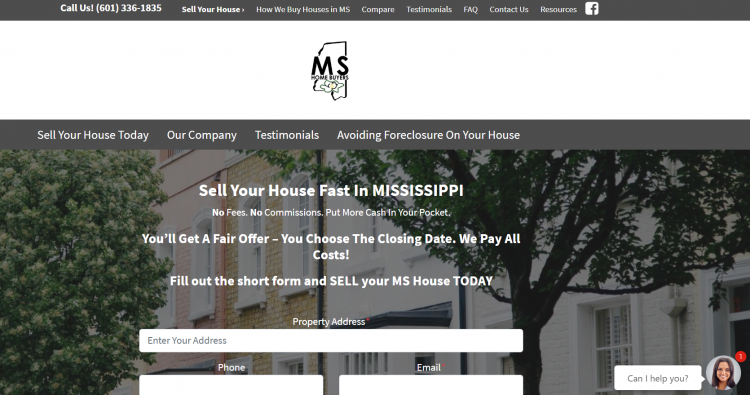
So, in the spirit of mutually agreed upon theft (:D), here’s how you can go on Facebook and look at MS HOME Buyer’s Facebook Ads.
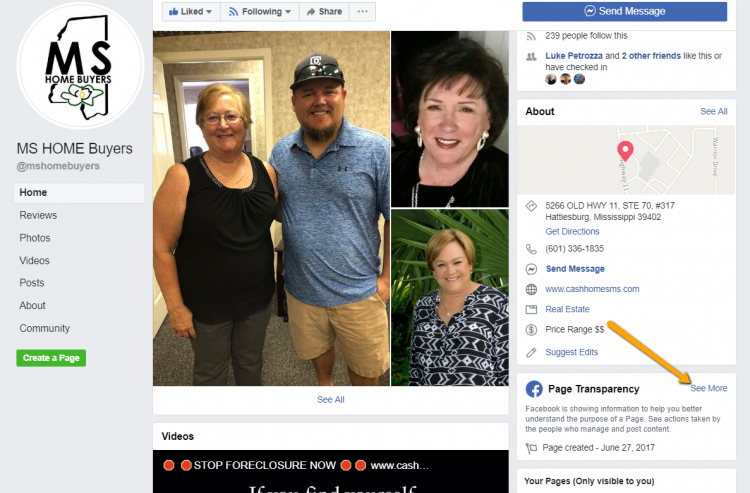
Go to MS HOME Buyers Facebook page and click on “See More” next to “Page Transparency” on the right side.
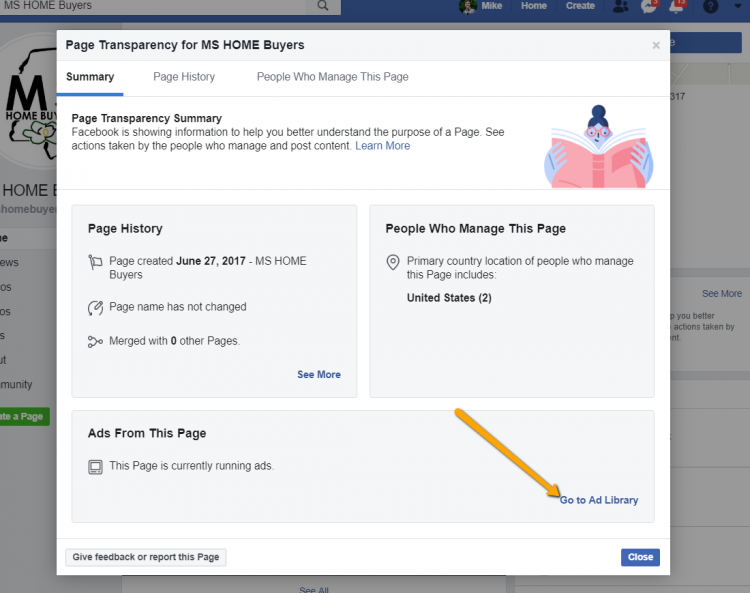
Click on “Go to Ad Library”.
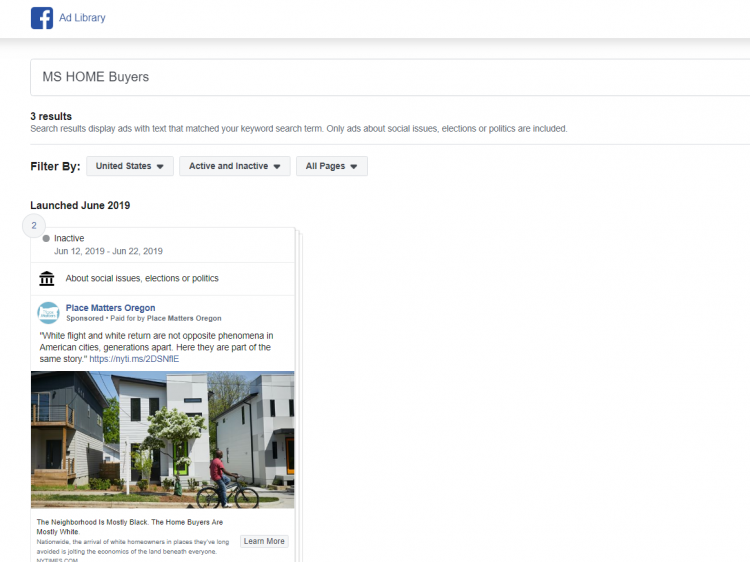
And voila! You can now look through the ads that these guys are running and they’ve given you explicit permission to copy them, so have fun!
Oh! And if you’re needing to do competitor research or want to figure out what other investors in your market are doing with their Facebook Ads, use the above strategy — knowledge is power, after all.
Dead-Simple, Secret Strategy #5: Don’t Give Yourself An Option To Not Finish The Job
When listening to this interview, one of my favorite things that Johnson said was…
Not to overplay the stereotype — being from Mississippi — but the truth is that when you grow up on a farm or in a rural area… you just gotta get the job done. There’s been plenty of times where we had to fix a fence and we didn’t have any extra fence and we just had to figure it out with what we had… I think that’s where people go wrong: they let not doing it be an option. The truth of it is, if you put yourself in a position where you don’t have a choice, then it’s a different mindset — it’s not ‘we don’t have this or we don’t have that,’ it’s just… you gotta make it work.
I think that quote speaks for itself. When you don’t give yourself an option to quit or to not finish the job, you get it done with what you have; that’s all there is to it. And more often than not, just working hard with what you have at your disposal will grow your business, regardless of the resources available to you.
Dead-Simple, Secret Strategy #6: Keep Your Business Simple, But Do The Simple Things Better Than Anyone Else
The philosophy behind Johnson and Moreno’s business is to “Keep it simple, but work extremely hard on those simple things.”
Many real estate investors (many entrepreneurs, for that matter) get caught up in the details of their business. They create over-complicated internal processes that unintentionally slow their businesses down. Or they use 10 different marketing strategies all at the same time, optimizing none of them.
But the best way to grow a business is usually to let your internal processes and marketing strategies grow with your business. Always keep it as simple as possible to build a business that’s agile, and optimize the heck out of those simple internal processes, sales tactics, and marketing strategies.
You can do 100 different things with mediocrity… or you can do a couple of things expertly well. For Johnson and Moreno, working really hard on the simple things has proven far more lucrative than trying to tackle everything at once.
Dead-Simple, Secret Strategy #7: Don’t Underestimate The Impact Of Hard Work And Compounding Results
The grind. The hustle. The day-in and day-out hard work of an entrepreneur.
Over time, it can get exhausting and discouraging. You start to wonder if all this hard work will pay you back in the end. Well, Johnson firmly believes that it will:
Don’t underestimate the legwork and then giving your efforts time to compound.
Before you can build momentum for your business, don’t forget that you must first push the boulder up the hill — only then can it start rolling down the other side.
And don’t quit before you reach the top of the hill; that’s where building a business gets fun.
Conclusion
We hope that this information has helped!
Clearly, Johnson and Moreno are crushing it with their business. I imagine they’re well over $100k per month now that we’re half-way through the year. And we’d love to see you get to that same place.
Maybe $100k per month seems so out of reach right now as to be ridiculous.
Or maybe you’re right on the cusp of breaking through that threshold.
Whatever the case, in addition to using the above tips, we’re willing to give you a risk-free trial period with our service which has generated over a million leads for real estate investors and agents.
Wonder what 2019 is going to look like for the real estate market? Or, even more importantly, how you and your real estate business should prepare for the future?
Of course, you are. Because you’re an entrepreneur and you want to grow a consistent and predictable source of income.
Fortunately, this year looks good overall, with an expected 1% increase in sales, a 3.1% increase in median home price. It will likely be a softer, less intensely thriving market than 2018 or 2017, but a healthy one nonetheless.
But that optimism won’t keep the market from changing.In the words of real estate Yoda, “Change, the real estate market will so change with it, you must” (Disclaimer: I made that up).
Yoda aside, I dug around and found some relevant real estate stats for your 2019 marketing strategy. Here’s what I learned and some main takeaways for each set of stats.
33 Real Estate Statistics that’ll Change your 2019 Strategy
General Real Estate Statistics
In 2018, 5.5 million existing homes were sold in the U.S. (Source)
In 2017, 612,000 newly built homes were sold in the U.S. (Source)
There are approximately two million active real estate licenses in the U.S. (Source)
Redfin’s Housing Demand Index went from 124 in May of 2018 to 131 in September of 2019 (Source)
By 2020, the real estate industry will account for 22% of commercial drone use.
House listings that have aerial photographs sell 68% faster than properties with standard images. (Source)
There are almost 44 million renter-occupied houses and 75 million owner-occupied houses in the U.S. (Source)
From 2016 to 2017, apartment construction climbed by 21%, putting apartment supply at a 20-year high. (Source)
Interest rates increased to 2.27% in 2018 (Source)
The number of online real estate leads is increasing (up 65% from 2016 to 2017), but the conversion rate is taking a dip (down 10% from 2016 to 2017). (Source)
Main Takeaways
Consider getting into the rental market — As demand for rentals increases, consider getting in front of this trend, buying and holding rentals as a passive income stream.
Start using drones for house photography — If you want to sell houses faster (which you do), then you might want to consider investing in a drone to take aerial photographs. These house listing images don’t just look pretty — they make the property sell about 68% faster.
Buy and rent out apartments — The market loves apartments right now. Consider getting some of your own and using them for passive income.
Give your “About Us” page a little more love — While this page is the third-most important page on your website, it’s also probably the most neglected. Stop neglecting it. Set it up to build trust with website visitors so you’re not losing leads to a shoddy “About Us” page.
House Buyer Real Estate Statistics
In 2018, first-time homebuyers made up 34% of all homebuyers. (Source)
65% of homebuyers 37 years and younger were first-time homebuyers in 2018. (Source)
In 2017, Millennials accounted for 33% of homebuyers. (Source)
In 2017, 56% of homebuyers 36 years old and younger found their homes on the internet and 50% of buyers between the age of 37 and 51 found their homes online. Older buyers over the age of 51 years old were the only group that sought out an agent first. (Source)
Across all generations, half of all homebuyers use the internet to find a home and 93% of buyers who are 36 years old or younger frequently use the internet during a house search. (Source)
The typical homebuyer searches for 10 weeks and looks at 10 properties before choosing a house. (Source)
In 2016, there were 5% more homes built than in 2015 (from 1.108 million to 1.163 million). (Source)
In 2017, 52% of homebuyers were first-timers while 48% were repeat buyers. (Source)
44% of all homebuyers end up buying a home that they found on the internet.
Over half (51%) of home shoppers claim that YouTube is their favorite video research platform. (Source)
Almost 90% of home-buying Millennials, Gen X’ers, and young Boomers bought a home with the help of an agent in 2016. (Source)
84% of homebuyers found online information to be a crucial part of their house search. (Source)
By 2025, Millennials are expected to form 20 million new households in the U.S. (Source)
Main Takeaways
Pay attention to Millennials — Now, millennials are between the age of 22 and 37 years old. Which makes them fall within the average home-buying age of 31. They’re tech-savvy and they like the internet (I know because I am one :D), so make sure that your website is fast and user-friendly.
Get your website’s SEO dialed in — Since so many people are using the internet to find a home, real estate investor, or real estate agent, you need to be visible online. That, of course, is easier said than done. Write consistent content, target the right keywords, and your rankings will start to rise. You can find a more thorough real estate SEO strategy here.
Post consistent videos on YouTube — YouTube is the second most-used online search engine right behind Google. To drive traffic and find leads on the platform, make videos and build your YouTube following. You can find out more about doing that here.
Make sure your website converts as best it can — The last thing you want is to drive traffic to your website and still land zero deals from that traffic — believe me… it happens. If people don’t trust your website or it’s unclear what you want them to do, they’ll leave faster than they arrived. To make sure your website is set up to convert visitors, consider this conversion optimization checklist.
House Seller Real Estate Statistics
By July 2021, the total median home price reached $390,500.
On average, sellers receive 98% of the listed price. (Source)
Staged homes spend half the time on the market compared to non-staged homes and they regularly sell for about 6% above the listed price. (Source)
In southern states, home sales are expected to grow by 6% in 2018 rather than 2.5% (the national average). (Source)
70% of homeowners prefer to list with a real estate agent who uses video marketing to advertise their home. (Source)
Main Takeaways
Consider hiring a professional house stager — Heck, why wouldn’t you do it if the house will spend less time on the market and the seller will get 6% above the listed price? Seems like a good investment for you and the seller.
Use video marketing — The more options that you offer for advertising someone’s house, the more house sellers who’ll want to work with you. A video is one of those above-and-beyond kinds of marketing options. It takes just a little more work on your part but really flatters the house sellers. You can find out more about real estate video marketing here.
Conclusion
For real estate professionals who adapt to the changing industry, 2019 holds loads of potential. And for those who refuse to change, 2019 is going to present a problem… a big problem.
Drones, Millennial buyers, third-party listing websites, and virtual tours make it increasingly difficult for stubborn agents and investors to increase revenue. If you want to make 2018 one of your best years yet — which you do — then you need to change with the times.
And the times are increasingly online.
Which means you need to have your own website that drives traffic and converts visitors. Then, you need to market yourself correctly.
At Carrot, we’ve driven over one million leads for thousands of real estate professionals by building websites, educating our audience, and helping them implement the most recent marketing strategies.
Want to get onboard?
You can check out our plans page — and let us know if you have any questions in the comments.
Either way, make 2019 a year that you’ll want to repeat by the end of it. :-)





![Wholesaling Cold Calling Script [Complete Guide]](https://image-cdn.carrot.com/uploads/Post-Header-171.png)