One of the biggest mistakes we see a lot of real estate investors and agents making with their paid advertising is honestly, you stop doing your marketing way too soon.
Demo Carrot: How many deals are you losing to your competitor’s website?
One of the calculations we’ve come up with over the last year or so that kind of helps you wrap your mindset around where you should be putting that money and when you should stop is just something that I call your max CPL, your max cost per lead.
In this short video, I’m going to walk you through this really, really simple calculation. In under three minutes, you’ll be able to figure out your ceiling for the max amount you should be paying for leads.
The funny thing is we want you never to have to pay this amount, but this calculation is what the big guys in every single market are doing. So, if you’re wondering how the big guys in your market are winning and getting most of the leads, it’s using this calculation.
You just don’t know it. I’m going to walk you through this really, really quick, and I want you to grab a piece of paper and follow along as you’re doing this. I want you to do it yourself and come up with your max cost per lead.
I’m going to tell you exactly what to do with that when you’re working with your pay-per-click person or when you’re doing it yourself to really go out there and dominate your market.
How to Calculate Max Cost Per Lead
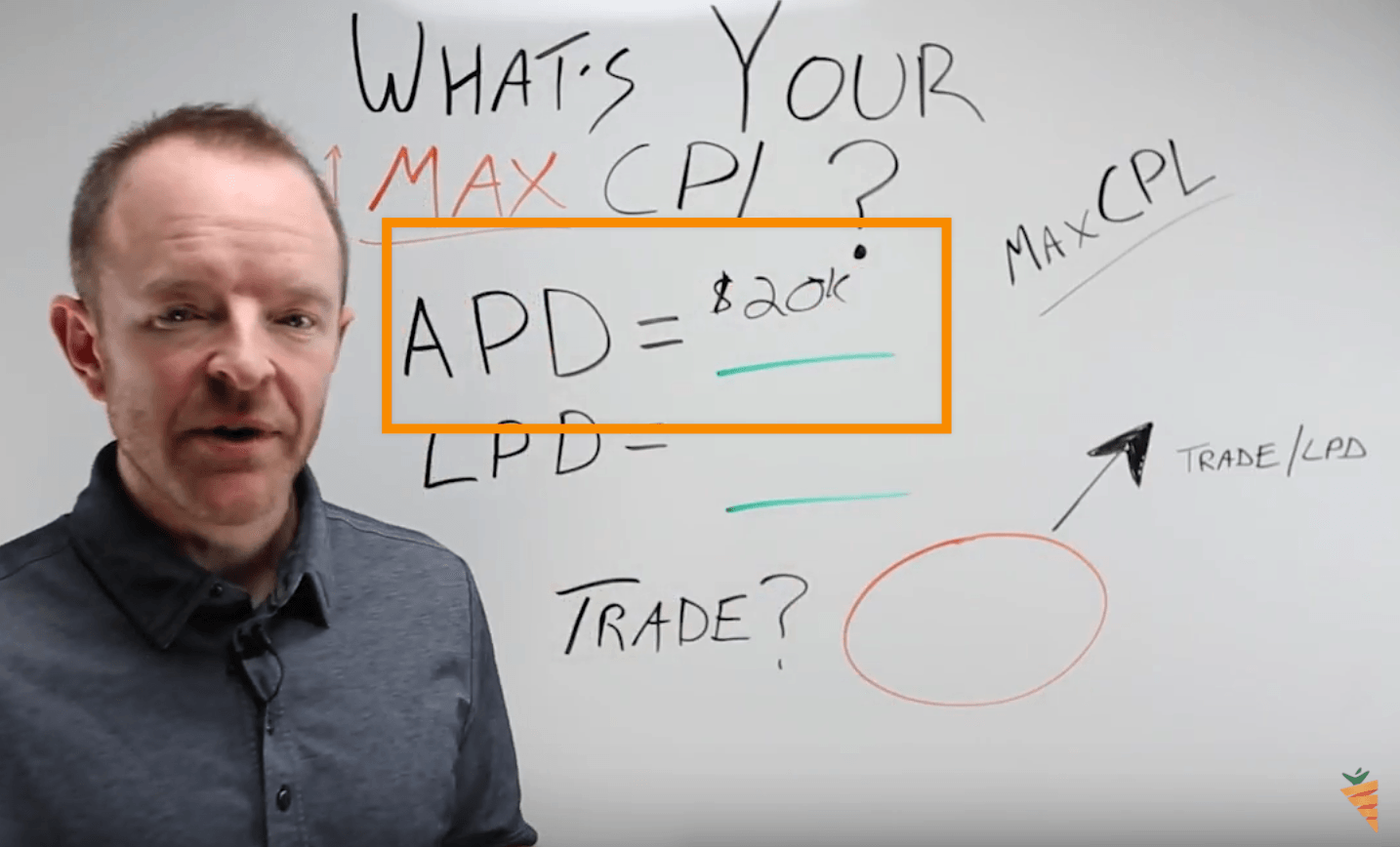
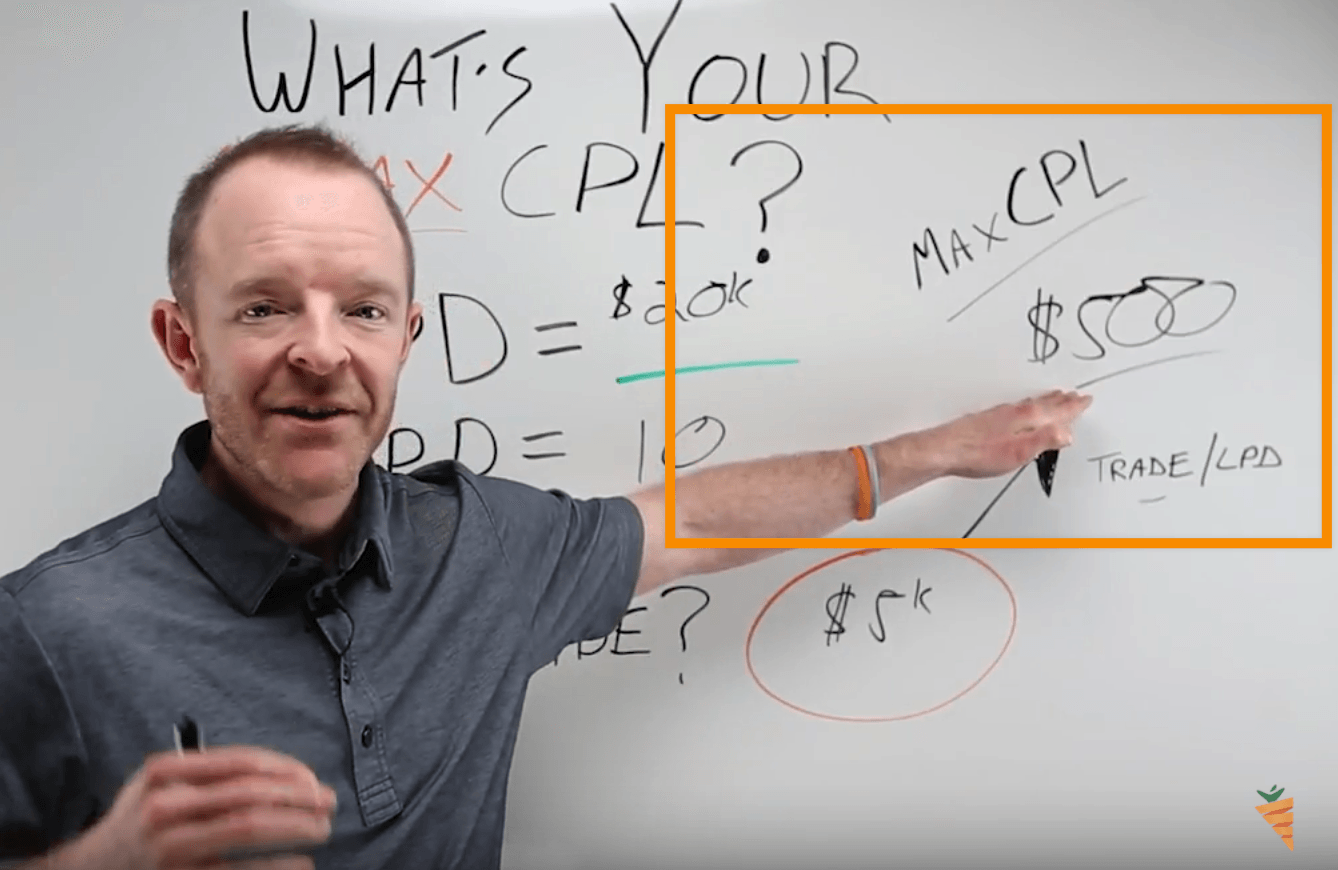
The first thing we want to put down here is your APD, your average profit per deal. Your average profit per deal, of course, is going to vary in markets, so write down yours. For this particular scenario, we’re going to use $20,000.
Let’s assume that your average profit per deal is $20,000. Now what we’re going to do is how many leads does it actually take to get one of those deals?
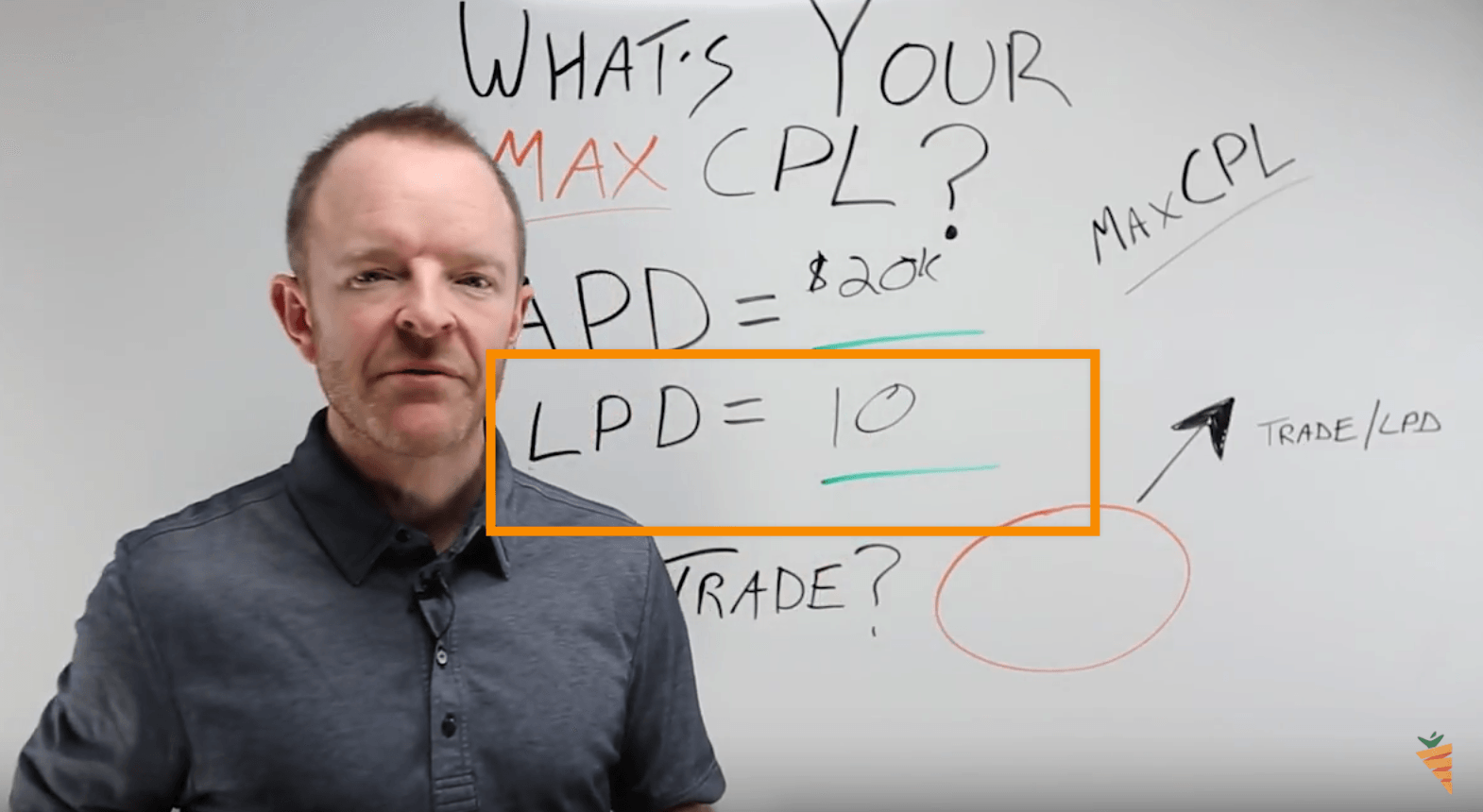
The acronym for that LPD, so how many leads per deal?
How many leads does it take to get one of those $20,000 deals? Write that down. We’re just going to use a really, really round number here. We’re going to use 10 on here.
The average that we see, honestly, the average for pay-per-click is about 10 to 15. The average for SEO is between 8 and 14, 8 and 15, around there.
If you’re doing direct mail, it’s going to be closer to the 30 to 40 to 45 range leads before you get one of those deals, but when you’re doing pay-per-click, which is what this particular video’s about, this is probably pretty close to where you’re going to be, 8, 10, 15, somewhere around there.
Now, this is where we kind of changed the calculation over the years for people to really make it hit home. Now, this is not scientific.
I’m probably going to get comments from people saying, “Well, that’s a complete guess. What does that matter?” Well, this does matter because this helps you psychology-wise wrap around what your ads budget should be.
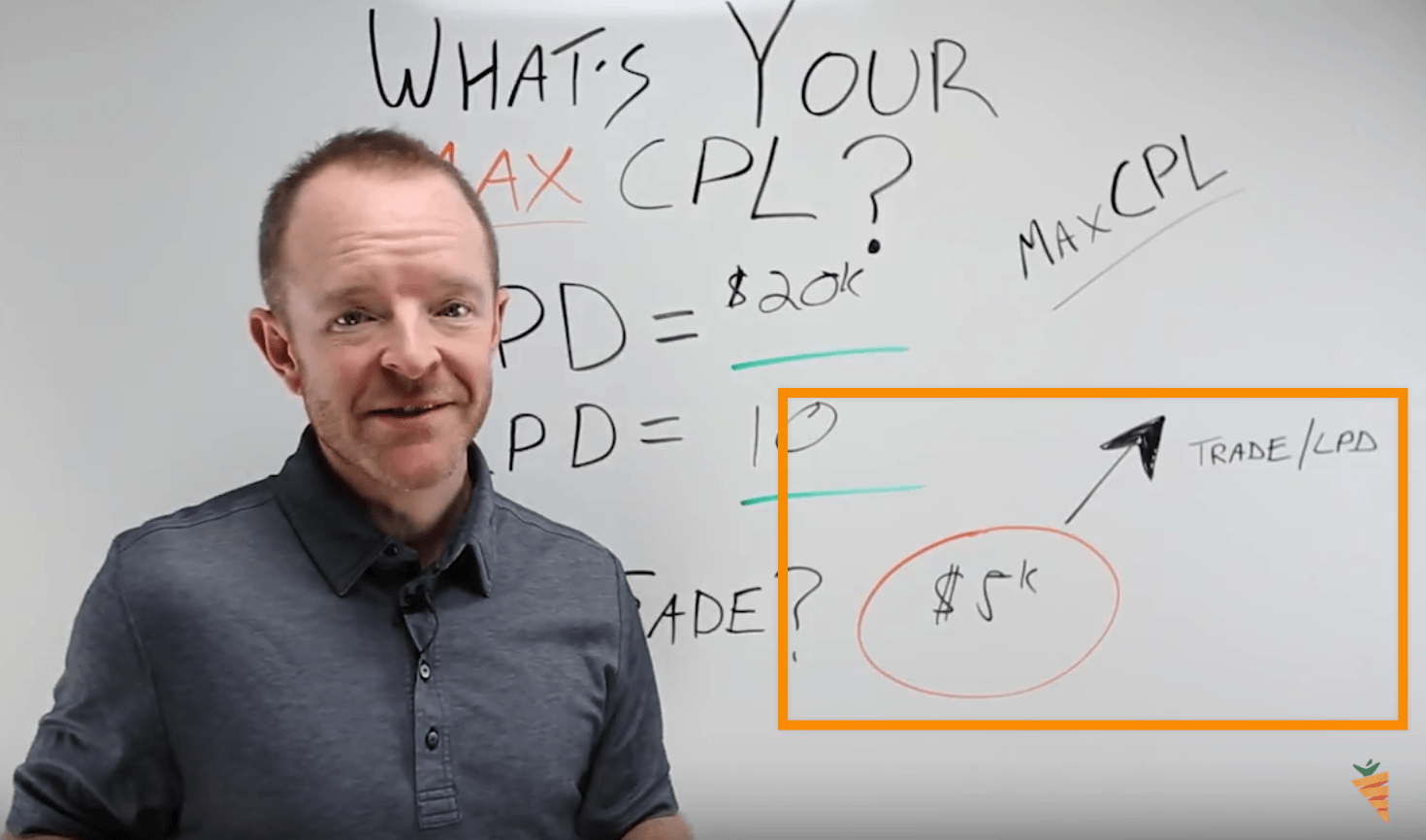
To get one of those $20,000 deals, what would you trade? How much would you actually trade to get that $20,000 deal, assuming that you know all the effort it will take, the commissions you’ve got to pay out, and things like that? So, would you trade $2,000? Would you trade $5,000? What’s the max amount you would trade to get that deal?
In this particular instance, we’re going to use $5,000 because I’d trade five grand all day to get 20 grand all day. Now, it’s probably pushing it to say that you’d trade $10,000 for $20,000 because then the risk becomes too much.
What’s the max amount that you know you would be insanely ecstatic if you were able to trade those all day for that? I’m going to put $5,000.
This is way, way simpler than you think it is. Right?
What Would You Trade to Make a Deal?
Here’s what we’ve got. We’ve got your average profit per deal of $20,000. You’ve got 10 leads per deal, which, once again, that’s just using an assumption here. Then you’ve got, I would trade $5,000 for that $20,000 all day long.
All we’re going to do now is we’re going to take this number, your $5,000, divide it by how many leads it takes, what you would trade divided by the number of leads it would take to get there, and that’s your max cost per lead. In this case, it’s $500.
So, a lot of you are probably looking at that going, “Oh my gosh. A $500 lead is insane. Why would I pay $500 so I can get leads for $120 or for $80?” or, “My friend over here’s getting leads for $62.”
The thing is, when we think about leads in the mindset of trying to get them for as low cost as possible, what happens is you really limit the number of leads you can go after.
The big guys in the markets, when you start to see how they’re going in there and dominating the markets, it’s because they know their numbers. It’s because they know they’re willing to trade $5,000 all day long for 20, and they can go out there and outspend you.
They can spend more money to get in front of the prospect. They can spend more money on Google Ads on Facebook to get in front of the prospect. They’re willing to spend up to $500 in this scenario to get that same exact prospect that you’re stopping your marketing at $100, or at $150, or f$200.
You can look at that and see who’s going to win the game. If you’re stopping your marketing, you’re turning your campaigns off, you’re bumping your bids down, and you’re stopping it at, man, $150, “I don’t want to go over $175 a lead,” and your competitors know that they’re insanely profitable at up to $500, they’re going to win all day long.
Now, do you actually want to spend up to $500? Ideally, not. Ideally, our clients don’t spend anywhere near their max cost per lead, but we have a client in Boston whose max cost per lead is pushing $700 or $800 per lead when you look at his numbers.
He’s spending about $300 to $400 per lead in his market, sometimes $250, and crushing his market, where his other competitors are coming at us saying, “Hey. We’re struggling. We’re getting leads for $150, $175.” We’re like, “Spend more money, and you’ll start competing.”
Calculating Your Max Cost Per Lead
Find your max cost per lead. Figure out what you would trade to get that average profit per deal. Then divide it by how many leads it will take to get that, and that will give you this nonscientific but insanely, insanely effective, mathematical max cost per lead number.
You go to your pay-per-click person with that number. As long as they’re managing your pay-per-click well and your pay-per-click campaign, your stuff is converting well, and your averages hold still, spend as much money as you can up to that cost per lead, and you’re going to win.
This blog post took us 80% LESS time to create than a normal blog post… because we did it with the assistance of Carrot’s new VideoPost tool. See what VideoPost is, and how it can be a game-changer for your content marketing in 2017.
We’re insanely excited to announce a brand new feature. We’ve actually been using this process to cut our content marketing time down by 80%, increase our traffic, and help our clients do the same.
I’m going to walk you through this new feature that we call VideoPost, what it helps you do, and how we came up with this content marketing method to automate and make your life simpler.
Introducing Carrot’s Automatic Video Transcription… VideoPost’s
VideoPost helps you turn simple videos into powerful written content that Google loves in just minutes vs. hours. 3/4 of this blog post was created with our VideoPost feature, saving us over 60 minutes vs. writing manually. Let’s dive in to see how you can start using VideoPost today.
(click to play video, OR read the article below)
VideoPost came about by us trying to solve our own problem a year and a half ago.
As you know, it takes time to sit down and craft content or it takes money to hire it out to have someone else do it. Content and SEO are our number one source of leads here at Carrot, but it’s also the number one source of leads for our Carrot clients.
We know that content marketing is effective in the real estate market, but can we put out great content with less time and energy?
So we asked the question…
How do we make it so it’s so simple and easy that you want to do content every single week?”
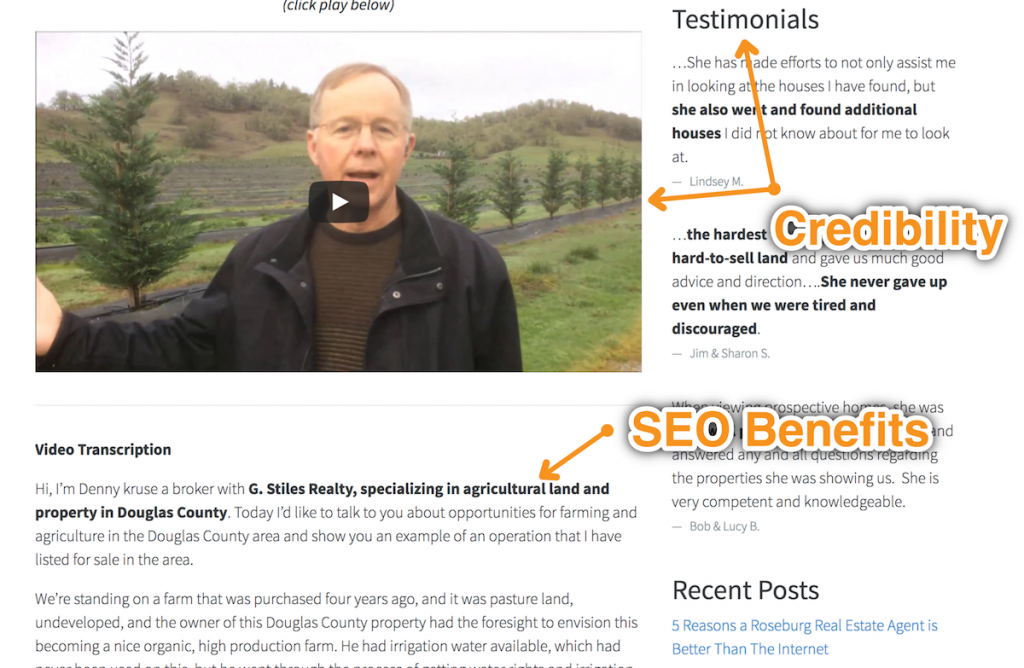
Especially when you’re in competitive markets, one of the best ways to crack through that clutter and to gain an advantage is to build credibility and your expertise.
And the best way to do that is through content, except most people don’t have the time to do written content.
VideoPost Simplifies All Of That For You – An Example: G. Stiles Realty
G. Stiles is the largest independent broker in Douglas County, Oregon… and an AgentCarrot client. See how they used VideoPost to streamline their content marketing…
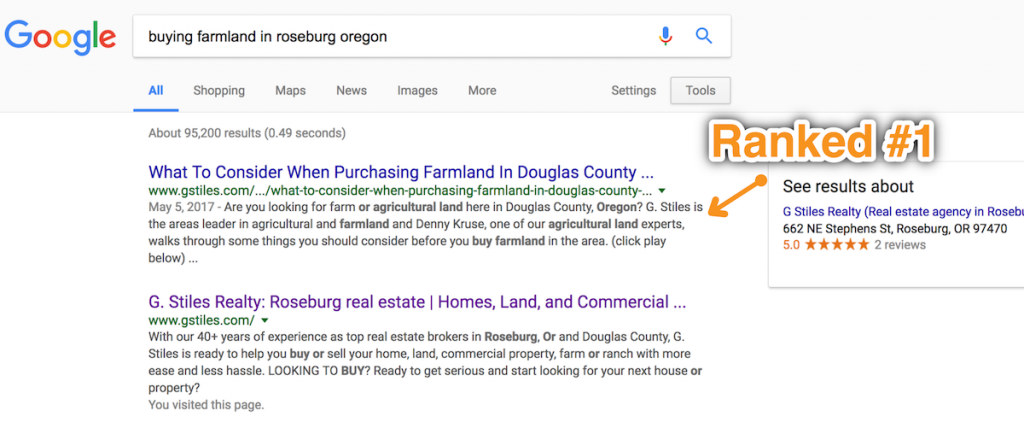
Let’s say you’re in a small town like Roseburg, Oregon. This is actually one of our AgentCarrot client’s G. Stiles, and they were having a tough time with their content marketing strategy as well.
We went to them and we said…
“Hey, go out on site and film a short 3-8 minute video walking people through some information that’s going to help them and be useful for them in that scenario.”
One of their specialties is in farmland and in some other agricultural-type properties, so they went there, filmed the video, and then uploaded it to YouTube.
We then had the video transcribed word for word and made a blog post for them (this was before our VideoPost feature, so it took a bit longer).
Here’s Denny’s Three And A Half Minute “On The Job Content” Video
We Then Turned The Video Into A Content Rich Article That Google Loves
This particular example was long before we created VideoPost to automate the process.
We then manually submitted it to a transcription service, brought it back, copied and pasted it into their blog, bolded a couple of things for readability, separated some of the paragraphs, put a link in there, and then we put a clear call to action at the end of it.
Less than five minutes of editing in total. About 30-45 minutes to submit the video for transcription, pay for it, get it back in a Word document, bring it to their Carrot site, and manually remove the weird formatting that can come from copying and pasting content from Word documents. (again, today, VideoPost automates most of this and brings the process down to less than 5 minutes).
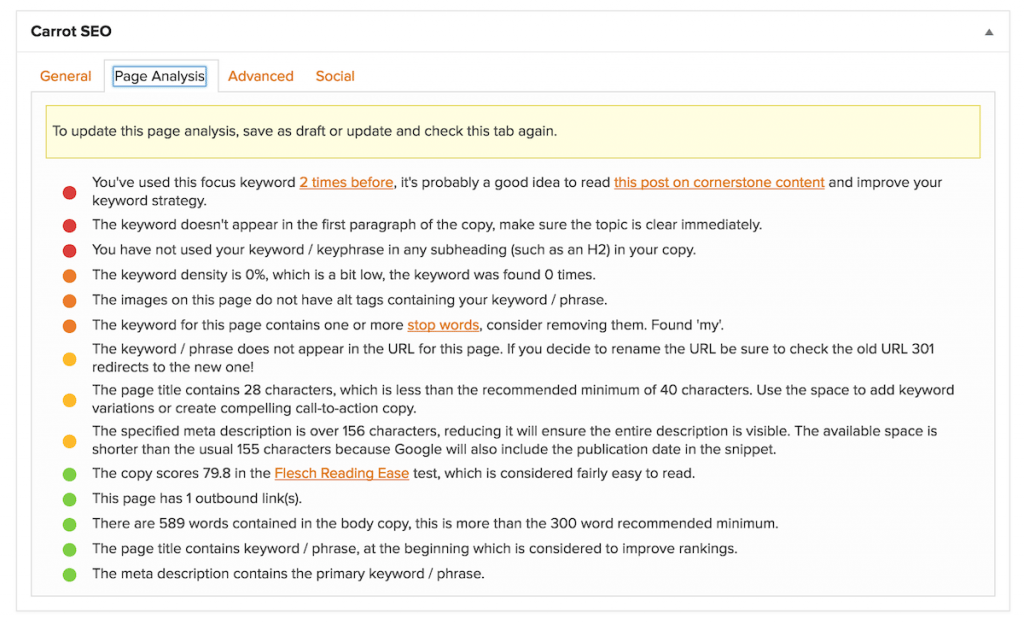
Then we used our SEO tools here in Carrot to make sure it was optimized for search engines for the phrase “buying farmland in Roseburg, Oregon” and all related phrases in the area.
The Results?
Within weeks, this blog post started to climb in the rankings.
As of the time I recorded this video, their blog post from this process is ranking over big websites like LandWatch, and Land and Farm, and Zillow, and LoopNet, and Realtor.com, all from a little piece of short video content.
Now, is this particular search getting tons and tons of searches per month? The answer is of course not, but as a part of a cohesive strategy to really go in there and swarm and dominate your market, you want to be going after the most competitive search phrases of course, but also you want to cast a wider net with these more niched down search phrases.
If you do just one video post per week, over the course of a year that’s going to be 52 new pages on your website to potentially rank in front of your best prospects.
You will cast a wider net out there to grab more searches, build more expertise in your market, become the leading expert in that market to where everyone knows, likes, and trusts because they see your information everywhere they go.
How Do We Automate This And Make It Simpler With VideoPost?
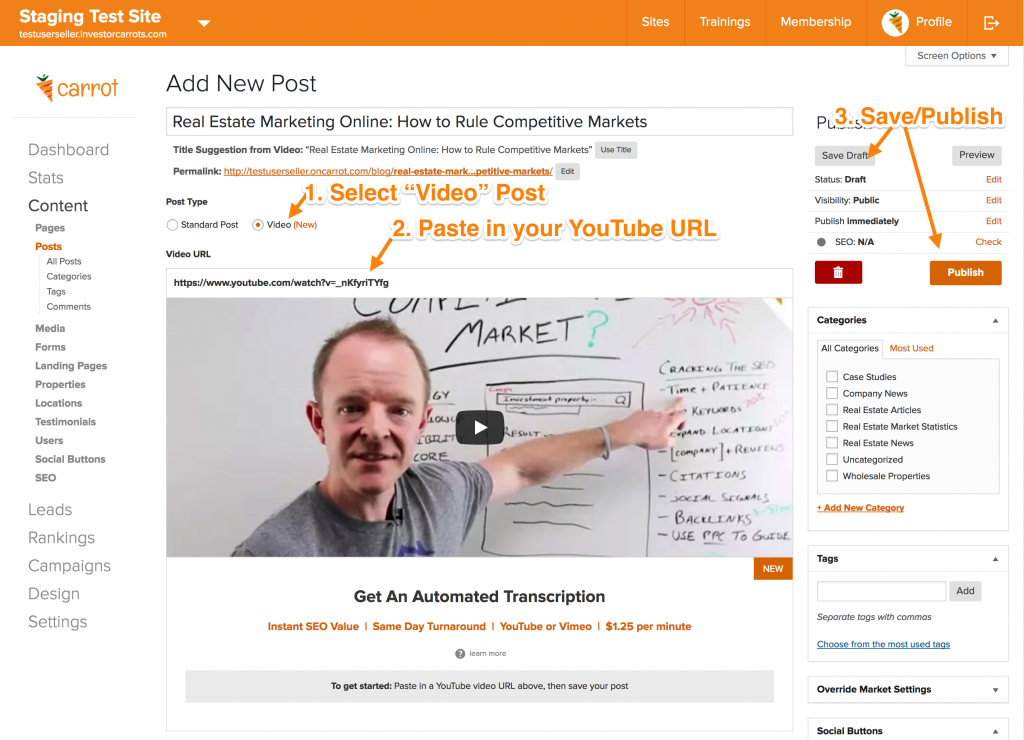
It takes under 3 minutes to create a VideoPost in your Carrot account, then edit it as much or as little as you want (we suggest basic edits to make it visually more easy to read with sub heads, that’s it!). If you’re a Carrot member already simply…
1. Log in to your Carrot website and click “New Post”, then VideoPost…
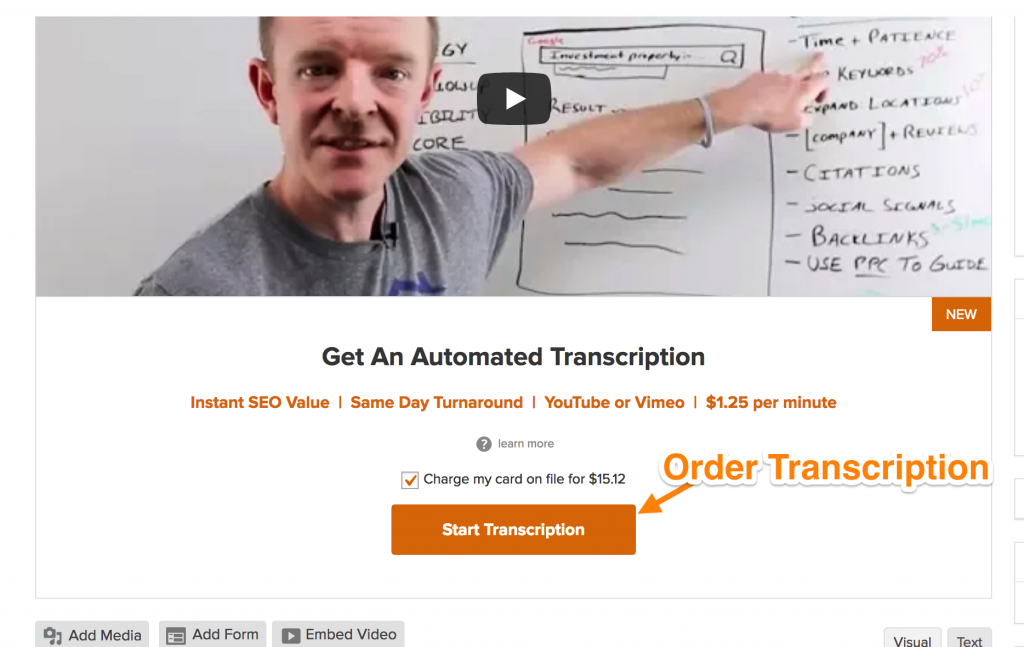
2. Confirm the transcription purchase and click Start Transcription!
By automating your transcriptions into our VideoPost format, it saves you 15-45 minutes vs. having to manually use transcription services. If you value your time at just $100/hr… that time savings alone is worth $25 – $50 to you. If you value your time higher, your savings are even larger.
The average VideoPost should be 3 – 8 minutes long, meaning a cost of only $3.75 – $10 per content piece. Compare that to $30 – $75 to outsource to a writer, VideoPosts are a huge time savings and direct money savings every time you use it.
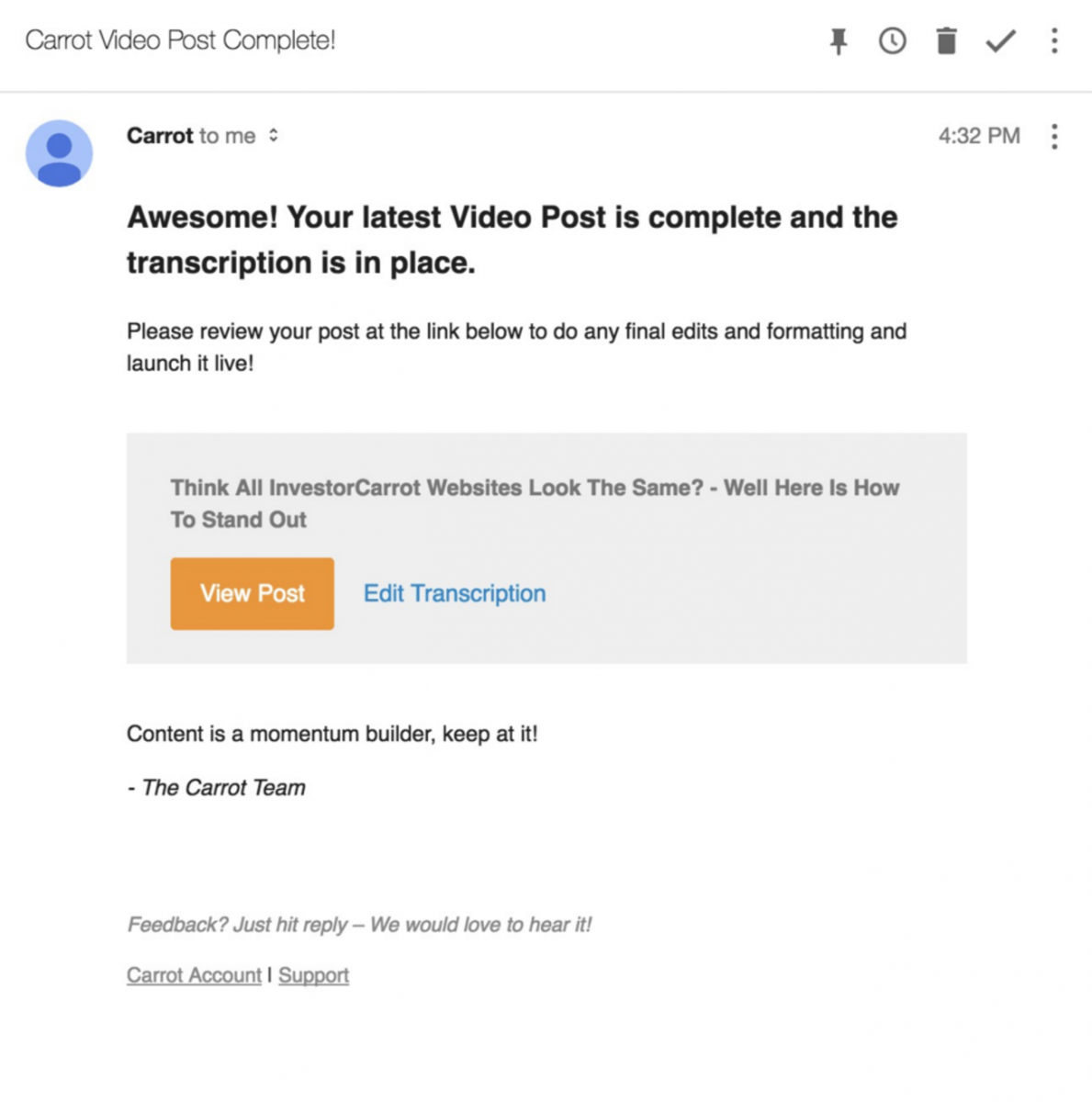
3. Within 24 hours (usually within several hours) your VideoPost is complete and ready to publish
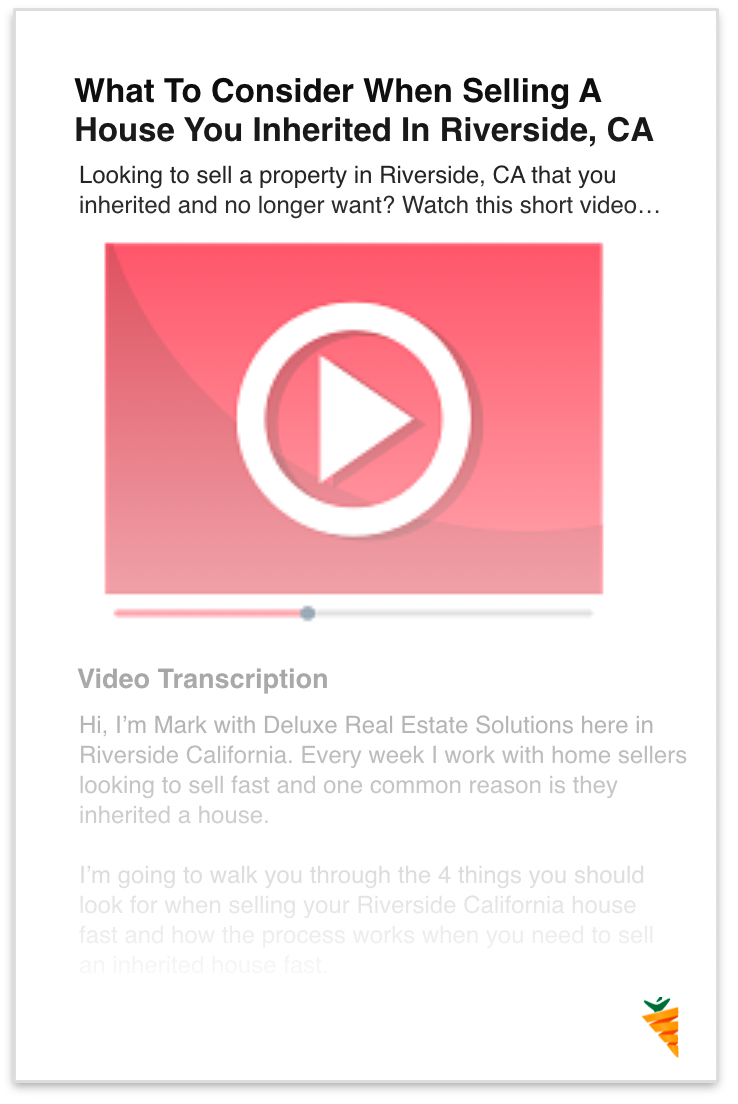
Once your VideoPost is complete, with your transcription added, your post created in our VideoPost format (title, intro paragraph, video, transcription, and call to action)… we’ll email you your new post for review and you can then make any edits to the post you want. No more logging into transcription services and copying & pasting transcriptions… that’s a waste of time. VideoPost does it all for you.
How To Get Extra SEO Juice From Your VideoPost
How well Google ranks your VideoPost depends greatly on the content in the video and the small quick tweaks you can make inside of each VideoPost.
To make sure to squeeze all the on-page SEO juice out of this VideoPost here are a few things you can do…
Make sure when you’re recording your video, you know which types of searches you want to go after in Google… then use those words in the video. If you’re going after “Portland Oregon river homes”… you’ll want to make sure to say those words. You have to remember to say the things that you’re showing in your video.
Go through and format the post so it’s nice and easy for a user to read (this will help with bounce rate). No one wants to read a wall of text.
Find some key areas to add <h2> and <h3> tags.
Can you link to other content you have done on your site?
Make sure to include a call to action at the end (how do they contact you if they have questions or want an offer?)
And last… make sure to use our Carrot SEO Tool to dial in the content for a specific search phrase.
Dial in the SEO on your VideoPosts with the Carrot SEO Tool whether you’re an SEO expert or not.
VideoPost vs. Manually Using Transcription Services
When we were doing this process the manual way… we submitted it to a service called Rev.com, then we had to manually do every other step to get the content from Rev.com into our blog editor. This still took us 30-45 minutes to do. Yes, better than 1-2 hours to write an article, but still too long for most people to fit in on a weekly basis.
Now, with the VideoPost feature, this is only going to take you as much time as it does to film your video, log into your Carrot account, paste in a URL, and click a button – we do the rest.
We go out and get the transcription and then notify you when the transcription’s inside of your account ready and formatted in our special “VideoPost” format.
VideoPost Automatically Structures Your Content Flow Properly
Once our system gets the transcription of your video back, we automatically build it into our VideoPost format for you. First, your SEO optimized blog post title, then a short summary of the video, next your video, the transcription, then a simple call to action. All automatic.
This step alone will save you 10-15 minutes. What will you do with that extra time? Get a workout in? Call a prospect and land a deal? Meditate on the day and get clarity? You can do whatever the heck you want while VideoPost does that part of your content creation for you.
How Much Will You Save With VideoPost? And What Can You ADD To Your Marketing Efforts?
VideoPost will enable you to do more content, do more robust content, get your brand, your face, your content in front of your prospects so you build up that expertise with your market.
It’s going to save you hundreds of dollars per month when you just do one blog post per week.
If you do one video post per week, that’s 52 new pages on your website over this next year.
That’s 52 new chances to cast a wider net to get in front of your prospects. Every single time your prospects search different things in your real estate market… like “buying farmland in Roseburg, Oregon”, they’re going to see you over and over again. It’s going to add up in their mind that…
“Man, this person, this company is a really reputable company, they’re an expert.”
Not Sure What To Make Videos About?
That’s the easy part. You’re already creating hours of content every single day… you’re just not documenting it so others can get value from it. But here are some ideas…
On The Job Content – next time you’re out in the field, whip out your cell phone and document the situations you’re in, and answer your prospects questions
Testimonials – ask a recent seller or buyer to allow you to film them and ask them about the process
Case Study– this is similar to a testimonial but maybe you just talk through the process
Market Trends & Updates – find a report online and share your expertise or opinion about it on video
About Us – make a video about how your company was started and who you want to work with
At the end of the day, just be useful and valuable for the people that you can best help. Answer their common questions in videos, educate them on things they’re searching for, and have fun with it!
Now it’s time for you to dig in and launch your first VideoPost!
Already a Carrot client? Sweet! The VideoPost feature is ready to use… just hop into your Carrot account and put it to use!
As you dive in and use VideoPost, please send us feedback on ways we can make it even better. There are things on our roadmap already for adding more power and simplicity to VideoPost, so we’re excited to make this one of the most useful tools in your content marketing arsenal in this next year.
Listen to the CarrotCast Podcast and Subscribe Below!
A lot of people put their goals out there but to actually document it and show the ups and the downs the bad months, the bad days. If you follow my Instgram you’ll see the bad days where I’m like I hate this, I hate this. Max Maxwell
One of our Carrot core values is “Be a Beacon of Positivity and Possibility”. I love to align with people who are beacons for other and Max Maxwell is one of them.
My view of entrepreneurship is broken down into three levels:
The Dreamer. Someone is hustling to make it happen but isn’t there yet.
The Doer. Is settled and established.
The Inspirer. This person is set on being an inspiration for others to do better and achieve more.
On this episode of the CarrotCast Max shares some of the cool things he’s doing every day on Instagram and YouTube to inspire 1000’s of people.
We also dive into these three big takeaways:
Max’s story and exactly what he did to land his first two deals.
Using a stacking method to target hot leads.
Leverage online marketing with Carrot and how he closes 1 in 4 leads from PPC.
Listen in and Get Inspired. Learn to Leverage Online Marketing to Inspire Others to Pursue Their Goals.
1:45 – Who is Max Maxwell? 3:30 – Why he shares his daily “ups and downs” of real estate investing on Instagram. 5:15 – What his team looks like after he started consistently generating $20-$25,000 per month. 7:05 – Why he doesn’t like the term VA and instead uses “remote employees.” 9:25 – His path to real estate investing. 11:30 – Stumbling onto probate leads and his fascinating story about closing his first deal. 16:15 – Reverse engineering to build his business. 18:10 – Max’s business model. Stages: lists, bandit signs, paid traffic, and cold calling. 19:50 – How he would approach taking on a new market that he doesn’t know a thing about. 23:30 – Leverage online marketing. What’s working for him on the online side of his marketing? 28:30 – Why Max chose to join Carrot? 29:45 – What are some of his favorite real estate stories that he has shared on Instagram. 32:15 – What is his vision past reaching the goal of $100k per month. Also, his reality T.V. idea to travel anywhere in the United States to help someone close their first deal. 35:35 – Follow Max on Instagram and YouTube. 39:25 – What motivates him beyond revenue. What is his “why” at this point in his life? 44:15 – Max’s closing inspiring words.
Listen to the CarrotCast Podcast and Subscribe Below!
Sellers will call and say you know I have 10 letters on my desk. So of those 10 letters what makes you stand out? How are you personalizing that letter? And, how are you connecting with that seller like no one else is? That’s what I think about when I create my marketing. April Crossley
April Crossley has almost been with Carrot from the beginning. April shares how she has grown her business and made the leap into real estate full-time after leaving a high-paying medical career.
She also reveals how she’s now built up her portfolio of rental properties to dozens of properties. Also, find out her direct mail strategy and how she leverages her online real estate investing with Carrot to amplify her business.
Listen, enjoy, and check out more CarrotCast episodes at carrotcast.com.
Listen to the CarrotCast Podcast
[podcast-subscribe]
Listen in to learn how April combines her online real estate investing with direct mail to acquire 40 + units and 10+ flips per year.
1:15 – Who is April Crossley? Where is her real estate investing business located, and what does her team look like? 4:15 – Breaking down her whiteboard notes and schedule structure. How she stays on task. 8:15 –What was that “aha” moment when she decided to shift from a high-level healthcare career to real estate investing? 14:00 – Viewing risk differently. How April sees risks differently than most people. Also, how long it took for her to feel safe to leave her job? 18:00 – If she had kept her medical license, would she have slipped back into that career? 20:00 – Breaking down her business model. What does her mix of rentals and flips look like right now, and why does she have that strategy? 24:40 – In a competitive market, where is she finding her properties? Online and offline? 25:50 – April’s direct mail strategy. What types of messages does she put in her letters? She gets creative and puts much thought into the message and design. 33:35 – How she builds credibility with her prospects. 38:45 – What made her feel like she needed a web presence? How is having a website helping her investing business? 41:20 – Why building credibility in real estate is so important. 45:10 – What she is seeing from her online leads. Has she seen a difference in quality or closure rate between her online vs. offline leads? 46:45 – How did she get such high SEO rankings, and what was involved in that process? 49:05 – What advice would she give to a student who has decided to start investing but is very hesitant? How would she get them to push through? 51:45 – What advice would she give someone who needs to start a website for online real estate investing?
One question a lot of people have when they’re starting or thinking about doing SEO as a way to generate leads for your business is they think, “Well, how long is this going to take?”
Once I launch my website and I start performing the tasks or someone starts doing it for me, is this a week? Is it four weeks? Is it a year? What’s the timeline?”
In this quick post, we’re gonna walk you through, with real-world examples, what you can expect as far as the timeline for search engine optimization to take hold when you’re implementing things that we teach in this training.
How Long Does It Take to See SEO Results?
SEO for real estate investors can be a long-term play, and I’m not gonna lie. If you’re in a more competitive market, as we’ll show, you’re not gonna get ranked in the top three in Google for a very competitive phrase like, “well my house fast” or, “we buy houses,” or, “investment properties in … ” you get the idea. It won’t happen within a matter of days or weeks.
You really have to have a short-term traffic plan to be able to drive traffic to your websites with AdWords, Facebook, or Craigslist marketing using our Craigslist training, in the short-term.
If You’re Already a Carrot Member, Check Out These Premium Training Courses:
Over the long-term, especially if you’re in a larger city, you’ll want to really focus on building that SEO because when SEO takes hold, it is insanely worth it. So how long it’ll take to rank well on Google, and by ranking well, what I’m talking about is the top three positions for the right keywords? A lot of people say, “Hey, what will get me ranked on page one on Google?”
And really, page one doesn’t really matter a whole lot. It’s really the top five positions, in particular, the top three positions are where you’re really gonna get consistent traffic and leads. That’s what we’re aiming for is the top three positions, one of the first three spots in the organic search result for sellers, buyers, tenants, whatever you’re looking for.
But it depends on things like the competition in your market. So the more investors or the more agents that have websites that are going for the same keywords, obviously the harder it’s gonna be to rank there.
But I want to put your mind at ease that every single market in the country can be overtaken by someone setting up their website today. We’ve had people in every single, and many of the biggest markets in the country.
The Future of SEO for Real Estate and 5 Signs you’re Under-prepared
Either they went and set up a fresh website or have had one there for years and years, but they implemented the things in this training. They leveraged our system and they were able to outrank their competition over a period of time.
It depends on how well your on-page is optimized, how well that content is optimized for those exact keywords. If you’re wanting to rank well for investment properties in Las Vegas but you don’t have the keyword phrase optimized on your page using our SEO tool for that, then it’s gonna be really hard to rank for that.
Also, how well your off-page optimization is done. Are you building some backlinks? Are you doing some social media stuff where you’re getting people to Facebook like or Google Business your page? It doesn’t have to be a lot. You don’t need many backlinks and you don’t need a lot of social media activity in many markets to rank very, very well.
If you just bought your domain recently and just launched a website, you’re definitely gonna have to build Google’s trust in your website, over the next several weeks, next several months.
Then Google will start to notice that you’re going to be around here for a while. So we’re hoping that as you implement the things we’re teaching you, your ranking will continue to increase and then once you lock-in the top three positions for search phrases that matter, your leads should start to go up.
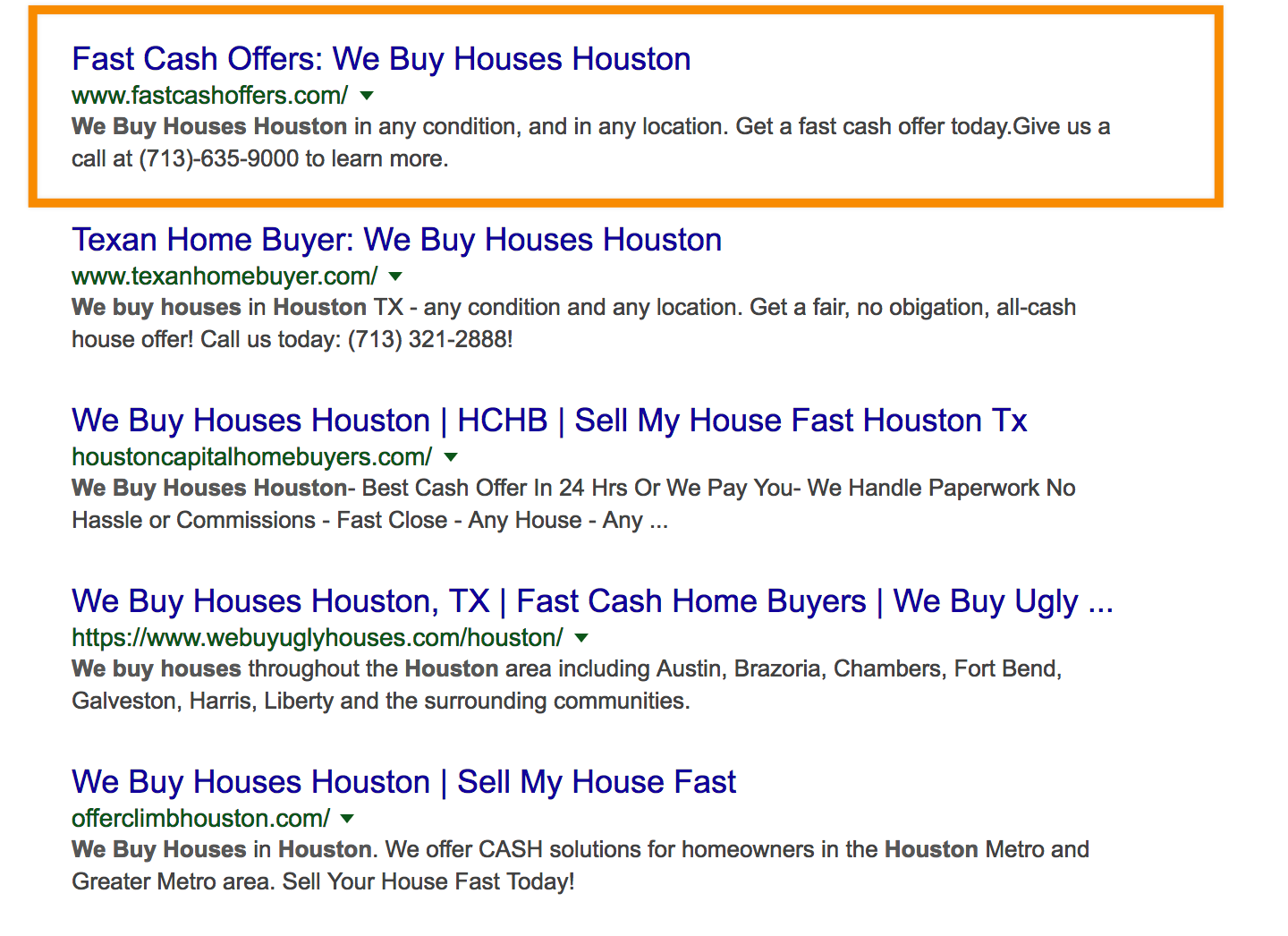
Here are some real-life examples. Here’s one in the Houston market.
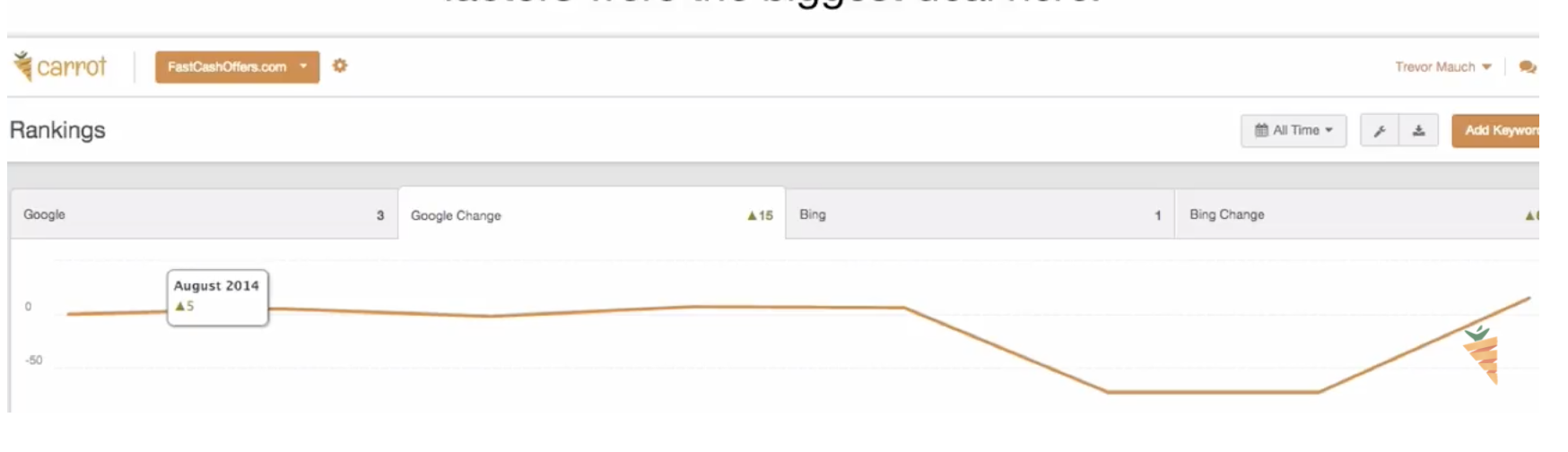
Fastcashoffers.com ranks number one for “we buy houses Houston”
This is arguably one of the most, if not the most competitive market in the entire country for motivated sellers online. This particular Carrot customer retained a search engine optimization vendor in our marketplace to do the SEO for them because they didn’t have the time to do the SEO.
It took about 10 months. It took 10 months to go from page 3 or page 4 where they started for, “We buy houses Houston and Sell house fast Houston.” Now, they’re at the number one position. So if you were to go to Google and type up, “We buy houses Houston,” they’re in the number one position. Google does kinda change their mood, so every now and then it’ll bump back down, it’ll bump back up, but it’s been holding there for quite a while.
[cta offer=”seobible”]
They stayed at the number seven and number five position, they bounced between those positions for literally, probably, three to five months. This screenshot here is a timeline over about six or seven months of what it took to get them ranked high.
As you can see, it stayed there steady, steady, steady, really wasn’t moving. It actually took a dip down when Google made an update. Google was kind of readjusting things, and it jumped back up and it’s been settling in at number one ever since then. For them, it took 10 to 12 months to really, in one of the most competitive markets in the country, hiring an SEO team to do it, and they’re crushing it.
So how they got there, they had a domain that they brought to Carrot. They had already been aged a bit. So they had already bought that domain.
They’d owned it for years before they ever came to Carrot and they had already had a website on that domain before. So they had already done some things that kinda gave them a jump start.
They had a few backlinks and they had their citations or their business directories already on there. And then just bringing that over to Carrot really put on the afterburners. That’s what took it from page three, page four on Google to rising up in the rankings pretty darn high in the most competitive market in the country.
I thought it was gonna take longer than the 10 to 12 months that it took. It took 10 months. Honestly, I thought it was gonna take well over a year but because they already had the domain purchased and they had some other backlinks and some citations already built, it made it happen quicker.
Here’s another one in the Baltimore market.
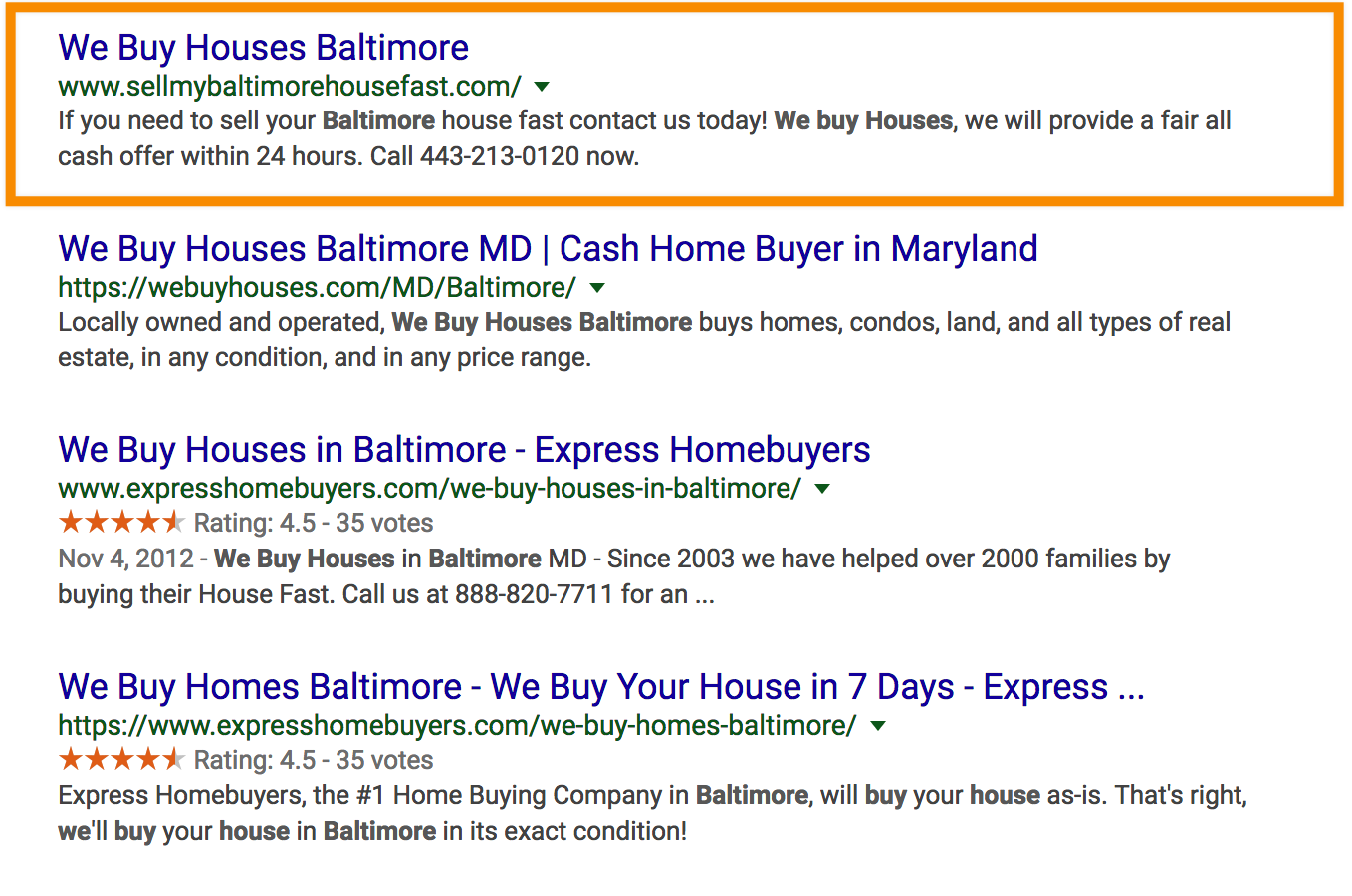
Sellmybalitimorehousefast.com ranks number one for “we buy houses Baltimore”
Again, very, very competitive market. It took them four to five months to rank on page one for phrases like, “We buy houses Baltimore and Sell house fast Baltimore.” Then it took them another four to five months of working this training, building some backlinks, getting some citation going, some social media action, to get to the number one result. The person who had held the number one result before was literally there for three or four years.
Learn how David Brown leveraged the Carrot real estate investor websites to generate his motivated house seller leads and get more traffic.
This Carrot member came into a market with a fresh website, brand new domain name, and within eight to nine months, they overtook that number one position, started to get really, really consistent leads and deals and ended up closing over 20 deals within the next 12 months after that. 100% from SEO, netted almost $100,000. They were very, very low-profit margin deals but they closed a lot of them.
Here’s how they did it. This customer-focused on the on-page. They really focused on making sure that the content on the page that we provided was unique to them. They used our SEO tool and then quickly shifted gears to building quality backlinks and social media boosts through our training. You can see, it took a while. It bumped up, it bumped back down, then all of a sudden, bam. It bumped up and it’s stayed there ever since.
The Birmingham, Alabamamarket is a pretty decently competitive market. This person hired the SEO firm to do it as well, through our marketplace. It’s a really competitive seller search phrases like, “Sell my house fast and we buy houses Birmingham.” It took about four months to get to the number two to number three position in Google with a fresh domain name. Then another couple of months, they hit the number one for several of the top search phrases.
So how did they do it? They hired our team to do the SEO, and all we’re doing is implementing exactly what we teach. We started off with just further tweaking the on-page factors. We tweaked up their content a little bit more so it was more different than any of the other Carrot members in their market.
You want to make sure your content does stand out.
We added some more high-quality content, some blog posts and changed some of our pages a little bit, and then added some specific information for Birmingham.
We also built a few backlinks and citations and that’s it. Literally, there are less than 5 or 10 backlinks pointing to this website. We did build the citations, which, if you don’t have the time to do that following our training, we can do it for you and that’s all that we did. So very minimal stuff.
It was mainly just focusing on making sure the content was tweaked to them. They had testimonials on there, built some blog posts in there, and then we built a few backlinks and citation, and it crushes it.
Here’s another one in California.
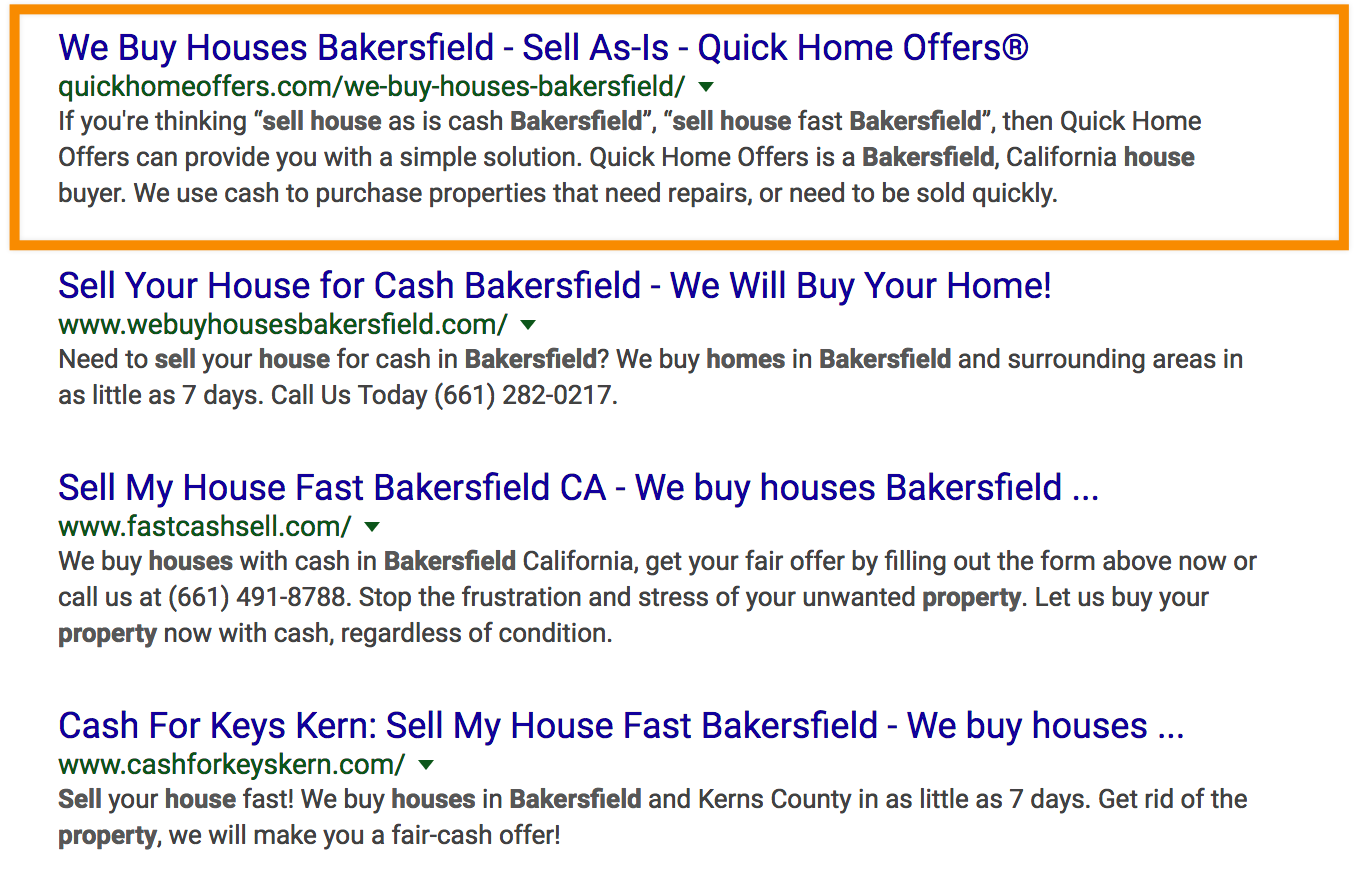
Quickhomeoffers.com ranks number one for “sell my house Bakersfield”
They focus on medium-sized cities within California, Fresno, Bakersfield, things like that. They also tweaked their own content so it was unique from any other Carrot member in California.
It took them a few hours to do, so it was all a very good investment of their time. They added in specific information for their city. So they created city-specific landing pages, which we teach in our training, and we also teach in our Carrot Coaching Calls.
He built a few backlinks and about three months later they’re sitting on page one. Then after another two to three months, they’re in the top three, and a month or two after that to level-off in the number one position for their main keywords in several cities around the state of California.
Riding the SEO Roller Coaster
You might see your website slowly, slowly rise, bumped up, bumped down a little bit, and kinda steady stayed up. Or, you might see a slight decrease in your rankings at a period of time, just hold tight. Don’t worry about it. Sit there for two or three weeks and see what happens. Often times, it’ll bump back up.
Here’s another real-life example on the flip side of this.
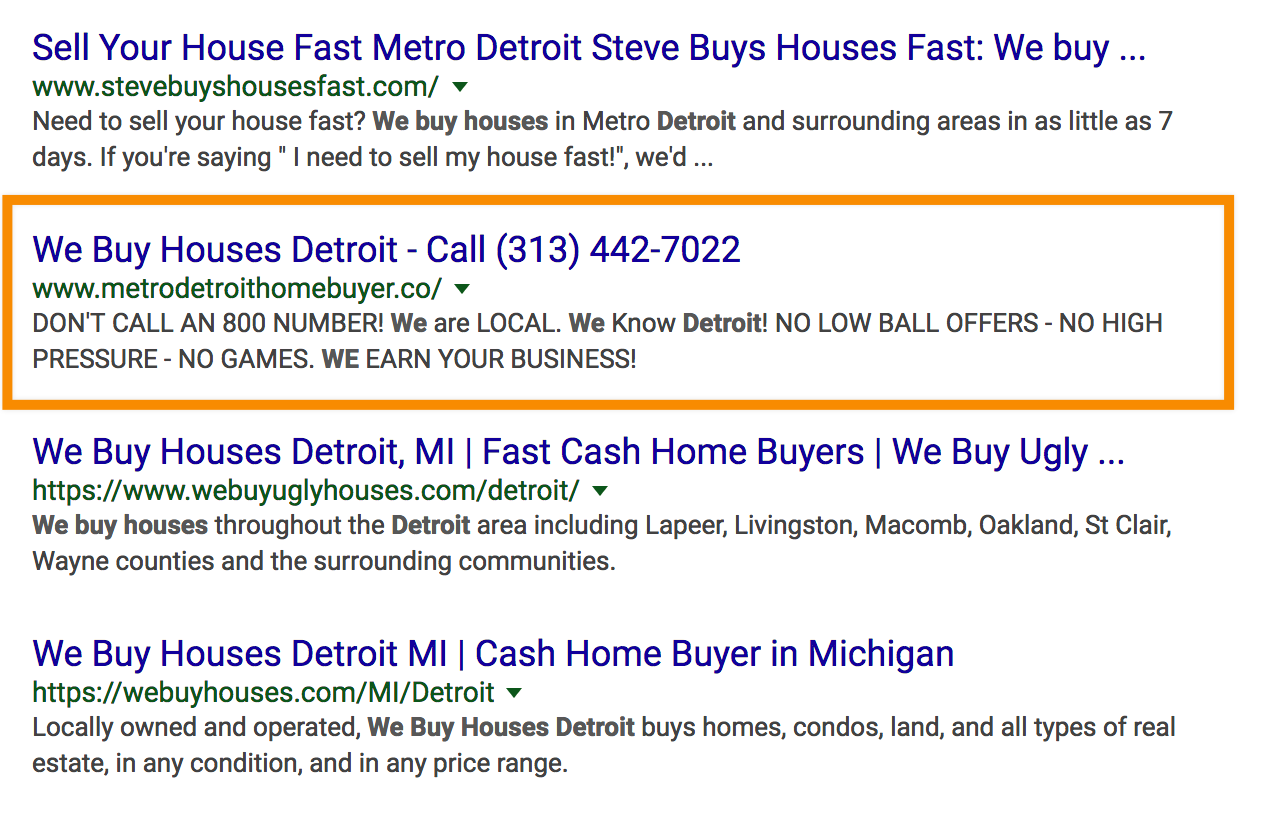
Metrodetroithomebuyer.co ranks number two for “we buy houses Detroit”
Those ones I mentioned before were all in pretty competitive markets. The most competitive ones took 10 to 12 months of good SEO work, actively having someone do the work for them. The kind of medium cities took four to six months to do some good work, then they did the implementation or had someone do it for them.
See here, this is in Detroit, another competitive market, but he focused on different keywords. He focused on keywords that weren’t the main keywords, and he literally had his web pages ranked on page one and in the top of page one within two weeks of launching his website. Here’s an email that Dennis sent. He said,
“Trevor, holy crap. Got my first lead from my metro Detroit home buyer site and I haven’t done much, if any, customization yet. A person on the West Coast with several properties here to sell. Very cool.” – Dennis Fassett
So it can happen very quickly.
Here’s my general guideline: if you’re in a small market or you’re going after a small market, and I’m talking a population under 100,000 people, you can legitimately get your web pages ranked on page one within 2 to 12 weeks and often times in the top five in Google, on cities with populations under 100,000, within 2 to 12 weeks.
As an example, we’re working with a client here in Oregon right now and we literally just launched their website last month, did the customizations that we teach here, we added some city-specific pages, used the SEO tool to make sure that they are optimized for that phrase.
Within three weeks, they were on page one.
Now, he’s ranking number one or number two for a couple of the phrases in some of the cities and the top five for others. I expect those ranking to climb. The reason that it happened so fast is that it was smaller cities, and the content on each one of those individual city-specific pages was tweaked and customized a little bit.
This isn’t just launching a website and sitting there. This is someone working the SEO, doing the things in the Carrot training and allowing two to six months to get onto page one in the top five or so.
In large markets, a population of a million-plus, we’re talking six-plus months to get onto page one. Sometimes, you might have a miracle and have it happen quicker.
If you have already brought some domain juice with you, if you’ve owned the domain for a while, if you already have some backlinks pointing toward it, if you already have some social media activity pointing toward it, that’s gonna help you accelerate the process.
But if you bought a domain brand new and you’re in a large market and someone’s actively doing the SEO for you that we teach in here, it’s going to take six or more months to get onto page one in the top five.
It can really vary, so even if you’re in a very large city, even if you’re in Houston or if you’re in New York or LA, it can really vary in how long it takes. So if you’re going to go after a broad term like, “Investment properties in Chicago,” that’s a pretty broad term where that’s more competitive.
There’s a lot of people going after that, it’s gonna take longer to rank for that than what’s called a long-tail keyword phrase that has four or more full words in it. “Fixer-upper investment properties in North Chicago,” that phrase, even though it’s still in Chicago, it’s a longer phrase, it’s more targeted. There’s gonna be less competition. It’s gonna be easier to rank for that, a lot easier.
SEO in Different Market Sizes
Here’s a general guideline. Smaller markets under 100,000, if you’re going after strong keywords, 2 to 12 weeks to get onto page one if you’re doing the right actions.
Medium markets, population 250,000 to 1 million, 2 to 6 months if you’re doing the actions to get those rankings.
Larger markets, six-plus months to get onto page one if you’re doing those rankings. And then from there, it can take several months longer potentially, depending on your market, to get into that top two or three positions if you’re doing the right actions in here.
SEO for Real Estate Investors: ROI
The ROI on SEO is huge if you do it right. So even if you’re in a competitive market and you’re going, “You know what? I don’t have six or seven or eight months to get the leads coming in,” what you do is you go to our other trainings and you get some paperclipping going.
You get some YouTube video marketing going, which is going to rank very quickly if you do them right, within weeks, even in competitive markets potentially. You get some Craigslist marketing going. Get that stuff going in the short-term.
In the long-term, if you’re in a competitive market, you or have someone work on the SEO for you. This is that first example that I showed you where it took about 10 to 12 months. I emailed him … This was several months ago at that time and they did four deals that month alone. Got bid out on a few, sat down, started building up some more city-specific pages, so they’re working it by splitting out city-specific pages and getting articles written up. They closed four deals and netted well over $30,000 that one month. The next month, they closed deals again.
So the long-term ROI, being patient, especially if you’re in a competitive market and the implementing or hiring someone to implement for you, is gonna be a big, big deal. Be patient and you’ll get the results.
Did you launch your website within the last 6 weeks and your website isn’t showing up anywhere on the first few pages of Google yet? Are you not quite sure how Google really works? Then this post is for you.
We get this question all of the time… “I have had my website up and I can’t find it in Google yet”… in this video we’ll walk through how search engine’s like Google work, how search engines find websites, and how they rank your website in the search results.
Understanding how search engines like Google work is essential for real estate professionals who want their websites to rank higher in search results and generate consistent leads through organic traffic.
Key Takeaways
Google finds websites by “crawling” through links on the internet, which is why getting links to your site from other sources is critical for being discovered and indexed.
Being indexed by Google (appearing in their database) is just the first step; ranking high for specific keywords requires ongoing optimization and quality content relevant to those search terms.
SEO isn’t a quick marketing solution like PPC, but it offers superior long-term ROI if you’re willing to invest the time in building quality backlinks, creating relevant content, and following best practices.
By understanding the basics of how search engines crawl, index, and rank websites, real estate professionals can develop effective strategies to climb the search rankings over time, generating increasingly valuable organic leads for their business.
Did You Launch Your Site Within The Last 6 Weeks and It’s Not Showing Up In Google?
If so, this video below is for you. The video is from Module 1 of 6 in our premium 3 Lead Per Day Training where we’re diving into the basics of SEO for those new to SEO. So we decided to yank this video from the course (just $99 for 40+ amazing training videos on PPC, SEO, and YouTube marketing) so it can be a resource for anyone.
Basically, go through the steps I show in the video to check and see if your website is being indexed by Google first… if it is, then your work to climb the SEO rankings has begun! If it isn’t, follow the steps in the video to let Google know your website exists by doing a quick Google + posting that tells people about your new site and links to it and find some other ways to get a link to your new website online so Google can find the link and spider your website.
Give it a few days or a week and do the test above, again, on your real estate website and if it still isn’t showing up on the first few pages of Google for your company name and location, then it may not be indexed yet. But odds are, unless you have some penalties on your domain name from building spammy backlinks, you just need to give it a bit more time.
Not Ranked On The First Few Pages Of Google For Your Ideal Keywords?
Now, being indexed in Google (i.e. – Google has your site saved in their database) and ranking high for the specific keywords you want to go after are two completely different things. If you show up using the test above but not for the keywords you’re looking to rank for… now it’s time to “optimize” your website for the specific keywords you want to rank for.
You can use some of the FREE resources we’ve already created to help you get your website ranked higher in Google. Or, if you’re an Carrot member you can dive into the advanced 3LPD training program ($99 and only available for Carrot members) and it’ll walk you through step by step how to increase your ranking and beat out your competition.
Some free SEO resources for real estate investors and agents to get you started on your climb to the top of the rankings:
Those will get you rolling and always feel free to hit us with questions over here on the blog! Or if you’re a Carrot member, reach out to us on our next weekly Carrot Mastermind call.
If you plan on getting your website ranked high in Google to ramp up your leads over time with SEO you should also really understand the basics of how search engines like Google work.
That way as you’re working through the steps, you better understand it.
How Search Engines Work
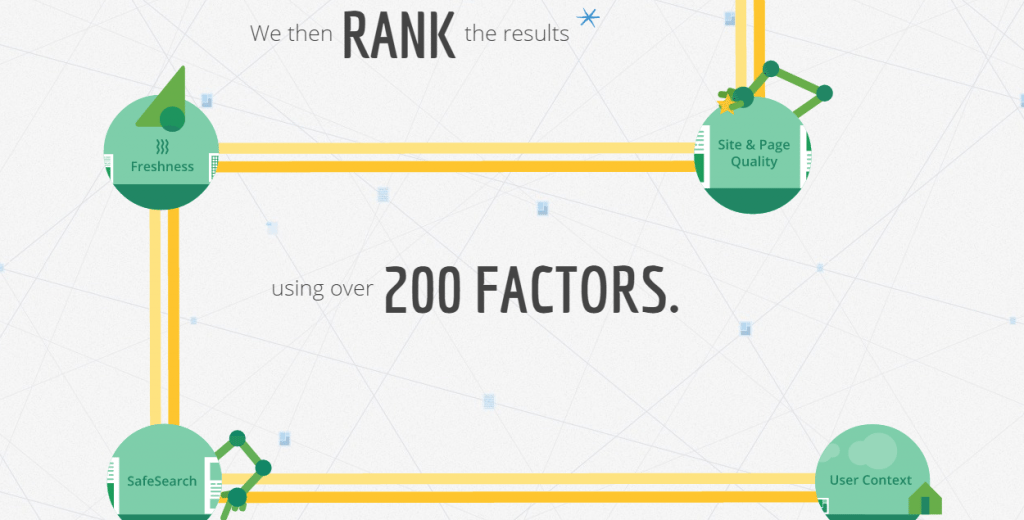
So, if you’re wanting to dig in and learn a bit more about how Google navigates sites by crawling the web… this section is going to be perfect for you. Overall, ranking results are calculated using over 200 factors which sounds intimidating… but if you understand how Google works and how to play by its rules… it makes ranking your real estate investing website in Google a heck of a lot easier and more fun.
Carrot helps you focus on a few factors that have the most power to help you rank where sellers, buyers, tenants, private lenders, etc. are searching online. This short video is one of the “Module 1” videos in our 3 Lead Per Day training. So if you’re newer to SEO and ranking websites in Google, this will be a great bit of foundational knowledge to soak up. If you’re experienced in SEO… then go ahead and skip this video.
A Brief “How Google Works” Run Through…
The text below is from the video above, so if you learn better by reading, dive into the content below to learn how Google works. If you already watched the video, great! You can skip this section and get to work on your real estate website and get it climbing in the SEO rankings.
So how do search engines actually work? In this module, it is going to walk you through the basics of how search engines work…from the time you put in the search in there to what they are doing in the background to determine how to rank them.
So, first of all just to reiterate the basics here, if you’re newer to SEO what we are talking about here is the things in the Google search or Yahoo or Bing search that show up in the main section of the search results. At the top of the section that’s ads, you can see the ads are indicated with those little orange ad tags. And on the right side, those are ads as well.
So how does Google determine what shows up in that main section which is called the organic search results section?
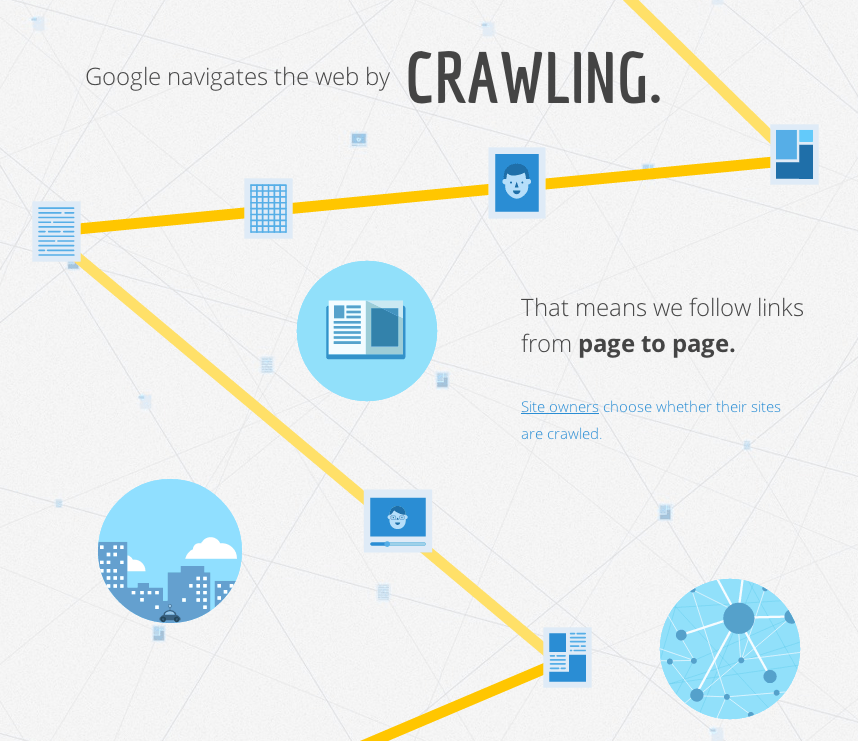
First of all, let’s understand search. Here’s a graph that we pulled directly from Google. Kinda talks about how Google goes out there and crawls different websites. So, Google navigates the web by crawling from website to website. That means that they follow links from page to page.
So, if you have a website up there and you have a link on one page that leads to another, Google’s robots are crawling through all of those links trying to visit every page they can possibly make it to on the web. And, they have these big huge massive servers that are continually, around the clock, crawling the web. And, the cool thing, is the website, owners can choose whether your website is crawled or not. If your website is not crawled, if we do not allow Google to see your website, then it doesn’t show up in the search results.
Of course, by default Carrot members websites are not set to be hidden from Google. They are set to be crawled and we make it to where it makes it easier to be crawled by Google. Which is a good thing.
So one way that Google finds your website and the pages on your website is by going through links on other web pages that link to your site.
As an example, if you made a post on your Google + account that links to a page on your site, Google will find that and go through that link and land on your site… and magically now Google knows about that page and it’s in their index. Pretty cool, eh?
And then Google begins sorting the pages along the way by the page content and hundreds of other factors.
As Google spiders the web, they’re saving all of this data. They know what this page is about, what links that point to the page, and what it feels is the authority and relevance of that page to what you just searched.
This is why so SEOs spend so much time building, earning and winning backlinks. If you want to get started on this, check out our guide on how to use HARO to get backlinks.
Then they rank those results so someone goes online and they type in a phrase, it could be… “sell my house fast in Baltimore” or it could even be “local plumbers”. Google then determines that based on all of the web pages that they’ve crawled and saved in their database according to 200+ factors where your web page should fall in the rankings.
How Relevant is Your Website?
And they’re really looking at relevance. They’re looking at how relevant is your web page or your website to that exact search that person just made.
And, the way that they determine the relevance, is the website quality of the content, or how relevant it is to that search phrase. We also want to make sure we have those keywords that we’re going after in the content. We also want to make that our website has fresh and unique content so Google sees it as relevant.
Basically, the Google bots are continually scouring the internet and “spidering” through links on pages to find other pages and other websites, then it determines what the page is about, it’s authority, and where it should fall in the rankings compared to the millions of other websites all in a matter of nanoseconds.
Pretty amazing stuff.
With that said, don’t let any of that scare you. It’s very easy to get on page 2 in Google just by following basic things we teach here on this blog.
Then to climb onto page 1 and the top of page 1… you’ll want to focus on building some quality backlinks, having robust solid content on your website that is relevant to the keyword phrases you want to rank for… and you need time. SEO isn’t a fast marketing solution like PPC.
Need More Online Leads For Your Wholesaling / House Flipping Business?
Generate More Real Estate Investing Leads and Cut Through The Marketing Clutter In Your Market. Download our FREE Marketing Toolkit: Get Access To This Content Marketing Toolkit + Training For Real Estate Investors HERE!
And take a Demo of Carrot today to leverage the same system 1000’s of other investors use to generate his online leads and deals each and every month.
Listen to the CarrotCast Podcast and Subscribe Below!
I kept reading stuff about real estate and it just really, really interested me. So I got my real estate agent license and started doing some real estate brokerage stuff on the side. Made some money on the side and got so consumed with it that because I really liked real estate that I got fired from my job. Tom Cafarella
On this CarrotCast episode Boston’s #1 Home Buyer, Tom Cafarella, breaks down his journey and real estate marketing strategy. Tom walks through step by step his journey from a job he hated, to making the leap, to realizing he needs to be great at marketing.
He slowly learned and refined his marketing from the ground up.
Breakdown:
Tom spends $1million a year on marketing. He explains what works for him and what doesn’t.
His #1 way of generating leads online is Facebook (for sellers). He breaks down in detail how he’s having success on Facebook where others aren’t.
And, before switching to Carrot a year ago or so, he was skeptical Carrot could outperform his custom site. He made the switch and test it. Carrot doubled his online leads and business… HUGE ROI.
Listen, enjoy, and check out more CarrotCast episodes at carrotcast.com.
Listen to the CarrotCast Podcast
[podcast-subscribe]
[cta offer=”recontent” color=”red”]
Listen to this CarrotCast episode and how to create your own real estate marketing strategy and generate more leads for your business.
1:15 – Who is Tom Cafarella? From a “hated” accountant position to building a real estate company now running 100+ fix and flips per year and much, much more. 9:00 – The two things that triggered Tom to change his mindset to take a risk and get going in real estate. You have to put in the hours to be successful. 15:55 –What happened after his first wholesaling deal that netted him $115,000. Implementing different marketing systems and why did he decide to leave the Homevestors franchise. 19:05 – When and why Tom became a student of real estate marketing strategy. 21:00 – Find out a little bit more about his real estate system and training at realestateinvestingiseasy.com. 24:00 – What he tested during his marketing scaling and diving into Facebook ads. 27:45 – What types of ads are working for him on Facebook. 32:25 – Why it is so hugely important to drop people on a high converting, quality, website.
“If someone said to me, Tom I want to run my Facebook ad account but I want to drop it to this non-Carrot site, I would actually not do it.” – Tom Cafarella
34:15 – Your missing big time lead volume if you don’t have a mobile responsive and optimized website. 37:00 – How to build a cold call list. 39:30 – Why is this quote…
“Ultimately the business that can spend the most to acquire a customer wins.”
Is so important to Tom. 43:30 – Overall – you need to marketing for deals every month. If you don’t you’re going to fail. 45:45 – Why he made the switch from a nice looking custom website to Carrot. 49:15 – Tom’s estimated ROI Carrot will produce for him – it’s amazing!!
[podcast-subscribe]
All told, Facebook has generated over 15,000 new leads since January of this year alone. And that’s leads. Not traffic, not visitors, not followers, not fans … real leads.
Imagine the difference a few hundred new leads could have made in your business over the last year. Image what they could do for you in 2018.
Simply put … that kind of lead-generating faucet is absolutely transformative.
To illustrate how our clients do it, we collaborated with infographic making company, Venngage, to create this visual explanation.
Real Estate Facebook Ads: The Why and How of Getting Leads [Infographic]
Listen to the CarrotCast Podcast and Subscribe Below!
There are lots of agents that love working with first-time home buyers. And, there are tons of agents that never want to work with first-time home buyers. You can go out and create that experience. You can go out and be intentional about attracting those people. Those perfect, right clients. Josh Schoenly
In this episode of The CarrotCast, I have a special guest for you, Josh Schoenly. I have known Josh for years in different businesses that he’s owned. First of all, he’s one of the best dudes around. He’s ethical, honest, and knows what he’s doing. He’s a big, big, big sharer.
But I wanted to bring him on because Facebook marketing became a topic, of course, over the past year that keeps on coming up more and more from our clients.
On this episode, Josh walks through every single step of how to dial in your Facebook ads for real estate. From targeting to your ads and your landing pages. If you want to learn more about Josh or more from him, then go check out his website, clientalchemist.com. I’m excited to welcome Josh to the podcast and you guys to his world because he’s an amazing dude. I think you’re just going to love him.
Also, we did a great podcast with Kylie Newbold, which I feel is the number Podcast episode on Facebook ads for real estate investors specifically. Go check out that episode here.
Enjoy and check out more CarrotCast episodes at carrotcast.com.
Listen to the CarrotCast Podcast
[podcast-subscribe]
Listen to this CarrotCast episode and start to embrace marketing for your business.
2:30 – Introduction to Josh Schoenly. 6:30 – Does that always need to be a grind phase when building up a business or can it be built with flexibility and leverage? 9:25 –What marketing resources Josh has used during his marketing journey? 12:50 – One of the best ways to understand marketing is to take notes of what catches your eye. Start creating your own marketing swipe file. 15:00 – Josh’s 4 step philosophy to Facebook ads for Real Estate Agents.
Identify
Attract
Connect
Converse
23:00 – Putting your clients first. The importance of building relationships rather than chasing dollars. 26:15 – Facebook marketing for long-term growth. Quick wins but also creating a foundation.
Breaking down the 4 steps to Facebook ads for Real Estate:
30:30 – #1 Identify – How to identify your Facebook audience and niche. 37:15 – How Facebook “interests” targeting work. 38:30 – #2 Attract – What types of ads are working for Agents, and how much are they spending.
Do you need help calculating your marketing budget?
45:25 – #3 Connect – What is your marketing objective, and where to send that traffic? 49:15 – #4 Converse – How to nurture leads and create an ongoing follow-up system. 53:30 – Telling simple stories within your marketing can go a long way for success.

![How to Calculate Your Max Cost Per Lead [Whiteboard]](https://image-cdn.carrot.com/uploads/Featured-Image-61.png)
















![Real Estate Facebook Ads | The Why and How of Getting Leads [Infographic]](https://image-cdn.carrot.com/uploads/Featured-Image-43.png)