You’ve probably heard the phrase “conversion rate” tossed around quite a bit over the years. And that can be a great thing if you’re testing your conversion rates… but not so good if it’s inaccurate and you follow the next “guru” advice blindly without running your tests (or for Carrot members, we do this for them).
Carrot is one of the leading real estate website platforms. We are confident that our members generate 60,000+ leads per month through our platform and nearly 1.7 million sessions each month because we have such an extensive data set available to us from which to conclude.
So first… let’s dive into the basics of conversion rate (specifically for a real estate investor website). Then we’ll dive into why it’s important, how to do it right, and give you a few resources we use to improve our conversion rates.
What Is Conversion Rate?
The “conversion rate” on your website is simply the ratio between the number of people who land on your website vs. the number of people who “convert” on your website to become a lead.
That could be a cash buyer lead, motivated seller, tenant, or private lender.
The “conversion rate” is pretty simple to calculate.
If you have 100 visitors to that page and 15 of them put in their info on that page and opt-in as a lead for you, that is a 15% conversion rate.
In other words, it’s…
Conversion rate percentage = (Number of people who converted on your website / Number of visitors to your website) x 100
At Carrot, we’re constantly testing our customer’s websites to see what converts visitors best.
A Test In Progress On A Carrot Members Website: This is a shot from an actual test we’re running on a motivated seller website.
How Do You Find Out The Conversion Rate?
There are a few ways to determine your website’s conversion rate.
The easiest and most accurate is using a software tool… like the one we use… VWO.com (about $49/month and easy to use).
You have to get a bit of code from the software, put it on your website (really easy to do inside a Carrot account – hit up our support if you need help), and then set up the test in the software. Let the traffic come in; it’ll tell you how many people convert as a lead.
It may take you a few hours your first time to set up a test, and unless you’re getting 100 visitors to your website each month, it’s probably not worth setting up a test (it would take many, many months to come up with any real info because your traffic is so low).
If you’re on a budget and are not a tech person, you can count the number of leads you had in a specific period — then look up the # of visitors in that period on your analytics and divide the two.
*Or, if you’re a Carrot member… and you’re getting over 500 visitors a month to your site and 15+ leads a month, we’ll do your conversion rate and optimization testing for you! Just let us know through support.
What Is A Good Conversion Rate For A Real Estate Investors Website?
One of the biggest misconceptions we hear all the time (and I once thought the same thing) about conversion rates from our members… is that there is a “normal” conversion rate for a website in our industry.
I wish there were.
But in reality… there are so many factors that can affect how many people convert on your website into a lead that a good conversion rate for a motivated seller website… isn’t a good conversion rate for a cash buyer website or rent-to-own website.
Factors include:
Where the visitor is coming from before they hit your website. Are visitors finding your website organically through social media or paid ads? *Paid ad conversion rates can also be deceptive. A Google Ads campaign targeting a state or national can have different (usually higher) conversion rates compared to a local campaign
Whether or not your site is set up to convert well (like all of our Carrot sites are)
Credibility on your website… High-quality testimonials can increase your conversion rate by 34%
Colors
Your logo can sometimes make or break conversions
Button CTA… Changing your CTA can increase the conversion rate by 49.5%
On one cash buyer test we ran… at one point, that website was converting almost 40% of all people who landed on the page to a cash buyer lead (picture of test results mid-way through below):
Cash Buyer Conversion: Results mid-way through a “split-test” on a cash buyer website for one of our InvestorCarrot members. That is a pretty darn high conversion rate… even for a cash buyer website (we’ve worked hard to get our Carrot websites converting high – that’s why so many people LOVE having their websites on Carrot). But later in that same test, the conversion rate settled in the mid-’20s.
Why?
In this case, the website didn’t change… it was mainly a “traffic issue.” She started doing Craigslist marketing which tends to yield a higher volume of traffic but a lower conversion rate.
But on average… we’re seeing cash buyer websites (when people drive the visitor to our home pages which are geared to convert well) convert between 20-40% of visitors to a cash buyer with quality traffic.
Motivated Seller Website Conversion Rates
We’ve heard people ask if our motivated seller websites are converting at “25% as they used to 5 years ago,” and the answer is no, they’re not.
5, 6, 7 years ago, before every investor on the block had a website, before 50%-60% of all searches were on cell phones (and most websites aren’t optimized for mobile). During the recession, when hoards of sellers were in dire straights and just needed out (and were willing to opt into any and every website online they could find to get out of the situation fast), the conversion rates on a motivated seller site could consistently reach 20% or more.
And that’s a stellar conversion rate for a motivated seller website.
But times and markets have changed a lot, even over a year, and conversion rates are a bit softer for motivated sellers.
Sellers today have more choices regarding websites to engage with online and are pickier with who they’ll work with. They want to see a website that feels credible, that they can trust, and that is easy to use.
So we’re seeing motivated seller websites (depending on the quality of traffic they’re sending to the site, and what they have done to their site to improve / decrease the conversion rate) convert from 7% to 20%. 20% is an outlier… and only with organic search traffic (SEO) or direct type in traffic.
What We Consider Average For A Seller’s Website (Your Site Should Convert At Least 8-10%)
Lots of House Seller Leads: This website is a highly trafficked home buyer’s website. We’re building some of our “Carrot Magic” into his website. The same stuff that’s already built into our Motivated Seller websites for our Carrot members.
And another…
What We Consider Solid For Sellers
A Surprising Video Test: This test is on a Carrot member’s website that gets 100% of its traffic from SEO (using our 3 Lead Per Day Training). But we ran a test recently to see if a video would increase the conversion rate on her website — the result is surprising :-)
And another…
What We Consider Stellar (this rarely happens long-term on a website) during this test, this Carrot member got a GREAT stretch of quality traffic. The test is still early… so the rate will likely dip below 20%.
Conversion Rate: This is a shot from an actual test on a motivated seller website.
All in all, you should shoot to have your motivated seller website convert at least 10% of your visitors to leads at a minimum… and work your way toward a 15-20% conversion rate (for a quality lead) on the top end in today’s environment with building solid credibility on your website, great quality traffic.
In a recent conversion test on motivated seller sites, we also found a potential 55% conversion rate increase by making one simple change to the hero section.
Conversion Rate: Hero sections that increased conversion rates by anywhere from 25 to 55%
Rent to Own / Tenant Buyer Website Conversion Rates
Rent-to-own tenant buyers and tenants of rental properties tend to convert pretty darn well when they land on a website set up to convert (like our Carrot sites are). A tenant (or even buyer) tends to be putting in their info on your site to see available properties… so it’s a much lower commitment than a seller’s decision to sell their house to someone.
A Solid (But standard on Carrot) Conversion Rate For a Rent-To-Own Site
Rent To Own Leads Flowing In: In this test on a rent-to-own website of a Carrot member, you can see in the early stages of the test their site is converting on average close to 40%. This isn’t out of the norm on our rent-to-own websites.
Our rent-to-own websites have been performing well. After several rounds of testing (and we continue to test and improve these sites for our customers each month), we tend to see tenant buyers converting between 20-40% on the website.
One member’s website even had a string of several months (and several hundred leads) where their site converted nearly 50%. Their traffic was very high quality coming from a Facebook campaign.
Summing Up The Basics Of Conversion Rates For Real Estate Investor Websites
Improving the conversion rate of our Carrot platform is something we love to do, and it’s fun.
We’re running 50 tests on our Carrot member’s websites… actively working to improve the conversion rate of our platform every month. We do the same thing for our real estate agent websites, too!
Hit Me With Your Conversion Rate Questions Below!
So… do you know the conversion rate on your website? If so, hit me with a comment below! If not, hit me with your URL, and we’ll look at your site and give you some feedback.
And as always, if you feel Carrot may be a fit for your real estate websites and want better results online, we’d love to have you in the Carrot community. Check out our plans and hit us up with questions anytime!
If you’re like me and your business relies on Google rankings for traffic and leads for your business. Every time I hear the word Google algorithm update, the anxiety kicks in a bit.
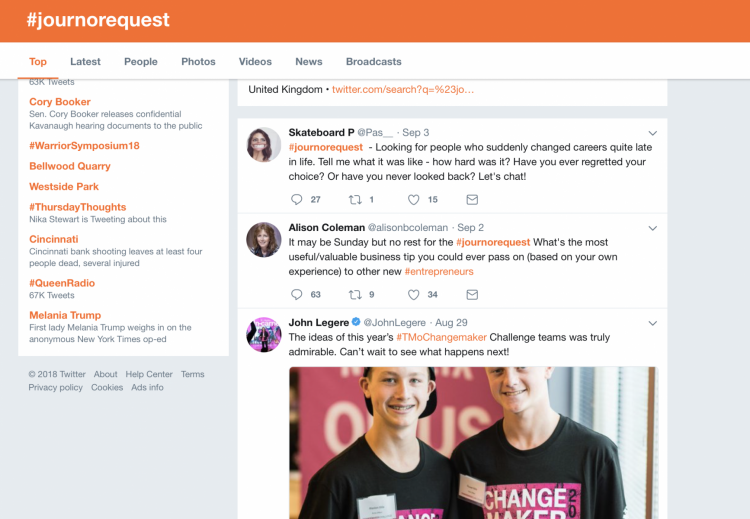
Any Google Core Algorithm update is going to cause a shakeup in site rankings across all industries and all markets. It’s the reason you see hilarious threads like this on Twitter…
As always at Carrot we strive to understand these updates as best we can so we can give our members the best information to ensure their sites continue to perform well.
Problem: Post Google Core Algorithm Update Research
After the core google algorithm update that was rolled out from December 6th – December 20th the team went back and researched a broad scope of sites using tools, such as…
Google Search Console – which provides insights on rankings, visibility, and overall performance.
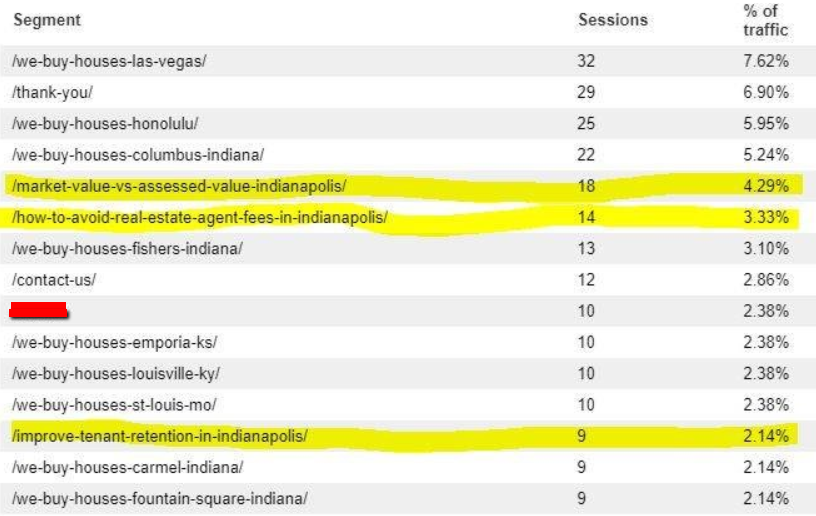
We found that the algorithm update did have an impact on a significant number of sites in the real estate industry, some positive, some negative, and some stayed relatively consistent. For example, this Carrot member account shows stability after the Core algorithm update. But this site has heavy credibility, BBB, trust, and many Google reviews, etc
We decided to review a collection of 20 or so sites within our own platform and reviewed historical rankings, site freshness, uniqueness of content, backlinking profile, the works.
Primary Findings
What we found …
Stale sites, i.e. sites that hadn’t been updated in the last 6 months or so, appeared to be much more vulnerable to negative impacts from the update than sites that were actively being updated on a consistent basis.
Those updates could be continually adding blogs and content on a consistent basis, active social media accounts, ongoing backlink development, etc.
For example, henrystreetpg.com which hasn’t made any content updates, or posted any social media posts, or utilized any of our content packs in the past 6 months took a significant hit.
From mid-page one for a lot of rankings down to the bottom of page two top of page three type rankings. Here’s a look at one of the keywords Henry Street PG has been targeting and the drop in rankings beginning December 6, 2020.
On the other hand, sites that were regularly posting on social media, consistently adding backlinks, consistently adding blogs and new content to their site either stayed consistent or improved in their rankings.
Additional Findings
We also found that some sites that we deemed were unfairly negatively impacted between December 6th and December 20th, but have since made a rebound while others remain in the lower rankings, primarily due again to the lack of any updates to the sites.
Based on our findings we have decided more than ever how important it is to stay consistent with your ongoing SEO and site maintenance.
Solutions: Initiatives You Can Take
Using the case study above where Henry Street Property Group dropped significantly in the rankings, here are some initiatives they are going to take with their site and follow the effects of the changes.
Implementing an active Social Media presence.
One of the quickest and easiest things you can do if you haven’t started yet is to implement a consistent posting schedule on social media. This indicates to Google that you are an active business and presence on the internet.
Review backlink profile
See if you can get any quick wins with a few citations here or there. Review your competitor’s backlink profiles to see if you can get some additional ideas for backlink options.
Content review
A few quick wins here would be to check your average word count and strive for an average of 1500+. Review the content and look for places you can clean up and clarify for your site visitors.
Update Google My Business information
Review your google my business profile to ensure everything is up to date. Ensure your company descriptions and information accurately describe the work you do.
Utilize h tags in a proper format
People often think the more h tags the better. Stacking h1 or h2 tags on top of each other.
You want to follow a typical article format.
Only one h1 heading per page.
You shouldn’t stack h headings on top of each other
There should be standard paragraph text under each heading as though it were a standard article you’d read in the paper or magazine.
Summary
A drop in search rankings is a given in the SEO world. Knowing how to investigate what may have caused the drop is an important piece of the puzzle.
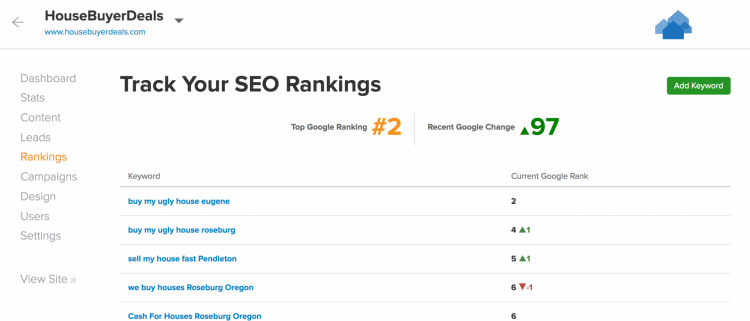
We also highly recommended that you have monitoring that tracks changes to your website’s content and keywords. Carrot members can easily accomplish this using the keyword rank tracking tool.
If you’ve read this article, it’s obvious your website’s SEO is really important to you. If you would learn more about SEO check out our Real Estate SEO page for more comprehensive guides. You can also stay up to date on Google updates through our SEO News page.
One day, you’re on page one of Google for your target keyword phrases, and then, one day, you’re not. Maybe it starts by noticing that you’re not getting as many leads as usual. When you check to see what’s going on, you find that a few of your primary real estate SEO rankings are suffering — the ones that drive passive organic traffic to your real estate website.
Featured Resource: The Ultimate SEO Keywords Guide
No SEO or content marketer can accurately predict what any future Google algorithm update will look like.
But it would help if you thought about it like this: Search engines are built with the intention to serve people.
“Core” algorithm updates typically happen a few times a year, as Google tries to continuously to improve the quality of its search results.
The latest core update started rolling out on August 15, 2024:
Google likes to reiterate that there is often nothing to fix on your site after core updates…
“We know those with sites that experience drops will be looking for a fix, and we want to ensure they don’t try to fix the wrong things. Moreover, there might not be anything to fix at all.” … “There’s nothing wrong with pages that may perform less well in a core update.”
Although, smaller core updates tend to happen every few months. Google has said:
“We’re constantly making updates to our search algorithms, including smaller core updates.”
So Google may have made updates to previous core updates, but they’ve also said:
“We don’t announce all of these because they’re generally not widely noticeable.”
But Google has acknowledged, when released, they can cause content to recover if improvements warrant.”
Don’t get stuck thinking… “What can I do?” There are plenty of best practices you can optimize for. Focus on offering the best content you can. Algorithms seek to reward informative content.
Does your content provide original information, reporting, or research?
Does your content provide a complete or comprehensive description of the topic?
Does your content provide insightful analysis or interesting information that is beyond obvious?
Does your provide substantial value and originality?
Is your headline and/or page title descriptive, and does it provide a helpful content summary?
Is your content worthy of sharing or being recommended?
Does your content show expertise?
Is your content trustworthy and shows that you are the authority on the subject?
Does your content showcase the author’s expertise or have links to an “About” page?
Is your content free of factual errors and spelling or stylistic issues?
Does your content display well on mobile devices?
Is your content genuine, or was it created for the sole purpose of rankings?
Over the past few years, E-E-A-T, or Experience, Expertise, Authoritativeness and Trustworthiness, has been considered a strong SEO guideline. Check out Google’s own guidance on creating helpful, reliable, people-first content to learn more about E-E-A-T and the impact it can make on your rankings.
Now you have some information that you can point to from Google about how to move forward if your website was impacted negatively after a Google core update.
Maybe you’ve been tracking your keyword rankings using Carrot’s Keyword Rank Tracker, and you’ve noticed some keyword phrases just starting to dip (going from position 1 or 2 to position 7 or 8), or maybe you’ve fallen back to Page 2 of the search results.
Let’s dive in a little deeper and show you what we tell our members…
Why are your real estate SEO rankings suffering, and what can you do to fix it?
It all starts with determining whyyour SEO rankings are slipping.
Step 1. Determine Why Your Real Estate SEO Rankings Are Slipping
Before you try to fix suffering rankings, we need to determine why your rankings are slipping in the first place.
Which of your posts or pages are getting the most traffic
Where your visitors are coming from
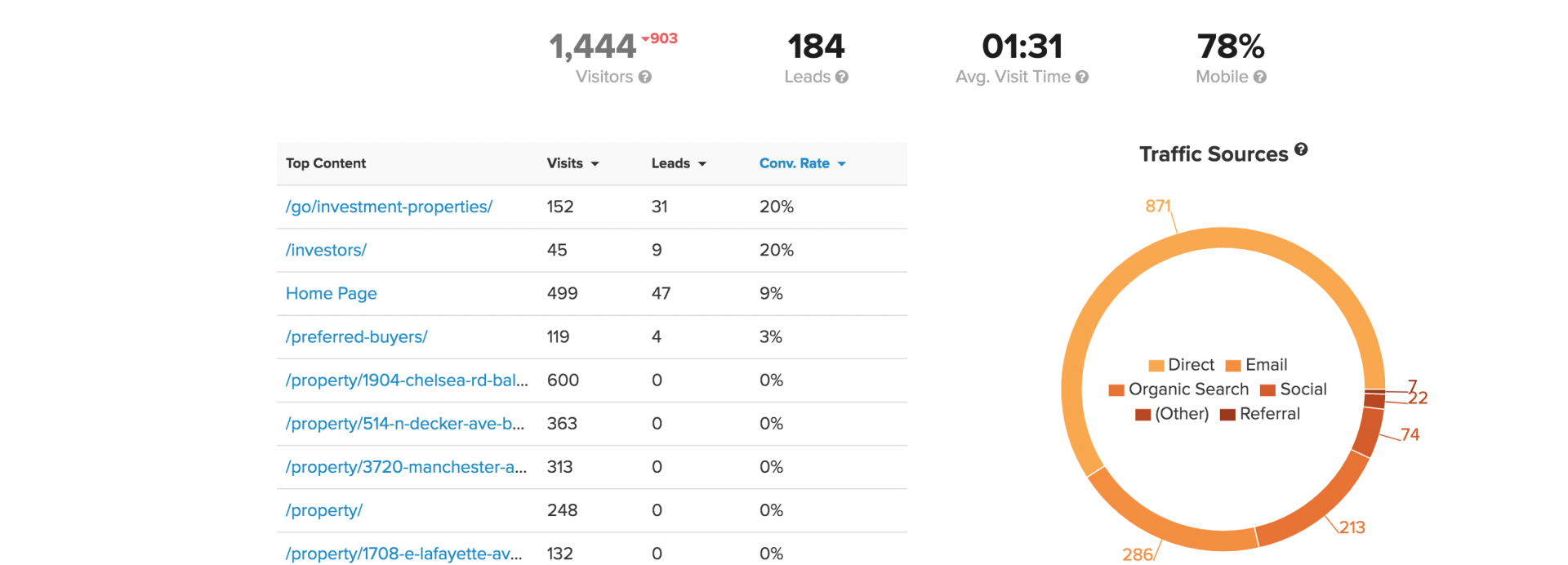
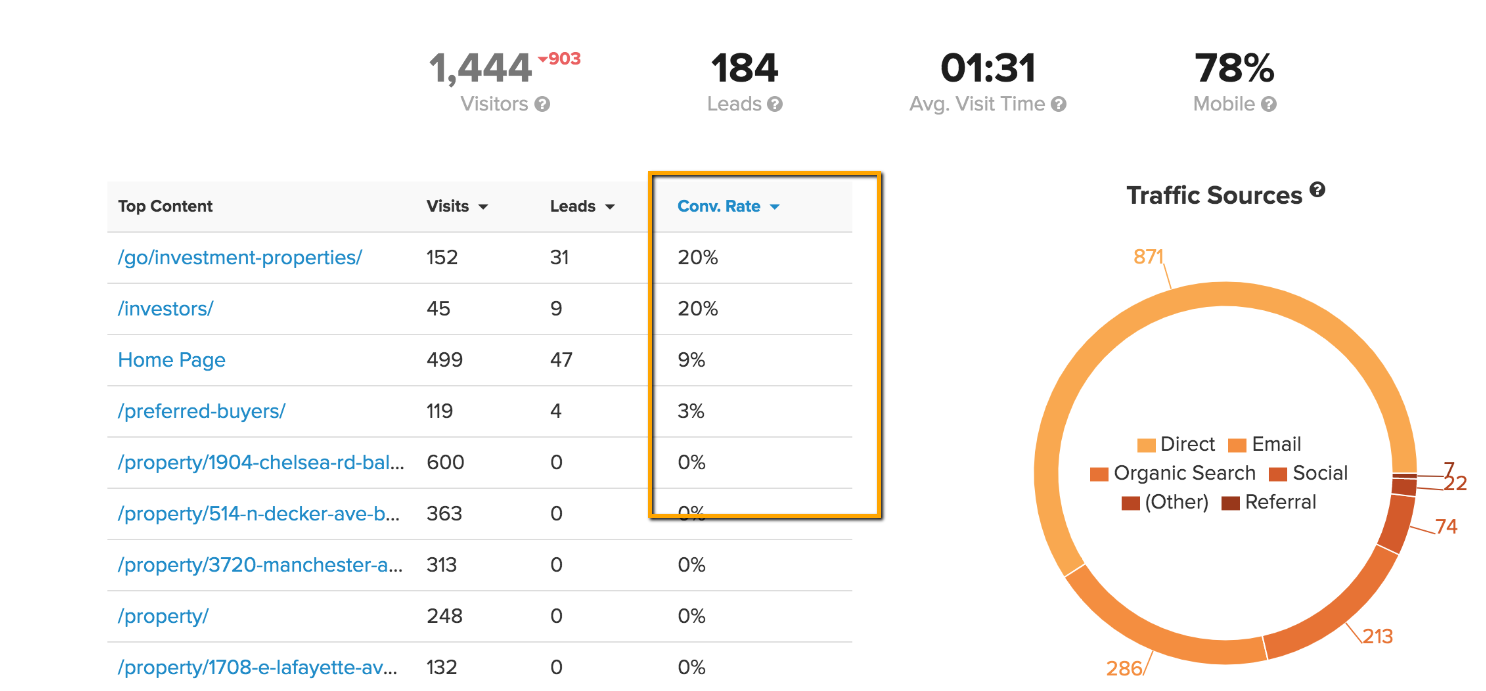
What pages are converting your visitors into leads
How many other websites are linking back to yours
You’ll want to analyze your website data and try to determine if the drop in traffic or rankings actually has anything to do with a Google algorithm update, or maybe it’s due to other factors entirely.
For example, many businesses experience seasonal dips or spikes in traffic during certain times of year, like summer or the December holidays.
There are quite a few other possibilities. Among the most common reasons are…
Is a Competitor is Beating You? — This is the most common reason that a ranking will start to dip. If you’ve only gone down the search results page a few spots, then it’s likely that Google is trying to make space for a competitor who it perceives as having rank-worthy content for the specified keyword phrase. Check out Step 2 to figure out how to address this problem.
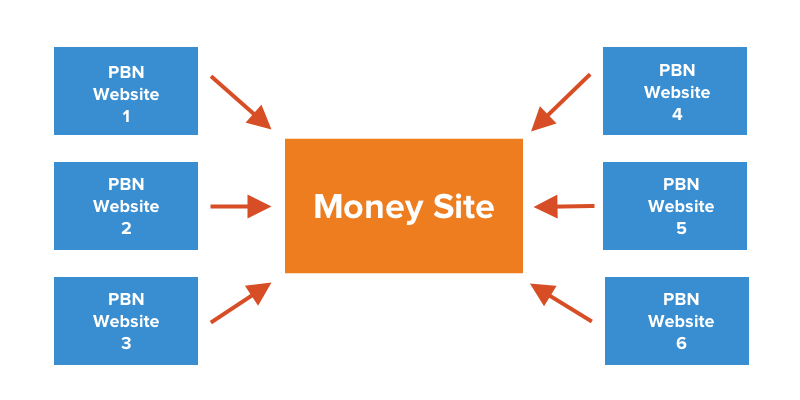
HasGoogle Penalized Your Site? — In rare cases, it’s possible that Google has penalized your site for one reason or another. If you’ve been paying for backlinks, using PBNs, or using other black-hat SEO tactics, it’s possible that Google has penalized your site. If this is the case, then your site will probably have completely disappeared, not just have dipped a bit. Check out Step 10 to learn more about how to fix this.
Did You Publish Lots of Templated Content Without Making It Unique? — Tools like Carrot’s Automated Content Library and Niche Authority Builder provide pre-written blog posts and pages to make content creation quicker, but you’ll always want to add your own insights and expertise to each post to make them your own. We suggest adding at least 30-50% of your own unique content in order to stand out among competitor sites and keep Google from viewing your content as duplicate.
Did You Trim Your Content On Your Home Page Or City Pages? — If you’ve recently made changes to your content, those changes might take time to bounce back in the rankings.
Are You Even Tracking Your Rankings? — You can’t fix an issue without data. Carrot’s Keyword Rank Tracker lets you easily grab back data to see what day things might have changed.
Is Your Page Load Speed is Too Slow? — Google has explicitly said, over and over again, that how fast your website loads (or even a specific page) is a direct indicator of how well you rank. The faster it loads, the better. Carrot prides ourselves on incredibly fast loading websites (they load nearly 70% faster than standard WordPress websites), but if you don’t have a Carrot site, check out Step 6 for ways to fix this.
Is Your Website is NOT Mobile Optimized? — Carrot websites are optimized for all viewing devices (including desktop, smartphone and tablets), but if your non-Carrot website isn’t optimized for mobile, then you’ll have trouble ranking for any keyword phrase. Google prioritizes the mobile version of your website over the desktop version, so this is an absolute must. Check out Step 8 to learn more about this.
Once you know what the problem is, you should have a much easier time fixing the problem with the below steps. If your page completely disappeared, then you probably got penalized by Google.
If your page slipped just a few positions, then a competitor is probably beating you (the most likely reason). And if you slipped big — say, to page 5 — then it may be because Google updated its algorithm and your page no longer fits the bill.
Whatever the case, you can use the below steps to fix your problem and then measure progress toward improving your SEO rankings.
Remember: SEO and evergreen marketing is an ongoing process. We recommend looking at trends over longer time periods, like month over month and quarter over quarter, rather than focusing on changes in traffic or keyword rankings on a daily or weekly basis.
Step 2. Update & Enhance Your Content
Assuming that your page hasn’t been penalized by Google and that you only slipped a few positions, this is the very first thing you should think to do.
Because a lot of times, your real estate SEO rankings slip simply because someone else (a competitor, usually) created a better page than you and Google is trying to make space for them. This is an opportunity for you to pull out the big guns and beat them at their own game.
When a page starts to slip by a few positions, here’s what you should do…
Look At What The Other Page-One Rankings Are Doing — The first thing you should do is examine what other pages are ranking on the first page for the given keyword and make some guesses as to why those pages are beating you. What are they doing that you’re not doing? How can you do something better than them? Could you write a longer piece of content or create a video to enhance the post? Answer questions that people are asking about the topic? Could you offer your audience more details?
Write Additional Unique Content — If possible, add a couple of hundred extra words to the page. Not just babble, of course, but valuable content. Ensure you include your target keyword phrase a few times within this extra content. Learn more about writing unique content and see examples of a “Good/Better/Best” blog post.
Add Some Images & Alt Text — Google loves images just as much as readers. It breaks up the content and makes the page easier to digest. So add a few relevant images to the page. If you do, make sure also to add relevant alt text to describe what is seen in the image. Learn more about optimizing images.
Create A Video To Enhance The Post — Leveraging video can be a great way to enhance the trust and credibility for your business along with boosting your traffic. Creating video posts is highly beneficial for website SEO because they can engage visitors more effectively than static written content, keeping them on the page longer, which signals to search engines that your website’s content is valuable. If you have a post or page with helpful content, consider creating a YouTube video about the same topic and embedding it into your page.
If you have old blog posts or pages that haven’t been properly personalized AND those posts or pages receive very little or no traffic, you may want to simply remove those pages. This is especially true if the topics of those pages aren’t particularly important to your business objectives.
With more and more content being published every day, Google simply doesn’t have the resources to index everything that’s published on the Internet. So it’s important to focus on quality and relevance to your ideal customer or client rather than just pumping out a ton of content.
Google doesn’t like broken links — that is, links from your page that go to a page that no longer exists.
If links on your page have gone bad (maybe because the place you were linking deleted their page), remove them and/or consider linking elsewhere. Just test out each link on your page to make sure it’s working correctly.
Too many broken links tell Google that you’re not paying much attention to updating your content consistently, and the almighty algorithm doesn’t like that.
Quick Methods to Find Broken Links using Online Checkers Here are some quick and easy tools you can use to find broken links. All you need to do is enter your URL into the search boxes, and they will provide you with a list of broken links:
How to Fix Broken Links Once you’ve found the links that are broken, your next step is to fix them. You want to make your content easy for the user to read and navigate.
You have two options when it comes to fixing broken links. You can update the link to point to a different page, or create a 301 redirect to have the old link forwarded to a related or relevant page.
Look For Internal Linking Opportunities
As you review the content on your website, look for opportunities to link up related posts or pages within your site. Internal links between related pages and posts on your own website helps Google crawl your website more easily.
Many people don’t realize that it’s possible to have too much SEO-based content or at least too much disorganized content.
Keyword cannibalization, for example, is when you destroy (or cannibalize) your rankings because you have too many pages that are targeting the same keyword phrase or very similar phrases.
Google likes it most when you have one page per specific topic or keyword phrase — that is, each page on your website only targets one keyword phrase, and there’s no overlap.
If you created several other pages targeting a similar phrase to the page you’re watching suffer, then it’s probably because you have too much-disorganized content for Google’s liking. Keep it simple and go back to having only one page per keyword phrase.
Write a main “niche topic page” for a broad core topic keyword relevant to your business. For example: “how to sell your house”
Then write a handful of other shorter supporting blog posts that are related to the main topic but dive deeper into sub-topics
Finally, create internal links between your niche topic page and the supporting blog posts to create a “topic cluster”:
You can follow this process manually, or you can also use our Niche Authority Builder tool to execute this blog content strategy more quickly.
Step 5. Get Your Citations in Order
You’ve probably heard that building backlinks are one of the best ways to improve your SEO rankings. And that’s true — but it’s also pretty difficult to consistently build high-quality backlinks.
Fortunately, getting your citations in order can have a similar impact.
What are citations?
Typically, they are third-party listing websites (like your Google Business Profile) that have your business info and a link back to your website. There are a few things you want to do with these citations.
First, make sure that you have at least 50 or 60 citations on different websites — that will help your rankings quite a lot.
Second, make sure that the information on all of those citations is the same across the board and up-to-date.
It’s just a matter of adding your listing to these various sites — which can be tedious but is great for your rankings. If you don’t know how to do this or would rather have someone else do it for you, we have a citation building service. Check it out, and let us know if you need help!
Or, if you want to build citations on your own, learn more:
The faster your website loads, the better. Regarding Google rankings, there’s no such thing as too fast.
Not only is page speed an important factor within Google’s ranking algorithm, but it also decreases the bounce rate, increases the time-on-page, and even helps your conversion rate.
That’s why, at Carrot, we take website load speed so darn seriously. We’re constantly making optimizations to keep our member’s sites moving wicked-fast. During one of our most recent tests, our sites received a 94/100 on their speed.
You can test your website’s speed over here to see how it’s performing.
If you have a Carrot site, you shouldn’t need to worry about this, as our high-performing websites are built with speed in mind. (But feel free to reach out to our team if your website isn’t loading as you expect it to.)
If you don’t have a Carrot site, you’ll want to do the following…
Compress Image Files — This is one of the primary ways to improve your website load speed. If you have a lot of high-quality images on your page, then that can hurt your page’s agility. By compressing those images, you make the files smaller and easier to load (which means faster).
Optimize CSS, JavaScript, & HTML — Clunky code is bad for load speed. Make sure that your CSS, JavaScript, & HTML is optimized to load quickly and that you don’t have any unused scripts running.
Reduce Redirects — The more times that a page has to redirect, the longer it’s going to take to load. Consider removing redirects entirely for the page you’re trying to fix.
Carrot websites have image compression and page speed performance already built-in. So if this all seems too complicated, you can get yourself a high-speed Carrot site and never have to worry about this again. ;-)
Step 7. Get SSL Certification
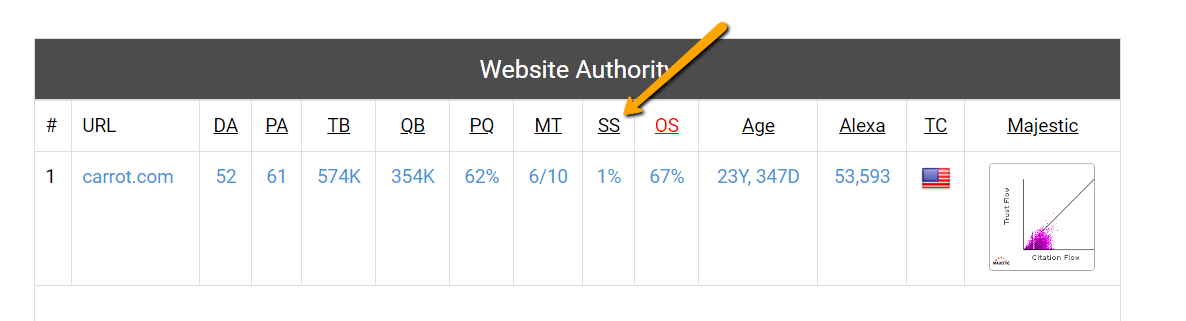
Within the last few years, Google has strengthed the authority of websites that have SSL and weakened those that don’t. SSL certification is a basic way to secure your website from prying eyes. You can tell whether you have SSL certification or not by going to your website and checking to see if your URL is “HTTP” or “HTTPS” — if it’s “HTTPS”, then it has SSL certification already.
If you don’t have a Carrot website, you’ll have to do the process manually and pay about $50.
This isn’t a total game-changer for your rankings, but it might be just the boost you need to beat pesky competitors.
Step 8. Optimize Your Real Estate Website for Mobile
If your website isn’t mobile-optimized, you should look into getting a different website builder that automatically adjusts for different devices. (Carrot websites are optimized for all viewing devices, including mobile.)
If your website isn’t mobile-friendly, then it’s unlikely you’ll get many rankings at all — Google now prioritizes indexing the mobile version of sites over the desktop version, so this is an absolute must if you’re serious about ranking in search engines.
You can test your site to see if it’s mobile-friendly using our mobile-friendly tool.
1. Get a Real Estate website that is “mobile-friendly” + responsive.
2. Design for the touch, not the click Notice The Important “tap” Elements On This Carrot Site In The Green Zone
3. Make it easy for visitors to engage with you (both opt-in and phone) 4. Get to the call to action quickly
5. Don’t use too many form fields.
6. Sandwich your call to action areas. One on top and one on the bottom. Optimize your page by adding a phone number and a second form to the bottom of the page.
7. Don’t rely on video as the primary call to action.
Step 9. Improve Your Keyword Density
People who are new to SEO make a few common mistakes when it comes to keyword density. Either they don’t include their keyword phrase in the copy, they include it way too much (which Google counts as spammy), or they try to rank for 10 different keyword phrases with a single page.
So… if any of those sound like you… here are a few guidelines to stick to…
Aim For 1 Keyword Phrase Per Page — No more. No less. And if some keyword phrases are super similar, then put those on there as well. Just don’t try to rank for totally different keyword phrases on the same page… you’ll probably end up ranking for nothing.
Aim For 1% Keyword Density — As for the exact match of your keyword phrase, try for 1% keyword density. This means that for every 100 words, your keyword should be mentioned once. Less than this and Google might not know what your page is about, but more than this and Google might count it as keyword stuffing (which is a bad thing).
Need help finding the right keywords? Carrot’s Keyword Explorer lets you spy on competitor’s rankings and find new keyword ideas for your content marketing strategy.
Step 10. Avoid Black-Hat SEO
Google isn’t afraid to penalize websites that’ve been using shady tactics to help their rankings. So we recommend avoiding black-hat SEO tactics, such as paying for backlinks or using Private Blog Networks (PBN’s).
If you don’t know what that means, good, you’re probably not doing it. But if you have used those tactics and you think Google might be penalizing you, then you can check to see over on Google Search Console.
To fix a penalty, stop any black-hat SEO tactics, produce high-quality content, and keep working on your SEO efforts. Over time, Google will learn to trust you again.
Conclusion
There you have it! Now you know what to do if your real estate SEO rankings are slipping.
Just like with farming, seasons matter in business.
If you own a ski resort… seasons matter big time.
If you are a landscaper… seasons matter.
If you are a real estate investor or agent… seasons matter.
And, even though it’s December, now is the time to start thinking about Spring.
We wrote a blog post about the seasonality of real estate investor leads and the volume of online searches that motivated house sellers, cash buyers, tenants, etc. make each month during the holiday months.
In that post, we laid out the data and the stats showing the common “dip” in searches in the holiday months for people looking to sell their house… and the increase in those online motivated seller leads in the spring and summer months.
Now, this doesn’t mean that there aren’t a lot of deals to be had in the winter months.
Why Now Is The Perfect Time To Ramp Up For Spring And Online Motivated Seller Leads
So, don’t look at the data and think that you can’t do deals in the holiday months. That’s not what this is about. It’s about…
Realizing There Is “Lead Gen” Seasonality In The Real Estate Flipping / Wholesaling Business and Preparing For…
… the dips and the climbs.
Take for instance the quick chart below that we pulled up.
Motivated Seller Searches: 11 Popular Highly Motivated House Seller Searches Online… The Trend
Motivated House Seller Searches: This is the average motivated house seller online searches of just 11 common highly motivated seller searches sellers make online. Notice the data… and the slight climb to a peak in summer in searches. Then another climb in fall before the holiday dip.
Now take a look at these ones below that are a bit more drilled down on specific keyword phrases that we know motivated sellers are typing into Google each month.
(at the end of this post I’ll show you something really cool that we’re seeing… and how it’s indicating that we’re heading into another GREAT year for an increase in motivated seller searches online. So read this whole article and let me know your thoughts in the comments section)
“We buy houses” Type Searches: Spring And Summer Increase
It’s December… Are you preparing right now to capture the higher motivated seller lead search volume in the spring and summer? If you don’t have a website, right now is the time to get one up and started. If you do have a website, now’s the time to get things ramped up.
“Sell house fast” Type Phrases: Spring Bump with Late Summer Increase
Getting The Picture Now? Getting your website up and rolling and optimized… or getting a real marketing plan in place and executing it RIGHT NOW is an ideal time to get rolling so you can capture the late spring and summer increase… which likely means a higher chance of more deals.
“I buy houses” Type Phrases: Seeing A Similar Spring And Summer Bump And Fall Slump
Pretty Consistent w/ a Slight Bump In Spring / Summer
“We buy houses in [location]” Type Phrases: But For Just Portland, Atlanta, Houston, and Pittsburgh
Even More Dramatic Spring / Summer Bump: When you go hyper-local… where the motivated seller includes their city in the search (which most sellers do), the increase likely coming up in spring and summer becomes even more apparent.
Last… from our own Google Analytics account.
Spring / Summer Traffic Ramp From Our Own Google Analytics Account
Further Proof… We can look at Google’s data all day long, but how about actual Google Analytics data from our own account for our Carrot members’ real state websites.
You get the idea.
Those charts above show just a few of the dozens and dozens of SEO search phrases motivated house sellers are typing in… that real estate investors should want to get in front of.
In fact, our Carrot members are generating over 60,000 opt-in leads per month(that doesn’t count the thousands of phone call leads per month to their Carrot real estate websites as well). So we’re constantly helping our customers position themselves in front of the online traffic to increase their chances of generating more motivated seller leads and more deals.
The SEO Search Data Is Great… But Why Is NOW A Great Time To Get Things Rolling?
Over the past five years, we’ve been tracking the organic search engine rankings of many of our Carrot members’ real estate websites. This goes from motivated house seller websites to cash buyer websites, to note buyer websites, rent to own websites, agent sites, etc.
This is a mix of real estate investors and agents who are both implementing our “lead generation” training… and the ones who decided to outsource their SEO or PPC for them.
Take a look at some of these charts below that show how long it *may* take in some markets to get your SEO rankings to improve enough to generate consistent leads online.
These pictures are from actual SEO ranking increases for a few of our Carrot clients in some more competitive markets.
How Long Did Their SEO Take? 4 Months To Make A Major SEO Jump In This Competitive MD Market
4 Months And 20 Deals – This InvestorCarrot client used our 3 Lead Per Day Training to get her website ranked high in Google. She’s in a more competitive market and it took about 4 months to get onto page 1… another few months to get in the top 2 results.
And another…
How Long Did Their SEO Take? About 3-5 Months In A Competitive Alabama Market
Similar To Above – This client is in a very competitive market for motivated seller searches as well. It took 3-5 months of solid SEO work to get into a top position in Google in his market. Now he’s generating a lead per day and closing deals consistently through his online marketing.
Last one…
How Long Did Their SEO Take? About 2-3 Months In A Competitive California Market
They Had A Jumpstart – This Carrot customer was already ranking near page 1 in Google for a competitive search phrase for motivated seller leads. Within 2-3 months, his ranking improved to the top of page 1 for this search phrase and he’s closed 4+ deals from his Carrot site since.
The Average Time It May Take To Rank Well In Most Markets Is About 3-5+ Months When You’re Doing SEO
SEO for real estate typically takes time. Although, I’ve seen websites rank in the top 3 spots in Google WAY faster than that in less competitive markets (within weeks)… I’ve seen some take way longer. But what we always like to say is that if you’re implementing SEO right (the way we teach) or hire someone who knows what they’re doing… in most markets you should see a dramatic improvement within 3-5 months.
From there, it may take another few months in competitive markets to get to the top of page 1… sometimes longer.
But, all this to say… if the average is 3-5 months to see an SEO boost… and it’s the beginning of December right now… that puts you into March – May/June to improve your rankings and capture that increase in online searches from motivated sellers come Springtime.
Don’t have a website right now but want to start leveraging inbound online marketing for your real estate investing business to grow your business?
Already have a website and just haven’t seen the results or haven’t put in the right online marketing strategy to get results?
We can help you.
At Carrot we focus on results as the primary driver of everything we do.
Having a great platform that makes SEO easier for you is the first step (which our system does).
Having the right training, plan, and support is the part that makes the biggest difference.
If you’re a Carrot member and want to ramp things up, here’s what you can do:
Show up to our weekly Carrot Coaching Calls – I’ll take your website and show you exactly what changes and steps you need to take right now to improve your SEO ranking and leads. This is perhaps one of the largest reasons Carrot members love Carrot and get great results. Hands-on help.
Go through our 3 Lead Per Day Training – It’ll walk you step by step through how to improve your SEO rankings using your own website and youtube videos. Get implementing! And ask us questions when you hit any roadblocks. We’re here for ya!
With our detailed training and weekly LIVE Carrot Coaching Calls, we take our members by the hand and help you get results.
So, are you going to commit to getting things started or ramped up with your online marketing right now to catch the increase in traffic that’s heading our way in a few months?
Hit me w/ your comments below and let us know if we can help you in that journey this next year.
SEO for real estate agents is the process of increasing website rankings by improving on and off-page factors such as content, keywords, page speed, URLs, and backlinks.
Choosing a good domain name
Does a domain name matter for SEO? Well, yes and no.
A better question might be how you want to brand your agent website?
You can either brand your website with a name or a location. The location will restrict your ability to market outside of your initial target market. For some investors that is not a problem.
We published more information about branding considerations here.
As for having a keyword rich domain name we also have some thoughts.
The short answer is, not all real estate agents will have the opportunity to grab a keyword-rich URL so don’t worry too much about it.
Carrot Personally Branded Real Estate Agent Site
Pick the keywords that you want to use for organic rankings
Keywords are one of the most important aspects of SEO. A keyword is what word you are placing the most importance on for Google to know what the page is generally about.
If you have never done keyword research, not to worry, it’s really easy.
If you want to know which keywords we have identified as the best keywords to target on your website, grab our SEO Bible.
Write engaging content that connects with your visitors
Google’s algorithm analyzes how engaging your content is.
It tracks this a few ways,
How long a visitor stays on your page
How many pages they view
How fast your website can load pages
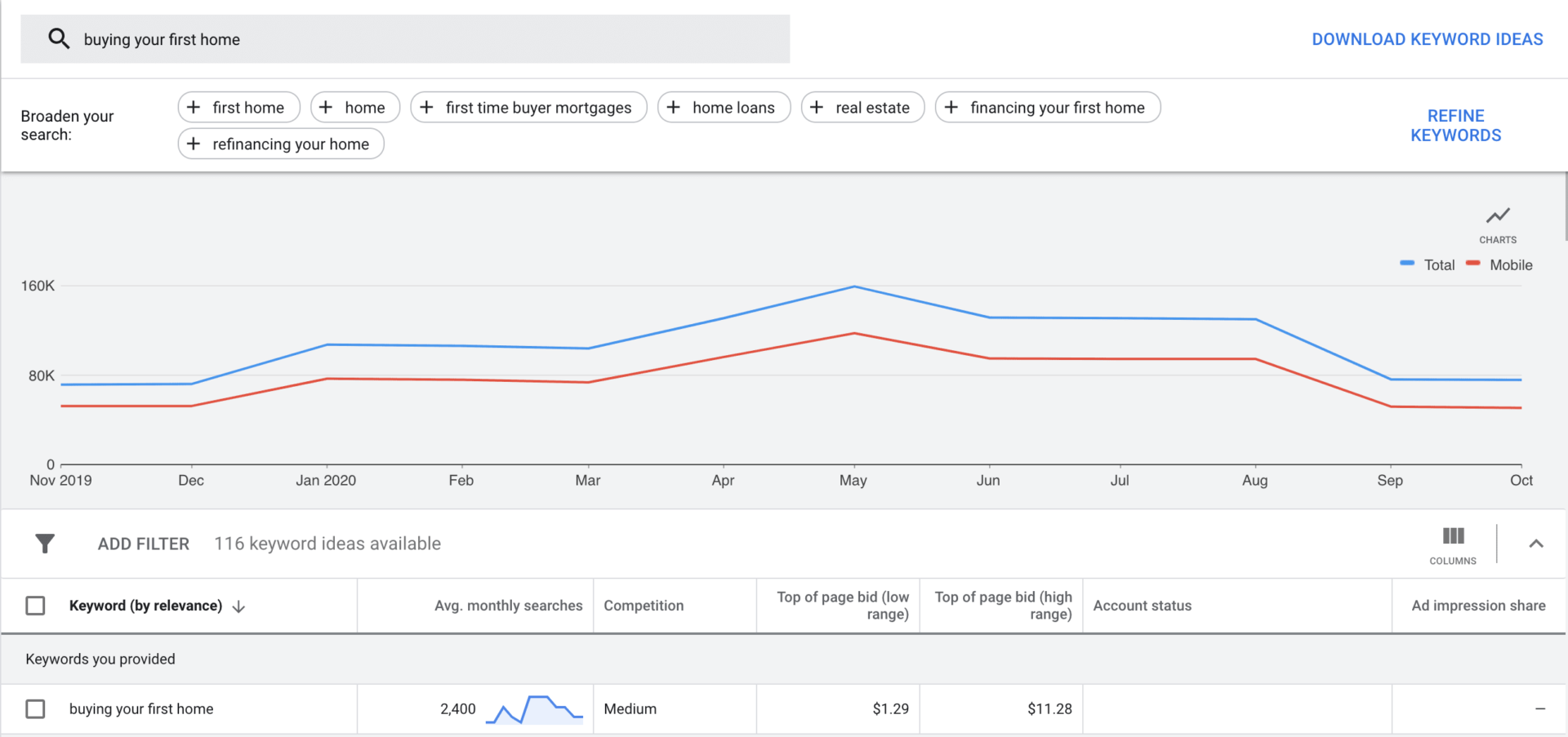
In order to engage your readers, try to answer a question you know they will have. If you’re not sure where to start, you can by typing in phrases using Google. Then use the keywords that you find have good search volume and also answer important questions. Such as, how to buy my first house.
Also, mix your content up between written words, video, and visuals when it makes sense.
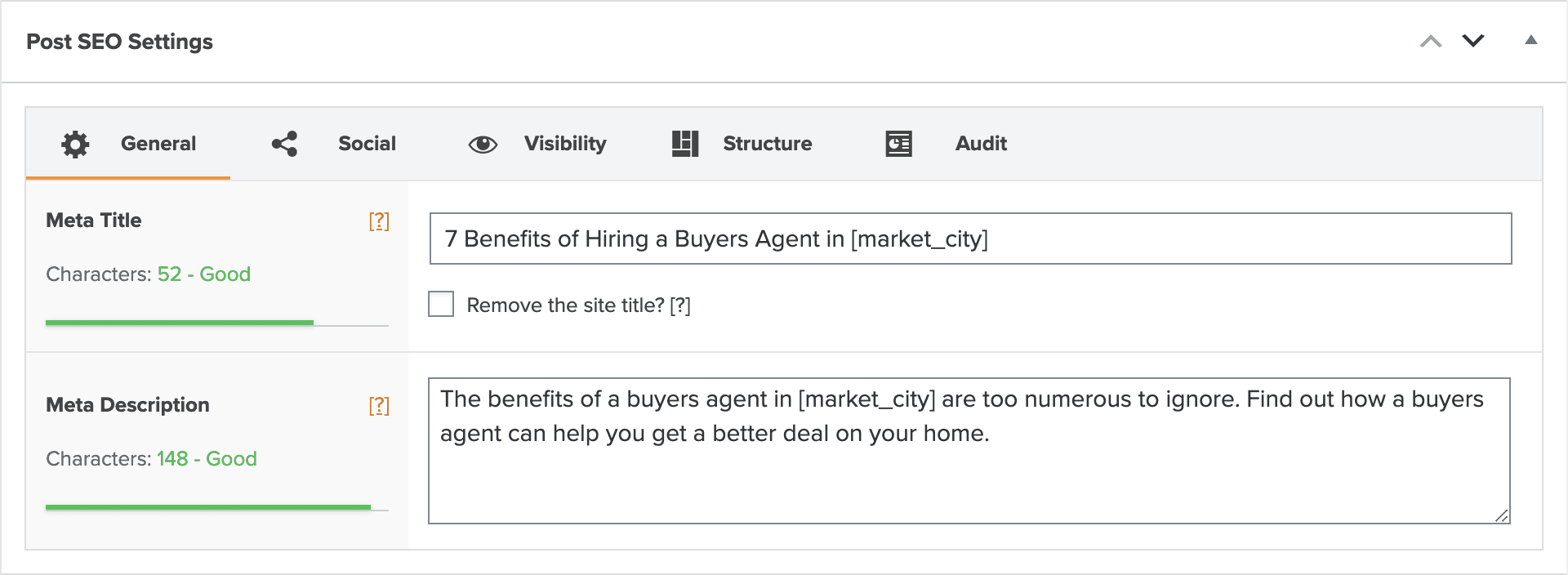
Keep your title tag under 60 characters
Years ago Google search results would limit title tag length based on the number of characters.
Now they do it a bit different. They use pixels (the current limit is 512 pixels).
No one should count pixels, we recommend you just count characters. And we’ve found that staying under 60 characters will keep you under the pixel limit most of the time.
We have a handy tool built into Carrot websites that help you create your page or blog post’s title tag
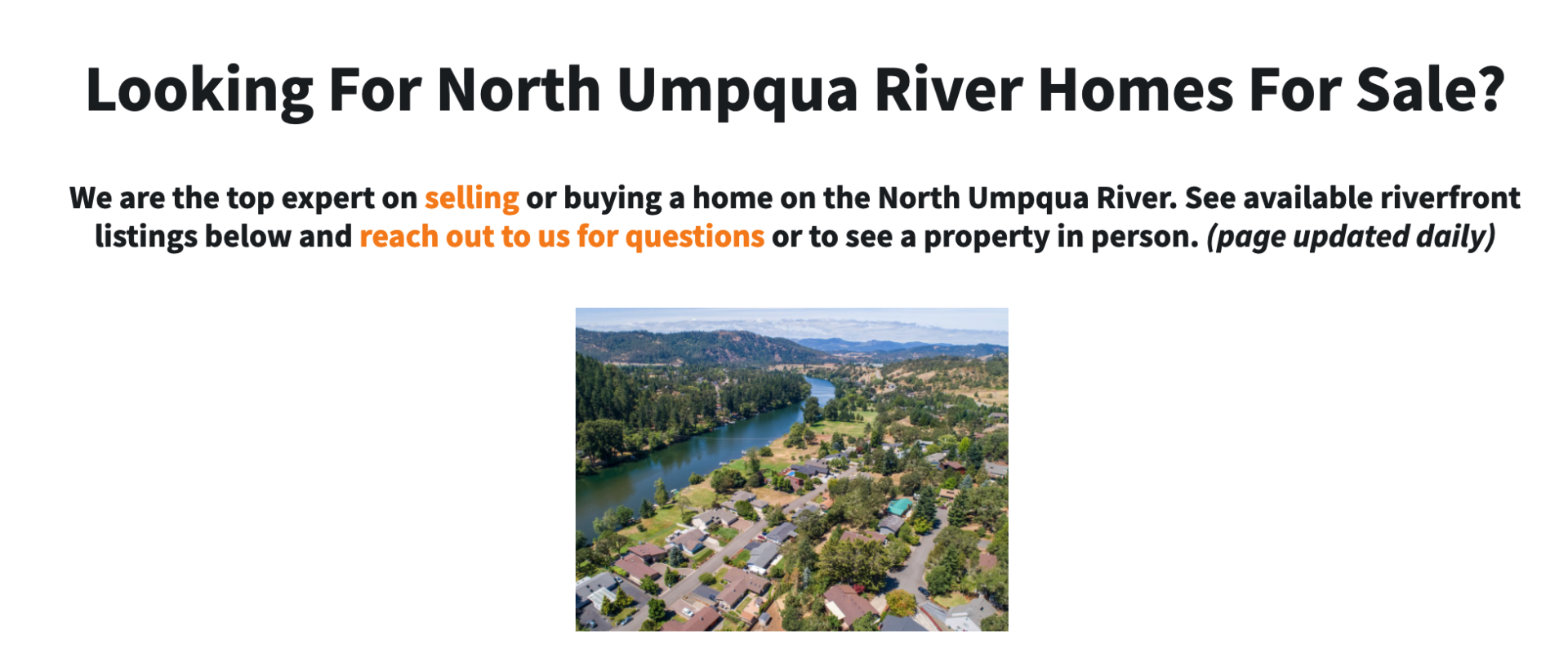
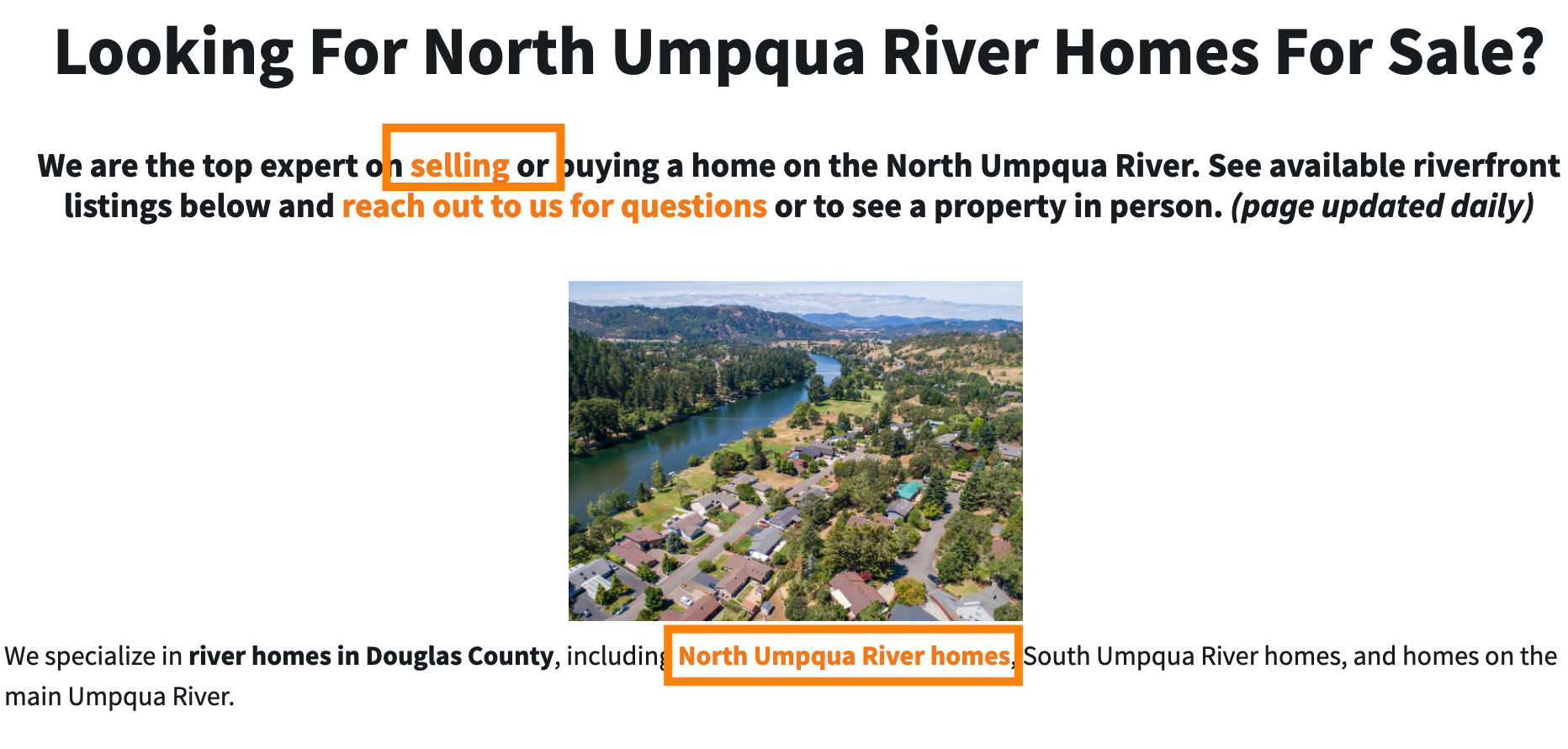
Place your keyword in the first 100 words
It’s still important and common practice to include your keyword within the first 100 words.
Having it near the top will allow visitors to connect with the topic that they have searched for. They’ll know that they are in the correct place.
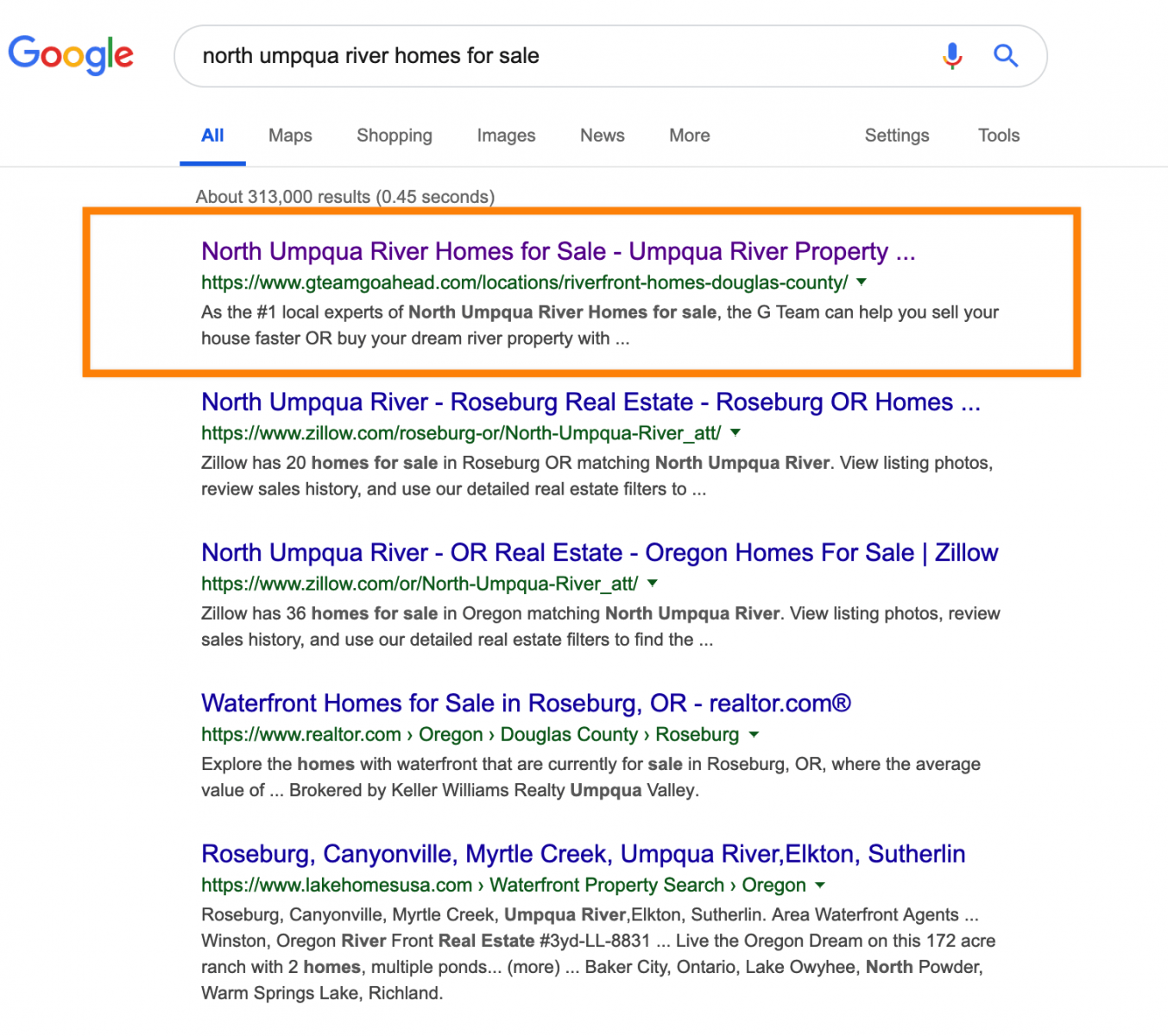
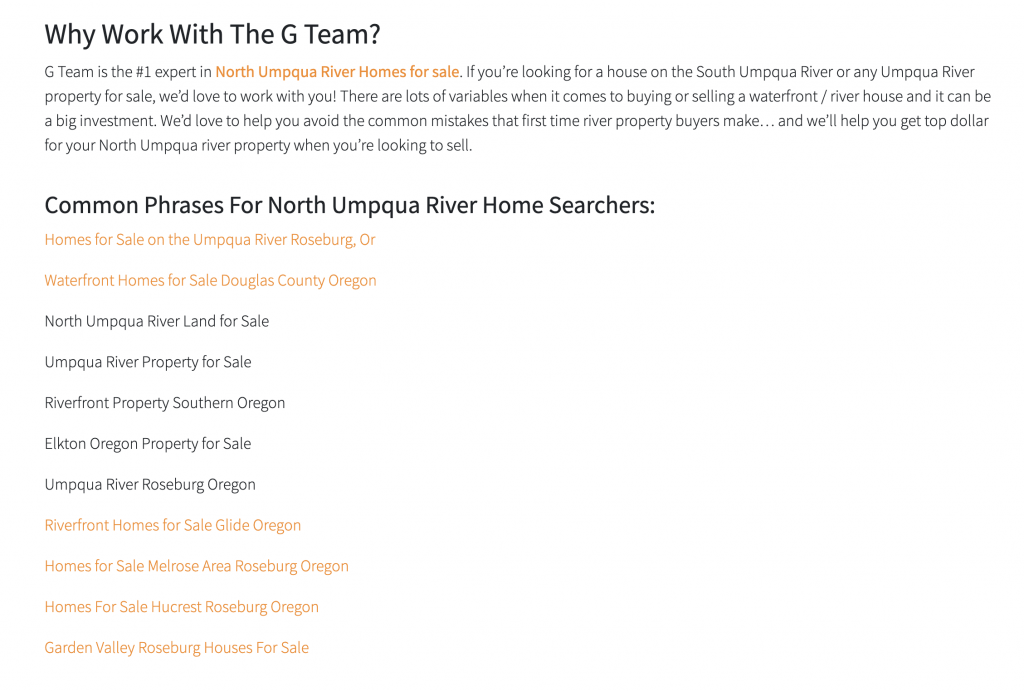
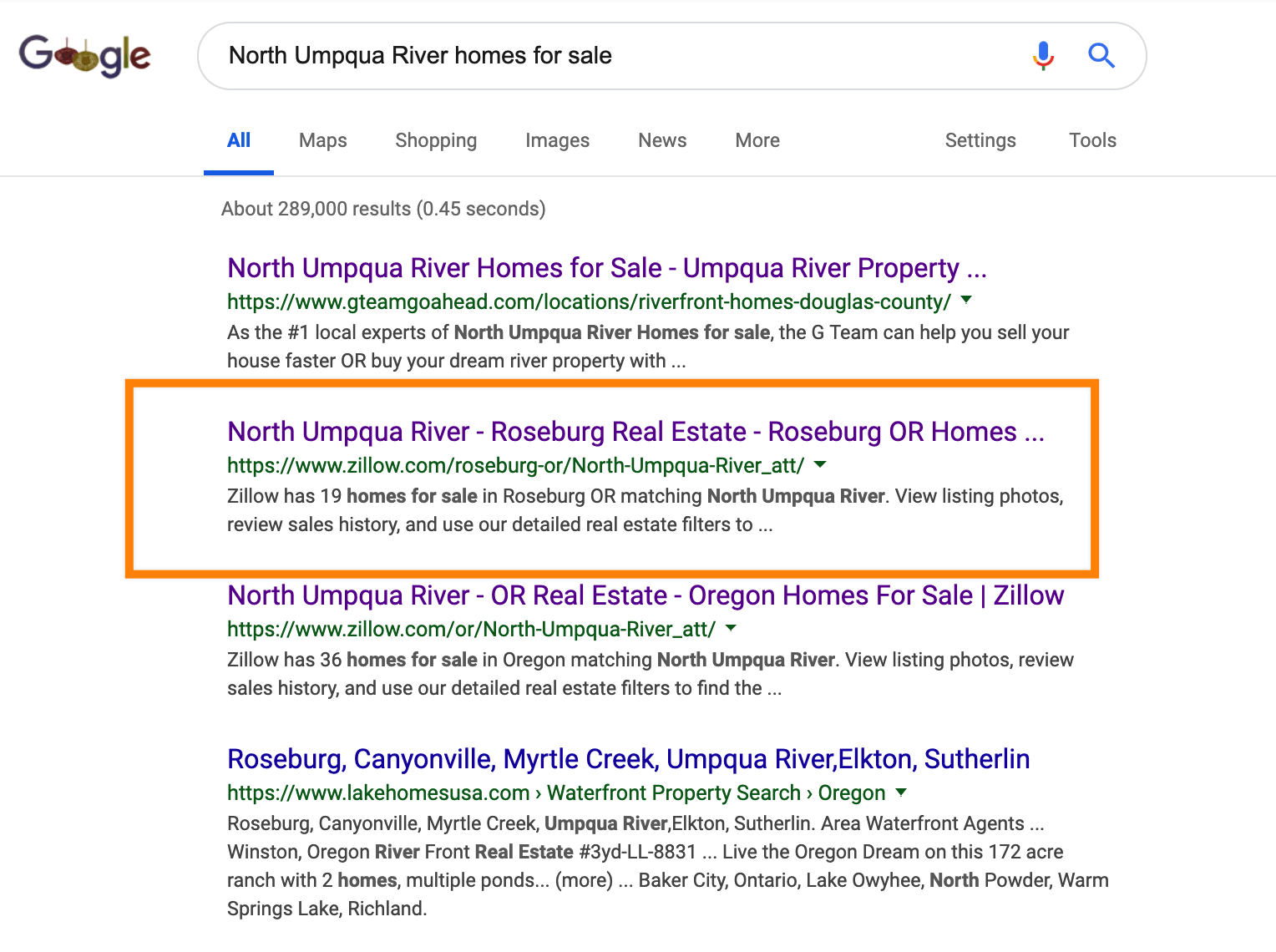
For example, this Carrot member out-ranks Zillow for long-tail keyword “North Umpqua River Homes” and you can see it with the very top of the content.
Use shorter URLs
Short URLs can help a searcher understand what the page is about before clicking on it.
It can also make it easier for them to remember if they ever need to return.
A study performed by Backlinko.com analyzed 1 million Google search results and the study revealed that shorter URLs performed better in Google than long URLs.
Although long-tail keyword URL’s most likely won’t have a significant negative impact on your SEO, from a searcher’s point of view, easily remembered URLs are the way to go.
Use images
An image can do a lot for your real estate website. It can add amazing location images to look at, break up your text, and give the search engines a better idea of what’s on the page.
Keeping your readers engaged with your content helps Google know that the content is worthwhile and to keep it ranking high for search terms.
Google pays attention to user experience signals. So, anything you can do to keep visitors on your page is a big win.
Here is an example of using images to break up text within a blog post.
Must haves: Privacy policy and terms page
Having a privacy policy and terms page most likely won’t give your real estate website a huge boost in the search ranking but don’t forget about these pages.
First, you have the opportunity to include your company name which helps, especially since it will be linked on every page of your website’s footer.
Another reason to have these pages is that it helps Google and Bing visitors see that you are a legitimate business. You have the opportunity to create content about what you do and who you are.
Carrot websites include these pages in the footer by default.
Don’t over-optimize anchor text
It’s recommended to put your keyword in your anchor tag, the text in your links, some of the time. But not all of the time.
It’s been a while but during Google’s Penguin update websites started being penalized for over optimizing anchor text with keywords.
Create link text that helps your visitors understand what they are clicking. You don’t need to worry about stuffing keywords to help rankings. Make your content flow with real terms.
New to link building? Try writing a simple resource page
A resources page can be a simple, quick, and easy way to get a bunch of links on a page that are really helpful to a website visitor.
Find a few resources that a website visitor might look for. Include them on the page and then email the person who you link to and ask them to check out the resource you included them on.
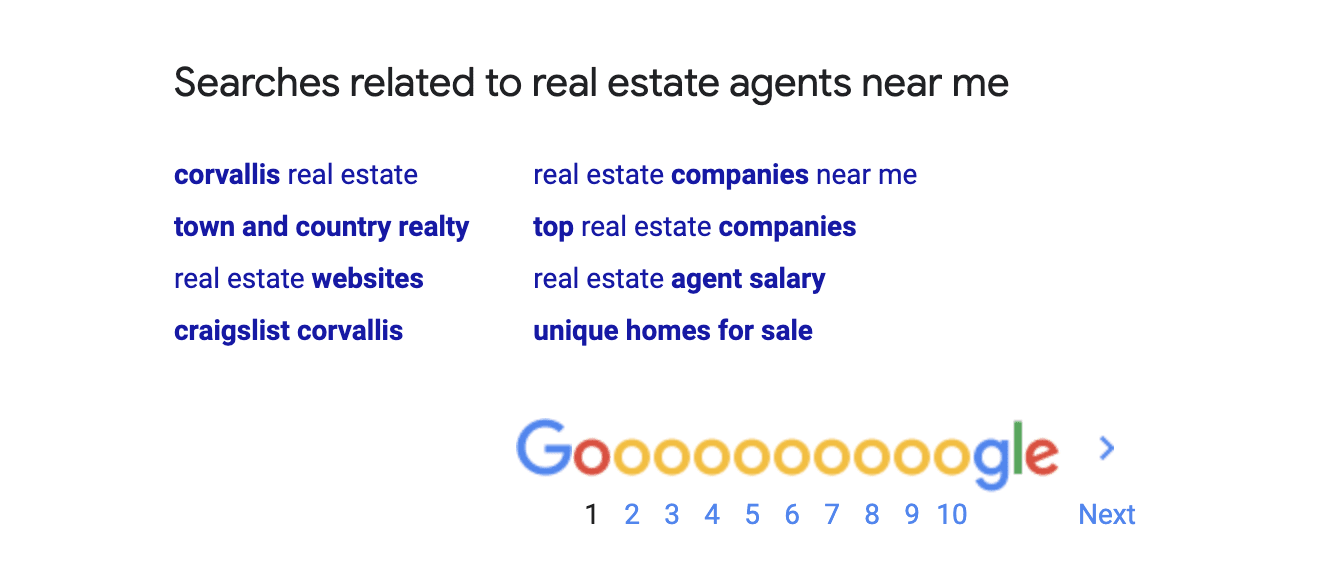
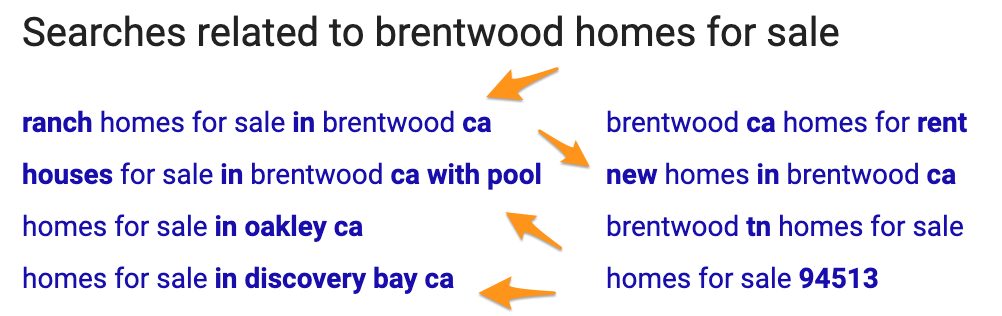
Google will give you some suggestions on what other keywords are related to your search.
Just use Google search to find some keywords you think leads are typing in and at the bottom of the search results you will see what Google is relating that search to.
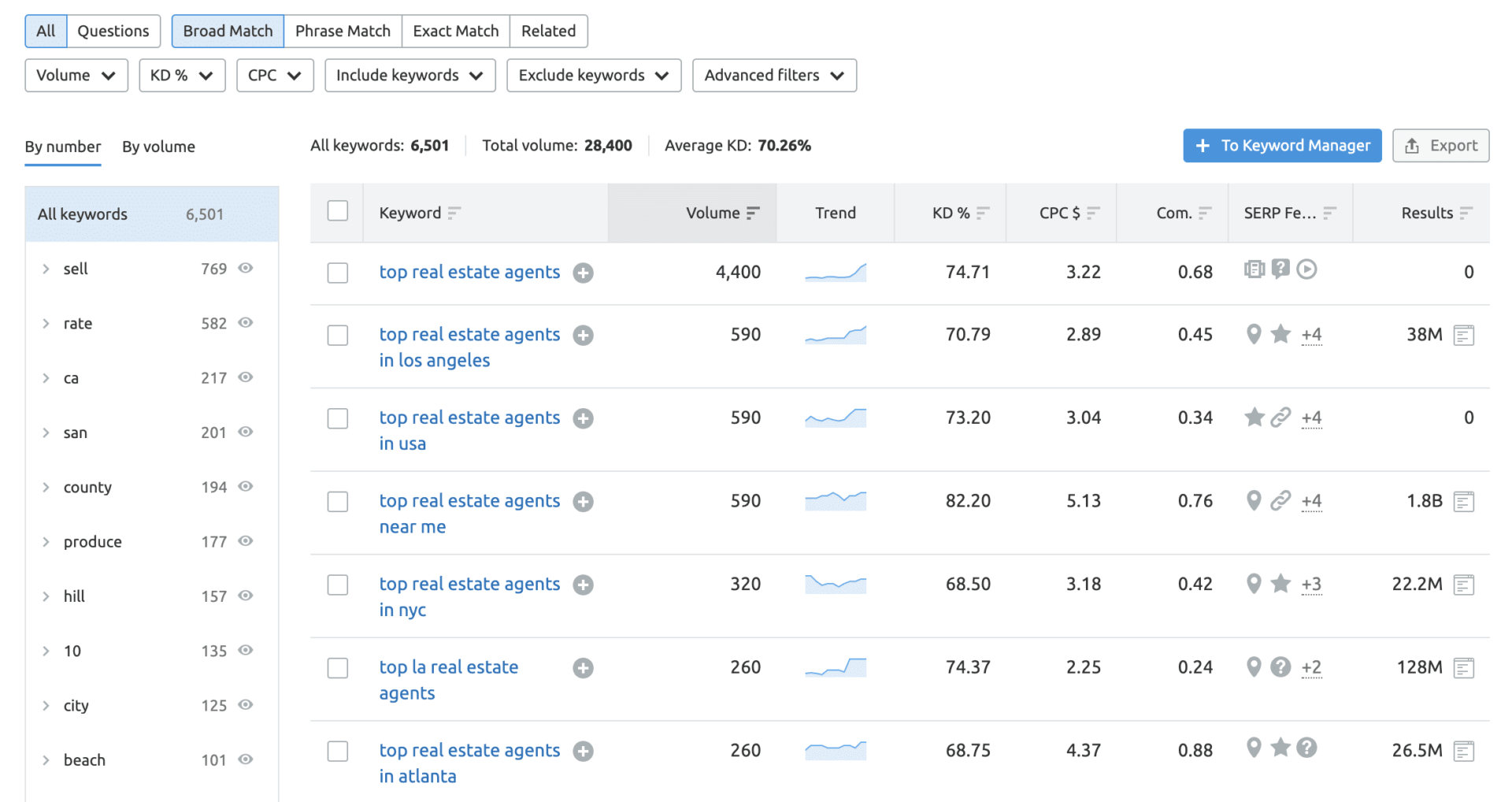
Spy on competitors’ keywords with SEMRush
SEMRush is a great keyword research tool that offers a lot of features to help your real estate website’s SEO.
Maybe, what it’s best at is helping you find what keywords your competition are ranking for.
Simply add a keyword or competitor domain and see what comes up. You’ll find the keywords in their title tag and meta description. Then you can try and optimize those for yourself.
Make sure your website is mobile-friendly
Carrot members get a lot of traffic from mobile devices.
You should always make sure your website is mobile-friendly. Not sure how to do that? Use our free tool here.
Make sure your real estate agent website server is fast
Why do you want your website to load fast?
Google wants to send users to pages with quick load times because no one wants to wait to find answers.
Hosting is important and you get what you pay for. If you have some who built your website, ask them to look at your website’s speeds.
Carrot sites are built and hosted on highly secure and fast servers. And, we are constantly improving the website speed for our members.
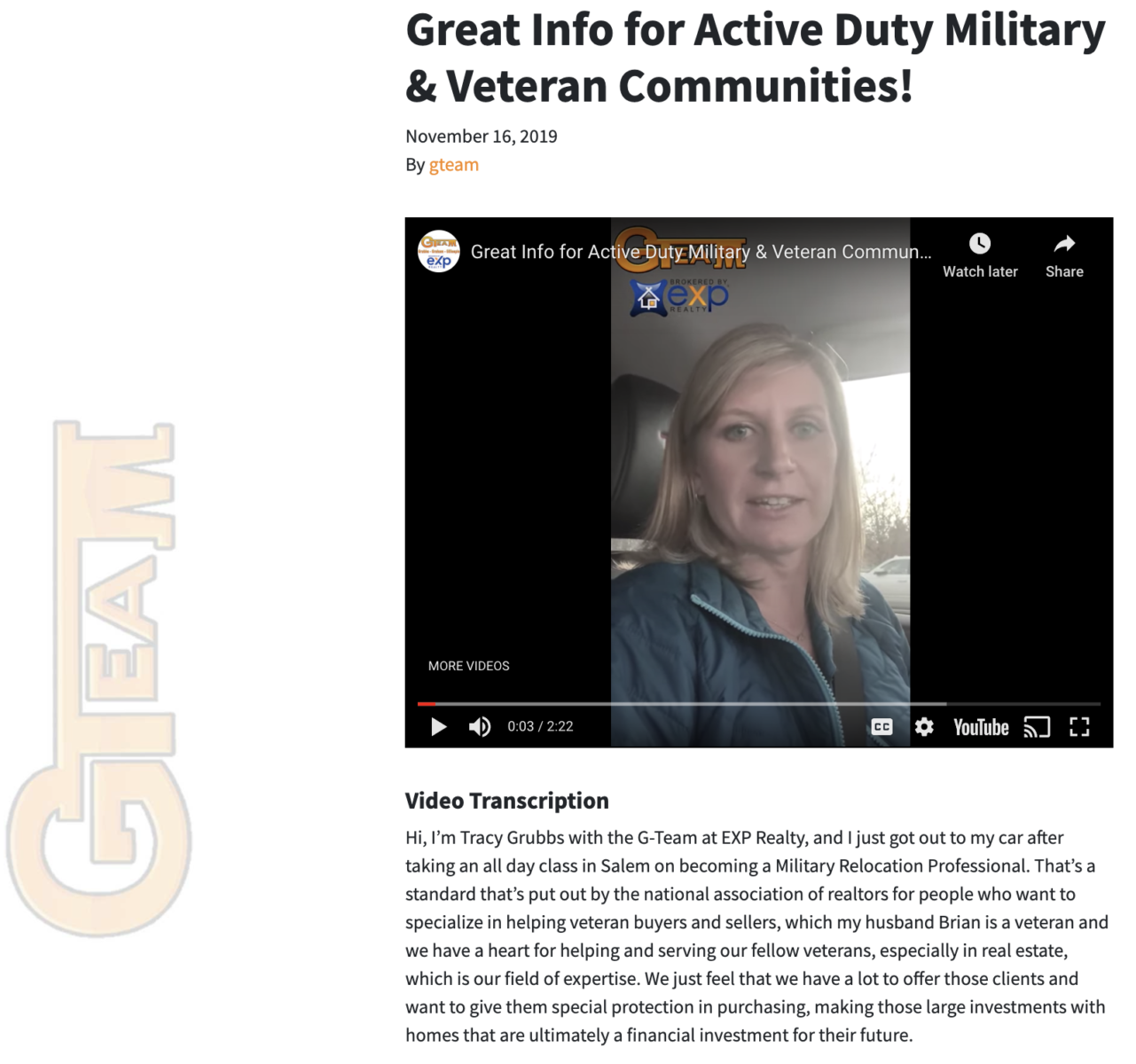
Use video post transcriptions
Using a video post transcription for your videos is a great idea to make your website more accessible for all visitors, especially those who use screen readers, and, having text to create more SEO opportunities.
Google can’t crawl a video. Adding a transcript gives Google the information it needs to decide what the video is about.
You can see an example of a video post one of our members did…
If the video is a YouTube video, these embeds will boost views (and therefore rankings).
Either way, embedded videos can significantly improve your bounce rate and dwell time numbers.
Here’s an example of an embedded video:
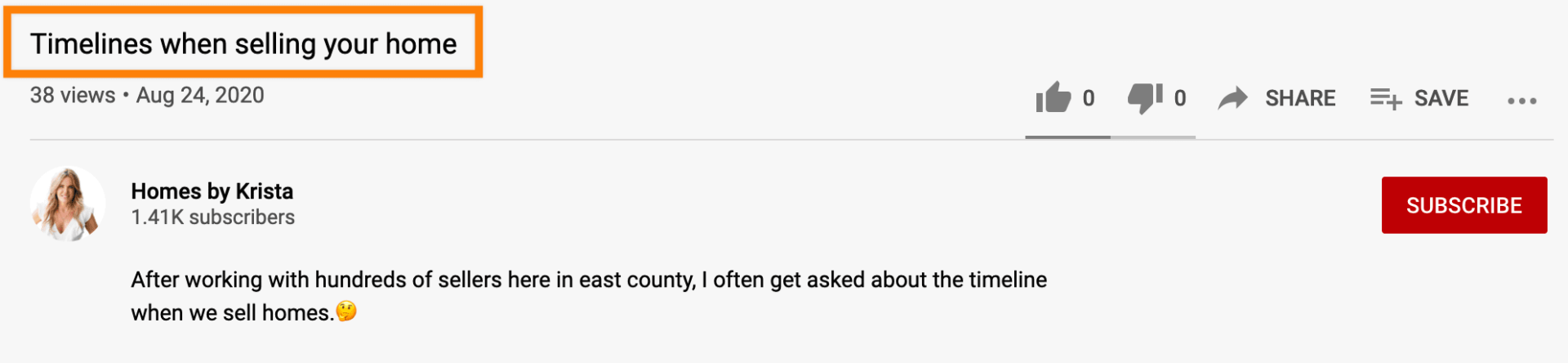
Include your keyword within your video’s filename, title and description
Google needs help in figuring out what your video is about.
Include your target keyword (at least once) in your video’s filename, title, and description. That way you’ll be helping Google and YouTube understand your video’s topic.
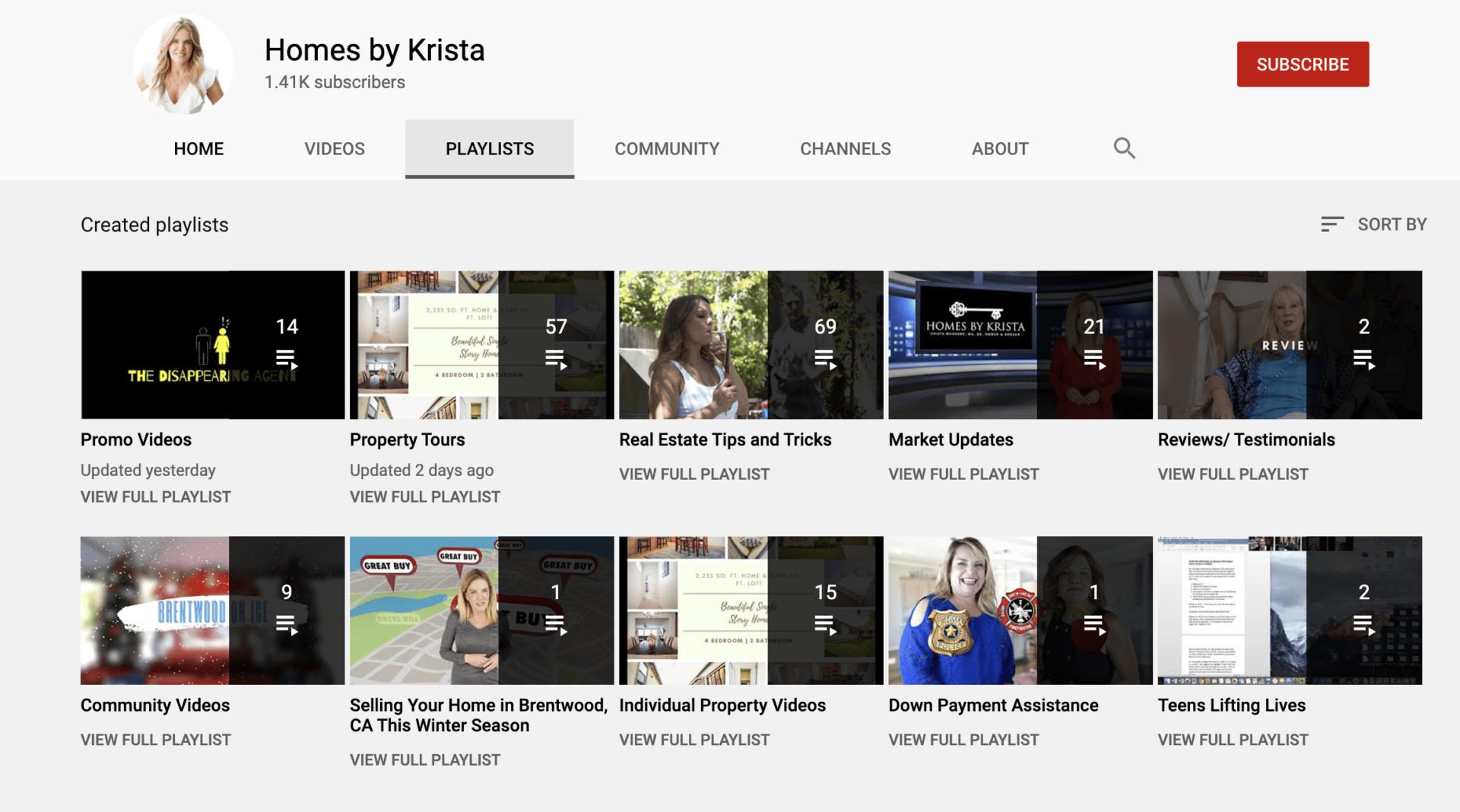
Use keywords within your YouTube playlist
Why put in the effort?
Well your playlist can actually help rank in YouTube’s search results.
Second, again, it’s helping Google and YouTube know which videos and playlists to suggest.
Keyword-rich URLs
Google still pays attention to the keywords that appear in your URL. A URL provide a strong indicator of what your page is all about.
Use keywords in subheadings and make content easy to read
Visitors will spend more time on your site when content easy to read.
Avoid a lot of paragraphs bunched together. Space your walls of text into skimmable content with bullets and subheadings:
Use brackets in your title tags
Brackets have been shown to boost CTR. Why? Brackets call attention to your idea and allow your content to stand out from the clutter.
Use your keyword in your meta description
You want to optimize your meta description to attach clicks. Write a very clear and compelling for why someone should click on your content.
Also be sure to include you keywords within your meta description.
Use keywords in H1 and H2 tags
It’s recommended that you use your exact keyword in the page’s H1 and H2 tags. But you don’t want to over-optimize or over-use your keyword, so replace the exact keyword with a synonym instead as you create more H2 tags.
So if your target keyword was “Garden Valley Homes for Sale” you could use a term like “Homes For Sale In Garden Valley” in an H2 tag.
Make social sharing buttons easy to find
If a visitor wants to share your content, don’t make it hard for them to do it. Each one of your posts and pages should have a social sharing button easily visible.
And, don’t forget to see how it looks on mobile devices.
Social shares equals in-demand content.
Optimize your homepage for both your brand and conversions
Your homepage carries the most authority.
But they can also be hard to rank. Homepages that are light on content or in highly competitive areas may have more difficulty. That’s one reason Carrot homepages oave have more content. We believe in evergreen content.
As a real estate agent, you should focus on both branding and conversions because a lot of your internal pages link to the home page and there is a good chance if someone comes to your site from a blog post or location page they will also check out your homepage.
Publish long-form content
Content studies have found a correlation between long-form content and higher search rankings. But, that doesn’t mean that simply writing longer content will push you to the top of page one. But publishing 1000+ word content helps increase your odds.
Use internal linking
Internal linking is a good way to tell Google what other pages on your website are useful and related to the topic.
Here’s how it could work. Link from a ranked page to pages you want to rank.
It’s pretty simple and it works.
Here is an example from one of our Carrot members location pages linking to other content on their website.
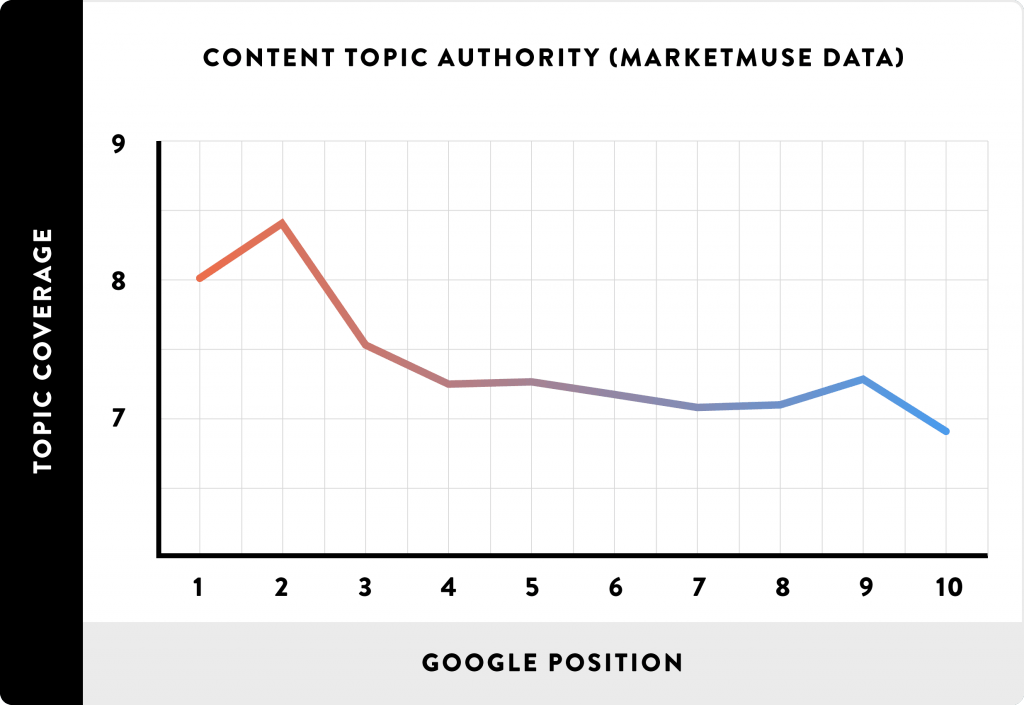
Write content that completely covers a topic
Again, Backlinko’s research shows search engine ranking factors found that highly informative content significantly outperformed shallow, low-level content.
Write image alt text
Google can’t see what’s in an image so you need to tell them. Use image metadata, like the image filename and alt text to communicate what the image is.
It’s a good idea to use a keyword in with the image when it makes sense but avoid simply stuffing keywords.
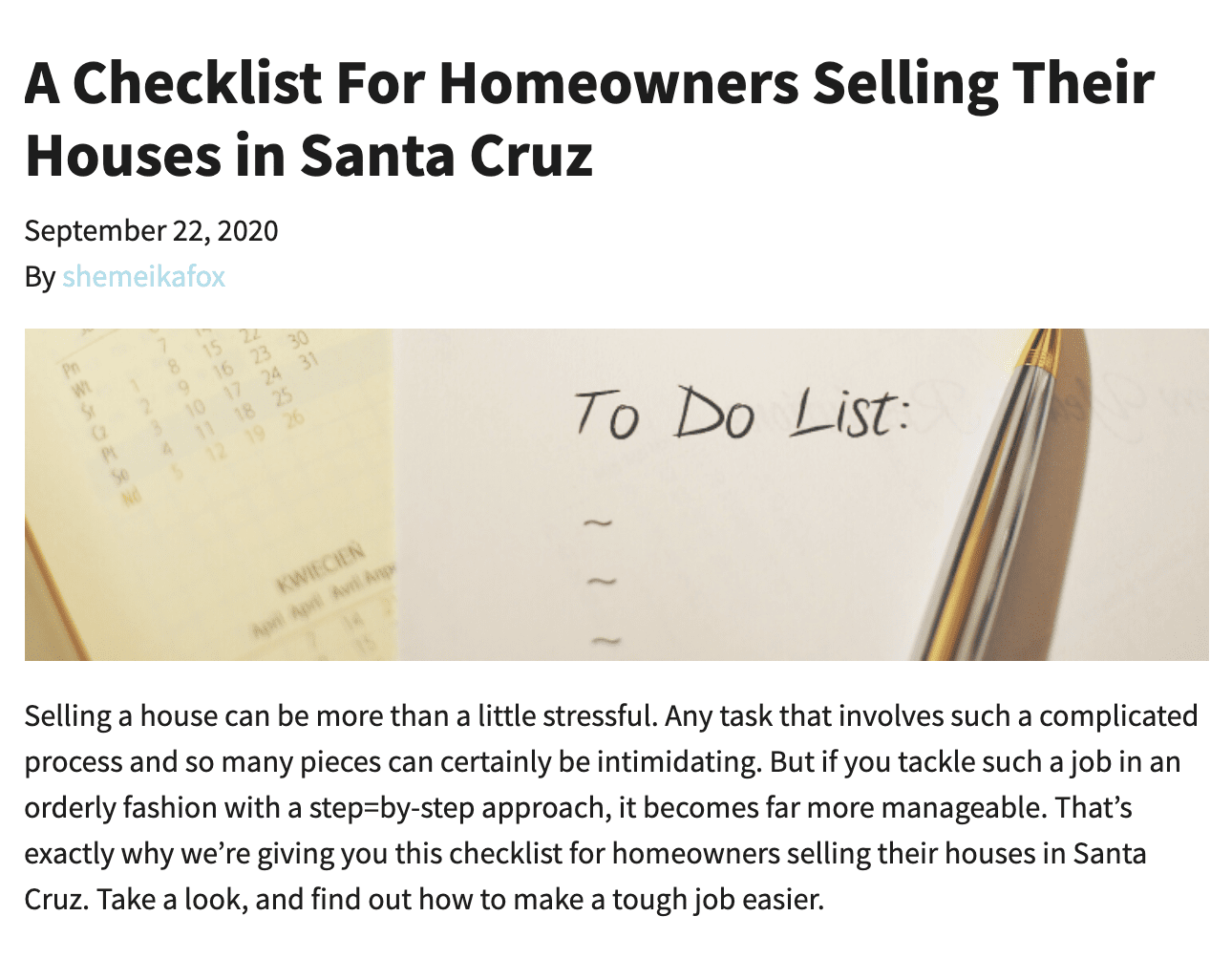
Create a checklist or glossery of terms post
Creating a checklist or terms blog post can take some time, but it can be worth the effort to provide useful information to your visitors.
Basically, create a checklist of an important topic or simply a list of industry-related terms that visitors might not know. Think about all the questions a potential lead might have and start crafting your list.
For example, a checklist homeowners can use to sell their house.
Create an XML and HTML Sitemap
Sitemaps help Google find (and index) real estate website’s pages.
Make sure to create an XML and HTML sitemap of your site and submit them to Google via the Google Search Console.
If you are a Carrot member the sitemap is already created for you. Read our site map tutorial.
Competition in the real estate market will always be fierce. But what if you could attract a steady stream of qualified leads without the constant hustle? The answer lies in local SEO for real estate.
Real Estate SEO Bible: The Ultimate SEO Keywords Guide
Imagine this: a potential seller in your market searches for an investor specializing in fixer-upper properties. Through the power of local SEO, your website appears at the top of their search results, showcasing your expertise in local market trends and flipping potential. This is the magic of a well-optimized local SEO for real estate strategy – attracting motivated sellers and generating deals on autopilot.
This guide is designed for real estate investors like you. By following our 7 simple tips to master local SEO for real estate, you’ll be well on your way to ranking higher in local search results, attracting high-quality leads, and ultimately skyrocketing your real estate business.
The Power of Local SEO for Real Estate Investors: Attract Local Leads & Dominate Your Market
Local SEO focuses on optimizing your online presence to rank higher in search results for local searches related to real estate investing in your target market. With a strong local SEO strategy, your website could be the first they see, positioning you as the go-to expert.
The benefits of local SEO for real estate investors are undeniable:
Attract a Steady Stream of Local Leads: By ranking higher for relevant searches, you’ll naturally attract motivated sellers in your area, saving you time and resources on lead generation.
Target High-Quality Leads: Local SEO prioritizes location, ensuring you connect with sellers searching for someone to buy their house quickly.
Boost Brand Awareness and Credibility: High local search rankings project an image of authority and expertise, making you the trusted choice for local sellers.
Cost-Effective Marketing Strategy: Compared to traditional advertising, local SEO offers a long-term, sustainable approach to lead generation without breaking the bank. This is what we call Evergreen Marketing.
By mastering local SEO for real estate, you’re not just optimizing your website – you’re setting yourself up as a dominant player in your local market, attracting a constant flow of qualified leads ready to do business.
7 Simple Tips to Master Local SEO for Real Estate and Skyrocket Your Lead Generation
Now that you understand the power of local SEO for real estate let’s dive into practical steps to implement it. Here are 7 easy-to-follow tips for mastering local SEO for real estate and attracting qualified leads in your target market:
Tip 1: Claim and Optimize Your Google My Business Profile
Think of your Google My Business (GMB) profile as your online storefront for local searches. Claiming and optimizing your GMB profile is crucial for local SEO for real estate. Here’s what to do:
Claim your GMB profile: Search for “Google My Business” and follow the steps to claim your business listing.
Optimize your profile: Fill out all information accurately, including your business address, phone number, website URL, and service categories relevant to real estate investors (e.g., “cash home buyer,” “ real estate investor”).
Add high-quality photos: Showcase your professionalism with clear images of yourself, your team (if applicable), and properties you’ve invested in.
Encourage customer reviews: Positive reviews build trust and improve your local search ranking. Provide exceptional service and politely request satisfied clients to leave a review on your GMB profile.
Tip 2: Target Relevant Local Keywords
The key to attracting local leads lies in using the right SEO keywords. Conduct keyword research to identify search terms potential sellers in your area use. Here’s the trick:
Focus on local intent: Instead of just “real estate investor,” target long-tail keywords with location qualifiers, like “ cash home buyer” or “ investor for distressed properties.”
Use keyword research tools: Free and paid tools like Carrot’s SEO Keyword Bible or SEMrush can help you uncover high-volume, low-competition keywords relevant to your target market. You can use our Keyword Explorer Tool if you are a Carrot member.
Tip 3: Create High-Quality, Local Content
Content is king, and local SEO is no exception. Establish yourself as a local expert by creating informative content that caters to your target audience’s needs. Here are some ideas:
Blog posts: Create informative blog posts on topics like “ real estate market trends,” “ home buying guide for sellers,” or “[type of property] investment strategies in .” Here are 101 blog post topics to get you started.
Local case studies: Showcase your expertise by sharing success stories of past deals you’ve closed.
Local real estate guides: Create downloadable guides offering valuable insights into the local market, attracting leads, and establishing your authority.
Tip 4: Build Local Citations
Citations are essentially online mentions of your business name, address, and phone number (NAP) across various directories and websites. Building strong local citations is a key element of local SEO for real estate. Here’s how to get started:
Claim listings on local directories: Search for relevant online directories in your city/region and claim your business listings, ensuring your NAP information is consistent across all platforms.
Partner with local businesses: Network with other local businesses and explore opportunities for guest blogging or backlinks on their websites.
Industry associations: Join relevant real estate investor associations and get listed on their online directories.
Tip 5: Encourage Positive Online Reviews
Positive online reviews are gold for local SEO for real estate. They build trust with potential sellers and signal expertise to search engines. Here are some ways to encourage reviews:
Provide exceptional service: Happy clients are more likely to leave positive reviews.
Request reviews politely: After a successful transaction, ask your client to leave a review on Google My Business and other platforms. Provide direct links to make it easy for them.
Respond to all reviews: Thank happy customers for their positive feedback and address any negative reviews professionally.
Tip 6: Engage with Local Online Communities
Don’t underestimate the power of local online communities. Actively participating in relevant online forums, Facebook groups, and platforms like Nextdoor can boost brand awareness and establish you as a local expert. Here’s how:
Join local real estate investor groups: Share your knowledge, answer questions, and build relationships with other investors and potential clients in your area.
Engage in discussions: Provide valuable insights on local market trends and demonstrate your expertise in a casual setting.
Offer free consultations: Showcase your expertise by offering free consultations to potential sellers through online communities, building trust and generating leads.
Tip 7: Track Your Results and Adapt
Local SEO for real estate is an ongoing process. It’s crucial to monitor your progress and adapt your strategy accordingly. Here’s what to track:
Get Started Now To Master Local SEO On Your Real Estate Investing Website
As an investor working within today’s web environment, your best strategy to gain the attention of prospective clients in your market is to use local SEO.
The Carrot platform is built to make it crazy easy to leverage local SEO and outrank your competition. So, take a demo of Carrot and see if it’s a fit.
We talk a lot about content marketing for real estate agents and investors.
Writing blog content for your website doesn’t just help you generate more passive traffic through SEO (Search Engine Optimization); it also allows you to engage with your ideal market and provide them with free value.
But for all the buzz around writing blog content, recording videos, and posting on social media, it can still be a challenge to create that high-quality content that ranks in Google (generating passive traffic to your website), engages your ideal market, and gets “shares” on social media.
So, we put together this resource for you with five easy-to-follow real estate blog post templates for real estate agents and investors.
How Powerful is Content Marketing For Real Estate?
Content marketing is, quite simply, publishing content (blog articles, social media posts, YouTube videos, etc.) to brand and grow your business.
And it’s effective for pretty much every industry, real estate included.
In some ways, content marketing is more effective in the real estate industry than in other industries.
If I want to create content consistently and I’m in the travel niche, for example, I’m going to have a ton of competition—there are just a lot of content creators in the travel niche.
Not so much for real estate. Especially if you consider that you’re only competing with content-creating real estate professionals in your area of operation, there’s even less competition.
That’s good! It means you’ll have less trouble standing out.
But if you’re still not convinced that consistent content marketing can be crazy powerful for your business’ growth, consider these stats…
90% of buyers look online to find their next home.
70% of people prefer to get a sense of your business through online content.
61% of inbound leads cost less than outbound leads.
Websites with blogs have 434% more indexed pages than websites without blogs.
Companies that blog receive 97% more links than those that don’t.
Yeah…
Content marketing can certainly give your real estate business the boost it needs. We also have a few other resources on this topic that you might find helpful.
Either way, here are five blog post templates for your real estate website content.
Keep in Mind Before You Write
Here are some things to remember before you start writing your blog posts.
Get to know your audience
Do keyword research before writing
Write a good headline for every blog post
Hook your readers from the start
Answer their questions with your blog posts
Tell a captivating story
Make your content easily scannable
Be authentic in your writing
Prioritize quality content over the number of words
Use data
Need help finding keywords for your blog posts? We did it for you!
5 Real Estate Blog Post Templates You Can Steal
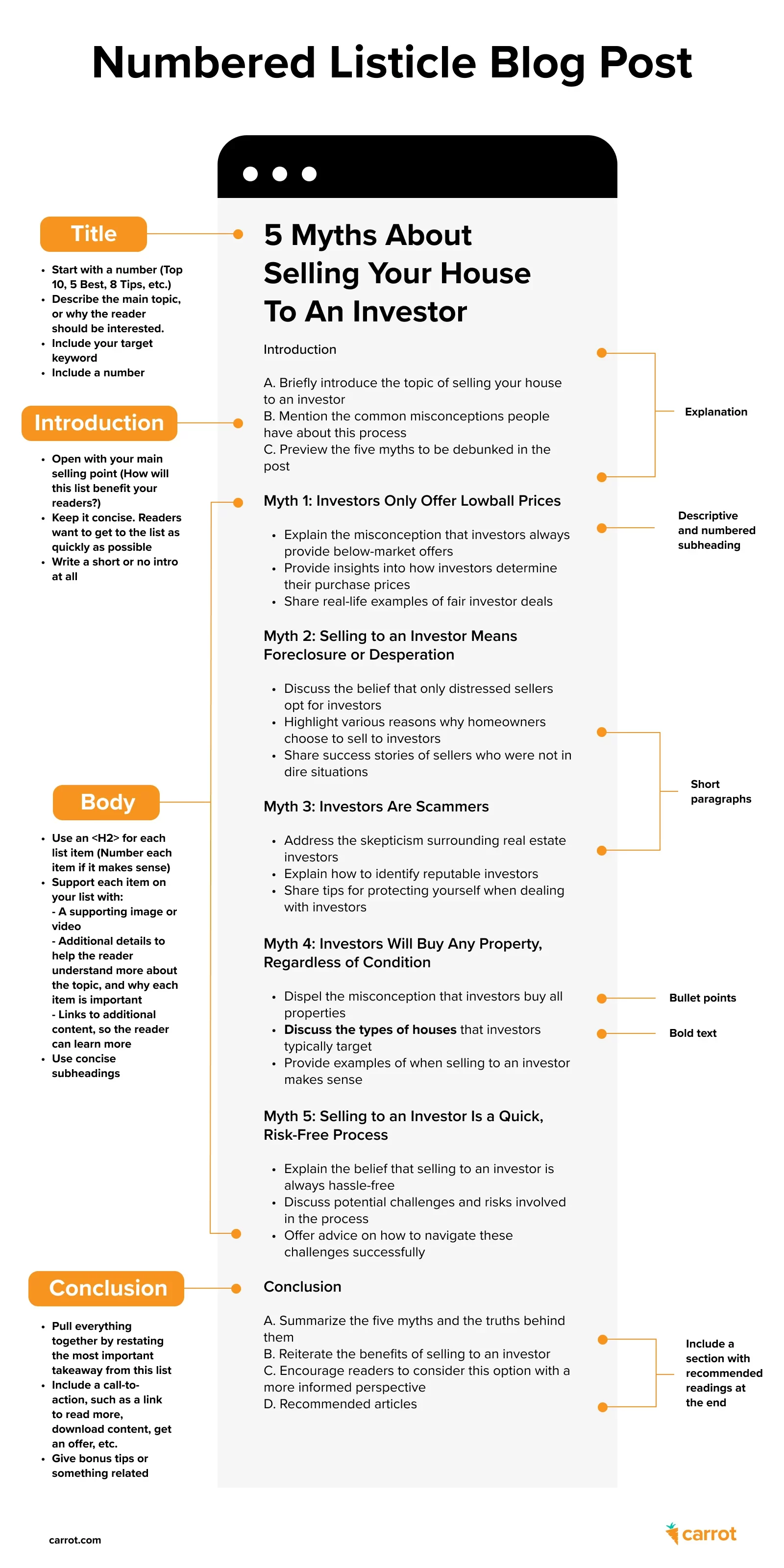
Blog Post Template 1: The Listicle
The listicle blog post template is exactly what it sounds like. It’s a “list” of reasons, tips, tricks, or hacks that provide easy-to-scan value for your audience.
This blog post is a listicle.
Listicles are easy to write and easy for readers to digest, and they tend to do well in Google and social media.
A few examples of listicle posts are…
5 Reasons Why People Sell Their Home With Real Estate Agents
5 Myths About Selling Your House To An Investor
10 Ways To Sell Your House For More Money
The template for a listicle is pretty basic. Here it is.
TitleOptions
[X] Reasons That…
[X] Ways To…
[X] Tips For…
[X] Hacks That Will…
Introduction
Write a short introduction, between 50 and 150 words, that empathizes with your ideal market’s current situation and briefly explains the problem your article willd solve.
Middle – Points
List your article’s points as H2 headings and write between 50 and 150 words for each point, expanding upon the core concept.
Conclusion
Write 50 to 150-word conclusion which overviews the article’s content and calls the reader to take action. Your CTA should often encourage the reader to work with you.
The average person doesn’t understand much about the real estate world—how to increase the value of their home, how to sell quickly, or even how to find a trustworthy agent, for instance.
And who better to teach those practical skills than you, a local real estate professional?
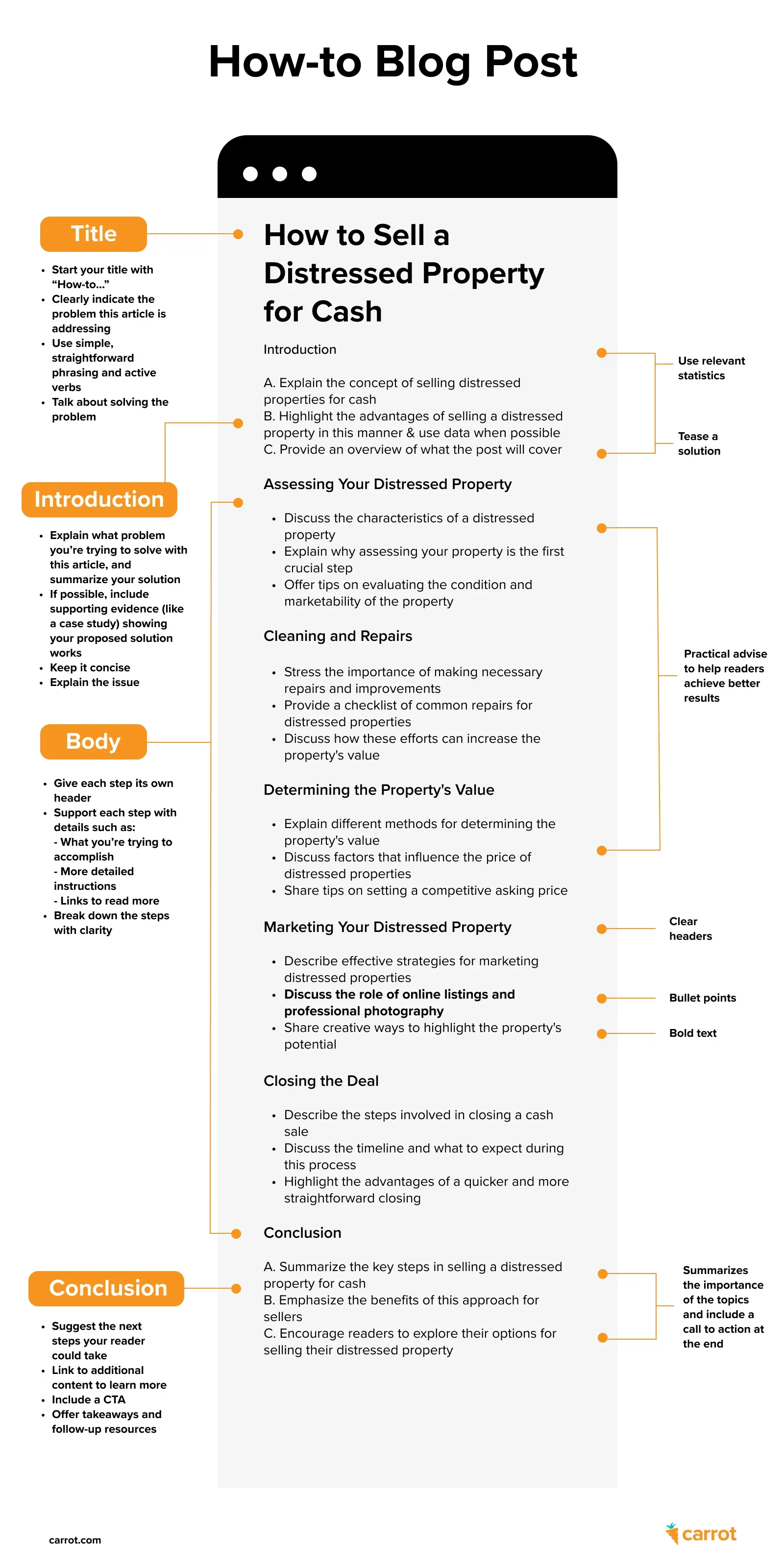
Because most people have many real estate-related questions, the “How To” article format is particularly pertinent.
It’s a great format for establishing yourself as the go-to expert in your market, the person people think of first when making a real estate-related decision (which, of course, is a good thing!).
Here’s the template.
TitleOptions
How To… [do something that your target audience wants to learn how to do]
…Sell Your House For More Money
…Find a Trustworthy Real Estate Agent
…Sell a Distressed Property For Cash
Introduction
Write a short introduction, between 50 and 150 words, that empathizes with your ideal market’s current situation and briefly explains the problem your article will solve.
Middle – Steps
List your article’s “Steps” as H2 headings and write between 50 and 150 words for each step, providing more detail on accomplishing the task.
For example…
Step 1: Determine the value of your house.
Step 2: Check the reviews for the investor’s website.
Step 3: Call and talk to the investor.
Conclusion
Write 50 to 150-word conclusion which overviews the article’s content and calls the reader to take action. In many cases, your CTA should encourage the reader to work with you.
Did you provide clear, actionable steps to accomplishing the task your reader needed help with?
Did you provide relevant and accurate facts and stats to prove your understanding of the concept?
Did you emphasize the importance of understanding this concept if it is not already well-known?
Did you properly cite and backlink your sources?
Did you spell-check and proofread?
Are there at least 1-2 images?
Is the post 800-1,000 words at a minimum?
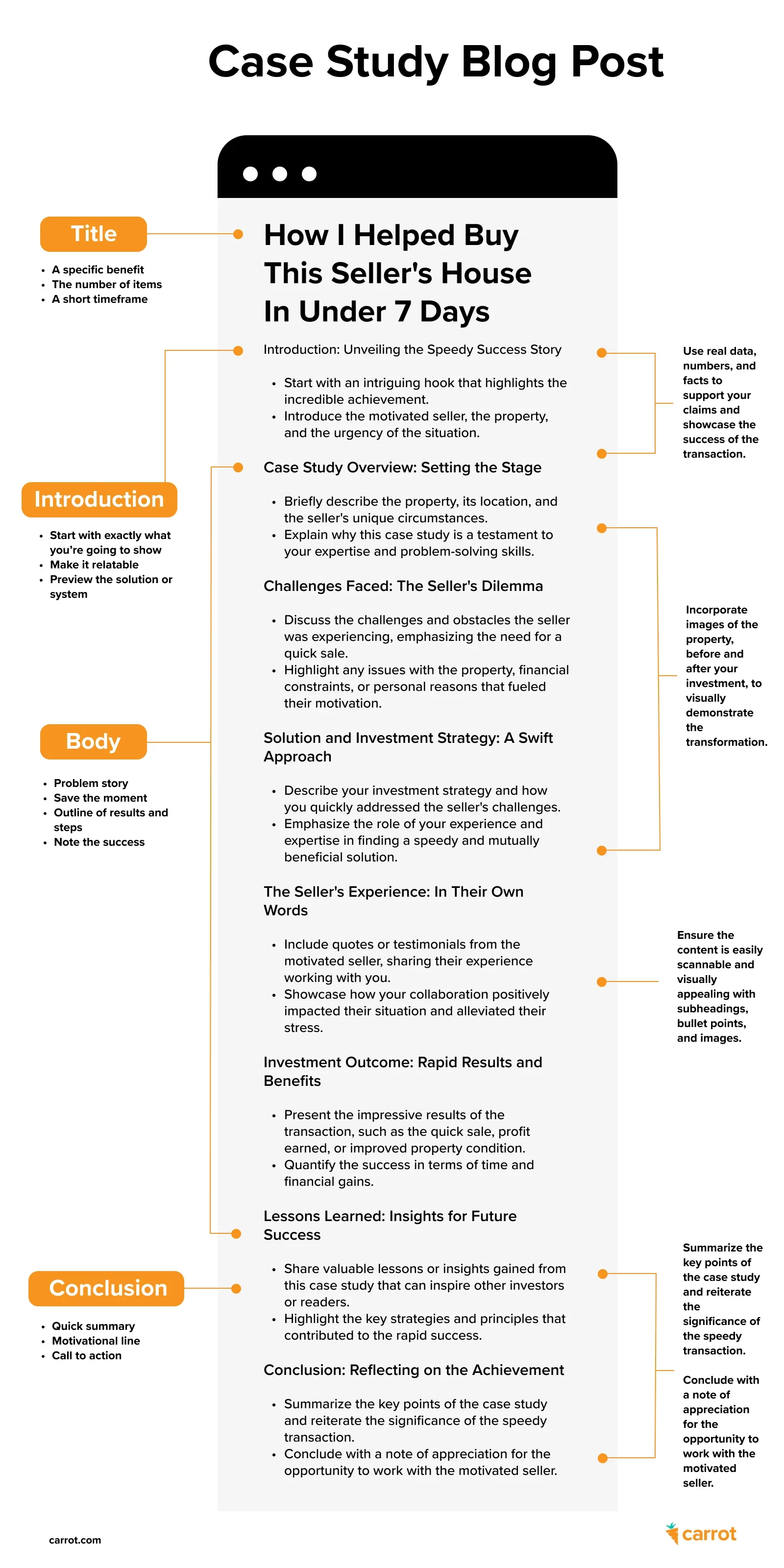
Blog Post Template 3: The Case Study
Case studies are perhaps the most powerful kind of blog content for building trust with your audience and rapport for your business.
A case study is an article that explains the benefits of working with you by telling the story of a past client who was extremely pleased with their experience.
You can use case study articles to illustrate that you pay more than other investors, work faster than other agents, or are simply more trustworthy and honest than the competition.
For this type of blog article, you’ll need to interview your past clients and ensure they’re okay with you publishing the story of them working with you.
Here’s the template.
TitleOptions
Case Study: How…[something awesome]
…I Helped Sell This Person’s House In Under 7 Days
…I Paid $100,000 In Cash For This Person’s Property
…I Saved This Person From Bankruptcy
Introduction
Write a short introduction, between 50 and 150 words that builds suspense for the story your article is going to tell.
Middle – Before, During, After
Your article should have Before, During, and After sections as H2 headings. Under the Before section, describe what the person was going through before working with you.
Under the “during” section, describe their experience working with you (use direct quotes and testimonials if possible), and in the After section, discuss how much better off they are now because they worked with you.
Conclusion
Write 50 to 150-word conclusion which overviews the article’s content and calls the reader to take action. In many cases, your CTA should encourage the reader to work with you.
Blog Post Template 4: The VideoPost
Don’t want to write your blog post?
Well, at Carrot, we’ve created the solution: VideoPost.
We offer our members this tool, which allows them to quickly and easily transcribe a video into a fully written article with the click of a button.
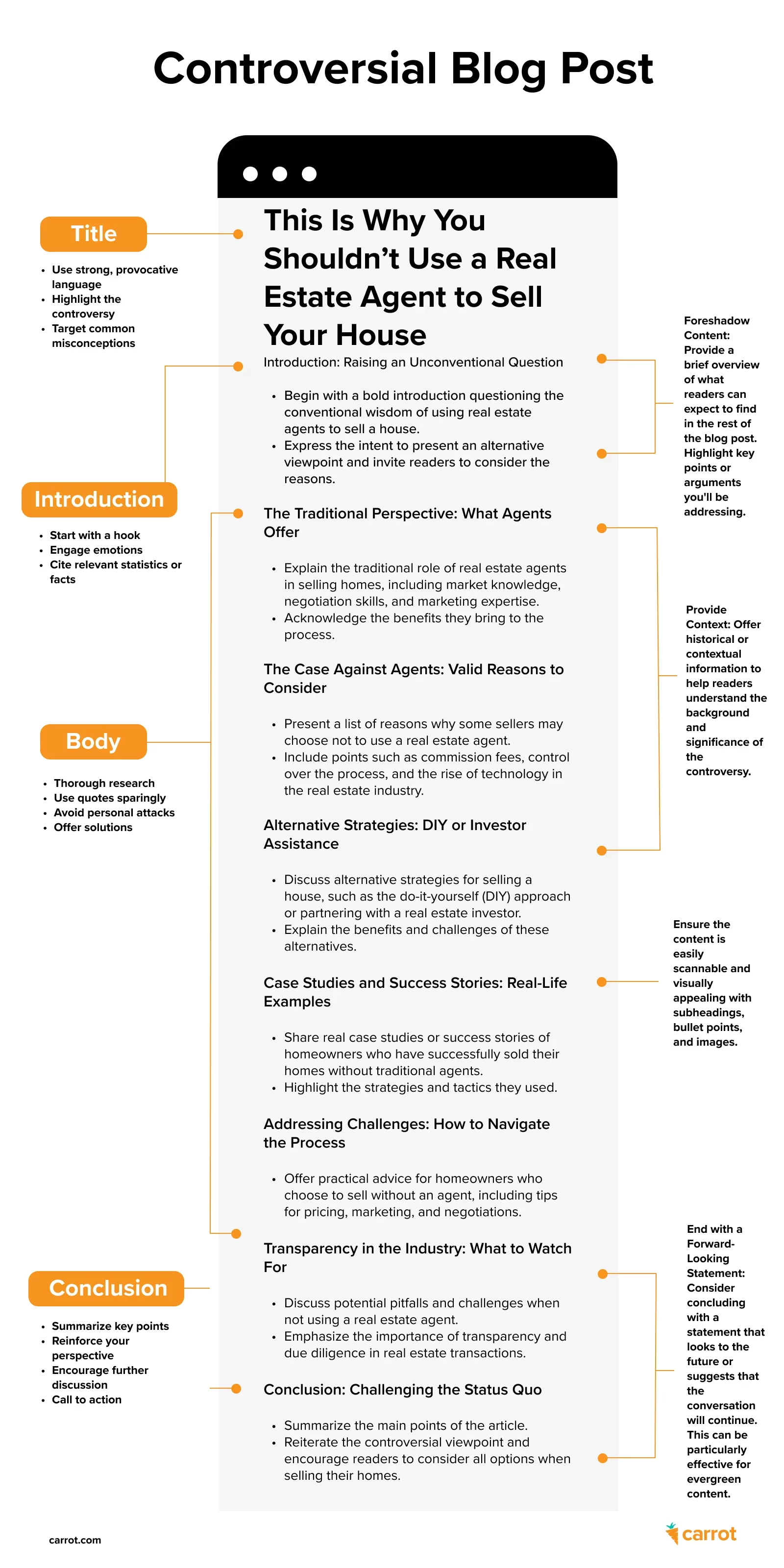
And your blog content is no exception. Sharing your controversial opinions with your audience might seem like a bad idea, but it’s actually a great way to attract people who agree with you and generate attention for your business (no publicity is bad publicity, eh?).
Here’s the template for writing a controversial post.
TitleOptions
This Is Why… [controversial opinion]
…Selling Your House To An Investor Is More Profitable
…Real Estate Agents Are The Best Option
…You Shouldn’t Use a Real Estate Agent
Introduction
Write a short introduction, between 50 and 150 words, that describes what the article is going to be discussing.
Middle
The middle structure here is a little more complicated than some of the other blog post templates. The first section should focus on describing the popular wisdom that people receive and why that seems to make sense.
The second section should dismantle that concept with logic and evidence. The final section should introduce your new idea and provide evidence for that opinion. All section headers should be H2 headings.
Conclusion
Write 50 to 150-word conclusion which overviews the article’s content and calls the reader to take action. In many cases, your CTA should encourage the reader to work with you.
Put These Real Estate Blog Templates to Work!
Although this doesn’t give you templates for every kind of blog post, it gives you a solid foundation for writing killer content. Now, all you have to do is use these real estate blog post templates!
Now, when you sit down to write a blog post, you don’t have to think about how to put the content together. You’ve got the exact recipe you need to make it happen. For more resources and real estate marketing materials, click on the link!
Having good real estate backlinks can provide a huge boost in your organic rankings. However, if you do them wrong, the effect can devastate your rankings, sending them into the Google abyss. That is why educating yourself before starting a link-building strategy is critical.
Demo Carrot: How many deals are you losing to your competitor’s website?
In the world of real estate websites, backlinks are like gold. They’re essentially links from other websites that point back to yours. Search engines see these backlinks as a vote of confidence in your content and expertise.
The more high-quality backlinks you have from relevant real estate websites, news outlets, or local directories, the higher your website will rank in search results for local homebuyers and sellers. This translates to increased online visibility, attracting more qualified leads and ultimately growing your real estate business.
Why Are Real Estate Backlinks Important?
Backlinks are a major piece of the SEO (search engine optimization) puzzle.
They go together like peanut butter and jelly. You need one to make the other better.
High-level, here are four quick reasons why it’s important to have a good backlink strategy:
Backlinks are how Google (and other search engines) find your pages.
Backlinks are a way to show Google that you have a solid reputation. Search engines will push searchers to websites they can trust.
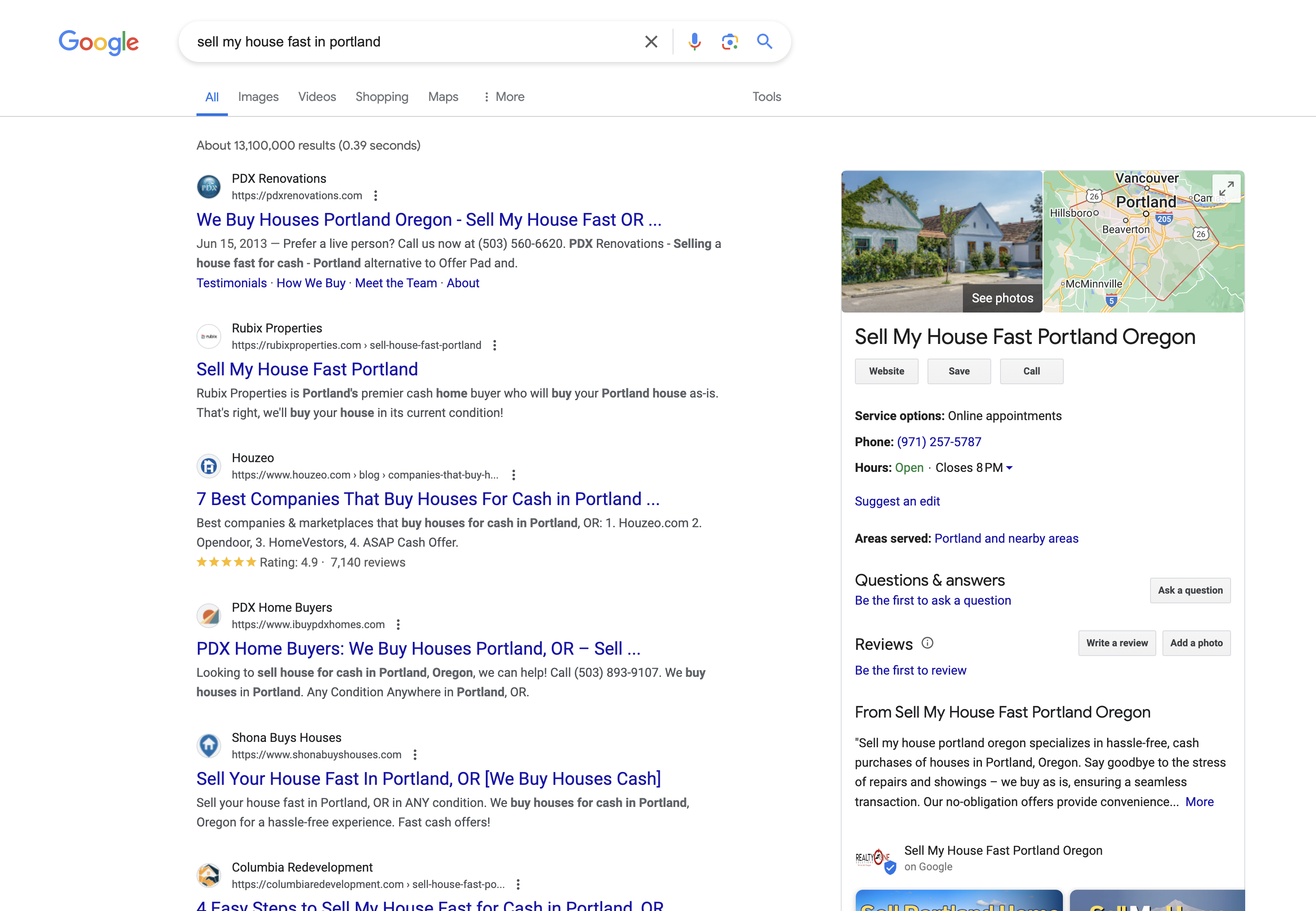
Here’s an example. When someone types “sell my house in [market city]” or “real estate agent in [market city]” into Google, you want your website to come up on the first page.
If it doesn’t, you’re missing out on a lot of website traffic, leads, and, more importantly, deals.
Some 93% of internet experiences start with a search engine, including the real estate industry. When people — your target market — are looking for help, they go to Google.
And if you show up on the first page, that’s good for business.
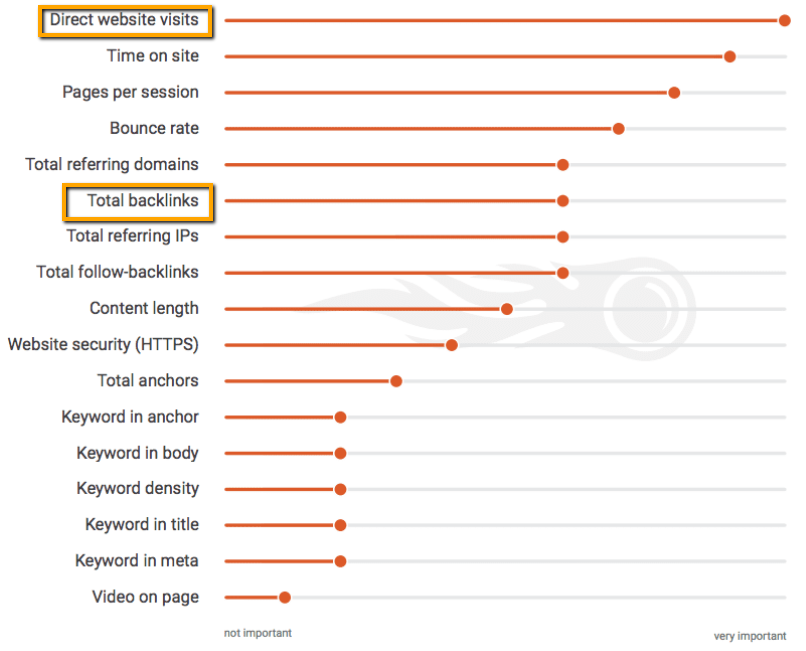
Two of the most powerful factors for ranking in Google are website traffic and backlink portfolio.
In other words, the more traffic and backlinks a page on your website receives, the better that page will rank for your target keyword phrases.
Unfortunately, getting traffic and backlinks is one of the most difficult things. This article will give you practical tips for promoting your content and building links to your website.
Here are nine real estate backlinks strategies to help improve a website’s authority and credibility in the eyes of search engines.
1. Consistent Content Creation
This is your first step on the way to building your SEO rankings. Without consistently creating blog content for your website, you might rank for a few keyword phrases on your homepage. Still, you won’t rank for any longtail keyword phrases (like “how to deal with foreclosure” or “how to sell my how during a divorce”).
Think of every piece of content like a door to your website. The more doors you have, the more people can visit your website, and the more opportunities you have to rank in Google. A good rule of thumb, though, is to create only one piece of content for each keyword phrase you’re targeting.
While consistently creating content can be time-consuming, our Grow plans at Carrot include done-for-you blog content. You just need to customize about 25% of each post and publish it!
Many of our members, like Ryan Dossey, consistently get SEO leads from those done-for-you blog posts!
But maybe you want to create your own unique content—no problem! We’ve created VideoPost, which you can use to transcribe video content into a blog post with the click of a button—learn more here.
2. Building Backlinks with Local Citations
Getting listed in relevant directories isn’t just about backlinks, it’s about building your online presence and local SEO. Here’s why citations are crucial and how to find the best ones for your real estate website:
What are Citations?
Citations are online mentions of your real estate business, including your name, address, and phone number (NAP). These mentions can appear on various online platforms like:
Local Business Directories: Yelp, Google My Business, Bing Places for Business, Angie’s List, HomeAdvisor, etc.
Industry-Specific Directories: Realtor.com, Zillow, Trulia, LoopNet (commercial real estate), etc.
Local Government Websites: City or county government websites often list licensed real estate agents.
Chamber of Commerce Listings: Joining your local chamber can provide valuable directory listings.
Benefits of Citations:
Improved Local Search Ranking: Search engines like Google rely on consistent NAP citations across the web to verify your business legitimacy and location. The more accurate and consistent your citations are, the higher your website will rank in local search results for relevant real estate keywords.
Increased Online Visibility: Citations help potential clients discover your business when searching for real estate agents online. These listings often display basic contact information, reviews, and sometimes even links to your website, directing more traffic your way.
Backlink Potential: Many high-quality directories provide backlinks to your website, further boosting your SEO.
Finding the Right Directories:
Focus on Relevance: Don’t just submit your website to every directory you find. Prioritize directories relevant to your location, the real estate niche you serve, and those trusted by potential clients.
Local Directories First: Start with local business directories and industry-specific real estate platforms.
Use Online Tools: Several online tools like Moz Local or Yext can help you find high-quality directories and manage your citations across different platforms.
Maintaining Accuracy:
Once you’ve claimed your listings on relevant directories, ensure your NAP information is consistent across all platforms. Any inconsistencies can negatively impact your local SEO. Regularly monitor and update your listings as needed.
By building a strong citation profile through local directories, you establish your real estate business online, improve your local search rankings, and potentially earn valuable backlinks to your website. This comprehensive approach strengthens your online presence and attracts more qualified leads.
3. HARO
HARO (for Help A Reporter Out) is a great way to build backlinks and market authority simultaneously. Journalists sign up for HARO to get quotes and contributions from market experts. You can sign up for HARO (for free) to become a source of expertise for journalists.
Oftentimes, if they choose to quote you, they’ll also give you a backlink.
Heck, you could even outsource this to a VA if you want. You can learn more about using HARO to build backlinks.
4. #Journorequest
The hashtag #JournoRequest is another direct line to journalists writing online articles and seeking expert contributions.
By searching the hashtag on Twitter, your page will populate with many different online writers looking for specific types of contributions. They’ll have no problem providing a backlink in return most of the time.
Again, this is so simple that you could pay a VA to scour Twitter for you and look for backlink-building contribution opportunities. You’ll have to provide them with expert quotes when they find one.
5. Establishing Yourself as the Local Real Estate Expert: Building Trust and Backlinks
Becoming a local resource in the real estate market isn’t just about generating leads; it’s about building trust, establishing expertise, and attracting backlinks through valuable community engagement. Here are some strategic ways to position yourself as the go-to expert:
1. Offer Free Consultations and Resources:
Free Consultations: Provide potential clients with free consultations to discuss their buying or selling needs. This allows you to showcase your knowledge, build rapport, and demonstrate your commitment to their success.
Host Educational Seminars: Organize workshops or seminars on topics relevant to your target audience, such as “First-Time Homebuyer Tips” or “The Benefits of Selling Your Home in Today’s Market.” This establishes you as a thought leader and positions your website as a resource for valuable information.
Create Free Downloadable Resources: Develop downloadable guides, checklists, or market reports that provide valuable insights for buyers and sellers. Make these resources freely available on your website with clear calls to action encouraging visitors to explore your services.
2. Participate in Local Events:
Industry Events: Network with other professionals at real estate conferences, workshops, or association meetings. These events provide opportunities to build relationships, exchange knowledge, and potentially collaborate on future projects.
Community Events: Actively participate in local community events like charity fundraisers, neighborhood clean-up initiatives, or local festivals. This demonstrates your commitment to the community and fosters positive brand recognition. Sponsor local events to gain further visibility and establish your brand as a trusted local partner.
3. Partner with Local Businesses:
Strategic Collaborations: Partner with businesses that complement your real estate services, such as mortgage lenders, title companies, or home inspectors. Cross-promote each other’s services and leverage each other’s audience reach.
Local Publications: Connect with local newspapers, online publications, or radio stations. Offer your expertise as a guest speaker or interviewee on topics related to the real estate market. This provides valuable exposure and potential backlinks when your website is mentioned as a resource.
Offer Free Content to Local Websites: Contribute informative articles or blog posts to local publications or neighborhood websites. These guest posts establish you as an expert and can include backlinks to your website for further information.
By actively engaging with your local community, offering valuable resources, and demonstrating your expertise, you build trust and brand recognition. This can lead to local publications featuring you as a resource, potentially including backlinks to your website, further boosting your local SEO and attracting organic traffic. Remember, becoming a local resource is a long-term strategy that pays off with increased brand loyalty, trust, and ultimately, more qualified leads.
6. QuuuPromote
QuuuPromote is a service where you can pay to get Twitter shares for your content. Here’s how it works…
There are two sides to Quuu’s business model. The first side comprises “influencers” who want to post quality content on their Twitter feed automatically — they pay Quuu to do just that.
The second side of Quuu’s business model is made of people (like you!) who have good content and want to get that content shared on Twitter — Quuu then posts that content on the “influencer’s” Twitter feeds.
So yeah… from a business model perspective, Quuu is having their cake and eating it, too. But it’s relatively inexpensive and worth trying if you want more shares and clicks (inside your Quuu dashboard, you can see how many clicks your promotions get).
7. Leveraging Social Media Promotion for Backlinks:
Social media platforms offer a powerful tool to promote your real estate content and attract backlinks. Here’s how to maximize your efforts:
1. Identify Your Target Audience:
Platforms: Not all social media platforms are created equal. Focus on platforms where your target audience spends their time (e.g., Facebook groups for local residents, LinkedIn for industry professionals).
Communities: Join relevant Facebook groups, online forums, and subreddits focused on real estate in your area or niche.
2. Content Strategy for Backlinks:
Post Consistently: Regularly share valuable content like blog posts, local market updates, home buying tips, or visually appealing property listings.
Optimize for Sharing: Include clear calls to action, encouraging viewers to share your content. Use relevant hashtags and engaging visuals to increase shareability.
3. Engage and Build Relationships:
Be a Valuable Contributor: Don’t just post your content and disappear. Participate in discussions, answer questions, and offer helpful advice. Establish yourself as a trusted resource within the community.
Collaborate with Others: Look for opportunities to collaborate with other real estate agents, lenders, or local businesses on social media campaigns. Cross-promotion can expand your reach and attract backlinks from their audience.
8. Turn Dead Ends into Backlink Opportunities
Broken link building is an effective strategy for acquiring backlinks by identifying and replacing outdated or non-functional links on relevant real estate websites. Here’s how to refine this tactic and maximize your chances of success:
1. Finding Broken Links:
Free and Paid Tools: Utilize free tools like Check My Links or Broken Link Check. Consider premium tools like Ahrefs or SEMrush for more advanced features and website crawling capabilities.
Focus on Local Relevance: Prioritize websites related to real estate in your local market. Look for local news outlets, neighborhood association websites, or even competitor websites (avoid anything malicious).
Target Relevant Pages: Focus on pages that discuss topics relevant to your content. For example, if you have a blog post on “The Best Schools in [Your Neighborhood],” target websites with broken links on pages about local schools or family-friendly neighborhoods.
2. Crafting Your Outreach Message:
Personalize Your Approach: Avoid generic templates. Research the website owner or editor and personalize your email with their name and a brief mention of their website.
Highlight the Issue: Concisely explain that you discovered a broken link on one of their pages (mention the specific page and URL).
Offer a Valuable Solution: Present your website and a relevant blog post or resource that offers valuable content as a perfect replacement for the broken link. Briefly explain why your content aligns with their website’s theme and audience needs.
Focus on Mutual Benefit: Frame your message as a win-win situation. You’re helping them improve their website while potentially earning a valuable backlink for your own.
Include Call to Action (CTA): End your email with a clear call to action, politely requesting them to consider your suggestion and replace the broken link with your content.
3. Increase Your Success Rate:
Quality Over Quantity: Focus on reaching out to high-quality websites with relevant traffic and domain authority. A few backlinks from high-authority sites are more valuable than many from low-quality sources.
Track Your Efforts: Use a spreadsheet or CRM (Customer Relationship Management) tool to track the websites you contacted, the broken links you reported, and the responses you receive. This helps monitor your progress and identify areas for improvement.
Follow Up, But Don’t Be Pushy: Send a polite follow-up email a few days after your initial contact if you haven’t heard back. However, avoid being overly persistent.
By implementing these steps, broken link building can become a valuable strategy for acquiring backlinks from relevant websites. Remember, focus on providing a genuine solution and building relationships with website owners. This approach leads to higher success rates and strengthens your online presence in the real estate market.
9. Mastering Guest Blogging for Real Estate Backlinks: Attract New Clients and Boost SEO
Guest blogging on relevant websites is a powerful strategy for building backlinks, establishing yourself as an expert, and attracting potential clients in a new market segment. Here’s how to maximize your guest blogging efforts for real estate:
1. Identify High-Impact Websites:
Go Beyond the Obvious: While local news outlets and mortgage lenders are good starting points, delve deeper. Consider websites like:
Local Business Associations: Chambers of Commerce, neighborhood associations, or niche-specific business groups often have publications or blogs.
Community Websites: Look for websites catering to your target audience, like local parenting blogs, neighborhood guides, or relocation resources.
Industry Blogs: Target real estate blogs with a national reach that allow guest contributions, focusing on topics relevant to your niche (e.g., luxury properties, first-time homebuyers, investment real estate).
2. Craft Compelling Guest Post Ideas:
Focus on Value, Not Sales: Your primary goal is to provide valuable information to the target audience of the host website. Research their readership and tailor your content to their needs.
Address Local and Regional Trends: Offer insights specific to your market. This can be anything from “The Benefits of Owning in [Your Neighborhood]” to “Local Market Update: Rising Interest Rates in [Your City].”
Target Buyer Personas: Craft content geared towards specific buyer personas, such as “First-Time Homebuyer Mistakes to Avoid” or “[Your City]’s Best Neighborhoods for Growing Families.”
Showcase Your Expertise: While offering valuable information, subtly weave in your expertise. Briefly mention relevant past experiences or successful transactions to establish your credibility.
3. The Art of the Pitch:
Research the Editor: Don’t send generic emails. Identify the editor responsible for the blog section and personalize your outreach.
Highlight Your Value Proposition: In a concise email, explain who you are, your area of expertise, and how your guest post aligns with the website’s audience and content strategy.
Provide Content Samples: Include links to your best blog posts or published articles showcasing your writing style and expertise.
Negotiate Backlinks: While not always possible, politely negotiate the inclusion of a backlink to your website within the guest post or author bio section.
4. Building Relationships:
Go Beyond the Single Post: Don’t treat guest blogging as a one-time transaction. Engage with the website after your post is published. Respond to comments, participate in discussions, and build rapport with the editor and audience.
Reciprocal Opportunities: If the website allows it, explore collaborative opportunities. You could offer to host a guest post from their editor on your website, further expanding your reach and promoting valuable content exchange.
Here are a couple of cold outreach templates to get you started.
For podcasts…
Subject: Quick idea…
Hey [name of person or business]!
My name is [name] and I’m a real estate [investor/agent] in [location]. My business has [build credibility with revenue numbers, media mentions, or a testimonial from a past customer]. And I’d LOVE to be a guest on your podcast to discuss [pitch a relevant topic you’d be comfortable discussing].
What do you think? Is that something we could set up?
Let me know! I’d be happy to get it on the calendar. :-)
Cheers,
[Name]
For blog posts…
Subject: Quick idea…
Hey [name of person or business]!
My name is [name] and I’m a real estate [investor/agent] in [location]. My business has [build credibility with revenue numbers, media mentions, or a testimonial from a past customer]. And I’d LOVE to write an article for your website. Here’s my idea: [pitch a relevant topic you’d be comfortable writing about].
What do you think?
Let me know! I’d be happy to get started on it right away. :-)
Cheers,
[Name]
By implementing these strategies, guest blogging becomes a powerful tool for building backlinks, attracting new clients, and establishing yourself as a trusted real estate expert within your local and potentially broader online communities. Remember, guest blogging is a long-term strategy focused on building relationships and providing value, ultimately leading to increased brand awareness and website traffic that converts to qualified leads.
WARNING: Avoid These 2 Link-Building & SEO Tactics
Regarding SEO, it’s not just important to use the right strategies. It’s also important that you don’t use the wrong strategies.
Shady link-building tactics- often called “black-hat SEO”- can penalize your website by Google and completely destroy your rankings.
For that reason, we recommend avoiding the following link-building tactics…
1. PBNs
Look, building backlinks is difficult. It’s time-consuming, expensive, and soul-crushing.
We all know it.
Which is exactly why PBNs are so darn tempting…
These services promise to build backlinks to your website at a remarkably low cost and get your website ranking quickly. They won’t say much about how they will build those backlinks, but the promise of seeing your website on the first page of Google’s results is enough to persuade most of us to enter our credit card information.
Since they won’t tell you how they build your website backlinks, I will…
In a nutshell, they purchase hundreds or thousands of expired/unused domains with a bit of SEO juice built from the previous owners. Then, they go to all these domains and plug a backlink to your website.
After a bit, your website starts to rank, and you’re thinking, “Wow! These guys are awesome!”
Here’s the problem: PBNs cheat the system. Google explicitly says that using a PBN won’t only get the PBN company in trouble but also penalize your website.
It’ll all be good and fine until Google finds out. And they almost always find out.
Once they do, your website will take a massive dive in the rankings (or get banned from indexing altogether) – and recovering from that loss will be harder than trying to get a new website ranking (because you’ve lost Google’s trust).
2. Paying for Backlinks
Paying for backlinks can be a bad idea for a few reasons:
It can hurt your SEO: Search engines like Google frown upon unnatural link building practices. If they catch you buying backlinks, they might penalize your website, causing it to rank lower in search results instead of higher.
Low-quality links can be worse than no links: Not all backlinks are created equal. Buying backlinks often means getting links from irrelevant or low-quality websites. These links won’t help your SEO and might even hurt your reputation.
Wasted money: There’s no guarantee that the backlinks you buy will improve your rankings. You might be throwing money away on ineffective strategies.
Unsustainable: Building backlinks naturally takes time and effort, but it’s a more sustainable strategy. Paid backlinks are often temporary, requiring constant reinvestment to maintain any SEO benefit.
Risk of getting flagged: Google has sophisticated algorithms to detect unnatural link building practices. Getting caught can lead to serious penalties, harming your website’s visibility for a long time.
Google explicitly says it doesn’t want people paying for backlinks, but this no-no has a caveat.
If you’re going to pay for backlinks, pay for good white-hat backlinks — ones that come from real sites with real domain authority in Google’s eyes. And be very careful about buying cheap links from sites that promise quick and fast results.
Ideally, your real estate backlinks should come from sites with low spam scores. Ask any SE firm you’re considering hiring how they build backlinks and where those links come from. That will tell you a lot about whether those links are high-quality.
Top Backlink Tools
1. Backlink Analysis Tools:
Help you discover backlinks pointing to your website and competitor websites.
Analyze the quality and source of backlinks (authority, relevance).
Track the number of backlinks over time and identify any lost backlinks.
Examples: Ahrefs, Moz Link Explorer, SEMrush Backlink Tool, Majestic
2. Link Building Tools:
Help you identify link building opportunities.
Suggest relevant websites where you can potentially acquire backlinks.
May offer features like outreach management or content creation suggestions.
Examples: Ahrefs, SEMrush Link Building Tool, BuzzSumo, BuzzStream
3. Broken Link Building Tools:
Help you find broken links on relevant websites.
Allow you to suggest your own content as a valuable replacement for the broken link.
This can be a great way to acquire backlinks while helping the website owner improve their content.
Examples: Check My Links, Broken Link Checker, Ahrefs Broken Backlinks report (part of their Backlink Analysis Tool)
4. SEO Suite Tools:
Offer a comprehensive suite of SEO tools, including backlink analysis, keyword research, on-page optimization tools, and website crawling capabilities.
Examples: SEMrush, Ahrefs, Moz Pro
Important Note:
Some of these tools are free, with limited features, while others require a paid subscription.
The best tool for you will depend on your specific needs and budget.
Additional Tips:
Focus on building high-quality, natural backlinks from relevant websites.
Avoid buying backlinks or participating in link schemes, as this can hurt your SEO in the long run.
Combine backlink building with other SEO strategies like creating high-quality content and optimizing your website for relevant keywords.
How to Track Your Rankings (Pay Attention to These 3 KPIs!)
You can build real estate backlinks and drive traffic to your website until you’re blue in the face, but if you don’t track your progress and the results of those actions… then, well, it’s hard to know if all that hard work has been worth it.
So here are the primary KPIs you’ll want to pay attention to and exactly how you can track those KPIs…
Target Keyword Rankings — When discussing SEO, this is the first thing you should pay attention to. Is the page you created ranking for the phrase you want it to rank for? Is it fluctuating up or down the rankings? As a Carrot member, you get access to our easy-to-use keyword ranking tracker that will alert you to any recent fluctuations in position.
Page Traffic Volume — Page traffic is an important element of SEO progress because 1) more traffic typically means better rankings, and 2) well… more traffic is an excellent thing for lead generation. The easiest way to watch website traffic as a Carrot member is right inside your dashboard’s “Stats” tab…
Scroll down to see how much traffic each page of your website gets and even where all that traffic is coming from.
Page Conversion Rate — This is the end goal, right? If you build backlinks and promote content, even if you drive traffic to your website, but those visitors don’t convert into leads, what’s the point? You should expect at least a 2% conversion rate from your blog posts and 10% from your homepage. If your conversion rate is lower than that, check out this article. To check your conversion rate as a Carrot member, go to your “Stats” dashboard, scroll down, and look at the “Conv. Rate” column.
Now that you understand what KPIs to monitor for your SEO efforts let’s discuss how to promote your content and get backlinks!
Conclusion
There you have it!
You should now understand how to build your SEO rankings with real estate backlinks and content promotion.
If you have any more questions, feel free to ask them in the comments, and we’ll help you out however we can! Good luck!
Zillow dominated the real estate industry through 1 primary strategy.Ranking high in Google and controlling the conversation online.
In this post, we’ll walk through real case studies that show you how to beat Zillow, Trulia, and Realtor.com in Google in your local market and scoop up traffic and leads for FREE away from the tech giants.
(Dive into the video snippet from a recent AskCarrot episode below!)
The video above was a short snippet from a live show we recently did, so we’ve typed out a high-level summary of the steps below and are providing the full video transcription below along with enhanced graphics and action items as well.
Each well-done Location Page will likely take you between 30-60 mins. But it’s well worth the time investment for the long-term momentum building results you can get.
The basic steps to beat Zillow in Google are:
1. Do things Zillow, Trulia, and Realtor.com can’t or won’t do. They can’t replicate you, they likely won’t build out as much valuable content as you could on the niches you’re an expert on, and they won’t try to be the authority on that niche like you can be. Build value, be an authority, and stand out.
2. Determine your niches that you want to dive deep into and become an authority in. I get pushback all the time from agents who say “But I don’t want to niche down. It’ll limit me!”.
But that’s exactly the opposite of what will happen.
When you choose to focus on becoming an expert and authority on a specific topic or niches, it’ll attract more people your way because you stand out as a clear expert. If you don’t niche, you’ll just be a part of the crowd.
3. CRITICAL DETAILS: Build out Location Pages in your Carrot site with our “Beat Zillow” framework (infographic below).
We deconstructed Zillows strategy, tested it and tested it until we’ve repeatedly been able to outrank Zillow in Google.
Start with your primary cities (those will be hard to outrank Zillow for since they’re so competitive) but then focus on the niches within the markets.
Example… your primary market may be “Brentwood California homes for sale”… that will be hard to outrank Zillow for.
Create a location page for that since it’s your primary city… but then focus your ranking efforts on the niches within Brentwood. Like neighborhoods, types of houses, etc.
Here are some great examples of real local searches in Google that could make great niche location pages you could create in your Carrot account, then aim to outrank Zillow with.
4. Track the SEO ranking of your new location pages. As a Carrot member, you can use our Ranking Tracker tool to track where your pages rank in Google and get smart feedback on how to improve the ranking.
Content marketing and SEO is a long-term momentum building strategy and patience is key. The page mentioned in that video took about 2-3 months to get the #1 ranking after we made the right optimization changes.
But this site has been around for years and was already starting to pop up in other rankings as well. If your website is brand new it may take a bit longer.
The more location pages you create, the more momentum you’ll build over time. This is the exact same way Zillow took over the market. It wasn’t overnight, but a strategic long-term strategy.
5. Rinse and repeat. I’d focus on creating Location Pages on your real estate agent website (we hope you use Carrot :-) every quarter.
Each quarter, target the cities or niches you want to focus on, then build out the pages or have our Carrot Services Team help you do it.
As you add more high content pages to your site, over time it’ll get easier and easier to get great Google rankings more quickly. Remember, it’s all about momentum.
Our members control more top 5 Google rankings than any other website system in the nation and it was recently rated as faster than any other website builder in a recent study.
If you want to separate yourself from other agents, stop paying Zillow for leads that you can get for FREE in Google, and add consistency and predictability to your online leads, take a Demo of AgentCarrot and learn more about how top agents all around the country are becoming their local authority by controlling the conversation online with our content marketing tools.
Either way, dive into the full details from my video below and we can’t wait to hear from you as you put this “beat Zillow” strategy to work!
How to Beat Zillow in Google [Infographic]
Full Video Transcript And More Details
So, a lot of people say, hey, how do you beat Zillow, or how do you beat the big guys? How do you beat Express Homebuyers? How do you beat We Buy Houses? How do you beat those companies at SEO?
What I did about a month and a half ago, I had people telling me that they can’t beat Zillow on SEO. Yeah, it’s gonna be really hard to beat them for some phrases, I get it.
But I’m pretty confident they can beat in SEO for phrases that matter.
A local real estate agent here in Roseburg, the G Team, one of their niches, what we always tell people to do, especially in this market environment, is you need to pick something to specialize in. It could be multiple somethings.
If you’re a real estate agent, can you specialize in a part of town? Can you specialize in a type of a seller or a buyer? First-time homebuyer? Someone’s looking at downsizing? Small families? Families that are looking to create a family home?
Whatever it is, specialize in something so you can speak to people in the language that’s gonna match them.
And so, then, their niches are North Umpqua River Homes, that’s an amazing river in town. They’ve sold probably more homes to people on the river than anyone else.
Another niche of theirs is high-level, upscale homes. It’s the same client, right? That client wants to live on the mountain, this other one wants to live by the river.
Another one is rental property owners. Again, the same client. We said, okay, let’s create a page and let’s see if we can’t go after one of the niches to get it right.
So you can see right here…Zillow’s number two, number three, number four. Realtor.com, Trulia, all these other national sites. Then you see this little old gteamgoahead.com website at number one.
How did it get this page to number one? I will deconstruct how to do it, and why I made it that way. Exactly how we were able to beat Zillow at their own game.
Basically, this website’s probably been up for five or six years. The URL has been, they switched over to Carrot about a year ago, and we said, okay, what are people looking for if they make that search, “North Umpqua River homes for sale.”
Finding Search Phrases
First of all, we went to Google and started typing up phrases to see what would actually pop up, right? So “North Umpqua River homes for sale,” that ended up being a Google-suggested search.
Then I scroll to the bottom to find other phrases that people are typing in:
“Waterfront home for sale Douglas County.” “Umpqua River property for sale.” “Riverfront property Southern Oregon.” “Homes for sale.”
So Google is telling us that these are related to the phrases I searched. Google’s telling us that these phrases are related to the phrase, “North Umpqua River homes for sale.”
So what that means, is that we want to find ways to work those phrases into our content. Google’s telling us the roadmap. Google’s telling us exactly what to put on the page.
*This particular Carrot member went through our concierge program. It’s our high-level program, where we dial the content in for you.
Reach out to us if you’re a high-level agent, a high-level investor, with a budget, that doesn’t want to do as much of the setup work, we can do the setup work and dial in your website for you.
Then we created content. When I was going through looking at these rankings, the first thing I like to do if I’m trying to get a ranking, is I click every single page on page one to see what they have on them. ‘I want to deconstruct how they’re winning so we can beat them at their own game.
So I click at the Zillow one to see what’s on this page. Number one, of course, Zillow is a massive website, it’s got a huge, huge, huge domain authority.
That’s not something we can compete with. We can’t compete against the domain authority here. So we can do as good as we can possibly do, and then have some backlinks and other pieces of the SEO strategy.
Then we ask ourselves, can we compete with site structure and content, and make the content better?
So out of the gates, they have a bunch of property listings. Scroll down the pages and we find, “Zillow helps find the newest Roseburg “real estate listings.”
That paragraph has a bunch of links to specific pages set up just in Roseburg. This is Roseburg apartments. There is bank-owned properties in Roseburg. Also Roseburg facts and some information about the Roseburg market.
This is how Zillow is winning the SEO game.
Number one, their title text is North Umpqua River. Then it says Roseburg real estate homes for sale. They also have a bunch of pages that are also in Roseburg.
Niche down pages that they’re linking to from the main page. They have some information about the market. So what I did, is I found all the written content and studied how many words are in them.
How many words are in here that’s specific to Roseburg stuff? So I took this, figured out how many words they have on the page and found it was about 300 words, including the title tagging content.
Now, if I can create a page with, probably, 500 to 800 words, make it more robust, make it more content, make it better, include some good images, make sure that my title tag is really good and drilled down to the exact phrase I’m trying to rank for.
If I’m going to beat Zillow, I’ve gotta be drilled down exactly with my title tag, and some other things in the phrase I’m looking to go for.
So you can see I titled it, “North Umpqua River homes for sale in Roseburg, Oregon.” That’s exactly what I’m trying to rank for.
Hopefully, it also ranks for other phrases related to it.
The next thing is, add a good title. “Looking for North Umpqua River homes for sale?” You can see I use it kinda similar. Then I use a bunch of different phrases that are similar. You can see a waterfront property in Roseburg?
Where did we get that? We got that from Google. Google was telling us that people are searching for “waterfront.”
The word waterfront is bolded. So I want to make sure that I’m talking about waterfront homes. It also said “river homes in Douglas County,” and the word “Douglas County” is important to Google, because it says it’s related. So I start to work those phrases in there that Google’s telling me. I put about 500 words on this page.
Put a nice image. Put the property listings there through our IDX system.
Then I did exactly what Zillow did. You see “Why use Zillow,” you see a bunch of facts about the area, and then you see some links to some other pages. So we’re like, all right, let’s just go ahead and do what they’re doing.
So I created some “Why Work with the G Team” content. I also put our keyword in there, and then I went and grabbed other common phrases, and I linked them up to their other pages. This one’s linked up to the Garden Valley page. This one’s linked up to the Hucrest page.
Then we put a call to action at the bottom that’s specific to the River homes list. This one took about two months to beat Zillow on Google.
Just creating about 700 words on here, good quality content, deconstructing what Zillow had done with their page format, but adding more content and making it better.
Making sure my title tag was really drilled in, and it beat it, and it’s getting leads right now, really, really targeted leads. That’s how you beat Zillow.
We’re gonna keep on doing it with them, and keep on putting out pieces of training to show you guys how to do it. All things equal, it’s going to be really hard for us to beat Zillow with a bad tech stack.
The tech stack is basically, what is the website built on? Ours is really fast. It’s smooth, and it’s clean, and it keeps on getting better.
We were stuck at position four for about three weeks, and then it went to position three, and one of the Zillow rankings was below us. I believe that if we had a tech stack that was slower, things like that, that it wouldn’t have bumped up there.
We talked about how to get your clickthrough rate higher. So when people click the rankings in Google, the ones at the higher click through rates is actually a factor to get it ranked better.
Using Title Tags for SEO
The last tip is the title tags.
Look at the other titles and see if you can just come up with one that still has the keywords in it, but is more compelling. So this one here, North Umpqua River dash Roseburg Real Estate dash Roseburg Homes, is kinda lifeless.
Depending on the day that you’re searching, or whatever, this actually says, on my cellphone when I do it, it actually shows it this way, the title tag is North Umpqua River homes for sale, Umpqua River property.
So I added in the words “updated daily,” because it shows, oh, this is cool, I can see an updated list. It looks different than the other ones down there.
Try to put things in there that grab their attention, that makes them wanna click the thing in the first place.
Have questions or comments? Be sure to hit us up in the comments section below or hit us up on Facebook.

![[Backed By Data] What is a Good Conversion Rate for Your Real Estate Investing Website?](https://image-cdn.carrot.com/uploads/what-is-a-good-conversion-rate-featured.png)
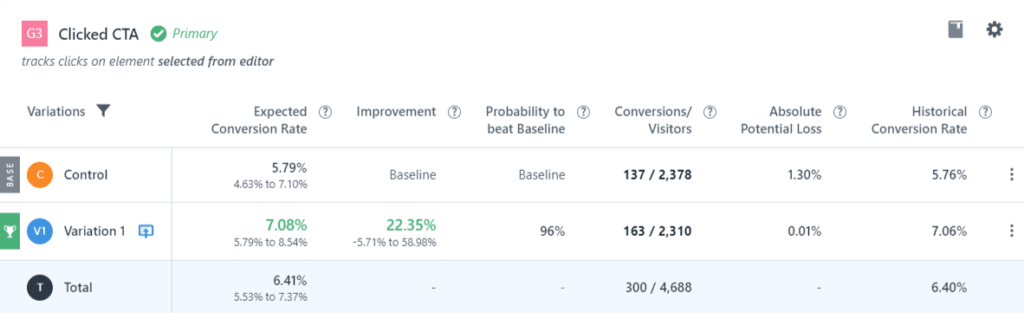
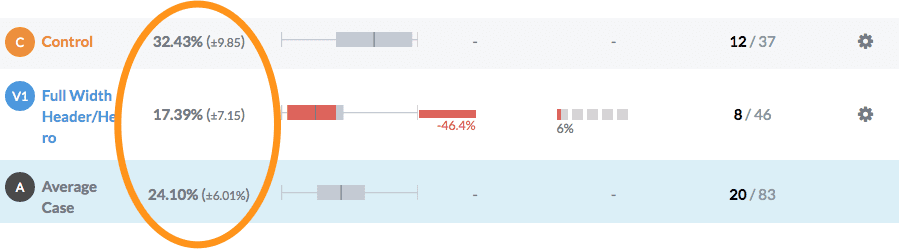

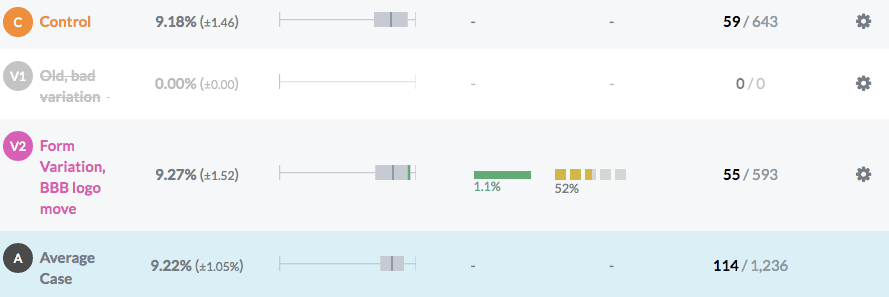
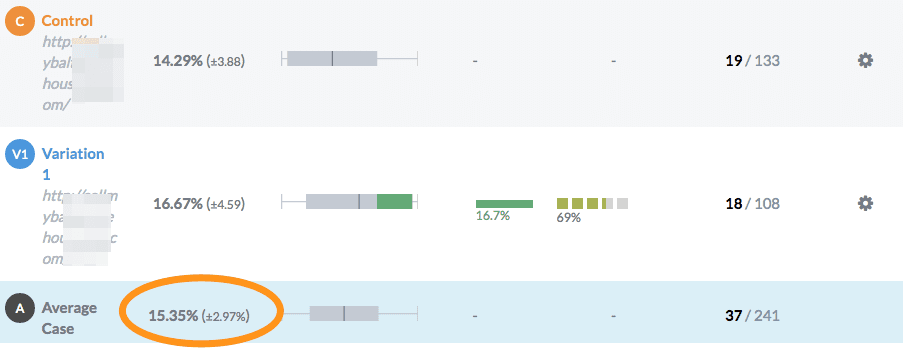
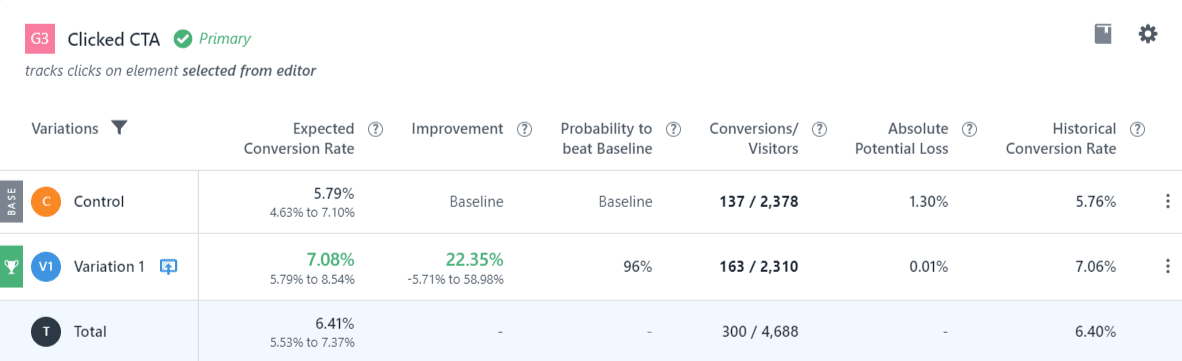
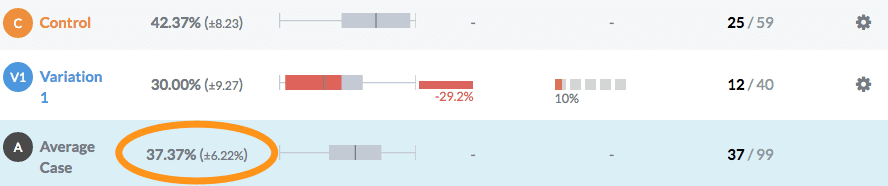
![[Analysis] December 2020 Google Core Algorithm – What to Do If Your Rankings Dropped](https://image-cdn.carrot.com/uploads/Google-Core-Algorithm-Update.png)
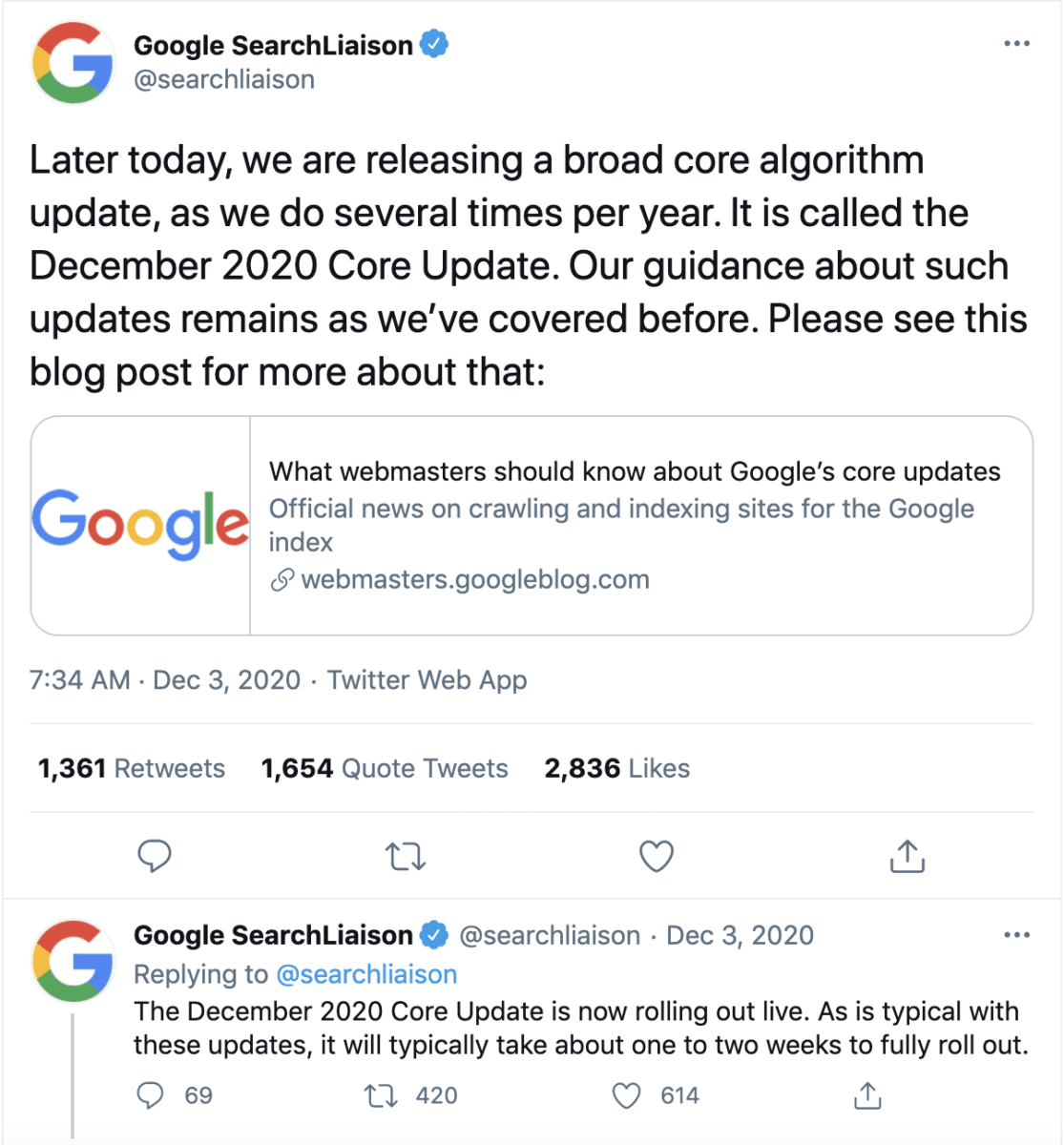
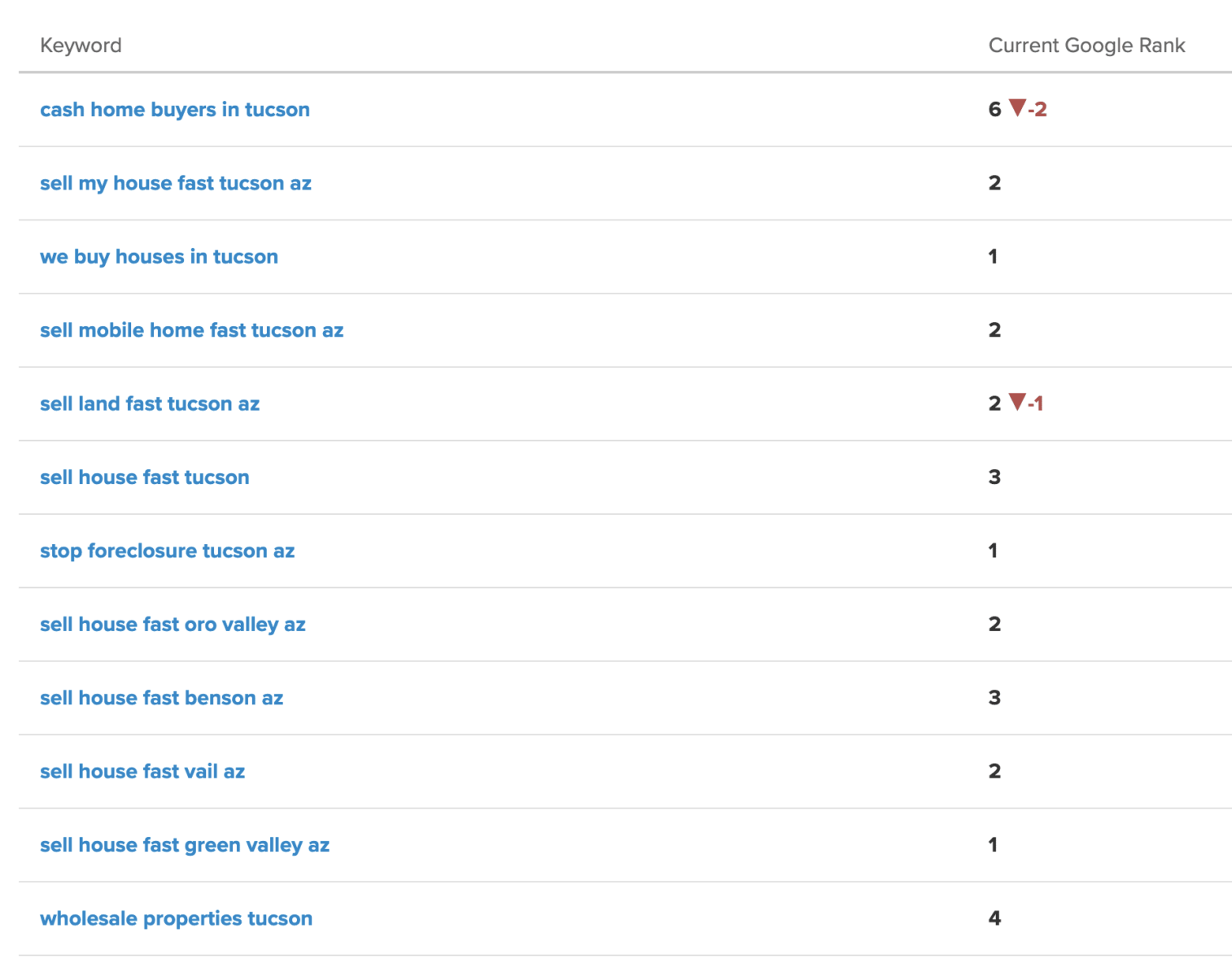

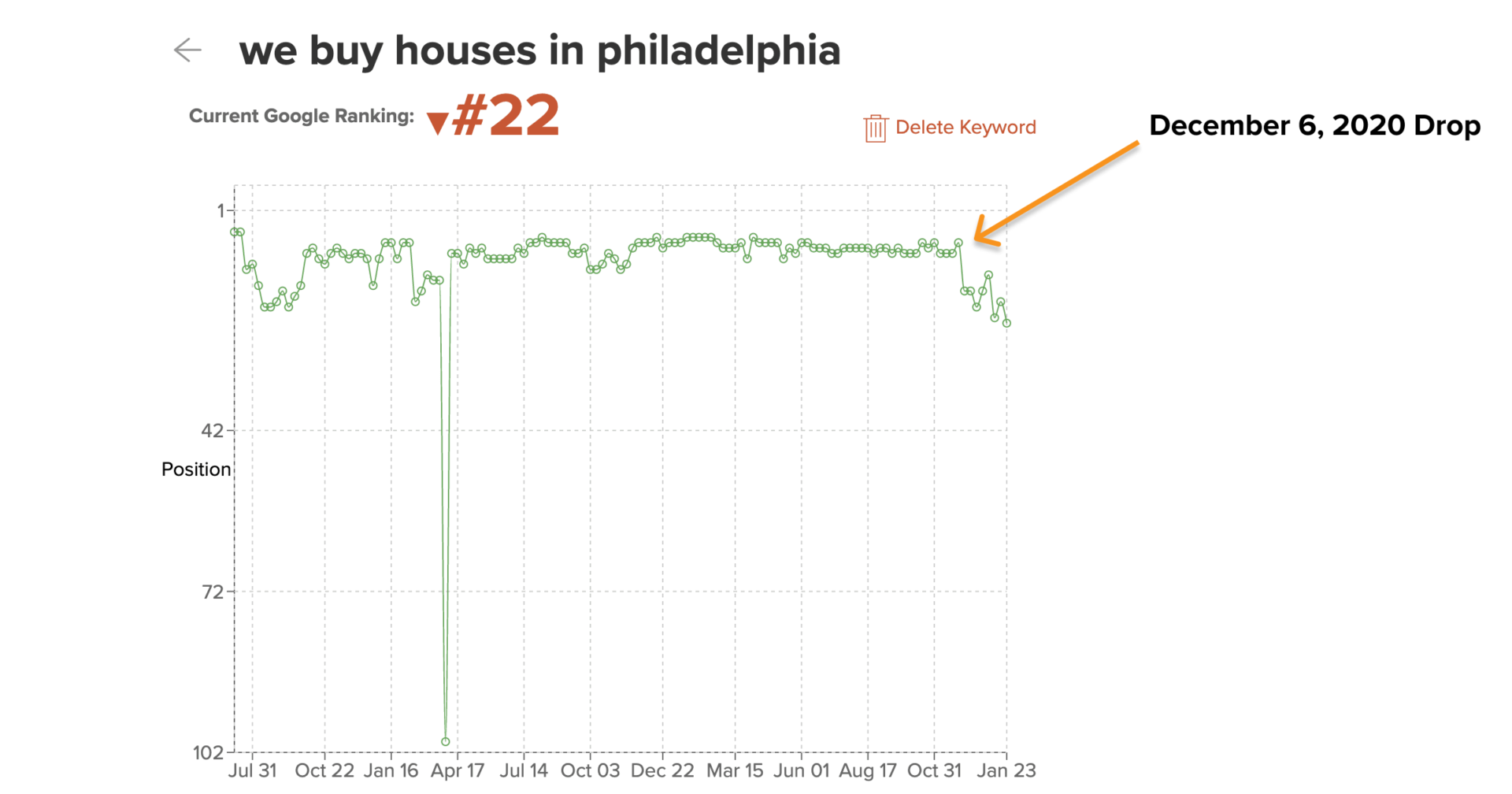
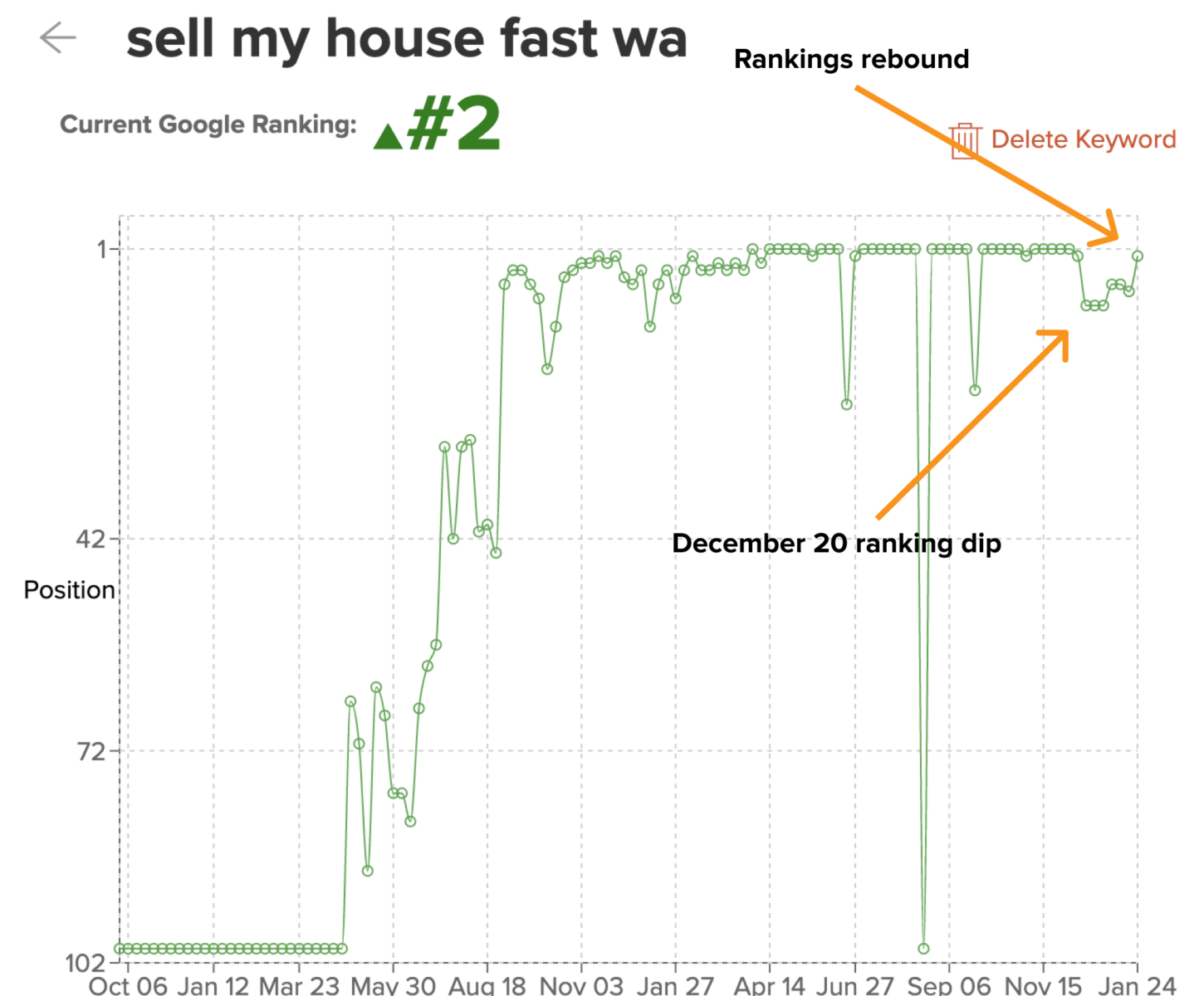
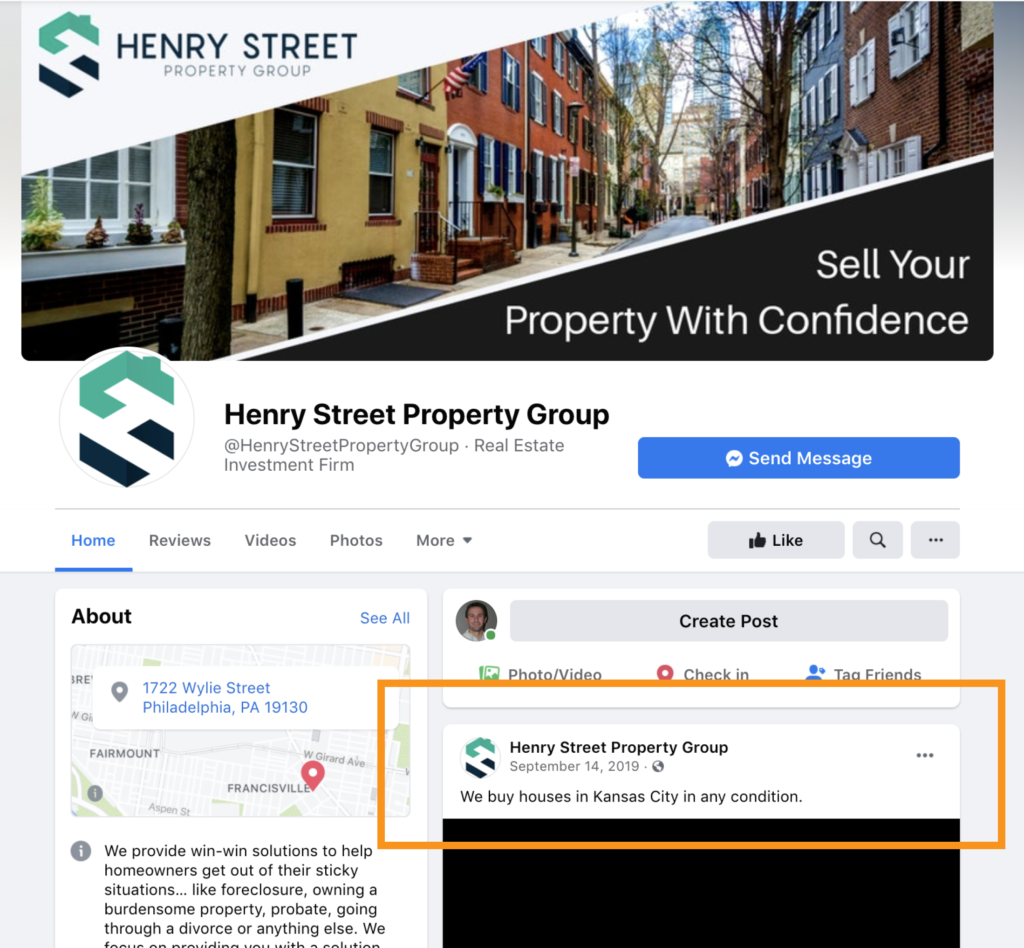
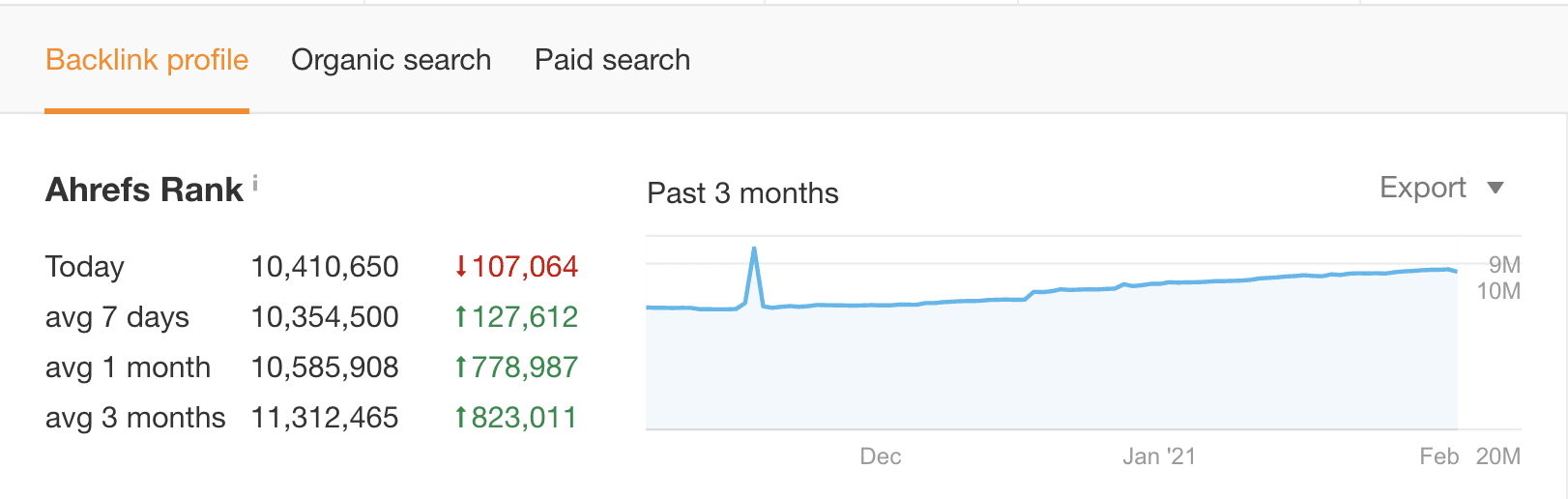
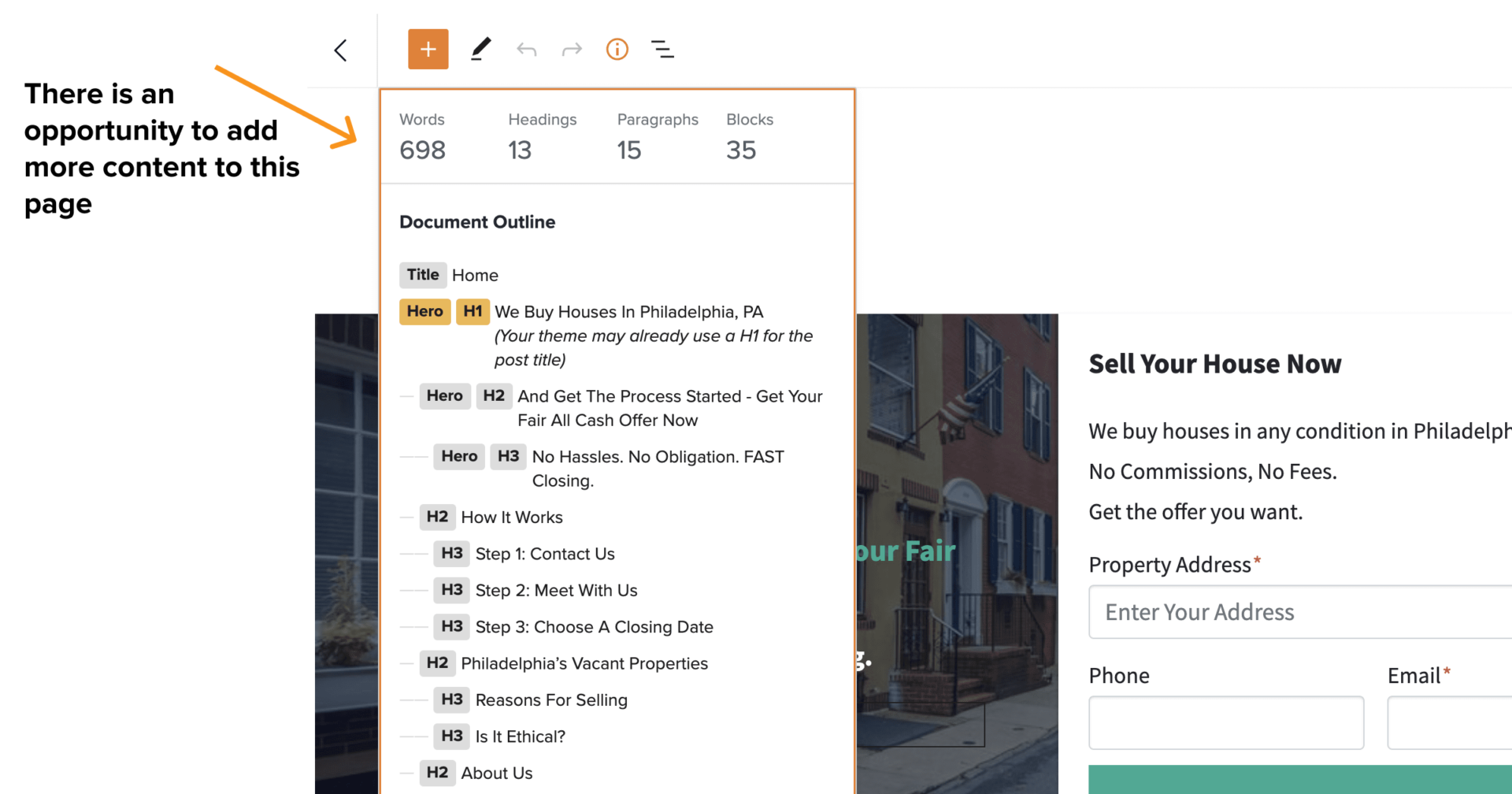
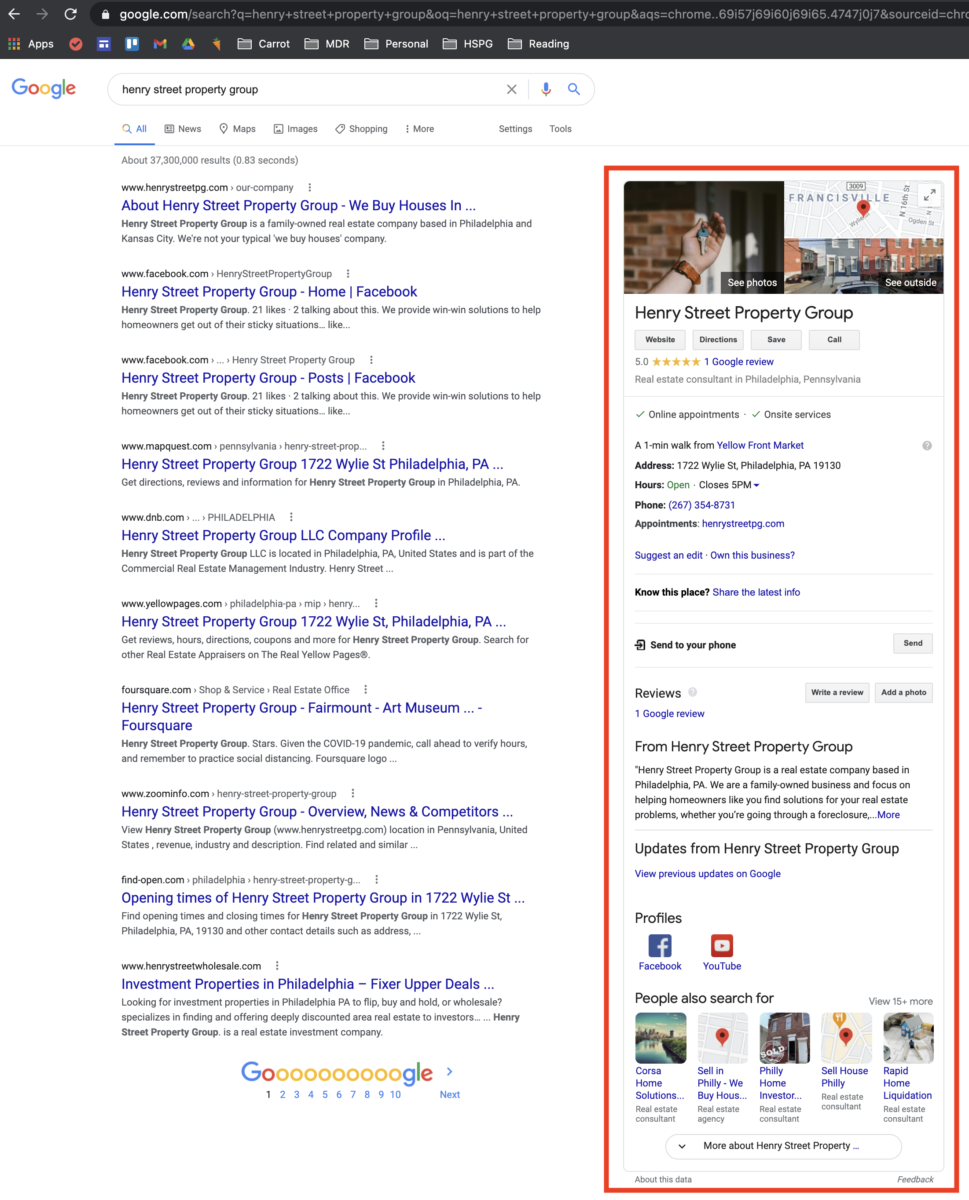
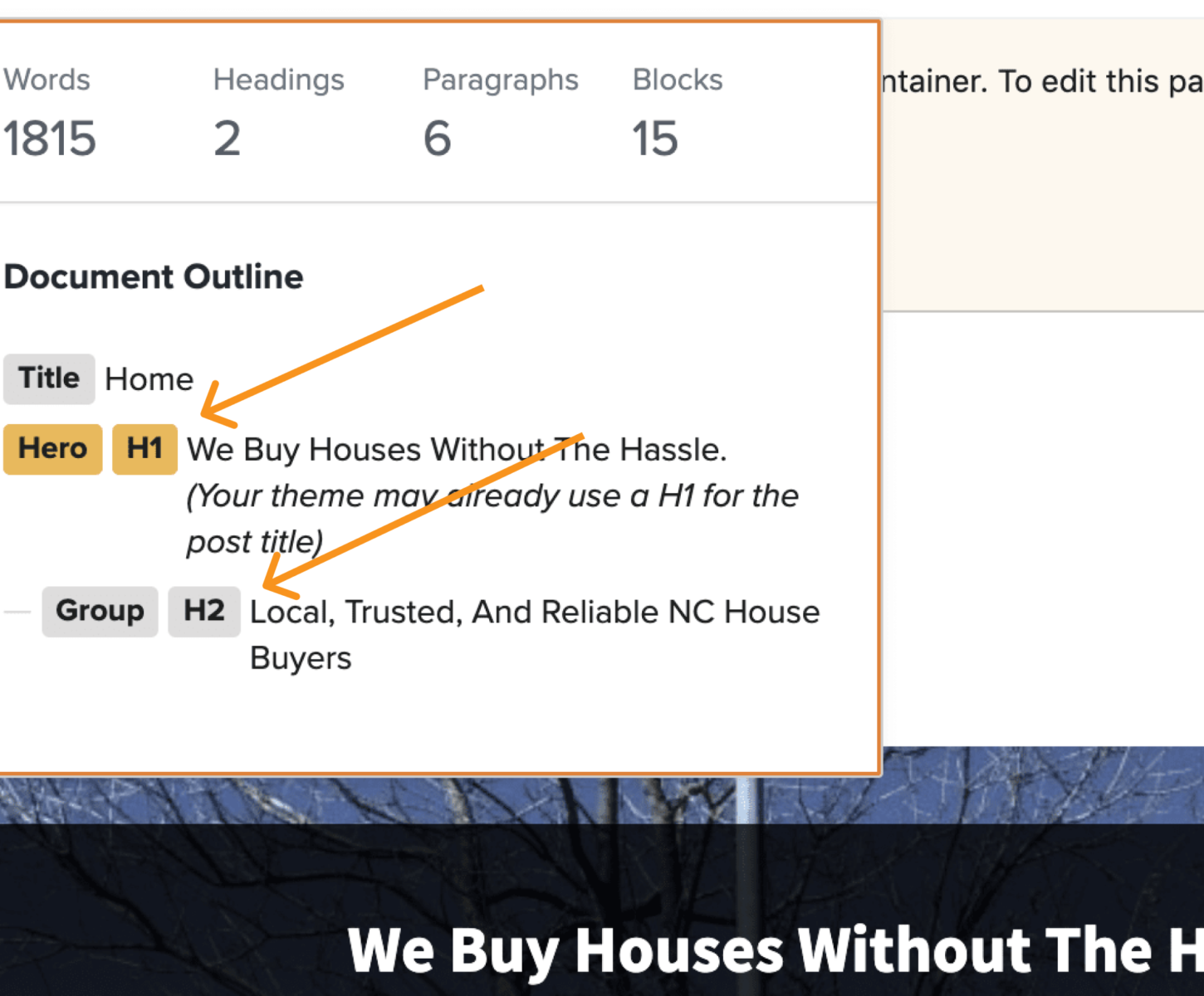


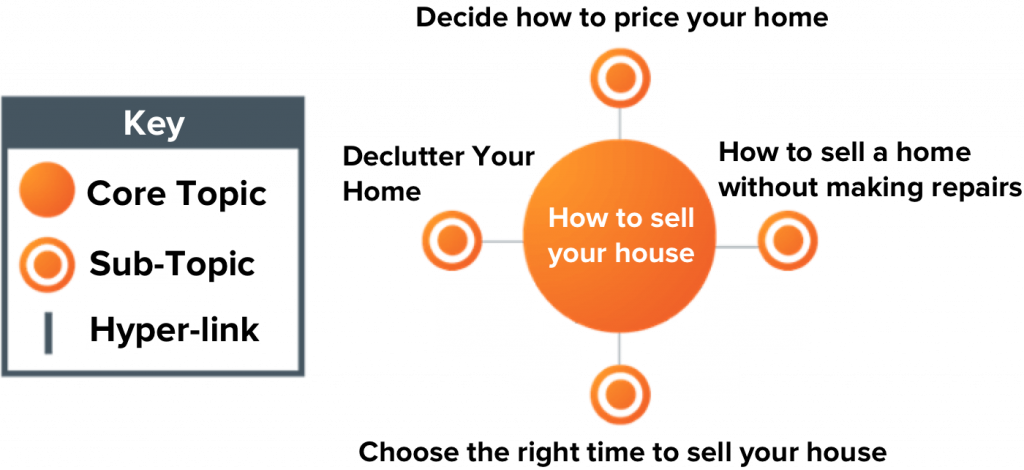
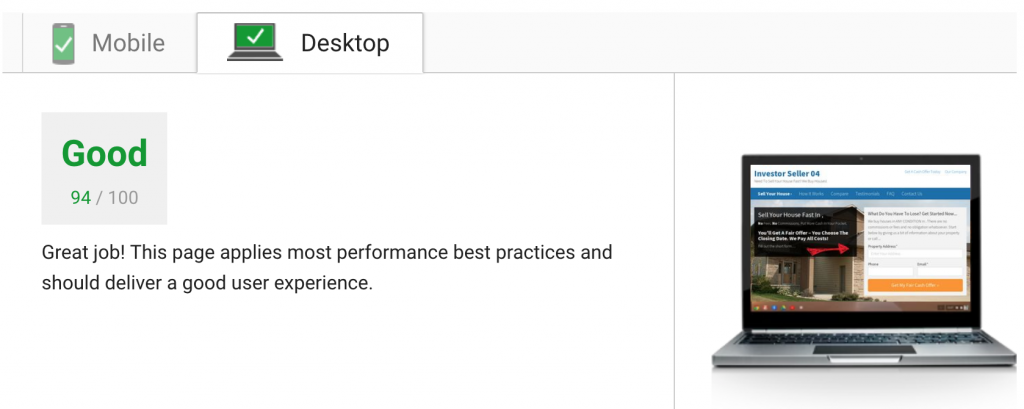
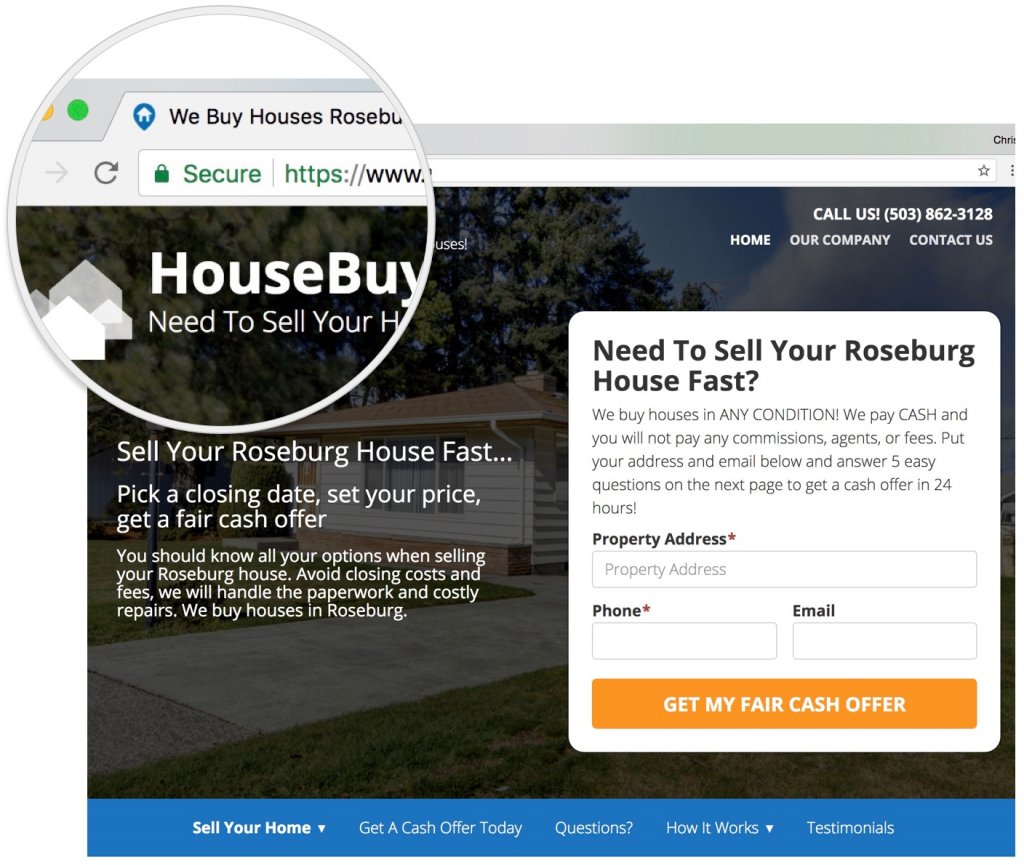
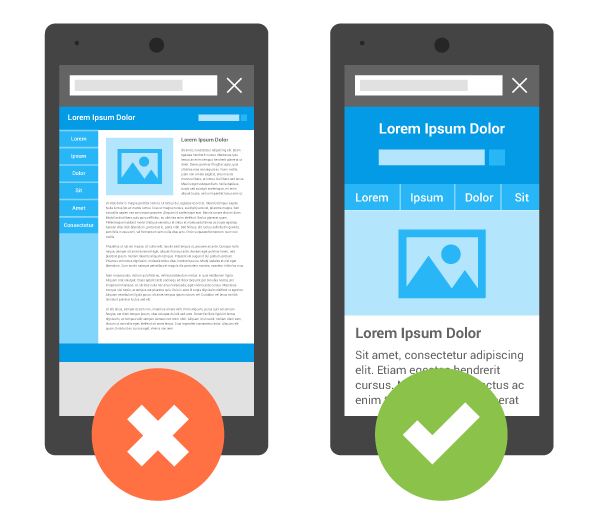
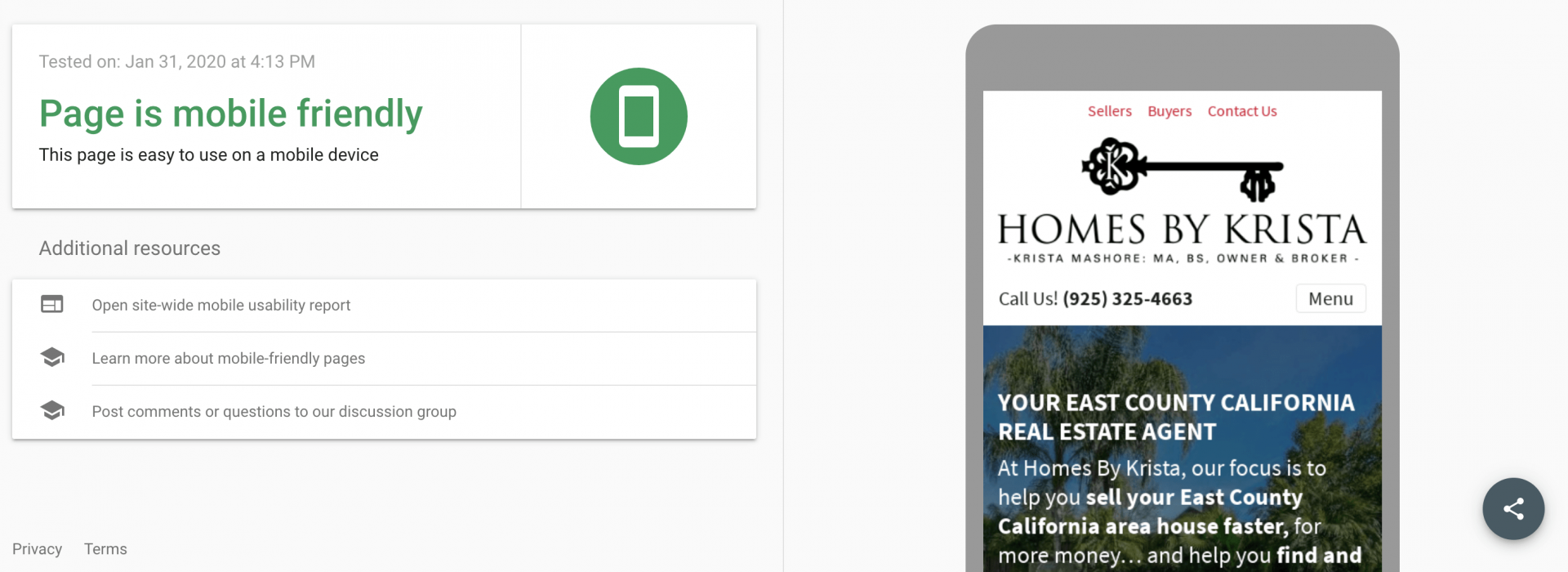
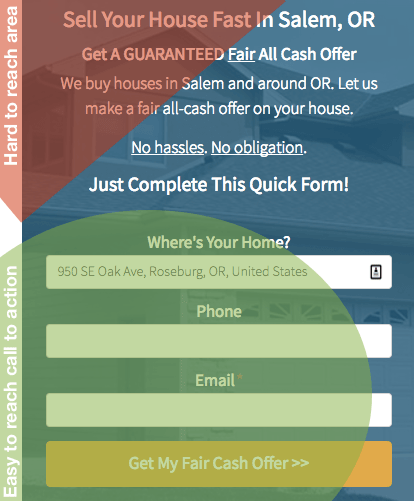
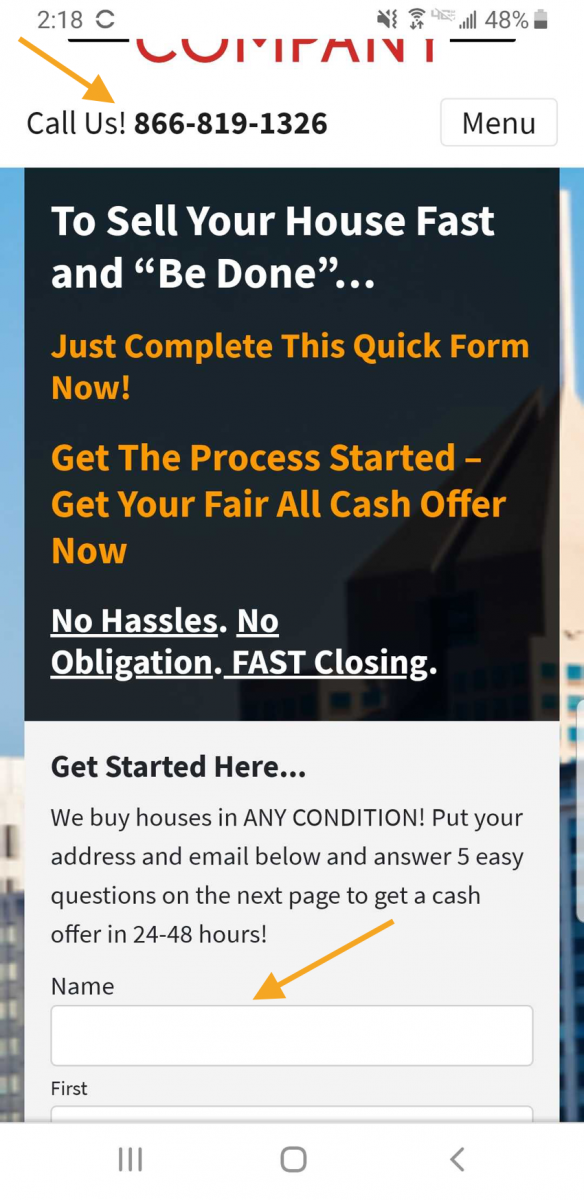
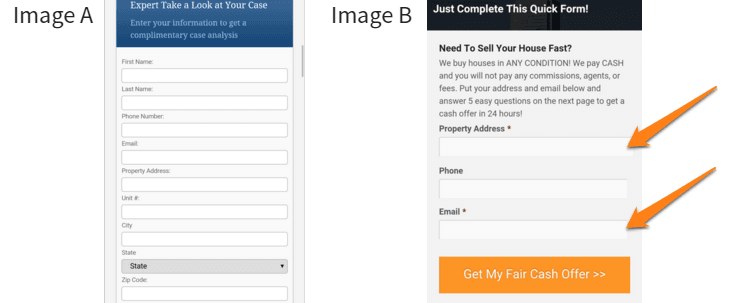
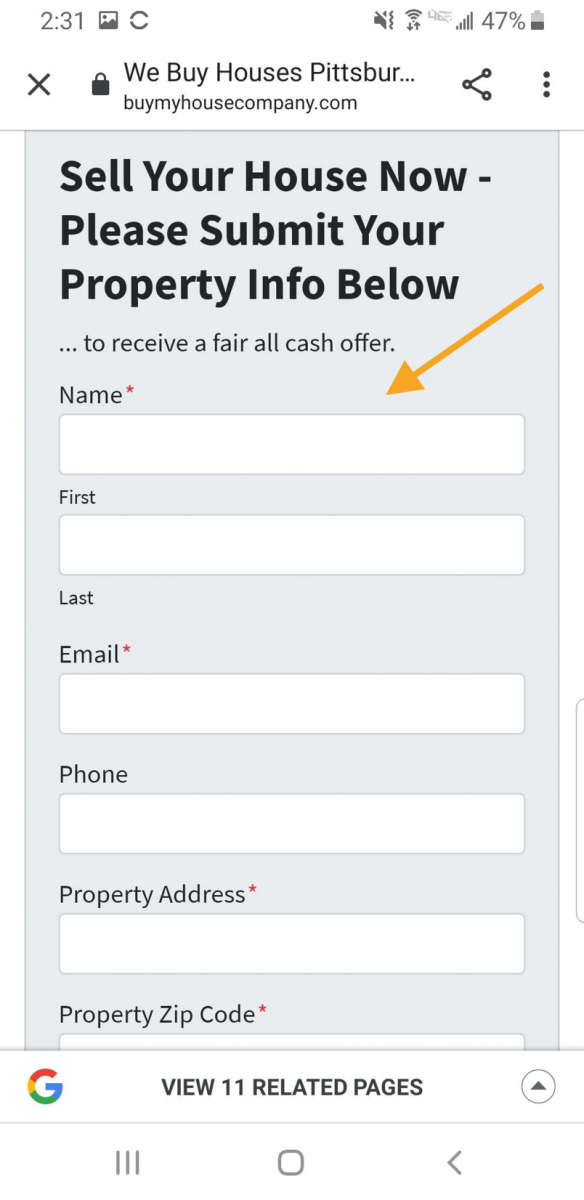


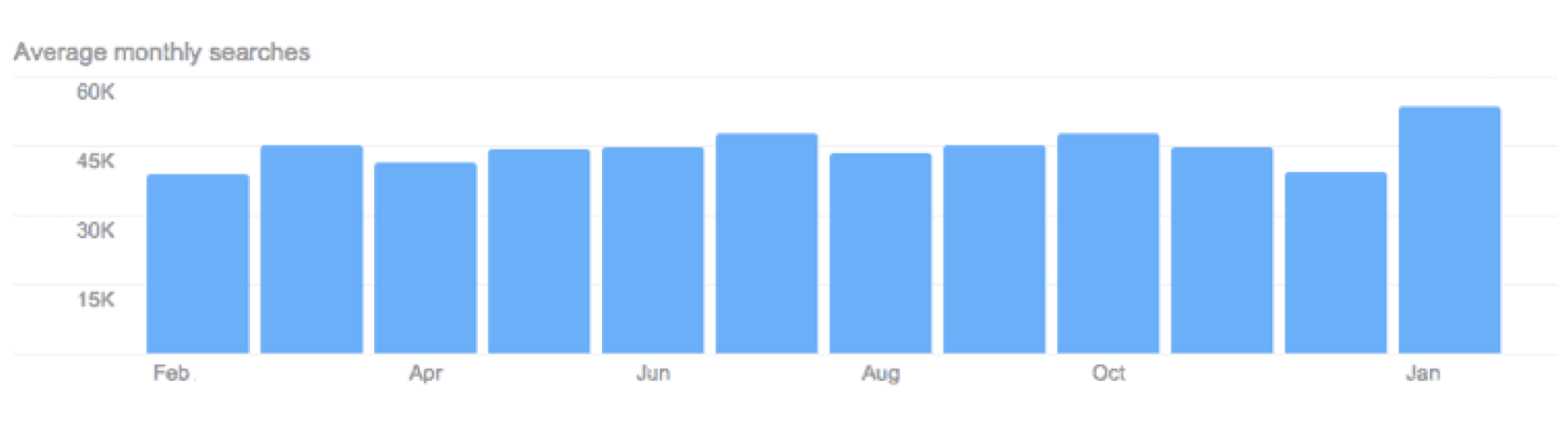
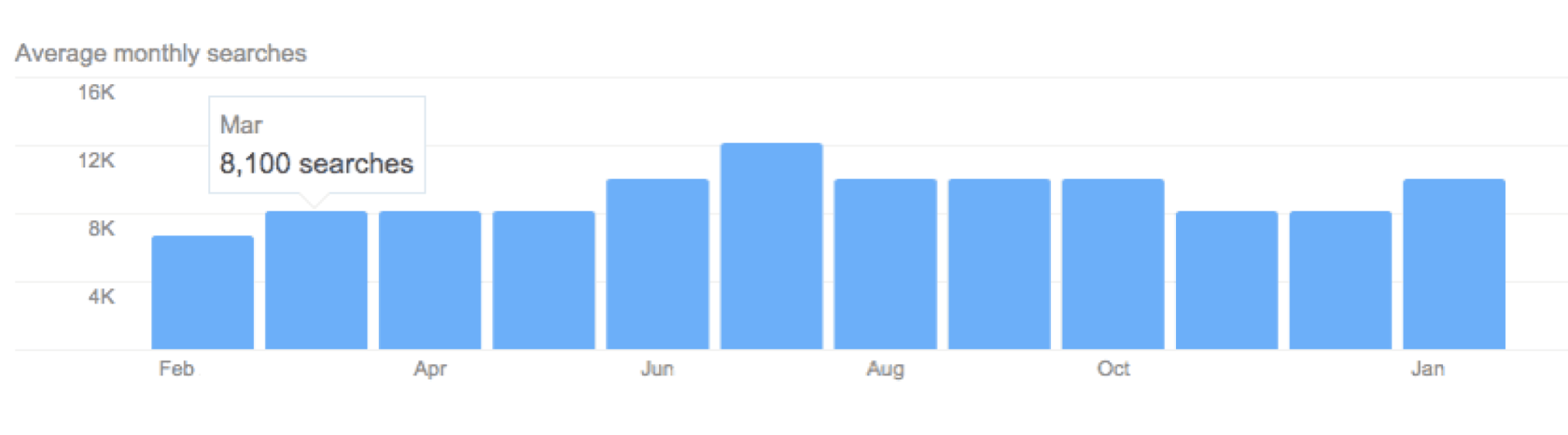
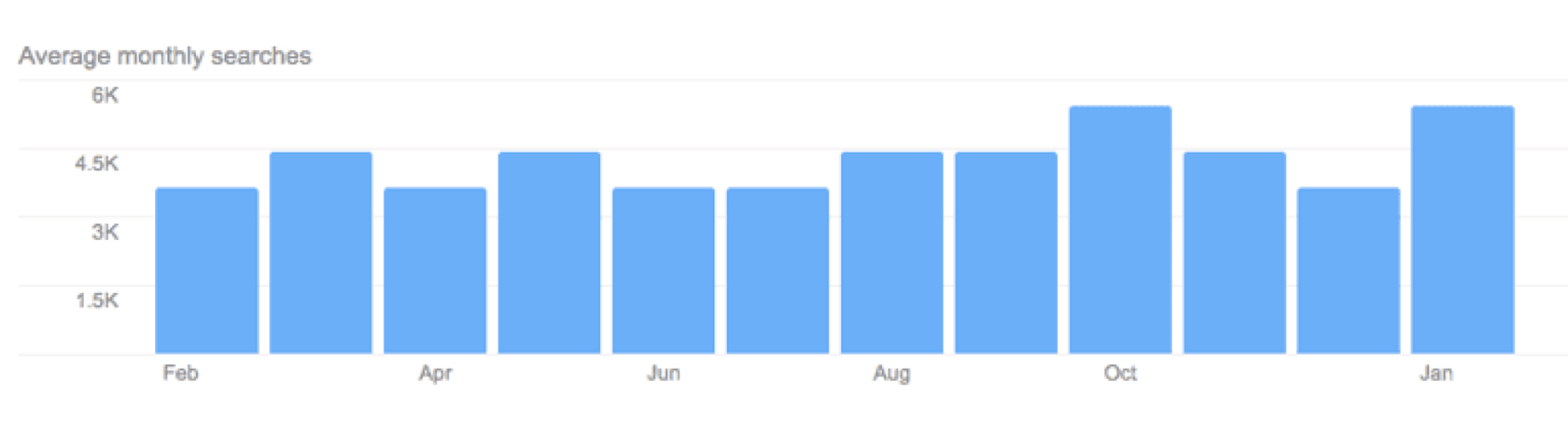
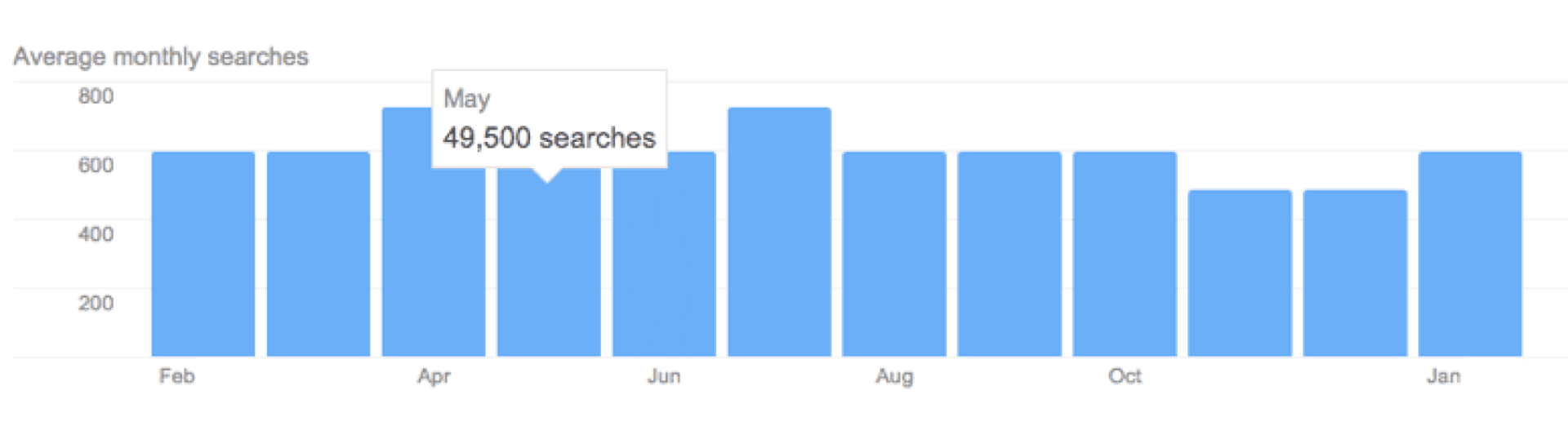
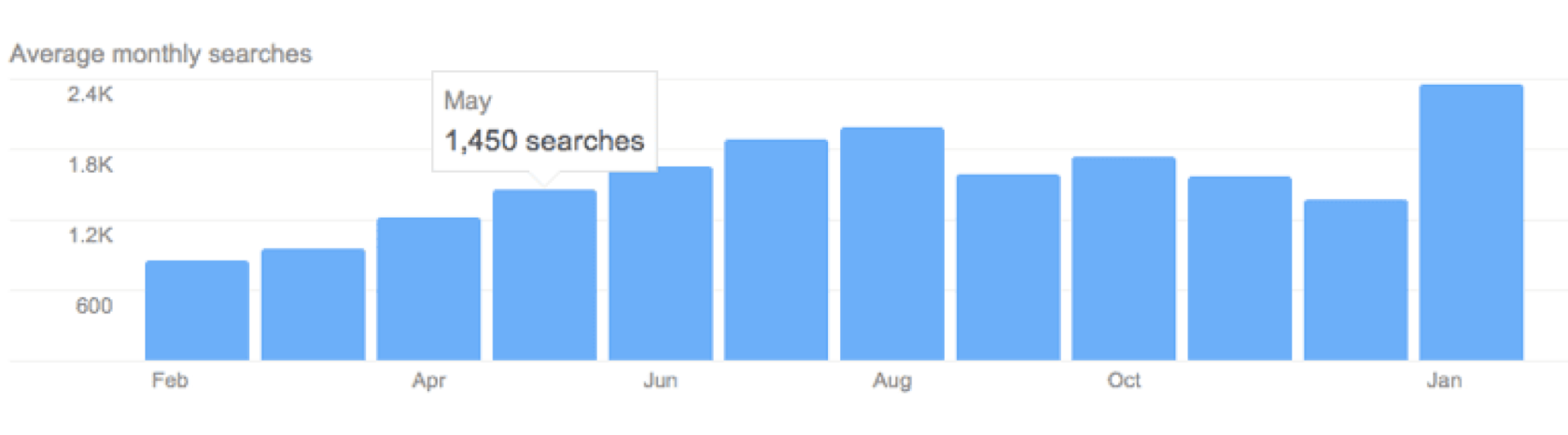
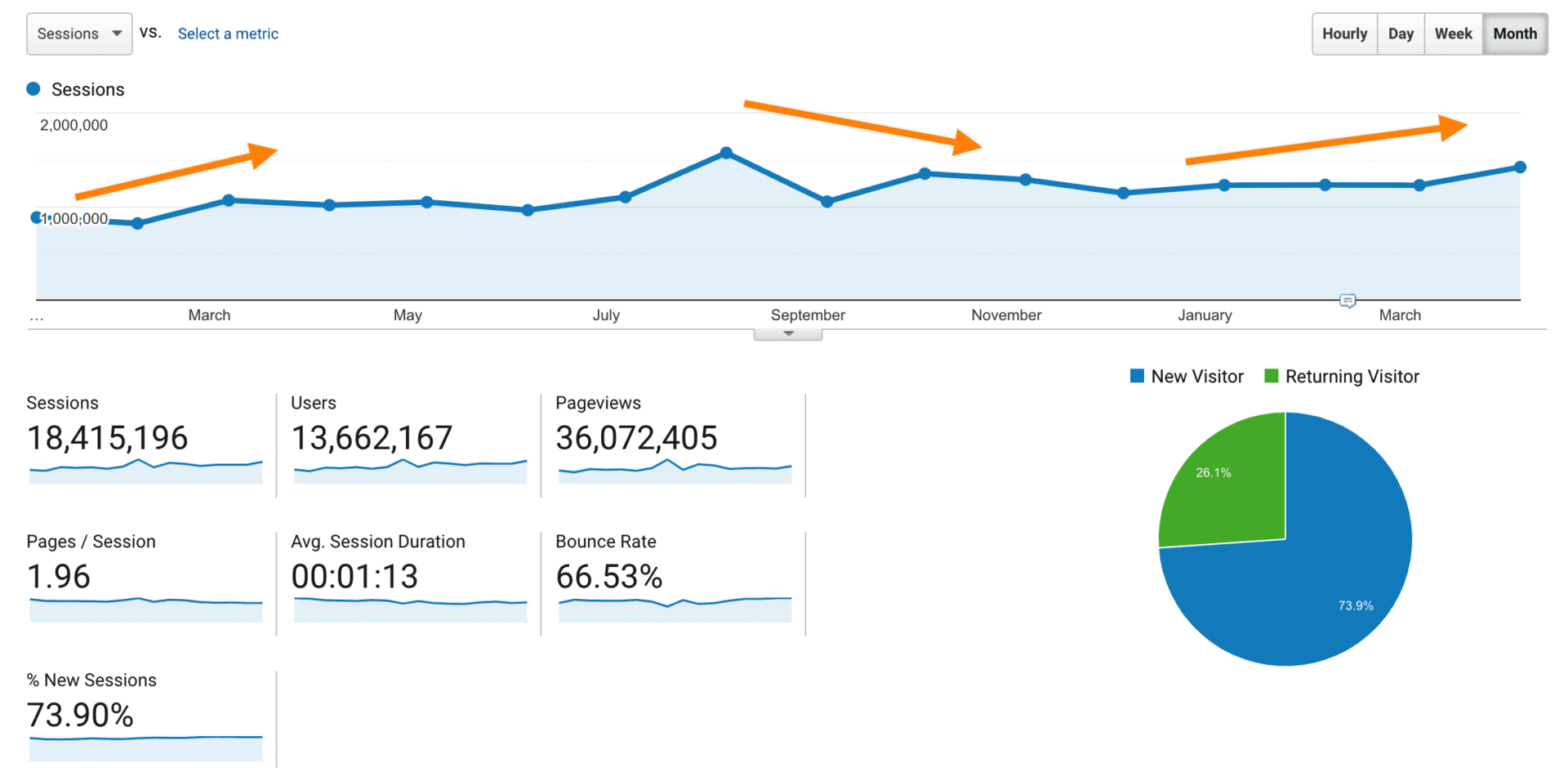



![SEO For Real Estate Agents [30+ Highly Effective Tips]](https://image-cdn.carrot.com/uploads/seo-for-real-estate-agents-featured.png)