

Author: Mike Blankenship

  • This Real Estate Agent Doubled Her Closings + Increased Website Traffic By 227%

    This Real Estate Agent Doubled Her Closings + Increased Website Traffic By 227%

    Fox Realty Group, Increases Closings by 100%

    Shemeika Fox is a real estate agent in Santa Cruz. She’s marketing her business in ways that most real estate agents never even consider, and because of that, she’s cutting through the clutter in her competitive market. Since implementing Carrot and an Inbound methodology, Shemeika’s web page views increased by 227% and their closings have increased 2x.

    Recently, she joined us on the CarrotCast to discuss her journey through our 30 Day Challenge, which has helped her take her market authority even further. She is quickly ramping herself up to be the leading real estate expert in all of Santa Cruz!


    In 2019, Shemeika Fox doubled her number of closings. But it wasn’t by sheer luck… it was by clear-cut strategy and intentional action.

    She’s marketing her business in ways that most real estate agents never even consider, and because of that, she’s cutting through the clutter in her competitive market.

    Just before that success, though, Shemeika was tired and frustrated — she was on the hamster wheel of business, sweating for every single lead.

    She knew something needed to change.

    And that’s when she made these five key shifts in her thinking and her marketing.

    1. Mindset Shift: From Hunting To Farming

    Entrepreneurs are great at getting up early and working late.

    There’s a ceasless motivation that drives entrepreneurs, and while that’s an important quality for success, it’s also not sustainable.

    Ask any ex-entrepreneur why they got a day-job and they’ll probably tell you that they worked too hard and too long for too little payback.

    That’s because most entrepreneurs hunt for their closings.

    They pay for advertisements, ask for referrals, send direct mail, follow-up, and cold call. But here’s the thing: the moment that you stop doing those things… the leads stop flowing. Which means that the only way to generate more leads or to keep generating leads at all it to keep working harder and longer… to keep hunting.

    But what about a farmer?

    A farmer is different than a hunter. They plant seeds, nurture those seeds, and then reap the benefits of their careful attention.
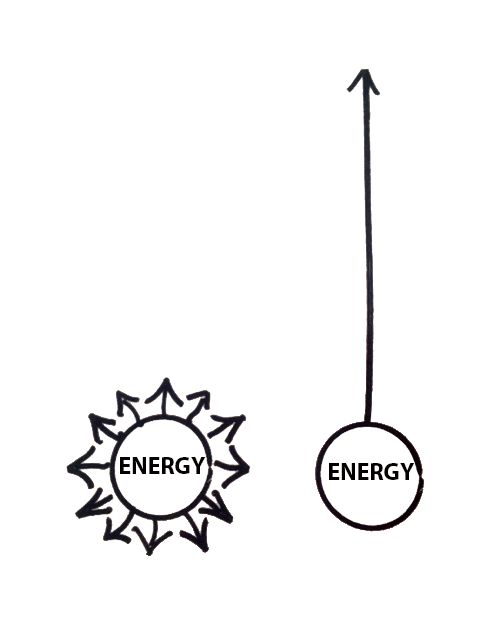
    less-work
    All of the lines on the left are equal to the length of the line on the right, but more progress is made when focus is put in just one mission-critical direction.

    Sure, it takes more time to see the results, but the harvest is much more plentiful and, in terms of ROI, it requires much less work per closing.

    Farming strategies include SEO, buliding brand awareness, and content marketing… all strategies that most real estate agents neglect.

    Now we’re not saying that you should stop running ads or sending direct mail, but you should be farming and hunting for your leads.

    Hunt for leads when your business needs them immediately, and farm when you can allow a bit more time for results.

    This was an important mindset shift for Shemieka to make and it’s important for all entrepreneurs.

    Harder work is not the only way to generate more leads or grow a bigger business. Like the cliche goes, work smarter, not harder.

    For Shemieka, that means consistently running ads and sending direct mail, but also spending plenty of time building her online brand image, posting content to social media, and growing her SEO presence.

    2. Simple, Effective Lead-Generation Website

    Building an effective website is one of the most difficult parts about building a real estate business.

    You need one because everyone else has one… but how do you get that website to actually be useful and generate leads?

    And in order to get the functionalities and features you need to get your website generating leads on autopilot, how do you build that without spending thousands of dollars on a custom design?

    For Shemeika (and for more than 7,000 real estate pros around the nation), Carrot was the answer.

    Before signing up with Carrot, this was Shemeika’s website.
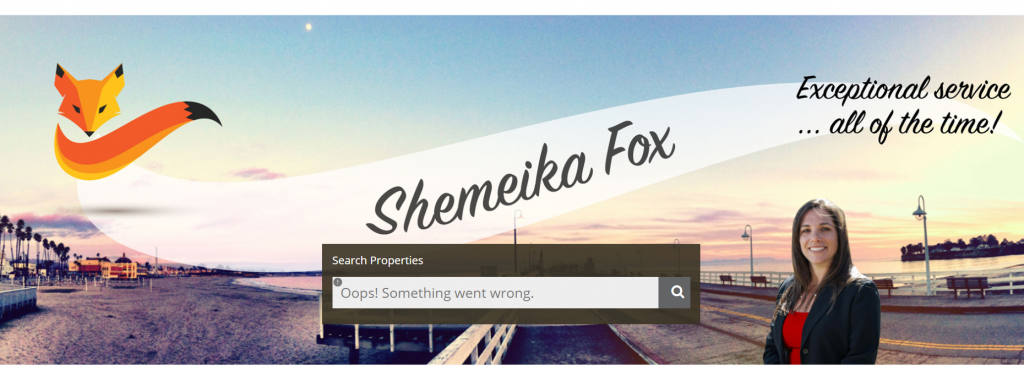
    It might look pretty, but the problem is that it wasn’t generating leads for Shmeika’s business, no matter how much traffic she drove to the site.

    That’s why she signed up with Carrot.

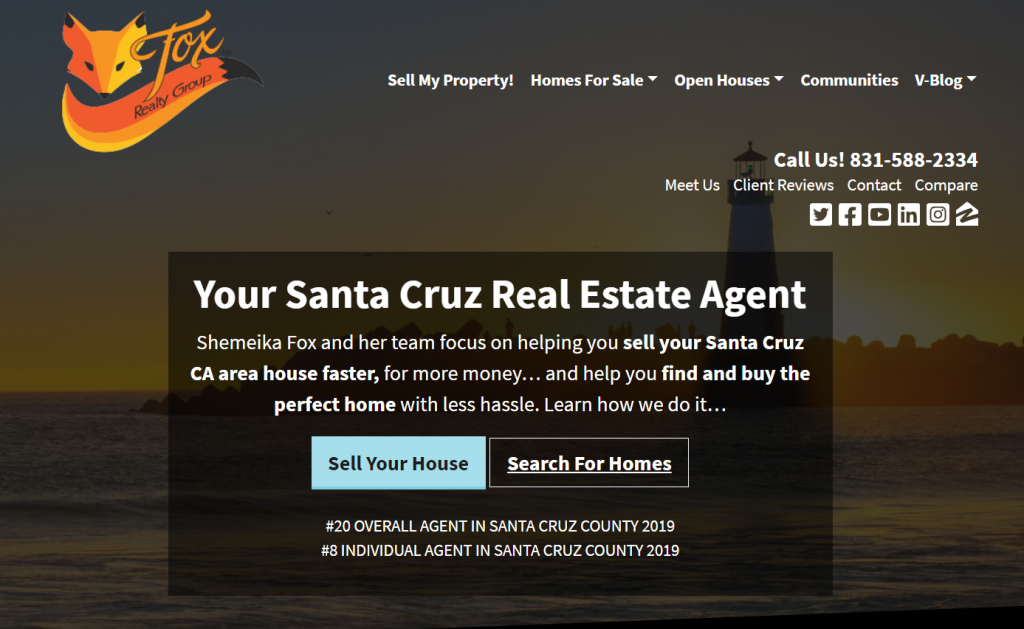
    Here’s her new website.
    And guess what?

    People don’t just visit that site… they opt-in, they contact her, and those leads turn into closings.

    In fact, her website brings in so many leads that, in 2019, she doubled her number of closings.

    Why?

    Well, the genius of our Carrot methodology is in giving your website traffic exactly what they want. First, people tell you whether they want to buy a home or sell their home.

    If they want to buy, then they can immediately start browsing through your listings — if they find something they like, they just have to dial the number in the upper right corner of your Carrot site!
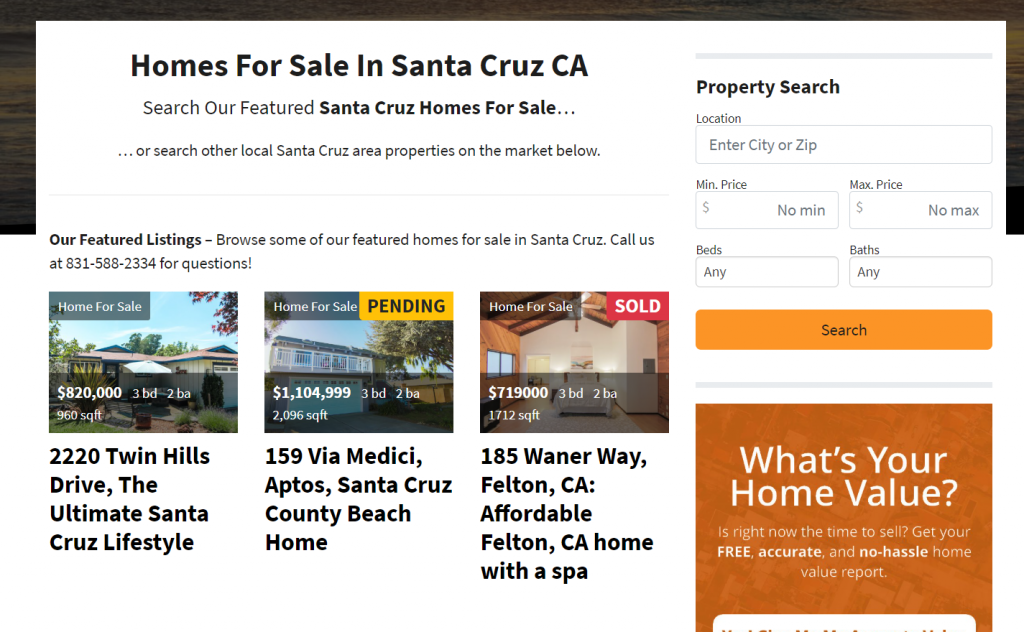
    If they want to sell their home, then they’ll be taken to this page which is designed to get them in contact with you as soon as possible.

    And the conversion rate on Carrot sites is higher than any other website builder in the industry, which means more leads, more often.

    This was a fundamental shift for Shameika. In her own words,

    “Carrot has impacted my business so positively! I love the property websites, landing pages, the SEO rankings, blog and over all design of the site. I also love the landing pages that i use to drive traffic from ads that I run. And my favorite is to watch the increase on Google rankings with the more relevant content we produce. Really great web host!”

    3. Focus On Blog & SEO

    One thing we’ve found that separates top-performing real estate agents from everyone else is a focus on search engine optimization.

    And that makes sense.

    Because if you rank on page one for a search phrase that is getting attention every single month, then you’re going to get a lot more website traffic and lot more leads than your competitors.
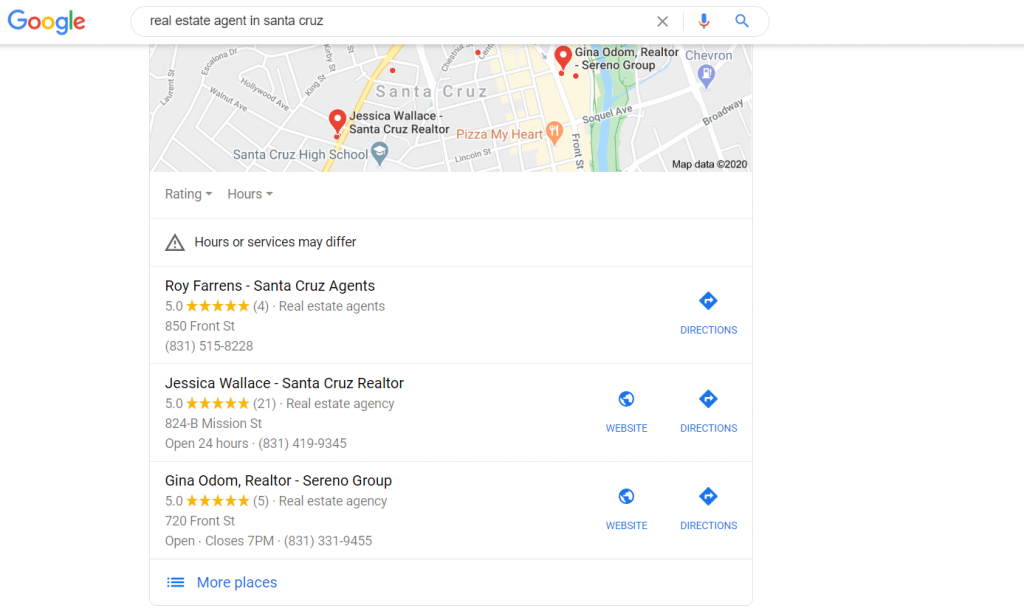
    And by focussing on SEO, you won’t just get more leads, you’ll also get higher quality leads.

    Our members have found SEO leads to be about three times higher quality than leads from paid advertisements, which means it takes about three times less leads to actually close.

    The reason for that is simple.

    With paid advertisements, you’re interrupting people who may or may not be intersted in your service.

    But with SEO, interested people come searching for you.

    So the question becomes, how can you build your SEO rankings?

    Well, we’ve designed Carrot to help you do just that… and here are some of the features we offer that you’ll definitely want to take advantage of…

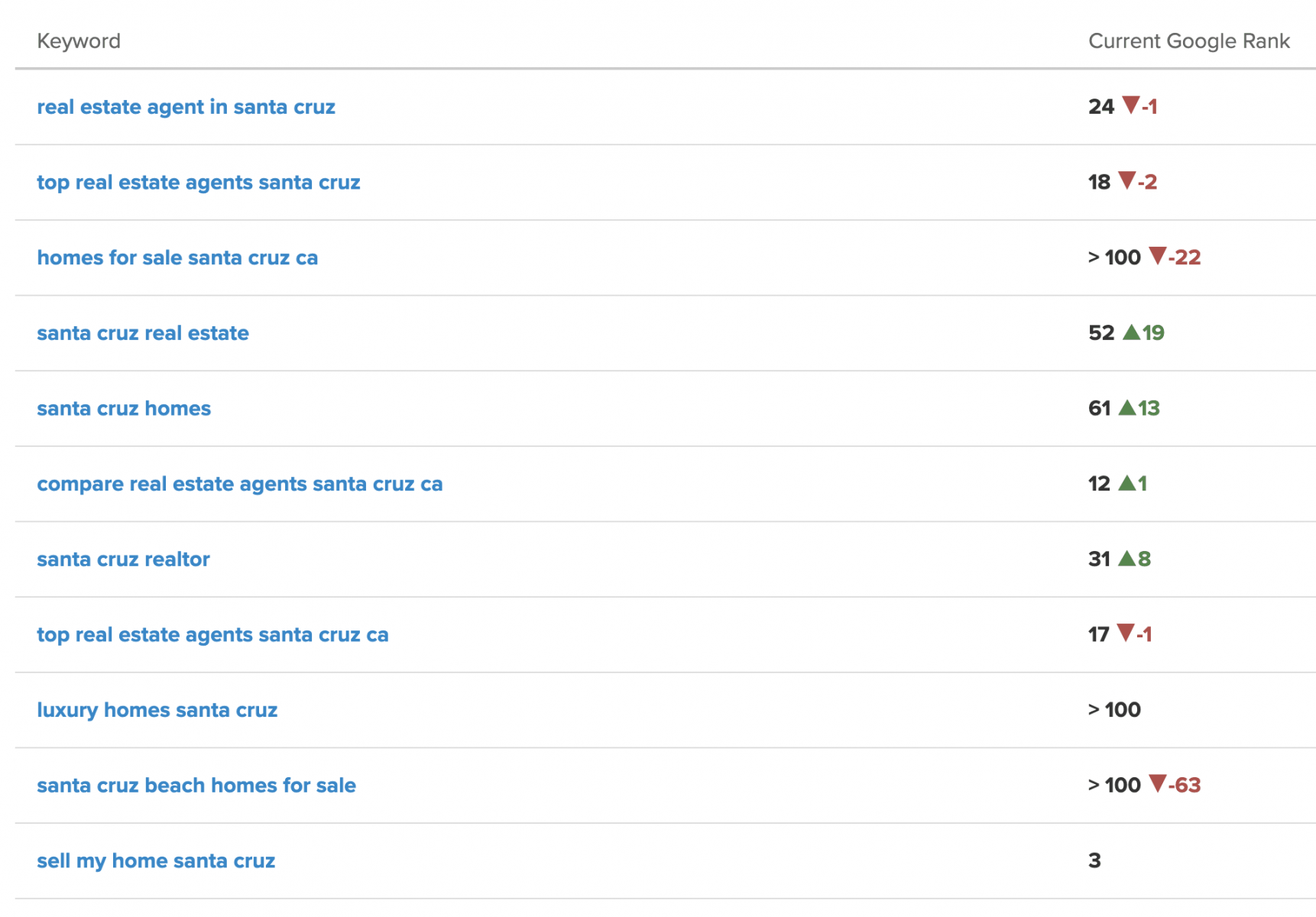
    Ranking Tracker — Our ranking tracker will keep an eye on how your website is performing for certain keywords in Google. Just enter the keywords that you’re trying to rank for and our ranking tracker will do the rest, giving your regular updates on your website’s SEO performance.
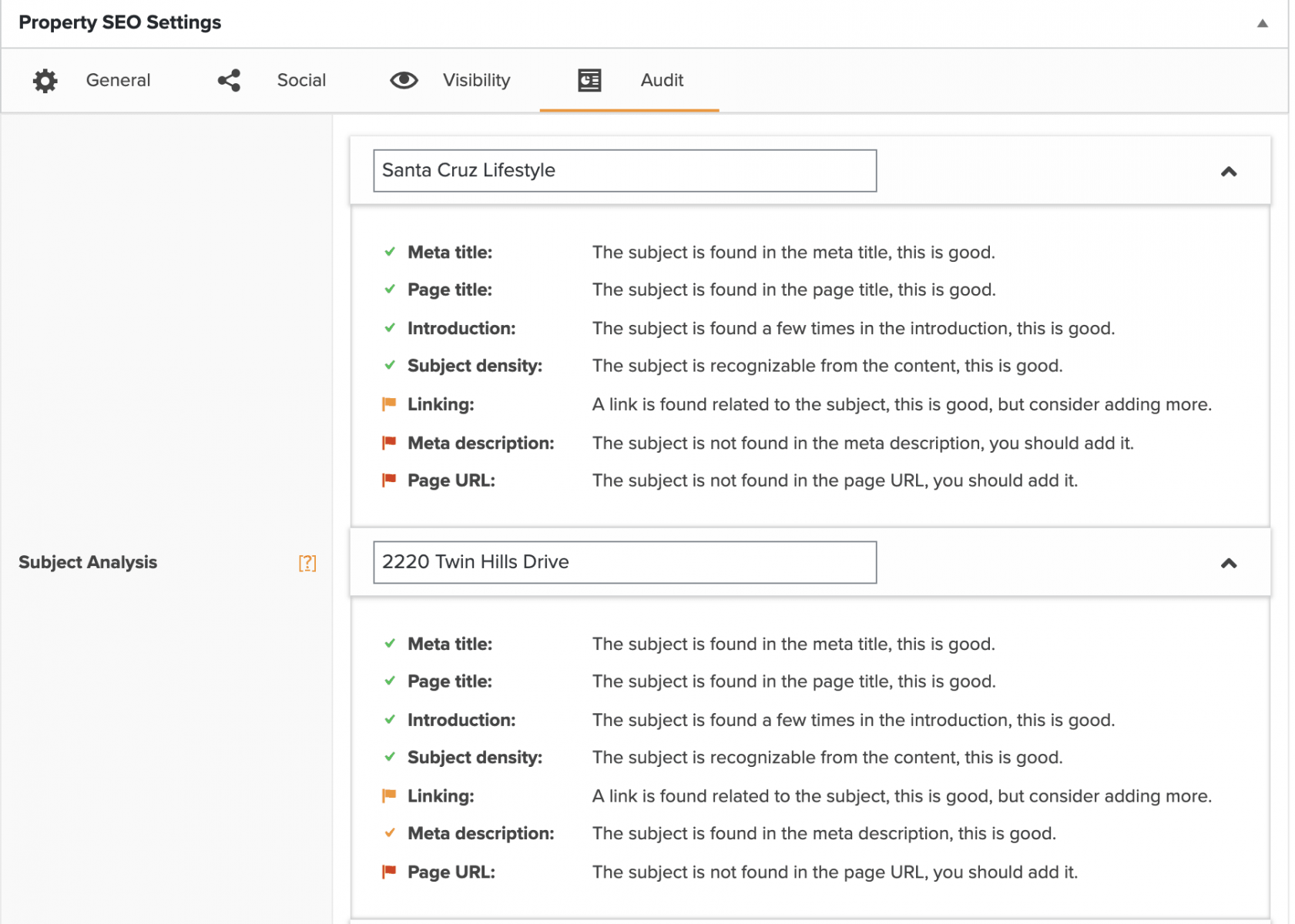
    SEO Tool — Whenever you’re designing a page of your website with Carrot, just scroll to the bottom to find our SEO Tool, which will automatically scan your page for search engine optimizations and give you a checklist of what you still need to do. Once the light is green, that means you’re good to go!
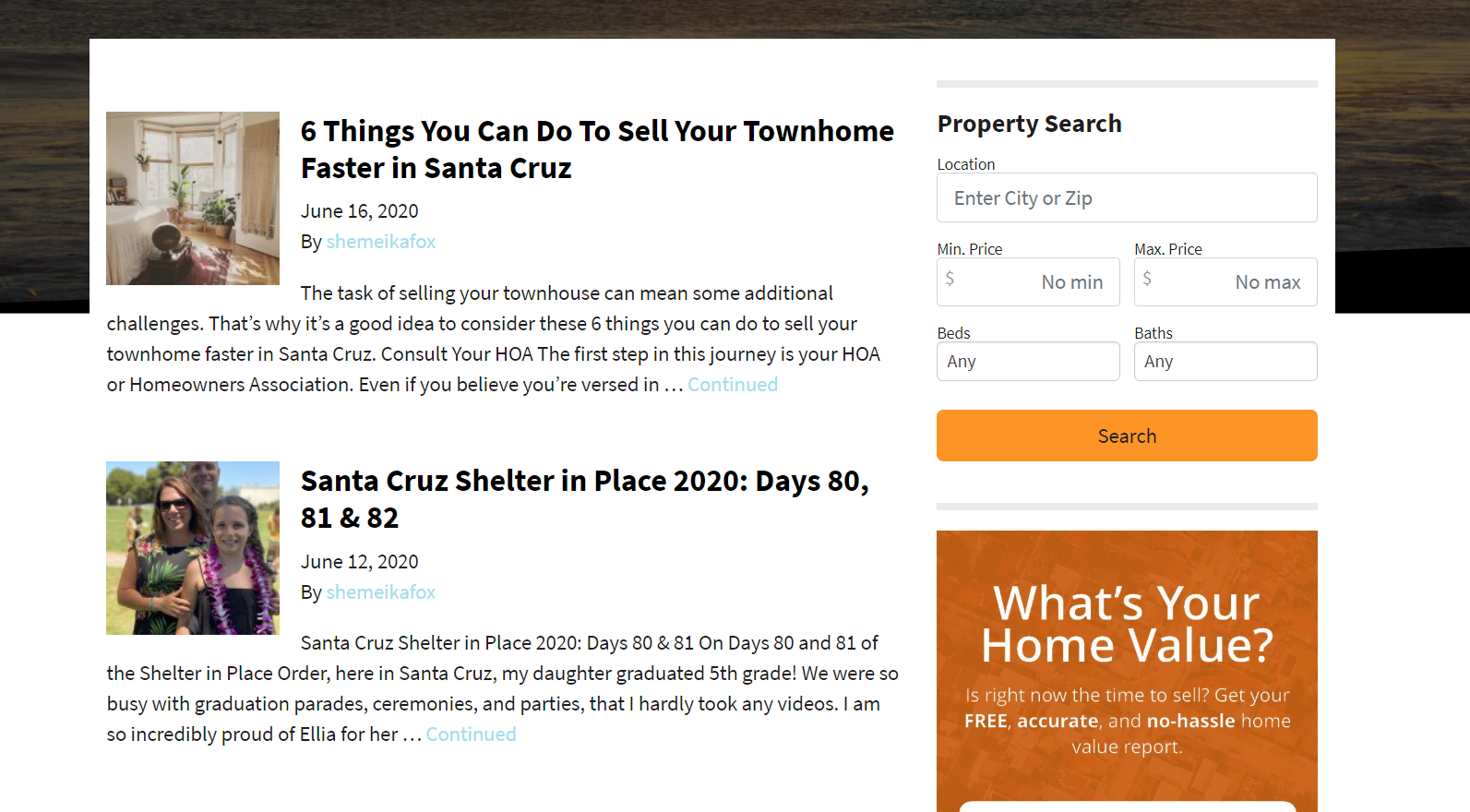
    Monthly Blog Posts — If you sign up for a Content Pro or Advanced Marketer membership, then we’ll also provide you with blog content for your website every month that is customized for your market and written to rank for a specific high-value keyword in Google. Just publish the content every month and you’ll give your website a better chance of ranking!
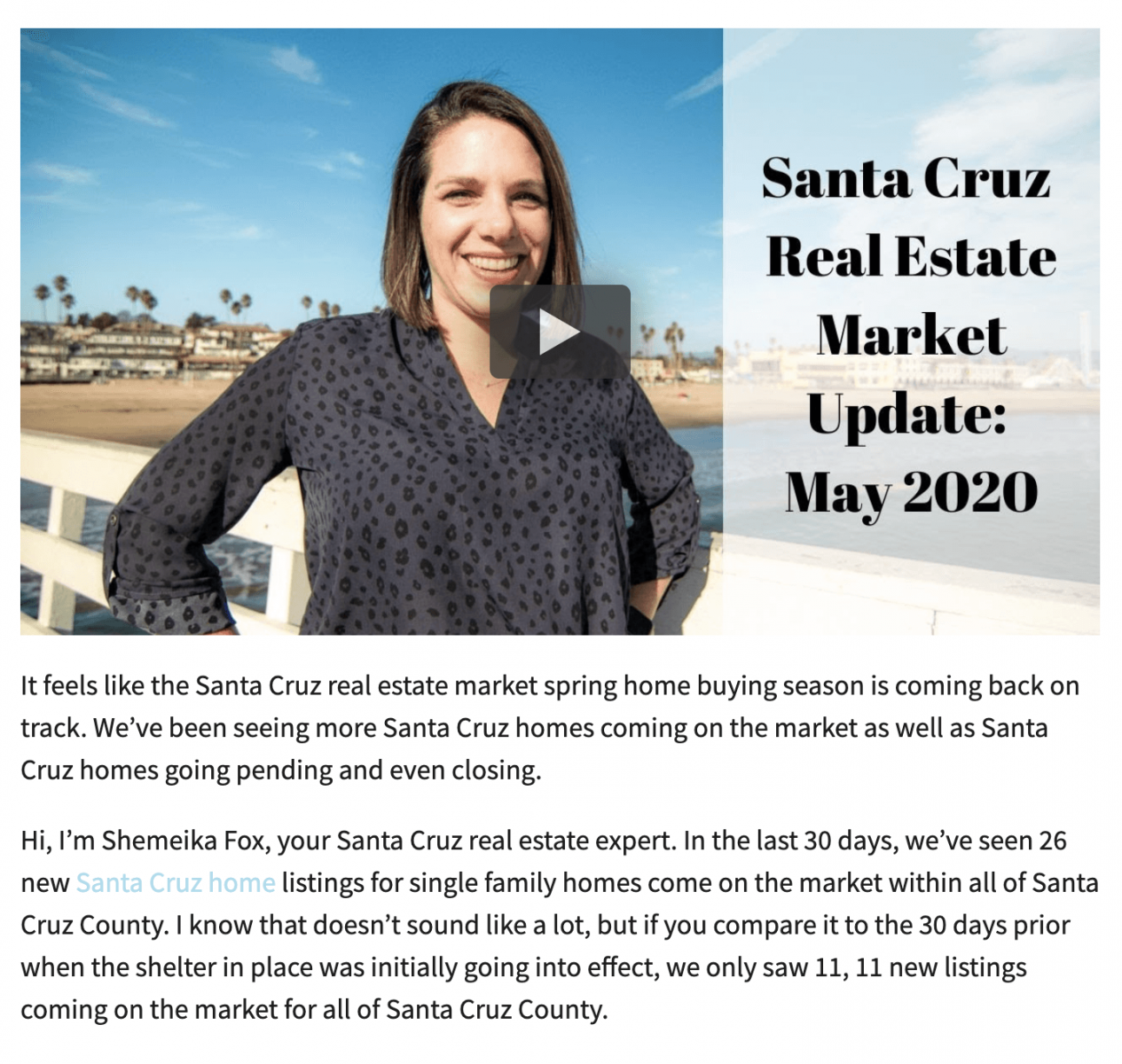
    VideoPost — One of Shemeika’s favorite things about her Carrot site is the ability to use a feature that we call VideoPost. This tool allows you to upload and trascribe any video into a long-form blog post for your website that can help you rank in Google. But instead of writing the article, you just upload your video and we’ll do the rest. This is a great way to quickly and easily create SEO content for your website.
    4. Advertisements & Landing Pages

    When we asked Shameika what her favorite thing about Carrot was, she mentioned that she loves being able to quickly and easily create landing pages that she can then drive paid traffic to.

    With Carrot, you can create a new landing page with just a few clicks.
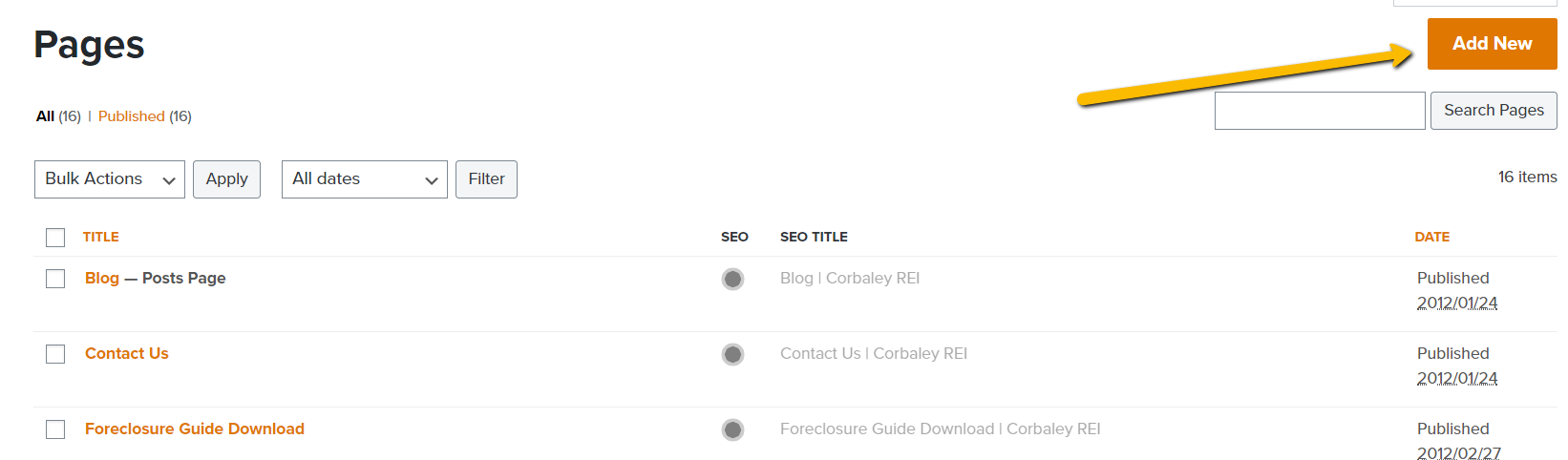
    You can then customize that page however you want.

    You can turn it into a sales page with an opt-in form, testimonials, and even a credibility bar… or you can turn it into a long-form blog post.

    The choice is yours.

    But one of the best ways to make use of this feature is to create a new landing page for each specific market that you’re advertising to… and then to drive that traffic to that page.

    You might, for example, create a page for people who want to buy river-front homes, or a page for people who want to sell a home for over $500,000, or people who just want to learn more about you as a real estate agent.

    Remember, the riches are in the niches.

    And with a Carrot site, you can easily create a sales page for each niche that you operate in.

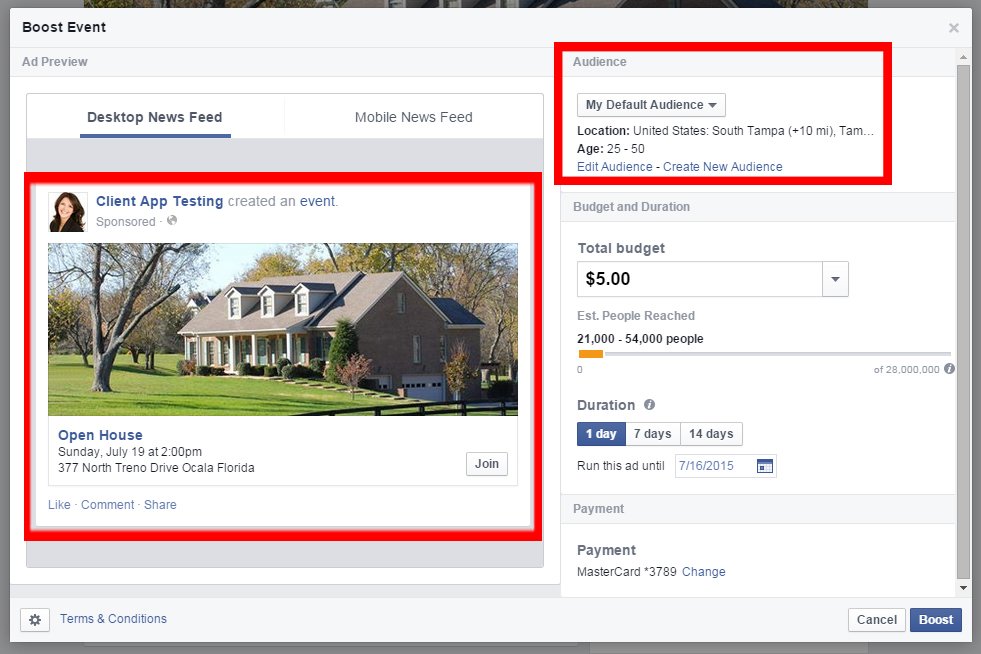
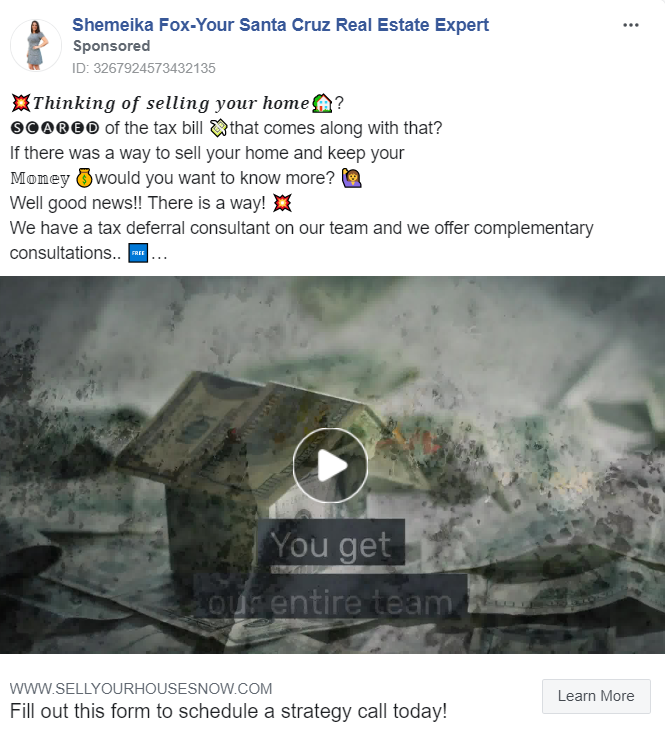
    Here’s a Facebook ad that Shameika is currently running…
    And here is the page that advertisement will take you to if you click.
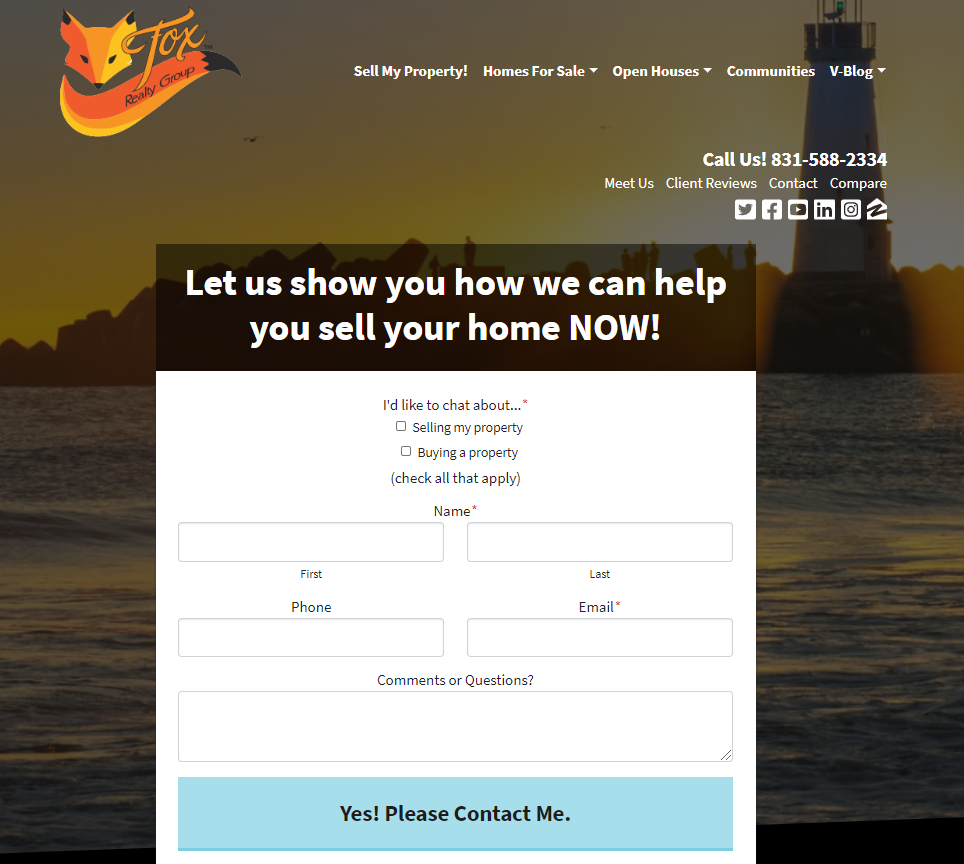
    See how the advertisement seamlessly flows into the landing page?

    That’s how it should always be.

    It should feel like one cohesive experience rather than two separate experiences.

    And by leveraging the versatility of Facebook’s targeting and Carrot’s landing page builder, you can create a seamless experience for buyers and sellers in any niche or market.

    Here’s one more example…

    And here’s the landing page…
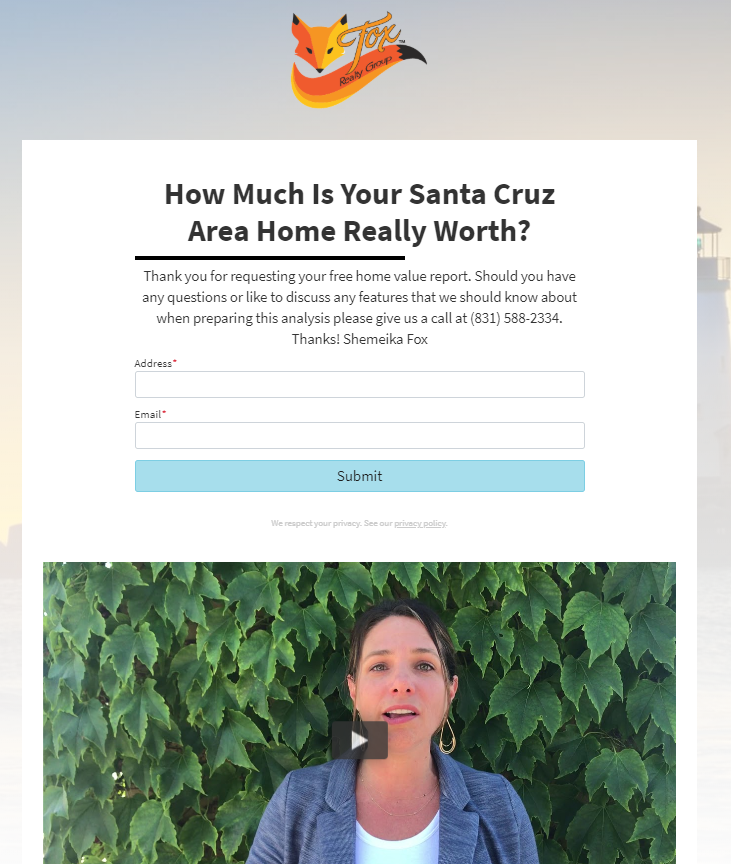
    Shameika skillfully attracts her target market with Facebook ads and then gives them what they want most on the landing page.

    In return, she gets their contact information and can then add them to her email list.

    Or maybe she’ll be able to start working with them right away. Whatever happens, this is a great strategy for generating leads.

    Create more landing pages for more niches and markets… and use advertisements to drive targeted traffic.

    5. The 30-Day Challenge

    What if you could take a system that’s proven to generate high-quality leads — a system that has made hundreds of investors and agents around the nation millions of dollars — and implement it right into your business in just 30-60 minutes per day over a 30-day period?

    Sounds too good to be true, yeah?

    Well, that’s the exact system that Shameika went through… and it helped to unlock her business’ full potential.

    We call it our 30-Day Authority Building Challenge [CLICK HERE TO JOIN].

    In it, we walk you through how to brand your real estate business, how to drive traffic, and — most importantly — how to get high-quality leads (and even how to obliterate your best month’s lead-gen record)

    At Carrot, we’ve helped countless real estate pros beat their most aggressive market competitors, generate more than one million leads, and build businesses that support themselves and their families.

    Over the last few years, we’ve learned a lot about what real estate marketing tactics work… and what doesn’t.

    And we thought to ourselves…

    “What if we created a tried-and-true, fool-proof lead-gen system for agents and investors — a system that would help our members become the go-to experts in their market, drive leads passively to their website, and build the business of their entrepreneurial dreams?”

    This challenge is helping people even more than we could have imagined…

    One of our long-standing members, Chris Wojciechowski, said he wishes we would have created this challenge 3 years ago!

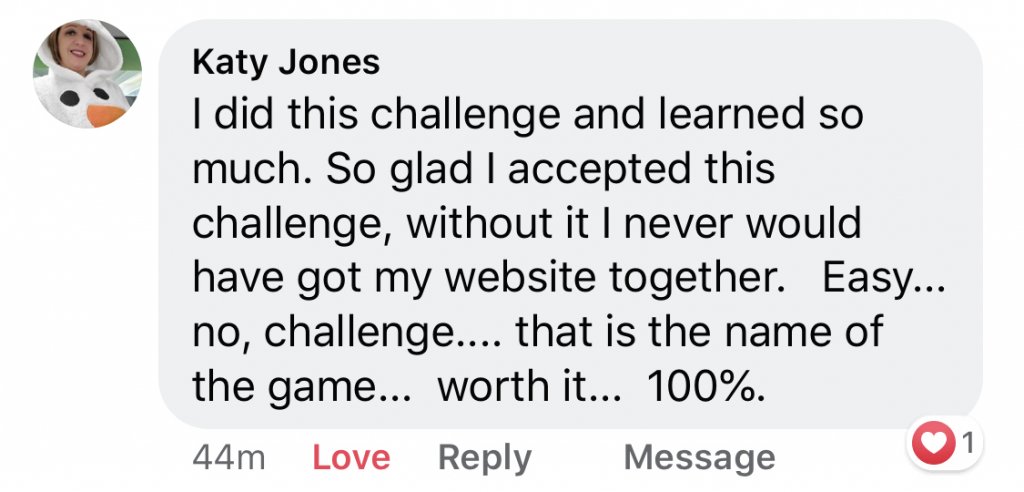
    Carrot 30 day challenge success

    So…

    Are you ready to create a marketing system for your real estate business that generates leads like clockwork, that makes your business more predictable and sustainable?

    Moreover, are you ready to spend just 30-60 minutes per day over the next month to make it happen?

    Great!

    Conclusion

    What are your goals for 2020?

    Do you want to generate more leads, do more closings, and grow your revenue?

    Do you maybe even want to double the number of closings you do this year?

    Well, we can no longer count on one hand the number of Carrot members who have taken their businesses to the next level.

    There are many stories just like Shameika’s of agents and investors who have used online marketing, SEO, Carrot, and advertising to beat their competition and build the business of their entrepreneurial dreams.

    It is possible for you as well.

    You just need the right tools.

  • 7 Biggest Wholesaling Real Estate Challenges (& How To Overcome Them)

    7 Biggest Wholesaling Real Estate Challenges (& How To Overcome Them)

    For years, wholesaling real estate has been peddled as an easy, low-cost entrance to real estate investing.

    In some cases, course-sellers have even described it as a mindless and straightforward way for anyone to get rich quickly.

    And while the wholesaling business model is full of opportunity and riches, it’s not as easy as some people would like us to believe.

    There are, after all, challenges.

    In fact, at Carrot, we’ve built a good portion of our business around helping people understand the pros and cons of wholesaling real estate and how to overcome the challenges.

    Once you know how to overcome the challenges, it is a remarkable business model that can support you and your family well into the future.

    Here are 7 of the biggest wholesaling real estate challenges and how to overcome them

    1. Saturated Markets

    Because of all the successful real estate investors creating courses and selling their knowledge about wholesaling online, many markets are becoming saturated with competition.

    In fact, before 2004, there wasn’t much online talk about wholesaling real estate.

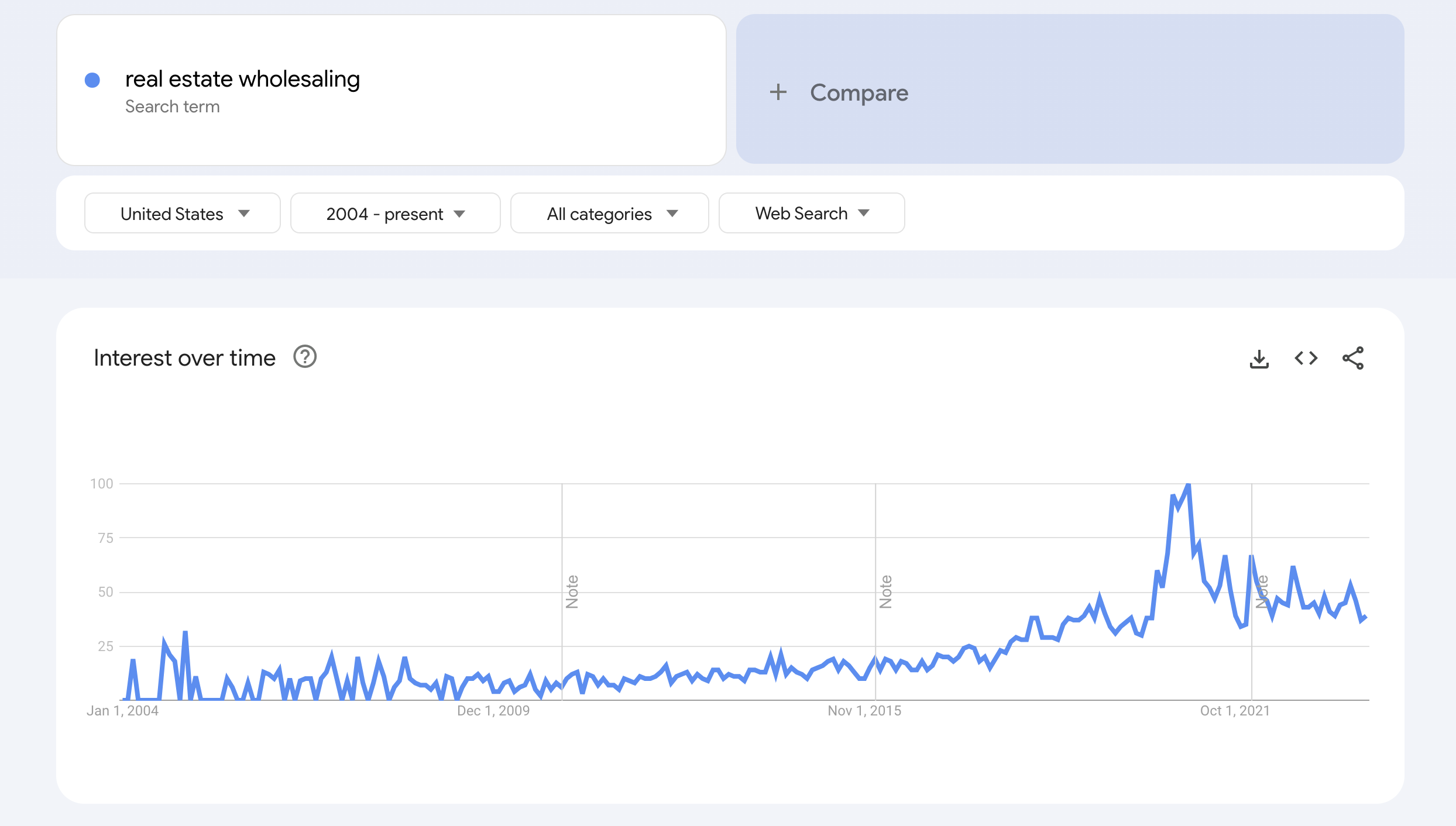
    Google Trends shows how popularity has risen (and is rising) for the term “real estate wholesaling.”

    google trends real estate wholesaling 2024

    The good news is that most of that competition is made up of wanna-be entrepreneurs who will be here today and gone tomorrow.

    Only some of that competition is going to stick around.

    Still, in most markets, there’s no shortage of wholesalers vying for the deals you’re trying to secure.

    How can you compete in such a saturated environment?

    How can you cut through the clutter?

    Here are a few ideas…

    • Unique Marketing — The fact is, most of your competitors are marketing in very similar ways. They’re not just sending direct mail but very similar mailers. They’re not just running Facebook Ads but similar Facebook Ads. Ask yourself this question: how can you market in a unique way that helps your business stand out from others? Finding a less-served niche, driving for dollars, and cold calling are three ways that you might differentiate yourself and find off-market deals that your competition has overlooked.
    • Search Engine Optimization — When someone looks for your service in Google by typing something like “Sell my house fast in [MARKET CITY],” who do they find? If they find your website, you’ll collect more leads than your competitors on autopilot. At Carrot, we specialize in helping you rank for high-value keyword phrases in your market. Learn more here.

    2. Low-Quality Leads

    High-quality leads will be worth the wait if you’ve put aside the necessary budget to secure deals and are consistent with your advertisements.

    Still, stumbling through swaths of low-quality leads to get to those high-quality leads is a common problem for wholesalers.

    It costs time, money, and energy.

    The goal, of course, is to generate fewer low-quality and more high-quality leads.

    How do you do that?

    You can’t avoid all the tire-kickers, but here are a few strategies for closing more deals with fewer leads…

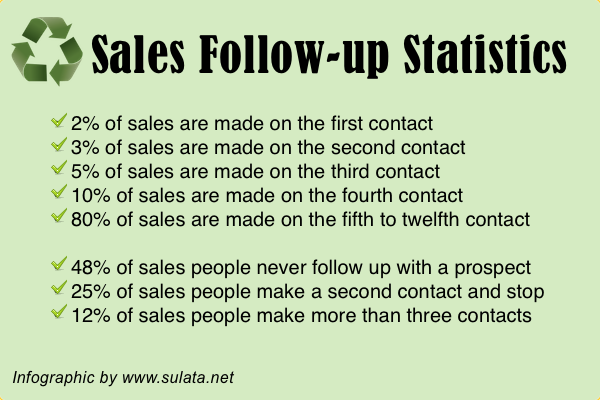
    • Follow-Up — 90% of the time, deals close during the follow-up process… not during the first phone call. That’s why following up with each lead at least 5-10 times is essential. That might seem like a lot of extra work if the leads are low-quality… but you might be surprised at how many leads become high-quality after adequate follow-up. Go here to learn how Carrot can help you manage your leads.
    • Build Your List — Rather than targeting general probate or out-of-state owner lists (i.e., the same lists your competitors are targeting), try building your list by driving for dollars. This will increase the quality of your leads and give you access to an untapped market.

    3. Inconsistent Deal Generation

    Where are all my deals?!

    We just finished talking about the obstacle of low-quality leads… but what about inconsistent deal generation?

    After all, your business can’t survive if this month is excellent and the next is terrible. You need leads coming in every single day, week, and month of the year to close some deals.

    And it’s not just leads for lead’s sake.

    Consistent wholesaling lead generation equals consistently closed deals and predictable monthly revenue for your business… which is critical.

    So, how can you generate deals consistently?

    Here are some ideas…

    • Understand Your Max Cost-Per-Deal — Do you know how much it costs to close one deal? Once you know how much you should spend to acquire a single deal, you’ll be more confident in running ads and sending direct mail every single month. Just keep an eye on your ROI.
    • Search Engine Optimization — SEO is perhaps the most effective strategy for consistent lead generation. If you stop sending direct mail or running Facebook ads, the leads stop coming in… but not with SEO. So long as your website ranks and people search, you will get phone calls from high-quality leads. Go here to learn how Carrot can help you rank in search engines.
    • Consistent Marketing — Don’t send your direct mail all at once. Also, don’t dump your month’s budget into a single quick-fire ad campaign. Instead, spread your budget and marketing campaigns out over more extended periods to ensure that you always have fresh leads coming in.

    4. Market Brand Awareness

    If people aren’t aware that your business exists, they won’t come to you when they want to sell their home… plain and simple.

    People must know and like your brand if you want to succeed, especially in a competitive market.

    Okay, that makes sense.

    But how do you increase brand awareness in your market?

    How do you become the person people go to when they need to sell their home fast?

    Here are some ideas…

    • Brand Your Clothes — It might seem silly, but putting your brand logo on a t-shirt or hat can go a little way toward increasing brand awareness in your community, especially if you wear that clothing to public events or sell it to people who also love your business. The more people who see your business icons, the more people who will think of your business when the time comes to sell.
    • Spend Time In The Community — It’s hard to overstate the importance of spending time in your community. As the icon for your business, the more people who know you, the more word-of-mouth and referrals you will generate. Get out there, be someone who people expect to show up, and you might be surprised at how much that helps to grow your business’ market authority.
    • Content Marketing — Social media and your blog are great places to improve your company’s brand awareness. And the best part is that you can do it all from the comfort of your office. If you’re a Carrot member with the Content Tools add-on, we make it easy; you don’t have to worry about creating your blog content. We’ll give you blog posts ready to rank in Google and built to attract targeted leads every month. Find out more over here.

    5. Fast Lead Response

    How quickly do you respond to leads when they come in?

    It turns out that quick follow-up is extremely important. Who knew?

    Research shows that the longer you wait to respond to a new lead, the less likely you are to contact them.

    You’re 100X more likely to close a web-based lead if you return their call within 5 minutes.
    MOST INVESTORS FAIL AT THIS!

    Responding quickly to your leads is so important that one of our most successful members, RJ Bates, has instituted what he calls the 5-second rule in his office. Someone has to answer the phone within 5 seconds, or there’s a penalty.

    So, how are you going to respond to leads quickly?

    There are two parts to this.

    First, you must know that a new lead has come in immediately. With a phone call, that’s easy — answer the phone. But what about leads that come through your website? You need to know within seconds when a new lead opts in so you can contact them ASAP.

    And second, you need to be able to contact them quickly.

    Carrot makes this dead simple. With a few clicks, you can set up text message notifications so that you receive a text whenever a new lead opts in on your website.

    This automated text even includes the lead’s contact information and their answers to critical opt-in questions. That way, you can call them immediately and try to make them an offer.

    Learn more about our text notifications over here.

    6. Ineffective Advertisements

    Not all advertisements are created equal.

    Some ads will bring you lots of leads and deals at minimal cost, but others will fall flat.

    To run a sustainable business, you need to find a strategy for running effective ads consistently, day in and day out.

    Here are a few ways to consistently create high-quality and high-converting ads.

    • Create New Ads — Many people spend a lot of time trying to create the perfect ad the first time around. But the reality is that every ad you create will resonate with some people and fall flat with others. So, the real trick is to become prolific at creating ads. Create new ads, and you’ll quickly learn what works and what doesn’t.
    • Change Your Targeting — The targeting you use is, in some ways, even more important than the ad itself. Because if you’re running ads to people who aren’t interested in your service, you’re still not going to generate leads. So, play around with your targeting to see what works best.
    • Our 3 Lead-Per-Day Training — Our 3 Lead-Per-Day Training is one of our member’s favorite training we’ve created. In it, we show you how to use Facebook, Google, Craigslist, and SEO to generate three leads daily. Check it out over here.
    • Peak At Your Competitors — You might not know this, but Facebook now allows you to look at any page’s Facebook ads… past and present. Just click on Page Transparency and go to the ad library to see what your most successful competitors are doing. Maybe you’ll learn a thing or two.

    7. Market Competition

    We already talked about the challenges of operating in a saturated market.

    But the reality is that you’re not just competing with other real estate investors. You’re competing with real estate agents as well.

    And this might be an excellent opportunity to apply an old saying: “If you can’t beat ’em, join ’em.”

    Why not create a mutually beneficial relationship with other investors and agents in your market? You can refer leads to each other when it makes sense, and both build your business.

    This won’t always be possible, of course — you’ll have to compete with some businesses whether you like it or not, but why not team up with those you can?

    It will make building your own business that much easier.

    Conclusion

    Wholesaling real estate is an excellent business model.

    It might not be precisely what some popular gurus and coaches would have us believe it is, but it is an effective method for building a sustainable business in the long run.

    Remember to focus on what you can control.

    Setting a “2 deals a month” goal might be setting yourself up for failure…

    Set goals based on controllable actions:

    • Number of calls per month
    • Number of letters sent out
    • Amount of marketing dollars spent
    • Number of buyers added to buyer’s list

    You can’t fully control being #1 on Google, but you can control the keywords you research, video VideoPosts, and SEO pages you create.

    Wholesaling real estate is also relatively low-cost to get started and low-risk, but it still comes with challenges — namely, the 7 mentioned above.

    You now know how to overcome those challenges — so stop making excuses and start building your business!

    Did we miss anything? What challenges are you facing? Let us know in the comments!

  • 12 Proven Lead Generation Ideas For Real Estate Agents

    12 Proven Lead Generation Ideas For Real Estate Agents

    It’s hard building a thriving and successful real estate agent business.

    But, of course, there are some things that will make it a little easier.

    You’ve got tons of competition (other real estate agents) to deal with. You have to make good hires as your business expands, utilize the right tools, and budget your finances effectively.

    You’ve also got to consistently generates leads and make transactions.

    That’s the real crux of the issue, isn’t it?

    Because if you’re not consistently making transactions, then your business isn’t going to grow. If you are, on the other hand, then everything else will sort of fall into place.

    So we put together this article to give you some additional ideas for generating leads for your business, in good times and bad.

    Here are the 12 best lead generation ideas for real estate agents in a rapidly evolving industry to give you the tools to keep the buyers and sellers coming in:

    1. Change to a High-Converting Website
    2. Get Rankings For Long-Tail Keywords
    3. Use Incentivized Opt-In Forms
    4. Ask For Referrals
    5. Master Content Marketing
    6. Use Direct Mail
    7. Sponsor Housewarming Parties
    8. Brand Your Clothing
    9. Partner With Other Experts
    10. Attend Networking Events
    11. Run Paid Ads Consistently
    12. Advertise At Local Businesses

    1. Change to a High-Converting Website

    Here’s the hard truth about most website builders: they are great for… well, building a website… but they aren’t great for getting conversions necessarily.

    Most website builders (like WordPress and Wix, for instance) provide you with a suite of tools to create any kind of website that you like, but they don’t provide you with guidance as to what will actually work best in your industry.

    Because when someone visits your website, they are considering working with you. And it’s your job to build trust and get their contact information as quickly as possible.

    At Carrot, we’ve run hundreds of split tests to determine what type of website converts the most visitors. And the best part is, all of our AgentCarrot Members get a high-converting website out of the box — just customize the copy, images, and logos however you like and you’ve got yourself an online lead generation machine for real estate agents.

    Krista Mashore AgentCarrot Website

    2. Get Rankings For Long-Tail Keywords

    At Carrot, we spend a lot of time discussing SEO and Google rankings… that’s because we know the power of Google rankings first hand for our business and we’ve seen the impact on our member’s businesses.

    If you rank on page 1 for high-value keyword phrases in your market, then most of your business’ lead gen will take care of itself.

    Sure — you’ll still want to run paid ads and network within your community, but ranking in Google will give you an undeniable step up on the competition.

    Here’s what we’re talking about…

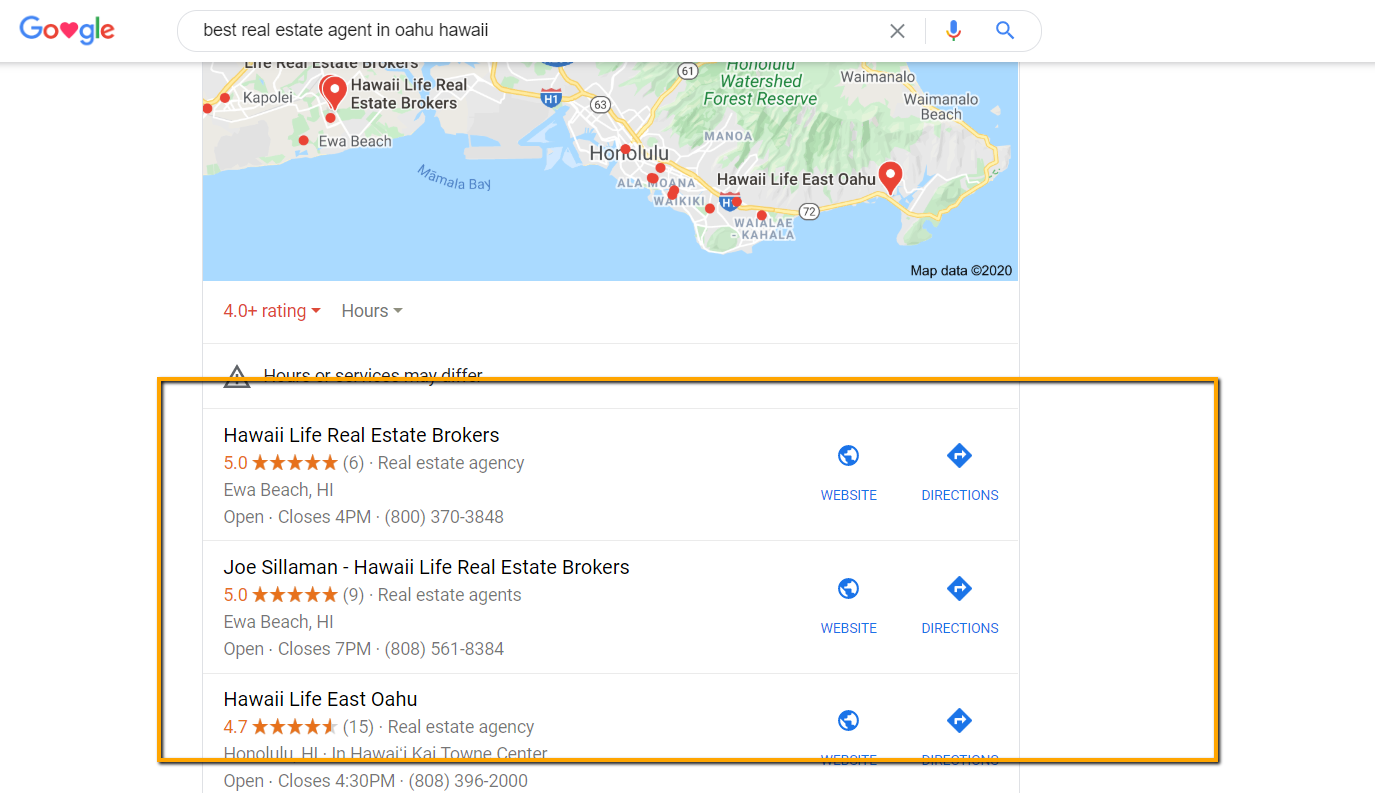
    When someone searches for a pertinent phrase specific to your market — “Best real estate agent in [MARKETY CITY]” or “[MARKET CITY] real estate agent”, for example — if you’re on the first page, then you have a fair chance of that person visiting your website and becoming a lead.

    The higher up you are on the first page, the better your chances.

    But how do you get your website to the top of the rankings?

    First, you have to choose a keyword phrase with the right intent and with not too much competition.

    Here are a few examples of great starter keywords for most markets…

    • Best real estate agents in [MARKETY CITY]
    • Real estate agent in [MARKET CITY]
    • Buy a home in [MARKETY CITY]
    • Sell my home in [MARKETY CITY]

    If you want to get ranking even faster, then you might target longer-tail keyword phrases based on your niche or preferred market…

    • Sell my riverside home in [MARKET CITY]
    • Get best price on my home in [MARKETY CITY]
    • Want to downsize in [MARKETY CITY]

    The list could go on… but you get the idea.

    The next step is to create a page on your website that’s dedicated specifically to the keyword phrase that you’ve chosen.

    This means that the exact phrase you chose should be in the title, meta description, and URL of your page — this will give you a better chance of ranking.

    Then watch what your rankings do (you can use our Keyword Ranking Tracker if you’re a Carrot member) and adapt your strategy as needed.

    If you aren’t ranking as you expected, then look at what other page-1 results are doing and try to mimic their strategy (without stealing). If you get to the first page seamlessly, then move onto other keywords and keep the momentum going!

    Do this with enough keywords and, over time, your website will start pulling in traffic and leads… passively.

    3. Use Incentivized Opt-In Forms

    One of the most common mistakes that real estate agents make when designing their website is that they don’t have an incentivized opt-in form at the front and center of their primary pages (homepage, about page, listing pages, etc).

    If you’re going to collect leads through your website, then you need an incentivized opt-in form.

    What is an incentivized opt-in form?

    Well first, it’s a form that’s easy for your target market to fill out. Usually, it just requires name and contact information (the fewer fields you require, the higher your conversion rate will be, usually).

    The second piece is just as important, though: this form is incentivized, which means that when someone fills it out, you give them exactly what they want.

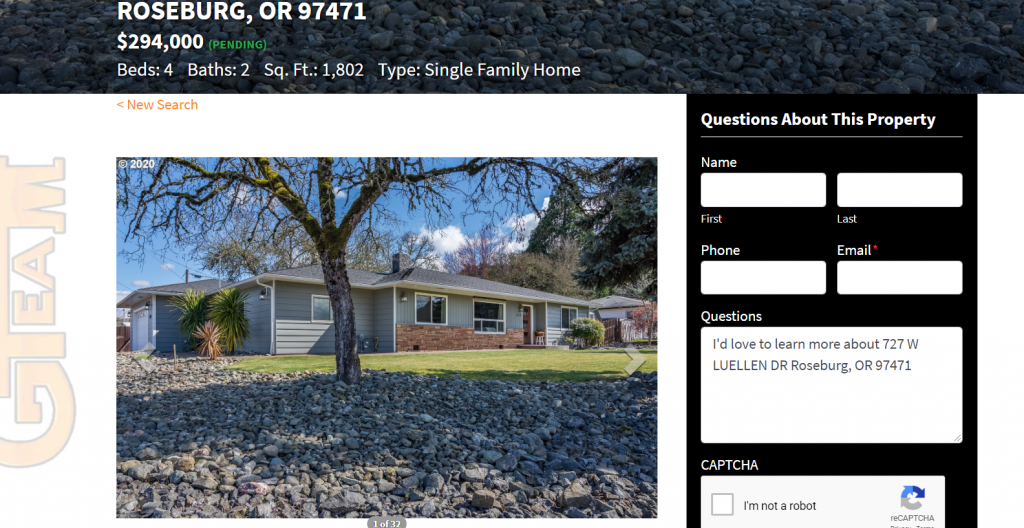
    The G Team, for example, a real estate company in Roseburg Oregon, has an incentivized opt-in form on all of their property listing pages.

    You could also put an opt-in form on your homepage that requires visitors to give you their email address before viewing your listings.

    There are a lot of different options here, but the important thing is to make sure that your website is set up to collect leads.

    Oh — and all Carrot websites come with an incentivized opt-in form baked right in. ;)

    4. Ask For Referrals

    Creating a consistent referral process with your past clients can be a great way to generate more leads and grow your business.

    You might be surprised by how many people are willing to offer referrals once you’ve helped them and built a relationship with them.

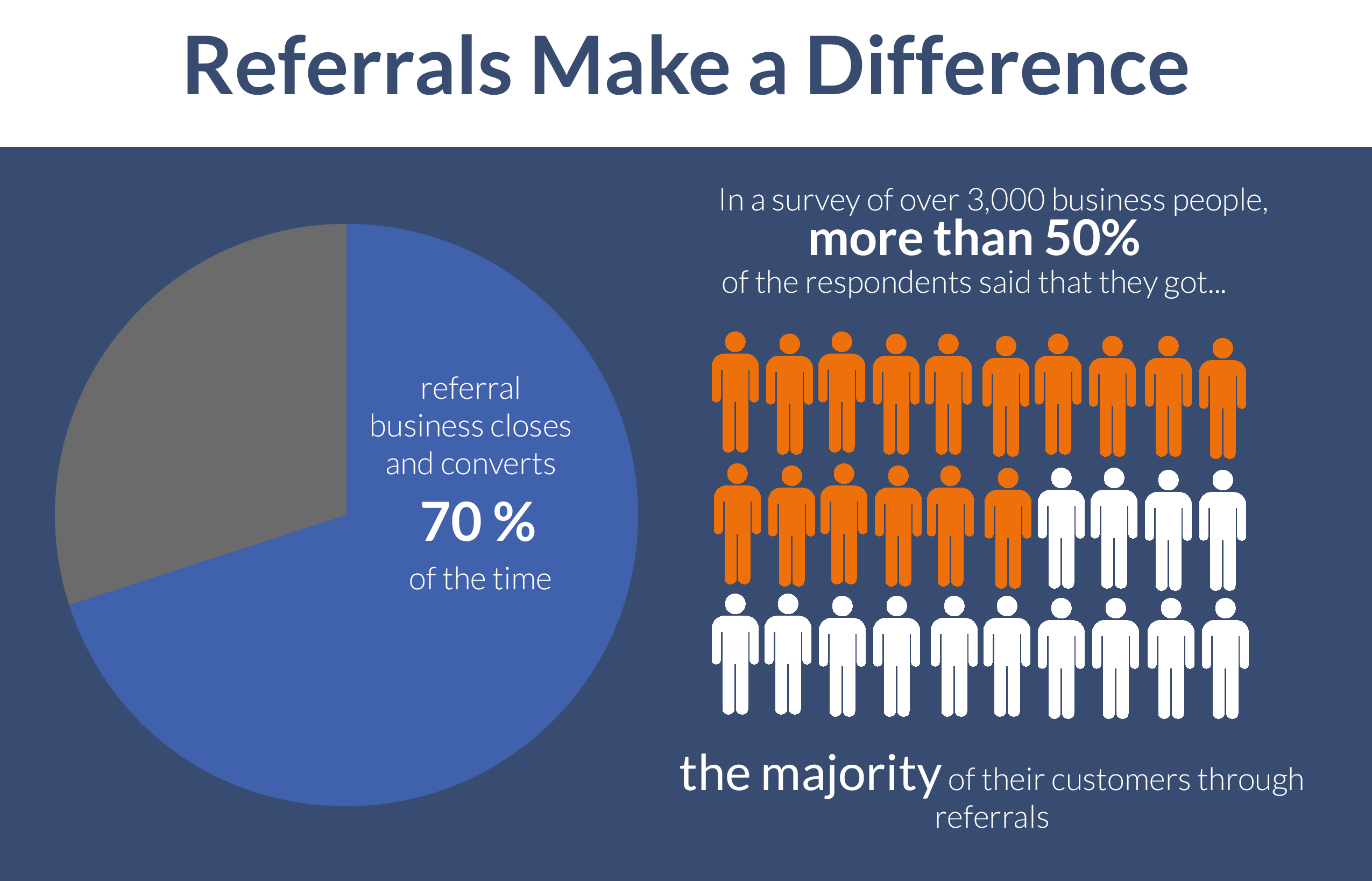
    And the best part is, leads that are referred to you have a super high close-rate of 70%.

    How important are sales referrals?

    So why not call some of your past clients, catch up, and ask them if they know anyone who might require your services?

    Most people won’t mind you asking and many people will probably give you a referral if they know of someone who’s trying to buy or sell their home.

    Worth a shot!

    5. Master Content Marketing

    Content marketing is an extremely powerful tool for real estate agents. Unfortunately, though, not many real estate agents consistently use content in their marketing strategy.

    But that’s good news for you… if your competitors aren’t content marketing, then that’s a gap you might be able to fill!

    Okay… but what is content marketing?

    Well, it’s basically just creating content (video, podcast, social media posts, blog posts, etc) that attract your target market… usually by providing free value.

    Let me give you an example.

    At Carrot, we offer monthly blog content packages as a part of our Content Pro and Advanced Marketer member plans.

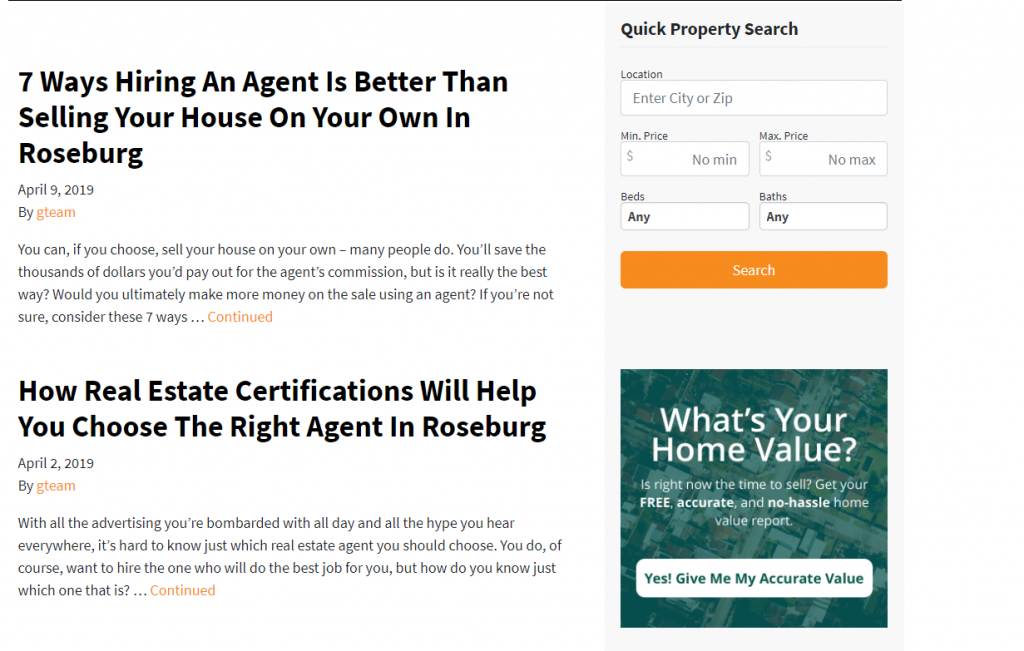
    And this is what one of member’s blogs looks like just from the content they’ve received through their Carrot plan.

    The coolest part, though, is that those blog posts can generate leads for your business!

    You can share them on social media to attract attention and they can even rank in Google for certain phrases and pull traffic passively.

    The other option is to create your own blog content. And while that can be time-consuming, at Carrot, we’ve also created a simple solution for that.

    With VideoPost, you can transcribe a video you’ve recorded into a long-form blog post with the click of a button!

    VideoPost Real Estate Blog Content

    Here is a PERFECT example of the power of content marketing + VideoPosts.

    “In this post, we’ll walk through real case studies that show you how to beat Zillow, Trulia, and Realtor.com in Google in your local market and scoop up traffic and leads for FREE away from the tech giants.”

    —>>> How To Beat Zillow in Google With Your Real Estate Agent Website – Case Study + Guide

    However you decide to do it, creating and marketing content is a great way to grow your business and generate leads over the long-term.

    6. Use Direct Mail

    Even though we talk a lot about digital marketing at Carrot, we can’t forget the ol’ tried-and-true direct mail marketing.

    This is a great way to generate leads consistently for your business.

    In fact, many of our members use digital marketing tactics and direct mail to grow their businesses.

    The question is: when should you send direct mail and how often?

    Most experts recommend sending direct mail consistently every single month so that you can keep lead-flow momentum.

    But if you’re going to send direct mail every month… what exactly are you going to put on those mailers?

    Here are some ideas.

    You could do something as simple as this…

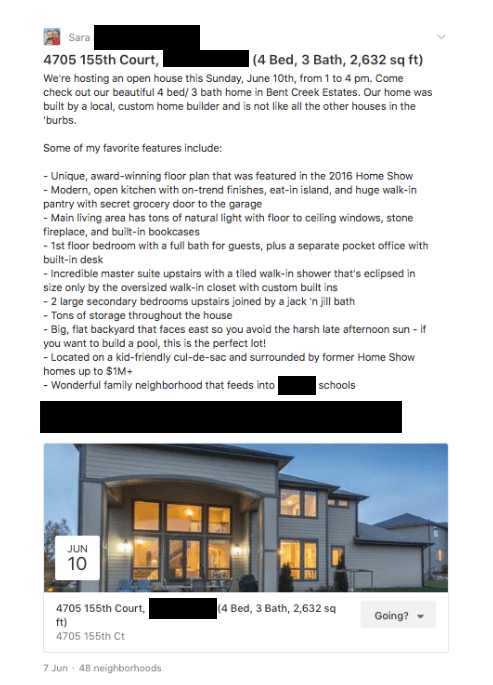
    You can also send out mailers about an upcoming open house…

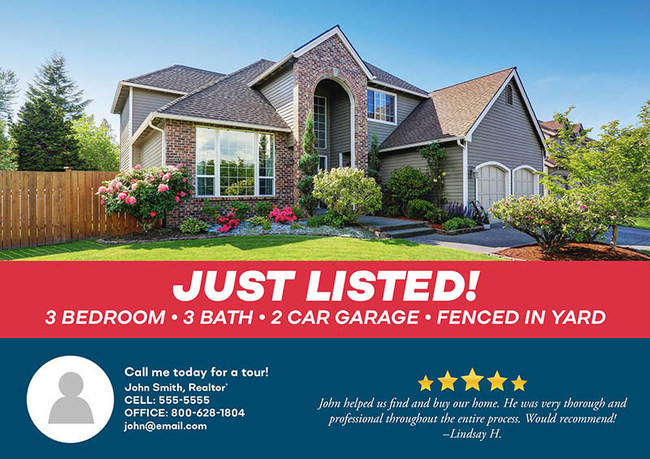
    You could send “Just Listed!” announcements…

    You could mail out to people who are currently renting a home…

    Or you could send flyers that provide people with a look into your market’s current housing conditions.

    Broker Judy Weiniger on Creating a Dynamite Mailer

    Clearly, you have a lot of options when it comes to your direct mail campaigns. And what you send will depend largely on how creative you’re willing to get.

    At the very least, we would recommend sending holiday postcards.

    But a really successful direct mail strategy will depend on consistently sending mailers to connect with your community and generate leads.

    One overlooked way to impress your clients, build brand awareness, and even generate leads is to sponsor a housewarming party for your clients who just purchased a new home.

    Obviously you don’t want to make it too much about you, but just hosting the party will speak volumes about you and your business to the people who attend.

    Plus, you can meet lots of new people in the community that you’ve never met before and maybe even get a referral or two out of it.

    Just ask the new homeowners to invite anyone they like and tell them that you’ll be handling the refreshments.

    At the very least, you’re going to surprise and delight your existing clients!

    8. Brand Your Clothing

    It might seem silly, but branding your clothing can be a great way to build awareness for your business and get people asking questions.

    Heck, we even do this at Carrot with the dolls that we create for our members!

    Why?

    Well, partly because it’s fun. ;)

    But also because we know that when someone asks one of our members why they have a Carrot doll, that’s going to launch into a discussion about the service that we offer.

    You can use the same tactic by either branding your own clothing with your business name and logo and/or giving a free t-shirt or hat to people who’ve worked with you in the past.

    There are lots of different websites that allow you to create custom clothing. Printful is one of the most well-known.

    9. Partner With Other Experts

    Let’s think for a minute.

    Who else probably talks with a lot of people who are wanting to buy or sell their home?

    Appraisers? Local handymen? Coffee shop workers? Real estate investors?

    Anyone else you can think of?

    If you could build a relationship with those people and create a two-way lead-gen street (you give them referrals and they give you referrals), that can be a really beneficial thing for your business.

    So make a list of everyone you can think of who is already speaking with your target market, give ’em a call, and tell ’em what you have in mind.

    You might be surprised by how many people are willing to help you out.

    10. Attend Networking Events

    Most communities have recurring meetups or networking events for entrepreneurs and small business owners.

    These can be a great place to build relationships with other entrepreneurs in your community and create mutually beneficial partnerships.

    (If there isn’t one in your community, then you might consider starting one!)

    Meeting the right person to aid you with your next phase of business can really help to unlock its potential.

    You never know who you’re going to meet, what opportunities will be placed on your lap, or what you’ll learn all because you attended a certain meet-up.

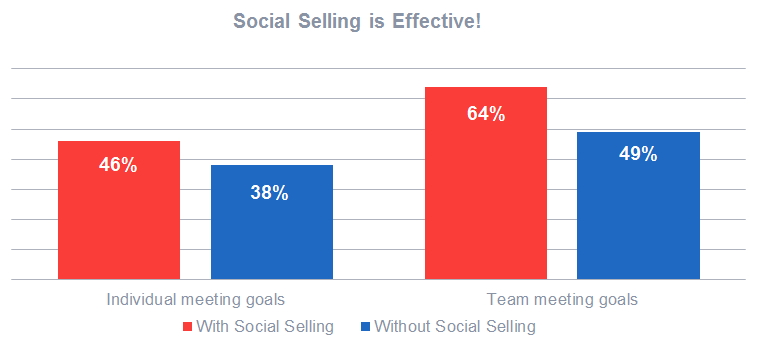
    Plus, marketers and salespeople who spend time on social selling (building important relationships) tend to be more successful than their counterparts.

    11. Run Paid Ads Consistently

    At Carrot, we talk a lot about organic marketing strategies like SEO and content marketing.

    And those are super important for growing your business over the long-term!

    But that doesn’t mean you should ignore the power of paid advertising.

    In fact, most of our members consistently use paid ads to generate leads for their businesses and they build up organic strategies over time to decrease overhead.

    The best part about paid ads is that they generate leads right now… not later.

    But the question is… how much money should you spend on your paid advertisements and how can you make sure that you’re going to collect a healthy ROI?

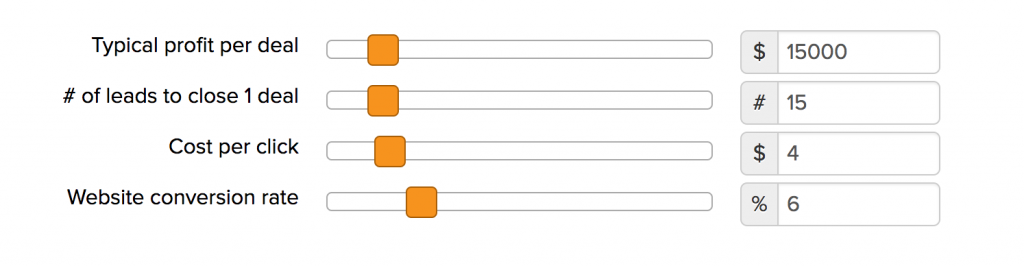
    Well, we created this totally free ROI calculator so that you can enter your know-able metrics and determine your budget.

    We originally created this calculator for investors but it works just as well for agents.

    For example, if you typically profit $5,000 per transaction, close one transaction for every 5 leads, average $4 per click, and have a website conversion rate of 6%… then you should be willing to pay a minimum of $333 to get one deal and a maximum of $433.

    This part of marketing is mostly science. Just update your ads regularly, make sure you’re targeting the right audiences, set your budget, and keep to the process.

    The more consistent you are with running paid ads, the faster and more predictably your business will grow.

    We’ve talked a lot about collaborating with other business owners in your community.

    And that’s because, for real estate agents, that’s a really powerful strategy.

    But if you want to skip the relationship-building and networking piece, you might just consider asking some local businesses if you can advertise with them.

    You could pay for a spot on the local radio. You could put up flyers at local coffee shops. You could provide free mints at restaurants with a sign that says “Courtesy of [BUSINESS NAME].”

    Your imagination and creativity is the limit.

    The more people who see your face in the community, the more leads you’re going to naturally generate.

    Ready To Get More Leads & Close Your Next Listing?
    Join the Agent 30-Day Challenge

    Agent 30 Day Challenge Success

    This 30-day challenge is designed to dramatically improve your site by focusing on one highly significant task per day so you can achieve success in just minutes a day!

    Conclusion

    The question is, how are you going to consistently generate leads as a real estate agent?

    Because if you can consistently generate leads, then you can consistently do transactions and build a predictably profitable business.

    And above are 12 different answers to that question.

    We hope this article helps you build the business of your dreams!

  • Carrot Success Story: How Ben Lovro Wholesales 5 Deals Per Month (11 Lessons You Can Use Today)

    Carrot Success Story: How Ben Lovro Wholesales 5 Deals Per Month (11 Lessons You Can Use Today)

    How do you build a thriving real estate investing business? That’s the question we consistently try to answer here at Carrot.

    Ben Lovro, Founder of EN-VISION HOME SOLUTIONS, and Carrot member from South Carolina hopped on and walked us through how he consistently does 4-6 deals per month.


    Ben has been a Carrot customer for a few years now, and he is someone we’ve have wanted to have on our podcast for a long time.

    His story and transformation are nothing short of incredible. It’s not just a story of becoming a real estate investor or building a business. Ben’s story is about perseverance and overcoming the obstacles that life throw can throw our way.

    We’re excited to share with you his story (from five years in prison to five deals per month), his processes, and his tricks for maintaining a positive mindset.

    Here are the main ways he’s been able to build his success.

    Watch the full success story…

    From 5 Years in Prison to 5 Deals a Month Wholesaling, Here’s How Ben Lovro Does It

    11 Simple High-Impact Lessons to Become a Successful Real Estate Investor

    1. “You Can’t Microwave Success”

    During the interview, Trevor asks Ben…

    “Do you ever just want to quit?”

    Ben sort of laughs to himself and says…

    “More times than I can even tell you about.”

    And he goes on to say something really powerful…

    “You can’t microwave success.”

    That is, there’s no shortcut for building a successful real estate wholesaling business.

    You’ve got to show up, do the work, and show up again tomorrow.

    This stuff often takes longer than you want. But if you’re faithful to proven strategies and processes, then you will succeed… it’s only a matter of time.

    But remember, there’s no way to cut corners.

    If you’re in the midst of a grind, just know that you are making progress and that that progress will pay off sometime in the future. It might just feel like cold, hard work right now… but this season won’t last forever.

    Stay the course… and you’ll reap rewards down the road.

    2. Begin With The End In Mind

    Why do you want to build a real estate business?

    Many new real estate investors or agents are in it for the money… or the sense of freedom that they can acquire.

    And that’s great but it’s probably not clear enough.

    If you’re going to succeed in the long-term, then you’ve got to know why you’re doing what you’re doing.

    Because here’s the thing: it’s going to be tough sometimes. And if you don’t have a really compelling reason for building your business, then you’re probably going to quit.

    So why are you doing it?

    • Do you want to make a positive impact on the people around you?
    • Do you want to lead others?
    • Do you want to provide for your family?
    • Do you want to have more freedom for the things that really matter in life?

    This is a lesson that Ben originally learned from reading The 7 Habits Of Highly Effective People and it’s stuck with him.

    Whatever your ultimate goal is, write it down and remind yourself why you’re doing what you’re doing every single day.

    3. Read Like Crazy

    It’s no secret that consistently reading non-fiction books can make a big impact on your mindset and by association, on your business.

    (Because YOU are leading your business…)

    So here’s a question for you: are you reading consistently?

    Ideally, you should read at least a little bit every day.

    You should read books that challenge your mindset, books that make you think about business differently, and books that teach you practical strategies for being successful.

    The more you read, the more successful you will probably be — in fact, it’s kind of hard to not become successful if you read like crazy.

    So in some ways, this is a shortcut to becoming the person that you want to be and building the business of your entrepreneurial dreams.

    Read, read, read.

    Two books that Ben mentions are The 7 Habits Of Highly Effective People and Rich Dad Poor Dad. If you don’t know where to start… maybe start with one of those.

    4. Use A Winning Website

    It might seem a little silly… but the website you’re using can have a big impact on whether or not your business is successful.

    Or at least, how successful your business is.

    Ben started with a basic website provider but received sub-par results.

    It wasn’t until he switched to Carrot, that he started seeing massive results.

    He started generating more leads.

    He started closing more deals.

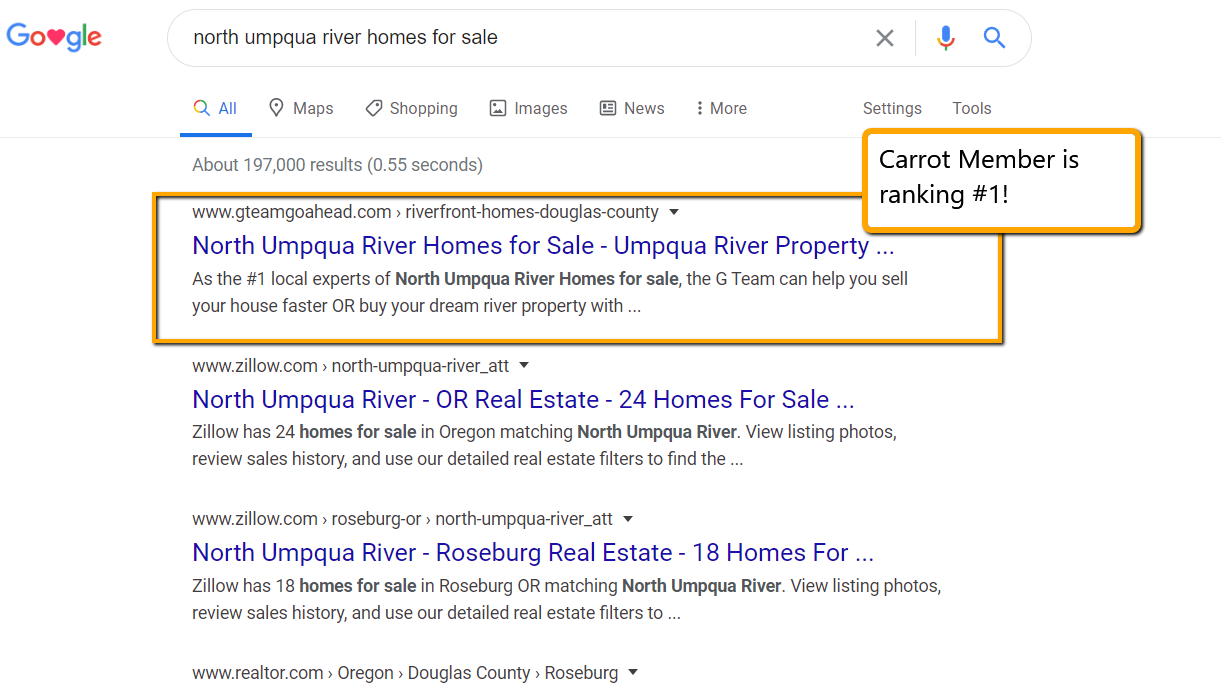
    And after 6 months of consistently working on his SEO, he ranked position number 1 for his target keyword phrase in Google.

    Now, he attributes a ton of his success to his Carrot website and to his SEO efforts.

    If your website is built to win… your business will win as well.

    You can sign up to get a winning website risk-free for 30 days over here.

    Who knows? Maybe that’ll be a game-changer for your business as well!

    5. Delegate As Early As You Can

    Many entrepreneurs are nervous to start delegating, to start hiring, and to start trusting other people to manage parts of their business.

    That’s understandable, of course.

    Your business is your livelihood… and the last thing you want is for someone else to mess up what you’ve got going.

    But here’s the thing: not delegating is always one of the best ways to hamper or slow your own success.

    By trying to continue as a one-man show, you limit how large your business can grow and you put yourself at a much higher risk for burnout.

    You know all of those things that have to be done but that you hate doing?

    They’re different for everyone — maybe you hate cold calling, maybe you hate acquisitions, or maybe you hate sending direct mail. Whatever the case, those things that you hate doing are going to burn you out if you don’t delegate them soon.

    You should focus on your strengths, not your weaknesses.

    And the good news is that you can actually start delegating pretty early in the life of your business.

    Ben started by hiring someone to help him with cold calling so he could focus on growing his business. He went to UpWork and hired someone who’s now been with him for several years.

    When it comes to hiring people on UpWork (which is an awesome platform), Ben offers some advice…

    • Try to weed out 90% of people — Most of the people who apply for your job aren’t going to be very committed. Try to weed out people by asking them to do very specific tasks during the interview process and then watch to see who does what you asked. Eventually, you’ll have just a few promising applicants to choose from.
    • Ask people why they’d be a good fit for your business — Ben encourages you to ask applicants why they think they’d be a good fit for your business. Do they have past experience? Are they consistent? Are they loyal? These are the kinds of things you’re trying to find out.

    As time goes on, you’ll be able to hire more and more people by reinvesting your profits into your business.

    Ben has two cold-calling people and an Acquisitions Manager, now.

    The sooner you start delegating, the faster your business is going to grow.

    Related Content: Guide To Cold Calling Motivated Sellers (+Free Scripts!)

    6. Don’t Put Everything Into Your First Deal 

    Starting to build a real estate investing business can be tough… especially when you’re trying to land your first deal.

    It’s not uncommon for a person’s first deal to go a bit askew.

    Maybe they don’t make as much money as they thought they would, maybe they can’t find a buyer, or maybe the deal falls through.

    It’s important to mentally prepare for those possibilities because if they happen (and they very well might), you need to keep going.

    Remember: one failure does not equal future failures.

    In fact, those failures are usually an important part of the learning process.

    So embrace them, prepare for them, and do not sink everything you have into your first deal.

    7. Use Our 3-Lead-Per-Day Training

    What if you were getting 3 leads through your website every single day… without running paid traffic?

    That would be pretty awesome, yeah?

    Well we created our 3 Lead Per Day Training to help you do just that — and it uses a little thing we call SEO.

    Basically, SEO stands for Search Engine Optimization and it is tactics and strategies for getting your website to rank in Google so that when someone types in “Sell my house fast in [YOUR CITY]” or something similar, they go to your website and give you a call.

    From what we’ve seen, this is the most game-changing marketing strategy for real estate investors and agents.

    Many of our members get 5-10 leads per day just through SEO!

    And in this training, we show you how to do that!

    This training is so simple that you can just hand it to a Virtual Assistant that you hired on UpWork, ask them to go through it and follow it step-by-step… and they’ll know how to optimize your website to rank.

    In fact, that’s exactly what Ben did with his VA.

    He went through this training himself. Then he handed it to his VA and he never had to worry about SEO again… but he’s getting inbound leads like crazy.

    Which brings me to the next lesson.

    Here’s why you should try to lean toward inbound marketing.

    Related Content: The Beginners Guide to SEO for Real Estate Strategies, Tips, And Examples

    8. Lean Toward Inbound Marketing Leads

    Paid advertising can me a major part of your business’ success.

    Within a few days, you can run Facebook ads, send direct mail, or use PPC to generate leads.

    And while some of those leads might be tire-kickers, they are still leads. Ben’s close rate, for example, on leads from paid advertisements hovered around 1 in 60, which isn’t unheard of depending on the strategy.

    Most real estate investors, though, explain that inbound marketing leads are much higher quality. Some report getting a 1-in-10 or 1-in-15 close rate.

    But what is inbound marketing?

    Well, let’s first talk about outbound marketing.

    Outbound marketing is paid ads. You go pay to interrupt people’s online experiences… and some of those people are, by happenstance, interested in what you’re offering and they click on your ad.

    But because those people aren’t looking for you when they find you, the quality of those leads is relatively low.

    Inbound marketing, on the other hand, what we specialize in here at Carrot.

    Inbound marketing for real estate is a strategy that focuses on attracting leads from your content. Basically it’s when a lead comes looking for you rather than vying for their attention.

    The most common way this happens is that someone types into Google something like “Sell my house fast in [MARKET CITY]” and they stumble across your website… then they give you a call.

    Because those people came looking for you, they are more motivated and they are far more likely to turn into a closed deal.

    However, SEO takes a long time to get going.

    It took Ben 6 months until he got to position number one in Google for many search terms and two for many other — but once he did, it was well worth the wait.

    Ben Lovro organic ranking number one for carrot member

    That’s why we recommend investing in paid ads to keep your business moving, but investing in SEO over the long-term so your lead-flow will be more predictable and sustainable.

    Outbound marketing can support your business now but inbound marketing can support your business for years to come.

    9. Understand The Difference Between Different Temperature Leads

    Not all leads are created equal.

    Some leads… you don’t even have to negotiate. They tell you how much you want, you pay them that amount, and you’ve got a closed deal.

    Some leads want to negotiate with you for a while. They want a price that you can’t afford, but you follow-up with them hoping that they’ll change their mind.

    And some leads just aren’t super motivated. Sure they are sort of interested in your service… but they aren’t even close to ready to make a commitment.

    It’s very important to understand the difference (and value) of each of these kind of leads.

    Hot leads, warm leads, and cold leads.

    Because once you understand that your business is generating different kinds of leads, you can serve each lead appropriately and make the most of each.

    Hot leads… answer their call, close quick, and make the process as painless as possible.

    Warm leads… negotiate with them, listen to their concerns, help them however you can, and DEFINITELY follow-up consistently.

    Cold leads… stay in touch with them but don’t invest too much time chatting with them. You should keep them on your emailing or calling list and follow up every other month or so.

    The point is… treat every lead how they want to be treated and your business will grow faster.

    10. Create a Morning Routine to Control Your Day

    Ben also understands the importance of having a morning routine.

    As entrepreneurs, it’s easy to get lost in the busy-ness of the day the moment you wake up. Maybe you try to rush out the door to get to important tasks as soon as possible.

    That makes sense… you’re busy.

    But you can’t neglect your morning routine.

    According to Ben, you’ve got to take immediate control of your day by meditating, reading, and even watching an inspiring YouTube video every morning.

    This will set you up to conquer the day and do your best work.

    And what’s the point of putting a ton of work into your business if it’s not going to be your best work?

    So start your day off right and take even just 15 minutes to take care of yourself and get inspired.

    Related Content: Download the Daily Habit Tracker

    11. Let Impact Drive You

    Why are you building your business?

    You probably want to create more freedom for you and your family.

    You probably want to make lots of money.

    But do you also want to impact others?

    Trevor and Ben talk about how money becomes boring after a while and will only drive you so far in your business, but making an impact will always drive you. That is, wanting to help others and leave your legacy on the world.

    It might seem silly, but one of the best ways to grow your business is by caring for others and doing your best to leave a positive impact on your clients.

    Related Content: Carrot’s commitment to making an IMPACT

    Now Get Busy

    Kathryn Orford said…

    “Sometimes our biggest nightmare turns out to be our biggest gift. And it all comes down to our attitude. Life will throw us curve balls and disappointments, even heartbreak. But ultimately we can choose if we’re going to be bitter or better for the experience.”

    Ben not only has chosen a better experience, but he has also crushed it! Now it’s time for you to lace up your boots and get to work. Get organized. Get a strategy. Get healthy.

    We’ll leave you with some questions…

    Why are you proud of the business that you’re building or have built?

    What have you learned along the way?

    Let us know in the comments and let us know how this interview benefited you! :)

  • 5 Real Estate Blog Post Templates to Make Your Writing Easier

    5 Real Estate Blog Post Templates to Make Your Writing Easier

    real estate blog post templates

    We talk a lot about content marketing for real estate agents and investors.

    Writing blog content for your website doesn’t just help you generate more passive traffic through SEO (Search Engine Optimization); it also allows you to engage with your ideal market and provide them with free value.

    But for all the buzz around writing blog content, recording videos, and posting on social media, it can still be a challenge to create that high-quality content that ranks in Google (generating passive traffic to your website), engages your ideal market, and gets “shares” on social media.

    So, we put together this resource for you with five easy-to-follow real estate blog post templates for real estate agents and investors.

    Or, if you want to skip the legwork and have Carrot tools create high-ranking, share-worthy blog content for you, become a Carrot Member and subscribe to the Content Tools add-on ;-)

    Otherwise, let’s dive right in!

    How Powerful is Content Marketing For Real Estate?

    Content marketing is, quite simply, publishing content (blog articles, social media posts, YouTube videos, etc.) to brand and grow your business.

    And it’s effective for pretty much every industry, real estate included.

    In some ways, content marketing is more effective in the real estate industry than in other industries.

    If I want to create content consistently and I’m in the travel niche, for example, I’m going to have a ton of competition—there are just a lot of content creators in the travel niche.

    Not so much for real estate. Especially if you consider that you’re only competing with content-creating real estate professionals in your area of operation, there’s even less competition.

    That’s good! It means you’ll have less trouble standing out.

    But if you’re still not convinced that consistent content marketing can be crazy powerful for your business’ growth, consider these stats

    • 90% of buyers look online to find their next home.
    • 70% of people prefer to get a sense of your business through online content.
    • 61% of inbound leads cost less than outbound leads.
    • Websites with blogs have 434% more indexed pages than websites without blogs.
    • Companies that blog receive 97% more links than those that don’t.

    Yeah…

    Content marketing can certainly give your real estate business the boost it needs. We also have a few other resources on this topic that you might find helpful.

    And if you want to fill your blog with high-quality, high-ranking content without spending hours creating that content…

    real estate blog content

    …check out our Content Tools add-on!

    Either way, here are five blog post templates for your real estate website content.

    Keep in Mind Before You Write

    Here are some things to remember before you start writing your blog posts.

    • Get to know your audience
    • Do keyword research before writing
    • Write a good headline for every blog post
    • Hook your readers from the start
    • Answer their questions with your blog posts
    • Tell a captivating story
    • Make your content easily scannable
    • Be authentic in your writing
    • Prioritize quality content over the number of words
    • Use data

    Need help finding keywords for your blog posts? We did it for you!

    5 Real Estate Blog Post Templates You Can Steal

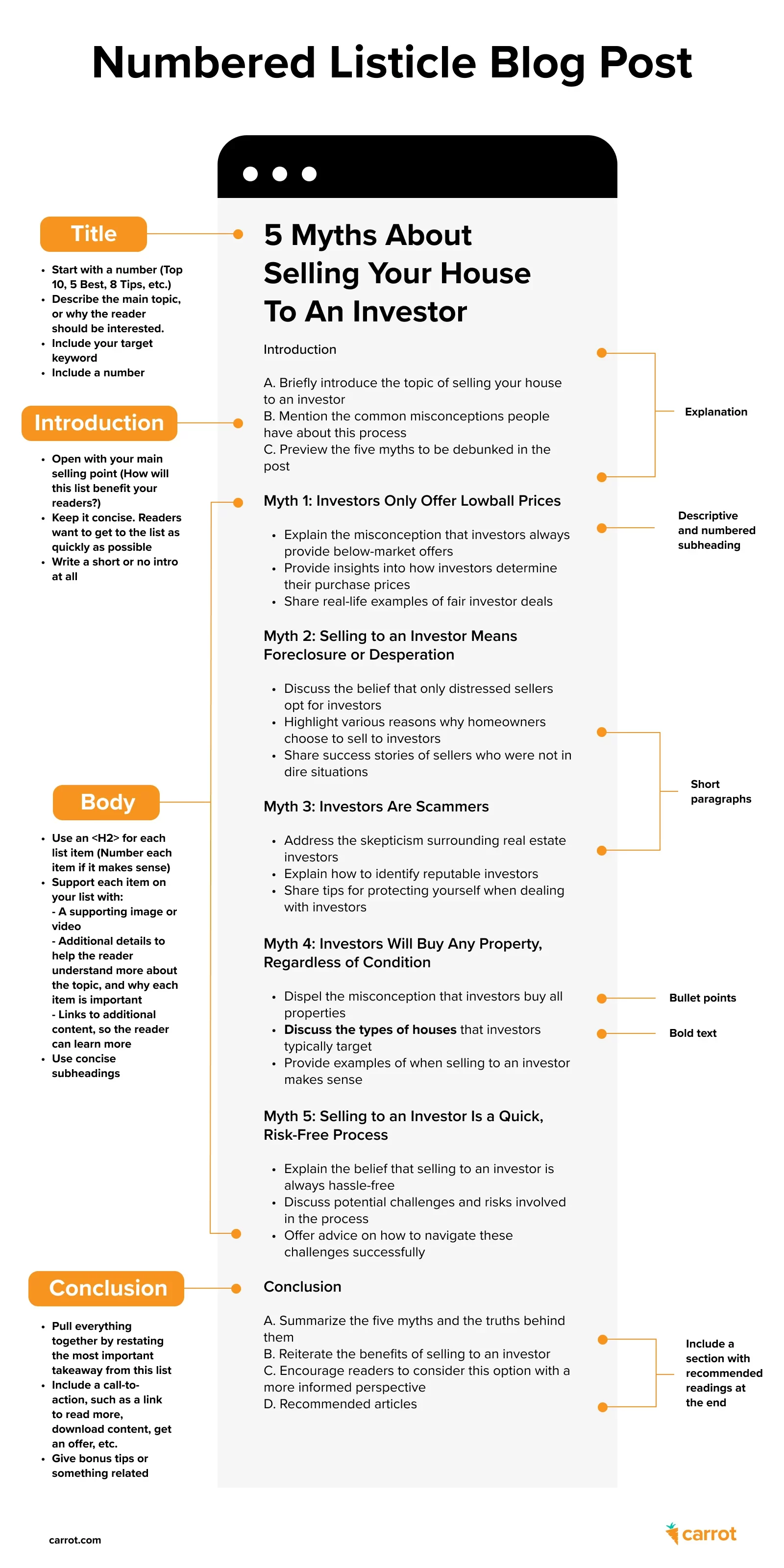
    Blog Post Template 1: The Listicle

    The Listicle blog post template for real estate

    The listicle blog post template is exactly what it sounds like. It’s a “list” of reasons, tips, tricks, or hacks that provide easy-to-scan value for your audience.

    This blog post is a listicle.

    Listicles are easy to write and easy for readers to digest, and they tend to do well in Google and social media.

    A few examples of listicle posts are…

    • 5 Reasons Why People Sell Their Home With Real Estate Agents
    • 5 Myths About Selling Your House To An Investor
    • 10 Ways To Sell Your House For More Money

    The template for a listicle is pretty basic. Here it is.

    Title Options

    • [X] Reasons That…
    • [X] Ways To…
    • [X] Tips For…
    • [X] Hacks That Will…

    Introduction

    Write a short introduction, between 50 and 150 words, that empathizes with your ideal market’s current situation and briefly explains the problem your article willd solve.

    Middle – Points

    List your article’s points as H2 headings and write between 50 and 150 words for each point, expanding upon the core concept.

    Conclusion

    Write 50 to 150-word conclusion which overviews the article’s content and calls the reader to take action. Your CTA should often encourage the reader to work with you.

    Here’s an example of a listicle post that we wrote a few weeks ago: 9 Ways To Be a More Productive Real Estate Professional & Business Owner.

    Checklist Before Publishing

    • Did you provide at least three examples, suggestions, or tips that directly speak to the topic you’re writing about?
    • If examples are from real companies or people, did you embed images, video, and/or a social media post of that example to strengthen your point?
    • Did you provide relevant and accurate examples and statistics to explain this concept further?
    • Did you properly cite and backlink your sources?
    • Did you spell-check and proofread?
    • Are there at least 1-2 images?
    • Is the post 800-1,000 words at a minimum?

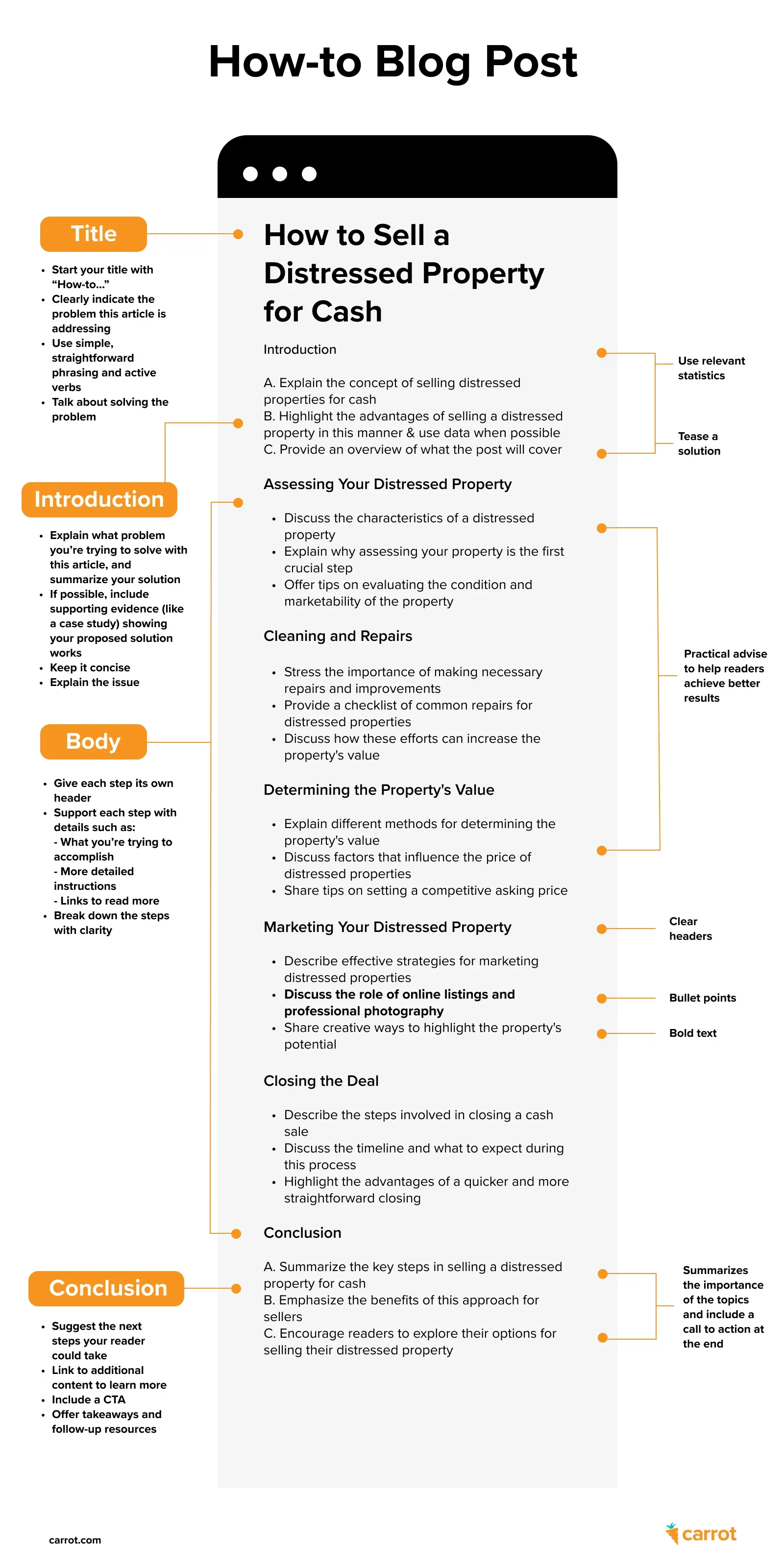
    Blog Post Template 2: The “How To” Post

    How-to blog post template for real estate

    The average person doesn’t understand much about the real estate world—how to increase the value of their home, how to sell quickly, or even how to find a trustworthy agent, for instance.

    And who better to teach those practical skills than you, a local real estate professional?

    Because most people have many real estate-related questions, the “How To” article format is particularly pertinent.

    It’s a great format for establishing yourself as the go-to expert in your market, the person people think of first when making a real estate-related decision (which, of course, is a good thing!).

    Here’s the template.

    Title Options

    • How To… [do something that your target audience wants to learn how to do]
      • …Sell Your House For More Money
      • …Find a Trustworthy Real Estate Agent
      • …Sell a Distressed Property For Cash

    Introduction

    Write a short introduction, between 50 and 150 words, that empathizes with your ideal market’s current situation and briefly explains the problem your article will solve.

    Middle – Steps

    List your article’s “Steps” as H2 headings and write between 50 and 150 words for each step, providing more detail on accomplishing the task.

    For example…

    • Step 1: Determine the value of your house.
    • Step 2: Check the reviews for the investor’s website.
    • Step 3: Call and talk to the investor.

    Conclusion

    Write 50 to 150-word conclusion which overviews the article’s content and calls the reader to take action. In many cases, your CTA should encourage the reader to work with you.

    Here’s an example of a “How To” article: How To Do Keyword Research For Real Estate PPC Campaigns

    Checklist Before Publishing

    • Did you provide clear, actionable steps to accomplishing the task your reader needed help with?
    • Did you provide relevant and accurate facts and stats to prove your understanding of the concept?
    • Did you emphasize the importance of understanding this concept if it is not already well-known?
    • Did you properly cite and backlink your sources?
    • Did you spell-check and proofread?
    • Are there at least 1-2 images?
    • Is the post 800-1,000 words at a minimum?

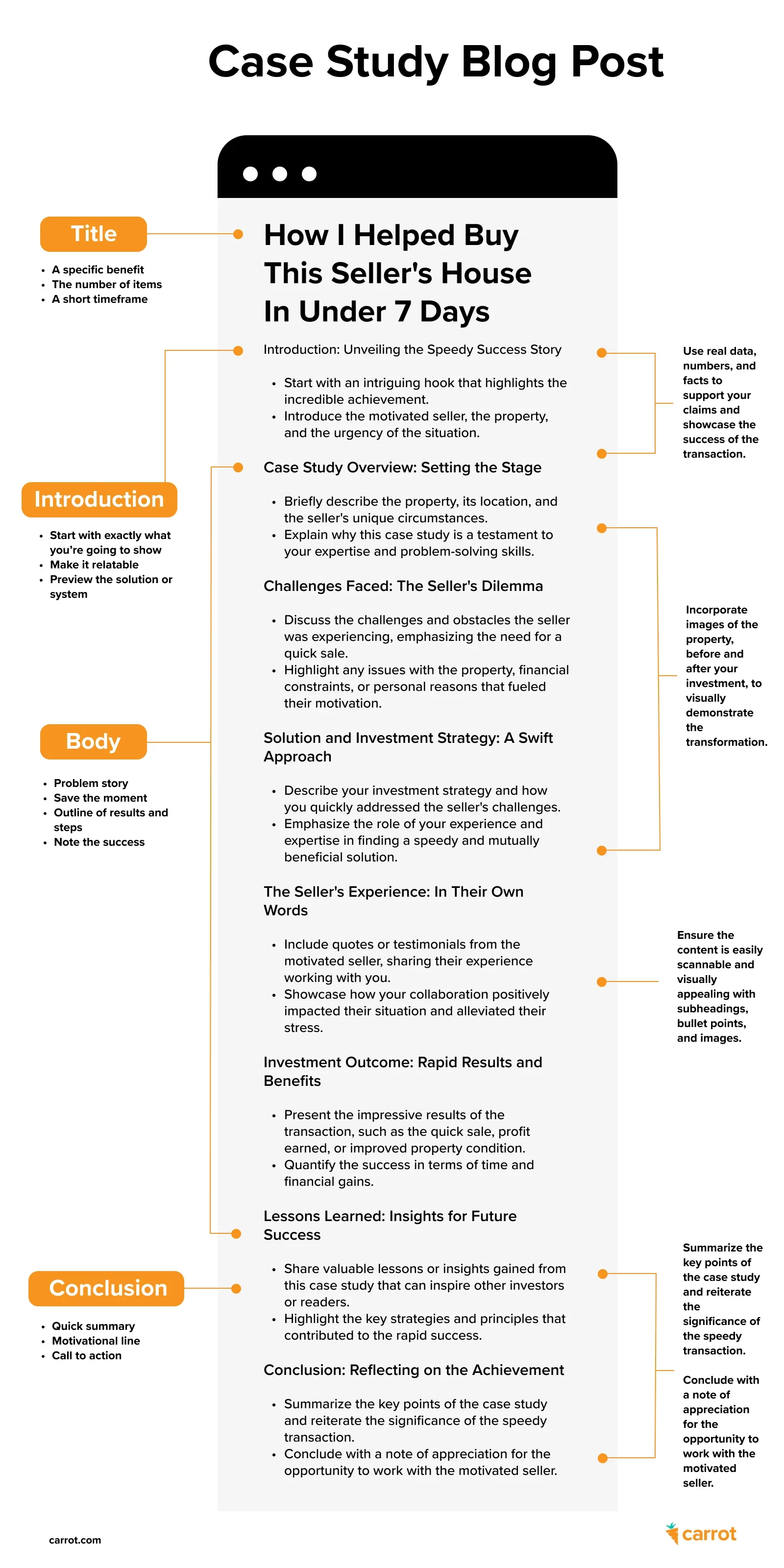
    Blog Post Template 3: The Case Study

    Case Study blog post template for real estate

    Case studies are perhaps the most powerful kind of blog content for building trust with your audience and rapport for your business.

    A case study is an article that explains the benefits of working with you by telling the story of a past client who was extremely pleased with their experience.

    You can use case study articles to illustrate that you pay more than other investors, work faster than other agents, or are simply more trustworthy and honest than the competition.

    For this type of blog article, you’ll need to interview your past clients and ensure they’re okay with you publishing the story of them working with you.

    Here’s the template.

    Title Options

    • Case Study: How…[something awesome]
      • …I Helped Sell This Person’s House In Under 7 Days
      • …I Paid $100,000 In Cash For This Person’s Property
      • …I Saved This Person From Bankruptcy

    Introduction

    Write a short introduction, between 50 and 150 words that builds suspense for the story your article is going to tell.

    Middle – Before, During, After

    Your article should have Before, During, and After sections as H2 headings. Under the Before section, describe what the person was going through before working with you.

    Under the “during” section, describe their experience working with you (use direct quotes and testimonials if possible), and in the After section, discuss how much better off they are now because they worked with you.

    Conclusion

    Write 50 to 150-word conclusion which overviews the article’s content and calls the reader to take action. In many cases, your CTA should encourage the reader to work with you.


    Blog Post Template 4: The VideoPost

    Don’t want to write your blog post?

    Well, at Carrot, we’ve created the solution: VideoPost.

    We offer our members this tool, which allows them to quickly and easily transcribe a video into a fully written article with the click of a button.

    Rather than write your entire article, just talk into the camera for 5 minutes, post that video on social media, and then turn that video into a blog post on your website using our VideoPost feature.

    Here’s how this feature works.


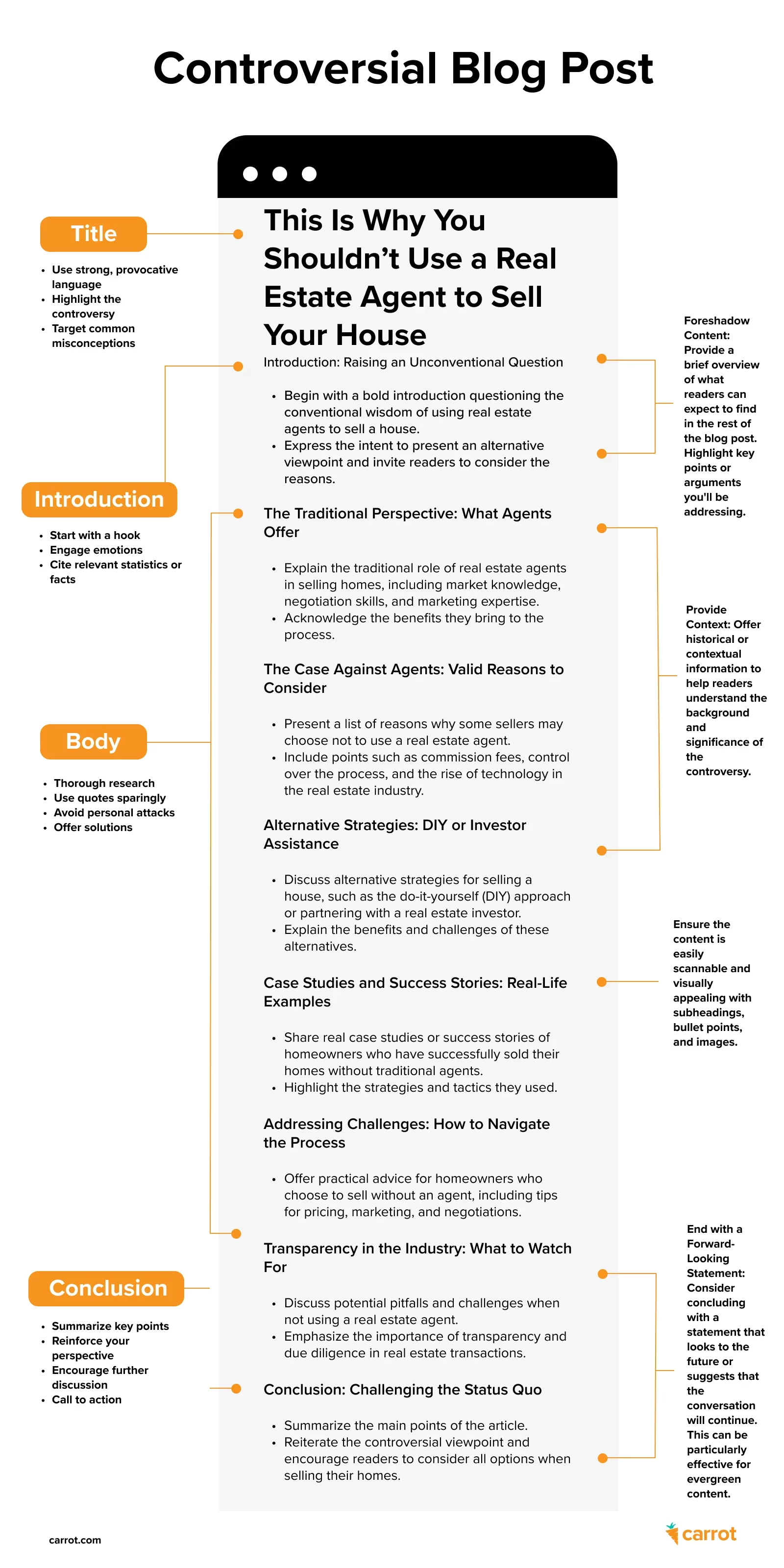
    Blog Post Template 5: The Controversial Post

    Everyone loves some controversy.

    And your blog content is no exception. Sharing your controversial opinions with your audience might seem like a bad idea, but it’s actually a great way to attract people who agree with you and generate attention for your business (no publicity is bad publicity, eh?).

    Here’s the template for writing a controversial post.

    Title Options

    • This Is Why… [controversial opinion]
      • …Selling Your House To An Investor Is More Profitable
      • …Real Estate Agents Are The Best Option
      • …You Shouldn’t Use a Real Estate Agent

    Introduction

    Write a short introduction, between 50 and 150 words, that describes what the article is going to be discussing.

    Middle

    The middle structure here is a little more complicated than some of the other blog post templates. The first section should focus on describing the popular wisdom that people receive and why that seems to make sense.

    The second section should dismantle that concept with logic and evidence. The final section should introduce your new idea and provide evidence for that opinion. All section headers should be H2 headings.

    Conclusion

    Write 50 to 150-word conclusion which overviews the article’s content and calls the reader to take action. In many cases, your CTA should encourage the reader to work with you.

    Put These Real Estate Blog Templates to Work!

    Although this doesn’t give you templates for every kind of blog post, it gives you a solid foundation for writing killer content. Now, all you have to do is use these real estate blog post templates!

    Now, when you sit down to write a blog post, you don’t have to think about how to put the content together. You’ve got the exact recipe you need to make it happen. For more resources and real estate marketing materials, click on the link!

  • 3 Real Estate Professionals Explain How They Overcame The Limiting Beliefs That Kept Them From Success

    3 Real Estate Professionals Explain How They Overcame The Limiting Beliefs That Kept Them From Success

    Overcome Limiting Beliefs

    At Carrot, we have helped thousands of real estate investors and agents generate (literally) millions of leads.

    It’s been an extremely exciting adventure for us and for our members.

    But we’ve also learned that there’s one thing that can keep even the most effective real estate pros from achieving everything they’re capable of achieving.

    And we’re not talking about a struggling market or bad employees or even a sub-par marketing strategy.

    We’re talking about your mindset and overcoming your limiting beliefs.


    Your mindset is like the rudder of a ship. You might have the nicest ship on the 7 seas, you might have the best crew, you might be the most effective navigator, and you might even be an excellent sailor, but without a rudder, it’s all worthless — without the ability to direct all of that potential, you’ll never get where you want to go.

    And without a winner’s mindset, you’re never going to… well, win.

    So we asked three real estate professionals and Carrot members what their biggest limiting beliefs were and how they overcame them — they gave us these shockingly transparent answers.

    Enjoy!

    anthony beckham

    1. Anthony Beckham, Founder of Beckham Group Investments LLC

    “I think one of the biggest limiting beliefs I’ve had, and have heard from many others in the industry, is the reluctance to invest in themselves and their companies. I remember, in my first year, even being reluctant to spend $100 in online marketing ad spend before going forward with it.

    Within 60 days, I had closed 2 deals, totaling around $10,000 in commission (the most I had ever made in a month at that point) and it was all I needed to go all-in on my business. The proof of concept is the big break-through for most people, almost like being given permission to go all in. It certainly was for me.

    I went through the same reluctance when hiring. The truth is, if you are making a good hire, training them right, and helping them grow, an employee doesn’t cost you anything. They should be making you money. You should be seeing a return on them just like you would with your marketing expenses.

    Additionally, I remember having doubts even about myself physically. When you think of an authority figure in real estate — a person who will help you purchase your biggest asset — you don’t typically picture a 21-year-old kid with no experience, 5’7”, with acne, and an old beat-up car. It’s crazy what you’ll come up with for reasons people may not work with you!

    I quickly realized that my age and quirks may have been actually attributing to my success. As I got more reviews and past sales under my belt, I would get calls from people I had never met saying, ‘It looks like you’re a young go-getter, and that’s exactly what I’m looking for!’

    If you’re a hard worker and behave as a true professional, it doesn’t matter your experience level or whether you look authoritative at first glance. I played the part, and eventually became it.”

    Takeaways

    • Don’t be reluctant to invest in yourself and in your business. If you believe something is going to pay you back, then have some faith and make the investment.
    • You don’t have to look like a real estate agent or real estate investor to be successful. Everyone has their own style and your style will resonate with a certain market or group of people. Embrace that.
    jonathan tran

    2. Jonathan Tran, Founder of At Home Buyers and Partner of Norton Home Solutions & DyeNamic Home Buyers

    “When my brother and I started this real estate journey, I was three months out of college with a degree in Exercise & Nutritional Science and I had little to no real working experience. I’ve still never had a full-time job. There would be nights where I would lay in bed with crushing fear and anxiety saying to myself…

    • What are you doing?
    • You can’t be successful in real estate.
    • You know absolutely nothing about business and you’ve never even owned a house!
    • You’re almost 30 and you’ve never had a full-time job, you’re going to be working for the rest of your life.

    These beliefs ran through my mind almost every day for the first three months of starting our business until we got our first deal.

    Obviously the first deal was a huge milestone because it really showed us we could make money. It also proved to us the tools, resources, coaching calls and courses within Carrot worked. Simply by consuming the content, actively engaging in coaching calls, volunteering for critiques, and implementing suggestions, we were able to get our first deal.

    But of course, this wasn’t the end of my limiting beliefs. The leads started too slow. We stopped hearing the sweet pings of new leads and the fear, anxiety, and choking thoughts came back.

    Around this same time, Trevor [The founder of Carrot] posted something about a Habit Tracker he created on a Google Sheet. My thought was that if I could implement his daily habits, maybe it would help me in our business. There were many things in the tracker that I’d never done but I was committed to using it.

    After the first week of using the tracker, I could feel a shift. I had a more positive and optimistic outlook on the future and with what we were doing. I still do many of the habits today and these were 5 habits I feel made the greatest impact in changing my beliefs:

    1. Waking Up Early
    2. Meditating
    3. Gratitude Journaling
    4. Exercising
    5. Reading/Podcasts

    There’s something about starting the day with discipline when you’ve consciously made the decision to get out of your warm comfortable bed (even though you’re an entrepreneur and you make your own hours you could sleep in until noon) but you chose to get up before the sun.

    Then I’m completely still and put my mind in a calm place for just 10 minutes to not worry about how the day might go or the things I need to do. At this point, my mind is so calm and I write down a few things I’m grateful for and thank God for this opportunity.

    I’m headed out the door thinking about how amazing it is to have all my arms and legs to be able to use every equipment in the gym. As I’m exercising I’m listening to an audiobook or podcast and for an hour I get to hear someone else talk about their belief or perspective on a topic that’s different and I start to agree with their perspective and beliefs, which shoves down my own limiting beliefs.

    I know it’s cliche. People talk about morning routines and developing habits all the time, but they really do work.”

    Takeaways

    • Getting proof of concept that something is possible (closing your first deal or signing your first contract) is an important step on the pathway to success — it gives you the permission you need to go all-in.
    • Consuming helpful resources and content is an important part of mastering your craft (check out Carrot resources).
    • How you start your day will determine your productivity and effectiveness throughout your entire day — take your morning routine seriously.

    3 Resources to Crush the Year and Build Healthy Habits

    Download the Resources

    shemeika fox

    3. Shemeika Fox, Founder of Fox Realty Group

    “I would say that the limiting belief I have struggled with in the past, not so much anymore, or at this moment, have been that I am not better than any other agent. I do not offer any more, so why would the client hire me.

    Also, those other agents are already higher producers, so there is no room for me to be successful. And finally, that there is a scarcity of business and not an abundance.

    I am pleased to say that for the most part, I have overcome these beliefs. I know that my service is superior to most if not all other local agents. My marketing plan is proven to work and while the average days on the market in Santa Cruz County are hovering around 36, my average days on market is at 11 days.

    Now I am not saying this out of arrogance or to be boastful. I am actually just really proud that the efforts we are implementing and by thinking outside of the box and listening to our clients’ needs and helping them achieve their goals we are seeing great success.”

    Takeaways

    • Creating a service that you are proud of and consistently doing your best work day-in and day-out is a sure-fire way to achieve long-term success.
    • Listen to your client’s needs and help them achieve their goals; this will almost always lead to building a bigger, more sustainable business.

    Conclusion

    We really appreciated the transparency with which the 3 investors and agents within this article shared their personal challenges.

    because the truth is, we all struggle.

    And most of us struggle in the same way — we believe we’re not good enough, we’re not smart enough, or even that we don’t look the part.

    The people who win, though, are the ones who see those disempowering thoughts for what they really are — limiting beliefs — and move forward despite them.

    We hope this article encouraged you to keep moving forward — in time, you’re going to crush it if you keep doing your best work.

    So what limiting beliefs do you struggle with? Let us know in the comments!

  • Carrot’s 30-Day Challenge: Ready To Obliterate Your Best Month’s Lead-Gen Record?

    Carrot’s 30-Day Challenge: Ready To Obliterate Your Best Month’s Lead-Gen Record?

    Carrot's 30-Day Challenge

    What if you could take a system that’s proven to generate high-quality leads — a system that has made hundreds of investors and agents around the nation millions of dollars — and implement it right into your business in just 30-60 minutes per day over a 30-day period?

    Sounds too good to be true, yeah?

    Well, that’s exactly what we’ve created… We’re calling it our 30-Day Authority Building Challenge [CLICK HERE TO JOIN].

    And in it, we’re going to walk you through how to brand your real estate business, how to drive traffic, and — most importantly — how to get high-quality leads (and even how to obliterate your best month’s lead-gen record).

    Are you ready?

    Carrot's 30 Day Challenge for Agents & Investors
    Carrot 30 day challenge
    “I did this challenge and learned so much. So glad I accepted this challenge, without it I never would have got my website together. Easy… no. Challenge… that is the name of the game… worth it… 100%.”

    At Carrot, we’ve helped countless real estate pros beat their most aggressive market competitors, generate more than one million leads, and build businesses that support themselves and their families.

    Over the last few years, we’ve learned a lot about what real estate marketing tactics work… and what doesn’t.

    And we thought to ourselves…

    “What if we created a tried-and-true, fool-proof lead-gen system for agents and investors — a system that would help our members become the go-to experts in their market, drive leads passively to their website, and build the business of their entrepreneurial dreams?”

    This challenge is helping people even more than we could have imagined…

    One of our long-standing members, Chris Wojciechowski, said he wishes we would have created this challenge 3 years ago!
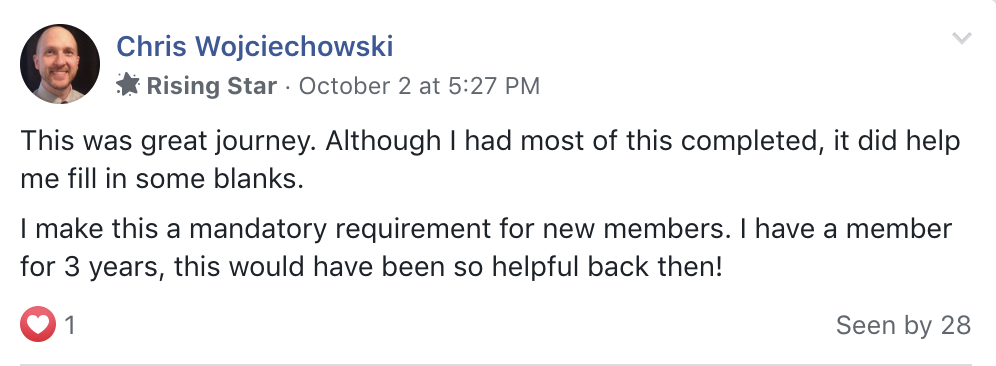
    Carrot 30 day challenge success
    “This was a great journey. Although I had most of this completed, it did help me fill in some blanks. I make this a mandatory requirement for new members. I have been a member for 3 years, this would have been so helpful back then!”

    So…

    Are you ready to create a marketing system for your real estate business that generates leads like clockwork, that makes your business more predictable and sustainable?

    Moreover, are you ready to spend just 30-60 minutes per day over the next month to make it happen?

    Great! Click below to join!

    got my first lead from the Carrot 30 day challenge
    “I got my first lead!!!!”
    website ranking with help from the Carrot 30 day challenge
    “I Googled my Carrot website keywords plus location and what a surprise. My website showed up #3. When I Googled location plus keywords, I showed up #2. Niche marketing plus Carrot website.”

    A Glimpse At The 30-Day Challenge Gameplan

    We’ve recorded a ton of in-depth content for this challenge. We’re going to show you how to set up your website, choose the best keywords to target, leverage social media, convert leads like clockwork, and lots more.

    Not only will we teach you how to do those things, but we’re also going to keep you accountable — each day has a checklist of items you need to finish. You’ll need to set aside 30-60 minutes for most days.

    By the end of it, you’ll have a website set up to convert leads, a traffic plan to drive high-quality prospects to your website, and an irresistible, trustworthy brand image.

    Pretty sweet, right?

    Here’s a little peek at the agenda for investors (and below that is the agenda for agents).

    A Glimpse At The 30-Day Challenge For Investors

    Week 1 – Mindset & Marketing Plan ✍️

    • Launching your site
    • Building credibility
    • Localizing your site
    • Adjusting your content strategy
    • Schedule your content

    Week 2 – Creating Your Content Plan 📋

    • Content, content, content
    • Integrate with 3rd party services
    • Connect your social media accounts
    • Set up your data hubs

    Week 3 – Drive Traffic 📈

    • Create your first Craigslist post
    • Setting up your paid traffic sources
    • Set up your first Google Ads campaign
    • Start working on your SEO

    Week 4 – Put Your Content Hyperdrive ✍️

    • How to create citations
    • How to create Backlinks
    • Creating your first video
    • Launching a buyers website
    • How to create buyer list

    We’ll also teach you…

    • How to set up a Facebook retargeting pixel
    • Learn how to create a Google Business profile
    • How to Create Unique Content for SEO

    And tons more…

    INVESTORS: Ready to beat your best month’s lead gen record? Join the 30-day challenge below and let’s make it happen!

    “It was great! I enjoyed every minute, great content… don’t change anything. I loved it, I know that some tutorials are outdated but it made me search and seek harder! Keep it up Carrot gang”

    – Blane Daretz

    “Anyone who has not done the 30 day program needs to sign up. Great Accountability” – Kathy Denworth via Epic Planning Call

    A Glimpse At The 30-Day Challenge For Agents

    Week 1 – Mindset & Marketing Plan ✍️

    • Building a business with the right mindset
    • Standing out in a shifting industry
    • Incorporating Carrot into your marketing
    • Agent Marketing Plan: content pyramid & your mission and finding your niche
    • How to perform SEO keyword research

    Week 2 – Launch Your Carrot Site 🚀

    • Launch your website
    • Why and how to build credibility
    • Customize to stand out in your market
    • How to set up IDX & adding properties
    • Integrating 3rd party sources & domain setup

    Week 3 – Build Your Foundation 📋

    • How SEO Works
    • How to create location and landing pages
    • Using Carrot’s VideoPost feature to create blog posts
    • Getting your backlinks started

    Week 4 – Driving Traffic 📈

    • How to create a niche VideoPost
    • Get your featured property listings started
    • How to create featured property landing pages

    We’ll also teach you…

    • Creating and Dialing in your Facebook Campaign
    • Setup Facebook Retargeting

    And tons more…

    AGENTS: Ready to beat your best month’s lead gen record? Join the 30-day challenge below and let’s make it happen!

    “Hello, Carrot Team. First of all, I’m in love with my new website, I’m working crazy daily on it making the changes and adding more stuff. I’m on the 30-day challenge.”

    – Rafael Zanette

    INVESTORS & AGENTS: You Ready To Obliterate Your Best Month’s Lead-Gen Record?

    Ready to turn your website into a lead-gen machine? Ready to build the business of your entrepreneurial dreams? Ready to beat your own personal record and your most aggressive market competitors?

    If you said “yes,” then we made this 30-day challenge for you.

    Join the 30-day challenge over here and we’ll show you exactly how to win, step by step, day by day.

    See you on the inside!

  • 12 Real Estate Open House Ideas For Getting More Attendees And Leads

    12 Real Estate Open House Ideas For Getting More Attendees And Leads

    10 Open House Ideas For Getting  More Attendees And Leads

    How often have you heard a co-worker say, “my open house show-up rate is low. What are some effective real estate open house ideas?

    You probably hear something similar often if you’re innovative and hungry for the next sale.

    Open houses are particularly popular among first-time home-buyers who want to tour properties before they make a decision; the laid-back nature of the open house environment is a perfect introduction.

    Still, some naysayers argue that open houses don’t work or are not as effective at finding buyers as some less time-intensive strategies.

    In fact, according to a HomeLight Top Agent Insights Survey, most responders rated open houses a 3 on a scale of 10 based on effectiveness. That was due to how open houses are used to generate leads rather than serious buyers.

    Why Should You Hold a Real Estate Open House?

    Here’s what we can’t forget: so long as you collect each visitor’s contact information, an open house isn’t a waste. You may not have found the perfect buyer for this property, but you’ve generated tons of leads for future properties.

    In other words, the benefit of running an open house is two-fold…

    First, you might find a buyer for the property you’re advertising.

    And second, if you get many attendees and collect their contact information, you can add all those leads to your list of prospects.

    But how will you get attendees to your next open house and collect their contact information? Here are 12 effective real estate open house ideas for getting more attendees and leads.


    12 Real Estate Open House Ideas That Will Change Your Business

    1. Hold The Open House On Sunday

    real estate open house ideas

    It’s no secret that the weekend is the best time to host an open house.

    But which day is best — Saturday or Sunday?

    Well, there’s probably not a lot of difference between the two, but according to Homelight, 75% of real estate agents claim that Sunday is the best day to hold an open house.

    That makes sense if you think about it. On Saturday, most people are relaxing at home after a week of working or using it to take day trips (especially during the summer). They go to the lake, go shopping, hang out with family, fish, hunt, or kayak.

    On Sunday, many people are getting ready for the workweek again. Some people go to church, and many spend their Sunday afternoons on productive activities — catching up on house cleaning or yard work, for instance. It’s this time — during the afternoon on Sunday — when many people are likely to attend an open house.

    Of course, the best time of day for an open house will be a bit different for every neighborhood and every property. So try different days and times and see what works best for your market.

    2. Personally Invite Neighbors

    Personally invite the neighbors on the street or surrounding neighborhood to the open house. Knock on their door and/or leave a flyer. Invite them to a special “neighbor only” hour. So if the open house is 1-4, invite them from noon-1 to see their neighbor’s home.

    Consider doing a separate twilight open house with the same “neighbors only” concept.

    3. Use Facebook Ads & Facebook Marketplace

    open house ideas facebook ads
    (Image Source)

    It might seem like a waste of money to run Facebook ads for an open house. But here’s what you have to keep in mind: you’re not just trying to find a buyer for this property; you’re trying to generate as many leads for your business as possible.

    This means that the more people attend your open house, the better. When you view it that way, running Facebook ads might not be a bad idea, especially if you have a visually irresistible property with high-quality photos.

    Heck — you might even be able to cover the cost of Facebook ads by pitching it to the seller as an additional service with an additional fee.

    However, if you don’t want to spend money on Facebook ads, then at least post about the open house in the Facebook Marketplace — that should get you a little bit of extra attention for free.

    4. Create a Facebook Event

    Open house Facebook event
    (Image Source)

    This is an easy tip, so I’m not going to spend too much time on it.

    Facebook events are a great way to get attention for your upcoming open house, increase the number of attendees, and even gauge how many people you should expect (people you invite can mark “not going,” “maybe,” or “going”).

    You can even run Facebook ads directly to the event you created to give your open house a broader reach.

    Create a Facebook event for your next open house and invite as many people as possible.

    Here are the steps to create a Facebook Event:

    1. From your News Feed, click Events in the left menu.
    2. Click + Create Event on the left side.
    3. Click Create Public Event. Anyone can see your event and search for it, even if you aren’t friends. Once you’ve created a public event, you won’t be able to change it to private later.
    4. Fill in the event name, location, date, time, and description.
    5. Type and select keywords about your public event so it can be recommended to people interested in that topic (for example, open houses).
    6. Choose who can edit and post in your event and then click Create. You’ll be taken to your event, where you can invite guests, upload photos, add a cover photo or video, share posts, and edit event details.

    5. Create Content Every Day Leading Up To The Open House

    open house content ideas
    (Image Source)

    The more people you get to your open house, the better. With more attendees, you’ll generate more leads, more attention to your business, and a higher chance of finding “the one” for the house you’re selling.

    Because of that (and because running an open house is time-intensive), you’ll want to give yourself at least a week-long runway for getting people’s attention about the open house.

    Try posting once per day on social media about the open house for the entire week before its scheduled date. You should also consider running some ads on those posts.

    You might even think about writing an entire blog post on your real estate agent website which details the home and the open house is for (the home’s history, perks, neighborhood, special features, etc.)

    The more hype you build on social media, the more attention you generate and the better the open house will perform for your business.

    Don’t have time to write a blog post? Take advantage of VideoPosts!

    It’s SUPER Simple:

    • First, shoot a video.
    • Second, transcribe it.
    • Third, upload it to your website.

    That’s IT! You now have a blog post to rank in Google and/or use as social media posts.

    Need an example? Take a look at this VideoPost example from a Carrot member: Sell My Chalco Neighborhood House

    6. Put Out Physical Signs During Open House

    open house signs

    You might be surprised at how many half-committed home buyers drive around on Sundays looking for yard sales, events, and, yes, even open houses.

    I know I used to!

    These last-minute decision-makers might not be the ideal buyer for the house you’re currently selling, but they make for great future leads that help build momentum for your business.

    Plus, you never know where a house buyer is going to come from — might as well do everything you can to get people to your open house!

    Putting out signs for your open house within a few block radius is dead simple and, in collaboration with the other strategies in this article, will help you top off an already popular event.

    It works for yard sales — why not for your open house?

    Here are seven different types of open house signs you can choose from:

    1. A-frame signs
    2. Directional signs
    3. Flags or feather flags
    4. Balloons
    5. Riders
    6. Magnets
    7. Interior signs

    Don’t forget to…

    • Strategically place your signs
    • Brand your sign
    • Be sure to share it in a Facebook post
    • Check neighborhood rules

    7. Put Up Fliers In Public Places

    open house ideas fliers
    (Image Source)

    A lot of real estate agents will hand out fliers to nearby neighbors and current leads. But if you spent time creating a nifty flier, why not take that one step further?

    Most coffee shops, coworking spaces, cafes, and bakeries won’t mind if you set out some free fliers on their counter or near the newspapers.

    And you never know how many attendees this is going to generate for your open house — it could get 1 person or it could get 10 people. But it doesn’t take much effort to create fliers and disperse them throughout your community — so why not give it a shot?

    Just make sure that you have high-quality photos on your fliers (hire a photographer if you need to — it’s almost always worth it), the date and time of the open house, and your contact information. The last thing you’d want to do is hand out fliers lacking the necessary information (or, God forbid, with the wrong information).

    Here are a couple of other tips for creating attractive and effective real estate open-house fliers:

    As you begin to craft your open house flyers, you’ll want to catch the eye of interested buyers. Follow these few rules:

    • Use a professional photo of the home.
    • Use a short, bullet-point list of the highlights of the house.
    • Include event details. Date, times, your name, a headshot, and contact information.

    8. Hold an Open House Contest Or Raffle

    Hold an Open House Contest

    People love having something fun to do on the weekends.

    And while it might not be the first thing that comes to mind, running a giveaway or creating a contest can be a great way to get attendees for your open house and generate leads for your business.

    To participate in your contest and have a chance at winning whatever it is you choose to giveaway (it could be a monetary prize or it could be an item like a TV or stereo), people should, at the very least, have to attend your open house and submit their contact information.

    You might also require that they share your open house Facebook event and giveaway on social media with their friends, which will automatically improve attendance.

    If you decide to spend the extra money and run a giveaway, just make sure that you promote it adequately so that your money doesn’t go to waste.

    9. Do a Facebook Live Video During Or After The Open House

    Facebook LIVE Open House | Episode #1

    Here’s the great news — even if your open house doesn’t have great attendance, you can still shoot a Facebook Live video and reach people who wanted to go to your open house but didn’t for whatever reason.

    Once the open house is over, just pull out your smartphone, turn on the selfie camera, and talk about the property while you walk around and show it to your viewers. This way, even people sitting at home can check out the house you have for sale.

    Also, in the video description, you can encourage people to contact you if they have any questions or want to schedule a time to see the house themselves.

    It wouldn’t surprise me if more and more open houses start happening on Facebook Live vs. in-person over the years to come — it’s a quick and easy way to reach more people and advertise your inventory.

    This is also a great option when you don’t have the time to do a full open house for a property and want to do something a little less time-intensive.

    Here are the steps to use Facebook Live:

    1. Select the Live Video button.
    2. Give Facebook access to your camera and microphone when prompted.
    3. Switch to “Live” on the bottom of your camera screen.
    4. Choose your privacy and posting settings.
    5. Write a compelling description.
    6. Tag friends, choose your location or add an activity.
    7. Set your camera’s orientation.
    8. Add lenses, filters, or writing and drawing to your video.
    9. Click the “Start Live Video” button to start broadcasting.
    10. Interact with viewers.
    11. Click “Finish” to end the broadcast.
    12. Post your reply and save the video to your camera roll.

    10. Make Providing Contact Information Feel Mandatory

    When someone walks into your open house, maybe you won’t require people to sign in; maybe you will. Whatever the case, signing in should feel as though it’s mandatory.

    You don’t have to hunt down people who didn’t sign in, but people should feel as though they’re supposed to when they enter the open house.

    Consider, for instance, putting your contact sheet near the entrance with a sign that says, “Please sign in.” Most people won’t mind doing that. Most people will expect that they’re supposed to.

    You just don’t want to miss out on generating leads because signing in felt too much like an option, and people easily skipped over it or missed it.

    Generating leads for your business is at least half of the goal of any open house, so make sure that singing in and providing contact information feels mandatory to anyone who attends.

    And if you’re running a giveaway, as we mentioned in idea #7, then make clear that signing in is a mandatory part of entering the giveaway or contest.

    Free download: Open House Sign-In sheet

    Please Sign In Open House Sheet

    11. Follow Up With Attendees

    follow up with open house attendees
    (Image Source)

    You ran an open house and had great success. People attended, you got their contact information, and maybe you even found a few promising buyers.

    Great!

    What’s next?

    Buying real estate is a big decision that takes time and consideration. For that reason, most sales magic happens during the follow-up stage.

    So don’t let all of that contact information go to waste. Add those leads to your CRM or whatever list builder you use, and keep in touch with them. You can add them to a weekly emailing list, for instance, or you can add them to your list of people to call every few months.

    However you do it, ensure you follow up with all those shiny new leads.

    BONUS… Here’s an open house follow-up email template to get you started. Change the content to make it fit your style:

    Hi (Name),


    I’m just touching base to let you know it was very nice to chat with you yesterday at (open house address).

    Through our conversation, it was clear you’re hunting for the perfect home, so I’d love to continue our chat and see what I can do to help you find that dream home.

    Even though this home might not be a fit, I wanted to thank you for coming to my open house at (open house address) and let you know I have other homes currently available in my portfolio that I would like to show you.

    I specialize in dealing with homes in competitive markets and pride myself on being able to offer clients the chance to get into properties before they are listed.

    If this is of interest to you, let’s schedule a time that suits you and we can talk more about what you’re looking for in a new home and get you settled in!

    Best regards,

    (your name)

    12. Parnter with a Lender

    Partner with a lender who will be on site, providing some of the signs needed, and reposting social posts.

    Conclusion

    There’s no denying it: open houses are more time-intensive than other marketing strategies.

    You have to sit at the seller’s house for at least a few hours and cross your fingers that potential buyers show up. Beyond that, you have to advertise the open house and ensure people know it’s happening.

    So if you’re going to run an open house, you might as well do it right. If you do, you can get attendees and generate lots of leads for your business.

    And you can use the above 12 real estate open house ideas to get the most bang for your buck.

    But enough from us — what strategies do you use to ensure your open house is a winner? Let us know in the comments!

  • Carrot Success Story: How To Drive 7 Figures Through Your Carrot Site With Ryan Dossey

    Carrot Success Story: How To Drive 7 Figures Through Your Carrot Site With Ryan Dossey

    “If you had to give a ballpark guess, how much money would you say your Carrot site is worth to your business?” I asked.

    I reached out to Ryan Dossey for an interview because first, he’s been a Carrot member since like 2014 (long enough that he can’t remember exactly when he signed up) and more importantly, because he’s a wildly successful entrepreneur and real estate investor.

    He has been mentioned and/or quoted in Forbes, Time, Money, Entrepreneur, and Yahoo Finance.

    In the last 18 months, his business, Christopher Ellyn Homes (which does a little of everything — wholesaling, flipping, and buy-and-hold) acquired $8.8 million in rentals.

    In terms of cash flow, his real estate investing business typically generates somewhere in the high five-figure range every month (they’ve hit 7 figures a few times).

    He’s also the founder of Call Porter and Ballpoint Marketing.

    “Oh man. It’s hard to place a number on that. But I’d say that our Carrot site is easily worth 7 figures to our business,”

    Ryan responded…

    “I mean, we’ve done 7 figures in assignments through that site. If it wasn’t for my Carrot site, I wouldn’t have the same credibility I have today in my market.”

    Talk about some awesome feedback!

    He also offered some tips for real estate investors who are looking to grow their businesses and cut through the clutter.

    5 Ways Ryan Dossey Generates Consistent 7 Figures

    #1: You Gotta Get a Carrot Site

    Back in 2012, Ryan was just getting into real estate investing. And the first site he created for his business was hosted on Lead Propeller — one of our competitors that many of you are probably aware of.

    But eventually, Ryan got fed-up with painfully low conversion rates and moved to Carrot.

    More specifically, his Lead Propeller site was suffering to the tune of a 1% or 2% conversion rate. His Carrot site now receives about an 11% conversion rate.

    He gets far more leads. And because of that, he’s able to build a sustainable business with predictable lead-flow and income.

    Even when sending direct mail, Ryan says,

    “It’s my website that build credibility when people are trying to learn about my business. If I didn’t have a trustworthy site that loads fast and looks like a million bucks and converts well, then my business wouldn’t be as profitable as it is today — plain and simple.”

    Which begs the question: is your site doing all of those things? If it isn’t, then you might consider getting yourself a Carrot site. Our sites load even faster than Google and we’re constantly optimizing tech stack, SEO, and design. To quote Ryan once more,

    “My favorite thing about Carrot is that they’re constantly optimizing so you don’t have to.”

    #2: Customize Your Carrot Site

    Christopher Ellyn Homes - Carrot Site

    Having been a Carrot member for 4 or 5 years, I thought Ryan would be the perfect guy to give advice to new Carrot members about how to get the most of their membership.

    So I asked him,

    “What would you tell new Carrot members to do with their site to get the most bang for their buck?”

    His response was simple:

    “Customize it. You have to make it your own. You have to create a brand image for your business.”

    Specifically referring to his own Carrot site, he said,

    “We customized the hero image on the homepage, we rewrote and customized the entire ‘Our Company’ page, and we replaced all of the stock images with real images of our city or the people who work in our business.”

    And he recommends that all Carrot members do the same thing.

    “Carrot provides a great foundation, but you have to customize your site if you really want to stand out from the competition.”

    Ryan and his team even went so far as to create separate landing pages for different markets where they operate (something we highly recommend doing — you can learn more about optimizing your city pages).

    Originally, Ryan did all of these customizations himself to save on money. But recently, he decided to sign up for Carrot’s Concierge service, where we make all of these site changes for you, specific to your industry and business.

    Of our Concierge service, Ryan commented,

    “We noticed some pretty solid changes. Actually, our bounce rate went down and our sessions duration went up after going through Carrot’s Concierge service.”

    I asked him for specifics and he said that his bounce rate went from 70% before the Concierge service to 65% and his average session duration went from 2:18 to 3:18.

    Pretty cool, huh?

    Related Content: Here are 13 Changes You Can Make to Differentiate Your Carrot site in Under 10 Minutes

    #3: Publish Regular Blog SEO Content

    Value of real estate investor blog posts

    At Carrot, we talk a lot about the power of maintaining a blog on your real estate site. It helps make your site appear more active to visitors and it gives your website more opportunities to rank in Google (which means more chances to generate free traffic and leads).

    And we’re so adamant about the importance of having a blog on your site that our Content Pro and Advanced Marketer plans include monthly content.

    That’s right — every month we’ll send you content for your blog so you don’t have to spend hours writing and researching your own content. The Content Pro plan includes 12 articles every month and the Advanced Marketer plan includes the same 12 plus 12 more exclusive articles.

    From our experience, more content equals more leads.

    And when I asked Ryan what his favorite thing about Carrot is, he said,

    “I love the blog content that Carrot provides.”

    When I asked him why he loves it, he said,

    “Well, first, because it fills out our site and makes us appear more active. But also because those articles are actually generating leads for our business every month.”

    And while we recommend customizing about 25% of the articles that we give our members to avoid duplicate content, Ryan and his team just post those articles on their website without any changes.

    And still, those articles are generating about 10% of all of their website’s traffic every single month purely through SEO.

    real estate website traffic every month through SEO
    We highlighted the URLs which are blog articles on Ryan’s site.

    Sure — you could publish your own blog content. But you have enough other work to do — you don’t need to add consistent content marketing to your plate.

    Why not let us write the blog articles for you?

    Plus, if you really want to create some of your own content on top of what we provide you with, then we’ve made it dead-simple and lightning-fast through a little tool we call VideoPost.

    Related Content: On-Page SEO for Real Estate: 16 Steps to Optimize Your Websites

    #4: Target Competitor’s Keywords

    bidding on competitor keywords

    One day, Ryan was doing some SEO research for his real estate website. He typed “Christopher Ellyn Homes” — the name of his company — into Google to make sure that they were ranking first for branded search terms…

    …but wait — what’s this?

    Looking at the Google Ads, he noticed that some of his competitors were spending money to target his branded keyword phrases.

    After doing some research on the ad strategy, he decided to do something similar. Now he targets some of his biggest market competitor’s branded keywords with his own Google ads.

    What’s more? He’s even generating a few leads every month with this strategy! And the even cooler part he mentioned is that the cost-per-lead with this strategy is dirt cheap — specifically, $15.

    So why not give it a try yourself? It’s worth a shot, especially if your competitors are already trying to steal your own leads. ;-)

    Related Content: Learn How To Find High-Intent Real Estate Keywords and Dominate Your Market’s SEO Rankings

    #5: He Doesn’t Use Yellow Letters & Postcards – Instead, Goes Color

    real estate direct mail yellow letter
    (Image Source)

    Yellow letters are extremely common among real estate investors.

    And the reason is simple: they get opened. After all, if you received a yellow letter in your mailbox, you’re going to open it simply to see if it’s as important as it claims to be.

    There are a few problems with sending yellow letters, though. First, it’s very competitive — so if you do it, too, you’re just joining in with that clutter. As Earl Nightingale once said…

    “Look at what the majority of people are doing, and do the exact opposite, and you’ll probably never go wrong for as long as you live.”

    Second, a yellow letter can be portrayed as dishonest. The implication of a yellow letter is that it’s some sort of legal warning. But, of course, that isn’t true. So when someone opens up your letter, there’s a serious chance of frustration because they feel deceived.

    Ryan Dossey makes a strong case against yellow letters and postcards, saying, “They are just the same old thing. If you want to get a higher response rate, you have to do something different. You have to stand out.”

    Instead, Ryan uses full-color, custom branded pieces. And he says that he gets a higher response rate from his direct mail than anyone else in his market. “It’s a huge advantage,” he says.

    So consider ditching the yellow letters and postcards and trying something else — something that none of your competitors are doing.

    Conclusion

    At Carrot, we take our member’s success very seriously. If our members succeed at building businesses that provide them with financial and personal freedom, then we count that as a win.

    In fact, our mission at Carrot is to “Add humanity back to business and give people more time in life for the things that matter.”

    If you feel like you’re on the hamster wheel with your business, constantly grinding away but never see real promising results, never building tangible momentum that can carry your business forward for years to come, then we might be the solution you’re looking for.

    We’ve generated millions of leads for thousands of real estate professionals around the country, and we’d love to do the same for you. Give us a risk-free try over here and let’s build the business of your dreams together. :-)