Category: Real Estate Marketing

  • 5 Must-Have Elements for the Best Local Business PPC Landing Page

    5 Must-Have Elements for the Best Local Business PPC Landing Page

    In part one of this PPC landing page series, we covered the 4 Major Problems with Your PPC Landing Page (that cost you leads). These are major, commonly recurring issues we see local business owners make when they launch PPC ad campaigns. But they’re not the only thing standing in your way of having an amazing ad campaign that generates lots of leads and revenue. Once you address the common issues, it’s time to take your landing page to the next level. 

    Here are the 5 elements we see on every top-converting PPC landing page. Revisit your current landing pages to make sure they have each of these elements, and keep them in mind as you launch new ads and campaigns.

    Key Takeaways

    • Make sure the message, key talking points, and exact phrases in your ads are used on the landing page they link to. This “message match” is important for ad quality, but also reassures visitors that you’re legitimate and will solve the problem that made them click.
    • Directly address a visitor’s main fears or painpoints. This gives them the confidence that you understand their challenges and can help.
    • Build credibility by including trust signals like real images of your team, client reviews, and specifics about your business (i.e., locally owned and operated since 2006) on the landing page.
    • Make the button text clear and compelling. Specific language like “Get My Fair Cash Offer” outperforms generic text like “Click Here” by 49.55%.

    Table of Contents

    Carrot icon
    Lead generation, at its best
    Attract, convert & close more motivated leads
    Try Carrot Today

    Bonus Tip: Match Your Messages!

    Before we get into the landing page-specific elements, I want to take a minute to remind you of the importance of having landing pages that match the talking points of your ad.

    Covered in The Homepage Problem section of our last blog, message matching gives your ads credibility and helps them score higher in Google’s Ad Scoring algorithm.

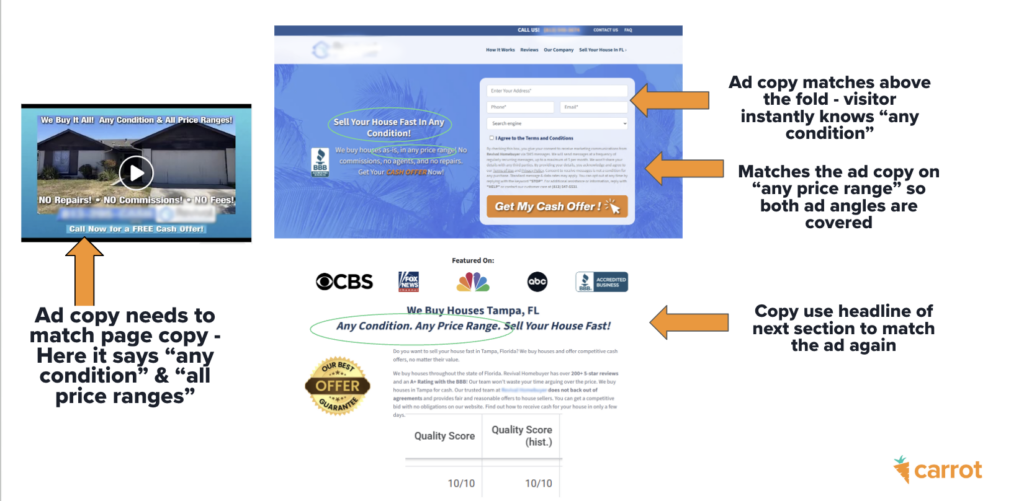
    So what does message matching look like? Here are a few examples …

    It might be tempting to personalize your ads by saying something like “Matt Buys Houses.” That personalization isn’t necessarily bad. But if the ad links to a page that only has your business name and doesn’t mention Matt again, you’ll run into message match and credibility issues. Someone clicked on an ad about Matt, but Matt is suddenly gone, replaced by a nameless business. Because the ad doesn’t match the landing page, visitors (and Google) aren’t sure the landing page is for the same businesses as the ad. Visitors lose trust (cautious of a bait and switch), and Google may flag your ad as scammy. The end result is your ad showing up less often and visitors who leave without contacting you.

    You can still run the “Matt” ad and include your business name on your website, just make sure to also use the phrase “Matt Buys Houses” on the landing page in addition to your business name. Similarly, if you use a picture of yourself (or a happy client) in your ad, make sure that image is also used on the landing page for continuity and credibility.
    Whatever talking points you specifically call out in the ad (a certain location, quick response times, fast closings, purchasing houses in as-is condition, etc.) make sure every single point you mention in the ad is repeated in the copy of your website. (We walk through some good and bad examples in minute 37:30 of the original webinar.)

    Does that mean you need a specific landing page for every ad you run? If each ad has different selling points, then yes, absolutely. Someone who clicks on an ad for emergency HVAC repair doesn’t care that you also design and install new systems. They clicked on your ad to solve a specific problem, so make sure the landing page attached to that ad directly addresses that exact problem.

    Pro Tip: You don’t need a dedicated landing page for each ad if the message is the same, but you’re testing different designs. As long as you cover all the same talking points and use the same language on the landing page as you do in the ads, you can point multiple ads to a single page.

    Now, let’s get into how to design a simple, high-converting PPC landing page!

    Must-Have PPC Landing Page Element 1: The Winning Headline Formula

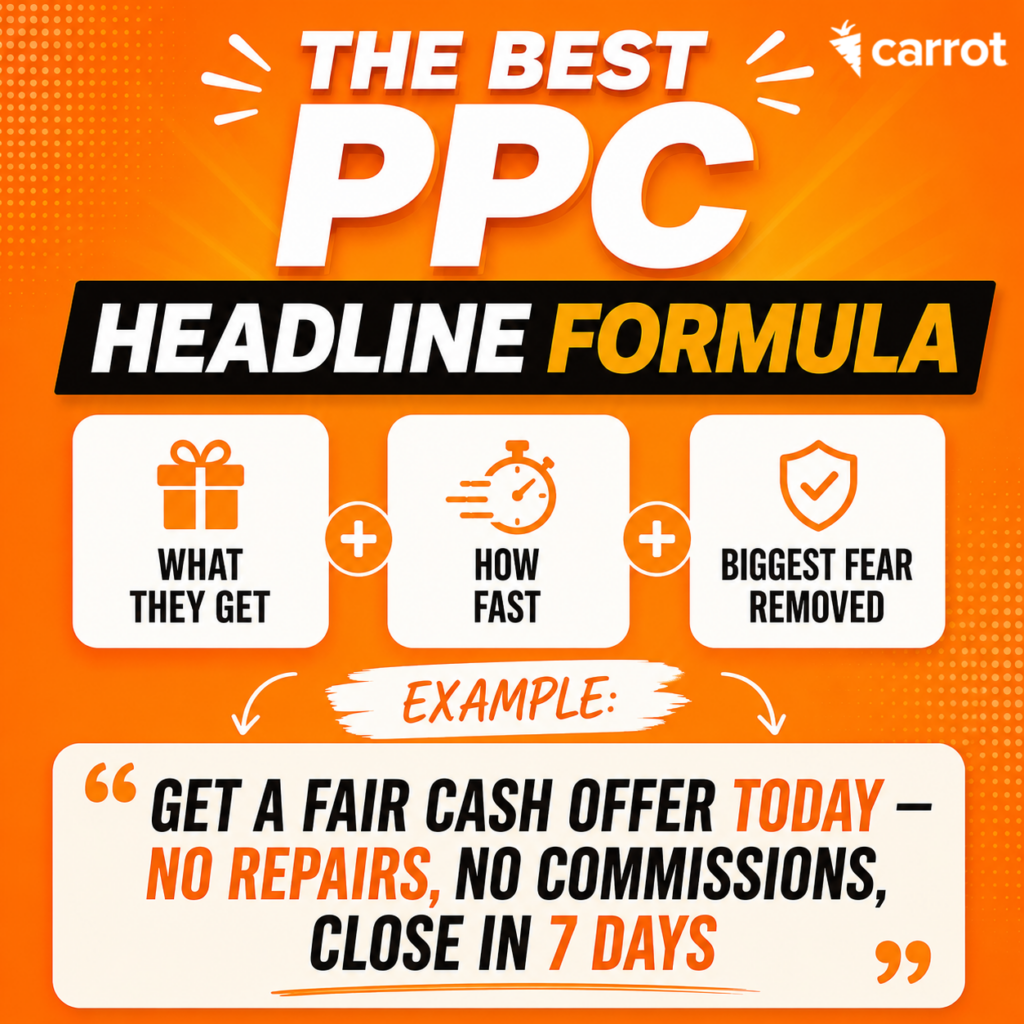
    Your headline should match the talking points of your ad (I think we’ve covered that thoroughly!), but we’ve also come up with a specific formula that wins over and over again. After spending 10+ years testing and refining landing pages for Carrot members, here’s the most effective PPC landing page headline formula:

    [What visitors get] + [How Fast] + [Biggest Fear Removed]

    The biggest fear can also be the major painpoint they’re trying to solve for …

    • Selling a house in as-is condition
    • A fast closing timeline
    • Fast or affordable emergency repair for a plumbing or HVAC issue
    • Wanting a new roof with a long guarantee
    • Needed a local service provider in their small or remote area

    This simple formula captures attention right away and directly addresses the problem a visitor is trying to solve. Nothing complicated, nothing too clever that the visitor needs to figure out, just a straightforward, appealing promise.

    Don’t worry too much about length when writing a headline using this formula, just focus on getting your point across clearly and compellingly. (Though you don’t want it to be so long that the visitor just glosses over it). You can also play with the order of the elements, as long as the headline reads naturally. Here are a few examples:

    • Get a Fair Cash Offer [what they get] Today [how fast] — No Repairs, No Commissions, Close in 7 Days [their fear/painpoint]
    • We Buy Houses Anywhere in the US [what they get] With Closing in as Little as 5 Days. [how fast] You Pay No Fees and No Repairs [their fear]
      • A Carrot member uses this exact headline and sees a 41.9% conversion rate on their landing page!
    • Emergency Plumbing Repair [what they get] Within an Hour! [how fast] Trusted plumbers in Portland for 20 years! [their fear]

    Use this formula to test different headlines and find the best combination that inspires visitors to contact you.

    Must-Have PPC Landing Page Element 2: Address Visitor’s Fears

    Fear is the number one thing stopping people from contacting you. (How many times have you talked yourself out of a purchase or service because you weren’t sure about the quality, how reputable the business was, or if it was worth it? Those are all fear-based holdups.) When it comes to selling a property or hiring a local service provider, fear-based emotions are extra hard to get over. This isn’t buying a new jacket, it’s a major transaction that most people are probably inexperienced with.

    The best way to get someone over their fears is to address them directly and honestly. You’ve touched on one or two of the major issues in the headline, but that’s only one sentence. You need to drive the point home repeatedly.

    Identify 2-3 major reasons someone might hesitate to contact you or what they might be concerned about. These can also be reasons too work with you. Here are some examples:

    • A specific closing timeline (5 days, 7 days, “close on your timeline”)
    • No fees, no commissions
    • As-is condition, No repairs
    • Fair offer, free quote
    • 100+ five-star reviews
    • In business since 2016, In business for over 20 years
    • Local family-owned business
    • All techs are background checked

    Just below the headline is a great place to address these fees. It can be as simple as a bulleted list in the hero section of the page.

    Again, make sure the fears you highlight in your ad are the most important ones addressed on the landing page. You can talk about more on the landing page, but keep the main focus in line with the ad.

    Must-Have PPC Landing Page Element 3: Trust Signals

    Now that you’ve promised to solve their problem, a visitor’s next priority is making sure you’re a reputable business worth contacting. When someone evaluates a business or service provider, they ask themselves a set of questions:

    • Is this person/company real?
    • Have they done this before?
    • Are they local?

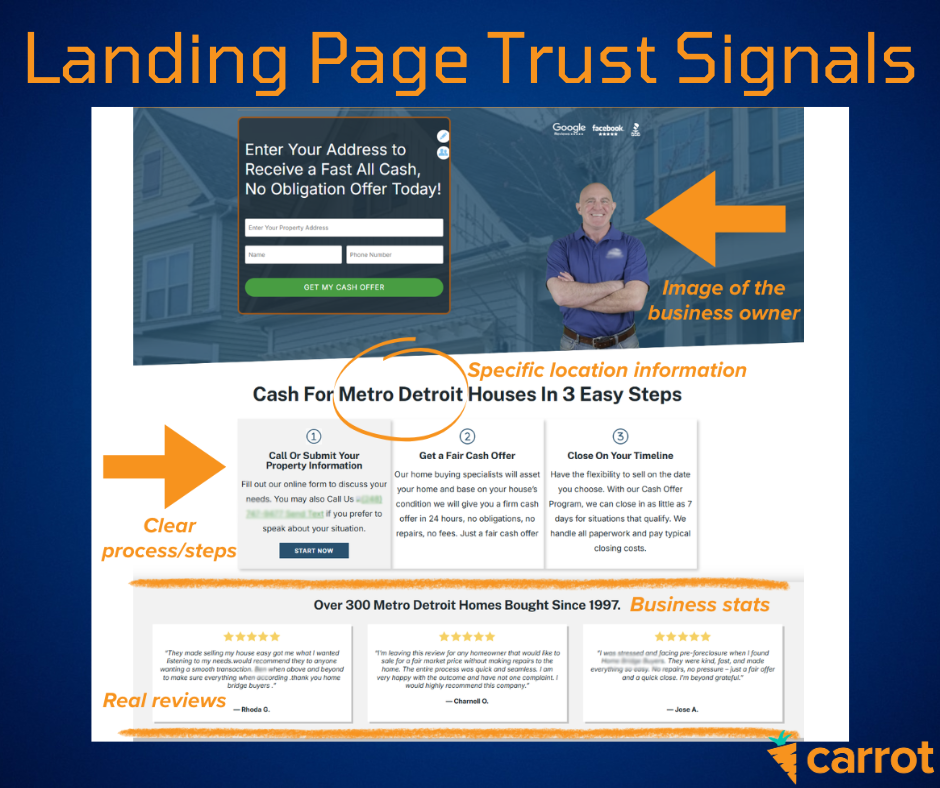
    Include credibility builders and trust signals on the landing page to put them at ease. A few of the example fears listed above are also trust builders (in business since 2016, local family-owned business, all techs are background checked). A few other examples of trust signals to include on your PPC landing page are:

    • Real photos of you and your team
    • Stats about your business (number of houses you’ve bought/serviced)
    • Local city/neighborhood references and photos
    • Reviews and testimonials from real clients
    • Badges (5 stars on Google, A+ from BBB)
    • License info
    • Process transparency (“here’s what happens next,” “here’s our process”)

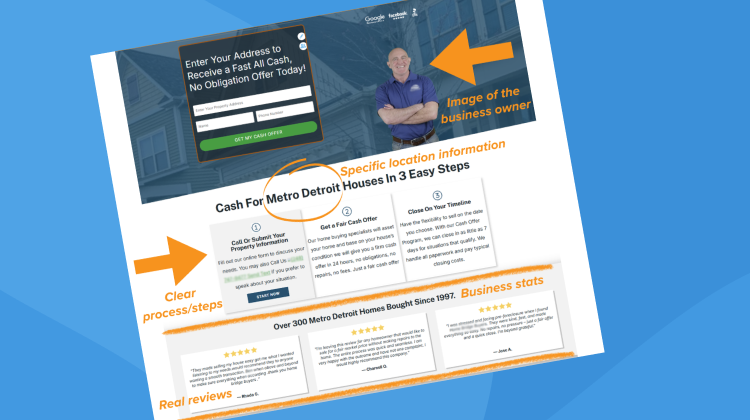
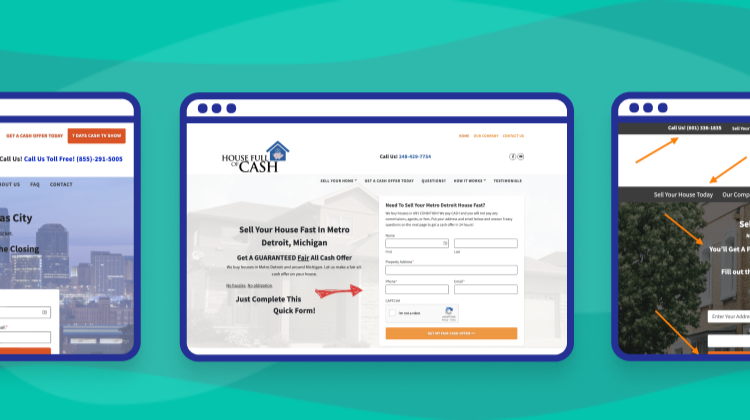
    Here’s what a landing page with good trust signals looks like …

    PPC Landing Page Trust Signals - Carrot

    Must-Have PPC Landing Page Element 4: Make Your Call-To-Action (Button) Clear & Compelling

    The button language on landing page forms is another thing Carrot has tested extensively over the years. Known as the call-to-action (CTA), what your button says should be specific and detailed. 

    Clear language like “Get My Fair Cash Offer” outperforms generic text like “Click Here” by 49.55%. That’s because generic button text doesn’t tell the visitor what’s going to happen, what they’ll get, or what they can expect. Making it crystal clear what happens when they give you their information gives them confidence.

    Good CTAsBad CTAs
    ✅ Get My Fair Cash Offer
     ✅ “See What My House Is Worth
    ✅ “Get My Free Quote
    ❌ Submit
    ❌ Click Here
     ❌ Contact Us

    Having a strong CTA in the hero section of your landing page is particularly important. This is the most common contact point for visitors.

    Must-Have PPC Landing Page Element 5: Low-Friction Contact Methods

    By now a visitor has gotten to your PPC landing page, determined that you can solve their problem, decided that you’re trustworthy, and knows exactly what they’ll get by contacting you. The last thing you want is to have them back out now because your contact form is too long or they can’t find your phone number.

    If you want people to call you, make your phone number very prominent both as your CTA and in places that a visitor would expect to find your phone number on a website (at the top and bottom of the page). Neary 83% of PPC traffic comes from a mobile device, so make sure the phone numbers on your landing page have click-to-call enabled and are easy to touch with your finger (meaning there isn’t so much stuff around them that the number itself is hard it hit).

    Pro Tip: Use call tracking on your PPC landing pages so you know exactly which campaigns generate the most leads and business!

    If your CTA is form-based, keep forms short! We strongly recommend using only 3 fields on your form.

    • For real estate: Name, phone, address
    • For home service providers: Name, phone, problem

    While it’s tempting to want to gather more information with your form, every field you add above three reduces conversions. Think of each field as a friction point. If the form takes too long to fill out, asks for too much information, or makes the visitor think too hard, they’re going to leave without completing it.

    If you absolutely need to collect more information, consider using a multi-step form instead of one long form. Multi-step forms put each question on its own “screen” so the visitor doesn’t get immediately overwhelmed by the amount of information they need to share. This is particularly helpful for mobile users where a long form would take up too much space on the screen and be difficult to fill in.

    Keep PPC Landing Pages Simple & Focused

    A good PPC landing page isn’t difficult to create. It’s actually the opposite. Keep things focused, address the visitor’s main concerns, and help them understand what will happen when they contact you. 

    If you want to dig into what makes a great PPC landing page even more, check out our free on-demand webinar, The 97% Blind Spot: How to Get 10x More PPC Leads Without Touching Your Ad Budget. Or use the PPC landing page templates built into Carrot to give you a jumpstart and make sure you don’t miss any important conversion elements!

  • 4 Major Problems with Your PPC Landing Page (that cost you leads)

    4 Major Problems with Your PPC Landing Page (that cost you leads)

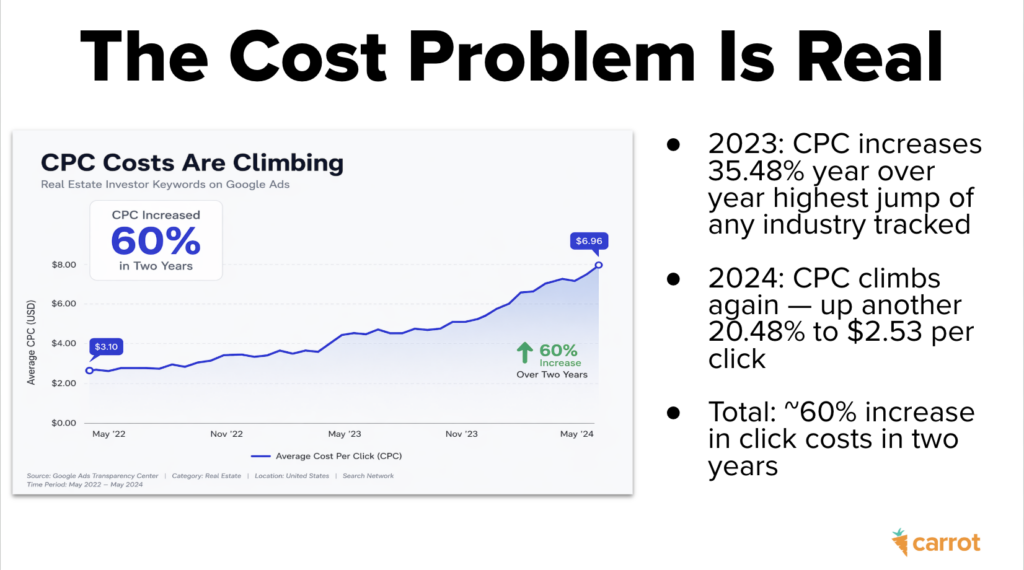
    No matter what happens in the world of SEO (or GEO or AEO or AI search … or any other organic traffic source), paid ads remain a reliable source of leads for many real estate investors and local home service providers. But even PPC (pay-per-click) has seen some changes in recent months, namely increasing costs without a corresponding bump in leads. Or, if you want to keep your cost per click down, you might be experiencing reach creep well beyond the geography you actually need leads from.

    So is PPC a bad marketing channel now? Not at all!

    The key to getting the most bang for your buck is making sure your PPC landing pages are set up for success. You can have the best ads in the world, but if the landing page they point to isn’t great, you won’t generate leads. (And Google might actually charge you more to show your ads!)

    For many businesses, the landing page is where they lose leads … not the ad itself. If you’re getting a good number of clicks, but none of them turn into a high quality lead or client, the issue isn’t with your ad, it’s with the landing page.

    This blog teaches you how to fix your leaky PPC landing pages, based on teachings from Carrot’s webinar The 97% Blind Spot: How to Get 10x More PPC Leads Without Touching Your Ad Budget.

    Key Takeaways

    • The four common PPC landing page issues that could be costing you leads and making your ads less effective overall.
    • Over 80% of PPC traffic comes from mobile, where users expect pages to load in under 3 seconds. Unfortunately, the average page load time in mobile is over 8 seconds. To improve your mobile load times, choose a website provider that pays attention to site speed.
    • Make sure your Google ad quality score is high by matching the language and messaging of your ad to the landing page it links to.

    Table of Contents

    Carrot icon
    Lead generation, at its best
    Attract, convert & close more motivated leads
    Try Carrot Today

    Most Common Problems Hurting Your PPC Ads & Landing Pages

    Nailing a PPC ad campaign can be tricky. You need the right message, the right copy, the right graphics, targeting the right people and areas … and sometimes it still seems like it’s not working. That could be for a few reasons that have nothing to do with your ads. Here are four common PPC landing page issues that could be costing you leads.

    PPC Problem 1: The Homepage Problem

    Where does your ad point to? If you’re like nearly 50% of people running PPC ads, the answer is probably your homepage. And that’s an issue. This is the biggest driver of wasted ad spend in PPC.

    So why is pointing to your homepage bad? The simple answer is that the messaging in your ad needs to match the messaging on the page the ad links to (i.e. the landing page). Not kind of match. Match. If the ad says something like “Sell your house fast for cash, no realtor commissions,” the landing page that ad points to needs to reiterate all those points exactly the same way. 

    When someone clicks on your ad, it’s because whatever that ad promised was enticing to them. If they get to the landing page (where the action takes place) and they don’t see that same promise, they may lose interest or trust and not take action.

    Google also puts a lot of weight on ad-landing page message match. (It’s a big part of Google Ad’s secret scoring.) If the language in the ad doesn’t match the language on the landing page, Google may decide that your ad is spammy or won’t give the visitor what you promise. If that’s the case, it won’t display your ad as often as the ones it deems high quality.

    Recommendation: Does your ad offer something like a fast cash offer? Change your form button from generic “Contact Us” wording to language that better matches your ad, like “Get My Cash Offer.”

    PPC Problem 2: The Writing Problem

    A recent study found that an estimated 54% of adults in the United States read below a sixth grade reading level. On top of that, people don’t pay close attention to online ads. So the best way to grab their attention quickly and communicate your message in a way that makes them take action is to keep it simple. 

    And that goes for the copy on your landing page too. During the webinar, we shared that landing page copy written for a 5th-7th grade reading level converts at 11.1%, while copy written at a college reading level converts at only 5.3%. Word choice matters, and in this case, it’s best to keep things simple and clear. The last thing you want is for people to be confused or feel like this service isn’t for them. If you try to get fancy or too clever, you could be costing yourself leads.

    PPC Problem 3: The Mobile Blindspot

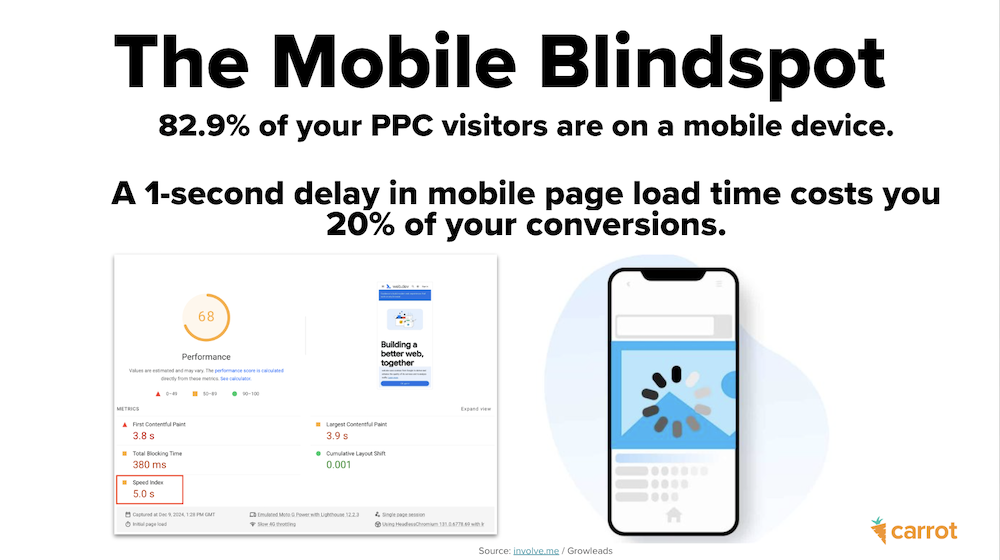
    What’s one of the best ways to waste ad budget? Having people click on your ad only to abandon the page before it even loads. The accepted knowledge among marketers is that people will leave if your site doesn’t load within 3 seconds. … But that stat is from 2011 (I personally remember writing about it back then!). Imagine how much faster people expect load times to be today!

    Today, more than 80% of PPC visitors are on a mobile device and, unfortunately, mobile load times are often slower than desktop. (BrowserStack puts the average mobile load time at a staggering 8.6 seconds.) That’s a lot of lost leads … and a lot of wasted budget.

    Our data shows that PPC landing pages that load on mobile within 2.4 seconds convert nearly twice as effectively as slower-loading pages.

    Keeping your PPC landing page simple and following best practices for page speed will improve your ad ROI by driving more leads. Choose a website provider (like Carrot) that natively pays attention to site speed and enables backend features to keep your site fast. Too many custom website developers focus on what looks good and ignore performance, which can quickly drag down your site. Pretty doesn’t convert leads, performance does

    Recommendation: Use pagespeed.web.dev to see how fast your site or PPC land pages load on mobile and desktop. 

    PPC Problem 4: Google’s Secret Ad Scores

    It should be no surprise that Google has an algorithm to determine where your ads are placed, how often they show, and how much they charge you to show them. It’s called the ad quality score — the higher the score the better. (We explain how to find your ad’s scores around minute 34 of the webinar.)

    How do you get a good Google ad quality score? Here are some tips.

    Based on the theme of this blog, you shouldn’t be shocked to learn that the quality of your PPC landing page directly impacts the ad’s quality score.

    Landing pages that Google deems “above average” not only have a higher click through rate (CTR), but see costs-per-click 36% below average … meaning Google charges them less for each click. If your landing page isn’t high-quality, Google shows your ad less often, shows other ads above it, and charges you more if someone clicks.

    How do you make sure you have a high quality landing page? That’s where message matching comes in. Google crawls your ad and landing page specifically to see if they’re talking about the same things, using the same language, and have the same major messages. So make sure your landing page makes the same promises as your ad.

    Want to see what good message matching looks like? Check out minute 38 of the webinar.

    Fixing Your PPC Landing Pages

    Those are some of the most common — and most impactful — mistakes made with PPC landing pages. Some are easy to fix (numbers 1 and 2), and some take a little more expertise (numbers 3 and 4). Working with the right PPC ad manager (or diving deep on ads yourself) can help, but you also need to make sure your website is set up to support high quality PPC landing pages.

    In the next blog, we’ll dive into the five elements every high-converting PPC landing page needs (including the fool-proof formula to write a winning landing page headline). But if you don’t want to wait for that post to publish, you can check out the webinar replay now (it includes a lot more helpful information as well, including touching on SEO changes and how AI impacts lead generation).

  • The Hidden Problems with All-in-One Software

    The Hidden Problems with All-in-One Software

    All-in-one software solutions have a lot of benefits. They give you access to multiple tools for a single price, they keep your data or assets centralized, and they cut down on daily “switching cost” — time wasted moving between apps. For some people, they’re a great option. But like most things, they’re not perfect and they’re not for everyone. It’s important to understand the downsides of all-in-one applications before making an expensive purchasing decision.

    Key Takeaways

    • All-in-one software has downsides that many people don’t consider, including paying for features you’re not using, wasting time on an overcomplicated system, becoming stuck in a single system, and settling for features that aren’t “best in class.”
    • All-in-one applications are good for some businesses, but businesses concerned with efficiency and growth should choose “best in class” solutions that meet their needs, help them grow, and are constantly improving.
    • In a survey conducted by Carrot, 60.4% of real estate investors said they’re willing to pay for the most effective tools, even if it’s different products versus an all-in-one marketing solution. When it comes to driving business, power and efficacy are more important than a wide selection of features.
    • You can audit how much you’re using your existing all-in-one software and how effective the features are with this free Software Usage Assessment Worksheet 

    Table of Contents

    1. Master of None
    2. All-in-Ones Offer Features in Place of Power
    3. Paying for Features You Don’t Need or Use
    4. Is Your All-in-One Actually Slowing You Down?
    5. Who are All-in-One Solutions Good For?
    6. Wait, doesn’t Carrot offer more than one solution?
    7. Understand the Benefits and Limitations
    Carrot icon
    Lead generation, at its best
    Attract, convert & close more motivated leads
    Try Carrot Today

    Everyone talks about the benefits of all-in-one apps. Now, let’s take a critical look at some of the downsides.

    All-in-One Software vs. Best-in-Class: What do you really need for your real estate CRM?

    Masters of None

    One of the first questions to ask yourself when considering an all-in-one is, “How good are the individual features?” While an all-in-one app may technically offer a feature, does that feature meet your needs and work well? If you were looking at just this feature, how does it compare to alternative solutions? Oftentimes, all-in-one solutions add features to make their product look more appealing and meet user wants, but it may be treated as just checking a box. A feature that doesn’t function well or live up to industry standards doesn’t really solve your need. If you’re relying on subpar features, your competition using best-in-class solutions will absolutely overtake you.

    Also ask yourself, “How often is each feature updated?” All-in-one providers often stretch themselves thin with complex feature suites, meaning many features are launched when they’re “good enough” and never updated or innovated. Large companies with hundreds of employees may be able to pull it off, but smaller companies don’t have the manpower to adequately maintain and support a large number of features — especially if you expect them to keep innovating to keep up with the market.

    Dedicated software providers aren’t stretched as thin, allowing them to put their full time, attention, and resources into maintaining, improving, and innovating a focused set of solutions.

    All-in-Ones Offer Features in Place of Power

    Do you want power and functionality, or do you want a lot of options that only work so-so? For companies that want to grow and succeed, the answer is clear — you want the tools that actually work.

    In a survey conducted by Carrot, 60.4% of real estate investors said they’re willing to pay for the most effective tools, even if it’s different products (versus an all-in-one marketing solution). When it comes to driving business, power is more important than a wide selection of all-in-one features.

    Companies that offer specialized software can build more features within that software. That one solution is their entire world, so they focus wholeheartedly on its effectiveness and depth. 

    Vetting and selecting different software may seem daunting, but if it helps you close more deals, it’s worth the effort. The key to building your own custom software suite is finding solutions that integrate well together. This lets you choose whatever solution works best for your needs, instead of simply taking the features and capabilities an all-in-one thinks you need.

    Pro Tip: If you do choose an all-in-one solution, make sure it allows outside integrations. Otherwise, you are fully locked into their features. If they change a feature, remove a functionality, or simply never improve their existing features, you’re stuck with what they offer. This also means you can’t use best-in-class tools that may offer a better experience or more functionality.

    Paying for Features You Don’t Need or Use

    Feature-rich all-in-one solutions often mean a lot of features that you’re paying for but not actually using. It may not sound like a big deal, but you could be wasting money on a subpar product.

    Here’s a quick way to assess an all-in-one’s fit if you already have one or if you’re considering one.

    Evaluating Your Existing All-in-One

    If you currently have an all-in-one solution, document how many of the features you’re actively using, then divide your total cost by that number to get a rough idea of how much you’re paying per feature (don’t forget to account for add-ons or usage-based pricing). If you want to take it a step further, give each feature you use a grade based on how effective it is and how much it meets your needs. If a feature has a low score, spend some time looking at single solution alternatives to see if switching would be better. While the standalone software might seem more expensive, consider how it will improve your efficiency, insights, lead generation, or overall revenue. If it will improve your business outcomes, it’s likely worth the price.

    Download our Software Usage Assessment Worksheet

    Assessing a Potential All-in-One

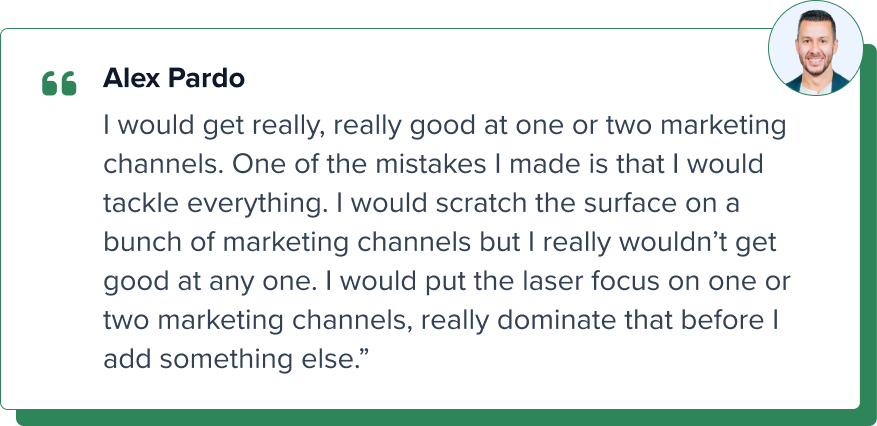
    If you’re considering an all-in-one, write down the problems you’re trying to solve, then evaluate its features. This way, you won’t be blinded by all the bells and whistles that you don’t actually need. Especially if you’re a newer investor, don’t overly plan for what you want to do; focus on what you need to do right now. If you’re not ready to spend the money on direct mail, you don’t need software that offers a direct mail option right now. Focus on one channel first, then, when you’re ready to expand, look for the right solution at the time.

    Alex Pardo - REI Marketing Advice

    For more beginner tips, download “5 Priceless Lessons from Million Dollar Real Estate Investors”

    Building your software suite as you go based on need ensures you always have the right-fit solutions in place rather than relying simply on what’s offered.

    Is Your All-in-One Actually Slowing You Down?

    It’s a common belief that all-in-ones cut down on switching costs — and that’s true. But they can also cause unnecessary distractions.

    When you’re in a single-purpose software, you’re doing one thing — editing your website, creating a marketing asset, following up with leads, whatever that software does. But if you’re in an all-in-one that does everything, it’s easy to get distracted by all the things you could be doing. You may go into the software to follow up with leads but find yourself building a new direct mail campaign. Before you know it, that lead follow up you were supposed to be doing is at best delayed, at worst completely forgotten.

    This is particularly true for teams. You may have good self discipline and focus, but can you say the same for everyone on your team. While teams may save time not switching between apps, they can also lose a lot of productivity to distraction or completing tasks that are more appealing but less profitable.

    Who are All-in-One Solutions Good For?

    All-in-one solutions clearly have their place (otherwise they wouldn’t be so prevalent). The key is understanding when an all-in-one is a good fit and when it might actually hurt your business.

    Who All-In-Ones are Good ForWho All-In-Ones Aren’t a Good Fit For
    One-person teams who want to move quickly and don’t have to worry about how a team works with the app.People managing teams who need to make sure the app is easy for everyone to use and keeps their team focused on the task at hand.
    Businesses that are comfortable with their current state and don’t want to scale.Companies that want applications that actively help them grow.
    People who are happy using the features offered and don’t want to look for better solutions or different feature sets.Teams that want the best-in-class tools with deep functionality to ensure maximum impact and efficiency.

    Wait, doesn’t Carrot offer more than one solution?

    It’s true, we do. We have Carrot Web and CarrotCRM. The difference is, it’s not a closed ecosystem. While the two softwares fully integrate and work wonderfully together, you can connect a different CRM to your Carrot website or use CarrotCRM with any other website or simply upload your offline leads. You don’t have to use them together and we treat them as two separate solutions.

    They also have different engineering teams who remain dedicated to maintaining and improving the individual products. CarrotCRM was originally InvestorFuse, and their entire engineering team joined Carrot when we acquired that company in XXXX.

    Because they’re treated separately, you see things like continuous solution improvements and new features being added to web and CarrotCRM designed to improve each solution experience.

    Here’s a quick recap of some of the most recent improvements and feature releases …

    Carrot WebCarrotCRM
    Call Tracking (but you can still integrate an outside solution if you prefer!)New AI features
    Site speed improvementsConstantly improving dashboards
    LLMs.txt file auto-generation to help with AI search visibilityKPI TV dashboard

    Understand the Benefits and Limitations

    At the end of the day, whether you choose an all-in-one or bespoke software comes down to your specific needs and values. But understanding the drawbacks as well as the benefits is an important part of the process.

    Take time to document what you’re trying to achieve, what’s most important, and what functionality you actually want out of software, then find the best solution. And remember, just because you’ve implemented one solution doesn’t mean you can’t switch. If it’s not working for you or your team, find something that does. Wasting time trying to make a poor fit work ultimately wastes money.

  • Why Call Tracking is the Most Profitable Real Estate Tool You’re Not Using

    Why Call Tracking is the Most Profitable Real Estate Tool You’re Not Using

    Whether you’re just starting out as a real estate investor or you run a multimillion dollar investment company, everyone wants to make sure the money they spend on lead generation actually lands deals. 

    The best way to do that is with campaign tracking (tying specific leads to their source, like Facebook, a direct mailer, or even a billboard or radio ad). That’s easy with specific landing pages and forms. But what if a lead calls you? Even if you ask where they heard about you, they may not remember or provide specifics. 

    Enter call tracking. Call tracking lets you put a unique phone number on all of your lead generation channels and campaigns so you know exactly where a lead came from. 

    And now, call tracking is built directly into your Carrot website and included in your subscription!

    Key Takeaways

    • Call tracking lets you identify which lead sources drive the most leads and deals, based on real data, not guesswork and gut feelings.
    • If you don’t have call tracking enabled on our website, you don’t know how many leads your site actually generates. Form submissions is an incomplete picture of a real estate website’s lead generation power (especially since 50.78% of web traffic comes from mobile devices, according to proprietary Carrot data).
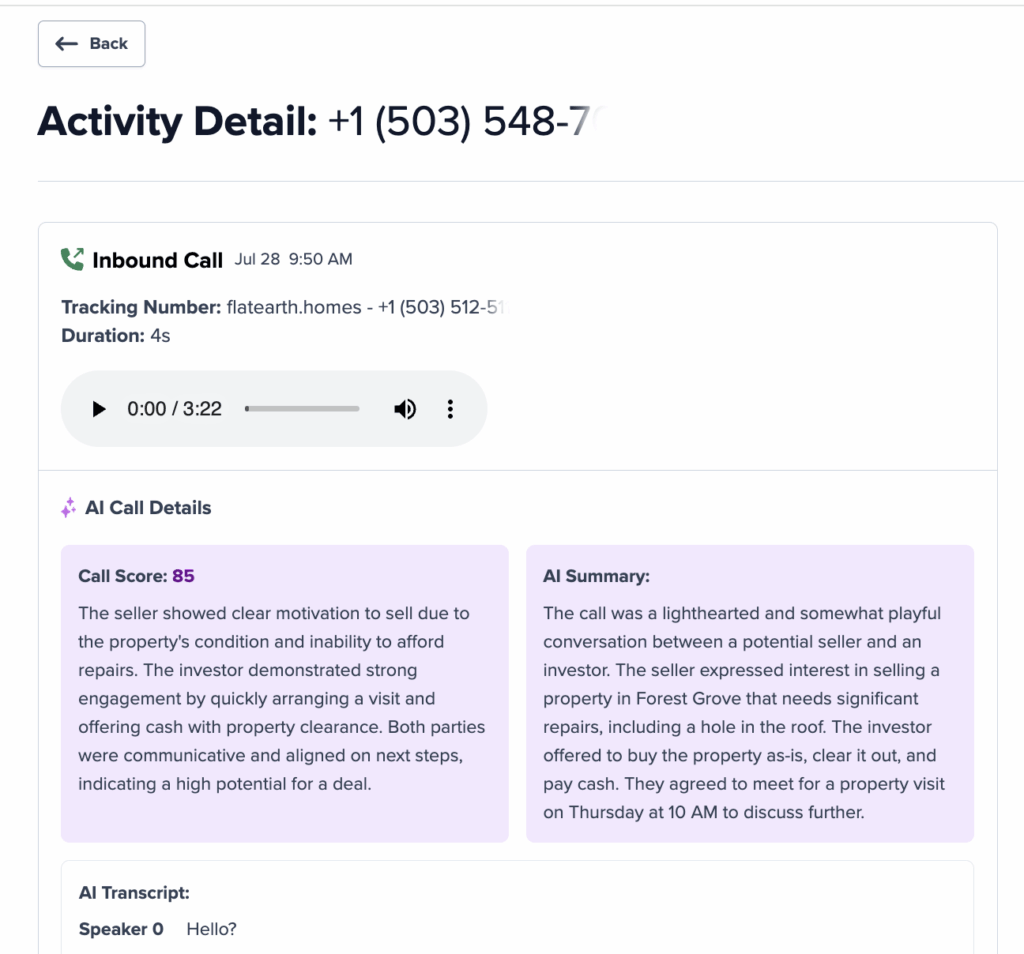
    • Carrot AI Call Insights provides automatic call transcripts, summaries, a call rating, and actionable next steps so you know exactly what was discussed and which leads to work first based on their motivation and fit.

    Setting up call tracking gives you peace of mind that your marketing efforts work and allows you to focus on the areas that drive the best results.

    Table of Contents

    1. What are the benefits of call tracking for real estate investors?
    2. Who uses call tracking?
    3. How does Carrot Call Tracking work?
    4. How much does Carrot Call Tracking Cost?
    5. How does Carrot’s Call Tracking compare to other call tracking services? 
    6. Take your business to the next level with call tracking
    Carrot icon
    Lead generation, at its best
    Attract, convert & close more motivated leads
    Try Carrot Today

    What are the benefits of call tracking for real estate investors?

    Call tracking gives you a clear, accurate understanding of where each phone lead came from. Did they visit your website then call you? Did they see something on social media or get a specific direct mailer? Knowing where each lead came from lets you know what’s working.

    Say you’re trying out two different direct mail pieces. A lead calls and says they got your postcard. But you don’t know which one it is. You can ask them to describe it, but is that really how you want to spend your time on the phone with a new motivated lead? No! With call tracking, you can skip the entire “how did you hear about us” conversation because you already know based on the number they called. Over time, you’ll know which campaigns are the most effective based on real data tied to each unique number. 

    Call tracking is particularly important for understanding your website’s effectiveness. In 2024, 50.78% of traffic to Carrot-hosted websites came from mobile devices. And when people are searching on a mobile device, it’s easier to click on the phone number and make a call than it is to fill out a form. If you’re not attributing these calls to your website, you won’t have a complete picture of its effectiveness. You may even think your website isn’t generating leads when in reality it could be your biggest driver of calls.

    The funny thing is, most of my leads are coming from people who find the site but choose to call instead of filling out the form. I’ve started asking everyone how they found me and what made them reach out, and more and more people are skipping the form entirely and just dialing the number. … It’s happening so often that I wonder if it’s part of a bigger shift in consumer behavior.
    Jeff Tucker, Jeff Buys Houses Cash

    In addition to knowing which sources generate the most leads, pay attention to which sources generate the best leads — the ones that turn into deals more often or have the largest value. You might get 100 calls from direct mail pieces, but if none of them turn into a deal, then it’s not really a good lead source. Meanwhile, you might only get a few calls a month from your website, but if most of them turn into deals, that’s a great source! With the average real estate investor spending $1,000 a month on advertising, making sure every dollar works is critical. You need a way to track actual success when deciding where to spend your money and determining campaign ROI.

    Identifying your real lead and deal sources lets you turn off marketing methods that aren’t producing deals and focus your time, energy, and budget on the channels that actually generate revenue. If you’re a high lead volume business, knowing which channels convert to deals more often also allows you to prioritize new leads, focusing on the best lead sources first. 

    You may have a general idea of where your best leads come from, but not knowing for sure means you could be wasting money or time. Call tracking makes it crystal clear, no guesswork involved.

    Who uses call tracking?

    The beauty of Carrot’s built-in call tracking is that it makes this great feature accessible to any investor, without having to purchase a separate service. 

    Solo & Newer Investors

    When you’re a one-person team, your time matters even more. And if you’re newer to real estate investing, you might be particularly sensitive about your budget and profit margins. Built-in call tracking included with your website gives you an accurate understanding of lead generation effectiveness without shopping around for another tool or learning and integrating another system.

    It’s an easy, hassle-free way to understand how much revenue each advertising dollar generates so you can focus your time and money where it will have the greatest impact and accelerate your business.

    Team Managers

    Whether you manage a large team or work with a VA or two, visibility is key to ensuring your team (and business) is successful. Call tracking helps with this in two ways:

    1. It makes sure any marketing plans someone else puts in place are working (and not just wasting your money). If you don’t see any calls coming in from a specific campaign, that’s a sign you need to ask some critical questions about it.
    2. It provides insights into your VA’s or lead manager’s availability, responsiveness, and capacity. You can easily see the total number of calls, how many were answered, and how many were missed.

    At the end of the day, call tracking helps give you full visibility into what’s driving results, no matter who’s handling your marketing or fielding calls.

    How does Carrot Call Tracking work?

    Carrot’s built-in call tracking puts a unique, local phone number (different than your personal or business number) on your website. This tells you exactly how many phone call come from people visiting your website. Call tracking combined with the lead generation forms on your site give you a complete understanding of how many leads your site generates. 

    When you’re ready to turn Carrot Call Tracking on, simply:

    1. Select a number local to your area (this is important as it let’s leads know you’re a real, local person, not some nameless, faceless mega company).
    2. Connect your new number to a receiving line where you want calls forwarded.
    3. Connect your new number to the campaign you want to track
      • If you want to use the number to track phone leads from your website, Carrot will automatically replace the phone number currently on your site with the new tracking number! (If you have landing pages that already have unique numbers, we won’t change those).

    The whole process takes less than five minutes!

    If you want to add unique numbers to additional marketing campaigns or landing pages, simply add numbers to your account, assign them to a tracking campaign, and add them to your marketing. (Remember, for call tracking to work effectively, don’t use the same number across multiple campaigns or marketing channels!) 

    When a call comes in, it rings through to your receiving line. If you’re unavailable, the caller can leave a voicemail like normal and that message is tracked to the appropriate campaign in your call tracking dashboard. All calls are recorded so you can revisit them or use the AI Call Insights feature for additional insights. Whether you pick up or the lead leaves a message, a two-party consent message plays automatically before recording starts, satisfying the strictest state requirements. Recordings are stored for 30 days (60 if you have the AI Call Insights add-on). If you want to keep them longer, you can download recordings before they expire. 

    All inbound calls are automatically logged in CarrotCRM. If a matching opportunity exists, the call is attached. If there isn’t an existing opportunity for this lead, the system automatically creates one tagged with the campaign. If you use a different CRM, we’re working on a Zapier integration to push call details, recording URLs, and transcripts (when available) from your free CarrotCRM instance to your CRM of choice. Stay tuned for that update (or talk to one of our experts about switching to CarrotCRM!)

    If you miss a call or receive a text message to the tracking number, you’ll get an email with the caller’s number and a link to the recording (if they left a voicemail) or a copy of the text message they sent. These email notifications are great for on-the-go investors, letting you catch up on incoming calls or keep up with VA activity no matter where you are. Have some down time between meetings? Get everything you need to know about your latest lead and follow up now instead of waiting until you’re back in the office.

    Analytics & AI Call Insights

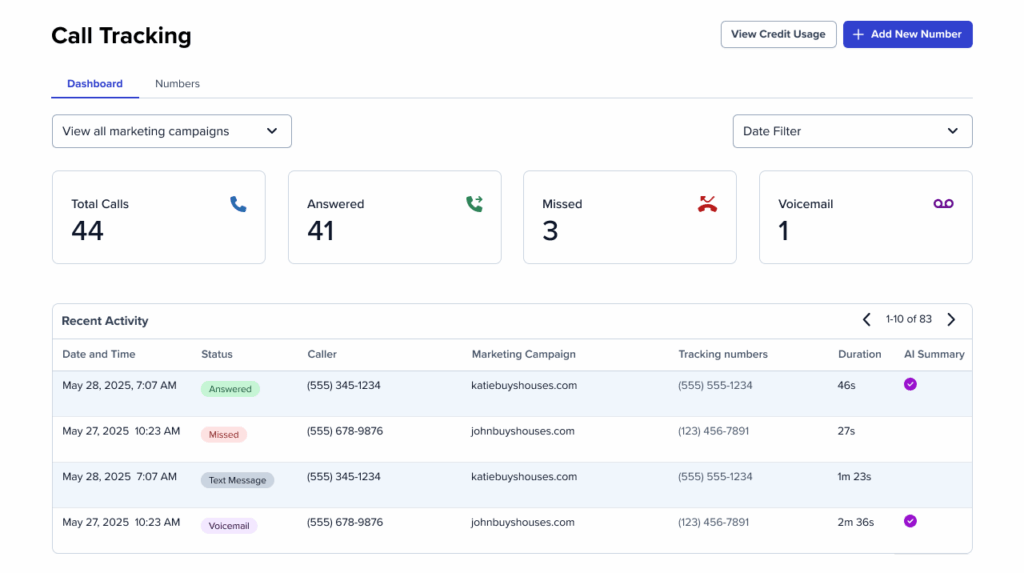
    The call tracking dashboard gives you a quick view into how many calls you’ve received and how many were answered, missed, and left messages. Each call log shows you the time, date, contact details, duration of the call, and provides a link to the transcript if you have AI Call Insights enabled. You can view all calls, or drill down into specific campaigns.

    AI Call Insights gives you even more useful information by providing:

    • Automatic Transcripts: Recorded calls are transcribed within ~2 minutes post-call. Transcripts feature speaker labels and remove the “um’s,” “so’s,” and pauses, giving you a clean view of who said what.
    • Call Summaries: Each call is distilled into a clear 2-4 sentence summary that captures the tone, urgency, and what was discussed.
    • Call Rating: AI analyzes the call based on critical factors like pricing alignment, urgency, and engagement then gives the call a 0-100 rating, allowing you to identify and prioritize the most promising calls first instead of wasting time on callers who aren’t serious yet.
    • AI Action Items: AI analyzes the call and pulls out bulleted action items so you know exactly what to do next.

    Transcripts and summaries automatically sync to the matching CRM opportunity so when you’re working a lead you always have the latest information. 

    AI Call Insights let’s you move faster and more intentionally. Instead of listening to a missed call  or relistening to a call when you’re ready to reach out again, you can save time by getting a quick recap instead. Not sure which lead to follow up with first? The Call Rating assesses a lead’s readiness and motivation and gives you a rating summary so you know what’s behind that assessment. These ratings help you prioritize the leads that are most likely to turn into deals. It’s similar to AI Lead Scoring, but specific to this call or text message and helps you move quickly with leads who are ready to sell before they move on to someone else.

    With the built-in AI features, you no longer have to upload a call recording into an external transcription service or load a transcription into ChatGPT to find the key points. You can also stop relying on virtual assistants to listen to all the calls and provide written recaps. It’s all down for you in a matter of minutes.

    How much does Carrot Call Tracking Cost?

    Carrot call tracking gives you one local number to use on your Carrot website, plus 100 recording minutes and 25 inbound SMS messages per month as part of your Carrot subscription. 

    If you reach 80% of your recording minutes or SMS limit, you’ll get an email alert letting you know you’re nearing capacity. If you go over the threshold, it’s $0.05 per minute and $0.03 per additional inbound SMS message. Keep track of your costs on the Usage and Costs page, which displays your real-time consumption, projected overages, and invoice history for full transparency.

    Need additional numbers for different marketing campaigns? No problem! You can add as many local numbers as you’d like for $3/month each. 

    AI Call Insights can be added to your subscription for $39 per month. (AI Call Insights is not part of the CarrotCRM AI feature suite. Turing on CarrotCRM AI features does not enable AI Call Insights.)

    How does Carrot’s Call Tracking compare to other call tracking services? 

    We believe that call tracking is a critical component of measuring your success and managing your budget and focus, so we worked hard to make it as affordable as possible. Because it’s fully integrated into our real estate website platform, we were able to make it part of the subscription and only charge for additional usage. Most other call tracking solutions (like CallRail) are standalone services that need to be connected to an external website.

    CallRail starts monthly subscriptions at $50/mo (plus the cost of your website as CallRail doesn’t offer this service). 

    Carrot Call Tracking vs. CallRail

    CallRailCarrot Call Tracking
    5 numbers5 numbers (1 included, plus 4 add-ons)
    250 minutes250 minutes (100 included, plus 150 overage minutes)
    $50/mo$19.50/mo

    Carrot Call Tracking vs. CallRail with AI Insights

    CallRailCarrot Call Tracking
    5 numbers5 numbers (1 included, plus 4 add-ons)
    250 minutes250 minutes (100 included, plus 150 overage minutes)
    AI insights & call transcriptionsAI insights & call transcriptions
    $100/mo$58.50/mo

    Take your business to the next level with call tracking

    Managing time, budget, and understanding your return on investment is critical for any business at any stage. Call tracking is another tool that gives you deeper understanding of what’s working and where to focus your efforts. For many real estate investors, it’s the missing piece to their reporting. You know how many leads you generate, how many turn into deals, how many form fills you get. Now it’s time to know exactly how many calls and text messages you get from leads, and exactly where they came from. Stop driving blind and start making smarter decisions based on real call tracking data to take your business to the next level.

  • How AI is Reshaping SEO for Real Estate Investors: What You Need to Know in 2025

    How AI is Reshaping SEO for Real Estate Investors: What You Need to Know in 2025

    The search landscape has seen huge changes in recent years. If you’re a real estate investor who’s been watching your website traffic fluctuate or noticing fewer clicks from Google searches, you’re not imagining things.

    Google’s AI Overviews now appear in nearly half of all search results, and in May 2025, Google launched AI Mode for all US-based searchers. The era of traditional SEO strategies is rapidly evolving.

    For real estate investors who depend on their websites to generate motivated seller leads, these changes are business-critical developments that require immediate attention. When prospects search “cash home buyer,” “we buy houses,” or “sell my house fast,” Google increasingly provides answers directly in search results, pushing the #1 ranked website further down the page than we’re used to. So how should you adjust your SEO to make sure you still show up on top in 2025? Let’s cover some key strategies!

    KEY TAKEAWAYS (TL;DR)

    • AI Overviews are Dominating Search: Google’s AI-generated summaries now appear in nearly half of all search results, often providing “zero-click” answers, which means many searchers never leave the Google search results page.
    • Brand Authority is Key: Google’s algorithms now heavily emphasize brand recognition and mentions across the web, not just on your site. Backlinks are still important, but you’ll also want your company mentioned by name on trusted, relevant sites.
    • Unique Content is More Important Than Ever: Generic content is being de-ranked, and often even ignored by Google. Focus on providing your own unique and helpful expertise, local market insights, and real-world case studies that AI tools like ChatGPT can’t replicate.
    • Local SEO is Evolving: Optimize your Google Business Profile and target hyper-local keywords, as AI Mode prioritizes local intent.
    • Diversify Your Marketing: Reduce reliance on single marketing tactics by investing in omnichannel marketing, including social media, video content, and offline networking.

    Let’s get you up to speed on the most significant AI-driven changes impacting search in 2025 and beyond. In this guide, we’ll cover what these changes mean for your real estate investing business, and give you actionable SEO strategies to help you maintain and grow your online presence.

    Table of Contents

    1. The AI Revolution in Search: What to Know
    2. Building Brand Authority in an AI-Dominated Landscape
    3. Adapting Your Content Strategy for AI-First Search
    4. Measuring Success in the New SEO Landscape
    5. How to Stay Ahead: Real Estate Investor Marketing in the A.I. Era
    6. Your Action Plan: 15 Essential Steps to Future-Proof Your Marketing Strategy
    7. Conclusion
    8. Frequently Asked Questions
    Carrot icon
    Lead generation, at its best
    Attract, convert & close more motivated leads
    Try Carrot Today

    The AI Revolution in Search: What Real Estate Investors Need to Know

    Google’s AI Overviews Are Dominating Search Results

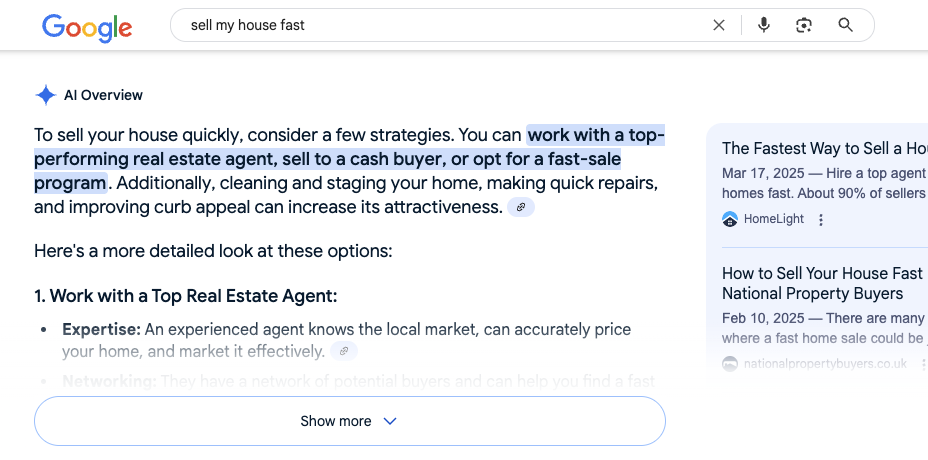
    The most dramatic change affecting real estate investor websites began in May 2024 when Google officially launched AI Overviews.

    By December 2024, these AI-generated summaries appeared in 47% of Google search results, and recent data shows they spiked even higher during Google’s March 2025 core update.

    Most recently at Google’s I/O annual developer conference in May 2025, they announced the rollout of AI mode to all users in the U.S.

    Screenshots showing Google's AI overviews for a search of "sell my house fast".

    Here’s what’s especially challenging for real estate investors: AI Overviews show up heavily for broad, top-of-funnel queries—exactly the type of searches your potential sellers are making when they first consider selling their property. When someone searches “how to sell my house fast” or “cash home buyers near me,” they’re increasingly getting AI-generated answers without ever clicking through to your website.

    The numbers are staggering:

    • Research shows that nearly 60% of searches in 2024 resulted in “zero-click” outcomes, meaning users get their answers directly from Google without visiting any websites.
    • A study by Datos and SparkToro found that for every 1,000 searches on Google in the United States, only 360 clicks make it to non-Google-owned properties that aren’t paying for ads.

    The Rise of Forum Content and Video Results

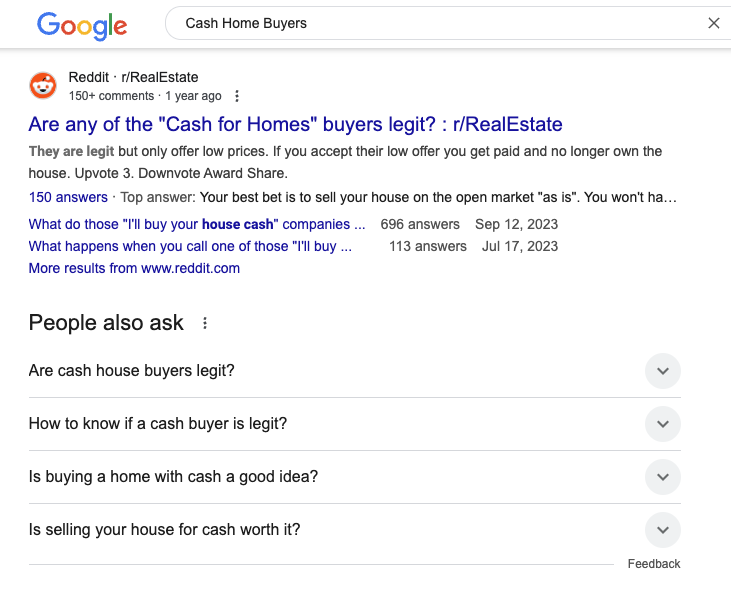
    Another significant shift impacting SEO strategies for small businesses is the increased prominence of forum content like Reddit and Quora in search results. This trend is particularly relevant for real estate investors because many forum discussions reveal the distrust and skepticism people have toward “cash home buyers” and the real estate investment industry in general.

    Screenshot showing Reddit forum answers in the Google search results.

    When potential sellers search for information about working with real estate investors, they’re increasingly finding forum discussions where people share both positive and negative experiences. This shift emphasizes the critical importance of reputation management and building authentic trust signals across multiple platforms.

    Video content is also showing up more often in search results, with both YouTube videos and short-form video content appearing more frequently. This presents opportunities for real estate investors looking to diversify their content strategy. Plus, research shows that websites with video content see 50% more engagement than those without.

    You can stay ahead of things by monitoring relevant forums and conversations in your local market area. Then develop content in both written and video formats that speaks directly to the concerns people have. Showcase the trustworthy, local people behind your company to combat the skepticism that some motivated sellers may have about cash home buyers.

    Building Brand Authority in an AI-Dominated Landscape

    The Growing Importance of Brand Mentions and Recognition

    One of the most significant revelations from the May 2024 Google algorithm leak was the emphasis on brand authority.

    In Rand Fishkin’s original analysis of the leaked Google Search API documents, his primary takeaway was that “brand matters more than anything else.” He commented:

    If there was one universal piece of advice I had for marketers seeking to broadly improve their organic search rankings and traffic, it would be: “Build a notable, popular, well-recognized brand in your space, outside of Google search.”

    For real estate investors, this means your reputation and brand recognition across multiple platforms now directly impacts your search rankings. Google measures brand mentions on YouTube transcripts, social media platforms, and across the web.

    The stronger your brand presence beyond your website, the better your chances of ranking well in traditional search results and being cited in AI Overviews. More than ever, off-page SEO isn’t just about building backlinks. It’s also about social media visibility and digital PR & publicity for your business.

    You can monitor referring domains, backlinks to your website, and your Authority Score with Carrot’s Domain Overview Tool. We also recommend adding your company’s business name to the Keyword Rank Tracker to monitor that your website ranks at the top of the search results when people search for your company by name.

    The Role of Engagement Signals in Rankings

    Google had insisted for years that they don’t use anything from Chrome for ranking, but the Google API documents leaked in May 2024 suggested that they actually do use Chrome and Android device data to understand how users interact with websites.

    Engagement signals are crucial ranking factors. Google looks at what happens after users click through from the search results to your website.

    Your website’s user experience directly impacts your search rankings. If visitors quickly return to Google after visiting your site (known as “pogo-sticking”), it signals to Google that your content didn’t satisfy their intent. However, if they spend time on your site reading content, watching a helpful video, or filling out a form, those engagement signals can play a role in how Google will rank your website in the future.

    Adapting Your Content Strategy for AI-First Search

    The Challenge of AI-Generated Content Saturation

    Google’s March 2024 core update, described as their “largest in history,” resulted in 45% less low-quality, unoriginal content in search results. The search engine giant is actively working to combat the flood of AI-generated commodity content that lacks originality and value.

    In January 2025, Google updated its Search Quality Rater guidelines to focus on spam and unoriginal content. Google expanded the definition of what it considers spam, and it called out low effort content in Section 4.6.6 of their guidelines:

    “The Lowest rating applies if all or almost all of the [Main Content] on the page (including text, images, audio, videos, etc) is copied, paraphrased, embedded, auto or AI generated, or reposted from other sources with little to no effort, little to no originality, and little to no added value for visitors to the website. Such pages should be rated Lowest, even if the page assigns credit for the content to another source.”

    Google’s quality raters are human consultants hired by Google to manually spot check the quality of Google search results and provide feedback to help Google improve their algorithms. The Search Quality Rater guidelines tell these consultants what they should look out for when evaluating the search results.

    Understanding Information Gain and Content Uniqueness

    Google’s “information gain score” patent, granted in June 2022, represents a fundamental shift in how search engines evaluate content quality. Rather than focusing solely on word count or how recently a page was updated, Google now measures how much new useful information your content provides that doesn’t exist elsewhere online.

    For real estate investors, this means that simply publishing generic content is not only unlikely to improve your rankings, it could actually hurt your search visibility. Instead, you need to consistently add your specific expertise, local market knowledge, case studies, and unique data that differentiates you from competitors.

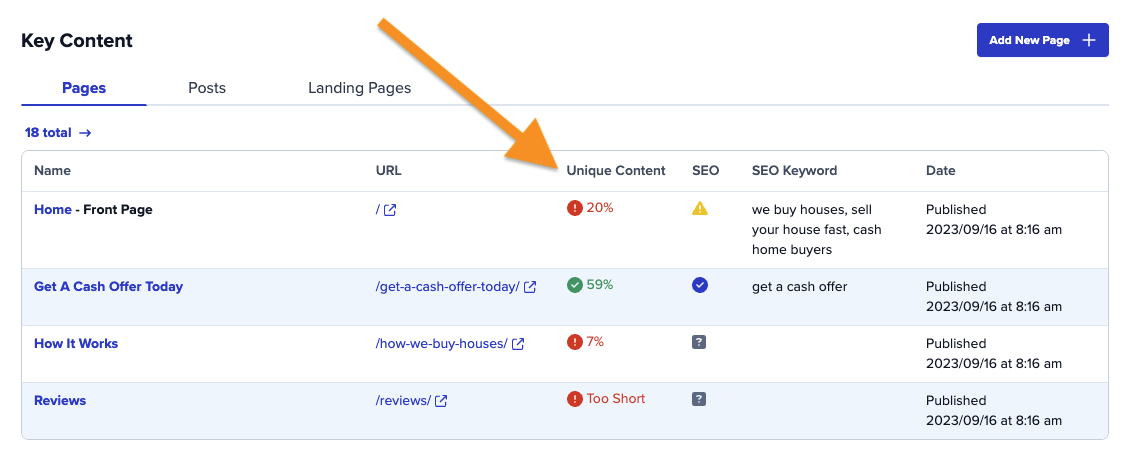
    This is why we’ve built our Unique Content Tool to help you see how different your edited content is from the original template. Plus, our updated AI Rewrite Tool makes personalizing your content easier than ever! You’ll still need to add your own insights, but our built-in tools can expedite your content creation process by making sure the AI-generated copy matches your unique brand — an excellent starting point.

    Screenshot showing Carrot's Unique Content Tool

    Creating Content That Stands Out

    The key to a successful content strategy in 2025 and beyond lies in combining AI efficiency with human knowledge and authenticity.

    Real estate investors have a unique advantage here—your direct experience with local markets, specific property challenges, and successful deal structures provides the exact type of unique information that both Google’s algorithms and your potential clients value most. You can still use AI tools to help you write, just be sure to add your own insights and flair. (Carrot’s Automated Content Library is a perfect example of this. It offers well-researched, pre-written blog posts that you can use as a starting point, then customize to your market and with additional insights and expertise you’ve honed over your career.)

    When you combine well-optimized website content with video marketing, you can build trust and credibility with local homeowners and increase your potential visibility in Google search results.

    Measuring Success in the New SEO Landscape

    Traffic Attribution and Traditional SEO KPIs are Changing

    The traditional SEO metrics that real estate investors have relied on for years—keyword rankings, organic traffic, and click-through rates—are becoming less reliable indicators of holistic marketing success. As Google’s search results pages continuously evolve with AI Overviews, video content, and forum results, these metrics don’t tell the complete story of your marketing performance.

    A critical issue affecting real estate investor websites is attribution of traffic sources. Research in 2024 showed that significant percentages of web traffic from social networks, messaging apps, and even AI chatbots are often lumped in under “Direct” traffic by Google Analytics.

    This “dark traffic” phenomenon means you might be receiving more referral traffic from social media, AI chatbots like ChatGPT, and other sources than your analytics show.

    The Rise of Brand Awareness Metrics

    In this new landscape, brand awareness metrics are becoming increasingly important. Brand mentions across the web, branded search volume, and your visibility in AI-generated responses are now crucial indicators of your market authority and future search performance.

    For real estate investors, this shift means monitoring how often your company is mentioned on social media, in local forums, and in AI chatbot responses when people ask about local home buyers. These mentions often lead to branded searches and direct traffic that may not be properly attributed in traditional analytics.

    We always recommend tracking branded terms (like your company name) in our Keyword Rank Tracker so you can make sure you are controlling the conversation around your brand.

    Aligning with Business-Critical Metrics

    More than ever, SEO success and marketing efforts need to align directly with business metrics that matter to your real estate investing operation. A decrease in organic traffic might be offset by higher-quality leads or better conversion rates from other sources.

    For real estate investors, this makes it even more important to focus on business metrics like revenue, lead quality, cost per lead and lead-to-close ratios rather than website traffic or rankings alone. (Make sure you have a strong, real estate-specific CRM to help you monitor these key metrics.)

    How to Stay Ahead: Real Estate Investor Marketing in the AI Era

    The changes we’ve seen in 2024 and early 2025 are just the beginning of AI’s impact on search and digital marketing. Google’s introduction of AI Mode with Gemini 2.0 in March 2025 shows even more sophisticated AI capabilities are coming, with particular emphasis on local intent and complex query handling.

    For real estate investors, this means the strategies that work today need to be flexible enough to adapt as AI becomes even more prominent in search results.

    The most successful real estate investors in this new landscape will be those who maintain competitive advantages that can’t be easily replicated by AI or competitors. This includes deep local market knowledge, strong personal relationships, proven track records, and authentic brand authority and content built over time.

    Your Action Plan: 15 Essential Steps for Real Estate Investors to Future-Proof Your Marketing Strategy

    Based on the major shifts happening in search and AI, here’s your comprehensive action plan to adapt and thrive:

    1. Optimize Content for AI Overview Inclusion – Structure your website content with clear, concise answers to common seller questions. Utilize dedicated FAQ block patterns, bullet points, and numbered lists to make information easily digestible for both human readers and AI algorithms. Ensure your content directly addresses user intent, making it a prime candidate for Google’s AI Overviews and featured snippets by providing direct, authoritative responses.
    2. Target Hyper-Local and Intent-Driven Keywords – Shift your keyword strategy from broad, competitive terms like “we buy houses” to highly specific, long-tail, and geographically focused phrases. Think “sell my house fast in [your specific neighborhood]” or “cash home buyer for inherited property in [your city].” Rather than old-school keyword stuffing, use entity-based SEO to provide context and meaning through synonyms and related words. This approach helps you capture niche local demand and signals to Google’s AI that your content is highly relevant to specific local queries.
    3. Prioritize Unique, Expert-Driven Content (Information Gain) – Move beyond generic advice and focus on creating unique content that provides genuine “information gain.” This means consistently adding your original expertise, local market knowledge, real-world examples, and proprietary data that can’t be easily found elsewhere or replicated by AI. Your direct experience with specific property challenges and successful deal structures is what will differentiate you from your competitors.
    4. Create Transparent Process Guides – Develop detailed, process-driven educational content that clearly outlines your actual methods for evaluating properties, calculating costs, and negotiating deals. Sharing your transparent approach builds significant trust with potential sellers, demystifies the real estate investment process, and positions you as an honest, knowledgeable authority in your local market.
    5. Cultivate a Consistent Multi-Platform Brand – Establish and maintain a strong, consistent brand presence across all relevant digital platforms. This includes not only your website but also YouTube, LinkedIn, Facebook, Instagram, and specialized real estate forums. Ensure your messaging, visual identity, and value proposition are consistent, building credibility for your brand and recognition across the web, which Google increasingly values.
    6. Engage Actively on Community Platforms – Proactively participate in online communities where homeowners discuss selling properties, such as Reddit, Quora, Nextdoor and local Facebook groups. Provide genuine value by answering questions, offering insights, and sharing helpful resources without being overly spammy or self-promotion. Focus on bringing your humanity into conversations, building trust, establishing yourself as a helpful expert, and driving referral traffic and brand mentions.
    7. Develop High-Value Video Content – Create diverse video content, including property walkthroughs, authentic seller testimonials, and educational videos explaining various aspects of selling to an investor. Optimize these videos with relevant titles, descriptions, and tags for YouTube and embed them strategically on your website. Simply upload your video and Carrot’s VideoPost will transcribe it into a blog post that’s optimized for search engines.
    8. Showcase Authentic Customer Success Stories – Document your successful deals and share them as case studies on your website, video testimonials, and social media success stories. These real-world examples provide powerful social proof, demonstrate your ability to solve problems for sellers, and build trust and credibility that generic AI-generated content simply cannot replicate.
    9. Optimize Your Google Business Profile for Local Dominance – Your Google Business Profile (GBP) is more critical than ever. It’s often the first touchpoint for local sellers and a primary data source for Google’s AI Overviews, especially for “near me” searches. Ensure your GBP is fully claimed, verified, and meticulously optimized with accurate business hours, services offered (e.g., “cash home buyer,” “fast house sale”), high-quality photos of properties and your team, and consistent updates. Actively encourage and respond to reviews, as these build trust and signal local authority to both potential sellers and Google’s algorithms. A robust GBP is foundational for appearing in local search results and being cited by AI.
    10. Proactively Monitor Brand Reputation – Set up comprehensive monitoring systems like Google Alerts and specialized social listening tools to track all online mentions of your company, key personnel, and brand. Actively manage your online reputation by responding to reviews, addressing feedback, and correcting misinformation. A strong, positive brand reputation is a crucial signal for Google’s algorithms and AI Overviews, influencing your visibility and trustworthiness.
    11. Align Marketing KPIs with Business Outcomes – Shift your focus beyond traditional SEO metrics like keyword rankings and organic traffic, which are becoming less reliable. Instead, analyze performance through the lens of core business metrics: lead quality, cost per lead, lead-to-close ratios, and revenue generated. Pay close attention to how AI Overviews impact branded versus non-branded searches, and track referral traffic from social media, forums, and AI chatbots, even if it’s initially misattributed. Make sure your marketing efforts are directly tied to tangible results for your real estate investing operation, even if traditional traffic numbers fluctuate.
    12. Focus on Brand Visibility & Public Relations – Actively seek out credible brand mentions for both your company and personal brand across various platforms. Engage in relevant forums like Reddit and Quora, and leverage PR platforms like HARO and Qwoted to secure publicity. Remember that mentions by brand name on third-party sites, including YouTube and LinkedIn, are just as crucial as backlinks for signaling authority and can significantly enhance your visibility within LLMs and AI Overviews, directly building trust and recognition in your target market.
    13. Establish Deep Local Authority (Offline & Online) – Build authentic local market authority by actively engaging with your community both online and in the real world. Attend local investor meetings, sponsor community events, and develop strong relationships with real estate professionals, contractors, and local businesses. These real-world connections increase your credibility, generate valuable word-of-mouth referrals, help you find off-market properties, and reinforce your local presence to Google’s algorithms.
    14. Embrace a Diversified Omnichannel Approach – Reduce your dependence on any single lead source by investing in a truly omnichannel marketing strategy. Diversify your efforts across search engine optimization, social media marketing, targeted direct mail campaigns (make sure your mailers include your URL or a scannable QR code!), email nurturing sequences, and in-person networking. This creates a resilient lead generation ecosystem that can withstand future shifts in search algorithms and consumer behavior.
    15. Leverage an AI-Powered CRM for Sales Efficiency – Integrate and fully utilize CRM platforms like Carrot CRM with embedded AI features to streamline your sales process and manage high-volume pipelines effectively. Carrot CRM’s newest features — Autonomous Lead Manager (ALM), AI Opportunity Summaries, and AI Lead Scoring — can automate follow-ups, prioritize leads, and provide real-time property analysis, giving your acquisition team improved clarity and speed without replacing the essential human touch.

    Conclusion

    The AI revolution in search represents both significant challenges and unprecedented opportunities for savvy real estate investors. While traditional SEO strategies are evolving, the fundamental principles of providing value, building trust, and solving real problems for homeowners remain as important as ever.

    Remember, AI is changing how people find information, but not why they need to sell their houses quickly or work with reliable investors.

    To be successful, you should adapt to changing technologies while focusing on what makes your real estate investment business unique.

    The same time-tested strategies are true both online and off:

    • Build lasting relationships and genuine brand authority with people in your local market.
    • Provide valuable solutions for motivated sellers, then share that know-how online (while providing “information gain” that sets you apart from competitors).
    • Diversify your offline and digital marketing channels, but remember that other human beings will make or break your success.

    By combining these timeless principles with modern strategies adapted for an AI-first world, you’ll be well-positioned for continued success.

    Ready to future-proof your real estate investment marketing? Analyze the competitive landscape in your local market area for free with Carrot’s Market Scout.

    Frequently Asked Questions

    Q: How do I know if AI Overviews are affecting my real estate investor website traffic?

    Monitor for declining organic click-through rates on informational queries like “how to sell my house fast” or “cash home buyers.” Review your Google Search Console Search Performance metrics to compare impressions versus clicks, and note if branded searches are increasing relative to non-branded terms. AI Overviews typically have the strongest impact on top-of-funnel and question-based searches where users might get their answers directly from AI summaries.

    Q: What’s the best way to optimize my real estate investor content for AI citations and overviews?

    Create content that directly addresses homeowner questions with clear, straightforward language. Implement FAQ sections, numbered lists, and headings that match natural search queries. Prioritize adding unique local market insights and specific methodologies that showcase your personal expertise and experience rather than generic advice that AI systems can easily synthesize and present without citing your website.

    Q: Should real estate investors still focus on traditional SEO strategies for local markets?

    Absolutely, but with strategic adjustments. Local SEO remains essential since Google’s AI prioritizes local intent, but you need to emphasize distinctive geographic content that positions you as the authoritative local expert. Combine traditional on-page SEO and local optimization with comprehensive brand development and off-page SEO across multiple channels to maximize visibility in both traditional search results and AI-generated answers. Incorporate video marketing to enhance SEO performance, strengthen brand recognition, and build credibility within your local market.

    Q: How can I track if my real estate investment marketing is working when analytics are becoming less reliable?

    Focus on connecting your marketing metrics to business KPIs such as revenue generation, lead quality assessment, cost per acquisition, and lead-to-close conversion rates, while still maintaining digital marketing performance tracking. Monitor your backlink profile and domain authority using Domain Overview, integrate Google Search Console data directly into your Carrot dashboard by connecting Search Performance, and implement campaign tracking links to accurately measure your marketing effectiveness.

    Q: What types of content should real estate investors prioritize in 2025 to compete with AI-generated information?

    Prioritize content that highlights your specialized expertise and intimate local market knowledge—comprehensive neighborhood investment analyses, detailed case studies of your actual transactions, transparent process walkthroughs with specific examples, and market insights that only an active local investor would possess. Complement this expertise-driven content with authentic video testimonials and success stories that establish trust and credibility. Learn more about creating unique content.

    People also read …

  • How AI is Reshaping SEO for Real Estate Investors: What You Need to Know

    How AI is Reshaping SEO for Real Estate Investors: What You Need to Know

    The search landscape has seen huge changes in recent years. If you’re a real estate investor who’s been watching your website traffic fluctuate or noticing fewer clicks from Google searches, you’re not imagining things.

    Google’s AI Overviews now appear in nearly half of all search results, and in May 2025, Google launched AI Mode for all US-based searchers. The era of traditional SEO strategies is rapidly evolving.

    For real estate investors who depend on their websites to generate motivated seller leads, these changes are business-critical developments that require immediate attention. When prospects search “cash home buyer,” “we buy houses,” or “sell my house fast,” Google increasingly provides answers directly in search results, pushing the #1 ranked website further down the page than we’re used to. So how should you adjust your SEO to make sure you still show up on top in 2025? Let’s cover some key strategies!

    KEY TAKEAWAYS (TL;DR)

    • AI Overviews are Dominating Search: Google’s AI-generated summaries now appear in nearly half of all search results, often providing “zero-click” answers, which means many searchers never leave the Google search results page.
    • Brand Authority is Key: Google’s algorithms now heavily emphasize brand recognition and mentions across the web, not just on your site. Backlinks are still important, but you’ll also want your company mentioned by name on trusted, relevant sites.
    • Unique Content is More Important Than Ever: Generic content is being de-ranked, and often even ignored by Google. Focus on providing your own unique and helpful expertise, local market insights, and real-world case studies that AI tools like ChatGPT can’t replicate.
    • Local SEO is Evolving: Optimize your Google Business Profile and target hyper-local keywords, as AI Mode prioritizes local intent.
    • Diversify Your Marketing: Reduce reliance on single marketing tactics by investing in omnichannel marketing, including social media, video content, and offline networking.

    Let’s get you up to speed on the most significant AI-driven changes impacting search in 2025 and beyond. In this guide, we’ll cover what these changes mean for your real estate investing business, and give you actionable SEO strategies to help you maintain and grow your online presence.

    Table of Contents

    1. The AI Revolution in Search: What to Know
    2. Building Brand Authority in an AI-Dominated Landscape
    3. Adapting Your Content Strategy for AI-First Search
    4. Measuring Success in the New SEO Landscape
    5. How to Stay Ahead: Real Estate Investor Marketing in the A.I. Era
    6. Your Action Plan: 15 Essential Steps to Future-Proof Your Marketing Strategy
    7. Conclusion
    8. Frequently Asked Questions
    Carrot icon
    Lead generation, at its best
    Attract, convert & close more motivated leads
    Try Carrot Today

    The AI Revolution in Search: What Real Estate Investors Need to Know

    Google’s AI Overviews Are Dominating Search Results

    The most dramatic change affecting real estate investor websites began in May 2024 when Google officially launched AI Overviews.

    By December 2024, these AI-generated summaries appeared in 47% of Google search results, and recent data shows they spiked even higher during Google’s March 2025 core update.

    Most recently at Google’s I/O annual developer conference in May 2025, they announced the rollout of AI mode to all users in the U.S.

    Screenshots showing Google's AI overviews for a search of "sell my house fast".

    Here’s what’s especially challenging for real estate investors: AI Overviews show up heavily for broad, top-of-funnel queries—exactly the type of searches your potential sellers are making when they first consider selling their property. When someone searches “how to sell my house fast” or “cash home buyers near me,” they’re increasingly getting AI-generated answers without ever clicking through to your website.

    The numbers are staggering:

    • Research shows that nearly 60% of searches in 2024 resulted in “zero-click” outcomes, meaning users get their answers directly from Google without visiting any websites.
    • A study by Datos and SparkToro found that for every 1,000 searches on Google in the United States, only 360 clicks make it to non-Google-owned properties that aren’t paying for ads.

    The Rise of Forum Content and Video Results

    Another significant shift impacting SEO strategies for small businesses is the increased prominence of forum content like Reddit and Quora in search results. This trend is particularly relevant for real estate investors because many forum discussions reveal the distrust and skepticism people have toward “cash home buyers” and the real estate investment industry in general.

    Screenshot showing Reddit forum answers in the Google search results.

    When potential sellers search for information about working with real estate investors, they’re increasingly finding forum discussions where people share both positive and negative experiences. This shift emphasizes the critical importance of reputation management and building authentic trust signals across multiple platforms.

    Video content is also showing up more often in search results, with both YouTube videos and short-form video content appearing more frequently. This presents opportunities for real estate investors looking to diversify their content strategy. Plus, research shows that websites with video content see 50% more engagement than those without.

    You can stay ahead of things by monitoring relevant forums and conversations in your local market area. Then develop content in both written and video formats that speaks directly to the concerns people have. Showcase the trustworthy, local people behind your company to combat the skepticism that some motivated sellers may have about cash home buyers.

    Building Brand Authority in an AI-Dominated Landscape

    The Growing Importance of Brand Mentions and Recognition

    One of the most significant revelations from the May 2024 Google algorithm leak was the emphasis on brand authority.

    In Rand Fishkin’s original analysis of the leaked Google Search API documents, his primary takeaway was that “brand matters more than anything else.” He commented:

    If there was one universal piece of advice I had for marketers seeking to broadly improve their organic search rankings and traffic, it would be: “Build a notable, popular, well-recognized brand in your space, outside of Google search.”

    For real estate investors, this means your reputation and brand recognition across multiple platforms now directly impacts your search rankings. Google measures brand mentions on YouTube transcripts, social media platforms, and across the web.

    The stronger your brand presence beyond your website, the better your chances of ranking well in traditional search results and being cited in AI Overviews. More than ever, off-page SEO isn’t just about building backlinks. It’s also about social media visibility and digital PR & publicity for your business.

    You can monitor referring domains, backlinks to your website, and your Authority Score with Carrot’s Domain Overview Tool. We also recommend adding your company’s business name to the Keyword Rank Tracker to monitor that your website ranks at the top of the search results when people search for your company by name.

    The Role of Engagement Signals in Rankings

    Google had insisted for years that they don’t use anything from Chrome for ranking, but the Google API documents leaked in May 2024 suggested that they actually do use Chrome and Android device data to understand how users interact with websites.

    Engagement signals are crucial ranking factors. Google looks at what happens after users click through from the search results to your website.

    Your website’s user experience directly impacts your search rankings. If visitors quickly return to Google after visiting your site (known as “pogo-sticking”), it signals to Google that your content didn’t satisfy their intent. However, if they spend time on your site reading content, watching a helpful video, or filling out a form, those engagement signals can play a role in how Google will rank your website in the future.

    Adapting Your Content Strategy for AI-First Search

    The Challenge of AI-Generated Content Saturation

    Google’s March 2024 core update, described as their “largest in history,” resulted in 45% less low-quality, unoriginal content in search results. The search engine giant is actively working to combat the flood of AI-generated commodity content that lacks originality and value.

    In January 2025, Google updated its Search Quality Rater guidelines to focus on spam and unoriginal content. Google expanded the definition of what it considers spam, and it called out low effort content in Section 4.6.6 of their guidelines:

    “The Lowest rating applies if all or almost all of the [Main Content] on the page (including text, images, audio, videos, etc) is copied, paraphrased, embedded, auto or AI generated, or reposted from other sources with little to no effort, little to no originality, and little to no added value for visitors to the website. Such pages should be rated Lowest, even if the page assigns credit for the content to another source.”

    Google’s quality raters are human consultants hired by Google to manually spot check the quality of Google search results and provide feedback to help Google improve their algorithms. The Search Quality Rater guidelines tell these consultants what they should look out for when evaluating the search results.

    Understanding Information Gain and Content Uniqueness

    Google’s “information gain score” patent, granted in June 2022, represents a fundamental shift in how search engines evaluate content quality. Rather than focusing solely on word count or how recently a page was updated, Google now measures how much new useful information your content provides that doesn’t exist elsewhere online.

    For real estate investors, this means that simply publishing generic content is not only unlikely to improve your rankings, it could actually hurt your search visibility. Instead, you need to consistently add your specific expertise, local market knowledge, case studies, and unique data that differentiates you from competitors.

    This is why we’ve built our Unique Content Tool to help you see how different your edited content is from the original template. Plus, our updated AI Rewrite Tool makes personalizing your content easier than ever! You’ll still need to add your own insights, but our built-in tools can expedite your content creation process by making sure the AI-generated copy matches your unique brand — an excellent starting point.

    Screenshot showing Carrot's Unique Content Tool

    Creating Content That Stands Out

    The key to a successful content strategy in 2025 and beyond lies in combining AI efficiency with human knowledge and authenticity.

    Real estate investors have a unique advantage here—your direct experience with local markets, specific property challenges, and successful deal structures provides the exact type of unique information that both Google’s algorithms and your potential clients value most. You can still use AI tools to help you write, just be sure to add your own insights and flair. (Carrot’s Automated Content Library is a perfect example of this. It offers well-researched, pre-written blog posts that you can use as a starting point, then customize to your market and with additional insights and expertise you’ve honed over your career.)

    When you combine well-optimized website content with video marketing, you can build trust and credibility with local homeowners and increase your potential visibility in Google search results.

    Measuring Success in the New SEO Landscape

    Traffic Attribution and Traditional SEO KPIs are Changing

    The traditional SEO metrics that real estate investors have relied on for years—keyword rankings, organic traffic, and click-through rates—are becoming less reliable indicators of holistic marketing success. As Google’s search results pages continuously evolve with AI Overviews, video content, and forum results, these metrics don’t tell the complete story of your marketing performance.

    A critical issue affecting real estate investor websites is attribution of traffic sources. Research in 2024 showed that significant percentages of web traffic from social networks, messaging apps, and even AI chatbots are often lumped in under “Direct” traffic by Google Analytics.

    This “dark traffic” phenomenon means you might be receiving more referral traffic from social media, AI chatbots like ChatGPT, and other sources than your analytics show.

    The Rise of Brand Awareness Metrics

    In this new landscape, brand awareness metrics are becoming increasingly important. Brand mentions across the web, branded search volume, and your visibility in AI-generated responses are now crucial indicators of your market authority and future search performance.

    For real estate investors, this shift means monitoring how often your company is mentioned on social media, in local forums, and in AI chatbot responses when people ask about local home buyers. These mentions often lead to branded searches and direct traffic that may not be properly attributed in traditional analytics.

    We always recommend tracking branded terms (like your company name) in our Keyword Rank Tracker so you can make sure you are controlling the conversation around your brand.

    Aligning with Business-Critical Metrics

    More than ever, SEO success and marketing efforts need to align directly with business metrics that matter to your real estate investing operation. A decrease in organic traffic might be offset by higher-quality leads or better conversion rates from other sources.

    For real estate investors, this makes it even more important to focus on business metrics like revenue, lead quality, cost per lead and lead-to-close ratios rather than website traffic or rankings alone. (Make sure you have a strong, real estate-specific CRM to help you monitor these key metrics.)

    How to Stay Ahead: Real Estate Investor Marketing in the AI Era

    The changes we’ve seen in 2024 and early 2025 are just the beginning of AI’s impact on search and digital marketing. Google’s introduction of AI Mode with Gemini 2.0 in March 2025 shows even more sophisticated AI capabilities are coming, with particular emphasis on local intent and complex query handling.

    For real estate investors, this means the strategies that work today need to be flexible enough to adapt as AI becomes even more prominent in search results.

    The most successful real estate investors in this new landscape will be those who maintain competitive advantages that can’t be easily replicated by AI or competitors. This includes deep local market knowledge, strong personal relationships, proven track records, and authentic brand authority and content built over time.

    Your Action Plan: 15 Essential Steps for Real Estate Investors to Future-Proof Your Marketing Strategy

    Based on the major shifts happening in search and AI, here’s your comprehensive action plan to adapt and thrive:

    1. Optimize Content for AI Overview Inclusion – Structure your website content with clear, concise answers to common seller questions. Utilize dedicated FAQ block patterns, bullet points, and numbered lists to make information easily digestible for both human readers and AI algorithms. Ensure your content directly addresses user intent, making it a prime candidate for Google’s AI Overviews and featured snippets by providing direct, authoritative responses.
    2. Target Hyper-Local and Intent-Driven Keywords – Shift your keyword strategy from broad, competitive terms like “we buy houses” to highly specific, long-tail, and geographically focused phrases. Think “sell my house fast in [your specific neighborhood]” or “cash home buyer for inherited property in [your city].” Rather than old-school keyword stuffing, use entity-based SEO to provide context and meaning through synonyms and related words. This approach helps you capture niche local demand and signals to Google’s AI that your content is highly relevant to specific local queries.
    3. Prioritize Unique, Expert-Driven Content (Information Gain) – Move beyond generic advice and focus on creating unique content that provides genuine “information gain.” This means consistently adding your original expertise, local market knowledge, real-world examples, and proprietary data that can’t be easily found elsewhere or replicated by AI. Your direct experience with specific property challenges and successful deal structures is what will differentiate you from your competitors.
    4. Create Transparent Process Guides – Develop detailed, process-driven educational content that clearly outlines your actual methods for evaluating properties, calculating costs, and negotiating deals. Sharing your transparent approach builds significant trust with potential sellers, demystifies the real estate investment process, and positions you as an honest, knowledgeable authority in your local market.
    5. Cultivate a Consistent Multi-Platform Brand – Establish and maintain a strong, consistent brand presence across all relevant digital platforms. This includes not only your website but also YouTube, LinkedIn, Facebook, Instagram, and specialized real estate forums. Ensure your messaging, visual identity, and value proposition are consistent, building credibility for your brand and recognition across the web, which Google increasingly values.
    6. Engage Actively on Community Platforms – Proactively participate in online communities where homeowners discuss selling properties, such as Reddit, Quora, Nextdoor and local Facebook groups. Provide genuine value by answering questions, offering insights, and sharing helpful resources without being overly spammy or self-promotion. Focus on bringing your humanity into conversations, building trust, establishing yourself as a helpful expert, and driving referral traffic and brand mentions.
    7. Develop High-Value Video Content – Create diverse video content, including property walkthroughs, authentic seller testimonials, and educational videos explaining various aspects of selling to an investor. Optimize these videos with relevant titles, descriptions, and tags for YouTube and embed them strategically on your website. Simply upload your video and Carrot’s VideoPost will transcribe it into a blog post that’s optimized for search engines.
    8. Showcase Authentic Customer Success Stories – Document your successful deals and share them as case studies on your website, video testimonials, and social media success stories. These real-world examples provide powerful social proof, demonstrate your ability to solve problems for sellers, and build trust and credibility that generic AI-generated content simply cannot replicate.
    9. Optimize Your Google Business Profile for Local Dominance – Your Google Business Profile (GBP) is more critical than ever. It’s often the first touchpoint for local sellers and a primary data source for Google’s AI Overviews, especially for “near me” searches. Ensure your GBP is fully claimed, verified, and meticulously optimized with accurate business hours, services offered (e.g., “cash home buyer,” “fast house sale”), high-quality photos of properties and your team, and consistent updates. Actively encourage and respond to reviews, as these build trust and signal local authority to both potential sellers and Google’s algorithms. A robust GBP is foundational for appearing in local search results and being cited by AI.
    10. Proactively Monitor Brand Reputation – Set up comprehensive monitoring systems like Google Alerts and specialized social listening tools to track all online mentions of your company, key personnel, and brand. Actively manage your online reputation by responding to reviews, addressing feedback, and correcting misinformation. A strong, positive brand reputation is a crucial signal for Google’s algorithms and AI Overviews, influencing your visibility and trustworthiness.
    11. Align Marketing KPIs with Business Outcomes – Shift your focus beyond traditional SEO metrics like keyword rankings and organic traffic, which are becoming less reliable. Instead, analyze performance through the lens of core business metrics: lead quality, cost per lead, lead-to-close ratios, and revenue generated. Pay close attention to how AI Overviews impact branded versus non-branded searches, and track referral traffic from social media, forums, and AI chatbots, even if it’s initially misattributed. Make sure your marketing efforts are directly tied to tangible results for your real estate investing operation, even if traditional traffic numbers fluctuate.
    12. Focus on Brand Visibility & Public Relations – Actively seek out credible brand mentions for both your company and personal brand across various platforms. Engage in relevant forums like Reddit and Quora, and leverage PR platforms like HARO and Qwoted to secure publicity. Remember that mentions by brand name on third-party sites, including YouTube and LinkedIn, are just as crucial as backlinks for signaling authority and can significantly enhance your visibility within LLMs and AI Overviews, directly building trust and recognition in your target market.
    13. Establish Deep Local Authority (Offline & Online) – Build authentic local market authority by actively engaging with your community both online and in the real world. Attend local investor meetings, sponsor community events, and develop strong relationships with real estate professionals, contractors, and local businesses. These real-world connections increase your credibility, generate valuable word-of-mouth referrals, help you find off-market properties, and reinforce your local presence to Google’s algorithms.
    14. Embrace a Diversified Omnichannel Approach – Reduce your dependence on any single lead source by investing in a truly omnichannel marketing strategy. Diversify your efforts across search engine optimization, social media marketing, targeted direct mail campaigns (make sure your mailers include your URL or a scannable QR code!), email nurturing sequences, and in-person networking. This creates a resilient lead generation ecosystem that can withstand future shifts in search algorithms and consumer behavior.
    15. Leverage an AI-Powered CRM for Sales Efficiency – Integrate and fully utilize CRM platforms like Carrot CRM with embedded AI features to streamline your sales process and manage high-volume pipelines effectively. Carrot CRM’s newest features — Autonomous Lead Manager (ALM), AI Opportunity Summaries, and AI Lead Scoring — can automate follow-ups, prioritize leads, and provide real-time property analysis, giving your acquisition team improved clarity and speed without replacing the essential human touch.

    Conclusion

    The AI revolution in search represents both significant challenges and unprecedented opportunities for savvy real estate investors. While traditional SEO strategies are evolving, the fundamental principles of providing value, building trust, and solving real problems for homeowners remain as important as ever.

    Remember, AI is changing how people find information, but not why they need to sell their houses quickly or work with reliable investors.

    To be successful, you should adapt to changing technologies while focusing on what makes your real estate investment business unique.

    The same time-tested strategies are true both online and off:

    • Build lasting relationships and genuine brand authority with people in your local market.
    • Provide valuable solutions for motivated sellers, then share that know-how online (while providing “information gain” that sets you apart from competitors).
    • Diversify your offline and digital marketing channels, but remember that other human beings will make or break your success.

    By combining these timeless principles with modern strategies adapted for an AI-first world, you’ll be well-positioned for continued success.

    Ready to future-proof your real estate investment marketing? Analyze the competitive landscape in your local market area for free with Carrot’s Market Scout.

    Frequently Asked Questions

    Q: How do I know if AI Overviews are affecting my real estate investor website traffic?

    Look for decreases in organic click-through rates for broad, informational keywords like “how to sell my house fast” or “cash home buyers.” Monitor your Google Search Console Search Performance data for impressions versus clicks, and check if you’re seeing more branded searches relative to non-branded terms. AI Overviews typically impact top-of-funnel, question-based queries most significantly.

    Q: What’s the best way to optimize my real estate investor content for AI citations and overviews?

    Structure your content to directly answer common homeowner questions using clear, concise language. Use FAQ sections, numbered lists, and headings that match how people naturally ask questions. Focus on adding unique local market insights and specific processes that demonstrate your own experience and knowledge rather than serving up only generic advice that AI can easily replicate.

    Q: Should real estate investors still focus on traditional SEO strategies for local markets?

    Yes, but with modifications. Local SEO remains crucial since Google’s AI shows heavy local intent, but you need to emphasize unique geographic content and make it clear that you are a trusted local expert. Combine traditional on-page SEO and local SEO tactics with broader brand building and off-page SEO across multiple platforms to maximize your visibility in both traditional search results and AI-generated responses. Leverage video marketing to further boost SEO, brand visibility, and build trust with your local community.

    Q: How can I track if my real estate investment marketing is working when analytics are becoming less reliable?

    Align your marketing metrics to business KPIs like revenue, lead quality, cost per lead and lead-to-close ratios, but continue to track your digital marketing success. Track your backlinks and website authority with Domain Overview, pull Google Search Console data directly into your Carrot dashboard by connecting Search Performance, and use campaign tracking links to monitor your results.

    Q: What types of content should real estate investors prioritize in 2025 to compete with AI-generated information?

    Focus on content that showcases your unique experience and local market knowledge—detailed neighborhood investment guides, case studies of actual deals, process explanations with real examples, and market insights that only an active local investor would know. Combine this expertise-driven content with video testimonials and success stories that build trust and authenticity. Learn more about creating unique content.

    People also read …

  • 5 Ways to Attract Leads in a Competitive Real Estate Market by Standing Out Online

    5 Ways to Attract Leads in a Competitive Real Estate Market by Standing Out Online

    No matter what type of real estate investing you specialize in, finding the right deals makes or breaks the bottom line. And if you don’t want to spend all day, every day hustling and cold calling, having motivated leads come to you online is a great way to keep your pipeline filled.

    But how do you stand out in a crowded market and make sure leads find YOU first? Here are some actionable takeaways you can use to make yourself the most successful investor in your area.

    KEY TAKEAWAYS

    • Putting unique content on your website is key to ranking well in search engines and building trust with potential leads. If you use pre-written blog templates or an AI writing tool, take the time to add your own personality and insights before publishing.
    • Getting hyperlocal is a great way to stand out. People prefer working with someone they can trust, and they’re more likely to trust someone from their community versus a nameless, faceless investor.
    • Look at your competitors’ websites or top-ranking sites in other areas to figure out what you absolutely must have on your site and get inspiration for how to attract leads.

    In a competitive real estate market, you have to find ways to stand out. By doing your research, providing high-quality information on your website, and building trust by being hyper-local, you can stand out from the competition, attract leads, and fill your deals pipeline.

    Table of Contents

    1. Understand What You’re Up Against … and How to Stand Out
    2. Share Unique, High-Value Content
    3. Localize Down to the Neighborhood
    4. Showcase Your Local Knowledge
    5. Build a (Recognizable) Brand
    6. Be Yourself, Just Online
    Carrot icon
    Lead generation, at its best
    Attract, convert & close more motivated leads
    Try Carrot Today

    1. Understand What You’re Up Against … and How to Stand Out

    The first step of standing out is knowing your competition. Start by using Market Scout to see how difficult your investment market is, get marketing strategy recommendations, and see marketing insights like average website domain authority in your area, keyword difficulty, and how much paid ads cost.

    Glossary:

    • What is website domain authority? Domain authority is a score that measures your website’s quality and reputation based on key metrics like organic traffic, authenticity, and quality backlinks. While domain authority doesn’t directly contribute to search rankings, it is a good indicator of how search engines view your site. A higher domain authority score is better.
    • What is keyword difficulty? Keyword difficulty is a metric used to understand how many sites are targeting a specific keyword and, in return, how difficult it is to rank for that keyword. The higher the score, the more competition there is for that keyword.

    Now that you have a general understanding of the market and know what type of marketing strategies you should double down on (like SEO, content creation, or video), it’s time to dig deeper. Google keywords you want to rank for to see what information and linked websites come back in Google’s AI Overview and which webpages rank at the top of the search results. Take a look at these pages to see what they’re doing — what pages do they have, what kind of information do they share, what keywords are they obviously targeting? Use this as inspiration for what to include on your own website, then do it better!

    (Note: Don’t ever copy someone’s website, copy, blogs, or videos exactly. Use theirs for inspiration, but create your own content with your own spin and personality.)

    Do you find yourself saying, “But what about this?” when reading a competitor’s website? That’s a great signal that you should fill that gap!

    2. Share Unique, High-Value Content

    SEO trends are changing, but one thing remains the same: Search engines love unique content that is insightful, helpful, and answers common questions using the same language a searcher would use.

    In today’s online world, you can’t simply set up a website with basic pages and expect to rank or generate leads. You have to add additional topical pages, blogs, and FAQs to share your knowledge and gain a competitive edge.

    What questions have your clients asked in the past? What concepts do you find yourself explaining over and over? Are there any unique regulations or laws in your area that impact clients? These are all great topics for creating unique content on your site. 

    You can also use Google’s autofill feature (start typing a search term and look at the phrases Google suggests) and the “People Also Ask” section of the search results to get ideas. These are based on real things people are searching for, so providing that information can help you attract leads.  

    Looking for unique topics to cover doesn’t mean you shouldn’t explain important terms or concepts your leads need to know just because everyone else does. Just focus on explaining it like you would in person, especially if your area has a specific dialect or uses certain terms. If you can, add details and data specific to your region (this is exactly the type of unique, high-value content search engines love).

    3. Localize Down to the Neighborhood

    Online search is becoming more and more localized. Even if someone doesn’t specifically search for something near them, search engines often serve up local results anyway. (Do a random Google search and scroll to the bottom of the first page. You might see a shockingly accurate location tag. My location changes when I’m five minutes away from my house because I’m in a different neighborhood within my city!)

    To make sure you come out on top either way, launch localized webpages targeting specific cities, towns, and even neighborhoods.

    What is a localized webpage?

    A localized webpage is a page on your website that uses a specific location as a target keyword. For example, if you’re a wholesaler in Colorado, you might have a webpage targeting Denver. The URL could be something like www.yourcompany.com/sell-house-fast-denver and the text at the top of the page (the H1) would say “Sell Your House Fast in Denver, Colorado.” This gives you a better chance of showing up in search results when someone specifically searches Denver or is in the Denver area.

    Set up webpages for more than one location

    But if you’re a real estate wholesaler in Colorado, you likely don’t only do deals in Denver. So you’ll want a localized page for every area you want to attract leads in — Lakewood, Westminster, Aurora, Arvada, etc. And remember how Google gets hyper-specific with your location? If you’re in an area with commonly used neighborhood names, set up localized pages for those as well. To keep with our Denver example, you might set up pages for West Highlands, East Colfax, or RiNo. This gives you a better chance of attracting attention from potential leads when they see that you really understand where they are.

    4. Showcase Your Local Knowledge

    Speaking of connecting with leads on a local level …

    Despite living in an always connected, global world, many people still like working with someone local. Think about the last time you needed a home contractor or mechanic. You might have Googled it, but you’re equally likely to have asked your friends, family, and trusted local network for a recommendation. People want to work with someone they can trust, and being local goes a long way in building rapport.

    Having a webpage targeting a specific town or neighborhood grabs attention, but what really builds trust is showing how much you know and understand the area. A few blocks can make a dramatic difference in many cities, and towns only a few miles apart might be night and day different when it comes to real estate. A big, national company won’t understand that.

    Look at each of those localized webpages you created and figure out what information you can add to highlight your knowledge of the area and give leads useful insights. A few examples include:

    • Highlighting deals you’ve done in the area
    • Sharing reviews or testimonials from past clients in that area
    • Explaining local regulations that may impact your leads
    • Calling out trends or local news that might be impacting the market in that area

    You can even stand in front of a recognizable neighborhood landmark and film a short video introducing yourself and your services using the specific area name.

    5. Build a (Recognizable) Brand

    Things like local videos published online help build your brand, which can go a long way in attracting leads and having leads choose you — especially in a crowded market.

    One of the five lessons shared in 5 Priceless Lessons from Million Dollar Investors is about getting personal and building a brand. It’s partially about putting people at ease as they decide who to work with, and partially about making sure you’re the one they think about right away when the time comes.

    “I want to make sure I have the brand so that if someone is thinking about selling their house in my market, they’re thinking about my company.” — Jeremy Resmer

    Traditional tactics like direct mail and bandit signs might help with this, but so do things like posting videos online or sponsoring a local little league team. Bigger ticket items like local TV or radio ads help with brand building, but if you’re creative and keep it local, you can find good opportunities to get your name, face, and logo out there.

    “Hey! I know you!” Real-Life Brand Building

    Justin Turner owns Turner Home Team in eastern North Carolina. Looking for a way to stand out and generate leads, he turned to a somewhat old-school method of advertising — billboards.

    “I’ve had so many people tell me they’ve seen my billboard. It leaves a lasting impression and brings more awareness than other campaigns,” Justin explained. “It makes me visible in my community in a way online ads can’t, helping me build real, local brand recognition that creates a stronger sense of trust.”

    It wouldn’t work without his website though. He warns this method (and any other offline outreach, like direct mail) relies on having a professional online presence.

    “[You have to have] a website people can research you on — they’re not going to do deals with some sketchy person just because of a billboard.”

    Since investing in billboards, Justin’s monthly organic brand searches on Google have more than doubled. After drawing in interested leads with the billboard, he uses his website to build trust and gain confidence by showcasing his experience, professionalism, honesty, and — most importantly — his team.

    “People trust those who they can relate to and understand.”

    Be Yourself, Just Online

    If there’s a theme to all of this advice, it’s to be authentic and helpful. Attracting leads is the name of the game, but the best way to do that is by remembering that leads are people.

    “This is a people business and real estate is a byproduct of what we do.”
    — Beau Hollis, 5 Priceless Lessons from Million Dollar Investors

    Do you find it easier to generate business face-to-face or by building in-person relationships? Bring that spirit and energy to your website. Using a few technical details shared in this post (like launching hyperlocal webpages) can get you in front of new eyes, but it’s up to the rest of your website content to sell your story. Be unique, be helpful, be approachable … be yourself.

    People also like …

  • 9 Real Estate Business Models To Consider With Rising Interest Rates or When Inventories Are Low

    9 Real Estate Business Models To Consider With Rising Interest Rates or When Inventories Are Low

    real estate business models for 2021

    It’s often said that more millionaires are made through real estate than any other type of business. But what real estate business models do they use?

    And while it’s difficult to measure the validity of that claim, one thing’s for sure: there’s a lot of money to be made in real estate.

    Questions are often raised about whether you should become a wholesaler, a flipper, an agent or broker, or even a hybrid agent/investor.

    These questions are common in market events, as we have experienced in recent years…

    • Housing prices are up
    • Housing sales are up
    • Mortgage rates are up
    • Housing inventory numbers are down
    • The number of days on the market is down
    • Affordability is down

    Even in low inventory / high-value markets, one thing is sure: people will always buy or sell houses.

    Our Carrot member data shows a Q4 quarterly increase of 6.24% in leads over Q3.

    Carrot Member Leads Q3 2021 vs Q4 2021

    And people who put their money into real estate — buying assets rather than liabilities — ensure a lucrative future for themselves and their families.

    So the question is, how should you get into real estate?

    Here are nine real estate business models to consider. Prepare yourself for low inventory and changing interest rates.

    The Diversity of Real Estate Business Models

    There used to be just a few different real estate business models.

    If you had access to a lot of capital, you could place big bets with the fix-and-flip system and hope the market didn’t dip at the wrong time. You could also buy-and-hold real estate, steadily expanding your portfolio and net worth.

    You could become a real estate agent or broker without big money, netting 3% to 6% per transaction.

    Those were the options.

    Now things are much more diverse.

    Here are the real estate business models we will cover in this article…

    • Real estate agents
    • Wholesaling
    • Wholetailing
    • Buy and hold investing
    • House flipping
    • Remote investing
    • Listing service for FSBO
    • BRRRR
    • Hybrid agent/investor

    The good news is… there’s a real estate business model that will work with any budget. So long as you have the discipline to get started and keep going, you can win at real estate.

    The Main Challenge of These Real Estate Business Models

    While the business models below present a ton of opportunity for entrepreneurs — indeed, at Carrot, we’ve seen many agents and investors build thriving businesses in just about every market — they’re not free of challenges.

    These challenges include hiring the right people, being mathematical in approaching every transaction, and building trust with buyers and sellers.

    But one challenge stands above all the rest: consistently generating leads.

    For agents and investors, having a consistent flow of leads makes your monthly income more predictable and allows you to grow your business more quickly.

    How do you do that?

    At Carrot, we specialize in helping investors and agents create simple, effective websites that rank in Google (and thus drive traffic) and systematically convert visitors into leads.

    We’ve generated over 2.5 million leads for thousands of investors and agents nationwide.

    You can learn more about us over here.

    1. Real Estate Agents

    When someone thinks about getting into real estate, this is usually the first business model they consider — that of a real estate agent or broker.

    Real estate agents make money by helping people buy and sell homes, usually pulling in between 3% and 6% of the sales price. A $250,000 home would net between $7,500 and $15,000.

    To become a licensed realtor, you’ll need to research the requirements and processes in your local market — typically, this will include taking some courses and passing a test.

    If you reside in New York, consider enrolling in NYREI, a leading real estate school in New York. Their highly reputed programs will equip you with the knowledge and skills necessary to navigate the dynamic real estate market successfully. You might also need to get sponsored by a real estate brokerage.

    Pros

    • Low barrier to entry. Anyone with enough time, determination, and sales savvy can become a real estate agent.
    • Good profits on high-ticket homes.

    Cons

    • Requires expertise in sales.
    • It takes time to build a name for yourself.
    • The average transaction takes about 3 months to complete.

    2. Wholesaling

    Wholesaling is a real estate investing business model that’s cropped up over the last decade or so.

    As a wholesaler, rather than flipping real estate or buying and holding your properties, you work as a sort of “deal finder” for other cash buyers. Your job is to find good deals (motivated sellers) and get them under contract for a price you and your cash buyer can afford. When you pass the deal onto the cash buyer, you’ll typically make a $5,000 to $20,000 assignment fee.

    The most significant benefit to wholesaling real estate is that you don’t need a massive amount of money to get started — just a few thousand dollars to send out your first mailers and secure your first deal.

    Pros

    • No license is required (although that is steadily changing in some states)
    • Requires just a few thousand dollars in startup capital.
    • Tons of opportunities in most markets.
    • Can make up to $20,000 or more per deal.

    Cons

    • Wholesaling has become highly competitive in most markets.
    • New regulations are being introduced in many states to regulate wholesaling.

    “6 wholesale deals this month if all goes through. $124k… 4 ppc, 1 organic, 1 Facebook retargeting. 1 have closed the other 5 are under contract with a buyer and the last one waiting on a buyer. Carrot system is still rockin”

    – Brian Rockwell

    3. Wholetailing

    The word “wholetail” is a combination of “wholesale” and “retail”. In a wholetail deal, the investor buys a house for a low-ball price, makes just enough repairs so that it’s capable of selling on the MLS, and then sells it to a traditional buyer.

    It’s not unusual to make $50,000 to $100,000 on a wholetail deal, but without nearly as much work as flipping takes.

    We recommend wholetailing real estate when you’ve found a house that needs very few repairs, you can get it for a price that’s significantly under market value, and you have the cash to purchase the home (your own money or someone else’s).

    Pros

    • Wholetailing requires very little work but has a big payoff.

    Cons

    • Wholetail deals are hard to come by.
    • Wholetailing works better as a supplemental investing strategy than it does a primary business model.
    • Requires access to large amounts of cash.

    4. Buy-And-Hold Investing

    Buy-and-hold investing is probably the best business model for increasing long-term wealth and net worth. In the buy-and-hold strategy, the investor buys properties (ideally ones that are a good deal), fills them with tenants to create cash flow, and holds.

    Buy-and-hold investing aims to collect as many properties as possible and build as big of a portfolio as possible.

    The hardest part of this business model is securing the cash to purchase properties consistently — we recommend seeking out private money or hard money to fund your deals.

    Pros

    • Great way to increase net worth.
    • Creates a ton of passive cash flow.

    Cons

    • Need to manage properties and deal with tenants.
    • Need access to a lot of capital to maintain momentum.

    5. House Flipping

    House flipping is the HGTV method of real estate investing- perhaps the most popularized way to make it big.

    What these TV shows don’t talk about, though, is how house flipping is also one of the riskier real estate business models — because during the time between when you buy a house and when you sell it (often 6 months or so), you’re just crossing your fingers that the market doesn’t take a hit.

    Still, house flipping is a great real estate business model to add to your repertoire — it has higher risk but also a higher payoff, often upwards of $100,000 for a single deal.

    Pros

    • Bigger cash payoff than any other investing model.

    Cons

    • Requires a lot of fixer-upper work.
    • Has a higher risk.
    • Requires a lot of upfront cash.

    6. Remote Investing

    Remote real estate investing has only become possible for the everyday investor in the last decade.

    Technology has advanced so that investors can generate leads, find deals, inspect homes, purchase properties, and more… all without even being in the same state as the property they’re purchasing.

    Check out our guide here to learn more about virtual real estate investing.

    This is a great option for people who don’t want their businesses tied down to a single location.

    Pros

    • You can operate anywhere in the U.S., accessing the most profitable markets.
    • Gives you more time and freedom.

    Cons

    • It requires a lot of research before entering into a new market.
    • Requires you to buy properties site unseen.
    • You must build a business with clear-cut systems and hire trustworthy people you can depend on.

    7. Listing Service For FSBO

    What’s great about this business model is that once it’s set up, it can be almost entirely passive — you’ll need to hire a VA to manage some basic tasks and keep up with customer requests.

    Here’s how it works: you get your real estate license, set up a website attracting FSBO sellers who want to list their house on the MLS, and offer to do it for a flat fee.

    You can charge upwards of $250 per listing, for instance.

    And as mentioned above, you can train a VA to do a lot of the heavy lifting. So once you’ve built the website and found ways to drive traffic (paid ads and/or SEO), this will run almost entirely on autopilot.

    Pros

    • Easy to set up and easy to manage.
    • Decent money maker with very little work.

    Cons

    • Will need a real estate license.
    • Will be competing with other FSBO listers.
    • Will require a good chunk of upfront work to get everything set up.
    • Will need to find ways to drive traffic consistently.

    8. BRRRR

    The BRRRR method (Buy, Rehab, Rent, Refinance, Repeat) is a modified version of the buy-and-hold business model.

    BRRRR is an ongoing process by which real estate investors can purchase multiple properties with very little capital relative to the growth of their portfolios. First, the investor finds a good deal and buys the property using cash, private money, or hard money. Then they rehab the property and fill it with tenants to start the cash flow.

    After a seasoning period of 12-24 months, the investor does a cash-out refinance on the home — this is where a financial institution provides a new loan on the property and returns the cash that they used to purchase the property in the first place.

    Then the investor repeats that process with their original funds. If the investor plays their card right, they can purchase many properties with the same funds.

    Pros

    • Allows for faster portfolio growth.

    Cons

    • Requires the investor to secure upfront funding.
    • Requires very accurate math.

    9. Hybrid Real Estate Model

    The hybrid real estate model is a strategy where an agent is also an investor. So, you are essentially serving sellers up with multiple different offers.

    It’s a cash offer. Hey, if you’re looking for speed and convenience and are willing to take a bit of a shave in equity, here’s this.

    Or, if they want top dollar, here’s what we can list for them in the market.

    That’s all that it is.

    Pros

    • Flexibility to work with different types of sellers.
    • Easier to adapt to market shifts.

    Cons

    • Requires agents to be open to learning more about investing.

    Carrot member, Anthony Beckham, is a hybrid agent/investor. He always says his average profit per deal as an investor is around $20,000 to $30,000. His average agent commission is around the $7000 to $12,000 range.

    Final Thoughts

    There you have it!

    Those are nine real estate business models- something for everyone.

    If you don’t have much starting budget, wholesaling or becoming a real estate agent are wonderful options. If you have more capital, then you might consider flipping or BRRRR.

    Whatever you decide, there’s plenty of opportunity in each business model.

    Good luck!

    Not a Carrot member yet? Take a free interactive tour now!

  • Video Marketing for Real Estate: A Step-by-Step Guide

    Video Marketing for Real Estate: A Step-by-Step Guide

    Videos are often seen as a way to build brand awareness and establish a presence in the industry. However, many real estate professionals are missing out on the full potential of video marketing for real estate.

    This unique article will debunk the myth that real estate videos are only for branding.

    We’ll show you how to use videos to generate motivated seller and buyer leads using data and creative use cases you may not have considered before. So, if you’re ready to take your real estate business to the next level, keep reading to learn how to unlock the full potential of video marketing.

    With the right strategies and techniques, you can use video marketing to create targeted campaigns that drive conversions and help you stand out in a competitive market. So, let’s dive into how you can use video marketing to generate quality leads for your real estate business.

    By the time you’re done reading, you’ll know how to take advantage of one of the best forms of marketing we have at our disposal.

    [The Data] Benefits of Video Marketing For Real Estate

    If you aren’t convinced you need to implement video marketing into your business, here’s some data to back up how quickly this sector is growing.

    Carrot members drove 2,741 leads via YouTube.

    Carrot members generated 2,741 leads through YouTube, which is evidence that YouTube can effectively serve as a channel for lead generation.

    Leads from YouTube convert 2x higher than other channels.

    There are a ton of different ways to generate leads online. Regarding lead quality, though, it’s hard to beat the conversion rate from leads that come through video platforms like YouTube.

    Based on our internal data across more than 7,000 members, we’re seeing leads convert from video viewer to prospect at a rate of 8.43% — more than double the rate of other lead sources.

    37% of investors and agents ARE using video in their marketing.

    And whether or not you consider yourself a marketer right now, a recent study from the National Association of REALTORS Research Group has shown that more than 37% of investors and agents ARE using video in their marketing. With an additional 35% responding that they intend to implement it. The remaining 28% stated that they do not want to use video in the future.

    73% of homeowners are likelier to list with an agent who uses video.

    When it comes to selecting a realtor, homeowners and buyers take it seriously. Even if they don’t know what’s on the line by choosing the wrong one, they know this decision can be one of the biggest decisions they make in their lives.

    That’s why more than 73% reported that they are likelier to list with an agent who uses video in their marketing. (Source: Realtor Magazine)

    403% more inquiries are driven by video listings.

    In the same study, NAR found that 403% more inquiries are being driven by video listings, especially 360-degree tours, than with photos only. Videos are not only a fantastic way to get extra attention on your properties but also a great way to keep them engaged with your business.

    51% of homebuyers use YouTube in their searches.

    One of the biggest reasons you should use video in your marketing is because YouTube is the primary destination for homebuyers. After Google, YouTube is the biggest, most widely used search engine available. (Source: Animoto)

    70% of homebuyers want a virtual tour of the home.

    With the pandemic, virtual tour requests skyrocketed. In a Digital In The Round study, 70% of buyers wanted to virtually tour the home they were considering BEFORE physically visiting the property.

    On top of that, they reported that buyers in the 18-34 group spent 10x more time looking at listings and were 130% more likely to become a lead if they saw a virtual tour of the property before they had to contact you.

    How To Get Started With Video Marketing

    Since getting started and creating that first video can be the hardest part of implementing this strategy into your marketing, here are some quick tips to help you.

    Tip #1: Keep it simple.

    You don’t have to be a professional videographer or editor to make incredibly effective videos.

    Keeping it simple, especially initially, will help you more than spending thousands of dollars hiring a professional or paying an editor.

    All you need is an iPhone or Android with a decent camera, a good lapel or Bluetooth microphone, and a handheld gimbal if you have problems keeping your hands steady.

    Initially, focus on ensuring your audio is good and the video quality is at least 1080p HD. From there, the rest of your effectiveness comes down to the content in the video.

    Tip #2: Everybody starts in the same place.

    One of the best things you can do, especially in the beginning, is to accept that your videos will probably be bad. You may even cringe when you look back on them a year from now.

    Everybody starts at the same place, and unless you were born a video marketing savant, it’s OK to be bad at this for a bit. Keep showing up and improving, and your videos will improve, too!

    The people watching your videos care more about you as a human and the property you’re showing them than they do the editing tricks you used to get their attention.

    Tip #3: Stay focused on your goals.

    Are you trying to become an influencer in your market or space? Or are you trying to generate buyer leads so you can sell more properties?

    People often try doing both, which creates washed-down, ineffective marketing. Instead of falling victim to the ‘do it all’ marketing strategy, focus on one specific goal. 

    Tip #4: Be patient. It takes time.

    The traction you get with your video marketing efforts won’t happen overnight, either. 

    But don’t let it discourage you if your first few videos don’t take off how you thought they would. As with any marketing strategy, it takes time to build that momentum up.

    But once you’ve built it? It’s easier for your newer videos to gain traction because you stayed consistent and kept creating your first videos without giving up.

    Tip #5: Don’t forget the humans.

    Many investors and agents using video make one major mistake: they ONLY showcase the property and not themselves. 

    So, with that in mind, ensure you’re showing up in the video and giving them a chance to get to know, like, and trust you without taking the focus off the property. 

    Humans buy from humans, so give them a chance to buy from YOU.

    While you’re keeping humans as the focus, make sure to include the humans around the property you’re selling — they’re buying into the lifestyle, the location, and the property’s features. Show them what they’re getting! 

    Tip #6: Keep your videos to the point.

    On average, around 37% of your viewers will stick around to the end of the video. 

    So if you want to increase that rate, keeping them short and to the point will ensure the videos are engaging and that you keep people watching.

    Not every property needs a 30-minute documentary. A shorter 3-5 minute video can be more effective if it targets the property’s key features.

    Tip #7: Promote your videos.

    Don’t sit around thinking, “if I build it, they will come.” Proactively sharing the videos you’ve created will significantly reduce your time to gain real traction in your area.

    Make sure you’re devoting energy to helping get the word out. You can even partner with a digital marketing agency to complement your in-house efforts and reach your target audience more efficiently.

    All it takes is the right person to see the video to be effective, so do what you can to share it where you think that person might be.

    Top Video Marketing Topics For Seller Leads

    When looking for people willing to sell their homes fast for cash, video is one of the best marketing strategies you can use.

    To help you get started, here are some of the topics you’ll want to cover:

    Top Real Estate Video Ideas & Topics For Motivated House Seller Leads

    Seller Testimonials

    When you’ve just finalized a deal with a prospect, emotions will never be higher than they are at that moment. That means it’s time to turn on the camera and capture those emotions on video. If it’s finalized during an online call, make sure you ask your prospect for their consent before turning on the recording on your enterprise call center software.

    We’ve recorded a podcast focusing solely on capturing the perfect seller testimonial. You can watch/listen to it by clicking here.

    And to show you how quick & straightforward these videos can be, here’s a 15-second seller testimonial we found from a Chicago-based agent and his seller.

    When you get it right, these videos are some of the most effective content you’ll ever create for engaging with potential prospects, starting the relationship on the right foot, building trust, and getting them to move forward with you.

    About Me Video

    Sometimes, investors and agents struggle to create an “About Me” video. Whether that’s because they’re uncomfortable talking about themselves or because they can talk about themselves for way too long, we’ve noticed a trend.

    Creating these around precisely what your client wants/needs to see and hear from you doesn’t have to be a struggle. We’ve compiled a 10-minute video that breaks down our process and how we create “about me” videos, introductions, and more.

    You can watch it below!

    Other topics to make sure you cover:

    Seller testimonials and a video about who you are, are must-haves, but you’ll also want to ensure you’re giving the search engines what they want. 

    To help with that, here are some of the most common keywords your sellers are going to be using on Google and YouTube:

    • How to sell your house fast for cash [city, state]
    • We buy houses in [city, state]
    • Home buyers in [city, state]
    • How to stop foreclosure in [city, state]
    • First-time home seller in  [city, state]
    • Real estate Investor vs. agent in [city, state] (pros & cons)
    • Top 5 mistakes when selling your [city, state] house
    • Top 5 neighborhoods in [city, state]

    When creating videos around these keywords, keep your content focused on what you know they will be searching for.

    Some keywords are self-explanatory, while others will let you dive deeper. 

    For instance, the “top 5 mistakes when selling your home in [city, state]” can be tailored to the specifics of your area and include things like neighborhoods to avoid, best school zones, worst areas for traffic, etc. 

    These will help your prospects visualize their life in the area and know they’re avoiding the mistakes you point out.

    And don’t forget to cover the questions that you keep getting asked over and over again. 

    Not only will you be giving your prospects what they’re looking for, but these questions will often help you show up higher in the search results on Google and YouTube.

    And you’ll save time by sending prospects the video you’ve already recorded when those questions inevitably come up.

    How to Script & Outline Your Videos

    When creating your videos, you can use impromptu sessions where you hop on and talk about something you know your buyers and sellers could help with.

    But, for the most part, you’ll want to ensure you stick to some scripting. In our case, it’s always best to keep it as simple as possible. 

    Here’s a quick 3-step script you can use:

    • Step 1: Introduce the property yourself. People connect with people, so don’t be afraid to show your face on camera. 
    • Step 2: Give a quick tour of the property, including 3-5 key features. For this section, focus on the property — you don’t have to be on camera.
    • Step 3: Record yourself making final points and giving a call to action. Make sure your face is on camera for this step, too.

    Don’t let it be any more challenging than this. 

    Practice before you go live and, if you have to, write down what you want to cover in bullet point format and keep it in front of you. It helps to stay focused and make your videos more concise.

    As you get experience and become comfortable with the process, you can develop your style and hire creative editors to make your videos flashier. Until then, though, keep it simple!

    7 Creative Hacks & Tools For Video For Real Estate

    You will naturally want to make even more videos as you gain momentum. That’s when it’s time to start looking at tools and efficiency hacks you can use to get more done in less time.

    Here are some of the best hacks and tools you can use to save more time:

    #1 – Convert Your Videos Into Blog Posts

    Sitting down and creating long blog posts isn’t something anyone looks forward to. 

    With VideoPost, you can upload your videos and instantly receive a transcription that you can review and turn into a blog post. Once approved, you can hit publish on your blog.

    Here’s a link that shows you how to use VideoPost to create real estate content in less than 10 minutes.

    Then, when you’re ready to start increasing your customer engagement, converting more visitors into leads and leads into deals, and optimizing for YouTube and Google SEO, watch this quick 15-minute tutorial.

    #2 – Automate Engagement, Replies, And Testimonials

    Personalizing your interactions with your audience can be time-consuming if you try to do it manually every time you get a question or testimonial.

    With VideoAsk, you can add the human element to your funnel and convert more leads. This tool makes it super easy for you to be conversational (and authentic) in your marketing and collect testimonials once the deal is done.

    Once you start using it, you will abandon the manual way forever. It’s that powerful.

    #3 – Perform Advanced YouTube Keyword Research

    Even though YouTube and Google SEO are based on similar algorithms, what ranks on YouTube and the keywords people use to search on the platform can differ from those used on Google.

    With a tool like TubeBuddy or VIDIQ, you can see the keywords people use on YouTube and then cater your content and video titles to those keywords.

    Advanced keyword research helps you find high-performing video topics faster, too.

    #4 – Increase Email Clickthrough & Conversion Rates

    Tools like BombBomb help take your email campaigns to the next level by making your follow-up campaigns more personal and personable.

    Whether converting leads into deals, following up for birthdays and anniversaries, letting them know what to expect next, or just answering questions, BombBomb enables you to put video responses directly into your emails to make them more personal & powerful.

    This results in increased responses and stronger relationships and helps keep your prospects and contacts engaged throughout the process. On top of that, recording a video and plugging it into your email is FAR faster than typing it out manually — and gives you room to add context and clarity to the conversation.

    #5 – Train Your Team Faster & Easier

    Loom lets you quickly record your screen or desktop and automatically upload it to their platform. Then you can share a link to the video so your team or prospects can watch without having to log in.

    This saves a ton of time, helps eliminate lengthy Zoom meetings that could have been summed up in a quick five or 10-minute video, and enables you to keep the conversation moving forward.

    You can access the tool for free, and it plugs into your web browser, so you don’t have to download anything. You can also use it on your phone to record Looms even if you’re on the go.

    #6 – Offer 360 Degree Virtual Tours

    3D virtual tours are becoming necessary to stand out while highlighting the key features your prospects want to see.

    Whether you want to help them experience walking through the home before they become a lead, or you’re looking for a way to make your listings stand out, tools like Matterport make it easy.

    With it, you can use your phone to record the tours, add notes and comments, create accurate measurements, and even pull 4K photos from the video. You can also upload directly to your social media profiles, Google Street View, VRBO, and Realtor.com, and embed the tours on your website.

    You can do it without hiring a video editor or buying expensive cameras.

    #7 – Create Before & After Flip Videos

    Most investors make the mistake of only focusing on the result. This is understandable because they’ve poured so much time, love, money, and energy into the project that it only makes sense to showcase how great it turned out.

    But if you want to stand out and engage your prospects deeper, show them what the project started as. Spend some time filming it before you start and what it turns into once you put all that hard work into it. When you use an animation maker, you can creatively illustrate this transformation, making your project even more captivating

    Most of the time, prospects don’t notice the small details that take the most effort. If you point those details out, though, they become selling points without having to do any selling, and you’ll hear prospects talking about them when it’s time to sit down and close the deal.

    Video Marketing for Real Estate Simplified

    Once you understand how powerful (and profitable) using videos in your real estate business can be, creating them becomes much more enjoyable.

    In the beginning, remember to keep things simple and stay focused on what your people want to see from you. Keep your videos short and concise, and ensure you share them wherever possible.

    If you keep the tips and hacks from this guide in mind as you create, you’ll experience why video marketing for real estate is so effective.

    We’re here to help. You don’t have to get overwhelmed, find new topics, and fumble through video content. Not only have we done a lot of the work for you in this post, but we’ll guide you along the way, step-by-step, so you can be on your way to doing what you do best — closing deals.

    If you have any questions…

    And as always, if you feel Carrot may be a fit for your real estate websites and want better results online, we’d love to have you in the Carrot community, and be sure to learn more about video marketing

    Check out our plans and hit us up with questions anytime!