Category: Inbound Marketing

  • 15 Negotiation Lessons From Steve Trang’s Live Seller-Call Roast (Carrot Summit ’25)

    15 Negotiation Lessons From Steve Trang’s Live Seller-Call Roast (Carrot Summit ’25)

    At our recent Carrot Summit, we tried something we’ve never done before: live coaching on real seller calls.

    Two rookie investors brought their recorded calls, and Steve Trang — one of the most respected sales trainers in real estate — broke them down, play-by-play.

    • Call #1: Nick of We Buy 502 (Louisville, KY) — SEO lead from his Carrot site, divorce situation, multiple offers in play.
    • Call #2: Sergio of Michigan Houses for Cash (Detroit, MI) — Facebook ad lead, owner-occupied, full remodel, “thinking about moving up north.”

    We played each call, paused at the coachable moments, and let Steve dish out his decades of sales experience. No fluff, just practical feedback on what to say and the psychology behind it.

    Below are 15 field-tested takeaways — each with a real quote from the call (what not to say) and Steve’s coaching.

    Want to see the entire session? Watch the full YouTube Video below:

    Rookie Seller Calls Get ROASTED by Master Negotiator Steve Trang from @DisruptorsPodcast

    1) Open Like They Expected Your Call — Not Like a Telemarketer

    Timestamp: ~3:40–4:33

    Investor said:Hi, is this Lindsay?

    Steve’s coaching:

    “That telegraphs you don’t know them and triggers sales resistance. Call like they asked you to: ‘Hey Lindsay, this is Steve — you just filled out the web form.’

    Why it works: They did request contact. An assumptive, confident open positions you as the solution, not a cold caller.

    Say this instead:Hey Lindsay, this is Nick with WeBuy502 — you just filled out our form about Marian Dr. Got a minute?


    2) Set Expectations Early, Before You Talk Price

    Timestamp: ~5:32–6:35

    Investor said: Jumped straight into property details without a frame.

    Steve’s coaching:

    “Set the frame as early as possible. Get agreement that the call ends in a yes or no. If you wait until after price, it feels harsh.”

    Why it works: Pre-suasion. You lower guardrails and keep control of the call path.

    Say this instead:Here’s the plan: I’ll ask a few questions, we’ll see if we’re a fit, and by the end it’ll be a yes or a no — fair?


    3) Ask One Question, Then Listen in Silence

    Timestamp: ~7:41–8:12

    Investor said:What about the HVAC? Is it blowing cold air right now?

    Steve’s coaching:

    “You asked two questions. Ask one open question and embrace the silence. That’s where the information comes out.”

    Why it works: Stacked questions invite short answers. One open question + pause invites detail (and motivation).

    Say this instead:Tell me about the HVAC.(then stop talking)


    4) Don’t Explain How You Work Early On — Sellers Care About Outcomes

    Timestamp: ~11:43–13:44

    Investor said:We can typically buy in a couple weeks… here’s how we…

    Steve’s coaching:

    “No one cares about the how if the outcome is ‘I get money when I need it.’ Over-explaining inserts objections.”

    Why it works: The logical brain justifies; the emotional brain decides. Keep them in the outcome.

    Say this instead:If we agree on numbers, we can have you funded on your timeline.


    5) Use Open-Ended Money Questions — Not Yes/No

    Timestamp: ~14:11–15:30

    Investor said:Do you have a mortgage on the property?

    Steve’s coaching:

    “Yes/no questions keep their guard up and invite half-truths. Ask, ‘How much do you still owe on the mortgage?’

    Why it works: Open questions get specifics you’ll use to structure terms and reframe later.

    Say this instead:I’m curious — how much do you still owe on the mortgage?


    6) Ditch Jargon (Equity, Escrow, Due Diligence)

    Timestamp: ~15:56–17:21

    Investor said:You’ve got a little bit of equity…

    Steve’s coaching:

    “Every confusing word raises their guard. Talk like you’re explaining it to a third-grader.”

    Why it works: Clarity = safety. Safety = decisions.

    Say this instead:After the mortgage gets paid off, you two would split the leftover cash.


    7) Sell With Third-Party Stories — And Offer Cash In Your Hands, Not a “Cash Offer”

    Timestamp: ~17:28–19:55

    Investor said:We can make a cash offer… we also do delayed possession.

    Steve’s coaching:

    “Say ‘we can put cash in your hands’ (visual), and pitch features as a story: ‘Some owners we’ve helped stayed 2–3 weeks after closing — would that help you?’

    Why it works: Features feel generic. Stories let sellers see themselves in the solution.

    Say this instead:In similar situations, we’ve put cash in the seller’s hands first, then let them stay a couple weeks to find the next place. Would that make life easier for you?


    8) Negotiate “Walk-Away Cash”, Not House Values

    Timestamp: Worth vs. walk-away ~20:37–22:10; offer framing ~27:06–29:26

    Investor said:

    • What do you think the house is worth?
    • In an ideal world, I’d be around 116…(followed by justification)

    Steve’s coaching:

    “If you price against ‘what it’s worth,’ you’re now fighting Zillow/Realtor opinions. Ask what they need to walk away with. And don’t plant your flag. Float it: ‘What if I could do 116 — what would happen next?’

    Why it works: You reframe around their outcome (survival, fresh start) and keep room to trade terms.

    Say this instead:

    • When you two split the proceeds, how much do you need in hand to move on comfortably?
    • What if I could get you roughly 116 — what would the next step look like?

    Call #2 Takeaways


    9) Skip the Filler “How Are You Doing?”

    Timestamp: ~36:10–36:58

    Investor said:Hi, how are you?

    Steve’s coaching:

    “Unless you genuinely care, ‘How are you?’ is just filler. Sellers hear it every time from salespeople. It comes across as disingenuous.”

    Why it works: Predictable scripts = sales resistance. Authentic or nothing.

    Say this instead:Hey Sylvia, I probably caught you at a bad time — is now still okay to talk?


    10) Assume It’s a Bad Time — Don’t Ask for Permission to Talk

    Timestamp: ~38:03–39:18

    Investor said:Is this a good time to talk?

    Steve’s coaching:

    “Flip it. Assume it’s a bad time: ‘I hope I didn’t catch you at a bad time.’ The natural reaction is ‘No, this is fine.’ Now you have permission to continue.”

    Why it works: Negative assumptions lead to positive, clarifying responses. You control the frame.

    Say this instead:I probably caught you at a bad time, didn’t I?


    11) Capture & Reuse Seller’s Trust Cues

    Timestamp: ~40:00–41:25

    Investor said:You guys had a good rating on Google.

    Steve’s coaching:

    “Write that down. Bring it back later when they hesitate: ‘You told me you trusted us because of our ratings — does that still feel true?’

    Why it works: Sellers give you ammo — don’t let it slip. Trust cues are anchors you can loop back to.

    Say this instead (later in call):Earlier you mentioned you picked us because of our Google rating — is that still important to you?


    12) Dig Into the Real “Why” — Not Surface-Level Answers

    Timestamp: ~44:00–45:55

    Investor said:I’ve been in this house 17 years. I just kind of want something new.

    Steve’s coaching:

    “That’s surface. Dig deeper: ‘How long have you been thinking about moving? What stopped you before? Why now?’ Without the deeper ‘why,’ you’ll only negotiate on price.”

    Why it works: Price-only negotiations crush margins. Motivation gives you leverage.

    Say this instead:You’ve wanted to move for a while — what’s really driving it now?


    13) Avoid Inserting New Objections Yourself

    Timestamp: ~1:01:06–1:04:07

    Investor said:Sometimes we let another investor buy the house… would that be an issue?

    Steve’s coaching:

    “Don’t raise wholesaler concerns yourself. Instead, ask: ‘When you hear wholesaler, what worries you most?’ Then solve that exact concern.”

    Why it works: Explaining “we’re different” doesn’t land. Asking first lets you hit the right target.

    Say this instead:You’re more informed than most sellers — when you hear wholesaler, what concerns you most?


    14) Customize Timing Instead of Defaulting to 30 Days

    Timestamp: ~1:05:02–1:06:02

    Investor said:Closings typically happen in 21–24 days, but I write 30 just in case.

    Steve’s coaching:

    “Bounce it back: ‘When do you want the money by?’ Then set your contract to their date. Don’t guess — ask.”

    Why it works: Timing is part of your leverage. Hit their exact target and you become the obvious choice.

    Say this instead:When would you like to have funds in hand? If I can guarantee that date, would that work?


    15) Shorten the Gap Between Emotion and Close

    Timestamp: ~57:00–59:09

    Investor said:I’ll call you back in 30 minutes with an offer.

    Steve’s coaching:

    “If they’re emotional now, negotiate now. Every hour you delay, motivation fades. If you must split it into two calls, lock in commitment: ‘If I call back at 2:30, are you 100% good to answer?’

    Why it works: Emotions drive decisions. Contracts should follow emotion, not logic.

    Say this instead:If I can make the numbers work, are you comfortable moving forward on this call?


    Steal-This Mini Script from Steve:

    “Hey Lindsay, this is [Name] with — you just filled out our form about . Here’s the plan: I’ll ask a few questions, we’ll see if we’re a fit, and by the end it’ll be a yes or a no — fair?
    Tell me about your timeline — what’s driving it? … (silence)
    Got it. When you two split the proceeds, how much do you need in hand to move on comfortably?
    Some owners we’ve helped stayed a couple weeks after closing while cash was already in their hands — would that help you?
    If I could get you roughly [$ Price] and guarantee funds by [date], what would the next step look like?”


    That’s a wrap! I hope you found that useful.

    If you like Steve’s style, check out his training at https://objectionproofselling.com/.

    If you have questions about Carrot, or want to know how we can help you generate more leads and close more deals, just reach out to us! We’d love to help.

    See you at the next Carrot Summit!

  • Why Call Tracking is the Most Profitable Real Estate Tool You’re Not Using

    Why Call Tracking is the Most Profitable Real Estate Tool You’re Not Using

    Whether you’re just starting out as a real estate investor or you run a multimillion dollar investment company, everyone wants to make sure the money they spend on lead generation actually lands deals. 

    The best way to do that is with campaign tracking (tying specific leads to their source, like Facebook, a direct mailer, or even a billboard or radio ad). That’s easy with specific landing pages and forms. But what if a lead calls you? Even if you ask where they heard about you, they may not remember or provide specifics. 

    Enter call tracking. Call tracking lets you put a unique phone number on all of your lead generation channels and campaigns so you know exactly where a lead came from. 

    And now, call tracking is built directly into your Carrot website and included in your subscription!

    Key Takeaways

    • Call tracking lets you identify which lead sources drive the most leads and deals, based on real data, not guesswork and gut feelings.
    • If you don’t have call tracking enabled on our website, you don’t know how many leads your site actually generates. Form submissions is an incomplete picture of a real estate website’s lead generation power (especially since 50.78% of web traffic comes from mobile devices, according to proprietary Carrot data).
    • Carrot AI Call Insights provides automatic call transcripts, summaries, a call rating, and actionable next steps so you know exactly what was discussed and which leads to work first based on their motivation and fit.

    Setting up call tracking gives you peace of mind that your marketing efforts work and allows you to focus on the areas that drive the best results.

    Table of Contents

    1. What are the benefits of call tracking for real estate investors?
    2. Who uses call tracking?
    3. How does Carrot Call Tracking work?
    4. How much does Carrot Call Tracking Cost?
    5. How does Carrot’s Call Tracking compare to other call tracking services? 
    6. Take your business to the next level with call tracking
    Carrot icon
    Lead generation, at its best
    Attract, convert & close more motivated leads
    Try Carrot Today

    What are the benefits of call tracking for real estate investors?

    Call tracking gives you a clear, accurate understanding of where each phone lead came from. Did they visit your website then call you? Did they see something on social media or get a specific direct mailer? Knowing where each lead came from lets you know what’s working.

    Say you’re trying out two different direct mail pieces. A lead calls and says they got your postcard. But you don’t know which one it is. You can ask them to describe it, but is that really how you want to spend your time on the phone with a new motivated lead? No! With call tracking, you can skip the entire “how did you hear about us” conversation because you already know based on the number they called. Over time, you’ll know which campaigns are the most effective based on real data tied to each unique number. 

    Call tracking is particularly important for understanding your website’s effectiveness. In 2024, 50.78% of traffic to Carrot-hosted websites came from mobile devices. And when people are searching on a mobile device, it’s easier to click on the phone number and make a call than it is to fill out a form. If you’re not attributing these calls to your website, you won’t have a complete picture of its effectiveness. You may even think your website isn’t generating leads when in reality it could be your biggest driver of calls.

    The funny thing is, most of my leads are coming from people who find the site but choose to call instead of filling out the form. I’ve started asking everyone how they found me and what made them reach out, and more and more people are skipping the form entirely and just dialing the number. … It’s happening so often that I wonder if it’s part of a bigger shift in consumer behavior.
    Jeff Tucker, Jeff Buys Houses Cash

    In addition to knowing which sources generate the most leads, pay attention to which sources generate the best leads — the ones that turn into deals more often or have the largest value. You might get 100 calls from direct mail pieces, but if none of them turn into a deal, then it’s not really a good lead source. Meanwhile, you might only get a few calls a month from your website, but if most of them turn into deals, that’s a great source! With the average real estate investor spending $1,000 a month on advertising, making sure every dollar works is critical. You need a way to track actual success when deciding where to spend your money and determining campaign ROI.

    Identifying your real lead and deal sources lets you turn off marketing methods that aren’t producing deals and focus your time, energy, and budget on the channels that actually generate revenue. If you’re a high lead volume business, knowing which channels convert to deals more often also allows you to prioritize new leads, focusing on the best lead sources first. 

    You may have a general idea of where your best leads come from, but not knowing for sure means you could be wasting money or time. Call tracking makes it crystal clear, no guesswork involved.

    Who uses call tracking?

    The beauty of Carrot’s built-in call tracking is that it makes this great feature accessible to any investor, without having to purchase a separate service. 

    Solo & Newer Investors

    When you’re a one-person team, your time matters even more. And if you’re newer to real estate investing, you might be particularly sensitive about your budget and profit margins. Built-in call tracking included with your website gives you an accurate understanding of lead generation effectiveness without shopping around for another tool or learning and integrating another system.

    It’s an easy, hassle-free way to understand how much revenue each advertising dollar generates so you can focus your time and money where it will have the greatest impact and accelerate your business.

    Team Managers

    Whether you manage a large team or work with a VA or two, visibility is key to ensuring your team (and business) is successful. Call tracking helps with this in two ways:

    1. It makes sure any marketing plans someone else puts in place are working (and not just wasting your money). If you don’t see any calls coming in from a specific campaign, that’s a sign you need to ask some critical questions about it.
    2. It provides insights into your VA’s or lead manager’s availability, responsiveness, and capacity. You can easily see the total number of calls, how many were answered, and how many were missed.

    At the end of the day, call tracking helps give you full visibility into what’s driving results, no matter who’s handling your marketing or fielding calls.

    How does Carrot Call Tracking work?

    Carrot’s built-in call tracking puts a unique, local phone number (different than your personal or business number) on your website. This tells you exactly how many phone call come from people visiting your website. Call tracking combined with the lead generation forms on your site give you a complete understanding of how many leads your site generates. 

    When you’re ready to turn Carrot Call Tracking on, simply:

    1. Select a number local to your area (this is important as it let’s leads know you’re a real, local person, not some nameless, faceless mega company).
    2. Connect your new number to a receiving line where you want calls forwarded.
    3. Connect your new number to the campaign you want to track
      • If you want to use the number to track phone leads from your website, Carrot will automatically replace the phone number currently on your site with the new tracking number! (If you have landing pages that already have unique numbers, we won’t change those).

    The whole process takes less than five minutes!

    If you want to add unique numbers to additional marketing campaigns or landing pages, simply add numbers to your account, assign them to a tracking campaign, and add them to your marketing. (Remember, for call tracking to work effectively, don’t use the same number across multiple campaigns or marketing channels!) 

    When a call comes in, it rings through to your receiving line. If you’re unavailable, the caller can leave a voicemail like normal and that message is tracked to the appropriate campaign in your call tracking dashboard. All calls are recorded so you can revisit them or use the AI Call Insights feature for additional insights. Whether you pick up or the lead leaves a message, a two-party consent message plays automatically before recording starts, satisfying the strictest state requirements. Recordings are stored for 30 days (60 if you have the AI Call Insights add-on). If you want to keep them longer, you can download recordings before they expire. 

    All inbound calls are automatically logged in CarrotCRM. If a matching opportunity exists, the call is attached. If there isn’t an existing opportunity for this lead, the system automatically creates one tagged with the campaign. If you use a different CRM, we’re working on a Zapier integration to push call details, recording URLs, and transcripts (when available) from your free CarrotCRM instance to your CRM of choice. Stay tuned for that update (or talk to one of our experts about switching to CarrotCRM!)

    If you miss a call or receive a text message to the tracking number, you’ll get an email with the caller’s number and a link to the recording (if they left a voicemail) or a copy of the text message they sent. These email notifications are great for on-the-go investors, letting you catch up on incoming calls or keep up with VA activity no matter where you are. Have some down time between meetings? Get everything you need to know about your latest lead and follow up now instead of waiting until you’re back in the office.
    Analytics & AI Call Insights

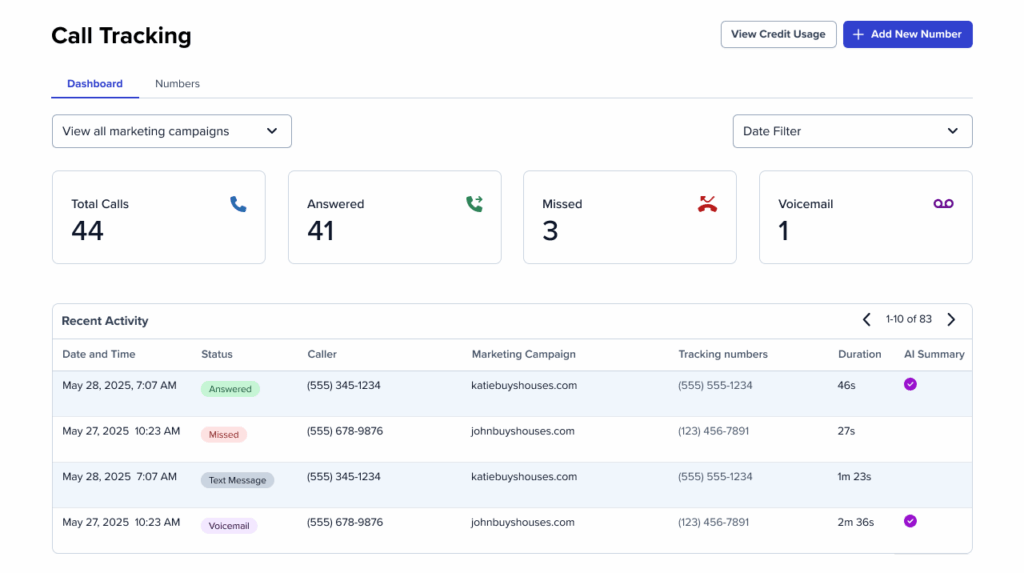
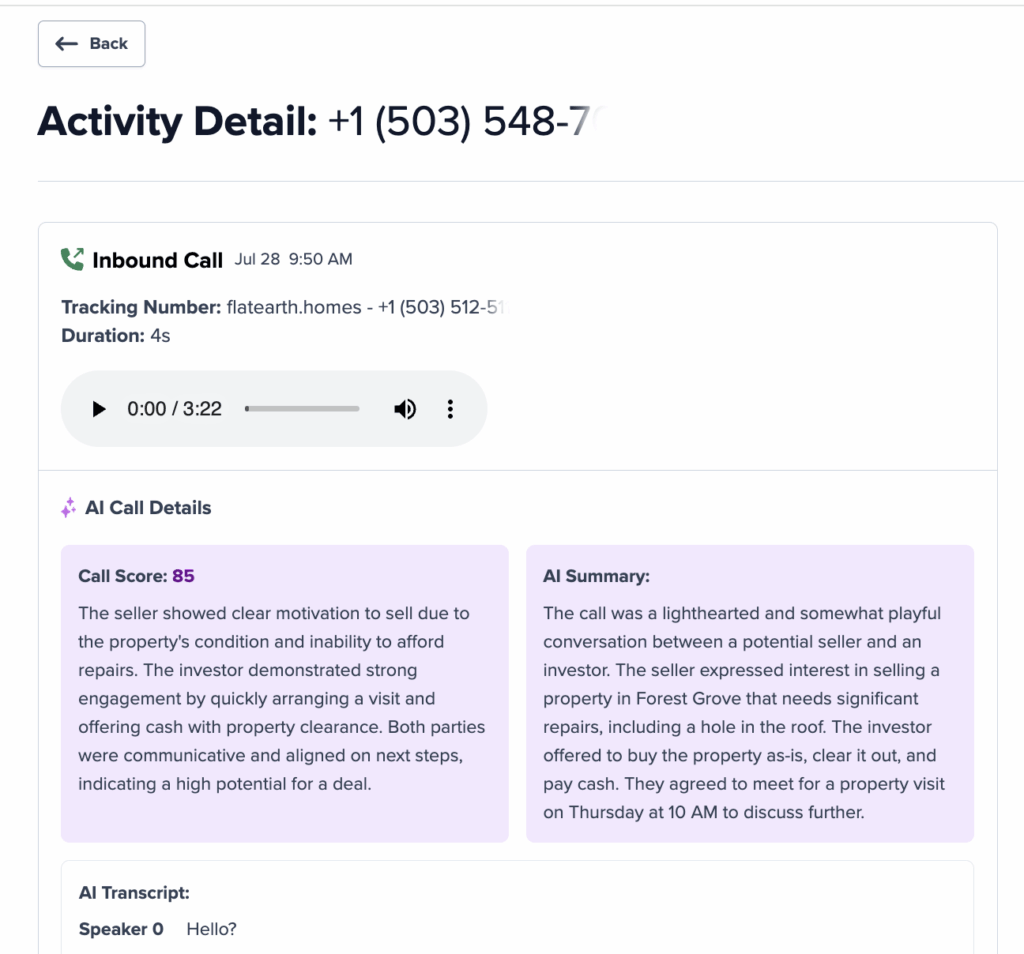
    The call tracking dashboard gives you a quick view into how many calls you’ve received and how many were answered, missed, and left messages. Each call log shows you the time, date, contact details, duration of the call, and provides a link to the transcript if you have AI Call Insights enabled. You can view all calls, or drill down into specific campaigns.

    AI Call Insights gives you even more useful information by providing:

    • Automatic Transcripts: Recorded calls are transcribed within ~2 minutes post-call. Transcripts feature speaker labels and remove the “um’s,” “so’s,” and pauses, giving you a clean view of who said what.
    • Call Summaries: Each call is distilled into a clear 2-4 sentence summary that captures the tone, urgency, and what was discussed.
    • Call Rating: AI analyzes the call based on critical factors like pricing alignment, urgency, and engagement then gives the call a 0-100 rating, allowing you to identify and prioritize the most promising calls first instead of wasting time on callers who aren’t serious yet.
    • AI Action Items: AI analyzes the call and pulls out bulleted action items so you know exactly what to do next.

    Transcripts and summaries automatically sync to the matching CRM opportunity so when you’re working a lead you always have the latest information. 

    AI Call Insights let’s you move faster and more intentionally. Instead of listening to a missed call  or relistening to a call when you’re ready to reach out again, you can save time by getting a quick recap instead. Not sure which lead to follow up with first? The Call Rating assesses a lead’s readiness and motivation and gives you a rating summary so you know what’s behind that assessment. These ratings help you prioritize the leads that are most likely to turn into deals. It’s similar to AI Lead Scoring, but specific to this call or text message and helps you move quickly with leads who are ready to sell before they move on to someone else.
    With the built-in AI features, you no longer have to upload a call recording into an external transcription service or load a transcription into ChatGPT to find the key points. You can also stop relying on virtual assistants to listen to all the calls and provide written recaps. It’s all down for you in a matter of minutes.

    How much does Carrot Call Tracking Cost?

    Carrot call tracking gives you one local number to use on your Carrot website, plus 100 recording minutes and 25 inbound SMS messages per month as part of your Carrot subscription. 

    If you reach 80% of your recording minutes or SMS limit, you’ll get an email alert letting you know you’re nearing capacity. If you go over the threshold, it’s $0.05 per minute and $0.03 per additional inbound SMS message. Keep track of your costs on the Usage and Costs page, which displays your real-time consumption, projected overages, and invoice history for full transparency.

    Need additional numbers for different marketing campaigns? No problem! You can add as many local numbers as you’d like for $3/month each. 

    AI Call Insights can be added to your subscription for $39 per month. (AI Call Insights is not part of the CarrotCRM AI feature suite. Turing on CarrotCRM AI features does not enable AI Call Insights.)

    How does Carrot’s Call Tracking compare to other call tracking services? 

    We believe that call tracking is a critical component of measuring your success and managing your budget and focus, so we worked hard to make it as affordable as possible. Because it’s fully integrated into our real estate website platform, we were able to make it part of the subscription and only charge for additional usage. Most other call tracking solutions (like CallRail) are standalone services that need to be connected to an external website.

    CallRail starts monthly subscriptions at $50/mo (plus the cost of your website as CallRail doesn’t offer this service). 

    Carrot Call Tracking vs. CallRail

    CallRailCarrot Call Tracking
    5 numbers5 numbers (1 included, plus 4 add-ons)
    250 minutes250 minutes (100 included, plus 150 overage minutes)
    $50/mo$19.50/mo

    Carrot Call Tracking vs. CallRail with AI Insights

    CallRailCarrot Call Tracking
    5 numbers5 numbers (1 included, plus 4 add-ons)
    250 minutes250 minutes (100 included, plus 150 overage minutes)
    AI insights & call transcriptionsAI insights & call transcriptions
    $100/mo$58.50/mo

    Take your business to the next level with call tracking

    Managing time, budget, and understanding your return on investment is critical for any business at any stage. Call tracking is another tool that gives you deeper understanding of what’s working and where to focus your efforts. For many real estate investors, it’s the missing piece to their reporting. You know how many leads you generate, how many turn into deals, how many form fills you get. Now it’s time to know exactly how many calls and text messages you get from leads, and exactly where they came from. Stop driving blind and start making smarter decisions based on real call tracking data to take your business to the next level.
  • 5 Ways to Attract Leads in a Competitive Real Estate Market by Standing Out Online

    5 Ways to Attract Leads in a Competitive Real Estate Market by Standing Out Online

    No matter what type of real estate investing you specialize in, finding the right deals makes or breaks the bottom line. And if you don’t want to spend all day, every day hustling and cold calling, having motivated leads come to you online is a great way to keep your pipeline filled.

    But how do you stand out in a crowded market and make sure leads find YOU first? Here are some actionable takeaways you can use to make yourself the most successful investor in your area.

    KEY TAKEAWAYS

    • Putting unique content on your website is key to ranking well in search engines and building trust with potential leads. If you use pre-written blog templates or an AI writing tool, take the time to add your own personality and insights before publishing.
    • Getting hyperlocal is a great way to stand out. People prefer working with someone they can trust, and they’re more likely to trust someone from their community versus a nameless, faceless investor.
    • Look at your competitors’ websites or top-ranking sites in other areas to figure out what you absolutely must have on your site and get inspiration for how to attract leads.

    In a competitive real estate market, you have to find ways to stand out. By doing your research, providing high-quality information on your website, and building trust by being hyper-local, you can stand out from the competition, attract leads, and fill your deals pipeline.

    Table of Contents

    1. Understand What You’re Up Against … and How to Stand Out
    2. Share Unique, High-Value Content
    3. Localize Down to the Neighborhood
    4. Showcase Your Local Knowledge
    5. Build a (Recognizable) Brand
    6. Be Yourself, Just Online
    Carrot icon
    Lead generation, at its best
    Attract, convert & close more motivated leads
    Try Carrot Today

    1. Understand What You’re Up Against … and How to Stand Out

    The first step of standing out is knowing your competition. Start by using Market Scout to see how difficult your investment market is, get marketing strategy recommendations, and see marketing insights like average website domain authority in your area, keyword difficulty, and how much paid ads cost.

    Glossary:

    • What is website domain authority? Domain authority is a score that measures your website’s quality and reputation based on key metrics like organic traffic, authenticity, and quality backlinks. While domain authority doesn’t directly contribute to search rankings, it is a good indicator of how search engines view your site. A higher domain authority score is better.
    • What is keyword difficulty? Keyword difficulty is a metric used to understand how many sites are targeting a specific keyword and, in return, how difficult it is to rank for that keyword. The higher the score, the more competition there is for that keyword.

    Now that you have a general understanding of the market and know what type of marketing strategies you should double down on (like SEO, content creation, or video), it’s time to dig deeper. Google keywords you want to rank for to see what information and linked websites come back in Google’s AI Overview and which webpages rank at the top of the search results. Take a look at these pages to see what they’re doing — what pages do they have, what kind of information do they share, what keywords are they obviously targeting? Use this as inspiration for what to include on your own website, then do it better!

    (Note: Don’t ever copy someone’s website, copy, blogs, or videos exactly. Use theirs for inspiration, but create your own content with your own spin and personality.)

    Do you find yourself saying, “But what about this?” when reading a competitor’s website? That’s a great signal that you should fill that gap!

    2. Share Unique, High-Value Content

    SEO trends are changing, but one thing remains the same: Search engines love unique content that is insightful, helpful, and answers common questions using the same language a searcher would use.

    In today’s online world, you can’t simply set up a website with basic pages and expect to rank or generate leads. You have to add additional topical pages, blogs, and FAQs to share your knowledge and gain a competitive edge.

    What questions have your clients asked in the past? What concepts do you find yourself explaining over and over? Are there any unique regulations or laws in your area that impact clients? These are all great topics for creating unique content on your site. 

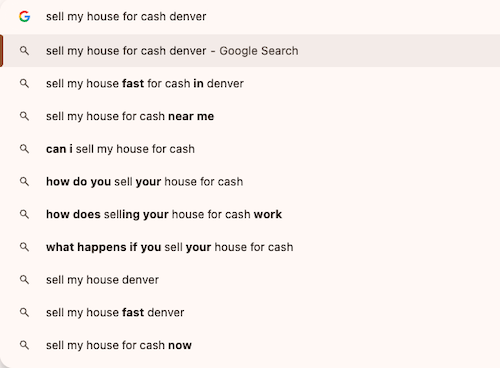
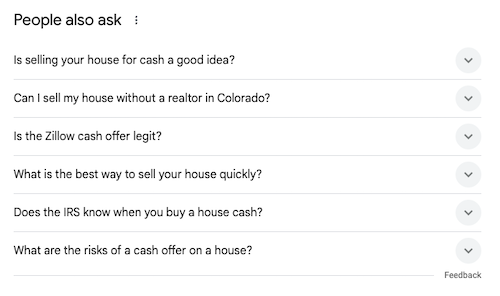
    You can also use Google’s autofill feature (start typing a search term and look at the phrases Google suggests) and the “People Also Ask” section of the search results to get ideas. These are based on real things people are searching for, so providing that information can help you attract leads.  

    Looking for unique topics to cover doesn’t mean you shouldn’t explain important terms or concepts your leads need to know just because everyone else does. Just focus on explaining it like you would in person, especially if your area has a specific dialect or uses certain terms. If you can, add details and data specific to your region (this is exactly the type of unique, high-value content search engines love).

    3. Localize Down to the Neighborhood

    Online search is becoming more and more localized. Even if someone doesn’t specifically search for something near them, search engines often serve up local results anyway. (Do a random Google search and scroll to the bottom of the first page. You might see a shockingly accurate location tag. My location changes when I’m five minutes away from my house because I’m in a different neighborhood within my city!)

    To make sure you come out on top either way, launch localized webpages targeting specific cities, towns, and even neighborhoods.

    What is a localized webpage?

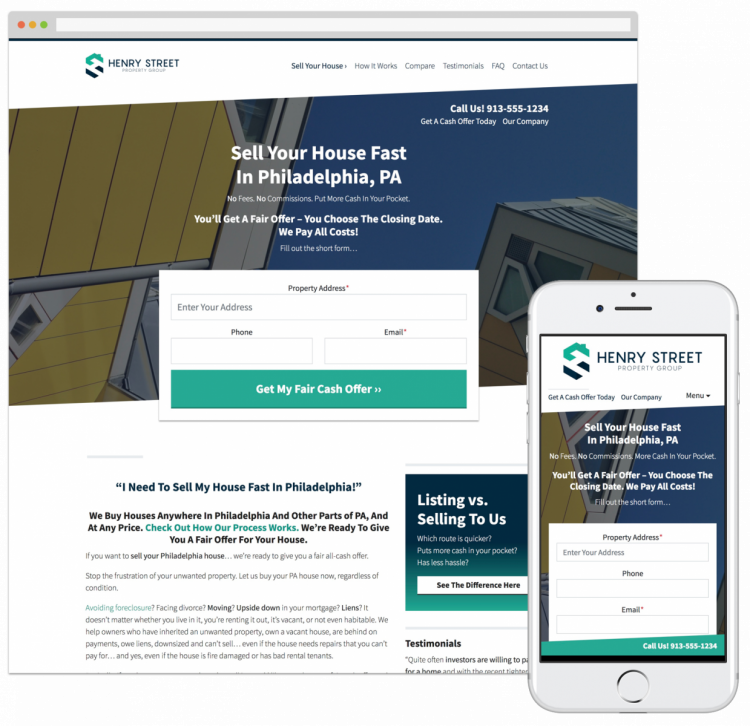
    A localized webpage is a page on your website that uses a specific location as a target keyword. For example, if you’re a wholesaler in Colorado, you might have a webpage targeting Denver. The URL could be something like www.yourcompany.com/sell-house-fast-denver and the text at the top of the page (the H1) would say “Sell Your House Fast in Denver, Colorado.” This gives you a better chance of showing up in search results when someone specifically searches Denver or is in the Denver area.

    Set up webpages for more than one location

    But if you’re a real estate wholesaler in Colorado, you likely don’t only do deals in Denver. So you’ll want a localized page for every area you want to attract leads in — Lakewood, Westminster, Aurora, Arvada, etc. And remember how Google gets hyper-specific with your location? If you’re in an area with commonly used neighborhood names, set up localized pages for those as well. To keep with our Denver example, you might set up pages for West Highlands, East Colfax, or RiNo. This gives you a better chance of attracting attention from potential leads when they see that you really understand where they are.

    4. Showcase Your Local Knowledge

    Speaking of connecting with leads on a local level …

    Despite living in an always connected, global world, many people still like working with someone local. Think about the last time you needed a home contractor or mechanic. You might have Googled it, but you’re equally likely to have asked your friends, family, and trusted local network for a recommendation. People want to work with someone they can trust, and being local goes a long way in building rapport.

    Having a webpage targeting a specific town or neighborhood grabs attention, but what really builds trust is showing how much you know and understand the area. A few blocks can make a dramatic difference in many cities, and towns only a few miles apart might be night and day different when it comes to real estate. A big, national company won’t understand that.

    Look at each of those localized webpages you created and figure out what information you can add to highlight your knowledge of the area and give leads useful insights. A few examples include:

    • Highlighting deals you’ve done in the area
    • Sharing reviews or testimonials from past clients in that area
    • Explaining local regulations that may impact your leads
    • Calling out trends or local news that might be impacting the market in that area

    You can even stand in front of a recognizable neighborhood landmark and film a short video introducing yourself and your services using the specific area name.

    5. Build a (Recognizable) Brand

    Things like local videos published online help build your brand, which can go a long way in attracting leads and having leads choose you — especially in a crowded market.

    One of the five lessons shared in 5 Priceless Lessons from Million Dollar Investors is about getting personal and building a brand. It’s partially about putting people at ease as they decide who to work with, and partially about making sure you’re the one they think about right away when the time comes.

    “I want to make sure I have the brand so that if someone is thinking about selling their house in my market, they’re thinking about my company.” — Jeremy Resmer

    Traditional tactics like direct mail and bandit signs might help with this, but so do things like posting videos online or sponsoring a local little league team. Bigger ticket items like local TV or radio ads help with brand building, but if you’re creative and keep it local, you can find good opportunities to get your name, face, and logo out there.

    “Hey! I know you!” Real-Life Brand Building

    Justin Turner owns Turner Home Team in eastern North Carolina. Looking for a way to stand out and generate leads, he turned to a somewhat old-school method of advertising — billboards.

    “I’ve had so many people tell me they’ve seen my billboard. It leaves a lasting impression and brings more awareness than other campaigns,” Justin explained. “It makes me visible in my community in a way online ads can’t, helping me build real, local brand recognition that creates a stronger sense of trust.”

    It wouldn’t work without his website though. He warns this method (and any other offline outreach, like direct mail) relies on having a professional online presence.

    “[You have to have] a website people can research you on — they’re not going to do deals with some sketchy person just because of a billboard.”

    Since investing in billboards, Justin’s monthly organic brand searches on Google have more than doubled. After drawing in interested leads with the billboard, he uses his website to build trust and gain confidence by showcasing his experience, professionalism, honesty, and — most importantly — his team.

    “People trust those who they can relate to and understand.”

    Be Yourself, Just Online

    If there’s a theme to all of this advice, it’s to be authentic and helpful. Attracting leads is the name of the game, but the best way to do that is by remembering that leads are people.

    “This is a people business and real estate is a byproduct of what we do.”
    — Beau Hollis, 5 Priceless Lessons from Million Dollar Investors

    Do you find it easier to generate business face-to-face or by building in-person relationships? Bring that spirit and energy to your website. Using a few technical details shared in this post (like launching hyperlocal webpages) can get you in front of new eyes, but it’s up to the rest of your website content to sell your story. Be unique, be helpful, be approachable … be yourself.

    People also like …

  • 10+ Email Marketing Tips to Warm Up Cold Leads with Jay Schwedelsen

    10+ Email Marketing Tips to Warm Up Cold Leads with Jay Schwedelsen

    10+ Email Marketing Tips to Warm Up Cold Leads w/ Jay Schwedelsen

    You’ve probably heard the email advice: “Don’t use the word ‘free.’” “Keep your emails short or risk going to spam.” “Don’t use emojis in subject lines.” Turns out, a lot of that advice is outdated — and in some cases, flat-out wrong.

    Jay Schwedelsen, host of the popular marketing podcast Do This, NOT That, recently joined us on Carrot’s Evergreen Marketing podcast to share updated tips for successful email lead nurturing. Jay is undisputedly one of the top experts in the field and he shared 10+ tips and dispelled some popular myths around email. 

    If you’ve left email behind in your lead follow-up, it’s time to dust off your list. 

    “Your email list is probably the most important asset you have. Your email database is your owned asset. It is the only marketing channel for basically no money that you can communicate whatever it is you want to communicate at any given moment. There’s nothing else like that.” — Jay Schwedelsen

    Even if you are actively sending emails, you might be unknowingly making some mistakes that are hurting your engagement rate.

    Whether you’re an investor following up with cold leads, an agent sending out market updates, or just trying to figure out how to get more replies, there’s something in the episode for you. Here’s a sneak peek at three tips Jay discusses.

    Tip #1: Your emails don’t matter if they aren’t opened

    “A lot of times when we’re sending out an email, we’re worried about ‘oh what are we writing in the email?’ or ‘oh, what’s the offer?’ and that’s backward,” Jay explained. “If you don’t get the email opened, who actually cares what’s inside the email? So we have to get that email opened and the number one thing that’s going to get that email opened is the subject line.”

    When people look at their email inboxes, they scroll through quickly and decide what gets their attention. Jay contends that most people don’t read the entire subject line, instead focusing on the first few words.

    With that in mind, front-load your subject lines. Jay recommends starting a subject line with all caps or keeping it super short to make it stand out. Better yet, start your subject line with a number.

    “If you start your subject line with a number, your open rate will rise about 20%.”

    And forget about avoiding certain “spam trigger” words. It’s true that words like “free” or even dollar signs used to send your emails straight to the junk folder, but that’s not the case anymore. Feel free to write the most compelling subject line possible without avoiding important words!

    Need help with your subject lines? Check our Jay’s free subject line grader.

    Tip #2: Send more emails (yes, you read that right!)

    “You’re probably not sending out enough email. In the real estate market I see this a lot. People will get focused on their email sending for a month or two, and then they move onto something else, and they won’t send again for another 2-3 weeks or a month. The most important thing you can do to make sure you’re getting that business is to be sending enough. You need to be at least sending email weekly — at least!”

    Why? Because sending email frequently and consistently actually helps keep you out of the junk folder. It all comes down to email engagement, Jay explains.

    “If you don’t send enough email — and we see it in all the data — if you don’t send at least a weekly email to your database, you actually cannot generate enough opens and clicks to stay in that person’s inbox. It needs to be relevant stuff, it can’t be garbage. But sending out more email is step number one.”

    Since email engagement is actually what matters, Jay has a few tips to make sure people actually read and interact with your email.

    • Paragraphs should never be more than four lines.
    • Start your email with something super attention-grabbing. Don’t save the “hook” for the end … some readers won’t get there.
    • Restate the main point, offer, or action you want readers to take in a PS at the end of the email (to grab the attention of people who just skim).

    “When you have a PS with a call to action, a link in the PS, your click-through rates go up on average by about 15%.”

    Tip #3: Make your emails valuable

    “Don’t push offers until you’ve established the fact that you’re not annoying.”

    Let’s be honest, no one likes being sold to. But as real estate professionals and marketers, it’s our natural default to send offers and promotions. If you’re working on a cold list — or a new one — focus your first few emails on offering value to your leads.

    “For the first 4-5 sends, don’t promote anything. Nothing you send out should be a benefit to you the sender, it should only be a benefit to the individual you’re sending to. It’s hard to do because our nature is “sell, sell, sell” but you need to show the people in that database that you’re going to give them value.”

    Jay shares some ideas of valuable information to send your leads (you’ll have to listen to get his tips), but whatever you send can’t have a form in front of it. Offering value before asking for something builds trust and gets leads used to opening your emails. When you do send something promotional, they’re more likely to pay attention because of the relationship you’ve built.

    “It’s like dating. You can’t be just like ‘Hi, nice to meet you. Do you want to get married?’ It doesn’t work, it’s weird.”

    Tips #4-10: More gems from Jay

    In less than 40 minutes, Jay shares insights on not only how to successfully use email nurturing, but creative ways to grab attention and make your emails better every time. More tips covered in the podcast include:

    • Why the inbox promotions section isn’t as bad as you think
    • The best way to benchmark your email marketing success
    • How to get people to respond to your emails
    • Going beyond basic AI to really make your emails better (including using AI to analyze your competitors’ emails for new ideas)
    • Should you use emojis and memes in your emails?

    Stop Overthinking, Start Sending

    At Carrot, we talk a lot about building a business of freedom and impact. And email — done right — is one of the most powerful, low-cost tools you have to create conversations that lead to deals.

    So whether you’re following up with motivated sellers, re-engaging old leads, or just trying to stay visible, start putting these tips into practice. Then hit send. Test. Iterate. Improve.

    And remember: It’s not about perfection. It’s about progress.

    Listen to the full 10+ Email Marketing Tips to Warm Up Cold Leads w/ Jay Schwedelsen episode to unpack what’s actually working right now in email marketing. 

    PS – You can use these tactics in your automated outreach sequences in Carrot CRM!

  • Videos Increase Website Conversion Rates Up to 56% — Here’s How to Get Started

    Videos Increase Website Conversion Rates Up to 56% — Here’s How to Get Started

    Video content is the best way to boost motivated leads without requiring any extra website traffic. This article explains why video is a game-changer for website conversion, and shares practical tips to get the right video content on your website!

    Key Takeaways

    • Website visitors who start watching a video are 24% more likely to convert to a lead and visitors who watch an entire video are 56% more likely to convert!
    • You should have five types of videos on your website to share key information that visitors are looking for.
    • You can quickly and easily create videos with free tools like VN and Canva.

    If you want to increase your website conversion rate and number of motivated leads, read on to discover how to quickly add videos to your site.

    Table of Contents

    1. The Data Behind Why Video Matters
    2. The 5 Types of Videos Your Website Needs
    3. How to Produce Videos, Easily
    4. Where to Put Videos on Your Website
    5. Conclusion: Make 2025 the Year of Video
    Carrot icon
    Lead generation, at its best
    Attract, convert & close more motivated leads
    Try Carrot Today

    The Data Behind Why Video Matters

    Online video consumption is estimated to hit four hours per day in 2025, according to Oberlo. When sellers do their research on who to work with, they don’t just like to gather information via video, they expect it! That’s why it only makes sense that your website should include videos.

    It’s not just a matter of giving web visitors information in a format they prefer. Having videos on your website can dramatically improve your lead conversation rate (how many website visitors turn into leads). Based on recent data analyzed by Carrot, when a web visitor starts watching a video, their chances of converting to a lead increase 24% (over visitors who don’t watch videos). Visitors who watch an entire video have a 56% better chance of converting!

    Adding videos to your website also helps with SEO. Google places a lot of weight on “high quality” content that it believes will help users answer their questions and find valuable information. Since today’s users like to watch videos, Google likes when videos are available to answer their search queries. Answering common questions or covering popular topics lets you capture that search traffic more easily.

    As people watch videos on your site, they’re also inherently spending more time on the page. Google also views this as a positive indicator that your content (and by extension, your website as a whole) is valuable, which can positively impact your domain authority and search rankings.

    The 5 types of videos your website needs

    Videos are a great way to answer common questions, highlight your experience, and put visitors at ease about working with you. Think of video as your chance to be “face to face” before you ever meet a lead. You likely get some of your best deals by networking, so bring that same personality and energy online with video! Here are the most important videos to make for your website.

    Note: If you’re new to video, get our free Video Marketing Playbook for R.E. Investors for ideas, scripts, and easy steps to recording!

    1. “About ” Video

    Who are you? What’s your experience? Why should people work with you? Make a short video introducing yourself and let people get to know you so they feel comfortable reaching out. 

    Here’s a video that walks you through creating an “About us” video as a real estate investor or agent:

    How to Create an “About Us” Video for Real Estate

    2. Working with [Your Company Name] Video

    A “How it Works” video can put potential leads at ease by detailing what it’s like working with you. How does the process work? What steps can they expect? What objections might they have?

    3. Customer Testimonials

    Video testimonials from happy clients talking about what it’s like working with you and how pleased they are with the results are great on websites. Website visitors may be skeptical of a written quote, but watching people talk about their experience generates a lot of trust. 

    Here’s an in-depth video on exactly what to say to get perfect testimonials every time you close a deal.

    4. FAQ Videos: Explain Complex Topics

    Odds are your leads aren’t real estate professionals. They may even be dealing with a new-to-them situation, like selling an inherited home, renting-to-own, or selling a house fast for cash. Put them at ease by answering questions they’re likely to have. Leads want to work with an expert, so show off your knowledge!

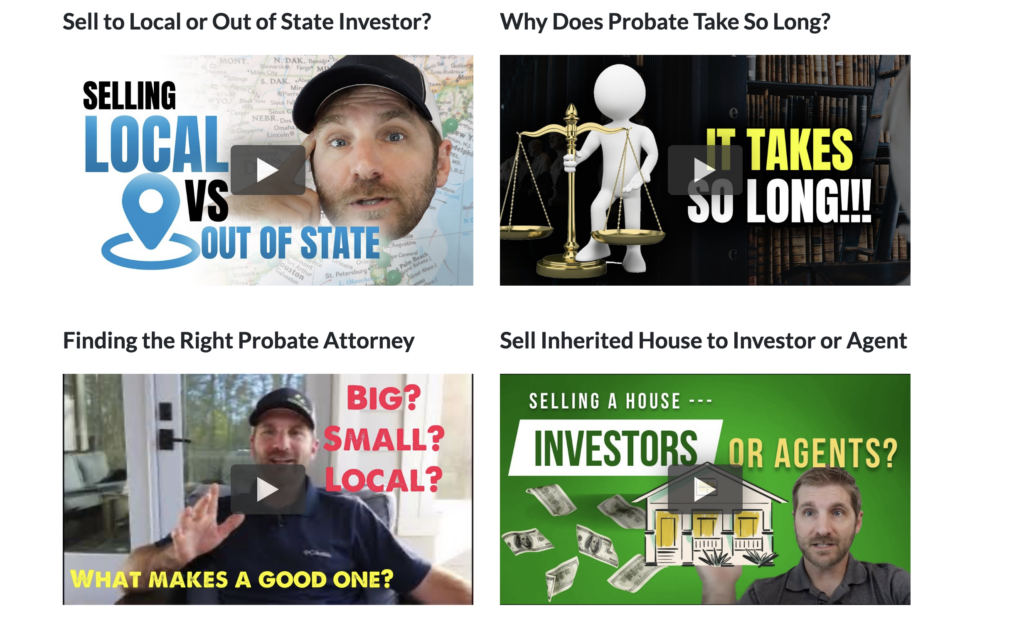
    Investor Brad Woodall is a prime example of someone who went all-in on creating videos that answer prospects questions. He doubled down on probate-related video content which he posts on YouTube and an entire video library on his Carrot website & now consistently generates high-quality probate leads because of it!

    FAQ Videos Example from Investor Brad Woodall

    5. Share Local Trends

    Talking about local trends are great videos to publish on social media channels, and they can add an engaging element to blog posts covering the same topic. If you’re discussing a particularly important trend that leads should know about, you can even add this type of video to your homepage while it’s a hot topic.

    Overall, videos build your credibility and put leads at ease, making them pre-disposed to want to work with you! 

    How to produce videos, easily

    Videos don’t have to be complicated or daunting, and you don’t need to start a YouTube channel or become a TikTok star (though you certainly can if you like making videos!). Today’s consumers are used to seeing natural, self-shot videos, so simple videos recorded on your phone or computer work just fine. There are even services that make it easy to produce animated videos if you’re uncomfortable being on camera (though showing your face will build stronger trust with potential clients).

    Don’t worry too much about the length of the video, both long and short videos have their place. Let the topic dictate the length of the video. And while you don’t have to worry about Hollywood standards, your videos should look nice and reflect your brand. Make sure the lighting is good and you have a non-distracting background. If you have shirts with your logo, consider wearing it in the video to reinforce brand recognition.

    Videos don’t need to be overly produced, but if you want to do a little editing or add your logo or contact information, we recommend finding a video editor on a website like Fiverr.com. If you’re more DIY, VN is a simple (free!) video editing software available for both Mac and PC. If you want to add music to your video, make sure you get royalty-free audio clips. You’ll also want an eye-catching “video thumbnail” (the image people see before clicking on the video). These are easy to create for free with tools like Canva, which has thousands of pre-built templates to match any style. If you’re creating several videos, choose one thumbnail style or one style per video type. This keeps your brand look consistent and professional.

    Where to put videos on your website

    You don’t want to cram all your videos onto one page, that would be overwhelming. Instead, think about where each type of vidoe makes most sense. If you were visiting a website, what type of information would you expect to encounter on each page? With that in mind, you want to make sure key videos are posted to your most high traffic pages — the home page, about us, and contact us pages for most real estate investor websites.

    Introduction videos and video testimonials in particular should be published on your homepage, about us page, and contact us pages — preferably toward the top of the page. In addition to generating the most traffic, these are also the highest converting pages, so putting videos here gets them in front of visitors at critical points in their journey. It also makes it easy for them to contact you immediately after watching the video — remember, visitors are significantly more likely to convert to a lead after watching a video!

    If you’re answering common questions, breaking down a topic, or discussing a local trend, add these videos to topical landing pages, blog posts, or niche credibility pages targeting the same topic and keywords. Publishing topical content on your website (especially around commonly searched questions or terms) will help you rank better in search results. The more valuable content you add to these pages — both written and video — the better chance they have of ranking.

    Carrot has a video post feature that makes adding this new content to your website even easier. Designed to help you get more leverage from videos explaining topics, trends, or answering questions, the VideoPost feature automatically transcribes your original videos into an SEO-optimized blog post. This is a great way to publish videos quickly.

    Here’s how easy it is to put video content on your website. This example ranked #1 for the keyword we were aiming for!

    Create Real Estate Video Content in Under 10 Minutes with Carrot's VideoPost

    Bonus video publishing tip: Post the same videos on YouTube. It’s easy to create a YouTube channel for your company on posting video to this popular platform give them an even better chance of showing up in search results. Make sure the video has a clear, accurate title with your target keywords and a good description with a link to your website. As a bonus, publishing videos on YouTube make them even easier to embed into your webpages, simply choose the Youtube block when editing the page and drop in the video URL.

    Conclusion: Make 2025 the year of video

    Video has been a popular way for Americans to consume information for years, and it’s only getting more popular. At the same time, competition in the real estate investing industry is getting stiffer, so any little tactic to give you an edge is a welcome advantage. Video could be the ticket to making you stand out, attract leads, and close more deals in 2025.

    In short, businesses that adopt video win far more often than those that don’t.

    Don’t overthink it and don’t be nervous about getting started, it’s not as hard as you think! For more on how to get started with video, check out Video Marketing for Real Estate: A Step-by-Step Guide.

    Happy filming—You’ve got this!

  • 101 Real Estate Blog Post Topic Ideas to Spark Your Creativity

    101 Real Estate Blog Post Topic Ideas to Spark Your Creativity

    Are you having difficulty coming up with great real estate blog post ideas? Generating new blog post topics can be a discouraging task. We have compiled a list of 101 real estate blog ideas you can write about today.

    Key Takeaways

    • “Evergreen” content is a blog topic that stays relevant and fresh for a long time. This is ideal for a website so that your content continuously attracts leads.
    • There are 10+ types of blogs. Understanding them makes it easier to come up with new blog ideas and write content that readers find helpful.
    • QUALITY content is more important than quantity. Make sure your blog posts show your experience, expertise, authority, and trustworthiness (E.E.A.T.).

    Read on to understand why publishing blog posts on your website is important, how to do it correctly, and get real estate blog topic ideas to get you started!

    Table of Contents

    1. Why Blogging Matters (& How to Do it Right!)
    2. Types of Blogs
    3. Real Estate Blog Post Ideas for House Buyers
    4. Real Estate Blog Post Ideas for Rehabbers & Flippers
    5. Real Estate Blog Post Ideas for House Sellers
    6. Real Estate Blog Post Ideas for Tenant & Property Management
    7. Real Estate Blog Post Ideas for Rent-To-Own Property
    8. Real Estate Blog Post Ideas for Foreclosures
    9. Real Estate Blog Post Ideas for Real Estate Agents
    10. Real Estate Blog Post Ideas for Real Estate Investors
    11. Real Estate Blog Post Ideas for Local Market Trends & Analysis
    12. Real Estate Blog Post Ideas for Land Buying & Selling
    13. Evergreen Marketing For Real Estate Investors Is Misunderstood…
    14. Here’s How To Provide Great Value To Your Ideal Prospects
    15. Here’s How To Read People’s Minds
    16. Writers Block? Get Started With These Real Estate Blog Ideas
    17. How Consistently Should I Post Real Estate Blogs?
    18. More Tips To Create Great Real Estate Content
    19. How To Get Content Written For You
    20. The Carrot Content Marketing System
    21. Get Your First (or next) Blog Posts Up!
    Carrot icon
    Lead generation, at its best
    Attract, convert & close more motivated leads
    Try Carrot Today

    Why Blogging Matters (& How to Do it Right!)

    As a real estate investor, your job is to gather more motivated sellers and cash buyers so you can do more deals. The more often you do that, the more deals you can do; the more you can automate that process, the easier it becomes for you (and the more you can scale without working yourself to the bone).

    Marketing your real estate investing business online means competing with other investors for just a few positions on the search engine results pages!

    And, the higher you appear in search results, the more likely people are to click on YOUR search result and end up on YOUR site. But once they’re on your site, your job isn’t over! You need to convince them to do business with you.

    That’s where content marketing comes in.

    Evergreen content is search-optimized content that is continually relevant and stays “fresh” for your target audience over a long period.

    Evergreen content marketing (done the right way) helps you get in front of more of your prospects online and capture the attention of the people you want to do deals with. Once those people are on your site, marketing builds credibility and authority for you and your business.

    Done right, evergreen content is perhaps the most significant edge you can get as an investor regarding the web.

    Blogging remains one of the most potent ways to connect with your audience and drive them to action. The blog ideas you choose to spend your time & resources on are important.

    Research shows that companies who blog with quality content get 67% more leads than those who don’t publish content.

    We’ve found that SEO inbound marketing close rates are 2 to 4 times higher on average than outbound selling efforts—making the right real estate blog ideas an investment that pays off big time.

    We’ve seen our members creating quality content from blogging and other page resources for 10+ years. We’ve learned a thing or two about how to develop content ideas that already have proven demand online for our members.

    To make it even easier, we broke this list down into topics and investment focus areas so you can find blog ideas that perfectly fit your needs.

    Types of Blogs

    Before diving in, let’s explore some of the most commonly used templates for blog posts:

    • Listicle: A numbered list, like “Top 5 Things NOT to Do When Selling a House for Cash.”
    • Case Study: Telling a story about a real experience. This is a great way to highlight your customer’s experiences with you and the results they got.
    • How-To Guide: Just like it sounds, an expert guide that helps people answer a question and learn how to do something.
    • Solutions Overview: Offer a service or product? Use a blog to explain what it is and (more importantly) how it helps!
    • Checklist: People working through a process — like selling a house they inherited, dealing with a home foreclosure, looking to sell for cash, buy land, etc. — need to know what steps to take. You’re the expert, so make them an easy-to-follow checklist.
    • Comprehensive Guides: Google loves expert content that explores a topic in depth, and your potential customers are looking for information. Prove your expertise, put customers at ease, and make Google happy with long-form comprehensive guides that dive deep into a topic. (Bonus: You can link to relevant checklists from your guide!)
    • Definitions Explained: If you’re in a particular niche area or there’s a term or concept that our customers always seem confused by, use that as an opportunity to educate others by explaining it on your website.
    • Statistical Analysis: People hear phrases like buyers or sellers market or other stats in your area, but they may not understand what that means for them. Dive into the statistics to explain the impact it could have for your customers.
    • Frequently Asked Questions (FAQs): Short, sweet, clear copy that quickly answers common questions. Pro Tip: Be sure to use the same words your leads might use.
    • Comparison Breakdown: Shoppers are always comparing products and services, so break down how your company is different from your competition or how selling/buying options differ.

    Real Estate Blog Post Ideas for House Buyers

    • Top problems buyers face when looking to buy for cash flow.
    • Where buyers can find money to do more deals (savings, mortgage loans, lines of credit, private money, etc.).
    • A comparison of the various ways to buy a home (mortgage, rent-to-own).
    • A checklist of qualifications that someone needs if they want to get a mortgage.
    • How a buyer’s agent can help you.
    • What are the pros and cons of different mortgage types? Ie…fixed, 15 year to 30 year?
    • What questions do I need to ask a seller before buying a home?
    • How to pencil in your home buying costs.
    • How to make an offer on a house.
    • # common mistakes homebuyers make.
    • # of things first-time homebuyers need to consider.

    Real Estate Blog Post Ideas for Rehabbers & Flippers

    • Top problems buyers face when looking for rehab properties.
    • Strategies to control costs on rehab properties.
    • How to negotiate with contractors and sub-contractors.
    • How to work with contractors and sub-contractors and get them to finish the work on time.
    • How to do due diligence when you can’t tear down every wall.
    • Top # tips for rehabbing a house.
    • What will rehabbing a house cost you?
    • What first-time flippers can expect.
    • How to rehab and flip an ugly house.
    • Should you use a contractor to rehab a flip?

    Real Estate Blog Post Ideas for House Sellers

    • Top problems sellers face when selling their property through traditional methods (and why selling their home for cash to you is much better).
    • Top ways that sellers can improve their home’s curb appeal before selling it.
    • How much should a seller ask for their home?
    • How long does it take to sell a home in the various ways (i.e., compare traditional, FSBO, or selling to an investor).
    • A step-by-step checklist that a seller can use to prep their home for sale.
    • Sell your home faster with these crafty tips.
    • What is a deed when selling your home?
    • Should you sign a trust deed when selling your house?
    • Who is responsible for title insurance?
    • Is Craigslist worth listing my house on?
    • Seasonal advantages or disadvantages of selling your house.
    • Why start preparing your home for sale years before selling it.
    • What is keeping your home from selling?
    • This is why your house isn’t selling.

    Real Estate Blog Post Ideas for Tenant & Property Management

    • Strategies to deal with tenant problems.
    • How to interview tenants and know when you’ve found the right one.
    • How to deal with tenants that cause property damage?
    • How to keep a good tenant?
    • How to protect yourself from bad tenants?
    • Top # property management mistakes.
    • How to solve the biggest property management issues.
    • Property management issues when renting out a condo.

    Real Estate Blog Post Ideas for Rent-To-Own Property

    • Top problems rent-to-own tenants face, and how working with you can solve those problems.
    • Step-by-step through the rent-to-own process.
    • What does someone need to qualify for rent-to-own?
    • What is renting-to-own?
    • Is there a growing demand for rent-to-own homes?
    • When rent to own – who is responsible for paying homeowners insurance?
    • Can someone be eligible for a lease-to-own contract if they have filed bankruptcy?

    Real Estate Blog Post Ideas for Foreclosures

    • Top problems faced by people in foreclosure.
    • How does the foreclosure process work?
    • What are the ways to avoid foreclosure?
    • If homeowners file for bankruptcy, can they stay in their property and avoid foreclosure?
    • What should I know about buying a foreclosed home?
    • Insider tips to buy a foreclosed home.
    • Potential downfalls for purchasing a foreclosed property.
    • # tips for buying a foreclosure.
    • Top # of mistakes made when buying a foreclosure.

    Real Estate Blog Post Ideas for Real Estate Agents

    • How to find the best real estate agent in your area.
    • How the commission structure works.
    • # of advantages/disadvantages of hiring a real estate agent.
    • Share an interesting story about a real estate deal.
    • Share an interesting story about a house listing (distressed, high priced…)
    • What are the pros and cons of holding an open house?
    • Why low commissions are bad for home sellers.
    • # tips to mitigate capital gains on real estate sales.
    • # Important things to know about appraisals and comps.
    • Find comps in your area to determine the potential appraised value.

    Real Estate Blog Post Ideas for Real Estate Investors

    • How to work with an investor – what to expect, how quickly they can help, who should be involved.
    • How investors can network with people to find private capital.
    • How to find a great property management company to work with.
    • How many cash-flowing properties do you need to retire early?
    • Ways to increase cash flow from your properties.
    • A step-by-step plan to build a portfolio of cash-flowing deals.
    • Share an interesting story about a real estate investing deal.
    • What to look for in potential homes to use as flips.
    • What to look for when buying an apartment complex?
    • What to look for when buying a condo?
    • What types of homes should I look for as a beginner investor?
    • What is the top # of things an investor should look for in an investment home?
    • # of real estate investment niches.
    • Different types of commercial real estate investments.
    • # Worst types of real estate investments.
    • How to attract investor-friendly real estate agents.
    • Overview of the Local Real Estate Market
    • Neighborhood Spotlight: Highlighting Local Communities
    • Market Predictions and Forecasting
    • Impact of Economic Factors on the Real Estate Market
    • Investing in Emerging Neighborhoods
    • Demographic Shifts: Understanding Population Trends and Their Influence
    • Infrastructure Development: Assessing the Impact on Property Values
    • Tourism and Hospitality: Analyzing the Effects on Vacation Home Markets

    Real Estate Blog Post Ideas for Land Buying & Selling

    • # Land buying problems to avoid.
    • # Reasons why you should be investing in land.
    • Things to consider before buying land.
    • How to sell lots and land.
    • How selling land is different than selling a home.
    • What do you need to do to get your land ready to sell?
    • Is the lending market for vacant lots and land difficult?
    • How to take good photographs of your land before selling it.

    Evergreen Marketing For Real Estate Investors Is Misunderstood…

    Content marketing is powerful … when done right. Many inexperienced investors turned on a relentless content marketing “machine” that churned out blog posts hour after hour or were thin pieces of content that lacked any real value or substance for the reader.

    They had heard the maxim that “content is king,” so they thought that creating more content would help them elevate to a higher level in search results.

    Unfortunately, many people chose to put content quantity over content quality.

    Google got wise to those quantity-over-quality efforts and made algorithm changes, adjusting the search results to show sites that only provided high-quality content. Suddenly, investors who had sunk thousands of dollars into creating low-quality blog posts (often through cheap services like Fiverr.com) found themselves in the Mariana Trench of search results…

    … and that’s NOT a good thing.

    These investors were short-sighted in another way:

    Aside from being punished by Google for poor quality, they also failed to realize that humans were reading their content!

    Earlier, I explained the TWO tasks that content marketing accomplished:

    1. To help them appear higher in search engines

    AND…

    2.  To help build credibility and authority to guide prospective buyers and sellers to do deals with you

    By choosing quantity over quality, investors might get a bump in search engine results (until Google changes its algorithm). Still, they weren’t doing a great job of convincing buyers of anything.

    Evergreen marketing needs to add VALUE to its readers.

    Here’s How To Provide Great Value To Your Ideal Prospects

    You need to provide great content for the people you’re trying to reach that attracts them and converts them into a lead… but how do you provide that content?

    How do you know what “good” content is? How do you package it for them so search engines see its value and attract the right audience?

    The good news is that you need to know one secret to provide great content for any audience… it works for EVERY audience you’re trying to reach.

    It doesn’t matter what kind of investing you do (wholesaler, rehabber, landlord, etc.). It doesn’t matter what audience you’re trying to reach (motivated sellers, cash buyers, probate deals, foreclosures, rent-to-own folks, tenants, contractors, or anyone else); this content marketing strategy will be true for you.

    Here’s the secret…

    Every search engine search is a question that your audience wants to ask or a problem they have (even if they don’t frame it as a question)

    Like…

    How do I sell my Detroit home?” – it’s easy to see how that’s a question.

    “I want to sell my house in New Jersey” – that’s a sentence, but there’s a question in there; they’re wondering something: “How?” or “Who?” or “What’s the process?”

    Real estate investments in Memphis” – there’s a hidden question there, too. “What are they?” or “Where in Memphis are they?” or “How much do they cost?” or “What’s the potential return?”

    What to do with a house I inherited in Michigan?” – This is where we get more narrow and focused on specific scenarios.

    Every Google search is a question and/or a problem.

    And, when you know that, you can create content on your website and in your YouTube videos that answer those questions.

    Answering questions (even the questions that searchers don’t realize they’re asking) will help you get in front of the right audience, and it will help you build credibility and trust through the valuable answers you provide.

    Then,… game over. You become a valued expert in your area… versus being seen as a fly-by-night operator like most competitors.

    Here’s How To Read People’s Minds

    This leads investors to a big question: “How do I know what people are searching for so I can answer their questions and get them to my website?

    There are many online tools, but the easiest way is to open up Google.com, start typing, and let Google do the rest!

    Google sees what you’re typing and makes some assumptions based on similar, popular searches, and it presents those assumptions to you as auto-complete options.

    Here are three examples.

    I started typing, and Google offered different ways to complete my search.

    See These Suggested Searches That Google Gave Me…

    columbusohiohomesforsale REI Post Ideas
    Blog Post Ideas For Real Estate Investors ATL
    memphisrealetateinvesting REI Blog Ideas

    While not all of these are relevant to my audience, I know that some of them are – they are questions that my audience wants to know!

    Write those down into an extensive list and build one or more blog posts around them.

    Writers Block? Get Started With These Real Estate Blog Ideas

    To help you further, here’s a list of 101 blog post ideas for real estate you can use to get you going. These blog post ideas are based on research that we quickly performed… and many of these are already built into our Content Marketing System that helps you do content marketing more efficiently (in our Content Tools).

    (Be sure to personalize these with your city and state to increase your chances of ranking well in your local area).

    As an example… “How does the foreclosure process work?”

    Localize yours for your area like… “How does the foreclosure process work in Florida?”.

    I found all of these just by doing what I showed you above… finding what my prospects are already typing into Google… and seeing what Google suggests.

    How Consistently Should I Post Real Estate Blogs?

    How often you blog ultimately depends on what you aim to accomplish with your blog.

    Many bloggers say more content is better, while others say less often. But remember, before you begin blogging, don’t forget it’s quality over quantity.

    You shouldn’t publish content just for the sake of having more posts. You should align your frequency to your content goals and resources.

    If you’re starting, aim for one blog post per week. You may increase it to twice a week as you get into a cadence.

    If writing becomes a challenge, you can use a video post tool like the one we offer at Carrot. Record a video blog and transcribe it into written content optimized for keywords.

    More Tips To Create Great Real Estate Content

    • Write valuable copy. That’s the most important step. Spend the time to create value for your audience.
    • Remember to answer the question that searchers consider when searching for your page.
    • Even if a topic doesn’t seem like it is relevant to you (such as a blog post like “Top ways to improve the curb appeal of your house before you sell it”), you can always pivot to talk about the benefits of selling the house to you rather than listing it instead.
    • Optimize your content for SEO by including search term keywords throughout the copy, including the title and any headers you use.
    • Real estate investing is a local business! Make sure your copy is fine-tuned for your town/city and state.
    • Include a clear and compelling call to action in every post.
    • Keep your posts “evergreen” whenever possible to always be relevant to your audience, even years from now.

    How To Get Content Written For You

    You’ve got many great ideas to get you started, but chances are, you probably want to focus on the deals and NOT on the actual writing. Of course, you can write some if you wish to, but there aren’t many investors I’ve met who want to do that.

    Outsourcing can be a powerful way to get your content written for you… if you find good writers who understand your prospect well and know how to optimize a blog post SEO.

    We’ve used these sites in the past to find decent writers:

    • UpWork.com (formerly Elance.com and Odesk.com)
    • Guru.com
    • TextBroker.com

    You can hire content writers on these sites to create content for you. Remember that you get what you pay for. Not all these writers can write well in English, nor will they be familiar with real estate investing. You need to do your due diligence.

    Working with topic experts (people who know our business and industry well) can be expensive, but the quality and results are 10x better. You get what you pay for.

    Or, Here’s An Even Easier Way – The Carrot Content Marketing System

    Of course, you can hire someone, but did you know that the Carrot platform already has powerful content built into it?

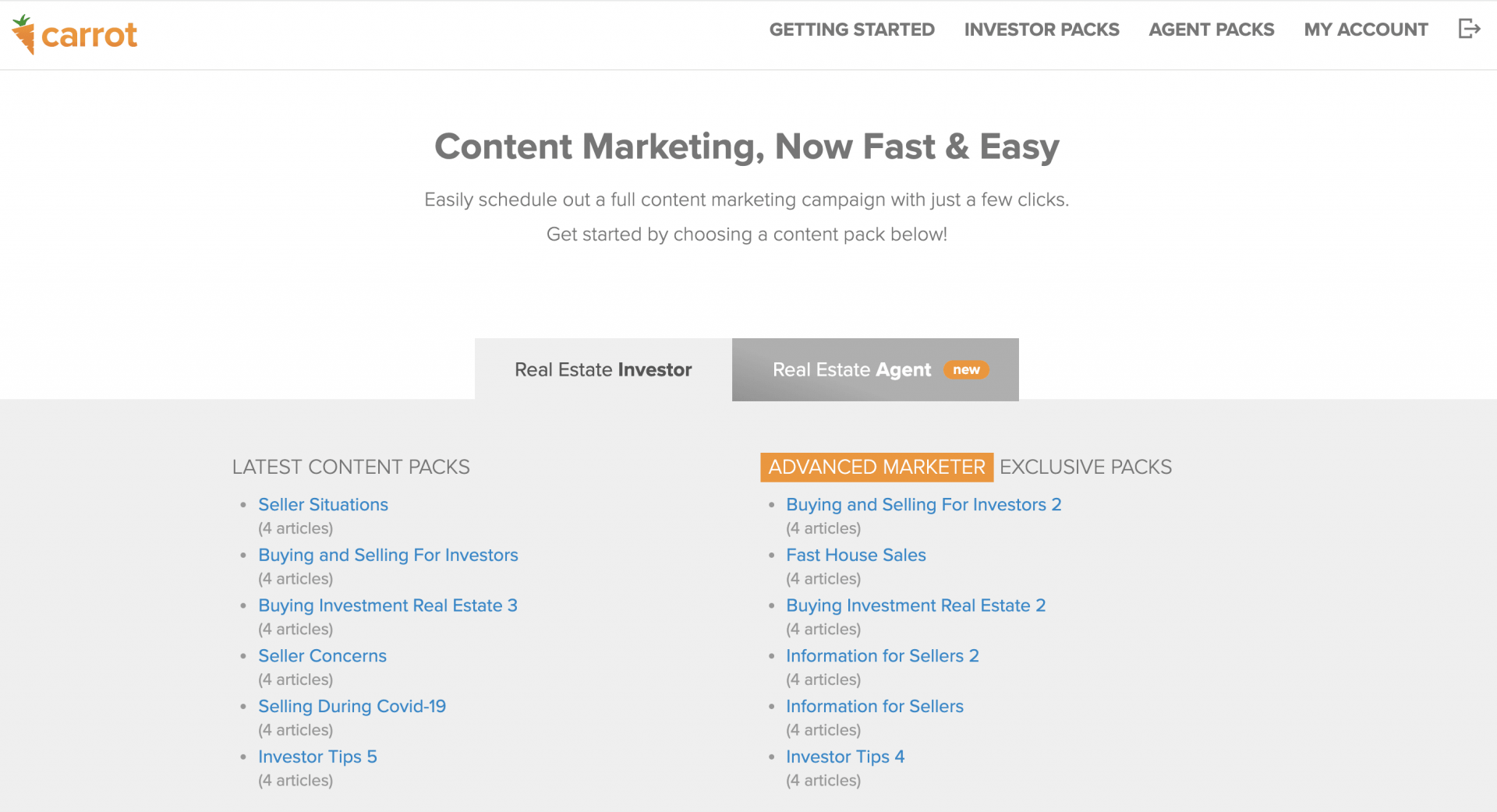
    For Content Tools members, with our Automated Content Library, you get regular “content packs” of blog posts that are high quality (excellent for search engines!) and informative (great for humans!), plus they’ve been optimized with some of the most powerful search engine optimization strategies on the planet… then localized for your market.

    What’s the catch? We’ve done 80-90% of the work for you, but it’s up to you to update the content with your voice. We are saving you dozens of hours per month and hundreds of dollars vs. hiring out the writing and optimization… plus you can always edit these posts to put your spin on them before they publish.

    Best of all worlds.

    So, if you’re looking for some very powerful content marketing without much effort to write it (or manage writers), then be sure to check out our Content Pro level.

    So, Let’s Get Your First (or next) Blog Posts Up!

    If you’re not going to dive in and corner your market as an expert leveraging great content… your top competition will.

    So the choice is yours.

    Evergreen content marketing is how real estate investors (wholesalers, house flippers, etc.) can now get an edge online.

    The ones who understand how to do it well are setting themselves up for long-term success as Google shifts more and more toward preferring rich and fresh content on your website.

    In this blog post, you read about the strategies you need to implement to create great content, you got 100+ compelling real estate blog post ideas to get you started, and you even read some fast-track ideas to help you get going even sooner so you can focus on doing more deals now.

    So dive in and get your first blog post up today!

    Don’t over-complicate it. Just get something up to start, then improve from there.

    I suggest scheduling one post weekly and publishing it live Tuesday, Wednesday, or Thursday. Why? Our data shows overwhelmingly that most of the leads coming through our platform come in midweek… with Sunday being the worst day. So post that content when your best prospects are likely to see it.

    Enjoy!

  • Busted! 10 Inbound Marketing for Real Estate Investors Myths that Some ACTUALLY Believe

    Busted! 10 Inbound Marketing for Real Estate Investors Myths that Some ACTUALLY Believe

    10 Inbound Marketing for Real Estate Investors Myths

    Inbound marketing for real estate investors is essential for business growth. BUT…

    … for some of you, false ideas and beliefs are holding you back.

    They disempower you from taking action and making progress — because when you believe something isn’t going to be worth it, then you’re not going to do it and, you’re certainly not going to invest in it. 

    And not doing something that would help your business grow is detrimental. 

    That’s why it’s essential, as real estate investors, that we examine our limiting beliefs for fallacious thoughts and ideas. 

    If you believe some of these myths… you’re leaving $1000s in potential deals on the table!


    Believe it or not… Here are the 10 inbound marketing for real estate investors myths

    The ideas that limit growth and hold you back from true success. 

    1. “I Get All of My Leads Offline, I Don’t Think I Need a Website”

    We’ve found that real estate websites can convert higher and are more profitable than offline leads.

    Plus, your website will be the central hub to track all of your marketing efforts. Even offline leads, from cold calling to direct mail.

    So, why do you need a website?

    The first is that you want to own your brand. You want to have a website to secure your name within your market, and a website is a perfect way to do this.

    You want to connect the website to your name, your company, and your brand since that’s what consumers are going to search for online, and you want to be sure that your website pops up and not a competitor’s.

    And this is true, too, about owning your name. You want potential buyers and sellers to Google your business name. Having a website will help to solidify yourself, your brand, and your company.

    Think about it: even when you give a seller a business card, they’re likely going to lose the card or not even look at it when searching for your company.

    You want them to be able to Google your name and find your website easily. Start with that fundamental assumption that they are going to Google you and that having a website to lead them to after this search will help you keep them in the long run.

    Besides lead generation and owning your brand, last but not least, a reason to have a website is convenient for you and your clients.

    Often, sellers, even if they’re very interested in working with you, will appreciate the convenience of filling out your contact form and then having you get back to them.

    Potential leads also like to search websites to call or reach out on their own time, which a website helps them do by providing them with contact information and on-site fill forms.

    So just having that simple convenience of looking you up whenever they want and for how long they want will increase the likelihood that they will engage with you.

    It’s essential to control the conversation around your brand.

    2. “Evergreen” Marketing Can’t Support My Business

    In this blog post, we talked about the difference between two types of marketing efforts.

    We called them…

    1. Hamster wheel marketing
    2. Evergreen marketing

    Hamster wheel marketing refers to inbound marketing efforts that require you to keep working in order to get results. That includes running paid advertisements, sending direct mail, cold calling, and so forth. 

    These tactics are beneficial for real estate investors.. 

    But they’re not long-term or lasting

    They only work for as long as you work. 

    Evergreen marketing, on the other hand, refers to marketing efforts that have a lasting impact. You work on something today and it delivers results for years to come without any additional effort on your part.

    This includes building your website’s search engine rankings and creating a well-known brand in your community that generates word-of-mouth. 

    These strategies are what we help investors with here at Carrot.

    We know that businesses built on the foundation of Evergreen marketing are much more resilient, profitable, and predictable.

    Check out the video to learn more about this distinction…


    Evergreen Marketing: How To Finally Get Off Marketing Hamster Wheel and Convert Leads 2-4x Higher

    And we’re here to tell you that Evergreen marketing can support your business — thousands of our members have experienced the difference for themselves. 

    That doesn’t mean you won’t still do some hamster wheel marketing to fill in the gaps, but Evergreen can be the foundation and driving force for your business. 

    And when it is, everything changes.

    3. You Can’t Determine the ROI of Online Marketing

    Let’s think about online, inbound marketing, practically for a moment. 

    If we’re talking about word-of-mouth and SEO (Search Engine Optimization), how are you going to prove the ROI of your marketing efforts? 

    The ROI of SEO, for instance — the best Evergreen marketing tactic we know of — is inherently difficult to track.

    And if you hire a content writer, an SEO agency, and a custom website designer… then the cost will climb fast.

    Heck — it might take years to get a positive ROI from your investment. 

    That’s why we’ve made the process easier. 

    With specialized real estate website services, such as Carrot, you get…

    • A website that is built to rank in Google AND to convert visitors into leads. 
    • Done-for-you content every month that’s optimized for various keywords in your market. 
    • Keyword trackers that report your SEO rankings. 
    • An SEO tool that helps you easily optimize the content on each page of your website. 

    And more…

    This makes it easier to rank in Google, and it makes it easier to prove the ROI of your efforts. 

    Our highest-level plan is $199 per month — it includes all the goodies and features to get your website ranking as quickly as possible. 

    Per year, that’s $2,388. 

    How much is your average profit on a deal? $5,000? $10,000? 

    If you sign up for Carrot and get just one deal over the next 12 months from SEO… you will make at least double your money. 

    And chances are, you’re going to get more than just one deal through SEO.

    4. Online Marketing Lead Quality Isn’t That Good

    To some degree, SEO puts the power in the hands of the searcher and website visitor — they can browse, click, and read whatever they want. 

    And so you might be tempted to think that, since the power is entirely in their hands, lead quality is going to suffer. 

    The opposite is true.

    Lead quality can skyrocket when you focus on SEO.

    Our members’ survey found that Carrot leads convert 7x better and are 2.5x more profitable than non-Carrot leads!

    carrot leads vs non-carrot leads

    That’s because “Carrot leads” often come through Google rankings. But, this can be from any website ranking on the top of Google.

    And it makes sense that Evergreen marketing leads would be higher quality than hamster wheel marketing leads. 

    Think about it… 

    Paid advertising, direct mail, and cold calling are all types of interruption marketing methods. You interrupt the person when they are doing something completely unrelated to what you want to talk to them about.

    (Which the exception of Google Ads)

    For SEO, however, the person is actively looking for your services

    Maybe they type in “Sell my house fast in ” or “Cash buyer in ”.

    Either way, those people are looking for your services and they’re going to…

    • Turn into deals more regularly
    • Be willing to accept lower offers

    These people are already looking for you online in your market… your job is to improve your website’s visibility so that you’re the one they come to visit.

    5. Online Marketing is Too Expensive

    This objection is very similar to the second objection we talked about — that you can’t prove the ROI of Evergreen marketing. 

    And it should be a concern if you plan to spend thousands of dollars per month on your Evergreen marketing efforts. 

    If possible, you need to make sure that that investment is paying off. 

    What if there were a less expensive and just as effective way to improve your rankings and drive results? 

    What if there were a way not to hire a web designer, an SEO agency, and a content writer?

    That’s what we, as well as other real estate services, offer — all of the above gets packaged into one affordable monthly plan. 

    Carrot gives you a high-converting website, monthly SEO-focused content, and all the tools you need to improve and track your rankings with ease. 

    And our plans start at just $69 per month

    6. My Business Just Relies on Word-Of-Mouth

    Maybe you don’t have a website, and you don’t think you need one.

    Maybe your business relies on word-of-mouth to generate leads and close deals.

    First of all, good work. Creating a business that generates word-of-mouth is an enviable feat — one that you should be proud of. 

    BUT…

    If you don’t have a website, then you’re missing out on…

    • Having a more streamlined business
    • Having a more predictable monthly income
    • Generating consistent leads and deals

    In fact, for five years, Robert and Ricky Grand — real estate agents and investors in Eugene, Oregon — depended on word-of-mouth to find deals. 

    And it was going okay. 

    But here’s what they said after joining Carrot…

    “I’m 100% all-in with Trevor and Carrot. They know what they are doing. Yes, they are a business with the goal to be profitable, but these guys care and are totally on our side.

    Honestly, working with Trevor and his team is refreshing. I trust them and don’t second guess anything. If Carrot gives us feedback, we implement it without wondering if there is a catch.

    Hope it helps to hear it from someone who is a customer. I happily spend the money to work with them.”

    – Ricky Grand, Grand Real Estate Investments

    In just four years, these guys transformed their word-of-mouth-based side-hustle into a full-time 7 figure business in large part because they dove headfirst into Evergreen marketing and supplementing with Google Ads.

    Check out their story here.

    7. A Website is a Website

    Maybe after reading that last section, you think that you do need a website.

    Your next thought might be, Well, I’m just going to keep it simple and build a basic website with WordPress or something. “I can get WP and hosting for under $10/mo or Wix for cheap.”

    Because a website is just a website, right? 

    Wrong. 

    Not all websites are created equal. There’s a lot of stuff that goes into building a high-converting website — from tech stack and page speed to sales copy and conversion optimization.

    There are many options, but services such as Carrot are designed for real estate professionals. We have proven data to back up our claims that we will help our members rank higher and produce more leads to close more deals.

    Everything from the fastest page speeds to custom-written SEO content and an automated content delivery system. They are guaranteed to help you rise above the competition.

    You don’t just need a website. 

    You need a website that…

    • Ranks in Google for high-value keyword phrases
    • Converts visitors into leads systematically

    That’s what we offer at Carrot. 

    We’ve spent over a decade studying the psychology behind motivated sellers. And we’ve taken what we’ve learned and baked that right into our website templates…

    … so your website is virtually guaranteed to convert better than your competitors. 

    real estate investor website conversion optimization

    And to give you a glimpse of just how much better our tech stack is than other popular website builders, check out this article.

    A third-party examination of 150,000 websites found that Carrot’s tech stack outperforms practically every other website builder…

    Google PageSpeed Score for Small Providers

    So no… a website isn’t just a website. 

    You need a high-performing website. 

    And at Carrot, we worry about that so you don’t have to. 

    “We couldn’t be happier with the site so far…What we have seen is a DRAMATIC increase in web leads.  Since switching to Carrot, the leads we are getting are converting to purchases at a MUCH higher level.  

    Things have been moving so fast that we haven’t had the opportunity to accurately determine the lead to purchase ratio, but I would estimate it is in the 25 to 35% range, which means the leads we are getting are significantly better than our historical average.

    Thanks for everything and we are now looking at expansion because of the success we have had in such a short time.”

    – Carter Steph, 18002SellHomes

    8. Paid Advertising is All My Business Needs

    Many real estate investors solely rely on hamster wheel marketing methods to keep their business afloat…

    • Direct Mail
    • Facebook Ads
    • Cold Calling

    And as we’ve said before, that’s not necessarily a bad thing. 

    We think that those tactics should be a part of your business — they’re a great way to build brand awareness and create a consistent flow of leads. 

    But should they be the foundation? 

    We don’t think so. 

    Because the moment you stop spinning the wheel is the exact moment that deals stop coming through your day.

    What if, instead, you could build a marketing system that generates traffic and leads for your business for years to come without any additional effort or budget? What if those leads were high quality and turned into deals at an exceptional rate?

    That’s the power of Evergreen Marketing. 

    You might not need it. 

    But “need” is just a matter of perspective…

    If you want to create a business with predictable monthly lead-flow, if you’re going to generate more high-quality leads and make more money on every deal… then yes, you need Evergreen marketing.

    9. My Website Doesn’t Need to Be Mobile-Friendly

    This is a myth that’s easy to knock down. 

    If you think that your website doesn’t need to be mobile-friendly, consider the following statistic we’ve pulled from our Carrot member’s sites — and keep in mind that these investors come from different places all over the nation…

    Over 60% of our member leads come through mobile devices.

    Carrot member mobile leads

    So yes, your Carrot site does need to be mobile-friendly

    And lest you try to build your custom site and make it mobile-friendly — which will cost you a ton of money — every single one of our website templates is automatically optimized for both desktop and mobile. 

    Let’s take, for instance, one of the most recent Google Algorithm updates… Core Web Vitals. Page speed on mobile devices was a hot topic. If mobile page speed isn’t up to par, your Google ranking could suffer.  

    10. SEO Takes Too Long to See Results

    Maybe you think that you can build a WordPress site and just do a little bit of SEO research and then do a little bit of optimizing. 

    You could

    But should you? 

    Here’s what we know — if you do a little bit of SEO work, that’ll result in a little bit of SEO traffic (if you’re lucky). 

    Any reputable SEO agency will tell you the same thing, SEO takes time.

    And if you want a lot of SEO traffic, then you’ve got to put in a lot of work.

    While some can see quicker results, it is ultimately determined by different variables before seeing how rankings settle in 4-12 months.

    Some of these variables include:

    • Relevant keywords and topics
    • How much content you have relating to those keywords and topics
    • Quality of content
    • Age and speed of the websites and domain
    • Website design, including ease of use
    • The average time a user stays on the site
    • Geographical location
    • Competition
    • Level of social activity
    • Page-speed

    Again, we know this takes time and hard work. But, once your Evergreen – SEO marketing kicks in, you can sit back and reap the benefits. Highly qualified leads will come to you rather than you seeking them out.

    You could just get yourself a Carrot website and we’ll do it for you or check out our guide for real estate SEO.

    Overall, there’s no shortcut to ranking in Google. 

    Make These Myths a Thing of the Past

    Hopefully, you’ve acquired a new perspective on some of your limiting beliefs. 

    As we said at the beginning, having a misconception of inbound marketing for real estate investors can limit your business growth. 

    If you’re not a Carrot member yet and are curious to see if this can help you generate more leads online (motivated sellers, buyers, tenants, note sellers, etc.), take our demo and check out what Carrot has to offer.

    But enough from us — what limiting beliefs have you had to overcome in order to move forward in your business? We’d love to hear about it in the comments!

  • Think All Carrot Websites Look the Same? You’d Be Wrong! There Are 1000’s of Different Ways to Make Your Carrot Website Design Stand Out From Your Competition

    Think All Carrot Websites Look the Same? You’d Be Wrong! There Are 1000’s of Different Ways to Make Your Carrot Website Design Stand Out From Your Competition

    If you’ve ever thought…

    “Geez, this looks like every other Carrot website design in my market – how can I make myself look different from the others while still maintaining the awesome conversion rate that Carrot websites provide?”

    Then, you’ve come to the right place! We have 1000’s of members, many of whom are in competitive markets and generate hundreds of leads monthly. They close multiple, multiple deals each month, as well.

    To the lead-converting glee of Carrot members, we prioritize conversion optimization over aesthetics. To some, that might seem like a bad idea.

    After all, don’t the two always go hand in hand?

    Not necessarily.

    Carter Steph is proof. Carter switched from an $8k “pretty” custom website to Carrot and saw his closing rate go from 7% to 20% within a few months. Read his story here.

    We have been in business for years and have always had a web presence. We switched to Carrot this month and have already seen a huge improvement in our click-through rate, but more importantly we have more leads being generated by form fills then we have ever received. And we’ve only had our new website up for 7 days!!

    Carter Steph, 1-800-2 Sell Homes

    Even conversion testing giant, Crazy Egg, claims that “ugly” websites often convert better than their prettied-up counterparts. That’s not to say that we’ll provide you with an ugly website that converts well; it’s simply to illustrate that conversion optimization should trump website aesthetics when choosing a website design platform.

    Fortunately, at Carrot, you don’t have to choose between the two – on our real estate investor websites and our real estate agent websites, we’ve found the perfect balance between conversion optimization and beauty.

    Here’s a basic, nothing-fancy website with an “at-time” 25% conversion rate:

    But if tomorrow someone forced us to choose between giving our customers high conversion rates or designing beautiful websites, we’d immediately choose performance.

    Often, people choose a website based only on how it looks rather than how it converts, and we think that’s a massive mistake. You’re in business to make money, not just to look pretty, and, for our members, that’s what we help them do – build a sustainable and predictable business.

    We’re not Wix, WordPress.com, or SquareSpace—and our members, as well as we, are proud of that differentiation.


    We ran a test a few years ago and we had double the conversion on Carrot verses LeadPropeller and our custom site.

    – Jason Bible, Houston House Buyers

    “I blew $40k unfocused and doing all kinds of marketing in my first year… then I focused on Carrot and Evergreen marketing and after a year of focused work did my first $100k month.”

    – Adam Mitchell – Dallas, TX “Home Buying Guys”

    There are 100’s if not 1000’s of different ways to make your website stand out from others.

    We wanted to give you the top changes you can make (whether you’re an agent or investor) in about 10 minutes that will differentiate your business from the others in your market without sacrificing a high conversion rate. Check out our tutorial video or keep reading to learn more:

    Getting Started: 9 Simple Ways to Customize Your Carrot Website Design

    Note: This article is for real estate investors and agents. The differentiation recommendations below can be made to an Agent or Investor’s website. 

    Website Design Changes

    1. Choose a Website Theme 2 Minutes

    We have eight different website themes (or designs) for our members.

    All of these convert to our standards (we’ve tested each and every one thoroughly), and the one you choose should be a matter of preference.

    Here are your options. It takes less than 2 minutes to choose a new website theme.

    8 Different Design Templates to Choose From

    Mahogany – Our Latest Premium Design! (For Grow members)

    Stand out without losing the performance. Our latest Premium Design Mahogany features clean, modern lines, big, bold, easy-to-read text, and space to emphasize all of your content. Instantly separate yourself from others in your area with a few clicks.


    Mahogany design template

    Aspen Design (For Grow members) account for 5.14% of Carrot member websites

    We’re officially introducing a new, full-featured design for those of you who crave a distinguished, modern (and, yes, still high-converting) website.

    Carrot real estate website aspen template

    Hemlock (For Grow members) accounts for 11.31% of Carrot member websites

    A more modern “angle” on our highest-performing designs. Test this one to see if it inches your performance up and gives you that differentiation you’re looking for.
    To learn more about changing your website theme, go here.

    carrot real estate website hemlock theme

    Oak – Accounts for 3.49% of Carrot member websites

    It is a design with a striking image and a clear CTA area, and it is amazing on mobile. It’s the default design for Agent websites.


    Juniper – Accounts for 12.81% of Carrot member websites

    Our 2nd most popular design features a centered CTA area and outstanding mobile performance.


    Cedar – Accounts for 7.55% of Carrot member websites

    Large and striking hero image with our right-aligned CTA area, with the navigation below the hero. Ideal for people with a white, transparent background logo.


    Douglas – Accounts for 54.26% of Carrot member websites

    This is the default style for all investor websites, but it takes a few seconds to switch to one of the other ones on this page.


    Madrone – Accounts for 5.34% of Carrot member websites

    A different take on our Douglas design, just with a reimagined header design to freshen things up on mobile and desktop.


    Branding Changes

    2. Upload a Logo 4 Minutes

    Creating a clean and reputable logo can help differentiate your website from other Carrot members and add loads of credibility. As it stands, only 36% of Carrot customers have uploaded a logo to their website.

    This means that uploading a logo to your Carrot website design will help you stand out even more.

    The more unique and reputable your logo is, the more it will differentiate your website and build credibility.

    Here are a few examples of Carrot members who use a logo to build credibility and differentiate their website.

    Ashley Buys Houses
    GTeam
    Home Offer Kansas City
    Sell Now HomeBuyers…

    Here’s a gif showing how easy adding a logo to your website is.

    To learn more about adding a logo to your website, go here.

    3. Adjust Website Colors < 2 Minutes

    Colors have a deceptively significant impact on differentiating websites that – at their foundation – look similar. Just consider how different these Carrot websites look with the same theme but different colors.

    different website color combinations

    The Carrot members that differentiate their website the most don’t only change the color, but they match the color of their logo to the color of their website. In other words, they create their brand colors and then add them to their Carrot website design.

    We Buy Homes in Tucson
    Houston House Buyers
    Coachella Valley HomeBuyers

    And here’s a gif showing how simple it is to change the base colors of your website.

    To learn more about changing the colors of your Carrot website, go here.

    4. Use A Branding Icon 3 Minutes

    If you don’t have the time or finances to create a custom logo for your website, no worries—you can simply use our pre-made branding icons to differentiate your website.

    Plus, only 8.5% of Carrot’s websites use branding icons, so you’ll stand out from the competition quite well.

    Here’s an example of what it can look like.

    Here’s a GIF showing how you can add a branding icon to your Carrot website design in just a few minutes.

    5. Change Button Color < 2 Minutes

    Similar to the overall branding colors of your Carrot website, the button color can help differentiate your business and even increase the chance of conversions.

    We found, for instance, that changing the color of the button on one of our member’s websites from black to orange increased conversions by 29.55%.

    The trick isn’t to change your button color to orange but to a color that stands out relative to the other colors on your homepage. Choose a color for your button that is either sparse or nowhere else on your homepage.

    Something like this from House Heroes…

    Or Krista Buys Houses…

    And here’s a gif showing you how you can change the button color of your CTA.

    To learn more about how to change the color of your CTA button, go here.


    Imagery Changes

    6. Update Hero Section 5 Minutes

    The hero section image is the quickest and most significant visual update you can make. As a Carrot member, you can also quickly and easily customize the hero image on your website.

    We recommend avoiding stock photos if you want to stand out from other Carrot members. Try using a photo directly from your market – something your market will recognize and think, Okay, I’m in the right place.

    Consider the look and feel of these personalized hero photos on Carrot member websites.

    Townsend Realty Group

    Learn how Townsend Realty Group is achieving predictable business growth with Carrot at a 25% conversion rate.

    Example in Baltimore – Juniper Design Template

    Carrot Aspen theme

    Example in Louisville – Aspen Design Template

    Example in Dallas, Texas – Hemlock Design Template

    And here’s a gif that shows how easy it is to add your local image to your Carrot website design.

    To learn more about changing your hero image, go here.

    7. Add Local Images 10 Minutes

    Like the hero section on your website, avoid stock photos and generic images throughout the rest of your website unless you are adding local or USA maps. To build trust and credibility with your target market, try using real photos of houses in your market. Place them throughout the website to make it clear to visitors that they’re in the right spot and that you’re the person to help them. To enhance the visual appeal of these images, consider using a photo editor like Picsart to optimize and polish the photos before uploading them to your website.

    Consider how these Carrot members sprinkle personalized photos throughout their

    websites.

    The Beckham Group

    We Buy Homes In Tucson

    Sell Now Homebuyers

    To learn more about adding images to your website pages, go here.

    8. Adjust Your Hero Form Layout 3 Minutes

    As a Carrot member, you can customize your form section with two clicks of a button (literally). You can easily change to three styles, regardless of your selected website style.

    Column / Stacked / Inline

    Simply choose the one that best fits your brand image. Each will convert well (we’ve tested them), so the choice is yours.

    Go here to learn more about changing your form layout with a few clicks.


    Credibility Improvements

    9. Add a Credibility Bar 10 Minutes

    Adding credibility to your website, whether you’re a Carrot member or not, is critical for your conversion rate. This is especially true in the real estate industry, where consumers try to work with someone they can trust who won’t deceive them.

    Our credibility bar option is the perfect way to add a differentiating and trust-building flair to your website. You can use the credibility bar in several different ways on your Carrot website.

    7DaysCash

    Halo Home Buyers

    Go here to learn more about adding a custom credibility bar to your website.

    10. Add Testimonials 10 Minutes

    The Credibility bar isn’t the only place to add a past customer testimonial to your website – and it’s not the only place you should.

    You can also add testimonials to these spots on your website to build even more trust with visitors.

    Here are a few different looks, including using video testimonials.

    Ocean City Development

    GuaranteedCashOffer

    Sell Now Homebuyers – Video testimonial

    Frank Jr Buys Houses – Video testimonials

    If possible, your testimonials should have some, if not all, of these elements:

    1. Full name of the person.
    2. Professional title of the person.
    3. Image or video of the person.

    To learn more about adding testimonials to your Carrot website, go here.

    11. Personalize the “About” Page 10 Minutes

    When people visit a real estate website, our research shows that the “About” page is the third-most visited tab. You can further differentiate your website from the competition by writing up something personal, adding biographies and pics for team members, and casting company vision.

    For inspiration, consider how these Carrot members have customized their About Page.

    Carrot member about page

    Triple C Properties

    CR of Maryland

    12. Add Badges 10 Minutes

    Website badges that show what makes your company unique and different from the competition can be a great way to stand out online. For example, a website badge that says “Veteran Owned” or “100+ 5-Star Ratings.”

    Here are a few examples.

    Nextwave Homebuyers
    Warrior Property Solutions
    Kind House Buyers

    Consider your unique selling proposition for your business and create a badge that expresses that on your website.

    With this, you’ll sell or buy stronger and faster than the competition and quickly differentiate yourself from other clutter online.

    Easy Editing

    13. Visual Block Editor

    Like anything in life, there are trade-offs. The “big” low-cost website builders (think Wix, Squarespace, and WordPress themes) chose to go all-in on ease of use and sacrifice performance for their clients. You would save a bit of time, but it could cost you tens of thousands of dollars (or more) from underperformance.

    Performance and results and easy editing
    At Carrot, we have been all-in on performance since the beginning. We created the easy drag-and-drop Visual editing experience on our websites so that users can enjoy both benefits without sacrificing either.

    What the Visual Editor helps you do

    A few benefits you’ll enjoy with this powerful Visual Editor include…

    • No more switching back and forth from editor to page – now see all your edits in real-time, including your hero section, forms, and more!
    • Use Drag and Drop tools to easily create and edit pages with movable and reusable block patterns!
    • Make your website stand out visually without having to use any fancy code.
    • Enjoy the new “Full-Screen Mode” to have the most beautiful, clean, and simple editing experience possible… without the distractions (try this mode, you’ll love it!)
    • SEO Grader updates: 1) Your SEO grade for the page will update in real-time without you having to save the page, and 2) Now get SEO grades for multiple keywords for the same page! (this is huge)
    • No loss of page speed

      … and more

    Here are some examples of designs you can easily create with the visual editor…

    MRR Property Solutions

    Myrtle Beach Home Buyers

    Capstone Homebuyers

    To learn more about the Visual Editor, watch the tutorial video below or check out our Help Center.

    Getting Started: Editing a Page with Carrot's Visual Editor

    Content Changes

    14. Customize Content 10+ Minutes

    Your website’s blog represents a phenomenal opportunity to differentiate your business from the competition.

    Our Grow Carrot plans provide monthly content for your website, but sometimes it’s worth tweaking these blog posts to fit your market and business positioning better.

    Here are a few ways to quickly tweak them to fit your target market better.

    1. Localize the tips and advice.
    2. Add a bit of your advice.
    3. Add your tone of voice to the article.

    Consider Fox Realty Group – a Carrot member – and how they’ve customized their blog content without getting too complicated.

    Fox Realty

    So if you have more money than time, another way to differentiate your Carrot blog is by upgrading your plan.


    Conclusion

    We’re not going to sugarcoat this… Customizing your website takes work. Unless you outsource your website customization, you’ll need to invest time.

    You now know how to customize your Carrot website design without sacrificing aesthetics or conversion rate. Use these 14 ways to differentiate your website and stand out from the competition – even if that competition consists of other Carrot members.

    Many people don’t customize their website with the above simple changes, so if you do, you have a far better chance of standing apart and cutting through the online clutter – to be seen by your target market faster and more often.

    If you don’t have the time to make these changes, check out our Concierge Setup Service, where we’ll do it for you.

    Either way, happy customizing and happy converting.

  • [Heat Map Results] Where Are Buyers and Sellers Clicking On Your Real Estate Website

    [Heat Map Results] Where Are Buyers and Sellers Clicking On Your Real Estate Website

    Imagine you build a marketing site to pull in buyers, sellers, or investors. Is your website really amazing? Or is it coming up short when the time comes for closing deals and moving people from browsing to clicking to filling out a contact form?

    Ever heard of a heat map? We’ll show you how motivated sellers and buyers interact with your website and how to make sure that more visitors are converted into leads while they’re browsing around.

    There are two main problems that we often see on real estate websites:

    1)   The website is a ghost town…getting no visitors, and

    2)   The website’s visitors aren’t submitting their information.

    The first problem is usually solved with SEO content when:

    1)   The website doesn’t have good, user-friendly content,

    2)   The content is not optimized to reach the search terms that people in the local market are actually using, or

    3)   The site’s competitors are ranking higher in a search.

    We have many articles and resources that focus on increasing your site traffic by using SEO, social media, and paid ads. But today is all about the second main problem we see.

    What are people doing on your real estate website?

    You only get one shot to make a first impression, and your website is that opportunity. In fact, it takes about 50 milliseconds (that’s 0.05 seconds) for searchers to form an opinion about your website that determines whether they’ll stay or leave.

    Conversions are often overlooked when average people create their websites. Too often they hire designers who focus more on aesthetics than results… those folks need to quit calling themselves marketing experts because they’re artists (most art doesn’t sell).

    The following key points can help optimize conversions by positioning your services in clear view so buyers and sellers know what’s available… including credibility that builds trust with potential buyers and sellers… and the rest of the content that can help eliminate fears or uncertainty.

    Are you trying to create art or are you trying to get leads?

    When you’re setting up your real estate site, it’s not how it looks… but how productive and successful the design is.

    Listen, I get in this argument with designers a lot – so please don’t send me a bunch of angry emails about how design matters…I know it’s really important. But honestly? It doesn’t matter if something is “pretty” it doesn’t convert visitors into leads.

    One of the many tools that Carrot uses to test out its theories about web design is heat maps. Heatmaps are useful because they allow us at Carrot, and more importantly you as a business owner who has entrusted your hard-earned cash with our system, to measure how successful something on the page will be before we commit any resources towards it. We want to know for sure whether or not what works in theory also translates into reality!

    So what’s a heat map anyway, and how can agents and investors use it to generate more leads online? 

    Back to the point, thanks… in this context, a heat map is a generated picture of where visitors to the website move their mouse and where they click on the page.

    Below I’m gonna put a few examples of a heat map that we generated for a user’s site, and give you a few key points on what works so well on this design.

    Brittany (the owner of http://sellmybaltimorehousefast.com) sent us a quick email after watching one of our webinars, asking for help getting more leads… we were able to increase the conversion rate by 80+% with just a couple of simple changes.

    Check out these heat maps (the site is greyed out, with little points of light showing where people have lingered with their mouse or clicked – the “hotter” the click spot, the more often it’s clicked).

    What did you notice on that heatmap?

    See all of the bright spots? The green and blue spots are where a lot of people click… indicating things that the motivated sellers felt were really important.

    First off, 94% of clicks happen on the top of the page.  The vast majority of web visitors to any given site don’t bother to scroll down.

    Side note: That statistic is valid across websites in general – on our investment sites, we tend to get about 8 seconds per page on average – 4 times more engagement than average, but still a lightning-fast choice to stay or go. You only have microseconds to reach your target audience – just another reason that your content and design matter so much.

    There are a few great lessons to learn right away from this click map…. 

    1)   People are clicking in many spots across the homepage. The clicks aren’t just happening in one spot, and visitors to this real estate investing website are finding what they need when they click through for more information. This site is designed specifically with sellers of properties as its audience, so it’s a relief that different types of people – those looking for answers about how they can sell their home, found exactly what they’re looking for on the site!

    2)   Titles matter. The title of a menu is designed to appeal directly to people who need to sell their house, and this top one has some great ones: “We Buy Houses in Louisville, KY”, “How It Works” and a contact form right on the front page that asks people to put in their address, phone, and email first thing.

    3)   Visitors want to know about your home buying process before they submit their info. Having a solid “how it works” page can be an integral part of your lead generation strategy.

    Have a truly excellent “how it works” page that includes:

    • A breakdown of your service in a series of simple bullet point steps
    • Include an informative, personal video
    • Include testimonials to build credibility and trust
    • Communicate the benefits they gain by working with you
    real estate website how it works page

    Here’s an example of a well-thought-out “how it works” page

    Where is your credibility on your own real estate websites?

    It’s a really common problem that hurts a ton of great real estate agents and investors… when people get to the site they need to have a compelling reason to give over their personal information. Think about it… real estate is the largest investment most people ever make in their lives. There’s no piece of real estate more intimate than someone’s home.

    And yet…

    So many real estate sites don’t build trust or credibility.

    In fact, there are 3 key factors that I wanna mention that are critical to successfully designing a site that converts – and I’ll tell you how we’ve used them to design the Carrot sites like this example that are generating great leads.

    Credibility, Content, and Contact

    Check out this graphic – I’ve broken down the links on the page into numbers so you can see the percentage of page visitors that clicked on each link type.

    Even more great lessons for real estate here… 

    As you can see, 12% of the clicks are for Credibility, 42% is on the Content (which is written to develop trust and credibility while reducing the fear and anxiety that most people buying or selling a home are feeling), and 46% of the clicks on the home page are actually converting – they’re contacting members using the forms.

    Keep in mind that the percentages are recording just clicks on the home page – a lot of other conversions happen on the lead pages that we’ve optimized for the local market.  That means that people are most often giving their information over to get a free report, such as a home valuation report, or another valuable tool. 46% of the clicks on the home page aren’t always the main source of leads. It just depends on how the site is being promoted, and where the majority of traffic is directed.

    The mix of these 3 factors is critical to a successful lead generation site.

    Content is a powerful tool to get your message out, but it needs credibility once people arrive or they won’t contact you.

    Content has long been seen as the lifeblood of search engine traffic and so much more for businesses looking to stand out online. However, even though content is king, you must know what happens when someone arrives at their site. What can be done after visitors land on your site in order to make them want to work with you?

    BONUS: One Tweak That Could Double Your Conversion Rate

    One more thing… this one simple tweak that we did on hero sections doubled conversions… it’s so crazy simple that we were totally surprised that it worked so well.

    We actually removed content from the hero sections to move the form up on mobile devices.

    Yup, that’s it.

    Even after doing this stuff for many years, it’s crazy to see what a big difference such a small change can make.

    That’s why we’re constantly testing different sites.

    We create websites that give your business the edge with a no-nonsense approach.

    We’re all about giving clients an advantage, so we design effective and user-friendly sites to stand out from the competition. We want our work to be as engaging for visitors on desktop or mobile devices alike; you never know what device they may use in order to find your site! In fact, over 60% of Carrot member leads come from mobile.

    This Is All Built Into Your Carrot Websites Already!

    The best thing about using Carrot is that you don’t have to worry about managing any of the technical aspects. We’re constantly running tests with our members and making tweaks in order to make sure your experience on this platform goes smoothly.

    We believe in results over anything else and are continually improving our system to help you get better results.

    We’re constantly posting tips, tricks, and techniques we use to improve SEO, conversions and get great results for Carrot members. So if you’re not already getting our weekly blog emails, make sure you sign up now! And if you want a website that truly generates leads for your business, go check out our plans to join Carrot and leverage our marketing knowledge and testing to generate more leads for your own real estate company. 

    Not An Carrot Member? Take A Tour Of Our System