

Search results for: “conversion”

  • Are There Less Real Estate Investor Leads In Holiday Months Than Summer Months? (Stats Inside…)

    Are There Less Real Estate Investor Leads In Holiday Months Than Summer Months? (Stats Inside…)

    Are There Less Real Estate Investor Leads In Holiday Months Than Summer Months?

    We’ve been getting some awesome questions from the Carrot community lately so we’re going to be answering some of them here on the blog in detailed posts to help you get an edge on your competition with your real estate investing website.

    The other day, one of our members from Indianapolis (one of the top turn-key rental property sellers in Indianapolis) asked…

    “Hey Jake, good morning, in general, are there less real estate investor leads in holiday months then in the summer months?”
    Francisco 

    (NOTE: This customer is in our Content Pro plan and saw their first leads in their market within the first 2 weeks after launching their sites and implementing a few critical steps.)

    We’ve monitored this trend over the years while also monitoring search levels on many of the top motivated sellers, cash buyers, private lenders, and tenant search phrases out there.

    Now… each type of searcher came up with slightly different seasonal search patterns…. so in this post, we’ll run through some of what we found so you can better prepare for fewer November and December lead volumes when leveraging SEO and traditional Google PPC specifically for motivated property seller leads and cash buyers.

    So… Are There Less Real Estate Investor Leads In Holiday Months Than Summer Months?

    When Are Motivated Property Sellers Searching Google?

    We pulled a chart of 25 of the top motivated seller SEO search phrases and found some really interesting stuff.

    First, let us look at the highest searched highly motivated real estate seller search phrase, “we buy houses”.

    Average Monthly Searches Of The Motivated Seller Search Phrase “we buy houses”

    Average "we buy houses" Searches In Google Per Month
    Average “we buy houses” Searches In Google Per Month: Notice the big ramp-up of searches in the summer and spring months. What’s this mean?

    That’s really interesting… but that doesn’t tell the whole story. So we took the average of the top 25 motivated seller keyword phrases to see overall… is there a seasonality for motivated sellers hopping online and searching for someone to buy their house.

    The graph below shows the average of the top 25 search phrases in the United States for highly motivated sellers on Google across the past 24 months.

    Average Monthly Searches Of The Top 25 Motivated Real Estate Seller Search Phrases

    Top 25 Motivated Real Estate Seller search volume
    Average Monthly Searches In The Past 24 Months: Highly motivated sellers searches on Google trend up in the warm months and down in the colder months… with December being the lowest each year.

    We see a similar ramp up in the warm months… and the number of motivated sellers searching Google with the common highly motivated search phrases dips in the winter months.

    On average… the summer months are getting nearly 30% more searches from motivated sellers than November and December.

    Now, we did cross-check this to make sure it wasn’t a “cold winter climate” vs. “mild winter climate” thing… and overall we still saw very very similar trends. So, for now, we’ve ruled out the climate being the major contributing factor to the seasonality of the motivated seller searches.

    Why Do Fewer Motivated Property Sellers Search Google In November And December?

    There are lots of reasons that could be causing this… but here are a few of my guesses…

    • Fewer people want to move in the winter… especially during the holidays
    • It’s COLD! (in lots of places) so they want to hang out
    • It’s the holidays and people don’t have the time to deal with something else or don’t want to disrupt the holidays
    • Generally, there are fewer properties on the market in general so many house sellers feel that “selling in the spring” is what you’re supposed to do to sell a house fast (even though some data shows houses that sell in the winter sell for higher prices and sell quicker)

    When Are Cash Buyers Of Real Estate Searching Google?

    Overall a cash buyer is in a different mindset than a highly motivated seller. Usually, a person who’s looking to buy investment property tends to look for properties when they are thinking about their financial future.

    There is a bit of seasonality to cash property buyer searches as well.  Fewer searches for the top 20 cash property buyer searches on Google in November and December than most of the other months during the year… but one key thing to take note of, if you’re selling investment properties or just looking to grow your cash buyers list in a bit way… is the single most searched month in the whole year is January.

    Average Monthly Searches Of The Top 20 Investment Property / Cash Buyer Search Phrases

    Investment Property / Cash Buyer Search Phrases
    January Is The Single Most Searched Month For Cash Buyers: This chart from Google search data shows January beating out all other months during the year for investment property buyers looking online for properties. What are you doing to get ready to build your cash buyers list in a big way in January?

    That’s pretty darn cool (and useful) eh?

    Find Seasonal Opportunities

    It shouldn’t be surprising that the real estate industry has seasonal patterns. To validate this… according to Realtor.com, homes are most popular in the summer months when people have their minds set on moving because it’s a peak season for inventory and sales.

    But, the winter months should not be discounted. For example, wintertime can provide a unique opportunity for investors because they know people want their houses sold fast!

    Winter Pro: Serious Sellers

    Winter is known to be the most profitable season for buyers. When it’s cold outside and snowing, there are many more “serious” sellers who want their home sold quickly so they can get on with life in warmer weather; conversely, this means that you’ll find some motivated sellers right when you need them.

    Winter Con: Low Lead Volumes

    Winter weather can be a major factor in the real estate cycle. Cold weather, including elements of rain and snow, can make it more difficult to find sellers. This can have an impact on the buying and selling process, as the limited potential sellers may have an overappreciated value of a home in cold months.

    What This All Means

    What this means to me is that people are looking at their financial goals at the start of the year and saying… “Man, I need to get my butt in gear and pick up some more investment properties to hit my goals this year”… so they dive in right after the holidays and start looking for properties.

    There may also be tax reasons that people are waiting until January to kick up their investment property search… either way… the data shows it’s the case… so now it’s time to act on it.

    So, if you know the single most popular month for investment property searches online is January each year… what are you doing to build your own cash buyer list for your real estate investing business?

    What Can You Do To Prepare Your Real Estate Investing Business For Seasonal Search Trends?

    Really, what this data shows is that there are seasonalities to the real estate investor leads you can expect from SEO for real estate investing and even PayPerClick marketing.

    So keep these things in mind as you’re generating leads for your real estate investing business through your website…

    • Winter months for both investment property buyers and motivated house sellers bring in lower volumes than the summer months (but not drastically lower… at the least… maybe 30% lower on motivated seller leads)
    • Now is the perfect time to start your Evergreen marketing campaigns if you haven’t already so your real estate investing websites rank higher in Google for keywords that matter when the spring and summer come around
    • If possible, try not to rely strictly on SEO or PPC for your only lead generation if you’re not in a larger market in the winter months if possible… so your marketing plan is well rounded and you’re getting leads coming in from places other than just the internet in slower lead months.
    • Get a cash buyer/investment property buyer campaign rolling asap so you can take advantage of the highest searched month of the year for people looking for investment properties. How? Start your Craigslist marketing… go to your REI club in January and start getting your buyers’ list built there… kick on some Google PPC campaigns if you have a bit of a budget to invest… Facebook ad campaigns are doing REALLY well to generate investment property buyers and tenant buyers… basically… get focused and leverage the January cash buyer traffic!!!

    If you’re a Carrot member, you know how well the Cash Buyer websites on our system are converting… so put it to use.

    Also, on the motivated seller side of things… having a real estate investing website with a high conversion rate (how many people land on your website and become a lead) is as important as ever in months with lower search volumes like December… so if your current website isn’t converting like it should… take a look at Carrot to see if it’s a fit for you.

    We’re the only company in the industry as focused on results and increasing conversions on our platform each and every month as much as we are… so you can just focus on growing your business… not fiddling with building websites and trying to learn conversion rate optimization in your “spare” time.
    Hit me with comments or questions below! And leverage these seasonalities in the Google searches to your advantage!!!!

  • How to Grow Your Real Estate Business Into Multiple Markets | Real Estate Strategy Whiteboard

    How to Grow Your Real Estate Business Into Multiple Markets | Real Estate Strategy Whiteboard

    How to Grow Into Multiple Markets as a Real Estate Investor

    Video Transcription

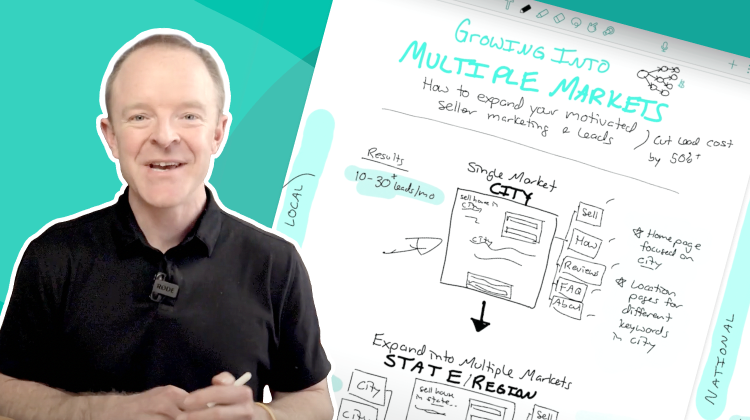
    If you’re a wholesaler or a real estate agent that’s looking for motivated sellers, I’m going to show you how to grow your real estate business into multiple markets, get leads for $20 to $30 per lead and cut your Google pay per click ad costs by 50% to 75% by going regional or national in this video right here.

    So guys and gals, a couple of weeks ago, I was talking with one of our clients that they were pulling in leads from Google pay per click for somewhere between $20 to $30 bucks a lead.

    Now, you can even, I’ve heard stories of $10 bucks a lead, $50 bucks a lead, the whole thing.

    The thing they did was they went from just being a local investor or local hybrid agent investor, looking for sellers in one market, to they expanded to national.

    So, now they’re using their Carrot website for national lead generation.

    So, what I’m going to do in this video is I’m going to walk you through it. We’re going to dive into my iPad.

    I will show you how to go from a local website with Carrot to regional or statewide.

    And then if you wanted to expand to national, they’re all completely different business models, so I’m not saying that you should do it because you have to then figure out, of course, all the different moving parts of how to turn those leads into deals, how to analyze deals in different markets, the whole thing.

    We’re not going to cover that in this video. We’ll cover that in some other videos. But let’s dive into the iPad because we’re going to show you exactly how to set up your Carrot website, depending on whether you’re local, regional, state, or national.

    Let’s dig in.

    How to Grow Your Real Estate Business Into Multiple Markets

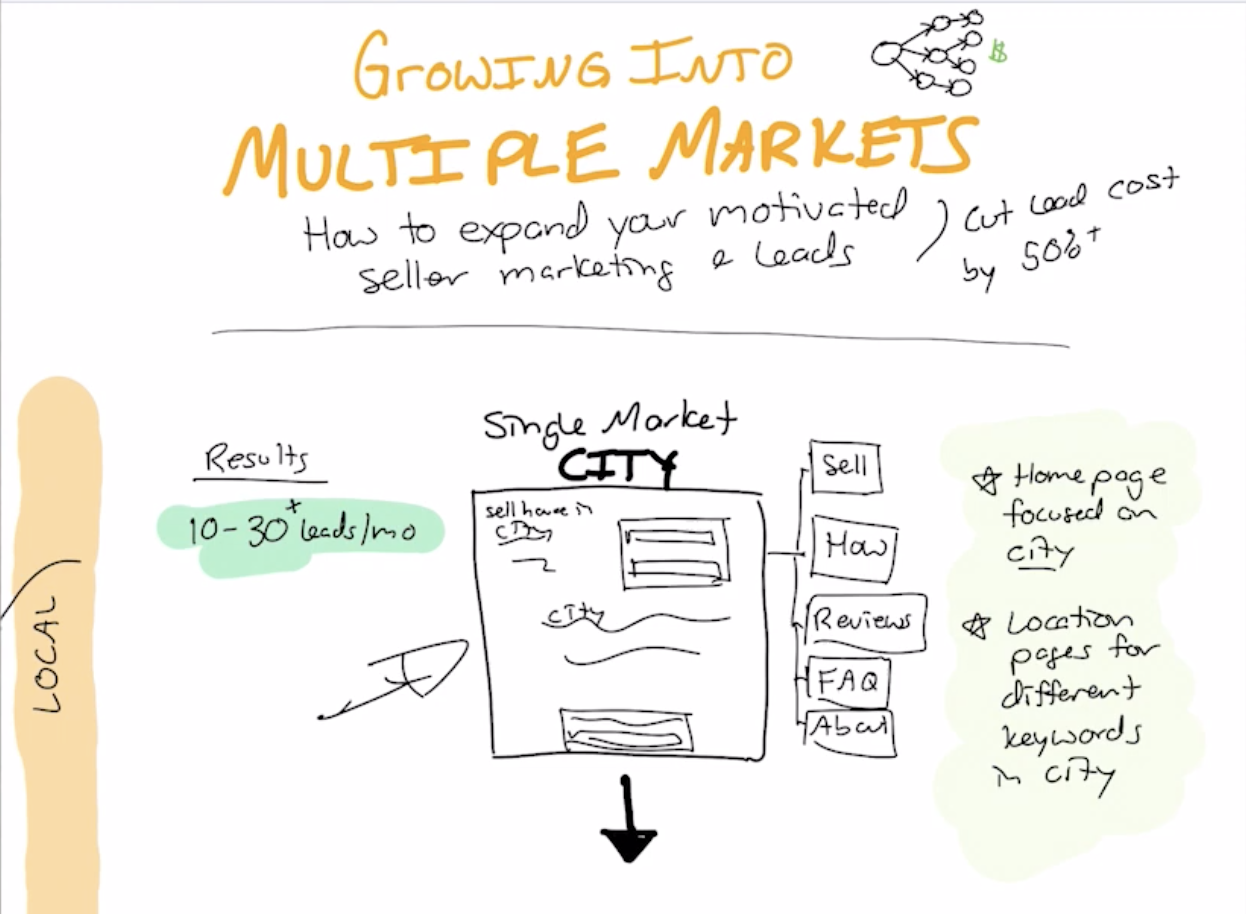
    So, we’re right here on the iPad. The very first thing, this is where most of our clients are, most of our clients are in the local bucket. Meaning, you’re in one market, you’re in Cincinnati, you’re in Tampa, you’re in Roseburg, Oregon. You’re in Phoenix, Arizona.

    One market city real estate website strategy
    Single Market Real Estate Website Strategy

    Of course, the bigger the city, the more opportunity there is to pull more and more leads out of the city because the population’s higher.

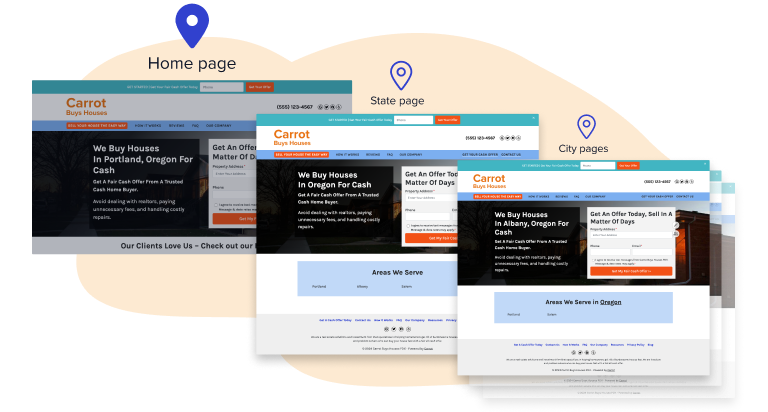
    So, in a single city market, your website’s pretty much going to look like this. You’re going to have your homepage right here and it’s going to be, “Sell your house in city.”

    Pretty much those types of phrases. Over here, you’re going to have your standard, what we call authority hub pages, which is your “sell a house” page.

    It’s going to have a call to action on it. Your “how it works” page. Reviews page with testimonials to build trust and credibility, maybe some FAQ, and then you’re about page and contact pages. That’s what we call the core conversion pages here at Carrot.

    To be in one city, that’ what you need.

    That’s pretty much all that you need.

    You can use our tools and systems then add automated blog posts, or to use our video post feature, to build further trust and credibility. But that’s how you would lay it out.

    Your homepage is focused on the city at that point, sell your house fast in Cincinnati. And then you would talk about that, show Cincinnati pictures.

    Your location pages might be set up for different keywords in that city. So, maybe you set up a location page for cash home buyers in the city, or sell your inherited house in Cincinnati. That’s how you’d leverage that.

    So, let’s say now that we wanted to expand out beyond that one location. If you’re in a city, you can pretty much expect somewhere between 10 and 30 leads a month once you get the SEO and/or Google pay per click launched in that one area.

    It depends on the population and your market.

    If you’re in a 10,000 person city, then you’re probably going to be maybe three, four, five leads a month from Google PPC or SEO.

    If you’re in a two million person population market, you might be able to get 30 to 50 leads a month, if you’re ranking really in Google and doing some Google Ads.

    Regional or State Website Strategy

    So, now we’re going to move into the regional or state set up on your website.

    statewide real estate website strategy
    Statewide Real Estate Website Strategy

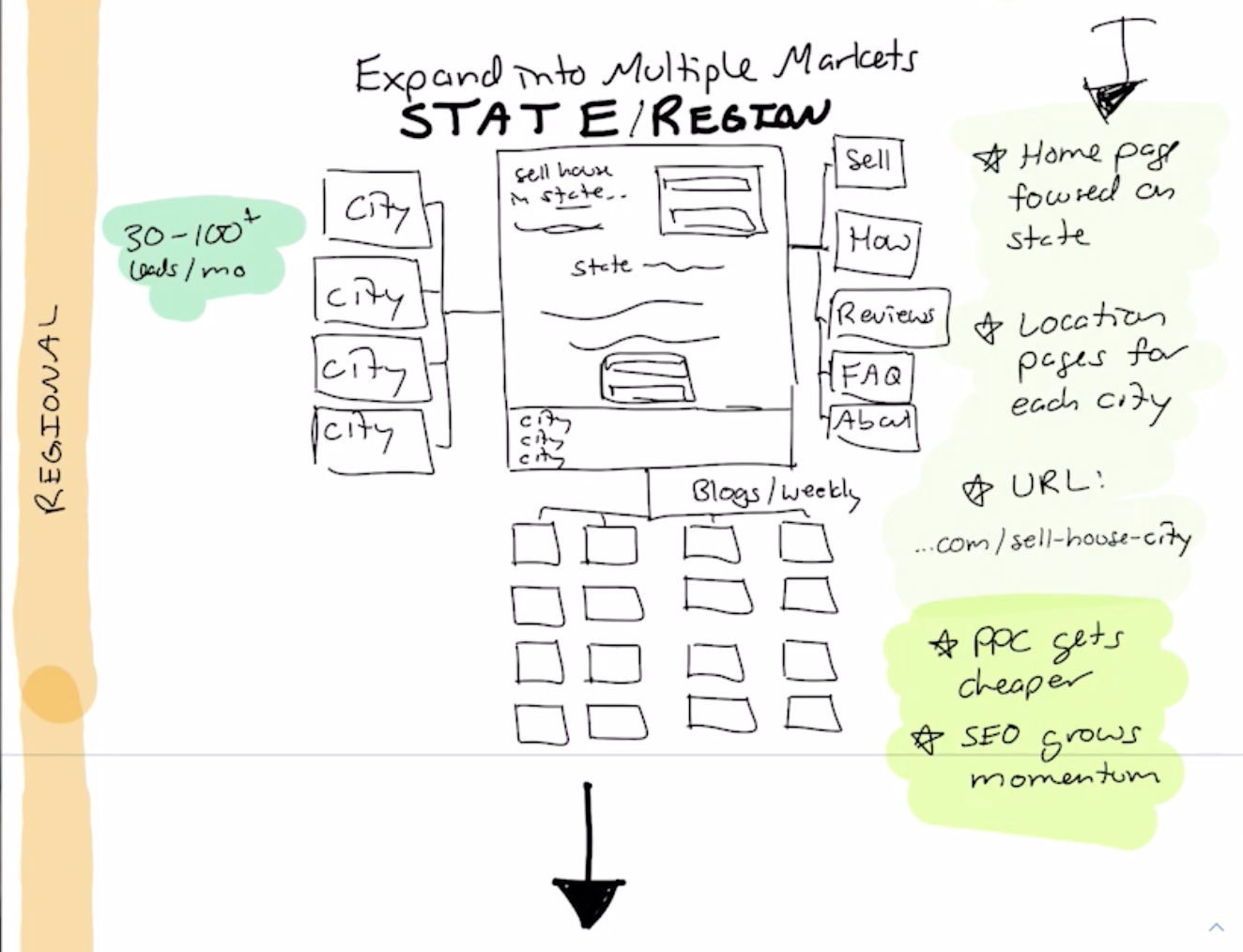
    The regional or state set up on your website is basically going to be kind of like this, the only real core differences are your homepage now, your homepages focus on the state.

    So, rather than your homepage focus on just one city, we’re going to focus on the entire state or the entire region that you operate in.

    If you’re in the entire state of Texas and you have four prime cities, Austin, San Antonio, Dallas, and Houston, as an example, then you’re going to have your homepage be, “Sell your house fast in Texas,” basically.

    Then you’re going to have pictures that have a broad array of pictures of the different markets that you buy houses in, or that you’re a real estate agent and/or an investor in.

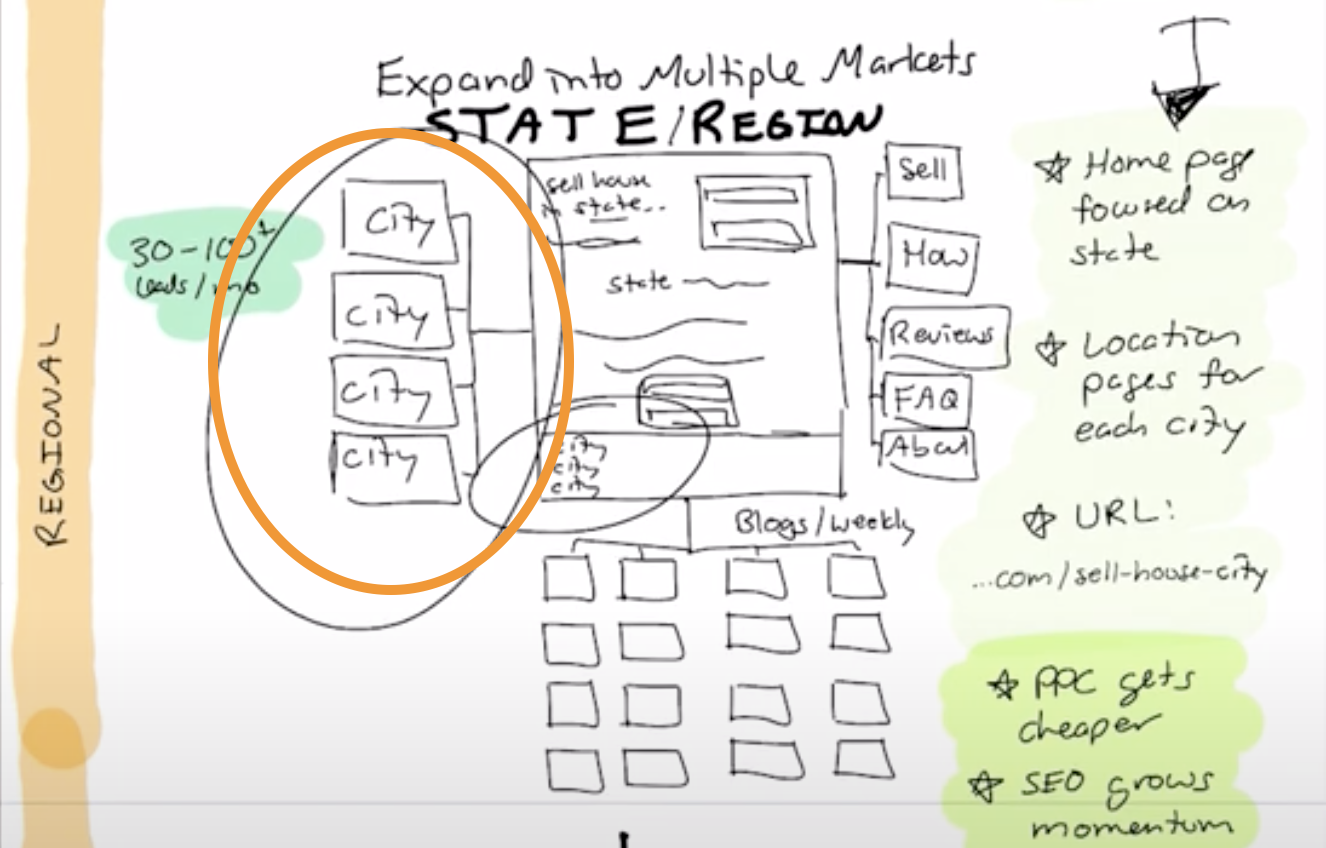
    Then down at the bottom of your website, you’re going to have a link to your prime cities in that state.

    You might link up to five, six, seven, eight of your cities to those city location pages.

    Over on the left side, those are what we call location pages. So, you’re going to set up a new page for every single location or every single city in that state. Sell my house fast, Dallas. Sell my house fast, San Antonio. Sell my house fast, Katy, Texas. Whatever those cities are.

    city location page strategy
    City Location Page Strategy

    I want you to focus on just looking at those on a quarterly basis. Every quarter, do I need to add any new city pages or location pages within this state?

    Now, let’s say you’re in three, or four, or five states. You’re in a region. Your homepage would then be, “We buy houses in the tri-state area,” or look for tri-state investment properties.

    Then on the homepage, talk about the three states you do business in and maybe some of your primary cities. Then you would create pages for states and cities.

    Some advantages here, your homepage is focused on the state. You can start to rank really well at the state level and at the city level.

    Location pages for each city, like I said, now you can get those rankings in Google for each city. Your URL is going to look kind of like this, whatever it is .com, forward slash, sell your house in X, Y, Z city.

    Your PPC, this is where is where the lead costs get lower. If you’re marketing, doing Google PPC in just one market, your PPC cost is going to be the most it can possibly be because you don’t have a very broad targeting there.

    The broader you’re targeting, the lower your click cost tends to be.

    But once you start to get down in here into the state and region, and you’re marketing a wider audience, your PPC gets cheaper and your SEO momentum actually grows because now you’re setting up multiple pages in multiple cities, the 10th location page, 11th, 12th, 15th, ninth, whatever it is.

    As you built up the SEO and your overall domain name, each one of those is going to rank in Google faster and faster and faster.

    So, a lot of people ask, should I set up multiple websites? Should I have a website for every city?

    And my suggestion is, if it’s all for motivated house sellers and you are okay with having one unified brand that will work well in all those cities, then I would suggest setting up the one motivated house seller website that encompasses all of those cities because the SEO juice is going to feed into every location page you create, and they’re going to rank faster and quicker.

    National Website Strategy

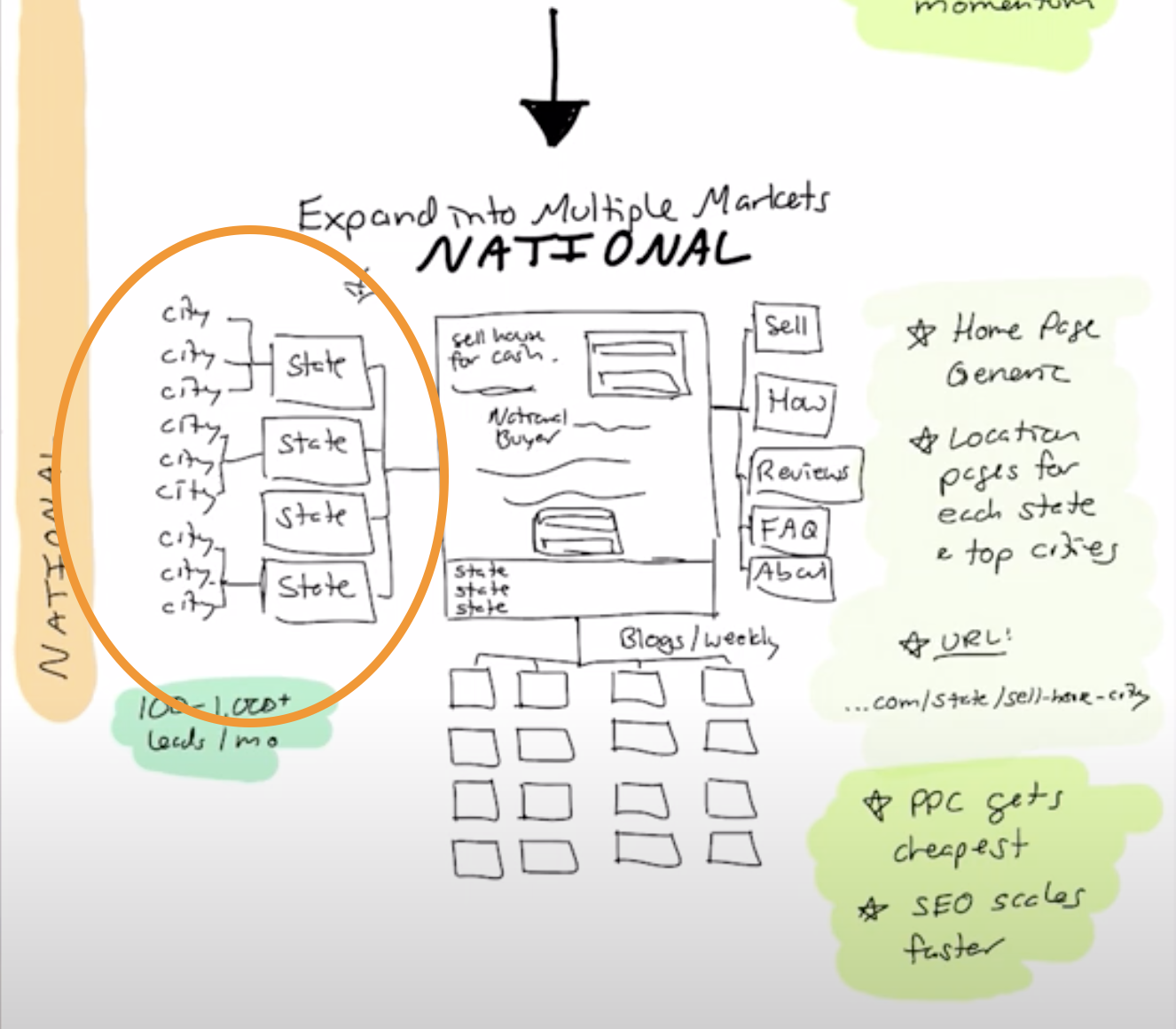
    So, now let’s say you want to go to the national.

    national real estate website strategy
    National Real Estate Website Strategy

    We have a lot of our clients using Carrot to do national house buying, national investment property websites, things like that.

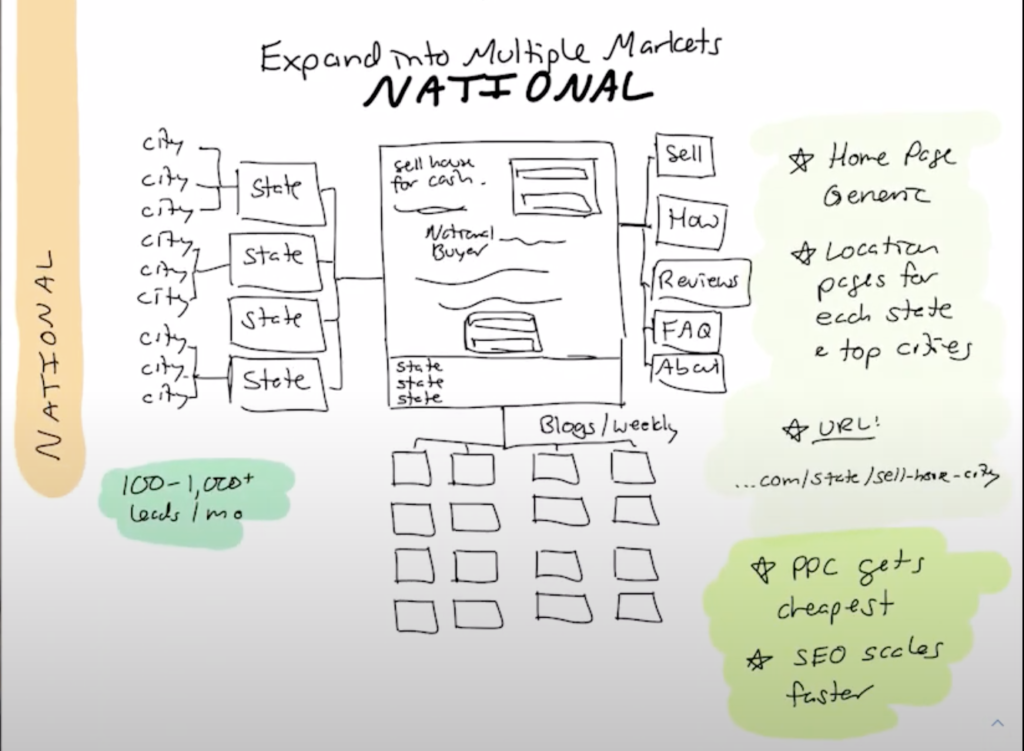
    The main difference that you’re going to do here is your homepage now is going to be more generic.

    So, rather than sell your house fast in Cincinnati or sell your house fast in Ohio, now it’s going to be “sell your house fast”, “how to sell your house fast for cash”, or “we will make you a cash offer on your home.”

    Then on that homepage, you’ll talk about that “we buy all around America” and then you might have a link to maybe some of your primary markets that you buy in.

    Link up to some of those states or some of the cities that are the primary markets that you buy in.

    Now what we’re going to do with our location pages is this, instead of creating location pages for a city at the root level, we’re going to create location pages for each of your primary states.

    state landing page strategy
    State Landing Page Strategy

    Let’s say you’re a national buyer, but you focus on 10 states. Create a location page for each one of those states. It could be “sell my house fast Florida”, or sell my house fast Georgia.” Basically, it’s “sell my house fast, insert state.”

    Now what you’re going to do is create city pages for each one of those states, which are the primary cities in the state that you buy in.

    If it’s Florida and your primary cities are Tampa, Orlando, and Jacksonville. You’re going to create a Jacksonville page, sell my house fast in Jacksonville. For Orlando, you’re going to create an Orlando page, sell my house fast in Orlando. You’re going to do the same thing for Tampa.

    Those would be underneath the state of Florida. This is what it would look like over here on the URL. It’d be your site .com, forward slash whatever that state is.

    So, that’d be Florida, forward slash Florida, and then forward slash sell my house fast Tampa.

    That would be the name of that page, sell my house fast Tampa. The name of that page would be Florida, or sell your house in Florida. That is your structure.

    Your PPC gets the cheapest here with this strategy. Now, this is where you’re going to start to get your $20 cost per lead. Your $30 cost per lead. Your $50 cost per lead in Google, in the exact same markets, that before you might have been paying $80 bucks, a hundred bucks, $150, $200 per lead in the exact same market.

    You might be saying, “Why is that? Why does the cost per lead in Google Ads get so much cheaper?” Or even Facebook if you go broader. Because you’re targeting a wider audience and when you target a wider audience, Google actually has more data to feed back into your campaign to get your click costs and lead costs lower.

    Your SEO scales way faster too.

    If you already have 10 20, 30 location pages, and you have some SEO juice on your website.

    When you set up that new page and that new market, it’s going to get ranked really, really fast, because you’ve already done all of this work.

    Creating this amazing national website with the state pages and the city pages, and you’re eight months in, a year in, two years in.

    Google loves your site. They see you as an authority, it’s got some great link juice. Every single page ranks faster now.

    At this level (national), you can expect 100 to 1,000 leads a month, depending on how well you’re doing the marketing. At the state and the region, you can expect between 30 and a hundred leads a month. Of course, depending on how well you’re doing your marketing and SEO and PPC.

    Recap: How to Grow Your Real Estate Business Into Multiple Markets

    Let me recap real quick.

    The best way to expand from local to national is to create a new cadence or new setup with your location pages.

    You go city and then state, and then also you start to scale out your Google Ads. Because as you scale out your Google Ads to more states, more locations, they get cheaper and cheaper.

    And that’s how the big lead generation services do it. That’s how our biggest clients do it and get way more leads at a way cheaper cost because they’re going national.

    Check out our other videos in this series and on our YouTube channel.

    Hit the subscribe button on our YouTube channel because every single month, we put out new content that teaches you how to be an investor or an agent, or a hybrid investor agent, and generate more leads more consistently in an evergreen fashion on the internet.

    You can finally get more freedom, finally, make a greater impact with your business. Go to carrot.com/evergreen to check out our webinar on the topic of evergreen marketing. If you enjoyed this video, we’re going to dive way deeper into that training.

    Go to carrot.com/evergreen. Have an amazing rest of the week, like and subscribe to this video, we’ll see you in the next video.

  • Busted! 10 Inbound Marketing for Real Estate Investors Myths that Some ACTUALLY Believe

    Busted! 10 Inbound Marketing for Real Estate Investors Myths that Some ACTUALLY Believe

    10 Inbound Marketing for Real Estate Investors Myths

    Inbound marketing for real estate investors is essential for business growth. BUT…

    … for some of you, false ideas and beliefs are holding you back.

    They disempower you from taking action and making progress — because when you believe something isn’t going to be worth it, then you’re not going to do it and, you’re certainly not going to invest in it. 

    And not doing something that would help your business grow is detrimental. 

    That’s why it’s essential, as real estate investors, that we examine our limiting beliefs for fallacious thoughts and ideas. 

    If you believe some of these myths… you’re leaving $1000s in potential deals on the table!


    Believe it or not… Here are the 10 inbound marketing for real estate investors myths

    The ideas that limit growth and hold you back from true success. 

    1. “I Get All of My Leads Offline, I Don’t Think I Need a Website”

    We’ve found that real estate websites can convert higher and are more profitable than offline leads.

    Plus, your website will be the central hub to track all of your marketing efforts. Even offline leads, from cold calling to direct mail.

    So, why do you need a website?

    The first is that you want to own your brand. You want to have a website to secure your name within your market, and a website is a perfect way to do this.

    You want to connect the website to your name, your company, and your brand since that’s what consumers are going to search for online, and you want to be sure that your website pops up and not a competitor’s.

    And this is true, too, about owning your name. You want potential buyers and sellers to Google your business name. Having a website will help to solidify yourself, your brand, and your company.

    Think about it: even when you give a seller a business card, they’re likely going to lose the card or not even look at it when searching for your company.

    You want them to be able to Google your name and find your website easily. Start with that fundamental assumption that they are going to Google you and that having a website to lead them to after this search will help you keep them in the long run.

    Besides lead generation and owning your brand, last but not least, a reason to have a website is convenient for you and your clients.

    Often, sellers, even if they’re very interested in working with you, will appreciate the convenience of filling out your contact form and then having you get back to them.

    Potential leads also like to search websites to call or reach out on their own time, which a website helps them do by providing them with contact information and on-site fill forms.

    So just having that simple convenience of looking you up whenever they want and for how long they want will increase the likelihood that they will engage with you.

    It’s essential to control the conversation around your brand.

    2. “Evergreen” Marketing Can’t Support My Business

    In this blog post, we talked about the difference between two types of marketing efforts.

    We called them…

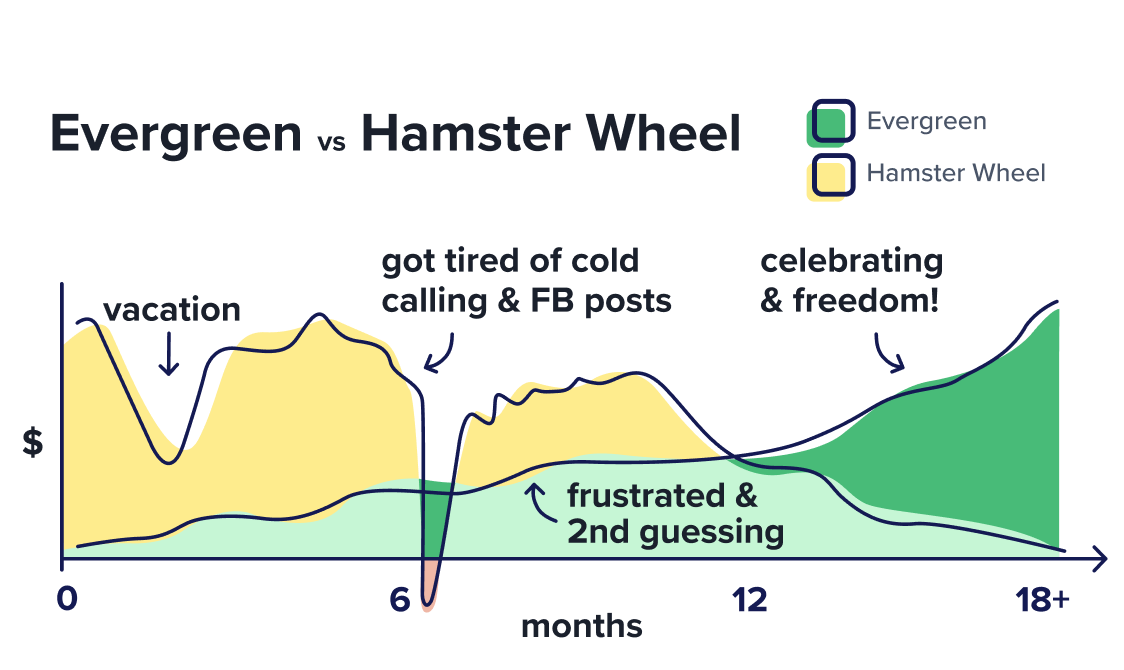
    1. Hamster wheel marketing
    2. Evergreen marketing

    Hamster wheel marketing refers to inbound marketing efforts that require you to keep working in order to get results. That includes running paid advertisements, sending direct mail, cold calling, and so forth. 

    These tactics are beneficial for real estate investors.. 

    But they’re not long-term or lasting

    They only work for as long as you work. 

    Evergreen marketing, on the other hand, refers to marketing efforts that have a lasting impact. You work on something today and it delivers results for years to come without any additional effort on your part.

    This includes building your website’s search engine rankings and creating a well-known brand in your community that generates word-of-mouth. 

    These strategies are what we help investors with here at Carrot.

    We know that businesses built on the foundation of Evergreen marketing are much more resilient, profitable, and predictable.

    Check out the video to learn more about this distinction…


    Evergreen Marketing: How To Finally Get Off Marketing Hamster Wheel and Convert Leads 2-4x Higher

    And we’re here to tell you that Evergreen marketing can support your business — thousands of our members have experienced the difference for themselves. 

    That doesn’t mean you won’t still do some hamster wheel marketing to fill in the gaps, but Evergreen can be the foundation and driving force for your business. 

    And when it is, everything changes.

    3. You Can’t Determine the ROI of Online Marketing

    Let’s think about online, inbound marketing, practically for a moment. 

    If we’re talking about word-of-mouth and SEO (Search Engine Optimization), how are you going to prove the ROI of your marketing efforts? 

    The ROI of SEO, for instance — the best Evergreen marketing tactic we know of — is inherently difficult to track.

    And if you hire a content writer, an SEO agency, and a custom website designer… then the cost will climb fast.

    Heck — it might take years to get a positive ROI from your investment. 

    That’s why we’ve made the process easier. 

    With specialized real estate website services, such as Carrot, you get…

    • A website that is built to rank in Google AND to convert visitors into leads. 
    • Done-for-you content every month that’s optimized for various keywords in your market. 
    • Keyword trackers that report your SEO rankings. 
    • An SEO tool that helps you easily optimize the content on each page of your website. 

    And more…

    This makes it easier to rank in Google, and it makes it easier to prove the ROI of your efforts. 

    Our highest-level plan is $199 per month — it includes all the goodies and features to get your website ranking as quickly as possible. 

    Per year, that’s $2,388. 

    How much is your average profit on a deal? $5,000? $10,000? 

    If you sign up for Carrot and get just one deal over the next 12 months from SEO… you will make at least double your money. 

    And chances are, you’re going to get more than just one deal through SEO.

    4. Online Marketing Lead Quality Isn’t That Good

    To some degree, SEO puts the power in the hands of the searcher and website visitor — they can browse, click, and read whatever they want. 

    And so you might be tempted to think that, since the power is entirely in their hands, lead quality is going to suffer. 

    The opposite is true.

    Lead quality can skyrocket when you focus on SEO.

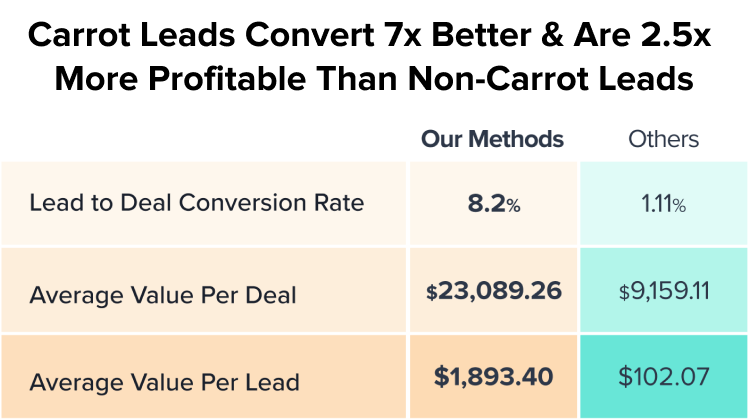
    Our members’ survey found that Carrot leads convert 7x better and are 2.5x more profitable than non-Carrot leads!

    carrot leads vs non-carrot leads

    That’s because “Carrot leads” often come through Google rankings. But, this can be from any website ranking on the top of Google.

    And it makes sense that Evergreen marketing leads would be higher quality than hamster wheel marketing leads. 

    Think about it… 

    Paid advertising, direct mail, and cold calling are all types of interruption marketing methods. You interrupt the person when they are doing something completely unrelated to what you want to talk to them about.

    (Which the exception of Google Ads)

    For SEO, however, the person is actively looking for your services

    Maybe they type in “Sell my house fast in ” or “Cash buyer in ”.

    Either way, those people are looking for your services and they’re going to…

    • Turn into deals more regularly
    • Be willing to accept lower offers

    These people are already looking for you online in your market… your job is to improve your website’s visibility so that you’re the one they come to visit.

    5. Online Marketing is Too Expensive

    This objection is very similar to the second objection we talked about — that you can’t prove the ROI of Evergreen marketing. 

    And it should be a concern if you plan to spend thousands of dollars per month on your Evergreen marketing efforts. 

    If possible, you need to make sure that that investment is paying off. 

    What if there were a less expensive and just as effective way to improve your rankings and drive results? 

    What if there were a way not to hire a web designer, an SEO agency, and a content writer?

    That’s what we, as well as other real estate services, offer — all of the above gets packaged into one affordable monthly plan. 

    Carrot gives you a high-converting website, monthly SEO-focused content, and all the tools you need to improve and track your rankings with ease. 

    And our plans start at just $69 per month

    6. My Business Just Relies on Word-Of-Mouth

    Maybe you don’t have a website, and you don’t think you need one.

    Maybe your business relies on word-of-mouth to generate leads and close deals.

    First of all, good work. Creating a business that generates word-of-mouth is an enviable feat — one that you should be proud of. 

    BUT…

    If you don’t have a website, then you’re missing out on…

    • Having a more streamlined business
    • Having a more predictable monthly income
    • Generating consistent leads and deals

    In fact, for five years, Robert and Ricky Grand — real estate agents and investors in Eugene, Oregon — depended on word-of-mouth to find deals. 

    And it was going okay. 

    But here’s what they said after joining Carrot…

    “I’m 100% all-in with Trevor and Carrot. They know what they are doing. Yes, they are a business with the goal to be profitable, but these guys care and are totally on our side.

    Honestly, working with Trevor and his team is refreshing. I trust them and don’t second guess anything. If Carrot gives us feedback, we implement it without wondering if there is a catch.

    Hope it helps to hear it from someone who is a customer. I happily spend the money to work with them.”

    – Ricky Grand, Grand Real Estate Investments

    In just four years, these guys transformed their word-of-mouth-based side-hustle into a full-time 7 figure business in large part because they dove headfirst into Evergreen marketing and supplementing with Google Ads.

    Check out their story here.

    7. A Website is a Website

    Maybe after reading that last section, you think that you do need a website.

    Your next thought might be, Well, I’m just going to keep it simple and build a basic website with WordPress or something. “I can get WP and hosting for under $10/mo or Wix for cheap.”

    Because a website is just a website, right? 

    Wrong. 

    Not all websites are created equal. There’s a lot of stuff that goes into building a high-converting website — from tech stack and page speed to sales copy and conversion optimization.

    There are many options, but services such as Carrot are designed for real estate professionals. We have proven data to back up our claims that we will help our members rank higher and produce more leads to close more deals.

    Everything from the fastest page speeds to custom-written SEO content and an automated content delivery system. They are guaranteed to help you rise above the competition.

    You don’t just need a website. 

    You need a website that…

    • Ranks in Google for high-value keyword phrases
    • Converts visitors into leads systematically

    That’s what we offer at Carrot. 

    We’ve spent over a decade studying the psychology behind motivated sellers. And we’ve taken what we’ve learned and baked that right into our website templates…

    … so your website is virtually guaranteed to convert better than your competitors. 

    real estate investor website conversion optimization

    And to give you a glimpse of just how much better our tech stack is than other popular website builders, check out this article.

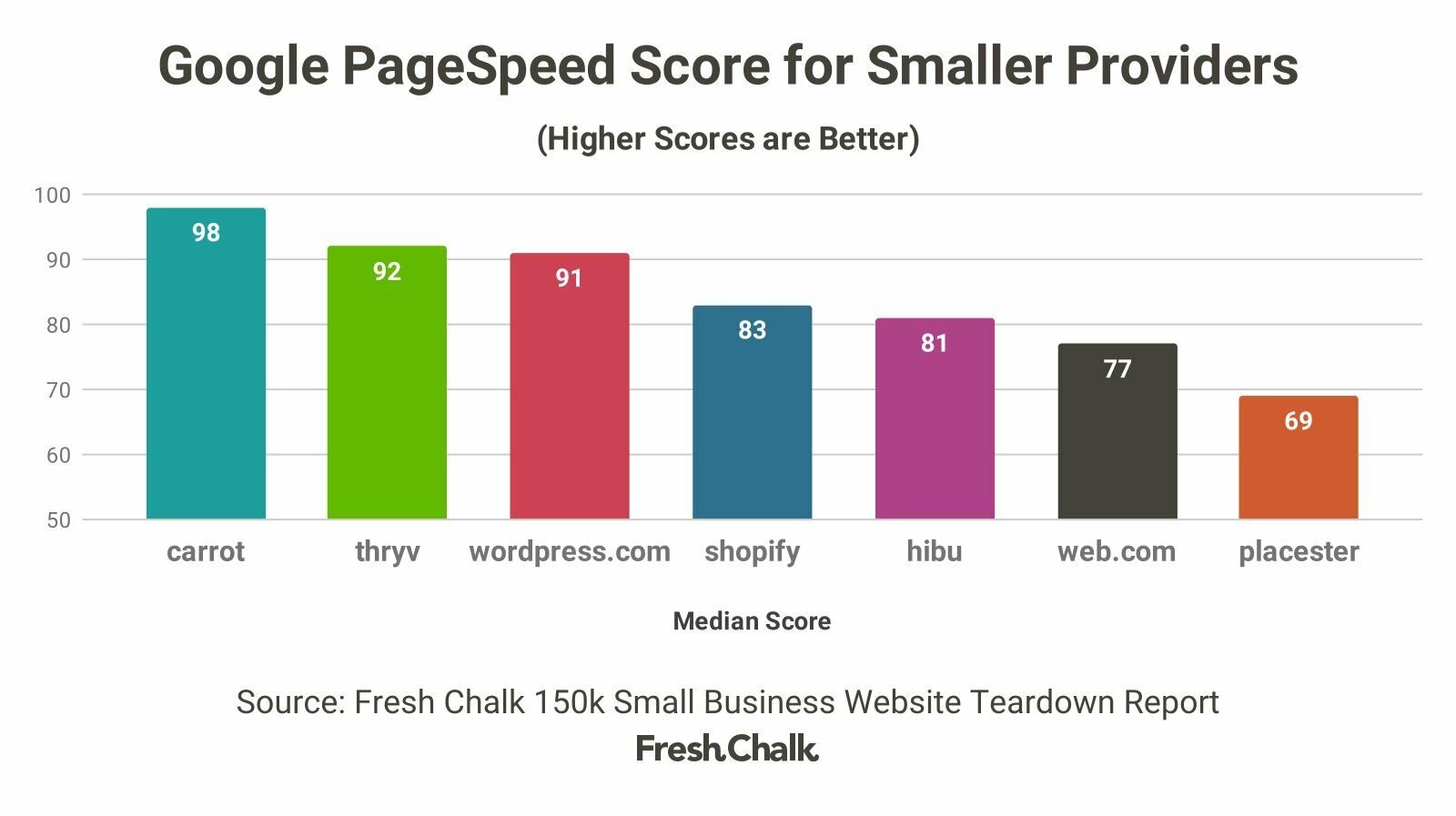
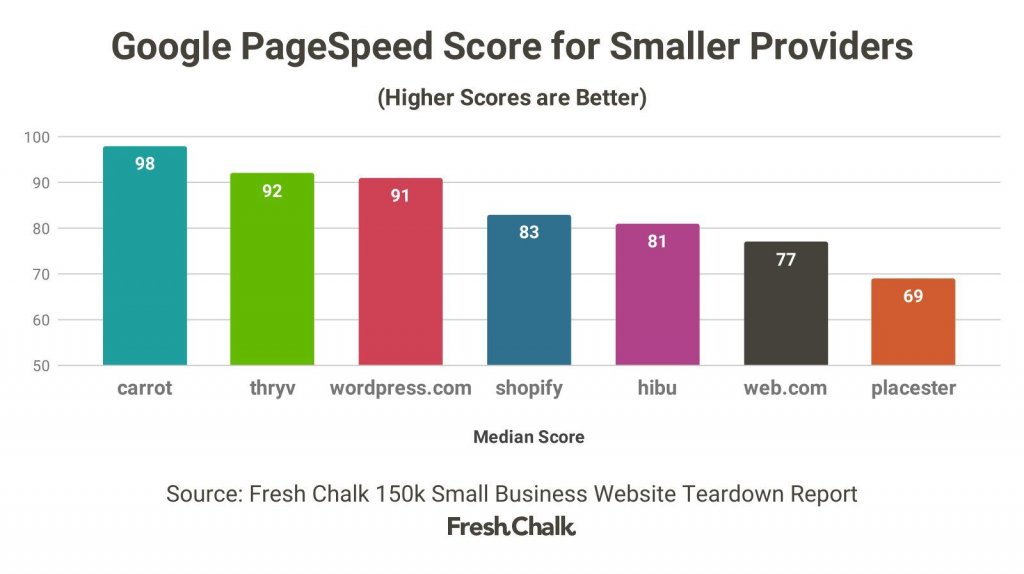
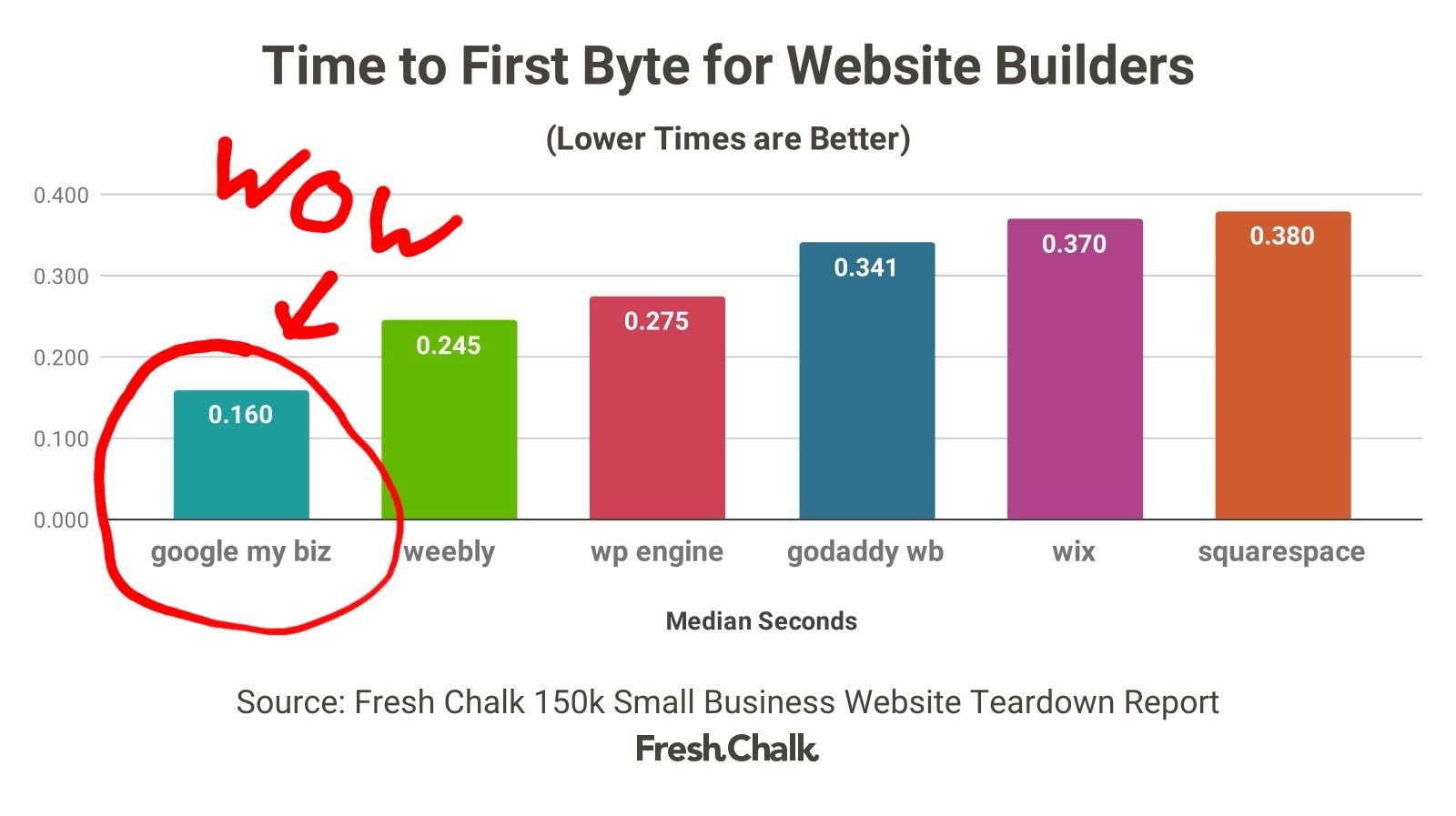
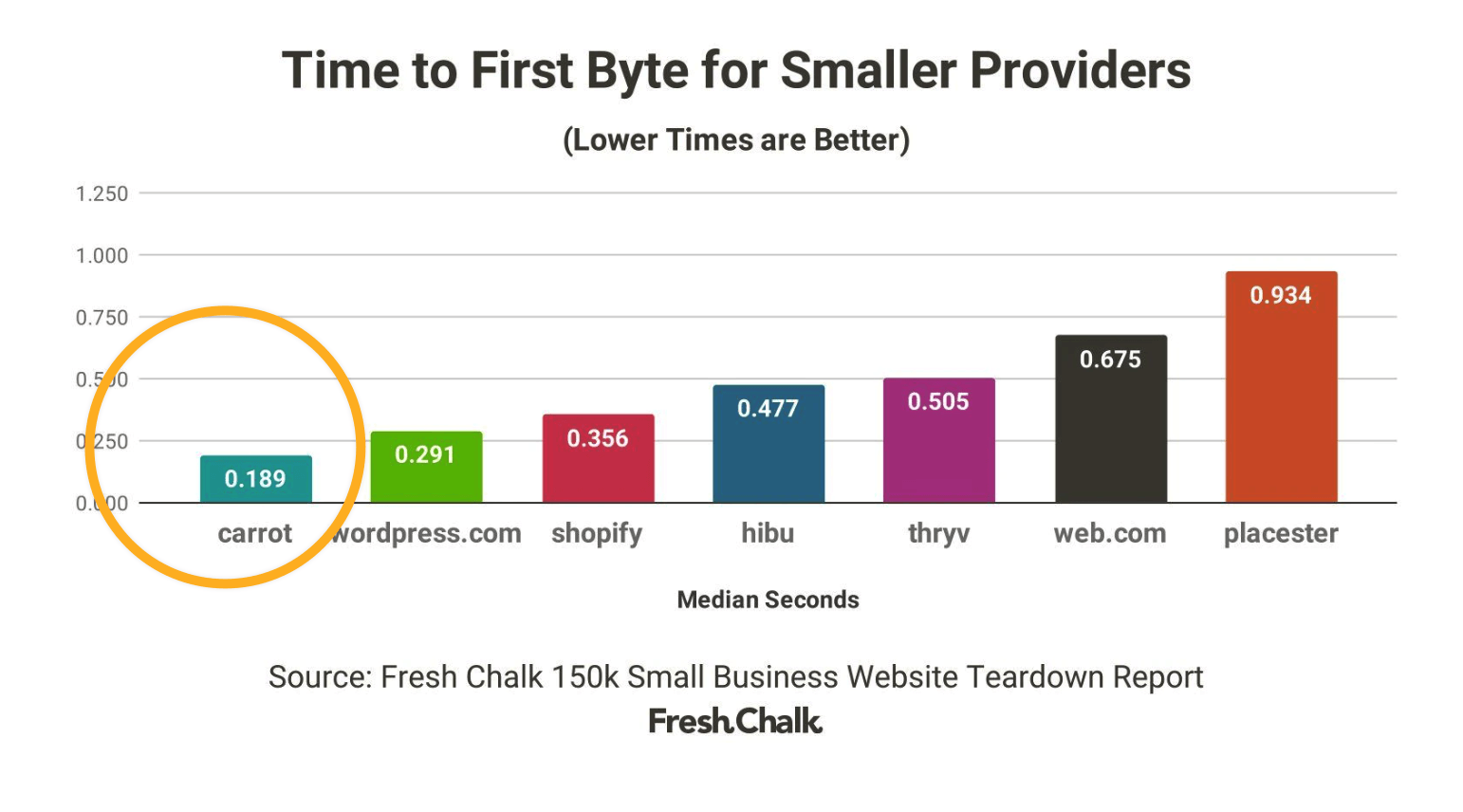
    A third-party examination of 150,000 websites found that Carrot’s tech stack outperforms practically every other website builder…

    Google PageSpeed Score for Small Providers

    So no… a website isn’t just a website. 

    You need a high-performing website. 

    And at Carrot, we worry about that so you don’t have to. 

    “We couldn’t be happier with the site so far…What we have seen is a DRAMATIC increase in web leads.  Since switching to Carrot, the leads we are getting are converting to purchases at a MUCH higher level.  

    Things have been moving so fast that we haven’t had the opportunity to accurately determine the lead to purchase ratio, but I would estimate it is in the 25 to 35% range, which means the leads we are getting are significantly better than our historical average.

    Thanks for everything and we are now looking at expansion because of the success we have had in such a short time.”

    – Carter Steph, 18002SellHomes

    8. Paid Advertising is All My Business Needs

    Many real estate investors solely rely on hamster wheel marketing methods to keep their business afloat…

    • Direct Mail
    • Facebook Ads
    • Cold Calling

    And as we’ve said before, that’s not necessarily a bad thing. 

    We think that those tactics should be a part of your business — they’re a great way to build brand awareness and create a consistent flow of leads. 

    But should they be the foundation? 

    We don’t think so. 

    Because the moment you stop spinning the wheel is the exact moment that deals stop coming through your day.

    What if, instead, you could build a marketing system that generates traffic and leads for your business for years to come without any additional effort or budget? What if those leads were high quality and turned into deals at an exceptional rate?

    That’s the power of Evergreen Marketing. 

    You might not need it. 

    But “need” is just a matter of perspective…

    If you want to create a business with predictable monthly lead-flow, if you’re going to generate more high-quality leads and make more money on every deal… then yes, you need Evergreen marketing.

    9. My Website Doesn’t Need to Be Mobile-Friendly

    This is a myth that’s easy to knock down. 

    If you think that your website doesn’t need to be mobile-friendly, consider the following statistic we’ve pulled from our Carrot member’s sites — and keep in mind that these investors come from different places all over the nation…

    Over 60% of our member leads come through mobile devices.

    Carrot member mobile leads

    So yes, your Carrot site does need to be mobile-friendly

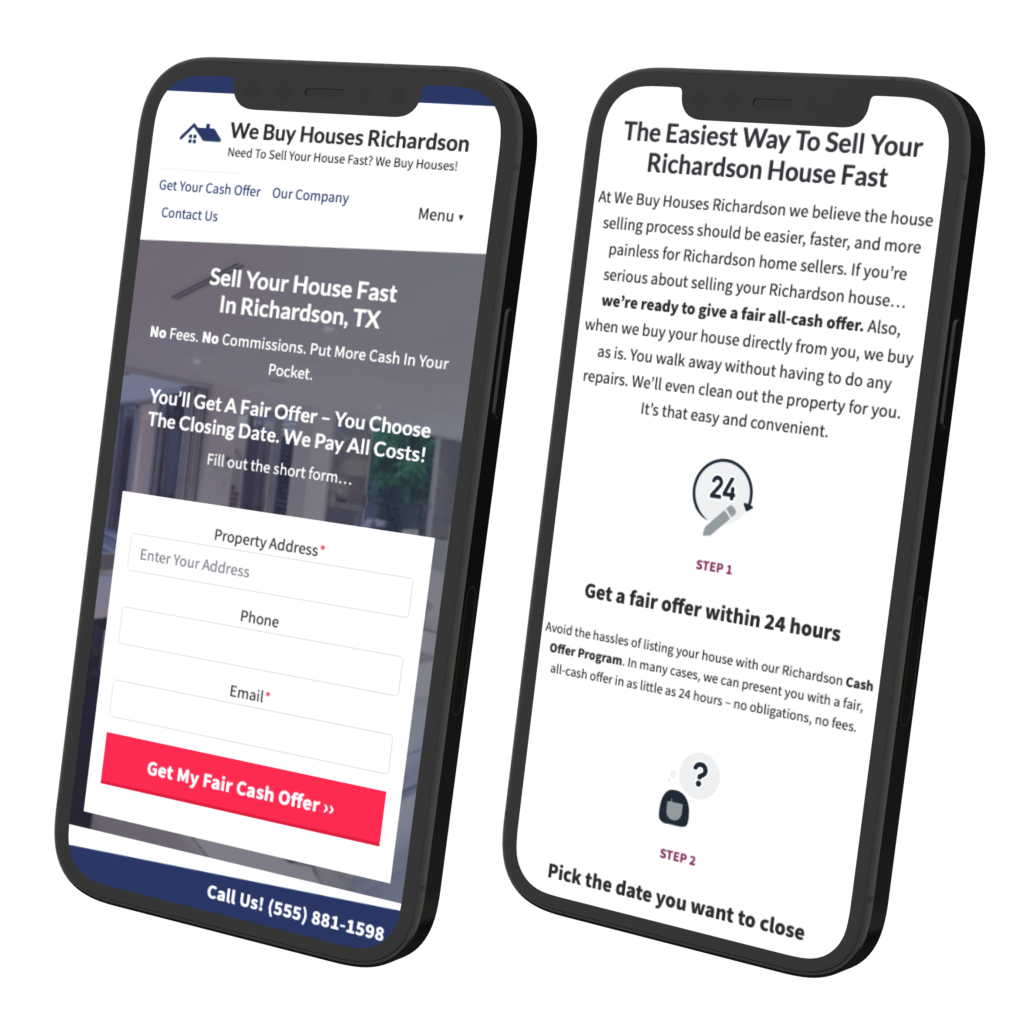
    And lest you try to build your custom site and make it mobile-friendly — which will cost you a ton of money — every single one of our website templates is automatically optimized for both desktop and mobile. 

    Let’s take, for instance, one of the most recent Google Algorithm updates… Core Web Vitals. Page speed on mobile devices was a hot topic. If mobile page speed isn’t up to par, your Google ranking could suffer.  

    10. SEO Takes Too Long to See Results

    Maybe you think that you can build a WordPress site and just do a little bit of SEO research and then do a little bit of optimizing. 

    You could

    But should you? 

    Here’s what we know — if you do a little bit of SEO work, that’ll result in a little bit of SEO traffic (if you’re lucky). 

    Any reputable SEO agency will tell you the same thing, SEO takes time.

    And if you want a lot of SEO traffic, then you’ve got to put in a lot of work.

    While some can see quicker results, it is ultimately determined by different variables before seeing how rankings settle in 4-12 months.

    Some of these variables include:

    • Relevant keywords and topics
    • How much content you have relating to those keywords and topics
    • Quality of content
    • Age and speed of the websites and domain
    • Website design, including ease of use
    • The average time a user stays on the site
    • Geographical location
    • Competition
    • Level of social activity
    • Page-speed

    Again, we know this takes time and hard work. But, once your Evergreen – SEO marketing kicks in, you can sit back and reap the benefits. Highly qualified leads will come to you rather than you seeking them out.

    You could just get yourself a Carrot website and we’ll do it for you or check out our guide for real estate SEO.

    Overall, there’s no shortcut to ranking in Google. 

    Make These Myths a Thing of the Past

    Hopefully, you’ve acquired a new perspective on some of your limiting beliefs. 

    As we said at the beginning, having a misconception of inbound marketing for real estate investors can limit your business growth. 

    If you’re not a Carrot member yet and are curious to see if this can help you generate more leads online (motivated sellers, buyers, tenants, note sellers, etc.), take our demo and check out what Carrot has to offer.

    But enough from us — what limiting beliefs have you had to overcome in order to move forward in your business? We’d love to hear about it in the comments!

  • Carrot Leads Convert 7x Better & Are 2.5x More Profitable Than Non-Carrot Leads

    Carrot Leads Convert 7x Better & Are 2.5x More Profitable Than Non-Carrot Leads

    We recently surveyed our Carrot members about their lead-to-deal conversion rate — that is, what percentage of leads become deals. We also asked them about the source of these leads (Carrot leads or Non-Carrot) to determine which efforts provide the most high-quality leads and thus the most deals.

    The results were exciting. They indicated that Carrot leads convert 7 times better and are 2.5 times more profitable than non-Carrot leads.

    carrot leads vs non-carrot leads

    This is something we’ve known anecdotally for a long time — from all of the reviews we’ve received from our members. For example…

    “Carrot literally changed my life. Trevor and his crew are the best people on the planet. Get plugged into their system and culture, and you will start generating leads!” – Brian Rockwell


    “I have generated just over 200 leads in a little over 4 months using my Carrot site. I couldn’t be more thankful for the services they have provided. Thank you Carrot!” – Hank Tobler


    “Closed 3 deals exclusively from SEO leads / Carrot conversions. No PPC. No attribution to any Facebook ads. Just Google search results and credibility.” – Daniel DiGiacomo

    … but still, it’s refreshing to see the actual data.

    Let’s take a look!

    Not a Carrot member? Take a free demo…

    The Survey Data & What it Means

    To be clear, non-Carrot leads refer to any leads that didn’t come through an investor’s Carrot website. Maybe they called, texted, or emailed instead.

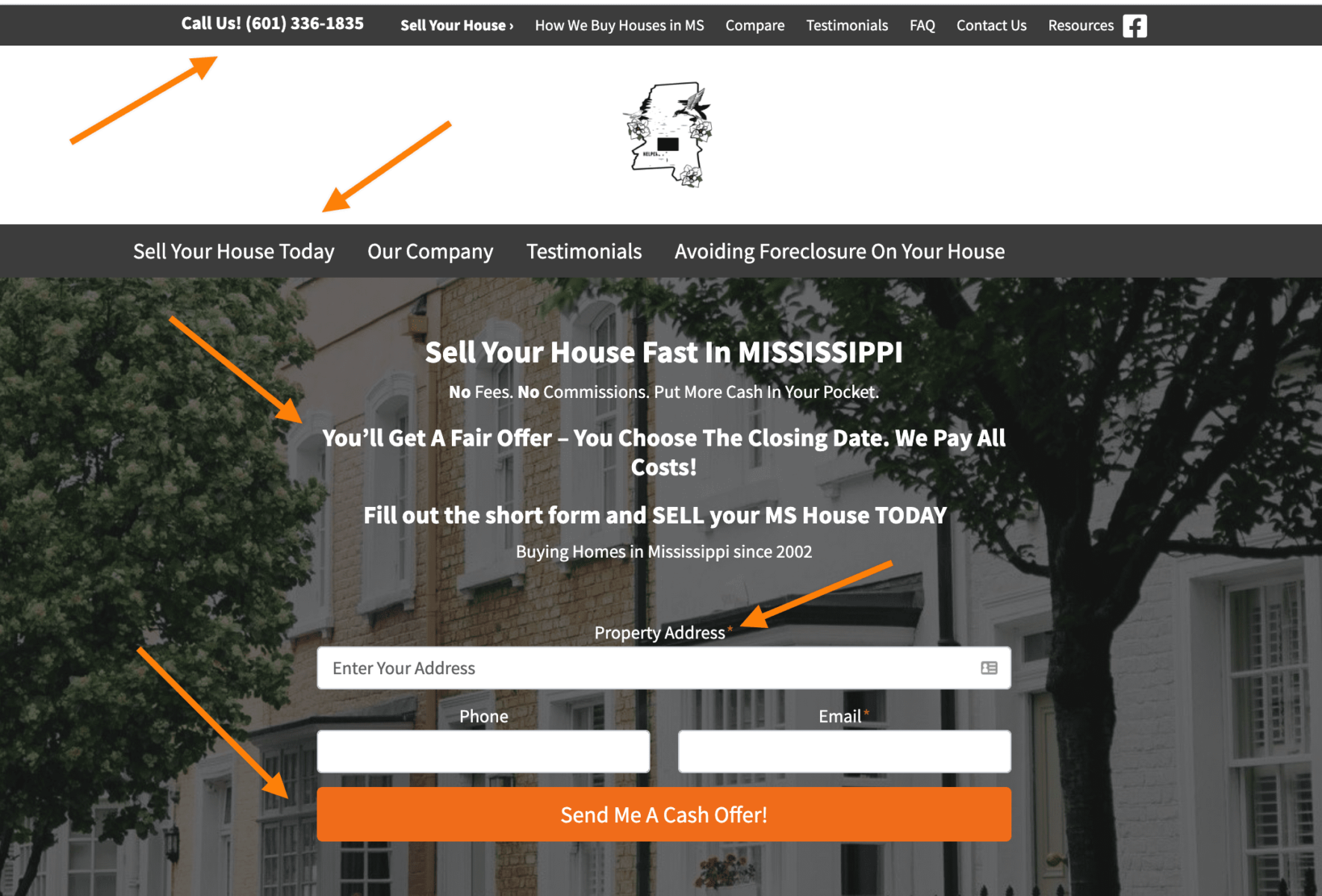
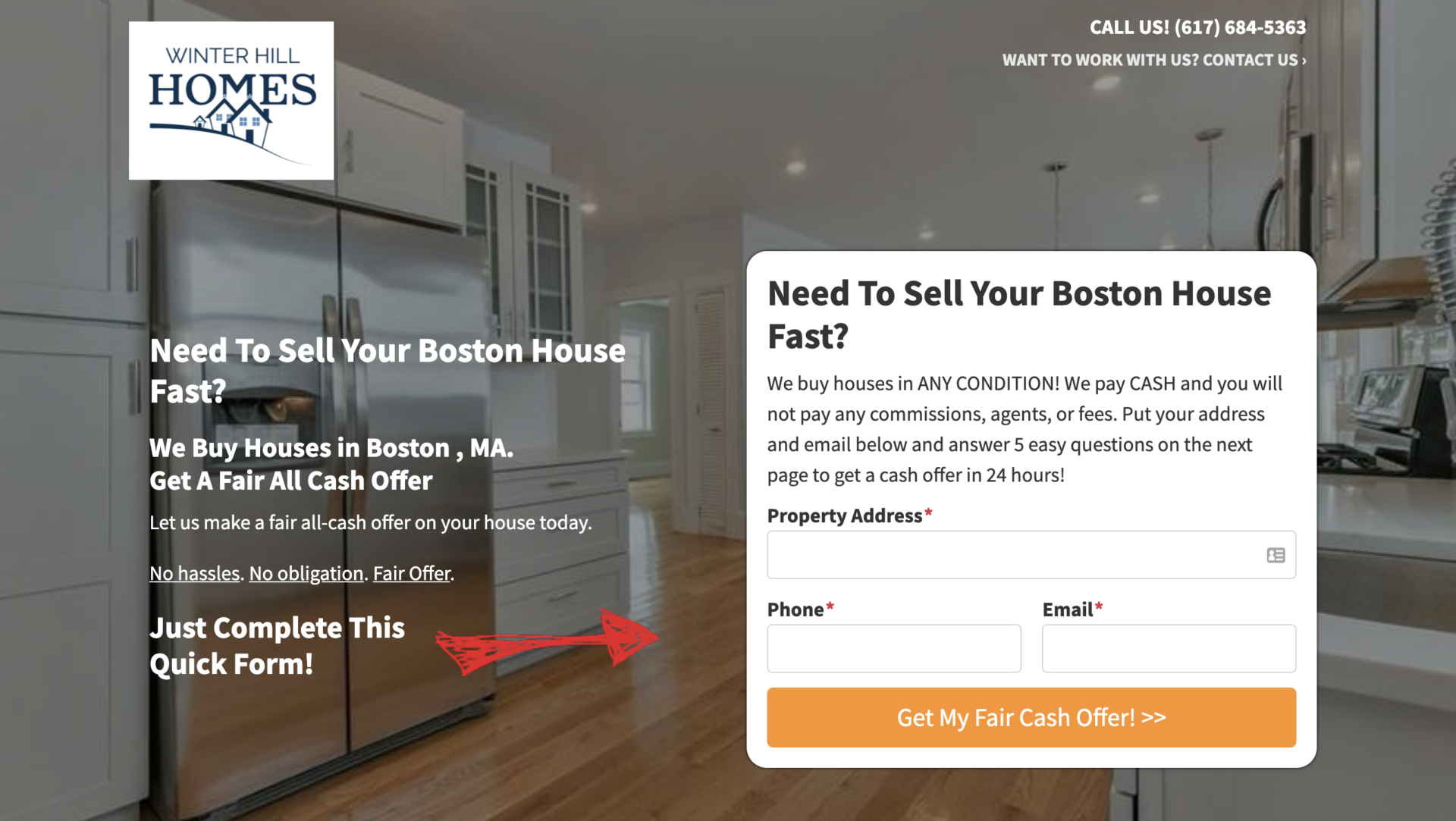
    Carrot leads, naturally, refer to any leads that came through the investor’s website. They visited and opted into a CTA that looks something like this…

    Carrot investor website hero section

    So, what exactly were the results?

    Well, we asked Carrot members for their lead-to-deal conversion rate and their average value per deal for both Carrot and non-Carrot leads.

    We then used those numbers to calculate the survey respondents’ average value per lead.

    Here are the Carrot vs. Non-Carrot results:

    Carrot lead vs non-carrot leads per deal

    Amazing, right?

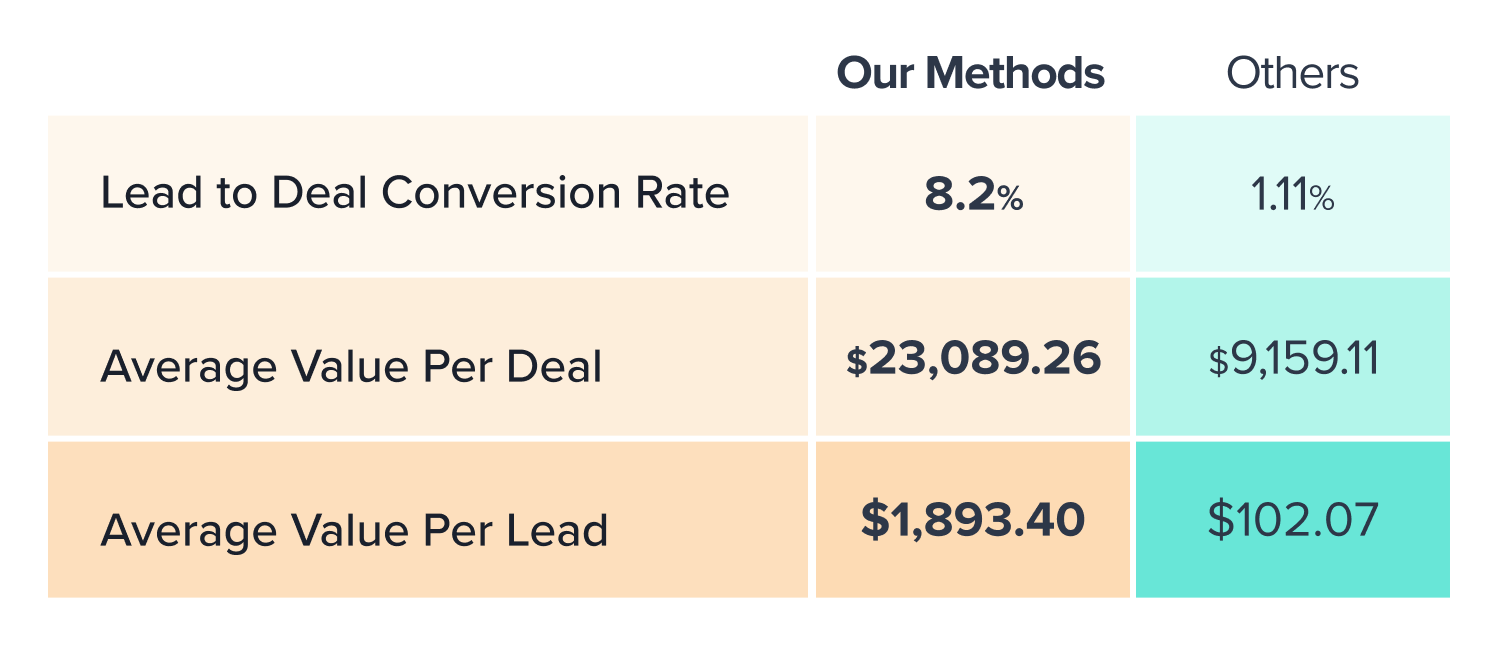
    Carrot leads had an 8.2% lead-to-deal conversion rate, while non-Carrot leads had a 1.11% conversion rate.

    Even more surprisingly, Carrot leads that became deals had an average value of $23,089.26, and non-Carrot leads that became deals had an average value of $9,159.11.

    That makes the average value per Carrot lead $1,893.40. That is enough to pay for an entire year of our top subscription plan, by the way! And, the average value per non-Carrot lead is $102.07.

    Something is going on here, and let’s talk about that.

    But before we do, understand that we’re not saying you shouldn’t generate leads one way, but you should generate them another.

    Every real estate investor has to find what works for their business and their market, which usually is a mishmash of various marketing tactics.

    Here, we’re just looking at some high-level trends that might be helpful for investors to consider.

    Why are Carrot leads so much better than Non-Carrot leads?

    There are essentially two questions we have to answer.

    1. Why do Carrot leads become deals much more frequently than non-Carrot leads?
    2. Why do Carrot deals have much bigger profit margins than non-Carrot deals?

    And the first thing we need to examine is where these leads are coming from. After all, the source determines the quality.

    Non-Carrot leads is a broad term that includes a lot of different sources: cold calls, inbound calls from direct mail campaigns and door knocking, flyers, business cards, bandit signs, and so forth.

    You might not notice it at first, but all of those sources have a similarity: they all represent outbound marketing efforts.

    That is, you go out and try to find people who might be interested in selling their home. You offer them a fair cash offer and a quick turnaround time. You do this by sending them mail, knocking on their door, or calling their phone.

    Of the people who contact you via outbound marketing methods, it’s safe to assume that many of them are just curious. They’re not motivated to sell by any particular circumstances in their life, but your offer caught their attention, and so they call you to find out more.

    That’s how most non-Carrot leads are generated.

    Now let’s look at Carrot leads.

    We’ve built Carrot websites with wicked-fast load speeds, mobile friendliness, and a clean tech stack.

    Carrot sites rank for high-value phrases in Google more than any other site builder in the industry (terms like “sell my house fast in ” or “sell my house for cash in .”

    Third-party data from Fresh Chalk pointed this out. Here are page speed scores for different website builders (a huge factor for Google rankings).

    Fresh Chalk pagespeed test results

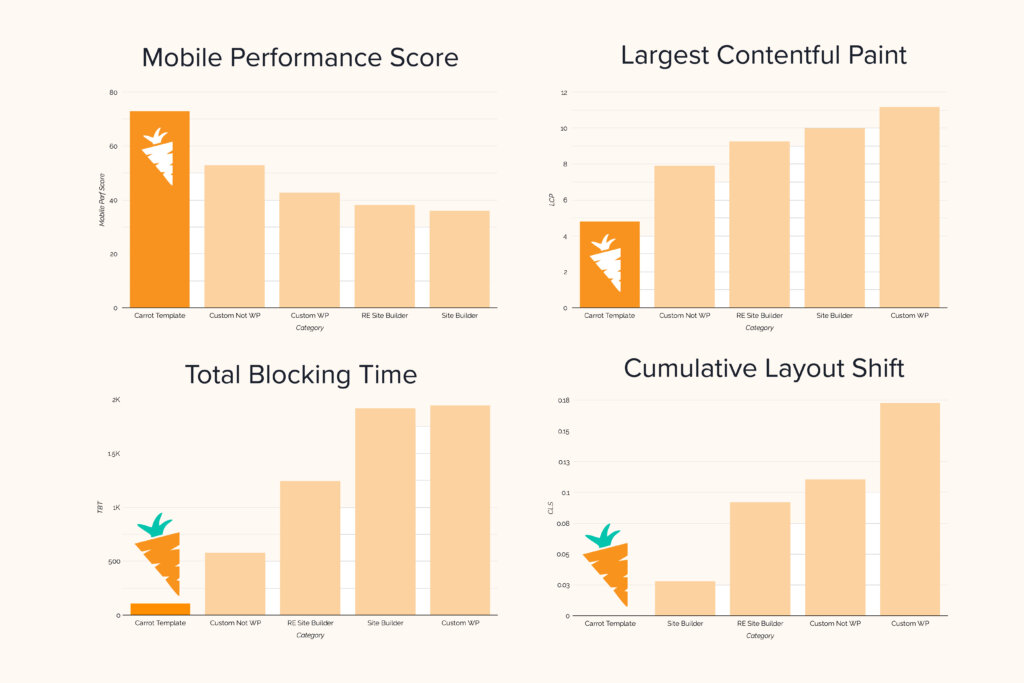
    The same is true for Carrot’s mobile performance (which is now a huge part of internet traffic).

    This graphic represents the recent updates that Carrot developers have made to our member sites to get ahead of the latest Google Core Web Vitals update. Learn more about what this graphic means and the changes that we made here.

    Carrot website mobile speed Core Web Vitals Update

    But that’s only one of the many reasons that Carrot sites sit at the top of the rankings.

    The secret to quality lead mastery

    Our members also create Evergreen content for their blogs every single month, content that’s optimized to rank in Google.

    We also give our members the ability to:

    • Track their rankings right inside of their account. 
    • Ensure that every page and post is optimized to rank (via a simple checklist). 
    • Create long-form evergreen content by transcribing video content with the click of a button (VideoPost). 
    • Publish weekly blog content with a click of a button.
    • And so much more!

    This is the difference between hamster wheel marketing

    “If you’re creating a piece of content and you just put it up on Facebook or Instagram, it’s going to be there for 24 to 48, maybe 72 hours before it gets pushed down, forcing you to get back on the hamster wheel and post again, and post again and post again, because the life span of that content is so short.

    The lifespan of that content is so short that you have to be on the hamster wheel continually.

    If you get off of the hamster wheel, if you stop doing those postings, if you stop doing direct mail, if you stop cold calling or doing RBMs, then your leads will eventually dwindle to a stop, and you’ve got to restart and get back on the hamster wheel.”

    … and Evergreen Marketing

    “Get into a routine of creating content. Another piece of content this week, another piece of content next week, a blog post next week, a video post, a video post, a location page, and eventually, you’re going to have a brick wall that does all of the work for you.

    Remember, it’s going to be slow going in the first three, four, five, six months potentially.

    But as long as you’re consistently stacking bricks of quality content that answers real questions from your market, you’re entertaining in your own way; you’re going to start to pick up that momentum.”

    At Carrot, we focus on evergreen marketing — consistent action that produces long-term results. 

    Evergreen marketing for real estate

    Now, why all of this information about Google rankings, page speed, and tech stack?

    Well, because of the way Carrot sites are built, they typically generate a good chunk of leads via evergreen marketing through search engines like Google — this means that motivated sellers find you rather than you trying to find motivated sellers.

    That’s called inbound marketing.

    And it almost always results in higher quality leads than outbound marketing.

    So that answers our first question.

    Why do Carrot leads become deals much more frequently than non-Carrot leads?

    There’s a high likelihood it’s because many of them are likely coming through search engines.

    When you think about it, it’s not all that surprising that outbound marketing leads tend to be lower quality than inbound marketing leads. It’s the difference between you looking for motivated sellers and motivated sellers looking for you.

    We get feedback about this difference all the time from our members…

    “I consistently get organic leads from my Carrot website. I have purchased my best deals to date through my websites. I highly recommend you implement training and tools available through the platform.” – Beau Eckstein


    “I’m getting 2x more motivated seller leads with my custom Carrot site than my old site, and the tools and content help me stand out in my crowded market.” – Tyler Ford


    “I am saving between $20,000 and $50,000 every single month in lost lead-gen closing potential after switching from my expensive custom-made site to my Carrot site.” – Carter Steph

    And it’s not just hearsay. When we take a peek at the source of traffic and leads for our members, we can see a good chunk coming from the organic content that Carrot helps to provide. So far, in 2021, organic traffic accounts for 25.8% of our member leads.

    carrot leads 2021 - organic

    But what about the second question: why do Carrot deals have more significant profit margins than non-Carrot leads?

    Part of the answer is likely the same as the first — since Carrot sites drive organic leads through search engines, investors don’t have to directly pay for those leads like they would have to with a direct mail campaign.

    This makes a big difference in per-deal profitability. But that’s not the entire story.

    Again, we have to look at where these deals come from.

    If someone receives your mailer and it makes them think about selling a property that they’ve owned for a while, and so they call you, they’re probably not going to be as willing or motivated to accept a lower offer.

    But if someone is actively looking for someone like you who can buy their home as-is for cash, they’re probably more motivated and thus more willing to accept a lower offer, which results in higher profit margins.

    And so that answers our second question…

    Why do Carrot deals have much bigger profit margins than non-Carrot deals?

    It’s because inbound marketing efforts are less expensive and generate leads that are more motivated to accept lower offers.

    Final Thoughts

    If there’s a lesson to be learned from all this, it’s about the value of inbound marketing.

    When you create an online presence that allows motivated sellers to find you, you can expect to generate much higher quality leads for less money and increase your per-deal profitability.

    That’s not to say that you should stop sending direct mail, cold calling, door knocking or driving for dollars. We are huge advocates of those strategies, and they support many Carrot member businesses!

    Perhaps a hybrid approach is best.

    Steadily invest in your online presence. Create a high-converting real estate website, start search engine optimization, create new content, and so forth to build a long-term source of lead generation.

    That will take time to start working.

    While you’re working on SEO and content, you can also run PPC ads and send direct mail to generate leads more immediately for your business.

    That’s the balanced approach that has worked for thousands and thousands of real estate investors, and there’s no reason that it won’t work for you, too.

    Click below if you’re ready to take the next step.

  • [Data] Carrot Websites Now 69.8% Faster Than Custom Websites on Mobile

    [Data] Carrot Websites Now 69.8% Faster Than Custom Websites on Mobile

    Back in June, we introduced you to the latest big update to Google’s ranking algorithm – Core Web Vitals – and promised we’d be back with more information about how our team here at Carrot has responded to make sure your site speed and performance are up-to-par when it comes to this latest update.

    Today, we’re back to let you know that not only have your Carrot websites just become 50% faster thanks to the upgrades from our Engineering team, but your competitive advantage in site speed and performance against your non-Carrot competitors has grown!

    Recap of Core Web Vitals

    Core Web Vitals are the latest elements to be introduced to Google’s search ranking algorithm. They were partially introduced to the algorithm in June and, as of the end of August, play a full role in Google’s ranking mix.

    It’s been proven that page speed impacts the conversion rate of visitors to leads on websites, and Google has taken steps to make page speed more of a ranking factor (while still a very low factor when compared to quality content, quality backlinks, etc.).

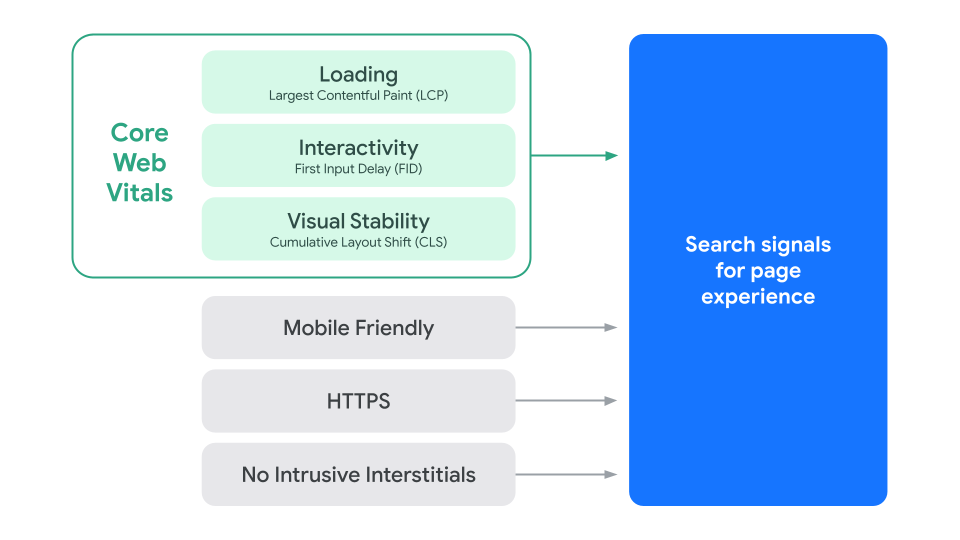
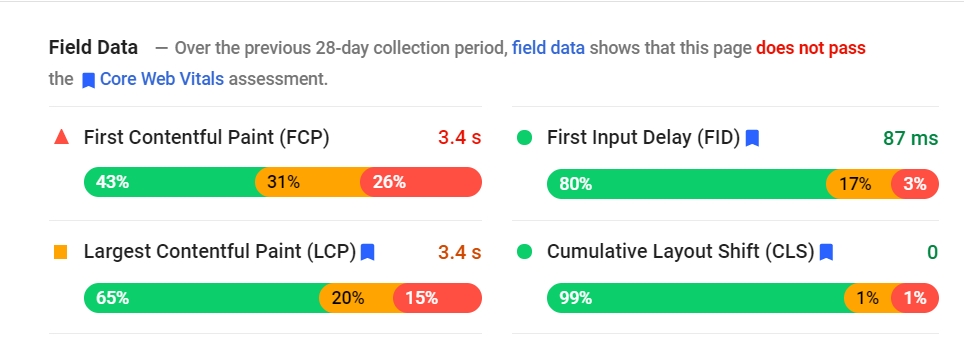
    While there are various things that go into determining overall page experience in Google’s eyes, Core Web Vitals generally apply to how quickly a site loads, how quickly it becomes interactive for a user, and how visually stable it is while it’s loading.

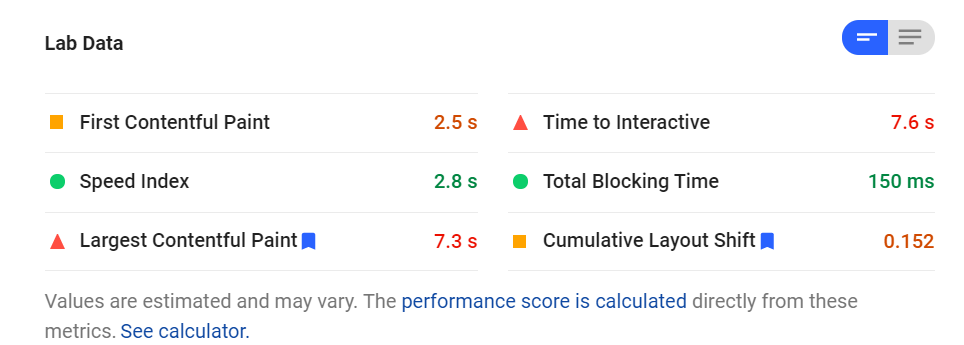
    The actual Core Web Vitals themselves are comprised of Largest Contentful Paint (LCP), First Input Delay (FID), and Cumulative Layout Shift (CLS). In plain English, the way your website code is structured and how clean it is, matters to page speed. Below the surface, there is a multitude of related metrics that can be used to determine how well you are doing at meeting benchmarks for those big three.

    How Fast Are Carrot Websites Already vs. The Big Tech Players

    As we’ve reported in the past, Carrot sites are known for being among the fastest in the world on desktop. A study of over 150,000 websites (real estate and non-real estate) showed that Carrot sites were faster than every other website builder they tested… except for one. We nearly tied with Google’s own, very simple, Google My Business websites.

    We’ve continued to keep this page speed edge for our clients (all included in every Carrot plan) on desktop.

    Now Onto Mobile Page Speed

    If you’ve run a report using Google’s PageSpeed Insights tool, you’ve probably noticed that mobile scores tend to be lower than desktop. There are a few reasons for that. The first reason is that, although technology has come a long way, phones simply aren’t as powerful as desktop computers. That’s obvious. The other is how mobile speed scores are tested – by using an older generation phone with a 3G connection as the testing “device.” That’s why we caution against reading too much into the baseline mobile scores you see when you run some of these tools.

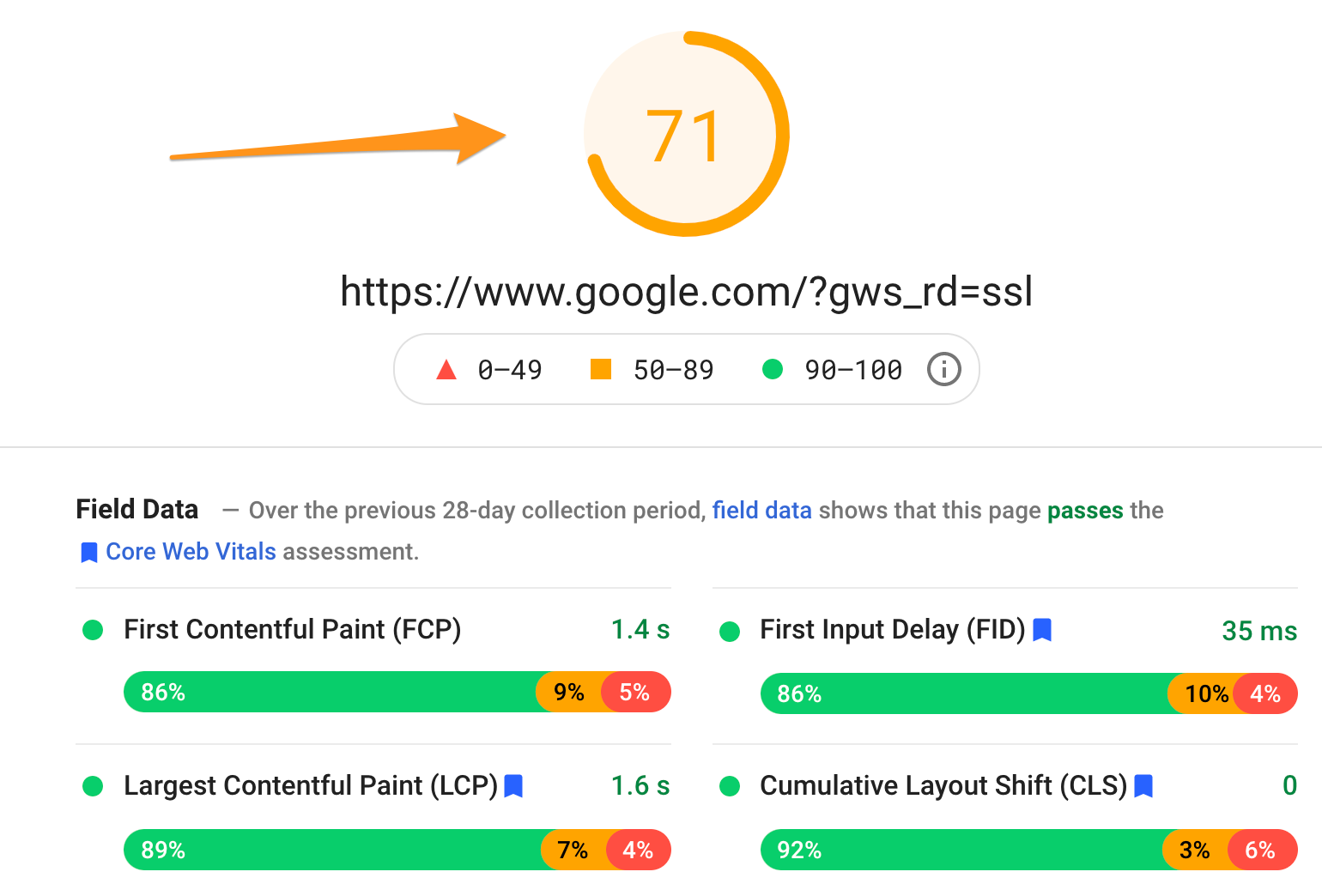
    For example, this is from Google’s own Pagespeed Insights tool on Google.com itself. Google itself scores a 71 out of 100 on mobile speed and a 99 out of 100 on desktop (our Carrot templates score a 98-99 out of 100 upon launch on desktop as well).

    Google’s Mobile Pagespeed Score On Their Own Website

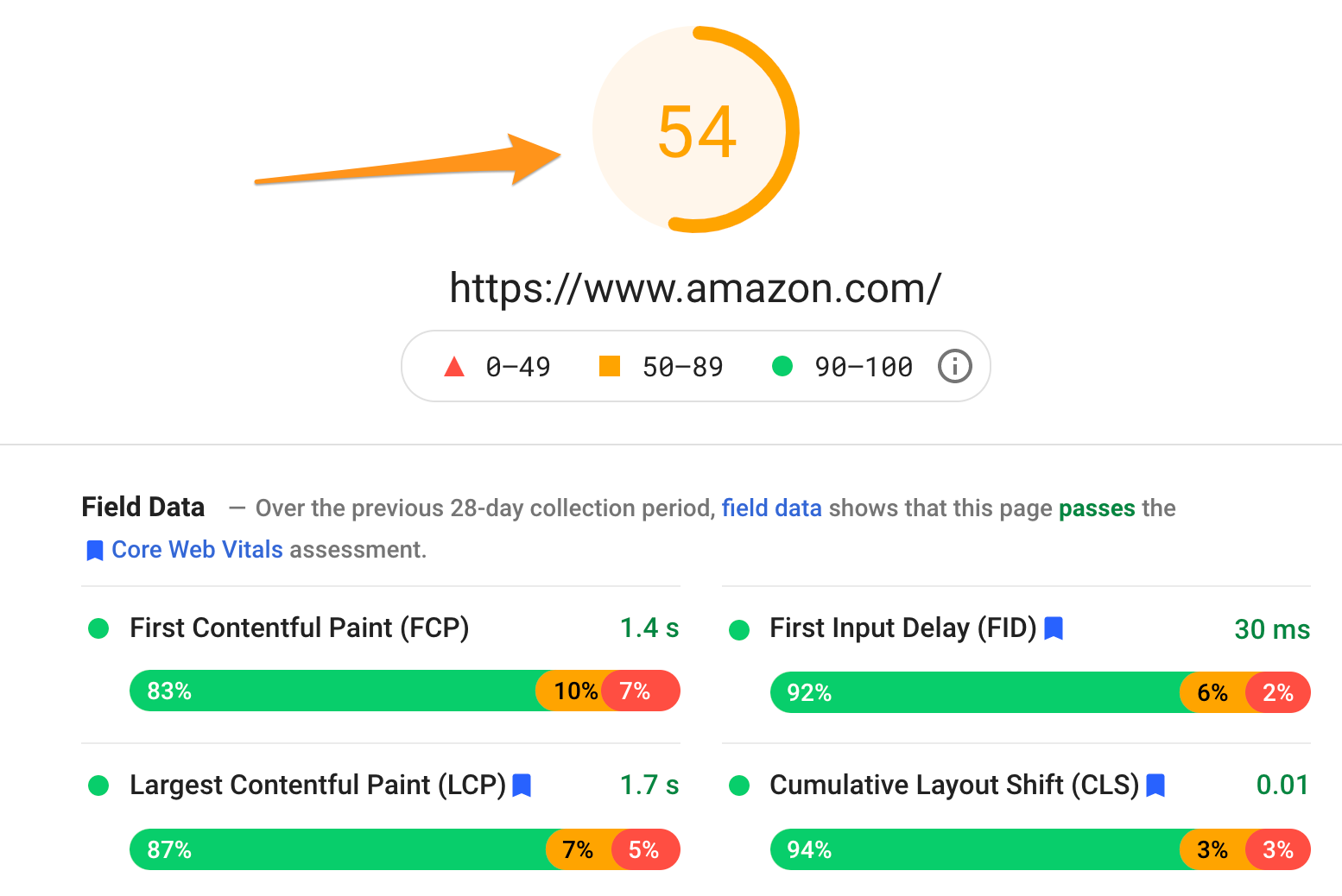
    Amazon.com’s Mobile Pagespeed Score

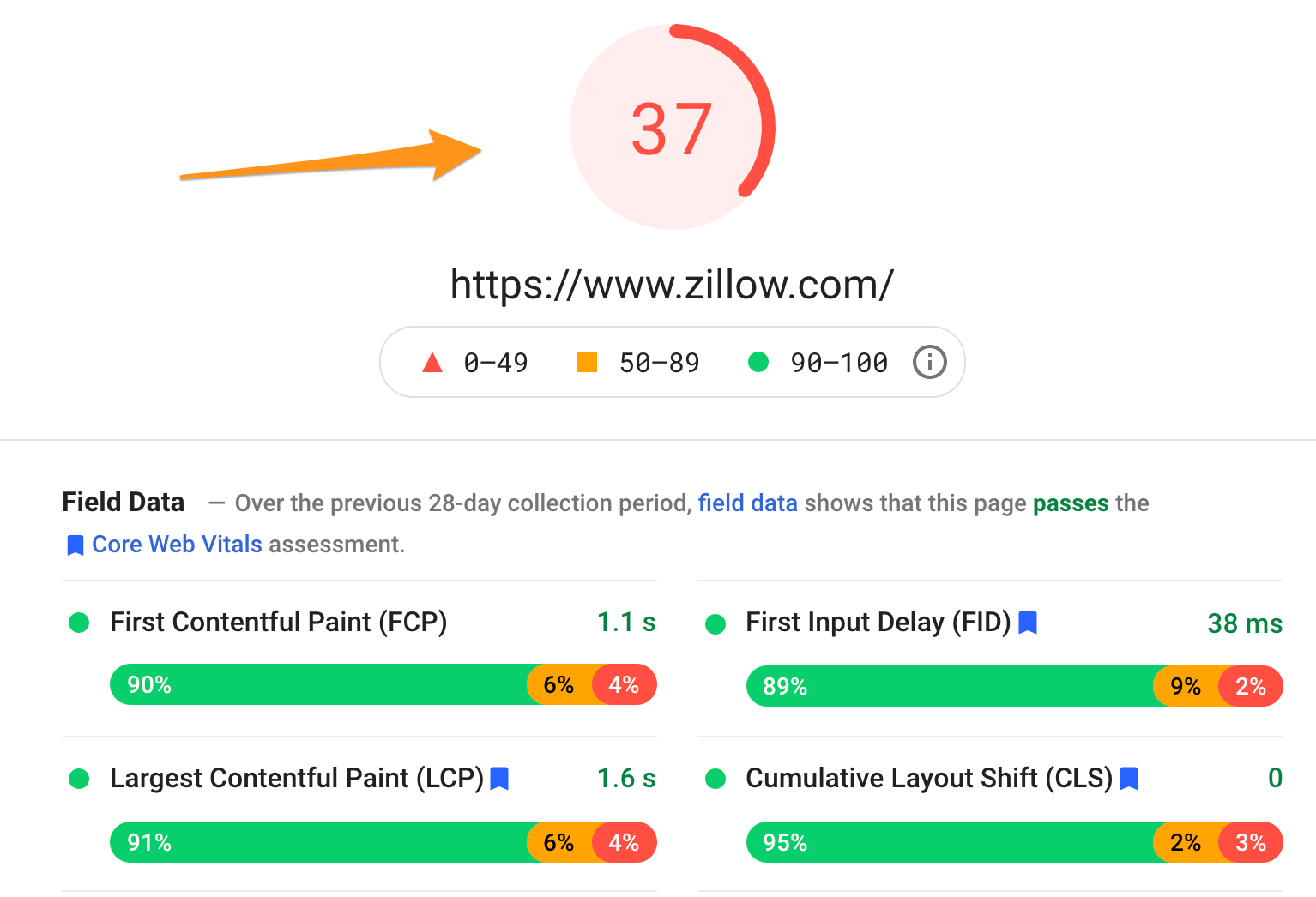
    Zillow’s Mobile Pagespeed Score

    All 3 of these websites above are known as some of the best-ranking websites in the world, despite the low mobile page speed score you may see in Google’s Pagespeed Insights tool.

    Why do we show you the 3 sites above? To show that Google isn’t weighing page speed in Google rankings as a primary ranking factor yet, but also to show you how Carrot sites compare to some of the largest and most valuable websites in the world when running these baseline tests.

    So as Google works page speed more and more into its ranking factors, Carrot members are already ahead of the game.

    [Data] Carrot Sites Now 69.8% Faster than Custom WordPress Websites

    [Data] Carrot Sites Now 69.8% Faster than Custom WordPress Websites

    What We Did to Improve Core Web Vitals and Site Speed On All Carrot Websites

    We already knew that Carrot sites were fast, but Google’s update led us to set out to make them even faster.

    Over the last few months, our team has been working to audit, identify, and optimize several facets of our sites and network with Core Web Vitals and site speed in mind.  Through the use of a new, robust tracking system, we’ve been able to highlight key areas that impact every single site on our network.

    These include:

    • Font-related improvements
    • Image-related improvements
    • Javascript/CSS-related improvements
    • Template-level improvements

    By breaking this overarching site speed and performance theme into several smaller buckets, our Engineering team was able to directly address any snags in site performance and go to work fixing them. 

    While the concept of Core Web Vitals and site speed is certainly not new to us at Carrot, the introduction of them into Google’s ranking algorithm meant that we had to double down on this work over the course of the past several months.

    We won’t bore you with the super technical details, but here are a few things our great team of Engineers did to help your site – and every site on our network – become faster and up-to-par with the Core Web Vitals update:

    • Revisited several code packages and determined whether or not we still need them, and if we do, looked at how we can better optimize when it comes time for a site to load
    • Tested and optimized how and when we load webfonts on a page
    • Ensured images are being properly deferred off-screen where applicable and reduced the number of resources needed to load them
    • Conducted a deep dive into our Javascript packages and unbundled them where it made sense to do so, lending a great improvement to site speed and loading

    Enough Of The Technical Stuff … How Much Faster Did Carrot Websites Get?

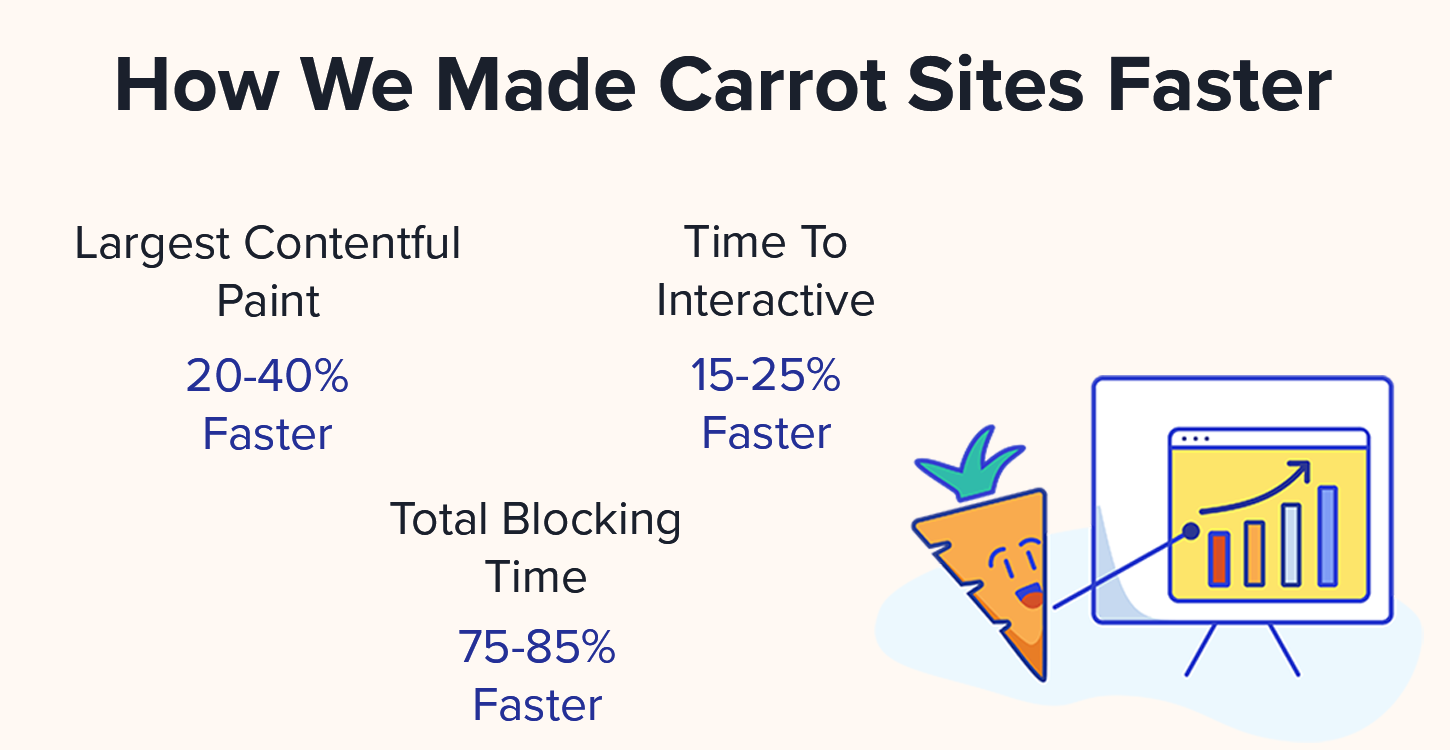
    Across the handful of templates and sites we tracked before, during, and after this Engineering work, Mobile Performance Scores increased significantly – by anywhere from 25 to 50%!

    ** Note – When we reference scores in this article, we are referencing absolute baseline scores using Google’s Lighthouse Tool. Make sure to read up on our guidance on testing tools and their associated caveats in the Dos and Don’ts Guide **

    Across the handful of templates and sites we tracked before, during and after this Engineering work, Mobile Performance Scores increased significantly – by anywhere from 25% to 50!

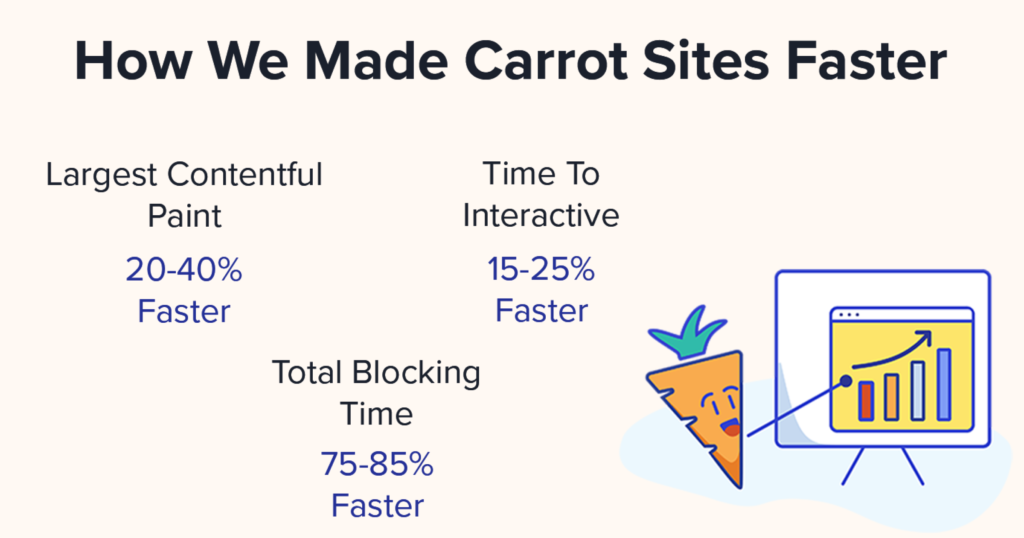
    Beneath the surface of the top-line Performance Score, we identified several important metrics that we knew we could target for improvement.

    Among these were:

    • Largest Contentful Paint (one of the primary CWV metrics)
    • Time To Interactive and Total Blocking Time as measurements of input delay
    • and Cumulative Layout Shift (another primary metric)

    The end result? Sites that load faster, require fewer resource-heavy elements and maintain visual stability.

    These three metrics (combined with Cumulative Layout Shift) directly impact all three areas of Core Web Vitals and – as a result – your overall Performance Score.

    It’s important to note – every single one of these improvements is sourced from the mobile version of our sites.

    Because the desktop versions of our sites were already lightning-fast (meeting or exceeding CWV benchmarks for every category), we were able to focus our attention on anything impacting mobile scores specifically.

    This is great because Google has signaled that only mobile search is impacted by this latest algorithm update… yet another way Carrot is staying ahead of the game and delivering high-impact improvements for our members.

    So How Do We Stack Up To The Competition?

    After seeing such significant improvements to site speed and performance, we wanted to know: How do we stack up to the competition now? We set out to collect a sample of CWV and site speed scores for a myriad of non-Carrot sites in large real estate markets.

    These included custom WordPress sites, other site builders (Weebly, Squarespace, etc.), other site builders that cater to the real estate industry, and custom sites that aren’t built on the WordPress engine.

    We matched our most popular template up against them and were blown away by the results!

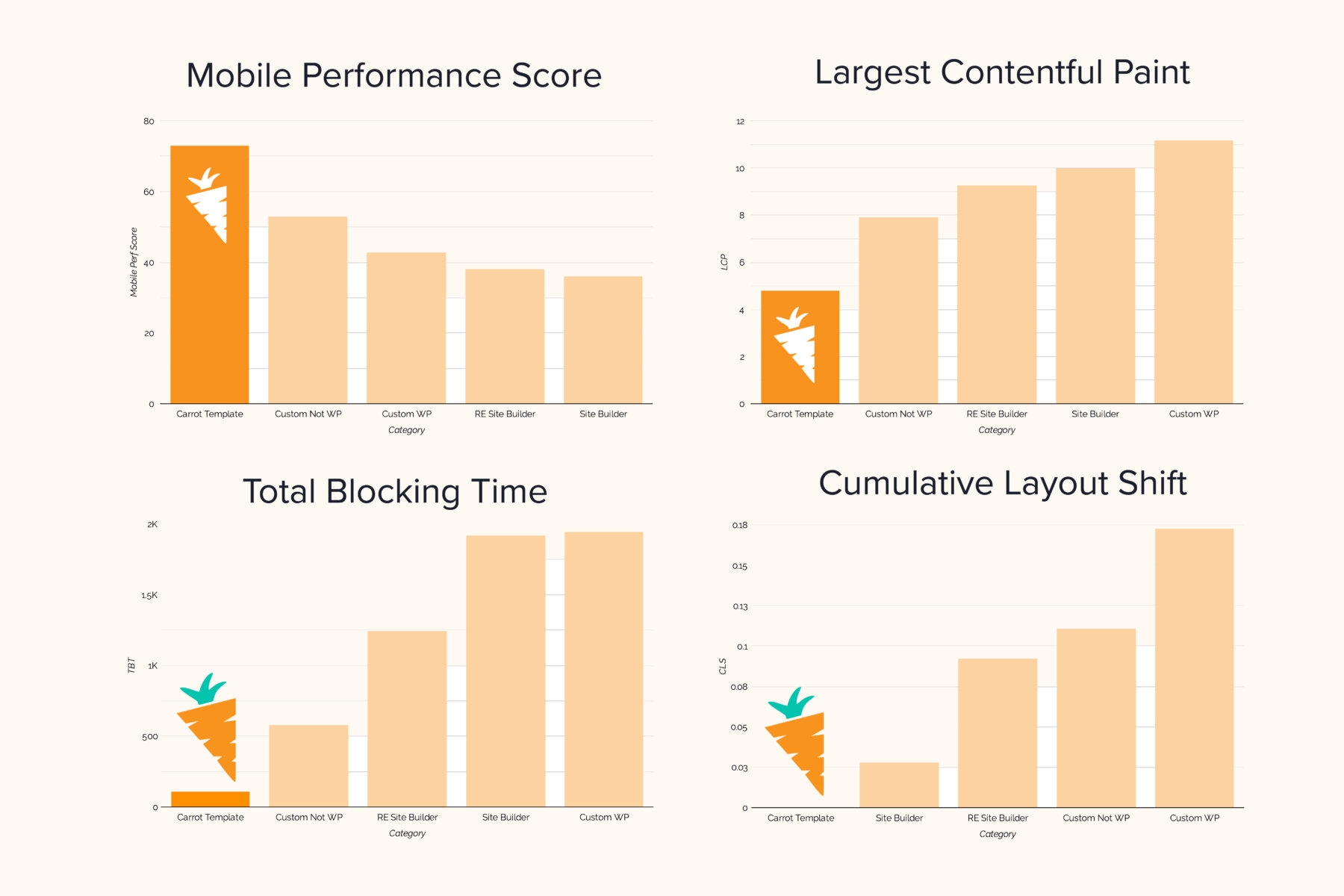
    Carrot sites beat 92.5% of competitor sites in terms of Mobile Performance Score!

    Better yet, we outperformed 75.9% of sites in Largest Contentful Paint, 88.8% of sites in Total Blocking Time, and 79.6% of sites in Cumulative Layout Shift!

    Check out how we performed against each category below:

    (Reminder: LCP and TBT are measured in seconds so lower scores are better; a lower score is better for CLS as well!)

    Here’s the full breakdown…

    CategoryMobile Performance ScoreLCP (sec.)TBT (ms.)CLS
    Carrot Site734.81100.000
    Custom WordPress4311.171,9470.173
    Custom Not WP537.95800.111
    Site Builders3610.01,9180.028
    RE Site Builders389.291,2470.092

    We always knew that Carrot sites outperform the competition in terms of SEO and conversion, and now we know that the man-hours and effort we’ve devoted to site speed and performance over the past several months has increased our competitive advantage even more!

    What’s Next For Core Web Vitals and Site Speed At Carrot?

    Just because Google has now fully introduced Core Web Vitals and site speed metrics to their ranking algorithm doesn’t mean our work is done. We still have a healthy backlog of ideas to improve site speed and performance on our network that we’ll keep hammering away at over the next weeks and months.

    We’re also going to be expanding and improving the system and process we use to track Core Web Vitals scores here at Carrot.

    We not only want to be able to see measurable, quantifiable gains in these scores as we continue our work over time, but we also want to catch (and fix!) anything that may negatively affect site speed scores on Carrot sites before that impact is actually seen.

    We’re also going to be developing some ways to analyze aggregate organic traffic across our network leading up to and following Google’s announced roll-out of this update. There are still open questions across the industry about when, where, and how much we will see this impact on rankings and inbound organic traffic.

    As one of the largest network of real estate sites on the Internet, we hope to help answer some of these questions and bring you the insights you need to know.

    Core Web Vitals – and Google’s definition of “page experience” in general – is still a relatively new concept, and it’s sure to evolve in the coming months and years. Google itself has signaled that this is the case…

    “Because we continue to work on identifying and measuring aspects of page experience, we plan to incorporate more page experience signals on a yearly basis to both further align with evolving user expectations and increase the aspects of user experience that we can measure.”

    Evaluating page experience for a better web – Google – May 28, 2020

    As the discussion of Core Web Vitals continues to evolve and we learn more from Google, we’ll be sure to bring you those updates and any guidance or improvements for your sites. In the meantime, enjoy your better, faster Carrot site without needing to spend thousands of dollars on web development contractors to keep your site fast.

    Not a Carrot member and tired of hassling with the tech when it comes to keeping your site fast and ahead of the curve?

    Now is the perfect time to switch from a clunky, custom site to a Carrot site that’s been engineered for optimal performance in page speed, conversion rate, SEO, and everything else you need to dominate your market.

  • Top 3 Social Media for Real Estate Platforms for New Business Growth

    Top 3 Social Media for Real Estate Platforms for New Business Growth

    Social media for real estate agents is now an essential part of the marketing strategy.

    The 21st century has brought a lot of surprises with it — not least of all self-driving cars and monkeys playing pong with their minds (thanks, Musk) — including how real estate agents find clients and grow their businesses.

    A few decades ago, business cards and direct mail were all the rage. That was just about all an agent could do to find clients.

    The internet has changed that.

    Social media, in particular, has created a massive opportunity for real estate agents to build trust, display their expertise, and find clients… all without leaving the comfort of their sofa.

    How?

    That’s what we’re talking about here — why you should use social media, which platforms are best, what to post, how often to post, and how to optimize your profiles to attract clients.

    First things first!

    Why Should Real Estate Agents Use Social Media?

    So you’re looking for a way to find clients consistently.

    Maybe you’ve seen other real estate agents use social media successfully… or maybe you just got the idea without any prompting.

    Whatever the case — however you came about the idea of using social media posts for real estate to find clients — it’s a good idea.

    And you don’t have to take our word for it.

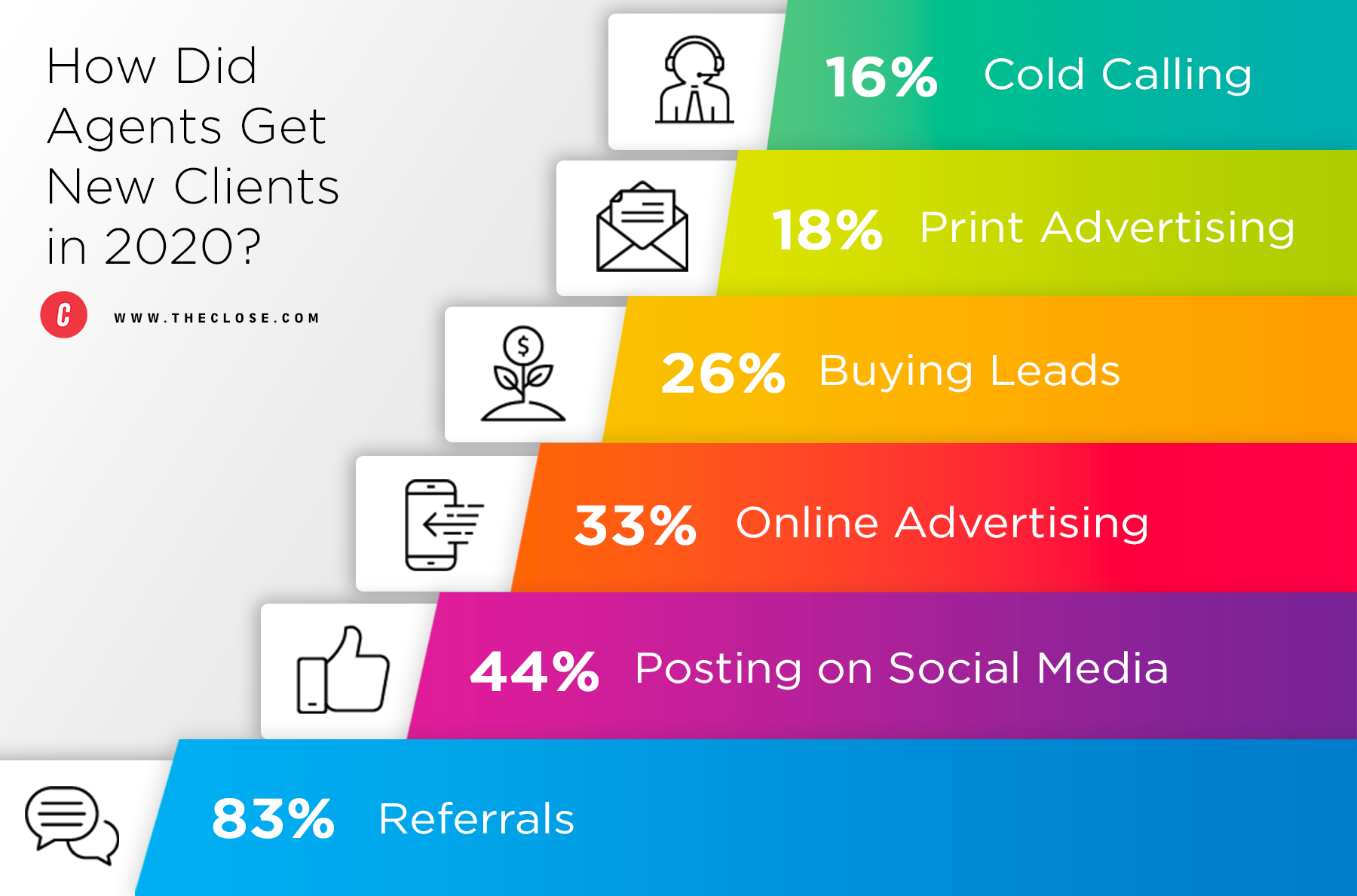
    SocialMediaToday published stats revealing how impactful social media has been for real estate agents. In 2020, 44% of agents said they found clients through social media…

    Social Media Real Estate Stats

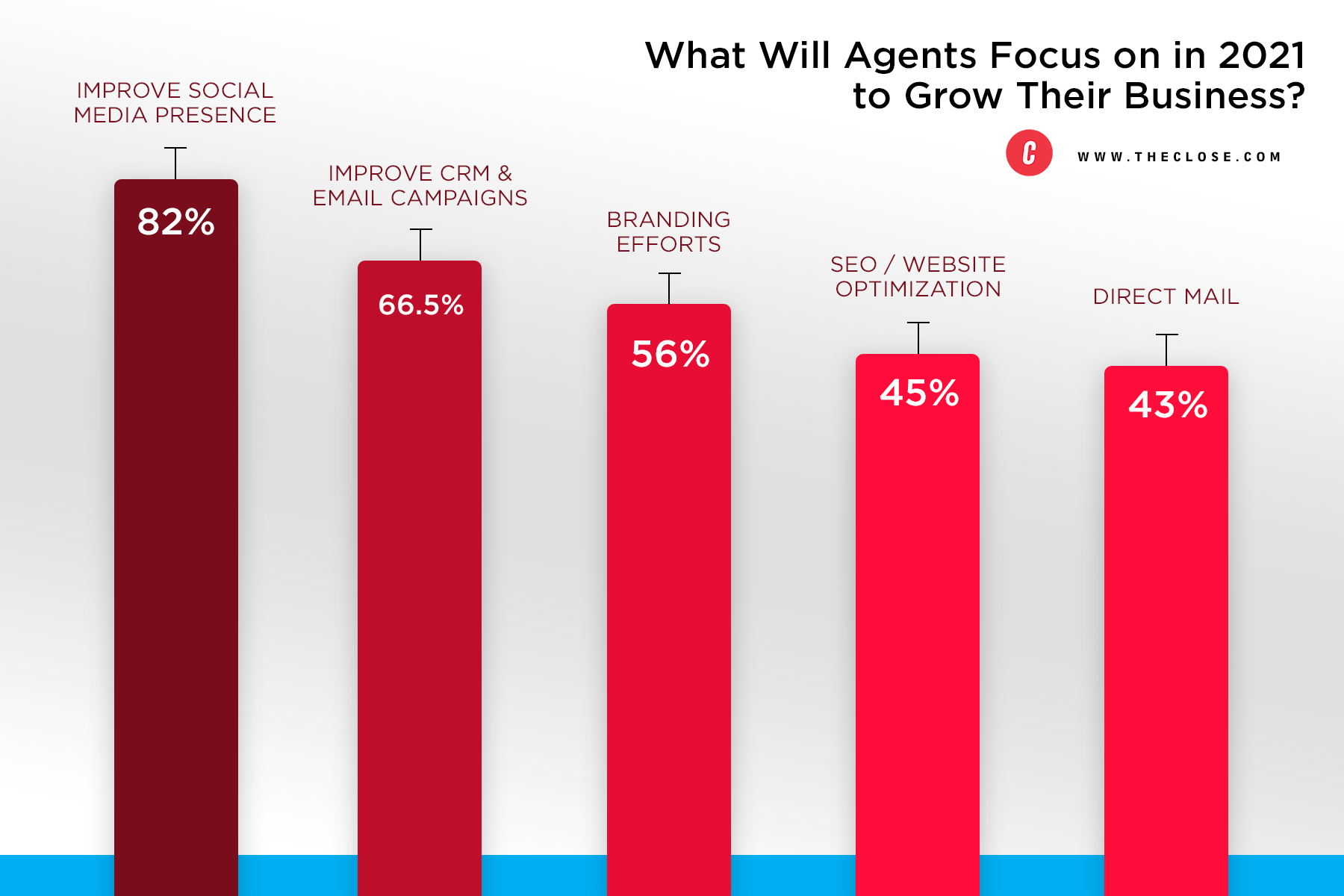
    Additionally, 82% of real estate agents said they would focus on improving their social media presence to grow their business…

    Social Media Real Estate Stats

    So there should be no doubt.

    Done right, social media marketing (both organic and paid) can be an extremely effective strategy for growing your real estate business.

    You can increase brand awareness, showcase your expertise and years of experience, build authentic relationships, and, most importantly, find clients.

    Now, let’s talk about which platform you should use.

    Which Social Media Platform is Best For Real Estate Agents?

    The bad news is that there are hundreds of social media platforms.

    The good news is that the vast majority — for our purposes, all but four — are obsolete.

    Most of them have too few users to be worth your time. And we can even eliminate many of the platforms that do have millions of users because they’re not very localized — Twitter, Pinterest, LinkedIn, etc.

    Every platform has a vibe.

    And what we’re really looking for is social media platforms where people expect to connect with other people in the same city. Because, as a real estate agent, local relationships will be the most valuable relationships.

    So, we’ve narrowed it down to three platforms: Facebook, Instagram, and TikTok.

    1. Facebook

    Facebook is an excellent platform for real estate agents because people expect to connect with people in their city — with “friends.” So both close friends and acquaintances won’t hesitate to accept your friend request.

    Here are some interesting stats about Facebook.

    • Facebook usage is high among U.S. adults, earning over $70k annually.
    • 70% of U.S. adults use the Facebook platform every day.
    • 69% of Americans use Facebook.

    Examples

    Here are some examples of Facebook posts from other real estate agents!

    Listing post…

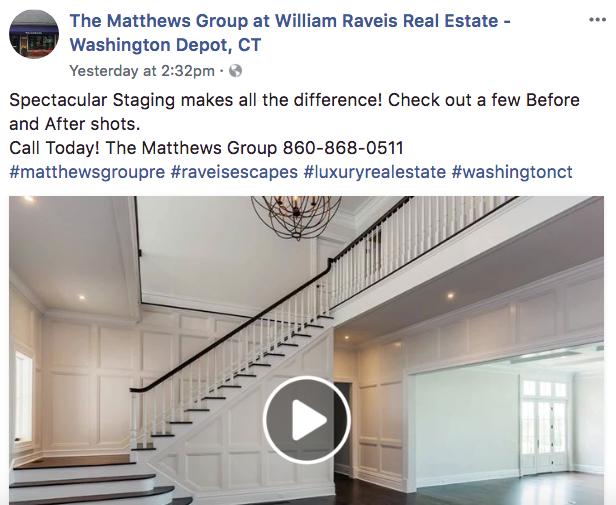
    Example of a Facebook real estate listing

    Case study post…

    Example of a real estate Facebook success story post

    Behind-the-scenes post…

    real estate Behind-the-scenes Facebook post

    How Often To Post

    The experts at Hootsuite recommend posting 1-2 times daily on Facebook. This should help you stay present in the minds of your audience but not overwhelm them.

    Other Facebook Tips

    Here are some other tips when you’re posting on Facebook…

    • Be Authentic — Facebook users love authenticity. They want to get to know the real you… not necessarily the business. So don’t be afraid to discuss yourself or share your thoughts and opinions!
    • Don’t Oversell — On Facebook, you shouldn’t try to sell people with every post. You should also entertain people, give them free value, and offer free advice. Make sure you balance your listing posts with other, more personal, value-driven posts.
    • Stay Top-Of-Mind — The goal of Facebook is to stay top-of-mind and to build trust. It’s more about consistency, value sharing, and brand awareness and less about mindlessly posting all of your listings.

    2. Instagram

    Instagram is similar to Facebook in that people are open to following people they know locally. If it’s better than Facebook, that would be because it’s a highly visual platform. And obviously, real estate is highly visual.

    Beautiful house listings and before-and-after pictures do really well on Instagram. Let’s look at some examples…

    Examples

    Here are some great Instagram post examples from Krista and Aaron Farr from Spokane. So that’s where these examples come from.

    Testimonial post…

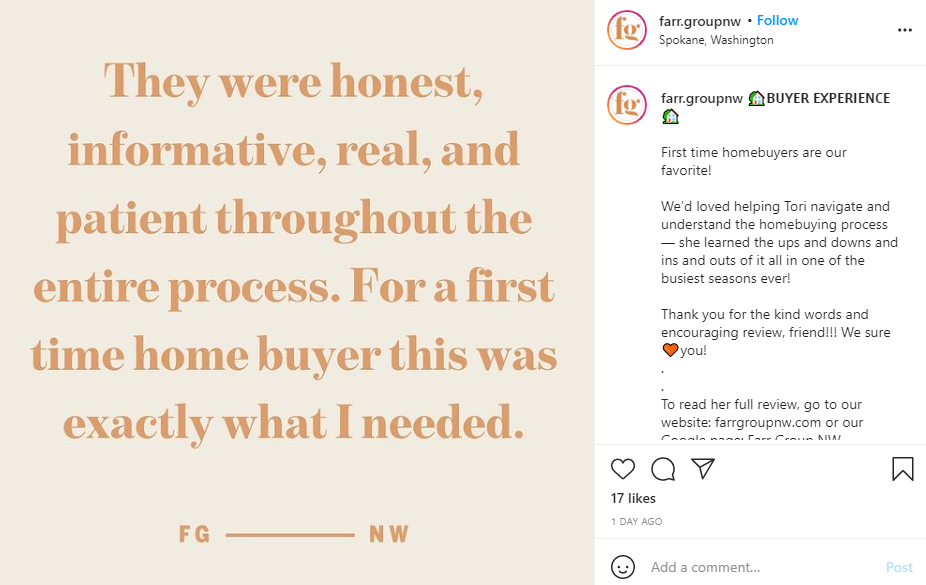
    Instagram Testimonial Post

    “Sold” notifications…

    Sold Notifications

    Storytelling post…

    Storytelling Instagram Post

    How Often To Post

    Hootsuite recommends posting 3-5 times per week on Instagram.

    Other Instagram Tips

    • Focus On Visuals — Instagram is a highly visual platform. So, focus on making the visuals eye-catching and beautiful. This should be easy if you already get professional photos for your listings!
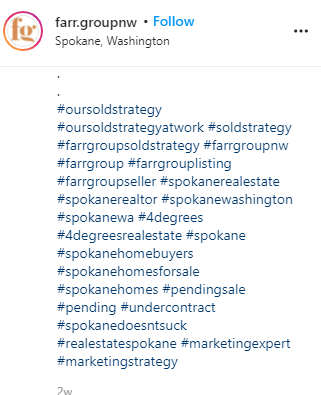
    • Use Hashtags — On every Instagram post, use as many hashtags as you can. That will increase the post’s visibility. Here’s a screenshot of all the Hashtags the Farr Group uses on one of their Instagram posts…
    Instagram real estate Hashtags
    • Create a Vibe — Your Instagram profile should have a “vibe” across all the posts. That is, they should use similar colors and have a similar “feel.” Check out the screenshot below to see what I mean…
    Instagram Profile Vibe

    3. TikTok for Real Estate

    TikTok is a relatively new social media platform with tons of potential for real estate agents. Like Instagram, it’s very visual. But instead of every post being an image or graphic, every post is a short, user-made video.

    The best TikTok videos are value-driven, authentic, funny, and entertaining. The best part is that TikTok localizes the content that people see — so if you live in Roseburg, Oregon, you’ll see content from people in Roseburg, Oregon.

    It also means that people in your city will see your content more than people outside your city — that’s good for business!

    Examples

    Here are some examples of content from real estate agents on TikTok.

    Why buy instead of rent…

    @zamiradunnetrealtor

    Listen up! Move towards buying instead of renting #ontariorealtor #realestatetips

    ♬ My House – Flo Rida
    What $800k will get you in Frisco, TX…

    Market update…

    How Often To Post

    You should post at least once per day on TikTok.

    Other TikTok Tips

    • Be Entertaining — Posts that perform well on TikTok are fast-paced and entertaining. So try to mimic what you see doing well. Be funny, provide tons of value, show interesting behind-the-scenes anecdotes, or tell a crazy story to keep people engaged.
    • Hop on Trends — TikTok is jam-packed with different trends. People doing the same dance, mimicking the same movie lines, or something else. While these trends are a little silly, they’re a great way to get more eyes on your content.
    • Post Often — On TikTok, you should post at least once daily. But more often is pretty much always better.

    Optimizing Your Social Media Profiles To Attract Clients

    Remember why you — a real estate agent — want to start using social media.

    It’s not to gain fame, to scroll your way into oblivion, or to connect with tons of random people…

    It’s to grow your business.

    One thing we’ve got to think about when it comes to growing your business through social media is what people will see when they visit your profile.

    After all, that’s the goal — that people will see your content, get curious, click on your profile, learn about you, and maybe, at some point, become a client.

    But people can’t just be impressed by your content; they must also be impressed by your profile! Or at least not unimpressed.

    There’s a baseline that you need to hit — so let’s look at great profiles on Facebook, Instagram, and TikTok and then muse about what makes those profiles great.

    Here’s the Farr Group profile on Instagram…

    Real estate agent profile on Instagram

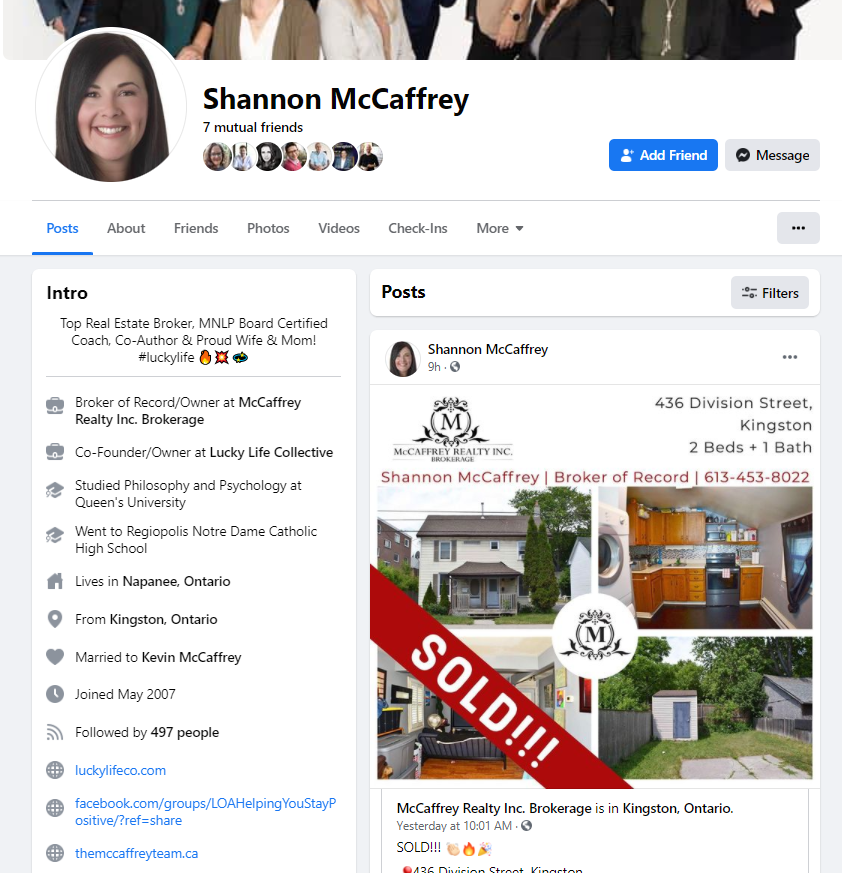
    Here’s Shannon McCaffrey’s Facebook profile…

    Facebook Agent Profile

    And here’s Zamira Lalji’s TikTok profile…

    real estate agent TikTok profile

    Okay — so what do these profiles have in common?

    First, they don’t have to include custom logos and super amazing graphics… they can be pretty basic. The things that these profiles all have — and that YOU should include! — is…

    • Bio — Who are you? All of the above profiles answer that question quickly and clearly. Tell people that you’re a real estate agent, and tell them where you operate!
    • Credibility — The above profiles also build credibility. Are you a top 1% real estate agent? Have you won awards? How many people have you helped sell their homes? Try to build some credibility by using those stats in your bio!
    • Links — Finally, these profiles tell people where to go (via links) if they want to learn more. So don’t forget to include a link to your website.

    P.S. Don’t Forget Your Website!

    Let’s imagine someone clicks through to your profile because they are currently looking for a real estate agent — crazier things have happened!

    They are impressed by your profile and recent social media posts, so they click through to your website (via the link on your profile). Then what happens?

    Well, that entirely depends on how effective your website is at converting visitors into leads.

    Fortunately, conversion is a science — a science that we’ve mastered at Carrot. We specialize in building high-converting websites for real estate agents and investors. Click here to learn more and to try us out for yourself risk-free!

    Paid vs. Organic

    So far in this guide, we’ve talked almost entirely about organic social media marketing — posting content, building connections, and garnering a following.

    But it’d be a disservice to not briefly mention social media advertising, which can also be an effective (and more direct) way to generate real estate leads.

    So here’s a quick overview with links to learn more…

    The Paid Strategy

    Facebook and Instagram are probably the best places to advertise your services as a real estate agent — and since you’re paying to reach people, these posts can be much more direct.

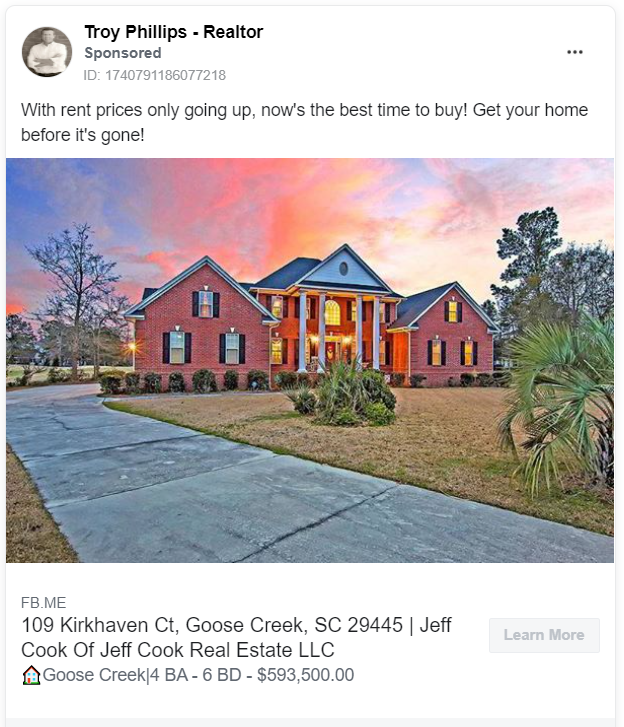
    Here’s an example.

    Real estate agent facebook ad

    And what’s really cool is that Facebook allows you to target people by zip code… so you’ll only reach people within your target market!

    Another helpful strategy is called “retargeting” — the Facebook Pixel allows you to track website visitors and then run advertisements to people who visited your website but who didn’t provide you with their contact information.

    Cool, right?

    Of course, ads cost money.

    You’ll want to track results to see if your spending gives you the needed ROI.

    To learn more about Facebook advertising, check out our interview with Josh Schoenly, where he shares his proven Facebook advertising framework!

    The Organic Strategy

    Organic social media marketing is what we’ve been talking about throughout most of this article.

    This means seeking out authentic connections, posting organic (non-paid) content, and perhaps most of all… being consistent. Getting followers, building trust, and becoming the go-to expert in your market via social media isn’t an overnight venture… it’s something that will take a lot of time and persistence.

    The more that people see your content and the more they like your content, the better.

    The best thing you can do is create a content publishing schedule and stick to it for at least the next 6 months — see what happens!

    52 Real Estate Content Ideas For ANY Social Media Platform

    Okay — now the rubber meets the road.

    You know you want to start using social media to grow your business. And you even know what platform you’re going to use and how often you’re going to post…

    But what are you going to post ABOUT?

    Normally, that’s the hardest part of social media marketing — knowing what to talk about.

    But we’ve made this super easy for you.

    We created this playbook with 52 marketing ideas for real estate agents— and you can easily turn each of these ideas into a social media post instead of a blog post. So click that link and bookmark the guide for when you’ve run out of ideas.

    As always, we’ve got you covered. ;-)

    Final Thoughts

    Social media is a powerful tool with tons of potential for real estate agents.

    And now you know where to start!

    Choose a platform — Facebook, Instagram, or TikTok — create a publishing calendar, stick to it, and bookmark this page to get inspiration and examples when you can’t think of something to share.

    Over time, you’ll increase your brand awareness, build trust, and find new clients. Don’t be tempted to automate this, the risks aren’t worth the reward!

    You’ll also have a competitive advantage over other real estate agents in your market — real estate agents who aren’t using social media.

    So it’s well worth your time.

    All that’s left now is action and consistency — off you go!

  • Think All Carrot Websites Look the Same? You’d Be Wrong! There Are 1000’s of Different Ways to Make Your Carrot Website Design Stand Out From Your Competition

    Think All Carrot Websites Look the Same? You’d Be Wrong! There Are 1000’s of Different Ways to Make Your Carrot Website Design Stand Out From Your Competition

    If you’ve ever thought…

    “Geez, this looks like every other Carrot website design in my market – how can I make myself look different from the others while still maintaining the awesome conversion rate that Carrot websites provide?”

    Then, you’ve come to the right place! We have 1000’s of members, many of whom are in competitive markets and generate hundreds of leads monthly. They close multiple, multiple deals each month, as well.

    To the lead-converting glee of Carrot members, we prioritize conversion optimization over aesthetics. To some, that might seem like a bad idea.

    After all, don’t the two always go hand in hand?

    Not necessarily.

    Carter Steph is proof. Carter switched from an $8k “pretty” custom website to Carrot and saw his closing rate go from 7% to 20% within a few months. Read his story here.

    We have been in business for years and have always had a web presence. We switched to Carrot this month and have already seen a huge improvement in our click-through rate, but more importantly we have more leads being generated by form fills then we have ever received. And we’ve only had our new website up for 7 days!!

    Carter Steph, 1-800-2 Sell Homes

    Even conversion testing giant, Crazy Egg, claims that “ugly” websites often convert better than their prettied-up counterparts. That’s not to say that we’ll provide you with an ugly website that converts well; it’s simply to illustrate that conversion optimization should trump website aesthetics when choosing a website design platform.

    Fortunately, at Carrot, you don’t have to choose between the two – on our real estate investor websites and our real estate agent websites, we’ve found the perfect balance between conversion optimization and beauty.

    Here’s a basic, nothing-fancy website with an “at-time” 25% conversion rate:

    But if tomorrow someone forced us to choose between giving our customers high conversion rates or designing beautiful websites, we’d immediately choose performance.

    Often, people choose a website based only on how it looks rather than how it converts, and we think that’s a massive mistake. You’re in business to make money, not just to look pretty, and, for our members, that’s what we help them do – build a sustainable and predictable business.

    We’re not Wix, WordPress.com, or SquareSpace—and our members, as well as we, are proud of that differentiation.


    We ran a test a few years ago and we had double the conversion on Carrot verses LeadPropeller and our custom site.

    – Jason Bible, Houston House Buyers

    “I blew $40k unfocused and doing all kinds of marketing in my first year… then I focused on Carrot and Evergreen marketing and after a year of focused work did my first $100k month.”

    – Adam Mitchell – Dallas, TX “Home Buying Guys”

    There are 100’s if not 1000’s of different ways to make your website stand out from others.

    We wanted to give you the top changes you can make (whether you’re an agent or investor) in about 10 minutes that will differentiate your business from the others in your market without sacrificing a high conversion rate. Check out our tutorial video or keep reading to learn more:

    Getting Started: 9 Simple Ways to Customize Your Carrot Website Design

    Note: This article is for real estate investors and agents. The differentiation recommendations below can be made to an Agent or Investor’s website. 

    Website Design Changes

    1. Choose a Website Theme 2 Minutes

    We have eight different website themes (or designs) for our members.

    All of these convert to our standards (we’ve tested each and every one thoroughly), and the one you choose should be a matter of preference.

    Here are your options. It takes less than 2 minutes to choose a new website theme.

    8 Different Design Templates to Choose From

    Mahogany – Our Latest Premium Design! (For Grow members)

    Stand out without losing the performance. Our latest Premium Design Mahogany features clean, modern lines, big, bold, easy-to-read text, and space to emphasize all of your content. Instantly separate yourself from others in your area with a few clicks.


    Mahogany design template

    Aspen Design (For Grow members) account for 5.14% of Carrot member websites

    We’re officially introducing a new, full-featured design for those of you who crave a distinguished, modern (and, yes, still high-converting) website.

    Carrot real estate website aspen template

    Hemlock (For Grow members) accounts for 11.31% of Carrot member websites

    A more modern “angle” on our highest-performing designs. Test this one to see if it inches your performance up and gives you that differentiation you’re looking for.
    To learn more about changing your website theme, go here.

    carrot real estate website hemlock theme

    Oak – Accounts for 3.49% of Carrot member websites

    It is a design with a striking image and a clear CTA area, and it is amazing on mobile. It’s the default design for Agent websites.


    Juniper – Accounts for 12.81% of Carrot member websites

    Our 2nd most popular design features a centered CTA area and outstanding mobile performance.


    Cedar – Accounts for 7.55% of Carrot member websites

    Large and striking hero image with our right-aligned CTA area, with the navigation below the hero. Ideal for people with a white, transparent background logo.


    Douglas – Accounts for 54.26% of Carrot member websites

    This is the default style for all investor websites, but it takes a few seconds to switch to one of the other ones on this page.


    Madrone – Accounts for 5.34% of Carrot member websites

    A different take on our Douglas design, just with a reimagined header design to freshen things up on mobile and desktop.


    Branding Changes

    2. Upload a Logo 4 Minutes

    Creating a clean and reputable logo can help differentiate your website from other Carrot members and add loads of credibility. As it stands, only 36% of Carrot customers have uploaded a logo to their website.

    This means that uploading a logo to your Carrot website design will help you stand out even more.

    The more unique and reputable your logo is, the more it will differentiate your website and build credibility.

    Here are a few examples of Carrot members who use a logo to build credibility and differentiate their website.

    Ashley Buys Houses
    GTeam
    Home Offer Kansas City
    Sell Now HomeBuyers…

    Here’s a gif showing how easy adding a logo to your website is.

    To learn more about adding a logo to your website, go here.

    3. Adjust Website Colors < 2 Minutes

    Colors have a deceptively significant impact on differentiating websites that – at their foundation – look similar. Just consider how different these Carrot websites look with the same theme but different colors.

    different website color combinations

    The Carrot members that differentiate their website the most don’t only change the color, but they match the color of their logo to the color of their website. In other words, they create their brand colors and then add them to their Carrot website design.

    We Buy Homes in Tucson
    Houston House Buyers
    Coachella Valley HomeBuyers

    And here’s a gif showing how simple it is to change the base colors of your website.

    To learn more about changing the colors of your Carrot website, go here.

    4. Use A Branding Icon 3 Minutes

    If you don’t have the time or finances to create a custom logo for your website, no worries—you can simply use our pre-made branding icons to differentiate your website.

    Plus, only 8.5% of Carrot’s websites use branding icons, so you’ll stand out from the competition quite well.

    Here’s an example of what it can look like.

    Here’s a GIF showing how you can add a branding icon to your Carrot website design in just a few minutes.

    5. Change Button Color < 2 Minutes

    Similar to the overall branding colors of your Carrot website, the button color can help differentiate your business and even increase the chance of conversions.

    We found, for instance, that changing the color of the button on one of our member’s websites from black to orange increased conversions by 29.55%.

    The trick isn’t to change your button color to orange but to a color that stands out relative to the other colors on your homepage. Choose a color for your button that is either sparse or nowhere else on your homepage.

    Something like this from House Heroes…

    Or Krista Buys Houses…

    And here’s a gif showing you how you can change the button color of your CTA.

    To learn more about how to change the color of your CTA button, go here.


    Imagery Changes

    6. Update Hero Section 5 Minutes

    The hero section image is the quickest and most significant visual update you can make. As a Carrot member, you can also quickly and easily customize the hero image on your website.

    We recommend avoiding stock photos if you want to stand out from other Carrot members. Try using a photo directly from your market – something your market will recognize and think, Okay, I’m in the right place.

    Consider the look and feel of these personalized hero photos on Carrot member websites.

    Townsend Realty Group

    Learn how Townsend Realty Group is achieving predictable business growth with Carrot at a 25% conversion rate.

    Example in Baltimore – Juniper Design Template

    Carrot Aspen theme

    Example in Louisville – Aspen Design Template

    Example in Dallas, Texas – Hemlock Design Template

    And here’s a gif that shows how easy it is to add your local image to your Carrot website design.

    To learn more about changing your hero image, go here.

    7. Add Local Images 10 Minutes

    Like the hero section on your website, avoid stock photos and generic images throughout the rest of your website unless you are adding local or USA maps. To build trust and credibility with your target market, try using real photos of houses in your market. Place them throughout the website to make it clear to visitors that they’re in the right spot and that you’re the person to help them. To enhance the visual appeal of these images, consider using a photo editor like Picsart to optimize and polish the photos before uploading them to your website.

    Consider how these Carrot members sprinkle personalized photos throughout their

    websites.

    The Beckham Group

    We Buy Homes In Tucson

    Sell Now Homebuyers

    To learn more about adding images to your website pages, go here.

    8. Adjust Your Hero Form Layout 3 Minutes

    As a Carrot member, you can customize your form section with two clicks of a button (literally). You can easily change to three styles, regardless of your selected website style.

    Column / Stacked / Inline

    Simply choose the one that best fits your brand image. Each will convert well (we’ve tested them), so the choice is yours.

    Go here to learn more about changing your form layout with a few clicks.


    Credibility Improvements

    9. Add a Credibility Bar 10 Minutes

    Adding credibility to your website, whether you’re a Carrot member or not, is critical for your conversion rate. This is especially true in the real estate industry, where consumers try to work with someone they can trust who won’t deceive them.

    Our credibility bar option is the perfect way to add a differentiating and trust-building flair to your website. You can use the credibility bar in several different ways on your Carrot website.

    7DaysCash

    Halo Home Buyers

    Go here to learn more about adding a custom credibility bar to your website.

    10. Add Testimonials 10 Minutes

    The Credibility bar isn’t the only place to add a past customer testimonial to your website – and it’s not the only place you should.

    You can also add testimonials to these spots on your website to build even more trust with visitors.

    Here are a few different looks, including using video testimonials.

    Ocean City Development

    GuaranteedCashOffer

    Sell Now Homebuyers – Video testimonial

    Frank Jr Buys Houses – Video testimonials

    If possible, your testimonials should have some, if not all, of these elements:

    1. Full name of the person.
    2. Professional title of the person.
    3. Image or video of the person.

    To learn more about adding testimonials to your Carrot website, go here.

    11. Personalize the “About” Page 10 Minutes

    When people visit a real estate website, our research shows that the “About” page is the third-most visited tab. You can further differentiate your website from the competition by writing up something personal, adding biographies and pics for team members, and casting company vision.

    For inspiration, consider how these Carrot members have customized their About Page.

    Carrot member about page

    Triple C Properties

    CR of Maryland

    12. Add Badges 10 Minutes

    Website badges that show what makes your company unique and different from the competition can be a great way to stand out online. For example, a website badge that says “Veteran Owned” or “100+ 5-Star Ratings.”

    Here are a few examples.

    Nextwave Homebuyers
    Warrior Property Solutions
    Kind House Buyers

    Consider your unique selling proposition for your business and create a badge that expresses that on your website.

    With this, you’ll sell or buy stronger and faster than the competition and quickly differentiate yourself from other clutter online.

    Easy Editing

    13. Visual Block Editor

    Like anything in life, there are trade-offs. The “big” low-cost website builders (think Wix, Squarespace, and WordPress themes) chose to go all-in on ease of use and sacrifice performance for their clients. You would save a bit of time, but it could cost you tens of thousands of dollars (or more) from underperformance.

    Performance and results and easy editing
    At Carrot, we have been all-in on performance since the beginning. We created the easy drag-and-drop Visual editing experience on our websites so that users can enjoy both benefits without sacrificing either.

    What the Visual Editor helps you do

    A few benefits you’ll enjoy with this powerful Visual Editor include…

    • No more switching back and forth from editor to page – now see all your edits in real-time, including your hero section, forms, and more!
    • Use Drag and Drop tools to easily create and edit pages with movable and reusable block patterns!
    • Make your website stand out visually without having to use any fancy code.
    • Enjoy the new “Full-Screen Mode” to have the most beautiful, clean, and simple editing experience possible… without the distractions (try this mode, you’ll love it!)
    • SEO Grader updates: 1) Your SEO grade for the page will update in real-time without you having to save the page, and 2) Now get SEO grades for multiple keywords for the same page! (this is huge)
    • No loss of page speed

      … and more

    Here are some examples of designs you can easily create with the visual editor…

    MRR Property Solutions

    Myrtle Beach Home Buyers

    Capstone Homebuyers

    To learn more about the Visual Editor, watch the tutorial video below or check out our Help Center.

    Getting Started: Editing a Page with Carrot's Visual Editor

    Content Changes

    14. Customize Content 10+ Minutes

    Your website’s blog represents a phenomenal opportunity to differentiate your business from the competition.

    Our Grow Carrot plans provide monthly content for your website, but sometimes it’s worth tweaking these blog posts to fit your market and business positioning better.

    Here are a few ways to quickly tweak them to fit your target market better.

    1. Localize the tips and advice.
    2. Add a bit of your advice.
    3. Add your tone of voice to the article.

    Consider Fox Realty Group – a Carrot member – and how they’ve customized their blog content without getting too complicated.

    Fox Realty

    So if you have more money than time, another way to differentiate your Carrot blog is by upgrading your plan.


    Conclusion

    We’re not going to sugarcoat this… Customizing your website takes work. Unless you outsource your website customization, you’ll need to invest time.

    You now know how to customize your Carrot website design without sacrificing aesthetics or conversion rate. Use these 14 ways to differentiate your website and stand out from the competition – even if that competition consists of other Carrot members.

    Many people don’t customize their website with the above simple changes, so if you do, you have a far better chance of standing apart and cutting through the online clutter – to be seen by your target market faster and more often.

    If you don’t have the time to make these changes, check out our Concierge Setup Service, where we’ll do it for you.

    Either way, happy customizing and happy converting.

  • Demo: Websites

    Carrot Websites Hold More #1 Search Rankings Then Any Other Real Estate Websites

    Don’t settle for a website that’s just a “glorified business card.” Leverage Carrot’s Lead Generation Hub to attract, convert, and close more deals!

    Getting your real estate business online is the easy part. But what happens next? Most website providers will get your site up and running, but then leave all the real hard work up to you. Without understanding what it takes to elevate your real estate investor website to the next level, you might as well be handing potential customers a glorified business card that has little chance of generating high-quality leads.

    With Carrot’s real estate marketing platform you’ll never be left to handle all the ins and outs on your own. As you’ll see in our interactive demo, we’ve simplified the web building process with Visual Editor technology so even novices can create their own high-converting website that acts as a Lead Generation Hub. Utilizing Evergreen marketing strategies combined with effective SEO tools like Keyword Explorer and Content Packs, watch your Google ranking skyrocket as you gain the competitive edge. Tie in some world-class support and professional services, and soon you’ll see why Carrot is the industry leader for attracting the right site traffic, converting highly-motivated leads, and closing more deals than ever before.

    One lost deal from an under-performing website can cost you upwards of $10,000. So the question is: How many deals can you afford to lose?

    Ready to see what Carrot can do for you? 

    Ready to amplify your online lead generation with Carrot?

    Custom Carrot Websites

    Start with a high-performing website

    Carrot websites are built with performance and conversion in mind. With site templates pre-built with SEO-friendly content to help you attract a specific type of lead and designs optimized for desktop and mobile, Carrot makes it easy to build a high-performing website that actively works to attract and convert leads for you, whether you’re an experienced online marketer or just getting started.

    Build online authority and credibility

    To break out the cycle of hamster wheel marketing and chasing down leads, you need a solid online marketing strategy. But not everyone has the tools, time, and expertise to do what it takes to build online authority with content marketing and get their website on the first page of Google search results. Carrot makes it easy with an entire suite of tools aimed at doing just that — improving your SEO ranking with automated blogs, keyword tracking, and other time-saving online marketing tools and done-for-you services.

    Backed by a team dedicated to your success

    Whether you’re just getting started or are a real estate marketing pro, we know everyone could use a little — or a lot — of help now and then. That’s why we have an entire team of product and real estate experts ready to help you with all of your questions. From troubleshooting to strategy building, Carrot has your back. 

    The tools you need, nothing you don’t.

    Launch your website, boost your SEO, and manage your leads.

    High-Converting Website

    Easily Edit Your Content

    SEO Rank Tracker

    Landing Page Builder

    Website Analytics

    SEO & Marketing Strategy and Trainings

    Email & Live Chat Support

    CRM lead manager

    Access to the Carrot Community

    Industry Leading Security & Hosting

    Optimized for mobile leads

    59% of Carrot member leads come from mobile devices. Carrot site templates are optimized to provide the best mobile experience for your visitors and to convert your mobile traffic into leads!

    Carrot isn’t just a website — it’s a Lead Generation Hub.

    How hard is your website working for you? It may be pretty, but is it helping you stand out in your market and build online authority to generate consistent — and qualified — leads?

    Other website providers:

    VS.

    Carrot’s websites:

    Built to rank in organic Google search results & AI

    Optimized for all devices — desktop, mobile, tablet

    Uses industry-leading best practices to convert more leads

    Loads fast to keep visitors’ interest and engagement

    Builds online authority for better search results & trust

    Supports many types of real estate and local business providers

    Provides training and support from our team of product and marketing experts

    Hear what other investors have to say…

    Closed 10 deals this year from Carrot and the margins are always higher from internet leads.

    Josh Justiniano

    My conversion as compared to before is unbelievable. I wish I would have done it a long time ago.

    Steve Londeau

  • Core Web Vitals & Page Speed – What To Do (and Not Do) with Your Website

    Core Web Vitals & Page Speed – What To Do (and Not Do) with Your Website

    By now, you’ve probably heard about Google’s upcoming Core Web Vitals update and are wondering what it means for your site, where you should be looking to learn more, and what you should be doing to prepare. 

    Back in June, we provided a brief overview of the Google update (officially titled the “Page Experience Update”) and an introduction to Core Web Vitals – the metrics playing the most prominent role in the update.  

    Recap:

    The Page Experience Update is introducing Core Web Vitals to Google’s search ranking algorithm for the first time.  Core Web Vitals are a series of pagespeed scores relating to how quickly a page loads, how quickly that page is interactive, and how stable that page is visually. Google started introducing elements of this update to their algorithm in mid-June, with the goal for it to play a full role by the end of August 2021.

    Check out our SEO News page to learn more.

    Over the past several months, our Carrot Engineering Team has been identifying, optimizing, and improving features and elements that directly contribute to better user experience and site speed metrics. 

    As that work continues to make our sites faster and better than ever, we’ve compiled some of the most common questions, issues, and misconceptions we’ve seen as a resource for you to be ahead of the game on your end.

    DO Understand Testing Tools

    We get this question a lot: how do you test your site speed and Core Web Vitals and what tool should you use?  At Carrot, we recommend using Google’s PageSpeed Insights Tool because – regardless of which tool you choose – the most important consideration is that you be consistent. 

    To us, using Google’s own tool makes the most sense.  If you’re using the Chrome Browser, the Lighthouse Tool in the Developer Tools is another great option.

    That said, we always want to be sure that our members understand the differences and caveats between those snapshot scores provided by tools and the scores that are actually being used in Google’s algorithm. Google differentiates them into two categories: lab data and field data.

    Lab Data – Provided By Testing Tools

    Google Lab Data

    Lab data is exactly what it sounds like – data collected in a lab, or in this case, a single snapshot report performed by Google’s PageSpeed Insights Tool or any other third-party testing tool. 

    It uses your own browser or another emulated device to load your website in a simulated environment and capture the key metrics that contribute to Core Web Vitals and Page Experience.  These scores are meant to be consistent baselines and are not necessarily reflective of actual user experience. 

    Just like in a real lab, you want to control for all variables when running experiments and tests on your website.  Google’s page speed tool (and most other tools) do this by loading your site on a simulated older generation smartphone with only a 3G connection to determine mobile “site speed” scores. 

    This is meant to represent the absolute baseline and used as a tool for debugging any performance issues with your site.  It’s useful for looking at where you can improve your scores, but it’s not useful for understanding real user experience.  Most users are on newer mobile devices with better connections and WiFi. 

    Their experience is better than in the simulated snapshot and contributes to field data – the real scores used by Google’s search ranking algorithm. 

    Field Data – Provided By Real User Experience

    Like we said above – field data is what Google is actually introducing to their search algorithm.  It represents the actual user experiences collected by the Chrome User Experience Report (or CrUX) when users visit your site.  Google then looks at the 75th percentile of those scores, and that’s your actual “score” used by their algorithm.

    Just like with Google’s more commonly-known ranking indicators, we lose visibility and transparency the closer we get to the algorithm.  So while snapshot lab data scores can be accessed whenever we feel like running a tool, user experience field data is more ambiguous and inaccessible.

    There are two primary areas where you can gain insights about your real user experience scores if your site has sufficient traffic/data for Google to generate reports.  That’s in the Core Web Vitals tab of Google Search Console or at the top of reports in the PageSpeed Insights Tool.  

    For individual URLs, you may see an error – “Field Data — The Chrome User Experience Report does not have sufficient real-world speed data for this page.”  This means that there is not enough CrUX data available to generate a representative anonymous view of your performance.

    If you find this to be the case, no sweat – you just need more visitors, and the best way to do that is by focusing on generating great content first.

    This leads us into our next section…

    DON’T Stop Focusing On Content

    Under no circumstance should you stop what you’re doing to generate great content and drop everything to focus on Core Web Vitals.

    Here’s some guidance directly from the source – Google…

    “While page experience is important, Google still seeks to rank pages with the best information overall, even if the page experience is subpar. Great page experience doesn’t override having great page content.” – Understanding page experience in Google Search results

    In other words, page experience and site speed scores are just other ingredients in the complex recipe Google uses to produce search results and rankings. 

    Content is still king. 

    Relevant, useful, informative, and high-quality content will continue to outperform competitors and other websites – because, at the end of the day, a visitor is seeking content first.  Page speed is just another supplemental measurement.

    At Carrot, we have always excelled on the content side of things. That’s our bread and butter!  So while Google’s Page Experience Update is certainly something to keep an eye on now and in the future, we highly recommend that you continue leveraging our tools and investing your time, resources, and creative efforts to produce high-quality, relevant content above all else.

    Another note: Core Web Vitals will only apply to mobile search results.  Across our network, we see that nearly 40% of inbound traffic (and leads!) to Carrot sites still occur on desktop.  Those desktop search results will not be impacted by this update at all.  That’s why content is still so important. 

    DO Take A Minimalist (And Mobile First!) Approach To Design

    Because this update applies solely to mobile search, it underscores the importance of taking a mobile-first approach when looking at your website content and design.  Let’s face it – mobile has taken over. 

    As we mentioned, 60% of traffic across our Carrot network occurs on a mobile device.  Keep that in mind when thinking about how to layout and implement content on your site.  Sometimes, less is more.

    We recently did a series of conversion tests that reiterates this point. We found that simply reducing the amount of content in a website’s main hero section and form, could increase conversion rates by up to 50%! 

    This test confirmed our theory that by reducing the clutter that a visitor sees, they will be more likely to engage with the lead form.

    The same principle applies to site speed and performance.  Each additional element that you include on a page requires additional resources to process, render, and place that element on the page.  That results in additional time that it takes the page to load. 

    In the left image, the form is prominent and the page isn’t blocked from loading by resource-heavy elements. In the right image, there are more elements to load, and the form is pushed “below the fold.”

    The most common abuses of this also often incorporate some of the most resource-heavy elements – like pictures and videos placed all around the page, or high up near the top of the page. 

    While we encourage you to continue creating great content to highlight your credibility and experience, we also encourage you to be mindful of how, and where, you deploy that on your site.  Run snapshots before and after adding it and see how it impacts your scores. 

    At the end of the day, the goal of your site is to generate leads.  With so many users now browsing on their phones, it increases the importance of improving user experience in more ways than just site speed. 

    By taking a step back and considering how some of your content elements might be drawing attention away from conversion elements or impacting a visitor’s experience on your site, you’ll also be guaranteed to improve your site speed metrics at the same time. 

    DO Take Image Optimization Seriously

    While we are on the content note, we understand that there are naturally going to be images and graphics you want to include to help highlight your experience and improve your site aesthetic. 

    We highly recommend being cognizant of the various ways to ensure you aren’t overburdening your site’s speed and performance when adding images.

    For step-by-step examples, check out our image optimization guide.

    DON’T Weigh Your Site Down With Tracking Scripts

    Just like with content elements, too many unnecessary tracking scripts and third-party codes can also overburden your site and negatively impact your Core Web Vitals scores. 

    The same concept applies: each script or code snippet you add requires more resources to execute.

    We get it – some tracking scripts like Google Analytics, Google Ads, and the Facebook pixel might be necessary for your marketing if you’re making ad-buying decisions based on those metrics.  In this case, you have to consider it a trade-off. 

    In exchange for gaining visibility into those tracking metrics and insights, you’re negatively impacting your site speed marginally.  Which is more important to you?  In most cases, those tracking analytics will outweigh site speed.

    If you aren’t heavily and consistently using these tracking tools, perhaps consider what you really need and what you can get rid of.  Over time, the addition of individual scripts and code snippets can naturally bloat if not routinely audited for only the most necessary scripts.  This is one of the most common variables we see when reviewing customer site speed report results.

    Note: This also applies to any additional third-party scripts and services like chatbots, call tracking, etc.

    Finally, DON’T Freak Out…

    Core Web Vitals and Google’s Page Experience Update are certainly complicated, but by taking the time to understand the basics and paired with our Engineering Team’s work to optimize your site, you’ll be ahead of most site owners. 

    Screaming Frog analyzed 20,000 URLs last year, and only 12% of mobile sites and 13% of desktop sites passed the Core Web Vitals assessment. There is a lot of work for everyone to do, and we’re committed to continuing to provide you with the resources and updates you need.

    We’re thankful for a great community of members who are really supporting what we’re doing here at Carrot to help transform the way high-achieving real estate agents and investors use the internet to grow their real estate business.