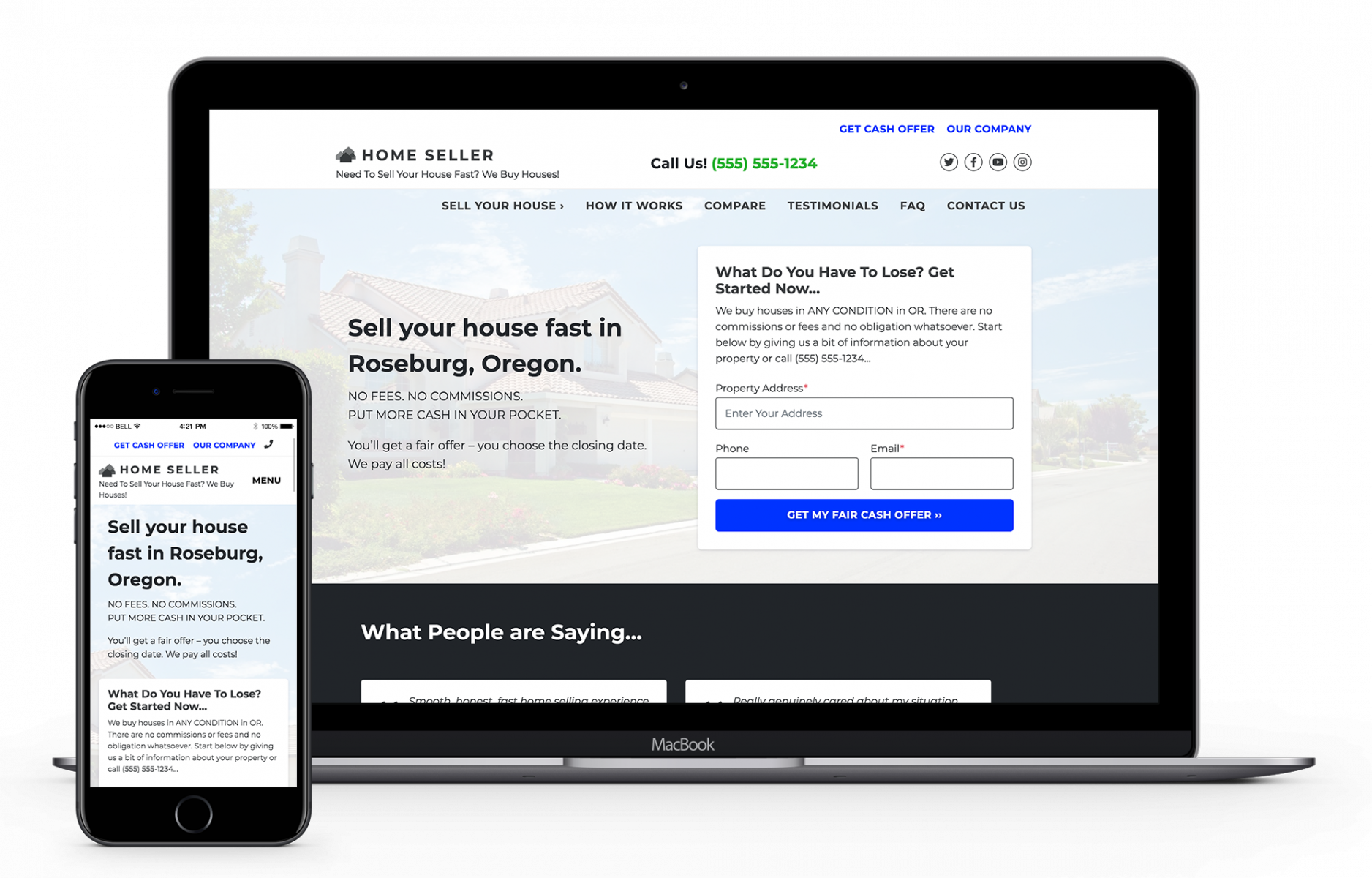
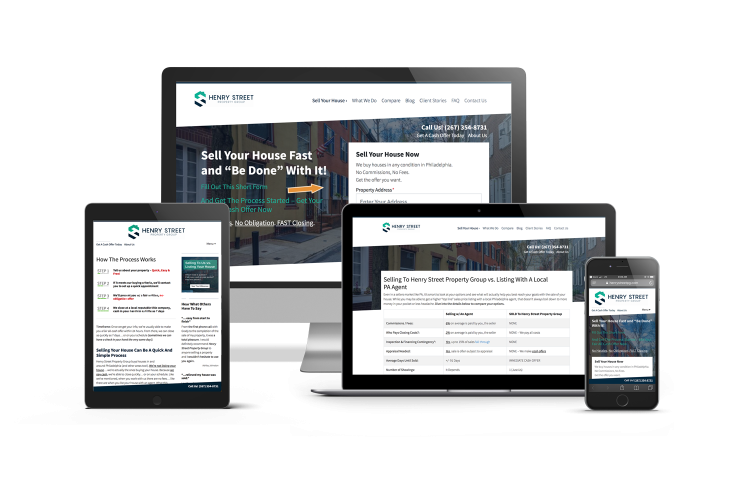
We just announced our latest Premium Website Design for Advanced Marketer Plan members… Aspen.
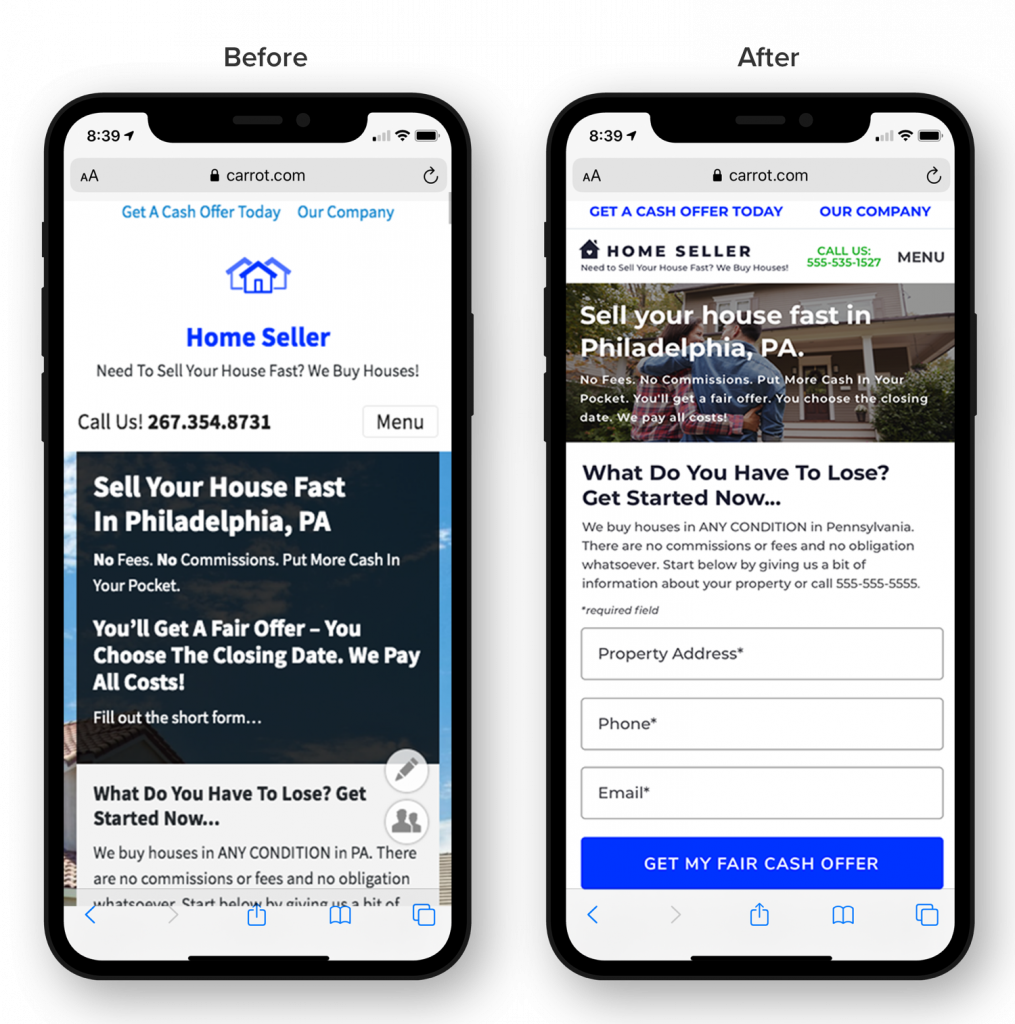
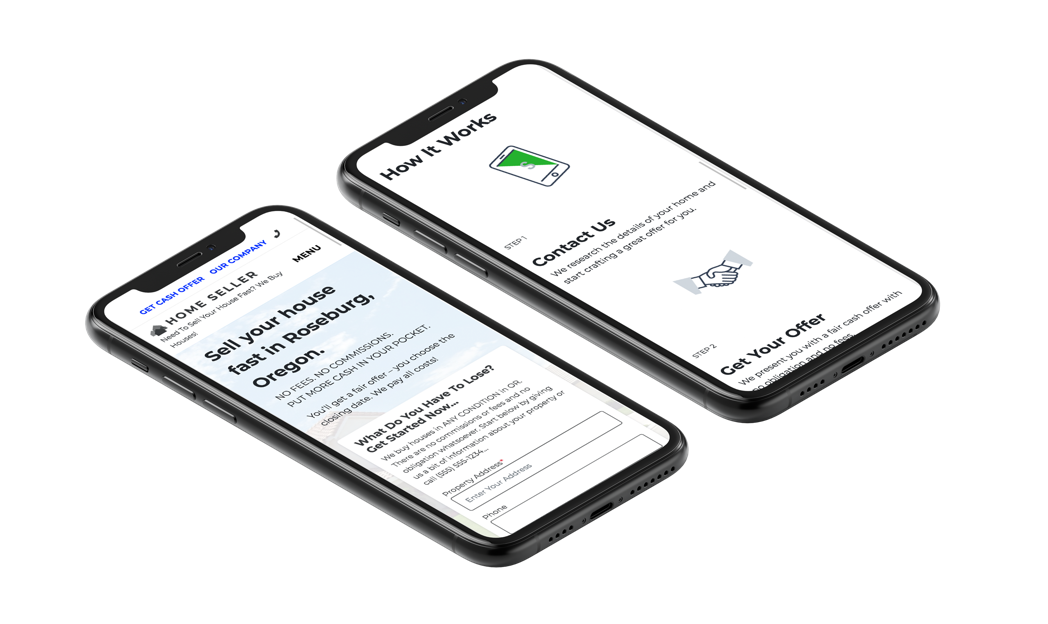
Aspen is clean, fast (like all of our designs on all plans), beautiful on mobile, and gives you even more style and polish in the body content of your website. This new design is built from the ground up to sync with our Visual Editor to make editing your site as easy and fast as possible.
This website design isn’t just beautiful, it converts with the same principles as all of our other Carrot site designs.
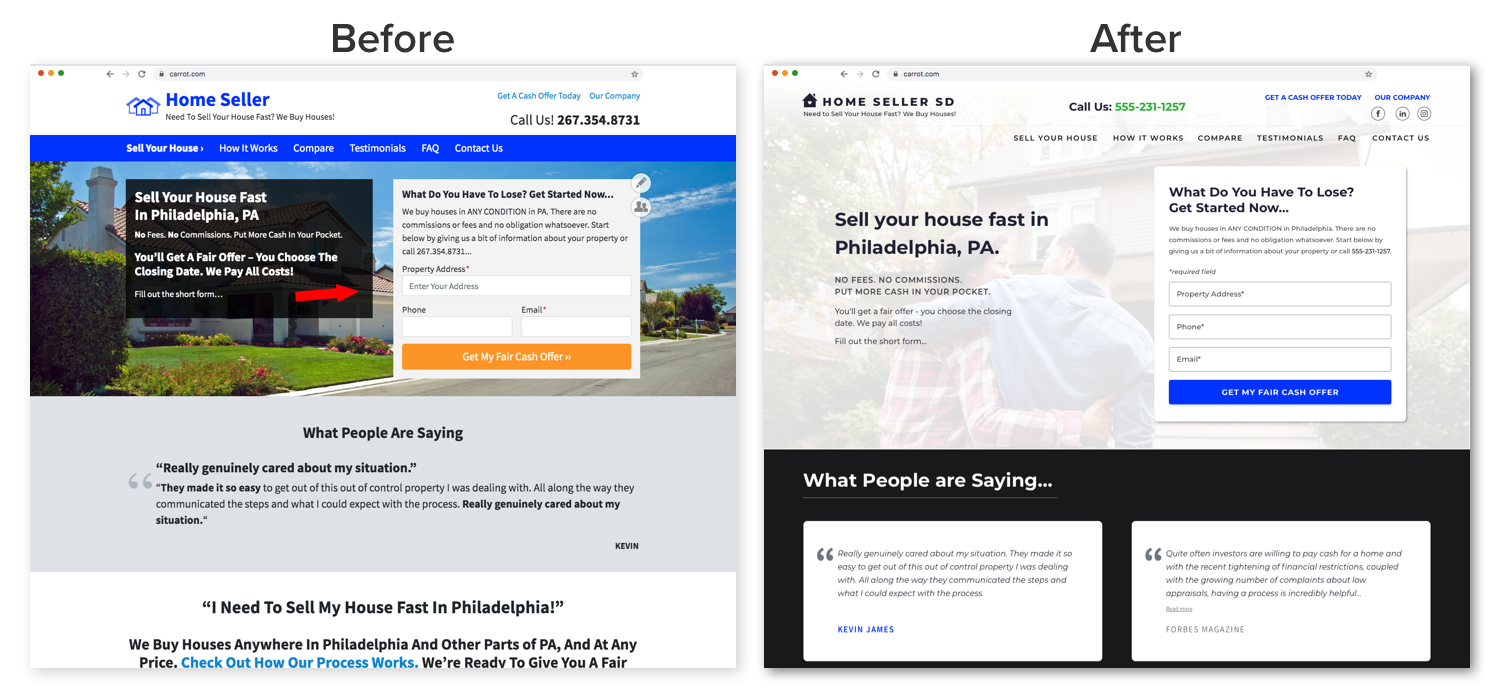
Carrot Design Before and After. Take a Look at the Aspen Design on the Right
So – the kicker question: How much are we going to charge you?
It’s included with our Advanced Marketer member’s first access to new site styles!
Since we want this design to remain a unique and distinguishable theme for high-performing investors and agents, for now, it’s only available for our Advanced Marketer members.
That may sound like a bummer if you’re not yet an Advanced Marketer member. But we want to ensure that high-performing real estate professionals like yourself get exclusive access to the best that Carrot has to offer and that you get to try it out before anyone else.
And if you aren’t yet an Advanced Marketer member, you can upgrade your plan with just a few clicks…
Note: We have a time-sensitive offer at the bottom of this post for those of you who aren’t Advanced Marketer members. Read on.
Once you’re an Advanced Marketer, you can switch to the Aspen design just as easily…
Plus, Aspen isn’t the only benefit you’ll get with Advanced Marketer. You’ll also get…
Track 20 SEO keyword phrase rankings per site
12 Content Pro blog postsand 12 Premium blog posts every single month
If you’re already an Advanced Marketer member, then test Aspen and let us know what you think! If you’re not, then go preview it on your website to see what you think.
If you like it, consider upgrading so you can have access to Aspen and other new site styles we release that will further distinguish your website from online clutter – always with the same industry-leading conversion rate that we are known for.
Time-sensitive Offer for Our Core and Content Pro Members (and Non-members)
If you upgrade to Advanced Marketer, you’ll immediately get access to the Hemlock theme and all the other goodies that come with an Advanced Marketer membership.
Upgrade to Advanced Marketer and you’ll also get access to an exclusive FREE BONUS: The Entrepreneur Freedom Formula – Trevor’s 5 core processes he uses to regain 20+ hours per week, drive more results with less effort, delegate faster with more confidence, and get more freedom and flexibility in your business in 2020.
If you’re looking to scale up your leads and stand out from the competition, this Advanced Marketer Upgrade package and training series will help you head into the fall with momentum and clarity.
If you have been a real estate investor for any amount of time, you’ve probably heard of BiggerPockets.
BiggerPockets is a community of over 1,584,000 like-minded individuals, all with a passion for real estate investment. On their website, you can interact with other investors, ask questions in the public forums, and even advertise deals you are working on.
The site offers something for everyone. Whether you are thinking about making your first real estate investment or you have 30 years of experience under your belt, BiggerPockets has resources that will benefit you.
Back in May of 2019, I was honored to be the second guest on the BiggerPockets Business Podcast. For the first time, I was able to share my personal story in a whole new way. I sat down as a guest with J and Carol Scott to discuss how I got started, finding your unique abilities, building a strong brand, and how to master the content bullseye.
Listen in for an episode that’s a little different this week, and be sure to check out all of the cool things that BiggerPockets has to offer real estate investors.
Read the Full Show Notes Below…
Your Business Shouldn’t Make You Miserable. How to Ensure It Doesn’t! – A BiggerPockets Podcast Swap!
I never wanted to be an entrepreneur. I never had the lemonade stand and I wasn’t out selling candy bars for school. I had no interest in any of that stuff. My mom and dad both had businesses of their own, but they were created out of necessity.
They were bound to their work and lacked the freedom and flexibility that most entrepreneurs are after. It wasn’t until after college that I really began thinking about going into business for myself.
When Things Changed
In high school, I wanted to be a doctor. It seemed like a stable and profitable profession. Something I could do that would not only pay the bills but would also allow me the freedom to take a break when I needed one. While I am glad I dabbled in a few things before becoming an entrepreneur, I knew I wasn’t going to be an orthopedic surgeon when I almost fainted in the emergency room watching a basic procedure in health occupations class.
Later, while going to school at the Oregon Institute of Technology, I had an amazing professor named Arie DeGroot. He is an attorney, real estate investor, and an incredible speaker. His energy was amazing and I knew that whatever he was doing, I wanted that too.
In 2004 I bought my first investment property. I was a junior in college with a 4-unit investment property in Klamath Falls, which I still own today. After buying the property I wondered what else I could do, and things began to take off from there.
I gave myself one year to either become successful at this whole real estate thing or I would go get a job. This is something I think is very important for young people just starting out, and that is to give yourself some time. Take some time to figure things out. Find out what you like, as well as what you are good at.
Customer Experience
Growing up, my mom had a wedding planning business that she ran out of our basement. The whole family helped with the business, but in my case, it wasn’t the fun stuff. I wasn’t doing the marketing, I was doing the grunt work. I was held to a high standard. It wasn’t acceptable to set up late for a wedding or to have the client leave with doubts about the service.
It is because of this that I believe that Carrot is known for some of the best customer experiences, not just in this industry, but with any company that our customers work with.
Client satisfaction was ingrained in me early on, and I figured that you might as well be great at whatever you’re doing. When we started with Carrot we said, let’s not just do it well, let’s be the best in the world at it.
Creating a Team
After buying the 4-plex, I thought I wanted to be a real estate flipper. Everyone seemed to be doing it at the time and it seemed like a way to make great money and be my own boss. I learned all I could about it, and after a year or so of research, I had 4-5 clients.
My problem was that I disliked the maintenance side of things. It drained my energy and I knew that doing the actual building wasn’t what I wanted to do. I liked the design and the marketing side of things. I realized that in order to be successful, I was going to have to build a team or do something else.
After seeing my parents in business, I always believed that having employees was a huge pain in the butt. After starting Carrot, I was afraid to hire employees, I was afraid to grow the team past just six or seven people.
I found myself doing too much, spending too much time hustling and not enough time doing what I loved. It was only when I put everything I had into building the right team, that I was finally able to achieve the freedom I was after. I was finally able to create an impact.
Today, we have a team of about 30 people.
Your Superpower vs. What You’re Great At
Your superpower is what you are really, really good at. We all have something that we can do just a little bit better than everyone else. When you focus your business around that unique ability, that is when things will take off. It’s not just about doing what you love. If that were the case, I would be a professional baseball player.
Your business doesn’t have to be your passion. Your business should be able to fuel your passion.
For me, my superpower was marketing. I became pretty good at it, and by the time I was in my mid to late 20s, I was generating a nice 6-figure income from it. The problem was, it was making me miserable. I didn’t want to get up each morning and continue doing these same things each day.
Chasing Energy
In 2012, I learned more about chasing energy. I had it ingrained in me that it’s the things you’re great at what you get paid really well for. While I was great at creating products, I was completely drained.
I began a coaching program when I learned that my unique ability may not be what I was great at. My superpower may have been something completely different but I would never know because I was spending my time doing all of the things I was good at, like marketing and creating campaigns.
I knew I had to make the switch. I had to find a way to spend my time doing the things I loved within the business while paying others to do the things I didn’t like as much.
What gives me energy is, strategy, not the execution. Execution drags the energy out of me, making me feel drained when everything is said and done. What I love is to coach high-level entrepreneurs on my team.
Today, I chase things that give me more energy than when I started. I suggest writing down the things that give you more energy than when you started. If you also happen to be great at those things, you have the potential to be world-class.
The Energy Audit
Something we use internally here at Carrot I think can be beneficial to all of our listeners out there, and that is our Energy Audit. It’s simple.
Take out a piece of paper and draw a line down the middle. As you go through your day, write down all of the things that give you energy on the left and the things that drain you on the right. Even if it is something that makes you a bunch of money, if it is draining to you, write it down.
Working out, doing podcasts, and filling up a whiteboard with strategy notes give me energy. But when we actually have to create the plan to get it done, that’s when I am out of there. That stuff goes on the right.
The only way to be able to change something is to measure it. We have a great template that will let you measure what you are doing. It will let you know what percentage of your time you are spending doing the things that drain you.
Letting Go
In 2010, 80% of the things I was doing were energy draining. No wonder I wasn’t able to really light my business up and scale it. No wonder I wasn’t really happy doing what I was doing. No wonder I didn’t feel purpose and passion in my work. I got paid well for it so society was saying keep doing that, do it more even.
However, I knew things had to change. One thing I was great at and that was great for my company was creating exceptional long-form content. Our content has helped Carrot become one of the fastest-growing companies in America. The problem was, I hated it. I knew that if I could get rid of that and add something that gave energy instead of draining it, I would become more productive in my business and happier overall.
First, I had to give myself permission – letting myself know that I wasn’t the only one out there who could create this high-quality content. I found an excellent writer and paid him a tremendous amount of money per article.
Then, I was able to take my time and dive into creating podcasts, something that really fueled my energy. I took a step back from the different businesses I was involved with, took some time to write out my guiding principles and nonnegotiables, if things weren’t lining up, I was going to shift my business or stop it. Some of the things I wrote down were:
I needed to have more fun
I wanted to build something that mattered. Something that would be an asset for my family.
I needed predictable and recurring revenue
I was going to go all-in on my unique abilities
Find one singular focus and become really good at it
As Carrot grew, we were having fun and becoming some of the best in the world at what we were doing. Around year three, our goal became to bring humanity back into business.
For us, what we love the most was the interactions we were having with our customers. Automation is good for some things, as long as you are amplifying human touch somewhere else.
Content and Context
At Carrot, we focus on online lead generation content marketing and conversion rate optimization.
Two things really helped us to get where we are today:
Content
Context
A lot of people put out a lot of great content and gain a lot of attention. In order to back it up, you need the context saying that your product or solution really is the best.
Focus on actually delivering a better result, a better solution to their problem, and being able to answer any questions they have about your service.
The Content Bullseye
When creating content with a client, I like to use what I call the content bullseye. Picture a bullseye with three rungs to it. The center of the bullseye is the brand. The second rung is discovery. The third rung is evangelism.
After you have nailed your product and truly solve people’s problems better than anything else, you can go all-in on content for your brand. Take some time to Google your brand name and look for reviews. This is the conversation that your market is seeing when they are researching you.
Articles such as “How Do I generate Leads Online,” or How Do You Do Facebook Marketing For Real Estate Investors” is discovery content. People will learn from your article and say hey, this service is pretty interesting. When they begin researching you is when you want to be able to control the majority of the information out there about your brand.
Another step we took was to be as active as possible in public forums related to our business. We don’t own BiggerPockets, but it is the most amazing forum out there. By adding so much value to these forums, when people are researching us, it’s clear that we’re the best. So you start with your branding, work on your discovery content, and reach out using evangelism.
Leading the Leaders
As our company continues to grow, it’s important to have leaders within the team. I can no longer be lazy, I have to be an example to those on my team, so they, in turn, can lead teams of their own. I can’t wake up late or fail to be clear on my priorities.
This is what I am most pumped about going into the future.
I am being forced to work against some of the bad habits I have created over the years and finding that I am becoming a better person for it.
“If you had to give a ballpark guess, how much money would you say your Carrot site is worth to your business?” I asked.
I reached out to Ryan Dossey for an interview because first, he’s been a Carrot member since like 2014 (long enough that he can’t remember exactly when he signed up) and more importantly, because he’s a wildly successful entrepreneur and real estate investor.
He has been mentioned and/or quoted in Forbes, Time, Money, Entrepreneur, and Yahoo Finance.
In the last 18 months, his business, Christopher Ellyn Homes (which does a little of everything — wholesaling, flipping, and buy-and-hold) acquired $8.8 million in rentals.
In terms of cash flow, his real estate investing business typically generates somewhere in the high five-figure range every month (they’ve hit 7 figures a few times).
“Oh man. It’s hard to place a number on that. But I’d say that our Carrot site is easily worth 7 figures to our business,”
Ryan responded…
“I mean, we’ve done 7 figures in assignments through that site. If it wasn’t for my Carrot site, I wouldn’t have the same credibility I have today in my market.”
Talk about some awesome feedback!
He also offered some tips for real estate investors who are looking to grow their businesses and cut through the clutter.
Back in 2012, Ryan was just getting into real estate investing. And the first site he created for his business was hosted on Lead Propeller — one of our competitors that many of you are probably aware of.
But eventually, Ryan got fed-up with painfully low conversion rates and moved to Carrot.
More specifically, his Lead Propeller site was suffering to the tune of a 1% or 2% conversion rate. His Carrot site now receives about an 11% conversion rate.
He gets far more leads. And because of that, he’s able to build a sustainable business with predictable lead-flow and income.
Even when sending direct mail, Ryan says,
“It’s my website that build credibility when people are trying to learn about my business. If I didn’t have a trustworthy site that loads fast and looks like a million bucks and converts well, then my business wouldn’t be as profitable as it is today — plain and simple.”
Which begs the question: is your site doing all of those things? If it isn’t, then you might consider getting yourself a Carrot site. Our sites load even faster than Google and we’re constantly optimizing tech stack, SEO, and design. To quote Ryan once more,
“My favorite thing about Carrot is that they’re constantly optimizing so you don’t have to.”
#2: Customize Your Carrot Site
Having been a Carrot member for 4 or 5 years, I thought Ryan would be the perfect guy to give advice to new Carrot members about how to get the most of their membership.
So I asked him,
“What would you tell new Carrot members to do with their site to get the most bang for their buck?”
His response was simple:
“Customize it. You have to make it your own. You have to create a brand image for your business.”
Specifically referring to his own Carrot site, he said,
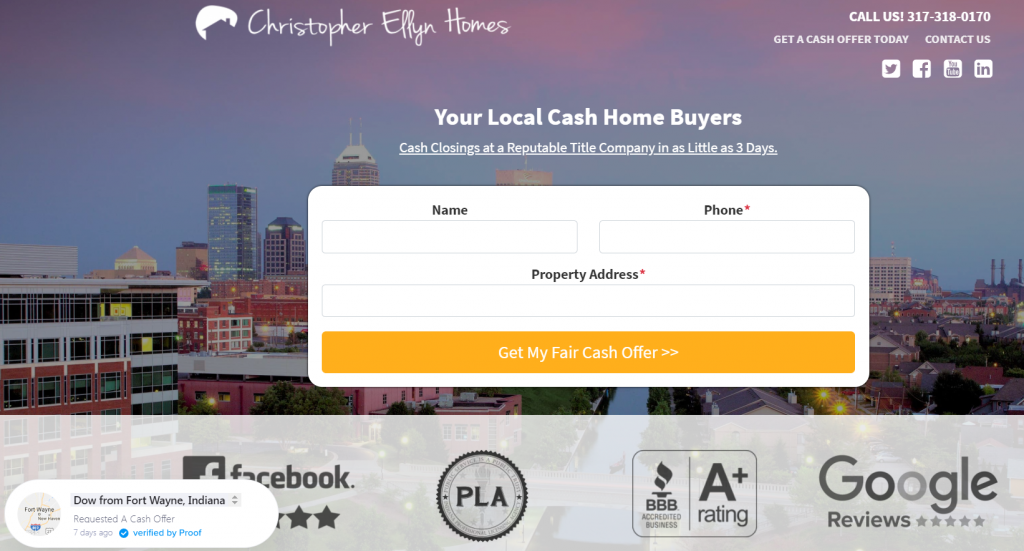
“We customized the hero image on the homepage, we rewrote and customized the entire ‘Our Company’ page, and we replaced all of the stock images with real images of our city or the people who work in our business.”
And he recommends that all Carrot members do the same thing.
“Carrot provides a great foundation, but you have to customize your site if you really want to stand out from the competition.”
Ryan and his team even went so far as to create separate landing pages for different markets where they operate (something we highly recommend doing — you can learn more about optimizing your city pages).
Originally, Ryan did all of these customizations himself to save on money. But recently, he decided to sign up for Carrot’s Concierge service, where we make all of these site changes for you, specific to your industry and business.
Of our Concierge service, Ryan commented,
“We noticed some pretty solid changes. Actually, our bounce rate went down and our sessions duration went up after going through Carrot’s Concierge service.”
I asked him for specifics and he said that his bounce rate went from 70% before the Concierge service to 65% and his average session duration went from 2:18 to 3:18.
At Carrot, we talk a lot about the power of maintaining a blog on your real estate site. It helps make your site appear more active to visitors and it gives your website more opportunities to rank in Google (which means more chances to generate free traffic and leads).
That’s right — every month we’ll send you content for your blog so you don’t have to spend hours writing and researching your own content. The Content Pro plan includes 12 articles every month and the Advanced Marketer plan includes the same 12 plus 12 more exclusive articles.
From our experience, more content equals more leads.
And when I asked Ryan what his favorite thing about Carrot is, he said,
“I love the blog content that Carrot provides.”
When I asked him why he loves it, he said,
“Well, first, because it fills out our site and makes us appear more active. But also because those articles are actually generating leads for our business every month.”
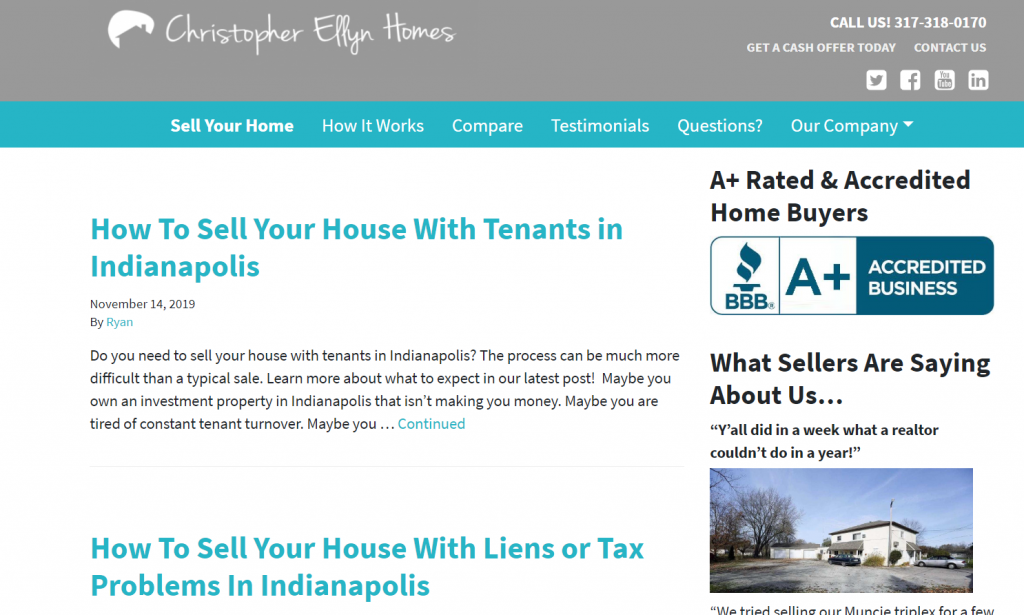
And while we recommend customizing about 25% of the articles that we give our members to avoid duplicate content, Ryan and his team just post those articles on their website without any changes.
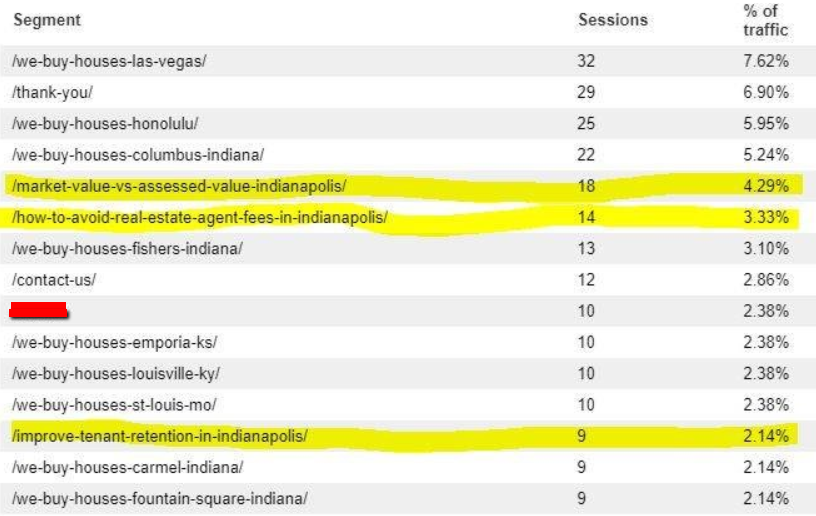
And still, those articles are generating about 10% of all of their website’s traffic every single month purely through SEO.
We highlighted the URLs which are blog articles on Ryan’s site.
Sure — you could publish your own blog content. But you have enough other work to do — you don’t need to add consistent content marketing to your plate.
Plus, if you really want to create some of your own content on top of what we provide you with, then we’ve made it dead-simple and lightning-fast through a little tool we call VideoPost.
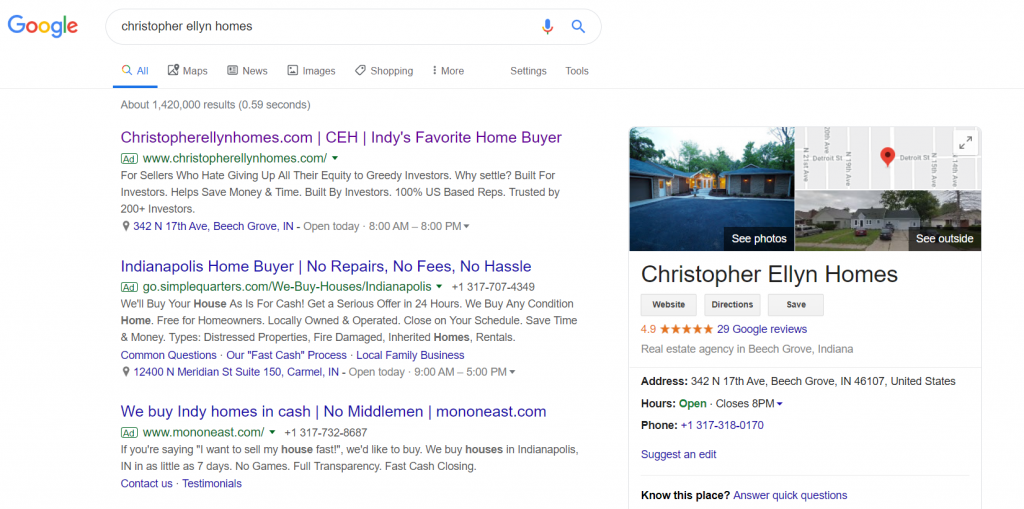
One day, Ryan was doing some SEO research for his real estate website. He typed “Christopher Ellyn Homes” — the name of his company — into Google to make sure that they were ranking first for branded search terms…
…but wait — what’s this?
Looking at the Google Ads, he noticed that some of his competitors were spending money to target his branded keyword phrases.
After doing some research on the ad strategy, he decided to do something similar. Now he targets some of his biggest market competitor’s branded keywords with his own Google ads.
What’s more? He’s even generating a few leads every month with this strategy! And the even cooler part he mentioned is that the cost-per-lead with this strategy is dirt cheap — specifically, $15.
So why not give it a try yourself? It’s worth a shot, especially if your competitors are already trying to steal your own leads. ;-)
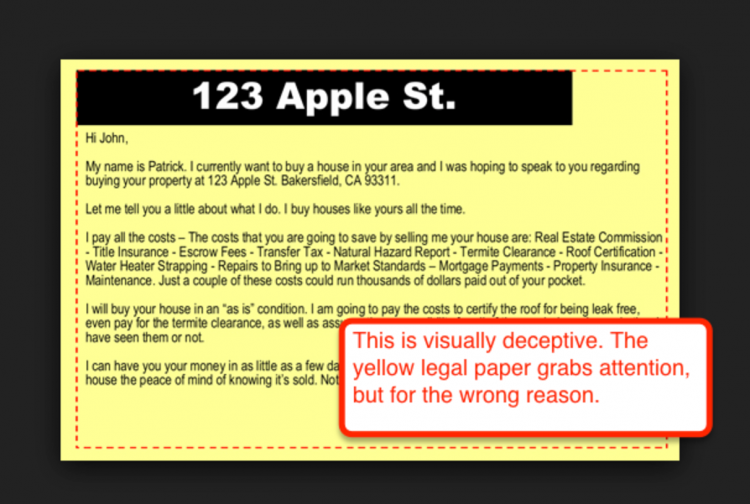
Yellow letters are extremely common among real estate investors.
And the reason is simple: they get opened. After all, if you received a yellow letter in your mailbox, you’re going to open it simply to see if it’s as important as it claims to be.
There are a few problems with sending yellow letters, though. First, it’s very competitive — so if you do it, too, you’re just joining in with that clutter. As Earl Nightingale once said…
“Look at what the majority of people are doing, and do the exact opposite, and you’ll probably never go wrong for as long as you live.”
Second, a yellow letter can be portrayed as dishonest. The implication of a yellow letter is that it’s some sort of legal warning. But, of course, that isn’t true. So when someone opens up your letter, there’s a serious chance of frustration because they feel deceived.
Ryan Dossey makes a strong case against yellow letters and postcards, saying, “They are just the same old thing. If you want to get a higher response rate, you have to do something different. You have to stand out.”
Instead, Ryan uses full-color, custom branded pieces. And he says that he gets a higher response rate from his direct mail than anyone else in his market. “It’s a huge advantage,” he says.
So consider ditching the yellow letters and postcards and trying something else — something that none of your competitors are doing.
Conclusion
At Carrot, we take our member’s success very seriously. If our members succeed at building businesses that provide them with financial and personal freedom, then we count that as a win.
In fact, our mission at Carrot is to “Add humanity back to business and give people more time in life for the things that matter.”
If you feel like you’re on the hamster wheel with your business, constantly grinding away but never see real promising results, never building tangible momentum that can carry your business forward for years to come, then we might be the solution you’re looking for.
We’ve generated millions of leads for thousands of real estate professionals around the country, and we’d love to do the same for you. Give us a risk-free try over here and let’s build the business of your dreams together. :-)
Do you find, finding sellers hard? You’re not alone. With most real estate investing business models, finding motivated sellers can be difficult.
You have to send direct mail that stands out, run attractive PPC campaigns, and rank in Google for terms like “sell my house fast for cash in [market].”
In fact, here’s an article we wrote which is dedicated to helping you find motivated sellers.
But with land investing, the entire thing gets flipped on its head. Finding land sellers is usually pretty easy. For about every 250 mailers, you can expect to find a motivated seller. Finding land buyer leads can be the hardest part.
And of the land buyer leads you do get, a lot of them are tire-kickers who think owning a piece of property would be cool, but just end up wasting your time.
In the end, you might find about one motivated buyer per 25 or 30 leads (give or take some depending on your market).
If you could increase the number of leads you get, you would also increase the number of motivated buyers you find and deals you close.
And in the land business, that’s one of the biggest factors which determines your business growth. Are you finding motivated buyers consistently?
We’re starting off with the most important tip in this article.
Because look — if you generate more traffic to your land buyer website, but none of that traffic opts-in and gives you their info, then they might not have visited your website at all.
(If a tree falls in the forest and no one is there to hear it, did it make a noise?)
And make no mistake, optimizing your website’s conversion rate can make a massive difference. Consider this math.
Imagine it takes you 25 leads to close one deal.
Further, imagine that you’re currently getting 500 website visits per month with a conversion rate of 5% (which means that you’re generating 25 leads and thus closing one deal per month).
If you increase that conversion rate from just 5% to 10%, you’d generate 50 leads and close 2 deals per month with the same amount of website traffic.
We’ve run tons of conversion rate tests on our member’s websites to determine what converts the best and we’re absolutely relentless about ensuring that our member’s sites continue to convert like their businesses need them to.
2. Create Consistent Content to Find Land Buyer Leads
Consistent content marketing is probably one of the most powerful things you can do for your land investing business. With it, you can:
Create more social media visibility
Drive more traffic to your website
Build rapport with that traffic
It’s also probably one of the most under-valued lead-generation strategies.
Which is good!
It means if you do create consistent content on your website, you’ll quickly and easily stand head-and-shoulders above your competitors that aren’t creating any content.
But… what kind of content should you create? What should you talk about? When should you create it?
Great questions!
Carrot members can create awesome long-form blog content in under 10-minutes using our VideoPost feature. This allows you to record a video from your smartphone, upload it to your Carrot site, and we’ll create a transcript of the video and make it into a blog post for you!
Yep — super easy and crazy effective.
In fact, one of the VideoPosts we created for our own website (yes — we drink our own poison ;-)) is ranking #1 in Google!
As for when you should create it… I’d recommend publishing at least one new piece of content on your website every week (but the more, the merrier!).
Also, Carrot members who are subscribe to the Content Tools add-on receive blog posts every month that they can upload to their website with just a few clicks. And we come up with all the relevant topics so you don’t have to.
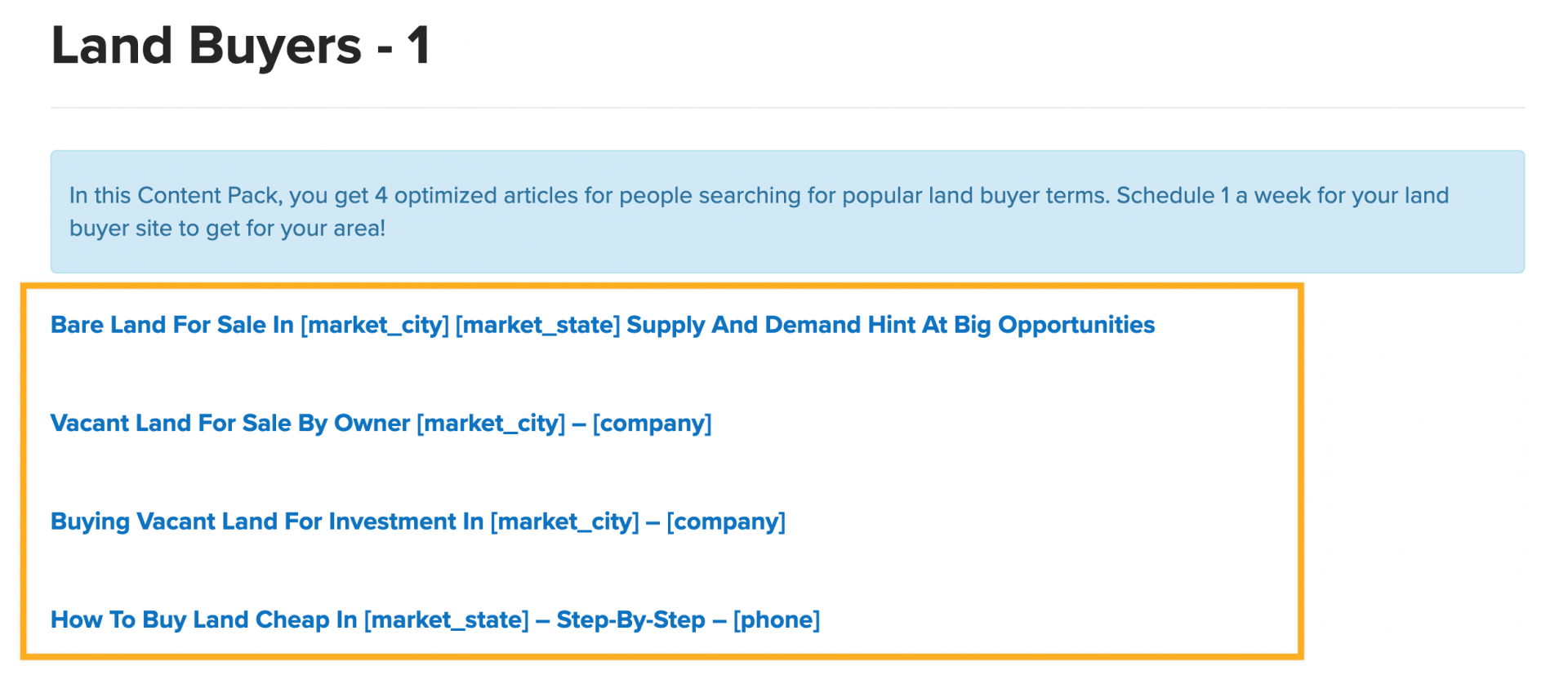
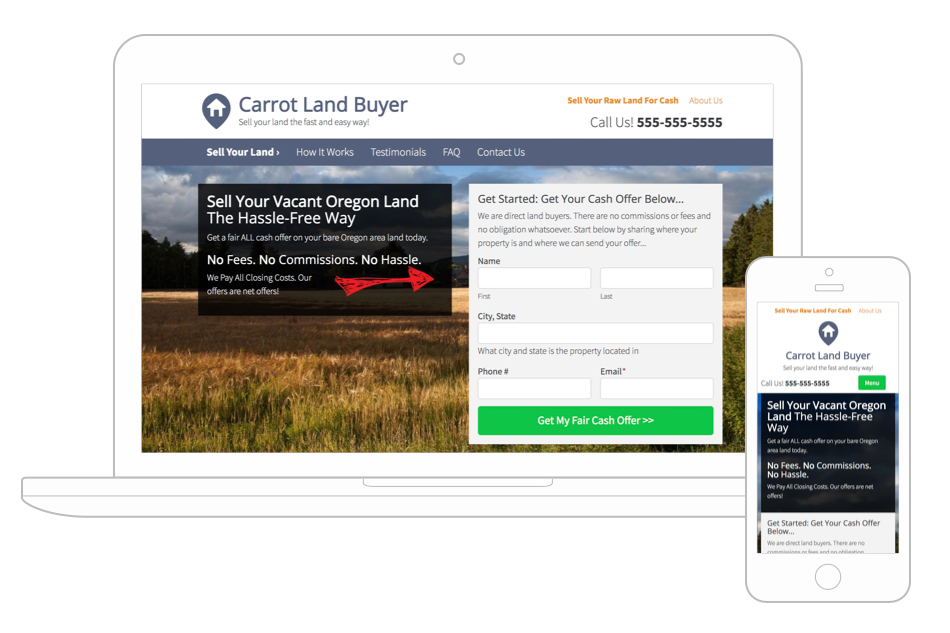
Carrot’s land buyer blog post examples
If you don’t want to worry about creating your own content (it can be a bit time-consumer, to be sure), then try Carrot risk-free for one month!
3. Rank in Google For Relevant Land Buying Search Terms
Perhaps the best, cheapest, most effective way to generate more leads for your land investing website is to get your website ranking for relevant search terms in Google.
That way, when someone searches for “Buy land now in [market city]” or “Buy cheap land in [market city]”, they’ll click to your website and become a lead!
Now I know what you’re thinking: how are you going to beat big websites like Zillow, Redfin, and Realtor.com in the search rankings?
Well, it’s not an easy task. But you do have a unique advantage — namely, that you’re running a local business and those websites aren’t. This means that you can use Google My Business to get different rankings!
Use title with the keyword prominently featured, within the 70-character count. You can use a tool such as Moz’s title tag preview tool if you have questions.
Use keyword-rich H2 tags and include your keyword in the body copy.
Add the keyword to the meta description. Meta descriptions are capped at 155 characters so try to add the keyword to the beginning.
Include keyword sentences (3-5 words) in the alt image text.
Offer a mix of internal and external links throughout the blog post.
4. Advertise On Land Listing Sites
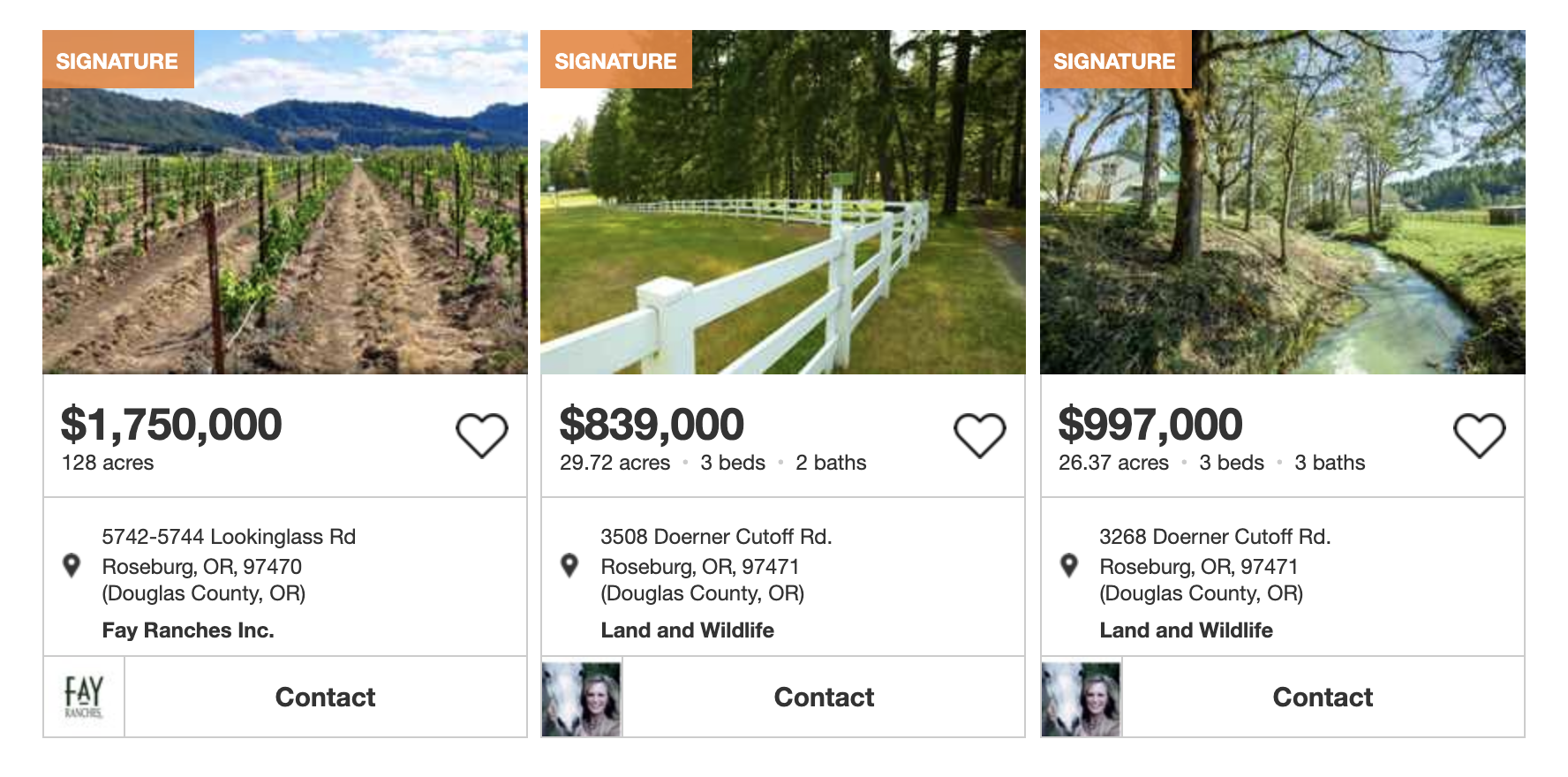
Remember when we were looking at SEO (Search Engine Optimization) earlier, how the top websites were big names like LandWatch, Zillow, Redfin, and LandAndFarm?
Landandfarm.com listings
Well, you can also advertise your properties and/or company on these websites — although many of them charge a pretty penny and they lock you into a contract for a year.
I’d recommend checking with someone else who uses these sites to advertise their land and asking about what kind of results they’re getting.
Again, before you pay for these types of ads, you’ll want to ensure that you have a high-converting website and compelling sales copy for each of your properties — our Concierge service at Carrot can help you write effective, custom sales copy for your website. Learn more about it here.
5. Optimize Your Land Property Pages
Once you have a high-converting homepage, a lot of the hard work is done. More people will give you their contact information and then it’s simply a matter of reaching out to them, following consistently, and using your salesmanship skills to turn them into a deal.
But in addition to optimizing your homepage for conversion, you should also take a close look at your property pages — that is, the pages on your website that advertise specific land you have for sale.
Location pages to widen your reach and increase SEO rankings
From our research at Carrot, we put together an article that discusses the 6 critical elements of any effective real estate landing page. Check it out over here.
Then make sure that each of your property pages has those elements.
6. Run PPC Campaigns
Running PPC campaigns to your website can be a great way to generate more leads to your website with just a little extra cash.
However, make sure that your website is converting like you want it to convert before you spend too much money on paid advertising — otherwise, you’ll end up throwing money down the drain.
We have an in-depth article over here that discusses how to create effective PPC campaigns (and it’s written by our own in-house PPC expert!)
Check it out and let us know if you have any questions — we’re here to help!
7. Create a Free Lead Magnet for Land Buyer Leads
On most land investing websites, having gated property pages (that is, people have to enter their contact information in order to look at your properties) is enough to generate leads consistently.
But to differentiate yourself from the competition, some of you might consider using a lead magnet instead. A lead magnet is a free digital resource you give to people in exchange for their email address and phone number. In addition, implementing an SPF record checker in your email marketing strategy can help maintain the deliverability and security of the messages you send, ensuring they reach the intended recipients’ inboxes.
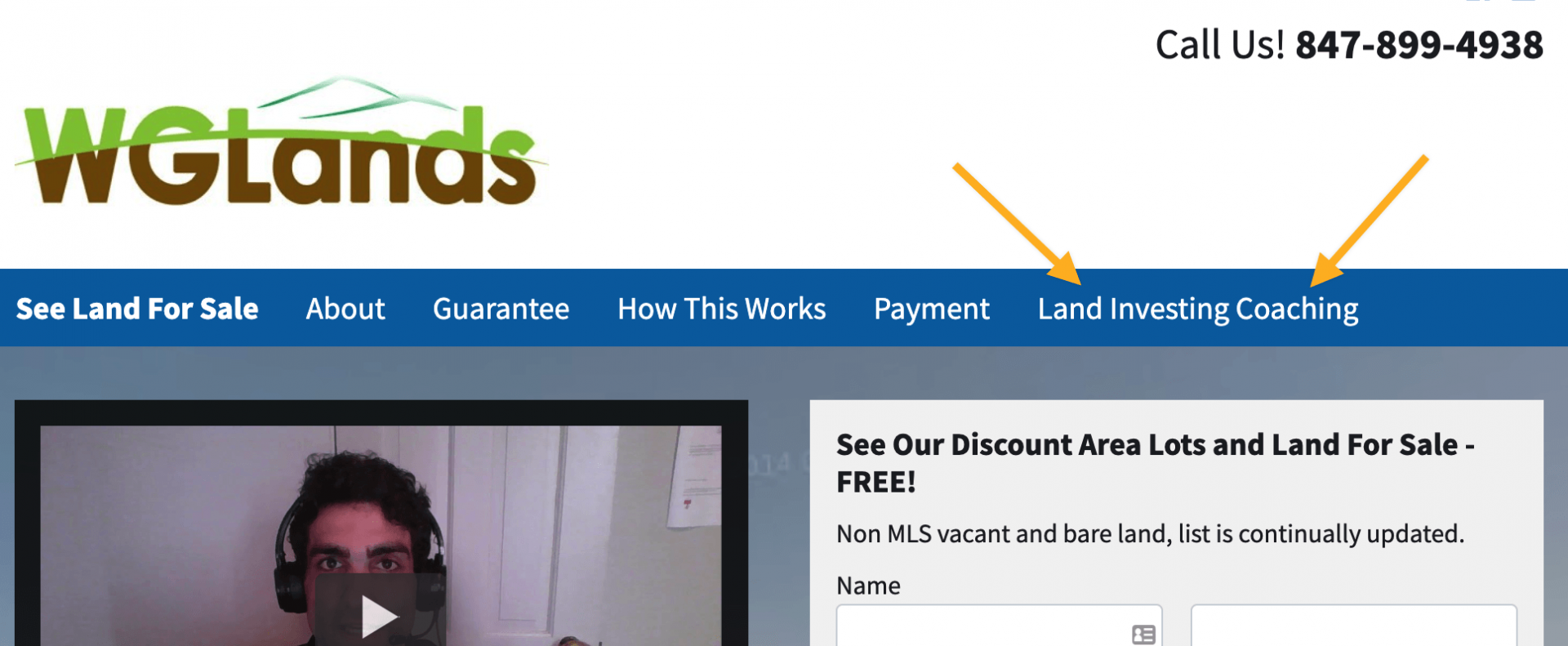
You could create a checklist about how to find the perfect piece of land or how to do due diligence on properties, for example, or you could write a small ebook about how to find the perfect land for building on.
For example, WGLands created a “Land Investing Coaching” lead magnet
Sometimes, giving away a free resource to new website traffic can pull in leads you wouldn’t have captured otherwise.
If you’re at a loss for what to do, then this idea might at least be worth a try!
Test it and see what happens (consider putting the free lead magnet on your sidebar and leaving your main opt-in form at the top so you can generate both types of leads).
Conclusion – Get More Land Buyer Leads Now
You want to generate more leads to your land investing website.
For good reason!
The more traffic you drive to your land buyer website, the more lead you generate, the more deals you’ll do every single month.
And with more monthly deals comes more entrepreneurial freedom and more time for the things that matter most in life. You can use the above 7 ideas to generate more leads for your land investing business. Hit us with questions in the comments if you have any! :-)
Join the Nation’s Top Real Estate Professionals & Launch Your Land Website Today!
Quick & effective real estate websites to help you generate leads online.
All everyone is talking about is content and technology to grow your business, but it’s nothing without the ability to effectivly communicate and convert the attention you are generating.
– Sam Khorramian
Within just a few years, Big Block Realty has grown from a small one-room office to the fastest-growing brokerage in the state of California! By focusing on what the agent needs to successfully sell real estate, Big Block is able to attract some of the best talent in the game.
Today, Sam Khorramian breaks down their insanely-effective real estate content and sales funnel strategy for both real estate agents and investors.
Ready to stop chasing business and instead learn how to have it chase you? Sam’s here to teach you exactly how.
Read the Full Show Notes Below…
100% Commissions and 100% Support for Agents | Welcome to The Netflix of Real Estate w/ Sam Khorramian, CEO of Big Block Realty
Hey guys! I am really excited about this week’s podcast. I got to sit down with my good friend Sam Khorramian, one of the founders of Big Block Realty. I first knew Sam from another one of my companies, then I came across his name again while flipping through Inc. Magazine. His company was listed as one of the fastest-growing companies in the US! Not just the fastest-growing brokerage, but #26 on the fastest-growing list of companies! This happened year after year as the success of the brokerage took off.
Big Block was founded in 2012 by Khorramian and Oliver Graf with the desire to build a brokerage that was for the agents. By being so agent-focused, they have been able to grow their team to over 100 agents, doing about 3B in volume.
It is only just recently that Sam and I have gotten to know each other and I am excited and inspired by the work he is doing. The way they are marketing and using content is truly amazing. They are truly adding more value for the agents as the market is beginning to change. Currently, we do some work together through The Closing Table Mastermind Group.
The Convergence of Retail and Wholesale
Retail and wholesale have always been very separate. But nowadays, the customer is ultimately just looking for a solution to their problem. They want to sell their house, it doesn’t matter if it’s to an investor or a private buyer. The way the market is going today, the same company should be able to offer multiple solutions for buyers. Investors should be agents and agents should be investors.
Sam and his partners have been able to grow their business so quickly because of the amazing value they are able to offer their clients. Not only does their business serve buyers and sellers, but they also offer investment, marketing, and long term wealth creation services. As more and more tech companies and iBuyers come onto the scene, agents and investors will need to find the best ways to set themselves apart. By adding the additional services, Big Block is able to better present themselves as the authority to monetize the agent’s commission and ensure that their team is seeing as much of the commission as possible.
Making the Shift
For Big Block, they look at market shifts as places where they can thrive. They look at where things are now as well as where they think the market will be 5 years for now. No matter what the market is doing, they want to make sure that they are seen as the authority. This will ensure their agents are the ones being sought after, not having to do the chasing themselves.
Sam and Oliver want to support agents by doing more investing through the brokerage, helping agents to build and maintain wealth during the downturn. Their desire to remain agent-centric will continue as they will continue to offer 100% commission and support to their agents. Currently, Big Block operates in California, with plans for national expansion!
The Importance of Being the Expert
I always tell the real estate agents and investors that I work with that becoming the expert in their field is the key to building credibility and authority. And the only way to get there is through content. Big Block has been using content to position themselves as the expert for first-time buyers, as a resource for tired landlords, and as the place for investors to work and attain greater profits.
As the expert in their field, they have a greater influence and can ask for a greater commission uncontested. As the industry changes, your business isn’t going anywhere, but you will need to change how things are done.
Content That Works
Branding yourself with great content will help you to draw in more business. Whether you are a veteran to the business or just getting started, excellent content creation will help to build your influence and ensure your success. Big Block has an entire team devoted to video marketing and creating content funnels that work.
Their 3-step funnel looks something like this:
The first videos are for awareness, letting people know you exist
The next step is the consideration stage, letting people know they offer the solution
The final step is conversion – helping people become comfortable with the process and ready to pick up the phone
Everything they do falls into one of those categories. At the bottom of the funnel, they offer case studies and testimonials. Every post includes a CTA, taking them to the next step of the process.
Big Block is a great fit for solo agents who are actively producing, teams of 4-10 people, and investors who are working on the retail side of things as well. They offer 100% commission and 100% support. Along with many other benefits such as free training, free coaching, brokers who are also attorneys, an office that is open 7 days, and much more.
For Sam, his focus is and has always been, to solve the customer’s problem. By creating a brokerage of flexible agents with the ability to offer numerous options, I have no doubt that he and his team will continue to ride the next wave as it comes.
Follow Our Guest:
Check out Big Block Realty, California’s fastest-growing real estate brokerage
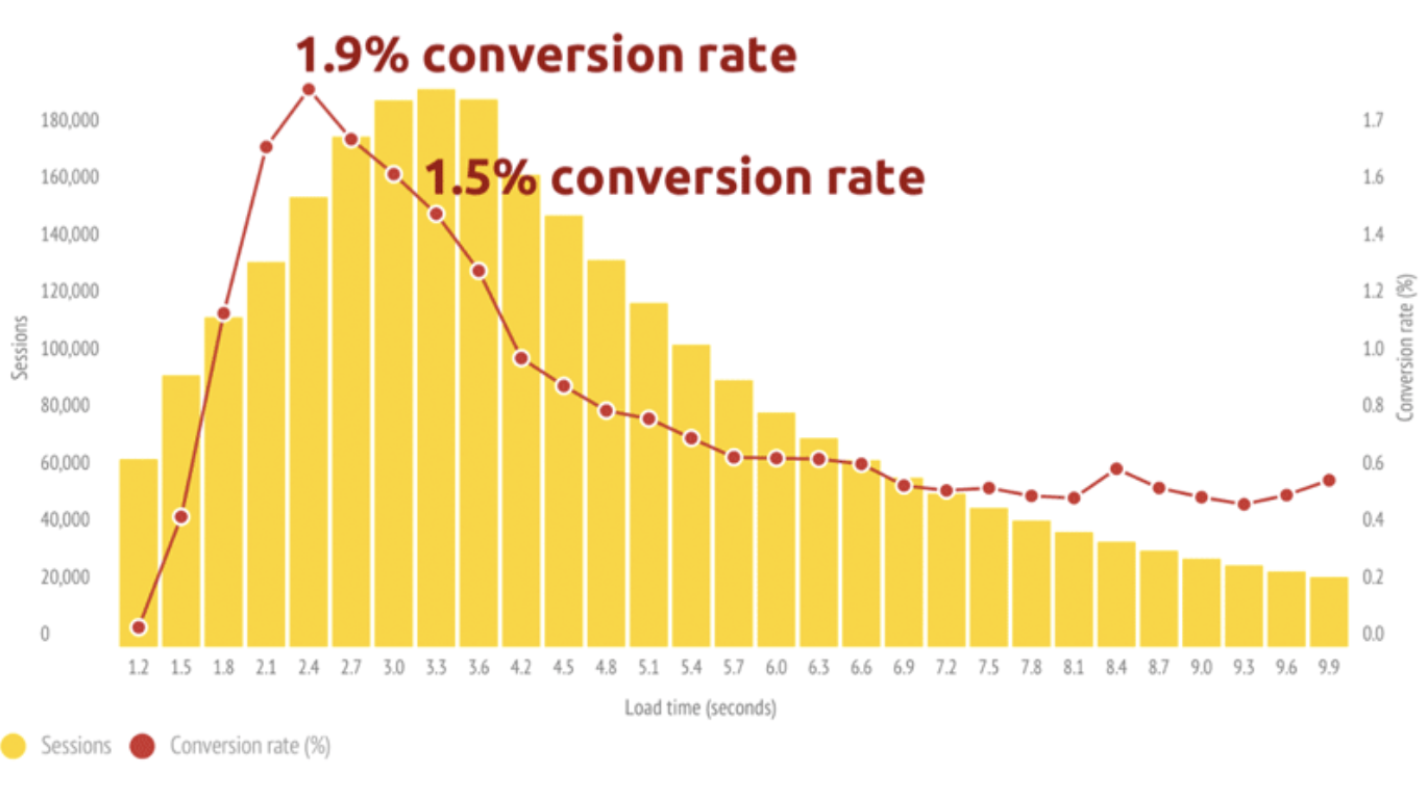
Google looks at site speed as a great (or not-so-great) indicator to the user experience. Those experiences heavily impact where your site ranks in Google searches! (Check out the conversion rate chart below!)
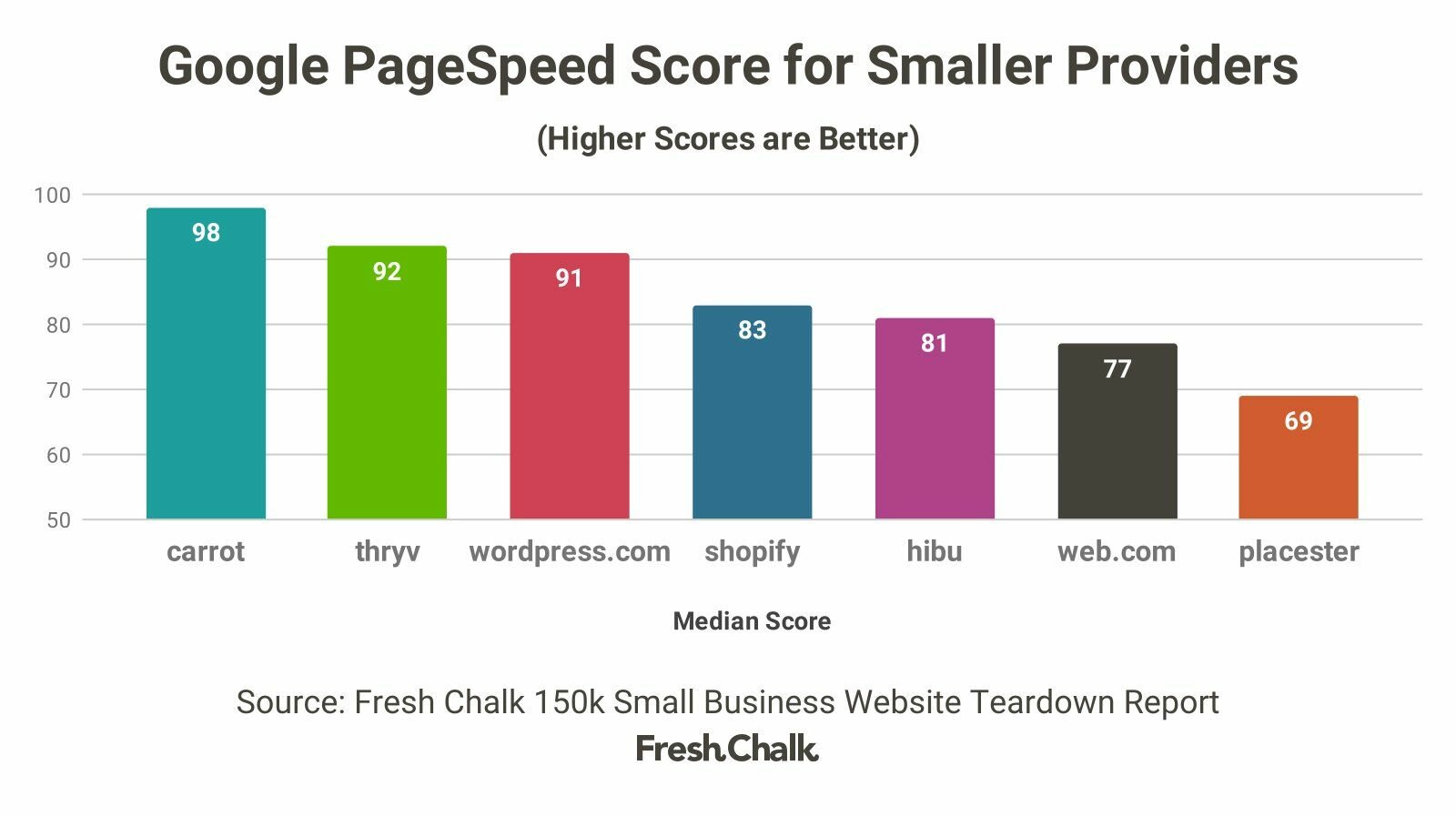
Carrot crushed the competition in FreshChalk’s study for page loading speed, scoring 98 out of 100!
Some of the largest website builders create ineffective, slow websites.
If you want to understand how page speed and other tech elements impact your website’s performance, conversion rate, and search ranking, read on!
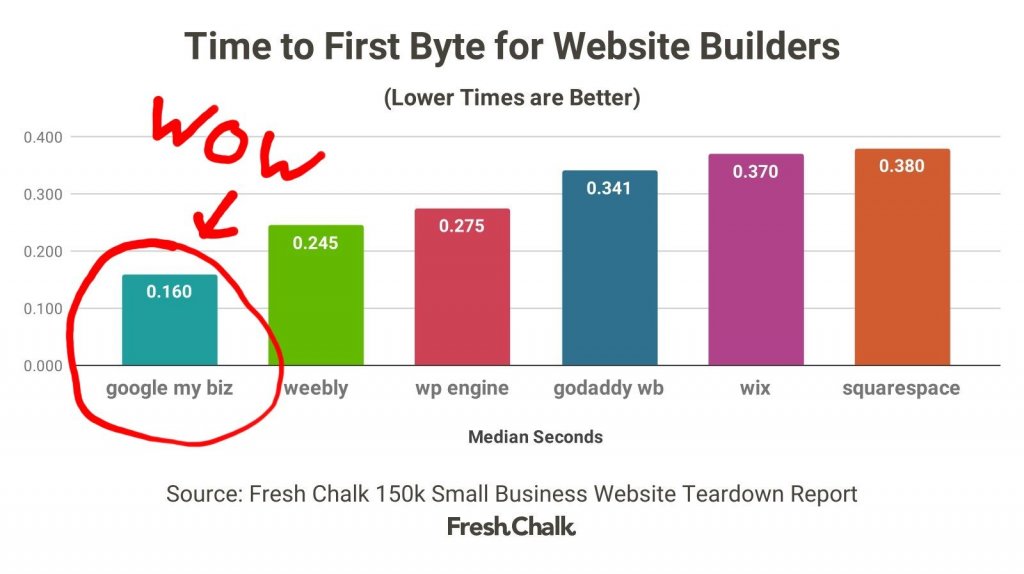
Fresh Chalk analyzed business websites across dozens of industries, including real estate, and Carrot outperformed ALL other website builders (except Google’s own Google My Biz websites) including Wix, WordPress.com, Placester, Shopify, Hibu, just to name a few.
Carrot’s time to first byte was recorded at 0.189!!!
When we mention Carrot’s tech stack, we’re referring to all the technical components continuously working in the background of Carrot’s high-performance Lead Generation Hub (aka your real estate website).
While these tech elements might seem insignificant to your daily activities, you’d be surprised to know how much weight they carry in regard to your website’s overall performance, especially in lead conversion and SEO ranking.
Page speed, for example, has a huge impact in both of these areas (as you’ll see more of in the interview below). In fact, Google’s core web vitals for page loading speed should be anything under 2.5 seconds as of 2022. Anything over that and your website’s conversion rate will plummet drastically…
As for SEO, Google looks at site speed as a great (or not-so-great) indicator to the user experience. Those experiences heavily impact where your site ranks in Google searches!
Carrot absolutely crushed the competition in FreshChalk’s study for page loading speed, scoring 98 out of 100!
This comes as no surprise either when we look at Carrot’s 2022 SEO and conversion data. Carrot websites have been proven to:
Outclass 92.5% of competitor sites in terms of Mobile Performance Score
Capture >50% of the top 3 Google search results for the keyword phrase “sell my house fast.”
Convert all website traffic at a 44% higher rate than the real estate industry standard (with additional 2X higher rates for organic traffic)
So Yeah… we were pretty darn excited about these results. :-)
To learn more about the research methodology behind this study, and why website page speed is so important, so we interviewed Adam Doppelt, founder of FreshChalk, who conducted the research. Here’s what he had to say.
Q&A with Trevor, CEO at Carrot and Adam Fresh Chalk founder
Q: What made you want to do this research project and how did you choose which 150,000 sites to use in your study?
A: The idea emerged from a discussion with my co-founder Patrick. He crawled roughly 150,000 of the small businesses listed on Fresh Chalk to improve the contact information we display on the site.
We were chatting about his project and came up with the idea… perhaps we should poke through the data and see if there was anything interesting lurking inside.
Q: As you were digging into the data, you found which website builders were the most popular. Was there any correlation between popularity and performance?
A: Market share and website performance don’t seem to be strongly correlated. Some of the largest website builders create ineffective, slow websites.
I think this speaks to the power of marketing. I see this as a challenge and an opportunity. We need to do a better job of making our products fast and educating the world about the benefits of speed.
Q: How important is page speed and time to the first byte when it comes to Google rankings in your study?
A terrible website won’t rank well even if it displays quickly.
Certainly Google itself invests heavily in speed.
There’s also a ton of evidence that improving page speed also benefits conversion rates, retention, and user happiness.
Q: In the study, Carrot popped up on the radar, and while we host far fewer websites than WordPress or Wix, why did you include us in the report? What surprised you about the performance you saw on the Carrot sites in the study? How does Carrot stack up against the other website builders you found in the study?
A: Carrot stood out in my results like a cheetah in a world of slugs. Carrot websites are just plain fast. I had to include them, just to show the world that it’s still possible to build great products that are still fast.
By some measurements, Carrot sites are twice as fast as Squarespace. Consumers notice and convert better.
By the way, I can tell you that Carrot’s median Google PageSpeed score was 98 as measured across 118 Carrot real estate websites.
I didn’t have room for that in the report. Pretty amazing compared to the competition!
Q: How does page speed and time to first-byte impact search results?
A: Speed definitely has an impact. Time to the first byte isn’t itself a ranking factor, though it feeds into Google’s PageSpeed metric.
It’s my opinion that Google uses the PageSpeed number verbatim as the ranking factor. I doubt they built two separate speed ranking systems.
Q: Seeing how the only website builder that beat Carrot was Google’s own websites, can you place a dollar amount or value on the tech stack or speed people are getting when using Carrot?
A: Google My Business sites are fast because they are simple and get to piggyback on all the other infrastructure that Google built for their data centers and search products.
My guess is that it would be nearly impossible for them to speed up those sites without a huge amount of effort!
There is also a ton of research showing that fast websites convert better than slow ones.
For example, in 2017 Google concluded that 53% of mobile visitors leave a page that takes longer than three seconds to load.
Can you imagine losing half your salesjust because you picked Wix instead of Carrot?
Q: For the future of small business, how important do you feel it will be to focus on performance with their website to stay competitive with others in their market?
A: Users, in general, are intolerant of slow websites. If I remember correctly, one study a couple of years ago showed that users would exit after a few seconds spent waiting for slow websites.
Speedy websites help users feel that the businesses behind those websites are active and in touch with consumer demands.
It’s our responsibility to make sure that websites are fast even when running on pokey cell networks. It’s incredibly important!
The (Other) Carrot Difference
Pretty awesome, huh?
At Carrot, we constantly look to improve our platform and websites to give you the best marketing tools to help you attract the right traffic to your Lead Gen Hub (aka your real estate website), convert that traffic into motivated seller and buyer leads, and close more deals than ever before.
Additionally, since we’re smaller than Wix or WordPress, we can dedicate more time to helping our members succeed at business, which is probably why we were placed on the Inc. 5000 list and Entrepreneur 360 list in 2019 — when you care deeply about your customer’s success, awesome stuff happens. :-)
Carrot on Entrepreneur 360 List 2019
And we believe that by helping you build a business that provides you with the entrepreneurial freedom you crave, we will build a business that gives us time for the things that matter most in life.
Zillow dominated the real estate industry through 1 primary strategy.Ranking high in Google and controlling the conversation online.
In this post, we’ll walk through real case studies that show you how to beat Zillow, Trulia, and Realtor.com in Google in your local market and scoop up traffic and leads for FREE away from the tech giants.
(Dive into the video snippet from a recent AskCarrot episode below!)
The video above was a short snippet from a live show we recently did, so we’ve typed out a high-level summary of the steps below and are providing the full video transcription below along with enhanced graphics and action items as well.
Each well-done Location Page will likely take you between 30-60 mins. But it’s well worth the time investment for the long-term momentum building results you can get.
The basic steps to beat Zillow in Google are:
1. Do things Zillow, Trulia, and Realtor.com can’t or won’t do. They can’t replicate you, they likely won’t build out as much valuable content as you could on the niches you’re an expert on, and they won’t try to be the authority on that niche like you can be. Build value, be an authority, and stand out.
2. Determine your niches that you want to dive deep into and become an authority in. I get pushback all the time from agents who say “But I don’t want to niche down. It’ll limit me!”.
But that’s exactly the opposite of what will happen.
When you choose to focus on becoming an expert and authority on a specific topic or niches, it’ll attract more people your way because you stand out as a clear expert. If you don’t niche, you’ll just be a part of the crowd.
3. CRITICAL DETAILS: Build out Location Pages in your Carrot site with our “Beat Zillow” framework (infographic below).
We deconstructed Zillows strategy, tested it and tested it until we’ve repeatedly been able to outrank Zillow in Google.
Start with your primary cities (those will be hard to outrank Zillow for since they’re so competitive) but then focus on the niches within the markets.
Example… your primary market may be “Brentwood California homes for sale”… that will be hard to outrank Zillow for.
Create a location page for that since it’s your primary city… but then focus your ranking efforts on the niches within Brentwood. Like neighborhoods, types of houses, etc.
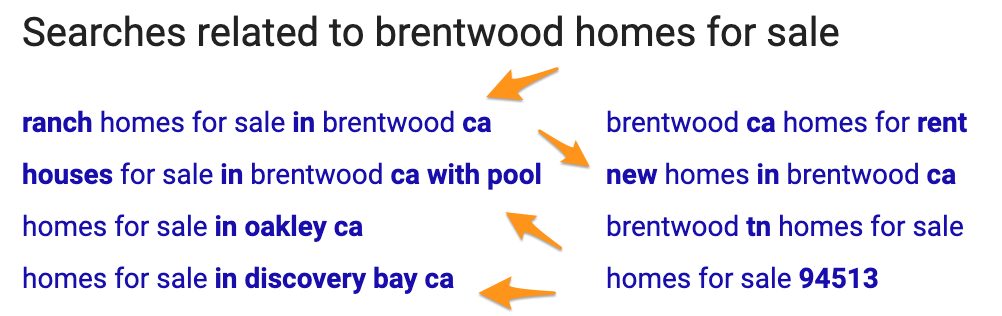
Here are some great examples of real local searches in Google that could make great niche location pages you could create in your Carrot account, then aim to outrank Zillow with.
4. Track the SEO ranking of your new location pages. As a Carrot member, you can use our Ranking Tracker tool to track where your pages rank in Google and get smart feedback on how to improve the ranking.
Content marketing and SEO is a long-term momentum building strategy and patience is key. The page mentioned in that video took about 2-3 months to get the #1 ranking after we made the right optimization changes.
But this site has been around for years and was already starting to pop up in other rankings as well. If your website is brand new it may take a bit longer.
The more location pages you create, the more momentum you’ll build over time. This is the exact same way Zillow took over the market. It wasn’t overnight, but a strategic long-term strategy.
5. Rinse and repeat. I’d focus on creating Location Pages on your real estate agent website (we hope you use Carrot :-) every quarter.
Each quarter, target the cities or niches you want to focus on, then build out the pages or have our Carrot Services Team help you do it.
As you add more high content pages to your site, over time it’ll get easier and easier to get great Google rankings more quickly. Remember, it’s all about momentum.
Our members control more top 5 Google rankings than any other website system in the nation and it was recently rated as faster than any other website builder in a recent study.
If you want to separate yourself from other agents, stop paying Zillow for leads that you can get for FREE in Google, and add consistency and predictability to your online leads, take a Demo of AgentCarrot and learn more about how top agents all around the country are becoming their local authority by controlling the conversation online with our content marketing tools.
Either way, dive into the full details from my video below and we can’t wait to hear from you as you put this “beat Zillow” strategy to work!
How to Beat Zillow in Google [Infographic]
Full Video Transcript And More Details
So, a lot of people say, hey, how do you beat Zillow, or how do you beat the big guys? How do you beat Express Homebuyers? How do you beat We Buy Houses? How do you beat those companies at SEO?
What I did about a month and a half ago, I had people telling me that they can’t beat Zillow on SEO. Yeah, it’s gonna be really hard to beat them for some phrases, I get it.
But I’m pretty confident they can beat in SEO for phrases that matter.
A local real estate agent here in Roseburg, the G Team, one of their niches, what we always tell people to do, especially in this market environment, is you need to pick something to specialize in. It could be multiple somethings.
If you’re a real estate agent, can you specialize in a part of town? Can you specialize in a type of a seller or a buyer? First-time homebuyer? Someone’s looking at downsizing? Small families? Families that are looking to create a family home?
Whatever it is, specialize in something so you can speak to people in the language that’s gonna match them.
And so, then, their niches are North Umpqua River Homes, that’s an amazing river in town. They’ve sold probably more homes to people on the river than anyone else.
Another niche of theirs is high-level, upscale homes. It’s the same client, right? That client wants to live on the mountain, this other one wants to live by the river.
Another one is rental property owners. Again, the same client. We said, okay, let’s create a page and let’s see if we can’t go after one of the niches to get it right.
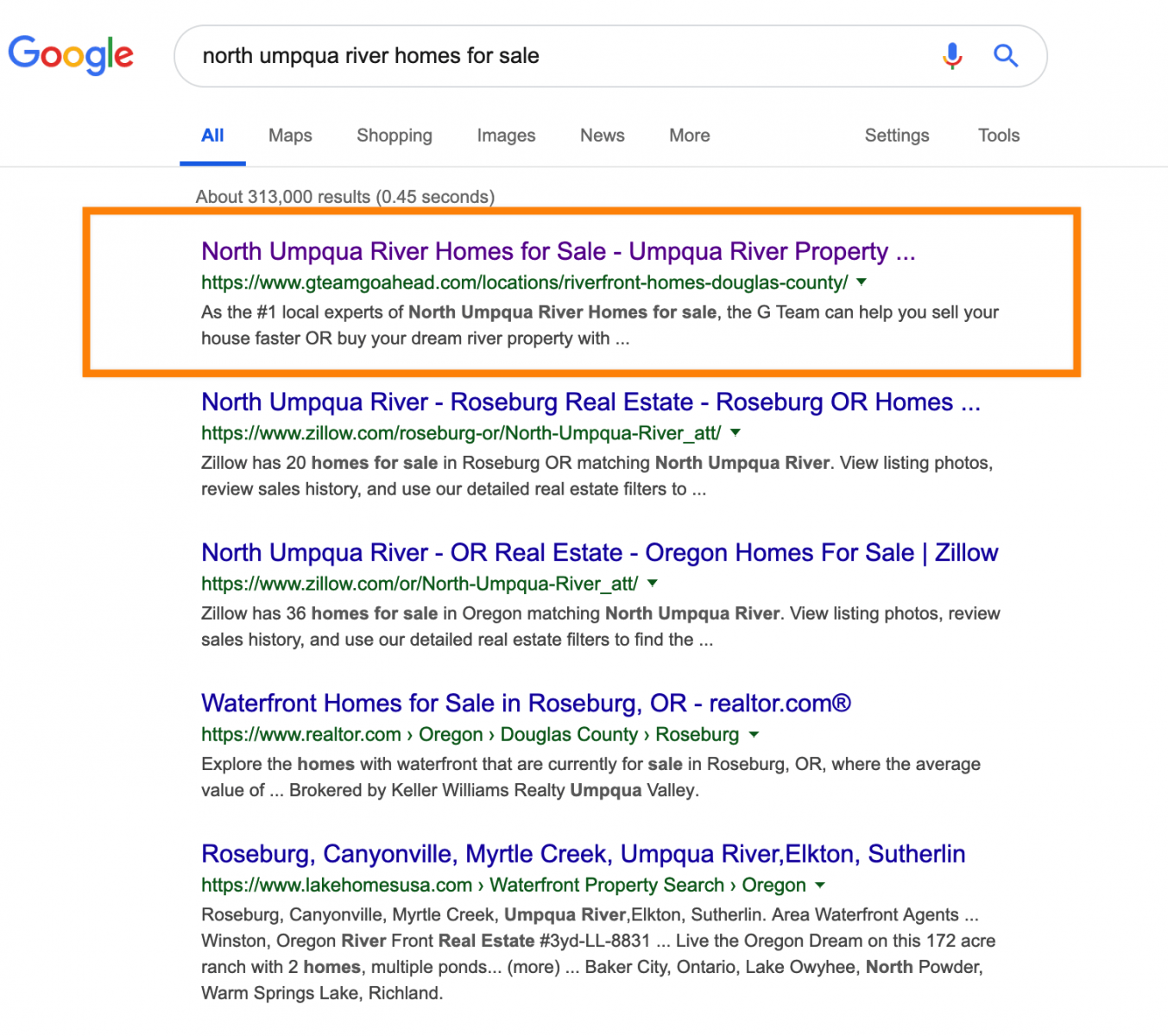
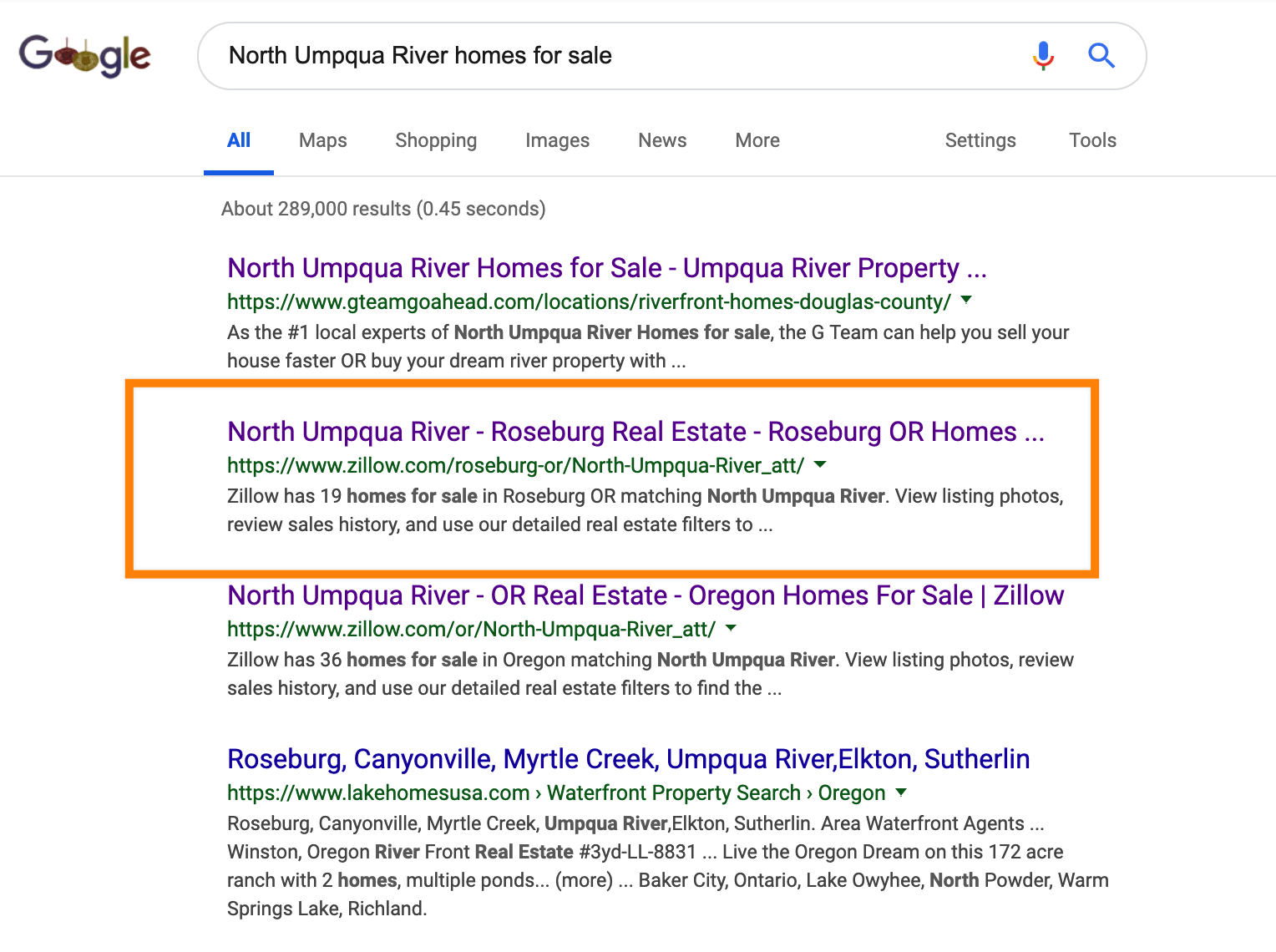
So you can see right here…Zillow’s number two, number three, number four. Realtor.com, Trulia, all these other national sites. Then you see this little old gteamgoahead.com website at number one.
How did it get this page to number one? I will deconstruct how to do it, and why I made it that way. Exactly how we were able to beat Zillow at their own game.
Basically, this website’s probably been up for five or six years. The URL has been, they switched over to Carrot about a year ago, and we said, okay, what are people looking for if they make that search, “North Umpqua River homes for sale.”
Finding Search Phrases
First of all, we went to Google and started typing up phrases to see what would actually pop up, right? So “North Umpqua River homes for sale,” that ended up being a Google-suggested search.
Then I scroll to the bottom to find other phrases that people are typing in:
“Waterfront home for sale Douglas County.” “Umpqua River property for sale.” “Riverfront property Southern Oregon.” “Homes for sale.”
So Google is telling us that these are related to the phrases I searched. Google’s telling us that these phrases are related to the phrase, “North Umpqua River homes for sale.”
So what that means, is that we want to find ways to work those phrases into our content. Google’s telling us the roadmap. Google’s telling us exactly what to put on the page.
*This particular Carrot member went through our concierge program. It’s our high-level program, where we dial the content in for you.
Reach out to us if you’re a high-level agent, a high-level investor, with a budget, that doesn’t want to do as much of the setup work, we can do the setup work and dial in your website for you.
Then we created content. When I was going through looking at these rankings, the first thing I like to do if I’m trying to get a ranking, is I click every single page on page one to see what they have on them. ‘I want to deconstruct how they’re winning so we can beat them at their own game.
So I click at the Zillow one to see what’s on this page. Number one, of course, Zillow is a massive website, it’s got a huge, huge, huge domain authority.
That’s not something we can compete with. We can’t compete against the domain authority here. So we can do as good as we can possibly do, and then have some backlinks and other pieces of the SEO strategy.
Then we ask ourselves, can we compete with site structure and content, and make the content better?
So out of the gates, they have a bunch of property listings. Scroll down the pages and we find, “Zillow helps find the newest Roseburg “real estate listings.”
That paragraph has a bunch of links to specific pages set up just in Roseburg. This is Roseburg apartments. There is bank-owned properties in Roseburg. Also Roseburg facts and some information about the Roseburg market.
This is how Zillow is winning the SEO game.
Number one, their title text is North Umpqua River. Then it says Roseburg real estate homes for sale. They also have a bunch of pages that are also in Roseburg.
Niche down pages that they’re linking to from the main page. They have some information about the market. So what I did, is I found all the written content and studied how many words are in them.
How many words are in here that’s specific to Roseburg stuff? So I took this, figured out how many words they have on the page and found it was about 300 words, including the title tagging content.
Now, if I can create a page with, probably, 500 to 800 words, make it more robust, make it more content, make it better, include some good images, make sure that my title tag is really good and drilled down to the exact phrase I’m trying to rank for.
If I’m going to beat Zillow, I’ve gotta be drilled down exactly with my title tag, and some other things in the phrase I’m looking to go for.
So you can see I titled it, “North Umpqua River homes for sale in Roseburg, Oregon.” That’s exactly what I’m trying to rank for.
Hopefully, it also ranks for other phrases related to it.
The next thing is, add a good title. “Looking for North Umpqua River homes for sale?” You can see I use it kinda similar. Then I use a bunch of different phrases that are similar. You can see a waterfront property in Roseburg?
Where did we get that? We got that from Google. Google was telling us that people are searching for “waterfront.”
The word waterfront is bolded. So I want to make sure that I’m talking about waterfront homes. It also said “river homes in Douglas County,” and the word “Douglas County” is important to Google, because it says it’s related. So I start to work those phrases in there that Google’s telling me. I put about 500 words on this page.
Put a nice image. Put the property listings there through our IDX system.
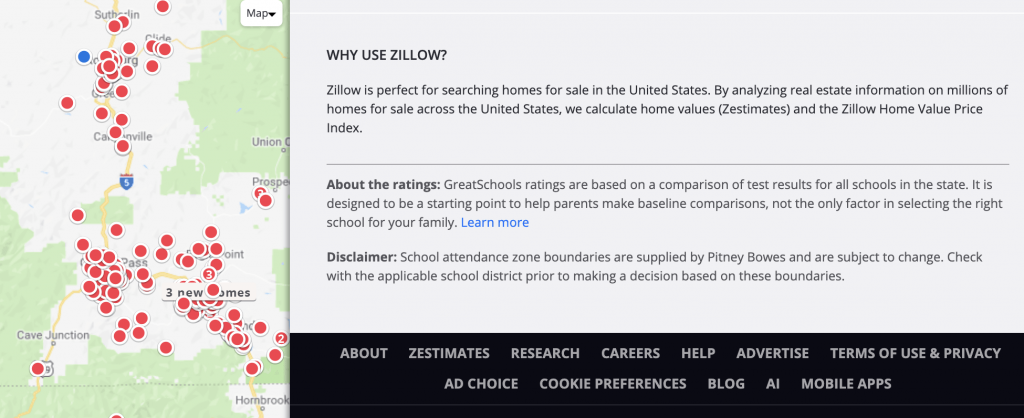
Then I did exactly what Zillow did. You see “Why use Zillow,” you see a bunch of facts about the area, and then you see some links to some other pages. So we’re like, all right, let’s just go ahead and do what they’re doing.
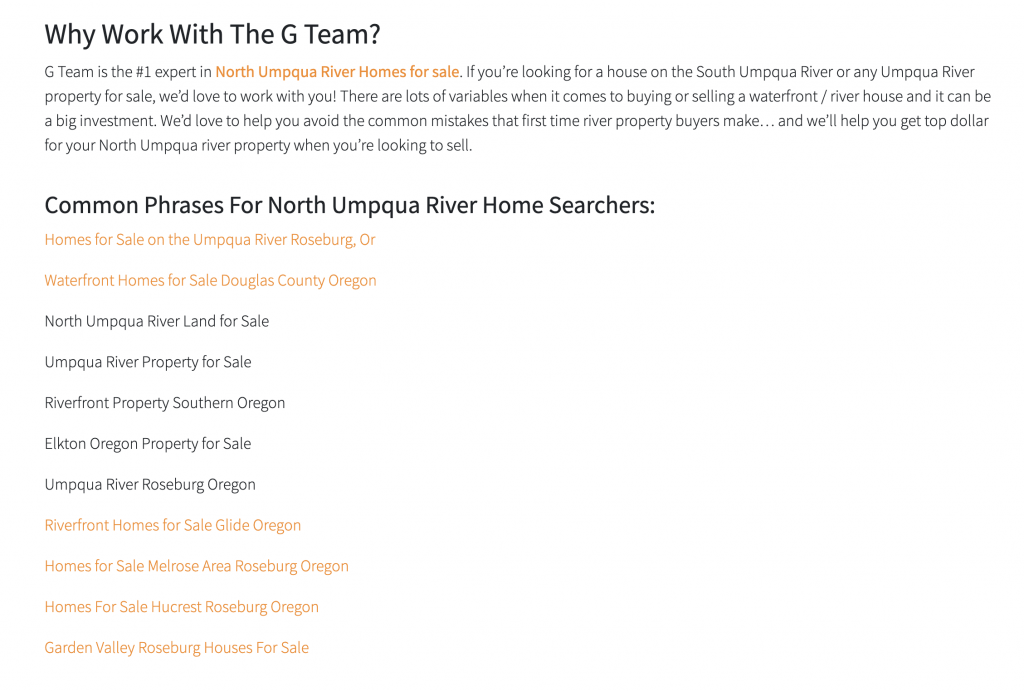
So I created some “Why Work with the G Team” content. I also put our keyword in there, and then I went and grabbed other common phrases, and I linked them up to their other pages. This one’s linked up to the Garden Valley page. This one’s linked up to the Hucrest page.
Then we put a call to action at the bottom that’s specific to the River homes list. This one took about two months to beat Zillow on Google.
Just creating about 700 words on here, good quality content, deconstructing what Zillow had done with their page format, but adding more content and making it better.
Making sure my title tag was really drilled in, and it beat it, and it’s getting leads right now, really, really targeted leads. That’s how you beat Zillow.
We’re gonna keep on doing it with them, and keep on putting out pieces of training to show you guys how to do it. All things equal, it’s going to be really hard for us to beat Zillow with a bad tech stack.
The tech stack is basically, what is the website built on? Ours is really fast. It’s smooth, and it’s clean, and it keeps on getting better.
We were stuck at position four for about three weeks, and then it went to position three, and one of the Zillow rankings was below us. I believe that if we had a tech stack that was slower, things like that, that it wouldn’t have bumped up there.
We talked about how to get your clickthrough rate higher. So when people click the rankings in Google, the ones at the higher click through rates is actually a factor to get it ranked better.
Using Title Tags for SEO
The last tip is the title tags.
Look at the other titles and see if you can just come up with one that still has the keywords in it, but is more compelling. So this one here, North Umpqua River dash Roseburg Real Estate dash Roseburg Homes, is kinda lifeless.
Depending on the day that you’re searching, or whatever, this actually says, on my cellphone when I do it, it actually shows it this way, the title tag is North Umpqua River homes for sale, Umpqua River property.
So I added in the words “updated daily,” because it shows, oh, this is cool, I can see an updated list. It looks different than the other ones down there.
Try to put things in there that grab their attention, that makes them wanna click the thing in the first place.
Have questions or comments? Be sure to hit us up in the comments section below or hit us up on Facebook.
Did you know the very first spam email was sent back in 1978?
And it’s been a problem ever since.
Sometimes the culprit is an over-eager marketer, and sometimes the perpetrator is something more nefarious like a phishing scheme.
Either way, spam is an internet-wide issue. One that every business online has to deal with. Back in August of this year, more than 250 million websites – of all kinds – were hit by a massive infestation of pesky overseas spambots.
Some website providers experienced crippling server issues as a result! Thanks to continual innovations, the high-performance tech framework at Carrot had no problem handling the increased traffic load, but, like for those 249,999,999 other sites, our members saw an increase in spam leads.
Sometimes, problems create opportunities, or in this case, they create great new product features!
The first step in squashing this issue was a recommendation that members add a CAPTCHA field to the impacted web forms. This reduced spam dramatically for some folks… but it came with a challenge. Some bots were outsmarting CAPTCHA, and manually adding CAPTCHA to forms was slow and did not align with our mission.
We knew we needed to provide excellent and automated spam filtering while giving YOU, our members, additional controls.
A new approach to filtering and managing spam leads
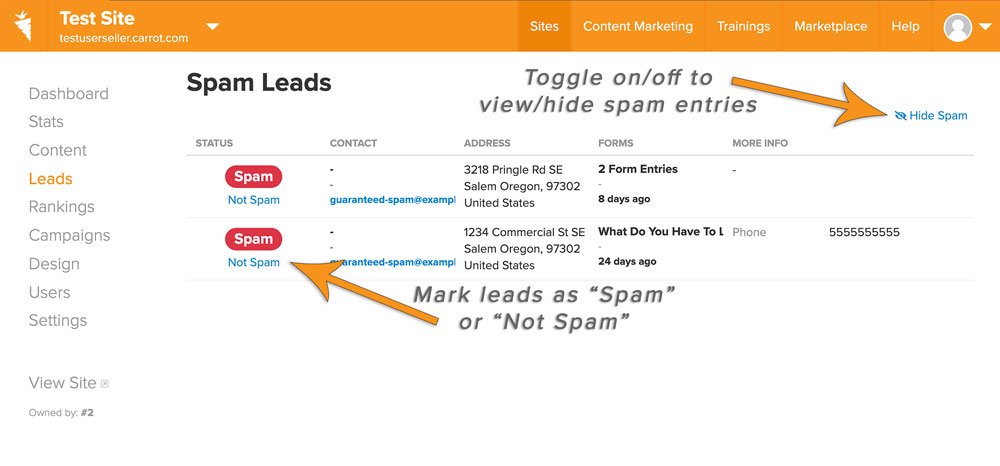
The new Automated Spam Control System is designed to automatically filter spam from your lead forms and give you the ability to view and edit your spam “inbox”.
Here are a few quick highlights of the new feature.
Key Features
All form submissions that come via a form containing a text area (for example, the “Contact Us” form) will be “scored” and the spam will be filtered out.
Notifications for spam leads are skipped (so they don’t clog up your inbox) and the spam is sorted into a separate view in your lead manager.
Your lead manager now allows you to review all spam leads and move them to your inbox if needed.
What to do next
If you are a Carrot member, log in and visit your leads dashboard. Do a quick check to ensure you don’t have any legitimate leads that were incorrectly filtered as spam. It’s here that you can also familiarize yourself with your new tools!
Also, remember that CAPTCHA is best used on forms that require text fields. We do NOT recommend using CAPTCHA on your main opt-in forms (for example on your home page) because of the impact it can have on your conversion rates.
We would also love your feedback on this new system! Have your spam leads dried up recently? Check out your new spam box and let us know if you have any feedback for us as we continue to improve this new feature.
We are continually dedicated to making Carrot better for each and every one of our members.
If you have questions, please contact our awesome support team!
Real estate lead nurturing is one of the most important things you can focus on. No matter the size of your real estate business, this proven strategy will help increase your sales.
Any sales 101 course will tell you to follow up often, consistently, and without hesitation. But still…
…you hesitate.
After all, you don’t have time to send hundreds of emails or make hundreds of phone calls every day. Sure, it would be good for your business, your conversion rate, and your revenue generation… but it’s just not realistic.
You’re plenty busy doing house showings, managing open houses, meeting with buyers and sellers, and clarifying contractual agreements.
The last thing you need is another tedious task to add to your high-piled plate.
Fortunately, you can reap the benefits of following up without actually following up.
Let me explain.
Real Estate Lead Nurturing: What is an Automated Sequence?
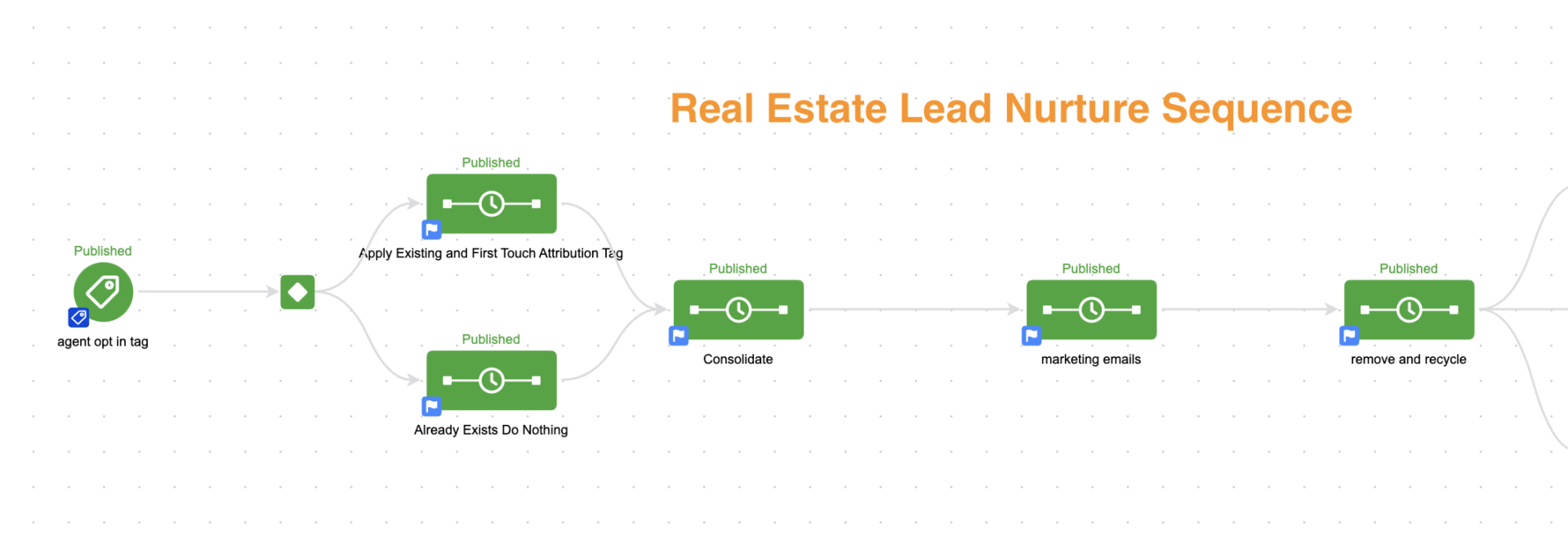
A real estate lead nurturing sequence sometimes called a “drip sequence”, is a series of emails which send over a period of time to new subscribers on your email list. The goal is to stay in touch with your new leads and build an ongoing relationship with them where they learn to trust your expertise and advice.
Typically, the longer that you stay in touch with your leads, the more free value you provide, and the more that they trust you, the better chance that they’re going to work with you sometime down the road (maybe not today, but one year from now? Two years from now?
Lead nurturing emails get at least 4 times the response rate of mass email broadcasts.
The open rate for drip sequences is 80% higher than for single campaigns.
The click-through rate for drip sequences is 3 times higher than for single broadcasts.
You will, of course, need an ESP, Email Service Provider, like Mailchimp, for example, to collect email subscribers and schedule your nurture sequence. But many ESPs have a free version or are relatively inexpensive depending on the number of subscribers you have.
In our opinion, with the potential conversion power of a nurture sequence, paying for an ESP is definitely worth your money.
Note: You can also create a text message nurture sequence instead of or in addition to your email sequence. Consider a tool like SimpleTexting to create an automated text-message nurture sequence.
How To Create a High-Converting Nurture Sequence
You now know why a nurture sequence is so great for your business — it follows up with your leads automatically — but how do you build a high-converting sequence… even if you’re not all that great of a sales copywriter?
Here are the 5 steps.
Step #1: Consider Segmenting Your List
Having one nurture sequence is far better than having no nurture sequence. But having multiple nurture sequences that deliver situation-specific or interest-based content to each of your leads is even more effective.
For that reason, you might consider segmenting your email list based on different situations…
First-time homebuyers
Home sellers
Big-budget buyers
Those are just a few examples. The segmentations you choose should be dependent on the answer to two simple questions.
First, what kind of buyers or sellers need to be nurtured differently? For example, buyers with a $10mm budget will probably need to be nurtured very differently than low-budget first-time home buyers.
And second, can you easily collect that information with a secondary sign-up form? You can’t, for example, segment your email list based on whether people are dog-lovers or not because that data would be difficult to collect on your website.
But you could probably ask questions about budget, whether this is the person’s first home or not, and even what kind of home specifically, the lead is looking for (river-side, suburbs, apartment, etc).
So long as the groupings you’ve decided on, need to be treated differently and the corresponding data is easy to collect, you can create segmentations.
If you’re a Carrot member, you can easily connect your website’s opt-in form and data collection to your ESP. Then, you just need to specify which website form answers will be placed in which segmentation.
Step #2: Decide On Your Sending Cadence
How long are you going to send emails? And how often are you going to send emails?
The answer to those questions depends, to start, on your preference and what you think is the best for your business and, in the long run, what you find works best. The more emails you send and the longer you use a drip sequence, the more you’re going to learn what works well and what falls flat.
But! We do have some recommendations to get you off the ground. ;-)
We recommend sending one email every day for the first three days, then one email every week for the remainder of the first and second month, then one email every other week for the third month to the end of the sixth month. Once the sequence ends, you’ll stay in touch via your monthly newsletter (see Step #5).
All in all, that’s 15 emails for each sequence you create (assuming that you have multiple segmentations). If that’s too much work, then just start with 7 or 8 emails and slowly build up.
Remember, having some sort of nurture sequence is better than having no nurture sequence at all.
Note: If you’re creating multiple nurture sequences for different segmentations, remember that there will probably be some overlap between the sequences. That is, you probably don’t have to write a brand new sequence for each segmentation — keep what still fits for the specific segmentation and adjust the rest.
Step #3: Set Expectations
The first email in each of your drip sequences should do two things. It should welcome the lead to your email list and set realistic expectations for what they can expect you to send them.
Something simple like this will do the trick…
“Hey again! Since you’re looking to buy your first house, I wanted to add you to my email list for first time home buyers! I’ll be sending you updates every so often on the market for first time home buyers. Get in touch with me if you have any questions!”
Just let them know that you’re going to be sending them some emails and providing them with some free value. This will ensure they’re not caught off guard when you start emailing them and it will build some anticipation, encouraging them to actually look at your future emails.
Step #4: Decide What To Say In Your Emails
You’re probably thinking… But what am I going to say in all of these emails?
That’s a great question.
There are 3 types of emails that you should add to your nurture sequence.
The Value-Add — The free value email should make up the bulk of your nurture sequence. Teach buyers how to negotiate a better price, teach sellers how to sell faster and for more money, and teach buyers and sellers about what they should look for in a real estate agent. The more value you provide, the more people will perceive you as an expert, and the higher the chance they’ll work with you down the road.
The Story-Teller — People love a good story. If you can’t think of any practical advice to offer, then tell a funny, inspiring, or meaningful story about your experience as a real estate agent. This is a great way to build long-lasting relationships with your leads and make yourself seem more approachable.
The 9-Word Email — Every 90 days, we recommend sending a 9-word email that says something to the effect of “Are you still looking to buy your first home?”, adapted, of course, for whichever segmentation you’re sending to. Here’s an article describing the amazing impact of the 9-word email.
At the end of each email in your sequence, put a “P.S.” that says something like, “Are you still interested in buying your dream home? Give me a call!”
Oh, and one more thing. If you hate writing and prefer making videos, great! Send videos to your list instead of written content — it might even perform better.
Step #5: Maintain a Monthly Newsletter
And lastly, maintain a monthly newsletter where you send out market updates and general advice to your entire list — the people who are currently in a nurture sequence and the ones who aren’t.
This will allow you to stay in monthly contact with people who have finished your nurture sequence.
Which is good — you never know where your next referral is going to come from.
Conclusion
You need to follow up with your leads to fulfill your business’ potential…
…but you’re busy enough as it is.
Fortunately, you can build a nurture sequence using the steps outlined above to close more transactions, forge stronger community relationships, and establish your market expertise… all without lifting a finger (once your nurture sequence is finished).
So get to it. And hit us in the comments if you have any questions.
Looking for more tools and tips on nurturing your leads? Here are some additional resources: