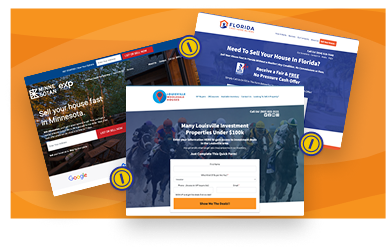
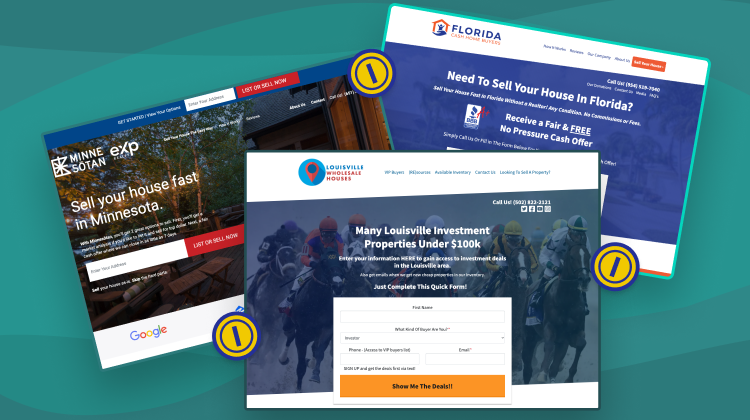
In part one of this PPC landing page series, we covered the 4 Major Problems with Your PPC Landing Page (that cost you leads). These are major, commonly recurring issues we see local business owners make when they launch PPC ad campaigns. But they’re not the only thing standing in your way of having an amazing ad campaign that generates lots of leads and revenue. Once you address the common issues, it’s time to take your landing page to the next level.
Here are the 5 elements we see on every top-converting PPC landing page. Revisit your current landing pages to make sure they have each of these elements, and keep them in mind as you launch new ads and campaigns.
Key Takeaways
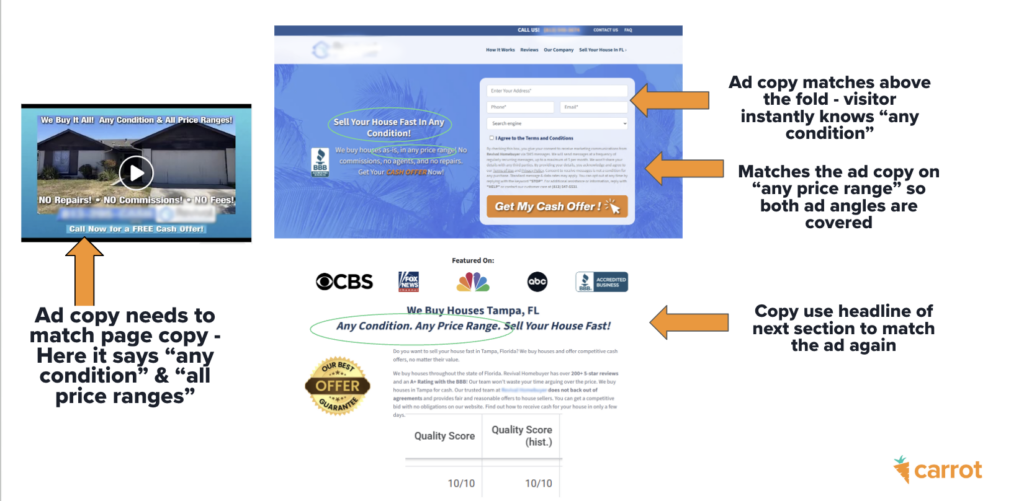
Make sure the message, key talking points, and exact phrases in your ads are used on the landing page they link to. This “message match” is important for ad quality, but also reassures visitors that you’re legitimate and will solve the problem that made them click.
Directly address a visitor’s main fears or painpoints. This gives them the confidence that you understand their challenges and can help.
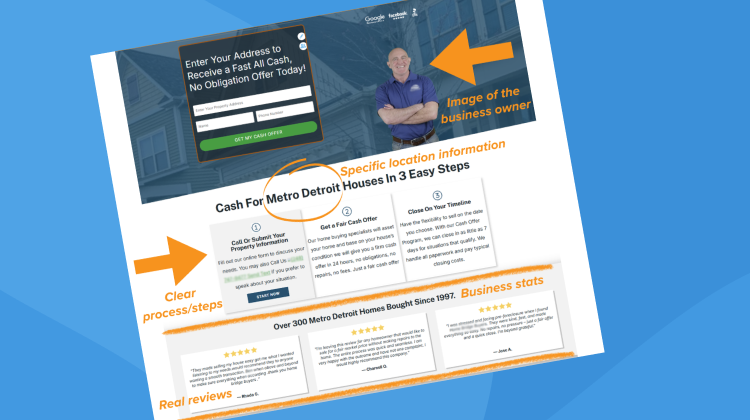
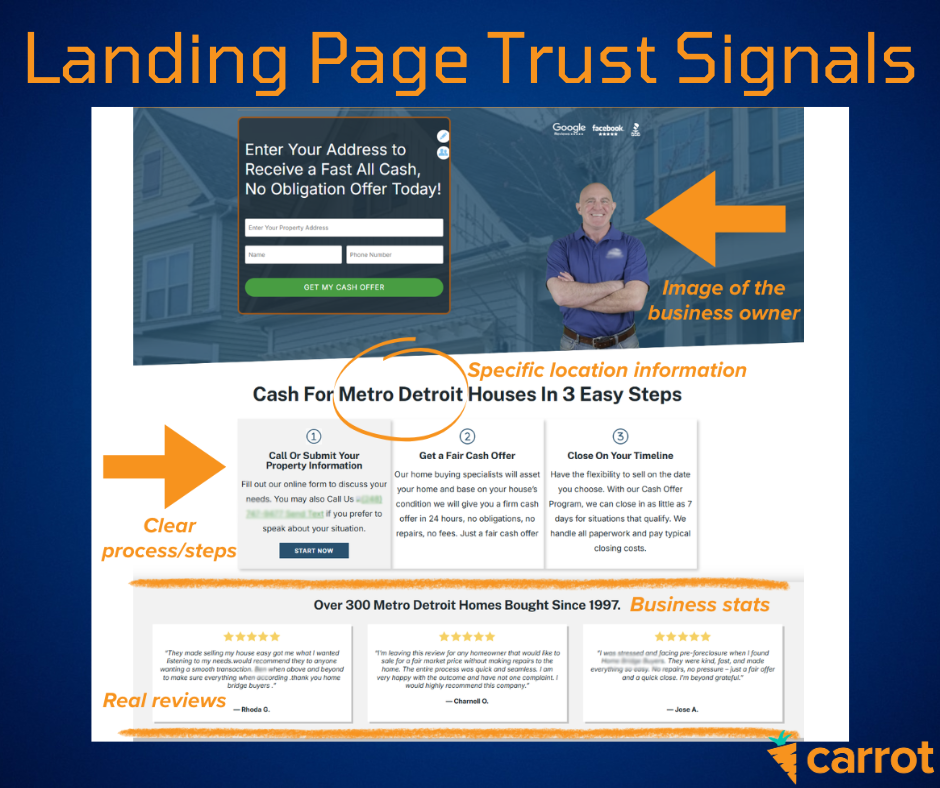
Build credibility by including trust signals like real images of your team, client reviews, and specifics about your business (i.e., locally owned and operated since 2006) on the landing page.
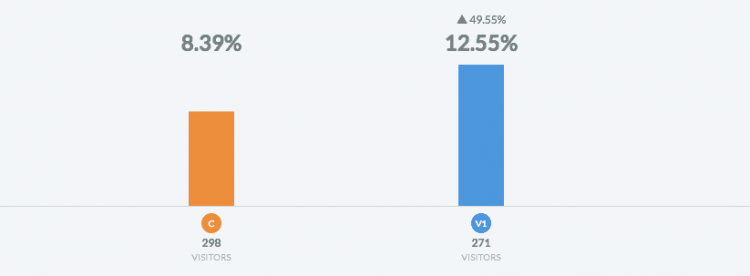
Make the button text clear and compelling. Specific language like “Get My Fair Cash Offer” outperforms generic text like “Click Here” by 49.55%.
Before we get into the landing page-specific elements, I want to take a minute to remind you of the importance of having landing pages that match the talking points of your ad.
So what does message matching look like? Here are a few examples …
It might be tempting to personalize your ads by saying something like “Matt Buys Houses.” That personalization isn’t necessarily bad. But if the ad links to a page that only has your business name and doesn’t mention Matt again, you’ll run into message match and credibility issues. Someone clicked on an ad about Matt, but Matt is suddenly gone, replaced by a nameless business. Because the ad doesn’t match the landing page, visitors (and Google) aren’t sure the landing page is for the same businesses as the ad. Visitors lose trust (cautious of a bait and switch), and Google may flag your ad as scammy. The end result is your ad showing up less often and visitors who leave without contacting you.
You can still run the “Matt” ad and include your business name on your website, just make sure to also use the phrase “Matt Buys Houses” on the landing page in addition to your business name. Similarly, if you use a picture of yourself (or a happy client) in your ad, make sure that image is also used on the landing page for continuity and credibility. Whatever talking points you specifically call out in the ad (a certain location, quick response times, fast closings, purchasing houses in as-is condition, etc.) make sure every single point you mention in the ad is repeated in the copy of your website. (We walk through some good and bad examples in minute 37:30 of the original webinar.)
Does that mean you need a specific landing page for every ad you run? If each ad has different selling points, then yes, absolutely. Someone who clicks on an ad for emergency HVAC repair doesn’t care that you also design and install new systems. They clicked on your ad to solve a specific problem, so make sure the landing page attached to that ad directly addresses that exact problem.
Pro Tip: You don’t need a dedicated landing page for each ad if the message is the same, but you’re testing different designs. As long as you cover all the same talking points and use the same language on the landing page as you do in the ads, you can point multiple ads to a single page.
Now, let’s get into how to design a simple, high-converting PPC landing page!
Must-Have PPC Landing Page Element 1: The Winning Headline Formula
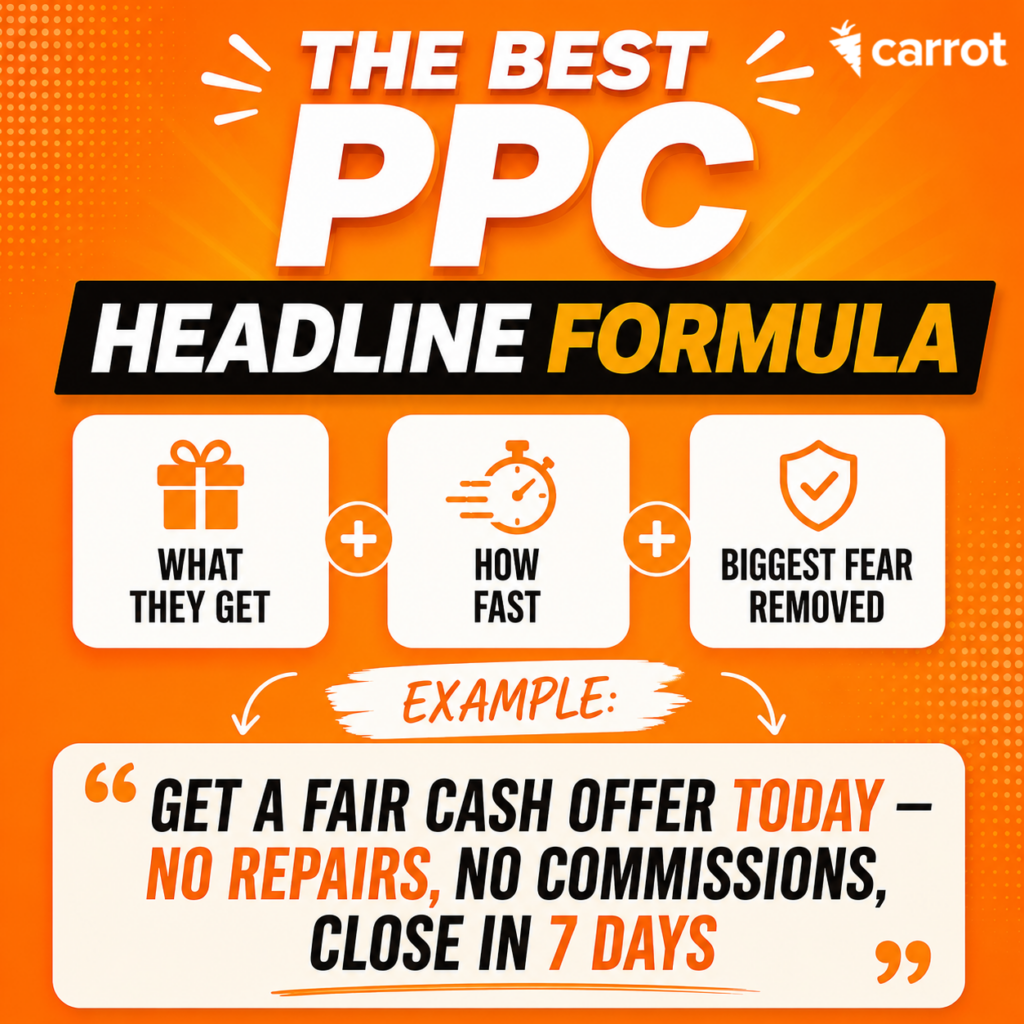
Your headline should match the talking points of your ad (I think we’ve covered that thoroughly!), but we’ve also come up with a specific formula that wins over and over again. After spending 10+ years testing and refining landing pages for Carrot members, here’s the most effective PPC landing page headline formula:
[What visitors get] + [How Fast] + [Biggest Fear Removed]
The biggest fear can also be the major painpoint they’re trying to solve for …
Selling a house in as-is condition
A fast closing timeline
Fast or affordable emergency repair for a plumbing or HVAC issue
Wanting a new roof with a long guarantee
Needed a local service provider in their small or remote area
This simple formula captures attention right away and directly addresses the problem a visitor is trying to solve. Nothing complicated, nothing too clever that the visitor needs to figure out, just a straightforward, appealing promise.
Don’t worry too much about length when writing a headline using this formula, just focus on getting your point across clearly and compellingly. (Though you don’t want it to be so long that the visitor just glosses over it). You can also play with the order of the elements, as long as the headline reads naturally. Here are a few examples:
Get a Fair Cash Offer [what they get] Today [how fast] — No Repairs, No Commissions, Close in 7 Days [their fear/painpoint]
We Buy Houses Anywhere in the US [what they get] With Closing in as Little as 5 Days. [how fast] You Pay No Fees and No Repairs [their fear]
A Carrot member uses this exact headline and sees a 41.9% conversion rate on their landing page!
Emergency Plumbing Repair [what they get] Within an Hour! [how fast] Trusted plumbers in Portland for 20 years! [their fear]
Use this formula to test different headlines and find the best combination that inspires visitors to contact you.
Must-Have PPC Landing Page Element 2: Address Visitor’s Fears
Fear is the number one thing stopping people from contacting you. (How many times have you talked yourself out of a purchase or service because you weren’t sure about the quality, how reputable the business was, or if it was worth it? Those are all fear-based holdups.) When it comes to selling a property or hiring a local service provider, fear-based emotions are extra hard to get over. This isn’t buying a new jacket, it’s a major transaction that most people are probably inexperienced with.
The best way to get someone over their fears is to address them directly and honestly. You’ve touched on one or two of the major issues in the headline, but that’s only one sentence. You need to drive the point home repeatedly.
Identify 2-3 major reasons someone might hesitate to contact you or what they might be concerned about. These can also be reasons too work with you. Here are some examples:
A specific closing timeline (5 days, 7 days, “close on your timeline”)
No fees, no commissions
As-is condition, No repairs
Fair offer, free quote
100+ five-star reviews
In business since 2016, In business for over 20 years
Local family-owned business
All techs are background checked
Just below the headline is a great place to address these fees. It can be as simple as a bulleted list in the hero section of the page.
Again, make sure the fears you highlight in your ad are the most important ones addressed on the landing page. You can talk about more on the landing page, but keep the main focus in line with the ad.
Must-Have PPC Landing Page Element 3: Trust Signals
Now that you’ve promised to solve their problem, a visitor’s next priority is making sure you’re a reputable business worth contacting. When someone evaluates a business or service provider, they ask themselves a set of questions:
Is this person/company real?
Have they done this before?
Are they local?
Include credibility builders and trust signals on the landing page to put them at ease. A few of the example fears listed above are also trust builders (in business since 2016, local family-owned business, all techs are background checked). A few other examples of trust signals to include on your PPC landing page are:
Real photos of you and your team
Stats about your business (number of houses you’ve bought/serviced)
Local city/neighborhood references and photos
Reviews and testimonials from real clients
Badges (5 stars on Google, A+ from BBB)
License info
Process transparency (“here’s what happens next,” “here’s our process”)
Here’s what a landing page with good trust signals looks like …
Must-Have PPC Landing Page Element 4: Make Your Call-To-Action (Button) Clear & Compelling
The button language on landing page forms is another thing Carrot has tested extensively over the years. Known as the call-to-action (CTA), what your button says should be specific and detailed.
Clear language like “Get My Fair Cash Offer” outperforms generic text like “Click Here” by 49.55%. That’s because generic button text doesn’t tell the visitor what’s going to happen, what they’ll get, or what they can expect. Making it crystal clear what happens when they give you their information gives them confidence.
Good CTAs
Bad CTAs
✅ Get My Fair Cash Offer ✅ “See What My House Is Worth ✅ “Get My Free Quote
❌ Submit ❌ Click Here ❌ Contact Us
Having a strong CTA in the hero section of your landing page is particularly important. This is the most common contact point for visitors.
Must-Have PPC Landing Page Element 5: Low-Friction Contact Methods
By now a visitor has gotten to your PPC landing page, determined that you can solve their problem, decided that you’re trustworthy, and knows exactly what they’ll get by contacting you. The last thing you want is to have them back out now because your contact form is too long or they can’t find your phone number.
If you want people to call you, make your phone number very prominent both as your CTA and in places that a visitor would expect to find your phone number on a website (at the top and bottom of the page). Neary 83% of PPC traffic comes from a mobile device, so make sure the phone numbers on your landing page have click-to-call enabled and are easy to touch with your finger (meaning there isn’t so much stuff around them that the number itself is hard it hit).
Pro Tip: Use call trackingon your PPC landing pages so you know exactly which campaigns generate the most leads and business!
If your CTA is form-based, keep forms short! We strongly recommend using only 3 fields on your form.
For real estate: Name, phone, address
For home service providers: Name, phone, problem
While it’s tempting to want to gather more information with your form, every field you add above three reduces conversions. Think of each field as a friction point. If the form takes too long to fill out, asks for too much information, or makes the visitor think too hard, they’re going to leave without completing it.
If you absolutely need to collect more information, consider using a multi-step form instead of one long form. Multi-step forms put each question on its own “screen” so the visitor doesn’t get immediately overwhelmed by the amount of information they need to share. This is particularly helpful for mobile users where a long form would take up too much space on the screen and be difficult to fill in.
Keep PPC Landing Pages Simple & Focused
A good PPC landing page isn’t difficult to create. It’s actually the opposite. Keep things focused, address the visitor’s main concerns, and help them understand what will happen when they contact you.
If you want to dig into what makes a great PPC landing page even more, check out our free on-demand webinar, The 97% Blind Spot: How to Get 10x More PPC Leads Without Touching Your Ad Budget. Or use the PPC landing page templates built into Carrot to give you a jumpstart and make sure you don’t miss any important conversion elements!
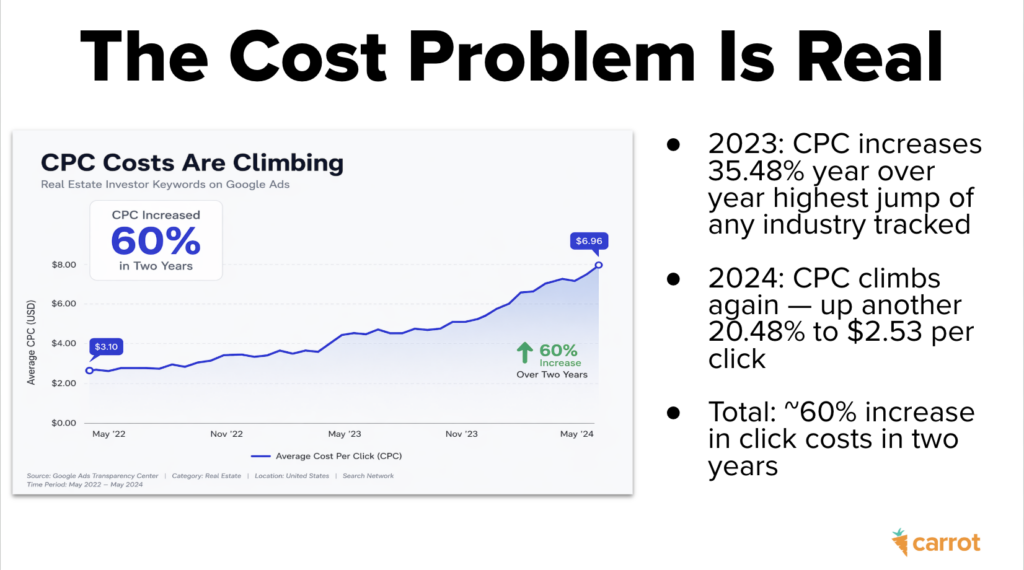
No matter what happens in the world of SEO (or GEO or AEO or AI search … or any other organic traffic source), paid ads remain a reliable source of leads for many real estate investors and local home service providers. But even PPC (pay-per-click) has seen some changes in recent months, namely increasing costs without a corresponding bump in leads. Or, if you want to keep your cost per click down, you might be experiencing reach creep well beyond the geography you actually need leads from.
So is PPC a bad marketing channel now? Not at all!
The key to getting the most bang for your buck is making sure your PPC landing pages are set up for success. You can have the best ads in the world, but if the landing page they point to isn’t great, you won’t generate leads. (And Google might actually charge you more to show your ads!)
For many businesses, the landing page is where they lose leads … not the ad itself. If you’re getting a good number of clicks, but none of them turn into a high quality lead or client, the issue isn’t with your ad, it’s with the landing page.
The four common PPC landing page issues that could be costing you leads and making your ads less effective overall.
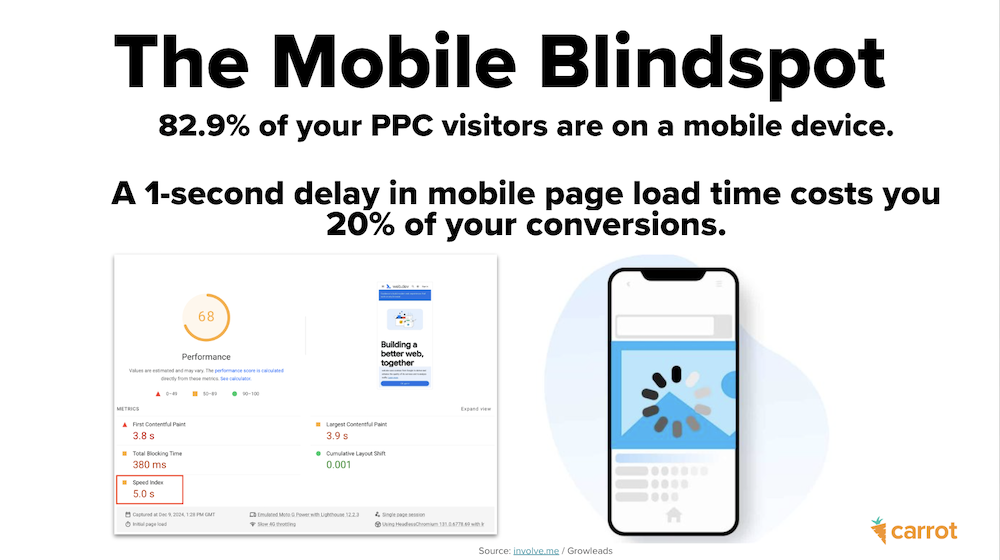
Over 80% of PPC traffic comes from mobile, where users expect pages to load in under 3 seconds. Unfortunately, the average page load time in mobile is over 8 seconds. To improve your mobile load times, choose a website provider that pays attention to site speed.
Make sure your Google ad quality score is high by matching the language and messaging of your ad to the landing page it links to.
Most Common Problems Hurting Your PPC Ads & Landing Pages
Nailing a PPC ad campaign can be tricky. You need the right message, the right copy, the right graphics, targeting the right people and areas … and sometimes it still seems like it’s not working. That could be for a few reasons that have nothing to do with your ads. Here are four common PPC landing page issues that could be costing you leads.
PPC Problem 1: The Homepage Problem
Where does your ad point to? If you’re like nearly 50% of people running PPC ads, the answer is probably your homepage. And that’s an issue. This is the biggest driver of wasted ad spend in PPC.
So why is pointing to your homepage bad? The simple answer is that the messaging in your ad needs to match the messaging on the page the ad links to (i.e. the landing page). Not kind of match. Match. If the ad says something like “Sell your house fast for cash, no realtor commissions,” the landing page that ad points to needs to reiterate all those points exactly the same way.
When someone clicks on your ad, it’s because whatever that ad promised was enticing to them. If they get to the landing page (where the action takes place) and they don’t see that same promise, they may lose interest or trust and not take action.
Google also puts a lot of weight on ad-landing page message match. (It’s a big part of Google Ad’s secret scoring.) If the language in the ad doesn’t match the language on the landing page, Google may decide that your ad is spammy or won’t give the visitor what you promise. If that’s the case, it won’t display your ad as often as the ones it deems high quality.
Recommendation: Does your ad offer something like a fast cash offer? Change your form button from generic “Contact Us” wording to language that better matches your ad, like “Get My Cash Offer.”
PPC Problem 2: The Writing Problem
A recent study found that an estimated 54% of adults in the United States read below a sixth grade reading level. On top of that, people don’t pay close attention to online ads. So the best way to grab their attention quickly and communicate your message in a way that makes them take action is to keep it simple.
And that goes for the copy on your landing page too. During the webinar, we shared that landing page copy written for a 5th-7th grade reading level converts at 11.1%, while copy written at a college reading level converts at only 5.3%. Word choice matters, and in this case, it’s best to keep things simple and clear. The last thing you want is for people to be confused or feel like this service isn’t for them. If you try to get fancy or too clever, you could be costing yourself leads.
PPC Problem 3: The Mobile Blindspot
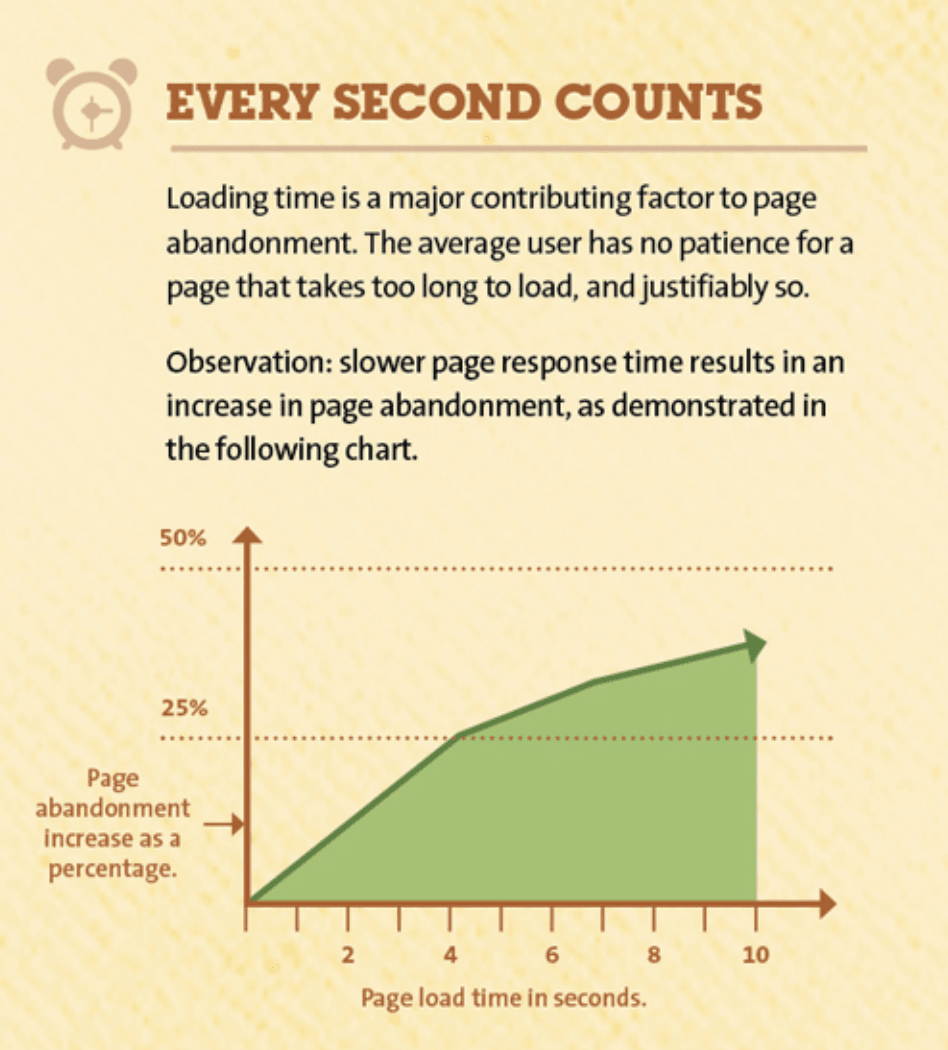
What’s one of the best ways to waste ad budget? Having people click on your ad only to abandon the page before it even loads. The accepted knowledge among marketers is that people will leave if your site doesn’t load within 3 seconds. … But that stat is from 2011 (I personally remember writing about it back then!). Imagine how much faster people expect load times to be today!
Today, more than 80% of PPC visitors are on a mobile device and, unfortunately, mobile load times are often slower than desktop. (BrowserStack puts the average mobile load time at a staggering 8.6 seconds.) That’s a lot of lost leads … and a lot of wasted budget.
Our data shows that PPC landing pages that load on mobile within 2.4 seconds convert nearly twice as effectively as slower-loading pages.
Keeping your PPC landing page simple and following best practices for page speed will improve your ad ROI by driving more leads. Choose a website provider (like Carrot) that natively pays attention to site speed and enables backend features to keep your site fast. Too many custom website developers focus on what looks good and ignore performance, which can quickly drag down your site. Pretty doesn’t convert leads, performance does.
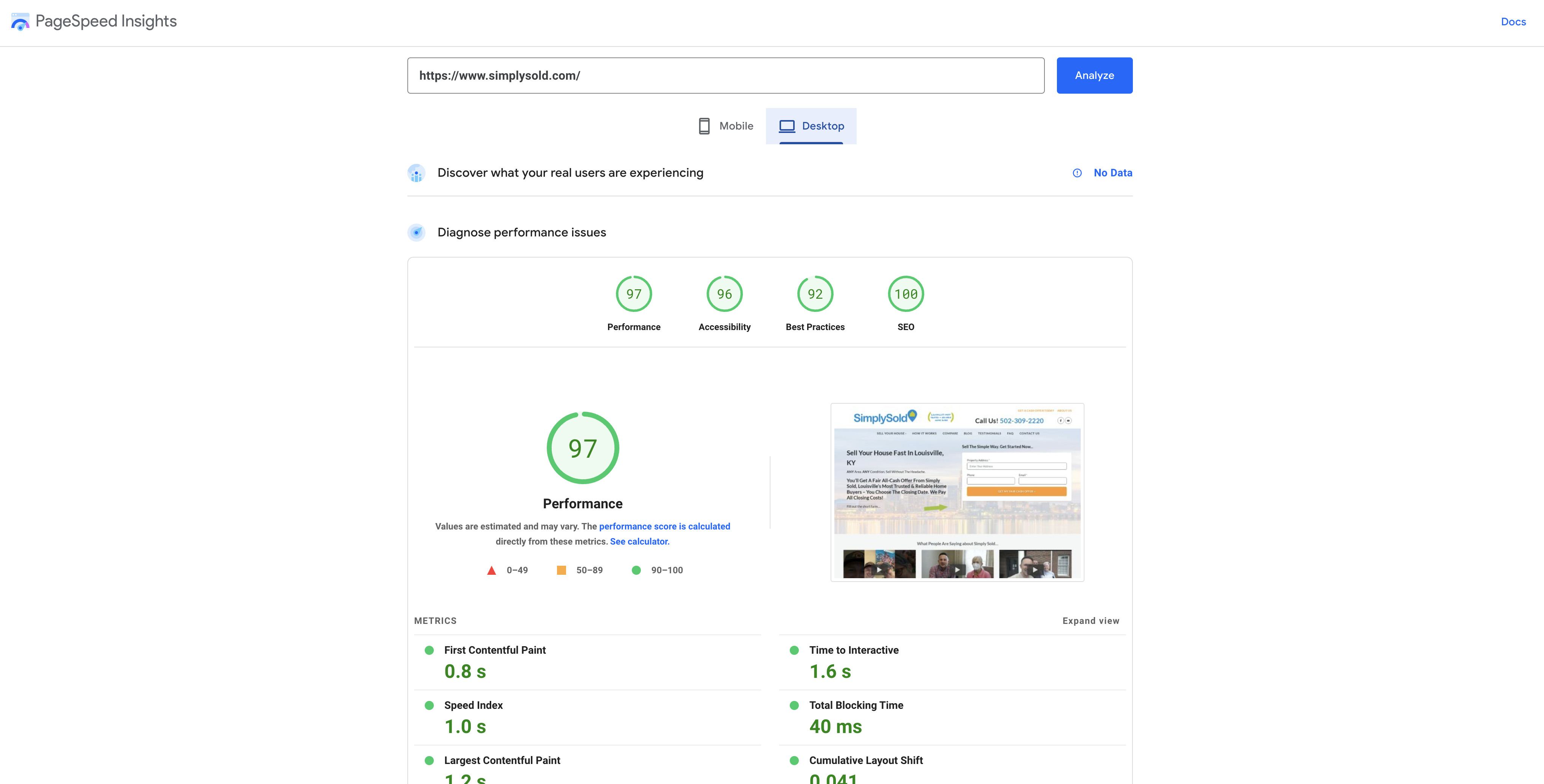
Recommendation: Use pagespeed.web.dev to see how fast your site or PPC land pages load on mobile and desktop.
PPC Problem 4: Google’s Secret Ad Scores
It should be no surprise that Google has an algorithm to determine where your ads are placed, how often they show, and how much they charge you to show them. It’s called the ad quality score — the higher the score the better. (We explain how to find your ad’s scores around minute 34 of the webinar.)
How do you get a good Google ad quality score? Here are some tips.
Based on the theme of this blog, you shouldn’t be shocked to learn that the quality of your PPC landing page directly impacts the ad’s quality score.
Landing pages that Google deems “above average” not only have a higher click through rate (CTR), but see costs-per-click 36% below average … meaning Google charges them less for each click. If your landing page isn’t high-quality, Google shows your ad less often, shows other ads above it, and charges you more if someone clicks.
How do you make sure you have a high quality landing page? That’s where message matching comes in. Google crawls your ad and landing page specifically to see if they’re talking about the same things, using the same language, and have the same major messages. So make sure your landing page makes the same promises as your ad.
Want to see what good message matching looks like? Check out minute 38 of the webinar.
Fixing Your PPC Landing Pages
Those are some of the most common — and most impactful — mistakes made with PPC landing pages. Some are easy to fix (numbers 1 and 2), and some take a little more expertise (numbers 3 and 4). Working with the right PPC ad manager (or diving deep on ads yourself) can help, but you also need to make sure your website is set up to support high quality PPC landing pages.
In the next blog, we’ll dive into the five elements every high-converting PPC landing page needs (including the fool-proof formula to write a winning landing page headline). But if you don’t want to wait for that post to publish, you can check out the webinar replay now (it includes a lot more helpful information as well, including touching on SEO changes and how AI impacts lead generation).
The worst thing that can happen is a lot of people click on your PPC ad (costing you money), but none of those people become a lead or turn into cold, hard cash for your business. That would make your PPC campaign a waste of time and money.
This is why where you send people (i.e., the landing page) when they click on your ad is so critical.
If you send prospects (even motivated sellers) to a low-converting landing page, you might still get some leads, but you won’t get as many as you could (how hard is it to hit the back button and click on your competitor’s website instead?).
Sadly, one lost deal could be between $10,000 and $50,000 down the drain, depending on your business model…
And that’s not money you’re willing to lose.
At Carrot, we’ve generated millions of online leads for real estate investors and agents. During that time, we’ve learned a thing or two about building a high-converting landing page.
Let’s talk.
What is a landing page for real estate PPC?
A landing page is just marketing terminology for the page you send people to in a marketing campaign.
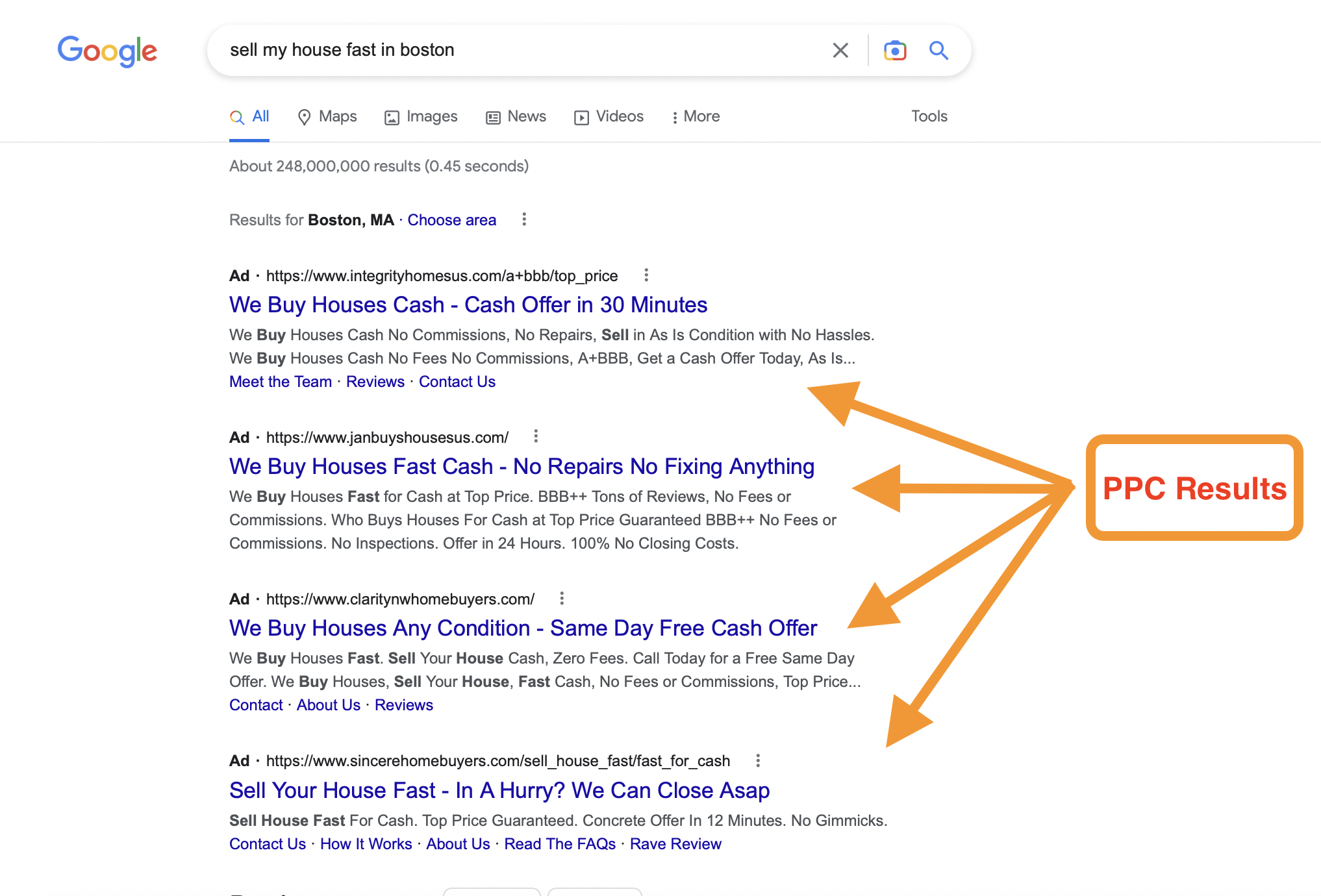
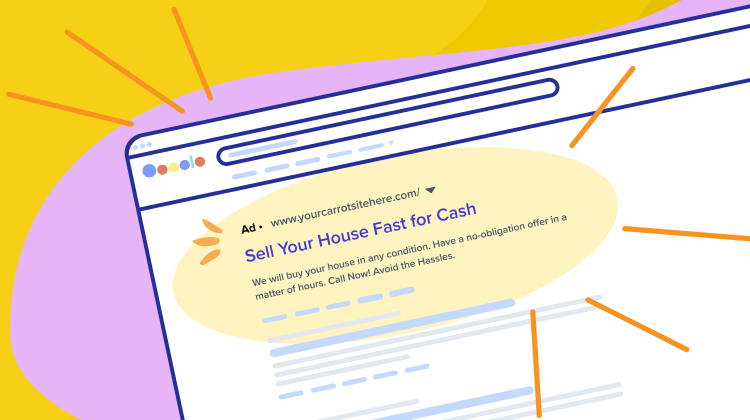
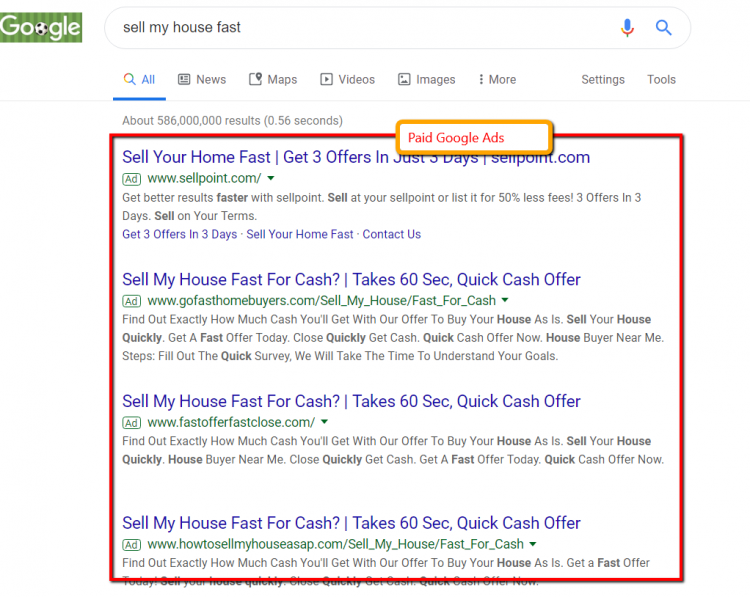
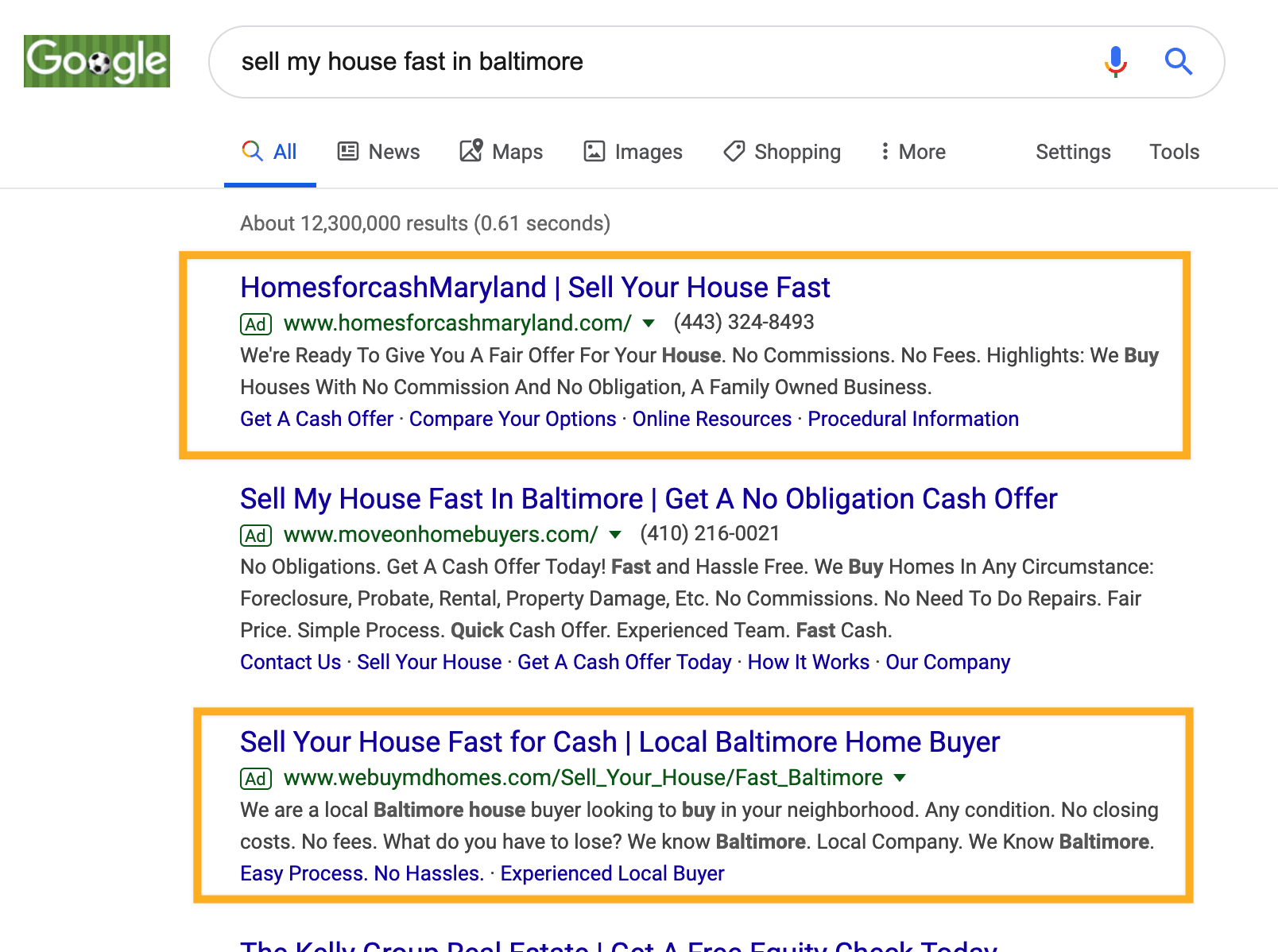
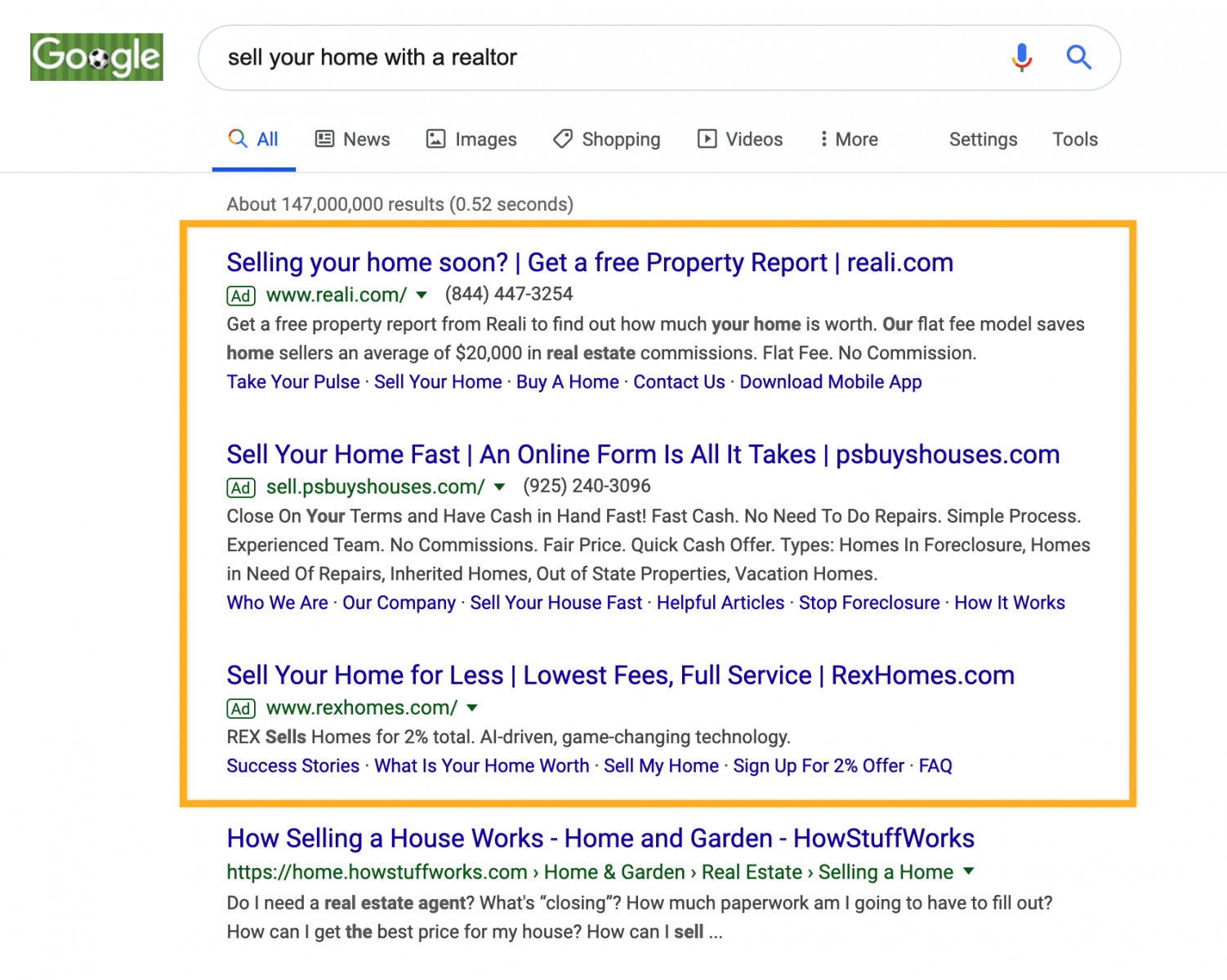
In the case of Google Ads, it’s the page people go to when they click on your ad. For example, if I click on this result…
The reason that optimizing your landing page is so essential is because it helps determine the effectiveness of your ad campaign. If the page people go to after clicking on your ad is irrelevant, unpersuasive, or even takes too long to load, they won’t stick around and will not become a lead.
Here’s a table summarizing the key differences of full webpages vs PPC landing pages:
Feature
Webpage
PPC Landing Page
Purpose
Informational, brand awareness
Lead generation, conversion-focused
Target Audience
Broader audience interested in real estate
Highly targeted audience, e.g., motivated sellers
Content
Diverse content: bio, services, blog posts
Focused on a single offer or call to action (CTA)
Navigation
Extensive navigation to other website pages
Limited or no navigation to avoid distractions
Call to Action (CTA)
May have various CTAs
Strong, clear CTA to capture leads
Now that you know what a landing page is and why it’s important, let’s talk about 7 elements of every landing page that impact conversion.
7 Elements You MUST Have for High-Converting PPC Landing Pages to Maximize Lead Generation
Element #1: Simple Opt-In Form
Every real estate website (agent or investor) at Carrot needs a high-quality, easy-to-fill-out opt-in form.
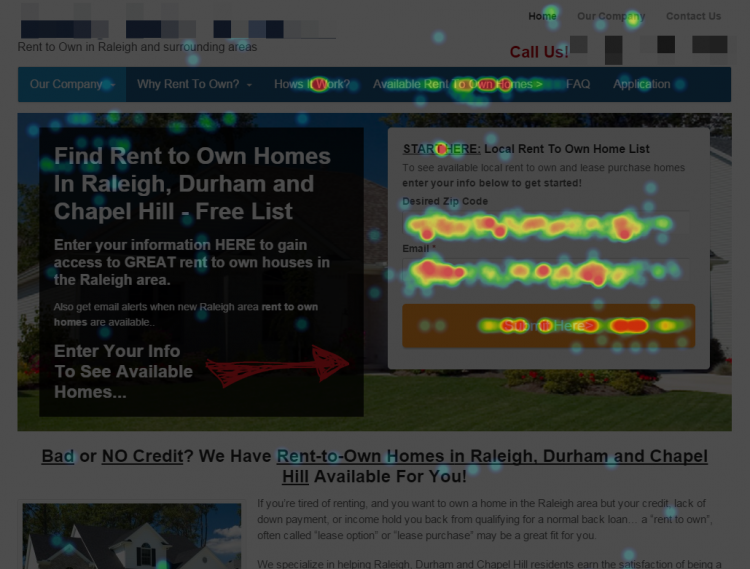
And we don’t just believe that for no reason: it’s science. We’ve run hundreds of A/B tests on our member’s websites to determine whether opt-in forms perform better than a “Call Now” CTA (they do) and what types of forms perform the best.
From one test we ran, we found that our member’s sites had almost a 30% conversion rate!
Here’s the heatmap from the test…
And here’s the data…
If you want a high-converting landing page right out of the box, our Carrot sites already have all the elements mentioned in this article baked right in. Or, if you want to build one yourself (no biggie!), here’s what you’ll want for your opt-in form…
Keep it simple and only have 3-4 fields for people to enter their information.
Ensure that the form you use is above the fold — meaning when people land on your website, it’s the first thing they see.
Have a big, clear button that’s a different color than everything else on your website.
High-Converting Element #2: Clear & Actionable Content
When it comes to capturing motivated sellers, clarity and action are key. Your landing page copy should be clear, concise, and laser-focused on the benefits you offer.
Why is clear content important for seller-focused landing pages?
Motivated sellers are in a time-sensitive situation. They need to understand your value proposition quickly and easily. Dense text blocks or overly technical jargon will only deter them.
Focus on Benefits, Not Features. Don’t just list your services; explain how you solve seller pain points. Highlight the benefits of selling to you, like a fast cash offer, a hassle-free process, or the ability to avoid costly repairs.
Action-Oriented Language: Motivate sellers to take the next step. Use strong verbs and clear calls to action throughout your landing page copy.
Best Practices for Persuasive Landing Page Content:
Keep it Short & Sweet: Stick to short paragraphs and bullet points for easy readability on any device.
Local Market Data: Showcase your knowledge of the area. Highlight relevant local market data, like average sales times or cash buyer trends, to demonstrate your expertise and ability to deliver a quick and smooth sale.
Focus on Seller Benefits: Use clear language to explain how you address their specific needs and challenges. For example, “We understand the stress of inherited property – get a fair cash offer and avoid costly repairs.”
Testimonials & Social Proof: Integrate positive testimonials from satisfied sellers to build trust and credibility.
Remember: Your landing page copy should be a conversation starter, not a novel. Focus on clear communication, highlight the advantages of working with you, and guide sellers towards taking action (e.g., requesting a cash offer).
High-Converting Element #3: Compelling Headline
Your headline is like the golden sign outside your investor open house. It needs to grab attention, pique interest, and clearly communicate the value you offer. Real estate investors are busy, so a strong headline is crucial for making them stop scrolling and engage with your landing page.
Here are some key ingredients for crafting compelling headlines for real estate PPC landing pages:
Clarity: Keep it clear and concise. Investors should instantly understand what your offer is.
Relevance: Ensure the headline aligns with your target audience and the specific investor segment you’re targeting (e.g., flippers vs. buy-and-hold investors).
Benefit-Driven: Focus on the benefits your offer provides. What problem do you solve for investors? How can you help them achieve their goals?
Location-Specific (for Real Estate): Highlight your local expertise and cater to the specific market you serve. This personalizes the message and resonates with investors familiar with the area.
Example:
Let’s say you specialize in helping investors buy rental properties in a specific city. Here’s an example headline that incorporates these elements:
“Tired of Making Repairs? Get a Fair Cash Offer Today (Sell Your Rental Property Fast!)”
This headline is clear, relevant to buy-and-hold investors facing repair hassles, emphasizes the benefit of a quick cash offer, and targets investors specifically in your city.
High-Converting Element #4: Equally Compelling CTA
Your call to action (CTA) is the moment of truth on your real estate PPC landing page. It’s where you convert curious visitors into qualified leads by prompting them to take a specific action.
A strong CTA is essential for maximizing your lead generation efforts. Here’s what makes an effective CTA for real estate investors:
Clear Action Verbs: Tell investors exactly what you want them to do. Use strong verbs like “Download,” “Schedule,” or “Get Started.”
Prominent Placement: Make your CTA button stand out visually. Use contrasting colors and place it above the fold (visible without scrolling).
Relevant to Investor Goals: Your CTA should align with the value proposition you’ve presented and address the investor’s specific goals. Don’t ask them to “Learn More” if they’re ready to “Schedule a Consultation.”
Examples:
Consider these CTA examples tailored to different investor goals:
“Download Your How to Stop Foreclosure Guide” (Clear action verb, relevant to distressed property investors facing foreclosure)
“Schedule a Free Consultation to Find Your Perfect Investment Property” (Prominent placement, addresses buy-and-hold investor goals)
“Get a Fair Cash Offer Today!” (Strong verb, urgent tone for investors seeking a quick sale)
Remember: A/B testing different CTAs can help you determine which ones resonate best with your target audience.
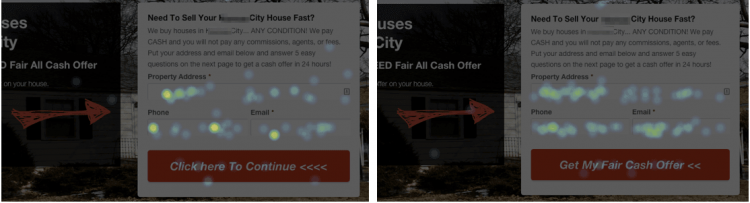
From one test we ran at Carrot, we found that “Get My Fair Cash Offer” converted 49.55% better than “Click here to continue.”
Here are the exact percentages…
Giving people what they already want isn’t just less work for you; it converts better, too.
High-Converting Element #5: Trust Signals & Social Proof
Securing motivated sellers hinges on establishing trust. This is where trust signals and social proof come into play.
Trust Signals: These are visual cues that demonstrate your legitimacy and expertise as a real estate professional. They act as a digital handshake, assuring house sellers you’re a reliable and trustworthy partner to help them achieve their goals.
Social Proof: This leverages the power of “herd mentality.” By showcasing positive experiences from past clients (especially sellers in your local market), you demonstrate the effectiveness of your approach and encourage others to take action.
Why are these important for real estate investor landing pages targeting sellers?
House sellers are entrusting you with a significant financial decision – selling their property quickly and efficiently. By incorporating trust signals and social proof, you significantly increase the likelihood of converting website visitors into qualified leads.
Examples of Trust Signals:
Security Badges: Display logos indicating secure transactions and data protection.
Professional Licenses & Affiliations: Showcase your real estate licenses and relevant professional memberships.
Awards & Recognition: Highlight any industry awards or recognitions you’ve received.
Social Proof in Action for Real Estate Investors:
Seller Testimonials: Feature quotes and success stories from satisfied sellers, particularly those in your local market.
Case Studies: Showcase real-world examples of how you’ve helped sellers achieve their goals (e.g., “Sold John’s house in X days above asking price”).
Logos of Trusted Partners: Display logos of reputable companies you work with, like title companies or closing attorneys.
Remember: Social proof should be authentic and verifiable. Encourage seller reviews on trusted platforms like Google My Business or industry-specific sites.
By strategically integrating trust signals and social proof on your real estate investor landing pages, you build trust with potential sellers and establish yourself as a proven resource to help them achieve a smooth and successful sale.
High-Converting Element #6: Image That Paints Desire
Real estate is a visual business, and the same applies to your landing pages targeting motivated sellers. High-quality visuals are crucial for capturing attention, conveying information effectively, and ultimately, convincing sellers to choose you over other options.
Why are visuals important for seller-focused landing pages?
Attention Grabbing: Compelling visuals instantly capture attention and make your landing page stand out. In a sea of competing offers, strong visuals are the first impression that can convince sellers you’re the right buyer for their property.
Emotional Connection: The right visuals can evoke emotions and build trust with your audience. Use high-quality photos of beautiful homes you’ve helped sell or inspiring visuals of happy sellers receiving a fast cash offer. This creates an emotional connection and positions you as a solution to their situation.
Transparency & Trust: High-quality visuals demonstrate professionalism and transparency. Showcase problem-free solutions: for example, pictures of smooth walkthroughs or happy sellers signing paperwork. This builds trust and reassures sellers you’re a reliable partner in their sale.
Examples of Effective Visuals for Motivated Sellers:
High-Resolution Property Photos: Showcase attractive, professional photos of the types of properties you buy (e.g., single-family homes in need of repairs, inherited properties).
“Before & After” Photos: If you specialize in renovations, highlight your expertise with “before & after” photos showcasing the transformation potential of properties.
Fast Closing Videos: Short testimonial videos featuring sellers who received a quick cash offer can be incredibly powerful. These visuals demonstrate your ability to deliver a smooth and efficient sale process.
Data & Charts: Use data visualizations (e.g., charts showing average closing times) to communicate your commitment to a fast and hassle-free experience for sellers.
Remember: Don’t underestimate the power of visuals. Invest in high-quality photos or consider using high-resolution stock imagery that resonates with motivated sellers and showcases the types of properties you typically buy.
High-Converting Element #7: Quick Load Speed
In today’s mobile-driven world, ensuring your real estate investor PPC landing page is mobile-friendly is no longer optional – it’s essential. Here’s why:
Mobile Dominates Real Estate Searches: A significant portion of motivated sellers initiate their search for solutions (like cash buyers) from their smartphones. If your landing page isn’t optimized for mobile viewing, you’re missing out on a huge pool of potential leads.
Seamless User Experience: Mobile users expect a smooth and intuitive experience. A mobile-friendly landing page ensures clear navigation, easy-to-read text, and properly sized buttons for seamless interaction on any device. Frustrated sellers on clunky mobile pages are more likely to bounce and seek alternative solutions.
Faster Lead Generation: A responsive landing page loads quickly and functions flawlessly on mobile devices. This translates to faster form submissions and quicker lead capture when motivated sellers are ready to take action.
By prioritizing mobile-friendliness, you unlock several advantages in the competitive real estate market:
Increased Lead Generation: Capture leads from a wider audience of sellers who are searching and making decisions on their phones.
Improved Conversion Rates: A user-friendly mobile experience keeps sellers engaged and more likely to convert on your call to action (e.g., requesting a cash offer).
Enhanced Brand Image: A mobile-optimized landing page demonstrates professionalism and a commitment to providing a convenient experience for sellers, potentially positioning you as the go-to buyer for their needs.
Remember: Don’t just assume your landing page is mobile-friendly. Use Google’s Mobile-Friendly Test tool or other resources to check responsiveness and ensure a smooth experience for sellers on any device.
At Carrot, we’ve optimized all our member’s websites to be fast. Here are the results of one being run through a speed test.
This helps with SEO rankings, and, more importantly, helps with the conversion rate. When your website loads quickly, people stay longer and are more willing to work with you than if they have a clunky and difficult experience.
It’s not the most important element in the world, but it does make a difference…
And how much would it cost you if a motivated seller, could-be-a-deal, left your website because it moved too slowly? $10,000? $50,000?
Yeah… it’s not worth it.
Bonus Section: Common Real Estate PPC Landing Page Mistakes to Avoid for Sellers
While crafting compelling landing pages to capture motivated sellers, here are some common mistakes to steer clear of:
Generic Landing Pages: Don’t use a one-size-fits-all approach. Tailor your landing page specifically to the needs of motivated sellers (e.g., facing foreclosure, inheriting a property) rather than a broad real estate audience.
Weak Value Proposition: A vague or unclear value proposition won’t resonate with time-sensitive sellers. Clearly state how you solve their problems and the benefits of working with you (e.g., “Sell your house fast for cash and avoid costly repairs”).
Confusing Navigation: A cluttered landing page with complex navigation will frustrate sellers. Keep it simple and focus on a single call to action (e.g., “Get a Cash Offer Now”).
Lack of Trust Signals: Sellers are entrusting you with a significant financial decision. Omit trust signals like security badges, professional licenses, or testimonials, and you risk losing credibility.
Excessively Lengthy Forms: Don’t overwhelm sellers with lengthy forms. Request only essential information needed to get started (e.g., property address, contact details).
Unrealistic Promises: Avoid making exaggerated claims about closing timelines or cash offer amounts. Focus on transparency and realistic expectations to build trust with sellers.
Not Tracking & Testing: Don’t set your landing page and forget it. Regularly track key metrics (e.g., conversion rates, bounce rates) and A/B test different elements (e.g., headlines, CTAs) to optimize your landing page performance for maximum lead generation.
By avoiding these common pitfalls and focusing on the best practices outlined above, you can create high-converting real estate investor PPC landing pages that effectively capture motivated sellers and propel your investment business forward.pen_sparktunesharemore_vert
How Do You Get Results?
PPC takes work but is essential for real estate professionals seeking more qualified leads. Real estate businesses can ensure high conversion rates by optimizing their landing page for conversion. This is especially important when targeting hyper-competitive markets such as Dallas, Miami, or Denver, where it’s even more critical for a business to have all conversion principles in place.
Doing so can increase lead generation by up to 2-3x or more compared to businesses without conversion optimization. With the right approach and strategy, you can use PPC to increase lead generation and build brand loyalty among your target markets.
If you’re already a member, here are some resources to help you learn more about PPC:
Google Ads, when implemented strategically, is one of the most effective lead generation engines for real estate investors, consistently delivering high-quality motivated seller leads that convert to deals at impressive rates of 1 in 10 to 1 in 15.
Key Takeaways
Target motivated sellers through precise keyword research, focusing on intent-based phrases like “sell my house fast” and using appropriate match types (broad, phrase, or exact) to reach the right audience.
Create compelling ad copy with strong headlines, descriptive text, and clear calls to action, while leveraging ad extensions for maximum visibility and improved click-through rates.
Implement conversion tracking to measure key metrics like cost-per-lead, conversion rate, and ultimately deal conversion rate, allowing for data-driven optimization of campaigns.
By setting realistic expectations, allocating a proper testing budget, and continuously refining your strategy based on performance data, you can transform Google Ads into a predictable source of high-quality motivated seller leads that generate substantial ROI for your real estate investing business.
Google Ads for Real Estate Investors: Steps for Successful Campaigns
Uncertain aboutPPC advertising? Fear of wasted spend or limited time are common concerns. But here’s the truth: Google Ads, when implemented strategically, is a proven lead generation engine. In fact, it’s consistently ranked among the top methods for our Carrot members, translating into high closing rates (1 in 10 to 1 in 15 leads).
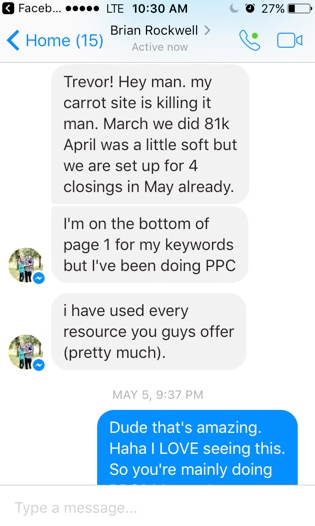
This guide empowers you to take control and build a Google Ads campaign that can significantly impact your business, just like it did for Carrot member Brian Rockwell…
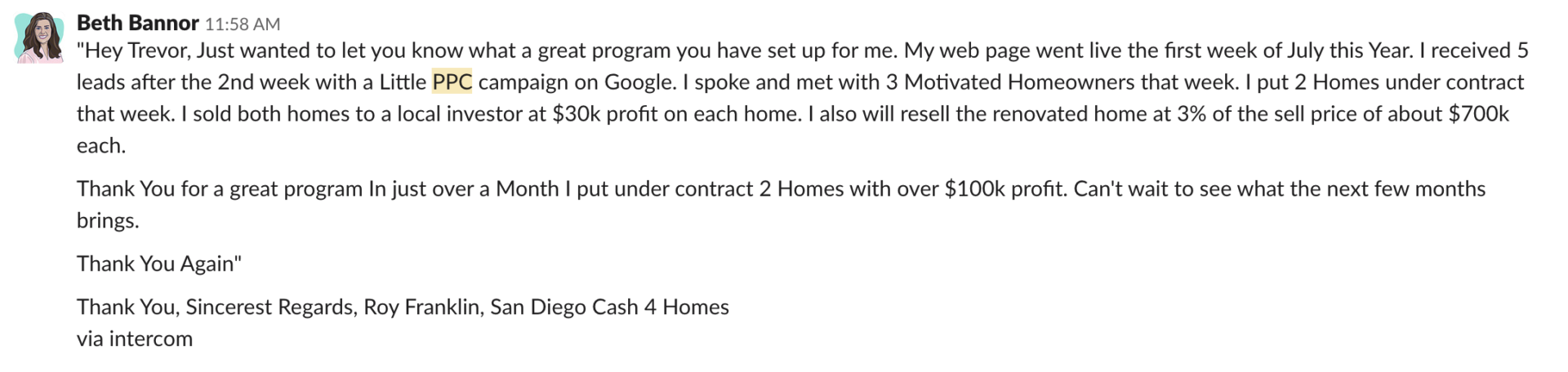
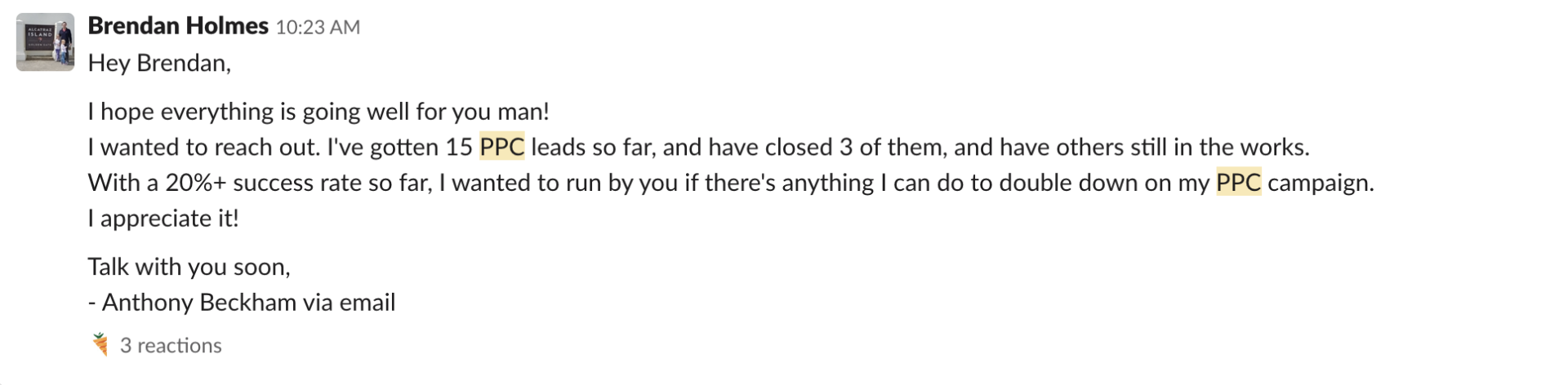
and countless others…
Real Estate Investor PPC Keywords
Are you curious what the most profitable Motivated Seller keywords?
We’re committed to your privacy. Carrot uses the information you provide to us to contact you about our relevant content, products, and services. You may unsubscribe from these communications at any time. For more information, check out our Privacy Policy.
What is Google Ads?
Google Ads is an online advertising platform developed by Google, where advertisers bid to display brief advertisements, service offerings, product listings, or videos to web users. It can place ads both in the results of search engines like Google Search and on non-search websites, mobile apps, and videos.
Google Ads for real estate investors can be a powerful way to reach your target audience, but it takes some knowledge and preparation. Check out this list for everything you need before getting started!
Google Ads Basic Terms
Keywords: These are the words or phrases that people type into Google Search, which trigger your ad to appear. When setting up an ad campaign, you’ll pick a list of keywords that you think people might search for when they want what you offer (and don’t worry: we can help).
Bid: This is the maximum amount you’re willing to pay when someone clicks on your ad. (Since, with Google Ads, you don’t pay to show up — only when someone clicks on your ad to visit your site or call you.)
Quality Score: This metric tells you how relevant your keywords are to your ad and your landing page (i.e., the webpage where people will be taken when they click your ad). A good Quality Score can lower your bid costs and improve your ad rank in the search results.
Ad Rank:Ad Rank is a metric that helps determine where your ad will show up, relative to other ads, when it’s triggered to appear on Google. Your rank is determined using your bid, quality score, and other factors.
CPC (cost-per-click): The actual amount you pay when someone clicks on your ad. (You don’t necessarily pay your entire bid price for every click — that sets up a range of possible costs-per-click you might pay.)
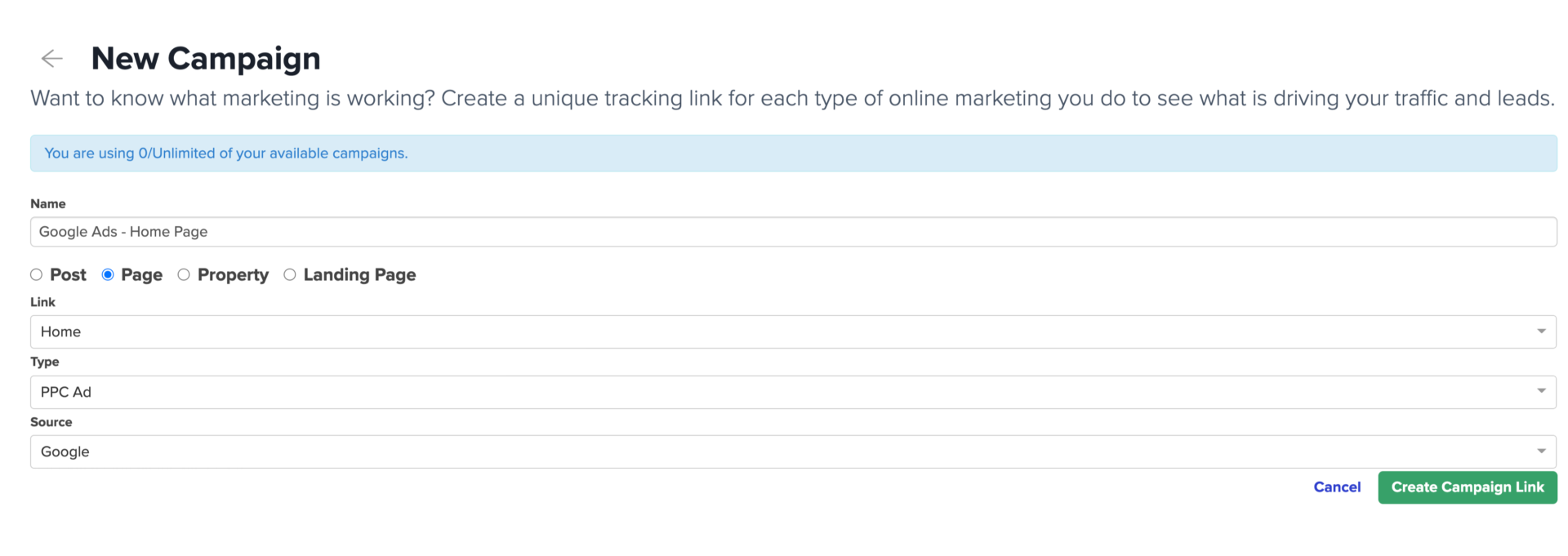
Conversion: A conversion occurs when someone who has clicked your ad takes another action you’ve designated as important — like making a purchase, signing up for a newsletter, or calling you. Here are20 steps to optimize your real estate investor PPC account.
Part 1: Google Ads Fundamentals for Real Estate Investors
In this section, we’ll dive into the foundational elements of Google Ads specifically for real estate investors. We’ll explore the benefits of using this platform to attract motivated sellers and high-quality leads, guide you through setting up your account, and explain how to structure your campaigns for optimal results.
Why Should Real Estate Investors Use Google Ads?
Traditionally, real estate investors have relied on networking, cold calling, and yard signs to find motivated sellers. However, Google Ads offers a powerful and targeted approach to reach a highly engaged audience actively searching for solutions. Here’s why Google Ads should be in your real estate investor toolkit:
Reach Highly Motivated Sellers: Target potential sellers actively searching for terms like “sell my house fast” or “we buy houses in [your city].” These individuals are more likely to be open to your offers compared to cold leads.
Laser-Focused Targeting: Go beyond demographics. Refine your targeting by location, property type (single-family, multi-unit), timeframe (foreclosure, inheritance), or even budget to reach the most relevant sellers.
Measurable Results: Track every click, lead, and conversion generated through your ads. Analyze data and optimize your campaigns for maximum ROI and lead generation. Tip: To streamline your project management and efficiently track tasks, it’s beneficial to create Jira filters that help you monitor your Google Ads campaigns’ performance.
Faster Lead Generation: Compared to traditional methods, Google Ads can deliver qualified leads quickly, allowing you to act fast and secure deals before competitors.
Scalability & Flexibility: Start small and scale your campaigns as your budget and goals grow. Adjust targeting and messaging based on performance data for continuous improvement.
Setting Up Your Google Ads Account (Step-by-Step with Real Estate Investor Considerations)
Creating your Google Ads account is a straightforward process. Here’s a step-by-step approach with considerations for real estate investors:
Set Your Campaign Goal: Choose “Leads” as you’re primarily interested in generating seller leads.
Target Location: Enter your target market area (city, zip code, or radius) where you’re actively looking for properties. Your location settings will play a role in placement. For example, if you choose the location target option of “Presence: People in or regularly in your targeted locations,” and you only buy houses in Oakland, when someone in New York searches for “sell my house fast,” they will not see your ad. That’s because Google’s main objective is to display ads to searchers within the target location.
Budget: Set a daily or monthly budget that aligns with your comfort level and investment goals. Start small and increase as you gain confidence and refine your campaigns.
Bidding Strategy: Consider “Manual CPC” or “Maximize Conversions” initially to prioritize generating leads within your budget.
Real Estate Investor Considerations:
Business Name & Website: Use a clear and professional business name that reflects your brand. Ensure your website is mobile-friendly and optimized to capture leads (e.g., contact forms).
Payment Method: Select your preferred payment method (credit card, debit card) for your advertising costs.
Understanding Campaign Structure & Targeting (Campaign Goals, Ad Groups, Keywords for Real Estate)
Now that your account is set up, let’s explore how to structure your campaigns for success.
Campaigns: These represent your overall advertising objectives. As a real estate investor, your primary campaign goal will likely be “Leads.”
Ad Groups: Organize your ads within your campaign based on a specific theme or target audience. For example, you might create separate ad groups for “Cash for Houses Fast” or “Sell Your Inherited Property.”
Keywords: These are the words and phrases potential sellers will use to search for solutions. Real estate investor keyword research should focus on terms related to motivated sellers, such as “we buy houses,” “sell my house fast,” or location-specific variations like “[your city] house buyers.”
Keywords Match Types and Research
The different match types give you room when selecting your keywords. Match types tell Google whether you want to match a search query exactly or if your ad should be shown to anyone with a search query that’s somewhat related. There are three match types to choose from:
Broad match“may show on searches related to your keyword, which can include searches that don’t contain the keyword terms. This helps you attract more visitors to your website, spend less time building keyword lists, and focus your spending on keywords that work. Broad match is the default match type that all your keywords are assigned so that you don’t have to specify another match type (exact match, phrase match, or a negative match type).”
The syntax for broad match is to simply input the keyword. Below is an example of how a broad match keyword would work:
Broad Match Keyword:
Quick Sell Home
Ads May Show on Searches For:
quick sale
private home sale
1 bedroom houses near me
Phrase match“may show on searches that include the meaning of your keyword. The meaning of the keyword can be implied, and user searches can be a more specific form of the meaning. With phrase match, you can reach more searches than with exact match and fewer searches than with broad match, only showing your ads on the searches that include your product or service.”
The syntax for phrase match is to put quotes around your keyword. Below is an example of how a phrase match keyword would work:
Phrase Match Keyword:
“We Buy Houses”
Ads May Show on Searches For:
best we buy houses company
we buy houses for cash companies
we buy houses in colorado
Exact match“may show on searches that have the same meaning or same intent as the keyword. Of the three keyword match options, exact match gives you the most control over who sees your ad, but reaches fewer searches than both phrase and broad match.”
The syntax for exact match is to use square brackets. Below is an example of how an exact match keyword would work:
Exact Match Keyword:
[Sell My House Fast]
Ads May Show on Searches For:
sell my house fast
quick fixes to sell your home
sell my houses fast
If you’re starting out and don’t know exactly how your market will be searching, move away from a broad match to a narrowed approach so you can see which searches yield the best results. You should always keep a close eye on your keywords and modify them as you can gain new data.
Keyword Research
Once you have your direction plan, it’s time to perform keyword research for your market, intent keywords, and competition.
Define your target customer —Most investors likely have an idea, but newer investors might need to take the time to create a customer avatar.
Define your target locations — You can target locations down to the city. You can even exclude cities, counties, or states.
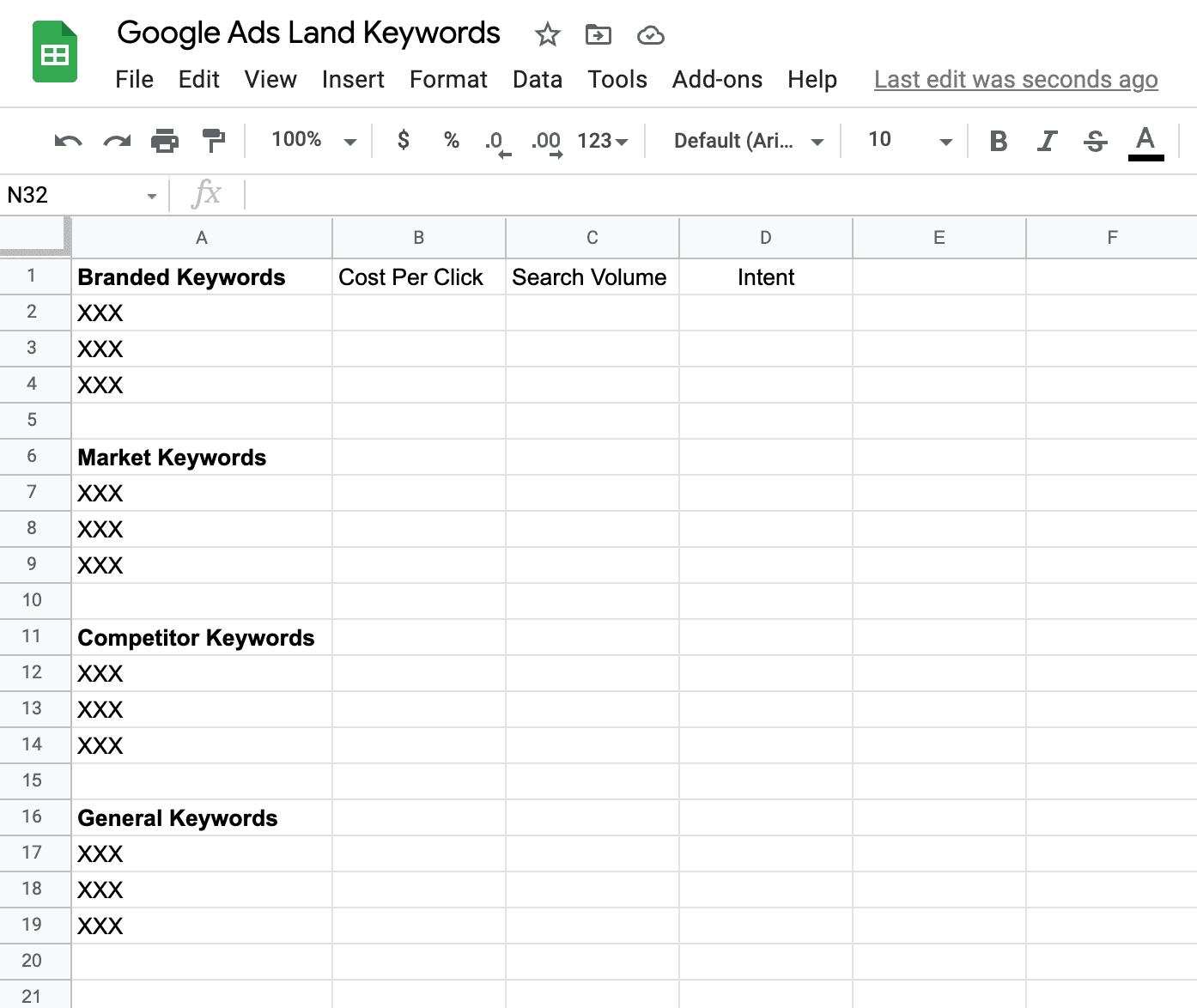
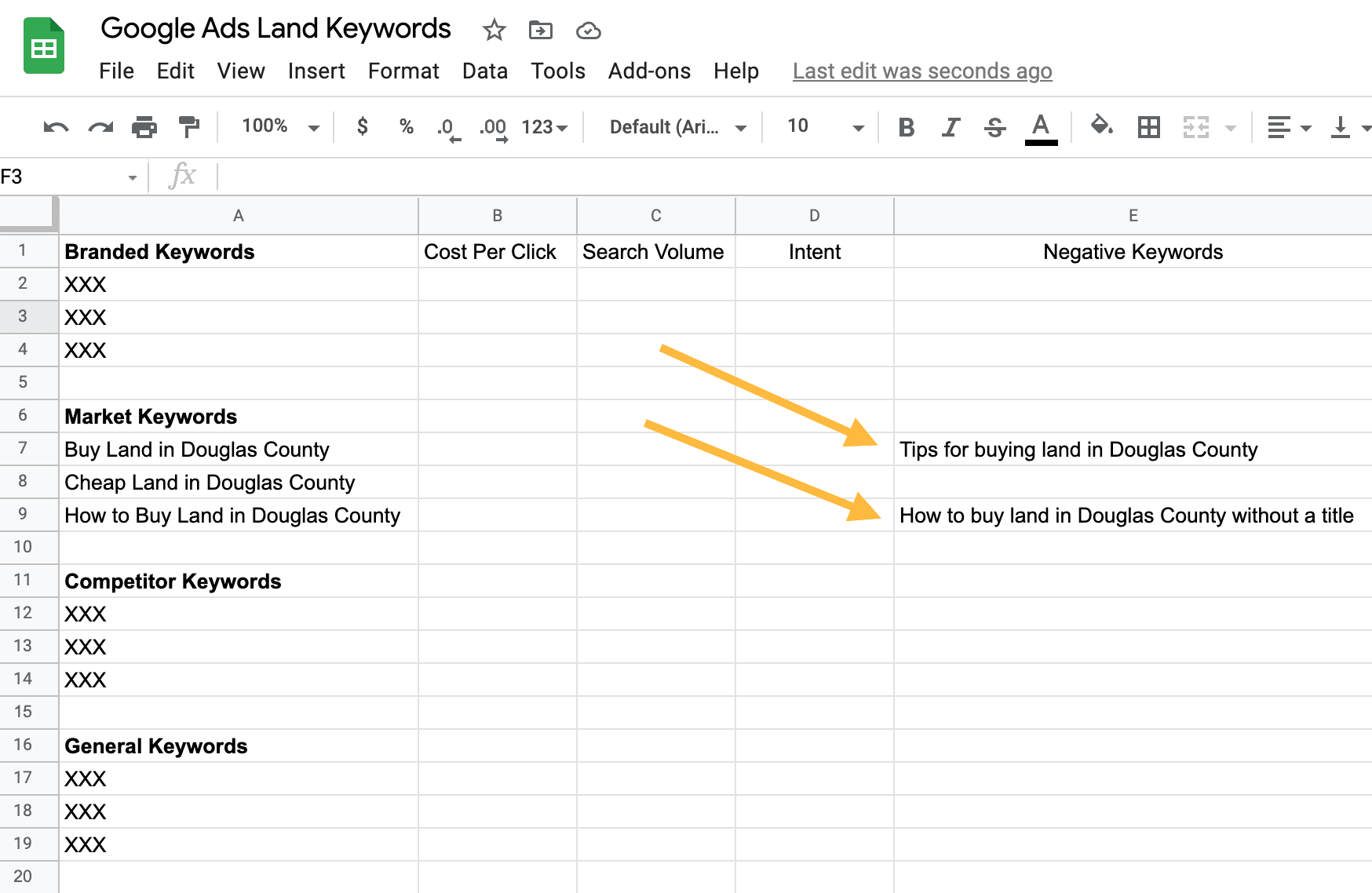
Identify keywords to block —Called negative keywords, adding these in will help block your ads from showing for the wrong searcher.
Sort keywords and identify customer intent keywords vs. research keywords — Research keywords might be on the edge, so be careful when choosing them. You must monitor those to make sure they’re not eating up your budget.
Organize your keywords into categories — For example:
Category: Sell My House Fast Category: We Buy Houses Category: Sell Your House Quick
This will help you build your ad groups around your keywords while staying organized.
Pro Tip: Do some spying on your competitor’s keywords — SEMRush or SpyFu are two great tools that provide helpful information.
Next Steps:
In the following sections, we’ll delve deeper into crafting compelling ad copy, optimizing your landing pages, and using advanced strategies to maximize your return on investment with Google Ads.
Part 2: Creating High-Converting Ads for Real Estate Investors
Now that you understand the fundamentals of Google Ads for real estate investors, let’s focus on crafting the elements that will grab attention and convert clicks into leads.
Writing Compelling Ad Headlines & Descriptions (Examples & Best Practices)
Headlines and descriptions are your prime real estate on the search results page.
Here’s the amount of characters allotted in a Google Ads ad:
Display URL Examples
www.domain.com/We-Buy-/Houses-Cash
www.domain.com/Sell-Your-Home/For-Cash
Dimensions for Responsive Search Ads
Enter your headlines. You’ll need to enter a minimum of 3 headlines, but you can enter up to 15.
Enter your descriptions. You’ll need to enter a minimum of 2 descriptions, but you can enter up to 4.
You can also control where individual headlines and descriptions appear in your ad by pinning headlines and descriptions to specific positions.
Here is an example of a responsive ad converting at 32.52% with 40 leads:
Focus on benefits for sellers (e.g., “Sell Your House Fast for Cash!”).
Highlight urgency (e.g., “Get a Cash Offer in 24 Hours”).
Use strong verbs and action words (e.g., “Sell Now,” “Get Your Free Offer”).
Incorporate location if relevant (e.g., “[Your City] Cash Home Buyers”).
Descriptions:
Expand on the headline’s benefits (e.g., “Skip the hassle of listing & showings. We buy houses in any condition.”).
Address seller pain points (e.g., “Facing foreclosure? We can help.”).
Showcase your unique selling proposition (USP) as a real estate investor (e.g., “Fast closings, no fees”).
Include a clear call to action (CTA) (e.g., “Get a Free Cash Offer Today!”).
Examples:
Headline: Tired Landlord? Sell Your Rental Property Fast for Cash!
Description: Get a fair offer in 24 hours and close in 14 days. We handle everything – no repairs, no hassle! Learn More Now!
Crafting Powerful Calls to Action (CTAs) that Drive Leads
Your CTA is the final nudge that encourages potential sellers to take the next step. Here are some effective CTAs for real estate investor ads:
Get a Free Cash Offer
Sell Your House Now
Learn More About Our Fast Closing Process
Schedule a Free Consultation
Download Your Free Guide to Selling Your Property
Ad Extensions
If you’re running Google Ads, you should be using Ad Extensions for two reasons:
They’re free
They give users additional information and another reason to interact with your ad.
These extensions fall within one of these six categories for real estate investor campaigns.
Call (Phone number)
Location (Link to your Google+ profile)
Sitelinks (Clickable links that can drive traffic to different pages on your site, such as your “About” page, “Testimonials” page, and “How We Buy Houses” page)
Call-Outs (Non-Clickable points. Great for Calls-to-Action)
Structured Snippets (Real estate investors don’t get many options with this one, but can use the “Types” option and list out what types of houses you buy)
Image extensions allow advertisers to upload relevant visuals to complement their existing text ads. Image extensions can help drive performance, with compelling visuals of past deals or cash offers that enhance the message of their text ads.
Landing Pages
Designing Effective Landing Pages for Conversions (Landing Page Optimization for Real Estate Investors)
Once someone clicks your ad, they land on your landing page. Here’s how to optimize your landing page for conversions:
Focus on a single offer: Don’t overwhelm visitors with multiple options.
Match the message of your ad: Ensure the landing page reinforces the benefits and call to action from your ad.
Keep it clear and concise: Use bullet points, visuals, and easy-to-understand language.
Make it mobile-friendly: You will probably already know that your website needs mobile-friendly. 61% of our motivated house sellers, cash buyers, and rent-to-own tenant leads were from mobile devices last year. If your website is not mobile optimized, you’re likely losing tens of thousands of dollars per year in leads and deals without knowing it.
Include a prominent lead capture form: Capture seller information with a clear value proposition for submitting their details (e.g., “Get Your Free Cash Offer Now!”).
By following these best practices and tailoring your messaging to the needs of motivated sellers, you can create high-converting Google Ads campaigns that generate a steady stream of leads for your real estate investment business.
Part 3: Optimizing Your Google Ads Campaigns for Success
Having a well-structured campaign is just the first step. Now it’s time to fine-tune your efforts to maximize leads and ROI.
Bidding Strategies for Real Estate Investors (Maximizing ROI with Cost-per-Lead (CPA) Bidding)
Bidding is the process of determining how much you’re willing to pay for each click on your ad. As a real estate investor, your primary goal is to generate leads. Here’s a bidding strategy optimized for your needs:
Cost-per-Lead (CPA) Bidding: This strategy allows you to set a maximum amount you’re willing to pay for each lead generated through your ads. Google Ads will then automatically adjust your bids to acquire leads within your budget.
In Google Ads, Cost-per-Lead (CPA) Bidding is an automated bid strategy that prioritizes acquiring conversions (leads) at your specified maximum cost per lead. It utilizes machine learning to set bids for each auction, aiming to generate leads within your target cost range.
Here’s a breakdown of Cost-per-Lead (CPA) Bidding in Google Ads:
Focus on Lead Acquisition: This strategy optimizes for acquiring leads (e.g., form submissions, phone calls) at a cost you’re comfortable with.
Automated Bidding: Google Ads leverages complex algorithms to analyze various factors, such as user behavior, landing page relevance, and historical data, to determine the optimal bid for each auction. The goal is to acquire leads within your set CPA target.
Cost Control & Efficiency: This strategy strives to spend your budget efficiently, acquiring leads at or below your target cost.
Benefits of Cost-per-Lead (CPA) Bidding:
Conversion Focus: Directly optimizes for your campaign’s primary goal: generating leads.
Cost Control: Set a maximum cost you’re willing to pay for each lead, providing greater control over your budget.
Efficiency & Optimization: Google Ads prioritizes bids on auctions most likely to convert within your target CPA.
Drawbacks of Cost-per-Lead (CPA) Bidding:
Data Dependence: Google’s algorithms require a sufficient amount of conversion data to learn and optimize effectively. This may not be ideal for brand-new campaigns.
Performance Fluctuations: Actual cost per lead may vary depending on competition and campaign performance.
Limited Traffic Potential: Setting a very low CPA target might limit the number of leads you acquire.
Who Should Use Cost-per-Lead (CPA) Bidding?
Established Advertisers: This strategy works well for those with a history of lead generation through Google Ads and a good understanding of their ideal customer acquisition cost (CAC).
Lead Generation Campaigns: Ideal for campaigns where generating qualified leads is the primary objective.
Optimizing Existing Campaigns: Effective for established campaigns with sufficient conversion data to optimize lead acquisition costs.
Overall, Cost-per-Lead (CPA) Bidding is a powerful strategy for advertisers focused on acquiring leads within a specific budget. However, it requires a foundation of conversion data and an understanding of your target cost per lead.
Here are four additional bid strategies you can test:
Maximize clicks:
In Google Ads, Maximize clicks is an automated bid strategy that prioritizes getting you the most clicks possible for your set daily budget. It utilizes machine learning to determine the optimal bid for each auction, aiming to stretch your budget to reach a broad audience.
Here’s a breakdown of Maximize clicks bidding in Google Ads:
Focus on Clicks: This strategy prioritizes maximizing the total number of clicks on your ad within your campaign budget.
Automated Bidding: Google Ads uses algorithms to analyze various factors like keyword relevance, user search intent, and historical data to set bids for each auction.
Budget Efficiency: This strategy aims to spend your entire daily budget on clicks that are most likely to be relevant to your campaign.
Benefits of Maximize clicks bidding:
Simple Setup: No need to manage individual keyword bids, saving you time and effort.
Driving Traffic: Well-suited for campaigns where increasing website traffic and brand awareness is the primary objective.
Testing & Awareness: Effective for gathering initial data and building brand awareness through a high volume of ad impressions.
Drawbacks of Maximize clicks bidding:
Conversion Focus Limited: Doesn’t directly optimize for conversions (e.g., leads, sales), potentially attracting clicks that don’t convert.
Cost Fluctuations: The cost per click (CPC) can vary depending on competition and auction dynamics.
Quality Control Risk: You may attract irrelevant clicks that don’t align with your target audience.
Who Should Use Maximize clicks bidding?
New Advertisers: Easy to set up and manage, ideal for those starting with Google Ads and aiming to build initial traffic.
Website Traffic Campaigns: Well-suited for campaigns where driving visitors to your website is the primary goal.
Testing & Refining: Useful during the initial phase of a campaign to gather data and refine targeting for better conversions later.
Overall, Maximize clicks bidding is a user-friendly option for driving website traffic and gaining initial campaign insights. However, it may not be the most effective strategy for campaigns focused on generating high-quality leads or sales.
Target impression share:
In Google Ads, target impression share bidding is an automated bidding strategy that focuses on showing your ad a specific percentage of the time someone searches for your chosen keywords. Here’s a breakdown of target impression share bidding in Google Ads:
Impression Share Focus: Set a target percentage (e.g., 70%) of how often you want your ad to appear on the search results page for relevant keywords.
Automated Adjustments: Google Ads automatically adjusts your bids throughout the day to try and achieve your desired impression share goal.
Visibility Control: This strategy helps ensure your ad reaches a specific level of visibility within your target audience.
Benefits of Target impression share bidding:
Visibility Control: Gain more control over how often your ad appears in search results.
Branding & Awareness: Effective for building brand awareness by ensuring your ad is consistently visible to potential customers.
Flexibility: Based on your goals (top-of-page placement, absolute top-of-page), you can choose different target impression share percentages for various ad groups or campaigns.
Drawbacks of Target impression share bidding:
Cost Focus Shift: Doesn’t directly optimize for clicks or conversions, potentially leading to higher costs per click (CPC).
Limited Control Over Budget: Maintaining a specific budget with this strategy can be challenging, as maximizing impressions might require higher bids.
Less Data Dependence: May function adequately without a large amount of conversion data compared to some automated bid strategies.
Who Should Use Target impression share bidding?
Brand Awareness Campaigns: Ideal for prioritizing ad visibility and reaching a broad audience.
Competitive Markets: Can help ensure your ad stays visible in highly competitive search queries.
Complementing Other Strategies: Can be used alongside conversion-focused strategies to maintain brand awareness while optimizing for actions.
Overall, target impression share bidding is a good option for advertisers prioritizing ad visibility and brand awareness. However, it may not be the most cost-effective strategy for campaigns solely focused on conversions.
Maximize conversions:
In Google Ads, Maximize conversions is an automated bid strategy that prioritizes generating conversions within your set daily budget. It uses machine learning to automatically set bids for each auction, aiming to get you the most conversions possible.
Here’s a breakdown of Maximize conversions bidding in Google Ads:
Focus on Conversions: This strategy prioritizes getting you the most conversions (e.g., leads, sales) for your campaign, not necessarily clicks.
Automated Bidding: Google Ads uses complex algorithms to analyze various factors like user search queries, browsing context, and past performance to determine the optimal bid for each auction.
Budget Efficiency: This strategy aims to spend your entire daily budget efficiently, acquiring conversions at the best possible price.
Benefits of Maximize conversions bidding:
Simple Setup: No need to manage individual keyword bids, saving you time and effort.
Focus on Results: Prioritizes conversions, aligning with your campaign goals.
Budget Optimization: Google Ads strives to spend your entire budget on clicks most likely to convert.
Drawbacks of Maximize conversions bidding:
Less Control: You don’t have direct control over the cost per click (CPC) for each ad.
Data Dependence: Requires a sufficient amount of conversion data for Google’s algorithms to learn and optimize effectively.
Limited Transparency: You can’t see the exact bids Google places on your behalf.
Who Should Use Maximize conversions bidding?
New Advertisers: Easy to set up and manage, ideal for those starting with Google Ads.
Conversion-focused Campaigns: Well-suited for campaigns where generating leads or sales is the primary objective.
Limited Time or Resources: Saves time compared to manual bidding, allowing you to focus on other aspects of your campaign.
Overall, Maximize conversions bidding is a user-friendly option for advertisers prioritizing conversions and wanting to automate the bidding process. However, it sacrifices some control over cost per click.
Manual bidding:
In Google Ads, manual bidding gives you direct control over the maximum amount you’re willing to pay for each click on your ad. It’s a hands-on approach compared to automated bid strategies that Google Ads sets for you.
Here’s a breakdown of manual bidding in Google Ads:
Setting Your Max Bid: You determine the highest cost per click (CPC) you’re comfortable paying for each time someone clicks your ad.
Management: You manually adjust bids for individual keywords, ad groups, or your entire campaign based on performance and budget.
Targeting: Manual bidding allows for granular control over where your ads appear. You can adjust bids based on factors like location, device (phone, computer, etc.), and time of day.
Benefits of Manual Bidding:
Precise Control: You have the final say on how much you spend per click.
Flexibility: Tailor your bids to specific keywords or audiences you find most valuable.
Optimization Potential: Analyze data and refine bids to maximize return on investment (ROI).
Drawbacks of Manual Bidding:
Time Commitment: Requires ongoing monitoring and adjustments to maintain optimal performance.
Expertise Needed: Understanding keyword research, competitor analysis, and conversion tracking is crucial for success.
Potential for Wasteful Spending: Setting bids too high can lead to unnecessary costs, while bidding too low might limit your ad’s visibility.
Who Should Use Manual Bidding?
Experienced Advertisers: Those comfortable with Google Ads and have the time to manage bids strategically.
Small Budgets: May be beneficial for keeping a tight control on spending.
Specific Campaign Goals: When focusing on maximizing conversions or clicks within a set budget.
Overall, manual bidding offers a high level of control for experienced advertisers. However, it requires ongoing effort and expertise to be successful.
Pro Tip: Start with a conservative CPA bid and gradually increase it as you gain confidence in your campaign’s effectiveness and refine your targeting.
Conversion Tracking & Measuring Results (Key Metrics for Success)
Tracking conversions is crucial for understanding your Google Ads campaigns’ performance. Here are some key metrics for real estate investors:
Leads: The total number of potential sellers who submitted their information through your landing page form.
Cost-per-Lead (CPA): The average amount you pay for each lead generated.
Conversion Rate: The percentage of people who click your ad and convert into a lead.
Click-Through Rate (CTR): The percentage of people who see your ad and click on it.
Website Traffic: The total number of visitors your landing page receives from your Google Ads campaigns.
By monitoring these metrics, you can identify areas for improvement. Analyze which keywords are generating the most leads and adjust your bids accordingly.
Advanced Strategies: Remarketing & Automation (Reaching Past Website Visitors and Using Google Ads Automation)
Once you’ve mastered the basics, Google Ads offers advanced features to further optimize your campaigns:
Remarketing: This allows you to show targeted ads to people who have already visited your website but haven’t taken action yet. Consider crafting specific messages reminding them of your offer or highlighting testimonials from satisfied sellers.
Automation: Leverage Google Ads automation tools to streamline campaign management. Utilize automated bidding strategies to optimize bids for conversions and save time on manual adjustments.
Remember: Google Ads is a continuous learning process. Experiment with different strategies, track your results and refine your campaigns to maximize your return on investment and generate a steady flow of motivated sellers for your real estate business.
Part 4: Taking Your Real Estate Investor Google Ads to the Next Level
By now, you’ve built a solid foundation for using Google Ads to attract motivated sellers. Let’s explore some advanced tactics to elevate your campaigns and maximize your lead generation potential.
Analyzing Competitor Ads (Learning from Successful Campaigns)
Keeping an eye on your competitors can be a valuable learning tool. Here’s how to analyze their Google Ads:
Search for relevant keywords in your target area. See what ads appear at the top of the search results page.
Analyze their headlines and descriptions. What benefits are they highlighting? How are they addressing seller pain points?
Identify their calls to action (CTAs). What action are they encouraging potential sellers to take?
Don’t copy blindly. Use this information to inspire your own creative messaging and identify potential gaps in your strategy. Perhaps a competitor is focusing on a specific seller pain point you haven’t addressed yet.
Integrating Google Ads Data with Your CRM (Streamlining Workflow for Lead Nurturing)
Once you start generating leads through Google Ads, you’ll need a system to manage and nurture them. Integrating your Google Ads data with a Customer Relationship Management (CRM) tool can streamline your workflow:
Automatically capture lead information: Eliminate manual data entry by automatically transferring lead details (name, contact information, source) from your landing page form into your CRM.
Track lead activity: Monitor how sellers interact with your emails, phone calls, and website visits within your CRM.
Tailor communication: Segment your leads based on their needs and interests, allowing you to send personalized messages that nurture them toward a sale.
By integrating data, you gain a holistic view of your leads and improve your chances of converting them into successful deals.
Common Mistakes to Avoid & Troubleshooting Tips
Even seasoned Google Ads users can make mistakes. Here are some common pitfalls to avoid for real estate investors:
Targeting too broadly: Ensure your keywords and ad groups are laser-focused on your ideal seller profile. Avoid generic terms that might attract unqualified leads.
Neglecting landing page optimization: Your landing page is the final step in converting clicks into leads. Ensure it’s clear, concise, and optimized for mobile devices.
Ignoring negative keywords: Identify keywords triggering irrelevant searches and add them as negative keywords to prevent wasted ad spend.
Not tracking conversions: You can’t optimize what you don’t measure. Set up conversion tracking to understand campaign performance and identify areas for improvement.
Troubleshooting Tips:
Low Click-Through Rate (CTR): Analyze your headlines and descriptions. Are they compelling enough to grab attention? Try A/B testing different variations.
High Cost-per-Lead (CPA): Refine your keyword targeting and consider adjusting your bids to focus on higher-quality leads.
Low Conversion Rate: Optimize your landing page. Ensure it’s clear, mobile-friendly, and offers a compelling value proposition in exchange for seller information.
Remember: Consistency is key. Regularly monitor your campaigns, experiment with different strategies, and adapt based on your data. By staying persistent and data-driven, you can continuously refine your Google Ads efforts and generate a steady stream of motivated sellers for your real estate investment business.
Part 5: Expanding Your Reach: Exploring Other Campaign Types
While Search Ads are a foundational element of any real estate investor’s Google Ads strategy, other campaign types can further enhance your reach and connect with potential sellers at different stages of their journey. Here’s a closer look at two powerful options:
Video Ads:
Target Audience: Video ads allow you to showcase your expertise and the appeal of investing in real estate through captivating visuals. You can target these ads to a broad audience searching for real estate-related topics or create retargeting campaigns for website visitors who haven’t yet converted.
Campaign Goals: Video ads are well-suited for brand awareness, showcasing your company’s approach and success stories. They can also be used to generate leads by directing viewers to a landing page with a clear call to action.
Benefits:
High Engagement: Video ads can grab attention and effectively communicate your message in a compelling format.
Emotional Connection: Videos can build trust and establish your brand as a reliable and knowledgeable partner for real estate investors.
Versatility: You can create various video ad formats, from short explainer videos to testimonials from satisfied clients.
Things to Consider:
Production Quality: Invest in high-quality video production for a professional and trustworthy presentation.
Targeting: Refine your targeting to ensure your video ads reach the right audience at the right time.
Tracking & Measurement: Track key metrics like video views, engagement, and website traffic to measure campaign effectiveness.
Display Ads & Retargeting:
Campaign Goal: Display ads are banner ads placed on websites across the web. They can be used for brand awareness, retargeting website visitors who haven’t converted, or driving traffic to specific landing pages.
Retargeting: This powerful strategy allows you to show targeted ads to people who have already interacted with your website or mobile app. Remind them about your offerings and encourage them to take action, like filling out a lead form.
Benefits:
Brand Awareness: Increase brand visibility by placing display ads on relevant websites frequented by your target audience.
Retargeting Power: Reconnect with website visitors who have shown initial interest but haven’t converted yet.
Targeted Reach: Display ad networks allow for specific targeting based on demographics, interests, and online behavior.
Things to Consider:
Banner Design: Create visually appealing and clear banner ads that resonate with your target audience.
Landing Page Alignment: Ensure your landing page aligns with the message and offer presented in the display ad.
Retargeting Strategy: Develop a strategic retargeting campaign with a clear timeframe and compelling message to re-engage website visitors.
By incorporating video ads and display campaigns with retargeting into your marketing mix, you can create a well-rounded Google Ads strategy that reaches potential sellers throughout their decision-making journey, ultimately generating a steady stream of qualified leads for your real estate investment business.
Conclusion and Extra Resources
Congratulations! You’ve reached the end of this comprehensive guide on leveraging Google Ads to attract motivated sellers and propel your real estate investment business forward.
Key Takeaways & Recap:
Google Ads offers a powerful platform for real estate investors to target motivated sellers who are actively searching for solutions.
By crafting compelling ad copy, optimizing landing pages, and utilizing effective bidding strategies, you can generate a steady stream of qualified leads.
Continuously monitor and analyze your campaigns to maximize return on investment (ROI) and refine your approach based on data insights.
Set Realistic Expectations for Your Google Ads Campaign:
Before diving into Google Ads, it’s crucial to set realistic goals and understand market limitations.
Market Research: Research your target market’s potential for seller leads. A high budget allows for more leads and targeting broader markets, while a lower budget might be better suited for smaller areas.
Data & Optimization: Google Ads needs time to collect data and optimize performance. Give your campaigns a few months to reach their full potential.
Return on Investment (ROI): Factor in ROI when planning your campaign. Track key metrics and adjust your strategy to maximize profitability.
To minimize wasted spending and maximize lead generation, plan your campaign beforehand:
Target Audience: Are you targeting sellers or buyers?
Customer Acquisition Cost (CAC): Determine your acceptable cost per lead.
Maximum Cost-per-Click (CPC): Estimate your maximum cost per click based on your profit margin and sales conversion rate. 4. Budget: Set a realistic budget for your campaign, allocating a portion for initial testing.
Test Budget: Allocate a specific amount to test different keywords and identify the most effective ones. Use the formula: Test Budget = (100 clicks) x (Estimated CPC)
By setting realistic expectations and planning your campaign meticulously, you can create a Google Ads strategy that maximizes your return on investment and generates a steady stream of qualified leads.
Remember:
Focus on the benefits for sellers and address their pain points in your ad copy.
Leverage your unique selling proposition (USP) as a real estate investor to stand out from competitors.
Track conversions and key metrics to measure success and identify areas for improvement.
Resources for Further Learning:
The world of digital marketing is constantly evolving. Here are some valuable resources to stay ahead of the curve and enhance your Google Ads expertise:
What to Learn More? Here Are Some Extra Resources for Our Members:
By implementing the strategies outlined in this guide and utilizing the resources provided, you can become a Google Ads pro and unlock the full potential of this powerful platform to grow your real estate investment business.
“I spent $800 last month on the wrong keyword. What the he** did I do wrong?!”
Those are the exact words from a Carrot member who chose to allow Google Ads to find motivated seller keywords for him. Google added “real estate” industry keywords that led to a month of worth of wasted spend.
The goal of this post is to help you stop wasting time and money on the wrong keyword research for your real estate PPC campaigns.
Just the term itself, “keyword research”, sounds complicated, confusing, and exhausting.
Who wants to scour the internet looking for keywords to target? And why is it so important, anyway? Even if you are going to target specific keywords in Google or Bing with your paid ads, can’t you just trust your instincts to know which keywords are the best?
After all, you know your market better than anyone.
Well, take it from someone who’s done loads of keyword research over the past years for terms related to the real estate industry: your instincts aren’t always right.
Fortunately, keyword research doesn’t have to a painful and grueling process — it can be simple, quick, informative, and even fun. I’m going to show you how to do keyword research for your paid advertising campaigns in this post.
You’ll be able to move quicker and save money by only using the keywords that matter. Let’s dive in, here are the steps to find the right keywords for your real estate PPC campaigns.
What Is Keyword Research For Real Estate PPC?
First, PPC, or “pay-per-click” is when you pay when someone clicks on your ads. Typically, you want to be on the top or first page of Google or Bing results for your target keyword phrases.
When your prospects search for a phrase such as “sell my house fast” in Google, you want your ads to be shown at the top of the first page. Otherwise, searchers probably aren’t going to see your ads. People rarely click ads on the bottom of the search results page.
Keyword research for PPC, then, is researching, finding, and targeting the most profitable keywords for your business.
Why Is Keyword Research For Real Estate Important?
It’s not unusual to waste loads of time and money on the wrong PPC campaign. With the Carrot member in the opening paragraph. They allowed Google to create their motivated seller keywords. They didn’t realize it until burning through $800 without a lead.
Anyone who’s used Bing or Google Ads for more than a month knows all too well how quickly budgets can be spent.
The truth is, your PPC campaign is only going to be as good as the research you do beforehand.
Which keywords are people searching for?
What’s the competition like for those keywords you’re going to target?
Which keywords do you not want to target? Turn those into negative keywords!
What’s the intent of the people typing the chosen keyword into Google — are they just browsing or are they ready to commit?
All of those questions, and more, need to be answered before you pull out your wallet and launch a campaign.
Don’t be a perfectionist. But also don’t jump on your horse before you’ve prepared the saddle. Of course, doing keyword research is easier said than done. Which is why I put together this article to walk you through the process step by step.
Here we go… Five steps to conducting PPC keyword research.
Step #1: Brainstorm Keyword Ideas
The first step is to sit down with pen or pencil, paper, and brainstorm ideas. You probably already have some sense for what your target market types into Google.
Here are a few ideas for investors:
Sell my house fast in [market city]
Buy land in [market city]
Evict tenants in [market city]
Deal with foreclosure in [market city]
And here are a few ideas for agents:
Best real estate agent in [market city]
Real estate agents in [market city]
Sell my house for top dollar in [market city]
Sell my house real estate agent [market city]
Those terms are all related to what you do and where you’re located — those will likely be really valuable for your PPC campaign targeting. But what about the name of your business? When people search for your brand name, it might be a good idea to put some budget toward ranking for that in Google Ads, especially if you’re not yet ranking for your brand name organically.
You might also consider targeting competitor branded terms, although that will usually cost you a lot more per click than targeting less competitive phrases (only do this if you have the budget for it).
Bidding on longtail keyword phrases (such as “I want to sell my house quickly in [market city]”) can be a worthwhile strategy for leveraging low competition phrases with the right intent. Similarly, targeting commonly misspelled words relevant to your market and service can sometimes be profitable.
Right now, the goal is simply to make a list of all the ideas that you have. Write them down or put them on a spreadsheet. You can even use this tool to come up with more ideas by merging different market-specific words together.
I’ll use a land buyer website as an example. Here’s what a list of potential keywords might look like:
Buy land in Douglas County
Buy cheap land in Douglas County
Buy discounted land in Douglas County
Buy buildable land in Douglas County
Best land in Douglas County
How to buy land in Douglas County
How to build a house on land in Douglas County
Can I build a house on my own land in Douglas County
How to drill a well in Douglas County
How to do a perc test in Douglas County
Step #2: Refine Your Ideas With a Keyword Research Tool
More than likely, not all of the keywords that you wrote down will be a good idea for your PPC campaign. Some keywords are better suited to an SEO campaign than to a PPC campaign.
Here are the criteria you should use to determine whether or not a keyword phrase is ideal for PPC:
Is the keyword phrase high conversion intent? — When people search for that phrase, what do they want? Are they ready to take action? Or are they just doing preliminary research?
Your PPC budget is best spent on keyword phrases where people are ready to take action. “Sell my house fast for cash” is high conversion intent. But “How to fix up my distressed property” isn’t; that’s probably better suited to SEO targeting.
Does the keyword phrase have decent search volume and low competition? — The sweet spot for a keyword phrase is to have a decently high search volume (at least over 100 searches per month, say, depending on the size of your market) and to not be remarkably competitive.
Ideally, you want to find a few keyword phrases with low competition and decent search volume, but in most major markets competition can be strong.
Does the keyword phrase have a cost-per-click price that’s within your budget? — The bigger your budget, the more competitive keyword phrases you can target. So you’ll have to adjust your campaign based upon how much money you can spend. Make sure that the phrases you choose do fit within your budget by looking at the average cost-per-click of the phrase.
If you say “no” to any of those questions, then remove the keyword phrase from your list for now.
You can use the Google Ads Keyword Planner tool to do your keyword research and answer these questions for yourself. If you want to take it one step further and do competitive research, you can use a tool like Spyfu.
Here’s what a list looks like after it’s refined.
Buy land in Douglas County
Buy cheap land in Douglas County
Buy discounted land in Douglas County (Search volume too low)
Buy buildable land in Douglas County (Search volume too low)
Best land in Douglas County (Targeting the wrong market — I sell cheap land)
How to buy land in Douglas County
How to build a house on land in DouglasCounty (This would be better for SEO since it’s low conversion intent)
Can I build a house on my own land in Douglas County (Better for an SEO campaign)
How to drill a well in Douglas County (Better for an SEO campaign)
How to do a perc test in Douglas County (Better for an SEO campaign)
Step #3: Organize Your Keywords
The next step in your PPC keyword research journey is to organize your chosen keywords on a spreadsheet or somewhere that you can group them, track their results, and easily reference that data.
Here’s what a spreadsheet might look like:
You can group your keywords by branded, market-specific, competitor phrases, and general. Then, at the very least, you’ll want to track cost-per-click, search volume, and intent for all of those keywords.
The tighter and more focused your ad groups are, the easier it will be to:
Measure the performance of each keyword
Prune or expand your lists if necessary
Create highly specific and relevant ads
This last point is especially crucial. Small, tightly organized ad groups have multiplying beneficial effects on your account. Well-organized campaigns have more relevance, and higher relevance leads to higher Quality Scores, which (as we’ve told you many times) simultaneously increase your ad rankings and reduce what you pay for each click and each conversion. Healthy PPC accounts always have healthy Quality Scores, and strong keyword organization can go a long way toward improving your scores.
Step #4: Choose Your Negative Keywords
When you choose which phrases to target with your PPC campaign, let’s say “sell my house fast in [market city]”, Google Ads aren’t going to only show your ad to people who type exactly that into Google, it’ll show your ad when there’s a similar search as well, something like “sell my house fast with an agent in [market city]” for instance.
If you’re searching for motivated sellers, the problem becomes, you don’t care about people (probably) who want to sell with a real estate agent, you’re looking for people with distressed properties who need to sell fast.
That’s where negative keywords for real estate come in.
When you choose which keywords to target, you should also make a list of similar but irrelevant keywords not to target (these are called “negative keywords” in Google Ads).
Here are some examples.
The intent on those negative keywords is a little off and it’s a better use of my time and PPC budget to target keywords with the right intent (the ones that might actually convert when they click on my website).
Same goes for you.
Check out our free negative keyword list and more tips on doing negative keyword research and excluding money-wasting keyword phrases from your PPC campaigns.
Step #5: Test, Test, And Test Again
Even after you hit “launch,” the research doesn’t stop.
In fact, that’s where the real testing beings. All of this keyword research work, this was just the pre-research to give your PPC campaign the best chance of success. It’s not until you run a campaign and watch the results roll in (or not roll in) that you can measure how profitable certain keywords are for your business.
If you’re a Carrot member, you can even use our UTM tracking links to determine the effectiveness of your PPC campaigns.
Conclusion
Keyword research for real estate is one of the most important pieces of your PPC strategy for search ads. Take your time and get it right.
Don’t stop testing. Don’t stop iterating. And don’t stop learning. The people who win — the ones who make the biggest ROI from their paid ad spend — are the ones who learn from every campaign they launch and refine the next campaign before it launches.
What do you think? How do you conduct your keyword research? Which keyword research tools and strategies do you use? Share your thoughts, knowledge, and questions with us in the comments below!
Those are the same words that thousands (millions?) of real estate investors have said to the person running their PPC ads.
“I’ve already spent $1,500 and I haven’t closed a single deal from those leads! If it hasn’t worked now, then it isn’t going to work.”
It’s difficult to believe differently than that. After spending thousands of dollars on a campaign which isn’t delivering the kind of results your business needs, quitting seems like the only logical option.
But let’s slow down for a moment.
Just because you’ve spent several thousand dollars on your PPC efforts without closing a deal does notmean you’re doing something wrong. In fact, it might mean you’re doing something right.
Let me explain.
What Is The Goal Of Your Real Estate PPC Campaign?
Is your real estate PPC campaign a success?
To answer that question, you first need to determine the goal of running ads.
If you’re simply trying to build brand awareness, then seeing a tangible return on your investment might be irrelevant. If you’re trying to generate leads for your email list which might turn into a closed deal down the road, then all that matters is getting new people on your email list. In those cases, use the metrics mentioned in this article to determine how successful your real estate PPC campaign is.
If more likely, you’re running a PPC campaign to find motivated sellers and close deals, having a strict, tangible, profitable ROI matters a lot more. The first thing you’ll need to do, then — before you even launch your campaign, ideally — is set a realistic and profitable budget for your ads.
Here’s how to do that.
What is a Realistic Budget and ROI For Your Real Estate PPC Campaign?
Earlier, I said, “Just because you’ve spent several thousand dollars on your PPC efforts without closing a deal does not mean you’re doing something wrong. In fact, it might mean you’re doing something right.”
And I meant it.
At Carrot, we know lots of real estate investors who have to spend between $1,000 and $5,000 to get a single deal. The reason for that has nothing to do with their ads being ineffective, but everything to do with thick market competition. The thicker the competition, the more investors have to spend on ads to close a single deal.
Here’s the kicker, though: those investors are still making between $10,000 and $50,000 in profit as wholesale fees. So while spending up to $5k on an ad campaign might seem crazy, it’s still very profitable.
“Would you pay $3,000 to make $30,000? I don’t know about you, but I’d take that deal all day long.”
Okay. Great.
Spend money to make money. You get that.
But how much money is too much money? How much should you expect to spend on your PPC campaign before closing a deal? At what point should you throw in the towel?
You’ll just need four pieces of information in hand:
Typical profit per deal
Typical # of leads to close 1 deal
Cost per click
Website conversion rate
Example:
Imagine that you can safely expect to make at least $15,000 in wholesale fees on a single deal. Let’s also imagine you’re in a competitive market and that it takes you 25 leads to close one deal. Your cost-per-click for your PPC campaign is $15 and your website conversion rate is 15% (typical for a Carrot site).
That means you should expect to spend at least $2,500 to close a single deal and no more than $3,250.
And while that might seem like a lot of money to spend, you’ll also notice that the ROI on your expenses will be between 362% and 500%…
As Brian Rockwell said, “I’d take that deal all day long.”
Formula For Calculating ROI
Of course, ad spend is likely not your only cost for generating leads and closing deals. You might also be paying people to run your ads for you, tackle due diligence on properties, meet with buyers, or create contracts.
Maybe you also want to include those costs in the overall ROI of your PPC campaigns…
It’s up to you… really, it depends on what you want to find out. If you want to strictly determine how effective your PPC campaign is and if you’re staying within budget, then you might want to leave other indirect costs out of the equation. If, on the other hand, you want to determine the profitability and ROI of your entire business, then you’ll certainly need to include all other costs.
Whatever the case, here’s the formula you can use for finding the ROI of any of your marketing efforts.
ROI = (Revenue – Cost) / Cost
How To Determine a PPC Campaign’s Effectiveness (The 4 Metrics That Matter Most)…
There’s no doubt about it: ROI is the king of determining the success of any PPC campaign.
If you’re not making more money than you’re spending — if your ads aren’t profitable for your business — then you need to press “Stop” and try something else.
Having said that, looking only at the ROI of your PPC campaign can blindside you to other important metrics. Because even if your ads are profitable, they still might not be as profitable as they could be.
The goal is to not only run profitable and realistic PPC campaigns but to also increase the effectiveness and profitability of those campaigns. To do that, you should keep a close eye on the below metrics, test new things, and make changes as needed.
1. Cost-Per-Click
You can find this metric reported directly in your Google Ad dashboard. It tells you the amount of money you’re spending for each click you receive. The more enticing and click-able your ad is to website browsers (i.e. the more people who click), the less money you’ll spend on each click. However, competitive markets will force a high cost-per-click regardless of how effective your ad is, simply because there are so many other bids.
2. Quality Score
The quality score of an ad campaign is a metric which attempts to show you, with a score between 1 and 10 (10 is best), how effective your ad campaign is. Using the number of clicks your ad is receiving when people see it, the quality score also influences how much Google is going to show your ad, your cost-per-click, and even your ad placement (at the top vs. at the bottom). Keep a close eye on this metric and tweak your ad if it has a low-quality score.
3. Impression Share
Impression share is the percentage of people who, when your ad was placed on the page they visited, actually scrolled and saw your ad. If you ad has a low-quality score and is sitting at the bottom of the results page, your impression score will be much lower than competitors with ads showing at the top. An impression score of 80% means that 80% of people saw your ad and 20% didn’t.
4. Website Conversion Rate
While this isn’t technically a PPC metric, the website conversion rate is absolutely vital to consider for any paid ads you’re running which drive traffic to your website. Since you’re paying to generate clicks and hopefully leads and closed deals, you need a website which consistently converts the traffic your hard-earned money is driving to it. What’s a good conversion rate? Find out over here. And if you don’t want to worry about optimizing your website for conversion, consider getting yourself a Carrot website. We’ve generated over one million leads for investors and agents all around the U.S. and we’d love to do the same for you (a typical Carrot website conversion rate is around 10%. A typical conversion rate for most other industries is around just 2%).
Conclusion
I understand.
It gets discouraging, running ads which aren’t pulling results for your business. After all, if your business is to survive, you can’t be dumping money into a useless ad campaign for much longer.
You need results.
But keep in mind that results often take time.
The best thing you can do, in fact, is set yourself up for success by determining a realistic budget for your PPC campaigns: how much should you expect to spend? And how much is too much?
With those numbers, you’ll be far more confident spending the money you’re spending… knowing when you should expect a closed deal and when you’ve spent too much.
Then, work to improve the ROI of your PPC ads by watching the 4 metrics mentioned in this article. Because even if your paid ads are profitable, you still might be able to make them more profitable. Which is always a good thing to do.
With that, you’re ready to run successful PPC campaigns. The rest is simply doing, testing, trying, and iterating. Off ya go!
When it does launch, you want to collect clicks from motivated sellers or interested buyers, and you want your cost-per-click to stay within budget.
Easier said than done, of course. You might think that a campaign will convert like a million bucks, but then you launch it… and it doesn’t.
(You’ve been there, right?)
How can you possibly know what will convert well and what isn’t before you even launch the campaign? Well, ultimately, you can’t. But you can use a few simple copywriting tricks to increase the chance that your ad is a winner.
When it comes to platforms such as Google Ads, it’s just words on a page, no images or video allowed. So let me walk you through 8 ad copy for real estate PPC campaigns tips that will have you lowering your cost-per-click and increasing your conversion rate in no time.
But before we dive in, you need to be aware of the different ad platforms’ character limits. Character limits can make crafting ad copy a little difficult, so you’ll need to have an idea before writing.
Google Ads:
15 headlines with 30 characters for each headline. 4 description lines with 90 characters for each description. Option to pin your headlines and descriptions in specific positions of your ads. Set your display URL path. Set your final URL like a normal expanded text ad.
Microsoft (Bing) Ads:
Titles 30 characters each, up to three ad titles Ad text 90 characters each, up to two ad descriptions Final URL 2048 characters, including prefix (e.g., “www.”), suffix (e.g., “.com”), and tracking templates
Facebook Ads:
Facebook ad specs for single-image ads are:
Text: 90 characters Headline: 25 characters Link Description: 30 characters
8 Tips To Write High-Converting Ad Copy For Real Estate PPC Campaigns
Tip #1: Write 3 Ads And Choose The Best One
Writing three ads from the get-go rather than one can help get your creative juices flowing and give you more ideas for connecting with your audience and getting them to convert. I do this for many different ad copy, and I find that the last one I write is usually the best, because you start getting in your flow, and the ideas become more solid as you write them down.
Try this: write down three complete ads, headlines, and descriptions, and see which one you like the most. More than likely, one will stand out among the rest. This is a quick way to ensure you’re not running an ad just because it was the first thing that came to mind. Your brain needs to simmer a bit before it comes up with high-converting ad copy.
Let me give it a swing to show you what I mean…
[Headline] Need to sell your home fast for cash?
[Description] Foreclosure? Probate? Divorce? We can help you through your difficult life situation, putting a fair cash amount in your pocket faster than anyone else (within a week).
[Headline] Need to sell your house for cash in one week?
[Description] Foreclosure? Probate? Divorce? Whatever you’re going through, we’re real estate investors who buy properties fast for cash to benefit sellers like you.
[Headline] Sell Your House For Cash in Just One Week (1,257 Properties Purchased)
[Description] Foreclosure? Probate? Divorce? Whatever you’re going through, we’re real estate investors who buy properties fast for cash to benefit sellers like you. We’ll make your difficult situation easier.
Tip #2: Run Consistent A/B Tests
If you’re in the real estate business for the long run, which you are, then you will be doing a lot of marketing. And the more you learn about what makes motivated sellers and buyers tick, the better ads you can write.
Perhaps the best way to learn more about your target market — what makes them click and convert — is to A/B test pieces of your sales copy.
Do not, though, A/B test two totally different ads. While that can be interesting anecdotally, you can’t possibly pull any quantitative information from those tests since there are too many differing factors.
Instead, choose which part of an ad you want to test, and then create two identical ads, save for the one element that you want to test (headline, for instance).
Here’s an example of an A/B test where the marketer tested the description (pretty significant difference in results for such a small change).
If you’ve spent any time as a copywriter, then you’ve heard it a million times: the headline is the most important part of your ad. It’s what people see first; in the case of Google ads, it’s often the only thing they look at before they click.
If that doesn’t illustrate the importance of your headline, I don’t know what does.
Make sure you dedicate a little extra time to brainstorming a title that resonates with your target market.
First, you want to start with a basic ad headline.
Sell Your House Fast For Cash!
Then, you want to look for places to add specificity to the title (specificity is enticing, vagueness isn’t). Here’s an idea.
Get a Fair Cash Offer On Your House in Just 24 Hours!
That’s a little better. We can make it even more specific if we’re willing to do more targeted advertising.
Going Through a Divorce? Sell Your House Fast For Cash
Or…
Dealing With Foreclosure? Sell Your House For Cash Now!
You can see how each title gets better as I spend a little more time thinking about it. The same will be true when drafting headlines for your Google ads.
Google Ads Tips: Including your keyword within your title can help increase your Quality Score.
Tip #4: Try Using These Power Words
Different words trigger different thoughts and different emotions. Fortunately, most people are very similar, and certain words trigger similar emotions. Using words that evoke the right emotion can be extremely effective at making your copy more enticing.
What words should you use? Here’s a list of power words for any sales copy you write.
You/Your
Because
Introducing
Welcome
Unique
Announcing
Secret
Hidden
Truth
Temptation
Now
Discover
New
Win
Cheap
Free
Lazy
Humiliation
Alone
Reject
Stress
Here are a couple of examples of these and other similar power words in Google Ad campaigns:
Here are a couple of examples of these and other similar power words in Facebook Ads:
If you’re a Carrot member, don’t miss the opportunity to learn from the industry’s top Facebook marketers. Check out the Facebook Leads Masterclass today!
Tip #5: Touch On The Prospect’s Emotional Pain Or Desire
When you’re writing sales copy, you aim to connect with your prospect’s emotional pain or desire (depending on whether you’re trying to attract sellers or buyers). No one buys anything or commits to anything without first seeing a vision in their head — a vision for how that product or service might solve their problem or give them something they desire.
No one buys a car without first imagining owning it. No one buys a house without first walking around and imagining living in it. And no one will work with you unless they can see the tangible benefits of doing so.
Your copy should wise up to that and try to get the prospect to imagine what it’ll be like to work with your business.
For example…
[Headline] Get Your Life Back — Sell Your House Fast For Cash
[Description] Sick and tired of dealing with the demands of foreclosure, probate, or divorce? We can’t solve everything, but we can make you a fair cash offer on your home and close in just one week… Can you imagine no more worry?
[Headline] Reduce Stress — Sell Your House For a Fair Cash Offer in One Week
[Description] Stressed from difficult life situations? We’ve helped hundreds of people sell their house fast for cash and regain their lives. Ready to start enjoying life again?
Tip #6: Try Statistics or a Case Study
One of the best ways to make your Google Ads copy more enticing is to use statistics or a case study. This builds credibility for your business and makes your promise more believable.
Here are some examples of what I mean… notice how the data makes them far more enticing than some previous examples.
[Headline] Need to Sell Your House Fast? I Just Handed This Person $50,000… Cash (Case Study)
[Description] Let me tell you a quick story about someone who just sold their house to me in one week for $50,000. You can do the same thing… but first, I need you to understand this simple process…
[Headline] Need Quick Cash For Your House? We Can Help (1,500+ Offers Sent)
[Description] When you need to sell your house fast for cash, we’re the people you come to. We’ve made over 1,500 cash offers and helped hundreds of people out of difficult situations. Are you ready?
Tip #7: Respond To Common Objections
If you know what objections people will have when they read your ad, why not deal with them right from the beginning? Maybe not in your headline… but definitely in your description.
Here are some of people’s most common objections about working with real estate pros…
Can I trust you? — First and foremost, people want to know that they can trust you and your business. Real estate is a big transaction, the biggest transaction that most people will ever deal with, and it’s for that reason that people so carefully try to vet who they’re going to work with to ensure that they’re the real deal.
Can I buy or sell fast? — Speed is important if you’re dealing with motivated buyers or sellers. No one wants to wait forever to get their pain or desire fulfilled.
Will it be difficult? — People want to know that you will do all the legwork. They don’t want to have to do anything difficult themselves.
How much will it cost me? — No one wants to be nickel and dime’d. Tell people how much it’ll cost them and move on with it.
What’s the catch? — Most people think that everyone is trying to manipulate them, especially marketers, so indicating that there are “no strings attached” can be a helpful sales strategy.
Tip #8: Study Your Competition
A great way to get ideas for your own Google Ads campaign is to spy on the competition and see what top agents and investors in your market are doing. Then you can either copy them, try to do better than them, or do something completely different. Either way, you can make more informed decisions when you know what the competition is doing.
You can use a tool like ChatGPT to do competitive keyword research. Or you can keep it simple and type your target keyword phrase into Google and see what ads come up.
Conclusion
You can’t know whether an un-launched ad will perform as you want it to. Only once you hit the big red button can you measure your ad campaign’s cost-per-click and ROI.
But these eight PPC Ads copywriting tips will give your ads a far better chance of winning the click and the day. Give them a try, and let us know how it turns out!
We’ve already written about why Bing ads can be crazy profitable for real estate investors and agents. But how do you set up a Bing Ads account? Well here’s how…
Demo Carrot: How many deals are you losing to your competitor’s website?
But first, we need to clear something up. In early 2019, Bing Ads was rebranded as Microsoft Advertising. In this article, we’re going to reference Bing Ads.
Real estate investors can be very busy and sometimes don’t have the necessary time to research and create marketing campaigns, especially when it comes to pay-per-click advertising.
We understand the requirement to streamline some of this process. That’s why we created this simple step-by-step guide to creating your own Bing Ads account. It’s for short-on-time investors needing to expand their online marketing.
If you have an email address you already use to sign in to Microsoft products (like Skype or Xbox LIVE), all you need to do is sign in and the transition will be complete. If you’ve never used this email to sign into a Microsoft product, you’ll be able to sign up for a new account.
Click Next
Sign into Bing Ads
Enter Bing Ads account info
Click Create Account.
After you’ve created your Bing Ads account, you can set up your campaign by importing from Google AdWords (see below) or by creating a new campaign. You can also skip this step and click Continue. Enter your billing and payment information and click Next. You can also skip this step and enter your billing and payment information later by clicking Skip.
Option 2: Create A New Email Address And Then Create An Account
A Microsoft account is an email address and password you use to sign in to Microsoft services or devices. If you use an email address and password to sign in to services like Skype, Xbox LIVE, or Outlook.com, you already have a Microsoft account.
Enter information for the new account
Click Create account
You’ll be taken to the Bing Ads Create Account page directly after creating your new Microsoft account and will already be signed in with your new account
You’ll be taken to the Bing Ads Create Account page directly after creating your new Microsoft account and will already be signed in with your new account.
After you’ve created your Bing Ads account, you can set up your campaign by importing from Google AdWords or by creating a new campaign. You can also Choose Option 3 to skip this step. Once you choose your desired option click Continue.
Enter your billing and payment information and click Next. You can also skip this step and enter your billing and payment information later by clicking Skip.
In Bing Ads, click Import Campaigns, and then click Import from Google AdWords.
If you have imported from Google AdWords in the past 90 days, you will see a table that tells you the data and AdWords account that was imported along with:
Enter your Google sign-in information, click Sign in and then Accept
Select the Google campaigns you want to import, then click Continue
Under Choose Bing Ads account & import options, do the following:
Choose the Bing Ads account you want to import to
Choose the appropriate time zone
Choose the appropriate options for “What to import”
Choose the options you want for bids and budgets
Click Import
All this PPC advertising stuff can seem complicated, but that’s what we’re here for. The initial setup of your first campaign is not nearly as important as the long-term optimization of your account. Hopefully, this piece will help you create your Bing Ads account with as little pain and suffering as possible.
The small amount of effort it requires to create a Bing Ads for real estate account is small in comparison to the long-term benefits that Bing Ads advertising can offer in addition to AdWords as part of a comprehensive, sustainable, and above all, profitable, online marketing strategy. So what are you waiting for? Create a Bing Ads account, and let’s get to work!
Create Your First Campaign
Have You Had Success With PPC Advertising?
Facebook, AdWords, Bing, Craigslist… Shoot those success stories through the comments box below. We’d love to hear!
Also… be sure to dive into our Carrot blog to get insights on attracting and converting more inbound leads for your real estate investing business.
Are you dismissing Bing PPC for real estate investors because that “guy” in the online forums said it’s not worth using it? Is your Google Ads campaign killing your marketing budget?
Demo Carrot: How many deals are you losing to your competitor’s website?
What if I told you Bing might help you attract extra leads at a lower cost (if you do it right)?
“For me, Bing Ads is too expensive. The conversion rates just suck…” via Reddit
“Bing Ads are s*** compared to Google Ads in my experience”. via Reddit
We see these kinds of comments about Bing PPC for real estate investors all of the time. You probably do as well.
We’re often asked, “Is Bing PPC worth it as an additional source for real estate investor advertising?”
So, we wanted to find out… and we started testing, which we dive into below. Also, we’ll show some of the advantages Bing can have over AdWords.
Don’t Assume That Google Ads Is The Only Game In Town For PPC Marketing
When prospects search online for a real estate professional (this applies to investors and agents), you want to be on the first page.
Because if you are, people will click on your result, they’ll visit your website, and there’s a darn good chance they’ll even become a lead (at the very least, you can tag them once they visit your website and retarget them with Facebook ads — learn more over here).
And leads from search engines are typically much higher quality than direct mail leads, bandit sign leads, or even door knocking or cold calling leads.
Because they came looking for you.
However, in the world of search engines and PPC, Google Ads reign supreme. Google, after all, dominates nearly 95% of all search engine traffic.
But in this article, we’re not talking about Google Ads. We’re talking about Microsoft Advertising (the advertising platform behind Bing, a search engine mockingly acronym as “But It’s Not Google”), which holds about 2.39% of the world’s search engine market share.
That begs the question: why are we discussing Microsoft Advertising?
Well, there are a few advantages you should be aware of.
Should You Use Microsoft Advertising?
While holding 2.20% of the world’s search engine market share seems small and insignificant, those two percentage points still amount to 12 billion searches per month. Everyone searches online. Most people do it daily, so owning a few percentage points of the world’s search engine share is more powerful than it seems.
And here’s the other thing: most people only use one search engine.
If you’re a Google user (and you probably are), when is the last time you searched using Bing, Yahoo, or DuckDuckGo?
Yeah… don’t even remember. Neither do I. And neither do most people.
Most online searchers use a single search engine and rarely stray.
This means that the people who search using Bing… you’ll seldom reach those same searchers with Google Ads. Conversely, you’ll rarely reach Google Ads users when using Microsoft Advertising.
Searchers don’t cross platforms. This means to reach all of your prospects, your business should.
But look — I’m not going to tell you that you have to advertise on Bing; it’s your call. I want to point out that running a Microsoft Advertising campaign in addition to your Google Ads campaign can give you a competitive edge in your market: you’ll reach the people who your competitors aren’t probably even advertising to.
Because since Google is the biggest, most visible search engine, everyone knows about it, including your competitors. And they’re advertising on it.
Bing? Maybe not. Using Microsoft Advertising could help you snag leads that your competition outright ignores.
Is Bing PPC for real estate investors worth it? Here’s What We Found…
Carrot Member Google Ads Campaign
With that success with Google Ads, we wanted to see if we could “stack” on more leads by adding Bing PPC to the picture. As you can see, he invested $1,910 in ad costs during those 30 days in Google Ads and collected ten confirmed online opt-in leads… and many other phone call leads. Counting the phone call leads brings his cost per lead down to under $100 per lead.
Same Carrot Member Bing PPC Campaign
Now let’s compare them both apples to apples across the board.
Clicks:
Google Ads: 377
Bing: 338
Google Ads had 11.5% more clicks by volume
Impressions:
Google Ads: 41335
Bing: 24660
Google Ads had 68% more impressions by volume
Click Through Rate:
Google Ads: .91%
Bing: 1.37%
Bing had a 50% greater click-through rate by a percentage
Cost Per Click:
Google Ads: $5.07
Bing: $3.32
Google Ads cost per click was 53% higher than Bing
Conversions:
Google Ads: 10
Bing: 6
Google Ads (for this specific market) only had 4 more online leads in total (doesn’t count phone call leads).
Total Invested:
Google Ads: $1910.34
Bing: $1123.65
Google Ads overall spending was 70% higher than Bing and yielded 40% more leads.
Just one thing to remember from this test… the cost per lead in this campaign is higher than our typical cost per lead on PPC. The client wanted us to test a set of 6,000 broad match keywords he received from a mentor… vs. our more targeted approach to PPC management.
The cost per lead on that broad match keyword group is 5x higher than on our targeted group… for the same number of leads. But the client is ok with that higher cost per lead because his margins on deals are so high that it ensures he’s not missing any leads.
Bing delivers lower search volume but a more attractive cost per lead.
Of course, you’ll get more impressions and clicks on Google Ads, but you’ll usually pay more per click for those visitors.
It’s not that one is better than the other… this post is mainly to lay out the argument that Bing is a very valid PPC marketing platform that, in this month-long test, pulled leads that cost us less than we pay for leads from Google.
More… Quick Microsoft Advertising Stats
Here are some stats about Bing and Microsoft Advertising to keep your mind churning and informed.
Microsoft Advertising generally has a lower cost-per-click than Google.
Google Ads’ click-through rate has been neck-and-neck with Microsoft Advertising click-through rate, around 2.5%.
Bing offers better support to advertisers with lower budgets.
7 Reasons Why You Shouldn’t Ignore Bing PPC For Real Estate Leads…
1. Bing PPC offers cheaper CPCs (costs per click) and potentially higher ROI
This is primarily because fewer investors use Bing over Google Ads. Bing Ads generally has lower competition than Google Ads, especially in the real estate industry. With fewer advertisers competing for the same keywords and targeting options, the cost per click (CPC) on Bing Ads tends to be lower. Real estate investors can use this lower competition to secure motivated seller leads at a more cost-effective rate.
Here are some additional reasons by CPCs are lower on Bing:
Cost-Effective Advertising: Lower CPCs on Bing Ads translate to lower advertising costs for real estate investors. By paying less per click, investors can stretch their advertising budget further, enabling them to reach more motivated sellers within their allocated budget. This cost-effectiveness can lead to a higher return on investment (ROI) for investors, as they can generate more leads and conversions for a lower cost compared to other advertising platforms.
Targeting Specific Audience: Bing Ads allows precise targeting options, including demographics, location, and search intent. Real estate investors seeking motivated seller leads can leverage these targeting options to reach their desired audience more effectively. By narrowing down their target audience and focusing on specific geographic areas or relevant search terms, investors can ensure their ads are shown to users actively looking for real estate information or intending to sell their properties. This focused targeting can result in higher conversion rates and an improved ROI.
Unique User Base: Bing has a distinct user base that often differs from Google’s audience. Bing users tend to be older, more affluent, and more likely to be homeowners. These characteristics align well with the target audience of real estate investors seeking motivated sellers. By advertising on Bing Ads, investors have the opportunity to connect with this specific user base and potentially find motivated sellers who are more likely to engage with their ads and pursue a real estate transaction.
Considering these factors, Bing Ads can offer real estate investors seeking motivated seller leads a cost-effective advertising solution with cheaper CPCs and potentially higher ROI. By leveraging the lower competition, cost-effectiveness, precise targeting options, and unique user base of Bing Ads, investors can maximize their ad spend, generate more leads, and increase their chances of finding motivated sellers interested in their real estate offerings.
2. The Expanding Reach of Bing PPC
Bing PPC has experienced remarkable growth, solidifying its position as a formidable advertising platform. With the integration of Microsoft Advertising and Bing, its reach has expanded significantly, capturing a substantial share of search queries.
In fact, Bing now powers over 30% of all search queries in the United States. Ignoring Bing PPC could mean missing out on a sizable portion of potential leads and lucrative real estate investment opportunities.
3. Bing Ads offers new ad features!
Since 2022, Microsoft Advertising (formerly Bing Ads) has introduced several changes to its ad structure to enhance the advertising experience for marketers. Here are some notable updates:
Expanded Text Ads: Microsoft Advertising introduced Expanded Text Ads, allowing advertisers to create more compelling and informative ads. Expanded Text Ads feature additional headline and description fields, providing more space for advertisers to highlight their products or services. This update allows for more creative and engaging ad copy, improving click-through and conversion rates.
Image Extensions: To make ads more visually appealing, Microsoft Advertising introduced Image Extensions. This feature enables advertisers to add relevant images to their ads, helping them capture the attention of potential customers. By incorporating visual elements into their ads, advertisers can effectively convey their brand messages and increase ad engagement.
Callout Extensions: Callout Extensions allow advertisers to include additional text to highlight unique selling points, key benefits, or special features of their products or services. This update gives advertisers more flexibility to communicate essential information to potential customers and differentiate themselves from competitors. By leveraging Callout Extensions, advertisers can increase the relevance and impact of their ads.
Dynamic Search Ads: Dynamic Search Ads (DSA) were improved to provide more accurate and relevant ad targeting. This feature enables advertisers to automatically generate ads based on the content and keywords on their websites. Microsoft Advertising’s DSA now offers improved page coverage and refined targeting options, ensuring that ads are shown to users actively searching for related products or services.
These updates to the ad structure in Microsoft Advertising (formerly Bing Ads) offer advertisers more versatility, improved visibility, and better opportunities to engage with their target audience. By leveraging these features, marketers can create more impactful and effective ad campaigns on the platform.
4. Syndication across the Microsoft Advertising Network
Bing PPC allows real estate investors to syndicate their ads across the expansive Microsoft Advertising Network. This network includes popular platforms such as MSN, Outlook, and Microsoft Edge, ensuring broader exposure and increased visibility for investment opportunities.
By leveraging the Microsoft Advertising Network, investors can reach a wider audience, attracting qualified traffic to their websites or landing pages and expanding their potential for successful real estate transactions.
5. Bing PPC offers flexibility!
The differences in Bing Ads ad groups can benefit real estate investors seeking motivated seller leads. Here’s how these differences can be advantageous:
More Descriptive Ad Group Naming: With a higher character limit for ad group naming in Bing Ads, real estate investors can use more descriptive and detailed names. This allows investors to organize their ad groups to align closely with their real estate investment strategies.
Using descriptive names, investors can easily identify and manage ad groups targeting specific geographic areas, property types, or other relevant criteria. This level of organization can streamline campaign management and make tracking the performance of individual ad groups easier.
Inclusion of Search Partners by Default: Bing Ads includes search partners as part of the ad group targeting by default. Real estate investors using Bing Ads can extend their reach beyond Bing’s search engine to include partner websites such as Yahoo and other affiliated search networks.
By default, investors can potentially reach a wider audience and increase the exposure of their motivated seller ads. This expanded reach can lead to more opportunities to connect with motivated sellers searching for real estate information on partner websites.
Default Ad Distribution on Bing Ads: Bing Ads has a default ad distribution setting of “All” within an ad group. Real estate investors’ ads are automatically eligible to appear on Bing, Yahoo, and search partner sites without additional configuration.
This broader ad distribution can increase the visibility of ads and generate more impressions, potentially reaching a larger pool of motivated sellers. Investors using Bing Ads can leverage this default setting to expand their ad reach and increase the likelihood of connecting with motivated seller leads.
Ad Extensions at the Ad Group Level: Bing Ads allows real estate investors to set ad extensions at the ad group level. This gives investors greater control and flexibility in associating ad extensions with specific ad groups. Real estate investors can utilize ad extensions such as call extensions, site link extensions, or location extensions at the ad group level to enhance the visibility and relevance of their ads.
By customizing and optimizing ad extensions at the ad group level, investors can provide additional information and relevant contact details to potential motivated sellers, increasing the chances of engagement and lead generation.
Real estate investors can benefit from enhanced organization, broader ad distribution, and more control over ad extensions by taking advantage of these specific features in Bing Ads ad groups. These benefits can help investors effectively target motivated seller leads, increase ad visibility, and drive better engagement, ultimately maximizing their chances of connecting with potential motivated sellers and securing profitable real estate transactions.
6. Bing Ads have better device targeting options.
Device targeting options in Bing Ads can benefit real estate investors seeking motivated seller leads. Here’s how real estate investors can leverage these options effectively:
Mobile Device Targeting: Since many users now rely heavily on mobile devices for their online activities, targeting mobile devices can be a strategic move for real estate investors. Mobile targeting allows investors to reach potentially motivated sellers searching for information on their smartphones or tablets.
By tailoring campaigns specifically for mobile users, investors can capture the attention of on-the-go sellers, increasing the likelihood of engaging with motivated leads.
Location-Based Targeting: Bing Ads provides location targeting options, allowing real estate investors to focus on specific geographic areas known for motivated seller activity. By combining location and device targeting, investors can effectively reach potential sellers in their desired locations using mobile devices to search for real estate information. This precise targeting ensures that investors connect with motivated sellers in their target market, maximizing the chances of generating high-quality leads.
All Device Targeting: Real estate investors can opt for all device targeting to ensure maximum campaign exposure and reach. By targeting all devices, including desktops, mobile devices, and tablets, investors can cover a broader audience and increase the chances of capturing motivated seller leads across various devices.
This comprehensive approach allows investors to reach potential sellers regardless of their preferred device, ensuring a higher chance of engagement and lead generation.
Bid Adjustments for Device Performance: Bing Ads allows investors to adjust bids based on device performance. By closely monitoring the performance of their campaigns on different devices, investors can identify which devices are driving the most conversions and adjust their bids accordingly.
For example, if mobile devices show higher conversion rates, investors can increase their bids for mobile targeting to allocate a larger portion of their budget to the most effective device. This optimization strategy helps investors maximize their return on investment and generate more motivated seller leads.
Real estate investors can utilize device targeting options in Bing Ads to connect with motivated seller leads. By targeting mobile devices, focusing on specific locations, using all device targeting for maximum exposure, and adjusting bids based on device performance, investors can enhance their campaigns’ effectiveness, increase engagement, and generate more quality leads from motivated sellers.
7. Bing Ads platform is ideal for companies with a small budget!
While Google Ads remains a popular choice, Bing PPC often offers a cost-effective alternative for real estate investors. In some instances, Bing PPC can provide a lower cost-per-click (CPC) compared to Google Ads, enabling investors to stretch their advertising budget further and achieve a higher return on investment (ROI).
By optimizing campaigns and implementing strategic bidding, investors can maximize their ad spend on Bing PPC, attracting motivated prospects without breaking the bank.
Is Bing PPC Right For Your Real Estate Investing Business?
It can help you tap into new leads you’d never otherwise reach on Google. That’s for sure.
If just maybe… especially if you need to start on a smaller budget to test the waters.
If your advertising campaign is limited to a small geographic area, Google Ads might be the platform where you’ll gain significant search volume, depending on your keywords and match types. Higher search volume means more potential customers for your business.
Yes, Google Ads is still the “empire” for paid search, with most of the market share. For that reason, Bing Ads is often an afterthought that doesn’t get much attention. But Bing has some unique capabilities that most folks do not use. If you optimize for these Bing Ads only features, you’re sure to increase performance significantly.
They’re both great platforms with their advantages and disadvantages. But the analyst inside of all great advertisers should prefer to test both. See if you can stack on additional leads for motivated house sellers, cash buyers, and tenants… you name it… by adding Bing to the mix.
You’ll see, in time, which performs better for your market and budget.
Read this post if you want more great tips on effective PPC marketing.
The Pros and Cons of Microsoft Advertising
Let’s keep this simple and break down the pros and cons of Microsoft Advertising.
Pros
Bing is the second-most-popular search engine. So if you want to put money somewhere other than Google, Bing is the place to do it.
Since Bing has less search traffic than Google, it also has less competition and a lower cost-per-click usually, so it can be less expensive to advertise.
Bing gives you more characters for your ad than Google, allowing you more room to convince people to click your result.
Bing shows more of its ads at the top of the page than Google does, which is helpful for the click-through rate since people don’t have to scroll down the page.
Almost 75% of Bing users are over 35, so Microsoft Advertising can be good for reaching an older audience.
Cons
Bing can have lower search engine traffic (compared to Google), so potentially fewer leads.
My recommendation? Start with Google Ads, and if you have the budget to spare and need a competitive edge, supplement your efforts with Microsoft Advertising.
Still Have Questions?
Still not sure if Microsoft Advertising is right for your business? That’s okay — it’s not always easy to know the right path to take when it comes to marketing. But the good news is that you don’t have to decide now.
Why not try it out for yourself?
You can create a Microsoft Advertising account over here and start driving traffic to your site immediately (and if you need a high-converting site out-of-the-box, sign up with Carrot).
Who knows? Bing might give your business the competitive edge you’ve been looking for.