If you’re not getting many motivated seller leads to your real estate investing website, it’s for one of two reasons. Here, we’ll help you diagnose your “no leads” issue…
This post is going to help YOU break down the patterns that lead to success in real estate investment — with a special focus on online lead generation.
We’ve focused on what investors are doing right, so it only seemed fair to focus on what’s going wrong.
A few times a week the same thing happens, we get emails from non-Carrot members that look something like this:
“Help! I’m not getting many motivated house seller leads from my website and I don’t know why!”
It always stinks to hear that, but the good news is that most real estate investing websites struggle to generate leads for a few basic reasons.
So let’s dive in to get to the crux of the problem.
Getting leads online really equates to only two simple things. Traffic and Conversion. But before you get started, take a few minutes and watch…
It All Comes Down To Traffic and Conversion
Traffic – Are you getting traffic to your website? (ranking well for keywords that actually get enough searches to matter?)
Conversion – Does your website convert enough of those visitors to leads?
So, when someone emails in and asks for advice to get leads… it always comes down to those two things.
Traffic and conversion.
This post is mainly about the Traffic part since we already know the Carrot system converts (Conversion Examples:Here , Here , and Here ).
So first we look at the traffic… because if there isn’t any traffic going to your website… conversion doesn’t matter.
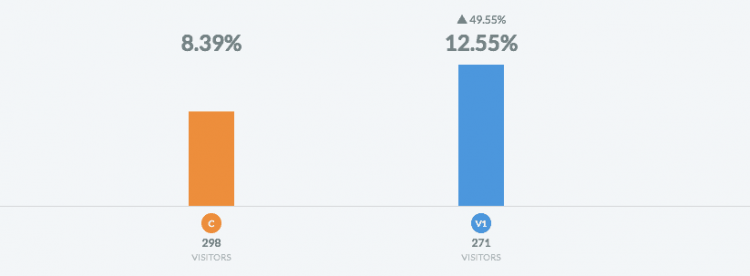
If your website is converting motivated seller leads at 15% (15 of every 100 visitors sends you their info, which is solid)… and you’re only getting 25 people to your website each month… that’s only about 4 leads per month.
Not much to build a business off of right?
So… here’s what we do.
We start problem-solving by asking the same questions. If you’re banking on SEO is a part of your traffic generation strategy… we’ll ask you this question first:
How much search volume is happening in your market?
In simple terms… are there enough people in the areas you’re targeting searching for the keywords in Google that your pages are ranking for?
Unfortunately, most of the time we get a “huh?” in response.
Then we explain:
Even if you’re ranking at the top of a search, no one is going to click your link if no one is searching.
Then a lot of times we’ll dive in and do a little bit of research, only to discover what we already know… that there’s little to no search volume in their market for the keywords they’re ranking for.
It’s like putting a great billboard on a dark back alley street that no one sees.
But put that same awesome billboard on a busy street… then it produces GREAT results.
[cta offer=”seobible color=”blue”]
Here are Some Examples For You
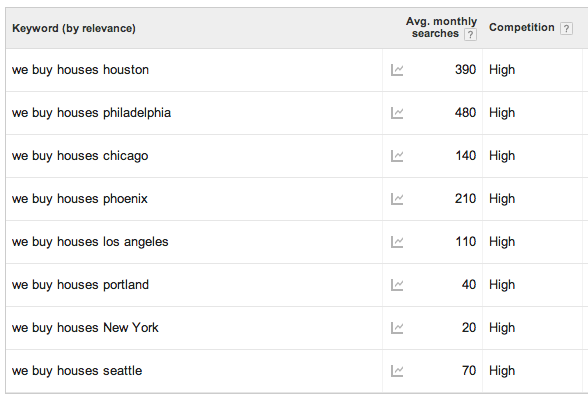
For a quick illustration of what I’m talking about, let’s look at some US cities and check out the search volume (using the keyword planner tool in Google’s Adwords) for a common search term in each market, “we buy houses [insert your city]”.
This term tends to be a popular search phrase across most cities in the US so it’s usually a great barometer in any market for the volume of “highly motivated sellers” in that market:
The Good – Below are numbers for average monthly searches for those terms in Google. You can note that some cities get MANY more searches than others… showing the potential SEO demand for that keyword.
Our barometer is anything over 30 per month is worth making a page for on your website with our SEO Grader tool to help you rank for that term.
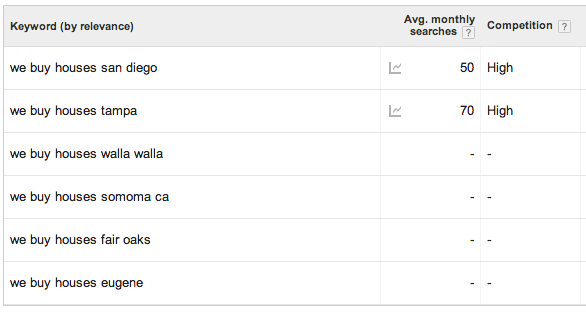
The Bad – Below are numbers in a few cities we grabbed out of thin air. One of the cities below is a city that a client of ours is ranked well for but emailed us saying he hadn’t been getting leads to his website.
Why? “we buy houses fair oaks” isn’t getting much search action. The Fair Oaks market may not be a great city to focus on for all of your online lead generation efforts.
Now, it’s important to realize a couple of things about that data:
Each of those is the average number of monthly searches over the last 12 months. It’s really common to see big spikes in search volume one month, followed by a major drop in traffic in the next if an economic event happened in that city causing more motivated sellers (a huge job layoff in the city, etc.).
Notice that the most populated city has the least amount of searches: In this example, Philly was searched 24x more often than NYC, although it has only 18% of the population.
Searches like these are often motivated by external factors
We originally wrote this post in 2014 when we did a Google search for “Philadelphia layoffs,” and at that time there were almost 4,000 teachers were laid off in June of 2013. The point is, when lots of people lose their jobs at once, it’s easy to imagine panicked sales taking place if folks can’t pay their bills.
These searches for the “we buy houses [insert your city]” and “sell my house fast [insert your city]” terms happen when people need fast answers (and you want to be in front of them when they search for those fast answers, like our client David Brown has been able to do).
They’ll often do a quick search, and if they find what they’re looking for, they’ll put in their information into a form and become a “lead”. If they don’t see what they want, they’ll keep moving until they find it.
But if SEO is your main marketing strategy, you won’t get any leads if there aren’t many searches for the specific phrases you’re ranking for.
Search Engine Optimization for Real Estate Investors Only Works When Enough People Are Searching The Phrases You’re Ranking For
Too many SEO services out there just focus on getting you rankings… because rankings are sexy right?
But those rankings don’t matter much if they’re for terms that only a handful of people are searching each month.
So what happens if you’re in one of those markets that aren’t getting many searches for the popular terms like “we buy houses [your city]” or “sell house fast [your city]”?
Does This Mean That You Should Abandon SEO When Searches Are Low?
Not at all!
In fact, it’s a really good time to build your business and get creative.
Remember, SEO is a long-term strategy. It’s not a short-term one.
And if you’re really wanting to generate consistent leads and dominate your local market online… you can still do that!
I just closed a deal from you guys, it was all because of your site and the credibility built in and all that. Going to be a really profitable deal, and I’m going to reinvest that going forward. You guys rock and I love the sites and everything you all do! – Joseph Sauter, Quick Cash Sale For You
While yes, there are some markets where there just aren’t a lot of motivated sellers searching online… but it doesn’t mean the sellers aren’t out there searching.
You just need to broaden out your keywords that you focus on your website so rather than banking all of your traffic on just the “we buy houses ” or “sell house fast ” keywords… add in others.
Not Getting SEO Leads? Here’s Your Plan Of Action…
Create some pages on your motivated seller website for “Focus Keywords” (use our SEO Grader tool to help you optimize these pages for those phrases very easily) like…
sell your house fast [insert city]
how to sell house fast in [insert city]
how can I sell my house fast [insert city]
sell my house for cash [insert city]
how to rent your house in [insert city] (many people who need to sell, just quit and settle for renting. Write an article on your blog!)
tips on selling your [insert city] house
… you get the idea.
If rather than trying to bank your lead generation on 1 term that only gets 30 searches a month… why not create some more pages on your website (InvestorCarrot makes that crazy easy) that are focused on other keywords ALSO in your market… so you have 15 pages ranking for search phrases that get 30 searches a month each.
Make sense?
If NOT, hit us with questions below and we’ll dive in and clarify for you… we’ll even get specific and help you figure it out for your own market through the comments section below.
Even if you’re in an area that doesn’t currently get a lot of search data… it’s worth it to rank well there.
When something happens in your market (like layoffs) that create a lot of demand for fast, cash buyers, you want to be first in line to capture those leads. Working on SEO now is critical to rank high when searches do pick up.
If you’re like most investors you’re deeply focused on your local market and what’s happening today. You’re only working to make deals happen soon, not years or months down the road.
That might be a mistake.
Too many investors are only thinking about short-term results… even though the best investment advice is always focused on long-term wealth-building, not scattered attempts to get rich fast.
If you’ve got the bigger picture in mind, there are a few ways you can grow your business:
Get inventory in other ways. Go old-school and start knocking on doors. Network. Partner up with companies who provide services to homeowners under financial distress. Put up signs. Advertise – good pay-per-click can be really helpful to capture the few searches that do exist. Since the leads are fewer, you’ll have to pay more to get them. That’s supply and demand.
Focus on growing a different list. If you’ve been trying to capture seller leads, shift your focus to building a list of cash buyers. Ditto on rent-to-own tenants. When inventory is tight there are lots of people looking for deals, so set up another site to grab those leads. If you hustle, you can find ways to profit from those lists, even when inventory is low.
Branch out to surrounding markets too. Too often people get stuck thinking that they need to work where they are, instead of going to find the place where they can add the most value. Start with other cities around you and see if there is more search volume in those cities. I know investors who have switched their focus away from the major metro areas and are focusing on smaller, blue-collar areas where there’s less competition from other investors. Once you’re really good at building lists, generating leads and doing deals, you don’t have to be geographically limited at all. With the right local partners, you can work anywhere.
Adjust your strategy. Too many investors and entrepreneurs get stuck on a particular path, and they lose their perspective on the big picture. They forget that they are subject to the whims of the market and that the market is entirely outside of their control. When there’s not a high rate of foreclosures, wholesaling and flipping get tougher. More competition + fewer deals = Lower profit margins.
Does that mean that wholesaling and flipping are bad strategies?
No, not at all – just that you’ve gotta pay attention to the conditions in your local market without forgetting the bigger picture.
Know Your Market And The Trends (Or we’ll help keep you up to date :-)
To illustrate, let’s do a quick Google Trends search in the US for “we buy houses” just to see how the graph moves around:
As you can see, there were a lot more folks searching for “we buy houses” back in the fall.
Overall in the US economy, we seem to be exiting a period of high fluctuation and returning to a slow, stable growth pattern.
And while trends in our market change… so do the things that sellers and cash buyers type into Google.
Just do your research (or follow us here on this blog and we’ll do it for you) and adapt on your website to focus on the keywords your market is typing into Google.
For now…
“we buy houses” and “sell house fast” (and related terms) are still some of the most popular for the ultra-motivated sellers
“investment properties in ” is a search term growing in popularity right now big time (GROW THAT BUYERS LIST!)
If your market doesn’t have many searches for those terms… consider going after other keyword terms like the ones I mentioned in this article… OR, branch out into other surrounding cities to capture search rankings in those ones too so you can do deals there too to increase your lead flow.
Sound like a plan?
Hit us with your questions about your market below… or questions about how to take this knowledge and use it on your own websites to get more traffic and leads this year.
Don’t Have Time To Focus On SEO But See The Value?
Think about this. If you’re investing in markets that get at least 30 searches a month for “we buy houses [insert your city]”… and don’t have the time or energy to focus on worrying about the SEO yourself… we can help.
If you’re interested in a long-term SEO strategy for your business, you should check out our SEO services… we’ll let you know if your local market has the search volume to make SEO worth the investment based on what we uncover.
Don’t have a website or want a system that works great to generate traffic and convert the leads?
For those of you that know me, you know I’ve been a huge advocate of using Facebook ads to turbocharge your real estate investing business, especially as of late.
There are only a few things that work really well to get deeply discounted properties (mailing, cold calling, and online ads).
Because EVERYONE is mailing the cost per acquisition for mailers has gone through the roof.
Cold calling works great, but it is something that most investors won’t do.
This is where real estate investor lead generation with Facebook ads fit in: they are just as easy to scale as mailers and don’t require you to pound the phone all day. Unlike other forms of marketing, Facebook ads are extremely predictable.
When you mail or cold call, there is a lot of variability on a month to month basis in terms of cost per lead. When it comes to Facebook, you know within a very narrow window what your cost per lead is.
Another major benefit of Facebook ads is that they can also be turned up at a moment’s notice.
So when you need more leads you can ramp up your campaigns, and vice versa.
Real Estate Investor Lead Generation with Facebook: Making Money on Facebook Leads
Now that we know the benefits of Facebook Ads, let’s talk about the execution.
The Targeting:
For real estate investor lead generation it is crucial that if you are paying to show your ads, that you are showing the right people. One of the main reasons why Facebook is such an incredible tool and why Facebook is worth so much money as a company is that Facebook knows everything about you.
They know your age, whether you are a homeowner, what you like(and don’t like), and much more. And with this information, you can put your ads in front of only the people who are most likely to want to sell to an investor.
One important thing to understand about Facebook ads is that you are interrupting what someone is currently doing.
They didn’t come on Facebook to see an ad. They came to see what their friends were up to.
So from a high level, it is critical that your ad stands out, or else it won’t even get noticed.
There are a few important things to make sure your ad stands out.
The image – this is the most important part of your ad, believe it or not. The picture is what “stops” the person from scrolling. If you can’t stop them from scrolling, they won’t read the ad and you are dead in the water.
The wording – once the person “stopped” because of the image that you used, the next thing you need to master is the “copy” or the wording of your ad. Where most people make a mistake is that they write extremely “professional” ads. By professional I mean boring. Again, users aren’t going on Facebook to see ads and they will skip over them if it isn’t interesting. You need to tell a “story” more than list out the benefits of working with you. One thing to start doing immediately is to start reading the Facebook ads in your current news feed and look at how the good ones are written. Then copy the same style.
Lead capture: how you capture your leads also makes a big difference. It is great for you to have a great image and great copy but if they are dropped to a website that doesn’t convert, it will all be for nothing. I’ve tried various sites and bar none carrot is the best performer. If you are spending significant money on Facebook ads, you NEED a Carrot site. The price is a drop in the bucket compared to what the ads cost and you will get more leads per dollar spent. One thing to note is that I used to have a non-carrot site that looked really pretty that did not convert. I see many people making this same mistake. Don’t repeat this mistake.
You are probably thinking “I know that I need a great image and great copy” but how do I know what to do on Day 1?
Can’t you just give me what is working?
I have good news and bad news on this question.
The good news is that anyone can figure it out fairly easily. The bad news is that it takes a little bit of work.
The reason that I can’t just give you what is working for me is that what is working on Facebook changes over time. One of the drawbacks of Facebook ads is that you have to manage them. An ad that was working a month ago, might now work anymore.
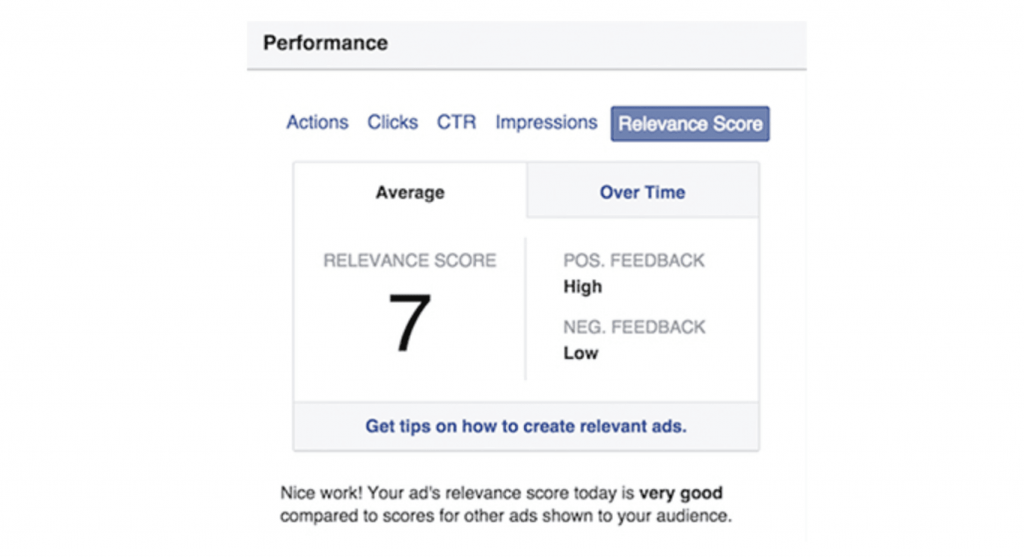
The reason for this is what Facebook calls the “relevance score” The relevancy score is determined by how people respond to your ad. If you are serving up content that Facebook users find annoying, they will hide it.
Because Facebook makes its money by users being on Facebook all day every day, they don’t want to serve ads that are annoying to the users. So, what happens is that if everyone is hiding your ad, Facebook will show it less and you will pay a lot more per lead and eventually the ad won’t work at all.
The good news is that it is really easy to figure out what is working with just a small amount of money using a concept called “split testing”
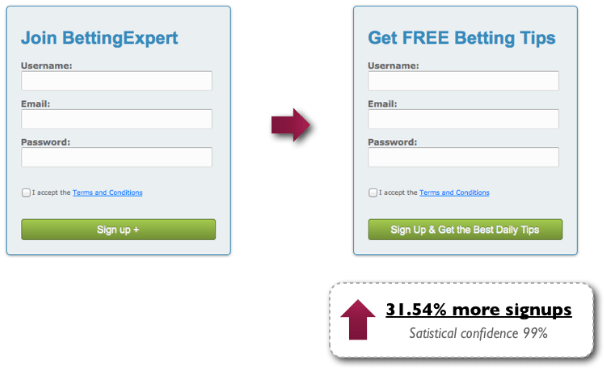
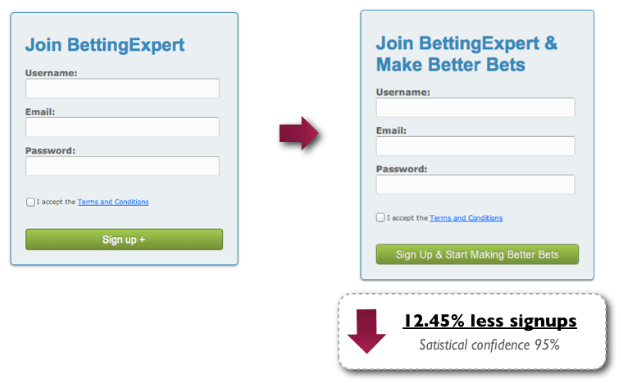
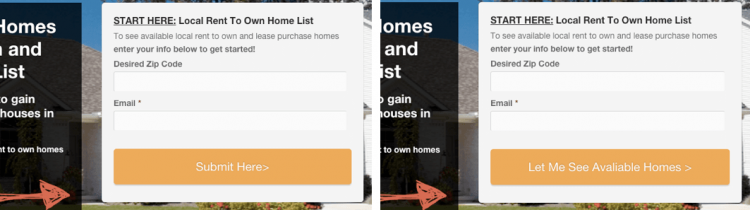
Split testing is the process of comparing two ads with one different variable. For example two ads with the same wording but with different pictures. Or, leaving out a call-to-action:
You would run these ads together and see which one performs better and then spend more on the winner.
The more that you split test Facebook ads, the better your cost per lead will be. This may sound like a lot of work, but if you are going to run Facebook ads, you need to do this or someone else needs to do this for you.
When someone tells me that Facebook ads don’t work, I know it is either because they have not gone through the process of split testing OR they don’t know how to properly monetize the leads(which is going to be my last point related to facebook ads).
If you are going to spend the time and money to run Facebook ads, you need to maximize the return on your investment. MOST people aren’t doing this. There are three components to making money on Facebook Leads: converting leads into appointments, converting appointments into deals and maximizing your ROI on Leads
Converting leads into appointments: you need to follow up with these leads as soon as possible and multiple times (I recommend calling/texting and emailing every day for the first 10 days). You also need a good CRM (I use Follow Up Boss) and a really good email sequence (mine was written by a good copywriter). It is also very important to know what to say when making these calls. My team has a free weekly training on how to turn these exact leads into appointments. To get free access go to www.oceancityweeklytraining.com and sign up for the Wednesday at 11 am free class. All of these follow up systems are used just to get the appointment (which is half the battle)
Converting appointments into deals: Once you have the appointment, you need to convert it. Motivated sellers are NOT MOTIVATED BY MONEY so what you say and do on the appointments matters, big time. You need to say and do the right things when you get sellers face to face. To learn more about how to do that check out my free Tuesday at 10 am training at www.oceancityweeklytraining.com.
Maximizing ROI on Leads
Real Estate Investor Lead Generation with Facebook: You Have To Be Able To Maximize Every Lead That Comes In
Where most people go wrong here is that they only make money 1 way on their leads and because of that they have a hard time getting a great ROI on their money. You NEED to be able to make money in multiple ways or else you will constantly battle for profitability. For comparison purposes, I get over 12x return on my money spent on Facebook.
Examples of how to maximize every lead include:
Retail leads – when the seller wants too much money for the house, you list the property or find an agent that can list it
Wholesaling – for the deals that you don’t want or can’t fund
Fix and flipping – for your high-profit deals
Buy and hold great rental properties for long-term wealth
If you aren’t utilizing the above 4 strategies it is going to be hard to compete with someone (like me) who can.
Implementing all 4 of these strategies is not difficult, you just have to know how to do it.
To learn all of my strategies on how to maximize leads go to www.realestateinvestingiseasy.com for a full training session on this exact topic.
Already a Carrot Member? Check Out Carrot’s Facebook Leads Masterclass
Listen to the CarrotCast Podcast and Subscribe Below!
I was confident like yeah I’m young but you can play tht in a positive way. I was like, yeah I’m young, I’m gonna hustle, I’m ambitious. You know I really need this so I’m going to work for you. And, it’s kind of how I played it and people respect that. You know I got a lot of “I what to help a young guy make it.” You know I think people root for that to, the bug. It’s bad in one sense but you can use it to your advantage.
Tim Oppelt
Tim Oppelt, from Opp Real Estate, has endured a lot. He’s worked one of the “worst” jobs possible, been laid off, and made some investing errors. But he’s a big believer in trying to do what you love and creating a new path for others. With that… He’s beginning to crush it!
He wants to change some negative perceptions about entrepreneurs into a perception that maybe you can do what you want in life and succeed because you love doing it.
Tim discusses spending hours and hours and dollars and dollars working on a website and online marketing but not getting a return. He found what wasn’t working and decided to join Carrot and dive into his online marketing head-on.
Now he is having online marketing success by scaling your business.
We dive into his strategy for phone leads, how he follows up with prospects, and the importance of creating amazing systems for his clients and marketing.
Listen to this episode and create a path to scale your real estate investing business.
1:45 – Why Tim is on the CarrotCast. Also, who he is and what his business looks like right now. 3:55 – What drives Tim? What his main passions are right now? 6:00 – His path to real estate investing after being laid off from a previous job. 8:15 – What was the first touch point in real estate and breaking down his direct mail strategy? 10:50 – Saying “Just do it” and leaving the perfection vs. progress attitude for a bit. 12:40 – Feeling that prospects are looking at you differently than others. How Tim got around the “your too young” mentality. 15:15 – When did he move to more of a web-based marketing strategy? And what percent of leads and deals are coming in via the web vs. direct mail right now? 18:40 – Why Tim joined Carrot.
I saw real estate investor and website and thought I’m an investor and need a website it made sense.
Tim Oppelt
20:40 – What was wrong with his first AdWords campaign structure and how he fixed it. 22:40 – There is more strategy than “implementing the thing”. How Tim’s marketing knowledge has upgraded his business and where he’s focusing most right now. 25:50 – Where and how to scale up your real estate investing business. 26:55 – Tim’s AdWords spending and how many deals he’s been pulling out. 29:05 – What his online deal mix looks like. 30:15 – Hiring his first assistant. Where he was in his business when he decided this would be the right move. 32:40 – Testing phone calls: live answer vs. voicemail. 36:15 – Hiring assistant number 2. Why he made this move and what tasks they are assigned. 37:50 – What are Tim’s dreams, how much he’s working right now, and how much does he want to be involved in the future? 40:30 – The biggest things he’s been able to pull from Carrot and implement into his business. 43:20 – The pivotal point after being laid off when he took the plunge into real estate investing. 44:25 – What book is he reading right now? 45:30 – Tim’s advice for someone with or looking for an investor website. Would he recommend Carrot?
According to the U.S. Small Business Association, only 56% of small businesses with 50 or fewer employees have a marketing plan. Almost half of smaller businesses are missing out on leads and sales.
Here are four other reasons why a marketing plan is essential for your real estate agent or investor business.
It forces you to think about where you’re going with your real estate business. Creating a common goal to drive towards.
It ensures that you’re aligned with your company values.
It serves as a foundation for your marketing activities. If you build a house, you start with a solid foundation. Same thing with your marketing plan.
Possibly the most important – it gives you a process. Without a process, you won’t have the direction you need and will likely either be going off course or starting to feel confused about your marketing efforts. The process can also act as a measure of your failures and successes.
Sample Real Estate Marketing Plan
At its basic level, a real estate marketing plan answers a series of questions that helps you define your ideal targets and craft your business’s most compelling offers into a cohesive story. It uses good distribution channels to reach your ideal targets.
Here are the questions you need to ask when making a good real estate marketing plan:
What are your goals?
What impact do you want to have on your communities?
Is your market saturated with similar offers, or is it ripe with opportunity?
How tough is your competition?
Who is your ideal target?
What are your Strengths, Weaknesses, Opportunities, and Threats?
What are your compelling offers?
How will you reach your target audience?
What is your marketing budget?
What keywords are the best opportunities in your market?
First things first: you need to set your goals and objectives.
Clearly, state what you want to accomplish for yourself in your real estate business. If you’re an investor, it could be buying 50 properties this year. As a real estate agent, you might consider closing 100 listings.
Or, in both situations, you could want to get your brand or name out more for recognition. It could be that 50 percent of your target market knows who you are. Set goals that you can quantify to record and track your accomplishments.
Develop a 10,000-foot vision for your business, such as…
Become the top producer in your area
Retire in 10 years
Control particular niches of buyers and sellers
Then quantify that vision with measurable goals. Measurable goals might include:
Obtaining 50 listings in the next year
Close 10 deals in your target market area in 12 months
Earn referrals from 50 percent of your past customers
Purchase 10 single-family rental properties in the next 48 months
What Impact Do You Want to Have in Your Communities?
You want your real estate business to be sustainable and build a good relationship with your community. How you approach and treat your clients has a tremendous impact on how your business is viewed within your market.
Your clients directly affect your business reputation, lead, and deal volume. But it’s not just your direct clients. Anyone that you interact with can be considered an indirect client. Residents, Facebook friends, your website host, employees, contractors, partners, and suppliers.
You must constantly assess your behaviors and their impact on your local community and the broader audience.
Then you can assess and find your niche within. What events to attend and who to build relationships with. Your community approach will also help you create your immediate and long-term business needs.
Is Your Market Saturated with Similar Offers?
You want to build strong relationships with your customer base. As you’re maintaining a high value and positive service for your customers, they’re more likely to spread the word among their peers.
If you’re in a competitive market and find it hard to make your marketing stand about your competition, then be sure to make your service and client experience stand out.
Marketing Strategies for Real Estate: How Tough is Your Competition?
First, you need to identify your competitors. Take into account your potential or future competitors too.
There are a couple of methods you can use to do this.
1. Look at them from a customer’s point of view
If you can look at your competitors from a customer’s point of view, you’ll be able to spot some of their larger strengths and weaknesses.
It’s a fun yet challenging activity to think like a customer. Why would a customer want to use them as a real estate service? Is it because they can offer more and faster payment turnaround time, or do they have top-tier customer service? These could all be strengths for your competition.
Become your ideal client and put yourself in their shoes. Wonder why you would be more likely to deal with them instead of using your company to accomplish their real estate needs.
2. Look at them from their point of view
Next, take a look at their point of view. This can help you understand their strategy, culture, and attitude toward the market. Take a look at what assets they bring to the field and how you would use them if they were yours. Take a look at what you interpret as their weaknesses.
How could you commit to making those weaknesses into your strengths?
Ask and answer these questions before your analysis:
Before you dive into your real estate marketing competitor analysis, be sure you’re asking the right questions. Here are some common questions to get you started:
Who are your competitors?
What types of services are they using?
How much market share do they have?
What have been some of their past strategies?
Are they using the same strategy?
Are they aggressive with their real estate marketing?
How competitive are they in the market?
What are their strengths and weaknesses?
Are they a threat to you? If so, how big of an impact can they have?
Does their marketing strategy affect yours or how you do business?
Who is Your Ideal Target Audience?
Create a simple paragraph profiling your ideal real estate target audience. Create a customer avatar regarding these demographics: sex, age, family, earnings, lifestyle, and geographic location.
Ask yourself questions about your customers, such as:
Are they followers or leaders?
Are they timid or aggressive?
Are they introverts or extroverts?
How often are they likely to move?
Are they traditional and bear more of a connection to the community?
No matter your real estate market, you’ll need to define them in this section narrowly. It is an important step that will guide you as you plan your media and public relations campaigns.
What are your Strengths, Weaknesses, Opportunities, and Threats?
Performing a SWOT Analysis is a crucial step when creating your real estate marketing strategy.
The term “SWOT Analysis” sounds like a daunting task. But, it can be simple.
It’s broken down into two categories:
Your internal issues: Strengths and weaknesses
Your external issues: Opportunities and threats
This analysis will allow you to see what factors will help you achieve your objectives due to your strengths and opportunities.
It will also highlight what obstacles you must hurdle before achieving your real estate goals due to your weaknesses and/or threats.
Overall, the SWOT analysis assesses your real estate company’s strengths, weaknesses, market opportunities, and potential threats to give you insight into the possible issues that can impact your success.
The number 1 goal of a SWOT analysis aims to determine and assign all important factors that could positively or negatively impact the success of one of the categories, giving you an in-depth view of your real estate business.
Four Categories Of SWOT:
Strengths:
What are the advantages of your real estate business?
What can you do better than your competition?
What exclusive resources can you use that others can’t?
How does your market see your strengths?
What factors into you closing the deal?
What is your company’s Unique Selling Proposition?
When considering your strengths, look at your internal employees and external customers/market.
Weaknesses:
What might you be able to improve on?
What locations and markets should you avoid?
What potential clients within your market might see as your weaknesses?
What factors cause you to lose the deal?
Again, account for your internal and external clients. Do your clients see weaknesses that you haven’t seen? What are your competitors doing better than you right now?
Weaknesses can be a gut check. But stick with it and be as realistic as you can.
Opportunities:
What positive opportunities are available to you?
Are there trends that you need to know?
Some of the positive opportunities you can take advantage of are:
Changes in real estate technology. For example, recording a video testimonial and uploading it to Facebook as soon as you record it.
Changes within the real estate field. Are more real estate agents becoming investors or vice versa?
Changes in the economic status and population profile within your market.
Are there any local events you can help organize or lead within the real estate niche?
Take a look at your strengths and weaknesses as you approach your opportunities. They can provide invaluable information on what you can work harder to improve upon.
Threats:
What obstacles do you need to hurdle in your market?
What are your competitors doing?
Are there any technical issues that are threatening your market position?
Do you have cash-flow problems that you need to address?
Do you have any weaknesses that are threatening your business?
Once you have chosen your real estate business values within the four SWOT categories, you can develop a more strategic plan.
For example, once you’ve identified your weaknesses and potential threats, you can create a plan to eliminate or at the least minimize them while continuing to improve upon strategies that will make you a more robust business.
To create your compelling offers, ask yourself the following questions:
Who do you sell or buy real estate to or from? Be highly specific.
What are the problems that you help them solve?
How do you solve their problems?
Why are you better at solving their problems?
Now create your compelling pitch like this:
How [insert who your ideal client is] can [insert verb] [insert the problem] through [insert solution].
How Will You Reach Your Target Audience?
Getting your audience to engage with your content is essential for connecting with your target market online. The online real estate market is increasingly growing and vying for client attention.
But, even the investor or agent with a small budget can succeed with the right strategies.
Start by narrowing it to a highly targeted audience.
If you offer buyer and seller services, your target currently includes more people in your local market.
For example, focus on only one section of zip codes within your market city. Then expand your area as your finances and business grow.
So, choose a specific area of your market and focus efforts there. Then expand.
A second option will be to focus on the seller or buyer market if you’re a real estate investor. There are specific factors to consider, but marketing towards the seller’s market is most likely the one to go after.
Your marketing costs within major cities will likely be expensive, so media such as Google Ads might be too high unless you can target slightly out of the city.
If you don’t have the budget, take advantage of pricing within the suburban markets.
The other thing you need to do is get your website organized to target your audience. If that requires creating city-specific pages, then you need to do that.
Also, get one of the most overlooked pages, your “About” or company page optimized. Be sure it includes your city or area, how you conduct your business, and your process. Spell out your strengths and why they should choose you over the competition.
What is Your Marketing Budget?
Having a solid marketing budget is integral to being realistic and will help you improve your revenue over time.
You can overspend on marketing costs if you don’t know your budget. Therefore causing an unwanted and bad experience.
Here are a few steps to help you organize your budget and determine where to spend your marketing dollars strategically.
Your first step needs to be organizing your current financial positions. You MUST be specific. If you’re too loose and choose to estimate, it creates an unrealistic budget.
This starts with getting in order your revenue information. You’ll need to know how much revenue your real estate business makes every month. Even though your income varies throughout the year, you must have a number based on reliable revenue (the minimum amount of money you make each month.)
You’ll also need to minus business expenses. Rent, materials, the cost of VA’s, etc.
Any business expense must be subtracted from your revenue before nailing down your marketing budget. Setting a realistic budget is one that focuses on income that exceeds expenses.
After you find your available disposable income, you’ll need to determine what that money will be. Although marketing is a major area to focus on, don’t forget to set aside a budget for unexpected circumstances and growth.
Separate your money based on your goals. You will invest more money in online marketing if your primary goal is attracting leads.
But, if your goal is to hire more VA’s or full-time assistants, you’ll want to put more income into your company’s growth and set aside less for marketing until you’ve been able to close more deals.
2. Determine where you want to allocate your funds
Once you have calculated what is available to spend on marketing, your next step is organizing and prioritizing your money.
There are three main elements to how you spend your marketing dollars:
Budget size
Your past experiences
Reaching the optimum target audience
Start by organizing how to spend the budget based on the amount. If you have a small, more limited marketing budget, you should probably consider Craigslist ads, Facebook ads, local citations, social media posting, and email advertising to attract new clients.
A heavier marketing budget would provide the opportunity to include direct mail, bandit signs, and Google Ads to attract an expanded range of clients.
Apart from any budget limits, don’t forget to consider and implement what strategies have worked for you in the past. You might have noticed postcards helped bring in more clients during a specific time.
Then do that same strategy again, even if you still have more budget for more expensive marketing methods.
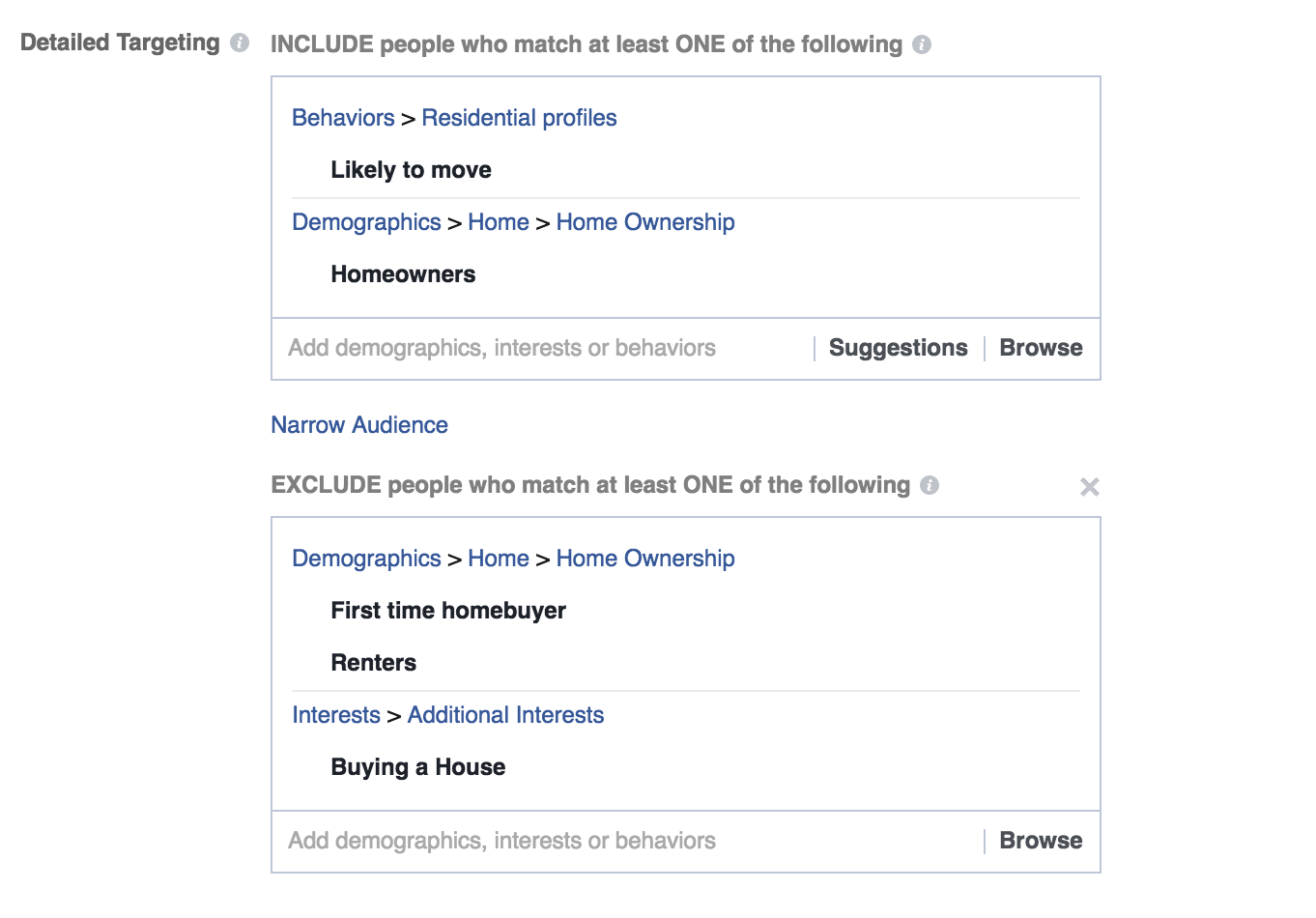
Also, don’t overlook the marketing channels that will help you target and reach your optimum audience. For example, Facebook advertising is an effective channel for targeting motivated sellers, but you still need to create the right audiences to filter out potential buyer leads.
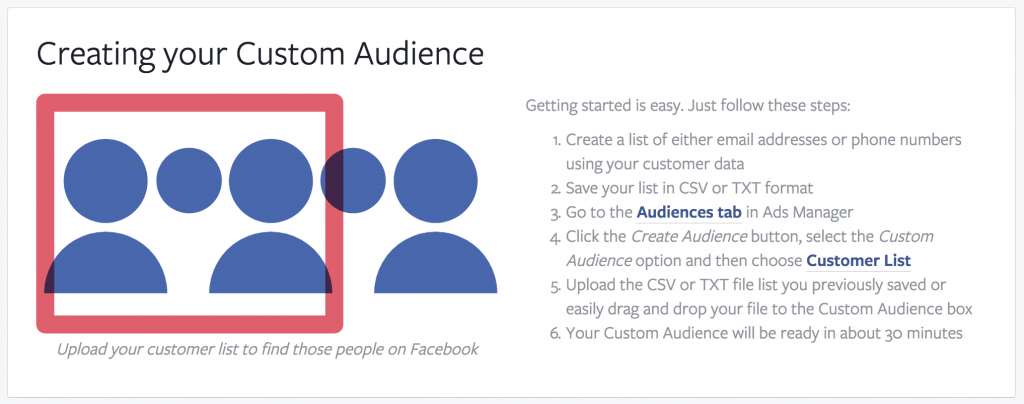
Facebook Ads Audience for Real Estate
Create and document very detailed customer avatars. Then, think about which media they’re more likely to consume. That is the spot where you need to be advertising.
If you’re considering testing a new marketing channel, allocate some funds for that test. Start with a small budget since you don’t know how effective the new channel will be.
For example, if you enter the Google Ads marketing channel, start with a small campaign with highly targeted keywords and a budget.
Only allocate more budget after you gain enough data to determine if it’s working for you. If it works, pull more funds into the new marketing channel.
What Real Estate Keywords Are the Best in Your Market?
How do you use real estate keywords? If you are only using them to optimize your website for search rankings, you could be missing out on other ways to gain visibility within your target market.
Get into the mindset to use your keywords in your online and offline marketing.
Here are some platforms where you can utilize your real estate keywords more:
Real estate website optimization (homepage, landing pages)
Real estate social media profile optimization (Twitter, Instagram, Facebook)
Offline marketing (postcards, bandits signs, direct mail)
Using real estate keywords should not be limited to your digital marketing efforts.
Find different ways to plug them into your offline practices as well.
For example, are you sending out flyers or postcards that take advantage of some keywords?
Are you placing bandit signs around your target market with specific messages and a phone number in case they’re sitting in a parking lot and want to write your number down to contact you later?
If you’re using this kind of marketing and not some keywords, it’s time to readjust your strategy.
Keywords hold a lot of power in online marketing but can be effective offline too. Just be careful that you’re not infringing on trademarks. If you question a keyword phrase, check it out first.
This plan assumes that you’ve got a website that has been proven to convert leads.
If you’re trying to scrape together a bunch of tips to save a few bucks on building your website, you’re doing it wrong. It will cost you much more than the monthly membership price to build what we’ve built.
There are a few things you should do first to get that website up and running, and these only take a few minutes:
Get your testimonials on the site because social proof and credibility are essential to conversions.
Make sure the copy on the site reflects your business and is in line with local laws (for example, if you or your team have a real estate license, you’ll need to change the copy to make sure you’re correctly disclosing your license… but you should make that into a benefit since a license gives you more options for sellers than someone operating without one).
Okay, so that last one might be complicated if you’re new to the business… but you need to be making sure you’re aware of the laws around you since being ignorant isn’t an excuse if you’re trying to get out of a five-figure fine for operating without a license (in some states)…
This reminds me that I need to mention we’re not attorneys or financial advisors; all of this stuff is just general advice. You need specific, professional advice on your real estate investment business…
Having a competent lawyer ensures you’re not offering something illegal without knowing it is a good idea.
There are a couple of ways to use these questions…just cut and paste them into a document and start answering them if you’re ready.
Want our help in making your real estate marketing plan?
Frustrated by the slow drip of leads? As a real estate investor, you know time is money. Waiting months for a trickle of potential deals can seriously hinder your growth.
This blog post is key to unlocking leads in just 90 days. We’ll unveil a data-driven real estate marketing plan designed for 2024, helping you attract motivated sellers and generate more deals faster.
Demo Carrot: How many deals are you losing to your competitor’s website?
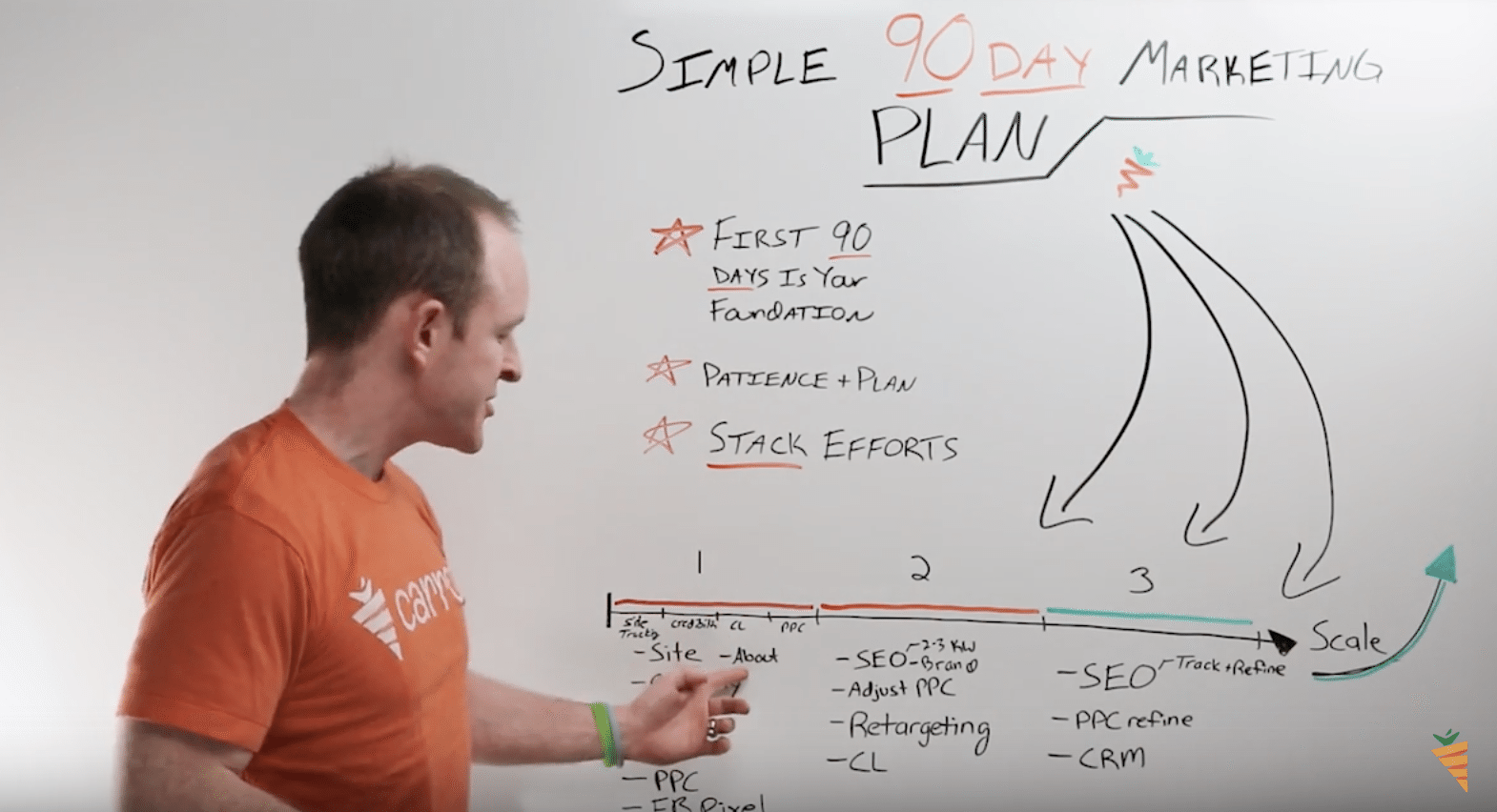
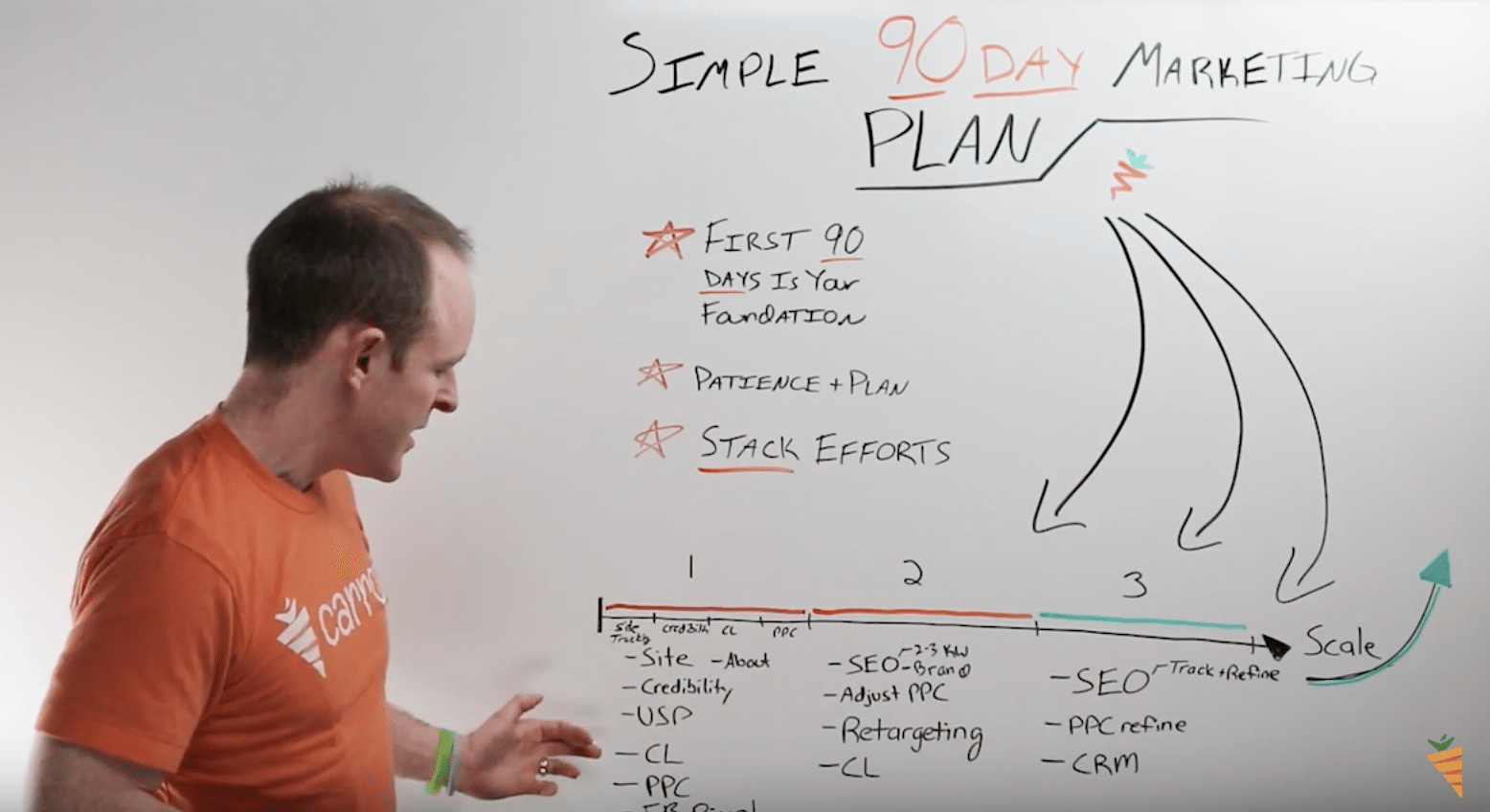
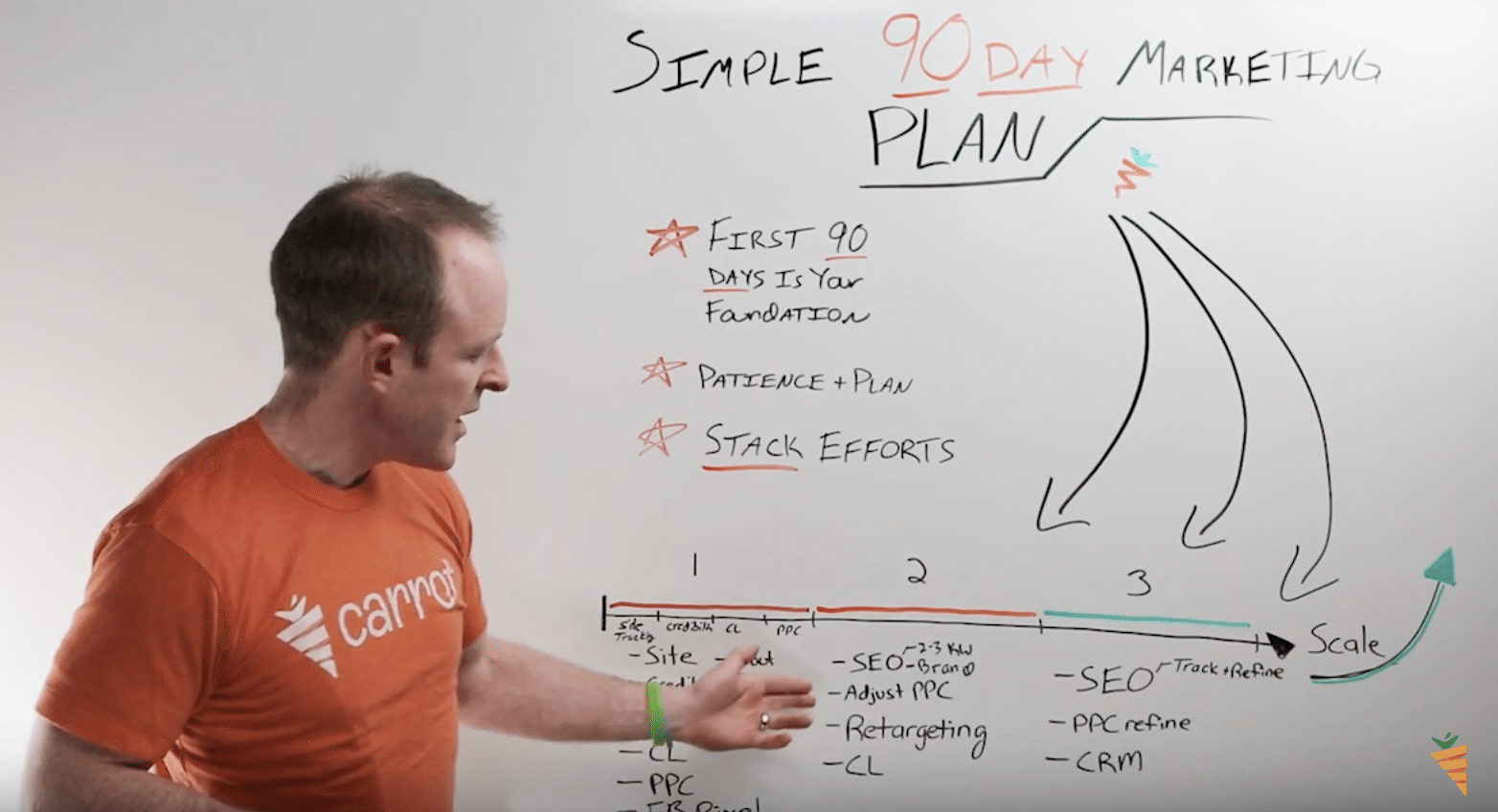
We all had it at one point, and you’ll probably have it if you don’t have it right now. I will walk through this Carrot whiteboard strategy, a suggested path in your first 90 days with your online marketing strategy in the real estate industry.
Real Estate Marketing Plan: Our Simple 90-Day Lead Generation Strategy For Sellers and Buyers
If you haven’t set up your website yet, the first thing you’ll do is, of course, get one. If you need a website, check us out at carrot.com. If you’re not a Carrot member, you can also check out biggerpockets.com or Facebook forums to see how our clients perform. That’s great! We’ll roll with whatever you have going on now.
The first 90 days are the foundation. So, many people have unreal expectations in their first 90 days of any marketing, but primarily online.
Online marketing takes some time to develop, so if you’re looking at SEO, PPC, or something similar, your first 30 days, especially, are spent getting things going and refining things.
Even if you’re doing PPC, your campaign won’t be optimized in that first month. So, have realistic expectations about your first 90 days. This is your foundation setup, and you will scale up after that.
One of the biggest things is you need to have patience in these first 90 days because if we expect the world to change in 90 days, you expect a flood of leads to start coming in, but you’re not putting a flood of marketing out there; then you’re probably not going to get the results that you expect.
I’m not saying that you can’t get a flood of leads in the first 90 days; you totally can, but you have to put a flood of marketing out there to capture that, and we’ll show you how to do that.
So, one thing I want to ensure that we all do in our marketing and our businesses is to keep your marketing simple initially. You see many different marketing methods and must explore them all at once.
But that isn’t the path you need to follow. We’ll often look at companies and go, “Man, that company is exactly where I want to be,” but they didn’t start there. They slowly stacked things onto their business, and over time, as they found out something worked, they made it good; they made a process. They systemized it and said, “Let’s stack something else on there.”
That’s how a real estate investor goes from doing their first deal to 2,000 deals. It doesn’t happen overnight. It happens by stacking marketing methods and systems, one by one, as they perfect each of them. So have patience and stack your efforts.
Conquer Online Marketing in 90 Days: Start with a High-Converting Website on Carrot.com
Forget chasing trends or endless social media strategies. Here’s a fact: Your website is the foundation of your online marketing success.
That’s why experts recommend launching a high-converting website as the first step in your online marketing journey. But building a website can feel overwhelming. Don’t worry, Carrot is here to help!
Here’s how Carrot makes creating a powerful website fast and easy:
1. Choose Your Winning Template:
Carrot offers a variety of website templates designed specifically for real estate investors, each optimized for mobile responsiveness and high conversion rates. No hosting or coding necessary!
2. Customize Your Brand:
Make your website your own with a user-friendly editor. Add your logo, colors, and images to create a professional and cohesive brand experience.
3. Leverage Built-In Marketing Tools:
Carrot equips you with powerful tools like lead capture forms, call-to-action buttons, content tools, and SEO optimization to attract and convert leads from day one.
4. Focus on What Matters Most:
Carrot websites are designed to prioritize clarity and user experience. This means your visitors can easily find the information they need and take action, maximizing lead generation.
Stop wasting time on online marketing that doesn’t deliver results. Get started with Carrot today and launch a website that converts visitors into leads and fuels your online success.
Ready to dominate your online presence? Head over to Carrot.com and get started on building your high-converting website in minutes!
Personalizing Your Website To Cut Through The Clutter
Within the first 48 hours, you will want to do some basic stuff. Launch your site, tweak your content, personalize your content a little bit, post your story, and fill out your “about” page so people can connect with you.
You want visitors to see a real face or person behind the brand, not a nameless, baseless entity. As we’ve discussed in content, in our CarrotCast podcasts, and in our coaching calls for our customers, it’s a cluttered market. Hence, you stand out by telling your stories and connecting personally.
So, ensure you personalize your content within the first few days of launching your website. You have to reinvent the wheel. If you’re a Carrot customer, take our content and look at one paragraph, read it, see what’s in it, write it in your own words, and then delete ours. So adjust 20, 30, and 40% of that content.
Add Lead Tracking So You Know What’s Working And What’s Not
The next thing you must do is put tracking in place as soon as possible. If you’re a Carrot customer, you already have tracking in place, but if you want to get more advanced, and you want to use your own Google Analytics account, or you want to put your Facebook pixel, I would do that the first couple weeks of getting your website. Or, we can do it for you if you’re a Carrot member.
You’re going to need to start tracking that traffic right away. That way, you can begin to retarget people.
Hone Your Unique Selling Proposition
Next, you must ensure your unique selling proposition is nailed within those first few weeks of your online marketing.
What about you and your company standing out, giving people a reason to work with you?
Find Leads With Facebook Ads – First 30 Days
So we launched the website, got our tracking in place, personalized some content, had our “about” page up there, put a picture of you on there, and swapped out pictures. Hence, they’re local to your area, swapped out some content, so it’s unique to you and your area, and built-in that credibility, testimonials, things like that, and then we start some Facebook Ads.
Start Facebook Ads a week two or three after launching your website.
Facebook is fast, quick, and free. If you do it correctly, you can have leads and traffic coming in that day. Our blog has some great resources and a Facebook Masterclass.
Start by running a couple of ads targeting a motivated seller audience, then scale it up over four to six weeks to where you have a couple of campaigns with 3-5 ads within each.
Launch And Build Up Your Pay-Per-Click – First 30-60 Days
Next, once some Facebook Ads are going, your website is optimized with great content, you’ve personalized it, you’ve built credibility, and you’ve built a great “about” page, then you start to do some Google Ads if you have a budget.
If you have $500 to $3000 monthly and are in specific markets, you can start some small-scale PPC marketing and ramp it up.
Sprinkle Credibility Into Your Real Estate Marketing Plan
In month two, you have some momentum going. You’ve got your website; you can always tweak it later, add more credibility, or add your Better Business Bureau logo later. We always look for progress, not perfection, so get that site out the door in the first two weeks, build some basic credibility there, and then continually refine it from there.
If you’re unsure what to do on your website to build credibility, contact us or check out our content on credibility building.
Time To Work In SEO – 30-90 Days
Shift your focus to SEO and Evergreen Marketing. Pick two to three high-leverage keywords to focus on for your market. We discuss it in some of our resources and start setting that foundation.
Then, if you have a tool to track your rankings, maybe start putting those keywords in there to see how your rankings are going. We have that built into Carrot, but other tools can track your rankings if you’re not a Carrot user.
One of the biggest contributors to SEO is content. Ensure you have a good blog post strategy and plenty of real estate blog post ideas to work from!
Begin To Adjust Your Pay-Per-Clicks
Now, it’s time to adjust your PPC because you can’t set it up, forget it, and not adjust it. So, in month two, you will adjust and refine your PPC campaign. If you have enough traffic, you will also turn on retargeting.
You’ve put your Facebook retargeting pixel on, which we teach you how to do in a blog post on our website. Then, in month two or three, we will start turning on retargeting ads on Facebook, and the same thing happens: we teach you how to do those in those other resources, so check them out. Also, keep your Facebook Ads going.
Finally, to wrap out your foundational first 90 days, you’re going to be tracking and refining your SEO. You’re going to a coach or someone you can go to to ask them for advice on improving your SEO, building some backlinks, and social media signals, and this time, you’re probably going to get some citations.
So, get your website listed on Yelp, Yellow Pages, and all those citations. We suggest starting between 20 and 40 in the first 90 days. We can do it if you’re a Carrot member; check out our marketplace. If you’re not a member, check out our how-to build citations for real estate blog post.
After you refine your PPC, and only at this time, start thinking about a CRM. Way too many people started thinking about a CRM for tracking their leads in month one. If you don’t have any leads coming in, you have no leads to manage in a CRM. It’s like having gas without a car to put it into.
So make sure you’re focusing on getting leads first, and then you get your CRM to manage your leads once you start getting enough lead flow that you can’t manage. If you do it correctly, you scale up.
Wrapping Up Your Real Estate Marketing Plan: First 90 Days
Once again, contact us for those resources if you are a Carrot member. It’s just a quick run-through. We have many other resources, coaching, and guidance to help you crush it, just like we do with thousands of customers. If you’re not a Carrot member, keep returning to our CarrotCasts or free resources to help you grow or join the fold. Join the Carrot community.
We will be learning new, amazing things every week with great experts, great marketers, and our Carrot team to teach you how we do what we do and how you can make a bigger difference!
Your first month of online marketing typically is going to be one of your hardest and least productive because you’re really cutting new trail everywhere you go. Kiley Newbold
If you haven’t been running Facebook ads for real estate lead generation, then you’re most likely missing out and stepping behind your competition.
Getting motivated house seller leads on Facebook hasn’t been easy over the years. Cash buyers, tenants… yes. But sellers have been a harder nut to crack. Until the last 12 months, that is.
Our guest, Kiley Newbold, a Facebook marketing ninja who was the Vice President of Marketing & Technology at a $75MM company before going full-time into Facebook marketing for real estate professionals recently, dives into his strategies that are consistently attracting high value motivated house seller leads through Facebook ads.
Listen to this episode of the CarrotCast with Kiley as he lays out some Facebook marketing tips for real estate investors and agents. Grab something to take notes and take full advantage of these tips. Enjoy!
3:30 – How Kiley helped build the ColorRun from 0-50 countries and helped millions of people via Facebook. 7:25 – Why working and the time spent with the ColorRun was so enjoyable. 10:15 – How Kiley is bringing his passion from the ColorRun to his new business venture and entrepreneurship. 12:35 – Why Facebook hasn’t worked for motivated seller leads in the past and Facebook marketing pitfall #1. 18:16 – Taking the emotion out of your advertising decisions and instead trusting your data. Carrot ROI Tool. 20:40 – How to set your advertising budget. 21:45 – Facebook marketing pitfall #2: Don’t look at your numbers on a daily basis. 23:25 – Facebook marketing pitfall #3:Testing too many variables at once. 26:18 – Facebook marketing pitfall #4: Don’t make massive changes on a regular basis. 29:50 – How much does the actual website play into the success of Facebook campaigns and why having a personalized website makes a positive effect. 36:30 – Why it is so important to have not just a mobile friendly website, but also one that is optimized to convert while you’re using Facebook marketing. 37:10 – What first step you need to take when structuring your Facebook campaign. 39:05 – What types of ads (image, carousel, video) are working best right now. 43:50 – Quick Facebook marketing tips for real estate recap. 47:00 – The importance of retargeting and how to get it setup. 49:15 – What Kiley has seen as the biggest difference in markets. Are there markets where Facebook hasn’t worked? 50:05 – What statistics and numbers you should be concentrating on and the importance of understanding attribution. 57:00 – Take these Facebook marketing tips for real estate and apply them to the places where people hang out the most. 58:20 – Kiley’s current journey into entrepreneurship.
SEO for real estate investors often feels like one part uber-advanced technical “hacks” and two parts dark magic.
Listening to the advice of SEO gurus could easily leave you feeling overwhelmed … and incredibly disheartened.
It’s not. And you shouldn’t be.
SEO for real estate investors comes down to optimizing around 10 on-page elements. And that’s incredibly good news.
Why? Because traffic is the lifeblood of any online business. And for real estate investors what you need isn’t just any old traffic — not just visitors for the sake of visitors — but high-quality, lead-worthy, traffic you can count on month in and month out.
This post will guide you in how to get more traffic to your website by teaching you what’s important to search engines (i.e., ranking factors) and what you yourself can do to get your real estate investor site to rank exactly where you need it to.
If you’re already familiar with SEO, then CLICK HERE to jump down to the meat of this post: a step-by-step checklist of HOW to optimize your on-page SEO for real estate investors.
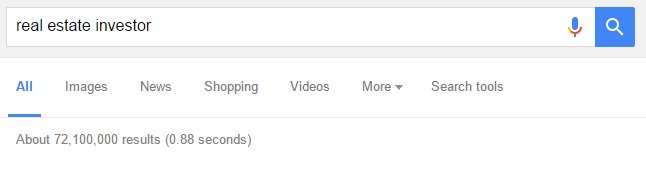
Your position among those 72-million-plus results dramatically determines how many people visit your site. Data from May of 2016 indicates that while the average clickthrough rate (CTR) of position one websites on Google’s search engine results pages (SERPs) is 23%, position ten is 2%.
And you don’t even want to know what happens to a clickthrough rate when you fall outside of positions one through ten. As the old adage goes, “The best place to hide a dead body is on page two of Google.”
All this to say, it’s vital to understand exactly what factors Google takes into account when prioritizing their search results.
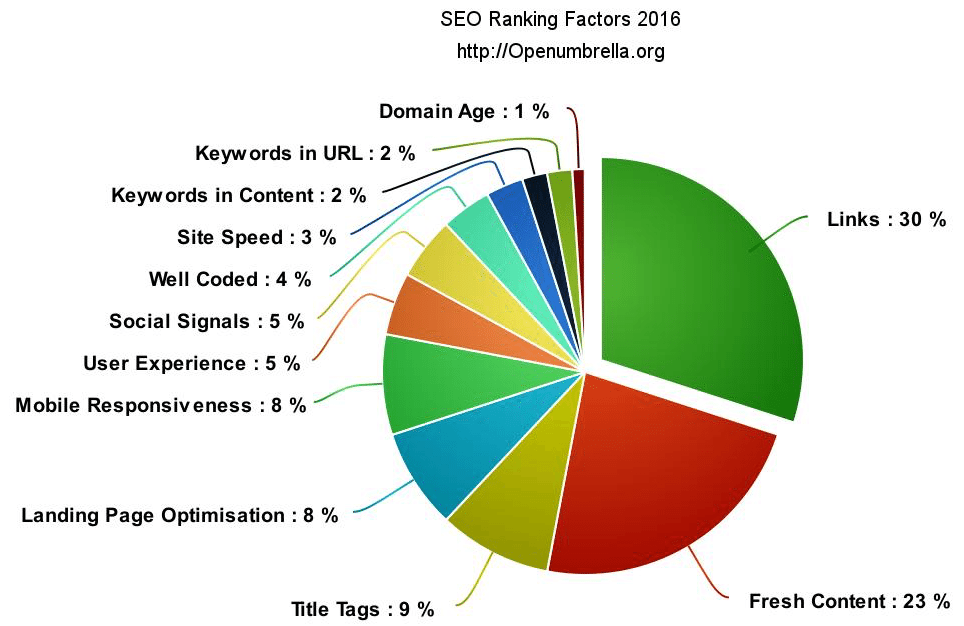
According to Open Umbrella’s analysis of 182 websites, there are at least 12 vital factors:
That can sound like a lot … but it’s nothing compared to SEO genius Brian Dean’s Google’s 200 Ranking Factors: The Complete List. (Full disclosure: the list actually contains 205 ranking factors. Geez.)
But here’s the thing … you don’t have to become an SEO genius to get your real estate investor site to rank. And — even better — you don’t have to get to page one.
Instead, SEO for real estate investors falls into three big buckets: (1) technical SEO, (2) off-page SEO, and (3) on-page SEO.
[cta offer=”seobible” color=”red”]
Technical SEO
Naturally, technical SEO involves a host of behind the scene elements, some of which include …
Indexable: can Google access and catalog all your pages?
Speed: how fast does your website load?
Responsiveness: does it appear correctly on mobile, tablet and desktop devices?
The good thing about being an Investor Carrot member is that all these factors are taken care of for you. Big sigh of relief.
If you’re not a member, have a look at the health of your website by using a tool like HubSpot’s website grader.
Off-Page SEO for Real Estate Investors
Off-page SEO is really all about the links from other websites to yours.
And when I say “all about” … I mean all about. Backlinks are the number one ranking factor all search engines use to prioritize their results.
They’re also the side of SEO you have the least control over.
That’s why — for now — we’re going to forego link building strategies and instead focus on the side of SEO you can control.
On-Page SEO for Real Estate Investors
On-page SEO for real estate investors focuses on your (1) content and your (2) keywords.
Everybody wants to “hack” Google with the second approach. And of course, optimizing your keywords is vital. But before we go through our checklist on that process, do not ignore …
SEO for Real Estate Investors: Content Matters
Sadly, one of the most neglected areas in SEO, specifically by small businesses and entrepreneurs like real estate investors, is the continuous development of quality, value-add content.
Many real estate investors who take their business online are under the false impression that adding content — any content — with the right keywords placed in the right keyword positions will do.
Easy, because valuable, and fresh content is the only kind of content that other people will link to. And remember, other people’s links are the number one factor in SEO.
3. We discovered that content rated as “topically relevant” (via MarketMuse), significantly outperformed content that didn’t cover a topic in-depth. Therefore, publishing focused content that covers a single topic may help with rankings.
4. Based on SERP data from SEMRush, we found that longer content tends to rank higher in Google’s search results. The average Google first page result contains 1,890 words.
Do not make the mistake of putting “content quantity over content quality.”
Instead, invest in long-form content — roughly 2,000 words — that valuable and relevant. If you’re looking for ideas, check out our 101 Blog Post Ideas For Real Estate. If you’re looking for a comprehensive crash course that covers the entire process, jump over to our Content Marketing Roadmap. Both are free resources … even if you’re not a Carrot Member.
Our Content Marketing Roadmap will walk you through the exact content creation process Carrot Members are using to pull in over 55,000 lead per month.
But this isn’t a post about content marketing. This is a post about SEO … so let’s turn our attention to the real meat: keywords.
SEO for Real Estate Investors: Keywords
Keywords are what help search engines match the content on your website to online searches. It’s essential that you master the art of keyword research in order to maximize your results.
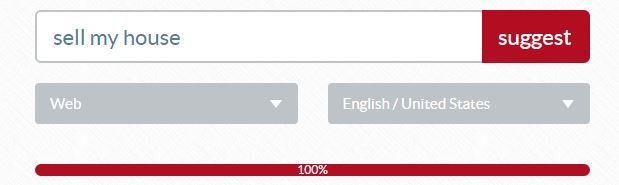
The easiest way to find your own most popular keywords is by using a free tool called Ubersuggest. Simply type in a target phrase like “sell my house”:
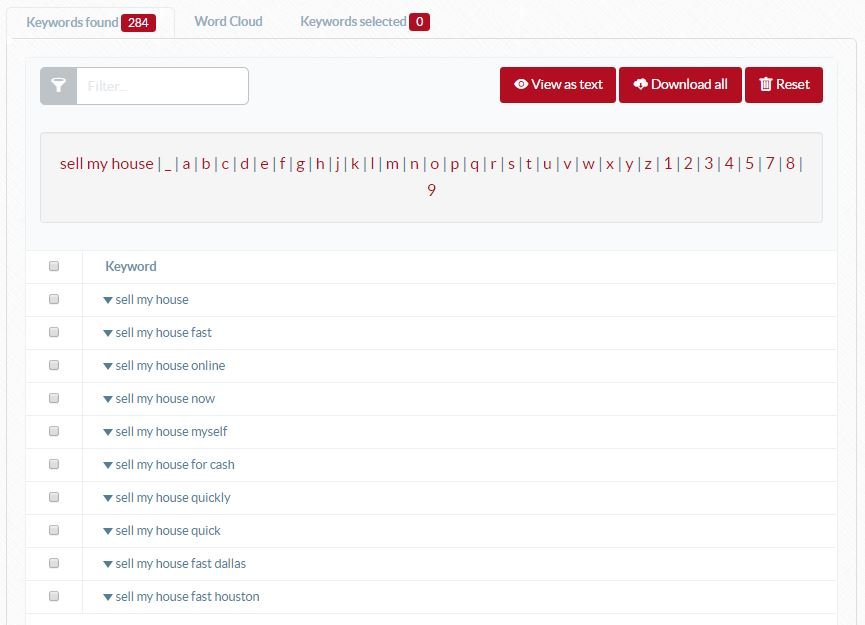
Ubersuggest will then automatically generate a massive list of possible long-tail keyword phrases related to that general phrase.
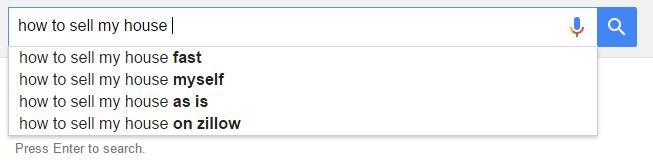
You can also use Google’s auto-complete feature as well, especially to narrow down the most popular long-tail phrases.
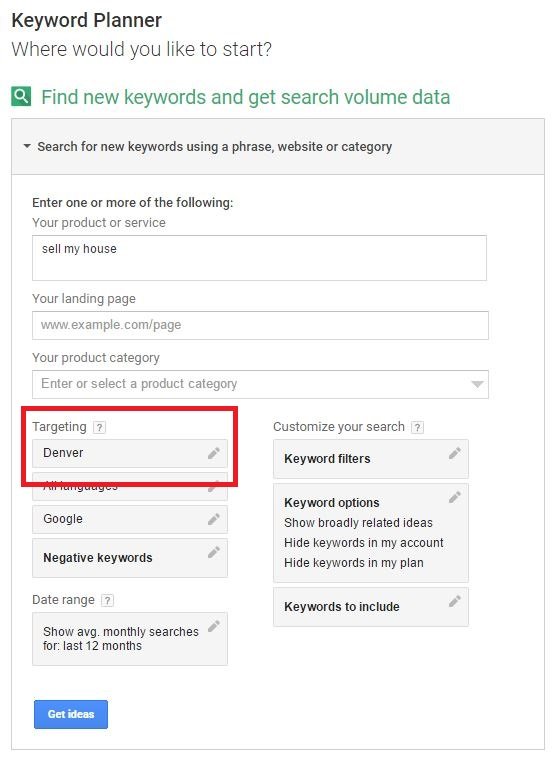
For an even more detailed examination of the keywords you should target, Google AdWord’s free Keyword Planner tool is phenomenal. Just be sure to enter the area you want results for under “Targeting”:
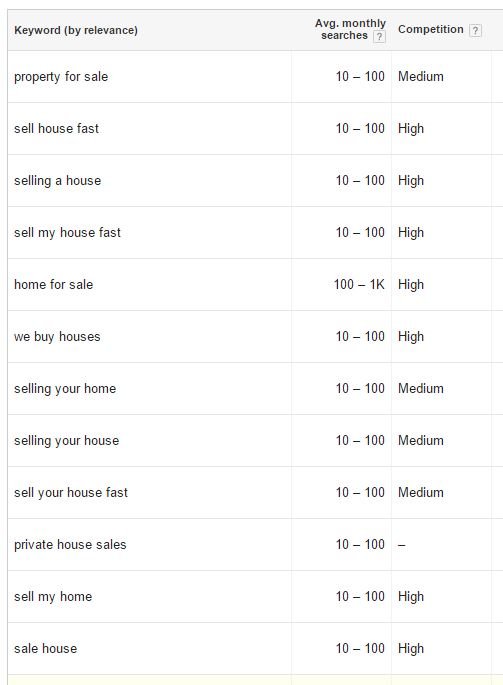
Google will then give you a list of possible long-tail keyword phrases to choose from based on the location you selected:
Whatever tool you use, simply select the long-tail keyword most relevant to what you’re offering. In this example case “sell my house fast in Denver” is hands down the winner.
Before we proceed to the next section, you should know that Investor Carrot websites come with guidance as to how to add on-page SEO to your content, but if you’re not a member, the next part should bring clarity.
SEO for Real Estate Investors: On-Page Checklist
After you’ve created your content and selected your targeted keyword, it’s time to get to work on SEO. What follows are the ten most valuable on-page elements that should include your keyword phrase.
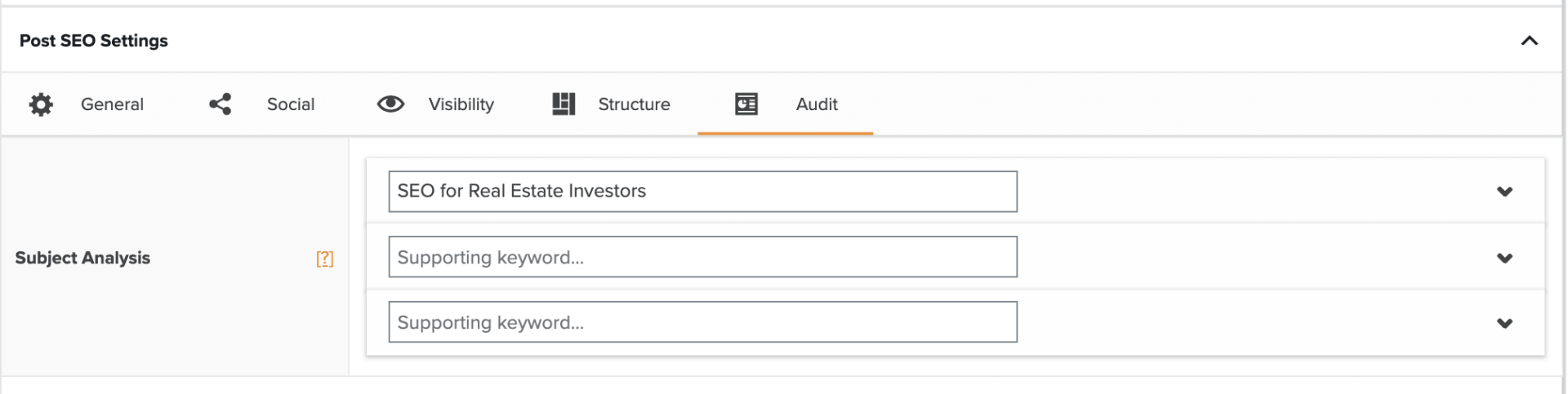
You can easily use this as a checklist, but we’ve also built a Carrot SEO tool especially for real estate websites. Our SEO goal for this page is to rank for the phrase “SEO for real-estate investors.” So this is what the tool looks like when we plug that phrase in:
Now let’s walk through the ten most important elements.
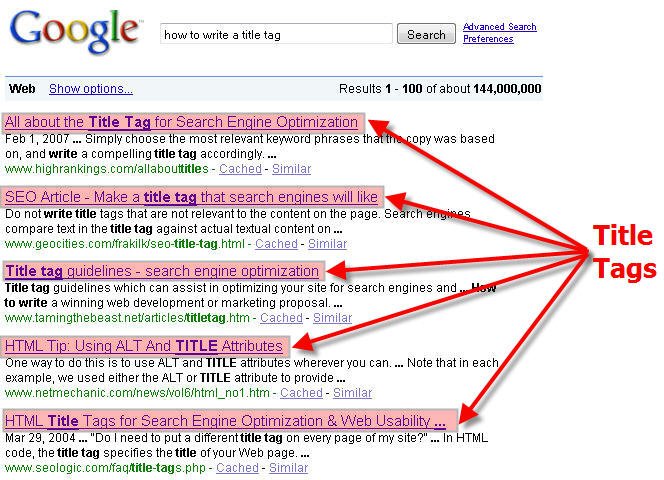
1. Title Tags
Title tags are the headings of the pages on your website. In search results, they are the main headings.
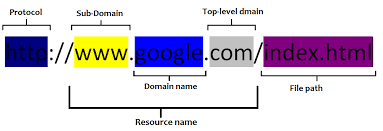
2. URLs
If you’re adding keywords to titles, and your permalinks are set up correctly, the URL will automatically include the title.
Often, however, your title will be longer than the keywords you want to rank for. That’s why you should simplify it in the URL and limit the actual web address to your targeted keywords alone.
As much as possible, try to avoid using numbers in your URL, whether that’s dates or even numbers associated with the title of your article. Why? Because if you ever want to go back and update your post, changing the URL will essentially void any SEO power the original pages had.
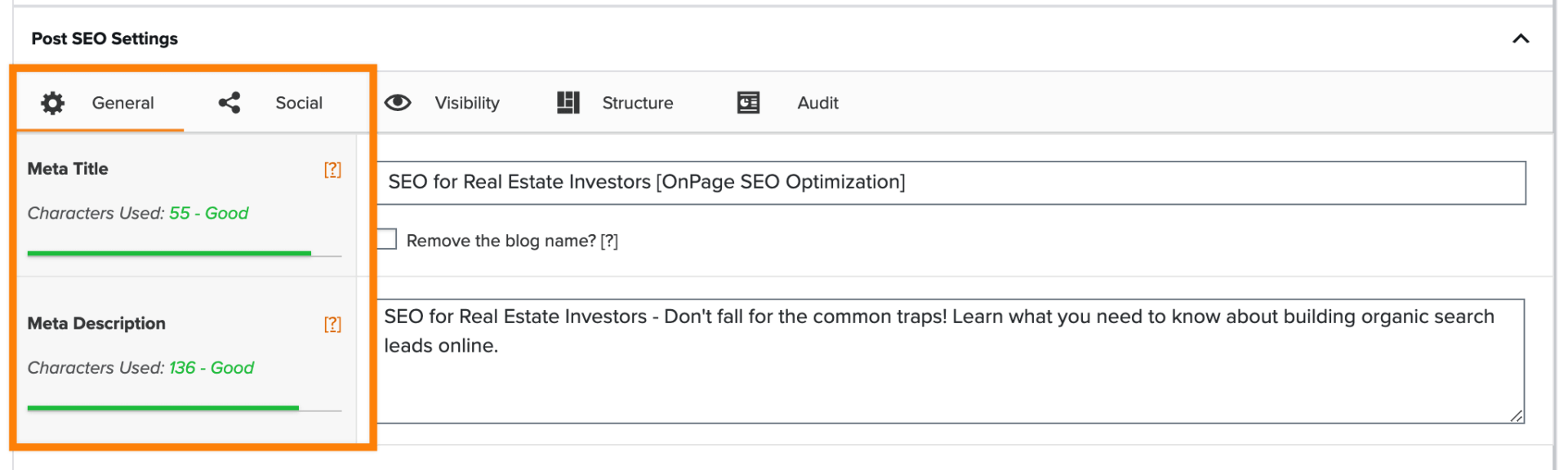
3. Meta Descriptions
And when you compile the meta description, make it compelling in order to attract attention. Consider it the advertisement for a page’s content. This is what the meta description looks like in searches:
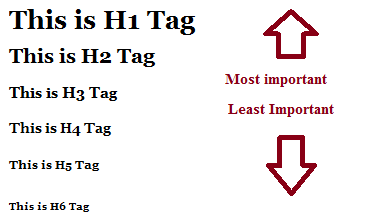
4. Headline Tags
Headlines and subheadings divide your on-page content into scannable chunks making it far easier to read.
But at the same time, they also tell search engines what the content is about, and what’s most important.
Pretty self-explanatory, but make sure you add keywords naturally and don’t “stuff” your content with them. A good rule of thumb is to add the keyword phrase in the first 100 words — preferably in the very first sentence — as well as after every 150 or so words.
6. Bolded Words
Adding bolded words for SEO is debatable, but it can’t hurt if you don’t over-bolden. When you add this technique, focus on using bold text only to make a point to the reader. In other words, focus on reader experience.
We’ve covered off-page SEO for real estate investors and the importance of links from other websites to yours.
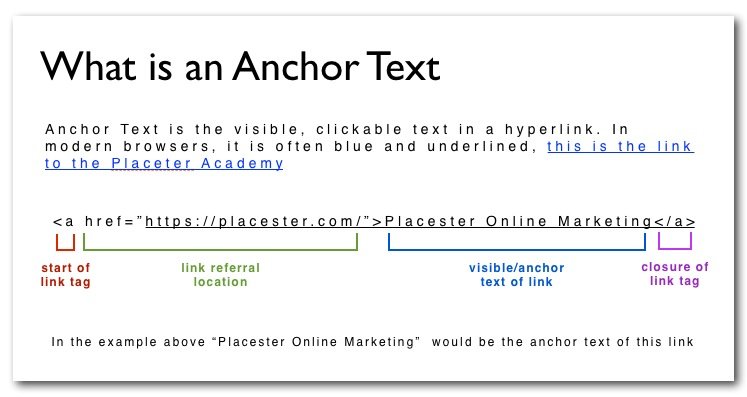
What I mean by inserting links to keywords (otherwise known as anchor text), is that when you link to a good website from a keyword, it signals to search engines what both your content and theirs is about. But there is a certain art to it and it shouldn’t be obsessed over.
While external links dramatically improve both types of authority [domain and page], linking between pages on your own site — namely, linking from high page authority URLs to low page authority URLs — pass the SEO value of the first page onto the second.
Here’s the bottom line: do not include your targeted keywords in the anchor text to other sites. Do include your targeted keywords in the anchor text to your own site.
8-9. Images
Search engines use the images on your site to further help them decipher relevancy (how relevant your content is to user searches).
First, before you upload images to your website, they should be compressed so that they don’t slow down your site. You can use a tool like Optimizilla for this.
Second, for every image you add, include your keywords in two places. Let’s take this post’s header image as an example:
(1) Image name
Instead of using a generically titled image name, get specific. Rather than “blog-post-header-image-1.jpg” or even “seoforrealestateinvestors.jpg” … use “SEO-for-real-estate-investors.jpg”
(2) Alt tags
Alt tags are the default text a browser displays if images are turned off. This time, write your alt tag with your keywords, but write them to be read: “SEO for Real Estate Investors.”
10. Local Keywords
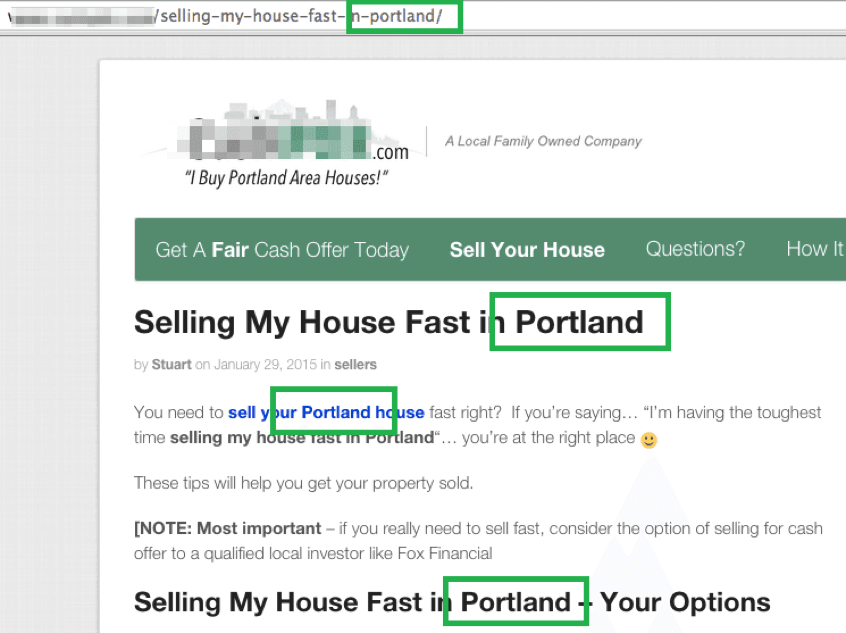
In no other industry does location matter quite as much as it does in the real estate investor SEO realm. Since your competitors are likely not fully up to speed with the location element in SEO, you could get way ahead of them with a little bit of additional work.
Local search is a lot different to international search, and the intentions are often very different too.
For example, if you wanted to order pizza for dinner tonight, Google is going to assume you want local buying options. By default, instead of serving up global results, Google will offer you local results you can actually use to order pizza.
People searching for “real estate investors” want to know about a career as a real estate investor or find someone to sell their property too. But if they were to add an area — which most do — their intention is to find a real estate investor in that area. Big difference, right?
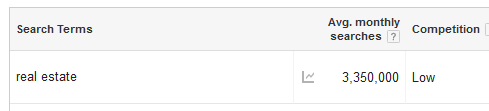
Have a look at this: for the search term “real estate,” there are a phenomenal amount of searches every month — 3,350,000 to be exact — and there’s not much competition for the phrase.
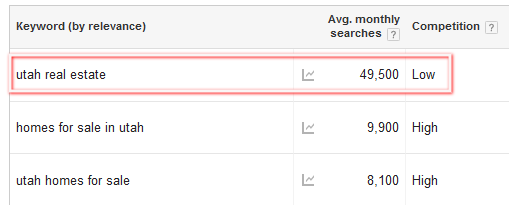
But the term is also not relevant for real people because real people who are searching for what you provide will add an area. Now watch what happens when you add an area:
The search amounts drop to 49,500 per month. Although the search amount is lower, the good news is that “Utah real estate” represents the people most interested in doing business with someone in Utah.
You can even get hyper-local in your SEO for real estate investors.
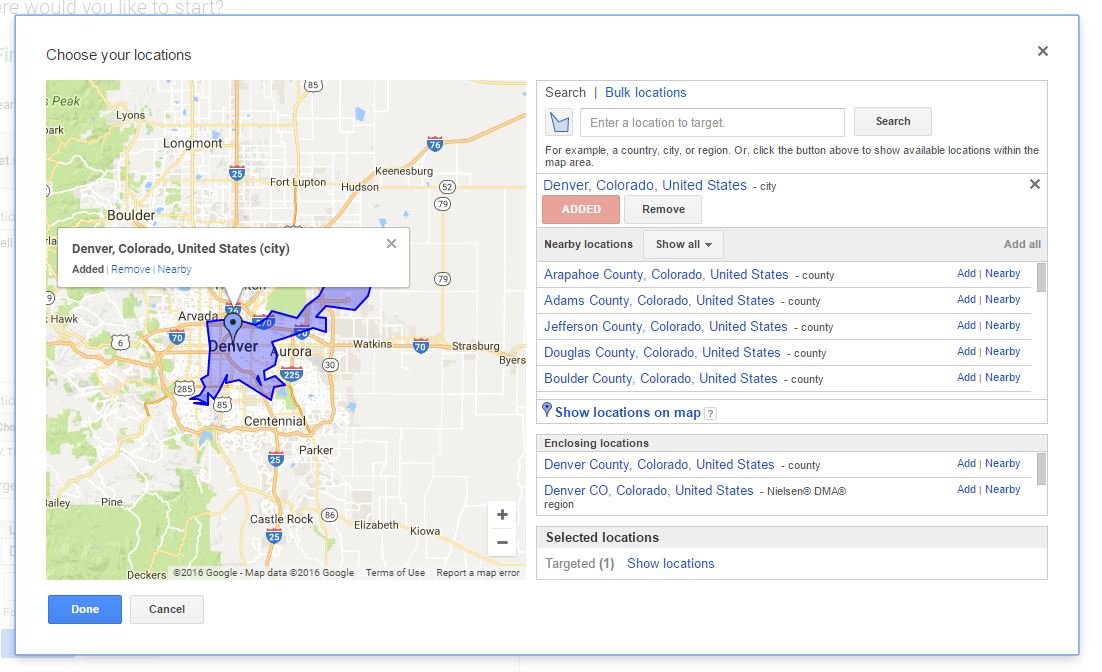
Remember Google AdWords Keyword Planner? They have the option to add nearby locations:
Of course, you probably know your area even better than Google. So if you’re creating landing pages to target specific locations within your larger geography, in those specific locations as well.
However, don’t stuff all your hyper-local keywords into one page. Instead, create 5-10 copies of your original landing page, each with the hyper-location featured in all the on-page elements mentioned above.
Buy My House Company — For example, is one of many Carrot members who highlight location elements on their homepage:
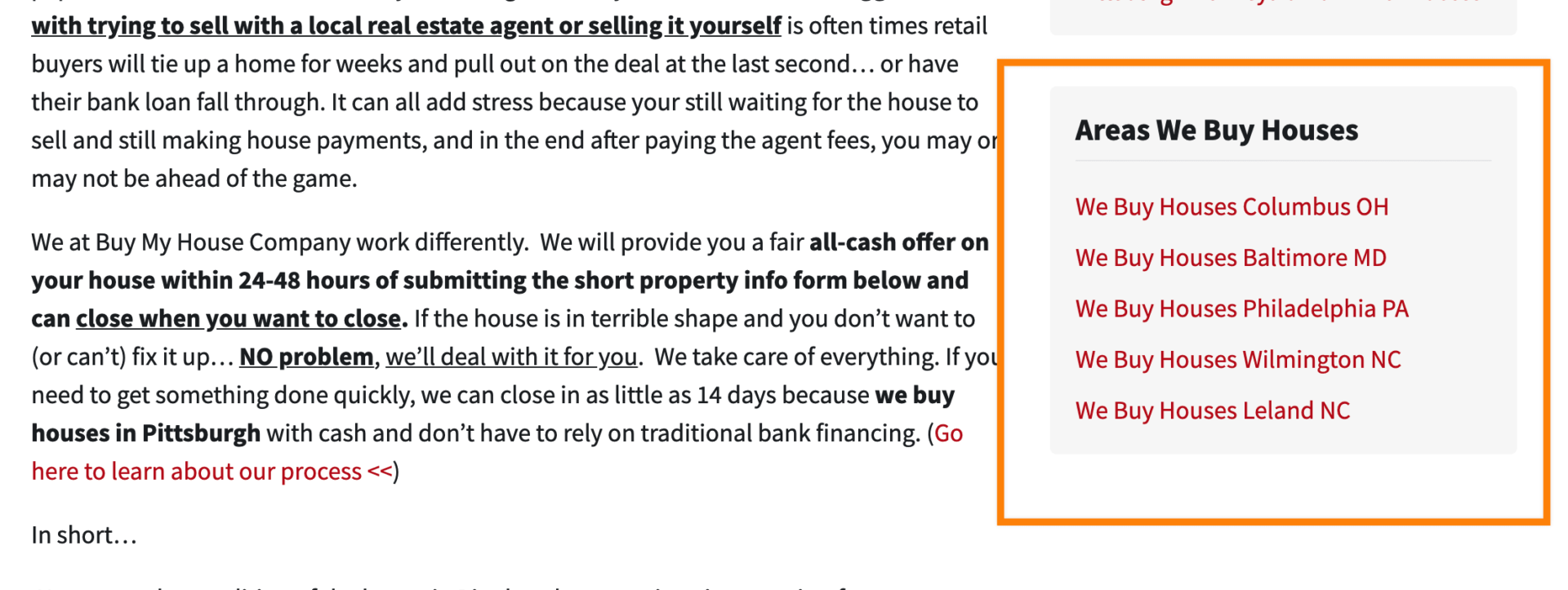
But, if you hover over the “Sell Your Home” button in the header navigation, something of SEO-brilliance occurs:
They’ve essentially created cloned versions of their homepage with hyper-local keywords for each of the areas they serve.
Another local keyword area you have control over — although it’s not technically part of on-page SEO — are business listings. When your website is submitted on business listings like Google Business Pages, Yahoo’s Aabaco small business listings, Bing places for business, etc., it tells search engines that your website is valid and dramatically increases your ranking when someone searches for a keyword associated with your side.
Moreover, search engines would rather list a website that’s registered as a local business, than one that is not. Be sure that the format of your NAP (name of the business, address, and phone number) is consistent throughout the Internet.
[BONUS] 11. SEO for Real Estate Investors: Reviews
How relevant your website content is according to what people are searching for in your niche.
Where the business is situated, also for the purpose of “area relevance.”
How prominent your business is and it’s objective reputation.
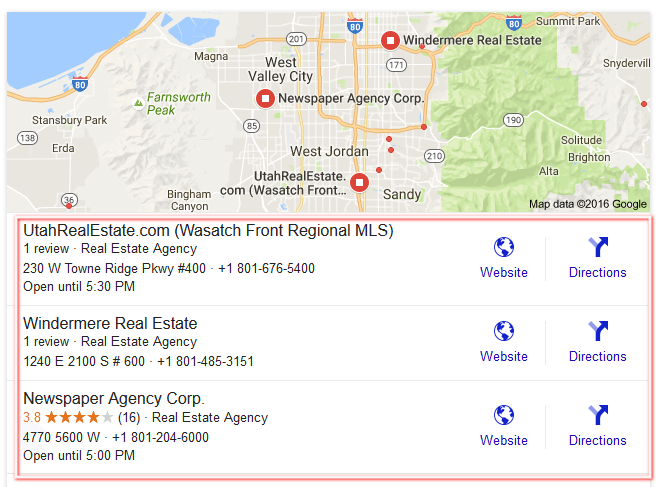
Pushing for reviews is one substantial SEO technique to use to beat competitors in the world of real estate investment. Have a look at a Google search I did for “real estate Utah.” This is what was on the first results page, immediately under the ads, which means it gets the ultimate place of prominence:
Can you see how every single one of these websites has reviews? None of the other results below these contained reviews.
SEO for Real Estate Investors Isn’t Dark Magic
We’ve covered a lot of information in this post.
But don’t get overwhelmed.
Instead of getting obsessed with backlinks, focus on what you can control: your on-page keywords. Select the right keywords and add them — like a human — to each of these ten areas:
Title tags
URLs
Meta descriptions
Headline tags
The first 100 words
Bolded words
Links
Image Names
Image Alt Tags
Local keywords
SEO for real estate investors may seem daunting at first, but it’s what will set you apart from your competition who won’t bother learning the ropes.
And if you want to make life a lot easier, you may want to consider becoming an Investor Carrot member, so that most of the hard work is already done for you or to get help as you go.
I think it’s safe to say… everybody wants more traffic.
In fact, every time you hear about a new real estate agency crushing it online, I know exactly how you feel: envious, resentful … discouraged.
Why?
Because over the last decade, the internet has become a universal part of the home buying process.
Did you know? A full 92% of all home buyers — across every geographic region and age range — use the internet during their search.
What’s more, for 42% of those buyers, the internet is their very first step.
Of course, you already know all that.
Here’s the problem …
Most real estate agents and investors simply don’t know
how to generate enough online traffic to meet their lead generation needs.
As a result, we often turn to paid traffic as an answer.
But with the average cost of a single click for a location-specific phrase like “purchasing a home” sitting at $24 … paying for that life-sustaining traffic doesn’t come cheap.
The good news is paid traffic — whether from Google AdWords or social media — doesn’t have to be the cornerstone of your online marketing strategy.
In fact, it shouldn’t be.
Last year, of the 200,000+ leads our clients pulled in online, pay-per-click accounted for less than 20%.
Eighty percent of our clients’ leads — roughly 160,000 from all over the nation — came from free and organic search.
How?
Through an approach we call conversation marketing.
However, before we jump into our three-phase approach to generating more traffic and leads, let’s start with a few foundational principles.
Why You Shouldn’t Pay for Traffic If You Don’t Have To
With a subtitle like that, you might think I’m advising against using paid advertising in total.
But to generate traffic, leads, and revenue over the long term, you need to create content based on your target audience’s real needs and concerns.
The difference between the two approaches comes down to separating your traffic-driving goals into two clear groups: (1) search-engine optimization (SEO) tactics to increase organic visitors — what we’ve termed conversation marketing — and (2) PPC tactics to increase paid visitors.
Knowing the differences is vital.
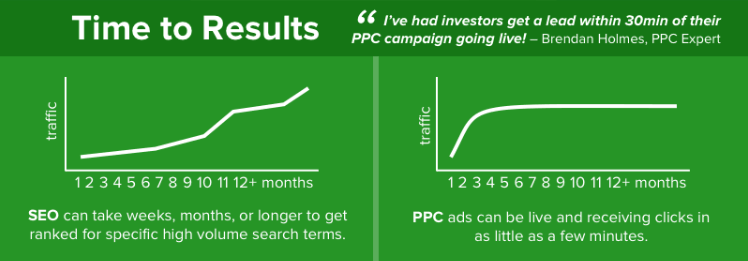
Why You Should Use Both SEO and PPC In Your Marketing
Efforts For Best Short And Long-Term ROI And Consistency
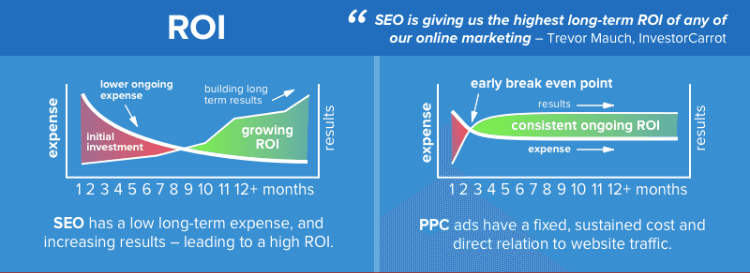
Why you should use both SEO and PPC in your marketing efforts Image Credit: Investor Carrot
While it may sound technical, SEO really just comes down to creating search friendly content that your target audience will find helpful. We’ll get into the details of how to do this in just a minute. For now, it’s important to be aware that SEO takes a larger upfront investment of time and resources and its results don’t materialize overnight.
Leads come to you. You don’t have to chase them down.
You position yourself as a helper versus a “bottom feeder.”
Higher search ranking doesn’t just mean more traffic, it also means more trust.
In turn, that trust turns a higher ratio of traffic into leads into deals.
You’re not forced into competing for the same lead everyone else is after.
Over time, lead cost dramatically decreases. Best of all, the more search-friendly, organic content you create, the easier generating traffic and leads becomes in the future.
Content Marketing Versus Conversation Marketing
All of the benefits listed above come directly from an approach to online marketing known as content marketing.
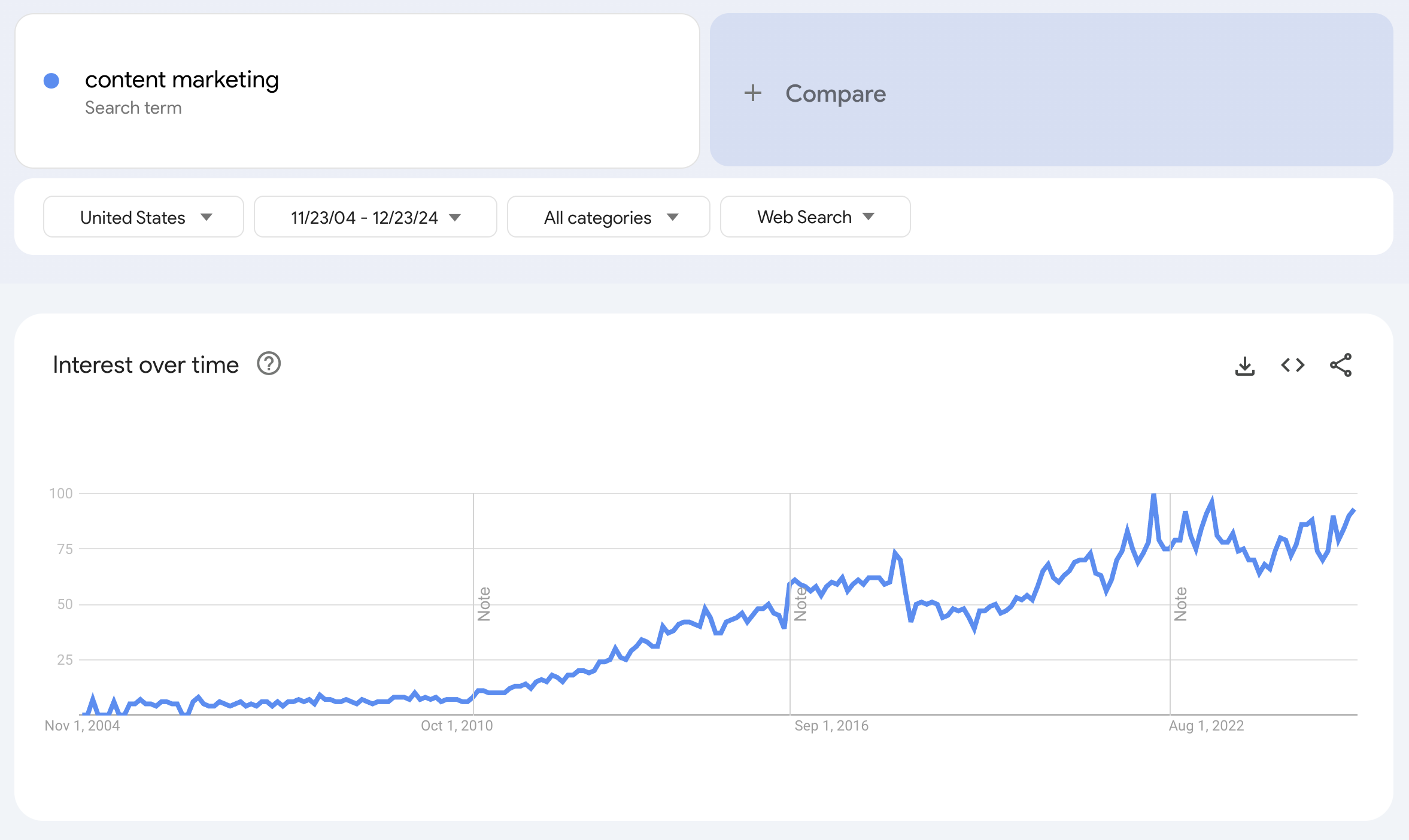
Since 2012, the phrase “content marketing” has exploded. Google Trends officially dubs it a “breakout,” meaning the number of global searches for the term has increased by over 5,000%.
The explosion of all things “content” is rooted in a simple principle: add value … and add it for free.
Whether it’s in the form of blog posts, buyer’s guides, checklists, podcasts, ebooks, webinars, or email campaigns, content marketing is the leading way to provide valuable information to your target audience and increase your traffic.
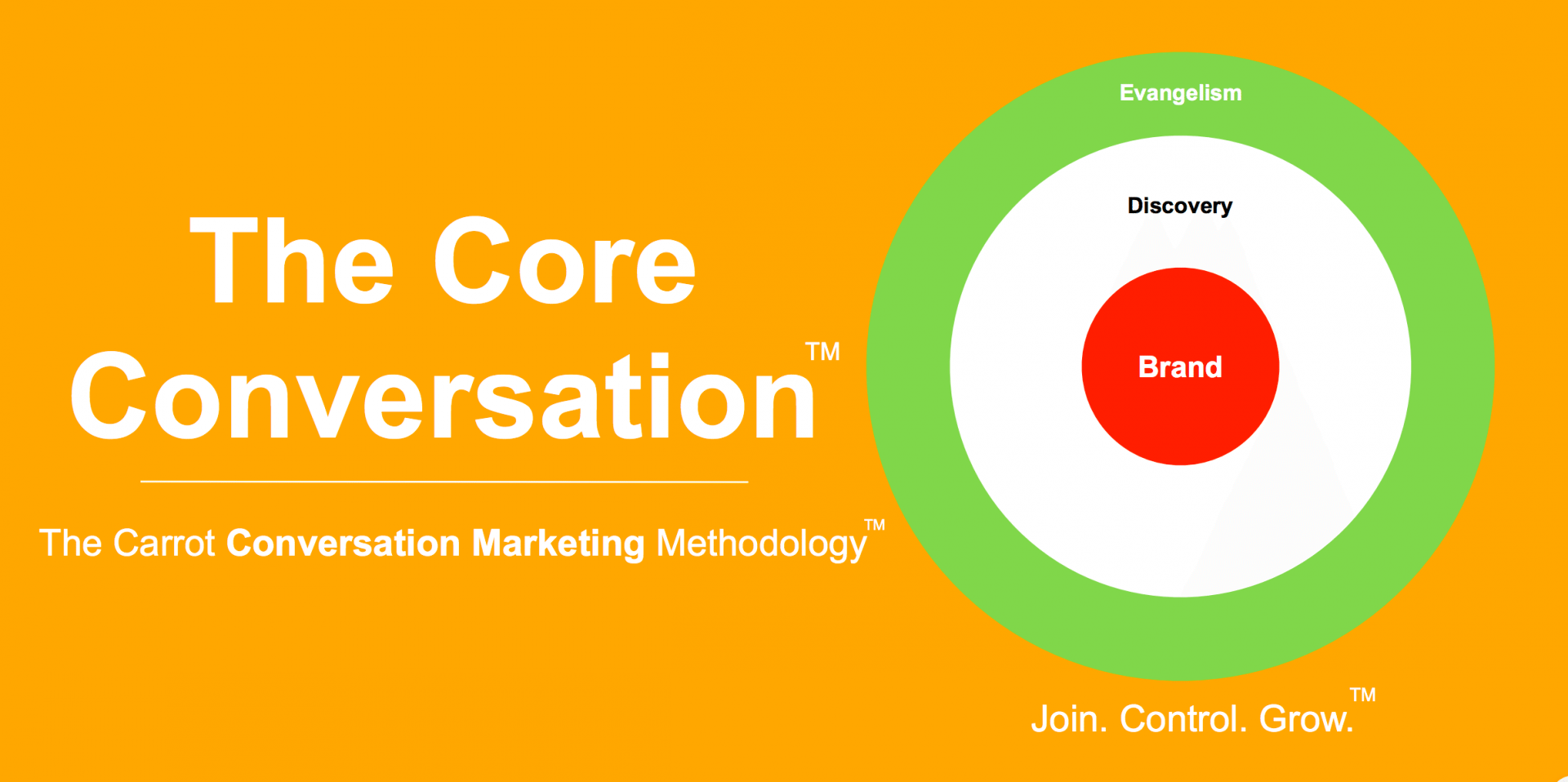
However, at Carrot we’ve learned to take a slightly different approach. Instead of content marketing, our goal is to create “Conversation Marketing.”
Why?
Because ultimately, all business — online or off — revolves around human connections.
This is exactly why conversation marketing works so well. It educates and builds trust with your prospect. It gives them what they need to enter the real estate buying or selling process and complete their due diligence efforts before biting the bait.
And best of all, it connects them directly to you as their go-to source for guidance.
This sector [real estate] revolves around people and relationships, you can benefit by working with integrity.
Trust and relationships are the most valuable assets in real estate whether you’re an investor or an agent.
Couldn’t have said it better.
At Carrot, we use the term “Conversation Marketing” to define our approach to talking with both visitors and customers. Our primary aim is to talk “with” instead of taking “at”; meaning, the content we create avoids the more traditional marketing missteps of creating a one-sided conversation. This is especially important at the beginning.
What Real-Estate Conversation Marketing Is
You’re in a busy restaurant. You overhear a conversation about someone trying to sell their house they just inherited and they weren’t sure if there were other ways to sell it besides working with an agent… they wanted it to get done quickly.
Scenario one, you go over and say,
“Hi Mike. We buy houses. Lemme buy your house!”
Uh. Say what? Why are you butting into my conversation?
Scenario two, you approach it as,
“Hi Mike, it’s nice to meet you. Couldn’t help but overhear you’re thinking about selling a house you inherited. Tough process sometimes. I’ve been through that too. When did you inherit the house?
Mike: Ah, it was my dads. He passed away last year but ownership was just passed to me this month and now I’m figuring out what to do next. Was thinking about renting it but I think I’d rather have less hassle and just sell. You: Yep I feel you. In the right situations, I actually buy houses like that and have bought several that people inherited. I’d be happy as heck to show you some of the pros and cons and just help you make sure you pick the route that’s best for you. I’ll send you a short article I wrote on selling a house you inherited actually… it’ll clear things up for you I think”
Scenario one is called interruption marketing. It doesn’t provide any human connection. It “butts in” rudely. While this would never be acceptable human behavior in the real world, sadly, it’s exactly how the vast majority of real estate website present themselves.
Scenario two is conversation marketing. It’s engaging, focuses on listening, and builds itself on questions. Helps them solve a problem by delivering value and content.
Three Phases to Get More Traffic through Conversation Marketing
Over the years we’ve created and perfected a 3 part process to not just get a ranking or two… but really control the conversation around your marketplace in a big way. That’s how you dominate in SEO and content marketing.
It’s basically 3 simple steps… and in this order.
Your Brand – Control the convo so people see what you want them to see when they search for you
Discovery – Join and control the convo around questions or problems your market is hitting the web to “ask” (type into Google)
Create Evangelists – Helping your clients do your selling and content for you.
Let’s dive in!
Phase 1: Your Brand – What Are People Seeing?
The first thing most people do when they make a big financial decision is hit the web to research the company they’re about to work with.
Real estate is no different.
So when you’re sending out your direct mail pieces, or doing PPC or SEO, or even your bandit signs… people are hitting the web searching for your business name or phone number to do some research on you.
What do they see when they search your business name?
Here Are A Few Examples Of Brands Or Companies When I Google Their Name…
Notice the suggested searches Google is giving me… people are actively typing those phrases in consistently, so you should create content that ranks well and controls the conversation around those keywords.
Test it yourself…
Go ahead… Google your company name + your city and see what comes up. That’s what your prospects are seeing before they decide to work with you.
Here’s what it looks like when you’re controlling the conversation around your brand vs. letting your competitors control it for you or the internet decide who you are to your prospects when they search you.
This Company Purposefully Controls The Top 5 Spots When You Google Their Name With Very Credible And Positive Content
Here’s a company that my consulting business works with that sells $600mm/yr in flooring and we helped them control the conversation around their brand in a big way.
Notice The Videos We Created And 2 Articles That Are Ranked 1-3 For This Brand Related Search?
Before, when you searched that phrase it was nothing but a few sites where those few negative nancy’s posted a bad review on their personal blog bashing the product. When in actuality on Home Depot.com the product rating was stellar and reviewed by tens of thousands of happy customers. Those couple bad apples raise to the top in Google.
So we wrote down all of the keyword phrases that came up in Googles suggested search box around our company and created videos and articles optimized to rank well for each on.
We teach you how to optimize your posts and videos to rank well in Google in our 3 Lead Per Day Training for Carrot members.
Action Items:
Google your own company name + the name of your primary city. i.e. – “ABC House Buyers Charlotte”. Then write down all of the Google suggested searches that come up as you’re typing in your search that are related to your brand. If you’re brand new or not a big investor, you likely won’t have any suggested searches pop up quite yet that are related to your business.But common ones house sellers type in when they’re researching a house buying company are…
reviews
scam
bbb
[your main city]Type those into Google and see what comes up. Are you ranking well for any of the top 5 results? If not, you need to create content on your site that optimizes for that keyword. At Carrot, we automatically optimize your “About” page for your company name and location, so that’s done for you. But to really control the conversation you may want to create more content.
Create content and a video or two to rank for that content. Then launch it on your website and put it up on YouTube. Basically title the YouTube video the exact keyword phrase you’re going after. If you’re going after the keyword phrase “ABC House Buyers reviews” you should upload a testimonial video from a client of yours and name the video title that in YouTube.
Easy eh? Then every month search the phrases around your company name and see where you stand.
Even 1 lost deal because your client sees something online about you that makes them at all uneasy (including not finding anything about you at all) could cost you tens of thousands of dollars.
Phase 2: Discovery – What Are People Searching To Solve Their Real Estate Problems?
The best way to increase your traffic — without being forced to pay for it — is through content creation and getting that content ranked well in Google.
That content will be the backbone of your conversations.
This phase is joining the conversations and hopefully eventually controlling those online conversations as people are going online to “discover” the solutions to their problems and the answers to their questions.
The need for content is universal online is because search engines like Google will only consider your website to be an authority if the content you create (1) revolves around the keywords your ideal customers are already using and (2) that content itself is valuable enough to be shared and linked to by sites and businesses other than your own.
However, never forget the aim of conversation marketing: getting more visitors to your website by actually helping them.
This means understanding your prospect’s buying cycle in addition to your valuable keywords so that you know what type of content to create. Here’s an overview from InMan of what the typical real-estate buying cycle looks like:
The first three phases are where you need to educate and start conversations for maximum impact and traffic:
Dreaming:
This is the earliest stage of the “buying” process when the prospect has an initial thought to buy or sell a property (or note, or land, etc.).
Initiating:
The initial thought has dug in a little deeper and the prospect tentatively starts exploring online. This is where your real estate investing business can address a need, by providing content using search terms the prospect uses to search for information. Like “How to sell a house I inherited in Dallas”. They’re starting that conversation online… will you engage with them or let your competitors?
Shopping:
If you’ve already “nabbed” your prospect with value-add content in the first two phases and have their email address on your list, this is where you start reaping your rewards. Only when your company has helped educate and build trust with a prospect they are likely to turn to you when they’re ready to officially engage.
Small and large businesses alike often make the fatal marketing mistake of trying to be all things to all people.
Kind of like trying to cram everything on one site for house buyers, house sellers, renters… etc. And you shouldn’t use the same site for motivated house sellers and cash buyers for your content either (like we teach here in this article).
Instead, it’s vital to get focused on the handful of brand-defining specialties that make you stand out.
Take Business Insider’s graphics These 10 Corporations Control Almost Everything You Buy as an example. Notice that in the middle of the image are the 10 corporations that own most of the goods we buy.
However, when it comes to what you actually purchase, their subsidiaries are responsible for doing the work:
The point is obvious: while there are only about 10 corporations in the driver’s seat, each has created distinct brands to actually sell their various goods and services.
Why?
Because if they didn’t separate their brands into specific niches, they’d struggle to market themselves effectively.
Regardless of your size, the same principle is true for you as a real estate investor or agent.
Who is someone going to pick if they’re trying to sell a house they inherited?
The company where the website says they “specialize in buying inherited properties for top dollar” and where they have content that talks about selling an inherited property…
… or the company that just says “We buy any house”?
I know I’d probably pick the company that seems like it has a specialty in the situation I’m in.
That’s why the this phase of conversational marketing doesn’t involve asking yourself, “Who do I want to be?”
Instead, it focuses on the far more conversational question: “Who do I want to reach?”
In other words … your audience.
Thankfully, deciding who you want to reach and digging into what they like, love, and hate, doesn’t take divination, a crystal ball, or even brainstorming.
There are a host of online tools that can help you get to know the people you want to reach.
Where should you look?
Go after the low-hanging fruit first:
Social media sites
Question and answer sites like Quora
Forums your target audience belong to
Popular blogs in your niche
In addition to the usual suspects, Placester provides a detailed list of online resources to try out.
The benefits of identifying a single-target market — e.g., “first time home buyers with less-than-perfect credit in the Portland area” — versus trying to be all things to all people — e.g., plain vanilla “home buyers” — are enormous.
And this is true not only from a marketing point of view, but also from a service perspective.
For instance, more and more people are turning to social media channels to share their home-buying experience and provide feedback, whether good or bad.
By paying attention to what real-life people are saying within your chosen niche you can discover things like:
What are their struggles, fears, and anxieties?
What reasons motivated them to want to sell a property or buy one?
What are their dreams and expectations?
What is it that they’re really looking for in a house buying / selling service?
What do people who’ve completed their first purchase or sold their house wish they’d known at the start?
Again, the important thing with conversation marketing in the real estate investment and agent business is not to think long and hard about you and the words you want use, but rather, to pay attention to your ideal customers and the words they themselves are already using.
That point about “the words they’re already using” is massive.
Conversation marketing aims at generating organic traffic not paid traffic.
This means you have to organize your approach around specific keywords that are optimized to improve your search engine rankings for phrases your prospects are actually searching online. Conversations they’re starting.
The search phrases that drive more traffic to your website — and are easiest to rank for (i.e. less competition) — are the ones that are more specific. These are called “long-tail keywords” because they contain more than one or two words.
This graph shows that the most effective keywords for search engine purposes are long-tail
For example, rather than casting your keyword-net wide with a phrase like “selling a house,” use long-term keyword phrases that your audience is actively talking about:
“selling an inherited house”
“selling a house after a divorce”
“selling rundown house without making improvements”
Ubersuggest is another fantastic tool you can also try to spark off ideas for long-tail keyword phrases.
Example Of Using Ubersuggest To Find Topics To Write About
This was a search I did on Ubersuggest for the term “express home buyers”
Now that you’re armed with the best keyword phrases that your target audience are already using to find solutions to their real estate needs, you’re ready for the next step: creating amazing content around the keyword phrase of your choice.
However, simply having amazing content isn’t enough.
You also have to ensure that content works on a technical front. This is even more important today because search engines now judge the value of a site based on its design as well as its speed.
My suggestion is that you look for a designer or a proven website system like Carrot who is familiar with websites that perform well in the real-estate industry specifically.
This option may be slightly more expensive than the “get a website for $90” deals, but will save you from going to the trouble of setting up a website — content and all — only to discover months later that technical issues are holding you back from bringing in traffic.
Once you’ve created a base of content to address the first three stages of the buying cycle do not simply let it sit there.
Instead, repurpose it.
Repurposing your existing content is hands down the best way to create new content … without having to create new content.
As soon as a particular piece of content (like an article) show signs of performing well — i.e., generating traffic or even things as simple as comments or social shares — turn that article into a video or a SlideShare presentation. Make it the topic of a video. Pick one specific point in the article to expand on it in an entirely new post. Or even bundle together your best articles into an ebook on a landing page.
After you’ve created and repurposed your content, don’t make the mistake of thinking your conversations will take care of themselves.
Our third and final phase is the real key.
Phase 3: Evangelism – Helping Customers Do Your Selling For You
Evangelism is the last phase of the conversation marketing model you’ll need to lock down.
Simply put: creating evangelists means turning your best clients into your best salespeople.
This involves being intentional not just about sharing your content directly with your best customers — in the hopes that they’ll go forth and do likewise — but including them in that content itself.
For instance, if you spend any time at all on our website, you’ll notice there’s hardly a single page that doesn’t include a customer testimonial or case study.
On our homepage, we include three glowing recommendations front and center, right under our hero image:
On our
See how this top investor uses one of his client stories to squash the “too good to be true” thoughts going through some sellers minds. It empowers your clients to be evangelists for your brand and your company.
Here’s what happens when you help your clients spread the word about your company and service. They do the selling for you!
This happy house seller has already referred 3 people to this Carrot client
You could even make a nice “Stories” page like we have on our site and have built into Carrot websites:
And… One Of Many Client Testimonials On This Investors Site
Why all this focus on our customers?
Because we know the cold, hard truth: selling yourself is hard. Letting the people who’re already wildly delighted with your service sell you … is easy.
Ironically, selling yourself means engaging in the very marketing behaviors that inhibit genuine conversations.
Letting the people who’re already on your side sell you, that’s how you start a genuine conversation.
Video is the most powerful form of evangelistic content, so make a real effort to get your content — especially repurposed content — into video format.
If creating video content sounds daunting, it shouldn’t.
Here at InvestorCarrot we’ve produced a host of “Customer Stories,” all of which boil down to little more than webcam-recorded conversations with some of our greatest success stories:
Example Of A Simple, Low Production Video We Shot To Help Tell A Customer Story (in their words)
And you know why they work?
Because the format of those stories grows directly out of our overall approach itself: conversations not selling.
You can do the exact same thing as a real estate investor or agent.
It’s all about the conversations…
Most entrepreneurs and small business leaders are overwhelmed by online marketing tactics meant to increase traffic.
Why?
Because there are so many opinions, so many tools, and so many methods.
On top of that, your prospects are equally overwhelmed. They’ve been exposed to scammers and self-centered agents alike, both of which make it clear that they’re only interested in one thing: making a quick buck.
Conversation marketing won’t make you an overnight internet celebrity.
It takes investment, insight, patentice, and a bit of creativity.
But by following our proven three-phase method … you can dramatically increase your traffic without having to pay for it. Remember, of the over 200,000 leads our clients generated last year, less than 20% came from paid traffic… the majority of them came from Conversation Marketing.
Best of all, you’ll position yourself as a genuinely helpful resource and the expert in your area which makes it so you’re not a commodity anymore. After all, people are people and every great relationship — business or otherwise — always starts with a conversation.
At the risk of being obvious … as a real estate investor, your business lives and dies by two things.
Number one, your ability to generate leads. Number two, your ability to close deals.
And one way to increase the amount of online leads you get is to…
… do a lot of testing and make your website convert more visitors into qualified leads.
How a small increase in performance can put tens of thousands in “found” profits in your pocket.
An increase in “conversion rate” on a real estate investing website from 5% to 8% means an extra 3 leads per 100 visitors. If you get 100 qualified visitors per month to your site… that’s an extra 36 motivated seller leads per year (3 x 12). If you close on average a deal per every 15 qualified seller leads and net on average $10k per deal… that’s an extra 2 deals and $20k in profits per year.
Just by doing some testing and improving the performance of your website.
Pretty cool eh? That’s assuming NO extra traffic. Free money.
We spend so much time split testing and optimizing our pages here at Carrot because we know so many people go to the web first to get information about buying or selling their house.
In fact, a whopping 43% of home buyers start their purchase process online compared to the second-place first step — contacting an agent — at 15%.
In other words, if you want to meet leads where they are, fill your sales funnel, and start converting like crazy … hands down the best way to do that is online.
A New Page Design We Tested That Yielded Up To 38.54% More Leads
See how and why this page design increased lead flow on some sites up to 38% more…
This post is going to go into a lot of the methodology and “backstory” on how to create a real estate investing or agent page that performs at a high rate. One that converts more visitors into leads than your current website may (for sure your competitors) and one that squeezes out an extra margin of leads and deals without you increasing your traffic (assuming you are getting solid traffic right now).
Below we’ll actually give you the “Stacked Hero” landing page and if you’re not a Carrot member you can even download the raw HTML files to upload and use yourself online. If you are a Carrot member, great! As of our last update, you now have this design available to launch NEW websites within your Carrot account in under 10 seconds with no tech hassle. We like to make your life easy :-)
To do that, I’ll share how our “Stacked Hero” design converted 38.54% more real estate leads than our best performing previous design. Even better — after guiding you through a handful of optimization principles — I’ll share how you can implement the very same template in your own business.
Let’s dive into the story of why this page design performs so well and the marketing principles that cause most real estate investor websites to perform so bad.
And if you’re NOT yet a Carrot member, download the HTML files of this landing page at the bottom of this page for FREE. Carrot members, this design is now in your account and you can launch a new site with it in under 10 seconds.
Real Estate Lead Generation Today: Thou Shall Test … or Die
This means we’re constantly testing and improving elements on our client’s websites to improve their results.
For the last year we’ve had a mission: to create a lead generating page that could beat our highest performing control.
This meant running tests across a select number of current Carrot websites throughout the country; ones that were getting a good amount of traffic and already converting leads. In fact, we ran 7 months’ worth of tests and dozens of page variations to tens of thousands of motivated house sellers and buyers.
This sort of real-world optimization gives us both a baseline to work from as well as data-driven insights most real estate agents simply can’t generate on their own.
Our testing software informs us when we have a clear winning test variation. You can see below what one of those looks like:
Our testing software lets us know when we have a winning test variation
Before jumping into the details of our tests themselves, let’s start with some of the guiding principles of online lead generation.
Online Real Estate Lead Generation Principles
To keep things as clear as possible, three principles are essential to your online lead generation: (1) your goal, (2) your content, and (3) your form.
1. Your Goal
By far, the biggest mistake you can make on a lead generating page — regardless of the industry — is complication.
Simplicity isn’t just essential to online lead generation. It should be the cornerstone of all your marketing, period.
Why?
Because as Harvard Business Review reports — after reviewing data from “multiple surveys of more than 7,000 consumers” as well as “interviews with hundreds of marketing executives and other experts around the world”:
The single biggest driver of stickiness [that is, a lead or customer’s likelihood to follow through on an intended purchase, buy the product repeatedly, and recommend it to others] was “decision simplicity.”
What consumers want from marketers is, simply, simplicity.
The first step to simplicity is knowing exactly what you want to achieve for each and every piece of customer-facing content you create.
Whether you’re working on a home page, landing page, email campaign, pay-per-click advertising, or even just a physical mailer … you have to begin and end with “a single, all-consuming question: ‘What is your goal … the one, smallest, easiest thing you want your reader to do?’”
As KlientBoost recently put it in their Landing Page Optimization Guide: Find Heaven By Saving Your Visitors From Hell:
Start with your ultimate goal and then … work backwards.
In other words, to increase conversions, your pages need to be ruthlessly free of clutter. Anything that doesn’t move a visitor closer to the one action you want them to take … must be eliminated.
Don’t feel [like] you have to fill all the empty or “white” space on your site with extra icons, or images. Avoid fancy animations and drop down menus. These are more likely to distract users from your content, rather than attracting them to it. Keep the look clean and uncluttered.
This warning comes with good reason.
For example, take a look at the following home page for Fisher Nicholson Realty. Notice that there are no less than 22 possible actions a visitor can take (and that doesn’t even include the dropdown menus that appear if you hover over the navigational bar nor the additional 19 options in the footer):
Way Too Much Distraction And Choices At The Top Of This Site
All told, there are a whopping 68 links, buttons, navigational options, and calls-to-action on that one page alone.
Compare that quagmire with our own homepage. Excluding the header and footer, only four clickable buttons exist:
Even better, three of those four buttons send visitors directly to our Pricing and Plans page.
If you’re designing a landing page … things need to be even simpler.
The golden rule is just one call to action.
That doesn’t mean you can only have one button, but it does mean every button you have should guide visitors toward the same, singular something.
Going back to our first bad example — Fisher Nicholson Realty — clicking through to the “Buyers/Sellers” page you find this:
While the page opens with a call to action — “Buying or Selling? Please make Fisher Nicholson ‘The Home Team’ your Real Estate Company of Choice.” — the only clickable links are to non-related sites, property comparisons, search options, or featured properties.
Tragically, even if a visitor wanted to give them their contact information to “make” Fisher Nicholson their “Real Estate Company of Choice,” there’s literally no place to submit their contact information on the page itself.
Visitors can only take one of two actions: either “Show Me The Deals!” or to call you on the phone.
Technically speaking, the website design we used for our Hero Stacked test is not a landing page; it’s a home page that plays the best of both worlds…
… landing page but engages those not quite ready to convert with great content and credibility. This “mini-site” format actually turns into more leads than squeeze pages according to our vast testing over the years.
But the focus is still on getting email signups for lead generation. So while landing pages should eliminate all distractions, a home page will still need to have navigational links and other clickable areas and all focus on ONE CORE call to action.
However, the same principle applies: the above-the-fold area of any home page should be uncluttered, simplified, and targeted.
Does The Main Call To Action Jump Out Or Do You Have To Hunt For It?
The most notorious place for clutter is the home page. Given the diversity of audience your home page gets, the desire to give them plenty of “what if” options is natural.
Resist that temptation.
In test after test after test, the principle of simplicity — that less truly is more — has proved itself.
2. Your Content
Naturally, given how central simplicity is to your real estate lead generation process, all the content on a page should exist to support the one goal you want your visitor to take: to sign up.
This means placing the most important information — especially your page’s copy — at the top of the page in the hero section. When a visitor lands on your website, you’ve only got a matter of seconds to capture their attention.
If you make it too difficult for your visitor to figure out how you can help them, there are plenty other websites who will be easy to understand … and compelling.
A compelling headline must hit your visitor above all with value.
Your headline can address a pain-point the visitor needs answers for or instill a positive emotional reaction … but either way, it has to touch the heart.
Having all said that, you don’t need to load all the benefits in the main attention-grabbing section, like this personal training website has done:
Too Many Conflicting “Benefits” Crammed Into The Top…
Limit what you want to say in this most important part of your website
Geek Estate Blog highlights just how bad trying to pack an exhaustive list of benefits can be by using a landing page for townhomes in Bothell as a test case. This is how it reads:
You may not be able to see it properly, but the example above is a website about weight loss. Unfortunately, all the images are useless because they don’t support the page’s goal. After all, what’s the point of a car photo on a weight loss website?
On a homepage or landing page, the chief piece of visual content is called a “hero image.”
Adding an oversized “hero” image is incredibly popular. This stems from a hero image’s ability to add appeal, relevance, and what we might even call “sexiness” to a page.
The right hero image can also have a massive impact on overall conversions.
Have a look at this test from French snowboarding ecommerce site Salomon:
The original design on this landing page does not include an oversized hero image
Crazyegg reports that the version with the oversized hero image, as well as a few other tweaks, increased sales from French shoppers by 39.8% and sales by global shoppers by 29.7%, both at a 99.9% confidence rate.
If you add an oversized hero image, bear these four points in mind:
Make sure the photo is responsive so that it behaves when the page is viewed with mobile devices.
Avoid stock photos which can put people off and can lose credibility on your site. Use “real” people or high-quality original product image.
Keeping the form short ‘n sweet also makes it easier for mobile users to complete it, and this is important because there are now more mobile than desktop users on the Internet.
Not to kick Fisher Nicholson Realty while they’re down, but here’s what their contact form looks like on desktop:
Too Many Form Fields Reduces Performance In A Big Way…
There are a total of 19 forms fields … only four of which are required.
On mobile, the form itself is virtually illegible:
Even more detrimental, there is absolutely zero incentive for a visitor to submit their contact information.
The “Send Request” button promises no pay offs, offers no benefits, and it isn’t even an enticingly worded action. Afterall, who wakes up in the morning thinking to themselves, “Gosh, I can’t wait to ‘send a request’ today”?
Be sure not to neglect this part of your form: “What will the visitor get?”
Inman provides a host of ideas for creating compelling and click-worthy real-estate lead magnets: “a lead magnet is an irresistible bribe offering a particular chunk of value to a prospect in exchange for their contact information.” The list includes:
Home sellers’ guides.
Relocation packets.
Neighborhood market reports. New listing email registrations.
Property comparative market analyses.
“How-to” e-books or videos — how to stage a home, how to increase curb appeal, how to buy foreclosures, and so on.
Reports — neighborhood, school, crime and more.
Lists — bank-owned properties, short-sale homes, 203(k)-eligible properties, etc.
Real estate-related e-books or videos — landscaping, remodeling, investment opportunities, flipping a house, and so on.
Making forms convert is a complex business, because what works for one site may not work for another. The truth is that you have to keep testing and checking the data to see what’s working for your target audience or not.
To drive this home, Michael Aagaard presents two seemingly contradictory button-copy tests on Content Verve. In the first, adding “Get the Best Daily Tips” increased conversions by 31.54%. In the second, adding “Start Making Better Deals” decreased conversion by 12.45%:
49% More Leads Because Of The Words On Your Buttons…
Knowing this is precisely why we test so relentlessly at InvestorCarrot.
Lastly, when it comes to your forms … does size matter?
Yes.
Large forms get more signups, maybe because they’re so “in-your-face.” Our own tests have shown that having a large form in the middle of the page that contrasts the surrounding elements can help improve conversions substantially.
All those form tips can be a lot to take in. So here’s a quick rundown of best practices from our own extensive testing:
Keep the form fields short
Have the call to action button take up the entire width of the form
Include value-driven language in your call to action button itself
Make the information around the form draw the reader down the page
A Template to Get 38.54% More Online Real Estate Leads …
Enough about principles and best practices.
What you really want is a proven template you can use to get more online leads.
Here’s exactly how we built one that does just that.
Test #1: Three Columns (this test failed)
We started with our high-performing lead-generation page, which already included a number of optimization wins we’d learned from previous tests.
For instance, one the rules we’ve proved to our clients over and over again is that changing the words on the call to action button from a “descriptor” (“Click to Continue” or “Submit”) to a “mental commitment” increase conversions. Here’s just one example:
The Variation on the right — “Get My Fair Cash Offer” — showed an improvement in 49.5% at a 12.55% conversion rate compared to the first — “Click Here to Continue.”
To put a bit of context around that, out of every 100 visitors who land on your website, using the “mental commitment” language would produce 12.5 leads rather than 8.3.
That might not sound like a huge deal. But even if your site only gets 1,000 visitors a month, that translates into 40 additional motivated seller leads.
Even if you close 1 out of every 20 leads (which is a low percentage for many of our customers) and only net on average $7.5k (which, again, is much lower than many of our customers average):
That’s $15,000 in extra revenue every month all without having to generate any additional traffic to your website.
Still, we knew we could do better.
So, we took that page as our control and began by testing a three-column layout with no sidebar to limit the amount of links on a page. The idea was to make it simpler for a user to consume the page’s information:
Version #1 Of This Test – 3 Column Layout
Unfortunately, our first test was not a success.
The results were less than spectacular, but we learned a lot
It actually reduced the performance on the page.
As a result, we decided to get more intentional and focus on the main element a user sees when they first land on a home page: the hero section.
Test #2: The Stacked Hero (this test was a huge success)
Our first priority was to zero in on the page’s goal.
As you can see, the information in the last column on the right is unnecessary. It’s about the real estate agency themselves and adds no value to the visitor. Instead of moving them closer to signing up, it only distracts:
The 3rd column on the right is not necessary in this all important above-the-fold section
This time we predicted — i.e., our hypothesis was — that adding better imagery and a larger form focus the core message of the page.
The second test, then, was all about improving the conversion rate of the site’s home page hero section. This section is incredibly important because a lot of traffic passes through this page, and this is the first thing a lead sees.
Not only that, but research proves that the attention span of people has become so short that your website has a few seconds to grab attention before the visitor clicks away.
The following test page ran for a month across 15 InvestorCarrot websites and received over 1,600 visitors:
Version #2 – The “Stacked Hero” (38% more leads)
Pay special attention to the differences between the two pages:
Control
Three columns
Light Hero image
Three headlines
Narrow form fields and button
Headline:
“Need to Sell Your House Fast?”
Includes phone number
Six lines of text below
Headline:
No location in the headline
Variation
One Column
Dark hero image
One headline
Page-wide form fields and button
Headline:
“Sell Your House Fast in Portland. Get a Guaranteed Fair All-cash Offer.”
Excludes phone number
One line of text below
Headline:
Location included in the headline
In addition, by center aligning every element, having a dark background to create contrast between both the text and the button, and filling up a good portion of the screen with the hero, visitors automatically see what’s most important to complete the call to action.
The heat map below, which measure users mouses and eye-movement, validated this belief. Notice that the majority of user engagement is happening on the headline and form fields … exactly where you want their focus to be:
This heat map shows where a user is focused when they are looking at the hero section
In other words, the hero test incorporated nearly all of the principles we covered above.
And the results?
A good representation of how the test performed individually can be seen from this specific test from a member in the Alabama market.
The Test Results Speak For Themselves…
This graph represents a stacked hero test (for motivated seller leads) where the control and variation were close … until the end.
The cumulative total was what really knocked our socks off:
A 38.54% increase in online real estate lead generation across the board.
If you’re in the real estate sector, we at InvestorCarrot have a simple way of increasing your real estate leads; we’ve already done the testing for you by creating website templates like the one used in this test study.
And you can have it for free.
Carrot Members:You can dive into your account and launch a new website… then dive into the “Design” tab for the site and select the “Juniper” design to put this design to work for your business. But, you may be asking… “Is this design higher performing than the original Carrot design?” The answer is… in some cases it boosted performance up to 38.54%, in a few, it decreased performance a tad, in several, it was a wash. It did provide a performance boost in most of the 20 or so sites we tested it on but on some, it didn’t… so our advice is if you have a Carrot site up already that is pulling leads consistently to keep it how it is. Our original design is still our most consistent design. This new one just adds another option to get a different look while still retaining GREAT performance.
Non-Carrot Members: If you know HTML and have some time and want to hack through some setup stuff… You’ll need your own hosting, some programming knowledge to hook up a form, and to write your own content on the page. Or you can skip all of that and join Carrot and launch this design along with all of the other benefits Carrot customers enjoy within seconds.
(Already a Carrot member? Great! Launch this design in your account in just minutes! Log in, create a new site, and choose the “Juniper” style.