Author: Trevor Mauch

  • How To Build a High-Converting PPC Landing Page For Real Estate PPC Campaigns (7 Elements With The BIGGEST Impact)

    How To Build a High-Converting PPC Landing Page For Real Estate PPC Campaigns (7 Elements With The BIGGEST Impact)

    You’re spending a hard-earned marketing budget on your PPC campaigns…

    Every penny counts. More importantly, every click counts.
    The worst thing that can happen is a lot of people click on your PPC ad (costing you money), but none of those people become a lead or turn into cold, hard cash for your business. That would make your PPC campaign a waste of time and money.

    This is why where you send people (i.e., the landing page) when they click on your ad is so critical.

    If you send prospects (even motivated sellers) to a low-converting landing page, you might still get some leads, but you won’t get as many as you could (how hard is it to hit the back button and click on your competitor’s website instead?).

    Sadly, one lost deal could be between $10,000 and $50,000 down the drain, depending on your business model…

    And that’s not money you’re willing to lose.

    At Carrot, we’ve generated millions of online leads for real estate investors and agents. During that time, we’ve learned a thing or two about building a high-converting landing page.

    Let’s talk.

    What is a landing page for real estate PPC?

    A landing page is just marketing terminology for the page you send people to in a marketing campaign.

    In the case of Google Ads, it’s the page people go to when they click on your ad. For example, if I click on this result…
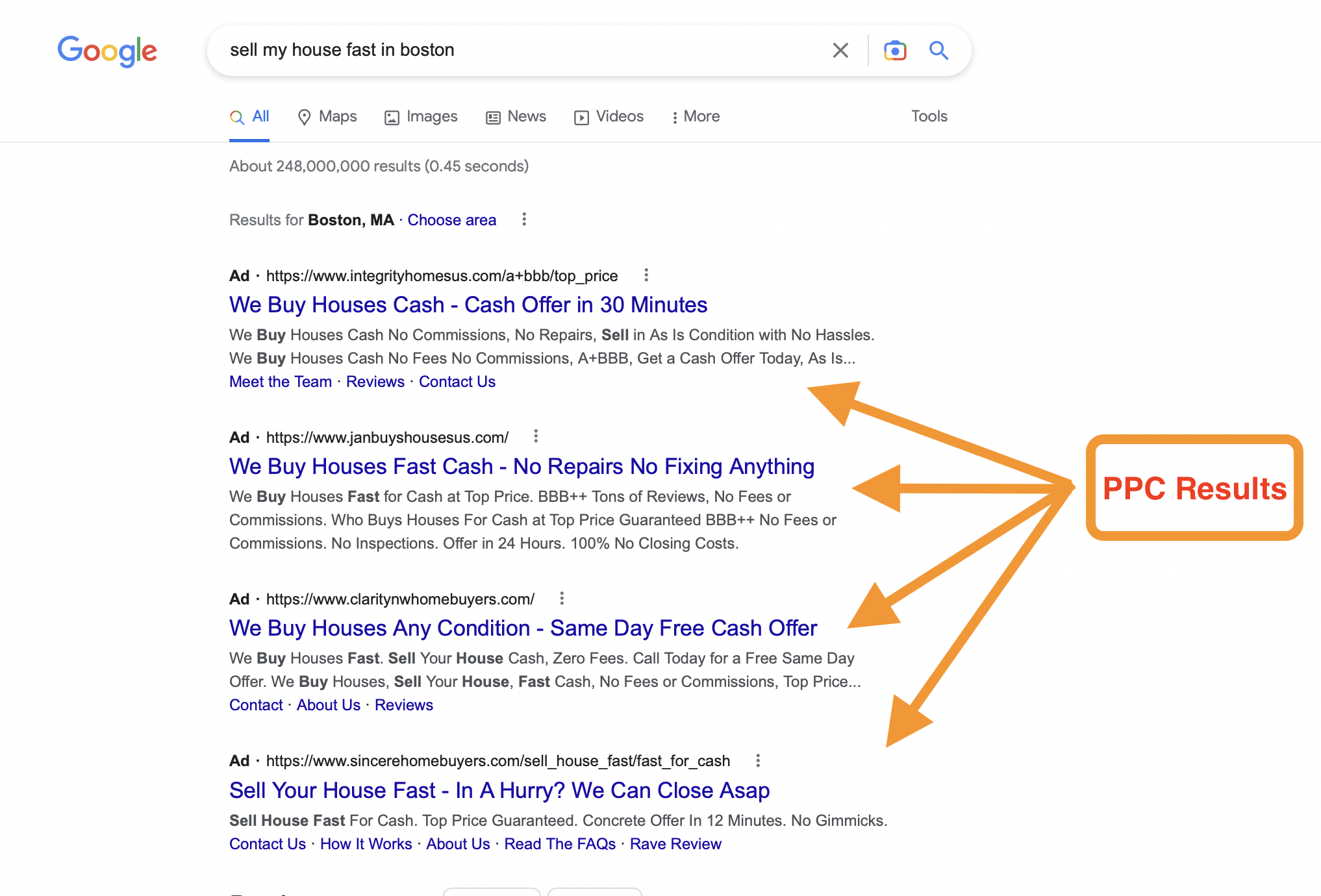
    Google Ads search results for sell my house in boston

    The reason that optimizing your landing page is so essential is because it helps determine the effectiveness of your ad campaign. If the page people go to after clicking on your ad is irrelevant, unpersuasive, or even takes too long to load, they won’t stick around and will not become a lead.

    Here’s a table summarizing the key differences of full webpages vs PPC landing pages:

    FeatureWebpagePPC Landing Page
    PurposeInformational, brand awarenessLead generation, conversion-focused
    Target AudienceBroader audience interested in real estateHighly targeted audience, e.g., motivated sellers
    ContentDiverse content: bio, services, blog postsFocused on a single offer or call to action (CTA)
    NavigationExtensive navigation to other website pagesLimited or no navigation to avoid distractions
    Call to Action (CTA)May have various CTAsStrong, clear CTA to capture leads

    Now that you know what a landing page is and why it’s important, let’s talk about 7 elements of every landing page that impact conversion.

    7 Elements You MUST Have for High-Converting PPC Landing Pages to Maximize Lead Generation

    Element #1: Simple Opt-In Form

    Every real estate website (agent or investor) at Carrot needs a high-quality, easy-to-fill-out opt-in form.

    And we don’t just believe that for no reason: it’s science. We’ve run hundreds of A/B tests on our member’s websites to determine whether opt-in forms perform better than a “Call Now” CTA (they do) and what types of forms perform the best.

    From one test we ran, we found that our member’s sites had almost a 30% conversion rate!

    Here’s the heatmap from the test…
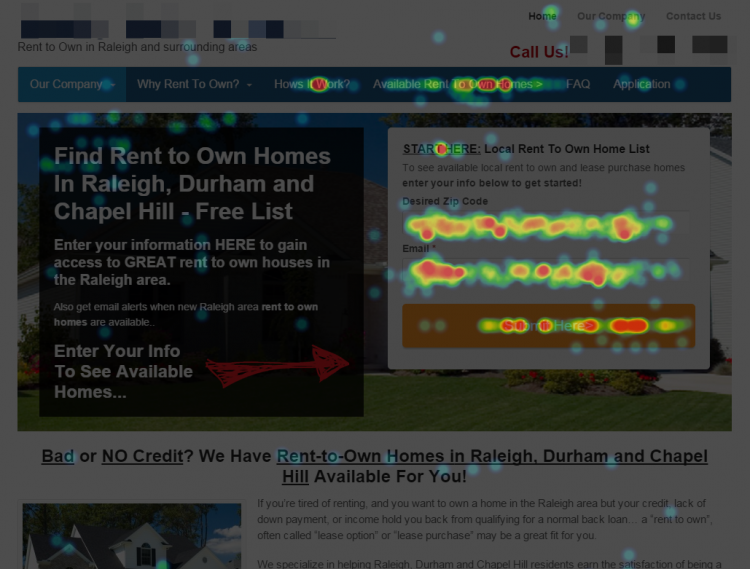
    Rent To Own Homes In NC Heatmap

    And here’s the data…

    rent-to-own-house-website-test1

    If you want a high-converting landing page right out of the box, our Carrot sites already have all the elements mentioned in this article baked right in. Or, if you want to build one yourself (no biggie!), here’s what you’ll want for your opt-in form…

    • Keep it simple and only have 3-4 fields for people to enter their information.
    • Set up text message notifications for when a lead opts in so you can follow up fast (Carrot does this automatically!)
    • Ensure that the form you use is above the fold — meaning when people land on your website, it’s the first thing they see.
    • Have a big, clear button that’s a different color than everything else on your website.

    High-Converting Element #2: Clear & Actionable Content

    When it comes to capturing motivated sellers, clarity and action are key. Your landing page copy should be clear, concise, and laser-focused on the benefits you offer.

    Why is clear content important for seller-focused landing pages?

    • Motivated sellers are in a time-sensitive situation. They need to understand your value proposition quickly and easily. Dense text blocks or overly technical jargon will only deter them.
    • Focus on Benefits, Not Features. Don’t just list your services; explain how you solve seller pain points. Highlight the benefits of selling to you, like a fast cash offer, a hassle-free process, or the ability to avoid costly repairs.
    • Action-Oriented Language: Motivate sellers to take the next step. Use strong verbs and clear calls to action throughout your landing page copy.

    Best Practices for Persuasive Landing Page Content:

    • Keep it Short & Sweet: Stick to short paragraphs and bullet points for easy readability on any device.
    • Local Market Data: Showcase your knowledge of the area. Highlight relevant local market data, like average sales times or cash buyer trends, to demonstrate your expertise and ability to deliver a quick and smooth sale.
    • Focus on Seller Benefits: Use clear language to explain how you address their specific needs and challenges. For example, “We understand the stress of inherited property – get a fair cash offer and avoid costly repairs.”
    • Testimonials & Social Proof: Integrate positive testimonials from satisfied sellers to build trust and credibility.

    Remember: Your landing page copy should be a conversation starter, not a novel. Focus on clear communication, highlight the advantages of working with you, and guide sellers towards taking action (e.g., requesting a cash offer).

    High-Converting Element #3: Compelling Headline

    Your headline is like the golden sign outside your investor open house. It needs to grab attention, pique interest, and clearly communicate the value you offer. Real estate investors are busy, so a strong headline is crucial for making them stop scrolling and engage with your landing page.

    Here are some key ingredients for crafting compelling headlines for real estate PPC landing pages:

    • Clarity: Keep it clear and concise. Investors should instantly understand what your offer is.
    • Relevance: Ensure the headline aligns with your target audience and the specific investor segment you’re targeting (e.g., flippers vs. buy-and-hold investors).
    • Benefit-Driven: Focus on the benefits your offer provides. What problem do you solve for investors? How can you help them achieve their goals?
    • Location-Specific (for Real Estate): Highlight your local expertise and cater to the specific market you serve. This personalizes the message and resonates with investors familiar with the area.

    Example:

    Let’s say you specialize in helping investors buy rental properties in a specific city. Here’s an example headline that incorporates these elements:

    • “Tired of Making Repairs? Get a Fair Cash Offer Today (Sell Your Rental Property Fast!)”

    This headline is clear, relevant to buy-and-hold investors facing repair hassles, emphasizes the benefit of a quick cash offer, and targets investors specifically in your city.

    High-Converting Element #4: Equally Compelling CTA

    Your call to action (CTA) is the moment of truth on your real estate PPC landing page. It’s where you convert curious visitors into qualified leads by prompting them to take a specific action.

    A strong CTA is essential for maximizing your lead generation efforts. Here’s what makes an effective CTA for real estate investors:

    • Clear Action Verbs: Tell investors exactly what you want them to do. Use strong verbs like “Download,” “Schedule,” or “Get Started.”
    • Prominent Placement: Make your CTA button stand out visually. Use contrasting colors and place it above the fold (visible without scrolling).
    • Relevant to Investor Goals: Your CTA should align with the value proposition you’ve presented and address the investor’s specific goals. Don’t ask them to “Learn More” if they’re ready to “Schedule a Consultation.”

    Examples:

    Consider these CTA examples tailored to different investor goals:

    • “Download Your How to Stop Foreclosure Guide” (Clear action verb, relevant to distressed property investors facing foreclosure)
    • “Schedule a Free Consultation to Find Your Perfect Investment Property” (Prominent placement, addresses buy-and-hold investor goals)
    • “Get a Fair Cash Offer Today!” (Strong verb, urgent tone for investors seeking a quick sale)

    Remember: A/B testing different CTAs can help you determine which ones resonate best with your target audience.

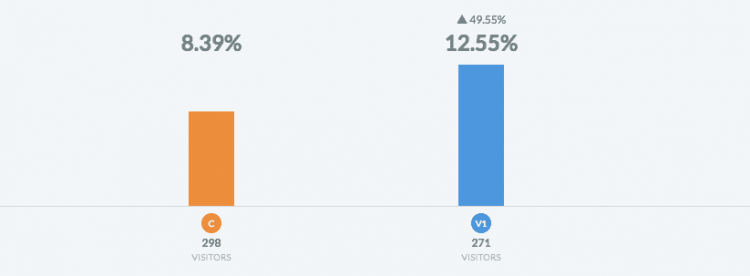
    From one test we ran at Carrot, we found that “Get My Fair Cash Offer” converted 49.55% better than “Click here to continue.”
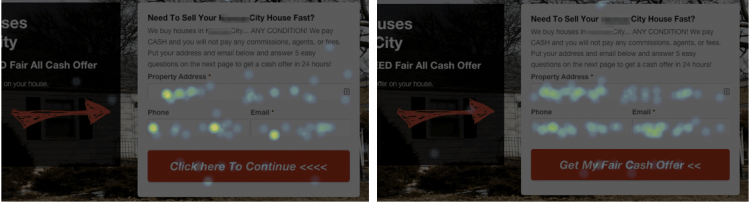
    split test motivated house seller website

    Here are the exact percentages…

    house seller website test

    Giving people what they already want isn’t just less work for you; it converts better, too.

    High-Converting Element #5: Trust Signals & Social Proof

    Securing motivated sellers hinges on establishing trust. This is where trust signals and social proof come into play.

    • Trust Signals: These are visual cues that demonstrate your legitimacy and expertise as a real estate professional. They act as a digital handshake, assuring house sellers you’re a reliable and trustworthy partner to help them achieve their goals.
    • Social Proof: This leverages the power of “herd mentality.” By showcasing positive experiences from past clients (especially sellers in your local market), you demonstrate the effectiveness of your approach and encourage others to take action.

    Why are these important for real estate investor landing pages targeting sellers?

    House sellers are entrusting you with a significant financial decision – selling their property quickly and efficiently. By incorporating trust signals and social proof, you significantly increase the likelihood of converting website visitors into qualified leads.

    Examples of Trust Signals:

    • Security Badges: Display logos indicating secure transactions and data protection.
    • Professional Licenses & Affiliations: Showcase your real estate licenses and relevant professional memberships.
    • Awards & Recognition: Highlight any industry awards or recognitions you’ve received.

    Social Proof in Action for Real Estate Investors:

    • Seller Testimonials: Feature quotes and success stories from satisfied sellers, particularly those in your local market.
    • Case Studies: Showcase real-world examples of how you’ve helped sellers achieve their goals (e.g., “Sold John’s house in X days above asking price”).
    • Logos of Trusted Partners: Display logos of reputable companies you work with, like title companies or closing attorneys.

    Remember: Social proof should be authentic and verifiable. Encourage seller reviews on trusted platforms like Google My Business or industry-specific sites.

    By strategically integrating trust signals and social proof on your real estate investor landing pages, you build trust with potential sellers and establish yourself as a proven resource to help them achieve a smooth and successful sale.

    High-Converting Element #6: Image That Paints Desire

    Real estate is a visual business, and the same applies to your landing pages targeting motivated sellers. High-quality visuals are crucial for capturing attention, conveying information effectively, and ultimately, convincing sellers to choose you over other options.

    Why are visuals important for seller-focused landing pages?

    • Attention Grabbing: Compelling visuals instantly capture attention and make your landing page stand out. In a sea of competing offers, strong visuals are the first impression that can convince sellers you’re the right buyer for their property.
    • Emotional Connection: The right visuals can evoke emotions and build trust with your audience. Use high-quality photos of beautiful homes you’ve helped sell or inspiring visuals of happy sellers receiving a fast cash offer. This creates an emotional connection and positions you as a solution to their situation.
    • Transparency & Trust: High-quality visuals demonstrate professionalism and transparency. Showcase problem-free solutions: for example, pictures of smooth walkthroughs or happy sellers signing paperwork. This builds trust and reassures sellers you’re a reliable partner in their sale.

    Examples of Effective Visuals for Motivated Sellers:

    • High-Resolution Property Photos: Showcase attractive, professional photos of the types of properties you buy (e.g., single-family homes in need of repairs, inherited properties).
    • “Before & After” Photos: If you specialize in renovations, highlight your expertise with “before & after” photos showcasing the transformation potential of properties.
    • Fast Closing Videos: Short testimonial videos featuring sellers who received a quick cash offer can be incredibly powerful. These visuals demonstrate your ability to deliver a smooth and efficient sale process.
    • Data & Charts: Use data visualizations (e.g., charts showing average closing times) to communicate your commitment to a fast and hassle-free experience for sellers.

    Remember: Don’t underestimate the power of visuals. Invest in high-quality photos or consider using high-resolution stock imagery that resonates with motivated sellers and showcases the types of properties you typically buy.

    High-Converting Element #7: Quick Load Speed

    In today’s mobile-driven world, ensuring your real estate investor PPC landing page is mobile-friendly is no longer optional – it’s essential. Here’s why:

    • Mobile Dominates Real Estate Searches: A significant portion of motivated sellers initiate their search for solutions (like cash buyers) from their smartphones. If your landing page isn’t optimized for mobile viewing, you’re missing out on a huge pool of potential leads.
    • Seamless User Experience: Mobile users expect a smooth and intuitive experience. A mobile-friendly landing page ensures clear navigation, easy-to-read text, and properly sized buttons for seamless interaction on any device. Frustrated sellers on clunky mobile pages are more likely to bounce and seek alternative solutions.
    • Faster Lead Generation: A responsive landing page loads quickly and functions flawlessly on mobile devices. This translates to faster form submissions and quicker lead capture when motivated sellers are ready to take action.
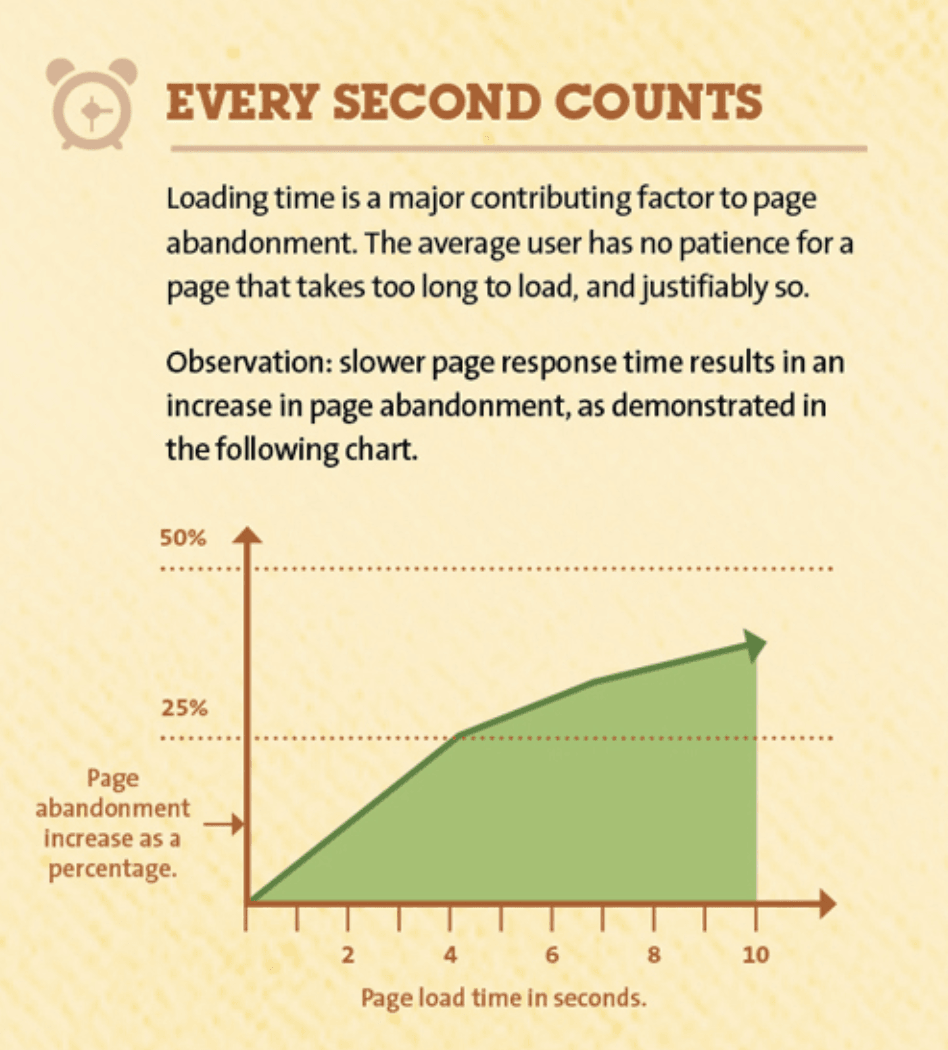
    page speed loading time

    (Image Source)

    Benefits for Real Estate Investors:

    By prioritizing mobile-friendliness, you unlock several advantages in the competitive real estate market:

    • Increased Lead Generation: Capture leads from a wider audience of sellers who are searching and making decisions on their phones.
    • Improved Conversion Rates: A user-friendly mobile experience keeps sellers engaged and more likely to convert on your call to action (e.g., requesting a cash offer).
    • Enhanced Brand Image: A mobile-optimized landing page demonstrates professionalism and a commitment to providing a convenient experience for sellers, potentially positioning you as the go-to buyer for their needs.

    Remember: Don’t just assume your landing page is mobile-friendly. Use Google’s Mobile-Friendly Test tool or other resources to check responsiveness and ensure a smooth experience for sellers on any device.

    At Carrot, we’ve optimized all our member’s websites to be fast. Here are the results of one being run through a speed test.
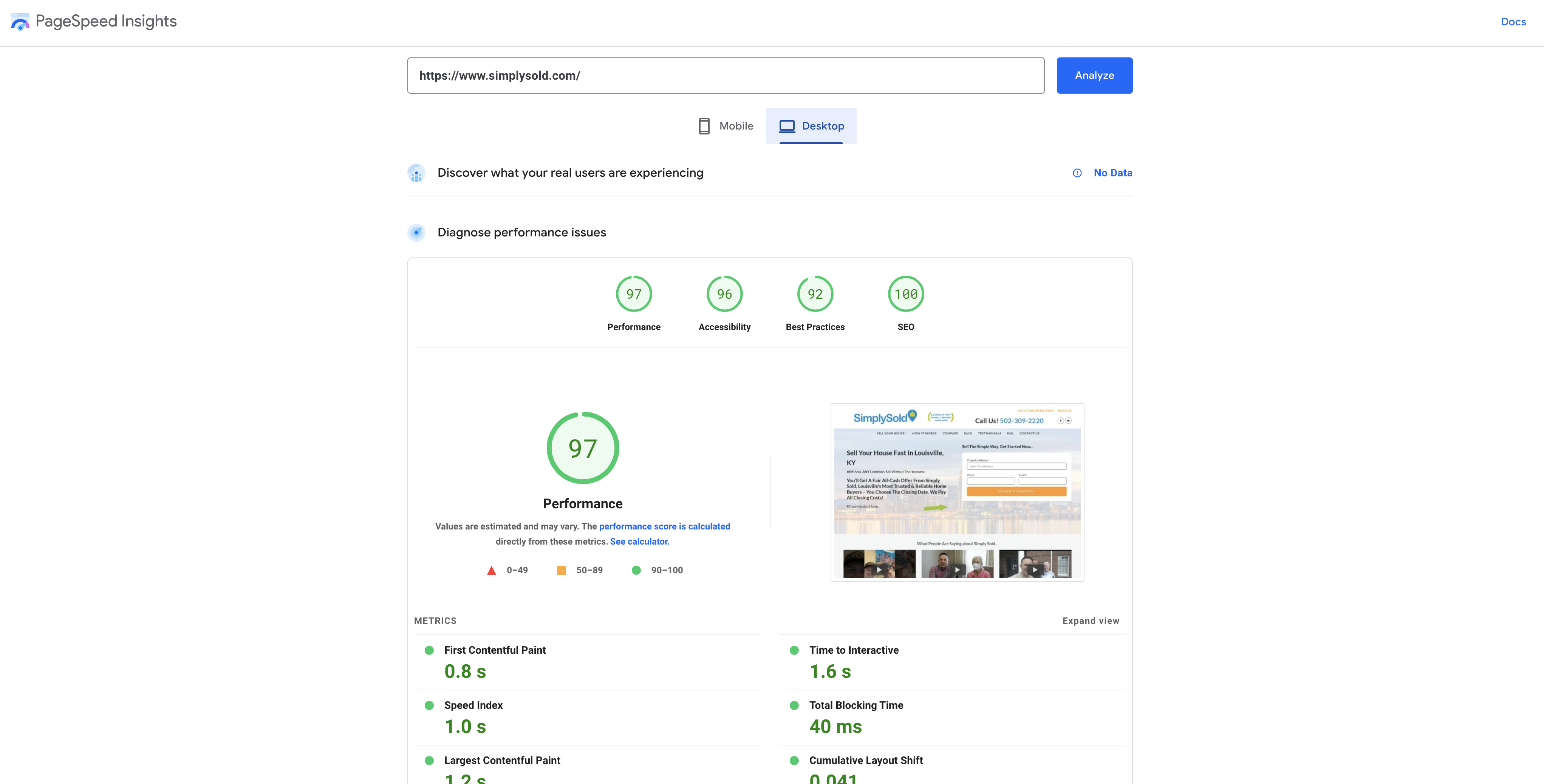
    Carrot member pages speed results

    This helps with SEO rankings, and, more importantly, helps with the conversion rate. When your website loads quickly, people stay longer and are more willing to work with you than if they have a clunky and difficult experience.

    It’s not the most important element in the world, but it does make a difference…

    And how much would it cost you if a motivated seller, could-be-a-deal, left your website because it moved too slowly? $10,000? $50,000?

    Yeah… it’s not worth it.

    Bonus Section: Common Real Estate PPC Landing Page Mistakes to Avoid for Sellers

    While crafting compelling landing pages to capture motivated sellers, here are some common mistakes to steer clear of:

    • Generic Landing Pages: Don’t use a one-size-fits-all approach. Tailor your landing page specifically to the needs of motivated sellers (e.g., facing foreclosure, inheriting a property) rather than a broad real estate audience.
    • Weak Value Proposition: A vague or unclear value proposition won’t resonate with time-sensitive sellers. Clearly state how you solve their problems and the benefits of working with you (e.g., “Sell your house fast for cash and avoid costly repairs”).
    • Confusing Navigation: A cluttered landing page with complex navigation will frustrate sellers. Keep it simple and focus on a single call to action (e.g., “Get a Cash Offer Now”).
    • Lack of Trust Signals: Sellers are entrusting you with a significant financial decision. Omit trust signals like security badges, professional licenses, or testimonials, and you risk losing credibility.
    • Excessively Lengthy Forms: Don’t overwhelm sellers with lengthy forms. Request only essential information needed to get started (e.g., property address, contact details).
    • Unrealistic Promises: Avoid making exaggerated claims about closing timelines or cash offer amounts. Focus on transparency and realistic expectations to build trust with sellers.
    • Not Tracking & Testing: Don’t set your landing page and forget it. Regularly track key metrics (e.g., conversion rates, bounce rates) and A/B test different elements (e.g., headlines, CTAs) to optimize your landing page performance for maximum lead generation.

    By avoiding these common pitfalls and focusing on the best practices outlined above, you can create high-converting real estate investor PPC landing pages that effectively capture motivated sellers and propel your investment business forward.pen_sparktunesharemore_vert

    How Do You Get Results?

    PPC takes work but is essential for real estate professionals seeking more qualified leads. Real estate businesses can ensure high conversion rates by optimizing their landing page for conversion. This is especially important when targeting hyper-competitive markets such as Dallas, Miami, or Denver, where it’s even more critical for a business to have all conversion principles in place.

    Doing so can increase lead generation by up to 2-3x or more compared to businesses without conversion optimization. With the right approach and strategy, you can use PPC to increase lead generation and build brand loyalty among your target markets.

    If you’re already a member, here are some resources to help you learn more about PPC:

    Other free PPC resources:

  • EP 423: Accountability “Do’s & Don’ts” For Leading a Team

    EP 423: Accountability “Do’s & Don’ts” For Leading a Team

    Accountability "Do's & Don'ts" For Leading a Team | Trevor Truck Talk | Leadership Podcasts & more

    About this episode:

    If you’re a part of a team and you get to the end of your week feeling drained, super busy but without progress to show for it progress, it’s could be an accountability issue. It might be that you’re not clear on your goals or the exact steps needed to hit them. This si something that many successful leaders struggle with – holding each other accountable in the right way. In this episode I’ll share some of the do’s and don’ts I’ve learned, so you can run a more accountable, more efficient team. Listen in.


  • Study Shows Carrot Websites Dominate Rankings For “Sell My House Fast”…

    Study Shows Carrot Websites Dominate Rankings For “Sell My House Fast”…

    Do you know… SEO has 2x-3x higher conversion over other online marketing channels?

    If you’re in the market for the most motivated leads, look no further than SEO. Search engine optimization is a powerful tool that helps real estate agents and investors improve their online visibility and ranking in search engine results.

    The question is, who’s ranking/winning?

    We recently surveyed the top 225 markets in the United States to see which companies rank on the first page of Google for one of the most competitive search terms… “sell my house fast [insert city].”

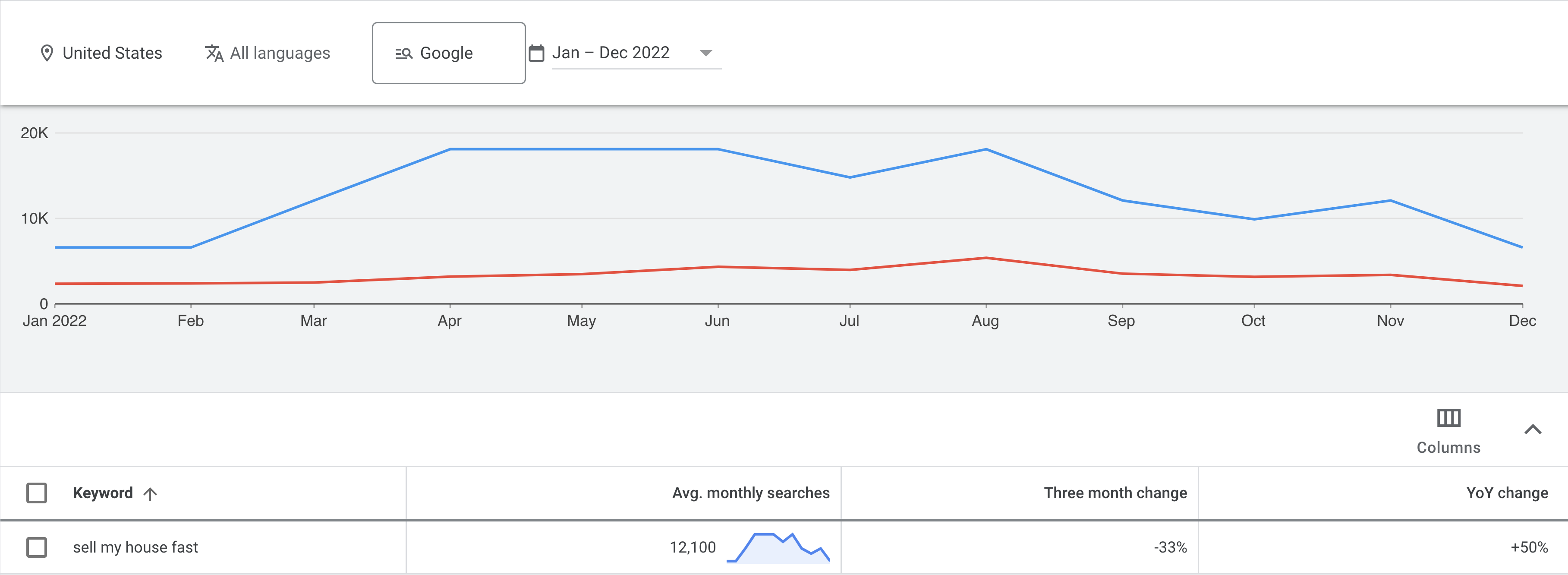
    In fact, according to Google’s keyword planner, “sell my house fast [insert city]” was searched 12,100 times per month in the United States in 2022. That’s also a 50% increase over 2021.

    It’s no secret that ranking on the first page of Google is crucial for businesses that want to attract qualified leads and drive conversions. With so many companies vying for a top spot, we wanted to see which successfully achieved page-one rankings for this highly competitive search term.

    The results of our study were fascinating, and we’re excited to share them with you. Keep reading to discover which companies, including Carrot, came out on top and how they achieved such impressive results.

    The Results

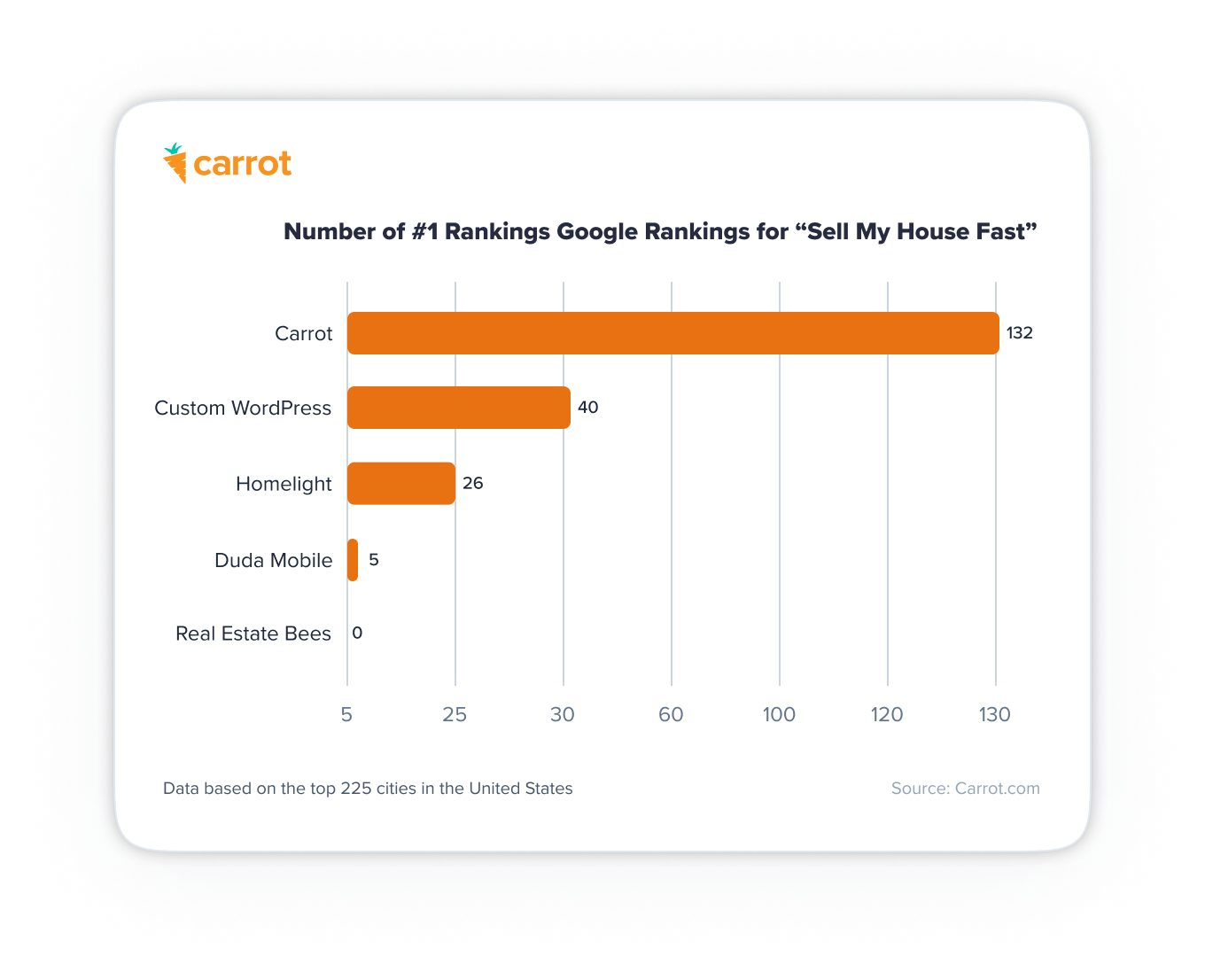
    Carrot websites rank #1 for “sell my house fast” in 132 out of 225 cities

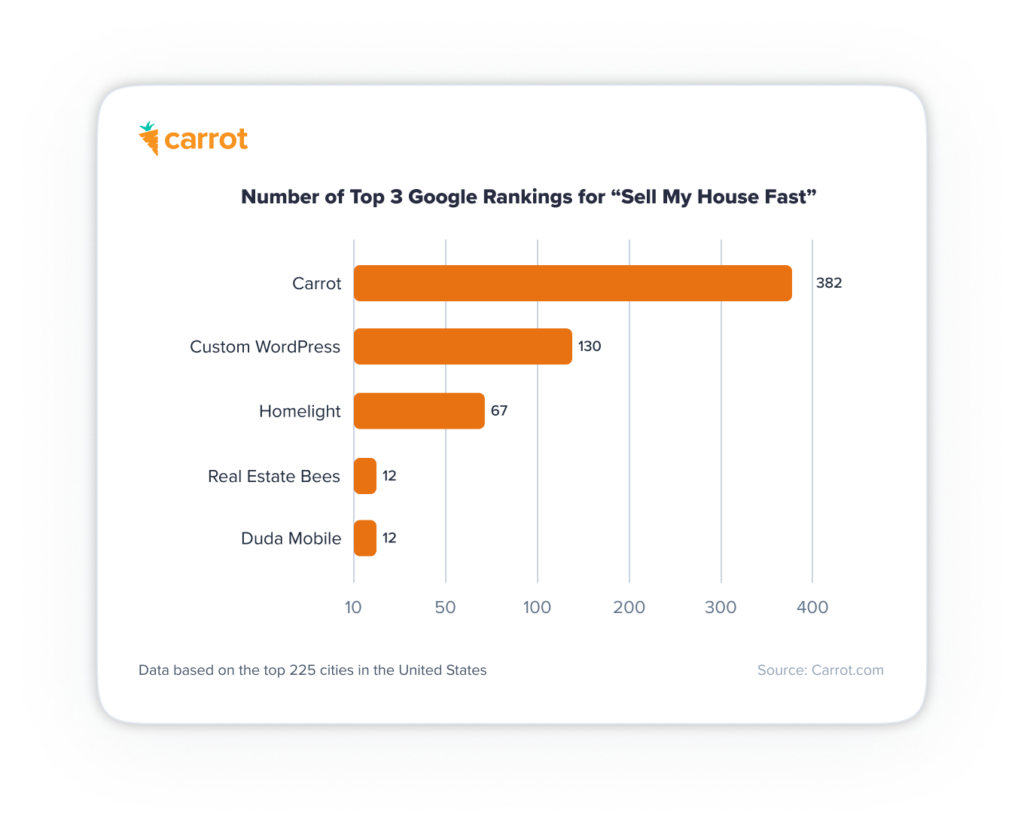
    Carrot websites ranked in the top 3 positions 382 times within the 225 markets

    That’s 98% more times than the nearest competitor

    See the full results of the study here.

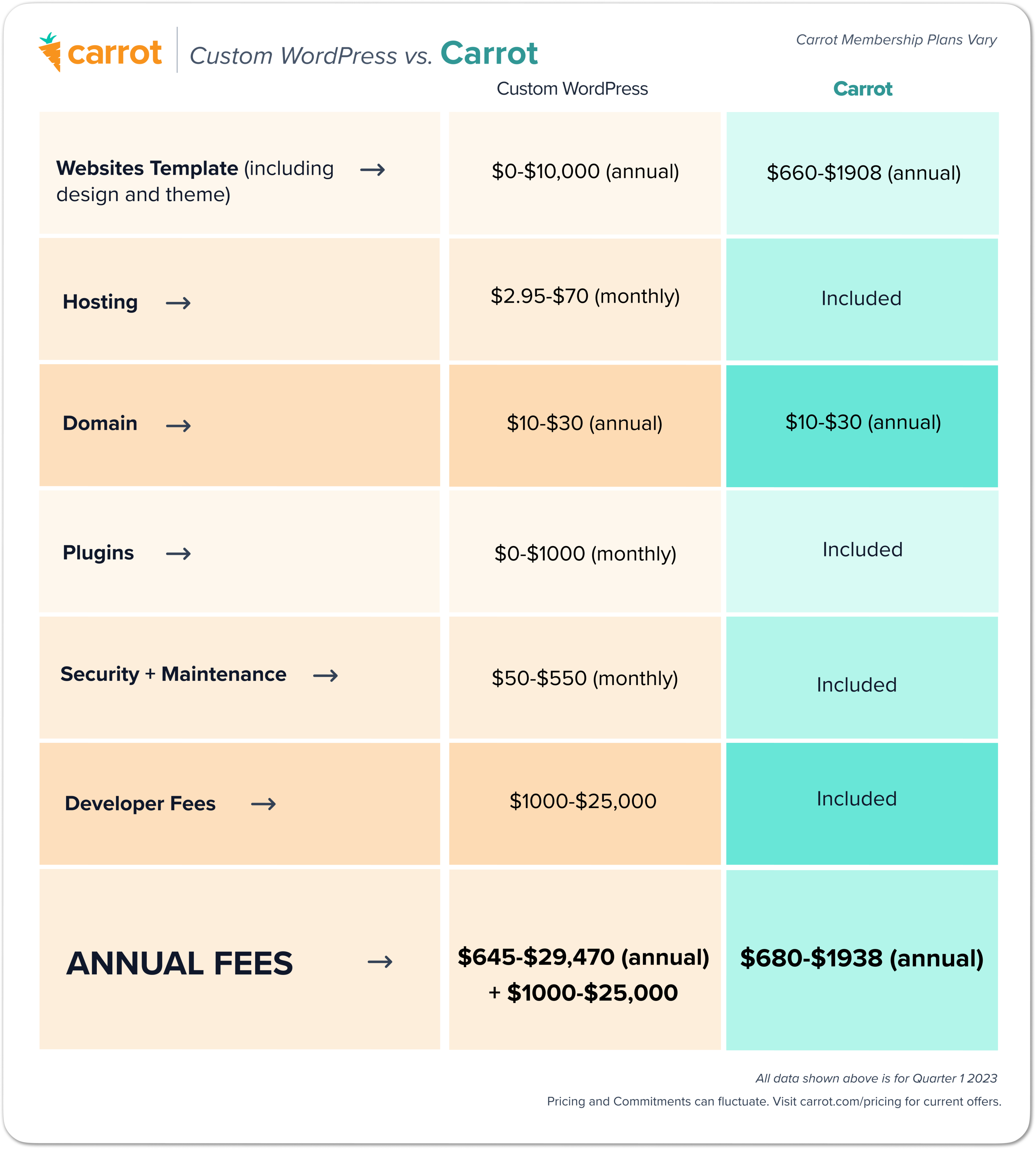
    Top Two Performers… Carrot vs. Custom WordPress

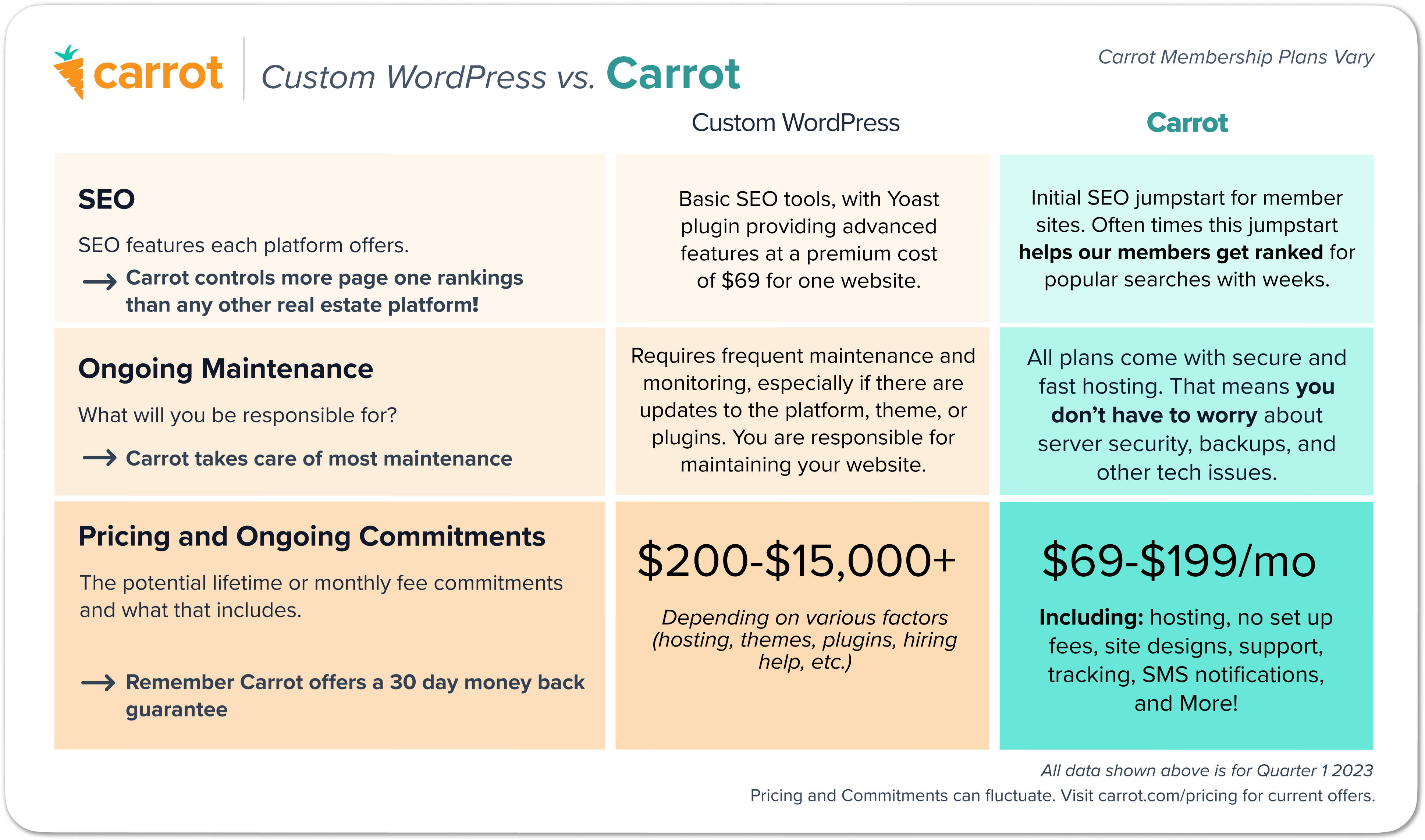
    Carrot and custom WordPress sites are popular for building and hosting a website, but they offer different features, advanced tools, and pricing plans. Carrot is known for its user-friendly interface, performance, and affordable pricing, while WordPress offers a broader range of theme options for building a website.

    Both providers offer options to choose from and include basic SEO tools. Carrot is an excellent choice for a more hands-off and cost-effective solution. At the same time, custom WordPress sites are more suited for businesses with more time and budget to learn how to create and manage a website.

    Quick Comparison Chart…

    And Pricing Comparison Chart…

    Also… Carrot template’s mobile performance scores are 60.01% higher than custom WordPress sites we tested.

    Learn more about Carrot’s performance and how our members report a 7x higher lead-to-deal conversion and an increase of $13,932 profit per deal while gaining consistency and predictability in their online leads.

    Keith Sant… how he got to the top ranking in Seattle

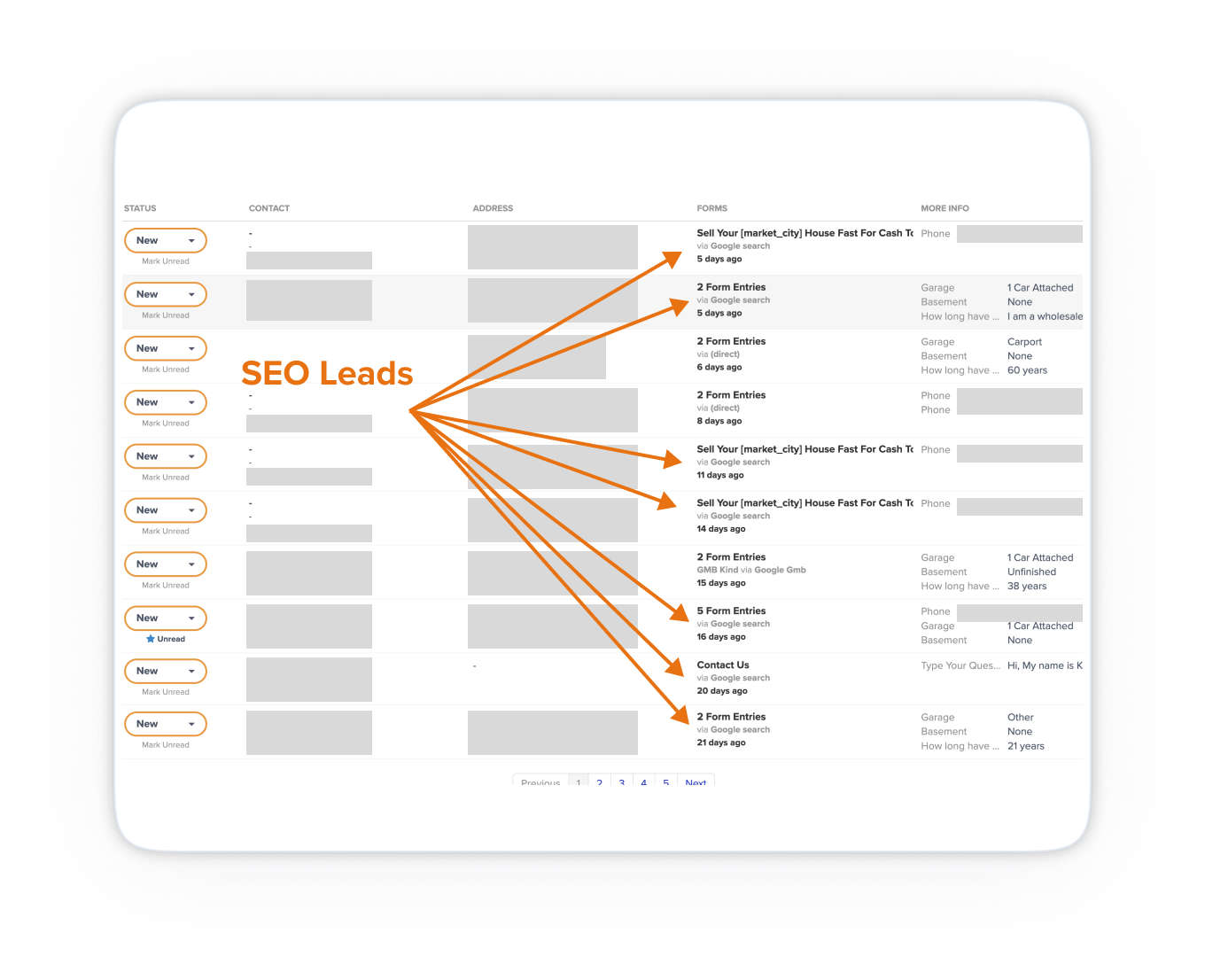
    “That 3 leads per day training paid off! Yesterday was my first 5 organic lead day! 2 SEO leads 1 Google My business lead, and 1 buyer lead. I’m so pumped and not slowing down.”

    – Keith Sant, Seattle, Kind House Buyers

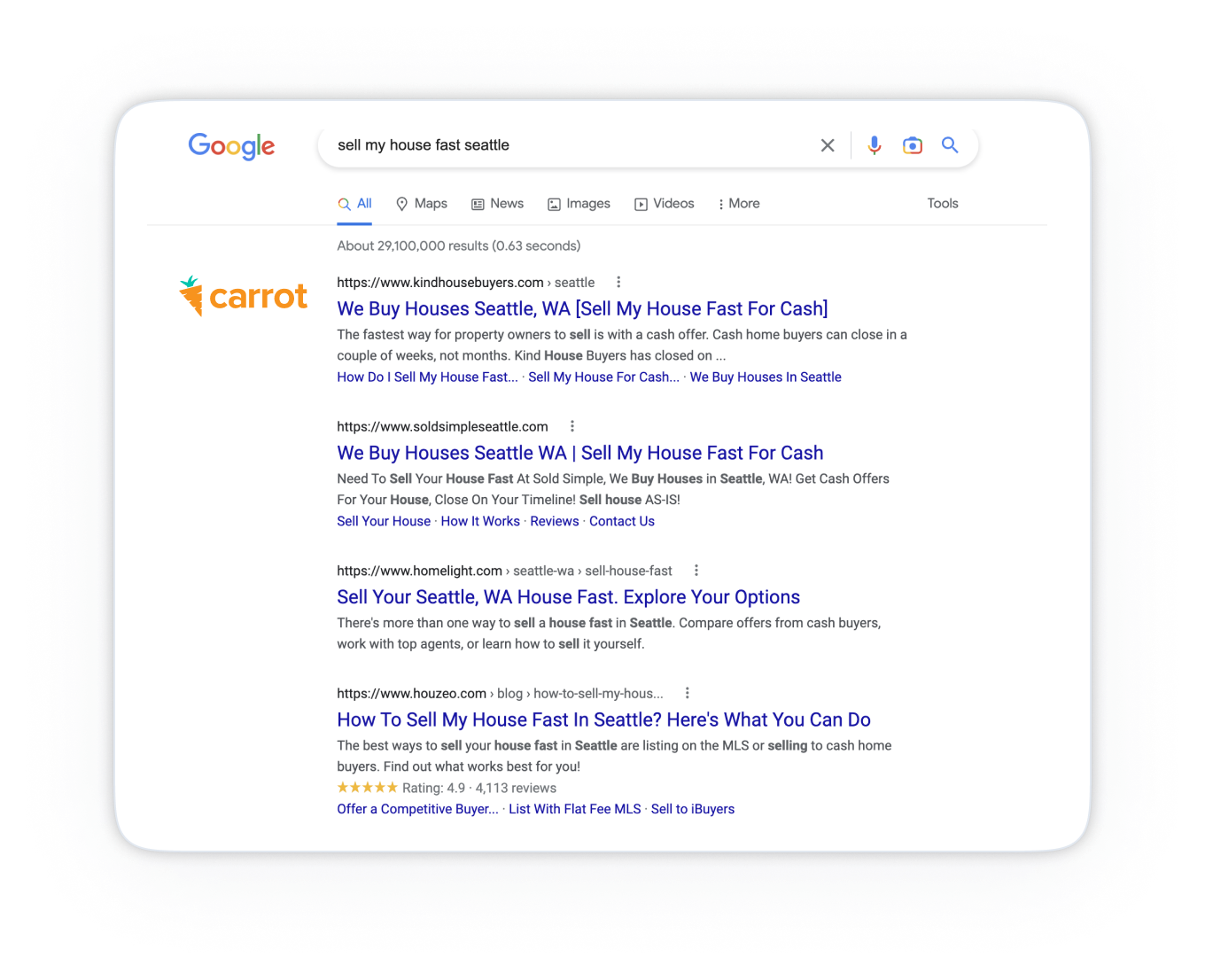
    Here’s how it looks… Google search “sell my house fast Seattle”… Carrot website ranking #1…

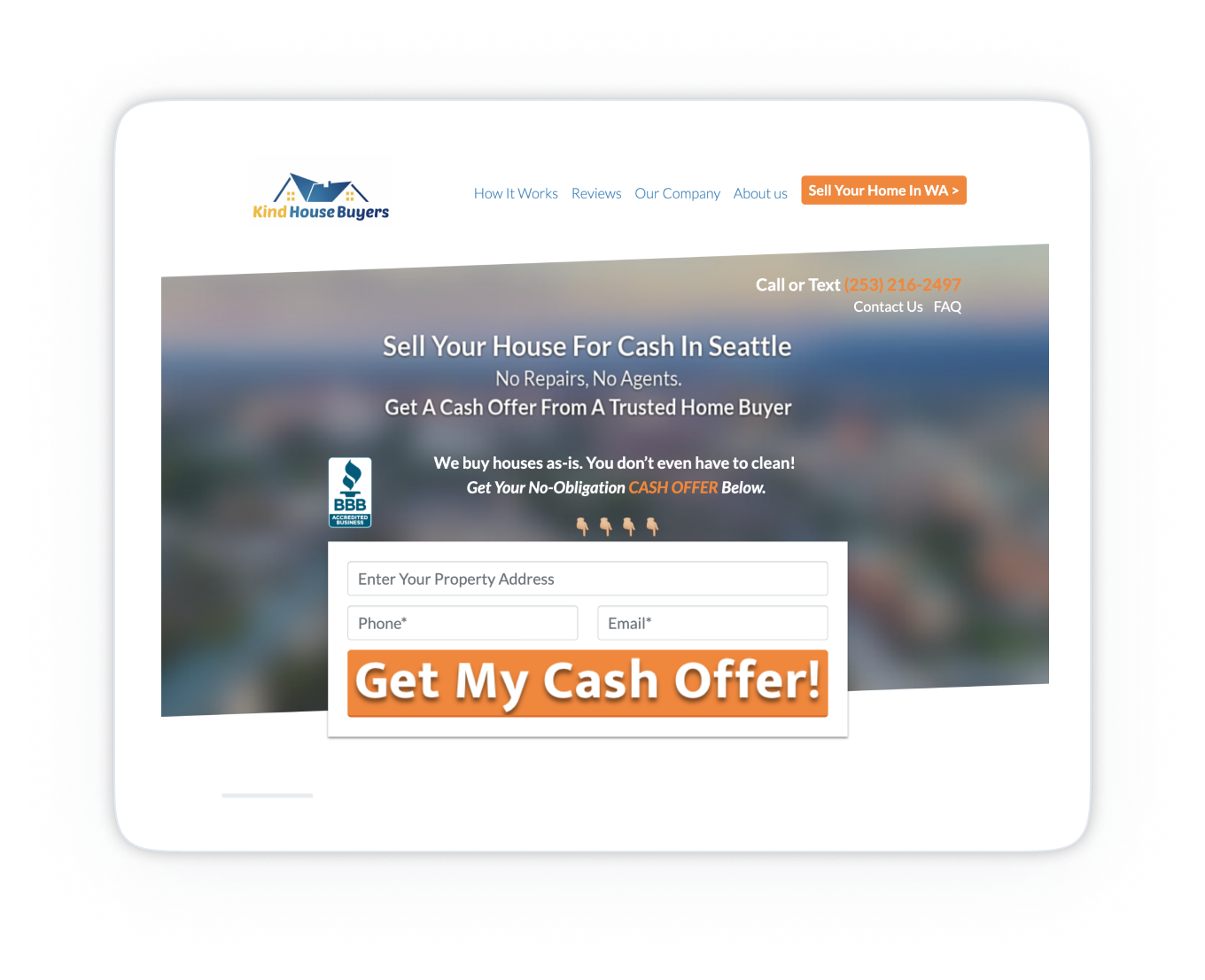
    Motivated seller lands on Kind House Buyers Carrot website…

    Organic SEO Leads grow…

    The importance of ranking first in search engine results and how it can benefit your business

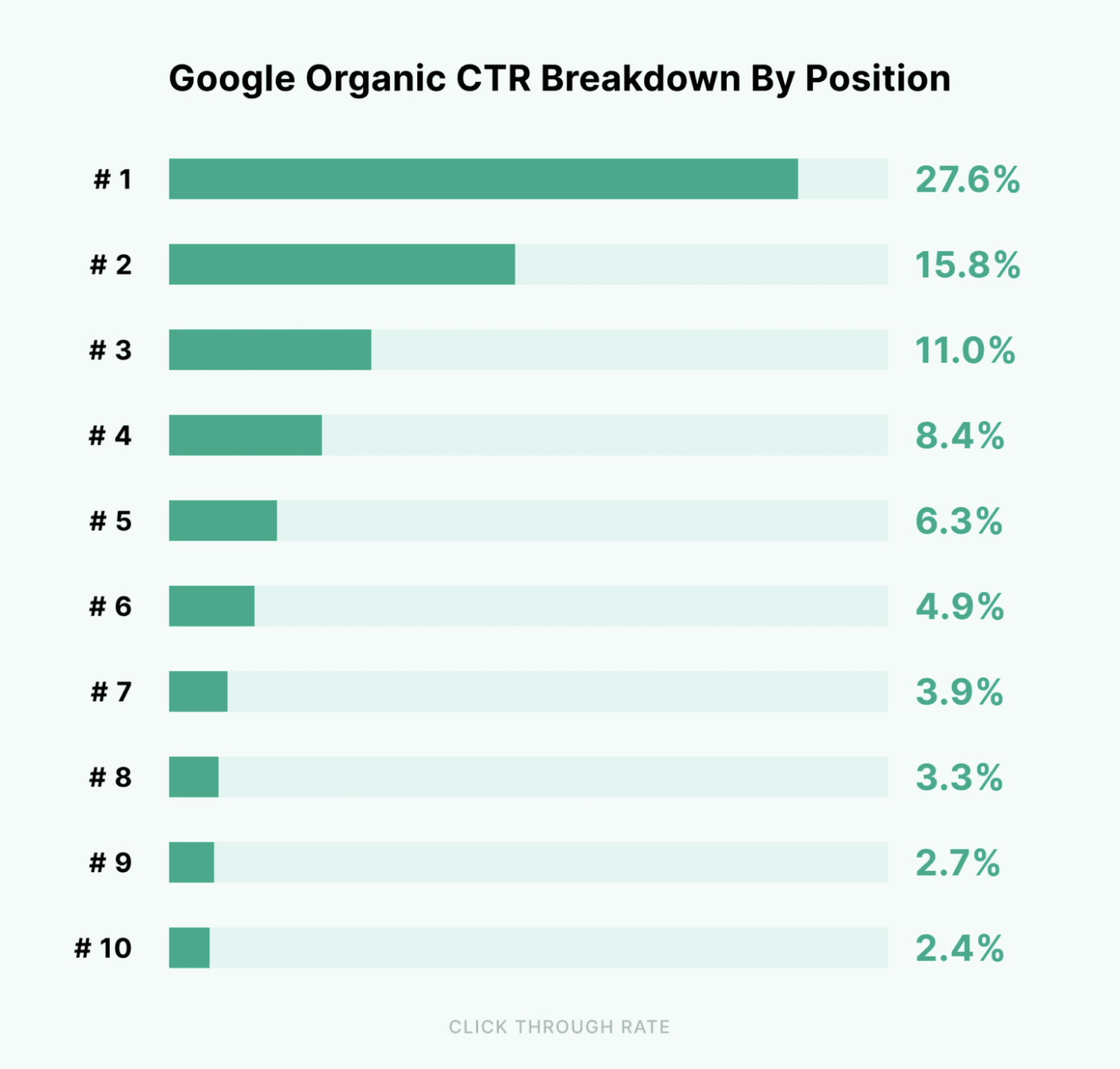
    For several reasons, ranking first in search engine results can greatly benefit your real estate business. In a recent study, Backlinko reported the #1 result in Google has a CTR (click-through-rate) of 27.6%.

    CTR per Google Ranking 1-10

    Ranking first in search results can lead to an increase in traffic to a website. When users search for a particular keyword or phrase, the top-ranked results are typically the ones they click on first. As a result, a top-ranking can significantly increase the number of visitors to your website.

    Ranking #1 is significantly more valuable than any other position. The #1 result in Google has a 10x higher CTR than the #10 result.

    A #1 ranking can improve your website’s credibility and perceived authority. When a website ranks highly in search results, it can give the impression to users that your website is a reliable and trustworthy source of information. This can lead to an increase in the credibility of your website and the services you offer.

    Finally, ranking in the top 3 in search results can increase your business’s revenue. If your website can attract more qualified visitors as a result of its top ranking, it may be able to convert more of those visitors into deals. This can lead to a significant increase in revenue.

    Overall, ranking 1-3 in search results can significantly benefit your business, leading to increased traffic, improved credibility, and higher revenue.

    Ready to Learn More About SEO for Real Estate?

    Download our comprehensive keyword bible now and optimize your online presence for maximum visibility and success!

    SEO keyword Bible Cover

    The current state of competition

    The level of competition for top rankings in search engines can vary significantly depending on the market and the targeted keywords. In general, however, there is often high competition for top rankings in search results as investors and agents strive to attract as much traffic as possible from search engines, especially Google.

    There are a few factors that can influence the level of competition for top rankings in search engines:

    Market: Some markets are naturally more competitive in search engine rankings due to the higher demand for buyers or sellers. The real estate industry tends to be highly competitive regarding search engine rankings.

    Keyword difficulty: The difficulty of ranking for a particular keyword can also affect the level of competition. Keywords that are highly specific and have low search volume are usually less competitive, while more general and high-volume keywords are often more competitive.

    The number of competitors: The number of competitors targeting the same keywords can also impact the level of competition. If there are a large number of websites competing for the same keywords, it can be more challenging to achieve top rankings.

    Overall, the level of competition for top rankings in search engines can vary greatly depending on the market and keywords being targeted. It is important for businesses to carefully research their competition to determine the best strategies for achieving top rankings.

    Strategies for increasing number one rankings

    Several strategies can be used to increase the chances of ranking first in search results:

    On-page optimization: On-page optimization refers to optimizing individual pages to rank higher and earn more relevant traffic in search engines. This includes optimizing the content and HTML source code of a page. On-page optimization can include techniques such as using header tags, optimizing title tags and meta descriptions, and using internal linking.

    Off-page optimization: Off-page optimization refers to activities performed outside of a website to improve its search engine rankings. This can include building high-quality backlinks from other websites and promoting the website on social media and other online platforms.

    Content marketing: Creating and promoting high-quality, relevant content on a website can help to improve its search engine rankings. This can include blog posts, articles, videos, and other content relevant to the target audience.

    Link building: Building high-quality backlinks from other websites is another important factor in search engine rankings. These links act as “votes” of confidence in a website’s quality and can help improve its rankings.

    Technical SEO: Ensuring a website is technically optimized can also help to improve its search engine rankings. This can include optimizing the website’s loading speed, mobile responsiveness, and security.

    Overall, a combination of these strategies can help to improve the chances of ranking first in search results. To stay ahead of your competition, continually monitor and optimize a website’s search engine rankings.

    Ready to Learn More About SEO for Real Estate?

    Download our comprehensive keyword bible now and optimize your online presence for maximum visibility and success!

    SEO keyword Bible Cover

    The role of keyword research

    Keyword research is essential to ranking first in search results, as it helps determine which keywords and phrases are most likely to drive traffic to a website.

    There are a few key factors to consider when conducting keyword research:

    Relevance: Choosing keywords relevant to a website’s content is important. This will help ensure that the website attracts qualified, motivated visitors interested in your services.

    Search volume: Choosing keywords with a high search volume can help to increase the chances of ranking first in search results. Keywords with a high search volume are typically more competitive, but they can also drive more traffic to your website.

    Competition: The level of competition for a particular keyword can also be an important factor to consider. If a keyword has a high level of competition, it may be more difficult to achieve top rankings for that keyword.

    Several tools available can help with keyword research, such as Google’s Keyword Planner. These tools can provide data on the search volume and level of competition for different keywords, which can help determine which keywords to target.

    Overall, keyword research is an important step in ranking first in search results, as it helps identify the keywords most likely to drive traffic to your website.

    How Do You Get These Results?

    SEO takes work but is essential for real estate professionals looking to generate more qualified leads. By optimizing website content, real estate businesses can ensure they appear in the top search engine results. This is especially important when targeting hyper-competitive terms such as “sell my house fast [insert city],” where it’s even more critical for a business to be visible on the first page of search results.

    Doing so can increase lead generation by up to 2-3x or more compared to businesses without SEO optimization. With the right approach and strategy, you can use SEO to increase lead generation and build brand loyalty among your target markets.

    If you’re already a member, here are some resources to help you learn more about SEO:

    Other free SEO resources:

    If you’re not a Carrot member, join today!

  • ChatGPT for Real Estate and What it Means for SEO

    ChatGPT for Real Estate and What it Means for SEO

    We’re all familiar with search engines and how they help us find information quickly and easily. But, with the emergence of artificial intelligence (AI), could search engines be replaced altogether? Let’s take a look at how ChatGPT for real estate is changing the way people find information online.

    What is ChatGPT for Real Estate and How Does it Work?

    ChatGPT stands for Conversation Graph Technology, an open-source natural language processing (NLP) model that enables users to create conversations with computers. It uses deep learning and predictive text to generate responses to a user’s questions or statements.

    By leveraging the latest advances in AI, ChatGPT is capable of understanding and responding to complex conversations in real-time. Unlike other NLP models, ChatGPT does not require pre-trained data sets and can be trained on any domain-specific data set. This makes it ideal for applications such as customer service, virtual assistant development, and conversational marketing campaigns.

    Additionally, its accuracy, scalability, and low latency make it suitable for enterprise applications. With its cutting-edge technology, ChatGPT has the potential to revolutionize how people interact with computers by making conversations more natural and engaging than ever before.

    Those 3 paragraphs were written entirely by asking an AI “What is ChatGPT?” – Pretty neat, right?

    Friendly face of a robot that uses chatbot AI. Is this the future of ChatGPT?

    AI is Changing the Way We Find Information Online

    Artificial Intelligence is transforming how we interact with technology, and it’s having a major impact on search engines. In fact, AI-powered chatbots are already beginning to replace traditional search engine queries.

    As technology advances, the role of the AI chatbot in providing personalized and instantaneous responses to user inquiries continues to grow, revolutionizing the way people seek and obtain information online.

    For example, when you ask Siri or Alexa for something specific—like “What’s the weather like for today?”—they will provide you with an answer without having to type in any keywords or phrases. This is because AI-powered chatbots can understand natural language processing (NLP). This means that they can interpret human speech and respond accordingly. Moreover, with the emerging rise of Large language models (LLMs) it’s becoming easier to deal with content and leverage data for further advancements.

    Can ChatGPT or Other AI Change How We Make Content?

    Yes, it absolutely can. There are already hundreds of websites out there that are written entirely by AI language models! Theoretically, you could use AI to create 100% of your content – but is that a good idea? Are there any SEO implications for doing something like that?

    Deciding whether or not to use AI to create content for your business is a tricky question that requires careful consideration.

    On the one hand, using AI-generated content could save time and money. On the other hand, Google may flag such content as spammy, which could hurt your business’s SEO rankings and brand impression (more context on this later in the article).

    When considering whether or not to use AI-generated content for your business, it’s important to remember that Google’s algorithms are constantly changing and improving. As such, certain tactics used to generate content with AI may become less effective over time or even completely outdated.

    While AI can automate many tasks associated with content development—such as finding relevant topics and keywords—it cannot replace human feedback, creativity, and insight when it comes to crafting unique pieces of content that are engaging and helpful to readers.

    Furthermore, any automated content created by AI should always be checked for accuracy and clarity by a human editor before publishing. Although AI may generate accurate results based on complex data, understanding how those results apply to real-world applications requires expertise and human feedback to interpret the results properly.

    Although, in case of bulk content, you can even use a specialized online proofreading tool (Wordvice AI is a good one to use).

    This ensures that any automated content published on behalf of your business is free from errors, complies with regulations (if applicable), and meets all standards for quality control in terms of grammar, style, formatting, etc.

    In short – yes, you may consider using ChatGPT for Real Estate to create content for your business IF you’re confident that you understand its limitations and capabilities. When appropriately used—combining human creativity with machine automation—AI-generated content can provide great benefits in terms of efficiency and cost saving without sacrificing quality or accuracy.

    Just make sure to monitor how Google flags such material, so you don’t fall behind with its algorithm changes!

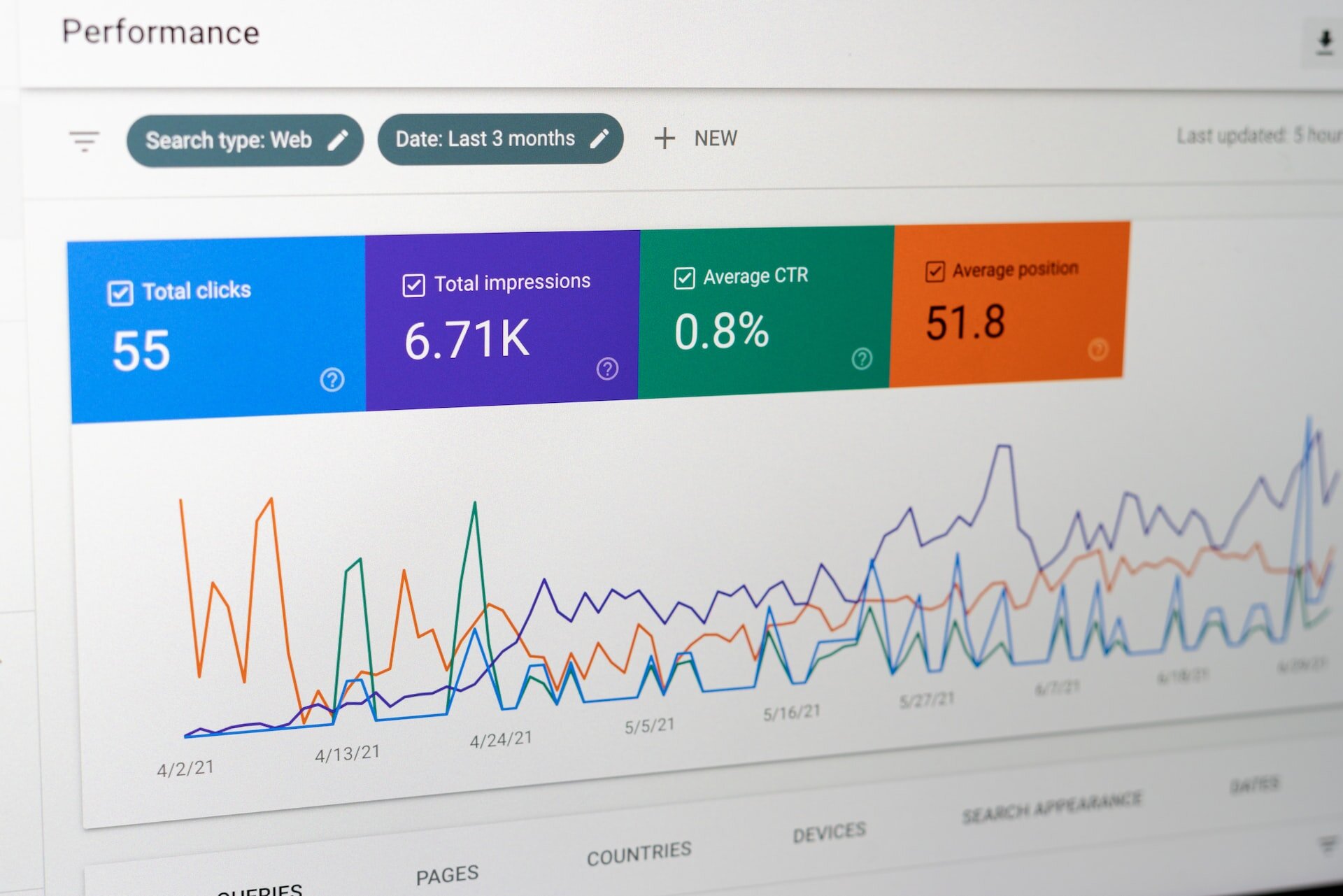
    Online dashboard showing stats that are regularly used in SEO.

    How will ChatGPT impact SEO in the future?

    While it might seem like ChatGPT and other AI learning models are poised to kill search engines like Google and Bing, it will be a long time before search engines are replaced. Chatbots aren’t new, but they aren’t out of beta either. Most AI models are several iterations away from being able to compete with search engine powerhouses.

    There are several reasons for this:

    1. AI and Chatbots are inherently biased. The answers are based on human-made data currently available online. That means racism, bias and misinformation can bleed into a chatbot’s learning model, giving unsavory answers and unsafe content.
      It’s why Microsoft had to hastily take its AI chatbot offline in 2016, shortly after it was introduced. Facebook also introduced a chatbot, but after reviewing user feedback they quickly took it down after giving racist answers.
    2. ChatGPT can confidently present the wrong answers. These answers are generated using language models found online, but that creates problematic model outputs – mainly in the form of incorrect answers. ChatGPT must collect user feedback at a large scale before it can reliably provide the correct answer.
    3. It’s cost prohibitive. The processing required to deliver an acceptable tuned answer by scrubbing immensely large pools of data is expensive. One estimate has OpenAI spending $3 million per month, with ChatGPT still in beta, requiring people to make an account.
    4. High traffic means frequent server downtime. While writing this article, we tested ChatGPT once an hour for 3 hours. Unfortunately, the servers were at capacity each time we checked. Could you imagine a world where Google servers were at capacity?

    Is Google Moving Against AI & ChatGPT?

    Absolutely. We have already seen some action from Google to combat the inevitable flood of AI content on the internet. The Helpful Content Update, the Spam Link Update, and the Product Reviews update all had a heavy impact on AI-generated content (among other things).

    However, Google has also invested heavily into its own AI, LaMDA, which went viral last year for being “sentient.” Their controversial handling of testing LaMDA shows us how cautious and powerful Google considers AI to be.

    For the moment, Google continues to rely heavily on Google Search, which makes money through ads and e-commerce sales and accounted for nearly 80% of its revenue last quarter.

    Google CEO Sundar Pichai has been in meetings to “define Google’s AI strategy” and has “upended the work of numerous groups inside the company to respond to the threat that ChatGPT poses.”

    Will AI be Integrated into Search Engines or Replace them?

    Microsoft recently announced this week that they are incorporating ChatGPT into the Bing search engine in hopes of winning users from Google.

    Microsoft has already invested over $1 billion into OpenAI. It has hopes that becoming a bigger player in online search could help offset its problems elsewhere (like its slowing growth in cloud computing).

    Bing’s ChatGPT integration could launch as soon as late March, according to a report by The Information.

    The Benefits of AI-Powered Search Engines

    Using an AI-powered search engine has numerous benefits over traditional search engines. For one thing, since AI-powered chatbots can interpret natural language, users don’t have to worry about typing in exact keywords or phrases in order to get relevant results. Instead, they can ask their question in plain English and get an answer immediately.

    Traditional search engines rely on algorithms to understand the content of websites, while AI-enabled search engines can better comprehend and interpret human language. As a result, they can provide more accurate results than traditional methods that tend to be limited by keyword matching.

    AI-enabled search engines can also understand various types of queries, from single words to complex sentences, making them more versatile and reliable when interpreting what users are looking for.

    AI can learn from user behavior and preferences. This means that AI-enabled search engines can improve their relevance rankings based on past searches and personalization options.

    Additionally, machine learning allows them to identify patterns in data and make predictions accordingly, which makes them suitable for more complicated tasks such as providing detailed answers to queries or suggesting new topics or related content. This is something that can’t be done with conventional search engine algorithms very easily. This is one of Google’s primary concerns.

    Since machine learning algorithms power chatbots, they can provide faster answers than traditional search engines- especially for simple queries. Sometimes people want the answer to a question without needing to scrub through 10 results and a slew of ads.

    Google Search Console dashboard showing the results of content created with ChatGPT
    Photo by Justin Morgan on Unsplash

    Are there any risks associated with using ChatGPT for Real Estate SEO purposes?

    Yes, there are some potential risks associated with using ChatGPT for real estate SEO purposes. Although the technology is AI-based and can generate content easily, it may not always provide the level of accuracy or relevancy required for SEO purposes. This can lead to a decrease in quality when creating content that is both optimized and engaging.

    Due to its automated nature, ChatGPT will also struggle to keep up with changes in search engine algorithms or topics related to SEO that require special attention.

    Moreover, it is important to note that since the generated content will likely be similar across multiple websites, it can lead to duplicate content issues which could negatively impact the rankings of all involved sites.

    This could result in penalties from search engines or even blacklisting if not appropriately addressed. Additionally, ChatGPT has no capability of understanding how humans use language differently based on cultural context and, as such, might not be suitable for certain markets where this kind of sensitivity is required.

    Finally, many experts have warned about over-relying on automated solutions, like ChatGPT for real estate, as they might create content that looks good but lacks meaningful relevance or fails to engage readers in a meaningful way effectively.

    Should I Use AI Content Generation for My Real Estate Investor Website?


    You should be very cautious with this. Google has already shown off its ability to detect AI-generated content, and the consequence is having your blog post removed from the Google Index.

    However, there are a lot of powerful applications where using AI can benefit your company. Generally speaking, you want to use AI to outline our content or give us a starting point from which we can edit.

    AI can do 80% of the work, but to fly under the radar and avoid Google penalties, you still need to edit/refine the last 20%. Some examples of tasks that AI can do safely:

    • Blog post outlines
    • Title variations
    • Meta descriptions
    • Conclusion paragraphs
    • Ad copy
    • Intro paragraphs
    • Product descriptions

    Please keep in mind that the more unique, helpful, and original content that you can create – the better off you will be.

    The Human Touch: Why AI-Generated Content Needs Human Editing to Shine

    At this point, it seems unlikely that traditional search engines will be completely replaced by AI anytime soon; however, it’s clear that AI will continue to have an increasingly important role in finding information online.

    ChatGPT for real estate can save time and improve efficiency by quickly generating ideas and keywords for your blog, but it lacks the creativity, nuance, and personal touch that only humans can provide.

    As real estate investors continue to leverage technology for success in their businesses, understanding how AI works and how it impacts search engine usage will be key to staying competitive in today’s market!

    If you want to stay ahead of the curve in all things SEO, be sure to bookmark our Real Estate SEO page to get access to all of our in-depth SEO articles and guides!

  • EP 405: Who’s in my circle? The 3 People You Need to Bring Stability to Your Life & Business

    EP 405: Who’s in my circle? The 3 People You Need to Bring Stability to Your Life & Business


    Maybe you’re taking your business into uncharted territory in 2023. Maybe you’re in a season of growth that seems like it will never pass. No matter what phase you’re in, there are 3 roles or people you need in your life if you want to get the most out of this life. Let’s call it this: outside perspective.

    Listen in to find out how I’m growing as a leader through this next season and how you can too.

    Join me for my annual Epic planning call at Carrot.com/EPIC

  • EP 393: My Counterintuitive, Effective Approach to Personal Development AKA Just in Time VS. Just in Case Learning

    EP 393: My Counterintuitive, Effective Approach to Personal Development AKA Just in Time VS. Just in Case Learning


    About this episode:

    I want to share with you the handful of specific tactics I’ve implemented that have transformed the way I grow as an entrepreneur, specifically when it comes to reading. Why? Because most people, especially those investing in personal development, pick up any book that interests them. We end up consuming a swath of information only to remember (and apply) a sliver of it. If you’re looking to speed up your growth and get more out of your dedication, listen in.

    Mentioned in this Episode:

    Five Major Pieces to the Life Puzzle by Jim Rohn

    Carrot’s Authority Leader Plan

  • EP 391: Scaling a Team & Setting Better Income Goals AKA Why Your Income Might Not Need to Grow

    EP 391: Scaling a Team & Setting Better Income Goals AKA Why Your Income Might Not Need to Grow


    About this episode:

    I got an email from a customer this week about having limiting beliefs around the ability to scale a team in a small market. I wanted to answer his question by talking about the questions you need to ask yourself BEFORE you make your first hire. I see investors & entrepreneurs make this mistake of comparison & scaling too soon way too often. Today, we’re talking about how to avoid it + the right way to start growing your team. Listen in.

  • EP 389: The Exponential Wealth-Building Strategy Used by Celebrities & How to Apply It

    EP 389: The Exponential Wealth-Building Strategy Used by Celebrities & How to Apply It


    About this episode:

    How did Roger Federer, Elon Musk, Jay Z, and Kanye literally 10X their income? It wasn’t JUST because they became famous. There’s a strategic way they’ve handled their money that you can apply as an investor or agent. If you’ve built a consistent business and you’re looking for a way to set yourself up for success over the long term, this episode is for you. Listen in!

    Mentioned in this episode:

    InvestorFuse.com