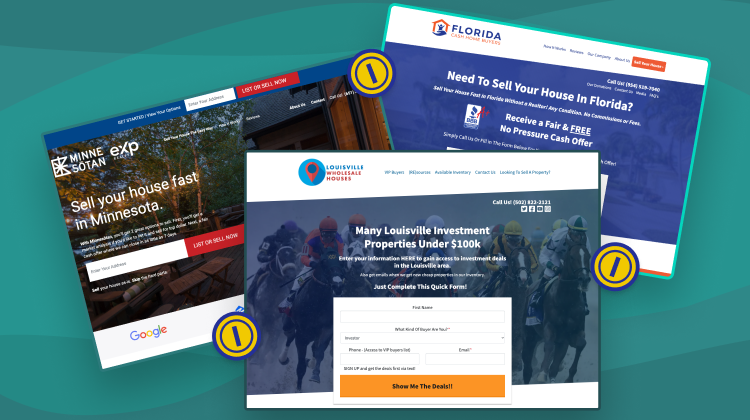
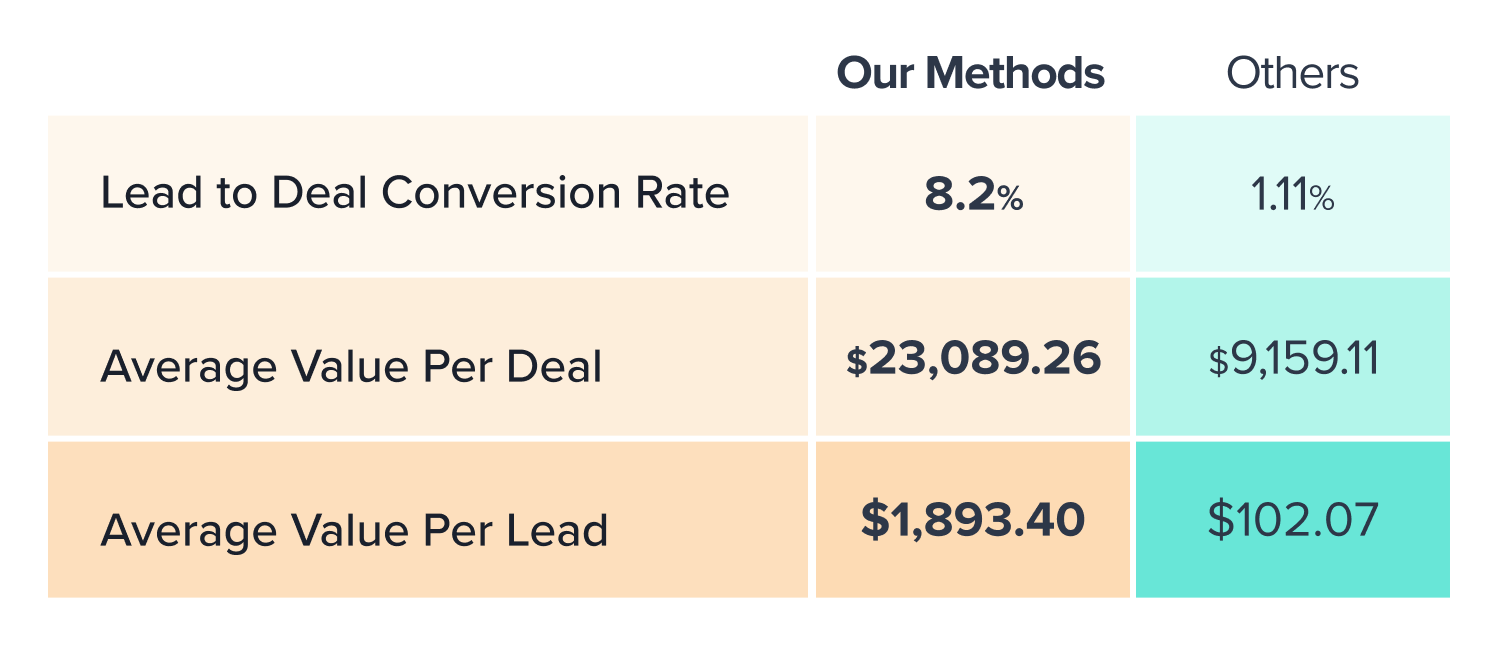
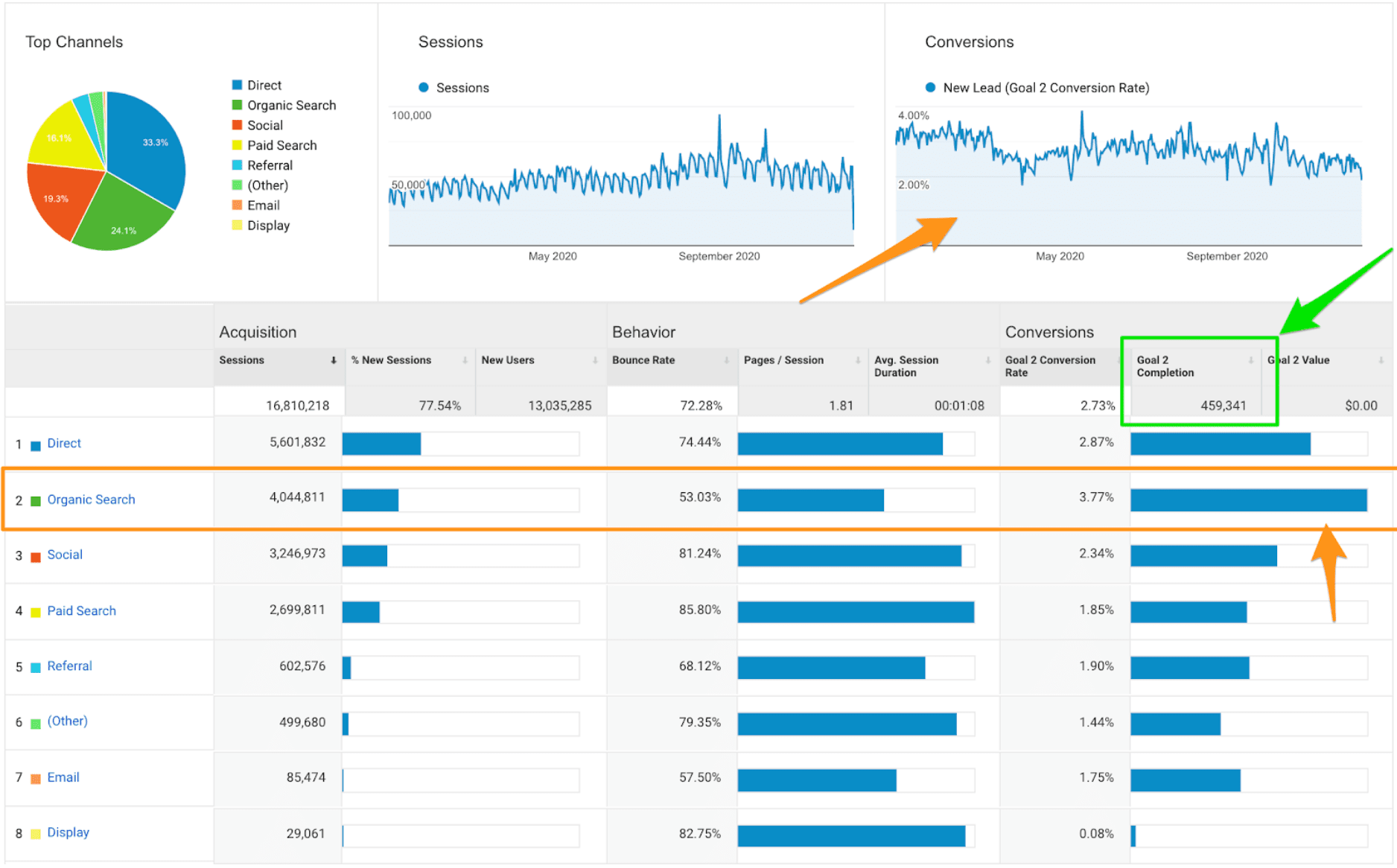
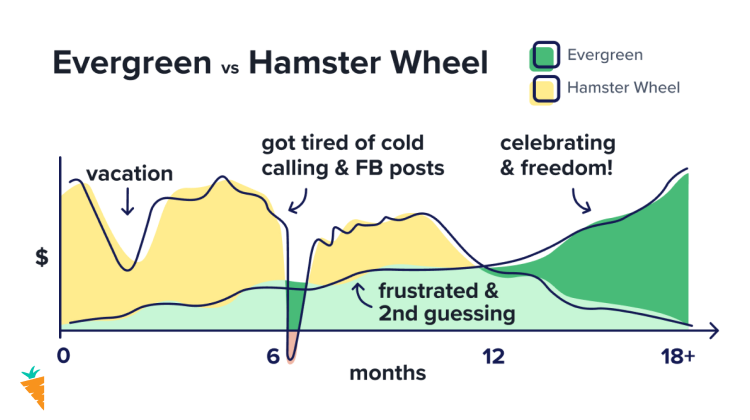
The worst thing that can happen is a lot of people click on your PPC ad (costing you money), but none of those people become a lead or turn into cold, hard cash for your business. That would make your PPC campaign a waste of time and money.
This is why where you send people (i.e., the landing page) when they click on your ad is so critical.
If you send prospects (even motivated sellers) to a low-converting landing page, you might still get some leads, but you won’t get as many as you could (how hard is it to hit the back button and click on your competitor’s website instead?).
Sadly, one lost deal could be between $10,000 and $50,000 down the drain, depending on your business model…
And that’s not money you’re willing to lose.
At Carrot, we’ve generated millions of online leads for real estate investors and agents. During that time, we’ve learned a thing or two about building a high-converting landing page.
Let’s talk.
What is a landing page for real estate PPC?
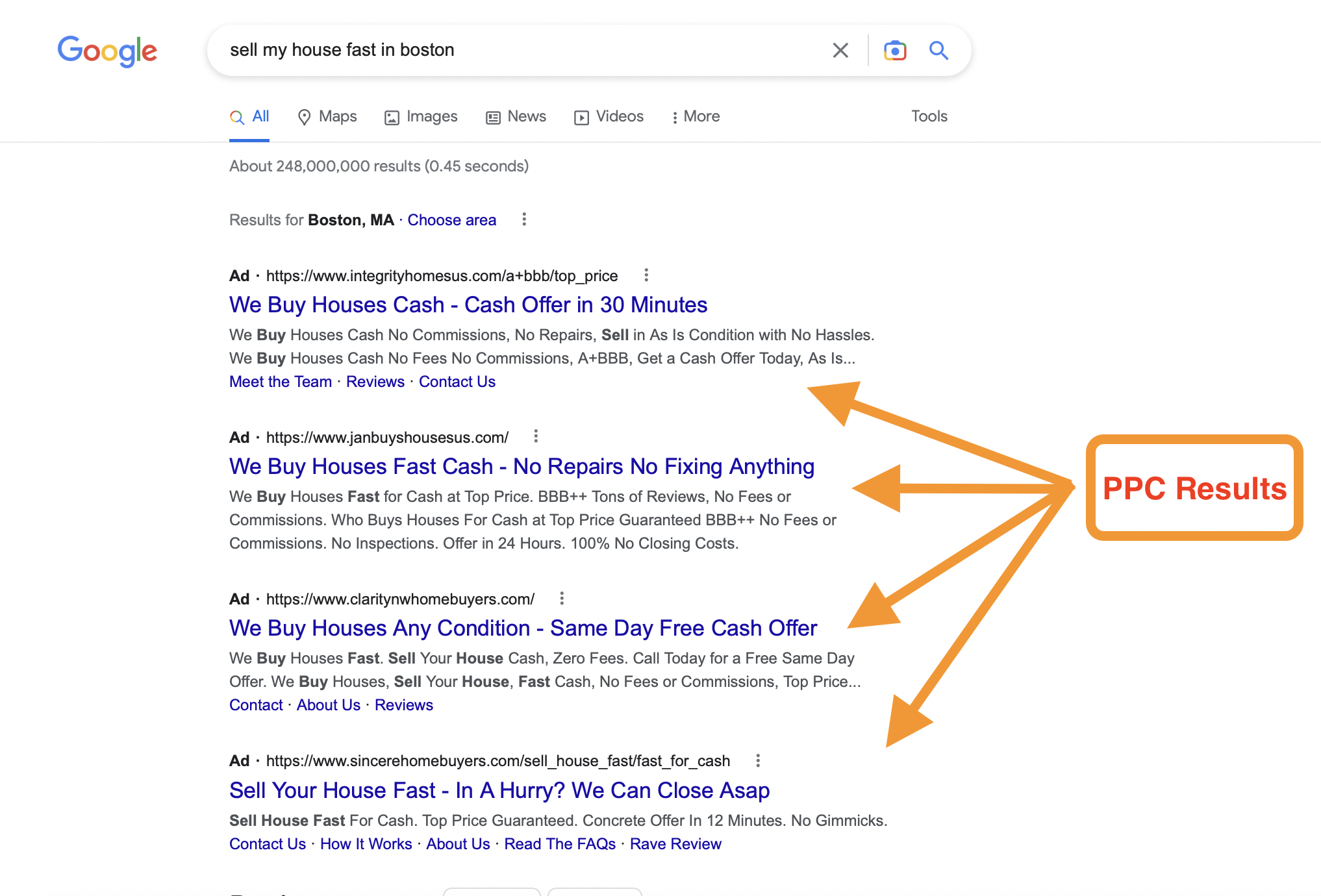
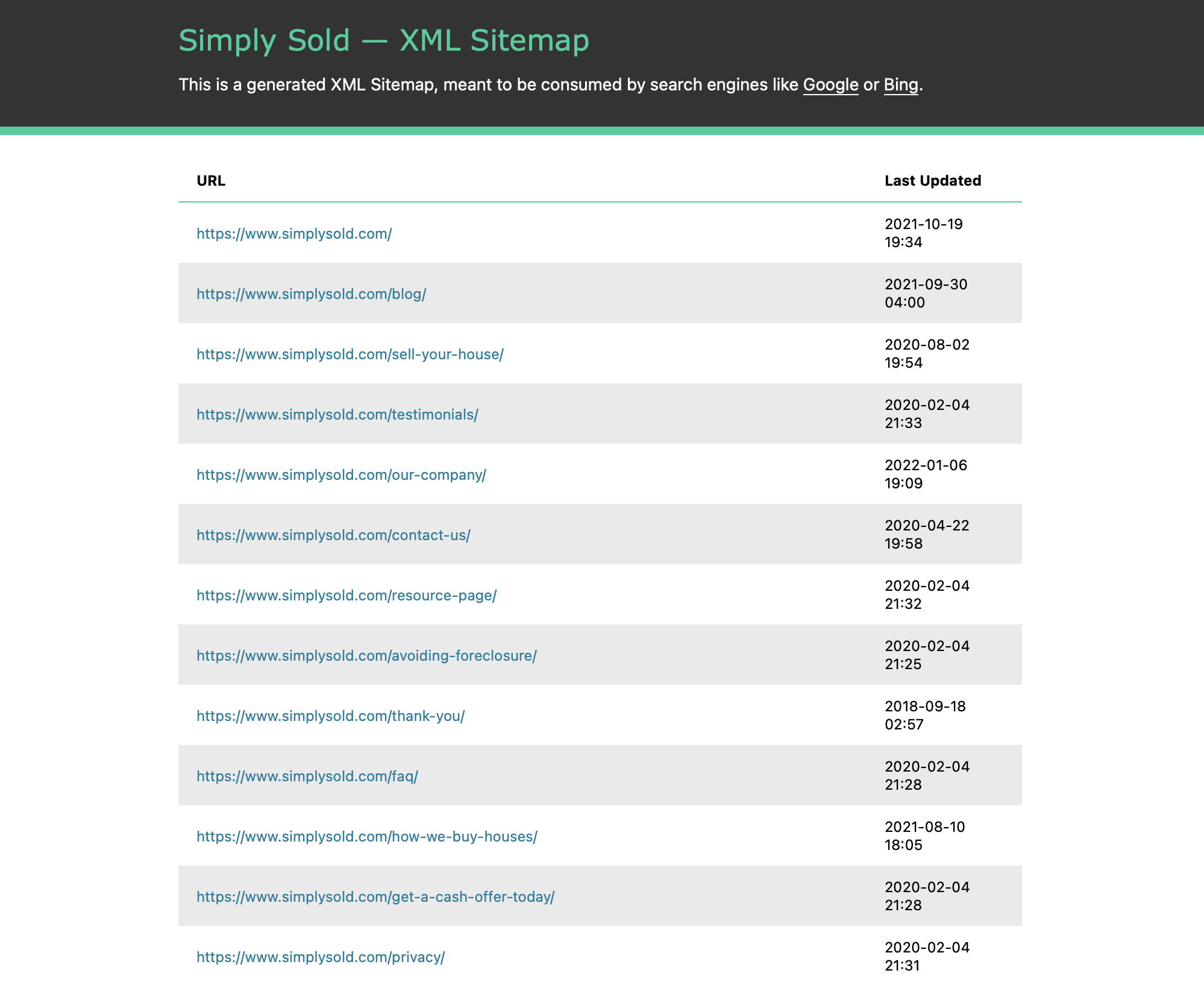
A landing page is just marketing terminology for the page you send people to in a marketing campaign.
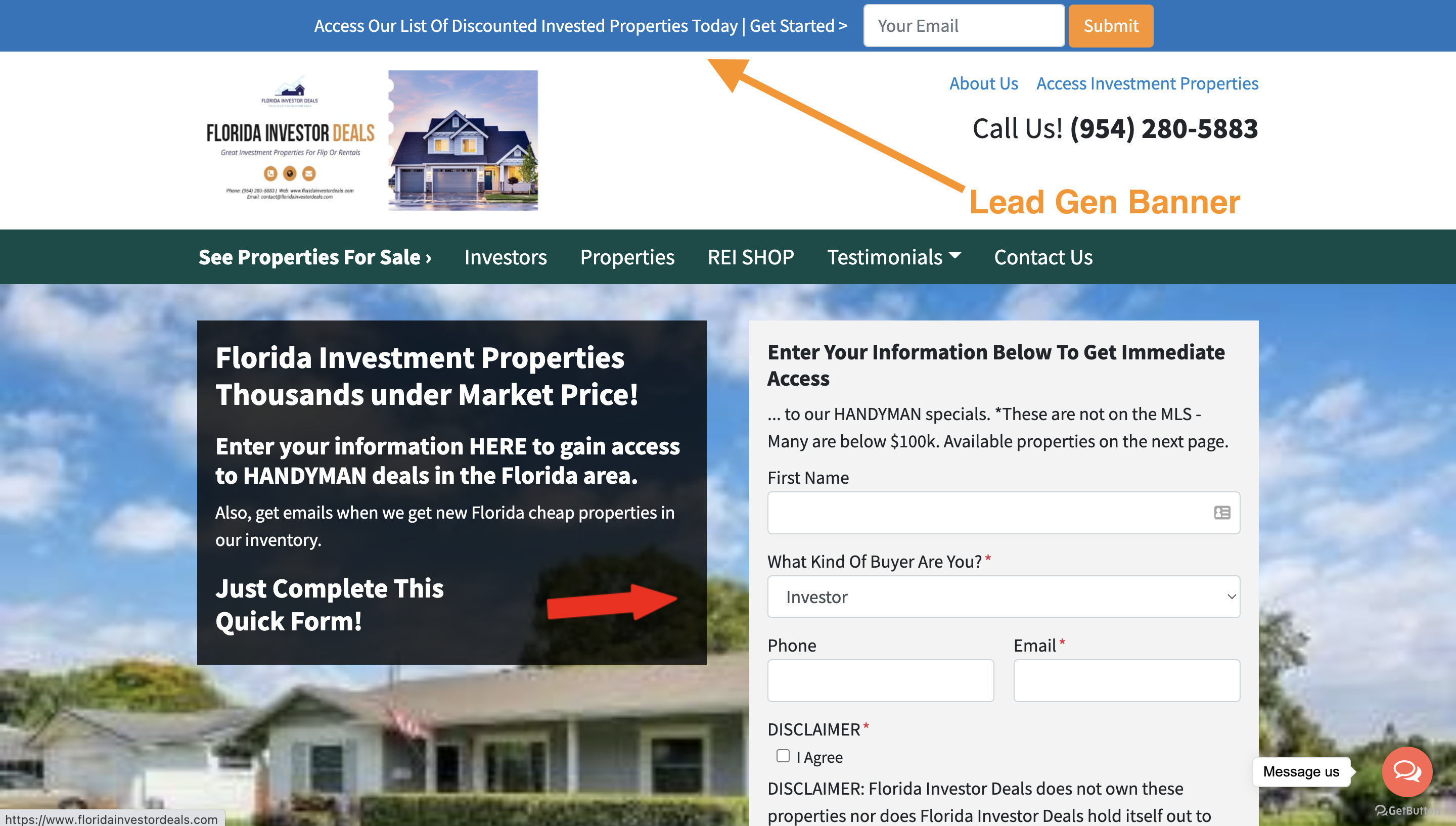
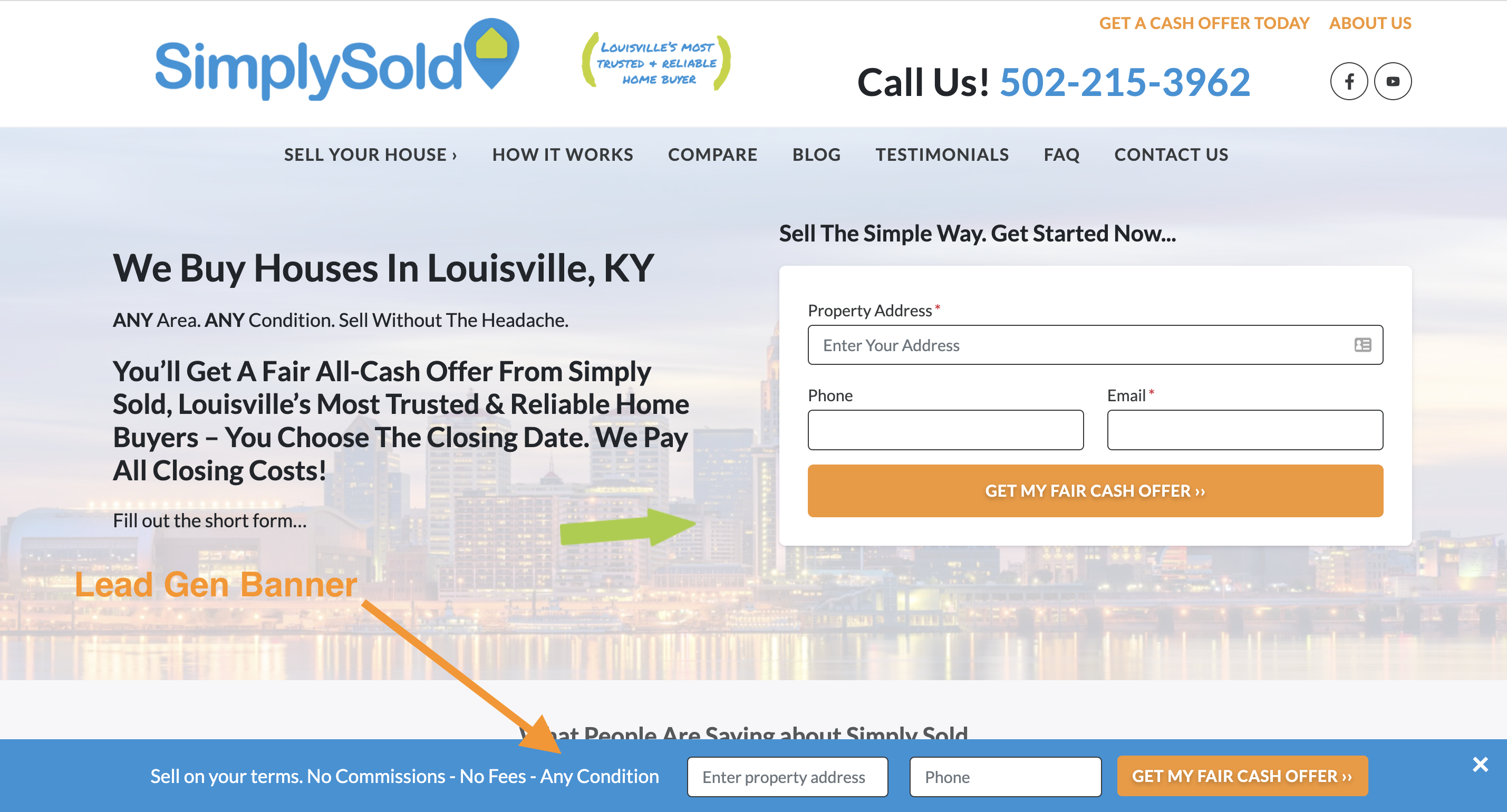
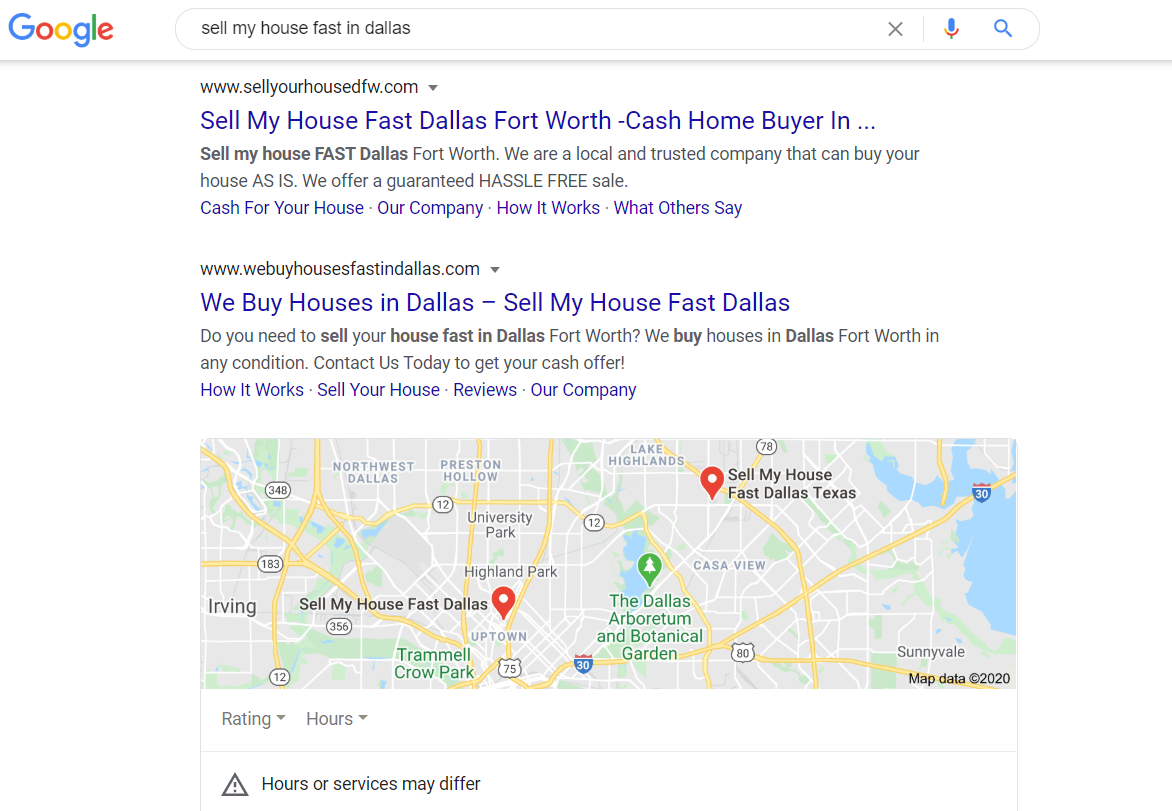
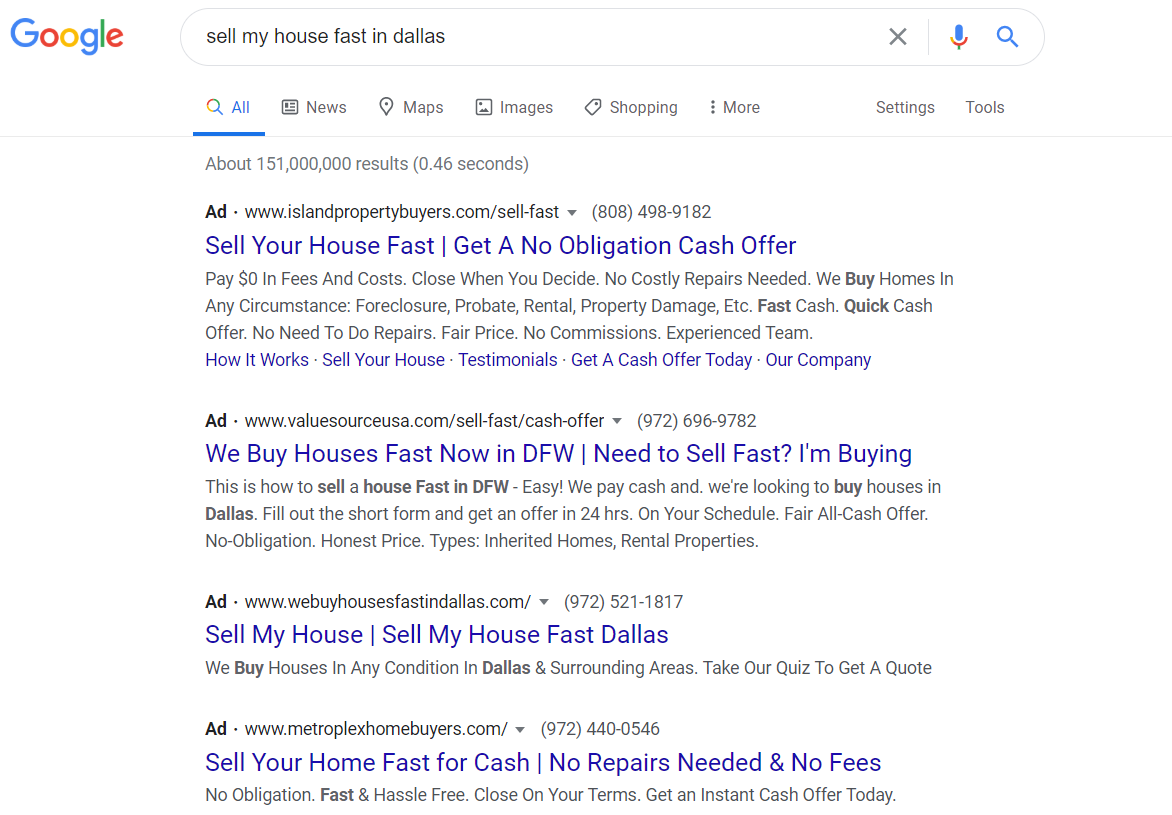
In the case of Google Ads, it’s the page people go to when they click on your ad. For example, if I click on this result…
The reason that optimizing your landing page is so essential is because it helps determine the effectiveness of your ad campaign. If the page people go to after clicking on your ad is irrelevant, unpersuasive, or even takes too long to load, they won’t stick around and will not become a lead.
Here’s a table summarizing the key differences of full webpages vs PPC landing pages:
Feature
Webpage
PPC Landing Page
Purpose
Informational, brand awareness
Lead generation, conversion-focused
Target Audience
Broader audience interested in real estate
Highly targeted audience, e.g., motivated sellers
Content
Diverse content: bio, services, blog posts
Focused on a single offer or call to action (CTA)
Navigation
Extensive navigation to other website pages
Limited or no navigation to avoid distractions
Call to Action (CTA)
May have various CTAs
Strong, clear CTA to capture leads
Now that you know what a landing page is and why it’s important, let’s talk about 7 elements of every landing page that impact conversion.
7 Elements You MUST Have for High-Converting PPC Landing Pages to Maximize Lead Generation
Element #1: Simple Opt-In Form
Every real estate website (agent or investor) at Carrot needs a high-quality, easy-to-fill-out opt-in form.
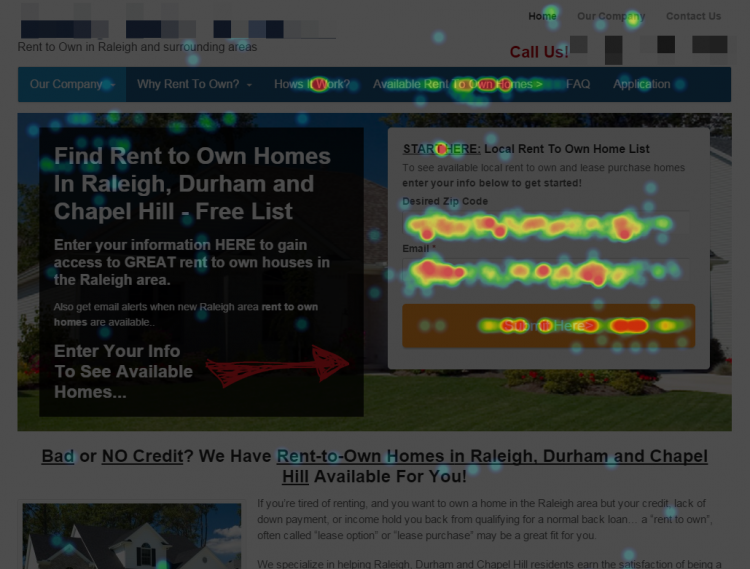
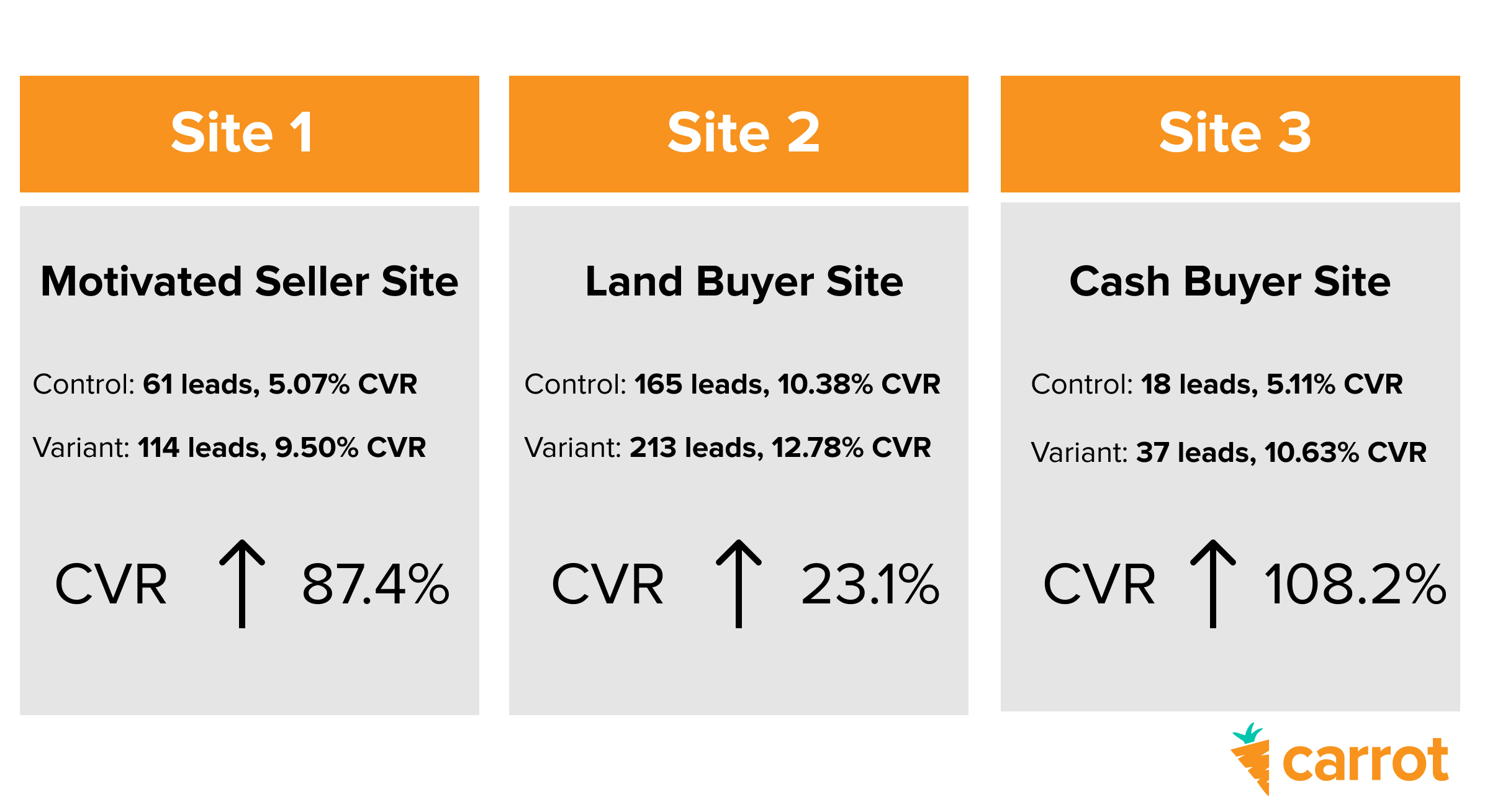
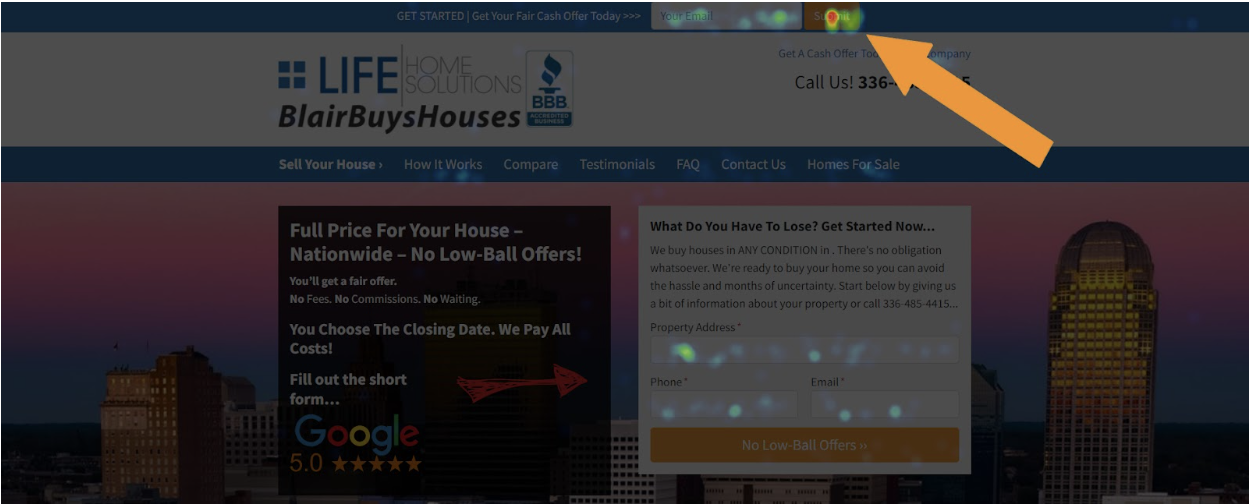
And we don’t just believe that for no reason: it’s science. We’ve run hundreds of A/B tests on our member’s websites to determine whether opt-in forms perform better than a “Call Now” CTA (they do) and what types of forms perform the best.
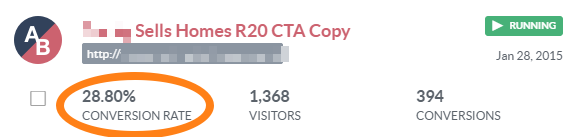
From one test we ran, we found that our member’s sites had almost a 30% conversion rate!
Here’s the heatmap from the test…
And here’s the data…
If you want a high-converting landing page right out of the box, our Carrot sites already have all the elements mentioned in this article baked right in. Or, if you want to build one yourself (no biggie!), here’s what you’ll want for your opt-in form…
Keep it simple and only have 3-4 fields for people to enter their information.
Ensure that the form you use is above the fold — meaning when people land on your website, it’s the first thing they see.
Have a big, clear button that’s a different color than everything else on your website.
High-Converting Element #2: Clear & Actionable Content
When it comes to capturing motivated sellers, clarity and action are key. Your landing page copy should be clear, concise, and laser-focused on the benefits you offer.
Why is clear content important for seller-focused landing pages?
Motivated sellers are in a time-sensitive situation. They need to understand your value proposition quickly and easily. Dense text blocks or overly technical jargon will only deter them.
Focus on Benefits, Not Features. Don’t just list your services; explain how you solve seller pain points. Highlight the benefits of selling to you, like a fast cash offer, a hassle-free process, or the ability to avoid costly repairs.
Action-Oriented Language: Motivate sellers to take the next step. Use strong verbs and clear calls to action throughout your landing page copy.
Best Practices for Persuasive Landing Page Content:
Keep it Short & Sweet: Stick to short paragraphs and bullet points for easy readability on any device.
Local Market Data: Showcase your knowledge of the area. Highlight relevant local market data, like average sales times or cash buyer trends, to demonstrate your expertise and ability to deliver a quick and smooth sale.
Focus on Seller Benefits: Use clear language to explain how you address their specific needs and challenges. For example, “We understand the stress of inherited property – get a fair cash offer and avoid costly repairs.”
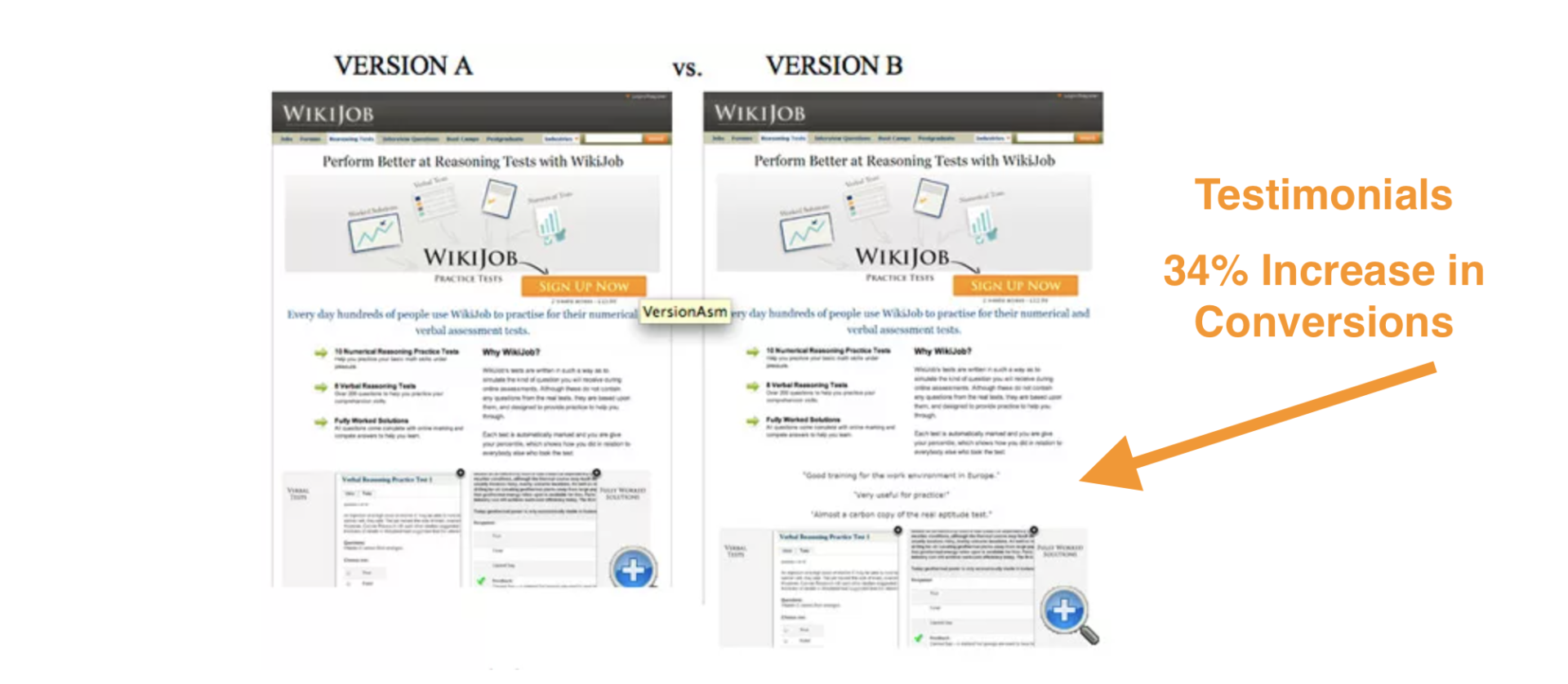
Testimonials & Social Proof: Integrate positive testimonials from satisfied sellers to build trust and credibility.
Remember: Your landing page copy should be a conversation starter, not a novel. Focus on clear communication, highlight the advantages of working with you, and guide sellers towards taking action (e.g., requesting a cash offer).
High-Converting Element #3: Compelling Headline
Your headline is like the golden sign outside your investor open house. It needs to grab attention, pique interest, and clearly communicate the value you offer. Real estate investors are busy, so a strong headline is crucial for making them stop scrolling and engage with your landing page.
Here are some key ingredients for crafting compelling headlines for real estate PPC landing pages:
Clarity: Keep it clear and concise. Investors should instantly understand what your offer is.
Relevance: Ensure the headline aligns with your target audience and the specific investor segment you’re targeting (e.g., flippers vs. buy-and-hold investors).
Benefit-Driven: Focus on the benefits your offer provides. What problem do you solve for investors? How can you help them achieve their goals?
Location-Specific (for Real Estate): Highlight your local expertise and cater to the specific market you serve. This personalizes the message and resonates with investors familiar with the area.
Example:
Let’s say you specialize in helping investors buy rental properties in a specific city. Here’s an example headline that incorporates these elements:
“Tired of Making Repairs? Get a Fair Cash Offer Today (Sell Your Rental Property Fast!)”
This headline is clear, relevant to buy-and-hold investors facing repair hassles, emphasizes the benefit of a quick cash offer, and targets investors specifically in your city.
High-Converting Element #4: Equally Compelling CTA
Your call to action (CTA) is the moment of truth on your real estate PPC landing page. It’s where you convert curious visitors into qualified leads by prompting them to take a specific action.
A strong CTA is essential for maximizing your lead generation efforts. Here’s what makes an effective CTA for real estate investors:
Clear Action Verbs: Tell investors exactly what you want them to do. Use strong verbs like “Download,” “Schedule,” or “Get Started.”
Prominent Placement: Make your CTA button stand out visually. Use contrasting colors and place it above the fold (visible without scrolling).
Relevant to Investor Goals: Your CTA should align with the value proposition you’ve presented and address the investor’s specific goals. Don’t ask them to “Learn More” if they’re ready to “Schedule a Consultation.”
Examples:
Consider these CTA examples tailored to different investor goals:
“Download Your How to Stop Foreclosure Guide” (Clear action verb, relevant to distressed property investors facing foreclosure)
“Schedule a Free Consultation to Find Your Perfect Investment Property” (Prominent placement, addresses buy-and-hold investor goals)
“Get a Fair Cash Offer Today!” (Strong verb, urgent tone for investors seeking a quick sale)
Remember: A/B testing different CTAs can help you determine which ones resonate best with your target audience.
From one test we ran at Carrot, we found that “Get My Fair Cash Offer” converted 49.55% better than “Click here to continue.”
Here are the exact percentages…
Giving people what they already want isn’t just less work for you; it converts better, too.
High-Converting Element #5: Trust Signals & Social Proof
Securing motivated sellers hinges on establishing trust. This is where trust signals and social proof come into play.
Trust Signals: These are visual cues that demonstrate your legitimacy and expertise as a real estate professional. They act as a digital handshake, assuring house sellers you’re a reliable and trustworthy partner to help them achieve their goals.
Social Proof: This leverages the power of “herd mentality.” By showcasing positive experiences from past clients (especially sellers in your local market), you demonstrate the effectiveness of your approach and encourage others to take action.
Why are these important for real estate investor landing pages targeting sellers?
House sellers are entrusting you with a significant financial decision – selling their property quickly and efficiently. By incorporating trust signals and social proof, you significantly increase the likelihood of converting website visitors into qualified leads.
Examples of Trust Signals:
Security Badges: Display logos indicating secure transactions and data protection.
Professional Licenses & Affiliations: Showcase your real estate licenses and relevant professional memberships.
Awards & Recognition: Highlight any industry awards or recognitions you’ve received.
Social Proof in Action for Real Estate Investors:
Seller Testimonials: Feature quotes and success stories from satisfied sellers, particularly those in your local market.
Case Studies: Showcase real-world examples of how you’ve helped sellers achieve their goals (e.g., “Sold John’s house in X days above asking price”).
Logos of Trusted Partners: Display logos of reputable companies you work with, like title companies or closing attorneys.
Remember: Social proof should be authentic and verifiable. Encourage seller reviews on trusted platforms like Google My Business or industry-specific sites.
By strategically integrating trust signals and social proof on your real estate investor landing pages, you build trust with potential sellers and establish yourself as a proven resource to help them achieve a smooth and successful sale.
High-Converting Element #6: Image That Paints Desire
Real estate is a visual business, and the same applies to your landing pages targeting motivated sellers. High-quality visuals are crucial for capturing attention, conveying information effectively, and ultimately, convincing sellers to choose you over other options.
Why are visuals important for seller-focused landing pages?
Attention Grabbing: Compelling visuals instantly capture attention and make your landing page stand out. In a sea of competing offers, strong visuals are the first impression that can convince sellers you’re the right buyer for their property.
Emotional Connection: The right visuals can evoke emotions and build trust with your audience. Use high-quality photos of beautiful homes you’ve helped sell or inspiring visuals of happy sellers receiving a fast cash offer. This creates an emotional connection and positions you as a solution to their situation.
Transparency & Trust: High-quality visuals demonstrate professionalism and transparency. Showcase problem-free solutions: for example, pictures of smooth walkthroughs or happy sellers signing paperwork. This builds trust and reassures sellers you’re a reliable partner in their sale.
Examples of Effective Visuals for Motivated Sellers:
High-Resolution Property Photos: Showcase attractive, professional photos of the types of properties you buy (e.g., single-family homes in need of repairs, inherited properties).
“Before & After” Photos: If you specialize in renovations, highlight your expertise with “before & after” photos showcasing the transformation potential of properties.
Fast Closing Videos: Short testimonial videos featuring sellers who received a quick cash offer can be incredibly powerful. These visuals demonstrate your ability to deliver a smooth and efficient sale process.
Data & Charts: Use data visualizations (e.g., charts showing average closing times) to communicate your commitment to a fast and hassle-free experience for sellers.
Remember: Don’t underestimate the power of visuals. Invest in high-quality photos or consider using high-resolution stock imagery that resonates with motivated sellers and showcases the types of properties you typically buy.
High-Converting Element #7: Quick Load Speed
In today’s mobile-driven world, ensuring your real estate investor PPC landing page is mobile-friendly is no longer optional – it’s essential. Here’s why:
Mobile Dominates Real Estate Searches: A significant portion of motivated sellers initiate their search for solutions (like cash buyers) from their smartphones. If your landing page isn’t optimized for mobile viewing, you’re missing out on a huge pool of potential leads.
Seamless User Experience: Mobile users expect a smooth and intuitive experience. A mobile-friendly landing page ensures clear navigation, easy-to-read text, and properly sized buttons for seamless interaction on any device. Frustrated sellers on clunky mobile pages are more likely to bounce and seek alternative solutions.
Faster Lead Generation: A responsive landing page loads quickly and functions flawlessly on mobile devices. This translates to faster form submissions and quicker lead capture when motivated sellers are ready to take action.
By prioritizing mobile-friendliness, you unlock several advantages in the competitive real estate market:
Increased Lead Generation: Capture leads from a wider audience of sellers who are searching and making decisions on their phones.
Improved Conversion Rates: A user-friendly mobile experience keeps sellers engaged and more likely to convert on your call to action (e.g., requesting a cash offer).
Enhanced Brand Image: A mobile-optimized landing page demonstrates professionalism and a commitment to providing a convenient experience for sellers, potentially positioning you as the go-to buyer for their needs.
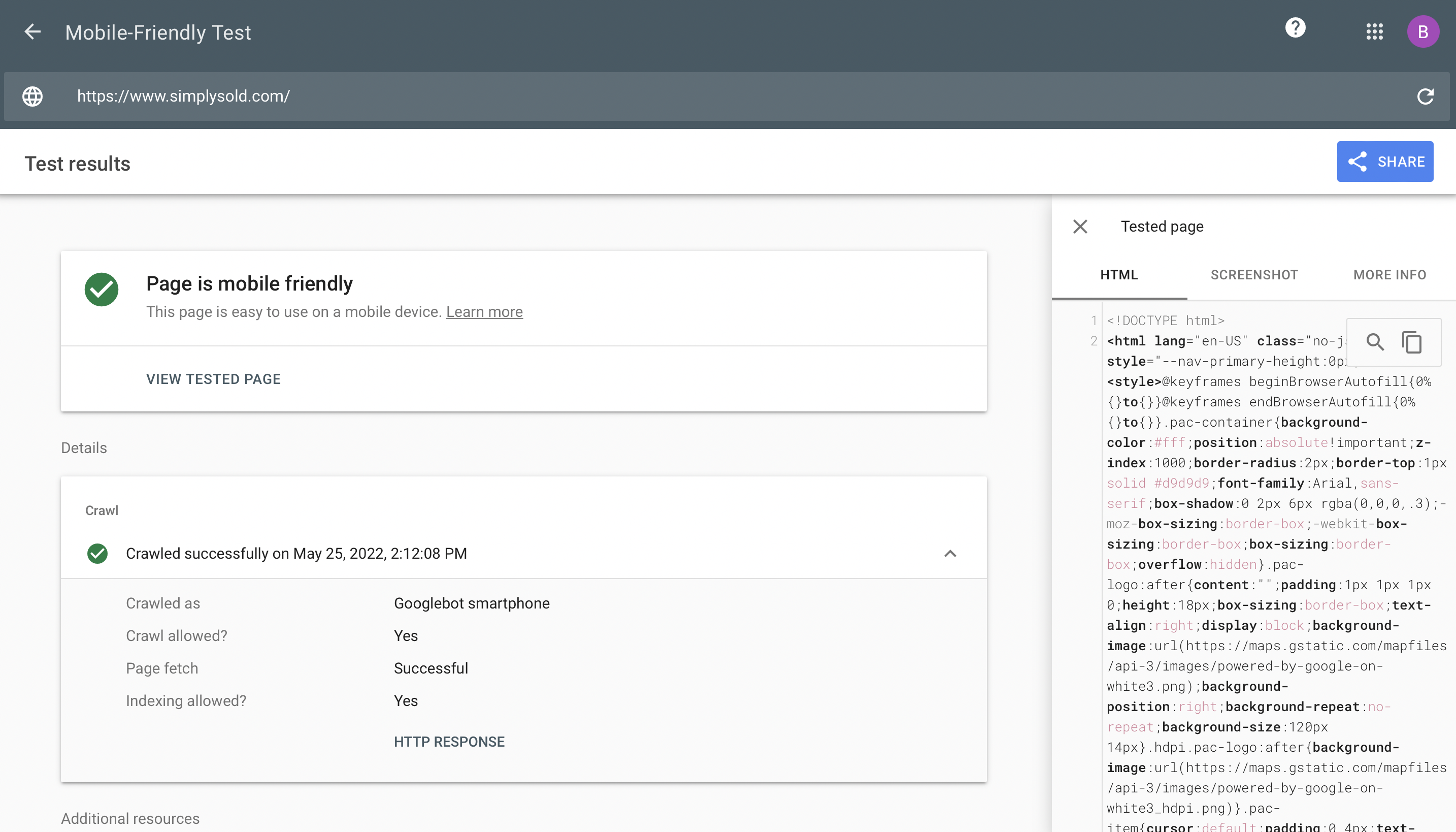
Remember: Don’t just assume your landing page is mobile-friendly. Use Google’s Mobile-Friendly Test tool or other resources to check responsiveness and ensure a smooth experience for sellers on any device.
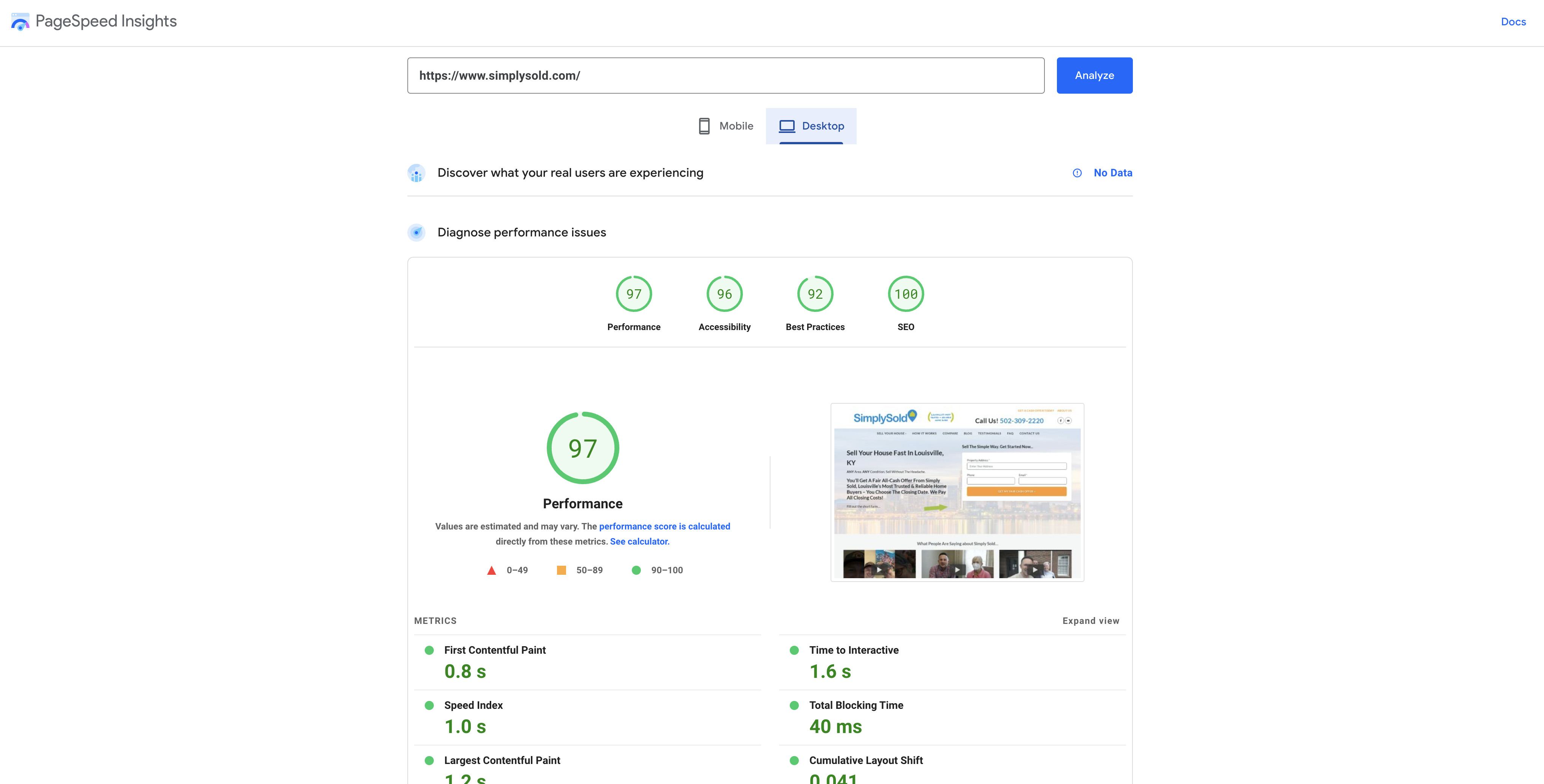
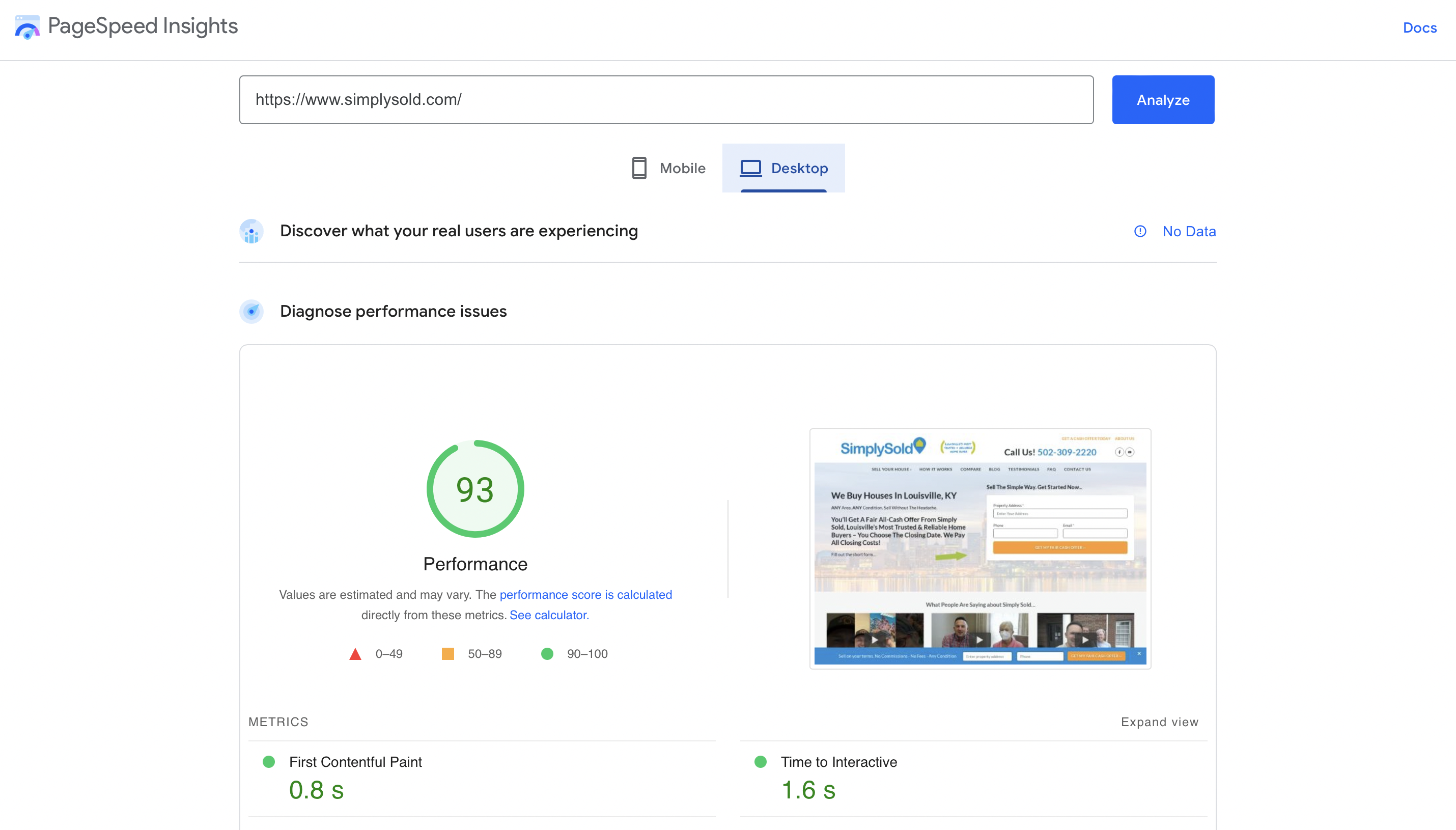
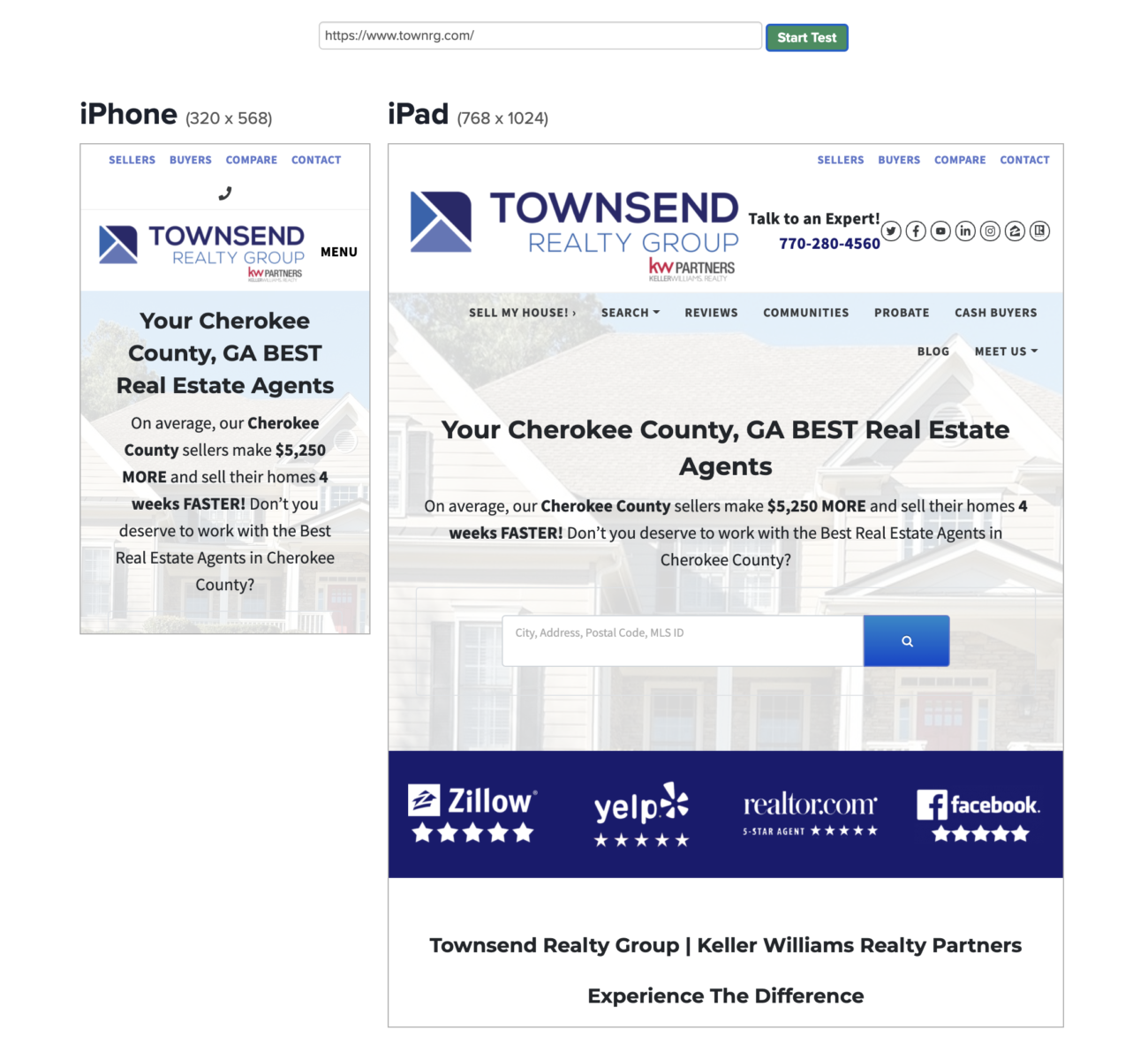
At Carrot, we’ve optimized all our member’s websites to be fast. Here are the results of one being run through a speed test.
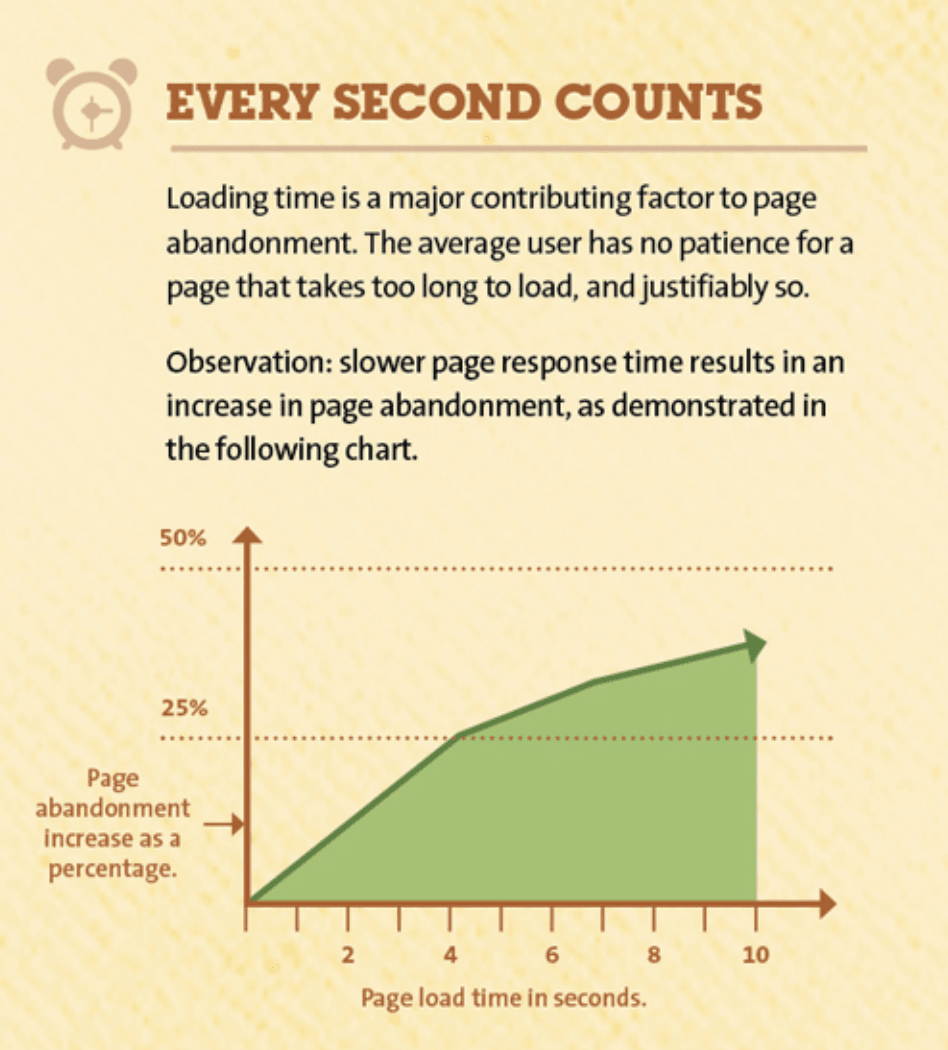
This helps with SEO rankings, and, more importantly, helps with the conversion rate. When your website loads quickly, people stay longer and are more willing to work with you than if they have a clunky and difficult experience.
It’s not the most important element in the world, but it does make a difference…
And how much would it cost you if a motivated seller, could-be-a-deal, left your website because it moved too slowly? $10,000? $50,000?
Yeah… it’s not worth it.
Bonus Section: Common Real Estate PPC Landing Page Mistakes to Avoid for Sellers
While crafting compelling landing pages to capture motivated sellers, here are some common mistakes to steer clear of:
Generic Landing Pages: Don’t use a one-size-fits-all approach. Tailor your landing page specifically to the needs of motivated sellers (e.g., facing foreclosure, inheriting a property) rather than a broad real estate audience.
Weak Value Proposition: A vague or unclear value proposition won’t resonate with time-sensitive sellers. Clearly state how you solve their problems and the benefits of working with you (e.g., “Sell your house fast for cash and avoid costly repairs”).
Confusing Navigation: A cluttered landing page with complex navigation will frustrate sellers. Keep it simple and focus on a single call to action (e.g., “Get a Cash Offer Now”).
Lack of Trust Signals: Sellers are entrusting you with a significant financial decision. Omit trust signals like security badges, professional licenses, or testimonials, and you risk losing credibility.
Excessively Lengthy Forms: Don’t overwhelm sellers with lengthy forms. Request only essential information needed to get started (e.g., property address, contact details).
Unrealistic Promises: Avoid making exaggerated claims about closing timelines or cash offer amounts. Focus on transparency and realistic expectations to build trust with sellers.
Not Tracking & Testing: Don’t set your landing page and forget it. Regularly track key metrics (e.g., conversion rates, bounce rates) and A/B test different elements (e.g., headlines, CTAs) to optimize your landing page performance for maximum lead generation.
By avoiding these common pitfalls and focusing on the best practices outlined above, you can create high-converting real estate investor PPC landing pages that effectively capture motivated sellers and propel your investment business forward.pen_sparktunesharemore_vert
How Do You Get Results?
PPC takes work but is essential for real estate professionals seeking more qualified leads. Real estate businesses can ensure high conversion rates by optimizing their landing page for conversion. This is especially important when targeting hyper-competitive markets such as Dallas, Miami, or Denver, where it’s even more critical for a business to have all conversion principles in place.
Doing so can increase lead generation by up to 2-3x or more compared to businesses without conversion optimization. With the right approach and strategy, you can use PPC to increase lead generation and build brand loyalty among your target markets.
If you’re already a member, here are some resources to help you learn more about PPC:
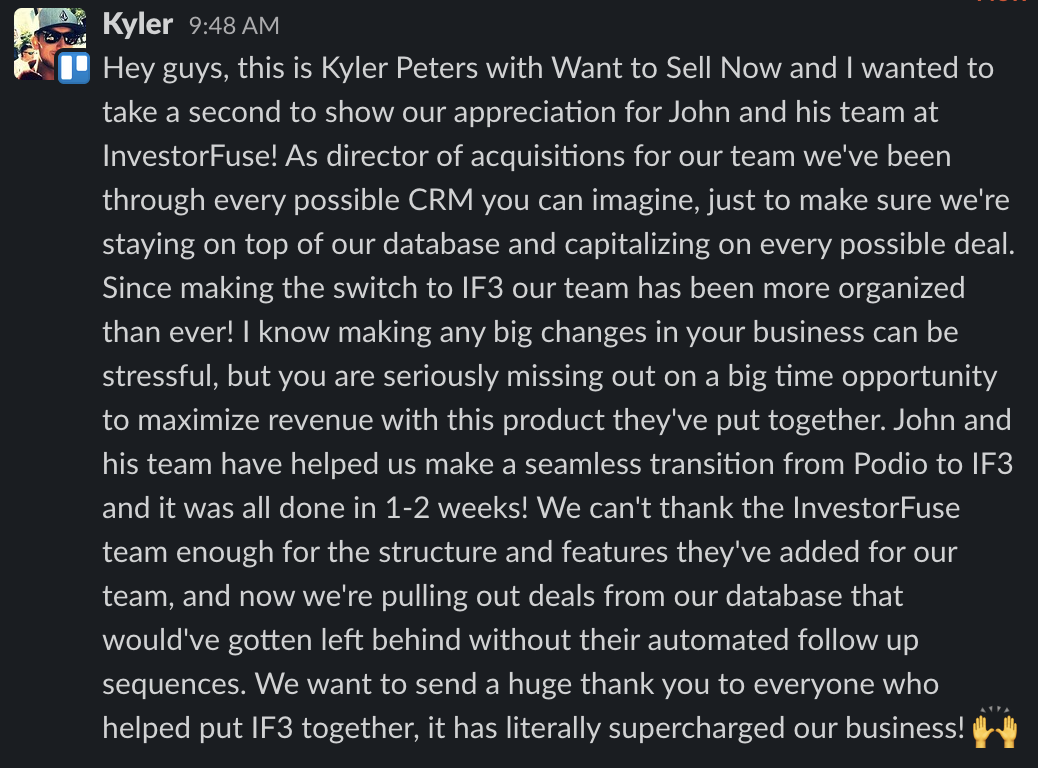
We have some fun news: Carrot has acquired InvestorFuse, a powerful lead management and follow-up CRM trusted by hundreds of top real estate investors and hybrid agents nationwide.
See How Carrot Works How many deals are you losing to your competitor’s website?
If you’ve heard of InvestorFuse or tried it in the past, this is the start of a new era for InvestorFuse, and we couldn’t be more excited.
In 2014, we founded Carrot to do one thing better than anyone else in the world… to help real estate investors stop losing leads and deals from an under-performing website (while crafting such an amazing customer experience, it sets the standard for the entire industry).
At the time, real estate investors and agents often looked at their website as a “nice to have” rather than a “critical to have.”
Countless “all-in-one” tools included websites as afterthoughts. You could launch free or cheap sites through companies like Wix and the legacy website builders in the real estate space focused on giving you 30 designs to choose from rather than putting the best performing tool in your hands from the start.
Since then, our single focus has been on performance. Helping our members launch and scale the fastest loading, best ranking, and highest converting websites for motivated sellers, cash buyers, tenants, and more. We’ve helped our members generate more inbound online motivated seller leads than any other single platform in the world.
But, over the years, we’ve had countless Carrot members ask us, “When is Carrot building a CRM? I’d love for all of my tools to be in one spot”.
It’s crazy tempting to build more new shiny objects, but what has contributed to our success has been that singular focus on going deep for our members rather than wide.
Converting more leads into deals in a competitive market
In early 2020, as we mapped out our 3-year vision, the topic of lead follow-up and management kept popping up in conversations. As markets became even more competitive, I’d be on phone calls with top investors and agents from around the nation, and a common theme kept coming up. “I’m getting lots of leads, but my close ratio has decreased slightly.”
It didn’t matter how motivated the leads they were getting through their Carrot sites were if they weren’t managing those leads “post opt-in” very well. I’d find leaky bucket after leaky bucket in our member’s follow-up practices and countless lost deals from disorganized lead management systems.
The more we peeled back the onion of the shifting market, the more it became critical for investors and agents to get leads and finally focus on tightening their systems to stop the leaky bucket of lost deals and revenue.
One lost deal from bad follow-up or clunky lead management can cost you $10k, $20k, $50k, or more. Not to mention your lost time working with systems not created from the ground up with investors and agents in mind.
Our decision to buy InvestorFuse
Going into 2021, we debated whether to “build or buy” our members’ a lead management/follow-up function. After digging deep into our vision and mission, we became convinced that we were only getting started building the best online marketing tool for those looking to attract the most motivated real estate leads online. And taking away from the resources required for those efforts would be harmful in the long run for our members.
So we set out to find a software company that aligned with our values, had an existing customer base already using both systems, and had a great team. They’d need a vision and singular focus to solve the problem of lead management and follow-up for real estate investors and agents.
In early 2021 I gave InvestorFuse founder Dan Schwartz a call to inquire about our interest. I knew InvestorFuse had built a fantastic reputation in its early years but had a rough “InvestorFuse 2.0” launch in 2020 that took some wind out of its sails.
During our call, I learned they’d just rolled out InvestorFuse 3.0 to the market. As we hung up that day, I said… “Man, our cultures, visions, and missions align so well. If you guys can prove InvestorFuse 3.0 is an amazing product that clients love over the next few months, we can build something extraordinary together.”
Fast forward to early 2022. InvestorFuse 3.0 client satisfaction was at an all-time high, and the team under new CEO John Whitfield was clicking. So we decided to close the deal… making InvestorFuse our first acquisition (hopefully more to come.)
Finally, complete end-to-end data. From website visitors to closed deal
Our first step is to unify the data from end to end to help build more intelligent applications that benefit all our members across both platforms to attract and convert more leads and deals online. Keep an eye out in 2023 for innovations you’ve never seen before.
How does this acquisition affect you?
In all the good ways! It starts with unlocking some amazing solutions for you as a real estate investor or hybrid agent, all under the Carrot umbrella.
Top investors like Beau Hollis, Keith Sant, Max Maxwell, Nick Perry, and Tyler Ford all use InvestorFuse… and we’re excited to continue building the best possible platforms that focus on being the best of class in what we do.
Carrot: for the best-of-breed high-performing real estate websites and online marketing.
InvestorFuse: for the best-of-breed lead management and follow-up for investors who want to streamline processes and save time. Especially those with teams or scaling into multiple markets.
If you’re already an InvestorFuse member, we’re excited to welcome you into the Carrot community. You’ve already seen new features, dozens of fixes, and additional investments hit your accounts in the past 6 months.
It’s only the beginning. Here’s a sample of features the InvestorFuse team has rolled out in the past few quarters…
Transactions beta (you’ll be able to handle the dispositions side of the business coming soon!)
… and dozens and dozens of improvements to the software across the board
I can’t say what’s coming over the coming months, but I can speak to keep your eyes out because our most significant innovations are on the horizon.
If you’re a Carrot member (but not an InvestorFuse member), this acquisition only strengthens the resources we’ll have to serve you. We’ve already started working with the InvestorFuse crew on some of our content and training efforts.
We’ve also been collaborating on tests and data deep-dives to discover new ways to help members on both platforms win more leads and deals. We’ll continue to find more ways to make upgrading into InvestorFuse easier and lower cost as a bundle.
If you’re already a member of both InvestorFuse and Carrot, amazing! We just rolled out our new direct Carrot + InvestorFuse integration inside of Carrot. It eliminates the need to use Zapier to send your leads from Carrot to InvestorFuse, saving you money and eliminating an extra step in the process.
Next, we’re looking for the best way for you to access both applications from one login. We’ll be improving the cohesiveness of the user interfaces to make the experience seamless and amazing.
Bundle Carrot + InvestorFuse and save (get a live demo)
For everyone, we’re experimenting with the best ways to reward active members of both systems.
Carrot member and want to demo InvestorFuse? If you’re not an InvestorFuse member and want a live demo to see what it can do for you, hop on a call with our Product Specialists.
If have a Carrot subscription, you can have free Access to Carrot CRM (coming soon), or a 20% recurring monthly discount for the three InvestorFuse plans:
Essentials $147 goes to $118 Pro $247 goes to $198 Premium goes from $377 to $302
Reach out to Carrot support with a request to “bundle and save,” and we’ll take care of the billing updates behind the scenes.
*The bundled rate applies to your base account subscription for each platform and cannot be applied to add-ons or text message credits. If you downgrade or cancel one of the platforms, your subscriptions will revert to their normal prices.
The beginning of the next chapter
Acquisitions, if not done right, can negatively affect the customer experience, and trust me, we’re going to make sure this doesn’t happen. We’ve been working hard to integrate the two companies, share best practices, and amplify the best of both companies. We’re excited to work towards our shared vision of helping you build a business of freedom and impact… now from lead… to closed deal.
Thank you so much for supporting Carrot over the years, and I honestly couldn’t be more excited about the years ahead. We are excited for you, the industry, and the positive impact we can all make together.
But real estate investing can be expensive. Rental properties can cost hundreds of thousands. Of course, you can take out an investment property loan, but you still need the 15-30% down payment.
You’re probably searching for creative real estate financing ideas if you cannot fund the project.
This guide will explain creative real estate financing and how you can do more deals by using many different methods to invest in real estate.
What is creative real estate financing?
Creative real estate financing is any type that falls outside traditional methods like banks, credit unions, and online lenders.
Typically, when people think of creative financing, they think of seller financing, private money lending, or lease options. But there are many other types of creative financing as well.
The key is to think outside the box and be willing to try new things. By doing so, you’ll have access to more opportunities and will be able to do more deals.
14 Creative Real Estate Financing Strategies
The following creative financing options are a great place to start:
To give you real-life creative financing strategies that real estate investors use to do more deals, we spoke with Pace Morby, the king of “sub to” deals and creative financing.
He said, “You can double or triple your deal flow without increasing your lead flow by being more creative.” Also: “I never once ran into a deal I couldn’t structure to be a win-win for myself and the seller by utilizing creative finance.”
Below, we’ve compiled many of the strategies he shared with us and some tactics other investors use.
Here they are!
1. Subject-To Financing
Subject-To financing is a creative real estate financing strategy that involves purchasing a property while leaving the existing mortgage. This method allows investors to acquire properties without securing new financing, making it an attractive option for buyers and sellers. However, it’s crucial to understand the intricacies and risks associated with subject-to transactions before proceeding.
Subject-To financing, short for “subject to existing financing,” entails buying a property while assuming the seller’s mortgage payments. The property title is transferred to the buyer, but the existing mortgage remains in the seller’s name. This arrangement allows the buyer to acquire the property with minimal upfront costs and without traditional financing.
However, subject-to financing carries inherent risks for both parties involved. Sellers may face potential risks if the buyer defaults on the mortgage payments, leading to foreclosure or damage to their credit. On the other hand, buyers must carefully assess the terms of the existing mortgage, including interest rates, prepayment penalties, and potential changes in loan terms.
Steps Involved in Completing a Subject-To Transaction
Negotiation: The buyer and seller negotiate the terms of the subject-to transaction, including the purchase price, terms of the existing mortgage, and any additional agreements or contingencies.
Due Diligence: The buyer conducts thorough due diligence to assess the property’s condition, title status, and financial viability. This includes reviewing the existing mortgage documents and verifying the seller’s loan obligations.
Documentation: Both parties execute a purchase agreement that outlines the terms of the subject-to transaction, including the transfer of ownership and responsibilities for mortgage payments. Additionally, legal documents such as a warranty deed or trust deed may be prepared to effectuate the transfer of title.
Loan Assumption: The buyer assumes responsibility for making mortgage payments on the existing loan, typically by establishing a separate escrow or trust account to cover ongoing payments. It’s crucial to ensure compliance with lender requirements and avoid triggering the due-on-sale clause, which could accelerate the loan balance.
Closing: The subject-to transaction is finalized at closing, where the buyer assumes ownership of the property, and the necessary legal documents are executed and recorded. The seller may receive any remaining equity in the property, and the buyer assumes full responsibility for managing the mortgage payments moving forward.
2. Seller Finance
Seller financing is a real estate transaction method where the seller acts as the lender, allowing the buyer to purchase the property with financing provided directly by the seller. This alternative financing arrangement offers unique advantages for both parties involved, fostering flexibility and facilitating transactions that might otherwise be challenging to complete through traditional lending channels.
Seller financing, also known as owner financing or seller carryback, involves the seller extending credit to the buyer to facilitate the property purchase. Instead of obtaining a mortgage loan from a bank or financial institution, the buyer makes regular payments directly to the seller over an agreed-upon period, typically at a negotiated interest rate.
The benefits of seller financing for buyers include:
Access to financing without meeting stringent bank requirements
Potential for more favorable loan terms, such as lower interest rates or flexible repayment schedules
Opportunity to purchase properties that may not qualify for traditional financing due to factors like condition or location
Streamlined closing process with reduced closing costs and paperwork compared to traditional loans
For sellers, the advantages of offering seller financing may include:
Attracting a larger pool of potential buyers, including those unable to secure traditional financing
Generating a steady stream of passive income through interest payments
Potentially selling the property at a higher price or with more favorable terms than through conventional sales methods
Retaining ownership of the property’s title until the loan is fully repaid, providing recourse in the event of default
How Seller Financing Works
In a seller financing arrangement, the buyer and seller negotiate the terms of the financing agreement, including the purchase price, down payment amount, interest rate, repayment schedule, and any other relevant terms or contingencies. Once both parties agree to the terms, they execute a purchase agreement or promissory note outlining the specifics of the financing arrangement.
Upon closing, the buyer makes a down payment to the seller, typically ranging from 10% to 20% of the purchase price, although this can vary depending on the agreement. The seller then extends credit to the buyer for the remaining balance, which the buyer repays over time through regular installment payments, including principal and interest.
Throughout the repayment period, the seller retains a security interest in the property, commonly referred to as a mortgage or deed of trust, which serves as collateral for the loan. In the event of default, the seller may have the right to foreclose on the property and reclaim ownership.
3. Morby Method
This creative real estate financing method was created and coined by Pace Morby. It’s so good we couldn’t exclude it.
It builds upon the previous method: seller financing.
A common hurdle you’ll run into if you start buying properties via seller financing is that the seller will want a large down payment. Unless you’ve got deep pockets, you can’t pay every seller a big down payment.
This method suggests that you agree to give the seller a large down payment, and then you go to an easy loan site (such as myinvestorloans.com) to finance 70% of the purchase price. You bring that 70% to the seller, who finances the remaining balance.
Now that you’ve purchased a property without your own money on the line, the seller gets their down payment.
4. Cash-Out Refinance
A cash-out refinance is a traditional mortgage loan where you take out a new loan for more than what you owe on your existing loan.
The difference between the two loans is given to you in cash. This cash can be used for anything, including investing in real estate.
A cash-out refinance can be a good option if you have home equity and need cash for a down payment on another investment property.
This is commonly used in the BRRRR method.
5. Hard Money Loans
Hard money loans are a specialized form of financing commonly used in real estate transactions, particularly for investment properties or projects that may not qualify for traditional bank loans. Understanding hard money loans’ characteristics, advantages, and requirements is crucial for investors seeking alternative funding options in the competitive real estate market.
Hard money loans are short-term, asset-based loans secured by real estate collateral. Unlike traditional bank loans, which prioritize the borrower’s creditworthiness and financial history, hard money lenders focus primarily on the value and potential of the underlying property. As such, hard money loans typically feature the following characteristics:
Higher Interest Rates: Hard money loans often carry higher interest rates than traditional mortgages, reflecting the increased risk associated with this type of financing.
Shorter Loan Terms: Hard money loans typically have shorter repayment periods, ranging from six months to a few years, with balloon payments due at the end of the term.
Quick Approval and Funding: Hard money lenders prioritize speed and efficiency, offering rapid approval and funding to accommodate time-sensitive real estate transactions.
Asset-Based Underwriting: Instead of scrutinizing the borrower’s credit score or income history, hard money lenders evaluate loan applications primarily based on the value and potential of the underlying property.
Secured by Real Estate Collateral: Hard money loans are secured by a lien on the financed property, providing the lender with recourse in the event of default.
Pros and Cons of Using Hard Money Lenders
Pros:
Accessibility: Hard money loans provide an alternative funding source for investors who may not qualify for traditional bank loans due to credit issues or property conditions.
Speed: Hard money lenders offer quick approval and funding, enabling investors to capitalize on time-sensitive opportunities or complete projects on tight timelines.
Flexibility: Hard money loans can be tailored to accommodate various real estate investment strategies, including fix-and-flip projects, property renovations, and short-term acquisitions.
Cons:
Higher Costs: Hard money loans typically come with higher interest rates, origination fees, and closing costs than traditional mortgages, increasing the overall cost of borrowing.
Shorter Terms: The shorter repayment periods of hard money loans may necessitate refinancing or selling the property within a relatively brief timeframe, potentially increasing the pressure on investors to generate returns quickly.
Risk of Loss: Since hard money loans are secured by real estate collateral, defaulting on the loan could result in foreclosure and loss of the property, posing significant risks for borrowers.
Criteria for Qualifying for Hard Money Loans
While hard money lenders may have varying eligibility requirements, common criteria for qualifying for hard money loans include:
Equity in the Property: Hard money lenders typically require borrowers to have a significant amount of equity in the property being financed, often ranging from 20% to 30% of the property’s appraised value.
Exit Strategy: Lenders may assess the borrower’s proposed exit strategy for repaying the loan, such as selling the property, refinancing with a traditional mortgage, or securing alternative funding.
Property Valuation: Hard money lenders conduct thorough appraisals or valuations of the property to assess its current market value and potential for appreciation.
Experience and Track Record: Some hard money lenders may consider the borrower’s experience and track record in real estate investing when evaluating loan applications, particularly for more complex or high-risk projects.
Real estate investors can make informed decisions when exploring alternative financing options for their investment ventures by understanding the defining characteristics, advantages, and requirements of hard money loans.
6. Private Money
Private money lenders play a crucial role in real estate financing, offering alternative funding solutions to investors and borrowers who may not qualify for traditional bank loans. Understanding the dynamics of private money lending, including identifying potential lenders and structuring loan agreements, is essential for navigating the complexities of real estate investment.
Private money lenders, or hard money lenders, are individuals or companies that provide short-term loans secured by real estate collateral. Unlike traditional banks or financial institutions, private money lenders often focus on the value and potential of the underlying property rather than the borrower’s credit history or financial standing.
Private money lenders play a vital role in real estate financing by offering flexible funding options for various real estate transactions, including fix-and-flip projects, property renovations, and short-term acquisitions. These lenders can provide rapid approval and funding, enabling investors to capitalize on time-sensitive opportunities or overcome financing obstacles.
How to Find and Approach Private Money Lenders
Networking: Attend real estate investment clubs, networking events, and industry conferences to connect with potential private money lenders. Building relationships with other investors, real estate professionals, and industry insiders can provide valuable referrals and introductions to reputable lenders.
Online Platforms: Explore online platforms and directories that connect borrowers with private money lenders. These platforms allow borrowers to submit loan requests and receive offers from multiple lenders, streamlining the process of finding financing for real estate projects.
Local Real Estate Associations: Engage with local real estate associations, chambers of commerce, and business networking groups to identify private money lenders in your area. These organizations often host meetings, seminars, and networking events where lenders and borrowers can connect and collaborate.
Real Estate Professionals: Leverage the expertise of real estate agents, brokers, and attorneys with experience working with private money lenders. These professionals can provide valuable insights, recommendations, and introductions to reputable lenders within their network.
When approaching private money lenders, you must present yourself professionally, articulate your investment goals and objectives clearly, and provide comprehensive information about the property and project you’re seeking financing for. Be prepared to answer questions about your experience, track record, and proposed exit strategy for repaying the loan.
Guidelines for Structuring Private Money Loans
Loan Terms: Negotiate the terms of the loan agreement, including the loan amount, interest rate, loan-to-value ratio, and repayment schedule. Clarify any additional fees or charges associated with the loan, such as origination fees or prepayment penalties.
Security and Collateral: Offer the property financed as collateral to secure the loan. Provide documentation, such as property appraisals or valuations, to support the loan amount and ensure adequate protection for the lender.
Legal Documentation: Draft and execute a comprehensive loan agreement or promissory note that outlines the rights and obligations of both the borrower and lender. Consult with legal professionals specializing in real estate law to ensure compliance with applicable regulations and laws.
Exit Strategy: Develop a clear exit strategy for repaying the loan, such as selling the property, refinancing with a traditional mortgage, or securing alternative funding. Communicate your proposed exit strategy to the lender and ensure you can fulfill your repayment obligations.
7. STABBL Loans
STABBL loans, or short-term asset-backed bridge loans, offer a unique financing solution for real estate investors and developers seeking quick access to capital for time-sensitive projects. Understanding the features, benefits, and considerations associated with STABBL loans is essential for effectively leveraging this alternative financing option.
Explanation of STABBL Loans
STABBL loans are short-term financing instruments secured by tangible assets, such as real estate, equipment, or inventory. These loans are typically used to bridge funding gaps for real estate acquisitions, renovations, or other investment opportunities requiring immediate capital. STABBL loans offer flexible terms, rapid approval, and streamlined underwriting processes, making them ideal for investors seeking short-term financing solutions.
Benefits and Challenges of STABBL Loans
Benefits:
Quick Access to Capital: STABBL loans provide investors with rapid access to capital, allowing them to seize time-sensitive investment opportunities or address urgent funding needs.
Flexible Terms: STABBL loans offer flexible repayment terms, allowing borrowers to customize the loan structure to suit their specific project requirements and financial objectives.
Asset-Backed Security: STABBL loans are secured by tangible assets, providing lenders with collateral and reducing the risk associated with lending. This asset-backed security may enable borrowers to secure more favorable loan terms or higher loan amounts.
Challenges:
Higher Interest Rates: STABBL loans often come with higher interest rates than traditional financing options, reflecting the short-term nature of the loans and the associated risks.
Shorter Repayment Periods: STABBL loans typically have shorter repayment periods, requiring borrowers to repay the loan within a relatively brief timeframe. This may pressure borrowers to generate returns quickly or secure alternative financing for longer-term projects.
Asset Valuation and Due Diligence: Lenders may conduct thorough due diligence and asset valuation assessments to determine the loan amount and terms, requiring borrowers to provide comprehensive documentation and assurances of the asset’s value and potential.
Tips for Structuring Successful STABBL Loans
Understand Loan Terms: Familiarize yourself with the terms and conditions of the STABBL loan, including interest rates, repayment schedules, and any associated fees or charges. Clarify any ambiguities or uncertainties before committing to the loan.
Assess Project Viability: Conduct a comprehensive assessment of the project’s viability, including financial projections, market analysis, and risk factors. Ensure that the project aligns with your investment objectives and has the potential to generate sufficient returns to repay the loan.
Negotiate Favorable Terms: Negotiate with the lender to secure favorable loan terms, including competitive interest rates, flexible repayment schedules, and reasonable fees. Leverage your asset’s value and potential to negotiate more favorable terms.
Have an Exit Strategy: Develop a clear exit strategy for repaying the STABBL loan, such as selling the asset, refinancing with long-term financing, or securing alternative funding sources. Communicate your exit strategy to the lender and ensure it aligns with the loan’s repayment schedule and terms.
By understanding the features, benefits, and considerations associated with STABBL loans, borrowers can effectively leverage this financing option to fund real estate projects and capitalize on investment opportunities while managing associated risks and challenges.
8. Joint Ventures in Real Estate
Joint ventures in real estate involve collaboration between two or more parties to pursue a specific real estate project or investment opportunity. These partnerships allow investors to combine resources, expertise, and capital to achieve common investment objectives. Understanding the dynamics of joint ventures, including their benefits, challenges, and best practices for structuring agreements, is essential for successful collaboration in real estate ventures.
Explanation of Joint Ventures in Real Estate
In real estate, a joint venture typically involves two or more parties pooling their resources and expertise to undertake a specific project or investment opportunity. Joint ventures can take various forms, including partnerships between individuals, companies, or entities such as real estate developers, investors, or property owners.
Key features of joint ventures in real estate include:
Shared Ownership: Joint venture partners typically share ownership and control of the real estate project or investment, with each party contributing capital, assets, or expertise to the venture.
Defined Objectives: Joint ventures have specific objectives or goals, such as acquiring a property, developing a project, or generating returns through property management or leasing activities.
Mutual Benefit: Partners in a joint venture collaborate to achieve mutual benefit, leveraging each other’s strengths and resources to maximize the venture’s success.
Risk Sharing: Joint venture partners share the risks and rewards associated with the real estate project, spreading the risk among multiple parties and mitigating individual exposure.
Benefits and Challenges of Partnering with Other Investors
Benefits:
Access to Capital: Joint ventures provide access to additional capital and resources, allowing investors to pursue larger or more complex real estate projects than they could undertake individually.
Diversification: Partnering with other investors diversifies risk by spreading exposure across multiple parties and investments, reducing the impact of individual project failures or market downturns.
Complementary Expertise: Joint venture partners bring diverse skill sets, knowledge, and experience to the table, enhancing the overall capabilities and effectiveness of the partnership.
Shared Costs and Responsibilities: Partners in a joint venture share the costs and responsibilities of the real estate project, reducing the burden on individual investors and increasing efficiency.
Challenges:
Decision-Making: Joint ventures require consensus and collaboration among partners, which can sometimes lead to disagreements or delays in decision-making.
Risk of Conflict: Differences in goals, expectations, or management styles among partners can lead to conflicts or disputes within the joint venture, potentially jeopardizing the project’s success.
Shared Profits: Joint venture agreements typically involve sharing profits and returns with partners, reducing the individual share of profits compared to a solo investment.
Complexity: Structuring and managing joint ventures require careful planning, documentation, and ongoing communication among partners.
Tips for Structuring Successful Joint Venture Agreements
Define Objectives and Roles: Clearly define the objectives, roles, and responsibilities of each partner in the joint venture agreement, outlining expectations, contributions, and decision-making processes.
Establish Legal Structure: Choose an appropriate legal structure for the joint venture, such as a partnership, limited liability company (LLC), or corporation, and draft a comprehensive agreement outlining the terms and conditions of the partnership.
Allocate Risks and Rewards: Determine how risks and rewards will be allocated among partners, including profit-sharing arrangements, equity stakes, and mechanisms for resolving disputes or conflicts.
Address Exit Strategies: Include provisions for exiting the joint venture, such as buyout options, dissolution procedures, or mechanisms for selling or transferring ownership interests.
Consult Legal and Financial Advisors: Seek guidance from legal and financial professionals experienced in real estate joint ventures to ensure compliance with relevant laws and regulations and mitigate legal and financial risks.
By understanding the benefits, challenges, and best practices associated with joint ventures in real estate, investors can effectively leverage collaboration to pursue lucrative investment opportunities and maximize returns while minimizing risks and conflicts.
9. Lease Purchase Agreements
Lease purchase agreements offer a unique arrangement allowing individuals to lease a property with the option to purchase it later. Understanding the structure, advantages, and potential pitfalls of lease purchase agreements is essential for buyers and sellers considering this type of transaction.
Definition and Structure of Lease Purchase Agreements
A lease purchase agreement, a rent-to-own or lease option agreement, is a contractual arrangement between a buyer and seller that combines lease and purchase agreement elements. In a lease purchase agreement:
The buyer leases the property from the seller for a predetermined period, typically one to three years, when they pay rent and an additional option fee.
The buyer has the option, but not the obligation, to purchase the property at the end of the lease term, usually at a pre-negotiated price.
A portion of the rent payments may be credited toward the property’s purchase price, providing the buyer with equity buildup over the lease term.
Benefits and Drawbacks of Lease Purchase Agreements for Buyers and Sellers
Benefits for Buyers:
Path to Homeownership: Lease purchase agreements allow buyers to move into a property immediately while working towards homeownership, even if they don’t have sufficient funds for a down payment or can’t qualify for a mortgage upfront.
Price Lock: Buyers can lock in a purchase price for the property upfront, protecting them from potential increases in property values during the lease term.
Flexibility: Lease purchase agreements provide buyers with flexibility and time to assess the property and its suitability for their needs before committing to a purchase.
Drawbacks for Buyers:
Non-Refundable Option Fee: Buyers typically pay a fee upfront, which can be a substantial cost if they decide not to exercise their option to purchase the property.
Obligations and Risks: Buyers may be responsible for maintaining the property and paying for repairs and maintenance during the lease term, even though they don’t yet own the property.
Benefits for Sellers:
Higher Rent Payments: Sellers can typically charge higher rent payments under lease purchase agreements, as a portion of the rent may be credited towards the property’s purchase price.
Reduced Vacancy Risk: Lease purchase agreements can help sellers find tenants more quickly and reduce the vacancy risk, as they attract tenants who are serious about eventually purchasing the property.
Drawbacks for Sellers:
Limited Buyer Pool: Lease purchase agreements may limit the pool of potential buyers. Not all renters are interested in or financially capable of purchasing the property at the end of the lease term.
Potential for Default: Sellers face the risk of buyers defaulting on the lease or failing to exercise their option to purchase the property, which could result in extended vacancies or legal complications.
Tips for Negotiating Favorable Lease Purchase Terms
Clear Terms and Conditions: Clearly outline the terms and conditions of the lease purchase agreement, including the purchase price, option fee, rent payments, lease term, and any other relevant details.
Flexible Terms: Negotiate flexible terms that benefit both parties, such as adjustable purchase prices, rent credits, and lease extensions or renewal options.
Due Diligence: Conduct thorough due diligence on the property and the other party involved in the transaction to ensure that the terms of the lease purchase agreement are fair and equitable.
Legal Counsel: Seek the advice of legal professionals specializing in real estate law to review and draft the lease purchase agreement, ensuring compliance with applicable laws and regulations.
Communication: Maintain open and transparent communication throughout the negotiation process to address any concerns or questions and ensure that both parties agree on the terms of the agreement.
By understanding the structure, benefits, and potential challenges of lease purchase agreements and following these tips for negotiating favorable terms, buyers and sellers can navigate the process effectively and achieve their goals in a lease purchase transaction.
10. Home Equity Loan
Utilizing home equity as a funding source for real estate investments can offer significant advantages, providing homeowners with access to capital for property acquisitions, renovations, or other investment opportunities. However, it’s essential to understand the various strategies, risks, and alternative methods associated with tapping into home equity effectively.
Strategies for Tapping into Home Equity to Fund Real Estate Investments
Home Equity Loan (HEL) or Home Equity Line of Credit (HELOC): Homeowners can borrow against the equity in their property by obtaining a home equity loan or opening a home equity line of credit. These loans typically offer favorable interest rates and flexible repayment terms, making them ideal for financing real estate investments.
Cash-Out Refinance: With a cash-out refinance, homeowners refinance their existing mortgage, replacing it with a new loan that exceeds the current mortgage balance. The difference between the new loan amount and the existing mortgage balance is paid out to the homeowner in cash, providing access to a lump sum of equity.
Home Equity Investment: Some platforms and investment vehicles allow homeowners to access home equity without additional debt. Homeowners can sell a percentage of their home’s future appreciation to investors in exchange for upfront cash, providing liquidity while retaining property ownership.
Home Equity Sharing: Home equity sharing arrangements enable homeowners to access equity in their property by selling a percentage of the home’s future appreciation to investors or partners. In exchange, investors receive a share of the property’s appreciation when it is sold or refinanced.
Risks and Considerations Associated with Using Home Equity
Increased Debt Burden: Tapping into home equity through loans or refinancing increases the homeowner’s overall debt burden, potentially impacting their financial stability and ability to meet repayment obligations.
Risk of Foreclosure: Defaulting on home equity loans or lines of credit puts the homeowner at risk of foreclosure, as the lender may seek to recoup their investment by seizing the property.
Interest Costs: Borrowing against home equity incurs interest costs, which can add up over time and increase the total cost of borrowing. Homeowners should consider the long-term implications of interest payments on their financial situation.
Market Volatility: Real estate markets are subject to fluctuations in property values, economic conditions, and other external factors. Using home equity to finance investments exposes homeowners to the inherent risks of real estate investing, including potential declines in property values.
Alternative Methods for Leveraging Home Equity
Seller Financing: Homeowners looking to sell their property can offer seller financing to potential buyers, allowing them to purchase the property with a down payment and regular installment payments directly to the seller.
Joint Ventures: Partnering with other investors or real estate professionals in joint venture agreements can provide access to additional capital and expertise for real estate investments, reducing the need to rely solely on home equity.
Peer-to-Peer Lending: Peer-to-peer lending platforms connect borrowers with individual investors willing to fund their projects. Homeowners can explore peer-to-peer lending as an alternative source of financing for real estate investments, leveraging their creditworthiness and income potential.
Equity Crowdfunding: Equity crowdfunding platforms enable homeowners to raise capital by selling their property shares to a large group of investors. This allows homeowners to access funding without taking on debt or risking foreclosure.
By weighing the risks and benefits of tapping into home equity and exploring alternative methods for leveraging equity, homeowners can make informed decisions about financing real estate investments and pursue opportunities that align with their financial goals and risk tolerance.
11. Cross Collateralization
Cross collateralization is a type of creative financing where you use more than one property as collateral for a loan.
For example, let’s say you have a portfolio of five properties worth $100,000. You could use all five properties as collateral for a $500,000 loan.
The advantage of cross-collateralization is that you can get a larger loan than you could with just one property — or you can use your assets (rather than cash) to secure a hefty loan.
The downside is that if you default on the loan, the lender could foreclose on your properties. So, using this strategy only if you’re confident in making the payments is important.
12. Self-Directed IRA Investing
Self-directed IRAs offer investors a unique opportunity to diversify their retirement portfolios beyond traditional stocks, bonds, and mutual funds by allowing them to invest in a wide range of alternative assets, including real estate. Understanding the fundamentals of self-directed IRAs, their application in real estate investing, and the associated tax implications and regulations is crucial for maximizing the investment potential of these retirement accounts.
Overview of Self-Directed IRAs and Their Investment Potential
Self-directed IRAs are retirement accounts that offer investors greater control and flexibility over their investment choices compared to traditional IRAs. With a self-directed IRA, investors can invest in alternative assets such as real estate, private equity, precious metals, and more, providing opportunities for portfolio diversification and potentially higher returns.
The investment potential of self-directed IRAs in real estate is significant, allowing investors to acquire various properties, including residential homes, commercial buildings, rental properties, and land, directly or indirectly through partnerships, LLCs, or real estate investment trusts (REITs).
How to Use a Self-Directed IRA to Fund Real Estate Deals
Establishing a Self-Directed IRA: To begin investing in real estate through a self-directed IRA, investors must establish a self-directed IRA account with a qualified custodian or administrator specializing in alternative investments. The custodian will facilitate the investment process and ensure compliance with IRS regulations.
Funding the Self-Directed IRA: Once the self-directed IRA account is established, investors can fund the account by transferring funds from existing retirement accounts, such as traditional IRAs, 401(k)s, or rollover IRAs. Investors can contribute annually to their self-directed IRAs within the IRS contribution limits.
Identifying Investment Opportunities: With funds in the self-directed IRA, investors can explore various real estate investment opportunities, including direct property acquisitions, real estate partnerships, private lending, and investing in REITs or real estate funds.
Executing Real Estate Transactions: When investing in real estate through a self-directed IRA, all transactions must be conducted through the IRA account, and all income and expenses related to the investment must flow in and out of the IRA. This includes rental income, property maintenance costs, property taxes, and any proceeds from property sales.
Tax Implications and Regulations to Consider
Prohibited Transactions: The IRS imposes strict rules and regulations regarding prohibited transactions and disqualifies persons in self-directed IRAs. Prohibited transactions, such as self-dealing or using IRA funds for personal benefit, can result in severe tax penalties and disqualification of the IRA.
Unrelated Business Income Tax (UBIT): Income from certain real estate investments within a self-directed IRA may be subject to unrelated business income tax (UBIT). This tax applies to income derived from debt-financed property or certain types of passive income, such as rental income from leveraged properties.
Required Minimum Distributions (RMDs): Investors with self-directed IRAs must adhere to IRS rules regarding required minimum distributions (RMDs) once they reach the age of 72. Failure to take RMDs as required can result in substantial tax penalties.
Consultation with Tax Professionals: Given the complex tax implications and regulations associated with self-directed IRAs and real estate investing, investors are strongly advised to consult with qualified tax professionals, attorneys, or financial advisors specializing in self-directed retirement accounts and real estate investments.
By understanding the mechanics of self-directed IRAs, leveraging them to fund real estate deals, and navigating the associated tax implications and regulations, investors can harness the full potential of these retirement accounts to build wealth, diversify their portfolios, and secure their financial futures through real estate investing.
13. BRRRR Method
The BRRRR method, which stands for Buy, Rehab, Rent, Refinance, Repeat, is a popular real estate investment strategy that offers a systematic approach to building a rental property portfolio while maximizing returns and minimizing risks. Understanding the components and nuances of the BRRRR method is essential for investors looking to leverage this strategy effectively.
Overview of the BRRRR Method
The BRRRR method is a five-step process that involves:
Buy: Acquiring a distressed or undervalued property below market value, typically through off-market deals, foreclosure auctions, or direct negotiations with motivated sellers.
Rehab: Renovating or rehabilitating the property to increase market value and appeal to potential tenants. Depending on the property’s condition and investment goals, this may involve cosmetic updates, repairs, or more extensive renovations.
Rent: Finding tenants and securing rental income for the property. This step involves marketing the property, screening potential tenants, and executing lease agreements to generate cash flow.
Refinance: Once the property is stabilized and generating rental income, refinance it with a new mortgage loan based on its improved value. The goal is to pull out as much of the investor’s initial capital as possible, ideally achieving a loan-to-value (LTV) ratio of 75-80%.
Repeat: Using the proceeds from the refinance to fund the acquisition of additional investment properties and repeat the process, thereby building a portfolio of income-producing assets over time.
Benefits and Drawbacks of the BRRRR Method
Benefits:
Maximized Returns: The BRRRR method allows investors to leverage their capital efficiently by recycling it from one property to the next, maximizing returns and accelerating portfolio growth.
Equity Buildup: By acquiring distressed properties below market value and increasing their value through renovations, investors can quickly build equity in their properties, enhancing long-term wealth accumulation.
Cash Flow: Rental income from the property provides ongoing cash flow, which can be reinvested into additional properties or used to cover expenses and generate passive income.
Drawbacks:
Execution Risks: The success of the BRRRR method depends on the investor’s ability to identify undervalued properties, accurately estimate renovation costs, and manage the rehab process effectively. Poor execution or underestimating expenses can result in cost overruns and diminished returns.
Market Conditions: Market fluctuations and economic factors can impact property values, rental demand, and financing terms, affecting the feasibility and profitability of BRRRR projects.
Capital Requirements: While the BRRRR method offers the potential to recycle capital and leverage financing, investors still need sufficient initial capital to fund property acquisitions, renovations, and holding costs until the property is stabilized.
Tips for Implementing the BRRRR Method
Thorough Due Diligence: Conduct comprehensive market research and property analysis to identify viable investment opportunities and mitigate risks associated with the BRRRR method.
Accurate Cost Estimation: Develop detailed renovation budgets and estimate expenses to ensure rehab projects stay on track and within budget.
Strategic Financing: Work with lenders experienced in real estate investment financing to secure favorable loan terms and maximize leverage while minimizing risks.
Effective Property Management: Implement robust property management practices to maintain and maximize rental income, minimize vacancies, and ensure tenant satisfaction.
Continuous Learning: Stay informed about market trends, industry best practices, and evolving regulations to adapt and refine your BRRRR strategy over time.
By understanding the components, benefits, and potential challenges of the BRRRR method and following these tips for implementation, investors can leverage this strategy to build a sustainable and profitable rental property portfolio over the long term.
14. Crowdfunding
Real estate crowdfunding has emerged as a popular alternative investment option, allowing individuals to pool their resources and invest in real estate projects through online platforms. Understanding the dynamics of real estate crowdfunding, including how it operates and successful examples, is essential for investors looking to diversify their portfolios and participate in the real estate market.
Introduction to Real Estate Crowdfunding Platforms
Real estate crowdfunding platforms serve as intermediaries that connect investors with real estate developers or sponsors seeking funding for their projects. These platforms leverage technology and online networks to democratize access to real estate investment opportunities, enabling individuals to invest in properties they may not have access to otherwise.
Key features of real estate crowdfunding platforms include:
Diverse Investment Opportunities: Crowdfunding platforms offer many investment opportunities, including residential properties, commercial real estate, development projects, and more.
Accessibility: Real estate crowdfunding platforms allow investors to participate in real estate deals with lower minimum investment amounts than traditional real estate investments, making them accessible to a broader audience.
Transparency and Due Diligence: Crowdfunding platforms provide investors with comprehensive information, including property details, financial projections, and sponsor backgrounds, enabling informed investment decisions.
Streamlined Investment Process: Through online platforms, investors can browse available deals, review investment details, and complete transactions seamlessly, streamlining the investment process.
How Crowdfunding Works for Real Estate Investments
Real estate crowdfunding operates on a crowdfunding model, where multiple investors contribute funds towards a specific real estate project in exchange for an ownership stake or a share of the project’s returns. The process typically involves the following steps:
Selection of Projects: Real estate developers or sponsors submit projects to crowdfunding platforms for consideration. Projects undergo due diligence and vetting processes to assess their viability, potential returns, and alignment with investor preferences.
Investment Offering: Once approved, projects are listed on the crowdfunding platform, where investors can review project details, financial projections, and investment terms. Investors can participate in projects by committing funds to the investment offering.
Funding Period: Crowdfunding campaigns have a specified period during which investors can contribute funds towards the project. Once the funding target is met, the project moves forward, and investors become equity holders or lenders, depending on the investment structure.
Project Execution: Real estate developers or sponsors execute the project according to the proposed plan, leveraging the funds raised through crowdfunding to acquire, develop, or manage the property. Investors receive updates on the project’s progress and performance through the crowdfunding platform.
Distribution of Returns: Upon completion or sale of the project, investors receive distributions of returns based on their investment stake. Returns may include rental income, property appreciation, or proceeds from the sale of the property, depending on the project’s performance.
Examples of Successful Crowdfunding Campaigns
Fundrise:Fundrise is a leading real estate crowdfunding platform that offers a range of investment options, including eREITs (real estate investment trusts) and eFunds. The platform has facilitated investments in diverse real estate projects, providing investors access to institutional-quality properties and competitive returns.
RealtyMogul:RealtyMogul is another prominent real estate crowdfunding platform that offers a variety of investment opportunities, including commercial properties, multifamily buildings, and debt investments. The platform has successfully funded numerous projects across different asset classes, providing investors with a streamlined investment experience and attractive returns.
These examples demonstrate the diverse investment opportunities available through real estate crowdfunding platforms and the potential for investors to participate in lucrative real estate projects while mitigating risks and diversifying their portfolios.
Can you buy a house without a loan?
Yes, you can buy a house without a loan if you have the cash to pay for it outright or use one of the other creative financing methods.
You don’t need a loan if you have the cash to pay for a property outright. You can buy the property and own it free and clear.
If you don’t have the cash to pay for a property outright, you can use one of the other creative financing methods, such as seller financing, private money lending, or lease options.
Can you buy a house with bad credit and/or no money down?
The short answer is yes; you can buy a house with bad credit and no money down. But you’ll have to be creative and likely avoid going the traditional route.
One option is to find a seller willing to finance the property purchase. Another option is to use a private money lender. These individuals are willing to loan you money for your real estate investment.
You can also look into lease options and rent-to-own agreements. These are creative ways to buy a property with bad credit and no money down.
Ultimately, it will be up to you to find a creative way to finance your real estate investment. But know it is possible to do so even if you have bad credit and no money down.
Final Summary
Creative financing is a great way to buy property when you don’t have the traditional means.
There are many different types of creative financing, such as seller financing, lease options, private money lending, and more.
Each type of financing has its own set of pros and cons. The key is finding the type of financing that works for every deal your way.
And remember, even if you have bad credit and no money down, there are still ways to finance your real estate investment. You have to be creative!
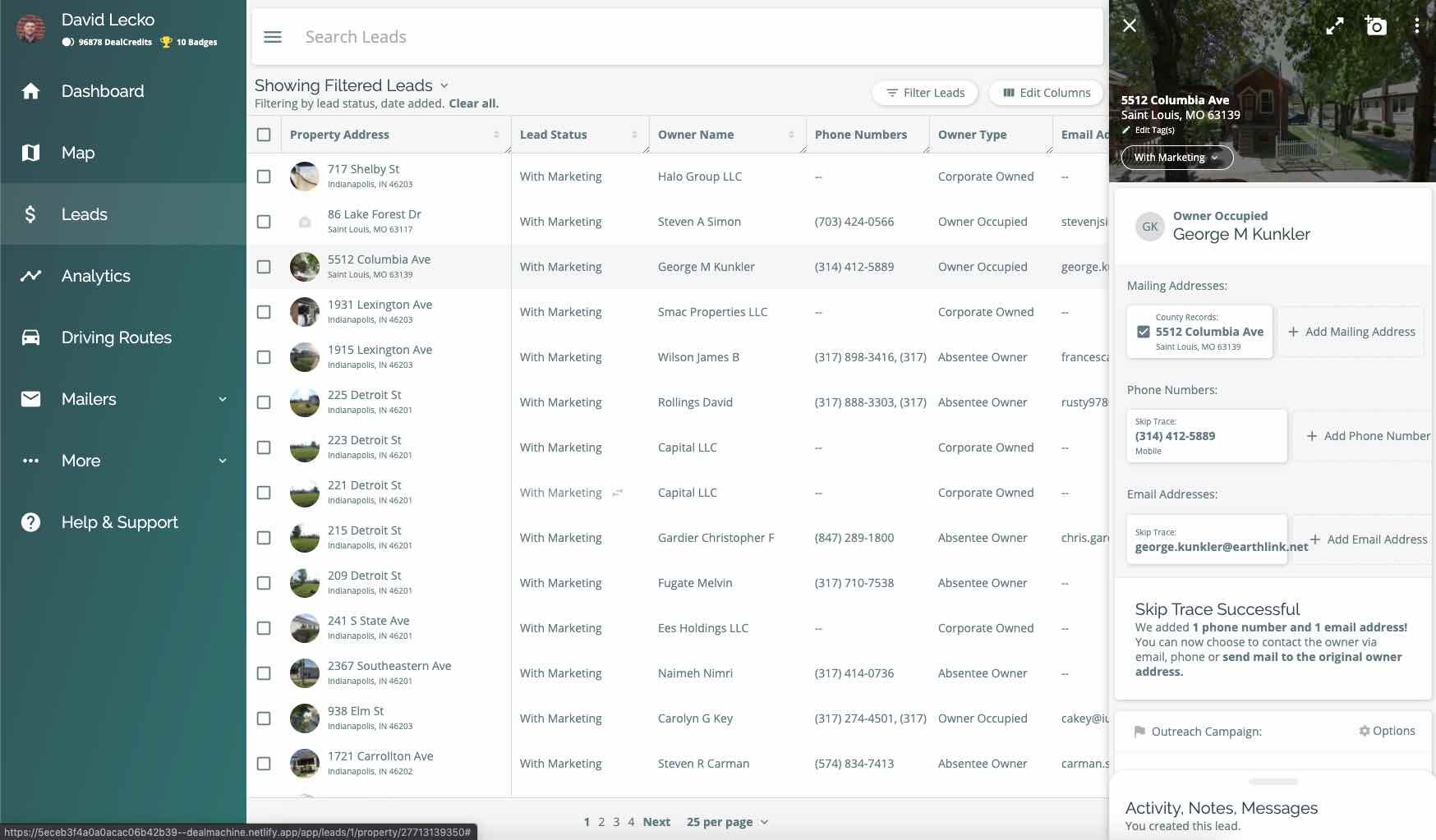
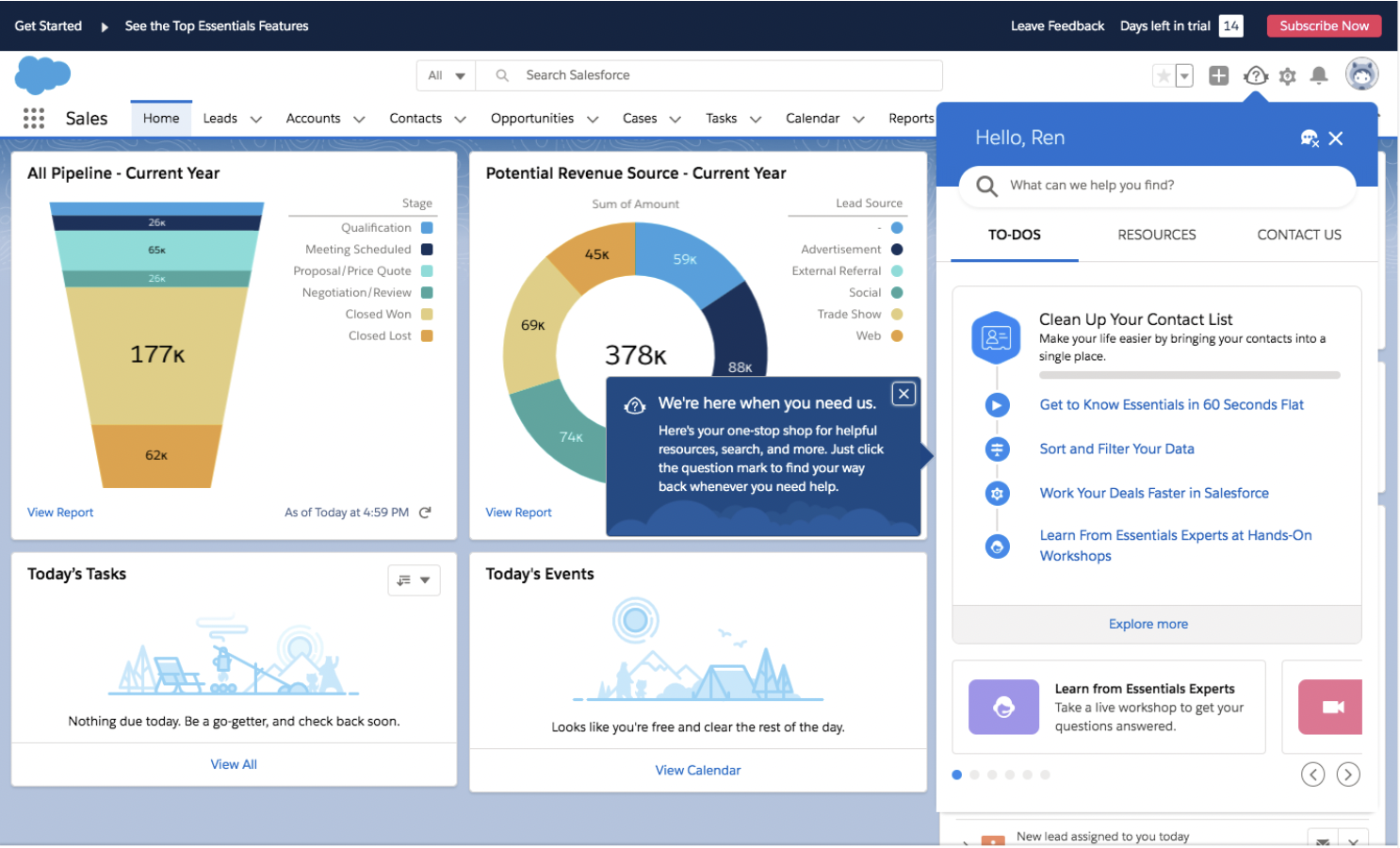
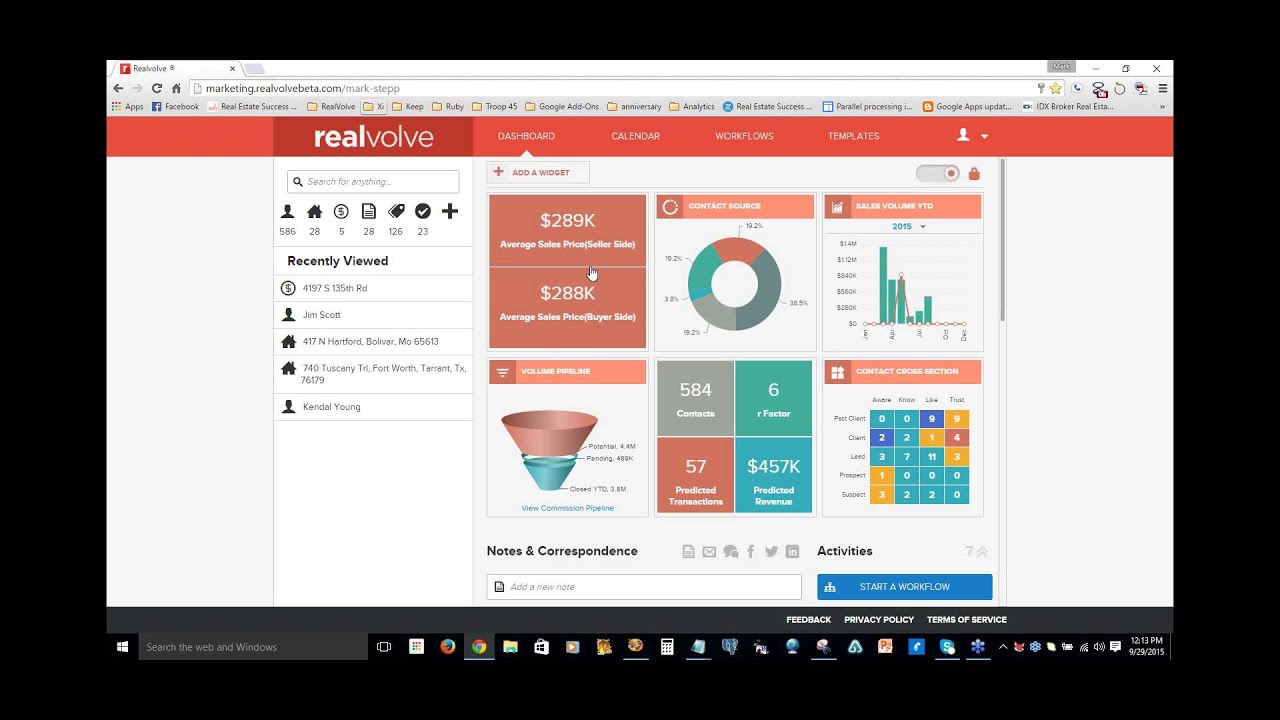
Are you tired of losing track of leads stuck in spreadsheets? CRMs for real estate investors are the game-changer you need. Keep track of lead an deal status, streamline your workflow, follow-up like a pro (with zero effort!), and close more deals.
Real estate investor benefit from having a CRM because it helps with efficient organization, lead management, automated communication, task organization, and other critical lead follow-up elements that help close deals.
There are several CRMs specifically built for real estate investors, and they include features unique to this market. Carrot CRM and InvestorFuse are two CRMs built for real estate wholesalers.
By not using a CRM, real estate investors risk wasting time, missing critical data and insights, and losing lead details.
Which real estate CRM is best for you? We’ll help you find the perfect solution to meet your specific needs.
A CRM (Customer Relationship Management) software tool for real estate investors is designed to help manage and streamline interactions with potential sellers, buyers, and leads.
It is a central hub where investors can track communication, automate follow-ups, manage property data, and organize deals throughout the sales pipeline.
In the competitive real estate market, a CRM helps investors stay organized, nurture relationships, and improve efficiency, leading to more closed deals and better time management.
Why Real Estate Investors Need a CRM
CRMs aren’t just a tool; they’re a strategic advantage. Boost productivity, stay organized, and build lasting relationships with your clients. In the competitive real estate market, strong relationships are key to success.
How do you build and maintain these relationships? A CRM provides the organization and tools you need to connect with clients effectively and grow your business.
Here are 10 reasons real estate investors benefit from having a CRM solution:
Efficient Organization: A CRM provides a centralized platform for storing and managing client and lead information. This organized database streamlines daily operations and ensures that critical details are readily accessible.
Lead Management: CRMs offer robust lead management tools, enabling investors to track leads, monitor their progress through the sales pipeline, and implement strategic follow-ups. This helps in converting leads into clients.
Automated Communication:CRMs often come with automation features that allow for the scheduling of emails, follow-ups, and reminders. This automation ensures consistent communication with clients and leads, enhancing engagement.
Task and Calendar Management: CRMs’ built-in task and calendar features help real estate professionals stay on top of important dates, appointments, and deadlines, contributing to better time management and organization.
Analytics and Reporting: Many CRMs provide analytics and reporting tools, allowing investors to analyze performance metrics. This data-driven insight aids in understanding market trends, optimizing strategies, and making informed business decisions.
Document Storage and Management: Real estate transactions involve numerous documents. CRMs often include document storage capabilities, making it easy to organize, share, and retrieve essential paperwork in one secure location.
Collaboration and Team Communication: CRMs facilitate collaboration for real estate teams by providing a shared platform for team members to access and update information. This promotes better coordination and communication within the team.
Customization: CRMs are adaptable to individual business needs. Investors can customize their CRM to align with specific workflows, ensuring the system complements their unique business processes.
Client Retention: CRMs contribute to stronger client relationships through effective communication, timely follow-ups, and personalized interactions. Satisfied clients are likelier to become repeat customers and refer the investor to others.
Scalability: As a business grows, so does the volume of client and transaction data. CRMs are scalable, accommodating the expanding needs of a real estate business without compromising efficiency.
A CRM serves as a comprehensive tool that not only organizes and centralizes information but also enhances communication, automates tasks, and provides valuable insights, contributing to the overall success of real estate professionals.
Best CRMs for Real Estate Investors
Here are the industry’s top CRMs for real estate investors and a short breakdown of what each one offers.
1. Carrot CRM
Carrot’s real estate platform provides the end-to-end tools to attract, convert, and (most importantly) CLOSE more deals than ever. In fact, Carrot leads convert to deals 7x higher than non-Carrot leads and yield almost $14,000 profit per deal on average!
These numbers are no mistake, and while SEO tools and high-converting websites are responsible for acquiring highly-motivated leads, it comes down to Carrot’s excellent lead management features to help you move quickly through sales cycle stages and generate revenue.
Carrot’s real estate CRM software makes it easy to manage your lead workflow. Once a lead opts in on your website, you will be notified by email and/or SMS text.
Once you become aware of your new high-quality lead, it’s time to utilize our CRM to move leads through your sales process. Take a look at what it can do below.
Step-by-Step Actions
Hyper-focus on the right next step
Don’t lose deals because of inconsistent follow-up, forgotten tasks, or manual lead management (I’m looking at you, spreadsheets). Improve lead follow-up with an action-based CRM that suggests the best next step. Carrot CRM’s decision trees make lead management impossible to mess up.
Property Reports
Understand properties at a glance
Knowing the financials and property specs on a potential opportunity helps you decide which deals are worth it and what your ROI might be. More data = smarter offers.
With Carrot CRM’s in-app Property Data Reports, you don’t have to piece this information together from multiple sources. It’s all right there, and it’s included in your subscription!
Outreach Sequences
Automate your lead follow-up
If you’ve been trying to follow up with a lead for a while, odds are you’ll eventually stop trying, leaving that lead to languish. Carrot CRM’s automated outreach sequences make sure no lead gets left behind. Craft your custom sequences by setting the types of outreach (text, voicemail, email, etc.), the message, the outreach timing, and the next step if the sequence finishes before the lead reengages. Sequences supercharge your productivity.
KPI Dashboards
Know exactly where you stand
Take control of your business growth with visibility into the data that matters most. With more than 70 KPIs, quickly understand lead flow, action statuses, deal details, campaign performance, and more. Gain insight into how many actions, touches, sequences, appointments, offers, and contracts are completed each week so you can focus your efforts where they’re needed most.
We can help you build a competition-squashing online presence with strong SEO-ranking content marketing tools, high-converting websites, landing pages, and lead management tools to win more deals with higher returns.
Common Question: Do I need to be a Carrot website member to get Carrot CRM?
You can get Carrot CRM with or without a website. Want to add a website? Create your own customized Carrot bundle. If you have a website on another platform, you can connect those leads to Carrot CRM with a Zapier integration. (Carrot leads are automatically integrated into Carrot CRM!)
Don’t wait! Look at all we offer and try us risk-free with our 30-day money-back guarantee.
InvestorFuse is today’s real estate investing market’s most well-rounded, feature-rich (and affordable) CRM.
What does it do?
Here are some of the top features!
Actions
InvestorFuse is designed to be easy to use, so you won’t need to return to school for an IT degree so that you can teach your team how to use it.
With a step-by-step approach, the software automatically generates actionable workflows that take the lead through the sales pipeline until they close the deal.
Automated Follow-Up
Automated text messages, emails, voicemail, and other actions to ensure no lead is lost are part of the picture. Your staff knows exactly which leads are on their plate.
Intuitive
InvestorFuse is real estate investment software geared toward wholesaling and other real estate investing. Because it has more lead management than a typical CRM, you’ll spend less time switching between platforms and focusing more on your company.
This tool helps your team finish work quickly and efficiently without searching multiple apps to manage leads.
Flexible Workflow
When your business is doing well, and you’ve brought on a team to handle part of the workload, you want to waste as little time managing them as possible. InvestorFuse offers a customizable workflow process and checklists tailored to your business goals so that you can quickly assign tasks and move forward.
This CRM is made for real estate investors by real estate investors.
The interface is gorgeous, and it’s constantly being updated with new features.
Pricing: Starts at $147/month
InvestorFuse Reviews
3. REISift
For many reasons, REISift is one of the most highly rated CRMs explicitly built for real estate investors.
With it, you can manage your data, create internal workflows, track follow-up attempts, skip trace, schedule direct mail campaigns, cold calls, and more.
It’s the all-in-one tool many investors are switching to for managing (and growing) their real estate business.
Pricing: Starts at $49/month
4. Deal Machine
If you’ve ever attempted to discover and contact a property owner directly, you know how time-consuming it is. There’s a need for software and solutions that can make it simpler for real estate investors to quickly get in touch with property owners via mail, email, or phone.
DealMachine is an app that helps you send out mail solicitations to the owners of specific properties, which have been hand-picked by you, and track down a property owner’s (e.g., mailing addresses, email addresses, and phone numbers) complete contact information.
Sound awesome?
It is.
Here are some of the top features!
Driving For Dollars
One of DealMachine’s best features is its ability to drive for dollars and find motivated sellers who are likely to respond to your offer.
While you’re driving and see a property you want to research, stop the car on the side of the road. Then, open the app on your phone and click on that property.
The app gives you the homeowner’s contact information from public records and third-party data within seconds, including their phone number, email address, and mailing address.
Then, you can call the owner to see if they’re interested in selling or set up a direct mail campaign with a single click.
DealMachine also tracks your driving route, so you don’t have to worry about driving the same route twice.
Real Estate List Builder
DealMachine’s list-building functionality is a quick approach to creating a list of motivated sellers without leaving your home. The property owner information it pulls is surprisingly accurate.
To get started, you can enter a city or zip code to generate a list of properties.
Then, you can filter the list by criteria such as estimated value, equity, mortgage balance, and more.
Once you have your list of potential sellers, click on each property to research the owner’s contact information (via skip tracing).
You can also add notes to each property profile to remember important details about each lead.
Street Pics
Another great feature of DealMachine is the ability to snap street pics of properties and save them within the app.
You can then send direct mail with a picture of the person’s property.
Mail Tracking
Want to know when your direct mail gets delivered? For an additional fee, DealMachine will update you on the status of your direct mail campaigns.
Comps
Want to run simple and surprisingly accurate comps on a property in just a few seconds? DealMachine has a feature that examines recent local sales on the MLS to run comps on your property.
Pricing: Starts at $49/month
5. Salesforce
Salesforce is one of the biggest and most popular CRMs on the market. Big businesses use it in nearly every industry, and it has many features to support it.
Salesforce is not as specific to real estate investing as some of the other options on this list, but if you’re looking for an all-around great CRM with many features, It’s worth considering.
Pricing: Starts at $25/user/month
6. Realvolve
Realvolve is feature-rich and designed to help you manage your business, contacts, leads, properties, and more — all in one place.
With it, you can create internal workflows, manage your team, send email, SMS, and social media messages directly from the application, and tons more.
Pricing: Starts at $94/month
7. REI Automation Squad
REI Automation Squad was created by real estate investors who needed a simple way to automate and track KPIs. Their Beast Mode CRM was created using feedback from fellow real estate investors.
They now have over 2,000 users on their CRM platforms.
Their business is built off EOS methodology, where team members are assigned roles and KPI goals.
Pricing: REI Automation Squad offers three services, from free to more advanced fee-based services. Their most popular and complete service, Beast Mode CRM, is $197 monthly for one (3) users or less. Additional users can be added for $25 a month.
8. LionDesk
LionDesk includes a power dialer, automatic lead capture, drip campaigns, email and text templates, and more.
It even includes a text message manager that allows you to send and receive text messages directly from the application — no need for a separate texting app (you can also send video texts!).
Pricing: Starts at $99/month
9. Wise Agent
Wise Agent is a cloud-based CRM designed for real estate professionals. It offers a suite of features, including contact management, lead capture, transaction management, and marketing automation.
Wise Agent also integrates with third-party applications such as QuickBooks, Google Calendar, Dropbox, and MailChimp. This makes it easy to manage your business from a single platform.
Pricing: Starts at $32/month
10. Hubspot
HubSpot Sales is a powerful CRM designed to help sales teams close more deals and accelerate their sales pipeline.
HubSpot Sales offers many features, including contact management, deal tracking, email integration, and built-in phone Calling. HubSpot Sales also has a robust reporting system that gives you visibility into your sales pipeline and performance.
If you’re looking for a CRM to help you close more deals and accelerate your sales pipeline, then HubSpot Sales is worth considering.
Pricing: Starts at $45/month
11. Forefront CRM
Forefront CRM is a versatile tool that promises to be useful to real estate investors. As a CRM system, its suitability depends on each investor’s specific requirements and preferences.
Forefront CRM offers customization features, allowing users to tailor the system to their needs. This adaptability can help manage properties, leads, and contacts efficiently.
Automation features enhance productivity by automating routine tasks like follow-ups and email campaigns. It also offers tools for property management, helping investors track property details, repairs, and rental income efficiently.
However, the decision to use Forefront CRM should be based on individual requirements, familiarity with CRM systems, and budget considerations.
Pricing: Starts at $99/month
What You’re Missing If You Don’t Use a Real Estate CRM
If you don’t currently use a CRM for your real estate business, you’re probably wondering how you would apply its use to your day-to-day and how it impacts revenue generation.
The bottom line is that you’re losing money without a CRM setup tailored to your specific needs. Here’s why:
You’re Losing Details About the Leads
If you’re not using a CRM, you forget the details about the lead, the property, and the conversations. CRMs allow you to stay on top of your leads.
Keeping track of the essential details will help you build a more trustworthy relationship with the buyer or seller.
You’re Wasting Time
Most communication is virtual or “digital” now, so you need a centralized hub where you can quickly and easily search for contacts.
All communication with the lead can be quickly shared amongst teams so everyone is on the same page. Quick data sharing protects against wasting time rediscovering information with the lead and portraying a brand with its business dialed in.
You’re Missing Critical Observations
Do they need more information about buying or selling a house and how your service can help them?
Do they need a reminder about your service?
Do they deserve some cost break or special offer such as helping them make repairs?
Speak to them as buyers and sellers seeking specific information on their journeys. By frequently reducing the sales cycle, you’ll generate more engagement, deals, and brand loyalty.
You’re Losing Channel Data
Do you know what your most successful marketing channel is?
Or, what is your most successful marketing campaign?
Does your most successful channel change each year or season?
Where are your most profitable deals?
Do your marketing channels experience the 80/20 or maybe a 60/40 rule?
Knowing these answers and identifying your key metrics allows you to grow your business without guessing.
Save yourself time, hassle, and guesswork of pulling data from different channels.
Real estate CRMs help you understand which channels perform best and where you can scale up or back.
Final Thoughts
Choosing the right CRM for your real estate business is essential. The CRM you choose should be based on your business’s specific needs.
If you’re unsure which is right, take another look at the Best CRMs for real estate investors. With many great options, you’ll find the perfect CRM for your business.
Did we miss your favorite CRM? Hit us in the comments section below, or join the Carrot Community!
What would it be like to spy into your top competitor’s SEO dashboard to see what their best traffic-driving SEO keywords are? Discover your competitor’s best keywords, your site’s most effective keywords in Google, and find new keywords your best prospects are searching for in Google every day.
The Keyword Explorer helps you find high-intent keywords to target as part of your evergreen SEO strategy.
While Carrot has published many of the most common keywords for real estate professionals in the SEO Bible, the Keyword Explorer enables you to dig deeper to find additional keywords that people are searching for so that you can stand out from your competition online.
The Demand for SEO Leads For Motivated House Sellers
SEO and demand for SEO leads in real estate is only increasing. The retail side of real estate has been focused on social media and YouTube for the past 5 years, and recently, this past 12 months, started talking more about SEO. This will only keep getting hotter because SEO leads are the best leads, cost less over the long term, and people are looking for new ways to get great leads without cold calling.
In the real estate investing and agent space, there are no other tools or websites that have a robust SEO suite. No one focuses on SEO as much as we do. So we’re doubling down on this feature set not just to display data but to guide our members to the right choices.
What You Get with the Keyword Explorer
The new Keyword Explorer puts SEO keyword research at your fingertips! With it, you can…
Instantly Find What Your Site Ranks For In Google: The lowest hanging fruit to increasing your rankings and leads is to improve the Google rankings you ALREADY have. The challenge here is most people don’t have a clue what keywords they’re actually ranking for. Instantly see what you’re ranking for, how much traffic potential there is, what % of your traffic is from that keyword, and more.
Discover Valuable SEO Keywords: Find the keywords that motivated house sellers and buyers in your target market to search. Find keywords related to ones already turning into great leads for you to expand your reach, find keywords in your niches, and more.
Spy On Your Competitors: Ever wonder what keywords your top competitors are going after? Which keywords are bringing them the most traffic to their site? Type in any URL and get instant data on the keywords their site ranks in Google for, the position, the page, how much traffic it’s likely getting, the % of their overall organic traffic that keyword is driving, and more.
How do you know what keywords you should target on your site? You can certainly target the most common phrases in your industry (e.g. “sell my house fast” or “best real estate agent in “), but those keywords are typically very competitive.
The Carrot Keyword Explorer helps you find the best high-intent keywords to target. Get into the minds of your prospects by seeing what people are searching for on Google, along with the relative traffic and difficulty of ranking for those keywords.
You can search by a phrase to find related keywords (similar to Google’s autosuggest but with a lot more data!) or type in a domain name to find out what your competitors are ranking for.
Since we want this feature to remain unique and distinguishable for high-performing investors and agents, it’s only available as part of our SEO Tools add-on for Carrot members.
How do I use it?
To use the Keyword Explorer, type in a keyword or the URL of your top SEO competitor that you know or think that people will be searching for (“find a real estate agent” or “sell my house fast”). The keyword explorer will then list keywords related to the original keyword you input. Simpler is often better when looking for ideas.
The list of related keywords will also show you the search volume for that keyword, representing the estimated number of times people search for that phrase each month.
SECOND: Put the keyword or URL of your top SEO competitor into the Keyword Explorer and instantly see their top SEO keywords
LAST: Grab the SEO keywords you didn’t know you’re ranking for already OR want to go after from your search, and put them in your SEO Ranking Tracker tool
Upgrade to the SEO Tools Package and Get Carrot Keyword Explorer Today!
Did you know that over 70% of search engine users click on organic results within the first page? That means if your website isn’t ranking well, you’re missing out on a massive chunk of potential customers.
Real Estate SEO Bible: The Ultimate SEO Keywords Guide
Unveiling the Power Beneath the Surface: Your Guide to Technical SEO
Technical SEO is the foundation upon which organic search success is built. It refers to the optimization of your website’s behind-the-scenes elements that search engines use to understand and rank your content. Think of it as the invisible architecture that allows search engine crawlers to navigate your website efficiently and effectively.
Here’s why conducting a technical SEO analysis is crucial for your website:
Increased Visibility: A technically sound website is more easily crawled and indexed by search engines, leading to higher visibility in search results.
Improved User Experience: Technical SEO factors like mobile-friendliness and fast loading speeds directly impact user experience, which is a key ranking factor for search engines. A happy user is more likely to stay engaged and explore your offerings.
Enhanced Organic Traffic: By addressing technical SEO issues, you remove barriers that prevent search engines from fully understanding your website. This translates to attracting more organic traffic, the lifeblood of any successful online presence.
Investing time in a technical SEO analysis is an investment in your website’s long-term success. It’s the first step to ensuring your website is search engine friendly and primed to attract the qualified traffic you deserve.
Buy First, Why SEO?
As we’ve written about elsewhere on our blog, SEO is a form of evergreen marketing in many other places. That is when an SEO strategy is executed correctly, it has the potential to become a lead-generation powerhouse.
Once you make the initial investment into an SEO campaign, as long as some routine maintenance is performed, you’ll likely have an asset that keeps sending leads your way for many years.
This costs a fraction of the price compared to leads from PPC or social media advertising campaigns.
How Does Technical SEO Fit In?
Most people familiar with SEO seem to understand that content and backlinks are required to earn free traffic from Google. There are endless guides that focus on publishing more and more content or getting more and more backlinks.
Few, however, delve into the foundation of SEO — how well the underlying website functions for users and search engine crawlers alike. In the industry, this is known as technical SEO.
Technical SEO is a simple term, but it covers many topics. Ultimately, it comes down to a well-built website — how fast it loads, how clean the coding is, the internal linking structure, if any internal or external links are broken or run through complex redirect chains if images are broken, whether or not the design is responsive and loads in a user-friendly way when on a slow connection… really, the list could go on for days.
We haven’t discussed this much because Carrot members don’t have to worry about it. All Carrot sites have a search-engine-optimized tech stack baked in.
However, many people reading this article won’t be using this system, so I aim to help you by providing a technical SEO checklist and some pointers on the best tools to use in your analysis.
The Pillars of Technical SEO: Building a Strong Foundation
Technical SEO encompasses a variety of factors that work together to ensure search engines can easily access, understand, and present your website to users. Here are the four core pillars of technical SEO:
Crawlability: Imagine search engines like giant spiders crawling through the web, discovering and indexing websites. Crawlability refers to how easily these search engine spiders can navigate your website. This includes having a well-structured sitemap, optimized robots.txt file, and internal linking that allows the spiders to find all your important pages. Good crawlability ensures your website’s content gets seen by search engines.
Indexability: Once search engines crawl your website, they must understand your content to determine its relevance for search queries. Indexability refers to whether search engines can include your pages in their search results. Factors like proper use of meta tags, structured data markup, and fresh, high-quality content all contribute to good indexability. If a page isn’t properly indexed, it won’t appear in search results.
Mobile-friendliness: In today’s mobile-first world, a website that isn’t optimized for smartphones and tablets is a major disadvantage. Mobile-friendliness ensures your website displays correctly and provides a seamless user experience on all devices. Search engines prioritize mobile-friendly websites in search results, giving you an edge over non-optimized competitors.
Site Speed: Nobody likes a slow website! Site speed refers to how quickly your website loads for users. Search engines consider page load speed as a ranking factor, as slow loading times can lead to frustrated users and high bounce rates. Optimizing images, minimizing code, and using a reliable web host all contribute to a faster website, which benefits both search engine rankings and user experience.
By focusing on these core pillars, you create a solid technical foundation for your website. Search engines will be able to efficiently crawl and index your content, and users will have a positive experience when they visit your site. This combination is a recipe for organic search success.
Charting Your Course: The Technical SEO Analysis Checklist
A technical SEO analysis checklist is your roadmap to a healthy and search-engine friendly website. Just like any journey, it’s important to have a plan to ensure you’re covering all the important bases. Here are the key areas to evaluate during your technical SEO analysis, each playing a crucial role in search engine visibility:
Crawlability:
Robots.txt: Is your robots.txt file configured correctly to allow search engine crawlers to access your important content?
Sitemap: Does your website have a well-structured sitemap that clearly communicates all your pages to search engines?
Internal Linking: Is your website’s internal linking structure optimized to allow search engine crawlers to navigate efficiently and discover all your content?
Indexability:
Meta Tags: Are your title tags and meta descriptions optimized with relevant keywords and clear descriptions to help search engines understand your content?
Structured Data Markup: Have you implemented structured data markup to provide search engines with additional context about your content, potentially leading to richer search results?
Noindex Directives: Are there any pages on your website that you intentionally don’t want search engines to index? Are these pages properly marked with a noindex directive?
Mobile-Friendliness:
Responsive Design: Does your website display correctly and provide a user-friendly experience on all devices, especially smartphones and tablets?
Mobile Speed: Does your website load quickly on mobile devices? Slow loading times can significantly hurt your mobile search ranking.
Site Speed:
Page Load Time: Are your website’s pages loading fast enough for users? Tools like Google PageSpeed Insights can help you identify areas for improvement.
Image Optimization: Are your website’s images optimized for size and quality to ensure fast loading times without sacrificing visual appeal?
Caching: Is your website leveraging browser caching to improve repeat visitor experience and overall page load speed?
By systematically working through this checklist, you’ll gain valuable insights into your website’s technical SEO health. The next step is to leverage SEO tools to delve deeper into each area and identify any specific issues that need to be addressed.
Here’s an example of what your XML sitemap should look like:
If you’re a Carrot member, then this is handled for you. Carrot ensures your site is configured correctly and that Google can find and index all the pages on your site.
Unveiling the Landscape: Essential Tools for Technical SEO Analysis
While a technical SEO checklist provides a solid framework, SEO tools act like powerful magnifying glasses, allowing you to zoom in and identify specific technical issues impacting your website. A combination of free and paid tools can equip you to conduct a comprehensive technical SEO analysis.
Here are some essential tools to consider for your technical SEO toolbox:
Free Tools:
Google Search Console (GSC): This free powerhouse from Google offers a wealth of insights into your website’s search engine performance, including crawl errors, mobile usability issues, and sitemap status. It’s a must-have for any technical SEO analysis.
Google PageSpeed Insights: Focused specifically on website speed, this free tool analyzes your website and provides actionable recommendations for improvement. It’s a great way to identify areas where you can optimize page load times.
Mobile-Friendly Test: Another free offering from Google, this tool allows you to quickly test how your website displays on mobile devices. It’s a simple yet effective way to ensure your website provides a seamless mobile experience.
Paid Tools:
Screaming Frog SEO Spider: This desktop application acts like a virtual SEO spider, crawling your website and identifying technical issues like broken links, missing meta tags, and crawl errors. It’s a powerful tool for uncovering a wide range of technical SEO problems.
SEMrush Site Audit: Part of the comprehensive SEMrush SEO suite, the Site Audit tool offers a deep dive into your website’s technical health. It provides detailed reports on crawl errors, mobile usability, and on-page SEO optimization, making it a valuable tool for identifying and prioritizing technical SEO issues.
Ahrefs Site Audit: Similar to SEMrush, Ahrefs offers a Site Audit tool that crawls your website and generates reports on technical SEO issues. It provides insights into broken links, internal linking structure, and mobile responsiveness, helping you identify areas for improvement.
Remember, the best approach often involves a combination of free and paid tools. Free tools like Google Search Console and PageSpeed Insights offer a fantastic starting point, while paid tools can provide more in-depth analysis and reporting capabilities. Choose the tools that best suit your needs and budget to empower your technical SEO analysis.
Putting it into Action: Analyzing Your Website with the Checklist & Tools
Now that you’re armed with the technical SEO checklist and a toolbox of powerful tools, it’s time to delve into analyzing your website. Here’s a step-by-step walkthrough to guide you:
Step 1: Gather Your Tools
Start by having your chosen technical SEO checklist and tools readily available. This might include the free Google tools (Search Console, PageSpeed Insights, Mobile-Friendly Test), and potentially a paid SEO tool like Screaming Frog or SEMrush Site Audit.
Step 2: Work Through the Checklist
Use the technical SEO checklist as your roadmap. Go through each section (crawlability, indexability, mobile-friendliness, site speed) and assess your website’s health in those areas.
Step 3: Leverage the Tools
For each section of the checklist, utilize the relevant SEO tools to gain deeper insights. Here’s how some tools can be applied:
Crawlability:
Google Search Console: Check the “Crawl Errors” report to identify any issues preventing search engines from accessing your pages.
Screaming Frog: Crawl your website using Screaming Frog to identify broken links and crawl errors.
Indexability:
Google Search Console: Use the “Coverage” report to see if any important pages are blocked from indexing or have indexing issues.
Mobile-Friendliness:
Google Mobile-Friendly Test: Enter your website URL and see how it renders on mobile devices.
Screaming Frog: Screaming Frog can also identify mobile-friendliness issues during its crawl.
Site Speed:
Google PageSpeed Insights: Analyze your website with PageSpeed Insights to identify areas for improvement regarding loading speed.
Step 4: Interpreting the Results
Each tool will provide reports and data that pinpoint specific technical SEO issues. Here’s a general approach to interpreting the results:
Free Tools:
Google Search Console: The reports will highlight issues with clear explanations and often suggest solutions.
Google PageSpeed Insights: The tool will provide a score and specific recommendations for improvement, like optimizing images or reducing page size.
Paid Tools:
Screaming Frog: The software generates a comprehensive report detailing various technical SEO issues. You’ll need some familiarity with SEO best practices to interpret the findings.
SEMrush/Ahrefs Site Audit: These tools offer detailed reports with explanations and prioritization of technical SEO issues, making them easier to understand and address.
Step 5: Take Action!
Once you’ve identified technical SEO issues through the checklist and tools, it’s time to take action! Prioritize the most critical issues that are likely to have the biggest impact on your search engine ranking and user experience. Many SEO tools offer suggestions for fixing the identified problems.
Remember, a technical SEO analysis is an ongoing process. As you make changes and optimize your website, it’s important to revisit the checklist and tools periodically to monitor progress and identify any new issues that may arise.
Conquering the Challenges: Fixing Technical SEO Issues & Prioritization
The technical SEO analysis has unearthed valuable insights, but the real magic happens when you address the identified issues. Here’s where prioritization becomes crucial.
Not all technical SEO issues are created equal. Some can significantly hinder your search engine ranking and user experience, while others might have a lesser impact. Focusing on the most critical issues first will yield the biggest return on your investment.
Here’s how to approach fixing technical SEO issues with prioritization in mind:
Severity: Start by addressing the most severe issues first. These might include crawl errors that prevent search engines from accessing your pages, missing or duplicate meta tags that confuse search engines, or critical mobile usability problems that frustrate users.
Impact: Consider the potential impact of each issue. For example, a large number of broken links can significantly hurt your website’s ranking, while a single missing image alt tag might have a lesser effect.
Common Technical SEO Issues & Solutions:
Here are some frequent technical SEO culprits and how to tackle them:
Broken Links:
Identify broken links using SEO tools and replace them with working links or remove them entirely.
How to Find & Fix Broken Links
Fixing broken links on your site is important for some key reasons:
It creates a better experience for your visitors: nobody likes clicking on a link and getting an error message.
It helps Google crawl your site more efficiently: you don’t make it hard for people to contact you, so why would you treat Google that way?
It helps to pass link juice or link equity throughout your website: this helps your content rank better due to its extra authority.
it shows Google that your site is well-maintained and of high quality: Google considers broken links an indication that your site is outdated and poorly maintained.
Suppose you want to find and fix broken links on your site. Use any crawler to scan your site and identify all the broken links. Screaming Frog is an option here—it’s free for sites with up to 500 pages!
Screaming Frog Discovering Errors
When scanning for these errors, replace all 4xx and 5xx error pages, and either remove or replace those links with updated, correct links, avoiding the use of redirects where possible. For more info, read this guide on how to fix broken internal links.
Slow Loading Pages:
Analyze your website with Google PageSpeed Insights and implement recommendations to improve page load speed. This could involve optimizing images, reducing page size, and enabling browser caching.
How to Improve Your Site’s Load Speed
Engagement 101 teaches if your site doesn’t load quickly, people won’t stay on it.
40% of visitors will leave a site that takes longer than 3 seconds to load.
So if you want people to stick around (AND if you want to improve your SEO), you need a fast website. Test your website using Google’s PageSpeed Insights.
There’s a clear correlation between sites that load fast and rank well…
How do you make your site load fast if you’re not a Carrot member? Here are some tips…
Use a content delivery network (CDN): a globally distributed system of servers that delivers content to visitors based on their geographic location allows visitors from all over the world to load your content quickly, no matter where they are.
Compress your images: images are often the heaviest elements on a page, slowing down your site’s loading speed. To avoid this, compress your images before you upload them to your site. You can use a free tool like TinyPNG to do this.
Optimize your code: if your website’s code is bloated or inefficient, it can slow down your site’s loading speed. To avoid this, minify your HTML, CSS, and JavaScript files. You can use a free tool like Minifier to do this.
Crawl Errors:
Use Google Search Console to identify crawl errors and fix any underlying issues preventing search engines from accessing your pages. This might involve fixing robots.txt configuration or resolving server-side errors.
How to Fix Crawl Errors
Redirects can significantly impact user experience and crawl efficiency, particularly if they are broken, form chains, or create loops.
Similar to broken links, they deteriorate the user experience and can confuse bots. Even functioning redirects add complexity, and my guiding principle for dealing with search engine crawlers is to maintain simplicity whenever possible.
There’s inconsistency in statements from Google’s representatives regarding how much link equity is transferred through redirects. Commonly, this involves redirecting from old to new domains, but it’s equally applicable to page-to-page redirections. Why take the chance?
Addressing and fixing these issues, or ideally, replacing them with straightforward, final URLs, enhances both user and crawler navigation, ensuring total PageRank value is directed to your ultimate URL.
Review Your Content:
Ensure all important pages have unique and relevant title tags and meta descriptions to help search engines understand your content.
How to Review Your Content
While this isn’t a content audit discussion, content quality is still vital in technical SEO upkeep. A site audit should evaluate content quality, pinpointing issues such as:
Duplicate content,
Broken images,
a high number of low word count pages, and
Incorrect tag usage, including duplicates or absences of:
H1,
title, and
meta descriptions.
Naturally, high-quality and well-organized content tends to rank better and engage users. This isn’t a straightforward “pass/fail” situation, but during a tech audit, if the content lacks quality, it’s crucial to note that a content audit should be the next step.
It’s also worth being aware that some themes can cause issues with your content. Incorrect tag usage can often be tied to theme configuration instead of the way in which the content itself has been formatted.
Insecure Website (Missing SSL): Ensure your website uses HTTPS encryption by installing an SSL certificate. This improves your website’s security and gives you a slight ranking boost in search results.
How to Ensure Your Site is Secure
Google has stated that it prefers sites that use HTTPS, the secure version of HTTP. They’ve even started giving a slight ranking boost to sites that use HTTPS.
If you’re unfamiliar with HTTPS, it’s a more secure way of transmitting data over the internet. When you visit an HTTPS site, all the data exchanged between you and the site is encrypted. That means it’s much harder for hackers to intercept and steal that data.
This is especially important for real estate investors and agents because you often deal with sensitive information like addresses, phone numbers, and email addresses.
To use HTTPS, you need to get your SSL certificate — a digital certificate that authenticates your website’s identity and enables encryption. You can request your SSL certificate through your website host or hire someone else to help you.
If you’re a Carrot member, then your site is automatically HTTPS encrypted. This will result in a safer experience for your website visitors and better rankings in Google.
Missing Localization Configuration:
If you target international audiences, verify your website’s hreflang tags are correctly configured. This helps search engines understand your website’s language variations and deliver the most relevant version to users in different regions.
How to Check Your Localization Config
Incorrect or absent hreflang or HTML lang attributes can hinder organic search performance, particularly for websites targeting diverse regions or languages.
In my experience, multilingual sites often start as problematic whenever I begin a technical SEO audit.
Properly implementing these attributes ensures that search engines present the correct content to the intended audience.
If you only run your site in English and think you can forget about this type of thing, I’d caution you to think again.
It’s still beneficial to implement this, as it aids search engines and other tools in recognizing the primary language of your page.
This boosts accessibility, enabling screen readers to apply the correct language pronunciation rules, and it also enhances search engines’ comprehension of your site’s content.
With content translation becoming more routine, these straightforward steps significantly enhance content accessibility to a broader audience, and Google likes it when you consider this.
Subpar Mobile Experience:
Even if your website uses a responsive design, conduct a mobile-specific SEO audit. This might reveal issues like slow mobile load times or usability problems on smaller screens. Prioritize fixing these issues to ensure a smooth mobile experience.
How to Make Your Site Mobile-Friendly
It’s no secret that more and more people are using their phones to surf the web. Over 60% of all internet traffic now comes from mobile devices!
If your site isn’t set up for mobile SEO, you’re missing out on a ton of traffic (and potential leads).
It also means that Google is starting to penalize sites that aren’t mobile-friendly. In other words, if your site isn’t optimized for mobile devices, you could be pushed down in the search results…
To avoid this, you must ensure your site is “responsive.” That means it should adjust to fit any screen size, whether a phone, tablet, or desktop computer.
Carrot member website mobile-friendly test results
If you’re a Carrot member, then your site is automatically responsive. We build all Carrot sites using responsive design, so you don’t have to worry about this!
Poor Page Experience:
Page experience encompasses various factors that impact user experience, including mobile-friendliness, loading speed, and visual stability. Use Google Search Console’s “Core Web Vitals” report to identify areas for improvement in page experience. Optimizing these factors can significantly enhance user experience and potentially improve your search ranking.
How to Improve Your Page Experience
Google is continually updating its page experience signals. Core Web Vitals combined with existing search signals, including mobile-friendliness, safe browsing, HTTPS security, and intrusive interstitial guidelines, are all factors here.
Largest Contentful Paint (LCP) – the loading performance of the largest contentful element on the screen. This should happen within 2.5 seconds to provide a good user experience.
First Input Delay (FID) – measuring when someone can first interact with the page. To ensure a good user experience, the page should have an FID of less than 100 ms.
Interaction to Next Paint (INP) is an observation of the time it takes for the page to respond to all click, tap, and keyboard interactions that occur during a user’s visit to a page.
Cumulative Layout Shift (CLS) – measuring the visual stability of elements on the screen. Sites should strive for their pages to maintain a CLS of less than .1 seconds.
These ranking factors can be measured in a report found in Google Search Console, which shows you which URLs have potential issues:
Finding In-Depth Solutions:
These are just a few examples, and the solutions can vary depending on the specific issue. For more in-depth solutions and troubleshooting steps, leverage the resources available online. Many SEO tools offer detailed guides and explanations for fixing technical SEO problems. Additionally, reputable SEO websites and blogs often publish articles and tutorials on common technical SEO issues and solutions.
Remember, tackling technical SEO is a journey, not a destination. By prioritizing issues, implementing solutions, and monitoring progress, you can create a technically sound website that thrives in search engine results and provides a seamless user experience.
Technical SEO Best Practices
Performing a technical SEO audit may initially appear complex, but with a methodical approach and the correct toolkit, it transforms into a critical element of your online marketing plan.
Here are what I consider to be the best steps for conducting this in-house:
Select Your Tools: Not everyone has a big budget for software. High priced tools like Ahrefs and Semrush can make the process faster, but they aren’t mandatory. Please make use of whatever you can and simply get on with it. Action matters more than software.
Develop a Routine: Acknowledge that this isn’t a one-time fix, so frequency is key. Depending on your website’s size and intricacy, a schedule will help—be it monthly, quarterly, or semi-annually—to proactively manage potential issues. At Dialed Labs, we use weekly audits to maintain and monitor our client sites.
Prioritize Findings: Address issues based on their potential impact on your site’s effectiveness and user experience, and remember that not all discoveries demand immediate action. Implement the highest impact fixes first.
Detail Changes and Monitor: By keeping detailed logs of your fixes, you can evaluate what techniques are fruitful and discover any fixes that may not have gone to plan. We keep a detailed “Activity Log” for client projects to transparently showcase daily updates.
Stay on the Cutting Edge of SEO: Winners more or less take all in SEO, so being second best is hardly the right strategy. If you want to be at the top of the SERP, staying in the loop with the most recent official and community-driven guidelines and trends is essential.
Engage with External Experts: Sometimes, external insights can make a significant difference. Consider consulting with professionals for a more in-depth and comprehensive review.
Technical SEO Checklist
It’s easy to get lost in the weeds as you go through a process like this. Download and print out the following checklist. It will help you stay on track and not miss anything important.
The Road Ahead: Maintaining Your Technical SEO Advantage
Congratulations! By conducting a technical SEO analysis, you’ve taken a significant step toward improving your website’s search engine visibility and user experience. However, technical SEO is an ongoing process, not a one-time fix.
Search engine algorithms and user expectations constantly evolve, so it’s crucial to revisit your technical SEO health regularly. Scheduling periodic technical SEO audits (every 3-6 months) allows you to identify and address any new issues that may arise.
Remember, the technical SEO checklist and tools you explored earlier are valuable companions on this journey. Use them to monitor progress, stay up-to-date with technical SEO best practices, and ensure your website remains search engine-friendly over time.
Ready to Take Your Technical SEO to the Next Level?
If you’d like to delve deeper into technical SEO or need assistance implementing solutions, we’re here to help! We offer a variety of resources, including:
In-depth guides on specific technical SEO topics
SEO consultations tailored to your website’s needs
Ongoing technical SEO monitoring and maintenance services
By investing in your website’s technical SEO health, you’re investing in its long-term success. Contact us today to explore how we can help you achieve your SEO goals!
From a Motivated Seller site that saw a conversion rate jump 23.5% to a Cash Buyer site that had its conversions double to the roughly 300 Carrot members that are generating 25% more leads with this simple element on their sites … the Carrot Lead Generation Banner is changing how visitors engage (and convert!) on Carrot sites.
Carrot Website Heatmap Test on a Mobile Device
Introducing The Carrot Lead Generation Banner
Carrot’s Innovation Lab and testing program have a few objectives. One of which is discovering new, out-of-the-box ways to take the traffic you’re already generating and turn that traffic into more leads.
Several months ago, we set our sights on introducing a new conversion element into the mix. In this case, the approach wasn’t necessarily out-of-the-box. If anything, it was straightforward – but we were blown away by the testing results.
By adding a simple, persistent (some would call it “sticky”) banner to the top or bottom of a Carrot site, the site’s homepage started converting significantly better. In some cases, the conversion rate doubled!
“…generating 25% more leads“
And after making a few adjustments to the user interface and experience, early adopters of the Carrot Lead Generation Banner are generating 25% more leads on their sites.
Why does such a seemingly simple element supercharge a site’s conversion rate? Let’s dig into the testing results and find out….
And keep reading to learn how you can set your site up for even more success by enabling the Carrot Lead Generation Banner.
Into The Lab…
At Carrot, we love looking at aggregate stats and analytics across our network. And when we dove into this specific test, we had one singular data point in mind – the first form on a page generates over 75% of all leads generated by Carrot sites.
So we wanted to know … will adding a persistent, “sticky” banner at the top or bottom of a page with a simple “call to action” and single-field form generate more leads above and beyond what that form would typically generate?
We launched versions of several site types – one with the Carrot Lead Generation Banner and one without.
In every case, our question’s answer was a resounding YES.
The total number of leads increased, the conversion rate increased, and the total number of leads who went on to complete their full lead profiles increased as well!
Testing Results
When we broke down the results of each test, it became clear what was happening. When the Carrot Lead Generation Banner was present, that primary form on the page (which generally accounts for 75% of all leads) continued to generate leads at a high rate.
It saw little to no decrease in effectiveness.
The difference, however, was found in the additional leads that were pouring through the Lead Generation Banner! In some cases, the Lead Generation Banner accounted for even more leads than the primary form (especially on mobile!).
Carrot Examples
Lead Generation Banner at the top of a website:
Lead Generation Banner at the bottom of a website:
What makes the Carrot Lead Generation Banner work?
We know from our previous testing surrounding hero section forms that sites tend to convert better when the primary form is more visible on the screen, there is less “noise” surrounding it, and the “call to action” is more prominent. And that’s exactly what we think is happening with the Carrot Lead Generation Banner.
Check out this heatmap that shows the intensity with which visitors interacted with the form in the Lead Generation Banner at the top of the screen…
How to add the Carrot Lead Generation Banner to your site and supercharge your conversion rate today
If you’re a Carrot member, the new Lead Generation Banner element is already added to your site, but you need to go turn it on and customize it to fit your goals.
We’ve outlined an in-depth tutorial (along with some tips on how to use the banner) in our Help Center.
Closing
We have some exciting plans for the Carrot Lead Generation Banner that we are exploring with our Engineering Team to make the element even easier to deploy and even more effective at generating leads. But that doesn’t mean you have to wait!
Our testing results – and the results from the early adopters of the banner – are clear: the Carrot Lead Generation Banner is an incredibly effective tool when it comes to grabbing visitors’ attention, presenting them with a simple, direct call to action, and ensuring that they have a clear avenue to convert.
Think all Carrot websites look the same? You’d be wrong! There are 100’s if not 1000’s of different ways to make your website stand out from your competition.
Searching for the best real estate website builder for your business? A website is one of the most essential marketing tools you can use. If you don’t have a high-converting lead generation website, you’re leaving $1000s on the table.
Demo Carrot: How many deals are you losing to your competitor’s website?
There are many real estate website builder options, some are generic website builders (like WordPress, Wix, Squarespace, and GoDaddy) and some specialize in real estate templates and optimization (like Carrot, Placester, and Real Geeks).
You real estate website builder should have these key features: Mobile-responsive design, lead generation tools, industry-specific templates, and good customer support.
Your real estate website should have these key pages: Homepage, location-specific pages, “About Us,” and a reviews page
In this article, we review 10 of the best real estate website builders, the elements every successful real estate website needs, and how to choose the perfect website builder for your business.
Why We’re Qualified to Make a Top 10 Best Real Estate Website Builder List
Only one thing matters: Performance To Achieve Results.
We see websites as a lead generation hub for real estate agents and investors. In today’s crowded real estate market, you need an online presence to stand out. But you need something that’s more than just an “online business card.”
Amplifies all of your marketing efforts (online and offline)
It is optimized for SEO and lead conversion right out of the box
We’ve been in business for nearly a decade, served tens of thousands of real estate professionals nationwide, and generated millions of leads for our members.
So, we know a thing or two about online marketing and web design in the real estate industry.
Stick with us, and we’ll guide you through this process and help you decide which route is best for your business … a website created by a real estate website builder or a customized website.
Top 10 Real Estate Website Builders
As technology and the real estate industry continue to evolve, web companies are looking at ways to provide new tools and services to support their members. Certain real estate website builders can provide incredible opportunities to boost your business.
1. Carrot
So now, let’s ask the most critical question: how does Carrot stack up?
Carrot is often considered one of the best real estate website builders due to several key features and advantages:
Lead Generation: Carrot strongly emphasizes lead generation for real estate professionals. It provides a range of lead capture tools, including customizable forms, landing pages, and call tracking, all designed to help agents and investors attract and manage leads effectively.
SEO Optimization: Carrot websites are built with SEO in mind. The platform offers tools and features to help real estate professionals rank well on search engines, increasing website visibility and organic traffic. Carrot gives you all the SEO tools you need to hit the ground running with a website optimized for top search engine ranking.
Content Marketing: Carrot offers a content management system (CMS) that allows users to create and publish high-quality real estate content. This is essential for establishing authority and attracting organic traffic.
Property Listings: Carrot offers customizable property listing pages, making it easy for real estate agents and investors to showcase their listings to potential buyers and sellers.
Mobile Responsiveness: Carrot is 100% mobile-friendly. If you’re looking for a website builder that will look great on any device, Carrot is your best bet.
Community and Support: Carrot provides a community of real estate professionals who use the platform, along with access to educational resources, webinars, and coaching. This community can be valuable for networking and learning from industry influencers.
Customization: Carrot has templates specifically designed for real estate investors and agents. These templates come with pre-built pages, essential features for any real estate website, SEO tools installed and configured for you, CTA buttons, and more.
Local Market Focus: Carrot’s websites are built to target specific local markets, which can be highly effective for real estate professionals looking to dominate their local areas.
Speed and Performance: Carrot websites are known for their fast loading times, providing a better user experience for visitors. As mentioned above, our sites are 68% faster than custom WordPress sites, but our tech stack outperformed WordPress, GoDaddy, Wix, Weebly, and Squarespace in a third-party test.
Easy To Use: Carrot’s editor is straightforward, even if you have no experience with coding or web design. You can have a professional-looking design and high-converting website up and running quickly.
CRM Integration: Carrot offers a real estate CRM and seamlessly integrates with other systems commonly used in the real estate industry. This integration streamlines lead management and follow-up processes, making it easy to centralize, organize, and track interactions with leads and clients. With a good CRM, real estate agents and investors can stay on top of their client relationships and maintain effective communication, ultimately improving their conversion rates and business growth.
Trustworthiness: Carrot is a well-established platform with a strong reputation in the real estate industry. Its track record and proven success stories contribute to its appeal as a reliable website builder.
Carrot has a proven track record of converting visitors into leads. If you’re looking for a website builder to help you generate more leads, Carrot is the way to go.
On average, Carrot leads have $13,930.15 in EXTRA profit per deal!
*From a survey of 150+ randomized Carrot clients
Carrot is often regarded as one of the best real estate website builders due to its strong focus on lead generation, SEO optimization, content marketing, mobile responsiveness, community support, customization options, local market targeting, and a reputation for reliability. These features can help real estate professionals effectively market their services and listings and drive lead generation for their businesses.
Learn more about our real estate websites… take a demo today!
The world’s most popular website builder. 43% of the web is built on WordPress. Bloggers, small businesses, and Fortune 500 companies use WordPress more than all other options combined. It offers thousands of easy‑to‑install add‑ons. Collect leads, create contact forms, automatically back up your site, and more.
WordPress is considered one of the best real estate website builders for several compelling reasons:
Versatility and Customization: WordPress is an open-source content management system (CMS) that offers unparalleled versatility and customization options. Real estate professionals can create unique, feature-rich websites tailored to their specific needs and branding. With thousands of themes and plugins available, you have complete control over the design and functionality of your website.
SEO-Friendly: WordPress is inherently SEO-friendly, making optimizing your real estate website for search engines easier. You can use various SEO plugins to improve your site’s visibility in search results, helping potential clients find your listings more easily.
Ease of Use: Despite its robust capabilities, WordPress is known for its user-friendly interface. Real estate agents and brokers with varying levels of technical expertise can easily update property listings, add blog posts, and manage website content without extensive coding knowledge.
Mobile Responsiveness: Mobile responsiveness is crucial for real estate websites, as many users search for properties on smartphones and tablets. WordPress themes are typically designed to be mobile-friendly, ensuring that your site looks and functions well on all devices.
Integration with MLS: WordPress can integrate seamlessly with MLS databases through plugins or custom solutions. This allows you to display up-to-date property listings on your website, enhancing your site’s value for potential buyers and sellers.
Lead Generation: WordPress offers various lead generation tools and plugins that enable you to capture visitor information through contact forms, pop-ups, or opt-in forms. These features help you build your client database and nurture leads effectively.
Blogging Capabilities: Blogging is an effective way to engage with your audience, establish authority in the real estate market, and improve your website’s SEO. WordPress includes a robust blogging platform, making it easy to create and share informative content related to the real estate industry.
Community Support: WordPress has a vast and active community of developers, designers, and users who contribute to its growth. You can access forums, tutorials, and resources to troubleshoot issues, customize your site, or seek advice from experienced users.
Scalability: WordPress can scale to accommodate your needs whether you’re a solo agent or part of a large real estate agency. You can expand your website’s functionality as your business grows, adding features like property search, mortgage calculators, or client portals.
Cost-Effective: Many WordPress themes and plugins are available for free or at a relatively low cost, making it a cost-effective option for real estate professionals looking to establish an online presence without breaking the bank.
In conclusion, WordPress stands out as one of the best real estate website builders due to its flexibility, SEO capabilities, user-friendliness, mobile responsiveness, and integration with MLS databases. It empowers real estate agents and brokers to create professional, customized websites that effectively showcase their listings and services to potential clients.
Placester has been recognized as one of the best real estate website builders for several reasons:
Specialized Real Estate Focus: Placester is designed specifically for real estate professionals, making it a tailor-made solution for agents, brokers, and agencies. This specialization means it understands the unique needs and challenges of the real estate industry.
MLS Integration: One of Placester’s standout features is its seamless integration with Multiple Listing Service (MLS) databases. This ensures that your website always displays accurate and up-to-date property listings, a crucial factor for potential buyers and sellers.
User-Friendly Interface: Placester offers a user-friendly drag-and-drop website builder that makes it easy for real estate professionals, even those without extensive technical knowledge, to create and update their websites. You can quickly add property listings, customize pages, and manage content.
Mobile Responsiveness: In today’s mobile-centric world, having a website that functions well on smartphones and tablets is essential. Placester’s templates are designed to be mobile-responsive, ensuring that your listings and information are easily accessible on all devices.
Lead Generation Tools: Placester provides built-in lead generation tools, including customizable contact forms and lead capture features. These tools help you collect visitor information and grow your client database, making it easier to follow up with potential buyers and sellers.
SEO Optimization: Placester strongly emphasizes search engine optimization (SEO). Its websites are optimized for search engines, making it easier for your site to rank well in search results and attract organic traffic.
Templates and Designs: Placester offers a variety of professionally designed templates tailored to the real estate industry. These templates are visually appealing and can be customized to match your branding and style preferences.
Blogging and Content Marketing: Content marketing is a powerful tool in real estate, and Placester supports blogging and content creation. You can easily publish articles, market insights, and neighborhood guides to engage with your audience and establish your expertise.
Community and Support: Placester provides access to a community of real estate professionals who use the platform, allowing you to connect with peers, share best practices, and stay informed about industry trends. Additionally, they offer customer support to assist with technical issues and questions.
Affordability: Placester offers competitive pricing options, making it accessible to a wide range of real estate professionals, including individual agents, small agencies, and larger brokerages.
In summary, Placester is considered one of the best real estate website builders due to its industry specialization, MLS integration, user-friendly interface, mobile responsiveness, lead generation capabilities, SEO optimization, and supportive community. It enables real estate professionals to create professional, data-rich websites that effectively showcase property listings and services to potential clients.
Squarespace is considered one of the best real estate website builders for several compelling reasons:
Beautiful Design Templates: Squarespace offers a wide range of professionally designed templates that are visually stunning and modern. These templates are ideal for showcasing real estate listings and creating an attractive online presence for agents and agencies.
Ease of Use: Squarespace’s intuitive drag-and-drop website builder makes it user-friendly, even for those without technical skills. Real estate professionals can easily create and update their websites, add property listings, and manage content with minimal effort.
Mobile Responsiveness: Squarespace templates are inherently mobile-responsive, ensuring that your real estate website looks and functions seamlessly on various devices, including smartphones and tablets. This is crucial for reaching potential buyers and sellers who browse on mobile.
Integrated Blogging: Squarespace provides robust blogging tools, allowing real estate agents to share market insights, neighborhood guides, and other valuable content. Blogging helps establish authority in the field and improve SEO, attracting more organic traffic to your website.
SEO-Friendly: Squarespace pays attention to SEO best practices, making ranking your real estate website well in search engine results easier. You can optimize your site by customizing meta tags, titles, and descriptions.
Third-Party Integrations: Squarespace allows you to integrate third-party tools and services to enhance your website’s functionality. This can include integrating with real estate-specific services for property listings or lead generation.
Lead Capture and Forms: Squarespace provides customizable lead capture forms, making collecting visitor information and inquiries easy. This helps real estate professionals build their client databases and follow up with potential buyers and sellers.
eCommerce Capabilities: Squarespace’s eCommerce features can be beneficial if you’re selling real estate-related products or services. You can create online stores or add payment options for services like property assessments or consultations.
Analytics and Metrics: Squarespace offers built-in analytics tools that provide insights into website traffic, user behavior, and more. These metrics help you understand how visitors interact with your site and make data-driven decisions.
Customer Support: Squarespace provides reliable customer support through various channels, including email support, live chat, and a knowledge base. This support is valuable for resolving technical issues and answering questions.
Affordability: Squarespace offers competitive pricing options, making it accessible to both individual real estate agents and larger agencies with varying budgets.
In summary, Squarespace is one of the best real estate website builders due to its stunning design templates, ease of use, mobile responsiveness, integrated blogging and SEO features, lead capture capabilities, and excellent customer support. It empowers real estate professionals to create visually appealing and functional websites that effectively showcase property listings and services to potential clients.
Real Geeks is considered one of the best real estate website builders for several compelling reasons:
MLS Integration: Real Geeks seamlessly integrates with Multiple Listing Service (MLS) databases, ensuring that your website displays up-to-date and accurate property listings. This is essential for real estate professionals to provide reliable information to potential buyers and sellers.
Lead Generation Tools: Real Geeks provides a comprehensive suite of lead generation tools, including customizable lead capture forms, automated email follow-ups, and Customer Relationship Management (CRM) integration. These tools help you collect and manage leads effectively, making it easier to nurture potential clients and convert them into buyers or sellers.
Customizable Design: Real Geeks offers a range of customizable website templates and design options, allowing you to create a unique and visually appealing online presence that aligns with your branding and style.
Mobile Responsiveness: In an era where many users browse the web on mobile devices, Real Geeks websites are designed to be mobile-responsive, ensuring that your listings and information are accessible and functional on smartphones and tablets.
SEO Optimization: Real Geeks strongly emphasizes search engine optimization (SEO) best practices, making ranking your website well in search engine results easier. This can lead to increased organic traffic and visibility for your listings.
Effective Property Search: Real Geeks provides robust property search functionality, allowing visitors to your website to filter and search for properties based on various criteria such as location, price range, property type, and more. This enhances the user experience and helps potential buyers find their desired properties quickly.
User-Friendly Interface: Real Geeks offers an intuitive interface for managing your website, listings, and leads. Even users with limited technical knowledge can easily navigate and update their websites.
Community and Support: Real Geeks provides access to a community of real estate professionals who use the platform, fostering networking opportunities, sharing best practices, and staying informed about industry trends. Additionally, they offer customer support to assist with technical issues and questions.
Affordability: Real Geeks offers competitive pricing options, making it accessible to individual agents, small agencies, and larger brokerages with varying budgets.
Regular Updates: Real Geeks consistently updates and improves its platform to stay aligned with the latest trends and technologies in the real estate industry. This ensures that your website remains competitive and up-to-date.
Real Geeks is considered one of the best real estate website builders due to its comprehensive feature set, MLS integration, lead generation capabilities, customization options, mobile responsiveness, SEO optimization, and supportive community. It empowers real estate professionals to create professional, data-rich websites that effectively showcase property listings and services to potential clients.
GoDaddy can be a good choice as a real estate website builder for several reasons:
Ease of Use: GoDaddy’s website builder is user-friendly and doesn’t require extensive technical knowledge. Real estate professionals can easily create and manage their websites with its intuitive interface.
Templates: GoDaddy offers a selection of real estate-specific templates that make it simple to showcase property listings and create a professional online presence.
Mobile Responsiveness: Websites created with GoDaddy’s builder are designed to be mobile-responsive, ensuring that property listings and content display well on smartphones and tablets.
SEO Tools: GoDaddy provides built-in SEO features that help improve the visibility of real estate websites on search engines, making it easier for potential buyers and sellers to find your listings.
Integration: GoDaddy allows for easy integration with third-party tools and services. This can be valuable for adding features like contact forms, appointment scheduling, and social media integration.
Domain and Hosting: GoDaddy offers domain registration and hosting services, making it a one-stop solution for your real estate website needs.
Affordability: GoDaddy’s pricing is competitive, making it an accessible option for real estate professionals, especially those who are just starting their careers.
Customer Support: GoDaddy provides customer support and resources to help users with technical issues or questions related to their websites.
Customization: While GoDaddy offers templates, it also allows for customization, so you can tailor your real estate website to match your branding and unique requirements.
Security: GoDaddy strongly emphasizes website security, which is important for protecting your and your clients’ information.
In summary, GoDaddy is a good real estate website builder for those looking for a straightforward, budget-friendly, and user-friendly solution. It can help real estate professionals establish a strong online presence and showcase their property listings effectively.
Sierra Interactive is considered a good choice for a real estate website builder due to several key advantages and features:
Real Estate Focus: Sierra Interactive is specifically designed for the real estate industry, so it’s tailored to the unique needs of real estate professionals. This focus ensures that the platform provides the tools and features necessary for success in this field.
Property Search: Sierra Interactive offers advanced property search functionality, making it easy for visitors to find and explore real estate listings. This feature is essential for a real estate website.
Lead Generation: The platform provides robust lead generation tools, including customizable forms, call tracking, and CRM integration. These tools help real estate agents capture and manage leads effectively.
IDX Integration: Sierra Interactive seamlessly integrates with multiple MLS (Multiple Listing Service) databases, allowing real estate professionals to display up-to-date property listings on their websites.
Mobile Responsiveness: The websites created with Sierra Interactive are designed to be fully mobile-responsive, ensuring an optimal user experience on smartphones and tablets, which is crucial in today’s mobile-centric world.
SEO Optimization: Sierra Interactive prioritizes SEO features, making it easier for real estate websites to rank well on search engines, which is essential for attracting organic traffic.
Customization: While offering pre-designed templates, Sierra Interactive allows for extensive customization, enabling users to create unique and branded real estate websites.
CRM Integration: The platform integrates with Customer Relationship Management (CRM) systems, simplifying lead management and follow-up for real estate professionals.
Community and Educational Resources: Sierra Interactive typically provides access to a community of real estate professionals using the platform, educational resources, and webinars, which can be valuable for enhancing your real estate marketing strategies.
Client-Focused Approach: Sierra Interactive strongly emphasizes enhancing the client experience. Their website designs aim to engage and retain visitors, ultimately helping real estate agents convert leads into clients.
In summary, Sierra Interactive stands out as a top choice for a real estate website builder due to its specialized focus, lead generation tools, IDX integration, mobile responsiveness, SEO optimization, customization options, and commitment to providing valuable resources for real estate professionals. These features can help agents and brokers establish a strong online presence and effectively market their listings.
Wix is recognized as one of the best real estate website builders for several compelling reasons:
User-Friendly Interface: Wix offers an incredibly intuitive and user-friendly website builder, making it accessible to real estate professionals of all technical backgrounds. You can easily create and manage your real estate website, even without coding experience.
Wide Range of Templates: Wix provides a diverse selection of professionally designed templates, many of which are specifically tailored to the real estate industry. These templates are visually appealing and customizable, allowing you to create a unique and engaging online presence for your listings and services.
Mobile Responsiveness: Wix ensures that its templates are mobile-responsive, meaning your real estate website will look and function seamlessly on smartphones and tablets. This is crucial for reaching potential buyers and sellers who frequently browse on mobile devices.
SEO-Friendly: Wix offers built-in SEO tools and features, such as customizable meta tags, titles, and descriptions, making it easier to optimize your real estate website for search engines. This can result in improved search engine rankings and increased organic traffic.
Property Listings: Wix allows you to integrate and display property listings effectively. You can add detailed property descriptions, high-quality images, virtual tours, and contact forms to provide potential buyers and sellers with comprehensive information.
Lead Generation Tools: Wix offers a variety of lead generation tools, including customizable contact forms and pop-ups. These features enable you to collect visitor information and inquiries, build your client database and nurture leads effectively.
Blogging Capabilities: Wix includes a robust blogging platform, which is essential for content marketing in the real estate industry. You can publish market insights, neighborhood guides, and other valuable content to engage with your audience and establish your expertise.
App Market: Wix’s App Market provides a wide range of third-party integrations and add-ons that can enhance your real estate website’s functionality. You can integrate with real estate-specific tools, calendars, booking systems, and more to meet your specific needs.
Analytics and Reporting: Wix offers built-in analytics tools that provide insights into website traffic, user behavior, and more. These metrics allow you to track your website’s performance and make data-driven decisions for improvement.
Affordability: Wix offers competitive pricing options, making it accessible to individual real estate agents, small agencies, and larger brokerages with varying budgets.
Customer Support: Wix provides customer support through various channels, including email, live chat, and a comprehensive knowledge base. This support is valuable for addressing technical issues and inquiries promptly.
Wix is considered a good real estate website builder due to its user-friendliness, extensive template selection, mobile responsiveness, SEO capabilities, property listing features, lead generation tools, blogging capabilities, third-party integrations, analytics, affordability, and customer support. It empowers real estate professionals to create visually appealing and functional websites that effectively showcase property listings and services to potential clients.
BoomTown is regarded as one of the best real estate website builders for several compelling reasons:
Integrated Lead Generation: BoomTown is renowned for its lead generation capabilities. It offers a suite of tools and features designed to capture, manage, and nurture real estate leads effectively. This includes customizable lead capture forms, automated follow-up emails, and CRM (Customer Relationship Management) integration.
MLS Integration: BoomTown seamlessly integrates with Multiple Listing Service (MLS) databases, ensuring that your website displays the most up-to-date and accurate property listings. This real-time data is crucial for providing potential buyers and sellers with reliable information.
Customizable Design: BoomTown provides the flexibility to create customized real estate websites. You can personalize the design, layout, and branding to align with your unique style and agency identity.
Mobile Responsiveness: In an era where many users browse on mobile devices, BoomTown ensures that its websites are mobile-responsive. This means your real estate listings and services will look and function seamlessly on smartphones and tablets.
SEO Optimization: BoomTown pays attention to SEO best practices, making ranking your website well in search engine results easier. This can result in increased organic traffic and visibility for your listings.
Property Search Functionality: BoomTown offers advanced property search features that allow potential buyers to search for properties based on specific criteria such as location, price range, property type, and more. This enhances the user experience and helps clients find their dream homes.
Analytics and Reporting: BoomTown provides comprehensive analytics tools that offer insights into website traffic, lead behavior, and marketing performance. These metrics help you make informed decisions to optimize your online presence.
Lead Nurturing Automation: BoomTown’s platform includes automated email marketing and follow-up features, which enable you to engage and nurture leads over time. This can improve conversion rates and help you close more deals.
Community and Support: BoomTown users gain access to a community of real estate professionals who use the platform. This community fosters networking opportunities, best practice sharing, and staying updated on industry trends. Additionally, BoomTown offers customer support to assist with technical issues and questions.
Scalability: Whether you are an individual agent or part of a larger brokerage, BoomTown can scale to accommodate your needs. As your business grows, you can expand your website’s functionality, incorporating features like property alerts and client portals.
Competitive Advantage: BoomTown’s advanced features and lead generation capabilities can give real estate professionals a competitive edge in a crowded market. Its tools are designed to help agents and brokers stand out and attract clients effectively.
BoomTown is considered a real estate website builder due to its integrated lead generation, MLS integration, customizable design, mobile responsiveness, SEO optimization, property search functionality, analytics, lead nurturing automation, community support, scalability, and competitive advantage. It empowers real estate professionals to create effective websites that capture and convert leads into buyers and sellers.
IDX Broker is considered one of the best real estate website builders for several compelling reasons:
MLS Integration: IDX Broker seamlessly integrates with Multiple Listing Service (MLS) databases. This integration ensures that your real estate website displays up-to-date and accurate property listings, a critical factor for potential buyers and sellers seeking reliable information.
Customizable Design: IDX Broker offers a high degree of customization, allowing you to create real estate websites tailored to your branding and style preferences. You can design unique layouts, choose color schemes, and add custom content.
Mobile Responsiveness: In today’s mobile-centric world, IDX Broker ensures that its templates are mobile-responsive. This means that your real estate listings and services will be accessible and functional on various devices, including smartphones and tablets.
SEO-Friendly: IDX Broker emphasizes search engine optimization (SEO) best practices, making ranking your website well in search engine results easier. This can result in increased organic traffic and visibility for your listings.
Property Search Functionality: IDX Broker offers advanced property search features, allowing potential buyers to search for properties based on specific criteria such as location, price range, property type, and more. This enhances the user experience and helps clients find their ideal properties.
Lead Capture: IDX Broker provides customizable lead capture forms and widgets. This enables you to collect visitor information and inquiries efficiently, helping you build your client database and follow up with potential buyers and sellers.
Content Management: Users can easily add and manage content, including blog posts and property listings, to keep their websites fresh and informative. Content marketing is essential for engaging with potential clients and establishing industry authority.
Third-Party Integrations: IDX Broker allows integration with various third-party tools and services to enhance your website’s functionality. This can include integrating with customer relationship management (CRM) systems, email marketing platforms, and more.
Community and Support: IDX Broker users can access a community of real estate professionals using the platform. This community fosters networking opportunities, best practice sharing, and staying informed about industry trends. Additionally, IDX Broker offers customer support to assist with technical issues and questions.
Affordability: IDX Broker offers competitive pricing options suitable for individual agents, small agencies, and larger brokerages with varying budgets.
Lead Generation Tools: IDX Broker provides lead generation features, such as property alert notifications and property inquiry forms, that help capture potential buyers’ information and keep them engaged.
IDX Broker is considered one of the best real estate website builders due to its robust MLS integration, customization options, mobile responsiveness, SEO optimization, property search functionality, lead capture capabilities, content management, third-party integrations, supportive community, affordability, and lead generation tools. It empowers real estate professionals to create professional websites that effectively showcase property listings and services to potential clients.
Building a website is the first step to succeeding in your real estate career.
But there’s a big difference between having a website and having a website that generates a consistent flow of leads and ultimately gives you freedom for your business.
The truth is your website is only one part of the online marketing puzzle.
For instance, do you have answers to the following questions?
How are you going to drive consistent, high-quality traffic to your website?
How will you make sure that your website converts traffic into leads?
How will you know when a lead comes in so you can contact them immediately?
Those are super important questions to answer before you start building your website.
The biggest mistake that real estate professionals make is they just put up a website, cross their fingers, and then get crickets.
Your website will only be as effective as your entire online marketing strategy.
We start by giving our members a high-converting website that turns visitors into leads like clockwork.
That’s ground zero.
Then, we provide the tools, resources, and software to help our members…
Drive high-quality traffic through Google.
Track performance.
Get notified when leads come in.
Brand their business.
And lots more.
Just having a website is not enough if you’re serious about using the power of online marketing to grow your real estate business. You need all the other puzzle pieces in place.
Once you have the entire strategy, your website will become an asset for your business, creating predictable and exciting lead flow.
Now, you could do that yourself and try your hand at a custom, unique-to-you website if you want. Or hire that out…
But unless you or they are a professional web designer AND expert online marketer in the real estate industry, you’re probably in for stress and confusion.
How to Choose the Best Real Estate Website Builder
What is the best real estate website builder? Ultimately, there is no “best” product. The best web builder depends on your company size and business type.
Your real estate business needs a website that converts visitors into leads. But it can be overwhelming trying to figure out where to start.
Designing a website can be complicated. You might even find yourself quitting before learning how to build a website.
The good news. To build a good business website, you don’t have to understand or learn complex coding. You can use a website builder instead!
An excellent real estate website builder is easy for beginners to learn and start with. They typically provide templates and features based on best practices that give you the advantage of faster results without spending as much time learning the details of website building.
If you’re unsure where to begin, using a website builder rather than hiring a website designer would be a better choice. And that’s true of any business putting off building a website because you don’t know where to start. Every day your business goes without a website, you lose leads and deals.
The Benefits of Real Estate Website Builders
Here are some of the critical benefits of website builders.
Takes Less Time: A website builder will take a fraction of the time to build compared to a custom site.
This is because website builders are designed for non-experts. So, there’s no need to spend weeks or months learning how to use the platform.
Costs Much Less: Website builders like Carrot cost a fraction of what hiring a web developer to build you a custom site would cost.
In addition, there are no ongoing maintenance costs. All updates and changes are free for life.
Is Easy To Use: Website builders like Carrot are easy to use, even for people without experience with coding or web design.
Want to make some changes? All you need to do is drag and drop, and you’re done! It’s that easy.
Converts Like Clockwork: There’s no guarantee that a custom-built site will convert well — and since it’s nearly impossible to change after the fact, you’ve only got one shot…
Most website builders allow you to make changes and test different things whenever you want quickly. Plus, you get website templates proven to convert in your specific niche, whether you’re a real estate agent or investor.
Key Features a Real Estate Website Builder Should Have
Hopefully, you understand the benefits of using a website builder like Carrot instead of hiring someone to build you a custom site (learn more about custom sites below).
But what features should you vet when looking for the best real estate website builder?
After all, not all website builders are created equal. Some will work better and perform better than others.
Here are the features we recommend looking for in the tool you choose. Carrot has all of these!
A Mobile-Friendly Design: More than 50% of all web traffic and leads now comes from mobile devices, so your site must be designed with mobile devices in mind.
An Intuitive Editor: The website editor should be easy to use and understand, even if you have no experience with coding or web design.
Industry-Specific Templates: The best real estate website builders will have specifically designed templates for the real estate industry.
Lead Generation Tools: A good real estate website builder will give you more than just a website but also lead capture forms, call to action (CTA) buttons, lead managers, SEO trackers, and other lead gen tools.
Tested and Proven to Convert: Your website builder should have a history of converting visitors into leads.
Reliable Customer Support: If you have questions or need help with your site, you’ll want a good customer support team that is knowledgeable, friendly, and helpful.
What Pages Does Your Real Estate Website Need?
Now that you understand the importance of online marketing and why using a real estate website builder is a better strategy, let’s talk about the different types of pages your website will need.
Marketers want to create and host real estate websites with valuable content that effectively engages buyers and sellers. They know they need a website but don’t know what pages are the most necessary or where to start when putting one together.
There’s a big difference between a well-thought-out real estate website and one put up on a whim.
So, which pages does your real estate website need?
Here are the most Important Pages
Homepage
Your homepage is the first thing people see when they visit your website.
This should be the most compelling page on your website. The headline should quickly tell people what you do, and the rest of the page should empathize with your target market and explain how you can help them.
The CTA, meanwhile, should be front-and-center.
Here’s an example of an agent website (scroll to see the full page)…
Here’s an example of an investor website (scroll to see the full page)…
Location Pages
If you operate in multiple locations, you’ll want to create location pages for each one. This will help you rank in Google for various high-value keyword phrases.
Your location pages will be your homepage duplicated with specific locations and updated content to that market.
About Page
Your about page is a critical piece of your website. In fact, according to our tests, it’s the second-most visited page after the homepage.
This is where you introduce yourself to your target market and explain why you’re the best person for the job.
You should also list your qualifications, experience, and any awards or recognition.
Testimonial (Review) Pages
To prove just how powerful testimonials can be (at least the conversion rate side of things), Unbounce reports on an A/B test run on WikiJob’s website. Ideal for testing, Version A and Version B are identical save for one difference: Version B includes a testimonial above the website’s opt-in form.
In the end, Version B increased the conversion rate by 34%.
Let’s put that in perspective for a wholesaler’s website.
Imagine that you drive 1,000 website visits every month, generating 100 leads per month on your website (a 10% conversion rate — typical for Carrot websites), and that you close 1 in 25 leads. That means you’re doing about 4 deals per month at, let’s assume, $10,000 profit per deal.
Boom — you add a glowing testimonial to your website and increase your conversion rate by 34%, from 10% to 13.4%.
Now, you will get more than 130 monthly leads with the same amount of traffic (1,000 website visits). And since you close 1 in 25 leads, you’ll now do a little more than 5 deals monthly with the same amount of website traffic.
You added $10,000 in monthly wholesale fees (from $40,000 to $50,000 per month) by putting a testimonial on your website.
And the same goes for real estate agents: you can increase your conversion rate and monthly income by adding excellent testimonials to your website.
You’ve Got a Website! Now What?
As you should now know, having a website is just the beginning.
If you choose the right real estate website builder that generates leads, drives traffic, and helps your business grow, it will become an asset for your business.
You can continue working on getting more rankings on Google, build more brand awareness in your market, and create an ongoing influx of high-quality leads.
Ready to get started? Take a demo of Carrot’s Lead Generation Hub now…
Although there is no single most important trait, learning to find motivated sellerleads can be one of the most critical skills in real estate investing. Finding motivated seller leads all comes down to having the right process for continuous lead generation.
Key Takeaways
There are five signs that a seller is motivated:
They’re in a life-changing situation (divorce, bankruptcy, job transfer, etc.)
They want to downsize
The property has been sitting on the MLS for a while
The owner is straightforward about the condition of the property
The owner is absente and/or the property is sitting vacant
Cold calling and direct mail generate motivated seller leads, but a good website can be a consistent source of leads without the manual outreach effort.
Once you determine your maximum offer, it’s often wise to start negotiations with a lower figure. This leaves room for compromise and creates the potential for additional profit if the seller accepts your initial offer. A common approach is to subtract $20,000 from your pre-determined maximum cash offer.
Read on to understand what a motivated seller lead is, how to find motivated sellers (we share 11 different tactics), and learn how to negotiate these deals!
What Separates Struggling Real Estate Investors from Successful Ones?
If there’s one thing that separates a struggling investor from most successful real estate investors, it’s their systems for generating leads. They have processes that work like clockwork day in and day out.
Demo Carrot: How many deals are you losing to your competitor’s website?
Top investors generate 20 or more high-quality, motivated seller leads per month.
Does that sound too good to be true? It’s not.
In 2003, we built our first website to generate motivated seller leadsfor wholesalers. Since then, we’ve refined our marketing systems, website platforms, and overall strategy for driving leads online.
We’ve generated over 1,253,267 real estate-related leads in the past 5 years alone.
The lead generation strategies and options we will teach you in this article have been proven. Although they can take some upfront work, once the ball is rolling, you can generate monthly leads.
Ready to learn how to find motivated sellers?
Let’s do this.
What Are Motivated Sellers?
A motivated seller is an owner who needs to get rid of their property quickly and meets at least one of the following conditions:
They are willing to sell below market value at a 10-30% price.
They are ready to sell under specific terms. Including no money down and no interest.
In an ideal situation, you’d want both conditions, but one advantage of working with them is that they have reasons to sell fast. You’re there to help them solve the problem.
Some common types of motivated sellers include:
Distressed sellers
Landlords
Facing foreclosure
Relocating
Bank in possession of REOs
Divorce
Inherited houses
Recent job loss
5 Signs That a Seller is Motivated
You know what a motivated seller lead is.
But how can you spot them?
Here are five signs that a seller is motivated — you can gather this information through public records, online research, and, most importantly, talking directly to the seller.
Life-Changing Situation: If the owner is going through a life-changing situation like divorce, probate, bankruptcy, or moving across the country, they are far more likely to be in a hurry to sell… and to care less about how much they get.
Wants to Downsize: People who want to downsize often want to live more simply. They want a smaller house with less upkeep. They’re likely overwhelmed by the state of things in their current homes. These people often want to sell their property as-is for cash.
Property Has Sat On MLS: If the property has sat on the MLS for a long time (say, 6 months or more) without selling, there’s probably something wrong with the house. And the owner might have come to terms with that and be interested in selling fast for cash.
Owner is Straightforward: If the owner neglects to discuss the problems with the property, they might still be trying to get top-dollar. But if they are open and honest about the quality of the house, then they might be more willing to make a deal.
Absentee & Vacant: An absentee owner is one who doesn’t live in the same city or state as the property they own. If the property is also vacant, the owner is not making money on it but is still, at the very least, paying property taxes. These types of owners commonly want to offload their property quickly.
Online Strategies: Casting Your Net in the Digital World
The Internet has become invaluable for real estate investors seeking motivated sellers. Here are some powerful online strategies to consider:
1. Real Estate Listing Platforms: These platforms are a great starting point. While many listings showcase readily available properties, utilizing the platform’s filters can help you target motivated sellers:
Expired Listings: Properties that haven’t sold within a typical timeframe might indicate seller frustration or a need for a quick sale.
FSBO (For Sale By Owner) Listings: These sellers are already actively trying to sell their property themselves, potentially indicating motivation for a faster deal.
Pre-Foreclosure Listings: Target properties in pre-foreclosure to potentially help homeowners avoid foreclosure and offer them a win-win solution.
2. Real Estate Investment Websites: We’re going to go a little deeper in this section because it’s our bread and butter.
SEO, PPC, and social media.
Let’s start with SEO. SEO for real estate is what we consider the secret sauce of a successful real estate investor and investing marketing strategy.
Organic leads are where the majority of leads come from for our members.
It’s not theory; here’s a real peek behind the scenes…
We focus not only on SEO but also on how it builds into Evergreen marketing.
The definition of Evergreen marketing is: “a: retaining freshness or interest: perennial. b: universally and continually relevant: not limited in applicability to a particular event or date.”
In marketing terms, it’s marketing you do once, and it works for years… not hours, days, or weeks. Content relevant for a long time serves your best prospects and gets in front of them where they’re searching online.
Results grow momentum over time = Freedom
We then amplify Evergreen with paid marketing and even hamster wheel marketing.
Hamster wheel marketing is defined as: “any situation that seems endless without goal or achievement.”
In marketing terms, any marketing campaign that works for a short time after you do has a limited life span. Then, you have to do it repeatedly to keep results coming in.
Cold calling, direct mail, posting on social, open houses, etc.
Results stop when you stop = Stress
Growing increasingly into the Evergreen is where you create consistency, freedom, and flexibility.
You can significantly impact your business, but that’s where your most valuable and highest converting leads come from.
Building a solid lead generation engine for your real estate business will give you quality leads for life.
It’s a big goal, but don’t be intimidated.
Here’s some proof…
Tyler Ford has been getting 2x more motivated seller leads with Carrot than with his old site. The Carrot tools and Evergreen marketing content has helped him stand out in my crowded local market.
While paid advertising can immediately bring in motivated seller leads and help your business in the short term… SEO can build momentum and help grow your business over the long term.
But what is SEO?
It’s pretty simple.
When a motivated seller wants to sell their house fast for cash, many go to Google and type in “Sell my house fast in [MARKET CITY].”
For example, if I search for “Sell my house fast in Dallas,” Google thinks these real estate websites can help me.
Those websites get clicks and traffic from motivated sellers whenever someone types that phrase into Google… which is more often than you’d think.
That traffic then turns into leads (so long as the investor’s website is optimized for conversion), and the investor generates deals monthly through SEO.
You can also pay to get in those search results…
And that is a good idea when you’re starting. But it shouldn’t replace your SEO strategy.
More than 90% of people click on organic results before PPC results.
So here’s the question: how do you get Google to rank your website for a high-value keyword phrase?
Well, it can take time and some patience.
To start, you’ll need to put the correct title on your page, have a website that loads quickly, and do a few other things. Reference this SEO guide for help.
And at Carrot, we have TONS of tools to help you.
We give you monthly SEO-optimized blog post content. Our websites have an SEO-friendly tech stack. We also allow you to track your progress on target keyword phrases and alert you to missing optimizations on any page.
SEO for real estate investors couldn’t be any easier than with a Carrot site. :)
PPC is another valuable asset for generating motivated leads.
Google Ads can work so long as you have a solid strategy. Year after year, it’s one of our Carrot members’ top lead generation methods (behind organic leads).
Our real estate investor members consistently get feedback that their Google Ads leads are closing between 1 in 10 and 1 in 15 leads per deal.
Learn more about Google Ads for real estate investors in this ultimate guide.
3. Social Media Advertising: The power of social media targeting can’t be ignored. Platforms like Facebook and Instagram allow you to create laser-focused advertising campaigns. Target potential sellers based on demographics like age, location, and even interests related to downsizing or relocation.
4. Data Analytics & Lead Generation Tools: For a more sophisticated approach, consider investing in paid tools. These tools aggregate and analyze vast amounts of data on potential sellers. You can target outreach based on factors like absentee ownership, distressed properties, or recent life events that might trigger a homeowner to sell (e.g., job loss, probate, divorce). While these tools come at a cost, they can significantly enhance the quality and efficiency of your lead generation efforts.
One option worth exploring is USLeadList, a platform specializing in high-quality pre-probate inheritance leads for investors, wholesalers, and agents. Their data gives you a competitive edge in finding motivated sellers before your competition. With reliable leads at your fingertips, you can spend less time searching and more time closing deals.
Traditional Strategies: Building Relationships and Hitting the Pavement
While the digital world offers a wealth of opportunities, tried-and-true traditional methods still hold value:
1. Direct Mail Campaigns:Direct mailers can be a powerful tool for reaching motivated sellers. Here’s the key: customization. Craft compelling mailers that address specific needs. For example:
Absentee Owners: Highlight the challenges of managing a property from afar and offer a cash solution for a quick, hassle-free sale.
Probate Leads: Express your condolences and offer a streamlined process to sell a property inherited through a probate sale.
Distressed Homeowners: Present yourself as a solution to financial burdens associated with unwanted property.
2. Networking with Local Professionals: Building relationships with individuals “in the know” can be a game-changer. Here are some key connections to cultivate:
Real Estate Agents: Agents often encounter sellers facing various situations. Develop relationships with agents who understand your investment criteria and can connect you with motivated sellers.
Property Managers: Property managers deal with absentee owners and may come across situations where a quick sale benefits all parties.
Title Companies: Title companies handle property transactions and might have insights into potential sellers facing challenges.
3. Cold Calling: Don’t underestimate the power of a well-executed cold call. Here are some tips for success:
Do your research: Identify the owner’s name and any relevant details about the property beforehand.
Be clear and concise: Introduce yourself, explain your purpose quickly, and highlight the benefits you offer as a buyer.
Prepare for objections: Anticipate common objections, such as “I’m not interested in selling,” and prepare responses emphasizing a win-win solution.
4. Driving for Dollars: This strategy involves driving through neighborhoods looking for potential leads. Target areas with neglected properties, overgrown lawns, or “for sale” signs that have been up for extended periods. These signs might indicate absentee ownership or seller motivation for a quick sale. Once you’ve identified a potential lead, research ownership information and send a targeted mail flyer or make a cold call to initiate contact.
One option is to use Google Maps Street View and apps such DealMachine. You can drive for dollars without leaving your house.
Creative Strategies: Thinking Outside the Box
Beyond the traditional methods, consider these creative approaches to expand your pool of motivated sellers:
1. Attend Local Events:
Foreclosure Auctions: While attending foreclosure auctions can be competitive, they offer opportunities to connect with distressed homeowners directly. You might be able to strike a deal before the auction or offer a solution outside the formal auction process.
REO (Real Estate Owned) Sales: Banks often hold sales for properties they’ve repossessed (REO). While competition can exist, attending these sales allows you to potentially negotiate directly with the bank for a good deal.
Community Events: Local fairs, neighborhood gatherings, or even investment seminars can be a chance to connect with potential sellers. Introduce yourself as a real estate investor and explain your interest in buying properties in the area.
2. Offer Value Propositions:
Don’t just wait for sellers to come to you. Instead, consider offering valuable services to attract motivated sellers:
Free Consultations: Provide free consultations to homeowners considering selling. Analyze their situation, explain your buying process, and highlight the benefits of a quick cash sale.
Market Analyses: Offer free market analyses to homeowners. This establishes you as a knowledgeable resource and opens a conversation about their selling options.
By providing value upfront, you build trust and position yourself as a solution-oriented buyer, increasing the chances of converting a consultation into a successful deal.
3. Build Partnerships:
Collaboration is key in real estate investing. Partner with other investors who share your goals:
Cash Buyers: Partner with cash buyers who can offer quick closings, attractive to motivated sellers needing to sell fast.
Other Investors: Collaborate with other investors to combine resources and expertise. You can expand your reach and target a wider range of motivated sellers by working together.
Thinking creatively and building strong partnerships can unlock new opportunities to connect with motivated sellers and achieve your real estate investment goals.
Quick tip: Reaching out via email is a great way to build partnerships. Using a LinkedIn email finder can also help expand your network and reach potential leads, further improving your ability to identify cash buyers and motivated sellers.
The Difference Between Inbound & Outbound Lead Generation
We’ve shared many different strategies on this blog for real estate lead generation: Traffic plus Conversions, and we’ve shown you a bunch of great strategies for building traffic. If you haven’t read those posts, click those links to check them out… I’ll try not to duplicate much here.
Real estate investors can generate motivated leads using both outbound and inbound (paid and organic) sources.
Confused?
Let me make it more simple.
“Outbound” marketing is direct mail, cold calling, and driving for dollars.
“Inbound” marketing is Google Ads, Microsoft ads, and Facebook strategies, with good content through organic search rankings or SEO.
The Simple Motivated Seller Lead Generation Formula
To generate more motivated seller leads for your business, you first have to understand the simple formula for lead generation.
That is, how is a lead generated in the first place?
Different investors will answer that question differently. Some will say that cold calling is how you generate leads, others will say direct mail, and others will say by personally connecting with people in the community.
And none of those answers are wrong.
Successful investors also use direct mail and/or cold calling to generate consistent business leads.
But they also do something that very few investors don’t do.
They systematically generate leads by using the formula below…
TRAFFIC + CONVERSION = LEADS
Let’s break that down.
Traffic is when people visit your website. They might come through paid advertisements you’re running (like Facebook Ads or Google Ads) or organically through a search engine (Google) or a social media site (Facebook).
Wherever they come from, one thing is for sure… you can’t generate leads on autopilot through your website if you’re not generating traffic.
Paid ads effectively drive immediate traffic to your website. Building your organic traffic takes a little more time (but the payoff is massive) — more on organic traffic or “SEO” shortly.
What about conversions?
A conversion is when a person takes the action you want them to take after visiting your website. Usually, that’s filling out a form that provides you with their contact information or calling your business directly.
And voila! You have a lead.
Those are the two vital elements to generating motivated seller leads.
You have to drive traffic to your website consistently and consistently convert that traffic into leads for your business.
And Carrot websites have the highest conversion rate in the industry (usually between 10% and 20%).
A conversion rate on one Carrot member’s website.
That’s why we believe in our product so much.
We know that if someone takes their organic traffic seriously and uses Carrot to create their website, they’ll have everything they need to build a winning business.
How to Negotiate with Motivated Sellers
When it comes to negotiating with motivated sellers, there are some commonalities.
We all know that price is not something that’s set in stone. And neither is a seller’s immediate inclination to work with or not with you.
They could call you ready to sell but a few days later lose interest. Or they could call skeptically and leave the call prepared to sign.
Part of what determines these outcomes is how you negotiate. What you say, what questions you ask, and how you talk could impact.
So, we asked some experienced real estate investors how they negotiate with sellers to close more deals.
Negotiating with Motivated Sellers: Securing Profitable Deals
Unearthing motivated sellers is a crucial skill in real estate investing. However, negotiation is equally important to convert those leads into successful transactions. Here’s a breakdown of the key steps involved:
1. Market Research and ARV Determination:
The foundation of any negotiation lies in accurate information. Start by conducting thorough market research to determine the property’s After Repair Value (ARV). This represents the estimated market value of the property once repairs are complete. Consider seeking assistance from a qualified real estate agent who can provide valuable insights and access to comparable property data (comps).
2. Repair Cost Estimation:
Accurately estimating the cost of necessary repairs is critical. For complex repairs, consider engaging a professional contractor to provide a detailed estimate. This ensures your calculations reflect the true cost of bringing the property up to market standards.
3. Max Cash Offer Calculation:
Once you have a solid understanding of the ARV and repair costs, it’s time to calculate your maximum cash offer. A common strategy employed by real estate investors is the 70% rule. Here’s how it works:
Example: Assume the property’s ARV is $200,000 and estimated repairs come to $30,000.
Following the 70% rule, your maximum cash offer would be:
($200,000 ARV – $30,000 Repairs) x 70% = $119,000 Max Cash Offer
This calculation ensures you leave sufficient room for profit, even if unforeseen repair needs arise during renovations.
4. Strategic Offer Presentation:
While you’ve determined your maximum offer, it’s often wise to start negotiations with a lower figure. This leaves room for compromise and creates the potential for additional profit if the seller accepts your initial offer. A common approach is to subtract $20,000 or more from your calculated maximum cash offer. This becomes your opening bid, allowing for negotiation flexibility while still securing a profitable outcome.
By following these steps and employing effective negotiation tactics, you can increase your chances of securing motivated sellers and achieving successful real estate transactions.
Now, it’s essential to mention one more thing.
Before you bring your offer, you should’ve had a few conversations with the seller.
You should know why they’re selling, how much they hope to get, and how motivated they are.
If you don’t, get that information before you enter into negotiations. That’s cannon fodder for the discussion you’re about to have — if you know why they’re selling, then you can explain why your offer is what it is and how it will help them.
Conclusion: A Multi-Faceted Approach to Finding Motivated Sellers
The landscape of motivated seller lead generation is constantly evolving. In 2025, a diversified approach is crucial for success. Don’t be afraid to experiment with the abovementioned strategies – both online and traditional methods have their merits.
Here are some key takeaways:
Cast a Wide Net: Utilize a variety of online platforms, explore creative strategies, and build relationships with local professionals.
Target Strategically: Tailor your approach to specific seller types, whether it’s absentee owners, distressed homeowners, or those navigating probate.
Track & Analyze: Monitor the success of each approach. Analyze which methods generate the most leads and the highest conversion rates in your market.
Remember, the key to finding motivated sellers is consistent effort and a willingness to adapt your strategies.
Empower Your Journey:
Becoming a successful real estate investor is an ongoing journey. Here are some resources to fuel your knowledge:
Industry Publications: Stay up-to-date on market trends and best practices by subscribing to industry publications or blogs.
Online Courses: Invest in online courses or workshops from reputable sources to refine your skills and learn advanced lead generation techniques.
By combining these resources with the strategies outlined above, you’ll be well-equipped to identify and connect with motivated sellers, paving the way for successful real estate transactions.