This episode is for informational purposes only and does not constitute legal advice.
You have to be willing to respect the people who are involved in your transaction – the contractor, the title company. Be willing to respect those people’s time as much as you respect your own.
– CC Moreno
Attorneys + Wholesalers | 18 Legal Tips for Better Closings w/ CC Moreno
How’s your relationship with your attorney? While many investors are looking for cheap advice as quickly as possible, it’s more important to take the time to build a genuine and mutually beneficial working relationship. Real estate attorney CC Moreno is here to teach you why you need to consider your attorney or title company a partner in your business as opposed to just another vendor. She will be sharing with you exactly what to ask, what you should watch out for, both now and in the years ahead.
Read the Full Show Notes Below…
Here at Carrot, we spend a lot of time teaching people how to get leads and develop a great mindset. But one thing that comes up a lot, that we haven’t addressed as frequently, is the legal aspects of wholesaling and how it all works. CC Moreno, Esq. works in property law and is the brains behind Wholesale Hackers – the private Facebook group she runs with her husband Brent Moreno and where you can see CC’s full list of 18 tips.
4 Things That Prevent Fast Closings
CC runs into many things that can delay a closing – but that can also be easily avoided. Some of these things include:
The contract is filled out incorrectly
No earnest money is being offered
There is no “out clause”
There are liens or judgments on the property
While CC can search the title for you at any point, every investor should know how to do a search themselves. Most states have an online database where you can pop in the address to find everything associated with the property in question.
Wholesalers, Ask Your Attorney these Questions:
When choosing an attorney or title company to work with, there are a number of questions that you should ask. Many are used to one type of closing, done a certain way, and may not have the skills you need to close on time. When working with a new attorney or title company, be sure to ask…
Do you work with investors frequently?
What is your hourly rate?
Do they understand double-closings and what are the laws in your state?
Are you able to handle out-of-state closings?
What’s in the settlement fee?
Does it include document preparation?
Does each closing come with title insurance?
When do you run the title on the property?
Do you offer wires and paper checks?
Maintaining a Great Relationship with Your Attorney
As an investor or agent, you’ll quickly learn the value of good relationships. Your contractor, title company, accountant, and attorney all play vital roles in the success of your business. Don’t take these people for granted or be disrespectful of their time and efforts.
Don’t ask for stuff for free
Stick to your appointments
Respect people’s time as you would respect your own
Pay whether or not you close on a deal
Don’t change the contract without informing the person preparing the closing documents
Bad Apples & The Future of Real Estate: Hybrid
Real estate investors have often been associated with the underbelly of real estate. Sadly, a few bad apples have tarnished the industry in the eyes of many. As legislation changes for wholesalers throughout the country, one of the main things we expect to see is a licensure requirement. We’ve been talking about the hybrid model for years. Being licensed may have different requirements, but ultimately it will help build your credibility while allowing you to cash in on your retail leads.
Working with the right attorneys, title companies, and other professionals will ensure you experience fast and efficient closings, without any surprises. Be sure to visit the Wholesale Hackers Facebook group for further explanation on these great tips.
Our new series is taking you behind the scenes of some of the most interesting and rewarding deals that our customers are closing. Keith Sant is a returning guest, avid Carrot Camper, and a trusted home buyer based in Tacoma, WA.
Today we will learn how he found the lead and how the process went while answering all of your questions about the process. Join us every other Thursday at Carrot.com/deal
Read the Full Show Notes Below…
Keith Sant named his company Kind House Buyers for a reason. As we go behind this deal, you will see why. In this situation, Keith was able to not only go above the asking price but also make over $30k on the deal. Here’s how he did it…
Behind the Deal
The lead came in from a PPC campaign, from someone who was doing their research on buyers in the area. Because Keith had a credible website and a strong reputation, he was one of the buyers she called.
Keith answered the phone when other investors didn’t and he was able to immediately set up an appointment to see the property.
This property was a manufactured home, with plumbing and electrical problems. There was an unpermitted addition, which had also put a lien on the home.
The property could not be listed in the traditional sense, and the family wanted to relocate their aging father who was living on the property.
Breaking Down The Numbers
The family owed about $78k on the property and had also spent a good $10k on family-related issues. Keith knew he could easily sell the land alone for $100k.
After crunching some numbers, he was able to offer more than what they owed, helping to reimburse the family and pay for relocation expenses.
Normally Keith would ear down the property and simply add a new manufactured home, He could then quickly resale it as a brand new home.
However, because of the high demand fr mobile homes, he know this would take a while.
So instead, he flipped the property to a fellow investor who had the tools and means to fix up the property. In this situation, everyone came out ahead.
Building Your Reputation
There are many reasons why homeowners turn to Keith when they need to sell. One of those is the strong reputation he has built over the past 4 years. Keith regularly adds content to his website, adds customer reviews, and is completely transparent about how he works.
Recently, Keith was even feated in an article in the Olympian which spoke of this deal in particular. So many times investors will be painted as vultures who are just after a quick buck.
By being informative and getting his name out there, he is not only building trust but changing the perception of the industry for the better.
If you are putting links out there online and not tracking them, how will you know where your leads are coming from? Our keyword tracking tool will help you see where your leads are coming from and which keywords they are searching.
You will be able to make tweaks to your content to get more eyes on it, thus improving your rankings in Google search results. Look for more data to be added to the keyword tool in the months ahead!
Join Us Live!
Join us every other Thursday on Facebook Live. We’ll be taking you behind the deal with some of the top guys and gals in the industry.
Get answers to your questions live on air while learning the fundamentals of the business.
A lot of people have it in their head that marketing is hard – but once you learn it, it is the most valuable skill out there.
– Keith Sant
Growth Hacking Real Estate Marketing: 5 Uncomplicated & Unheard of Online Tips
Keith Sant hates cold-calling. He has always focused on inbound marketing, whether it is through his website, his social media, or even with his bandit signs. What he realized is that his lead to close ratio and average profit per deal were higher with these inbound leads.
So he focused his energy on bringing more traffic to his site by using some incredible growth hacking strategies.
Now he is closing 6-10 deals a month online. Today we are diving into what growth hacking is and how you can use it to grow and scale your business no matter the industry.
Read the Full Show Notes Below…
Growth hacking is taking data and experimentation, mixing it with marketing and psychology, then adding technology, tools, and automation.
Great marketers share this incredible mindset that allows them to take something that isn’t working, tweak it, and have it work amazingly well. When Keith started with Carrot, he wasn’t doing much online.
He used bandit signs and was using his Carrot site to amplify this form of marketing. But with some testing and tweaking, he now does the majority of his business with online leads.
Here are 5 of the best growth hacks he used to grow his business over the past 4 years.
Amplify What You Are Already Doing
The best way to use your new Carrot site is to amplify what you are already doing. For Keith, that meant putting his website on all of his bandit signs. He also added a link to his Craigslist ads, helping him to build trust and credibility.
Craigslist is still working in Keith’s market, so he has a VA post on his behalf each and every Friday. Using tracking links on his Carrot site, he can see exactly which ads are performing well.
Budget for the Right Keywords
Many people will take all of their marketing budget and throw it behind keywords such as “sell my house” or “we buy houses.”
While these work great in some markets, this isn’t true for all. If these keywords aren’t performing well in your area, take your budget and focus on the keywords that are performing.
Use Calendly Links
A simple and effective growth hack Keith used was to add a Calendly link to his website. This allows people to jump ahead and instantly book their own time for Keith to come out and see their property.
They don’t have to wait for a callback, they can arrange a meeting simply by visiting Keith’s website.
He included this link in his first follow-up email and on the “thank you” page a person sees after filling out a contact form.
Get Creative Backlinks
Backlinks will build trust in the eyes of Google. While you can go for the low-hanging fruit on social sites and Zillow, there are some other ways to get creative backlinks.
Sign up and learn how to use HARO to answer questions, generate backlinks, and build authority.
When networking, ask to exchange backlinks
Collaborate with other investors
Ask for reviews on Yelp, Zillow, and the BBB
It is important to think about where your ideal lead is looking. Many people aren’t a fan of the BBB and how their business model works, myself included.
However, many people in an older demographic will utilize the Better Business Bureau to determine the credibility of a business.
Edit Your Forms Wisely
Small changes can have a big impact. For example, Keith had a form on his website that was rarely filled out. He added a small money bag icon to the form and almost immediately, one-third of the form submissions on his site come from that one.
Unless you are paying for traffic, you will need to tweak and optimize to get more people on your site.
Using these creative growth hacks can quickly change your rankings, traffic, and sales!
Which growth hack will you try first? Remember, a year from now you’ll wish you’d started today!
As you’re planning out your marketing for the year ahead, you might have a couple of questions popping into your mind. You might be asking, how the heck am I going to reach my goals?
You might even be asking what are your goals as a real estate agent or an investor?
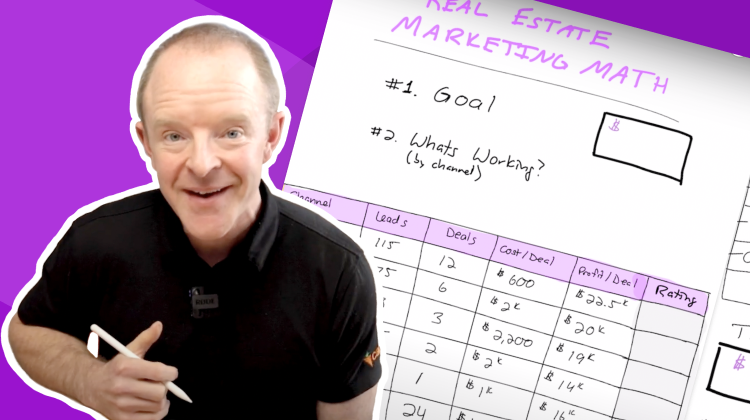
What I’m going to be walking through in this video is a simple five-step process, I use it here at our company, and I suggest you use it as an investor and agent as well, to plan out exactly what you need to do in your marketing in the year ahead to be able to reach your goals.
The cool thing about this is, a lot of people, they’ll look at the goals, write a goal number down, it might be an income goal, it might be a deal number goal, and then you pull back and you say, what are the things that are going to help me get there?
You might write down a few different projects, and I ran my businesses like this for years. I’d have a goal, and I’d go to the whiteboard and I’d say, what are some of the cool, exciting, fun things I might need to do this year?
I’d write them down and then that would be my plan. The thing I would forget to do is what I’m going to teach you today, which is mapping down to your marketing channels, so you have an exact clear, ABC step-by-step plan to reach your goals in a fail-safe way.
As soon as I started deploying this in my own businesses and teaching other investors and agents how to do it as well, you start to get more clarity on your plan.
The cool thing is, I actually did a podcast on this, the cool thing is this becomes your strategy. The definition of a strategy basically, is a strategy is as much what not to do, as it is what to do.
What we’re going to be diving into here on my iPad, is we’re going to show you exactly what you should do, so you can say no to so many other things in this year ahead. Work less, gain more freedom, make a greater impact.
Let’s dive into the iPad now.
The first thing I want you to do here is, there are five steps.
The first step is we’re going to set your goal, and if you have to pause this video throughout, as you’re doing your annual planning, or if you’re watching this sometime in the midyear, amazing.
Optimize Your Real Estate Marketing: Step 1
You can still do the same thing if you’re not clear on what you need to do in your marketing to reach your goals as an investor or an agent.
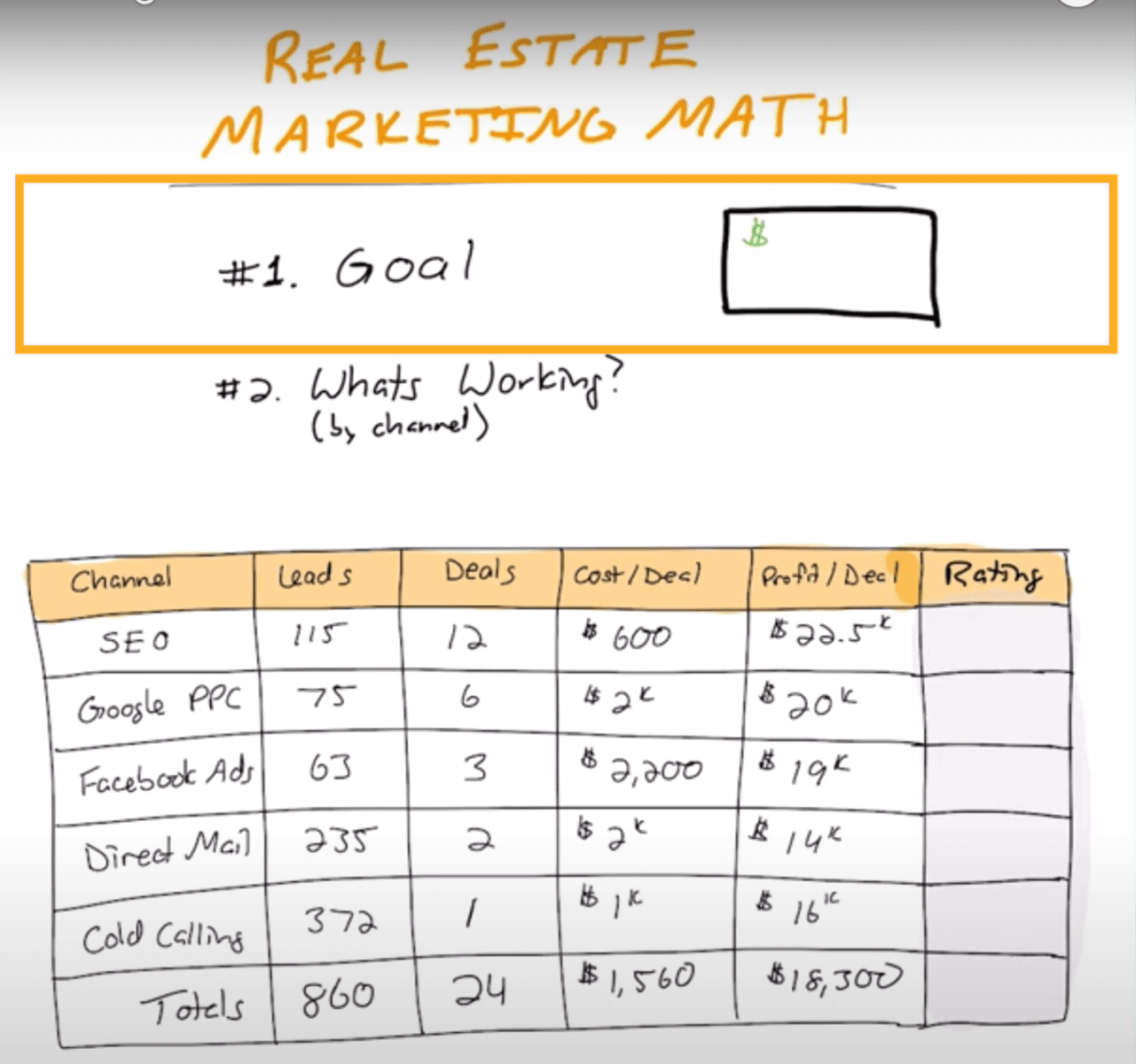
The first step is setting your goal.
Okay, we’re going to pick an income goal, because deal numbers don’t really matter if you’re doing a bunch of low volume or low dollar deals versus if you do some high dollar deals.
I always pick an income number because you can map that to the lifestyle that you want, or the freedom or impact you want to make.
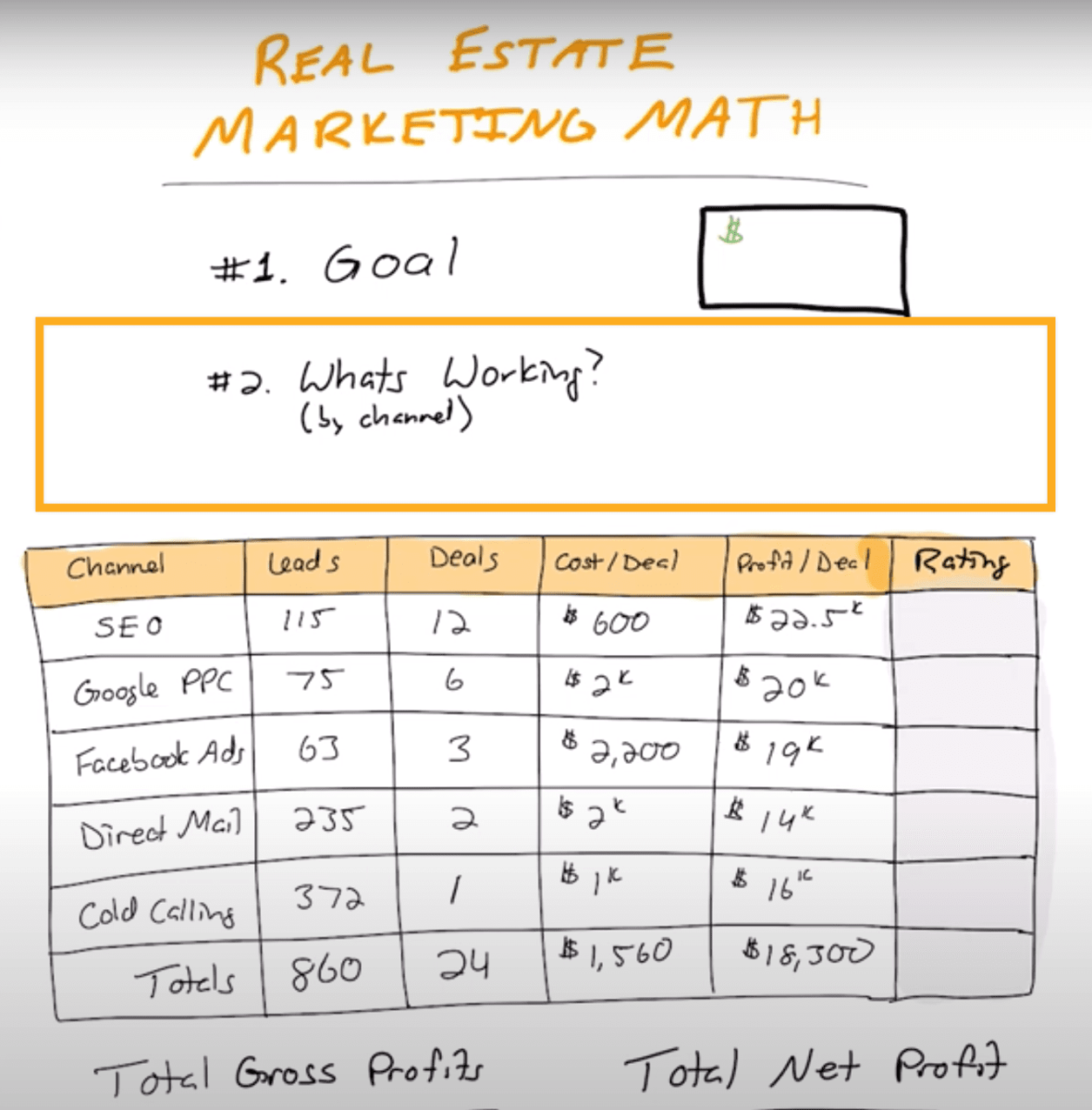
Next, we need to ask what is working? This is a big step a lot of people miss… they set a goal and then they just go, hey, what do I need to do next? We need to first ask what’s working.
Optimize Your Real Estate Marketing: Step 2
I’m going to give you a framework in here for exactly how to track and show what’s working in your business in a crazy, crazy, simple way.
Then what we’re going to say is, what’s the difference between where we currently are to the goal that we’re going for?
Optimize Your Real Estate Marketing: Step 3
I call it the Delta.
Next, we’re going to say cool, now that we know the difference in what we need to make up, what are the biggest opportunities that we see, the one, two, or three max, to be able to hit our goal.
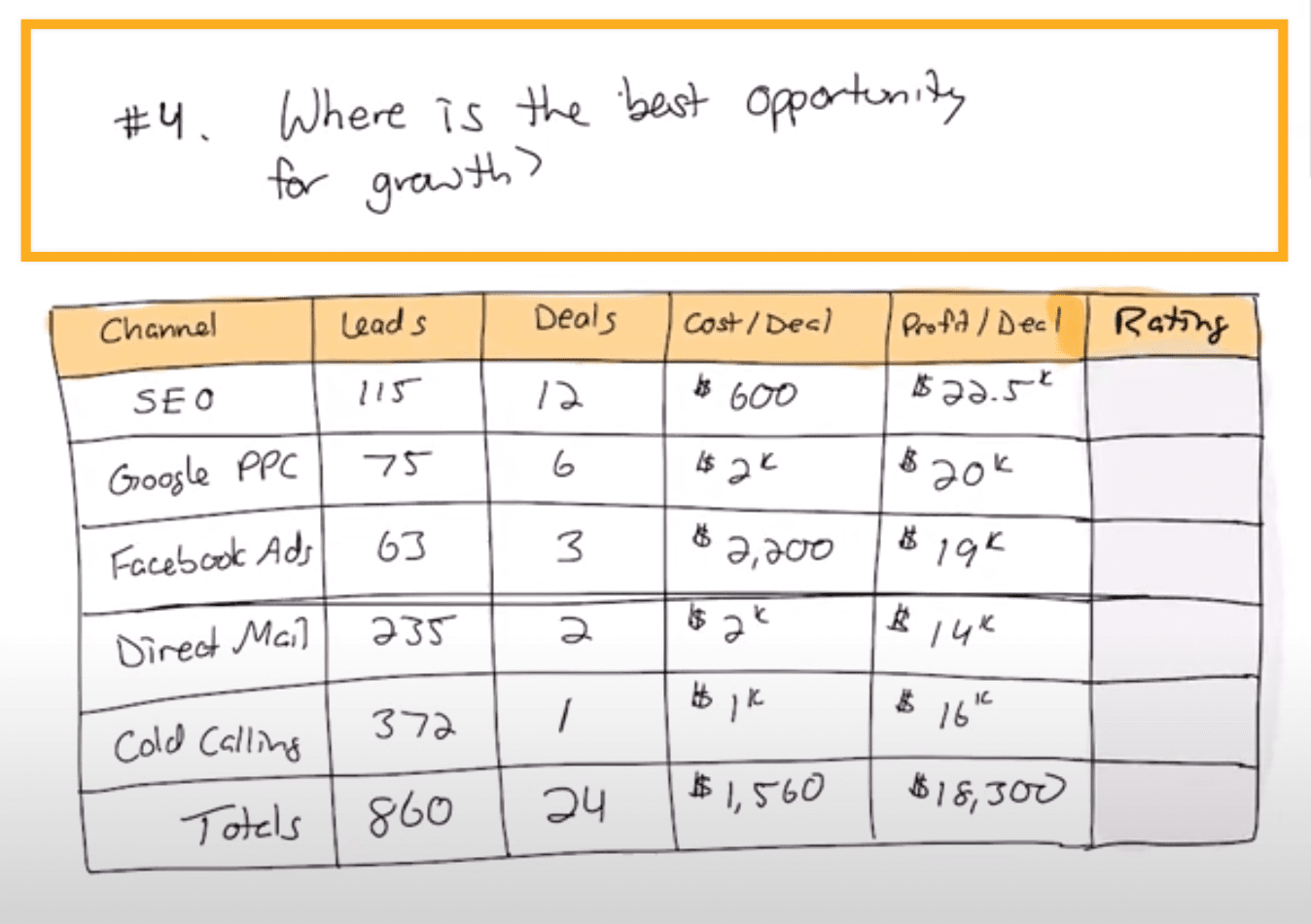
Optimize Your Real Estate Marketing: Step 4
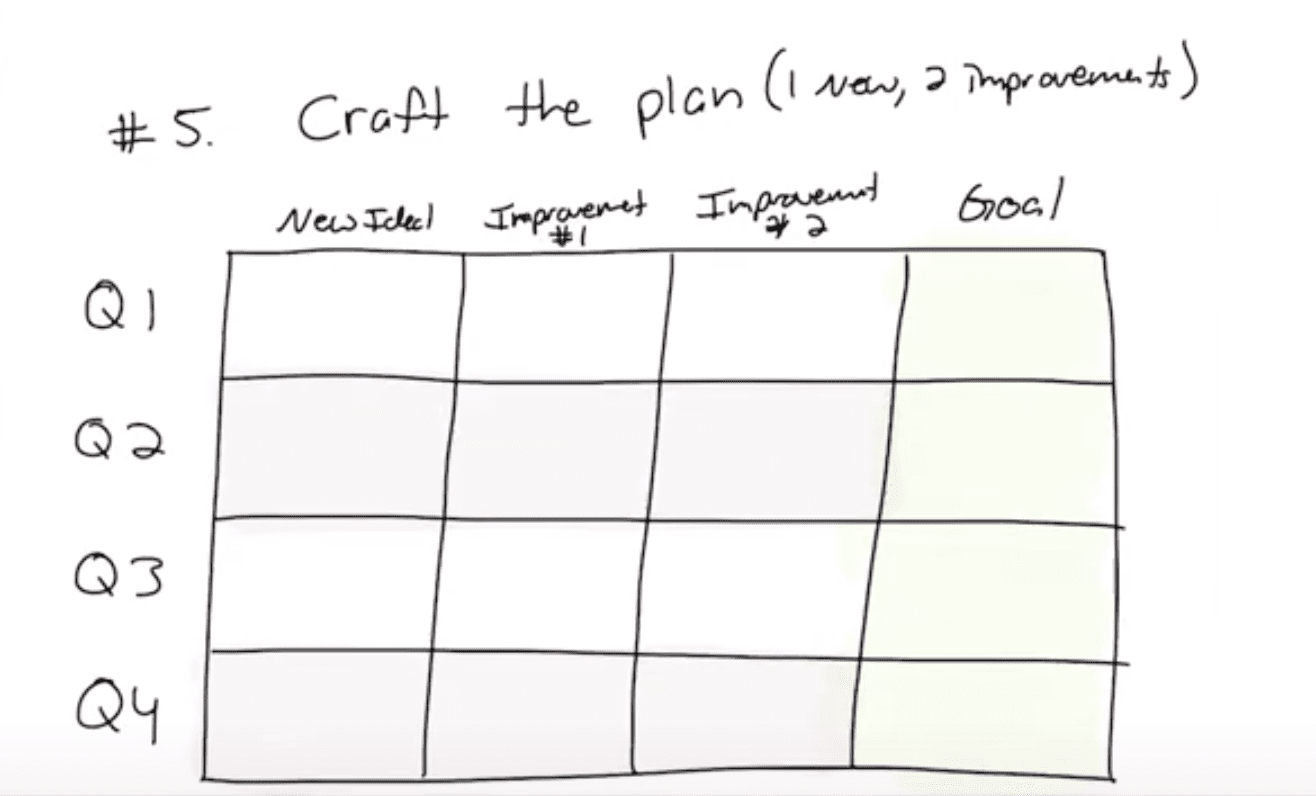
Then last, we’re going to craft the plan in a really crazy simple one-page thing that you can use each and every quarter.
Optimize Your Real Estate Marketing: Step 5
Let’s go back up to the top.
For this example here, I’m going to be working with one of our clients who is an A player. They’ve already started to do some deals. They’re a hybrid agent investor, which is what we specialize here in at Carrot.
The people who have their license, and their investor who can offer cash offers, maybe even flip homes. This person’s been doing deals for two or three years, and they want to get to a $750,000 profit goal.
Okay, so that’s a big goal. If you are trying to get to your first $100,000, it doesn’t matter.
Next what we’re going to do, is I want you to write down every marketing channel that you’re currently using to get leads and to close deals.
You might be doing referrals as an agent, or you might be big, big, big on cold calling as an investor agent, whatever it is, write down the channels that generated your leads in deals this past 12 months.
If you have to hit pause in this video, go ahead and do it. Write down the channels on the left side and come back.
Next, I want you to pull back into your data. This might be one of those things where you might be going, I don’t know what the channels did, but one of the biggest keys that you can do as a marketer is you have to know and have clarity on what each marketing channel is doing for your business.
One of the biggest mistakes that I find with people is they end up investing $5000, $10,000, $15,000 a month, and they say, I’m getting deals out of this, but I don’t know which channels are working and which channels aren’t working.
So they keep on putting more and more money into the marketing, not knowing which half of their marketing’s working and not.
This is going to help you save tens of thousands of dollars potentially in marketing every year, and help you grow your income in a more predictable way with less work, which is what we’re about here at Carrot. Helping you get more freedom.
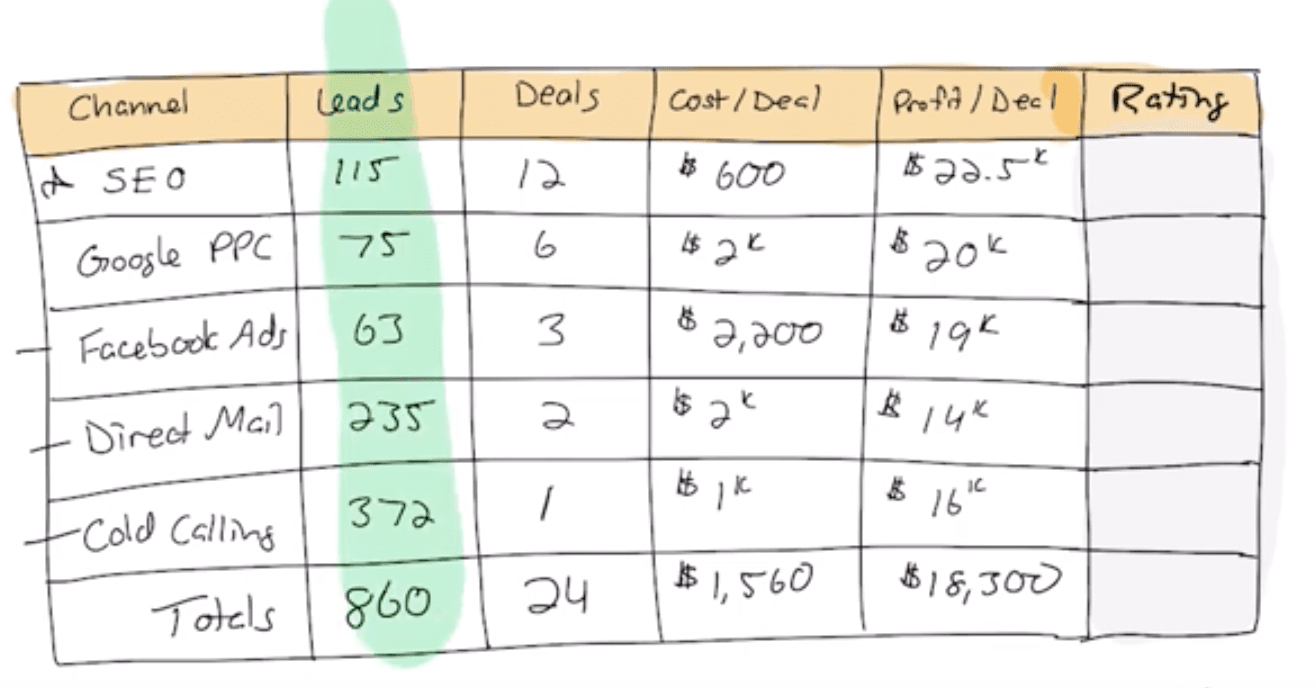
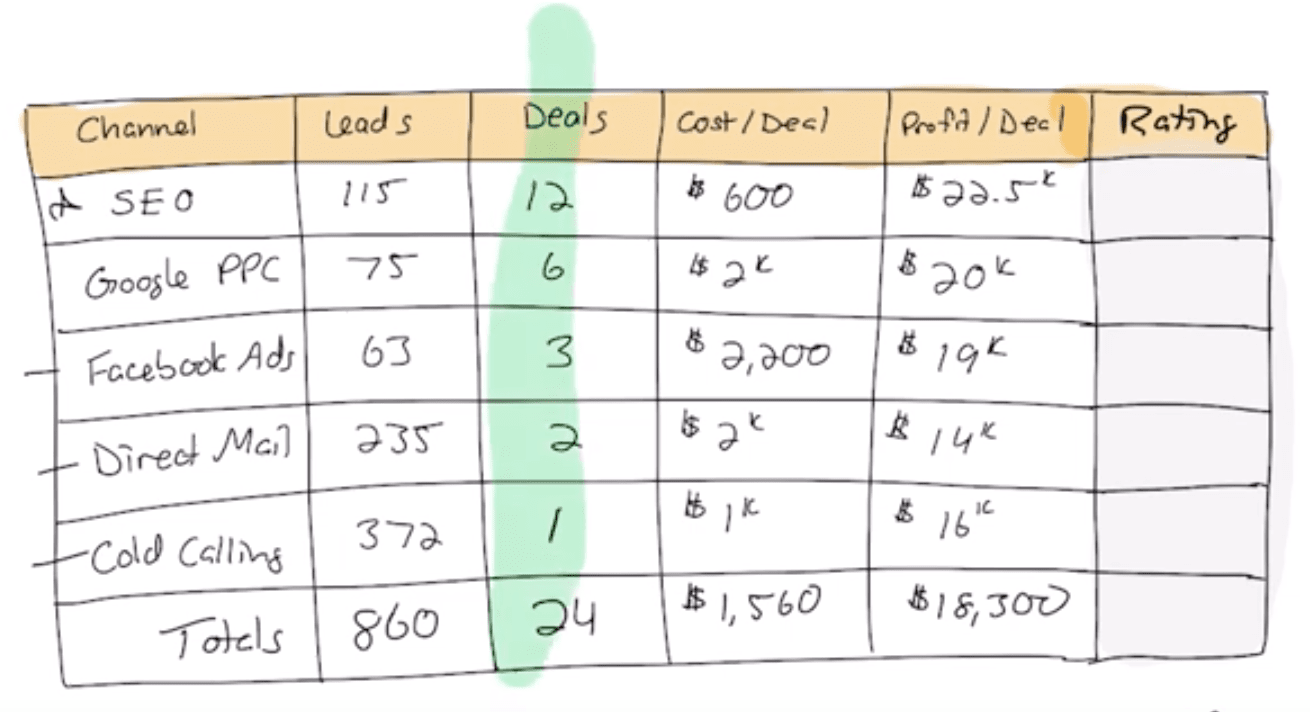
What I want you to do next, is now write down what are your leads. How many leads did you get with that channel?
Real Estate Marketing Channels: Leads
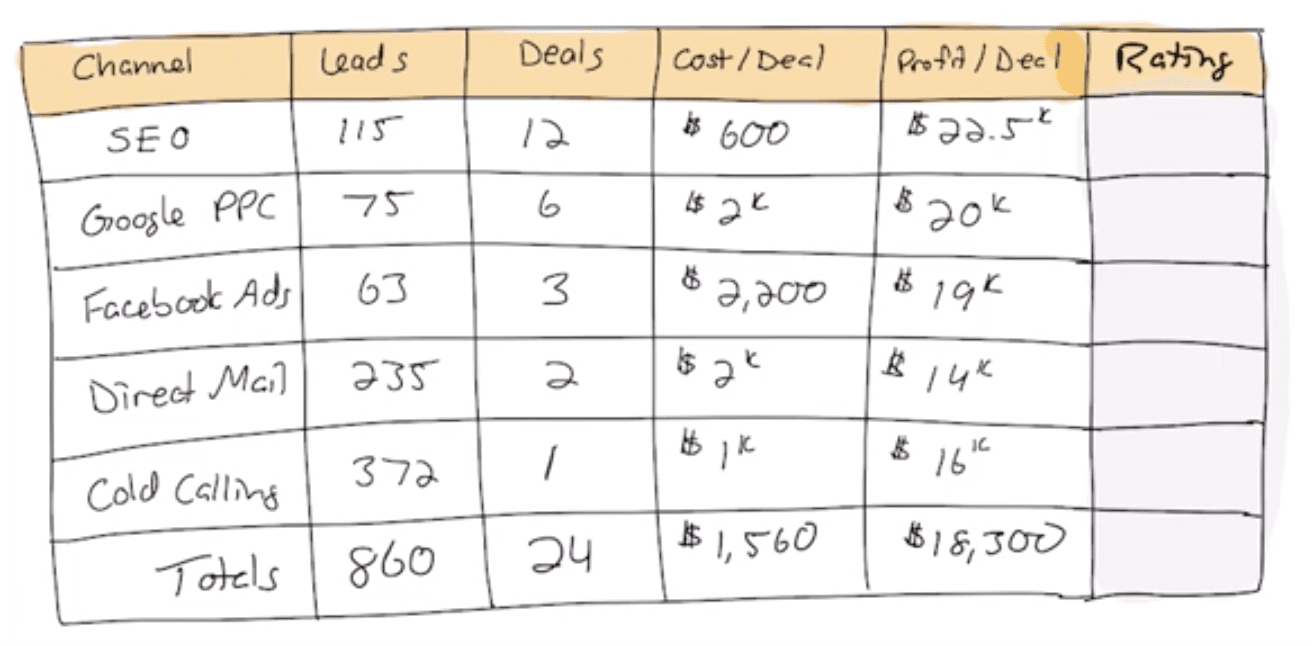
In this example, we’re going to say the SEO channel got 115 leads this past 12 months, Google PPC, 75 Facebook Ads, 63, you get the idea. Write those down.
Then we’re going to say with each channel, how many deals came out of those?
Real Estate Marketing Channels: Deals
Now you might be saying, I don’t know how to track how many deals came from the channels.
Well, what we can do is if you’re using a system like Carrot, our system will actually tell you which leads came from SEO. It’ll tell you which leads came from a Facebook ad, or from a Google ad. It’ll tell you all of those things.
Now you’ll be able to know which leads and deals came from direct mail and cold calling because you want to use a different tracking phone number with each one of those marketing methods.
You can always say if anyone called from this phone number, it’s from my direct mail, so you can track the leads and deals.
Okay, now what I want you to do is dive even deeper.
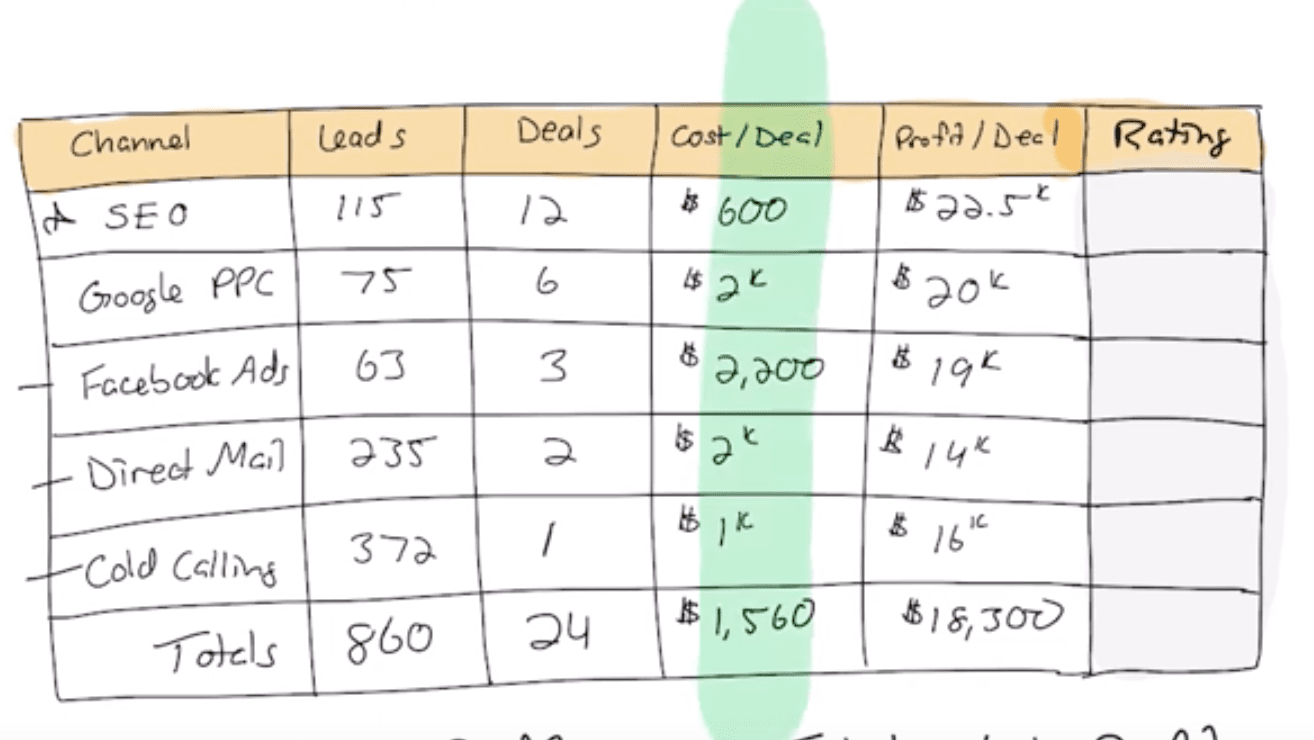
Real Estate Marketing Channels: Cost per Deal
If you’re looking at this going, man, I don’t have this data.
What I want you to know is number one, it’s simple data to track so you can get it, but number two, this is critical data if you want to grow your business, work less, make a greater impact.
With each one of the channels, say, I’ve got 115 leads at the SEO this past year, 12 deals out of it. How much did you invest in doing SEO that year? Did you pay someone to do it? Did you do it yourself?
Just take the entire amount of money you invested in the SEO that year and divide it by the number of deals that you did. In this case, we’re just going to say it was about $600 a deal, which was the average cost when we took that amount.
If it was Google pay-per-click or direct mail same thing, take the entire cost of what you spent on direct mail this year, Google pay-per-click this year, or cold calling, or whatever it is, and then divide it by the number of deals you got to come up with your cost per deal.
This can be an important number.
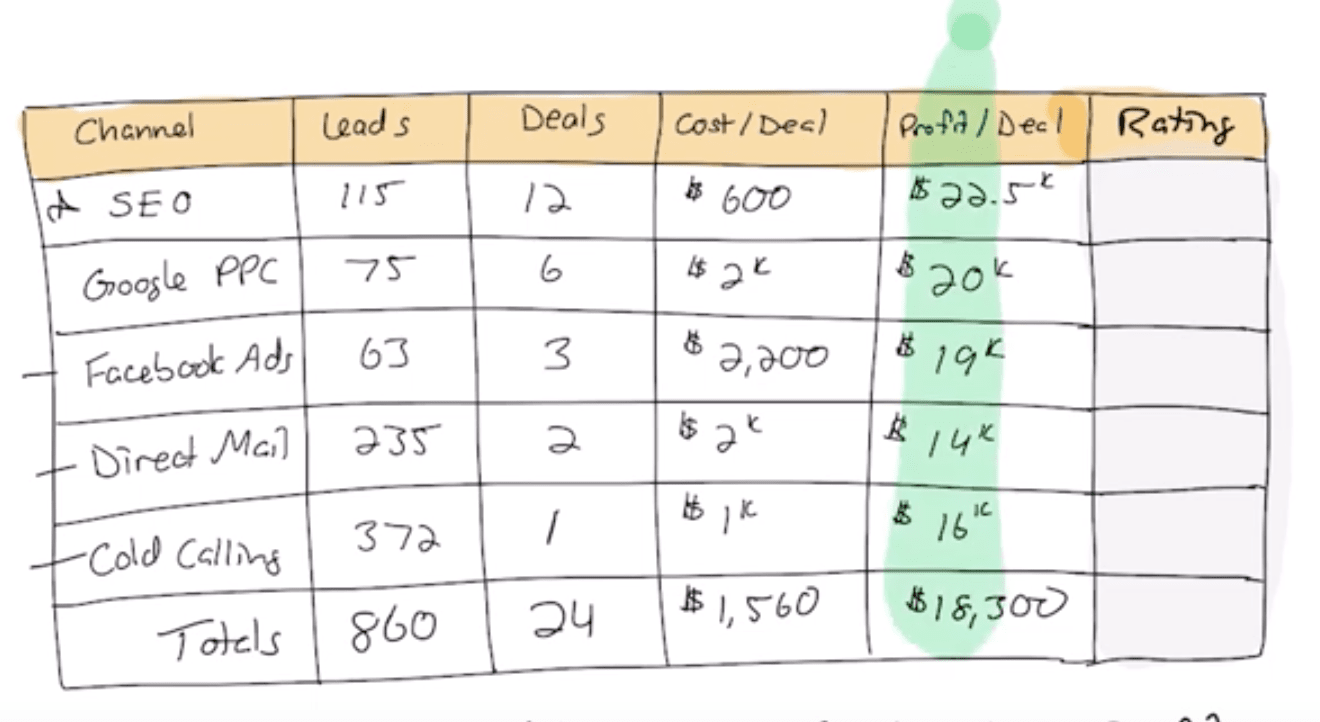
Next, it’s the profit per deal. Do the same thing. Look at the lead sources. What were the profits on those?
Real Estate Marketing Channels: Profit per Deal
What were the total profits for the year for that channel, divided by how many deals you did, and fill out the profit per deal column.
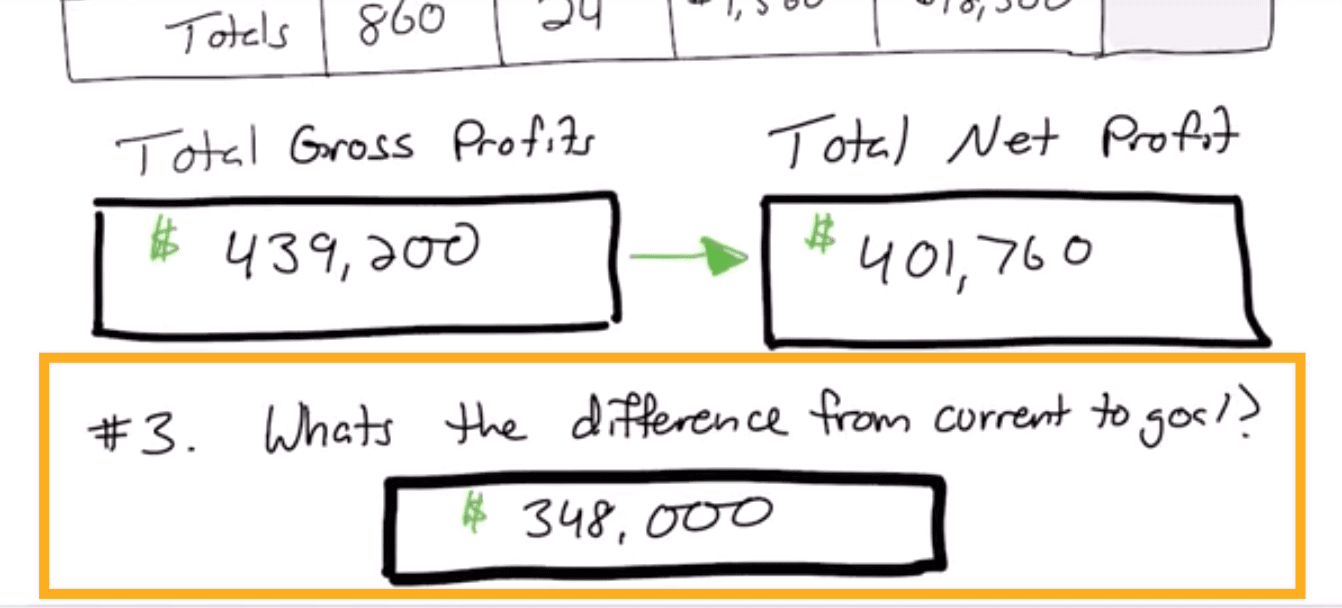
We’re going to end up coming up with these numbers down here in this section down here which is… what was our total profit for the year?
If we add those up, our total gross profit in this example is about $439,000.
If we take out the cost for those deals, let’s say it was about $401,000. We netted $401,000, that’s amazing. That’s a huge huge year.
If your goal is $750,000, and we currently brought in about $439,000, the difference between those two numbers is $348,000, about $350,000.
That’s the Delta we’re trying to make up in this next year with our plan.
I’m going to show you guys exactly how to do that in about three to five more minutes in this video.
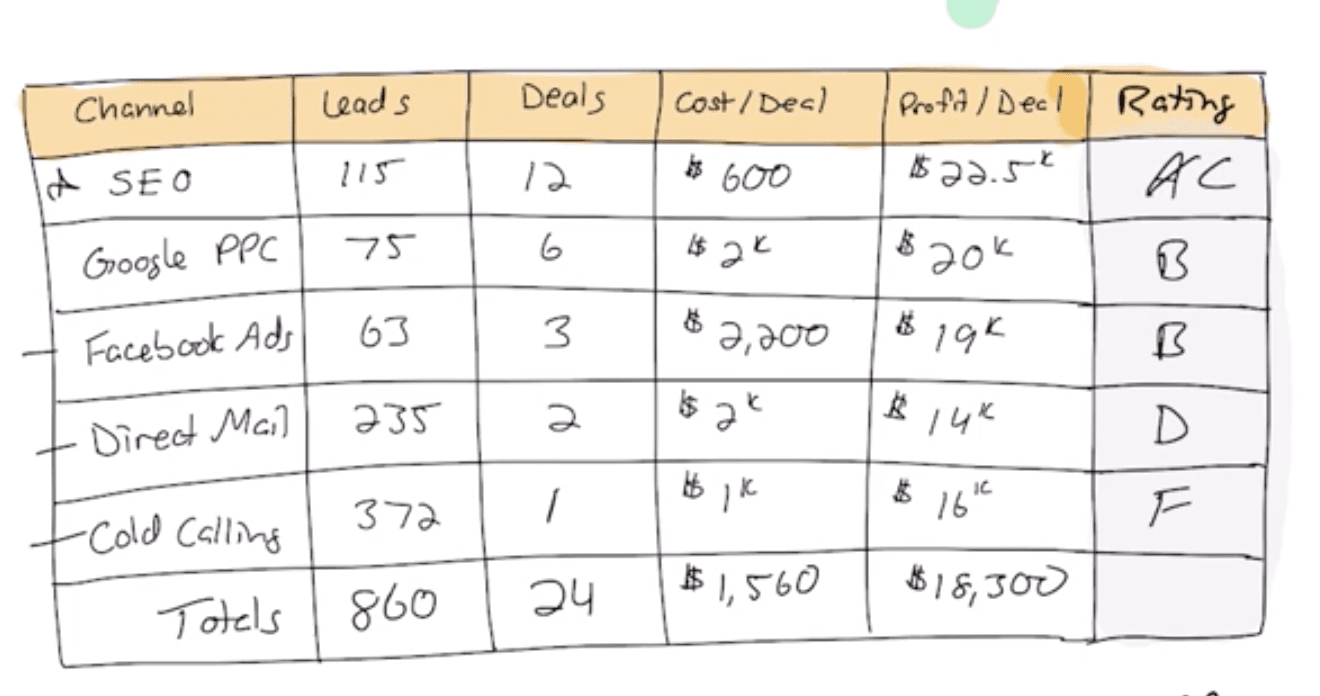
The next step I want you to take here, is with each one of your channels, now the way that we decide what we need to do in the year ahead, is we look at each channel and we ask ourselves, let’s kind of give it a grade rating, an A through an F.
An A means we’re executing it insanely well, and there’s probably no room for growth in this channel. We’ve maximized the channel.
If you’re doing SEO, and you’re just in one market, and you’re dominating Google for all of your keyword phrases, you’re ranked number one in Google for all your keyword phrases, that’s probably going to be an A.
There’s probably not a lot of room for improvement there if you’re dominating ranking number one in Google for all of your phrases.
If you’re not ranking number one in Google for all of your phrases, you’re number six, number seven, number eight, you might be getting a couple of leads here or there, maybe that’s a C.
Okay, give yourself whatever that rating is. Do the same thing with all of those.
I’m just going to make up some numbers here. Let’s say we’re a B with Google PPC. It’s working pretty good.
Let’s say direct mail, we’re a D on that, we tested it out, but we’re not really doing too great. Let’s say cold calling is an F, we got one deal, but man it wasn’t predictable. Let’s say, this is a B on the Facebook ads.
What we’re doing is we’re asking ourselves, where do we see an opportunity for growth? If it’s an A, we’re saying we’re doing the best we can possibly do, expanded it at the best we possibly could, there’s no opportunity for growth.
If it’s an F, it means we definitely haven’t maximized it, so it might be on the docket there okay.
Now, let’s say Google pay-per-click and Facebook ads look awesome, and then I really want to get this direct mail thing working better, so I’m going to go I see an opportunity for growing Facebook or Google pay-per-click.
Let’s say direct mail number two, and Facebook number three. If I think that there’s a lot of room for growth and we have the skillset to do so.
Okay, I’m going to come down here now, with what we had just done with those ratings. We’re going to rate those out, and now we’re going to come up with some new goals for these.
Let’s say the Google PPC, what we had been doing in the past was 75 leads, let’s say we want to increase that now and grow that to 150 leads.
We want to double this so we can help to start to make up that Delta of about $350,000.
We know with Google pay-per-click that we’re closing about one in 10 leads into a deal that gives us $20,000.
That was six deals, now if we can double our Google pay-per-click if we see opportunity there, because we haven’t really stepped into it too much, or we can expand our keywords, that’s going to then take it to 12 deals.
Let’s say the cost per deal stays about the same, and the profit per deal stays about the same.
Now that’s going to make it to, rather than us bringing in about a $120,000 in Google pay-per-click that year, that’s going to bring in far more, that’s going to bring in, shoot, about $240,000 with Google pay-per-click that year.
I’m just going to delete that puppy and let’s make this the goal.
Let’s say $240,000 total is what we’re going to bring in, and we’re going to bring in $120K extra.
What we’re determining is how are we going to make up this Delta of $348,000 bucks? Well, now we’ve made up right there $120,000 of it with the Google side of it.
Now let’s look at Facebook. If we closed three deals last year from Facebook, and an average of about $20,000 profit per deal, how many more deals do we think we can get out of Facebook?
How many more leads do we think?
Can we double that? I don’t know. That’s for you to determine, go talk to someone who’s an expert, or you dive into it. Let’s say this doubles to six, and that goes from $60,000 to $120,000 now.
It goes from $60,000 to $120,000 now, and that is in total. So the extra, the Delta that we’re adding is another $60,000. $120,000 plus 60, that’s about $180,000. You guys know where I’m going with this, right?
Now let’s say direct mail. We see a lot of opportunities. We just did one test and we want to expand it out. Let’s say we want to take this and see if we can’t expand this to 10 deals this year. We want a 5x this year.
How many leads do we need to get the whole thing? I’m not going to do all the math here, but you guys see where I’m going with this.
The things that we want to focus on here, doing some quick behind-the-scenes math, is we want to figure out what channels do we need to expand it by, how much do we need to expand them to get to this number here? The $348,000 bucks.
We’re going to speed up through TV time, and now let’s assume that we had picked our three or four channels, we’d worked the numbers and we have a plan.
Let’s say the number one plan is the Google pay-per-click.
We worked the numbers. We say, I think there’s more opportunity there, maybe we can bump this to 200 leads, and maybe we can bump this to 15 deals, and that’s a couple of extra deals. That’s $160,000, $170,000 there. Bam we found out our plan.
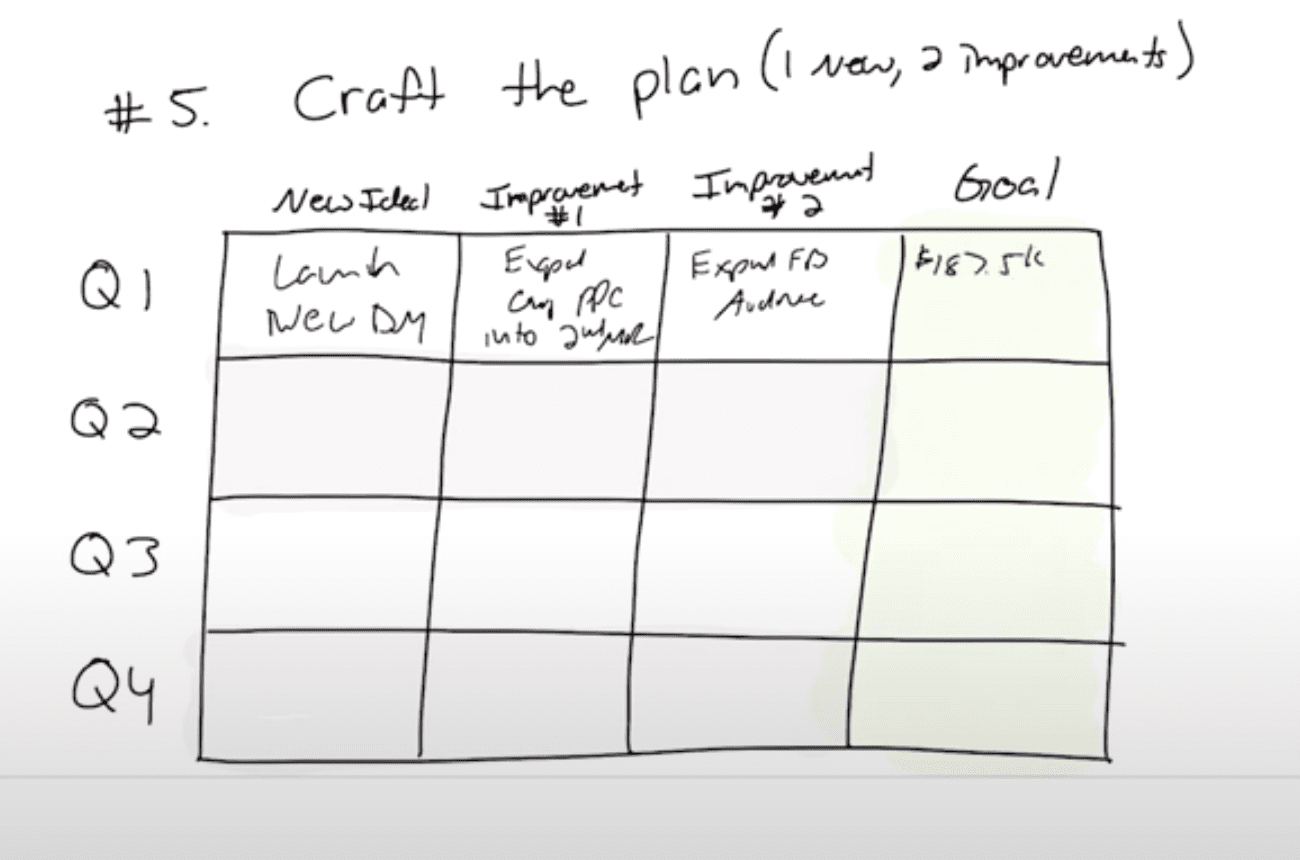
Q1 now, I want you guys to do this.
Pick one new idea per quarter and two improvements per quarter. One thing that we oftentimes do is plan way too many projects. Just start one new thing per quarter, and two improvements per quarter.
This here might be a new idea of direct mail. We barely dabbled in direct mail. We’re going to launch a new direct mail campaign. That’s the big new thing we’re going to do this year.
Improvement number one is we’re going to expand Google PPC into the second market.
That’s our improvement. We’re going to expand there. Improvement number two might be expanding Facebook’s audience.
Then our goal, if our total goal is $348,000 in extra revenue, and our total goal for the year is $750,000. If we divide that out, how much money, how much revenue do we need to bring per quarter?
I’m just going to grab my fancy calculator here really fast and show you guys this last little thing and we’ll wrap this video, and you’ll have a plan essentially. $750,000 divided by four equals $187,000 a quarter. $187,500 a quarter; $187,500.
Real Estate Marketing Channels: Craft Your Plan
You don’t have to make these all exactly the same per quarter, you can make them so you ramp up or whatever you want to do. It’s your plan. Each quarter I’m going to be planning out this.
Then we say, hey our goal is $187,500 per quarter. You can break it down per month, and then you say, okay how much of this is going to come from our direct mail campaign?
How much of it’s going to come from our expansion of Google pay-per-click and Facebook ads.
Then spend the next 10, 15, 30 minutes going, if we did those in the first quarter, what do we need to do in the second quarter?
It might be launching something else new here. It might be hiring an employee over here because now you’re having more leads.
It might be now getting a dispositions manager or something like that. It might be adding Carrot in here is that big new project.
Then each quarter you pick two things you can improve, one thing you can grow on that’s brand new.
All right, guys. Let me recap this right now, block out about an hour to two hours possibly, as you’re heading into this next year, and this can help you get insane clarity in exactly what you need to do with your real estate marketing as an investor or agent.
The first thing is you pick your revenue goal for the year. The second thing is you break out a scorecard like this that I’m showing you on the iPad, and ask what is working and break it down by channel.
Dig into those numbers. If you don’t have them you really need them to grow.
Then figure out what your profits are, and ask yourself what’s the difference between my goal and what I did this past year?
Next, we need to say, what’s our greatest opportunity? We need to kind of grade our channels. An A is you’re doing the best you could possibly do, no more room for growth. An F is it’s terrible, and there might be room for growth.
Then craft your quarterly plan, one new thing, two improvements per quarter, and then map those to your scorecard, which would be bringing in $187,500 per quarter or whatever your number is.
Guys and gals, we’re going to have some amazing resources for you that are going to help you to do your planning better, that is going to help you to grow your business better.
If you’re looking to expand your evergreen marketing and buy back more of your time, go to Carrot.com/evergreen, and check out our latest webinar on this topic so you can step into evergreen marketing, win more leads that are the highest margin, highest profit deals while you’re stacking your marketing with your other channels.
Guys have an amazing rest of the week, plan your marketing, hit it hard, but buy back your time this year.
Madison was successful because she wasn’t afraid to fail forward. She wasnt saying “I don’t know what to do.” She just tried. I really appreciated that.
– Beau Hollis
The “I Quit My Job” Deal w/ Beau Hollis
Beau Hollis, the closer out of Louisville, is back to take us behind another one of his awesome deals. This one in particular changed the lives of both the buyer and seller. Beau has spent much of his career as a solo investor.
Recently, on a day like any other, Beau met Madison, an aspiring investor who wasn’t afraid to do the work. He brought her in to make some calls, and show her the ropes, and together they closed their first deal in only a couple of weeks. Right then and there, Madison quit her day job.
Here’s how Beau is finally expanding his team while helping others to gain financial freedom.
Read the Full Show Notes Below…
In our most recent Behind the Deal Livestream, we dove into a lot of great topics. From mentorship and growing your team, to doing deals that are out of state. You’ll hear how the lead was found, how they worked with the seller, and how much they made when all was said and done.
We were most excited to hear about the incredible impact he made with this deal, as well as Beau’s advice for overcoming your nerves. Keep reading or listen in to learn more…
Mentoring Your Way to a Larger Team
Despite what Youtube might tell you, you don’t learn this business overnight. The best way to become an expert is by getting out there and doing the work. Finding a great mentor can be the fastest way to learn. However, experienced investor can only devote their time to those who are eager to learn.
In the case of this deal, Beau worked with an acquisitions person named Madison. He was at the bank one day, wearing his infamous “House Buying Guy” shirt, when Madison asked if he was serious.
After a number of questions, joining his FB group, going to Meet-Ups, and getting on the phone to make some calls, Madison got this deal in the door.
The Deal
While Beau primarily works in Louisville, this lead came in from Florida. Normally, he would let the lead go, but he gave it to Madison so she could practice on the phones. The owner had recently lost his wife and they didn’t feel right trying to negotiate with him.
It was a tenant-occupied property that the owner simply wanted to sell right away. He wanted $85k and that’s exactly what Beau and Madison offered.
They sold for a $64k profit. And after the commissions and closing costs were covered, they walked away with about $54k.
Beau gave Madison a 10% split and she turned around and quit her job to pursue real estate full time.
Having Conversations
The best advice Beau can give is simply to talk to people. Many people get rattled by nerves or hesitate to pick up the phone because they aren’t sure what to say. The only way to get over this fear is by getting out there and doing it.
The only way to have good conversations is to have a whole bunch of bad ones first. Beau recognizes that we are in the people business. He loves talking to people and helping them find solutions.
He could hire a bunch of people to do this for him, but he genuinely loves doing the work.
Fear as a Healthy Motivator
Regret can be a huge motivator. Next time you are nervous to make that call or email that lead, think about how you will feel if you don’t do it. Even if you don’t close the deal, just by making the call you will be proud of yourself. Regret can be a healthy motivator.
Put yourself in that emotional state. How will I feel after I make the call? How will I feel if I don’t do it?
Tips That Actually Work: Landing Pages vs. Location Pages
A lot of our users have had questions about landing pages vs. location pages. In our experience, we have found that…
The home page will build trust and rapport, driving people through the journey. They are great for SEO, especially for those on a desktop who may be in search mode.
Landing pages do great on mobile and are a great place to point your Google/Facebook Ads. These pages are more simple than the home page, with less navigation and the opportunity to click away.
Location pages are hyper-specific and are meant to bring traffic to your page. Just like Zillow or Realtor, adding Location Pages to your website will help to improve your SEO.
Join us at carrot.com/deal every other Thursday for Behind the Deal where you can ask your questions and watch live!
We’ve been getting some awesome questions from the Carrot community lately so we’re going to be answering some of them here on the blog in detailed posts to help you get an edge on your competition with your real estate investing website.
The other day, one of our members from Indianapolis (one of the top turn-key rental property sellers in Indianapolis) asked…
“Hey Jake, good morning, in general, are there less real estate investor leads in holiday months then in the summer months?” Francisco
(NOTE: This customer is in our Content Pro plan and saw their first leads in their market within the first 2 weeks after launching their sites and implementing a few critical steps.)
We’ve monitored this trend over the years while also monitoring search levels on many of the top motivated sellers, cash buyers, private lenders, and tenant search phrases out there.
Now… each type of searcher came up with slightly different seasonal search patterns…. so in this post, we’ll run through some of what we found so you can better prepare for fewer November and December lead volumes when leveraging SEO and traditional Google PPC specifically for motivated property seller leads and cash buyers.
So… Are There Less Real Estate Investor Leads In Holiday Months Than Summer Months?
When Are Motivated Property Sellers Searching Google?
First, let us look at the highest searched highly motivated real estate seller search phrase, “we buy houses”.
Average Monthly Searches Of The Motivated Seller Search Phrase “we buy houses”
Average “we buy houses” Searches In Google Per Month: Notice the big ramp-up of searches in the summer and spring months. What’s this mean?
That’s really interesting… but that doesn’t tell the whole story. So we took the average of the top 25 motivated seller keyword phrases to see overall… is there a seasonality for motivated sellers hopping online and searching for someone to buy their house.
The graph below shows the average of the top 25 search phrases in the United States for highly motivated sellers on Google across the past 24 months.
Average Monthly Searches Of The Top 25 Motivated Real Estate Seller Search Phrases
Average Monthly Searches In The Past 24 Months: Highly motivated sellers searches on Google trend up in the warm months and down in the colder months… with December being the lowest each year.
We see a similar ramp up in the warm months… and the number of motivated sellers searching Google with the common highly motivated search phrases dips in the winter months.
On average… the summer months are getting nearly 30% more searches from motivated sellers than November and December.
Now, we did cross-check this to make sure it wasn’t a “cold winter climate” vs. “mild winter climate” thing… and overall we still saw very very similar trends. So, for now, we’ve ruled out the climate being the major contributing factor to the seasonality of the motivated seller searches.
Why Do Fewer Motivated Property Sellers Search Google In November And December?
There are lots of reasons that could be causing this… but here are a few of my guesses…
It’s COLD! (in lots of places) so they want to hang out
It’s the holidays and people don’t have the time to deal with something else or don’t want to disrupt the holidays
Generally, there are fewer properties on the market in general so many house sellers feel that “selling in the spring” is what you’re supposed to do to sell a house fast (even though some data shows houses that sell in the winter sell for higher prices and sell quicker)
When Are Cash Buyers Of Real Estate Searching Google?
Overall a cash buyer is in a different mindset than a highly motivated seller. Usually, a person who’s looking to buy investment property tends to look for properties when they are thinking about their financial future.
There is a bit of seasonality to cash property buyer searches as well. Fewer searches for the top 20 cash property buyer searches on Google in November and December than most of the other months during the year… but one key thing to take note of, if you’re selling investment properties or just looking to grow your cash buyers list in a bit way… is the single most searched month in the whole year is January.
Average Monthly Searches Of The Top 20 Investment Property / Cash Buyer Search Phrases
January Is The Single Most Searched Month For Cash Buyers: This chart from Google search data shows January beating out all other months during the year for investment property buyers looking online for properties. What are you doing to get ready to build your cash buyers list in a big way in January?
That’s pretty darn cool (and useful) eh?
Find Seasonal Opportunities
It shouldn’t be surprising that the real estate industry has seasonal patterns. To validate this… according to Realtor.com, homes are most popular in the summer months when people have their minds set on moving because it’s a peak season for inventory and sales.
But, the winter months should not be discounted. For example, wintertime can provide a unique opportunity for investors because they know people want their houses sold fast!
Winter Pro: Serious Sellers
Winter is known to be the most profitable season for buyers. When it’s cold outside and snowing, there are many more “serious” sellers who want their home sold quickly so they can get on with life in warmer weather; conversely, this means that you’ll find some motivated sellers right when you need them.
Winter Con: Low Lead Volumes
Winter weather can be a major factor in the real estate cycle. Cold weather, including elements of rain and snow, can make it more difficult to find sellers. This can have an impact on the buying and selling process, as the limited potential sellers may have an overappreciated value of a home in cold months.
What This All Means
What this means to me is that people are looking at their financial goals at the start of the year and saying… “Man, I need to get my butt in gear and pick up some more investment properties to hit my goals this year”… so they dive in right after the holidays and start looking for properties.
There may also be tax reasons that people are waiting until January to kick up their investment property search… either way… the data shows it’s the case… so now it’s time to act on it.
So, if you know the single most popular month for investment property searches online is January each year… what are you doing to build your own cash buyer list for your real estate investing business?
What Can You Do To Prepare Your Real Estate Investing Business For Seasonal Search Trends?
Really, what this data shows is that there are seasonalities to the real estate investor leads you can expect from SEO for real estate investing and even PayPerClick marketing.
So keep these things in mind as you’re generating leads for your real estate investing business through your website…
Winter months for both investment property buyers and motivated house sellers bring in lower volumes than the summer months (but not drastically lower… at the least… maybe 30% lower on motivated seller leads)
Now is the perfect time to start your Evergreen marketing campaigns if you haven’t already so your real estate investing websites rank higher in Google for keywords that matter when the spring and summer come around
If possible, try not to rely strictly on SEO or PPC for your only lead generation if you’re not in a larger market in the winter months if possible… so your marketing plan is well rounded and you’re getting leads coming in from places other than just the internet in slower lead months.
Get a cash buyer/investment property buyer campaign rolling asap so you can take advantage of the highest searched month of the year for people looking for investment properties. How? Start your Craigslist marketing… go to your REI club in January and start getting your buyers’ list built there… kick on some Google PPC campaigns if you have a bit of a budget to invest… Facebook ad campaigns are doing REALLY well to generate investment property buyers and tenant buyers… basically… get focused and leverage the January cash buyer traffic!!!
If you’re a Carrot member, you know how well the Cash Buyer websites on our system are converting… so put it to use.
Also, on the motivated seller side of things… having a real estate investing website with a high conversion rate(how many people land on your website and become a lead) is as important as ever in months with lower search volumes like December… so if your current website isn’t converting like it should… take a look at Carrot to see if it’s a fit for you.
We’re the only company in the industry as focused on results and increasing conversions on our platform each and every month as much as we are… so you can just focus on growing your business… not fiddling with building websites and trying to learn conversion rate optimization in your “spare” time.
Hit me with comments or questions below! And leverage these seasonalities in the Google searches to your advantage!!!!
When it comes to video, you don’t need a lot of views to drive a lot of business.
– Anthony Beckham
The “Zombie House” Deal & How to Dominate SEO with Video w/ Anthony Beckham
In this episode of Behind the Deal, we brought in our friend Anthony Beckham, a local agent and investor who is doing big things in our small town.
Within just a few years, he has built an incredible team and become one of the top agents in our area.
Today we will hear about “the Zombie House” and how he is using video to improve SEO rankings and dominate the local market.
Read the Full Show Notes Below…
Our motivation for these Behind the Deal episodes is to demystify and break down the process of investing in real estate from start to finish.
We are letting you know how they found the lead, closed the deal and persevered through all sorts of crazy challenges.
This episode is no exception.
Anthony not only bought the Zombie House, but he was able to sell it twice. Here’s how he did it…
The Deal
Anthony typically focuses on his brokerage, which does over 100 transactions a year in a market of about 25,000 people. He also does a handful of wholesale deals a year, only buying in situations where he can not lose.
In the case of the Zombie House, Anthony knew he would be able to at least sell the land, breaking even on the deal.
For this deal, in particular, the lead came in from a friend and fellow real estate professional with a Carrot site. The deal wasn’t right for them, so they called up Anthony to see if he was interested.
The Numbers
On the lead form, the seller referred to the house as the “Zombie House” and she wasn’t kidding. While the property looks ok from the outside, the inside required a lot of clean-up and renovation.
The seller was originally thinking they would sell for $80k, but after meeting with Anthony, they ended up selling directly for $25,500.
Selling the House Twice
Anthony was able to find a buyer for the property who paid him $45k for the property. This meant a fast profit of about $19,500.
After spending some time working on the house, the new buyer realized it wasn’t going to be worth it to continue putting money into the property and that they were better off listing it.
And guess who they hired to be the listing agent? Anthony helped them get the property on the MLS, selling for $60k. He helped the investor achieve a small profit while picking up a 3.5% commission on the deal.
Hacks to Dominate SEO with Video
Anthony has built an incredible reputation locally through the power of SEO. He has a full-time videographer on staff who has turned him into a bit of a local celebrity.
Together, they create new videos each and every week that has helped build brand awareness and answer questions buyers and sellers often have.
By creating this informative, evergreen content, Anthony has positioned himself as the local expert real estate expert.
Tips That Actually Work
The use of video is one of our favorite tips that actually work.
We’ve created a Video Marketing Playbook to help you with keywords, scripts, and 52 excellent content ideas. You’ll want to create videos that are about 3-8 minutes long as posts of this length can easily be turned into written blog posts.
Keep in mind that when you are first starting, you may not receive a ton of views. But if you stay consistent, you will build your audience quickly.
Shooting a video one time has the potential to generate leads for years to come.
If you’re a wholesaler or a real estate agent that’s looking for motivated sellers, I’m going to show you how to grow your real estate business into multiple markets, get leads for $20 to $30 per lead and cut your Google pay per click ad costs by 50% to 75% by going regional or national in this video right here.
So guys and gals, a couple of weeks ago, I was talking with one of our clients that they were pulling in leads from Google pay per click for somewhere between $20 to $30 bucks a lead.
Now, you can even, I’ve heard stories of $10 bucks a lead, $50 bucks a lead, the whole thing.
The thing they did was they went from just being a local investor or local hybrid agent investor, looking for sellers in one market, to they expanded to national.
So, now they’re using their Carrot website for national lead generation.
So, what I’m going to do in this video is I’m going to walk you through it. We’re going to dive into my iPad.
I will show you how to go from a local website with Carrot to regional or statewide.
And then if you wanted to expand to national, they’re all completely different business models, so I’m not saying that you should do it because you have to then figure out, of course, all the different moving parts of how to turn those leads into deals, how to analyze deals in different markets, the whole thing.
We’re not going to cover that in this video. We’ll cover that in some other videos. But let’s dive into the iPad because we’re going to show you exactly how to set up your Carrot website, depending on whether you’re local, regional, state, or national.
Let’s dig in.
How to Grow Your Real Estate Business Into Multiple Markets
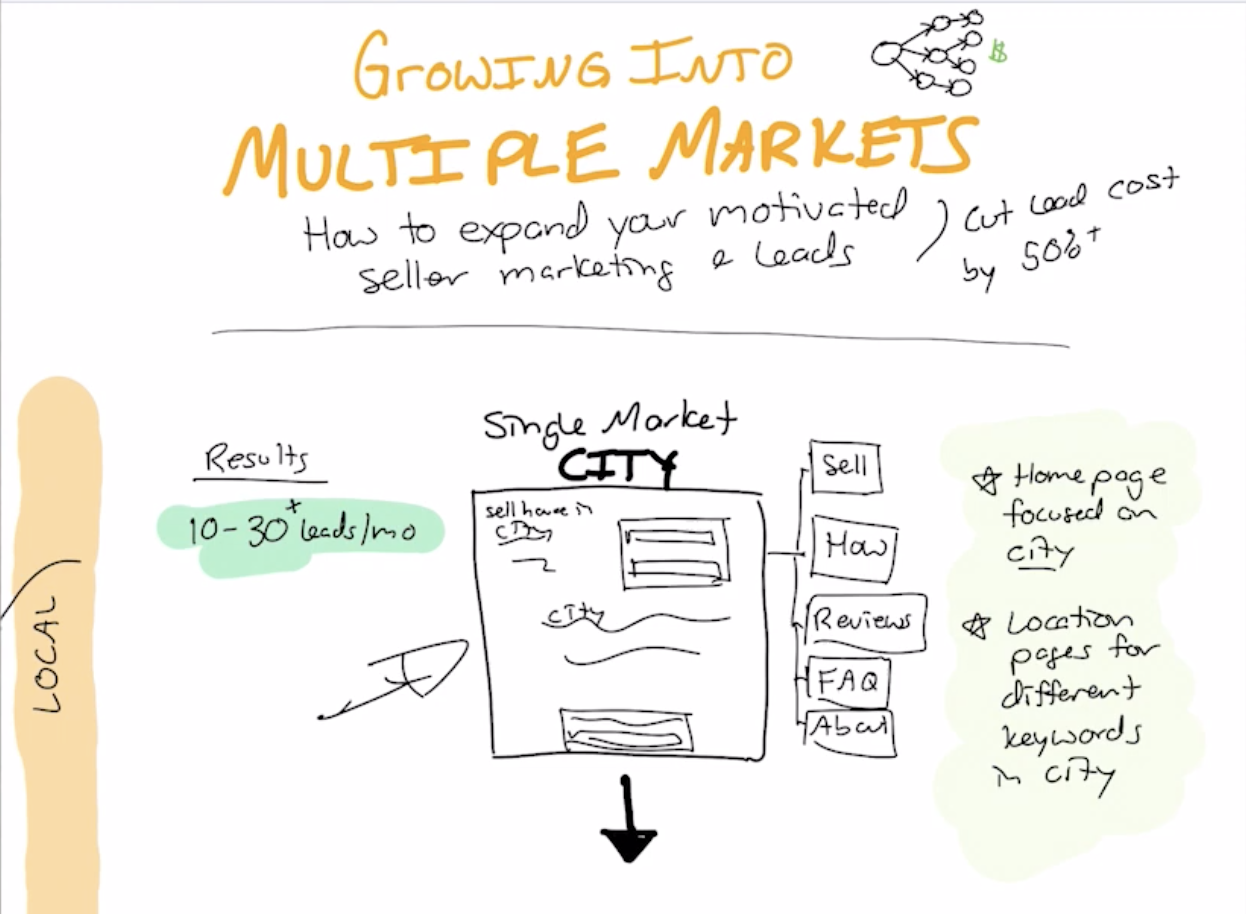
So, we’re right here on the iPad. The very first thing, this is where most of our clients are, most of our clients are in the local bucket. Meaning, you’re in one market, you’re in Cincinnati, you’re in Tampa, you’re in Roseburg, Oregon. You’re in Phoenix, Arizona.
Single Market Real Estate Website Strategy
Of course, the bigger the city, the more opportunity there is to pull more and more leads out of the city because the population’s higher.
So, in a single city market, your website’s pretty much going to look like this. You’re going to have your homepage right here and it’s going to be, “Sell your house in city.”
Pretty much those types of phrases. Over here, you’re going to have your standard, what we call authority hub pages, which is your “sell a house” page.
It’s going to have a call to action on it. Your “how it works” page. Reviews page with testimonials to build trust and credibility, maybe some FAQ, and then you’re about page and contact pages. That’s what we call the core conversion pages here at Carrot.
To be in one city, that’ what you need.
That’s pretty much all that you need.
You can use our tools and systems then add automated blog posts, or to use our video post feature, to build further trust and credibility. But that’s how you would lay it out.
Your homepage is focused on the city at that point, sell your house fast in Cincinnati. And then you would talk about that, show Cincinnati pictures.
Your location pages might be set up for different keywords in that city. So, maybe you set up a location page for cash home buyers in the city, or sell your inherited house in Cincinnati. That’s how you’d leverage that.
So, let’s say now that we wanted to expand out beyond that one location. If you’re in a city, you can pretty much expect somewhere between 10 and 30 leads a month once you get the SEO and/or Google pay per click launched in that one area.
It depends on the population and your market.
If you’re in a 10,000 person city, then you’re probably going to be maybe three, four, five leads a month from Google PPC or SEO.
If you’re in a two million person population market, you might be able to get 30 to 50 leads a month, if you’re ranking really in Google and doing some Google Ads.
Regional or State Website Strategy
So, now we’re going to move into the regional or state set up on your website.
Statewide Real Estate Website Strategy
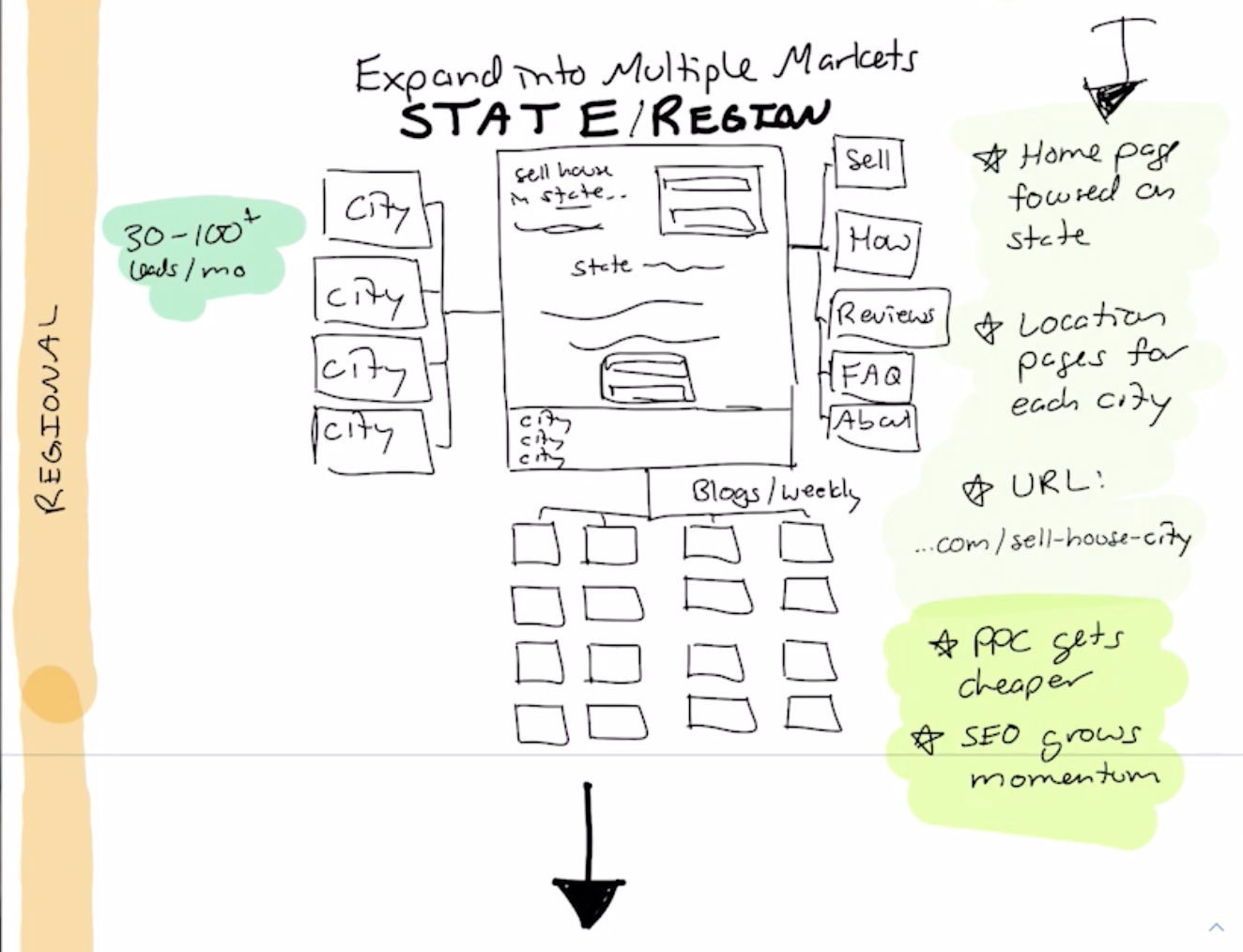
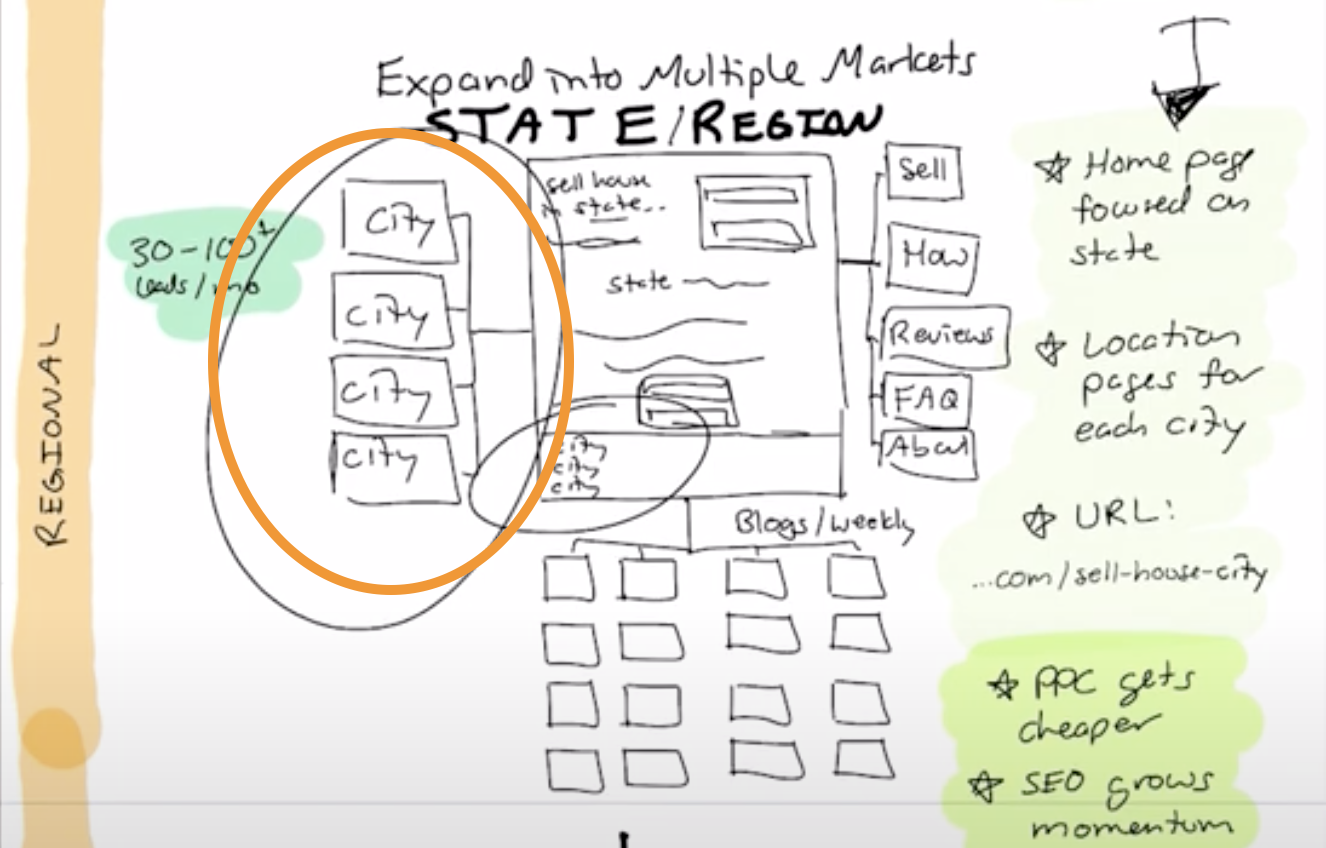
The regional or state set up on your website is basically going to be kind of like this, the only real core differences are your homepage now, your homepages focus on the state.
So, rather than your homepage focus on just one city, we’re going to focus on the entire state or the entire region that you operate in.
If you’re in the entire state of Texas and you have four prime cities, Austin, San Antonio, Dallas, and Houston, as an example, then you’re going to have your homepage be, “Sell your house fast in Texas,” basically.
Then you’re going to have pictures that have a broad array of pictures of the different markets that you buy houses in, or that you’re a real estate agent and/or an investor in.
Then down at the bottom of your website, you’re going to have a link to your prime cities in that state.
You might link up to five, six, seven, eight of your cities to those city location pages.
Over on the left side, those are what we call location pages. So, you’re going to set up a new page for every single location or every single city in that state. Sell my house fast, Dallas. Sell my house fast, San Antonio. Sell my house fast, Katy, Texas. Whatever those cities are.
City Location Page Strategy
I want you to focus on just looking at those on a quarterly basis. Every quarter, do I need to add any new city pages or location pages within this state?
Now, let’s say you’re in three, or four, or five states. You’re in a region. Your homepage would then be, “We buy houses in the tri-state area,” or look for tri-state investment properties.
Then on the homepage, talk about the three states you do business in and maybe some of your primary cities. Then you would create pages for states and cities.
Some advantages here, your homepage is focused on the state. You can start to rank really well at the state level and at the city level.
Location pages for each city, like I said, now you can get those rankings in Google for each city. Your URL is going to look kind of like this, whatever it is .com, forward slash, sell your house in X, Y, Z city.
Your PPC, this is where is where the lead costs get lower. If you’re marketing, doing Google PPC in just one market, your PPC cost is going to be the most it can possibly be because you don’t have a very broad targeting there.
The broader you’re targeting, the lower your click cost tends to be.
But once you start to get down in here into the state and region, and you’re marketing a wider audience, your PPC gets cheaper and your SEO momentum actually grows because now you’re setting up multiple pages in multiple cities, the 10th location page, 11th, 12th, 15th, ninth, whatever it is.
As you built up the SEO and your overall domain name, each one of those is going to rank in Google faster and faster and faster.
So, a lot of people ask, should I set up multiple websites? Should I have a website for every city?
And my suggestion is, if it’s all for motivated house sellers and you are okay with having one unified brand that will work well in all those cities, then I would suggest setting up the one motivated house seller website that encompasses all of those cities because the SEO juice is going to feed into every location page you create, and they’re going to rank faster and quicker.
National Website Strategy
So, now let’s say you want to go to the national.
National Real Estate Website Strategy
We have a lot of our clients using Carrot to do national house buying, national investment property websites, things like that.
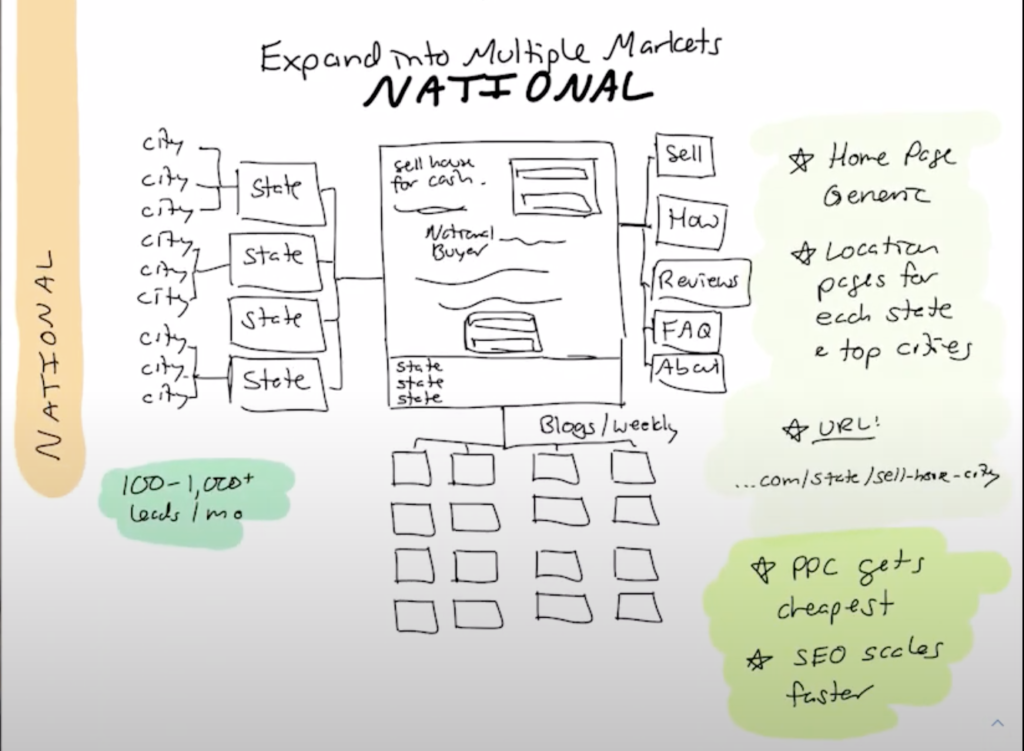
The main difference that you’re going to do here is your homepage now is going to be more generic.
So, rather than sell your house fast in Cincinnati or sell your house fast in Ohio, now it’s going to be “sell your house fast”, “how to sell your house fast for cash”, or “we will make you a cash offer on your home.”
Then on that homepage, you’ll talk about that “we buy all around America” and then you might have a link to maybe some of your primary markets that you buy in.
Link up to some of those states or some of the cities that are the primary markets that you buy in.
Now what we’re going to do with our location pages is this, instead of creating location pages for a city at the root level, we’re going to create location pages for each of your primary states.
State Landing Page Strategy
Let’s say you’re a national buyer, but you focus on 10 states. Create a location page for each one of those states. It could be “sell my house fast Florida”, or sell my house fast Georgia.” Basically, it’s “sell my house fast, insert state.”
Now what you’re going to do is create city pages for each one of those states, which are the primary cities in the state that you buy in.
If it’s Florida and your primary cities are Tampa, Orlando, and Jacksonville. You’re going to create a Jacksonville page, sell my house fast in Jacksonville. For Orlando, you’re going to create an Orlando page, sell my house fast in Orlando. You’re going to do the same thing for Tampa.
Those would be underneath the state of Florida. This is what it would look like over here on the URL. It’d be your site .com, forward slash whatever that state is.
So, that’d be Florida, forward slash Florida, and then forward slash sell my house fast Tampa.
That would be the name of that page, sell my house fast Tampa. The name of that page would be Florida, or sell your house in Florida. That is your structure.
Your PPC gets the cheapest here with this strategy. Now, this is where you’re going to start to get your $20 cost per lead. Your $30 cost per lead. Your $50 cost per lead in Google, in the exact same markets, that before you might have been paying $80 bucks, a hundred bucks, $150, $200 per lead in the exact same market.
You might be saying, “Why is that? Why does the cost per lead in Google Ads get so much cheaper?” Or even Facebook if you go broader. Because you’re targeting a wider audience and when you target a wider audience, Google actually has more data to feed back into your campaign to get your click costs and lead costs lower.
Your SEO scales way faster too.
If you already have 10 20, 30 location pages, and you have some SEO juice on your website.
When you set up that new page and that new market, it’s going to get ranked really, really fast, because you’ve already done all of this work.
Creating this amazing national website with the state pages and the city pages, and you’re eight months in, a year in, two years in.
Google loves your site. They see you as an authority, it’s got some great link juice. Every single page ranks faster now.
At this level (national), you can expect 100 to 1,000 leads a month, depending on how well you’re doing the marketing. At the state and the region, you can expect between 30 and a hundred leads a month. Of course, depending on how well you’re doing your marketing and SEO and PPC.
Recap: How to Grow Your Real Estate Business Into Multiple Markets
Let me recap real quick.
The best way to expand from local to national is to create a new cadence or new setup with your location pages.
You go city and then state, and then also you start to scale out your Google Ads. Because as you scale out your Google Ads to more states, more locations, they get cheaper and cheaper.
And that’s how the big lead generation services do it. That’s how our biggest clients do it and get way more leads at a way cheaper cost because they’re going national.
Check out our other videos in this series and on our YouTube channel.
Hit the subscribe button on our YouTube channel because every single month, we put out new content that teaches you how to be an investor or an agent, or a hybrid investor agent, and generate more leads more consistently in an evergreen fashion on the internet.
You can finally get more freedom, finally, make a greater impact with your business. Go to carrot.com/evergreen to check out our webinar on the topic of evergreen marketing. If you enjoyed this video, we’re going to dive way deeper into that training.
Go to carrot.com/evergreen. Have an amazing rest of the week, like and subscribe to this video, we’ll see you in the next video.
It is arrogant to believe that you are the guy who will solve all the problems within your business.
– Chris Kennedy
How to Grow a 7-Figure Property Management Biz You Actually Enjoy w/ Chris Kennedy
It’s not often that we get to have a customer in-studio to tell us about their business journey.
Chris Kennedy is not only a member but also a Carrot Camper who has taken what he has learned, implemented it and created an incredible vision for his future.
We sat down to talk about his goals, his mission, what gives him energy, and what he is doing to take his business to the next level.
Read the Full Show Notes Below…
Chris Kennedy is an investor, broker, and property manager. With a robust portfolio of his own, he has been able to take what he has learned, and help others achieve the same success.
By building solid relationships with tenants, property owners, and his team, Chris has been able to carve out a very lucrative niche for himself in a highly competitive market.
Building a Multi-Faceted Business
Chris was an investor first, then got into sales and management. Today his company also handles property management, where he spends the majority of his time. His mission is to help thousands of people through responsible real estate practices.
Currently, he is doing just that. By serving buyers, sellers, tenants, owners, and a long list of vendors, Chris is building a business that impacts more and more people each day.
Excelling at Property Management
Most people dealing with property management don’t like it. One reason is that they are looking at it as a transaction vs. a relationship. It can be a brutal and intense job, which is exactly what Chris loves about it.
He also has found true purpose in his work, both helping tenants and fellow investors succeed in their pursuits.
His company is a steward of his client’s assets, and Chris takes great pride in this.
The key for him has been building the right team and putting the right systems in place. Many property management companies use antiquated systems. Because of this, Chris saw a lot of opportunity in this field.
Adopting the latest and greatest technology has put him one step ahead of other managers in his area.
In the beginning, when managing less than 100 properties, the job felt difficult. But as he grew, he was able to hire a team, implement the best software, and design the right processes.
Currently, he has around 30 clients, with a combined total of over 600 properties!
Moving From Operations to Ownership
As founders, Chris and I can both relate to letting the day-to-day operations of the business consume your time. When you are self-employed and working solo, your income is tied to time.
But as you grow and build a team, more of your time can be dedicated to coaching, casting a vision, and working in the areas in which you make the greatest impact. You can focus on what gives you energy as opposed to the daily tasks that drain you.
When Chris visited us at CarrotCamp, he felt as if he was drifting a bit and losing focus within his business. He expected to get tactical, learning how to build a website and get leads in the door. And while he learned quite a bit about that, he walked away with something much greater.
The clarity and vision he needed to take his business to the next level.
After CarrotCamp, Chris worked on his vision daily before sharing it with his team. Since that time the mentality, passion, and drive of his team have soared.