You’ve probably heard the phrase “conversion rate” tossed around quite a bit over the years. And that can be a great thing if you’re testing your conversion rates… but not so good if it’s inaccurate and you follow the next “guru” advice blindly without running your tests (or for Carrot members, we do this for them).
Carrot is one of the leading real estate website platforms. We are confident that our members generate 60,000+ leads per month through our platform and nearly 1.7 million sessions each month because we have such an extensive data set available to us from which to conclude.
So first… let’s dive into the basics of conversion rate (specifically for a real estate investor website). Then we’ll dive into why it’s important, how to do it right, and give you a few resources we use to improve our conversion rates.
What Is Conversion Rate?
The “conversion rate” on your website is simply the ratio between the number of people who land on your website vs. the number of people who “convert” on your website to become a lead.
That could be a cash buyer lead, motivated seller, tenant, or private lender.
The “conversion rate” is pretty simple to calculate.
If you have 100 visitors to that page and 15 of them put in their info on that page and opt-in as a lead for you, that is a 15% conversion rate.
In other words, it’s…
Conversion rate percentage = (Number of people who converted on your website / Number of visitors to your website) x 100
At Carrot, we’re constantly testing our customer’s websites to see what converts visitors best.
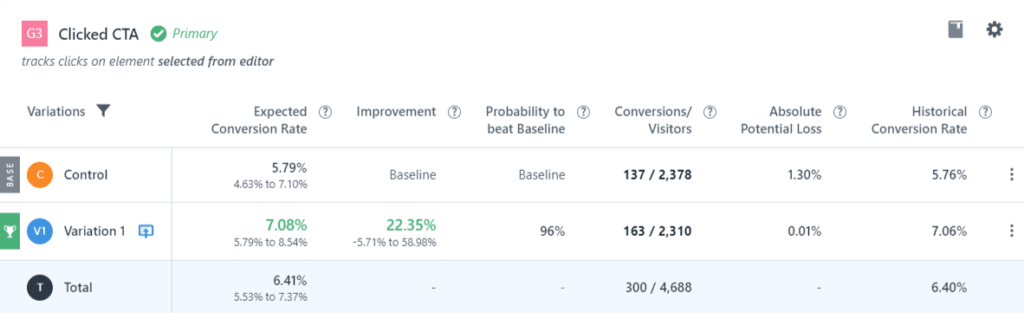
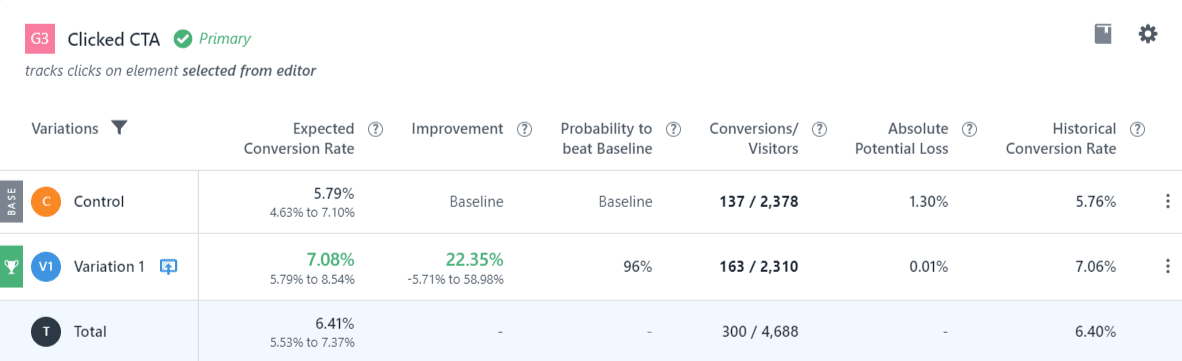
A Test In Progress On A Carrot Members Website: This is a shot from an actual test we’re running on a motivated seller website.
How Do You Find Out The Conversion Rate?
There are a few ways to determine your website’s conversion rate.
The easiest and most accurate is using a software tool… like the one we use… VWO.com (about $49/month and easy to use).
You have to get a bit of code from the software, put it on your website (really easy to do inside a Carrot account – hit up our support if you need help), and then set up the test in the software. Let the traffic come in; it’ll tell you how many people convert as a lead.
It may take you a few hours your first time to set up a test, and unless you’re getting 100 visitors to your website each month, it’s probably not worth setting up a test (it would take many, many months to come up with any real info because your traffic is so low).
If you’re on a budget and are not a tech person, you can count the number of leads you had in a specific period — then look up the # of visitors in that period on your analytics and divide the two.
*Or, if you’re a Carrot member… and you’re getting over 500 visitors a month to your site and 15+ leads a month, we’ll do your conversion rate and optimization testing for you! Just let us know through support.
What Is A Good Conversion Rate For A Real Estate Investors Website?
One of the biggest misconceptions we hear all the time (and I once thought the same thing) about conversion rates from our members… is that there is a “normal” conversion rate for a website in our industry.
I wish there were.
But in reality… there are so many factors that can affect how many people convert on your website into a lead that a good conversion rate for a motivated seller website… isn’t a good conversion rate for a cash buyer website or rent-to-own website.
Factors include:
Where the visitor is coming from before they hit your website. Are visitors finding your website organically through social media or paid ads? *Paid ad conversion rates can also be deceptive. A Google Ads campaign targeting a state or national can have different (usually higher) conversion rates compared to a local campaign
Whether or not your site is set up to convert well (like all of our Carrot sites are)
Credibility on your website… High-quality testimonials can increase your conversion rate by 34%
Colors
Your logo can sometimes make or break conversions
Button CTA… Changing your CTA can increase the conversion rate by 49.5%
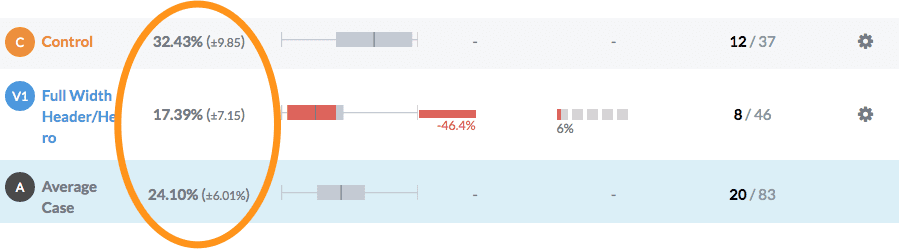
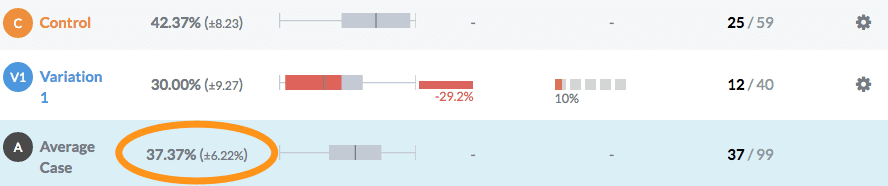
On one cash buyer test we ran… at one point, that website was converting almost 40% of all people who landed on the page to a cash buyer lead (picture of test results mid-way through below):
Cash Buyer Conversion: Results mid-way through a “split-test” on a cash buyer website for one of our InvestorCarrot members. That is a pretty darn high conversion rate… even for a cash buyer website (we’ve worked hard to get our Carrot websites converting high – that’s why so many people LOVE having their websites on Carrot). But later in that same test, the conversion rate settled in the mid-’20s.
Why?
In this case, the website didn’t change… it was mainly a “traffic issue.” She started doing Craigslist marketing which tends to yield a higher volume of traffic but a lower conversion rate.
But on average… we’re seeing cash buyer websites (when people drive the visitor to our home pages which are geared to convert well) convert between 20-40% of visitors to a cash buyer with quality traffic.
Motivated Seller Website Conversion Rates
We’ve heard people ask if our motivated seller websites are converting at “25% as they used to 5 years ago,” and the answer is no, they’re not.
5, 6, 7 years ago, before every investor on the block had a website, before 50%-60% of all searches were on cell phones (and most websites aren’t optimized for mobile). During the recession, when hoards of sellers were in dire straights and just needed out (and were willing to opt into any and every website online they could find to get out of the situation fast), the conversion rates on a motivated seller site could consistently reach 20% or more.
And that’s a stellar conversion rate for a motivated seller website.
But times and markets have changed a lot, even over a year, and conversion rates are a bit softer for motivated sellers.
Sellers today have more choices regarding websites to engage with online and are pickier with who they’ll work with. They want to see a website that feels credible, that they can trust, and that is easy to use.
So we’re seeing motivated seller websites (depending on the quality of traffic they’re sending to the site, and what they have done to their site to improve / decrease the conversion rate) convert from 7% to 20%. 20% is an outlier… and only with organic search traffic (SEO) or direct type in traffic.
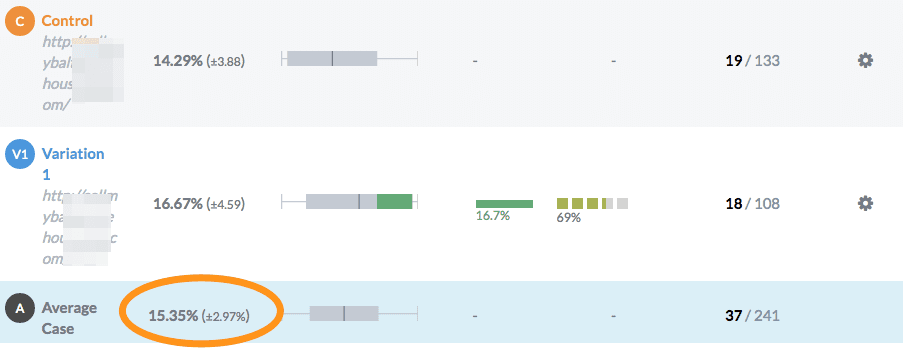
What We Consider Average For A Seller’s Website (Your Site Should Convert At Least 8-10%)
Lots of House Seller Leads: This website is a highly trafficked home buyer’s website. We’re building some of our “Carrot Magic” into his website. The same stuff that’s already built into our Motivated Seller websites for our Carrot members.
And another…
What We Consider Solid For Sellers
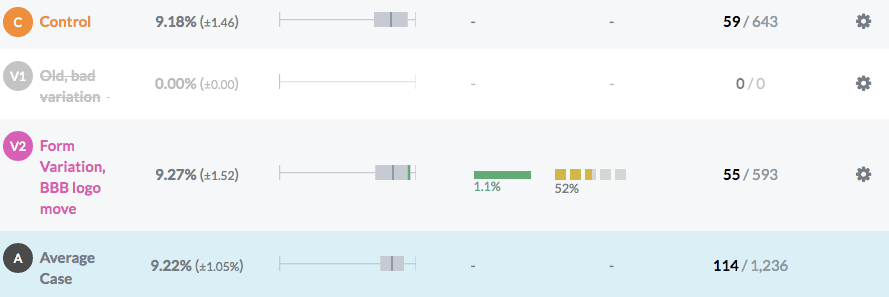
A Surprising Video Test: This test is on a Carrot member’s website that gets 100% of its traffic from SEO (using our 3 Lead Per Day Training). But we ran a test recently to see if a video would increase the conversion rate on her website — the result is surprising :-)
And another…
What We Consider Stellar (this rarely happens long-term on a website) during this test, this Carrot member got a GREAT stretch of quality traffic. The test is still early… so the rate will likely dip below 20%.
Conversion Rate: This is a shot from an actual test on a motivated seller website.
All in all, you should shoot to have your motivated seller website convert at least 10% of your visitors to leads at a minimum… and work your way toward a 15-20% conversion rate (for a quality lead) on the top end in today’s environment with building solid credibility on your website, great quality traffic.
In a recent conversion test on motivated seller sites, we also found a potential 55% conversion rate increase by making one simple change to the hero section.
Conversion Rate: Hero sections that increased conversion rates by anywhere from 25 to 55%
Rent to Own / Tenant Buyer Website Conversion Rates
Rent-to-own tenant buyers and tenants of rental properties tend to convert pretty darn well when they land on a website set up to convert (like our Carrot sites are). A tenant (or even buyer) tends to be putting in their info on your site to see available properties… so it’s a much lower commitment than a seller’s decision to sell their house to someone.
A Solid (But standard on Carrot) Conversion Rate For a Rent-To-Own Site
Rent To Own Leads Flowing In: In this test on a rent-to-own website of a Carrot member, you can see in the early stages of the test their site is converting on average close to 40%. This isn’t out of the norm on our rent-to-own websites.
Our rent-to-own websites have been performing well. After several rounds of testing (and we continue to test and improve these sites for our customers each month), we tend to see tenant buyers converting between 20-40% on the website.
One member’s website even had a string of several months (and several hundred leads) where their site converted nearly 50%. Their traffic was very high quality coming from a Facebook campaign.
Summing Up The Basics Of Conversion Rates For Real Estate Investor Websites
Improving the conversion rate of our Carrot platform is something we love to do, and it’s fun.
We’re running 50 tests on our Carrot member’s websites… actively working to improve the conversion rate of our platform every month. We do the same thing for our real estate agent websites, too!
Hit Me With Your Conversion Rate Questions Below!
So… do you know the conversion rate on your website? If so, hit me with a comment below! If not, hit me with your URL, and we’ll look at your site and give you some feedback.
And as always, if you feel Carrot may be a fit for your real estate websites and want better results online, we’d love to have you in the Carrot community. Check out our plans and hit us up with questions anytime!
In this post, we’re going to be diving into a different topic than we usually cover here at Carrot. We usually cover Google organic, Google paid ads, Facebook paid ads, and our clients generate a little over 60,000 organic leads every single month.
Most of those motivated sellers. So we’re going to be tackling from the other side of it, especially since we work with a lot of real estate agents now as well.
Our topic today is how can real estate agents actually use social media better? We dive in with Jason Pantana, coach, trainer, and speaker for Tom Ferry International.
Listen to the podcast
Video Transcript
Trevor:
When we started to pull back and ask ourselves, “Well, shoot, who knows social media better than anyone that we know or have seen?” There’s only one name that popped up for me. I’m like, “We’ve got to get Jason Pantana on.”
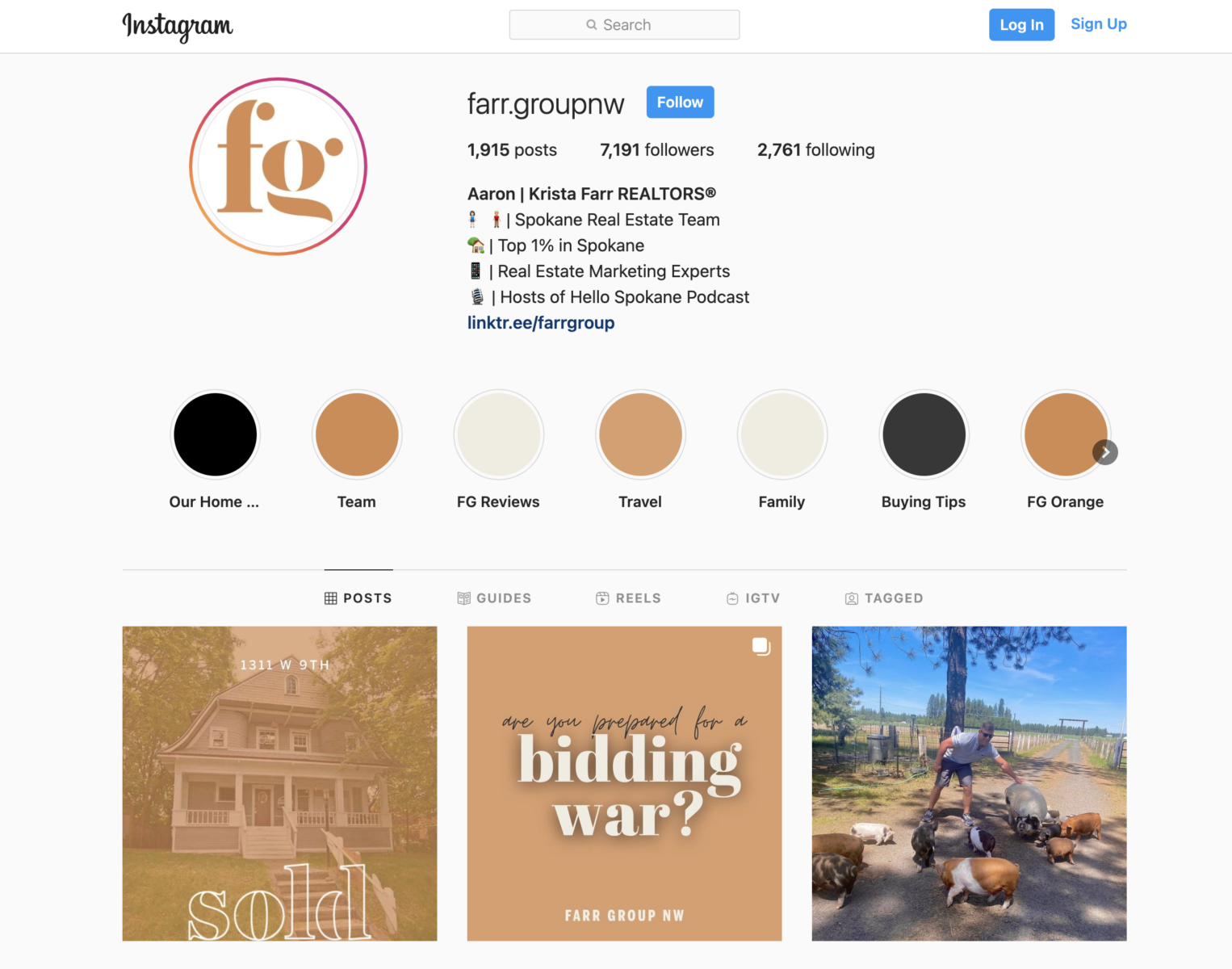
Jason works with a mutual members of ours, the Farr Group, who we’ll talk about the Farr Group in this post.
It’s been really cool seeing Aaron and Krista from two years ago even when I first had gotten contact with them. It was within their first year, they weren’t really that big on social.
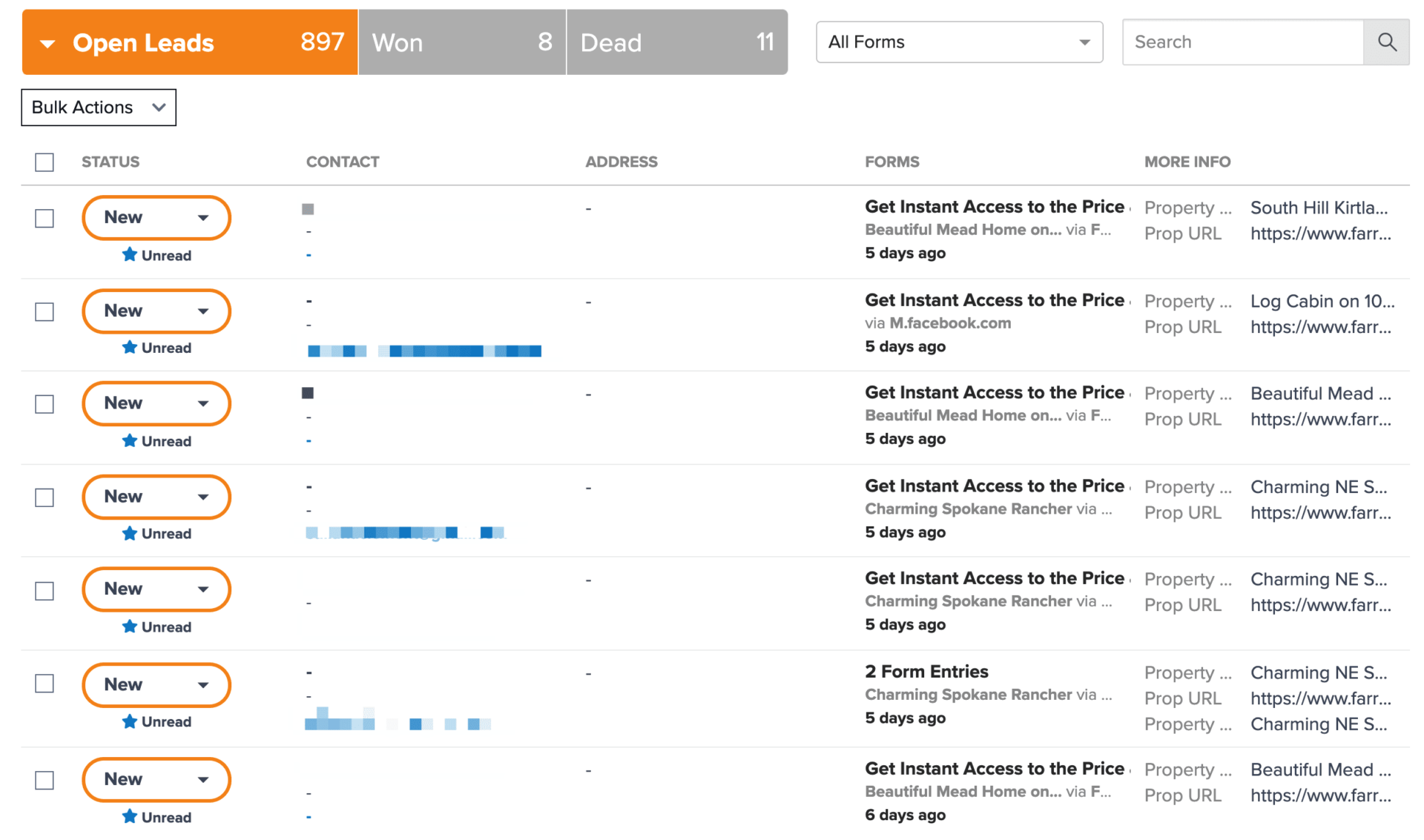
Farr Group Leads Dashboard with 100s of Leads from Social
Now seeing them become one of the top 10 agents in their whole area in less than three years pretty much using social media and referrals.
And now they’re stacking on the Google organic, it’s amazing stuff.
But I’m going to officially introduce our guest today. Jason Pantana, he’s with the Tom Ferry group, but here’s one of the big things y’all. Tom Ferry has a lot of amazing coaches.
Jason is the guy that I’ve seen referred to over and over again as their social media and online marketing guy. It’s like when they need someone to go in and really talk in a deep way about the online marketing side of it for retail real estate, that’s where Jason comes in.
I’m going to toss over to you, man. For those of you who are maybe in the investor side of our business and aren’t familiar with Tom Ferry International or with you specifically, or if they’re on the agent side and they don’t really know, they’re not familiar with you, who are you, what do you do daily and how did you get into the game of educating agents on growing their social media followings and turn them into elites?
Jason Pantana:
I’ll keep this brief. One, I’m super delighted to get to be here with you. This is going to be a fun conversation I expect. Thank you for inviting me. Again, my name is Jason Pantana, I’m a business coach and marketing trainer for Tom Ferry International.
We provide coaching services predominantly in residential real estate, but just real estate profession as a whole. I’ve got thousands of clients all over the world. I personally coach every day of the week, so I have about 40 clients I coach personally. That’s typically my mornings. I just finished up my morning of coaching, and then I’m here with you guys right now.
In terms of day to day, I spend every morning just in the trenches with agents and I tend to focus my coaching specifically around marketing, all things marketing. I love hearing that you guys talk about Google organic SEO and paid traffic.
I talk about those things too. I spend an extra bit of time, I would argue, on the social media side of content, which is why we’re here today and we’re going to have a blast.
But really the thing I’m focused on, I think you’ll get a pretty quick glimpse of it. If you go check me out on Instagram, for instance, I just post content that I believe is going to help you as an agent in your business. Most of my content is focused on helping you build your sales business.
I’ll be candid about that. As you said, I work with Aaron and Krista Farr. I think you and I started working with them around similar times. It’s been about three years for me, like right when they first started.
One of my first orders of business was getting Krista licensed so she could come into the mix and start being social media amazing, which is what she is.
I love helping agents grow their businesses, by all means digital, but in particular that a lot of success with social, specifically, Instagram has been sort of a wheelhouse for a lot of my clientele.
Just generating bottom of the funnel, inbound, organic leads, which is what I will get into today. I hope that’s enough about me. Let’s talk about marketing.
Unlock Your Instagram Marketing Knowledge
Learn everything that Real Estate Agents need to know to get started with Instagram marketing.
If you are coming in from the Carrot world where we talked about what we call Evergreen marketing.
Evergreen marketing is how do you get off of what we call the marketing hamster wheel long-term and take a lot of that content from your social media and make it evergreen through Google and YouTube so people can find it for a long time.
What we’re going to do is we’re going to talk about how do you come up with great content topics on here with Jason.
We’re going to talk about how to get better reach with your social. Because we use social here at Carrot, even though evergreen is always our foundation, to build that momentum over the long-term with Google.
We use social media big time to build the audience, which then fuels the Evergreen and vice versa.
We’re going to talk about the content topics. We’re going to talk about mistakes agents and likely investors probably make the same mistakes in social. We’re going to talk about big opportunities on the different platforms because Jason is really tuned into all of those.
Where should a real estate agent start with social media?
Jason, let’s dive in first. Starting at the top, we’re going to teach specifically for agents right now, but investors take this and apply this over on the investor side.
Where should an agent start with social? Should they start on Facebook, Instagram? Where should they start where they’re going to get the biggest bang for their time?
Jason Pantana:
All right, so where should an agent start when they’re going to get involved on social?
I would say that the obvious place to start is where you’ve already got your account set up. There was a reason that led you to sign up for Facebook. There was a reason that you got on Instagram.
Whatever it is, I think there’s a component of just go where the crops are already growing.
But the other component I would say is where do you want to dominate? If you want to dominate on TikTok, go dominate on TikTok. Go make your heart sing. If you want to own Instagram, that’s a great spot too.
I will tell you, candidly, I’m a huge fan of Facebook and Instagram. I have clients who do both, so we typically will get into content within those.
I’m a cross-channel distributor of content, so my idea is, getting content mileage. I am not one of those people who thinks you should create content specifically for LinkedIn, specifically for TikTok, specifically for YouTube.
I think you have to take your content, build it in a lab and then optimize it for delivery across those different channels.
But I want to say from the starting point your content should be representative of your brand, your objectives in terms of what you want out of social and can go everywhere.
In terms of a platform to get started, I would personally pick Instagram. I teach my clients on Instagram the everywhere strategy.
The reason I choose Instagram is twofold.
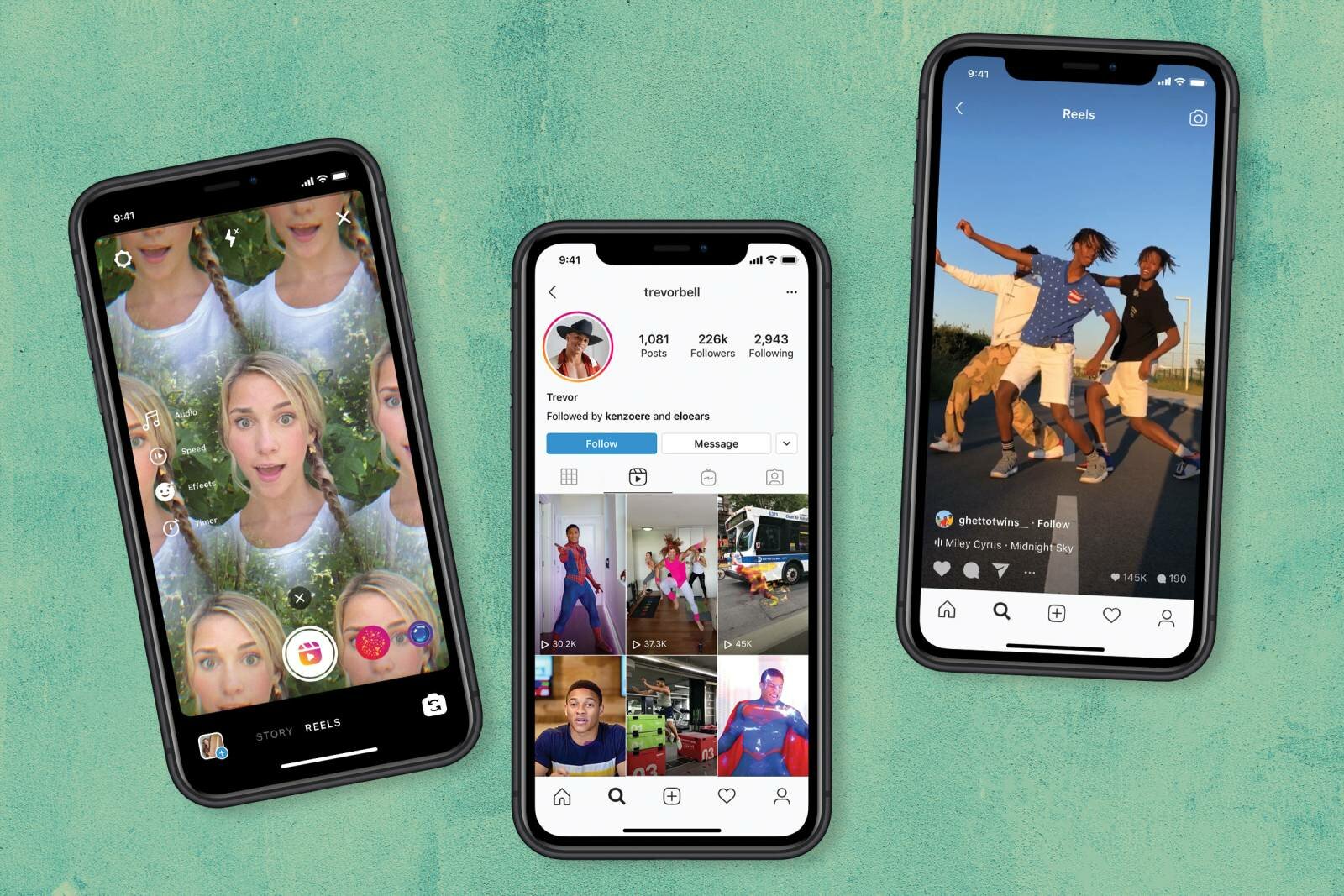
One, it’s pretty democratic in the sense that it has a wide array of different types of posts. I can do photo posts, I can do carousels, I can do short-form vertical videos called reels. I can do long-form videos called IGTV. It has DMs, it has comments and shares and stories.
It’s got the whole types of content I might create. I like to use it as sort of my starting point and then distribute from Instagram to everywhere. I also like it because it sounds better to say Instagram to everywhere, then Facebook to everywhere. But if you want to go to Facebook first, be my guest. That’s going to work for you as well.
But I would also encourage agents to actually shift their mindset from saying, “I have to pick a platform,” and instead say, “You know what, let’s create a space where I’m optimized across all the channels I want to be on.”
Right now we don’t know where the consumer is. It could be anywhere and everywhere, and in fact, I would love for them to see me on multiple channels because that’s going to create a frequency illusion where they think they see more of me and I have more top of mind awareness.
My advice to you would be is focus, not on the platform so much as what’s the content you’re going to produce.
What are you committed to?
What makes you excited in terms of content to make?
Then just get your accounts set up and lay out the distribution path from Instagram to everywhere.
Post it natively to Facebook, to LinkedIn, to YouTube, you name it.
Trevor:
That’s perfect because, all too often, we’ll hear someone say, “Hey, this is the path.” But, like you’re saying, everyone is a little bit different.
Someone might really resonate with Facebook and how it’s used and vice versa. You’d mentioned the content side. That’s where I’m sure you see it every day, especially, with your new coaching students but we see it all the time too, is people go, “Shoot, what do I create content on?”
We’ve got a model here at Carrot that’s mainly aimed around the organic side of things. But what would you suggest for an agent or an investor in this case too, what should their first pieces of content be? What should that cadence look like? Is it mostly personal stuff, mostly business stuff, is it a mix?
Jason Pantana:
Okay, so let’s talk about the personal versus professional dichotomy first, which a lot of people have cited Gary Vaynerchuk’s Jab, Jab, Right Hook concept, which was a brilliant concept. But it was pre some algorithmic changes that occurred a couple of years ago.
What I’ve noticed is when people are still operating on the, “Okay, I’m going to do three personal posts and one professional post.” Like clockwork, it’s nothing but crickets when it comes time for the professional post.
So at the end of the day, every post is judged by the algorithm. It’s not so much about like, “Well, I got so many hearts and likes on this kindergarten graduation picture, but nobody cares about my new listing or whatever it is.”
That doesn’t work anymore, so instead what I about with people is you got to blend the story of your business and your life.
They got to be blended together.
Some of my best clients who are really like they’re cleaning up on social media, I’m thinking of Glenda Baker, for instance. She’s in Atlanta, Georgia. She’s probably close to a million followers on TikTok now. Her TikTok growth has been insane. She’s got about 50,000 on Instagram, growing like crazy.
She’s getting DMs and PMs and all kinds of pings for people who want to list their properties, buy their properties, agents making referrals.
All kinds of that inbound lead generation happening, and all she talks about is real estate. In fact, that’s the thing that I noticed most about her is I see her personality emanating through what she does for a living.
There’s no distinction, so my thoughts are, at the end of the day, your brand is your voice, your mind, your heart, your face. You’re the one that’s for sale, so I think you’ve got to put you on camera, you’ve got to be in the feed, so your audience gets a sense of your personality.
Now, I’m not saying everything has to be about trying to sell a listing or whatever, but I’m also not saying that you can never do that. I come across a lot of social media experts who are constantly trying to tell agents to not post about real estate.
I look at that and I’m like, but when I see the agents who are actually making money off of social, it’s the opposite of your advice. Like look at the Farrs’, for instance, I know we’re cleaning up on social media.
They post about their lives, but they’re never more than an arms reach away from their business, ever. There’s no shame in social proof.
Unlock Your Instagram Marketing Knowledge
Learn everything that Real Estate Agents need to know to get started with Instagram marketing.
What type of social media content should I create?
Trevor:
So let’s dive into that content topic side of it.
I think that’s really helpful what you’d said in a big way because a lot of people are taught 60/40, 60% business, 40% personal, and the personal are just personal. It’s the dog I got this week, which is fine. Versus, like you’re saying, melding it together. One really good example that I’ve seen in the investor world, so for all you investors you say social media is just for agents, which it’s not.
We have an amazing client, they came up to our event we called Carrot Camp last year, and they’re an investor. They go back there and they’re filming restaurant reviews. He calls it lunch with Lance, but it’s always him, the home buying guys. He’s going out there, he’s bringing some of his buyers and sellers that they work with.
It’s like on HGTV, everyone loves the shows that show people what people are doing for a profession. Watching people fish, watching people flip houses, watching people be real estate agents.
So it’s mostly business with some personal stuff mixed in.
Jason Pantana:
I would also just chime in on that, I love the idea of touring local restaurants, getting to know local business owners. But I would say there’s a lot of agents who they figured out they’re going to create the diners drive-ins and dives food network show because in their head I suspect a lot of them are like, “This isn’t salesy, this isn’t real estate focus. This is community focused.”
I don’t want to be that guy or that girl who’s costly about real estate. But I always ask my clients the question, “What does your mom watch more of, food network or HGTV, or is it a tie?”
The answer is usually it’s probably a tie or something like that. But my point is don’t overlook the fact that touring houses, talking about houses, people are obsessed.
SNL did a sketch recently on Zillow because people love to look at houses. There should be no shortage of ideas for content when you sell houses for a living, or when you flip houses or a wholesaler, whatever you do on the investor side of it.
Where do I find great content ideas for social posts?
Trevor:
Let’s say it’s an average week for an agent. What are some types of things that they should start to turn that brain on to be aware of to document a great content?
Jason Pantana:
I teach going back to the Instagram to everything strategy. The first thing I do is I establish a minimum cadence in terms of how much content, what’s the frequency minimum standards per week.
It’s one IGTV a week and you press the share to feed button. When you’re uploading to IGTV, there’s always the option to share to your main feed. Absolutely a must. If it’s only distributed through the IGTV feed, which you may not have known this, IGTV is its own app.
If you don’t click the share to feed preview button, you’re pretty much invisible. So it’s one of those a week and one reel a week as a minimum.
I’m almost ready to adjust my own strategy. I was looking at my Instagram insights, which you should do from time to time and I was breaking down, “Okay, what types of posts of mine reach the biggest audience of followers versus non followers?”
So they actually have charts and graphs in the insights tab assuming that you have either an Instagram business or creator profile.
They show you unbelievable analytics, including, your average IGTV gets this much reach with your followers, and this much reach with non-followers. Reels was off the charts doing about 80% non-followers.
We’re finding because reels is the new prized feature that Instagram is touting and wanting everybody to adopt.
I’m getting right now crazy reach, and I’m generating a lot of followers because they’re finding my content through the reels feed because they did build the reels feed straight into the mobile app. That should give you a kind of optics on what they’re trying to do at Instagram.
I would say, recapping, here’s a sample posting schedule:
One IGTV a week,
One reel a week,
And, at least, three supporting posts a week.
They could be photos, they could be carousels. They have three supporting posts and then never don’t have a story. That’s actually my cadence. It’s one IGTV, one reel, three supporting posts, never don’t have a story.
Let’s dive into the content “what.” I typically teach to think of content like a restaurant menu. You go to a restaurant and they hand you the menu, this is their way of saying, “Order something off of the menu.
We don’t make things that aren’t on the menu. We make things on the menu. We have appetizers, we have entrees, we have desserts. Pick from the menu.”
I think a lot of agents, wake up and, they look at the look hamster wheel of social media. I’ll admit, it is totally a hamster wheel. I think you’re smart to listen to this man and try to convert that into some evergreen content. Evergreen content isgoing to help make it more worth the while, which is part of what I teach too.
But back to this hamster wheel. I think a lot of agents look at the 365-day calendar and they think, “Oh, what am I going to post today? What am I going to post tomorrow?” As if you’re having to reinvent the process every stinking day and that’s daunting. I think the hamster wheel feeling is more of a feeling that’s psychological than it is strategic.
What I teach is the menu, it’s got three parts to the menu.
Section one, we call it shows and series,
Section two we call it deal data,
Section three we call it the vault.
Section one, shows and series are basically your video shows. This is your IGTV, your reels. I would create weekly video shows. It could be a pro tip series, it could be a market update series, it could be a quick answer series where people ask you questions and you do 30-second Instagram reel answers that stuff.
It could be home tours, it could be interviews with local businesses like you talked about. You should have your shows and series lined up episodically week-by-week.
Again, my minimum standards for my clients is one IGTV a week, one reel a week, which basically means we’re talking about two shows a week for all intents and purposes.
Section two is deal data. It’s just listed, just sold, listing video, under contract, offer accepted, open house. It’s those types of things.
The whole idea of deal data is it should be templated out. Let’s use the Farrs’, for example. They use Canva. If you go to their Canva, they have templates for what a just listed post looks like, what it just sold post looks like, and they literally just sub out the address and change the photo.
Rinse, repeat.
That’s what needs to happen to streamline some of the production of content with this deal data. I talked about three supporting posts per week, here we go. It’s in your deal data.
This stuff’s critical. I also think like if you look at the Farr’s feed on Instagram, just Instagram, for instance, I’m going to see the matchy-matchy nature of, “Oh, there’s another sold, another sold, another sold, another sold” because they match up with each other.
So because of that, it really creates this feeling of, “Wow, the Farrs are really selling a lot of houses,” and they are, they are selling a lot of houses but there’s also a perception component too. How do you take that into effect?
Lastly, section three is the vault. The vault is basically just things you do every now and again. You may not do them always, but I’d like you to have a word bank or a vault that you can pull from, from time to time.
Like testimonials, what does a testimonial look like when you post one? Do you do stock shots or behind the scenes shots?
Stock shots have been a popular one for a lot of my clients lately. Basically, what we’re doing is when they have a new listing, they pay their photographer a little extra to basically do some headshots at the property lifestyle photos at the top view while they’re getting the shots for it.
They just pepper those photos out from time to time with some the melodramatic caption that’s maybe related, maybe not related.
Unlock Your Instagram Marketing Knowledge
Learn everything that Real Estate Agents need to know to get started with Instagram marketing.
That tip right there is awesome because if you guys are already doing listing photos, or if you’re an investor going there and doing photos of properties, like Jason said, why not just have that camera person just turn the camera on you for a few shots. You’ve got the concept right there.
Jason Pantana:
Show up in the last 15 minutes, they’ll film you. Like I have a client in Little Rock, Arkansas, Ray Ellen, he does this.
He’s got probably 90 days of content already lined up.
He’s at the point now where he has to be aware of seasons. That’s how far ahead he’s getting with doing this, and so he has this spreadsheet where he writes out captions and they just play the matching game.
I’ll use this caption for this post, this one for this one, and they don’t always relate. It’s very personal blogger style where it’s a photo of you and then whatever you’re thinking about. I mean, invariably, those photos and those posts do really well. That’s a no brainer to me.
Recapping, you’ve got the shows and series, the deal data, and the the vault.
Trevor:
I want you guys to write those down. The reason this is important is because just like Jason said, oftentimes when we’re going to go with step into doing something, when we don’t have a menu, when our options are limitless, your brain explodes. You go, “Oh, shoot, what do I do?”
We start to actually get paralyzed when we have too many options. If you go into a grocery store and there are 75 types of ketchup, and there have been actual studies done like psychological studies.
If you have three choices, you’re going to be able to pick, and so I love it. By the end of this week, what I want you guys to do is write down those three things.
Then begin to carve out an hour maybe, half an hour and start to dream, “What type of deal data can I start sharing next week? What show or series can we do?”
Jason Pantana:
I’ve been encouraging my clients I love in the field videos. I love house tours, I love restaurant interviews, I love business interviews, neighborhood tours, but there are bottleneck in terms of getting them done.
If you’ve got to go in the field and plan logistics and coordinate, coordinate, coordinate, the clients of mine who are really killing it with video are the best.
They typically film one time a month and do everything in bulk, they get like a paper background like this set up, they’ve got a camera, typically, a videographer.
Some of them rent the runway to get multiple outfits picked out, and they show up ready to film for a half or full day and they knock out 20, 30 videos in a day and they’re done for the month. Move on to the next month.
That content gets packaged and released and dripped out throughout the month. That’s the way to play it.
Trevor:
The thing about doing that too is it takes you out of that daily hamster wheel thinking because then it is strategic. It takes you from tactical on the day-to-day going, “Oh shoot, I need to find something to document today.” Which you can do in the stories.
That’s where bring out those stories, document that stuff. But then everything else are used strategically to chunk it up.
Guys, listen to Jason because he’s teaching you the path here, but then he’s also teaching you the way to make it so it doesn’t own your life. Where you own the strategy, the strategy doesn’t own you.
Jason Pantana:
The best agent video creators are filming once a month to create. That should be your objective, film once a month.
How much time should you invest in social media?
Trevor:
How much time would you suggest setting aside for social? The people that are crushing it, like the Farr Group, like that other guy you mentioned, the people who are crushing it, how much time are they investing into social per month? Then the people who are doing so-so, what’s your best guess in how much time that they’re investing into it?
Jason Pantana:
Let’s use Glenda Baker as an example. She’s in Atlanta, Georgia. She’s the one who’s got like a million followers on TikTok.
She films one day a month. She comes ready to the studio. She’s got her hair and makeup, her clothes, her scripts, what she’s going to talk about. She comes in ready to roll and film. Cameras on, lights, camera action.
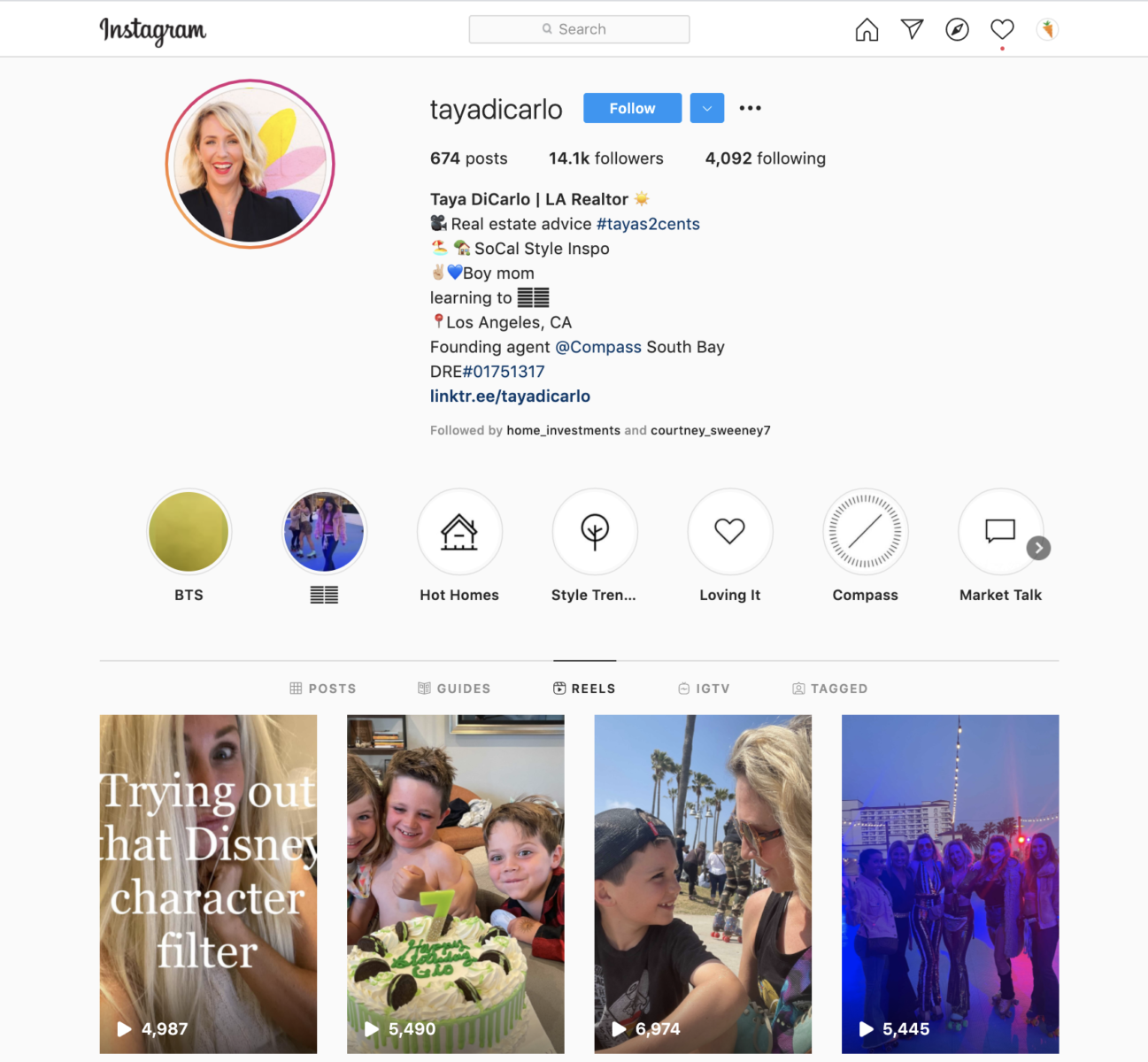
She’ll get 35 videos in 11 hours, so she films an 11 hour day once a month, but she knocks out 35 videos. Taya DiCarlo in Manhattan Beach, California, client of mine too.
She does the same thing, she films for a half a day and she’s knocking out about 20 videos.
In terms of time, if you already have the big content created in advance, there’s a releasing feeling. Now, the idea of running and gunning, is to your point, you’re going to be subject to and controlled by social, which is not a good state.
Trevor:
One thing we talk about a lot here at Carrot, is our state admission at Carrot has helped to build a businesses of freedom and impact. We really want people to be free from their businesses.
That’s where the Evergreen comes in, so that they can make the impact they want to make.
What Jason’s mentioning here, let’s say you guys wanted to go on a two week vacation or a month long vacation or whatever it is, which is normally unheard of for most real estate agents right now.
If you could have that content batched, you can still record like the Farr Group. They still took pictures and did stories from their vacation, but they were still cranking through the deal data. They weren’t posting the deal data, so that stuff was batched.
Jason Pantana:
Yeah, they now have a marketing coordinator who works for them, so she’s taken on some of the load. But that’s recent.
A lot of the stuff is just scheduled and ready to roll. I think you’ve got to… don’t be a slave to your social media, that’s the goal.
Control it, not it to control you. That’s a matter of we need a plan, experts say, I don’t even know who said this, but I’ve heard it said before that for every minute you spend planning how to use your time, you’ll save seven minutes on the implementation.
I think that’s true in a lot of walks in life, especially, in social media. If you just say, “Okay, Jason said I’m going to do one IGTV, one reel, three supporting posts. Never don’t have a story. That’s my minimum cadence.”
That’s the output of content.
Now I’ve got to fill, “What are those pieces of content?” Well, I’ve got my shows and series, my deal data, the vault, fill in your little menu.
Then come up with, “Well, how am I going to film it?” I would say if you can figure out how to film once a month, if you can try to figure out through Canva or graphic designers or whomever you need to streamline the other posts, get these things as turnkey as possible.
So that really when you’re on social, you’re just posting stories and you’re engaging with other people’s content. That should be more or less what you’re doing on social.
Team or contractors? How to build a team to record videos
Trevor:
I love it. One thing that people might be thinking is like, “Oh shoot, so Jason mentioned his videographers posting for him. That other girl, she records videos once a month and probably someone posts it for him.”
But also you mentioned right there, and a lot of people probably saw it slipped by them was the Farr Group didn’t have anybody for the first year and a half, at least.
Jason Pantana:
Well, I didn’t have anybody until a month ago, so it’s me too.
Trevor:
There we go. If someone is going to have a team member and is it a full-time role? Is it just a contractor? What type of investment may people be able to get someone who can run the posting of the stuff and maybe the videos for?
Jason Pantana:
I’m going to take this two different ways. It depends on the channel you want to go after. If we’re talking about like Instagram and Facebook, that’s a little bit simpler. YouTube is a little bit more sophisticated. YouTube is more of your evergreen content, so YouTube is more of a search engine, less of a social network.
So because of that, there are some nuances to the distribution on YouTube that will make or break what you’re doing there. Sliding that off to the side, I typically have my clients usually look for an hourly part-time, either a marketing coordinator or a marketing admin, whichever title you like better.
This is somebody who’s paid somewhere between $15 and $20 an hour, generally speaking, and they’re basically following orders and instructions.
The mistake a lot of agents make is they say, “I want to hire a social media director for $35,000 a year.” I’m like, “Do you realize director titles typically are six figures. Senior executive level people in companies.”
A, they’re not going to work for that money,
B, if you hire a social media director and they go to Glassdoor and they plug in what they’re supposed to get paid, they’re going to assume you’re ripping them off.
But I think the biggest difference is strategy comes from the top down. If you’re going to hire somebody who’s administratively going to take action, they’re taking action on what you tell them to do.
I think like that’s what the Farrs’ did really well. Krista manages their marketing coordinator. She says, “Do this, do this, do this, do this,” and it gets done. I don’t think there’s any way around that.
Trevor:
So, if you are looking to buy back that time, get more freedom so you can make more impact, it maybe won’t start that way. You got to hustle and get the work done that first year, first 18 months to get momentum going.
But cast that vision for buying back your time, and that’s always something I want to have our community look at is whenever we start a strategy, just really dig in and make it happen.
Even search engine optimization takes work. Either you’ve got to do the work a few hours a week or hire it out, but your vision should always be to buy back the time over the long term.
Jason Pantana:
I think we can work backward too. Facebook and Instagram burn cheap gas, not the premium stuff. You need more. I’m not saying make bad content, but I am saying making more content, there is an element and I’m being somewhat cynical here, but quantity almost matters more in some cases.
I’ve had clients buy basically chess clocks, or they set little timers where you’re going to say, “I’m going to give myself 15 minutes to do this, 30 minutes to build this post”, whatever it is.
You time yourself so that you can basically predict, “Well, if I want to do one IGTV, one reel, three supporting posts, never done of a story, and I’m going to block an hour to record this video or 30 minutes for that.”
You can literally map out how much time it takes and then say, “Can I do that for a year?” Then once I’m established, then I’m going to bring somebody on to keep rowing for me while I move up to the next level, so to speak.
Trevor:
Let’s talk about make the transition from we’re building the audiences, we’re getting content out there, we’re resonating, to now we’re building authority because that’s really what we’re after here.
Getting in front of people, building that authority. What are you guys finding right now, Jason, that’s working great to turn those people watching you from afar into leads, into people that you work with?
Jason Pantana:
A couple of things I would say, one, is social media has two elements.
It’s like a two-sided coin, it’s got the side of content and the side of the conversation, so you got to do both. I think one of the mistakes I see is agents who are only doing the conversation side, which does work better on Facebook than on Instagram.
They’re DM-ing, they’re commenting, they’re engaging, they’re not creating content. They’re not being a knowledge broker. That’s a gap.
Or the flip side of it, and this is the more common is they’ve figured out how to make content or they buy the content works, but they’re just not really there. They seem unapproachable.
I think like, again, let’s use the Farrs as an example, they’re putting out a cornucopia of content. They really are, but they’re also DM-ing and messaging and engaging, and they’re active in groups on Facebook and so forth and they make themselves approachable.
I would say that there’s an element of content and conversations that really has to be a part of it. I also think this is where, like going back to the early thing, is it professional or is it personal content? It needs to be the right hybrid.
We teach that there are five themes of content that you need to be able to address. It’s not even parts. You can decide how much of this or how much of that.
But there are five ingredients or five themes your content should speak to.
We talk about real me, or if you’re a team, the real us. We talk about agent behind the scenes, these two can be married sometimes. We talk about social proof, so like just listed, just sold, under contract, offer accepted, new listing, blah, blah, blah. We talk about knowledge broker, which is big for me, and then hyper-local. Where do you do business? Are your boots on the ground?
If you have those five themes present in your mix of content, the net effect is people will come to you. I think that’s the thing I’ve noticed most about the clients I coach, and I have a good number of clients who get a lot of business off of Instagram. People are direct messaging them, they’re commenting.
In other words, they’re creating content that invites that conversation, and then it just starts going. Even me, like if you ask me, why am I creating social media content, I’m going to tell you because I really like to contribute and things like that, just like you do. But I’m also going to tell you because I’m generating organic leads for Tom Ferry every day of the week.
I was going to do a 100 webinar challenge for myself.
So I started taking a selfie of me every time I was doing a webinar, which I need to get back to doing. But I was like this is going to make social proof. This is going to make people like Trevor say, “I should get him on my podcast. I should get him to speak for me.”
Then, bam, it works. It’s that, it’s real me, hyper-Local, knowledge broker, social proof agent behind the scenes. If those things work together in some kind of a shape, you’re going to attract people to want to work with you.
Trevor:
One thing I want to pull out right now, I just came to the realization so you were mentioning the posts that I engaged in. Let’s relate this over to an agent or an investor now.
The reason I engaged in that, is number one, I’d seen Jason for probably a year because the Farr Group, one of his clients, posted about him or tagged him to it, so I started following him.
Then I see him post, before all your content’s amazing, but I’m not an agent. I’m like, “Okay, it’s great. I’m going to learn from it. But I’m not an agent.”
That one post struck out to me because I’m like, “Oh, I can help him here. Also, this might be an opportunity for us to connect and I can help my audience.” I’m like, “Let me take all this stuff that he’s been teaching.
As we’ve been growing a bigger and bigger user base on the agent side, let me take his knowledge and plug it over here to help serve people.” If you hadn’t have done that “Hey, here’s my journey I’m on. Here’s the challenge I’m on” post it might have a different outcome. Instead, I thought” I’m going to dive in, serve him, serve my community and be able to meet an amazing dude.”
Don’t be afraid to do that.
How do I get more comments and DMs?
Jason Pantana:
But I would tell you if your content is not sparking comments and DMs, you need to adjust it because that’s where the money gets made is in the inbox.
Trevor:
How can people do that? Let’s get tactical a little bit, what are some of the ways that people can do that to spark themselves?
Jason Pantana:
Well, you can ask yourselves why? Let’s go easiest, the simplest explanation or the easiest way to do it is reciprocity.
Start commenting on their stuff, start messaging them, and you’re going to actually reverse prioritize yourself where they’ll probably do it one just because it’s human nature to reciprocate.
But also because when they reply to your DM, when they reply to your comment, that’s actually a signal to Facebook and Instagram that they want to see your content too. You’re prioritizing yourself in the feed. I would say out of the gate, you need to be engaging with their content to invite them into yours.
They’ll return thefavor.
The other thing is ask yourself a rhetorical question, “But, hey, when I post this, what response am I expecting to get from it? What is somebody likely to comment, or they’re going to scroll past? Will this get them to when I stop and like it, when I stop and comment, when I say it, what I share it?” And so forth.
I know that’s a surface long answer, but it’s the truth. The other thing, a lot of agents are just trying to phone it in like, “Oh, I just got to get it out there.” Yeah, you do, but what’s the point of doing that if it doesn’t actually get out there?
Because we know the way these algorithms work is they don’t serve dud content in the feeds. I would argue in the first 10 minutes to an hour, Facebook and Instagram have decided that they’re investing in your post or not. If you can’t get conversations, so like we’ll talk about this, but you should optimize your content.
Like for Instagram, out of the gate, I would do a couple of things. I would tag a location when you post, when you can. With Reels you can’t really do that.
But when you can, I would tag a location. I would use hashtag strategically. They give you up to 30, and we don’t copy and paste hashtags. They don’t like that. We vary our hashtags. We don’t spam with hashtags, we’re careful that our hashtags aren’t actually what we think are innocent, but aren’t innocent hashtags.
Because if those hashtags are blocked, you’re screwed. I tend to like hashtags that are between 100 to 500,000 other posts using them.
That’s a sweet spot where I stand a chance to populate in the explore feed. I don’t care if the hashtags are in a caption or comment, but you got to use hashtags.
I would also tag people when it’s relevant. I’ve done this two different ways. Sometimes if I have a post and I want to just give it a quick blitz into the feed, I’ll tag four or five other people like the Farrs’ because there’s a good chance they’re going to comment on it quickly because they get notified.
Now, don’t overdo this one, but every now and again, it’s enough to spark like get a little flame lit on your posts.
Then sometimes I actually private message it over to people, and that can help do it too.
Trevor:
I’m going to riff on that a little bit. Here’s a couple of thoughts that popped up on what Jason had said. Let’s say I’m a real estate agent, I’ve got a house on the river that is being listed. Maybe it’s not even my listing, maybe it’s someone else’s.
And I have four people in my database I know are looking for a house in the river. Take that picture. I’m not an attorney, I don’t know what’s going on with your guys’ local MLS, and so check this.
But you take that picture of the property, maybe the carousel or whatever it’s called, tag those four people, “Hey, this amazing property is just beautiful.” Is something something that you would do, or educate people to do, or is that something that would not be a good one?
Jason Pantana:
As far as, again, I will echo you in terms of, “Hey, make sure you understand what your real estate commission and your MLS will and won’t let you do.” But if you’re onsite at a property, even if it’s showing somebody else’s listing. Your clients don’t want it, or maybe it’s a broker preview, but you’re like I have three buyers who would love this.
You can private message it to them.
I don’t see any issue with private messaging it to them. In fact, I have a lot of my clients who are really pulling back from text messaging and they’re using more DMs because the by-product of that is actually I’m signaling Facebook and Instagram to prioritize my content organically based upon these exchanges happening in the DMs just using it as a substitute.
But as far as like taking photos of other people’s properties, obviously, follow the rules.
Trevor:
Here’s one more that I’ve seen work. It was a while back when I first saw it working, and I don’t know if it’s the same now, but this one your real estate agents would post something like, “Hey, just did a search of the MLS.
There’s 85 properties that you could buy for less than $800 a month. $800 a month. Hey, everyone down below, post your rent, and if you want the list that I came up with for properties you can buy from us at $800 a month.”
Jason Pantana:
Yep, so we’ve done those. We have the DM us your rent. That’s what we used to do. We haven’t done it in a while, so I call them calibrated stories. Basically, it’s a calibrated question, “Do you want this? Yes or no?” Based upon that, I can message them.
Another one was are you thinking about selling your home or planning to sell your home this year or next? Yes or no. Sometimes people say yes, and if they say yes, you DM them. You start talking to them, have a conversation.
I like the idea of what’s your current rent, and I’ll tell you what you could get this property for? What you could afford in terms of a purchase price? That’s one that would probably work really well right now except it’s super competitive. I would want to be careful around clear co-operation and MLS stuff, but you could theoretically. Don’t do this if this is against the rules.
You could theoretically ask the calibrated question like imagine a story poll where it’s a yes or no, or an ask me anything that can input a question. Are you searching for a home and can’t find one? Would you be interested in somebody who is looking for off-market properties for you? Yes or no?
Because that would solve, like that’s a pain point that a lot of consumers are feeling right now. Our terminology is off-market matchmaker, the terminology. You got to be very careful that you don’t violate the clear cooperation or MLS rules and stuff. Just be very careful around that.
But, to me, it’s like I have a script that some of my clients are using, this is a little bit off topic though. They get a lead from Zillow or something like that, and the person wants to go see 123 Main Street is already under contract.
The script is…
“Hey, can I be blunt for just a quick second with you?” They’re say, “Sure, would you please be? and you come back with “Listen, you know the market’s super hot right now, candidly, anything you’re looking at on these portals, for all intents and purposes, is just the floor model. It’s not the one you’re going to buy.
The one you’re going to buy is not on the market yet, which is why you need an agent like me who’s willing to circle prospect, door knock, and go find properties that meet the specifications of what you’re looking for. Would you be interested in that? Yes or no?”
Unlock Your Instagram Marketing Knowledge
Learn everything that Real Estate Agents need to know to get started with Instagram marketing.
That’s gold right there. So all you real estate agents who are struggling with listings, that right there is an amazing mindset shift, but also it’s a great positioning. It’s an amazing positioning shift because so many people are struggling with, “Oh my gosh, I’m making 20 offers for these houses.” If you can shift towards more of the off-market, then that’s a whole other call that would be really fun to dig in with you on.
That’s what we focus on here. Carrot has been all off-market stuff, so as we’re trying to work more and more with agents and investors together, it’s like, “All right, how do we take the retail seller leads that come in for our investors and teach them to work them into their strategy by pairing up with agents.
Most of the investors are taking those and throwing them away because they’re like, “Oh, they’re tire kickers.” Or they’re not realistic with their values.
We see this an opportunity to take those and pair up with agents.
Become an off-market matchmaker. Go look in Jason’s contents on Instagram because he teaches that, and I’m sure in your guy’s YouTube channel you guys have videos in that.
Jason Pantana:
One of the posts on my Instagram will link you to my website. There’s actually an email you can send your entire database. Here is a videos designed to generate seller leads via Facebook:
I’ve got one question from an investor, so this will be an interesting one from Heritage Home Buyers. What about an investor wanting content for sellers and buyers, both? Do you mix it, segregate best practices?
I’ll add a little bit of color on the investor side. Since on the investor side, most of the time, the buyers and sellers aren’t the same person. It’s like it’s a highly motivated person, they’re not also looking to buy investment properties. I’ll show you guys what you guys can do on the outside.
Jason Pantana:
I assume then, just asking a question, I assume the challenge is you’re trying to find folks who want to sell their properties so that you can then resell them to a buyer and it’s a different value proposition.
Trevor:
Yeah.
Jason Pantana:
The seller wants to sell because they probably need to, or want to make it easy and painless. And the buyer is probably going to pay, they’re probably going to flip the property, which means they’re going to pay a little bit more. So you don’t want to turn people away. You don’t want your buyer content to make people not want to list and sell their home with you.
One thing I would say out of the gate is most of my clients, we just talk about the market. Because when you talk about the market, it will naturally lead you to share, “Well, here are the pros and cons for buyers and sellers. Here are the pros and cons for buyers versus sellers.”
The market is the market. I’m just the messenger of the marketplace. So I would then focus my content for sellers saying, “Look, selling your home right now is an amazing opportunity.”
Trevor:
What you had said before was really, really important because you were saying talk about the market, and that’s something I think investors in general have that disadvantage versus agents.
Because agents are so tuned into knowing what’s going on in the market. Investors know micro markets here or there.
Jason Pantana:
A couple of campaigns were running. So I have some clients who do this one, we call it the search, stay, sell campaign.
What that campaign is, is, “Hey, would you love to cash out in this unbelievable seller’s market but you’re not ready to move yet? Maybe not for a year or longer? Would you be interested in selling your property to me, and I’ll lease it back to you at a very good rate for as long as you want?”
I’ve had folks like that’s a pretty decent angle to get in and find some folks who maybe they’re about to retire or they want to move to Florida or something like that, and they’re interested in cashing out and what they think might be the height of the market, but they’re not ready to go yet.
I’d be talking to those folks and saying, “Can I provide you with a solution?” I know EasyKnock already has a program called sell and stay, so we called ours sell, stay, search because that gives you the ability to stay while you search.
It’s the same idea. I think that’s a powerful campaign to talk about, but also I’m waiting for someone to do this video. I’ve had this video in my mind for awhile, asking the question, how much were you paid to live in your house this year?
That’s the pattern into our question, “how much are you paid to live in your house this year?” People are like, “Well, what do you mean?” I was thinking about this actually came from a call with the Farrs’. We are talking about when should you be reaching out to your past clients or past buyers to see if they’ve had any thoughts of selling?
The debate was well if they’ve only been there for a year or two, it’s too soon. There was somebody who worked for the Farrs’ on their team who had bought with them within the last year. I was like, “Well, hey, how about you? Have you had any thoughts of selling?” She’s like, “Every day.”
I was like, “When did you buy the house?” She goes, “Nine months ago.” I’m going to make these numbers up. Okay, I’m going to make them up. I go, “What did you pay for it?” She’s like, “$250.” Then I asked Aaron, I’m like, “What do you think it’s worth today nine months later?” He said, “About $350.” So call it $100 grand in nine months.
Really, the truth is the number was $90,000 in nine months.
It was at that point it actually worked out too. I was like, “So, literally, you’ve made $10,000 in equity every month you’ve been living in that property.” I think there’s content around the idea, but also this one’s for your investors who want to pick up some listings.
I have this other vision of a video where there’s a table that’s empty and you walk in with a duffel bag and you unzip the bag on the table and you dump out a ton of different poker chips. Just poker chips all over the table, and you hold up the poker chips to the camera and you say, “The thing about poker chips is they’re worth nothing until you cash them out.”
If you’re thinking about the equity in your property is it’s worth only whenever the market sets it’s worth when you sell and cash out. Is this the time to cash out?
I just think helping people see like, “Okay, I have a choice to make. The market is what it is, is this the right time for me in talking about the market?”
Trevor:
I like it, and that’s a huge shift for everyone to make. There’s always something going on and that’s interesting in the market.
Talk about it from your authority point, from your advantage, or from your vantage point. The biggest thing, like Jason talked about before going back to Heritage Home Buyers is I don’t think you really have to split up your content between the wholesale buyers and sellers. You come from, “Hey, here’s our mission, our vision for our company. Here’s the impact we want to make locally. Let’s document how we’re in business together.”
People will see that you buy houses. People will see that you flip houses. Then at the end of the day, one big mindset shift that investors need to get over, and the successful ones do is the sellers who sell to you know that they’re selling at a discount.
You’re not pulling the wool over the eyes, nor should you. That’s not the game. The game is speed and convenience, and just like when we go down to a car lot, we go buy a new car retail, and then they ask you the very next question they ask us, “Hey, do you have a car to trade in?”
We know that we could sell that car for more on Craigslist, but we choose not to because of speed and convenience.
If that’s the mindset gap that you’ve got on Heritage Home Buyers that you think, “Shoot, I don’t want them to see the other content.” They should see it so they can see your business model and see that you’re a true, honest, ethical business that goes out there and service people, and just talk about the market, which is great.
Is there anything that we haven’t touched on that you’re passionate about talking about? Whether it’s related to real estate or not, but is there a topic that’s really helping agents we didn’t touch on?
Jason Pantana:
I’m scanning my list here. Yeah, so get reels going. Again, it’s a great way to grow your following.
You need more content. I made a note to increase your content by an order of magnitude. Like I said before, Facebook and Instagram burn cheap gas, which means you need to start filming and creating content in batches.
That’s going to be critical. Dig into hashtags and location tagging. Start or continue story sharing reciprocity, you share their stories, they’ll share yours. That’s just an idea of reciprocity in terms of networking on social. It is a social network, comment, share their stuff and they’ll do the same for you. Lastly running Instagram promos and then boosting your Facebook posts.
Don’t be afraid to put some money behind your best content, so use the promote button on Instagram, use the boost button on Facebook.
Use the old, “This is Dennis Yu’s Dollar a Day method.” Which basically says everything you post on Facebook, just spend a dollar for seven days and see how it does basically with a low spend, and should I promote that content further?
That way what’s happening is you’re paying Facebook and Instagram to show your content to a wider audience. This means if the content is good and if their algorithm is working effectively, they’ll choose to follow you.
I have a client who she’s got like 18,000 followers. How did she do that? She promoted every post for five bucks or something.
Buy your followers, but you’re buying them in the best way possible.
Contribute to key Facebook groups. Go live on Instagram with influencers because when they go live with you, it notifies their followers, and then you get floor time with their followers.
If there’s an agent that’s got a good following, go live with them. Use your email list. You should be promoting your content through your emails. You should be paying attention to the analytics and insights on Facebook and Instagram in terms of when to post content.
You’ll get all the content there. In your stories, use the clickable stuff, the yes-no polls, the AMAs, the slider scales.
Anything interactive, use that tag your location. That’s going to help your stories go to a farther, wider audience. Stop phoning in your captions, get serious about your captions. They need to invite a conversation.
Your video thumbnails need to look good and pretty. That needs to be standardized. I would encourage if you want to get serious about content, hire a graphic designer to say, “Build me the templates that I can just rinse and repeat.”
That’s what the Farrs meant, build me the templates, put them in Canva and I’ll rinse and repeat all the live long days. Then the rest is there some other odds and ends, but I just think it’s a matter of, A, your content is the most important thing.
So don’t be stuck on the idea of I have to create content for every platform.
I’m going to create my content and I’m going to distribute it across my platforms. But if I choose to be active on a platform, then I must be active. I get less out of LinkedIn because I don’t work LinkedIn. I get more out of Instagram because I work at the most. That’s just the way the cookie crumbles.
Trevor:
One thing on that too, if that is going to be your active social channel and you’re not active on there, what happens when your prospects see it and they go, “Shoot, that person must not really be doing a lot of things or whatever it is.”
Jason Pantana:
Yeah.
Trevor:
Dude, we’re right up against the hour, and I appreciate you spending time with us. Like I said, the energy that you put out into the market, absolutely love it. One of my favorite core values here at Carrot is “Be a Beacon of Positivity & Possibility.”
You embody that, Tom embodies that, so I appreciate you guys doing what you do in the real estate space. Not just teaching tactics and strategy, which is very important, but the mindset behind it, the energy behind what agents do is not just listing and selling properties, it’s actually serving people.
You guys really serve the community well, man. So I appreciate you spending the time with us.
Jason Pantana:
Thank you for having me. It’s been a blast. I look forward to connecting with everybody else online, and we should do a follow-up part two on this at some point about the market matchmaker stuff.
Trevor:
That’d be killer. Now, I’m going to wrap with this right here. That’s a great segue is we have a lot of investors and agents, and we’ve got about 8,000 customers here at Carrot, about 7,500 or investors, about 600 or so are agents. We’re building the agent side of it, and here’s the thing, y’all.
The reason I say that is this, is I really believe we’ve been saying it for three years and now it’s accelerating. The retail side and the wholesale side are scrunching together, and you’ve got the iBuyers in the middle that have pulled it a little bit faster.
The better that you guys and girls, whether you’re an agent or an investor, can serve your sellers and your buyers, the better you can serve them. With not just building the authorities the way that we get in front of them and we build the trust, the way we build the credibility is crazy important.
But the way that we serve them is going to be really, really important moving forward. Are we truly serving them with the options that sellers, all the options that sellers have so we can compete against the iBuyer, so we can compete against the other agents that actually are making offers.
Then on the other side of it, y’all, is on the evergreen side, take everything that Jason said here and implement it, deploy it to build the authority, to build connections, to pull in people.
Because this is where you get the relationship. You don’t build a relationship from a Google or from a blog post on your website. You build authority there, you could build relationship. The relationship is right inside of this phone. It’s on your Instagram, it’s on your Facebook.
So mix the two worlds, y’all, mix your social and building authority through that. Take that content as we teach, put it onto a Google, put it onto YouTube to build evergreen, and it’s going to be an amazing, amazing match right there.
I appreciate you coming on here. Let’s connect for sure after this. Guys and girls, we’re going to post up his Instagram handle again. But just go follow him, Jason Pantana.
Go follow Tom Ferry as well. Whether you’re an investor or an agent, you guys should follow them.
Unlock Your Instagram Marketing Knowledge
Learn everything that Real Estate Agents need to know to get started with Instagram marketing.
If you’re gonna sell something, you might as well sell something expensive because the checks get bigger. The three most expensive things we could think of were jets, yachts, and houses. We didn’t know anything about jets or yachts, so we ended up with houses.
– Oliver Graf
7 “Bolt-On” Income Streams from Brokerages to Bitcoin as an Agent or Investor w/ California’s Fastest-Growing Brokerage Cofounder, Oliver Graf
Cofounder of Big Block Realty, Oliver Graf, has quickly helped to start and grow one of the top brokerages in the United States. Their “gym-membership” approach has shaken up the industry and attracted some of the area’s top agents to their team.
Here’s how Oliver and his team have gotten creative to become San Diego’s top brokerage, while also generating multiple streams of income. Plus a special conversation in which Trevor and Oliver discuss his strategy for Cryptocurrency.
Whether you are an agent, investor, or entrepreneur, Oliver Graf is a guy you want to know…
Read the Full Show Notes Below…
This episode of the podcast was a fun one for me as we live-streamed the entire thing. Having Oliver as my guest was ideal as he has an incredible story and offers an abundance of wealth.
We were able to dive into the history of Big Block, what they’re doing differently, and how they are using creative strategies to disrupt the industry. As one of the top, fastest-growing brokerages in the nation, it’s exciting to see where Oliver and his team are heading!
Causing Disruption
One of the many reasons why Big Block has been so successful is because of the way they run their business. Standing out wasn’t an option, it was something they knew they needed to do.
Their logo, branding colors, and commission structure are unlike anyone else in the business. They charge their agents a small flat fee each month, in turn allowing them to keep 100% of their commissions.
Big Block combines both a brick and mortar office building, with the most cutting-edge technology available. Their creative marketing has helped them to recruit agents, allowing them to franchise the business to locations outside of California.
7 Business Ideas to Bolt Onto Your Current Business
One of the most proven ways to build wealth is by creating multiple streams of income. You don’t want to be stuck or reliant on transactions forever. Oliver is a big fan of “bolting on” services in order to provide better service for his clients. A few of the examples he suggested include:
Owning your own brokerage if you are a high-volume agent or investor.
Buy a moving truck and offer your services to clients who are buying or selling.
Partner with a solar company to collect referral fees for all of the clients whom you refer and eventually buy.
Start a title company. While it can be expensive to set up, it can pay off if you are high-volume.
If you are a brokerage, create a transaction coordinator position and offer the services to the agents you work with.
Start your own marketing business to not only serve your needs, but to also work with other agents and investors.
You could also start a photography business, offering your services to other agents and businesses in your area
If you get creative, there are many other services you can offer your clients as an agent or investor. They say, in order to grow your business, you need: more customers, you need to charge more per customer, or you need to turn your customers into repeat buyers, giving you money on more than one occasion.
Oliver on NFTs and Cryptocurrencies
I am fascinated by NFTs and the cryptocurrency space. Recently, I was a part of a mastermind in which everyone was into crypto, and I was very much out of the loop. Oliver regularly invests in cryptocurrency and has been doing so since 2017. Many people are dismissive of currency that isn’t tangible, that is located in a world that is only digital. However, Oliver believe this is what the future will look like. He believes that in the not so distant future, people will be able to pop on their goggles and tour a home from their couch. Friends will be able to meet up in digital places, having real experiences while spending time together.
Oliver predicts a lot of change in the next few years, both in real estate and with the rise of cryptocurrency. As far as he is concerned, we are only in the 2nd inning when it comes to crypto – it’s not too late to get your foot in the door. Start with a small investment and see how you do. Over time, you will be able to add, build, and grow your digital wallet.
Being creative in your marketing, investment strategy, and how you run your business can pay off in big ways. What sets your business apart from the competition and how can you better serve your clients by offering them services they already need? After listening to the whole episode with Oliver, I challenge you to not only figure out which business you can bolt on to your current one but to also to get at least $100 into your crypto account!
Hey Carrot Community! In our ongoing quest to help our members always stay ahead of the game when it comes to all things performance (SEO rankings, page speed, and conversion rates) we wanted to dive into a new Google algorithm update coming down the pike this summer called the “Core Web Vitals” update.
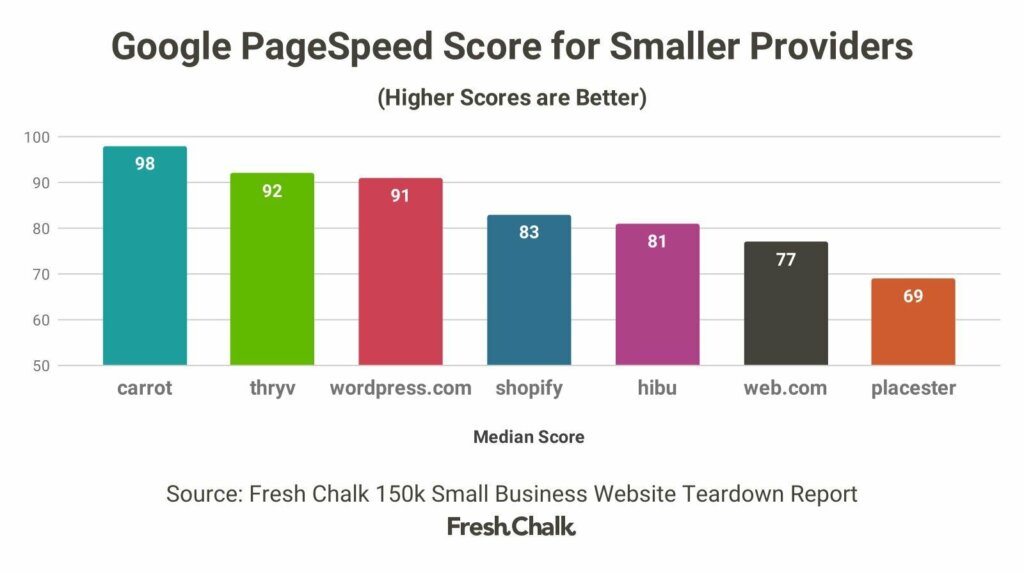
The cool news is that anyone with a Carrot website is already ahead of the game a good bit. Page speed optimizations we’ve made over the years and additional optimizations we have coming to mobile this summer put Carrot sites among the fastest on the internet today.
Alright, in this post we’ll dive into…
What is Google’s “Core Web Vitals” update?
How it may impact Google rankings for real estate agent & investor websites moving forward
Why page speed is important (and what we’ve done and have planned to keep you ahead with blazing fast websites)
Some simple things you can do to increase your page speed in addition to the updates we’re making for you
What is Google Core Web Vitals and How Does It Impact SEO?
But before we dive in… I want to give you the high level in one sentence.
Basically, Google is making an update that favors websites that have a better experience than ones that don’t, and part of that experience is how fast pages load (on both mobile and desktop). Google has found that when a website loads fast, it’s a better experience for the website visitor than when a website loads slow.
Why does Google care how fast your website loads you may ask?
Google’s money comes primarily from the advertising it sells on Google searches called Google Ads. When a Google user loves the experience of searching for information and when they have a great experience on the websites Google serves up to them (a site loading quickly vs. slow for example)... more people will continue to use Google.com for their web searches… which increases their ad revenue.
Google announced in November 2020 that Core Web Vitals would roll out in May 2021, but that has been postponed to at least mid-June 2021 with a full rollout by August 2021.
Here are the elements of Core Web Vitals (this next section is going to get a bit techie):
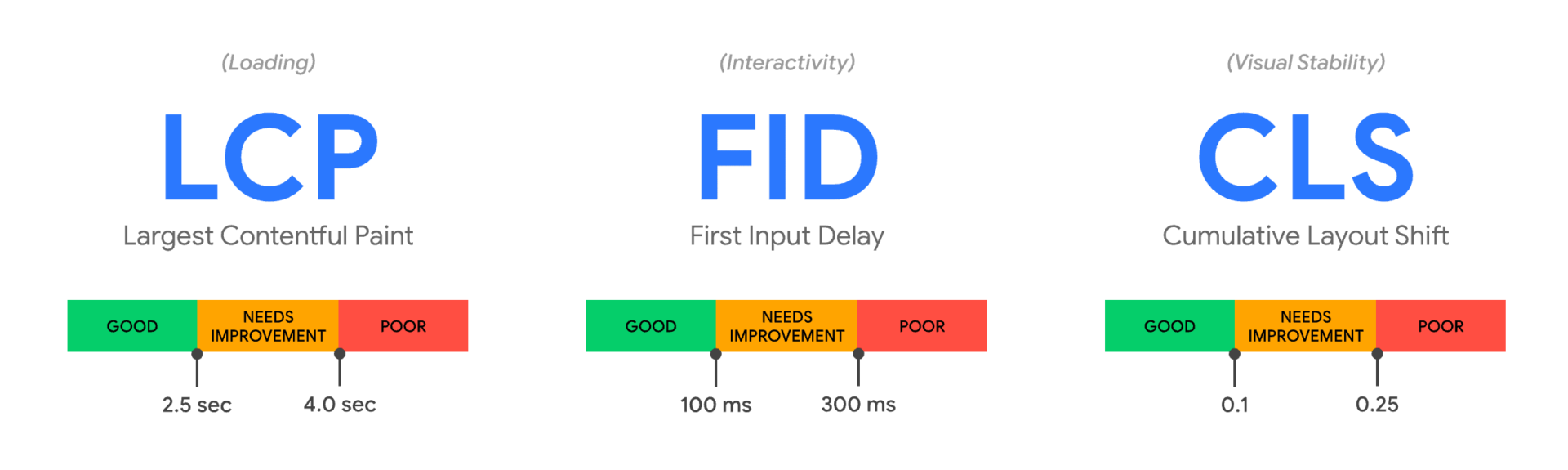
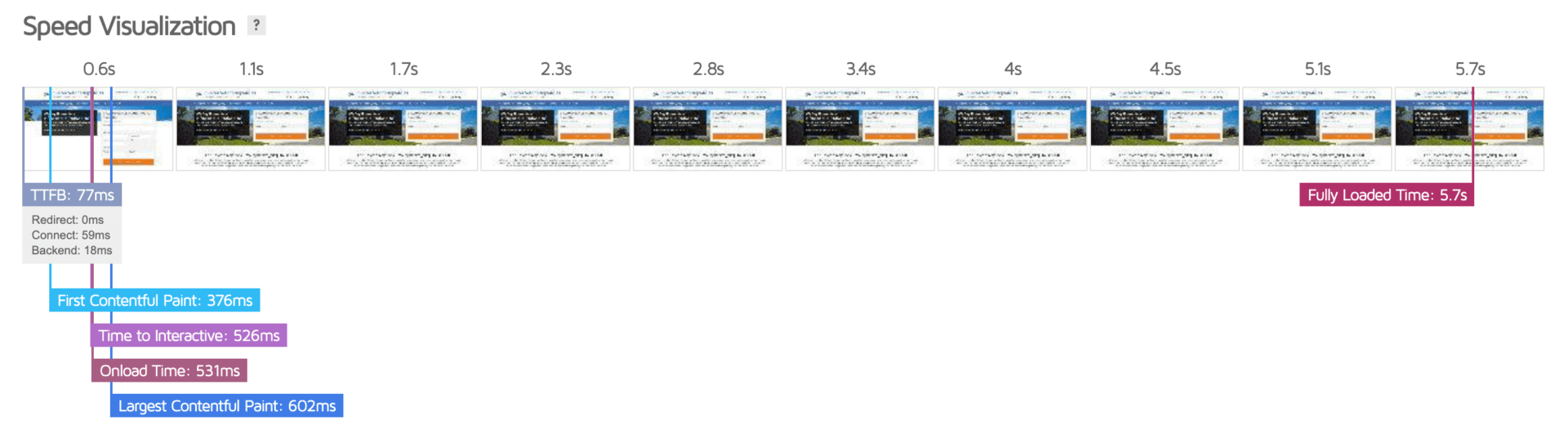
Largest Contentful Paint (LCP) – Measures loading performance. To provide a good user experience, sites should strive to have LCP occur within the first 2.5 seconds of the page starting to load.
First Input Delay (FID) – Measures interactivity. To provide a good user experience, sites should strive to have an FID of less than 100 milliseconds. This involves how long it takes the user to interact with your page including clicking on links from the main menu and navigation bar, filling out forms, and opening up “accordion text” on mobile devices. These are some of the aspects that are taken into consideration for a good user journey experience.
Cumulative Layout Shift (CLS) – Measures visual stability. To provide a good user experience, sites should strive to have a CLS score of less than 0.1. Any elements that take too long to load can cause users to click on something they didn’t mean to and cause a bad user experience. This is particularly important for mobile devices.
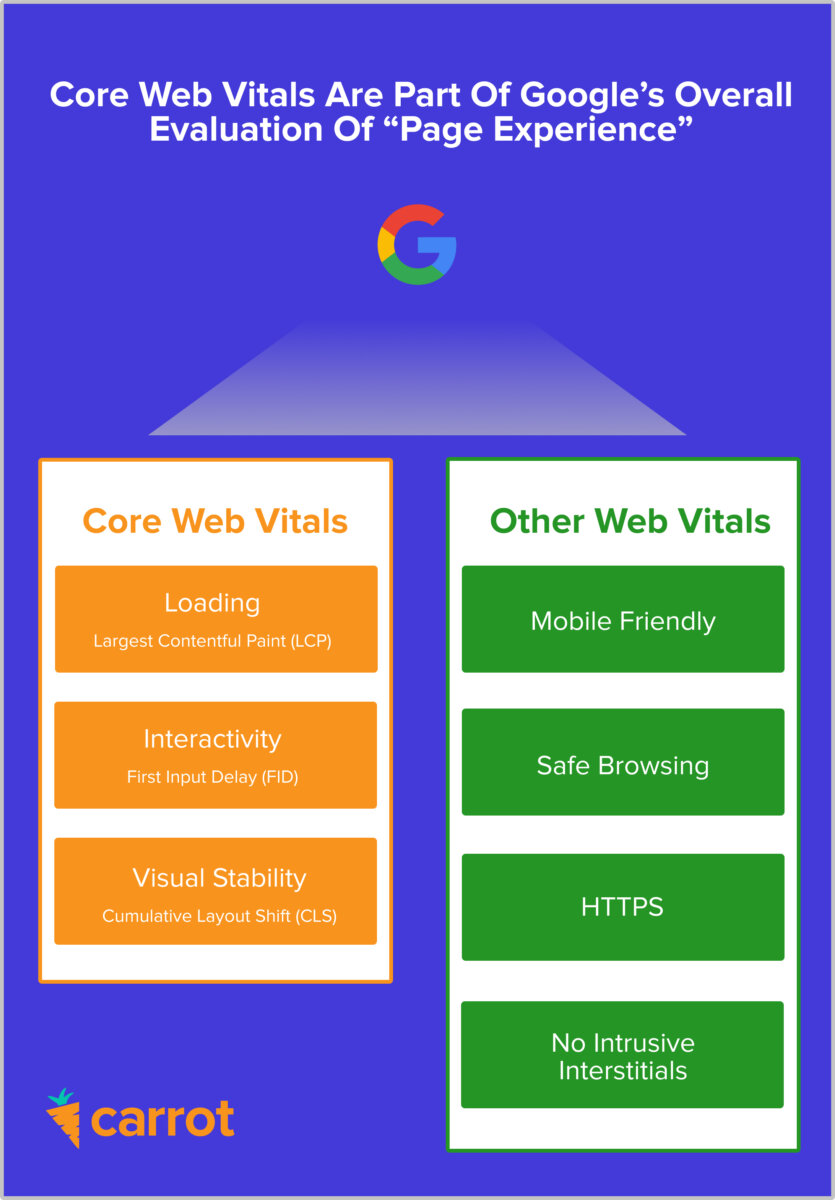
Core Web Vitals are comprised of three aspects of page experience: Loading, Interactivity, and Visual Stability. Each of these aspects have their own associated metrics that have zones that correspond with “Good,” “Needs Improvement,” and “Poor.”
In a nutshell, Core Web Vitals are a subset of factors that will be part of Google’s “page experience” score. It’s basically, Google’s way of measuring your page’s overall UX.
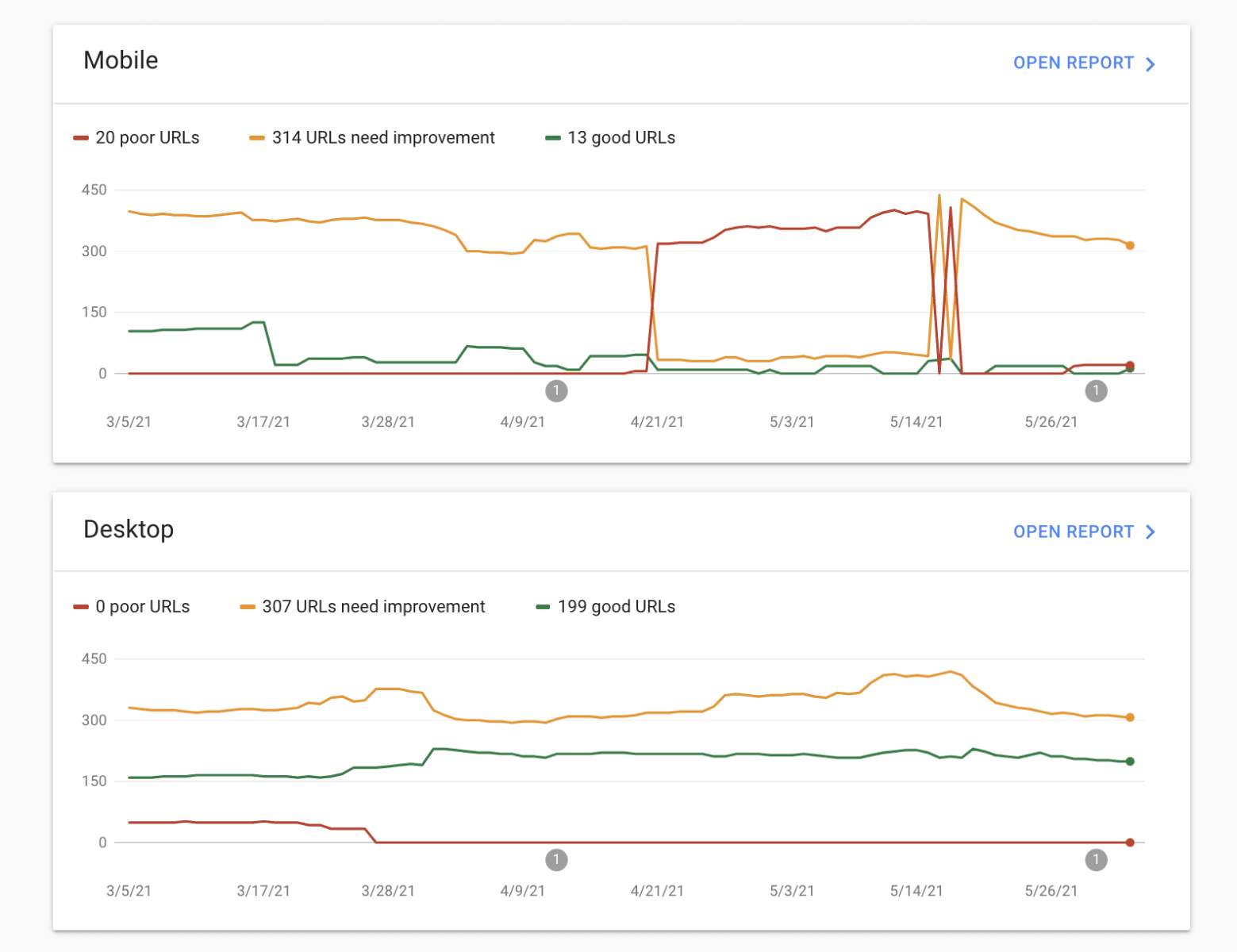
You can find your site’s Core Web Vitals data in the “Experience” section of your Google Search Console account.
Page Experience:
We’re taking this update seriously. That said, we believe there is one way, that has not changed, that you can reap the splendors of search engine optimization. It is:
Create great content.
Take it from Google:
“While all of the components of page experience are important, we will prioritize pages with the best information overall, even if some aspects of page experience are subpar. A good page experience doesn’t override having great, relevant content.” – Google
Technical considerations have always played a role in determining search rankings. So, in that regard, the page experience update is not unique.
Great SEO has to be preventative, not reactive.
That’s why since the start of Carrot we’ve taught our members to create Evergreen content to enhance their overall inbound marketing strategy. Evergreen content is the “relevant content” you’ll need to create to stay preventative rather than reactive.
Why Page Speed is Important
Google is setting expectations to have websites have high loading performance or how fast your content appears on the screen.
Carrot has always taken page speed serious. In fact, in a study, Carrot outperformed ALL other website builders, (except Google’s own Google My Biz websites) including Wix, WordPress.com, Placester, Shopify, Hibu, just to name a few in page speed.
So page speed isn’t anything new. In another study done in 2014, Walmart found that for every 1-second improvement in page load time, conversions increased by 2%.
For the upcoming Core Web Vitals update, Google has set the bar as… “For a good user experience, aim for an LCP (Largest Content Paint) of 2.5 seconds or less.” This Carrot site loads in 602ms.
At Carrot, we are constantly working to improve the speed, rankings, and conversion rates of our member’s websites. Since we’re smaller than Wix or WordPress and others, we can dedicate more time to helping our members succeed at business.
Why is Google including Core Web Vitals in its algorithm?
Google makes money by delivering relevant and valuable content to people searching for it. When a motivated house seller goes to Google and types “sell my house fast for cash Spokane”, Google wants to make sure it serves up the results that are going to provide the best experience for the searcher.
A great experience means people will keep using Google, which means more people will click ads in Google, which means Google’s revenue goes up.
So, in their continued drive to influence the way the entire industry builds websites and creates content, Google is making a move to make the “page experience” factors even more important in the way they rank websites.
We actually see this as an AMAZING thing for Carrot members.
How will this change impact you and your business
Ultimately, Google has indicated that sites generally shouldn’t expect drastic changes in search rankings. While this update is intended to highlight and favor pages that offer a great, fast, and stable user experience, Core Web Vitals are not intended to replace the priority placed on informative, relevant content. It’s just another ingredient in the mix to ensure site visitors have an awesome experience — a win-win for all!
As mentioned above, Google will begin gradually introducing these metrics and aspects to their algorithm in mid-June, with the goal to have them fully playing a role in the search algorithm by the end of August.
For more in-depth information and questions on Core Web Vitals and Page Experience, check out Google’s FAQ.
How Carrot is preparing for the changes
Here at Carrot, we’ve been tracking this update over the past several months, testing our templates and sites, and working with our engineers to ensure our network — and your site — is optimized for Google’s algorithm.
In preparation for the initial phases of the Page Experience Update, we will be making some improvements to our backend code and network to improve page experience and site speed scores even further.
These improvements include a re-evaluation of our code specifically with Core Web Vitals in mind, optimizations to certain plug-ins and script packages, and an enhanced ability for us to monitor site performance and speed data across our entire network.
Tools to measure your Core Web Vitals
Google has provided a set of tools to help you analyze performance, identify issues, and fix them ahead of the algorithm update to help ensure your rankings aren’t negatively impacted..
Google Search Console (GSC). If you’re a verified owner, you can monitor the current state of your website in the Core Web Vitals Report of the GSC. From there, you can find out your pages’ performance categorized as “Good”, “Need Improvement”, or “Poor”.
Page Speed Insights (PSI). Use PSI on the pages that need improvement to diagnose and identify specific issues.
Lighthouse and Chrome DevTools. These tools can be used to measure your pages’ specs, and identify what needs fixing and what steps to take in order to fix it.
Web Vitals Chrome Extension. The extension can be used to monitor in real-time the core web vitals of webpages on desktop. It can be used on every page of every website, regardless of whether you are the owner, and it can give you a peek of how other pages similar to yours are doing as well.
Chrome User Experience Report (CrUX). Here you can find information about the CWV performance of your website, based on real-life user data.
The future of SEO with Google Core Web Vitals changes
We are compiling a list of best (and worst!) practices so that you can be sure nothing you are doing on your own individual sites is negatively impacting your scores. We’ll be posting that guide over the next few weeks to ensure that you’ll have plenty of time to take a look at your site and make any necessary improvements before the update goes into full effect later this summer.
We have conducted full Core Web Vitals and Page Experience audits on our most popular site templates and a sample of our member sites. Our sites are already performing exceptionally well, and with the improvements our engineering team is working on, you’ll be one step ahead when Google’s algorithm update goes live. We’re happy to report that our sites perform exceptionally well.
We have our Carrot members covered!
If you’re not a Carrot member, here are some things to consider when optimizing a website for Core Web Vitals. We recommend analyzing each URL individually as you might have a different score because a page holds different layouts, content blocks, and elements. Here are some basic steps you should consider taking:
Scale images to the correct placement sizing
Compress large image files
Lazy load static content
Apply a content delivery network to the hosting platform
Remove any unnecessary render-blocking resources
Serve images in next-gen formats
Remove any unused javascript
Hit us up on the comments section below with questions, comments, or concerns!
Highlight what you are good at and the solutions you can provide – you will see a lot of action above and beyond those instant movers who buy right away.
– JT Rose
Agents & Hybrids: How to Optimize Your Facebook ads for Better Seller Leads – Messaging, Brand-Building, and More
Welcome to our forth and final installment of our Facebook ads mastery series. Today, we are talking about bringing in high-quality seller leads, buyer leads, building authority with your content, messaging for hybrid agents, and what to do if your ad is disapproved.
We are once again sitting down with Kiley and JT of Silverstreet Marketing, focusing more on agents and hybrid investor/agents. However, the principles discussed apply to any sort of business, even those not related to real estate.
For years we have been talking about how hybrid investor/agents are the future of real estate. That future is now. Investors who aren’t agents are leaving 80% of their leads on the table, while agents who can’t offer more than one way to sell are trying to fit all of their leads into the same box. As buyers and sellers become more educated about real estate, they are looking for options. Here’s how agents, investors, and those who are a hybrid of the two, can utilize Facebook ads to captivate more buyer and seller leads while building authority along the way.
Are Ads the Same for Agents and Investors?
When running ads for motivated seller leads, agents and investors should have a different approach. No matter what kind of lead you are looking for, keep their unique experience in mind.
Your messaging will be different to someone who wants to sell in a few months vs. someone who needs to sell urgently
Agents will want to get in front of leads several months ahead of time, while investors are looking for those who need to sell right away
Agents will want to get in front of their leads early, providing consistent value while the leads is contemplating the sale
When adding value, you can offer complimentary CMA reports and market data. You can take it one step further by creating content to help with their situation. For example, an article titled: “5 Repairs to Help You Get an Additional $20k on the Sale of Your Home.”
How Do I Build Long-Term Authority With My Content?
Adding value through content will also help to position you as the authority. Regular content builds trust as well as your online presence.
Your social presence is meaningful – you need to exist
Facebook and Youtube are often used as search engines – your content should offer information and answer questions
Celebrate your successes on our social media platforms by sharing the stories of those you have helped
Include content that has nothing to do with real estate, just to make your name known throughout your local community
The key is getting people engaged. Helping out with charity events, creating content about your community, and busting standard objections will help you find higher-quality seller leads.
How Do I Modify My Ads to Get Both Buyer and Seller Leads?
Don’t just go after those seller leads, buyer leads are instrumental too. If you are targeting the right class of buyers, you will see that 50% of them not only wish to buy, but they need to sell too. You will be able to work both sides, while doing the work to bring in just one lead.
Buyer leads are higher conversion and lower resistance
Buyer leads will often cost less
Send your leads to a simple and direct landing page, with a CTA form that is front and center
Don’t overcomplicate things for your buyer leads
Find out how early you can market a house before it hits the MLS – this varies by state
Before finalizing your ads, make sure you know how you are going to follow up with the lead. Highlight the ways you are good at what you do and how you can help.
What Sort of Messaging Should Hybrid Investor/Agents Use?
Hybrid investor/agents should focus on the multiple solutions they are able to offer.
Highlight the fact that you can help the seller explore multiple options, offering custom solutions
Let them know that your solution puts them in control – you don’t have to conform to any selling method
Kiley and JT have a great ad that highlights 3 selling options. The seller can get a cash offer, sell privately to one of the buyers in their network, or list on the MLS. Your hybrid messaging should let your leads know that you can offer the solution that best fits their life.
What Happens if My Ad Isn’t Approved?
With Facebook guidelines becoming more strict, many ads are often unapproved. This happens quite often to people running their own ads, and can quickly cause them to lose access to their ad account.
When dealing with anything having to do with real estate, make sure the special ad category is selected
Make sure you do not have any political references in your copy
Try to avoid overusing the word “you.”
If you have created an ad, followed all the rules, and still find it isn’t approved, you can appeal the decision. Facebook ad approval is far from perfect, you aren’t alone.
We hope you enjoyed this Facebook Mastery series. We’ve looked at ads from a high level, refined creative, and helped you to better optimize your current ads. Learn more about setting up your ads at carrot.com and get help from our marketplace to have Kiley and JT help you through the process!
When receiving a negative comment on your ad, if you can skew it into a positive thing, you can use it as an opportunity to clear a misconception or highlight your customer service.
– Kiley Newbold
How to Maximize Facebook Ad ROI + iOS 14 Update
In part 3 of our Facebook ads series, we are sitting down with Kiley Newbold and JT Rose of Silverstreet Marketing. They are going to show you how to maximize your Facebook Ad ROI by setting the right budget and tweaking your creative. We will also discuss the best ways to respond to negative comments on your ad and what exactly you need to watch out for with the iOS 14 update.
As an agent or investor, you can use Facebook Ads to find motivated, high-quality leads. In the first two parts of our series we talked about launching your ad and the creative aspects. Now we want to help you maximize your Facebook Ad ROI by helping you set a budget, tweak your ad as necessary, and how to properly engage with comments to your ad. We will also let you know what you need to be aware of with the iOS 14 update so you can adapt accordingly.
How Do I Set My Facebook Ads Budget?
Your budget will vary depending on your market and your desired result. Different goals will require different budgets. As a very basic rule of thumb, JT and Kiley recommend..
$500/month or about $17/day for those who are targeting a broad audience to build brand recognition
$1000/month or $34/day for those who are ready to really dive into Facebook Ads, using their page for lead gen and to increase website traffic
How Should I Tweak My Creative for the Best Optimization?
If you are not happy with how your campaign is performing or if you want to find ways to increase your ROI, there are several things you can look at.
Reach – If your ad isn’t getting in front of enough people, even if your conversion rate is high, your volume will still be low
Clicks – If people are seeing your ad – are they clicking on it? If not, you may want to change up your creative to garner more interest.
Conversion – If they are clicking, but not converting, there are a few things to look at. You can see if your page is slow to load, if your landing page is structured properly, and what your lead form looks like.
If your campaign isn’t working, don’t just quit. If it were direct mail, you wouldn’t just throw it all away. You would tweak it, refine it, and try again. That is exactly what you should be doing with your Facebook Ads to maximize your ROI.
What Should I Know About Engaging With Comments?
A lot of people will avoid engaging with negative comments by either ignoring them or deleting them entirely. For many reasons, this isn’t the right way to handle negative feedback to your ad. Instead you should…
Flip it – changing it into a positive. Use the opportunity to clarify a misconception or show how well your customer service team performs
Always reply – good or bad, Facebook sees any engagement as a metric of health
Only delete comments that are spam or profane
Good or bad, it is very powerful to see a business who is actively responding to comments left online. For every comment made, there are lots of people thinking the same thing. When you are able to reply with intelligence and tact, you aren’t just addressing one person, but several who may have had misconceptions about you or your service.
What Do I Need to Know About the iOS 14 Update?
The iOS update includes new privacy protocols that will change how ads can track people. While Kiley and JT aren’t concerned about the update, there are a few things to watch out for.
You will see a difference in what you are able to track – this changing what some of your audiences look like
Make sure you verify your domain so that you can prioritize your Facebook Pixel events
Set your pixel prioritization – the new update will allow you to track up to 8 events
While your tracking may become a little skewed as this update rolls out, all will be well after the initial adjustment period. Some advertisers may see this update as a burden, thus pulling their ads. This only makes more room for those who stay the course.
Look out for Episode 4 in our series which we will dedicate more to agents and hybrid investor.agents!
Don’t be scared. Give it time. You can’t run an ad for a week and then stop. Don’t just spend money and leave. Stay the course.
– Chad Keller
Facebook Ads Mastery #2/4: What Makes Effective Facebook Ad Copy? Create Creative That Convert! w/ Chad Keller
In part 2 of our Facebook Ads series, we are once again sitting down with Chad Keller to dive into what makes an effective Facebook ad. We will discuss which ads you should launch first. How to nail your Facebook Ad copy and creative. And how to hack the competition to get a better idea of what works and what doesn’t in your market.
Chad Keller isn’t only a professional marketer, but he is an investor as well. His unique insights are helping many Carrot clients find success in the Facebook ads world. Here are 5 things to keep in mind when creating your ad so that you can maximize the reach and effectiveness.
Which Ads Should You Launch First?
Without a doubt, you should start with ads to retarget leads who have already shown an interest in your services. Your goal now is to build trust in order to achieve a conversion. Your retargeting ads should:
Include a video or picture of your face – if not you, then include a photo of your team
Highlight a testimonial from a past client
Retargeting ads can have longer copy than ads appearing to cold audiences
Serve up content that eliminates objections
After you have built up trust – hit them again with your main marketing message: “I will buy your house.”
Don’t exclude leads who have already filled out your form, but haven’t yet converted
Which Type of Headlines and Hooks Work Best?
Having the right headline and hook is critical in reaching your audience and getting those clicks. Think of your sellers and what they are going through. What will motivate them to sell to you? Good copy should:
Be hyper local, focusing on the area you wish to buy
Copy should address obstacles homeowners may be facing
Reinforce that you buy in as-is condition, etc.
How Do I Know Which Pictures and Videos to Use?
The visual appeal of your ad should be strong and geared to the audience you want to reach. If you are buying houses to fix up, use a photo of an old and run down house. If you are looking to buy land, use a photo of land. The photos and videos in your Facebook ad should:
Experiment with gifs and movement vs. still photos to see which garners the most attention
Your gif should be about 8-13 seconds so that the ad will appear across other platforms
If your gif or video is over 15 seconds, it will not post to all platforms, (Instagram, etc.) significantly lowering your reach
Keep photos relevant to the market you are targeting – avoid overused stock photos that you see on every real estate site
A digital bandit sign that is direct and to the point has been a successful Facebook ad for Chris in the past
What Are Some Mistakes People Make With Their Facebook Ad Copy?
There are many common mistakes Chris sees when working on ad campaigns. A few of these include:
Slapping their logo on or typing over a stock photo – Facebook likes when there is an element of design. Canva is an easy way to create ads that look professionally done.
Using the wrong sizing, thus allowing other ads to be seen in the same space when a potential lead is browsing Facebook on their phone
What Can I Learn From the Competition?
Whenever I see an offline advertisement that grabs my attention, I save it into a swipe file. I use this for inspiration when creating ads of my own. I do the same thing with ads I see on social media. What did I like about it? What made me stop? A few ways to learn from the competition include:
Whenever you see a great ad, click to save the video to a file you can reference later
If you see an ad for a competitor – click it. You will then be privy to how they are running their retargeting campaigns
Check out the Facebook ads library to look up competitors to see what ads they are currently running and what is working for them
Keep AIDA in mind when setting up your ad. Attention, interest, desire, and action. Do your best to work this all in, study the results, then tweak as necessary. In the next episode of this series, we will dive in even further, offering you ways to maximize your ROI with Facebook ads.
With bandit signs, you can’t measure your reach. With Facebook ads, you can see exactly how many people saw your ad, tracking it down to the cent.
– Chad Keller
The 5 Biggest Facebook Ad Mistakes in Real Estate + How To Get Started
What better way to kick off a series a new series on Facebook ads than with a guy who spends MILLIONS of dollars on ads? Seriously.
Through working with big companies like Dish, Macy’s, Chewy, TheChive, Sprint, and more – not to mention successfully running ads for his own investing business, Chad Keller has been testing, optimizing, and teaching others how to turn cold traffic from crappy ads into sellers that are more motivated than Tony Robbins on Red Bull.
Today, we’re looking at the most costly mistakes investors & agents make. Then, in the next 3 episodes, we’ll dive into the copy, creative, budget, targeting, and how to scale campaigns.
Stop blowing your marketing budget on under-performing ads & Listen to the podcast.
At Carrot, we often talk about the power of evergreen content. Providing valuable information to your readers builds credibility and trust, making you the go-to source for your target audience.
Your content needs to be created just one time but has the potential to reach buyers for years to come. But what do you do while you are building that momentum? Many savvy investors and agents will turn to Google and Facebook ads.
These ads can help you not only get leads in the door right away, but they can also help you add to your organic content as you build up your SEO. They are measurable vs. bandit signs and other forms of traditional advertising, allowing you to get down to a granular level.
Today, we are diving into the world of Facebook ads and how to use them to target your ideal client.
The Power of the Pixel
The most important part of advertising on Facebook is putting the Facebook pixel onto your website. A pixel is “an analytics tool that allows you to measure the effectiveness of your advertising by understanding the actions people take on your website.
You can use the pixel to make sure your ads are shown to the right people.” Before spending a dime on Facebook ads, be sure to set up this tool to see who is visiting your site, enabling you to define audiences for your ads.
Targeting Your Audience
When setting up your ad campaign, there are several objectives you can choose from. Awareness, reach, traffic, engagement, lead generation, messages, and conversions to name a few.
When boosting posts, for example, these are typically just to build awareness, and may not give you the conversions you are looking for. After a potential client visits your site, you may want to refine the advertising you are showing to them. Don’t reserve the same ad, instead, show them new content that will blast their objections!
In the past, many people utilized lead form ads to collect the interested party’s contact information then and there. And while these sorts of ads may be cheaper, getting the lead off of Facebook and onto your website, has proven to increase your conversion rates.
The 5 Biggest Facebook Ad Mistakes People Make
#1 – Not having the pixel installed on the website at all/properly
#2 – Not understanding the goals of each campaign objective and how they are used
#3 – Using leads form ad units instead of the conversion objective for leads
#4 – How important good creatives really are
#5 – How to properly segment and set up audiences
I really enjoyed diving into this episode to discuss Facebook ad mistakes with Chad. Look out for episode 2 in this series where we will dive into what makes for great copy, creative, and how to create ad campaigns. And later, we will get into setting a budget, scaling, and optimizing for better results.
Make a list of everything you do and ask yourself, “how can I do none of this?”
– Joe McCall
Marketing, Automation, and Delegation – How to Build Systems That Will Free You From Your Business w/ Joe McCall
Joe McCall is a pro when it comes to building processes and scaling. These skills have helped him to build a business of flexibility and freedom, that allows him to travel the world with his family.
Today, he is running his business from his laptop, spending the majority of his time on his long-running podcast and teaching other investors creative financing tricks.
Listen in as we talk about creating the right marketing, automating it so it happens in spite of yourself, and how to delegate all of your tasks to the right people.
Read the Full Show Notes Below…
Joe McCall is a returning guest and a long-time friend. We attend Masterminds together and have seen each other’s businesses grow. One thing I love about Joe is his ability to create processes and delegate tasks. He’s done it the right way, enabling him to run his business from wherever he likes.
So far, Joe and his family of 6 have hit the road in an RV and have had multiple trips to Europe, in which they have spent months at a time. Joe’s tactics and creative strategies prove that there are lots of ways to make money in real estate. Here’s how he has done it and how you can do the same.
Going MAD
MAD stands for marketing, automation, and delegation. To be successful in real estate, without having to work 80 hours a week, you will need to implement all three. Joe has multiple Carrot sites and has several VA’s who do nothing but cold calling. He has implemented the right software and created the right team.
Today, he only needs to spend a few hours working on his real estate business each week. This time is mostly spent checking in, reviewing analytics, and analyzing scorecards. Joe doesn’t want to be an absentee owner, but he does want to spend his time doing the things that fuel him.
He has built his business with flexibility and freedom in mind – something we are passionate about here at Carrot.
Getting Creative With Your Deals
With so many ways to get involved in real estate, finding success all comes down to how much you are willing to work for it. So many investors give up when they get discouraged, but staying the course is what will lead you to success. Joe has done many different types of deals.
One of the niches he is passionate about is lease option deals. He is able to find motivated sellers, enter into a lease option agreement, then sell the option to a third party. Just like that, he is out of the deal, with profit in hand.
Trusting the Gurus
From about 2006-2009, Joe was a professional student. He took all of the courses, read all of the books, and put in the work so he was able to quit his job in 2009. Education has been a big part of Joe’s journey, and now he is giving back by offering training of his own. Agents, investors, and real estate educators are often some of the least-trusted lines of work.
Joe is looking to change this impression by offering real value to the students he works with. Today, Joe is spending the majority of his time passing along his knowledge through his podcast and paid courses. While money is great, what fuels Joe is helping people. His courses light him up and bring him excitement. He is bringing humanity back to business – and that is something we love.

![[Backed By Data] What is a Good Conversion Rate for Your Real Estate Investing Website?](https://image-cdn.carrot.com/uploads/what-is-a-good-conversion-rate-featured.png)