Listen to the CarrotCast Podcast and Subscribe Below!
When you’re confident with whatever it is, you expect the result. You’re not hoping for it – you expect it. So you can say “hey, here’s what we’re going to do and you can just lead.” I think when you’re starting out, your confidence is more like you’re not sure what to do, and I think that is picked up on. Gary Horton
While most of the real estate market is flooding into flipping houses or wholesaling houses… savvy investors are looking at the gaps in the market where there is an outsized opportunity vs. competition level.
When Carrot client Gary Horton hit a wall wholesaling real estate in San Diego he tested out flipping vacant land… and hasn’t looked back since.
Now Gary buys and sells land all over the West Coast, from his house (or office), does 8-9 flips per month, and barely has any competition.
In this episode, Gary lays out his entire business model from start to finish. His marketing, how he targets sellers, how he sells his properties, his margins, how he does online marketing to drive consistent land deals… EVERYTHING.
Dive in and listen to Gary’s story and get inspired to go down the path less traveled.
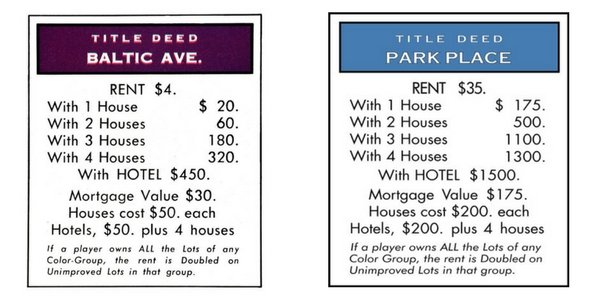
3:20 – Gary’s backstory — Who he is and working a career that he didn’t love. 6:00 – Building confidence and credibility to leave his job and close his first deal. 9:30 – Why he decided to pivot from the truly motivated house seller market to flipping vacant land. 12:45 – Knowing your strengths and weaknesses can save you a lot of pain and time. Walking through the Kolbe Index test. 15:50 – The nuts and bolts of land flipping. 20:30 – Cracking the land flipping code — making the move and dealing with the responsibility that came with it. 23:15 – Gary’s land-buying business model: Buying Baltic Avenue instead of Park Place.
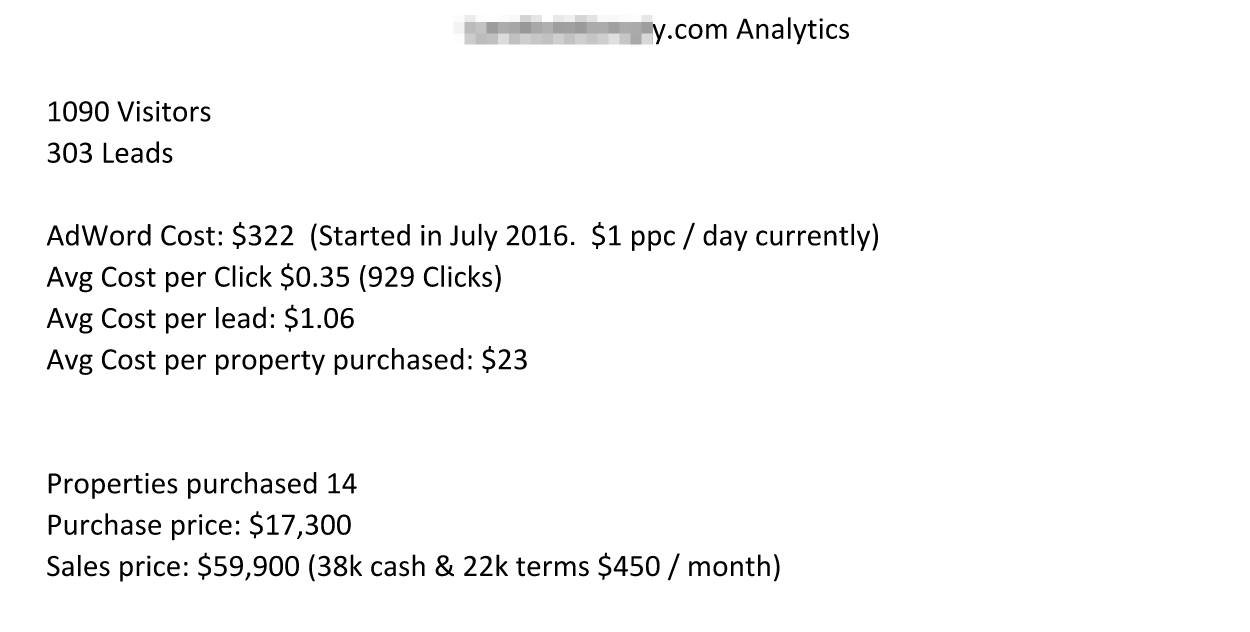
27:55 – What types of situations are the sellers going through to sell their land so cheap? And the strategy behind his direct mail campaigns. 32:05 – The leads from his Carrot website have been very good. Find out how that has helped him open the door for more investment opportunities. 34:35 – How searchers are finding his website: SEO and AdWords on a $1 per day budget. 38:25 – Find out his online stats, such as how he’s been able to profit over $40,000 and only spend $322 on AdWords.
42:50 – Building up a seller financing land business that is consistent, predictable, and low-risk. 45:20 – His rule of thumb of pulling a list and what to look for when finding a sweet land buying niche. 48:50 – Diving in deeper into what one of those land buying niche opportunities looks like: From dream communities to land buyers paradise. 52:05 – Land SELLERS: How to market your land listings. 1:01:30 – What are some of Gary’s goals he’s pushing? 1:10:30 – Why he chose Carrot and what it meant to his business.
Listen to the CarrotCast Podcast and Subscribe Below!
I ask myself the question, ‘How can I be better?’ Because, if content is about cutting through the clutter and getting to the top of rankings, then I have to stand out when I write my content.” Mike Blankenship
How do you put together remarkable pieces of content as a real estate investor or agent on the web that are useful and effective?
How do you get people to see it?
Creating content can seem like a daunting task.
On this episode of the CarrotCast, Carrot Content Strategist, Mike Blankenship, and Trevor Mauch discuss the practical things you can do to seamlessly produce any piece of content, from the birth of an idea to the publication of a post. And, give actionable tips to make your content better, build more credibility and help more people with great content.
Be sure to listen to our other episodes of the CarrotCast at www.carrotcast.com.
Listen to the Podcast
[podcast-subscribe]
In This CarrotCast On Creating Remarkable Content For Real Estate Investors And Agents, we discuss…
4:30 – People say“content marketing isn’t going to work for me” – how to make content marketing work for your business if you’re in a market that doesn’t have a lot of competition. 8:20 – How do you make your content marketing effective in a competitive market? Cutting through the market by solving a problem for your audience. 11:00 – The first step to creating content. The process for coming up with ideas and tools to find those ideas. 13:45 – Why every piece of content should be solving a problem for your audience. 14:55 – After finding an idea to write about and performing some keyword research, what is the next step to crafting useful content that is also great for SEO and social shares? 18:35 – Do this one thing after you’ve chosen a solid idea. 22:30 – Before you get started writing, find out how to outline an article and why it’s important to write about topics you truly enjoy. Take a look at one of Trevor’s favorite pieces that he’s published:
27:30 – Mike walks through his process for writing long pieces of content. 30:15 – Don’t let your content creation drag you down. Why you should start short and explore different topics and processes. 34:20 – Don’t procrastinate and be afraid. Why it’s important to hit the publish button. 42:25 – How long should written content be and some shortcuts to speed up the content process. 46:25 – Thinking outside the box. Where to look for ideas to write about that are indirectly related your topic.
Listen to the CarrotCast Podcast and Subscribe Below!
I knew from my background that once I did the work, it would keep returning a benefit to me over and over again. Today, I’m reaping the rewards. David Brown
“You can’t do any deals with SEO”.
We hear that quite often from people who don’t want to put in the work and focus.
But for those who use a solid proven system and implement a plan with consistency… they see results.
Dave Brown fuels almost his whole 30-40 deal per year business with his approach to Real Estate SEO and in this podcast, he breaks down exactly how he started, what he did on SEO in the first days, what he does today, some tips… and his story as a real estate investor.
If you’re curious about pulling in deals with search engine optimization listen to Dave Brown’s story and how he does it.
2:20 – Find out what David has learned over his 2 decades in the real estate industry. 5:00 – How to build a business around your lifestyle and why David gave up his real estate agent license and never wants to get it back. 7:50 – Creating a business around leverage. The context of what David’s business structure and the organization looks like and why. 16:00 – David’s mindset around growth – doing more with less. 18:15 – What business systems he uses… CRM, Phone Tracking, Online Marketing. 20:05 – Unpacking his Real Estate SEO strategies — Why his website content has been so effective in cutting through the clutter. Keys:
Making basic customizations
Two months of creating location-specific page content
Building credibility
Link building
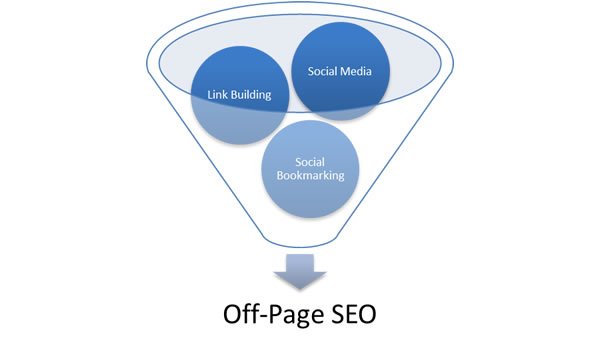
23:30 – David’s secret sauce he dashes on his location-specific pages — Taking it to another level! 28:10 – Why creating pages that target specific keywords have helped him command his market in search results rankings. 31:25 – How to increase your website traffic, in theory. We focus on some SEO math. 34:25 – SEO tactics you can employ to your website. 35:50 – David shares his off-page SEO strategy.
39:00 – Sharing heartwarming stories in a much needed time… Check out David’s other passion… americansnippets.com. A website and podcast about American stories that need to be shared. 41:10 – Top rules for your website… customized, clean, and credible.
The owner financing option is becoming more common. Which is why you need a strong online presence and a high performing website. The first thing your potential clients do is search for financing options online. And no matter how good of a broker you are, your hands are tied without clients to cater to.
You need to grab the browser’s attention by giving them a reason to work with you beyond the traditional bank loan. In line with one of our core values, “Consistent Improvement and Innovation”, we created our Owner Finance sites with your clients, your business, and above all else, the relationship between the two, in mind.
So, how can you soar a mile ahead of your competitors? Offer an optimized and mobile responsive website that encourages your clients to work with you.
All of the InvestorCarrot sites are mobile responsive so that your clients can reach you and your services on whatever they’re using: mobile or desktop.
In terms of usability, setting up and maintaining a website is simple. Even if you’re a beginner, you’ll quickly get the hang of it. But if you do struggle, it’s okay. Carrot support has your six.
Introducing Our New Owner Finance Website System
Over a two-month period, we researched and tested owner finance websites to create our first version of a high performing seller financing website that you, as our InvestorCarrot member, can access and setup in your account.
We’ve kept these owner financing websites simple… but effective. And we’re still actively testing the sites, so there’s more to come. As we continue learning, we’ll add elements to your website, each and every month, that increase engagement, conversion, and revenue.
The Design
We’ve taken our proven “lead hero” and built that into the owner finance websites, as well. We found that when we utilized the “lead hero” on our home pages, the homepage conversion rate increased across the board.
Of course, we’ve built in our hidden Conversion Boosters that are infused into all of our InvestorCarrot real estate investor websites. The Conversion Boosters improve opt-ins, engagement, and one of the most important aspects of your business, brand credibility.
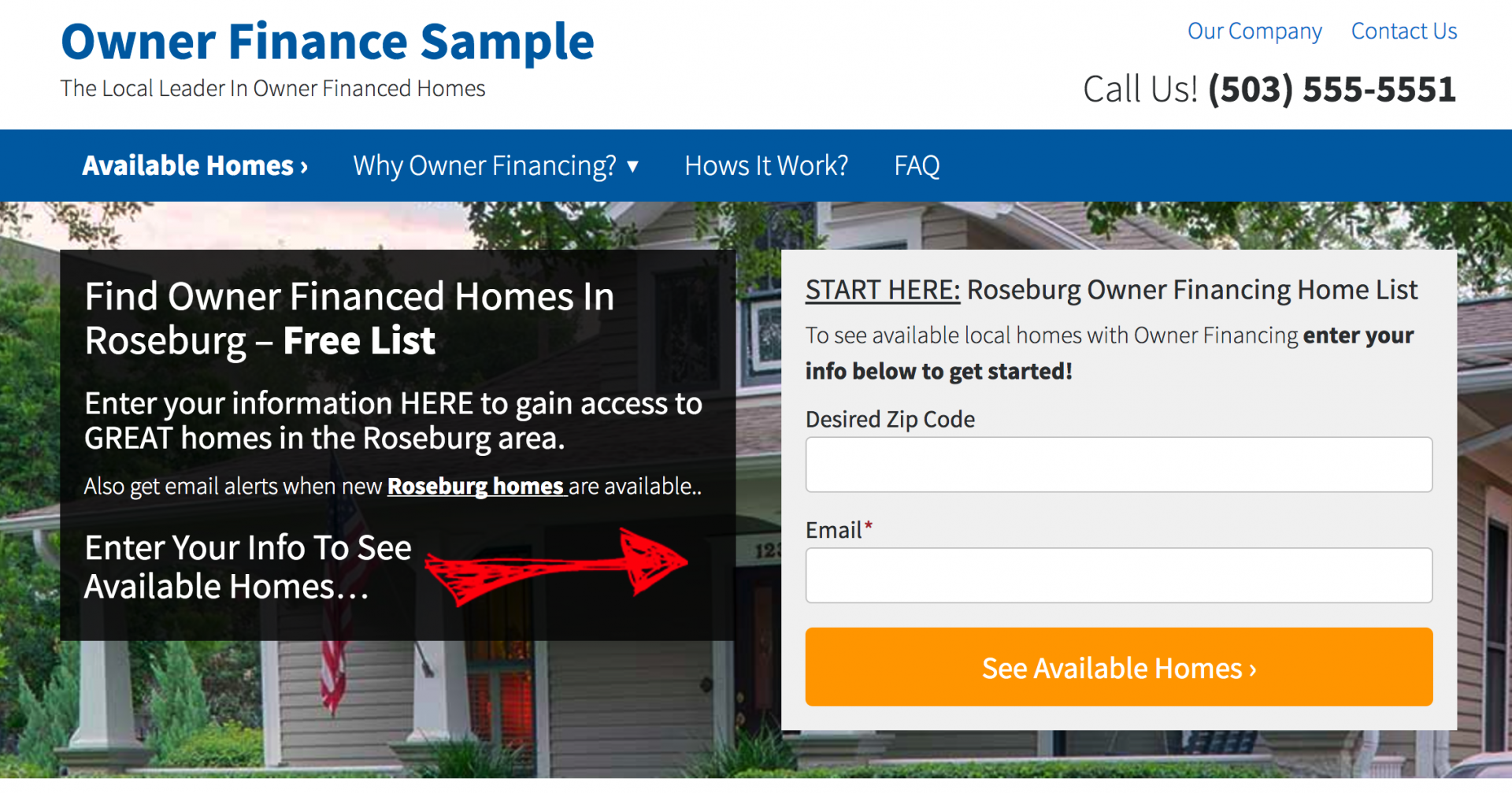
Let’s take a look at some of the pages on our owner finance websites…
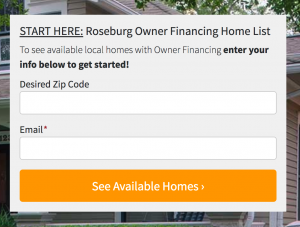
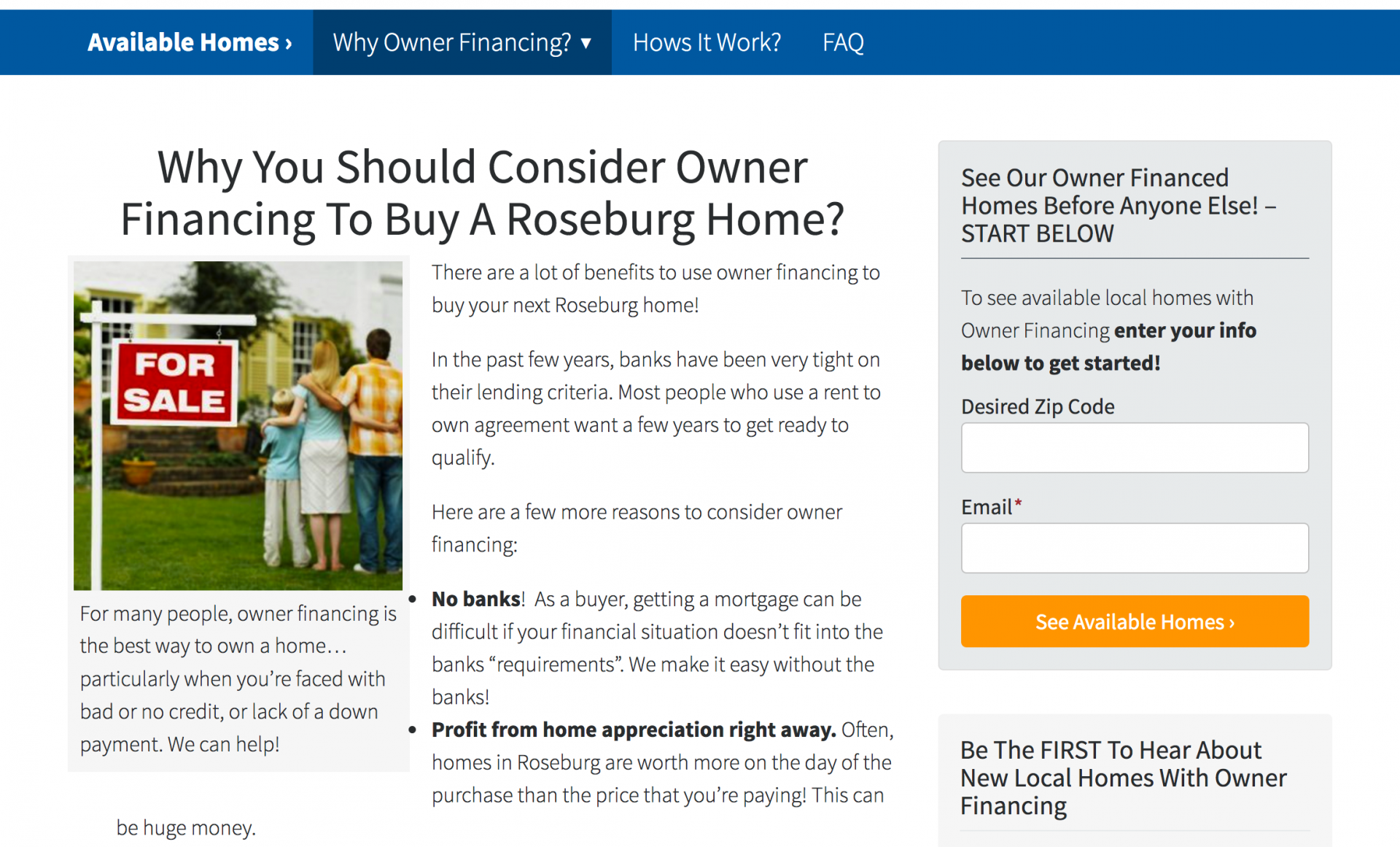
Available Homes Page:
Why Use Owner Financing Page:
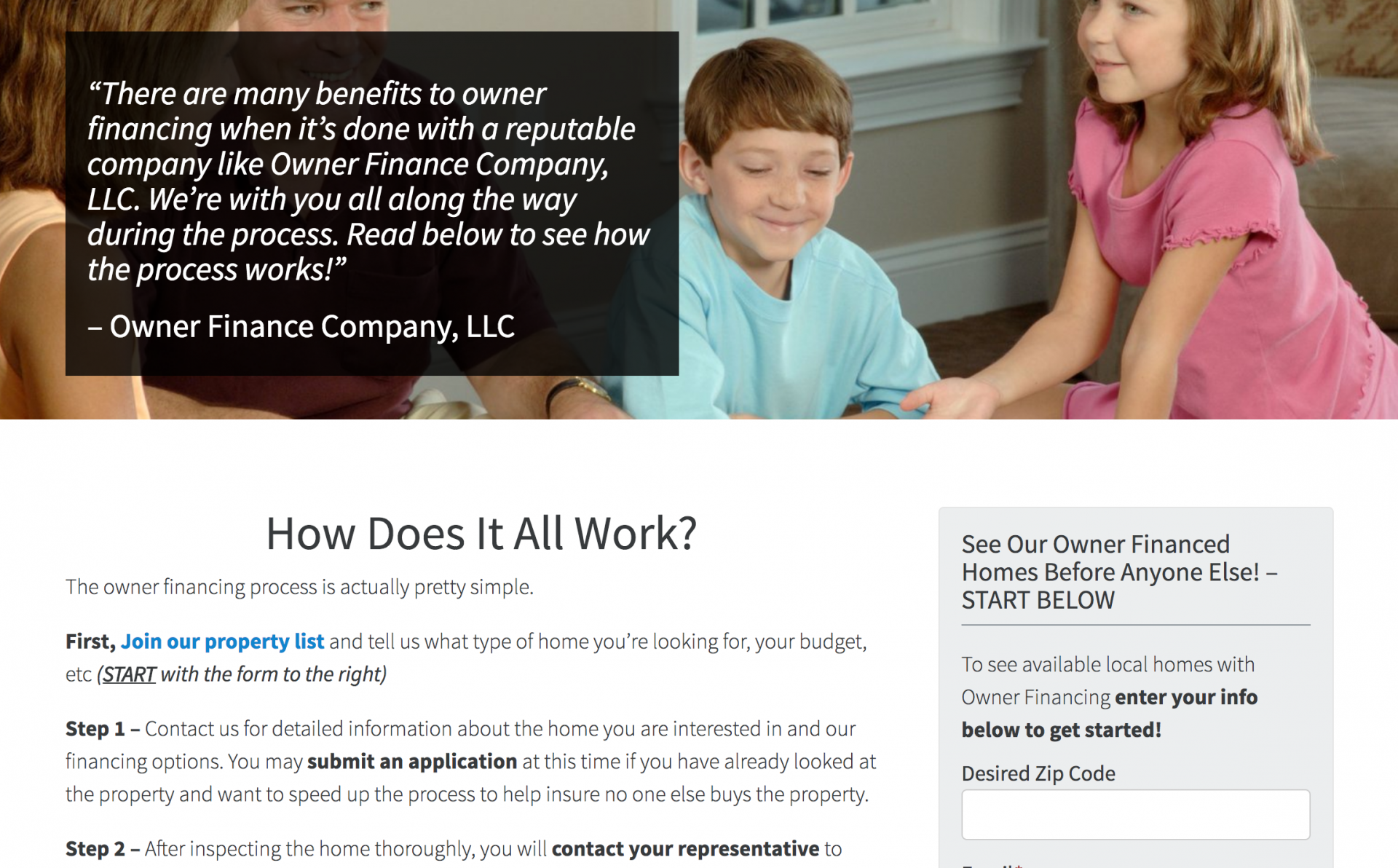
How It Works Page:
The Results Method
Our proven philosophy has been “Design For Results, NOT For Prettiness.” When Carrot first started, we were all about a pretty site. But it didn’t take us long to learn that results are what matter most…
InvestorCarrot websites are built from the ground up, backed by research and test data, to leverage SEO, produce loyal clients, and make your business into a brand client’s can’t help but connect with.
Plus, we’re always testing and adding new features to our websites and to our Carrot client dashboards.
Once we find what works best… our team goes to work to create a nice, clean look, all while retaining the current conversions (or, ideally, increasing website conversions even more!).
The Owner Finance Website Content
The content has been professionally written by people who know SEO, website conversion, and the real estate investor industry inside and out.
The words on a page can make or break your search engine results and directly influence how well your website performs once a visitor arrives.
Every page on our new owner finance website is written with four factors in mind…
Search Engine Optimization
Lead Conversions
Customized and Customizable
Credibility Boosters
There are many reasons why our members love us, but one of the main reasons is the quality and actionable content we produce. You can save time by leveraging writers to produce content rather than spending countless hours producing your own.
NOTE: All of our website content is Copyright Protected for use ONLY by active InvestorCarrot members, and may not be copied in all or part on another website. Any copyright infringements will be taken seriously. We appreciate you playing by the rules.
The SEO
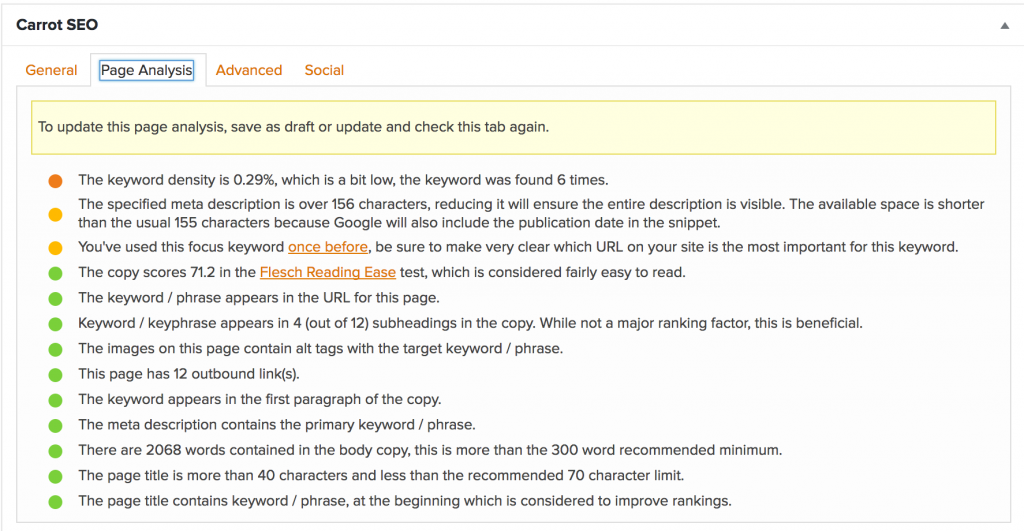
Just like our other websites, we’ve done the SEO keyword research to find out what seller financing phrases are being searched for in Google. Then, we’ve built content and pages around those phrases that people are already looking for.
Plus, we even make it easy for SEO novices to help your content rank higher with our Carrot “SEO Assistant”. If you can read a traffic signal… you can optimize your pages for the search engines with our SEO tools.
The Lead Capture Process
One thing we’ve discovered over the years of lead generation experience (over 400,000 real estate industry leads and counting) is that the majority of your website visitors won’t opt-in immediately… they need a bit more information that compels them to trust you and then, give you their information.
Because of this, we’ve built in multiple places for your website visitors to engage in the content and convert into a lead when they feel comfortable.
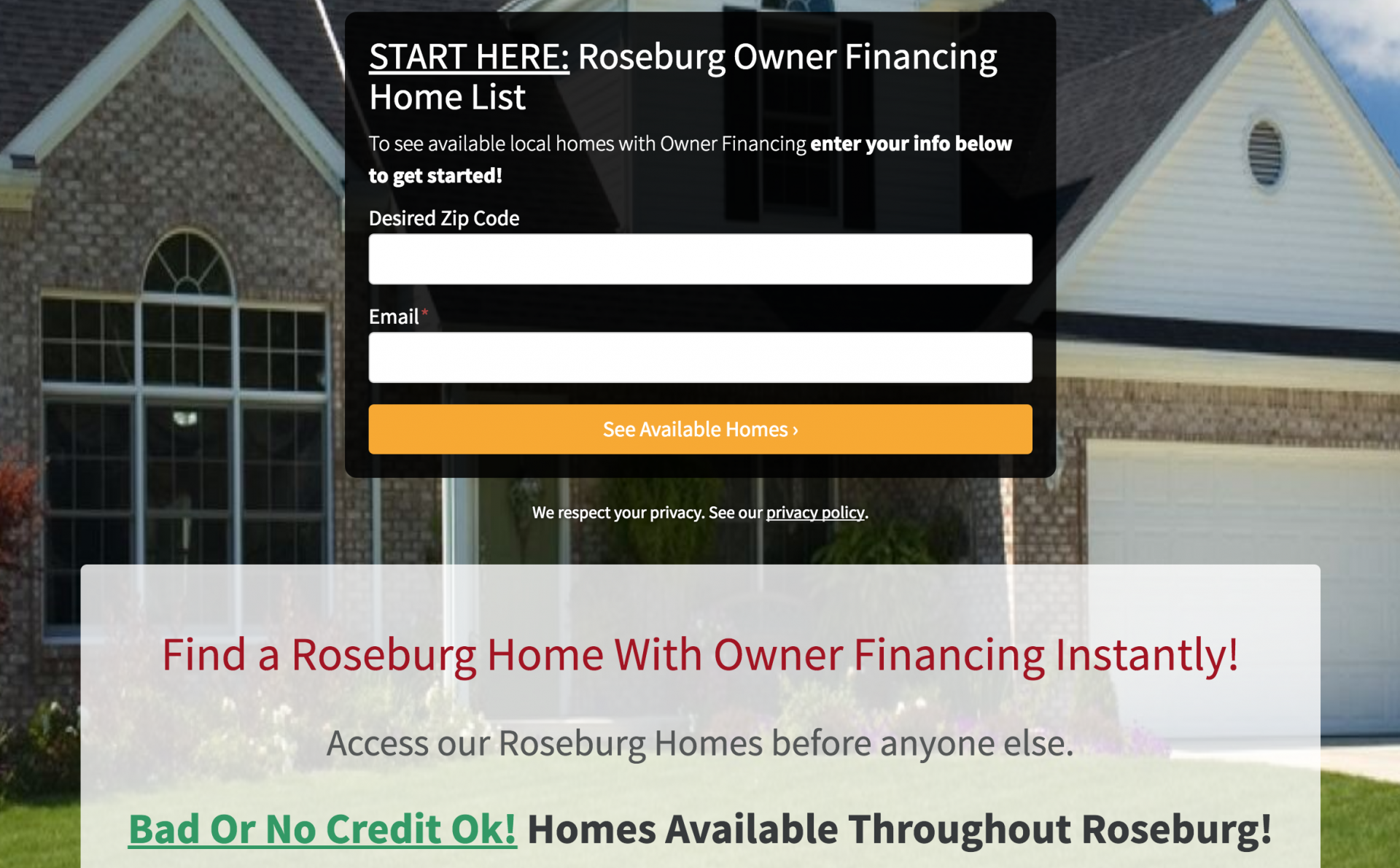
Part of this is the custom lead pages we’ve designed specifically for those interested in seller financing.
And like all of the pages we create… they’re all based on the continual testing we’re doing to increase the effectiveness of our pages in converting website visitors into leads.
How To Launch Your Owner Financing Website With InvestorCarrot
If you’re an InvestorCarrot member, you can get your own Land Buyer website up and live in a few seconds.
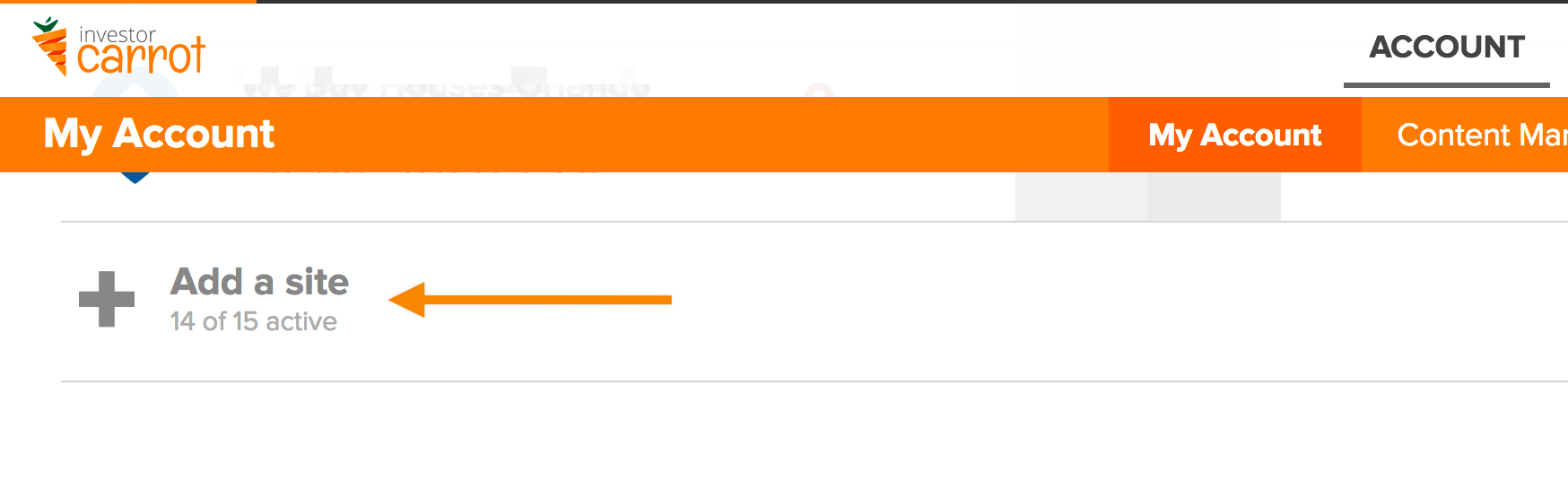
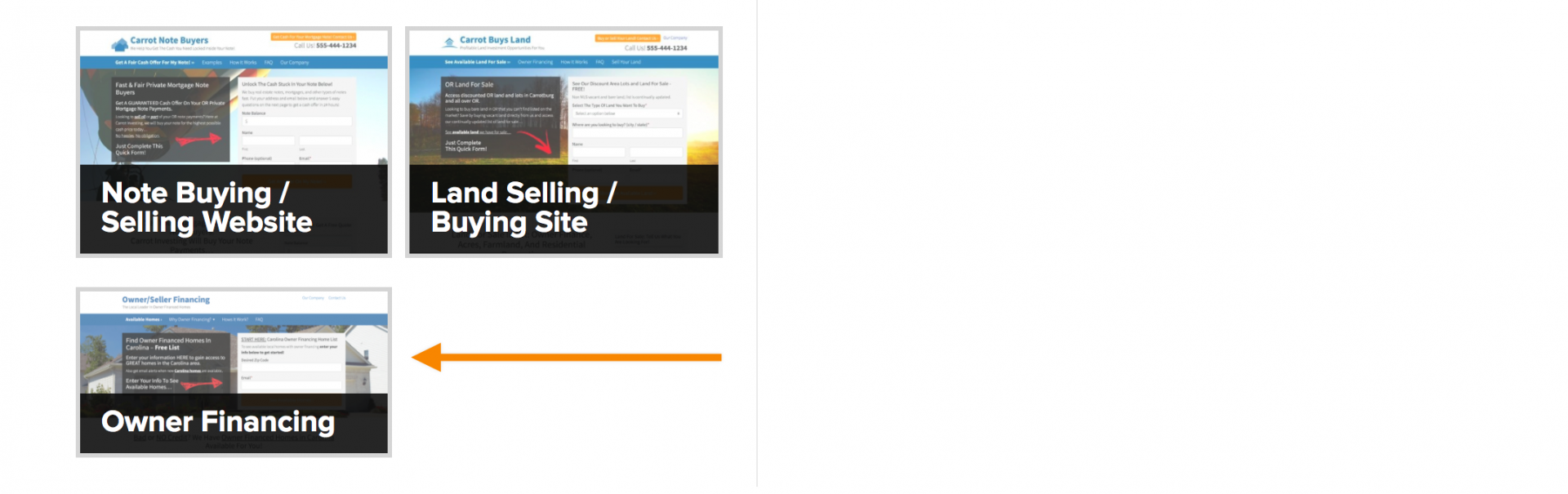
Select “Owner Financing” website in the “Create A Website” list:
Name your site and click “Create Your Site”
That’s it!
Now you can log in and customize your owner finance website, attach a domain to it if you want, and get to work!
Not An InvestorCarrot Member Yet? Join Below!
If you’re not an InvestorCarrot website but want to leverage our tools, our system, our marketing knowledge, and our support to help you generate more leads to your real estate business… awesome! Simply take a demo or click the link below to get started!
Listen to the CarrotCast Podcast and Subscribe Below!
Know what you’re good at and know your cycle of confidence and stay in it. Really know what you’re going to good at. You don’t need to be good at everything. Figure out something… and nail it. Michael Rogers
When should you make the leap to full-time in your side business? It doesn’t matter what business it is, there’s a point when it makes more sense to leave your day job and go full-time into your passion.
Michael Rogers, a Carrot client and CPA of 12+ years walks through his journey on how he did his first deal, built an income producing portfolio while still working full-time, then how he slowly scaled back his hours at the CPA firm he was employed at and eventually dove in as a full-time real estate investor, just this past winter.
Now, Michael is still focused on building his portfolio for the long-term and doing wholesale deals for his active income. How did Michael do it? Listen in.
3:45 – What are some benefits to your mindset from short-term to long-term thinking? 5:40 – How we can all relate to Michael’s change from corporate CPA to real estate investing. 8:50 – What role Michael’s family played in his decision to become a full-time real estate investor. 12:20 – Michael shares the key lessons he’s learned in the first couple of years being in the real estate investing industry. 15:20 – What type of criteria does he set when looking at properties? 17:00 – His various type of assets he invests in and how he’s built a passive income flow. 19:00 –A$35k deal – That’s how he started 2017 off! What type of growth he has experienced over the past few months. 21:38 – Using his InvestorCarrot website to generate leads and build a legit and credible business. 23:15 – What marketing mix is generating leads for Michael and helping his SEO with quality backlinks such as being featured in “The Chattanoogan” newspaper.
38:00 – How Michael has grown as a real estate investor. 42:15 –InvestorCarrot vs. the other guys. How Michael’s life has changed by using the Carrot platform and where he thinks he would be without it. 44:00 – Why “family” and “freedom” are the core reasons he took the leap into investing. 46:00 – Michael’s projected 24-month visions for family and business. 51:15 – Why Michael truly believes in the InvestorCarrot process and websites.
Listen to the CarrotCast Podcast and Subscribe Below!
Anything that’s worth doing is worth sucking at, first. I think that’s a Gary Halbert think that he said. And, you don’t start writing and immediately build an audience. It takes time. I tell everybody, if you won’t write for one then you won’t write for a 1000. Ryan Fletcher
*Warning: This podcast contains explicit language*
Brand storytelling pretty much works for everyone. If done right, it can be one of the most effective pieces of your content marketing strategy. We’re living in a time of competition clutter and brand storytelling is one way to keep your brand from conforming to the herd.
How can you grow your business to make you the only viable option for leads without having to go door to door or make cold calls?
How can you tell a more influential story to cut through the clutter and become a driving force behind that story?
How do you create a credible brand where before leads even reach out, they’re likely to go with you because of what you’ve done in your community?
So many investors and agents fall into the short term marketing “tactics” trap and lose focus on building the foundation for an amazing long-term business.
On this episode of the CarrotCast, Ryan Fletcher, host of the Agent Marketing Syndicate Podcast and author of Defeat Mega Agents, joins us to discuss gaining control of your business and avoiding some of the “tactics” that may lead you down the wrong path.
If you’re looking to rely on Facebook ads, AdWords, Craiglist… then great!
But, thispodcast is for the serious, long-term agent and investor.
Build credibility and community!
Enjoy and be sure to listen to our other CarrotCast episodes at carrotcast.com.
Listen to the Podcast
[podcast-subscribe]
It’s easy to get caught up in all of the training and coachings, but you need to take control of your brand by telling a story.
But… how do you accomplish that? How do you create a brand that is so good that leads can’t ignore you? Find out on this episode of the CarrotCast.
Enjoy!
3:00 – What pushed Ryan into real estate and from $8k to $180k within one year. 7:15 – Breaking through the mindset that extended content doesn’t work. 12-page sales letters – people read them because they’re not boring. 10:00 – How Agent Marketing Syndicate helps agents break away from the clutter. HINT: Build relationships 3-5 years before someone is even in the market to sell their house. 13:30 – Creating content that builds relationships through a message and having patience. 15:00 – Why building relationships in the community and outside of real estate are so important for long-term success. 20:10 – How Ryan gets his real estate message out. The HEART is hardcopy mailers then repurposing via social media. 22:15 – Changing the failure mindset and pulling away from the canned real estate agent thinking. Building confidence to put your story on paper. 27:30 – Having a passion for great service: What is the Impact Club and how it brings together communities for the greater good. 34:30 – Creating a process for being in it for the long game. 38:15 – Want to become a better marketer? 41:10 – Making business shifts. The difference it can make in life, with friends, and with family. 47:30 –3 Things you can do to set yourself up so others have a hard time competing against you. 52:20 – Brand Storytelling: 3 Main levels you need to commit to in order to stand out from the crowd.
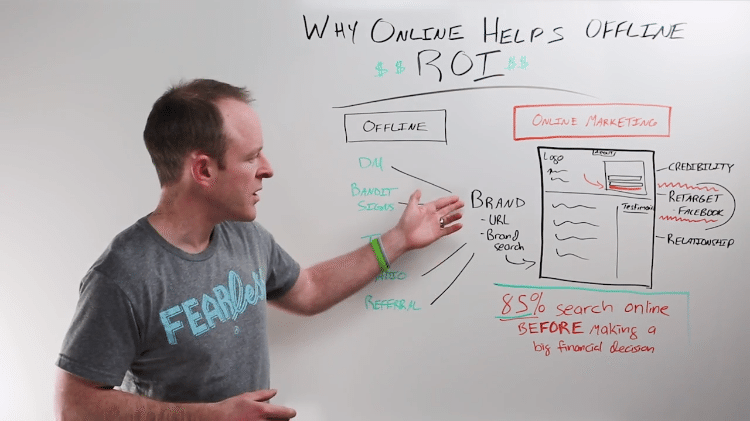
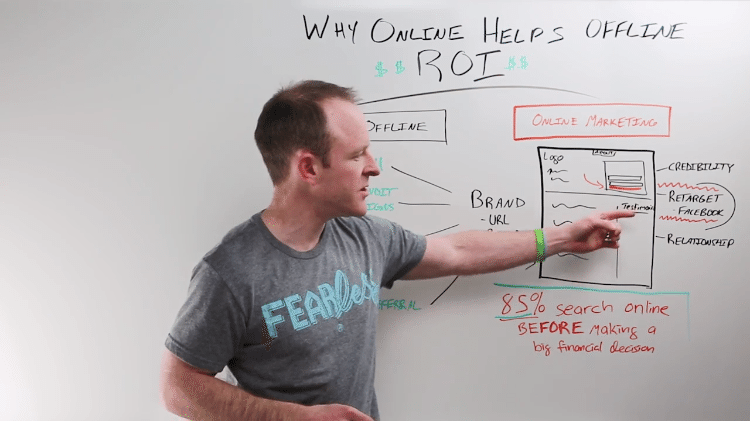
Are you doing some offline real estate marketing as well as online real estate marketing? We’re talking direct mail, bandit signs, radio, TV, etc. If you are, you need to watch this video because this video’s going to walk you through how to increase the return on investment that you get with your offline marketing, leveraging online marketing.
Why Online Real Estate Marketing Can Boost Your Offline ROI
Now with this topic, one of the biggest things that we always look for to help our high-achieving investors is how do you squeeze more return on investment out of your marketing?
A lot of people come to us just for online real estate marketing help. The problem is they kind of think of that in a capsule or silo. They’re not thinking about, “How does my offline marketing work with my real estate marketing online?
If you do them correctly, they actually work together really well to help you make more money.
New Consumer Path to Opt-in or Purchase
On one side of the equation, you’ve got your offline marketing. Direct mail, bandit signs, TV, radio, referrals, etc. Maybe you’re only doing one of these. Maybe you’re doing none of them.
If you’re investing money there, then you’re putting marketing messages in front of your prospects. Now in today’s day and age what happens is, according to lots of studies and this one, in particular, 85% of people when they have to make a big financial decision, they search online before they actually make that decision.
Picture yourself at Home Depot, or you’re going to buy a car. Almost none of us make decisions like that without whipping out our phone or our computer and searching online to find reviews or ratings, or finding other options and alternatives.
House sellers, house buyers, investment property buyers, everyone does the same thing.
What do we do to make sure that when we introduce those people to our brand through our offline marketing, that we’re then capturing them when they go online?
You can’t do it with a website that doesn’t perform well. If someone’s going to go online, they’re going to research your company after they received your postcard, as an example. They’re going to go online and they’re going to look at your website.
Also, are you building a recognizable brand? Can searchers say, “This is a company name that I can lock into my mind.” Or, “I can lock that person’s face that’s on that website into my mind.”
It’s memorable.
Or, is there a testimonial on your website that really resonated with them. We need to make sure the story we’re telling them online is helping to support and further the sale of your offline marketing.
Optimize Your Real Estate SEO for Certain Keyword Phrases
One other really important thing that you guys should be doing with your online marketing to help your offline marketing better, is even if you’re not using your website on your direct mail pieces or your TV advertisements, people are Googling your company name.
They’re Googling the phone number that’s on there. They’re Googling anything that they can find that’s identifiable on that direct mail piece or offline marketing to then go research your company.
Often times they’ll put the word ‘reviews’ at the end of it, such as ABC Properties reviews.
Make sure your website’s ranked really, really well for that search phrase, and there are some tools inside of InvestorCarrot that can help you do that.
Once someone gets there, are they actually going to convert into a lead? You need to make sure you have a high performing website.
Once someone gets there, you need to make sure you’re then retargeting them. Go to Facebook and go to Google, wherever you want to do your retargeting and get the Facebook pixel. It’s one little piece of code and it’s free to get in the Facebook ads manager.
Put that on your website. With Carrot, it takes about 10 seconds. Just go in our Help section or hit up our support and they’ll help you.
Then, from then on, anyone who visits your website is going to be basically tracked by Facebook. These are people who have visited your website. A list will begin to be built within Facebook and now you can re-market to those people to get them to come back.
What we find is often times a person is not ready to actually engage with you in that first visit. Over half of all of your visitors won’t be ready to engage with you in the first visit, so that means we need to get them back and that’s where your retargeting comes in big time.
Online Real Estate Marketing Plus Offline ROI Conclusion
We have blog posts, we have videos, we have a Facebook course (if you’re a Carrot member) to teach you how to do this in detail.
Hopefully, this whiteboard lays out the strategy that if you have a well-optimized website, it ranks well for your phone number and your company name, and your company name with the word ‘reviews’ after it, you’re building relationship and credibility. And, you’re using retargeting, that’s going to help you get a better return on investment with your offline real estate marketing.
I’m going to leave you with this one question:
How many deals are you leaving on the table because you have a self-optimized online presence with all the money you’re investing in your offline marketing?
If it’s even one deal a year that you’re possibly losing that revenue and leaving it on the table, you need to get a better optimized online presence, you need to get your Facebook retargeting going.
Just check out our services and our plans and check out other content on our Carrot blog.
According to the U.S. Small Business Association, only 56% of small businesses with 50 or fewer employees have a marketing plan. Almost half of smaller businesses are missing out on leads and sales.
Here are four other reasons why a marketing plan is essential for your real estate agent or investor business.
It forces you to think about where you’re going with your real estate business. Creating a common goal to drive towards.
It ensures that you’re aligned with your company values.
It serves as a foundation for your marketing activities. If you build a house, you start with a solid foundation. Same thing with your marketing plan.
Possibly the most important – it gives you a process. Without a process, you won’t have the direction you need and will likely either be going off course or starting to feel confused about your marketing efforts. The process can also act as a measure of your failures and successes.
Sample Real Estate Marketing Plan
At its basic level, a real estate marketing plan answers a series of questions that helps you define your ideal targets and craft your business’s most compelling offers into a cohesive story. It uses good distribution channels to reach your ideal targets.
Here are the questions you need to ask when making a good real estate marketing plan:
What are your goals?
What impact do you want to have on your communities?
Is your market saturated with similar offers, or is it ripe with opportunity?
How tough is your competition?
Who is your ideal target?
What are your Strengths, Weaknesses, Opportunities, and Threats?
What are your compelling offers?
How will you reach your target audience?
What is your marketing budget?
What keywords are the best opportunities in your market?
First things first: you need to set your goals and objectives.
Clearly, state what you want to accomplish for yourself in your real estate business. If you’re an investor, it could be buying 50 properties this year. As a real estate agent, you might consider closing 100 listings.
Or, in both situations, you could want to get your brand or name out more for recognition. It could be that 50 percent of your target market knows who you are. Set goals that you can quantify to record and track your accomplishments.
Develop a 10,000-foot vision for your business, such as…
Become the top producer in your area
Retire in 10 years
Control particular niches of buyers and sellers
Then quantify that vision with measurable goals. Measurable goals might include:
Obtaining 50 listings in the next year
Close 10 deals in your target market area in 12 months
Earn referrals from 50 percent of your past customers
Purchase 10 single-family rental properties in the next 48 months
What Impact Do You Want to Have in Your Communities?
You want your real estate business to be sustainable and build a good relationship with your community. How you approach and treat your clients has a tremendous impact on how your business is viewed within your market.
Your clients directly affect your business reputation, lead, and deal volume. But it’s not just your direct clients. Anyone that you interact with can be considered an indirect client. Residents, Facebook friends, your website host, employees, contractors, partners, and suppliers.
You must constantly assess your behaviors and their impact on your local community and the broader audience.
Then you can assess and find your niche within. What events to attend and who to build relationships with. Your community approach will also help you create your immediate and long-term business needs.
Is Your Market Saturated with Similar Offers?
You want to build strong relationships with your customer base. As you’re maintaining a high value and positive service for your customers, they’re more likely to spread the word among their peers.
If you’re in a competitive market and find it hard to make your marketing stand about your competition, then be sure to make your service and client experience stand out.
Marketing Strategies for Real Estate: How Tough is Your Competition?
First, you need to identify your competitors. Take into account your potential or future competitors too.
There are a couple of methods you can use to do this.
1. Look at them from a customer’s point of view
If you can look at your competitors from a customer’s point of view, you’ll be able to spot some of their larger strengths and weaknesses.
It’s a fun yet challenging activity to think like a customer. Why would a customer want to use them as a real estate service? Is it because they can offer more and faster payment turnaround time, or do they have top-tier customer service? These could all be strengths for your competition.
Become your ideal client and put yourself in their shoes. Wonder why you would be more likely to deal with them instead of using your company to accomplish their real estate needs.
2. Look at them from their point of view
Next, take a look at their point of view. This can help you understand their strategy, culture, and attitude toward the market. Take a look at what assets they bring to the field and how you would use them if they were yours. Take a look at what you interpret as their weaknesses.
How could you commit to making those weaknesses into your strengths?
Ask and answer these questions before your analysis:
Before you dive into your real estate marketing competitor analysis, be sure you’re asking the right questions. Here are some common questions to get you started:
Who are your competitors?
What types of services are they using?
How much market share do they have?
What have been some of their past strategies?
Are they using the same strategy?
Are they aggressive with their real estate marketing?
How competitive are they in the market?
What are their strengths and weaknesses?
Are they a threat to you? If so, how big of an impact can they have?
Does their marketing strategy affect yours or how you do business?
Who is Your Ideal Target Audience?
Create a simple paragraph profiling your ideal real estate target audience. Create a customer avatar regarding these demographics: sex, age, family, earnings, lifestyle, and geographic location.
Ask yourself questions about your customers, such as:
Are they followers or leaders?
Are they timid or aggressive?
Are they introverts or extroverts?
How often are they likely to move?
Are they traditional and bear more of a connection to the community?
No matter your real estate market, you’ll need to define them in this section narrowly. It is an important step that will guide you as you plan your media and public relations campaigns.
What are your Strengths, Weaknesses, Opportunities, and Threats?
Performing a SWOT Analysis is a crucial step when creating your real estate marketing strategy.
The term “SWOT Analysis” sounds like a daunting task. But, it can be simple.
It’s broken down into two categories:
Your internal issues: Strengths and weaknesses
Your external issues: Opportunities and threats
This analysis will allow you to see what factors will help you achieve your objectives due to your strengths and opportunities.
It will also highlight what obstacles you must hurdle before achieving your real estate goals due to your weaknesses and/or threats.
Overall, the SWOT analysis assesses your real estate company’s strengths, weaknesses, market opportunities, and potential threats to give you insight into the possible issues that can impact your success.
The number 1 goal of a SWOT analysis aims to determine and assign all important factors that could positively or negatively impact the success of one of the categories, giving you an in-depth view of your real estate business.
Four Categories Of SWOT:
Strengths:
What are the advantages of your real estate business?
What can you do better than your competition?
What exclusive resources can you use that others can’t?
How does your market see your strengths?
What factors into you closing the deal?
What is your company’s Unique Selling Proposition?
When considering your strengths, look at your internal employees and external customers/market.
Weaknesses:
What might you be able to improve on?
What locations and markets should you avoid?
What potential clients within your market might see as your weaknesses?
What factors cause you to lose the deal?
Again, account for your internal and external clients. Do your clients see weaknesses that you haven’t seen? What are your competitors doing better than you right now?
Weaknesses can be a gut check. But stick with it and be as realistic as you can.
Opportunities:
What positive opportunities are available to you?
Are there trends that you need to know?
Some of the positive opportunities you can take advantage of are:
Changes in real estate technology. For example, recording a video testimonial and uploading it to Facebook as soon as you record it.
Changes within the real estate field. Are more real estate agents becoming investors or vice versa?
Changes in the economic status and population profile within your market.
Are there any local events you can help organize or lead within the real estate niche?
Take a look at your strengths and weaknesses as you approach your opportunities. They can provide invaluable information on what you can work harder to improve upon.
Threats:
What obstacles do you need to hurdle in your market?
What are your competitors doing?
Are there any technical issues that are threatening your market position?
Do you have cash-flow problems that you need to address?
Do you have any weaknesses that are threatening your business?
Once you have chosen your real estate business values within the four SWOT categories, you can develop a more strategic plan.
For example, once you’ve identified your weaknesses and potential threats, you can create a plan to eliminate or at the least minimize them while continuing to improve upon strategies that will make you a more robust business.
To create your compelling offers, ask yourself the following questions:
Who do you sell or buy real estate to or from? Be highly specific.
What are the problems that you help them solve?
How do you solve their problems?
Why are you better at solving their problems?
Now create your compelling pitch like this:
How [insert who your ideal client is] can [insert verb] [insert the problem] through [insert solution].
How Will You Reach Your Target Audience?
Getting your audience to engage with your content is essential for connecting with your target market online. The online real estate market is increasingly growing and vying for client attention.
But, even the investor or agent with a small budget can succeed with the right strategies.
Start by narrowing it to a highly targeted audience.
If you offer buyer and seller services, your target currently includes more people in your local market.
For example, focus on only one section of zip codes within your market city. Then expand your area as your finances and business grow.
So, choose a specific area of your market and focus efforts there. Then expand.
A second option will be to focus on the seller or buyer market if you’re a real estate investor. There are specific factors to consider, but marketing towards the seller’s market is most likely the one to go after.
Your marketing costs within major cities will likely be expensive, so media such as Google Ads might be too high unless you can target slightly out of the city.
If you don’t have the budget, take advantage of pricing within the suburban markets.
The other thing you need to do is get your website organized to target your audience. If that requires creating city-specific pages, then you need to do that.
Also, get one of the most overlooked pages, your “About” or company page optimized. Be sure it includes your city or area, how you conduct your business, and your process. Spell out your strengths and why they should choose you over the competition.
What is Your Marketing Budget?
Having a solid marketing budget is integral to being realistic and will help you improve your revenue over time.
You can overspend on marketing costs if you don’t know your budget. Therefore causing an unwanted and bad experience.
Here are a few steps to help you organize your budget and determine where to spend your marketing dollars strategically.
Your first step needs to be organizing your current financial positions. You MUST be specific. If you’re too loose and choose to estimate, it creates an unrealistic budget.
This starts with getting in order your revenue information. You’ll need to know how much revenue your real estate business makes every month. Even though your income varies throughout the year, you must have a number based on reliable revenue (the minimum amount of money you make each month.)
You’ll also need to minus business expenses. Rent, materials, the cost of VA’s, etc.
Any business expense must be subtracted from your revenue before nailing down your marketing budget. Setting a realistic budget is one that focuses on income that exceeds expenses.
After you find your available disposable income, you’ll need to determine what that money will be. Although marketing is a major area to focus on, don’t forget to set aside a budget for unexpected circumstances and growth.
Separate your money based on your goals. You will invest more money in online marketing if your primary goal is attracting leads.
But, if your goal is to hire more VA’s or full-time assistants, you’ll want to put more income into your company’s growth and set aside less for marketing until you’ve been able to close more deals.
2. Determine where you want to allocate your funds
Once you have calculated what is available to spend on marketing, your next step is organizing and prioritizing your money.
There are three main elements to how you spend your marketing dollars:
Budget size
Your past experiences
Reaching the optimum target audience
Start by organizing how to spend the budget based on the amount. If you have a small, more limited marketing budget, you should probably consider Craigslist ads, Facebook ads, local citations, social media posting, and email advertising to attract new clients.
A heavier marketing budget would provide the opportunity to include direct mail, bandit signs, and Google Ads to attract an expanded range of clients.
Apart from any budget limits, don’t forget to consider and implement what strategies have worked for you in the past. You might have noticed postcards helped bring in more clients during a specific time.
Then do that same strategy again, even if you still have more budget for more expensive marketing methods.
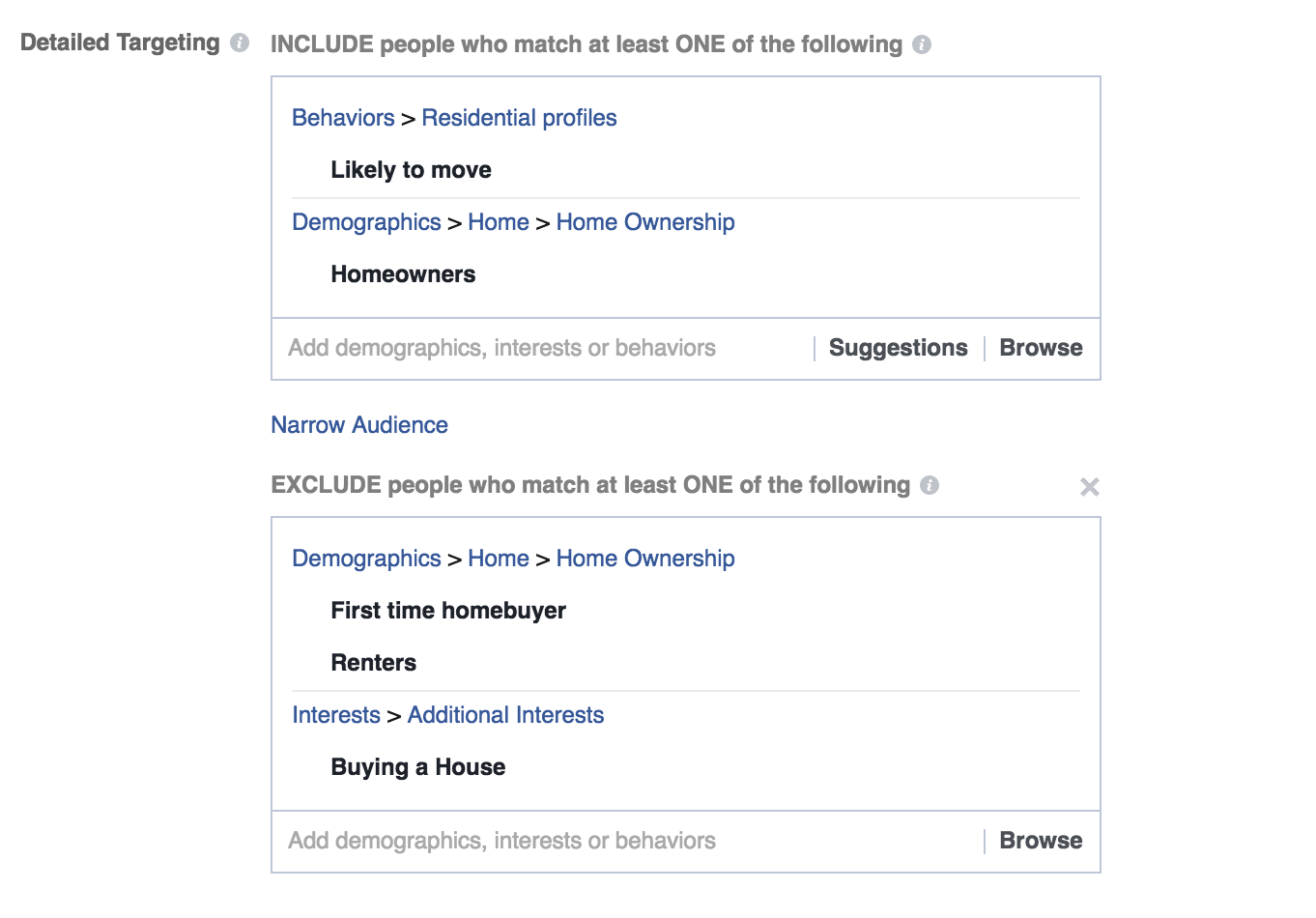
Also, don’t overlook the marketing channels that will help you target and reach your optimum audience. For example, Facebook advertising is an effective channel for targeting motivated sellers, but you still need to create the right audiences to filter out potential buyer leads.
Facebook Ads Audience for Real Estate
Create and document very detailed customer avatars. Then, think about which media they’re more likely to consume. That is the spot where you need to be advertising.
If you’re considering testing a new marketing channel, allocate some funds for that test. Start with a small budget since you don’t know how effective the new channel will be.
For example, if you enter the Google Ads marketing channel, start with a small campaign with highly targeted keywords and a budget.
Only allocate more budget after you gain enough data to determine if it’s working for you. If it works, pull more funds into the new marketing channel.
What Real Estate Keywords Are the Best in Your Market?
How do you use real estate keywords? If you are only using them to optimize your website for search rankings, you could be missing out on other ways to gain visibility within your target market.
Get into the mindset to use your keywords in your online and offline marketing.
Here are some platforms where you can utilize your real estate keywords more:
Real estate website optimization (homepage, landing pages)
Real estate social media profile optimization (Twitter, Instagram, Facebook)
Offline marketing (postcards, bandits signs, direct mail)
Using real estate keywords should not be limited to your digital marketing efforts.
Find different ways to plug them into your offline practices as well.
For example, are you sending out flyers or postcards that take advantage of some keywords?
Are you placing bandit signs around your target market with specific messages and a phone number in case they’re sitting in a parking lot and want to write your number down to contact you later?
If you’re using this kind of marketing and not some keywords, it’s time to readjust your strategy.
Keywords hold a lot of power in online marketing but can be effective offline too. Just be careful that you’re not infringing on trademarks. If you question a keyword phrase, check it out first.
This plan assumes that you’ve got a website that has been proven to convert leads.
If you’re trying to scrape together a bunch of tips to save a few bucks on building your website, you’re doing it wrong. It will cost you much more than the monthly membership price to build what we’ve built.
There are a few things you should do first to get that website up and running, and these only take a few minutes:
Get your testimonials on the site because social proof and credibility are essential to conversions.
Make sure the copy on the site reflects your business and is in line with local laws (for example, if you or your team have a real estate license, you’ll need to change the copy to make sure you’re correctly disclosing your license… but you should make that into a benefit since a license gives you more options for sellers than someone operating without one).
Okay, so that last one might be complicated if you’re new to the business… but you need to be making sure you’re aware of the laws around you since being ignorant isn’t an excuse if you’re trying to get out of a five-figure fine for operating without a license (in some states)…
This reminds me that I need to mention we’re not attorneys or financial advisors; all of this stuff is just general advice. You need specific, professional advice on your real estate investment business…
Having a competent lawyer ensures you’re not offering something illegal without knowing it is a good idea.
There are a couple of ways to use these questions…just cut and paste them into a document and start answering them if you’re ready.
Want our help in making your real estate marketing plan?
Frustrated by the slow drip of leads? As a real estate investor, you know time is money. Waiting months for a trickle of potential deals can seriously hinder your growth.
This blog post is key to unlocking leads in just 90 days. We’ll unveil a data-driven real estate marketing plan designed for 2024, helping you attract motivated sellers and generate more deals faster.
Demo Carrot: How many deals are you losing to your competitor’s website?
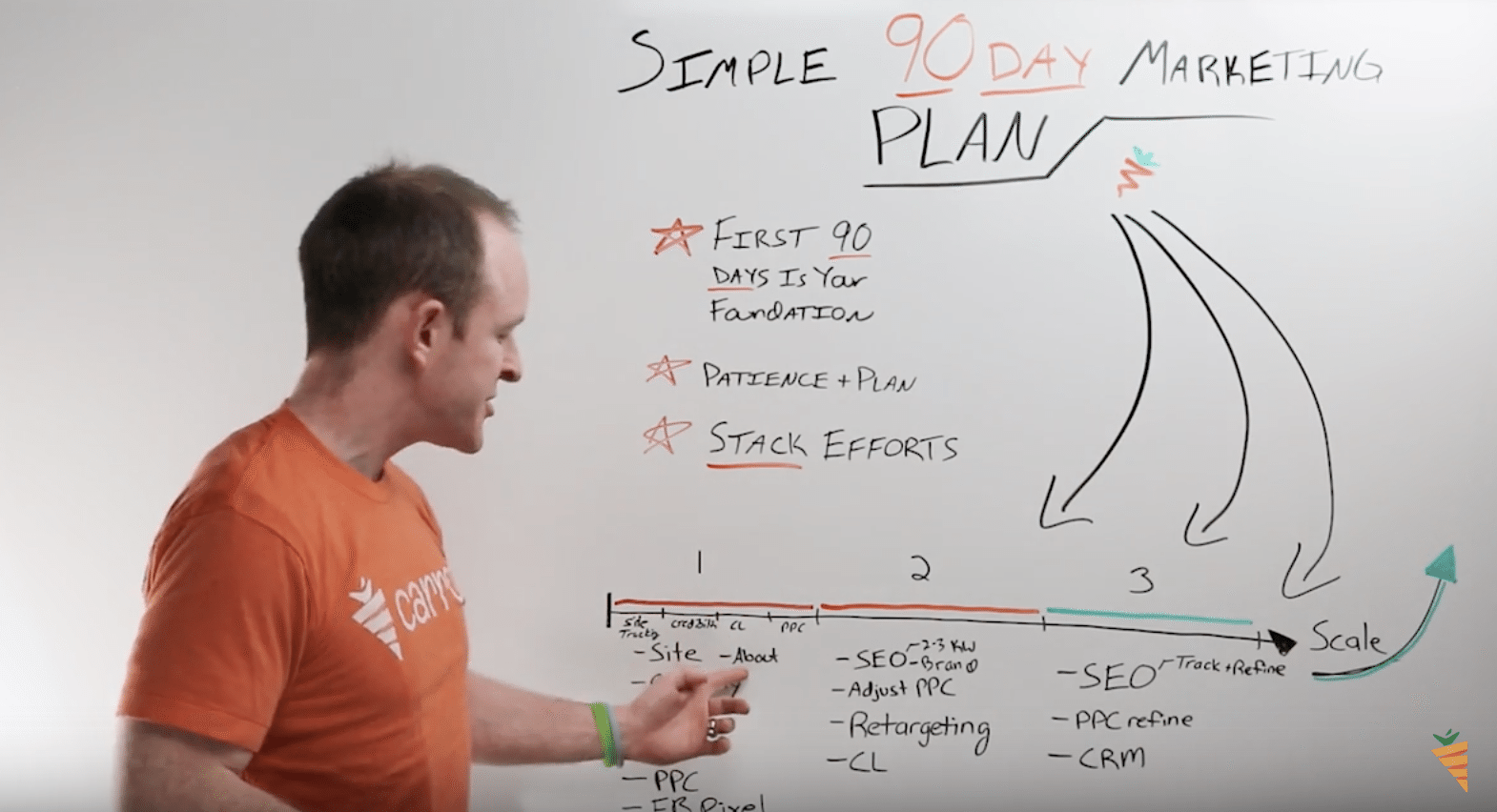
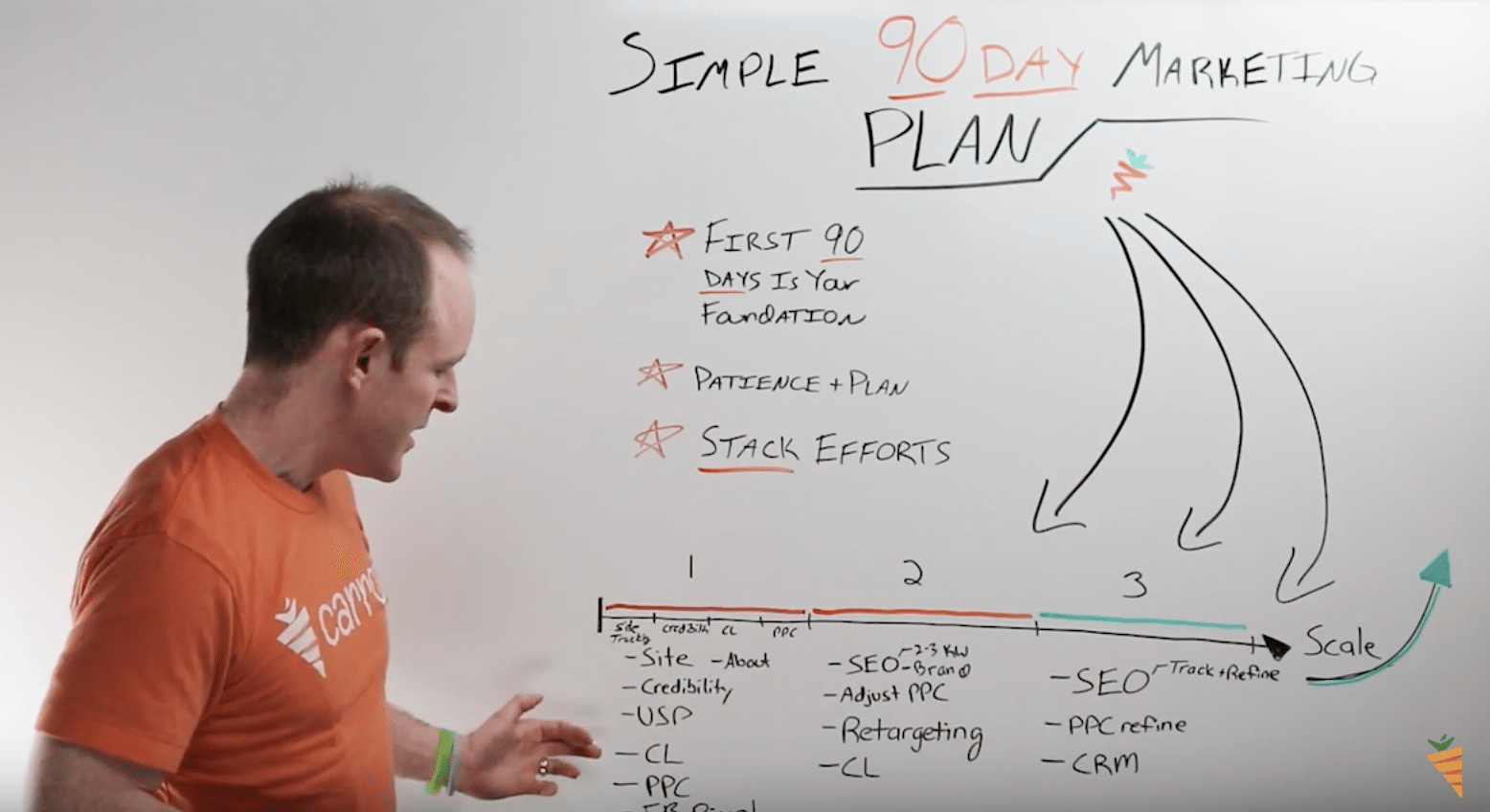
We all had it at one point, and you’ll probably have it if you don’t have it right now. I will walk through this Carrot whiteboard strategy, a suggested path in your first 90 days with your online marketing strategy in the real estate industry.
Real Estate Marketing Plan: Our Simple 90-Day Lead Generation Strategy For Sellers and Buyers
If you haven’t set up your website yet, the first thing you’ll do is, of course, get one. If you need a website, check us out at carrot.com. If you’re not a Carrot member, you can also check out biggerpockets.com or Facebook forums to see how our clients perform. That’s great! We’ll roll with whatever you have going on now.
The first 90 days are the foundation. So, many people have unreal expectations in their first 90 days of any marketing, but primarily online.
Online marketing takes some time to develop, so if you’re looking at SEO, PPC, or something similar, your first 30 days, especially, are spent getting things going and refining things.
Even if you’re doing PPC, your campaign won’t be optimized in that first month. So, have realistic expectations about your first 90 days. This is your foundation setup, and you will scale up after that.
One of the biggest things is you need to have patience in these first 90 days because if we expect the world to change in 90 days, you expect a flood of leads to start coming in, but you’re not putting a flood of marketing out there; then you’re probably not going to get the results that you expect.
I’m not saying that you can’t get a flood of leads in the first 90 days; you totally can, but you have to put a flood of marketing out there to capture that, and we’ll show you how to do that.
So, one thing I want to ensure that we all do in our marketing and our businesses is to keep your marketing simple initially. You see many different marketing methods and must explore them all at once.
But that isn’t the path you need to follow. We’ll often look at companies and go, “Man, that company is exactly where I want to be,” but they didn’t start there. They slowly stacked things onto their business, and over time, as they found out something worked, they made it good; they made a process. They systemized it and said, “Let’s stack something else on there.”
That’s how a real estate investor goes from doing their first deal to 2,000 deals. It doesn’t happen overnight. It happens by stacking marketing methods and systems, one by one, as they perfect each of them. So have patience and stack your efforts.
Conquer Online Marketing in 90 Days: Start with a High-Converting Website on Carrot.com
Forget chasing trends or endless social media strategies. Here’s a fact: Your website is the foundation of your online marketing success.
That’s why experts recommend launching a high-converting website as the first step in your online marketing journey. But building a website can feel overwhelming. Don’t worry, Carrot is here to help!
Here’s how Carrot makes creating a powerful website fast and easy:
1. Choose Your Winning Template:
Carrot offers a variety of website templates designed specifically for real estate investors, each optimized for mobile responsiveness and high conversion rates. No hosting or coding necessary!
2. Customize Your Brand:
Make your website your own with a user-friendly editor. Add your logo, colors, and images to create a professional and cohesive brand experience.
3. Leverage Built-In Marketing Tools:
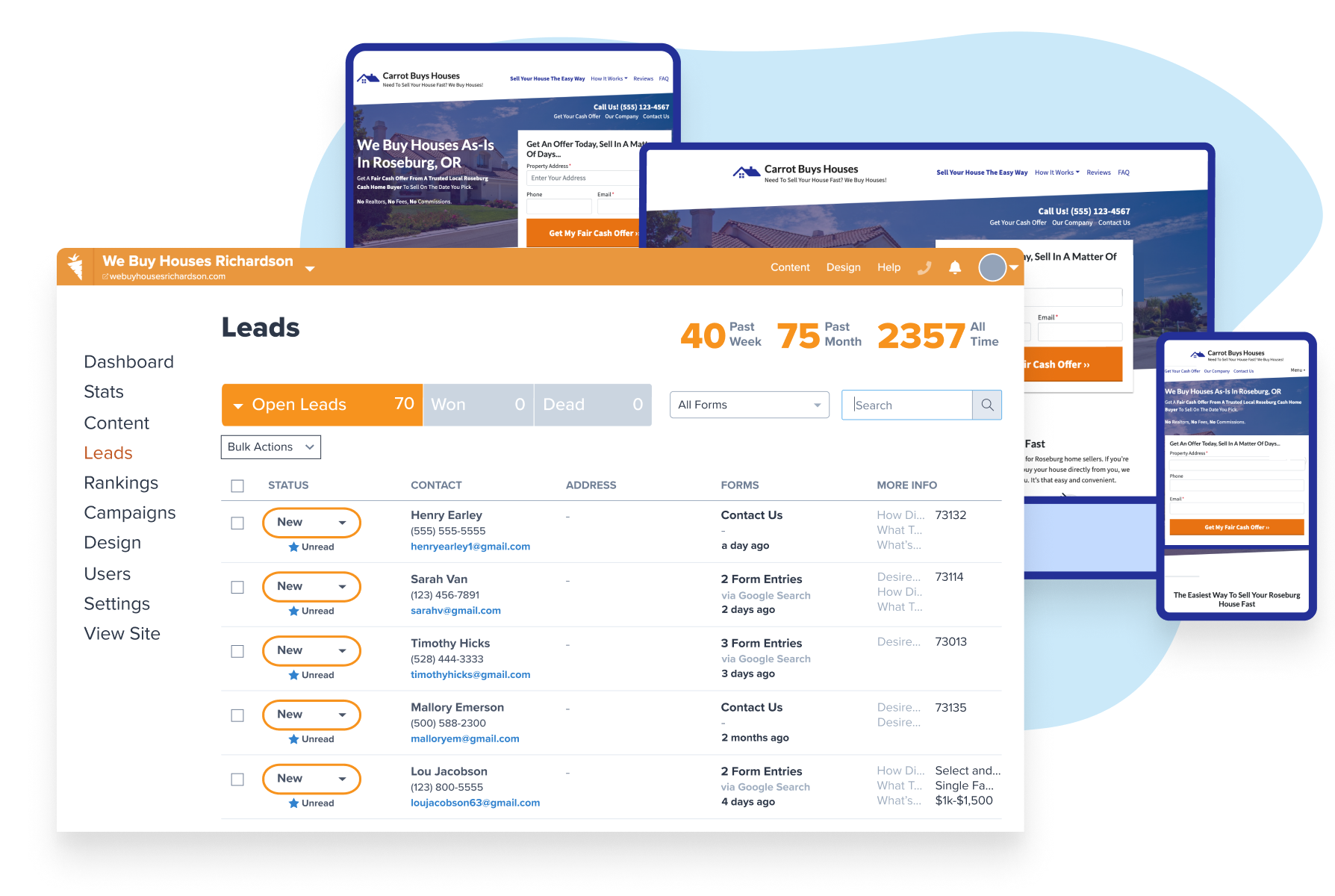
Carrot equips you with powerful tools like lead capture forms, call-to-action buttons, content tools, and SEO optimization to attract and convert leads from day one.
4. Focus on What Matters Most:
Carrot websites are designed to prioritize clarity and user experience. This means your visitors can easily find the information they need and take action, maximizing lead generation.
Stop wasting time on online marketing that doesn’t deliver results. Get started with Carrot today and launch a website that converts visitors into leads and fuels your online success.
Ready to dominate your online presence? Head over to Carrot.com and get started on building your high-converting website in minutes!
Personalizing Your Website To Cut Through The Clutter
Within the first 48 hours, you will want to do some basic stuff. Launch your site, tweak your content, personalize your content a little bit, post your story, and fill out your “about” page so people can connect with you.
You want visitors to see a real face or person behind the brand, not a nameless, baseless entity. As we’ve discussed in content, in our CarrotCast podcasts, and in our coaching calls for our customers, it’s a cluttered market. Hence, you stand out by telling your stories and connecting personally.
So, ensure you personalize your content within the first few days of launching your website. You have to reinvent the wheel. If you’re a Carrot customer, take our content and look at one paragraph, read it, see what’s in it, write it in your own words, and then delete ours. So adjust 20, 30, and 40% of that content.
Add Lead Tracking So You Know What’s Working And What’s Not
The next thing you must do is put tracking in place as soon as possible. If you’re a Carrot customer, you already have tracking in place, but if you want to get more advanced, and you want to use your own Google Analytics account, or you want to put your Facebook pixel, I would do that the first couple weeks of getting your website. Or, we can do it for you if you’re a Carrot member.
You’re going to need to start tracking that traffic right away. That way, you can begin to retarget people.
Hone Your Unique Selling Proposition
Next, you must ensure your unique selling proposition is nailed within those first few weeks of your online marketing.
What about you and your company standing out, giving people a reason to work with you?
Find Leads With Facebook Ads – First 30 Days
So we launched the website, got our tracking in place, personalized some content, had our “about” page up there, put a picture of you on there, and swapped out pictures. Hence, they’re local to your area, swapped out some content, so it’s unique to you and your area, and built-in that credibility, testimonials, things like that, and then we start some Facebook Ads.
Start Facebook Ads a week two or three after launching your website.
Facebook is fast, quick, and free. If you do it correctly, you can have leads and traffic coming in that day. Our blog has some great resources and a Facebook Masterclass.
Start by running a couple of ads targeting a motivated seller audience, then scale it up over four to six weeks to where you have a couple of campaigns with 3-5 ads within each.
Launch And Build Up Your Pay-Per-Click – First 30-60 Days
Next, once some Facebook Ads are going, your website is optimized with great content, you’ve personalized it, you’ve built credibility, and you’ve built a great “about” page, then you start to do some Google Ads if you have a budget.
If you have $500 to $3000 monthly and are in specific markets, you can start some small-scale PPC marketing and ramp it up.
Sprinkle Credibility Into Your Real Estate Marketing Plan
In month two, you have some momentum going. You’ve got your website; you can always tweak it later, add more credibility, or add your Better Business Bureau logo later. We always look for progress, not perfection, so get that site out the door in the first two weeks, build some basic credibility there, and then continually refine it from there.
If you’re unsure what to do on your website to build credibility, contact us or check out our content on credibility building.
Time To Work In SEO – 30-90 Days
Shift your focus to SEO and Evergreen Marketing. Pick two to three high-leverage keywords to focus on for your market. We discuss it in some of our resources and start setting that foundation.
Then, if you have a tool to track your rankings, maybe start putting those keywords in there to see how your rankings are going. We have that built into Carrot, but other tools can track your rankings if you’re not a Carrot user.
One of the biggest contributors to SEO is content. Ensure you have a good blog post strategy and plenty of real estate blog post ideas to work from!
Begin To Adjust Your Pay-Per-Clicks
Now, it’s time to adjust your PPC because you can’t set it up, forget it, and not adjust it. So, in month two, you will adjust and refine your PPC campaign. If you have enough traffic, you will also turn on retargeting.
You’ve put your Facebook retargeting pixel on, which we teach you how to do in a blog post on our website. Then, in month two or three, we will start turning on retargeting ads on Facebook, and the same thing happens: we teach you how to do those in those other resources, so check them out. Also, keep your Facebook Ads going.
Finally, to wrap out your foundational first 90 days, you’re going to be tracking and refining your SEO. You’re going to a coach or someone you can go to to ask them for advice on improving your SEO, building some backlinks, and social media signals, and this time, you’re probably going to get some citations.
So, get your website listed on Yelp, Yellow Pages, and all those citations. We suggest starting between 20 and 40 in the first 90 days. We can do it if you’re a Carrot member; check out our marketplace. If you’re not a member, check out our how-to build citations for real estate blog post.
After you refine your PPC, and only at this time, start thinking about a CRM. Way too many people started thinking about a CRM for tracking their leads in month one. If you don’t have any leads coming in, you have no leads to manage in a CRM. It’s like having gas without a car to put it into.
So make sure you’re focusing on getting leads first, and then you get your CRM to manage your leads once you start getting enough lead flow that you can’t manage. If you do it correctly, you scale up.
Wrapping Up Your Real Estate Marketing Plan: First 90 Days
Once again, contact us for those resources if you are a Carrot member. It’s just a quick run-through. We have many other resources, coaching, and guidance to help you crush it, just like we do with thousands of customers. If you’re not a Carrot member, keep returning to our CarrotCasts or free resources to help you grow or join the fold. Join the Carrot community.
We will be learning new, amazing things every week with great experts, great marketers, and our Carrot team to teach you how we do what we do and how you can make a bigger difference!









 Just like our other websites, we’ve done the