Category: Whiteboard Trainings

  • Why Online Real Estate Marketing Can Boost Your Offline ROI

    Why Online Real Estate Marketing Can Boost Your Offline ROI

    Are you doing some offline real estate marketing as well as online real estate marketing? We’re talking direct mail, bandit signs, radio, TV, etc. If you are, you need to watch this video because this video’s going to walk you through how to increase the return on investment that you get with your offline marketing, leveraging online marketing.

    Why Online Real Estate Marketing Can Boost Your Offline ROI

    Why Online Real Estate Marketing Can Boost Your Offline ROI

    Now with this topic, one of the biggest things that we always look for to help our high-achieving investors is how do you squeeze more return on investment out of your marketing?

    Not Sure What Your Marketing Budget Should Be? Use the Carrot ROI Calculator

    A lot of people come to us just for online real estate marketing help. The problem is they kind of think of that in a capsule or silo. They’re not thinking about, “How does my offline marketing work with my real estate marketing online?

    If you do them correctly, they actually work together really well to help you make more money.

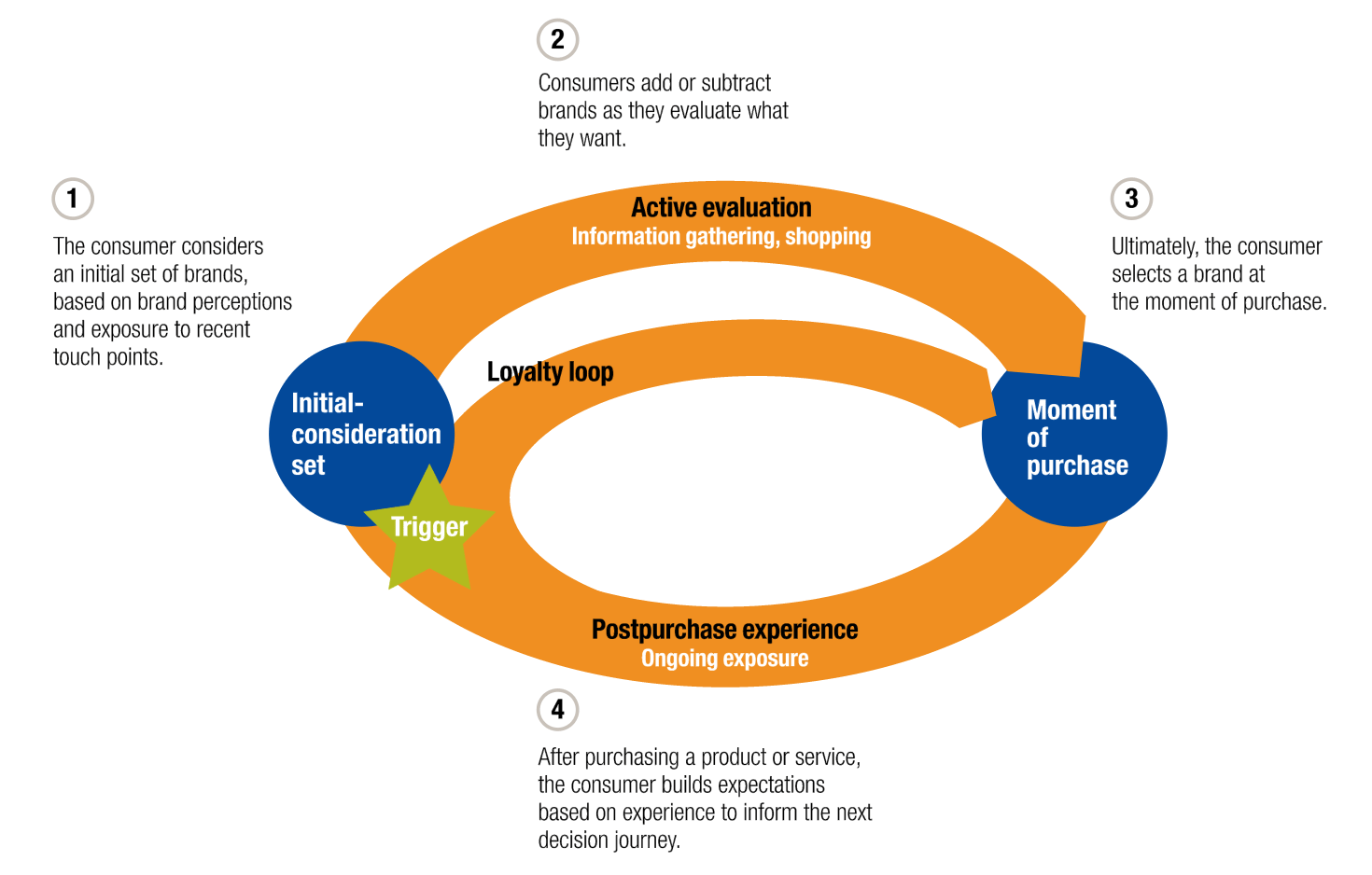
    New Consumer Path to Opt-in or Purchase

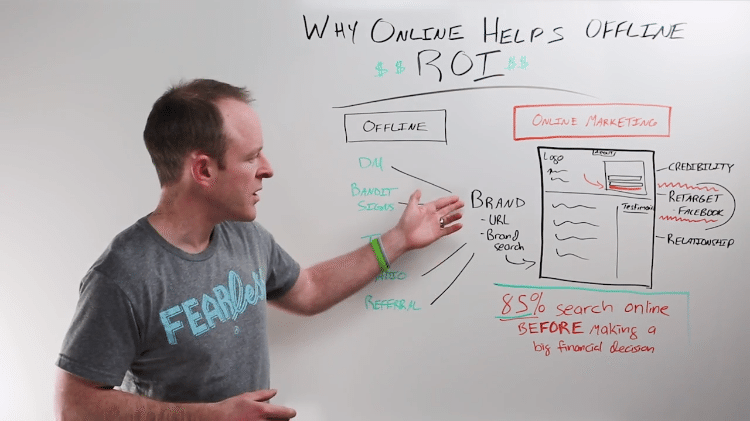
    On one side of the equation, you’ve got your offline marketing. Direct mail, bandit signs, TV, radio, referrals, etc. Maybe you’re only doing one of these. Maybe you’re doing none of them.

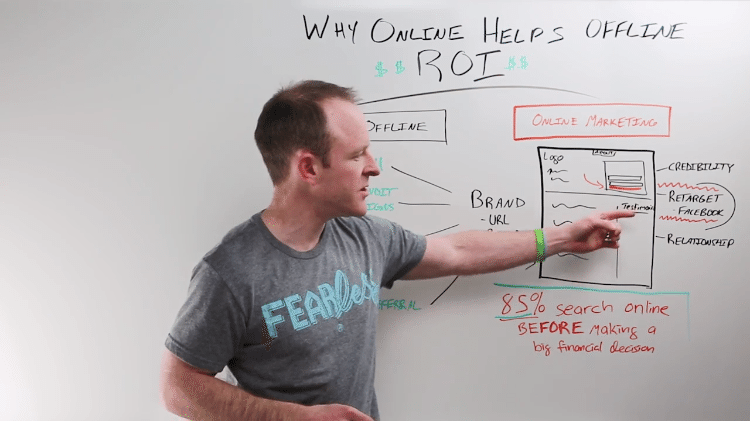
    If you’re investing money there, then you’re putting marketing messages in front of your prospects. Now in today’s day and age what happens is, according to lots of studies and this one, in particular, 85% of people when they have to make a big financial decision, they search online before they actually make that decision.

    Picture yourself at Home Depot, or you’re going to buy a car. Almost none of us make decisions like that without whipping out our phone or our computer and searching online to find reviews or ratings, or finding other options and alternatives.

    House sellers, house buyers, investment property buyers, everyone does the same thing.

    What do we do to make sure that when we introduce those people to our brand through our offline marketing, that we’re then capturing them when they go online?

    You can’t do it with a website that doesn’t perform well. If someone’s going to go online, they’re going to research your company after they received your postcard, as an example. They’re going to go online and they’re going to look at your website.

    • Is your website building credibility?
    • Is your website building a relationship with that prospect?
    • Can they feel that you’re a real person, you’re a real company, you’re not a nameless face that’s a corporation?

    We need to make sure your website is covering these issues.

    new customer buying cycle


    Image Source: McKinsey&Company

    Tailor Your Real Estate Brand Message

    Also, are you building a recognizable brand? Can searchers say, “This is a company name that I can lock into my mind.” Or, “I can lock that person’s face that’s on that website into my mind.”

    It’s memorable.

    Or, is there a testimonial on your website that really resonated with them. We need to make sure the story we’re telling them online is helping to support and further the sale of your offline marketing.

    Why Real Estate Marketing Online Can Boost Your Offline ROI - Branding

    Optimize Your Real Estate SEO for Certain Keyword Phrases

    One other really important thing that you guys should be doing with your online marketing to help your offline marketing better, is even if you’re not using your website on your direct mail pieces or your TV advertisements, people are Googling your company name.

    They’re Googling the phone number that’s on there. They’re Googling anything that they can find that’s identifiable on that direct mail piece or offline marketing to then go research your company.

    Often times they’ll put the word ‘reviews’ at the end of it, such as ABC Properties reviews.

    Make sure your website’s ranked really, really well for that search phrase, and there are some tools inside of InvestorCarrot that can help you do that.

    Once someone gets there, are they actually going to convert into a lead? You need to make sure you have a high performing website.

    Check out one of our other Whiteboard videos on our YouTube channel that walk you through the ideal set-up of a high performing home page.

    Implement Retargeting

    Once someone gets there, you need to make sure you’re then retargeting them. Go to Facebook and go to Google, wherever you want to do your retargeting and get the Facebook pixel. It’s one little piece of code and it’s free to get in the Facebook ads manager.

    Put that on your website. With Carrot, it takes about 10 seconds. Just go in our Help section or hit up our support and they’ll help you.

    Then, from then on, anyone who visits your website is going to be basically tracked by Facebook. These are people who have visited your website. A list will begin to be built within Facebook and now you can re-market to those people to get them to come back.

    Online Real Estate Marketing  - Retargeting

    What we find is often times a person is not ready to actually engage with you in that first visit. Over half of all of your visitors won’t be ready to engage with you in the first visit, so that means we need to get them back and that’s where your retargeting comes in big time.

    Online Real Estate Marketing Plus Offline ROI Conclusion

    We have blog posts, we have videos, we have a Facebook course (if you’re a Carrot member) to teach you how to do this in detail.

    Hopefully, this whiteboard lays out the strategy that if you have a well-optimized website, it ranks well for your phone number and your company name, and your company name with the word ‘reviews’ after it, you’re building relationship and credibility. And, you’re using retargeting, that’s going to help you get a better return on investment with your offline real estate marketing.

    I’m going to leave you with this one question:

    How many deals are you leaving on the table because you have a self-optimized online presence with all the money you’re investing in your offline marketing?

    If it’s even one deal a year that you’re possibly losing that revenue and leaving it on the table, you need to get a better optimized online presence, you need to get your Facebook retargeting going.

    Just check out our services and our plans and check out other content on our Carrot blog.

  • Real Estate Website Design: Credibility Sites Vs. Targeted Sites

    Real Estate Website Design: Credibility Sites Vs. Targeted Sites

    So you’re getting ready to launch your online marketing campaign, but you’re probably thinking “Man, what type of website am I going to build?”

    Real Estate Website Design: Credibility Sites Vs. Targeted Sites

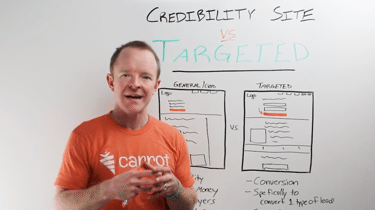
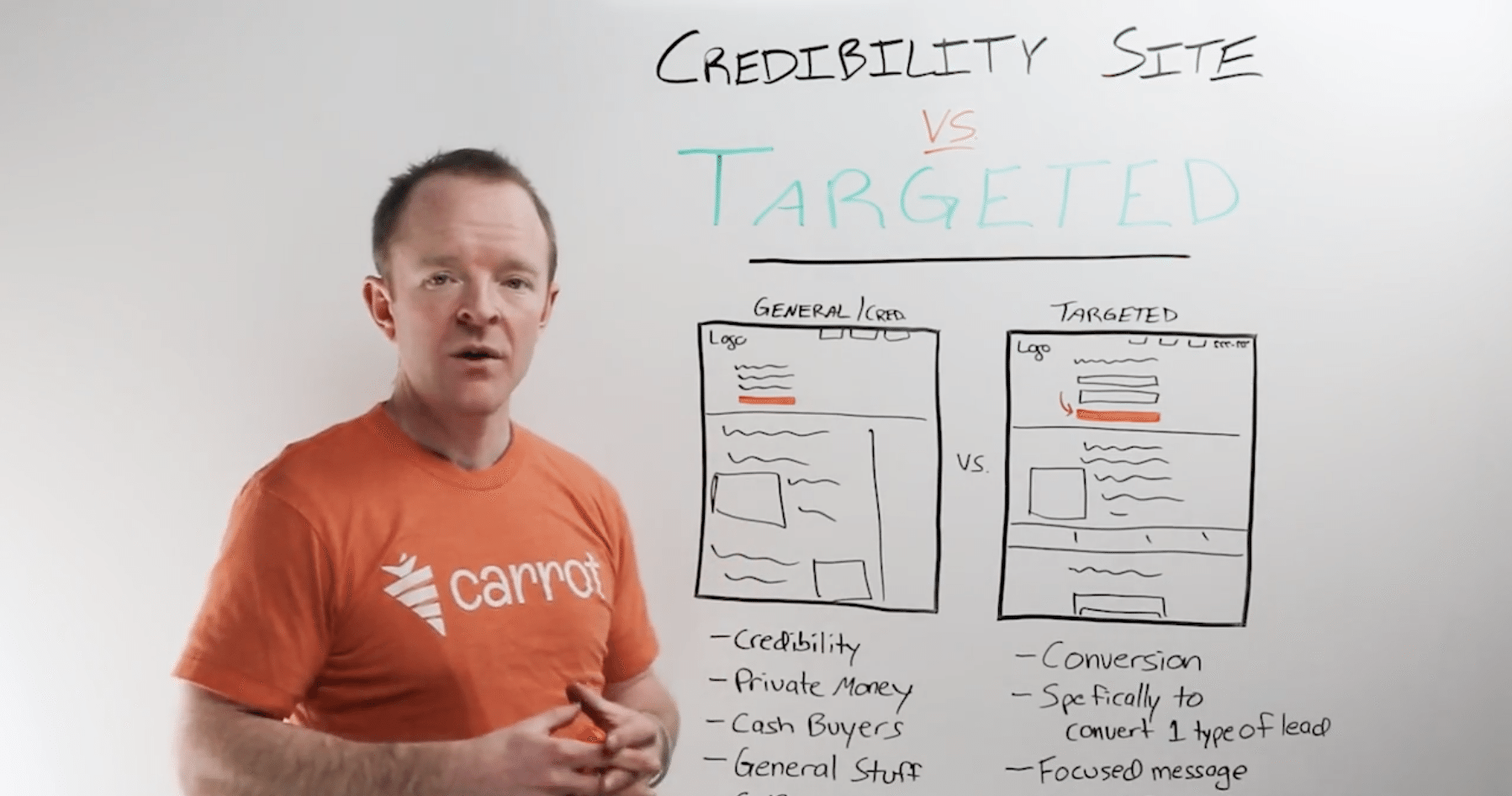
    At Carrot, we have general credibility websites and we have targeted websites. Where the targeted websites are specific to a certain type of lead. It could be a motivated house seller. It could be a cash buyer. It could be a retail buyer. There could be a note seller or buyer. You get the idea. Those are very, very targeted towards a certain type of lead.

    We get a lot of our clients asking us, “Why can’t I focus it all into one general credibility site?”

    Or, “Is a general credibility site going to work well or perform as well as a targeted site specific for, as an example, motivated house sellers?”

    Well, this video and post are going to walk you through the data and what the actual results are and what you should do depending on the type of lead you’re looking for.

    real estate websites- credibility vs targeted sites

    Real Estate Website Design: General Credibility Sites

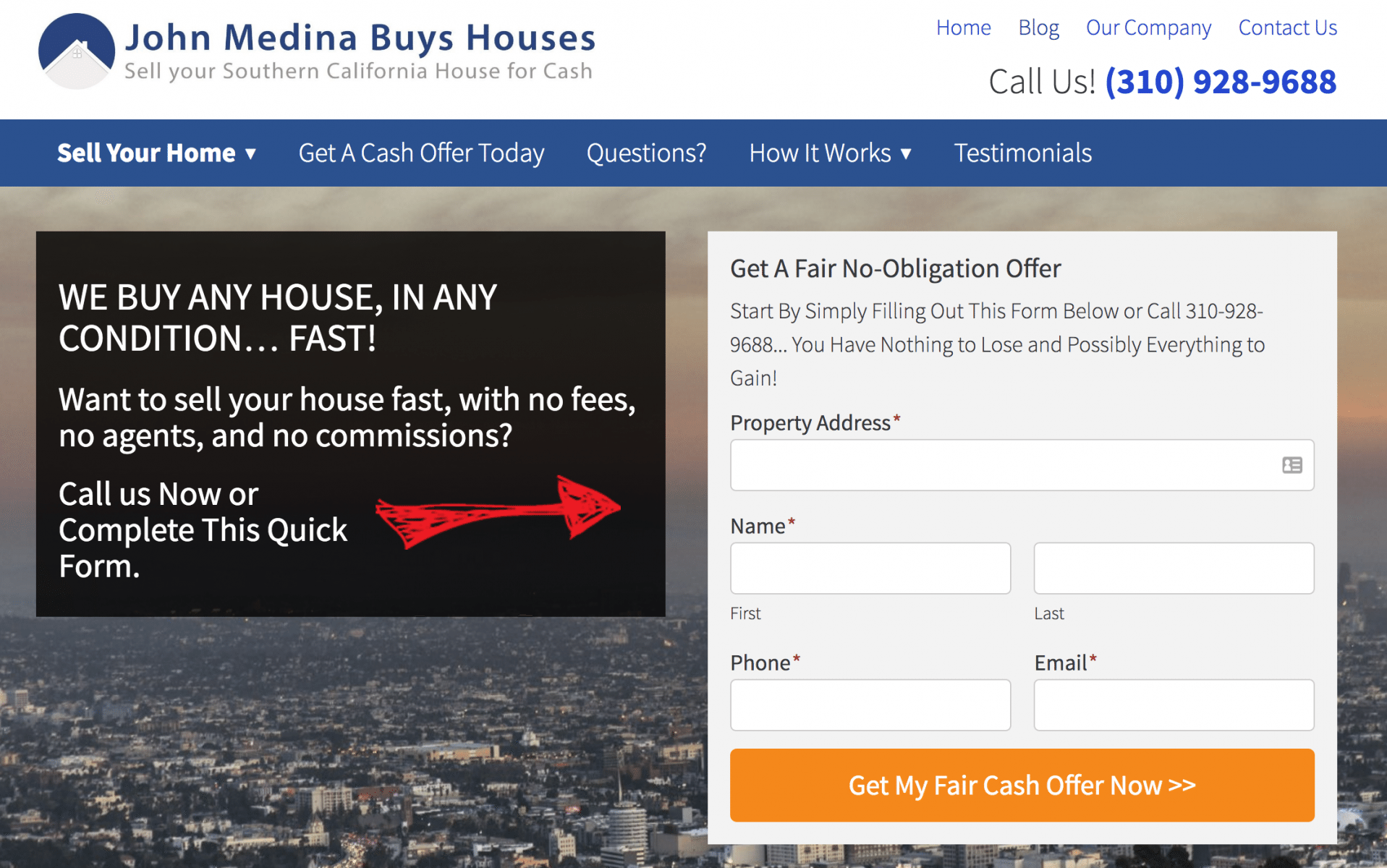
    So, first of all, we’ve got the general credibility site. A general credibility website is mainly focused on, just that, building general credibility for your company.

    So, it could be trying to get people there to show them who you are. What types of things you’re doing. What types of things you’re doing in real estate. And it could be multiple things.

    Saym, we’ve got this real estate fund and we’re flipping houses, so we buy houses. But we also sell houses and oh, by the way, did you also know that we do rent a home?” So it’s kind of “here’s who we are as a company”, and build that credibility.

    You could be looking for private lenders on that website. You could be building a cash buyer list on there and selling properties. That works really well on a main company credibility website.

    But it’s a lot of general stuff. It’s not really focused in on any one particular message. And it’s a split message.

    Your home page might say, “Hey, we are a real estate investment solutions firm. We buy, sell and rent houses.” But you’re going to be talking about all of that stuff if you’re on the homepage.

    So there’s no one focused message if you’re doing direct marketing toward that.

    If you’re driving a house seller there, they’re then going to get distracted by other messages. They’re going to get distracted by the message about investments. They’re going to get distracted by the message about looking for cash buyers and private lenders.

    If you’re doing direct marketing and paying money to drive people there, you don’t want to distract the message.

    But the general credibility website serves a very specific purpose.

    If you’re networking at your local chamber of commerce or rotary, you’re probably going to hand them the business card that drives them here. This website is then going to drive people toward your other specific target websites if you’re doing multiple things in your business.

    So you might have a link that says, “Sell your house.” And it’s gonna drive to your house seller specific website, ideally. That’s what the data shows works the best.

    real estate credibility website
    General Credibility Website

    Real Estate Website Design: Targeted Credibility Sites

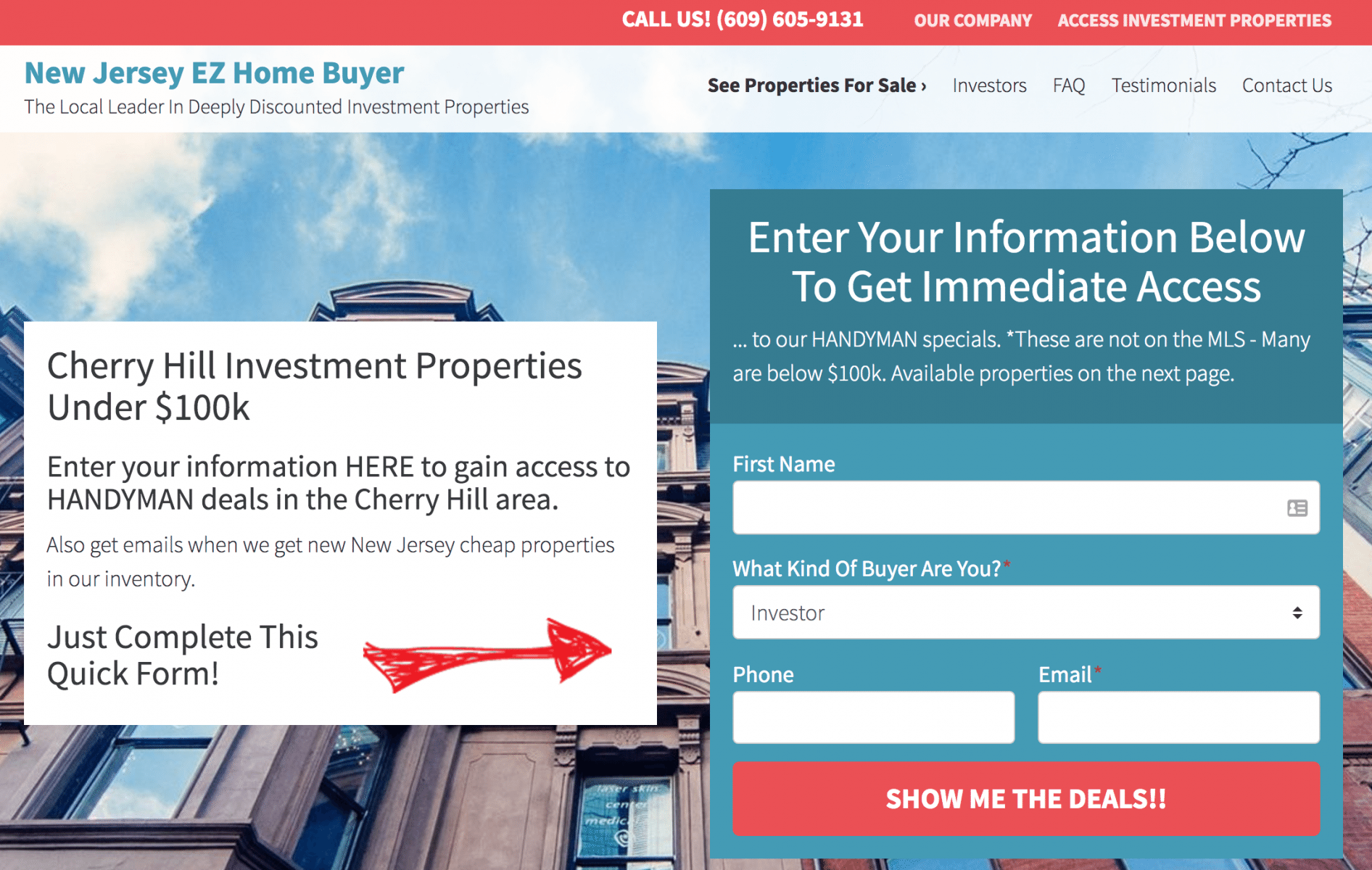
    On the other side, you have the targeted website. So, when we suggest that you focus on using a targeted website, it’s any time you’re actually going to be actively driving people to that website to convert as a lead.

    These websites are set up for conversion.

    The general credibility websites are not particularly set up for conversion. They’re going to be great on mobile and there will be landing pages on there that are set up for conversions.

    But the overall path is not set up to convert at a high, high rate. It’s set up to build credibility for you.

    These targeted websites are set up to convert at a high rate for one particular type of lead.

    You can see the eye directors on our Carrot websites, the big buttons. The very, very focused message. If you land on a motivated house seller website with Carrot, or if you’re building one, it should be very focused on that motivated house seller. Not on cash buyers, and then rent-to-own tenants and private lenders.

    Your entire website should be focusing on how you can help that seller. And that’s what will perform the best for you. It doesn’t distract them away from your messaging.

    Motivated Seller Targeted Website

    The website is specifically set up to convert one type of lead ideally.

    So, if a motivated house seller website speaks to the seller, it’s going to convert them.

    If you want to list properties for sale, then you set up another website for that to speak toward that. “Hey, we have discount properties. Join our list or see our properties here.”

    Or, you can fit that into the main company site too. You can kind of pull double duty with the main company and cash buyer if you want to.

    Buyers Lead Website

    Pay-Per-Click Traffic

    Lastly, your targeted websites are where you’re going to send all of your paid traffic.

    Please do not send paid traffic to the main company website. It’s unfocused. It’s untargeted. It’s building good credibility. But then it has all these rabbit holes that your prospects can dive around and they might go down the wrong rabbit hole and not become a lead of yours.

    So, they’re focused on conversion, specifically set up to focus on one type of lead. A very focused message on one type of prospect and how you can help them.

    They’re sites that are optimal for paid marketing. If you’re driving paid marketing to a main company credibility website, unless you vastly adjusted it, you’re probably wasting some money.

    Ending The Debate Of Credibility Sites Vs. Targeted Sites

    So that’s what we would do. That kind of hopefully ends the debate, credibility site versus a targeted website and what you use in certain circumstances. Ideally, if you’ve got your main credibility website and you’re looking to generate any leads online, you’ve also got at least one targeted website for your actual marketing activities.

    Join us on our other episodes of the Carrot strategy sketch because we have a lot of other topics to dive into and most are under 10 minutes. They’re going to help you get light years ahead of your competition and shave off months, if not years, on your learning curve.

    Also, be sure to check out the CarrotCast, which is our weekly podcast. Subscribe to our YouTube channel so you can see all of our videos before anyone else can. So, check us out and be sure to hit us up with comments and questions.

  • Real Estate Marketing Plan: Simple 90 Day Strategy To Your First Leads Online

    Real Estate Marketing Plan: Simple 90 Day Strategy To Your First Leads Online

    Frustrated by the slow drip of leads? As a real estate investor, you know time is money. Waiting months for a trickle of potential deals can seriously hinder your growth.

    This blog post is key to unlocking leads in just 90 days. We’ll unveil a data-driven real estate marketing plan designed for 2024, helping you attract motivated sellers and generate more deals faster.

    Well, that’s a pretty common problem to have.

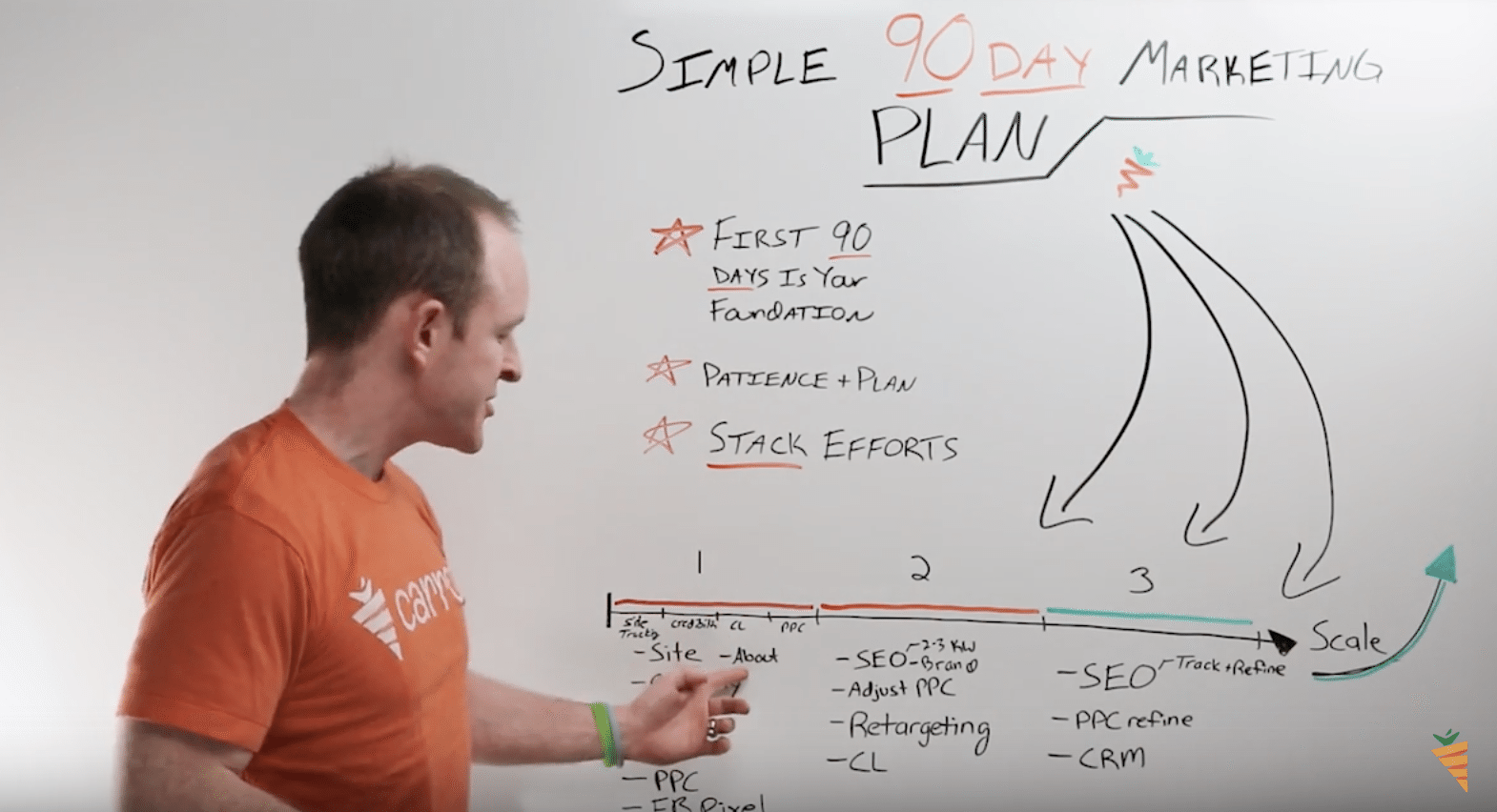
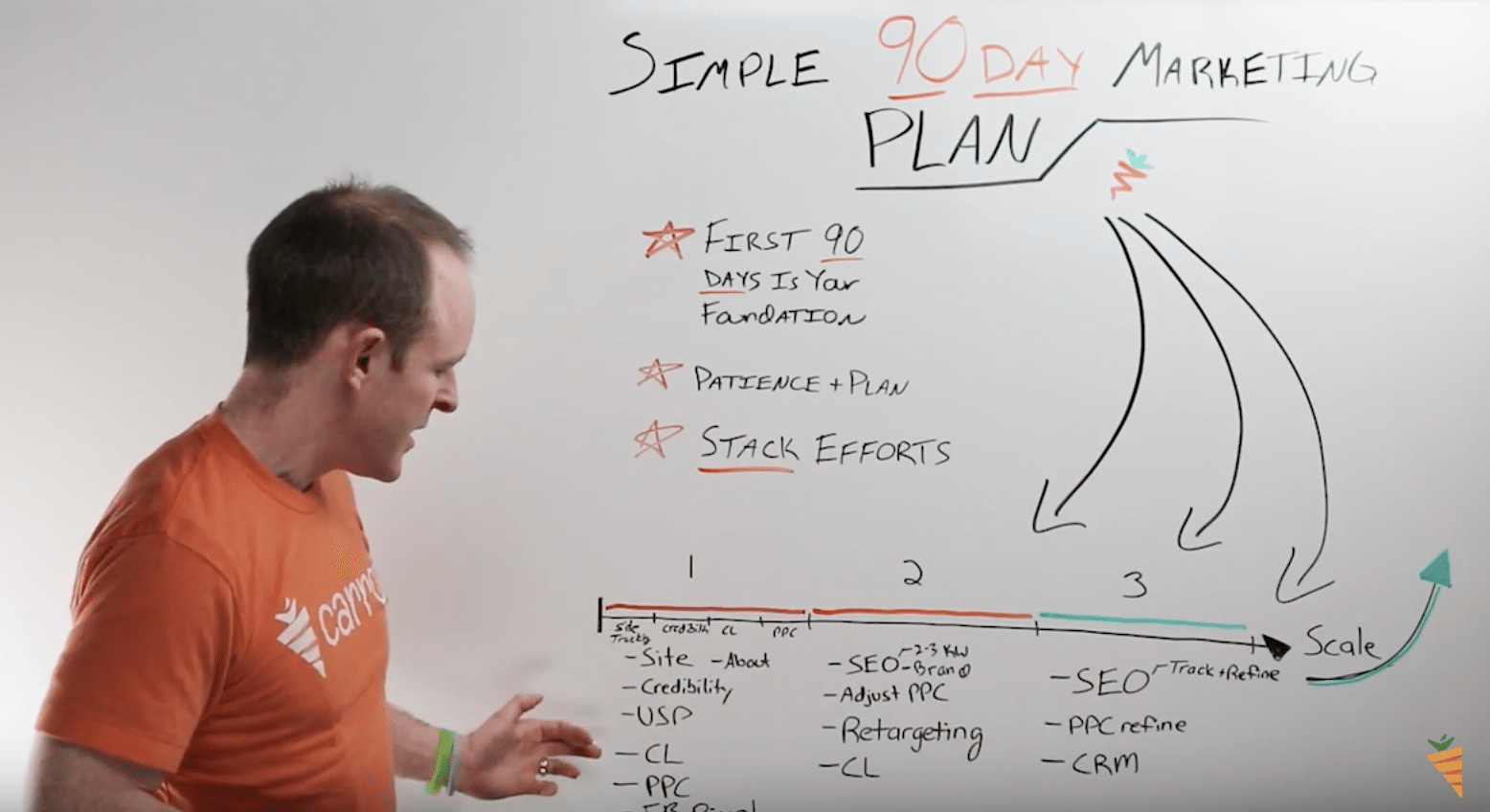
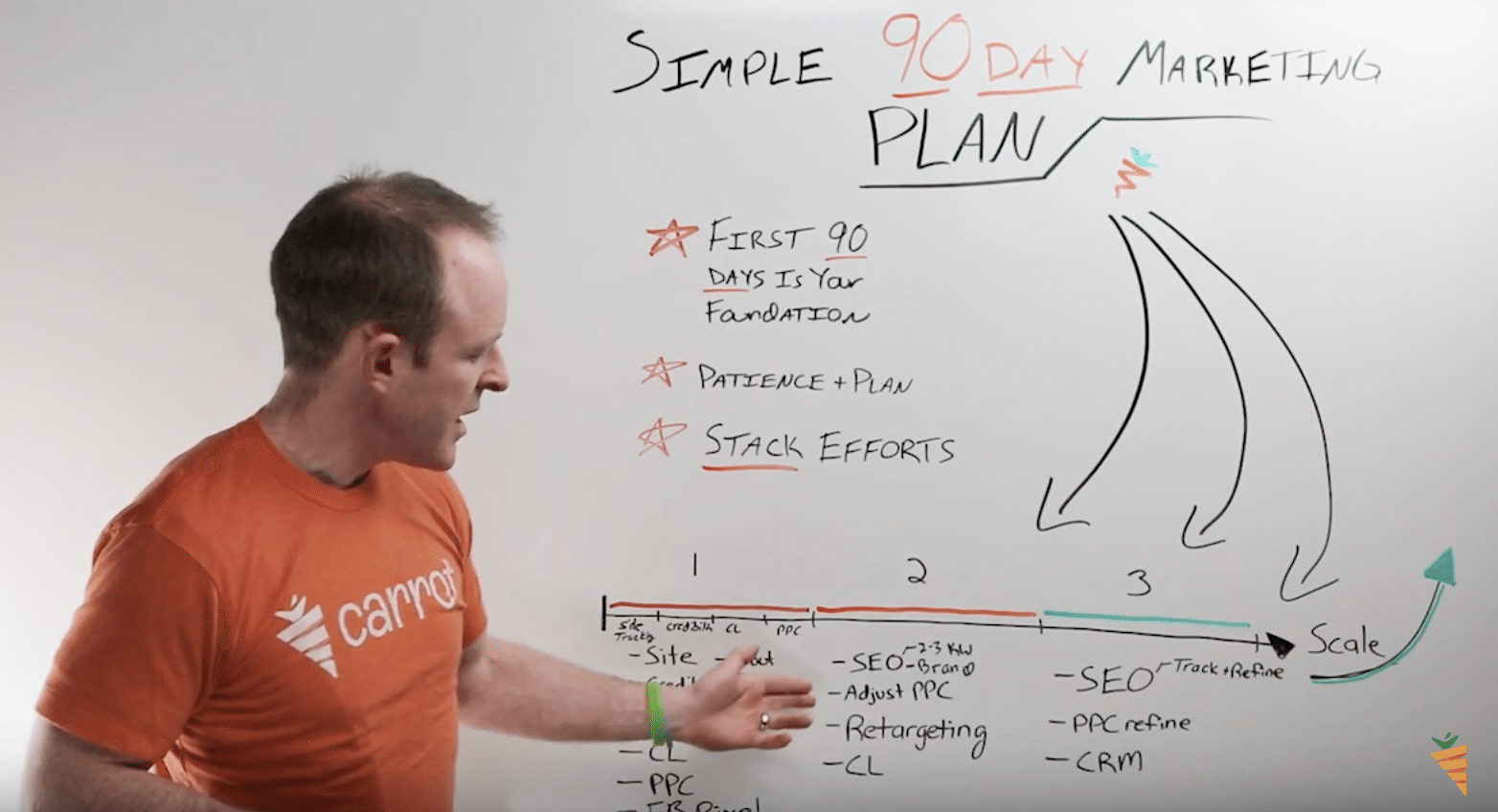
    We all had it at one point, and you’ll probably have it if you don’t have it right now. I will walk through this Carrot whiteboard strategy, a suggested path in your first 90 days with your online marketing strategy in the real estate industry.

    Real Estate Marketing Plan: Our Simple 90-Day Lead Generation Strategy For Sellers and Buyers

    If you haven’t set up your website yet, the first thing you’ll do is, of course, get one. If you need a website, check us out at carrot.com. If you’re not a Carrot member, you can also check out biggerpockets.com or Facebook forums to see how our clients perform. That’s great! We’ll roll with whatever you have going on now.

    The first 90 days are the foundation. So, many people have unreal expectations in their first 90 days of any marketing, but primarily online.

    Online marketing takes some time to develop, so if you’re looking at SEO, PPC, or something similar, your first 30 days, especially, are spent getting things going and refining things.

    Even if you’re doing PPC, your campaign won’t be optimized in that first month. So, have realistic expectations about your first 90 days. This is your foundation setup, and you will scale up after that.

    One of the biggest things is you need to have patience in these first 90 days because if we expect the world to change in 90 days, you expect a flood of leads to start coming in, but you’re not putting a flood of marketing out there; then you’re probably not going to get the results that you expect.

    I’m not saying that you can’t get a flood of leads in the first 90 days; you totally can, but you have to put a flood of marketing out there to capture that, and we’ll show you how to do that.

    So, one thing I want to ensure that we all do in our marketing and our businesses is to keep your marketing simple initially. You see many different marketing methods and must explore them all at once.

    But that isn’t the path you need to follow. We’ll often look at companies and go, “Man, that company is exactly where I want to be,” but they didn’t start there. They slowly stacked things onto their business, and over time, as they found out something worked, they made it good; they made a process. They systemized it and said, “Let’s stack something else on there.”

    That’s how a real estate investor goes from doing their first deal to 2,000 deals. It doesn’t happen overnight. It happens by stacking marketing methods and systems, one by one, as they perfect each of them. So have patience and stack your efforts.

    Conquer Online Marketing in 90 Days: Start with a High-Converting Website on Carrot.com

    Forget chasing trends or endless social media strategies. Here’s a fact: Your website is the foundation of your online marketing success.

    That’s why experts recommend launching a high-converting website as the first step in your online marketing journey. But building a website can feel overwhelming. Don’t worry, Carrot is here to help!

    Here’s how Carrot makes creating a powerful website fast and easy:

    1. Choose Your Winning Template:

    Carrot offers a variety of website templates designed specifically for real estate investors, each optimized for mobile responsiveness and high conversion rates. No hosting or coding necessary!

    2. Customize Your Brand:

    Make your website your own with a user-friendly editor. Add your logo, colors, and images to create a professional and cohesive brand experience.

    3. Leverage Built-In Marketing Tools:

    Carrot equips you with powerful tools like lead capture forms, call-to-action buttons, content tools, and SEO optimization to attract and convert leads from day one.

    4. Focus on What Matters Most:

    Carrot websites are designed to prioritize clarity and user experience. This means your visitors can easily find the information they need and take action, maximizing lead generation.

    Stop wasting time on online marketing that doesn’t deliver results. Get started with Carrot today and launch a website that converts visitors into leads and fuels your online success.

    Ready to dominate your online presence? Head over to Carrot.com and get started on building your high-converting website in minutes!

    Personalizing Your Website To Cut Through The Clutter

    Within the first 48 hours, you will want to do some basic stuff. Launch your site, tweak your content, personalize your content a little bit, post your story, and fill out your “about” page so people can connect with you.

    You want visitors to see a real face or person behind the brand, not a nameless, baseless entity. As we’ve discussed in content, in our CarrotCast podcasts, and in our coaching calls for our customers, it’s a cluttered market. Hence, you stand out by telling your stories and connecting personally.

    So, ensure you personalize your content within the first few days of launching your website. You have to reinvent the wheel. If you’re a Carrot customer, take our content and look at one paragraph, read it, see what’s in it, write it in your own words, and then delete ours. So adjust 20, 30, and 40% of that content.

    If you’re creating a website from scratch, write excellent, engaging content and incorporate real credibility and testimonials.

    Add Lead Tracking So You Know What’s Working And What’s Not

    The next thing you must do is put tracking in place as soon as possible. If you’re a Carrot customer, you already have tracking in place, but if you want to get more advanced, and you want to use your own Google Analytics account, or you want to put your Facebook pixel, I would do that the first couple weeks of getting your website. Or, we can do it for you if you’re a Carrot member.

    You’re going to need to start tracking that traffic right away. That way, you can begin to retarget people.

    Hone Your Unique Selling Proposition

    Next, you must ensure your unique selling proposition is nailed within those first few weeks of your online marketing.

    What about you and your company standing out, giving people a reason to work with you?

    Find Leads With Facebook Ads – First 30 Days

    So we launched the website, got our tracking in place, personalized some content, had our “about” page up there, put a picture of you on there, and swapped out pictures. Hence, they’re local to your area, swapped out some content, so it’s unique to you and your area, and built-in that credibility, testimonials, things like that, and then we start some Facebook Ads.

    Start Facebook Ads a week two or three after launching your website.

    Facebook is fast, quick, and free. If you do it correctly, you can have leads and traffic coming in that day. Our blog has some great resources and a Facebook Masterclass.

    90 day marketing plan craigslist marketing

    Start by running a couple of ads targeting a motivated seller audience, then scale it up over four to six weeks to where you have a couple of campaigns with 3-5 ads within each.

    Launch And Build Up Your Pay-Per-Click – First 30-60 Days

    Next, once some Facebook Ads are going, your website is optimized with great content, you’ve personalized it, you’ve built credibility, and you’ve built a great “about” page, then you start to do some Google Ads if you have a budget.

    If you have $500 to $3000 monthly and are in specific markets, you can start some small-scale PPC marketing and ramp it up.

    Sprinkle Credibility Into Your Real Estate Marketing Plan

    In month two, you have some momentum going. You’ve got your website; you can always tweak it later, add more credibility, or add your Better Business Bureau logo later. We always look for progress, not perfection, so get that site out the door in the first two weeks, build some basic credibility there, and then continually refine it from there.

    If you’re unsure what to do on your website to build credibility, contact us or check out our content on credibility building.

    better business bureau cred

    Time To Work In SEO – 30-90 Days

    Shift your focus to SEO and Evergreen Marketing. Pick two to three high-leverage keywords to focus on for your market. We discuss it in some of our resources and start setting that foundation.

    Then, if you have a tool to track your rankings, maybe start putting those keywords in there to see how your rankings are going. We have that built into Carrot, but other tools can track your rankings if you’re not a Carrot user.

    One of the biggest contributors to SEO is content. Ensure you have a good blog post strategy and plenty of real estate blog post ideas to work from!

    Begin To Adjust Your Pay-Per-Clicks

    Now, it’s time to adjust your PPC because you can’t set it up, forget it, and not adjust it. So, in month two, you will adjust and refine your PPC campaign. If you have enough traffic, you will also turn on retargeting.

    You’ve put your Facebook retargeting pixel on, which we teach you how to do in a blog post on our website. Then, in month two or three, we will start turning on retargeting ads on Facebook, and the same thing happens: we teach you how to do those in those other resources, so check them out. Also, keep your Facebook Ads going.

    90 day real estate marketing plan ppc marketing

    Finally, to wrap out your foundational first 90 days, you’re going to be tracking and refining your SEO. You’re going to a coach or someone you can go to to ask them for advice on improving your SEO, building some backlinks, and social media signals, and this time, you’re probably going to get some citations.

    So, get your website listed on Yelp, Yellow Pages, and all those citations. We suggest starting between 20 and 40 in the first 90 days. We can do it if you’re a Carrot member; check out our marketplace. If you’re not a member, check out our how-to build citations for real estate blog post.

    After you refine your PPC, and only at this time, start thinking about a CRM. Way too many people started thinking about a CRM for tracking their leads in month one. If you don’t have any leads coming in, you have no leads to manage in a CRM. It’s like having gas without a car to put it into.

    So make sure you’re focusing on getting leads first, and then you get your CRM to manage your leads once you start getting enough lead flow that you can’t manage. If you do it correctly, you scale up.

    Wrapping Up Your Real Estate Marketing Plan: First 90 Days

    Once again, contact us for those resources if you are a Carrot member. It’s just a quick run-through. We have many other resources, coaching, and guidance to help you crush it, just like we do with thousands of customers. If you’re not a Carrot member, keep returning to our CarrotCasts or free resources to help you grow or join the fold. Join the Carrot community.

    We will be learning new, amazing things every week with great experts, great marketers, and our Carrot team to teach you how we do what we do and how you can make a bigger difference!

    Free Download: Real Estate Marketing Plan: 90-Day Action Plan

    Get a step-by-step breakdown of leveraging Carrot’s online inbound real estate marketing plan to attract sellers, buyers, and tenants.  

  • From Clicks to Closings: Mastering SEO Keywords for Real Estate Investors

    From Clicks to Closings: Mastering SEO Keywords for Real Estate Investors

    Every month, our Carrot members generate tens of thousands of leads. Digging into our data, we find one really cool stat: well over a million of all those leads come from one source: search engine optimization.

    SEO For Real Estate Investors | How to Boost Ranking with Local SEO

    Are you a real estate investor who feels like you’re hitting a wall with your online visibility? Despite your best efforts, do your search engine rankings not reflect the quality of your investments?

    You’re not alone.

    Many real estate investors face the challenge of optimizing their online presence effectively to attract potential buyers, sellers, and partners.

    Importance of SEO

    In today’s digital age, where nearly 90% of homebuyers start their search online, mastering Search Engine Optimization (SEO) is not just advantageous—it’s imperative. SEO empowers real estate investors to enhance their online visibility, attract targeted traffic, and ultimately, convert more leads into profitable transactions. By strategically optimizing your website and content for search engines, you can ensure that your investment opportunities reach the right audience at the right time.

    In this blog post, we’ll delve into the critical topic of SEO keywords for real estate investors. We’ll explore common pitfalls that may be sabotaging your search rankings and provide actionable strategies to help you choose the most effective keywords for your niche. Here’s what you can expect to learn:

    1. Understanding SEO and Its Impact on Real Estate Investment: We’ll start by defining SEO and explaining why it’s particularly crucial for real estate investors looking to stand out in a competitive market.
    2. Common SEO Mistakes Real Estate Investors Make: Discover the common pitfalls that could be hindering your SEO efforts, such as keyword stuffing and neglecting local SEO.
    3. Choosing the Right Keywords for Real Estate: Learn how to conduct effective keyword research using powerful tools and techniques to identify the best keywords for your investment properties.
    4. Optimizing Content with Keywords: Explore best practices for integrating keywords naturally into your content to improve search engine rankings and user engagement.
    5. Monitoring and Adjusting Your Keyword Strategy: Understand the importance of ongoing SEO monitoring and how to adapt your keyword strategy based on performance data and market trends.

    By the end of this post, you’ll have the knowledge and tools to elevate your SEO strategy and ensure that your real estate investments get the online visibility they deserve. Let’s dive in and transform your search engine rankings for the better.

    Understanding SEO and Its Impact on Real Estate Investment

    In today’s digital age, SEO is vital for real estate investors seeking to establish a robust online presence. Let’s explore what SEO involves, its critical role in the competitive real estate market, and the primary goals it helps achieve.

    Definition of SEO

    SEO refers to the practice of optimizing your website and online content to improve its visibility in search engine results pages (SERPs). This optimization involves various strategies and tactics aimed at enhancing organic (non-paid) traffic to your site. By aligning your content with the algorithms that search engines use to rank websites, SEO helps ensure that your real estate investments are discoverable by potential buyers, sellers, and partners searching online.

    Relevance to Real Estate

    In the fiercely competitive real estate market, where buyers and sellers increasingly rely on the internet to research properties and find agents, SEO is more crucial than ever. Effective SEO strategies can differentiate your real estate listings from competitors’, elevate your brand’s visibility, and attract a steady stream of qualified leads. Whether you’re promoting residential properties, commercial spaces, or investment opportunities, a strong SEO presence can significantly enhance your chances of connecting with the right audience at the right time.

    SEO Goals

    The primary objectives of SEO for real estate investors encompass several key outcomes:

    • Visibility: Enhancing your website’s visibility in search results ensures that potential clients and investors can find your listings and services easily when conducting relevant searches.
    • Lead Generation: By attracting organic traffic through optimized content, SEO helps generate qualified leads interested in buying, selling, or investing in real estate. This targeted traffic increases the likelihood of conversions and transactions.
    • Brand Authority: Consistent SEO efforts not only improve your search rankings but also establish your brand as a trusted authority in the real estate market. Higher rankings convey credibility and reliability to potential clients, fostering trust and loyalty over time.

    In essence, mastering SEO empowers real estate investors to capitalize on market opportunities and achieve sustainable growth in an increasingly competitive industry. As we delve deeper into this topic, we’ll uncover actionable strategies to optimize your SEO efforts and maximize your investment potential online.

    Common SEO Mistakes Real Estate Investors Make

    Effective SEO for real estate investors requires more than just keywords—it demands strategic planning and adherence to best practices. Here are some common pitfalls to avoid:

    1. Keyword Stuffing

    Definition: Keyword stuffing refers to the practice of excessively using keywords, often unnaturally, within content in an attempt to manipulate search engine rankings.

    Why it Harms Rankings: Search engines like Google prioritize user experience and penalize websites that engage in keyword stuffing. Overusing keywords can make your content appear spammy and detract from its readability and value. This can result in lower rankings or even being flagged as spam, ultimately diminishing your site’s credibility and authority.

    2. Irrelevant Keywords

    Issue: Targeting irrelevant or overly broad keywords that do not align with your real estate niche or target audience.

    Impact: While broad keywords may attract high traffic volumes, they often attract visitors who are not interested in real estate investment specifically. This can lead to high bounce rates and low engagement metrics, signaling to search engines that your content may not be relevant to users’ queries. Focusing on niche-specific keywords ensures that you attract qualified traffic more likely to convert into leads or clients.

    3. Ignoring Local SEO

    Importance: Local SEO is crucial for real estate investors because property transactions are inherently local. Optimizing for local search terms (e.g., “real estate investments in “) helps you connect with potential buyers or sellers in your target geographic area.

    Common Oversights: Neglecting to optimize Google My Business profiles, not including location-specific keywords in content, or failing to obtain local backlinks are common mistakes. These oversights can hinder your visibility in local search results, impacting your ability to attract local clients and investors.

    4. Poor Content Quality

    Issue: Publishing low-quality or thin content that lacks substance or fails to provide value to readers.

    Impact: Search engines prioritize high-quality content that meets users’ needs and expectations. Thin content, stuffed with keywords lacking in depth or relevance, is unlikely to rank well. Investing in comprehensive, informative content that addresses common questions, provides valuable insights, or showcases your expertise can significantly boost your SEO efforts and user engagement.

    5. Neglecting Mobile Optimization

    Impact: With a growing number of users accessing the internet via mobile devices, mobile optimization is no longer optional—it’s essential for SEO success.

    Why it Matters: Websites that are not mobile-friendly experience higher bounce rates and lower engagement metrics from mobile users. This negatively impacts your site’s overall performance in search rankings, as search engines prioritize sites that offer a seamless mobile experience. Implementing responsive design, optimizing page speed, and ensuring mobile-friendly navigation are critical steps to improve your site’s mobile usability and SEO performance.

    By understanding and avoiding these common SEO mistakes, real estate investors can enhance their online visibility, attract targeted traffic, and ultimately achieve greater success in their digital marketing endeavors.

    Choosing the Right Keywords for Real Estate

    Selecting the right keywords is fundamental to successful SEO for real estate investors. Here’s a comprehensive guide on how to choose and utilize keywords effectively to enhance your online presence:

    1. Keyword Research Tools

    Keyword research forms the foundation of any successful SEO strategy. Tools like Google Keyword Planner, Ahrefs, and SEMrush provide invaluable insights into search volume, competition level, and related keywords. These tools allow real estate investors to identify high-potential keywords that align with their investment offerings and target audience. By leveraging data-driven insights, you can optimize your content to attract qualified traffic interested in real estate opportunities.

    Download our Free SEO Keywords for Real Estate Investors.

    2. Long-Tail Keywords

    Importance: Long-tail keywords consist of longer, more specific phrases that often have lower search volumes but higher conversion rates. For example, instead of targeting “real estate investment,” consider phrases like “affordable real estate investments in [Your City]” or “best commercial properties for sale in [Your Area].” These keywords cater to potential investors who are closer to making a decision, enhancing your chances of conversion.

    Benefits: Using long-tail keywords helps you compete more effectively in search engine results, as they are less competitive than broad keywords. They also attract highly targeted traffic that is more likely to convert, thereby maximizing the return on your SEO efforts.

    3. Local Keywords

    Focus: Real estate transactions are inherently local. Incorporating location-specific keywords (e.g., “luxury homes in [Your City],” “investment properties in [Your Neighborhood]”) is essential for attracting local buyers, sellers, and investors.

    Targeted Traffic: Local keywords help you reach a geographically targeted audience interested in real estate opportunities in specific locations. This enhances your relevance in local search results and improves your chances of connecting with qualified leads who are actively seeking properties in your area.

    4. Competitor Analysis

    Strategy: Analyzing competitors’ keyword strategies provides valuable insights into what works in your niche and identifies opportunities for improvement.

    Tools and Methods: Use tools like SEMrush or Ahrefs to analyze competitors’ top-performing keywords, organic search traffic, and backlink profiles. Pay attention to the keywords they are ranking for and their content strategies. Identify gaps where you can differentiate yourself or opportunities to capitalize on similar keywords with better content or targeting.

    5. User Intent

    Understanding: User intent refers to the reason behind a user’s search query. To effectively optimize for user intent, consider the intent behind keywords you target. Are users looking for property listings, investment advice, market trends, or real estate services?

    Incorporation: Tailor your keyword selection and content strategy to align with user intent. For instance, if users are searching for “real estate investment tips,” create content that provides valuable insights and practical advice on investment strategies. By meeting user intent, you increase the likelihood of satisfying user queries and improving engagement metrics, which are crucial for SEO success.

    By integrating these strategies into your keyword research process, you can enhance your SEO efforts, increase your online visibility, and attract targeted traffic interested in real estate investments. Remember, optimizing for the right keywords is not a one-time task but an ongoing effort to stay relevant and competitive.

    Optimizing Content with Keywords

    Optimizing your content with strategic use of keywords is crucial for improving search engine rankings and attracting relevant traffic. Here’s how real estate investors can effectively integrate keywords into their content:

    Content Creation Tips

    Creating valuable content that resonates with your target audience is the cornerstone of successful SEO. Consider the following tips:

    • Address Audience Needs: Understand what information potential investors are seeking. Tailor your content to provide insights, market trends, investment strategies, or property listings that align with their interests.
    • Quality Over Quantity: Focus on creating high-quality, informative content that adds value. Avoid thin content that lacks substance or fails to address user queries comprehensively.
    • Engage with Visuals: Incorporate engaging visuals such as property photos, infographics, or videos to enhance user experience and encourage longer on-page dwell times.

    Keyword Placement Best Practices

    Effective keyword placement helps search engines understand the relevance of your content to user queries. Here are some best practices:

    • Titles and Headers: Include primary keywords naturally in your page titles (H1 tags) and headers (H2, H3 tags) to indicate the main topic of your content.
    • Meta Descriptions: Write compelling meta descriptions that include relevant keywords. Meta descriptions serve as summaries in search engine results, influencing click-through rates.
    • Body Text: Integrate keywords naturally throughout your content, ensuring they flow smoothly and enhance readability. Avoid overusing keywords, as this can negatively impact user experience and SEO.

    Internal Linking Strategies

    Internal linking is a powerful SEO technique that helps distribute link equity across your website and guide users through relevant content. Consider these strategies:

    • Anchor Text: Use descriptive anchor text that includes relevant keywords when linking to other pages within your site. This helps search engines understand the context of the linked page.
    • Hierarchy: Establish a hierarchical structure with your internal links to prioritize important pages and guide users through a logical navigation path.
    • Relevance: Link to related content that provides additional value or context to the topic at hand. This not only enhances user experience but also encourages deeper engagement with your site.

    Importance of Regular Updates

    Regularly updating your content is vital for maintaining relevance and improving search engine rankings. Here’s why:

    • Freshness: Search engines prioritize fresh and up-to-date content. Regular updates signal to search engines that your site is active and relevant, potentially boosting your rankings.
    • Accuracy: Update outdated information, property listings, or market trends to ensure accuracy and reliability for your audience.
    • SEO Impact: Updating content gives you an opportunity to incorporate new keywords, optimize for current search trends, and improve overall SEO performance over time.

    By implementing these strategies, real estate investors can optimize their content effectively with targeted keywords, enhance user experience, and strengthen their SEO efforts. Remember, ongoing monitoring and refinement of your keyword strategy and content are essential to stay competitive.

    Monitoring and Adjusting Your Keyword Strategy

    Effectively monitoring and adjusting your keyword strategy is essential for maintaining and improving your SEO performance as a real estate investor. Here’s how you can stay ahead:

    SEO Analytics Tools

    Utilizing reliable SEO analytics tools is critical for tracking the performance of your keyword strategy. Here are key tools to consider:

    • Google Analytics: Provides detailed insights into website traffic, user behavior, and conversion metrics. Monitor organic search traffic, bounce rates, and keyword performance to gauge the effectiveness of your SEO efforts.
    • Google Search Console: Offers valuable data on how your site appears in Google search results. Monitor keyword rankings, click-through rates (CTRs), and identify opportunities to improve your search presence.
    • Carrot’s SEO Tools, SEMrush, or Ahrefs: These tools offer comprehensive keyword analysis, backlink profiles, and competitor insights. Monitor keyword rankings, analyze traffic trends, and identify new keyword opportunities for optimization.

    Regular Audits

    Conducting regular SEO audits helps identify and rectify issues that may impact your search engine rankings. Key aspects to focus on include:

    • Technical SEO: Audit for issues such as broken links, site speed, mobile-friendliness, and crawl errors that can affect user experience and search engine indexing.
    • Content Quality: Assess the quality and relevance of your content. Update outdated information, improve readability, and ensure it aligns with current SEO best practices.
    • Keyword Performance: Review keyword rankings, CTRs, and traffic trends. Identify underperforming keywords and opportunities to optimize existing content or target new keywords.

    Staying Updated

    SEO evolves constantly, with search engines updating algorithms and trends shifting in user behavior. Stay informed by:

    • Following Industry Experts: Keep up with leading SEO blogs, webinars, and industry publications to stay informed about the latest trends and algorithm updates.
    • Google Updates: Monitor announcements from Google regarding algorithm changes and updates that may impact your SEO strategy.
    • Continuous Learning: Invest time in ongoing learning and skills development to adapt to new SEO techniques and best practices.

    Adapting Strategies

    Based on performance data and insights gathered from audits and analytics tools, adapt your keyword strategy by:

    • Optimizing Underperforming Keywords: Revise content or metadata for keywords that are not ranking well. Experiment with variations or long-tail keywords to improve visibility.
    • Expanding Keyword Portfolio: Identify new keyword opportunities through competitor analysis or keyword research tools. Develop content targeting emerging trends or specific niche topics.
    • Refining Content Strategy: Adjust your content strategy based on audience feedback and performance metrics. Focus on creating content that resonates with your target audience and addresses their needs effectively.

    Real estate investors can continuously monitor, audit, and adapt your keyword strategy to maintain a competitive edge in search engine rankings, attract qualified traffic, and achieve sustainable growth in the digital marketplace. Remember, SEO is a dynamic process that requires ongoing attention and refinement to maximize results and ROI.

    Conclusion

    In navigating the complex world of SEO for real estate investors, mastering the art of keyword selection and optimization is paramount. Let’s recap the key insights we’ve explored in this blog post:

    • Understanding SEO: We began by defining SEO and highlighting its critical role in enhancing online visibility and attracting targeted traffic for real estate investments.
    • Common SEO Mistakes: We discussed pitfalls such as keyword stuffing, targeting irrelevant keywords, neglecting local SEO, poor content quality, and ignoring mobile optimization—factors that can hinder your SEO success.
    • Choosing the Right Keywords: We explored strategies for effective keyword research, including using tools like Google Keyword Planner, Ahrefs, and SEMrush, emphasizing the importance of long-tail and local keywords, competitor analysis, and understanding user intent.
    • Optimizing Content: We provided tips on creating valuable content that integrates keywords naturally, best practices for keyword placement, leveraging internal linking, and the importance of regular content updates.
    • Monitoring and Adjusting Strategy: Finally, we discussed the importance of using SEO analytics tools, conducting regular audits, staying updated with SEO trends, and adapting your keyword strategy based on performance data.

    Actionable Tips

    Here are some actionable tips you can implement immediately to enhance your SEO strategy as a real estate investor:

    1. Conduct a Comprehensive SEO Audit: Use tools like Google Search Console and SEMrush/Ahrefs to identify technical issues, keyword performance, and content opportunities.
    2. Optimize for Local SEO: Include location-specific keywords in your content, meta descriptions, and Google My Business profile to attract local clients and investors.
    3. Create High-Quality Content: Focus on producing informative, engaging content that addresses common questions and provides valuable insights into real estate investment opportunities.
    4. Monitor Keyword Performance: Regularly monitor keyword rankings and adjust your content strategy based on performance metrics to improve visibility and engagement.

    Call to Action

    Ready to elevate your real estate investments through effective SEO strategies? Whether you’re looking to optimize your website, refine your keyword strategy, or enhance your online presence, professional SEO services can make a significant difference.

    Join our Carrot Community for more guidance and further resources on maximizing your SEO efforts, and post your own questions.

    Remember, mastering SEO requires dedication, continuous learning, and adaptation to stay ahead in the real estate market. Start implementing these strategies today to position yourself for long-term success. Happy optimizing!

  • 4 Reasons Why You’re Not Getting Real Estate Leads Online And How To Fix It

    4 Reasons Why You’re Not Getting Real Estate Leads Online And How To Fix It

    This has to STOP… Obviously, you want more traffic and leads, right? We’ve all struggled to increase website traffic, and every lead guru has a big bag of tricks they’re eager for you to try. But… it’s a heck of a lot simpler than that.

    All you need to do is fix these 4 common reasons that are often neglected by real estate website owners either because they don’t understand their importance or because they are not sure how to approach them.

    4 Reasons Why You're Not Getting Real Estate Leads Online and How To Fix It

    Hey guys and girls, Trevor here coming at you with another whiteboard strategy sketch and these are getting really, really fun.

    I don’t know how many we have done so far but we have a lot more in store for you guys and keep the questions coming because the way that we come up with these things right here is from questions directly from you guys. Send them to us at support@oncarrot.com, through the comments section below or go to oncarrot.com and check us out.

    On this particular video, we’re going to address one of the most common “problem” questions that we get…

    “Why am I not getting the real estate leads online that I want or I’m NOT getting any leads?”

    Because in order for you guys to get value out of leveraging the web with your marketing, you got to be getting leads in some way whether it’s phone calls, whether it is people submitting forms, whatever it is. Leads have to be had, otherwise, you are not getting the value out of it.

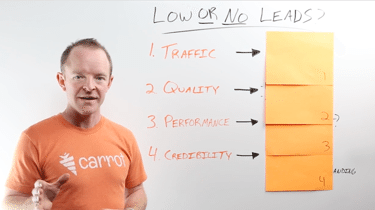
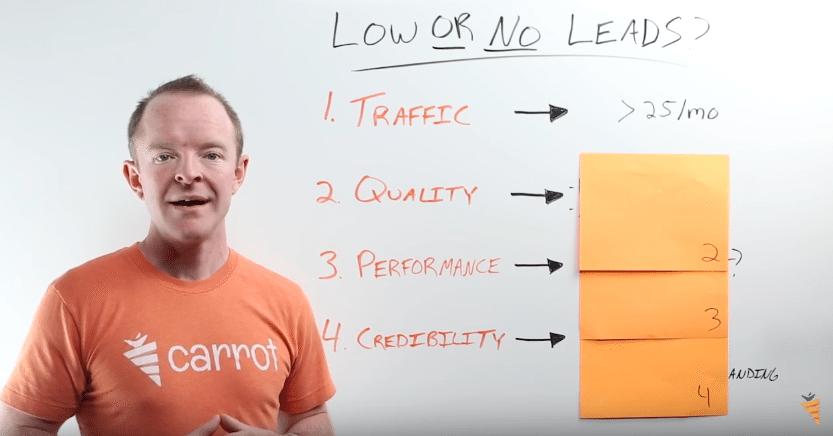
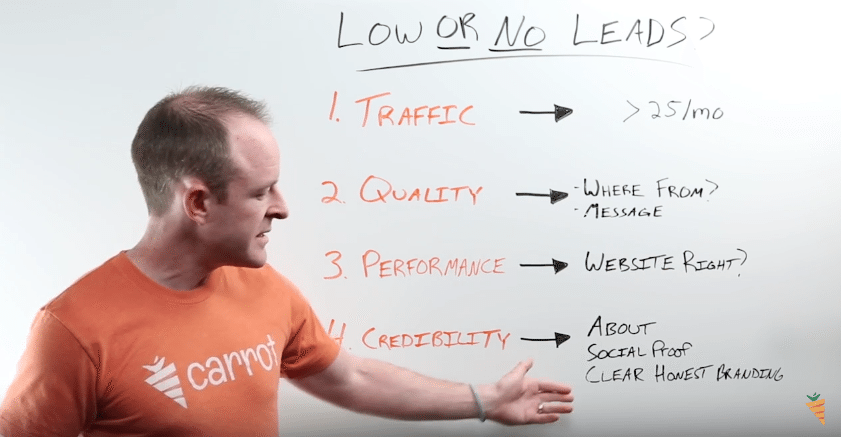
    We boiled it down to just four reasons that you are not getting the number of leads you want. As you are going through this particular strategy sketch, make sure that you are identifying which one or ones of these you need to tap on next.

    Okay?

    If you are not getting leads you want, you need to be doing one of these things better or more.

    Why Your Not Getting Real Estate Leads Online Reason #1: Traffic

    little-or-no-leads-traffic

    The first thing you want to look at is your traffic. That’s the most obvious thing, right? Because you can’t get a lead if you are not getting people to land on your website.

    How do we get more people to land on your website?

    The first thing we’d like to see is that you are getting at least 25 visitors to your website per month and we are saying at a minimum because on average let’s say it’s a motivated house seller website… you might be converting three, five, six, seven, eight percent,10% if you are doing really well, into a lead.

    If you are converting at 10%, which is a really high conversion rate in this type of market, you are only going to be getting about two to two and a half leads per month. Now that is not a lot of leads so that is your issue.

    If you are getting less than 25 people to your website a month, then that’s probably the first thing you need to focus on.

    If you are getting 50, 60, 70, people to your website a month and you are still not getting very many leads, let’s say it’s converting at less than 1%, we are going to move on to the next thing.

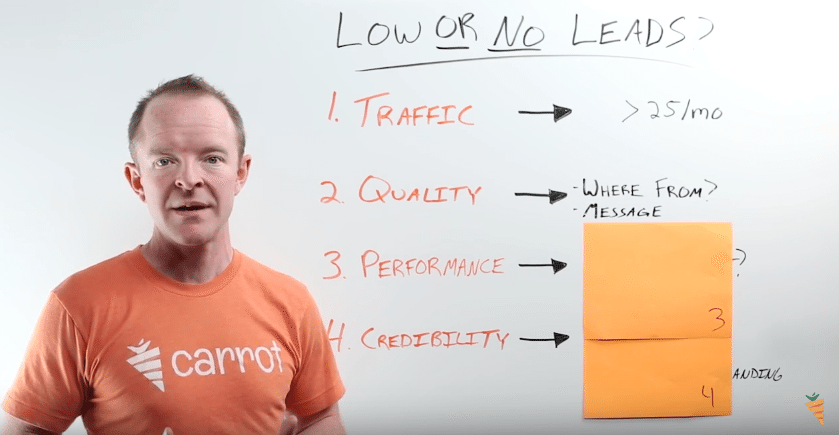
    Why Your Not Getting Real Estate Leads Online Reason #2: Quality of Traffic

    little-or-no-leads-quality

    The next thing is the quality of your traffic. First off, if you have traffic coming in and you are getting 20, 30, 40, 50, 60, 100 people to your website a month but you are still not getting very many leads, you are getting less than 5% or less than 3% of them becoming a lead, it could be a quality issue.

    You need to ask yourself some questions. It could be, where are these people coming from? Are they coming from good marketing channels? What is the message that you are delivering to them to get them to your website?

    Often times we’ll see people using Google pay-per-click or Facebook ads or something and they are getting a lot of traffic from Facebook for motivated house sellers but the problem is, those people are not very targeted. So you don’t want to be driving motivated house sellers from a random Facebook campaign to websites and expect to really have a conversion rate.

    The quality of those visitors is going to be lower. The quality of the Craigslist visitors will be probably a little bit lower, the quality of an SEO lead is going to be way higher. If you are not getting very many leads but you have a lot of traffic, see where your traffic is coming from. Is it coming from a high-quality source where they are very targeted and you can help them specifically? What message do they see before they land on your website?

    Did your ads say, “Sell your house.”? Then your website now says, “Sell your houses quickly, we buy houses.”. They are just looking for a real estate agent and you are offering a completely different service. Look and see what your ads and your message says.

    If you got the traffic nailed, the quality is perfect and that’s nailed, and you got a lot of traffic coming in and you are still not getting the leads you are looking for, what do we look at next? We look at performance next.

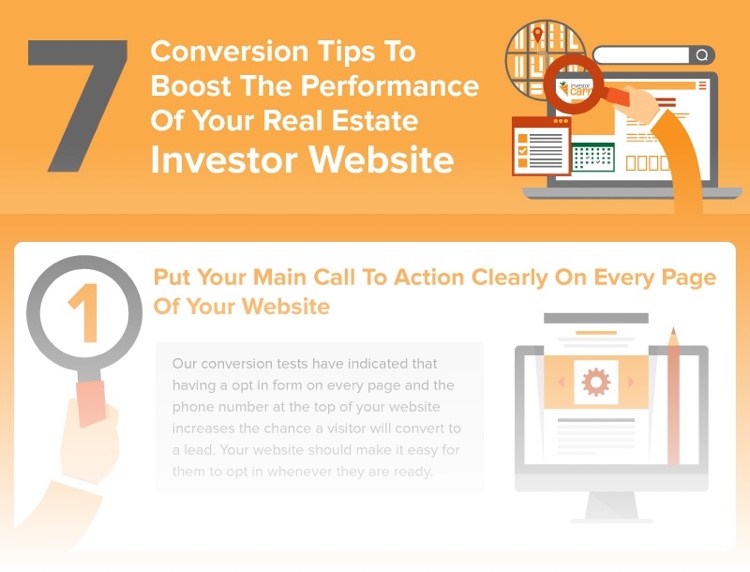
    Use Carrot’s Conversion Checklist

    7_conversion_tips_infographic_investorcarrot-featured-img

    Click Here To View Full Infographic

    If you would like for your website to convert more leads, then this webinar replay might be for you. It is a long call but packed full of valuable information. Give the webinar a view and then download our 16-point real estate investor conversion checklist.

    Download the Conversion Checklist ›

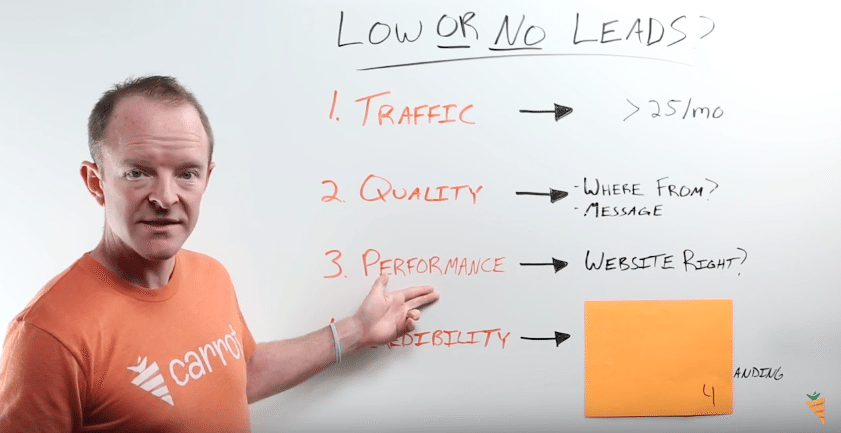
    Why Your Not Getting Real Estate Leads Reason #3: Website Performance

    little-or-no-leads-website-performance

    We talk a lot about performance here at InvestorCarrot where performance is one of the things we specialize in.

    It’s helping your websites perform at a higher level which means convert more of your visitors, more of your quality traffic into a lead. The performance side is your website. Have you gone through some tutorials on this website? Have you gone through our other whiteboard strategy sketches to see how you need to structure your forms? Have you gone through some of our mastermind calls, things like that? Make sure your website is built to be high performing.

    If you are a Carrot member already, you got this one nailed. You don’t have to do anything there unless you jerked up the design that we have given you. Make sure you are sticking with the design, then just personalize it with your own content, tweaks, you personalize it with your branding and credibility.

    If you are not a Carrot member, make sure you are really focusing on the design of your website so it’s performing at a high level and like I said we have a lot of resources you can check out. Go to oncarrot.com/resources and we have an entire video and an entire checklist on how to create a high performing website.

    If you’ve got your high performing website set up, you got quality traffic coming into it, and you’re still not getting enough leads, what we want to do is look into credibility.

    Why Your Not Getting Real Estate Leads Online Reason #4: Credibility

    little-or-no-leads-credibility

    You can have the best website in the world that is set up with all the cool things to get someone to convert into a lead, but maybe you haven’t built credibility on the website. Maybe people aren’t believing that you can truly help them.

    Maybe you’re not really building that connection with them enough to where they are like, “Man, these people seem like real people and I want to work with them.” You need to nail the credibility.

    What do you do to really build great credibility for any business?

    It could be business selling microphones or a business selling whatever it is. You need to be building credibility and you do it the same way. You have a really good about page.

    We found in our data, the number three most visited page, sometimes the number two most popular page across all of our thousands of InvestorCarrot members websites including our own sales websites is always the about page because people are looking to prove or disprove the preconceptions in their mind on why they should or should not work with you.

    If they go to your about page and it’s basic, it’s generic, it doesn’t have anything about you, they aren’t building that connection with you. They are probably going to bounce out of there and possibly go and look at your competitors. The ones that they connect with more, are going to be the ones they choose to work with.

    Make sure your about page has a little bit about you. Kind of tells about why you want to help people, your mission, and list maybe some of your team members in there. Don’t be afraid to put your face on the website because your face is going to have to go in front of your client eventually.

    Number two is social proof.

    Do you have things on your website that show that other people have worked with you before them that you helped that have been in similar situations?

    It could be a testimonial, it could be videos, it could be case studies on deals you have worked with, it could be people who you’ve sold properties to who have gotten great returns now and they had a better experience working with you. It could also be the Better Business Bureau badge.

    Things like that help to build social proof, reviews on your Facebook channel, things like that. You just want to show other people have worked with you in the past or attest to your character, that you are the type of person that they would want to work with.

    The last thing is clear and honest branding.

    We found so many websites that nail the about page, nail the social proof, they got the traffic coming in but their logo up top looks like it’s been made in Microsoft Paint in 1998. It’s pixelated. The words are hard to see, and the very first things we often times look at on a website is the upper left of that website which happens to be where logos often times are or at least the top of the website.

    So make sure you have very clear honest branding.

    I didn’t say you have to have a fancy logo, that’s a completely different thing. Some of the best websites that we have found that generate the most leads, had the simplest logos out there. They didn’t spend a bunch of money on them.

    Reasons You’re Not Getting Real Estate Leads Online

    If you nail these four things; nail your traffic, the traffic is high quality coming from great sources with a very clear and defined message that matches your website, the website is set up for performance and not just a couple of things but set up everywhere on every single page to perform at a high level, follow what we do and model it.

    Don’t copy what we do, but follow and model what we do or if you are a Carrot member that’s already been done for you.

    On the credibility side, have a great about page. Look at our about page and see how much you connect with us. We have our core values that we tell about our start-up story, we tell about our team, and you get a chance to connect with us at a better level. It becomes real people then, and it’s easier to work with people than work with a kind of an ominous company.

    Get your social proof nailed, get clear on honest branding and if you still don’t have a stream of leads coming in from there, I would highly suggest then you go back up to number one and ramp up your traffic using other methods.

    Go out there and get your leads flowing upwards, get your leads flowing in and make them consistent and predictable so your business can grow.

    That is why we are all doing this so we can have a consistent, predictable business that really fuels our lifestyle and helps a lot of people.

    Check out the whiteboard videos on our YouTube channel. If you aren’t on our YouTube channel, subscribe where the subscribe button is.

    If you are not on our YouTube channel, but you are on our website, subscribe to our blog or check out the webinar that we have going and you can probably find someone inside or on the website somewhere and see how we can help you grow your leads and leverage the web better.

  • A Formidable Opponent: How To Beat The 3pm Energy Slump

    A Formidable Opponent: How To Beat The 3pm Energy Slump

    It seems like as entrepreneurs, we’re always out there trying to find that little hack, that little whatever it is to try to squeeze more out of our day. I think a lot of people are always looking for a productivity app or a productivity hack or this new vitamin to take or whatever it is. I was too.

    A Formidable Opponent: How To Beat The 3pm Energy Slump

    I’ve been through the whole thing. I’ve downloaded all the productivity apps and the to-do list things and found eating plans to do and all this fancy stuff.

    In the end, a lot of it boils down to our physiology, the way that our bodies work. Oftentimes, we’re actually working against ourselves or we’re out there trying to find these amazing tools that are placing patches over the top of what actually needs to be fixed.

    I’m going to be teaching you guys about the 3:00 PM energy slump, which you fully are already aware of, but I’m going to walk you through a couple steps in how to get out of that in your lives. When you can get out of that 3:00 PM energy slump, you have so much more energy, so much more creativity, so much more life to go out there and do what you want to do. Whether it’s spending time with your friends, your family, growing your business, being more effective in that time in your business.

    I know I’ve spent way too many days where I got done with my lunch, and then 2:00, 3:00, 4:00, I’m sitting there at my computer not really doing a whole lot of anything good, but then I go home and I look back and I think, “Man, I could have spent that same amount of time with my family instead of sitting there not being effective,” or, “Shoot, if I could gain back the extra two or three hours a day, that’s an extra ten to fifteen hours a week that I can be more productive and effective in my business.”

    Let’s Knock It Out

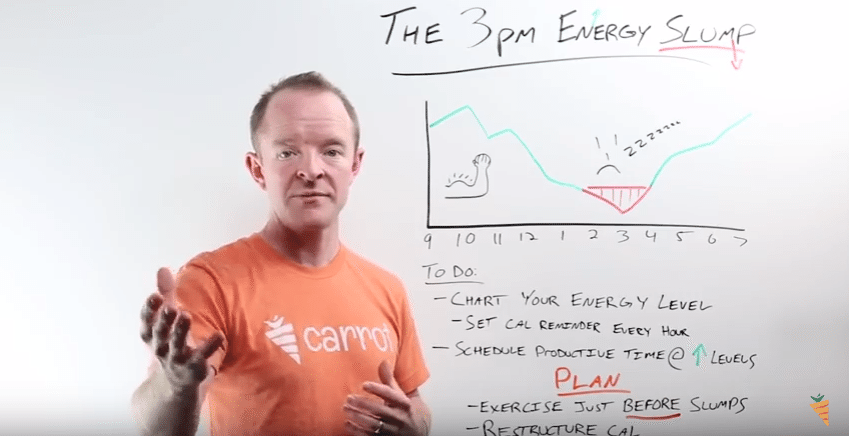
    We’re going to walk you through how you get out of the 3:00 PM energy slump. First of all, I’ve got this little chart here, and this chart is important because after I walk you guys through this process, I want you guys to create your own chart. I’m going to show you guys how and why that’s so important because my chart is not your chart. You guys might have a ton of energy at 3:00 PM, but your energy might slump at a different time during the day. This chart is basically the chart of mine.

    3pm-energy-slump
    Are you dozing off while reading this post? You’re in an energy slump. Beat it by following these simple tips to restructure your day and create the right mindset.

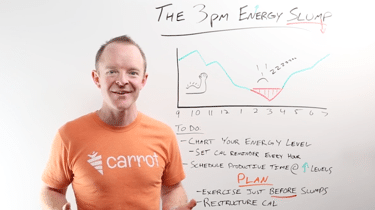
    I’m going to walk you through the process. I charted my energy level at every hour during the day for several days to find out when my energy was low and when it was high. That way, you can structure your life better and also tackle those low energy times and infuse more energy in them.

    I start at a pretty high energy level, but not when I first get up. When I first get up at 6:30 in the morning or when one of my kids is upstairs yelling to try to come downstairs, I’m not too high energy there. But what I do is I go through some steps to get high energy by 8:30 or 9:00 in the morning, oftentimes earlier.

    I get to work at about 8:15 in the morning, get really high creativity at that time, and I peak right there, and then my energy starts to steadily go down throughout the day, all the way up until 3:00 PM. For me, it’s oftentimes because I’m at my desk sitting, standing, sitting, standing with my stand up desk during this time.

    I’ve kind of gotten the roll of the day. The excitement of starting the day off has waned a little bit. I’ve kind of gotten my to-do-list, and then I ate lunch, got a belly full of food that might not be good energy food, and then you start to hit that lull. During that lull is when I’ve learned to try to shock your system back into place so you can get through that as quick as you can, so you can go back into a high energy state.

    For me, same time, it’s about 4:00 or 5:00 PM that I get a little bit higher energy. It’s kind of funny. Around 8:30, 9:00 PM, I’m pretty darn good, and then about 10:00 PM, I’m done.

    First… Take Note Of Your Energy Levels

    Okay, so what does your chart look like? I want you guys to chart your energy the next three days, and that’s it. It’s going to be really, really easy. Chart your energy the next three days. I want you to set a calendar reminder. Do it before you finish the video. Hit pause in this video in about ten seconds, after I tell you what to do.

    Set a reminder for every hour during your workday to gauge your energy level for the next three days. We’re talking nine to five, eight to whatever, whatever time is your work day.

    Set a calendar reminder that pops up and says, “What is your energy level?” Jot it down on a spreadsheet, a piece of paper, whatever. You can gauge your energy level in any way you want. You can do one to ten, you can do high, low, medium, however, you want to gauge it, gauge your energy level. Write it down.

    After those three days, you’re going to make your own chart. It’s going to show you when your energy is high and when it’s low.

    The high energy parts, figure out why it’s high, and write that down, and do more of that. Fit more of that in your schedule. The low energy times, oftentimes we don’t know why we have low energy at that time, and this is what we need to do to tackle that.

    The Plan

    We need to, first of all, schedule your productive time. It could be the time that you’re creative. It could be the time that you’re just doing the best work, the stuff that really makes a difference for you, the stuff you’re great at. Schedule that during your high energy level times.

    For me, right now doing this video, it’s before lunch. I haven’t eaten lunch yet. I know I’ve got good energy at this time. That’s why we’re doing our videos right now. If I were to schedule these videos at 2:00 or 3:00, even after I go through some of these steps to get my energy level up, it’s still going to be a little bit lower than normal, so scheduling your productive time during high energy times.

    Exercise Right Before Slumps

    All right, now here’s the plan for you. What you want to do is exercise just before the energy slump. It doesn’t mean you’ve got to go pump iron. It doesn’t mean you have to go run ten miles. Get outside, walk outside out of your house, walk outside of your office, and walk around the block. Walk a mile.

    That could be a really good, simple goal, just to walk a mile. It might take you fifteen, twenty minutes to walk a mile, maybe quicker. Do whatever works for you for exercise. It could be literally doing 15 jumping jacks in your office and just getting going. Set that in your calendar to do a quick exercise, ten minutes or so, just before the slump happens.

    Next, what you’re going to do is restructure your calendar. So put exercise on your calendar right before your slumps usually happen, a quick, simple exercise, ten, fifteen minutes max, just to get that going. You could go longer if you want to.  I’ve even seen some people do a quick five-minute exercise and it gets their energy level going back again.

    Everyone’s got five minutes, and that one five minute exercise is going to give you an extra two or three hours of productive and happy time during the day, which is a great investment.

    Change Your Eating And Drinking Pattern

    Now, you’re going to figure out your eating and drinking. It’s kind of funny. We just ordered lunch. Nate, the cameraman, just got a bacon cheeseburger, so I’m going to put him on the spot. I know for me, if I had a bacon cheeseburger with fries, I’m going to be in the sleepy zone in about two hours.

    Usually, it’s about 45 minutes after I eat something like that. For me, it’s high carbs. It just puts me in the gutter, so instead I got a salad. I’m not better than Nate. I just know where my energy levels are and I don’t want to be there because I’ve got a lot to get done today. Make sure you change your eating and drinking patterns.

    Also, drink a bunch of water, which I’ve been really bad at lately. That’s something I myself have to challenge myself to get back on that train of drinking a lot of water at the start of the day, and drinking a bunch of water also before your energy slump happens.

    Gain Lost Time Back

    If you guys go out there and do those things in your life and in your day, which it takes discipline, it does, but if you like having that energy slump and if you like giving away two, three, four hours of your day each and every day and not having that productivity or that happiness, that same energy level, that’s cool. Keep doing it.

    If you want to gain that time back that you’re never going to get back, find some ways to figure out your energy cycle.

    Reignite Yourself

    Restructure your calendar so it fits the productive stuff around that energy cycle.Then find ways to reignite your body just before those slumps happen so those slumps become less and less. You want those slumps to go from being low, to leveling out. That’s what’s going to happen when you guys implement this.

    Go out there, get more energy in your life, more energy in your day, and go out there and crush it. Let us know how it works in the comments section of the YouTube video or the comments section on the blog post, and we’d love to hear your feedback. Thanks, guys and gals. Go visit our other whiteboard strategy sketches on our YouTube channel, or subscribe here to the blog. Thanks, guys and gals. Go out there and crush it.

  • 4 Step Marketing Budget Formula: Find The Magic Number You NEED To Invest To Close A Deal

    4 Step Marketing Budget Formula: Find The Magic Number You NEED To Invest To Close A Deal

    What if you could know that for every $1500 invested in online ads, you’re pulling $10,000 back? But, a lot of investors don’t take the time to calculate and understand what it takes to get a positive ROI. So, they quit too soon. Let’s fix that.

    Before we dive in, as you listen to this Strategy Sketch, you’ll need to use The Carrot ROI Calculator tool to help pencil in your own marketing budget.

    I’ve got a quick story for you, but before I start if this is your very first strategy sketch with Carrot we have a lot of other ones on our YouTube channel. Check them out after you watch this one.

    4 Paid Marketing ROI Steps Only High Real Estate Achievers Understand

    The story is of 2 different real estate investors…

    One real estate investor’s had an amazing return on their marketing.

    The other one struggled and lost all their money and ended up giving up.

    I want to make sure that you identify where in this story you fit. Which one of these are you resonating with? Which one of these are you living right now?

    The First Investor…

    The first investor had a marketing budget and he knew his numbers really well. I’m going to be walking through exactly what the first investor did to make sure he got a great ROI on his marketing.

    The Second Investor…

    The second real estate investor also had a budget. He dove in, he started spending money, he started investing money, but he did not do these 4 steps I’m going to walk you through.

    They both had the same amount of money to start, they both had the same amount of experience. One of them lost his butt on all of his marketing, the other ended up making tens of thousands of dollars.

    Now, this is not a false story. I was on one of our Coaching Calls recently here at Carrot and these 2 investors were on the exact same call. One of them ended up blowing $1500 on pay-per-click marketing. The other one ended up making almost $9,000 in the first deal because he followed these 4 steps.

    If you want to know the difference between really active and really profitable investors, these 4 things are going to be that.

    Let’s go ahead and dive in.
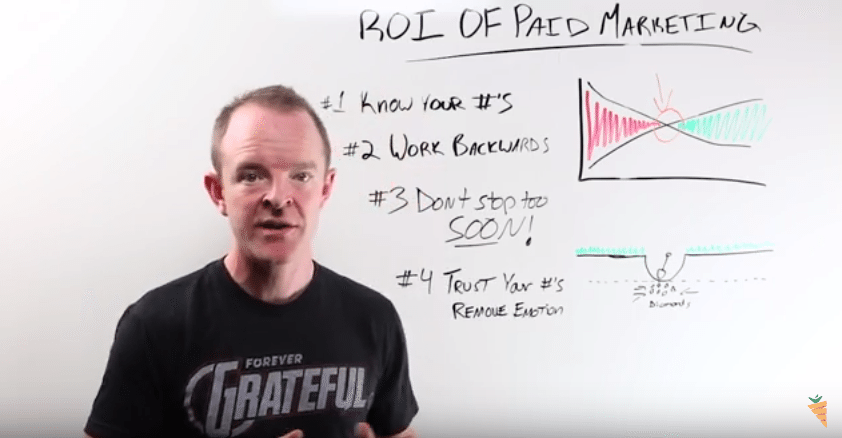
    ROI of Paid Marketing

    Step 1: Your “APD” – What Is Your Average Profit Per Deal?

    The first thing, how you get a great return on investment from your paid marketing? That’s what we’re talking about here is your paid marketing. A lot of this will translate over into the stuff where you’re just working kind of sweat equity for your marketing.

    Could be you doing your own SEO, could be you out there doing your own door knocking or whatever the heck it is, but we’re talking about marketing that you actually take your money and invest it into the marketing. It could be direct mail, pay-per-click, SEO, you name it.

    The first thing here is you’ve got to know your numbers, and I think a lot of people think that they know their numbers. They think, “I make about x amount per deal, I’ve got this much in my budget, and I’m just going to roll with that and we’ll see what happens.”

    You probably don’t know your numbers as well as you should but I’m going to walk you through in this video how you should know your numbers in a quick 30-second work your way backward formula.

    The numbers that you really need to know about your marketing: You need to know how much money you’re going to be making on each sale.

    If you’re a real estate agent, you need to know what your average profit per listing is. If you’re a real estate investor, you need to know what your average profit per deal is.

    If you’re not investing yet, go out there and investigate the market, talk to other investors in your market, and find out what their average profit per deal is. Write that down right now.

    That’s going to be a key number for you.

    Step 2: Your “LPD” and Website Conversion Rate – How Many Leads Before You Close A Deal On Average?

    The next thing that you’re going to need to know is what your conversion rate is. You’re going to need to know basically how many leads it takes to turn into a deal for you. You’re going to need to know all those types of things. We’re going to walk you through them here in a second.

    If you don’t know how many leads it takes for you to turn it into a deal, it’s going to be really hard to know your numbers and know how much you need to invest in your market.

    We’re going to work backward on some numbers and we’re going to help you identify your exact marketing budget so you know exactly what you need to invest with no guessing, take all the emotion out of it so you can just really focus on doing what you need to do. Invest in your marketing very intentionally and not stopping before you need to.

    Step 3: Don’t Stop Too Soon

    Third is exactly what I’ve led into. Don’t stop too soon. This is one of the biggest mistakes we see, not just for real estate investors or agents, in business in general. Too many of us stop way before we actually should stop. We invest a little bit of money in this marketing type and it doesn’t pan out right away and we go, “Oh my gosh, that must not work.”

    We throw up our arms and then we start something else and then we do that for a little bit. Then that doesn’t work like we thought it was. We throw up our arms and we move to something else again, and if you’re in that pattern right now.

    If you’re in the pattern of going and investing a little bit, dabbling, pulling back because you didn’t get the results you wanted, then you shift focus and you do the same thing, you’re probably going to be in that pattern forever until you change your thought process.

    If you’re in that pattern you’re going to be looking back in a year or two years or three years or even a month and going, “Oh my gosh, I ended up investing a lot of money, I lost a lot of money, I didn’t grow the business that I wanted to, I don’t have the freedom that I wanted, that I thought that I would have in my business,” and you’re going to blame it on everything but your marketing mindset.

    Having the right marketing mindset can save you from that.

    Step 4: Trust Your Numbers

    The fourth thing is you got to trust your numbers. You cannot go off of emotion in marketing. Marketing is an emotionless entity. You get emotion completely out of marketing unless you’re making your marketing materials. That’s a whole different video, a whole different strategy sketch where and how you use emotion in your marketing materials to really connect with your prospects. You can use emotion there. We don’t want to use emotion in how you analyze whether your marketing’s working or not.

    I read this book called Acres of Diamonds and this book basically is a very similar tale to the guys back in the gold rush in California, where there were many stories of these gold miners who would go in and they’d invest a ton of money in buying the equipment and people and digging and digging, and they get a little bit of gold but they did not hit the thread of gold that they thought they were going to hit.

    There was this one particular story, I don’t remember the gentleman’s name, but basically this guy built this big gold mine and he dug and dug and one day ran out of money and said, “You know what? I’m just going to quit because this must not be the spot.”

    What ended up happening was he ended up moving away, another miner came in and said, “You know what, this looks like it has promise. Let me dig a little bit further.” Within weeks this guy hit this massive payload of gold, 2-3 feet below where the other miner stopped, and the moral to the story there is you need to follow your numbers, not the emotion.

    If that first miner knew that gold was in there, he needed to make sure he knew how much budget he had, make sure he knew exactly what the ROI could be on the other end, and not stop until he hit those metrics.

    It ended up costing him millions and millions of dollars.

    How To Map Out Your Numbers

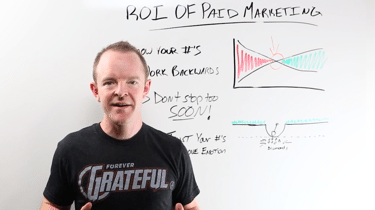
    What we’re going to do is we’re going to walk through a real example here, we’re going to map out your numbers, and we’re going to take it so your marketing turns from the red negative to the green positive. This point right here, this is what we call the inflection point in your marketing.

    Almost every time, you’re always going to have this ramp-up period. You’re going to have a period where it’s not giving you much of an ROI. With pay-per-click marketing, it’s going to take some time to get that optimized so your ROI, your return on investment, is where you want it to be.

    With search engine optimization, you’re going to be investing a lot of time and money if you’re hiring someone else to do it for 3, 4, 5, 6, 7, 8 months before you hit the inflection point and your rankings go up in Google and you start to get those leads and deals.

    We have to be long term focused. We cannot be short-term focused on our marketing, and we need to really be shooting for that inflection point, your break-even point, then from there, your profits start to really skyrocket.

    What we’re going to do is we’re going to work some numbers here. We’re going to work backward. And, we’re going to make sure you don’t stop too soon because now you’re going to know your numbers. That will help you so you trust your numbers and get emotion out of it.

    roi of paid marketing calculations

    Working The Numbers…

    Let’s start. If you’re a real estate investor let’s just work with wholesalers. What is your average profit per deal? Let’s assume that your average profit per deal is $10,000 in your market. So, we know that if you do a deal, you make $10,000. Now let’s work backward. How many leads does it usually take for you to close that one deal?

    The average for Carrot members, for online leads that are generated through our platform, is about 10-15 leads per deal right now.

    If you’re doing direct mail it’s about 20-40 leads per deal. If you’re doing pay-per-click it’s probably 15-30 leads per deal. We’re just going to run with 15 leads per deal for this example.

    Working backward, we know that we need to get 15 leads so we can get $10,000.

    If you’re doing pay-per-click marketing and you already have a campaign going and optimized, how much is it costing you to get a visitor to your website and how is your website converting?

    If you’re in a really hot market like a south Florida or LA or Portland, Oregon, websites, in general, are going to be converting lower than websites in a moderate market. If you’re in Birmingham or Louisville or something like that, your website for motivated sellers is going to convert higher than a hot market.

    So, don’t look at your friend in Kansas if you’re in LA and go, “Oh my gosh, my buddy’s getting a 10% conversion rate on his seller site, I’m only getting 3. What’s going on?” It’s probably your market, not your website if your website is set up the way that we teach.

    Now let’s work with a conversion rate. We’re going to do a 10% conversion rate. It takes 15 leads to close a deal, and then you’ve got your $10,000 profit. To get 15 leads, we’re going to need to get 150 visitors to our website. Your only goal now is how do I get 150 qualified people to my website? 150 people equal $10,000 to me.

    Let’s say you’re doing Google pay-per-click or something like that and you’re getting 150 visitors, costing you $2 a click. On average that’s going to be $300. Once again in this hypothetical situation, you need to having a marketing budget of at minimum $300. If you’re in a market where it’s going to be a lot more than $2 a click, say it’s $10-15 a click like a lot of markets are, you need to start adding those numbers up.

    Let’s say it’s $10 a click. Now that’s a $1,500 budget. $1,500 in order to get 15 leads, in order to get your $10,000 profit. Now the numbers are really starting to make sense, so those of you who are giving up after you put in $500 in your pay-per-click marketing, you need to be stretching all the way to your max budget. Give yourself a chance to let your numbers work for you.

    I think everyone watching this video will easily trade $1,500 for $10,000. If you won’t … please examine yourself because you need to be working the numbers like this.

    You cannot be going, “Okay, I want to invest $300 to get $20,000.” You need to be really thinking about those numbers in a big way because if you’re not, your competition is. If you’re in a market where you’re only willing to invest $400 to get a $10,000 deal but your competition is willing to invest $3,000, you’re going to get crushed every time in pay-per-click, every time in Craigslist, every time in SEO, every time in direct mail.

    You’re always going to get crushed because your competition knows their numbers. They’re going to take it up to their max budget, and they still know if they’re going to be able to profit.

    That is how you scale up your marketing. Know your numbers, remove emotion from it.

    1. Find out your average profit per deal first.

    2. Find out how many leads it takes you to close a deal,

    3. figure out your conversion rate on your website- which we can help you. If you’re an InvestorCarrot member we’ll help you with that. Just let us know and we’ll spin up a split test on your site to find out your conversion rate.

    4. Figure out how much it’s going to cost you to get those visitors to your site. Whether it’s through SEO or direct mail or pay-per-click. Figure out what that’s going to cost you to get your 150 visitors to the site using these numbers.

    Ramp Up Your Paid Marketing ROI

    Get out a piece of paper, figure out those numbers for yourself, get those calculations going, and get your return on investment ramped up for your business. Remove emotion from your marketing, go with your numbers, and work backward down the line.

    Sooner than you know it, you’re going to turn from dabbling to crushing it. And, it’s just going to keep on skyrocketing and going up.

    Thank you guys and gals for watching this strategy sketch. Make sure to check out other strategy sketches on our YouTube channel. Go over there, we have lots of great strategy sketches where we answer questions that you guys send in each and every week. Thank you guys and gals, we’ll talk soon.

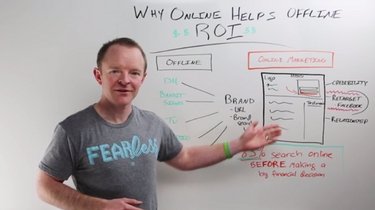
  • High-Converting Real Estate Investor Homepage in 2024: A Lead Generation Powerhouse

    High-Converting Real Estate Investor Homepage in 2024: A Lead Generation Powerhouse

    Are you frustrated by website visitors who browse and never contact you? You’re not alone. Turning lookers into motivated sellers requires a website that works as hard as you do.

    This guide isn’t your typical SEO or CRO jargon fest. We’re revisiting one of our most popular blog posts and injecting it with fresh strategies. We’ll cover data-driven tactics you can use right now to turn your website into a lead generation machine for motivated sellers.

    The CRO-Optimized Homepage Blueprint

    Let’s break down the essential elements of a high-converting real estate investor homepage:

    Anatomy of a High Converting Real Estate Homepage

    Hero Section: A Benefit-Driven Powerhouse for Maximum Conversions

    The hero section is your website’s prime real estate, acting as the first impression that grabs visitors and compels them to take action. Here’s a deeper dive into each element, incorporating data-backed reasoning and specific examples:
    1. Headline: Craft a Compelling Hook That Speaks Their Language

    • Data-driven Reason: Studies by Copyblogger show that strong headlines can increase conversion rates by up to 10%.
    • The Secret Sauce: Focus on benefits, not features. Instead of saying, “We Buy Houses,” a better option is “Sell Your House Fast: Hassle-Free Cash Offer Today.” Speak directly to their pain points (selling a house quickly, avoiding a lengthy process) and highlight the solution you provide (fast cash offer).
    • Specificity is Key: Get even more specific by targeting a particular niche of motivated sellers. For example, “Need to Sell Your Inherited Property Quickly? We Can Help!”

    2. Visual Appeal: Images that Matter

    • The Power of Local: High-quality, local imagery builds trust and establishes a connection with potential leads. Use photos reflecting your service area or showcasing successful deals you’ve closed.
    • Data on Visuals: According to our data, including relevant images in your content can increase views by an average of 82%.
    • Beyond Stock Photos: While professional stock photos can work, consider using genuine images of yourself or your team. This humanizes your brand and fosters trust.

    3. Eye-Catching CTA: The Call to Conversion

    • Color Psychology: Utilize contrasting colors for your CTA button. Studies suggest that red, blue, orange, and green are particularly effective in driving clicks.
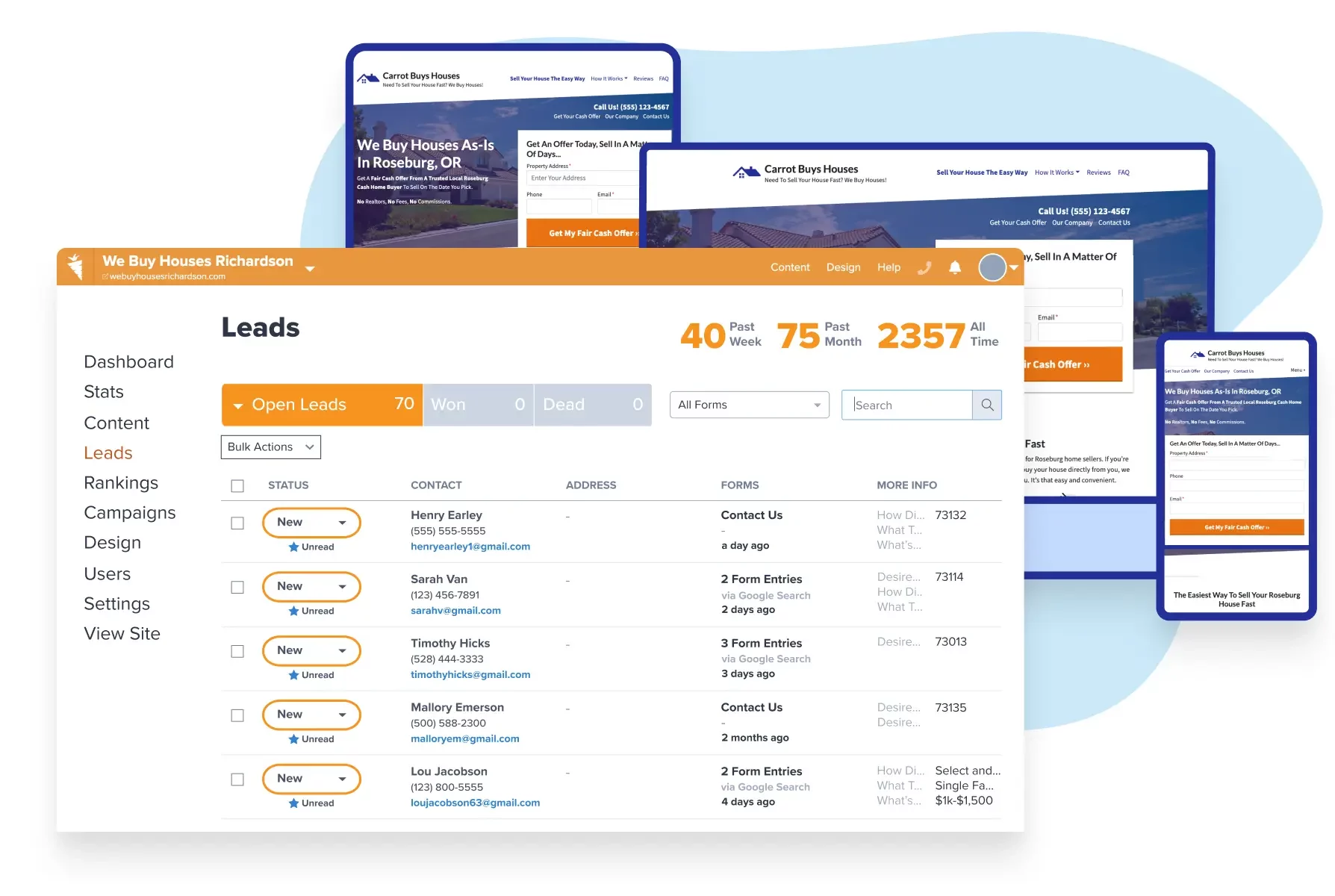
    • Action-Oriented Text: Ditch generic CTAs like “Submit.” Instead, use clear, action-oriented text like “Get Your Free Cash Offer” or “Schedule a No-Obligation Consultation.”
    • Button Size Matters: Don’t make them miss it! Make your CTA button prominent and large enough for easy tapping on mobile devices.

    4. Mobile-First Design: Prioritize the Dominant Viewport

    • The Mobile Majority: Our Carrot data proves over 60% of all web traffic now comes from mobile devices.
    • Seamless Shrinking: Ensure your hero section shrinks and adapts seamlessly for mobile viewing. Text should be easy to read, and buttons should be large enough for easy tapping.
    • Phone Number Visibility: Prioritize phone number visibility in the hero section. Ideally, it should be clickable for one-tap dialing on mobile devices. This removes friction and allows motivated sellers to connect with you instantly.

    Bonus Tip: A/B Testing is Your Friend

    Don’t settle for assumptions! Utilize A/B testing tools to compare different versions of your hero section elements (headline variations, CTA button colors, etc.). This data-driven approach helps you identify what resonates best with your target audience and maximizes conversions.

    Content that Educates and Converts: Building Trust and Inspiring Action

    The content beneath your hero section serves a crucial role in nurturing leads and guiding them toward conversion. Here’s how to craft compelling content that educates, builds trust, and ultimately converts visitors into motivated seller leads:

    1. Problem-Solution Focus: Speak to Their Needs, Not Just Your Services

    • Understand Your Audience: Conduct thorough market research and identify the specific challenges faced by motivated sellers in your area. Are they facing financial hardship, a looming relocation, or a complicated inheritance?
    • Data on Empathy: According to research, ads that use human emotion are 31% more effective than ads that use traditional tactics, which are only 16% effective.
    • Speak Their Language: Don’t just list your services. Address their pain points directly and use language they understand. For example, instead of saying, “We Offer Fast Cash Closings,” explain how a fast cash closing benefits them: “Get Cash in Your Hand Quickly and Avoid Months of Uncertainty.”

    2. Benefit-Oriented Text: Highlight the Value You Deliver

    • Focus on Outcomes: People are primarily motivated by the benefits they’ll receive. Go beyond simply explaining what you do; showcase how it solves their problems and improves their lives.
    • Data on Benefits Focus: Studies by MarketingSherpa indicate that benefit-oriented content can generate up to 5x more leads than features-focused content.
    • Examples: Instead of saying, “We Buy Houses As-Is,” emphasize the benefits: “Avoid Expensive Repairs: We Buy Your House in Any Condition!” Another example: “Skip the Stressful Listing Process: Sell Your House Quickly and Easily with Our Cash Offer.”

    3. Social Proof: Leverage the Power of Testimonials and Case Studies

    • Building Trust: Positive testimonials and case studies act as social proof, demonstrating the value you deliver to past clients. This builds trust with potential leads who are still considering their options.
    • Data on Social Proof: According to Nielsen, 92% of consumers trust recommendations from strangers more than advertising.
    • Showcase Success Stories: Feature success stories with quotes from satisfied clients. Briefly explain their situation, the challenges they faced, and how your services provided the solution.
    • Data-Driven Results: When possible, quantify the benefits you delivered. Include details like how quickly a house was sold or the amount of money saved by avoiding repairs.

    Remember:

    • Keep it Concise: People are busy, so keep your content concise and easy to read. Bullet points, subheadings, and visuals can improve readability.
    • Maintain a Conversational Tone: Write in a friendly and approachable manner, fostering a connection with your audience.
    • Call to Action: Throughout your content, strategically include CTAs that encourage visitors to take the next step, like contacting you for a free consultation or downloading a valuable guide.

    Strategic Navigation & Essential Pages: Guiding Visitors and Building Trust

    A well-structured website with straightforward navigation allows visitors to find the information they need quickly and efficiently. Here’s how to create a user-friendly experience that fosters trust and guides them toward conversion:

    1. Clear Navigation: A Roadmap for Your Website

    • User Experience (UX) Focus: A clear and intuitive navigation bar is crucial for a positive user experience. Visitors shouldn’t have to hunt for the information they need.
    • Data on Navigation: According to Crazy Egg, 40% of visitors will leave a website if they can’t find the information they’re looking for within the first few seconds.
    • Essential Links: Include a clear navigation bar at the top of every page with easy access to key pages like:
      • Home: This should always be the first link, allowing visitors to return to the hero section quickly.
      • About Us: Build trust and connect with visitors by showcasing your expertise and experience.
      • Services: Clearly explain the services you offer and how they benefit motivated sellers.
      • FAQs: Address common questions and concerns potential leads might have.
      • Contact: Provide multiple ways for visitors to get in touch with you, including phone number, email address, and a contact form.
    • Mega Menus (Optional): For websites with extensive information, consider well-organized mega menus that categorize sub-pages for easy navigation.

    2. Compelling “About Us” Page: Unveiling the Human Touch

    • Building Trust: A well-crafted “About Us” page humanizes your brand and builds trust with potential leads. It allows visitors to connect with you personally and understand your expertise.
    • Data on About Us Pages: Our studies show that “About Us” pages are among the top 5 most visited pages on most websites, indicating strong user interest.
    • Content Elements: Include the following elements on your “About Us” page:
      • Your Story: Share the story behind your business, your motivations for helping motivated sellers, and what sets you apart.
      • Team Bios: Showcase your team member’s expertise and experience. Include photos and brief bios highlighting their qualifications.
      • Testimonials: Integrate positive testimonials from satisfied clients to build trust and social proof.
      • Awards & Recognition: If you’ve received any industry awards or recognition, highlight them on your “About Us” page to demonstrate credibility.

    Bonus Tip: Consider incorporating video content on your “About Us” page. This allows visitors to connect with you on a more personal level and see your passion for helping motivated sellers.

    SEO Optimization for Search Visibility: Attract Qualified Leads Organically

    In today’s competitive online landscape, search engine optimization (SEO) is crucial for driving organic traffic to your real estate investor website. By strategically incorporating relevant keywords, you can ensure your website shows up in search results when motivated sellers in your area are looking for solutions.

    1. Keyword Research: Uncovering the Language of Your Audience

    • Understanding Search Intent: Conduct thorough keyword research to identify the specific search terms motivated sellers in your location are using. Tools like Google Keyword Planner, Carrot’s Keyword Explorer Tool, and SEMrush can be helpful for this.
    • Data on Keyword Research: According to a Backlinko study, websites with strong SEO strategies can generate over 1000% more organic traffic than those without.
    • Target Long-Tail Keywords: Don’t just focus on broad keywords with high competition. Target long-tail keywords that are more specific and have lower competition. For example, instead of targeting “sell my house,” target “sell my inherited house fast in [your city].”
    • Location Matters: Integrate local SEO keywords throughout your website copy to improve local search ranking. For example, include your city and state in your page titles, meta descriptions, and headers.

    2. On-Page Optimization: Weaving Keywords with Care

    • Strategic Keyword Placement: Once you’ve identified your target keywords, integrate them naturally throughout your website copy. This includes:
      • Page Titles: Every page should have a unique and keyword-rich page title that accurately reflects the content.
      • Meta Descriptions: Meta descriptions are short summaries displayed in search results. Optimize them with relevant keywords to entice users to click on your website.
      • Headers: Use H1, H2, and H3 headers throughout your content, incorporating your target keywords in a natural and informative way.
      • Body Copy: While keyword density is important, prioritize natural language and avoid keyword stuffing. Focus on creating valuable and informative content for your audience.

    Bonus Tip: Go beyond traditional keyword research. Explore “People Also Ask” (PAA) or Frequently Asked Questions (FAQ) sections and answer box content on relevant search terms. This allows you to target specific questions motivated sellers might have and position your website as a trusted resource.

    By implementing these SEO best practices, you’ll increase your website’s visibility for relevant search queries. This translates to attracting more qualified leads who are actively searching for solutions you can provide. Remember, SEO is an ongoing process. Regularly monitor your website’s performance, analyze keyword rankings, and adjust your strategy as needed.

    Conclusion: Cultivating a Conversion Powerhouse

    By implementing the data-driven CRO best practices and SEO strategies outlined above, you can transform your real estate investor website from a passive online presence into a powerful lead generation machine. Remember, a successful website is a living entity that requires ongoing optimization and nurturing. Here’s how to ensure your website continues to thrive:

    1. Embrace A/B Testing for Continuous Improvement

    • The Power of Iteration: Don’t settle for assumptions! Utilize A/B testing tools to compare different versions of your website elements. This could include testing variations of your hero section headline, CTA button color, or “About Us” page layout.
    • Data-Driven Decisions: Track key metrics like conversion rates, bounce rates, and time on page. Analyze A/B test results to identify what resonates best with your target audience and make data-driven decisions for future website improvements.

    2. Content Marketing: A Magnet for Motivated Sellers

    • Become a Trusted Resource: Don’t just focus on selling; establish yourself as a trusted resource in your community.
    • Data on Content Marketing: According to the Content Marketing Institute, content marketing generates over 3 times the leads compared to traditional advertising and costs 62% less.
    • Content Ideas:
      • Create informative blog posts that address common challenges faced by motivated sellers in your area.
      • Develop downloadable guides or e-books offering valuable insights on the real estate selling process.
      • Consider video content, hosting webinars, or creating infographics to diversify your content offerings.

    3. Leverage the Power of Online Reviews

    • Building Trust and Credibility: Positive online reviews from satisfied clients act as social proof and build trust with potential leads.
    • Data on Reviews: According to BrightLocal, 84% of consumers trust online reviews as much as personal recommendations.
    • Encourage Reviews: Make it easy for satisfied clients to leave positive reviews on platforms like Google My Business, Yelp, and Facebook.
    • Respond to All Reviews: Take the time to respond to all reviews, both positive and negative. Thank satisfied clients for their feedback and address any concerns raised in negative reviews promptly and professionally.

    Incorporating these ongoing strategies will cultivate a website that not only attracts motivated sellers but also fosters trust, establishes you as a valuable resource, and ultimately converts visitors into leads.

    Remember, a successful website is a journey, not a destination. By consistently applying these strategies and staying informed about the latest trends, you can ensure your real estate investor website remains a powerful Evergreen lead-generation machine for years to come.

  • Wholesaling in Multiple Markets: Strategies for Explosive Growth

    Wholesaling in Multiple Markets: Strategies for Explosive Growth

    Wholesaling across multiple real estate markets doesn’t require a complex website system but rather a strategic approach where your website serves as a central hub to establish credibility, showcase local expertise, and generate leads in each target area.

    Key Takeaways

    • Create location-specific landing pages for each market you serve with targeted keywords, local imagery, and content that demonstrates your understanding of local market conditions.
    • Build trust through transparency by including testimonials from each market, clear contact information, and educational resources that establish your expertise as a wholesaler.
    • Customize your messaging with location-specific calls to action and visual branding elements that resonate with each target market while maintaining consistent overall brand identity.

    By implementing these strategic website approaches, you can transform your online presence from a static brochure into a dynamic hub that speaks directly to each market you serve, overcoming the challenges of appearing relevant and trustworthy in multiple locations.

    Table of Contents

    1. Challenges of Wholesaling in Multiple Markets
    2. Website as Your Central Hub
    3. Website Strategy for Multi-Market Wholesalers
    4. Additional Tips & Considerations
    Carrot icon
    Lead generation, at its best
    Attract, convert & close more motivated leads
    Try Carrot Today

    Imagine Sarah, a young and ambitious real estate investor. Starting in her hometown, she quickly mastered the art of wholesaling – finding undervalued properties, securing them under contract, and assigning those contracts to rehab specialists at a profit. Success came quickly, but Sarah craved more. Limited by her local market, she knew she needed to expand her horizons. Undeterred, Sarah took a calculated leap, targeting several neighboring cities with similar demographics. By leveraging a strategic online presence, she built trust with sellers in these new markets, uncovered a wider pool of deals, and ultimately scaled her wholesaling business to new heights.

    Wholesaling, the process of acquiring properties under contract and then assigning those contracts to a buyer for a fee, is a powerful strategy for generating profits in the real estate market. While success is certainly achievable by focusing on a single market, venturing into new territories offers several advantages. Diversification across economic climates reduces risk, and a wider pool of deals provides more opportunities to find hidden gems. However, expanding your reach comes with its own set of challenges. Building trust with new sellers and buyers, demonstrating local market knowledge, and appearing relevant in each area all require a strategic approach.

    This is where your website steps in as your secret weapon. By crafting a website that speaks directly to each market you serve, you can overcome these hurdles and propel your wholesaling business to new heights. Let’s dive into the specific strategies you need to implement to transform your website from a static brochure into a dynamic hub that fuels your multi-market success.

    Watch this video for deeper insights into wholesaling in multiple markets:

    How to Grow Into Multiple Markets as a Real Estate Investor

    Challenges of Wholesaling in Multiple Markets

    The potential rewards of expanding your wholesaling business to multiple markets are undeniable. Access to a wider pool of deals, diversification across economic climates, and scaling your profits are all exciting possibilities. However, venturing into new territories also presents unique challenges that require a strategic approach. Here are the key hurdles you’ll need to overcome when marketing yourself as a wholesaler across multiple locations:

    • Local Knowledge and Market Nuances: Every market has its own rhythm. Understanding local trends, pricing structures, and even legalities specific to each area is crucial for success. A one-size-fits-all approach won’t work. Without in-depth knowledge of, for example, average renovation costs in a particular market, you risk miscalculating your profit margins or underestimating the rehab potential of a property. This can lead to missed deals or, worse, deals that fall apart during due diligence.
    • Building Trust with Potential Buyers and Sellers in Different Areas: In the wholesaling game, trust is your currency. Sellers need to feel confident that you can deliver a qualified buyer quickly and at a fair price. Buyers need to know you have access to good deals and the expertise to navigate the closing process. Building this trust takes time and effort, especially when you’re new to a market. Without a proven track record and established relationships with local players, convincing sellers you’re the right partner can be an uphill battle.
    • Appearing Relevant and Engaged in Each Market: Wholesaling is a competitive business, and potential clients are bombarded with marketing messages. To stand out, you need to demonstrate that you’re not just a fly-by-night operator. In a new market, convincing sellers you’re genuinely interested in their area and not just here for a quick buck requires a different approach. Simply plastering your generic wholesaling website across new territories won’t cut it.

    Website as Your Central Hub

    The challenges of wholesaling across multiple markets might seem daunting, but fear not! Your website can be the key to overcoming these hurdles and transforming into a central hub for your multi-market wholesaling business. Here’s how:

    • Conquer Local Knowledge with Targeted Content:

    While you can’t be an expert on every market overnight, your website can bridge the gap. Create location-specific landing pages or blog posts dedicated to each market you operate in. These pages can showcase your understanding of the area by highlighting: * Local market trends and data (average sales prices, days on market) * Success stories of past deals you’ve closed in that specific city * Testimonials from satisfied sellers in the area * Information on local resources and programs relevant to wholesalers (investor groups, lenders)

    By providing valuable, localized content, you demonstrate a genuine interest in each market and establish yourself as a knowledgeable resource for potential clients.

    • Build Trust Through Authority and Transparency:

    Your website can be a powerful tool for building trust with potential buyers and sellers. Here’s how:

    Showcase Your Expertise: Dedicate sections of your website to educating visitors on the wholesaling process and the benefits you offer as a wholesaler. Include clear explanations of what you do, the types of properties you work with, and your typical timeline for closing deals. Consider incorporating videos or case studies to showcase your past successes and expertise.
    Testimonials and Social Proof: Positive testimonials from satisfied sellers and buyers in each market you serve are gold. Include these prominently on your website, ideally linked to the specific location pages. Social proof builds trust and demonstrates your track record of success in different territories.
    Transparency is Key: Be upfront about your contact information, service areas, and fees. Having a dedicated “Contact Us” page for each market allows potential clients to easily reach you and fosters a sense of accessibility and local presence.

    • Appear Relevant and Engaged with Tailored Messaging:

    A generic wholesaling website won’t resonate with potential clients in different markets. Here’s how to use your website to appear relevant and engaged:

    Location-Specific Calls to Action: Instead of a generic “Contact Us” form, create targeted calls to action on each landing page that speak directly to the needs of that market. For example, “Get Your Free Seller’s Report – ” or “Find Your Cash Buyer in ” will resonate more than a generic “Sell Your House Fast” option.
    Visual Branding with a Local Touch: Maintain a consistent brand identity across your website but with the flexibility to incorporate subtle visuals that resonate with each target market. This could include using local cityscapes as background images or color palettes that reflect the local aesthetic.

    By implementing these strategies, your website transforms from a static brochure into a dynamic hub that speaks directly to each market you serve. This targeted approach builds trust, showcases your expertise, and positions you as a relevant and engaged player in each area you operate.

    Website Strategy for Multi-Market Wholesalers

    Your website is the cornerstone of your multi-market wholesaling operation. Here’s how to leverage its power to attract sellers and buyers in each of your target areas:

    Content Strategy: Speak the Local Language

    • Location-Specific Landing Pages: Ditch the one-size-fits-all approach. Create dedicated landing pages or blog posts for each market you serve. Titles like “Wholesaling Houses in ” immediately grab attention and demonstrate your local presence.
    • Targeted Keywords: People searching for wholesaling services use location-specific keywords. Research and incorporate relevant keywords for each market throughout your website content. This improves your search engine ranking in each area, ensuring potential clients easily find you.
    • SEO Optimization: Don’t underestimate the power of SEO. Optimize each landing page for its specific location by incorporating local keywords naturally into the content, meta descriptions, and image alt tags. Consider exploring local SEO tools to further boost your visibility in each market.

    Visual Branding: Consistency with a Local Flair

    Maintain a consistent brand identity across your entire website. This builds recognition and trust. However, infuse your website with subtle visual elements that resonate with each target market. Think about incorporating:

    • Cityscapes or Local Landmarks: Use high-quality images of cityscapes or iconic landmarks in the background of your landing pages for each market. This creates a sense of local connection and demonstrates familiarity with the area.
    • Color Palettes: Consider using color palettes that reflect the local aesthetic. This could be a vibrant beach scene theme for a coastal market or a more muted, historical theme for a city steeped in tradition. A subtle shift in color scheme can go a long way in creating a sense of local relevance.

    Calls to Action: Make it Clear What You Want

    Don’t leave visitors guessing about what to do next. Implement clear and targeted calls to action (CTAs) on each landing page. These CTAs should speak directly to the needs of that specific market. For example, instead of a generic “Contact Us” button, use CTAs like:

    • “Get Your Free Seller’s Report – “ – This provides immediate value and positions you as a resource for motivated sellers.
    • “Find Your Cash Buyer in “ – This speaks directly to a seller’s pain point and clearly conveys your value proposition.

    Lead Capture Forms: Segment Your Audience for Tailored Communication

    Utilize separate lead capture forms on each location-specific landing page. This allows you to segment your audience by market, ensuring your communication is relevant and targeted. By capturing location data, you can personalize future emails and marketing messages, building stronger relationships with potential clients in each area.

    Additional Tips & Considerations

    Conquering the digital landscape is just one piece of the puzzle. Here are some additional strategies to solidify your presence as a multi-market wholesaler:

    • Social Media Savvy: Don’t underestimate the power of social media platforms for targeted marketing. Create separate social media profiles or pages for each market you serve. Share location-specific content, engage with local groups and influencers, and run targeted social media ad campaigns to reach motivated sellers and potential buyers in each area.
    • Building Local Relationships: While your website is a powerful tool, there’s no substitute for building relationships with local players. Network with real estate agents, attend local investor meetings, and connect with other wholesalers in each market. These connections can be a valuable source of referrals and provide valuable insights into the local market nuances.

    Conclusion: Your Website – The Hub of Your Multi-Market Success

    The challenges of wholesaling across multiple markets are real, but you can overcome them with a well-crafted website as your central hub. By implementing the strategies outlined above, you’ll create a website that speaks directly to each market you serve, showcasing your expertise, building trust, and attracting a steady stream of motivated sellers and eager buyers.

    Remember, your website is a dynamic tool, not a static brochure. Continuously update it with fresh content, analyze your website traffic for each market, and refine your approach based on the data. You can turn your multi-market wholesaling dream into a thriving reality with dedication and a strategic online presence.