
Category: PPC Marketing

  • 10 Ways to Audit Your Google Ads Motivated Seller Account During-COVID

    10 Ways to Audit Your Google Ads Motivated Seller Account During-COVID

    10 Ways to Audit 
Your Google Ads Motivated Seller Account Post
 COVID

    As we enter a year since the COVID-19 pandemic started, we’re still in a position where we’re not always sure what to do next.

    For most of us, both our personal and business lives were impacted on a level that we’ve never experienced before.

    This impact probably included your real estate marketing and advertising as businesses shifted from growth mode to survival mode.

    As we’re moving out of the peak of the pandemic (let’s hope) many homeowners are still proceeding with caution.

    The good news is, whether you’re starting a new account, reactivating an old one, or scaling up a current Google Ads motivated seller account, we’ve outlined exactly what you need to do to audit your account and move forward without hesitation.

    What State is Your Google Ads Motivated Seller Account In Now?

    Right now, you’re probably within one of these groups… 

    You paused everything in 2020. Now, you’re back in your account looking to start generating leads again. If this is you, then most of your work has already been done. The campaigns have been created. You just need to enable them.

    Or, you may have scaled back your motivated seller campaigns and now you’re looking to rebuild into a larger account structure. This provides an advantage because you have recent data still going for you to base your moves off of.

    Lastly, you might be starting out with a totally new account. This way you get to create the account with a new strategy.

    COVID Google Ads Motivated Seller Account Audit 

    If you have or have had motivated seller campaigns, you know that it’s important to take it slow and do the right thing to your account or you’ll end up wasting budget. 

    Let’s take a trip through the items of your account that you should revisit so you can get back up and running properly.

    1. Adjust Your Budgets

    What you’re looking to spend may be different from what your budget was pre-COVID.

    Take a little time to review what you spent pre-COVID, during the past year, and what your spend goals are going to be post-COVID.

    How do you know what you should set your budgets to now?

    First, you know your market better than anyone. If you’re coming into a hot market, then you might want to increase your budget. If you feel your market is still a little timid, then back it off a bit.

    Next, you can use Google’s Budget Recommendations, or use a recommended formula based on what your monthly spend expectations are for the year and projected ROI.

    Then you can break down how much you’ll have to play with for daily budgets by using Google’s calculation:

    Monthly Budget divided by 30.4 which is the average number of days in the month = Overall Daily Budget

    If you’re running multiple city-specific campaigns, you might need to create a shared daily budget or stick with one area as you get a back into the swing.

    2. Evaluate and Set Realistic Goals

    Your performance metrics might look a little different from previous years, therefore it’s valuable to evaluate where your account performance was and set realistic goals for 2021.

    Focus your review on what means the most to you. For most investors, lead volume and cost per lead are the two most valuable metrics.

    You can use that data to set some benchmarks to get an idea of where you should be landing in terms of future performance. Factor in market conditions and market confidence.

    You could come to the conclusion that you’ll need to expect less leads at a higher cost per lead for the near future.

    3. Make Sure Your Bid Strategy Aligns with Your Goals

    You’ll need to ensure that your campaigns have a bidding strategy that aligns with your goals and metrics.

    We’re still big on using manual bidding, but if you’re using one of Google’s automated strategies, here are some things to keep in mind.

    For example, it’s not wise to use one of the conversion-based strategies such as Target CPA if you don’t have recent conversion data for Google to optimize off of.

    Keep in mind that certain bidding strategies, like Target CPA, have a minimum historical data requirement in order to use them with some effectiveness.

    If you’re starting out with a new account, with limited data, you should default to manual bidding or if you really want to use an automated strategy, stick with Maximize Clicks.

    4. Double Check Target Locations

    Where you choose to target will impact your reach as well as your spend. For example, if you were targeting all of a specific county before COVID when you had a higher budget, you might want to now scale it back to just a specific city within the county to align with a smaller monthly budget.

    Overall, you can restrict your location targeting based on your 2021 goals and budgets.

    5. Keyword Deep Dive – Pause or Add Keywords

    Don’t be afraid to pause keywords! We’re in times where some motivated seller keywords aren’t as hot as they once were or might be in the future. If your historical data shows keywords that drove leads in the past, but have become slow now, you can always revisit them at another time.

    In any market, every penny counts. No one likes to waste money but during uncertain markets, understanding your goals and how many leads are really possible, right now, will help you manage your keywords.

    So, pause any underperforming keywords and keep the keywords most relevant to your updated goals. This will help keep your accounts organized as well as ensuring that you are spending your money on the keywords that have the highest confidence levels.

    There could also be an opportunity to add keywords. You can use tools such as the Google Keyword Planner or as simple as Google Suggest. These two tools can be great places to check as you refresh your account so that you can keep your expectations as well as your bids working with your budget while using the top converting keywords.

    6. Edit Your Ad Copy and Messaging on Your Landing Pages

    Don’t forget your ad copy. In this current time, your market might present opportunities to test new ad copy. Align with your audience.

    For example, if your market currently has a “virtual” feeling, test something like “100% Virtual Sale” or “We Do Not Need to See Your House in Person”.

    In other words, take advantage of your market conditions and how people are thinking right now.

    If you have a new site or are using a past site, use that same language on your landing page as you do in your ads.

    Refreshing your ad copy and landing pages will not only bring things back up to date, but also give your audience a new look and messages that connect with them more than ever.

    7. Pause Underperforming Ads, Ad Groups, or Even Campaigns

    Similar to the keywords, you may want to look for opportunities to trim your account upon reactivating it. Pause any underperforming ads, ad groups, or even go as far as campaigns.

    Again, markets during COVID have looked different than before.

    You may experience heavy lead months followed by slow months. That’s why it’s important to use data and stay calm.

    If you have a good lead month followed by a bad month, it’s not necessarily a Google Ads issue. We have found that some markets have fluctuated heavily even month-to-month.

    Prioritize what aspects of your business are the absolute most important to advertise and pausing out anything that isn’t necessary.

    Find what is driving up your cost-per-lead and weed through those to ultimately get to the highest performers.

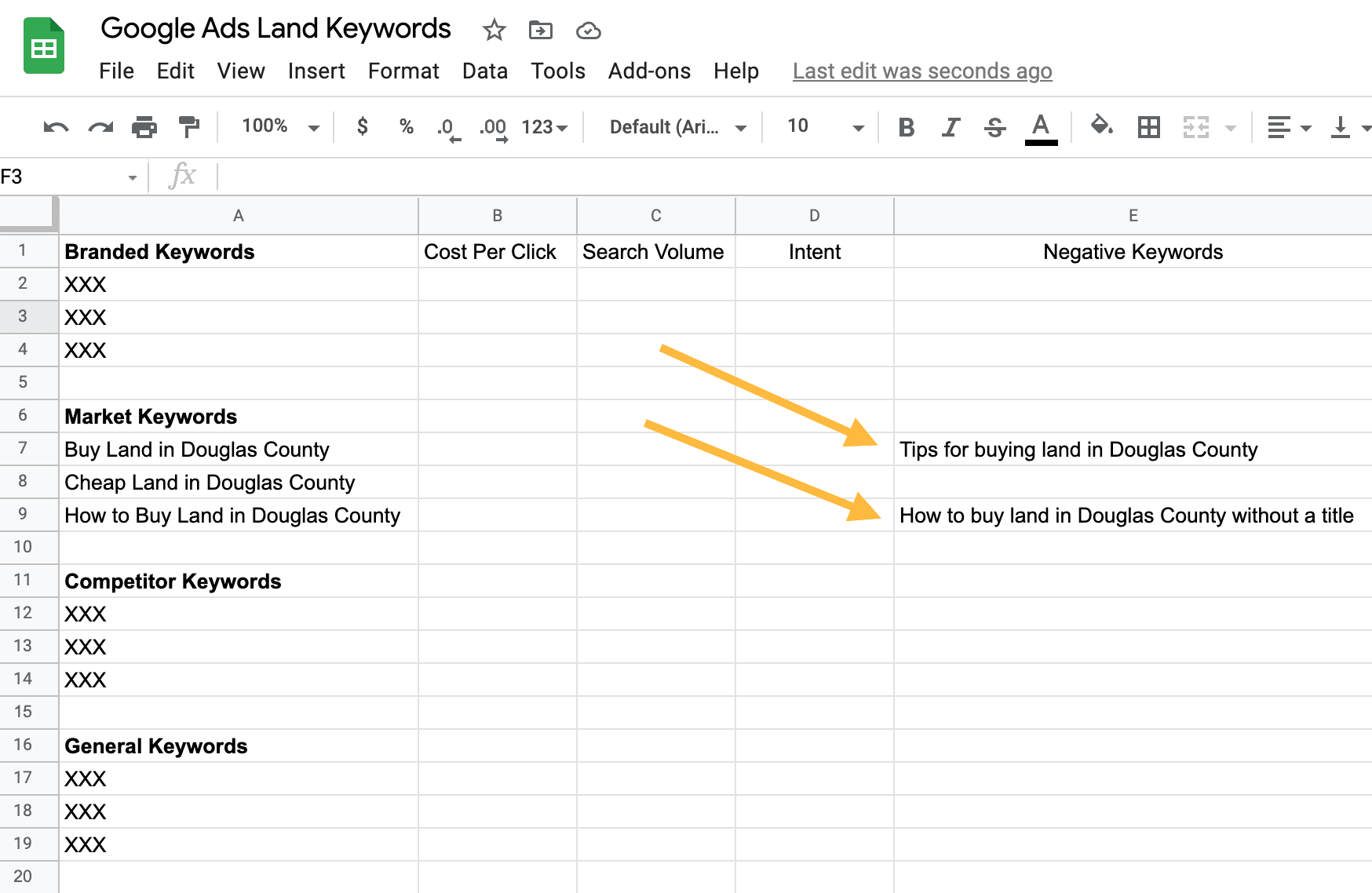
    8. Keep Adding Negative Keywords

    Between Google’s new match type changes and the always changing searcher intent, it’s important to stay on top of your negative keywords.

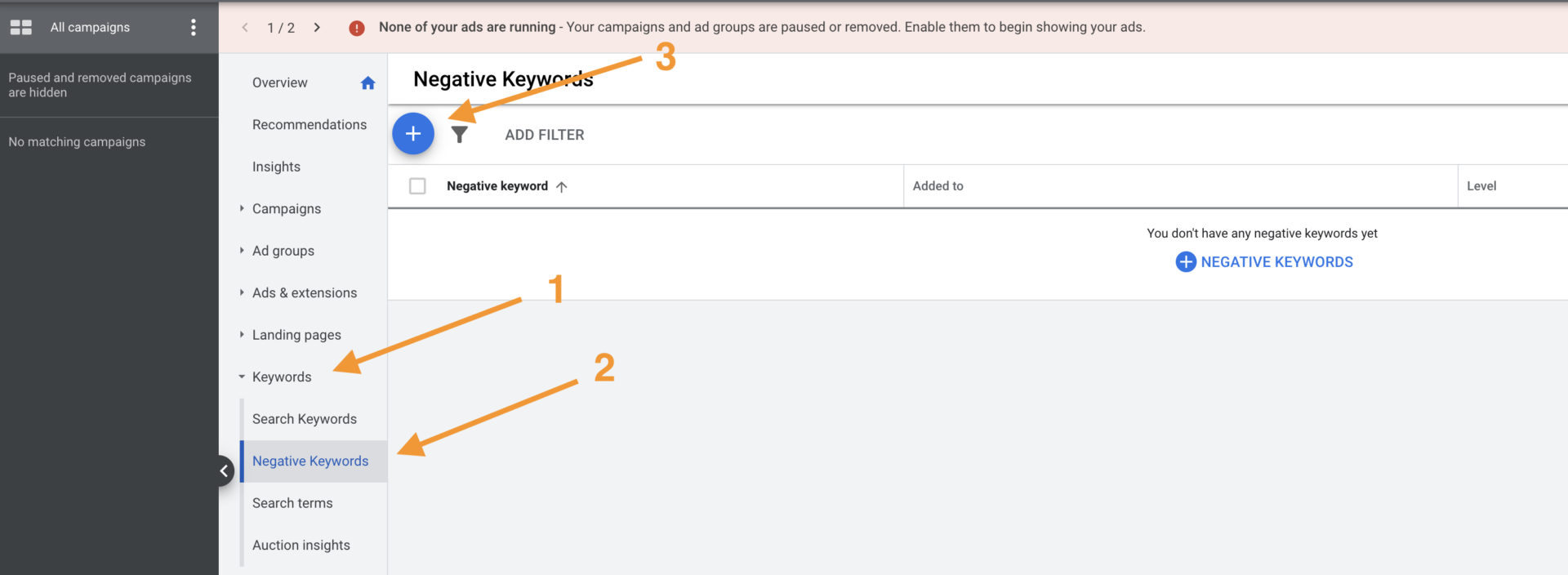
    Review the Google Search Terms report to see what queries you’ve shown up for and ensure you have your negative keywords added and up to date.

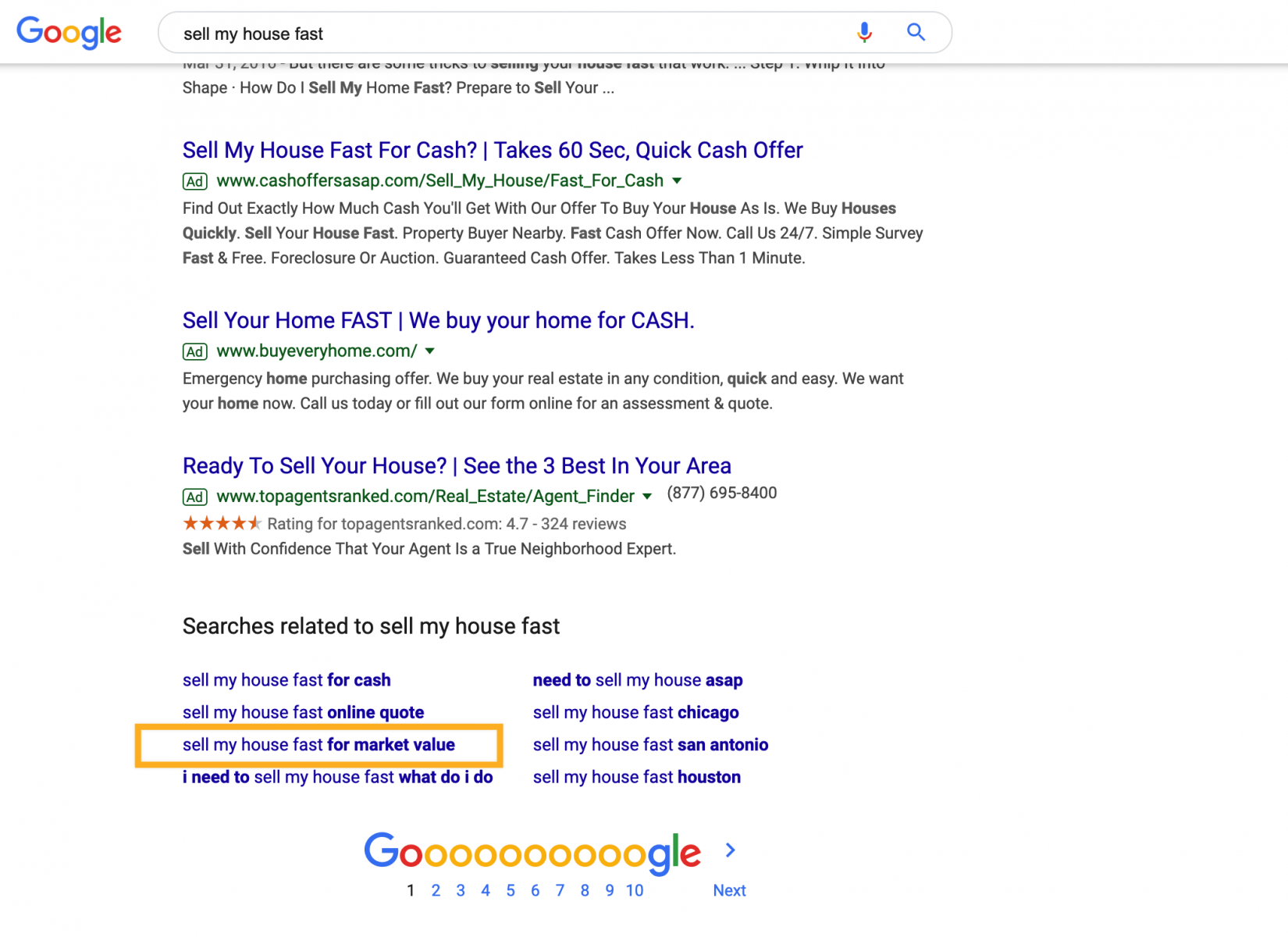
    We’ve seen some markets shift to more “sell my house fast online” and “sell house by owner fast” queries. Even though these seem to be motivated queries, some markets are noticing clicks going up but leads are not following.

    During COVID, when you see trends such as these, don’t be afraid to add a negative keyword to a good term. You can always remove it in more normal market conditions.

    Grab a free negative keyword list for motivated sellers.

    9. Double Check Your Conversion Tracking

    If you haven’t been dedicating time to your Google Ads account, then it might be a good idea to double check your conversion tracking as well.

    Possibly over the course of a year, you’ve made some changes to your website that could have impacted your tracking. Or, maybe you’ve changed your phone number so you’ll need to adjust that within your Google Ads account.

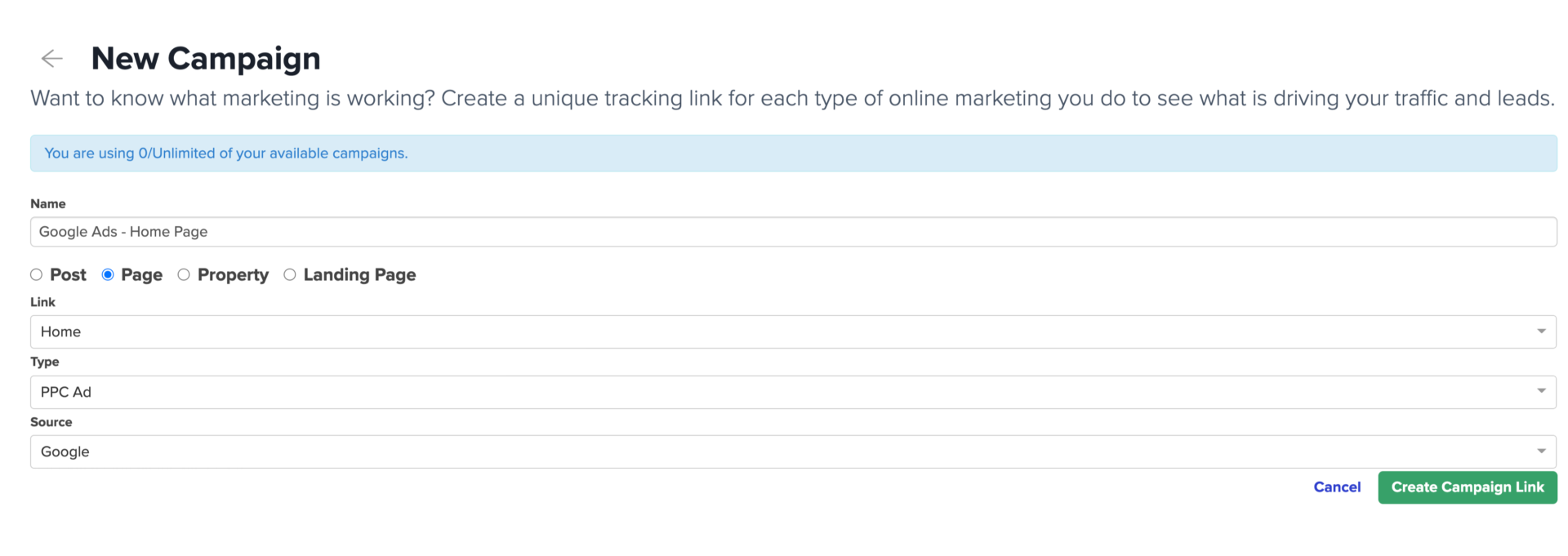
    Here’s how to be sure your Google Ads conversion tracking is set up correctly.

    10. Spy on Your Competition with Auction Insights

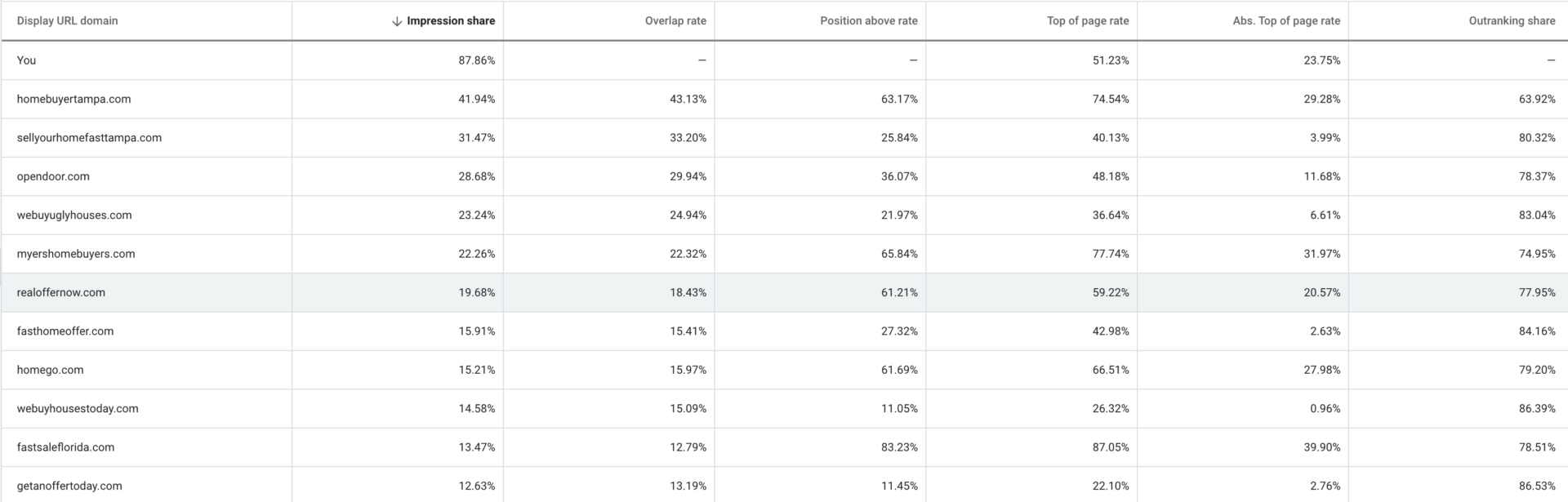
    Whether your account has been paused for a while or it’s currently active, you can also leverage the Auction Insights report of Google Ads to further investigate the climate of your market.

    Auction Insights breaks down who else is on the search results page most often along with you.

    So, if you’re wondering if new investors have emerged into your area since COVID-19 or if you’re curious to see who is outbidding you, this is the place to start.

    Auction Insights not only tells you who else’s ads are alongside yours but also where on the page they rank, above “Position Above Rate” or below you “Outranking Share.”

    Spy on Your Competition with Auction Insights

    Audit a current Google Ads motivated seller account or reactivate your account with confidence

    Whether you paused, scaled back, or are starting fresh, there are items to be evaluated with current or reactivated Google Ads motivated seller accounts during the pandemic.

    Let’s review the steps covered in this post:

    1. Adjust Your Budgets
    2. Evaluate and Set Realistic Goals
    3. Make Sure Your Bid Strategy Aligns with Your Goals
    4. Double Check Target Locations
    5. Keyword Deep Dive – Pause or Add Keywords
    6. Edit Your Ad Copy and Messaging on Your Landing Pages
    7. Pause Underperforming Ads, Ad groups, or Even Campaigns
    8. Keep Adding Negative Keywords
    9. Double-check your conversion tracking
    10. Spy on Your Competition with Auction Insights
  • We Analyzed 50+ Google Ads Accounts: Here Are The Best PPC Keywords for  Motivated Seller Leads [DATA]

    We Analyzed 50+ Google Ads Accounts: Here Are The Best PPC Keywords for Motivated Seller Leads [DATA]

    When you spend money on Google Ads, you want those ads to consistently drive motivated sellers to your website. But what are the best PPC keywords for motivated seller leads?

    Well, that’s what we’re going to show you. We just compiled five years’ worth of Google Ads keyword data — 29,000 keywords and 217,416 clicks from over 50 Google Ads accounts.

    Of course, there are a lot of different PPC keywords for motivated seller leads, so as a part of our criteria for this report, we are only sharing keywords that:

    • Had at least an 8.15% conversion rate
    • And a cost per lead of $250 or less

    Before we proceed, a few important points to consider provide a better understanding of these keywords.

    • All campaigns utilized the Google Ads Search Network with manual bidding.
    • Although these keywords have shown performance across more than 50 different markets in the United States and Canada, it’s essential to note that results may vary. It’s advisable to include various other keywords and match types in your Google Ads account, as they can also generate motivated seller leads.
    • Additionally, it’s crucial to account for market fluctuations. What may have been a successful keyword last year might yield different results this year.
    • For accurate measurement, we relied on conversion tracking implemented on all sites. To our knowledge, all Carrot sites had reliable conversion tracking. If you’re uncertain about the accuracy of your conversion tracking, we recommend reading our conversion tracking blog post to learn how to ensure its correctness.

    Let’s dive into the 20 best PPC keywords for motivated seller leads based on their conversion rates and cost per lead.

    Top 20 PPC Keywords for Motivated Seller Leads

    What Are the Best PPC Keywords for Motivated Seller Leads?

    If mastering keyword bidding were easy, many of us here at Carrot would be out of a job.

    There are three challenging aspects to consider regarding keywords: volume, cost, and quality. Naturally, you want your keywords to generate high search volume, which means more ad exposure and opportunities to capture leads.

    However, with high search volume also comes many people who have no interest in your service. Attracting clicks from individuals who will never convert is far from ideal, especially when you’re paying for each click. Search advertisers must be cautious with broad keywords and make the most of long-tail keywords.

    While it’s true that broad match keywords often have a lower cost-per-click, most Google Ads members want to invest their money in what works.

    That’s where long-tail keywords come into play. These keywords target a smaller but highly relevant audience along the intent scale. Bidding on these keywords is crucial for advertisers who want to minimize wasted ad spend.

    Don’t underestimate the power of negative keywords. They are truly fantastic! Negative keywords allow you to exclude searchers who have demonstrated no interest in your company, preventing their clicks from draining your budget.

    For example, if you’re seeking motivated sellers and have no interest in retail properties, showing your ads doesn’t make sense when someone searches for “what’s my house worth.” By adding this term as a negative keyword, you’ll immediately notice the difference it makes.

    In summary, finding the best PPC keywords for motivated seller leads requires a strategic approach that balances volume, cost, and quality. Utilizing long-tail keywords and leveraging negative keywords will help you attract a more relevant audience and maximize the return on your advertising investment.

    Top 20 PPC Keywords for Motivated Seller Leads

    1. “sell my house” – phrase match
    2. [we buy ugly houses] – exact match
    3. “sell my house” – phrase match
    4. “we buy houses” – phrase match
    5. how to sell the house fast – broad match
    6. need to sell house quickly – broad match
    7. [we buy houses] – exact match
    8. [sell my house] – exact match
    9. sell house for cash – broad match
    10. “sell my home” – phrase match
    11. “sell your house for cash” – phrase match
    12. “sell your house” – phrase match
    13. “home investors” – phrase match
    14. “sell house online” – phrase match
    15. “ugly houses” – phrase match
    16. “we buy homes: – phrase match
    17. “sell my home for cash” – phrase match
    18. “sell my house ” – phrase match
    19. “we buy ugly houses” – phrase match
    20. “companies that buy houses” – phrase match

    How To Find More PPC Keywords for Motivated Seller Leads

    Want to find your keywords? We recommend at least trying some of the keywords within this post, but if you’re deadset on doing your research, you can use Google’s Keyword Planner and Google Ads Search Terms Reports.

    Is Google Ads Worth It for Real Estate Investors?

    Google Ads can still be very worthwhile for real estate investors. It offers numerous benefits, such as targeting and reaching motivated leads, a pricing model based on performance, and easy tracking of return on investment (ROI). However, some disadvantages can be overcome with specific strategies.

    If budget concerns you, you can avoid direct competition with larger competitors by focusing on more specific, long-tail, or localized keywords. This approach can help lower the cost of bidding on highly competitive keywords related to motivated sellers.

    While these keywords may not have the same level of demand as others in your market, they can still effectively drive higher-converting traffic to your website.

    Robert manages his campaign. He’s successful because he uses the right keywords within his account. He doesn’t need 1000s of keywords but sticks with a small batch of the most effective.

    Google Ads Testimonial

    “In 2017 we wanted to shift our real estate business from a standard brokerage model to an investments model that flips homes. We didn’t know quite where to start. After some research, we found Carrot and got our websites up and running.

    We needed to start bringing in leads and had Brendan set up our Google PPC. Our business skyrocketed inside of just a few months.

    Google PPC has provided us with consistently high-quality leads. Inside of just 2 years, we doubled our business revenue. We couldn’t have done it without the Carrot team and especially Brendan setting up our Google ads. Thank You!”

    – Robert Grand

    How to Increase Google Ads Conversion Rate

    First, let’s clarify what a conversion rate is. The conversion rate for specific PPC Keywords for motivated seller leads refers to the number of people who click on an ad using that keyword and successfully convert, divided by the total number of people who clicked through.

    Calculating the conversion rate is relatively simple. You need to divide the number of conversions within a given time frame by the total number of visitors to your site and then multiply that by 100%.

    Conversion rate = (conversions / total visitors) * 100%

    For example, if your motivated seller site had 292 visitors and 21 conversions last month, your conversion rate would be 7.19%.

    To increase Google Ads conversion rates for real estate investors targeting motivated sellers, here are five key strategies:

    1. Refine your keyword selection: Choose relevant and specific keywords that align with the intent of motivated sellers. Utilize long-tail keywords to target a more qualified audience and minimize wasted ad spend. Additionally, consider negative keywords to exclude irrelevant searches and improve targeting.
    2. Optimize landing pages: Create high-converting landing pages that align with the messaging and expectations set by your ads. Ensure your landing pages provide value, address the needs of motivated sellers, and make it easy for them to take action. Use compelling copy, engaging visuals, and clear call-to-action buttons to encourage conversions.
    3. Test ad copy variations: Experiment with different ad copy variations to identify what resonates best with your target audience: test headlines, descriptions, and calls-to-action to find the most effective combination. A/B testing can help determine the optimal ad copy that generates higher conversion rates.
    4. Implement ad extensions: Take advantage of ad extensions to provide additional information and enhance the visibility of your ads. Sitelink extensions, call extensions, and structured snippets can improve the user experience, increase ad relevance, and drive more qualified clicks. Utilize these extensions strategically to highlight unique selling points and encourage conversions.
    5. Leverage retargeting: Implement retargeting campaigns to reach users who have previously interacted with your ads or website. By staying top-of-mind and re-engaging potential sellers, you can increase conversion rates. Tailor your retargeting messages to address specific pain points or offer incentives to encourage motivated sellers to take the desired action.

    Remember continuously monitor and analyze your campaign’s performance, make data-driven adjustments, and optimize your Google Ads strategy to maximize conversion rates over time. Data transformation is a critical step in this process, as it allows you to import insights from your campaign’s performance metrics, helping you refine your Google Ads strategy and ultimately achieve higher conversion rates over time.

    Check out these 13 ways to stand out from the competition and increase conversion rates.

    Once you get Google Ads and your website dialed in, you can achieve a steady flow of quality leads…

    consistent Google Ads motivated seller leads

    Note About Conversion Rate

    It’s important to remember that while Google Ads will drive traffic to your website, that doesn’t guarantee conversion or a consistent lead flow. You’ll also need to ensure that your website or landing page (wherever you send people after they click on your ad) is set up to convert. Carrot websites are built with the highest conversion rates in the industry, and you can try us risk-free for 30 days.

    Cracking the Google Ads Auction: Unveiling the Process

    It helps to understand how Google Ads determines which ads should show during an auction, which takes place every time someone searches on Google or visits a site that shows ads.

    The Google Ads auction process can be summarized in the following steps:

    1. Advertiser Bids: Advertisers participating in the auction set bids for specific keywords or placements. They indicate the maximum amount they are willing to pay for a click on their ad.
    2. Quality Score Evaluation: Google evaluates the quality of the ads and landing pages associated with the keywords. Factors considered include ad relevance, expected click-through rate, landing page experience, and ad formats.
    3. Ad Rank Calculation: Ad Rank is determined by multiplying the maximum bid by the Quality Score. Ad Rank determines the position of an ad on the search results page or other ad placements.
    4. Ad Placement: When a user enters a search query or visits a webpage that triggers an ad, Google looks at the Ad Rank of all eligible ads. The ad with the highest Ad Rank typically gets the top position, and subsequent ads are placed in descending order.
    5. Ad Display and Cost: If an ad is clicked, the advertiser is charged based on the cost-per-click (CPC) bid. The actual CPC paid by the advertiser may be lower than the maximum bid and is influenced by factors such as competition and the ad’s Quality Score.

    It’s important to note that the auction process occurs in real-time for each search query or ad placement, ensuring that the most relevant and valuable ads are displayed to users while maximizing the advertiser’s ROI.

    You can learn more about how bidding on keywords can help you create a cost-effective campaign.

    Google Ads Testimonial

    “Hey Trevor, Just wanted to let you know what a great program you have set up for me. My web page went live the first week of July this Year. I received 5 leads after the 2nd week with a Little PPC campaign on Google.

    I spoke and met with 3 Motivated Homeowners that week. I put 2 Homes under contract that week. I sold both homes to a local investor at $30k profit on each home. I also will resell the renovated home at 3% of the sell price of about $700k each.

    Thank You for a great program In just over a Month I put under contract 2 Homes with over $100k profit. Can’t wait to see what the next few months brings.

    Thank You Again”

    – Roy Franklin

    Conclusion

    Many real estate investors are skeptical about using Google Ads due to concerns about cost. There are indeed risks involved, and the monetary investment can be substantial. Some markets may require monthly budgets ranging from $5,000 to $10,000, and the average cost per click on Google Ads is around $10 to $20.

    Now, I’m not suggesting that you need to have such a high budget. However, I recommend investing a minimum of $1,000 per month (for smaller markets) to $3,000 per month and giving it at least 2-3 months to see tangible results.

    It’s important to acknowledge that a certain level of risk is involved, as with any advertising campaign. But if your campaign is successful, the potential rewards are significant.

    If you’re worried about not having the expertise to use Google Ads effectively, don’t be. You don’t have to be an expert yourself. Let us assist you with our Google Ads QuickStart service.

    With this service, you’ll receive:

    • Assistance from Google Ads Certified Professionals who will set up your account
    • Lead tracking to keep you informed about the number of leads generated for your business
    • Keyword research with match types
    • Conversion tracking
    • Installation of retargeting tags
    • Mobile-optimized ads
    • Geo-targeting
    • Ad extensions such as Sitelinks, Callouts, Calls, and Structured Snippets
    • Lists of negative keywords to refine your targeting
    • Initial optimization of keyword bids

    Discover more about this service and how it can benefit your business today!

  • Google Ads Update to Broad and Phrase Keywords

    Google Ads Update to Broad and Phrase Keywords

    In 2022, Google announced that it would simplify Google Ads match types. This post explains what this means and what you’ll need to do to your Google Ads accounts.

    Google recently made improvements to keyword matching technology and rules on how it selects keywords in your account.

    This Google Ads update is designed to help:

    • Control which keywords match a search query.
    • Reduce account complexity by giving more control over traffic without managing multiple match types.
    • Allow you to attract more qualified and high-performing traffic using fewer keywords easily.

    Here’s what Google’s announcement means.

    Change: The BERT algorithm has improved keyword matching precision

    BERT algorithm technology interprets language, queries, and search intent. This applies to keyword match type behavior. This makes keywords, particularly broad match type, more predictable and aligned with the search intent. 

    Change: Exact match type data also applies to broad and phrase match types

    To understand this change, we need to refresh our memory about some big changes in early 2022. Google retired modified broad match keywords and announced it will prefer exact match keywords that are identical to the search query. 

    Now the same logic that applies to exact match keywords will apply to broad and phrase match. If your ad group doesn’t have an exact match keyword that is the same as the search query but has broad or phrase match keywords identical to the query, Google will prioritize the broad and phrase keywords that exactly match the search query.  

    Here’s an example:

    If someone searches for house buyers near me and you’re targeting broad match house buyers and broad match house buyers near me, the identically matching broad match keyword house buyers near me will be preferred unless you’re targeting exact match house buyers near me, in which case the exact match will be served.

    Change: If you have multiple keywords and match types that are relevant, but not identical, to the search query, Ad Rank will not be the only deciding factor

    If keywords are relevant to a search query, but none are identical to it, Google will not just use Ad Rank, but Ad Rank plus other relevance signals to determine the keyword it serves. “Other relevance signals” include the meaning and intent of the search term and the meaning of your targeted keywords based on their associated landing pages. 

    Here’s an example:

    If someone searches “fast house buyers near me” and you are targeting the phrase match fast house buyer and the broad match house buyer, Google will select the phrase match keyword because it’s more relevant, even if it has lower Ad Rank than the broad match keyword.

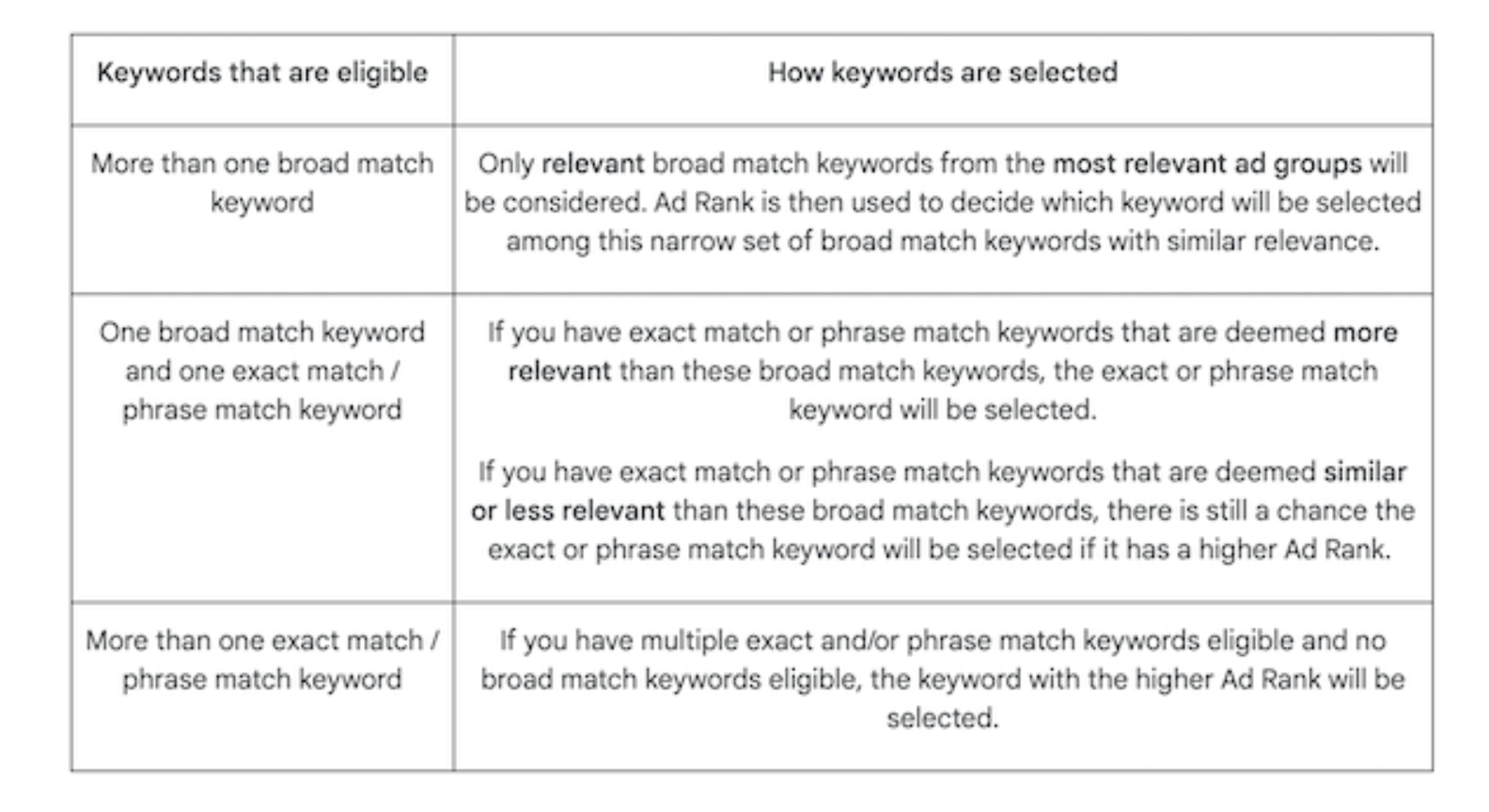
    Google states, “These rules ensure that the most relevant keyword will always be prioritized, so you can more easily use broad match and still maintain control.” Google provided the chart below to illustrate this logic.

    Additional Points

    Previously, we’ve directed members about using the same keywords with multiple match types to identify the highest-performing keywords. Google is saying this is not necessary any longer. 

    You can get more “qualified” traffic using fewer keywords 

    This is only what Google is saying. With these improvements, it’s possible to maintain better control over which keywords match a query. This is especially true with broad match keywords. This should “reduce account complexity” and eliminate the “extra work” of using multiple match types to control where traffic goes in your account.

    You should create “thematically” consistent ad groups

    Google suggests to “group keywords into thematically consistent ad groups so your ads will serve from the ad group you expect them to.”

    A basic example can be, if you’re an investor and inherited and cash are your most popular searches, you would create two ad groups:

    • One ad group with creatives for selling an inherited house.
    • A second ad group with creatives for selling for cash.

    If you’re pairing broad match keywords with a Smart Bidding strategy, there’s no longer a benefit to using multiple match types 

    What this means is that since broad match keywords are now more precise and predictable, plus they now follow the same logic as an exact match, you can target the appropriate broad match keywords and get the same results as you would if you targeted the phrase and exact match version of that keywords.

    Google says… “Also note that when you use broad match with Smart Bidding, there’s no benefit to using the same keywords in multiple match types. Broad match already covers the same queries and improves performance with real-time bid optimization.”

    What Does This Mean for Real Estate Agents and Investors?

    Test different match types. Even going as far as creating broad match experiments.

    We’ve always recommended taking Google’s messaging seriously but also with caution. Historically, broad match keywords have caused more wasted spending in real estate campaigns than they have lead generation.

    If what Google is promising, broad match keywords might be the future. Just monitor your account and make adjustments to keep quality searches high.

    Changes to Consider Making Now

    To help you get the most out of these upcoming changes, we suggest the following best practices:

    • Monitor performance and shift budgets where necessary: Traffic may fluctuate due to these changes, so make adjustments as needed.
    • Regularly check your “Recommendations”: Check the “Add new keywords” to maintain keyword coverage and “Remove redundant keywords,” which helps you consolidate duplicate keywords.
    • Continue to use negative keywords: Exclude matches you don’t want with negative keywords.

    Moving Forward

    We’ll monitor these new policies and send updates as they become available.

    For now, it’s important to be aware of these changes. This at least gives you an idea of what some recent changes mean.

  • How to Resolve Google Ads Limited by Budget Status In Your Real Estate Campaign

    How to Resolve Google Ads Limited by Budget Status In Your Real Estate Campaign

    If your real estate Google Ads campaign is getting the “limited by budget” notice, you’re probably asking yourself some questions:

    • Should I trust Google?
    • Are they just trying to get more money from me?
    • What can I do?
    • Is Google Ads even worth it on a limited budget?

    If you are limited by budget, you’ll likely not get as many clicks as possible if you have more to work with.

    Here’s a real-life comparison of a Google Ads account for motivated sellers who took a budget from $55.92 to $16.67 daily.

    $55.92 per day budget: 14-Day Period:

    • Leads: 6
    • Clicks: 56
    • Impressions: 1836
    • Spent: $671.27

    $16.67 per day budget: 14-Day Period:

    • Leads: 1
    • Clicks: 16
    • Impressions: 452
    • Spent:  $292.24

    As you can see, the drop in daily budget can significantly impact accounts.

    When your account is limited by budget, it’s as if you are trying to withdraw money from a bank account with no funds.

    That means Google has to wait until more money is available to be able to show ads.

    In this post, we explore what that “limited by budget” notice means and some strategies you can use to get the most out of your real estate Google Ads campaigns after seeing this message.

    What Does “Limited By Budget” Mean?

    The Google Ads support guide states that your campaign status is “Limited by Budget” which means:

    “A campaign status used when your average daily budget is lower than the recommended amount. When this happens, ads aren’t regularly showing as often as possible.”

    Simply put, if your keywords and bids could spend more than your daily budget limit, you will get this message.

    Google Ads limited by budget notice

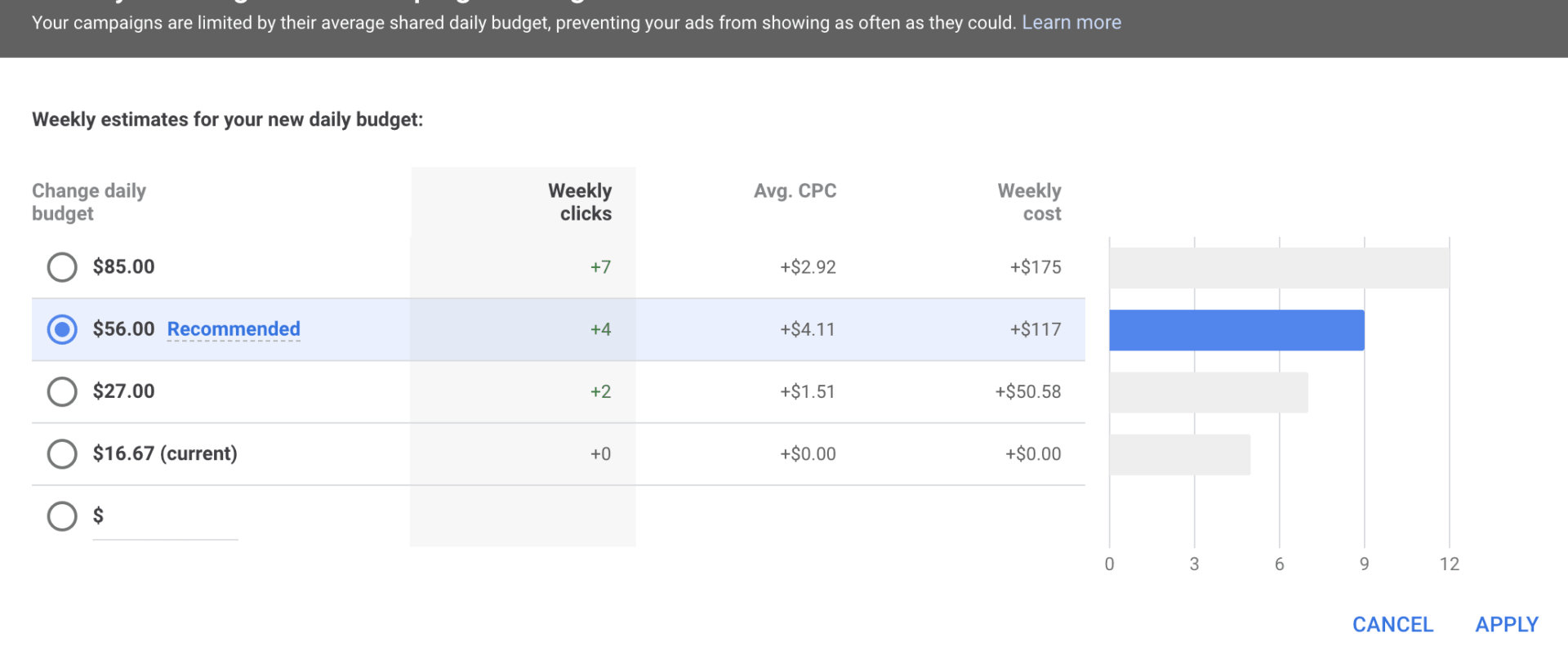
    To see what Google recommends your daily budget be, click on the bar graph icon “Eligible (Limited) Limited by budget” message. You will see a graph like the one below. This can help you understand how much you limit your account and what a new budget might mean.

    Google Ads budget recommendations

    What Happens When Your Real Estate Campaigns Are Limited By Budget?

    Your ad impressions will be lower. Being limited by the budget will impact how often your ads can be shown throughout the day. If you run out of budget early in the day, you’ll have data that don’t necessarily represent the campaign’s health. 

    Your ads will not receive as many clicks. Obviously, your clicks will go down if your ads aren’t getting impressions. From the example above, sometimes you can see a significant dip even in 14 days. We’ve been asked, “Isn’t having fewer clicks a good thing?” meaning “bad” clicks are eliminated. That’s not the case. Even a limited-by-budget campaign can attract clicks that aren’t 100% what you’re looking for.

    Your conversion rates can suffer. Hockey great Wayne Gretzky once said, “You miss 100 percent of the shots you don’t take.” If your Google Ads budget is limited, you’re missing opportunities to convert visitors into leads with each missed click.

    What Limited By Budget Factors Impact Your Real Estate Campaigns

    Your real estate keyword selection. If you’ve done your job finding the keywords that fit your real estate business research, then the keywords in your account should give you a chance to convert to leads. So, if people search for motivated seller keywords and click on your ads, your limited budget will be spent quickly.

    Your real estate ad copy. Be specific in your ad copy. If your ads are too broad, it might attract the wrong type of real estate visitor.

    Your keywords bids. Every keyword clicked is going to cost you money. You’ll tap out your budget sooner if your bids are higher.

    Your campaign settings. Google Ads offers many campaign settings that can impact your budget. You can raise and lower device bids, ad schedules, and target locations and use automated bid strategies.

    Overall… Your daily budget will be the #1 factor.

    Ideas That Can Help Optimize Google Ads Accounts Limited By Budget

    Here are some ideas you can implement for an account limited by budget. These ideas can help stretch your daily spending, but at some point, you’ll be sacrificing keywords, impressions, and/or leads if you don’t have the budget to 1) show ads throughout the day and 2) show ads in the top four ad positions.

    1. Decrease keyword bids. Since your budget will only stretch so far, each click puts your ads closer to shutting down for the day. You can decrease your bids on keywords that you’ve found are too expensive to be at the top of the page or have consistently been within the number one or two ad positions. You can bid for a lower ad position, such as three or four. You’ll need to monitor your average ad positions to be sure your ads still serve on the top of the page.
    2. Create an ad schedule. You can run some reports to see if you can find time pockets that have generated the most leads and create schedules only to show ads within those times. Unfortunately, real estate isn’t like other industries. Your best-motivated seller lead might come at a time you don’t expect. But, if you can find good data, playing the odds can help extend your budget.
    3. Consider your target locations. Run some geographic reports to find the areas with the highest cost per click, the most clicks, and, most importantly, the highest conversion rates. If you’re targeting multiple areas, find those with a lower cost per click and enough search volume to help conversion rates. Remove some areas from your target locations if they are too expensive and/or aren’t generating leads.
    4. Device bid adjustments. You have the option to change your bids for devices – mobile, desktop, and tablets. Run a device report to find your cost per click, clicks, and leads. You might find desktop devices get clicks, but leads aren’t as high as mobile devices. You can adjust your desktop bids by decreasing them by a percentage.
    5. Negative keywords. Not all real estate keywords are created equal. Motivated seller campaigns aren’t looking for buyers, and real estate agent buyer campaigns aren’t looking for sellers. Find the keywords that don’t make sense for your campaign and add them to your negative keyword list. This will allow your budget to, for the most part, be spent on searches from your target audience. Need a little help? Here’s a free negative keyword list for a motivated seller campaign.

    You always want to be evaluating your Google Ads account. That could be on a bi-weekly or monthly basis. It would be best to constantly track your current keywords, ads, settings, bids, and so on. You’re always looking for the best ways to accomplish the end goal… generate more leads at a lower cost.

    One of the biggest advantages to Google Ads and other paid traffic sources is you can see data quickly and restructure accounts to improve results quickly.

    If you have keywords that aren’t generating leads but have the most clicks in your account, it might be a good time to re-evaluate your keyword approach. Ask yourself:

    • Are you getting enough leads to justify the cost of these keywords?
    • What are the actual search terms that are converting?
    • Is it possible to focus on less expensive variations of that keyword?

    For example, if you’re bidding on “sell house,” but the actual search terms that convert are “sell house fast,” you might be able to save some money by being more precise with your keyword targeting.

    Being limited by budget might be part of your Google Ads experience. Some might be starting and managing their campaigns without the comfort level. Others might split marketing budgets between Google Ads, Facebook, and direct mail.

    But you can still make the most of your real estate Google Ads account by knowing what causes the “limited by budget” status and adjusting your strategy to fit your account’s expectations better.

  • Google Ads Housing Policy Update – Here’s What You Need to Know

    Google Ads Housing Policy Update – Here’s What You Need to Know

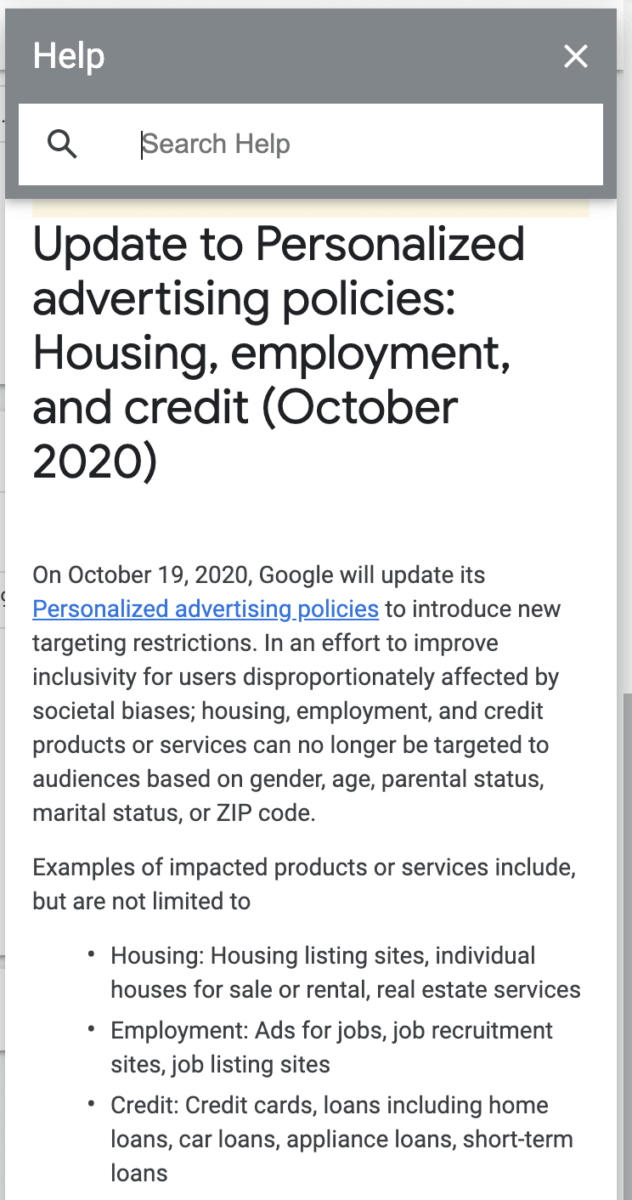
    As announced in August 2020, a new Google Ads Housing Policy, affecting accounts for real estate investors and agents, will change service policies on October 19th, 2020.

    Carrot members have started to receive emails and notifications within their accounts with this “Update to Personalized advertising policies: Housing, employment, and credit” title.

    We wanted to get the jump on the potential changes you’ll be facing and the mindset leading into October.

    This is a pretty significant change for Google Ads. Following Facebook’s move to special ad categories in 2019, Google presents its housing policies.

    The New Rules

    • Potentially impacted members will receive notifications in their Google Ads account, prompting them to acknowledge the housing policy changes and to agree to comply with relevant local laws. If you had not acknowledged these changes when the policy was enacted on October 19, accounts cannot create any new campaigns until they click to accept the changes.
    • Additionally, when the policy goes into effect, real estate advertisers will no longer be able to target audiences based on gender, age, parental status, marital status, or ZIP code. Any existing campaigns targeting newly restricted audiences will no longer be eligible to serve.

    For more information about the policy and how to acknowledge the changes in your account, you can refer to the upcoming policy for housing on the Personalized ads page or on the Google FAQ page.

    What This Means for Real Estate Agents and Investors

    Advertisers will need to update their campaigns before this policy goes into effect to ensure they aren’t negatively impacted.

    It will be determined how this policy affects accounts, but early indications are:

    • Zip Code targeting will no longer be available
    • Zip Code exclusions will no longer be available
    • Demographic exclusions will no longer be available

    Some of the restrictions advertisers can use for excluding certain audiences based on age or income might also be affected. If you’re currently excluding specific income levels or ages, be aware that you might need to remove those restrictions in October.

    Some of those accounts are already seeing warnings.

    Google Ads Housing Policy notice in an account

    What Should I Do Now?

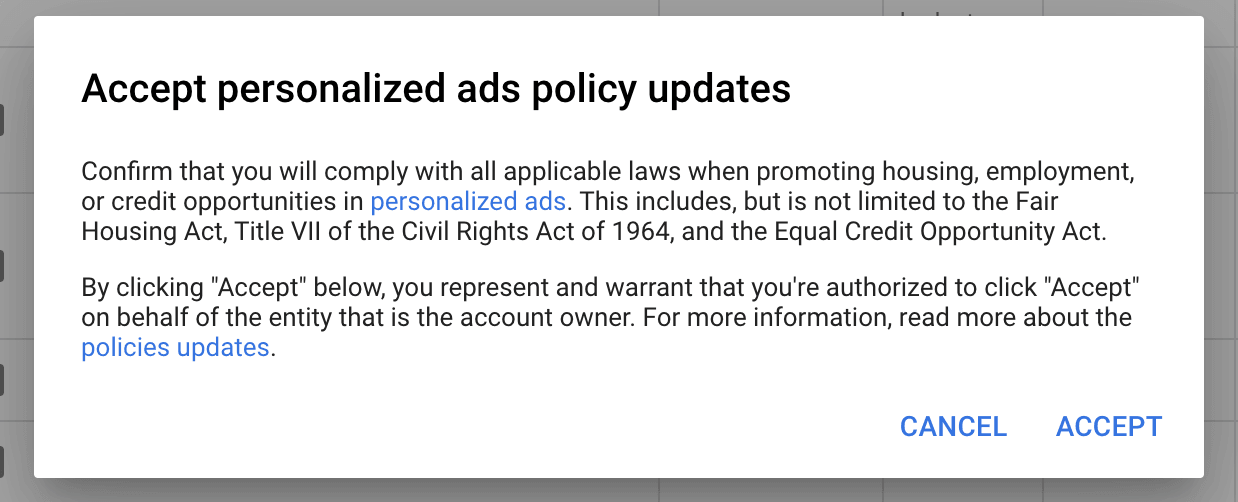
    For now, there isn’t anything to change unless you want to get ahead of the game. You can accept the policy and make the necessary changes to your targeting and/or demographics.

    You’ll see a message in your account like this:

    accept the new Google Ads Housing Policy

    Changes to Consider Making Now

    Zip Code Targeting/Excluding

    If you’re currently using a zip code based targeting strategy, now might be the time to get a headstart. Removing your zip codes and moving into a town, city, or county strategy.

    Here’s What We Recommend: As you make this move, think about taking advantage of the county or city-specific landing pages, as well as adjusting ad copy to match the new locations.

    Age Exclusions

    Accounts using age exclusions will also be affected. From what we know, this won’t be an option if you’re currently excluding such age groups as 18 to 24 or 25 to 34.

    Here’s What We Recommend: We might find something different come October, but for now, there might be an opportunity to add more negative keywords, update ad copy, and utilize ad extensions to make it clear who your audience is.

    Income Exclusions

    There’s also a potential that Google won’t allow for income exclusions. Some accounts have excluded such income levels as “Top 10%” due to the level of houses.

    Here’s What We Recommend: Again, you can focus more on the ad copy and utilizing your ad extensions to communicate the type of homes better you’re either willing to buy or sell. If you’re an investor with motivated seller campaigns, you can also take advantage of better images and niched copy on your real estate landing pages.

    Moving Forward

    We’ll continue to monitor these new policies and send updates as they become available.

    For now, it’s essential to be aware of these changes. This at least gives you an idea of what changes will be coming and how your mindset might have to shift come October.

    We won’t see the full impact until the new policy is implemented, but we can start adjusting both the ads and the website to further speak to the audience.

  • How to Calculate Your Google Ads for Real Estate Budget while Avoiding Common Mistakes

    How to Calculate Your Google Ads for Real Estate Budget while Avoiding Common Mistakes

    When we speak with potential members and host our Coaching Calls about Google Ads, one of the most common questions we hear is:

    How much should my Google Ads for Real Estate budget be?

    That’s a great question and there can be a couple of answers.

    Adopting the Right Mindset for Your Google Ads for Real Estate Account

    Before we dive into calculations, we need to cover the mindset approach you’ll need to have before starting a Google Ads account.

    Understand You’ll Need Time for Testing

    It is important to realize going into an ad campaign that you’ll need to do so with a realistic time frame in mind. The time frame will depend on your budget and it also depends on your market.

    There might not be enough search volume for your target keywords to get leads data in one or two months. For example, “sell my house fast” might be searched for 30 times per month in your market and you would get 4 clicks from that particular keyword.

    Is it realistic that you would get a lead from only 4 clicks? Probably not. Of course, though, you’ll be targeting more than just one keyword.

    The goal is to make sure there is enough search volume for your target keywords to achieve your goals within your time frame.

    Mistake #1: Don’t Stop Too Soon

    Stopping too soon is one of the biggest mistakes we see, not just for real estate investors or agents, but in business in general.

    Too many of us stop way before we actually should stop. We invest a little bit of money in this marketing type and it doesn’t pan out right away and we go…

    “Oh my gosh, that must not work.”

    We throw up our arms and then we start something else and then we do that for a little bit. Then that doesn’t work like we thought it would, and we throw up our arms again…

    If you create a pattern of going and investing a little bit, dabbling, and then pulling back because you didn’t get the results you wanted, you’re probably going to be in that pattern forever until you change your thought process.

    If you fall into that pattern you’re going to be looking back in a year or two and going…

    “Oh my gosh, I ended up investing a lot of money, I lost a lot of money, I didn’t grow the business that I wanted to, and I don’t have the freedom that I wanted and thought that I would have in my business.”

    You’re going to blame it on everything but your marketing mindset. Having the right marketing mindset can save you from that.

    Give yourself enough time. For Google Ads, that’s typically gathering three months of solid data before taking a hard look at if it’s working for your budget and market.

    Google Ads Budget – How Much Should You Spend?

    If you’re just starting out, it’s smart to start with a test budget. You’ll want to hold your costs while you’re figuring out what is going to work. 

    While you’re in data-gathering mode. It’s possible that your initial campaign will be profitable, but you may break-even, or you may lose a little money. 

    We’ve created many campaigns that were profitable right out of the gate, but you shouldn’t put all of your chips in and expect this to happen. Instead, it’s helpful to shift your mindset to looking at the first month or so as investing in market research.

    With your initial campaign, you’ll:

    • Gain insights into what ad messages are resonating with your target market.
    • Learn what keywords are converting into qualified leads and customers. 
    • And, you’ll be able to test your landing pages to figure out what is working best for converting clicks into leads and customers.

    Before you get started, learn how you can get “cost per click” estimates before going live with an account using the Google Keyword Planner tool...

    How to Find Keyword Bid Estimate Using the Keyword Planner Tool

    Related Content: Google Ads Traffic Has Increased 4% During COVID-19. The Necessary Adjustments to Also Increase Your Leads


    What should your budget be? Here are a couple of ways to formulate your budget

    First, you can calculate an estimated budget by multiplying the number of keywords you want to test by the cost per click and by a minimum of 100-200 clicks. As a general rule, you’ll want to get at least 100-200 clicks to determine what is converting for you.

    For example, if you’re going to test 10 keywords with a cost per click of $10, we’ll need to plan on a test budget of $1,000 to $2,000. You’ll find that there will be a mix of winning and losing keywords, ads, and possibly landing pages from the start.

    As you see the data come in, you’ll “prune” your campaign by keeping the winning keywords, dropping the losers to bring your campaign to profitability, and ready for the next round of expansion and testing.

    The second calculation is how we typically estimate a monthly budget. Start by looking at how many clicks it’s going to take to get a lead. As a general rule, it takes 15-20 clicks to get a lead. Let’s say your cost per click averages $20 per click. Next, let’s say it takes 5 leads to turn into a deal.

    • 15 clicks to get a lead
    • $20 per click
    • 5 leads to get a deal

    The equation looks like this:

    Clicks x Cost Per Click x Number of Leads to Get a Deal

    15 x $20 = $300 x 5 = $1500. You’ll need to budget $1500 to get one deal.

    Need a calculator? Use the Carrot ROI Calculator! You can also read this post to determine your Max Cost Per Lead.

    Mistake #2 Eventually… Focus on ROI, Not Cost

    If you want to dominate your market, you can’t just focus on “costs”, you must focus your energy on maximizing your return on investment (ROI) from Google Ads.

    We have a client who spends more than $10,000 per month with Google Ads. He’s happy to do so because he earns healthy profits on that advertising.

    The million dollar question is…

    “How do I get to that point where I’m scaling up my Google Ads and capturing more of my market share?”

    That is how you scale up your Google Ads. Know your numbers and remove emotion from it.

    1. Find your average profit per deal first.
    2. Find out how many leads it takes you to close a deal.
    3. Figure out your conversion rate on your website.
    4. Figure out how much it’s going to cost you to get those visitors to your site from Google Ads.

    Conclusion

    You can’t fully explore Google Ads for real estate without money. And, making room in your budget isn’t always easy or fun.

    At least, there are a couple of quick ways to create a Google Ads budget from scratch.

    First, start by researching how much your keywords are going to cost using the Google Keyword Planner tool. This will give you an idea of how much your keywords will cost per click.

    Once you’ve done that, you can do some simple calculations to find what you might need to start your budget at.

    If you don’t have enough to make that budget work, take a look at what you might be able to cut right now to test Google Ads. Can you cut down one of your other marketing platforms to give it a full test? You might want to keep an eye out for being limited by budget status as well.

    If so, it’s time to put that money into action.

    Lastly, you have to give it time, monitor your campaigns, and double down if they start performing well!

  • Google Ads Traffic Has Increased 4% During COVID-19 – Necessary Adjustments to Also Increase Your Leads

    Google Ads Traffic Has Increased 4% During COVID-19 – Necessary Adjustments to Also Increase Your Leads

    Google Ads Uncertainty During COVID-19

    Have you felt like this recently? Are you unsure if you should stop your Google Paid traffic right now?

    You’re not alone, but stay positive. We’re in this together!

    We’ve been answering these questions since March by providing data and challenging our members to shift their mindsets.

    This has led us to create this blog post. We want to show you what we’re seeing, why you need to change, and how to make those adjustments to WIN in Google Ads during COVID-19 and other events that can cause accounts to go haywire.

    We’re here to put your mind at ease.


    Additional COVID-19 Articles:


    What Our Google Ads Data is Showing During COVID-19

    Google Ads real estate investor statistics durning covid-19

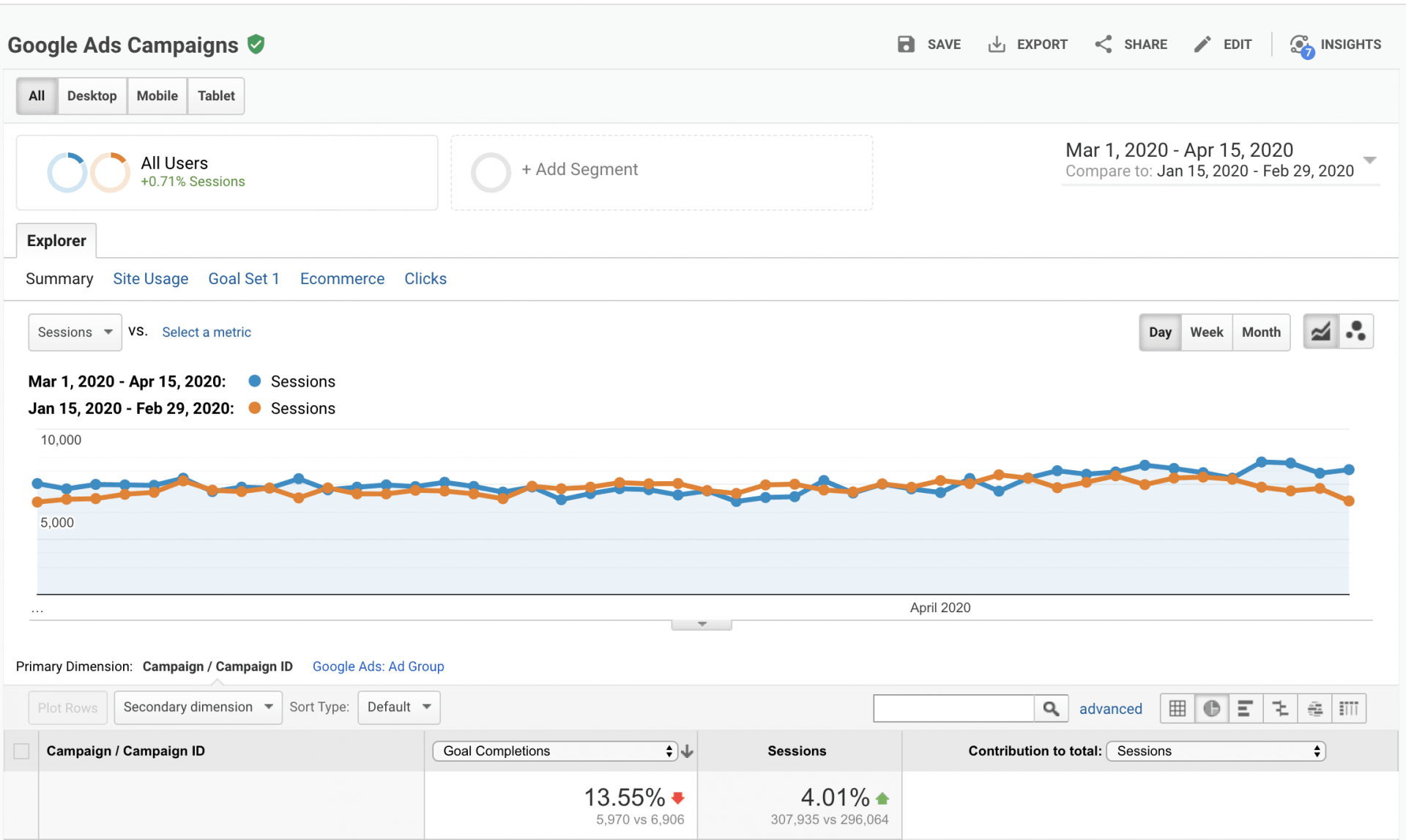
    Numbers were compared from January 15-February 29 and March 1-April 15.

    • Sessions from Google Ads have increased by 4.01%.

      Sessions are defined as…

    “A session is a group of user interactions with your website that takes place within a given time frame. For example, a single session can contain multiple page views, events, social interactions, and eCommerce transactions.”

    • Leads have decreased by 13.55%.
    • Across all members accounts, cost-per-click has increased by 39.3%, and to be expected, the cost per lead has increased by 19.4%.

    What does this mean? In “normal times” a conversion issue could mean you’re lacking credibility on your website. Or, not enough website personalization and customization.

    During COVID, it’s most likely due to searchers whose comfort level with the current situation is low. This presents a major opportunity to communicate with your audience in a different, more impactful way.

    So…

    Why Are Leads Down By 13.55%?

    Our best-educated hypothesis… there is a lack of communication between your visitors and your website messaging.

    Visitors need to know, during this time, that they still have options to sell their house right now. If they’re landing on a page that still has the typical message without educating them about what they can do, they’ll likely bounce for now.

    Communication is as important as ever. You need to tell them what they can do during this time where people are uncertain. For example, communicate that they can:

    • Send photos of their house
    • Join a video call
    • Join a Facebook Live for a walk-through
    • Hop on a phone call
    • Get the selling process started without ever meeting in person

    More on this below…

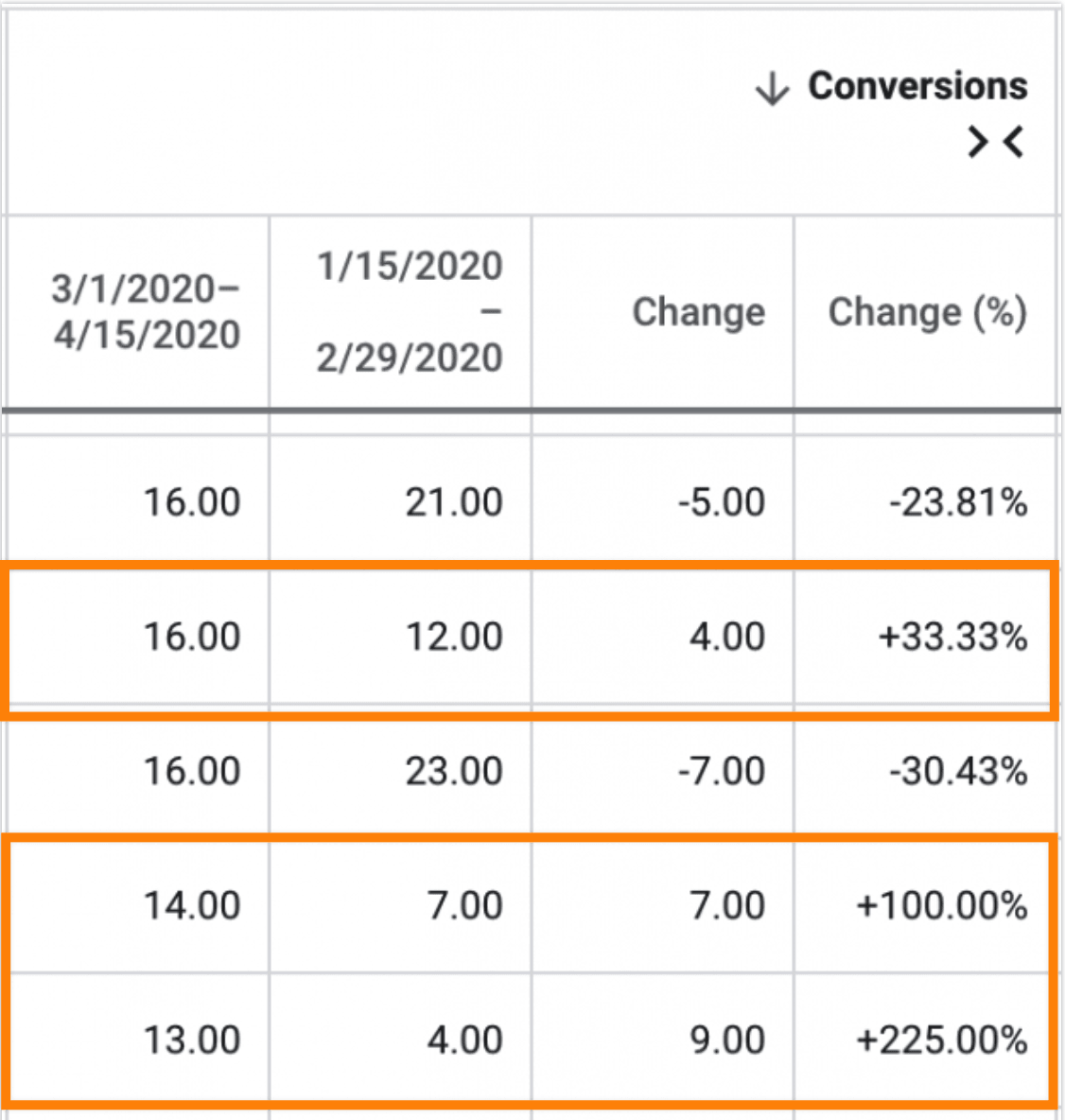
    What Can You Do Right Now to Increase Leads by 33, 100, or Even 225%?!

    The members (not all, but MOST) who have made the necessary steps to communicate to their audiences are seeing an increase in lead volume during the COVID-19 pandemic.

    real estate investor google ads during covid-19

    We wanted to give you some general tips to help make your Google Ads accounts more effective until this time in history is over.

    3 Simple Things You Can Do Today to Increase the Effectiveness of Your Google Ads Accounts

    Tip #1: Communicate and Build Relationships With Your Audience

    During “normal” times, Google Ads best practices dictate that you dig deep into as much data as you can find so you can be all but certain your next campaign will succeed.

    But, we’re in unknown territory holding a lot of uncertainty. No one knows for sure what to totally expect from their accounts right now.

    The ones who will have the most success will be those who take their best, common-sensed, educated move and immediately put their campaigns into action.

    Think of it this way.

    If you don’t try and decide to wait it out, you’ll fall further behind your competitors.

    If you make educated moves but fall short, you’ll at the very least have an idea of how to adjust your approach going forward.

    You don’t have a lot of time to collect a bunch of performance data… we can help with that.

    Your goal should be to find a way to communicate with your audience.

    It can be as simple as creating a Google Ads specific landing page with a COVID-19 message. For example…

    Google Ads Covid-19 landing page message

    Or, adding more content to your website from blog posts. Carrot Content Pro members have access to blog posts such as…

    covid-19 content pro blog post for real estate

    Or, switch it up a bit and shoot a quick video, such as this Carrot member did…

    Can You Still Sell Your House During Covid-19 Lockdown? | Candid Property Solutions

    Now, take your video a step further and create a VideoPost to add to your blog. Simply upload a video and receive a transcription for your content for a blog post in minutes.

    Check this out…How to Create Real Estate Content in Under 10 Minutes with Carrot’s VideoPost

    If you need to help to generate ideas for scripts, check out…The Content Marketing Playbook During COVID-19

    Tip #2: Refine Your Ad Copy

    This goes for your Google ads and any other paid advertising you create throughout the current pandemic.

    Google Ad’s character limitations don’t allow much room to convey a deeply sensitive and empathetic message, but you can utilize space to communicate that you’re still buying as well as other key points.

    We’ve seen ads use copy such as:

    • We’re Still Buying
    • We Can Rest Your Mind
    • No Strangers to Your Home
    • No-Direct Contact Required
    • You Can Still Sell Your House
    • A Phone Call Is All It Takes
    • We Can Buy Via Video, Phone, and Email

    You want to create ads that showcase the options they have and the value your service can give them during these circumstances your audience is currently in.

    If you can get to the heart of how your services can bring peace and closure to your customers’ lives, during this crisis and other times, you’ll stand a much better chance of surviving and thriving in the future.

    Tip #3: Trim Wasted Ad Spend

    During “normal” times, it can be easy to keep average-performing ad groups or keywords live as long as they’re bringing in some leads.

    But right now a shift to pause those ad groups or keywords and add to negative keyword lists might be a smart approach.

    Of course, you can then revive these ad groups and keywords once we’re out of this pandemic.

    If you need to cut your budget, a simple strategy would be to pause ad groups and/or keywords that haven’t produced a lead in the past month or two. Or, those ad groups and/or keywords that have converted one or two times in the past month or two.

    These might be low-hanging fruit keywords. Choose to pause those for now and hang onto the ad groups and keywords that make the most impact.

    It’s also important to continue to add search terms to your list of negative keywords

    Negative keywords will prevent your ads from showing up for future searches that seem to be related to your service but have nothing to do with it.

    We’ve seen terms that seem really good but aren’t converting into leads. Such as…

    “sell my house in 55+”

    So, that term is becoming an exact match negative term for now.

    We’ve also seen an influx of game-related terms, possibly due to more kids being without things to do. Terms such as…

    “how to sell your house in Rocitizens Boblox”

    These are search terms that can’t be predicted.

    Even during times like these, the old saying “you gotta spend money to make money” holds true for paid traffic. Merely pausing your campaigns altogether just isn’t the way to go.

    But, there are just smarter ways of figuring out the most efficient way to keep your campaigns live.

    You should always be looking for the most cost-effective approach to Google ads, but right now, it’s okay to tighten the spending up without feeling like you’re missing out on leads.

    Wrapping up

    The Google Ads industry changed entirely in the last month. Much of what we considered certainties only a few short weeks ago still remain today, but there are things you need to view a little differently for now.

    Adapting during these uncertain times will help you to continue to grow.

    It’s likely that you have already come under pressure to reduce spend or, at the very extreme, you’ve paused your account. These are sensible reactions given the circumstances, but are they the only options? 

    The answers to these questions depend a lot on each individual’s situation, but in this post, we hope to educate you on how to make these positive decisions and how to best adapt Google Ads during these challenging times.

  • How To Measure The Success Of Your Real Estate PPC Campaign

    How To Measure The Success Of Your Real Estate PPC Campaign

    “Listen… it’s not working.”

    Those are the same words that thousands (millions?) of real estate investors have said to the person running their PPC ads.

    “I’ve already spent $1,500 and I haven’t closed a single deal from those leads! If it hasn’t worked now, then it isn’t going to work.”

    It’s difficult to believe differently than that. After spending thousands of dollars on a campaign which isn’t delivering the kind of results your business needs, quitting seems like the only logical option.

    But let’s slow down for a moment.

    Just because you’ve spent several thousand dollars on your PPC efforts without closing a deal does not mean you’re doing something wrong. In fact, it might mean you’re doing something right.

    Let me explain.

    What Is The Goal Of Your Real Estate PPC Campaign?

    Is your real estate PPC campaign a success?

    To answer that question, you first need to determine the goal of running ads.

    If you’re simply trying to build brand awareness, then seeing a tangible return on your investment might be irrelevant. If you’re trying to generate leads for your email list which might turn into a closed deal down the road, then all that matters is getting new people on your email list. In those cases, use the metrics mentioned in this article to determine how successful your real estate PPC campaign is.

    If more likely, you’re running a PPC campaign to find motivated sellers and close deals, having a strict, tangible, profitable ROI matters a lot more. The first thing you’ll need to do, then — before you even launch your campaign, ideally — is set a realistic and profitable budget for your ads.

    Here’s how to do that.

    What is a Realistic Budget and ROI For Your Real Estate PPC Campaign?

    Earlier, I said, “Just because you’ve spent several thousand dollars on your PPC efforts without closing a deal does not mean you’re doing something wrong. In fact, it might mean you’re doing something right.”

    And I meant it.

    At Carrot, we know lots of real estate investors who have to spend between $1,000 and $5,000 to get a single deal. The reason for that has nothing to do with their ads being ineffective, but everything to do with thick market competition. The thicker the competition, the more investors have to spend on ads to close a single deal.

    Here’s the kicker, though: those investors are still making between $10,000 and $50,000 in profit as wholesale fees. So while spending up to $5k on an ad campaign might seem crazy, it’s still very profitable.

    Brian Rockwell is one such investor (and Carrot member!) who consistently pays several thousand dollars to close a single deal in his highly competitive market: Dallas, Texas.

    Here’s what he has to say about it:

    “Would you pay $3,000 to make $30,000? I don’t know about you, but I’d take that deal all day long.”

    Okay. Great.

    Spend money to make money. You get that.

    But how much money is too much money? How much should you expect to spend on your PPC campaign before closing a deal? At what point should you throw in the towel?

    To answer that question, check out our free-to-use ROI calculator for paid ad campaigns.

    roi calculator

    You’ll just need four pieces of information in hand:

    1. Typical profit per deal
    2. Typical # of leads to close 1 deal
    3. Cost per click
    4. Website conversion rate

    Example:

    Imagine that you can safely expect to make at least $15,000 in wholesale fees on a single deal. Let’s also imagine you’re in a competitive market and that it takes you 25 leads to close one deal. Your cost-per-click for your PPC campaign is $15 and your website conversion rate is 15% (typical for a Carrot site).

    That means you should expect to spend at least $2,500 to close a single deal and no more than $3,250.

    And while that might seem like a lot of money to spend, you’ll also notice that the ROI on your expenses will be between 362% and 500%…

    As Brian Rockwell said, “I’d take that deal all day long.”

    Formula For Calculating ROI

    Of course, ad spend is likely not your only cost for generating leads and closing deals. You might also be paying people to run your ads for you, tackle due diligence on properties, meet with buyers, or create contracts.

    Maybe you also want to include those costs in the overall ROI of your PPC campaigns…

    It’s up to you… really, it depends on what you want to find out. If you want to strictly determine how effective your PPC campaign is and if you’re staying within budget, then you might want to leave other indirect costs out of the equation. If, on the other hand, you want to determine the profitability and ROI of your entire business, then you’ll certainly need to include all other costs.

    Whatever the case, here’s the formula you can use for finding the ROI of any of your marketing efforts.

    ROI = (Revenue – Cost) / Cost

    How To Determine a PPC Campaign’s Effectiveness (The 4 Metrics That Matter Most)…

    There’s no doubt about it: ROI is the king of determining the success of any PPC campaign.

    If you’re not making more money than you’re spending — if your ads aren’t profitable for your business — then you need to press “Stop” and try something else.

    Having said that, looking only at the ROI of your PPC campaign can blindside you to other important metrics. Because even if your ads are profitable, they still might not be as profitable as they could be.

    The goal is to not only run profitable and realistic PPC campaigns but to also increase the effectiveness and profitability of those campaigns. To do that, you should keep a close eye on the below metrics, test new things, and make changes as needed.

    1. Cost-Per-Click

    You can find this metric reported directly in your Google Ad dashboard. It tells you the amount of money you’re spending for each click you receive. The more enticing and click-able your ad is to website browsers (i.e. the more people who click), the less money you’ll spend on each click. However, competitive markets will force a high cost-per-click regardless of how effective your ad is, simply because there are so many other bids.

    2. Quality Score

    The quality score of an ad campaign is a metric which attempts to show you, with a score between 1 and 10 (10 is best), how effective your ad campaign is. Using the number of clicks your ad is receiving when people see it, the quality score also influences how much Google is going to show your ad, your cost-per-click, and even your ad placement (at the top vs. at the bottom). Keep a close eye on this metric and tweak your ad if it has a low-quality score.

    3. Impression Share

    Impression share is the percentage of people who, when your ad was placed on the page they visited, actually scrolled and saw your ad. If you ad has a low-quality score and is sitting at the bottom of the results page, your impression score will be much lower than competitors with ads showing at the top. An impression score of 80% means that 80% of people saw your ad and 20% didn’t.

    4. Website Conversion Rate

    While this isn’t technically a PPC metric, the website conversion rate is absolutely vital to consider for any paid ads you’re running which drive traffic to your website. Since you’re paying to generate clicks and hopefully leads and closed deals, you need a website which consistently converts the traffic your hard-earned money is driving to it. What’s a good conversion rate? Find out over here. And if you don’t want to worry about optimizing your website for conversion, consider getting yourself a Carrot website. We’ve generated over one million leads for investors and agents all around the U.S. and we’d love to do the same for you (a typical Carrot website conversion rate is around 10%. A typical conversion rate for most other industries is around just 2%).

    Conclusion

    I understand.

    It gets discouraging, running ads which aren’t pulling results for your business. After all, if your business is to survive, you can’t be dumping money into a useless ad campaign for much longer.

    You need results.

    But keep in mind that results often take time.

    The best thing you can do, in fact, is set yourself up for success by determining a realistic budget for your PPC campaigns: how much should you expect to spend? And how much is too much?

    With those numbers, you’ll be far more confident spending the money you’re spending… knowing when you should expect a closed deal and when you’ve spent too much.

    Then, work to improve the ROI of your PPC ads by watching the 4 metrics mentioned in this article. Because even if your paid ads are profitable, you still might be able to make them more profitable. Which is always a good thing to do.

    With that, you’re ready to run successful PPC campaigns. The rest is simply doing, testing, trying, and iterating. Off ya go!

  • Case Study: Google Ads Traffic To Carrot Website Reveals The Most-Clicked Page On Your Site

    Case Study: Google Ads Traffic To Carrot Website Reveals The Most-Clicked Page On Your Site

    If you’re like most real estate investors, you’re already running paid advertising campaigns to your website (Carrot or otherwise).

    You’re running Google Ads or Facebooks ads or both…

    And every day, you wake up and check results. How many clicks are you getting? How many of those clicks turn into leads on your website? How many of those leads turn into deals? And do the results you’re getting justify the money you’re spending?

    Those questions are enough to give any marketer a migraine…

    But they are important questions to ask.

    You’re spending hard-earned money on paid advertising; you need to know if that’s money well-spent or not. If it is, great! If it isn’t, you’d best make some adjustments (advertise somewhere else, tweak the ad you’re running, or change where you’re sending traffic — Carrot converts out-of-the-box).

    To help you, we helped one of our members with their Google Ads campaign. We monitored their conversion rate and we even ran a nifty heatmap on their homepage which only tracked Google Ads traffic.

    Here’s what we found.

    The Case Study: Google Ads Traffic To Carrot Website Reveals The Most-Clicked Page On Your Site

    The website/company that we ran Google Ads campaigns for is called Henry Home Buyers, a real estate investing company which operates out of Minneapolis, Minnesota.

    Here’s what their website looks like.

    From April 15th to May 15th, we drove traffic to their website via the below Google Ad campaigns. During that time, we tracked their PPC metrics, their website conversion rate, and even put a heatmap on their homepage.

    Here is an example of an which ran from April 15th to May 15th.

    google ads traffic ad example

    For the month, that Google Ad campaign received 127 clicks, which took visitors to there homepage.

    The conversion rate was an above-average, super healthy 16.54%, meaning that 21 of the 127 people who clicked also opted-in on Henry Home Buyers website to become a lead.

    real estate investor adwords stats

    Considering that most real estate investors need 20 or 25 leads to generate one deal, this one Google Ads campaign could have theoretically amounted to $10,000 or $20,000 (depending on the width of their wholesale fee) — we weren’t able to actually track how many of those leads turned into deals, so this is conjecture. But you get the point.

    A good Google Ads campaign can pay you back ten-fold.

    Perhaps most revealing, though, is the heatmap we ran on their homepage during the test. Take a look.

    Google Ads Traffic most clicked on page
    Heatmap showing the most clicked on page… the “Our Company” or in this case “Meet Our Team” page.

    It doesn’t take an eagle-eyed human to spot that there’s two places lit up like a Christmas tree on the above heatmap — two places that people clicked more than anywhere else.

    1. Their high-converting Carrot opt-in form.
    2. And their “Meet Our Team” page (AKA, the “About” page)

    Well, it’s a darn good thing they have such an awesome “About” page with a high-quality team photo, their company’s core values, and even a CTA at the bottom encouraging visitors to give em’ a call.

    real estate investor website about page

    (Image Source)

    Which leads us into the main takeaway from this test. And it really can’t be overstated…

    The Most-Clicked Page On Your Website… Do NOT Neglect Your “About” Page…

    We’ve said it a million times and we’ll say it again…

    Real estate transactions aren’t just expensive financially, they’re expensive emotionally and mentally. Because real estate transactions are so taxing, the average consumer must completely trust the person that they choose to work with. They must believe you can solve their problem or help fulfill their dream, and that you can do so expertly.

    They also want to know that you have their best interest in mind — you might just be building your business to make money and achieve entrepreneurial freedom, but they don’t want to know that.

    They want to hear about how you can help them, why they should trust you, and how easy the process is going to be.

    They want to know that you understand their situation completely.

    They want to know that you’ve helped other people just like them.

    And they want to know that you can help them, too.

    This isn’t just true on Henry Home Buyer’s website…

    It’s true on this real estate website…

    our company page hotspot on heatmap

    And this one…

    writing an effective about page for conversion boost

    And even our OWN website!

    how to write a good about page for your real estate website

    In fact, our Carrot research found that the “About” page is almost always the 2nd most-visited page on real estate websites (right after the homepage). This means that most people who visit your website browse your homepage for a few moments and then go directly to your “About” page.

    The best thing you can do, then, is treating your “About” page as a natural part of your visitor’s experience. You know they’re going to click there quite fast; what can you do to make sure your “About” page serves them well? How are you going to convince them to work with you even though they’ve never met you before?

    Here are a few ideas.

    • Include your core values & mission statement — Remember how I mentioned that your prospect only cares about themselves and how you can help them? This is where you get to list the values of the company and the mission that drives your company. That’s immensely powerful for building trust with your website visitors. For inspiration, check out Carrot’s mission statement and core values.
    • Use smile-y photos — If you’re looking for motivated sellers, then your prospect probably isn’t in a very good place; more than likely, they’re going through a stressful and difficult life situation. For that reason (and to increase your likeability) give a big authentic smile in your “About” page photos.
    • Add a few testimonials — Nothing helps build trust with website visitors quite like a testimonial. People don’t want to be the first one to work with you, they want to know that you’ve already helped other people just like them. Assure them that you have by adding one or two testimonials (video testimonials are the best, but written will do the trick) to your “About” page.
    • Include a CTA — Since many people will click right to your “About” page after visiting your homepage, you should craft your “About” page like it’s the most important sales page on your entire website. Put your phone number on it and include a CTA with an opt-in form at the bottom.

    Where are you sending your paid traffic?

    That’s an important question.

    Where are you sending paid traffic?

    Because where you send paid traffic determines (at least partly) how valuable that traffic is going to be for your business. If you send traffic to a low-converting WordPress website (not all WordPress websites are low-converting, but many of them are), then you’re going to lose money fast. If, on the other hand, you send paid traffic to a high-converting site (like Carrot), you’ll make a hefty profit, you’ll gain new confidence in your paid ad campaigns, and you’ll probably even dump more money into running those ads.

    (If you can make $2 for every $1 you spend, why not do that all day long?)

    But how do you make sure that you’re sending your audience to a high-converting website?

    What even qualifies as a high-conversion rate?

    Well, cross-industry, a high conversion rate is around 2% or 3%…

    (Image Source)

    And while we know that’s the average for many websites in the world today, at Carrot, we say bubkus…

    We are committed to higher conversion rates, to more opt-ins, to more closed deals for our members.

    Which is why, for Carrot members, an average conversion rate is around 10%…

    motivated house seller website conversion rate

    An excellent conversion rate is around 15%…

    using video to increase conversion rate on real estate websites

    And an incredible conversion rate is 20% or higher.

    real estate investing website conversion

    To be honest, if you’re not getting at least a 5% conversion rate with your website, then it might be time to rethink where you’re sending your paid traffic. Maybe you could try to re-work and optimize your landing page… maybe you need better targeting with your paid ads… or maybe you need a Carrot website ( ;-) shameless pitch).

    Whatever the case, do not settle for a low conversion rate. Work until you’re pulling as many leads as you need to run a healthy business that provides you with the predictable income and financial stability that you need.

    Conclusion

    The pressure is on.

    When you’re running paid ads, you’re watching the ROI of your campaigns like a hawk…

    You’re wondering if the amount of money you’re spending is going to pay you back like you hope it will (try using our calculator over here to set a realistic paid advertising budget).

    Unfortunately, I can’t give you the answer :(

    But I can (and did!) show you what other real estate investors are doing, what kind of results they’re getting, and what you should expect for your website conversion rate.

    I hope it helps you build a business that you’re proud of.