Those are the same words that thousands (millions?) of real estate investors have said to the person running their PPC ads.
“I’ve already spent $1,500 and I haven’t closed a single deal from those leads! If it hasn’t worked now, then it isn’t going to work.”
It’s difficult to believe differently than that. After spending thousands of dollars on a campaign which isn’t delivering the kind of results your business needs, quitting seems like the only logical option.
But let’s slow down for a moment.
Just because you’ve spent several thousand dollars on your PPC efforts without closing a deal does notmean you’re doing something wrong. In fact, it might mean you’re doing something right.
Let me explain.
What Is The Goal Of Your Real Estate PPC Campaign?
Is your real estate PPC campaign a success?
To answer that question, you first need to determine the goal of running ads.
If you’re simply trying to build brand awareness, then seeing a tangible return on your investment might be irrelevant. If you’re trying to generate leads for your email list which might turn into a closed deal down the road, then all that matters is getting new people on your email list. In those cases, use the metrics mentioned in this article to determine how successful your real estate PPC campaign is.
If more likely, you’re running a PPC campaign to find motivated sellers and close deals, having a strict, tangible, profitable ROI matters a lot more. The first thing you’ll need to do, then — before you even launch your campaign, ideally — is set a realistic and profitable budget for your ads.
Here’s how to do that.
What is a Realistic Budget and ROI For Your Real Estate PPC Campaign?
Earlier, I said, “Just because you’ve spent several thousand dollars on your PPC efforts without closing a deal does not mean you’re doing something wrong. In fact, it might mean you’re doing something right.”
And I meant it.
At Carrot, we know lots of real estate investors who have to spend between $1,000 and $5,000 to get a single deal. The reason for that has nothing to do with their ads being ineffective, but everything to do with thick market competition. The thicker the competition, the more investors have to spend on ads to close a single deal.
Here’s the kicker, though: those investors are still making between $10,000 and $50,000 in profit as wholesale fees. So while spending up to $5k on an ad campaign might seem crazy, it’s still very profitable.
“Would you pay $3,000 to make $30,000? I don’t know about you, but I’d take that deal all day long.”
Okay. Great.
Spend money to make money. You get that.
But how much money is too much money? How much should you expect to spend on your PPC campaign before closing a deal? At what point should you throw in the towel?
You’ll just need four pieces of information in hand:
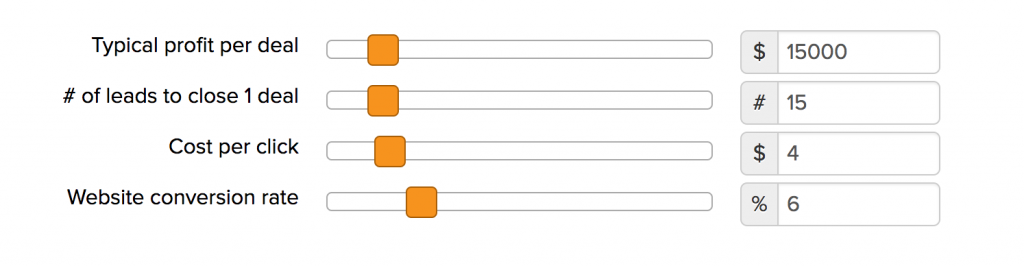
Typical profit per deal
Typical # of leads to close 1 deal
Cost per click
Website conversion rate
Example:
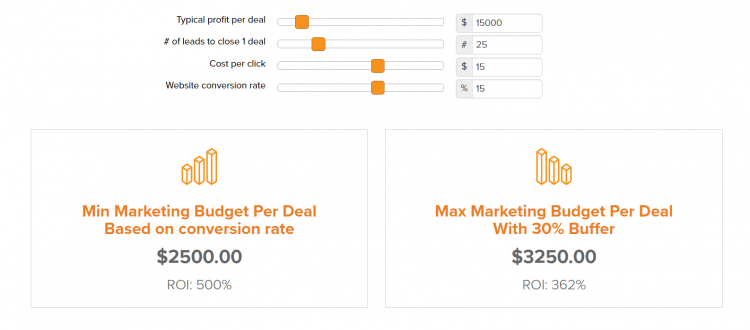
Imagine that you can safely expect to make at least $15,000 in wholesale fees on a single deal. Let’s also imagine you’re in a competitive market and that it takes you 25 leads to close one deal. Your cost-per-click for your PPC campaign is $15 and your website conversion rate is 15% (typical for a Carrot site).
That means you should expect to spend at least $2,500 to close a single deal and no more than $3,250.
And while that might seem like a lot of money to spend, you’ll also notice that the ROI on your expenses will be between 362% and 500%…
As Brian Rockwell said, “I’d take that deal all day long.”
Formula For Calculating ROI
Of course, ad spend is likely not your only cost for generating leads and closing deals. You might also be paying people to run your ads for you, tackle due diligence on properties, meet with buyers, or create contracts.
Maybe you also want to include those costs in the overall ROI of your PPC campaigns…
It’s up to you… really, it depends on what you want to find out. If you want to strictly determine how effective your PPC campaign is and if you’re staying within budget, then you might want to leave other indirect costs out of the equation. If, on the other hand, you want to determine the profitability and ROI of your entire business, then you’ll certainly need to include all other costs.
Whatever the case, here’s the formula you can use for finding the ROI of any of your marketing efforts.
ROI = (Revenue – Cost) / Cost
How To Determine a PPC Campaign’s Effectiveness (The 4 Metrics That Matter Most)…
There’s no doubt about it: ROI is the king of determining the success of any PPC campaign.
If you’re not making more money than you’re spending — if your ads aren’t profitable for your business — then you need to press “Stop” and try something else.
Having said that, looking only at the ROI of your PPC campaign can blindside you to other important metrics. Because even if your ads are profitable, they still might not be as profitable as they could be.
The goal is to not only run profitable and realistic PPC campaigns but to also increase the effectiveness and profitability of those campaigns. To do that, you should keep a close eye on the below metrics, test new things, and make changes as needed.
1. Cost-Per-Click
You can find this metric reported directly in your Google Ad dashboard. It tells you the amount of money you’re spending for each click you receive. The more enticing and click-able your ad is to website browsers (i.e. the more people who click), the less money you’ll spend on each click. However, competitive markets will force a high cost-per-click regardless of how effective your ad is, simply because there are so many other bids.
2. Quality Score
The quality score of an ad campaign is a metric which attempts to show you, with a score between 1 and 10 (10 is best), how effective your ad campaign is. Using the number of clicks your ad is receiving when people see it, the quality score also influences how much Google is going to show your ad, your cost-per-click, and even your ad placement (at the top vs. at the bottom). Keep a close eye on this metric and tweak your ad if it has a low-quality score.
3. Impression Share
Impression share is the percentage of people who, when your ad was placed on the page they visited, actually scrolled and saw your ad. If you ad has a low-quality score and is sitting at the bottom of the results page, your impression score will be much lower than competitors with ads showing at the top. An impression score of 80% means that 80% of people saw your ad and 20% didn’t.
4. Website Conversion Rate
While this isn’t technically a PPC metric, the website conversion rate is absolutely vital to consider for any paid ads you’re running which drive traffic to your website. Since you’re paying to generate clicks and hopefully leads and closed deals, you need a website which consistently converts the traffic your hard-earned money is driving to it. What’s a good conversion rate? Find out over here. And if you don’t want to worry about optimizing your website for conversion, consider getting yourself a Carrot website. We’ve generated over one million leads for investors and agents all around the U.S. and we’d love to do the same for you (a typical Carrot website conversion rate is around 10%. A typical conversion rate for most other industries is around just 2%).
Conclusion
I understand.
It gets discouraging, running ads which aren’t pulling results for your business. After all, if your business is to survive, you can’t be dumping money into a useless ad campaign for much longer.
You need results.
But keep in mind that results often take time.
The best thing you can do, in fact, is set yourself up for success by determining a realistic budget for your PPC campaigns: how much should you expect to spend? And how much is too much?
With those numbers, you’ll be far more confident spending the money you’re spending… knowing when you should expect a closed deal and when you’ve spent too much.
Then, work to improve the ROI of your PPC ads by watching the 4 metrics mentioned in this article. Because even if your paid ads are profitable, you still might be able to make them more profitable. Which is always a good thing to do.
With that, you’re ready to run successful PPC campaigns. The rest is simply doing, testing, trying, and iterating. Off ya go!
And every day, you wake up and check results. How many clicks are you getting? How many of those clicks turn into leads on your website? How many of those leads turn into deals? And do the results you’re getting justify the money you’re spending?
Those questions are enough to give any marketer a migraine…
But they are important questions to ask.
You’re spending hard-earned money on paid advertising; you need to know if that’s money well-spent or not. If it is, great! If it isn’t, you’d best make some adjustments (advertise somewhere else, tweak the ad you’re running, or change where you’re sending traffic — Carrot converts out-of-the-box).
To help you, we helped one of our members with their Google Ads campaign. We monitored their conversion rate and we even ran a nifty heatmap on their homepage which only tracked Google Ads traffic.
Here’s what we found.
The Case Study: Google Ads Traffic To Carrot Website Reveals The Most-Clicked Page On Your Site
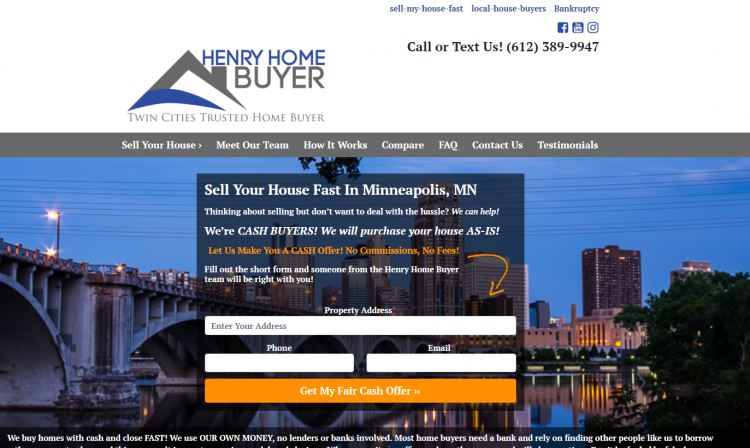
The website/company that we ran Google Ads campaigns for is called Henry Home Buyers, a real estate investing company which operates out of Minneapolis, Minnesota.
Here’s what their website looks like.
From April 15th to May 15th, we drove traffic to their website via the below Google Ad campaigns. During that time, we tracked their PPC metrics, their website conversion rate, and even put a heatmap on their homepage.
Here is an example of an which ran from April 15th to May 15th.
For the month, that Google Ad campaign received 127 clicks, which took visitors to there homepage.
The conversion rate was an above-average, super healthy 16.54%, meaning that 21 of the 127 people who clicked also opted-in on Henry Home Buyers website to become a lead.
Considering that most real estate investors need 20 or 25 leads to generate one deal, this one Google Ads campaign could have theoretically amounted to $10,000 or $20,000 (depending on the width of their wholesale fee) — we weren’t able to actually track how many of those leads turned into deals, so this is conjecture. But you get the point.
A good Google Ads campaign can pay you back ten-fold.
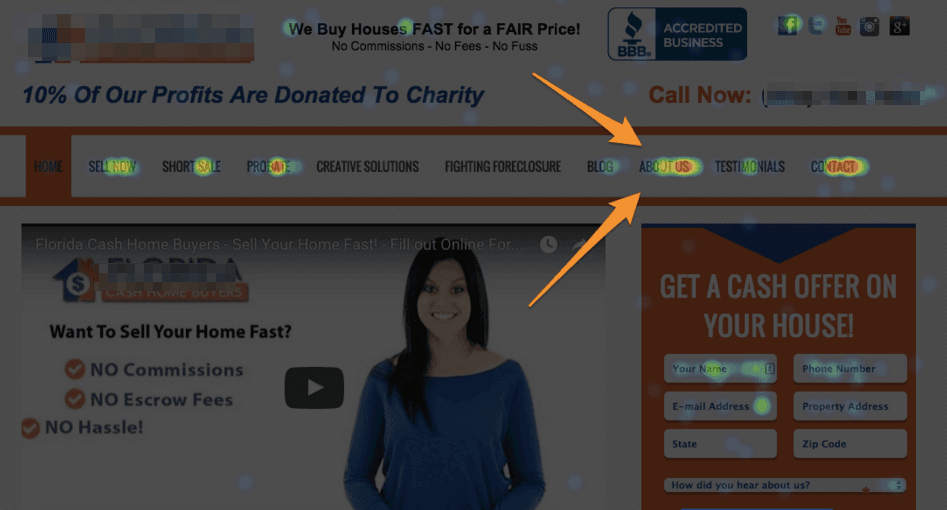
Perhaps most revealing, though, is the heatmap we ran on their homepage during the test. Take a look.
Heatmap showing the most clicked on page… the “Our Company” or in this case “Meet Our Team” page.
It doesn’t take an eagle-eyed human to spot that there’s two places lit up like a Christmas tree on the above heatmap — two places that people clicked more than anywhere else.
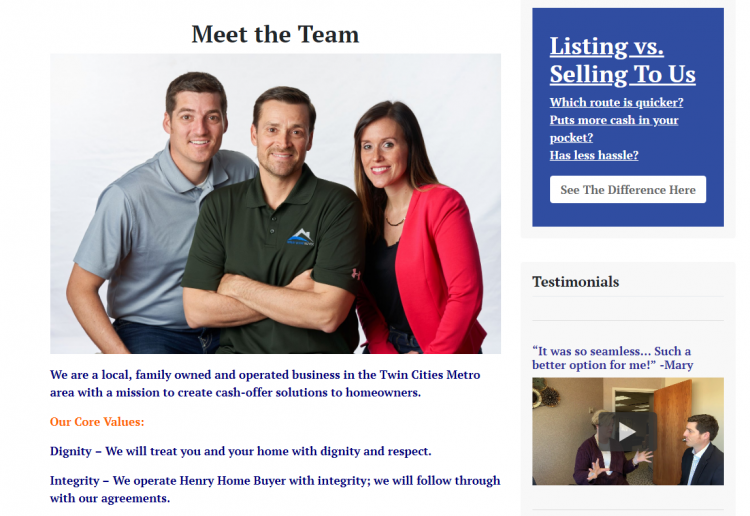
And their “Meet Our Team” page (AKA, the “About” page)
Well, it’s a darn good thing they have such an awesome “About” page with a high-quality team photo, their company’s core values, and even a CTA at the bottom encouraging visitors to give em’ a call.
Which leads us into the main takeaway from this test. And it really can’t be overstated…
The Most-Clicked Page On Your Website… Do NOT Neglect Your “About” Page…
We’ve said it a million times and we’ll say it again…
Real estate transactions aren’t just expensive financially, they’re expensive emotionally and mentally. Because real estate transactions are so taxing, the average consumer must completely trust the person that they choose to work with. They must believe you can solve their problem or help fulfill their dream, and that you can do so expertly.
They also want to know that you have their best interest in mind — you might just be building your business to make money and achieve entrepreneurial freedom, but they don’t want to know that.
They want to hear about how you can help them, why they should trust you, and how easy the process is going to be.
They want to know that you understand their situation completely.
They want to know that you’ve helped other people just like them.
And they want to know that you can help them, too.
This isn’t just true on Henry Home Buyer’s website…
It’s true on this real estate website…
And this one…
And even our OWN website!
In fact, our Carrot research found that the “About” page is almost always the 2nd most-visited page on real estate websites (right after the homepage). This means that most people who visit your website browse your homepage for a few moments and then go directly to your “About” page.
The best thing you can do, then, is treating your “About” page as a natural part of your visitor’s experience. You know they’re going to click there quite fast; what can you do to make sure your “About” page serves them well? How are you going to convince them to work with you even though they’ve never met you before?
Here are a few ideas.
Include your core values & mission statement — Remember how I mentioned that your prospect only cares about themselves and how you can help them? This is where you get to list the values of the company and the mission that drives your company. That’s immensely powerful for building trust with your website visitors. For inspiration, check out Carrot’s mission statement and core values.
Use smile-y photos — If you’re looking for motivated sellers, then your prospect probably isn’t in a very good place; more than likely, they’re going through a stressful and difficult life situation. For that reason (and to increase your likeability) give a big authentic smile in your “About” page photos.
Add a few testimonials — Nothing helps build trust with website visitors quite like a testimonial. People don’t want to be the first one to work with you, they want to know that you’ve already helped other people just like them. Assure them that you have by adding one or two testimonials (video testimonials are the best, but written will do the trick) to your “About” page.
Include a CTA — Since many people will click right to your “About” page after visiting your homepage, you should craft your “About” page like it’s the most important sales page on your entire website. Put your phone number on it and include a CTA with an opt-in form at the bottom.
Where are you sending your paid traffic?
That’s an important question.
Where are you sending paid traffic?
Because where you send paid traffic determines (at least partly) how valuable that traffic is going to be for your business. If you send traffic to a low-converting WordPress website (not all WordPress websites are low-converting, but many of them are), then you’re going to lose money fast. If, on the other hand, you send paid traffic to a high-converting site (like Carrot), you’ll make a hefty profit, you’ll gain new confidence in your paid ad campaigns, and you’ll probably even dump more money into running those ads.
(If you can make $2 for every $1 you spend, why not do that all day long?)
But how do you make sure that you’re sending your audience to a high-converting website?
What even qualifies as a high-conversion rate?
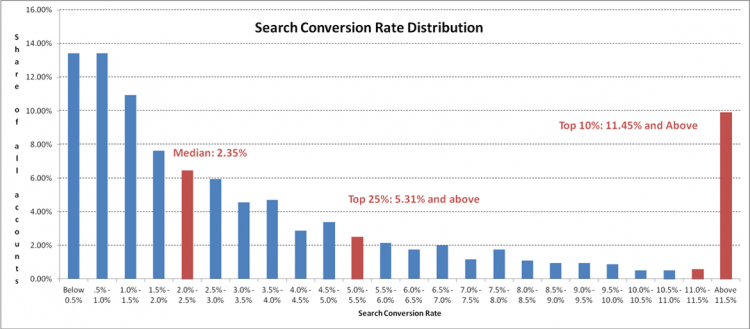
Well, cross-industry, a high conversion rate is around 2% or 3%…
And while we know that’s the average for many websites in the world today, at Carrot, we say bubkus…
We are committed to higher conversion rates, to more opt-ins, to more closed deals for our members.
Which is why, for Carrot members, an average conversion rate is around 10%…
An excellent conversion rate is around 15%…
And an incredible conversion rate is 20% or higher.
To be honest, if you’re not getting at least a 5% conversion rate with your website, then it might be time to rethink where you’re sending your paid traffic. Maybe you could try to re-work and optimize your landing page… maybe you need better targeting with your paid ads… or maybe you need a Carrot website ( ;-) shameless pitch).
Whatever the case, do not settle for a low conversion rate. Work until you’re pulling as many leads as you need to run a healthy business that provides you with the predictable income and financial stability that you need.
Conclusion
The pressure is on.
When you’re running paid ads, you’re watching the ROI of your campaigns like a hawk…
You’re wondering if the amount of money you’re spending is going to pay you back like you hope it will (try using our calculator over here to set a realistic paid advertising budget).
Unfortunately, I can’t give you the answer :(
But I can (and did!) show you what other real estate investors are doing, what kind of results they’re getting, and what you should expect for your website conversion rate.
I hope it helps you build a business that you’re proud of.
When it does launch, you want to collect clicks from motivated sellers or interested buyers, and you want your cost-per-click to stay within budget.
Easier said than done, of course. You might think that a campaign will convert like a million bucks, but then you launch it… and it doesn’t.
(You’ve been there, right?)
How can you possibly know what will convert well and what isn’t before you even launch the campaign? Well, ultimately, you can’t. But you can use a few simple copywriting tricks to increase the chance that your ad is a winner.
When it comes to platforms such as Google Ads, it’s just words on a page, no images or video allowed. So let me walk you through 8 ad copy for real estate PPC campaigns tips that will have you lowering your cost-per-click and increasing your conversion rate in no time.
But before we dive in, you need to be aware of the different ad platforms’ character limits. Character limits can make crafting ad copy a little difficult, so you’ll need to have an idea before writing.
Google Ads:
15 headlines with 30 characters for each headline. 4 description lines with 90 characters for each description. Option to pin your headlines and descriptions in specific positions of your ads. Set your display URL path. Set your final URL like a normal expanded text ad.
Microsoft (Bing) Ads:
Titles 30 characters each, up to three ad titles Ad text 90 characters each, up to two ad descriptions Final URL 2048 characters, including prefix (e.g., “www.”), suffix (e.g., “.com”), and tracking templates
Facebook Ads:
Facebook ad specs for single-image ads are:
Text: 90 characters Headline: 25 characters Link Description: 30 characters
8 Tips To Write High-Converting Ad Copy For Real Estate PPC Campaigns
Tip #1: Write 3 Ads And Choose The Best One
Writing three ads from the get-go rather than one can help get your creative juices flowing and give you more ideas for connecting with your audience and getting them to convert. I do this for many different ad copy, and I find that the last one I write is usually the best, because you start getting in your flow, and the ideas become more solid as you write them down.
Try this: write down three complete ads, headlines, and descriptions, and see which one you like the most. More than likely, one will stand out among the rest. This is a quick way to ensure you’re not running an ad just because it was the first thing that came to mind. Your brain needs to simmer a bit before it comes up with high-converting ad copy.
Let me give it a swing to show you what I mean…
[Headline] Need to sell your home fast for cash?
[Description] Foreclosure? Probate? Divorce? We can help you through your difficult life situation, putting a fair cash amount in your pocket faster than anyone else (within a week).
[Headline] Need to sell your house for cash in one week?
[Description] Foreclosure? Probate? Divorce? Whatever you’re going through, we’re real estate investors who buy properties fast for cash to benefit sellers like you.
[Headline] Sell Your House For Cash in Just One Week (1,257 Properties Purchased)
[Description] Foreclosure? Probate? Divorce? Whatever you’re going through, we’re real estate investors who buy properties fast for cash to benefit sellers like you. We’ll make your difficult situation easier.
Tip #2: Run Consistent A/B Tests
If you’re in the real estate business for the long run, which you are, then you will be doing a lot of marketing. And the more you learn about what makes motivated sellers and buyers tick, the better ads you can write.
Perhaps the best way to learn more about your target market — what makes them click and convert — is to A/B test pieces of your sales copy.
Do not, though, A/B test two totally different ads. While that can be interesting anecdotally, you can’t possibly pull any quantitative information from those tests since there are too many differing factors.
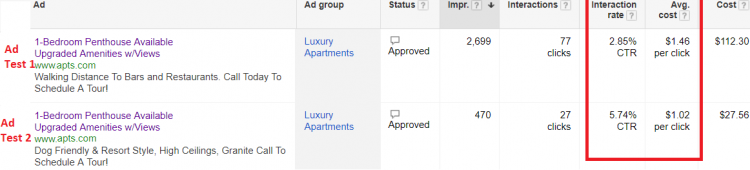
Instead, choose which part of an ad you want to test, and then create two identical ads, save for the one element that you want to test (headline, for instance).
Here’s an example of an A/B test where the marketer tested the description (pretty significant difference in results for such a small change).
If you’ve spent any time as a copywriter, then you’ve heard it a million times: the headline is the most important part of your ad. It’s what people see first; in the case of Google ads, it’s often the only thing they look at before they click.
If that doesn’t illustrate the importance of your headline, I don’t know what does.
Make sure you dedicate a little extra time to brainstorming a title that resonates with your target market.
First, you want to start with a basic ad headline.
Sell Your House Fast For Cash!
Then, you want to look for places to add specificity to the title (specificity is enticing, vagueness isn’t). Here’s an idea.
Get a Fair Cash Offer On Your House in Just 24 Hours!
That’s a little better. We can make it even more specific if we’re willing to do more targeted advertising.
Going Through a Divorce? Sell Your House Fast For Cash
Or…
Dealing With Foreclosure? Sell Your House For Cash Now!
You can see how each title gets better as I spend a little more time thinking about it. The same will be true when drafting headlines for your Google ads.
Google Ads Tips: Including your keyword within your title can help increase your Quality Score.
Tip #4: Try Using These Power Words
Different words trigger different thoughts and different emotions. Fortunately, most people are very similar, and certain words trigger similar emotions. Using words that evoke the right emotion can be extremely effective at making your copy more enticing.
What words should you use? Here’s a list of power words for any sales copy you write.
You/Your
Because
Introducing
Welcome
Unique
Announcing
Secret
Hidden
Truth
Temptation
Now
Discover
New
Win
Cheap
Free
Lazy
Humiliation
Alone
Reject
Stress
Here are a couple of examples of these and other similar power words in Google Ad campaigns:
Here are a couple of examples of these and other similar power words in Facebook Ads:
If you’re a Carrot member, don’t miss the opportunity to learn from the industry’s top Facebook marketers. Check out the Facebook Leads Masterclass today!
Tip #5: Touch On The Prospect’s Emotional Pain Or Desire
When you’re writing sales copy, you aim to connect with your prospect’s emotional pain or desire (depending on whether you’re trying to attract sellers or buyers). No one buys anything or commits to anything without first seeing a vision in their head — a vision for how that product or service might solve their problem or give them something they desire.
No one buys a car without first imagining owning it. No one buys a house without first walking around and imagining living in it. And no one will work with you unless they can see the tangible benefits of doing so.
Your copy should wise up to that and try to get the prospect to imagine what it’ll be like to work with your business.
For example…
[Headline] Get Your Life Back — Sell Your House Fast For Cash
[Description] Sick and tired of dealing with the demands of foreclosure, probate, or divorce? We can’t solve everything, but we can make you a fair cash offer on your home and close in just one week… Can you imagine no more worry?
[Headline] Reduce Stress — Sell Your House For a Fair Cash Offer in One Week
[Description] Stressed from difficult life situations? We’ve helped hundreds of people sell their house fast for cash and regain their lives. Ready to start enjoying life again?
Tip #6: Try Statistics or a Case Study
One of the best ways to make your Google Ads copy more enticing is to use statistics or a case study. This builds credibility for your business and makes your promise more believable.
Here are some examples of what I mean… notice how the data makes them far more enticing than some previous examples.
[Headline] Need to Sell Your House Fast? I Just Handed This Person $50,000… Cash (Case Study)
[Description] Let me tell you a quick story about someone who just sold their house to me in one week for $50,000. You can do the same thing… but first, I need you to understand this simple process…
[Headline] Need Quick Cash For Your House? We Can Help (1,500+ Offers Sent)
[Description] When you need to sell your house fast for cash, we’re the people you come to. We’ve made over 1,500 cash offers and helped hundreds of people out of difficult situations. Are you ready?
Tip #7: Respond To Common Objections
If you know what objections people will have when they read your ad, why not deal with them right from the beginning? Maybe not in your headline… but definitely in your description.
Here are some of people’s most common objections about working with real estate pros…
Can I trust you? — First and foremost, people want to know that they can trust you and your business. Real estate is a big transaction, the biggest transaction that most people will ever deal with, and it’s for that reason that people so carefully try to vet who they’re going to work with to ensure that they’re the real deal.
Can I buy or sell fast? — Speed is important if you’re dealing with motivated buyers or sellers. No one wants to wait forever to get their pain or desire fulfilled.
Will it be difficult? — People want to know that you will do all the legwork. They don’t want to have to do anything difficult themselves.
How much will it cost me? — No one wants to be nickel and dime’d. Tell people how much it’ll cost them and move on with it.
What’s the catch? — Most people think that everyone is trying to manipulate them, especially marketers, so indicating that there are “no strings attached” can be a helpful sales strategy.
Tip #8: Study Your Competition
A great way to get ideas for your own Google Ads campaign is to spy on the competition and see what top agents and investors in your market are doing. Then you can either copy them, try to do better than them, or do something completely different. Either way, you can make more informed decisions when you know what the competition is doing.
You can use a tool like ChatGPT to do competitive keyword research. Or you can keep it simple and type your target keyword phrase into Google and see what ads come up.
Conclusion
You can’t know whether an un-launched ad will perform as you want it to. Only once you hit the big red button can you measure your ad campaign’s cost-per-click and ROI.
But these eight PPC Ads copywriting tips will give your ads a far better chance of winning the click and the day. Give them a try, and let us know how it turns out!
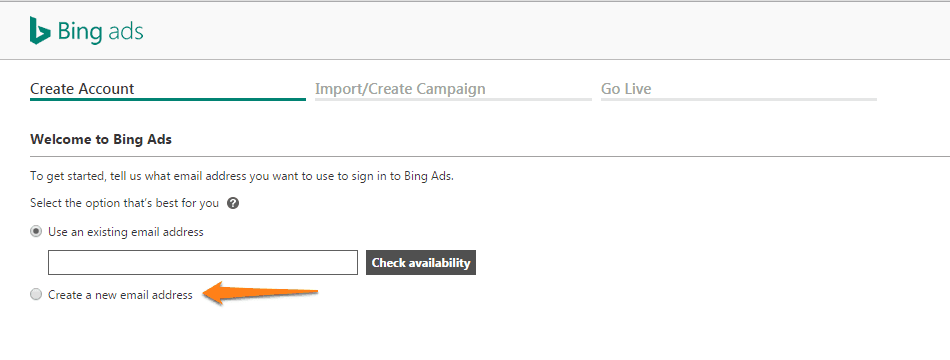
We’ve already written about why Bing ads can be crazy profitable for real estate investors and agents. But how do you set up a Bing Ads account? Well here’s how…
Demo Carrot: How many deals are you losing to your competitor’s website?
But first, we need to clear something up. In early 2019, Bing Ads was rebranded as Microsoft Advertising. In this article, we’re going to reference Bing Ads.
Real estate investors can be very busy and sometimes don’t have the necessary time to research and create marketing campaigns, especially when it comes to pay-per-click advertising.
We understand the requirement to streamline some of this process. That’s why we created this simple step-by-step guide to creating your own Bing Ads account. It’s for short-on-time investors needing to expand their online marketing.
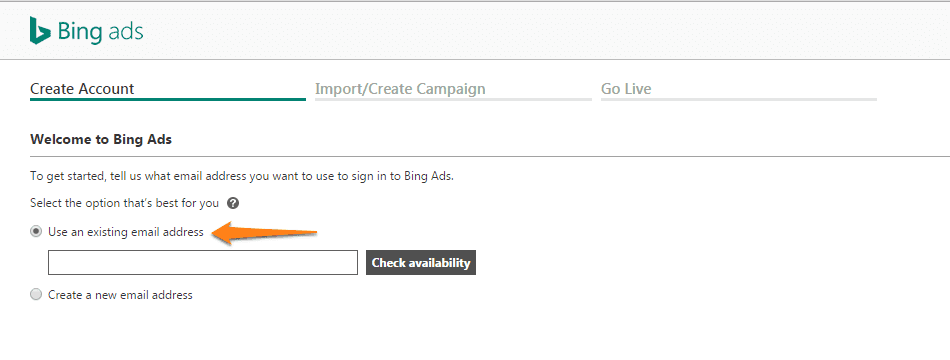
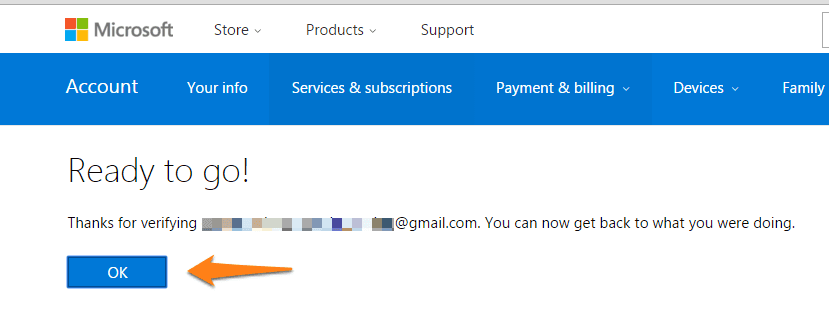
If you have an email address you already use to sign in to Microsoft products (like Skype or Xbox LIVE), all you need to do is sign in and the transition will be complete. If you’ve never used this email to sign into a Microsoft product, you’ll be able to sign up for a new account.
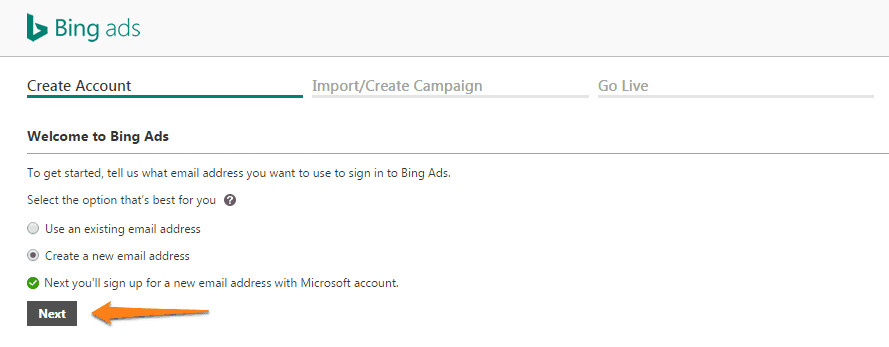
Click Next
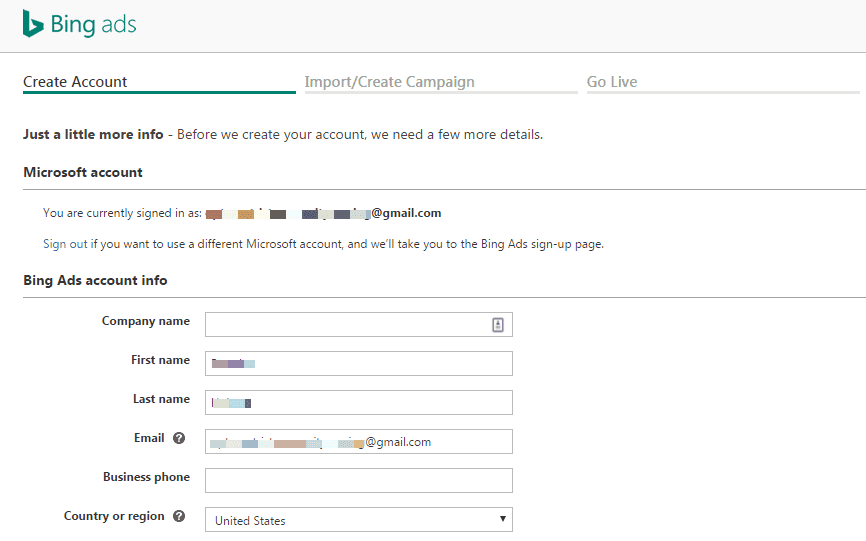
Sign into Bing Ads
Enter Bing Ads account info
Click Create Account.
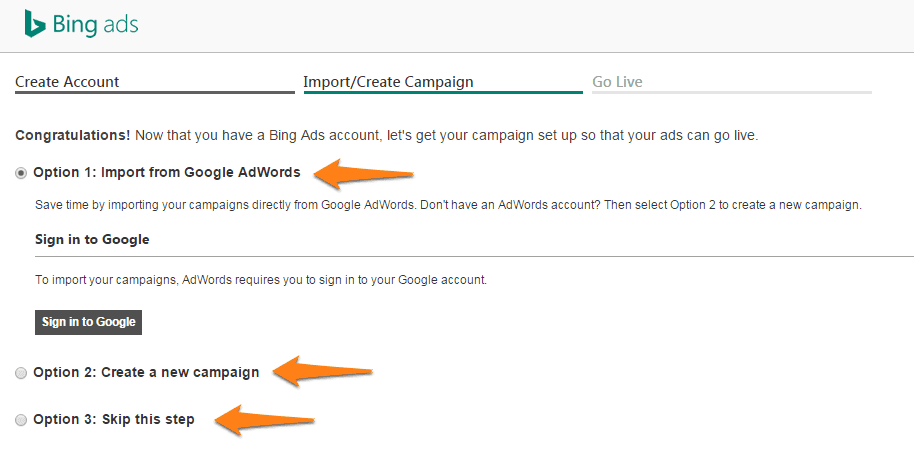
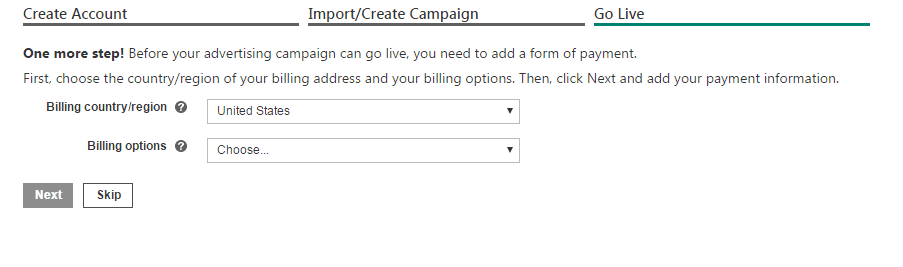
After you’ve created your Bing Ads account, you can set up your campaign by importing from Google AdWords (see below) or by creating a new campaign. You can also skip this step and click Continue. Enter your billing and payment information and click Next. You can also skip this step and enter your billing and payment information later by clicking Skip.
Option 2: Create A New Email Address And Then Create An Account
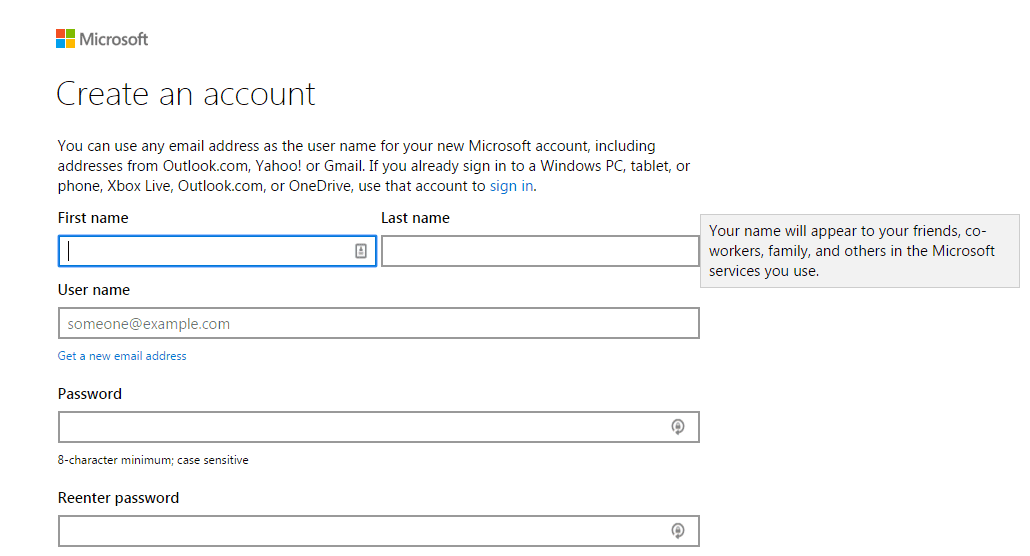
A Microsoft account is an email address and password you use to sign in to Microsoft services or devices. If you use an email address and password to sign in to services like Skype, Xbox LIVE, or Outlook.com, you already have a Microsoft account.
Enter information for the new account
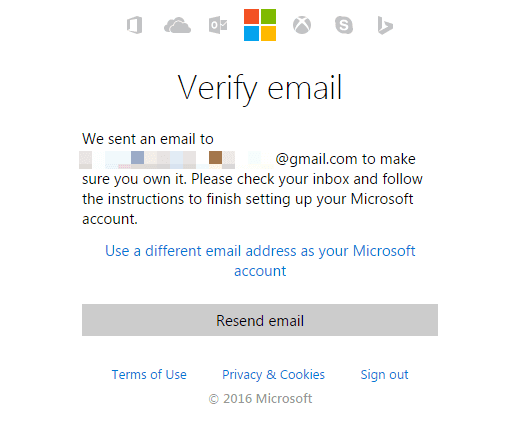
Click Create account
You’ll be taken to the Bing Ads Create Account page directly after creating your new Microsoft account and will already be signed in with your new account
You’ll be taken to the Bing Ads Create Account page directly after creating your new Microsoft account and will already be signed in with your new account.
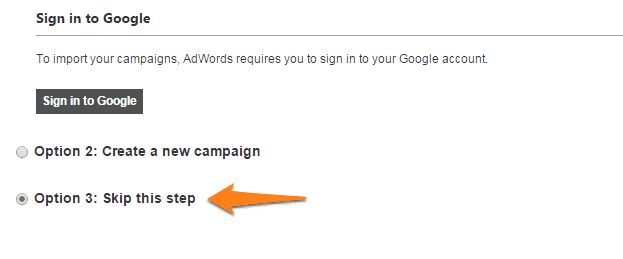
After you’ve created your Bing Ads account, you can set up your campaign by importing from Google AdWords or by creating a new campaign. You can also Choose Option 3 to skip this step. Once you choose your desired option click Continue.
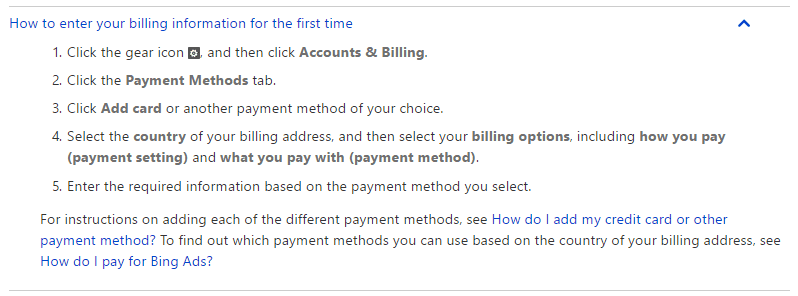
Enter your billing and payment information and click Next. You can also skip this step and enter your billing and payment information later by clicking Skip.
In Bing Ads, click Import Campaigns, and then click Import from Google AdWords.
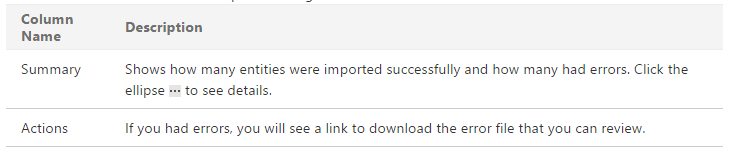
If you have imported from Google AdWords in the past 90 days, you will see a table that tells you the data and AdWords account that was imported along with:
Enter your Google sign-in information, click Sign in and then Accept
Select the Google campaigns you want to import, then click Continue
Under Choose Bing Ads account & import options, do the following:
Choose the Bing Ads account you want to import to
Choose the appropriate time zone
Choose the appropriate options for “What to import”
Choose the options you want for bids and budgets
Click Import
All this PPC advertising stuff can seem complicated, but that’s what we’re here for. The initial setup of your first campaign is not nearly as important as the long-term optimization of your account. Hopefully, this piece will help you create your Bing Ads account with as little pain and suffering as possible.
The small amount of effort it requires to create a Bing Ads for real estate account is small in comparison to the long-term benefits that Bing Ads advertising can offer in addition to AdWords as part of a comprehensive, sustainable, and above all, profitable, online marketing strategy. So what are you waiting for? Create a Bing Ads account, and let’s get to work!
Create Your First Campaign
Have You Had Success With PPC Advertising?
Facebook, AdWords, Bing, Craigslist… Shoot those success stories through the comments box below. We’d love to hear!
Also… be sure to dive into our Carrot blog to get insights on attracting and converting more inbound leads for your real estate investing business.
Are you dismissing Bing PPC for real estate investors because that “guy” in the online forums said it’s not worth using it? Is your Google Ads campaign killing your marketing budget?
Demo Carrot: How many deals are you losing to your competitor’s website?
What if I told you Bing might help you attract extra leads at a lower cost (if you do it right)?
“For me, Bing Ads is too expensive. The conversion rates just suck…” via Reddit
“Bing Ads are s*** compared to Google Ads in my experience”. via Reddit
We see these kinds of comments about Bing PPC for real estate investors all of the time. You probably do as well.
We’re often asked, “Is Bing PPC worth it as an additional source for real estate investor advertising?”
So, we wanted to find out… and we started testing, which we dive into below. Also, we’ll show some of the advantages Bing can have over AdWords.
Don’t Assume That Google Ads Is The Only Game In Town For PPC Marketing
When prospects search online for a real estate professional (this applies to investors and agents), you want to be on the first page.
Because if you are, people will click on your result, they’ll visit your website, and there’s a darn good chance they’ll even become a lead (at the very least, you can tag them once they visit your website and retarget them with Facebook ads — learn more over here).
And leads from search engines are typically much higher quality than direct mail leads, bandit sign leads, or even door knocking or cold calling leads.
Because they came looking for you.
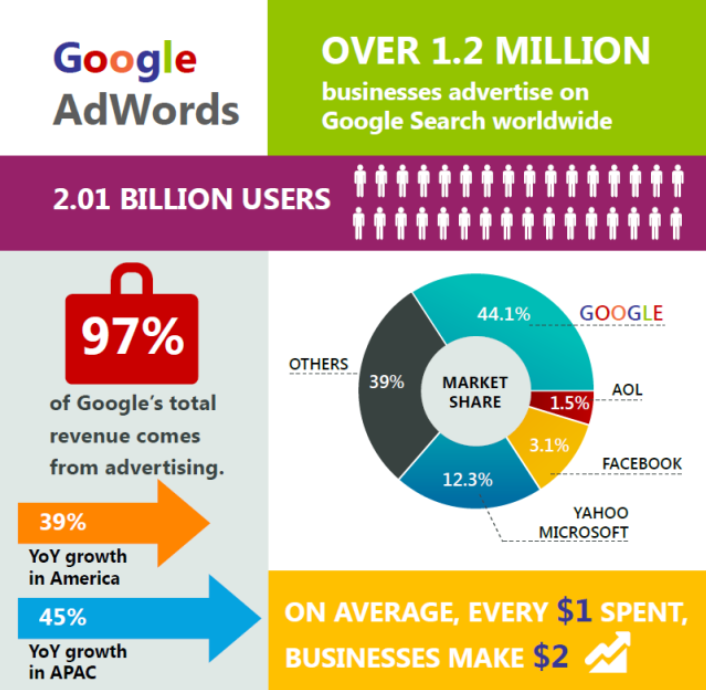
However, in the world of search engines and PPC, Google Ads reign supreme. Google, after all, dominates nearly 95% of all search engine traffic.
But in this article, we’re not talking about Google Ads. We’re talking about Microsoft Advertising (the advertising platform behind Bing, a search engine mockingly acronym as “But It’s Not Google”), which holds about 2.39% of the world’s search engine market share.
That begs the question: why are we discussing Microsoft Advertising?
Well, there are a few advantages you should be aware of.
Should You Use Microsoft Advertising?
While holding 2.20% of the world’s search engine market share seems small and insignificant, those two percentage points still amount to 12 billion searches per month. Everyone searches online. Most people do it daily, so owning a few percentage points of the world’s search engine share is more powerful than it seems.
And here’s the other thing: most people only use one search engine.
If you’re a Google user (and you probably are), when is the last time you searched using Bing, Yahoo, or DuckDuckGo?
Yeah… don’t even remember. Neither do I. And neither do most people.
Most online searchers use a single search engine and rarely stray.
This means that the people who search using Bing… you’ll seldom reach those same searchers with Google Ads. Conversely, you’ll rarely reach Google Ads users when using Microsoft Advertising.
Searchers don’t cross platforms. This means to reach all of your prospects, your business should.
But look — I’m not going to tell you that you have to advertise on Bing; it’s your call. I want to point out that running a Microsoft Advertising campaign in addition to your Google Ads campaign can give you a competitive edge in your market: you’ll reach the people who your competitors aren’t probably even advertising to.
Because since Google is the biggest, most visible search engine, everyone knows about it, including your competitors. And they’re advertising on it.
Bing? Maybe not. Using Microsoft Advertising could help you snag leads that your competition outright ignores.
Is Bing PPC for real estate investors worth it? Here’s What We Found…
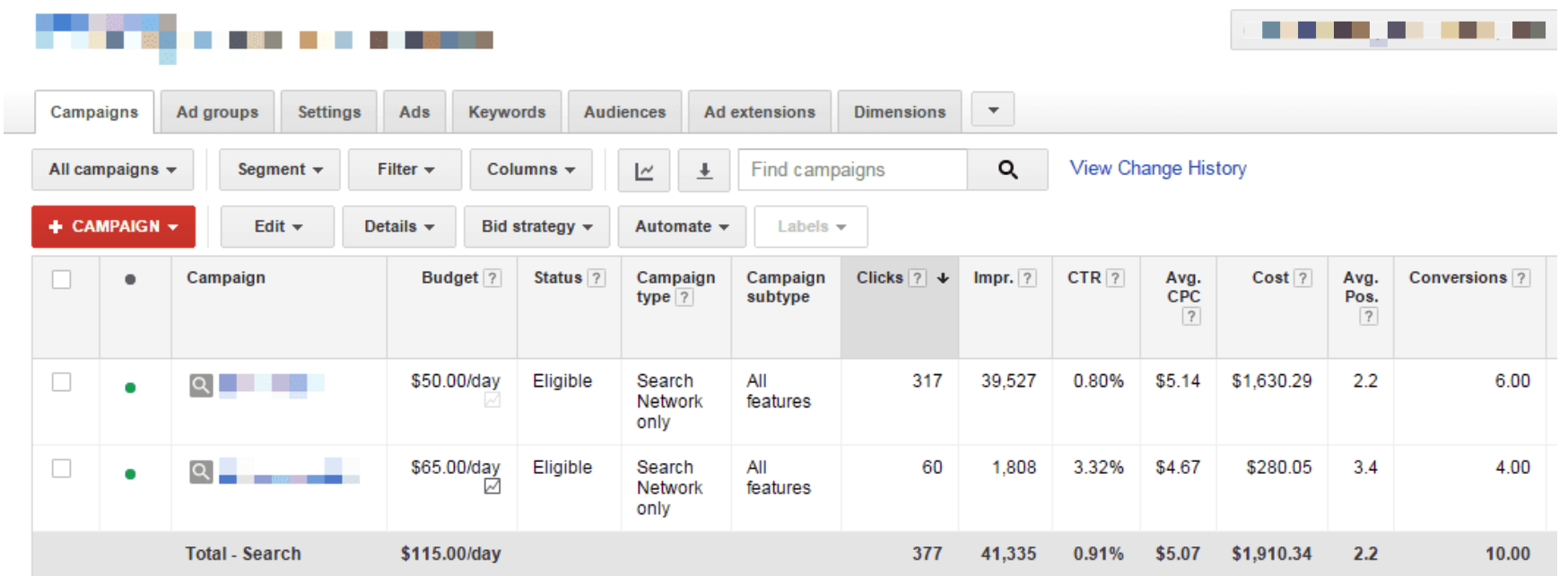
Carrot Member Google Ads Campaign
With that success with Google Ads, we wanted to see if we could “stack” on more leads by adding Bing PPC to the picture. As you can see, he invested $1,910 in ad costs during those 30 days in Google Ads and collected ten confirmed online opt-in leads… and many other phone call leads. Counting the phone call leads brings his cost per lead down to under $100 per lead.
Same Carrot Member Bing PPC Campaign
Now let’s compare them both apples to apples across the board.
Clicks:
Google Ads: 377
Bing: 338
Google Ads had 11.5% more clicks by volume
Impressions:
Google Ads: 41335
Bing: 24660
Google Ads had 68% more impressions by volume
Click Through Rate:
Google Ads: .91%
Bing: 1.37%
Bing had a 50% greater click-through rate by a percentage
Cost Per Click:
Google Ads: $5.07
Bing: $3.32
Google Ads cost per click was 53% higher than Bing
Conversions:
Google Ads: 10
Bing: 6
Google Ads (for this specific market) only had 4 more online leads in total (doesn’t count phone call leads).
Total Invested:
Google Ads: $1910.34
Bing: $1123.65
Google Ads overall spending was 70% higher than Bing and yielded 40% more leads.
Just one thing to remember from this test… the cost per lead in this campaign is higher than our typical cost per lead on PPC. The client wanted us to test a set of 6,000 broad match keywords he received from a mentor… vs. our more targeted approach to PPC management.
The cost per lead on that broad match keyword group is 5x higher than on our targeted group… for the same number of leads. But the client is ok with that higher cost per lead because his margins on deals are so high that it ensures he’s not missing any leads.
Bing delivers lower search volume but a more attractive cost per lead.
Of course, you’ll get more impressions and clicks on Google Ads, but you’ll usually pay more per click for those visitors.
It’s not that one is better than the other… this post is mainly to lay out the argument that Bing is a very valid PPC marketing platform that, in this month-long test, pulled leads that cost us less than we pay for leads from Google.
More… Quick Microsoft Advertising Stats
Here are some stats about Bing and Microsoft Advertising to keep your mind churning and informed.
Microsoft Advertising generally has a lower cost-per-click than Google.
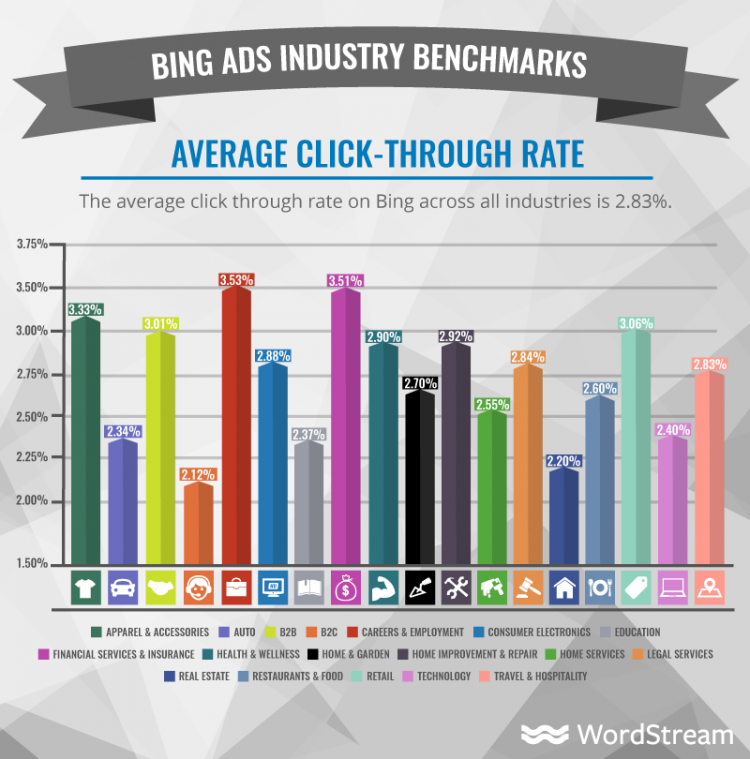
Google Ads’ click-through rate has been neck-and-neck with Microsoft Advertising click-through rate, around 2.5%.
Bing offers better support to advertisers with lower budgets.
7 Reasons Why You Shouldn’t Ignore Bing PPC For Real Estate Leads…
1. Bing PPC offers cheaper CPCs (costs per click) and potentially higher ROI
This is primarily because fewer investors use Bing over Google Ads. Bing Ads generally has lower competition than Google Ads, especially in the real estate industry. With fewer advertisers competing for the same keywords and targeting options, the cost per click (CPC) on Bing Ads tends to be lower. Real estate investors can use this lower competition to secure motivated seller leads at a more cost-effective rate.
Here are some additional reasons by CPCs are lower on Bing:
Cost-Effective Advertising: Lower CPCs on Bing Ads translate to lower advertising costs for real estate investors. By paying less per click, investors can stretch their advertising budget further, enabling them to reach more motivated sellers within their allocated budget. This cost-effectiveness can lead to a higher return on investment (ROI) for investors, as they can generate more leads and conversions for a lower cost compared to other advertising platforms.
Targeting Specific Audience: Bing Ads allows precise targeting options, including demographics, location, and search intent. Real estate investors seeking motivated seller leads can leverage these targeting options to reach their desired audience more effectively. By narrowing down their target audience and focusing on specific geographic areas or relevant search terms, investors can ensure their ads are shown to users actively looking for real estate information or intending to sell their properties. This focused targeting can result in higher conversion rates and an improved ROI.
Unique User Base: Bing has a distinct user base that often differs from Google’s audience. Bing users tend to be older, more affluent, and more likely to be homeowners. These characteristics align well with the target audience of real estate investors seeking motivated sellers. By advertising on Bing Ads, investors have the opportunity to connect with this specific user base and potentially find motivated sellers who are more likely to engage with their ads and pursue a real estate transaction.
Considering these factors, Bing Ads can offer real estate investors seeking motivated seller leads a cost-effective advertising solution with cheaper CPCs and potentially higher ROI. By leveraging the lower competition, cost-effectiveness, precise targeting options, and unique user base of Bing Ads, investors can maximize their ad spend, generate more leads, and increase their chances of finding motivated sellers interested in their real estate offerings.
2. The Expanding Reach of Bing PPC
Bing PPC has experienced remarkable growth, solidifying its position as a formidable advertising platform. With the integration of Microsoft Advertising and Bing, its reach has expanded significantly, capturing a substantial share of search queries.
In fact, Bing now powers over 30% of all search queries in the United States. Ignoring Bing PPC could mean missing out on a sizable portion of potential leads and lucrative real estate investment opportunities.
3. Bing Ads offers new ad features!
Since 2022, Microsoft Advertising (formerly Bing Ads) has introduced several changes to its ad structure to enhance the advertising experience for marketers. Here are some notable updates:
Expanded Text Ads: Microsoft Advertising introduced Expanded Text Ads, allowing advertisers to create more compelling and informative ads. Expanded Text Ads feature additional headline and description fields, providing more space for advertisers to highlight their products or services. This update allows for more creative and engaging ad copy, improving click-through and conversion rates.
Image Extensions: To make ads more visually appealing, Microsoft Advertising introduced Image Extensions. This feature enables advertisers to add relevant images to their ads, helping them capture the attention of potential customers. By incorporating visual elements into their ads, advertisers can effectively convey their brand messages and increase ad engagement.
Callout Extensions: Callout Extensions allow advertisers to include additional text to highlight unique selling points, key benefits, or special features of their products or services. This update gives advertisers more flexibility to communicate essential information to potential customers and differentiate themselves from competitors. By leveraging Callout Extensions, advertisers can increase the relevance and impact of their ads.
Dynamic Search Ads: Dynamic Search Ads (DSA) were improved to provide more accurate and relevant ad targeting. This feature enables advertisers to automatically generate ads based on the content and keywords on their websites. Microsoft Advertising’s DSA now offers improved page coverage and refined targeting options, ensuring that ads are shown to users actively searching for related products or services.
These updates to the ad structure in Microsoft Advertising (formerly Bing Ads) offer advertisers more versatility, improved visibility, and better opportunities to engage with their target audience. By leveraging these features, marketers can create more impactful and effective ad campaigns on the platform.
4. Syndication across the Microsoft Advertising Network
Bing PPC allows real estate investors to syndicate their ads across the expansive Microsoft Advertising Network. This network includes popular platforms such as MSN, Outlook, and Microsoft Edge, ensuring broader exposure and increased visibility for investment opportunities.
By leveraging the Microsoft Advertising Network, investors can reach a wider audience, attracting qualified traffic to their websites or landing pages and expanding their potential for successful real estate transactions.
5. Bing PPC offers flexibility!
The differences in Bing Ads ad groups can benefit real estate investors seeking motivated seller leads. Here’s how these differences can be advantageous:
More Descriptive Ad Group Naming: With a higher character limit for ad group naming in Bing Ads, real estate investors can use more descriptive and detailed names. This allows investors to organize their ad groups to align closely with their real estate investment strategies.
Using descriptive names, investors can easily identify and manage ad groups targeting specific geographic areas, property types, or other relevant criteria. This level of organization can streamline campaign management and make tracking the performance of individual ad groups easier.
Inclusion of Search Partners by Default: Bing Ads includes search partners as part of the ad group targeting by default. Real estate investors using Bing Ads can extend their reach beyond Bing’s search engine to include partner websites such as Yahoo and other affiliated search networks.
By default, investors can potentially reach a wider audience and increase the exposure of their motivated seller ads. This expanded reach can lead to more opportunities to connect with motivated sellers searching for real estate information on partner websites.
Default Ad Distribution on Bing Ads: Bing Ads has a default ad distribution setting of “All” within an ad group. Real estate investors’ ads are automatically eligible to appear on Bing, Yahoo, and search partner sites without additional configuration.
This broader ad distribution can increase the visibility of ads and generate more impressions, potentially reaching a larger pool of motivated sellers. Investors using Bing Ads can leverage this default setting to expand their ad reach and increase the likelihood of connecting with motivated seller leads.
Ad Extensions at the Ad Group Level: Bing Ads allows real estate investors to set ad extensions at the ad group level. This gives investors greater control and flexibility in associating ad extensions with specific ad groups. Real estate investors can utilize ad extensions such as call extensions, site link extensions, or location extensions at the ad group level to enhance the visibility and relevance of their ads.
By customizing and optimizing ad extensions at the ad group level, investors can provide additional information and relevant contact details to potential motivated sellers, increasing the chances of engagement and lead generation.
Real estate investors can benefit from enhanced organization, broader ad distribution, and more control over ad extensions by taking advantage of these specific features in Bing Ads ad groups. These benefits can help investors effectively target motivated seller leads, increase ad visibility, and drive better engagement, ultimately maximizing their chances of connecting with potential motivated sellers and securing profitable real estate transactions.
6. Bing Ads have better device targeting options.
Device targeting options in Bing Ads can benefit real estate investors seeking motivated seller leads. Here’s how real estate investors can leverage these options effectively:
Mobile Device Targeting: Since many users now rely heavily on mobile devices for their online activities, targeting mobile devices can be a strategic move for real estate investors. Mobile targeting allows investors to reach potentially motivated sellers searching for information on their smartphones or tablets.
By tailoring campaigns specifically for mobile users, investors can capture the attention of on-the-go sellers, increasing the likelihood of engaging with motivated leads.
Location-Based Targeting: Bing Ads provides location targeting options, allowing real estate investors to focus on specific geographic areas known for motivated seller activity. By combining location and device targeting, investors can effectively reach potential sellers in their desired locations using mobile devices to search for real estate information. This precise targeting ensures that investors connect with motivated sellers in their target market, maximizing the chances of generating high-quality leads.
All Device Targeting: Real estate investors can opt for all device targeting to ensure maximum campaign exposure and reach. By targeting all devices, including desktops, mobile devices, and tablets, investors can cover a broader audience and increase the chances of capturing motivated seller leads across various devices.
This comprehensive approach allows investors to reach potential sellers regardless of their preferred device, ensuring a higher chance of engagement and lead generation.
Bid Adjustments for Device Performance: Bing Ads allows investors to adjust bids based on device performance. By closely monitoring the performance of their campaigns on different devices, investors can identify which devices are driving the most conversions and adjust their bids accordingly.
For example, if mobile devices show higher conversion rates, investors can increase their bids for mobile targeting to allocate a larger portion of their budget to the most effective device. This optimization strategy helps investors maximize their return on investment and generate more motivated seller leads.
Real estate investors can utilize device targeting options in Bing Ads to connect with motivated seller leads. By targeting mobile devices, focusing on specific locations, using all device targeting for maximum exposure, and adjusting bids based on device performance, investors can enhance their campaigns’ effectiveness, increase engagement, and generate more quality leads from motivated sellers.
7. Bing Ads platform is ideal for companies with a small budget!
While Google Ads remains a popular choice, Bing PPC often offers a cost-effective alternative for real estate investors. In some instances, Bing PPC can provide a lower cost-per-click (CPC) compared to Google Ads, enabling investors to stretch their advertising budget further and achieve a higher return on investment (ROI).
By optimizing campaigns and implementing strategic bidding, investors can maximize their ad spend on Bing PPC, attracting motivated prospects without breaking the bank.
Is Bing PPC Right For Your Real Estate Investing Business?
It can help you tap into new leads you’d never otherwise reach on Google. That’s for sure.
If just maybe… especially if you need to start on a smaller budget to test the waters.
If your advertising campaign is limited to a small geographic area, Google Ads might be the platform where you’ll gain significant search volume, depending on your keywords and match types. Higher search volume means more potential customers for your business.
Yes, Google Ads is still the “empire” for paid search, with most of the market share. For that reason, Bing Ads is often an afterthought that doesn’t get much attention. But Bing has some unique capabilities that most folks do not use. If you optimize for these Bing Ads only features, you’re sure to increase performance significantly.
They’re both great platforms with their advantages and disadvantages. But the analyst inside of all great advertisers should prefer to test both. See if you can stack on additional leads for motivated house sellers, cash buyers, and tenants… you name it… by adding Bing to the mix.
You’ll see, in time, which performs better for your market and budget.
Read this post if you want more great tips on effective PPC marketing.
The Pros and Cons of Microsoft Advertising
Let’s keep this simple and break down the pros and cons of Microsoft Advertising.
Pros
Bing is the second-most-popular search engine. So if you want to put money somewhere other than Google, Bing is the place to do it.
Since Bing has less search traffic than Google, it also has less competition and a lower cost-per-click usually, so it can be less expensive to advertise.
Bing gives you more characters for your ad than Google, allowing you more room to convince people to click your result.
Bing shows more of its ads at the top of the page than Google does, which is helpful for the click-through rate since people don’t have to scroll down the page.
Almost 75% of Bing users are over 35, so Microsoft Advertising can be good for reaching an older audience.
Cons
Bing can have lower search engine traffic (compared to Google), so potentially fewer leads.
My recommendation? Start with Google Ads, and if you have the budget to spare and need a competitive edge, supplement your efforts with Microsoft Advertising.
Still Have Questions?
Still not sure if Microsoft Advertising is right for your business? That’s okay — it’s not always easy to know the right path to take when it comes to marketing. But the good news is that you don’t have to decide now.
Why not try it out for yourself?
You can create a Microsoft Advertising account over here and start driving traffic to your site immediately (and if you need a high-converting site out-of-the-box, sign up with Carrot).
Who knows? Bing might give your business the competitive edge you’ve been looking for.
Are you ready to take the next step in your online real estate marketing? That step is creating a Google Ads account.
Real estate investors face several challenges when it comes to generating leads. Traditional methods, such as direct mail and cold calling, can be time-consuming and yield low results. Even with a strong online presence, attracting qualified leads to your website can be tough.
This is where Google Ads comes in.
According to data, Google Ads can be a highly effective lead source for real estate investors. Without it, investors may struggle to compete in today’s crowded digital landscape. With Google Ads, investors can reach potential sellers and buyers actively searching for real estate solutions, resulting in a higher likelihood of conversion.
Furthermore, without a strong online advertising strategy, investors may miss out on valuable leads. The data shows that 97% of consumers search for businesses online before making a decision. If real estate investors are not visible in these search results, they may be losing out on potential leads to their competitors.
In addition to missing out on potential leads, not having a strong online presence can damage an investor’s credibility. With 78% of consumers saying they research a business before engaging with them, it’s crucial for investors to have a professional and user-friendly website. By using Google Ads to drive traffic to their website, investors can showcase their credibility and expertise to potential leads.
Overall, real estate investors who neglect to utilize Google Ads may miss out on valuable leads, damaging their credibility and struggling to compete in today’s digital landscape.
In preparation for creating a Google Ads account, there are a few important steps. While setting up the account itself is relatively straightforward, running effective Google Ads campaigns requires some groundwork.
Before You Create a Google Ads Account
First and foremost, ensuring that your website is relevant, user-friendly, and adds credibility is crucial. Your Google Ads account will drive traffic to your site, but once visitors arrive, it’s up to you to convince them to take action.
Your advertising efforts will likely be wasted if your landing pages are disorganized, lack relevant information, or are otherwise not conducive to conversions.
For guidance on creating effective landing pages that maximize the return on your PPC campaigns, we recommend checking out our land page best practices.
Before Starting a Google Ads Account, You Need to Consider
Your Google Ads account (formerly known as AdWords) can help you to bring qualified visitors to your real estate website. Once they’ve made it to your website, it’s YOUR duty to convince them to convert.
To make this happen, you must create pages that will compel your visitors to take action. If your pages are cluttered or lack relevant, credible information, you will have a leaky bucket and will likely be wasting money.
Take the time to focus on customizing your website a bit, especially your “Testimonials” and “Our Company” pages. Check why these two pages are so important. Also, be sure your real estate website is mobile-optimized. All Carrot websites are mobile-friendly. Therefore you’re maximizing the potential of your Google ads account.
2. Commitment. You must be willing to build Google Ads into your long-term financial and time plan.
It’s practically impossible to see the full potential of your Google Ads account from the start. It’s essential to recognize that PPC is not a short-term venture. Establishing a strong structure, expanding your keyword lists, identifying negative keywords, and testing ads and landing pages takes time.
Plus, you will likely start constantly changing keyword bids to fit your budget and keeping your ads in relevant, high-performing ad positions. Getting the first phase dialed in typically takes 1-3 months.
3. Dedication. You must be willing to spend time or outsource your account.
Your account is now up and running… you can sit back and relax. WRONG! There is still plenty of heavy lifting.
If you haven’t managed a PPC account before, I recommend taking serious time to learn. You must be comfortable with the Google Ads dashboard and educated enough to make good decisions. Making the wrong choices can cost you money and cause your account to take a step back in productive data.
Once you are comfortable to embark on the challenge, you must monitor your performance thoroughly. That hard work will well pay off in the end.
Take time developing your strategy, identifying your goals, and calculating your cost per lead/deal. You must know how much you will spend on Google ads to close a deal. As we know, all market profits aren’t created equal. An investor in New York might need to spend more to get one deal closed over someone in Memphis. You must know your market.
After you know your budget, you’ll need to have a solid keyword strategy in place. It’s a good idea, especially if you’re new to Google Ads, to start with highly targeted keywords and expand into broader terms as you get more comfortable.
Creating a New Google Ads Account for Real Estate
Step 1
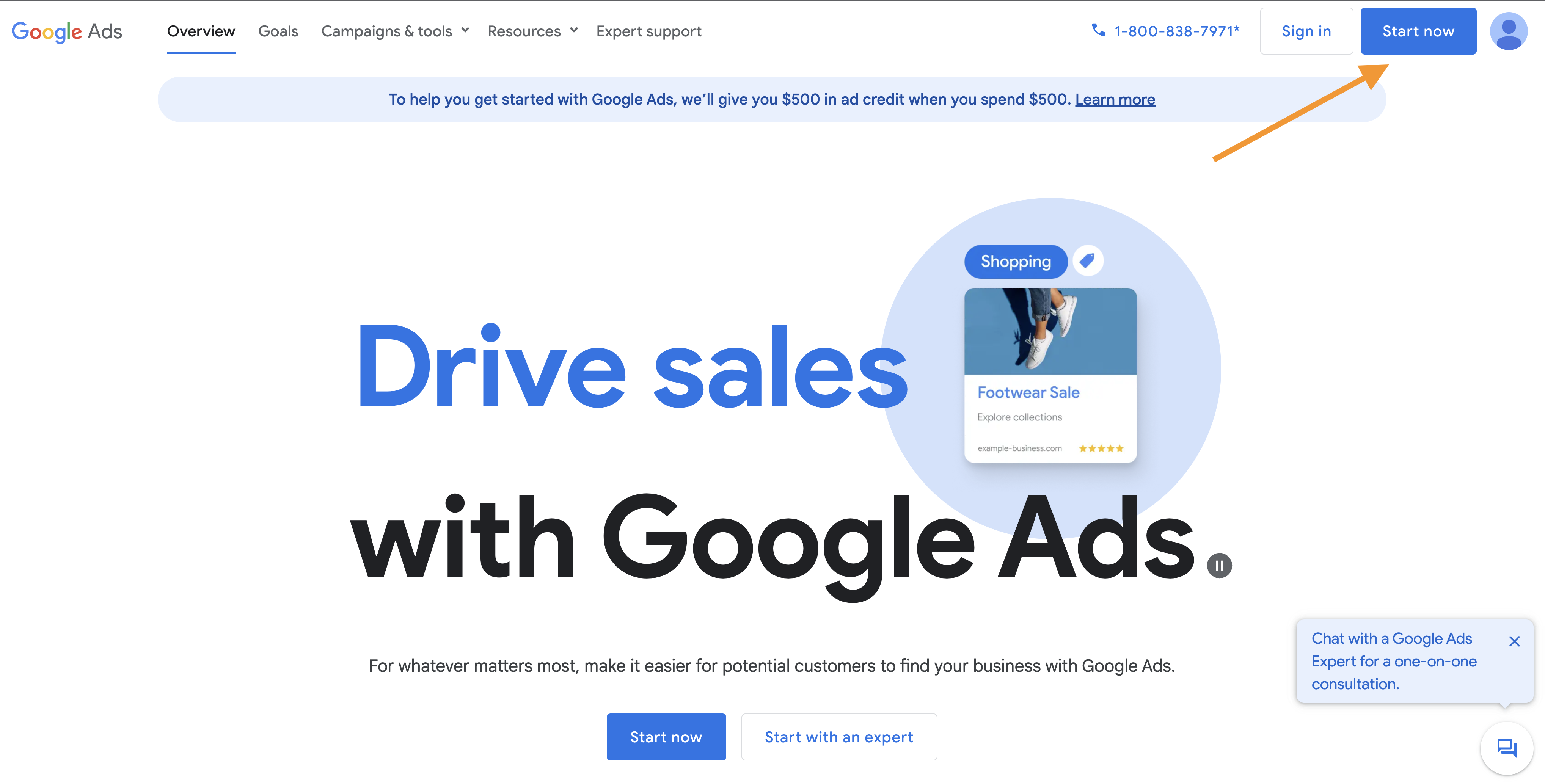
Head to www.ads.google.com to set up an account. When creating an account, you can create it under your existing Gmail account or set up a new one. I like to set up a new Gmail account ahead of time, which I use specifically for Google Ads management. This way, my personal email isn’t bombarded with emails from Google Ads.
Step 2
Now that your account has been established, you must complete a few housekeeping items, such as entering your business name.
Step 3
Enter your website URL.
Step 4
Review your website visual on mobile and desktop devices.
Step 5
Choose your main goal. For most real estate professionals, the goal will be to generate more leads.
Step 6
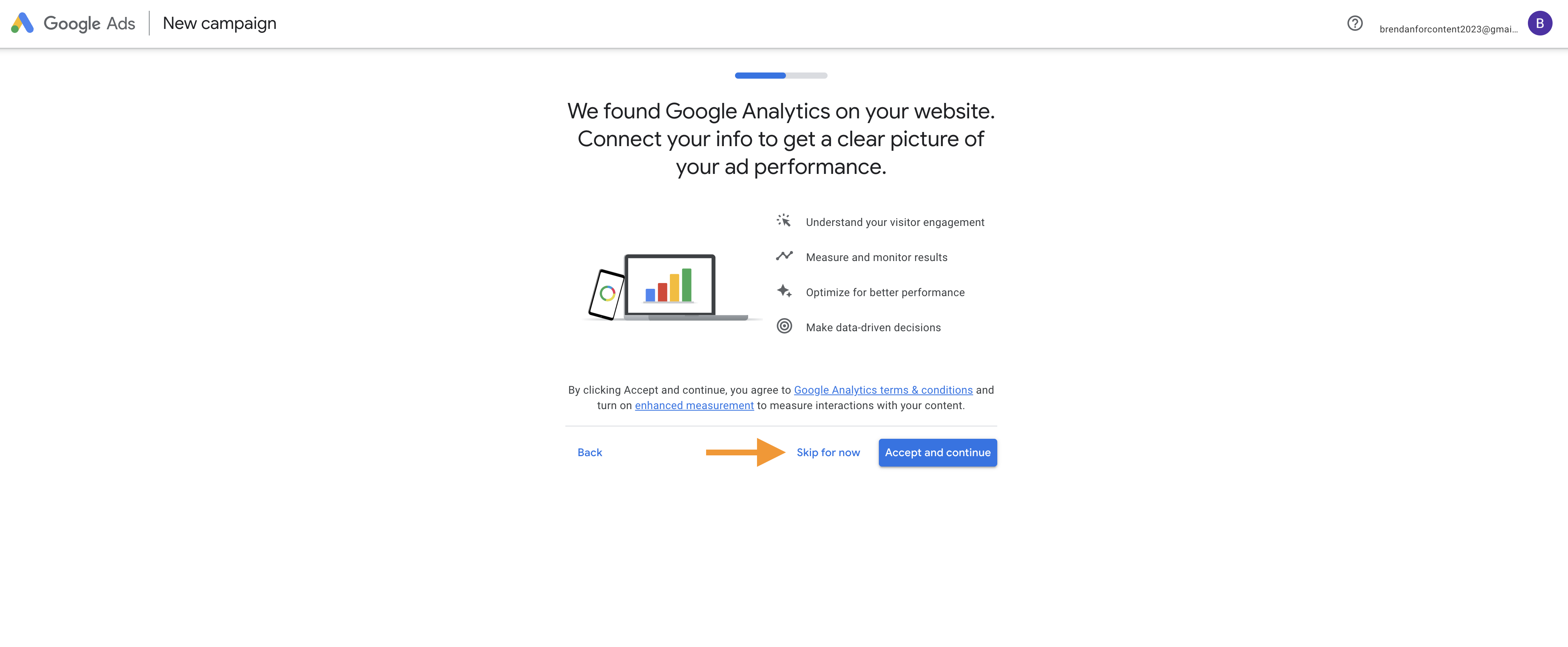
Google offers the opportunity to connect your Google Analytics account. If you do not have a GA account, you can choose to “skip for now.”
Step 7
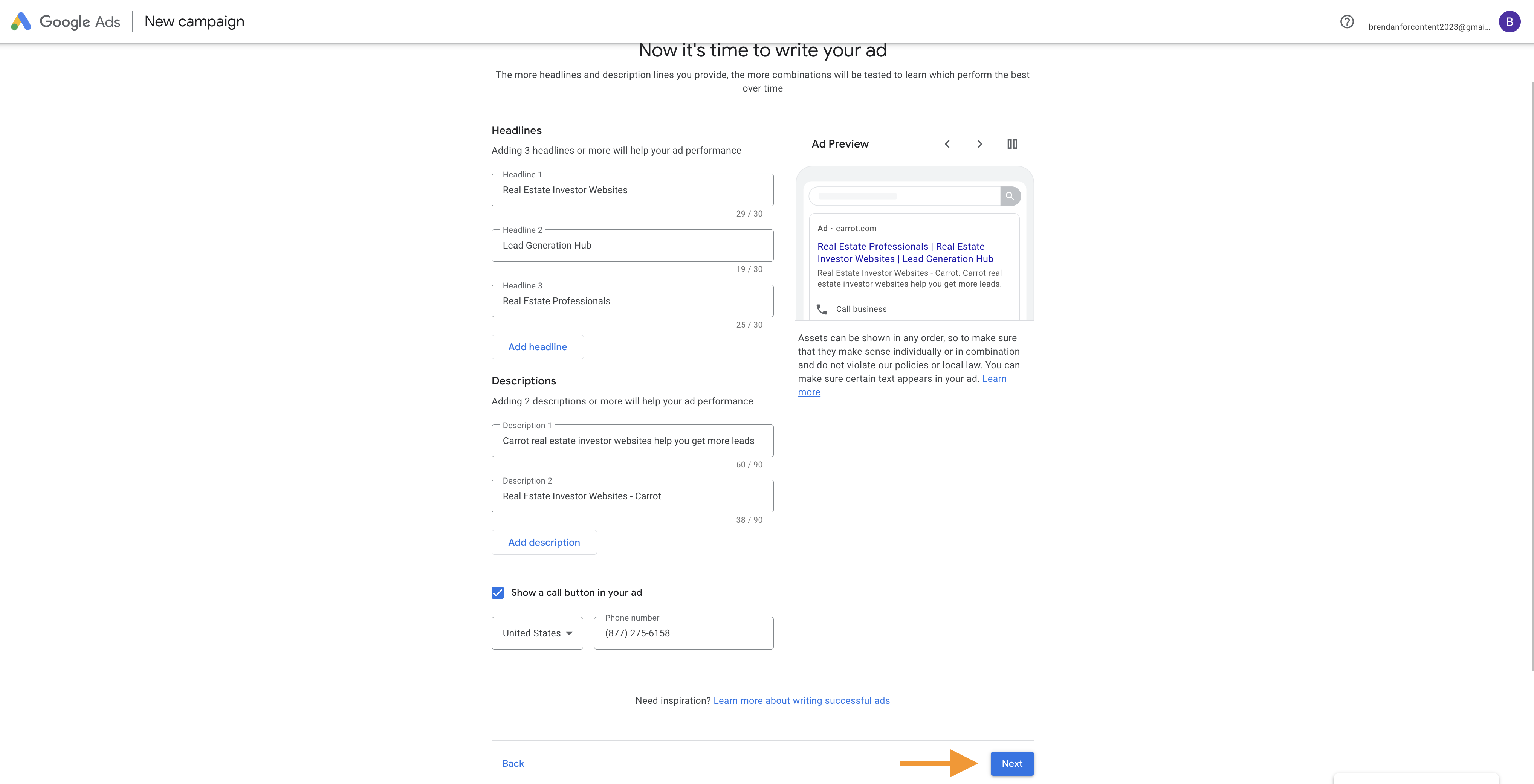
Time to create an ad. Choose three headlines and two descriptions, and enter your phone number.
Step 8
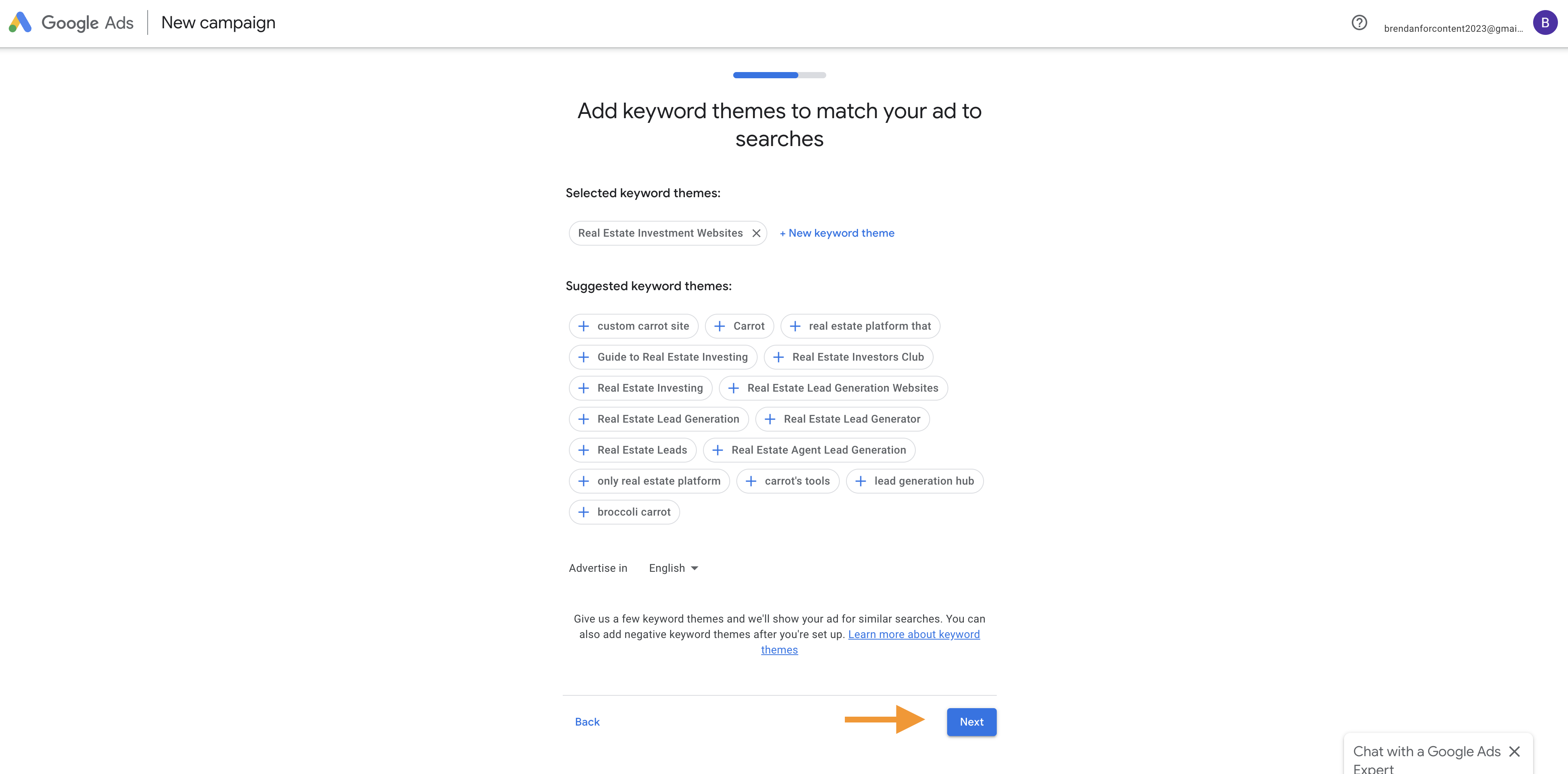
Google will present different keywords based on a theme. You can always adjust your keywords later.
Step 9
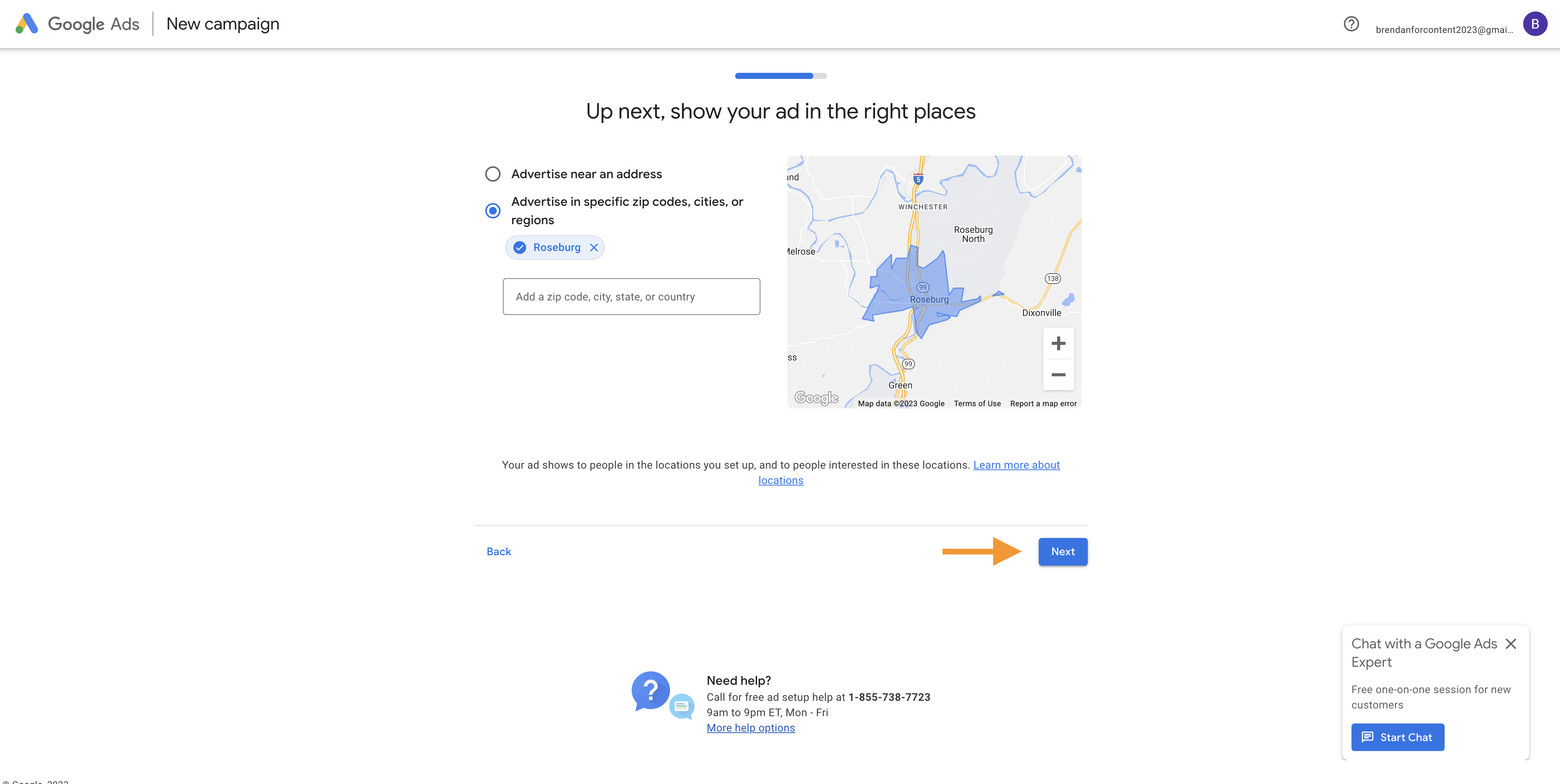
Next, you’ll be asked to add your target locations.
Step 10
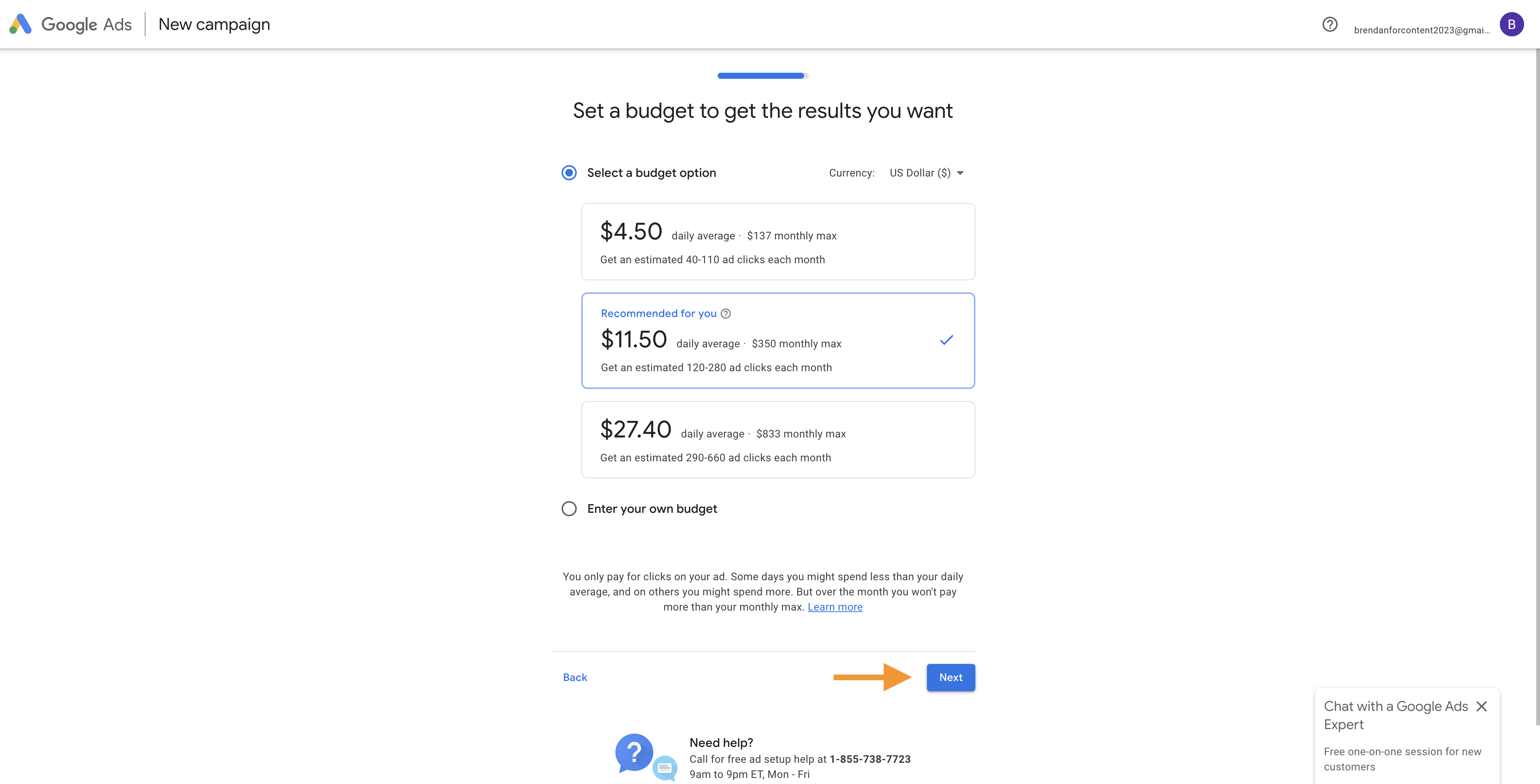
Set your daily or monthly budget.
Step 11
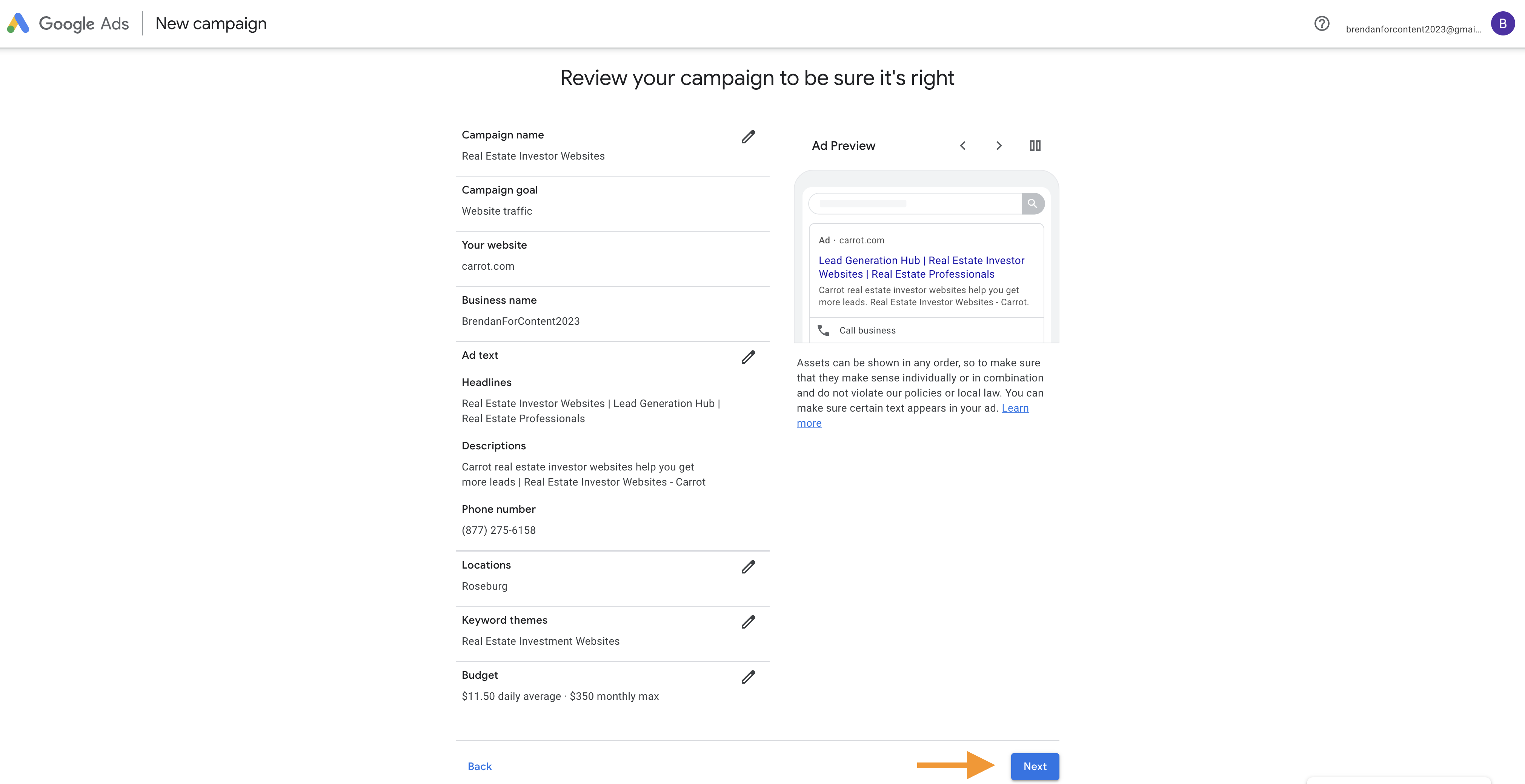
Review your campaign.
Step 12
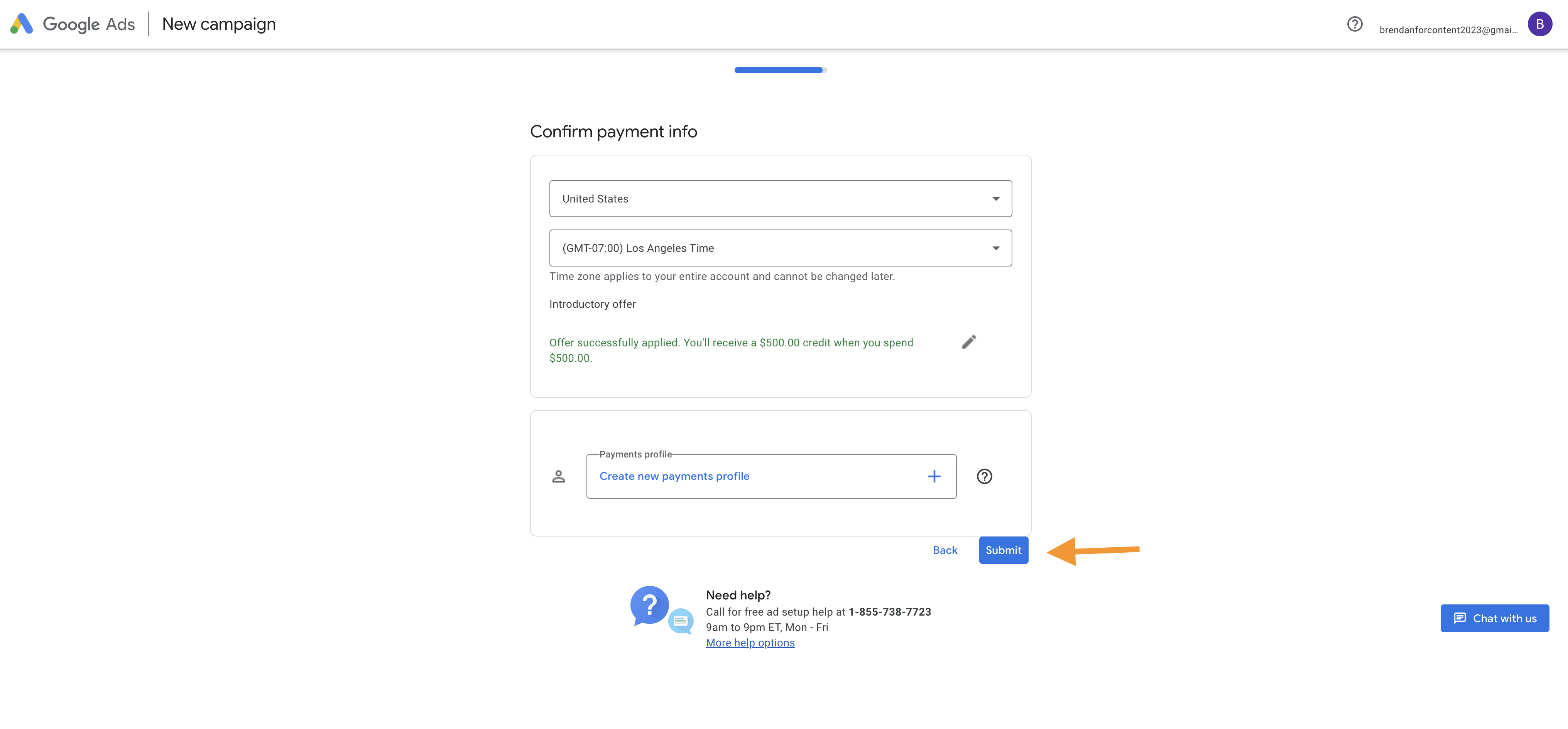
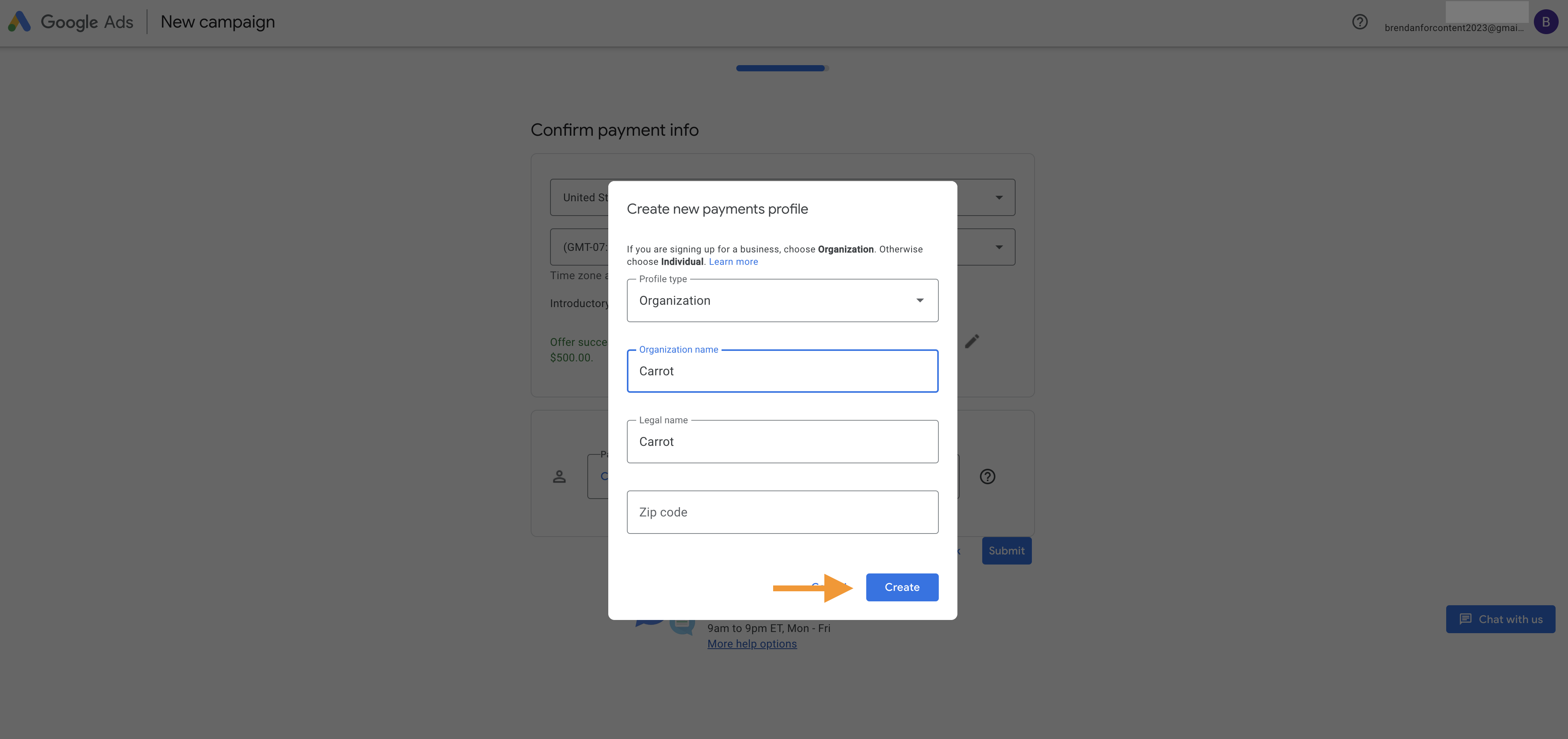
Finally, you are prompted to set up billing information.
Congratulations
You are now ready to start creating your Google Ads campaigns for real estate. We wish you the best of luck!
Be sure to hit us up with questions in the comments section below. Also, if you’re a Carrot member, join us on our weekly Coaching Calls, where we cover many PPC topics, SEO, lead generation, website design, and much more!
Not a Carrot member? What are you waiting for!? Check out our plans and get started today!
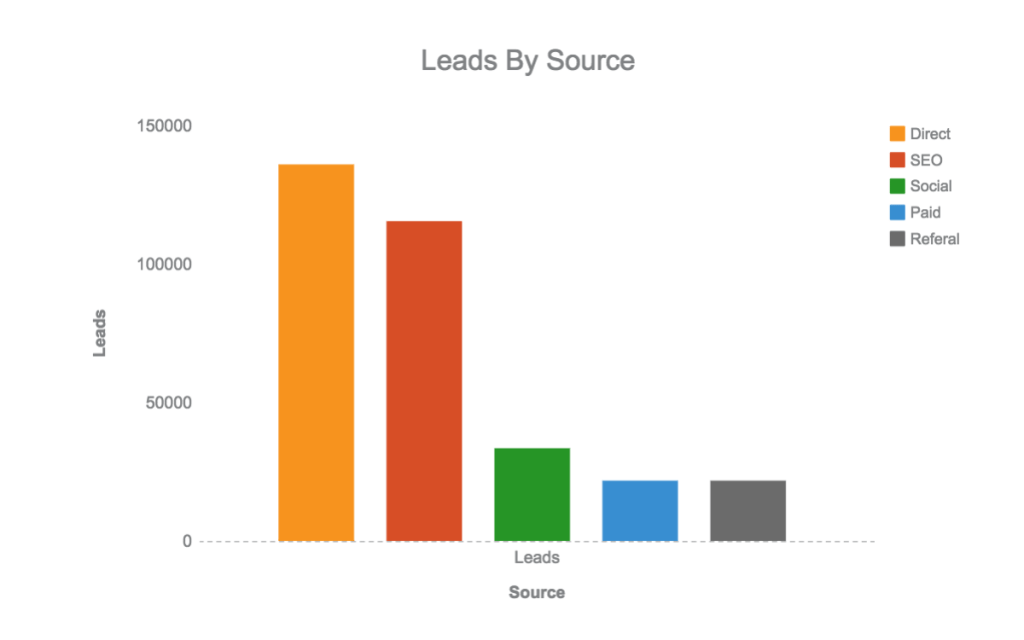
In 2018, PPC was the second highest lead generation medium for our members.
Trying to rank on page one of Google can be a daunting task for some. It takes time and resources to invest in a full, all-out SEO strategy. Even then it could take months to notice.
What can you do in the meantime?
Well, many of our members make use of both PPC and SEO — using the former to generate short-term traffic and the latter to generate longterm traffic.
In this intro to PPC for Real Estate, we run down what you need to understand if you’re considering this route. Including:
What is PPC for Real Estate?
How does PPC work?
What are the benefits of using PPC advertising for Real Estate?
PPC is a broad term used for various cost-per-click platforms real estate professionals use to get in front of their target audience. These include Google Ads (AdWords), Bing Ads, Facebook Ads, and numerous retargeting options.
Overall, PPC is a digital marketing strategy in which you advertise within a search engine’s sponsored results by bidding for the keywords, ad sets, and/or retargeting list connected to your real estate niche.
Pay-per-click is exactly that… you pay each time your ad is clicked. Although, there are times you can be charged for impressions (number of times your ads are shown).
Google Ads (Adwords) still reigns as PPC king for generating motivated seller leads. Facebook ads can also be an effective way to generate motivated sellers as well as buyer leads.
Facebook cost-per-click is also considered a lesser amount compared to AdWords. It’s important that you understand where your leads are coming from and the value of your cost per lead to fully understand which platform works best for you.
How Does PPC Work?
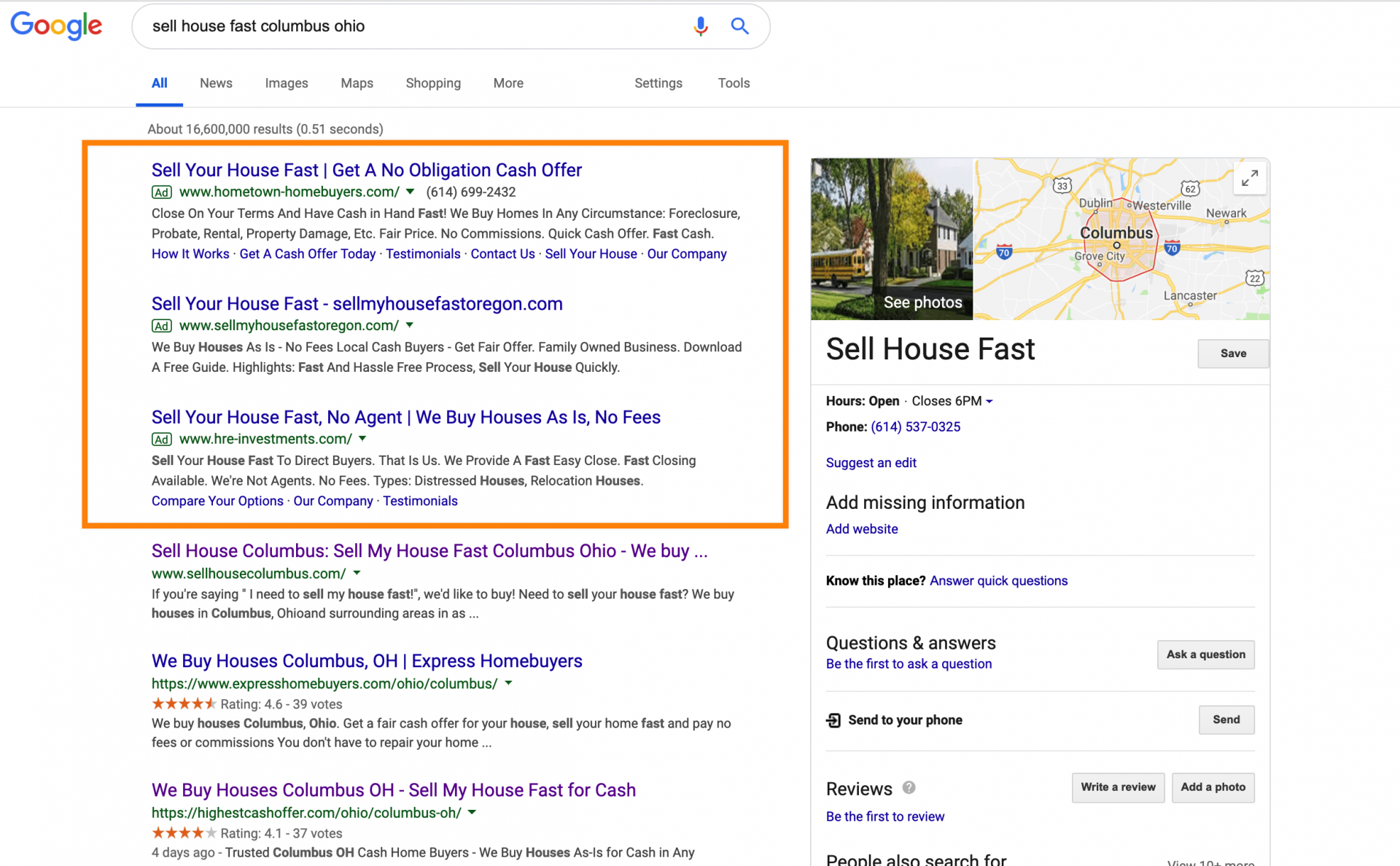
Starting with the basics. When a motivated seller types a search query into Google, the search engines provide two sets of results: pay-per-click ads (sponsored) and organic results.
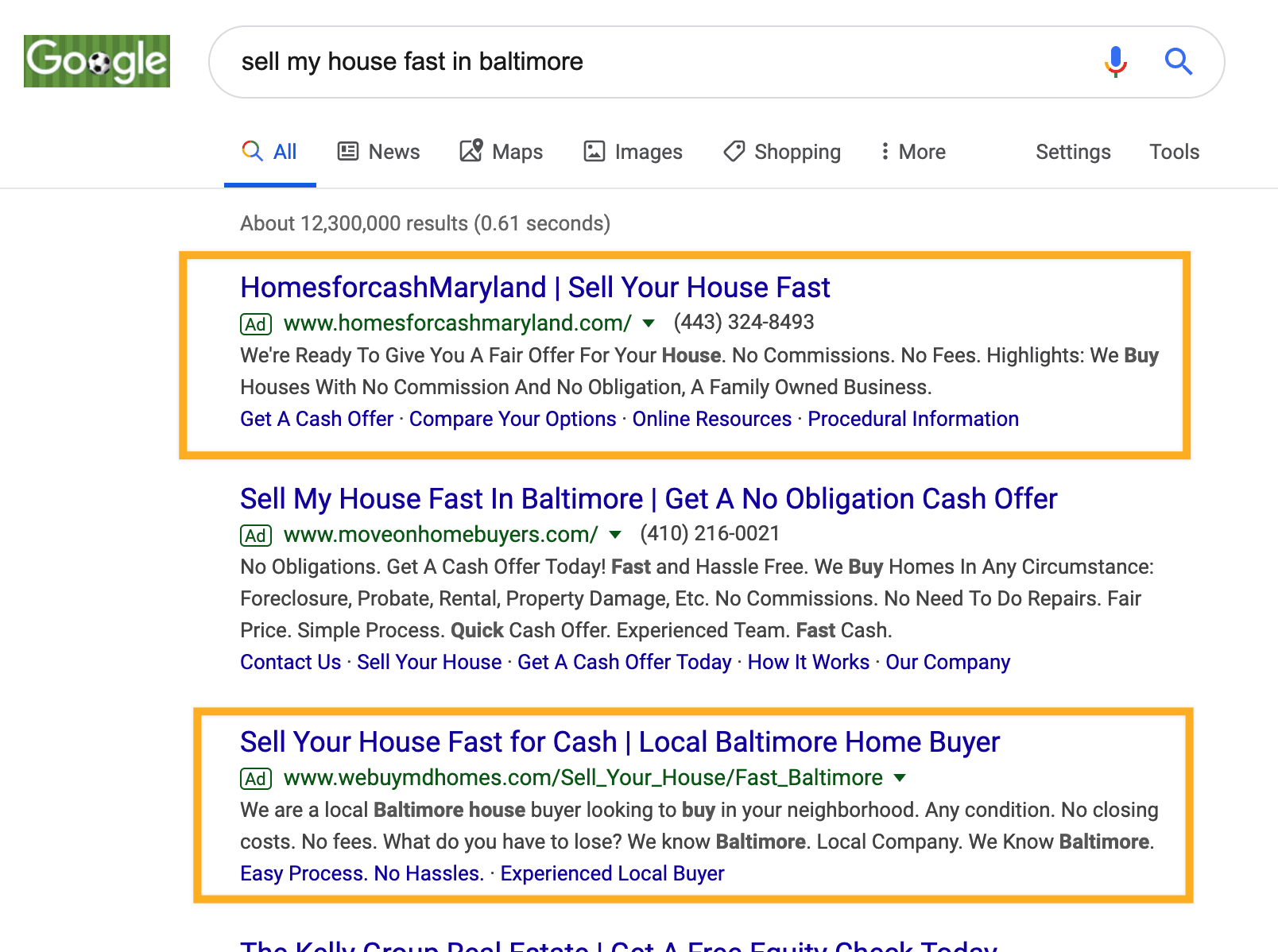
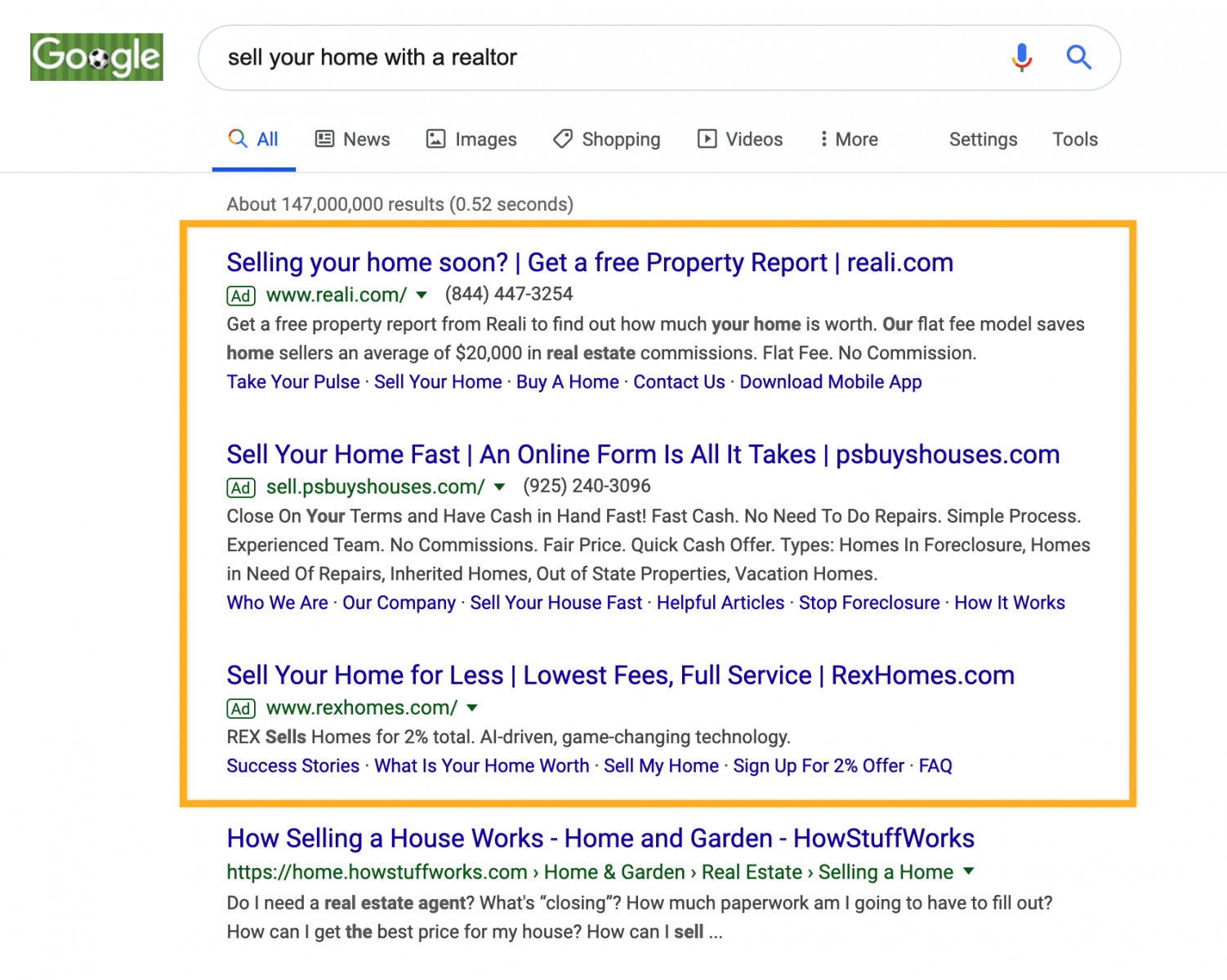
As seen in the picture below, the first three results on top are sponsored ads (indicated by the green square around the word “Ad”).
The other results below the ads are organic results. More than likely, the organic website results have climbed the rankings by executing a solid SEO strategy.
With PPC, when the searcher clicks on one of the ads, you (the advertiser) is charged for that click.
The price of that click will vary per the competition for that specific keyword as well as your target location(s).
You can use specific tools to find keyword traffic estimates as well as the competition and cost-per-click estimates. Tools such as:
Advertising with PPC ads can have many benefits. Here are some of the top reasons you should consider using PPC as part of your online marketing strategy.
1. You Have the Opportunity to Control Your Position on Page One of the Search Results
PPC advertising allows you to gain the most valuable ad space on whichever PPC platform you choose to use. If that’s Google, then you have the ability to get on top of the first-page search results without having to dedicate the time and resources for SEO.
Claiming ad space where most eyes will see them will increase your odds of getting solid lead generation and return on your investment.
2. Place Your Ads in Front of YOUR Audience
This is two-fold.
First, you can use specific keywords in your PPC ads. This will allow you to reach a specific target audience based on your location. For example, using keywords such as…
“Sell my house fast in Baltimore”
“Sell my house in Chicago”
“We buy houses fast in Boston”
This allows you to reach the local audience by choosing keywords that are targeting your audience location.
Second, you have the ability to use geo-targeting to limit who can see your ads based on locations. For example, if you are searching for motivated sellers in Baltimore, it wouldn’t be smart to allow searchers in D.C to see your ads.
You’d be would wasting your budget to allow searches from outside of your target areas to see and click on your ads.
3. Control Your Budget
Adverting with PPC ads offers you ultimate control of your money. You set your desired ad spend. If your budget runs low, platforms such as Google Ads will notify you that your budget is limited. This allows you to reassess your current PPC strategy and make the necessary adjustments to optimize your accounts.
As mentioned above, the majority of your PPC campaigns will follow the model that you only pay when someone clicks on your ad.
4. PPC is Immediate
There’s no wait time! Unlike SEO, PPC is live the moment you decide to turn your campaigns live. If increasing your buyer list for your real estate website is your goal, PPC ads allow you to get in front of your target audience NOW rather than waiting the span of time it takes for an SEO campaign.
5. Testing
PPC ads are an excellent way to split test your website, ad copy, or images that resonate with your target audience.
Using the A/B testing approach, you can test your ads and landing pages to see what form, color scheme, design… etc., are generating the best results. Once you gather enough date, you can use this information to make strategic moves to your campaigns to maximize your PPC ROI.
6. Track Your Results to Maximize ROI
Proving ROI is a major part of being a marketer today. Luckily, PPC ads allow you to track every aspect of your ad campaign to connect your efforts to your results.
You can see how each keyword is performing. You can see how each ad is performing. And, you can see exactly where and when your leads are reaching you.
You want to prove the worth of your PPC campaign. You’ll want to be sure your conversion tracking is linked to your website and for most of you, you’ll also want to be sure your lead source is relaying to your CRM.
Then you’ll be able to track from click to deal to see your profits that have come from your PPC strategy.
Plus, PPC website visitors are 50% more likely to purchase something than organic visitors (i.e. they’re more motivated).
So, who should use PPC? Those who have the ability to plan, have patience, and are willing to spend money to get results.
If you make well-informed decisions from the time you launch a PPC campaign, you will be able to increase traffic and leads to your website.
However, PPC usually isn’t best suited for those who are looking to dabble. You need to have a mindset that provides enough strategy to sustain months and sometimes years. Those who have similar “go-get-em” attitudes have fared especially well with PPC advertising.
Real estate also has a bigger advantage over other industries who utilize PPC. Profit margins can more than justify the costs associated with PPC.
If you are looking for a simplified answer of how to get started with PPC advertising, it can be summed up into a relatively easy process.
Here’s a simple look at how to plan your own PPC for real estate strategy:
1. Conduct a competitor analysis.
Identify the competitors who might be outranking you in your market. Analyze their search terms and search volumes using tools such as Google Keyword Planner and Ubersuggest as listed above.
2. Choose the real estate keywords you want to advertise for.
Conduct keyword research to learn how your target audience is searching for your real estate niche. If you’re looking for buyers for your agent website, then use such terms as, “new homes for sale” or “homes for sale in”.
3. Create ads based on thorough research.
Develop ad copy that will resonate with your target audience. Looking for motivated sellers? Use ad copy such as “We Buy House in Any Condition” or “Sell Your House As-Is Fast”.
4. Split test ad copy and/or landing pages to compare how different aspects of your PPC campaigns perform.
For ad copy testing, track metrics like click-through rate and cost per click. For landing page testing, track metrics such as conversion rates to determine the success of your PPC campaign.
You’ll also need to continuously manage keyword bids based your results. This will help you get the most ROI from your efforts.
5. Optimizing beyond your ads.
Real estate PPC campaigns are created from many parts beyond keyword bids and the ad copy. It’s important to think beyond the landing page and start to think about optimizing other pages that will help build credibility and connection with the searchers.
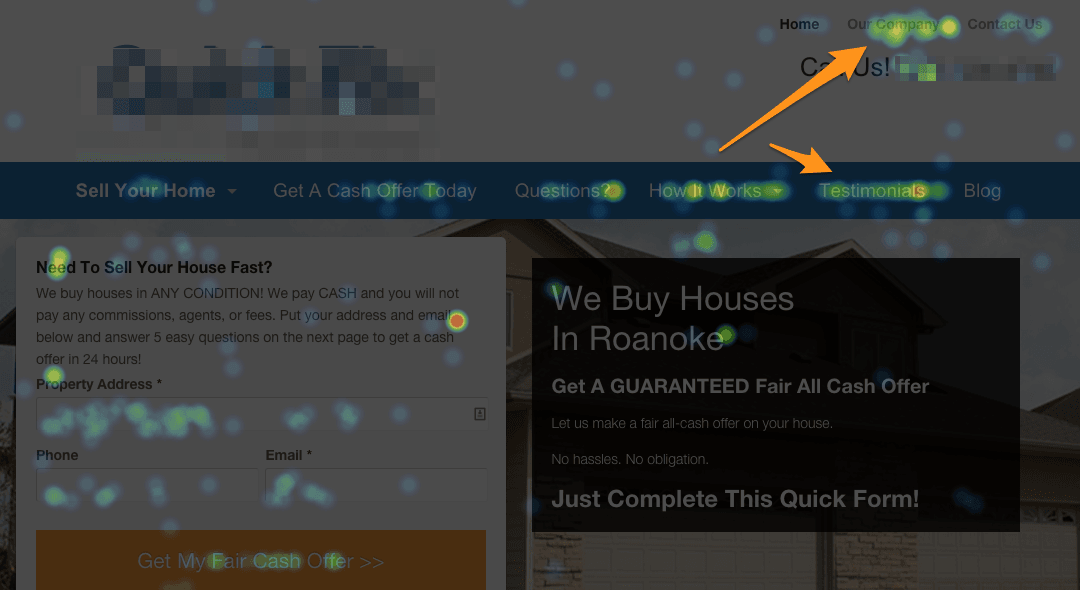
Three important pages to consider optimizing are your “Our company”, “Testimonials”, and the “How it works” pages.
This heat map from specific PPC traffic, confirms the need to optimize these pages. PPC traffic is looking for confirmation.
Conclusion
Don’t feel overwhelmed by this PPC intro. By having a sound strategy, educating yourself and putting in some time, you’ll be off and running with a successful PPC account. Or, consider hiring a third-party to consult or manage your account.
Overall, PPC can provide immediate results and be a lucrative piece of your online real estate marketing strategy.
Be sure to hit us up with questions in the comments section below. Also, if you’re a Carrot member, join us on our weekly Coaching Calls where we cover many PPC topics as well as SEO, lead generation, website design, and much, much more!
Not a Carrot member? Whatcha waiting for! Check out our plans and get started today!
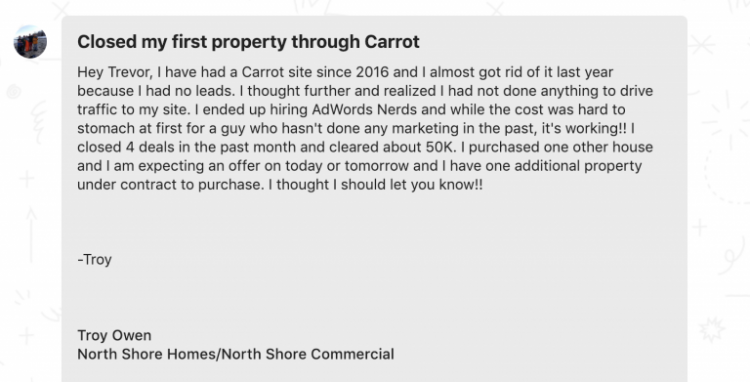
“I’m not getting any leads through my Carrot website. I’m just going to cancel it.”
That’s what Troy told himself one day as he drove to work. He almost did it, too. Thankfully, he gave it another shot.
And he couldn’t be happier…
Watch Troy’s Case Study
Meet Troy
Troy is a real estate investor out of Milwaukee. He’s no rookie – with over ten years of experience and plenty of closed deals, it’s clear that he knows his stuff.
Troy had a good thing going. He was spending his time buying and selling income properties to other investors and making a healthy profit.
One day, Troy decided to take things to the next level. He found out about Carrot and got his hands on one of our high-converting websites — powerful, lightweight sites that are made to dominate Google rankings and convert visitors into leads.
They’re made just for real estate investors like Troy, so once he set up his own site, he was hoping to get a lot of new leads…
But leads started drying up…
Some time passed, and he didn’t do much with the site beyond a bit of customization. He wasn’t actively trying to drive traffic to it with PPC or SEO, so it really just sat there.
That wasn’t a big deal until the market started shifting and Troy found that leads were getting harder and harder to come by. The other lead sources he used had all but dried up, and his Carrot website didn’t seem to be doing much for him.
“Sources that were giving me enough leads and deals these last years just weren’t enough to keep me busy. A lot of those have dried up… I had to find something else.”
That’s when he decided he could save some money every month If he got rid of his Carrot site. After all, what good is a high-converting website if no one ever sees it? It doesn’t matter how optimized it is if it’s just sitting there collecting dust. So he started researching how to cancel his Carrot subscription.
But then he thought, Quitting is the easy way out… maybe one more shot.
And he decided that he wasn’t ready to quit just yet. He realized that he hadn’t been doing as much as he could to drive traffic to the website, so he wanted to give it another go.
“I knew if I took the DIY route it wouldn’t have gotten done the way it needs to get done… so, I hired out and the leads that came in were more than enough to pay for it. So, it’s totally worth it — and it happened faster than I expected.”
How Troy made it work…
The second time around, Troy took it a lot more seriously. He found some great AdWords marketers and hired them to help him with PPC. It was a hard cost to stomach, especially while his leads were buckling, but once the PPC started bringing in traffic, he realized how powerful his website was.
“It was a bigger upfront cost, but it only takes one deal to pay for it, so it would be crazy not to give it a try.”
Steady leads have been flowing in ever since.
For Troy, the high cost of marketing and PPC quickly paid for itself. All it takes is closing one solid lead in a month. Troy closed four. He brought in $50,000.
Better yet, he started working on SEO, and now that more organic traffic is flowing in, his PPC is cheaper than it used to be, and he’s pulling in even more leads.
“Early on, the cost per lead was hitting $3,000…but now that I’m starting to get SEO leads that’s helping quite a bit.”
This gave him the freedom to focus on improving other aspects of how he does deals.
He experimented with different follow-up methods to see which worked best, and now that he adopted a more aggressive follow-up method, his leads per deal ratio is up from 10:1 to 5:1. He’s always experimenting with direct mail.
Troy realized that paying for his Carrot website and the AdWords marketers that he hired wasn’t a necessary evil – it was a sound investment. If he left his website without trying to make it work, he wouldn’t have saved money. He would have lost it…
“I knew the cost would be significantly higher in the first few months, but it didn’t take all that long. Now more deals are coming in, I’ve had some bigger deals come through, and that cost per lead is dropping down.”
Troy paid for services that ramped up his business. If he left Carrot and decided that the AdWords marketers were too expensive, he would have lost $50,000 in opportunity costs. That’s a type of cost that people don’t usually factor in, but it’s essential if you want to be a successful real estate investor.
Troy says it best:
“Commit to finding a way to drive traffic to your website. Whether it’s you or you hire out, you have to do it. The site converts, it’s proven…but you have to get traffic to your website before you experience any kind of return.”
An underperforming website or a lack of marketing can cost you. On the other hand, putting down money for services that can boost your income in the long term is a solid investment.
If you’re using Carrot and PPC marketers like Troy did then you can rest assured that you’ll get a lot more eyes on your website while maintaining a high ROI.
These services can pay for themselves many times over. Here at Carrot, giving our clients a good return on their investment is one of our biggest goals.
Like a gambler to the slot machine, you press “Start” on your Google Ads campaign.
Every day, you check the dashboard. A few clicks, even fewer conversions, and one measly phone call. You’ve already gambled away several hundred dollars with nothing to say for it. Every day, you get more nervous, receive fewer clicks, and waste more money.
Until eventually, you turn it off – Ah! This doesn’t work.
Take heart – that’s not the story for every Google Ads campaign. I’ve personally run Google Ads campaigns that sport a life-changing $300 to $1 ROI.
But it is the story for many Google Ads campaigns…
There has been a push in what has been recommended (mostly by Google) in the approach to your bidding strategy. Traditionally, we’ve been sworn into a manual bidding method based on bid matrixes factoring in ad position, performance, market location, and trends.
Despite how successful these methods have been over the past 5 years, the frequency in which we’ve seen our members embrace (at the request of the assumed “authority”) automated (robotic) bidding has increased significantly.
For some, this openness to automation has provided incredible value for their clients. For others, the results were underwhelming. If you find yourself in the same boat as the latter, it’s possible that your motivated seller Google Ads campaign is simply not a good fit for automated strategies. And trust me, I understand there are certainly a lot of Reasons To Not Use an Automated Bid Strategy. Before admitting defeat, make sure none of the following mistakes exist in your strategic implementation.
… Budget control is a huge component of the success of your Google Ads account. Not only from automated bid strategies but obviously, with manual strategies as well.
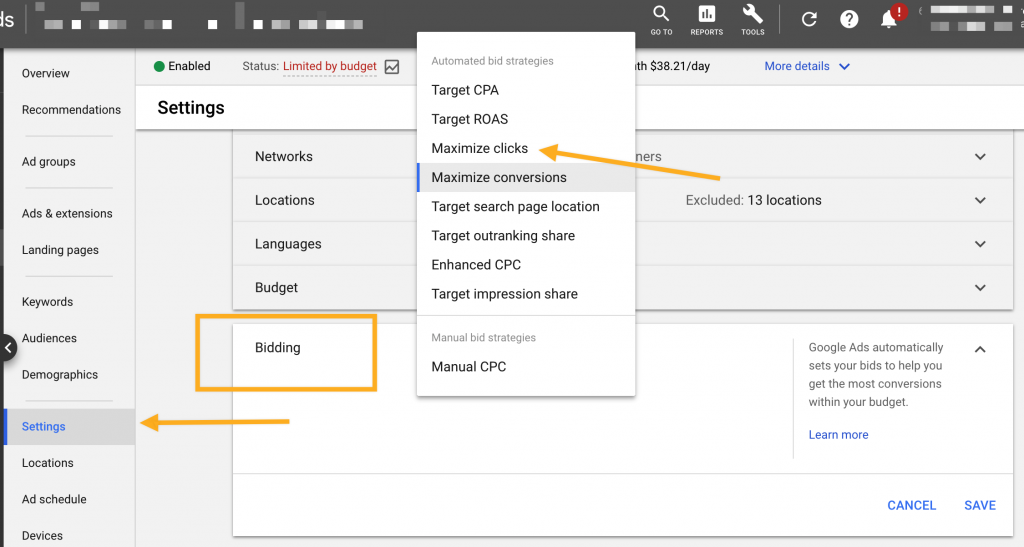
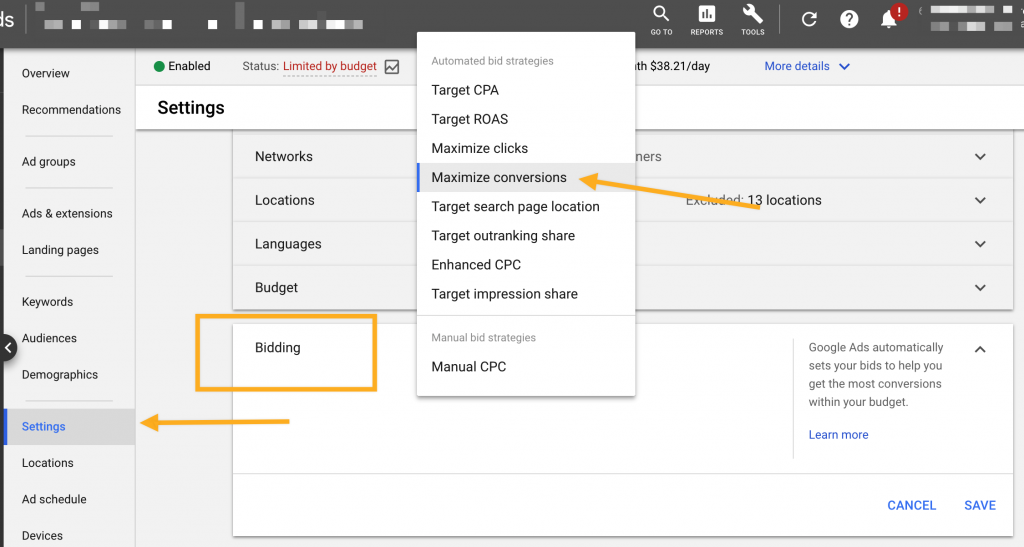
3 (Google Ads) Automated Bidding Strategies for a Motivated Seller Campaign That You Need to Know
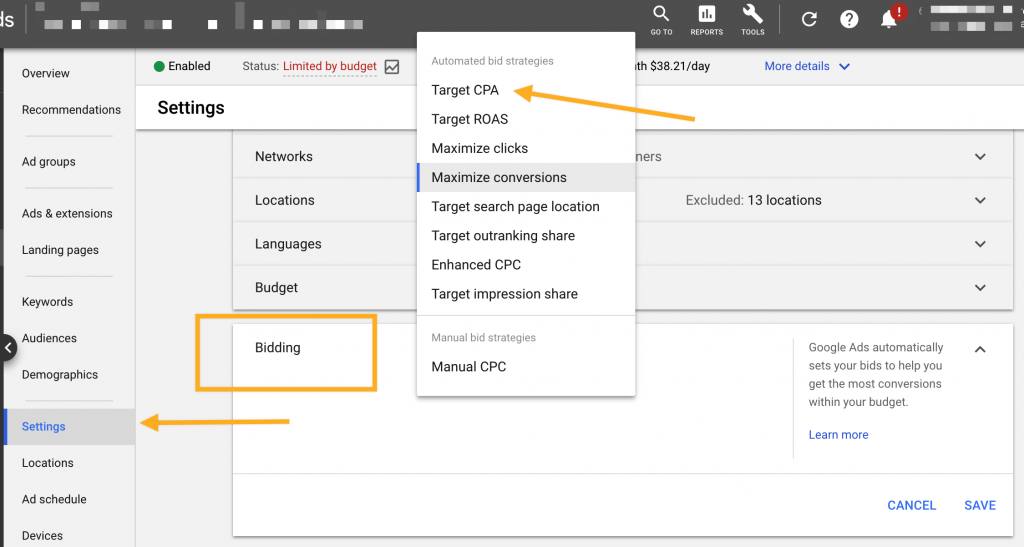
Target CPA (Cost Per Acquisition)
This might be the most recommended automated bidding strategy right now. Most Google Ads Strategy Specialists are pushing this one onto its members. But, this recommendation is usually without merit and data to back up the suggestion.
So, what is Target CPA Bidding?
Target CPA bidding optimizes your bids so you can get the most conversions, hopefully, for a target cost-per-acquisition that you set as a goal. Google explains it as…
Using historical information about your campaign and evaluating the contextual signals present at auction-time, Target CPA bidding automatically finds an optimal CPC bid for your ad each time it’s eligible to appear. Google Ads sets these bids to achieve an average CPA equal to your target across all campaigns using this strategy.
Some conversions may cost more than your target and some may cost less, but altogether Google Ads will try to keep your cost per conversion equal to the target CPA you set. These changes in CPA take place because your actual CPA depends on factors outside Google’s control, like changes to your website or ads or increased competition in ad auctions. Additionally, your actual conversion rate can be lower or higher than the predicted conversion rate.
For example, if you’ve found that it takes 15 Google Ads leads to close a deal and therefore you can pay up to $3750 to acquire a deal you might be willing to set your target CPA at $250.
Basically, you’re telling Google you’re willing to pay $250 per lead to get 15 leads. Google works to do it’s best to optimize your bids to reach that goal.
Now, Google Ads will use historical data, along with contextual signals such as device type, time of day, physical location, remarketing lists, and browser types to find motivated sellers who are (or seem) ready to fill out your lead form. These data points help predict opportunities for you to hit that budget goal, by showing your ads for search queries and at times they are most likely to convert.
Sounds great right?
Not so fast. Let’s keep going.
There are a few items that you must know.
You must properly set up your conversion tracking. Google Ads will take note of how many conversions (lead form) your ad drove and how much revenue it has generated based on your target CPA. Once your ads start running, your total average Cost-per-Acquisition will be reported as the Effective Target CPA. So, if you don’t have conversion tracking properly installed, there is no way Google can know if a searcher filled out your form.
Next, you’re losing your freedom. Google will now have the ability to bid above and beyond the normal click rate if it sees a keyword search fits within their data points. Within motivated seller campaigns, there is no guarantee you’ll capture a lead even if the data points to that.
Google Ads Target CPA Bidding Strategy
Maximize Clicks
The maximize clicks bidding strategy does exactly what the title suggests… It maximizes your clicks. You set your budget and Google goes to work spending it. Google explains it as…
Google Ads focuses on increasing clicks for your campaigns while spending a target amount. If you don’t specify a target spend amount, Google Ads will attempt to use the remaining daily budget of any campaigns using this bid strategy.
Even though this strategy might be the easiest to get clicks, it doesn’t mean it is a smart strategy.
You might be asking “Why?” Well… because this strategy doesn’t take conversion results into account. So click volume sounds great, but not if that number isn’t related to your lead volume.
Google Ads Maximize Clicks Bidding Strategy
Maximize Conversions
Just like “maximize clicks” the maximize conversions strategy is fairly straightforward. Maximize conversions will automatically set bid amounts to maximize your conversions. Google explains it as…
Using historical information about your campaign and evaluating the contextual signals present at auction-time, Maximize conversions bidding automatically finds an optimal CPC bid for your ad each time it’s eligible to appear. Google Ads sets these bids to help get the most conversions for your campaign while spending your budget.
Also, as with the maximize clicks strategy, the maximize conversions strategy can quickly blow through your budget. Unless you’re working with a hefty budget be sure to double check your daily campaign spend. Otherwise, you might be spending through your budget without getting leads.
This remains one of the most important topics. Picking a strategy will dictate the KPI that Google Ads will try to hit. Often, the most important KPI for a motivated seller campaign will be your Cost Per Acquisition (CPA).
You must know your numbers. If you have any disconnect between what you use to gauge performance and your #1 KPI the increased chances of having unsuccessful results. To ensure you have the proper number for your goals, use the Carrot ROI Calculator and make sure you understand all of the automated bidding strategies above.
Too High of Target Cost Per Acquisition (CPA) and Budget
Once you’ve solved your target number equation, you’re still not out of the woods. Budget command is a huge part of success when it comes to automated bid strategies.
At the end of the day, Google will be looking to spend as much of your budget as possible while trying to achieve an “acceptable” level of return. Automated strategies are honed in by volume (search traffic) and data. Therefore, it is commonplace for automation to rapidly spend through your budget caps during the “learning” phase.
In essence, too high of a target CPA and budget can lead to inflated cost per click, and therefore, decreased efficiency. If you choose to use automated bidding, consider starting with budgets roughly 20% below your 30-day total average spend. That way, at the very least, you can see how automated bidding will play out while not killing your normal budget.
Your Budgets Are Too Low
I just mentioned starting with roughly 20% below your 30-day total average spend. But… you also don’t want to start with too low of a budget. Campaigns with budgets that are too low, will need more time for the learning phase of the bid strategy. Also, a budget that is too low can lead to inconsistent performance.
When Target CPA isn’t hitting your bullseye, the campaign with not enough to spend is ultimately the reason why it’s failing to provide enough conversions at volume.
No Cost Per Click (CPC) Caps
With most campaigns, Google will recommend removing all CPC caps on the automated bid strategies. At some point, CPC caps will become unnecessary if budgets and goals are set to the proper level. But, when in some markets that are very competitive and therefore expense, it can be hard to trust Google robots to take over the reins. Keeping CPC limits in the beginning and slowly releasing them is at least an option to build trust in the automated system. You can find this option for shared bidding strategies under the Portfolio Bid Strategies in Tools.
Not Enough Conversion Data
Again, in order to have a successful automated bid campaign, you and Google will rely on consistent and significant data. If your account and campaigns are too low in volume, you increase the chances of having poor results. Google Ads suggests that you need at least 15 conversions per month for your campaign.
But 15 can be too low of a number. Anything below the 30-day data threshold will lead to incomplete optimizations and therefore a failure in the system.
You Don’t Give It Enough Time
This one is tough. Once you turn on a new automated bid strategy, the algorithm begins to learn, but, that takes time. Most of the time months. Some Google Ad Strategist even suggest 6-8 months worth of data. Within that learning period, you could very well see costs go up but leads go down.
Also, any times when the account or campaign(s) are paused or you make major changes in the budget and bid KPIs will reset the process.
So, if you can be patient and trust the automating bidding strategy that you’ve chosen, be sure to make incremental changes or you could be starting all over.
Automated bidding will always be around. While many will remain to utilize successful manual bidding methods, the reality is that you need to know more about automated bidding before testing it out. By avoiding certain mistakes, you might be able to increase your chances of success when testing these bid strategies.
Overall, when you switch to a Google Ads automated bidding strategy you will have less control over your bidding as well as having less credible data to make educated changes.
For example, if the automated bidding strategy started to tank, you won’t be able to analyze data as well as you would if you were using a manual strategy.
So, for those of you who like having complete control over your accounts, this strategy might not be your favorite.