Listen to the CarrotCast Podcast and Subscribe Below!
People that are beginning don’t have to look at our business model and mimic exactly what it is because the reality is, of you’re a Solopreneur you need one deal a month. That is it. I say you’re one deal away. That deal is going to change your life. Max Maxwell
One of our missions here at Carrot is to help you grow that freedom, grow that flexibility, increase those finances and finally make the impact that you want to make. That’s really the entrepreneurial dream that we’re all after, is getting that freedom, flexibility, finances, and impact.
One of the ways to do that is by what we call stacking your leads.
Stacking your leads means finding one thing that works and then stacking more things on top of that. It adds diversification. It makes it to where you can really scale better and go deeper into your market.
One of the ways that a lot of people are doing that is with cold calling.
Now, the cool thing about any kind of real estate marketing, whether it’s direct mail, cold calling, anything at all offline, radio and TV, is your website if you do it right, is actually going to help amplify all of that marketing.
Every single day whenever you’re putting out that marketing, people are taking out their cellphone and they’re going to the internet and they’re going to research you. Your company name, the phone number on your direct mail pieces, or the phone number you’re calling from, possibly your personal name and your competitors.
If you have a tight strategy and you’re leveraging Carrot to rank well and then perform amazingly on mobile and convert those people into leads and build credibility, you’re going to be winning more of those deals. Every single day there’s tons and tons of deals are lost because people aren’t focusing on the performance side of their online performance side of their offline marketing.
People are dropping balls in leaky buckets everywhere when prospects are hitting the web, after seeing your online marketing … Or after seeing your offline marketing or getting a cold call from you and you’re not closing the deal on your website.
This call right here is about cold calling. Amazing, amazing clients of ours, Max Maxwell and Tony Robinson, they were at the CarrotCamp recently here in Roseburg, Oregon at Carrot HQ and they really showed how they’re on their own journey to go over $100,000 a month. At that time at CarrotCamp, they were already at about $900,000 in wholesale profits, which is amazing!
The primary source for that is cold calling amplified by their Carrot website and a little bit of pay-per-click that they’re doing. We said, “You know what, Max, Tony? Come to my office, let’s talk about what you guys are doing in the cold calling. Let’s go up a couple of levels.”
We’re not going to get into the weeds in this call, but we’re talking about what these guys are doing to pull out so many deals in their market with cold calling. What processes and what tools they use. Also, who they’re hiring and how to pay them.
They dive into it fully here and they also talk about a new tool that they released, which is really, really cool, that they have been using and their students have been using.
In addition to that, we actually brought Max onto a training program that we created this last year called the Market Leaders Reveal training program. It’s a 10 week, 10 person training where we walk you through the top eight to 10 clients of ours, or just some top eight to 10 clients of ours who are crushing with different types of marketing where online amplifies all of it. One of those types that Max is using, once again, is cold calling.
He dove into that process in crazy great detail. At the end of this call, I’m going to give you a link that you can go to get that training, to invest in that training. You get access to everything that Max has, including the cold calling scripts and tools he uses and all that stuff to amplify what you learn in this particular episode.
Without further ado, I’m going to introduce Max Maxwell and Tony Robinson to talk about how they do cold calling, how they’re pulling out so many deals in the market with cold calling, and I’m just insanely proud of these guys and to have them as a part of the Carrot community.
Learn from them, and I’ll meet you on the other side of this podcast with the link where you can access our Market Leaders Reveal training.
Enjoy and be sure to hit us up on Facebook, please give us a rating on iTunes, watch other episodes on YouTube, or read the Carrot blog and share your thoughts. We’d love to hear them!
Listen to the CarrotCast Podcast
[podcast-subscribe]
Cold Calling Their Way to $900k in Profits. How Tony Robinson and Max Maxwell Real Estate Investors Have Used Carrot and Calls to Their Advantage
1:25 – Max and Tony intros and what their business looks like right now. 3:25 – Breaking down their cold calling process and why they take advantage of it. 5:35 – What is RVM? (Ringless Voice Mail) 6:15 – How many cold calls do you need to make it worth it? 8:25 – What are the biggest roadblocks other investors have when they contact them. 9:35 – How many cold calls they are making now compared to when they started out. 11:30 – How they utilize data and RVM’s. 14:15 – What is REIRail and how they use it. 16:10 – Connecting Carrot and a real estate investor website and cold calling
LINKS TO ADDITIONAL RESOURCES FROM THIS EPISODE
Max Maxwell + Tony Robinson Unplugged: The Struggles, Lessons, Failures, and Keys That Led to a Multi-million Dollar Real Estate Business: CarrotCast
$15M++ Revenue in 5 Years… How Raul Bolufe Has Built the Momentum to Crush Wholesaling in a Very Competitive Market: CarrotCast
8 Ways To Kill Your Goals (And How To Avoid Them) w/ Trevor Mauch and Adrian Nez: CarrotCast
How ethical is it if you go into a transaction trying to force all of your clients into one solution?
Trevor Mauch
Here at Carrot, we work with both real estate investors and real estate agents to generate leads by building market authority. There isn’t anyone better out there who brings in leads for both land and real property.
As such, I work with a lot of agents and investors who seem to be at a constant tug of war with one another. Each side seems to find fault with the other when in reality, they are working toward the same goal.
As I am driving today and preparing for our Market Leader Summit that we are hosting at the end of February, I got to thinking about how we can work together to resolve this divide.
How can agents and investors come together to serve their clients better? How can they adapt and learn from one another instead of the continuous opposition? I dive into this and more in today’s Truck Talk.
Read the Full Show Notes Below…
Are Real Estate Investors The Underbelly of the Real Estate Industry?
The relationship between real estate investors and real estate agents has often been a tumulous one. Both sides seem to find constant fault with what the other is doing. For many investors and agents, they believe that their solution is the best, end of story.
But is this really serving your clients?
The Industry Is Changing… Fast
For years we have been predicting the rise of iBuyers and how it would disrupt the industry. Four years ago we watched as Zillow put up it’s home buying page, then took it down. We saw all this before it was ever announced to the public. Technology is catching up to the real estate industry and in order to stay competitive, agents and investors must be willing to change too.
Ethical High Ground
I often hear agents say negative things about investors. That they are the underbelly of real estate, that they low-ball people, or that they are taking advantage of people who need to sell their homes quickly. While there are bad apples in every bunch, the same can be found with real estate agents too.
Many agents find themselves on an ethical high ground. Maybe because they are licensed and have gone through training, but more so, I think that realizing that there is more than one solution for their clients makes them defensive.
Now don’t get me wrong, I love real estate agents. I think everyone involved in real estate should become an agent. But the fact is, most sellers out there would prefer to NOT work with an agent at all. There aren’t many people out there who want to spend money on their house, deal with strangers walking through, wait for months for the property to sell, then pay out a hefty commission when all is said and done. Many sellers would prefer a convenient solution, that requires very little time and money.
So I ask you, how ethical is it if you go into a transaction trying to force all of your clients into one solution? I hear so many agents pass on potential leads because the homes aren’t pretty or because the seller isn’t in a place to sink money into the home before selling it. Now if the agent provided more than just one selling option, they would be able to help more people and close more deals.
The Mindset Shift
Both agents and investors need to make a major mindset shift or the competition is going to pass them up. The reality is, that instead of looking at each other as opposition, agents and investors should look at each other as two people with the same goal. Both want to close more deals and both want to help as many people as possible.
Investors aren’t bad and neither are agents. Both should go into a client meeting with the goal to help the house seller, no matter what the solution is. Imagine if an agent came to a home seller with multiple options instead of trying to fit everyone into the same box. They could offer…
A fast and fair direct sale that will result in a lower sale price, but with a much more convenient process
A traditional sale, which will require fixing up the property and putting it on the MLS
Or… a fix and sale option where the agent/investor puts in the money to fix up the house and the additional profits earned when the home sells are split 50/50
When agents and investors come together or when someone is able to solve a problem using multiple solutions, the client wins, and isn’t that what should all be here for? Are you really serving home sellers in the best way possible if you are only giving them one option?
If you are an agent who doesn’t want to buy houses yourself, partner up with someone who does. If you Google “sell my house fast” in your particular city, page one will be dominated by Carrot clients who invest in local property. Get together, have a coffee, and find ways to serve clients better while bringing ethics back into real estate.
If you are an investor or agent I would love to hear more about your thoughts on this! Please share this podcast as we want to spread our message to more and more real estate professionals out there. Our Market Leader Summit at the end of February is FREE and will feature some of the best minds on these very subjects.
Find your authentic self and go for it. Don’t be afraid to be different.
Shemeika Fox
Shemeika Fox isn’t your run-of-the-mill real estate agent. She is a strategist, who knows exactly how to position herself where people are looking. By being relentless, focused, and genuine, Shemeika has been able to DOUBLE her closings in a highly-competitive market, in just one year!
Recently, Shemeika completed our 30 Day Challenge, which has helped her take her market authority even further. She is quickly ramping herself up to be the leading real estate expert in all of Santa Cruz!
By finding the right clients for her avatar and expressing her true personality through informative and entertaining advertising, Shemeika is creating the business and the life she has always dreamed of.
Most importantly, she is the happiest she has even been in her career.
Read the Full Show Notes Below…
How This Real Estate Agent Doubled Her Closings In A Highly-Competitive Market In Just One Year w/ Shemeika Fox
Authority. You’ve heard me talk about it time and time again on this podcast, during whiteboard sessions, and maybe even on a one-on-one coaching call. The real estate industry is competitive and with changing technology and the rise of iBuyers, agents and real estate investors must find ways to set themselves apart and showcase the unique services they are able to offer their clients.
Shemeika Fox was part of one of our recent 30-day challenges and what she is doing with her business really stood out. When the challenge first started, she was already a few steps ahead of the game as she had previously utilized our concierge service to get her website up and running. Now, she has taken what we provided and ran with it. She is creating memorable content that you aren’t going to find anywhere else.
Generic Marketing Leads To Generic Clients
Until 2019, Shemeika was using a marketing strategy many agents use. She had a broker-powered website, a few advertised listings, standard mailers, and spent a lot of her time on the phone.
Shemeika was tired of chasing leads and wanted to position herself so that people would come to her. While she has always loved what she does, she knew that she was capable of more. She knew that her unique talent and ability could help a lot of people on their real estate journey, she just needed to learn how to attract them.
In 2019 Shemeika asked herself who she could best help. She set an intention to reach these clients utilizing marketing that came from the heart. This led to more leads that matched her ideal client avatar, and more importantly, the ability to find true joy and fulfillment within her business.
Making The Marketing Shift
In 2019, Shemeika got herself a Carrot website and utilized our concierge service to help her get her message across. She hired someone to help her with her marketing full-time, as well as a professional videographer to create some of the most clever and entertaining listing videos we have ever seen.
Today, Shemeika’s website promotes the Santa Cruz community she is so passionate about, local businesses she loves, how she and her team are giving back, all while showcasing her personality and mission.
People can get to know her before they even call the office, making it much easier for her ideal clients to find her instead of the other way around. She isn’t out there, solely talking about all the houses she has for sale. She’s focusing on all of the community stuff that really pumps her up and gives her energy within her business.
Shemeika is passionate about giving back to the community and helping other entrepreneurs in the Santa Cruz area. She co-hosts a women’s group that provides guest speakers as well as opportunities for networking.
Getting Off The Hamster Wheel
Over the past year, Shemeika has made a clear shift in her mindset and marketing. Her focus has changed from hamster wheel marketing to content pieces that will be evergreen. She provides community information, features local businesses, and sometimes finds herself talking about subjects that have nothing to do with real estate. And while she does do listing videos, there is nothing boring or ordinary about them.
Recently, Shemeika created a video for a listing using a spoof on the Freaky Friday movie, which featured the owner’s daughter and helped to quickly sell the house for much more than the asking price. Another recent listing featured a bee theme to showcase a bright and sunny yellow house. Shemeika’s videos are memorable, unique, and also show that she has fun in her career… something each and every one of us should be striving for!
Join us on our next 30-day challenge! You’ll learn how to refine your marketing and find real joy in your business!
I would rather fail under my own volition, than fail because of mediocrity.
Peter Lorimer
Meet Peter Lorimer. He’s responsible for over 30 #1 Hits, the host of his own Netflix series, and an agent that is dominating his own niche in real estate.
You’re going to learn how Peter positioned himself as an expert, created and dominated a brand new niche, built an insanely powerful brand, where 90% of his leads come through real estate social media, and, most importantly, how he does all of this while having the time of his life.
Read the Full Show Notes Below…
How To Use Social Media to Build A Powerful Brand & A Business You Love w/ Record Producer Turned Real Estate Agent, Peter Lorimer
Peter has a great backstory. From leaving home as a young teenager to conquer the music industry to diving into the real estate industry head first, determined to become the top sales agent in LA, Peter refuses to take no for an answer. His unrelenting optimistic attitude will not let him fail. His gratitude for his life, his family, and his spot in the universe propels him to be even greater day after day.
Today, Peter has over 200 agents on his team and is known to many as the “Rock n’ Roll Realtor.” He has built his brand, his niche, and his client base through attraction and energy. He knows exactly who he wants to work with and what his unique power is that he can use to help them. His obsession with data has helped him plan – keeping himself poised to be in the right place at the right time.
Using Data To See Into The Future
Peter is one of those who thrives on data. He watches the numbers, runs the math, and makes decisions based on what the facts tell him. In 2012 or so, he knew the record industry was about to make a major change, so he graciously walked away with his winnings. He saw that he was able to purchase investment properties in the LA area for a fraction of what his mom’s house in London was going for, so he went all in.
When Google was brand new, he recognized the innovation and potential – quickly buying up stock as soon as it was available. He was able to do the same thing for Netflix and Facebook.
The moment Peter saw social media switch from Myspace to Facebook, he knew that paper would have little to do with his marketing going forward.
Personalizing The Playbook With Your Custom Content Formula
A very loose formula Peter uses when scheduling social media posts is to break it down into thirds.
The first third of the content is personal (Puppies and lattes as Peter puts it.)
The second third is industry related. Things like interior design articles, landscaping, and other fun things can go here.
And the final third is you in your element. For example a video at an open house or property inspection.
When I talk with real estate pros I can sometimes get frustrated. I want to help them out so much, but I cannot provide a playbook that isn’t theirs – it’s inauthentic and won’t help them build the trust and credibility they need.
Personally, I run my business on energy. If it isn’t working or isn’t fulfilling, I will stop and change things up. Following the playbook that is meant for you will give you more energy than trying to copy any script.
It’s so important to find out what works for you and your business so you can become genuinely likable to the clients you wish to work with. It’s all about the connection you are able to make.
It’s Easy To Stand Out When You Do Things Differently
Peter was with Keller Williams for over five years. When he first got started, he thought things would be easy. He thought all of his music industry friends would instantly want to buy a house and that he would be the one they’d turn to. As it turns out, things weren’t that easy in the beginning.
Instead of becoming discouraged, Peter told his assistant that she was looking at LA’s next top agent and he began stacking the bricks to make it a reality. His background in music gave him a strong work ethic.
He had no problem spending 10 hours a day at the office, giving it all he had to get every deal he could. While other agents were clocking out early, Peter was on the phone, sending emails, and making sure people knew that he and The Keller Williams Entertainment Division were here and ready to serve them.
During his training at KW, he was told to knock on doors, focus on one geographical area, and to cold call. While this can work, Peter knew that if everyone else was doing it, he would need to do something different.
When he swapped his suit for his Metallica shirt and his script for genuine listening, things really took off. He began to see them as people – not just prospects. Doing things differently aligns perfectly with our #1 core value here at Carrot – “Have Fun and Be Different.”
Keeping Your Head Out Of Expectation
Instead of focusing on the results, Peter focused on action. He was relentless in reaching his goal, sitting any open house that came up. He knew that he would rather fail due to his own volition than fail because of mediocrity.
After leaving Keller Williams, Peter founded PLG Estates. Using his content formula and remaining authentic, he was able to attract a certain spere of people to prospect to, segmenting them into different audiences for marketing purposes. He looks at it like this:
Group A is your 100 closest connections
Group B is the next 500
Group C is the next 2,000
Group D is the next 7,000 or so
The people in Groups A, B, and C did not need to be reminded that Peter was a real estate agent. They didn’t necessarily want to see real estate content all of the time.
The content directed toward them was more personal. This helped to build credibility, trust, and show people what a likable guy Peter is. By sharing these moments with his followers, people felt like they already knew him before having the first phone call.
Hamster Wheel vs. Evergreen
I’ve talked about this quite a bit in the past and that is knowing when to jump on the hamster wheel and when to focus on growing your evergreen content. The hamster wheel will bring in leads, but won’t do anything for your long-term goals.
Evergreen marketing is creating things like blogs and videos – things that will always be around and searchable by your potential clients. This is the stuff that builds momentum for your business. I loke to think of it as stacking bricks. While it might be slow going in the beginning, before you know it, you’ll have a mighty wall.
Remember – The Client Is The Hero Of This Story
So many people will brag about being #1 in their content or tell people why they should choose them, but this isn’t the way to grab people’s attention. Your client needs to be the hero of your story.
Don’t send them something with your logo as a closing gift, send them something memorable that will become a keepsake. Making your clients feel happy, both within your content and in person, will ensure you find yourself a client who will stick by you for years to come.
Being Grateful For Today
Every day, Peter gets to wake up in LA, in a beautiful house, with his wonderful wife, and great kids. From the moment he wakes up he acknowledges that he has already won.
Being grateful to live in a country that offers so many more luxuries than anywhere else in the world is a big deal and Peter knows this. He believes in the power of the universe. If he hets a listing – he was meant to.
And if he doesn’t – it was supposed to go to someone else. Instead of worrying about expectations, Peter is always taking action, propelling himself forward no matter what the market may be doing. He knows if it all goes away tomorrow – he will jump out of bed in the morning and say, “ok, what’s next?!”
For Peter, what’s next is a big expansion for PLG Estates. Be sure to look out for him and his team in 2020!
Every now and then I have the opportunity to be able to connect with someone who has changed my business and my life.
Jay Papasan is the best-selling author of The ONE Thing, CEO at Keller-Williams Realty, and in 2014, Jay was named “one of the Most Powerful People in Real Estate.”
Before we started Carrot, I was struggling. I felt stuck. I never knew how to show up or what I should be doing. Many of you out there have probably heard of or read Jay’s book, The One Thing.
What’s in those pages changed my life both personally and professionally. I didn’t get too far into the book until I realized I had been looking at things all wrong. I had always thought that doing more was better, when in fact, it was actually better to do less.
Jay’s ability to provide a clear framework to focus and set goals has changed people’s lives all over the world. Listen in as we talk about setting personal goals, professional goals, learning to focus, and finding clarity within your business.
Read the Full Show Notes Below…
How to Get Focused, Think Like A CEO, And Do Your Best Work w/ The ONE Thing Author & Keller-Williams CEO, Jay Papasan
I’ve never met Jay in person, but with all of the lessons he’s taught me, I feel as if I’ve known him forever. Jay has spent 19 years with Keller Williams and currently serves as the VP of Learning. He’s partnered with Gary Keller on 11 books, including The One Thing and The Millionaire Real Estate Agent, two of the most influential business books ever written in my opinion.
His books, talks, and lessons have helped countless agents, and people in many other industries as well. Jay’s view on goal setting and finding your focus can revolutionize the way you do business and live your life.
Couple Goal Setting
The first thing we dove into was the topic of setting goals with your spouse or partner. This is something Jay is very passionate about and something I would like to get better at. I have no problem setting goals for the business, but when it comes to personal goals and sitting down with my family to sync up, I know I could do better.
What started 14 years ago as a conversation between Jay and his wife Wendy, has now turned into a 200 person seminar. For their first conversation, Jay and Wendy knew it was important to spend some time away from the house and to get out of their ordinary routine. They hired a sitter, found a cheap hotel, and sat down to have a conversation about their lives and where they wanted to be.
They asked themselves uncomfortable questions and discussed where they wanted to see themselves and their families in the next five years.
To get things going, they talked about things that filled them up, including where they wanted to go on vacation in the upcoming year.
They set financial goals, deciding to save $1,500 a month to be used as a down payment on their next real estate investment.
They knew they wanted to work on their relationship, so they made sure to set up a date night every week – midweek so they wouldn’t have to worry about finding a sitter.
They knew they had to have this conversation out of their usual environment and that it was important to make it fun.
They talked about what they wanted for their kids and their families as a whole.
They went way out with their goals and thought big. If they wanted to start a business, write a book, or have a ranch, what would they need to do today in order to get there?
After the goals are established, they assigned responsibility. Who was going to hire the lawyer? Who was going to coordinate the calendars? They sat down once a month to sync-up and look at what had been done.
One of the most important parts of their meeting was that there wasn’t any judgment. Sometimes things don’t get accomplished or we fall off track. The important part was that they talked about it, high-fived, and moved on.
Often times, they would reassign the task or realize that it wasn’t that important in the first place. It’s important to not become a slave to your goals. Today, their meeting happens on a weekly basis, but they always keep them positive and celebratory.
The ONE Thing
Everyone is busy. Either they have a lot of obligations, a lot of opportunities, or maybe even both. The One Thing gives people a simple framework to prioritize the things that matter most. It helps people to identify the one thing each day/week/month that will get them to where they want to be. Writing in on the calendar, blocking out the time, and making a date with yourself will make you 3x more likely to follow-through.
It will help you to:
Know what you want to do
Why you want to do it
When you will do it
Where you will do it
According to Jay and Gary’s research, it takes 66 days to really form a habit with the ability to build on it. Many people will say 21 days, but they didn’t find this to be true for most people
For me, I always struggled with knowing if I was doing the one right thing or if I was doing busywork to get by. I found that if I took it up a level, I was able to find the one thing that would not only solve my initial problem, but it would take care of many other things as well.
For example, my to-do list was always task-related. It took a while for me to realize, I needed to hire more people. Suddenly, our team went from 8-30 people, and I am able to be more productive than ever. This has been one of the biggest mindset shifts since I started Carrot.
A key tool in the book and something that resonated with me deeply is the focus question:
What is the one thing that I can do, such that by doing it, everything else is easier or unnecessary?
This is a very specific question, that will help you to identify your greatest point of leverage. People don’t always know the answer to this. They will often think about what is urgent as opposed to what they could really be doing. This question helped me to make things easier, but even more importantly, it helped me realize what was unnecessary.
The One Thing In Your Business
As a CEO or leader within your company, you are often expected to have your goals in mind with a plan in place. But how do you take that same thought process and have it trickle down to the members of your team? For Jay, and the team at KW, they use a document they refer to as 411.
The 411 document will break down your annual goals into monthly goals, then break them down to show what you should be doing that week. Jay sends his document to Gary on the first of each month and he has a quick meeting with his team each week to review their priorities and goals, coarse correcting as needed.
These quick meetings give him insight into his team’s mindset and how they are thinking. While you may be tracking KPI’s within your business, drilling down to see goals and priorities will help you determine how to get there.
How to Think Like a CEO
Gary and Jay host a great podcast called Think Like A CEO. The three things they suggest to help you think like a CEO are to:
Create Energy
Engage Talent
Own The Results
Creating Energy
Energy comes from your vision, your plan, and the mission you have for your company. Your mission is the problem you want to solve in the world and your vision is the world without that problem. Your plan lays out what you need to do to make that happen.
As a leader, you will win hearts with your mission, wins minds with your vision, and make it happen with your plan.
If you are using your personality to create energy, you’re going to burnout. When you create energy with your vision, mission, and plan, other people can come in and take the reins, sharing the message with your team.
Engaging Talent
Great talent is attracted to energy. They want to be a part of what you are doing and where you are going. If you are going to do something truly extraordinary, you need to have the right team of people around you.
You don’t need an infinite amount of people. With just a few talented people, you will be able to do incredible things. If there is somewhere that you are lacking in your life, it is likely because you are missing a relationship somewhere.
Owning Results
Owning results about being accountable. Whether it is the CEO or an employee, when they take ownership of what they are doing and the results they are achieving, they will perform at a higher level. It is important to be clear about your standards. What you have accepted in the past sets the standard you have today, so don’t be afraid to raise them.
Finding Meaning in Your Work
I wanted to end today’s podcast by discussing the impact of philanthropy on your business. Keller Williams bakes philanthropy into their business and it is something we do here at Carrot as well.
When you run a philanthropic business, people will find more meaning in their work, they will stay longer, and they will work harder. It doesn’t matter if the giving serves your business, it doesn’t negate the good you are doing in the world.
If you aren’t able to give money, give your time or your influence. Don’t wait, the good that you do today will set the stage for where you will be tomorrow.
Thanks for joining us guys and be sure to check out CarrotCast.com to catch the full post.
What’s up, everyone! I’m really pumped for this episode of the podcast as we wrap up our mindset series.
For the past 2 months, we have been focusing on mindset shifts, with a different topic each week.
Today I want to take you through a journey of how I was able to grow Carrot, highlighting some of the lessons I learned and the challenges I faced scaling the company.
Our studio sessions have received great feedback. I think that sharing some behind the scenes information about the inner-working of our company along with some of the information provided in our Truck Talks can be a huge asset to any investor or entrepreneur!
I love being able to sit down with Brady to dive deeper into mindset and personal growth. We really touch on some things that we can all do to become better in business, as well as ways to optimize yourself to be a better father, mother, husband, wife, son, daughter, etc.
Let’s dive in to go deeper into the mindset shifts we have made in order to be where we are today!
Read the Full Show Notes Below…
Behind the Scenes at Carrot | My 6 Biggest Mindset Shifts To Grow A Company From Zero to $10 Million
Growing and scaling a company can be a challenge. Just when you think you have things figured out, something will happen to make you question your processes, people, and even your purpose.
The magic happens when something unexpected happens, and you are able to learn and grow from it. In this podcast, I was able to sit down with Brady to discuss the mindset shifts we’ve adopted as well as the other shifts I have had to make along the way.
Six Lessons I Learned While Growing Carrot
#1 – The Billionaire Code
Alex Charfen created the Billionaire Code to help businesses who feel stuck and overwhelmed. In order to scale, they need a strategic plan. Scaling has been one of my greatest challenges personally.
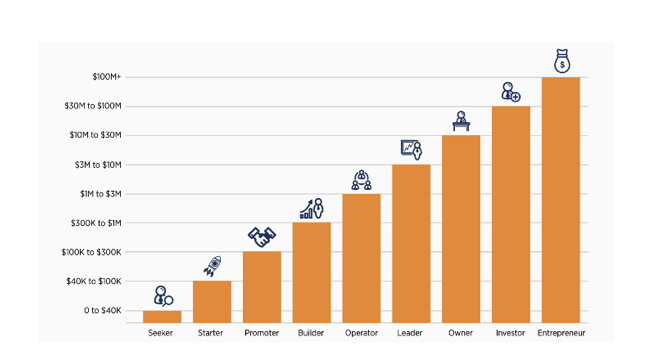
Alex has an excellent tool that breaks down where you are at in your business. When you are making 0-40, you are a seeker. A starter makes 40-100k, a promoter from 100-300k, and so on from there. When you are first starting out, you aren’t quite yet a true entrepreneur, you are someone who is working hard to build something, but in reality, you are still doing all of the work and have more of a glorified job.
As your business grows, there will likely be some times when you feel stuck and not sure how to proceed. It’s important to have market and avatar clarity so you know who you will serve and what unique assets you will be able to offer.
As Carrot is now headed for the $10 million mark this year, I have had to learn how to delegate success. Delegating tasks can be easy once you develop the right processes and standards. But putting the responsibility of success on others takes some getting used to.
#2 – Don’t Put Pressure On Finding Your Purpose
When many entrepreneurs are first starting out, there will often feel pressure to understand and define your passion and purpose. Many years ago, I thought I wanted to be a golf blogger. I loved golf, and being able to travel sounded great. However, I kept beating my head into a wall.
I had been a part of several startups, but I still didn’t have a business that fueled me, which really sparked my passion. I felt inadequate, and it was this feeling of inadequacy and not being able to define my passion that was holding me back in my business.
So I decided to stop looking for it. I gave myself one year to start my business and to make it as great as possible. I removed the need for purpose and gave myself some time to simply make it work.
By using the Energy Audit, I knew I needed to add people and processes if I was going to be successful. I discovered that I was passionate about pouring into others, being a leader, and coaching those who are just getting started. By taking the pressure off of trying to find a purpose, I was able to find it organically.
This year I am crazy excited about a plaque we recently received from the Portland Business Journal, recognizing Carrot as the 8th most philanthropic business in the state of Oregon. Out of 320,019 small businesses in Oregon, we were recognized. This lets me know that I am on the right track to finding my purpose.
#3 – Recommit Each Year & Reset Your Why
Every year I like to make a contract with myself before diving into the next 12 months. When I first started, I wanted to see if I could make this work. It turns out I was able to, so the next year I wanted to become the best in the industry.
By changing my why and recommitting to what I was doing, things became exciting again. I felt a drive and a passion I hadn’t felt in a while and became excited to see what was next. Just like renewing your vows, recommitting to your business is important.
If you aren’t happy with the way things are going in your business, you can sell it, end it, or revamp what you are doing to make sure you keep the passion alive.
#4 – Learn To Delegate – You Can’t Do It All On Your Own
One of my biggest limiting beliefs was that I had to do it all. I never wanted to grow a large company and manage a large team. I always thought that having employees took too much work and that I would never be able to find the right people.
There was so much promotion from the marketing gurus out these that recommended outsourcing everything, to not build a real business, with real people, and with real teams.
Initially, that’s where I was at, but I was miserable. I felt drained, and the energy audit told me I needed people on my team to really make an impact with my business. After reading The Pumpkin Plan, I realized I needed to trim some things down and take a better look at what I was doing.
In 2016, we brought more people on and grew from about 5-10 people. Now we are a team of 30, with the goal of adding 10-15 more by the end of 2020. I’ve learned to not be the bottleneck when it came to getting things done, but instead to trust the competency of the leadership I have put in place.
Very soon we will be launching something called the Entrepreneurs Freedom Formula which is only for our Advanced Marketer members. In this course, I will walk you through the delegation matrix. You’ll learn how to buy back some of your time and reduce that pressure and noise a bit.
#5 – Extreme Ownership
When I was first starting, and even to this day, I can get frustrated with the way things unfold within my business. It is easy to pass blame or to find an excuse, but when you take ownership of the entire process, you will be able to better find a solution.
Recently, I found out emails were going out that weren’t up to our normal standards. I could have pointed the finger, but I realized that this fell on me. I hadn’t provided the right guidelines or expectations as to what I wanted the emails to convey. Together with my team, we have been able to set standards and guidelines so that anyone can step into the position and know exactly what is to be expected in our emails.
Recently, there was a large amount of shredded paper littering the sidewalk outside of our office. At first, I was irritated and was waiting for someone else to clean it up.
Then one day I got out the broom and just did it myself. I handled it and honestly, I felt pretty jolly doing it. I was able to get my hands a little dirty while having so meditative time to think about the day ahead.
When you aren’t pushing the blame, you’ll get a better learning experience. You will be forced to ask what went wrong, and what you can do about it. You will experience more growth and will be able to put the standards in place assuring the issue doesn’t arise again.
Always remember that things happen for you, not to you. Find the positivity and the knowledge that can come from owning it when things go wrong.
#6 – Fight Against Perfection
My philosophy with Carrot has often been that done was better than perfect. People can spend months analyzing something, working to make things perfect, when in reality it could have been completed in only a few days. We like to build things and throw them out there, making adjustments as needed.
I can have a bit of a perfection complex from time to time, over analyzing things instead of just getting them done. In the past, we’ve gone a little too far with this, rolling out things that weren’t quite ready.
Now, we have a good balance of getting things done quickly, while still making sure they meet our standards. Now we have more of a 10-80-10 rule which says we will talk about things during the first 10%, then my team member will work on it for 80%, then bring it back to me for the final 10% before launching. It allows for checks and balances without me having to micromanage things.
Further Listening…
This podcast pairs well with Episode 66 of the podcast that we did back in January titled: My Struggles And 8 Success Lessons Learned… From Paying Taxes With My Credit Card To Multi-Million Dollar Businesses.
I look forward to taking the podcast even further in 2020 by doing some awesome interviews with clients, investors, and major industry influencers!
Let us know if you want to hear more about growth and mindset shifts! Be sure to check out Carrot.com/epic to check out the replay of my Epic Planning Session!
Hey everyone! No matter what business you’re in negotiation and strategy are critical to your success.
Managing expectations, skillfully handling objections, and knowing when to walk away are some of the most important lessons you will learn.
I was ecstatic to sit down with Steve Trang to discuss these very topics. You may know Steve from Real Estate Disruptors, but he is also an Agent, Investor, expert negotiator, and a great leader.
He’s going to share with us how he manages his business and what he’s learned as the leader of a very large brokerage.
Read the Full Show Notes Below…
7 Surefire Negotiation Tactics to Close Your Next Deal + How to Lead A Team w/ Wholesaler and Brokerage Owner Steve Trang
Steve Trang wasn’t always in real estate. In fact, he was an engineer for many years before he found his true calling. Business was always in his DNA. In 8th grade, he was the kid on the playground selling candy for profit. In the early 2000s, Steve and his buddies began buying rental properties.
He spoke to an agent, who made it sound easy and he dove in with both feet. He got his license and realized the real estate business wasn’t as easy as he thought.
Then a lightbulb went off. He wasn’t supposed to be an agent. He was supposed to be a business owner who happened to sell real estate. He started his own brokerage, mastered negotiation and leadership, and hasn’t looked back since.
Steve dropped a lot of knowledge during our call and I encourage you to adopt some of his strategies into your business as we roll into the new year.
The Art of Negotiations
When pursuing real estate, your greatest asset will be the ability to negotiate. With the market becoming flooded with competitors, you will need to stand out and be able to stand out, while negotiation the best deals for yourself. To be blunt, Steve and his team find success by just doing things better.
Meeting With Clients
When Steve goes to meet with a client, he sets the expectations from the first phone call. He lets them know that when he is coming to the house to see it, he is coming with the intention to buy.
He lets them know that it’s ok for them to say no and on the flip side, their house may not be one that his company ends up buying. He always asks potential sellers to keep him posted if something should change.
But he doesn’t just ask to be kept in the loop, instead, he asks how they will keep him in the loop. This small change of phasing encourages people to actually follow up and be in touch regarding their decision to sell.
Don’t ask if they will let you know… ask HOW they will let you know.
Develop Pain
People are usually selling their house for a reason. Maybe they can’t afford the payments, maybe they received an inherited property, or maybe they are the owner of a house that is falling apart.
When meeting with a potential seller, Steve and his team will ask questions to really bring their pain into the light. They will ask to know more about the situation, how long it has been going on, what’s going to happen, and if anyone knows about their problem.
This can get uncomfortable fast and can really make the seller stop and think about how big their problem really is. They might think foreclosure is no big deal, but once you’ve put them through the pain funnel, they will see just how great the ramifications of a foreclosure can be.
Managing Objections
Before the seller has a chance to put their objections out there, Steve will do it for them. He lets buyers know that time, money, and people will try to stop them from working together.
They might say that they need to talk to their sister about it first in which case Steve will do a bit of role-playing, asking what do they think their sister will say? They try to have that conversation without the seller actually contacting their sister.
Find Out What They Need
Steve doesn’t just throw an offer out there. He finds out what they need in order to solve their problem.
First, he makes sure that there isn’t another decision-maker who is absent from the meeting. Then he will ask how much they need to get out of the hole they are in. The home may be worth $150k, but if they need $30k to pay off debt, that is where he will start.
Using Only Questions
During the meeting, Steve will primarily use questions. This helps the buyer feel like they are more in control and not being told what to do.
If I give you $30k, what will happen next for you?
You don’t want this offer in writing right now, do you?
What would your sister say about this deal?
What will happen if you don’t find a solution?
Asking the right questions puts them in the driver’s seat. In many cases, they will ask for the contract right then and there.
Caring About The Seller
Steve is there to help homeowners solve a problem. He doesn’t go in with a clipboard, making notes of all the property flaws. Many homebuyers do this and it can be a bit antagonistic.
As Steve puts it, the other buyers are more like contractors, while he goes in as more of a psychologist. Who is the buyer going to feel more comfortable talking to? Even in the post-sale, give them the chance to cancel.
Help them feel confident in their decision to work with you. Truly care about the seller and do what you can to serve them better.
Lessons In Leadership
Steve knows a thing or two about leadership. He’s currently running a very successful brokerage with over 130 agents, a title company, a wholesaling business, an app, and a coaching business.
Managing all of these endeavors is a lot of work, but with the rights leaders in place and the right coaching, Steve has been able to find success with all of his businesses.
A Day In The Life
Steve aims to get up every day at 4:30. This gives him the time to review P&L’s or to complete a large task that has been a roadblock for others within his company. He has a 1.5 meeting with his business partner every Monday at 9 am sharp.
He will then spend 5-6 hours mentoring within the brokerage. Over the years, he has seen guys start out making $30k a year, and those same individuals are now making over $300k annually.
Good Leaders Ask Great Questions
If you were to ask your employees about you and your management style what would they say? Do they feel that you care about them? Are you able to help them? Do they believe that you truly want the best for them? It’s important to ask these questions and if any answers are no, then you need to make some major corrections.
Spouses usually cheat because they feel unappreciated and it’s the same in business. Truly caring for your team and making the decisions that will benefit them as opposed to your wallet is a sign of a great leader. Investing in your team today will bring you a more prosperous tomorrow.
Gaining Traction
Everything Steve does within his business goas through EOS. His meetings are all level 10 traction where attendees discuss:
Personal wins
Business wins
To-Do’s
Scorecarding
Identify, discuss, solve
At the end of the meeting, everyone rates how things went. Running meetings in this fashion has led to greater productivity and less wasted time.
This January, Steve is hosting a workshop for those who want to dive deeper into sales, negotiation, and lead-gen. I encourage everyone to check it out and to go follow Steve and check out his awesome podcast!
This is the best time to be alive and this is the best country to live in. Get out there and take advantage of the opportunity out there for you. Get rid of the negativity. The only thing holding you back is your own mind!
Be sure to check out CarrotCast.com to read the full blog post and to connect with Steve!
If you have been a real estate investor for any amount of time, you’ve probably heard of BiggerPockets.
BiggerPockets is a community of over 1,584,000 like-minded individuals, all with a passion for real estate investment. On their website, you can interact with other investors, ask questions in the public forums, and even advertise deals you are working on.
The site offers something for everyone. Whether you are thinking about making your first real estate investment or you have 30 years of experience under your belt, BiggerPockets has resources that will benefit you.
Back in May of 2019, I was honored to be the second guest on the BiggerPockets Business Podcast. For the first time, I was able to share my personal story in a whole new way. I sat down as a guest with J and Carol Scott to discuss how I got started, finding your unique abilities, building a strong brand, and how to master the content bullseye.
Listen in for an episode that’s a little different this week, and be sure to check out all of the cool things that BiggerPockets has to offer real estate investors.
Read the Full Show Notes Below…
Your Business Shouldn’t Make You Miserable. How to Ensure It Doesn’t! – A BiggerPockets Podcast Swap!
I never wanted to be an entrepreneur. I never had the lemonade stand and I wasn’t out selling candy bars for school. I had no interest in any of that stuff. My mom and dad both had businesses of their own, but they were created out of necessity.
They were bound to their work and lacked the freedom and flexibility that most entrepreneurs are after. It wasn’t until after college that I really began thinking about going into business for myself.
When Things Changed
In high school, I wanted to be a doctor. It seemed like a stable and profitable profession. Something I could do that would not only pay the bills but would also allow me the freedom to take a break when I needed one. While I am glad I dabbled in a few things before becoming an entrepreneur, I knew I wasn’t going to be an orthopedic surgeon when I almost fainted in the emergency room watching a basic procedure in health occupations class.
Later, while going to school at the Oregon Institute of Technology, I had an amazing professor named Arie DeGroot. He is an attorney, real estate investor, and an incredible speaker. His energy was amazing and I knew that whatever he was doing, I wanted that too.
In 2004 I bought my first investment property. I was a junior in college with a 4-unit investment property in Klamath Falls, which I still own today. After buying the property I wondered what else I could do, and things began to take off from there.
I gave myself one year to either become successful at this whole real estate thing or I would go get a job. This is something I think is very important for young people just starting out, and that is to give yourself some time. Take some time to figure things out. Find out what you like, as well as what you are good at.
Customer Experience
Growing up, my mom had a wedding planning business that she ran out of our basement. The whole family helped with the business, but in my case, it wasn’t the fun stuff. I wasn’t doing the marketing, I was doing the grunt work. I was held to a high standard. It wasn’t acceptable to set up late for a wedding or to have the client leave with doubts about the service.
It is because of this that I believe that Carrot is known for some of the best customer experiences, not just in this industry, but with any company that our customers work with.
Client satisfaction was ingrained in me early on, and I figured that you might as well be great at whatever you’re doing. When we started with Carrot we said, let’s not just do it well, let’s be the best in the world at it.
Creating a Team
After buying the 4-plex, I thought I wanted to be a real estate flipper. Everyone seemed to be doing it at the time and it seemed like a way to make great money and be my own boss. I learned all I could about it, and after a year or so of research, I had 4-5 clients.
My problem was that I disliked the maintenance side of things. It drained my energy and I knew that doing the actual building wasn’t what I wanted to do. I liked the design and the marketing side of things. I realized that in order to be successful, I was going to have to build a team or do something else.
After seeing my parents in business, I always believed that having employees was a huge pain in the butt. After starting Carrot, I was afraid to hire employees, I was afraid to grow the team past just six or seven people.
I found myself doing too much, spending too much time hustling and not enough time doing what I loved. It was only when I put everything I had into building the right team, that I was finally able to achieve the freedom I was after. I was finally able to create an impact.
Today, we have a team of about 30 people.
Your Superpower vs. What You’re Great At
Your superpower is what you are really, really good at. We all have something that we can do just a little bit better than everyone else. When you focus your business around that unique ability, that is when things will take off. It’s not just about doing what you love. If that were the case, I would be a professional baseball player.
Your business doesn’t have to be your passion. Your business should be able to fuel your passion.
For me, my superpower was marketing. I became pretty good at it, and by the time I was in my mid to late 20s, I was generating a nice 6-figure income from it. The problem was, it was making me miserable. I didn’t want to get up each morning and continue doing these same things each day.
Chasing Energy
In 2012, I learned more about chasing energy. I had it ingrained in me that it’s the things you’re great at what you get paid really well for. While I was great at creating products, I was completely drained.
I began a coaching program when I learned that my unique ability may not be what I was great at. My superpower may have been something completely different but I would never know because I was spending my time doing all of the things I was good at, like marketing and creating campaigns.
I knew I had to make the switch. I had to find a way to spend my time doing the things I loved within the business while paying others to do the things I didn’t like as much.
What gives me energy is, strategy, not the execution. Execution drags the energy out of me, making me feel drained when everything is said and done. What I love is to coach high-level entrepreneurs on my team.
Today, I chase things that give me more energy than when I started. I suggest writing down the things that give you more energy than when you started. If you also happen to be great at those things, you have the potential to be world-class.
The Energy Audit
Something we use internally here at Carrot I think can be beneficial to all of our listeners out there, and that is our Energy Audit. It’s simple.
Take out a piece of paper and draw a line down the middle. As you go through your day, write down all of the things that give you energy on the left and the things that drain you on the right. Even if it is something that makes you a bunch of money, if it is draining to you, write it down.
Working out, doing podcasts, and filling up a whiteboard with strategy notes give me energy. But when we actually have to create the plan to get it done, that’s when I am out of there. That stuff goes on the right.
The only way to be able to change something is to measure it. We have a great template that will let you measure what you are doing. It will let you know what percentage of your time you are spending doing the things that drain you.
Letting Go
In 2010, 80% of the things I was doing were energy draining. No wonder I wasn’t able to really light my business up and scale it. No wonder I wasn’t really happy doing what I was doing. No wonder I didn’t feel purpose and passion in my work. I got paid well for it so society was saying keep doing that, do it more even.
However, I knew things had to change. One thing I was great at and that was great for my company was creating exceptional long-form content. Our content has helped Carrot become one of the fastest-growing companies in America. The problem was, I hated it. I knew that if I could get rid of that and add something that gave energy instead of draining it, I would become more productive in my business and happier overall.
First, I had to give myself permission – letting myself know that I wasn’t the only one out there who could create this high-quality content. I found an excellent writer and paid him a tremendous amount of money per article.
Then, I was able to take my time and dive into creating podcasts, something that really fueled my energy. I took a step back from the different businesses I was involved with, took some time to write out my guiding principles and nonnegotiables, if things weren’t lining up, I was going to shift my business or stop it. Some of the things I wrote down were:
I needed to have more fun
I wanted to build something that mattered. Something that would be an asset for my family.
I needed predictable and recurring revenue
I was going to go all-in on my unique abilities
Find one singular focus and become really good at it
As Carrot grew, we were having fun and becoming some of the best in the world at what we were doing. Around year three, our goal became to bring humanity back into business.
For us, what we love the most was the interactions we were having with our customers. Automation is good for some things, as long as you are amplifying human touch somewhere else.
Content and Context
At Carrot, we focus on online lead generation content marketing and conversion rate optimization.
Two things really helped us to get where we are today:
Content
Context
A lot of people put out a lot of great content and gain a lot of attention. In order to back it up, you need the context saying that your product or solution really is the best.
Focus on actually delivering a better result, a better solution to their problem, and being able to answer any questions they have about your service.
The Content Bullseye
When creating content with a client, I like to use what I call the content bullseye. Picture a bullseye with three rungs to it. The center of the bullseye is the brand. The second rung is discovery. The third rung is evangelism.
After you have nailed your product and truly solve people’s problems better than anything else, you can go all-in on content for your brand. Take some time to Google your brand name and look for reviews. This is the conversation that your market is seeing when they are researching you.
Articles such as “How Do I generate Leads Online,” or How Do You Do Facebook Marketing For Real Estate Investors” is discovery content. People will learn from your article and say hey, this service is pretty interesting. When they begin researching you is when you want to be able to control the majority of the information out there about your brand.
Another step we took was to be as active as possible in public forums related to our business. We don’t own BiggerPockets, but it is the most amazing forum out there. By adding so much value to these forums, when people are researching us, it’s clear that we’re the best. So you start with your branding, work on your discovery content, and reach out using evangelism.
Leading the Leaders
As our company continues to grow, it’s important to have leaders within the team. I can no longer be lazy, I have to be an example to those on my team, so they, in turn, can lead teams of their own. I can’t wake up late or fail to be clear on my priorities.
This is what I am most pumped about going into the future.
I am being forced to work against some of the bad habits I have created over the years and finding that I am becoming a better person for it.
Today we are doing something a little bit different for this episode of the CarrotCast, we decided to do a 45-minute business teardown where we hop on with an agent or investor and unlock the biggest pain points in their business, so you can get a behind the scenes look at the journey of someone just like you and find out what it takes to get on the fast-track to success.
We sat down with Robert Grand, owner of Grand Realty and Eugene House Buyers to take a look at his business and his websites and how they could be improved. I do 3-4 of these calls each week, but have never recorded one until today!
We touched on some exciting topics including easy tips for content creation, creating a follow-up system, and restructuring deals to better capitalize on leads. Listen in as we breakdown Roberts’s business and discover ways to help him and his team find massive success, thus creating a major community impact in 2020.
Read the Full Show Notes Below…
Carrot, Fix my Business! Behind The Scenes Strategy Session w/ Real Estate Investor & Agent, Robert Grand
If you are an investor or an agent, you will want to do all you can to maximize your marketing efforts. With a few small tweaks and additions to your site, you will be able to create credibility and gain traction in your SEO efforts.
Robert Grand is a former firefighter who has been a real estate agent since 2012. Together with his partner, he runs a traditional real estate agency, a property management company, and does investments. Robert has two sites with us, one for Grand Realty and another for Eugene Housebuyers. We did a quick rundown of each, providing some tips to really make the site stand out and grab the attention of potential clients.
Eugene House Buyers
Eugene House buyers is set-up with the Hemlock theme. I always advise Carrot Clients to do a quick google search of words they want to rank for and take a look at any of the Carrot sites that pop up. In order to stand out, you’ll want to do something a little different with your theme, content, and message.
The site looks good and has a great local picture. The CTA stands out and matches with the company’s branding. Your call to action should always stand out, being one of the first things people see when visiting your site.
The content doesn’t appear to be updated from our stock content, which is ok, but it may not be so great for SEO. I always advise clients to go in there and tweak a few things to make it more personal. Ideally, 100% of the content should be different, however, just by editing 30-50%, Google will recognize it as unique content.
Updating the About page is extremely important. It provides a connection between you and your potential clients. You’ll want to make it personal, showing who you are and what you do. And of course, you should have a few pictures! On the realty side, Robert has a great about page, I suggested he grab some of that content and bring it over to the investor side.
Follow-up is another issue we addressed. If someone wasn’t interested in the cash offer, they were just letting the lead go instead of referring them over to the realty side. If you offer both services, be sure to provide dual offers and options for your clients! Robert left about $100k on the table last year just because the wasn’t passing the leads to the reality side.
Testimonials are great for your website but there are a few things you can do to make them even better. First off, if possible use full names as opposed to just initials. Try to include a photo with yourself and the client or better yet, get a video testimonial. If you aren’t able to achieve either, take a pic of the house, even a screenshot from Google maps will do if you aren’t able to drive-by.
For both sites, I advised Robert to get his Facebook retargeting set-up. I consider this another form of follow-up as you will be able to keep hitting those potential clients with new content every day.
Video, video, video. You hear me talk about this a lot, but including a video, with your face, will help you to get more leads and close more deals. Talk about what you can offer, who you can help, and why you’re doing what you are doing.
Grand Realty
Until signing up with Carrot, Grand Realty didn’t have a website. Their business did pretty well simply from word of mouth – they closed 45 transactions the first year. After getting the sites set-up, they didn’t do much with them for the first 4-5 months.
The first thing we talked about was knowing where the leads were coming from. In the “Campaigns” section, you can enter your information and find out! For this situation, we wanted to know how many people were coming to the site via the Eugene House Buyers site. This will let Robert know if people are actually clicking the link he has up.
If you are working with buyers and sellers as a real estate agent, why not set up landing pages for both? So many of our agents only create city-specific landing pages for homebuyers, without anything targeting home sellers. Since Robert focuses more on listings, I advised him to get some pages up there to attract home sellers in his market area. The more you niche these pages into seller specific situations, the easier it will be to get them to rank.
A question Robert had about his site was if he should market as Eugene or Eugene and Springfield, and which way would be better for SEO. If you search Google for real estate in Eugene and you see results or related searches for Springfield, you’ll know that Google looks at them as one and the same.
Since we did find Springfield results, and since his pages are ranking well, leaving them as Eugene and Springfield is the way to go. I do recommend that Robert create separate landing pages for each city. Adding in some great backlinks can help to bump up these pages even higher.
If you are creating lots of pages for your site, you don’t need to have them all in the primary menu. For example, Zillow will rank #1 for everything and they have millions of pages, but you don’t see links to all of them on their homepage. It’s once you search within Zillow, and you see all of the subpages and related searches that those other pages come into play. You can set up your site in the same way.
Immediate Action Steps
By doing just a few small things, Robert will be able to maximize the value of the sites he has with us. Here is what we have advised him to do…
Amp up the about pages
Implement Facebook retargeting
Utilizing our Campaigns feature to know where leads are coming from
Update stock content
Create better follow up and offer multiple solutions to clients
Create landing pages for sellers on the reality side
Add credibility to testimonials using photos or even video
By taking these few simple steps, Robert and his team will be able to reach more people, build credibility, and begin to establish themselves as the authority when it comes to real estate and in the Eugene area.
Making An Impact
A couple of years ago Robert shifted the way he did business. He, along with Ryan Fletcher created the Impact Club in the Eugene area as a way to give back. One of the initial projects gave $10k to The Clarity Water Project and to date they have been able to donate over $94k back into the local community. For Robert, it is all about building those finances so he can have the greatest impact on his community as possible.