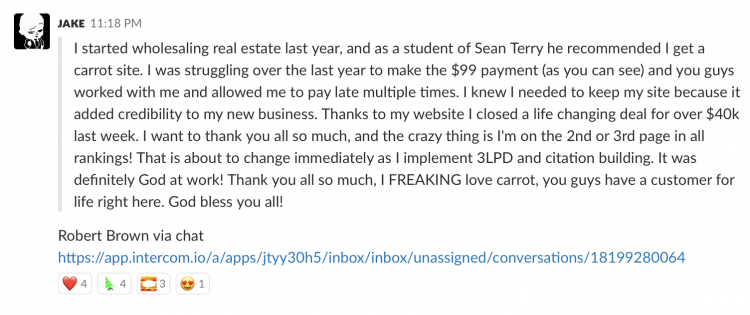
Those are the same words that thousands (millions?) of real estate investors have said to the person running their PPC ads.
“I’ve already spent $1,500 and I haven’t closed a single deal from those leads! If it hasn’t worked now, then it isn’t going to work.”
It’s difficult to believe differently than that. After spending thousands of dollars on a campaign which isn’t delivering the kind of results your business needs, quitting seems like the only logical option.
But let’s slow down for a moment.
Just because you’ve spent several thousand dollars on your PPC efforts without closing a deal does notmean you’re doing something wrong. In fact, it might mean you’re doing something right.
Let me explain.
What Is The Goal Of Your Real Estate PPC Campaign?
Is your real estate PPC campaign a success?
To answer that question, you first need to determine the goal of running ads.
If you’re simply trying to build brand awareness, then seeing a tangible return on your investment might be irrelevant. If you’re trying to generate leads for your email list which might turn into a closed deal down the road, then all that matters is getting new people on your email list. In those cases, use the metrics mentioned in this article to determine how successful your real estate PPC campaign is.
If more likely, you’re running a PPC campaign to find motivated sellers and close deals, having a strict, tangible, profitable ROI matters a lot more. The first thing you’ll need to do, then — before you even launch your campaign, ideally — is set a realistic and profitable budget for your ads.
Here’s how to do that.
What is a Realistic Budget and ROI For Your Real Estate PPC Campaign?
Earlier, I said, “Just because you’ve spent several thousand dollars on your PPC efforts without closing a deal does not mean you’re doing something wrong. In fact, it might mean you’re doing something right.”
And I meant it.
At Carrot, we know lots of real estate investors who have to spend between $1,000 and $5,000 to get a single deal. The reason for that has nothing to do with their ads being ineffective, but everything to do with thick market competition. The thicker the competition, the more investors have to spend on ads to close a single deal.
Here’s the kicker, though: those investors are still making between $10,000 and $50,000 in profit as wholesale fees. So while spending up to $5k on an ad campaign might seem crazy, it’s still very profitable.
“Would you pay $3,000 to make $30,000? I don’t know about you, but I’d take that deal all day long.”
Okay. Great.
Spend money to make money. You get that.
But how much money is too much money? How much should you expect to spend on your PPC campaign before closing a deal? At what point should you throw in the towel?
You’ll just need four pieces of information in hand:
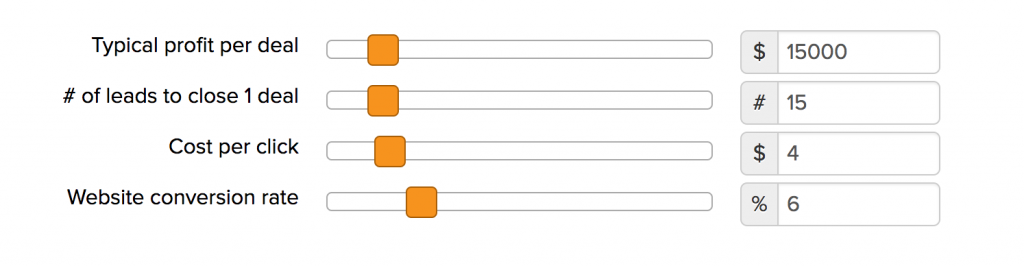
Typical profit per deal
Typical # of leads to close 1 deal
Cost per click
Website conversion rate
Example:
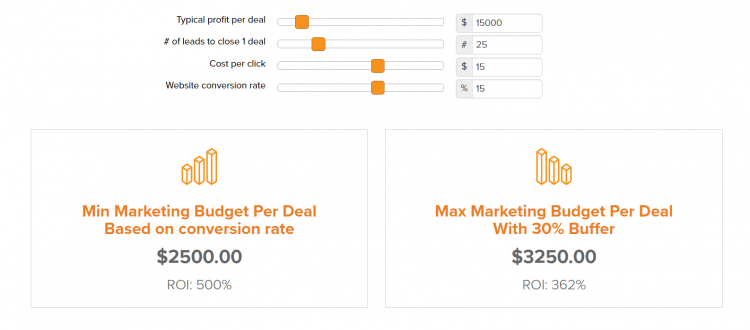
Imagine that you can safely expect to make at least $15,000 in wholesale fees on a single deal. Let’s also imagine you’re in a competitive market and that it takes you 25 leads to close one deal. Your cost-per-click for your PPC campaign is $15 and your website conversion rate is 15% (typical for a Carrot site).
That means you should expect to spend at least $2,500 to close a single deal and no more than $3,250.
And while that might seem like a lot of money to spend, you’ll also notice that the ROI on your expenses will be between 362% and 500%…
As Brian Rockwell said, “I’d take that deal all day long.”
Formula For Calculating ROI
Of course, ad spend is likely not your only cost for generating leads and closing deals. You might also be paying people to run your ads for you, tackle due diligence on properties, meet with buyers, or create contracts.
Maybe you also want to include those costs in the overall ROI of your PPC campaigns…
It’s up to you… really, it depends on what you want to find out. If you want to strictly determine how effective your PPC campaign is and if you’re staying within budget, then you might want to leave other indirect costs out of the equation. If, on the other hand, you want to determine the profitability and ROI of your entire business, then you’ll certainly need to include all other costs.
Whatever the case, here’s the formula you can use for finding the ROI of any of your marketing efforts.
ROI = (Revenue – Cost) / Cost
How To Determine a PPC Campaign’s Effectiveness (The 4 Metrics That Matter Most)…
There’s no doubt about it: ROI is the king of determining the success of any PPC campaign.
If you’re not making more money than you’re spending — if your ads aren’t profitable for your business — then you need to press “Stop” and try something else.
Having said that, looking only at the ROI of your PPC campaign can blindside you to other important metrics. Because even if your ads are profitable, they still might not be as profitable as they could be.
The goal is to not only run profitable and realistic PPC campaigns but to also increase the effectiveness and profitability of those campaigns. To do that, you should keep a close eye on the below metrics, test new things, and make changes as needed.
1. Cost-Per-Click
You can find this metric reported directly in your Google Ad dashboard. It tells you the amount of money you’re spending for each click you receive. The more enticing and click-able your ad is to website browsers (i.e. the more people who click), the less money you’ll spend on each click. However, competitive markets will force a high cost-per-click regardless of how effective your ad is, simply because there are so many other bids.
2. Quality Score
The quality score of an ad campaign is a metric which attempts to show you, with a score between 1 and 10 (10 is best), how effective your ad campaign is. Using the number of clicks your ad is receiving when people see it, the quality score also influences how much Google is going to show your ad, your cost-per-click, and even your ad placement (at the top vs. at the bottom). Keep a close eye on this metric and tweak your ad if it has a low-quality score.
3. Impression Share
Impression share is the percentage of people who, when your ad was placed on the page they visited, actually scrolled and saw your ad. If you ad has a low-quality score and is sitting at the bottom of the results page, your impression score will be much lower than competitors with ads showing at the top. An impression score of 80% means that 80% of people saw your ad and 20% didn’t.
4. Website Conversion Rate
While this isn’t technically a PPC metric, the website conversion rate is absolutely vital to consider for any paid ads you’re running which drive traffic to your website. Since you’re paying to generate clicks and hopefully leads and closed deals, you need a website which consistently converts the traffic your hard-earned money is driving to it. What’s a good conversion rate? Find out over here. And if you don’t want to worry about optimizing your website for conversion, consider getting yourself a Carrot website. We’ve generated over one million leads for investors and agents all around the U.S. and we’d love to do the same for you (a typical Carrot website conversion rate is around 10%. A typical conversion rate for most other industries is around just 2%).
Conclusion
I understand.
It gets discouraging, running ads which aren’t pulling results for your business. After all, if your business is to survive, you can’t be dumping money into a useless ad campaign for much longer.
You need results.
But keep in mind that results often take time.
The best thing you can do, in fact, is set yourself up for success by determining a realistic budget for your PPC campaigns: how much should you expect to spend? And how much is too much?
With those numbers, you’ll be far more confident spending the money you’re spending… knowing when you should expect a closed deal and when you’ve spent too much.
Then, work to improve the ROI of your PPC ads by watching the 4 metrics mentioned in this article. Because even if your paid ads are profitable, you still might be able to make them more profitable. Which is always a good thing to do.
With that, you’re ready to run successful PPC campaigns. The rest is simply doing, testing, trying, and iterating. Off ya go!
When it does launch, you want to collect clicks from motivated sellers or interested buyers, and you want your cost-per-click to stay within budget.
Easier said than done, of course. You might think that a campaign will convert like a million bucks, but then you launch it… and it doesn’t.
(You’ve been there, right?)
How can you possibly know what will convert well and what isn’t before you even launch the campaign? Well, ultimately, you can’t. But you can use a few simple copywriting tricks to increase the chance that your ad is a winner.
When it comes to platforms such as Google Ads, it’s just words on a page, no images or video allowed. So let me walk you through 8 ad copy for real estate PPC campaigns tips that will have you lowering your cost-per-click and increasing your conversion rate in no time.
But before we dive in, you need to be aware of the different ad platforms’ character limits. Character limits can make crafting ad copy a little difficult, so you’ll need to have an idea before writing.
Google Ads:
15 headlines with 30 characters for each headline. 4 description lines with 90 characters for each description. Option to pin your headlines and descriptions in specific positions of your ads. Set your display URL path. Set your final URL like a normal expanded text ad.
Microsoft (Bing) Ads:
Titles 30 characters each, up to three ad titles Ad text 90 characters each, up to two ad descriptions Final URL 2048 characters, including prefix (e.g., “www.”), suffix (e.g., “.com”), and tracking templates
Facebook Ads:
Facebook ad specs for single-image ads are:
Text: 90 characters Headline: 25 characters Link Description: 30 characters
8 Tips To Write High-Converting Ad Copy For Real Estate PPC Campaigns
Tip #1: Write 3 Ads And Choose The Best One
Writing three ads from the get-go rather than one can help get your creative juices flowing and give you more ideas for connecting with your audience and getting them to convert. I do this for many different ad copy, and I find that the last one I write is usually the best, because you start getting in your flow, and the ideas become more solid as you write them down.
Try this: write down three complete ads, headlines, and descriptions, and see which one you like the most. More than likely, one will stand out among the rest. This is a quick way to ensure you’re not running an ad just because it was the first thing that came to mind. Your brain needs to simmer a bit before it comes up with high-converting ad copy.
Let me give it a swing to show you what I mean…
[Headline] Need to sell your home fast for cash?
[Description] Foreclosure? Probate? Divorce? We can help you through your difficult life situation, putting a fair cash amount in your pocket faster than anyone else (within a week).
[Headline] Need to sell your house for cash in one week?
[Description] Foreclosure? Probate? Divorce? Whatever you’re going through, we’re real estate investors who buy properties fast for cash to benefit sellers like you.
[Headline] Sell Your House For Cash in Just One Week (1,257 Properties Purchased)
[Description] Foreclosure? Probate? Divorce? Whatever you’re going through, we’re real estate investors who buy properties fast for cash to benefit sellers like you. We’ll make your difficult situation easier.
Tip #2: Run Consistent A/B Tests
If you’re in the real estate business for the long run, which you are, then you will be doing a lot of marketing. And the more you learn about what makes motivated sellers and buyers tick, the better ads you can write.
Perhaps the best way to learn more about your target market — what makes them click and convert — is to A/B test pieces of your sales copy.
Do not, though, A/B test two totally different ads. While that can be interesting anecdotally, you can’t possibly pull any quantitative information from those tests since there are too many differing factors.
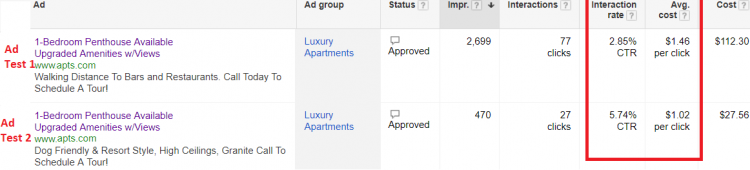
Instead, choose which part of an ad you want to test, and then create two identical ads, save for the one element that you want to test (headline, for instance).
Here’s an example of an A/B test where the marketer tested the description (pretty significant difference in results for such a small change).
If you’ve spent any time as a copywriter, then you’ve heard it a million times: the headline is the most important part of your ad. It’s what people see first; in the case of Google ads, it’s often the only thing they look at before they click.
If that doesn’t illustrate the importance of your headline, I don’t know what does.
Make sure you dedicate a little extra time to brainstorming a title that resonates with your target market.
First, you want to start with a basic ad headline.
Sell Your House Fast For Cash!
Then, you want to look for places to add specificity to the title (specificity is enticing, vagueness isn’t). Here’s an idea.
Get a Fair Cash Offer On Your House in Just 24 Hours!
That’s a little better. We can make it even more specific if we’re willing to do more targeted advertising.
Going Through a Divorce? Sell Your House Fast For Cash
Or…
Dealing With Foreclosure? Sell Your House For Cash Now!
You can see how each title gets better as I spend a little more time thinking about it. The same will be true when drafting headlines for your Google ads.
Google Ads Tips: Including your keyword within your title can help increase your Quality Score.
Tip #4: Try Using These Power Words
Different words trigger different thoughts and different emotions. Fortunately, most people are very similar, and certain words trigger similar emotions. Using words that evoke the right emotion can be extremely effective at making your copy more enticing.
What words should you use? Here’s a list of power words for any sales copy you write.
You/Your
Because
Introducing
Welcome
Unique
Announcing
Secret
Hidden
Truth
Temptation
Now
Discover
New
Win
Cheap
Free
Lazy
Humiliation
Alone
Reject
Stress
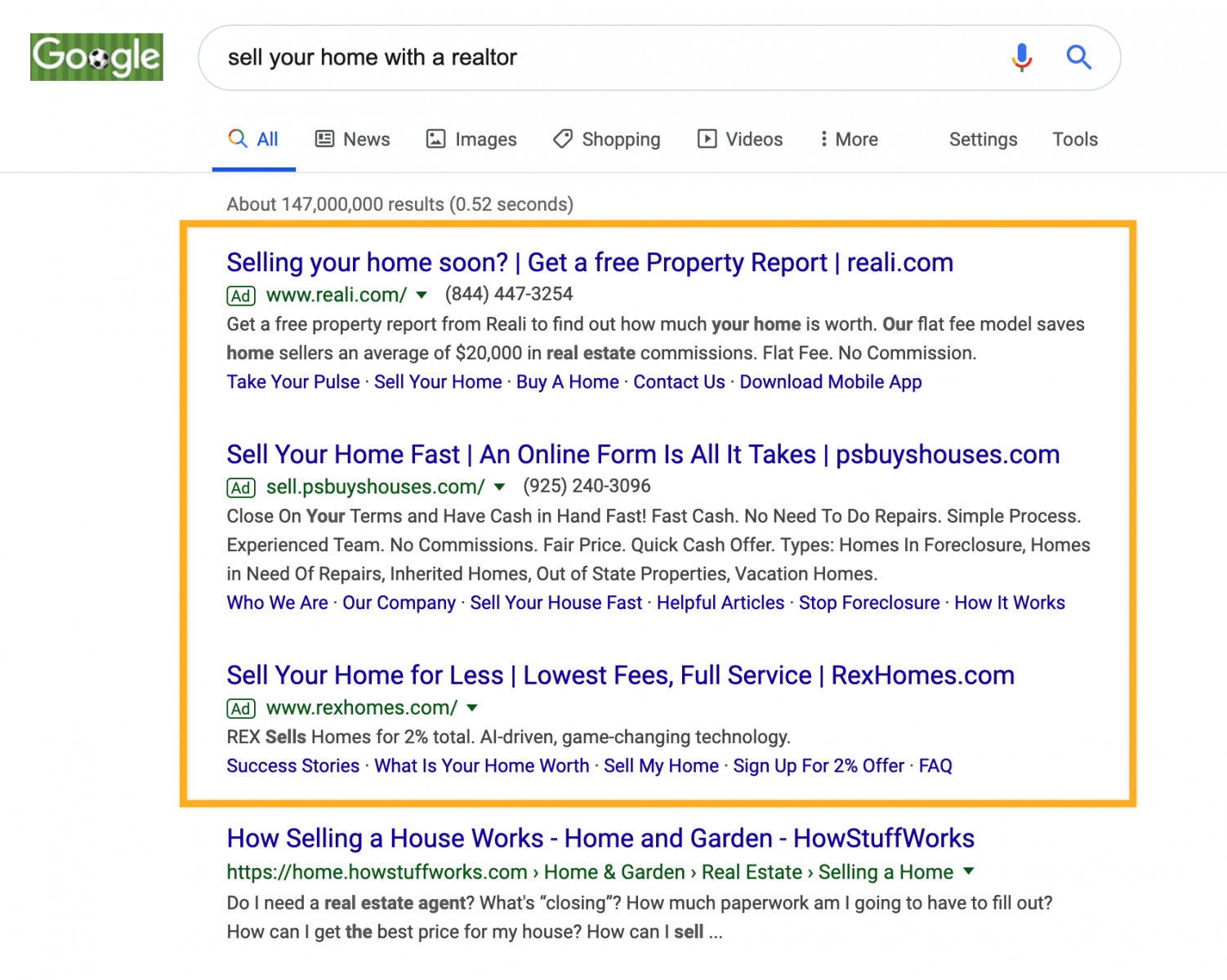
Here are a couple of examples of these and other similar power words in Google Ad campaigns:
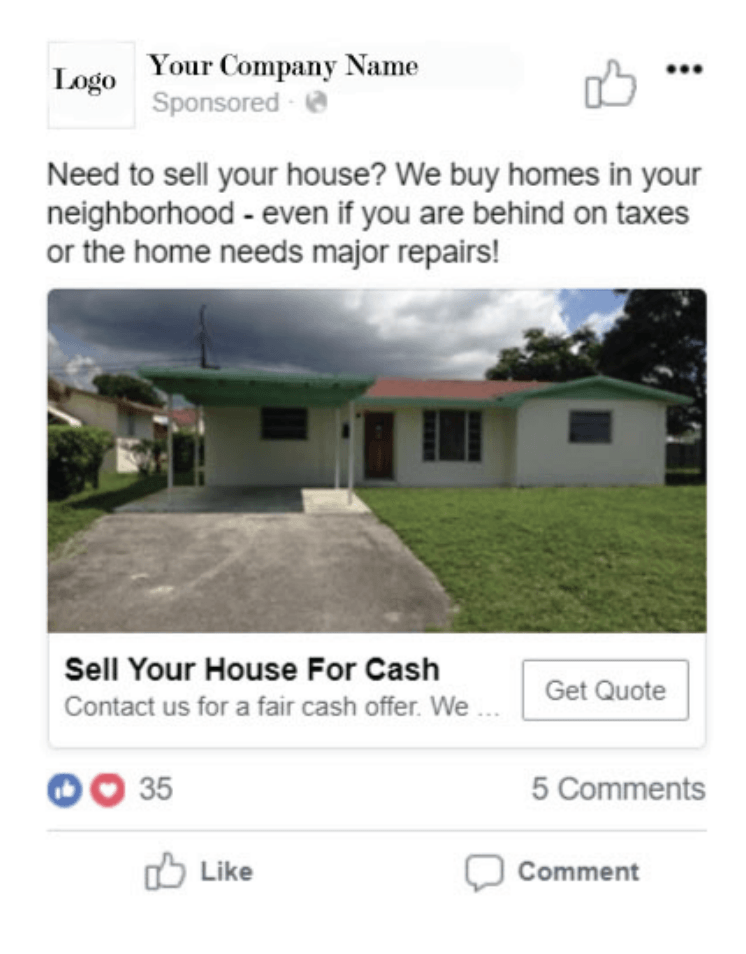
Here are a couple of examples of these and other similar power words in Facebook Ads:
If you’re a Carrot member, don’t miss the opportunity to learn from the industry’s top Facebook marketers. Check out the Facebook Leads Masterclass today!
Tip #5: Touch On The Prospect’s Emotional Pain Or Desire
When you’re writing sales copy, you aim to connect with your prospect’s emotional pain or desire (depending on whether you’re trying to attract sellers or buyers). No one buys anything or commits to anything without first seeing a vision in their head — a vision for how that product or service might solve their problem or give them something they desire.
No one buys a car without first imagining owning it. No one buys a house without first walking around and imagining living in it. And no one will work with you unless they can see the tangible benefits of doing so.
Your copy should wise up to that and try to get the prospect to imagine what it’ll be like to work with your business.
For example…
[Headline] Get Your Life Back — Sell Your House Fast For Cash
[Description] Sick and tired of dealing with the demands of foreclosure, probate, or divorce? We can’t solve everything, but we can make you a fair cash offer on your home and close in just one week… Can you imagine no more worry?
[Headline] Reduce Stress — Sell Your House For a Fair Cash Offer in One Week
[Description] Stressed from difficult life situations? We’ve helped hundreds of people sell their house fast for cash and regain their lives. Ready to start enjoying life again?
Tip #6: Try Statistics or a Case Study
One of the best ways to make your Google Ads copy more enticing is to use statistics or a case study. This builds credibility for your business and makes your promise more believable.
Here are some examples of what I mean… notice how the data makes them far more enticing than some previous examples.
[Headline] Need to Sell Your House Fast? I Just Handed This Person $50,000… Cash (Case Study)
[Description] Let me tell you a quick story about someone who just sold their house to me in one week for $50,000. You can do the same thing… but first, I need you to understand this simple process…
[Headline] Need Quick Cash For Your House? We Can Help (1,500+ Offers Sent)
[Description] When you need to sell your house fast for cash, we’re the people you come to. We’ve made over 1,500 cash offers and helped hundreds of people out of difficult situations. Are you ready?
Tip #7: Respond To Common Objections
If you know what objections people will have when they read your ad, why not deal with them right from the beginning? Maybe not in your headline… but definitely in your description.
Here are some of people’s most common objections about working with real estate pros…
Can I trust you? — First and foremost, people want to know that they can trust you and your business. Real estate is a big transaction, the biggest transaction that most people will ever deal with, and it’s for that reason that people so carefully try to vet who they’re going to work with to ensure that they’re the real deal.
Can I buy or sell fast? — Speed is important if you’re dealing with motivated buyers or sellers. No one wants to wait forever to get their pain or desire fulfilled.
Will it be difficult? — People want to know that you will do all the legwork. They don’t want to have to do anything difficult themselves.
How much will it cost me? — No one wants to be nickel and dime’d. Tell people how much it’ll cost them and move on with it.
What’s the catch? — Most people think that everyone is trying to manipulate them, especially marketers, so indicating that there are “no strings attached” can be a helpful sales strategy.
Tip #8: Study Your Competition
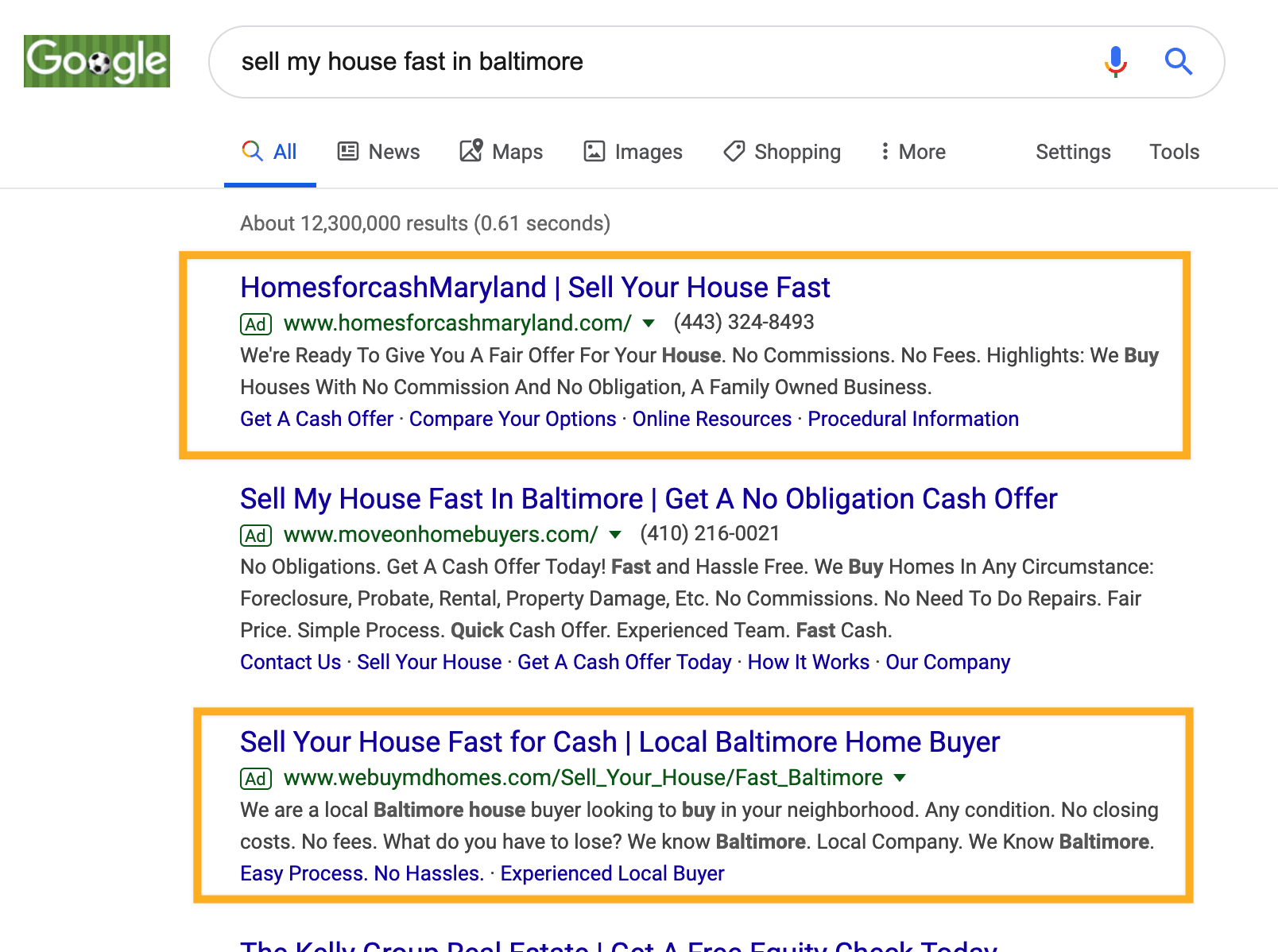
A great way to get ideas for your own Google Ads campaign is to spy on the competition and see what top agents and investors in your market are doing. Then you can either copy them, try to do better than them, or do something completely different. Either way, you can make more informed decisions when you know what the competition is doing.
You can use a tool like ChatGPT to do competitive keyword research. Or you can keep it simple and type your target keyword phrase into Google and see what ads come up.
Conclusion
You can’t know whether an un-launched ad will perform as you want it to. Only once you hit the big red button can you measure your ad campaign’s cost-per-click and ROI.
But these eight PPC Ads copywriting tips will give your ads a far better chance of winning the click and the day. Give them a try, and let us know how it turns out!
Are you dismissing Bing PPC for real estate investors because that “guy” in the online forums said it’s not worth using it? Is your Google Ads campaign killing your marketing budget?
Demo Carrot: How many deals are you losing to your competitor’s website?
What if I told you Bing might help you attract extra leads at a lower cost (if you do it right)?
“For me, Bing Ads is too expensive. The conversion rates just suck…” via Reddit
“Bing Ads are s*** compared to Google Ads in my experience”. via Reddit
We see these kinds of comments about Bing PPC for real estate investors all of the time. You probably do as well.
We’re often asked, “Is Bing PPC worth it as an additional source for real estate investor advertising?”
So, we wanted to find out… and we started testing, which we dive into below. Also, we’ll show some of the advantages Bing can have over AdWords.
Don’t Assume That Google Ads Is The Only Game In Town For PPC Marketing
When prospects search online for a real estate professional (this applies to investors and agents), you want to be on the first page.
Because if you are, people will click on your result, they’ll visit your website, and there’s a darn good chance they’ll even become a lead (at the very least, you can tag them once they visit your website and retarget them with Facebook ads — learn more over here).
And leads from search engines are typically much higher quality than direct mail leads, bandit sign leads, or even door knocking or cold calling leads.
Because they came looking for you.
However, in the world of search engines and PPC, Google Ads reign supreme. Google, after all, dominates nearly 95% of all search engine traffic.
But in this article, we’re not talking about Google Ads. We’re talking about Microsoft Advertising (the advertising platform behind Bing, a search engine mockingly acronym as “But It’s Not Google”), which holds about 2.39% of the world’s search engine market share.
That begs the question: why are we discussing Microsoft Advertising?
Well, there are a few advantages you should be aware of.
Should You Use Microsoft Advertising?
While holding 2.20% of the world’s search engine market share seems small and insignificant, those two percentage points still amount to 12 billion searches per month. Everyone searches online. Most people do it daily, so owning a few percentage points of the world’s search engine share is more powerful than it seems.
And here’s the other thing: most people only use one search engine.
If you’re a Google user (and you probably are), when is the last time you searched using Bing, Yahoo, or DuckDuckGo?
Yeah… don’t even remember. Neither do I. And neither do most people.
Most online searchers use a single search engine and rarely stray.
This means that the people who search using Bing… you’ll seldom reach those same searchers with Google Ads. Conversely, you’ll rarely reach Google Ads users when using Microsoft Advertising.
Searchers don’t cross platforms. This means to reach all of your prospects, your business should.
But look — I’m not going to tell you that you have to advertise on Bing; it’s your call. I want to point out that running a Microsoft Advertising campaign in addition to your Google Ads campaign can give you a competitive edge in your market: you’ll reach the people who your competitors aren’t probably even advertising to.
Because since Google is the biggest, most visible search engine, everyone knows about it, including your competitors. And they’re advertising on it.
Bing? Maybe not. Using Microsoft Advertising could help you snag leads that your competition outright ignores.
Is Bing PPC for real estate investors worth it? Here’s What We Found…
Carrot Member Google Ads Campaign
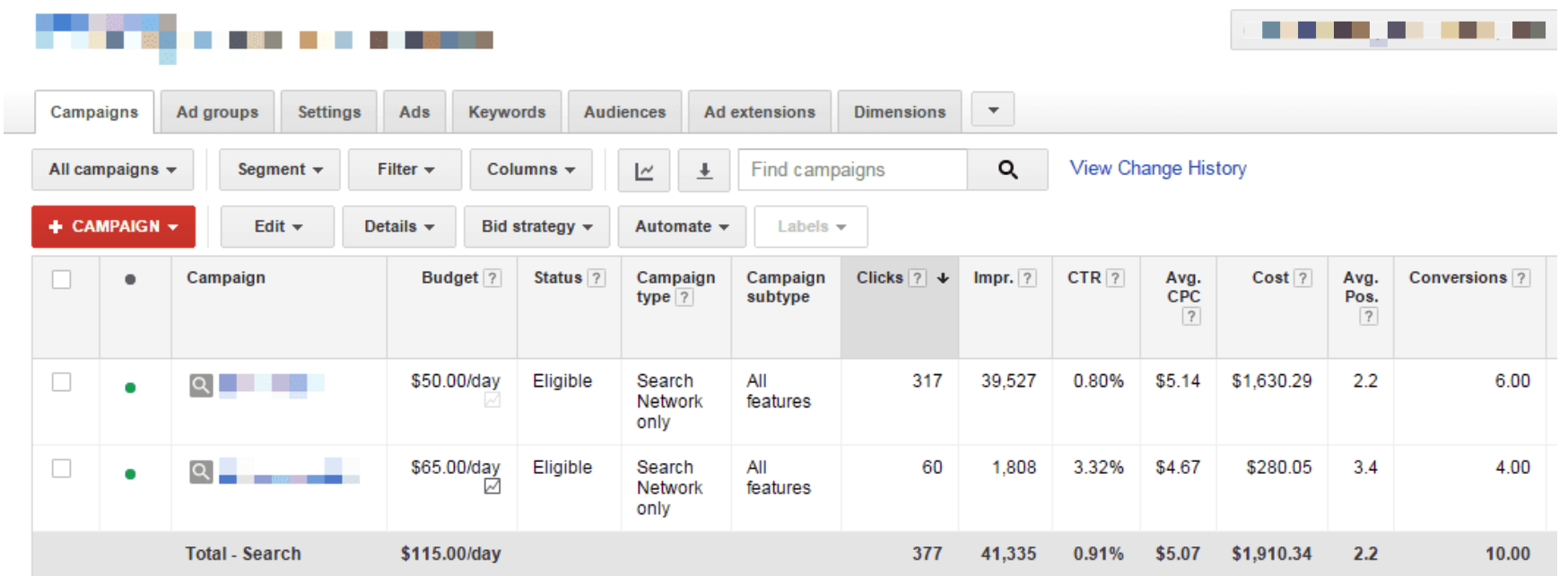
With that success with Google Ads, we wanted to see if we could “stack” on more leads by adding Bing PPC to the picture. As you can see, he invested $1,910 in ad costs during those 30 days in Google Ads and collected ten confirmed online opt-in leads… and many other phone call leads. Counting the phone call leads brings his cost per lead down to under $100 per lead.
Same Carrot Member Bing PPC Campaign
Now let’s compare them both apples to apples across the board.
Clicks:
Google Ads: 377
Bing: 338
Google Ads had 11.5% more clicks by volume
Impressions:
Google Ads: 41335
Bing: 24660
Google Ads had 68% more impressions by volume
Click Through Rate:
Google Ads: .91%
Bing: 1.37%
Bing had a 50% greater click-through rate by a percentage
Cost Per Click:
Google Ads: $5.07
Bing: $3.32
Google Ads cost per click was 53% higher than Bing
Conversions:
Google Ads: 10
Bing: 6
Google Ads (for this specific market) only had 4 more online leads in total (doesn’t count phone call leads).
Total Invested:
Google Ads: $1910.34
Bing: $1123.65
Google Ads overall spending was 70% higher than Bing and yielded 40% more leads.
Just one thing to remember from this test… the cost per lead in this campaign is higher than our typical cost per lead on PPC. The client wanted us to test a set of 6,000 broad match keywords he received from a mentor… vs. our more targeted approach to PPC management.
The cost per lead on that broad match keyword group is 5x higher than on our targeted group… for the same number of leads. But the client is ok with that higher cost per lead because his margins on deals are so high that it ensures he’s not missing any leads.
Bing delivers lower search volume but a more attractive cost per lead.
Of course, you’ll get more impressions and clicks on Google Ads, but you’ll usually pay more per click for those visitors.
It’s not that one is better than the other… this post is mainly to lay out the argument that Bing is a very valid PPC marketing platform that, in this month-long test, pulled leads that cost us less than we pay for leads from Google.
More… Quick Microsoft Advertising Stats
Here are some stats about Bing and Microsoft Advertising to keep your mind churning and informed.
Microsoft Advertising generally has a lower cost-per-click than Google.
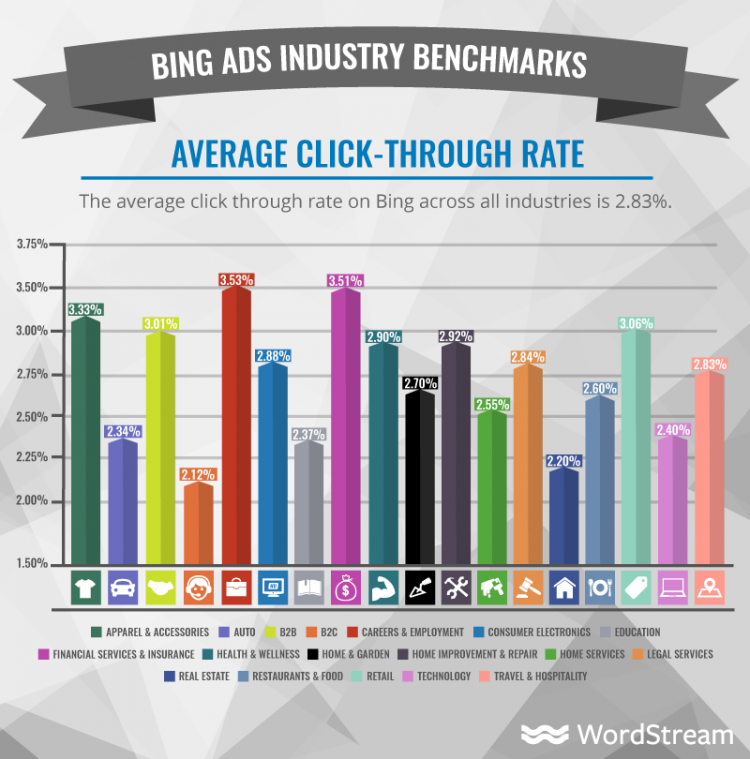
Google Ads’ click-through rate has been neck-and-neck with Microsoft Advertising click-through rate, around 2.5%.
Bing offers better support to advertisers with lower budgets.
7 Reasons Why You Shouldn’t Ignore Bing PPC For Real Estate Leads…
1. Bing PPC offers cheaper CPCs (costs per click) and potentially higher ROI
This is primarily because fewer investors use Bing over Google Ads. Bing Ads generally has lower competition than Google Ads, especially in the real estate industry. With fewer advertisers competing for the same keywords and targeting options, the cost per click (CPC) on Bing Ads tends to be lower. Real estate investors can use this lower competition to secure motivated seller leads at a more cost-effective rate.
Here are some additional reasons by CPCs are lower on Bing:
Cost-Effective Advertising: Lower CPCs on Bing Ads translate to lower advertising costs for real estate investors. By paying less per click, investors can stretch their advertising budget further, enabling them to reach more motivated sellers within their allocated budget. This cost-effectiveness can lead to a higher return on investment (ROI) for investors, as they can generate more leads and conversions for a lower cost compared to other advertising platforms.
Targeting Specific Audience: Bing Ads allows precise targeting options, including demographics, location, and search intent. Real estate investors seeking motivated seller leads can leverage these targeting options to reach their desired audience more effectively. By narrowing down their target audience and focusing on specific geographic areas or relevant search terms, investors can ensure their ads are shown to users actively looking for real estate information or intending to sell their properties. This focused targeting can result in higher conversion rates and an improved ROI.
Unique User Base: Bing has a distinct user base that often differs from Google’s audience. Bing users tend to be older, more affluent, and more likely to be homeowners. These characteristics align well with the target audience of real estate investors seeking motivated sellers. By advertising on Bing Ads, investors have the opportunity to connect with this specific user base and potentially find motivated sellers who are more likely to engage with their ads and pursue a real estate transaction.
Considering these factors, Bing Ads can offer real estate investors seeking motivated seller leads a cost-effective advertising solution with cheaper CPCs and potentially higher ROI. By leveraging the lower competition, cost-effectiveness, precise targeting options, and unique user base of Bing Ads, investors can maximize their ad spend, generate more leads, and increase their chances of finding motivated sellers interested in their real estate offerings.
2. The Expanding Reach of Bing PPC
Bing PPC has experienced remarkable growth, solidifying its position as a formidable advertising platform. With the integration of Microsoft Advertising and Bing, its reach has expanded significantly, capturing a substantial share of search queries.
In fact, Bing now powers over 30% of all search queries in the United States. Ignoring Bing PPC could mean missing out on a sizable portion of potential leads and lucrative real estate investment opportunities.
3. Bing Ads offers new ad features!
Since 2022, Microsoft Advertising (formerly Bing Ads) has introduced several changes to its ad structure to enhance the advertising experience for marketers. Here are some notable updates:
Expanded Text Ads: Microsoft Advertising introduced Expanded Text Ads, allowing advertisers to create more compelling and informative ads. Expanded Text Ads feature additional headline and description fields, providing more space for advertisers to highlight their products or services. This update allows for more creative and engaging ad copy, improving click-through and conversion rates.
Image Extensions: To make ads more visually appealing, Microsoft Advertising introduced Image Extensions. This feature enables advertisers to add relevant images to their ads, helping them capture the attention of potential customers. By incorporating visual elements into their ads, advertisers can effectively convey their brand messages and increase ad engagement.
Callout Extensions: Callout Extensions allow advertisers to include additional text to highlight unique selling points, key benefits, or special features of their products or services. This update gives advertisers more flexibility to communicate essential information to potential customers and differentiate themselves from competitors. By leveraging Callout Extensions, advertisers can increase the relevance and impact of their ads.
Dynamic Search Ads: Dynamic Search Ads (DSA) were improved to provide more accurate and relevant ad targeting. This feature enables advertisers to automatically generate ads based on the content and keywords on their websites. Microsoft Advertising’s DSA now offers improved page coverage and refined targeting options, ensuring that ads are shown to users actively searching for related products or services.
These updates to the ad structure in Microsoft Advertising (formerly Bing Ads) offer advertisers more versatility, improved visibility, and better opportunities to engage with their target audience. By leveraging these features, marketers can create more impactful and effective ad campaigns on the platform.
4. Syndication across the Microsoft Advertising Network
Bing PPC allows real estate investors to syndicate their ads across the expansive Microsoft Advertising Network. This network includes popular platforms such as MSN, Outlook, and Microsoft Edge, ensuring broader exposure and increased visibility for investment opportunities.
By leveraging the Microsoft Advertising Network, investors can reach a wider audience, attracting qualified traffic to their websites or landing pages and expanding their potential for successful real estate transactions.
5. Bing PPC offers flexibility!
The differences in Bing Ads ad groups can benefit real estate investors seeking motivated seller leads. Here’s how these differences can be advantageous:
More Descriptive Ad Group Naming: With a higher character limit for ad group naming in Bing Ads, real estate investors can use more descriptive and detailed names. This allows investors to organize their ad groups to align closely with their real estate investment strategies.
Using descriptive names, investors can easily identify and manage ad groups targeting specific geographic areas, property types, or other relevant criteria. This level of organization can streamline campaign management and make tracking the performance of individual ad groups easier.
Inclusion of Search Partners by Default: Bing Ads includes search partners as part of the ad group targeting by default. Real estate investors using Bing Ads can extend their reach beyond Bing’s search engine to include partner websites such as Yahoo and other affiliated search networks.
By default, investors can potentially reach a wider audience and increase the exposure of their motivated seller ads. This expanded reach can lead to more opportunities to connect with motivated sellers searching for real estate information on partner websites.
Default Ad Distribution on Bing Ads: Bing Ads has a default ad distribution setting of “All” within an ad group. Real estate investors’ ads are automatically eligible to appear on Bing, Yahoo, and search partner sites without additional configuration.
This broader ad distribution can increase the visibility of ads and generate more impressions, potentially reaching a larger pool of motivated sellers. Investors using Bing Ads can leverage this default setting to expand their ad reach and increase the likelihood of connecting with motivated seller leads.
Ad Extensions at the Ad Group Level: Bing Ads allows real estate investors to set ad extensions at the ad group level. This gives investors greater control and flexibility in associating ad extensions with specific ad groups. Real estate investors can utilize ad extensions such as call extensions, site link extensions, or location extensions at the ad group level to enhance the visibility and relevance of their ads.
By customizing and optimizing ad extensions at the ad group level, investors can provide additional information and relevant contact details to potential motivated sellers, increasing the chances of engagement and lead generation.
Real estate investors can benefit from enhanced organization, broader ad distribution, and more control over ad extensions by taking advantage of these specific features in Bing Ads ad groups. These benefits can help investors effectively target motivated seller leads, increase ad visibility, and drive better engagement, ultimately maximizing their chances of connecting with potential motivated sellers and securing profitable real estate transactions.
6. Bing Ads have better device targeting options.
Device targeting options in Bing Ads can benefit real estate investors seeking motivated seller leads. Here’s how real estate investors can leverage these options effectively:
Mobile Device Targeting: Since many users now rely heavily on mobile devices for their online activities, targeting mobile devices can be a strategic move for real estate investors. Mobile targeting allows investors to reach potentially motivated sellers searching for information on their smartphones or tablets.
By tailoring campaigns specifically for mobile users, investors can capture the attention of on-the-go sellers, increasing the likelihood of engaging with motivated leads.
Location-Based Targeting: Bing Ads provides location targeting options, allowing real estate investors to focus on specific geographic areas known for motivated seller activity. By combining location and device targeting, investors can effectively reach potential sellers in their desired locations using mobile devices to search for real estate information. This precise targeting ensures that investors connect with motivated sellers in their target market, maximizing the chances of generating high-quality leads.
All Device Targeting: Real estate investors can opt for all device targeting to ensure maximum campaign exposure and reach. By targeting all devices, including desktops, mobile devices, and tablets, investors can cover a broader audience and increase the chances of capturing motivated seller leads across various devices.
This comprehensive approach allows investors to reach potential sellers regardless of their preferred device, ensuring a higher chance of engagement and lead generation.
Bid Adjustments for Device Performance: Bing Ads allows investors to adjust bids based on device performance. By closely monitoring the performance of their campaigns on different devices, investors can identify which devices are driving the most conversions and adjust their bids accordingly.
For example, if mobile devices show higher conversion rates, investors can increase their bids for mobile targeting to allocate a larger portion of their budget to the most effective device. This optimization strategy helps investors maximize their return on investment and generate more motivated seller leads.
Real estate investors can utilize device targeting options in Bing Ads to connect with motivated seller leads. By targeting mobile devices, focusing on specific locations, using all device targeting for maximum exposure, and adjusting bids based on device performance, investors can enhance their campaigns’ effectiveness, increase engagement, and generate more quality leads from motivated sellers.
7. Bing Ads platform is ideal for companies with a small budget!
While Google Ads remains a popular choice, Bing PPC often offers a cost-effective alternative for real estate investors. In some instances, Bing PPC can provide a lower cost-per-click (CPC) compared to Google Ads, enabling investors to stretch their advertising budget further and achieve a higher return on investment (ROI).
By optimizing campaigns and implementing strategic bidding, investors can maximize their ad spend on Bing PPC, attracting motivated prospects without breaking the bank.
Is Bing PPC Right For Your Real Estate Investing Business?
It can help you tap into new leads you’d never otherwise reach on Google. That’s for sure.
If just maybe… especially if you need to start on a smaller budget to test the waters.
If your advertising campaign is limited to a small geographic area, Google Ads might be the platform where you’ll gain significant search volume, depending on your keywords and match types. Higher search volume means more potential customers for your business.
Yes, Google Ads is still the “empire” for paid search, with most of the market share. For that reason, Bing Ads is often an afterthought that doesn’t get much attention. But Bing has some unique capabilities that most folks do not use. If you optimize for these Bing Ads only features, you’re sure to increase performance significantly.
They’re both great platforms with their advantages and disadvantages. But the analyst inside of all great advertisers should prefer to test both. See if you can stack on additional leads for motivated house sellers, cash buyers, and tenants… you name it… by adding Bing to the mix.
You’ll see, in time, which performs better for your market and budget.
Read this post if you want more great tips on effective PPC marketing.
The Pros and Cons of Microsoft Advertising
Let’s keep this simple and break down the pros and cons of Microsoft Advertising.
Pros
Bing is the second-most-popular search engine. So if you want to put money somewhere other than Google, Bing is the place to do it.
Since Bing has less search traffic than Google, it also has less competition and a lower cost-per-click usually, so it can be less expensive to advertise.
Bing gives you more characters for your ad than Google, allowing you more room to convince people to click your result.
Bing shows more of its ads at the top of the page than Google does, which is helpful for the click-through rate since people don’t have to scroll down the page.
Almost 75% of Bing users are over 35, so Microsoft Advertising can be good for reaching an older audience.
Cons
Bing can have lower search engine traffic (compared to Google), so potentially fewer leads.
My recommendation? Start with Google Ads, and if you have the budget to spare and need a competitive edge, supplement your efforts with Microsoft Advertising.
Still Have Questions?
Still not sure if Microsoft Advertising is right for your business? That’s okay — it’s not always easy to know the right path to take when it comes to marketing. But the good news is that you don’t have to decide now.
Why not try it out for yourself?
You can create a Microsoft Advertising account over here and start driving traffic to your site immediately (and if you need a high-converting site out-of-the-box, sign up with Carrot).
Who knows? Bing might give your business the competitive edge you’ve been looking for.
In markets with little competition, the product and the offering are often the most important factors a prospect uses to decide what company to work with.
But in a cluttered market, with lots of competition, like today’s real estate world… credibility has grown to trump “product” as the main deciding factor to make or break your next deal.
So, what are the top 5% of real estate investors and agents doing to build more credibility in the market and make their competition irrelevant?
Trevor Mauch, CEO of Carrot, dives into specific examples and lays out his Credibility Score theory to help you determine what you should fix ASAP to build your credibility even more.
Listen to the Podcast
[podcast-subscribe]
Podcast Timestamps & Highlights
6:10 – What the consumer’s path to find a credible company online looks like. 10:00 – Recognizing competitors’ opportunity to move in and cloud the consumer decision process is essential. 12:00 – Example of an effective self-mailer used to build credibility.
15:15 – Marketing stages breakdown for real estate. What the most important pieces are. 17:45 – Look at your past and present marketing numbers and build credibility after the first contact from a lead. 18:50 – What it takes to build credibility into your real estate website. 22:00 – We’re in the age of trust and credibility. Everyone is online. What are you doing to cut through the clutter? 26:30 – Build a process within your business that adds credibility. 29:15 – Taking a look at Opendoor and Express Home Buyers. Two examples of companies with a good credibility strategy. 32:20 –Diving into Carrot’scredibility strategy. 33:45 –Stanford’s Web Credibility Research Center – 10 credibility score items people view on a website. 37:20 – What is the #2 most visited page on your website? 39:30 – Does your real estate website look good on mobile? And what you need to fix if it doesn’t. Use our mobile check tool. 42:40 – What does credibility mean? And how to do it so you connect with your lead more effectively. 44:00 – Using the credibility score formula and how to build credibility through social media and testimonials. 53:00 – Stacking upon the credibility score – Being picky on your website credibility. 55:00 – Using some how-to’s to beef up the overall impression of your real estate website. And the importance of controlling the conversation around your brand. 1:02:15 – Build things unique to your offerings to stand out from the online competition. Such as badges and logos. 1:04:30 – Creating the connection with credibility and working hard to go the extra mile to show you’re an expert in your market.
Our mission at Carrot just got bigger. See why in the video above then listen to why we’re betting $600k in our brand in the podcast below.
Whew! It’s been 5 years since we started Carrot. 5 years! And a lot has happened in those 60 some odd months.
Over that time we’ve helped thousands of real estate investors and agents stand out online, cut through the clutter, and win more leads and deals. In fact, well over 2,000,000 online leads and counting.
Over 3,000 Carrot Bud dolls have been sent out to raving Carrot fans, 1,000+ Carrot t-shirts (the comfiest ever!), 250,000+ CarrotCast downloads, thousands of “doses of awesomeness” have been sent in from Carrot members about their successes since working with us.
But a BIG piece of fully owning Carrot, the brand, has escaped us until now.
Our $600k Bet To Acquire Carrot.com And Go All In On Our Mission
Um, yes… you read that right. That’s no typo.
$600,000 for a domain name. Believe me, if you would have told me 3 years ago we’d be investing that much money into a domain I would have said you’re off your rocker. But today, I feel it’s one of the best investments we could have made to further our future and our mission to impact far more entrepreneurs.
You’ve heard me talk about how important it is today to build a brand and we’ve done a pretty darn good job of it over the years. But one thing that kept bugging us was the brand confusion in the market about our real company name.
Are we Carrot?
Are we OnCarrot?
Are we InvestorCarrot?
Well, we’ve always been Carrot. InvestorCarrot is a product, and AgentCarrot is a product. But a hefty percentage of people still called us OnCarrot as our business name rather than that just being our domain name. So much so that it became a running joke that would make us cringe internally every time we saw it.
The Need To Own Our Brand Became More Important
Many people feel that a brand is simply your company colors and a logo.
But, that’s just the start. We all know companies that have an amazing logo, but you cringe when you hear their name because of the way they run their business. They have a brand, just not the one they want.
A brand is everything that paints the picture of what your company represents to the marketplace.
The Carrot orange is a recognizable sign of our brand.
Our logo was a fun expression of our brand.
The dolls, t-shirts, and way we do business here all feed into building the Carrot brand that tens of thousands of grown to know and love.
But what about your domain name?
Your domain name can also signal how serious you are about your brand, or whether you’re just “dabbling” in your brand.
For us, our domain name was fine. It would have continued to do what it needed to do. But it didn’t further cement our brand. It actually distracted from it and made it harder for people to find us.
We’re Turning The Page To The Next Chapter At Carrot
As we’re making a big bet on our mission, on our brand, on helping tens of thousands more small businesses to stand out online and finally get results… we’re also making a big bet on YOU.
This is only our first big bet.
Throughout the next 24 months, we’re investing heavily into other areas.
We’re making big investments into…
Building our engineering and product teams to innovate our product faster than ever before
Transforming our Customer Success team to take your customer experience to an even higher level
Doubling down on our content efforts to get the most up to date and useful content possible
… and more.
I can’t think of a better way to celebrate International Carrot Day (April 4th) than this. And we’re grateful that you’re a part of the journey.
Celebrate International Carrot Day With Us + Win Prizes!
In celebration of our doubling down on our brand and mission, for International Carrot Day we’re doing 2 challenges today and giving away hundreds of dollars in prizes including orange Bose Speakers!
Just click the link below to enter one of our 2 challenges and celebrate with us!
The real estate market thrives on movement, and in today’s digital age, that movement starts with a click. Gone are the days of relying solely on yard signs and classified ads. For real estate professionals in 2024, a strong online presence is no longer a luxury; it’s a necessity.
Real Estate SEO Bible: The Ultimate SEO Keywords Guide
Here’s the reality: over 93% of homebuyers utilize online resources while searching for a perfect property. But the online world isn’t just for buyers. Motivated sellers, eager to sell fast and streamline the process, are also turning to the web in ever-increasing numbers.
This digital landscape presents a golden opportunity for real estate investors and agents: a platform to connect with motivated sellers looking for a trustworthy investor and eager homebuyers ready to move with the right agent. However, with countless real estate investors and agents for online attention, simply having a website isn’t enough. To truly stand out and capture valuable leads, you need a strategic approach to search engine optimization (SEO).
This blog post dives into the 16 best practices for on-page SEO specifically tailored for the real estate market in 2024. By implementing these actionable strategies, you can ensure your website surfaces at the top of search results, attracting potential buyers and motivated sellers, ultimately propelling your real estate business forward in the ever-evolving digital landscape.
You know how powerful SEO can be for your real estate business. With over 15 million users on our Carrot member’s websites and over 45,000 leads per month right now (as of the update of this post), there is a huge hunk from SEO.
On-page SEO for Real Estate: 16 Steps for Optimized Websites
Understanding the Importance of On-Page SEO for Real Estate
Imagine a beautifully staged property with a “For Sale” sign hidden behind a giant, opaque billboard. That’s essentially what a real estate website without strong on-page SEO is like. Potential buyers and sellers can’t see it, can’t find it, and can’t connect with the valuable resource you offer.
On-page SEO is the art and science of optimizing the elements within your website to improve its ranking in search engine results. In the competitive world of real estate, ranking higher means more visibility. More visibility translates into more qualified leads, client conversions, and a thriving real estate business.
Here’s a breakdown of the magic on-page SEO works for real estate professionals:
Attract Housebuyers: When potential buyers search for homes in your area, optimized keywords and content ensure your website appears at the top of search results. This positions you as a trusted resource, attracting buyers actively looking for properties.
Engage Motivated Sellers: Sellers seeking to list their property also search online. By targeting relevant keywords related to selling a home, your website becomes a beacon, attracting motivated sellers seeking top-notch agents to guide them through the process.
Boost Credibility and Expertise: High-quality, informative content showcases your knowledge of the local market and establishes you as a valuable resource for both buyers and sellers. This builds trust and positions you as the go-to agent in your area.
Drive Organic Traffic: Effective on-page SEO helps your website rank organically, meaning you don’t have to rely solely on paid advertising. This translates into cost-effective lead generation, attracting potential clients who are actively searching for real estate solutions.
By investing in on-page SEO, you’re essentially investing in the foundation of your online presence. It’s the key to unlocking the full potential of your website, transforming it from a hidden gem to a lead-generating powerhouse in the ever-competitive world of real estate.
Keyword Research: Unlocking the Language of Your Audience in Real Estate
In the dynamic world of SEO, understanding user intent is the Rosetta Stone to crafting a website that resonates with your target audience. This is especially true in the real estate market, where homebuyers and motivated sellers navigate the online landscape with distinct goals.
Moving Beyond Search Volume: Traditionally, SEO focused on keyword volume – finding the most commonly searched terms. However, modern SEO delves deeper, prioritizing keywords that reflect user intent. This means understanding the “why” behind user searches and what potential buyers and sellers are truly looking for when they type their queries into search engines.
Homebuyer Focus: A Journey of Discovery
For homebuyers, the search journey often involves a mix of informational and transactional keywords:
Informational Keywords: These keywords reveal buyers in the research phase, gathering information and understanding the market. Examples include:
“Best school districts in [your city]”
“ cost of living”
“Tips for first-time homebuyers”
Transactional Keywords: These keywords signal a buyer is nearing a decision and ready to connect with an agent. Examples include:
“[Your city] homes for sale under $300,000”
“Open houses this weekend near [landmark]”
“Find a real estate agent in [your zip code]”
By targeting both informational and transactional keywords, your website caters to buyers throughout their search journey, establishing you as a valuable resource and trusted guide from start to finish.
Motivated Seller Focus: Selling Smart, Selling Fast
Motivated sellers also have distinct search intent. They might be looking for:
“How to sell my house fast in [year]” (e.g., “How to sell my house fast in 2024”)
“Free cash offer”
“Top cash house buyers in [your area]”
These keywords reveal sellers seeking guidance and expertise to navigate the selling process effectively and get their property sold as quickly as possible.
Keyword Research Tools: Your Partners in Discovery
There are numerous tools available to help you conduct real estate-specific keyword research. These tools can be your partners in uncovering valuable insights:
High-volume, Relevant Keywords: Tools like Google Keyword Planner and SEMrush can provide data on search volume and competition for various keywords.
Long-tail Keywords: Targeting long-tail keywords with lower competition can be a goldmine for attracting qualified leads, especially for local markets. Tools like Ahrefs and Moz can help you discover these long-tail gems.
Local Keyword Targeting: By incorporating local keywords like your city or neighborhood, your website becomes more visible to potential buyers and sellers in your specific area. Tools like Google Trends can be helpful for identifying local search trends and capitalizing on them.
By leveraging keyword research and understanding user intent, you can craft a website that speaks directly to homebuyers’ and motivated sellers’ needs and desires. This strategic approach will attract valuable leads, propel your real estate business forward, and position you as a trusted advisor in the online space.
Optimizing Meta Titles and Descriptions for Listings: Crafting Click-Worthy Snippets
First impressions are everything in the competitive world of real estate online searches. This is where meta titles and descriptions for your listings come into play. These crucial elements are essentially the billboards for your properties on search engine result pages (SERPs). Compelling meta titles and descriptions can distinguish between a potential buyer clicking through to your website or scrolling right past.
Here’s why optimizing these elements is essential for real estate websites:
Increased Click-Through Rates (CTR): Well-crafted meta titles and descriptions entice users to click on your listing, driving valuable traffic to your website.
Improved Search Ranking: Search engines consider metadata when ranking websites. You can improve your listing’s visibility in search results by strategically incorporating relevant keywords.
Targeted Audience Attraction: Effective meta descriptions allow you to highlight the unique selling points of your listings, attracting the right kind of buyers searching for specific features or locations.
Crafting Click-Worthy Snippets:
Keep it Concise: There’s a limited character count for titles and descriptions (typically around 60 characters for titles and 160 characters for descriptions). Focus on including the most crucial information within these limits.
Keyword Integration: Strategically incorporate relevant keywords that potential buyers are searching for. However, avoid keyword stuffing as it can appear unnatural.
Actionable Language: Use strong verbs and calls to action (CTAs) to encourage users to visit your website and learn more about the property.
Highlight Unique Selling Points: What makes your listing stand out? Is it a stunning view, a spacious backyard, or a modern renovation? Briefly mention these features in your meta descriptions to grab attention.
Location, Location, Location: For local SEO, include the city, neighborhood, or zip code in both titles and descriptions to target local searches.
Pro Tip: Leverage Structured Data Markup: To optimize your optimization further, consider implementing structured data markup for your listings. This schema markup provides search engines with even richer information about your properties, potentially enhancing your listing’s appearance in SERPs with features like star ratings or virtual tours.
By following these best practices and crafting compelling meta titles and descriptions, you can transform your real estate listings from overlooked entries to click magnets, attracting qualified buyers and generating leads for your business.
Creating High-Quality, Engaging Content for Housebuyers and Sellers: Content is King (and Queen) in Real Estate
In today’s digital age, content is no longer just an afterthought – it’s the cornerstone of a successful real estate website. High-quality, informative content catering to housebuyers and sellers is essential for attracting leads, building trust, and establishing yourself as a local market expert.
Think Beyond Listings: While showcasing properties is crucial, your website should offer more than just listings. Creating a diverse content library positions yourself as a valuable resource, attracting visitors at various stages of their real estate journey.
Content for Housebuyers:
Local Area Guides: Craft informative guides that showcase your area’s best neighborhoods, schools, and amenities. This positions you as a knowledgeable local expert and attracts buyers interested in specific communities.
Hyperlocal Virtual Tours: Go beyond static photos with engaging virtual tours that allow potential buyers to experience properties virtually. Highlight unique features and layouts to create a truly immersive experience.
First-Time Homebuyer Resources: Provide informative content specifically tailored to first-time homebuyers. This could include guides on navigating the mortgage process, understanding down payments, determining how much house you can afford based on your financial situation, and homeownership basics.
Cost-of-Living Comparisons: Help potential buyers understand the financial landscape by creating content that compares the cost of living in your area to other cities or regions.
Content for Motivated Sellers:
Free Foreclosure Guides: Empower sellers with the knowledge and options to navigate foreclosure more confidently.
Guides for Selling Fast in [Year]: Create timely content that addresses current market trends and seller concerns. For example, “Top Tips for Selling Your House Fast in 2024” can attract motivated sellers seeking a quick and efficient sale.
A Smooth Path to Selling a Probate Property: Inheriting a house presents both sentimental value and the opportunity to generate financial gain. This guide equips sellers with the knowledge to navigate the probate process and prepare the property for a successful sale.
Focus on Expertise, Authoritativeness, and Trustworthiness (E-A-T):
When crafting content, prioritize E-A-T. Showcase your real estate expertise by incorporating data-driven insights on local market trends. Leverage your experience and knowledge to provide valuable advice and resources for buyers and sellers. Building trust is key, so ensure your content is accurate, well-researched, and up-to-date.
By creating a comprehensive content library that caters to housebuyers and sellers, you’re not just attracting visitors but nurturing leads and establishing yourself as a trusted advisor in the real estate market. Remember, informative content is an investment that reaps long-term rewards for your business.
Optimizing Image Alt Text for Visual SEO: Descriptive Text Meets Search Engine Power
Images are a powerful tool in real estate websites, showcasing properties and capturing the imagination of potential buyers. But in the world of SEO, images alone aren’t enough. Optimizing image alt text is a crucial on-page SEO strategy that unlocks the full potential of your visuals and enhances accessibility for all users.
What is Alt Text?
Alt text, short for alternative text, is a hidden description attached to an image. It acts as a substitute for the image itself, displayed when the image fails to load or when using a screen reader for visually impaired users.
Why is Alt Text Important for SEO?
Search Engines See the World Differently: Search engine crawlers can’t “see” images as humans do. Alt text provides a crucial description, helping search engines understand the content of your images and their relevance to your web pages.
Boosts Image Ranking: Optimized alt text with relevant keywords can contribute to your images ranking higher in image search results. This increases the visibility of your properties and potentially drives organic traffic to your website.
Accessibility Matters: For users who rely on screen readers, alt text provides an audio description of the image, ensuring everyone has access to the full content on your website.
Crafting Effective Alt Text for Real Estate Images:
Be Descriptive, Not Decorative: Avoid generic alt text like “Image of a house.” Instead, describe the key elements of the image: “ living room with fireplace and modern furniture.”
Target Relevant Keywords: While keyword stuffing is a no-no, strategically incorporating relevant keywords can improve image searchability.
Keep it Concise: Aim for clear and concise descriptions while providing enough detail, ideally under 125 characters.
Focus on User Intent: Consider what a potential buyer might look for when viewing the image. Is it a spacious backyard perfect for entertaining? Mention that in the alt text!
Optimizing alt text is a simple yet powerful on-page SEO strategy. By providing informative descriptions for your images, you cater to search engines and users with visual impairments. This translates to a more accessible website, improved image searchability, and a stronger online presence for your real estate business.
Incorporating Location-Based Keywords Strategically: Supercharge Your Local SEO
In today’s digital age, where people increasingly search for real estate online, location is everything. Potential buyers and sellers are specifically looking for properties in their desired areas. This is where location-based keywords come into play, acting as powerful tools to attract qualified leads to your real estate website.
Understanding Location-Based Keywords:
Location-based keywords are search terms that incorporate geographic locations, like cities, neighborhoods, zip codes, or landmarks. Here are some examples of location-based keywords for real estate:
“ homes for sale”
“Best school districts in [neighborhood name]”
“Open houses this weekend near [landmark]”
“How to sell my house fast in “
Why are Location-Based Keywords Important?
Target Local Audience: By strategically using location-based keywords, you ensure your website appears in search results by people specifically interested in your area. This translates to attracting highly qualified leads – potential buyers and sellers actively searching for properties in your local market.
Boost Local SEO Ranking: Search engines prioritize local results for users with location-based queries. By incorporating these keywords throughout your website content, from meta descriptions to blog posts, you signal to search engines the local focus of your business, potentially improving your local SEO ranking.
Stand Out from the Crowd: In the competitive world of real estate, location-based keywords can help you cut through the noise. Targeting local searches allows you to compete with other agents in your specific area rather than facing nationwide competition.
Strategic Use of Location-Based Keywords:
Don’t Just Focus on City Name: While “ house” is a good starting point, delve deeper. Consider incorporating specific neighborhoods or zip codes to attract even more targeted leads.
Content is Key: Weave location-based keywords naturally throughout your website content. Create blog posts about local market trends, highlight properties in specific neighborhoods, or offer guides for navigating your area’s buying or selling process.
Local Landing Pages: Create dedicated landing pages for specific neighborhoods or property types. This lets you showcase your expertise in various local markets and target even more granular searches.
Go Beyond the Website: Incorporate location-based keywords in your online marketing efforts beyond your website. Utilize them in social media posts, online directories, and even paid advertising campaigns to maximize your local online presence.
By strategically incorporating location-based keywords, you transform your real estate website from a generic online presence to a powerful local lead generation machine. This targeted approach ensures you connect with the right audience, potential buyers, and sellers actively searching for properties in your specific market. Remember, location is key, and using location-based keywords strategically puts you on the map for real estate success.
Mobile Optimization: Ensuring Your Website Works Seamlessly on the Go
In today’s mobile-driven world, how your website appears on smartphones and tablets is no longer an afterthought; it’s a necessity. The majority of real estate searches now happen on mobile devices. Imagine a potential buyer scrolling through listings on their phone, only to be met with a clunky website, slow-loading or requiring zooming and pinching to navigate. Frustration sets in, and they move on to a competitor with a mobile-friendly website. Don’t let this be you!
Here’s why mobile optimization is crucial for real estate websites:
The Mobile-First Mindset: Statistics show that many real estate searches happen on mobile devices. A website that isn’t optimized for mobile is invisible to many potential buyers and sellers.
Enhanced User Experience: Mobile users expect a seamless experience. A website that’s easy to navigate, loads quickly, and displays beautifully on smaller screens keeps visitors engaged and fosters trust in your brand.
Improved Conversion Rates: A user-friendly mobile website makes it easier for potential clients to contact you or request a showing. This translates to higher conversion rates, ultimately leading to more business for you.
Search Engine Optimization Boost: Mobile-friendliness is now a significant ranking factor for search engines. A website that performs well on mobile devices is more likely to rank higher in search results, both on mobile and desktop searches.
Making Your Website Mobile-Friendly:
Responsive Design is Key: A responsive design ensures your website automatically adjusts its layout and content to fit any screen size, be it a desktop computer, a tablet, or a smartphone.
Prioritize Fast Loading Speeds: Mobile users are impatient. A website that takes too long to load will be abandoned. Optimize your images, minimize redirects, and consider using a content delivery network (CDN) for faster loading times.
Make Sure Everything is Tappable: Buttons, links, and CTAs (calls to action) should be large enough for easy tapping on a mobile screen. Ensure forms are also mobile-friendly and avoid requiring excessive typing.
Test, Test, Test: Don’t just assume your website is mobile-friendly. Use Google’s Mobile-Friendly Test tool and test your website on various mobile devices to identify and fix any potential issues.
By prioritizing mobile optimization, you ensure your real estate website caters to the modern, on-the-go user. A seamless mobile experience translates to happy visitors, more leads, and ultimately, a thriving real estate business in the age of mobile dominance.
Improving Page Load Speed: Keeping Your Website Speedy for Satisfied Users (and Search Engines)
In the fast-paced world of online real estate, first impressions are made in milliseconds. Website loading speed plays a crucial role in user experience – a slow website frustrates potential buyers and sellers, causing them to bounce before they see your listings. But it’s not just about user happiness; page load speed is also a significant ranking factor for search engines.
Here’s why optimizing page load speed is essential for your real estate website:
Enhanced User Experience: Nobody enjoys waiting for a website to load. A speedy website keeps visitors engaged, allowing them to browse listings, explore your services, and contact you for real estate needs.
Reduced Bounce Rate: Bounce rate refers to the percentage of visitors who leave your website after viewing only one page. A slow website leads to high bounce rates, essentially losing potential leads before they even get a chance to explore your offerings.
Improved Conversion Rates: Faster loading times translate into a smoother user experience, which can lead to higher conversion rates. When visitors can easily navigate your website and find the information they need quickly, they’re more likely to contact you or request a showing.
SEO Benefits: Search engines prioritize websites that deliver a positive user experience. Faster loading speeds signal a well-optimized website, potentially boosting your ranking in search results and increasing organic traffic.
Strategies for a Speedy Website:
Image Optimization: Images are often the biggest culprits behind slow loading times. Resize images to fit your website layout and compress them for the web without sacrificing quality. Consider using tools like TinyPNG or ShortPixel for efficient image optimization.
Minimize Code: Clean and efficient code ensures your website loads quickly. Remove unnecessary code, minify existing code (reducing its file size), and leverage browser caching to store frequently accessed elements for faster loading on future visits.
Leverage a Content Delivery Network (CDN): A CDN stores copies of your website’s static content (like images and scripts) on servers around the world. This allows content to be delivered to users from the closest server, significantly improving website loading speed, especially for visitors from different locations.
Prioritize High-Quality Hosting: The server where your website resides plays a big role in performance. Choose a reliable hosting provider with a good reputation for speed and uptime to ensure your website is always accessible and delivers content quickly.
By implementing these strategies, you can transform your real estate website from a sluggish snail to a website that loads in a blink. This translates to a positive user experience, happy visitors, and ultimately, a website that works hard to generate leads and grow your real estate business.
Creating Informative Neighborhood Pages: Becoming the Local Real Estate Authority
In today’s digital age, potential homebuyers often embark on their search journey online. This presents a golden opportunity for real estate agents: the chance to establish themselves as local market experts by creating informative neighborhood pages on their websites.
Beyond Listings: Building Trust with Local Expertise
Simply showcasing listings isn’t enough. High-quality neighborhood pages provide valuable information to potential buyers, positioning you as a trusted resource and advisor. This content goes beyond basic demographics and delves into each neighborhood’s unique character and lifestyle.
Content that Captures Local Flavor:
Area Overview: Provide a comprehensive overview of the neighborhood, including its history, architectural styles, and overall vibe (family-friendly, trendy, artistic, etc.)
Local Amenities: Highlight the neighborhood’s key attractions: parks, restaurants, cafes, schools, shopping centers, entertainment options, etc.
Transportation Options: Is the neighborhood walkable? Does it have easy access to public transportation? Outline commute times to major employment hubs.
Community Life: Showcase the neighborhood’s community spirit. Are there farmers’ markets, local festivals, or community events?
School Information: For families, school quality is a top priority. Provide information on the public and private schools within the neighborhood, including ratings and academic performance.
Cost of Living: Offer insights into the average cost of living in the neighborhood, including housing costs, groceries, utilities, etc.
Visual Appeal: Complement your informative content with high-quality photos and videos that capture the essence of the neighborhood.
Optimizing Neighborhood Pages for Local SEO:
Target Local Keywords: Integrate relevant local keywords throughout your content, including neighborhood names, nearby landmarks, and specific amenities.
Internal Linking: Link your neighborhood pages to relevant listings within that area and vice versa. This creates a user-friendly experience and helps search engines understand the connection between your neighborhoods and properties.
Promote Your Local Expertise: Showcase your knowledge of the area by offering insights and highlighting unique aspects of each neighborhood. This positions you as the go-to agent for buyers seeking expertise in specific locations.
By creating informative neighborhood pages, you achieve several key goals:
Attract Local Buyers: Targeted content attracts potential buyers actively searching for homes in specific areas.
Establish Local Expertise: High-quality content positions you as a trusted advisor with deep local market knowledge.
Drive Organic Traffic: Optimized neighborhood pages improve your website’s local SEO ranking, leading to more organic traffic from potential buyers searching for information online.
Investing time and effort in crafting informative neighborhood pages is an investment in your local online presence. It’s a strategic approach that allows you to connect with the right audience, build trust, and ultimately generate leads from qualified buyers seeking their perfect home in your local market.
Utilizing Internal Linking: Weaving a User-Friendly Web for SEO Success
Imagine a well-organized library. Books on similar topics are shelved together, and clear pathways guide you from section to section. This organization makes finding information effortless. Your website should function the same way. Internal linking, the strategic practice of linking website pages to each other, is the architect behind this user-friendly structure, and it also plays a crucial role in SEO.
Weaving User-Friendly Pathways:
Enhanced Navigation: Strategic internal linking creates a clear hierarchy and connects relevant content, making it easier for users to navigate your website and find the information they seek.
Improved User Experience: A user who can seamlessly flow through relevant content is likelier to stay engaged and explore your website further. This translates to a more positive user experience, a key ranking factor for search engines.
SEO Benefits of Internal Linking:
Distributing Link Equity: Search engines consider the quality and quantity of links pointing to a webpage when determining its ranking. By strategically linking high-authority pages (pages that already rank well) to other relevant pages on your website, you distribute “link equity” throughout your site. This can potentially boost the overall SEO of all your pages.
Signaling Relevance to Search Engines: Internal links act like breadcrumbs for search engine crawlers, helping them discover and index your website’s valuable content. How you link your pages tells search engines which content on your site is most relevant to each other, providing valuable insights for ranking purposes.
Improved Organic Traffic: When users can easily find relevant content through internal links, they will likely stay on your website and explore more pages. This leads to increased organic traffic, a key metric for website success.
Strategies for Effective Internal Linking:
Link Relevant Content: Don’t just link for the sake of linking. Focus on connecting content that is thematically relevant and provides a natural flow of information for users. For example, link a blog post about “First-Time Homebuyer Tips” to relevant neighborhood pages on your website.
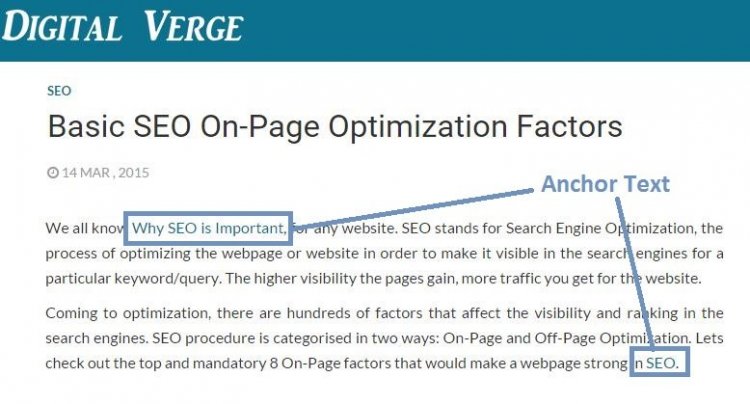
Anchor Text Matters: The text you use to link to another page (anchor text) should be descriptive and relevant to the content it leads to. Avoid generic text like “click here.” Instead, use an anchor text that entices users to click, like “ Real Estate Market Trends.”
Utilize Breadcrumb Navigation: Breadcrumb navigation allows users to see their location within your website’s hierarchy, making it easier to navigate back to previous pages.
Link From High-Authority Pages: Pages that already rank well on search engines hold more “link equity.” Linking to other pages from these high-authority pages can spread that value and potentially improve their ranking as well.
By implementing a well-thought-out internal linking strategy, you create a user-friendly website that keeps visitors engaged and helps search engines understand the structure and value of your content. This translates to a more positive user experience and potentially improved search engine ranking for your real estate website. Remember, internal linking is all about creating a web of relevant connections that benefits both users and search engines.
Optimizing URL Structures for Clarity and SEO Advantage
In the competitive world of real estate online searches, first impressions matter – and that includes your website’s URLs. Beyond simply directing users to the right page, well-structured URLs offer a glimpse into the content’s purpose and can even provide a slight SEO boost.
Balancing User-Friendliness with SEO:
Clarity for Users: Strive for clear and informative URLs for human visitors. Imagine someone scanning a list of search results – a descriptive URL can entice them to click through, knowing exactly what content awaits.
SEO Considerations: While user-friendliness is key, don’t neglect SEO best practices. Incorporate relevant keywords strategically throughout the URL structure, but avoid keyword stuffing which can appear unnatural.
Crafting Effective Real Estate URLs:
Keep it Descriptive: Instead of generic URLs like “page1.html” or “propertyID=123,” opt for descriptive structures that reflect the content. For example, “[city-name]/[neighborhood-name]/[property-type]/[unique-identifier]” provides valuable information for both users and search engines.
Incorporate Keywords: Strategically include relevant keywords within the URL structure. This can be the city name, property type (house, condo, etc.), or even a specific neighborhood.
Use Hyphens for Separation: Separate words within the URL using hyphens (-) for better readability. This makes the URL structure easier to understand for both users and search engines.
Keep it Concise: While informative, aim for relatively concise URLs. Ideally, keep them under 60 characters to ensure they display fully in search engine results pages (SERPs).
Optimizing Existing URLs:
If you already have a website, don’t despair! Consider implementing 301 redirects to update your existing URL structures. A 301 redirect signals to search engines that a page has permanently moved, ensuring your SEO value isn’t lost.
The Benefits of Clear and SEO-Friendly URLs:
Improved User Experience: Clear URLs make it easier for users to understand the content they’re about to access, leading to a more positive browsing experience.
Enhanced Click-Through Rates (CTR): Descriptive URLs in search results can entice users to click through, knowing exactly what content awaits.
Potential SEO Boost: While not a major ranking factor, well-structured URLs with relevant keywords can contribute to a positive SEO impact.
By prioritizing clear and SEO-friendly URLs, you create a website that’s not only user-friendly but also optimized for search engine visibility. This translates to a more positive user experience, potentially increased click-through rates, and a website that works hard to attract qualified leads and grow your real estate business.
Craft Compelling CTAs: Turning Website Visitors into Motivated Sellers
In today’s real estate market, a strong call to action (CTA) can be the difference between a website visitor browsing listings and a motivated seller contacting you. Effective CTAs for house sellers go beyond a simple “Contact Us.” They should be clear, concise, and speak directly to the seller’s needs and desires. Here’s how to craft CTAs that convert:
Understanding Seller Motivations:
Highlight the Benefits: People sell houses for various reasons. Focus on the benefits that resonate most with your target audience. Do they want a fast sale? Top dollar for their property? A stress-free experience? Tailor your CTAs to address these specific desires.
Examples of Compelling CTAs for House Sellers:
“Get a Free Home Valuation Now!” This CTA is clear, actionable, and speaks directly to a seller’s desire to understand their home’s market value.
“Sell Your House Fast & Hassle-Free. Get a Free Consultation Today!” This CTA focuses on two key benefits – speed and convenience – that are often priorities for sellers.
“Thinking About Selling? Learn How to Maximize Your Home’s Value!” This CTA targets sellers who may be in the early stages of considering a sale. It offers valuable information while positioning you as a knowledgeable resource.
“Ready to Cash In on Your Investment? Request a Personalized Selling Strategy!” This CTA speaks to sellers who view their home as an investment and want to maximize their profit.
Crafting Effective CTAs:
Keep it Short and Sweet: Your CTA should be clear, concise, and easy to understand. Aim for a few words that pack a punch.
Action-Oriented Language: Use strong verbs that encourage immediate action. Words like “Get,” “Request,” or “Start” motivate visitors to take the next step.
Highlight Urgency (Optional): In some cases, creating a sense of urgency can incentivize action. Consider CTAs like “Limited Spots Available: Schedule Your Free Consultation Today!”
Visually Appealing Design: Make sure your website’s CTA buttons are visually distinct and easy to find. Use contrasting colors and clear calls to action.
By crafting CTAs that are clear, benefit-driven, and action-oriented, you can transform website visitors into motivated sellers ready to connect with you and discuss their real estate needs. Remember, a strong CTA is a powerful tool for generating leads and growing your real estate business.
Addressing Concerns Upfront: The Power of FAQ Sections for Real Estate Websites
Imagine a potential buyer or seller visiting your real estate website. They’re likely brimming with questions: What’s the selling process like? What are closing costs? How do I find the right agent for me? A well-crafted FAQ section can be a goldmine, addressing these common queries and providing valuable information upfront.
Benefits of a Comprehensive FAQ Section:
Improved User Experience: An FAQ section empowers visitors to find answers to their questions quickly and easily, without needing to search through other website content or contact you directly for basic information. This translates to a more positive user experience and keeps visitors engaged on your website.
Reduced Support Inquiries: By addressing common questions upfront, you can reduce the repetitive inquiries you receive via email or phone. This frees up your valuable time to focus on consultations and client needs.
Positioning Yourself as a Resource: A comprehensive FAQ section showcases your expertise and positions you as a knowledgeable resource in the real estate industry. This builds trust with potential clients and establishes you as a go-to agent for their real estate needs.
Improved SEO Potential: While not a direct ranking factor, well-written FAQs that incorporate relevant keywords can contribute to a positive SEO impact. Search engines may favor websites that provide valuable and informative content to users.
Crafting an Effective FAQ Section:
Identify Common Questions: Consider the questions you ask most frequently by clients. Use these as a starting point for your FAQ section.
Categorize Content: Organize your FAQ content into clear categories for easy navigation. This could be by buyer vs seller queries, financing issues, or the selling process itself.
Conciseness is Key: While providing informative answers, aim for clear and concise explanations. Avoid overly technical jargon and keep your responses easy to understand for a general audience.
Link to Additional Resources: If an FAQ answer requires more in-depth explanation, consider linking to relevant blog posts or website pages on your site for further information.
Keep it Updated: As market conditions or regulations change, update your FAQ section regularly to ensure it provides the most accurate and current information.
Implementing a well-structured and informative FAQ section creates a valuable resource for website visitors. This translates to a more user-friendly website, positions you as a knowledgeable agent, and potentially reduces support inquiries, freeing up your time to focus on client needs and growing your real estate business. Remember, a well-crafted FAQ section is an investment that pays off in the long run.
Keeping Your Finger on the Pulse: Monitoring and Analyzing On-Page Metrics for Continuous Improvement
In the ever-evolving world of SEO, there’s no such thing as “set it and forget it.” Just like a well-oiled machine, your real estate website needs regular monitoring and analysis to ensure it’s performing at its peak. By tracking and analyzing on-page metrics, you gain valuable insights into user behavior, identify areas for improvement, and ultimately optimize your website for better search engine ranking and lead generation.
Essential On-Page Metrics to Monitor:
Organic Traffic: Track the organic traffic your website receives over time. This indicates how well your website ranks in search results and attracts visitors through organic search.
Bounce Rate: The bounce rate refers to the percentage of visitors who leave your website after viewing only one page. A high bounce rate might indicate issues with page content, loading speed, or user experience.
Time on Page: The average time users spend on a webpage provides insight into how engaging your content is. Low time on page might suggest visitors aren’t finding the information they need or the content isn’t compelling enough.
Conversion Rate: Track how many website visitors convert into leads, whether by contacting you, requesting a valuation, or signing up for your newsletter. Conversion rate indicates how effective your website is in generating leads and achieving your business goals.
Keyword Rankings: Monitor your website’s ranking for relevant keywords in search results. This will help you understand how well your SEO efforts are performing and identify areas for improvement.
Tools for Monitoring and Analysis:
Google Analytics: A free and powerful tool from Google, Analytics provides a wealth of data on website traffic, user behavior, and conversions.
Search Console: Another free Google tool, Search Console, offers insights into your website’s search engine visibility and helps identify potential issues hindering your ranking.
Website Heatmap Tools: Heatmap tools visually represent where users click on your website pages. This can reveal areas that might be confusing or require optimization for better user engagement.
Taking Action for Improvement:
Analyze the Data: Don’t just collect data – dig into the insights and identify trends or patterns. Are certain pages experiencing high bounce rates? Is organic traffic declining? Understanding these trends reveals areas that need your attention.
Test and Refine: Based on your analysis, implement changes to your website and track their impact on key metrics. This could involve optimizing page content, improving website speed, or refining your keyword strategy.
Continuous Monitoring: SEO is an ongoing process. Make website monitoring and analysis a regular habit. By consistently tracking key metrics and adapting your strategy, you ensure your website remains optimized for search engines and continues to attract qualified leads for your real estate business.
By dedicating time to monitor and analyze on-page metrics, you better understand how users interact with your website. This valuable data empowers you to make data-driven decisions, continuously improve your website’s performance, and ultimately achieve your real estate SEO goals. Remember, website optimization is a journey, not a destination. Embrace the process of monitoring, analyzing, and refining to keep your website at the forefront of search results and generate a steady stream of qualified leads for your real estate business.
Harnessing the Power of Structure: Utilizing Schema Markup for Real Estate Listings
Increasing your real estate website’s visibility is crucial in today’s digital age, where people rely heavily on search engines to find information. Schema markup is a powerful tool that goes beyond basic SEO and helps search engines understand the specific details of your property listings. This translates into richer search results for potential buyers and ultimately drives more qualified leads to your website.
What is Schema Markup?
Schema markup is a type of code that you add to your website’s HTML to provide search engines with richer information about your content. Think of it as adding labels to your listings, explaining what kind of property it is, its features, and other relevant details.
Benefits of Schema Markup for Real Estate:
Enhanced Search Results: By implementing schema markup for your real estate listings, search engines display richer snippets in search results. This can include details like property type (house, condo, etc.), number of bedrooms and bathrooms, square footage, and even pricing information. These richer snippets stand out from the crowd, grabbing the attention of potential buyers searching for properties online.
Improved Click-Through Rates: Schema markup can significantly increase click-through rates (CTR) from search results. The informative snippets provide users with a clear understanding of whether a listing is relevant to their needs, encouraging them to click through to your website for more details.
Targeted Audience: Schema markup lets you specify property type, price range, and location. This attracts a more targeted audience – potential buyers actively searching for properties that match their specific criteria.
Types of Schema Markup for Real Estate:
RealEstateListing: This schema type is specifically designed for real estate listings and allows you to specify details like property type, number of bedrooms and bathrooms, price range, location, and availability.
Location: Schema markup for location allows you to specify the property’s address, including city, state, and zip code. This enhances local SEO and helps potential buyers search for properties in specific neighborhoods.
ImageObject: Schema markup for images allows you to provide captions and descriptions for your property photos, improving the overall user experience and potentially boosting image search ranking.
Implementing Schema Markup:
While schema markup may seem complex, several user-friendly tools and resources are available to help you get started. Many website building platforms offer built-in schema markup options, or you can utilize Google’s Search Console to generate the code for your listings.
By incorporating schema markup for your real estate listings, you unlock a powerful SEO tool that enhances search engine understanding, creates richer search results, and ultimately attracts more qualified leads to your website. Remember, in the competitive world of online real estate, even a slight edge in search results can make a significant difference.
Staying Ahead of the Curve: SEO Trends and Algorithm Updates in 2024
The world of SEO is constantly evolving, and 2024 is no exception. Search engines like Google are becoming increasingly sophisticated, placing a higher emphasis on user experience, content quality, and relevancy. To stay ahead of the curve and ensure your real estate website thrives in search results, here are some key trends and potential algorithm updates to keep on your radar:
Focus on User Intent:
Understanding User Needs: In 2024, SEO goes beyond simply keyword stuffing. The focus shifts towards understanding the user’s intent behind a search query. Are they looking for information, browsing options, or ready to contact an agent? Tailoring your content and website structure to address these needs is crucial for ranking well.
Long-Tail Keywords: As user intent becomes a priority, long-tail keywords (more specific search phrases) will be more important. Focus on incorporating long-tail keywords that reflect the specific needs of potential buyers in your local market.
Content Reigns Supreme:
High-Quality, Informative Content: Search engines prioritize websites that offer valuable and informative content that keeps users engaged. Invest in creating high-quality content that addresses your target audience’s needs, answers their questions, and establishes you as a thought leader in the local real estate market.
Freshness Matters: Regularly update your website with fresh content. This could include blog posts on local market trends, neighborhood guides, or informative articles about the buying or selling process.
Technical SEO Remains Crucial:
Mobile-First Indexing: Google’s mobile-first indexing prioritizes websites that display and function flawlessly on mobile devices. Ensure your website is mobile-friendly, loads quickly, and offers a seamless user experience for mobile users.
Core Web Vitals: Core Web Vitals are a set of metrics that measure website speed, responsiveness, and visual stability. Optimizing your website for Core Web Vitals ensures a smooth user experience and can potentially boost your ranking.
Staying Informed:
Industry Blogs and Publications: Subscribe to reputable SEO blogs and publications to stay updated on the latest trends and algorithm changes.
Google’s Search Central: Google frequently updates its Search Central resource with information on best practices and potential algorithm updates. Monitor this resource to stay informed directly from the source.
You can proactively adapt your real estate website strategy by staying informed about these SEO trends and potential algorithm updates.
Remember, SEO is a marathon, not a sprint. By consistently creating high-quality content, optimizing your website for user experience, and keeping pace with industry changes, you ensure your real estate website remains visible in search results and continues to attract qualified leads for your business.
Conclusion: Dominate Your Market by Using the Power of On-page SEO for Real Estate
The real estate market thrives on a strong online presence. By implementing the 16 best practices explored throughout this post, you can transform your real estate website from a simple brochure into a lead generation machine. Here’s a quick recap to empower your online success:
Prioritize Page Load Speed: A speedy website keeps visitors engaged and improves SEO ranking.
Craft Informative Neighborhood Pages: Establish yourself as a local expert by creating valuable neighborhood content.
Utilize Internal Linking: Weave a user-friendly web that connects relevant content and boosts SEO.
Optimize URL Structures: Clear and SEO-friendly URLs enhance user experience and search visibility.
Write Compelling CTAs for House Sellers: Craft CTAs that resonate with seller motivations and drive conversions.
Implement FAQ Sections: Empower visitors with answers to common questions and showcase your expertise.
Monitor and Analyze On-Page Metrics: Gain valuable insights to continuously improve your website’s performance.
Harness Schema Markup: Unlock the power of structured data to create richer search results and attract targeted leads.
Embrace Mobile-First Indexing: Ensure your website offers a flawless mobile experience.
Focus on User Intent: Craft content that addresses potential buyers’ specific needs and questions.
Prioritize High-Quality Content: Informative and valuable content positions you as a thought leader and keeps users engaged.
Target Long-Tail Keywords: Attract qualified leads by incorporating long-tail keywords that reflect local searches.
Stay Updated with SEO Trends: Learn about the latest SEO best practices and algorithm updates.
Leverage Google Search Central: Stay informed directly from Google’s resource on SEO best practices.
Invest in High-Quality Images: Optimize images for faster loading times and enhance user experience.
Integrate Social Media: Expand your reach and connect with potential clients on social media platforms.
The real estate landscape is dynamic, and so should your online presence. By embracing these strategies and consistently refining your website, you can establish a dominant online presence, generate high-quality leads, and ultimately achieve your real estate business goals. So, take action today and watch your website flourish into a powerful tool that fuels your success in the exciting world of real estate!
As in years past, Carrot and our members had an excellent year. Here’s a brief snapshot of some of the amazing stories and things that happened in 2018.
Our team grew by 10 this year as we continue to innovate and be the leader in our industry.
… and more!
Here we go!
Hundreds of Thousands of Leads … You’re Crushing It!
Our members made another big leap in lead numbers in 2018. With over 315,000 leads coming in this year (when you DON’T count phone call leads… which we can’t track in Google Analytics currently) you’re pulling in more AdWords, SEO, Facebook, and social media online leads as a collective group than any other real estate investor and agent lead generation platform… by far. Keep crushing it!
Carrot Member Goal Completions (Leads) January 1 – December 25, 2018
53% of Leads Came From Mobile Devices
53% of Carrot Member Completions (Leads) Came from Mobile Devices
Which States Converted More Leads? Well…
Carrot Member Completions (Leads) Per State – Top 10 –
Texas reigns as the busiest lead volume state in 2018. Compared to 2017, Missouri fell from the top 5 and Virginia cracked the top 10 overtaking Tennessee this year.
Major NEW Features Launched
A Core Value of ours is “Consistent Improvement and Innovation“… and both our members and Carrot continue to push this value. In addition to the features we released in 2018, we helped our members spend more time focusing on their business …
Here is a look back on some of the features our AMAZING team rolled out in 2018 (but not limited to)…
All of these while keeping our member’s needs in our focus.
Logo Credibility Bar
Hemlock Design
We Launched AgentCarrot!
For years, the way Carrot clients have dominated their markets online started with a highly optimized website (for SEO and lead conversion) then amplified with our content marketing tools and training.
We had been in the beta phase with AgentCarrot for the past year and after amazing, amazing feedback from our Agent members, we were crazy excited to release the full version in April.
Our vision is to continue to improve how real estate agents and investors grow their business leveraging the web.
We’d like to send a special thanks to all of those who contributed to AgentCarrot’s success. Both to our members and the Carrot team!
This year we were placed at the 699th fastest growing company in the nation according to the Inc. 5000 list. Major Kudos to the Carrot team and our members. We wouldn’t be here without an amazing product, team, and amazing members.
The CarrotCast podcast had over 97,000 unique downloads in 2018. Here are the top five episodes of the year.
[podcast-subscribe]
Negotiation Psychology: How To Talk With A House Seller to Close More Deals + Help More People w/ John Martinez
I see a lot of good, really good, salespeople and a lot of really bad salespeople. You can tell whose good by how often people talk and when they talk, what they say. So, real quick, the best salespeople in the world in all industries … they talk maybe 10% of the time and when they do open their mouths it’s with the question.
John Martinez
After 20 Years Tyler Was Going To Give Up Real Estate Until He Made These 3 Changes w/ Tyler Ford
Long story short, I had my main guy that had worked with for ten years, did all of my rehabs, totally trusted him. I was getting ready to go out of town and he was going to be finished with this job before I got back and I prepaid him and also loaded up a Home Depot card. I can home and no work was done and he was nowhere to be found.
Tyler Ford
How Krista Sold 144 Homes Last Year in One of the Hottest Markets – Her Strategy and Story w/ Krista Mashore
… Agents, if you’re out there listening, people need to like and trust you. I mean you’re going to have a much easier time of gaining clients if they know, like, and trust you. They get to know and trust you by seeing you. By you showing up everywhere. Why are you giving them value by you helping them and I’ll you value, value, value.
Krista Mashore
How to Stay Ahead of Current Real Estate Market Cycles to Build Financial Freedom w/ Ramon Gonzalez
You know guys, that’s a two-edged sword. Everyone talks about debt with things go right, but I’ve been there with that when it doesn’t go right. It’s like right now people say oh you know what I just start off the loan and take a little piece. What for? 12% sounds pretty nice and I still get to go hang out with my daughter. I want more life. I don’t want more drama or more headaches.
Ramon Gonzalez
What It Takes To Go From Being Broke to Closing 100+ Deals Per Year w/ Justin Colby
People talk about this a lot, you gotta believe it before you see it and I’m truly and example of this. I didn’t even really know how to do any of this but I believed I can make an impression in the real estate community. In the investment world I knew it could create an income that I would be happy with but I also knew I could create a life that I wanted.
Justin Colby
Hundreds of “Doses Of Awesomeness” From Our Members
We LOVE to hear stories from our members that are helping them change their businesses and their lives! So much that we have a dedicated #Awesomeness channel in Slack.
Here are just a few examples of the ones we get each and every week… not counting the hundreds that happen that we never hear about!
World-Class Net Promoter Score
Carrot 2018 NPS
How do you know if you’re providing value and happiness to your members? How do you know if you’re failing? By using “Net Promoter Score”. It’s basically a question that asks how likely you are to recommend Carrot to a friend or colleague.
With thousands of responses in 2018 the majority scored us a 9 or 10… leaving us with an impressive NPS of 68.8%.
To put that into perspective, here is what some of the most respected companies in the world have scored for their NPS:
One of our core values is to “Deliver WOW Through Great Service” we’ll continue to go all out in 2019 to make our clients excited, happy, and successful, and to change the way people expect companies to serve them in the future after they experience service the “Carrot Way”.
We Added 3300 YouTube Subscribers and Accumulated Over 2,500,000 Watch Time Minutes… That’s Over 1736 Days!
Two Carrot Team Retreats + Growing Our Team… Again
The Carrot team grew +10 this year as we continue to innovate and be the leader in our industry. Our first retreat took place in beautiful and at the time snowy, Sunriver, Oregon. Next, we took to the high seas. Well not quite. The Summer retreat was “boat access only!” in Lakeside, Oregon.
Retreats are a great way to pull back, celebrate wins, and deep dive into high-level planning for the future.
CarrotCamp (Spring and Fall 2018)
The 2017 CarrotCamp was such a hit, we had to double it. So, we decided to have one in the Spring and Fall of 2018. CarrotCamp is not like most events. It’s not just a workshop or seminar, nor is it a retreat.
We designed CarrotCamp so it fits more like an immersive experience where we deep dive into the campers world. It’s unplugging and getting out of the office and into nature. It’s also time to work with the Carrot team to get massive things done to uplevel marketing… all the while building relationships with other high-level real estate entrepreneurs that will hopefully last a lifetime.
Thank you again 2018 CarrotCampers!
Be on the lookout for CarrotCamp 2019 Editions. Kicking off May 20-21, 2019. Learn more about CarrotCamp Spring 2019.
What An Amazing Year. And We’re Grateful To Have You On This Journey With Us.
How Was Your Year?
How was your 2018? Let us know below in the comments section. The amazing, the fair, and the awful :-)
Also… fire up your 2019 and get momentum building?
These 2 resources are the most shared and commented we’ve ever made. They can change your life…
Recently, we were placed as the 699th fastest growing company in the nation according to the Inc. 5000 list.
If I’m being honest, this came as a surprise to many of us.
Sure – we’ve all known for a while that Carrot is growing quickly (I think we hired 4 or 5 people in the last 6 months, making us a team of 20). But for the most part, we’re working, planning new projects, and having a blast while we do it.
Finding that we’re within the thousandfastest growing company in all of the U.S. is a bit like shooting hoops every day at the local gym and finding out five years later that you’re one of the best free-throwers in the nation…
You were just doing it because you enjoy it, but somewhere along the way, you became one of the best.
Really? Why? What did we do differently?
Well, we put together a list of 10 of our most integral beliefs as a company that contributed to landing on the Inc. 5000 list. We think (whatever that’s worth) that it’s these fundamental beliefs which guide our success and could guide yours as well.
1. Culture is More Important than Growth
Why do people get out of bed every day?
Why do they go to work?
What determines how hard they work, how productive they are, or the quality of that work?
At Carrot, we believe people work harder and better when they love what they do and who they work with. Every person on the Carrot team was chosen because of their passion for life – creating a culture that prioritizes itself before everything else.
The wonderful thing about a culture-focussed business, though, is that growth naturally follows.
When people love what they do and have genuine relationships with coworkers, they work harder and they stay around longer.
2. Honesty is More Important than Sales
While we passionately believe that Carrot is a good fit for the vast majority of real estate investors and agents around the nation, we also understand that Carrot isn’t a fit for everyone.
Some investors and agents have found success elsewhere – through a competitor or a private web development company – and more power to them!
We offer a service, we do the best that we can, and we believe that it’s one of the best real estate marketing solutions around. Still, it isn’t for everyone. And we’d rather have a mutually beneficial relationship with our customers than sell them something they don’t need.
3. One Lost Member is a Tragedy
Every member cancellation comes through our company’s #General Slack channel – which everyone in the company has access to. When someone cancels, we try to save them if we feel they’ve made a mistake – not through sales-speak and unhelpful promises, but through genuine concern for their business and a desire to help.
Many people cancel because they’re discouraged about business in general and they’ve hit a breaking point. These people just need a gentle hand to guide them in the right direction.
At Carrot, doing that isn’t below us.
If our desire is to help our customers, then that means we have to meet them where they are. Often times, a cancellation is a cry for help.
Which is why we treat every cancellation as a tragedy and an opportunity to inspire someone who’s lost hope.
4. Dreaming Big is More Important than Always Succeeding
We have an ambitious team of 20 people at Carrot.
People from support, marketing, product, services, and sales often have new crazy ideas they’d like to implement. Whether it’s testing new sales copy on our homepage, writing a book, or launching a new feature, there’s a way to make it happen.
In fact, we use a 1-page plan template that allows anyone to create a project, pitch it to the team, and get it approved, tweaked, or rejected.
Speaking from experience, few ideas get outright rejected – more often, there’s a recommended change or two.
And the person who pitched is then the leader of that project, setting due dates and seeing it through to the end.
It doesn’t always work, but the team alwayslearns something new along the way. And down the road, that learning usually leads to product iterations, better processes, and a stronger business model.
Dream big. Learn along the way.
5. Saving a Member Time is More Important than Saving Ourselves Time
We’re in business to help people. And often times, helping people requires sacrifice – late nights, long calls, and/or difficult conversations with members.
But that doesn’t discourage us. It fires us up. It reminds us why we’re in business. It reminds us why we’re a part of Carrot.
Because we want to help real estate investors and agents save more time in life for the things that matter most.
To achieve our mission, we have to be willing to sacrifice our own time to help our members.
And while late nights, long calls, and difficult conversations aren’t all that common, each of us is willing to sacrifice an evening to make our member’s life a little bit easier.
6. 90% of Success is Believing You Can Pull it Off
We have a bit of an unintentional mantra here at Carrot. It’s dead simple and almost mindless – but it’s also indicative of the spirit Carrot employees carry with them everywhere…
“We’ll get it.”
Look, business often gets discouraging. Sometimes a process breaks, a customer struggles with our service, or a weakness in our company shoves its way to the front of our priority list… and we’re left to pick up the pieces.
We have to solve the problem.
But it isn’t always that easy. Sometimes, we’re left with a big question mark, a big “what’s next?” or “how will we actually solve this in the future?” type of concern…
Cue mantra: “We’ll get it.”
And we will – usually, we just need more time to think about the problem and come back at it the next day.
But the belief that we will get it never fades, despite setbacks.
7. Arguing is Better than Settling
If you’re overthinking a product launch, then it’s probably best to just bring it to market and adapt as you receive customer feedback. At Carrot, though, we’ve been in the real estate space for 5 years and we have a pretty good idea of what our customers want or need from us.
(There’s always more to learn, of course)
So when we are launching a new product, service, or feature, we argue. Not “I hate you,” “you suck,” type of arguing. But we passionately defend our positions on what we believe is best for the market’s need, while still being respectful.
We don’t throw personal jabs, we argue ideas, and we believe that ideas do not define a person – which then gives us the freedom to throw them out or refine them.
Because in the end, we’d rather argue about a product before launch than release a sub-par service or feature to our customers.
8. Open-minded Differences are the Secret to Healthy Company Culture and Thrilling Growth
My personality clashes with several people on the Carrot team. Several of them think differently than I do, perceive the world differently, and even live their lives quite differently.
Normally, I avoid these kinds of people. We all prefer familiar over unfamiliar, making us gravitate naturally toward other people who act like us, believe the same things, and live the same way.
Problem is, similarity makes growth impossible.
If everyone around you thinks the same way, acts the same way and believes the same things, they’ll never challenge you… and you’ll never grow.
At Carrot, that’s not the case – the differing personalities (quite extreme differences, often) force all of us to rethink our positions and adapt to the environment around us.
That, with a healthy dose of open-mindedness, naturally leads to thrilling personal and collective growth.
9. The More You Give, the More You Get
Call us hippies if you want (we are based out of Oregon, after all), but we believe that what goes around, comes around. We believe that by giving time and money to other people who need it will pay us back in the future.
We don’t know how it work…
But we believe it.
And that’s why, every quarter, we donate a portion of our company revenue to charity organizations around the U.S. – yes, usually we buy them a ton of carrots.
10. Changing Lives is Better than Getting Credit
I won’t lie – getting credit for your project or idea is awesome. Everyone loves to receive positive feedback about something they accomplished.
But you know what is 10x more satisfying than getting credit for something you did?
Receiving a message like this…
And that is why we’re in business – to change lives.
So long as we’re doing that, getting credit can sit under the table and be quiet.
You’re working to build backlinks to your real estate website…
But after a few successes, you’re still not seeing an impact. You’re starting to wonder, “How many backlinks does it take to rank my real estate website in Google?”
After all, you’re busy building a business and you don’t have loads of time to guest blog for backlinks. You have better, more important things to do.
Still, it would be nice to outrank your competition on page 1 with some well-placed backlinks.
That’d mean passive traffic, high-quality leads, and less work/money to generate results.
Problem is, the way you’re building backlinks isn’t all that efficient and you’re not seeing the light at the end of the tunnel – which makes you wonder, “Will this ever work?”
That’s why I’m going to give you a general idea for how many backlinks you’ll need to start outranking your competition and then I’ll show you some quick, easy ways to build backlinks.
Let’s get started.
How Many Backlinks do you Need to Outrank your Competition?
While I’d love to answer that question with a specific number of backlinks… I can’t.
The answer depends on how many backlinks your competitors are building, your existing domain authority, your competitor’s domain authority, your overall SEO strategy, the quality of the backlinks you build, and a whole slew of other factors.
Having said that, though, there are a few things you should know about SEO in general when trying to increase your rankings with backlinks.
First off, the higher your current domain authority, the more difficult it is to increase your SEO power.
This just means that the more SEO authority you have, the harder it is to increase that authority with backlinks.
In the beginning, one or two high-quality backlinks might increase your domain authority and rankings significantly. As your website becomes more established, though, the competition gets increasingly fierce.
Of course, that also depends on how competitive your market is.
A friend and I put up a Carrot real estate investor website in Klamath Falls, Oregon – a low-competition market – and in just a week, the website was ranking 6th on the first page without us doing anything.
Since you’re reading this, I’m going to assume that didn’t happen in your market.
Which means you’ll need to put some energy into building quality backlinks. But here’s the thing…
Not All Backlinks are Created Equal
Some backlinks are more powerful than others. And these are the factors that determine how impactful any given backlink is on your rankings.
Anchor Text
Anchor text is the hyperlinked words that a backlink sits upon.
Because Google factors in anchor text when determining what the linked-to page is about and in determining how relevant your page is to the phrase you’re trying to rank for.
For instance, a backlink with anchor text that says, “Sell your home fast” would have a more positive impact on your rankings than anchor text that says “the market is healthy right now” or something else vague and irrelevant to your target keyword phrase.
When building backlinks, try to get anchor text that is relevant to the keyword phrase you’re trying to rank for.
Domain Authority
The domain authority and page authority of the page where you receive a backlink from helps determine how impactful that backlink is on your own domain authority.
The higher the domain authority of the website you received a backlink from, the bigger impact it’ll have your website.
This is a good way to gauge how much impact each backlink is having. After you receive a new backlink, check to see how much impact that backlink had on your domain authority. Just make sure that Google has re-indexed your website, otherwise, the impact won’t show up when you check.
To request priority indexing from Google, go here.
Relevance
It’s not just anchor text and domain authority that determine the quality of a backlink, it’s also the relevance.
If you get a backlink from a website that talks about how to conquer the emotional struggle of divorce, that backlink wouldn’t have as much positive effect on your target keyword rankings as one from a real estate website.
Ideally, the backlinks you build will be from websites relevant to real estate.
I’m not saying you should reject a backlink opportunity from an irrelevant website – those could still drive traffic and help diversify your backlink portfolio.
But I am saying that you should actively work for relevant backlinks instead of irrelevant ones. That will provide a higher impact on the links you build.
How to Build More High-quality Backlinks in Less Time…
You do need to build backlinks. But the number that you need to build greatly depends on how competitive your market is online.
So don’t ask, “How many backlinks do I need until I outrank the competition?”
You need backlinks to help your SEO and the more high-quality links you build, the better.
Ask, “How can I build good backlinks quickly and with less effort?”
HARO (which stands for Help A Reporter Out) is a great way to build backlinks and market authority all at the same time. Journalists sign up for HARO to get quotes and expert contributions from market experts. And you can sign up for HARO (for free) to become a source of expertise for those journalists.
Often times, if they choose to quote you, they’ll also give you a backlink.
Heck, you could even outsource this to a VA if you want.
The hashtag #JournoRequest is another direct line to journalists who’re writing online articles, seeking expert contributions.
By searching the hashtag on Twitter, your page will populate with lots of different online writers who’re looking for specific types of contributions. Most of the time, they’ll have no problem providing a backlink in return.
Again, this is so simple that you could pay a VA to scour Twitter for you and look for backlink building contribution opportunities. You’ll just have to provide them with expert quotes when they find one.
3. Podcast Pitching
An oft-forgotten and easy way to build relevant backlinks is by being a guest on real estate podcasts. Many podcast hosts today record their episodes digitally over a video call, so you don’t need to worry about traveling.
And the easiest way to find these podcasts is by Googling something like “real estate investing podcasts” or “small-business entrepreneurship podcast.”
Remember, the smaller the podcast, the easier it will be get accepted as a guest. The more prestigious the podcast, the more difficult it’ll be.
Then, find an email on their website or a “Contact Us” form and use this template to pitch your idea (or have a VA do it for you).
Subject: Quick idea…
Hey [name of person or business]!
My name is [name] and I’m a real estate [investor/agent] in [location]. My business has [build credibility with revenue numbers, media mentions, or a testimonial from a past customer]. And I’d LOVE to be a guest on your podcast to discuss [pitch a relevant topic you’d be comfortable discussing].
What do you think? Is that something we could set up?
Let me know! I’d be happy to get it on the calendar. :-)
Cheers,
[Name]
4. Testimonial Offers
One final way to build your backlink portfolio in very little time (but with a big impact) is to offer testimonials for online businesses where you’re a customer.
All online businesses are looking for testimonials from their customers. And most of them won’t bat an eyelid at your request for a backlink in return.
Just make a list of all the online tools you use and love. Then send those businesses an email with your testimonial, asking for a backlink in return. Here’s your swipe-able template for that.
Subject: I LOVE your company…
Hey [name of business or person you’re pitching]!
My name is [name] and I’m a real estate [investor/agent] in [location]. I’ve been using your service for [length of time] and it’s completely changed the way that I do business. I love it so much that I wanted to send over a testimonial that you can use if you feel so inclined. :-)
“[Testimonial].”
I hope you can use that testimonial to encourage others to use your [service/tool/product]. It’s been absolutely amazing.
Thanks for building something so genuinely helpful.
And if you do decide to use the testimonial, it would be awesome if you’d include a link to [your website] when quoting me.
Either way, keep up the good work. :-)
Cheers,
[name]
Conclusion
So, how many backlinks does it take to start ranking your real estate website on Google?
The honest but terrible answer is…
It depends.
Fortunately, building backlinks do help your rankings. The trick is to build as many high-quality backlinks as you can and watch how those links improve your rankings. And with the time-saving (even outsource-able) strategies above, you can increase your domain authority without guest blogging.
So go get started. And don’t stop until you’ve beaten the competition.