As a real estate investor, you know that finding motivated sellers is crucial to your success. With the emergence of powerful AI tools like ChatGPT and Bard, there are now even more ways to automate your lead generation efforts and optimize your Google Ads campaigns.
Ready To Get More Leads & Close Your Next Deal? Take Your Business To The Next Level
In the past, automation tools were primarily focused on bid management and targeting.
However, with the latest wave of generative AI technology, you can now leverage the power of text generation to create more effective ad copy that resonates with your target audience.
Using ChatGPT for Google Ads lets you set up and optimize your accounts and save time and resources while improving your campaigns’ effectiveness. With ChatGPT, you can automate tasks such as ad creation, keyword research, and even ad testing and optimization.
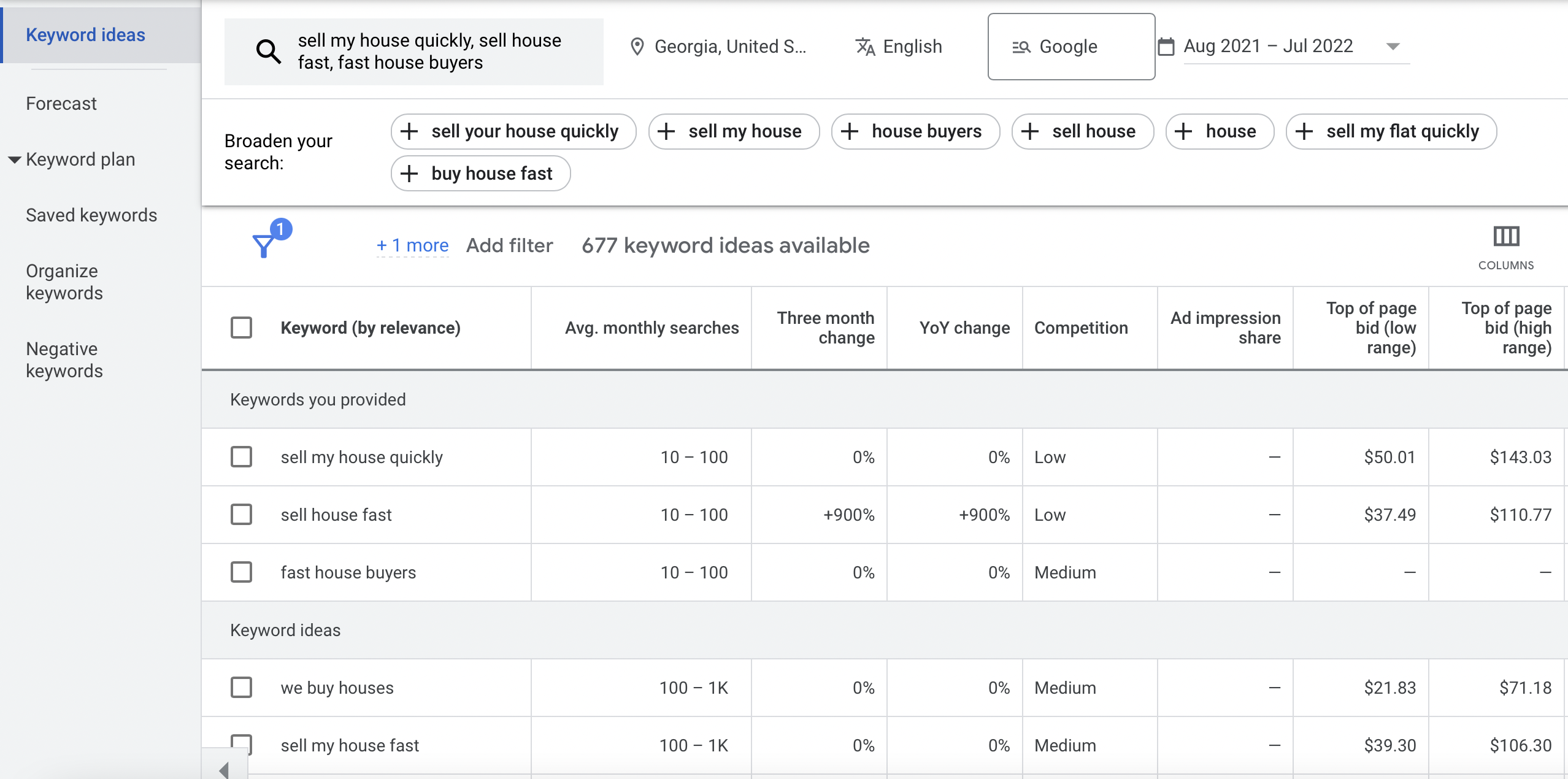
Using the right keywords in your ad copy is important to attract motivated sellers. Some examples of keywords to target might include “sell my house fast,” “cash home buyer,” or “we buy houses.” Incorporating these keywords into your ad copy and using ChatGPT to generate compelling headlines and descriptions can increase your chances of connecting with motivated sellers and closing more deals.
Overall, the emergence of AI-powered tools represents a significant opportunity for real estate investors to streamline their lead generation efforts and improve the effectiveness of their Google Ads campaigns.
In this ChatGPT for Google Adspost, we’ll cover the following:
Discovering Motivated Seller Keywords with ChatGPT
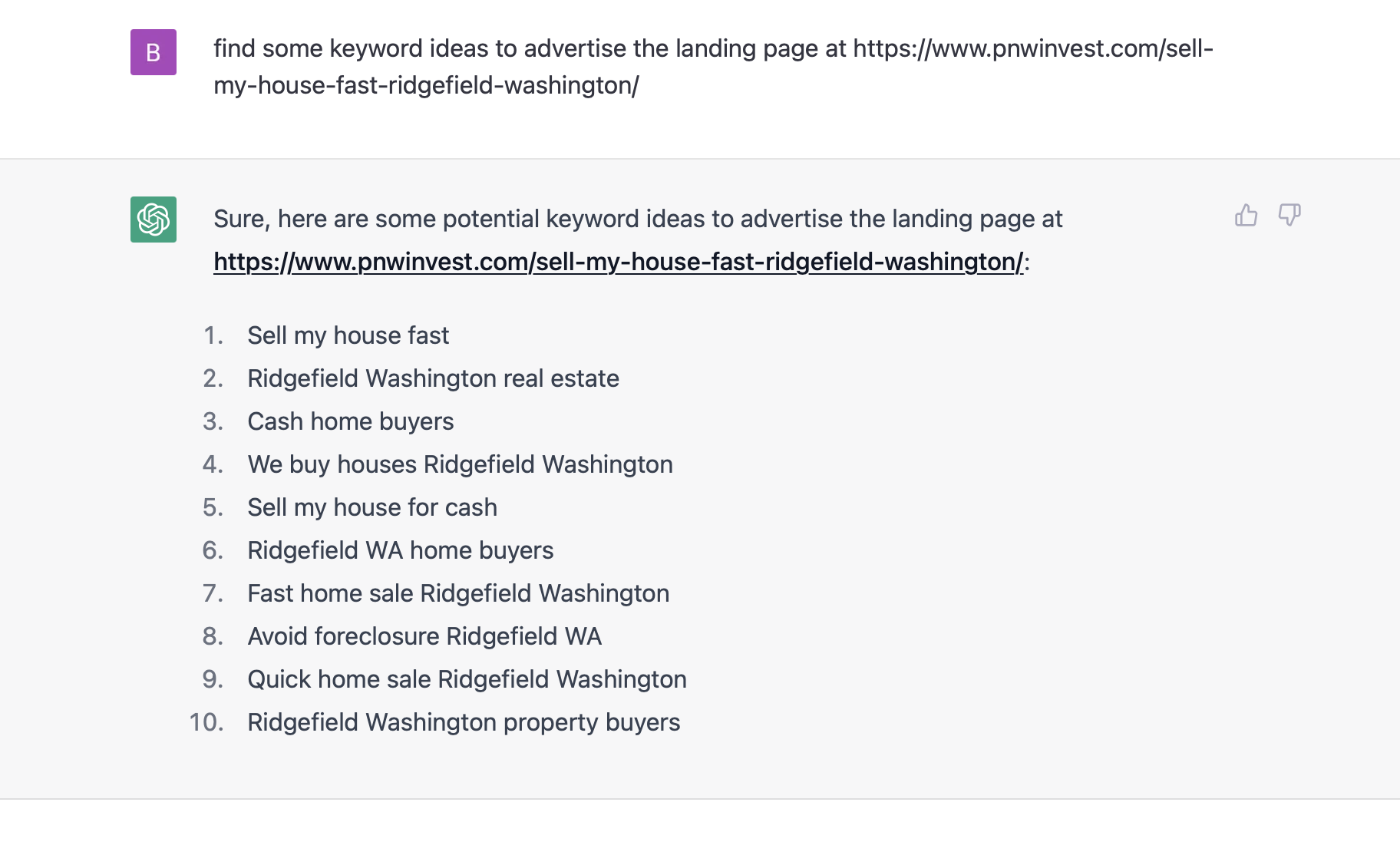
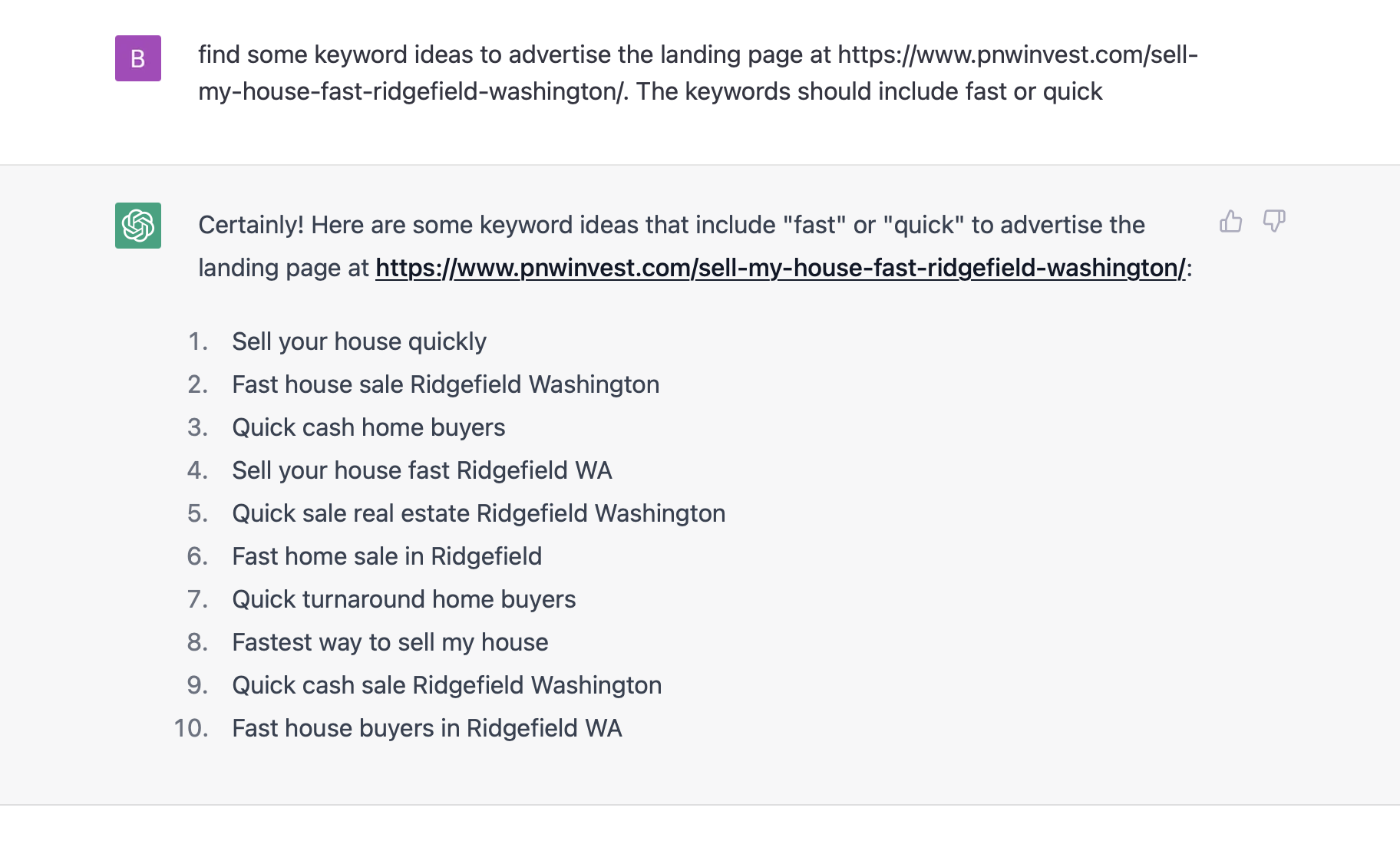
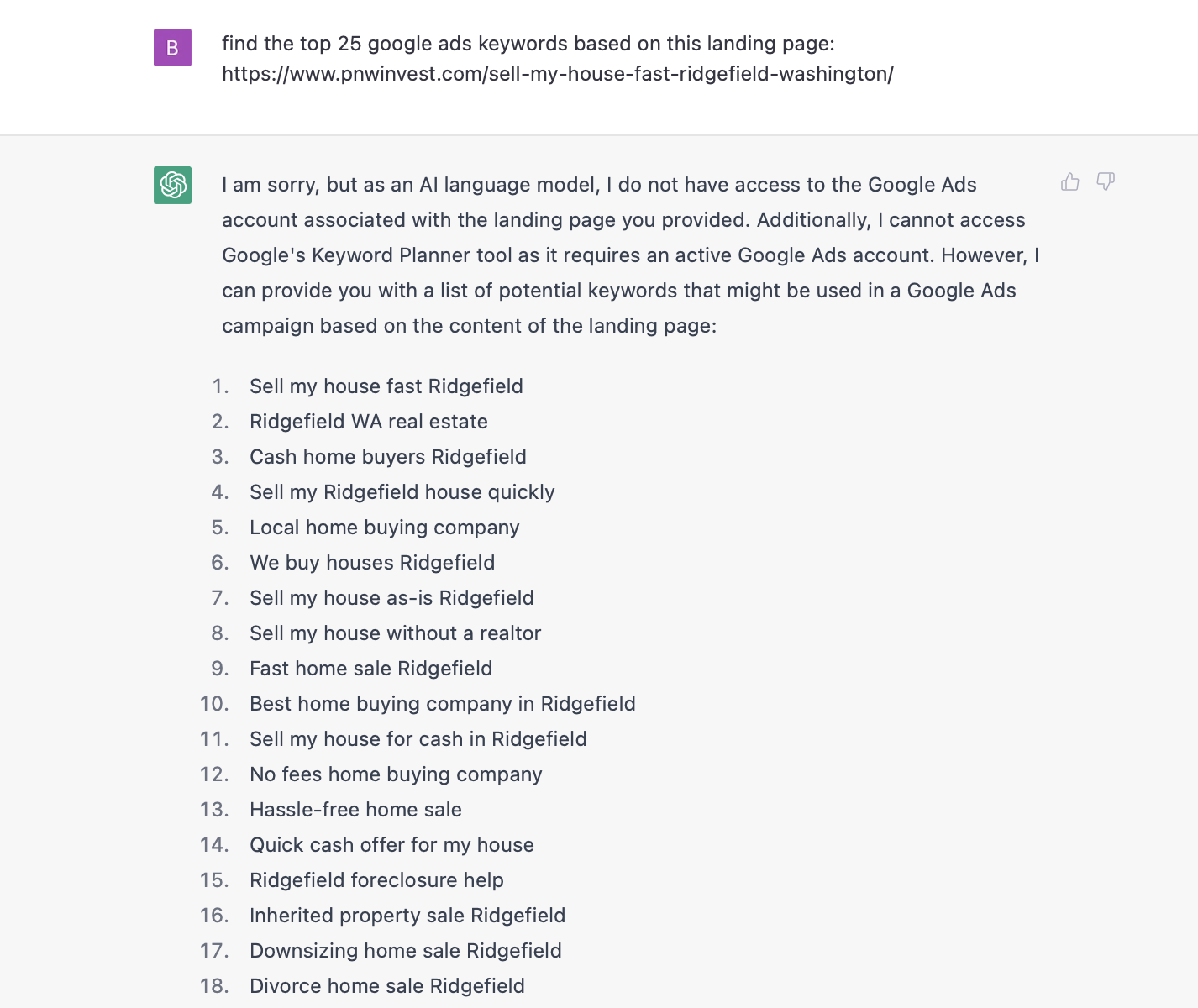
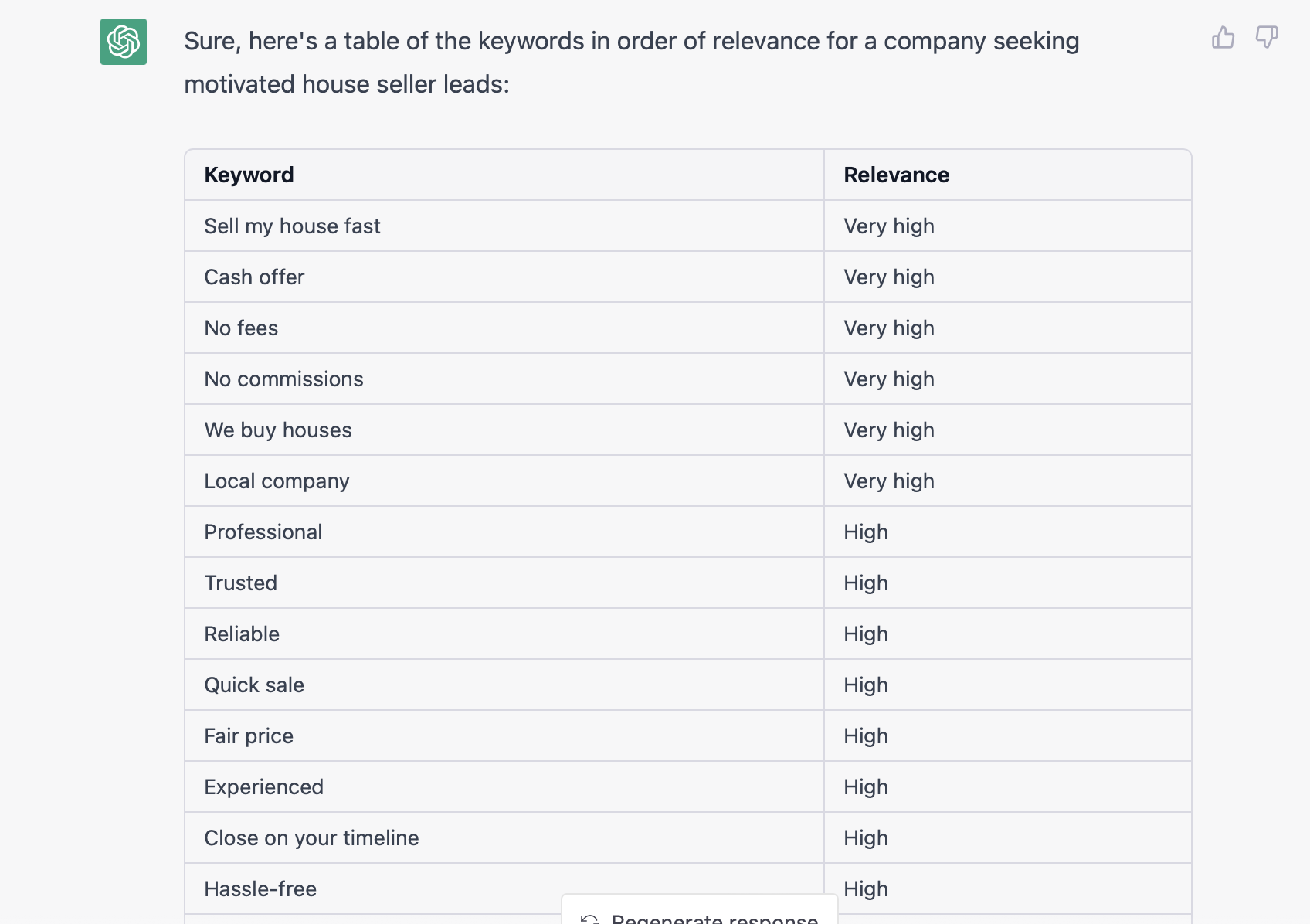
As a real investor, you know the importance of finding motivated seller leads. While Google’s Keyword Planner is a helpful tool, there’s an alternative that can help you discover new keywords. ChatGPT can provide suggestions when prompted with the landing page you want to target. It can be a valuable resource to help you find the right keywords for your motivated seller lead generation strategy.
Here is an example:
To make the keyword suggestions a bit more relevant, you can ask ChatGPT to include a particular term in each one:
Using GPT for Motivated Seller Keyword Classification
When using a keyword tool like ChatGPT for your Google Ads campaigns, you may end up with a long list of suggested keywords. However, having too many keywords can make creating targeted campaigns difficult, resulting in higher Quality Scores on Google.
Splitting the list of keywords into smaller groups related to each other is important to solve this problem. This way, you can create more relevant campaigns that are more likely to convert.
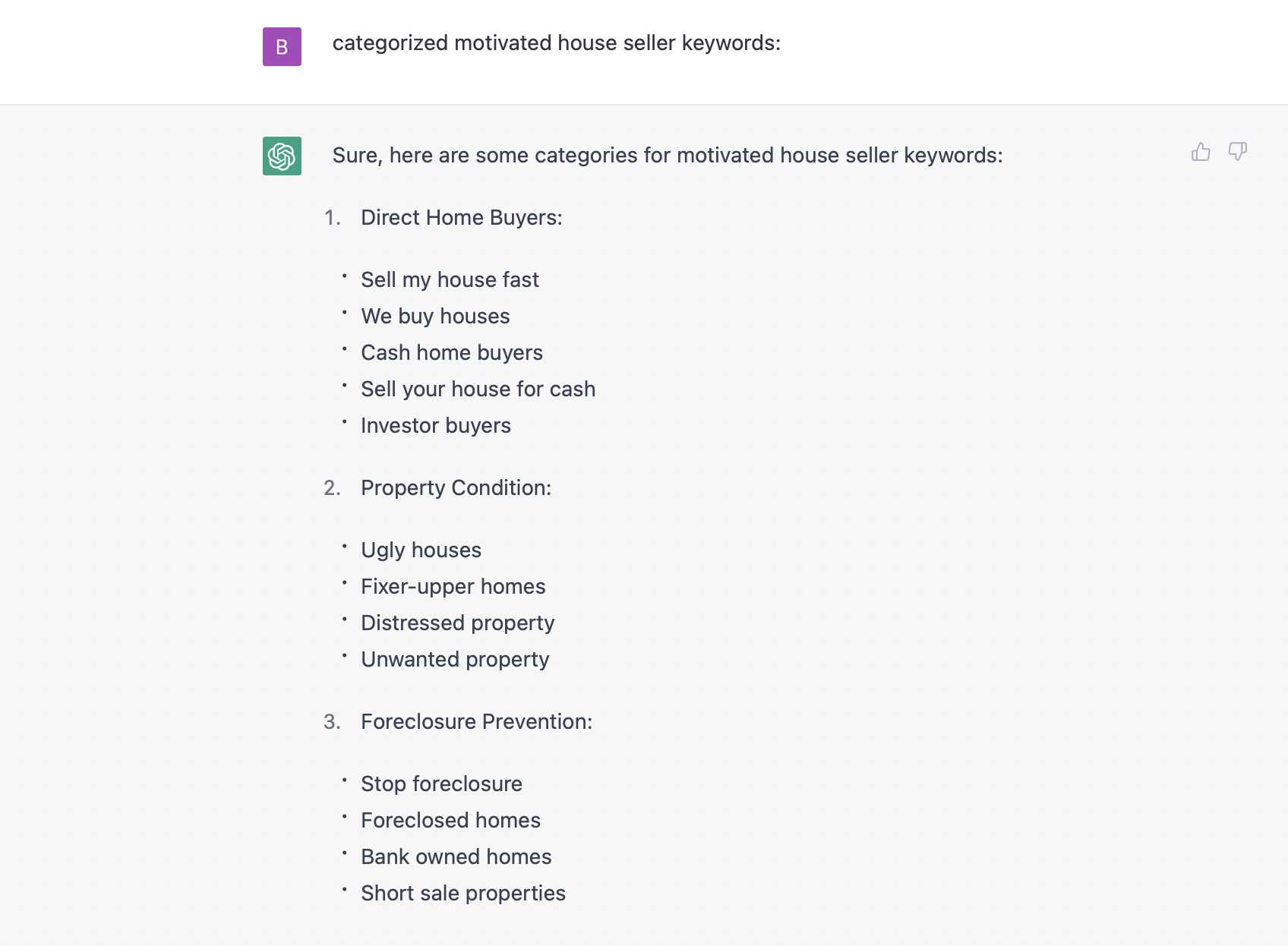
Fortunately, ChatGPT is great at grouping words by relevance. It’s so accurate that you may not even need to provide category names or examples in your prompts. I initially tried to help ChatGPT understand my desired categorization by adding a category name after the first few keywords, but this was unnecessary.
Using ChatGPT to group your keywords by relevance, you can create more effective campaigns and improve your search engine rankings.
The response to this prompt was of good quality despite not providing any examples for classification.
How to Utilize GPT for Ad Creation
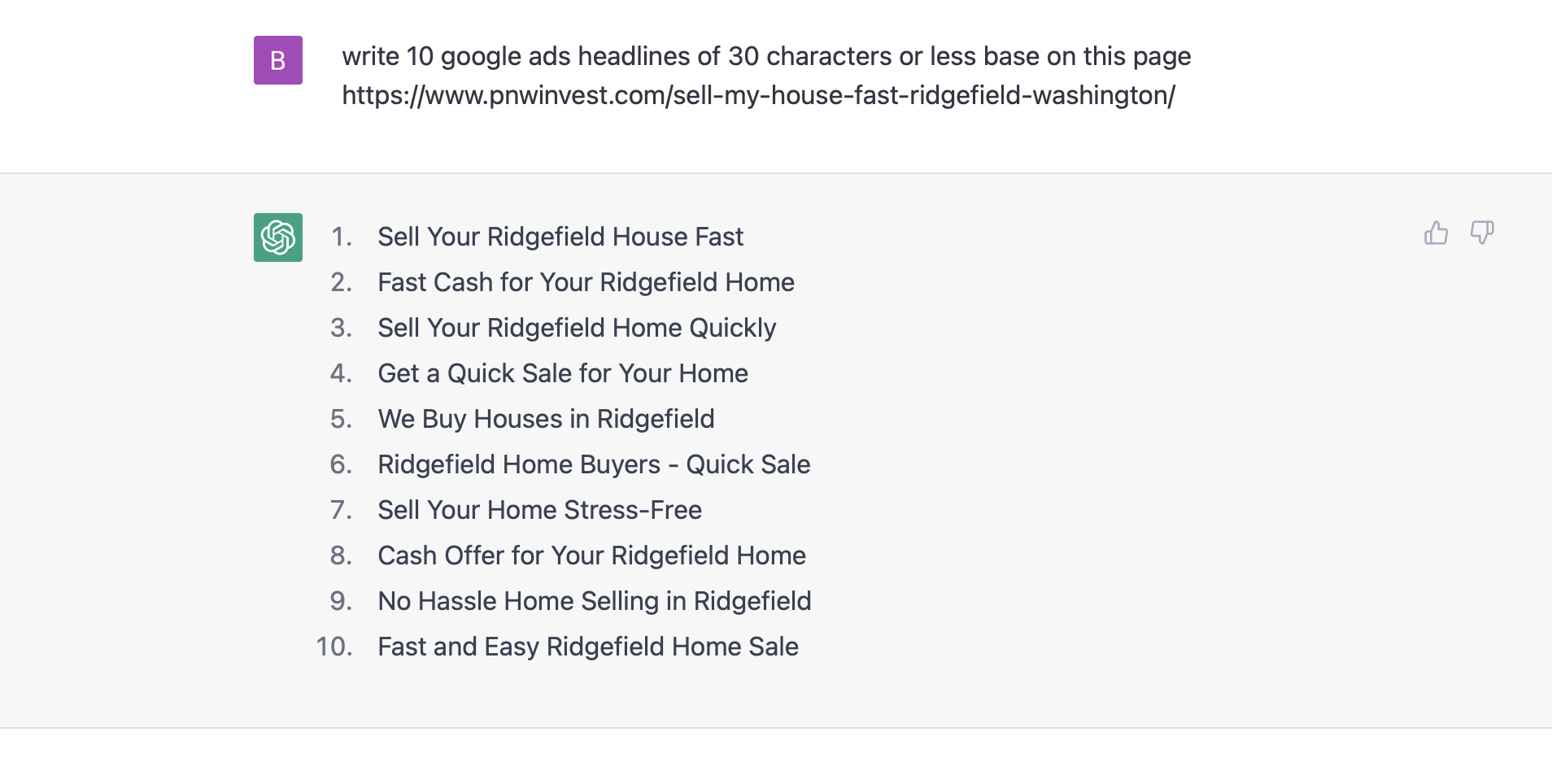
To set up ad groups, I already have grouped keywords and a landing page on my site. The only thing I need now are headlines and descriptions for the responsive ads. I asked ChatGPT for assistance in writing these ads.
Beware that sometimes, ChatGPT suggests ad headlines that are too long, exceeding the allowed character limits. This happens because ChatGPT doesn’t have strong mathematical abilities. Instead, it predicts the most probable text that should follow a given sequence. For instance, it recognizes that “1+1=” is typically followed by “2,” but it doesn’t perform the calculation. Instead, it looks for common patterns.
If this happens, you must adjust the characters to fit or try again.
GPT has a talent for completing the text, which means that when examples are provided in the prompt, the suggestions it generates are more accurate. This is because the suggestions follow the same pattern as the examples, which helps GPT predict what should come next in the sequence.
Utilize GPT for Optimizing Search Terms
After launching the ad groups, they will gather information about the search terms for which the ads were displayed.
This data can then be utilized for optimization purposes. However, analyzing search terms can be daunting, as there may be a vast amount of them to sift through.
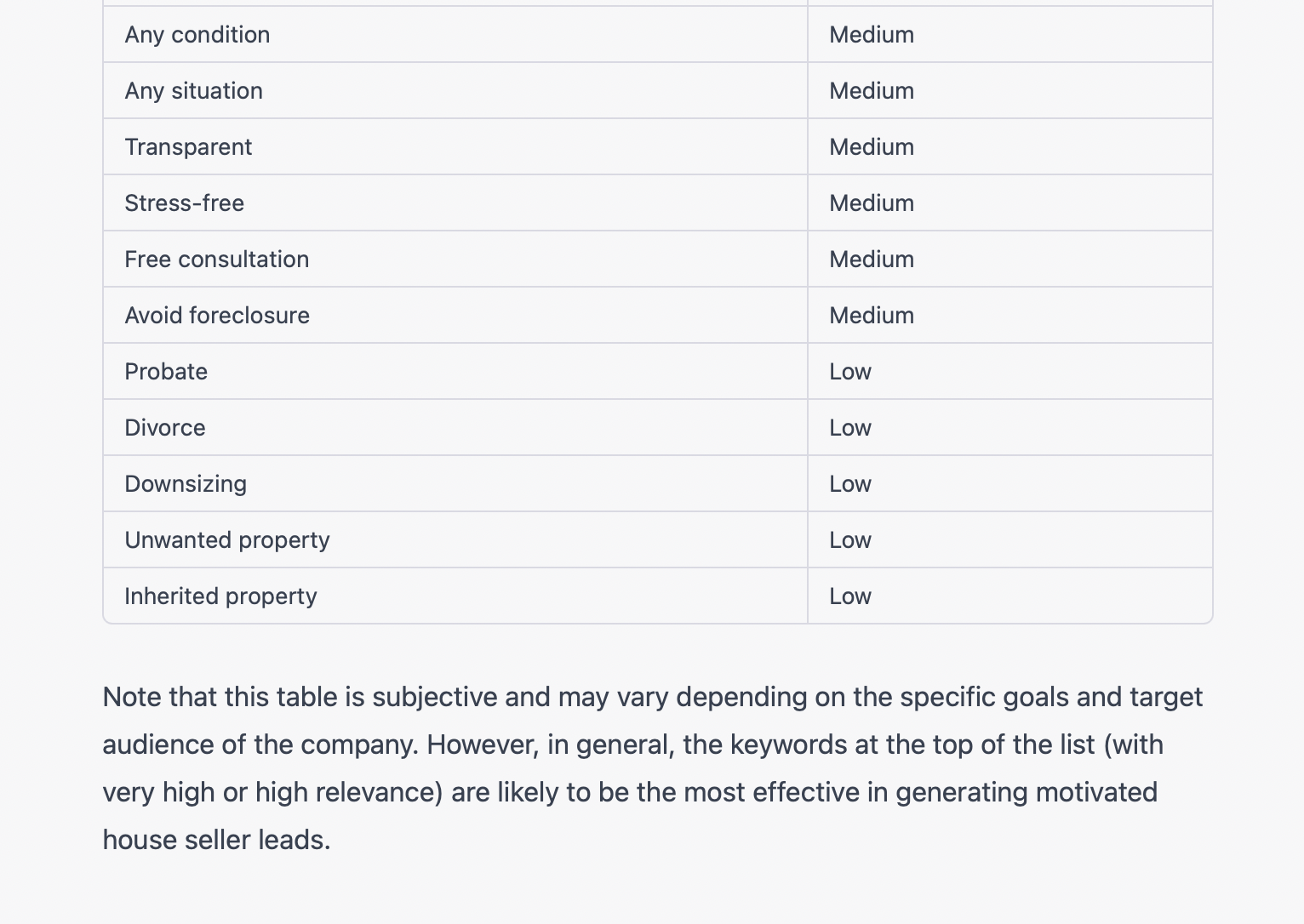
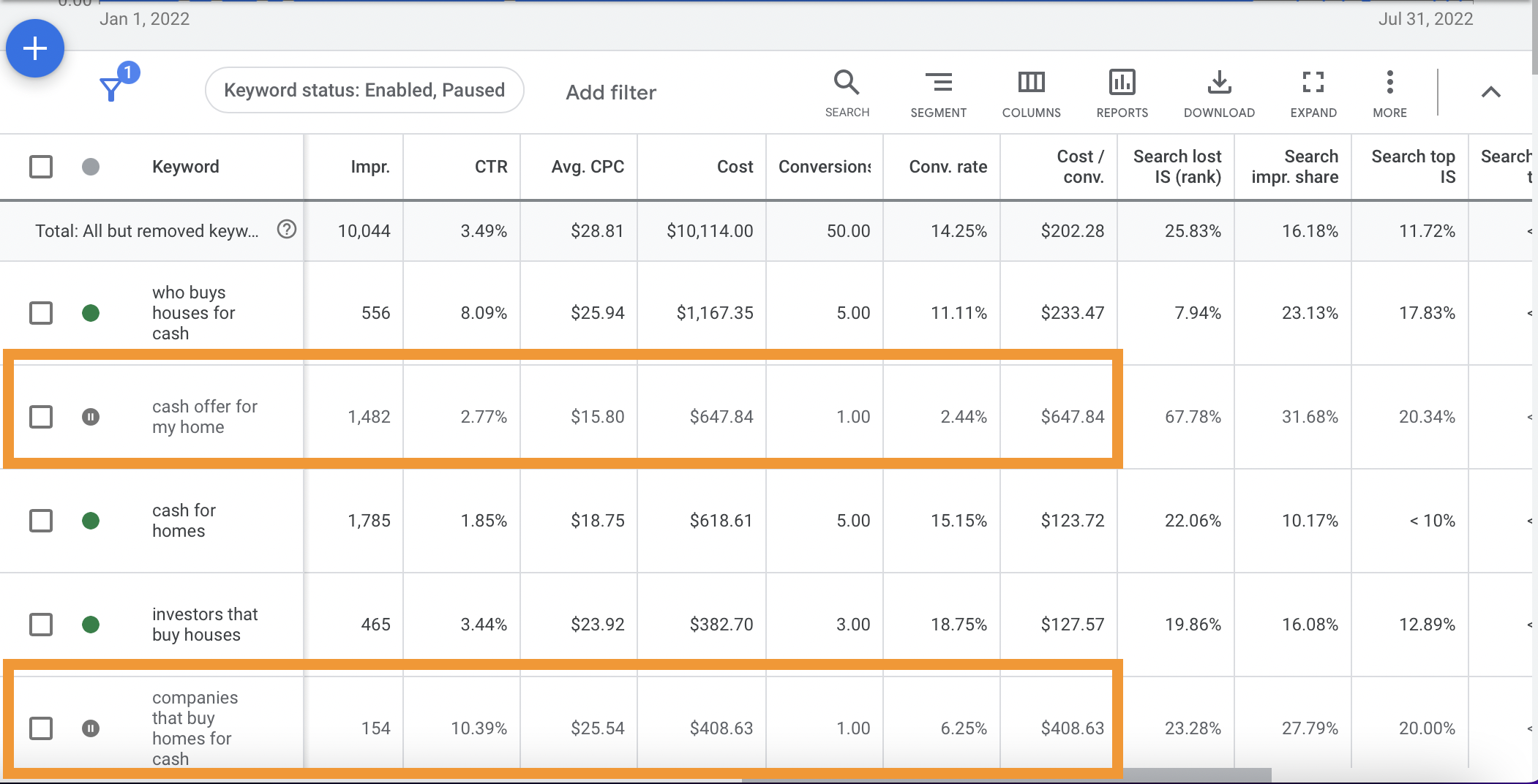
To simplify this process, I requested ChatGPT to rank my ad group’s search terms according to their relevance. As ChatGPT already comprehends the concept of relevance, no further explanation was necessary. The outcome was as follows:
Here are some search terms that ChatGPT deems more relevant to real estate investors advertising to motivated sellers:
Here are some search terms that ChatGPT deems more less to real estate investors advertising to motivated sellers:
As a real estate investor, you might find it helpful to use negative keyword ideas when conducting research. One effective strategy is to focus on the terms near the bottom of the relevance list, as they are usually less relevant to the landing page you’re promoting. This can save you time and help you prioritize your efforts when busy with other marketing tasks. While it’s not a perfect solution, it can be a helpful tool in your arsenal.
How to Use ChatGPT to Optimize Your PPC Landing Pages
If you’re someone who doesn’t create landing pages, you might feel unsure about them. To help you feel more confident, use these prompts to identify intelligent landing page recommendations.
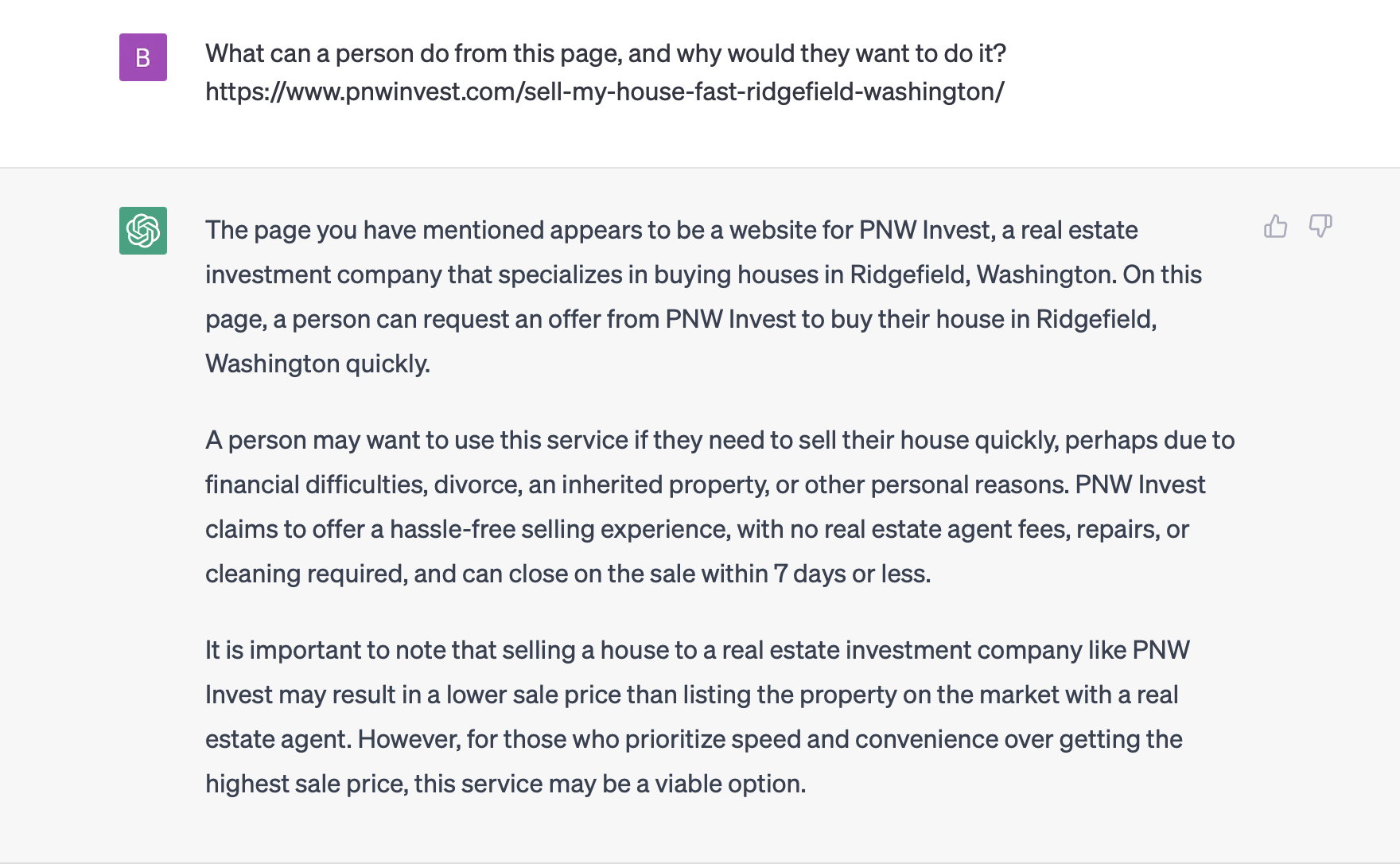
ChatGPT Prompt: “What can a person do from this page, and why would they want to do it? [Landing Page URL]”
This is a fast and basic method to assess whether the content of the page and the call to action are suitable for your potential leads.
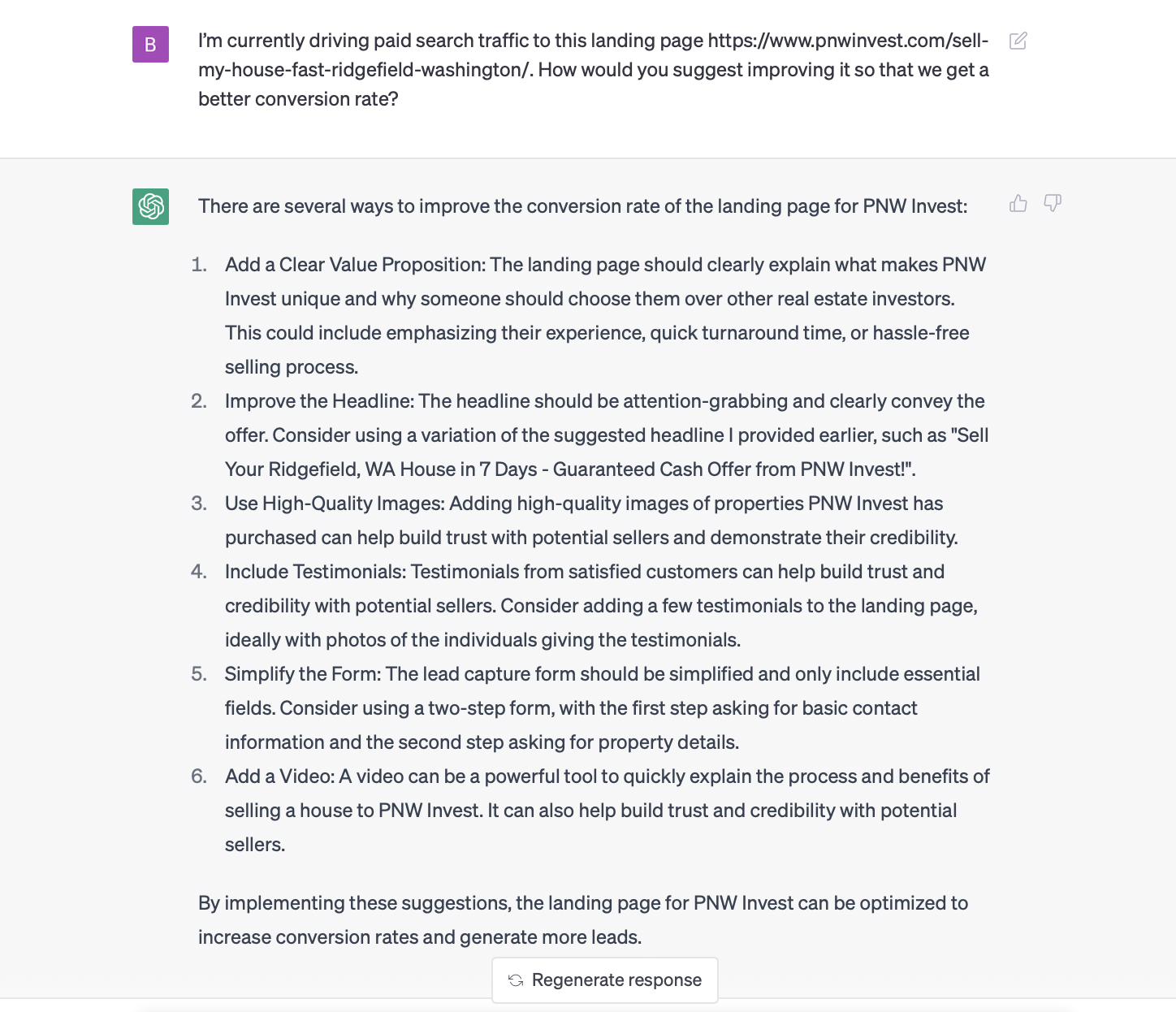
ChatGPT Prompt: “I’m currently driving paid search traffic to this landing page [Landing Page URL]. How would you suggest improving it so that we get a better conversion rate?”
This prompt may provide you with general advice for your landing page rather than reviewing your specific URL, but it’s still valuable advice to consider.
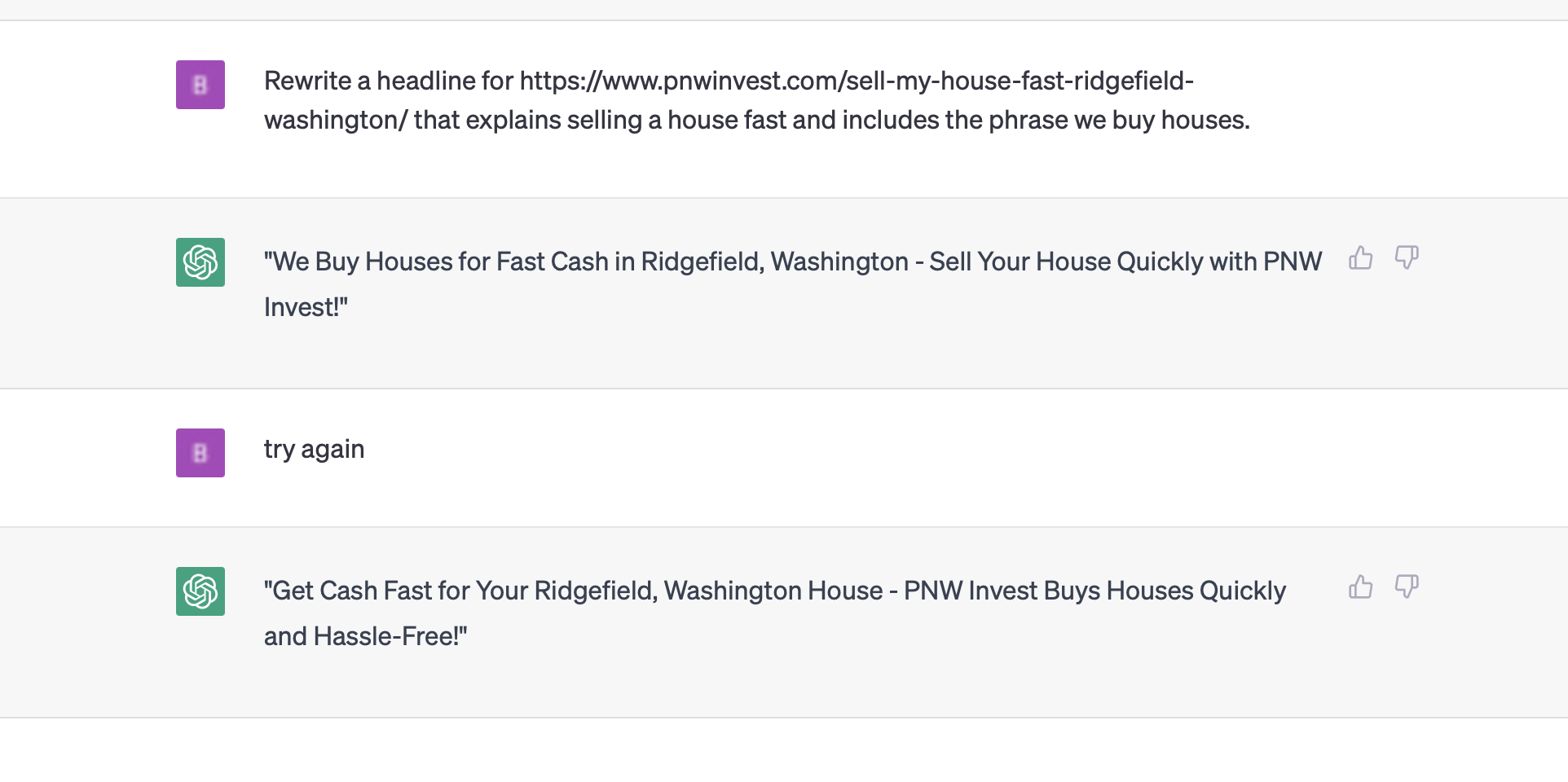
ChatGPT Prompt: “Rewrite a headline for [Landing Page URL] that explains [unique value proposition] and includes the phrase [keyword phrase].”
This prompt can help you address an issue with landing pages where the headlines focus on attention-grabbing rather than clearly conveying the page’s purpose. By using this prompt, you can improve your landing page’s message-match sequence and create stronger content above the fold to engage your audience better.
If you don’t like what you see the first time, you can ask ChatGPT to “try again.”
Conclusion
As a real estate investor, staying informed about the latest automation opportunities in PPC advertising is important.
Generative AI technologies like GPT and Bard can revolutionize how you approach PPC, and incorporating them into your campaigns can help you achieve better results.
However, it’s crucial to remain vigilant and monitor the performance of your AI-powered strategies to ensure they align with your business goals. Consider implementing the techniques covered in this post in your PPC campaigns.
With AI technology rapidly changing the PPC landscape, staying ahead of the curve is essential to remain competitive as a real estate investor.
We’re here to help. You don’t have to get overwhelmed and fumble through paid ads. Here is a guide that can help you get started using Google Ads so you can be on your way to doing what you do best — closing deals.
As always, if you feel Carrot may be a fit for your real estate websites and want better results online, we’d love to have you in the Carrot community, and be sure to learn more about paid ads.
Check out our plans and hit us up with questions anytime!
By targeting potential customers who are already interested in buying or selling a home, agents can save time and money while reaching more clients.
However, creating and managing a successful Google Ads campaign takes careful planning and execution.
The good news is that we’ve been in the real estate marketing space for a long time at Carrot, and we know what it takes to run great Google Ads, even if you’ve never used PPC advertising before in your life.
In this guide, you will learn everything you need about Google Ads that can potentially change your life as it has for 1000s of Carrot members…
There are 1.4 million real estate agents in the U.S.
Does your website stand out from the rest?
Break through the clutter online with Carrot — the real estate website platform built to attract and convert qualified leads. Take a free Real Estate Agent website demo today to see how Carrot can help you grow your business with consistent and predictable lead flow.
Take a Free Demo of Carrot Today
Google Ads for Real Estate Agents: Steps for Successful Campaigns
PPC advertising is a form of online marketing in which businesses can pay to display their ads on search engines and other websites. Advertisers only pay when someone clicks on their ad, making it a very effective way to drive traffic to your website.
Google Ads is a popular form of PPC advertising, and it’s an excellent way for real estate agents to get their properties in front of potential buyers and attract home sellers to use their services.
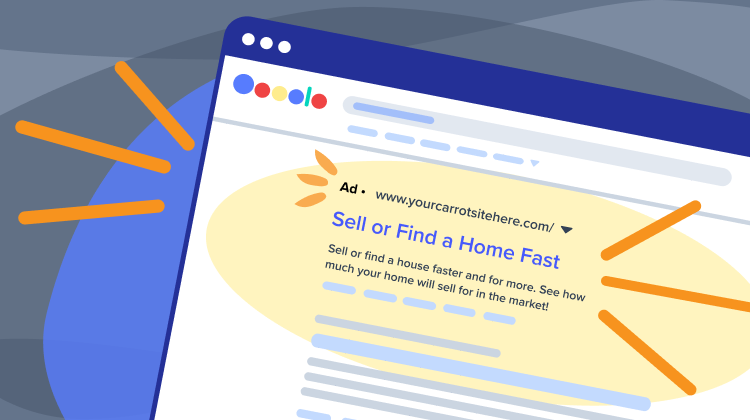
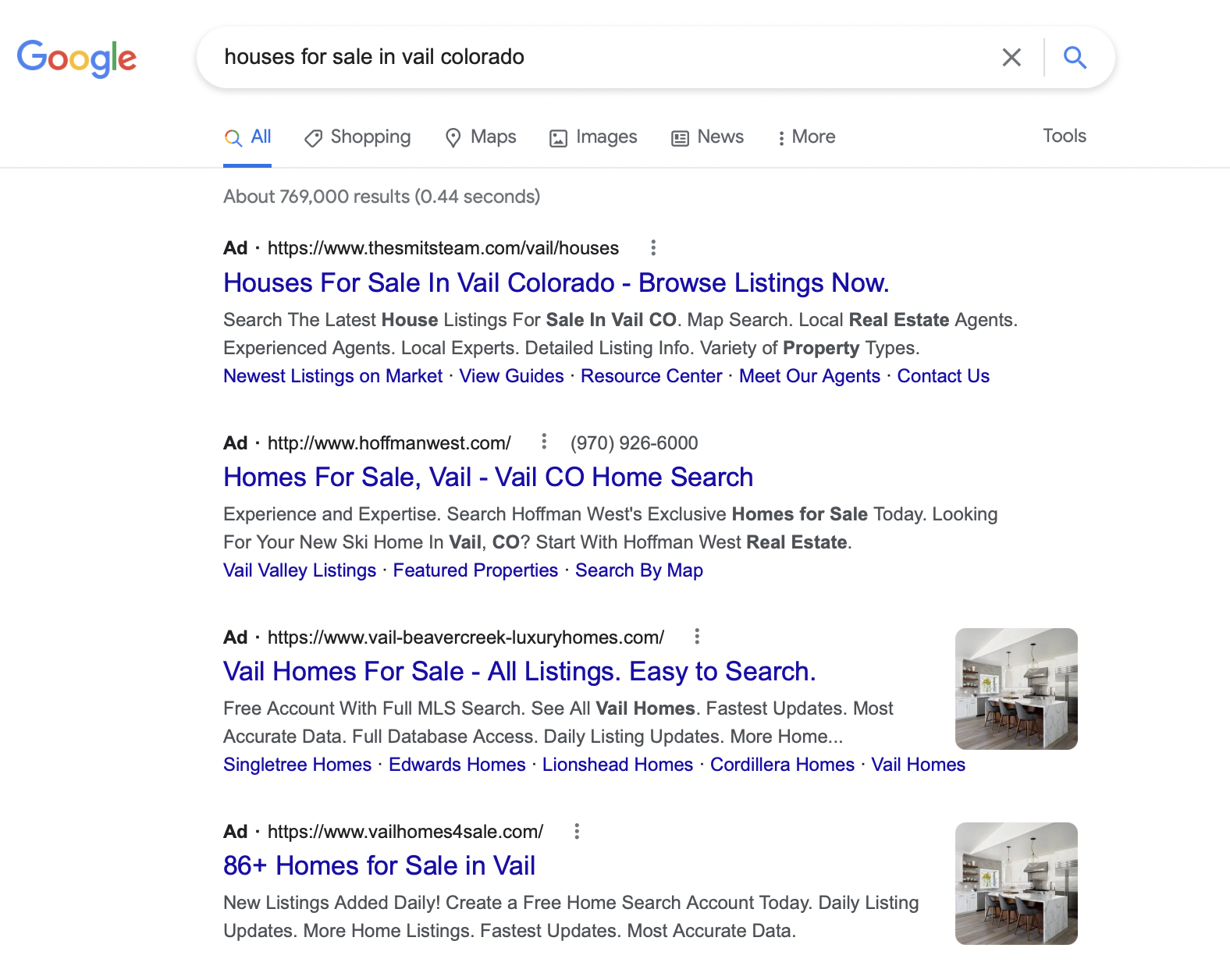
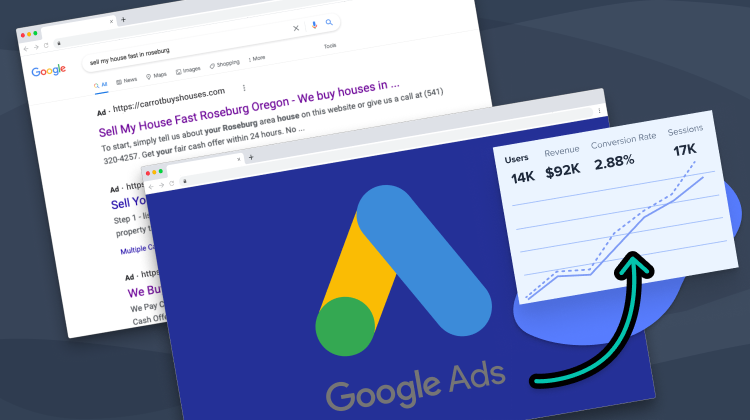
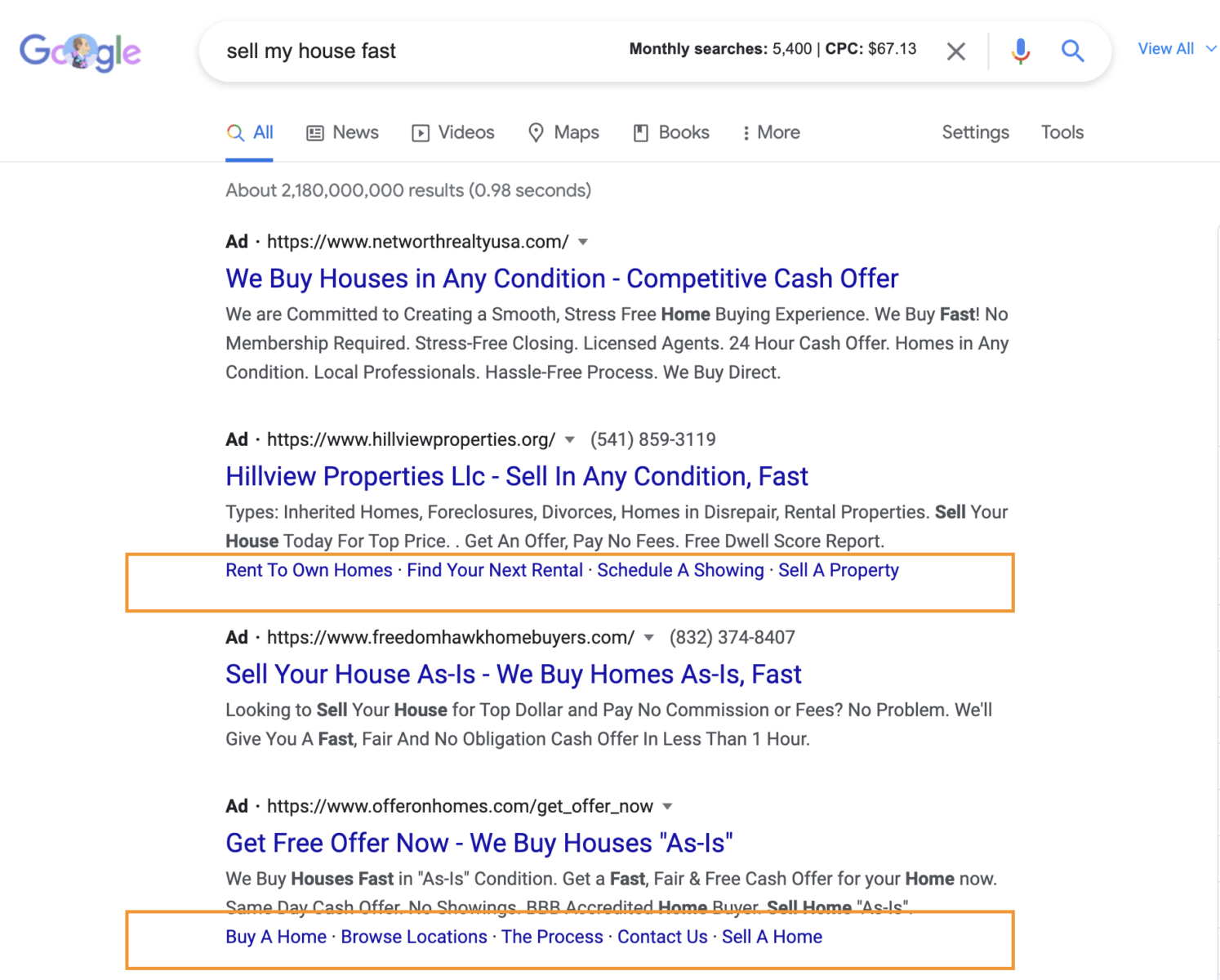
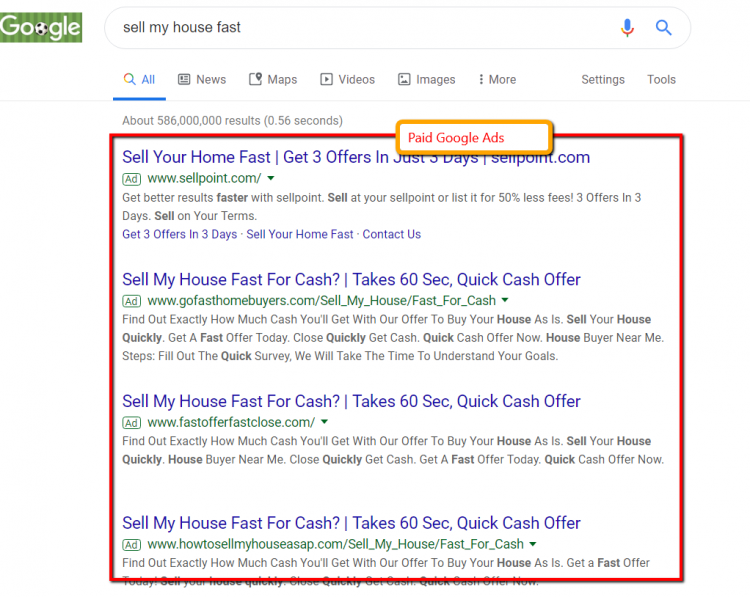
Here’s an example of how Google Ads appear in search results…
Understanding the Basics of Google Ads
Google Ads, a cornerstone of online advertising, operates on a pay-per-click (PPC) model, allowing advertisers to reach their target audience effectively. To embark on a successful journey with Google Ads for real estate, it’s crucial to grasp the fundamentals that govern its functionality.
1. Explanation of Google Ads and its Pay-Per-Click (PPC) Model:
Google Ads is a robust advertising platform where advertisers bid on specific keywords to have their clickable ads appear in Google’s search results. Unlike traditional advertising, where you pay for ad space regardless of performance, PPC means you only pay when a user clicks on your ad. This model offers a cost-effective way to drive traffic to your real estate listings.
2. Key Terms: Keywords, Ad Groups, Campaigns, and Quality Score:
Keywords: These are the words or phrases you choose to trigger your ads. In the real estate context, keywords could be terms like “homes for sale,” “real estate agents,” or specific location-based searches.
Ad Groups: Ad groups are clusters of related keywords within your campaign. You might have ad groups for real estate that focus on property types, locations, or buyer demographics.
Campaigns: Campaigns are the overarching structures that house ad groups. You might create campaigns for different property types (e.g., residential, commercial) or target audiences in real estate.
Quality Score: Google assigns a Quality Score to your ads based on their relevance, click-through rate (CTR), and the quality of your landing page. A higher Quality Score can positively impact your ad’s visibility and cost-per-click.
3. How Google Ads Auction Works:
Google Ads employs a dynamic auction system to determine the placement of ads in search results. Here’s a simplified breakdown:
Bid: Advertisers set a maximum bid they’re willing to pay for a click on their ad.
Quality Score: In addition to the bid, Google considers the Quality Score of the ad. A higher Quality Score can enhance ad placement even with a lower bid.
Ad Rank: The Ad Rank is calculated by multiplying the bid with the Quality Score. Ads with higher Ad Ranks are more likely to appear prominently.
Actual CPC (Cost-Per-Click): The actual amount an advertiser pays is influenced by the competitor’s Ad Rank below them and their Quality Score.
Understanding these foundational elements equips real estate professionals with the knowledge to navigate and optimize their Google Ads campaigns effectively. As we delve deeper into the intricacies of real estate advertising on Google Ads, this knowledge will be a valuable guide for creating impactful and cost-efficient campaigns.
Why Google Ads for Real Estate?
In the dynamic landscape of real estate marketing, leveraging the right platforms can make all the difference. Google Ads emerges as a powerhouse for real estate professionals, offering many advantages that can significantly impact visibility, lead generation, and overall success in the industry.
1. Precision Targeting for a Targeted Audience:
Google Ads allows real estate professionals to hone in on a highly specific, targeted audience actively seeking properties. Through the strategic use of keywords, advertisers can align their ads with the precise queries potential buyers are entering into Google’s search bar. This precision targeting ensures that your real estate listings are presented to individuals actively interested in the type of properties you offer.
2. Immediate Visibility in Search Results:
Real estate is competitive, and standing out in a crowded market is paramount. Google Ads provides a shortcut to immediate visibility in search results. Instead of relying solely on organic search rankings, your ads can appear prominently at the top of relevant search pages. This prime real estate in search results increases the likelihood of attracting the attention of potential buyers in the crucial decision-making phase.
3. Cost-Effective Lead Generation:
Google Ads operates on a pay-per-click (PPC) model, ensuring that you only pay when someone actively engages with your ad by clicking on it. This cost-effective approach means that your advertising budget is allocated to genuine leads—individuals who have shown interest in real estate properties by clicking on your ad. This targeted expenditure maximizes the return on investment and minimizes wasteful spending on audiences uninterested in your offerings.
4. Instant Brand Exposure:
For real estate professionals aiming to establish or enhance their brand presence, Google Ads provides an avenue for instant exposure. Beyond just listings, you can use ads to showcase your expertise, unique selling propositions, and the value you bring to potential buyers. The more frequently your brand appears in relevant search results, the more trust and recognition you can build among your target audience.
In essence, Google Ads offers a powerful toolkit for real estate professionals to survive and thrive in a competitive market. By strategically harnessing the advantages of this platform, you can position your listings in front of the right audience, elevate your brand visibility, and generate high-quality leads that are more likely to convert into successful transactions. As we explore the intricacies of Google Ads for real estate, these advantages will be the foundation for creating impactful and results-driven advertising campaigns.
Before You Start: Get Your Website Dialed In
Before launching any Google Ads campaigns or spending a single dollar on paid traffic, there’s one thing you need: a high-converting website. Without a site that’s optimized for capturing leads and driving action, all the traffic in the world won’t help your business.
Your website is the foundation of your digital marketing strategy. It’s where motivated sellers will land after clicking your ad, and it’s your best chance to turn that interest into a real lead. But simply having a website isn’t enough—you need to ensure it’s set up to convert. That means clear messaging, an easy-to-navigate design, fast load times, and a seamless experience on mobile devices.
Set Up a High-Converting Real Estate Website
Your website is the backbone of your Google Ads campaign. Once you’ve paid to get motivated buyers and sellers to click on your ad, ensuring they convert into leads is essential. Here’s how to optimize your website for maximum conversions:
1. Clear, Compelling Messaging
Your website should immediately communicate what you offer and why it’s valuable. For real estate agents, this often means highlighting a fast, hassle-free selling experience. Use strong headlines that address seller pain points and key benefits, such as “Get a Cash Offer in 24 Hours” or “Sell Your House Fast Without a Realtor.” Clarity and directness build trust quickly.
2. Trust Signals
Motivated sellers often find themselves in tough situations and want reassurance that they’re working with a credible agent. To build trust, include testimonials from happy clients, positive reviews, and certifications. Visual trust badges, such as “BBB Accredited” or logos from well-known media outlets, add authority and increase confidence in your services.
3. Simple Lead Capture Forms
Make it as easy as possible for visitors to give you their information. Keep your forms simple—only ask for the essentials like name, phone number, and property address. The shorter and more straightforward the form, the more likely visitors will fill it out. Consider offering a small incentive, like a “Free Home Valuation,” to encourage them to take action.
4. Mobile-Friendly Design
More than half of real estate searches come from mobile devices. If your website isn’t mobile-optimized, you’re losing leads. Ensure your site looks great and functions smoothly on smartphones and tablets. Use responsive design and large buttons for easy navigation, and ensure forms are easy to fill out on smaller screens.
5. Fast-Loading Pages
Speed is a critical factor in keeping visitors on your site. If your website takes too long to load, people will leave before they can engage. Aim for a load time under 3 seconds. Tools like Google PageSpeed Insights can help you monitor your site’s performance and find areas for improvement.
By implementing these best practices, you’ll maximize your website’s potential and turn more visitors into qualified leads for your real estate business. A well-optimized site works hand in hand with your ads, helping you get the most out of your marketing budget.
Need a website that checks all these boxes? We’ve got you covered! Join Carrot today and get a high-converting site built to generate leads, rank on Google, and help grow your real estate business.
Setting Up Your Google Ads Account
Embarking on a successful real estate marketing journey with Google Ads begins with the meticulous setup of your account. Let’s walk through the essential steps, emphasizing the importance of each element in ensuring your campaigns are tailored for success.
1. Step-by-Step Guide to Creating a Google Ads Account:
Visit the Google Ads Website: Start by navigating the Google Ads website (ads.google.com) and click “Start Now” to begin the account creation process.
Select Your Goals: Google Ads allows you to choose from various campaign goals, such as website visits, phone calls, or app downloads. For real estate, common goals include lead generation and website visits.
Campaign Type: Choose the campaign type that aligns with your objectives. Options may include Search, Display, or Video campaigns. For real estate, a Search campaign might be ideal to capture users actively searching for properties.
Define Your Location and Language Targeting: Specify the geographical areas you want your ads to appear in and the preferred language of your target audience.
Create Your First Ad: Craft a compelling ad that aligns with your real estate offerings. Highlight key selling points, unique features, or special promotions to entice potential buyers.
Set Your Budget: Determine your daily or monthly budget to control your advertising expenses. Google Ads provides flexibility, allowing you to adjust your budget based on performance.
2. Importance of Defining Campaign Goals and Target Audience:
Clarity in Objectives: Clearly define your campaign goals—driving traffic to your website, generating leads, or promoting specific listings. This clarity ensures that every aspect of your campaign aligns with your overarching objectives.
Understanding Your Audience: Identify your target audience based on demographics, interests, and behaviors. Consider factors such as location, home preferences, and buyer demographics in the real estate context. Tailoring your campaigns to a specific audience enhances their relevance and effectiveness.
3. Choosing the Right Keywords for Real Estate Campaigns:
Research Relevant Keywords: Conduct thorough keyword research to identify terms potential buyers will likely use when searching for properties. Include location-specific keywords and terms related to property types, features, and amenities.
The different match types give you room when selecting your keywords. Match types tell Google whether you want to match a search query exactly or if your ad should be shown to anyone with a search query that’s somewhat related. There are three match types to choose from:
Broad Phrase Exact
Broad match“may show on searches related to your keyword, including searches without keyword terms. This helps you attract more visitors to your website, spend less time building keyword lists, and focus your spending on keywords that work. Broad match is the default match type assigned to all your keywords so that you don’t have to specify another match type (exact match, phrase match, or a negative match type).”
The syntax for the broad match is to input the keyword. Below is an example of how a broad match keyword would work:
Phrase match“may show on searches that include the meaning of your keyword. The meaning of the keyword can be implied, and user searches can be a more specific form of the meaning. With phrase match, you can reach more searches than with exact match and fewer searches than with broad match, only showing your ads on the searches that include your product or service.”
The syntax for phrase match is to put quotes around your keyword. Below is an example of how a phrase match keyword would work:
Exact match“may appear on searches with the same meaning or intent as the keyword. Of the three keyword match options, exact match gives you the most control over who sees your ad but reaches fewer searches than both phrase and broad match.”
The syntax for an exact match is to use square brackets. Below is an example of how an exact match keyword would work:
If you’re starting and don’t know exactly how your market will be searching, move away from a broad match to a narrowed approach to see which searches yield the best results. You should monitor and modify your keywords closely as you gain new data.
Long-Tail Keywords: Incorporate long-tail keywords to capture more specific search queries. For example, “3-bedroom homes for sale in [location]” provides a more targeted approach than a generic term like “homes for sale.”
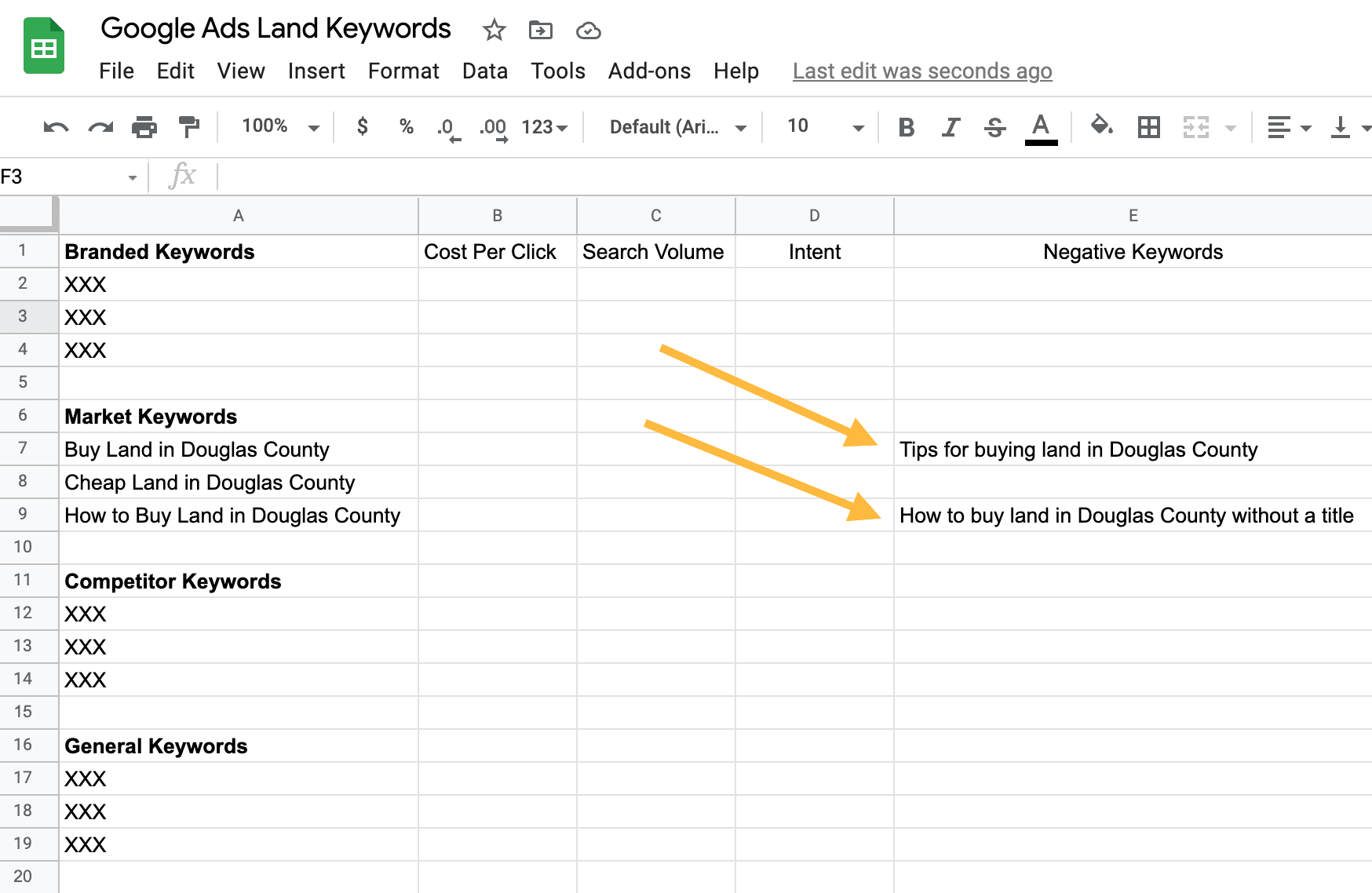
Negative Keywords: Exclude irrelevant terms through negative keywords to ensure your ads aren’t triggered by searches that don’t align with your offerings.
Negative keywords are one of the most underutilized tools PPC advertisers have at their fingertips. They can help you save a budget for the best quality searches when used correctly.
Let’s say you’re an agent creating your first Google Ads campaign. You’d like to appear on searches to sell your luxury properties targeting out-of-state buyers.
You may want to add terms such as “apartments” or “new house plans” as negative keywords.
As you’ll discover, from video games to furniture to spiritual statues, many search terms represent nothing to do with buying or selling a house.
Setting up your Google Ads account is not just a preliminary step; it’s the foundation for successful real estate campaigns.
By following these steps diligently and aligning your goals with the unique attributes of the real estate market, you set the stage for targeted, impactful, and cost-effective advertising.
As we delve deeper into the intricacies of Google Ads for real estate, the foundations established during setup will prove instrumental in creating campaigns that resonate with your audience and drive tangible results.
Keyword Examples
Example keywords for a “seller” campaign:
best realtors in my area
selling my home
list my house
home selling tips
staging your home to sell
how much is my house worth
local real estate agents
tips for selling my home
finding a realtor
find a real estate agent
Example keywords for a “buyer” campaign:
house listings
local homes for sale
new homes for sale in
find homes for sale in
2 story houses for sale in
riverfront houses for sale in
new listings in
buy a house in
homes for sale websites
new real estate listings
Crafting Compelling Real Estate Ads
In the realm of real estate advertising, the art of crafting compelling ads is paramount. It’s not just about showcasing properties; it’s about captivating your audience, driving engagement, and enticing potential buyers to take the next step. Let’s delve into the key components of creating ads that leave a lasting impression.
1. Writing Effective Ad Copy for Real Estate Listings:
Clarity and Conciseness: Craft ad copy that is clear, concise, and directly addresses the unique selling points of your real estate listings. Clearly communicate the value proposition and why potential buyers should explore further.
Highlight Key Features: Identify and emphasize the key features of the property. Whether it’s a spacious backyard, state-of-the-art kitchen, or proximity to amenities, these details should be prominently featured in your ad copy.
Create a Compelling Call-to-Action (CTA): Encourage immediate action with a compelling CTA. Whether it’s “Explore Now,” “Schedule a Viewing,” or “Learn More,” guide potential buyers on the next steps you want them to take.
Incorporate Keywords: Infuse relevant keywords seamlessly into your ad copy. This improves ad relevance and enhances the chances of your ad appearing in searches for specific real estate terms.
2. Utilizing Ad Extensions to Provide Additional Information:
Location Extensions: Enhance the local appeal of your real estate listings by incorporating location extensions. This feature displays your business address, making it convenient for users to find your properties.
Callout Extensions: Use callout extensions to highlight additional benefits or features that make your listings stand out. Whether it’s “Waterfront Views” or “Family-Friendly Neighborhood,” these snippets provide valuable information.
Sitelink Extensions: Direct users to specific pages on your website with sitelink extensions. This could include links to virtual tours, property galleries, or more detailed information about your real estate services.
Structured Snippet Extensions: Showcase specific aspects of your real estate offerings with structured snippet extensions. This could include categories like property types, amenities, or neighborhood highlights.
3. Creating Visually Appealing Display Ads:
High-Quality Imagery: Invest in high-quality images that showcase the best features of your properties. Clear, vibrant visuals capture attention and convey the appeal of the real estate listings.
Consistent Branding: Maintain consistency in branding across your display ads. This includes using the same color schemes, fonts, and logos to reinforce your brand identity.
Eye-Catching Design: Design visually appealing ads with attention-grabbing elements. Use contrasting colors, compelling headlines, and strategic placement of images to create an aesthetically pleasing composition.
Responsive Design: Ensure your display ads are responsive and compatible across various devices. With many users browsing on mobile devices, a responsive design ensures a seamless viewing experience.
Crafting compelling real estate ads is an art that combines persuasive storytelling with strategic elements.
By focusing on impactful ad copy, utilizing extensions for additional information, and creating visually stunning displays, you elevate your real estate listings to new heights.
These principles will serve as your guide to creating ads that capture attention and drive engagement and conversions.
Targeting Strategies for Real Estate
In the expansive world of real estate, precision is key. Targeting the right audience with the right message at the right time can significantly elevate the success of your campaigns. Let’s explore targeted strategies designed specifically for real estate professionals to ensure your message reaches those most likely to become your clients.
1. Geo-Targeting: Reaching Potential Clients in Specific Locations:
Localized Precision: Geo-targeting allows you to narrow your audience based on geographical location. For real estate professionals, this means reaching potential clients precisely where they want to buy or sell properties.
Neighborhood-Specific Campaigns: Tailor your campaigns to specific neighborhoods or regions. If you specialize in certain areas, use geo-targeting to direct your ads to individuals actively interested in real estate in those locations.
Adaptable Marketing: Adjust your messaging based on the unique characteristics of each location. Highlight nearby amenities, schools, or attractions to make your real estate offerings more appealing to the local audience.
2. Demographic Targeting Based on Buyer Profiles:
Understanding Buyer Profiles: Identify and define your target buyer personas. Consider demographics such as age, income, occupation, and family status. For example, a family home may be marketed differently than a luxury condo.
Tailored Content: Craft ad content that resonates with your target demographics. Speak directly to the needs and preferences of your audience to create a more personalized and impactful message.
Customized Offers: Adjust your offers based on the demographics of your audience. For instance, first-time homebuyers might be interested in special financing options, while retirees may prioritize downsizing or retirement communities.
3. Using Remarketing to Engage with Previous Website Visitors:
Staying Top-of-Mind: Implement remarketing strategies to reconnect with individuals who have previously visited your website. This keeps your real estate brand top-of-mind as they continue their property search.
Showcasing New Listings: Showcase new listings or updates to capture the attention of those who have shown interest in the past. Utilize dynamic remarketing to display specific properties based on the user’s previous interactions.
Encouraging Further Exploration: Include compelling calls-to-action in your remarketing ads, encouraging users to revisit your website, explore more listings, or contact you for personalized assistance.
Targeting strategies in real estate advertising go beyond casting a wide net; they involve a nuanced understanding of your audience and a strategic approach to reaching them where it matters most.
These targeting strategies will be the cornerstone of your campaigns, ensuring that your message reaches the right individuals at the right time, ultimately driving engagement and conversions.
Budgeting and Bidding Strategies for Real Estate Ads
Navigating the financial aspects of real estate advertising on Google Ads requires a careful balance between setting realistic budgets and implementing effective bidding strategies.
Let’s explore how to establish a budget, weigh the pros and cons of manual vs. automated bidding, and optimize bids to ensure a maximum return on investment (ROI) for your real estate campaigns.
1. Establishing a Realistic Budget for Real Estate Campaigns:
Assessing Your Resources: Evaluate your financial resources and determine how much you can allocate to your Google Ads campaigns. Consider your marketing budget and allocate a portion specifically for real estate advertising.
Cost-Per-Click (CPC) Considerations: Understand the average cost-per-click in the real estate industry, as it can vary based on factors such as location, property type, and competition. This knowledge helps you set a budget that aligns with the expected costs of reaching your target audience.
Campaign Goals and Duration: Tailor your budget to the specific goals of each campaign and its intended duration. Short-term promotional campaigns may require a different budget allocation than ongoing lead generation efforts.
2. Understanding Bidding Strategies: Manual vs. Automated:
Manual Bidding: With manual bidding, you have direct control over how much you’re willing to pay for clicks. This strategy provides a hands-on approach, allowing you to adjust bids based on performance, keywords, or specific ad groups.
Automated Bidding: Automated bidding relies on machine learning algorithms to set bids based on your campaign goals. Google’s automated strategies include Target CPA (Cost-Per-Acquisition), Target ROAS (Return on Ad Spend), and Maximize Conversions. Automated bidding can be advantageous for those seeking efficiency and time savings.
Hybrid Approaches: Consider a hybrid approach, combining manual bidding for high-priority keywords or ad groups with automated bidding for broader campaigns. This allows for greater flexibility and optimization based on performance data.
3. Tips for Optimizing Bids to Maximize ROI:
Monitor and Analyze Performance: Regularly review the performance metrics of your real estate campaigns, including click-through rate (CTR), conversion rate, and cost per conversion. Identify high-performing keywords and allocate the budget accordingly.
Adjust Bids Based on Performance: Leverage performance data to adjust bids for keywords or ad groups in manual bidding. Increase bids for top-performing elements to maximize visibility and decrease bids for underperforming areas to optimize budget allocation.
Utilize Bid Adjustments: Take advantage of bid adjustments based on location, device type, or time of day. Adjusting bids for specific criteria allows you to tailor your real estate ads to the most receptive audiences.
Test and Iterate: Implement A/B testing to assess the impact of different bidding strategies. Test variations in bid amounts, ad copy, or targeting parameters to identify the most effective combination for your real estate campaigns.
Establishing a budget and implementing bidding strategies in real estate advertising is a dynamic process that requires continuous monitoring and adjustment.
These budgeting and bidding strategies will be essential for optimizing your campaigns and achieving a maximum return on investment.
Monitoring and Analyzing Performance in Real Estate Advertising
The success of your real estate campaigns on Google Ads hinges on your ability to launch compelling ads and monitor and analyze performance continuously. Let’s delve into the significance of tracking key metrics, the role of Google Analytics in gaining insights, and the art of making data-driven adjustments to enhance your campaign’s overall performance.
1. Importance of Tracking Key Metrics: Click-Through Rate (CTR), Conversion Rate, and Cost Per Click (CPC):
Click-Through Rate (CTR): CTR is a vital metric that reflects the percentage of users who click on your ad after seeing it. A high CTR indicates that your ad resonates with the audience, while a low CTR may signify a need for adjustments to the ad copy, targeting, or relevance.
Conversion Rate: The conversion rate measures the percentage of users who completed a desired action, such as submitting a contact form or requesting more information. Monitoring conversion rates helps gauge the effectiveness of your real estate ads in driving valuable interactions.
Cost Per Click (CPC): Understanding the cost per click is crucial for managing your budget effectively. It reflects the amount you pay each time a user clicks on your ad. Keeping a close eye on CPC helps ensure your advertising expenses align with your budgetary constraints.
2. Utilizing Google Analytics to Gain Insights into User Behavior:
Integrated Data Sources: Integrate Google Analytics with your Google Ads account to comprehensively view user behavior. This integration enables you to connect advertising data with user interactions on your website.
User Journey Tracking: Track the entire user journey, from clicking on the ad to navigating your website. Analyze which pages users visit, how much time they spend, and whether they take desired actions. This information informs your understanding of user intent and engagement.
Segmentation and Audience Insights: Leverage Google Analytics to segment your audience based on demographics, interests, and behaviors. This segmentation provides valuable insights into the characteristics of users who engage most positively with your real estate offerings.
3. Making Data-Driven Adjustments to Improve Campaign Performance:
Keyword Optimization: Analyze the performance of keywords and adjust bids or add negative keywords based on their impact. Focus budget allocation on high-performing keywords to maximize visibility.
Ad Copy Refinement: Use performance data to refine your ad copy. Identify elements that resonate with your audience and incorporate these insights into future iterations. A/B testing different ad variations allows you to pinpoint the most effective messaging.
Targeting Enhancements: Evaluate the performance of demographic and geographic targeting. Adjust parameters based on the data, refining your targeting strategy to reach the most receptive audience for your real estate ads.
Budget Allocation: Allocate your budget strategically based on the performance of different campaigns, ad groups, or keywords. Shift resources to areas delivering the best results to optimize your return on investment.
Monitoring and analyzing performance in real estate advertising isn’t a one-time task; it’s an ongoing process that informs iterative improvements.
Mastering these performance analysis techniques will empower you to refine your campaigns, enhance user engagement, and achieve sustained success in the competitive real estate market.
Best Practices and Tips for Success in Real Estate Google Ads Campaigns
Running successful Google Ads campaigns in the dynamic realm of real estate requires a strategic approach, continuous refinement, and a keen understanding of industry best practices. Let’s explore a compilation of key strategies and tips to elevate your real estate advertising game and stay ahead of the competition.
1. Understand Your Target Audience:
Buyer Personas: Develop detailed buyer personas to understand your target audience’s demographics, interests, and behaviors. Tailor your ad content to resonate with potential buyers’ needs and preferences.
Leverage Audience Insights: Use analytics tools to gain insights into user behavior and demographics. This information helps you refine your targeting strategies and create more personalized and effective real estate ads.
2. Optimize Landing Pages for Conversions:
Seamless User Experience: Ensure the landing pages linked to your ads provide a seamless and user-friendly experience. Optimize for mobile responsiveness, quick loading times, and clear calls-to-action to encourage conversions.
Relevance to Ad Content: Align the content on your landing pages with the messaging in your ads. Consistency in information and visuals reinforces trust and increases the likelihood of users taking the desired actions.
3. Utilize Ad Extensions Strategically:
Location Extensions: Enhance the local appeal of your real estate listings by incorporating location extensions. This provides users with additional information about your business’s physical location.
Callout Extensions: Highlight unique selling points and benefits using callout extensions. These snippets offer an opportunity to showcase special features of your properties or services.
4. Leverage Negative Keywords:
Refine Targeting: Regularly review and update your list of negative keywords to refine targeting. This ensures irrelevant searches do not trigger your ads, optimizing your budget for more qualified leads.
5. A/B Test Ad Variations:
Continuous Improvement: Implement A/B testing to experiment with different ad variations. Test elements such as headlines, ad copy, and visuals to identify what resonates most with your audience. Use performance data to refine and optimize.
6. Stay Informed About Market Trends:
Adapt to Market Changes: Real estate is a dynamic industry, and trends can shift rapidly. Stay informed about current trends, changes in buyer behavior, and emerging technologies. Adapt your strategies to align with the evolving landscape.
7. Regularly Review and Adjust Bids:
Bid Optimization: Monitor the performance of your campaigns and adjust bids accordingly. Allocate more budget to high-performing keywords and make data-driven adjustments to maximize your return on investment.
8. Stay Ahead of Competition:
Competitor Analysis: Regularly analyze the strategies of your competitors. Identify what works well for them and explore opportunities to differentiate your real estate offerings. Stay ahead by offering unique value propositions.
9. Embrace Seasonal Campaigns:
Tailor Campaigns to Seasons: Real estate demand often fluctuates with seasons. Tailor your campaigns to align with seasonal trends, such as emphasizing cozy winter homes or summer outdoor spaces. This ensures relevance to current market interests.
10. Monitor and Respond to User Feedback:
Online Reputation Management: Monitor user reviews and feedback online. Respond promptly and professionally to address concerns or inquiries. A positive online reputation can significantly impact your credibility in the real estate market.
Embracing these best practices and tips positions you for success in the competitive real estate advertising landscape on Google Ads.
These strategies will guide you to create impactful campaigns, engage your target audience, and achieve lasting success in the ever-evolving real estate market.
Future Trends and Innovations in Google Ads for Real Estate
As real estate advertising landscape evolves, staying ahead of emerging trends and innovations becomes pivotal for success. Let’s briefly explore the future of real estate advertising on Google Ads, highlighting technologies and features likely to reshape the industry.
1. Video Content Dominance: Video content is gaining prominence across digital platforms, and real estate is no exception. Expect a surge in video ads showcasing property walkthroughs, neighborhood highlights, and immersive virtual tours. Video content engages users effectively and provides a more comprehensive view of listed properties.
2. Augmented and Virtual Reality Integration: Augmented reality (AR) and virtual reality (VR) technologies are set to revolutionize the real estate advertising experience. Imagine users being able to virtually tour a property, customize interiors, or visualize potential renovations. AR and VR enhance user engagement and bring listings to life in unimaginable ways.
3. Enhanced Data Analytics and AI-driven Insights: The future of real estate advertising lies in advanced data analytics and artificial intelligence (AI). Expect AI algorithms to analyze user behavior, predict preferences, and optimize ad targeting. Enhanced data insights will empower real estate professionals to make more informed decisions, ensuring campaigns are tailored to the specific needs of their audience.
4. Voice Search Optimization: With the rise of voice-activated devices and smart assistants, optimizing real estate ads for voice search is becoming crucial. Future trends indicate a shift towards conversational and long-tail keyword strategies, ensuring that ads are effectively surfaced in voice-activated searches related to real estate.
5. Sustainable and Green Living Emphasis: As environmental consciousness grows, real estate advertising is likely to highlight sustainable and eco-friendly features of properties. Ads promoting energy-efficient homes, green spaces, and environmentally conscious designs will cater to a market increasingly prioritizing sustainable living.
Conclusion
In conclusion, the benefits of leveraging Google Ads for real estate are abundant and multifaceted. This powerful platform gives real estate professionals a dynamic tool to reach a targeted audience, showcase properties effectively, and drive meaningful engagement. As we’ve explored the intricacies of real estate advertising on Google Ads, we are encouraged to embrace this platform fully.
Recap of Benefits:
Precision Targeting: Google Ads allows you to reach a highly targeted audience based on demographics, interests, and online behavior, ensuring your real estate ads are seen by those most likely to engage.
Visual Engagement: Utilize the visual appeal of Google Ads to showcase property images, videos, and immersive content, providing potential buyers a captivating experience.
Measurable ROI: The platform provides robust analytics, allowing you to track key performance metrics and make data-driven adjustments for optimal return on investment.
Adaptability to Market Changes: With Google Ads, real estate professionals can adapt quickly to market changes, capitalize on emerging trends, and stay ahead of the competition.
Click here to get yourself a Carrot website risk-free for 30 days!
Encouragement:
Leveraging Google Ads for real estate is not just an option; it’s a strategic necessity. The platform offers a dynamic canvas for creativity, innovation, and effective online marketing. As you navigate the future of real estate advertising, embrace the power of Google Ads to elevate your campaigns, engage your audience, and achieve lasting success in this ever-evolving industry.
The Biggest Virtual Gathering Of Real Estate’s Most Influential Investors And Agents.
The real estate market is insane right now… Investors are up against a saturated wholesaling industry, iBuyers & tighter regulations. Agents are feeling burnt out from bidding wars and defending commissions.
We’re all looking to get more seller leads, but we want is some of our sanity back.
This year’s sessions & guests were specifically crafted to transform your marketing, recharge your mindset, and dial in your systems & process. No matter where the market heads, we will give you the best shot at standing out & succeeding… and ultimately building a business of true freedom & impact. The question is – will you be there?
Get surrounded by people who can teach you everything you need to know in order to achieve the freedom you want and the financial predictability your business needs.
The only question is… ARE YOU READY?
Carrot Summit 2022 Is The Free LIVE 2 Day Virtual Event For The World’s Top Performing Real Estate Investors and Agents. Sign Up To Save Your Seat!
Learn From 30+ of The Best Real Estate Minds in The Nation
Want to learn Pace Morby’s creative finance skills to buy any house and how agents and investors can prepare and adapt to anything in 2022 with BiggerPockets, David Greene?
Or how about how Anthony Beckham and Josh Culler have used tactical video marketing strategies to generate seller leads, build buyer trust, and stand out in their mark
Or the exact negotiation skills John Martinez and Beau Hollis use to close more deals?
Or how to fix your agent seller pipeline and build a brand with Krista Mashore who has been in the top 1 % of realtors nationwide for 20 years. She is also the author of four best-selling books focusing on digital marketing and has been named Yahoo Finance’s number 1 digital marketer to watch in 2021!
Those are just a few of the things you’re going to learn at this year’s Market Leader’s Summit!
You’re going to be learning from the likes of 6-figure investors and agents likeMike Hambright, Tyler Ford, Cris Chico, Krystal & Dedric Polite, and many more.
You’re going to learn the exact strategies they’ve used to grow their businesses and learn the strategies they’re planning to use for 2022.
After all, if you could spend two days learning from some of the nation’s top real estate minds for a ridiculously low price (not even close to $1,000), you’d be crazy not to take that offer.
Free LIVE Online Summit with 30+ Top Real Estate Minds on March 30th-31st. Sign up to Save Your Seat. Learn More and Save Your Seat
The best part is, this summit is totally online, so no need to buy plane tickets or fly cross-state. All you need is a comfy couch, a computer, and a willingness to learn. ;-)
Here’s What People Said About Other Summits…
Here are some of the things people said after experiencing last year’s summit.
“I was able to watch most of the Market Leader Summit. It was my first introduction to Carrot and to investing beyond my little world of Ft Lauderdale. Let me say it was an eye opening event. The accumulation of talent, ideas and successful people was unlike anything I have experienced before. And I would say that the flow of the conference went well and Trevor is an incredible host.”
– Jeff Dixon / Ft. Lauderdale, FL
“I just attended your 2-day carrot marketing summit and have been watching all the videos on how to improve SEO, let me tell you that we got 4 deals into contract this week, 2 of which are SEO.”
This Mind-Blowing Agenda Will Change How You Do Business…
Our goal is for you to walk away from this 2-day summit with a new empowering, perspective on how you can grow a sustainable business for yourself and your family.
In fact, our mission here at Carrot (and we’re extremely passionate about this) is to help people like you reclaim time in life for the things that matter most… spending time with family, time on hobbies, time doing what you really love.
And that’s where creating a financially predictable business that makes you money every single month comes in.
At this year’s Market Leader Summit, you’re going to learn…
That’s why we’re bringing you the topics & speakers that matter most to help you:
Advance your marketing skills to stand out and attract more sellers…
Learn the industry-defining expert strategies to Safeguard your business for any direction the market heads…
Experience world-class training led by industry leaders to dial in your systems, strategies, and mindset to build a business of freedom and impact.
Meet and connect with like-minded industry experts and leaders, in our diverse networking events.
And tons more!
The best part is, you’re going to learn those things from people who’ve been there, done that — people who’ve been through the trenches and really know what it’s like to create a successful, sustainable business.
So… are you ready to build the business of your entrepreneurial dreams?
Beau Hollis is the founder of SimplySold in Louisville, Kentucky.
He’s been investing in houses for the past 7 years.
Currently, the majority of his business involves acquisitions that he does himself. He also has an acquisitions person and a full-time videographer.
It’s a low-key, small operation, but it has a high intention, and they go aggressively after deals.
“You know, I spend my time and effort and energy to do this business to provide for my family, not only money but years of my life, getting this up and going to have it, work is worth, the journey is not in vain.”
From Beau’s Carrot leads, his average profit per deal is nearly $40,000.
He’s done $400,000 in assignments in his Carrot site alone in the last six months.
Before using Carrot, he had no online presence and no experience in building websites.
“I had no world tech experience, and I just didn’t have an online presence. I didn’t want to have to build a website. So Carrot made that really easy for me.
Obviously, people cannot find you, people have no clue who you are, they can’t find your business, they don’t know if you’re in business at all, and so if they can’t find you, they can’t do business with you.
So you have no lead flow inbound from a website.”
At first, his vision was to dominate the outbound marketing space, whether it was cold calling, texting, or other things.
However, the lifespan of somebody doing outbound marketing all the time is limited.
“I have come from a background of sales, and I understand that you’re gonna do this one thing all the time, whether it’s cold calling or texting or putting out bandit signs, and there’s a lifespan to that.”
Outbound versus inbound leads are two things that are drastically different. Outbound leads are when you’re seeking out someone. A lot of work, effort, and energy is going into it before you even think about reaching out to the person.
Inbound marketing, or evergreen marketing, is a completely different mindset. You optimize your website with content: videos, blog posts, and testimonials.
Inbound offers a whole other world. People are seeking you out.
The challenge: Creating the path to the world of inbound marketing
This is a business to close deals. Serious real estate agents and investors want to make Evergreen inbound marketing a real avenue, not just a little street but a highway.
Evergreen inbound marketing takes a plan and plenty of patience. It takes a lot of video work on YouTube and on-page SEO with keywords and good content for high rankings.
“My expectation was that I’m just going to turn it on, get it up and live and then it would just bring in the people just saying, please take my house, that’s why I thought it was at the beginning when I first got, I just got it up and I just had, I just had it out there, I didn’t do any kind of optimization. I did zero, absolutely zero customization to the website.”
His website had been just sitting there for a long time. Years.
Then Beau had a conversation with Trevor to get the ball rolling.
He started implementing on his website and using the tools Carrot provides our members. Keyword tracking, campaign tracking, video postings… and over time and hard work, Beau’s inbound marketing started to click.
Once he started optimizing his site, he could see a bit of movement in his rankings.
That movement proceeded forward for a year or two then it was time to dive into the PPC world of inbound marketing. The one-two punch of paid and organic traffic really exploded his business.
In 2021, Beau’s Carrot leads have had an average profit per deal of roughly $40,000.
In comparison, Beau’s outbound leads have had an average profit per deal of roughly half that.
The tools: Carrot features
Although the real estate niche can sometimes be inconsistent, Carrot brings consistency to Beau’s business. He can count on deal flow.
It’s good because when you can count consistent leads, it means that you’re not stressed all of the time.
For Beau, Carrot has become a hub that brings all his inbound marketing efforts together. Since he’s driving traffic from all inbound marketing efforts to his Carrot site, he can track performance across all campaigns and channels, giving him the clarity needed with his marketing.
Here are some of the tools Beau is using to tie together his marketing efforts:
EvergreenTraining Beau needed to get many unqualified outbound leads to close deals. More leads meant more time and expense to sift through the tire kickers.
Automated blogs Carrot’s pre-written automated blog posts have allowed him to stand out in his market as an authority. This saves time and money and puts SimplySold at the forefront of its industry with expert quality content that he can customize for his needs.
Keyword Tracking How do you know if your SEO rankings are climbing? Tracking is easy with Carrot. Simply input the keyword, and we’ll track where that particular term ranks each week, making optimizing accordingly easier!
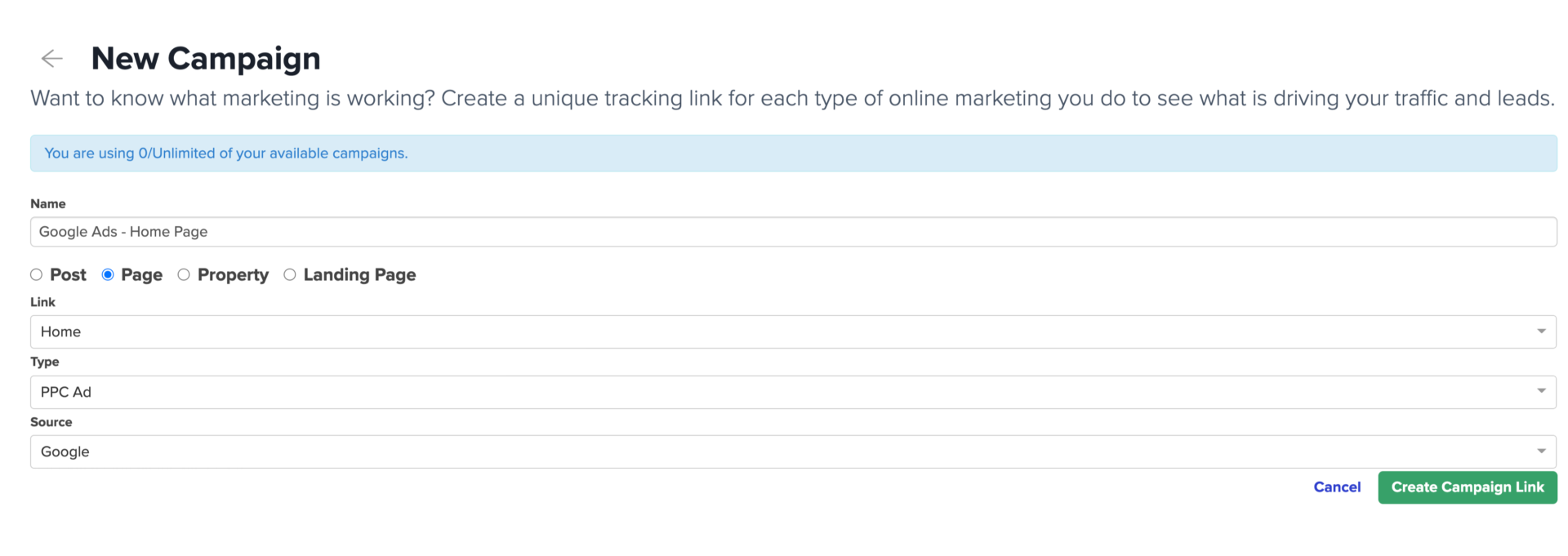
Campaign Tracking Links Learn how many leads you generate with your ads by following the conversions from them. Easily see which campaigns produce results and create a link to track click-throughs and leads better.
CarrotCamp CarrotCamp is a place where people come to get inspired by other entrepreneurs, hear first-hand stories about how they built their successful businesses and strategies for success. The knowledge Beau has gained from meeting these individuals has been essential in helping him grow his own real estate investing business.
The results:
Beau has been successful in implementing an Evergreen inbound marketing plan. He went all-in and began building his SEO content, which he followed up with PPC. Now he has a team and consistently closes inbound deals to grow his business.
He also knows how to scale his business using Carrot and inbound leads.
What about you? Are you ready for consistent and predictable growth in your business?
The Oregon-based real estate team uses Carrot’s training and resources to gain clients online within their community.
Snapshot:
Industry: Hybrid – Agent and Investor
Location: Eugene, Oregon
Year founded: 2012 Real Estate Agent – 2017 Real Estate Investing
Robert and Ricky Grand are hybrid real estate investors and agents in Eugene, Oregon. After finding success in the retail market in 2017, they decided to pursue investing, fueled by a desire to work on their own time and spend more time with their families.
Now, they’ve built a team that includes, for the first time in a long time; they feel clarity and peace of mind about where their business is headed.
“…I used to think aesthetically pleasing sites were mandatory. It had to look “cool”. It’s just not true. If you have the content and information people want, they will use your site. Carrot gave us the framework for our site and content, but it’s up to us to change it enough to add our uniqueness to it.
I’m 100% all in with Trevor and Carrot. They know what they are doing. Yes, they are a business with the goal to be profitable, but these guys care and are totally on our side.
Honestly, working with Trevor and his team is refreshing. I trust them and don’t second guess anything. If Carrot gives us feedback, we implement it without wondering if there is a catch.
Hope it helps to hear it from someone who is a customer. I happily spend the money to work with them.”
– Ricky Grand, Grand Real Estate Investments
The challenge: Marketing his business was difficult and produced unpredictable results.
Before joining Carrot, Robert worked as a fireman and real estate agent. Ricky worked a 60-80 hour per week job in finance. In fact, from 2012 to 2017, Robert mainly relied on word of mouth and did business with no website. That was the problem.
He was relying on unpredictable leads to come to them. That’s a hard strategy to scale.
So, after listening to a few CarrotCast episodes, he realized that to grow, they’d need a website. Carrot was one of the only companies that he truly believed in that would accomplish their goals.
They started working on their first website, trying to figure out SEO and understand online inbound marketing.
Slowly, they’ve grown their business from $100-300K to the $600K range and reached the seven-figure mark. They’ve also continued to build upon their strategy with Carrot by moving to a customized website and rebranding to GREI House Buyers, allowing them to expand business opportunities into other areas in Oregon.
That’s when they discovered the power of Carrot:
Search engine optimization
Predictable lead-flow
Consistent business growth, allowing him more time for the things that matter most in life
That’s precisely how they use Carrot.
The tools: Carrot features
For Ricky and Robert, Carrot is the central hub that combines all their marketing efforts. They’ve been running Facebook and Google Ads to drive traffic to their site in the short term while leveraging Carrot’s easy content marketing tools and strategy to build their Evergreen SEO for long-term lead generation.
Since they’re driving traffic from all marketing efforts to their Carrot sites, they can track performance across all campaigns and channels, giving them the clarity and comfort needed with their marketing strategy.
Here’s how the Grand Brothers are using Carrot as the hub to tie together the marketing efforts they were once doing on their own to become the authority in their area:
Training & Resources Robert says they would be lost without all the content and resources Carrot has created and the support we’ve shared to help them build their agent and investor strategies.
Automated blogs Carrot’s pre-written automated blog posts prevent them from having to write their blog posts. This saves them time and money, and they have become the authority in their market with their content.
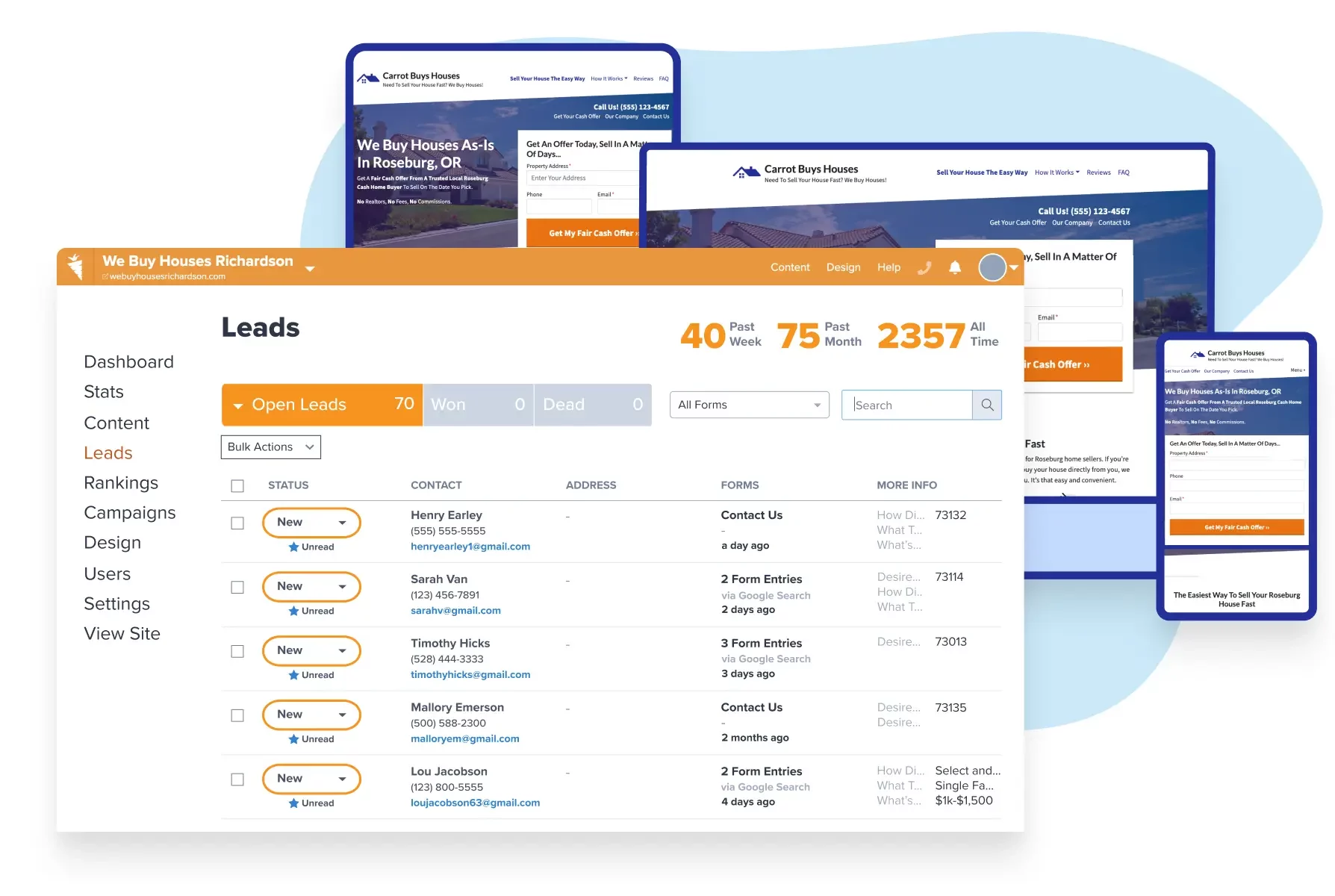
Lead Manager They send traffic from all of their marketing channels to their Carrot sites and can track the performance of their marketing campaigns. Instead of guessing, they can access leads via the leads dashboard to know exactly where the lead came from and where they can maximize their marketing efforts.
City-specific Landing Pages They can niche down marketing with hyper-targeted city pages that allow them to beat the competition and improve SEO rankings for people searching to sell in specific locations.
CarrotCamp CarrotCamp is a unique mix of lifestyle, masterminding, and implementation.
The knowledge they’ve gained by meeting other entrepreneurs who share their experiences and strategies is an essential piece to their success.
“Hey Trevor and the Carrot Team,
I can’t say enough how thankful I am for the Carrot Team!
You guys are all amazing and truly care about the success of others. It is really inspiring for us to keep going with your support.
CarrotCamp was the best mastermind event I have ever been to!
The unique abilities of all the Carrot team and the willingness to answer questions to help give us more clarity in our business is amazing.
The power of the Carrot culture really hit me after arriving. I thought it was pretty great but reflecting on the environment, I’ve realized it’s truly something special.
Culture can be envisioned by one person but it’s carried out by a great team of people who truly believe in it.
I can’t wait to come back to a future CarrotCamp to connect even more with everyone as well as other great investors. Thank You!”
– Robert Grand, Grand Real Estate Investments
Personalize Website with Carrot’s Concierge Service Robert chose to take advantage of Carrot’s concierge service to create a website that looks different than anyone else in their market. They worked with our team to dial in personalization and saved time to focus on running their business.
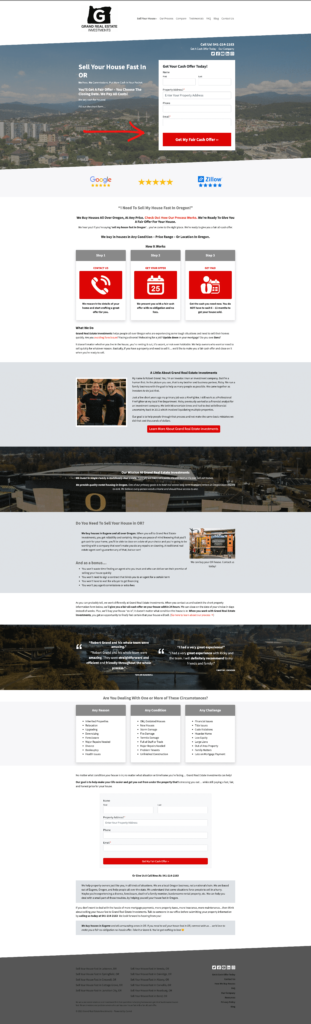
Scroll to see the whole Grand Real Estate Investments website…
The results:
Robert and Ricky have been successful real estate professionals. But it wasn’t until they went all-in with online marketing and began learning more through networking events and CarrotCamp. This education has helped them grow their business, hire a team, and create predictable lead flow.
“2 years ago I set out to transform my business into a more agile business. We became Investor Agents. At the time we realized more and more agents were flooding the market, which was a sign of a peak. Instead of fighting for market share as Realtors we added investing. Investing in Real Estate was our true passion anyhow. It was an easy switch.
The hard part was wading through the mass amounts of information to get us there. We found carrot and signed up. I remember thinking I just like the way these people think! I like how the team at Carrot treats me and answers questions even before I purchased anything. Now I sit here 2 years later with a small and thriving business that I feel confident about even during this time.
We are moving forward with our projects and will continue moving down this path with doing real estate listings and buyer purchases and buying to fix & rent or sell. There are a few companies that I don’t see as just a product or service I buy. I see them as part of my team. I see them this way because of how they add so much value. Thank You so much Carrot!”
– Robert Grand, Grand Real Estate Investments
Now, they know what the future of his business holds, and he knows where he wants to take it. More importantly, he knows how to take it forward.
What about you? Are you ready for consistent and predictable growth in your business? Click below to learn more!
It’s like utilizing that website as your core for everything is the key. That’s definitely the key. But it’s so simple to use. It’s not like a regular WordPress site. I love the simplicity. I know how to do everything.
When it comes to real estate investor PPC for motivated sellers campaigns, there tends to be a lot of emphasis on the quality and content of landing pages to increase conversions.
Ready To Get More Leads & Close Your Next Deal? Take Your Business To The Next Level
Your landing page is crucial, but to motivate sellers to visit it, you must first persuade them to click on your ad.
The best landing page will do little good if a seller doesn’t see it.
So, how do you make your Google PPC ads stand out from the rest of the clutter on a Google search result page?
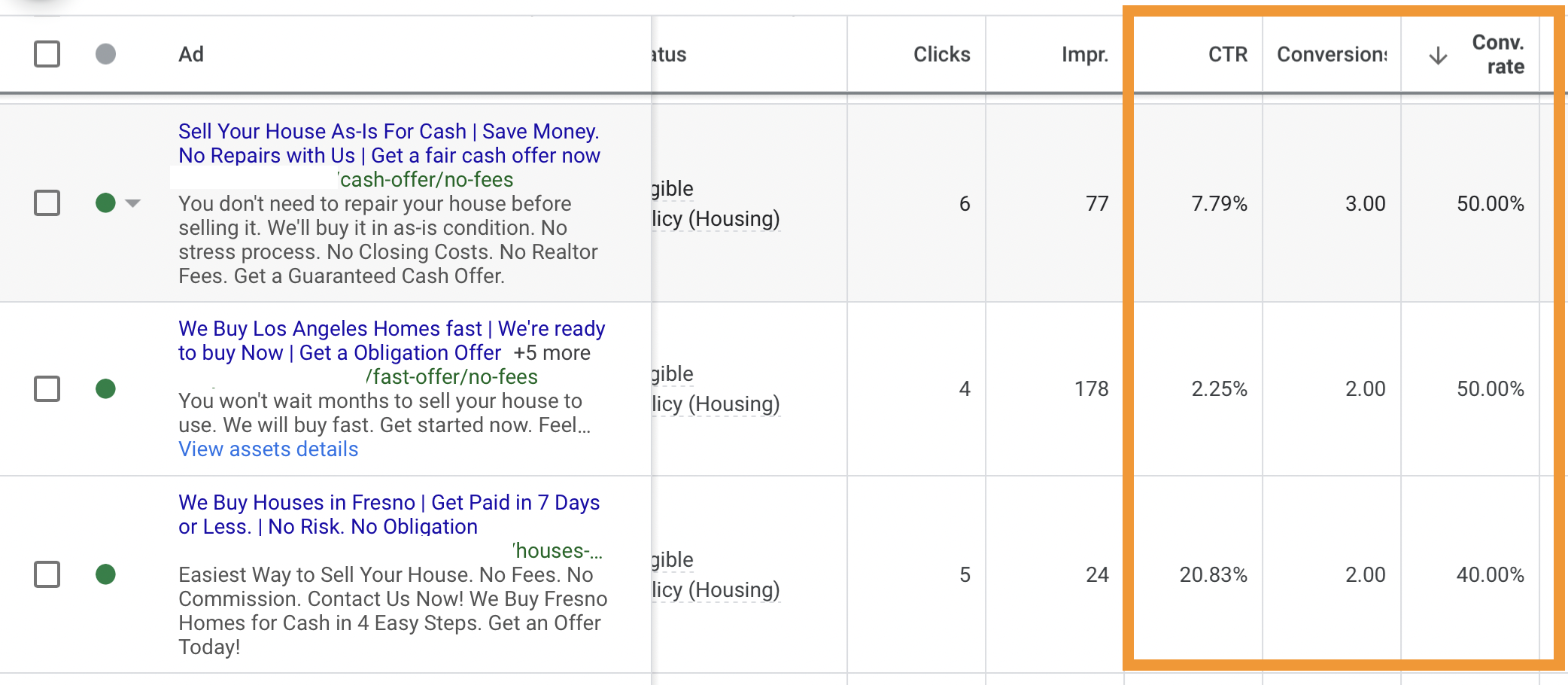
Based on the analysis of over 50 Google Ads accounts, we identified the top 10 commonalities with the highest click-through and conversion rates. Here’s a real example of a high click-through (17.39%) converting motivated seller ad (37.50%)…
After their Google search, that little ad has two to three seconds to grab the house seller’s attention.
You get a small headline and a very short amount of copy to convince the seller your site is worth visiting… and that you can solve their problem.
The better your ads perform, the more clicks you’ll get.
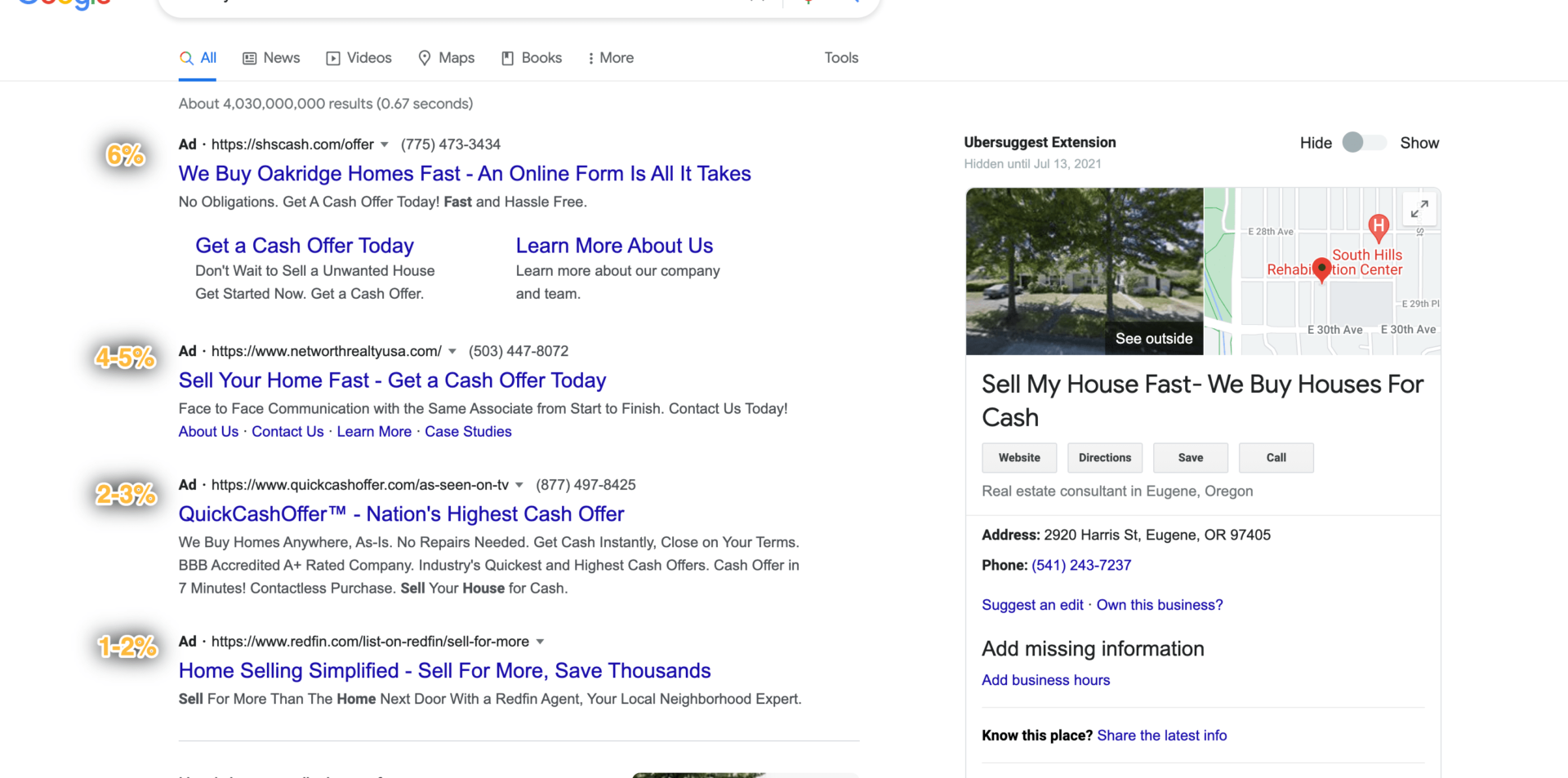
The Top 3 Google PPC Ads Get 2-6% click-through rates. Whereas ads 4 and below average 1-2% On A Google Search Result Page
10 Techniques for Creating High Converting Motivated Sellers PPC Ads
As quickly as possible, you need first to grab their eye; second, show them that you can likely help them, and relay a sense of credibility through the ad to make them feel great about clicking the ad to learn more.
Since you only have a few lines and seconds to relay all that, your ad headline and copy need to trigger an instant response.
Give motivated sellers a reason to click. Here are some practical and ethical triggers I use when creating PPC Ads for Real Estate Investors.
These triggers have helped to yield an average 5% click-through rate and an 18.2% visitor-to-lead conversion rate across Carrot PPC accounts that I manage.
People naturally interact with questions. Often that sense of curiosity piques our interest, and it creates an “open loop” in our minds to want to find the answer to that question. When asking a question in your ad headline, you’re triggering this curiosity and making your ad appeal to them personally. Here are a couple of ad headline examples where I used a question:
Other examples of questions you can pose are…
“Did your listing expire?”
“Need to sell quickly?”
“Is Your House In ?”
You get the idea.
Get creative.
2. If Possible, Use Humor:
Sometimes, this is a little harder in the real estate market. People like to laugh. If your ad headline makes them chuckle, they associate your ad with positive emotion. This creates a more receptive message.
A way to do that may be…
“Is Your House A Total Beater?” Sell As-Is. We’ll Pay For Repairs Get A Fair Cash Offer Today www.YOURURLHERE.com
3. Add Credibility
Call out a BBB rating or how long you’ve been in business. Increased credibility equals increased persuasiveness of the ad overall and strengthens your brand’s quality. This can lead to a higher click-through rate.
4. Go Regional:
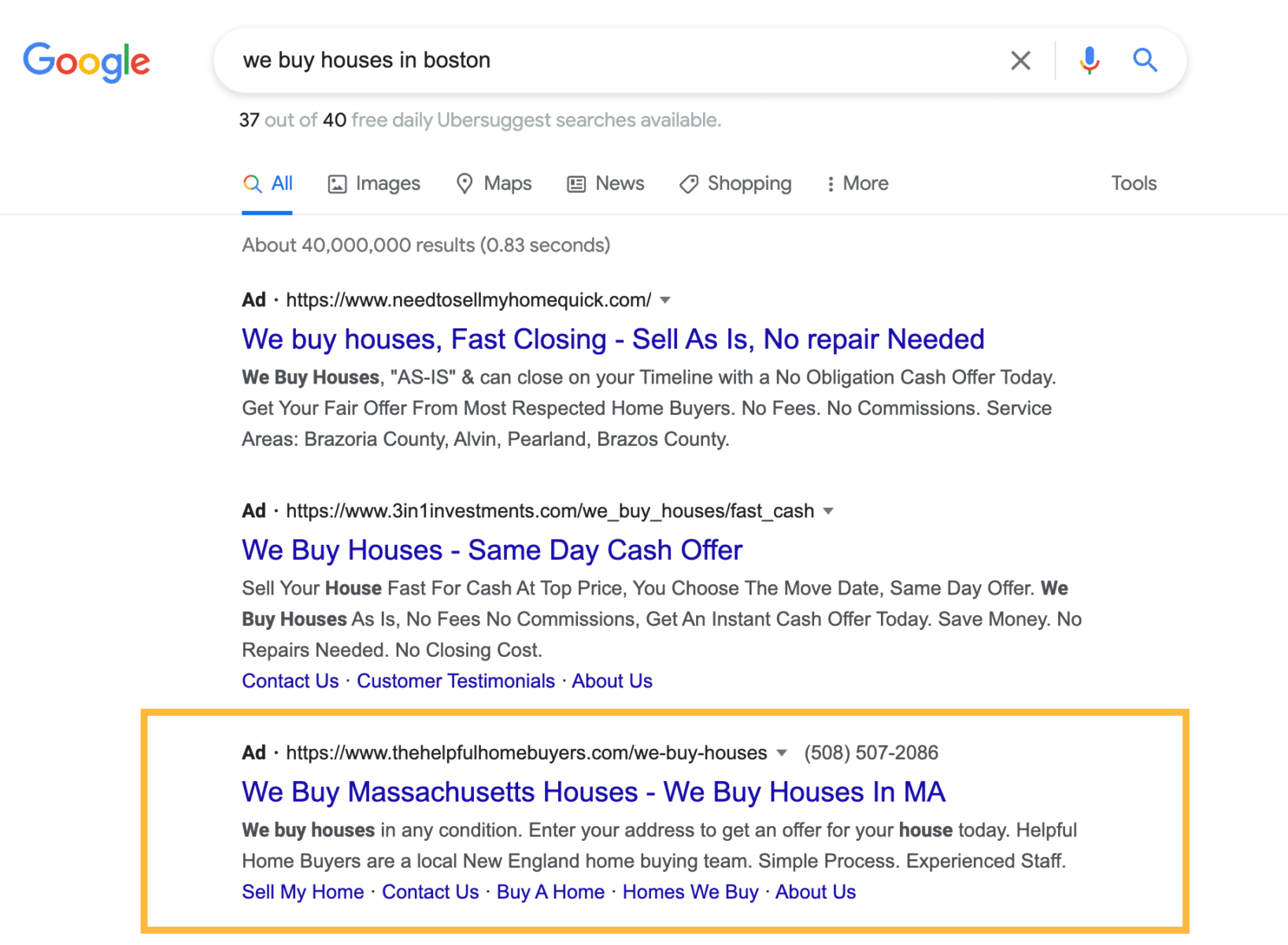
Depending on your campaign’s demographics, using regional triggers in your ads, such as city or state names, often pays off. Sellers will automatically relate to the area and build more trust seeing a loc ad. Couple that with a local-looking domain name or URL, and that’s even better!
5. Use Power Words:
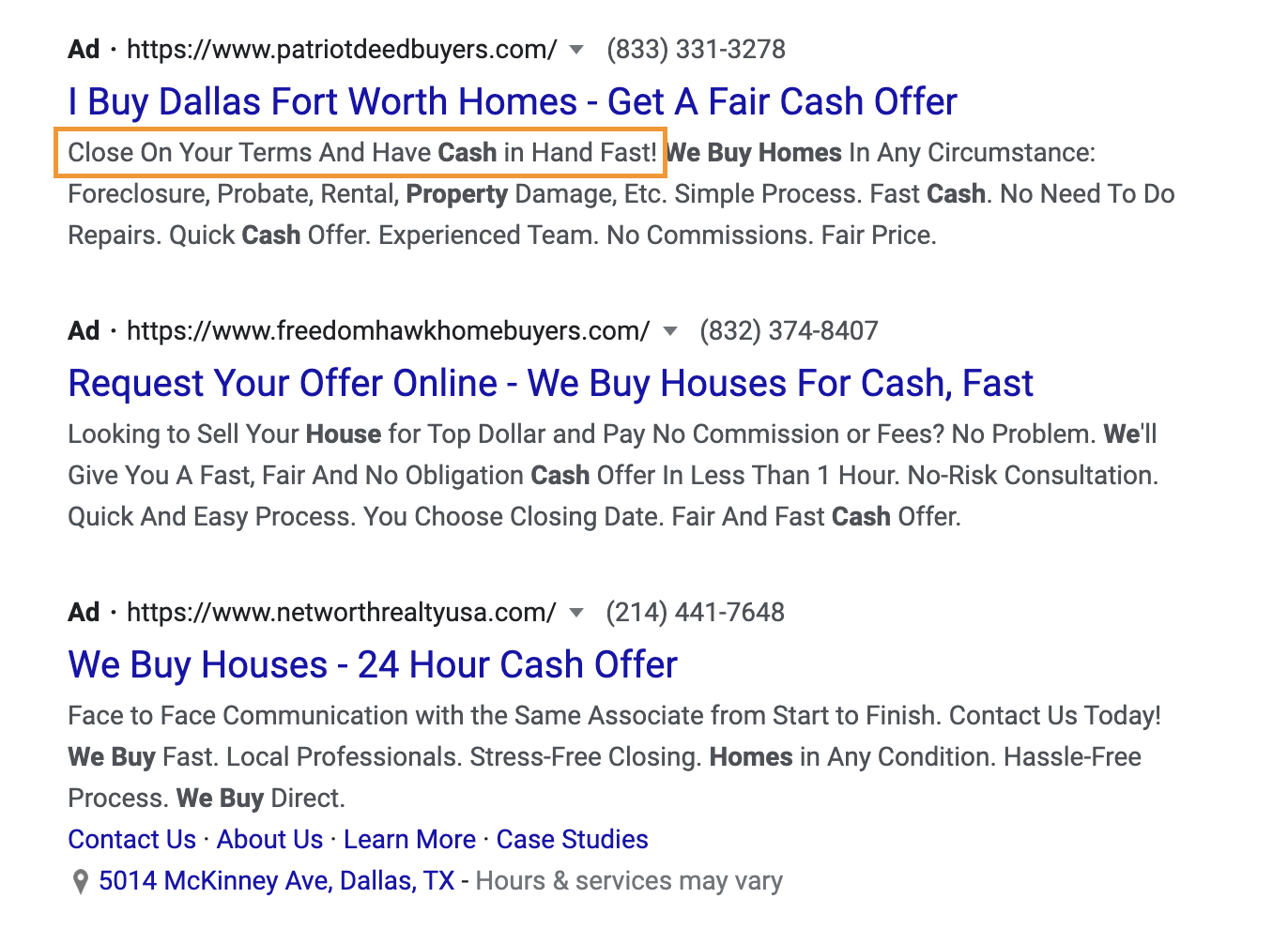
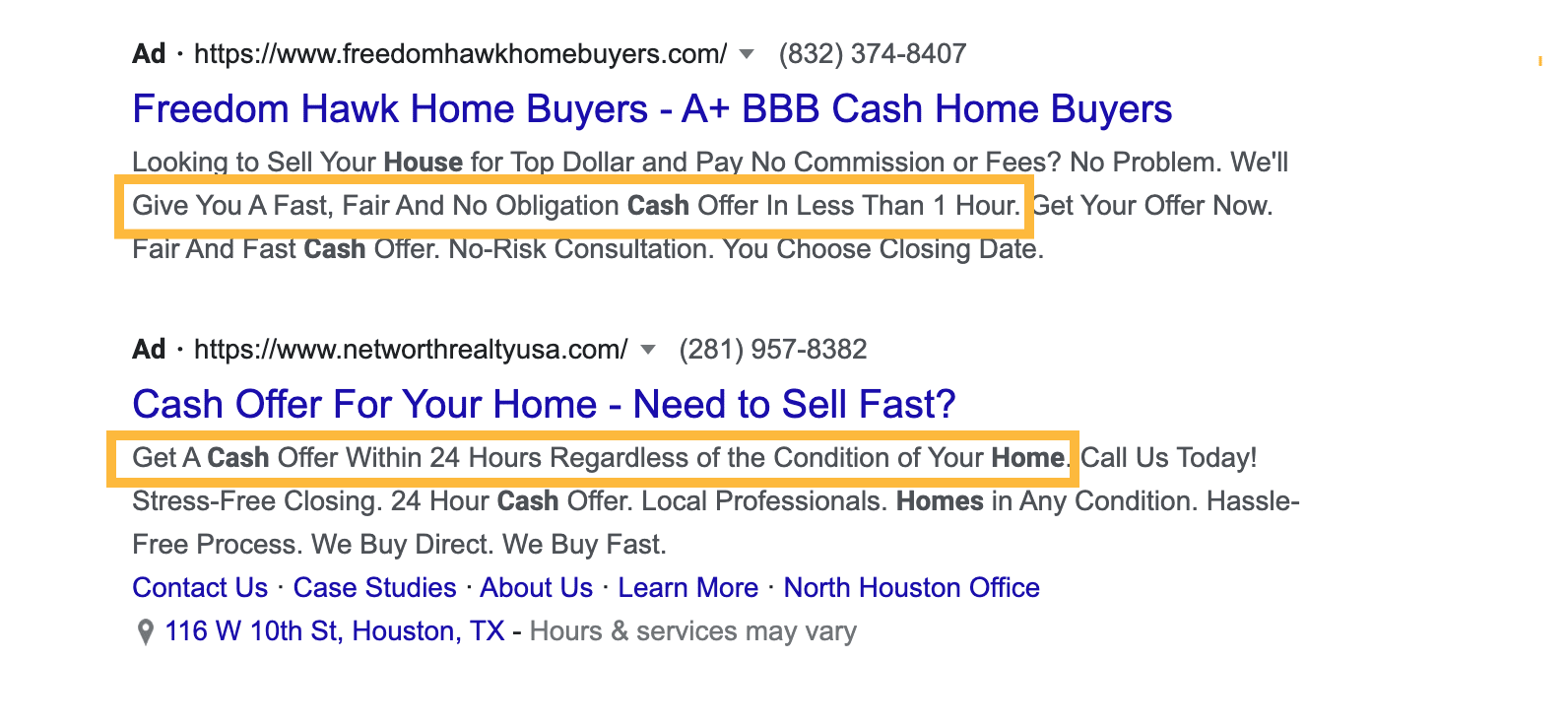
Several keywords are known as power words. These words are proven to attract attention and sales. They include words like highest, free, fast, super, fair, now, must save, expert, local, limited, and so on. Create a sense of urgency.
Some ways to use some of those powerful words in your ads include…
“Sell Your Boise House Fast”
“Get Your Fair Fast Cash Offer Today”
“Save time and money. Receive an offer today”
“If You Must Sell Now, We Can Help”
And so on.
Again, get creative and test things out.
6. Mention Guarantees:
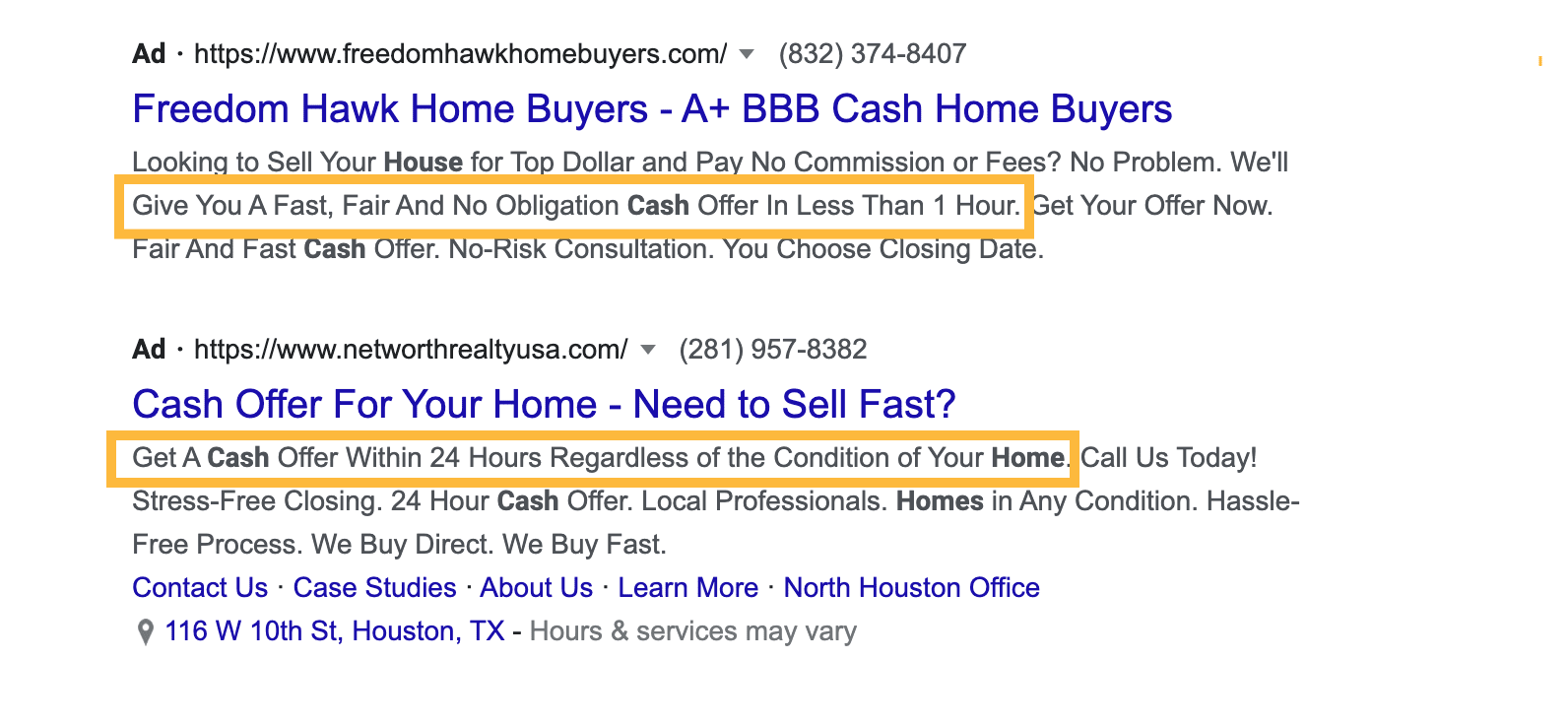
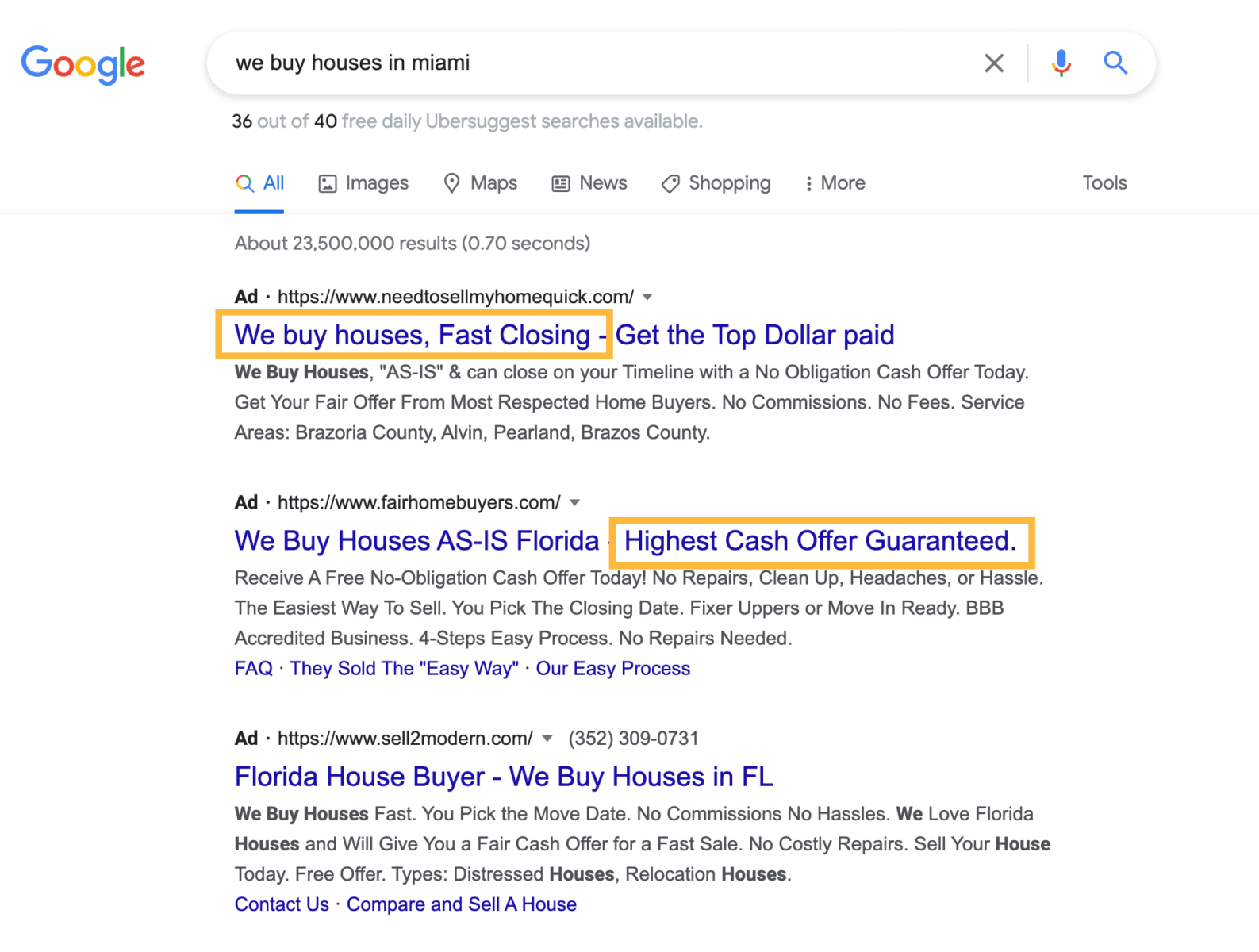
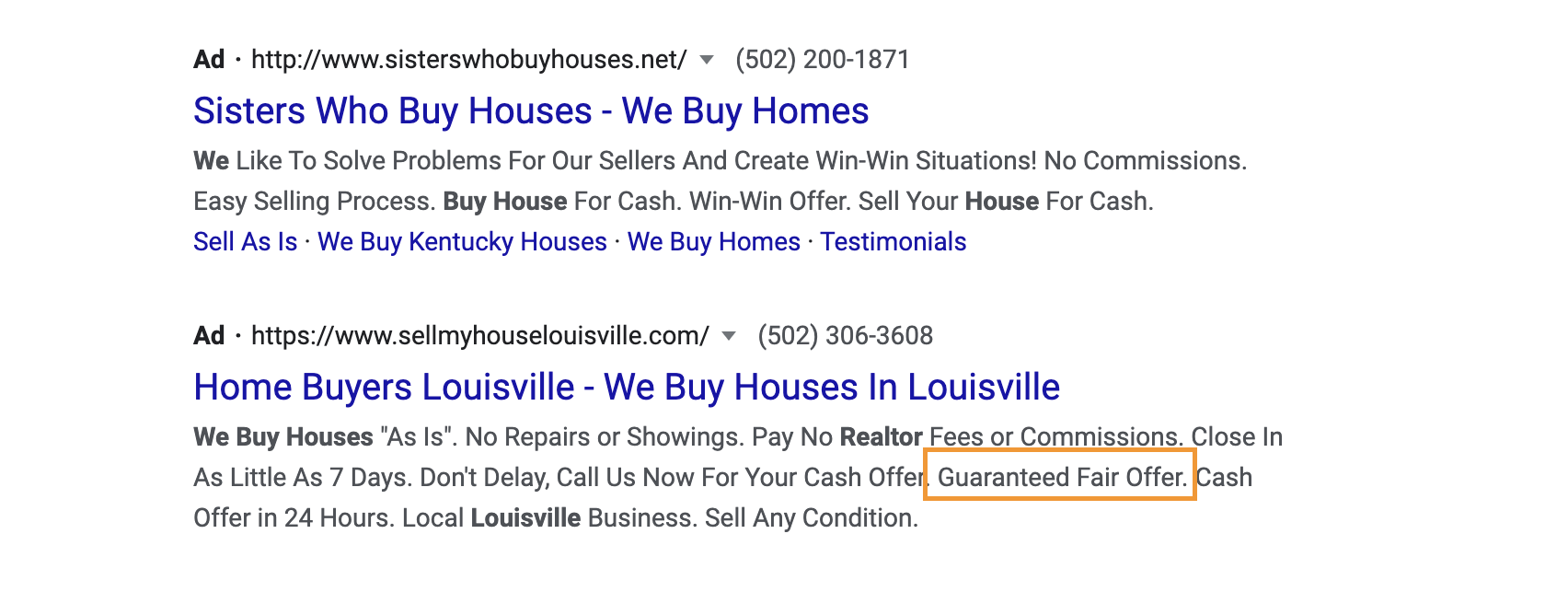
Guarantees are mentioned in an ad, such as a guaranteed cash offer or a guaranteed offer in 24 hours.
Here’s a quick disclaimer, but never guarantee anything you can’t 100% confidently fulfill.
Don’t guarantee the “highest offer” in the market unless you’re ready to do that.
Don’t guarantee to “close in 7 days” if you can’t do it.
Capiche?
7. Use Personalization:
Similar to ads asking a question, ads that specifically address the audience are much more likely to gain attention. Such as the title Facing Foreclosure?
Here are some other examples…
In Divorce? Sell Your House Fast Avoid costly broker fees. Sell In 7 Days Or Less. Receive a fast – fair cash offer today
Inherited A Boise House? Cash It Out Trade that house for cash today. Receive a fast-fair cash offer
Are You A Tired Landlord? We’re buying local rental houses Get a fair-fast cash offer today
Get creative.
Now… with that said, if you’re going to personalize your ads, you need to make sure you’re also putting these ads in front of very targeted searches. You won’t want to serve up a “tired landlord” ad to someone searching “sell my house fast” or “we buy houses.”
But you may want to test it out to someone searching “tax consequences of selling rental property” or “selling a rental property“… and targeting it to the locations you would buy.
8. Use Benefits + Story:
Searchers are good at recognizing advertising and blocking it out. So your ads can become more effective if they have a storyline and appear less like an ad.
Also, ensure your ads sell the benefit the homeowner will get by working with you. Too many people just mention the service… “we buy houses, “… “local home buyer,” etc. But the benefit they’ll experience is what they’re after.
A fast sale.
Cash in their hands quickly.
Avoid agent fees.
Avoid stress.
You get the idea.
Some examples…
David Sold His Boise House Fast He avoided agent fees and stress. See how you can to today!
Sell Your House Fast-Cash Need to Sell Fast? Close in 7-Days. We buy houses nationwide, No Cost!
Sell Your Boise House Easily Fair Price – No Fees – No Hassle Any Location – Any Condition
Look at the benefits mentioned in those ads that the seller can get working with us.
avoiding stress
avoiding agents fees
no cost
sell quickly (who doesn’t want that!?)
no hassles
fair
I can sell my house fast and be done w/ it
Focus on the seller’s benefits, and you’ll be golden.
9. Use Emotion and Senses:
As well as personalization, your ads can appeal to the five senses of the seller: sight, sound, smell, taste, and touch. Here’s an example where they can feel the money in their hands.
10. Use A Strong And Clear Call To Action:
It is proven that ads achieve the highest click-through rates if they use a call to action. For example, “sell now,” “offer in 24 hours,” or “close in 7 days”… lay out the benefit they’ll get and how they’ll get that benefit with the call to action.
Additional PPC for Motivated Sellers Ad Copy Advice to Attract Sellers Online
Attract Motivated Sellers with Powerful Ad Headlines The ad headline is likely the utmost important element of your entire ad. It needs to grasp the reader’s attention so they will read the rest of the ad.
Include Intent Keywords To create higher converting headlines, include your keyword in your headline. Keywords have been proven to achieve a higher click-through rate. If a motivated seller sees the keyword they have searched for; your ad is more likely to seem relevant to them and encourage them to read on and click.
Effective PPC Ad Text to Attract Motivated Sellers Once the reader has been drawn in with a solid headline, the rest of the ad needs to persuade them to click on the link that takes them to your landing page, ad text needs to be as relevant as possible. Try to use your target keywords in your ad text and your headline.
Fill In-Display URLs With Keywords While your ad headline and text need to do the core job of convincing the seller to click, your display URL should support your message by logically representing your site. For example, if your ad link takes sellers to a page residing on www.webuy.com/get-a-cash-offer, the display URL should read webuy.com/get-cash-offer.
Use Ad Extensions
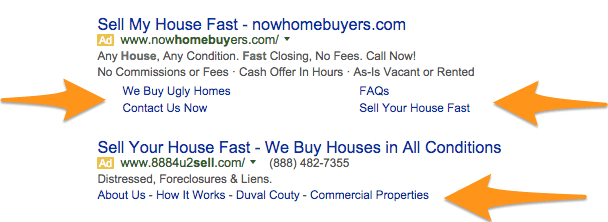
As we’ve mentioned in other PPC marketing posts on our blog, test using the ad extensions. We’ve found they can, in some cases, boost your click-through rate a lot… just make sure you have conversion tracking in place, so you know whether those extra clicks are turning into solid leads.
Conclusion
Getting motivated seller leads that convert through PPC or SEO is critical to your survival and growth as an investor.
In the end, conversions are about relevancy – does what you offer to match what they’re interested in, and do you clearly and quickly show them how you can solve their specific problem?
Sometimes it takes various A/B tests to determine what works for your market. Once you find it, keep doing it.
Try these PPC marketing ad ideas out, and let us know the results! One thing you’ll find is that testing new ad copy continually is one of the best ways constantly to improve your PPC marketing results.
Get to work… and let us know what you see works well for you with your PPC ads below in the comments section!
Sustaining success with real estate investor PPC can be frustratingly complex, and without being able to prove results, you can kiss your ad budget goodbye.
Before giving up hope, know that your PPC ads can ALWAYS improve.
Our members generated 62.64% MORE Paid Search leads in Q2 2022 over Q2 2021, and 26.12% MORE Paid Search leads over Q1.
Whether getting the highest ROAS you’ve gotten in months or stuck on a plateau, there are always ways to improve.
A little secret… improvements don’t need to be Herculean efforts.
You can get better results and do less.
We’re giving away the essential real estate investor PPC optimization strategies our PPC experts use to manage multiple members and increase lead volumes.
Here’s more proof…
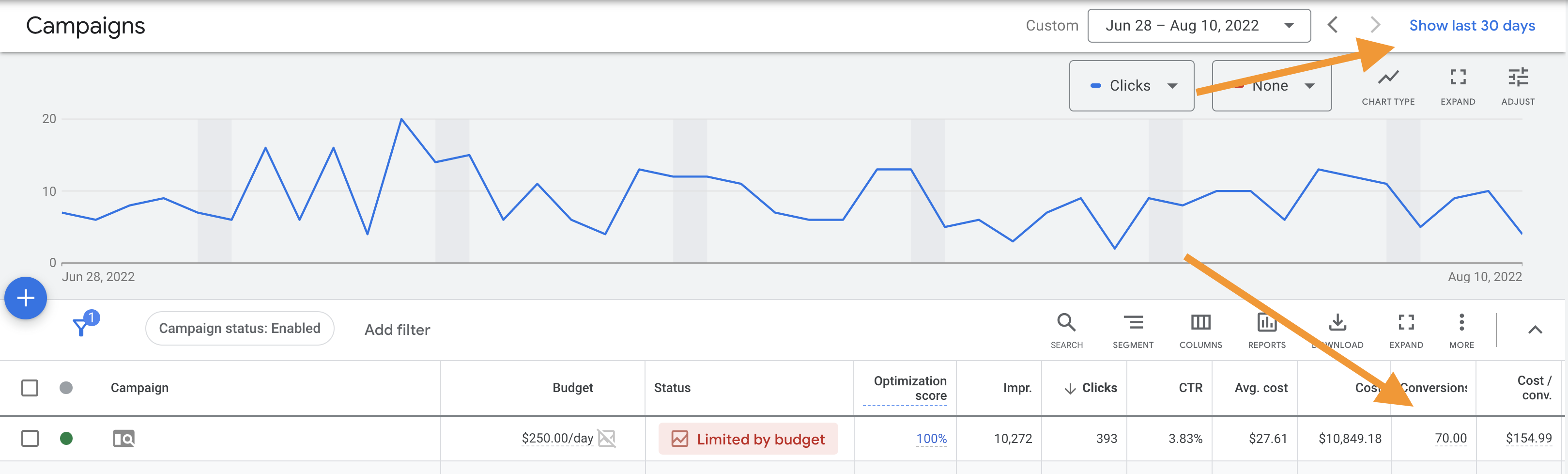
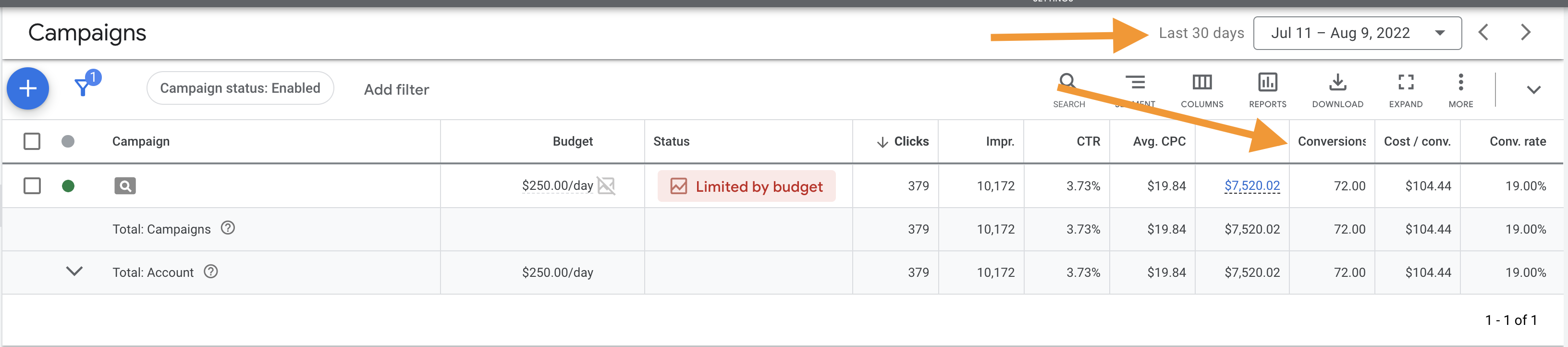
70 Google Ads leads in 30 days!
43 Google Ads leads in 30 days.
And… 72 Google Ads leads in 30 days!
I could keep going and going.
We work smarter, not harder. We’ll also tell you when these optimizations should happen so you know exactlyhow to optimize your real estate investor PPC campaigns and how often.
Your account is about to be the healthiest and strongest it’s ever been.
What is Real Estate Investor PPC Optimization?
Simply, Google PPC optimization real estate investors look at your account data and make changes to ensure optimal performance.
The digital marketing environment changes quickly. The settings and tests that upheld optimal performance last month (or even last week) might be working against optimal performance now.
Here’s an example. One of your keywords may have performed well for the first month, but when you look at your data from the second month, you see that it’s now driving up your cost-per-lead (CPL).
As part of your optimization regimen, you pause that keyword so your account will focus more on other keywords with lower CPLs.
Your optimization time is also when you become more informed about the secondary effects that your current settings, keywords, etc., have on your account.
Here’s another example. You have a keyword that’s doing amazingly well in lead volume and CPL, but when you dig into the search terms that your keyword is pulling in, you realize that they’re not relevant to motivated sellers. Suddenly all those unqualified leads that came in last week make more sense.
Routine optimization is the best way to ensure you’re pushing your performance in the right direction.
The Benefits Of Real Estate Investor PPC Marketing – Why Should You Do It?
PPC marketing is one of the first things we do when entering a new market to generate motivated seller, rent-to-own tenant-buyer, or cash buyer leads.
Instant Traffic: With real estate investor PPC marketing, you can have traffic and, hopefully, leads quickly, usually within 72 hours of launching a well-structured PPC campaign.
Easy To Target A Specific Prospect: One of the best ways to know that you’re targeting the right person is by getting your website in front of the people actively looking for solutions to their problems on Google. “sell my house fast in Atlanta” as an example. That person, of course, needs to sell fast… that’s a targeted prospect.
You Only Pay When Someone Clicks Your Ad: With direct mail, you fork out the money upfront to pay the printing fees and postage with no guarantee that your target prospect will even engage or read your direct mail piece. With PPC marketing, you only pay when someone clicks your ad and goes to your website.
Get Traffic Coming In While You Build Out Your SEO: SEO can take a while to rank well on Google for competitive phrases. So while you’re building up your SEO… you can get traffic and leads today with PPC.
Easy To Measure: If you set your account and campaigns up correctly, it’s pretty darn easy to measure what’s working and not.
We know that PPC marketing can be effective for real estate investors… but you may be asking… “How hard can it be to optimize it? And why do I have to optimize stuff after I get my campaign setup?”.
Well… if you’re not tweaking and refining your Google PPC campaigns to cut out the keywords that aren’t turning into leads and continually optimizing to increase your return on investment… you may as well light your money on fire because a non-optimized PPC campaign is doing just that.
So let us dive in and optimize that PPC marketing campaign.
20 Steps To Optimize Your Real Estate Investor PPC Campaigns
What tasks can you do to optimize your campaigns? What should you look for?
Knowing what to look at, when to look at it, and how to interpret and form solutions around what you’re seeing can be one of the most challenging things to learn for new Google PPC users.
I’ll be honest. It can even be challenging for experienced users at times.
There are so many elements to look at in Google Ads. Metrics, bids, bid adjustments, settings, search terms… the list goes on and on.
Let’s narrow down that list and focus on optimizations that maximize your time spent on the account. You don’t want to be wasting hours and hours looking for optimizations to make on just anything, so invest your time optimizing things that will make more of a difference in the account. You can use an employee scheduling apps to help you understand where you spend more time and optimize your work.
Ultimately the most valuable optimizations tend to be those that push the account for more results that are valuable to you, like leads. We’ve got 20 of those that can help.
1. Select Your Advertising Platform:
Of course, before starting real estate investor PPC marketing, you must decide what platforms you’ll use. We always suggest starting with Google Ads because over 90%+ of all real estate investing leads we pull in through PPC are through Google Ads. The rest is through Yahoo and Microsoft (Bing) PPC. So, dive in and start with Google Ads! Then add on Bing and Yahoo Search Marketing as you go.
With that said, it might also be beneficial to consider non-traditional platforms for your real estate PPC strategy. According to Stewart Dunlop, Founder of PPC.io, “LinkedIn is emerging as a key player among ad platforms for B2B marketers. Its prowess in providing authoritative business knowledge is resonating more than others like Twitter, and in the last few years, this has led to significant improvements in the performance of LinkedIn ads.” As such, while you begin with Google Ads, Bing, and Yahoo, you may eventually want to explore opportunities LinkedIn advertising offers.
2. Define Your Goal:
The most prominent mistake investors make when they start their PPC marketing campaigns is… they just start. They launch a campaign but don’t define clear goals for what they’re trying to achieve. “Get more leads” isn’t a goal. Make your PPC marketing goals clear and straightforward. “To generate motivated seller leads at under $260 per lead”. That’ll give you a good goal to shoot for so you know whether your campaign is even successful.
A good goal to start with is defining the cost per lead you’re aiming for and the return on investment you want to get over the long term.
For most investors, a cost per lead of under $200 is solid.
The further below that, the better. And as for return on investment… maybe a good start is to close your first deal from your PPC seller leads within the first 3-4 months… then ramp it up from there.
You just have to remember that most PPC marketing campaigns don’t start profitable. It’s the optimization process that makes your PPC campaign profitable as you go… and that can take 1-3 months to hone down a campaign… and ongoing work from there to keep that consistent. As long as you can make it through the initial optimization phase (the first 1-3 months), your PPC marketing should be profitable for you over the long run.
3. Research Your Target Audience:
Use the Google Keyword Planner to help you discover what your target audience is typing into Google. It’s crazy the insights you can get in there for how your prospects think and search for solutions to their problem. Then serve up ads in front of the keywords that you can help them the most.
Before you launch ads, know who your target audience is.
What problems or needs do they have? What are they searching for on Google? What solution are they looking for? What words do they use in their searches? Take all of this info and use it to help build out your keyword lists, ads, and landing pages.
4. Do Proper Keyword Research:
Doing your Keyword Research is one of the essential parts of your PPC campaign.
Use tools like Google Suggest, the Google Keyword Planner, Term Explorer, etc.
A big mistake that we see real estate investors make with their PPC keyword research is they aren’t looking at the searcher’s intent close enough.
For example, a seller types in the search phrase “House buyers in Dallas“.
Many people would look at that and assume that the person is looking for a company to buy their house. One of those “house buyer” companies. But… what if they’re searching for retail house buyers in the Dallas area?
If you’re a wholesaler or flipper with an ad up for that keyword and the house seller clicks on your ad… they may quickly realize that you can’t help them. Those types of keywords with mixed intent can cost you a lot of money.
So pay attention to your data and ensure your keywords’ intent focuses as much as possible at the start on the exact people you can help.
This will help you avoid wasting money.
5. Use Negative Keyword Lists:
A “negative keyword” is a word that you can tell Google or Microsoft to look for… that if it shows up in a search… to prevent your ad from showing up to that person.
For example, let’s say you’re a wholesaler or house flipper and you need to buy at a discount. So you may want to add a negative keyword for something like “full retail” there to prevent any searches that have “full retail” or “full price” in them from showing your ad.
Why? Because this type of person likely isn’t going to sell at a discount. So if someone types in “sell my house in Dallas at full price, ” your ad wouldn’t appear.
This can keep you from paying for clicks on your ads where the prospects wouldn’t be your ideal client.
A big mistake most people who are new to Google Ads is that they throw all their keywords into one ad group in their PPC account.
Heck, I did when I launched my first PPC marketing campaign.
But an effective way to optimize your ad spend and drive down your cost per lead (also to better target your ads to specific targets) is to create separate ad groups based on a common theme.
Here are a couple of examples:
Notice We Have Ad Groups Setup For Different Types Of Keyword In This Campaign
Then within each ad group is a slew of keyword variations, ads, etc.
As another example, you can use broader ad groups with more keywords within each group…
Years ago, this approach didn’t work as well as it is now, given the shift to responsive ads. Responsive ads allow users to include keywords in different headlines within one ad, therefore, having a positive impact on Quality Scores.
7. Write Killer Ad Copy:
Lots of people say that phonebook advertising is dead. It will be extinct someday, but people have been saying that phonebook advertising doesn’t work for years and years. (even back when people used phonebooks ;-).
The reason is that local company after the local company would say… “Hey, I need a phonebook ad.”
Then they’d look through the phone book and see what their competitor’s ads looked like… they’d mock up an ad similar to theirs (because that must be working, right?) and put it up there. Then they’d complain because they weren’t getting any calls from it.
But here’s the key, it wasn’t the phonebook that didn’t work… it was that their ad sucked.
It didn’t stand out from its competitors.
It didn’t give any compelling reason why they should talk with them vs. their competitors.
Real estate investor PPC campaigns are the same.
You can’t just look at what your competitors in your market are doing with their PPC ads and copy them. Why? Because you’ll risk being like all those companies over the years that fell prey to the “copy what my top competitors are doing” mindset that made everyone’s ads look the same.
Make your ads sell the benefit they’ll get by clicking that link vs. how cool you are.
Which ad below stands out? The “we buy houses” one focuses 100% on their company… not on how they can help the client. The client wants to know how you can help them know how cool you are. But look at the one on the top… I can quickly see how they can help me. Fast closing. No fees. Any condition.
8. Have Clear Call To Action:
Let me ask you a question.
What’s the best way to make a sale?
Well… what I’ve found… the best way to make a sale is to ask for the sale. That’s it.
Too many people try to dance around the subject and forget to clearly and confidently give their prospects a call to action that gets them closer to making a sale.
Take these ads below as an example.
Which one lays out how they can help me and gives me the most precise call to action of the 3?
Sure, not the 3rd one (the one outlined in Orange). That ad is too darn easy to just look past.
But the first one does a great job. It is clear (even has a specific price point), lays out the benefits, and says they have an exclusive rent-to-own listing. Cool… I’ll check that one out!
Tip: Their call to action could be more assertive by changing their “Sign Up Today” link to something like… “See Available RTO Homes” as our testing has shown works on our websites.
9. Create Effective Landing Pages:
The excellent high-quality motivated sellers or buyers from your PPC campaign won’t do you a lick of good without a landing page (or website) that performs well. You can see our conversion rate test blog posts we put out all the time where we show our members’ websites pulling in sometimes 20%+ more leads just with tweaks we make to their websites.
So don’t waste your traffic sending it to a low-performing website. Start doing conversion tests today (or have us take that off your hands by joining Carrot on our Content Pro plan :-).
10. Use Geo-Targeting:
Geo-targeting your PPC marketing campaigns is a no-brainer for real estate investors, mainly because real estate is such a geographically specific thing. If a person is looking for “rent to own homes in Ottowa Canada“… odds are they’re in Ottowa or are at least looking for properties in Ottowa.
But not everyone uses the location in the actual search phrase. Some people may type “rent to own homes,”… and Geo-Targeting is precisely how you get in front of those in the areas you want to target.
This will help increase your ads’ click-through rate (CTR), increase the conversion rate on your landing page (if you send them to a city-specific landing page), and help you cut down on wasted ad costs.
11. Utilize the Search Terms Report:
What is the Search Terms Report?
The search terms report will show the search queries that people are typing into Google to trigger your Google search ads. You can see the full terms people type in and the targeted keywords matching each search term. In addition, you can see statistics for each term over a certain period.
How to Use the Search Terms Report
You want to use the Google Ads Search Terms Report to find the top search queries when your ads show. The data you can find will be beneficial, and it is a report that advertisers should view weekly. Here are three best practices below when using the search terms report.
Add Negative Keywords
If you find terms that are not converting or unrelated to motivated sellers, you can exclude them altogether. You can click on the box next to the search term and click the ‘Add as negative keyword’ link at the top.
You can add the negative keyword to the Ad Group level or Campaign level or add it directly to your Negative Keyword List.
Find New Keywords to Target
The Search Terms Report contains some of the highest value data after you run your campaign. If you have an ongoing campaign, you can look at the report weekly and use it to drive more conversions at a lower cost. When you target keywords, seeing the search queries that people type before seeing your ads can be beneficial.
Google has this free thing they call “Ad Extensions.” This lets you add little links below your main ad to other spots on your website, like your “Fair Cash Offer” page or “How It Works” page as an example.
Bit’s of content your prospect would value that will help them make their decision. These do help increase the number of clicks you’ll get… just make sure you’re sending them to pages on your website that are set up to convert them into a lead.
Use the Google Ads Ad Extensions to grab more space on the page to get me to click the ad. Sold! I’m clicking that link!
13. Evaluate Quality Score:
Google Ads has this thing they call the “Quality Score“. There are all kinds of quality scores that Google looks at.
From an account-wide Quality Score that Google uses behind the scenes… to Quality Score for your landing pages, ads, and so on.
The quality score on your end is the easiest to control on your landing pages, ads, and campaigns.
Your landing page,s Google looks for “relevant and original content, transparency, and navigability.”
In other words… look like an honest company with real people behind it who care… and make your website easy for people to get the information they need.
Include things like a Terms of Service, Privacy Policy (all Carrot sites have by default), and content that matches your ad’s promise. Always try to improve your Quality Score… as we’ve found that the Quality Score is directly tied to improving your click costs in many cases.
14. Remove Ads With Low CTR:
One of the ways that Google adjusts which ad will show up wherein the ad positions on a Google search is the CTR… or click-through rate.
Ad Rank = CPC bid × Quality Score.
If the ad in position #2 is getting a CTR of 7% and bidding $2 per click… and the #1 position ad is getting a 4% CTR and bidding $2.50… Google may show the ad bidding only $2 per click in the #1 position because of its higher engagement with the searcher, as indicated by the CTR (click-through rate). Google makes more money this way because more people are clicking on the ad, the user wins because the ad is more compelling, and you win because you’re paying a lower cost for the same clicks because of well-performing ads.
If you have ads or landing pages with a low-quality score, Google may prevent them from even showing in the results. That’s how vital optimizing for quality score is.
So make sure to go through your account consistently, remove your ads that aren’t performing well, and launch new ads to improve your CTR every month. This will help you continually improve your click cost and hopefully result in more leads at a lower cost.
Most leads at a lower cost is a good thing :-)
15. Review the PPC Recommendations:
“Ad Recommendations” is a tool Google Ads provides to you. This score measures how well your account follows best practices for setup in Google’s eyes.
The hope is that by giving you a set of recommendations based on your account’s performance, you’ll be able to make changes to your account that will improve your campaign performance.
Recommendations may not always be the best direction for your Google Ads campaign.
Here are the common recommendations for a motivated seller campaign:
Budget
Remove Conflicting Negative Keywords
Add Broad Match Keywords
16. Focus on the “Right” Metrics:
Focusing on the right metrics is essential for a healthy real estate investor PPC account.
Impressions are important for brand recognition and can help you understand which terms motivated sellers are searching.
Yes, the more clicks, the more opportunities you have to convert visitors into real leads. These metrics are important but do they help you make decisions that can influence your results?
Many investors focus on these metrics when they should focus on other, more important ones.
10,000 impressions won’t add a dime to your bottom line if nobody clicks on your ads.
5,000 clicks don’t put more money into your pocket than 500 clicks if nobody is converting.
It’s the conversions that matter more than the clicks or the impressions. Conversions are what puts more money in your pocket, not the other stuff.
How to Fix It?
While you should be paying attention to all of your metrics, resist the temptation to focus on vanity metrics alone. If your conversions aren’t increasing, you won’t be making any more money.
17. Increase Bids For Top Performing Keywords:
This tip is assuming you’re using the “manual” bidding option.
Once you’ve had a chance, ensure your Quality Score is solid. You’ve paused non-performing keywords… find the ads and keywords that are performing well (performance should be decided upon ONLY by the conversion of quality leads on your website or phone calls from those visitors… NOT by clicks), and increase the bids on the keywords that are performing well.
Some people may be thinking… “Well, what should I bump my max daily budget up to and my click bid?”
As much as you can pay to still bring the results you want.
One of the quickest ways to increase your lead flow on a campaign that is already pulling some leads is to increase your daily ad spend. Then if you’ve maxed out the number of clicks you can get on that daily ad spend with that bid price… bump those bids up and test to see if the results still hold firm with a higher per click bid price.
This is why it’s important to never “set it and forget it” with your Google Ads campaigns while in the optimization phase.
18. Identify Non-Performing Keywords and Pause Them:
Then work through the campaign, find the keywords that aren’t performing well, and pause them.
Since real estate is such a high-profit margin product…1 closed deal can flip an entire real estate investor PPC campaign around to be from in the hole $3,500 to a $10k profit. So don’t quit too early or count specific keywords out too early.
But if you keep seeing a bunch of money being dumped into a keyword and it’s not converting into leads as it should… put a pause to those once you’re confident they’re not going to be good keywords for your campaign to focus on.
This is the #1 way that most do it yourself that we see doing their real estate investor PPC marketing can save a lot of money and headache… and sometimes cut their ad cost in half… is simply by pausing keywords that just aren’t performing.
19. Optimize Your Bid Management Strategies:
Your bidding strategy is determined at the campaign level. There‘s one manual option and four automated options.
Manual CPC
Manual bidding is an excellent place to start with real estate investor PPC bidding. You set your bids manually at the keyword level, and that number never changes unless you choose to update it manually.
Manual CPC gives you the most control but doesn’t take advantage of Google‘s machine learning.
Automated bidding strategies
Automated bidding lets Google do the heavy lifting. It tends to work best with campaigns that have been active for a while and have enough data.
Maximize clicks: With this strategy, Google automatically sets your bids to maximize the number of clicks you get on your ads. You can set a maximum CPC for bids to ensure that Google doesn‘t overspend. Although, if you don‘t enter a bid limit, Google will try to get you as many clicks as possible without going over your daily budget. I recommend setting a limit. If you don‘t, Google will spend your entire daily budget whenever possible, even if the clicks are too expensive.
Maximize conversions: Similar to maximizing clicks, but for maximizing conversions. You can set a target CPA (cost per acquisition or lead) to help guide its bidding. For this bidding strategy, you must have conversion tracking set up correctly. If you don‘t, you can still select Maximize Conversions, but Google won‘t have any information to make good decisions. In a worst-case scenario, you can severely overbid for traffic Google thinks is converting and burn through your budget.
Maximize conversion value: This bidding strategy is a bit more complex than maximize conversions and requires more setup. In addition to tracking conversions, you‘ll have to assign a value to each type of conversion. If one conversion type makes you an average of $5000 and another makes you $20,000, Google will prioritize the higher-earning type when possible. Typically this option isn’t the best for the best real estate investor PPC but is suited for e-commerce stores.
Target impression share: Target impression share maximizes your real estate investor PPC ads’ chances of appearing on the search page. You can select a percentage impression share you want to target and choose where you want to appear on the search page. This could be the top of the page, anywhere on the page, or the absolute top of the page. Setting a maximum CPC keeps Google from overspending. This strategy is best for campaigns focused on brand awareness. You want your ads to be shown as much as possible, even if you don‘t get a high CTR or conversion rate.
20. Make Sure Conversion Tracking Is Set Up:
Easily 8 out of 10 real estate investors and agents I talk to doing their own PPC go silent when we’re on the phone, and I ask them if they have conversion tracking on the campaign.
Conversion tracking is a simple thing you enable on your Ads campaigns by getting a little piece of code from your Ads account (here’s how) and putting it on your “conversion page.” Your conversion page is the page your visitors will see after they opt into your form.
For example, on Carrot, we have our streamlined “2 Step Lead Qualification Process“… so we make it easy for our users to put the conversion code on those “Step 2″ pages. It takes about 15 seconds in Carrot.
Even with our built-in LeadSource Tracking feature (where our system will tell you if your leads came from Google SEO, Google PPC, Facebook, etc… so you know what marketing is working), you can’t tell which keywords and specific ads inside your real estate PPC account produced those leads without setting up conversion tracking in your account.
Why Conversion Tracking Is So Important. You Can See What’s Converting Leads
Many investors say, “I’m getting leads, so it must work.”
But what if you knew exactly which keywords and ads were the ones pulling the leads and which ones were the ones just costing you money? You could drastically reduce your cost per lead just by turning off the keywords, costing you money but converting no leads.
Ready To Get To Work And Drive Those Leads With Real Estate Investor PPC!?
Real estate investor PPC marketing can be one of the most effective and fast ways to get your website in front of motivated sellers, cash buyers, tenants, rent-to-own tenants… and anyone else you want to reach.
But, it can take work, time, and experience to crush it with Google PPC marketing.
As the great Google Ads expert Perry Marshall once said…
“Make sure you know what you’re doing before you begin, or you’ll lose your ass. “
The real estate investors and agents you see consistently well with PPC marketing aren’t just throwing ads up there and hoping for the best. They’re not just throwing ads up and checking them here and there.
They follow these steps above (or as many of them as possible) to hone their PPC marketing campaigns to drive the most high-quality leads at the lowest cost per lead possible.
To put this all into perspective for you… the average wholesale deal right now nets $10,000 in assignment fees, and the average flip profit currently nets $70,697, according to RealtyTrac… so if you’re going to give this a “try” with a few hundred bucks or even $1,000, save your money and don’t start.
Be ready to spend some time learning the PPC platform…
… spending some good time in there optimizing things for the first several months, and be ready to invest at least $3000 as a minimum before you decide if PPC marketing worked for you or not.
On a recent Carrot Coaching Call (we have weekly live calls w/ our Content Pro members), a member who is doing very well with PPC for motivated sellers using our website system said he didn’t close a deal until he’d already spent $4,500 in ads. Then he closed a deal that netted him $18,000. So if he had quit after a month or two under his belt and $4,000 in ads spent… he would have missed out on that $18,000 profit deal.
So dive in, get to optimizing, and let us know how things go!
“I spent $800 last month on the wrong keyword. What the he** did I do wrong?!”
Those are the exact words from a Carrot member who chose to allow Google Ads to find motivated seller keywords for him. Google added “real estate” industry keywords that led to a month of worth of wasted spend.
The goal of this post is to help you stop wasting time and money on the wrong keyword research for your real estate PPC campaigns.
Just the term itself, “keyword research”, sounds complicated, confusing, and exhausting.
Who wants to scour the internet looking for keywords to target? And why is it so important, anyway? Even if you are going to target specific keywords in Google or Bing with your paid ads, can’t you just trust your instincts to know which keywords are the best?
After all, you know your market better than anyone.
Well, take it from someone who’s done loads of keyword research over the past years for terms related to the real estate industry: your instincts aren’t always right.
Fortunately, keyword research doesn’t have to a painful and grueling process — it can be simple, quick, informative, and even fun. I’m going to show you how to do keyword research for your paid advertising campaigns in this post.
You’ll be able to move quicker and save money by only using the keywords that matter. Let’s dive in, here are the steps to find the right keywords for your real estate PPC campaigns.
What Is Keyword Research For Real Estate PPC?
First, PPC, or “pay-per-click” is when you pay when someone clicks on your ads. Typically, you want to be on the top or first page of Google or Bing results for your target keyword phrases.
When your prospects search for a phrase such as “sell my house fast” in Google, you want your ads to be shown at the top of the first page. Otherwise, searchers probably aren’t going to see your ads. People rarely click ads on the bottom of the search results page.
Keyword research for PPC, then, is researching, finding, and targeting the most profitable keywords for your business.
Why Is Keyword Research For Real Estate Important?
It’s not unusual to waste loads of time and money on the wrong PPC campaign. With the Carrot member in the opening paragraph. They allowed Google to create their motivated seller keywords. They didn’t realize it until burning through $800 without a lead.
Anyone who’s used Bing or Google Ads for more than a month knows all too well how quickly budgets can be spent.
The truth is, your PPC campaign is only going to be as good as the research you do beforehand.
Which keywords are people searching for?
What’s the competition like for those keywords you’re going to target?
Which keywords do you not want to target? Turn those into negative keywords!
What’s the intent of the people typing the chosen keyword into Google — are they just browsing or are they ready to commit?
All of those questions, and more, need to be answered before you pull out your wallet and launch a campaign.
Don’t be a perfectionist. But also don’t jump on your horse before you’ve prepared the saddle. Of course, doing keyword research is easier said than done. Which is why I put together this article to walk you through the process step by step.
Here we go… Five steps to conducting PPC keyword research.
Step #1: Brainstorm Keyword Ideas
The first step is to sit down with pen or pencil, paper, and brainstorm ideas. You probably already have some sense for what your target market types into Google.
Here are a few ideas for investors:
Sell my house fast in [market city]
Buy land in [market city]
Evict tenants in [market city]
Deal with foreclosure in [market city]
And here are a few ideas for agents:
Best real estate agent in [market city]
Real estate agents in [market city]
Sell my house for top dollar in [market city]
Sell my house real estate agent [market city]
Those terms are all related to what you do and where you’re located — those will likely be really valuable for your PPC campaign targeting. But what about the name of your business? When people search for your brand name, it might be a good idea to put some budget toward ranking for that in Google Ads, especially if you’re not yet ranking for your brand name organically.
You might also consider targeting competitor branded terms, although that will usually cost you a lot more per click than targeting less competitive phrases (only do this if you have the budget for it).
Bidding on longtail keyword phrases (such as “I want to sell my house quickly in [market city]”) can be a worthwhile strategy for leveraging low competition phrases with the right intent. Similarly, targeting commonly misspelled words relevant to your market and service can sometimes be profitable.
Right now, the goal is simply to make a list of all the ideas that you have. Write them down or put them on a spreadsheet. You can even use this tool to come up with more ideas by merging different market-specific words together.
I’ll use a land buyer website as an example. Here’s what a list of potential keywords might look like:
Buy land in Douglas County
Buy cheap land in Douglas County
Buy discounted land in Douglas County
Buy buildable land in Douglas County
Best land in Douglas County
How to buy land in Douglas County
How to build a house on land in Douglas County
Can I build a house on my own land in Douglas County
How to drill a well in Douglas County
How to do a perc test in Douglas County
Step #2: Refine Your Ideas With a Keyword Research Tool
More than likely, not all of the keywords that you wrote down will be a good idea for your PPC campaign. Some keywords are better suited to an SEO campaign than to a PPC campaign.
Here are the criteria you should use to determine whether or not a keyword phrase is ideal for PPC:
Is the keyword phrase high conversion intent? — When people search for that phrase, what do they want? Are they ready to take action? Or are they just doing preliminary research?
Your PPC budget is best spent on keyword phrases where people are ready to take action. “Sell my house fast for cash” is high conversion intent. But “How to fix up my distressed property” isn’t; that’s probably better suited to SEO targeting.
Does the keyword phrase have decent search volume and low competition? — The sweet spot for a keyword phrase is to have a decently high search volume (at least over 100 searches per month, say, depending on the size of your market) and to not be remarkably competitive.
Ideally, you want to find a few keyword phrases with low competition and decent search volume, but in most major markets competition can be strong.
Does the keyword phrase have a cost-per-click price that’s within your budget? — The bigger your budget, the more competitive keyword phrases you can target. So you’ll have to adjust your campaign based upon how much money you can spend. Make sure that the phrases you choose do fit within your budget by looking at the average cost-per-click of the phrase.
If you say “no” to any of those questions, then remove the keyword phrase from your list for now.
You can use the Google Ads Keyword Planner tool to do your keyword research and answer these questions for yourself. If you want to take it one step further and do competitive research, you can use a tool like Spyfu.
Here’s what a list looks like after it’s refined.
Buy land in Douglas County
Buy cheap land in Douglas County
Buy discounted land in Douglas County (Search volume too low)
Buy buildable land in Douglas County (Search volume too low)
Best land in Douglas County (Targeting the wrong market — I sell cheap land)
How to buy land in Douglas County
How to build a house on land in DouglasCounty (This would be better for SEO since it’s low conversion intent)
Can I build a house on my own land in Douglas County (Better for an SEO campaign)
How to drill a well in Douglas County (Better for an SEO campaign)
How to do a perc test in Douglas County (Better for an SEO campaign)
Step #3: Organize Your Keywords
The next step in your PPC keyword research journey is to organize your chosen keywords on a spreadsheet or somewhere that you can group them, track their results, and easily reference that data.
Here’s what a spreadsheet might look like:
You can group your keywords by branded, market-specific, competitor phrases, and general. Then, at the very least, you’ll want to track cost-per-click, search volume, and intent for all of those keywords.
The tighter and more focused your ad groups are, the easier it will be to:
Measure the performance of each keyword
Prune or expand your lists if necessary
Create highly specific and relevant ads
This last point is especially crucial. Small, tightly organized ad groups have multiplying beneficial effects on your account. Well-organized campaigns have more relevance, and higher relevance leads to higher Quality Scores, which (as we’ve told you many times) simultaneously increase your ad rankings and reduce what you pay for each click and each conversion. Healthy PPC accounts always have healthy Quality Scores, and strong keyword organization can go a long way toward improving your scores.
Step #4: Choose Your Negative Keywords
When you choose which phrases to target with your PPC campaign, let’s say “sell my house fast in [market city]”, Google Ads aren’t going to only show your ad to people who type exactly that into Google, it’ll show your ad when there’s a similar search as well, something like “sell my house fast with an agent in [market city]” for instance.
If you’re searching for motivated sellers, the problem becomes, you don’t care about people (probably) who want to sell with a real estate agent, you’re looking for people with distressed properties who need to sell fast.
That’s where negative keywords for real estate come in.
When you choose which keywords to target, you should also make a list of similar but irrelevant keywords not to target (these are called “negative keywords” in Google Ads).
Here are some examples.
The intent on those negative keywords is a little off and it’s a better use of my time and PPC budget to target keywords with the right intent (the ones that might actually convert when they click on my website).
Same goes for you.
Check out our free negative keyword list and more tips on doing negative keyword research and excluding money-wasting keyword phrases from your PPC campaigns.
Step #5: Test, Test, And Test Again
Even after you hit “launch,” the research doesn’t stop.
In fact, that’s where the real testing beings. All of this keyword research work, this was just the pre-research to give your PPC campaign the best chance of success. It’s not until you run a campaign and watch the results roll in (or not roll in) that you can measure how profitable certain keywords are for your business.
If you’re a Carrot member, you can even use our UTM tracking links to determine the effectiveness of your PPC campaigns.
Conclusion
Keyword research for real estate is one of the most important pieces of your PPC strategy for search ads. Take your time and get it right.
Don’t stop testing. Don’t stop iterating. And don’t stop learning. The people who win — the ones who make the biggest ROI from their paid ad spend — are the ones who learn from every campaign they launch and refine the next campaign before it launches.
What do you think? How do you conduct your keyword research? Which keyword research tools and strategies do you use? Share your thoughts, knowledge, and questions with us in the comments below!
As we enter a year since the COVID-19 pandemic started, we’re still in a position where we’re not always sure what to do next.
For most of us, both our personal and business lives were impacted on a level that we’ve never experienced before.
This impact probably included your real estate marketing and advertising as businesses shifted from growth mode to survival mode.
As we’re moving out of the peak of the pandemic (let’s hope) many homeowners are still proceeding with caution.
The good news is, whether you’re starting a new account, reactivating an old one, or scaling up a current Google Ads motivated seller account, we’ve outlined exactly what you need to do to audit your account and move forward without hesitation.
What State is Your Google Ads Motivated Seller Account In Now?
Right now, you’re probably within one of these groups…
You paused everything in 2020. Now, you’re back in your account looking to start generating leads again. If this is you, then most of your work has already been done. The campaigns have been created. You just need to enable them.
Or, you may have scaled back your motivated seller campaigns and now you’re looking to rebuild into a larger account structure. This provides an advantage because you have recent data still going for you to base your moves off of.
Lastly, you might be starting out with a totally new account. This way you get to create the account with a new strategy.
COVID Google Ads Motivated Seller Account Audit
If you have or have had motivated seller campaigns, you know that it’s important to take it slow and do the right thing to your account or you’ll end up wasting budget.
Let’s take a trip through the items of your account that you should revisit so you can get back up and running properly.
1. Adjust Your Budgets
What you’re looking to spend may be different from what your budget was pre-COVID.
Take a little time to review what you spent pre-COVID, during the past year, and what your spend goals are going to be post-COVID.
How do you know what you should set your budgets to now?
First, you know your market better than anyone. If you’re coming into a hot market, then you might want to increase your budget. If you feel your market is still a little timid, then back it off a bit.
Next, you can use Google’s Budget Recommendations, or use a recommended formula based on what your monthly spend expectations are for the year and projected ROI.
Then you can break down how much you’ll have to play with for daily budgets by using Google’s calculation:
Monthly Budget divided by 30.4 which is the average number of days in the month = Overall Daily Budget
If you’re running multiple city-specific campaigns, you might need to create a shared daily budget or stick with one area as you get a back into the swing.
2. Evaluate and Set Realistic Goals
Your performance metrics might look a little different from previous years, therefore it’s valuable to evaluate where your account performance was and set realistic goals for 2021.
Focus your review on what means the most to you. For most investors, lead volume and cost per lead are the two most valuable metrics.
You can use that data to set some benchmarks to get an idea of where you should be landing in terms of future performance. Factor in market conditions and market confidence.
You could come to the conclusion that you’ll need to expect less leads at a higher cost per lead for the near future.
3. Make Sure Your Bid Strategy Aligns with Your Goals
You’ll need to ensure that your campaigns have a bidding strategy that aligns with your goals and metrics.
We’re still big on using manual bidding, but if you’re using one of Google’s automated strategies, here are some things to keep in mind.
For example, it’s not wise to use one of the conversion-based strategies such as Target CPA if you don’t have recent conversion data for Google to optimize off of.
Keep in mind that certain bidding strategies, like Target CPA, have a minimum historical data requirement in order to use them with some effectiveness.
If you’re starting out with a new account, with limited data, you should default to manual bidding or if you really want to use an automated strategy, stick with Maximize Clicks.
4. Double Check Target Locations
Where you choose to target will impact your reach as well as your spend. For example, if you were targeting all of a specific county before COVID when you had a higher budget, you might want to now scale it back to just a specific city within the county to align with a smaller monthly budget.
Overall, you can restrict your location targeting based on your 2021 goals and budgets.
5. Keyword Deep Dive – Pause or Add Keywords
Don’t be afraid to pause keywords! We’re in times where some motivated seller keywords aren’t as hot as they once were or might be in the future. If your historical data shows keywords that drove leads in the past, but have become slow now, you can always revisit them at another time.
In any market, every penny counts. No one likes to waste money but during uncertain markets, understanding your goals and how many leads are really possible, right now, will help you manage your keywords.
So, pause any underperforming keywords and keep the keywords most relevant to your updated goals. This will help keep your accounts organized as well as ensuring that you are spending your money on the keywords that have the highest confidence levels.
There could also be an opportunity to add keywords. You can use tools such as the Google Keyword Planner or as simple as Google Suggest. These two tools can be great places to check as you refresh your account so that you can keep your expectations as well as your bids working with your budget while using the top converting keywords.
6. Edit Your Ad Copy and Messaging on Your Landing Pages
Don’t forget your ad copy. In this current time, your market might present opportunities to test new ad copy. Align with your audience.
For example, if your market currently has a “virtual” feeling, test something like “100% Virtual Sale” or “We Do Not Need to See Your House in Person”.
In other words, take advantage of your market conditions and how people are thinking right now.
If you have a new site or are using a past site, use that same language on your landing page as you do in your ads.
Refreshing your ad copy and landing pages will not only bring things back up to date, but also give your audience a new look and messages that connect with them more than ever.
7. Pause Underperforming Ads, Ad Groups, or Even Campaigns
Similar to the keywords, you may want to look for opportunities to trim your account upon reactivating it. Pause any underperforming ads, ad groups, or even go as far as campaigns.
Again, markets during COVID have looked different than before.
You may experience heavy lead months followed by slow months. That’s why it’s important to use data and stay calm.
If you have a good lead month followed by a bad month, it’s not necessarily a Google Ads issue. We have found that some markets have fluctuated heavily even month-to-month.
Prioritize what aspects of your business are the absolute most important to advertise and pausing out anything that isn’t necessary.
Find what is driving up your cost-per-lead and weed through those to ultimately get to the highest performers.
8. Keep Adding Negative Keywords
Between Google’s new match type changes and the always changing searcher intent, it’s important to stay on top of your negative keywords.
Review the Google Search Terms report to see what queries you’ve shown up for and ensure you have your negative keywords added and up to date.
We’ve seen some markets shift to more “sell my house fast online” and “sell house by owner fast” queries. Even though these seem to be motivated queries, some markets are noticing clicks going up but leads are not following.
During COVID, when you see trends such as these, don’t be afraid to add a negative keyword to a good term. You can always remove it in more normal market conditions.
If you haven’t been dedicating time to your Google Ads account, then it might be a good idea to double check your conversion tracking as well.
Possibly over the course of a year, you’ve made some changes to your website that could have impacted your tracking. Or, maybe you’ve changed your phone number so you’ll need to adjust that within your Google Ads account.
Whether your account has been paused for a while or it’s currently active, you can also leverage the Auction Insights report of Google Ads to further investigate the climate of your market.
Auction Insights breaks down who else is on the search results page most often along with you.
So, if you’re wondering if new investors have emerged into your area since COVID-19 or if you’re curious to see who is outbidding you, this is the place to start.
Auction Insights not only tells you who else’s ads are alongside yours but also where on the page they rank, above “Position Above Rate” or below you “Outranking Share.”
Audit a current Google Ads motivated seller account or reactivate your account with confidence
Whether you paused, scaled back, or are starting fresh, there are items to be evaluated with current or reactivated Google Ads motivated seller accounts during the pandemic.
Let’s review the steps covered in this post:
Adjust Your Budgets
Evaluate and Set Realistic Goals
Make Sure Your Bid Strategy Aligns with Your Goals
Double Check Target Locations
Keyword Deep Dive – Pause or Add Keywords
Edit Your Ad Copy and Messaging on Your Landing Pages
Pause Underperforming Ads, Ad groups, or Even Campaigns