PPC (PayPerClick) marketing is one of the online lead generation strategies we teach our Carrot clients to use to get traffic coming in while you build up your SEO and content marketing.
Why?
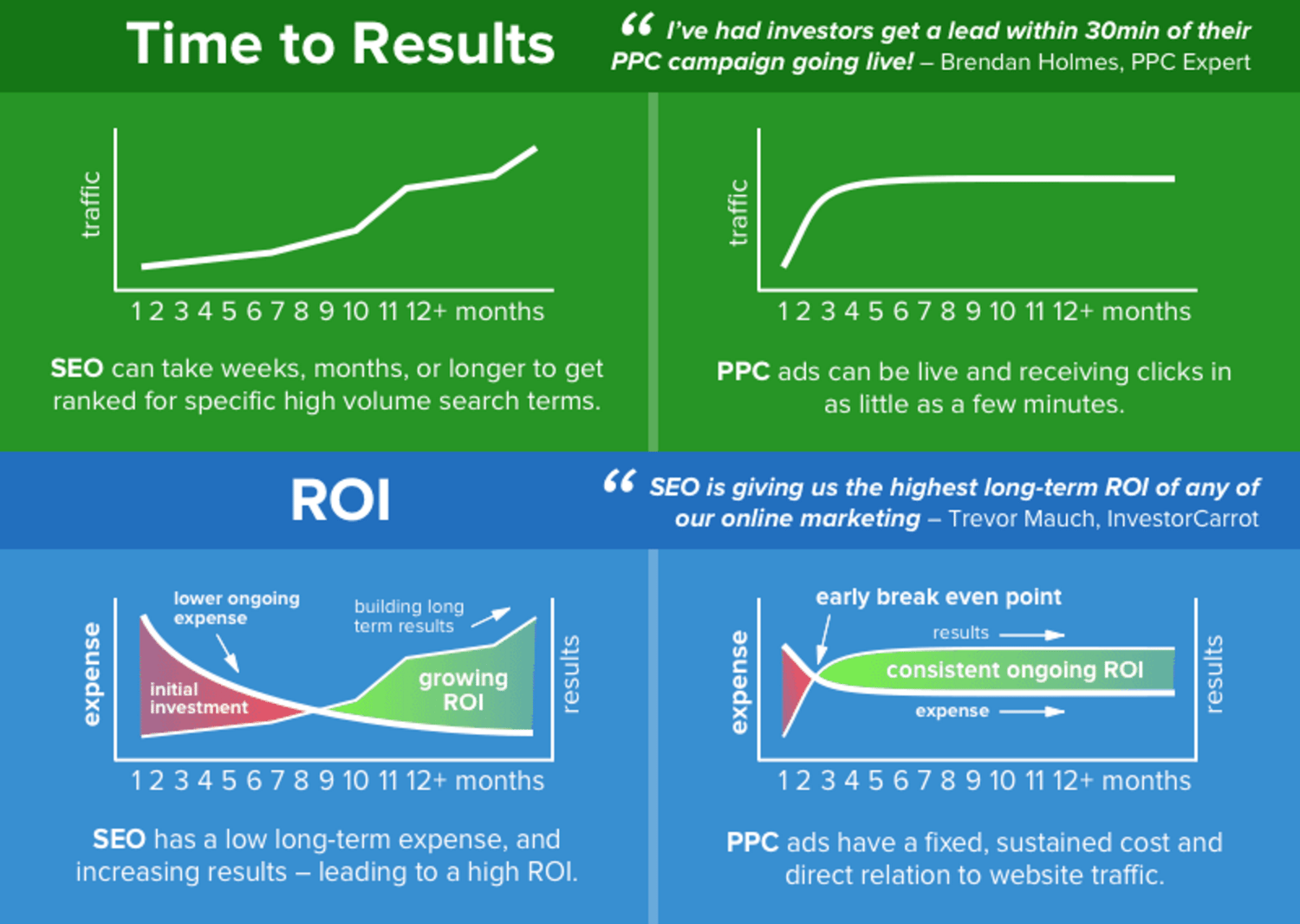
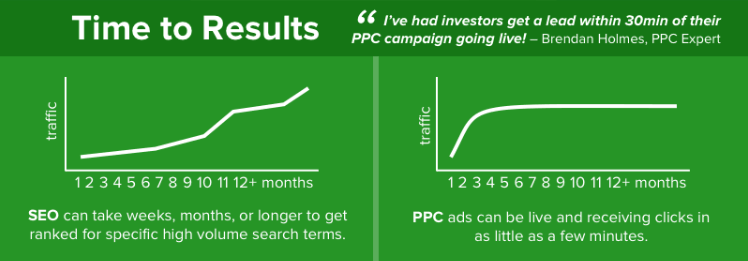
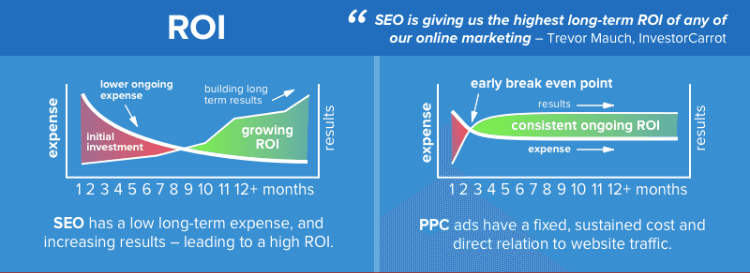
Because SEO is a long term game (highly profitable but it takes patience)… while with PPC marketing you can have traffic and leads coming in, in hours or days.
It’s not “one or the other”… it’s a matter of your real estate lead gen goals and which one or ones best fit into your overall time and money budget to reach the prospects that you need to keep growing your business.
Like this chart shows…
PPC Marketing Can Be A Critical Part Of An Overall Lead Generation Effort For Many
With that said, if you know that PPC marketing can be a great tool for you and your real estate investing business, but just don’t have the time to learn it yourself, you need to seriously think about finding an amazing team to do the work for you.
Who specializes in working with real estate investors and all of the intracacies involved.
Who specializes in performance above all else, not just setting up and automating a PPC campaign.
And who delivers amazing customer support that you’re used to as a Carrot client.
So…
We Welcome Our Latest Carrot Certified Partner To Our Community…
We’re excited to announce welcoming in AdwordsNerds to our Carrot Marketplace as our Carrot Certified Partner on the PPC marketing side of things.
So, one of the first things you need to take into consideration before starting out in PPC is to perform a simple review Google search. Start the search by Googling terms such as “AdWords Nerds review” or “reviews of AdWords Nerds”.
It’s important for you to have in mind how different PPC service companies have performed with past clients. Take a look at ratings, management fees, costs per conversions, lead generation, if you will have access to your account.
There are some PPC consultants who might charge $150 to $5000+ per month or charge a flat rate per lead. Adding that optimized real estate PPC specialist is often the more “cost-effective” route than signing with a large agency.
Those investors that try to manage their own AdWords campaigns usually become frustrated at quit. Leaving a bad experience.
The solution: Hire a professional PPC service for real estate investors.
AdWords PPC can be a very complex process. Without the proper guidance and education, one can become confused while wasting a lot of marketing dollars.
With that, Dan at AdWords Nerds stepped up to the plate! AdWords Nerds is a certified InvestorCarrot PPC company and partner. Dan wrote a very detailed PPC guide that explains what things you should know about AdWords before you start advertising and spending money. This guide lays out the things you must know about AdWords before you start using it.
[cta offer=”ppcreport”]
Real estate investors have one of the toughest, weirdest, most complicated AdWords markets in the world.
Dan came into investing after running AdWords campaigns in a dozen different industries. He worked with plumbers and coaches, plastic surgeons and ambulance companies.
Not a single one of them had the sheer level of insanity found when he started digging into the world of online marketing for real estate investors.
Why is that? Well, there’s a few reasons:
High Potential ROI On Real Estate Deals Lends Itself To PPC Marketing
Most businesses are trying to sell moderately-priced products. That places a cap on what can profitably be spent to bring in a new customer. But, real estate investors have more room in their budgets. Net profits can be upwards of $60k in deals. Even novice wholesalers can make over $10k in deals if they’re in a good market.
All that profit means people are willing to spend a lot to get motivated seller leads – and competition can be fierce.
Gathering Good Data On What Actually Works
Over the last year Dan had the opportunity to look at dozens of different Investor AdWords accounts.
He looked at hundreds of thousands of different keywords, ads, and landing pages. He saw bids as high as $150 a click…and as low as ten cents a click.
You know what he found out? There is almost no hard data out there on what actually works. Without good data to fall back on, people share their personal experiences. For example, an investor might share his or her account that’s been really crushing it in their market.
So what happens if you take that account and set it up in your neck of the woods? About 50% of the time, you’ll do great. And the other 50% of the time? Your account turns into a giant, smoking hole in the ground.
That’s because so much of what determines a keyword’s profitability is unique to your market, your business, and your situation.
What CRUSHES it in one market, may absolutely flop in another.
“Picking the right keywords for your real estate AdWords campaigns is what makes the difference between making money and losing money”. Dan Barrett
Know This – PPC Is Not SEO
SEO keywords are pretty well-understood in the real estate investor space – companies like Investor Carrot have put out amazing guides on the topic, and SEO is easier for most investors to understand…after all, we all use Google to search for stuff.
When you move those keywords to Pay Per Click, however, you start to run into problems.
In Pay-Per-Click, we have to worry not just about what keyword we’re using, but how that keyword will be matched up with the search queries we want. And it’s not always obvious.
Introducing! PPC Service For Real Estate Investors.
Fast, Quality Leads Without Lifting a Finger
PPC (PayPerClick) ads are a great way to get traffic to your website right away – without having to wait months for SEO.
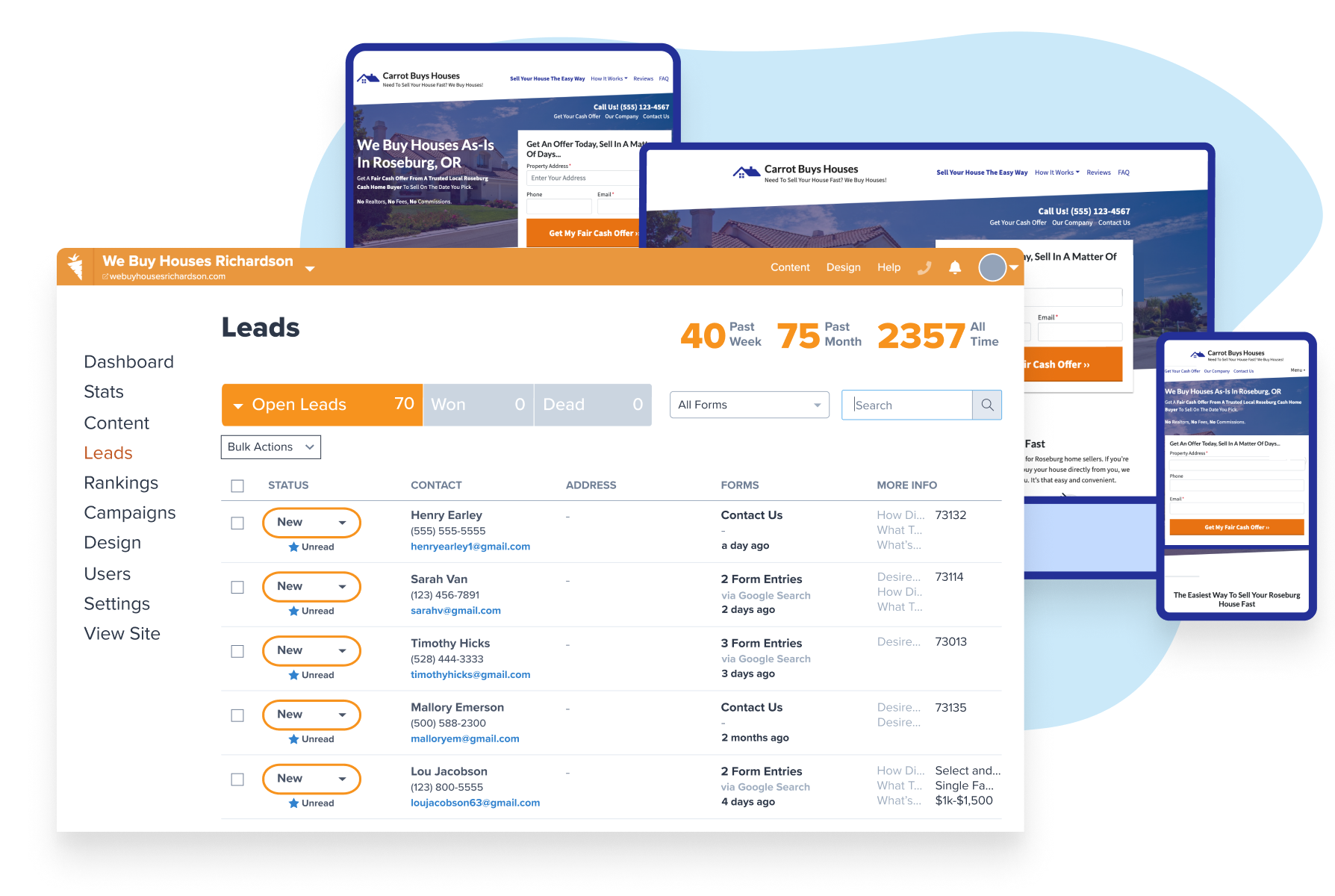
For our managed PPC service, you’ll work directly with the only Google Partner Agency that focuses specifically on Real Estate Investors – AdWords Nerds.
Interested in PPC for Real Estate Investors? Find out more about AdWords Nerds and what they have to offer.
I think it’s safe to say… everybody wants more traffic.
In fact, every time you hear about a new real estate agency crushing it online, I know exactly how you feel: envious, resentful … discouraged.
Why?
Because over the last decade, the internet has become a universal part of the home buying process.
Did you know? A full 92% of all home buyers — across every geographic region and age range — use the internet during their search.
What’s more, for 42% of those buyers, the internet is their very first step.
Of course, you already know all that.
Here’s the problem …
Most real estate agents and investors simply don’t know
how to generate enough online traffic to meet their lead generation needs.
As a result, we often turn to paid traffic as an answer.
But with the average cost of a single click for a location-specific phrase like “purchasing a home” sitting at $24 … paying for that life-sustaining traffic doesn’t come cheap.
The good news is paid traffic — whether from Google AdWords or social media — doesn’t have to be the cornerstone of your online marketing strategy.
In fact, it shouldn’t be.
Last year, of the 200,000+ leads our clients pulled in online, pay-per-click accounted for less than 20%.
Eighty percent of our clients’ leads — roughly 160,000 from all over the nation — came from free and organic search.
How?
Through an approach we call conversation marketing.
However, before we jump into our three-phase approach to generating more traffic and leads, let’s start with a few foundational principles.
Why You Shouldn’t Pay for Traffic If You Don’t Have To
With a subtitle like that, you might think I’m advising against using paid advertising in total.
But to generate traffic, leads, and revenue over the long term, you need to create content based on your target audience’s real needs and concerns.
The difference between the two approaches comes down to separating your traffic-driving goals into two clear groups: (1) search-engine optimization (SEO) tactics to increase organic visitors — what we’ve termed conversation marketing — and (2) PPC tactics to increase paid visitors.
Knowing the differences is vital.
Why You Should Use Both SEO and PPC In Your Marketing
Efforts For Best Short And Long-Term ROI And Consistency
Why you should use both SEO and PPC in your marketing efforts Image Credit: Investor Carrot
While it may sound technical, SEO really just comes down to creating search friendly content that your target audience will find helpful. We’ll get into the details of how to do this in just a minute. For now, it’s important to be aware that SEO takes a larger upfront investment of time and resources and its results don’t materialize overnight.
Leads come to you. You don’t have to chase them down.
You position yourself as a helper versus a “bottom feeder.”
Higher search ranking doesn’t just mean more traffic, it also means more trust.
In turn, that trust turns a higher ratio of traffic into leads into deals.
You’re not forced into competing for the same lead everyone else is after.
Over time, lead cost dramatically decreases. Best of all, the more search-friendly, organic content you create, the easier generating traffic and leads becomes in the future.
Content Marketing Versus Conversation Marketing
All of the benefits listed above come directly from an approach to online marketing known as content marketing.
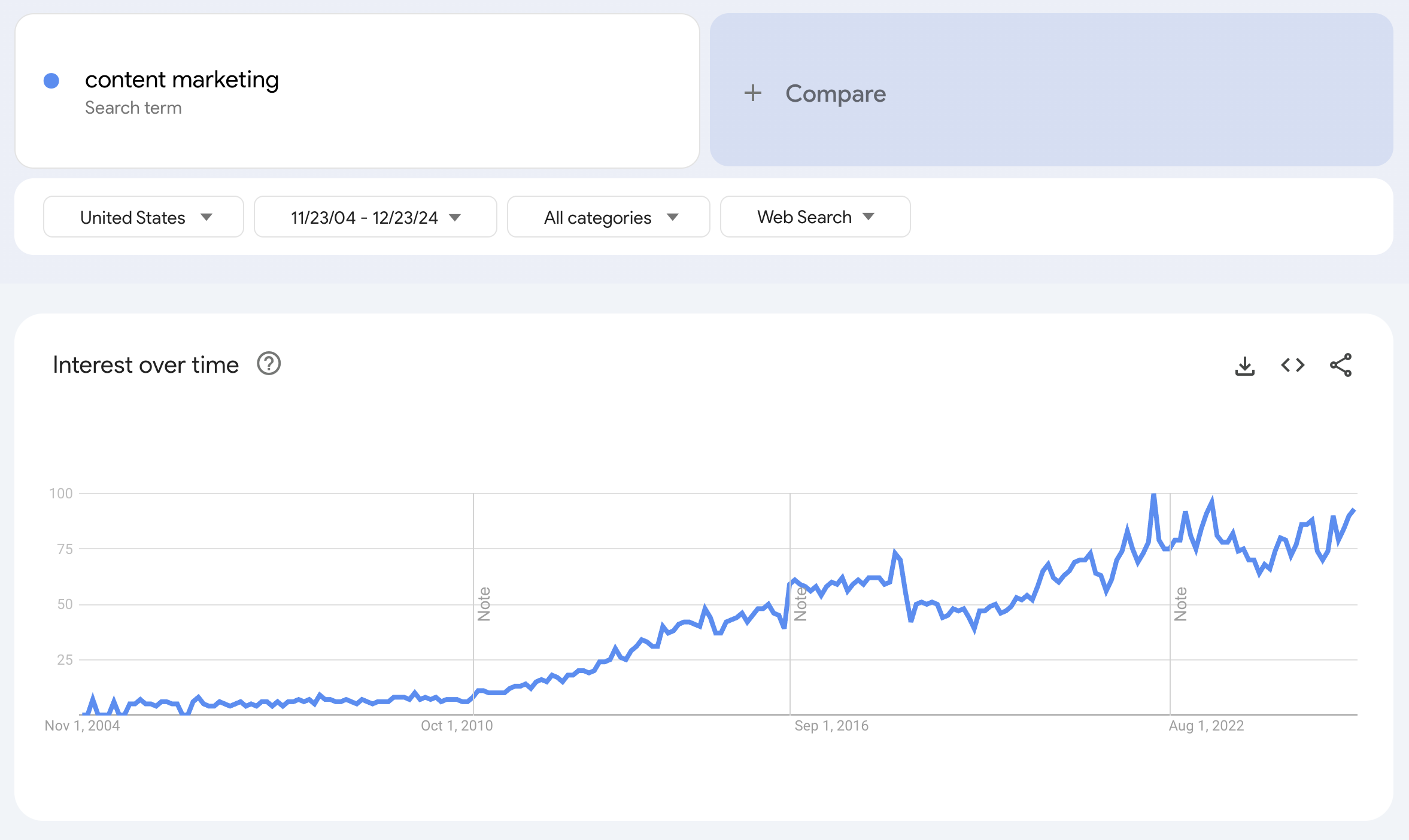
Since 2012, the phrase “content marketing” has exploded. Google Trends officially dubs it a “breakout,” meaning the number of global searches for the term has increased by over 5,000%.
The explosion of all things “content” is rooted in a simple principle: add value … and add it for free.
Whether it’s in the form of blog posts, buyer’s guides, checklists, podcasts, ebooks, webinars, or email campaigns, content marketing is the leading way to provide valuable information to your target audience and increase your traffic.
However, at Carrot we’ve learned to take a slightly different approach. Instead of content marketing, our goal is to create “Conversation Marketing.”
Why?
Because ultimately, all business — online or off — revolves around human connections.
This is exactly why conversation marketing works so well. It educates and builds trust with your prospect. It gives them what they need to enter the real estate buying or selling process and complete their due diligence efforts before biting the bait.
And best of all, it connects them directly to you as their go-to source for guidance.
This sector [real estate] revolves around people and relationships, you can benefit by working with integrity.
Trust and relationships are the most valuable assets in real estate whether you’re an investor or an agent.
Couldn’t have said it better.
At Carrot, we use the term “Conversation Marketing” to define our approach to talking with both visitors and customers. Our primary aim is to talk “with” instead of taking “at”; meaning, the content we create avoids the more traditional marketing missteps of creating a one-sided conversation. This is especially important at the beginning.
What Real-Estate Conversation Marketing Is
You’re in a busy restaurant. You overhear a conversation about someone trying to sell their house they just inherited and they weren’t sure if there were other ways to sell it besides working with an agent… they wanted it to get done quickly.
Scenario one, you go over and say,
“Hi Mike. We buy houses. Lemme buy your house!”
Uh. Say what? Why are you butting into my conversation?
Scenario two, you approach it as,
“Hi Mike, it’s nice to meet you. Couldn’t help but overhear you’re thinking about selling a house you inherited. Tough process sometimes. I’ve been through that too. When did you inherit the house?
Mike: Ah, it was my dads. He passed away last year but ownership was just passed to me this month and now I’m figuring out what to do next. Was thinking about renting it but I think I’d rather have less hassle and just sell. You: Yep I feel you. In the right situations, I actually buy houses like that and have bought several that people inherited. I’d be happy as heck to show you some of the pros and cons and just help you make sure you pick the route that’s best for you. I’ll send you a short article I wrote on selling a house you inherited actually… it’ll clear things up for you I think”
Scenario one is called interruption marketing. It doesn’t provide any human connection. It “butts in” rudely. While this would never be acceptable human behavior in the real world, sadly, it’s exactly how the vast majority of real estate website present themselves.
Scenario two is conversation marketing. It’s engaging, focuses on listening, and builds itself on questions. Helps them solve a problem by delivering value and content.
Three Phases to Get More Traffic through Conversation Marketing
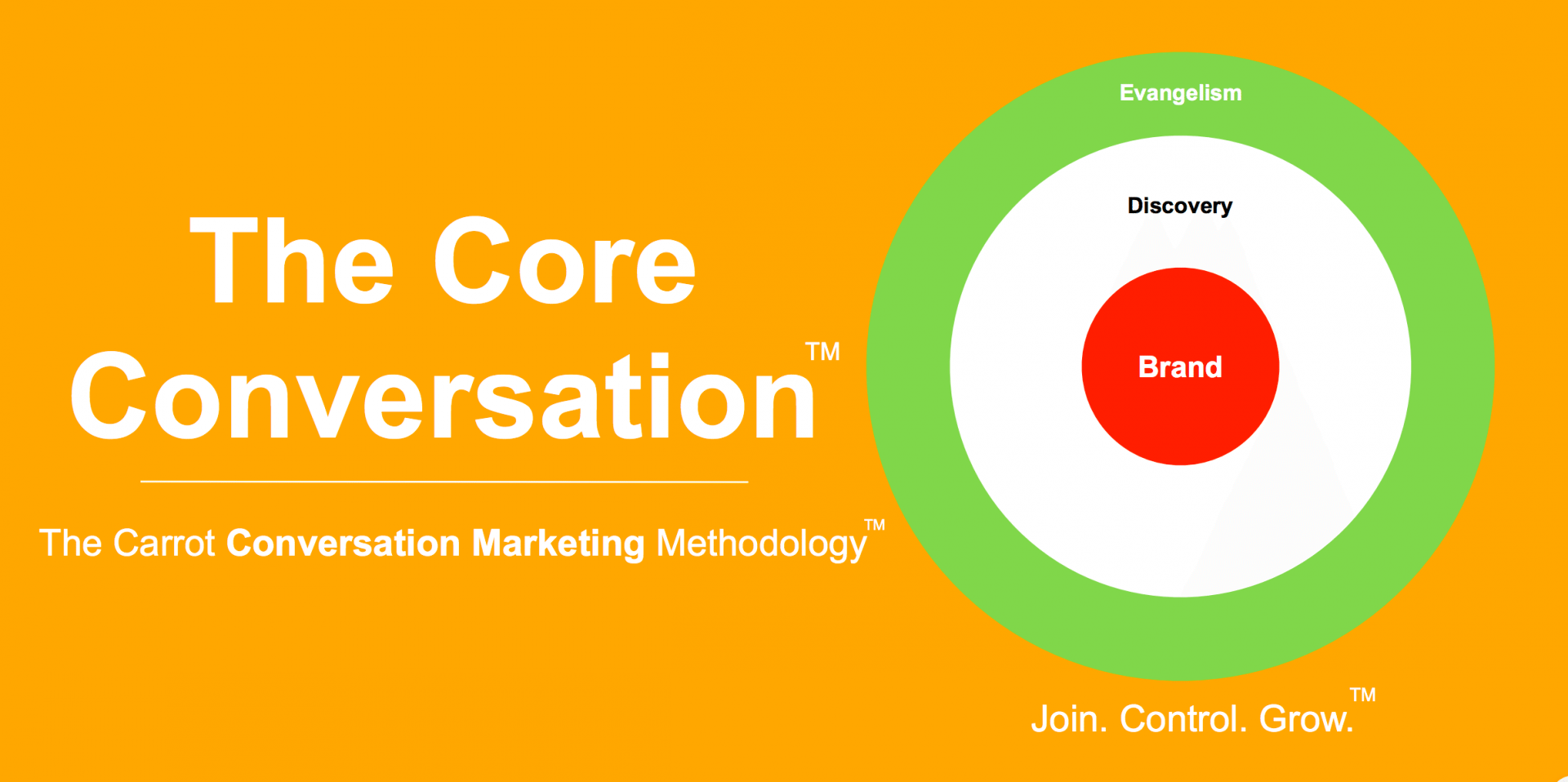
Over the years we’ve created and perfected a 3 part process to not just get a ranking or two… but really control the conversation around your marketplace in a big way. That’s how you dominate in SEO and content marketing.
It’s basically 3 simple steps… and in this order.
Your Brand – Control the convo so people see what you want them to see when they search for you
Discovery – Join and control the convo around questions or problems your market is hitting the web to “ask” (type into Google)
Create Evangelists – Helping your clients do your selling and content for you.
Let’s dive in!
Phase 1: Your Brand – What Are People Seeing?
The first thing most people do when they make a big financial decision is hit the web to research the company they’re about to work with.
Real estate is no different.
So when you’re sending out your direct mail pieces, or doing PPC or SEO, or even your bandit signs… people are hitting the web searching for your business name or phone number to do some research on you.
What do they see when they search your business name?
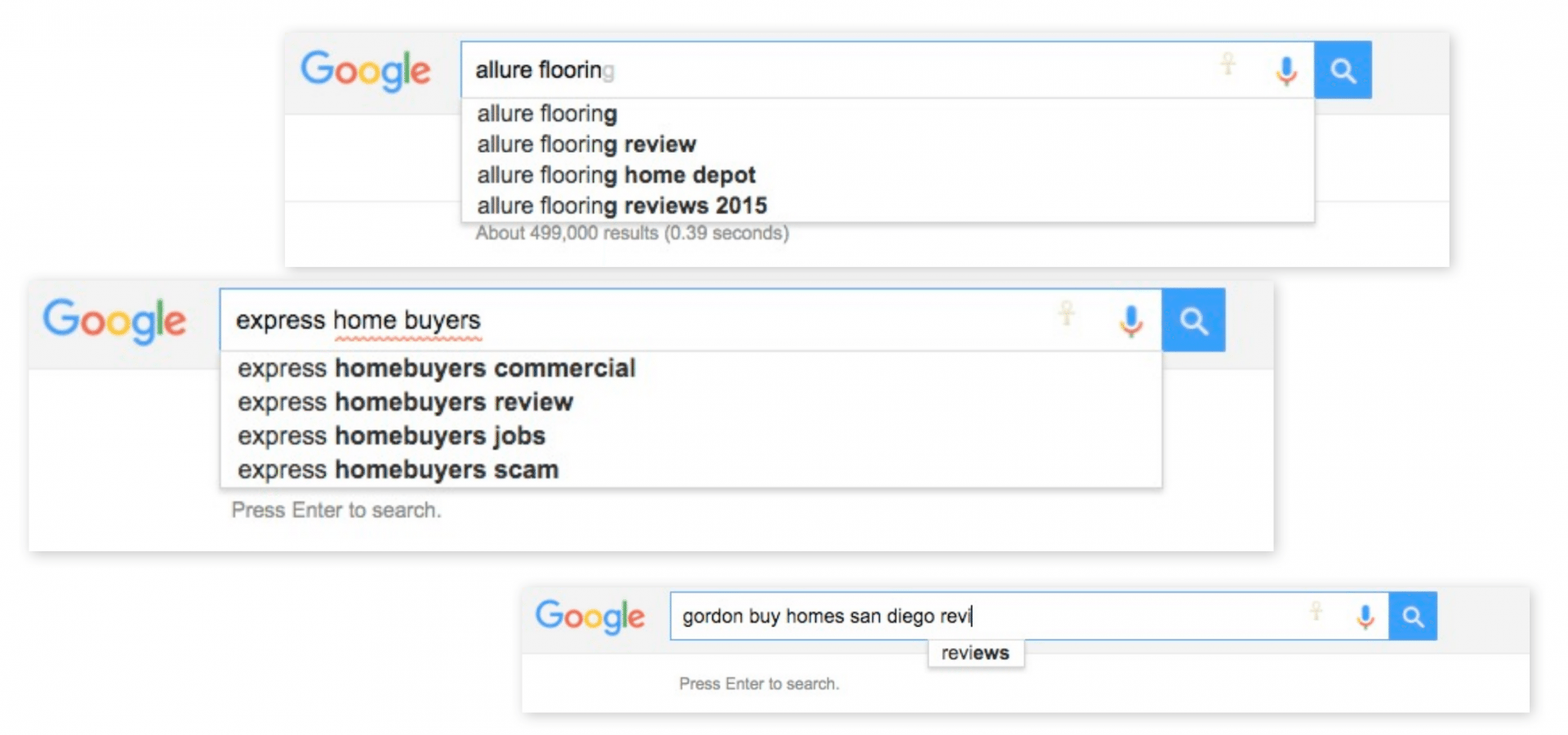
Here Are A Few Examples Of Brands Or Companies When I Google Their Name…
Notice the suggested searches Google is giving me… people are actively typing those phrases in consistently, so you should create content that ranks well and controls the conversation around those keywords.
Test it yourself…
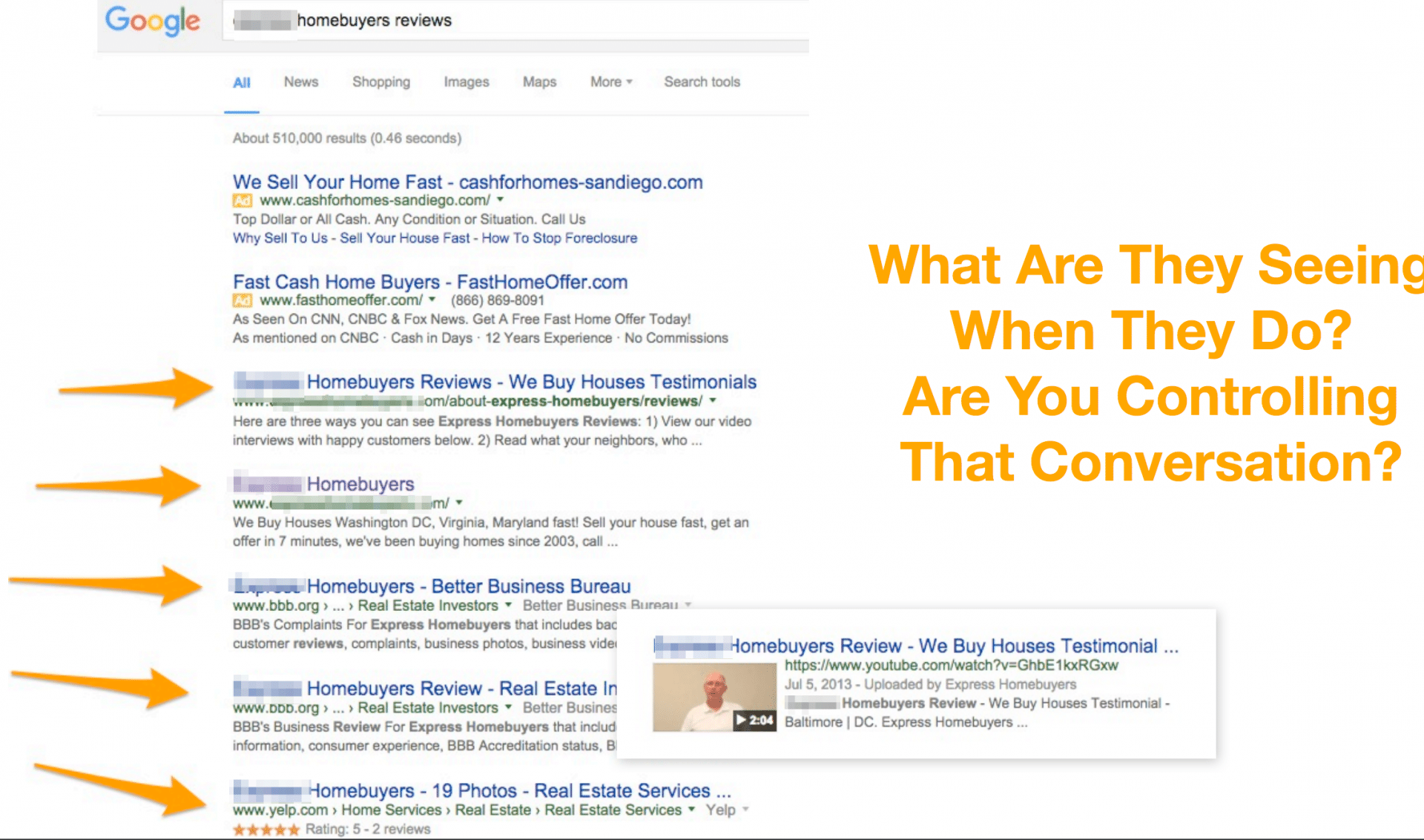
Go ahead… Google your company name + your city and see what comes up. That’s what your prospects are seeing before they decide to work with you.
Here’s what it looks like when you’re controlling the conversation around your brand vs. letting your competitors control it for you or the internet decide who you are to your prospects when they search you.
This Company Purposefully Controls The Top 5 Spots When You Google Their Name With Very Credible And Positive Content
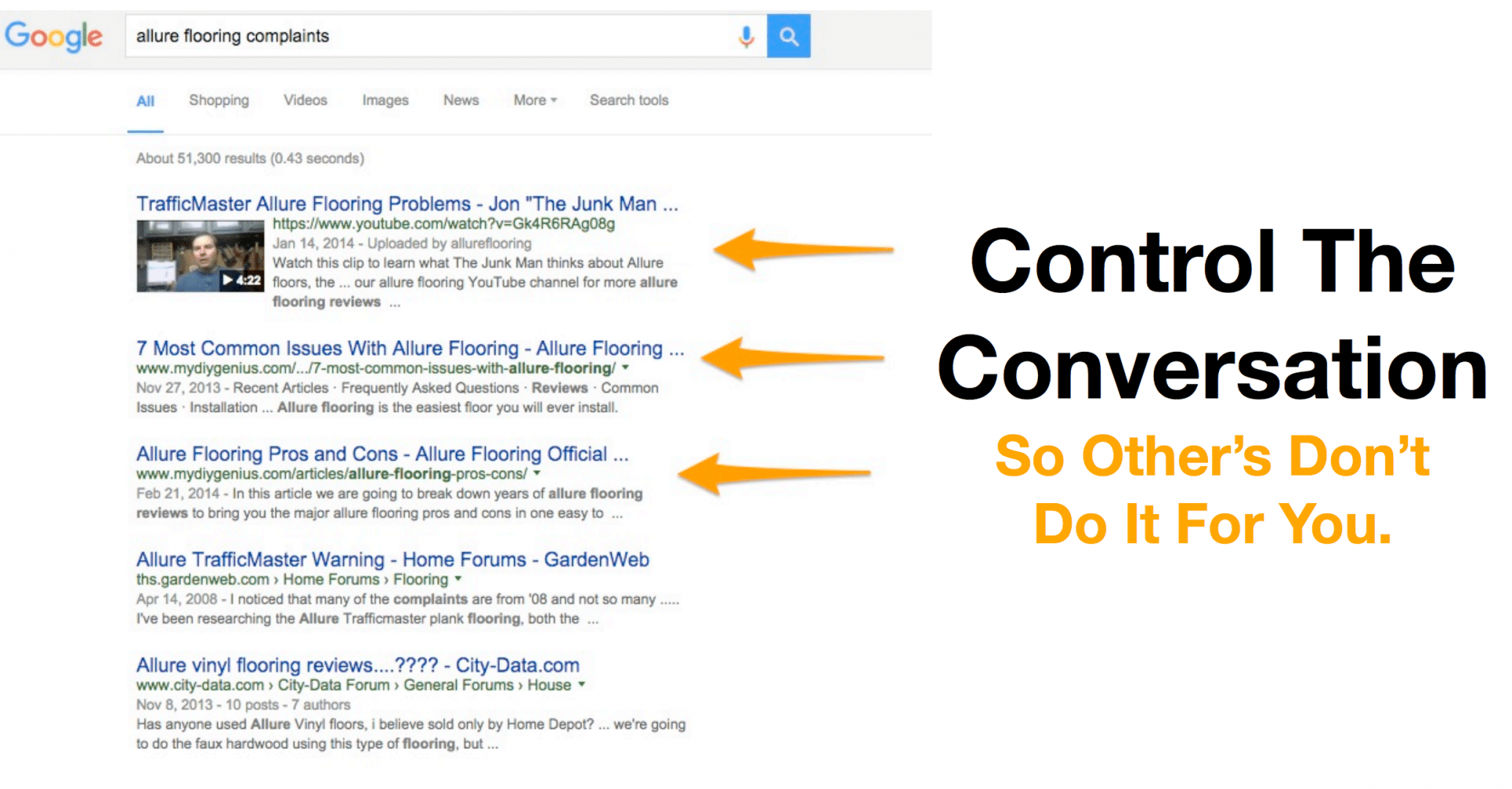
Here’s a company that my consulting business works with that sells $600mm/yr in flooring and we helped them control the conversation around their brand in a big way.
Notice The Videos We Created And 2 Articles That Are Ranked 1-3 For This Brand Related Search?
Before, when you searched that phrase it was nothing but a few sites where those few negative nancy’s posted a bad review on their personal blog bashing the product. When in actuality on Home Depot.com the product rating was stellar and reviewed by tens of thousands of happy customers. Those couple bad apples raise to the top in Google.
So we wrote down all of the keyword phrases that came up in Googles suggested search box around our company and created videos and articles optimized to rank well for each on.
We teach you how to optimize your posts and videos to rank well in Google in our 3 Lead Per Day Training for Carrot members.
Action Items:
Google your own company name + the name of your primary city. i.e. – “ABC House Buyers Charlotte”. Then write down all of the Google suggested searches that come up as you’re typing in your search that are related to your brand. If you’re brand new or not a big investor, you likely won’t have any suggested searches pop up quite yet that are related to your business.But common ones house sellers type in when they’re researching a house buying company are…
reviews
scam
bbb
[your main city]Type those into Google and see what comes up. Are you ranking well for any of the top 5 results? If not, you need to create content on your site that optimizes for that keyword. At Carrot, we automatically optimize your “About” page for your company name and location, so that’s done for you. But to really control the conversation you may want to create more content.
Create content and a video or two to rank for that content. Then launch it on your website and put it up on YouTube. Basically title the YouTube video the exact keyword phrase you’re going after. If you’re going after the keyword phrase “ABC House Buyers reviews” you should upload a testimonial video from a client of yours and name the video title that in YouTube.
Easy eh? Then every month search the phrases around your company name and see where you stand.
Even 1 lost deal because your client sees something online about you that makes them at all uneasy (including not finding anything about you at all) could cost you tens of thousands of dollars.
Phase 2: Discovery – What Are People Searching To Solve Their Real Estate Problems?
The best way to increase your traffic — without being forced to pay for it — is through content creation and getting that content ranked well in Google.
That content will be the backbone of your conversations.
This phase is joining the conversations and hopefully eventually controlling those online conversations as people are going online to “discover” the solutions to their problems and the answers to their questions.
The need for content is universal online is because search engines like Google will only consider your website to be an authority if the content you create (1) revolves around the keywords your ideal customers are already using and (2) that content itself is valuable enough to be shared and linked to by sites and businesses other than your own.
However, never forget the aim of conversation marketing: getting more visitors to your website by actually helping them.
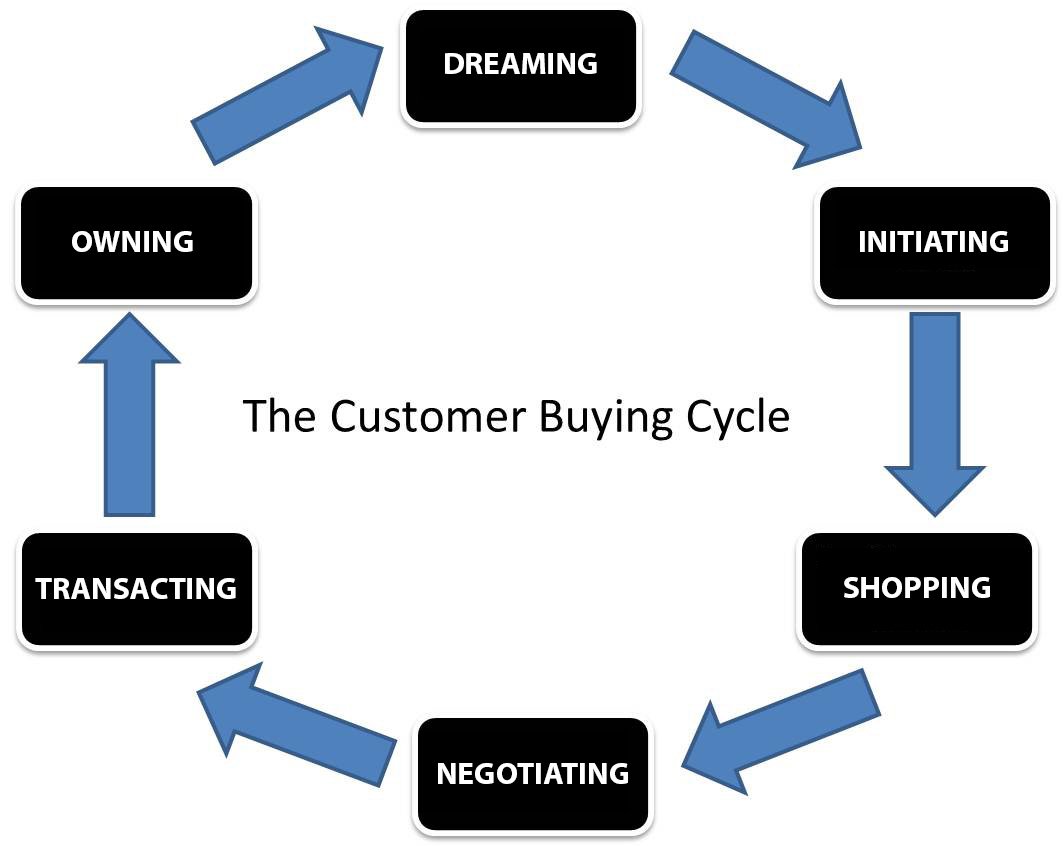
This means understanding your prospect’s buying cycle in addition to your valuable keywords so that you know what type of content to create. Here’s an overview from InMan of what the typical real-estate buying cycle looks like:
The first three phases are where you need to educate and start conversations for maximum impact and traffic:
Dreaming:
This is the earliest stage of the “buying” process when the prospect has an initial thought to buy or sell a property (or note, or land, etc.).
Initiating:
The initial thought has dug in a little deeper and the prospect tentatively starts exploring online. This is where your real estate investing business can address a need, by providing content using search terms the prospect uses to search for information. Like “How to sell a house I inherited in Dallas”. They’re starting that conversation online… will you engage with them or let your competitors?
Shopping:
If you’ve already “nabbed” your prospect with value-add content in the first two phases and have their email address on your list, this is where you start reaping your rewards. Only when your company has helped educate and build trust with a prospect they are likely to turn to you when they’re ready to officially engage.
Small and large businesses alike often make the fatal marketing mistake of trying to be all things to all people.
Kind of like trying to cram everything on one site for house buyers, house sellers, renters… etc. And you shouldn’t use the same site for motivated house sellers and cash buyers for your content either (like we teach here in this article).
Instead, it’s vital to get focused on the handful of brand-defining specialties that make you stand out.
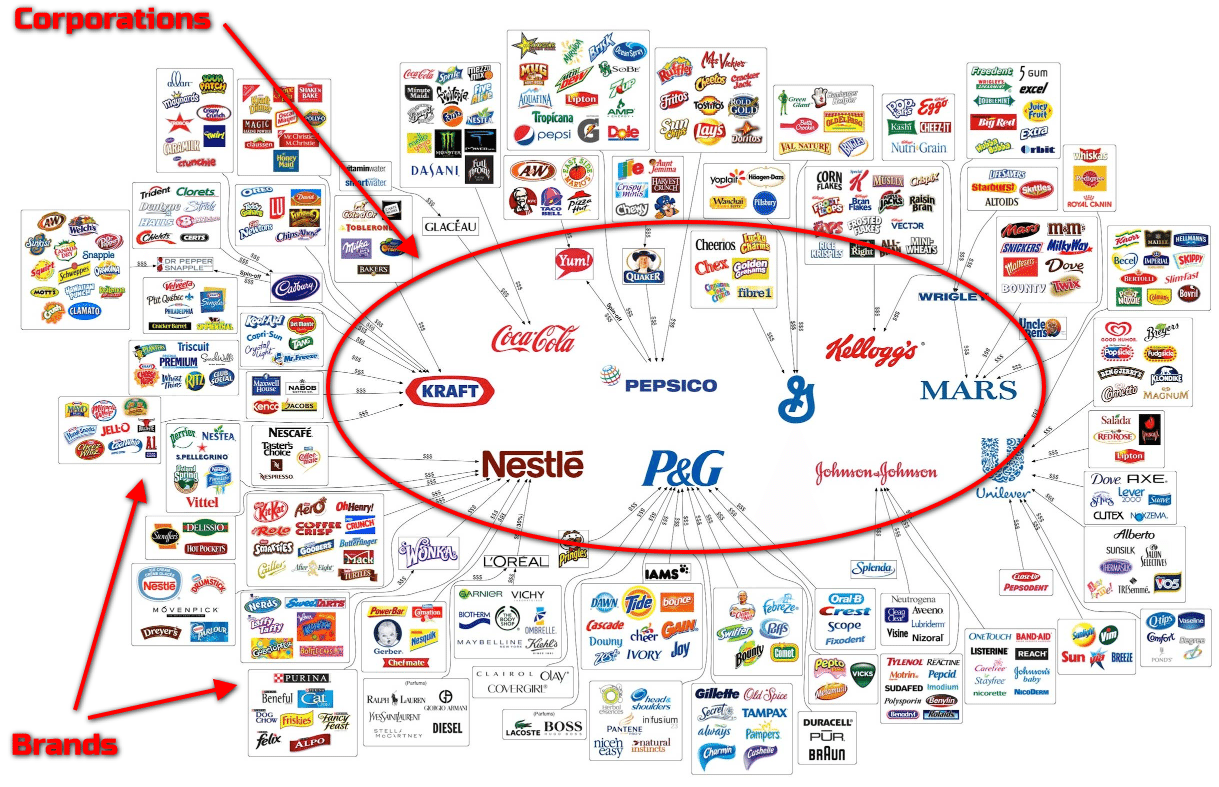
Take Business Insider’s graphics These 10 Corporations Control Almost Everything You Buy as an example. Notice that in the middle of the image are the 10 corporations that own most of the goods we buy.
However, when it comes to what you actually purchase, their subsidiaries are responsible for doing the work:
The point is obvious: while there are only about 10 corporations in the driver’s seat, each has created distinct brands to actually sell their various goods and services.
Why?
Because if they didn’t separate their brands into specific niches, they’d struggle to market themselves effectively.
Regardless of your size, the same principle is true for you as a real estate investor or agent.
Who is someone going to pick if they’re trying to sell a house they inherited?
The company where the website says they “specialize in buying inherited properties for top dollar” and where they have content that talks about selling an inherited property…
… or the company that just says “We buy any house”?
I know I’d probably pick the company that seems like it has a specialty in the situation I’m in.
That’s why the this phase of conversational marketing doesn’t involve asking yourself, “Who do I want to be?”
Instead, it focuses on the far more conversational question: “Who do I want to reach?”
In other words … your audience.
Thankfully, deciding who you want to reach and digging into what they like, love, and hate, doesn’t take divination, a crystal ball, or even brainstorming.
There are a host of online tools that can help you get to know the people you want to reach.
Where should you look?
Go after the low-hanging fruit first:
Social media sites
Question and answer sites like Quora
Forums your target audience belong to
Popular blogs in your niche
In addition to the usual suspects, Placester provides a detailed list of online resources to try out.
The benefits of identifying a single-target market — e.g., “first time home buyers with less-than-perfect credit in the Portland area” — versus trying to be all things to all people — e.g., plain vanilla “home buyers” — are enormous.
And this is true not only from a marketing point of view, but also from a service perspective.
For instance, more and more people are turning to social media channels to share their home-buying experience and provide feedback, whether good or bad.
By paying attention to what real-life people are saying within your chosen niche you can discover things like:
What are their struggles, fears, and anxieties?
What reasons motivated them to want to sell a property or buy one?
What are their dreams and expectations?
What is it that they’re really looking for in a house buying / selling service?
What do people who’ve completed their first purchase or sold their house wish they’d known at the start?
Again, the important thing with conversation marketing in the real estate investment and agent business is not to think long and hard about you and the words you want use, but rather, to pay attention to your ideal customers and the words they themselves are already using.
That point about “the words they’re already using” is massive.
Conversation marketing aims at generating organic traffic not paid traffic.
This means you have to organize your approach around specific keywords that are optimized to improve your search engine rankings for phrases your prospects are actually searching online. Conversations they’re starting.
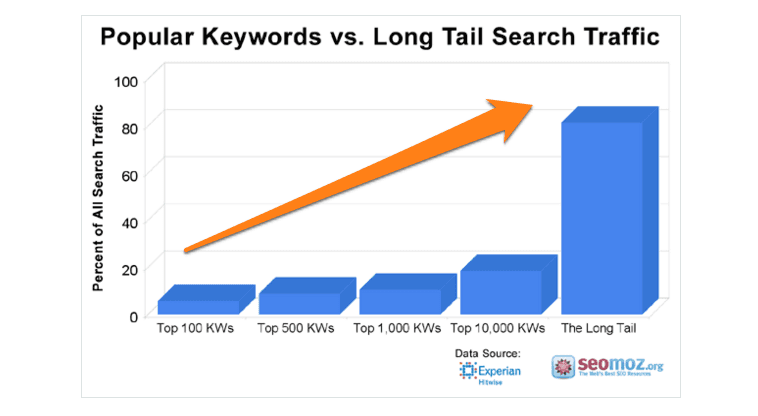
The search phrases that drive more traffic to your website — and are easiest to rank for (i.e. less competition) — are the ones that are more specific. These are called “long-tail keywords” because they contain more than one or two words.
This graph shows that the most effective keywords for search engine purposes are long-tail
For example, rather than casting your keyword-net wide with a phrase like “selling a house,” use long-term keyword phrases that your audience is actively talking about:
“selling an inherited house”
“selling a house after a divorce”
“selling rundown house without making improvements”
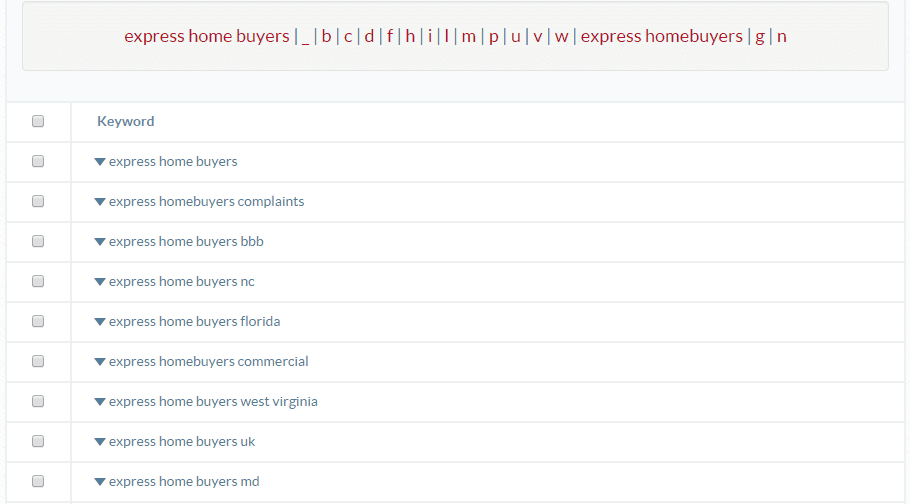
Ubersuggest is another fantastic tool you can also try to spark off ideas for long-tail keyword phrases.
Example Of Using Ubersuggest To Find Topics To Write About
This was a search I did on Ubersuggest for the term “express home buyers”
Now that you’re armed with the best keyword phrases that your target audience are already using to find solutions to their real estate needs, you’re ready for the next step: creating amazing content around the keyword phrase of your choice.
However, simply having amazing content isn’t enough.
You also have to ensure that content works on a technical front. This is even more important today because search engines now judge the value of a site based on its design as well as its speed.
My suggestion is that you look for a designer or a proven website system like Carrot who is familiar with websites that perform well in the real-estate industry specifically.
This option may be slightly more expensive than the “get a website for $90” deals, but will save you from going to the trouble of setting up a website — content and all — only to discover months later that technical issues are holding you back from bringing in traffic.
Once you’ve created a base of content to address the first three stages of the buying cycle do not simply let it sit there.
Instead, repurpose it.
Repurposing your existing content is hands down the best way to create new content … without having to create new content.
As soon as a particular piece of content (like an article) show signs of performing well — i.e., generating traffic or even things as simple as comments or social shares — turn that article into a video or a SlideShare presentation. Make it the topic of a video. Pick one specific point in the article to expand on it in an entirely new post. Or even bundle together your best articles into an ebook on a landing page.
After you’ve created and repurposed your content, don’t make the mistake of thinking your conversations will take care of themselves.
Our third and final phase is the real key.
Phase 3: Evangelism – Helping Customers Do Your Selling For You
Evangelism is the last phase of the conversation marketing model you’ll need to lock down.
Simply put: creating evangelists means turning your best clients into your best salespeople.
This involves being intentional not just about sharing your content directly with your best customers — in the hopes that they’ll go forth and do likewise — but including them in that content itself.
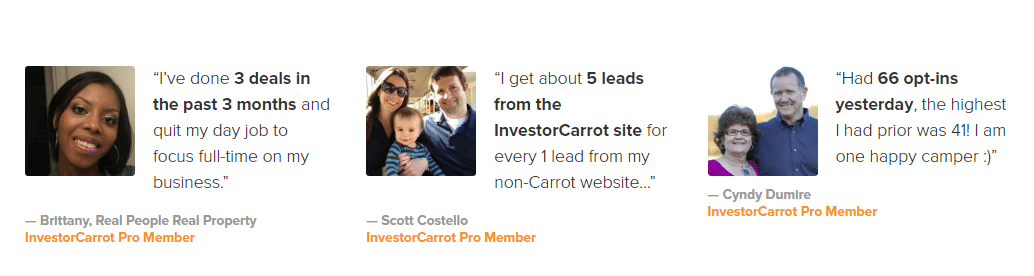
For instance, if you spend any time at all on our website, you’ll notice there’s hardly a single page that doesn’t include a customer testimonial or case study.
On our homepage, we include three glowing recommendations front and center, right under our hero image:
On our
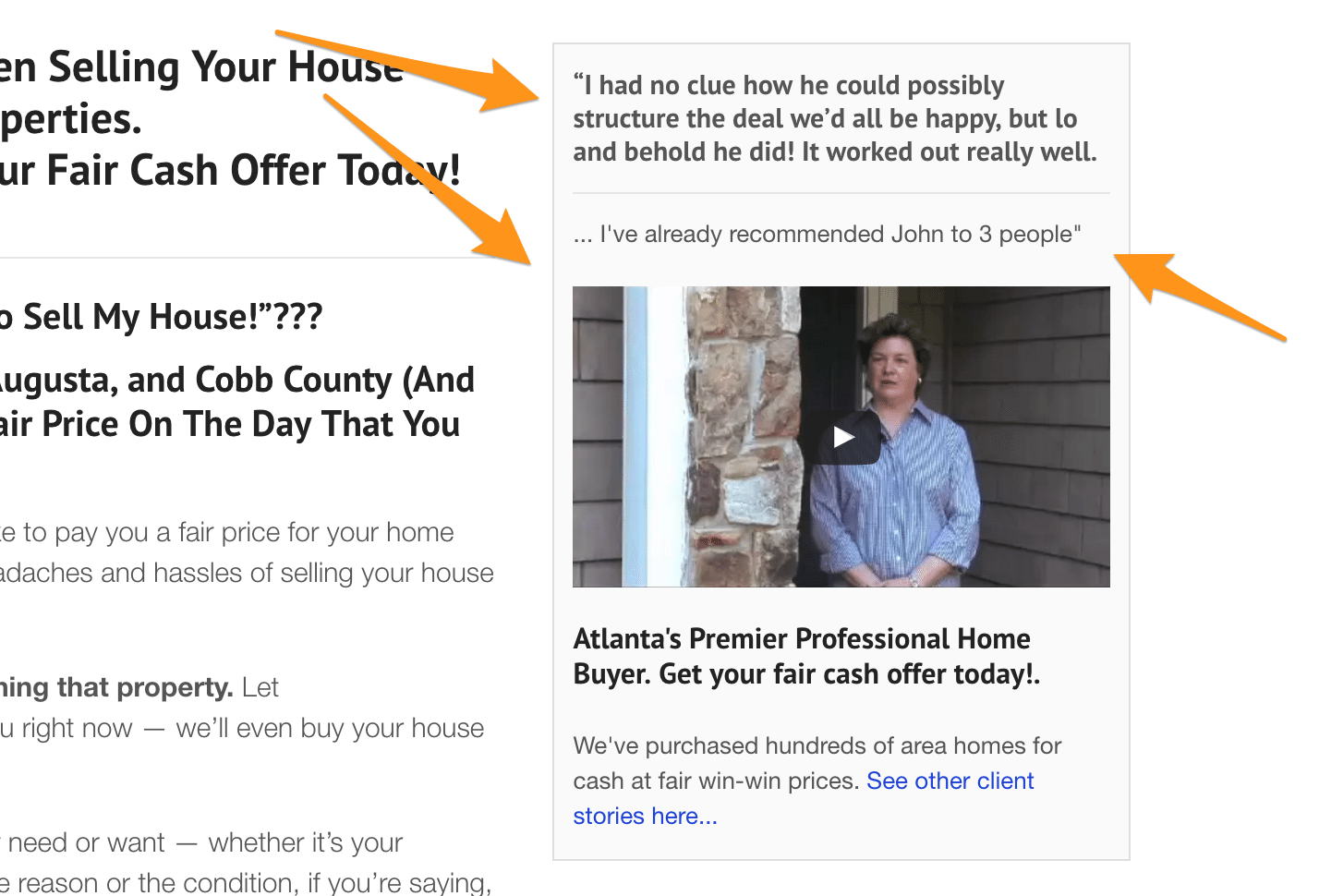
See how this top investor uses one of his client stories to squash the “too good to be true” thoughts going through some sellers minds. It empowers your clients to be evangelists for your brand and your company.
Here’s what happens when you help your clients spread the word about your company and service. They do the selling for you!
This happy house seller has already referred 3 people to this Carrot client
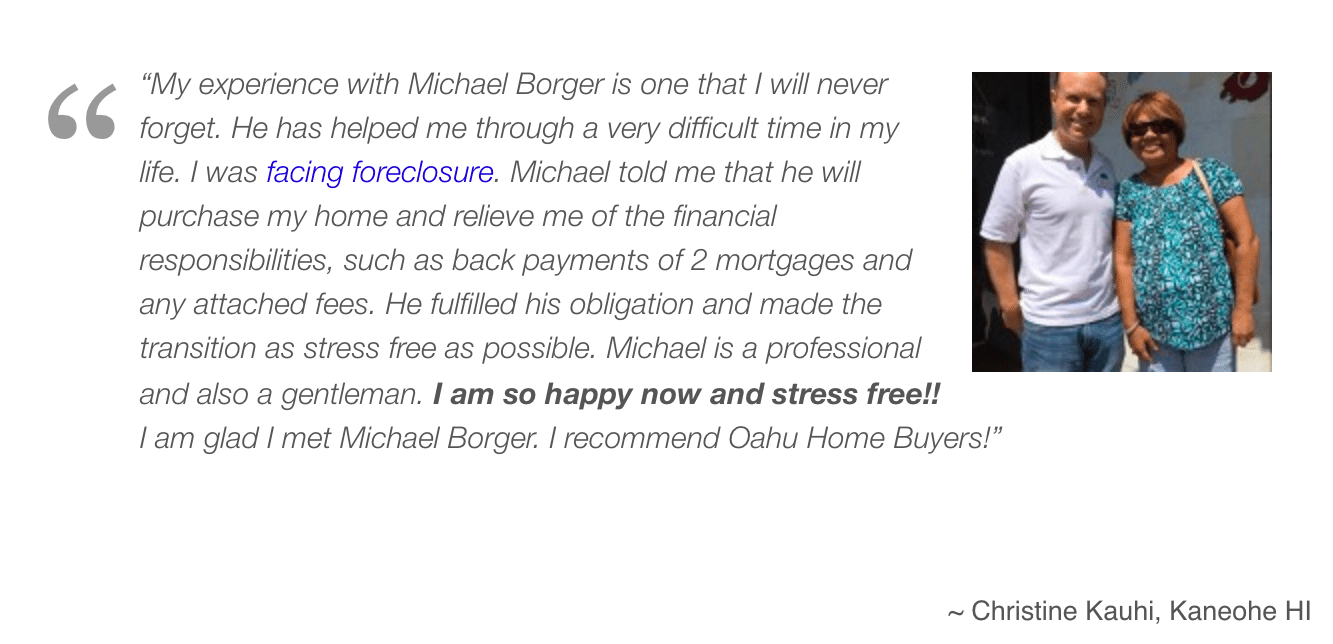
You could even make a nice “Stories” page like we have on our site and have built into Carrot websites:
And… One Of Many Client Testimonials On This Investors Site
Why all this focus on our customers?
Because we know the cold, hard truth: selling yourself is hard. Letting the people who’re already wildly delighted with your service sell you … is easy.
Ironically, selling yourself means engaging in the very marketing behaviors that inhibit genuine conversations.
Letting the people who’re already on your side sell you, that’s how you start a genuine conversation.
Video is the most powerful form of evangelistic content, so make a real effort to get your content — especially repurposed content — into video format.
If creating video content sounds daunting, it shouldn’t.
Here at InvestorCarrot we’ve produced a host of “Customer Stories,” all of which boil down to little more than webcam-recorded conversations with some of our greatest success stories:
Example Of A Simple, Low Production Video We Shot To Help Tell A Customer Story (in their words)
And you know why they work?
Because the format of those stories grows directly out of our overall approach itself: conversations not selling.
You can do the exact same thing as a real estate investor or agent.
It’s all about the conversations…
Most entrepreneurs and small business leaders are overwhelmed by online marketing tactics meant to increase traffic.
Why?
Because there are so many opinions, so many tools, and so many methods.
On top of that, your prospects are equally overwhelmed. They’ve been exposed to scammers and self-centered agents alike, both of which make it clear that they’re only interested in one thing: making a quick buck.
Conversation marketing won’t make you an overnight internet celebrity.
It takes investment, insight, patentice, and a bit of creativity.
But by following our proven three-phase method … you can dramatically increase your traffic without having to pay for it. Remember, of the over 200,000 leads our clients generated last year, less than 20% came from paid traffic… the majority of them came from Conversation Marketing.
Best of all, you’ll position yourself as a genuinely helpful resource and the expert in your area which makes it so you’re not a commodity anymore. After all, people are people and every great relationship — business or otherwise — always starts with a conversation.
You know all of those sellers, buyers, and tenants who land on your real estate website but never fill out a form or give you call? (i.e. – most of your visitors) They bail from your site to never return. What if you could “fetchback” a healthy percentage of them and turn them into a lead and deal after they leave? Well, you can (and we have been) do it with retargeting… especially Facebook Retargeting.
Follow along with us as we walk through the steps to create a simple Facebook campaign to fetch back your lost leads.
So put on your big boy (or girl) pants and roll up your sleeves for this really really detailed guide on getting your first Facebook retargeting ad launched today. It’s a doozy so hold on tight :-)
So, What Exactly Is Retargeting / Remarketing Anyway And Who Should Use It?
Raise your hand if you’ve ever visited a website (looking at shoes or even our site) and then magically you see ads on Facebook and other websites you’re on for that exact company or product?
Ya, I think we all have.
And retargeting ads return the best ROI that we see in any of our own marketing.
Retargeting basically drives potential leads back to your website by targeting the users who have previously visited your website with ads on other websites… like Facebook… but didn’t opt-in or take a specific action.
Once the visitor leaves your website they can be displayed customized ads as they move around the Internet. These ads bring your brand back in front of them, often generating the highest click-through and conversion rates of any type of online advertising.
How Retargeting Works In Simple Terms
Retargeting can be one of the highest return on investment paid advertising channels real estate investors and agents can use today.
As far as what types of real estate investors or agents should be using retargeting / remarketing on Facebook in your business, if you’re doing any of these types of marketing actively below you NEED to be using retargeting.
Are you actively marketing and driving traffic to your website right now using any of these?
Direct mail – If you include your website or if people search on Google and land on your site, retargeting is a must.
PPC Marketing – If you’re driving people with paid clicks through PPC, retargeting is a must.
SEO – Working your butt off on that high ranking that’s generating traffic? Retargeting is a must.
Craigslist – Yes, Craigslist is free, but may as well fetch people back who visit your site but don’t convert right away.
TV / Radio – People are likely hitting Google to research your company name or phone number and landing on your site. Retargeting is a must for you too.
Buying Leads – After you call a lead you bought, they’re hitting the web and researching you. If they land on your site, keep your name in front of them with Facebook retargeting
If you’re doing any of those actively and investing money and time into them, retargeting will help you fetch back more of them who visit your website and turn them into more leads over time.
If you convert just 1 more deal every year because of retargeting isn’t it worth it? I’d say so.
Why Use Facebook Retargeting Specifically As A Real Estate Investor Or Agent?
First off, marketing 101 is to deliver a targeted message to your best prospects where they already hang out.
That’s why bandit signs can be so effective… because you’re putting your message in front of your prospects where they’re already driving.
With retargeting on Facebook, according to a study, over 20% of all time spent online around the entire world is spent on Facebook. The average American spends on average 20 minutes per day on Facebook. So after your house sellers, buyers, tenants, lenders, etc. visit your website from your other marketing…
… odds are they’ll likely be visiting Facebook sometime in the next 48 hours. This makes Facebook a great place to get in front of your best prospects where they are already hanging out.
Like this…
On Mobile And Desktop Retargeting (or remarketing), Ads On Facebook Get YOU In Front Of The Website Visitors Who Left Your Site.
By using Facebook retargeting ads, you get another chance to turn that visitor into a lead. Plus, because you already attracted them once to your site, you know what they are interested in and can more easily create ads that speak to their needs. This creates more engagement, more likes, and higher conversion rates.
Let’s Get Your First Facebook “Retargeting” Ad Launched Today
Retargeting can be very powerful for entrepreneurs and their businesses.
But, most real estate investors and agents we talk to:
Launch a few Facebook campaign on their own and don’t see success, so they quit.
Attempt to set up a campaign, but get too confused by Facebook’s ad platform.
Don’t have time to educate themselves on how to do Facebook ads correctly and even try.
Don’t keep it simple stupid and over-think the process. Remember Facebook must make it simple enough for the everyday Joe to figure out.
So if you’re ready to dive into it and get your hands dirty, by the end of this step-by-step guide you will be running your first retargeting campaign and turning all of those one-time site visitors into converted leads and closed deals.
You’re going to have to roll up your sleeves and get a bit “geeky” with us. Cool?
Setting up Facebook retargeting means you are going to have to handle a little bit of code, but not to worry, you don’t have to be a programmer to set this up yourself.
So, what is this code you’re going to have to use?
Facebook calls the code they require you to use “pixels”.
How the New(est) Facebook Pixel Works
There is one pixel per account.
The pixel tracks website visits from your site back to Facebook so you can advertise to them (the whole point of retargeting).
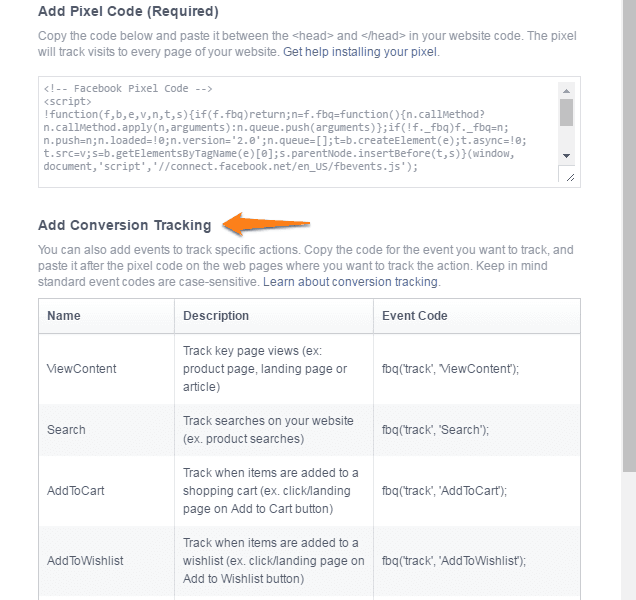
Then you can create a number of conversion events, “Custom Conversions” so you can track when a goal is reached.
An example of a goal could be a lead opt-in or for someone who signed up to your real estate investing newsletter. You can create multiple conversions. That gets kind of advanced so let’s get the easy part out of the way first.
IMPORTANT: You need to not only install the pixel but also set up what counts as a conversion. The following guide may look scary but it is actually pretty straightforward. Just take your time moving through the steps.
Step 1: Get Your Facebook Pixel On Your Website
The pixel is a very important piece to any retargeting campaign. This is because Facebook can only track your visitors when the pixel is on your site, so every day it isn’t installed means you will have fewer people to advertise to when your ads go live.
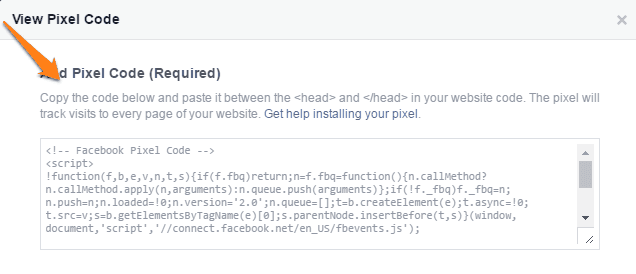
The pixel should be placed between the <head> tags on every page you want to be tracked (usually, this means every page, as you can always get specific later). If you don’t have access to a programmer, you should be able to place the pixel yourself!
If you’re already an InvestorCarrot member, it’s crazy easy to do yourself (takes about 20 seconds) OR you can just reach out to us and we’ll help you paste the code in and be done with it.
Let’s get that Facebook Pixel.
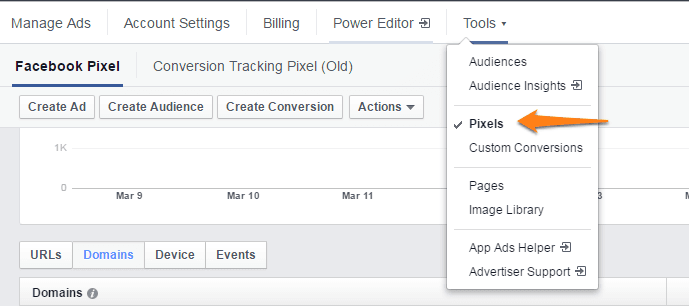
Go to your Power Editor in Facebook (or business.facebook.com for your business Facebook account) and click on “tools” and on “pixels” If you have already installed the pixel in the past, Facebook will automatically show the new pixel. Otherwise, Facebook will ask you to create a pixel and you can simply follow the brief instructions that show up.
Next, let’s put it on your website.
If you have a non-InvestorCarrot website reach out to your web guy or dig around in the website code to find the <head> section of your code and put that pixel code on any page you want to retarget visitors from. We suggest putting the Facebook pixel on every page on your website.
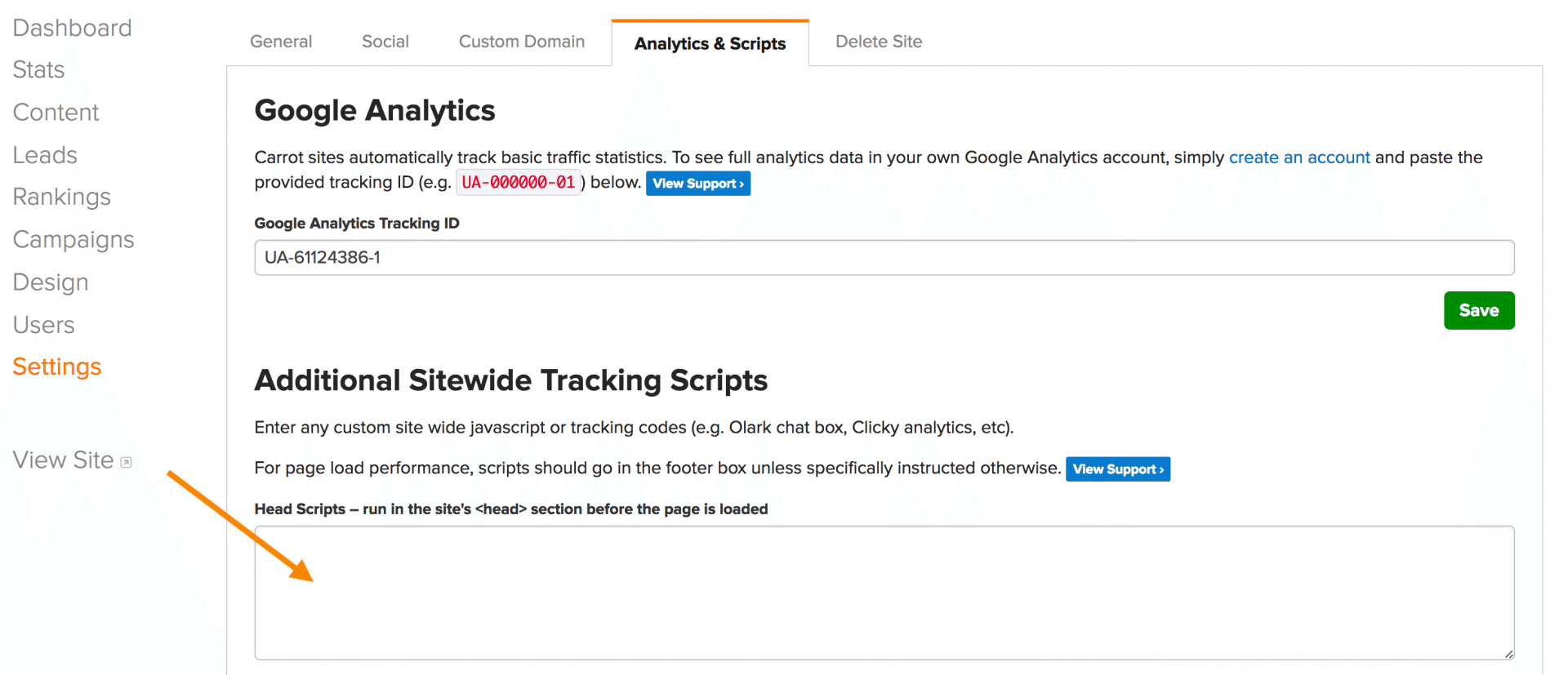
If you’re a Carrot member, to add the pixel code to your site simply go to your Carrot “Manage Site” dashboard and go to Settings then Analytics & Scripts. Then paste that code in the big “Additional Sitewide Tracking Scripts” box (shown below). Hit Save and you’re done!
Great!
Step 2: Create A Custom Audience
Now we need to tell Facebook who to serve up the ads to and to do that we need to create what they call a “Custom Audience” for those people who visit your website.
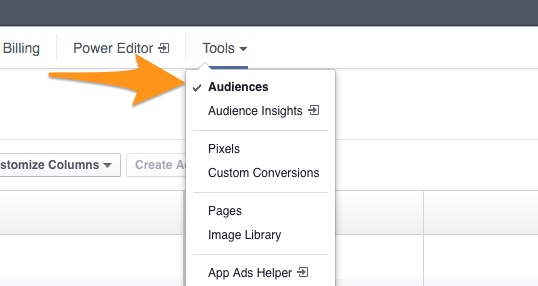
To do that head back up to “Tools” and click “Audiences“.
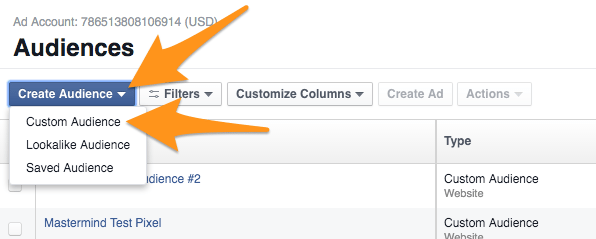
Then click “Create Audience” and choose “Custom Audience“.
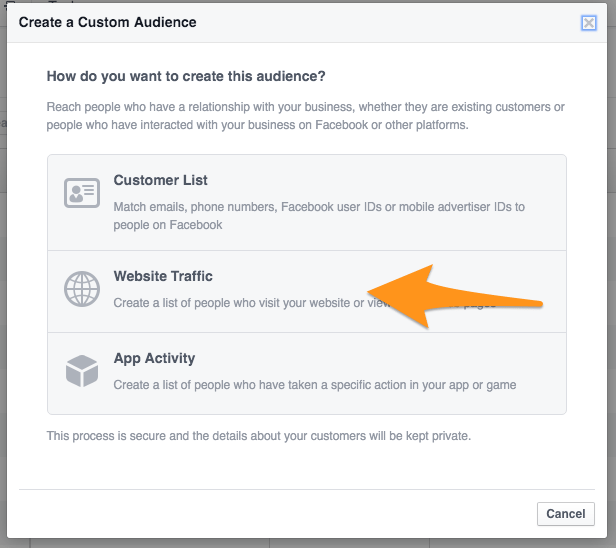
Next, choose “Website Traffic“…
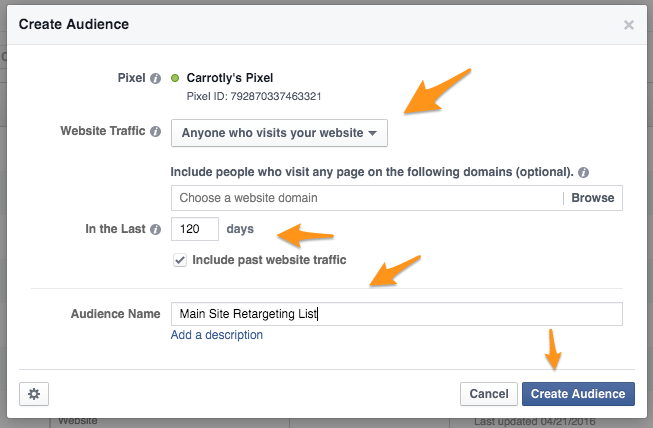
Next, we’re guiding you on the simplest way to launch a campaign so choose “Anyone who visits your website” then set the “In the last” for 120 days… meaning you’ll show ads to anyone for 120 days. The reason we do that is because it enables you to stay in front of them for several months in hopes that the timing will be right for them sometime during those 3 months to work with you.
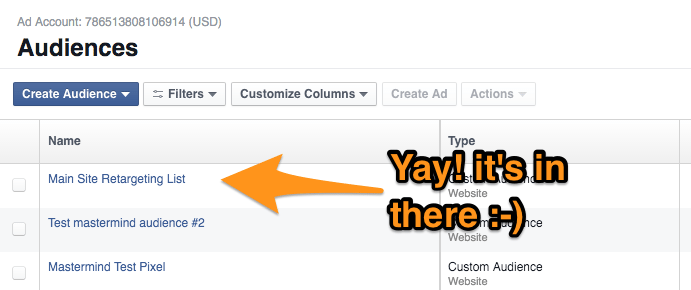
Great! Your custom audience of your website visitors is setup and you should see it in the list. Now click that and let’s launch some ads.
Now it’s time to start creating your ads!
Advanced Tracking: Creating Custom Conversions So Facebook Can Tell You If Someone Turns Into A Lead
If you’re using ads to drive people to your motivated seller page or other lead capture page, then you’ll need to use Custom Conversions.
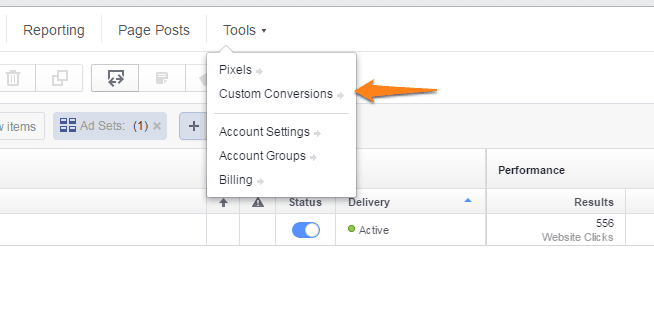
Create A Custom Conversion Using The Power Editor
Click Tools from the top menu
Click Custom Conversions
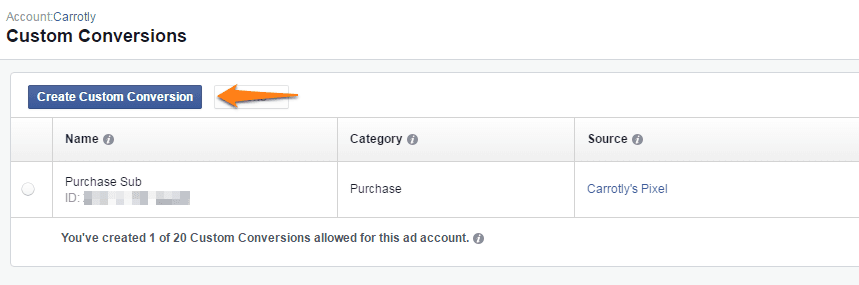
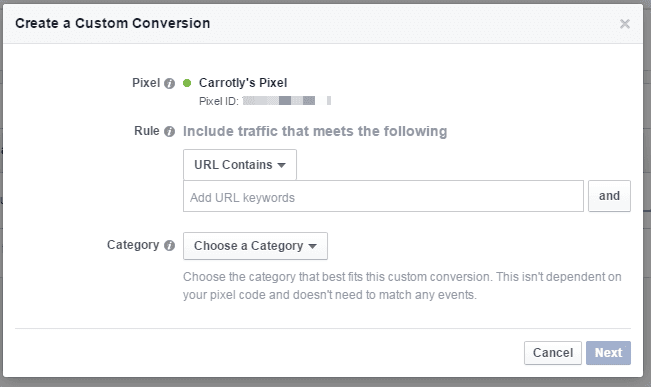
Click the “Create Custom Conversion” button at the top left and you’ll see something like this…
We are trying to help Facebook determine if a user who visited our website ended up converting.
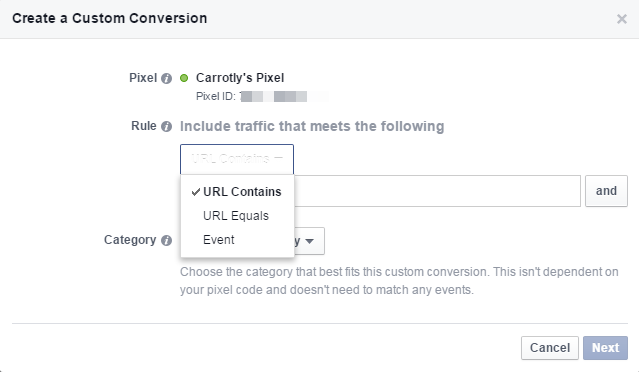
Under the rule, you’ll have three options…
If you’ve created Website Custom Audiences before, you’ve seen “URL Contains” and “URL Equals” before. You can create a rule, for example, to help Facebook determine who filled out your Carrot step-2 form
URL Contains: step-2/ OR
URL Equals: www.buymyhousecompany.com/step-2/ (it’s not required to use http:// or https://)
You won’t need to include both contains and equals.
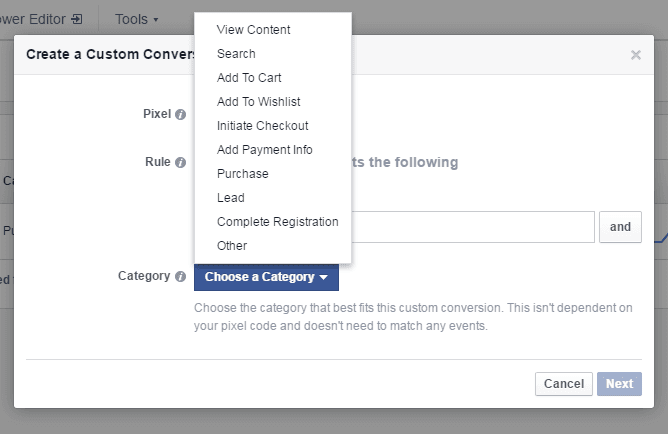
Next, select the conversion your category. For real estate investors, “Lead” is the most common category.
Options include:
View content
Search
Add to cart
Add to wishlist
Initiate checkout
Add payment info
Purchase
Lead
Complete registration
Other
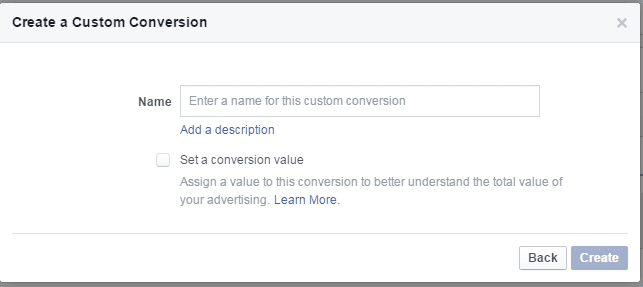
Now you can name, add a description, and set a conversion value for your custom conversion. Once set, click create.
Using Custom Conversions is a whole lot easier than using the old tracking pixel that was placed on all of your success pages. In the past, you had to manually copy and paste a unique code to the header of each page.
Now, you don’t need to do any of that. Your code is already on the site. Simply tell Facebook what a conversion is and create it. It’s now that easy!
BE AWARE: You can’t edit or delete a Custom Conversion once it’s been created. You can edit the name, but that’s it. If you have duplicate Custom Conversions, it might throw off your reporting.
How do you know the conversion pixel is working?
Facebook makes it easy by placing a little green dot with the word “verified” next to your pixels when they are up and working. In order for them to register as verified, all you have to do is visit a page where they are placed and then check again on Facebook. As long as someone has visited a page where your pixels are placed within the last 24 hours, they will show as verified when you’re in the pixel section (audience or conversion) of Facebook.
This is where the rubber meets the road. Getting ads created and live.
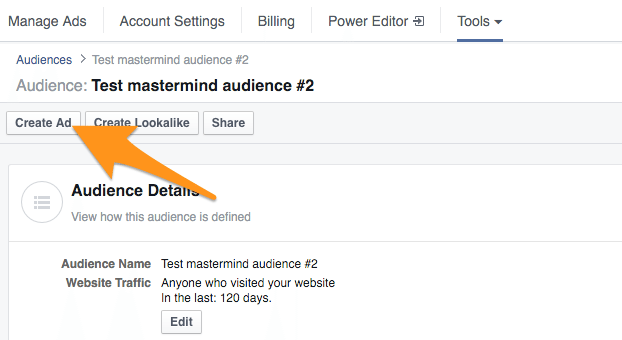
To do this you’ll go back to that audience you just created and click “Create Ad“.
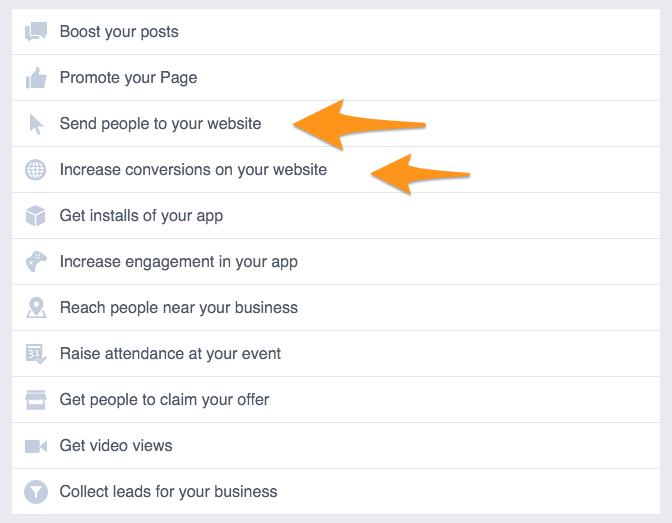
Now let’s select the objective of the ad. We like to choose “Send People to Your Website” or “Increase Conversions To Your Website“.
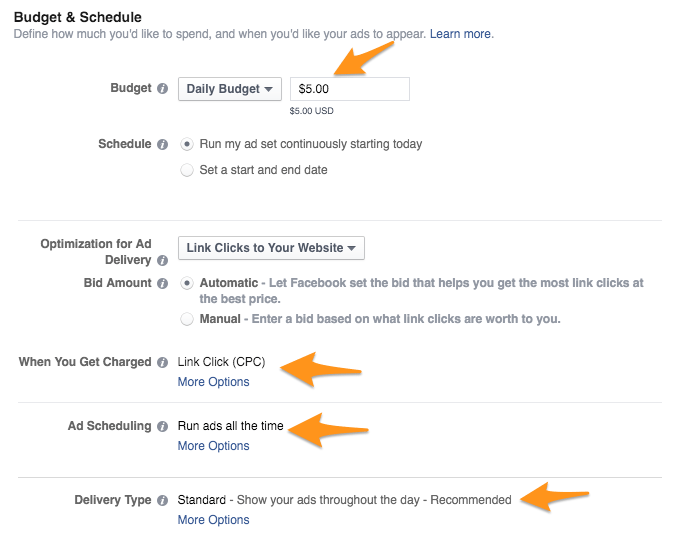
Now let’s set your basic ad delivery settings and your budget.
We suggest you start with $5 per day and check your results every day for the first week or to and adjust your budget accordingly. Also, select the settings as we have them below.
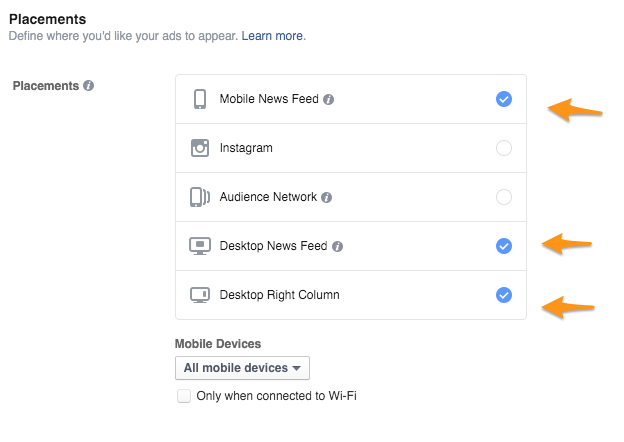
Last, we need to tell Facebook where we should serve up ads. Since they own Instagram that’s now an option. We usually exclude Instagram and the Audience Network as they haven’t been as effective for us. But for sure INCLUDE mobile as 80%+ of the traffic you’ll get from Facebook will be from mobile devices (which is why it’s important as heck to have a high performing mobile responsive real estate investing website).
Scroll down and click “Choose Ad Creative” and let’s make some ads!
There Are Two Main Parts To Each Ad
The copy (text) and the image.
Notice the big image + the text of a Facebook ad.
We like to focus on 3 types of ads:
Social proof – Testimonial ads or things showing “others have been there before” and worked w/ you successfully
Straight to the point – Like the ad above, we’re going straight to how we can help them or their problem. We’ll use these the most
Attention grabbing – So people don’t get blind to your ads over time, we like to make some that are quirky and attention grabbing
In this blog post, we’re going to just focus on getting an ad up and we’ll focus on the straight to the point ad.
Writing Facebook Ad Copy
With your ad copy, being clever is much less important than keeping things simple, intriguing, and to the point.
Even if you don’t have experience with creating ads, you should know exactly what speaks to your market audience.
You know what fears they have, what their biggest problems are, and what some solutions to those problems might be.
You should know all of this because this is you seller or buyer personas. With this information, you have what you need to get started creating ads.
This post going to focus specifically on news feed ads since they look just like regular Facebook posts and are the simplest place to start.
There are 3 elements to the copy in a news feed ad:
The main text that appears above the image
The headline that appears directly below the image and in larger font
The tagline that appears under the headline in smaller font
For the main text, try starting with a question that eliminates anybody who wouldn’t convert anyways. This way you eliminate as many clicks that don’t convert as possible since you will possibly be paying for clicks.
Examples:
“Are you struggling to find a way to sell your house?”
“Do you get stressed out by being behind on house payments?”
“Do you always hear about how effective selling to a Real Estate Investor can be
“Is it time to sell your house?”
A Simple Example
And Another. Notice The Simple But To The Point Copy
Your goal that if anyone answers the question with a no, they immediately move on and don’t click your ad.
This reduces unnecessary traffic and makes everyone who does click much more targeted… which reduces your cost.Everyone wins.
Additionally, try testing different message lengths in your ads. Have some be short and to the point, with just one main point or benefit mentioned. Try others that are much longer to point out more benefits. You won’t be sure what your audience responds best to until you test both.
For the headline, make the benefits people will receive if they click on your link rather simple. Are you looking to buy their house fast? Spell it out with the headline so it’s impossible to ignore.
The tagline portion of the ad is less important than the main text or the headline, but try driving a little more detail about what people are getting and tease them with some additional info. This way they feel the urge to at least click the link to learn more about the offer.
Creating Ad Images
While being an awesome ad designer can help, if you focus on creating images that stand out, you will still be way ahead of the game. Instead of trying to create an image from scratch using lots of graphics, use an interesting photo of yourself in action with bold text overlaid. Or even just an interesting real estate deal image. Images that look appealing will go a long way towards grabbing your audience’s attention.
Notice This Simple But Eye-Catching Image
You don’t need to get fancy with your images, in fact, the simpler the fewer the words the more effective usually.
Here are three sources to help you find images. Both free and paid.
Just be sure when using text on your images that you follow Facebook’s guidelines of not having more than 20% of the image contain text. You can use Facebook’s free grid tool to see how your ad measures.
Make Multiple Variations Of Your Ad To Test
Just so you can see which ad is working better, make a few variations of your ad to run on the same campaign at the same time. We’ll usually just swap out the picture and come up with a second variation of the text. Again, start simple with 2 versions of the main text and 2 images. This will create 4 total ads.
Now you have a simple A/B test to start your campaign.
A good rule of thumb is to let your ads run long enough to get a decent traffic before you make any decisions.
Try to get at least 500 impressions, but even better if you can wait until 1,000 impressions before pausing the ad that isn’t performing. We’ll go in more detail how to optimize a Facebook retargeting ad campaign in another future post.
Once you find a high performing ad, having both good click-through and conversion rates, start to create different versions of that ad. Test them all again to improve upon the best result.
Then, just keep repeating this process and ads should continue to improve over time.
Your total time each week to maintain your ad campaign will be literally less than 10 minutes once you get it launched.
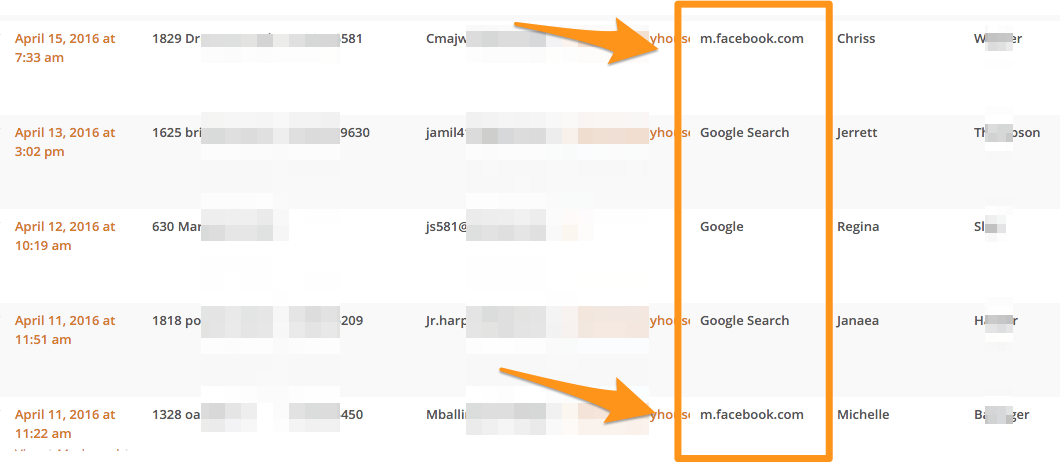
Step 5: Make Sure You Have Great “LeadSource” Tracking In Place On Your Website
With InvestorCarrot we have built in “LeadSource” tracking on every Carrot website so you can tell where all of your leads came from.
With InvestorCarrot We’ll Show You Where Your Leads Came From. Cool Eh?
But if you’re not an InvestorCarrot member, chat with your web guy or setup lead source tracking in your Google Analytics account. It’s not all that easy but you can totally get it done.
Tracking where your leads came from is crazy important so you know which marketing is working well and what isn’t working well. As you can see in the image above, just in that one week period this Carrot client got 2 leads from his Facebook retargeting campaign… so he can tell it’s working and track it all the way down to exactly which leads came from Facebook.
Is Your Ad Performing Well? Here are A Few Benchmarks
Benchmark number will depend on the real estate market in your location. So, there are no 100% benchmarks to follow. You’ll gain a personal benchmark number over the time of your campaign.
But, you can get general targets to help you set some goals in order to tell if the campaign is working.
Click-through-rate for desktop news feed = 1%
Click-through-rate for mobile = 2%
Click-through-rate for sidebar = 0.1-0.2 %
Cost per opt-in: $1-$3 (although if you have done the math on how well your lead funnel converts, you should know exactly what a lead is worth to you)
Cost per lead: Start by aiming for a 2X ROI. For example, this means if you make a profit of $3000 on a deal, you should be looking to spend no more than $1500 in getting leads.
Get Your First Facebook Retargeting Ad Rolling Today!
Now you have the “why” you should start a Facebook retargeting campaign and how to get started with your first one.
You’ve already attracted motivated sellers once to your site, so you know what content and images will attract them again.
They are much more likely to click on your ads and to convert into a lead, compared to first-time visitors.
A retargeting campaign is a perfect addition to your current marketing campaigns. It basically, enhances the work that you’ve already done.
For easy access and to recap, below is a checklist of the exact steps you need to take in order to get everything running. Use this checklist when creating your campaign and start turning those visitors that leave your site after one visit into long-term customers.
Download this Simple Facebook Retargeting Checklist
[Free Download] Use this checklist as a guide when creating your Facebook retargeting campaign.
Need More Online Leads For Your Wholesaling / House Flipping Business?
Generate More Real Estate Investing Leads and Cut Through The Marketing Clutter In Your Market. Download out FREE Marketing Toolkit: Get Access To This Content Marketing Toolkit + Training For Real Estate Investors here!
And take a Demo of InvestorCarrot today to leverage the same system 1000’s of other investors use to generate his online leads and deals each and every month.
So, are you seeing your leads slow down right now versus the volume of cash buyer or motivated seller leads you saw in the summer? Well, you’re not alone. It’s a seasonal thing… and here’s what you can do about it to make up some of those lost leads with other types of marketing.
There’s an interesting phenomenon happening right now that some investors are noticing and I wanted to write a blog post about it to make you aware of it:
Some investors (maybe even you) are noticing fewer leads right now… have you noticed that? (It’s not happening to everyone but to some).
Maybe you’re seeing this happen and you’re wondering if something is broken on your website or if Google changed their algorithm again. So I’m writing this blog post to let you know: it’s actually very normal…
What’s happening is kind of like what happens with the stock market:
Look at a chart of the Dow Jones over a period of years and you’ll notice that it trends generally upward.
But look at a chart of the Dow Jones over a period of hours or days and you’ll notice that it has a lot of peaks and valleys.
The same thing is happening to investors: While Carrot users are noticing a steady increase in the number of leads they get online when you implement what we teach and stick with it, some are also noticing that there are peaks and valleys… and in the winter months leads for some types of prospects (like motivated house sellers) tend to take a bit of a dip.
Why?
Well, the simple answer can be summed up with a meme from the TV show Game Of Thrones…
Winter is coming! Well, actually it’s HERE in many parts of the country.
No, I’m not joking. The season and how cold it is outside can affect the number of people out hunting for someone to buy their house.
Let me ask you a question:
If you live in an area of the country where it snows, when do you think about a snow shovel?
Chances are, you probably don’t think about it at the height of summer, when you’re sitting on the beach and watching your kids play in the surf.
Chances are, you probably think about it when the forecast calls for snow… or (more likely) after you look out the window one morning and see the ground covered in snow. That’s when you think, “Oh, I hope I have a snow shovel!” and then you go searching for one in the garage.
The Home Depot knows this.
That’s why, during the summer, you probably won’t find a lot of snow shovels (you might find one tucked away in a discount bin somewhere), but during the winter, the snow shovels are front-and-center… probably the first thing you see when you walk in into the store.
There are seasonal fluctuations in many types of businesses (including here at Carrot) and smart businesses know this and they plan for it and deal with it.
The same is true for your real estate investing business
The exact same thought process that occurs with you and your snow shovel also occurs with the motivated seller and cash buyer leads who come into your business.
Here’s Why Real Estate Investing Lead Volumes Can Fluctuate During The Year
Motivated sellers might want to sell throughout the year, but there are months when they are more motivated to sell than other months.
Cash buyers might want to buy throughout the year, but there are months when they are more motivated to buy than other months.
Not surprisingly, lead generation trends correspond to the months of increased motivation, which corresponds to increased search activity.
In short: during some months, motivation to sell or to buy increased, which increased searches for related keywords, which increased leads generated.
We first reported to investors on this phenomenon in 2013, in the post Are There Less Real Estate Investor Leads In Holiday Months Than Summer Months? We showed that motivated seller leads tended to fluctuate through the year, with a noticeable spike in the summer and a noticeable decline in the winter. The same phenomenon holds up year-after-year!
The same is true for cash buyers as well. We showed that cash buyer leads tended to fluctuate through the year, with a noticeable spike in January.
Motivated sellers are looking to sell when it’s nice: the summer months; with July being an ideal time perhaps to get the kids settled in a new place before school starts. December tends to be a slower month because of the holidays and people in general just have so much to do in December that they often put their sale off until the new year.
Cash buyers are looking to buy when they’re thinking about their financial future. This often happens around January when we all think about New Year resolutions and the year ahead.
Some investors might get frustrated by this knowledge, and feel tempted to shut things down in the quiet months while they ramp things up in the busy months.
But I believe that investors have a massive opportunity to grow their business by ramping up their efforts in the quiet months!
Here Are 10 Things You Can Do This Month If You’re Seeing The “Winter Lead Slump” That Some Investors Experience
The solution to fewer leads is a two-pronged approach:
You should level up the amount of marketing that you do to increase your leads right now, plus you should put some pieces in place to ensure that your leads remain stable throughout the year.
If you’re seeing fewer leads right now, here are a few ideas to help you shore up those lead numbers and not settle for a dip in volume:
Each week we’ll share with you our very best strategies for building your online presence and generating more leads. Our focus is to help you get more leads.
Keep marketing!
There might be fewer cash buyers and motivated sellers taking action right now… but they’re still out there!
So keep marketing.
Don’t wind down your marketing efforts just because it’s the end of the year and you’re assuming that all of your cash buyers have flown south for the winter.
Integrate your offline marketing
One of the first things we teach our InvestorCarrot members in our Carrot Guide is to integrate your website with your offline marketing. Test your URL on your postcards/letters, radio ads, TV spots, etc.
Find ways to integrate marketing you’re already doing offline with your website.
Accelerate the timeline
Cash buyer leads tend to spike in January because that’s one of the times of the year when cash buyers are thinking about their financial future. So create marketing that gets them thinking about their financial future sooner than January!
Start the conversation right now about how to get a jump-start on the new year. You can do the same thing for motivated sellers. Remind them that now is still a great time to sell and they can get cash in hand before Christmas!
Launch a direct mail campaign that markets…
“Cash In your Hand Before Christmas!”
…and get them to start thinking about accelerating their timeline to sell.
Market more to motivated sellers who don’t need to move (2nd homes, inherited, etc.)
Winter might not be an ideal time to move but not all of your motivated sellers need to move when they sell to you. Out of state owners, probate/inheritance owners, landlords, etc. – these people are still motivated to sell and they are not at all impacted by the weather.
Those absentee owners may want that cash injection before Christmas and the new year and may want to go into the new year without that burdensome property. Use that to your advantage.
Do more of what you’re already doing (ramp it up!)
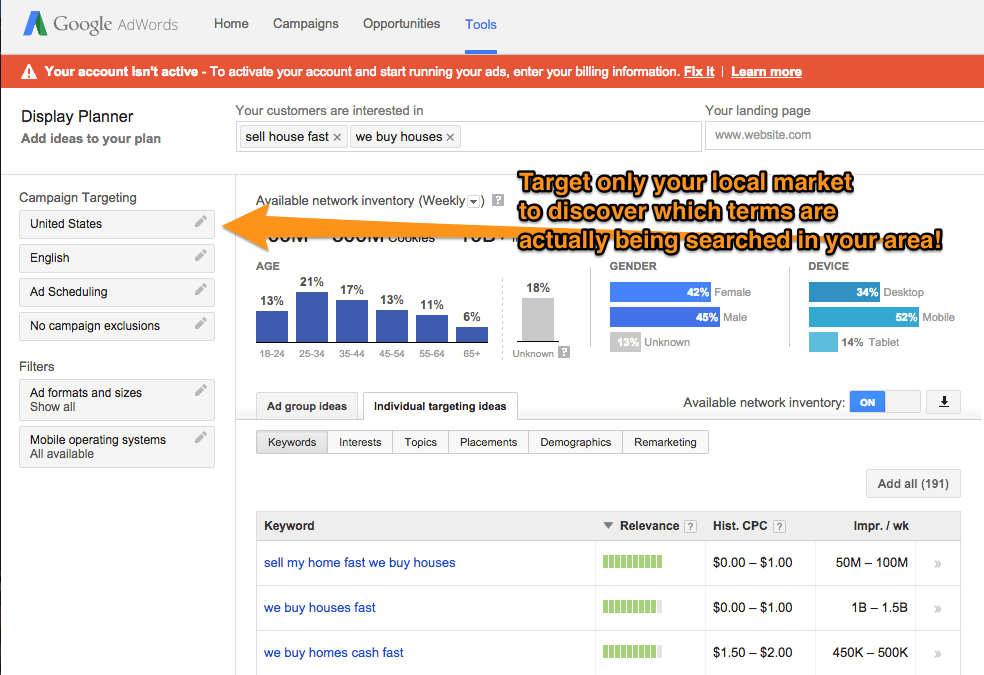
The majority of PPC campaigns by “do it yourselfers” that we see have glaring things that need to be fixed that would really increase the results from the campaign. And lots of people are being held back by a PPC ad budget that’s too low. Here are some tips on making your PPC marketing dollars go further.
Add more marketing channels
If you’ve been thinking of testing some new marketing channels, now is the time to add them so you have them refined and humming along when the spring and summer months kick in.
Craigslist continues to be a surprising source of cash buyers and a consistent stream of sellers for our members.
Many investors have been ignoring Craigslist for a few years because it’s old school and it’s gotten harder to market in the real estate sections. But we have a very powerful and effective Craigslist training that shows you how to still get leads from this source. And I believe that Facebook is an AMAZING source of cash buyer leads when done right.
So now is the time to start testing some Facebook efforts. And don’t stop there.
Motivated sellers are far less motivated to sell in the winter because they don’t want to move when it’s cold.
So how can you help them avoid that pain? Does it mean getting really creative by offering to cover a moving company? Some investors might scream at the potential cost… but consider this: it might make more sense to get SOME profit from a few deals than to get NO profit because you can’t find motivated sellers who are willing to move.
Also, you know all of those leads you generated in the past 4-6 months that didn’t turn into deals?
Well, send out a campaign to all of them to see if they were able to get their situation taken care of.
You could send an email that looks something like this…
“Hi [name], I hope your holiday season is going well!
If you remember, you and I connected a few months back when you let us know about your property at on our website.
I’m going through my notes and wanted to follow up to see if you were able to sell that house yet? If not, would it be worth chatting again to see if the timing is right for me to make you another offer? I’m buying 3 more houses before the end of the year yours is in the neighborhood we’re looking for.
I look forward to connecting with you!
– [your name]”
Plan ahead
Chances are, you’ll see a bump in cash buyer leads in the new year so use this time to build some extra capacity into your business (i.e. train a new acquisitions person or estimator), which will allow you to do even more when those cash buyers spike in January.
Also, if you’re still working to get your search engine rankings higher… the winter months are the PERFECT time to put in the SEO time (or hire it out) to grow your rankings so your website is ranked higher when the search volume picks back up.
Think long-term
Search engine optimization can take 3-5 months to really take effect(or sometimes longer in competitive markets) so if you level up your search engine optimization game now, you’ll help to position your site for even greater search engine result greatness! Don’t wait until March to try to rank well for a competitive phrase by the summer “traffic bump”… if you do you may not be giving yourself enough time for the SEO rankings to mature.
Seeing Your Leads Dip Unveils A Hidden OPPORTUNITY
Most investors will tell you that fewer leads is a frustration.
But I think it’s an opportunity: it’s an opportunity to build a more diversified and stable business by deploying new strategies that you might not normally have time to try out. And once you build these strategies into your marketing, they’ll continue working for you to drive more leads into your business and push that trend line even higher!
See our plans or take a demo… but above all, take this seasonal opportunity to get creative with your real estate marketing!
We’re on a roll over here at InvestorCarrot and, just like in farming… we’re making this spring a time renewal, refreshing, and improving the Carrot platform each and every week.
With that said, we’ve rolled out several pretty cool and important updates over the last 2 weeks, with more to come over the next 2 weeks.
One is a pretty major update to our property listing engine based on feedback from members and the other is an improvement on the way your social media sharing buttons work on your websites.
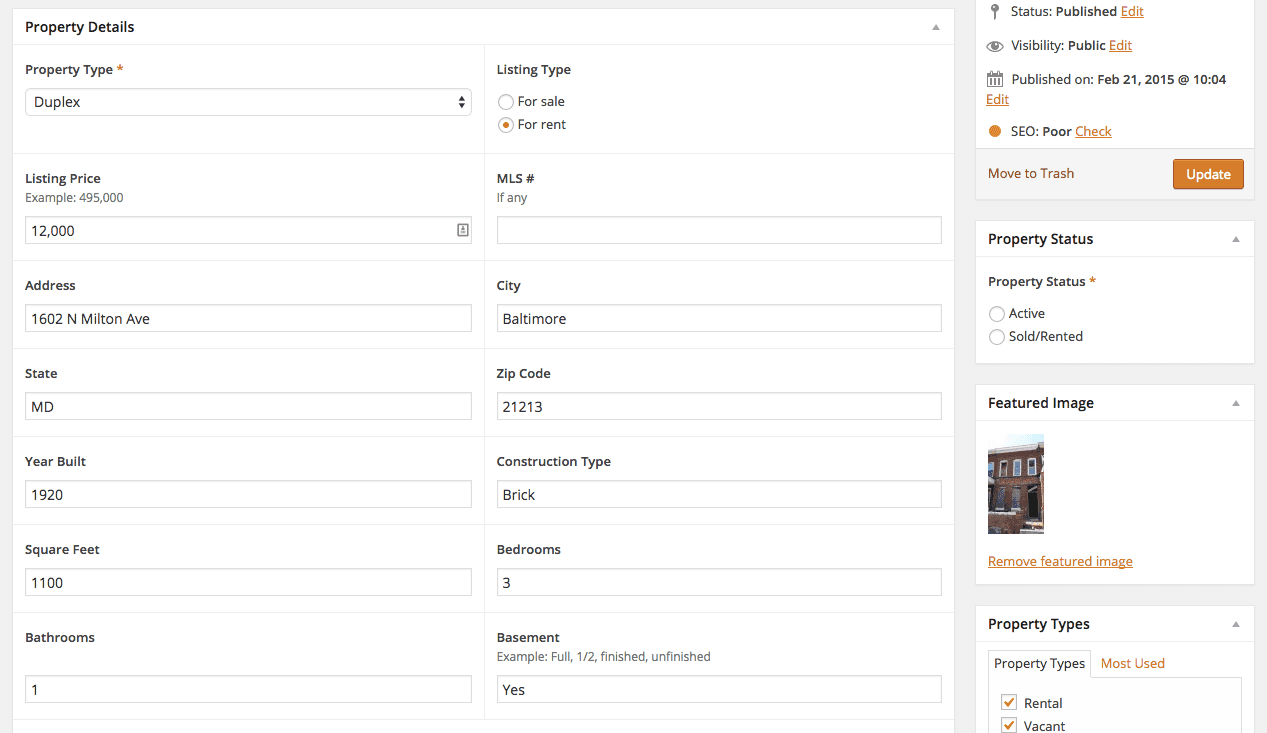
We are really excited about these changes and we know you will be too. If you are a new customer and haven’t used the property feature before you might not appreciate the awesome redesign these Carrot features have undergone. But we won’t leave you out. You can check out the screenshots below to see the changes we have made.
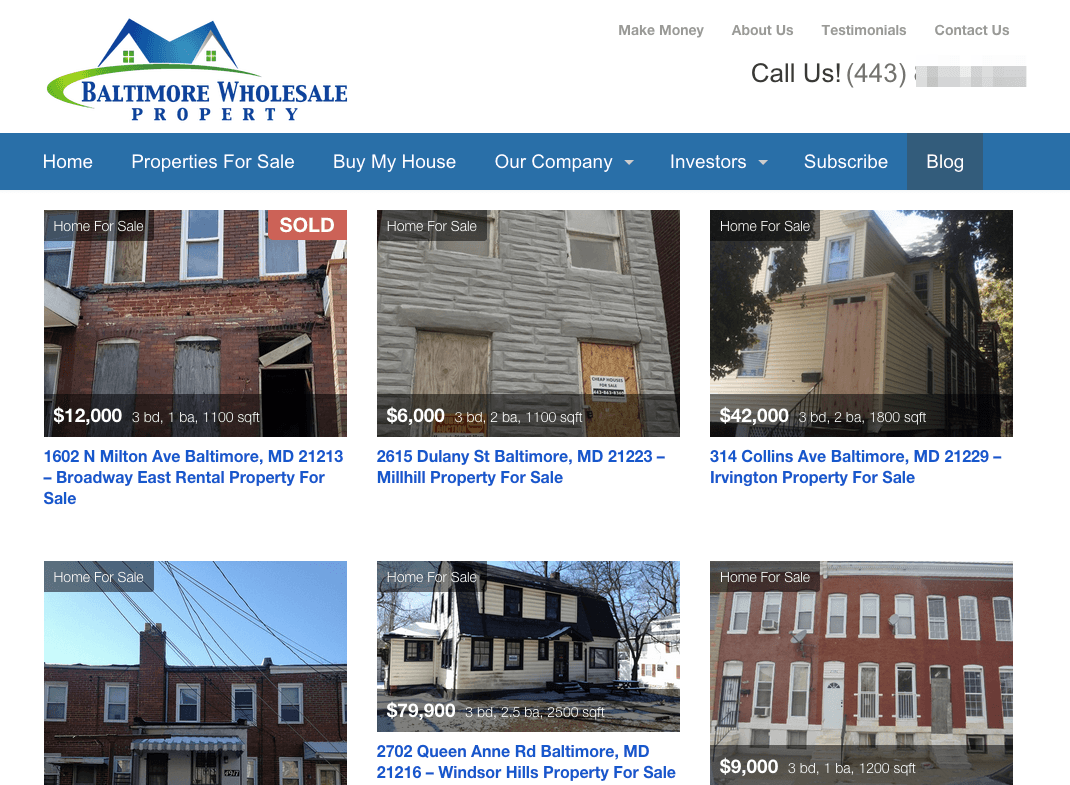
Update #1: The New Beautiful Property Listing Website Engine. Simpler. Sexier.
This major update isn’t one that’ll help you get more leads, but it is a major improvement on how you get your deals in front of your cash buyers, your rent to own tenants, and turnkey investors. Lots of our members were looking for a more modern and simpler way to launch a property listing website for their real estate investing or real estate agent business.
So we set out to make your property listings beautiful, more useful and intuitive, and more powerful in this first update of several planned updates to the Property Listing Engine.
The New And Improved Property Listing Page... help your buyers see more properties without scrolling (plus they look sharp!)
So What’s Different About The Look Of Your Property Listing Sites?
We made tons of updates to the Property Listing Engine on your websites, but here are a few of the biggest.
A Simpler, Easier To Read “Grid” View Of All Of Your Properties
This helps your cash buyers, rent to own tenants, and turnkey buyers see more properties without scrolling down. Plus they look great!
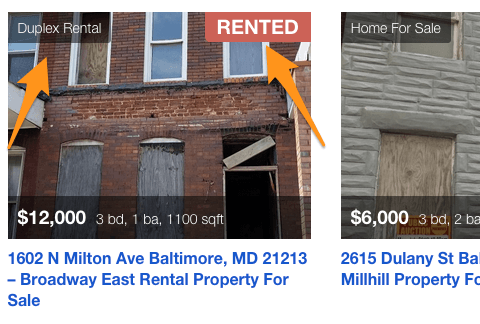
Mark Your Property Status And Type With A Click Of A Mouse
A simple click helps you indicate if a property is sold or rented, plus our system will tag your properties whether they’re a “Home For Sale”, Duplex, Apartment… you get the idea.
Improved Image Gallery That Looks Great On Every Device (especially mobile!)
We moved the image gallery from the bottom of your property listing sites to the top and made the gallery crisp, clean, and easy to use on all devices. We’ve found buyers want to see the visual of the property above all else, so they’re now front and center.
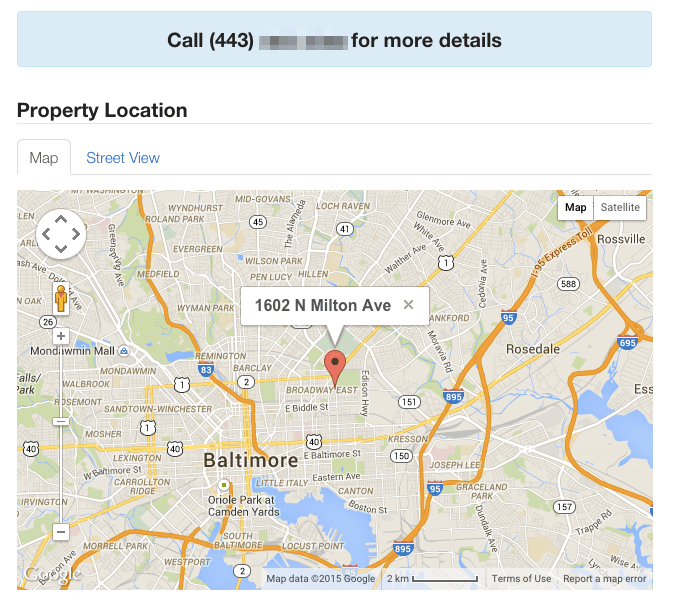
Simpler And Cleaner Google Maps And Street View Display With Clear Call To Action
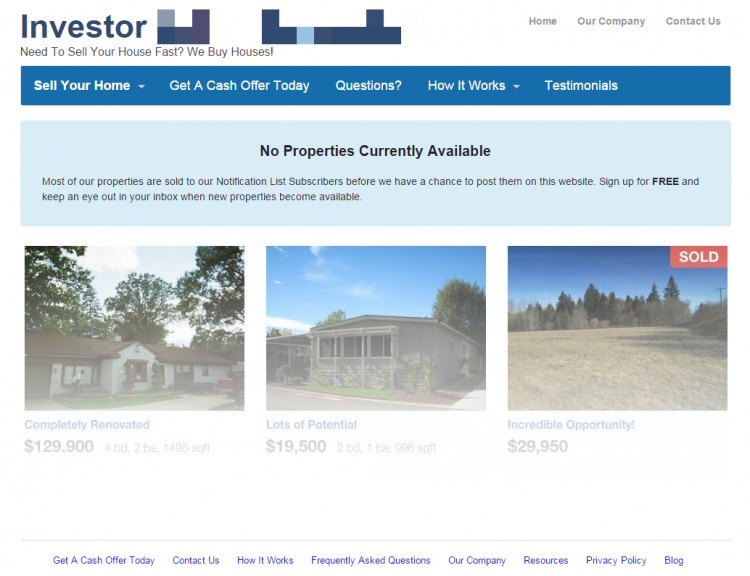
No Properties To Upload Yet? We’ll Still Make You Look Professional!
In the past, website visitors were faced with a blank page if there weren’t any properties uploaded to the website. Now, our system is helping you build credibility and your cash buyer list even if you have no properties to upload on your website yet.
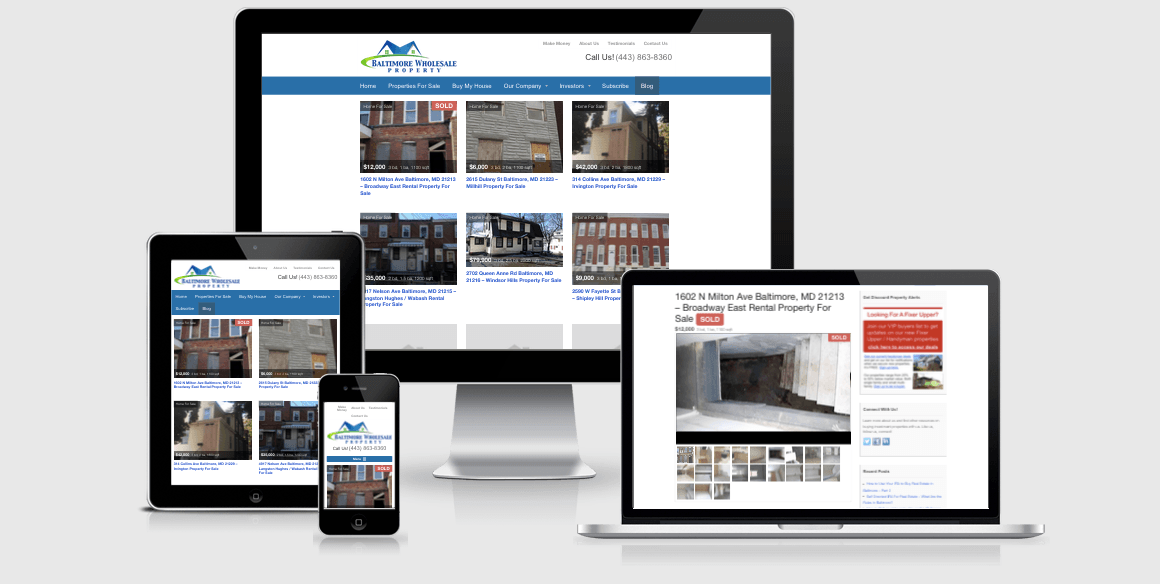
Nearly 30% Of Your Traffic Is Mobile:
These Property Listings Look Great On All Devices
A New, Simpler Process To Create Your Property Listings
We’ve rethought how listing your properties through your InvestorCarrot real estate investing websites should work, and we’ve simplified it.
Now we walk you through a very simple and intuitive “wizard” to get the property details in place, upload your pictures, and optimize the posting for SEO.
Hop in and try the new Property Listing Engine in your InvestorCarrot account!
Update #2: Faster, Sleeker Social Media Sharing Buttons
In our never-ending quest to always improve the performance of your websites we often will pinpoint very simple changes that we can make that help make your websites even faster than they already are.
In one of our tests, we discovered that there was room to improve the website load time by streamlining the Social Media Share buttons on your websites.
How Did We Improve The Social Media Buttons?
First of all, the new look is much more modern and clean on your website.
But that’s not the main reason we made the change.
Typical social media share buttons have their own separate styling and count of the number of “Likes” or “G 1+’s” made on that page. But every time someone landed on the website, their web browser would contact each of those networks like Google or Facebook to see the current “count” and render the share button on the site.
It’s not a huge deal, but it does decrease the page load speed and can make your site feel sluggish when it is really just waiting on those separate networks.
So these new social media share buttons load insanely fast, look great, and still do the same thing as before in helping you spread the word about your website and boost your social media sharing signals for SEO.
Does This Mean I Lose My Facebook and G 1+ Shares?
Nope! Your shares always follow your domain name… not the buttons. So whatever shares you had on your web page before, they’re still there!
We’d Love Your Feedback Below!
Give These New Features A Try!
This is the first of several property listing updates we have planned and we’d love your feedback.
What do you love about the new property listings on your website?
What would you love to see done to help you market your properties even easier and more effectively?
We’re all ears!
If you’re not an InvestorCarrot member yet, head on over and take our demo or see our pricing and plans. Be a part of the 48,000+ leads per month our Carrot members are pulling into their real estate investing websites with Inbound Marketing each and every month.
Looking for quality Real Estate SEO Tips to help you generate leads? Congrats, you’ve found the best Real Estate SEO Tips out there… at least we think so. :)
Search Engine Optimization can be super confusing. There is a ton of information out there, and most of it is contradictory or outdated.
This video will help you break down in less than 3 minutes SEO tips for real estate investors.
Real Estate SEO Tips (VIDEO):
Real Estate Investor SEO Tip #1:
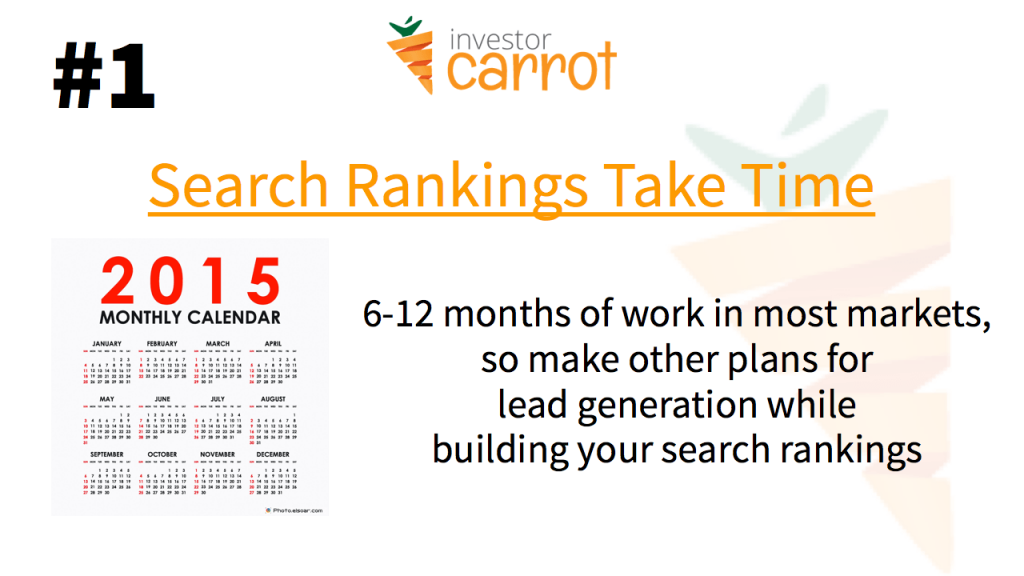
Don’t rush! SEO isn’t a short term solution. It’s a long term investment in your business. So be patient… and make plans to get leads from other sources (we can show you how, no worries).
Real Estate SEO Tip #2:
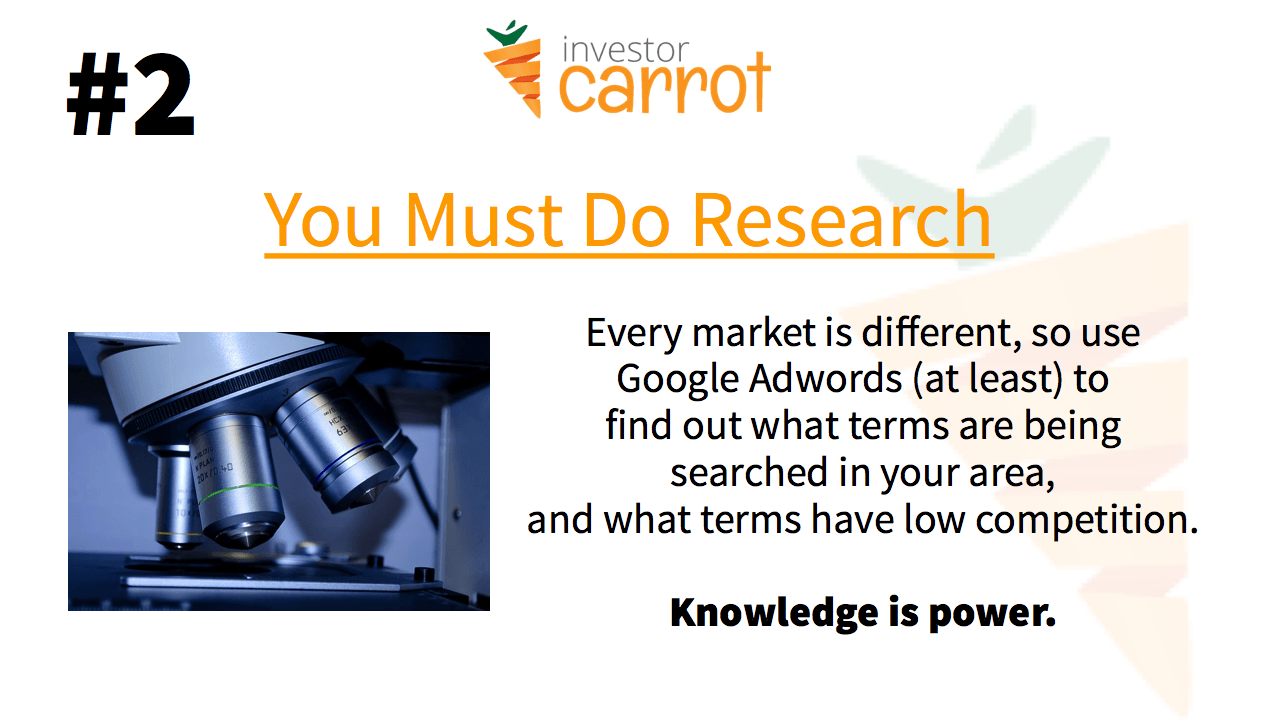
Our biggest Real Estate SEO Tip is to Do Your Homework… you have got to know what keywords are being searched in your market and understand what it will take to beat your competition – otherwise you won’t get the results you want. Get your Free SEO Bible here.
Real Estate Investors SEO Tip #3:
Keep on truckin… doing a little bit of SEO work every day (or at least a couple hours a week) will pay off well over the course of a year – if you’re focused and stick to a good plan (we’ll help you learn exactly what you need to know).
Real Estate Investor SEO Tip #4:
Google has, like, the smartest people ever working on this stuff. If you wanna try and beat ’em, go for it… be prepared to suffer the consequences. We’d recommend sticking to a solid, proven content marketing strategy – not cheap tricks. Get a free real estate marketing plan template.
Real Estate SEO Tip #5:
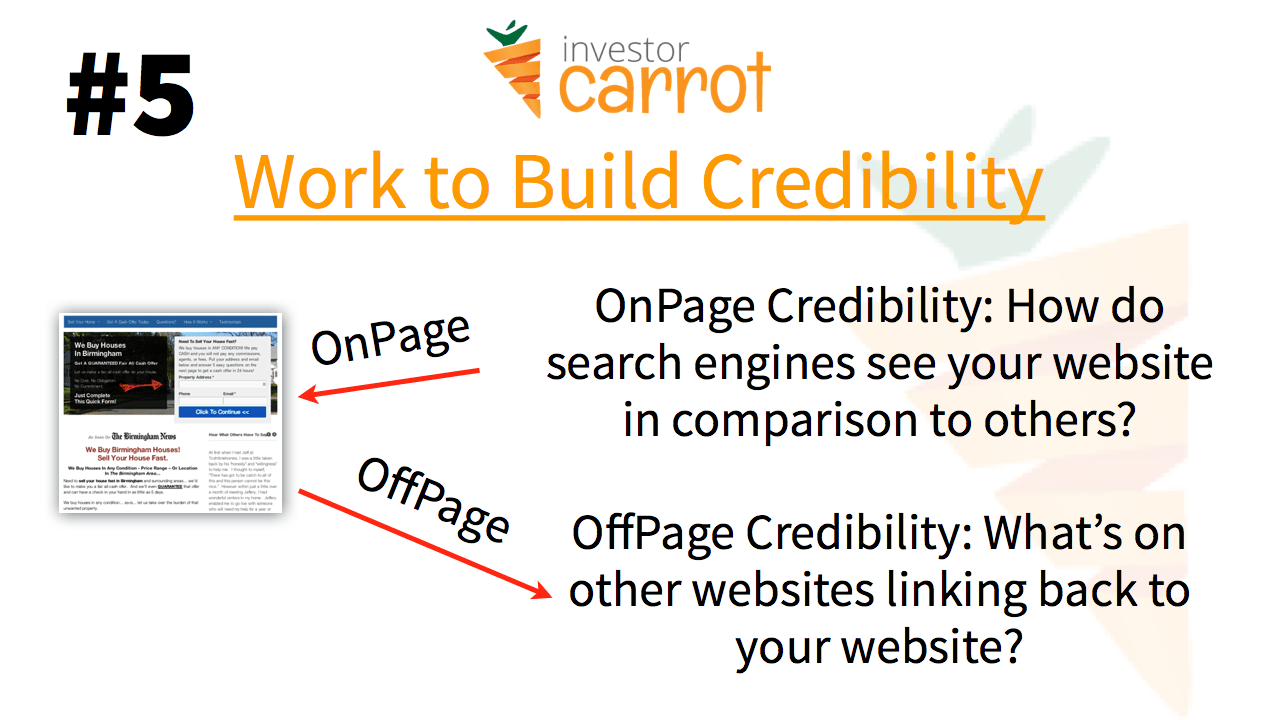
Credibility matters more than almost anything else. Once you prove that you (and your website) have Authority with Google, you’ll find it way easier to get high rankings on additional terms (and generate more leads). A focus on building Credibility for your business will improve your conversions on your site – add testimonials for social proof, improve your bio, and share your site in as many places as possible!
Real Estate SEO Tip #6:
Don’t buy those crummy spammy “instant result” automated SEO services – we’ve seen investors waste thousands of dollars and loads of time, just to find out they need to spend a lot more money on cleaning up the messes that were left behind. Seller intent keywords such as sell my house fast Dallas have much more quality searches for you than say, “what’s the value on my home?” Focus on high quality and you’ll get high-quality results. Our trusted vendors can help – click now to get started.
Real Estate SEO Tip #7:
Make sure you’re driving traffic to your website with at least a few different methods. Think of it as diversifying your marketing portfolio – so if one method crashes (when Google changes their algorithm some sites drop their rankings like a bad stock when the market is tanking), you won’t be left high and dry.
Real Estate Investors SEO Tip #8:
If you’re an expert in SEO, congrats! You’ll find our platform will save you a ton of time. If you’re just starting out on your internet marketing journey, you will want to stick with a proven, tested platform that helps you generate leads… oh hey, that’s what we built! ;) Launching a website on our platform takes less time than you spent to read this blog post – click here to see how fast it is to get started.
Want to get started?
Get access to a free demo of the InvestorCarrot technology platform!
Want to learn more about content marketing, lead generation and SEO?
The majority of search traffic comes from page 1 – these terms are highly competitive, so it’s super-valuable to invest in good SEO in your local market. We can help you. Click to see Brittany’s story of going from zero online leads to multiple leads per day – and how she was able to quit her wage job to become a full-time investor working for herself.
Don’t make your real estate investor marketing tough on yourself! Just take it one step at a time. Today’s post will show you expected and unexpected strategies for real estate investor lead generation.
As the real estate market gets increasingly competitive, the search for quality inventory becomes tougher every day.
If you’re like most of our members, you’d prefer to have your phone ring… you don’t want to cold call people from a list, right? I’ve done quite a bit of cold calling over the years myself, and even though I’m pretty good at it, it’s way more work… it’s a whole lot easier to learn solid inbound marketing practices from others, then replicate them for yourself.
My goal here of this blog is to take the best practices from others who are some of the best at real estate investor lead generation and bring them to you. Like a butler carrying a silver tray…. I want to serve lead generation techniques to you with style. :)
We’ve shown you the not-so-secret formula for lead generation is simple: traffic & conversions.
One fun thing to remember: traffic can come from anywhere. If you have a creative, fun or clever way to generate leads: do it! Don’t get stuck in “paralysis by analysis” — trust yourself when you think “hey, this might work.”
Unique Strategies for Real Estate Investor Lead Generation
The Expected:
Google Search
Optimize Your Real Estate Investor Lead Generation Websites
Craigslist for Real Estate Investors
Bandit Signs and Bus Stops
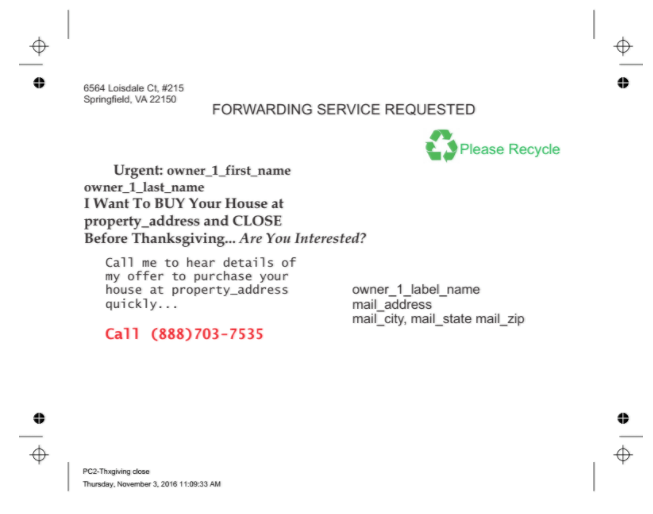
Direct Mail
Bird Dogging
Develop Properties
The Unexpected:
Bing, Yahoo and “Off-Google” Search
Optimize Yelp, Facebook… Everything
Local Classifieds
Flyers at Laundromats and Non-Profits
Door Knocking with a “Down Payment”
Turn Your Vendors Into Business Partners
Develop Communities
Expected: Google Search
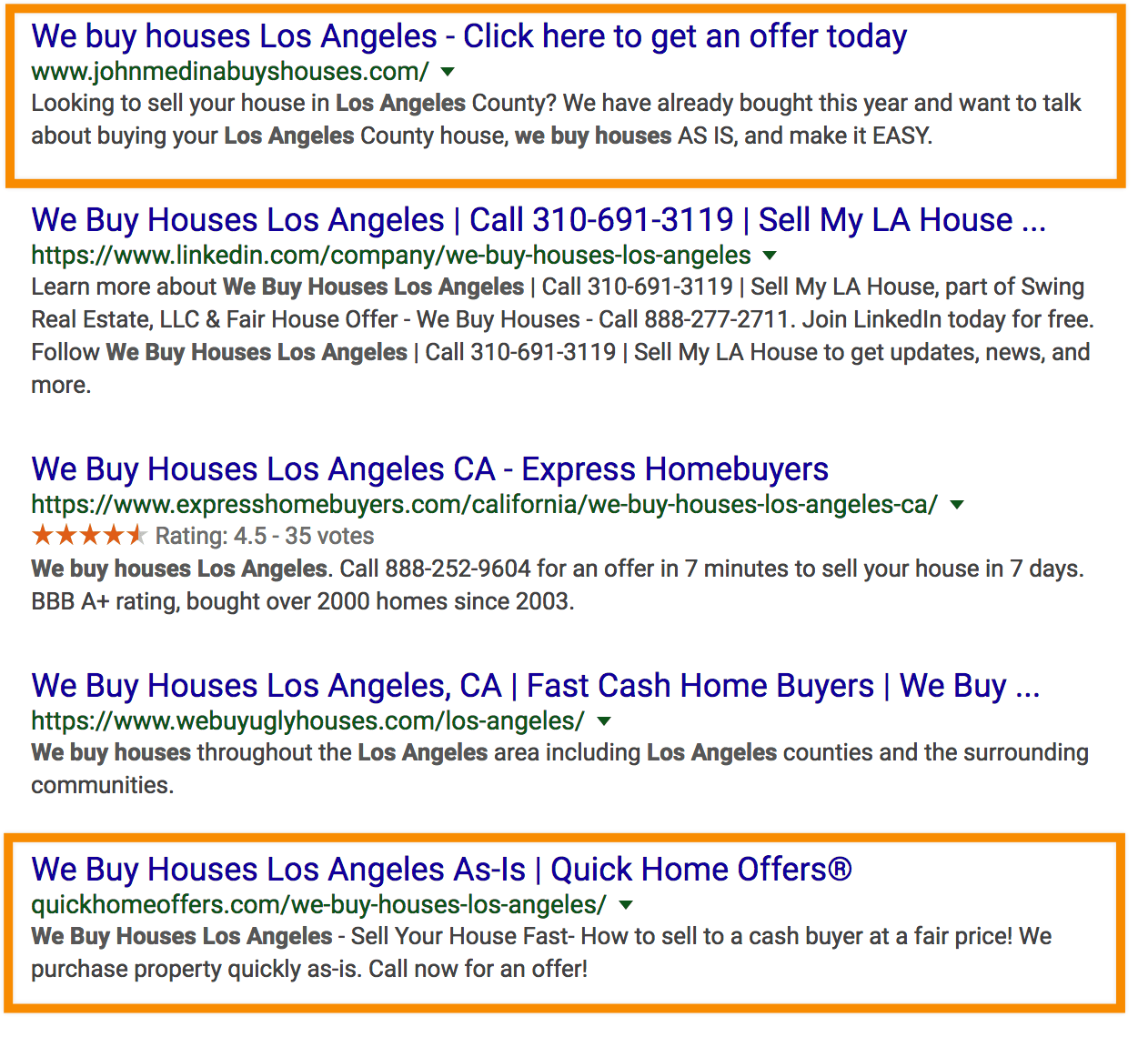
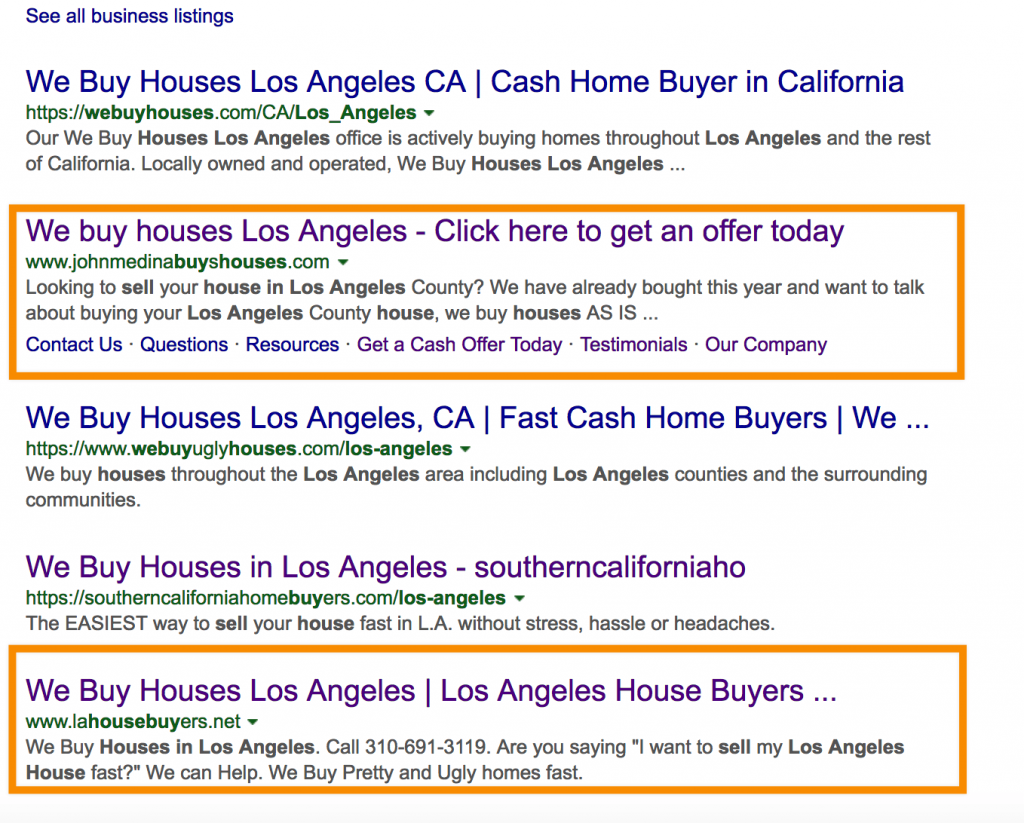
Carrot Members Ranking Organically on Google for We Buy Houses Los Angeles
Definitely one of our favorite places to generate leads!
A good chunk of our business comes from folks who search phrases like “real estate investor websites” online… then discover InvestorCarrot. They check us out, learn that we’ve got an awesome reputation… then start learning from us, launch a website, follow our training… and then get great results.
Lots of our members are beating their competitors on the top Google keywords in their markets using our sites. It’s super cool to see.
Carrot Members Ranking Organically on Bing for We Buy Houses Los Angeles
While Google gets about 66% of the traffic, they seem to get about 99% of the attention.
That leaves almost a third of the traffic out there without much competition. PPC costs are usually way lower on off-brand networks (although the conversion rates are often lower too, it still often ends up being cheaper than Google).
Expected: Optimize Your Real Estate Investor Lead Generation Websites
You know that you should be optimizing your website, right? Optimization is critical to getting found on search.
Did you know that investors are using pages on other platforms to crowd out their competition in search, too?
I’ve seen pages on Yelp, Facebook, YouTube, Zillow, blog sites, and other big platforms used to dominate top keywords in busy markets.
This is a really smart strategy because sites like Yelp and Facebook already have a ton of authority, so it’s way easier to rank your business’s page on their high-credibility site than on your brand new domain name.
I’d love to see more of our members dominating their local search by ranking different websites on the same keywords… and crowding out their competition.
Already a Carrot Member? Check Out Carrot’s Facebook Leads Masterclass
Unexpected: Geebo, Reachoo, and Other Local Classifieds
The same techniques that work so well on Craigslist also work for other local classified sites. I know one real estate investor who has had the same tiny little ad running for years in his local paper… I think he said it costs him about $80 per month to keep it there, and he makes about $25,000 per year off of the transactions that ad generates.
If you’ve got a local newspaper that doesn’t charge a ton, it’s probably a good idea to run a tiny ad with your phone number, especially if your competitor *isn’t* doing it.
It’s also not a bad idea to post ads on a lot of the free online sites that imitate Craigslist. On some of those sites, you might even get some SEO benefit when you link back to your site from your profile.
Lots of investors have tried putting up signs or buying bus stop ads.
They work, although paid ads are expensive and bandit signs are illegal in many areas (that’s why they got called “bandit” signs… cause they’re breaking the law).
Unexpected: Flyers at Laundromats and Non-Profits
If someone can’t afford to fix their washer, they might need to sell their house, right?
Most laundromats have a bulletin board where you can hang a flyer. Better yet, buy the laundromat. People pump quarters into those things all day long. ;)
Seriously though, make some quality fliers (or if you don’t have graphic design skills, hire someone)… and find the places where people go when they’re down-and-out.
Talk to folks at non-profit agencies who help with foreclosure and probate assistance, and see if they need a partner who buys houses or helps with short sales (depending on your specialties). You may be able to give them a donation from every transaction, depending on referral laws in your state. Check with a good attorney to be sure.
If you can build trust with the right agencies, you’ll have an ongoing deal pipeline for a long time. There are some insanely smart community development organizations who build housing and are solid real estate professionals. Don’t underestimate them.
If you can provide a great service for the same population they serve, they’ll be a great business alliance.
Plus, the partnership that you establish with them is great for press and building future credibility.
Expected: Direct Mail
Direct mail is still a viable real estate investor lead generation option, and it’s easy to replicate. There are a lot of systems for sale out there. It’s pretty expensive, and everyone’s doing it… if you’re in a busy market and using a popular system, you’re probably sending the same stuff as your competitors.
It’s still better than doing nothing. Direct mail campaigns tend to have about a 2-3% success rate, on average… so you’re definitely playing a numbers game.
Unexpected: Door Knocking with a “Down Payment”
I know this real estate investor lead generation method sounds crazy! But I know investors who do really well just walking up to houses and knocking on the door.
Of course, they know who they are targeting… after signs of disrepair, utility notices, etc., they walk up to the door… and if the owner is home, they give that person a $5 bill along with a business card… and let the homeowner know that it’s just a “down payment” when that seller is ready to sell. It’s pretty easy to get their contact info – shoot, let ’em know you wanna send ’em another $5 on their birthday.
I love that strategy… it’s a powerful psychological trigger to take money from someone.
And if you’re thinking “whoa, that’s a fast way to lose $5” – then you’ve probably never run a pay-per-click campaign on Google. If you’re not planning to spend some time and/or money on lead acquisition, you’re not making a serious plan.
Developing a list of people who have taken your “$5 down payment” and actually staying in touch with those people is a great way to get access to properties before anyone else in your market. You don’t want to go around giving away money… but if you can set yourself up to buy houses before anyone else, you’re winning.
Expected: Bird Dogging
Lots of real estate investors team up with “bird dogs” to send them leads. These are folks who (hopefully) do the work of finding potential off-market property sellers and then send you the leads. Depending on the bird dog and the strength of the lead, this might average out to a cost of $50-$1,500 per transaction.
Unexpected: Turn Your Vendors Into Business Partners
Often the people you already know are your key to growing your business… you might just not see the opportunity.
If you know an ambitious person… might be a sibling or a cousin, could be a virtual assistant, a student or a partially retired friend… even your spouse.
If you find someone who isn’t afraid to knock on doors and talk to people, that person could be a great potential partner for your real estate business. Or maybe you’re the type of person who loves to talk but hates technical details — then you might want to find someone who can help you crush it with online marketing.
Depending on the laws in your state, it might even make sense for you to help that person buy property under his or her name – or even together under a new LLC.
There are a lot of creative ways to structure deals.
As many industry veterans will tell you, often the price doesn’t matter as much as the terms.
When you’re calculating your profit from a transaction, what’s important isn’t just the price you paid… it’s the money you made.
If your subcontractor, virtual assistant, and your family are all working to help your business grow – if they have incentives, motivation and a clear path – you’ll have a
So don’t be afraid to partner up with other people who can help you generate leads…. and don’t be afraid to publish in unexpected places!
Expected: Develop Properties
As a real estate investor, you should always be looking for easy ways to add value to properties. If you could spend $5,000 to improve the landscaping and increase your sale price by $50,000 – that would be a no-brainer of a decision, right?
I like to think of my investments on a timeline… where can I add value today that I can pull out for the highest return later?
In other words, if I can get my hands on a fully-rented apartment building with crummy apartments and slowly rehab each one for pennies on the dollar by keeping a few decent workers busy, I’ll make a lot more money by never having to lose my cash flow.
If I build a 30-unit building from scratch, I’d have to have the money to wait until the building is mostly finished before I even take in any money… that means I’d have to take out a lot of loans, which all cut into my profit.
So generally speaking, I look for properties that are already occupied, but not making the kind of cash flow they could be making if they were cleaned up, improved and well-managed.
But either way, it comes down to the money… I like to find properties that need mostly cosmetic improvements because those are the cheapest ways to develop.
Great investors know how to add value to the properties they own to get exponential rates of return.
I’ve been lucky enough to work with some truly great investors along the way, and I’m looking forward to sharing more of what I learned from them… and what I’m still learning today from our awesome Carrot members – we’re lucky to have some of the nation’s top investors as our members, and we’re growing every day.
Unexpected: Develop Communities
As some of you know, I spent a decade in Chicago real estate… actually more when you count the years I spent as a kid getting dragged around to open houses by my mother, who loved to keep tabs on all the neighborhood real estate activity.
I got involved with over $1 billion worth of real estate during my time in Chicago… most of it when I was the managing broker of a really busy real estate brokerage that helped to develop one of the coolest communities – the Wicker Park / Bucktown / Logan Square areas on the city’s Northwest side.
My boss then was a tiger, and I’m sure she still is today. She built an amazing business from the ground up out of sheer will and determination.
She represented some of the top developers on the Near Northside – guys who would buy millions of dollars worth of properties each week, as inventory became available. My boss sold the condos and buildings. I managed the office, training leasing and sales agents. We sold over $100M in sales volume and leased out hundreds of apartments each year. It was the glory days of a booming economy.
But together, we sold a story. It was a story about the neighborhood, about the community… about the histories and cultures of the people who lived there.
After years and years of working in those communities, we saw incredible growth. Now, that wasn’t just from our efforts, or those of our developers… there were huge economic forces in a city like Chicago much larger than anything we were doing.
As successful brokers, we knew how to own the story of the neighborhood.
We sold it to our clients: buyers, sellers, investors, developers, and tenants.
Everyone wanted to participate in something larger than themselves… that’s that feeling of community that feels so good. When you’re really helping others, it shows… and people want to be a part of it.
Your Real Estate Investor Lead Generation Efforts…
should be centered on your community.
We do the same with Carrot: we think of our members first. We want to help you do the best possible marketing for your real estate investment business.
What’s working for you? Any unexpected techniques or tricks we should try? What’s got you stuck? What can we help you improve or understand better?
YouTube Real Estate Marketing doesn’t have to be tough, but if you want it to generate leads, you’d better optimize… we’ll show you how.
Want to get great results from your YouTube real estate marketing? Read these tips to find out how to get leads with videos!
Why use YouTube for real estate marketing?
If a picture is worth a thousand words, a YouTube real estate video is worth millions.
People can actually see you. They can hear you.
A video gives people a chance to build trust with you.
That trust is at the core of conversion strategy. Trust is what makes marketing work. People must have a certain amount of trust in order to make a purchase or fill out a form to get more info.
They have to believe in you.
That’s what makes video so great – it’s your chance to reach people, to connect with them, to inspire them to take action… to sell a house, to buy an investment… whatever you’ve got to offer, video can help you connect in a way that no other medium can do.
Think of it this way… a great sales video can keep selling for years, while you’re kicking back with your feet up.
So without further ado, here are the keys to getting great results from video marketing:
#1 – Do your keyword research.
I can’t emphasize enough how important it is to research your keywords.
You must make sure that you’re optimizing for keywords that are actually being searched in your market.
People search on YouTube differently than they do in regular Google search. They often use different terms and slightly different phrases. So don’t assume that the keyword research you did months ago when you were thinking about optimizing your site is going to be enough for a good video marketing campaign.
Unfortunately, Google shut off the tool that told us directly what was being searched on YouTube… best we can see now is what they provide in their Display AdWords Planner – you’ll need a free Google account to use the tool.
Here’s what the Display Tool looks like:
When you’re using Display Planner, make sure to target only your local market to see your *local* search traffic… you probably don’t want or need leads from areas across the world. :) Want some suggestions of terms? Keep reading.
#2 – Use no more than 2 keywords per video
For search marketing purposes, it’s way better to make a lot of small videos on YouTube targeting many keywords than to make one long one.
Think about it… people are searching a specific term, so you want your video to be directly related to that specific term. Sure, you can optimize a generic video a bunch of times with a lot of terms… but that technique won’t get good results.
Here are a few places where keywords might help:
Title
Tags
Description
Channel name
Playlist titles
Playlist description
Comment field
YouTube hashtags
Social media posts that link to YouTube
Website
Annotations
Captions
Content or script
Thumbnails
Graphics in video
Channel art
Channel icon
Custom Bitly links
Remember, Google is very smart. They work incredibly hard to make sure that good results climb to the top of their searches… so if you concentrate on making really high-quality content and optimizing it, you’ll get great results from it.
Don’t try to do too much with one video… make a plan to create new videos often.
#3 – Focus on making a great YouTube Real Estate Channel
Yeah, I know… you wanna just make one video, then call it quits.
But seriously, don’t bother. Trying to make one video will make you nuts. You can’t say everything you need to say in 90 seconds unless you’re super focused on just one or two keywords.
Either prepare to make video marketing a big part of your business, or don’t do it at all.
If you’re gonna do video marketing on YouTube, you’ll want to set up a really great YouTube channel.
That’s the goal… the top of the mountain you’ll want to climb. High credibility, high trust, high views… high revenue. :)
Videos that are on a great channel go to the top of the rankings.
Don’t stress about creating a great channel – it’s not something that will happen overnight. It’s the same offline and online – your focus should be on building high-quality, educational content that helps people in your local market.
That’s a long-term activity for major wealth-building, not a short-term, get-rich-quick trick.
So organize yourself in the way that makes the most sense for your working style.
Can you make one video per week? In a year you’ll have 52 videos… that’s a good amount for a channel.
Need help making your videos?
Organize it as a project instead… plan to make 20-30 videos at once. It takes less time and money than you’d think.
You can totally do it yourself, or hire some help.
You’ll need 3 people to help you:
A copywriter to help you script out your videos to make great content
A videographer to help you film and edit your videos
A search marketer to help you optimize your videos
That last piece is so important… there are so many examples of great quality videos that get no views, simply because they weren’t set up right from the beginning.
But like everything else, just optimizing on the video alone might not be enough to get it to the top of the search.
#4 – Surround Your Videos With Great Content
Here’s where you can really put your Carrot sites to use: embed your videos!
You might not want to put a video right on the top of your home page… we’ve found that those can lower your conversion rates. It’s important not to stuff videos any old spot… but to put them in the right places.
Put them into blog posts or pages that are optimized for the same keyword, and that will help Google (and the other search engines) realize the value of your video and serve it up to the right audience.
You can also send out videos as a part of a well-written press release, too – that will help increase your exposure and connect up your video with your keywords on many sites.
Just like a page, a video needs credibility coming from the outside… the more related places where your video appears, the better. It’s a great practice to embed your video on an optimized Carrot page, then focus on getting high-quality back links directly to that page… that will help increase your site’s ranking and reputation as well as your video at the same time.
#5 – Learn All You Can About Video Marketing
We’re gonna have a special guest for tomorrow’s Live MasterMind Call… and we’re gonna talk a bunch about video marketing, why real estate investors have been too shy to use it well, and what a huge set of opportunities there are gonna be coming up for investors who do the work of setting up a really great video marketing system for themselves.
Don’t treat your online marketing as just “content”… think of it like making your pitch on Shark Tank, again and again and again.
Even though I love content marketing, I really hate the word “content”.
It’s dumb. Makes it seem like just filler.
Crank up another blog post, stuff it in the queue, and onto the next one.
Here’s what matters most in business (and life) WAY more than just “content”: value.
You Have to Add Value
Otherwise, what’s the point? Why should someone work with you if you don’t add value?
Value is at the heart of every real estate transaction. Value is more than just money.
It’s speed – how fast can you buy or sell?
It’s service – will you take care of them?
It’s integrity – will you give them a fair deal?
It’s experience – can you remove stress and make it fun?
All these things help create the value that you bring to your transaction.
Are you describing them in your marketing?
Are you using your blog as a place to tell the stories of how you’ve helped sell a house fast in your area?
Telling those stories is a great way to add content that builds up your keyword ranking, but more importantly, it builds up your reputation. You’re creating your reputation as you conduct your business… and it’s up to you to tell the story.
You have to explain the value you bring to people. It’s not easy. In fact, it’s incredibly hard to articulate your value without sounding cheesy.
You want to tell the stories that make your audience the hero. We’re here to help real estate investors generate leads, but we take it much further than that.
We Want People to Tell Their Stories Better
We know that good storytelling skills matter a ton in the real estate business, not just for inbound lead generation, but for negotiation, team building, sales and relationship development.
If you can relate to people, no matter who they are in life, you can reach them through the right story… and if you want to do business with someone, your story must show the value you bring.
Your website is the perfect place to tell that story and share your value.
When you launch a Carrot website, it’s got a ton of great content already written into it… it’s got most of the most commonly searched keywords that people use, and our software automatically personalizes those pages with your market area.
But there’s one thing that needs to be added: Your STORY
Add in your testimonials – you should add in as many testimonials as you can because those provide important social proof.
Ideally, testimonials convey the value you bring – so a quote from a seller saying “You helped me sell my house in just 5 days and kept all your promises, I can’t thank you enough” is perfect.
If you don’t have the perfect quote, ask permission from folks who know you to use quotes like “A great person to do business with, highly recommended” – anything that will show that you add value.
Are you struggling to know how to add value?
When You Truly Know Your Audience, You Know What They Need
Remember, not every motivated seller is the same. Not everyone wants to sell their house fast – some need a smooth transition into a different living situation or just an urgent need for cash.
Not every real estate investor is the same, either.
That’s why it’s so important never to assume that your audience understands your business.
Use your blog as a platform to show off the value you provide to others.
That’s the secret to powerful inbound marketing: show your value, again and again.
Carrot members: join us this Wednesday for a great Live Coaching Call… register here.