

Category: Real Estate Marketing

  • 5 Mindset Habits For Setting And Achieving Your Real Estate Investing Goals in 2021

    5 Mindset Habits For Setting And Achieving Your Real Estate Investing Goals in 2021

    2016-12-03-mindset-main

    How do some the top real estate investors plan for the next year?

    Sometimes small differences separate those who fail in real estate vs. those who thrive… and the end of the year planning rituals give these top investors a huge edge over their competition.

    What are you doing this time of the year to plan for a successful year ahead? Well, here’s a peek behind the scenes of what these top real estate investors do to hone their mindset and get laser focus for the year ahead.

    Real estate investors continue to thrive by using solid real estate investment strategies. Wholesaling and flipping are continuing to push momentum as well as the multi-family market.

    However, perhaps even more than ever, is the ability to adapt to move within the market trends is hugely important. The ability to plan ahead.

    So we reached out to some top investors and real estate professionals to see if they would share what type of mindset they have when penciling in their strategies for the coming year.

    Use these strategies below and implement them in your own business before you get too far into the new year!

    5 Mindset Habits To Help Create Effective Real Estate Investing Goals For The Year Ahead AND Actually Achieve Them


    Doug Fath – Legacy Capital

    I love doing end of the year planning for the upcoming year. In order to make this planning as efficient as possible, there are three things that set me up to hit the ground running to create my yearly goals.

    1. Accurate Numbers

    I have the books for over a dozen of my entities reconciled on a monthly basis (thank you MY HQ Pro) so by the time I get to December I have accurate numbers through the end of November. This is super important because you need to account for your current year goals before you can create new ones.

    2. Strategic Planning

    I’ve always been a big planner but Dan Sullivan’s Strategic Coach Program has helped me take strategic planning to a new level, so by the time I get to the end of the year, I already have a pretty good idea what I’m up against in the new year based on my previous written goals (Life Time Goals, 3-Year Goals, and 1-Year Goals) that I review on a quarterly basis.

    3. Inspiration

    There aren’t many authors that can do this but there is something about Robert Kiyosaki’s writings that speaks to my soul and gets me inspired.

    I re-read and skim some of my favorite books which are primarily from his “Rich Dad” Collection.

    I’ll go through my highlights of “Rich Dad Poor Dad”, “Cashflow Quadrant”, “Guide to Investing”, “Retire Young Retire Rich”, “Increase Your Financial IQ”, “Conspiracy of the Rich” and Keith Cunningham’s “Keys to The Vault” and “The Ultimate Blueprint for an Insanely Successful Business”.

    By this point, I’m ready to rock and roll and create my new annual goals which I create in the following format.

    • Yearly Goals
    • Vision Board
    • Word of the year
    • Context – focus for the year
    • Business Investment Strategy (from Kiyosaki’s “Who Took My Money”)
    • Visual Illustration of my Business Investment Strategy
    • High-Level Goals – “Retire Young Retire Rich”
    • Personal Financial Statement – how do the fulfillment of my goals show up here
    • Personal Financial Statement – Results from the current year compared to new goals for the upcoming year
    • Growing & Development – “Rich Dad’s” 3 paths to wealth and how I plan to learn and grow in each of those areas this year
    • Financial Statements of Poor, Middle Class, and Rich (always a good reminder)

    Daniil Kleyman – Rehab Valuator

    I think for any proper, true self-reflection, you need to be able to get away from your regular physical and work environment.

    For me, that means going out of the country. At the end of each year, I try to take a trip to truly disconnect from my regular “world” and “grind” to assess where I’ve been and where I’m going.

    [At the time of writing this] Right now, I am sitting on my balcony in Maui overlooking the Pacific Ocean. We got in last night after spending 11 days in Thailand. Both destinations have been sunny, peaceful, and idyllic which all offer great scenery for taking time out and really thinking about what’s important in life.

    So that brings me to my year-end assessment and planning for the next year.

    I ask myself these questions…

    I think goal-setting has its place and I do some of that for the next year. But there is a deeper process that I engage in and it starts with asking myself the following questions:

    • Am I engaged in the kinds of activities every single day that I truly enjoy and want to be engaged in?

    I think focusing on goals is important but I want to make sure I am enjoying life and my work every single day, not just the thought or the prospect of the prize at the end of the journey. So I try to make sure that my daily activities and my work involve things I am truly passionate about.

    If you can get to that point, then the end result actually becomes less important. If you enjoy the journey, then the destination matters less and less.

    I make a list of the high-level work I do all the way down to the daily routine stuff and if there are things on the list which I don’t truly enjoy doing, then I make a game plan for how to outsource or delegate more and more of it out.

    And if there is an entire business or business segment which I realize doesn’t truly bring me satisfaction (I run multiple companies and within those companies multiple business niches or segments or revenue generators), then I start thinking about getting rid of that business or business segment altogether.

    • Am I living the kind of life I truly want to be living? This is more of a bigger picture lifestyle and lifestyle planning question.
    • Am I pursuing my passions?
    • Am I engaged in regular learning?
    • Am I traveling and seeing enough of the world?
    • Am I helping others regularly and giving back?

    Again, I think it’s important to ensure that our life is designed according to our ideals right now, not someday later.

    So I make sure that my plan for the following year includes all of these activities and if I don’t have the means to do something, then I make a game plan for finding those means.

    Those are my starting point questions.

    Once I answer those questions, then I back my way into what my specific goals and activities for next year should be so that I am able to continue leading the kind of life I want to be leading.

    Those answers guide what I do, not some arbitrary revenue figures or goals that are rooted in someone else’s expectations of me.


    Alex Pardo – FlipEmpire

    “9 Things You MUST Do To CRUSH the YEAR”

    Well, my friends, it’s that time of the year again. As we get ready to embark on another year, I’d like to share with you the process I go through to ensure I set myself up for success, and crush my goals!

    I’m not talking just about setting goals, and I’m definitely not talking about “new years resolutions” (which completely suck in my opinion).

    I think most people understand the importance of goals, but few people approach this important task with the level of thought and attention I think it deserves.

    After all, how can you have what you want out of life and business if you don’t know “WHY” you want it? How can you stack the deck in your favor so that by this time next year, you’re feeling accomplished, successful, happy and fulfilled?

    This post is aimed at helping you CRUSH IT (and my hope is that this process will help make it your best year ever!)

    The following 9-step outline will walk you through my systematic approach to document my vision, my “why”, set the goals I will accomplish in the new year, as well as an action plan to help guide me along the way.

    (Quick Tip: Did you notice what I said there? I said, “…set the goals I WILL accomplish”. You always want to state your goals as if you already achieved them)

    Here we go:

    1. Year-End Reflect & Review

    Take out a legal pad of paper (you’ll use this a lot), and write down everything you accomplished this year. I often find that I accumulated many more “wins” than I thought, and this process will help you begin to appreciate the progress you made (even though you may not feel like it).

    Now take some time to think about the challenges you encountered along the way. Write them down, but most importantly, write down what you learned as a result.

    2. Focus on your “Wins”

    Look at your list of accomplishments and focus on the positive. Don’t worry about the goals you didn’t accomplish, but look at where you were, and all the progress you made throughout the year.

    It’s always more productive to focus your attention on the gap between where you were, and where you are now, opposed to focusing on what you weren’t able to accomplish!

    3. Express Gratitude

    Write down everything you are grateful for… do not let your hand stop, just let it flow! It’s amazing what expressing gratitude does in our lives, so make sure you adopt this practice on a daily basis!

    4. “Cut the Fat”

    Make a list of the things you don’t like doing, and/or don’t add value to your life/business, and decide if you can: Delegate it? Outsource It? Automate It? Or, completely remove it from your list?!

    5. Write out your ‘January Letter’ (Vision)

    I got this from my friend Sean Terry, and it’s a great exercise. Mentally fast forward to Dec. 31st of the following year, and ask yourself what would have had to happen in that year for you to feel happy, successful, accomplished, etc.?

    Then write yourself a letter as if that year just finished and you accomplished everything you wanted to accomplish.

    TIP: Make sure that you embed emotion into this exercise. Imagine what it would feel like after you’ve crushed your goals…

    6. Create Emotionally Driven (S.M.A.R.T) Goals, and most importantly document your “WHY”

    Document exactly what you want to accomplish in the coming year, and “WHY”. I like to focus on 1-3 goals max, and for the following categories:

    • Family
    • Spiritual
    • Health
    • Business
    • Personal

    S.M.A.R.T Goals are: Specific, Measurable, Attainable, Realistic, Time-Based

    (Each goal should have a quick sentence or paragraph on “WHY” you want this goal. Remember to write them down as if you already accomplished them!)

    7. Reverse Engineer Your Goals

    • Break them down into quarterly goals
    • Then break those down into monthly goals
    • Then break those down into weekly goals
    • and finally daily goals

    8. Set Your Calendar

    Start with the most important thing first (ex. if Family, schedule all vacations, family time-off, etc…), then move on to the second most important thing (ex. Business goals). Everyone will be different, so you have to be self-aware.

    What’s most important to you?

    9. Recharge Your Batteries

    Take some time off to do what you love. Think about what energizes you, and do that! You can’t imagine how beneficial this is for you, your family, and your business.

    That’s it, my friends. I’ve come up with this throughout the years, and I hope you find it valuable. You are getting ready to do big things next year. People are relying on you, so follow through and make it happen!

    Oh, and one last parting thought…

    It’s not always about the destination, but the journey.

    Make sure you enjoy the ride. It won’t always be smooth. In fact, I can almost guarantee it will be bumpy along the way, but it’s all part of the process in making you the best version of yourself!


    Dan Schwartz

    “The January Letter”

    I didn’t originate this, but I can accredit it to Frank Kern for instilling this habit from a podcast I heard years ago.

    The gist: Before NYE, write a letter as your future self. Date the letter exactly one year from today, and start it with something along the lines of “Dear [your name], it’s been one heck of a year!” followed by a description of your accomplishments in these four pillars of your life:

    1. Personal development goals: Health, mindset, and relationships (new workout habits, new mentors, etc.)
    2. Career/business/economic goals: What level of financial abundance you’d like to achieve, what person have you become in your field etc.?
    3. Stuff goals: What kind of cool toys, trips, experiences, and fun stuff did you do and acquire?
    4. Contribution: How have you given back to the world?

    The point of the exercise is to mentally frame these accomplishments as if they already happened. It’s a powerful subconscious exercise.

    You’ll find when you read this letter in a year, it’s usually eerily in line with what you were able to actually manifest…so dream big!


    Trevor Mauch – Carrot

    For me, it’s really 4 steps I go through each December and January that have really given me momentum in business and life the last 6-7 years.

    Before that, I’d go through the same cycle every year.

    I was too busy. Too overworked. Under compensated. Not as grateful as I should be. Not happy (with every reason to be happy as heck).

    And in 2012 I had a transformational year.

    I’m talking… increase my income (net income, not just revenues) and productivity by 10x, I’m consistently happy (has nothing to do w/ the money by the way), fulfilled, clear on my purpose…

    … and yes… I’m still busy. I haven’t slain that dragon yet…

    … but the work I do for the most part now is stuff I LOVE to do and my purpose and mission in life have become crystal clear.

    It’s all a process.

    Anyone can repeat it.

    It’s 4 basic steps (that I went into in detail this week in a live Google Hangout that you can see below.

    The steps are…

    1. Mindset Re-Set

    It’s easy to lose urgency for actually doing the important things NOW in life vs. waiting and thinking we have forever to do it. Time with family, creating your legacy, striving for achievement, etc.

    So I recognize my own mortality… that NOW is the time to do those important things since there’s no guarantee any of us will be here in 10 years.

    2. Solid Annual Planning Process

    I do a 2 day “off-site”… fully away from the office and away from distraction. For me, it’s with the Leadership team at Carrot and we basically go through this agenda (and have a lot of fun in the process).

    • Reflect and review the year behind us. What did we do great? Do not so great? Celebrate the wins!
    • Mind-expanding s*** (pardon the french). Let’s really think big. Allow ourselves to get scared a bit. Then peel it back to what we want to accomplish specifically the next year now that our mind is expanded. What impact do we want to make? What legacy can we create right now? Why are we here????
    • Product planning. What products/services do we need to have and improve the next year to march toward that big vision we just cast? Get specific.
    • Marketing planning. What kind of marketing will it take to sell our product/service to reach those goals? Be specific.
    • People planning. What gaps do we have currently or bottlenecks we need to solve to achieve all of that and still live the amazing lifestyle we want to live? Also what amazing people can we bring into our mission and how do we best enrich their lives?
    • Process planning. Are there any processes we NEED to have in place to do all of that better? There always are. What will really unleash you and your potential in 2021 process-wise? Be specific. Tackle those first in the next year.

    3. Structure To Keep Course During The Year

    Most people do goal setting once and then they never check them again. I’ve learned I have to have guard rails on my year to keep me on course. Chunk down your big goals to 90 days so they seem more achievable and are easier to turn into action items each month. Have a solid daily “to do” process, and put other things in place to keep you on track.

    3 FREE Resources to Build Healthy Habits

    4. Crafting A “Winning Environment”

    One great way to stay motivated, inspired, and on track is to surround yourself with things that inspire you.

    So What Are You Doing To Plan A Successful Year Ahead RIGHT NOW?

    As the old saying goes… “if you fail to plan, you plan to fail”.

    The same thing doesn’t work for everyone as you can see in this blog post. So, borrow from what’s working for these top real estate entrepreneurs and implement those strategies in your own life right now.

    My guess is less than 5% of everyone reading this will actually go out and thoroughly plan your year ahead. Those people will crush it.

    The rest of the people will likely be looking back this time next year at the year that passed saying, “Man that year went fast. I had some goals I wrote down but I got off track and this year ended up just like last year ended. No real progress on my big life goals, no momentum, and nothing much to show for the year.

    So it’s your choice… borrow from these best practices this year to plan an epic year ahead… or continue on with the status quo. I hope you choose to have a life-changing year (for the better) in 2021.


    What are you doing to plan for 2021? Let me know below!

  • EP 17: He’s Bought 2,000+ Houses. How?  Brad Chandler with Express Homebuyers Unveils His Journey

    EP 17: He’s Bought 2,000+ Houses. How? Brad Chandler with Express Homebuyers Unveils His Journey

    2016-10-04-carrotcast_brad_main

    Our bread and butter was TV and has been for years. My father did TV advertising back in the early 80’s as an Attorney. In a way, he sort of pioneered it in the legal field. His two partners said “hey, I don’t want to do business with you if you’re going to TV advertise” and he said “see you later” and went and found two new partners. – Brad Chandler

    Why You Need A Killer Mindset In Your Real Estate Marketing And How Brad Has Thousands Of Reasons To Show For It

    Subscribe and rate us on iTunes

    Brad Chandler is the CEO of Express Homebuyers, one of the largest home buyers in the entire country. In this episode, we dive into what makes someone who has grown from a one-man show to now buying over 2,100 homes, tick.

    What key mindset shifts did Brad have to make early on? And what does Brad say is the most important part of his real estate marketing arsenal?

    Enjoy :-)


    Past CarrotCast episodes


    Listen to the Podcast

    Subscribe To The CarrotCast On iTunes

    In this CarrotCast conversation Trevor and Brad tackle: 

    • What makes high-achievers tick.
    • Differences in mindset between those who quit and those who find a way to figure it out.
    • Tips to stand out from your competition.
    • How to create an effective lead follow-up system.
    • How to create a business that serves you.

    Watch the Video Version

    He’s Bought 2,000+ Houses. How?  Brad Chandler with Express Home Buyers Unveils His Journey

    2:00 – The structure and focus of Express Homebuyers. From blow pops to 2,000 deals.
    5:35 – The three buckets of Express Homebuyers – Fix and Flip, Condo Development, and Rental Portfolio.
    7:00 – What it took to start Express Homebuyers and spending seven hard working months to close the first deal.
    8:50 – The difference in MINDSET between the people who struggle, but keep going and the people who quit.
    11:10 – The driving force behind Brad’s positive MINDSET.
    13:45 – Transactional vs. Wealth building wholesaling.
    15:20 – Brad’s real estate marketing plan – Heavy on TV advertising.
    20:10 – Standing out from the real estate competition, the value of being in front of your brand to build credibility, and the importance of your website’s “About” page.
    28:50 – Creating a business that serves you. Not you serving a business.
    35:25 – How to build an incredible follow-up system.
    40:10 – Implementing the 9 Word Email.
    42:20 – Outpacing the competition online. New Facebook targeting option.
    46:45 – Focusing on the “one thing” to strive to be better at.

    [podcast-subscribe]

  • EP 16: Effective Copywriting Tips For Real Estate From World Renowned Copywriter Ben Settle

    EP 16: Effective Copywriting Tips For Real Estate From World Renowned Copywriter Ben Settle

    2016-10-03-carrotcast_ben_main

    “If you know your market well and if you know who you’re talking to and know your customer, then you’ll know exactly what to say to get them to at least hear you out and read what you have to say. Then the only people that you hear back from are the people who are the most interested. So it saves you all of this time.” – Ben Settle

    “A copywriter should have an understanding of people, an insight into them, a sympathy toward them.”  – George Gribbin

    Subscribe and rate us on iTunes

    The message you deliver in your marketing can make or break how well it works. Your direct mail, website, ads, you name it… copywriting is THE single most valuable skill you can learn to make your marketing more effective.

    So Trevor invited on his good friend and world-renowned copywriter Ben Settle (the king of email copywriting) to talk about how you can connect with your audience better in real estate and boost your marketing with better copy.

    Enjoy :-)


    Past CarrotCast Episodes


    Listen to the Podcast

    Subscribe To The CarrotCast On iTunes

    In this CarrotCast conversation with Ben Settle we cover these six topics; 

    • The most effective types of copywriting.
    • How to intentionally craft copy around emotions and situations.
    • Effective copywriting tips for real estate.
    • How to copywrite for direct mail.
    • Crafting testimonials into stories.
    • Key copywriting resources he uses.

    Watch the Video Version

    Effective Copywriting Tips For Real Estate From World Renowned Copywriter Ben Settle

    3:55 – What is copywriting? Salesmanship in print or other media outlets.
    5:25 – Backstory of getting into copywriting.
    9:15 – Ben’s first copywriting assignment.
    10:00 – What types of copywriting crack through and actually work.
    12:35 – Importance of really understanding your prospects.
    16:15 – Basic needs that make us tick and intentionally crafting copy around insecurities, problems, and frustrations.
    26:50 – Some of the best techniques to join a conversion when writing copy. Building a vision before pitching an offer.
    31:30 – Examples of Real estate investor copywriting.
    40:45 – Copywriting for direct mail. Focus on the top one or two important messaging tactics.
    48:45 – How to leverage your case studies and stories.
    51:30 – Cutting through the marketing clutter. Stand out from the pack by telling a story.
    54:10 – Crafting copywriting using testimonials.
    57:40 – Resources available to better learn about your client.
    59:55 – Formulas for copywriting and learn a copywriting slacker secret.

    Book: Crypto Copywriting Secrets

    [podcast-subscribe]

  • 7 Factors Of A Great Domain Name For Real Estate Investing Websites

    7 Factors Of A Great Domain Name For Real Estate Investing Websites

    domain name for real estate investing

    When it comes to real estate investing, you must understand the power of leverage: Using a small amount of work to achieve a large payoff. Whether you get leverage from other people’s money (OPM), mortgages, virtual assistants, or automation, you know that leverage is a key part of the investing biz.

    Leverage is just as important when it comes to domain names for real estate investing. Your website’s domain name may seem like a small thing but it plays a huge role in your website:

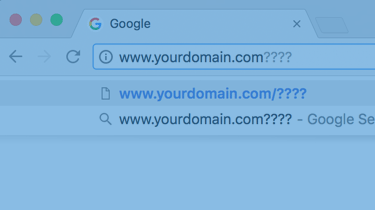
    • At its most basic function, a domain name are the words that people enter into their browser’s address bar to your website.
    • Your domain name is also a marketing tool – it’s a memorable word or phrase (functioning a lot like a sub-brand, slogan, or tagline) that you share with people so they’ll visit your site when they’re in front of their computer.
    • Your domain name is also a search engine optimization (SEO) tool. Search engines use the domain name as part of the algorithm that helps their automated systems understand what your website is about so they can index it properly… which allows your audience to find it when they search.
    • Your domain name is a sales tool, presenting the benefits of your solution to other people’s real estate problems. (Not all websites do this but many websites use this strategy. If your site’s domain name says something like “ColumbusOhioTurnkeyProfits” then you’re using your domain name as a sales tool).


    7 Factors Of A Great Domain Name For Real Estate Investing: Checklist

    As you think about what your website’s domain name should be, review this checklist of key factors in a great domain name and try to incorporate as many of these as you can.

    And one more thing to be aware of: These are general guidelines and recommendations. You may find that you have a domain name that “breaks” some of these rules but still works for you. We’re not suggesting you change your domain name if it works.

    These guidelines are meant to help you find a great domain name if you don’t have one yet.

    1. What does your audience want?

    Consider what your audience is looking for. Be specific. For example, motivated sellers aren’t automatically looking to SELL their property. They’re looking to solve a financial headache, or they’re tired landlords who are sick of dealing with tenants, or they’ve inherited a property that they can’t afford to keep.

    There’s a similar situation on the buyer side, too: Rent-to-own tenants are looking for an affordable property without a credit check; cash buyers who are also investors might be looking for turnkey properties.

    Action: Figure out what your audience wants and state those goals in a few words.

    2. What are they searching for?

    You’ve already thought about what your audience wants to achieve, but it’s important to know that what they want to achieve isn’t the same thing as what they search for. That’s because people are focused on their pain, and, they’re not thinking with your investor mindset. For example…

    • It’s less likely that someone will search for “sell my property” and rather “sell my house”. Or on the buyer side, if your buyers are investors looking for turnkey properties then their ideal outcome would be passive income that they earn while laying on the beach, but they’ll probably search for “turnkey real estate” or “cash flow investing”.
    • It’s also more likely that searchers will use the word “my” (“Sell My House”) rather than “a” (“Sell A House”) or “your” (“Sell Your House”). In fact, the search term “sell my house” has nearly 6 times more search volume than “sell your house”… obviously, because the searcher is thinking about their (“my”) house.
    website Domain Name for real estate investing Examples

    Action: Put yourself in your audience’s shoes and think about how they would search Google for information about their situation.

    3. Value, Benefits, and USP

    There is a reason that sellers and buyers come to you for help. You offer them some kind of beneficial value. There’s something unique about your real estate solution that makes you the preferred choice for that seller or buyer. The hard part is for you to figure out what it is.

    But once you know, you can incorporate that into your domain name as well. Do you provide really fast service? Are your offers all in cash? Can you close in two days? Do you do business in a different language? There are many reasons why someone would want to do business with you and your domain name is a place to highlight some of those reasons. FastCashRealEstateOffers.com or FreedomTurnkeyInvestments.com are a couple of examples.

    Action: Think about the reasons that people do deals with you instead of your competition. What unique benefits do you offer that no one else offers?

    4. Brand

    Your brand is another factor of your domain name. If you do business under a specific operating name, that name is part of your brand and you may want to include it in your domain name. An example might be a business called Sunrise Investments. That could work as a domain name. However, your brand is more than just your operating name – it’s the whole experience that someone has when they work with you to sell or buy a property. If you’re a veteran who does deals, your domain name might be something like “veteran buys houses”, which could also work as a domain name.

    Action: Think about your brand – both the name of your business as well as the experience people have when they work with you. List those components and see how they factor in.

    5. Location Specific (HIGHLY RECOMMENDED)

    Your location should be incorporated into your domain name for real estate investing. You may end up searching really well for a search term like “we buy houses” but that won’t help you if you buy houses in Oakland, New Jersey and you’re getting searchers from Australia looking for houses in that country. So choose a domain name that ideally highlights the area you do business.

    Most searchers will localize their search by city and state (Phoenix Arizona or they’ll often shorten it to Phoenix AZ). If you do business in a larger area than just one city, consider including only the state. (In most cases, searchers won’t search for the county they live in – usually just city or state (however, there are exceptions to this rule-of-thumb).

    real estate investing website domain name

    Action: List the areas you do business and try to narrow down the list to a few larger urban centers where you do deals.

    6. Clarity and simplicity

    After you’ve considered all of the factors so far, it’s good to do one final check for clarity and simplicity. It’s easy to allow your domain name to grow and grow and grow as you try to squeeze everything in. Accept the fact that you won’t likely get EVERYTHING squeezed into your domain name and just come up with a few ideas that you like. The fewer words, the better; however, you can probably expect to have at least four or five words (SellMyMemphisHome or TurnkeyInvestmentsColumbusOhio).

    • Aim for four or five words; avoid more than seven words.
    • If possible, avoid short forms (use Phoenix instead of PHX and Columbus instead of CBUS), although it’s okay to use the two-letter postal abbreviation for your state (OH for Ohio, etc.). In highly competitive markets, it might not be possible to use Phoenix. As a last resort, turn to PHX.
    • Remember that people will be typing these into your browser so try to keep them together as one single group rather than separated out by dashes (use TurnkeyInvestmentsColumbusOhio.com instead of turnkey-investments-columbus-ohio.com).

    Action: Review your potential domain names and have other trusted people review them as well. You should also have at least one person review your domain names who is NOT a real estate investor (to give you an “outsider’s” perspective).

    7. Choose a dot-com over other options

    Domain names end in dot-something (like .com or .org). These are called “top-level domains” or “TLDs”. When given the choice between .com, .net, or .anything-else, choose .com. Although search engines don’t necessarily prefer one TLD over the other in terms of ranking, .com seems to be perceived by most American searchers as the most credible and legitimate TLD. The importance of building credibility stands in a study by searchmetrics.com. It found out that almost 75% of backlinks go back to .com domains.

    And if someone remembers part of your domain name but not the TLD, they’ll type in .com by default. These attitudes are changing, especially as new TLDs are appearing, but .com is still preferred. If your ideal .com is unavailable, it’s probably better to seriously consider a different .com domain name instead of settling on the .net or .org TLD.

    domain names for real estate websites

    Action: Gather together the ideas you’ve come up with so far and start searching to see if those domain names are in use.

    Summary

    Your domain name for real estate investing is just as much a part of your business as your business name, your slogan, and your logo. It’s something you should think carefully about because, as we’ve mentioned earlier, your domain name does a lot of work for you as a marketing and sales tool. If you need to refresh,

    If you need to refresh, then CLICK HERE to jump back up to the meat of this post: a step-by-step checklist of HOW to optimize your domain name for real estate.

    7 factors to build a great domain name that will help grow your business for years to come.

  • 4 Step Marketing Budget Formula: Find The Magic Number You NEED To Invest To Close A Deal

    4 Step Marketing Budget Formula: Find The Magic Number You NEED To Invest To Close A Deal

    What if you could know that for every $1500 invested in online ads, you’re pulling $10,000 back? But, a lot of investors don’t take the time to calculate and understand what it takes to get a positive ROI. So, they quit too soon. Let’s fix that.

    Before we dive in, as you listen to this Strategy Sketch, you’ll need to use The Carrot ROI Calculator tool to help pencil in your own marketing budget.

    I’ve got a quick story for you, but before I start if this is your very first strategy sketch with Carrot we have a lot of other ones on our YouTube channel. Check them out after you watch this one.

    4 Paid Marketing ROI Steps Only High Real Estate Achievers Understand

    The story is of 2 different real estate investors…

    One real estate investor’s had an amazing return on their marketing.

    The other one struggled and lost all their money and ended up giving up.

    I want to make sure that you identify where in this story you fit. Which one of these are you resonating with? Which one of these are you living right now?

    The First Investor…

    The first investor had a marketing budget and he knew his numbers really well. I’m going to be walking through exactly what the first investor did to make sure he got a great ROI on his marketing.

    The Second Investor…

    The second real estate investor also had a budget. He dove in, he started spending money, he started investing money, but he did not do these 4 steps I’m going to walk you through.

    They both had the same amount of money to start, they both had the same amount of experience. One of them lost his butt on all of his marketing, the other ended up making tens of thousands of dollars.

    Now, this is not a false story. I was on one of our Coaching Calls recently here at Carrot and these 2 investors were on the exact same call. One of them ended up blowing $1500 on pay-per-click marketing. The other one ended up making almost $9,000 in the first deal because he followed these 4 steps.

    If you want to know the difference between really active and really profitable investors, these 4 things are going to be that.

    Let’s go ahead and dive in.

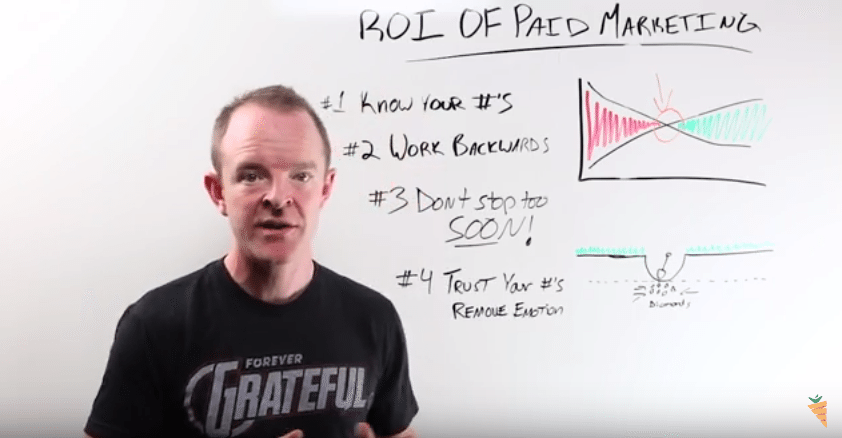
    ROI of Paid Marketing

    Step 1: Your “APD” – What Is Your Average Profit Per Deal?

    The first thing, how you get a great return on investment from your paid marketing? That’s what we’re talking about here is your paid marketing. A lot of this will translate over into the stuff where you’re just working kind of sweat equity for your marketing.

    Could be you doing your own SEO, could be you out there doing your own door knocking or whatever the heck it is, but we’re talking about marketing that you actually take your money and invest it into the marketing. It could be direct mail, pay-per-click, SEO, you name it.

    The first thing here is you’ve got to know your numbers, and I think a lot of people think that they know their numbers. They think, “I make about x amount per deal, I’ve got this much in my budget, and I’m just going to roll with that and we’ll see what happens.”

    You probably don’t know your numbers as well as you should but I’m going to walk you through in this video how you should know your numbers in a quick 30-second work your way backward formula.

    The numbers that you really need to know about your marketing: You need to know how much money you’re going to be making on each sale.

    If you’re a real estate agent, you need to know what your average profit per listing is. If you’re a real estate investor, you need to know what your average profit per deal is.

    If you’re not investing yet, go out there and investigate the market, talk to other investors in your market, and find out what their average profit per deal is. Write that down right now.

    That’s going to be a key number for you.

    Step 2: Your “LPD” and Website Conversion Rate – How Many Leads Before You Close A Deal On Average?

    The next thing that you’re going to need to know is what your conversion rate is. You’re going to need to know basically how many leads it takes to turn into a deal for you. You’re going to need to know all those types of things. We’re going to walk you through them here in a second.

    If you don’t know how many leads it takes for you to turn it into a deal, it’s going to be really hard to know your numbers and know how much you need to invest in your market.

    We’re going to work backward on some numbers and we’re going to help you identify your exact marketing budget so you know exactly what you need to invest with no guessing, take all the emotion out of it so you can just really focus on doing what you need to do. Invest in your marketing very intentionally and not stopping before you need to.

    Step 3: Don’t Stop Too Soon

    Third is exactly what I’ve led into. Don’t stop too soon. This is one of the biggest mistakes we see, not just for real estate investors or agents, in business in general. Too many of us stop way before we actually should stop. We invest a little bit of money in this marketing type and it doesn’t pan out right away and we go, “Oh my gosh, that must not work.”

    We throw up our arms and then we start something else and then we do that for a little bit. Then that doesn’t work like we thought it was. We throw up our arms and we move to something else again, and if you’re in that pattern right now.

    If you’re in the pattern of going and investing a little bit, dabbling, pulling back because you didn’t get the results you wanted, then you shift focus and you do the same thing, you’re probably going to be in that pattern forever until you change your thought process.

    If you’re in that pattern you’re going to be looking back in a year or two years or three years or even a month and going, “Oh my gosh, I ended up investing a lot of money, I lost a lot of money, I didn’t grow the business that I wanted to, I don’t have the freedom that I wanted, that I thought that I would have in my business,” and you’re going to blame it on everything but your marketing mindset.

    Having the right marketing mindset can save you from that.

    Step 4: Trust Your Numbers

    The fourth thing is you got to trust your numbers. You cannot go off of emotion in marketing. Marketing is an emotionless entity. You get emotion completely out of marketing unless you’re making your marketing materials. That’s a whole different video, a whole different strategy sketch where and how you use emotion in your marketing materials to really connect with your prospects. You can use emotion there. We don’t want to use emotion in how you analyze whether your marketing’s working or not.

    I read this book called Acres of Diamonds and this book basically is a very similar tale to the guys back in the gold rush in California, where there were many stories of these gold miners who would go in and they’d invest a ton of money in buying the equipment and people and digging and digging, and they get a little bit of gold but they did not hit the thread of gold that they thought they were going to hit.

    There was this one particular story, I don’t remember the gentleman’s name, but basically this guy built this big gold mine and he dug and dug and one day ran out of money and said, “You know what? I’m just going to quit because this must not be the spot.”

    What ended up happening was he ended up moving away, another miner came in and said, “You know what, this looks like it has promise. Let me dig a little bit further.” Within weeks this guy hit this massive payload of gold, 2-3 feet below where the other miner stopped, and the moral to the story there is you need to follow your numbers, not the emotion.

    If that first miner knew that gold was in there, he needed to make sure he knew how much budget he had, make sure he knew exactly what the ROI could be on the other end, and not stop until he hit those metrics.

    It ended up costing him millions and millions of dollars.

    How To Map Out Your Numbers

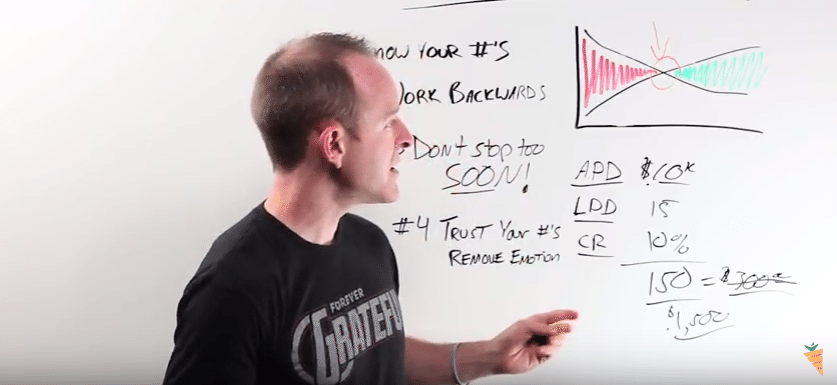
    What we’re going to do is we’re going to walk through a real example here, we’re going to map out your numbers, and we’re going to take it so your marketing turns from the red negative to the green positive. This point right here, this is what we call the inflection point in your marketing.

    Almost every time, you’re always going to have this ramp-up period. You’re going to have a period where it’s not giving you much of an ROI. With pay-per-click marketing, it’s going to take some time to get that optimized so your ROI, your return on investment, is where you want it to be.

    With search engine optimization, you’re going to be investing a lot of time and money if you’re hiring someone else to do it for 3, 4, 5, 6, 7, 8 months before you hit the inflection point and your rankings go up in Google and you start to get those leads and deals.

    We have to be long term focused. We cannot be short-term focused on our marketing, and we need to really be shooting for that inflection point, your break-even point, then from there, your profits start to really skyrocket.

    What we’re going to do is we’re going to work some numbers here. We’re going to work backward. And, we’re going to make sure you don’t stop too soon because now you’re going to know your numbers. That will help you so you trust your numbers and get emotion out of it.

    roi of paid marketing calculations

    Working The Numbers…

    Let’s start. If you’re a real estate investor let’s just work with wholesalers. What is your average profit per deal? Let’s assume that your average profit per deal is $10,000 in your market. So, we know that if you do a deal, you make $10,000. Now let’s work backward. How many leads does it usually take for you to close that one deal?

    The average for Carrot members, for online leads that are generated through our platform, is about 10-15 leads per deal right now.

    If you’re doing direct mail it’s about 20-40 leads per deal. If you’re doing pay-per-click it’s probably 15-30 leads per deal. We’re just going to run with 15 leads per deal for this example.

    Working backward, we know that we need to get 15 leads so we can get $10,000.

    If you’re doing pay-per-click marketing and you already have a campaign going and optimized, how much is it costing you to get a visitor to your website and how is your website converting?

    If you’re in a really hot market like a south Florida or LA or Portland, Oregon, websites, in general, are going to be converting lower than websites in a moderate market. If you’re in Birmingham or Louisville or something like that, your website for motivated sellers is going to convert higher than a hot market.

    So, don’t look at your friend in Kansas if you’re in LA and go, “Oh my gosh, my buddy’s getting a 10% conversion rate on his seller site, I’m only getting 3. What’s going on?” It’s probably your market, not your website if your website is set up the way that we teach.

    Now let’s work with a conversion rate. We’re going to do a 10% conversion rate. It takes 15 leads to close a deal, and then you’ve got your $10,000 profit. To get 15 leads, we’re going to need to get 150 visitors to our website. Your only goal now is how do I get 150 qualified people to my website? 150 people equal $10,000 to me.

    Let’s say you’re doing Google pay-per-click or something like that and you’re getting 150 visitors, costing you $2 a click. On average that’s going to be $300. Once again in this hypothetical situation, you need to having a marketing budget of at minimum $300. If you’re in a market where it’s going to be a lot more than $2 a click, say it’s $10-15 a click like a lot of markets are, you need to start adding those numbers up.

    Let’s say it’s $10 a click. Now that’s a $1,500 budget. $1,500 in order to get 15 leads, in order to get your $10,000 profit. Now the numbers are really starting to make sense, so those of you who are giving up after you put in $500 in your pay-per-click marketing, you need to be stretching all the way to your max budget. Give yourself a chance to let your numbers work for you.

    I think everyone watching this video will easily trade $1,500 for $10,000. If you won’t … please examine yourself because you need to be working the numbers like this.

    You cannot be going, “Okay, I want to invest $300 to get $20,000.” You need to be really thinking about those numbers in a big way because if you’re not, your competition is. If you’re in a market where you’re only willing to invest $400 to get a $10,000 deal but your competition is willing to invest $3,000, you’re going to get crushed every time in pay-per-click, every time in Craigslist, every time in SEO, every time in direct mail.

    You’re always going to get crushed because your competition knows their numbers. They’re going to take it up to their max budget, and they still know if they’re going to be able to profit.

    That is how you scale up your marketing. Know your numbers, remove emotion from it.

    1. Find out your average profit per deal first.

    2. Find out how many leads it takes you to close a deal,

    3. figure out your conversion rate on your website- which we can help you. If you’re an InvestorCarrot member we’ll help you with that. Just let us know and we’ll spin up a split test on your site to find out your conversion rate.

    4. Figure out how much it’s going to cost you to get those visitors to your site. Whether it’s through SEO or direct mail or pay-per-click. Figure out what that’s going to cost you to get your 150 visitors to the site using these numbers.

    Ramp Up Your Paid Marketing ROI

    Get out a piece of paper, figure out those numbers for yourself, get those calculations going, and get your return on investment ramped up for your business. Remove emotion from your marketing, go with your numbers, and work backward down the line.

    Sooner than you know it, you’re going to turn from dabbling to crushing it. And, it’s just going to keep on skyrocketing and going up.

    Thank you guys and gals for watching this strategy sketch. Make sure to check out other strategy sketches on our YouTube channel. Go over there, we have lots of great strategy sketches where we answer questions that you guys send in each and every week. Thank you guys and gals, we’ll talk soon.

  • 6 Disadvantages of Social Media Automation For Real Estate And How To Fix It

    6 Disadvantages of Social Media Automation For Real Estate And How To Fix It

    2016.09.4-socialautomation-main

    I’ve got a pet peeve I need to get off my chest. Too many real estate investors and agents are killing their credibility by automating their social media posting. It could be you.  This is where utilizing automated posting tools such as Buffer, Hootsuite, and Tweetdeck for social media can come in handy… maybe you’re even using them.

    But are you using them the right way? Do you think that “any post on Facebook is a good post on Facebook?”

    Well, if you’re doing it wrong… you could be killing your credibility rather than making a better connection with people better.

    Before we dive into the dangers of social automation, you might be wondering why you even need to implement an active internet presence. Well… As of 2015, a full 92% of all home buyers — across every geographic region and age range — use the internet during their search. You must be actively marketing your website to reach your full potential.

    Why You Need Social Media Marketing

    • Increase website traffic and search rankings. For example, if every person who follows Carrot on Twitter Retweets this post, it increases the likelihood it will rank higher in Google’s search results page for variations of “social media for real estate.”
    • Raise brand awareness. Make it easier for your customers to find you.
    • Create a positive brand identity, therefore building credibility. By connecting with your customers on social media, you are more likely to increase customer retention and brand loyalty.
    • Build conversations. Also known as Conversation Marketing.
    • Increase opportunities to capture leads.

    6 Reasons Automating Your Social Media Posts Could Be Killing Your Credibility

    With every positive comes a negative, or at least a small risk of something going wrong.

    1. Robotic Automation

    It’s the classic story of Man Vs. Machine. Is bigger, faster, strong… better? Social media automation is easy. But, it’s also easy to come off sounding like a machine. While the posts may come from you, they can easily lack a personal touch that increases engagement and building relationships. If you tweet in real-time, you can show emotion, write genuine thoughts and show your brands charisma. You can lose that when you become robotic.

    automated social posts

    Image Source: Spokal

    2. Giving Yourself Away

    It can be obvious who is really at the posting controls. You could be giving yourself away by using social media automation. Third-party applications, while worth it for several reasons, tell your followers you used them to post your content. Facebook and Twitter posts show where the post was from. Such as “posted via Hootsuite”. The same can go for Buffer. This could irritate your audience because posts read as articles that are being “advertised” and not as invaluable pieces of your content.

    3. Scheduling Features Aren’t Your Best Buddy

    A mistake that is still common is posting too much. You don’t need to post content with the sole purpose of pumping it out as much as possible. Again, this is annoying and creates a negative image of your business and makes your business less genuine. We’ve seen investors who post every hour on the hour – and it’s very obvious there’s not a true person sitting behind that keyboard. Different social platforms require different schedule strategies. It might be required to test the number of times and days in order to find what the best times to post for you are.

    Here’s an example of a posting schedule:

    • Twitter: Post 2-4 times weekdays from 9am-7pm
    • Pinterest: Post 1-2 times daily. Choose days from 2pm – 4pm and 8pm – 11pm
    • Google+: Post 1-2 times weekdays 9am-3pm
    • Facebook: Post 1-4 times weekdays 9am – 12pm. And, 2pm – 5pm
    • Blog: Once or twice per week. Post Tuesday and/or Thursday at 11 am

    4. Spam

    No, not the food. The 25 tweets sent out last hour. Automation adds to the temptation to either tweet too often or bombards them with the same message. It does not take much to be considered a culprit of spamming. If caught, social media platforms can temporarily suspend your account.

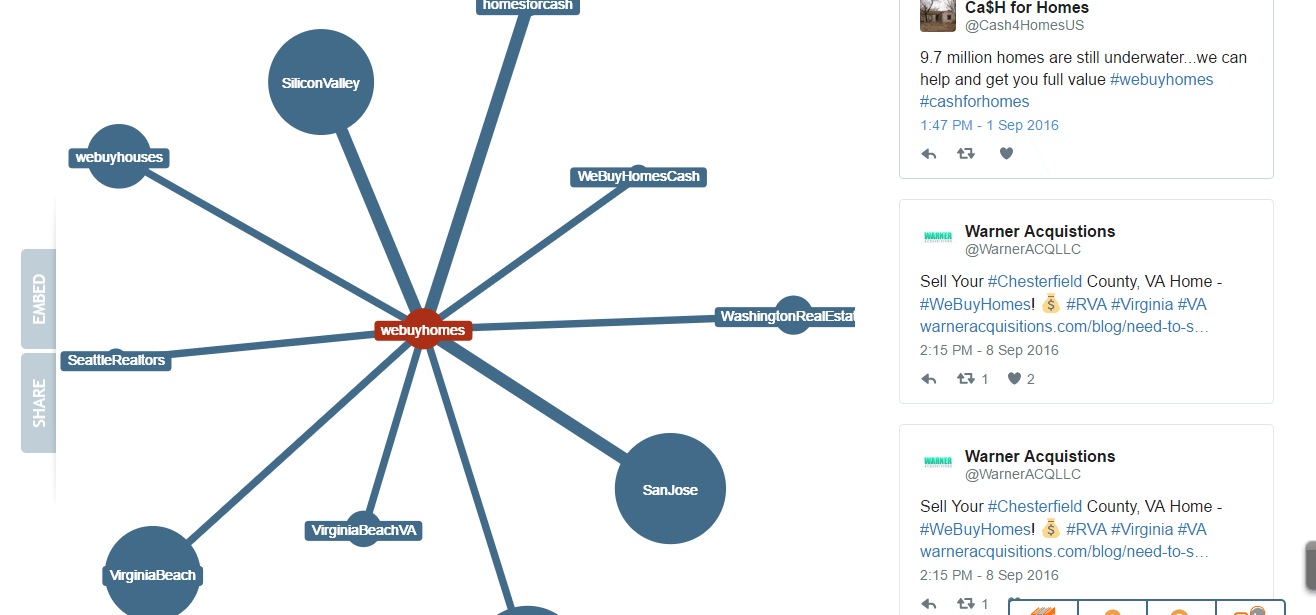
    5. Using The Wrong Hashtags

    Also, be aware of using automated hashtags. There are times hashtags are not what you thought they were. If you’re unsure of a hashtag, do a simple search using sources such as hashtagify.me.

    hashtag webuyhomes

    6. Carelessness

    You’re not done just because you published a bunch of content to Twitter and Facebook. Don’t forget to check and reply to questions and comments. You want that interaction. You must be prepared and interested in making real connections with your audience. That’s the fun part!

    respond to FB comments

    How To Properly Use Social Media Automation

    Of course, when done correctly and used judiciously, automated posting tools for social media can still be great time savers. Use these best practice automation tips to be present and successful on Twitter and Facebook.

    First… You must

    • Plan. Building a social media marketing plan is essential. Research your niche keywords and brainstorm content that will pull in your target audience. You could be writing towards motivated sellers, rent-to-own buyers, investment property seekers… whoever you’re targeting, make sure you have the right keywords.
    • Write amazing content. Make sure your content is offering valuable information to your target audience. Content isn’t always written. In addition to written content, create videos for YouTube showcase properties or create a Slideshare illustrating your buying process.
    • Establish a consistent brand image. Each social platform has its own identity and voice. Facebook is different than Instagram and Twitter. It can be easy to have your branding message become messy and inconsistent. If you feel like it’s getting out of control, take a step back, revisit your businesses core message, and get back on track being consistent.

    Then… You can

    • Use social media automation to fill your social media content calendar. Never be short of releasing high-quality content. You can release new content or repurpose some of your old, quality, content.
    • Use automation tools to find out the best time to post. Review your analytics. Test different days and times to find what times work best for your market.
    • Add personal touches to automated posts. Again, build your brand identity and credibility. Don’t be a mystery to your customers. Automate some casual posts so your audience feels like they know you and can feel connected to you and your brand.
    • Use automation to schedule your posts before you take an extended break. If you’re going to be away, schedule your social messages in advance. This will help you maintain a consistent social presence.

    Autoposting might be the only way you can achieve the ultimate goal of social media. Which, is connecting and communicating with your clients in a way build relationships and retention.

    Also be sure to read through Twitter and Facebook’s rules and best practices:

    Twitter Automating Tweets Rules and Best Practices
    Facebook Posting Tips and Best Practices

  • Ep 10: How A Former Olympian Stands Out In A Sea Of Competition in A Competitive Market w/ Martin Boonzaayer

    Ep 10: How A Former Olympian Stands Out In A Sea Of Competition in A Competitive Market w/ Martin Boonzaayer

    2016.09.01-CarrotCast_Martin-main

    “If I’m an investor and I want to buy a stock, I can’t just go buy a stock for 20% less than it’s worth. But in real estate I can. That’s what I love about real estate. You can provide a service that people need and want, get a deal, and make a profit at the same time.” Martin Boonzaayer

    Are You Having Trouble Fighting Your Way Through A Competitive Market? Listen To This CarrotCast And Start Standing Out!

    Subscribe and rate us on iTunes

    It’s not every day that you get to have a conversation with an Olympian. Especially not one who is a very motivated and smart real estate entrepreneur.

    This CarrotCast’s guest is that guy. Martin Boonzaayer is one of the top investors in the very competitive Phoenix, Arizona market. In fact, there is probably no better place to experience trial by fire.

    Over time, he’s built a system around being professional, consistent and honest with his clients. By using this system, he continues to stand out from the competition, even while offering much lower prices. He recently offered $20k less than his competition and closed the deal that netted $32k.

    Follow along and learn this system and much, much more!

    Have you Subscribed yet on iTunes??? If not, do it and rate us, we’ll love you forever!

    Enjoy :-)


    SEE ALSO


    Listen to the Podcast

    Subscribe To The CarrotCast On iTunes

    Martin joined us on this CarrotCast to talk about…

    • How he leverages his Carrot website with direct mail.
    • How to stand out from competition.
    • Being professional. It pays off!
    • His hiring process for VA’s.

    Watch the Video Version

    How to Stand Out In A Sea Of Competition in A Competitive Market w/ Martin Boonzaayer

    Start – How Martin got his start in real estate and his cool story of being an Olympian.
    7:43 – Ramping up direct mailing. Why trying to be more competitive on pricing wasn’t the answer. Solving that problem using a professional presentation.
    12:13 – How his company stands out in one of the most competitive markets in the nation. They consistently beat competitors while offering much lower asking prices.
    18:30 – What methods he incorporates to expand into other markets and his plan to expand over the next 12 months.
    26:36 – Where he looks to find great VA’s and what to look for in the hiring process.
    31:05 – Building trust with clients. How he made an offer $20k less than his competition, closed the deal, and netted $32k.
    34:12 – Honing leadership skills is valuable.
    36:18 – Creating a business that matters and impacts others.

    For any of us to succeed, we all need to succeed…We all have to be all in!

    [podcast-subscribe]

  • Ep 9: My Top SEO Guy Lays Out 4 Critical SEO Tips In 2016 w/ Matt Dalbey

    Ep 9: My Top SEO Guy Lays Out 4 Critical SEO Tips In 2016 w/ Matt Dalbey

    2016.08.05-CarrotCast_Matt_Dalbey-main

    “Getting ranked for a handful of core keywords is very important and it’s the starting point. Finding and identifying those important keywords is where you need to start. But that is only a means to an end. That is literally the tip of the iceberg.” Matt Dalbey

    Who Else Has Given Up On SEO Too Soon? You Probably Know A Few. Maybe Even You…

    But…You Might Have Been Closer To Higher Rankings Than They Thought. Listen Below To Learn What Everybody Ought to Know About SEO…

    Subscribe and rate us on iTunes

    In this CarrotCast episode, we dive in with our GO-TO SEO guy, Matt Dalbey. He has an awesome data-driven approach that we think will point your SEO mindset in the right direction.

    If you want to learn how to smash through SEO barriers in order to achieve a higher ranking website in organic search results, then this call is for you. If you want to learn some behind the curtain SEO tips only the professionals use, this is for you. And lastly, if you want to feel more energy and passion today, this episode is for you.

    PS – If you enjoy this episode, give us a review on iTunes and Subscribe. It helps us get our message out there even more and impact more people with the Carrot goodness.

    Listen to the Podcast

    Subscribe and Rate The CarrotCast On iTunes


    PAST EPISODES


    Check out this educational conversation with Matt about…

    Watch the Video Version

    My Top SEO Guy Lays Out 4 Critical SEO Tips In 2016 w/ Matt Dalbey

    Start – Who is Matt Dalbey and why he’s so good at SEO.
    8:30 – Having the right “long-term” SEO mindset is extremely important. That is one of the things that sets successful SEO apart from those who fail.
    13:55 – Real SEO client testimonial. Going from 0 to 80% of their leads via SEO. Getting ranked for a handful of keywords is a great start, but it’s only the tip of the iceberg. The iceberg is long-tail keywords.
    19:30 – What are long-tail keywords?
    23:40 – Don’t be the gold miner who gave up too soon and just missed the big one. Methodology and money.
    32:55 – How to build a good SEO foundation.
    34:40 – Using natural LSI, “latent semantic indexing” keywords in your content.
    36:41 – Creating a strong long-term strategy that is more than just updating your site. Using strong data to drive changes.
    42:00 – Thinking outside the box when building a link building strategy.

    “You want to provide value when linking to their site… quality over quantity”

    [podcast-subscribe]

  • Ep 8: Flipping Houses In A High Priced Market + Nailing Your Success Mindset w/ Michael Borger

    Ep 8: Flipping Houses In A High Priced Market + Nailing Your Success Mindset w/ Michael Borger

    2016.08.4-CarrotCast_Michael_Borger-main

    “I’m a big believer that marketing is 90% of this business. Marketing for the deals and obviously marketing for private money together. 10% is important but if we’re not marketing for deals, you really don’t have a business.” Michael Borger, Oahu Home Buyers

    Want To Learn More About Michael’s Approach to Success? Listen In To Find Out How To Avoid The #1 Most Fatal Marketing Mistake When Starting A Real Estate Investing Career

    Subscribe and rate us on iTunes

    In this CarrotCast podcast, Trevor is joined by real estate investor Michael Borger, owner of Oahu Home Buyers.

    Michael is an expert at remote rehabbing and wholesaling in the Aloha state of Hawaii from his home location in San Diego.

    He values marketing and shares one of the biggest mistakes he sees others make: not marketing enough. Marketing should be 90% of your real estate investing business. He also touches on having an understanding to how to scale your budget and marketing effort.

    And…a little lesson in Psychology… learn how to think with your good investor brain and not your emotional investor brain. Make good deal decisions like a veteran investor, not a newbie!

    Enjoy :-)


    SEE ALSO


    Listen to the Podcast

    Subscribe To The CarrotCast On iTunes

    We had a great CarrotCast conversation with Michael about…

    • Flipping houses in a high priced market.
    • Dabbling in marketing …Don’t Do It!
    • Developing a marketing plan and why 90% of your real estate business is marketing.
    • How to implement quickly but with quality always on your mind.
    • Deciding when to back away from a deal. And …being okay with that.

    Watch the Video Version

    How to Flip Houses In A High Priced Market + Nailing Your Success Mindset with Michael Borger

    Start – Remote rehabbing, exploring different markets and adopting a new business life as a parent.
    7:30 – Price point and deal flow differences in markets.
    10:20 – Don’t dabble in your marketing. Take charge and scale your effort so you can grow your business exponentially.
    13:30 – Creating a plan to implement and execute the things you need to get done to have a successful business.
    17:20 – How to handle leads that give off the feeling of desperation or “nail-biting”. If the deal doesn’t feel right, don’t be afraid to walk away.
    20:50 – What type of guideline Michael sets when approaching a deal. And… why traditional formulas don’t work well in expensive markets.
    22:30 – Constant and never ending incremental improvement and how Michael is always trying to improve himself and his business.

    I’m going to own this energy of my business …and it’s going to be awesome!

    [podcast-subscribe]