
Category: Carrot News

  • $40k Profit per Deal | The Power of Inbound Marketing w/ Beau Hollis

    $40k Profit per Deal | The Power of Inbound Marketing w/ Beau Hollis

    How SimplySold has achieved a $40,000 per deal business using Carrot.
    The company is a local, Louisville-based business that uses Carrot’s inbound marketing guidance and resources to gain new clients online.


    Snapshot:

    • Industry: Investor
    • Location: Louisville, Kentucky
    • Carrot Member Since 2016


    Beau Hollis is the founder of SimplySold in Louisville, Kentucky.

    He’s been investing in houses for the past 7 years.

    Currently, the majority of his business involves acquisitions that he does himself. He also has an acquisitions person and a full-time videographer.

    It’s a low-key, small operation, but it has a high intention, and they go aggressively after deals.

    “You know, I spend my time and effort and energy to do this business to provide for my family, not only money but years of my life, getting this up and going to have it, work is worth, the journey is not in vain.”

    From Beau’s Carrot leads, his average profit per deal is nearly $40,000.

    He’s done $400,000 in assignments in his Carrot site alone in the last six months.

    Before using Carrot, he had no online presence and no experience in building websites.

    “I had no world tech experience, and I just didn’t have an online presence. I didn’t want to have to build a website. So Carrot made that really easy for me.

    Obviously, people cannot find you, people have no clue who you are, they can’t find your business, they don’t know if you’re in business at all, and so if they can’t find you, they can’t do business with you.

    So you have no lead flow inbound from a website.”

    At first, his vision was to dominate the outbound marketing space, whether it was cold calling, texting, or other things.

    However, the lifespan of somebody doing outbound marketing all the time is limited.

    “I have come from a background of sales, and I understand that you’re gonna do this one thing all the time, whether it’s cold calling or texting or putting out bandit signs, and there’s a lifespan to that.”

    Outbound versus inbound leads are two things that are drastically different. Outbound leads are when you’re seeking out someone. A lot of work, effort, and energy is going into it before you even think about reaching out to the person.

    Inbound marketing, or evergreen marketing, is a completely different mindset. You optimize your website with content: videos, blog posts, and testimonials.

    Inbound offers a whole other world. People are seeking you out.


    The challenge: Creating the path to the world of inbound marketing

    This is a business to close deals. Serious real estate agents and investors want to make Evergreen inbound marketing a real avenue, not just a little street but a highway.

    Evergreen inbound marketing takes a plan and plenty of patience. It takes a lot of video work on YouTube and on-page SEO with keywords and good content for high rankings.

    “My expectation was that I’m just going to turn it on, get it up and live and then it would just bring in the people just saying, please take my house, that’s why I thought it was at the beginning when I first got, I just got it up and I just had, I just had it out there, I didn’t do any kind of optimization. I did zero, absolutely zero customization to the website.”

    His website had been just sitting there for a long time. Years.

    Then Beau had a conversation with Trevor to get the ball rolling.

    He started implementing on his website and using the tools Carrot provides our members. Keyword tracking, campaign tracking, video postings… and over time and hard work, Beau’s inbound marketing started to click.

    Once he started optimizing his site, he could see a bit of movement in his rankings.

    That movement proceeded forward for a year or two then it was time to dive into the PPC world of inbound marketing. The one-two punch of paid and organic traffic really exploded his business.

    In 2021, Beau’s Carrot leads have had an average profit per deal of roughly $40,000.

    In comparison, Beau’s outbound leads have had an average profit per deal of roughly half that.


    The tools: Carrot features

    Although the real estate niche can sometimes be inconsistent, Carrot brings consistency to Beau’s business. He can count on deal flow.

    It’s good because when you can count consistent leads, it means that you’re not stressed all of the time.

    For Beau, Carrot has become a hub that brings all his inbound marketing efforts together. Since he’s driving traffic from all inbound marketing efforts to his Carrot site, he can track performance across all campaigns and channels, giving him the clarity needed with his marketing.

    Here are some of the tools Beau is using to tie together his marketing efforts:


    Evergreen Training
    Beau needed to get many unqualified outbound leads to close deals. More leads meant more time and expense to sift through the tire kickers.

    He learned inbound online marketing with Evergreen content to attract the most qualified prospects. He’s built trust and credibility with them 24/7, 365 through his Carrot “Authority Hub.”


    Automated blogs
    Carrot’s pre-written automated blog posts have allowed him to stand out in his market as an authority. This saves time and money and puts SimplySold at the forefront of its industry with expert quality content that he can customize for his needs.


    Keyword Tracking
    How do you know if your SEO rankings are climbing? Tracking is easy with Carrot. Simply input the keyword, and we’ll track where that particular term ranks each week, making optimizing accordingly easier!


    Campaign Tracking Links
    Learn how many leads you generate with your ads by following the conversions from them. Easily see which campaigns produce results and create a link to track click-throughs and leads better.


    CarrotCamp
    CarrotCamp is a place where people come to get inspired by other entrepreneurs, hear first-hand stories about how they built their successful businesses and strategies for success. The knowledge Beau has gained from meeting these individuals has been essential in helping him grow his own real estate investing business.


    The results:

    Beau has been successful in implementing an Evergreen inbound marketing plan. He went all-in and began building his SEO content, which he followed up with PPC. Now he has a team and consistently closes inbound deals to grow his business.

    He also knows how to scale his business using Carrot and inbound leads.

    What about you? Are you ready for consistent and predictable growth in your business?

  • EP 299: I’ve Misunderstood Gratitude for Years – Here’s Why.

    EP 299: I’ve Misunderstood Gratitude for Years – Here’s Why.


    About this episode:

    “It’s important to realize we can and should have gratitude in all situations. Whether they’re the most difficult situations or the ones worthy of the most praise. We’re not asked to give gratitude for everything, but we have the ability to give gratitude in every situation.” – Eugene O’Kelly

    Mentioned in this Episode:

    Remembering Adrian Nez

    Chasing Daylight by Eugene O’Kelly

  • EP 290: The “Zombie House” Deal & How to Dominate SEO with Video w/ Anthony Beckham | Behind the Deal

    EP 290: The “Zombie House” Deal & How to Dominate SEO with Video w/ Anthony Beckham | Behind the Deal

    When it comes to video, you don’t need a lot of views to drive a lot of business.  

    – Anthony Beckham

    The “Zombie House” Deal & How to Dominate SEO with Video w/ Anthony Beckham

    In this episode of Behind the Deal, we brought in our friend Anthony Beckham, a local agent and investor who is doing big things in our small town.

    Within just a few years, he has built an incredible team and become one of the top agents in our area.

    Today we will hear about “the Zombie House” and how he is using video to improve SEO rankings and dominate the local market.

    Read the Full Show Notes Below…


    Our motivation for these Behind the Deal episodes is to demystify and break down the process of investing in real estate from start to finish.

    We are letting you know how they found the lead, closed the deal and persevered through all sorts of crazy challenges.

    This episode is no exception.

    Anthony not only bought the Zombie House, but he was able to sell it twice. Here’s how he did it… 

    The Deal

    Anthony typically focuses on his brokerage, which does over 100 transactions a year in a market of about 25,000 people. He also does a handful of wholesale deals a year, only buying in situations where he can not lose.

    In the case of the Zombie House, Anthony knew he would be able to at least sell the land, breaking even on the deal.

    For this deal, in particular, the lead came in from a friend and fellow real estate professional with a Carrot site. The deal wasn’t right for them, so they called up Anthony to see if he was interested. 

    The Numbers

    On the lead form, the seller referred to the house as the “Zombie House” and she wasn’t kidding. While the property looks ok from the outside, the inside required a lot of clean-up and renovation.

    The seller was originally thinking they would sell for $80k, but after meeting with Anthony, they ended up selling directly for $25,500. 

    Selling the House Twice

    Anthony was able to find a buyer for the property who paid him $45k for the property. This meant a fast profit of about $19,500.

    After spending some time working on the house, the new buyer realized it wasn’t going to be worth it to continue putting money into the property and that they were better off listing it.

    And guess who they hired to be the listing agent? Anthony helped them get the property on the MLS, selling for $60k. He helped the investor achieve a small profit while picking up a 3.5% commission on the deal. 

    Hacks to Dominate SEO with Video

    Anthony has built an incredible reputation locally through the power of SEO. He has a full-time videographer on staff who has turned him into a bit of a local celebrity.

    Together, they create new videos each and every week that has helped build brand awareness and answer questions buyers and sellers often have.

    By creating this informative, evergreen content, Anthony has positioned himself as the local expert real estate expert. 

    Tips That Actually Work

    The use of video is one of our favorite tips that actually work.

    We’ve created a Video Marketing Playbook to help you with keywords, scripts, and 52 excellent content ideas. You’ll want to create videos that are about 3-8 minutes long as posts of this length can easily be turned into written blog posts.

    Keep in mind that when you are first starting, you may not receive a ton of views. But if you stay consistent, you will build your audience quickly.

    Shooting a video one time has the potential to generate leads for years to come.

    Follow Our Guest: 

    Mentioned in This Episode:

    We want to hear your thoughts on the podcast! Drop them in the comments section below or hit us up on Facebook or Instagram!

  • Carrot Leads Convert 7x Better & Are 2.5x More Profitable Than Non-Carrot Leads

    Carrot Leads Convert 7x Better & Are 2.5x More Profitable Than Non-Carrot Leads

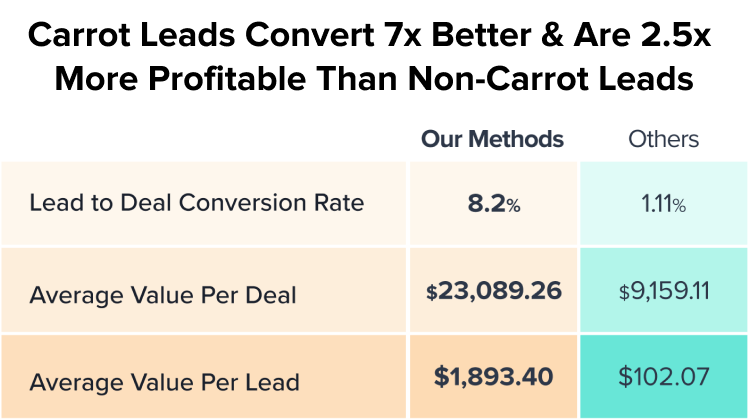
    We recently surveyed our Carrot members about their lead-to-deal conversion rate — that is, what percentage of leads become deals. We also asked them about the source of these leads (Carrot leads or Non-Carrot) to determine which efforts provide the most high-quality leads and thus the most deals.

    The results were exciting. They indicated that Carrot leads convert 7 times better and are 2.5 times more profitable than non-Carrot leads.

    carrot leads vs non-carrot leads

    This is something we’ve known anecdotally for a long time — from all of the reviews we’ve received from our members. For example…

    “Carrot literally changed my life. Trevor and his crew are the best people on the planet. Get plugged into their system and culture, and you will start generating leads!” – Brian Rockwell


    “I have generated just over 200 leads in a little over 4 months using my Carrot site. I couldn’t be more thankful for the services they have provided. Thank you Carrot!” – Hank Tobler


    “Closed 3 deals exclusively from SEO leads / Carrot conversions. No PPC. No attribution to any Facebook ads. Just Google search results and credibility.” – Daniel DiGiacomo

    … but still, it’s refreshing to see the actual data.

    Let’s take a look!

    Not a Carrot member? Take a free demo…

    The Survey Data & What it Means

    To be clear, non-Carrot leads refer to any leads that didn’t come through an investor’s Carrot website. Maybe they called, texted, or emailed instead.

    Carrot leads, naturally, refer to any leads that came through the investor’s website. They visited and opted into a CTA that looks something like this…

    Carrot investor website hero section

    So, what exactly were the results?

    Well, we asked Carrot members for their lead-to-deal conversion rate and their average value per deal for both Carrot and non-Carrot leads.

    We then used those numbers to calculate the survey respondents’ average value per lead.

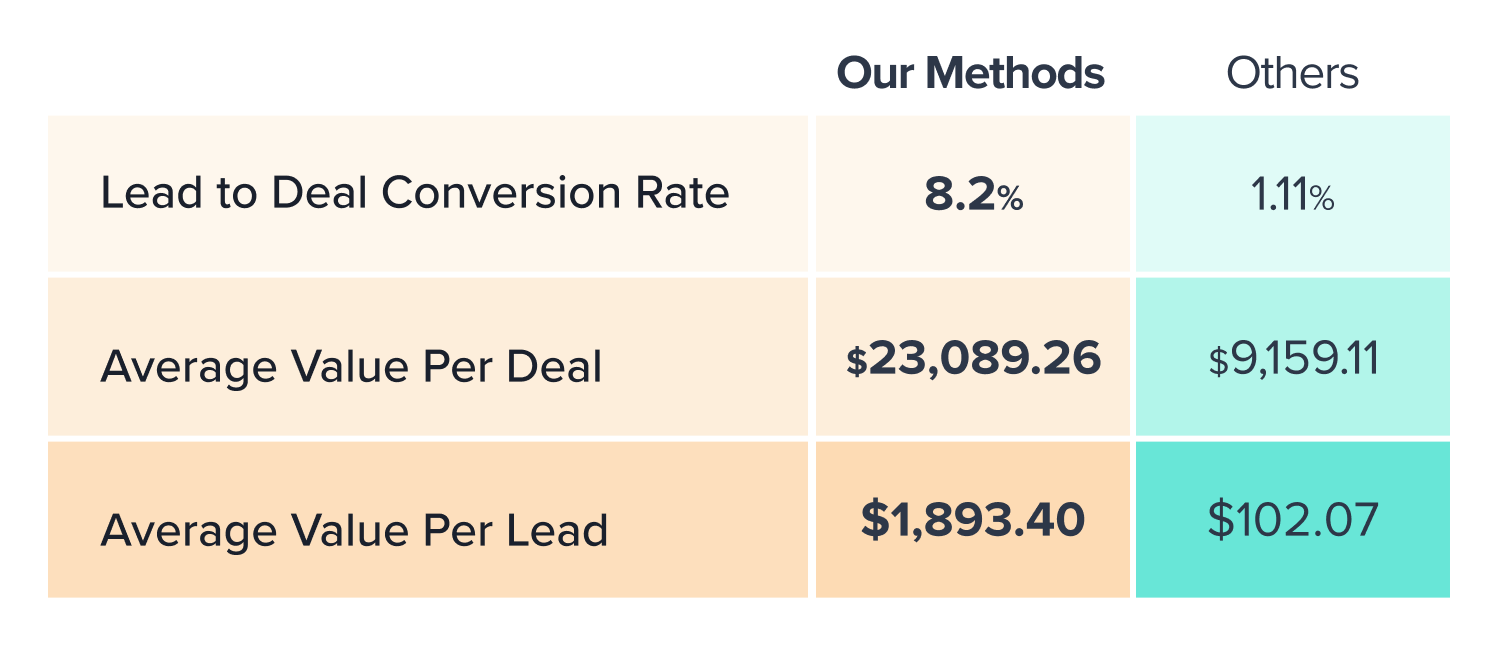
    Here are the Carrot vs. Non-Carrot results:

    Carrot lead vs non-carrot leads per deal

    Amazing, right?

    Carrot leads had an 8.2% lead-to-deal conversion rate, while non-Carrot leads had a 1.11% conversion rate.

    Even more surprisingly, Carrot leads that became deals had an average value of $23,089.26, and non-Carrot leads that became deals had an average value of $9,159.11.

    That makes the average value per Carrot lead $1,893.40. That is enough to pay for an entire year of our top subscription plan, by the way! And, the average value per non-Carrot lead is $102.07.

    Something is going on here, and let’s talk about that.

    But before we do, understand that we’re not saying you shouldn’t generate leads one way, but you should generate them another.

    Every real estate investor has to find what works for their business and their market, which usually is a mishmash of various marketing tactics.

    Here, we’re just looking at some high-level trends that might be helpful for investors to consider.

    Why are Carrot leads so much better than Non-Carrot leads?

    There are essentially two questions we have to answer.

    1. Why do Carrot leads become deals much more frequently than non-Carrot leads?
    2. Why do Carrot deals have much bigger profit margins than non-Carrot deals?

    And the first thing we need to examine is where these leads are coming from. After all, the source determines the quality.

    Non-Carrot leads is a broad term that includes a lot of different sources: cold calls, inbound calls from direct mail campaigns and door knocking, flyers, business cards, bandit signs, and so forth.

    You might not notice it at first, but all of those sources have a similarity: they all represent outbound marketing efforts.

    That is, you go out and try to find people who might be interested in selling their home. You offer them a fair cash offer and a quick turnaround time. You do this by sending them mail, knocking on their door, or calling their phone.

    Of the people who contact you via outbound marketing methods, it’s safe to assume that many of them are just curious. They’re not motivated to sell by any particular circumstances in their life, but your offer caught their attention, and so they call you to find out more.

    That’s how most non-Carrot leads are generated.

    Now let’s look at Carrot leads.

    We’ve built Carrot websites with wicked-fast load speeds, mobile friendliness, and a clean tech stack.

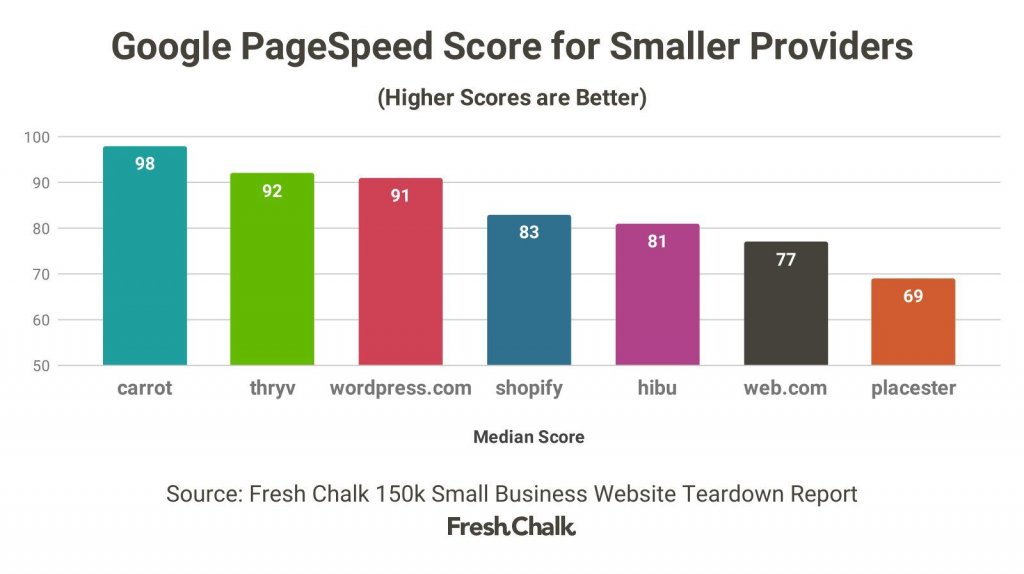
    Carrot sites rank for high-value phrases in Google more than any other site builder in the industry (terms like “sell my house fast in ” or “sell my house for cash in .”

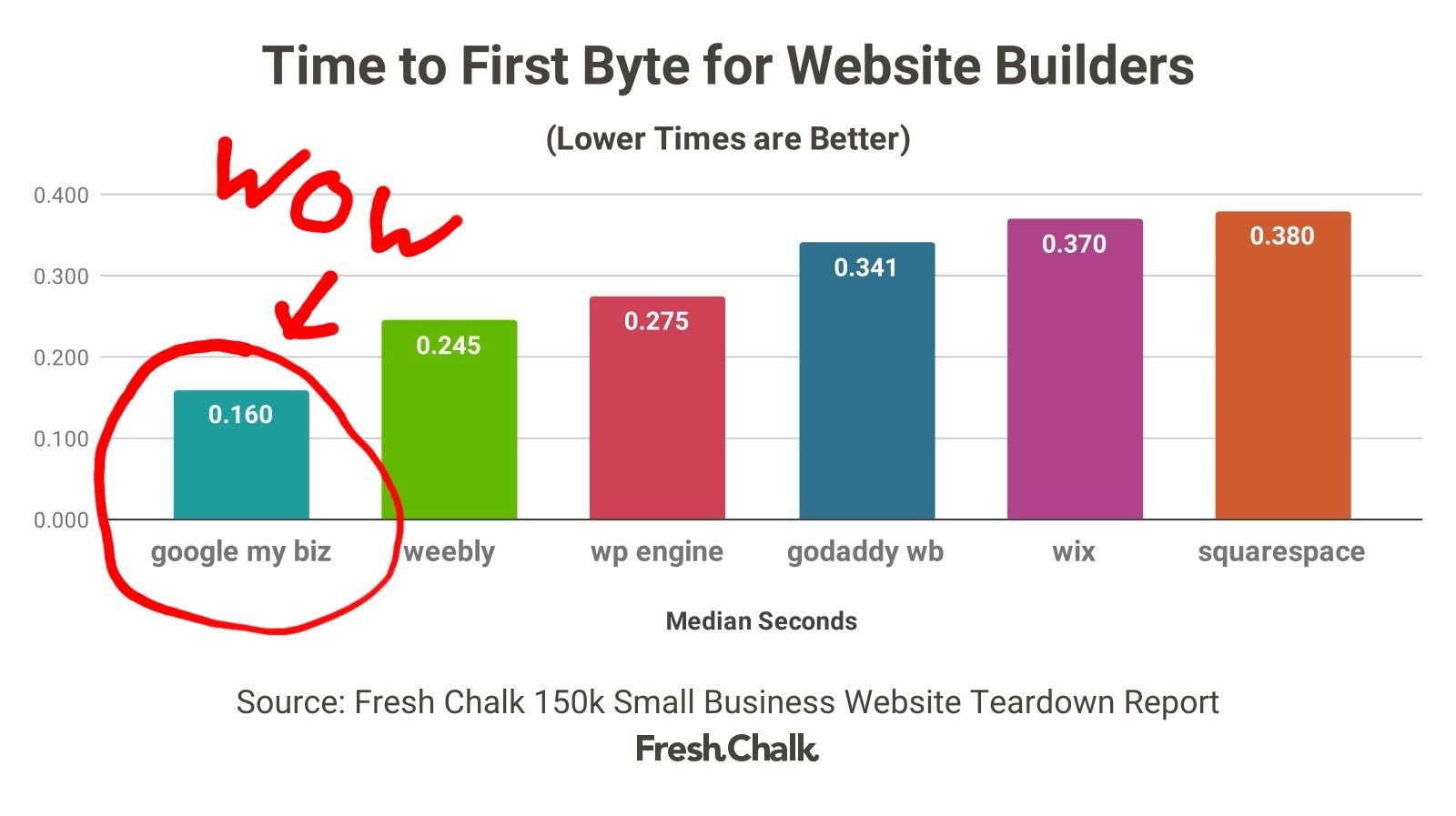
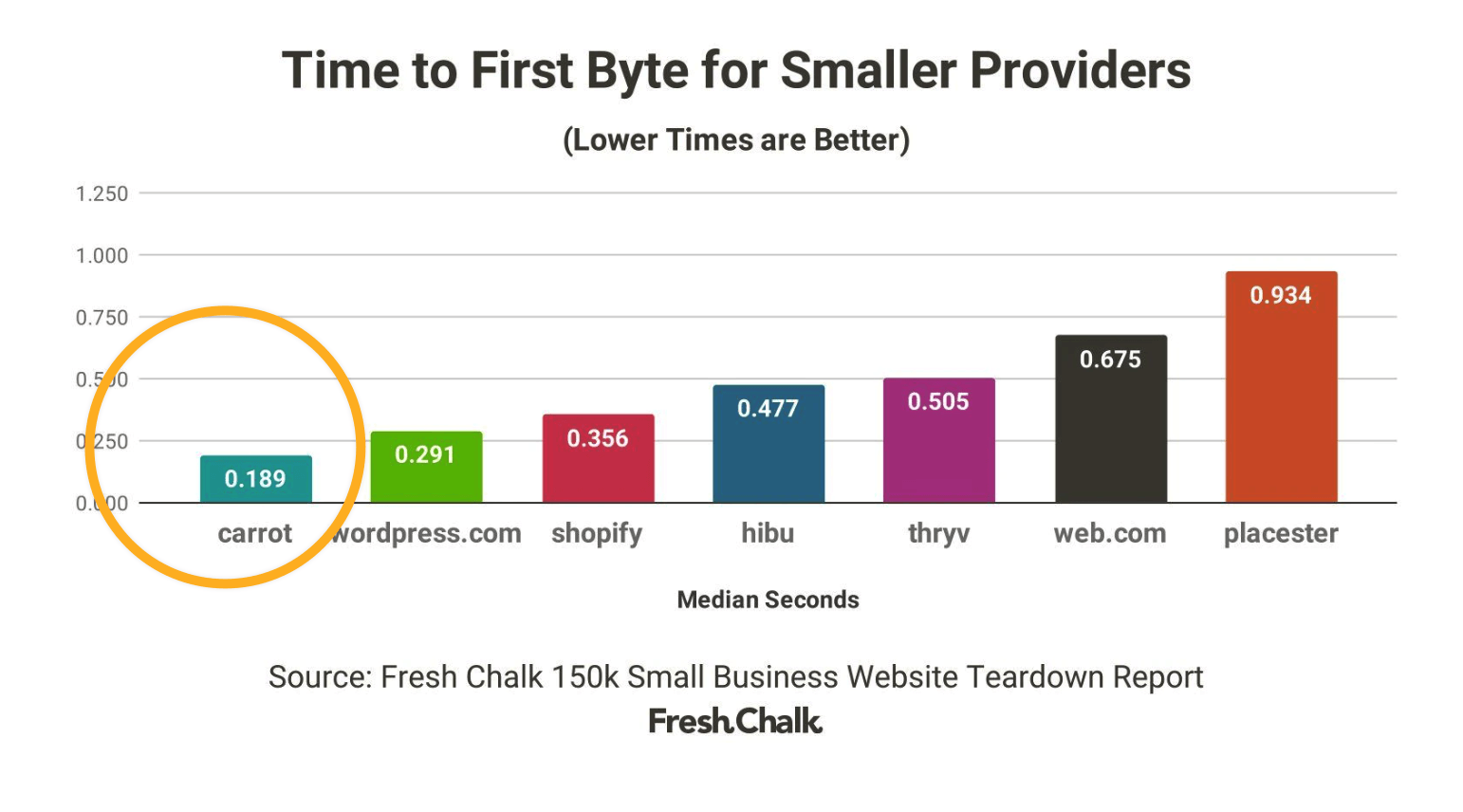
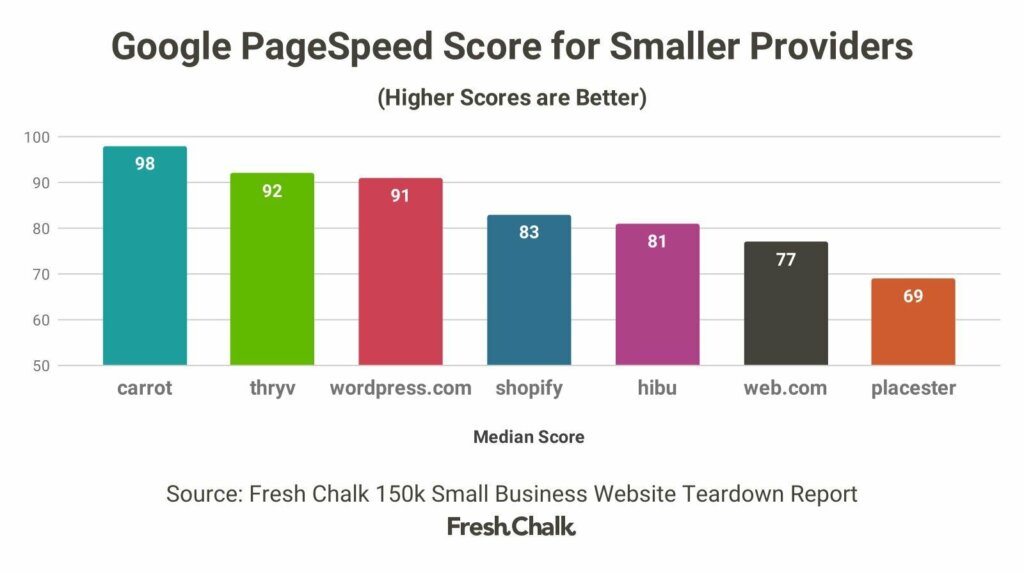
    Third-party data from Fresh Chalk pointed this out. Here are page speed scores for different website builders (a huge factor for Google rankings).

    Fresh Chalk pagespeed test results

    The same is true for Carrot’s mobile performance (which is now a huge part of internet traffic).

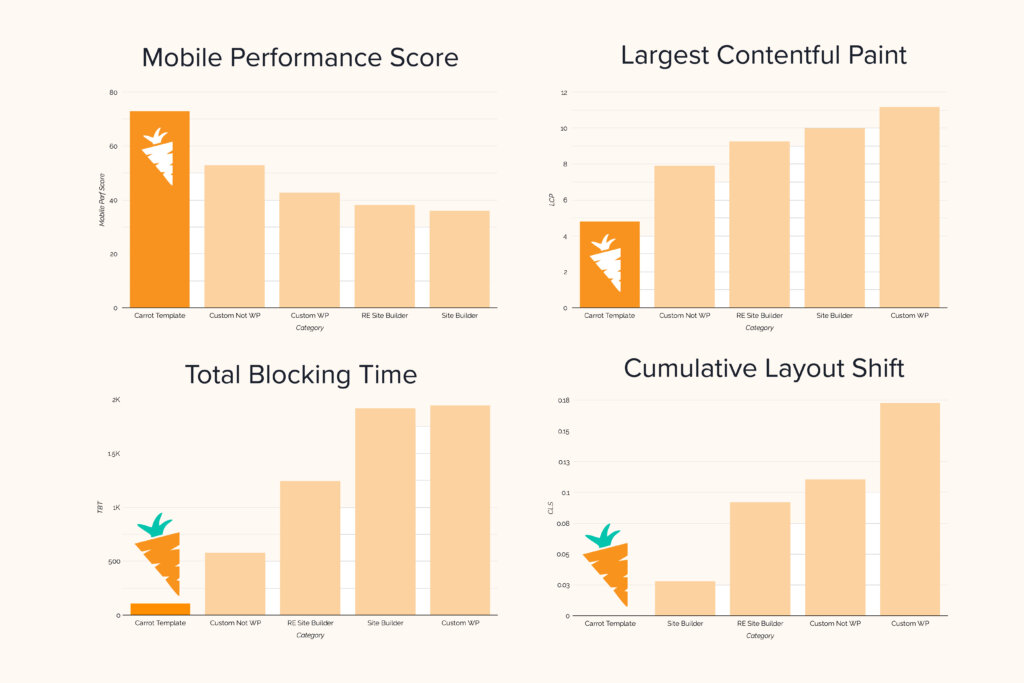
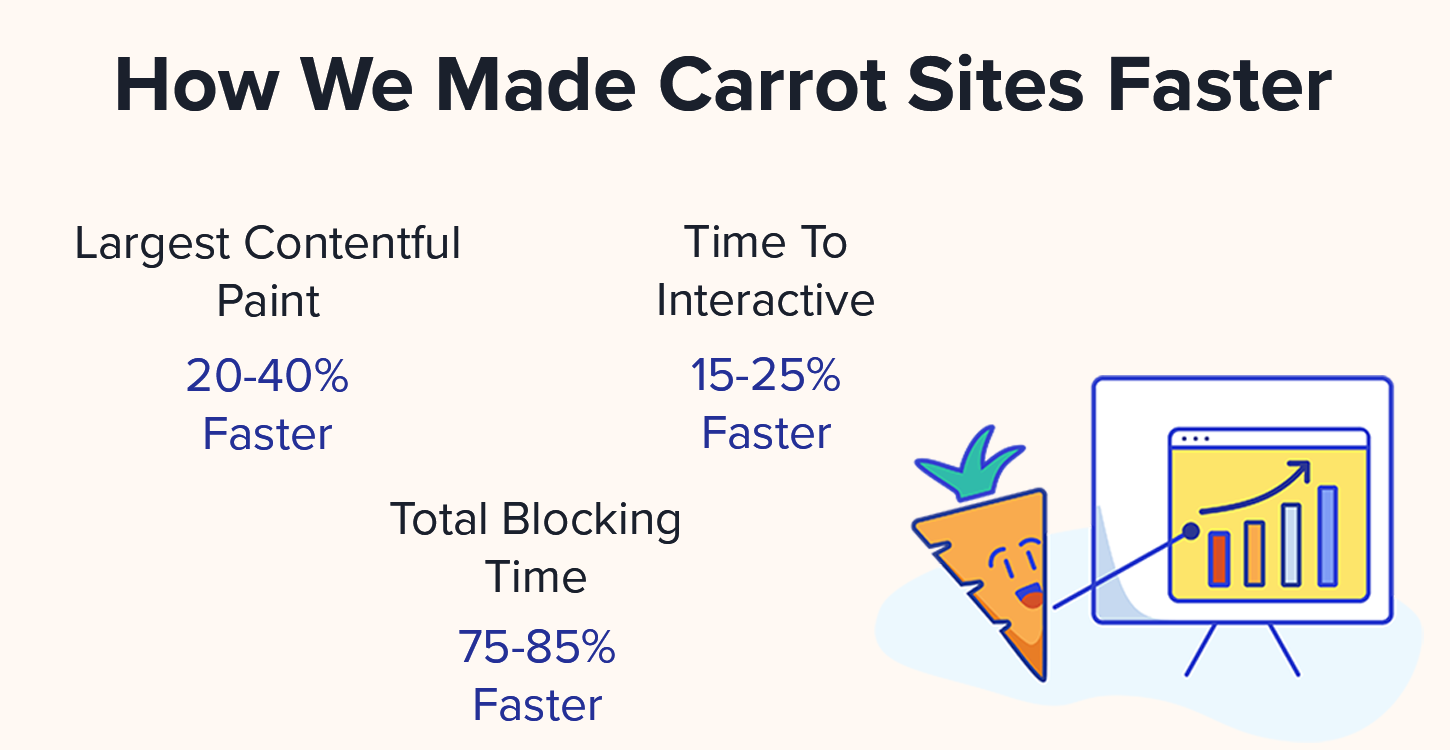
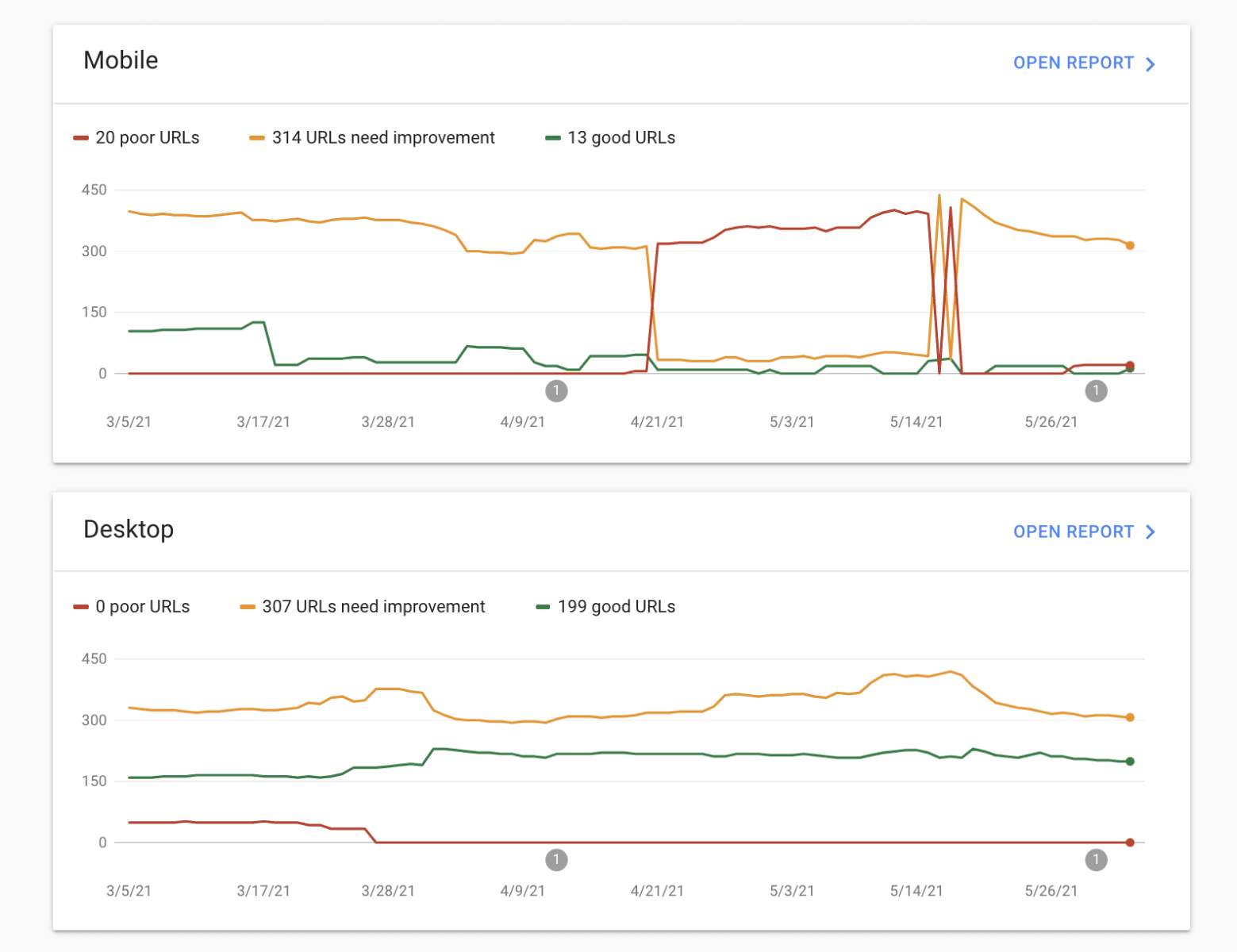
    This graphic represents the recent updates that Carrot developers have made to our member sites to get ahead of the latest Google Core Web Vitals update. Learn more about what this graphic means and the changes that we made here.

    Carrot website mobile speed Core Web Vitals Update

    But that’s only one of the many reasons that Carrot sites sit at the top of the rankings.

    The secret to quality lead mastery

    Our members also create Evergreen content for their blogs every single month, content that’s optimized to rank in Google.

    We also give our members the ability to:

    • Track their rankings right inside of their account. 
    • Ensure that every page and post is optimized to rank (via a simple checklist). 
    • Create long-form evergreen content by transcribing video content with the click of a button (VideoPost). 
    • Publish weekly blog content with a click of a button.
    • And so much more!

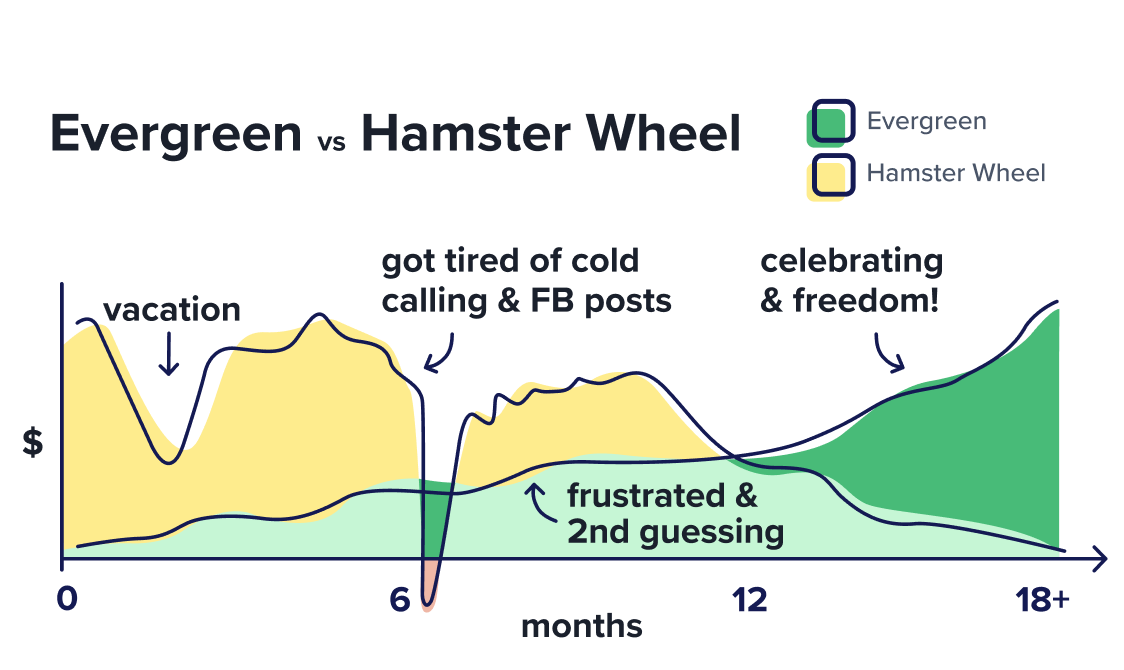
    This is the difference between hamster wheel marketing

    “If you’re creating a piece of content and you just put it up on Facebook or Instagram, it’s going to be there for 24 to 48, maybe 72 hours before it gets pushed down, forcing you to get back on the hamster wheel and post again, and post again and post again, because the life span of that content is so short.

    The lifespan of that content is so short that you have to be on the hamster wheel continually.

    If you get off of the hamster wheel, if you stop doing those postings, if you stop doing direct mail, if you stop cold calling or doing RBMs, then your leads will eventually dwindle to a stop, and you’ve got to restart and get back on the hamster wheel.”

    … and Evergreen Marketing

    “Get into a routine of creating content. Another piece of content this week, another piece of content next week, a blog post next week, a video post, a video post, a location page, and eventually, you’re going to have a brick wall that does all of the work for you.

    Remember, it’s going to be slow going in the first three, four, five, six months potentially.

    But as long as you’re consistently stacking bricks of quality content that answers real questions from your market, you’re entertaining in your own way; you’re going to start to pick up that momentum.”

    At Carrot, we focus on evergreen marketing — consistent action that produces long-term results. 

    Evergreen marketing for real estate

    Now, why all of this information about Google rankings, page speed, and tech stack?

    Well, because of the way Carrot sites are built, they typically generate a good chunk of leads via evergreen marketing through search engines like Google — this means that motivated sellers find you rather than you trying to find motivated sellers.

    That’s called inbound marketing.

    And it almost always results in higher quality leads than outbound marketing.

    So that answers our first question.

    Why do Carrot leads become deals much more frequently than non-Carrot leads?

    There’s a high likelihood it’s because many of them are likely coming through search engines.

    When you think about it, it’s not all that surprising that outbound marketing leads tend to be lower quality than inbound marketing leads. It’s the difference between you looking for motivated sellers and motivated sellers looking for you.

    We get feedback about this difference all the time from our members…

    “I consistently get organic leads from my Carrot website. I have purchased my best deals to date through my websites. I highly recommend you implement training and tools available through the platform.” – Beau Eckstein


    “I’m getting 2x more motivated seller leads with my custom Carrot site than my old site, and the tools and content help me stand out in my crowded market.” – Tyler Ford


    “I am saving between $20,000 and $50,000 every single month in lost lead-gen closing potential after switching from my expensive custom-made site to my Carrot site.” – Carter Steph

    And it’s not just hearsay. When we take a peek at the source of traffic and leads for our members, we can see a good chunk coming from the organic content that Carrot helps to provide. So far, in 2021, organic traffic accounts for 25.8% of our member leads.

    carrot leads 2021 - organic

    But what about the second question: why do Carrot deals have more significant profit margins than non-Carrot leads?

    Part of the answer is likely the same as the first — since Carrot sites drive organic leads through search engines, investors don’t have to directly pay for those leads like they would have to with a direct mail campaign.

    This makes a big difference in per-deal profitability. But that’s not the entire story.

    Again, we have to look at where these deals come from.

    If someone receives your mailer and it makes them think about selling a property that they’ve owned for a while, and so they call you, they’re probably not going to be as willing or motivated to accept a lower offer.

    But if someone is actively looking for someone like you who can buy their home as-is for cash, they’re probably more motivated and thus more willing to accept a lower offer, which results in higher profit margins.

    And so that answers our second question…

    Why do Carrot deals have much bigger profit margins than non-Carrot deals?

    It’s because inbound marketing efforts are less expensive and generate leads that are more motivated to accept lower offers.

    Final Thoughts

    If there’s a lesson to be learned from all this, it’s about the value of inbound marketing.

    When you create an online presence that allows motivated sellers to find you, you can expect to generate much higher quality leads for less money and increase your per-deal profitability.

    That’s not to say that you should stop sending direct mail, cold calling, door knocking or driving for dollars. We are huge advocates of those strategies, and they support many Carrot member businesses!

    Perhaps a hybrid approach is best.

    Steadily invest in your online presence. Create a high-converting real estate website, start search engine optimization, create new content, and so forth to build a long-term source of lead generation.

    That will take time to start working.

    While you’re working on SEO and content, you can also run PPC ads and send direct mail to generate leads more immediately for your business.

    That’s the balanced approach that has worked for thousands and thousands of real estate investors, and there’s no reason that it won’t work for you, too.

    Click below if you’re ready to take the next step.

  • Offline to 7 Figures in 4 Years | How Grand Real Estate Investments Went From No Website to a Thriving Hybrid Real Estate Business with Carrot

    Offline to 7 Figures in 4 Years | How Grand Real Estate Investments Went From No Website to a Thriving Hybrid Real Estate Business with Carrot

    How Grand Real Estate Investments started with no website to a thriving, 7 figure business in 4 years with Carrot.

    Robert Grand Testimonial

    The Oregon-based real estate team uses Carrot’s training and resources to gain clients online within their community.

    grand real estate investments team
    grand real estate investments

    Snapshot:

    • Industry: Hybrid – Agent and Investor
    • Location: Eugene, Oregon
    • Year founded: 2012 Real Estate Agent – 2017 Real Estate Investing

    Robert and Ricky Grand are hybrid real estate investors and agents in Eugene, Oregon. After finding success in the retail market in 2017, they decided to pursue investing, fueled by a desire to work on their own time and spend more time with their families.

    Now, they’ve built a team that includes, for the first time in a long time; they feel clarity and peace of mind about where their business is headed.


    “…I used to think aesthetically pleasing sites were mandatory. It had to look “cool”. It’s just not true. If you have the content and information people want, they will use your site. Carrot gave us the framework for our site and content, but it’s up to us to change it enough to add our uniqueness to it.

    I’m 100% all in with Trevor and Carrot. They know what they are doing. Yes, they are a business with the goal to be profitable, but these guys care and are totally on our side.

    Honestly, working with Trevor and his team is refreshing. I trust them and don’t second guess anything. If Carrot gives us feedback, we implement it without wondering if there is a catch.

    Hope it helps to hear it from someone who is a customer. I happily spend the money to work with them.”

    – Ricky Grand, Grand Real Estate Investments

    The challenge: Marketing his business was difficult and produced unpredictable results.


    Before joining Carrot, Robert worked as a fireman and real estate agent. Ricky worked a 60-80 hour per week job in finance. In fact, from 2012 to 2017, Robert mainly relied on word of mouth and did business with no website. That was the problem.

    He was relying on unpredictable leads to come to them. That’s a hard strategy to scale.

    So, after listening to a few CarrotCast episodes, he realized that to grow, they’d need a website. Carrot was one of the only companies that he truly believed in that would accomplish their goals.

    They started working on their first website, trying to figure out SEO and understand online inbound marketing.

    Slowly, they’ve grown their business from $100-300K to the $600K range and reached the seven-figure mark. They’ve also continued to build upon their strategy with Carrot by moving to a customized website and rebranding to GREI House Buyers, allowing them to expand business opportunities into other areas in Oregon.

    That’s when they discovered the power of Carrot:

    • Search engine optimization
    • Predictable lead-flow
    • Consistent business growth, allowing him more time for the things that matter most in life

    That’s precisely how they use Carrot.


    The tools: Carrot features

    For Ricky and Robert, Carrot is the central hub that combines all their marketing efforts. They’ve been running Facebook and Google Ads to drive traffic to their site in the short term while leveraging Carrot’s easy content marketing tools and strategy to build their Evergreen SEO for long-term lead generation.

    Since they’re driving traffic from all marketing efforts to their Carrot sites, they can track performance across all campaigns and channels, giving them the clarity and comfort needed with their marketing strategy.

    Here’s how the Grand Brothers are using Carrot as the hub to tie together the marketing efforts they were once doing on their own to become the authority in their area:


    Training & Resources
    Robert says they would be lost without all the content and resources Carrot has created and the support we’ve shared to help them build their agent and investor strategies.


    Automated blogs
    Carrot’s pre-written automated blog posts prevent them from having to write their blog posts. This saves them time and money, and they have become the authority in their market with their content.


    Lead Manager
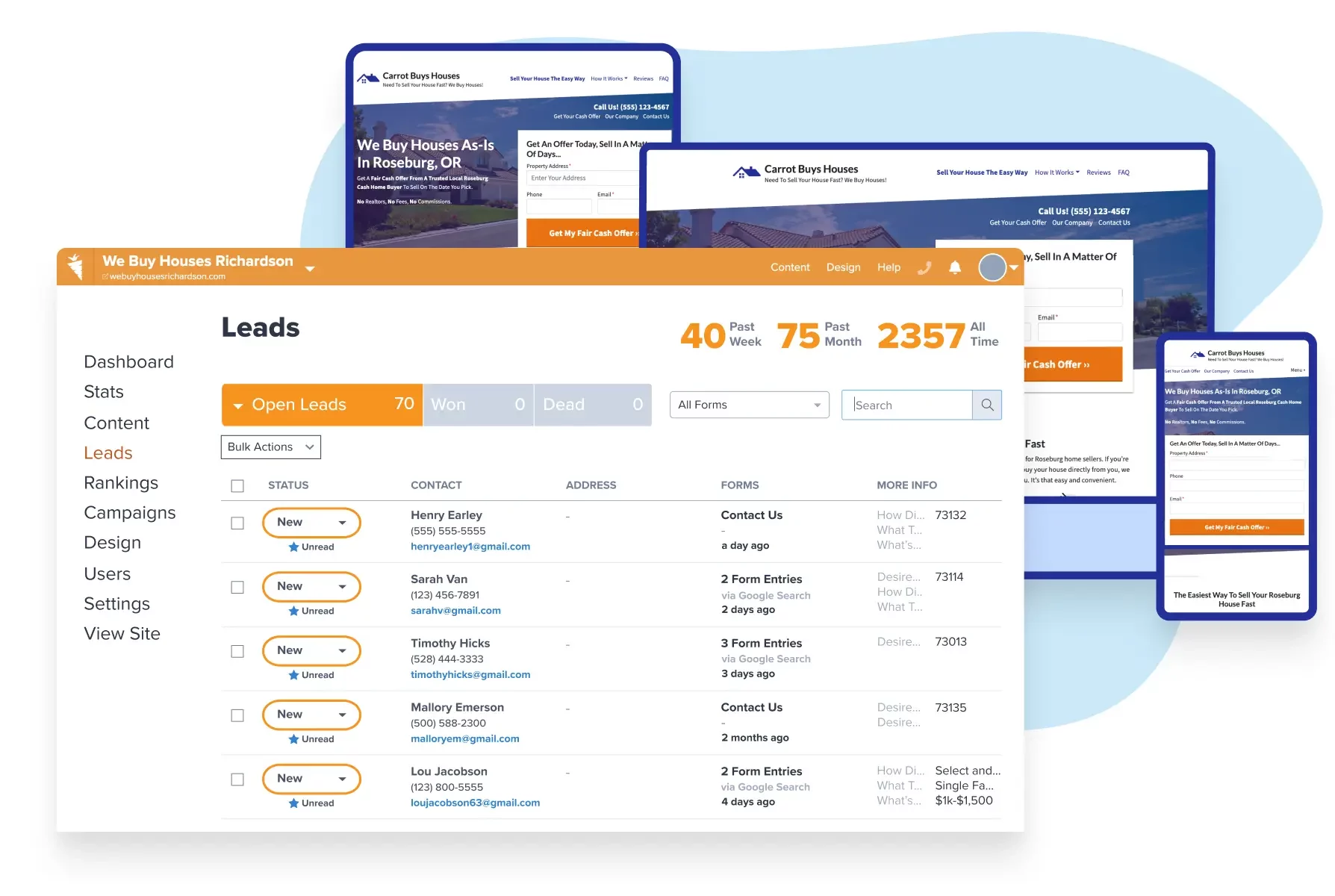
    They send traffic from all of their marketing channels to their Carrot sites and can track the performance of their marketing campaigns. Instead of guessing, they can access leads via the leads dashboard to know exactly where the lead came from and where they can maximize their marketing efforts.


    City-specific Landing Pages
    They can niche down marketing with hyper-targeted city pages that allow them to beat the competition and improve SEO rankings for people searching to sell in specific locations. 


    CarrotCamp
    CarrotCamp is a unique mix of lifestyle, masterminding, and implementation.

    The knowledge they’ve gained by meeting other entrepreneurs who share their experiences and strategies is an essential piece to their success.

    “Hey Trevor and the Carrot Team,

    I can’t say enough how thankful I am for the Carrot Team!

    You guys are all amazing and truly care about the success of others. It is really inspiring for us to keep going with your support.

    CarrotCamp was the best mastermind event I have ever been to!

    The unique abilities of all the Carrot team and the willingness to answer questions to help give us more clarity in our business is amazing.

    The power of the Carrot culture really hit me after arriving. I thought it was pretty great but reflecting on the environment, I’ve realized it’s truly something special.

    Culture can be envisioned by one person but it’s carried out by a great team of people who truly believe in it.

    I can’t wait to come back to a future CarrotCamp to connect even more with everyone as well as other great investors. Thank You!”

    – Robert Grand, Grand Real Estate Investments

    Personalize Website with Carrot’s Concierge Service
    Robert chose to take advantage of Carrot’s concierge service to create a website that looks different than anyone else in their market. They worked with our team to dial in personalization and saved time to focus on running their business.

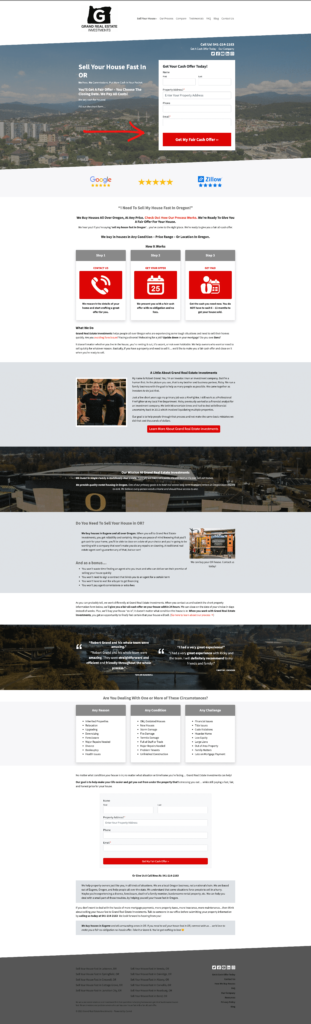
    Scroll to see the whole Grand Real Estate Investments website…


    The results:

    Robert and Ricky have been successful real estate professionals. But it wasn’t until they went all-in with online marketing and began learning more through networking events and CarrotCamp. This education has helped them grow their business, hire a team, and create predictable lead flow.

    “2 years ago I set out to transform my business into a more agile business. We became Investor Agents. At the time we realized more and more agents were flooding the market, which was a sign of a peak. Instead of fighting for market share as Realtors we added investing. Investing in Real Estate was our true passion anyhow. It was an easy switch.

    The hard part was wading through the mass amounts of information to get us there. We found carrot and signed up. I remember thinking I just like the way these people think! I like how the team at Carrot treats me and answers questions even before I purchased anything. Now I sit here 2 years later with a small and thriving business that I feel confident about even during this time.

    We are moving forward with our projects and will continue moving down this path with doing real estate listings and buyer purchases and buying to fix & rent or sell. There are a few companies that I don’t see as just a product or service I buy. I see them as part of my team. I see them this way because of how they add so much value. Thank You so much Carrot!”

    – Robert Grand, Grand Real Estate Investments

    Now, they know what the future of his business holds, and he knows where he wants to take it. More importantly, he knows how to take it forward.

    What about you? Are you ready for consistent and predictable growth in your business? Click below to learn more!

    It’s like utilizing that website as your core for everything is the key. That’s definitely the key. But it’s so simple to use. It’s not like a regular WordPress site. I love the simplicity. I know how to do everything.

    Robert Grand, Grand Real Estate Investments
  • [Data] Carrot Websites Now 69.8% Faster Than Custom Websites on Mobile

    [Data] Carrot Websites Now 69.8% Faster Than Custom Websites on Mobile

    Back in June, we introduced you to the latest big update to Google’s ranking algorithm – Core Web Vitals – and promised we’d be back with more information about how our team here at Carrot has responded to make sure your site speed and performance are up-to-par when it comes to this latest update.

    Today, we’re back to let you know that not only have your Carrot websites just become 50% faster thanks to the upgrades from our Engineering team, but your competitive advantage in site speed and performance against your non-Carrot competitors has grown!

    Recap of Core Web Vitals

    Core Web Vitals are the latest elements to be introduced to Google’s search ranking algorithm. They were partially introduced to the algorithm in June and, as of the end of August, play a full role in Google’s ranking mix.

    It’s been proven that page speed impacts the conversion rate of visitors to leads on websites, and Google has taken steps to make page speed more of a ranking factor (while still a very low factor when compared to quality content, quality backlinks, etc.).

    While there are various things that go into determining overall page experience in Google’s eyes, Core Web Vitals generally apply to how quickly a site loads, how quickly it becomes interactive for a user, and how visually stable it is while it’s loading.

    The actual Core Web Vitals themselves are comprised of Largest Contentful Paint (LCP), First Input Delay (FID), and Cumulative Layout Shift (CLS). In plain English, the way your website code is structured and how clean it is, matters to page speed. Below the surface, there is a multitude of related metrics that can be used to determine how well you are doing at meeting benchmarks for those big three.

    How Fast Are Carrot Websites Already vs. The Big Tech Players

    As we’ve reported in the past, Carrot sites are known for being among the fastest in the world on desktop. A study of over 150,000 websites (real estate and non-real estate) showed that Carrot sites were faster than every other website builder they tested… except for one. We nearly tied with Google’s own, very simple, Google My Business websites.

    We’ve continued to keep this page speed edge for our clients (all included in every Carrot plan) on desktop.

    Now Onto Mobile Page Speed

    If you’ve run a report using Google’s PageSpeed Insights tool, you’ve probably noticed that mobile scores tend to be lower than desktop. There are a few reasons for that. The first reason is that, although technology has come a long way, phones simply aren’t as powerful as desktop computers. That’s obvious. The other is how mobile speed scores are tested – by using an older generation phone with a 3G connection as the testing “device.” That’s why we caution against reading too much into the baseline mobile scores you see when you run some of these tools.

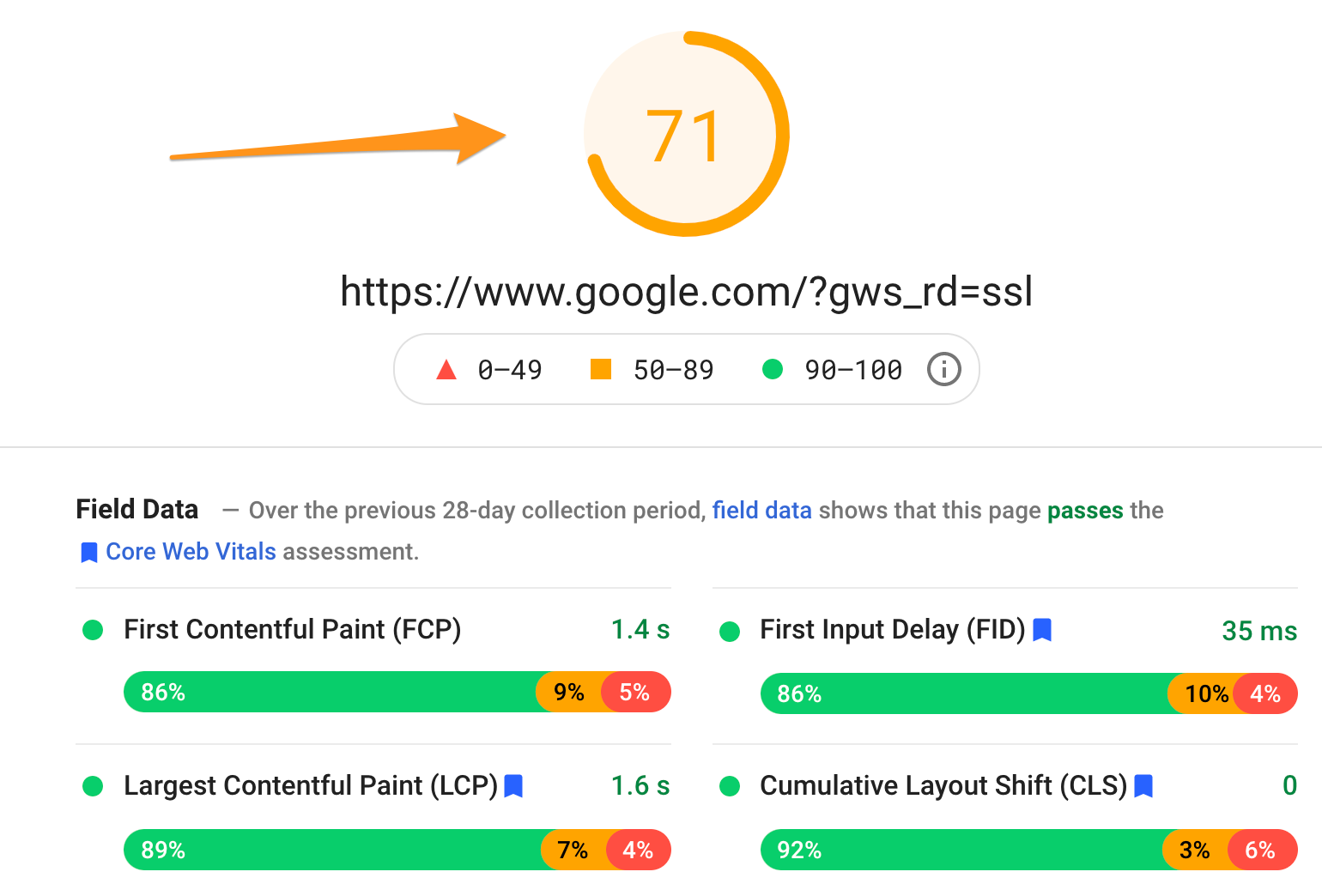
    For example, this is from Google’s own Pagespeed Insights tool on Google.com itself. Google itself scores a 71 out of 100 on mobile speed and a 99 out of 100 on desktop (our Carrot templates score a 98-99 out of 100 upon launch on desktop as well).

    Google’s Mobile Pagespeed Score On Their Own Website

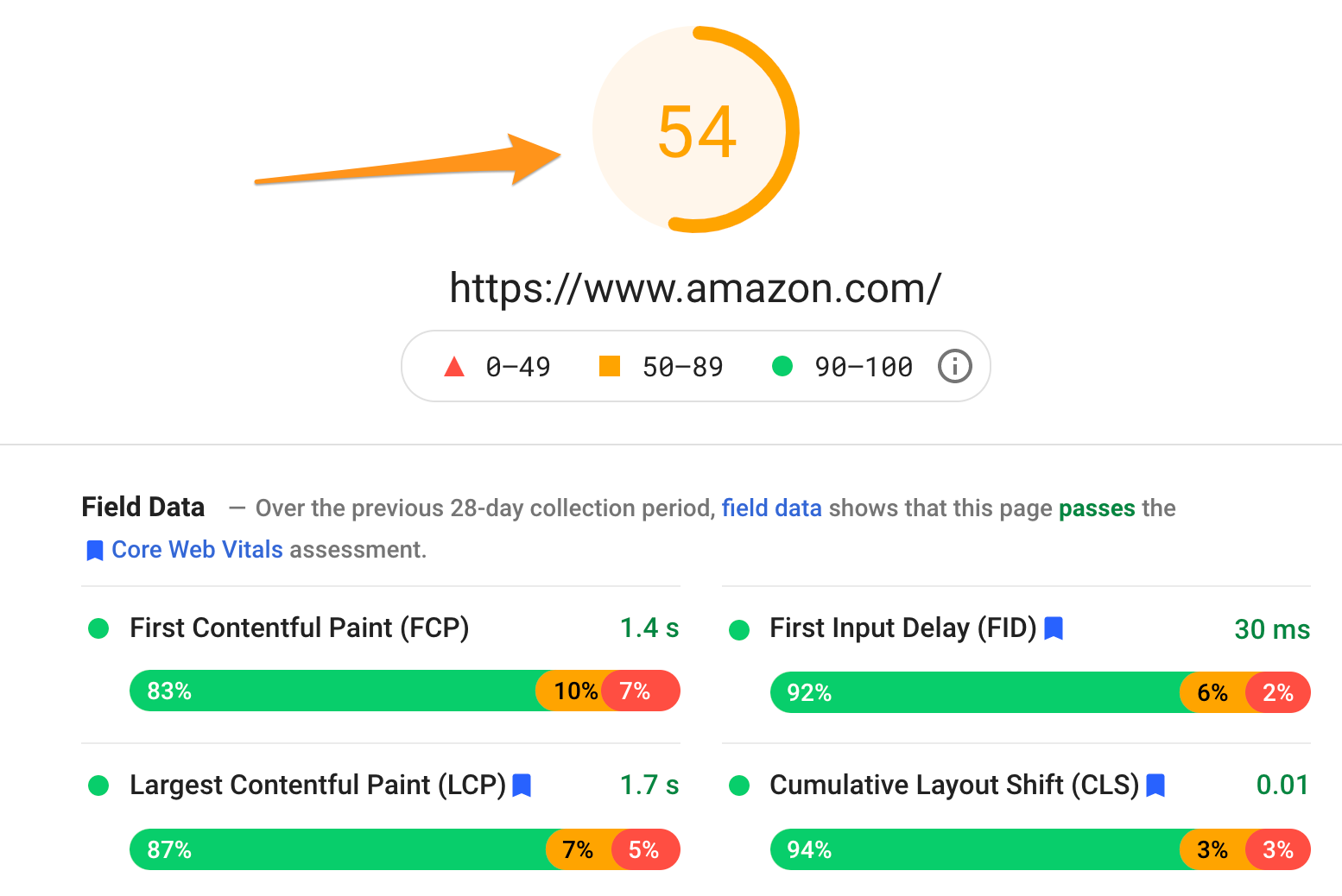
    Amazon.com’s Mobile Pagespeed Score

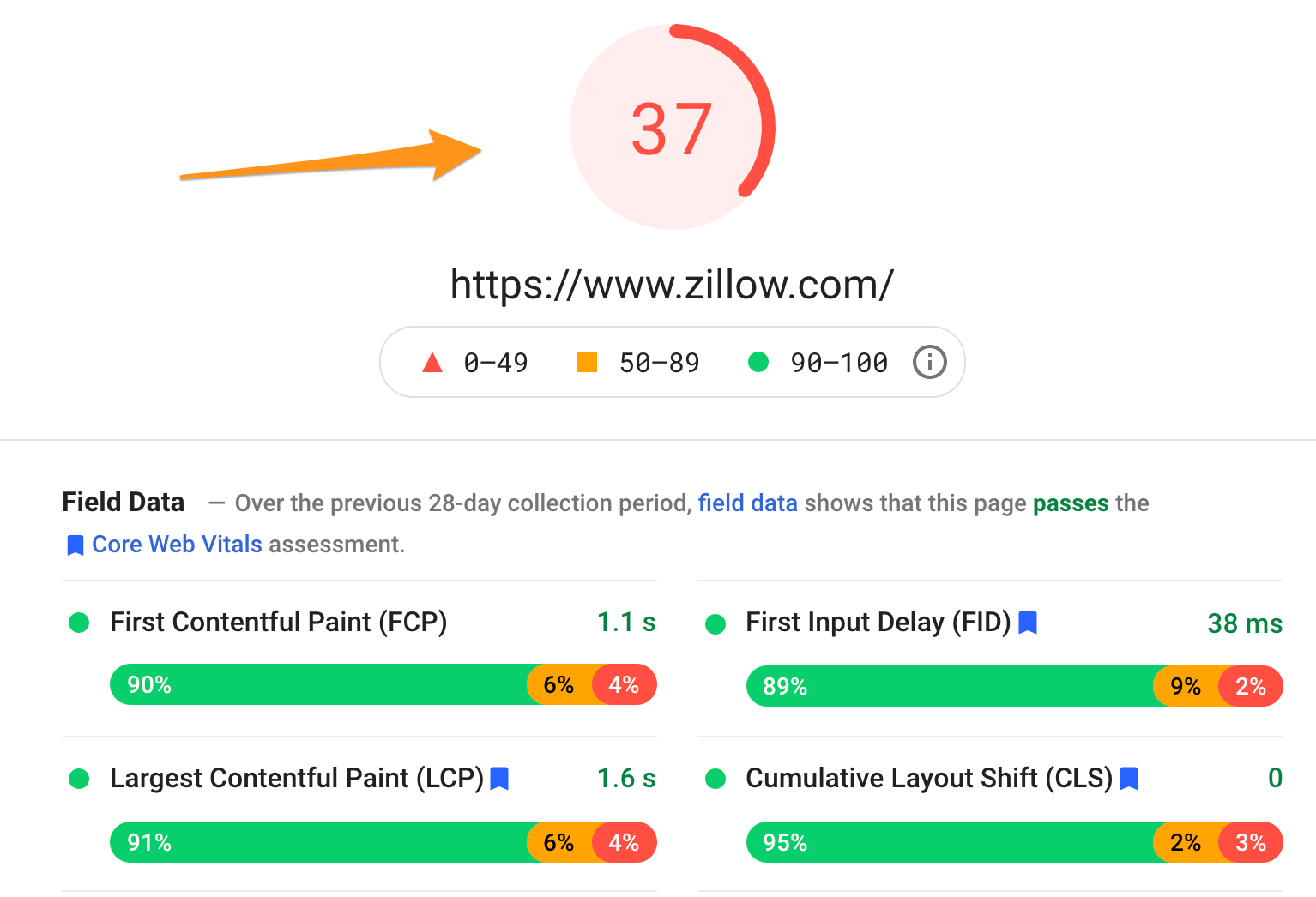
    Zillow’s Mobile Pagespeed Score

    All 3 of these websites above are known as some of the best-ranking websites in the world, despite the low mobile page speed score you may see in Google’s Pagespeed Insights tool.

    Why do we show you the 3 sites above? To show that Google isn’t weighing page speed in Google rankings as a primary ranking factor yet, but also to show you how Carrot sites compare to some of the largest and most valuable websites in the world when running these baseline tests.

    So as Google works page speed more and more into its ranking factors, Carrot members are already ahead of the game.

    [Data] Carrot Sites Now 69.8% Faster than Custom WordPress Websites

    [Data] Carrot Sites Now 69.8% Faster than Custom WordPress Websites

    What We Did to Improve Core Web Vitals and Site Speed On All Carrot Websites

    We already knew that Carrot sites were fast, but Google’s update led us to set out to make them even faster.

    Over the last few months, our team has been working to audit, identify, and optimize several facets of our sites and network with Core Web Vitals and site speed in mind.  Through the use of a new, robust tracking system, we’ve been able to highlight key areas that impact every single site on our network.

    These include:

    • Font-related improvements
    • Image-related improvements
    • Javascript/CSS-related improvements
    • Template-level improvements

    By breaking this overarching site speed and performance theme into several smaller buckets, our Engineering team was able to directly address any snags in site performance and go to work fixing them. 

    While the concept of Core Web Vitals and site speed is certainly not new to us at Carrot, the introduction of them into Google’s ranking algorithm meant that we had to double down on this work over the course of the past several months.

    We won’t bore you with the super technical details, but here are a few things our great team of Engineers did to help your site – and every site on our network – become faster and up-to-par with the Core Web Vitals update:

    • Revisited several code packages and determined whether or not we still need them, and if we do, looked at how we can better optimize when it comes time for a site to load
    • Tested and optimized how and when we load webfonts on a page
    • Ensured images are being properly deferred off-screen where applicable and reduced the number of resources needed to load them
    • Conducted a deep dive into our Javascript packages and unbundled them where it made sense to do so, lending a great improvement to site speed and loading

    Enough Of The Technical Stuff … How Much Faster Did Carrot Websites Get?

    Across the handful of templates and sites we tracked before, during, and after this Engineering work, Mobile Performance Scores increased significantly – by anywhere from 25 to 50%!

    ** Note – When we reference scores in this article, we are referencing absolute baseline scores using Google’s Lighthouse Tool. Make sure to read up on our guidance on testing tools and their associated caveats in the Dos and Don’ts Guide **

    Across the handful of templates and sites we tracked before, during and after this Engineering work, Mobile Performance Scores increased significantly – by anywhere from 25% to 50!

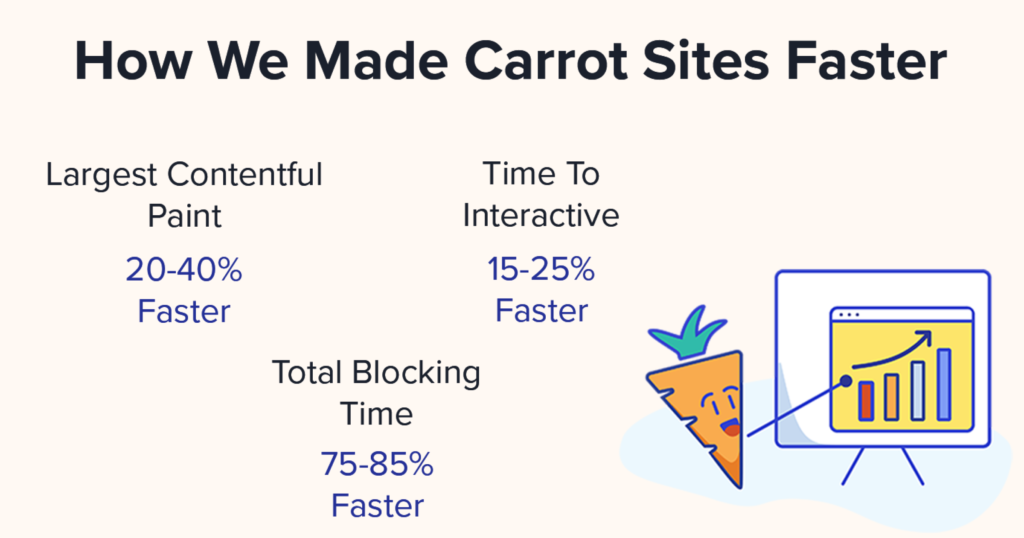
    Beneath the surface of the top-line Performance Score, we identified several important metrics that we knew we could target for improvement.

    Among these were:

    • Largest Contentful Paint (one of the primary CWV metrics)
    • Time To Interactive and Total Blocking Time as measurements of input delay
    • and Cumulative Layout Shift (another primary metric)

    The end result? Sites that load faster, require fewer resource-heavy elements and maintain visual stability.

    These three metrics (combined with Cumulative Layout Shift) directly impact all three areas of Core Web Vitals and – as a result – your overall Performance Score.

    It’s important to note – every single one of these improvements is sourced from the mobile version of our sites.

    Because the desktop versions of our sites were already lightning-fast (meeting or exceeding CWV benchmarks for every category), we were able to focus our attention on anything impacting mobile scores specifically.

    This is great because Google has signaled that only mobile search is impacted by this latest algorithm update… yet another way Carrot is staying ahead of the game and delivering high-impact improvements for our members.

    So How Do We Stack Up To The Competition?

    After seeing such significant improvements to site speed and performance, we wanted to know: How do we stack up to the competition now? We set out to collect a sample of CWV and site speed scores for a myriad of non-Carrot sites in large real estate markets.

    These included custom WordPress sites, other site builders (Weebly, Squarespace, etc.), other site builders that cater to the real estate industry, and custom sites that aren’t built on the WordPress engine.

    We matched our most popular template up against them and were blown away by the results!

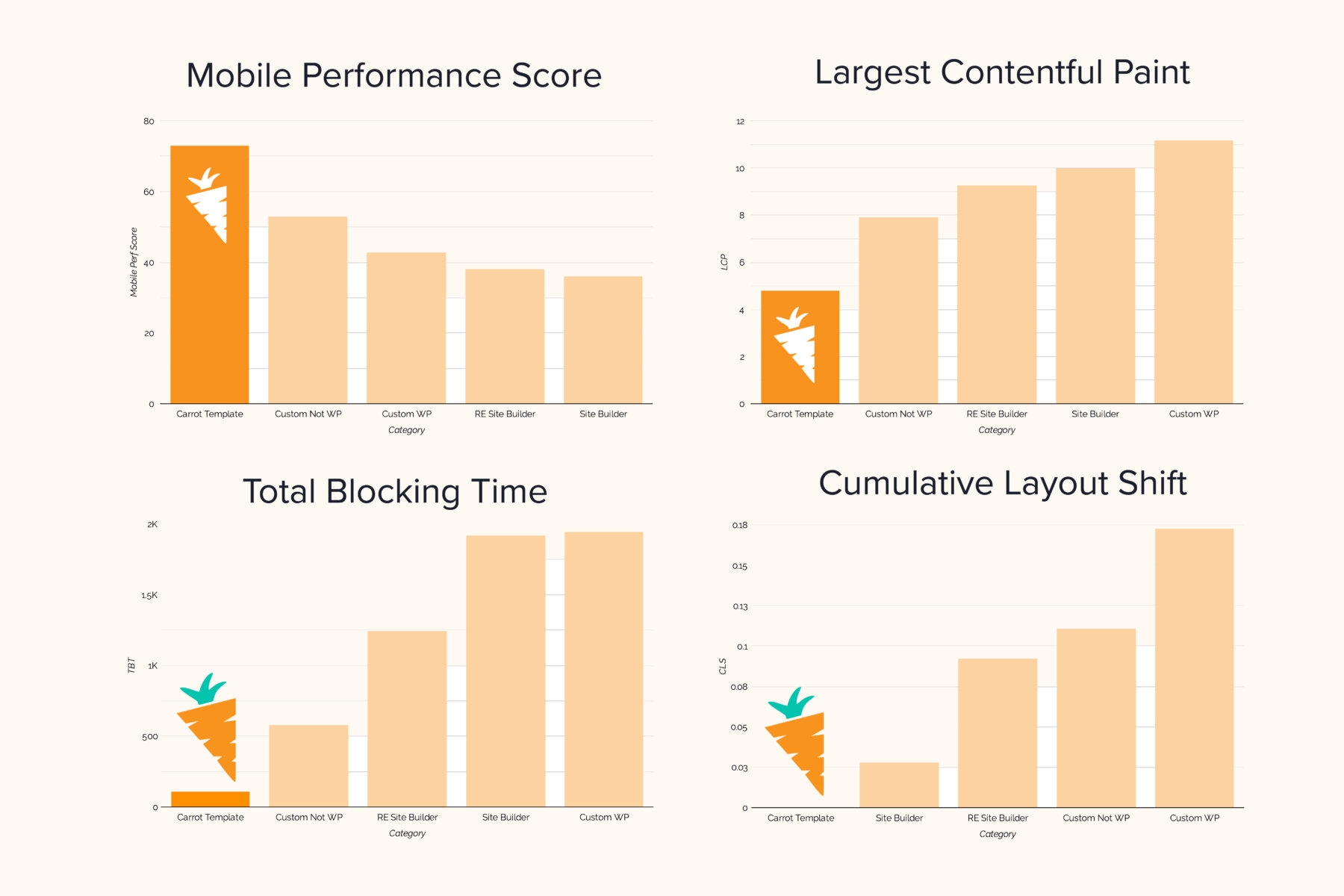
    Carrot sites beat 92.5% of competitor sites in terms of Mobile Performance Score!

    Better yet, we outperformed 75.9% of sites in Largest Contentful Paint, 88.8% of sites in Total Blocking Time, and 79.6% of sites in Cumulative Layout Shift!

    Check out how we performed against each category below:

    (Reminder: LCP and TBT are measured in seconds so lower scores are better; a lower score is better for CLS as well!)

    Here’s the full breakdown…

    CategoryMobile Performance ScoreLCP (sec.)TBT (ms.)CLS
    Carrot Site734.81100.000
    Custom WordPress4311.171,9470.173
    Custom Not WP537.95800.111
    Site Builders3610.01,9180.028
    RE Site Builders389.291,2470.092

    We always knew that Carrot sites outperform the competition in terms of SEO and conversion, and now we know that the man-hours and effort we’ve devoted to site speed and performance over the past several months has increased our competitive advantage even more!

    What’s Next For Core Web Vitals and Site Speed At Carrot?

    Just because Google has now fully introduced Core Web Vitals and site speed metrics to their ranking algorithm doesn’t mean our work is done. We still have a healthy backlog of ideas to improve site speed and performance on our network that we’ll keep hammering away at over the next weeks and months.

    We’re also going to be expanding and improving the system and process we use to track Core Web Vitals scores here at Carrot.

    We not only want to be able to see measurable, quantifiable gains in these scores as we continue our work over time, but we also want to catch (and fix!) anything that may negatively affect site speed scores on Carrot sites before that impact is actually seen.

    We’re also going to be developing some ways to analyze aggregate organic traffic across our network leading up to and following Google’s announced roll-out of this update. There are still open questions across the industry about when, where, and how much we will see this impact on rankings and inbound organic traffic.

    As one of the largest network of real estate sites on the Internet, we hope to help answer some of these questions and bring you the insights you need to know.

    Core Web Vitals – and Google’s definition of “page experience” in general – is still a relatively new concept, and it’s sure to evolve in the coming months and years. Google itself has signaled that this is the case…

    “Because we continue to work on identifying and measuring aspects of page experience, we plan to incorporate more page experience signals on a yearly basis to both further align with evolving user expectations and increase the aspects of user experience that we can measure.”

    Evaluating page experience for a better web – Google – May 28, 2020

    As the discussion of Core Web Vitals continues to evolve and we learn more from Google, we’ll be sure to bring you those updates and any guidance or improvements for your sites. In the meantime, enjoy your better, faster Carrot site without needing to spend thousands of dollars on web development contractors to keep your site fast.

    Not a Carrot member and tired of hassling with the tech when it comes to keeping your site fast and ahead of the curve?

    Now is the perfect time to switch from a clunky, custom site to a Carrot site that’s been engineered for optimal performance in page speed, conversion rate, SEO, and everything else you need to dominate your market.

  • Core Web Vitals & Page Speed – What To Do (and Not Do) with Your Website

    Core Web Vitals & Page Speed – What To Do (and Not Do) with Your Website

    By now, you’ve probably heard about Google’s upcoming Core Web Vitals update and are wondering what it means for your site, where you should be looking to learn more, and what you should be doing to prepare. 

    Back in June, we provided a brief overview of the Google update (officially titled the “Page Experience Update”) and an introduction to Core Web Vitals – the metrics playing the most prominent role in the update.  

    Recap:

    The Page Experience Update is introducing Core Web Vitals to Google’s search ranking algorithm for the first time.  Core Web Vitals are a series of pagespeed scores relating to how quickly a page loads, how quickly that page is interactive, and how stable that page is visually. Google started introducing elements of this update to their algorithm in mid-June, with the goal for it to play a full role by the end of August 2021.

    Check out our SEO News page to learn more.

    Over the past several months, our Carrot Engineering Team has been identifying, optimizing, and improving features and elements that directly contribute to better user experience and site speed metrics. 

    As that work continues to make our sites faster and better than ever, we’ve compiled some of the most common questions, issues, and misconceptions we’ve seen as a resource for you to be ahead of the game on your end.

    DO Understand Testing Tools

    We get this question a lot: how do you test your site speed and Core Web Vitals and what tool should you use?  At Carrot, we recommend using Google’s PageSpeed Insights Tool because – regardless of which tool you choose – the most important consideration is that you be consistent. 

    To us, using Google’s own tool makes the most sense.  If you’re using the Chrome Browser, the Lighthouse Tool in the Developer Tools is another great option.

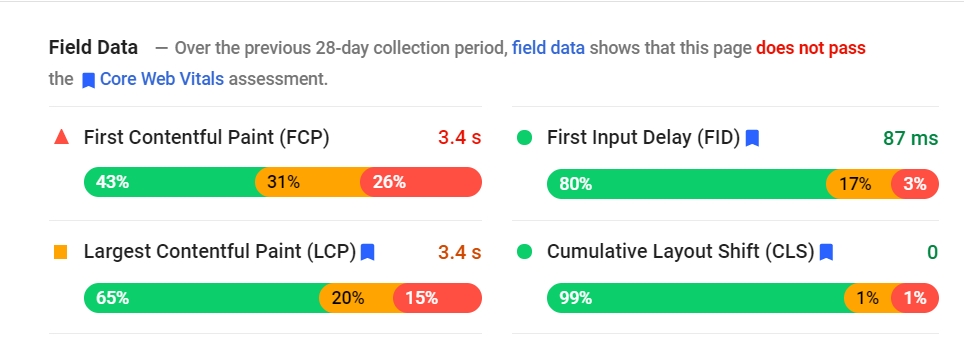
    That said, we always want to be sure that our members understand the differences and caveats between those snapshot scores provided by tools and the scores that are actually being used in Google’s algorithm. Google differentiates them into two categories: lab data and field data.

    Lab Data – Provided By Testing Tools

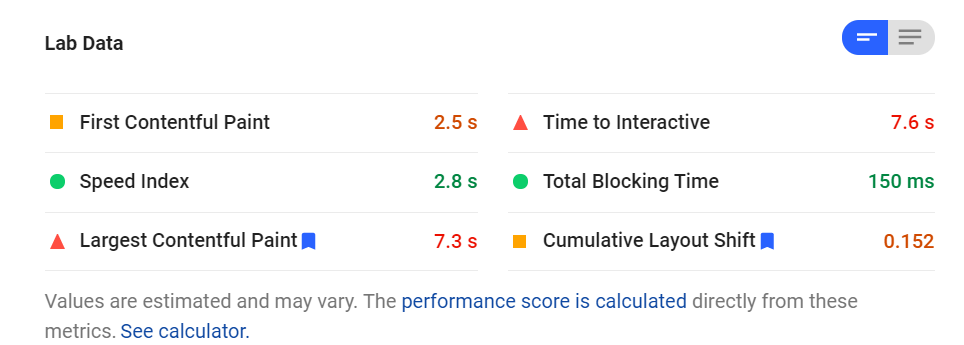
    Google Lab Data

    Lab data is exactly what it sounds like – data collected in a lab, or in this case, a single snapshot report performed by Google’s PageSpeed Insights Tool or any other third-party testing tool. 

    It uses your own browser or another emulated device to load your website in a simulated environment and capture the key metrics that contribute to Core Web Vitals and Page Experience.  These scores are meant to be consistent baselines and are not necessarily reflective of actual user experience. 

    Just like in a real lab, you want to control for all variables when running experiments and tests on your website.  Google’s page speed tool (and most other tools) do this by loading your site on a simulated older generation smartphone with only a 3G connection to determine mobile “site speed” scores. 

    This is meant to represent the absolute baseline and used as a tool for debugging any performance issues with your site.  It’s useful for looking at where you can improve your scores, but it’s not useful for understanding real user experience.  Most users are on newer mobile devices with better connections and WiFi. 

    Their experience is better than in the simulated snapshot and contributes to field data – the real scores used by Google’s search ranking algorithm. 

    Field Data – Provided By Real User Experience

    Like we said above – field data is what Google is actually introducing to their search algorithm.  It represents the actual user experiences collected by the Chrome User Experience Report (or CrUX) when users visit your site.  Google then looks at the 75th percentile of those scores, and that’s your actual “score” used by their algorithm.

    Just like with Google’s more commonly-known ranking indicators, we lose visibility and transparency the closer we get to the algorithm.  So while snapshot lab data scores can be accessed whenever we feel like running a tool, user experience field data is more ambiguous and inaccessible.

    There are two primary areas where you can gain insights about your real user experience scores if your site has sufficient traffic/data for Google to generate reports.  That’s in the Core Web Vitals tab of Google Search Console or at the top of reports in the PageSpeed Insights Tool.  

    For individual URLs, you may see an error – “Field Data — The Chrome User Experience Report does not have sufficient real-world speed data for this page.”  This means that there is not enough CrUX data available to generate a representative anonymous view of your performance.

    If you find this to be the case, no sweat – you just need more visitors, and the best way to do that is by focusing on generating great content first.

    This leads us into our next section…

    DON’T Stop Focusing On Content

    Under no circumstance should you stop what you’re doing to generate great content and drop everything to focus on Core Web Vitals.

    Here’s some guidance directly from the source – Google…

    “While page experience is important, Google still seeks to rank pages with the best information overall, even if the page experience is subpar. Great page experience doesn’t override having great page content.” – Understanding page experience in Google Search results

    In other words, page experience and site speed scores are just other ingredients in the complex recipe Google uses to produce search results and rankings. 

    Content is still king. 

    Relevant, useful, informative, and high-quality content will continue to outperform competitors and other websites – because, at the end of the day, a visitor is seeking content first.  Page speed is just another supplemental measurement.

    At Carrot, we have always excelled on the content side of things. That’s our bread and butter!  So while Google’s Page Experience Update is certainly something to keep an eye on now and in the future, we highly recommend that you continue leveraging our tools and investing your time, resources, and creative efforts to produce high-quality, relevant content above all else.

    Another note: Core Web Vitals will only apply to mobile search results.  Across our network, we see that nearly 40% of inbound traffic (and leads!) to Carrot sites still occur on desktop.  Those desktop search results will not be impacted by this update at all.  That’s why content is still so important. 

    DO Take A Minimalist (And Mobile First!) Approach To Design

    Because this update applies solely to mobile search, it underscores the importance of taking a mobile-first approach when looking at your website content and design.  Let’s face it – mobile has taken over. 

    As we mentioned, 60% of traffic across our Carrot network occurs on a mobile device.  Keep that in mind when thinking about how to layout and implement content on your site.  Sometimes, less is more.

    We recently did a series of conversion tests that reiterates this point. We found that simply reducing the amount of content in a website’s main hero section and form, could increase conversion rates by up to 50%! 

    This test confirmed our theory that by reducing the clutter that a visitor sees, they will be more likely to engage with the lead form.

    The same principle applies to site speed and performance.  Each additional element that you include on a page requires additional resources to process, render, and place that element on the page.  That results in additional time that it takes the page to load. 

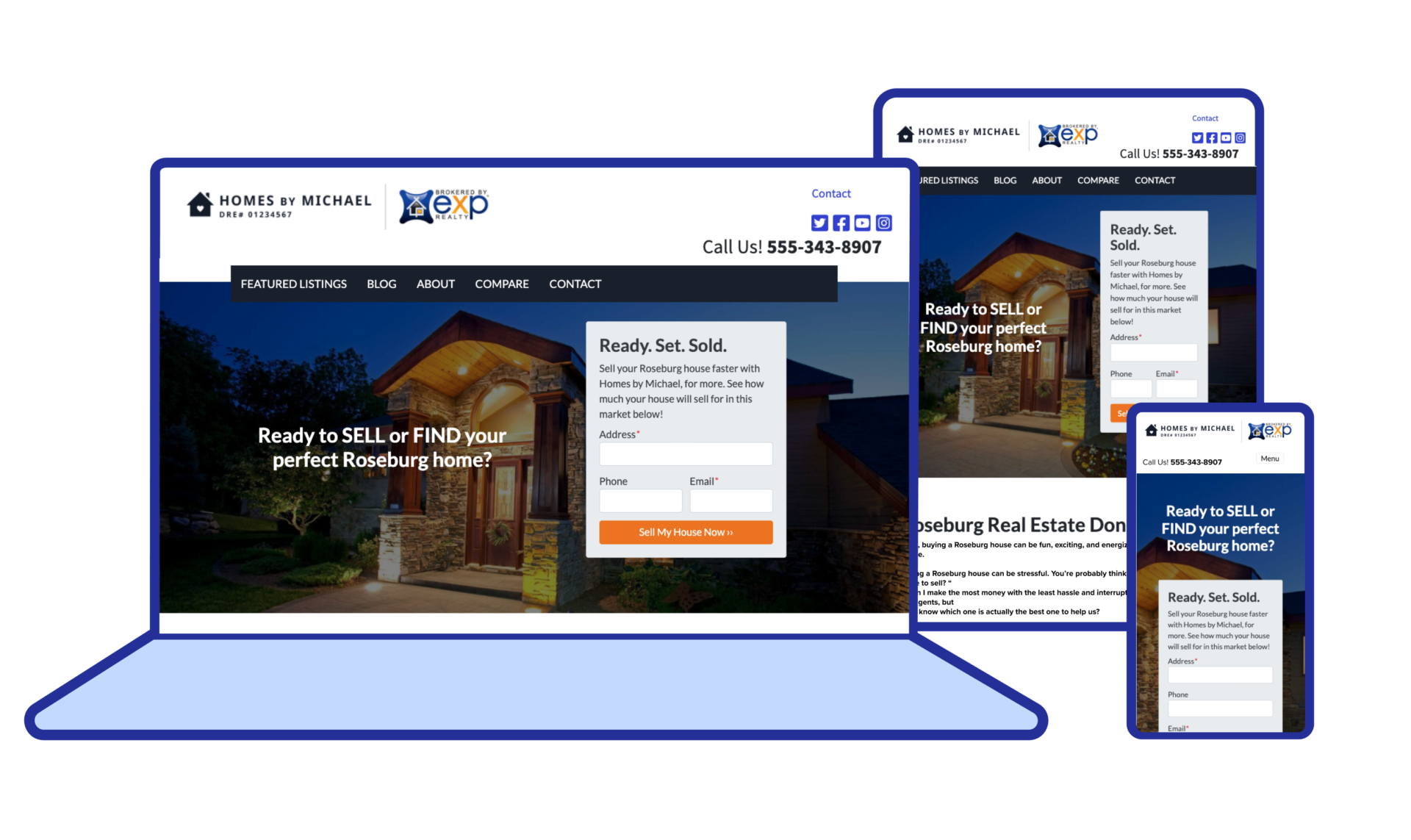
    In the left image, the form is prominent and the page isn’t blocked from loading by resource-heavy elements. In the right image, there are more elements to load, and the form is pushed “below the fold.”

    The most common abuses of this also often incorporate some of the most resource-heavy elements – like pictures and videos placed all around the page, or high up near the top of the page. 

    While we encourage you to continue creating great content to highlight your credibility and experience, we also encourage you to be mindful of how, and where, you deploy that on your site.  Run snapshots before and after adding it and see how it impacts your scores. 

    At the end of the day, the goal of your site is to generate leads.  With so many users now browsing on their phones, it increases the importance of improving user experience in more ways than just site speed. 

    By taking a step back and considering how some of your content elements might be drawing attention away from conversion elements or impacting a visitor’s experience on your site, you’ll also be guaranteed to improve your site speed metrics at the same time. 

    DO Take Image Optimization Seriously

    While we are on the content note, we understand that there are naturally going to be images and graphics you want to include to help highlight your experience and improve your site aesthetic. 

    We highly recommend being cognizant of the various ways to ensure you aren’t overburdening your site’s speed and performance when adding images.

    For step-by-step examples, check out our image optimization guide.

    DON’T Weigh Your Site Down With Tracking Scripts

    Just like with content elements, too many unnecessary tracking scripts and third-party codes can also overburden your site and negatively impact your Core Web Vitals scores. 

    The same concept applies: each script or code snippet you add requires more resources to execute.

    We get it – some tracking scripts like Google Analytics, Google Ads, and the Facebook pixel might be necessary for your marketing if you’re making ad-buying decisions based on those metrics.  In this case, you have to consider it a trade-off. 

    In exchange for gaining visibility into those tracking metrics and insights, you’re negatively impacting your site speed marginally.  Which is more important to you?  In most cases, those tracking analytics will outweigh site speed.

    If you aren’t heavily and consistently using these tracking tools, perhaps consider what you really need and what you can get rid of.  Over time, the addition of individual scripts and code snippets can naturally bloat if not routinely audited for only the most necessary scripts.  This is one of the most common variables we see when reviewing customer site speed report results.

    Note: This also applies to any additional third-party scripts and services like chatbots, call tracking, etc.

    Finally, DON’T Freak Out…

    Core Web Vitals and Google’s Page Experience Update are certainly complicated, but by taking the time to understand the basics and paired with our Engineering Team’s work to optimize your site, you’ll be ahead of most site owners. 

    Screaming Frog analyzed 20,000 URLs last year, and only 12% of mobile sites and 13% of desktop sites passed the Core Web Vitals assessment. There is a lot of work for everyone to do, and we’re committed to continuing to provide you with the resources and updates you need.

    We’re thankful for a great community of members who are really supporting what we’re doing here at Carrot to help transform the way high-achieving real estate agents and investors use the internet to grow their real estate business.

  • It’s a Low Inventory Real Estate Market Right Now – Here’s Our Solution to Getting More Listings

    It’s a Low Inventory Real Estate Market Right Now – Here’s Our Solution to Getting More Listings

    Carrot's response to today's low inventory real estate market seller site

    This year’s real estate market has been strong, with high interest in housing across all regions of the country. The strengthening economy and a demographic shift are fueling this growth — and millennials reaching their peak homebuying years have led to increased demand for homes nationwide.

    However, there’s another major trend in today’s market: housing inventory is at an all-time low. Simply put — there aren’t enough homes for everyone, so housing prices are skyrocketing and competition is fierce. 

    Low mortgage rates combined with an increase in work-from-home opportunities due to the Pandemic have fueled greater demand for suburban houses — and buyers are buying up these properties quickly as they come onto the market. Some buyers make offers without even seeing the property in person or including contingencies in their bids, just to win a bidding war with other eager homebuyers. 

    There’s also an increase in demand among millennials due to the historically low mortgage rates; however, many of them can’t find what they need within their budget. The drastically rising home prices are making affordable housing scarce. 

    Despite the increasing number of sellers due to increasing home prices and low-interest rates, limited construction activity earlier due to COVID-19 and high lumber prices, and pent-up demand for housing, housing demand is still drastically outpacing supply. So competition continues to be fierce for new homes hitting the market (or being sold off-market) making retail seller leads more elusive — and more valuable — than ever.

    Overview of the Real Estate Market

    These numbers are, of course, offset by the looseness of the definition of “active,” as well as the fact that some real estate agents help to sell homes, while many are purely focused on buyers or simply have an active, but unused, license.

    Additionally, we could potentially see over a million evictions in the coming months, while at the same time giving millions of people the means to get into a home. This is fueled by:

    • The ending of the mortgage moratorium.
    • The passing of President Biden’s first-time homebuyer credit. This first down payment tax credit “will help families offset the costs of home buying and help millions of families lay down roots for the first time,” according to President Biden’s campaign website.

    What does this mean for real estate agents today? 

    It means that every lead and listing counts and the real estate agents who succeed are the ones that consistently market, generate leads, follow-up, and build high-flying reputations in the area(s) where they operate.

    Don’t get us wrong. Today, inventory is low and competition is high. But the market has been through many similar fluctuations in the past and there are no indications that the market won’t balance back out. In other words, you’re in a good industry.  

    Here’s how, at Carrot, we’re helping real estate agents stand out in their markets and snag listings.

    The Carrot Solution

    Since CEO Trevor Mauch started Carrot, we’ve made it our mission to always innovate and evolve our software to stay ahead of the real estate market and anticipate our members’ future needs to help Carrot members see success.

    It’s the foundation of our company vision — to “inspire and empower real estate professionals to gain true freedom and make a greater impact with their businesses.”

    That means building awesome software that helps real estate professionals build authority online today while always staying a step ahead of your online lead generation needs in the future.

    One recent innovation inspired by current market trends that we are super excited to launch is our all-new Carrot Agent Seller Site Template that’s designed to help today’s agents attract and convert more retail seller leads.

    Our new site features fresh seller-focused content built from top-performing Carrot Agent sites, a modern design to help you stand out online, and — of course — Carrot’s proven SEO and conversion methodologies to attract and convert more seller leads in today’s highly competitive, low inventory real estate market. 

    How do we know it works? 

    Because the all-new content strategy is cultivated directly from our highest performing Agent members’ websites…

    • These sites received astronomically more traffic than the average agent site — across all channel groupings. The average agent site received 664 visitors in Q2. The top-performing Agent sites had 10X more visitors.
    • These sites converted all traffic between 2X to 5X better than the average agent site.
    • These sites converted organic traffic 215% better than the average agent site. 

    And we ensured the new design put you as the Agent at the forefront to help you strengthen your personal brand in your local market and build credibility with more social proof and happy client testimonials.

    So we figured… If it works for them, it could work for you!

    Check out a screenshot of the image below!

    How does it work? Sellers opt-in, you get notified, you call them and do what you do best… voila!

    Cool, right? 

    But that’s just one example of how we’re making it easier for agents to find listings. 

    Carrot members also get…

    • Tons of other tools that will help you drive traffic and generate leads in your specific market — UTM builder, SEO Keyword Rank Tracker, SEO Checker, and more!
    • Access to industry-leading trainings, support, and strategy from our team of product and real estate experts!

    But you don’t have to take our word for it!

    Check out some of the testimonials below from real estate agents using our software…

    “This is much more than a web hosting company…it’s a complete marketing and training program. Carrot has helped our Real Estate Team develop a complete marketing strategy. For the first time…ever…we can see how all the pieces fit together in a cohesive marketing strategy. The results have been an increase in exposure, online leads, and the ability to measure ROI! The training, support, coaching, and customer service have been amazing.” – Tom Townsend

    “Carrot has impacted my business so positively! I love the property websites, landing pages, SEO rankings, blog, and overall design of the site. I also love the landing pages that I use to drive traffic from ads that I run. And my favorite is to watch the increase in Google rankings with the more relevant content we produce. Really great web host!” – Shemeika Fox

    That’s all for now!

    We’ll let you know when we’ve got more cool innovations to share that’ll help you grow your business in a scalable and realistic way. 

    To your success!

    Want to learn more about our new seller site? Check out here.

    Unlock Our Newest Agent Site Template

    Join Carrot and Access Our Brand New Agent Seller Site Template Today

  • The Google Core Web Vitals Update | How It Impacts Real Estate Investors and Agents

    The Google Core Web Vitals Update | How It Impacts Real Estate Investors and Agents

    Hey Carrot Community! In our ongoing quest to help our members always stay ahead of the game when it comes to all things performance (SEO rankings, page speed, and conversion rates) we wanted to dive into a new Google algorithm update coming down the pike this summer called the “Core Web Vitals” update.  

    The cool news is that anyone with a Carrot website is already ahead of the game a good bit. Page speed optimizations we’ve made over the years and additional optimizations we have coming to mobile this summer put Carrot sites among the fastest on the internet today.

    Alright, in this post we’ll dive into… 

    • What is Google’s “Core Web Vitals” update?
    • How it may impact Google rankings for real estate agent & investor websites moving forward
    • Why page speed is important (and what we’ve done and have planned to keep you ahead with blazing fast websites)
    • Some simple things you can do to increase your page speed in addition to the updates we’re making for you

    What is Google Core Web Vitals and How Does It Impact SEO?

    But before we dive in… I want to give you the high level in one sentence. 

    Basically, Google is making an update that favors websites that have a better experience than ones that don’t, and part of that experience is how fast pages load (on both mobile and desktop). Google has found that when a website loads fast, it’s a better experience for the website visitor than when a website loads slow.

    Why does Google care how fast your website loads you may ask?

    Google’s money comes primarily from the advertising it sells on Google searches called Google Ads. When a Google user loves the experience of searching for information and when they have a great experience on the websites Google serves up to them (a site loading quickly vs. slow for example)... more people will continue to use Google.com for their web searches… which increases their ad revenue.

    Google announced in November 2020 that Core Web Vitals would roll out in May 2021, but that has been postponed to at least mid-June 2021 with a full rollout by August 2021.

    Here are the elements of Core Web Vitals (this next section is going to get a bit techie):

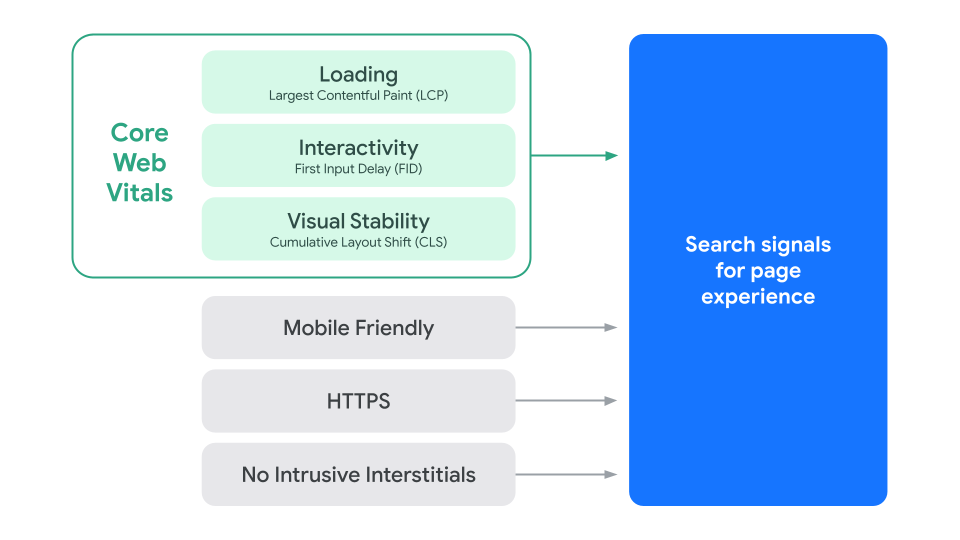
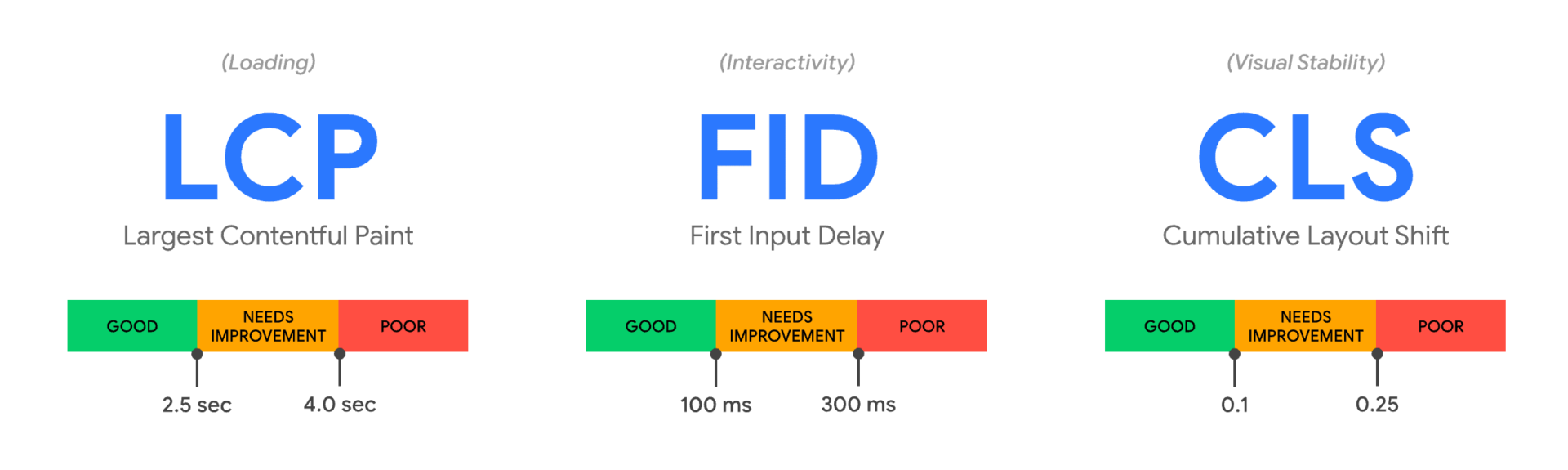
    (Image: web.dev)
    • Largest Contentful Paint (LCP) – Measures loading performance. To provide a good user experience, sites should strive to have LCP occur within the first 2.5 seconds of the page starting to load.
    • First Input Delay (FID) – Measures interactivity. To provide a good user experience, sites should strive to have an FID of less than 100 milliseconds. This involves how long it takes the user to interact with your page including clicking on links from the main menu and navigation bar, filling out forms, and opening up “accordion text” on mobile devices. These are some of the aspects that are taken into consideration for a good user journey experience.
    • Cumulative Layout Shift (CLS) – Measures visual stability. To provide a good user experience, sites should strive to have a CLS score of less than 0.1. Any elements that take too long to load can cause users to click on something they didn’t mean to and cause a bad user experience. This is particularly important for mobile devices.

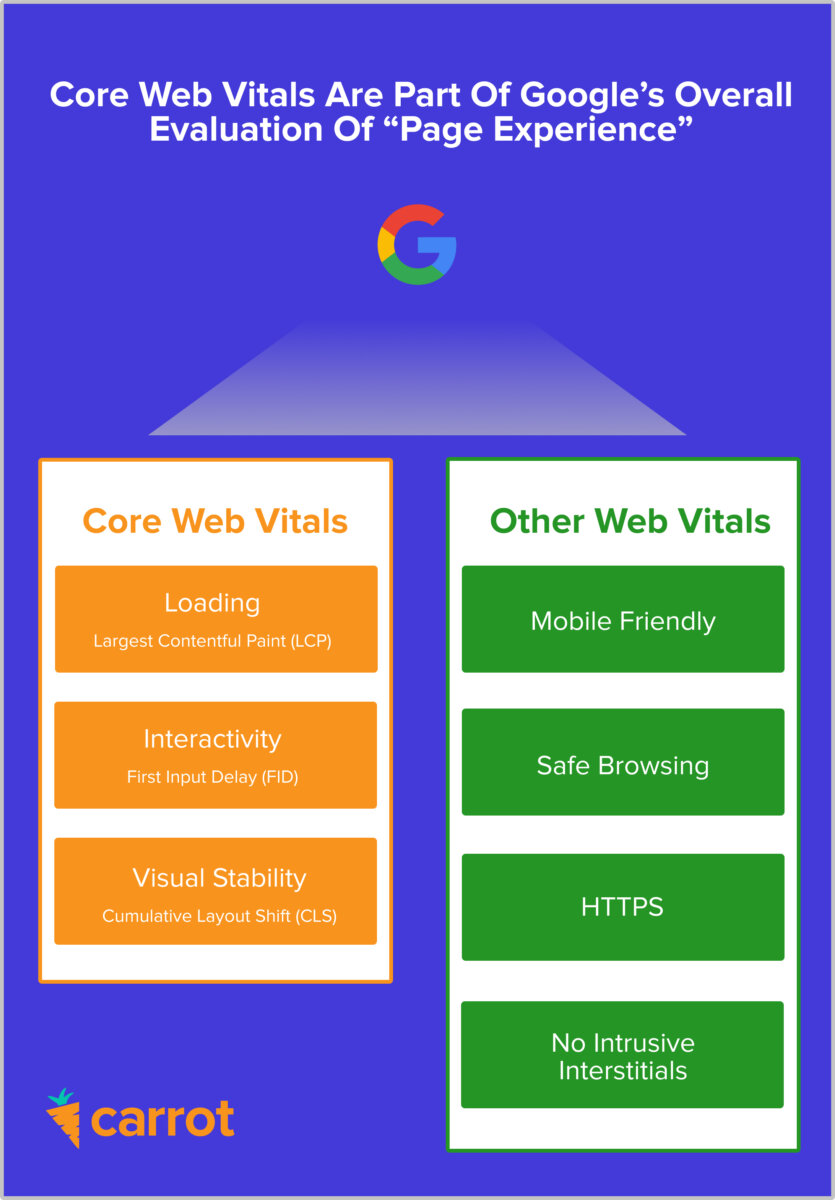
    Core Web Vitals are comprised of three aspects of page experience: Loading, Interactivity, and Visual Stability. Each of these aspects have their own associated metrics that have zones that correspond with “Good,” “Needs Improvement,” and “Poor.” 

    In a nutshell, Core Web Vitals are a subset of factors that will be part of Google’s “page experience” score. It’s basically, Google’s way of measuring your page’s overall UX.

    You can find your site’s Core Web Vitals data in the “Experience” section of your Google Search Console account.

    Google Search Console Core Web Vitals

    Page Experience:

    We’re taking this update seriously. That said, we believe there is one way, that has not changed, that you can reap the splendors of search engine optimization. It is:

    • Create great content.

    Take it from Google:

    “While all of the components of page experience are important, we will prioritize pages with the best information overall, even if some aspects of page experience are subpar. A good page experience doesn’t override having great, relevant content.” – Google

    Technical considerations have always played a role in determining search rankings. So, in that regard, the page experience update is not unique.

    Great SEO has to be preventative, not reactive.

    That’s why since the start of Carrot we’ve taught our members to create Evergreen content to enhance their overall inbound marketing strategy. Evergreen content is the “relevant content” you’ll need to create to stay preventative rather than reactive.

    Why Page Speed is Important

    Google is setting expectations to have websites have high loading performance or how fast your content appears on the screen.

    Carrot has always taken page speed serious. In fact, in a study, Carrot outperformed ALL other website builders, (except Google’s own Google My Biz websites) including Wix, WordPress.com, Placester, Shopify, Hibu, just to name a few in page speed.

    So page speed isn’t anything new. In another study done in 2014, Walmart found that for every 1-second improvement in page load time, conversions increased by 2%.

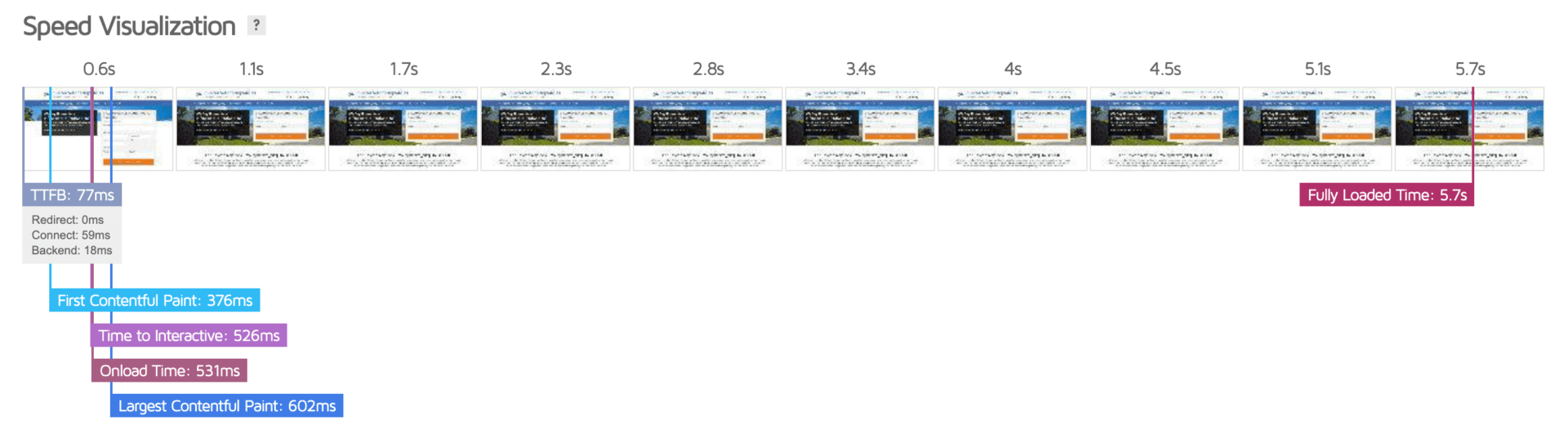
    For the upcoming Core Web Vitals update, Google has set the bar as… “For a good user experience, aim for an LCP (Largest Content Paint) of 2.5 seconds or less.” This Carrot site loads in 602ms.

    Page Speed Visualization

    At Carrot, we are constantly working to improve the speed, rankings, and conversion rates of our member’s websites. Since we’re smaller than Wix or WordPress and others, we can dedicate more time to helping our members succeed at business.

    Why is Google including Core Web Vitals in its algorithm?

    Google makes money by delivering relevant and valuable content to people searching for it. When a motivated house seller goes to Google and types “sell my house fast for cash Spokane”, Google wants to make sure it serves up the results that are going to provide the best experience for the searcher. 

    A great experience means people will keep using Google, which means more people will click ads in Google, which means Google’s revenue goes up. 

    So, in their continued drive to influence the way the entire industry builds websites and creates content, Google is making a move to make the “page experience” factors even more important in the way they rank websites. 

    We actually see this as an AMAZING thing for Carrot members.

    How will this change impact you and your business 

    Ultimately, Google has indicated that sites generally shouldn’t expect drastic changes in search rankings.  While this update is intended to highlight and favor pages that offer a great, fast, and stable user experience, Core Web Vitals are not intended to replace the priority placed on informative, relevant content.  It’s just another ingredient in the mix to ensure site visitors have an awesome experience — a win-win for all!

    As mentioned above, Google will begin gradually introducing these metrics and aspects to their algorithm in mid-June, with the goal to have them fully playing a role in the search algorithm by the end of August. 

    For more in-depth information and questions on Core Web Vitals and Page Experience, check out Google’s FAQ.

    How Carrot is preparing for the changes

    Here at Carrot, we’ve been tracking this update over the past several months, testing our templates and sites, and working with our engineers to ensure our network — and your site — is optimized for Google’s algorithm.

    In preparation for the initial phases of the Page Experience Update, we will be making some improvements to our backend code and network to improve page experience and site speed scores even further.

    These improvements include a re-evaluation of our code specifically with Core Web Vitals in mind, optimizations to certain plug-ins and script packages, and an enhanced ability for us to monitor site performance and speed data across our entire network. 

    Tools to measure your Core Web Vitals

    Google has provided a set of tools to help you analyze performance, identify issues, and fix them ahead of the algorithm update to help ensure your rankings aren’t negatively impacted..

    • Google Search Console (GSC). If you’re a verified owner, you can monitor the current state of your website in the Core Web Vitals Report of the GSC. From there, you can find out your pages’ performance categorized as “Good”, “Need Improvement”, or “Poor”.
    • Page Speed Insights (PSI). Use PSI on the pages that need improvement to diagnose and identify specific issues.
    • Lighthouse and Chrome DevTools. These tools can be used to measure your pages’ specs, and identify what needs fixing and what steps to take in order to fix it.
    • Web Vitals Chrome Extension. The extension can be used to monitor in real-time the core web vitals of webpages on desktop. It can be used on every page of every website, regardless of whether you are the owner, and it can give you a peek of how other pages similar to yours are doing as well.
    • Chrome User Experience Report (CrUX). Here you can find information about the CWV performance of your website, based on real-life user data.

    The future of SEO with Google Core Web Vitals changes

    We are compiling a list of best (and worst!) practices so that you can be sure nothing you are doing on your own individual sites is negatively impacting your scores.  We’ll be posting that guide over the next few weeks to ensure that you’ll have plenty of time to take a look at your site and make any necessary improvements before the update goes into full effect later this summer.

    We have conducted full Core Web Vitals and Page Experience audits on our most popular site templates and a sample of our member sites. Our sites are already performing exceptionally well, and with the improvements our engineering team is working on, you’ll be one step ahead when Google’s algorithm update goes live. We’re happy to report that our sites perform exceptionally well.

    We have our Carrot members covered!

    If you’re not a Carrot member, here are some things to consider when optimizing a website for Core Web Vitals. We recommend analyzing each URL individually as you might have a different score because a page holds different layouts, content blocks, and elements. Here are some basic steps you should consider taking:

    • Scale images to the correct placement sizing
    • Compress large image files
    • Lazy load static content
    • Apply a content delivery network to the hosting platform 
    • Remove any unnecessary render-blocking resources 
    • Serve images in next-gen formats 
    • Remove any unused javascript

    Hit us up on the comments section below with questions, comments, or concerns!