

Author: Mike Blankenship

  • Tyler Almost Quit Real Estate After 20 Years – That is, Until He Made These 8 Changes

    Tyler Almost Quit Real Estate After 20 Years – That is, Until He Made These 8 Changes

    Tyler was nervous about making the switch. But he was also burnt out from doing things the way he’d always done them.

    After 20 Years Tyler Was Going To Give Up Real Estate Until He Made These 3 Changes w/ Tyler Ford

    Far from being a rookie, Tyler Ford, a 20-year real estate investor, and agent, speaks with simultaneous confidence and humility reserved for those who’ve been in the business long enough to be intimately familiar with their strengths and weaknesses.

    And as someone once said, “With knowledge comes power.”

    Another way of saying that might be…

    With knowledge of reality comes the ability to change. 

    Or, better yet…

    With realistic knowledge of your current situation comes the ability to change your current situation.

    And if there’s one thing that Tyler Ford was ready to change, it was his current situation.

    At the beginning of 2017, after two decades of rehabbing, listing, selling, and buying real estate, Tyler Ford was ready to quit. When he left for vacation, pre-paying his trusted friend to rehab a home he’d bought, only to return and discover an un-fixed house and a missing associate, his spirits plummeted.

    If he couldn’t trust the person he’d always trusted, who could he possibly turn to?

    Maybe it’s time to try something else. 

    Maybe it’s time to get a 9-5 job. 

    Maybe I wasn’t cut out for this kind of work.

    These were the thoughts shoving their tentacles into Tyler’s mind. And they almost suffocated him completely – he was *this close* to quitting.

    But, in the end, he didn’t.

    And here’s why.

    Why Tyler Didn’t Quit and Why You Shouldn’t Either

    Tyler got his real estate license in college. Almost immediately, though, he plunged head-first into rehabbing homes.

    After finding success in flipping homes for over 15 years, Tyler continued to buy, fix up, and sell homes for a profit. But something happened. His 9-year-old website, which had past SEO authority, started falling due to competitors entering his market. The nightmarish stress of owning a fixer-upper and counting on a healthy market for when the home sells ate his soul every night as he lay in bed. And his love for real estate – and especially rehabbing – died.

    All at once, like a missile impact, Tyler Ford was finished.

    But then he wasn’t.

    Because he discovered wholesaling.

    He discovered Carrot. 

    He discovered the genius behind SEO and conversion optimization.

    All at once, everything changed for Tyler Ford.

    At the beginning of 2017, he was $20,000 in the hole. At the beginning of this year, he netted $90,000 on just two deals.

    How Tyler Ford Reinvigorated his Business and Made $90,000 on Just 2 Deals

    In his words, this is Tyler’s end goal: freedom.

    Wait. Actually, that deserves some visual emphasis:

    FREEDOM

    Isn’t that what you want?

    Isn’t that why you got into real estate investing in the first place? Because you wanted to travel whenever and wherever you want? Because you don’t want to worry about the price of the ticket when you go out to eat with the family? Because you don’t want to concern yourself financially with unexpected but necessary medical bills?

    Said more simply, because you want to do what you want when you want, where you want, and how you want.

    If that’s you, then you’d love to meet Tyler Ford.

    He’s not trying to build a massive business with hundreds of employees, and he’s not trying to build some billion-dollar corporation. He’s trying to build a business that passively supports himself and his wife

    That is his end goal.

    Here’s how he’s doing it.

    1. He ditched his 9-year-old website

    In his own words, “I was so nervous.” He already claimed the #1 ranking for his target keyword phrase, but there was a bigger problem: his website wasn’t converting the organic traffic that his website was generating passively. And what good is website traffic if you’re not converting it? Yeah – no good.

    2. He read this blog post

    That blog post changed his life. Read it to change yours.

    3. He signed up for Carrot

    *Shameless plug incoming* At Carrot, we’ve generated millions of leads for real estate investors and agents. Naturally, Tyler wanted a piece of that action. He didn’t know quite how massive that piece of the pie would be. When we asked him what he would recommend for other investors like yourself considering getting a Carrot website, he said very simply, “Do it. And put in the work.”

    4. He spent 2 months isolated

    Tyler locked himself in a room for 2 months. Okay – not literally. But he did put his head down and worked longer days for 2 months in order to brand his website, customize it, and get everything ready for some serious lead generation and search engine optimization.

    5. He localized all the blog content that Carrot provided

    He localized it rather than simply publishing all of the blog content that his Carrot plan provided for him. As an investor in Arizona, he removed pictures of houses in the mountains and replaced them with pictures of houses in valleys. He also localized advice, wording, and other elements so that anyone landing on his website immediately knew they were in the right place.

    6. He set realistic expectations

    Tyler knew he’d give up if he didn’t start with realistic expectations. That includes his SEO rankings, the amount of work he’d have to put in, and the number of deals he’d be doing.

    7. He was patient

    Tyler was right when he said, “The problem most people have is that they get frustrated early and quit.” Suppose there’s one reason that entrepreneurs fail to fulfill their ambitious dreams. In that case, it’s because they keep giving up too early, always starting at the beginning and never building the momentum that a healthy, living business requires.

    And last but not least…

    8. He kept his mission at the forefront of his mind

    What is the “Why?” behind your business? Why do you want to make more money? Why do you want to build a real estate business? You don’t have to be a saint with your answer, but you do have to be honest. Maybe it’s because you want to travel more, give to charity, or own a Lamborghini. The trick is to choose a “Why?” that keeps you motivated when things get difficult. So, choose something that gets you pumped. Tyler’s “Why”? Freedom.

    20 Years of Real Estate Investing in a Nutshell

    Before Carrot…

    • Tyler Ford was stressed.
    • Tyler Ford was ready to quit.
    • Tyler Ford couldn’t sleep at night.
    • Tyler Ford had lost his passion for real estate.
    • Tyler Ford was working more and experiencing less financial and personal freedom.

    After Carrot…

    • Tyler Ford just netted $90,000 on two deals generated with his Carrot website.
    • Tyler Ford has a clear path to his goals. (15 wholesale deals in his first year with Carrot with at least a $12,000 profit per deal).
    • Tyler Ford still has position #1 with his website, but his website converts significantly better than his old website.
    • Tyler Ford is finally working himself out of a job and heading toward his dream of living off of passive income.
    • Tyler Ford is buying 1 in 25 leads in a highly competitive market.
    • Tyler Ford is only spending a couple of hundred dollars per deal.

    Want to know how long the shortest membership at Carrot lasted?

    2 minutes.

    That’s right. 2 minutes.

    Why? Because, as the person claimed in our cancellation form, “I was looking around the website, and it looked too hard.”

    Within 6 months of changing to Carrot, Tyler’s website ranked and pulled in leads. Within 30 days, he made his first wholesale deal through Carrot.

    Still, it took patience and realistic expectations.

    Always remember this:

    Other people have started successful real estate businesses, and you can too. It’s not a question of IF you’ll succeed, but WHEN. Keep working at it, and you will succeed – it’s simply a matter of time. 

    Don’t be like the 2-minuter quitter. Determine your game plan, commit to it, and move forward relentlessly, holding nothing back.

    Then, nothing will be able to stop you from succeeding.

    This is what Tyler Ford did. And now, he’s having the best year of his real estate career.

    Download Tyler’s Free SEO Strategy for Real Estate e-Book!

    I know. You might be nervous about switching it up. You might be nervous about changing your strategy, getting a different website, or marketing yourself in a way you never have before. But, at Carrot, we specialize in helping people like you.

    If you’re already a member, we hope that knowing how Tyler Ford is crushing his market will help you crush your own.

    If you’re not a member, become one – we promise it’ll be the best thing you ever did for your business.

    Become a Carrot member today

    Remember, if Tyler is doing it, you can too. The only question is, are you willing?

  • Real Estate Marketing: 8 Tips to Find Motivated Sellers on Craigslist

    Real Estate Marketing: 8 Tips to Find Motivated Sellers on Craigslist

    2016.07.3-craigslist-main

    Most real estate investors have a “love-hate” relationship with Craigslist.

    We hear it all the time:

    “Craigslist doesn’t work for the real estate industry anymore.”
    “Ever since they killed the ability to post HTML-enhanced ads… my leads have dried up.”
    “Sure it’s great for ‘for sale by owner,’ but it’s impossible to scale.”
    “All I ever get is spam.”

    And I get it – when something isn’t working, it’s discouraging. It’s frustrating. Above all, it makes you want to quit and find a better place to invest your money.

    Before you give up, though, consider the kinds of results Cyndy Dumire – a real estate investor and Craigslist ad-writing pro – gets on a regular basis. Every week, Cyndy generates around 80 buyer leads, 30 seller leads, and 10 foreclosure leads. Even more impressive, in the last six months, she’s closed no less than 30 deals from leads that all originated from Craigslist ads alone.

    Effective Craigslist Ads With Cyndy Dumire

    Cyndy Dumire Effective Craigslist Ads

    The reasons most investors give up on Craigslist is twofold.

    1. Their ads don’t attract attention because they’re not offering their target audience a solution to a real and pressing problem (i.e., a market-driven need or desire).
    2. Their ads don’t inspire trust.

    We’ve ran hundreds of tests on our real estate websites and if there’s one thing we’ve learned, it’s that building trust with the people who arrive on your website impacts ROI and lead generation more than any other element.

    And that’s not just true on your website – it’s true on Craigslist.

    Of course, if you’re going to use Craigslist and actually get results like Cyndy, then you’re going to need to know more than, “Build credibility!”

    And that’s exactly where this post comes in.

    Today, I’m going to pull back the curtain and walk through 8 tips to find all the motivated sellers and buyers on Craigslist you want.


    Facebook Ads for Real Estate: The Why and How of Getting (REAL) Leads


    Craigslist Motivated Seller Tip #1: Know your ideal customer

    To paraphrase the great Warren Buffett: never sell heavy-metal music lovers tickets to a jazz show.

    If you’re trying to market to buyers or sellers, you’ve gotta start thinking like them.

    Why do they want to sell their house? How stressful is their situation? How can you help them?

    When determining your ideal customer as a real estate investor, there’re two questions you must answer:

    1. What kind of buyer or seller they are?
    2. What influences them in a personal capacity?

    Answering the first question is pretty easy. But don’t be misled by its simplicity. One of the first mistakes most Craigslist ad marketers make is casting their net too wide. Unfortunately, targeting too broad of an audience – like “local home buyers” or “local home sellers” – won’t work.

    Craigslist is too crowded for bland targets. Instead, you have to get specific about the kind of buyer or seller you’re focusing on and the needs that drive them.

    For instance, your perfect customer might be…

    • An out-of-state investor who needs to know cash flow numbers.
    • A house flipper who needs a clear assessment of how much work is required to turn the property around.
    • A rent-to-own tenant buyer who needs to know that you’ll work with them on their unique financing situation.

    In other words, be as detailed as possible when it comes to defining the kind of customer you’re aiming at.

    Answering the second question – your customer’s influences – takes a bit more work.

    To help, here’s a quick breakdown of the four major factors that influence home buyers specifically:
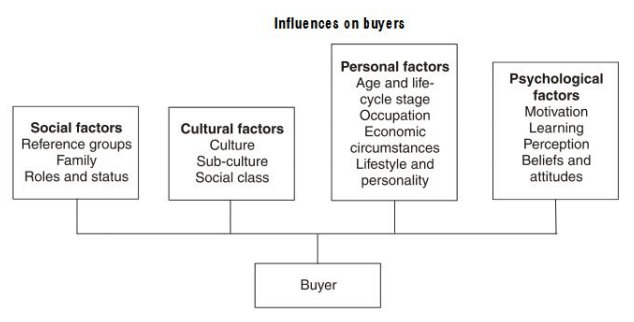
    craigslist influences

    (Image Source)

    Understanding your perfect customer’s influences does not demand addressing each and every element noted above. But you also can’t create the best real estate listing without knowing what is going to sway your customer.

    Again, this is all the more true on Craigslist. There are so many ads already vying for their attention, and that is why you need to make yours stand out.

    How do you make your listing stand out?

    Consider the following template as a starting point from our Posts 2 Profits Craigslist Marketing Course.

    [cta offer=”craigslist”]

    Notice how this ad communicates directly to the agent’s ideal customer and – especially through the power of questions – draws them in toward a preliminary solution. The “Free Book” offer – rather than an overt invitation to call them – is based directly on their ideal customer’s legitimate need.
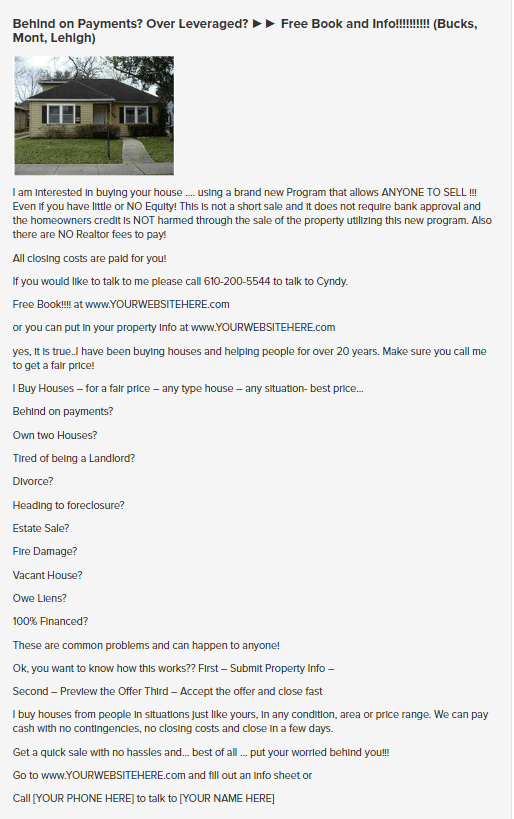
    craigslist ad template 1

    5 Signs You’re Likely To Fail As An Entrepreneur And Real Estate Investor


    Craigslist Motivated Seller Tip #2: Get personal

    Real estate is all about people.

    Of course, in a sense, all businesses are about people. But real estate is especially personal because the commodity it deals in is emotionally charged.

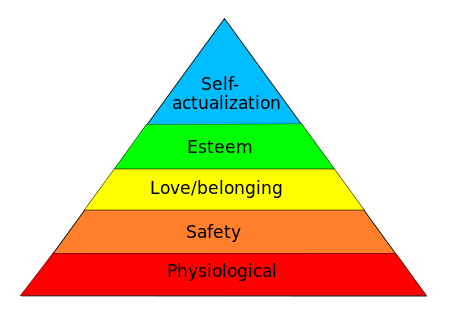
    After all, according to Maslow’s Hierarchy of Needs, safety is one of the most primal human needs and comes in second only to our need for food and water (i.e., “Physiological” needs).
    Maslows Hierarchy Of Needs

    (Image Source)

    Our homes give us safety. And – just like Maslow’s very next need identifies – they make us feel like we have a place to be “loved” and “belong.”

    Even more powerful is the realization that our homes are where our memories are created. Not to be cliche, but home really is where the heart is.

    So, listing a home or a property is a big deal. And trust is at a premium.

    People need to trust you with what is quite honestly their biggest asset.

    Keep your target audience – their needs, not yours; their dreams, not yours – at the forefront of your mind when you compile listings.

    Craft personal, trustworthy ads with these tips:

    • Use your name in the ad, not just your company’s.
    • Write the way you talk and read your ad out loud to make sure it’s conversational.
    • Press on the pain of the person whose problem you’re trying to solve, then offer your holistic solution.
    • Don’t be afraid to let your personality and passion shine through.
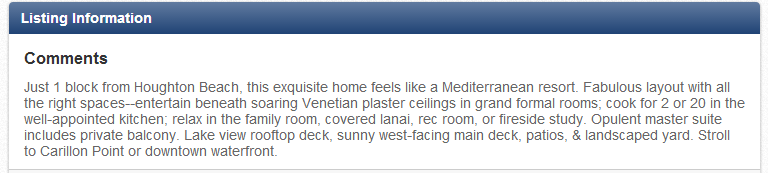
    • Above all, tell a story. Paint a picture of how living in the home would feel using sensory language.
    Well-written-craigslist-listing-description-2

    A well-written home description paints a vivid story.

    Craigslist Motivated Seller Tip #3: Include a Call to Action

    The entire point of any online marketing campaign – including listings on Craigslist – is to get the people who see it, to do something.

    Normally, this means getting them to contact you via text, email, or phone. It could also mean getting them to visit your agency’s website.

    Simply put: your Call to Action needs to get your reader to actually take action.

    That’s why, in your listing, it’s essential to add a clear and enticing CTA, and to give your reader options. For example, the following CTA invites the reader to choose the next step that’s most comfortable for them and repeats the CTA no less than five times.
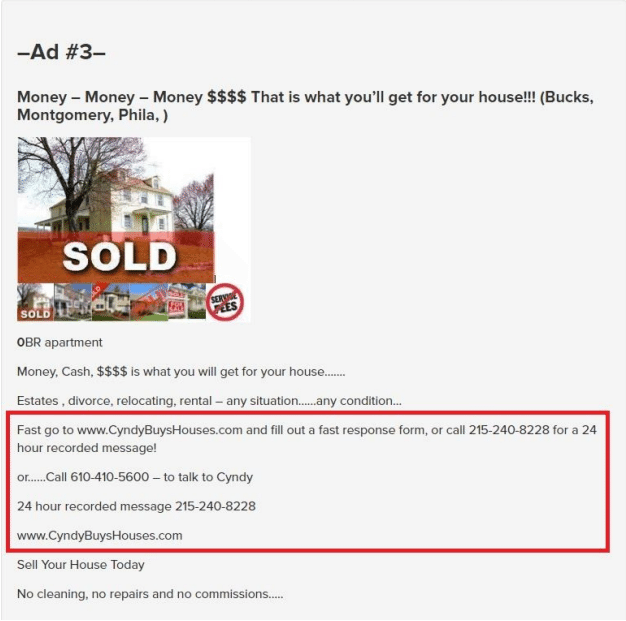
    craiglist sold 1

    Action also means you need to always include a direct email link so they can respond immediately to the ad if they’re interested. Oh, and don’t be afraid to call attention to that by inviting them to email you.


    A beginners guide to SEO for real estate investors


    Craigslist Motivated Seller Tip #4: Watch your words

    We all know how essential good imagery is to real estate. In fact, we’re going to cover imagery and graphics in the very next point.

    However, many investors fail because they underestimate the power of words. As Hamza Yusuf put it, “Don’t ever diminish the power of words. Words move hearts and hearts move limbs.”

    On Craigslist, watching your words comes down to two elements:

    1. Your keywords
    2. Your headlines

    The right keywords matter because it’s your keywords that will determine whether or not the right people find your ad. This is true both through Craigslist’s own search engine as well as outside search engines like Google.

    To get the best visibility for your ads, go beyond merely including your location as a keyword. Geek Estate’s post about “The Most Profitable Keywords in Real Estate offers this brilliant suggestion:

    “Profitable keywords imply an action. San Diego real estate implies nothing. It is just a thing. San Diego real estate for sale implies an action. People want something that is for sale, presumably so they can buy it.”

    In addition, Geek Estate also adds a second keyword characteristic: laser focus.

    In contrast to something like “Rancho Santa Fe homes for sale,” use “individual neighborhoods within Rancho Santa Fe”: e.g., “Fairbanks Ranch homes for sale, The Bridges homes for sale, or Rancho Santa Fe Covenant homes for sale.”

    Why? Because “people that type keywords like these into the search engines know exactly what they are looking for.”

    Lastly, as vital as keywords are, do not “stuff” your real estate listing with keywords for the sake of keywords. This creates an inhuman feel to your ads and violates our previous tip: “Get Personal.”

    The second element to watch is your ad’s headline.

    The title of your Craigslist ad is where the real attention-grabbing oomph resides, and you need to spend some time developing and testing titles that captivate. Whatever you do, don’t follow the crowd… unless of course, the ad has been proven to work, like the ones we provide in our Posts 2 Profits Craigslist Marketing Course.

    The ad I already called attention to in tip one is an excellent example of a headline that stands out:
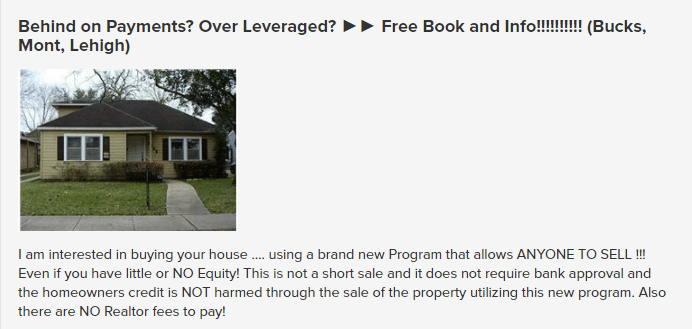
    Craigslist behind on payments ad

    Likewise, so is the headline in this ad:
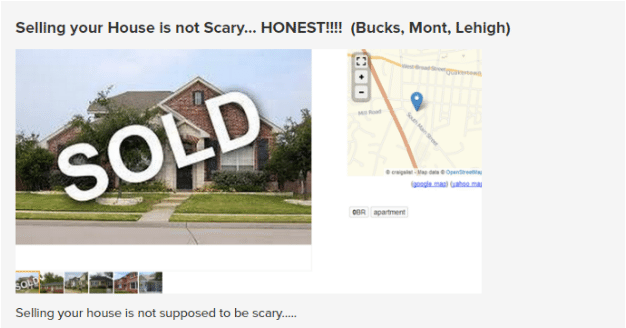
    craiglist sold

    On top of our own proven headlines, check out Inman’s 4 tips for writing powerful real estate copy which includes these simple, but super practical hacks:

    1. Short, concise bullet points work best
    2. Use numbers
    3. Use the words “unique,” “special” and “these”
    4. Use commands

    [cta offer=”craigslist”]

    Craigslist Motivated Seller Tip #5: Be relevant with your graphics

    There’s no doubt about it: not adding images to your ads is a Craigslist killer. However, the mere presence of images doesn’t automatically translate into success.

    The right graphics dramatically increase the number of people who will take action and get in touch with you. So too … the wrong graphics dramatically reduce that number.

    As a golden rule, be sure to use images that are eye-catching, relevant … and high quality. That’s true across the board. But how do you decide what images and graphics to include?

    Go back to your ideal customer. The image you choose should be based on the type of buyer or seller you’re looking for:

    • Turnkey investors want to see images that show off how nice the house is, that it’s been well kept and that it’s in a neighborhood that’ll attract the type of tenant they want. That last characteristic means you should always include both pictures of the property itself as well as its surrounding area.
    • Cash buyers or flippers want to see a house that needs TLC in comparison to other houses in the neighborhood. With these types, you’d be smart to show the flaws of the property, exactly what kind of work will be required, but end by displaying its underlying high-points and long-term value.
    • If your ideal customer is a homeowner or retail buyer — if they will be living in the property themselves — then staged images that show off the house as a home are essential. Just be careful what you include in those staged photos:

    craigslist doll pic 1

    Image Credit: Huffington Post

    craigslist doll pic 2

    Image Credit: Huffington Post

    • If your ideal customer is an investor, then glamorous, well-staged pictures of the property itself won’t be nearly as compelling as adding numbers to those pictures. In this case, you could try using a multi-property image for investors interested in purchasing multiple properties.
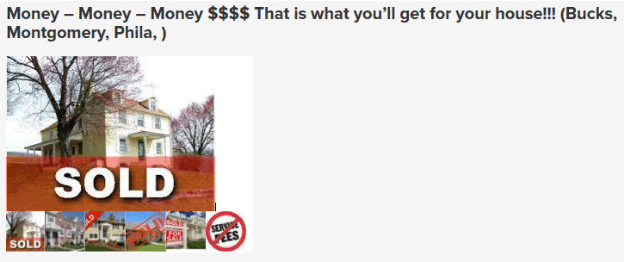
    craiglist sold 2

    Lastly, as a pro tip, don’t overdo it with images. Remember, the entire point of your ad is to get your reader to do something, like visit your website. Give them just enough to make them want to find out more.


    5 Real Estate Marketing Strategies to Turn Cold Website Visitors into Cold, Hard Cash


    Craigslist Motivated Seller Tip #6: Post often and from different “angles”

    Alongside the previous pitfalls we’ve covered, I’d be willing to argue that the number one real-estate-ad-killer on Craigslist isn’t the words, the images, or even the calls to action.

    It’s recency.

    The way that Craigslist works is the most recent postings land at the top of the page and the past ones get pushed down. Some people search Craigslist based on the search box (so make sure to include keywords that your best clients are likely to search in your listings), but most people just scroll down the listings a few scrolls to see “what’s new”.

    So with that said, to get in front of your prospects the most… make sure you have ads online and active at the times of the day that your prospects are likely looking at Craigslist. 

    We’ve even seen with today’s Craigslist algorithm some of the most successful accounts post between 3-15 times per day. 

    Here’s how…

    Day 1-3:
    Launch a Craigslist account and start posting just 3 times per day. Once in the morning, around lunch, and evening – around 7 or 8 pm. These tend to be the times of the day people will look at Craigslist. Think about when you look at your email, Facebook, or Craigslist… it tends to be during that “slack time” during your day. Posting your ads just before these “slack times” helps put your ads near the top of the feed when your best prospects hop on to browse.

    On those ads, don’t post the same ad every time. You’ll want to tackle it from different angles. If you’re looking for motivated house sellers or cash buyers, what are different reasons a house seller could want to sell? Create an ad for each. What motivations could cash buyers have? Create an ad for each.

    This way you’re keeping things interesting and hitting on multiple hooks. One might grab someone better than another.

    Day 4-8:
    Add in another ad to your mix. Now posting 2 ads 3 times per day (for a total of 6 ads that day). Again, don’t post the same ad every time and mix up your hooks. Also, mix up where you’re posting your ads – don’t put them all in the same spot.

    What we’re doing here is “seasoning” the account in a natural way so you’re not launching a new account and posting 20 ads the first day. That’s a great way to get your account banned and you’ll have to start over.

    Day 9-20:
    Keep renewing your ads every 48 hours as Craigslist lets you and bump up your ad posting frequency so you’re posting 3 ads 3 times per day (for 9 ads total per day).

    Same thing, keep your ads interesting, high value, and hitting on different hooks – things that your top prospects are thinking about, worrying about, or need help with.

    Day 21-20:
    I’d cap it at about 12 ads per day on that one account. I’ve seen some accounts get ghosted or banned at even that amount if the ads aren’t high value and really helping people. So in this phase, add on a 4th ad 3 times per day… capping it at that 12 ads per day for that Craigslist account.

    Just a note: if you post more than 15 ads a day, you’ll get “Craigslist slapped” and your ads will stop showing up.

    The lifespan of Craigslist ads can vary depending on the number of competing posts in different geographic locations. In large metropolitan cities, ads may only be visible for 5 days, while in smaller towns they may show up for 50 days.

    Why all this focus on recency and renewing? Because generating real estate leads on Craigslist is an attention game, so the more you’re at the top of the Craigslist listing when your best prospects are searching… the more likely your ads will get seen and the prospects will come your way.

    If you want to cross that gray line on the Craigslist Terms of Service to ramp it up… we’ve seen it be crazy effective having a few Craigslist accounts. Yes, this is against the Craigslist TOS so it’s your choice and you risk getting your accounts banned. However, if you’re marketing different websites with different phone numbers (i.e. – a cash buyer site and a motivated house seller site) the chances of it being seen as a duplicate account are very small.

    It all boils down to value. If you’re adding value to the Craigslist ecosystem vs. just spamming it… then you’re good.

    Craigslist Motivated Seller Tip #7: Create a system

    By now, you might feel a bit overwhelmed. Keeping track of all those ads can be hard work.

    Unfortunately, Craigslist doesn’t provide any analytics or tracking data, so it’s up to you to track each of your ads and monitor your calls as a part of your overall real estate marketing plan so you can see what’s working.

    At a minimum, keep a spreadsheet of your Craigslist ads and a method to monitor them.

    Not only does creating a system of tracking give you concrete proof of what’s working and what’s not, but getting organized with a system gives you more time to do other more important things.

    We recommend you send traffic to a specific URL on your site.

    This has a couple advantages.

    1. You can track them using Google Analytics
    2. You can retarget users that you know have come from Craigslist

    Here are a few tips to consider when creating a special page for Craigslist traffic.

    • Name the URL something short and descriptive. An example http://yourdomainname.com/sell-fast-cl
    • Realize that this site might rank in search so you will need to look at that traffic in your Analytics account
    • You should have content on that page that specifically address the type of lead and ad copy that they are coming from.
    • If they clicked on the ad and are coming to your site, you know what questions they have, make sure the answer is easily found.
    • Track which pages are converting the most traffic and make changes as necessary.

    At the end of the day, any data is better than no data.

    So, create a page, or have your developer help you. Then just send traffic to that specific page.


    8 Real Estate Marketing Tools to Save you 10+ Hours Per Week


    Craigslist Motivated Seller Tip #8: Build trust

    I mentioned in the introduction to this post that trust is at a premium on Craigslist. In fact, trust is absolutely crucial to all your real estate marketing efforts.

    I’ve touched on this theme a number of times already. But in case you missed it, trust is so vital that it deserves its very own tip.

    It’s like the old joke: “It’s all about sincerity. Once you can fake that … you’ve got it made.”

    In all seriousness, however, the last question you should ask yourself before you hit “Post” is, “Does this ad build trust?”

    A lot of factors go into trust, so let’s just look at the two most prominent.

    (1) Be Attractive

    It may sound shallow, but persuasion expert Robert Cialdini’s very first step in the famous know “trust chain” is to be “attractive.”

    This doesn’t mean you should feature glamor shots of yourself in your Craigslist ads.

    But it does mean the images you use must be high quality. It also means providing plenty of attractive “white space” in yours ads. Short sentences and short paragraphs don’t just look good, they’re easy to scan.
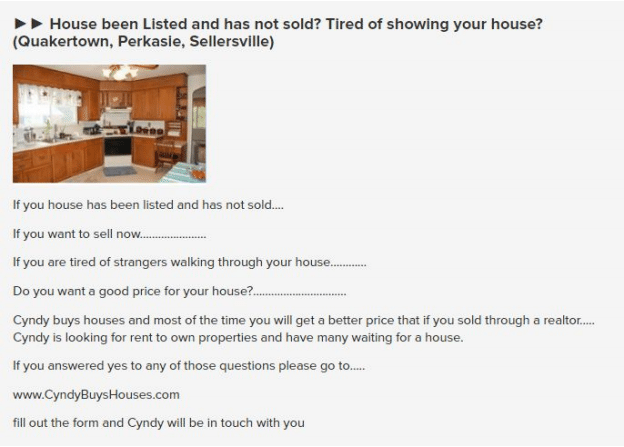
    craiglist house listed

    Being attractive also means covering your bases when it comes to grammar and proofreading. Nothing kills trust more than an agent who can’t spell correctly.

    (2) Be Easy to Contact

    Conversion guru Peep Laja, in his 39 Factors: Website Credibility Checklist, gives both the number two and number three spots to what we might call contactability:

    “Make your address and phone number visible at all times. Include it in the footer (a must), but depending on your site also in the header (especially if your business depends on incoming calls) and on the sidebar, in the microcopy.”

    “Make it very easy to contact you.”

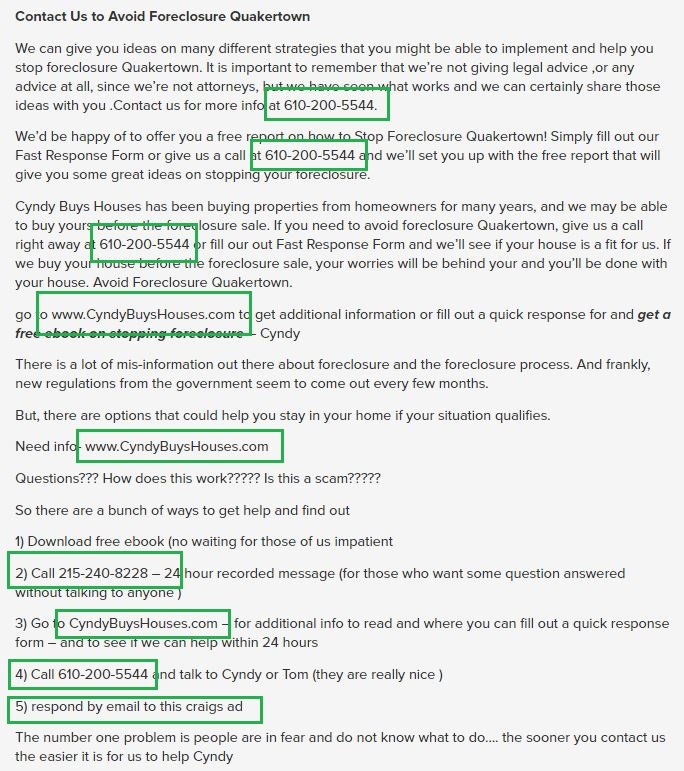
    How does this apply to Craigslist? Easy. Simply including your contact information once isn’t enough. Take a look at another of our proven templates and see if you can count how many contact opportunities there are:
    contact-craigslist

    All told, I counted nine. Even if it feels redundant … your ads should do the same.

    Real estate works on Craigslist… you just have to know how to work it.

    We’ve covered a lot of ground.

    Eight tips on how to find all the motivated sellers and buyers on Craigslist you want:

    1. Know your ideal customer
    2. Get personal
    3. Include a Call to Action
    4. Watch your words
    5. Be relevant with your graphics
    6. Re-post real estate listings … often
    7. Create a system
    8. Build trust

    Good luck out there, and let us know if we missed your own favorite tip in the comments.

  • Time Saving Content Marketing For Real Estate Agents (The Power Of Q&A)

    Time Saving Content Marketing For Real Estate Agents (The Power Of Q&A)

    Time Saving Content Marketing For Real Estate Agents

    Creating content takes too long. You spend time, money, and energy on each piece, hoping – praying – that it offers a return. And far too often, in the beginning, the return is negligible.

    So you quit producing.

    Fortunately, content is one of the best marketing methods – conversion rates are six times higher for content marketing adopters than non-adopters. Unfortunately, it’s also one of the most time-consuming methods.

    As if building a significant content repertoire doesn’t require enough energy, ensuring that repertoire is full of valuable information is even more daunting. Because of that lofty commitment, few real estate investors and agents do it at all.

    What you need is audience-tested content that takes very little time to create.

    The answer? Q&A.

    You already spend time answering client’s questions. Turning your answers into valuable pieces of content is the next obvious step.

    But what type of content should you use (written, video, audio)? And what’s a good system for creating this curiosity-based value?

    5 Time-Saving Ways to Create Real Estate Q&A Content

    1. FAQ Web Page

    The most obvious application of Q&A content that’s worth discussing is the FAQ web page. A Frequently Asked Question’s page is a must for any serious real estate business. Give your visitors a place to find answers and they’ll spend less time calling you with low-commitment inquiries.

    Of course, you want them to call you. But questions about what a mortgage broker is, how someone determines the value of their home, and what kind of credit score is needed to purchase a house are questions better answered online.

    In fact, many people won’t be comfortable calling you until they have a general understanding of how the process works. No one wants to look stupid. Your FAQ page is where prospects get educated so that they are comfortable calling you.

    Ultimately, FAQ is a sales page.

    Which means that you need a CTA at the bottom.

    For example:

    Time Saving Content Marketing for real estate agents - lead form

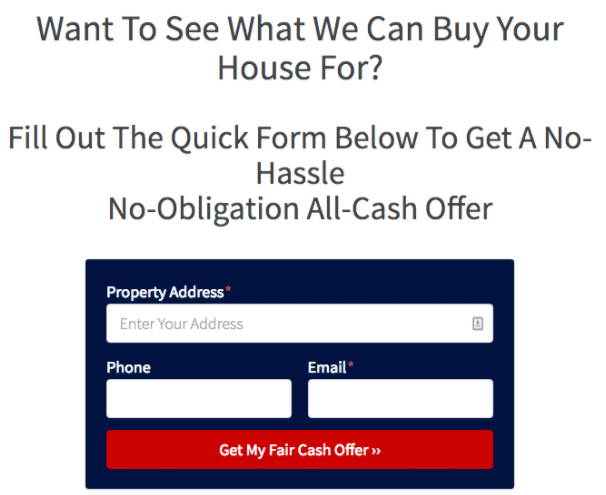
    And to give investors an idea of what questions your FAQ page should answer, here’s what the same site has on theirs:

    • Will you be listing my house on the MLS or actually buying it?
    • Do you pay fair prices for properties?
    • How do you determine the price to offer on my house?
    • Are there any fees or commissions to work with you?
    • How are you different from a real estate agent?
    • Is there any obligation when I submit my info?

    As a real estate agent, here are questions to consider, taken from Kyle Hiscock’s extensive list of house-buyer questions.

    • Should I buy or continue to rent?
    • Do I really need a Realtor when buying a home?
    • Who pays the Realtor fees when buying a home?
    • How long does the seller have to respond to my offer?
    • What if my offer is rejected?

    FAQ will increase how much visitors trust you. And they’ll start calling you with higher-commitment questions:

    How do I start working with you? Can we meet and talk about selling my home? I think I’d like to buy/sell. What should I do?

    2. Single Answer Content

    Once your FAQ page is live, use it as the foundation for more content. For most investors and agents, the curiosity-based content ends at the FAQ page. But all those questions can easily be turned into audience-tested blog posts.

    In other words, since you know what questions prospective clients are asking, then it’s safe to assume they are googling them as well. Why not create a single blog post around each question so that you can rank for exactly the kind of questions that prospects are asking?

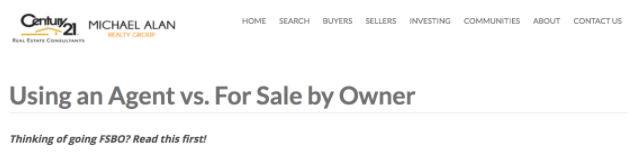
    Real estate agents, for example, could write a full blog post – between 500 and 1,000 words – pitting real estate agents against for-sale-by-owner. Much like this piece by Michael Alan, where he discusses the pros of using an agent and the risks of doing it alone.

    Century 21 Content Marketing For Real Estate Agents

    Real estate investors could write an FAQ style post on how house buyers are different than real estate agents or on how a fair price is determined.

    Also consider this video we made here at Carrot, showing our clients how to make testimonials that build trust and credibility.

    Real Estate Testimonials: A Guide to Building Trust and Landing New Clients

    We anticipated the kind of questions our clients ask, and then we created a video to help them accomplish their goals. You can do the same. Once you determine what your audience is asking, answer those questions with individual blog posts and you’ll be more likely to rank in Google.

    Social Media Video

    This is the pinnacle of Q&A content. Videos are personal, intriguing, and statistically, more likely to be viewed than written content. Animoto reports that

    “Four times as many consumers would rather watch a video about a product than read about it.”

    These videos won’t just help you continue to build a following on Social Media, if you transcribe the content and put it on your blog, they’ll even help you rank in search engines. Carrot customers can use VideoPost to quickly transcribe their videos.

    There are three ways you can approach videos.

    • The first is for the camera-shy.
    • The second for the brave.
    • And, the third for those of us who fall somewhere in the middle.

    3. Traditional Content Marketing for Real Estate

    Traditional videos are the record-edit-and-then-publish type.

    The benefit to using traditional video is if you make a mistake, you can delete and re-record. If you’re uncomfortable with the camera, this option is for you. It will place an editing barrier between you and the audience.

    Hit record, do your best, watch it, and redo if needed.

    At the very least, this will help you get comfortable with that digital eye.

    Real estate content marketing champion, Judy Weiniger, uses her youtube channel to answer questions with traditional videos:

    What is a pre-home inspection?

    Denny Kruse from G. Stiles Realty, a local Douglas County real estate company, spent years in farming. Therefore, he can answer questions and share his insights with people who are looking to purchase farm or agricultural land.

    What do I need to consider when buying farmland? 


    8 Real Estate Marketing Tools to Save you 10+ Hours Per Week


    4. Live Content Marketing for Real Estate

    These real estate videos are for the camera-bold. When you go live, mistakes will be noticed and if you run out of things to say, you’d better be prepared.

    The confident person might jump onto a Facebook Live video at the scheduled time without any notes, trusting for people to type questions as they record. The obvious risk is that no one will ask any questions and they’ll be left without anything to say.

    Thus, we recommend doing this type of free-flow live video only if you have a significant following and they are likely to interact.

    As an example and bold as ever, real estate investor, Colin Kirk, posted a Live Q&A session on Facebook in April.

    5. Live/Low-Risk

    MediaKix explains that…

    “Facebook live videos are watched three times longer than normal videos.”

    This stat can partly be explained by Facebook’s notifications that are sent out when someone goes live, but more so because of the authenticity that live video promises. The person being recorded can’t fake it.

    If you want to reap those benefits, but you don’t want to risk being left without questions to answer, here’s what you should do.

    Go to your FAQ page. Write down 5 questions that you could easily answer on a video. Then go live on Facebook, telling people that you’re going to answer some questions, so if they have any, they can feel free to throw them in the comments.

    Start by answering one of the questions you wrote down. And if you don’t get any more in the comments, simply continue answering your prep questions. If you do receive inquiries (which you likely will), answer them.

    This allows you to go live with all of the added benefits, but with a safety net in tow.

    Much like Thomas Cady did.


    3 Real Estate Sales Questions You Should Start Asking Right Now


    You already answer questions…

    Since you’re already spending a huge portion of your time answering questions, the best thing you can do is turn those questions into content that can rank in Google as part of your real estate SEO campaign. Combined with some linkbuilding like HARO outreach, your website will gain authority, win more rankings, and most importantly, generate more leads!

    By creating an FAQ page, and then, one-by-one, turning each question into a complete blog post and/or video, you’ll generate truly useful content and spend little time doing it.

    Content creation made easy?

    Yes, please.

  • 8 Real Estate Marketing Ideas That’ll Give Your Campaigns New Life

    8 Real Estate Marketing Ideas That’ll Give Your Campaigns New Life

    real estate marketing ideas Post Header

    Using the same ol’ marketing strategies for years on end can get a bit monotonous.

    Direct mailers, Facebook ads, flyers, AdWords, blog posts, emails… they all work. But the problem is, when you start getting bored of something, you don’t do it as well as you used to. Not because you’re lazy, but because you’re human.

    We all need to mix it up every now and again to reinvigorate our marketing strategies and inject new life into the way we execute those strategies.

    So, if you’re tuckered out from doing all the same things and want to try something new, here are eight real estate marketing ideas that might give you the energy to keep moving forward.

    Real Estate Marketing Idea #1: Run an A/B test

    Want to inject immediate energy into a marketing campaign?

    Then A/B test it.

    When it comes to marketing a business, there’s nothing quite as fun as trying to discover what works and what doesn’t. With an A/B test, you can experiment on everything from the copy of a landing page to the image on a Facebook ad to the color of a button.

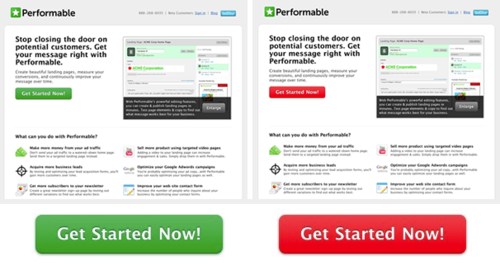
    In fact, HubSpot ran a test and found that red buttons outperform green buttons by 21%.

    Real Estate Marketing Ideas

    (Image Source)

    Except they don’t.

    HubSpot later found that it wasn’t so much the color red that increased conversions, but the uniqueness of that color in relation to the landing page it was on.

    In the image above, for instance, you can see that the red color stands out simply because nothing else on the page is red.

    With this A/B test, HubSpot discovered something important: uniquely colored CTAs can increase conversions.

    That is the power of A/B testing.

    Wondering what color CTA would work best on your website? Or maybe what words in your landing page title will make the biggest difference? Or maybe even which Facebook ad image draws the most attention?

    Great — run an A/B test and see what happens.

    For Facebook ads, you can just use Facebook’s internal tool. Learn how to do that here.

    For your website, though, consider using VWO, Optimizely (both paid services), or even Google Analytics (free).

    [cta offer=”recontent” color=”red”]

    Real Estate Marketing Idea #2: Buy a drone

    There’s no better way to inject child-like life into your marketing strategy than purchasing a remote-controlled toy.

    And drones aren’t just great for having a bit of well-deserved fun, they’re great for business. 83% of people selling their home prefer to work with an agent that uses drones. High volume realtors use drones 3.5 times more than their low volume counterparts. And, last but not least, homes with aerial images sell 68% faster than homes with basic images.

    Really, that’s no surprise when you take a glance at the beautiful photos these flying playthings can capture.

    (Image Source)

    (Image Source)

    But, which drone should you buy? There’s a lot of options and you want to get the best bang for your buck.

    Truthfully, I don’t know. I’ve never bought a drone and I hesitate to tell you which one to buy before I’ve actually tried it out for myself.

    However, I did find this list to get you started. Keep in mind, though, that that article probably has affiliate links littered throughout the list, so take those recommendations with a grain of salt.

    In the end, I’d trust Amazon reviews above all else (they’re harder for people to tamper with).

    Real Estate Marketing Idea #3: Create a Google My Business account

    Most of you have probably already created a Google My Business account.

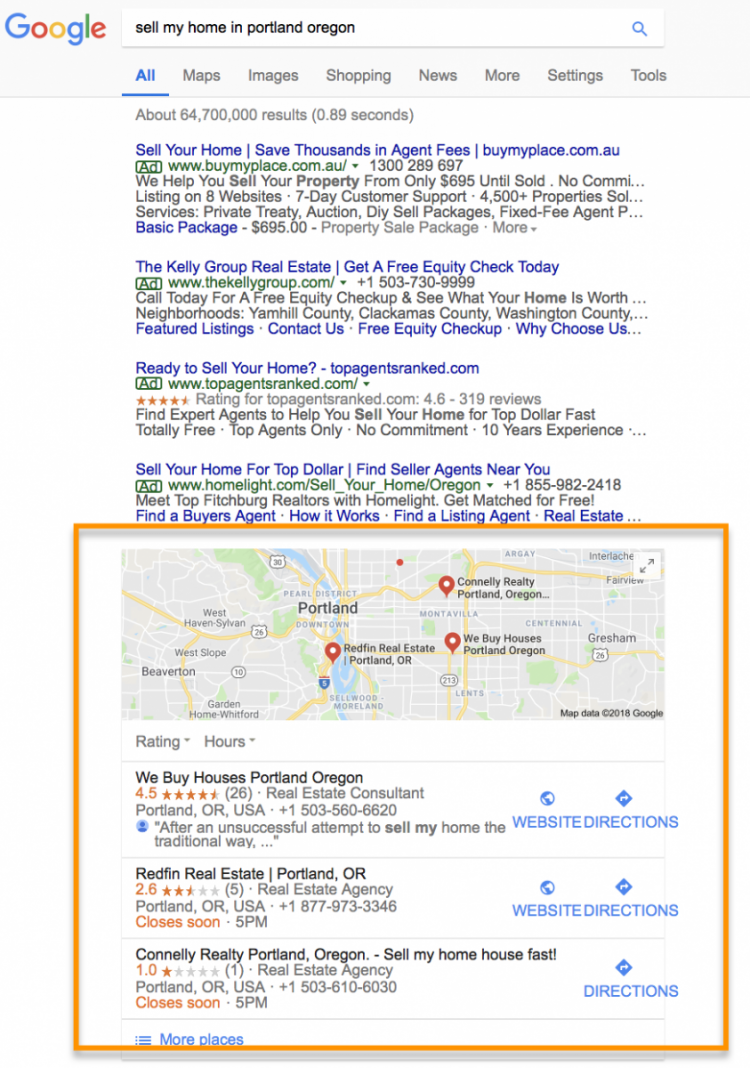
    But if you haven’t, then you might be missing out on easy-to-capture SEO traffic. For example, these are the kind of results that Google My Business can generate for your website.

    Real Estate Marketing Ideas google locations

    Perhaps the best part about these types of results is that they draw the eye even more than normal top-of-page Google results. It’s a great way for your business to cut to the front of the SEO competition, especially if you have more five-star reviews than anyone else.

    BONUS TIP: Generating reviews for your Google My Business account is another marketing strategy you might consider implementing. Reach out to your past customers and ask them to review you on your Google My Business page.

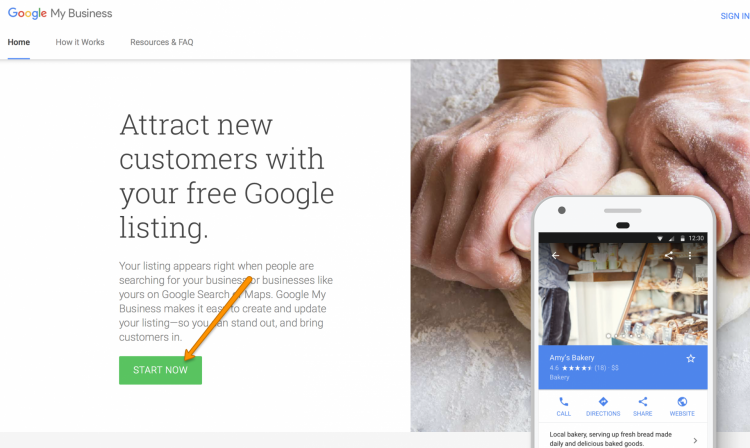
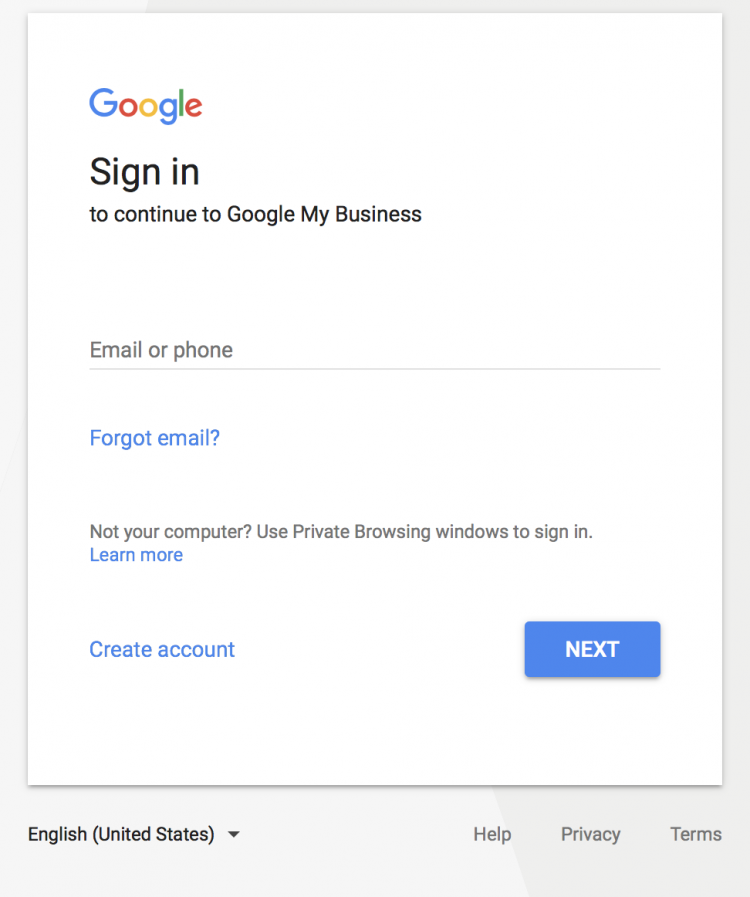
    If you don’t already have a Google My Business account, then simply go the landing page and click “Start Now.”

    google my business real estate marketing ideas

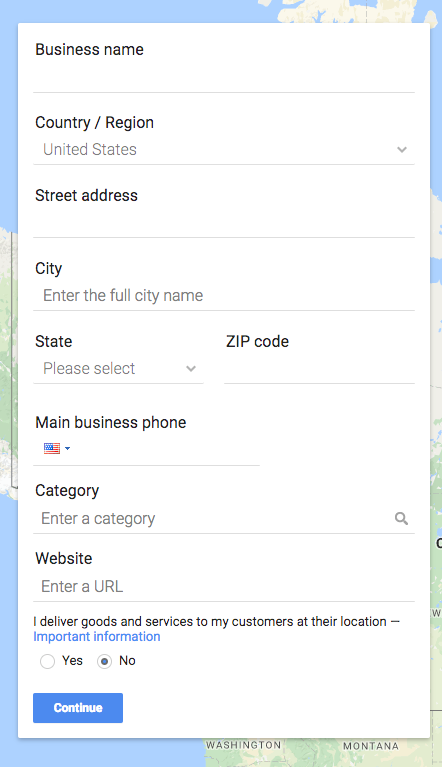
    Then, it’ll ask you to fill out some information.

    real estate marketing ideas google my business

    google my business post creationThe rest is quite easy. Just follow the prompts and you’ll be off and running — ready to collect all the reviews and SEO juice that Google My Business has to offer.

    Real Estate Marketing Idea #4: Join in on local events

    If you’re part of a team, then going to a local event to represent your real estate business is an effective way to drive energy levels upward. Even if you’re not part of a team, this can be an awesome way to regenerate your vigor for marketing your business.

    There’s just something about getting together with a group, meeting new people, and working toward a common goal.

    It’s inspiring.

    And, as you probably saw coming, it’s good for business.

    When you’re out at local events (whether it be a business meet up, a charity run, or a local holiday), you meet people. And conversations with strangers often naturally turn to questions about business.

    Here’s how real estate marketing pro, Elizabeth Wilson, over at Southern HomeBuyers puts it:


    “Networking is one of my favorites because it involves people and solving direct problems — meet ups, involvement in my neighborhood, church and running club… random but intentional. Not sales-y but inevitably, people ask ‘What do you do?’”

    Elizabeth Wilson,  Real Estate Pro at Southern Home Buyers


    And when people ask, “What do you do?” that gives you an opportunity to talk about your business and maybe even generate an unexpected lead through a stranger who’s looking to buy or sell.

    Of course, you want to make the most of when you go to these events. You don’t just want to count on random conversations with strangers.

    To be even more intentional, consider…

    • Wearing a t-shirt with your business name on it.
    • Taking pics that you can post later on social media.
    • Intentionally watching for conversational opportunities.

    8 Real Estate Marketing Tools to Save you 10+ Hours Per Week


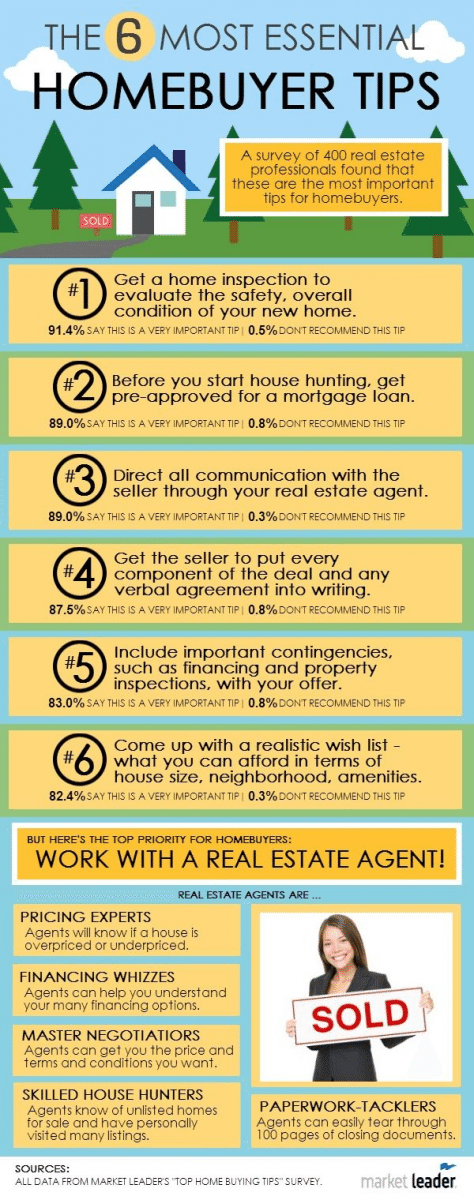
    Real Estate Marketing Idea #5: Create and promote an infographic

    More than likely, you’re not a designer.

    But that doesn’t mean you can’t dip your toes in design. In fact, it can be fun to try something you’ve never done — especially when that something has as much lead-generation potential as an infographic.

    In fact, here’s an infographic describing why visual content is so powerful. Ha!

    real estate marketing visual content

    (Image Source)

    Said more simply, people love visual content. And an infographic is basically a more visual and easy-to-digest blog post. Here, for instance, is an infographic that some real estate agents created.

    real estate marketing ideas infographic

    to-do list for first time buyers Real Estate Infographic(Image Source)

    But how the heck do you come up with an idea for your own infographic? And how do you actually design it?

    Well, it’s all easier than you think. Check out our real estate infographic guide to learn how to do it.

    Once you’re done creating it, promote it on your social media channels, email list, and blog.

    Real Estate Marketing Idea #6: Spend your lunch hour at the local coffee shop

    This idea is similar to “Join in on local events,” but takes less planning and is often more comfortable for real estate pros who’re flying solo.

    Still today, face-to-face interaction is the most impactful type of communication. Almost 100% of people say that face-to-face communication is critical for long-term business relationships. And 72% of people claim that their impression of someone is influenced by how that person appears and what their handshake is like — two things you can only experience in person.

    And consistently going to a coffee shop during your lunch hour is a great way to build face-to-face relationships with locals. The more you go, the more people you’ll meet and build relationships with. The more people you build relationships within the community, the more potential leads you have in your back pocket — not to mention the word-of-mouth buzz you’ll create.

    How, though, can you meet people when you’re in a coffee shop? After all, that can be a lot more awkward than I make it seem on the page. Here are a few tricks I found useful when I was trying to do the same thing in full-time ministry.

    1. Small talk with the barista — This is going to be your easiest access to a conversation. They’re paid for customer service and will be open to chatting so long as there isn’t a long line behind you.
    2. Engage with stuff that happens — When you go to the same coffee shop day after day, stuff happens. Someone drops their coffee. Someone else has a child who’s screaming. There’s a fender bender outside. All of these things are opportunities for you to engage with people in a small or big way, depending on the situation. If someone’s kid is throwing a fit, offer an understanding smile rather than a judgmental glare. If someone drops their coffee, offer to buy them a new one. If there’s a car accident outside, offer to give someone a ride home if they need it. All of these are opportunities to build authentic relationships that might turn into cold, hard cash in the future. The more you do this, the more it’ll pay off.
    3. Have a friendly face — Sometimes, other people will want to start a discussion. Maybe they have their own agenda, or maybe they have a question for you, or maybe they are just lonely. Whatever the case, these people won’t talk to someone with an unfriendly face. Make yourself seem approachable so that people who do want to chat with you feel welcome to do so.

    As a real estate professional, it might seem like you’re in the business of selling and buying houses, but you’re not. You’re in the business of building trustworthy relationships. And a coffee shop lunch break is a great way to do that consistently.

    Who knows? Some of those relationships might just end up making you a whole lot of money.

    Real Estate Marketing Idea #7: Run a webinar

    You might think that running a webinar is just for the self-proclaimed B2B coaches and gurus of the world, but it doesn’t have to be. In fact, running a webinar on a topic that appeals to your audience is a great way to build digital relationships and start relevant discussions about how you can help people buy or sell a home.

    Accordingly, here’s a far-from-exhaustive list to get you started hosting your very first webinar.

    • What not to do when buying your first home
    • X tricks to sell your house for its highest possible value
    • Should you sell your house without a real estate agent?
    • How to sell your house crazy fast

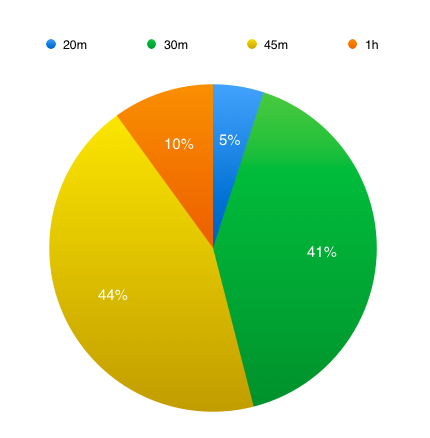
    Keep in mind, though, most people prefer to only watch a webinar for somewhere between 30 minutes and 45 minutes. So try to keep yourself to that time limit and advertise it as being that long in the first place. real estate marketing numbers

    (Image Source)

    In terms of technical webinar set up, this guide by SmartBlogger will show you how to do it for free (just skip to the “How to Run Webinars Like a Pro (Without Spending a Dime)” part).

    And before you actually do your webinar, test everything and make sure it’s all working how you want it to. There’s nothing quite as embarrassing or frustrating as technical difficulties during a webinar presentation.

    Once you’ve put your webinar together, start collecting sign-ups via Facebook ads, emails, and maybe even guest posts on other blogs.


    Real Estate Content Marketing: A Strategy You Can Actually Use to Grow Your Business


    Real Estate Marketing Idea #8: Optimize your website for conversions

    Enhancing your website’s conversion rate doesn’t just give you an excuse to break from the daily grind, it can also make a massive difference in how your business performs.

    Heck. If you’re pulling traffic to your website but not converting that traffic consistently, then you’re losing out on leads that are right in front of your face. And the competition is surely gaining those leads.

    So taking some time to think through your website’s layout, copy, and CTA placement is well worth the investment.

    Of course, making changes that will actually help your conversion rate is easier said than done.

    Fortunately, here at Carrot, we’ve run thousands of A/B test on our customer’s websites and generated 1.4 million leads — so we know a thing or two about conversion optimization.

    Here are some things you can do that will likely increase the conversion rate on your website:

    1. Place the CTA front and center — One of the first things your website visitors should see is the button that you want them to click. Put your CTA at the top of your homepage so that people who want to take action quickly are able to. Ideally, you want to place a few clicks between the moment they get to your website and the moment they convert.
    2. Add testimonials to your homepage — Digitally, nothing builds trust better than a stream of testimonials. To make these as impressive and trustworthy as possible, include a picture of the person who said it, their full name, and their professional title.
    3. Make the CTA a unique color — If your CTA is a unique color, then people will notice it easier. When they notice it easier, they’re more likely to click it. Or at least, if they want to click it, they can find it easily. ;-)

    Or you can just get yourself a Carrot website and we’ll do all of this for you. ;-)


    Learn more about working with Carrot


    Conclusion

    Bored out of your mind with the marketing tactics you’ve been using for what feels like a decade (or maybe is, literally, a decade)? then give one of these eight things a try.

    1. Run an A/B test
    2. Buy a drone
    3. Create a Google My Business account
    4. Join in on local events
    5. Create and promote an infographic
    6. Spend your lunch hour in the local coffee shop
    7. Run a webinar
    8. Optimize your website for conversions

    It’ll give your marketing headspace a much-needed injection of energy. And one of these might even be the thing your marketing strategy was missing all along.

  • How to Create Real Estate Agent Infographics (10 Examples)

    How to Create Real Estate Agent Infographics (10 Examples)

    Real Estate Agent Infographics

    One of the most persuasive ways to build brand awareness online is to incorporate real estate agent infographics into your content marketing strategy.

    Not all content is created equal. There’s a reason that 55% of B2C content producing companies rated visual content as their top priority.

    Pearson reports that 65% of the population are visual learners. Hubspot notes that an infographic is 30 times more likely to be read than pure text. And Massplanner explains that infographics are shared 3 times more than any other type of content.

    But, how do you create your own infographics that are useful to your audience, convert the right people into leads, and don’t look hideious?

    Well, that’s why you’re here.

    Because you’re not a designer or a professional content marketer, you’re a real estate agent. But, as we’re going to see, that doesn’t mean you can’t put together some lead-generating real estate infographics.

    Here’s a three-step process for creating your very own real estate agent infographics: Choose an idea. Find your formatting. Use these tools.

    Real Estate Agent Infographics – Pick an Idea

    As with any piece of content, you need an idea. And brainstorming is the best way to dig up ideas. But since you probably don’t have a real estate infographic guru sitting next to you, and brainstorming on your own is boring, we’ve done the digging for you. Here are 5 examples of infographics that you, as a real estate agent, can steal ideas from.

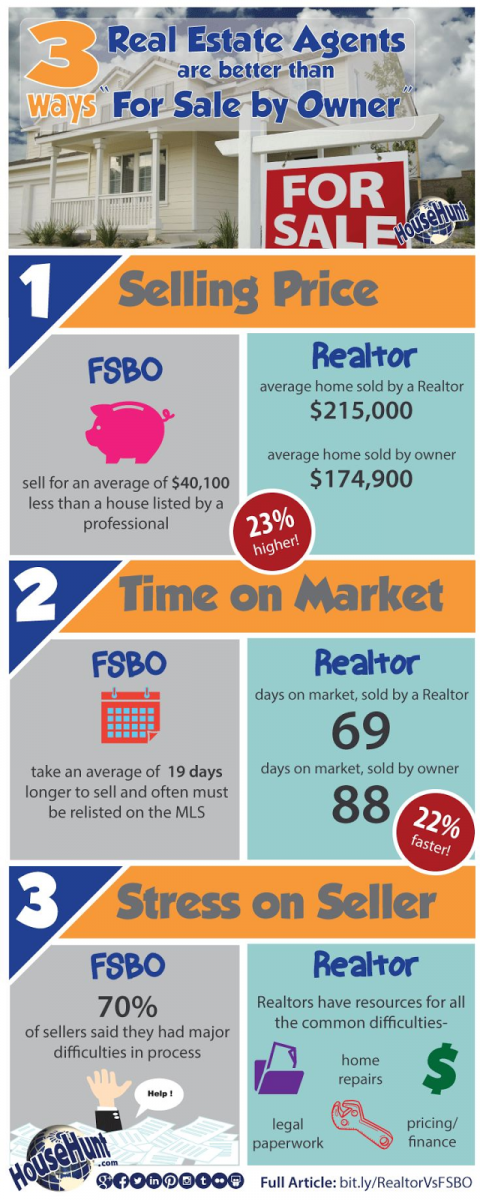
    (1) 3 Ways Real Estate Agents are Better than “For Sale By Owner.”

    real estate infographics real estate for sale by owner

    (Image Source)

    The perks of explaining — in an infographic — why someone should use a real estate agent are obvious… especially if you are one. If prospects believe they need an agent to sell their house, and you’re the one who convinced them of that, they’ll likely be giving you a call.

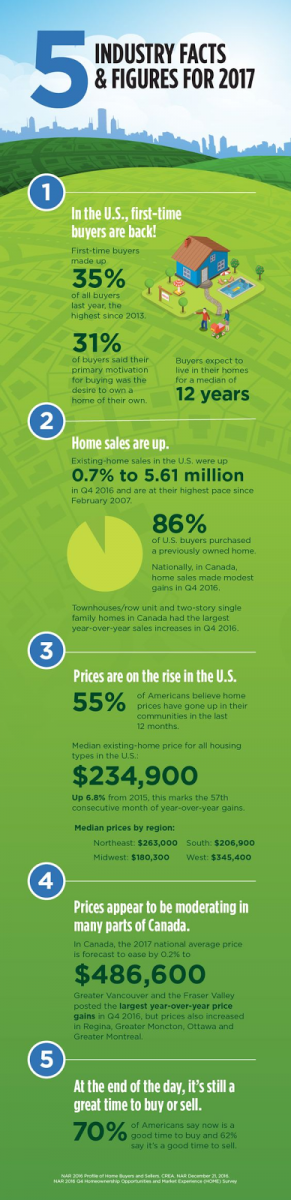
    (2) 5 Industry Facts & Figures for 2017

    real estate infographics industry stats

    (Image Source)

    Creating an infographic that illustrates the market’s health is a benefit to homebuyers and sellers alike. Anyone looking to purchase or peddle a house is likely interested in the market’s current wellbeing. This will help inform prospects of a ripe market and — if you include your phone number on the bottom — of who to call for help.

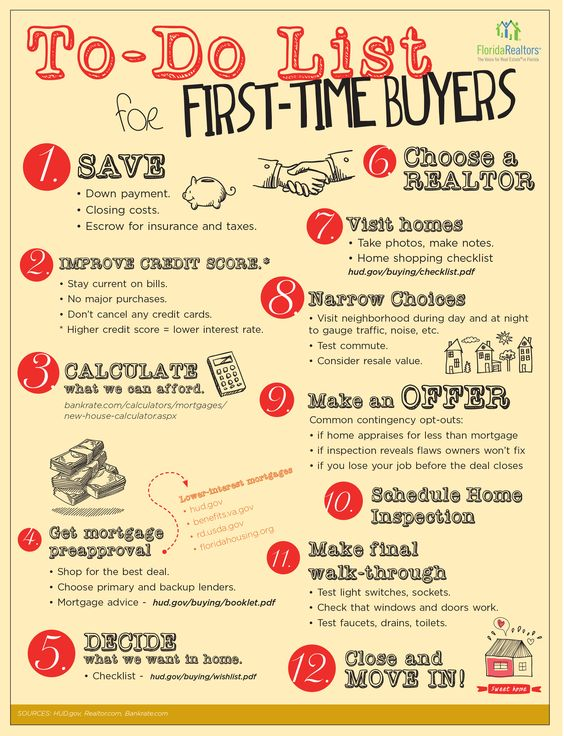
    (3) To-Do List for First-Time Homebuyers

    to-do list for first time buyers Real Estate Infographic

    (Image Source)

    This infographic is wildly helpful for the person looking to buy their first home. Every first-time buyer has worries, concerns, and doubts about the buying process. Creating a piece of content that covers the steps of purchasing a house helps to dilute these uneasy feelings — making the procedure seem a whole lot easier.

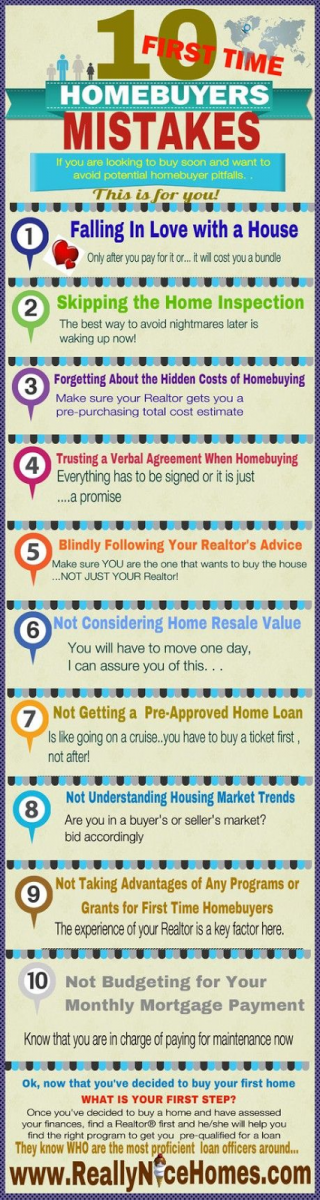
    (4) 10 First-Time Homebuyer Mistakes

    Real Estate Agent Infographic example 10 first time buyer mistakes

    (Image Source)

    Nobody wants to walk into a pole — whether that’s physical or metaphorical. Homebuyers are filled with fears of what could go wrong in choosing a house, purchasing the house, picking a real estate agent, getting a loan, and moving in. The infographic above does a nice job of ensuring that these fears don’t paralyze a prospect.

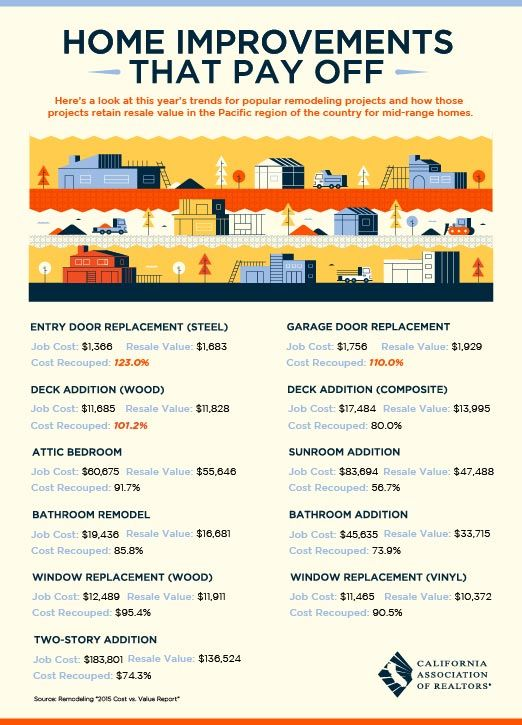
    (5) Home Improvements that Pay Off

    Real Estate Agent Infographics example home improvements

    (Image Source)

    Ever wondered what pays off on house remodels? Sure you have. And so has your potential client. Make an infographic that has information on what sort of remodels are the best to pursue. Again, the idea is to aid the person looking for help. If you help them now, you’ll likely get to help them again when they need an agent.

    Choose a Format

    Infographics are able to illustrate concepts that words cannot. Because of that, it’s important to consider what kind visual formatting you should use. Above all, don’t get fancy.

    The simpler your real estate infographic, the easier it is to understand and the more people who will engage with it. Here are some formats to consider from beautiful — but simple — real estate agent infographics.

    The formats are organized from easiest to hardest in regards to their creditability. Don’t be afraid to start at the beginning.

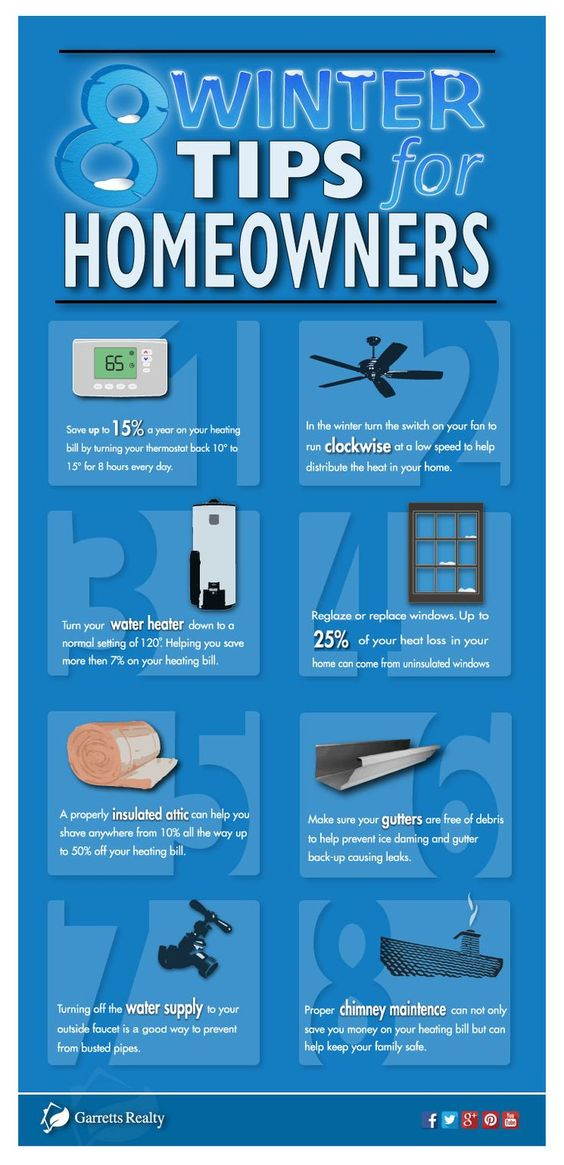
    (1) The Numbered List

    Real Estate Agent Infographic winter homeowner tips

    (Image Source)

    The numbered list format is common for a reason. It’s easy to read, effective at illustrating simple pieces of information, and guides the eye seamlessly from point to point. Simply choose a number of tips, don’t-do’s, or guidelines and fill in the blanks. Start here if you’ve never created an infographic before.

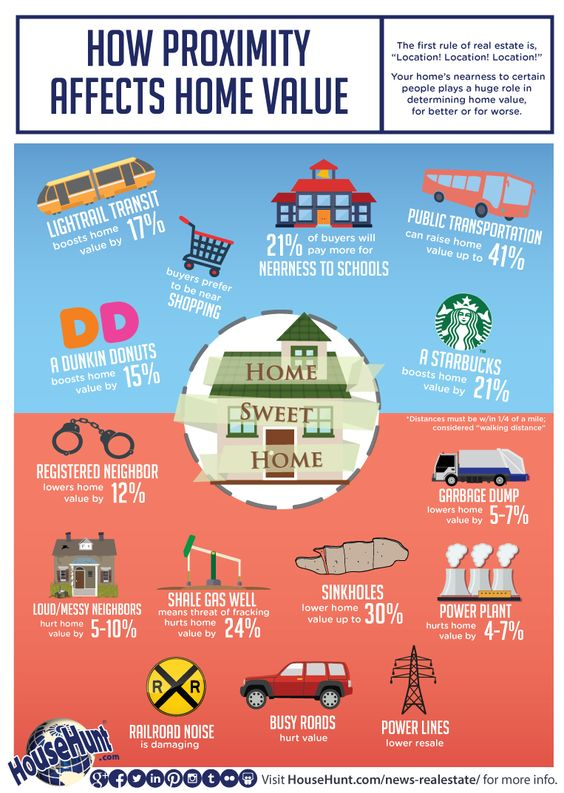
    (2) The Stat Card

    Real Estate Agent Infographics - how proimity affects home value

    (Image Source)

    This infographic is nearly as simple as the numbered list format but requires a bit more research. Use the stat card format when wanting to provide useful information for the prospective client, such as when to sell, best house investments, or any other topic that’s data-driven.

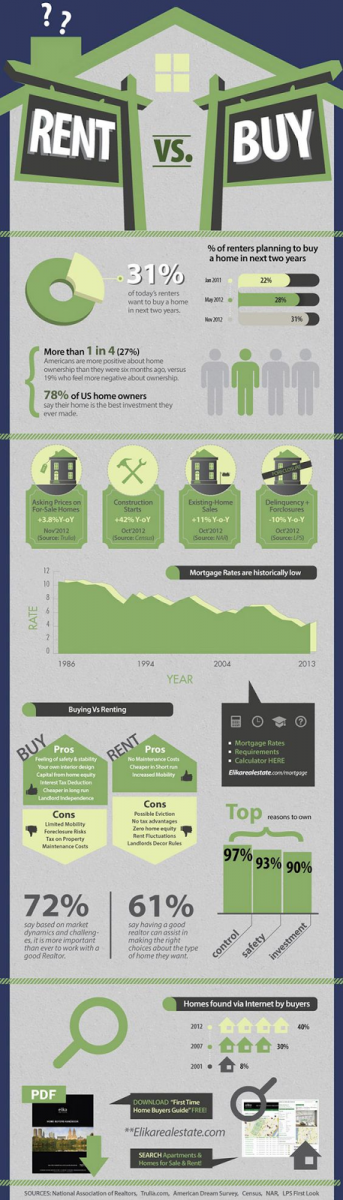
    (3) The Comparison

    Real Estate Agent Infographics - Rent vs buy

    (Image Source)

    Buying or selling a home is riddled with choices. How many beds and baths should I have? Am I getting my money’s worth? Should I rent instead of buying? Which is exactly why this format is fantastic for helping the prospect to make a decision.

    Ask yourself what kind of questions clients have for you and then create a comparison infographic to provide the pros and cons of each option.

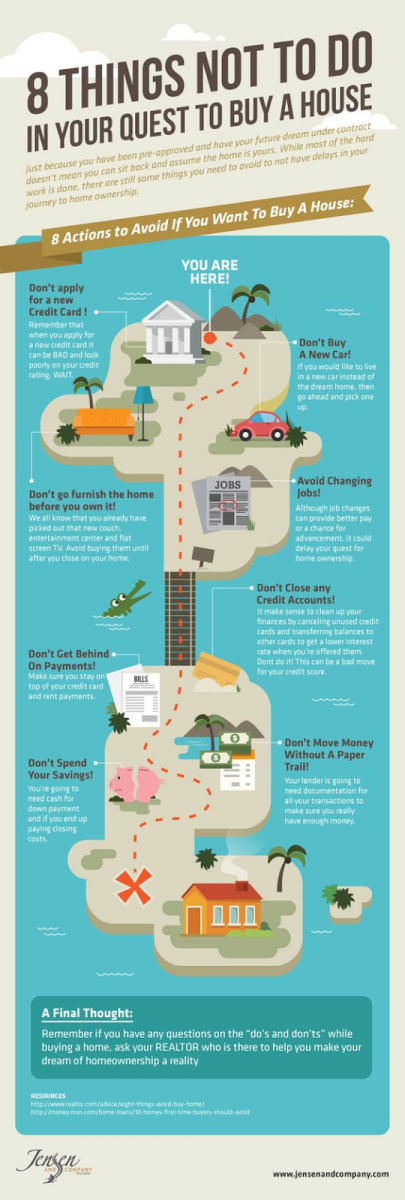
    (4) The Flow Chart

    Real Estate Agent Infographics - not to do to buy a house

    (Image Source)

    Building this kind of infographic requires some creativity beyond the previous templates. But the basic idea is allowing the infographic to guide someone from point A to point B.

    Visually on the graphic, and contextually on the info, the piece gives the viewer an idea of what it will take to make the journey — whether it be from renting to buying, from owning to selling, or from selling to investing.

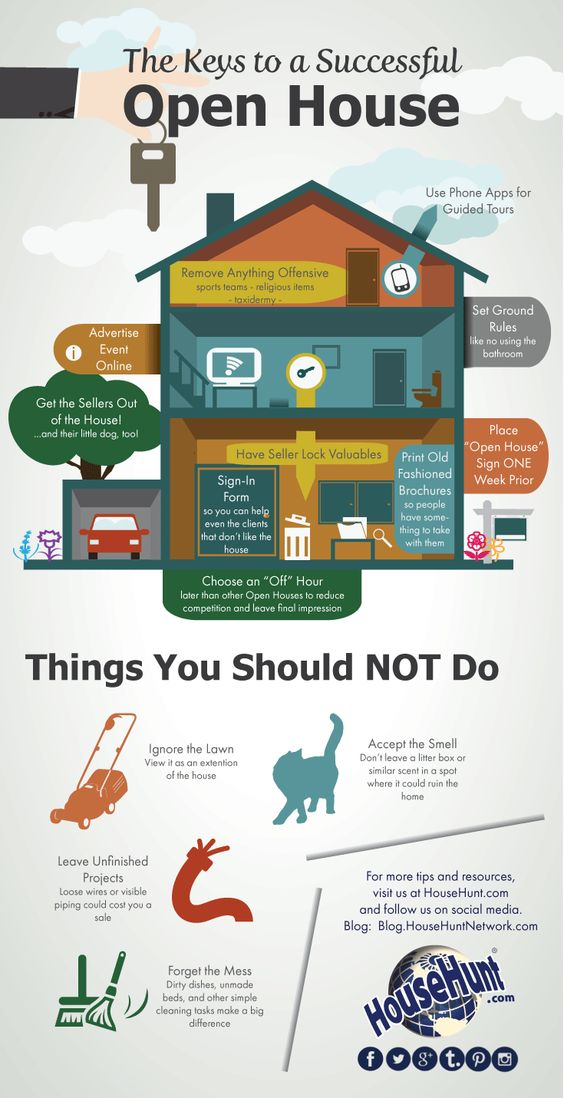
    (5) The Form Fits Function

    Real Estate Agent Infographics open house success

    (Image Source)

    This format for an infographic is one of the most creatively demanding. As you can see in the image above, the tips are placed visually within a house. Thus, the form matches the function. While this kind of infographic is beautiful to look at, it’s unnecessary. Unless you have the creative power, time, or money to design this kind of brilliant, free-flowing infographic, don’t.

    Use these Tools

    Thinking up an infographic in your head is one thing. Creating it is quite another. But, lucky for you, in our age of digital stampedes and marketing masters, anyone — including a real estate agent — can become a graphic design artist. Here are two tools you can use to create your own infographic right now for free.

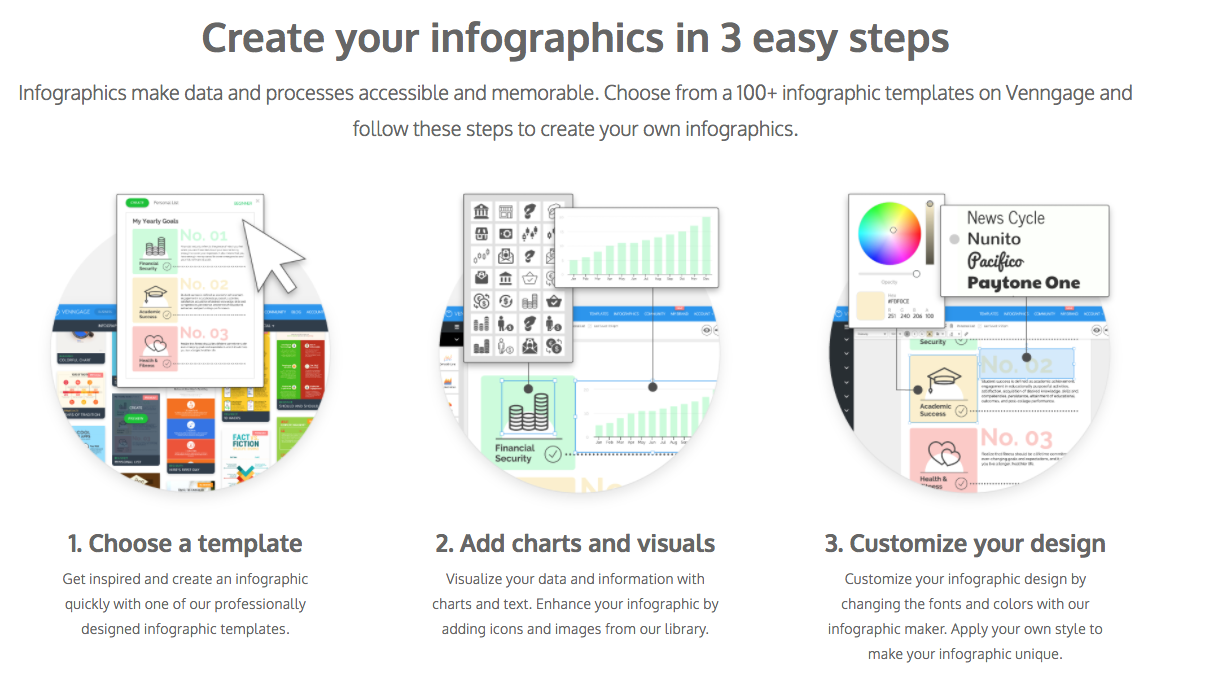
    (1) Venngage

    Just in case you think you’re too good for an infographic creator, be aware that huge companies including Google, Hubspot, Microsoft, and Forbes all use Venngage. In today’s world, a great tool is utilized by the small and the big alike. Venngage is such a tool. Join up for free and it will walk you through designing your very first infographic.

    create your own Real Estate infographic

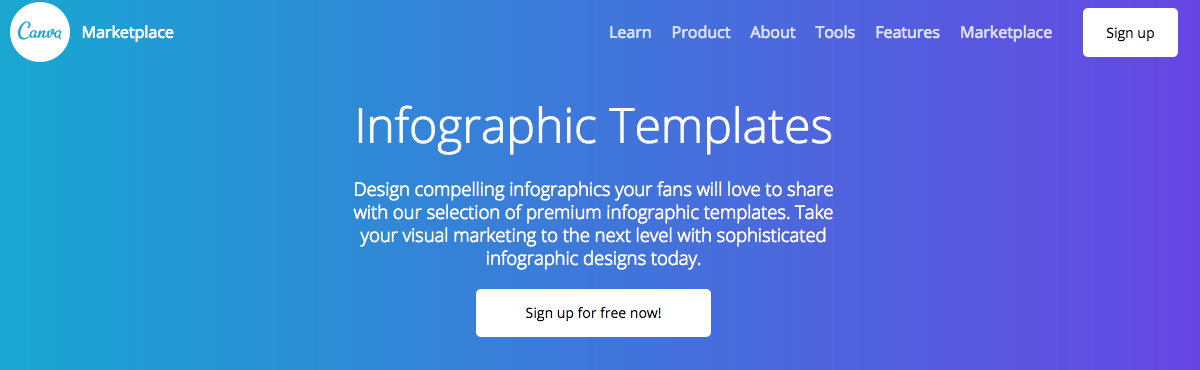
    (2) Canva

    More versatile than Venngage — and still free to use — is Canva, a holistic graphic design platform. You can edit images, design a logo, and create banners, flyers, and infographics. Great for the inexperienced graphic designer.

    A Final Tip

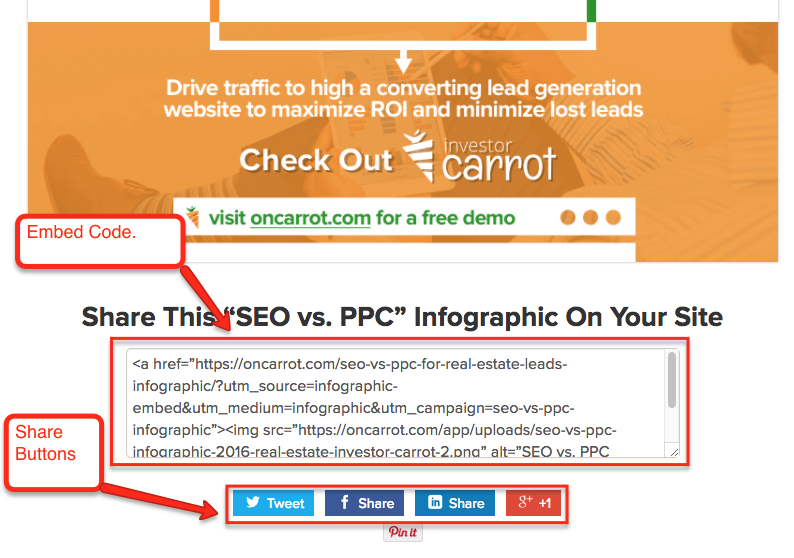
    Yes. Your audience is three times more likely to share an infographic than they are to share any other piece of content. But, that’s only the case if you make your infographic easy to share. Whenever you post an infographic, always include the embed code so that people can easily share it to either social media or on their own blog. On our infographic explaining SEO and PPC, we included shareable buttons and the embed code, to maximize the size of its wings.

    Real Estate Agent Infographics SEO vs PPC

    Keep it Visual, Fun, and Data-Driven

    Visual content will continue to be powerful because human nature demands it. And real estate agent infographics, in particular, are powerful because they are a visual representation of helpful, inspiring, and insightful data. Plus, now that tools to create your own infographics abound, you’re out of excuses.

    Remember, no first draft of content ever comes out perfect. So above all, just start. And keep in mind what you’ve learned here.

  • 3 Real Estate Sales Questions You Should Start Asking in 2024

    3 Real Estate Sales Questions You Should Start Asking in 2024

    Perhaps no one put it as well as John Martinez:

    “The best sales people only talk 10% of the time. And when they do open their mouth, it’s with a question.”

    John Martinez, Owner of Midwest Revenue Group

    Remember the bidding wars of 2022? Those seem like a distant memory in today’s real estate market (2024). Now, houses are lingering longer, and buyers are becoming more selective. As an investor, I recently came across Sarah, who inherited her childhood home. The emotional attachment was strong, but the upkeep was becoming a burden. She needed to sell, but traditional methods weren’t generating the interest she’d hoped for.

    That’s where the power of asking the right questions comes in. By digging deeper and understanding her specific situation, I was able to craft a solution that worked for both of us. Identifying motivated sellers and asking the right questions can be the key to unlocking a win-win deal in today’s market.

    The 2024 real estate market has shifted somewhat. While some areas might still be seller-friendly, it’s definitely not the breakneck pace of the past few years. Homes are sitting on the market a little longer, and buyers have more negotiating power. This can be a great opportunity for investors like myself, but it all hinges on finding truly motivated sellers.

    Market conditions significantly impact seller motivation. In a seller’s market, sellers might be more flexible with closing dates but less willing to negotiate on price. Conversely, sellers may be more open to price discussions in a buyer’s market but might need a longer closing timeline to find the right buyer. The key is understanding what motivates the seller beyond just the sale itself.

    3 Real Estate Sales Questions You Should Start Asking in 2024

    Question #1: What’s Your Ideal Timeline for Selling? (Focus on Urgency and Flexibility)

    This seemingly simple question, “What’s your ideal timeline for selling?”, can be a goldmine of information. It goes beyond just a date and reveals a seller’s true motivation and timeline constraints.

    Urgency Exposed:

    A seller who needs to close quickly, perhaps due to a job relocation or a new home purchase already under contract, is likely more motivated to negotiate. Knowing their ideal timeline allows you to tailor your offer. If you can offer a fast cash sale or a smooth, expedited closing process, it could be very attractive to them.

    Flexibility Uncovered:

    On the other hand, a seller with more flexibility might be more open to waiting for the right buyer and potentially a higher price. This doesn’t necessarily mean they’re not motivated – their motivation might simply lie in maximizing their profit. Understanding their flexibility allows you to craft a competitive offer that might not involve the quickest closing but still presents a compelling option.

    Negotiation Powerhouse:

    By understanding a seller’s ideal timeline, you can craft a negotiation strategy with more leverage. For an urgent seller, highlighting the speed and efficiency of your offer can be a big advantage. For a flexible seller, focusing on the terms and potential benefits of your offer becomes more critical. Asking this question empowers you to present a solution that aligns perfectly with their needs.

    Here’s what Question #1: “What’s Your Ideal Timeline for Selling? (Focus on Urgency and Flexibility)” might look like within a conversation:

    You: “So, Sarah, tell me a bit about your situation. Ideally, when would you like to see this house sell?”

    Seller (Sarah): “Well, ideally, I’d love to close by the end of the summer. That would give me enough time to find a new place before the school year starts.”

    You: “Absolutely, that’s a great target. Is there any flexibility in that timeline, or is the end of summer a firm deadline?”

    Seller (Sarah): “Honestly, it would be fantastic to close by then, but I could push back a few weeks if the right buyer came along.”You: “That’s good to know, Sarah. Thanks for your honesty. Understanding your ideal timeline helps me tailor the marketing strategy to attract qualified buyers who can meet your timeframe.”

    Question #2: Beyond Price, What Makes This Sale a Success for You? (Go Beyond the Bottom Line)

    We all know price is a major factor in any real estate transaction. But successful deals are often built on understanding what truly motivates a seller beyond just the dollar amount. That’s where the powerful question, “Beyond price, what makes this sale a success for you?” comes in.

    This question delves deeper, uncovering non-monetary motivations that can be key to crafting a win-win solution.

    Unveiling Hidden Motivations:

    Imagine a seller who inherited a large family home. They might need to sell due to downsizing or living in another state, but the emotional attachment to the property runs deep. Understanding this desire for a smooth transition or a respectful buyer can completely change your approach.

    Tailoring Your Approach:

    Knowing these non-monetary motivations can help you tailor your approach to address their concerns. For the downsizing seller, offering a flexible closing that allows them time to find a new place could be a major selling point. For the out-of-state seller, highlighting your experience handling long-distance transactions can be reassuring.

    Creative Solutions Emerge:

    Sometimes, understanding a seller’s motivations can lead to creative solutions. For example, if a seller needs to stay in the house for a few months after closing due to a delayed move-in on their new home, you might be able to structure a leaseback agreement. This shows you’re not just focused on a quick sale but on finding a solution that benefits everyone involved.

    By going beyond the bottom line and understanding what truly makes the sale a success for them, you can build trust, differentiate yourself from other agents, and unlock a deal that works for both parties.

    Here’s what Question #2: “Beyond Price, What Makes This Sale a Success for You? (Go Beyond the Bottom Line)” might look like within a conversation:

    You: “We’ve discussed the sale price, and that’s obviously important. But beyond the financial aspect, what would make this a truly successful sale for you, Sarah?”

    Seller (Sarah): “Honestly, it’s a bit bittersweet. This house has been in my family for years, and I have a lot of memories here. Ideally, I’d like to find a buyer who appreciates the character of the place and would take good care of it.”

    You: “That makes perfect sense, Sarah. Having owned the house for so long, it’s understandable you’d want it to go to someone who will cherish it. In our marketing materials, we can highlight the unique features and history of the home to attract those kinds of buyers.”

    Seller (Sarah): “That sounds wonderful! Knowing the new owners will appreciate the house would make this transition much easier.”

    You: “Absolutely, Sarah. And beyond finding the right buyer, is there anything else that would make this a smooth and successful sale for you?”

    By asking a follow-up question like this, you can uncover any additional needs or concerns the seller might have, allowing you to address them throughout the sales process.

    Question #3: Have You Considered Alternative Selling Options? (Explore Other Possibilities)

    In today’s diverse real estate landscape, a traditional listing might not always be the best fit for every seller. That’s why posing the question, “Have you considered alternative selling options?” can be a game-changer. This opens the door to exploring a wider range of solutions that might be a better fit for their specific needs.

    Beyond the Traditional Listing:

    Many sellers might not be aware of the various options available beyond a traditional listing on the market. This question allows you to showcase your knowledge and resourcefulness as an agent. You can discuss options like:

    • Cash Offers: For sellers who prioritize a quick sale and a guaranteed closing date, a cash offer can be very appealing. Explaining how you can facilitate a smooth cash sale can be a major advantage.
    • iBuyer Programs: These online platforms offer a fast and convenient way to sell a home directly to an investor. Understanding their situation allows you to present iBuyer programs as a viable option, highlighting the pros and cons so they can make an informed decision.
    • Creative Financing: Some sellers may be open to creative financing options, such as owner financing or lease-to-own arrangements. By understanding their motivations, you can explore these possibilities and show your willingness to think outside the box.

    Positioning Yourself as the Expert:

    By presenting these alternative selling options, you position yourself as a knowledgeable and resourceful agent who prioritizes finding the best solution for their needs. This can build trust and differentiate you from others who simply push a traditional listing.

    Here’s what Question #3: “Have You Considered Alternative Selling Options? (Explore Other Possibilities)” might look like within a conversation:

    You: “We’ve discussed a traditional listing on the market, and that’s certainly a great option. However, I also like to explore all possibilities to ensure we find the best fit for your situation. Have you considered any alternative selling options, like a direct cash sale or working with an investor?”

    Seller (Sarah): “Hmm, not really. I wasn’t sure if those options would fit this property well.”

    You: “That’s understandable. There are pros and cons to each approach. A traditional listing can get you top dollar, but it might take longer to find a buyer. A cash offer from an investor could close quickly, and you might not have to worry about showings or repairs. Would you be interested in learning a bit more about these alternative options?”

    Seller (Sarah): “Actually, yes, I would. I’m open to hearing more about anything that could make this process smoother.”

    You: “Excellent! Let’s discuss the pros and cons of each option in more detail and see if one might be a good fit for your needs.”

    By presenting alternative selling options in a neutral light and highlighting their potential benefits, you open the door to exploring solutions that might better fit the seller’s specific situation.

    Benefits of Asking These Questions (Value Proposition):

    In today’s market, where a seller’s motivations can be just as important as the asking price, asking the right questions becomes a powerful tool. Here’s how these three questions can lead to success:

    • Identify Highly Motivated Sellers: By probing beyond surface-level concerns, you can uncover sellers who are truly motivated to move quickly or on specific terms. This allows you to focus your time and energy on deals with a higher chance of closing.
    • Build Rapport and Trust: Understanding a seller’s situation and goals demonstrates genuine interest and builds trust. This rapport can lead to a smoother transaction and potentially open doors to future business.
    • Uncover Unique Needs and Tailor Your Approach: A one-size-fits-all approach rarely works in real estate. By uncovering a seller’s unique needs and motivations, you can tailor your approach to address their concerns and present solutions that meet their specific requirements.
    • Structure Win-Win Deals: Understanding both the seller’s and buyer’s priorities allows you to structure win-win deals that benefit everyone involved. This can lead to faster closings, satisfied clients, and a stronger reputation as a skilled negotiator.

    By incorporating these questions into your seller consultations, you can become a more effective agent, identify great opportunities, and unlock successful deals in today’s real estate market.

    Conclusion

    The real estate market of 2024 demands a shift in focus from just listing properties to truly understanding the motivations behind sellers. By asking the right questions, you can unlock valuable information that leads to win-win deals for everyone involved.

    Put These Questions into Action!

    Integrate these three powerful questions into your next seller consultations – ideal timeline, non-monetary motivations, and alternative selling options. You’ll be surprised at the insights you gain and the creative solutions you can develop.

    Bonus Tip: Sharpen Your Negotiation Skills!

    Knowing the seller’s motivations is just one piece of the puzzle. To truly excel in today’s market, hone your negotiation skills. Download Carrot’s free guide, “The Real Estate Sales Negotiation Playbook,” jam-packed with expert tips and strategies to turn you into a negotiation master.

    Remember, in a market where understanding trumps just selling, these questions and resources can be the key to unlocking your next real estate success story.

  • Did You See Your Rankings Dip After Integrating HTTPS/SSL On Your Website? Here’s Why

    Did You See Your Rankings Dip After Integrating HTTPS/SSL On Your Website? Here’s Why

    ssl integration search engine rankings

    It’s been about two months since we launched free SSL integration for Carrot customers. As of this article’s creation, 2,327 Carrot websites have made the switch from HTTP to HTTPS. And here’s what some of them are saying.

    “Setting up SSL was so easy. I have been waiting for this and I am glad you all implemented this in such a simple way!” — Lamar Cannon from Lamar Buys Houses


    “Although a boring update for most, I’m glad to see this added. Also, bravo on the execution. Easy to use, and rolling it into existing offering was way to go versus having us mess with renewals and certificates. Appreciate the hard work and continued improvement!” — Tyler Weinrich from Tyler Buys Houses

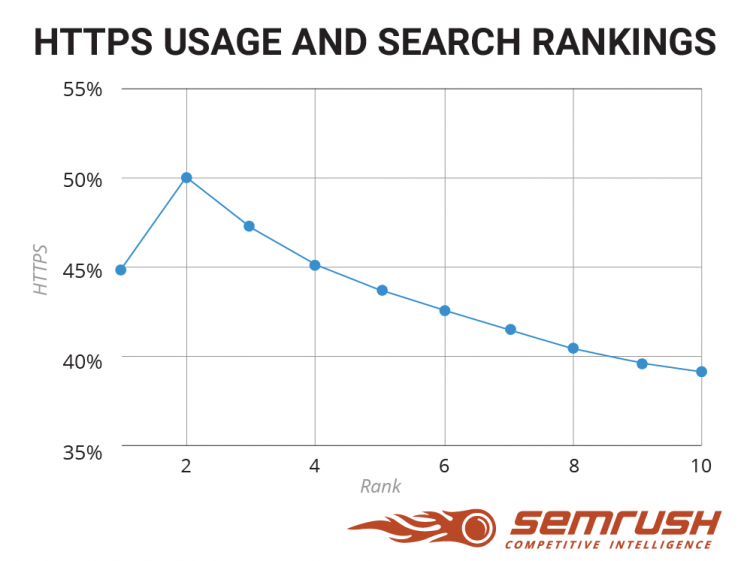

    “Thank you! Implementing SSL properly can be difficult and I’m impressed by how easy you guys have made it on us users. Everything worked perfectly per the instructions.” — Jeffrey Miller from AE Home Group

    We’ve seen lots of websites increase in ranking already (it could be a coincidence in the timing or a small part could be SSL… too soon to tell) and those clients are already seeing the other benefits of SSL.

    But we’ve heard from some members that after making their site SSL they experienced a drop in Google rankings… so we’ve created this post to address that concern and to walk you through things you can do if you experienced a drop… and to dive into the reasons a site could drop after adding SSL.

    If you did, don’t worry — that dip is actually quite common and almost always temporary. Here’s what you need to know.

    “Why did my Rankings Decrease after Integrating SSL?”

    Unfortunately, it’s hard to know the exact reason(s) that your ranking fell.

    It’s possible, for instance, that you noticed a dip in your rankings after integrating SSL and yet, the dip had nothing to do with the transition. From on-page SEO to SERP competition to backlinks, the world of SEO is complicated and discovering the reason for a sliding website isn’t a simple matter.

    Still, it is possible that SSL made your website slide a bit. So now let’s deal with the follow-up question: “Why the heck would you recommend that I integrate SSL if it’s going to hurt my rankings?”

    The answer to that question is this: because while SSL might dip your rankings in the short run, it will secure or even increase your rankings in the long run.

    Here’s what Google has to say about this:

    “Expect temporary fluctuation in site ranking during the move. With any significant change to a site, you may experience ranking fluctuations while Google recrawls and reindexes your site. As a general rule, a medium-sized website can take a few weeks for most pages to move in our index; larger sites can take longer. The speed at which Googlebot and our systems discover and process moved URLs largely depends on the number of URLs and your server speed. Submitting a sitemap can help make the discovery process quicker, and it’s fine to move your site in sections.”

    In simpler terms, this means that if your decrease in rankings was caused by SSL integration (which it might not have been), then it will most likely be temporary until Google has a chance to index all of your new pages.

    Think about it this way. When your website moves from HTTP to HTTPS, in Google’s eyes, all of those HTTPS pages of your website aren’t the same pages at the HTTP version, but duplicates. With SSL integration, then, all of those HTTP pages redirect to HTTPS pages. And Google takes time to register and index all of those redirects.

    Here’s what Rand Fishkin, the founder of Moz, has to say in one forum:

    “You can see many folks chimed in (both on G+ and on Twitter) noting that they’d had similar experiences. HTTPS is like any other redirection – it takes time for Google to pick up and count all the redirects, and in the meantime, you can lose rankings/traffic. We found that it all came back within ~3 months.”

    (Image Source)

    Said another way, a slight and temporary dip in rankings after SSL integration isn’t out of the ordinary.

    How to Speed Up Google’s Re-indexing Process

    Still, there are a few things you can do to speed up the recovery process and help Google re-index your website faster than they might on their own.

    1. Update your Google Search Console URL – Since Google sees your HTTPS pages as a new domain, you should definitely take a minute to go change your URL in the Google Search Console. You can learn how to do that here.
    2. Change old backlinks to the new HTTPS URL — If your backlinks profile is weak, you could lose up to 10% of the “link juice” from a given backlink because of the redirect from HTTP to HTTPS.  If your backlink profile was weak, this alone could be enough to see a dip in rankings. After the change, most backlinks will point to your HTTP pages, but, ideally, you want them to point to your new HTTPS pages. For obvious reasons, fixing those backlinks can be a tedious process. Do what you can here, but don’t sweat it if you can’t get some of them changed.
    3. Build new backlinks these next 2 months to your HTTPS URL — You’ll get the most SEO benefit from backlinks that point to your SSL certified URL, so make sure that any backlinks you get in the future have HTTPS in the URL (just copy and paste the URL from your website).
    4. Point internal links toward the HTTPS URL — Similar to what you’re doing with old backlinks, make sure that all of your internal links between pages point to HTTPS versions of the page rather than HTTP versions.

    Ultimately, SSL integration is a big positive over the long term, but don’t be surprised if you see a slight decrease in your rankings over the next couple months. In the meantime, take the above four actions and Google should correct itself — eventually giving you back your original rankings and maybe even increasing your rankings.

    Why Making the Change from HTTP to HTTPS is Still a Good Idea

    For Carrot customers, we’ve made switching to SSL as easy as clicking a few buttons. You can learn exactly how to do it here.

    Maybe you’re not convinced, though. Maybe you’re still wondering why you should make the change from HTTP to HTTPS. After all, your current website is pulling leads and driving traffic. Why rock the boat?

    Well, there are a few reasons that we want to encourage you to add SSL to your website if you haven’t already — even if your website is already performing like you want it to.

    First of all, websites that have SSL certification tend to rank better than websites that don’t.

    https search rankings

    (Image Source)

    This, of course, can take some time to actually have an impact on your rankings, but adding SSL to your website is a long-term play. It might not increase your SEO right away, but it prepares you for a future where search engines will increasingly favor HTTPS URLs.

    In the words of Google, “We encourage you to adopt HTTPS in order to protect your users’ connections to your website, regardless of the content on the site.”

    Google even uses SSL integration as a minor ranking signal when choosing which websites to list and which to leave unseen.
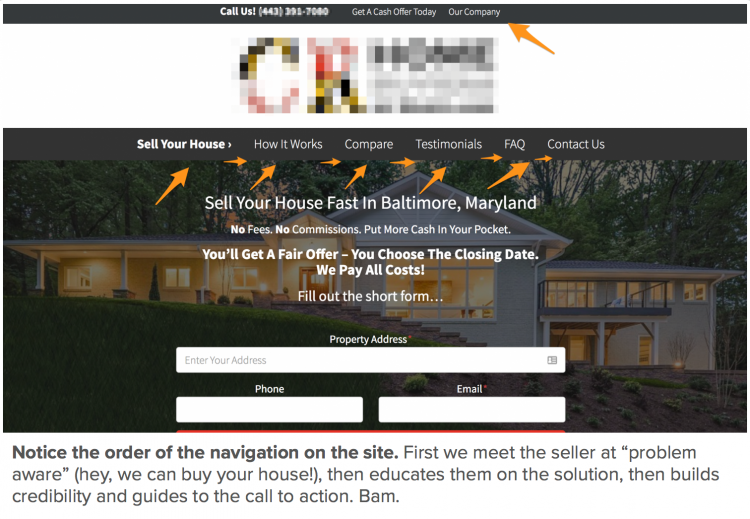
    Of course, SEO isn’t the only benefit to SSL integration. The most obvious advantage is website security…

    “SSL exists to make the connection between you and a website private. Without this, the data you send over the network could potentially be spied on by someone else on your network. This is something web visitors, your web browser, and even Google are looking for more and more and we wanted to get you ahead of the curve.” — Carrot’s CTO, Chris Carr

    And even website load speed is a consideration…

    “SSL creates a different type of connection on the web that allows for some new technology that can speed up page loading. Future proofing Carrot websites and allowing for more performance in the browser is always a win for us on the tech team. This equals less work, less expense, less hassle, and increased performance for you. Oh, and all of that means peace of mind.” — Carrot’s CTO, Chris Carr

    In the end, the long-term benefits of SSL integration outweigh the possible short-term dip in your rankings. If you’re not a Carrot customer, then you might experience a decrease in your SEO after transitioning for one of these reasons:

    1. You didn’t install the certificate properly.
    2. You didn’t properly implement redirects to your new HTTPS pages.
    3. You have canonical tags on HTTP page versions.
    4. You’re using a bad SSL certificate.

    Fortunately, if you’re a Carrot customer, you don’t have to worry about any of those things. We take care of all of that for you :-)

    Conclusion

    If you’ve integrated SSL and you’re loving it, awesome. :-)

    If you’ve integrated SSL and you saw a dip in your rankings, take heart — this is normal and the dip should be temporary. Sometimes, Google just takes a bit of time to re-index your website. And you can do the four things mentioned in this article to speed that process up.

    And if you haven’t integrated SSL on your website yet, then we recommend you do so. In the long run, it will help your website’s rankings, it will increase your security, and it will even make your website faster.

    As always, though, if you have any questions, don’t hesitate to leave a comment on this post or contact our world-class Customer Success team.

    [cta offer=”seobible” color=”red”]

  • Real Estate Website Hosting: 4 Things To Consider Before Buying

    Real Estate Website Hosting: 4 Things To Consider Before Buying

    real estate website hosting

    Imagine this… It’s Black Friday and you’re the CEO of one of the biggest shopping centers in the world. In the middle of the day, at noon, your in-store payment processing system crashes.

    For six hours, shoppers have to pay with cash or leave without buying.

    Not only does it hurt your company’s revenue stream, it hurts your company’s reputation.

    Sound like a nightmare?

    Well, this is exactly what happened to Macy’s on November 24th, 2017.

    And similar horrors happen online — from security breaches to untimely website crashes to load-speed issues. In the digital age that we’re all living in, those scenarios can have the same impact as a downed Macy’s on Black Friday.

    After all, how would you feel if your information got stolen while on a real estate agent or investor’s website? Or if you had to wait a full minute just for their website to load? Or if their website crashed while you were looking at house listings?

    You get the point. These are problems… big problems.

    Fortunately, you can avoid most of these revenue-killing scenarios by choosing the right real estate website host. In fact, here are four things that you should consider when selecting hosting for your real estate website.

    1. Security
    2. Speed
    3. Scalability
    4. Support

    Real Estate Website Hosting Consideration #1: Security

    One source reports that 86% of websites have at least one “serious” vulnerability.

    And perhaps there’s no more important real estate website hosting consideration than security. If your website is open to peering eyes, then your information or your visitor’s information can get stolen.

    No good.

    If someone steals your visitor’s information while they’re on your website, then you can count on them never visiting your website again. And you can definitely count on them never working with you.

    Sadly, this is such a problem that 71% of adults say that they are not confident that their information will stay private when working with a company.

    real estate website hosting confidence

    (Image Source)

    For that reason, 86% of internet users have tried actively to minimize the visibility of their digital footprint while 55% have tried to hide from specific people or organizations when online.

    Clearly, people care a lot about their privacy. If that privacy is violated, then, generally speaking, it’s an unforgivable sin of online business. That’s why so many businesses rely on tools for IT professionals.
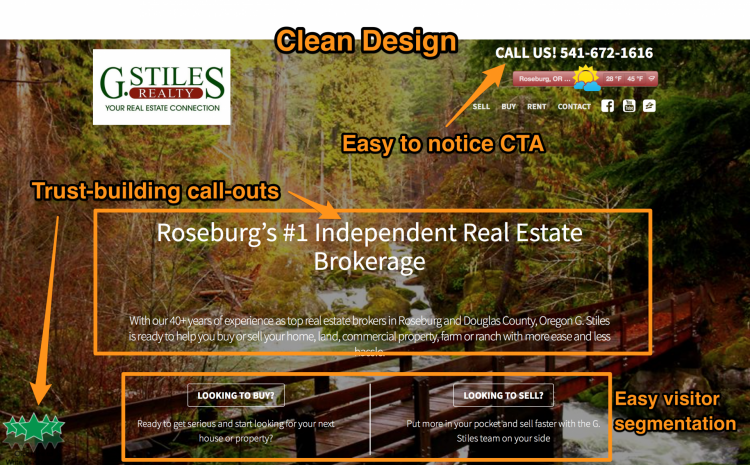
    And if someone steals your information… well, it’s quite difficult to manage a website when a cybercriminal is running around with your login credentials.

    But real estate website hosting security isn’t just important because you want everyone’s information to stay safe. That is the most important reason, but not the only benefit.

    Take SSL integration, for instance. Websites that have HTTPS instead of HTTP actually tend to rank better in search engines, which means more passive traffic and better real estate lead generation.

    google ranking https

    (Image Source)

    And since 93% of online experiences begin with a search engine, that SSL integration can help unlock a wealth of revenue-generating potential.

    Sure, it won’t automatically place you at the top of the rankings, but having SSL on your website is par for the course — if you don’t have it, then you’re likely to fall below the competition in search engines.

    For the sake of your privacy, your visitor’s privacy, and even your Google rankings, you should consider real estate website hosting that has the following features.

    1. Restore data points — You never know when your website is going to crash. In the tech world, things sometimes happen for no apparent reason. Ideally, you want a real estate website host that has a disaster recovery plan.
    2. Network monitoring — More than likely, you don’t have the time or ability to actively monitor your own website servers. That’s okay, though. Just make sure you choose a real estate website host that will consistently monitor the network for malicious attacks, diverting each one.
    3. Simple SSL integration — Adding SSL to your website can be a bit of a pain if you haven’t done it before. The best real estate website hosts will offer to do this for you.
    4. Network firewalls — If your website host doesn’t have network firewalls to protect its servers, find a new website host. This is simply expected in the real estate website hosting world.

    At Carrot, we offer all of these protections so that you never have to think twice about whether or not your website is secure. We even have several dev team members behind the scenes who constantly help monitor your website to respond to any problems within seconds.

    We’d love to work with you — whether investor or agent :-)

    Whatever real estate website host you choose, though, make sure it offers the above four things.

    Real Estate Website Hosting Consideration #2: Speed

    The speed of your website impacts two primary revenue-generating factors.

    First, SEO. Across the board, faster websites perform better in Google. In fact, the top players load in about .6 to .7 seconds.

    google ranking page load time

    (Image Source)

    The faster your website loads, the better chance you’ll rank above the competition.

    SEO for Real Estate | Does It Work for Small Markets?

    And speed becomes an even deeper consideration when you find out that users spend an average of 69% of their media time on smartphones instead of desktops or laptops.

    Often times, that smartphone isn’t as good at loading massive images, videos, or other visual files.

    Which means that your real estate website host should store your website’s information in the most organized and speedy fashion. You don’t want people leaving your website because they’re sick of waiting for it to load. And you definitely don’t want to lose customers because the competition’s website was faster than your own.

    Here’s the reality: people are impatient. Some studies even compare the human attention span to that of a goldfish.

    human attention span

    (Image Source)

    Of course, when you actually get into the nitty-gritty of that study, it becomes quite ridiculous. There’s no argument that the human attention span is far superior to that of a goldfish.

    So what’s really going on?

    People have more options and easier access to those options than ever before. Which means they are less patient of lengthy load times (for instance) because they can find a million — literally — other websites that will load faster and offer a similar solution.

    Said another way, the primary reason that you need a fast website is because people expect it.

    So then, the two reasons that website speed matters are because it helps your Google rankings and people won’t wait for a slow website.

    Which is why, at Carrot, we test our customer’s real estate websites regularly, to make sure we’re making them as fast as we possibly can.

    real estate agent website page speed

    In fact, here are three things we do to keep our customer’s websites fast. If you don’t choose to work with us, then you should choose another real estate website host that offers similar functions.

    1. Powerful CPUs and abundant RAM — We use extremely powerful Central Processing Units and an abundant amount of RAM that ensures we can keep up with the demands on all of our thousands of customer websites.
    2. Purpose-built servers —We leave our servers designated for specific operations so that there’s never a shortage of computing power for our customer’s websites.
    3. Load-balanced server clusters — Our servers can handle an infinite amount of demands. With load-balanced server clusters, we monitor our customer website’s load speed and computing power, adding servers as the demand increases, and removing servers as the demand decreases.

    Real Estate Website Hosting Consideration #3: Scalability

    You don’t want your business to outgrow your website hosting.

    Ideally, you want a real estate website host that will grow with you. As your website traffic and conversions increase, so too should the bandwidth of your hosting servers. Of course, with many website hosts, that’s not the case.

    Some real estate website hosts neglect scalability because they want to keep costs low. Others do it because they are outright lazy. Frankly, though, the reason doesn’t much matter.

    What matters is having a website that scales with your business — rather than holding it back.

    Otherwise, you’ll have to change website hosts as your business scales, which usually means a few days of downtime for your website and sorting through a confusing hash of DNS records.

    To ensure uninterrupted online presence and safeguard against potential cyber threats, consider opting for a DDoS protected VPS.

    And this isn’t just important if you want to grow your real estate business into a massive corporation. It’s important for the real estate industry as a whole. Some seasons naturally expect more sales than others. More sales mean more traffic which means a larger demand on your website for bigger and stronger bandwidth.

    June and July, for instance, almost double in sales from December and January.

    monthly share of annual existing home sales

    (Image Source)

    If your website can’t handle those rising and declining trends, then you’ll miss out on massive sales potential for the year.

    With a scalable host, though, you’ll never have to worry about your website slowing down or crashing because of an overabundance of demands. Within seconds as well as years, a scalable host will adapt to your online popularity rather than requiring you to adapt to it.

    There are many different ways to accomplish this on the tech side. But at Carrot, here’s how Austin, one of our developer geniuses explains what we do to make our website “infinitely” scalable.

    We can “infinitely” scale the number of web servers in our load-balanced cluster. Load balancing means that the requests sent to Carrot are spread out among an arbitrary amount of servers. We track the average response time and the average amount of load on the servers in our cluster and if the load becomes too high, we add more servers to our cluster. A good analogy is opening more checkout lanes at the grocery store if lines start to get too long.

    Real Estate Website Hosting Consideration #4: Support

    When thinking of real estate website hosting, most people don’t immediately consider support.

    The reality is, though, that when your website goes down for no apparent reason, struggles to climb through the rankings, doesn’t convert like you want it to, slows down, or becomes suddenly less secure, you need someone who can help.

    Regardless of how good the real estate website hosting is, it’s practically inevitable that you will either (1) have general questions about making customizations to your website or (2) experience unexpected problems which you don’t know how to fix.

    When that happens, you need reliable experts just a phone call away.

    Our world-class support team at Carrot is adamant about helping our customers. Just last quarter, they had over 7,000 conversations and nearly 300 one-on-one strategy calls.

    If your website host doesn’t have a remarkable support team, then find one that does.

    Conclusion

    The real estate website host that you choose has a massive impact on four things.

    1. Security
    2. Speed
    3. Scalability
    4. Support

    Before you decide which real estate website host to use, make sure that you consider these four factors. At Carrot, we keep our customer’s website fast, secure, and scalable, while also providing world-class support.

    If you want to work with us, then agents can go to our real estate agent websites and investors can go to our real estate investor websites.

    What do you think is the most important thing to consider when choosing a website host? 

  • Custom Real Estate Website Design: 3 Things You’ve Got to Have

    Custom Real Estate Website Design: 3 Things You’ve Got to Have

    Custom Real Estate Website Design

    Right now, more than ever, you must have custom real estate website design. In fact, 99% of millennials (21 – 37 years old) search online when looking for a home.

    I know, I know. Whoop-dee-do, no surprise.

    But here’s a few stats that are surprising. 89% of older baby boomers (54 – 72 years old) also use the internet during a house search and 77% of the silent generation (76 – 93 years old) do the same.

    In fact, 44% of homebuyers across all ages purchase a home that they find on the internet.

    This means that despite the age of your prospect, people are looking online at some point during their house hunt — more than likely.

    And since they’re looking online, you need to be online.

    If you’re not, you’re losing business.

    End of story… “Here, you can have my clients, savvy internet real estate competition,” type of bye, bye.

    And as you already know, those clients that work with the competition will do so again in the future — you don’t just lose them right now, you lose them forever.

    Of course, that’s not always the case, but it often is.

    Unfortunately, just being online isn’t enough, either. You need a website that drives traffic and converts visitors. In most cases, having your face on a corporate real estate website isn’t adequate, and neither is a cruddy website that your tech-buddy designed.

    I don’t have anything against your tech buddy or your real estate corporation, but I do want to help.

    For that reason, here at Carrot, we asked ourselves, “What are the three most important elements for any custom real estate website design to have?”

    This is what we came up with.

    Custom Real Estate Website Design Must #1: Easy Navigation

    When someone lands on your website, they want to do something.

    But what, exactly, do they want to do?

    Fortunately, in the real estate niche, that’s a relatively easy question to answer.

    People either want to learn about who you are (i.e. Can they trust you? Do you have a reliable track record? Do you seem legit?) or what you do (i.e. They want to pursue your services).

    Put more simply, visitors want to…

    1. Learn whether they can trust you.

    Or…

    2. Work with you.

    Pretty simple, huh?

    Yeah. At least on the surface.

    But here’s the thing: even guiding those two simple intentions requires some savvy website navigation. After all, the last thing you want is for visitors to land on a website that looks like this.

    If you arrived on this website, you’d leave within the first few seconds — your visitors will do the same thing.

    In fact, 38% of people will leave a website with an unattractive layout.

    What, really, though, is the problem with the above website?

    Because if we look beyond the hideous colors and hard-to-read text, there’s something even worse: poor navigation.

    Since people don’t know where to go, they leave.

    And you don’t have to take my word for it. One study found that 50% of referral-based website traffic immediately uses a website’s navigation menu to orient themselves.

    This is why, at Carrot, we include dead-simple navigation menus on our customer’s websites. For Investors…

    how a house seller makes decisions

    And agents…

    The moment that prospects land on those websites is the same moment that prospects know exactly what to do and where to go.

    Immediately, then, those websites build trust.

    A website without simple navigation, on the other hand, hurts trust and increases your bounce rate — which, in turn, hurts your business and the financial independence that you so ambitiously crave.

    The point is, a cluttered and hard-to-navigate website hurts everyone and helps no one.

    What, though, makes the difference between an easy-to-navigate website and a navigational disaster?

    Here are 4 things to keep in mind.

    1. Does your navigation bar have seven or less options? — You don’t want too many options on your website. You need to have the necessary ones (About Us, Contact Us, Testimonials, etc), but nothing more. Ironically, the more options that people have to choose from, the less likely that they’ll make a choice at all for fear of making the wrong choice. Remove that fear with fewer options.
    2. Is the button copy for each navigation button honest and clear? — In other words, title your blog, “Blog” and your about page, “About Us.” Don’t try to remake the wheel. You’ll only make things unclear for visitors to your website and hurt your reputation in the long run. Use terms that people are familiar with and immediately recognize.
    3. Is the design clean and the text easy to read? — This one is getting a bit more into the opinionated territory. For that reason, I recommend showing your website to a few trusted friends and asking them for their honest opinions. What do they think of the copy, the colors, and the overall flow? Do they like it or hate it? Ask them to be honest.
    4. Is the website easy to navigate on mobile devices? — Today, more than half of our member leads come from mobile devices. If your website isn’t just as easy to navigate on mobile devices as it is on a desktop device, you need a new website. Consider how terrible this website looks on mobile.

    In contrast, all of Carrot’s websites are mobile-friendly automatically… no extra work and no extra thinking. Boom. Donezo. Check to see if your website is mobile-friendly.

    Image result for oncarrot mobile

    If you want us to help build you an awesome website, investors can go here and agents can go here to check out our plans. We’d love to work with you :-)

    Plus, we’ll make sure you have all of the above elements dialed in.

    Otherwise, take the above information and hand it to your designer. Or make sure that the real estate website builder you choose integrates this advice.

    If your website isn’t easy to navigate, then it’s got no chance of competing with other online real estate websites. If it is easy to navigate, though, then people will immediately trust you — something that’s crazy valuable in the real estate world.

    Custom Real Estate Website Design Must #2: Clear and Relevant CTAs

    Your CTA (Call-To-Action) is arguably the most important part of your custom real estate website design.

    Your website might have a persuasive sales copy and a clean design, but if people don’t know where to click once they’re ready to take action, none of that matters.

    After all, the whole point of your website is to generate leads for your business. Without a CTA, that’s impossible.

    What, though, should your CTA be? Should you ask people to call you or sign up for your email list or enter their personal information?

    Since you’re a real estate agent or investor, generally speaking, the best CTA is a phone number. Think about it. If you were looking for a real estate agent or investor, would you want to email them and wait for a response or call them and talk to them right now?

    More than likely, the latter.

    In fact, contact information on a website is vital to all industries. 51% of people think that “thorough contact information” is the single most important element missing from business websites. And 44% of internet users will outright leave a company website if it doesn’t have contact information or a phone number.

    In the real estate industry, that truth is even more detrimental.

    Through a heat map study at Carrot that we ran on one of our customer’s websites, we found that the “Call Us” CTA in the upper right corner was getting massive attention.

    Carrot seller website heatmap

    Of course, so too did straightforward CTAs like this…

    investorcarrot lead form heatmap

    And this…

    investorcarrot call to action heatmap

    Which illustrates exactly why your CTA needs to have two characteristics.

    1. It needs to be clear (visually and linguistically)
    2. It needs to be relevant (to the page it’s on and the business you run)

    Here’s what that looks like on our real estate agent websites.

    What makes this CTA clear and relevant, though?

    First of all, it stands out from the rest of the page. The CTA’s positioning, color, and shape make it easy to notice the moment that you land on the website.

    Second, the button copy is clear and represents exactly what people expect to find when they visit a real estate agent website. You can either sell your property or buy your next home.

    Additionally, Orbit Media Studios offers this “Pro Tip” regarding mobile website navigation:

    “ProTip! For mobile visitors, make sure that the phone number turns into a button that dials the number when tapped. It’s a simple matter of adding tel: to the href code for the phone number for the mobile version of your site. The code should look something like this:

    <a href=”tel:773-348-4581″>(773)348.4581</a>”

    At Carrot, we design the best real estate websites for lead generation in the industry with clear and relevant CTAs. If you want to do it yourself, though, then use this as your CTA checklist.

    • Is the button copy clear? Do people know exactly what’s going to happen when they click it?
    • Is the CTA relevant to the website or page it’s on? What are you asking people to do and is that what they expect?
    • Does your CTA stand out visually? Is the color unique from the rest of the elements on the page and is your eye naturally drawn to it?

    Custom Real Estate Website Design Must #3: A Compelling “About” Page

    Out of the three elements that we chose to mention in this blog post, this is going to be the most surprising.

    Easy navigation and clear, relevant CTAs — sure. That makes sense.

    But an “About” page?

    Really?

    Is that one of the three most important custom real estate website design elements if you boil it down to its foundation?

    Yes. Yes, it is.

    Carrot’s own research shows that the About Page is often one of the top three most visited pages on our customer’s real estate websites.

    Here’s a visual representation of that attention.

    investor website heatmap - our company page

    But you don’t have to take our word for it. Another source found that 86% of visitors want to see information about a company’s products and services on the homepage.

    And with real estate, you are the product.

    Similarly, 52% of website visitors want to see “About Us” information when on a company’s homepage. Clearly, people care about who they’re doing business with.

    But how do you create an “About Us” page that builds trust and creates a relationship?

    Well, let’s walk through one of my favorite real estate “About Us” pages.

    A team of real estate agents based out of Roseburg, Oregon — The G Team — starts their “Meet The G Team” Page with their core values.

    Then, they build authority in their local market by describing their passion for the area and their expertise.

    Next, they have bios for people on the team.

    A friendly picture of the team…

    And they end with a video and CTA.

    The best part about this page is that they treat it like a sales page. Because believe it or not, your “About Us” page is a sales page.

    Think about it this way. Why would someone visit your “About Us” page in the first place? Probably because they want to figure out if they can trust you, if you have a reliable track record if you offer the service that they’re looking for.

    In other words, they visit your “About Us” page because they’re trying to determine if they want to work with you or not.

    Your “About Us” page needs to help them make that decision.

    In fact, here are the elements of a great “About Us” page for your real estate agent website design.

    1. Create and include your core values. 
    2. Add your mission statement. 
    3. Tell your story — Be brief, but include the juicy details that help people understand why you do what you do.
    4. Include an authentic and professional picture of yourself — Don’t take a picture when you have a fake smile on. Take a picture when you’re laughing or smiling genuinely. Believe it or not, people can tell the difference. And studies show that visitors will think you are more intelligent, attractive, and friendly if you’re actually smiling. Do the same for the rest of your team if you have one.
    5. Write the page’s content in the first person, like you’re actually… well, you — Don’t try to write in the third person like a robot describing someone else. Nobody wants to work with a robot. They want to work with a human. You’re a human, so be a human.
    6. Include a CTA — Anyone who visits the “About” page wants to learn about you because they’re thinking about working with you. Convince them, then pitch them.

    Conclusion

    You need a custom real estate website design but, most importantly, you need a website that drives traffic and converts visitors.

    In fact, if you have a website that doesn’t do those two things, then it’s practically the same as not having a website at all.

    For that reason, at the very least, your website needs easy navigation, clear and relevant CTAs, and a compelling “About Us” page. Without those, your website will sit in cyberspace, doing nothing for your business and nothing for your dream of financial and personal independence.

    At Carrot, though, we’ve generated over one million leads for our customer’s real estate websites in just three years. We’d love to help you, as well. Agents can find out more about working with us here and investors, here.

    If not, that’s okay too. :-)

    Either way, follow the above advice and you’ll be well on your way to having the website — and business — of your dreams.

    What do you think is the most important element on any real estate website