

Category: Search Engine Optimization

  • Did You See Your Rankings Dip After Integrating HTTPS/SSL On Your Website? Here’s Why

    Did You See Your Rankings Dip After Integrating HTTPS/SSL On Your Website? Here’s Why

    ssl integration search engine rankings

    It’s been about two months since we launched free SSL integration for Carrot customers. As of this article’s creation, 2,327 Carrot websites have made the switch from HTTP to HTTPS. And here’s what some of them are saying.

    “Setting up SSL was so easy. I have been waiting for this and I am glad you all implemented this in such a simple way!” — Lamar Cannon from Lamar Buys Houses


    “Although a boring update for most, I’m glad to see this added. Also, bravo on the execution. Easy to use, and rolling it into existing offering was way to go versus having us mess with renewals and certificates. Appreciate the hard work and continued improvement!” — Tyler Weinrich from Tyler Buys Houses


    “Thank you! Implementing SSL properly can be difficult and I’m impressed by how easy you guys have made it on us users. Everything worked perfectly per the instructions.” — Jeffrey Miller from AE Home Group

    We’ve seen lots of websites increase in ranking already (it could be a coincidence in the timing or a small part could be SSL… too soon to tell) and those clients are already seeing the other benefits of SSL.

    But we’ve heard from some members that after making their site SSL they experienced a drop in Google rankings… so we’ve created this post to address that concern and to walk you through things you can do if you experienced a drop… and to dive into the reasons a site could drop after adding SSL.

    If you did, don’t worry — that dip is actually quite common and almost always temporary. Here’s what you need to know.

    “Why did my Rankings Decrease after Integrating SSL?”

    Unfortunately, it’s hard to know the exact reason(s) that your ranking fell.

    It’s possible, for instance, that you noticed a dip in your rankings after integrating SSL and yet, the dip had nothing to do with the transition. From on-page SEO to SERP competition to backlinks, the world of SEO is complicated and discovering the reason for a sliding website isn’t a simple matter.

    Still, it is possible that SSL made your website slide a bit. So now let’s deal with the follow-up question: “Why the heck would you recommend that I integrate SSL if it’s going to hurt my rankings?”

    The answer to that question is this: because while SSL might dip your rankings in the short run, it will secure or even increase your rankings in the long run.

    Here’s what Google has to say about this:

    “Expect temporary fluctuation in site ranking during the move. With any significant change to a site, you may experience ranking fluctuations while Google recrawls and reindexes your site. As a general rule, a medium-sized website can take a few weeks for most pages to move in our index; larger sites can take longer. The speed at which Googlebot and our systems discover and process moved URLs largely depends on the number of URLs and your server speed. Submitting a sitemap can help make the discovery process quicker, and it’s fine to move your site in sections.”

    In simpler terms, this means that if your decrease in rankings was caused by SSL integration (which it might not have been), then it will most likely be temporary until Google has a chance to index all of your new pages.

    Think about it this way. When your website moves from HTTP to HTTPS, in Google’s eyes, all of those HTTPS pages of your website aren’t the same pages at the HTTP version, but duplicates. With SSL integration, then, all of those HTTP pages redirect to HTTPS pages. And Google takes time to register and index all of those redirects.

    Here’s what Rand Fishkin, the founder of Moz, has to say in one forum:

    “You can see many folks chimed in (both on G+ and on Twitter) noting that they’d had similar experiences. HTTPS is like any other redirection – it takes time for Google to pick up and count all the redirects, and in the meantime, you can lose rankings/traffic. We found that it all came back within ~3 months.”

    (Image Source)

    Said another way, a slight and temporary dip in rankings after SSL integration isn’t out of the ordinary.

    How to Speed Up Google’s Re-indexing Process

    Still, there are a few things you can do to speed up the recovery process and help Google re-index your website faster than they might on their own.

    1. Update your Google Search Console URL – Since Google sees your HTTPS pages as a new domain, you should definitely take a minute to go change your URL in the Google Search Console. You can learn how to do that here.
    2. Change old backlinks to the new HTTPS URL — If your backlinks profile is weak, you could lose up to 10% of the “link juice” from a given backlink because of the redirect from HTTP to HTTPS.  If your backlink profile was weak, this alone could be enough to see a dip in rankings. After the change, most backlinks will point to your HTTP pages, but, ideally, you want them to point to your new HTTPS pages. For obvious reasons, fixing those backlinks can be a tedious process. Do what you can here, but don’t sweat it if you can’t get some of them changed.
    3. Build new backlinks these next 2 months to your HTTPS URL — You’ll get the most SEO benefit from backlinks that point to your SSL certified URL, so make sure that any backlinks you get in the future have HTTPS in the URL (just copy and paste the URL from your website).
    4. Point internal links toward the HTTPS URL — Similar to what you’re doing with old backlinks, make sure that all of your internal links between pages point to HTTPS versions of the page rather than HTTP versions.

    Ultimately, SSL integration is a big positive over the long term, but don’t be surprised if you see a slight decrease in your rankings over the next couple months. In the meantime, take the above four actions and Google should correct itself — eventually giving you back your original rankings and maybe even increasing your rankings.

    Why Making the Change from HTTP to HTTPS is Still a Good Idea

    For Carrot customers, we’ve made switching to SSL as easy as clicking a few buttons. You can learn exactly how to do it here.

    Maybe you’re not convinced, though. Maybe you’re still wondering why you should make the change from HTTP to HTTPS. After all, your current website is pulling leads and driving traffic. Why rock the boat?

    Well, there are a few reasons that we want to encourage you to add SSL to your website if you haven’t already — even if your website is already performing like you want it to.

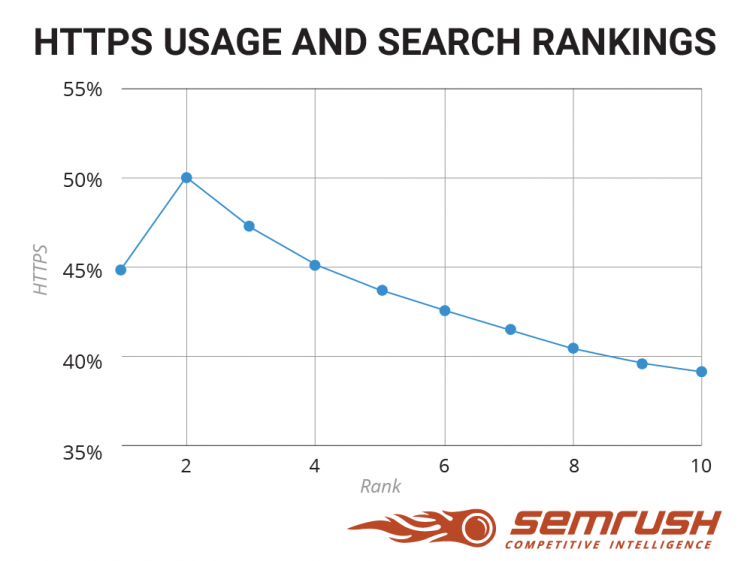
    First of all, websites that have SSL certification tend to rank better than websites that don’t.
    https search rankings

    (Image Source)

    This, of course, can take some time to actually have an impact on your rankings, but adding SSL to your website is a long-term play. It might not increase your SEO right away, but it prepares you for a future where search engines will increasingly favor HTTPS URLs.

    In the words of Google, “We encourage you to adopt HTTPS in order to protect your users’ connections to your website, regardless of the content on the site.”

    Google even uses SSL integration as a minor ranking signal when choosing which websites to list and which to leave unseen.

    Of course, SEO isn’t the only benefit to SSL integration. The most obvious advantage is website security…

    “SSL exists to make the connection between you and a website private. Without this, the data you send over the network could potentially be spied on by someone else on your network. This is something web visitors, your web browser, and even Google are looking for more and more and we wanted to get you ahead of the curve.” — Carrot’s CTO, Chris Carr

    And even website load speed is a consideration…

    “SSL creates a different type of connection on the web that allows for some new technology that can speed up page loading. Future proofing Carrot websites and allowing for more performance in the browser is always a win for us on the tech team. This equals less work, less expense, less hassle, and increased performance for you. Oh, and all of that means peace of mind.” — Carrot’s CTO, Chris Carr

    In the end, the long-term benefits of SSL integration outweigh the possible short-term dip in your rankings. If you’re not a Carrot customer, then you might experience a decrease in your SEO after transitioning for one of these reasons:

    1. You didn’t install the certificate properly.
    2. You didn’t properly implement redirects to your new HTTPS pages.
    3. You have canonical tags on HTTP page versions.
    4. You’re using a bad SSL certificate.

    Fortunately, if you’re a Carrot customer, you don’t have to worry about any of those things. We take care of all of that for you :-)

    Conclusion

    If you’ve integrated SSL and you’re loving it, awesome. :-)

    If you’ve integrated SSL and you saw a dip in your rankings, take heart — this is normal and the dip should be temporary. Sometimes, Google just takes a bit of time to re-index your website. And you can do the four things mentioned in this article to speed that process up.

    And if you haven’t integrated SSL on your website yet, then we recommend you do so. In the long run, it will help your website’s rankings, it will increase your security, and it will even make your website faster.

    As always, though, if you have any questions, don’t hesitate to leave a comment on this post or contact our world-class Customer Success team.

    [cta offer=”seobible” color=”red”]

  • Real Estate Website SEO: 5 Things To Consider When Trying To Rank Your Website

    Real Estate Website SEO: 5 Things To Consider When Trying To Rank Your Website

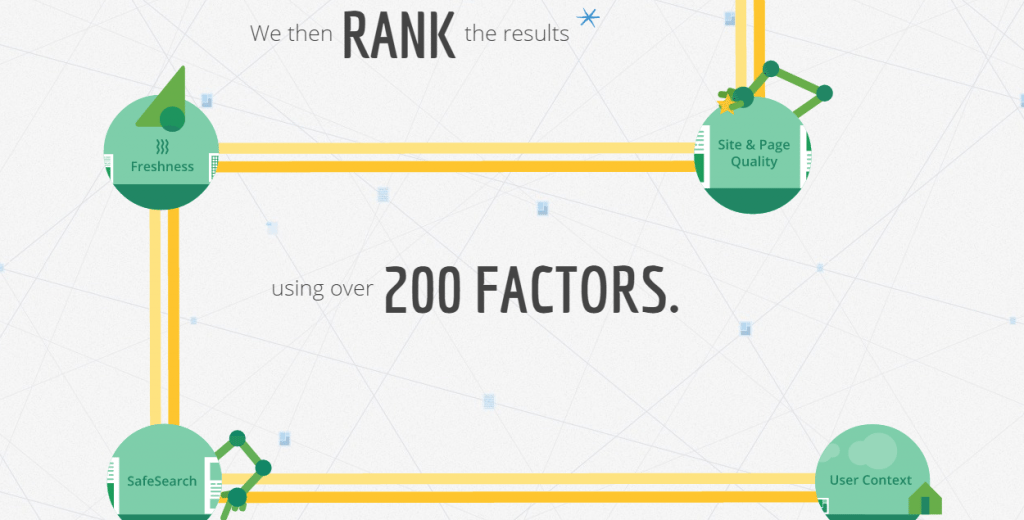
    real estate website SEO Post HeaderYou may know that Google uses about 200 factors when ranking a website. Some factors have been confirmed, others are speculative. We’re not going to dive into all 200, but we are going to focus on the most important real estate website SEO factors.
    I’m going to break down the real estate SEO strategy into five main groups:

    • Content
    • Backlink Profile
    • On-Page SEO
    • Technical Factors
    • Website Traffic & User Behavior

    But first…

    What Does SEO Mean In Real Estate?

    Maybe you don’t know this, but SEO is not a real-estate specific term. SEO stands for Search Engine Optimization and it refers to the act of trying to optimize your website to show up in search engines (like Google, Bing, and Yahoo) according to the algorithmic, semantic preferences of the targeted search engine.

    SEO is usually achieved by including specific keywords on a web page that quickly tell search engines what the page is about, generating high-quality links to a specific page, using relevant anchor text, and producing consistent long-form pieces of content.

    In the end, search engines want to deliver high-quality, relevant, and trust-worthy results to searchers. Now, I’m going to break down five things you need to consider for your own real estate website’s SEO — so that you can fall among the few who actually show up to searchers.

    1. Content

    We have all heard the phrase “content is king,” and as much as I dislike that phrase, it’s true. Content is still extremely relevant in 2018 and there seems to be a direct correlation between unique and relevant content and ranking well in Google.

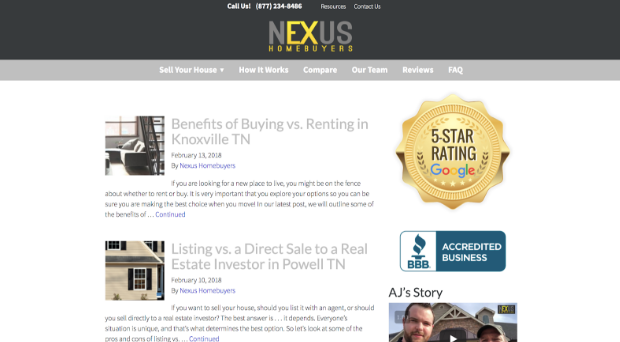
    That’s why Zach with Nexus Homebuyers consistently posts relevant content on his blog.

    Real Estate Website SEO Blog Example

    Not only does your content need to be both unique and relevant, it needs to be lengthy. An article’s length, or word count, provides the user with in-depth information and therefore appears more trustworthy. And the larger the search volume for your target keywords, the longer your content needs to be.

    The exact ideal length of an article is debatable, but the research indicates a word count of at least 600 words for low search volume keywords (1-100) and 725 words for high volume keywords (10,000 plus) is workable.

    If you want to find out which real estate SEO keywords to target and how much competition each keyword phrase has (without doing any of the work), you can download Carrot’s free SEO Keyword Bible for Agents or their SEO Keyword Bible for Investors

    Additionally, Google is focusing more on keywords within your content as opposed to the title tag, H1 tag, and meta description. According to a searchmetric’s study, keyword inclusion in the title tag, H1 tag, and meta description is decreasing year over year, which indicates Google is giving more weight to how relevant your content is. There is a very strong correlation between the pages in position 1-6 and content relevance.

    Two key takeaways:

    1. Optimize your content length for the competitiveness of your target keyword phrase.
    2. Create relevant and genuinely helpful content (not just content created for search engines).

    4 Real Estate Content Marketing Strategies You Can Actually Use to Grow Your Business


    2. Backlink Profile

    For many years, backlinks were the foundation for a website’s rankings. A strong backlink profile used to be the main focus for real estate website SEO, but lately there has been a decline in backlink relevance.

    Today, backlinks are important but they are also just one of the many contributing signals when ranking a website. Looking forward, I expect to see a continued decline in backlink relevance in the coming years.

    Just because backlinks are declining in relevance, though, doesn’t mean you should ignore them. According to a study performed by SEMrush, there were 6 main factors of a backlink profile:

    • Number of referring domains
    • Number of follow-backlinks
    • Number of backlinks
    • Number of anchors
    • Number of referring IPs
    • Low keyword presence in the anchor text

    Their study confirmed that the number of referring domains, follow-backlinks, backlinks, anchors, and referring IPs all had a direct impact on rankings. In other words, the greater the number of these factors, the higher the webpage ranked in the SERPs.

    Also, note that spamming links to a web page is not an acceptable practice. Instead, create a natural link building profile using only white-hat link building techniques such as guest posting on relevant and high domain-authority blogs.

    Keyword presence in the anchor text rarely occurs in web pages ranking in the top position. This is true in both high and low search volume keywords. Of all the backlink factors, this has the least effect on domain rankings. But, again, that doesn’t mean you should ignore it.

    In fact, if you want the best chance of ranking in Google, then pay special attention to all six backlink factors — not just the pretty few.


    How Many Backlinks Does it Take to Start Ranking Your Real Estate Website in Google?


    3. Real Estate On-page SEO

    In today’s age, keyword stuffing will no longer work to rank your site for a particular search phrase. Instead, the research shows that including your target keyword phrase in your main on-page elements such as your title, meta description, and body of the page does have a positive correlation to ranking your site.

    The data shows that the top-ranking sites include their keywords in these items, but it is not a significant factor when ranking a site.

    However, just because something is not a significant factor, does not mean you should ignore it. Google still uses your title, meta, and body to determine what the page is about, so you still need to include your main keyword in these items.

    According to SearchMetrics, research has also been shown that it is more important to create content focused on your keyword as opposed to using your exact match keyword itself. Google evaluates content on its relevance, and not by the inclusion of individual keywords.

    The bottom line, make your content relevant to your topic instead of keyword stuffing.


    On-Page SEO: The 12 Key Steps To Optimize Your Real Estate Investor Web Pages


    4. Technical Factors

    If you are a Carrot member, then most of these real estate websites SEO technical pieces are already taken care of for you. If you’re not a Carrot member, though, these technical factors are something you will need to pay attention to. The technical factors that we are going to focus on are:

    Technical factors remain an extremely important prerequisite to ranking a webpage. Even if the content is extremely relevant to the user, it is very difficult to achieve a top ranking in Google if the page is not easily accessible, easy to read, and technically optimized.

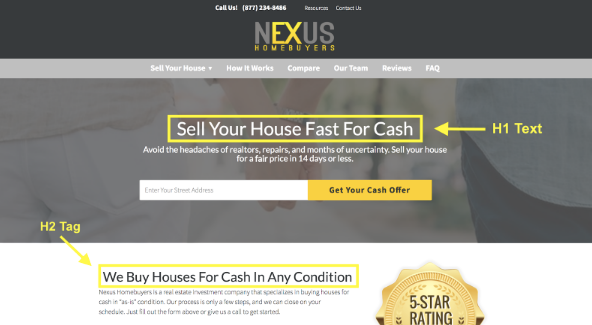
    Existing H1/H2

    Year over year, the existence of an H1 and H2 code has risen for the top ranking pages. This may seem obvious, but if you’re not making use of H1 and H2 tags, you could be leaving a valuable advantage on the table.

    Try your best to include your target keywords within these tags — but be careful not to ruin a compelling title for the sake of a keyword phrase.

    Real Estate Website SEO H1 Tag on Homepage

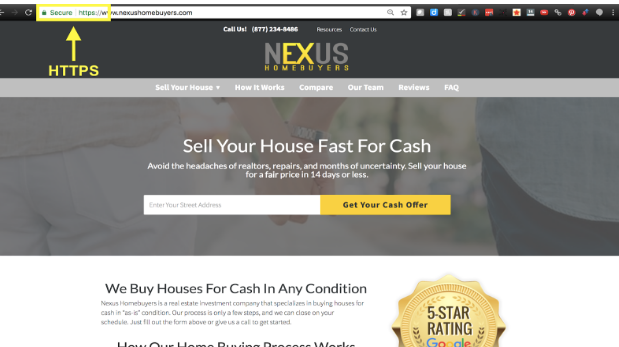
    HTTPS

    HTTPS is growing year after year and this year is no different. With cyber security becoming a main focal point, encrypting your page will be a huge advantage.

    Google has even stated that websites that have not switched to HTTPS will be marked as unsafe in Chrome. This will continue to push the web toward HTTPS encryption, and those who don’t adapt will fall down the SERP.

    real estate websites with security

    Fortunately for Carrot members, Carrot allows you to integrate SSL certification (or HTTPS encryption) on your website for free and with a single click.

    TLD Rankings

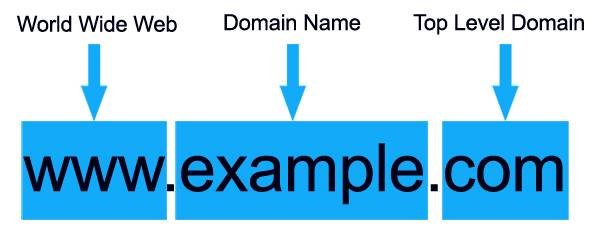
    TLD rankings, or Top-Level Domain rankings, focus on the most important component of a domain name. For example, in http://www.nexushomebuyers.com, the .com indicates the TLD.

    SEO for real estate domain example

    (Image Source)

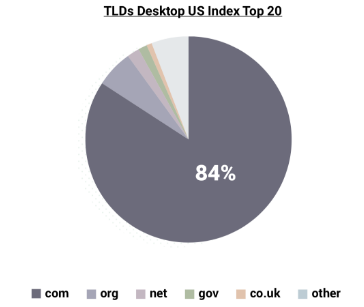
    In the last couple of years, the presence of .com pages in Google’s top 20 rankings has increased significantly. According to SearchMetrics, this is attributed to the fact that Google tends to give more significance to .com TLDs, increasing their ranking.

    This chart shows the most common TLDs in the Google Index:

    desktop indexing for websites

    (Image Source)

    The bottom line, try to use a trusted TLD such as .com on your site if possible.

    Site Speed

    Site speed, not to be confused with page speed, is measured by “time to first byte,” which means how long it takes for your browser to receive the first byte of information from the web server. Site speed is important because a slow website will result in the search engines crawling less pages with their given crawl budget. This can negatively impact the indexing of your website’s pages.

    Which is why Carrot does everything they possibly can to deliver speedy real estate investor websites and real estate agent websites to their clients.

    real estate investor websites page speed

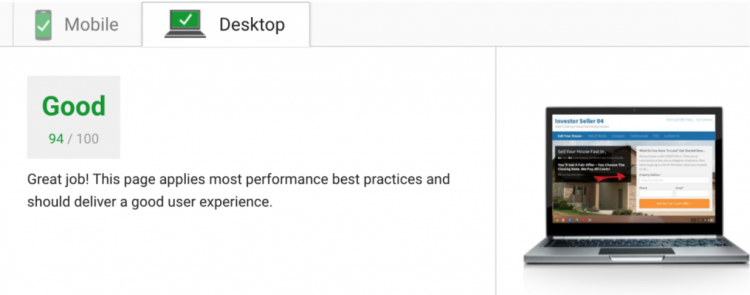
    Going along with a slow site speed, slower page speeds tend to have higher bounce rates and a lower average time-on-page. SEMrush has come out with a study stating that three out of the four highest factors for ranking a webpage are time-on-site, pages-per-session, and bounce rate. All of which can be negatively affected by a slow site and page speed.

    Your webpage should also be mobile friendly and load faster than your desktop site.


    How Page Speed Can Help Your Real Estate Website Rank Higher


    URL Length

    URL length has increased an average of 15% since last year and this is probably due to Google choosing specific landing pages for more relevant content as opposed to home pages. The big thing to take away from this is that almost all URLs in the top 20 rankings are under 60 characters in length. Make sure you are shortening your URLs as much as possible while still keeping your keyword phrase in the URL itself.

    real estate websites url length

    Mobile Friendliness

    We can’t talk about technical factors without touching on mobile-friendly web pages. As our society continues to rely on our smartphones more and more, the importance of mobile-friendly websites increases.

    Google has announced that it is switching to a mobile-first index which will mean it is no longer optional to have your website mobile-friendly. A mobile-first index means Google will create and rank its search listings based on the mobile version of the content, even for listings that are shown to desktop users.

    This means that the consequence of having a site that does not perform well in mobile searches could also negatively affect desktop searches.

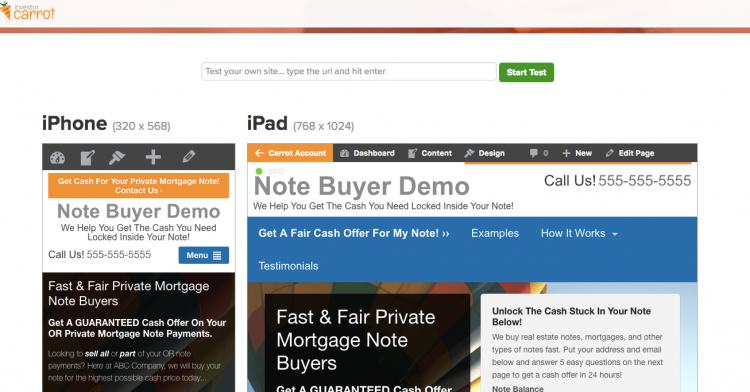
    You can test your site for mobile friendliness here.

    real estate investor mobile responsive websites

    5. Website Traffic and User Behavior

    As Google is shifting toward ranking sites that give the user a better overall experience higher, we are seeing a huge focus on user signals. These user signals are now considered one of, if not the most critical ranking factors for real estate investor websites and real estate agent websites alike. The user’s signals can be broken down into 5 main elements:

    • Website Traffic
    • Click-Through Rate (CTR)
    • Bounce Rate
    • Time-On-Site
    • Pages-Per-Session

    These signals are so important because they reflect a direct way to assess how relevant the content is to the user. Search engines can now draw conclusions about user satisfaction in regards to whether or not the search result was able to fulfill the searchers need. In essence, it helps Google show the most relevant pages for the user and improve overall user satisfaction.


    Real Estate Marketing Guide: How to Drive Traffic, Generate Leads, and Land Deals


    Website Traffic

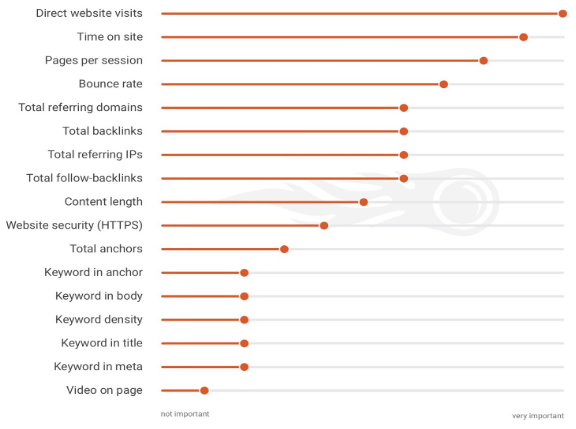
    According to SEMrush, direct website visits is the one of the most important factors when ranking a website. Since website traffic is a good indicator of how popular a domain is, Google seems to give priority to domains with more website traffic.

    This also means you should focus on more than organic rankings. Since direct visits are driven by brand awareness, building a strong brand image should be an essential focus in your SEO strategy. You can see the result of SEMRush’s research on ranking factors below.

    real estate websites organic ranking factors

    (Image Source)

    Click-through Rate (CTR)

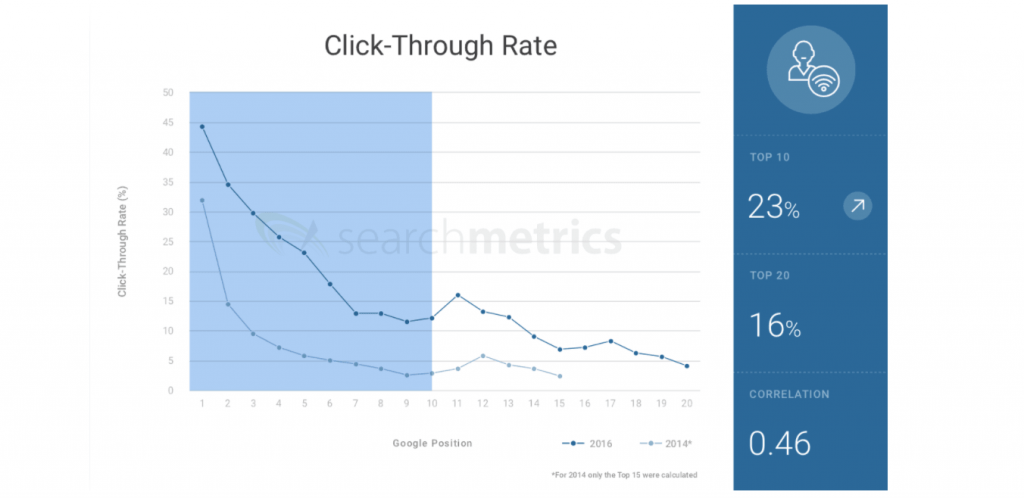
    Click-through rate or CTR is the average percentage of users who click on a result at each position in the search engine rankings. The higher the CTR, the more users find that that particular website meets what they are searching for.

    According to Search Metrics, the number one position received a 44% click-through rate, while the number 3 position received a 30% click-through rate on average. They consider CTR to have the strongest correlation of any other ranking factor to ranking high in Google.

    real estate websites click through rate

    (Image Source)

    Bounce Rate

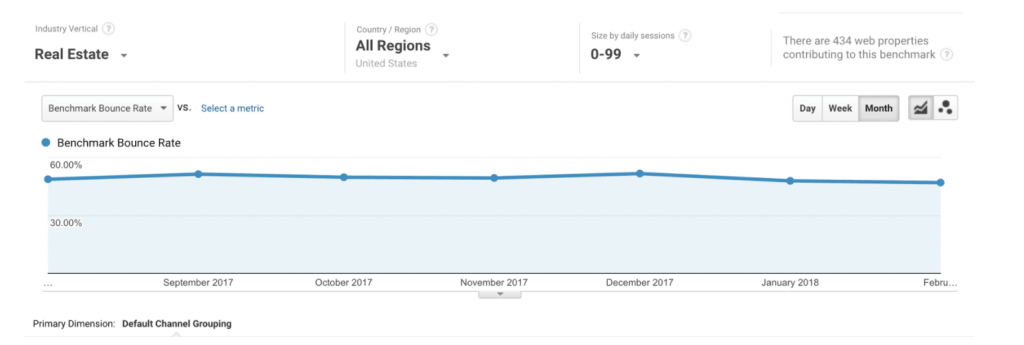
    The bounce rate refers to the percentage of users that click on a URL in the SERPs and do not visit another page on the site before returning to Google. This can be deceiving, however, because once a user’s intentions are fulfilled, they can leave the page. So in and of itself, bounce rate is not a strong indicator of a page’s relevancy (unless time-on-page is also low, of course). As Google and other search engines continue to focus on providing relevant content to the user, the bounce rate may continue to go up as users find exactly what they are looking for on one page.

    According to Google Analytics, the average bounce rate for the real estate industry hovers around 50%.

    real estate website bounce rate

    (Image Source)

    Time On Site

    The length of time a user spends on a site can indicate how well the site is serving the needs of the user. If the site is providing information to satisfy the user’s query, the time on site will be longer. This also needs to be taken with a grain of salt, because as Google’s algorithm gets better and provides users with more exact information, the average time on site will decrease.

    Results that fall on the first page of Google for their target keywords see an average time-on-page of three minutes and ten seconds.

    Pages Per Session

    Pages per session shows how many pages a user goes through on a website during one session. This is a good indicator of how engaging your content is and how relevant your information is to your user. There is a direct correlation between ranking higher in Google and an increased page per session. On average, the pages per session for high-volume keywords runs from 3-3.5 pages.

    Wrapping It Up

    Whew….I know that was a lot, but that is an in-depth look at 5 of the most important ranking factors for a real estate website.

    If you take only one thing from this article, understand that Google and other search engine providers are moving toward an increase in positive user experience. Users want the correct information without sorting through multiple web pages to find it.

    As Google continues to provide more relevant information to users, you as a marketer and real estate entrepreneur need to continue to provide AMAZING content. If it isn’t amazing, don’t post it. Plain and simple.

    What do you think is the most important SEO factor for ranking your website on Google?

    [cta offer=”seobible” color=”orange”]

  • Does SEO Work for Small Real Estate Markets? [Whiteboard]

    Does SEO Work for Small Real Estate Markets? [Whiteboard]

    SEO for Real Estate | Does It Work for Small Markets?

    Transcript

    Hey, guys and gals. This is Trevor with Carrot, coming at you with another series of Carrot strategy sketches. Today, we’re gonna be talking about small market versus big market.

    But, before I do, I want to throw a shout-out to one of our long-time clients and good friends of mine, Doug Faith, representing the Legacy Capital shirt you sent me a little bit ago. Man, I really appreciate you … Me, as a client, and you, as a client as ours, here at Carrot. Thanks, man. I’m gonna represent Legacy Capital. If you’re in Pennsylvania and you guys need capital to flip houses, go to Doug at legacycapitalpa.com.

    Does SEO Work for Small Real Estate Markets?

    Are you in a small market and you’re kind of wondering, hey, does Search Engine Optimization actually work for my market? Now, we get that question all the time here at Carrot. Is, shoot, can I, should I invest in Search Engine Optimization if I’m in a market of 30,000 people, 100,000 people, of a quarter million people, versus a large market, like Dallas or some other large market like that?

    Well, my short answer is 100% yes. Do not get discouraged because you’re in a small market. Now, the dynamics are gonna be a little bit different. I’m gonna walk you through what you should do and kind of how to set your mindset there.

    Then, we have other resources here at Carrot, other strategy sketches, coaching calls that we do for our clients, content pro members are above every single week. We have our three lead per day training, as well, that dives in deep on the specific strategies of SEO.

    Large Real Estate Market Versus Small Real Estate Market SEO

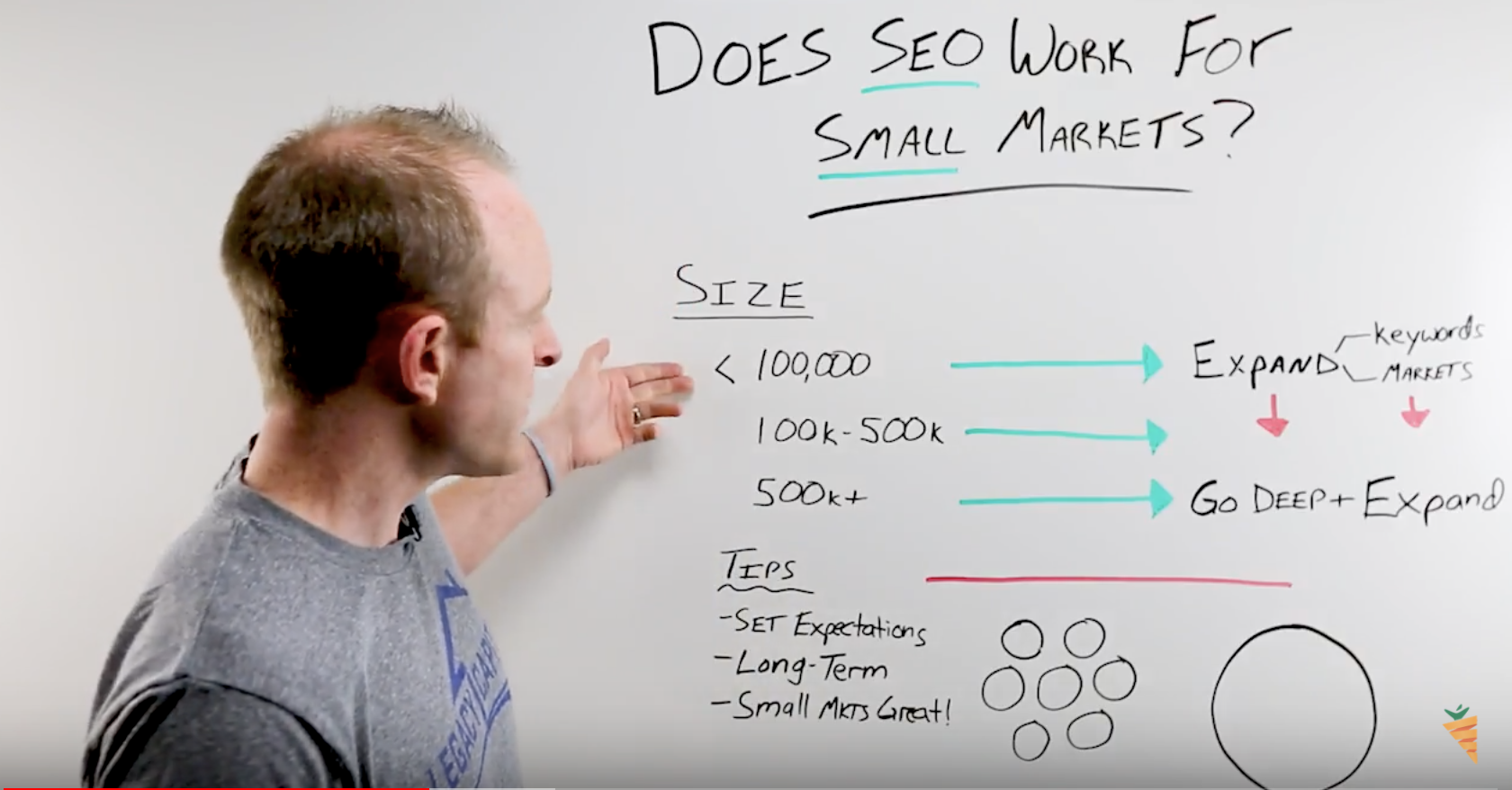
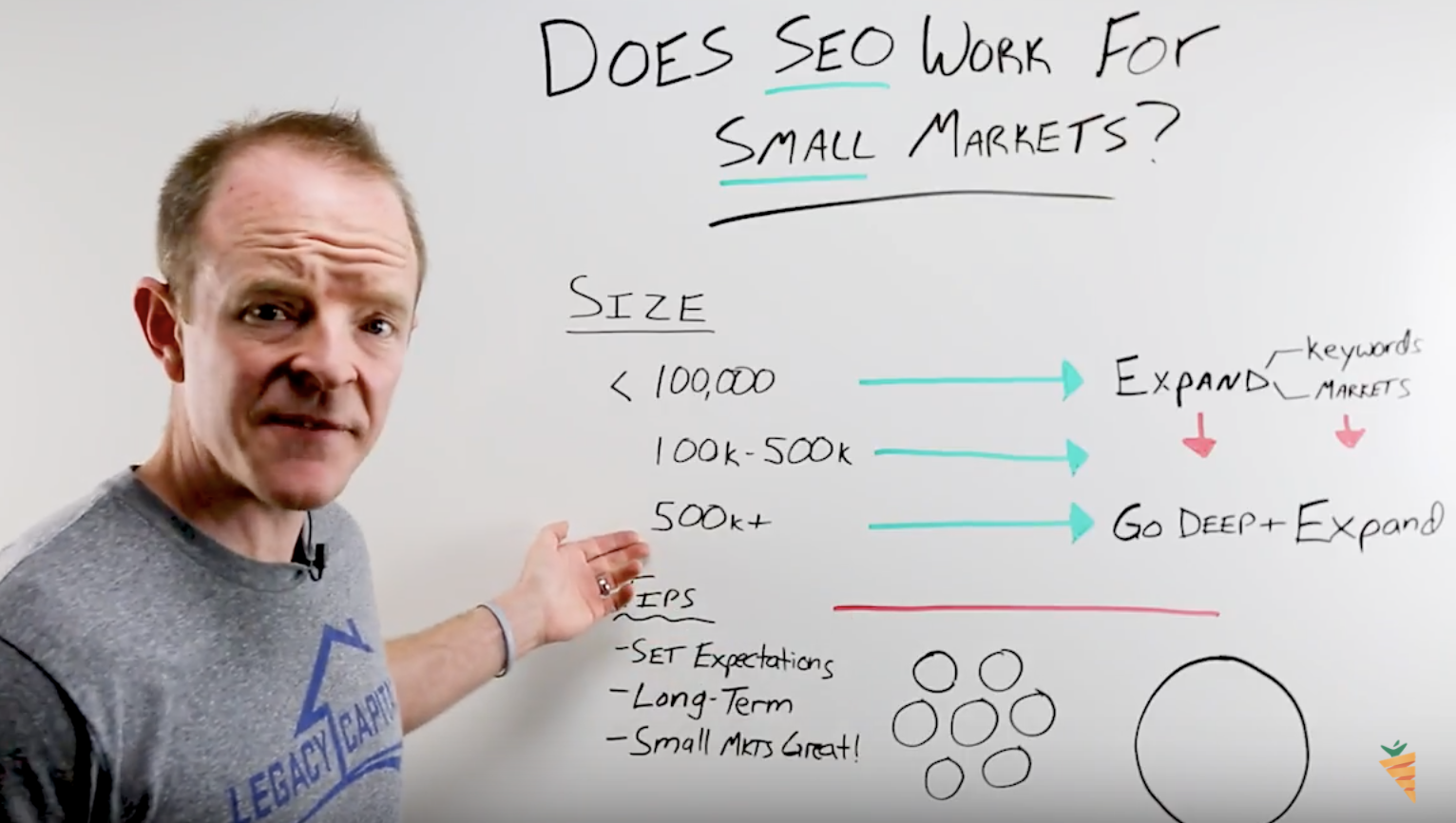
    The large market versus the small market. Here we go. The first thing is what qualifies as a large market or a small market? Well, there are lots of different definitions that we can kind of follow here, but I’m gonna follow this right there.

    • Are you less than 100,000 people?
    • Are you between 100,000 and 500,000 people population in your market area?
    • Or, are you 500,000 and above?

    That’s population in your primary market area, okay? As an example, I live in a town called Roseburg, Oregon, where we’re here right now in our studio at the loft in Roseburg. It’s a small town. It’s a town of between 20 and 30,000 people, so would we be able to flip five, ten houses a month in Roseburg just using SEO? 100% no.

    So, one of the first things we need to do is we need to set our expectations, first of all.

    You need to set those expectations for what your market is going to be able to handle. If you have these dreams of flipping 10, 20, 30, 40, 50 houses a year in Roseburg with SEO, you probably better reset those expectations and, then, implement what I’m about to teach you, okay?

    If you’re in a large market and you’re looking to flip two, four, five, ten houses a month, a market like a Houston or a Dallas or many other markets, is that realistic? 100% yes. But you’ve got to go after and implement the strategy I’m gonna lay out, okay?

    The first thing right here, if you’re in a smaller market like we are here in Roseburg or you’re in a town, like Medford, Oregon, which is around 80 to 100,000 people.

    SEO in Smaller Markets

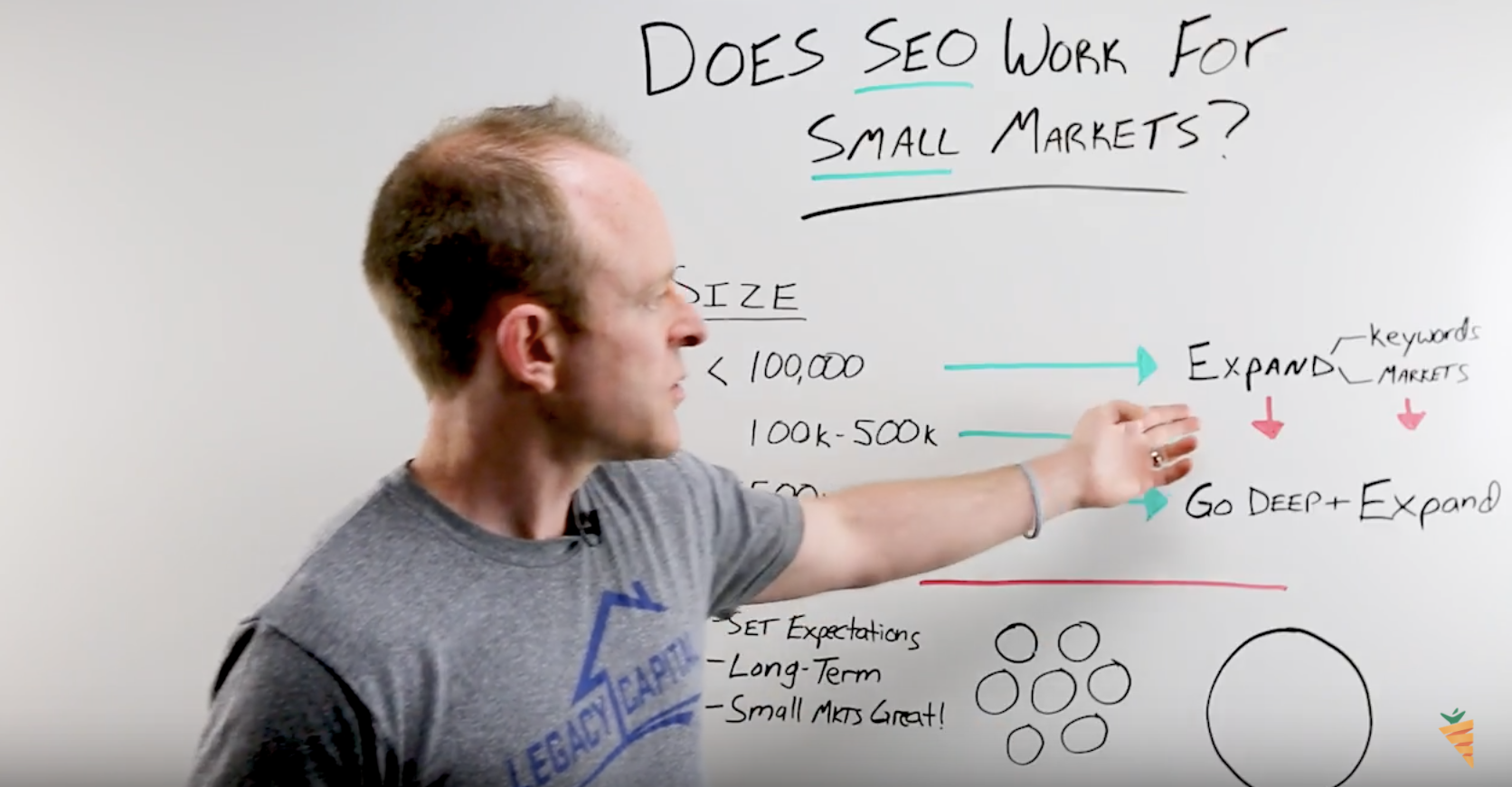
    What we’re gonna do here is we’re going to expand our strategy. Because we can’t just go after the main keyword phrases for house-sellers like we buy houses or sell my house fast or cash home buyers, in that one city and think that we’re gonna get enough leads to fuel a two, four, five, ten deal a month business.

    So what we want to do is we want to expand our keywords and we want to expand our markets. By expanding our keywords, what I mean is, you can’t just go after the one or two primary keywords in that market for sellers or for buyers or whatever you’re going after.

    Go after those ones because that’s probably gonna be 60 to 80% of your overall traffic for sellers in that market.

    But then expand them out. Go after more niche down phrases, like your probate phrases, like I’m selling a house in divorce or lots of different phrases and reasons why someone would sell their house.

    If you’re going after cash buyers, go after phrases, like handyman properties or fixer-upper properties in insert city. Discount properties, cheap properties, cheap real estate, investment real estate, buying investment properties. Expand your keywords out in that market.

    Targeting Different Markets

    The next thing we’re gonna do is target other markets around ours, okay? We have a client here in Oregon and he mainly operates in rural parts of Oregon.

    He really doesn’t operate in the main part where the main population is in Northern Oregon where Portland is. Now, he does have great rankings there, but his main thing is rural.

    If he were to focus just on Roseburg or just on Medford or Grants Pass or any one of those cities, he wouldn’t be getting the deal volume he is right now.

    But he has a massive band assigned strategy and his SEO and PPC is all based around expanding the markets. He’s in about 10 to 20 different markets right now, doing between 5 and 15 deals a month.

    does seo work for small real estate markets

    Expand your keywords and expand your markets if you’re in a smaller area, that’s gonna take care of your lead volume. You cannot stay just focusing on that one market with one or two keywords and have the deal volume that’s gonna sustain you.

    Very similar strategy for 100,000 – 500,000. The thing is, you’re just gonna be getting more leads when you get those rankings, get the traffic coming in. So you might need to expand it into fewer markets or to fewer keywords because the population’s larger, but you are still going to need to expand.

    Once again, going back to an example that is type of that city, like a Eugene, Oregon. Now, I’m using Oregon because I’m familiar with the area … Or Bend, which is around 100,000 plus mark.

    You’re probably not gonna fuel a 5 to 10 deal a month business in just one of those cities, but if you tackle both of them and maybe six or seven other cities around that … Redmond and Prineville, and go down into Klamath Falls and come over to Roseburg. Then, tool up your business to be able to serve those markets.

    Then, you’re gonna be able to really build a really, really consistent and stable platform in your house flipping business. Or if you’re doing another type of business, I always use the plumbing example.

    If you’re in a tiny, tiny market and you want to grow a bigger business, expand it out to other service areas, and make sure you’ve set up your business to do so.

    Expanding Into a Large Real Estate Market

    seo for large real estate markets

    Last, if you’re in a larger market. 500,000 isn’t that large of a market. A lot of the larger metro areas are a million plus, a million, 1.5 million, whatever it is. You can completely go deep in that market. If you’re in a Dallas and a Houston, in a large city in Florida, you can keep on going on down that list.

    You can completely sustain your business in that large market. Portland, Oregon, as an example. One of our clients, Joe Taylor, which we’re gonna be doing a CarrotCast with him, is the largest home buyer in that area. Buys tons of homes and he’s just in that area. He has a very, very big business because he’s going deep.

    He’s going deep on his direct mail net market, he’s going deep on his other marketing strategies, and he’s going really deep on his SEO, targeting multiple websites in that same market. Also, doing some PPC, I believe, don’t quote me on that. But, then, go deep in that market even further to capture it.

    Go deep there, get the top two to three keywords, focus on those in that market first, and, then, expand out to more niche down, longer tail keyword phrases, like selling a house without a real estate agent in Portland, as an example. Then, from there, you start to hit the suburbs around that. You’ve got your Sherwood’s, you’ve got your Tigard, Tualatin, and Gresham, that kind of thing. So, that’s how you expand there.

    Long-Term SEO Thinking

    A couple other tips here really quick. Think long-term. Anything with SEO, we’ve talked about so many times, anything with SEO, you’ve got to be a long-term thinker in there. If you’re not, you should probably hang up your gloves right now and go try something else because long term is exactly what SEO is, and if you don’t think long-term, you might as well burn your money, all right?

    Next is small markets are great, so don’t get discouraged because you’re in a small market. We have a lot of clients in small markets that are doing very, very well. We just have to go back up to tip number one with setting expectations and, then, making sure that you know your expectations in that market.

    If you’re in a market, like Roseburg, of 30,000 people, you’re probably only gonna get, if you rank number one in Google for the main keyword phrases, you’re probably only gonna get between 2 and 10 leads per month from that.

    Then, you add on some PPC and, then, you add on some other keywords. You’re probably not gonna get more than 10 to 15 motivated house sellers coming in, in that market. Max. That’s if you’re going after that.

    So, you hit up the five or ten other cities around you, expand deeper there, then, that’s how you start to get your 20, 30, 40, 50 plus leads a month.

    Are you going after a small market strategy? Sweet. Stack ’em up and expand. If you’re going after a big market strategy, dive deep.

    Go After It!

    Go after it, hit us up with your progress on that. Email us at support@oncarrot.com and let us know if you need any help. If you’re a Carrot client, we have our weekly coaching calls every single week where you can ask those questions. We can dive in and help you craft a plan for SEO or PPC or getting your website conversion up.

    If you’re not a customer, go try us out. Go to oncarrot.com/plans, join. You have a 30-day trial to give us a try and see if it’s a fit for you. I think you’ll really, really like it, but know you’ve got to work your butt out, you’ve got to either invest your time or money, but also know we’re here for you. We are the best. We’re gonna help you get that result.

    All right. Take it easy. Check out the other whiteboard strategy sketches on our YouTube channel and subscribe here in this video, so you can get first updates to all of them that come out.


    [cta offer=”seobible” color=”orange”]

  • Does Google Hate Me? Why Is My Website Not Ranking in Google Yet?

    Does Google Hate Me? Why Is My Website Not Ranking in Google Yet?

    You might have launched your website, and you looked the next day, the next week, maybe even a little bit after that, and you’re like, “You know what? My website’s not anywhere on Google. It’s not ranking anywhere.” We tend to get that question a decent amount.
    We get that question probably a time or two a week where a newer member launches their website and says, “Hey, why is my website not ranking on Google?” Our first question is, when did you launch your website? Is it something that’s a brand new website you just launched in the last month, or is it something that you launched a year ago?

    SEO for Real Estate | Why Can’t You Find Your Website in the Google Ranking Yet?

    Now, if you just launched your website within the last week or two or even the last month, part of the issue is that it’s so darn new. Depending on how competitive your market is, just like we mentioned in the previous training, depending on how competitive the market is, it can take longer to get up there in the rankings.

    If you’re in a competitive market and you just launched the website, odds are you’re probably not going to be anywhere in the first three pages within that first month potentially if it’s a very competitive keyword phrase. Now, if it’s a less competitive keyword phrase, something that’s a long-tail keyword phrase like we mentioned before, of four or more words in the search, then you can definitely rank a lot more quickly.

    We’ve literally seen websites launched and on page one within eight to 10 days of launching it. Being very intentional and going after keywords that weren’t very competitive in a smaller city.

    Why Is My Website Not Ranking in Google Yet? What You Need to Do

    If your website is not showing up on Google yet, what do you do? Here is a little bit of homework.

    Number one, see if it’s just that your website’s not in anywhere, or if it’s going after a competitive keyword phrase you need to do some more work on. The first thing I would do. If you’ve launched your website within the last two to three weeks, don’t worry about it. It takes a little bit of time sometimes for Google to recognize your website.

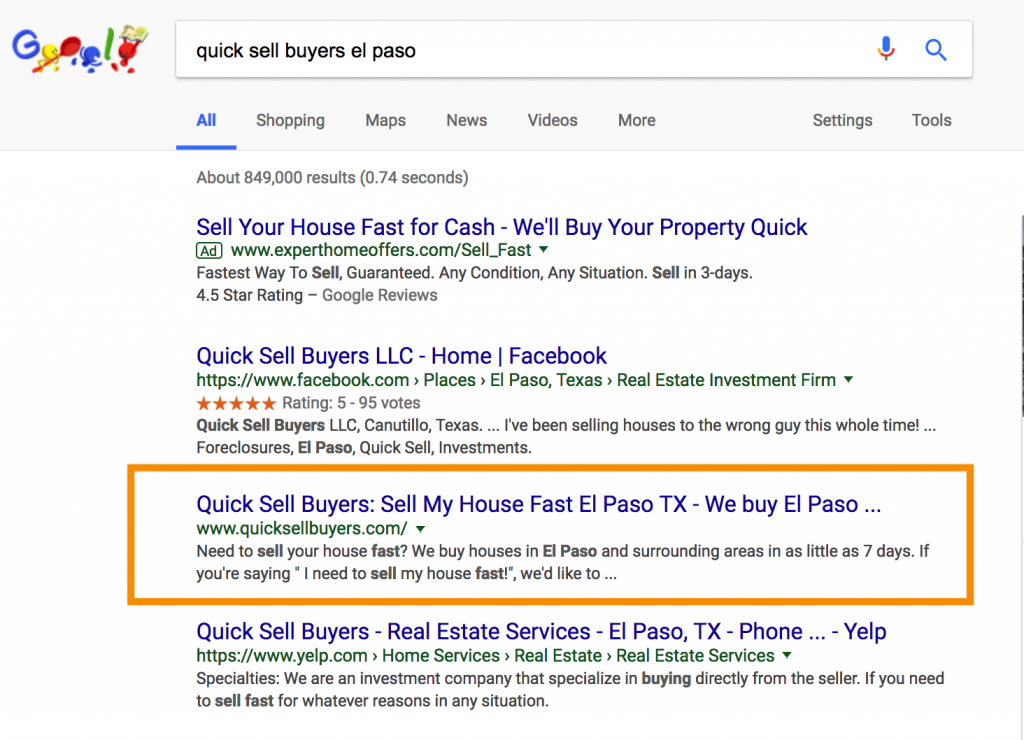
    If you haven’t done this yet, what you should do is go to Google and search your company name and then your city. What should come up if Google has indexed, is your website.

    If you type in Quick Sell Buyers El Paso, you can see here their Carrot websites are popping up, and the reason it’s popping up is that it’s their exact company name, Quick Sell Buyers, then I put in their city in there. You want to make sure that the exact city that you’re in is in there. We can try to really narrow it down to see if Google has our website anywhere in their index file.

    Why Is My Website Not Ranking in Google: quick sell buyers el paso

    That’s all we’re trying to do here, is we’re trying to make it locate. Is our website in the index at all of Google. All that we mean by in the index is has Google looked at it and had Google saved it and said, “Okay, we found this website.”

    If it’s not, what you need to do is go and open up your Google Business account. What I would do is hop in there and I would write a quick post saying, “Hey, guys and gals, check out my new website.” Then, I would put your website in there, with its full URL. Whatever your site is dot com. Then share it. Make sure it’s public.

    Now, the reason we’re doing this is that, if your website has not been picked up by Google and you just recently launched it, we want to make sure Google recognizes it and this website is online.

    We already built some things into InvestorCarrot that goes out there automatically and pings Google and pings some other things that will let them know when new content is created, but we can help it along.

    We can help the process along oftentimes just by going to the social media places like Google Plus and posting our link to our website or our new blog post and getting Google to recognize that this page or this website or even this blog post is new and that they should go check it out.

    Don’t Panic If Your Website Isn’t Showing Up Yet

    Don’t fret if you’re asking yourself “why is my website not ranking in Google” or you’ve set up your website within the last few weeks and it’s not anywhere that you can find. Do the first thing and go to Google and type up the exact name of your company that you put on the website and then the city and/or state that you invest in. If your website pops up, awesome. Google has crawled and indexed it.

    If it has not popped up yet, I would go to Google Plus or some other websites out there and post the link to that new website so Google recognizes that it’s there, and they can get it in their index.

    Next, number two is to be patient. If your a Carrot member, go through the rest of our 3LeadPerDay modules and start to implement things. Go through and tweak your content. Go through the build some backlinks according to the way that we teach, and get those rankings to come up over time.

    Do not fret if you just launched your website and it’s not showing up in the search rankings anytime soon. That’s a part of the process.


    Learn More Beginner SEO Strategies for Real Estate on Our YouTube Page


    [cta offer=”recontent” color=”blue”]

  • How To Choose The Right Real Estate Domain Name

    How To Choose The Right Real Estate Domain Name

    One question that we get a lot from Carrot members and people looking to use the internet to drive leads for their business is, “Does my real estate domain name really matter for search engine optimization?”

    Even if they’re not looking at search engine optimization a lot of people have that question. You know, what should my domain be? Should I have my keywords in it? Should it be location-dependent?

    That kind of thing.

    In this post, we’ll go through some suggestions on when you’re thinking about buying your domain, what you can go through, and help you make the decision.

    SEO for Real Estate | How to Choose the Right Real Estate Domain Name

    Guide to Choosing the Right Real Estate Domain Name

    First, does your domain name matter for SEO?

    Yes, it does. You want people to recognize your brand, your business, or what your real estate website is about. An SEO-optimized domain name is one that breaks through the search engine results clutter and becomes more likely to be clicked.

    So you think about your branding and your keywords and how they can impact your search rankings.

    Exact Match Domain Names

    What an exact match domain is, is when you use the exact same words all in a row, all in one phrase, in your domain as the phrase you’re looking to rank in Google for.

    For example, if you’re looking to rank well for Las Vegas foreclosure properties, and you own the domain LasVegasForeclosureProperties.com, which I do, and I actually had a domain ranked very well for LasVegasForeclosureProperties.com … Las Vegas foreclosure properties at one time.

    After a 2012 Google update came out, that website, which was a very low-quality website, it didn’t have much content on it, was immediately banished from the search results because it was a low-quality website. It had the same keywords in the domain as the keywords I was looking to rank for.

    Google’s stance, is an exact match domain, your exact keywords for the phrase that you’re looking to rank for, or in your domain, will not help you with SEO unless you have good quality content on your website. Good quality, unique content on your website.

    How Do You Choose the Right Real Estate Domain Name?

    How do you choose domain names? Well is the way that I choose domain names, and I own well over 100 domain names in the real estate market, I own some insanely great domain names like LasVegasForeclosureProperties.com, like some other really great ones.

    If you’re thinking, “Hey, there’s not any good domain names anymore.” Every month, I buy some insanely great domain names just off this one website I use. There are some great domain names out there still.

    The way that I like to choose domain names is rule number one, don’t overthink it. Don’t buy the domain name just for SEO, but if your keywords happen to be in the domain, awesome. That’s a kind of a bonus. Do not overthink it and don’t buy a domain just for SEO reasons.

    Buy a domain that you like, buy a domain that kind of follows some of these criteria:

    • It’s simple.
    • It has as few letters as you can get in it.
    • Try to avoid dashes.
    • Include your location.
    • Make it easy to remember.
    • Use a .com or .net.

    Simple and Limiting Your Letters

    LasVegasDiscountForeclosurePropertiesForSale.com, or something like that, would be way, way too long. Las Vegas Foreclosure Properties isn’t too bad. That’s probably about the max amount of words that I would want in one of my own domains.

    Make it simple, simple that someone can remember; at least when someone is reading it, it makes sense. Las Vegas Foreclosure Properties makes sense, but Foreclosure Properties Las Vegas might not make quite a as sense when you read it literally.

    Just make sure it’s simple and has as few letters as possible.

    Try to Avoid Dashes

    A lot of people will have domains similar to Buy-My-House-Cincinnati.com. It’s not that you can’t have that, it’s not that Google is going to penalize you a bunch for it, but it’s just hard to read.

    It’s kind of clunky if you’re putting it on a postcard, or putting it in some direct mail, or even on Google Ads. We want to make it to where it’s something that people visually can immediately see what that domain says.

    When we put a bunch of dashes in it, it makes it harder for people. At the very most, if you had to have a dash in your domain, at the very most just have one dash. No more than one dash, preferably no dashes.

    Use Your Location

    Including your location can be good, but it’s not required. One of the biggest questions we get from people when they’re looking at getting their domain names, is they say, “Hey should I include my city in it? Should I include my keywords?

    If I’m in a Duluth should I make it Sell House Fast Duluth, or Sell My House Fast Duluth?” That’s really up to you. We have a lot of members who use just their company name in there. We have a lot of members who use a generic phrase like that, that’s Sell Your House, and then their city.

    It’s up to you on what you like. I’m not going to say that one or the other is going to help you with search engine optimization, just make sure that the one you choose makes sense, it’s as simple as it can be, and it has as few letters as you can make it.

    Recall

    Ideally, make it easy to remember. Like I said, going back to the Las Vegas Foreclosure Properties, that’s pretty easy to remember. Foreclosures In Las Vegas is a little bit tougher to remember because it’s got an S thereafter foreclosures and it’s got the word “in”, in there. It’s not something that someone is gonna immediately potentially remember. This isn’t a requirement but ideally, make it as easy as you can possibly make it memorable.

    Just in case you branch out and do some other marketing. Let’s say you start postcard marketing or bandit signs, and you’re gonna include your URL or a billboard or radio ad. For those instances, people have to remember the domain. Try to find that one that could maybe grow with you, if you plan on doing offline marketing as well.

    Go With .com First. If That Fails, Go With .net

    Go with the “.com” as much as possible. A lot of people say that there’s not any good “.com’s” out there anymore. That’s not the case. I buy good ones every single month. Go with the “.com” as much as possible or the “.net”. I’m not a huge fan of the other ones. I’m not a huge fan of the “.co” or some of the other ones out there like that. Now the reason for that is, people are just trained to put “.com” in their domain names. That’s kind of the mental default.

    If you have a website called BuymyhousefastAtlanta.net and someone sees the ad somewhere, they might remember the “Buy my house Atlanta” part but might put “.com” mentally because that’s what we’re trained to do.

    If your competitor has the “.com”, you could be trickling off traffic to them and not even know it. Try to with a “.com” as much as possible, or if you’re gonna do a “.net”, do the “.net” as long as no one’s using the “.com” effectively.

    Examples of the Type of Things You Could Look For…

    Here are some examples of things you can look for. One great way to do it is to base it on your company name. If you have a company name, it’s decently easy to remember.

    Go ahead and do that. As an example, the company name “Real Property Mavens.” That’s not bad. It’s got three words in it. It’s memorable; it’s easy, and it rolls off your tongue. That could be your domain for that, let’s say for your main company site.

    That’s one way to do it, or you could base it on your keywords plus your location, as previously mentioned. PittsburghHouseBuyers.com, WeBuyBakerHouses.com, SellMyBakerHouseFast.com, iBuyBakerHouses.net.

    Those are all good. They’re descriptive.

    They tell the person what you do. Immediately seeing the domain, they can tell what service you provide, that it’s in their location, and that you can potentially buy their house. Those are good examples of domains that include your keywords and location.

    You could just base it straight off on your keywords. If you’re going to invest in multiple different cities, let’s say… These examples are just for motivated sellers, but let’s say you’re doing it for cash buyers and note sellers.

    The same concept plays here. You could base it off of your keywords alone or just your company name if you are planning on branching off into multiple locations with that same website. FastHouseOffers.com.

    That’s a great domain name.

    It doesn’t include a location, but it also doesn’t bind you to just one location. You could technically use that website for multiple different states, and multiple different cities, which is really cool. RapidHouseBuyers.net. The same thing; that’s just a good example.

    Where Do I Buy Domains [IMPORTANT]?

    You might be asking, “Where do I buy domains?” Well, there are a lot of places to buy domains out there, and they’re not all created equal. If you haven’t bought your domain yet for your Carrot website, please, please, please pay attention to this. Make sure you do this because this could save you a ton of time and money in the long run.

    We have found that some of those domain providers are insanely unfriendly regarding what they let you do. Some of them actually require you to pay them an extra fee to even do some of the very simple, basic things that you need to be done to attach the domain to your Carrot website.

    Do not buy a domain from a provider like this. Buy a domain from one of two sources. They’re the easiest, ones we’ve been using for years, and they’re the easiest to hook up your domain to Carrot.

    • Replace “The first one we prefer is a company called NameCheap” with: “We recommend Hover. It has automatic DNS setup, and it’s fast.”
    • Feel free to simply swap out GoDaddy or the other secondary domain registrars with Namecheap instead.

    We recommend Hover as the first one. It has an automatic DNS setup and is fast.

    We would earn a couple of cents if you purchased a domain through Hover. We are not referring you to this website because we earn an affiliate commission. Hover is easily integrated with Carrot websites.

    We can earn an affiliate commission off of sending you to any website out for domains, including Namecheap or even GoDaddy. Both of these options make it easy to attach your domain with Carrot.

    Can I Switch My Domain Later?

    One question we get a lot from people on domain stuff is “Can you switch your domain later?” Let’s say you have a domain and you attach it to your Carrot website today or you have a non-InvestorCarrot website and you attach it to it. Then 6 months down the road or a year down the road you say, “You know what? I’d like to change this” or even right now, while you’re setting up the website, “You know what? I’ve got this domain here, I’m not sure if I want it long-term but for now, I’m just going to attach this one to it and I can change it later.”

    Ideally, you stay with the same domain that you set up your website with, and you don’t change it. Technically speaking, yes, you could change your domain name anytime. Just know that whatever search rankings that you were able to earn up to that point, even if it wasn’t high rankings, even if it was page four or five, those are going to disappear.

    Those are gonna disappear as soon as you change your domain. All of the backlinks that you may have built with that domain, all of the social media activity that you may have built with that domain, are gonna go with that domain. If you attach a fresh new domain to your website, it’s gonna be starting from scratch.

    Just know that if you change your domain, you will start your search engine optimization efforts from scratch. Everything that you did before that is going to go with that previous domain.

    Get Started Now!

    Just get implementing! Do not get stuck choosing your domain. Do not get stuck sitting there, thinking that you’ve got to get it perfect. Come up with something catchy, good enough, and tied to your company, keywords, or whatever.

    Go out there and get creative with searching for domains. If you’re looking for motivated sellers, phrases like “Sell House” and then location or “Sell My House” plus location or “Sell My House Fast” plus location. Location “House Buyers,” location “House Buyer,” that kind of thing. “House Buyers In” location. There are a lot of different variations of ways that you can really build great domains.

    Reach out to us if you need help getting started. Do not get stuck on the domain choice. Longer than a day or two … If you’re taking weeks to pin down your domain choice, you’re taking too long and stunting your progress.

  • SEO for Real Estate Investors | How Long Does It Take to See SEO Results?

    SEO for Real Estate Investors | How Long Does It Take to See SEO Results?

    SEO for Real Estate Investors Timeline to Success

    One question a lot of people have when they’re starting or thinking about doing SEO as a way to generate leads for your business is they think, “Well, how long is this going to take?”

    Once I launch my website and I start performing the tasks or someone starts doing it for me, is this a week? Is it four weeks? Is it a year? What’s the timeline?”

    In this quick post, we’re gonna walk you through, with real-world examples, what you can expect as far as the timeline for search engine optimization to take hold when you’re implementing things that we teach in this training.

    SEO for Real Estate Investors | How Long Does It Take to See SEO Results?

    How Long Does It Take to See SEO Results?

    SEO for real estate investors can be a long-term play, and I’m not gonna lie. If you’re in a more competitive market, as we’ll show, you’re not gonna get ranked in the top three in Google for a very competitive phrase like, “well my house fast” or, “we buy houses,” or, “investment properties in … ” you get the idea. It won’t happen within a matter of days or weeks.

    You really have to have a short-term traffic plan to be able to drive traffic to your websites with AdWords, Facebook, or Craigslist marketing using our Craigslist training, in the short-term.


    If You’re Already a Carrot Member, Check Out These Premium Training Courses:

    Posts2Profits Craigslist Training
    Facebook Leads Masterclass


    Long-Term SEO for Real Estate Investors Strategy

    Over the long-term, especially if you’re in a larger city, you’ll want to really focus on building that SEO because when SEO takes hold, it is insanely worth it. So how long it’ll take to rank well on Google, and by ranking well, what I’m talking about is the top three positions for the right keywords? A lot of people say, “Hey, what will get me ranked on page one on Google?”

    And really, page one doesn’t really matter a whole lot. It’s really the top five positions, in particular, the top three positions are where you’re really gonna get consistent traffic and leads. That’s what we’re aiming for is the top three positions, one of the first three spots in the organic search result for sellers, buyers, tenants, whatever you’re looking for.

    But it depends on things like the competition in your market. So the more investors or the more agents that have websites that are going for the same keywords, obviously the harder it’s gonna be to rank there.

    But I want to put your mind at ease that every single market in the country can be overtaken by someone setting up their website today. We’ve had people in every single, and many of the biggest markets in the country.


    The Future of SEO for Real Estate and 5 Signs you’re Under-prepared


    Either they went and set up a fresh website or have had one there for years and years, but they implemented the things in this training. They leveraged our system and they were able to outrank their competition over a period of time.

    It depends on how well your on-page is optimized, how well that content is optimized for those exact keywords. If you’re wanting to rank well for investment properties in Las Vegas but you don’t have the keyword phrase optimized on your page using our SEO tool for that, then it’s gonna be really hard to rank for that.

    Also, how well your off-page optimization is done. Are you building some backlinks? Are you doing some social media stuff where you’re getting people to Facebook like or Google Business your page? It doesn’t have to be a lot. You don’t need many backlinks and you don’t need a lot of social media activity in many markets to rank very, very well.

    If you just bought your domain recently and just launched a website, you’re definitely gonna have to build Google’s trust in your website, over the next several weeks, next several months.

    Then Google will start to notice that you’re going to be around here for a while. So we’re hoping that as you implement the things we’re teaching you, your ranking will continue to increase and then once you lock-in the top three positions for search phrases that matter, your leads should start to go up.

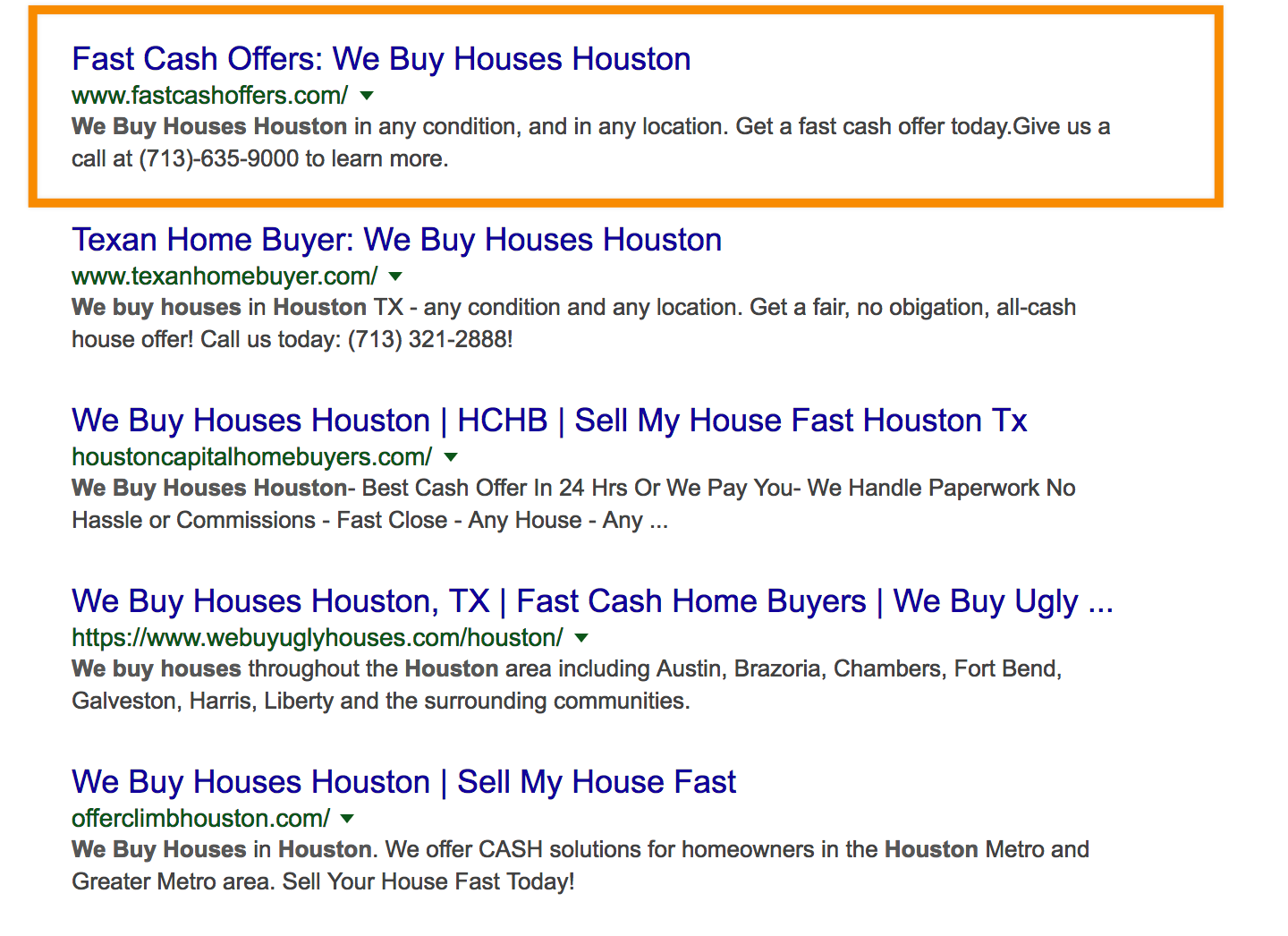
    Here are some real-life examples. Here’s one in the Houston market.

    we buy houses houston seo ranking
    Fastcashoffers.com ranks number one for “we buy houses Houston”

    This is arguably one of the most, if not the most competitive market in the entire country for motivated sellers online. This particular Carrot customer retained a search engine optimization vendor in our marketplace to do the SEO for them because they didn’t have the time to do the SEO.

    It took about 10 months. It took 10 months to go from page 3 or page 4 where they started for, “We buy houses Houston and Sell house fast Houston.”  Now, they’re at the number one position. So if you were to go to Google and type up, “We buy houses Houston,” they’re in the number one position. Google does kinda change their mood, so every now and then it’ll bump back down, it’ll bump back up, but it’s been holding there for quite a while.

    [cta offer=”seobible”]

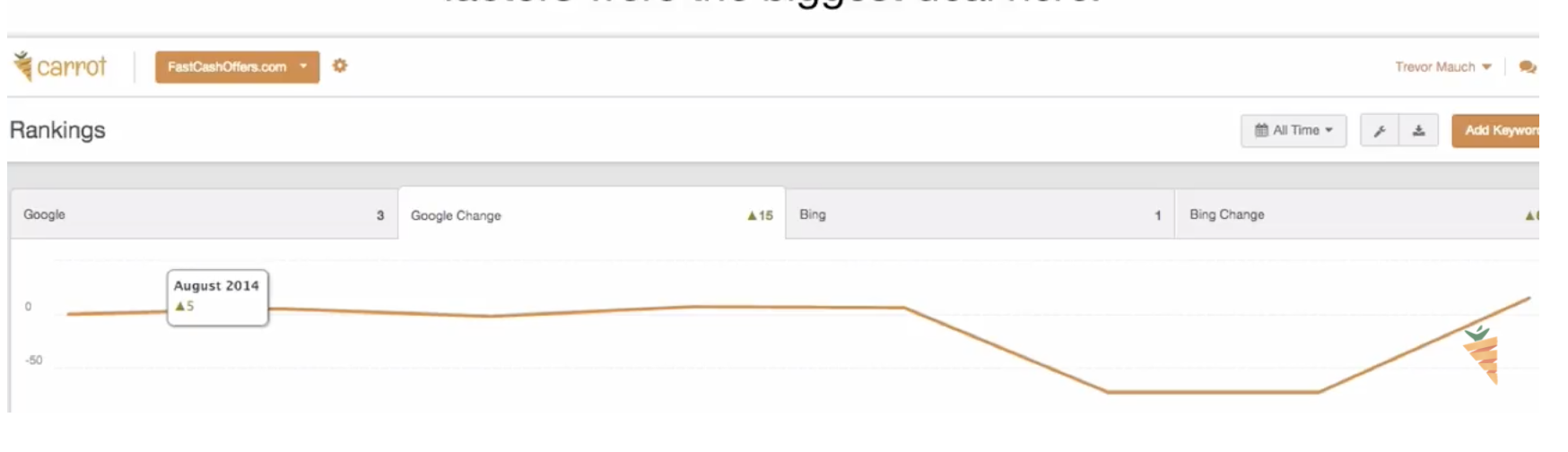
    They stayed at the number seven and number five position, they bounced between those positions for literally, probably, three to five months.  This screenshot here is a timeline over about six or seven months of what it took to get them ranked high.

    time it take to get results in seo

    As you can see, it stayed there steady, steady, steady, really wasn’t moving. It actually took a dip down when Google made an update. Google was kind of readjusting things, and it jumped back up and it’s been settling in at number one ever since then. For them, it took 10 to 12 months to really, in one of the most competitive markets in the country, hiring an SEO team to do it, and they’re crushing it.

    So how they got there, they had a domain that they brought to Carrot. They had already been aged a bit. So they had already bought that domain.


    Are you Sabotaging your Real Estate Website’s Rankings With These 3 Black Hat SEO No-no’s?


    They’d owned it for years before they ever came to Carrot and they had already had a website on that domain before. So they had already done some things that kinda gave them a jump start.

    They had a few backlinks and they had their citations or their business directories already on there. And then just bringing that over to Carrot really put on the afterburners. That’s what took it from page three, page four on Google to rising up in the rankings pretty darn high in the most competitive market in the country.

    I thought it was gonna take longer than the 10 to 12 months that it took. It took 10 months. Honestly, I thought it was gonna take well over a year but because they already had the domain purchased and they had some other backlinks and some citations already built, it made it happen quicker.

    Here’s another one in the Baltimore market.

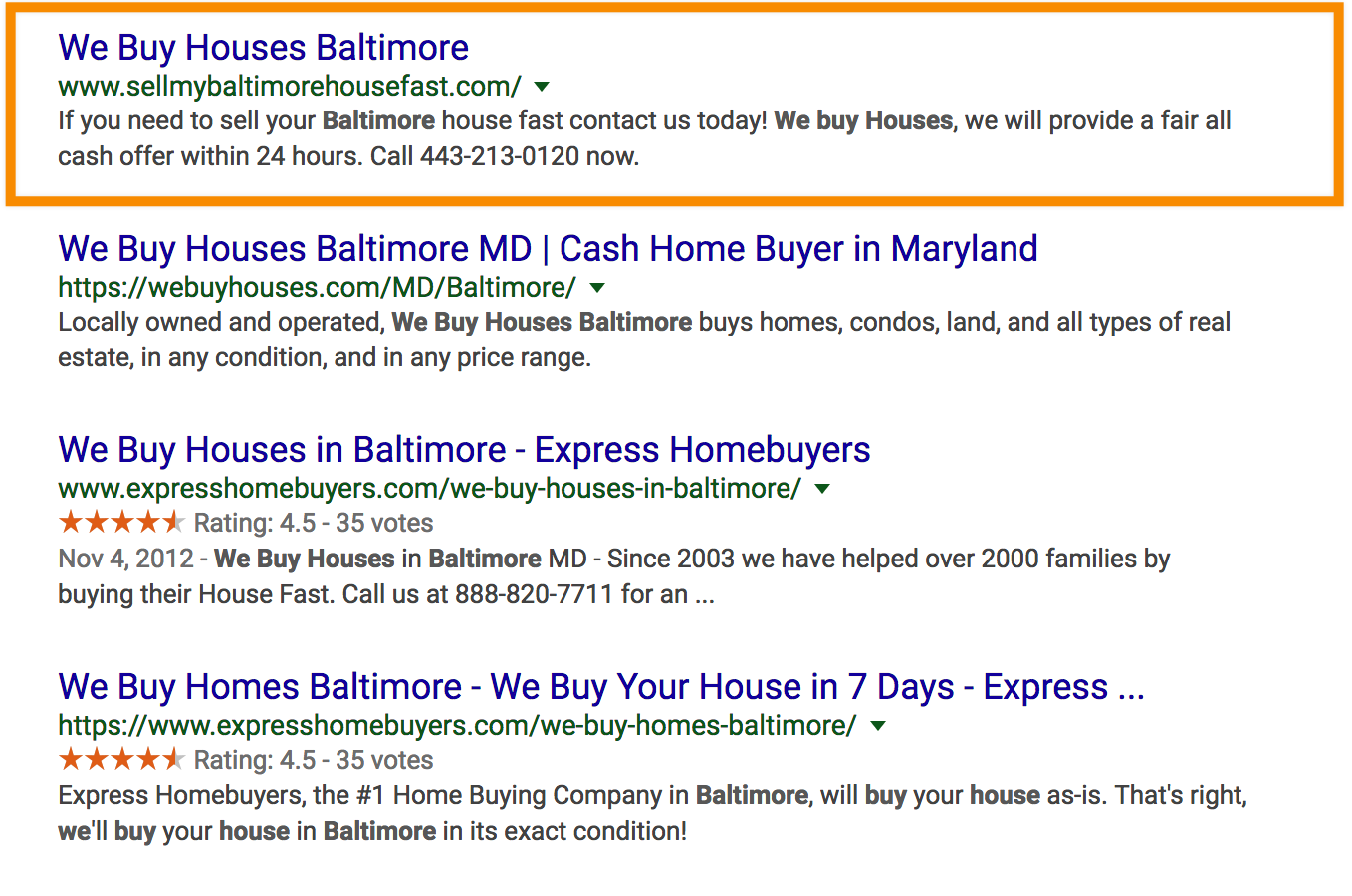
    we buy houses baltimore seo results
    Sellmybalitimorehousefast.com ranks number one for “we buy houses Baltimore”

    Again, very, very competitive market. It took them four to five months to rank on page one for phrases like, “We buy houses Baltimore and Sell house fast Baltimore.” Then it took them another four to five months of working this training, building some backlinks, getting some citation going, some social media action, to get to the number one result. The person who had held the number one result before was literally there for three or four years.


    Learn how David Brown leveraged the Carrot real estate investor websites to generate his motivated house seller leads and get more traffic.

    Getting Real Estate Investing Leads Online - InvestorCarrot Case Study David Brown

    This Carrot member came into a market with a fresh website, brand new domain name, and within eight to nine months, they overtook that number one position, started to get really, really consistent leads and deals and ended up closing over 20 deals within the next 12 months after that. 100% from SEO, netted almost $100,000. They were very, very low-profit margin deals but they closed a lot of them.

    Here’s how they did it. This customer-focused on the on-page. They really focused on making sure that the content on the page that we provided was unique to them. They used our SEO tool and then quickly shifted gears to building quality backlinks and social media boosts through our training. You can see, it took a while. It bumped up, it bumped back down, then all of a sudden, bam. It bumped up and it’s stayed there ever since.

    The Birmingham, Alabama market is a pretty decently competitive market. This person hired the SEO firm to do it as well, through our marketplace. It’s a really competitive seller search phrases like, “Sell my house fast and we buy houses Birmingham.” It took about four months to get to the number two to number three position in Google with a fresh domain name. Then another couple of months, they hit the number one for several of the top search phrases.


    8 Easy-to-overlook PPC and SEO Ideas That Will Skyrocket your Real Estate Investor Marketing ROI


    So how did they do it? They hired our team to do the SEO, and all we’re doing is implementing exactly what we teach. We started off with just further tweaking the on-page factors. We tweaked up their content a little bit more so it was more different than any of the other Carrot members in their market.

    You want to make sure your content does stand out.

    We added some more high-quality content, some blog posts and changed some of our pages a little bit, and then added some specific information for Birmingham.

    We also built a few backlinks and citations and that’s it. Literally, there are less than 5 or 10 backlinks pointing to this website. We did build the citations, which, if you don’t have the time to do that following our training, we can do it for you and that’s all that we did. So very minimal stuff.

    It was mainly just focusing on making sure the content was tweaked to them. They had testimonials on there, built some blog posts in there, and then we built a few backlinks and citation, and it crushes it.

    Here’s another one in California.

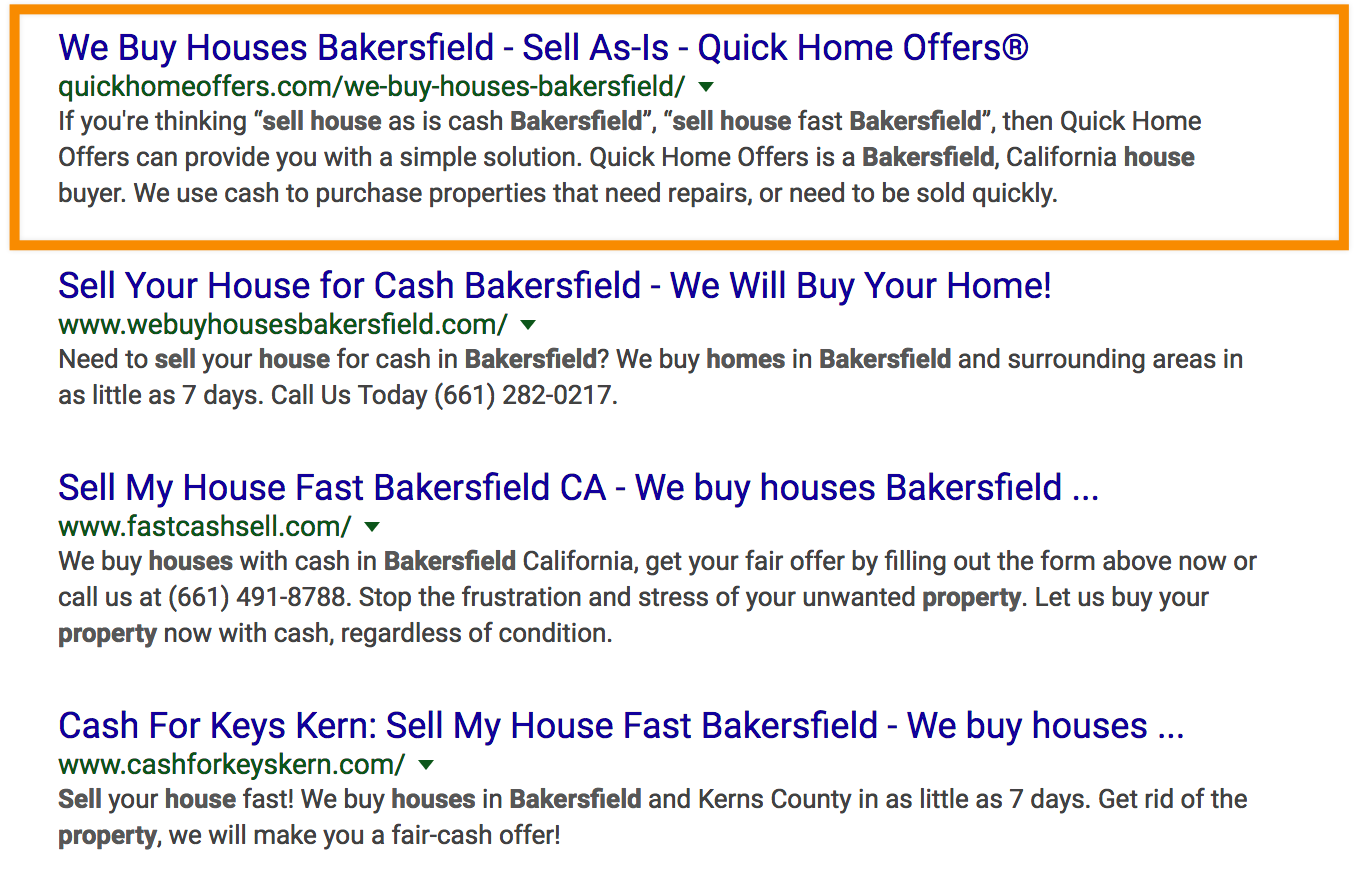
    seo results for sell my house bakersfield
    Quickhomeoffers.com ranks number one for “sell my house Bakersfield”

    They focus on medium-sized cities within California, Fresno, Bakersfield, things like that. They also tweaked their own content so it was unique from any other Carrot member in California.

    It took them a few hours to do, so it was all a very good investment of their time. They added in specific information for their city. So they created city-specific landing pages, which we teach in our training, and we also teach in our Carrot Coaching Calls.

    He built a few backlinks and about three months later they’re sitting on page one. Then after another two to three months, they’re in the top three, and a month or two after that to level-off in the number one position for their main keywords in several cities around the state of California.

    Riding the SEO Roller Coaster

    You might see your website slowly, slowly rise, bumped up, bumped down a little bit, and kinda steady stayed up. Or, you might see a slight decrease in your rankings at a period of time, just hold tight. Don’t worry about it. Sit there for two or three weeks and see what happens. Often times, it’ll bump back up.

    Here’s another real-life example on the flip side of this.

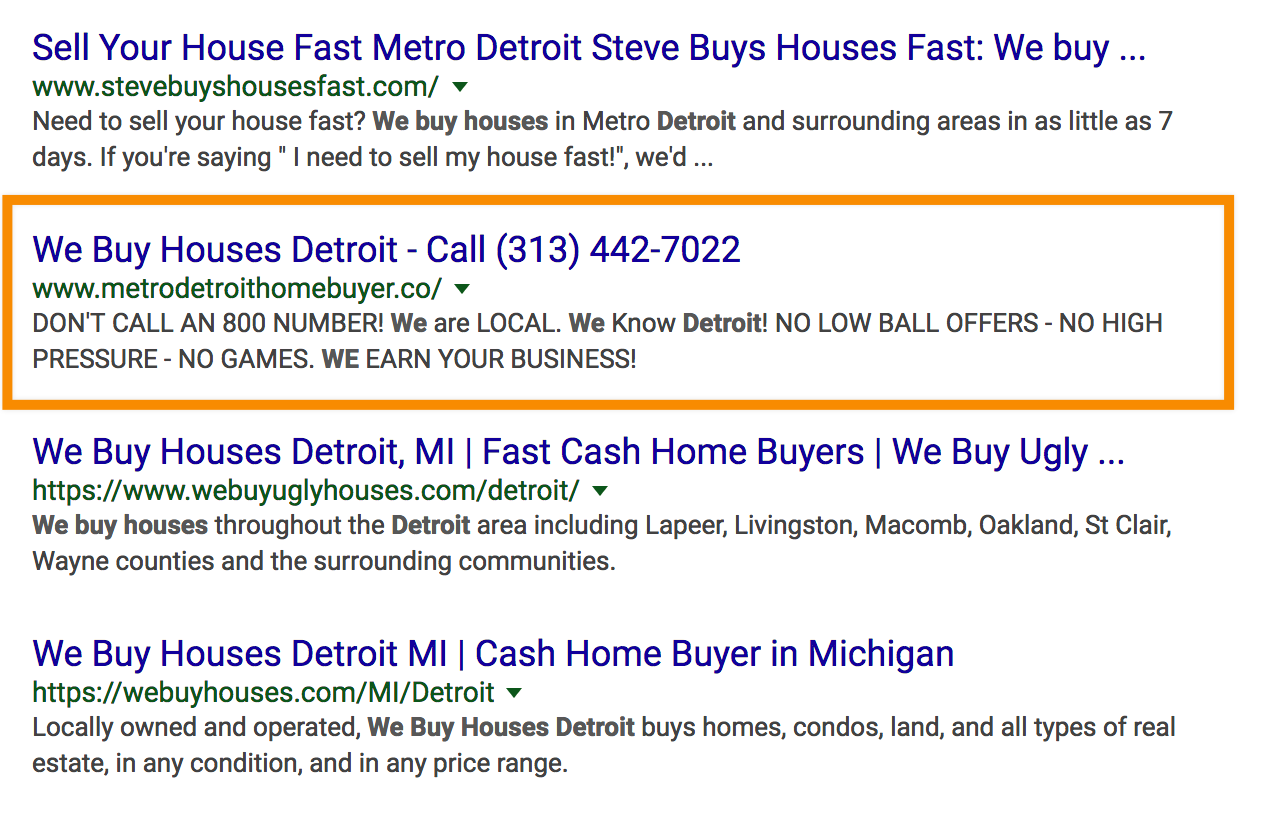
    seo for real estate investors we buy houses detroit seo rankings
    Metrodetroithomebuyer.co ranks number two for “we buy houses Detroit”

    Those ones I mentioned before were all in pretty competitive markets. The most competitive ones took 10 to 12 months of good SEO work, actively having someone do the work for them. The kind of medium cities took four to six months to do some good work, then they did the implementation or had someone do it for them.

    See here, this is in Detroit, another competitive market, but he focused on different keywords. He focused on keywords that weren’t the main keywords, and he literally had his web pages ranked on page one and in the top of page one within two weeks of launching his website. Here’s an email that Dennis sent. He said,

    “Trevor, holy crap. Got my first lead from my metro Detroit home buyer site and I haven’t done much, if any, customization yet. A person on the West Coast with several properties here to sell. Very cool.” – Dennis Fassett

    So it can happen very quickly.

    Here’s my general guideline: if you’re in a small market or you’re going after a small market, and I’m talking a population under 100,000 people, you can legitimately get your web pages ranked on page one within 2 to 12 weeks and often times in the top five in Google, on cities with populations under 100,000, within 2 to 12 weeks.

    As an example, we’re working with a client here in Oregon right now and we literally just launched their website last month, did the customizations that we teach here, we added some city-specific pages, used the SEO tool to make sure that they are optimized for that phrase.

    Within three weeks, they were on page one.

    Now, he’s ranking number one or number two for a couple of the phrases in some of the cities and the top five for others. I expect those ranking to climb. The reason that it happened so fast is that it was smaller cities, and the content on each one of those individual city-specific pages was tweaked and customized a little bit.

    This isn’t just launching a website and sitting there. This is someone working the SEO, doing the things in the Carrot training and allowing two to six months to get onto page one in the top five or so.

    In large markets, a population of a million-plus, we’re talking six-plus months to get onto page one. Sometimes, you might have a miracle and have it happen quicker.

    If you have already brought some domain juice with you, if you’ve owned the domain for a while, if you already have some backlinks pointing toward it, if you already have some social media activity pointing toward it, that’s gonna help you accelerate the process.

    But if you bought a domain brand new and you’re in a large market and someone’s actively doing the SEO for you that we teach in here, it’s going to take six or more months to get onto page one in the top five.

    It can really vary, so even if you’re in a very large city, even if you’re in Houston or if you’re in New York or LA, it can really vary in how long it takes. So if you’re going to go after a broad term like, “Investment properties in Chicago,” that’s a pretty broad term where that’s more competitive.

    There’s a lot of people going after that, it’s gonna take longer to rank for that than what’s called a long-tail keyword phrase that has four or more full words in it. “Fixer-upper investment properties in North Chicago,” that phrase, even though it’s still in Chicago, it’s a longer phrase, it’s more targeted. There’s gonna be less competition. It’s gonna be easier to rank for that, a lot easier.

    SEO in Different Market Sizes

    Here’s a general guideline. Smaller markets under 100,000, if you’re going after strong keywords, 2 to 12 weeks to get onto page one if you’re doing the right actions.

    Medium markets, population 250,000 to 1 million, 2 to 6 months if you’re doing the actions to get those rankings.

    Larger markets, six-plus months to get onto page one if you’re doing those rankings. And then from there, it can take several months longer potentially, depending on your market, to get into that top two or three positions if you’re doing the right actions in here.

    SEO for Real Estate Investors: ROI

    The ROI on SEO is huge if you do it right. So even if you’re in a competitive market and you’re going, “You know what? I don’t have six or seven or eight months to get the leads coming in,” what you do is you go to our other trainings and you get some paperclipping going.

    You get some YouTube video marketing going, which is going to rank very quickly if you do them right, within weeks, even in competitive markets potentially. You get some Craigslist marketing going. Get that stuff going in the short-term.

    In the long-term, if you’re in a competitive market, you or have someone work on the SEO for you. This is that first example that I showed you where it took about 10 to 12 months. I emailed him … This was several months ago at that time and they did four deals that month alone. Got bid out on a few, sat down, started building up some more city-specific pages, so they’re working it by splitting out city-specific pages and getting articles written up. They closed four deals and netted well over $30,000 that one month. The next month, they closed deals again.

    So the long-term ROI, being patient, especially if you’re in a competitive market and the implementing or hiring someone to implement for you, is gonna be a big, big deal. Be patient and you’ll get the results.


    [cta offer=”seobible”]

  • 4 Most Important SEO Ranking Factors for Real Estate From a 10,000 Foot View

    4 Most Important SEO Ranking Factors for Real Estate From a 10,000 Foot View

    seo ranking factors for real estate

    There is a lot that goes into search engine optimization, but in actuality, there’s only really a few things that will move the lever for you. The things that will be important and help you get results. That’s what we’re going to focus on in this post.

    We’re trying to give you the action items and the understanding of how it works and what you need to do to actually get results.

    Watch the Video or Read the Post Below

    SEO for Real Estate Investor | 4 Important SEO  Ranking Factors

    From a 10,000-foot Point of View, What’s the Most Important Part of SEO?

    First of all, there are four main parts of SEO. This introduction is all about really getting your head around what SEO is, how it works if you really want to learn the craft of SEO.

    SEO Ranking Factors for Real Estate #1: URL

    First of all, you’ve got what’s called the URL factors. The URL is your domain name. That’s things like how long your domain name has been owned by you. How long the website’s been up online. Those are things that matter. The site structure of the website. Is the website set up correctly with your URL?

    That’s something we’ve already built into Carrot. If you have a website outside of Carrot, that’s something you might be concerned about.

    There’s a bunch of other things, like site structure, like I said, domain lifespan, search engine friendly URLs. All of that stuff except for domain lifespan is built into Carrot to make your life easier. As your website stays online longer, it ages, and Google likes it.

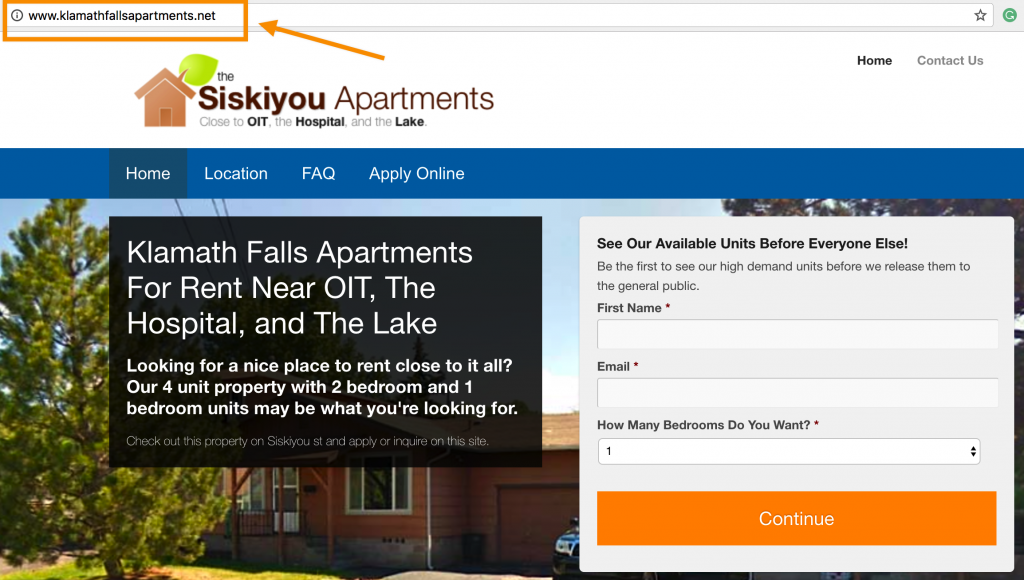
    Here’s a screenshot of a website.

    url factors for SEO

    Klamathfallsapartments.net. That’s the URL. I have owned that domain for several years, and if I was to go up a different website that Google felt was very similar as far as optimized in content, and my URL was owned for let’s say 10 years, and this one was brand new, I would definitely get a boost and some sort of credit for having a domain that has been owned and up and online longer.

    The longer that you own the domain, the more authority that Google will feel that your website potentially has.

    That’s one factor to always keep in your mind. That if you just purchased a domain, and you’re just attaching it to a new website, you’re going up against other websites that have been around for longer. We can definitely accelerate the process of ranking well using what we’re going to teach you, but some part of the equation may be that your domain might just need to age a little bit to get that ranking up.

    Be patient with some of the things. Make sure that you recognize that if you’re not seeing your ranking crack through and you’re doing everything else right, and your website is new, it may be domain age is part of it.

    You want to keep a nice, simple URL structure. That’s a good thing. Complicated is a bad thing. This is the way that we have it built out in our Carrot websites already, so if you’re a member, you don’t have to worry about this. If you’re not a member, if you have another website platform or you built one yourself, this is something you’re going to want to pay attention to.

    A simple URL structure will be something like:

    • yoursite.com/sell-my-atlanta-house, or
    • yoursite.com/how-it-works.

    On the flip side, something that’s complicated that Google doesn’t like is too many forward slashes in your URL:

    • your-site.com/sell/sellingyourhouse/boston

    That’s just not a very friendly URL.

    Google doesn’t like that as much. Or having weird characters in your URL:

    • yoursite.com/?p25235

    Google can’t determine what that’s about. In Carrot, we’ve already made it simple for you. You don’t have to do anything at all to make your URL simple.

    SEO Ranking Factors for Real Estate #2: On-Page SEO for Real Estate

    The second thing is on-page. On-page SEO are things on your website that you can physically see on the page. Content, pictures, things like that, and how they’re structured. In on-page, really, for your website, it’s kind of like soil for a farmer. On-page for SEO is like soil for the farmer.

    If you don’t have good soil and you’re planting a crop, there’s no way that that crop is going to grow very good. On the flip side, if you don’t have the on-page optimization done on your website for SEO, it’s going to be very, very hard to rank well for any keyword phrases, no matter what you’re doing on the back end. The on-page is where it starts. It’s the fertile soil to grow a great crop.

    If you don’t have fertile soil with the right nutrients and minerals, you can’t grow a good crop.

    Make sure that the on-page optimization is correct. With Carrot members, once again, we give you a jump start. The content that’s already built into your website is already optimized very, very well. We suggest you go in there and tweak it, customize it to yourself, and use the SEO tool built into our system on each page to ensure it retains its SEO grade for the keyword you’re going after.

    Part of on-page is content relevance. Let’s say someone is looking for a rent to own home in Birmingham, and your website doesn’t say those words anywhere on your website, but that’s what you’re looking for. How is Google going to know that your content is relevant to that search phrase?

    You need to make sure that your content talks about the same things that you’re trying to optimize and rank well for.

    Is it high-quality content, or are you just throwing up a few words here and there and moving on? You need to make sure that you have high-quality content on there … It’s robust content. It’s good. It’s valuable and also addresses the keywords and the things that your person, whether they’re a tenant, buyer, or seller, is typing in.

    Be sure to have very relevant keywords for search phrases that you know your prospects are typing in in your market. We just suggest you dive in and tweak it up to make it more relevant to you, more relevant to your business model, to you as a person. And, build some credibility in there.

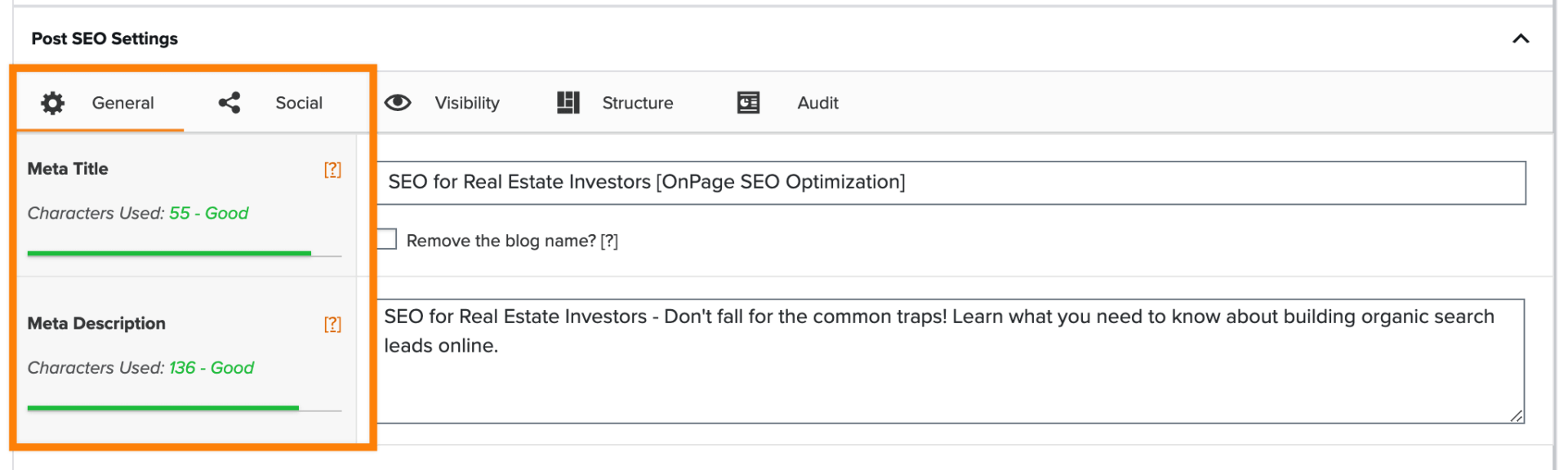
    Also, to help make it more relevant in Google’s eyes, we’ve got the Carrot SEO tool. With the Carrot SEO tool, you can tell the platform and you can tell Google what to look at.

    on-page seo tools

    With this, if you’ve identified that you want to rank for rent to own homes in Birmingham, AL, you put it in the focus keyword section. You make sure that keyword phrase is in the SEO title, as you can see it is, and you make sure it’s in the description down there below.

    What that does, that keys Google into the fact that that’s what that web page is about. It makes it very relevant in Google’s eyes that that web page is likely about rent to own homes in Birmingham, Alabama.

    This is a huge factor.

    We make it easier for you with Carrot, and we also give you the SEO tool to make sure that you’re following along. Whether you’re an SEO expert or not, you’re going to be able to optimize your pages very well with our built-in SEO tool.

    SEO Ranking Factors for Real Estate #3: Choosing the Right Real Estate Keywords

    Then next, with the SEO tool, are your keywords used right? Your pages should really have a good mix of your keyword phrases and pictures and structure so Google has the information they need to know your site is very relevant. That’s what we’re talking about here, guys.

    This isn’t rocket science.

    What we’re looking for is we just want to make sure that the content on the page is relevant to the search phrase that we’re trying to rank for. If we’re trying to rank for note sellers in California or note buyers in California, we want to make sure that the content on that page talks about your note buying service in California, and it has some pictures about that, and your title tag in our SEO tool and your description has those keywords in it. Very, very relevant. Use our SEO tool to help guide you along to make sure you’re staying relevant.

    Then like I said, the website structure. Is the website structured right? This is something you don’t have to worry about. If you did not have Carrot, you would have to worry about this, but we worry about how fast your website loads. We worry about all the things behind the scenes in the code.

    You do not have to touch it. That alone should make you rest easy at night knowing that you never have to touch this or reach out to a web person and have them do it. Get the on-page parts right, and it makes it much easier to grow a great crop. Bad on-page equals a thin crop. We all want to eat well. We all want to have a great crop.

    So now off-page SEO. Off-page basically is everything … It’s kind of obvious, but everything that is away from your pages. What we’re talking about here is off-page stuff that’s kind of like water and the fertilizer for a farmer. You’ve got this soil. You’re hoping to plant something.

    Now you’ve got to take something that’s outside of that environment of the soil and put it on the soil to help it grow the seed. It takes that fertile soil, and it adds the extra boost that it needs to grow.

    Without watering, without fertilizing a crop, it’s going to be really hard to make it grow well.

    One way that you can water and fertilize your website is with backlinks. Backlinks are basically where one website has a link on their website that’s clickable that goes over to your website. Google looks at it as a vote of confidence that your website is a good website according to that one. When other quality websites link to your website, Google really likes that.

    Also, your footprint matters. What I mean by footprint is if you just have a website up there, and you’re really looking to dominate in your market, if you only have your website up there and that’s all you’re doing, Google doesn’t really have a whole lot to go off of to see if you’re a legitimate company.

    One thing that they look at is your footprint. Do you have other entities, other websites or other social media profiles online, that also link to your website, that also has your company name in it?

    They also have your address in it, your phone number in it? So set up a Google Business profile.

    Go to YouTube and set up a YouTube profile and get a few videos in there. Go set up some business directories or citations, which we’re going to teach you how to do citations in a later module. Make sure you’re not just using a website only.

    Go out there and make sure your footprint is wider and you have your business listed and profiles claimed on other websites.

    SEO Ranking Factors for Real Estate #4: Social Media

    The fourth part is social factors. You can see here is a screenshot of the bottom of a website where it’s got Google My Business, Facebook likes, and things like that. Google is really looking at the social factors of your website.

    They look at that as votes kind of. They figure, well, if someone was on this website and they clicked the Facebook like button or engage with your Google Business content that must be a good thing.

    That must be a vote that that person likes the website. We’re going to say that if a website has consistent and good “votes”, then it must be high quality and relevant. They’re going to reward you with a higher search result out of that.

    Growing Your SEO

    Those are the four main parts, guys. You’ve got the URL factors, which is really the ground. That’s the ground. You’ve got the on-page stuff, which is really the soil. That’s the soil. You’ve got the … The off-page stuff is your water. That’s your fertilizer. Then the social stuff is just kind of good juju. That’s just good stuff, good mojo, to help with everything else.

    Next, what we’re going to dive into on the next video is the timeline to expect search engine rankings, to expect results and how to effectively guess what you can expect as far as how long it’s going to take to get results in your market, so let’s see you in the next video.

  • Why Is My Real Estate Website Not Showing Up In Google? Find Out How Search Engines Work

    Why Is My Real Estate Website Not Showing Up In Google? Find Out How Search Engines Work

    2016.05.3-howsearchengineswork-main

    Did you launch your website within the last 6 weeks and your website isn’t showing up anywhere on the first few pages of Google yet? Are you not quite sure how Google really works? Then this post is for you.

    We get this question all of the time… “I have had my website up and I can’t find it in Google yet”… in this video we’ll walk through how search engine’s like Google work, how search engines find websites, and how they rank your website in the search results.

    Understanding how search engines like Google work is essential for real estate professionals who want their websites to rank higher in search results and generate consistent leads through organic traffic.

    Key Takeaways

    • Google finds websites by “crawling” through links on the internet, which is why getting links to your site from other sources is critical for being discovered and indexed.
    • Being indexed by Google (appearing in their database) is just the first step; ranking high for specific keywords requires ongoing optimization and quality content relevant to those search terms.
    • SEO isn’t a quick marketing solution like PPC, but it offers superior long-term ROI if you’re willing to invest the time in building quality backlinks, creating relevant content, and following best practices.

    By understanding the basics of how search engines crawl, index, and rank websites, real estate professionals can develop effective strategies to climb the search rankings over time, generating increasingly valuable organic leads for their business.

    Table of Contents

    1. Did You Launch Your Site Within The Last 6 Weeks and It’s Not Showing Up In Google?
    2. Not Ranked On The First Few Pages Of Google For Your Ideal Keywords?
    3. How Search Engines Work
    4. How Relevant is Your Website?
    5. Need More Online Leads For Your Wholesaling / House Flipping Business?
    Carrot icon
    Lead generation, at its best
    Attract, convert & close more motivated leads
    Try Carrot Today

    Did You Launch Your Site Within The Last 6 Weeks and It’s Not Showing Up In Google?

    If so, this video below is for you. The video is from Module 1 of 6 in our premium 3 Lead Per Day Training where we’re diving into the basics of SEO for those new to SEO. So we decided to yank this video from the course (just $99 for 40+ amazing training videos on PPC, SEO, and YouTube marketing) so it can be a resource for anyone.

    Find Out How Google Works: The Investors Guide to SEO

    Basically, go through the steps I show in the video to check and see if your website is being indexed by Google first… if it is, then your work to climb the SEO rankings has begun! If it isn’t, follow the steps in the video to let Google know your website exists by doing a quick Google + posting that tells people about your new site and links to it and find some other ways to get a link to your new website online so Google can find the link and spider your website.

    We also suggest setting up a free Google Webmaster Tools account and submitting your sitemap to Google so it can make it that much easier for Google to always know when you have new content posted on your website.

    Give it a few days or a week and do the test above, again, on your real estate website and if it still isn’t showing up on the first few pages of Google for your company name and location, then it may not be indexed yet. But odds are, unless you have some penalties on your domain name from building spammy backlinks, you just need to give it a bit more time.

    Not Ranked On The First Few Pages Of Google For Your Ideal Keywords?

    Now, being indexed in Google (i.e. – Google has your site saved in their database) and ranking high for the specific keywords you want to go after are two completely different things. If you show up using the test above but not for the keywords you’re looking to rank for… now it’s time to “optimize” your website for the specific keywords you want to rank for.

    You can use some of the FREE resources we’ve already created to help you get your website ranked higher in Google. Or, if you’re an Carrot member you can dive into the advanced 3LPD training program ($99 and only available for Carrot members) and it’ll walk you through step by step how to increase your ranking and beat out your competition.

    Some free SEO resources for real estate investors and agents to get you started on your climb to the top of the rankings:

    Those will get you rolling and always feel free to hit us with questions over here on the blog! Or if you’re a Carrot member, reach out to us on our next weekly Carrot Mastermind call.

    If you plan on getting your website ranked high in Google to ramp up your leads over time with SEO you should also really understand the basics of how search engines like Google work.

    That way as you’re working through the steps, you better understand it.


    How Search Engines Work

    So, if you’re wanting to dig in and learn a bit more about how Google navigates sites by crawling the web… this section is going to be perfect for you. Overall, ranking results are calculated using over 200 factors which sounds intimidating… but if you understand how Google works and how to play by its rules… it makes ranking your real estate investing website in Google a heck of a lot easier and more fun.

    Carrot helps you focus on a few factors that have the most power to help you rank where sellers, buyers, tenants, private lenders, etc. are searching online. This short video is one of the “Module 1” videos in our 3 Lead Per Day training. So if you’re newer to SEO and ranking websites in Google, this will be a great bit of foundational knowledge to soak up. If you’re experienced in SEO… then go ahead and skip this video.

    How Google Works - InvestorCarrot

    A Brief “How Google Works” Run Through…

    The text below is from the video above, so if you learn better by reading, dive into the content below to learn how Google works. If you already watched the video, great! You can skip this section and get to work on your real estate website and get it climbing in the SEO rankings.

    So how do search engines actually work? In this module, it is going to walk you through the basics of how search engines work…from the time you put in the search in there to what they are doing in the background to determine how to rank them.

    So, first of all just to reiterate the basics here, if you’re newer to SEO what we are talking about here is the things in the Google search or Yahoo or Bing search that show up in the main section of the search results. At the top of the section that’s ads, you can see the ads are indicated with those little orange ad tags. And on the right side, those are ads as well.

    So how does Google determine what shows up in that main section which is called the organic search results section?

    Google-crawling-the-internet
    source: Google

    First of all, let’s understand search. Here’s a graph that we pulled directly from Google. Kinda talks about how Google goes out there and crawls different websites. So, Google navigates the web by crawling from website to website. That means that they follow links from page to page.

    So, if you have a website up there and you have a link on one page that leads to another, Google’s robots are crawling through all of those links trying to visit every page they can possibly make it to on the web. And, they have these big huge massive servers that are continually, around the clock, crawling the web. And, the cool thing, is the website, owners can choose whether your website is crawled or not. If your website is not crawled, if we do not allow Google to see your website, then it doesn’t show up in the search results.

    Of course, by default Carrot members websites are not set to be hidden from Google. They are set to be crawled and we make it to where it makes it easier to be crawled by Google. Which is a good thing.

    how search engines work: google sorts pages by content
    source: Google

    So one way that Google finds your website and the pages on your website is by going through links on other web pages that link to your site.

    As an example, if you made a post on your Google + account that links to a page on your site, Google will find that and go through that link and land on your site… and magically now Google knows about that page and it’s in their index. Pretty cool, eh?

    And then Google begins sorting the pages along the way by the page content and hundreds of other factors.

    As Google spiders the web, they’re saving all of this data. They know what this page is about, what links that point to the page, and what it feels is the authority and relevance of that page to what you just searched.

    This is why so SEOs spend so much time building, earning and winning backlinks. If you want to get started on this, check out our guide on how to use HARO to get backlinks.

    How Google Works Edit
    source: Google

    Then they rank those results so someone goes online and they type in a phrase, it could be… “sell my house fast in Baltimore” or it could even be “local plumbers”. Google then determines that based on all of the web pages that they’ve crawled and saved in their database according to 200+ factors where your web page should fall in the rankings.

    How Relevant is Your Website?

    And they’re really looking at relevance. They’re looking at how relevant is your web page or your website to that exact search that person just made.

    And, the way that they determine the relevance, is the website quality of the content, or how relevant it is to that search phrase. We also want to make sure we have those keywords that we’re going after in the content.  We also want to make that our website has fresh and unique content so Google sees it as relevant.

    How Search Engines Work - The Customer Journey

    source: Neil Patel “Advanced SEO

    Basically, the Google bots are continually scouring the internet and “spidering” through links on pages to find other pages and other websites, then it determines what the page is about, it’s authority, and where it should fall in the rankings compared to the millions of other websites all in a matter of nanoseconds.

    Pretty amazing stuff.

    With that said, don’t let any of that scare you. It’s very easy to get on page 2 in Google just by following basic things we teach here on this blog.

    Then to climb onto page 1 and the top of page 1… you’ll want to focus on building some quality backlinks, having robust solid content on your website that is relevant to the keyword phrases you want to rank for… and you need time. SEO isn’t a fast marketing solution like PPC.

    It can take months and months to even get on page 1 with a solid SEO plan. But the ROI over the long-term is why we LOVE SEO so much around here :-)

    Need More Online Leads For Your Wholesaling / House Flipping Business?

    Generate More Real Estate Investing Leads and Cut Through The Marketing Clutter In Your Market. Download our FREE Marketing Toolkit: Get Access To This Content Marketing Toolkit + Training For Real Estate Investors HERE!


    And take a Demo of Carrot today to leverage the same system 1000’s of other investors use to generate his online leads and deals each and every month.

    See Carrot In Action

    Watch: SEO for Real Estate: Introduction to Search Engine Optimization or check out Carrot’s SEO for Real Estate playlist.


  • Real Estate Marketing Online: How to Rule With SEO In Competitive Markets [Whiteboard]

    Real Estate Marketing Online: How to Rule With SEO In Competitive Markets [Whiteboard]

    Real Estate Marketing Online: How to Rule Competitive Markets

    Transcript

    Are you operating in a really competitive market like a Houston or a Dallas or just a large market where there’s a lot of competition? Well, a lot of our clients are and every single week we do coaching calls on every Tuesday at 11 o’clock Pacific time for our care customers who are in content pro membership or above.

    And one of the main questions we get on a really consistent basis is, “Man, I’m in a crazy, competitive market. There’s a lot of other investors, investing there, and there’s a lot of other care clients there. Can I crack through it and how do I do it?

    The first answer is, “100% yes, you can.” That sounds like a political stump that I just did there, yes you can, yes you can do it, we have clients every single day who are going out there implementing the plan we lay out on these whiteboard strategy sketches, on our coaching calls in our training’s and in, through support and they follow these methods I’m going to show you to get that result. So I want you to know that it can be done, but you gotta follow this to a T and don’t come complaining to me if it doesn’t work if you don’t do these.

    Online Real Estate Marketing in Competitive Markets

    OK, so here we go. So if you’re in a competitive market I’m gonna be kind of walking you through, how do you get in that search result for search engine optimization but also just in search in general, to get those consistent stream of leads coming in to fuel your business because when you’re in a large market like that you really can go deep in that market like we’ve talked about in other whiteboard strategy sketches you can go deep, and you can focus just in that market for the first year and get 30-40-50-60 leads a month if you really hit it hard, okay? And that can fuel your entire business 2-4-5-6-10 deals a month if you do it right.

    OK? So we want to get you here first of all, and we want to get you there through paid and through SEO in the competitive market. It’s going to be really hard to get really consistent, and a lot of momentum with just SEO okay? PPC is great, but you can stack on SEO to really add momentum over that year and this is kind of what we want to do.

    We’ve done a whiteboard Strategy Sketch on this exact topic before go check out youtube, go to YouTube.com and then go look up InvestorCarrot, find our channel, the first thing you need to do is subscribe to our channel the second thing you need to do is go search our channel for a video I think it’s called the 90-day marketing plan or something like that where we layout in a lot more detail what you should do in the first 90 days in any market to have leads coming in and to set yourself in a really, really solid foundation, okay? But we’re gonna give an abbreviated version of that today.

    So you’ve got here, and you’ve got twelve months out there and if you’re in a large market the first thing you need to do is we need to know that it’s going to take time, and we need to have a lot of patience, okay? Because with SEO, search engine optimization large market, it’s probably going to take you between 7, 8, 9, 10, 12 plus months to really get that momentum to get that ranking that’s going to get those leads to start trickling in and then start coming in more.

    I was talking to one of our clients yesterday, Martin, out of Phoenix, Arizona and he’s flipping a lot of houses, okay? Ten plus houses a month and when we were talking, you know a year ago he joined Carrot a little over a year ago he was in a very competitive market, he wanted to get some more organic traffic coming in, he was turning on PPC as well, but we’re like, you know what? I think that there’s going to be a great chance for you to crack into this market from a website that had never ranked in the top three pages of the main seller search phrases to what it is today getting really consistent leads, and he’s in top one-two-three rankings in google for the most competitive search phrases in Phoenix, how did he do that? The first thing, like I said, locked, and then it’s gonna take time, and he knew it, and he knew that he was going to have to be patient okay?

    Choosing Your Top Keywords

    The second thing, is we need to go out there and choose the top keywords, so what are those top keywords that are likely going to give us 70% or more of that traffic? For house sellers it’s likely your cash for homes, sell my house fast, insert city, we buy houses, insert city, there are a few others, just go to carrot.com/seo-bible, and you can check it out, we have a full report there that goes through all of the top motivated house seller keyword phrases for SEO, and you can check it out. If you’re doing pay per click go to carrot.com/ppc-keywords and oncarrot.com/seo-bible, and you can find both those reports where we give you all of the keywords based on our research, so we solved that one for you.

    keywords in real estate investing in competitive markets

    Alright but the first thing that we always like to do in a market, in a really competitive market is we’ve got to get leads coming in right now okay? If we don’t have leads coming in right now and it’s gonna take us 6, 7, 8, 9, 10, 12 months to start to get the real traffic to get traction and get deals in that market it becomes really, really discouraging, you know none of us want to be discouraged on our journey to grow our business or start our business so get pay per click going right away, okay?

    PPC Marketing

    In that first month to two months and it you don’t know how to do PPC we have a lot of resources on our blog you can check it out at oncarrot.com forward slash blog, or we have guides and resources and checklists on how to do it and we also talk about it all the time in our coaching calls if you are a carrot customer, and our three lead per day training okay also during that same time period during the first month to three months, in a competitive market the biggest thing we need to focus on is, how do you stand out from your competitors, how is it that your clients are going to chose you versus the 7, 8, 9, 10, 12 25, 30 other investors that are also vying for their business?

    The people that sent them that direct-mail piece, the people that have the bandit signs up in their neighborhood the people that are in the same rankings, the same paid search results that you’re competing for. Even if you get there, even if you get right here, and you don’t take care of the credibility piece then you’re not gonna win the game, the other people are going to win the game okay? So focus on that as a core strategy, what is your credibility score?

    Building Credibility

    We have a CarrotCast episode, which is our weekly podcast, just go to CarrotCast.com, and you can go directly to the CarrotCast to find our episode on credibility score. You can even go to Google and Google Investor Carrot credibility score or CarrotCast credibility score, you’re going to find that episode where we walk you through everything you need to do to ramp up your credibility whether you’re an experienced investor or brand new and set yourself apart. Also, we did a CarrotCast episode on USP, unique selling proposition, which in a competitive market that is a requirement, you’ve gotta have a unique selling proposition why people should choose to work with you versus someone else. Tackle those in the first three months.

    increase your website credibility score

    Get your PPC up and going, get leads coming in in the first several weeks get your first deal in the first month or two, and then during that time you’re setting up your SEO foundation the first one, two, three, four, five, six, seven months in a competitive market you’re likely going to get no leads so prepare for that mentally, okay?

    Consistency Wins the Game

    But after you start implementing that plan consistently over those months you’re gonna see a bump, and you’re gonna see another bump, and you’re gonna see another bump and around that 10 to 12,10 to 14 month time period if you’re implementing SEO well you’re gonna start to see those results coming possibly even quicker, okay? We have some clients in our concierge traffic service, which is a high-end service that we do internally for clients that are closing a lot of deals that are in really competitive markets that we were able to crack through the top five in the first five to six months and now we’re working on getting through that top three, but they’re already getting SEO leads in the first five to six months, that doesn’t always happen, but it can happen okay?

    So, make sure you’ve got that locked down in your mindset now if we’re going to go through on the SEO side of things in a competitive market here’s what we need to do, we need to go after the top keywords that are going to give you 70% of the traffic, go to those resources I mentioned before to find those keywords on PPC and SEO, okay then what we’re going to do next is expand locations immediately in that first one to three months at location-specific landing pages, We’ve done other whiteboard videos on this topic, and we teach in detail in our training if you’re a carrot customer in our blog we have a lot of free resources as well.

    So launch about ten location-specific landing pages and what those are, if you’re in Dallas, but there’s Ft. Worth and there’s a lot of other cities around Dallas that are suburbs or surrounding cities that you would also buy house in, launch pages on your Carrot site or another site that are specific to that location for your primary keywords, okay? For your primary keywords. And get at least ten of those up because those are going to be easier to rank for thank that primary large market of Dallas or Portland that big market and those rankings are going to happen faster so as you’re working on your SEO those are going to climb faster, your primary markets gonna climb a little bit slower, and they’re gonna rise together.

    Build Citations

    Next, do your citations, okay? Go to our blog, carrot.com/blog we talk about citations. If you’re a Carrot customer we can do your citations for you in our marketplace so check out our marketplace but this sets the foundation for credibility for your website in that local market right here, optimize for your company name plus the word reviews ‘cuz if you’re doing pay per click, or you’re getting traffic, or you’re doing direct mail we need to make sure that you rank well for your company name when people are trying to research you to see if you’re legit, and you never want to lose any deals because someone googles that and then don’t find any good things about you okay?

    Building real estate citations

    So optimize your about page for company, company plus your reviews then go get a Better Business Bureau Profile pay that three – four-hundred bucks, whatever it is, and then drive your clients over there to do reviews and optimize it as well for this and that going to help you close more deals.

    Social Signals

    Next are social signals. Get five, ten, fifteen people to google plus your homepage and Facebook like it over the first two months, backlinks if you’re going to do your own SEO just grab for three to five backlinks a month it’s not a big deal, and we teach how to do this in blog posts, we teach how to do this in our coaching calls, and our three lead per day training, if you’re a member, has it very, very detailed okay?

    If you’re not a client we don’t sell that to the open public yet but we will if you’re watching this video after I publish this video just go to carrot.com/3lpd, don’t do it right now because nothing exists but if you’re doing this for several months, go to carrot.com/3lpd, you can check it out.

    PPC to Guide SEO

    Last, use PPC, use your pay per click data to guide you on your SEO that’s one of the biggest mistakes people make in competitive markets, is they use their pay per click and their SEO in silos, what we always like to do is launch your PPC campaigns, find out the ones that are converting into leads and turning into deals the most and then go after those keywords in your SEO so use PPC to guide you.

    I’m gonna wrap this up, fast follow-up is huge in that market, if you’re in a competitive market you need to be calling your leads back within minutes or answer them live. We’ve talked to many clients that as soon as they switch to answering their calls live from pay per click and SEO they started closing more deals okay? It’s a big deal.

    Answer them live and if you’re a Carrot customer turn on your text message notifications where you get a text message notification within seconds of a lead coming in, you’ll have a phone number there you can tap the phone number, call them up fast follow-up’s gonna help you cut through in that market. And then last, have an abundance mindset okay? One thing we always love to do is, there’s enough for everyone. There’s enough to go around for everyone; leads, deals, success, abundance, share that with people in your market, don’t try to hold all of your secrets in, the more you share, honestly the more comes back to you. So have that abundance mindset.

    Real Estate Marketing in Competitive Markets

    Alright, you’re in the competitive market, use that as a blessing, it’s a great thing for you, don’t say, “oh my gosh I’m in this crazy competitive market it’s going to be hard.” It will be work, but there are amazing, amazing things for you on the other side of it. When you have the patience and time locked in your brain you have the plan and you’re working with the right team. Alright? Go after it, tackle it, check out our other episodes of Carrotcast go to carrotcast.com and our other carrot whiteboard strategies sketches on our youtube channel just subscribe right here, here wherever the heck it is. Subscribe to our channel and you get updates as soon as they come out.

    Learn more on the Carrot YouTube channel and start growing your business by leveraging the web as a real estate professional!