When an entrepreneur with a family and a full-time, W-2 job says he’s “busy,” that’s an understatement.
It’s probably one of the less ideal situations to be in when taking up a business venture. I know, because I’m there. It’s difficult on the family as well… if you don’t do it right.
So, how does the head of the family, who is paying the bills, raising his children, and sharing the responsibility of the household, all while trying to get a “side-hustle” going, manage everything?
Also called the Pareto Principle, says that 80% of an output constitutes 20% of an input. It’s an observable theory in nature. For instance, you can find that 80% of the land in a certain area can be owned by 20% of the population. Or 80% of sales in a company come from 20% of the sales staff.
So, because we know this is often the case in our daily lives as well, you can control this and achieve better and higher output by focusing on that 20% that is actually producing most of the results. For example, if most of your deals come from door knocking then it would be wise to focus most of your energy on that. If 20% of your friends are the ones that give you 80% of your happiness, then you should hang around that 20% more often.
Of course, this rule can be difficult to practice consistently in real life, especially for those with lives that are extremely busy like a father with 3 kids, a husband, and a job that demands 50-60 hours per week.
You can even find in some areas that 90% of results come from 10% of output. I first saw this principle in Perry Marshall’s book “80/20 Sales and Marketing”
Realistically, the 80/20 rule should be 90/10 for those that are extremely tight on time. Because even that 20% will be hard to fit into a life of work and family. So we have to restrict even further in order to have happy lives at home.
For those of you in that chaotic reality like me, a lot of online entrepreneurial advice can be dangerous. Especially advice on “grinding it out” non-stop, or quitting a w-2 job (thanks, Gary). I’m not the one to give any more advice other than my opinion on that issue, because I haven’t quit my w-2 and don’t plan on it anytime soon. But I can give advice on how to make a more efficient use of your restricted time, to actually drive you toward your goals… while having a happy life at home.
So, the below advice isn’t a “how to quit your job for your business” type of article, but a how to use the 90/10 principle and apply it to your busy-as-heck-family-man entrepreneurial life piece. So, from my experience, my trials and errors, here are 3 important things you can do to practice the 90/10 rule when time is a constraint and have a happier, less stressful time at home.
The number one advice for forward progression in your business without increasing your stress levels is to get rid of stuff in your life.
My wife is very into the “minimalism” movement. Basically, minimalism teaches to get rid of anything that you don’t love. It lessens the amount of stuff you have and teaches you to enjoy the things you love. The same lesson can be taught in business.
When you ask an entrepreneur, “What’s the most important task right now?” They can rarely choose 1-2 things. That’s because “everything” is important. But that kind of thinking ends up cluttering priorities, overwhelming the host, and stalling business growth.
Focus on what’s important.
What’s amazing about our brain is that when you focus on one thing, the outside peripheral world disappears so that we can solely focus on the target. It’s a built-in evolutionary trait of survival. There are many exercises that show how when we focus on a single image long enough, peripheral images start to disappear and the focused image becomes sharper and clearer.
This phenomenon is called the Troxler Effect. And the concept applies to business as well. I learned this from Gary Bencivenga –“the greatest living copywriter” – in his teaching at the Titans of Direct Response seminar. He said that when we focus our attention on ONE thing/desire/goal/task, then our brains use all mental energy to solving that ONE thing; even doing it at a subconscious level (if you’ve read “Think and Grow Rich” you know what I’m talking about).
The completion of that one thing is smoother, sharper and faster. This is the essence of the 90/10 principle.
Instead of trying to do everything, ask yourself, “what are the 2-3 tasks that make me money in my business?” After all, you’re an entrepreneur (whether you like it or not) and “making money” is your primary goal.
To do this, you have to start with what’s not the most important tasks.
This takes hard thinking. Because everything at first is “important.” However, ask yourself, “What are the tasks that aren’t driving my business forward?” For instance, learning how to manage an AdWords campaign is probably not the best use of your time. It takes time to learn, and for a family person, time is the most precious resource. Same with trying to learn online marketing (very few investors become successful with online lead generation right from the beginning as a newbie entrepreneur).
So, if your primary goal is to find deals, then focusing on the tasks that get you in front of sellers is the only task you should be worried about. Even at the expense of not going to meetups, not browsing Biggerpockets, not building a Podio system, and not learning new things in Real Estate. This is, of course, assuming you already know what Real Estate strategy to venture in, and you know how to analyze deals. If you don’t know, then that’s your focused task for a period of time.
Take my plan of action in my business, for example, the info-publishing industry. Because I’m a father of 3 and a husband, as well as a passive investor, I need to eliminate the unnecessary tasks and focus on what moves my business forward which is creating content weekly. That alone drives my business forward each time. Creating content has the most impact because it contributes to traffic and product development.
2. Choose the Most Impactful Task
Like the most powerful task in my business, so should you choose the task that has the most impact. In your real estate venture, it could be door knocking or cold calling. This does two things; it gets you in front of sellers faster than any other marketing media, which means getting a deal faster, it gets you to practice and learn how to negotiate and build rapport the quickest.
I know this sounds elementary, but we get so carried away with petty tasks that don’t move you forward. You should be choosing tasks that have an impact. Tasks that accomplish multiple things (if possible) and that get you to your primary goal the fastest.
3. Set Controllable Goals
This isn’t another “10x your goals” advice. There’s plenty of articles on how you should dream bigger. Instead, we should be reducing our goals.
It’s ok to have massive goals. But having that big goal does nothing. It sits there, making you upset when you don’t reach your “millionaire status” in one year. Instead of huge unattainable goals, turn those into small bite size goals you can actually control.
Here’s what I mean.
You can’t really control if you’re going to flip 12 houses this year. You can’t even necessarily control if you’ll get a deal this month. But you are in complete control of the tasks that can get you to that goal. Once you figure out what the most impactful tasks are, those tasks will be your new “bite-size” goal.
For example, let’s choose door knocking as the most impactful task. Let’s say that on average you (or people in your industry) get a deal after 200 doors knocked. Well then, that’s your new goal. Spread it out evenly to 50 door-knocks a week, and now you have an attainable and realistic goal for the week.
At the end of the week, when you accomplish those 50 doors, you don’t have to worry about hitting that bigger goal of getting one deal a month anymore. You did all you can for the week and went after your goal while achieving it. If you finish early and you have extra time in the week, you can either spend it with family or choose some other impactful task for the business.
What if you don’t reach your bigger goal of one deal a month? Well, first off, you’ll be less stressed and upset with yourself because you did all that you expected yourself to do (door knock 50 doors a week). Then you need to re-evaluate your small-bite-size goal. Is it too small of a number? Are you door knocking in the wrong places? Are you losing deals because of your lack of skill?
More Time Doing What You Love – Less Guilt While Doing it.
As I mentioned, this isn’t a “how-to-quit-your-job” or “how-to-be-successful” piece. And, the 90/10 rule doesn’t guarantee any success. But it does guarantee that you spend more time with your family (or whatever matters most in life to you) and live stress-free not worrying or getting overwhelmed.
It also guarantees that you focus on moving your business forward. “Forward” doesn’t necessarily mean success, but it does mean constant progression which leaves you with a much better chance of success than stagnation and distraction.
Most real estate investors have a “love-hate” relationship with Craigslist.
We hear it all the time:
“Craigslist doesn’t work for the real estate industry anymore.” “Ever since they killed the ability to post HTML-enhanced ads… my leads have dried up.” “Sure it’s great for ‘for sale by owner,’ but it’s impossible to scale.” “All I ever get is spam.”
And I get it – when something isn’t working, it’s discouraging. It’s frustrating. Above all, it makes you want to quit and find a better place to invest your money.
Before you give up, though, consider the kinds of results Cyndy Dumire – a real estate investor and Craigslist ad-writing pro – gets on a regular basis. Every week, Cyndy generates around 80 buyer leads, 30 seller leads, and 10 foreclosure leads. Even more impressive, in the last six months, she’s closed no less than 30 deals from leads that all originated from Craigslist ads alone.
Effective Craigslist Ads With Cyndy Dumire
The reasons most investors give up on Craigslist is twofold.
Their ads don’t attract attention because they’re not offering their target audience a solution to a real and pressing problem (i.e., a market-driven need or desire).
Their ads don’t inspire trust.
We’ve ran hundreds of tests on our real estate websites and if there’s one thing we’ve learned, it’s that building trust with the people who arrive on your website impacts ROI and lead generation more than any other element.
And that’s not just true on your website – it’s true on Craigslist.
Of course, if you’re going to use Craigslist and actually get results like Cyndy, then you’re going to need to know more than, “Build credibility!”
And that’s exactly where this post comes in.
Today, I’m going to pull back the curtain and walk through 8 tips to find all the motivated sellers and buyers on Craigslist you want.
Craigslist Motivated Seller Tip #1: Know your ideal customer
To paraphrase the great Warren Buffett: never sell heavy-metal music lovers tickets to a jazz show.
If you’re trying to market to buyers or sellers, you’ve gotta start thinking like them.
Why do they want to sell their house? How stressful is their situation? How can you help them?
When determining your ideal customer as a real estate investor, there’re two questions you must answer:
What kind of buyer or seller they are?
What influences them in a personal capacity?
Answering the first question is pretty easy. But don’t be misled by its simplicity. One of the first mistakes most Craigslist ad marketers make is casting their net too wide. Unfortunately, targeting too broad of an audience – like “local home buyers” or “local home sellers” – won’t work.
Craigslist is too crowded for bland targets. Instead, you have to get specific about the kind of buyer or seller you’re focusing on and the needs that drive them.
For instance, your perfect customer might be…
An out-of-state investor who needs to know cash flow numbers.
A house flipper who needs a clear assessment of how much work is required to turn the property around.
A rent-to-own tenant buyer who needs to know that you’ll work with them on their unique financing situation.
In other words, be as detailed as possible when it comes to defining the kind of customer you’re aiming at.
Answering the second question – your customer’s influences – takes a bit more work.
To help, here’s a quick breakdown of the four major factors that influence home buyers specifically:
Understanding your perfect customer’s influences does not demand addressing each and every element noted above. But you also can’t create the best real estate listing without knowing what is going to sway your customer.
Again, this is all the more true on Craigslist. There are so many ads already vying for their attention, and that is why you need to make yours stand out.
How do you make your listing stand out?
Consider the following template as a starting point from our Posts 2 Profits Craigslist Marketing Course.
[cta offer=”craigslist”]
Notice how this ad communicates directly to the agent’s ideal customer and – especially through the power of questions – draws them in toward a preliminary solution. The “Free Book” offer – rather than an overt invitation to call them – is based directly on their ideal customer’s legitimate need.
Of course, in a sense, all businesses are about people. But real estate is especially personal because the commodity it deals in is emotionally charged.
After all, according to Maslow’s Hierarchy of Needs, safety is one of the most primal human needs and comes in second only to our need for food and water (i.e., “Physiological” needs).
Our homes give us safety. And – just like Maslow’s very next need identifies – they make us feel like we have a place to be “loved” and “belong.”
Even more powerful is the realization that our homes are where our memories are created. Not to be cliche, but home really is where the heart is.
So, listing a home or a property is a big deal. And trust is at a premium.
People need to trust you with what is quite honestly their biggest asset.
Keep your target audience – their needs, not yours; their dreams, not yours – at the forefront of your mind when you compile listings.
Craft personal, trustworthy ads with these tips:
Use your name in the ad, not just your company’s.
Write the way you talk and read your ad out loud to make sure it’s conversational.
Press on the pain of the person whose problem you’re trying to solve, then offer your holistic solution.
Don’t be afraid to let your personality and passion shine through.
Above all, tell a story. Paint a picture of how living in the home would feel using sensory language.
A well-written home description paints a vivid story.
Craigslist Motivated Seller Tip #3: Include a Call to Action
The entire point of any online marketing campaign – including listings on Craigslist – is to get the people who see it, to do something.
Normally, this means getting them to contact you via text, email, or phone. It could also mean getting them to visit your agency’s website.
Simply put: your Call to Action needs to get your reader to actually take action.
That’s why, in your listing, it’s essential to add a clear and enticing CTA, and to give your reader options. For example, the following CTA invites the reader to choose the next step that’s most comfortable for them and repeats the CTA no less than five times.
Action also means you need to always include a direct email link so they can respond immediately to the ad if they’re interested. Oh, and don’t be afraid to call attention to that by inviting them to email you.
Craigslist Motivated Seller Tip #4: Watch your words
We all know how essential good imagery is to real estate. In fact, we’re going to cover imagery and graphics in the very next point.
However, many investors fail because they underestimate the power of words. As Hamza Yusuf put it, “Don’t ever diminish the power of words. Words move hearts and hearts move limbs.”
On Craigslist, watching your words comes down to two elements:
Your keywords
Your headlines
The right keywords matter because it’s your keywords that will determine whether or not the right people find your ad. This is true both through Craigslist’s own search engine as well as outside search engines like Google.
“Profitable keywords imply an action. San Diego real estate implies nothing. It is just a thing. San Diego real estate for sale implies an action. People want something that is for sale, presumably so they can buy it.”
In addition, Geek Estate also adds a second keyword characteristic: laser focus.
In contrast to something like “Rancho Santa Fe homes for sale,” use “individual neighborhoods within Rancho Santa Fe”: e.g., “Fairbanks Ranch homes for sale, The Bridges homes for sale, or Rancho Santa Fe Covenant homes for sale.”
Why? Because “people that type keywords like these into the search engines know exactly what they are looking for.”
Lastly, as vital as keywords are, do not “stuff” your real estate listing with keywords for the sake of keywords. This creates an inhuman feel to your ads and violates our previous tip: “Get Personal.”
The second element to watch is your ad’s headline.
The title of your Craigslist ad is where the real attention-grabbing oomph resides, and you need to spend some time developing and testing titles that captivate. Whatever you do, don’t follow the crowd… unless of course, the ad has been proven to work, like the ones we provide in our Posts 2 Profits Craigslist Marketing Course.
The ad I already called attention to in tip one is an excellent example of a headline that stands out:
Craigslist Motivated Seller Tip #5: Be relevant with your graphics
There’s no doubt about it: not adding images to your ads is a Craigslist killer. However, the mere presence of images doesn’t automatically translate into success.
The right graphics dramatically increase the number of people who will take action and get in touch with you. So too … the wrong graphics dramatically reduce that number.
As a golden rule, be sure to use images that are eye-catching, relevant … and high quality. That’s true across the board. But how do you decide what images and graphics to include?
Go back to your ideal customer. The image you choose should be based on the type of buyer or seller you’re looking for:
Turnkey investors want to see images that show off how nice the house is, that it’s been well kept and that it’s in a neighborhood that’ll attract the type of tenant they want. That last characteristic means you should always include both pictures of the property itself as well as its surrounding area.
Cash buyers or flippers want to see a house that needs TLC in comparison to other houses in the neighborhood. With these types, you’d be smart to show the flaws of the property, exactly what kind of work will be required, but end by displaying its underlying high-points and long-term value.
If your ideal customer is a homeowner or retail buyer — if they will be living in the property themselves — then staged images that show off the house as a home are essential. Just be careful what you include in those staged photos:
If your ideal customer is an investor, then glamorous, well-staged pictures of the property itself won’t be nearly as compelling as adding numbers to those pictures. In this case, you could try using a multi-property image for investors interested in purchasing multiple properties.
Craigslist Motivated Seller Tip #6: Post often and from different “angles”
Alongside the previous pitfalls we’ve covered, I’d be willing to argue that the number one real-estate-ad-killer on Craigslist isn’t the words, the images, or even the calls to action.
It’s recency.
The way that Craigslist works is the most recent postings land at the top of the page and the past ones get pushed down. Some people search Craigslist based on the search box (so make sure to include keywords that your best clients are likely to search in your listings), but most people just scroll down the listings a few scrolls to see “what’s new”.
So with that said, to get in front of your prospects the most… make sure you have ads online and active at the times of the day that your prospects are likely looking at Craigslist.
We’ve even seen with today’s Craigslist algorithm some of the most successful accounts post between 3-15 times per day.
Here’s how…
Day 1-3: Launch a Craigslist account and start posting just 3 times per day. Once in the morning, around lunch, and evening – around 7 or 8 pm. These tend to be the times of the day people will look at Craigslist. Think about when you look at your email, Facebook, or Craigslist… it tends to be during that “slack time” during your day. Posting your ads just before these “slack times” helps put your ads near the top of the feed when your best prospects hop on to browse.
On those ads, don’t post the same ad every time. You’ll want to tackle it from different angles. If you’re looking for motivated house sellers or cash buyers, what are different reasons a house seller could want to sell? Create an ad for each. What motivations could cash buyers have? Create an ad for each.
This way you’re keeping things interesting and hitting on multiple hooks. One might grab someone better than another.
Day 4-8: Add in another ad to your mix. Now posting 2 ads 3 times per day (for a total of 6 ads that day). Again, don’t post the same ad every time and mix up your hooks. Also, mix up where you’re posting your ads – don’t put them all in the same spot.
What we’re doing here is “seasoning” the account in a natural way so you’re not launching a new account and posting 20 ads the first day. That’s a great way to get your account banned and you’ll have to start over.
Day 9-20: Keep renewing your ads every 48 hours as Craigslist lets you and bump up your ad posting frequency so you’re posting 3 ads 3 times per day (for 9 ads total per day).
Same thing, keep your ads interesting, high value, and hitting on different hooks – things that your top prospects are thinking about, worrying about, or need help with.
Day 21-20: I’d cap it at about 12 ads per day on that one account. I’ve seen some accounts get ghosted or banned at even that amount if the ads aren’t high value and really helping people. So in this phase, add on a 4th ad 3 times per day… capping it at that 12 ads per day for that Craigslist account.
Just a note: if you post more than 15 ads a day, you’ll get “Craigslist slapped” and your ads will stop showing up.
The lifespan of Craigslist ads can vary depending on the number of competing posts in different geographic locations. In large metropolitan cities, ads may only be visible for 5 days, while in smaller towns they may show up for 50 days.
Why all this focus on recency and renewing? Because generating real estate leads on Craigslist is an attention game, so the more you’re at the top of the Craigslist listing when your best prospects are searching… the more likely your ads will get seen and the prospects will come your way.
If you want to cross that gray line on the Craigslist Terms of Service to ramp it up… we’ve seen it be crazy effective having a few Craigslist accounts. Yes, this is against the Craigslist TOS so it’s your choice and you risk getting your accounts banned. However, if you’re marketing different websites with different phone numbers (i.e. – a cash buyer site and a motivated house seller site) the chances of it being seen as a duplicate account are very small.
It all boils down to value. If you’re adding value to the Craigslist ecosystem vs. just spamming it… then you’re good.
Craigslist Motivated Seller Tip #7: Create a system
By now, you might feel a bit overwhelmed. Keeping track of all those ads can be hard work.
Unfortunately, Craigslist doesn’t provide any analytics or tracking data, so it’s up to you to track each of your ads and monitor your calls as a part of your overall real estate marketing plan so you can see what’s working.
At a minimum, keep a spreadsheet of your Craigslist ads and a method to monitor them.
Not only does creating a system of tracking give you concrete proof of what’s working and what’s not, but getting organized with a system gives you more time to do other more important things.
We recommend you send traffic to a specific URL on your site.
This has a couple advantages.
You can track them using Google Analytics
You can retarget users that you know have come from Craigslist
Here are a few tips to consider when creating a special page for Craigslist traffic.
Name the URL something short and descriptive. An example http://yourdomainname.com/sell-fast-cl
Realize that this site might rank in search so you will need to look at that traffic in your Analytics account
You should have content on that page that specifically address the type of lead and ad copy that they are coming from.
If they clicked on the ad and are coming to your site, you know what questions they have, make sure the answer is easily found.
Track which pages are converting the most traffic and make changes as necessary.
At the end of the day, any data is better than no data.
So, create a page, or have your developer help you. Then just send traffic to that specific page.
I mentioned in the introduction to this post that trust is at a premium on Craigslist. In fact, trust is absolutely crucial to all your real estate marketing efforts.
I’ve touched on this theme a number of times already. But in case you missed it, trust is so vital that it deserves its very own tip.
It’s like the old joke: “It’s all about sincerity. Once you can fake that … you’ve got it made.”
In all seriousness, however, the last question you should ask yourself before you hit “Post” is, “Does this ad build trust?”
A lot of factors go into trust, so let’s just look at the two most prominent.
(1) Be Attractive
It may sound shallow, but persuasion expert Robert Cialdini’s very first step in the famous know “trust chain” is to be “attractive.”
This doesn’t mean you should feature glamor shots of yourself in your Craigslist ads.
But it does mean the images you use must be high quality. It also means providing plenty of attractive “white space” in yours ads. Short sentences and short paragraphs don’t just look good, they’re easy to scan.
Being attractive also means covering your bases when it comes to grammar and proofreading. Nothing kills trust more than an agent who can’t spell correctly.
“Make your address and phone number visible at all times. Include it in the footer (a must), but depending on your site also in the header (especially if your business depends on incoming calls) and on the sidebar, in the microcopy.”
“Make it very easy to contact you.”
How does this apply to Craigslist? Easy. Simply including your contact information once isn’t enough. Take a look at another of our proven templates and see if you can count how many contact opportunities there are:
All told, I counted nine. Even if it feels redundant … your ads should do the same.
Real estate works on Craigslist… you just have to know how to work it.
We’ve covered a lot of ground.
Eight tips on how to find all the motivated sellers and buyers on Craigslist you want:
Know your ideal customer
Get personal
Include a Call to Action
Watch your words
Be relevant with your graphics
Re-post real estate listings … often
Create a system
Build trust
Good luck out there, and let us know if we missed your own favorite tip in the comments.
Watch the Full Carrot Coaching Call with Max Maxwell. Learn More About His Real Estate Investor Virtual Assistant Process
Naturally, you want a VA that’s going to become a vital part of your business — not some email-sending, spreadsheet-creating robot.
Of course, that doesn’t have to be the case. Brian Miles at Entrepreneur writes that “a virtual assistant is one of the fastest tickets to growth in 2017 and beyond.”
How, though, do you make sure that you hire the right person?
Well, you need to take the virtual assistant hiring role seriously — build systems, create solid training, and hire someone who can become a part of your business’ bigger picture. Ultimately, hire someone that fits your business.
Three Mindset Shifts To Make Before Hiring a Real Estate Investor Virtual Assistant
Many people have the wrong mindset when hiring a virtual assistant — or anyone, for that matter. Think to themselves, “I need to hire someone to work X amount of hours every week and get this job done. Other than that, it doesn’t really matter.”
Of course, you’re smart enough to know that’s a lie.
Every single person you hire will change the culture of your business because those people are the culture. Which means that you need to think long and hard about who you’re going to hire rather than speed-hiring out of blind necessity.
Recently, we had special guest Max Maxwell on a Carrot Coaching Call to talk about his highs and low and eventually how he built a solid strategy for hiring virtual assistants.
Finding success with a virtual assistant isn’t easy. As with hiring anyone, you must give them the skills to be successful. Sure, you want to hire talented people — but that doesn’t mean you can ignore the training phase of their onboarding altogether.
Here are three key takeaways from Max’s strategy.
Build a car so all you’re in charge of doing is putting gas in. – Max Maxwell
1. Be Sure You’re Ready to Hire a Virtual Assistant
One thing that Max realized after taking a shot with a VA (like many other Investors who hire VAs) is that if you’re not prepared, it can be more trouble than it’s worth. And you’re not hiring a VA to make things more complicated. You’re hiring a VA to make things less complicated.
Still, for many unprepared employers, hiring a VA ends up hurting their business rather than helping it.
Max learned that lesson through first-hand experience. Instead of asking himself the right questions — What is it that the virtual assistant will really be doing? What do I really need help with? — he hired before he was totally prepared.
And the last thing you want is for your virtual assistant to start off feeling lost because you didn’t prepare.
Before hiring your first virtual assistant, document a very clear picture of your needs and what tasks they will be covering for you. Keep a running list for a few months, documenting every time you feel like a VA would have helped in that situation.
Also, consider how much you can pay. Virtual assistants are typically a bargain, but if you have a little more to pay them, it’s possible that you can retain them for the long-term if they work out. When you do retain them, it makes for an easier transition for your HR and payroll team, especially if they use software like GustoHR.
2. You Need Systems and Processes
Max found success when he created a system, mastered the system himself, created a training process for that system, and then handed it off to his VA. But, he didn’t get that right the first time. It was a learning process for him.
For example, Max has created a specific CalRail number just to use for a mock phone call. When considering a VA, he’ll call them to hear how they interact over the phone. If they speak well and have good people skills, they can move on to the next step of his hiring process.
He’s trained himself to know exactly what he’s looking for when considering someone to manage outbound calls.
Too many employers hire their VA because they need something done and they need it done now. They don’t take the time to consider how valuable that VA can be if they actually create systems and processes to empower the VA to do the best work that they can.
Take time to create a hiring process. Create job descriptions. List the key responsibilities and areas the VA will be working in. Utilize applicant tracking software to streamline the hiring process. If you don’t want to create a written version, simply shoot a quick video that lays out the role you’re looking to hire for.
3. Treat Your Real Estate Investor Virtual Assistant Like an Actual Employee
If you take the time to get to know your virtual assistant, the less likely the situation is going to be a bad one. Take the time to treat them as if they were in the office right next to you. Treat them like the human that they are. You wouldn’t hire an office manager and then never get to know what their dreams and goals are. So, why would you treat a virtual assistant any different?
Exactly.
Their job is just as important (if not more important) as any and they should be treated that way.
Treat your virtual assistant’s role as any other within your business. You’ll build loyalty and a stronger worker from that meaningful relationship.
Get to know their culture, their goals, the dreams.
Conclusion
Before looking for a virtual assistant, build your systems, create your training strategy and set the right expectations. You need to set them up for success rather than blame them for failures. Remember, you must be an expert first. Then, and only then, will you be able to successfully hire and train your first virtual assistant.
“We have 1, 3, and 10-year plans… I can tell you specifics on how the company is going to look 10 years from now. I can tell you the size of the portfolio, the number of employees, what we’re going to be doing, charities that we’ll be working with. I can tell you details.” Carlos Vaz
The power of big ideas: When you really want to change something try thinking about the big things you want to change.
More often than not you’ll find it easier, faster and most importantly, that it can be done. Do this often enough and you’ll accomplish your dreams.
Carlos Vaz had a goal to purchase 2000 multi-family units in 2 years.
The catch; he had no history making such deals and he was in a foreign market. Literally. He landed in Dallas Texas via Brazil.
And, he nailed it.
This is big-time thinking and big-time investing. Carlos dives into what type of mindset it takes to build a long term real estate investing plan and how to stay focused while driving towards that goal.
Building your personal and business fountain and finding out what is important to you.
Learn how to discover and ID your market.
How to build relationships with brokers and banks.
How to look at and analyze properties. So you don’t lose.
Along with some amazing mindset shifts!
Enjoy :-)
Watch the Video Version
Start – Creating a long term real estate investing plan. 5:45 – How to think BIG. 8:30 – Carlos’ journey from Brazil to Boston and eventually landing in Dallas, Texas. 13:50 – What type of key factors did he look at when moving to the Dallas market. 21:30 – Economies of scale. Scaling the number of units per multi-family from 150 units to 500 units. 22:55 – How to fund really big deals. 25:30 – How to work with brokers. 26:20 – Should you use a management company or should you partner? How to find a good management company and what to look at when partnering. 28:25 – What does a management company typically charge? 33:30 – Stabilizing your first deal and how to get your first loan. 35:25 – Non-recourse loans vs. recourse loans. 37:30 – Who is the decision maker when working with a bank? And the drawback to financing with a bank. 39:15 – Financing tips and what’s involved in due diligence. 43:30 – Strategy behind what types of properties to look for. Hint: It’s all about the location. Also, looking at A, B, and C properties. 48:55 – Create a portfolio mixture. 50:00 – What resources are great to find properties. 54:45 – Listen to what the market is telling you about properties. 56:15 – How to build an awesome team. 56:50 – Expanding past multi-family units. 58:15 – The importance of having good core values within a company. 1:01:20 – Why giving back to your community and the journey of giving back is so important.
There’s a fair number of real estate investor blogs out there, all tempting …. But, it’s hard to know which sites are truly trustworthy, educational, and informative. So, we went ahead and scoured the web to narrow it down some real estate investing standouts that we enjoy reading.
Thanks to the well defined tips, information, and news on the housing, mortgage and finance industries that these sites offer, the blogs below offer great insights into the challenges that confront real estate investors. So check them out and bookmark your favorites to keep up with all things real estate. Also, be sure to check out our Carrot blog. We’re here to help investors and agents achieve their goals.
Sure, you can use social media to gather your investor news, but not everyone wants to spend their days combing through their Facebook, LinkedIn and Twitter feeds. Save time by going straight to the source, the powerful blogs themselves.
Real Estate Investor Blogs We Follow
We left out some of the obvious amazing blogs in this round like BiggerPockets and a few others. For this post we wanted to highlight some of the lesser known blogs that may (or may not) be on your list yet.
Joe has more of an active outlook on investing and life. He believes the most valuable resource we have is our time. He approaches his life in a manner of pursuing his passions and purpose. That purpose is helping others achieve financial success. His main focus is to place more investors in a “do more good” position in their lives. After leaving his career in adverting in 2012, Joe now controls over $21,000,000 worth of real estate. He knows what he’s talking about when it comes to real estate investing.
While you’re reading through his site, check out his Crash Course on real estate investing
Paula was searching for an opportunity to bring freedom into her life. Like many others, she found it in real estate investing. Through dedication, she has now built a property portfolio strong enough to bring her consistent income while she pursues other interests.
Seth is a top blogger and social media enthusiast in the real estate investment area. Seth is “here to show you how I’ve learned to eliminate the hassles, focus on what matters and make money.” Seth’s blog articles cover a wide range of real estate topics and are very informative.
Sharon has been part of the Louisville, KY real estate investing community since 1998. From her passion about real estate investing she has also become a blogger, coach and a podcast host. Her podcast is called “Let’s Talk Real Estate Investing”. Not only is she an amazing Carrot customer herself but our CEO Trevor has been fortunate enough to be on her podcast a few times lately.
Sharon’s real estate investing blog is driven around the basis of helping others build their business and dreams by providing quality content.
In addition to the Louisville Gals Real Estate blog, Sharon has also written for numerous other real estate sites and publications, such as REI Wealth Magazine and BiggerPockets.
Cris Chico was the first person to develop and perfect the concept of “virtual” real estate investing, where you can close deals literally from your laptop, from start to finish.
He then streamlined his methods into a fully integrated system called Virtual Wholesaling.
He has successfully wholesaled hundreds of residential properties all across America using his unique and groundbreaking system “Virtual Wholesaling”.
Matt has been a full-time real estate professional since 2003. He has built a small real estate empire with hardly using one dime of his own money. As an accomplished professional, he writes and teaches other to be successful in real estate investing and become a master of the “multiple streams of passive income” concept.
Tom believes “smart wholesalers who want to win in today’s overcrowded marketplace MUST become master marketers.” Tom is an expert marketer and wholesaler. He started wholesaling houses and became one of the most successful flippers by closing more than 100 deals in his first 18 months of business.
Top recommended articles
Want to succeed at Wholesaling? It’s all in the Hustle!
Top 8 Lists to Generate Motivated Sellers on Demand
I love educating the world about investing in real estate and being a real estate agent. created “Invest Four More to help people become real estate investors either as rental property owners, flippers, wholesalers or even note owners.” Besides blog posts, he also offers numerous investor podcasts. I am an investor, investing in today’s changing market. I am also an agent selling houses in today’s market.
You could call FlipNerd’s blog an advanced, expert-written, real estate investing information, and knowledge hub. Post topics include; making money, lifestyle, building wealth, networking, operations, and a general category. It’s a one-stop for all of your real estate investor questions.
Top recommended articles
The “Capital Stack”
Real Estate Crowdfunding Removes Borrowing Obstacles for House Flippers
Leverage Changed My Life – It Can Change Yours Too
Check out Sharon’s amazing real estate podcasts at Let’s Talk Real Estate Investing
Here’s Real Estate Quick Tips – Mindset Shift -Spending vs Investing – with Trevor Mauch
J Scott specializes in rehabbing and flipping homes. He blogs about his own property rehabs and flips, while also providing teaching videos and podcasts. He aspires to help investors learn who to be successful in the real estate investing industry.
Memphis Invest is a family owned real estate investing company. Their blog tips for real estate investors and news about the real estate investing industry come from some of the brightest investors in the country. They also base their decision making on company core values and have established a customer-focused business strategy.
NOTE FROM TREVOR: I’ve been fortunate to get to know the Clothier family well this past year and can’t say enough great things about their philosophy in business and their focus on great customer experiences for their investors. Definitely check out their blog and reach out to their team if you’re interested in working with them. They rock.
Top recommended articles
5 Ways Real Estate Investors Can Reduce Tax Liability & Increase Savings
The Truth About Turnkey Real Estate
Single or MultiFamily: Which is the Better Real Estate Investment? An in-depth study
What Real Estate Investing Blogs Do You Love To Read?
What blogs do you have on your computer that are “go-to’s” for you? Shoot them through the comments box below. We’d love to hear!
There are a ton out there and we were only able to mention a few of our favorites here in this post… but watch out for future “roundup” posts where we highlight our favorite real estate investing podcasts, real estate marketing blogs, traffic and conversion blogs, and more.
And also… make sure to dive into our blog some more here on our site to get insights on attracting and converting more inbound leads for your real estate investing business.
Generate More Real Estate Investing Leads and Cut Through The Marketing Clutter In Your Market. Download out FREE Marketing Toolkit: Get Access To This Content Marketing Toolkit + Training For Real Estate Investors here!
And take a Demo of InvestorCarrot today to leverage the same system 1000’s of other investors use to generate his online leads and deals each and every month.
Don’t you wish you could listen in while a 6 figure per month wholesaler talks to a motivated seller? Many real estate wholesalers focus so much on “getting the lead” that they forget that a huge leverage point in closing more deals in the first 3 minutes on the phone with a motivated seller.
Bryan Harris, the CEO of Homes For 10k, a 6-figure per month investor and Carrot member from Memphis Tennessee hopped on and walked us through 6 of his most important questions he asks during the initial motivated seller prospect call.
But first, Bryan wanted to stress the importance of perhaps the single most important (yet simple) thing that most investors just flat fail at that is costing them deal after deal without them even knowing it.
Did You Know, You’re…
Talking with Bryan and several other real estate wholesalers and flippers who do $100k/mo in different markets around the country they always say they’re amazed at how few of their “competitors” call back the leads they get quickly.
As InsideSales study said…
‘It’s like taking all of that money you spend on marketing and setting it on fire.”
The bottom line there is a lot of competition, so call back your leads as soon as you get them in.
There’s no such thing as too fast. Online leads can be a very impatient bunch. Competition can be Fierce. Leadshave many other investors to contact, so they expect a very fast response to their inquiries. Ideally, you will respond to them with a phone call within a few minutes. Always be prepared to respond. Have your questions ready to go.
You can be the best negotiator in the world… but if you’re not following Bryan’s advice above on calling back your web leads immediately… you’re competition could be grabbing deals out from under you before you even get the chance to call the seller.
Quick Tip: Have your web leads instantly sent to your phone with a text message!
This feature alone could possibly save you from losing a deal or more every year and pay for your Carrot membership for years and years and years.
Not A Carrot Member Yet? Take a demo to see why the top investors are all switching to Carrot!
6 Simple High-Impact Questions to Ask Motivated House Seller Leads When You Call
So, you got a lead that came in over the web, GREAT! You already know that you NEED to call them back immediately and that every minute that passes your chances at turning it into a deal goes down.
Now, let’s dive into what Bryan Harris, a 6 figure per month wholesaler in Memphis says on the phone when he talks with motivated house sellers.
Now let’s turn it over to Bryan!
Brendan: Bryan, it’s all, you man!
Bryan: Awesome, I’ll just go ahead and dive in!
Ok, so when I call back a motivated house seller I like to start the phone call very much like I’d start a call with a friend of mine. You don’t want to go straight to the numbers and the deal.
I’ll dive into my basic structure for talking to motivated sellers in this post. I’m not really going to give a “motivated seller phone script” mainly because I feel that when you use scripts things don’t come off as authentic and real.
So I’d be doing a disservice to you if I told you to “grab my script and just use this”.
I know you’re probably thinking, “Really? That’s one of the 6 questions?”. But it’s an important one. I ask this because I’ve found that people don’t care what you know until they know that you care.
This question is about the RAPPORT building, that is a must when talking to sellers.
You have to remember that there are hundreds of thousands of people doing exactly what you do, WHAT SEPARATES YOU FROM THE REST OF THE OTHER PEOPLE THAT WANT TO BUY THEIR HOUSE?
People tend to do business with people that they like and a simple THOUGHT FELT QUESTION like “How is your day?” can separate you from the pack.
One particular deal that comes to mind is the one that we recently obtained.
A $170,000 property for $22,000 here in Memphis.
That’s not a typo.
The seller told me she was bombarded by wholesalers. I asked her what stood out about me and our company and she said, she was about to lose her house to foreclosure and it seemed like I was the one who “cared” the most.
Needless to say. $120,000 profit later CARING IS SHARING…lol.
Question #2: “What’s your reason for selling?”
Knowing the motivation of your sellers is, of course, a big deal.
I ask this question to determine motivation. If the motivation isn’t there, when you present your low offer, you have no purpose to reference.
Motivation factor: The dire need for money to pay for college tuition that costs $5500 this semester.
As an example a conversation may go something like this:
Mr. Seller, I know you were asking for $29,000 and you may have others that have promised you more, but I can have $7,500 cash in your hand in 7 days and with that cash you can PAY FOR YOUR TUITION AND have $2,000 left for spending money
And school starts in 3 weeks. I can close by mid next week so that you can MEET YOUR REGISTRATION DEADLINE.
Too many investors discount the value they bring to the table with sellers and buyers and talk themselves out of a great deal. Find the true motivation and biggest pain point that the house seller has, and help them reach that goal as easily as possible. It could be a huge win-win for everyone.
Finding the motivation allows you to take their minds off the low offer you have presented, and focus on being the SOLUTION to their problem.
Question #3: “What is your name, number, and email?”
Did you notice this isn’t the first thing I asked for on the call?
A lot of people dive right in and ask for the contact info but what I’ve found is people can see it as threatening and putting the cart before the horse a bit. By this time I of course already have their phone number, but I’ll also confirm if this is their BEST phone number.
The importance of this information is because the FORTUNE IS IN THE FOLLOW UP.
TIP: EVERY SELLER NO MATTER WHAT GETS AN EMAILED CONTRACT OFFER FROM ME. EVERY SINGLE SELLER, EVEN IF THEY REJECTED MY OFFER.
And for the next year, they will receive an automated email and text from me monthly.
Most people do business with you on the 5th through the 12th contact. So by you following up with leads, you OUT PERFORM 98% of your competition.
Use automated systems such as AWeber or MailChimp for drip systems or do follow up emails for later dates. Or, Callfire for text deliveries. Find a way to automate your follow up and your life will be much easier.
InvestorCarrot integrates with Aweber and Mailchimp directly and makes it easy to get my leads into Callfire too.
Question #4: “Are you the decision-maker?”
This is a really important question.
The last thing you want is to get down to it and the person you’re talking too can’t really make the decision on selling their house alone.
I like to always double-check to make sure there isn’t anyone else on the title that need to sign in order to sell the property. If there are, find a time to discuss their options with all of the decision-makers present.
This helps you avoid the “let me talk it over with my (fill in the blank)”
Knowing if you are speaking with the decision-maker is very important information needed upfront.
Question #5: “Are there any mortgages, back taxes, liens etc.?”
In addition to just the obvious reasons, this keeps down surprises… this question is a really great one to continue to build rapport.
You may have made an offer based on the house being free and clear and not knowing there was a mortgage attached, you get to the closing table and find out there is an outstanding lien and the seller says, you didn’t ask that question.
Always find out all of the details on the house so you don’t have any last-minute surprises when it comes time to close on the property.
You’ll thank me later for this one.
Question #6: “How did you hear about us?”
This question is so so simple but very powerful.
How many sellers have you asked this question recently?
Not only does this question help them dig through their brain bank to remember what stood out about us… which helps validate their original decision to reach out to us… but this helps me spend my marketing dollars where I am getting the most bang for my bucks.
Knowing where my leads come from is crucial information for any business.
The vast majority of my deals come from my Carrot websites and PPC marketing
If this question is not asked, you will need to review your business weekly. The majority of your leads may be coming from one specific source and the only way to effectively know is to ask this question.
Now Get Busy + What Do You Ask Sellers When You Call Them?
First, if you have some other things you talk to motivated house sellers about when you’re on the phone with them… let us know in the questions panel below!
Bryan! Thanks for dropping in here and passing along some simple but awesome advice for the newer real estate wholesalers and flippers out there looking for a script and questions to ask for motivated house sellers! We appreciate it and look forward to bringing you back and diving into even more advanced stuff next time!
But for some inspiration, here is a Facebook post that Bryan recently posted that should get you fired up to achieve at a high level and to focus on what you do best and align with the people and systems that can help you succeed.
So, given today’s challenging real estate market, you want to treat lead inquiries like diamonds.
When you call your sellers…
Build rapport at the start
Find out their motivation for selling
Get their full contact info for followup
Dig out any hidden details about the property / mortgage before they bite you
Find out how they found you
I’m sure there are many more questions you could ask, but these 6 should get you started.
Download This Simple “6 Seller Questions”
Checklist For Your Next Call
[Free Download] 6 Initial Questions to Ask Motivated Seller Leads Checklist.
Keep it near you for an easy reminder of the initial questions to ask.
Need More Online Leads For Your Wholesaling / House Flipping Business?
Generate More Real Estate Investing Leads And Cut Through The Marketing Clutter In Your Market. Download our FREE Marketing Toolkit: Get Access To This Content Marketing Toolkit + Training For Real Estate Investors here!
And take a Demo of Carrot today to leverage the same system that Bryan uses to generate his online leads and deals each and every month.
In the “good ol’ days” you could log in to your Google Analytics account and actually see what keywords your website visitors typed into search engines to land on your website.
Knowing how a motivated real estate seller, tenant for a rental property, cash buyer, etc landed on your website is a big deal.
It shows you what is working on your real estate investing website to get people to your site, what to keep focusing on, what to stop doing… you get the idea.
But… today… your Google Analytics account may look a bit like this picture below. I took this screenshot today on the traffic from some of the recent organic search engine results from our InvestorCarrot platform. NEW! Check out Carrot’s refreshed robust analytics for Carrot members.
84.17% Of Our Investor Keywords Data Is Being Hidden From Us By Google… What’s The Deal?
Is Your Google Analytics Like This Too? (sure is): A recent screenshot from inside of our Google Analytics account for some of our InvestorCarrot traffic… 84%+ of the organic keyword data is purposefully hidden from us. Why? (see more below…)
Now, before we dive in deep here… I just want to let you know this isn’t a new development.
It actually has been since 2011 but many of our InvestorCarrot customers have been asking us how to find out what search terms their leads are typing in… and this is the largest thing in your way right now to getting that data.
In fact, according to one website… up to 88% of organic search keyword data is hidden purposefully by Google (to force you to “pay to play”).
Why Is Google Analytics Not Showing Me My Organic Search Keyword Data?
A while back Google implemented SSL encryption on all Google accounts. That means if you are logged into Gmail, Google+, YouTube or any other Google service, your web searches are secure and won’t end up in analytics.
What this means in terms of SEO keywords… is you (as the searcher) are not showing up in analytics with the keywords you used in that search on the websites you land on.
Good for the privacy of the searcher…
… not good for us as online marketers.
Rather than showing the SEO keyword data on what your website visitors typed into Google to find your site… it lumps all of those searches together into the ” (not provided) ” group.
But, we have one simple trick for Carrot members to grab back some of this missing data so you can know where more of your website visitors are coming from.
Time to take back some data. Let’s dive in!
How To Take Back Some Of Your Organic Keyword Data In Google Analytics
(a 15 min trick that’s worth it for advanced real estate investor / online marketers)
Before we dive in… if you’re a newer real estate investor and you’re getting less than 100 visitors a month to your website… we suggest you stop here and don’t get overwhelmed by going through the process below.
Why?
Because in the end… we like to teach “just in time” learning and implementation… not “just in case” learning and implementation. Don’t waste the time trying to figure this out when right now you should focus on getting your website ranked higher in your market and driving more traffic to your site.
If you’re getting 100+ visitors from Google searches per month… this may be something you might want to tackle.
The basic process we’re going through here is to connect 2 separate FREE Google services to get the data we want to see.
Ya… a pain in the butt… but totally worth it.
1. Set Up FREE Google Analytics Tracking On Your Website If You Haven’t Already
First things first, we need to get Google Analytics tracking code on your Carrot site. Here’s a tutorial below on how to do this in your InvestorCarrot account.
If you’re not a Carrot member yet, no biggie. Find out how to put the tracking code on your website or ask your web guy to do so for you (or join Carrot and streamline the entire process :-). You will need a Google account in order to set up Google analytics. If you have this already in place. Great, skip to the next step.
Quick Tutorial For InvestorCarrot Members On Adding The Google Analytics Tracking Script To Your Websites
2. Create A FREE Google Webmaster Tools Account
Next, you are going to need to create a free Google Webmaster Tools account… link that account with our Google Analytics account… account… then find a report in Analytics called Search Engine Optimization.
Ready, set, let’s go.
Head over to Google Webmaster Tools and log in with your Google account if you haven’t already.
If you haven’t already added your real estate investing websites to your Google Webmaster Tools account… let’s do it. It’ll only take 3 minutes.
Add Your Website To Webmaster Tools – Click “Add a Site”
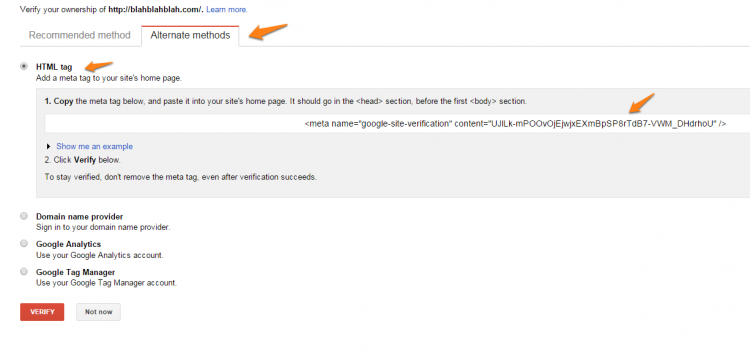
You will be asked to verify a piece of code on your site to prove you are the owner of it. There are a few ways you can verify that you own the website… but the easiest way is usually by choosing the “HTML Tag” option under “Alternate Methods” (seen below).
Verify You Own Your Website
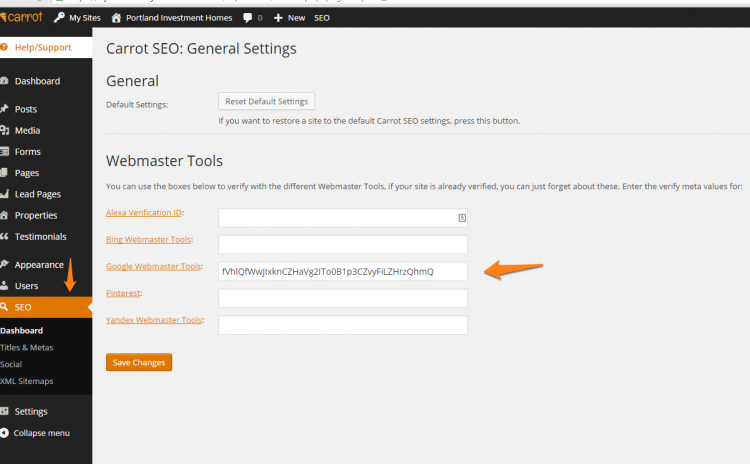
Take the meta tag and copy/paste it into your Carrot site under the SEO tab in the Google Webmaster Tools field. See below
Verify Meta Tag on Carrot Site
Once you have verified the code correctly you will be able to see your site when you log in to Google Webmaster Tools.
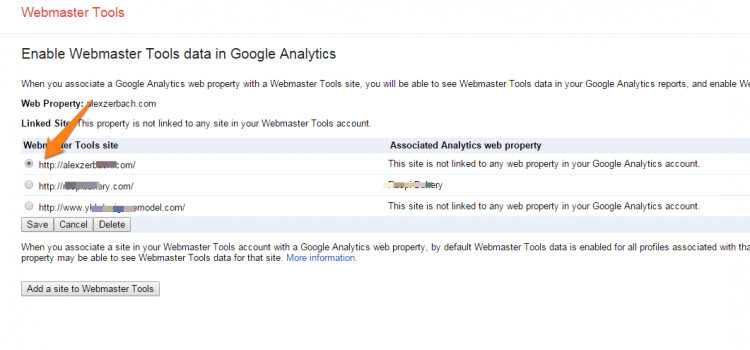
3. Connect Google Webmaster Tools And Google Analytics (super easy)
Now we need to go back to our Google analytics and link up our Webmaster Tools account.
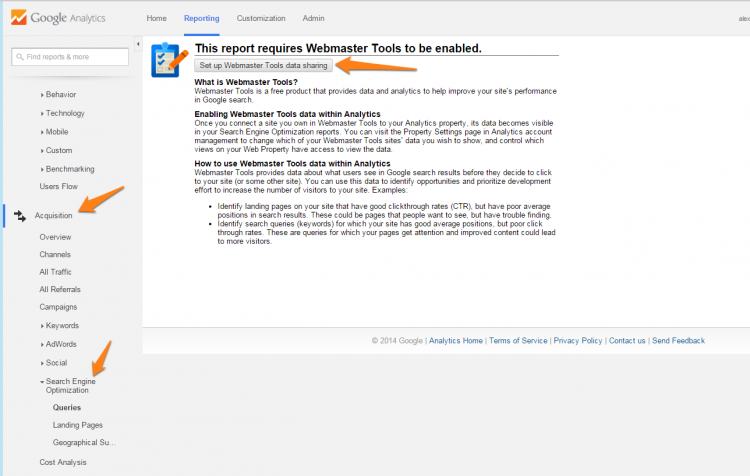
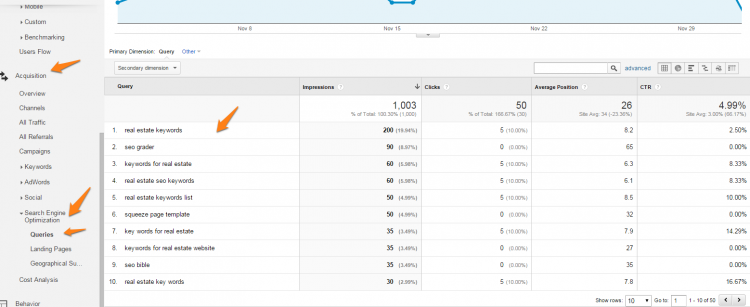
On the left sidebar go to Acquisition Tab > Search Engine Optimization and click Set Up Webmaster Tools Data Sharing.
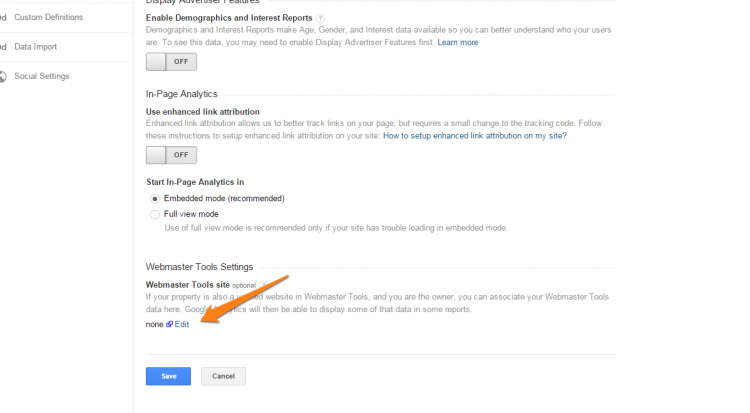
Once you click you will be redirected to a page where you must scroll to the bottom, and find the edit link.
Choose your site and click Save
4. Access Your SEO Keyword Data!
You’ve basically done it!
Now when you go back to Acquisitions Tab > Search Engine Optimization> Queries you should see many of the keywords that people are typing into Google to find your website that was hidden from Google Analytics before.
What These Investor Keywords Can Tell You As A Real Estate Investor
Really, most real estate investors won’t really ever need this data on a regular basis.
For most investors just knowing how people landed on your website is enough… so you can make sure you’re investing your time and marketing dollars wisely.
For more advanced real estate investors who really focus on online lead generation a lot… if you’re curious not just how people found your website but about what specifically they typed into Google to find you… that’s where this data comes in handy.
Here’s how I use the SEO keyword data in Google Analytics to get more traffic (sellers, buyers, tenants, etc.).
If you know that people are starting to land on your website for… let’ssay… “sell my Chicago house fast” because you found it in the Search Engine Optimization Queries tab down the list a bit… you can Google that phrase and see where you come up in the search results. Then implement steps to improve that ranking.
Treat these keywords kind of like an “early alert” that you’re starting to get traffic from a keyword.
Then once you know people are landing on your site from a keyword… ramp that traffic up by ranking better… OR, if you’re doing Google PPC marketing you can add that keyword to your ad groups to target ads to.
We’ll save an even more advanced step which involves using a free Google Adwords account as well to get even better data on your SEO keyword search data that Google is trying their darndest to hide from you for another post soon.
Like this tip? Hit me with your questions or insights on what you’re learning from your newfound SEO keyword data!
Looking for quality Real Estate SEO Tips to help you generate leads? Congrats, you’ve found the best Real Estate SEO Tips out there… at least we think so. :)
Search Engine Optimization can be super confusing. There is a ton of information out there, and most of it is contradictory or outdated.
This video will help you break down in less than 3 minutes SEO tips for real estate investors.
Real Estate SEO Tips (VIDEO):
Real Estate Investor SEO Tip #1:
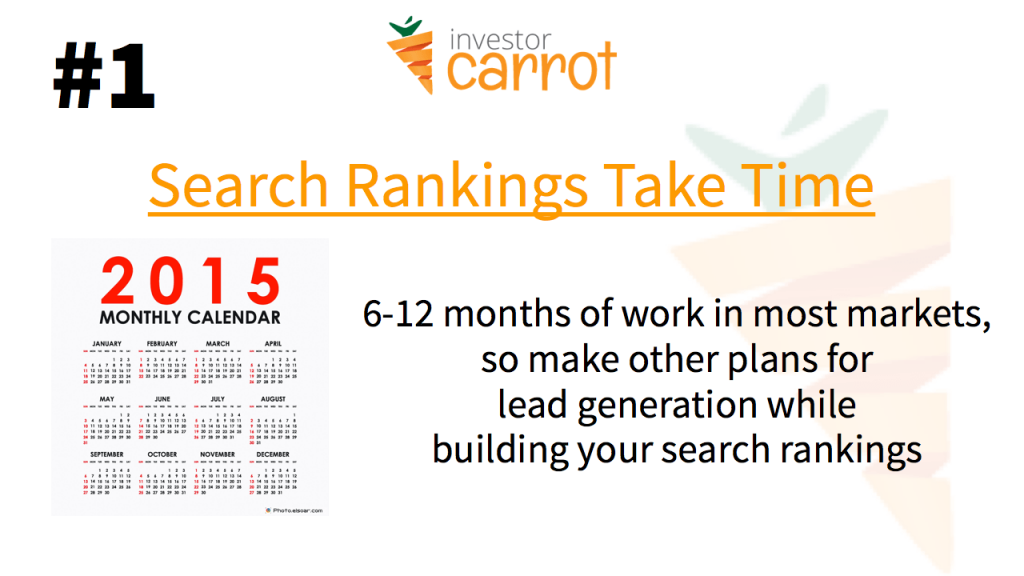
Don’t rush! SEO isn’t a short term solution. It’s a long term investment in your business. So be patient… and make plans to get leads from other sources (we can show you how, no worries).
Real Estate SEO Tip #2:
Our biggest Real Estate SEO Tip is to Do Your Homework… you have got to know what keywords are being searched in your market and understand what it will take to beat your competition – otherwise you won’t get the results you want. Get your Free SEO Bible here.
Real Estate Investors SEO Tip #3:
Keep on truckin… doing a little bit of SEO work every day (or at least a couple hours a week) will pay off well over the course of a year – if you’re focused and stick to a good plan (we’ll help you learn exactly what you need to know).
Real Estate Investor SEO Tip #4:
Google has, like, the smartest people ever working on this stuff. If you wanna try and beat ’em, go for it… be prepared to suffer the consequences. We’d recommend sticking to a solid, proven content marketing strategy – not cheap tricks. Get a free real estate marketing plan template.
Real Estate SEO Tip #5:
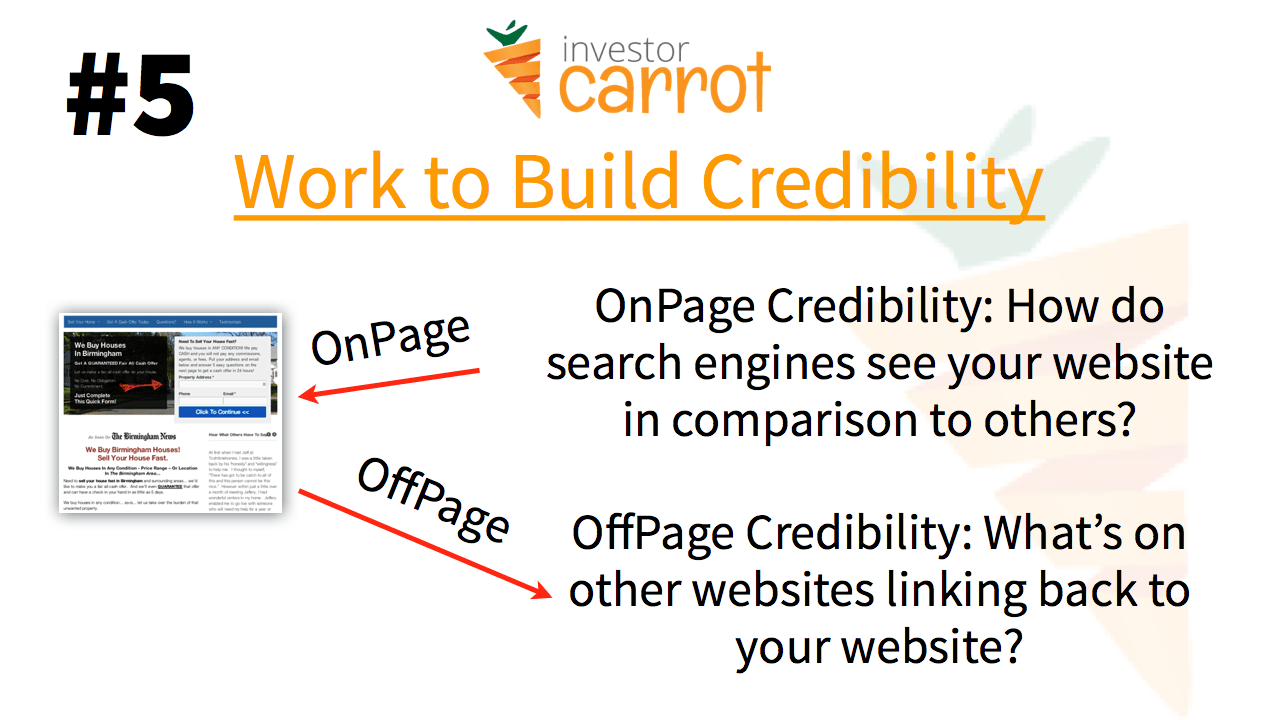
Credibility matters more than almost anything else. Once you prove that you (and your website) have Authority with Google, you’ll find it way easier to get high rankings on additional terms (and generate more leads). A focus on building Credibility for your business will improve your conversions on your site – add testimonials for social proof, improve your bio, and share your site in as many places as possible!
Real Estate SEO Tip #6:
Don’t buy those crummy spammy “instant result” automated SEO services – we’ve seen investors waste thousands of dollars and loads of time, just to find out they need to spend a lot more money on cleaning up the messes that were left behind. Seller intent keywords such as sell my house fast Dallas have much more quality searches for you than say, “what’s the value on my home?” Focus on high quality and you’ll get high-quality results. Our trusted vendors can help – click now to get started.
Real Estate SEO Tip #7:
Make sure you’re driving traffic to your website with at least a few different methods. Think of it as diversifying your marketing portfolio – so if one method crashes (when Google changes their algorithm some sites drop their rankings like a bad stock when the market is tanking), you won’t be left high and dry.
Real Estate Investors SEO Tip #8:
If you’re an expert in SEO, congrats! You’ll find our platform will save you a ton of time. If you’re just starting out on your internet marketing journey, you will want to stick with a proven, tested platform that helps you generate leads… oh hey, that’s what we built! ;) Launching a website on our platform takes less time than you spent to read this blog post – click here to see how fast it is to get started.
Want to get started?
Get access to a free demo of the InvestorCarrot technology platform!
Want to learn more about content marketing, lead generation and SEO?
The majority of search traffic comes from page 1 – these terms are highly competitive, so it’s super-valuable to invest in good SEO in your local market. We can help you. Click to see Brittany’s story of going from zero online leads to multiple leads per day – and how she was able to quit her wage job to become a full-time investor working for herself.
Don’t make your real estate investor marketing tough on yourself! Just take it one step at a time. Today’s post will show you expected and unexpected strategies for real estate investor lead generation.
As the real estate market gets increasingly competitive, the search for quality inventory becomes tougher every day.
If you’re like most of our members, you’d prefer to have your phone ring… you don’t want to cold call people from a list, right? I’ve done quite a bit of cold calling over the years myself, and even though I’m pretty good at it, it’s way more work… it’s a whole lot easier to learn solid inbound marketing practices from others, then replicate them for yourself.
My goal here of this blog is to take the best practices from others who are some of the best at real estate investor lead generation and bring them to you. Like a butler carrying a silver tray…. I want to serve lead generation techniques to you with style. :)
We’ve shown you the not-so-secret formula for lead generation is simple: traffic & conversions.
One fun thing to remember: traffic can come from anywhere. If you have a creative, fun or clever way to generate leads: do it! Don’t get stuck in “paralysis by analysis” — trust yourself when you think “hey, this might work.”
Unique Strategies for Real Estate Investor Lead Generation
The Expected:
Google Search
Optimize Your Real Estate Investor Lead Generation Websites
Craigslist for Real Estate Investors
Bandit Signs and Bus Stops
Direct Mail
Bird Dogging
Develop Properties
The Unexpected:
Bing, Yahoo and “Off-Google” Search
Optimize Yelp, Facebook… Everything
Local Classifieds
Flyers at Laundromats and Non-Profits
Door Knocking with a “Down Payment”
Turn Your Vendors Into Business Partners
Develop Communities
Expected: Google Search
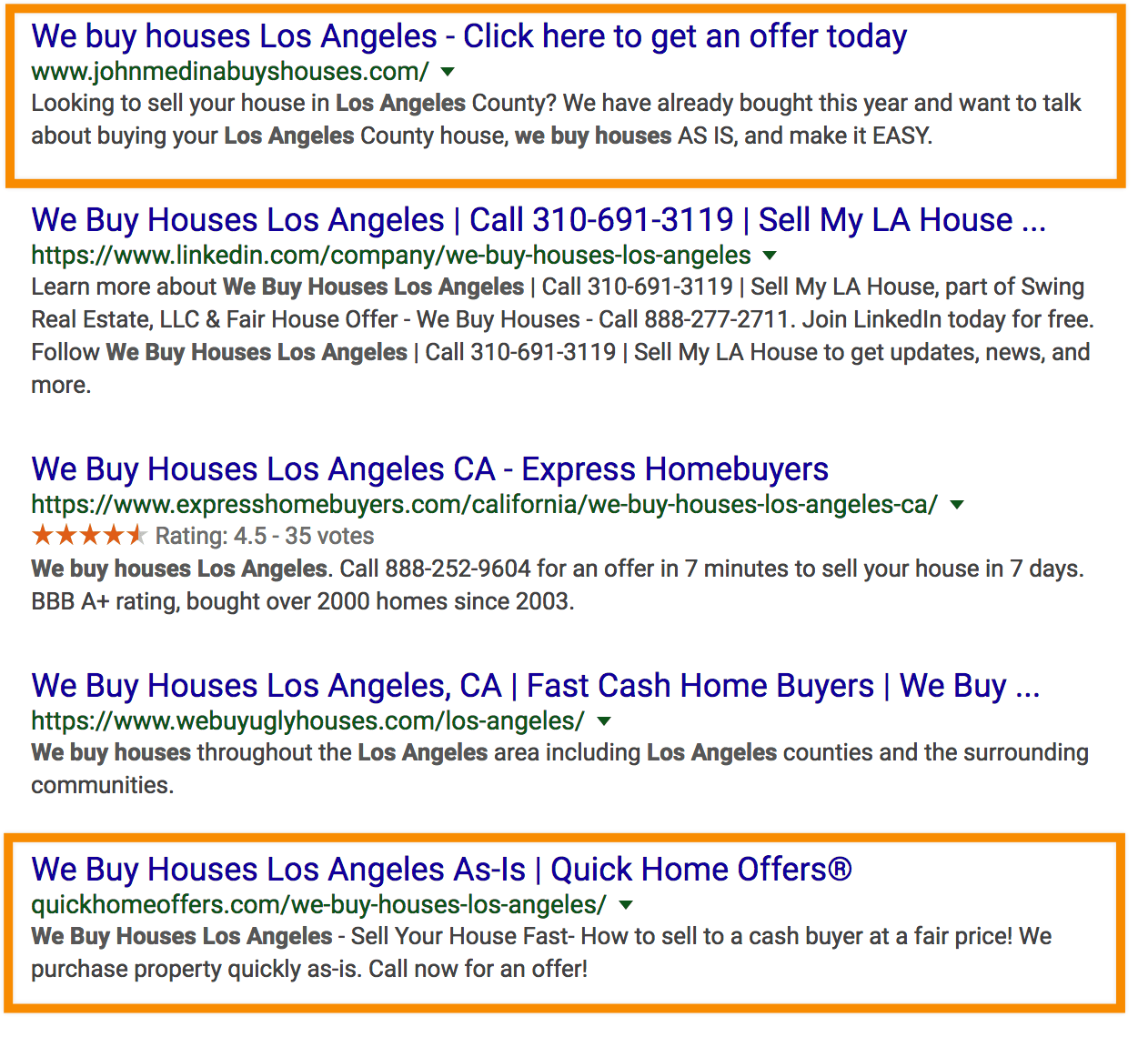
Carrot Members Ranking Organically on Google for We Buy Houses Los Angeles
Definitely one of our favorite places to generate leads!
A good chunk of our business comes from folks who search phrases like “real estate investor websites” online… then discover InvestorCarrot. They check us out, learn that we’ve got an awesome reputation… then start learning from us, launch a website, follow our training… and then get great results.
Lots of our members are beating their competitors on the top Google keywords in their markets using our sites. It’s super cool to see.
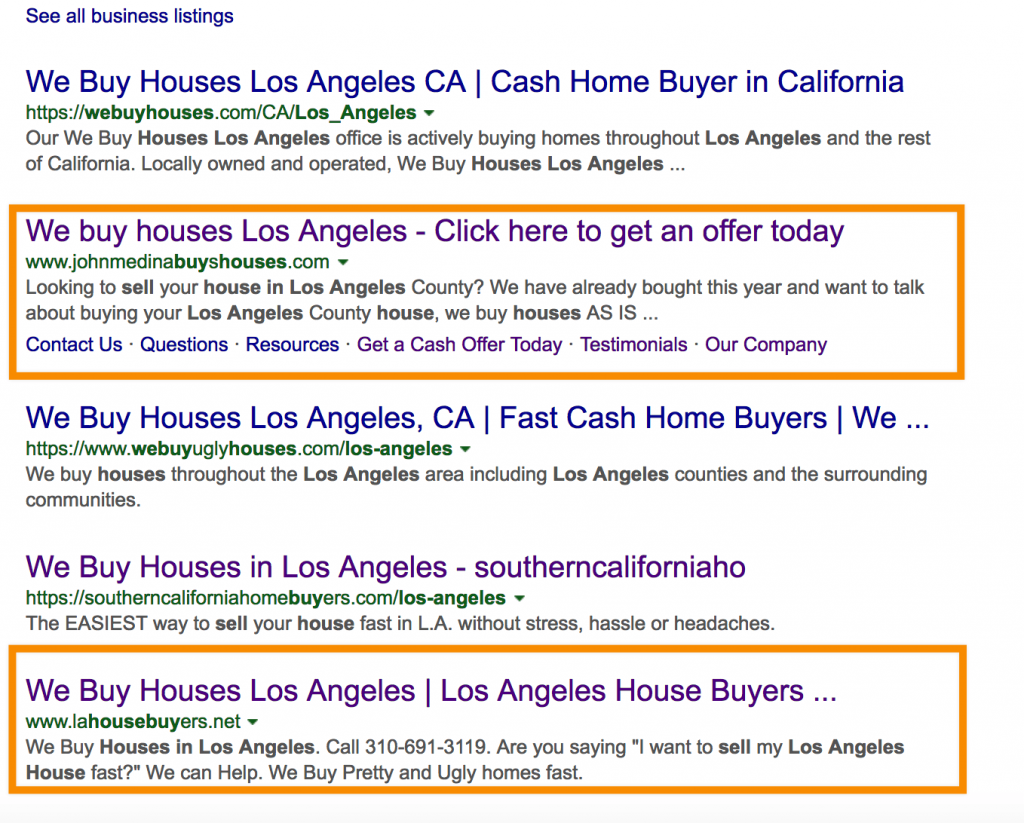
Carrot Members Ranking Organically on Bing for We Buy Houses Los Angeles
While Google gets about 66% of the traffic, they seem to get about 99% of the attention.
That leaves almost a third of the traffic out there without much competition. PPC costs are usually way lower on off-brand networks (although the conversion rates are often lower too, it still often ends up being cheaper than Google).
Expected: Optimize Your Real Estate Investor Lead Generation Websites
You know that you should be optimizing your website, right? Optimization is critical to getting found on search.
Did you know that investors are using pages on other platforms to crowd out their competition in search, too?
I’ve seen pages on Yelp, Facebook, YouTube, Zillow, blog sites, and other big platforms used to dominate top keywords in busy markets.
This is a really smart strategy because sites like Yelp and Facebook already have a ton of authority, so it’s way easier to rank your business’s page on their high-credibility site than on your brand new domain name.
I’d love to see more of our members dominating their local search by ranking different websites on the same keywords… and crowding out their competition.
Already a Carrot Member? Check Out Carrot’s Facebook Leads Masterclass
Unexpected: Geebo, Reachoo, and Other Local Classifieds
The same techniques that work so well on Craigslist also work for other local classified sites. I know one real estate investor who has had the same tiny little ad running for years in his local paper… I think he said it costs him about $80 per month to keep it there, and he makes about $25,000 per year off of the transactions that ad generates.
If you’ve got a local newspaper that doesn’t charge a ton, it’s probably a good idea to run a tiny ad with your phone number, especially if your competitor *isn’t* doing it.
It’s also not a bad idea to post ads on a lot of the free online sites that imitate Craigslist. On some of those sites, you might even get some SEO benefit when you link back to your site from your profile.
Lots of investors have tried putting up signs or buying bus stop ads.
They work, although paid ads are expensive and bandit signs are illegal in many areas (that’s why they got called “bandit” signs… cause they’re breaking the law).
Unexpected: Flyers at Laundromats and Non-Profits
If someone can’t afford to fix their washer, they might need to sell their house, right?
Most laundromats have a bulletin board where you can hang a flyer. Better yet, buy the laundromat. People pump quarters into those things all day long. ;)
Seriously though, make some quality fliers (or if you don’t have graphic design skills, hire someone)… and find the places where people go when they’re down-and-out.
Talk to folks at non-profit agencies who help with foreclosure and probate assistance, and see if they need a partner who buys houses or helps with short sales (depending on your specialties). You may be able to give them a donation from every transaction, depending on referral laws in your state. Check with a good attorney to be sure.
If you can build trust with the right agencies, you’ll have an ongoing deal pipeline for a long time. There are some insanely smart community development organizations who build housing and are solid real estate professionals. Don’t underestimate them.
If you can provide a great service for the same population they serve, they’ll be a great business alliance.
Plus, the partnership that you establish with them is great for press and building future credibility.
Expected: Direct Mail
Direct mail is still a viable real estate investor lead generation option, and it’s easy to replicate. There are a lot of systems for sale out there. It’s pretty expensive, and everyone’s doing it… if you’re in a busy market and using a popular system, you’re probably sending the same stuff as your competitors.
It’s still better than doing nothing. Direct mail campaigns tend to have about a 2-3% success rate, on average… so you’re definitely playing a numbers game.
Unexpected: Door Knocking with a “Down Payment”
I know this real estate investor lead generation method sounds crazy! But I know investors who do really well just walking up to houses and knocking on the door.
Of course, they know who they are targeting… after signs of disrepair, utility notices, etc., they walk up to the door… and if the owner is home, they give that person a $5 bill along with a business card… and let the homeowner know that it’s just a “down payment” when that seller is ready to sell. It’s pretty easy to get their contact info – shoot, let ’em know you wanna send ’em another $5 on their birthday.
I love that strategy… it’s a powerful psychological trigger to take money from someone.
And if you’re thinking “whoa, that’s a fast way to lose $5” – then you’ve probably never run a pay-per-click campaign on Google. If you’re not planning to spend some time and/or money on lead acquisition, you’re not making a serious plan.
Developing a list of people who have taken your “$5 down payment” and actually staying in touch with those people is a great way to get access to properties before anyone else in your market. You don’t want to go around giving away money… but if you can set yourself up to buy houses before anyone else, you’re winning.
Expected: Bird Dogging
Lots of real estate investors team up with “bird dogs” to send them leads. These are folks who (hopefully) do the work of finding potential off-market property sellers and then send you the leads. Depending on the bird dog and the strength of the lead, this might average out to a cost of $50-$1,500 per transaction.
Unexpected: Turn Your Vendors Into Business Partners
Often the people you already know are your key to growing your business… you might just not see the opportunity.
If you know an ambitious person… might be a sibling or a cousin, could be a virtual assistant, a student or a partially retired friend… even your spouse.
If you find someone who isn’t afraid to knock on doors and talk to people, that person could be a great potential partner for your real estate business. Or maybe you’re the type of person who loves to talk but hates technical details — then you might want to find someone who can help you crush it with online marketing.
Depending on the laws in your state, it might even make sense for you to help that person buy property under his or her name – or even together under a new LLC.
There are a lot of creative ways to structure deals.
As many industry veterans will tell you, often the price doesn’t matter as much as the terms.
When you’re calculating your profit from a transaction, what’s important isn’t just the price you paid… it’s the money you made.
If your subcontractor, virtual assistant, and your family are all working to help your business grow – if they have incentives, motivation and a clear path – you’ll have a
So don’t be afraid to partner up with other people who can help you generate leads…. and don’t be afraid to publish in unexpected places!
Expected: Develop Properties
As a real estate investor, you should always be looking for easy ways to add value to properties. If you could spend $5,000 to improve the landscaping and increase your sale price by $50,000 – that would be a no-brainer of a decision, right?
I like to think of my investments on a timeline… where can I add value today that I can pull out for the highest return later?
In other words, if I can get my hands on a fully-rented apartment building with crummy apartments and slowly rehab each one for pennies on the dollar by keeping a few decent workers busy, I’ll make a lot more money by never having to lose my cash flow.
If I build a 30-unit building from scratch, I’d have to have the money to wait until the building is mostly finished before I even take in any money… that means I’d have to take out a lot of loans, which all cut into my profit.
So generally speaking, I look for properties that are already occupied, but not making the kind of cash flow they could be making if they were cleaned up, improved and well-managed.
But either way, it comes down to the money… I like to find properties that need mostly cosmetic improvements because those are the cheapest ways to develop.
Great investors know how to add value to the properties they own to get exponential rates of return.
I’ve been lucky enough to work with some truly great investors along the way, and I’m looking forward to sharing more of what I learned from them… and what I’m still learning today from our awesome Carrot members – we’re lucky to have some of the nation’s top investors as our members, and we’re growing every day.
Unexpected: Develop Communities
As some of you know, I spent a decade in Chicago real estate… actually more when you count the years I spent as a kid getting dragged around to open houses by my mother, who loved to keep tabs on all the neighborhood real estate activity.
I got involved with over $1 billion worth of real estate during my time in Chicago… most of it when I was the managing broker of a really busy real estate brokerage that helped to develop one of the coolest communities – the Wicker Park / Bucktown / Logan Square areas on the city’s Northwest side.
My boss then was a tiger, and I’m sure she still is today. She built an amazing business from the ground up out of sheer will and determination.
She represented some of the top developers on the Near Northside – guys who would buy millions of dollars worth of properties each week, as inventory became available. My boss sold the condos and buildings. I managed the office, training leasing and sales agents. We sold over $100M in sales volume and leased out hundreds of apartments each year. It was the glory days of a booming economy.
But together, we sold a story. It was a story about the neighborhood, about the community… about the histories and cultures of the people who lived there.
After years and years of working in those communities, we saw incredible growth. Now, that wasn’t just from our efforts, or those of our developers… there were huge economic forces in a city like Chicago much larger than anything we were doing.
As successful brokers, we knew how to own the story of the neighborhood.
We sold it to our clients: buyers, sellers, investors, developers, and tenants.
Everyone wanted to participate in something larger than themselves… that’s that feeling of community that feels so good. When you’re really helping others, it shows… and people want to be a part of it.
Your Real Estate Investor Lead Generation Efforts…
should be centered on your community.
We do the same with Carrot: we think of our members first. We want to help you do the best possible marketing for your real estate investment business.
What’s working for you? Any unexpected techniques or tricks we should try? What’s got you stuck? What can we help you improve or understand better?


 When an entrepreneur with a family and a full-time, W-2 job says he’s “busy,” that’s an understatement.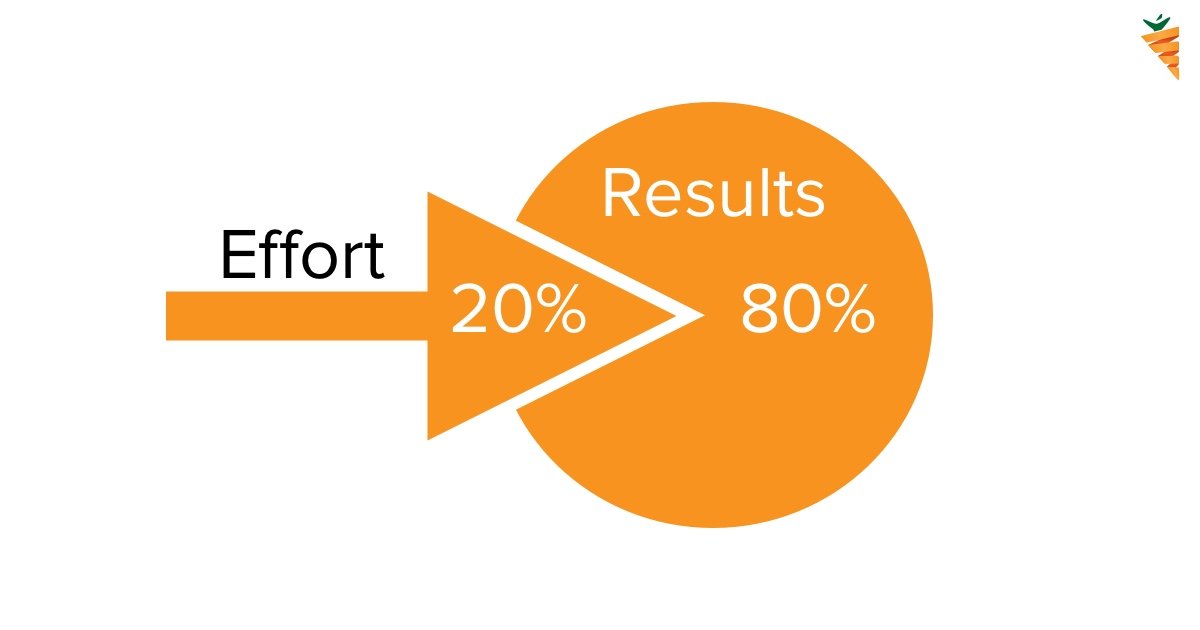



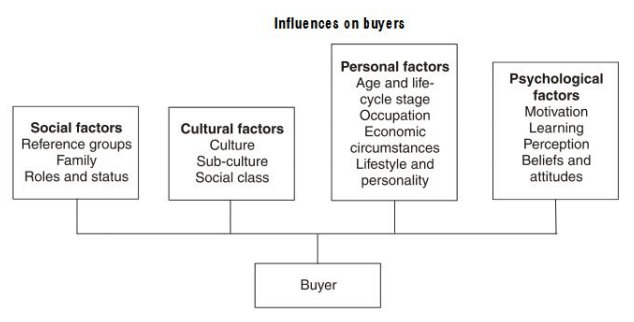
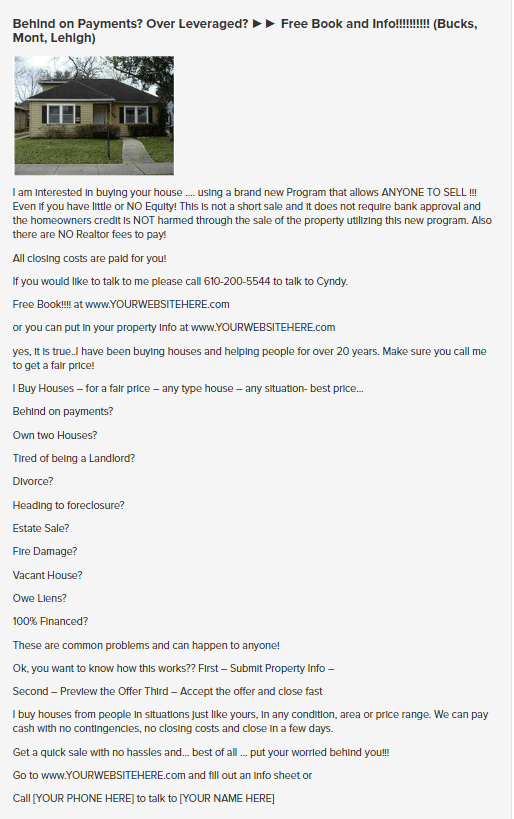
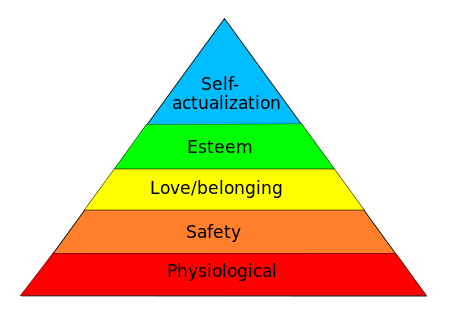
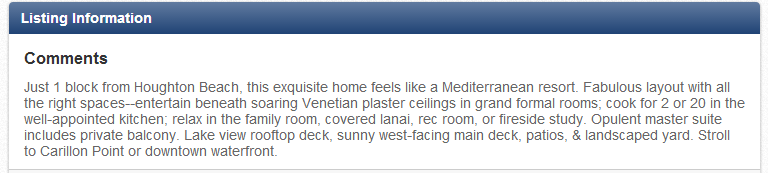
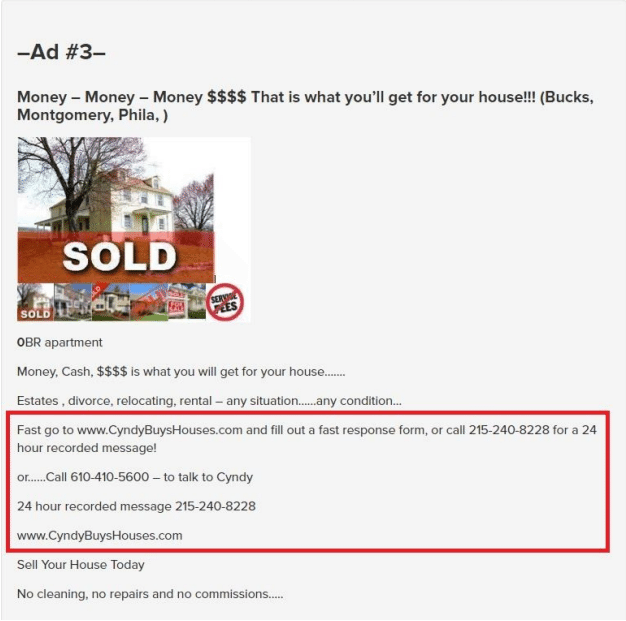
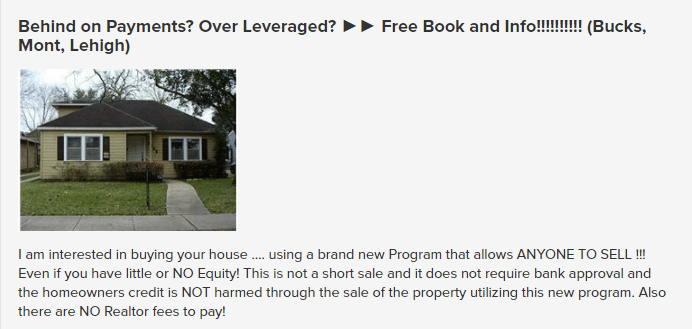


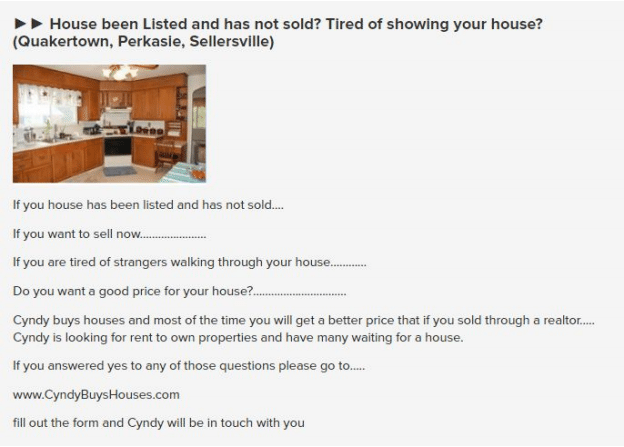
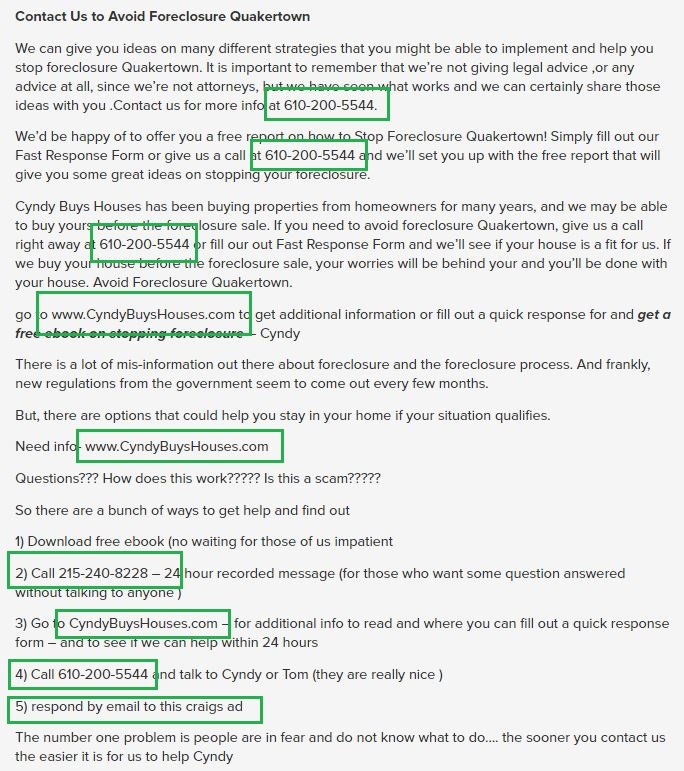

















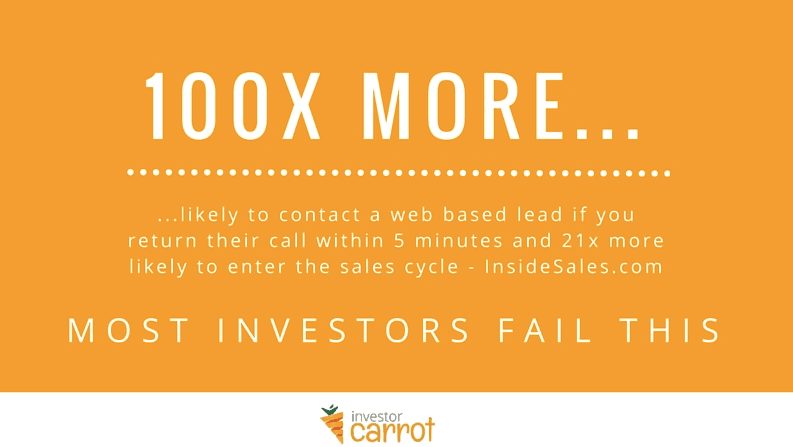
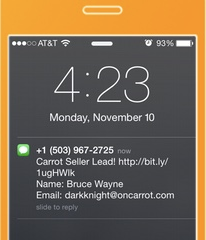

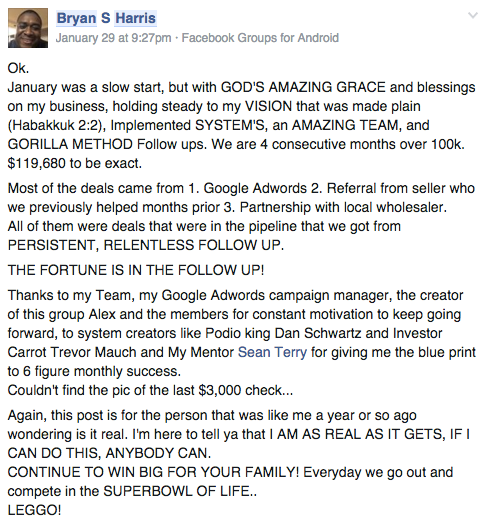
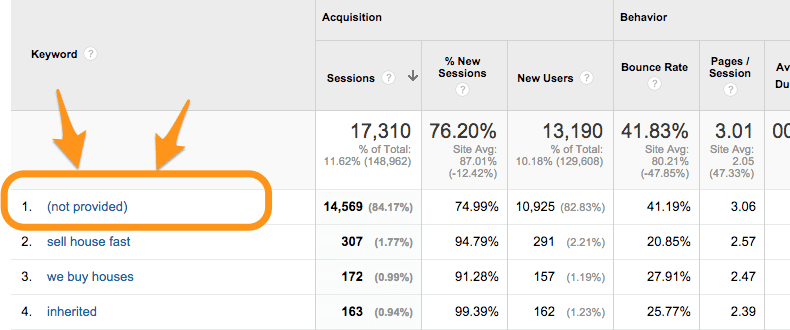


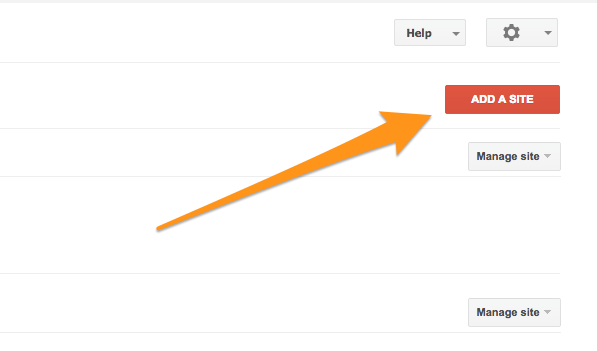 You will be asked to