I never negotiate over the phone. I go to their house, I sit down with them, I have a cup of coffee, and I build rapport.
– Edward Beck
What I Wish I Would’ve Done Differently in 15 Years of Wholesaling & Flipping – The Good, Bad, and the Ugly of Investing w/ Edward Beck
What I like so much about Edward Beck is that he is the kind of guy who tells it like it is. There are so many gurus out there telling people how to get rich quick while they pose in front of cars that aren’t even theirs.
Edward despises this side of the industry, and just like we’re doing at Carrot, Edward is determined to change the way real estate investors are perceived. By leading with his heart and having a true intent to help people, success will inevitably follow.
Read the Full Show Notes Below…
I love it when we have a guest on the podcast who is really out there to help people, it comes from the heart.
Edward isn’t in this to make as much money as possible, (although being so genuine helps him close more deals, rather he is out there to truly help homeowners when they need it.
20 years ago, wholesaling was a different ballgame. You could put out 100 signs and get 100 calls. Wholesales were few and far between, and people didn’t really understand what they did. Today, things are much different.
In some places, the market is saturated. You can put out 100 signs today and maybe receive 10 calls if you’re lucky. The old ways of marketing aren’t what they used to be. With so many people in the business, it is more important than ever that you provide high-quality content and truly find ways to help and connect with your audience.
Thinking He Needed To Do More
Direct mail, cold calling, PPC, SEO, text, door knocking… These are all great ways to get leads, but they aren’t right for everyone. Edward knew he didn’t want to market in this way any longer. He’s been creating great content and letting the leads come to him. He’s building a name for himself as a trusted resource, creating authority in his market.
Instead of making seven calls to a potential lead, he will meet with them directly. He never does any negotiations over the phone. He likes to sit down with people, get to know them, and have a real conversation.
He is the kind of guy that would rather be having a cup of coffee with someone than sitting behind his computer desk. He’s found out what works for him and ran with it, not giving in and doing all of the things investors assume they should be doing.
Knowing Your Audience
As an investor, you really need to know and understand your target audience. For Edward, he has an older audience. He works with many people who are downsizing or who have lived in their homes for a long time.
At the moment, a lot of them are scared to move, let alone have strangers come into their house to view it. What Edward and his team do is work to alleviate all of these fears.
His older clients aren’t always on social media. They get their news from the mainstream media and sometimes have irrational fears about selling. If they are online searching Google for help, they’re likely to click the first result, whether or not it is an ad. Edward aims to hold these top spots so he is able to help these people first.
He isn’t trying to score one big deal out of this. His goal is to do a few deals each month and make sure everyone comes out ahead. People know when you are trying to take advantage of them.
Edward can sleep well at night because he knows everything was done right. Without this purpose and mission to genuinely help people, you will burn out as an investor.
Leading From The Heart
Edward is in this business to help people. A couple of years back, he became so frustrated by what he was seeing in the industry, that he wrote a book of his own to help other investors get into the business. As he puts it, the book was written out of pure anger and resentment!
He did not like the phony side of the industry and was tired of seeing the same regurgitated material over and over again. His book is titled “Get Rich, but Not Quick,” and it keeps things real for new investors getting into the business. It is a straightforward, step-by-step guide to help you get started, even offering scripts of the exact things you should be saying to your potential clients.
Not Being Evergreen Sooner
During COVID, Edward doubled down and has been making a TON of videos. Finding content has been pretty simple. He will take a look at some of the titles from our automated articles, then make a video that dives into a topic even further.
He has also created videos around common seller questions and objections heard when speaking to homeowners about selling. Using his content, he is able to build authority, rapport, and lay any concerns to rest. Now, because of these videos, he is holding the top ranking for many of the best keywords for his market.
Looking Ahead
As demand for a fast sale goes up and down, it’s important to be prepared, making sure you are out there and in front of your potential clients when the time is right. It isn’t about the number of leads you bring in, but rather finding a way to connect with real people.
At Carrot, one of our core values is to be a beacon of positivity. One of the ways we do this is by delivering a “wow” through great service. In an industry where there is so much mistrust, I love when investors like Edward act as a force to uplevel our sphere.
When you have businesses that mesh together, you create a multiplying effect.
– Ryan Pineda
How Building a Brand, a Team, and Dominating YouTube Led Ryan Pineda to Buy 300 Homes in Just 3 Years
Ryan Pineda has been investing in real estate for only 5 years, but in this short amount of time, he has flipped hundreds of homes, built multiple businesses, and become a millionaire, all before the age of 30.
In fact, he has purchased over 100 houses each year for the past 3 years!
Now, speaking from a position of experience, he is helping other investors to do the same.
Read the Full Show Notes Below…
Nothing inspires me more than seeing other entrepreneurs out there crushing it. Ryan Pineda has been investing for 5 years, only doing it full time for the past 3.
In this short amount of time, he has been able to launch multiple companies, build an incredible team, and build a reputation for himself as one of the top investors in the Las Vegas area.
He is the prime example of someone who has found success and is using it to help others do the same.
Hitting the Ball From All Angles
As a former professional baseball player, Ryan learned the importance of teamwork and how many moving pieces must come together to be successful. At the beginning of his investment journey, Ryan spent all of his time flipping houses. He was good at it, but he knew that if that was all he did, he would become resentful and unfulfilled.
He looked at the industry and how he could better serve people. With this philosophy, he has built a brokerage, a real estate education company, and a tax service for investors, in addition to his investment business. He caught on early that in order to maximize the leads that are coming in, he would need to find different ways to serve people.
Building the Team to Do It
Ryan can’t run these businesses alone. Any entrepreneur who has tried to grow their business knows there aren’t enough hours in the day to play CEO, COO, and CFO – at least not if you want to do a good job. Finding the right people and filling these roles with people he could trust has been the biggest factor in Ryan’s success.
Today, his Brokerage has over 50 agents, and his acquisition business purchases over 100 properties a year. He has project managers handling the day to day and by hiring a COO (his sister Noelle) to oversee all businesses, and a COO to manage only his acquisitions (Sean Bob), he has been able to dedicate his time to doing the things that he loves within the business.
That is building a brand and making it known. With the right people managing the day to day, Ryan has been able to quickly take his business to the next level.
Making Yourself Known
While I have only recently connected with Ryan personally, I have been following him for a long time on YouTube and Instagram. He consistently drops great knowledge that is upping the game. Ryan is a person who is using YouTube in the right way. His tactics have quickly gotten him over 38k followers, with those numbers rising every day. So how does he do it?
According to Ryan, you need to have all of these things to be successful on Youtube:
Have a great title and tag – if they aren’t interested, they won’t click
Make sure you have a great thumbnail image that features your face – smile as Youtube loves to spread positivity
Be consistent – Ryan has built an audience quickly because he is doing 6 videos a week – all of which offer great content
Mix up your topics – have some with broad appeal and others with niched content
When running multiple businesses, getting your name out there is a no-brainer. You want to be the guy people turn to when they need help. You want them to know exactly who you are and what you can offer them.
Creating this kind of content will build trust, authority, and rapport with your potential clients. Putting yourself out there may feel daunting, but once you start, you’ll see just how well you are able to connect with people through video.
Building a business around a hobby you love takes the flame out of it. Finding a business that fuels your passions gives you the ultimate freedom.
– Raul Bolufe
How to Triple Your Real Estate Lead Volume Without Any Extra Marketing w/ Raul Bolufe
Raul Bolufe is a returning guest and a long time Carrot customer. You’ve heard me talk about the importance of the agent and investor hybrid, and Raul is the perfect example of this.
Today we are going to talk about a few of my favorite things. Finding your passion, helping your customers, and how to triple your real estate lead volume without any extra work.
Read the Full Show Notes Below…
A lot has changed since Raul was last on the Carrotcast. The market has exploded, strategies are changing, and more people have gotten into the industry.
However, none of this has slowed Raul down. In fact, he is busier than ever, always finding new ways to do business, serve his clients better, and increase his real estate lead volume.
Mixing it Up
Wholesaling is Raul’s primary business and he focuses his marketing on acquiring seller leads. That said, he also owns a real estate brokerage that handles any leads that may prefer a listing to a direct sale.
The rules are different in every state, but in Florida, Raul is able to own the brokerage without being licensed himself. He has a licensed broker on file, to whom he pays out regular distributions.
As the owner, Raul does not collect a commission, rather he collects a salary that the brokerage pays him directly. His setup is perfectly legal and actually reduces his personal liability while helping him to serve more people. As I said before, be sure to check the rules for where you live.
A Check on the Numbers
For Raul, about ⅓ of his transactions are done with a direct sale, while the other ⅔ are more interested in listing! Now imagine if Raul didn’t have his brokerage and didn’t do anything to help those other ⅔?
He’d be casting those leads away to the street. He wouldn’t be able to help them (which he loves to do) and his brokerage would miss out on its share of the commissions. While his profits are smaller on the retail side, he makes it up in volume.
The retail profits cover his marketing costs and then some, allowing him to see pure profit on his wholesale deals.
The good news is that you don’t have to own a brokerage to capitalize on these leads. Investors should look for investor-friendly agents to work with and agents should look for reputable investors to help them close difficult deals.
No longer should there be tension between investors and agents. They serve different needs and can ultimately come together to help more people by offering better solutions.
If you are an investor who isn’t licensed yourself, go take the test and get your license! If it’s really not something you want to do, find an agent to partner up with! To be blunt, if you aren’t doing this now, you are missing out on money!
Fueling Your Passions
Helping people and real estate are two of Raul’s passions. He loves finding creative solutions to help people out of difficult real estate situations. Gary V. says to take your passion and make a business out of it.
And this is great advice for some people. However, both myself and Raul have done things a bit differently. We have built businesses we love and used them instead to fuel our passions.
I love golf. I thought maybe I would be a golf blogger or do something in that industry, but it just wasn’t in the cards for me. Raul is a DJ. As he put it, if he could lock himself in a room all day and do that, he would.
However, that’s not what he uses to pay the bills. We both agree that building your business around a hobby you love may cause you to resent it. So many business people try to make a dollar off of everything, but having something that fulfills you, that allows you to be as creative as you want without the need to make a dollar, fulfills you in ways that money can’t.
For Raul, being a DJ fulfills a different aspect of his life than his real estate business does. When a business fuels your passion, you can be insanely fired up about it, and that gives you freedom.
You can’t complain about leads not coming in if you’re not doing video. You have to get out there, get out from underneath that fear, and conquer it.
– Josh Culler
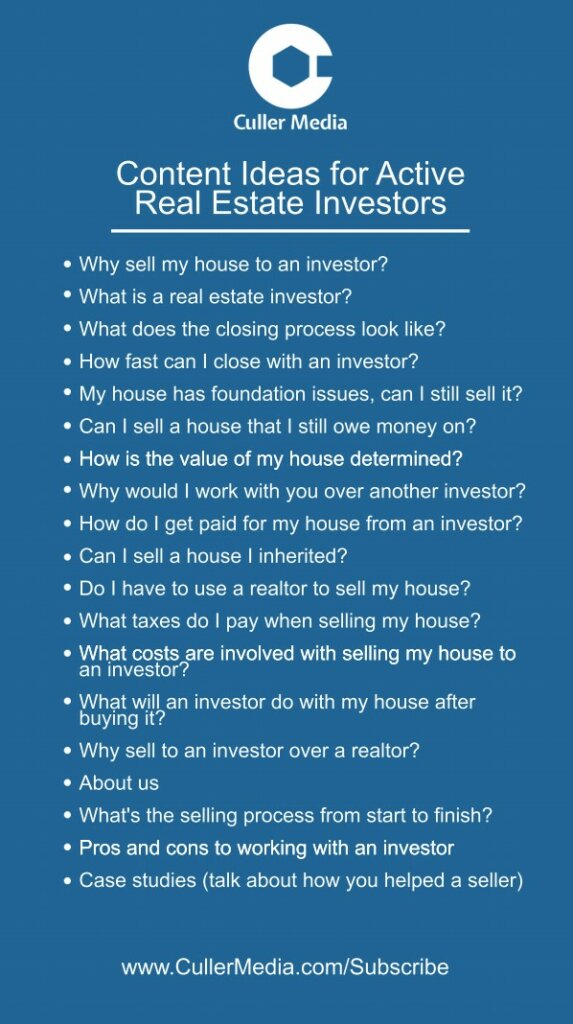
7 Quick Video Marketing Hacks + Free List of 19 Content Ideas for Investors w/ Josh Culler
Josh Culler is a marketing pro who leverages video to help real estate investors connect with their target market. As an expert in video content marketing, he has developed several hacks to get the job done easier and with finesse.
Don’t let a fear of getting in front of the camera stop you from using video. Josh will share with you his tips to show you exactly how to get out from underneath those fears so you can best connect with your audience.
Read the Full Show Notes Below…
I am super excited to sit down with Josh. I’ve seen his videos and I’m beyond impressed by what he is able to do for investors. People who never thought they’d be making videos for their business, are now front and center, cranking out high-quality content like you wouldn’t believe.
We had a great in-studio talk where I was able to pull out these 7 quick video marketing hacks to help real estate investors reach more people while building credibility and authority.
#1. Answer Questions
As an investor, you likely hear questions from homeowners all of the time. Your content can answer questions about your product, service, or industry.
Why should I sell directly?
What’s the difference between you and an agent?
How long will it take?
Answering these questions makes for great content. These are things people are wondering and you are building credibility and authority by being the person who has the answers. The content will be loaded with keywords and naturally primed for optimization.
#2. Film Case Studies
Think back to your last few deals and tell the story of what happened. How did the situation unfold? How were you able to help the homeowner?
Use varied stories that highlight specific situations such as an inheritance, foreclosure avoidance, or someone selling a run-down home. Tell a story with your video and your audience will be hooked.
#3. Film Your Process
While what you do may seem very simple, homeowners may not know what to expect. Film yourself visiting a property or running comps. Show people who you are, what you’re doing, and how everything works.
Even something that seems very elementary to you, maybe something your potential customer was wondering about but was too afraid to ask.
#4. Do Not Over Complicate Things
Josh has found that when it comes to video marketing, people either get too into it or they don’t commit enough. They will buy a $300 mic, a green screen, and edit their videos much more than they should.
Or… they don’t do it because they feel it will be too much work. They aren’t consistent, and they fail to capture moments that could really help them connect with their audience.
#5. Post Everywhere
Once you have your video, get that thing up everywhere! Use our video transcription tool to turn your video into a keyword-rich blog post. Not only do you want it on your Carrot site, but you should have it highlighted on your youtube channel, shared to Facebook, Instagram, and anywhere else you are active.
One important thing to remember is to post your videos natively. Don’t share a Youtube link on Facebook, upload the video directly instead. While the platforms may be similar – they are not friends. Another thing people don’t usually capitalize on is Google my Business and Apple Maps.
These are places people go to when looking for businesses. Instead of having the pictures associated with your business be from other people, take control, and upload content of your own.
You can add some pictures of your office, deals you’ve done, and clients you’ve worked with. Add in your videos as well to quickly connect with people who are searching you out.
#6. Keep It Real
In order to create content that will really connect with your audience, you need to remain genuine. Don’t have someone on Fiver film your video, do it yourself. Have the video be the same person who goes out to meet people and view houses. You’ll also want to be very clear on why you are doing what you are doing.
Financial goals are fine but aren’t always specific enough to motivate you to produce quality content. Josh, for example, not only wants to create a good life for his family, but he also wants to be able 100 missionaries!
This is a huge goal and it works for him. Your goal may look entirely different, and that’s ok!
#7. Be Consistent
Video content is evergreen. If you do a video series on how to handle an inherited home, once it helps you close one deal, it has paid for itself. By creating informative content on a consistent basis, you will create a library of information that will bring the leads to you.
With clear and intentional content, you will be the local authority before you know it. You’ll be able to turn your Carrot site into an authority hub, setting yourself apart from the other investors in your area.
Josh and his team provide a tremendous service to real estate investors. They can help you take your raw content, turn it into a professionally edited video, and get it back to you in 48 hours or less. Right now, you can use the code “CARROT” at cullermedia.com to receive 25% off Josh’s services! Check it out and get some video added to your Carrot site today!
The pandemic is pushing the need to get online and understand technology like never before.
– Tom Townsend
Tired of Tire Kickers? Get This Agent’s Step-by-Step Strategy for Consistent, High Quality Leads w/ Tom Townsend
Tom is a seasoned real estate agent w/ Keller Williams, who was burnt out on cold calling and struggling to compete with the big guys when it came to SEO. By shifting his strategy, and maxing out his AgentCarrot site, he is completely confident about the next 12 months.
Today, we’re looking at what messaging is working best, how Tom is using his Carrot site to convert more leads, and we will even make some tweaks to his site right here on the podcast to make his site perform even better.
Read the Full Show Notes Below…
A month or two ago, my team hit me up and said “You need to check out Tom Townsend.” I was blown away when I saw the data for his site and how he was implementing our training into his business.
Tom hasn’t been with us for a long time. In fact, he has only been a Carrot member for a few months. But in that short amount of time, he is already holding the top 1 and 2 spots for many keywords he is creating content around.
Where He Started
Tom has been in the real estate business since 2002. He began as an investor, flipping properties and holding a few here and there. He then took his real estate skills a step further by becoming a certified appraiser.
He was always heavy on the phones, chasing down leads, and setting up meetings. A few years ago, Tom and his team began utilizing Facebook Ads, but they weren’t directing them to any particular landing page or call to action.
They built a website via Wix, but it lacked flexibility and the ability to grow as the business did. The team moved the website to another platform, but it was cumbersome and time-consuming and wasn’t manageable while they were busy running on the hamster wheel.
The Lightbulb Moment
The pandemic has forced people to improve their online presence or get online if they weren’t already. For Tom and his team, it has allowed them to spend time creating evergreen content that will get them off of the hamster wheel. They are building their brand as the local authority and having the leads search them out instead of the other way around.
COVID has made a lot of people analyze what they are doing and what is important. For Tom, it was time. He wanted more time to do the things he loves, while still building momentum and credibility within the community.
The evergreen content Tom is creating is providing consistency and predictability, giving him the freedom he is after.
His Strategy Today and Why It Works
Many of the 100+ leads Tom has received in the past few months have been through paid PPC campaigns. This is exactly how we recommend agents and investors get the ball rolling.
In fact, Tom and his team have followed our advice and recommendations to a tee, thus bringing in more and more leads, creating more conversions, and closing more deals.
Next, they began creating content, with an emphasis on VideoPosts and our VideoPosts transcription service.
They have utilized our Advanced Marketer Articles, which only require a minute or two of personalization before posting.
They have modified their Facebook and Google advertising, directing people back to their website… err authority portal.
Tom and his team have spent time niching down their content to become the local experts.
They use our Campaign Tracking Links tool to track all of their advertising – even links printed on mailers they are sending out.
The Campaign Tracking Links have become one of Tom’s most important tools. It gives him a clear and centralized place to see what’s working, what’s not working, and where he can improve.
The Power of Testimonials
Many people will seek out testimonials just because they think they have to. They don’t spend time optimizing them or using them to fight objections. My advice is to seek out 5 very specific testimonials that will fight objections and be relatable to the ideal client you are seeking out.
For example, if you are an agent, use a testimonial from someone who was friends with another agent, but chose you instead because of your experience. Or, you can find an FSBO client you were able to help by getting them more than they would have on their own.
Many people will try to avoid working with an agent in order to save money. A testimonial letting them know they will likely get more money when all is said and done is a testimonial that will actually help you to convert.
Because of COVID, so many agents and investors are working from a home office. They’re not out and about attending open houses and networking events.
Here at Carrot, we have seen many people using this time to amp up their websites. To change them from glorified business cards, and instead, turning them to authority hubs.
Go to Carrot.com to see what we are doing to help agents ramp up even more as we close out the year strong.
Let me start with a hard question: “Are you a realreal estate investor or a fake?”
Wait. Don’t answer that. The truth is… time will tell.
Unfortunately, time — as it relates to real estate investing — is pretty harsh. Most real estate investors get chewed up and spit out before they even know what hit ‘em. Upwards of 87% according to some estimates.
But it’s not just real estate wholesalers and flippers.
It’s been published that 96% of businesses go out of business within the first 10 years, and over half fold up their tent by the end of the first year.
But that number is even high for real estate wholesalers and flippers…
… because of the low barrier of entry to get into business. It requires hardly any capital to get rolling… and you can read a book today, register a business tomorrow, and be a “flipper” or “wholesaler” by the end of the week… which is AWESOME. Still, it also makes it easy for many people who haven’t fully adopted the mindset and skill-set needed to be successful in running a business.
So, wouldn’t it be nice if you could diagnose your real estate investor’s “realness” — your likelihood of success — before getting clobbered?
Wouldn’t it be nice if someone told you the brutal truth about exactly why many real estate investors fail?
Well, “nice” might not be the best word.
After all, the brutal truth is rarely “nice.” But, profitable, career-saving, and life-changing? Absolutely!
In my 10 years working with real estate investors, I’ve seen thousands of real estate investors come and go. And the deepest irony — the cold, hard, brutal truth — is that it all comes down to five things those who fail tend to ignore (and those who succeed master).
The good news is you can overcome these common killers by having your eyes wide open to them and digging into the concrete solutions and resources I’ve included throughout.
1. You’re Following Emotion vs. Knowing Your Numbers
Investors who fail tend to open up their wallets based on emotional decisions vs. actually nailing their numbers and trusting the numbers.
When emotion takes over you tend to stop investing in marketing before it has a chance to succeed… you tend to make offers based on your “gut” vs. a tried and true formula… and you tend to bounce around from one thing to another in search of that magic bullet like a pinball machine.
One way people constantly get caught up in the emotions vs. the numbers is in how much money you invest in your business.
How much money do you invest in a marketing strategy?
How much money do you invest in a property?
How much money do you invest in your education?
As soon as emotion creeps into the equation and a mathematical formula stops being used… you’re on the fast track to losing your butt (and not knowing why).
As a real-world example, let’s say two people are doing PPC marketing.
Investor #1: Likely To Fail…
Investor #1 started with their budget rather than knowing the numbers. They have set aside $2,000 for PPC marketing for motivated house sellers. Plenty to turn a profit, right?
They start their PPC campaign and quickly find out that the first few weeks of a PPC campaign are all about honing the campaign and tweaking it… so they end up spending $800 in the first 3 weeks. They have 7 leads to show for it, which they’re working on… but no deals yet.
By week 4 they have their campaign honed a bit more but have spent $1250 of the $2,000 they had set aside… with a total of 10 leads.
Bummed, they start to think, “Man, maybe PPC isn’t for me. I’ve already gone through my budget; let me stop this campaign and figure something else out”.
With that, they stop their campaign and chalk it up as a “failure” and a loss. $2,000 in the hole and now onto “focus” on a new strategy.
Investor #2: Likely To Succeed In A Big Way…
Investor #2 started with the numbers… not their budget.
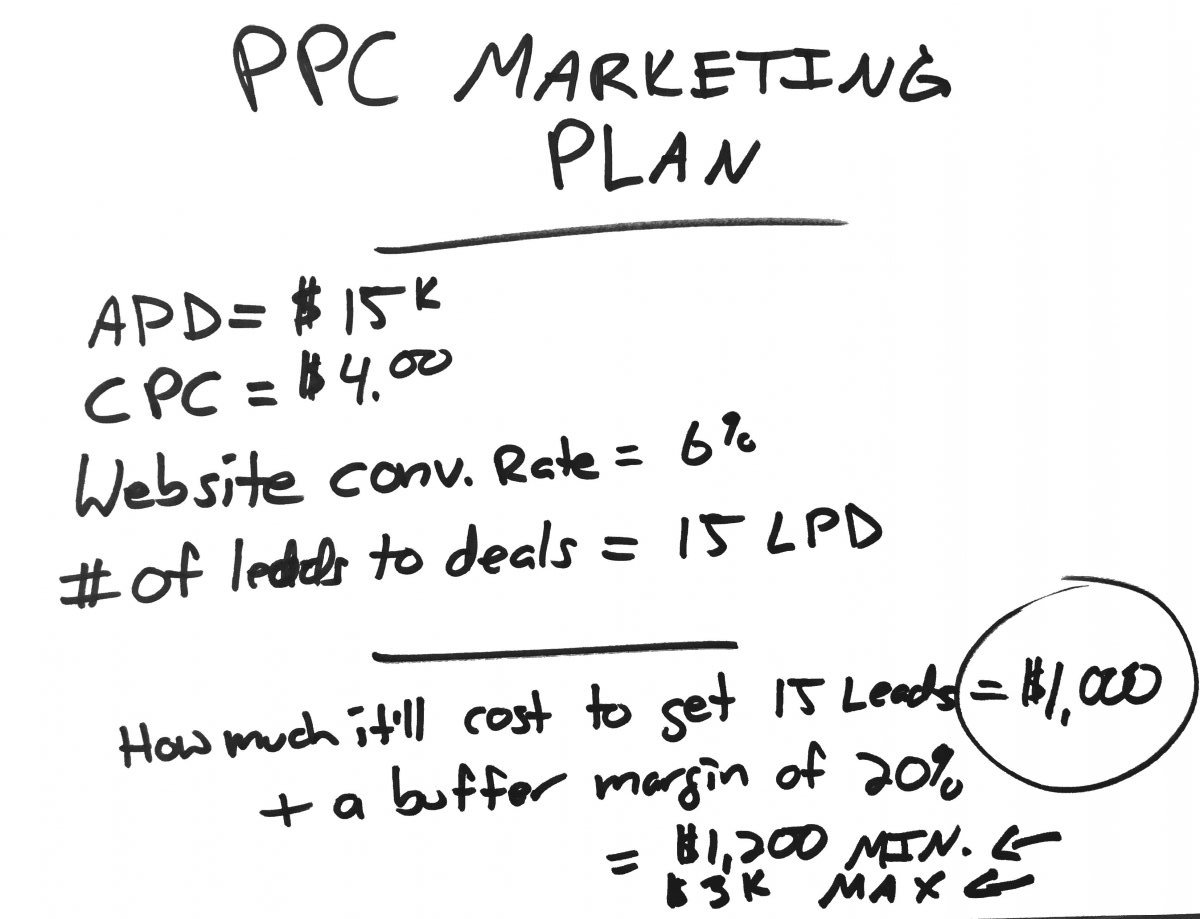
This investor worked the numbers… and it looks something like this…
What do those acronyms mean…
APD = Average Profit Per Deal
CPC = Cost Per Click (for your PPC marketing)
LPD = Leads per deal (how many leads on average until you close a deal)
MIN = The minimum you’ll need to allocate for your PPC marketing to have it work well MAX = A number you pick that is the max you’ll invest before you close a deal
Investor #2 knows her numbers well and can see that based on those average numbers, they shouldn’t expect any deals until, at a bare minimum, $1,200 has been invested in a well ran PPC campaign.
But, she also knows that in the real world, things don’t always work out like we hope they do in our calculations… so she sets a “max” that she’d invest in that marketing channel to close a $15k deal (her average) before she seriously thinks about shifting focus to something else or stopping the money invested into that marketing channel.
Investor #2 launched her PPC campaign, and it doesn’t go as well as she thought… she blew past the $1,200 mark without a deal… but she followed her numbers and kept investing, and at $2,500 in… she closed a deal that brought in $17k gross.
Subtract out the $2,500 in PPC costs, which turned into a nice $14,500 profit. BAM!
Now she has more firepower to invest in this marketing channel and work on improving those numbers even more.
The moral of the story is?
Investor #1 followed emotion and started with their “budget”… Investor #2 followed the numbers and started with knowing her numbers then set the budget that’ll lead her to success.
Investor #1 is already onto another marketing strategy and discouraged… Investor #2 is ready to scale things up and happy as a clam.
Here is the PERFECT example of Investor #2. Adam Mitchell could have easily let emotion hold him back…
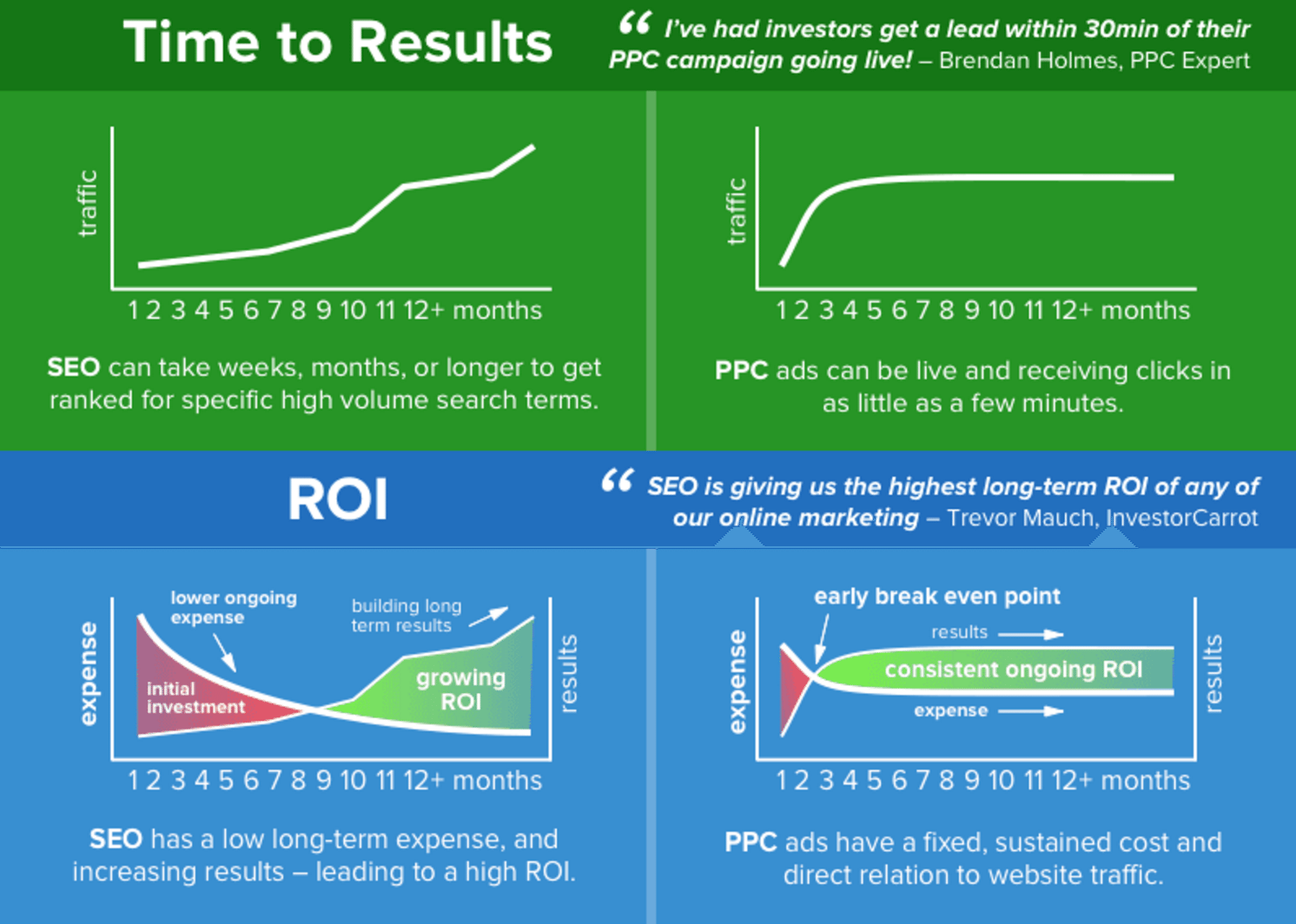
If you haven’t seen this section of our SEO vs. PPC Infographic… it maps out how PPC and SEO work regarding timelines and expectations. Remove emotion from the equation and stick with the numbers.
If you don’t know your numbers and create your marketing budget… you’ll stop investing your money too early and quit before it has a chance to work.
I know that sounds obvious but stick with me. On the real estate front, I hear this all the time:
However, every time I dig deeper, “doesn’t work” means, “Well, I tried it for two weeks. Dropped $500. But didn’t see any results.”
You see the problem, right?
While it might be cliche, the old truism is true: “It takes money to make money.” Simply “trying out” one so-called success method at a time, dipping your toes in but not investing in it — i.e., putting your money where your mouth is — is a sure way to sign your real estate investor death warrant.
Ironically, this same fatal mistake kills even more real-estate investors when investing itself.
It’s strange to think, but many still expect to get something out of nothing. That’s one of the reasons many folks get involved in real estate investing. As BiggerPocket’s points out, “How can I get started in Real Estate Investing if I don’t have any money?” is one of the most common questions they get asked.
And their answer?
You can’t.
That’s it — it’s that simple. You cannot invest in real estate with no money down. It is impossible; in fact, it is antithetical (big word) to the definition of “investment.”
I really want to encourage everybody…that when you are having things come up against you, you’ve got to make it happen. It’s right at that moment when you’re so close. You’ve got to double down. You gotta punch the gas and not pump the brake…
2. You’re Not Putting In The Time
This second failure is so similar to the first that I almost left it off my list. But there are subtle differences between the two that add up fast.
Why?
Putting in the time doesn’t mean physically “being there” doing busy work. Putting in the time means you purposefully cut out the crap in your life between you and your goals…
… so you have so much ample focus time that there’s no way you won’t succeed.
Putting in the time doesn’t mean…
Carving out 30 mins here and there when you can fit it in
Hopping on the forums and endlessly reading and “learning” stuff you may need to know someday
Going through 3 training courses before you get off your duff and start doing the business (making offers, looking at properties, etc.)
Saying, “I’ll give this a try for a couple of months and if it doesn’t work, I’ll move on”
Putting in the time means you’re getting serious with yourself and saying…
“I know this works. Others have done it before me. I’ll work it until it works and relentlessly hack out anything that doesn’t help me reach my goals. It’s not a matter of ‘if’… but a matter of ‘when’ it’ll happen. The only variable is time, not my effort or ability to make it happen”.
If you feel you don’t have enough time to invest in yourself and your business, you’re likely thinking too short-term and not long-term.
You’re thinking about how you can make a quick buck and have that instant gratification vs. building something that’ll truly last, make an impact, and leave a legacy.
If you’re not willing to bust your bottom for the next 18 months…
… (even if 12 months of it is utterly failing at every step), you may do yourself a favor and find something else you can invest 18 months into a full bore and switch to that.
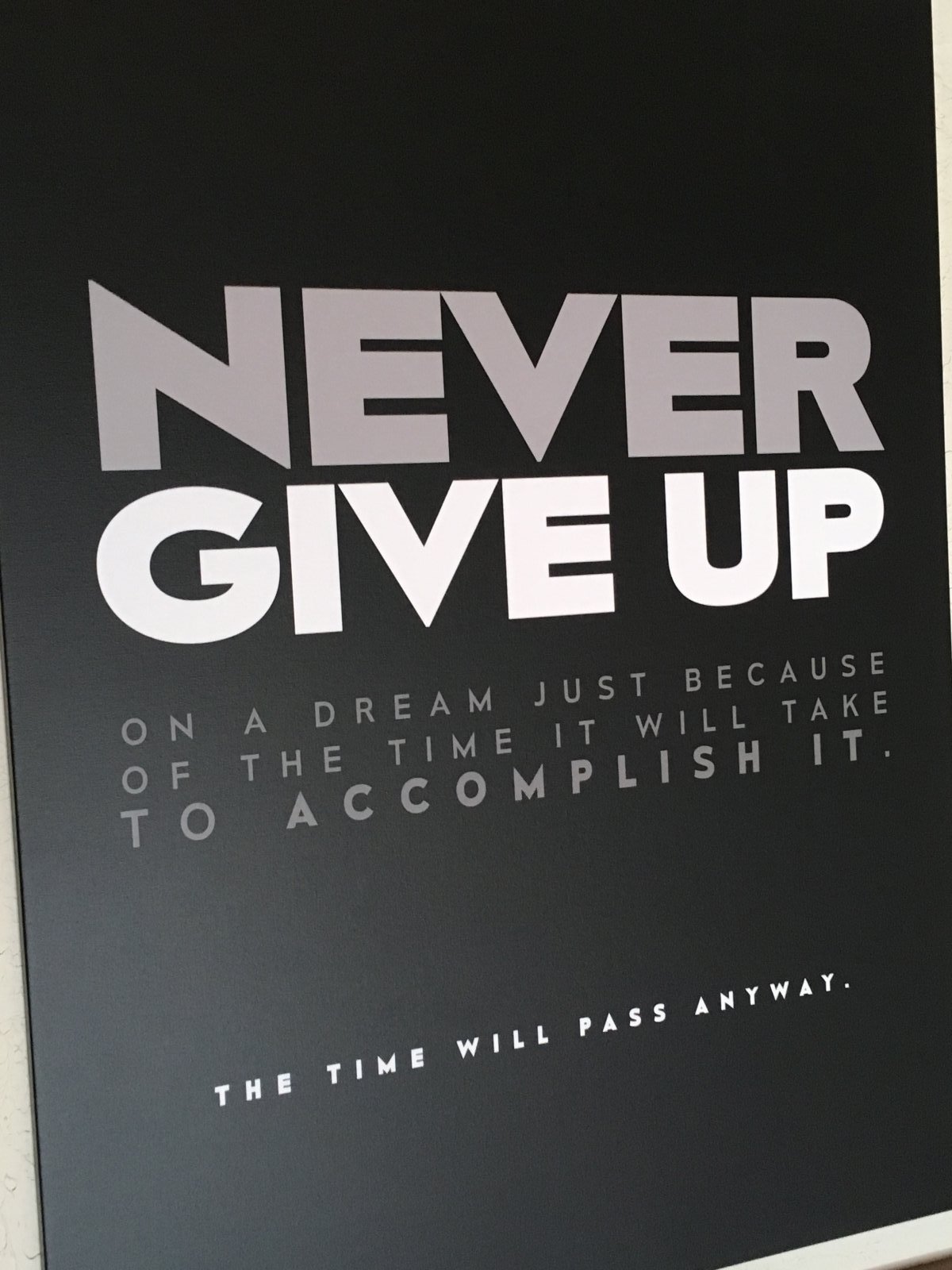
Every day when I walk into my office here at theLoft where Carrot is based, I see this at the top of my stairs.
3. You’re Quitting Too Soon
I know what you’re thinking, “How is perseverance different from time?”
The short answer is that success regularly takes longer than we expect… it also takes a lot more blood, sweat, and tears.
In other words, the reason real estate investors fail when it comes to perseverance is the same reason why 95% of dieters fail to lose weight and keep it off, why people always say they’re going to start exercising and then give up after a few days, and why so many people make new year’s resolutions that never see the light of day.
Are You Closer Than You Realize?
Psychology Today blames much of this failure to persevere on our brain chemistry:
“Neuroscientific research shows that higher levels of dopamine might separate the internal drive some people have to persevere while lower dopamine levels cause others to give up.”
So does that mean some people are just built to take the hard knocks necessary for success, and others aren’t?
Absolutely not.
The brain is an amazing organ, and — thanks to what’s known as “neuroplasticity” — if you haven’t been the person who perseveres up to now, you have the power to change that.
The key to becoming a person of perseverance are to increase dopamine levels by:
Achieving at least one goal or mini achievement each day, no matter how small.
Be your own best cheerleader. When you achieve something, be intentional about celebrating.
And just in case all that feels a bit too touchy-feely for you, consider the words of Ben Horowitz in The Hard Thing About Hard Things:
Great CEOs face the pain.
They deal with the sleepless nights, the cold sweats, and what my friend the great Alfred Chuang (legendary cofounder and CEO of BEA Systems) calls “the torture.”
Whenever I meet a successful CEO, I ask them how they did it. Mediocre CEOs point to their brilliant strategic moves or their intuitive business sense or a variety of other self-congratulatory explanations. The great CEOs tend to be remarkably consistent in their answers.
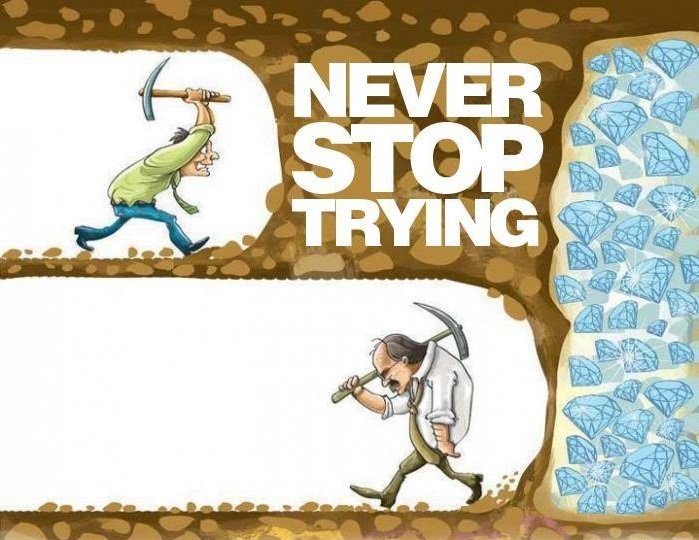
They all say, “I didn’t quit.”
4. You’re “Focusing” On Too Many Opportunities
I once got an email from a former member of ours.
His email said…
Carrot seems like a good product, but I have been focusing on too many marketing strategies.
In case you missed that, the words “focus” and “too many” are opposites.
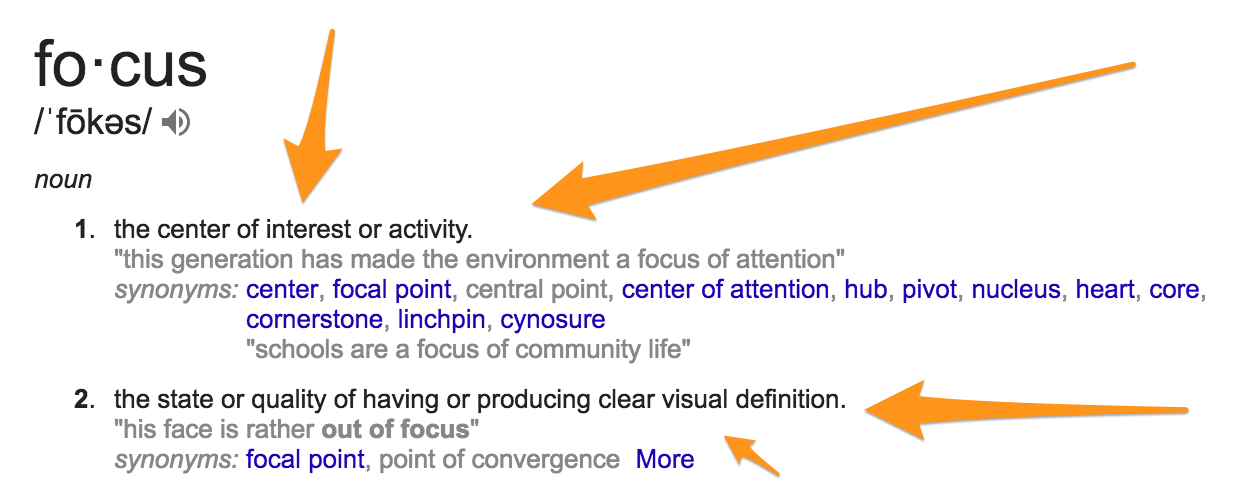
The official definition of “focus” is…
This member led himself to a sure and swift “business death” by “focusing on too many things.”
As long as we’re quoting brilliant thinkers, Confucius once said…
When real estate investors — or any entrepreneur for that matter — focus on doing too many things — i.e., chasing too many rabbits — they end up sucking at pretty much all of it.
And ironically, early success is often the biggest hindrance to future focus.
For instance, I had some big early wins when I started my business. This meant lots of people wanted to do business with me. However, most of the propositions were in areas not core to the business I had created.
As a real estate investor, you may experience the same thing. At times, I found it hard to give a resounding “no,” but I knew that if I didn’t, I would spend a lot of time on things that were not a priority and didn’t fit into my long-term plan.
Today, I am glad I was so hard-assed about my priorities. And that’s exactly why a laser-focused, long-term vision is a must; otherwise, you are likely to sway this way whenever something else comes along, or you get distracted.
In addition to learning to say “no” to opportunities that don’t align with your focus, discipline is another ingredient needed. Afford Anything puts it plainly when talking about getting rich by saying, “Focus on what’s important. Ignore everything else.”
Grab our free Real Estate Investor Business Plan to overcome this lack of focus. Inside, you’ll find everything you need to build a solid foundation to sustain your business over the long term and zero in on what truly matters.
5. You’re Just Learning Real Estate Skills, NOT Business Skills
We’ve found that newer real estate entrepreneurs are under the impression that to be successful, they only need to understand things related to real estate.
But any seasoned entrepreneur will tell you that to succeed, you need other business skills like communication, persuasion, team building, marketing, etc. Real estate investors who don’t have the right business skills are far more likely to fail than their counterparts who invest across the board.
For example, you may be brilliant at what you do, but if you can’t market yourself, you’ll never make money.
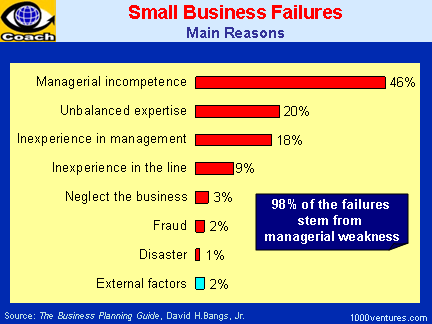
From these statistics, you can see that most businesses fail due to a lack of business skill
Chris Ducker says it like this:
“Most people seem to think that being a successful internet marketer is as easy as getting a website built and getting their own domain name and they could not be farther from reality.”
This mindset is developed from hearing how “easy it is to make money on the Internet” by scaly online entrepreneurs whose sole aim is to line their wallets with the profits of gullible opportunity seekers.
The reality is that no real estate agent just closes sales… and no website just gets traffic. Both need to be marketed. From a real estate investor point of view, Inman reports that physical brick-and-mortar walk-ins now account for fewer leads than websites. Now, you should know that in their findings, a dismal 3% of leads were generated via walk-ins and 4% via online methods.
But what you need to understand about this finding is that the numbers for online lead generation are so low. Although most real estate investors agree that a website is essential to their business, they don’t fully realize what an online presence entails, nor how to generate leads online.
For the sake of clarity: if real estate investors knew how to market their website, their website would generate a lot more leads than the 4% they currently are.
Bigger Pockets confirms this finding and adds, “Only if you create that awesome, SEO-friendly website, along with citations, profiles, and videos, and start producing awesome blog posts centered around your community will you benefit from this form [online] of marketing.”
As an antidote, look at our 90 Day Action Plan, designed to “break down exactly what to do to get your first 100 cash buyer leads, and your first 30 seller leads.”
So, What Path Are You Headed Down?
I want everyone to know that it’s OK to fail.
Failure is good. I’ve learned the most when I’ve failed… not when I’ve won.
So failure is part of the process.
Failure shouldn’t be a door closing but it should be a shortcut to the next door that’ll open very soon that will get you closer to the success you’re going after in your life.
Yes, failure is OK but what isn’t OK is choosing to ignore these 5 sure business killers that will lead you to failure over and over and over again.
So right now, take stock of yourself and where you are.
Are you…
Leading with emotion or with knowing your numbers?
Putting the time in?
Persevering even when you feel like you should stop?
Focusing on one path or chasing multiple rabbits?
Learning how to build a business or just learning tactical “deal making” skills?
Oh, if none of those are quite describing you and the reason you’re not reaching your goals… here’s a bonus #6 that is often the most confusing and toughest one to own up to.
Brian Buffini, Chairman and founder of Buffini & Company — America’s largest real estate training and coaching company — nails it on the head:
“Strangely enough, the majority of people we encounter have a fear of success rather than a fear of failure.”
I couldn’t agree more.
Of course, there’s always a chance I missed one of the killer pitfalls you’ve seen in your career. If I did, share it in the comments below.
Also, share with me below if any of these hit you in your gut? Let’s squash these and make YOUR GREATEST IMPACT this year.
“I’m just doing the things other agents aren’t doing in order to stand out” Krista Mashore
We love Krista Mashore because she practices what she preaches (and what we preach!)
In this episode, she lays out her tried and true 6-month strategy that her coaching students are implementing to go from 1 deal a month to 5, 10, and 15+ deals per month!
There’s no BS, no hype, just real stories, and real results.
We’ll cover:
What types of videos you should be creating as a real estate agent
How often you should be posting to social media
How to use your videos as Facebook ads
Why you don’t need a video person or fancy equipment when starting out
Who you should hire as you grow your business.
Listen in and learn how to start building consistent, predictable lead flow so you can finally gain back the freedom you’ve been working so hard for.
EP 164: Top 1% Agent Reveals Her Simple Strategy For Closing 12+ Homes Per Month w/ Krista Mashore
Every guru in the real estate market looks brilliant when they have only known an upcycle.
– Aaron Amuchastegui
How to Pivot Your Post COVIDInvestment Strategies for Auctions, Foreclosures, Commercial, and more w/ Aaron Amuchastegui
As we look ahead to 2021, I am thrilled to be having some leading real estate experts on the CarrotCast to help us anticipate what’s next. We’ll be talking about monetary policy, micro and macroeconomics, multi-family property shifts, and what investors can expect the market to look like going into 2021-2022.
Today we are talking to Aaron Amuchastegui to discuss foreclosures, the moratorium, and how to shift your post COVID investment strategies to remain successful during a frenzied market.
Read the Full Show Notes Below…
While the foreclosure moratorium is helping homeowners hold onto their home during the COVID pandemic, it is also forcing investors like Aaron Amuchastegui to shift their entire strategy.
By remaining flexible and adapting to the current market situation, he is able to find deals and opportunities in other places.
Today we will dig into the data and show you exactly how he’s doing it.
Aaron is an investor, entrepreneur, husband, and homeschool dad. Using his killer time management skills, he is able to balance his career, family, and free time. He has flipped thousands of houses and more importantly, he has been through an entire real estate cycle.
His perspective and insights are unmatched when it comes to looking ahead on foreclosures and what the moratorium will mean for the upcoming market shift.
Where We Are Today
There are experts out there who appear brilliant at what they do. And while many of them are, many have only been involved with real estate for the past 4 years. They only know the upcycle. They haven’t seen a down market or had to adapt their strategy to make money even when the market is falling.
Investors like Aaron are in a much better position to offer insight as to where we really are today. At the moment, pisces are inflated and properties don’t stay listed for long. It is a frenzied market, which isn’t sustainable.
Looking To The Past To Anticipate The Future
Back in 2009 when Aaron was deciding where to buy, he dove straight into the data. Today, just like the early 2000s, properties are flying off the shelves. Just like in 2005, new construction homes are being sold before they have been completed.
With unemployment benefits decreasing and the foreclosure moratorium coming to an end within the next few months, the demand is certain to drop, decreasing listing prices across the board.
Aaron believes that unlike 2008, people today have more equity. They aren’t refinancing to buy toys or make ill-advised purchases. Back in the day, people were financing 100% of the purchase price when buying, putting them in the hole almost immediately. Today, interest rates are much lower and people aren’t making the same mistakes as they were when the bubble burst.
What Happens After The Moratorium Is Up?
Because of COVID and the skyrocketing unemployment rates, the federal government has issued a foreclosure moratorium to protect homeowners until the end of the year. Only 25% of properties that should be foreclosed on are actually being put up for sale. These are properties financed with commercial and conventional loans.
In the past, investors had to think fast when potential foreclosure hit the market. They only had 3 or so weeks to get things in order to buy a property before the bank took over. Today, they have several months. This creates a big opportunity for investment buyers as well as an opportunity for homeowners to sell before losing their home to the bank.
Once the moratorium is up, the banks will once again be foreclosing on properties. In markets where we typically see 5,000 foreclosures per month, this number can easily jump to 20,000. This sudden availability of lower priced homes will aid in driving down prices and decreasing demand for the average property.
COVID and The Real Estate Market
There are exciting reports out there showing the insanely high number of buyers out there, however, these reports should be taken with a grain of salt. COVID has allowed many people to work from home, which means they no longer have to pay the high price of living in a city.
Many people are fleeing these large areas and moving to homes outside of the city at a fraction of the price. For example, in Austin, a property will sell for over $1 million on average, but outside of the city, houses are available for as little as $100k. As people flee, homes in these metro areas will become more affordable.
As the owner of hundreds of rental properties, Aaron is taking advantage of this inflated market while he can. If his tenants move out, he is selling his property, confident in knowing he will be able to re-buy it for less money in the next year or two. In the meantime, he is putting those profits away, ready to buy again when the time is right.
COVID has also caused a number of unique foreclosures to hit the market. Commercial properties are being foreclosed on, with banks selling low in any effort to recoup their funds.
Sadly, there are bars, restaurants, medical buildings, office buildings, and even buildings on college campuses being foreclosed on. Many investors are buying these commercial properties from the tenants, then leasing back to them at a much lower price.
Finding Time For It All
Aaron is a big proponent of the 4 Hour Work Week. By prioritizing his day and sticking to a schedule, he is able to balance work, home, and the needs of his family.
He embraces this philosophy so much so that he and his wife have introduced the 5 Hour School Week to homeschool their children.
They teach them through travel and real-world experiences, that go well beyond the 4 walls of a classroom.
Aaron is proof that even in uncertain markets there is an opportunity to be found. As someone who avidly invested in foreclosures, Aaron has had to rethink his investment strategy. Because he is following the data and staying in-tuned to what people need, he is finding opportunities and coming out on top time and time again.
Every tool, and everything you do should all lead to you having a great conversation with someone one on one to figure out what their problem is and how you can solve it.
– Adam Johnson
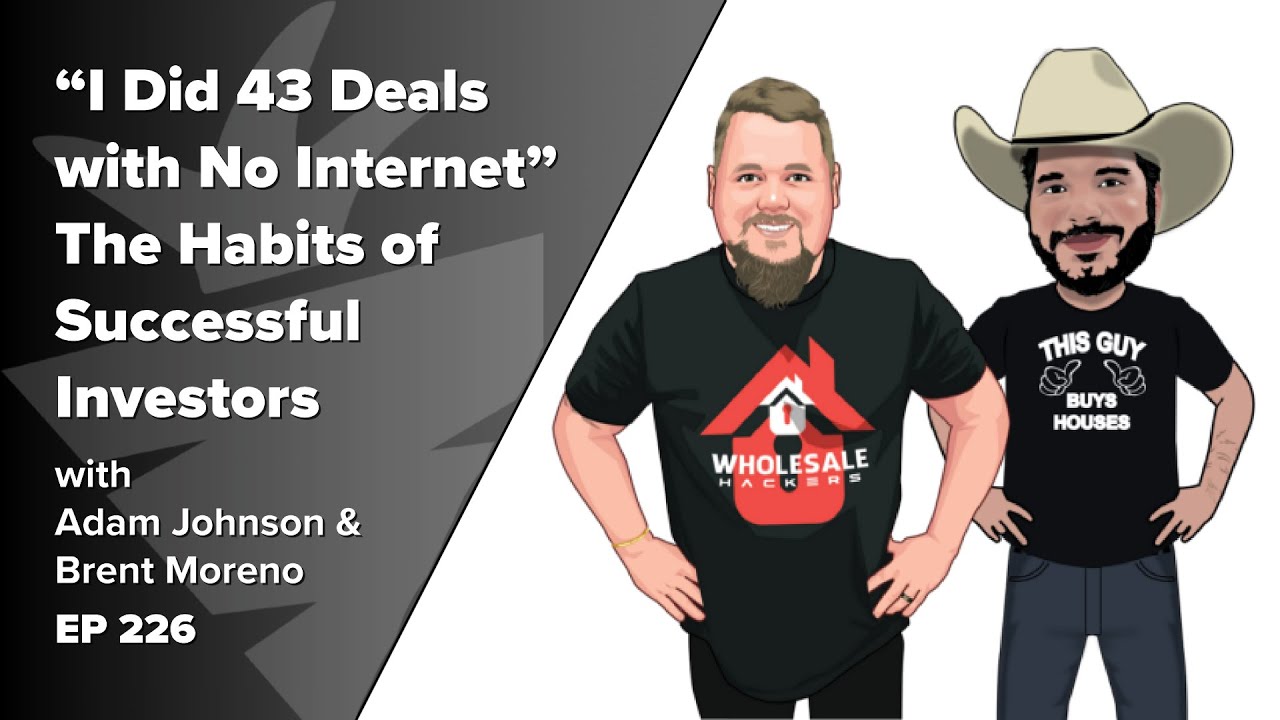
“I Did 43 Deals with No Internet” | The Habits of Successful Investors w/ Adam Johnson & Brent Moreno
It might seem counterintuitive for me to talk about how to close deals without having the internet, but that is exactly what one of our guests did. In 2017 Adam Johnson was able to close 43 deals without using the internet at all.
Brent and Adam buy and sell homes in Mississippi. They have done fix and flips, buy and holds, wholesale deals, and have offered creative financing for homeowners looking for solutions. Adam has been in the business for 18 years and has learned a thing or two about finding the right solutions for people.
6 Simple Things Successful Investors Do
Keeping It Simple
Sticking to the fundamentals and keeping things simple have proven to be successful investors for both Brent and Adam. Ultimately, everything they do leads back to creating real, meaningful, and helpful conversations with home sellers.
They want to learn all they can about a situation so that they are able to offer the most helpful solutions. Adam and Brent have been able to help so many people and are now sharing with others how they do it.
With a booming Facebook group, awesome podcast, a book, and now even new software, they are helping fellow investors simplify, avoid distraction, and get their deals closed.
Simple Methods
When it comes to finding new leads, they stick to the fundamentals. When it doubt, do some driving for dollars. If you are getting 25 leads per week this way, if you remain diligent, and practice the right follow-up, you will get your first deal faster than you may think.
Simple Software
In 2017, Adam discovered the internet.
While this did prove to be a game-changer for finding and contacting leads, it also caused a lot of distraction from the end goal. Being online throughout the day leads to distraction.
Whether it be the news, social media, or your inbox, the internet can easily pull you away from the tasks you need to complete. In many cases, they found they were wasting money on software they never touched.
Creating a Carrot site was able to simplify their online presence, making it easier to focus on the task at hand. As an investor, you are often hit with shiny object syndrome. There are so many different types of software, social platforms to maintain, and ways to reach people, that it can all be overwhelming.
With their Carrot site, they are able to run a site that produces fresh content, generates high-quality leads, and helps them close more deals than they ever had before – all with very minimal work on their end.
Simple Questions
One strategy that has been proven to be wildly successful for Brent and Adam is to ask simple, yet direct questions. On their contact form, they ask people how much they would like to get for their house. They then repeat and rephrase the question, causing people to lower their asking price by thousands. Their second question sounds something like…
If we were to pay you cash, cover all closing costs, and eliminate commissions, what is the lowest price you would accept?
Most people will come down on their price by $5k, some have dropped their price by $30k+!
Simple Processes
Sometimes it’s so simple, it’s hard. Over the past few weeks, Adam and Brent have made it a priority to simplify and get back to the fundamentals. For Adam, that means getting back into living rooms, talking to people one on one, and getting away from the computer.
They were able to begin focusing on their strengths, talking to people, getting away from the computer, and helping to find real solutions for those who need it. They delegated tasks and brought in others to make the day to day decision so they could get back to doing what they love – helping people.
Simple Solutions
As their investment journey has evolved, they have discovered other ways they can simplify their lead management process. The soon to be released “Deal Bell” software takes a simplified approach to lead management.
Basically, it takes the habits Adam has always used and digitized them. Every day you are able to focus solely on what needs to be done that day, without any distraction from other days and deadlines. It offers a simple and concise way to view your leads and quickly get caught up on where you are in the process with them.
Adam is also currently writing a book that I am thrilled to be writing the forward for. The book will outline Adam’s entire strategy, showing investors how they can simplify the process. The way you scale in business is by subtracting, not adding. It is about simplifying, not complicating and Adam’s book will show you how to do exactly that.
Looking Ahead
It’s no secret that I think we are in for a big shift in the real estate world. With markets being a bit crazy, the upcoming election, and COVID still impacting the way we do things, real estate is also going to change.
With more people working from home, commercial real estate will likely take a hit. Evictions and foreclosures have been paused for the moment, but this isn’t going to be the case forever. With people moving away from cities, rural living is becoming more and more desirable.
Even with the upcoming market shift, investors and agents can still be incredibly successful. Simple processes, simple solutions, and getting back to the fundamentals will allow you to focus on what is important – helping others.
As Zig Zigler said, “You will get all you want in life if you help enough other people get what they want.” And while this might sound cliche, I have found that the things that sound cliche usually sound that way because they are true.
So get out there and get back to the fundamentals. Be boring. But most of all, be consistent.