

Search results for: “ppc”

  • How To Measure The Success Of Your Real Estate PPC Campaign

    How To Measure The Success Of Your Real Estate PPC Campaign

    “Listen… it’s not working.”

    Those are the same words that thousands (millions?) of real estate investors have said to the person running their PPC ads.

    “I’ve already spent $1,500 and I haven’t closed a single deal from those leads! If it hasn’t worked now, then it isn’t going to work.”

    It’s difficult to believe differently than that. After spending thousands of dollars on a campaign which isn’t delivering the kind of results your business needs, quitting seems like the only logical option.

    But let’s slow down for a moment.

    Just because you’ve spent several thousand dollars on your PPC efforts without closing a deal does not mean you’re doing something wrong. In fact, it might mean you’re doing something right.

    Let me explain.

    What Is The Goal Of Your Real Estate PPC Campaign?

    Is your real estate PPC campaign a success?

    To answer that question, you first need to determine the goal of running ads.

    If you’re simply trying to build brand awareness, then seeing a tangible return on your investment might be irrelevant. If you’re trying to generate leads for your email list which might turn into a closed deal down the road, then all that matters is getting new people on your email list. In those cases, use the metrics mentioned in this article to determine how successful your real estate PPC campaign is.

    If more likely, you’re running a PPC campaign to find motivated sellers and close deals, having a strict, tangible, profitable ROI matters a lot more. The first thing you’ll need to do, then — before you even launch your campaign, ideally — is set a realistic and profitable budget for your ads.

    Here’s how to do that.

    What is a Realistic Budget and ROI For Your Real Estate PPC Campaign?

    Earlier, I said, “Just because you’ve spent several thousand dollars on your PPC efforts without closing a deal does not mean you’re doing something wrong. In fact, it might mean you’re doing something right.”

    And I meant it.

    At Carrot, we know lots of real estate investors who have to spend between $1,000 and $5,000 to get a single deal. The reason for that has nothing to do with their ads being ineffective, but everything to do with thick market competition. The thicker the competition, the more investors have to spend on ads to close a single deal.

    Here’s the kicker, though: those investors are still making between $10,000 and $50,000 in profit as wholesale fees. So while spending up to $5k on an ad campaign might seem crazy, it’s still very profitable.

    Brian Rockwell is one such investor (and Carrot member!) who consistently pays several thousand dollars to close a single deal in his highly competitive market: Dallas, Texas.

    Here’s what he has to say about it:

    “Would you pay $3,000 to make $30,000? I don’t know about you, but I’d take that deal all day long.”

    Okay. Great.

    Spend money to make money. You get that.

    But how much money is too much money? How much should you expect to spend on your PPC campaign before closing a deal? At what point should you throw in the towel?

    To answer that question, check out our free-to-use ROI calculator for paid ad campaigns.

    roi calculator

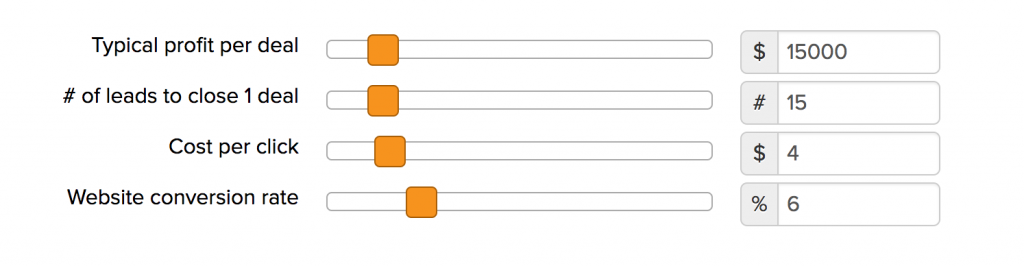
    You’ll just need four pieces of information in hand:

    1. Typical profit per deal
    2. Typical # of leads to close 1 deal
    3. Cost per click
    4. Website conversion rate

    Example:

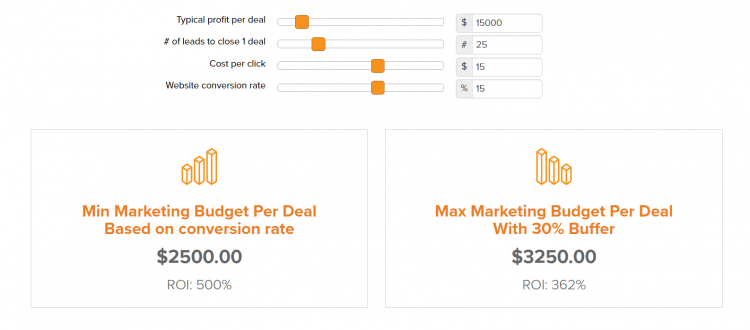
    Imagine that you can safely expect to make at least $15,000 in wholesale fees on a single deal. Let’s also imagine you’re in a competitive market and that it takes you 25 leads to close one deal. Your cost-per-click for your PPC campaign is $15 and your website conversion rate is 15% (typical for a Carrot site).

    That means you should expect to spend at least $2,500 to close a single deal and no more than $3,250.

    And while that might seem like a lot of money to spend, you’ll also notice that the ROI on your expenses will be between 362% and 500%…

    As Brian Rockwell said, “I’d take that deal all day long.”

    Formula For Calculating ROI

    Of course, ad spend is likely not your only cost for generating leads and closing deals. You might also be paying people to run your ads for you, tackle due diligence on properties, meet with buyers, or create contracts.

    Maybe you also want to include those costs in the overall ROI of your PPC campaigns…

    It’s up to you… really, it depends on what you want to find out. If you want to strictly determine how effective your PPC campaign is and if you’re staying within budget, then you might want to leave other indirect costs out of the equation. If, on the other hand, you want to determine the profitability and ROI of your entire business, then you’ll certainly need to include all other costs.

    Whatever the case, here’s the formula you can use for finding the ROI of any of your marketing efforts.

    ROI = (Revenue – Cost) / Cost

    How To Determine a PPC Campaign’s Effectiveness (The 4 Metrics That Matter Most)…

    There’s no doubt about it: ROI is the king of determining the success of any PPC campaign.

    If you’re not making more money than you’re spending — if your ads aren’t profitable for your business — then you need to press “Stop” and try something else.

    Having said that, looking only at the ROI of your PPC campaign can blindside you to other important metrics. Because even if your ads are profitable, they still might not be as profitable as they could be.

    The goal is to not only run profitable and realistic PPC campaigns but to also increase the effectiveness and profitability of those campaigns. To do that, you should keep a close eye on the below metrics, test new things, and make changes as needed.

    1. Cost-Per-Click

    You can find this metric reported directly in your Google Ad dashboard. It tells you the amount of money you’re spending for each click you receive. The more enticing and click-able your ad is to website browsers (i.e. the more people who click), the less money you’ll spend on each click. However, competitive markets will force a high cost-per-click regardless of how effective your ad is, simply because there are so many other bids.

    2. Quality Score

    The quality score of an ad campaign is a metric which attempts to show you, with a score between 1 and 10 (10 is best), how effective your ad campaign is. Using the number of clicks your ad is receiving when people see it, the quality score also influences how much Google is going to show your ad, your cost-per-click, and even your ad placement (at the top vs. at the bottom). Keep a close eye on this metric and tweak your ad if it has a low-quality score.

    3. Impression Share

    Impression share is the percentage of people who, when your ad was placed on the page they visited, actually scrolled and saw your ad. If you ad has a low-quality score and is sitting at the bottom of the results page, your impression score will be much lower than competitors with ads showing at the top. An impression score of 80% means that 80% of people saw your ad and 20% didn’t.

    4. Website Conversion Rate

    While this isn’t technically a PPC metric, the website conversion rate is absolutely vital to consider for any paid ads you’re running which drive traffic to your website. Since you’re paying to generate clicks and hopefully leads and closed deals, you need a website which consistently converts the traffic your hard-earned money is driving to it. What’s a good conversion rate? Find out over here. And if you don’t want to worry about optimizing your website for conversion, consider getting yourself a Carrot website. We’ve generated over one million leads for investors and agents all around the U.S. and we’d love to do the same for you (a typical Carrot website conversion rate is around 10%. A typical conversion rate for most other industries is around just 2%).

    Conclusion

    I understand.

    It gets discouraging, running ads which aren’t pulling results for your business. After all, if your business is to survive, you can’t be dumping money into a useless ad campaign for much longer.

    You need results.

    But keep in mind that results often take time.

    The best thing you can do, in fact, is set yourself up for success by determining a realistic budget for your PPC campaigns: how much should you expect to spend? And how much is too much?

    With those numbers, you’ll be far more confident spending the money you’re spending… knowing when you should expect a closed deal and when you’ve spent too much.

    Then, work to improve the ROI of your PPC ads by watching the 4 metrics mentioned in this article. Because even if your paid ads are profitable, you still might be able to make them more profitable. Which is always a good thing to do.

    With that, you’re ready to run successful PPC campaigns. The rest is simply doing, testing, trying, and iterating. Off ya go!

  • Ad Copy For Real Estate PPC Campaigns | 8 Tips to Get You More Clicks!

    Ad Copy For Real Estate PPC Campaigns | 8 Tips to Get You More Clicks!

    Before you launch a real estate PPC campaign and even press “Start,” you want to give that campaign the best chance of success.

    When it does launch, you want to collect clicks from motivated sellers or interested buyers, and you want your cost-per-click to stay within budget.

    Easier said than done, of course. You might think that a campaign will convert like a million bucks, but then you launch it… and it doesn’t.

    (You’ve been there, right?)

    How can you possibly know what will convert well and what isn’t before you even launch the campaign? Well, ultimately, you can’t. But you can use a few simple copywriting tricks to increase the chance that your ad is a winner.

    When it comes to platforms such as Google Ads, it’s just words on a page, no images or video allowed. So let me walk you through 8 ad copy for real estate PPC campaigns tips that will have you lowering your cost-per-click and increasing your conversion rate in no time.

    But before we dive in, you need to be aware of the different ad platforms’ character limits. Character limits can make crafting ad copy a little difficult, so you’ll need to have an idea before writing.

    Google Ads:

    15 headlines with 30 characters for each headline.
    4 description lines with 90 characters for each description.
    Option to pin your headlines and descriptions in specific positions of your ads.
    Set your display URL path.
    Set your final URL like a normal expanded text ad.

    Microsoft (Bing) Ads:

    Titles 30 characters each, up to three ad titles
    Ad text 90 characters each, up to two ad descriptions
    Final URL 2048 characters, including prefix (e.g., “www.”), suffix (e.g., “.com”), and tracking templates

    Facebook Ads:

    Facebook ad specs for single-image ads are:

    Text: 90 characters
    Headline: 25 characters
    Link Description: 30 characters

    Limits change a bit for carousel ads:

    Text: 90 characters
    Headline: 40 characters
    Description: 20 characters

    8 Tips To Write High-Converting Ad Copy For Real Estate PPC Campaigns

    Tip #1: Write 3 Ads And Choose The Best One

    Writing three ads from the get-go rather than one can help get your creative juices flowing and give you more ideas for connecting with your audience and getting them to convert. I do this for many different ad copy, and I find that the last one I write is usually the best, because you start getting in your flow, and the ideas become more solid as you write them down.

    Try this: write down three complete ads, headlines, and descriptions, and see which one you like the most. More than likely, one will stand out among the rest. This is a quick way to ensure you’re not running an ad just because it was the first thing that came to mind. Your brain needs to simmer a bit before it comes up with high-converting ad copy.

    Let me give it a swing to show you what I mean…

    [Headline] Need to sell your home fast for cash?

    [Description] Foreclosure? Probate? Divorce? We can help you through your difficult life situation, putting a fair cash amount in your pocket faster than anyone else (within a week).

    [Headline] Need to sell your house for cash in one week?

    [Description] Foreclosure? Probate? Divorce? Whatever you’re going through, we’re real estate investors who buy properties fast for cash to benefit sellers like you.

    [Headline] Sell Your House For Cash in Just One Week (1,257 Properties Purchased)

    [Description] Foreclosure? Probate? Divorce? Whatever you’re going through, we’re real estate investors who buy properties fast for cash to benefit sellers like you. We’ll make your difficult situation easier.

    Tip #2: Run Consistent A/B Tests

    If you’re in the real estate business for the long run, which you are, then you will be doing a lot of marketing. And the more you learn about what makes motivated sellers and buyers tick, the better ads you can write.

    Perhaps the best way to learn more about your target market — what makes them click and convert — is to A/B test pieces of your sales copy.

    Do not, though, A/B test two totally different ads. While that can be interesting anecdotally, you can’t possibly pull any quantitative information from those tests since there are too many differing factors.

    Instead, choose which part of an ad you want to test, and then create two identical ads, save for the one element that you want to test (headline, for instance).

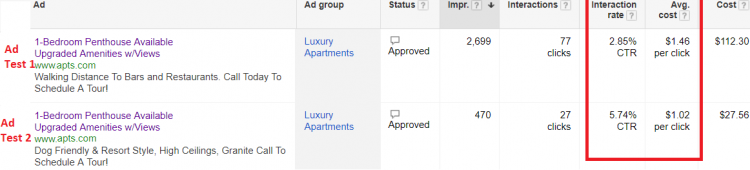
    Here’s an example of an A/B test where the marketer tested the description (pretty significant difference in results for such a small change).

    (Image Source)

    Tip #3: Spend 3 Times as Long On Your Title

    If you’ve spent any time as a copywriter, then you’ve heard it a million times: the headline is the most important part of your ad. It’s what people see first; in the case of Google ads, it’s often the only thing they look at before they click.

    If that doesn’t illustrate the importance of your headline, I don’t know what does.

    Make sure you dedicate a little extra time to brainstorming a title that resonates with your target market.

    First, you want to start with a basic ad headline.

    Sell Your House Fast For Cash!

    Then, you want to look for places to add specificity to the title (specificity is enticing, vagueness isn’t). Here’s an idea.

    Get a Fair Cash Offer On Your House in Just 24 Hours!

    That’s a little better. We can make it even more specific if we’re willing to do more targeted advertising.

    Going Through a Divorce? Sell Your House Fast For Cash

    Or…

    Dealing With Foreclosure? Sell Your House For Cash Now!

    You can see how each title gets better as I spend a little more time thinking about it. The same will be true when drafting headlines for your Google ads.

    Google Ads Tips: Including your keyword within your title can help increase your Quality Score.

    Tip #4: Try Using These Power Words

    Different words trigger different thoughts and different emotions. Fortunately, most people are very similar, and certain words trigger similar emotions. Using words that evoke the right emotion can be extremely effective at making your copy more enticing.

    What words should you use? Here’s a list of power words for any sales copy you write.

    1. You/Your
    2. Because
    3. Introducing
    4. Welcome
    5. Unique
    6. Announcing
    7. Secret
    8. Hidden
    9. Truth
    10. Temptation
    11. Now
    12. Discover
    13. New
    14. Win
    15. Cheap
    16. Free
    17. Lazy
    18. Humiliation
    19. Alone
    20. Reject
    21. Stress

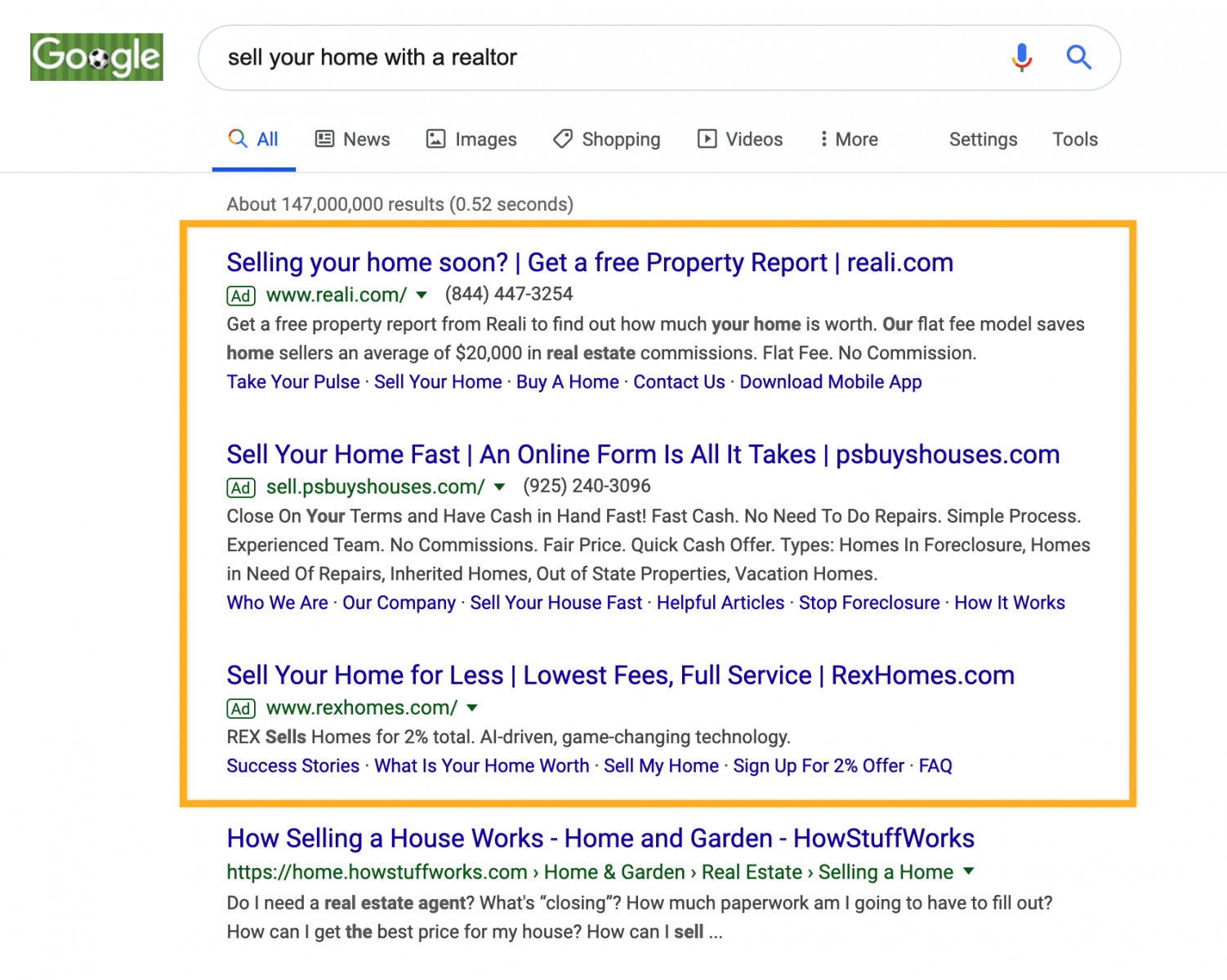
    Here are a couple of examples of these and other similar power words in Google Ad campaigns:

    power words for real estate ads

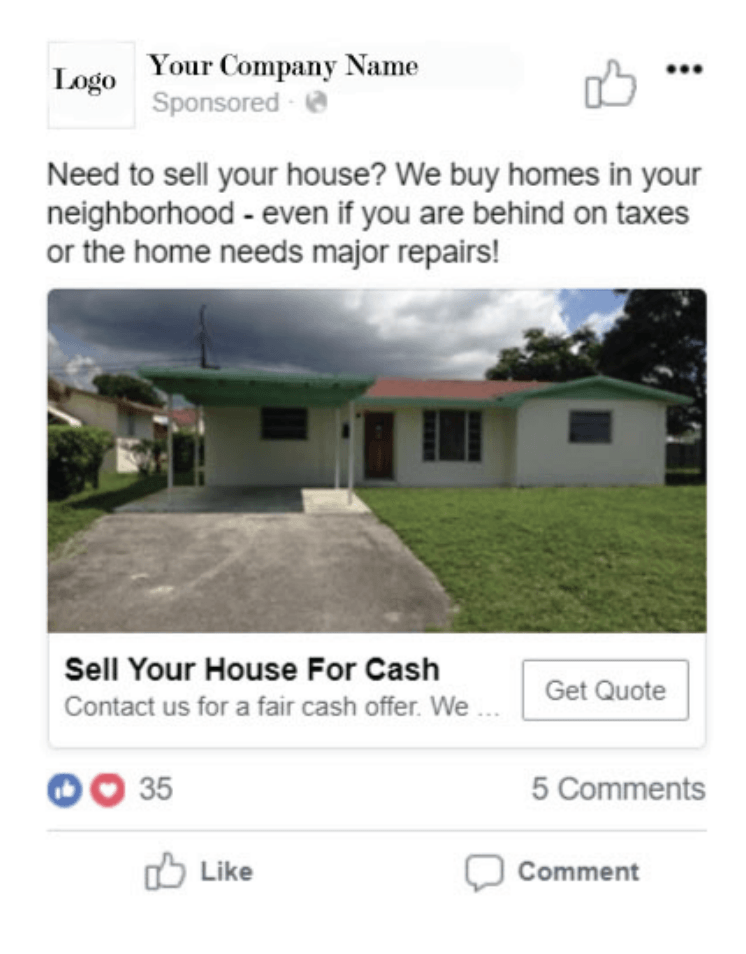
    Here are a couple of examples of these and other similar power words in Facebook Ads:

    real estate Facebook Ads
    real estate Facebook ads example

    If you’re a Carrot member, don’t miss the opportunity to learn from the industry’s top Facebook marketers. Check out the Facebook Leads Masterclass today!


    Tip #5: Touch On The Prospect’s Emotional Pain Or Desire

    When you’re writing sales copy, you aim to connect with your prospect’s emotional pain or desire (depending on whether you’re trying to attract sellers or buyers). No one buys anything or commits to anything without first seeing a vision in their head — a vision for how that product or service might solve their problem or give them something they desire.

    No one buys a car without first imagining owning it. No one buys a house without first walking around and imagining living in it. And no one will work with you unless they can see the tangible benefits of doing so.

    Your copy should wise up to that and try to get the prospect to imagine what it’ll be like to work with your business.

    For example…

    [Headline] Get Your Life Back — Sell Your House Fast For Cash

    [Description] Sick and tired of dealing with the demands of foreclosure, probate, or divorce? We can’t solve everything, but we can make you a fair cash offer on your home and close in just one week… Can you imagine no more worry?

    [Headline] Reduce Stress — Sell Your House For a Fair Cash Offer in One Week

    [Description] Stressed from difficult life situations? We’ve helped hundreds of people sell their house fast for cash and regain their lives. Ready to start enjoying life again?

    Tip #6: Try Statistics or a Case Study

    One of the best ways to make your Google Ads copy more enticing is to use statistics or a case study. This builds credibility for your business and makes your promise more believable.

    Here are some examples of what I mean… notice how the data makes them far more enticing than some previous examples.

    [Headline] Need to Sell Your House Fast? I Just Handed This Person $50,000… Cash (Case Study)

    [Description] Let me tell you a quick story about someone who just sold their house to me in one week for $50,000. You can do the same thing… but first, I need you to understand this simple process…

    [Headline] Need Quick Cash For Your House? We Can Help (1,500+ Offers Sent)

    [Description] When you need to sell your house fast for cash, we’re the people you come to. We’ve made over 1,500 cash offers and helped hundreds of people out of difficult situations. Are you ready?

    Tip #7: Respond To Common Objections

    If you know what objections people will have when they read your ad, why not deal with them right from the beginning? Maybe not in your headline… but definitely in your description.

    Here are some of people’s most common objections about working with real estate pros…

    • Can I trust you? — First and foremost, people want to know that they can trust you and your business. Real estate is a big transaction, the biggest transaction that most people will ever deal with, and it’s for that reason that people so carefully try to vet who they’re going to work with to ensure that they’re the real deal.
    • Can I buy or sell fast? — Speed is important if you’re dealing with motivated buyers or sellers. No one wants to wait forever to get their pain or desire fulfilled.
    • Will it be difficult? — People want to know that you will do all the legwork. They don’t want to have to do anything difficult themselves.
    • How much will it cost me? — No one wants to be nickel and dime’d. Tell people how much it’ll cost them and move on with it.
    • What’s the catch? — Most people think that everyone is trying to manipulate them, especially marketers, so indicating that there are “no strings attached” can be a helpful sales strategy.

    Tip #8: Study Your Competition

    A great way to get ideas for your own Google Ads campaign is to spy on the competition and see what top agents and investors in your market are doing. Then you can either copy them, try to do better than them, or do something completely different. Either way, you can make more informed decisions when you know what the competition is doing.

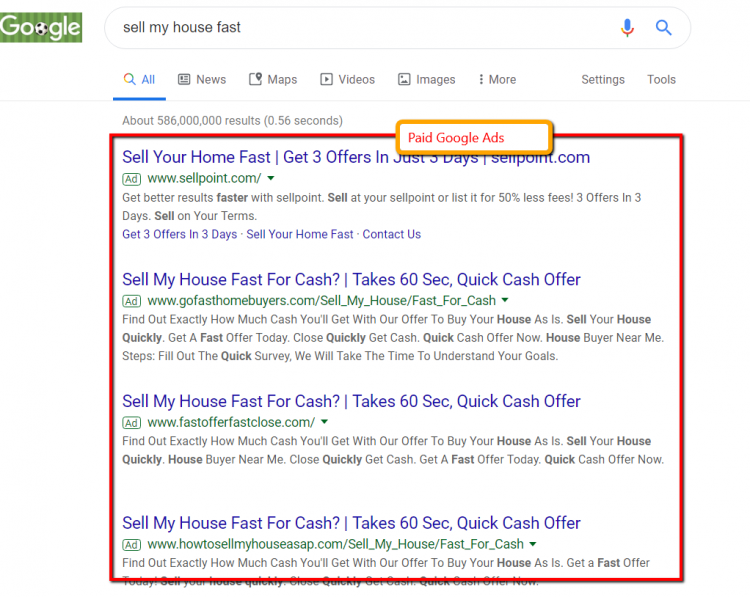
    You can use a tool like ChatGPT to do competitive keyword research. Or you can keep it simple and type your target keyword phrase into Google and see what ads come up.

    Conclusion

    You can’t know whether an un-launched ad will perform as you want it to. Only once you hit the big red button can you measure your ad campaign’s cost-per-click and ROI.

    But these eight PPC Ads copywriting tips will give your ads a far better chance of winning the click and the day. Give them a try, and let us know how it turns out!

  • EP 162: How OKC’s Largest Home Buyer Is Crushing It With TV & PPC w/ Carter Steph

    EP 162: How OKC’s Largest Home Buyer Is Crushing It With TV & PPC w/ Carter Steph

    EP 162: 1-800-2SELLHOMES | How OKC’s Largest Home Buyer Is Crushing It With TV & PPC w/ Carter Steph


    1-800-2-sell-homes OKC’s Largest Home Buyer

    “…If you can make people feel more safe and more comfortable, you’re going to close more deals”
    Carter Steph, 1-800-2SellHomes


    Carter Steph is no newbie to real estate. Last year, he and his team brought in over $1 Million in net profits, while closing on about 20% of their leads.

    In this episode, he shares what he’s focusing on to stretch his margins, how they dramatically increased their lead-to-close ratio, and what key advice he has for investors that DON’T have a big marketing budget.

    Listen in and don’t forget to Subscribe to the CarrotCast on Apple Podcasts! 


    EP 162: 1-800-2SELLHOMES | How OKC’s Largest Home Buyer Is Crushing It With TV & PPC w/ Carter Steph

    [podcast-subscribe]

    Follow our Guest:

    Carter’s Carrot site: https://www.18002sellhomes.com/

    Carter on LinkedIn: https://www.linkedin.com/in/carter-steph-76961aa7/


    We want to hear your thoughts on the podcast! Drop them in the comments section below or hit us up on Facebook or Instagram

  • Is Bing PPC For Real Estate Investors A Waste Of Time ? Absolutely Not. Here’s Why…

    Is Bing PPC For Real Estate Investors A Waste Of Time ? Absolutely Not. Here’s Why…

    Are you dismissing Bing PPC for real estate investors because that “guy” in the online forums said it’s not worth using it? Is your Google Ads campaign killing your marketing budget?

    What if I told you Bing might help you attract extra leads at a lower cost (if you do it right)?

    “For me, Bing Ads is too expensive. The conversion rates just suck…” via Reddit

    “Bing Ads are s*** compared to Google Ads in my experience”. via Reddit

    We see these kinds of comments about Bing PPC for real estate investors all of the time. You probably do as well.

    We’re often asked, “Is Bing PPC worth it as an additional source for real estate investor advertising?”

    So, we wanted to find out… and we started testing, which we dive into below.   Also, we’ll show some of the advantages Bing can have over AdWords.

    Don’t Assume That Google Ads Is The Only Game In Town For PPC Marketing

    When prospects search online for a real estate professional (this applies to investors and agents), you want to be on the first page.

    Because if you are, people will click on your result, they’ll visit your website, and there’s a darn good chance they’ll even become a lead (at the very least, you can tag them once they visit your website and retarget them with Facebook ads — learn more over here).

    And leads from search engines are typically much higher quality than direct mail leads, bandit sign leads, or even door knocking or cold calling leads.

    Because they came looking for you.

    However, in the world of search engines and PPC, Google Ads reign supreme. Google, after all, dominates nearly 95% of all search engine traffic.

    Google Ads traffic vs other search engines

    (Image Source)

    But in this article, we’re not talking about Google Ads. We’re talking about Microsoft Advertising (the advertising platform behind Bing, a search engine mockingly acronym as “But It’s Not Google”), which holds about 2.39% of the world’s search engine market share.

    That begs the question: why are we discussing Microsoft Advertising?

    Well, there are a few advantages you should be aware of.

    Should You Use Microsoft Advertising?

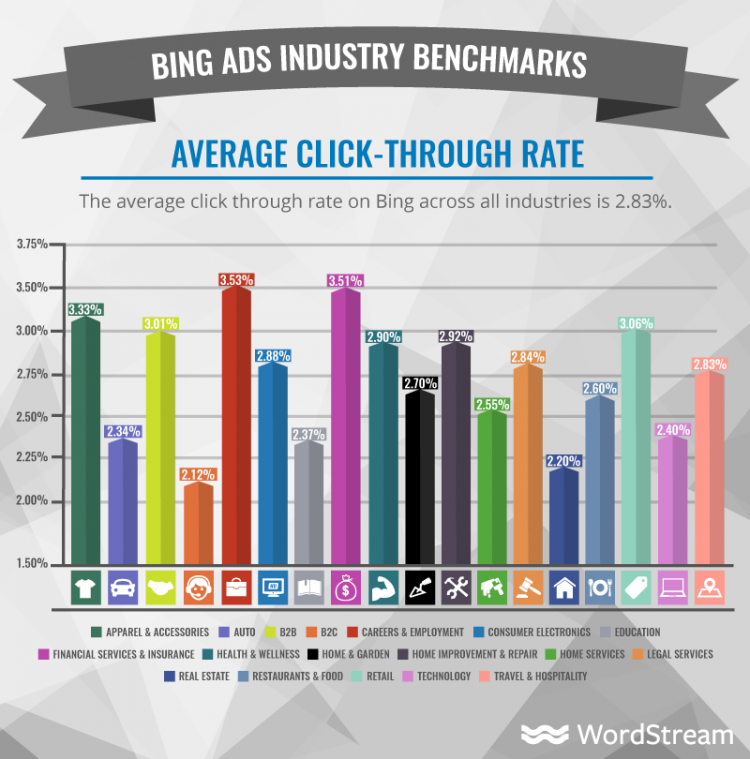
    Bing Ads Industry Benchmarks

    While holding 2.20% of the world’s search engine market share seems small and insignificant, those two percentage points still amount to 12 billion searches per month. Everyone searches online. Most people do it daily, so owning a few percentage points of the world’s search engine share is more powerful than it seems.

    And here’s the other thing: most people only use one search engine.

    If you’re a Google user (and you probably are), when is the last time you searched using Bing, Yahoo, or DuckDuckGo?

    Yeah… don’t even remember. Neither do I. And neither do most people.

    Most online searchers use a single search engine and rarely stray.

    This means that the people who search using Bing… you’ll seldom reach those same searchers with Google Ads. Conversely, you’ll rarely reach Google Ads users when using Microsoft Advertising.

    Searchers don’t cross platforms. This means to reach all of your prospects, your business should.

    But look — I’m not going to tell you that you have to advertise on Bing; it’s your call. I want to point out that running a Microsoft Advertising campaign in addition to your Google Ads campaign can give you a competitive edge in your market: you’ll reach the people who your competitors aren’t probably even advertising to.

    Because since Google is the biggest, most visible search engine, everyone knows about it, including your competitors. And they’re advertising on it.

    Bing? Maybe not. Using Microsoft Advertising could help you snag leads that your competition outright ignores.

    Is Bing PPC for real estate investors worth it?  Here’s What We Found…

    Carrot Member Google Ads Campaign

    Carrot Member Google AdWords Campaign

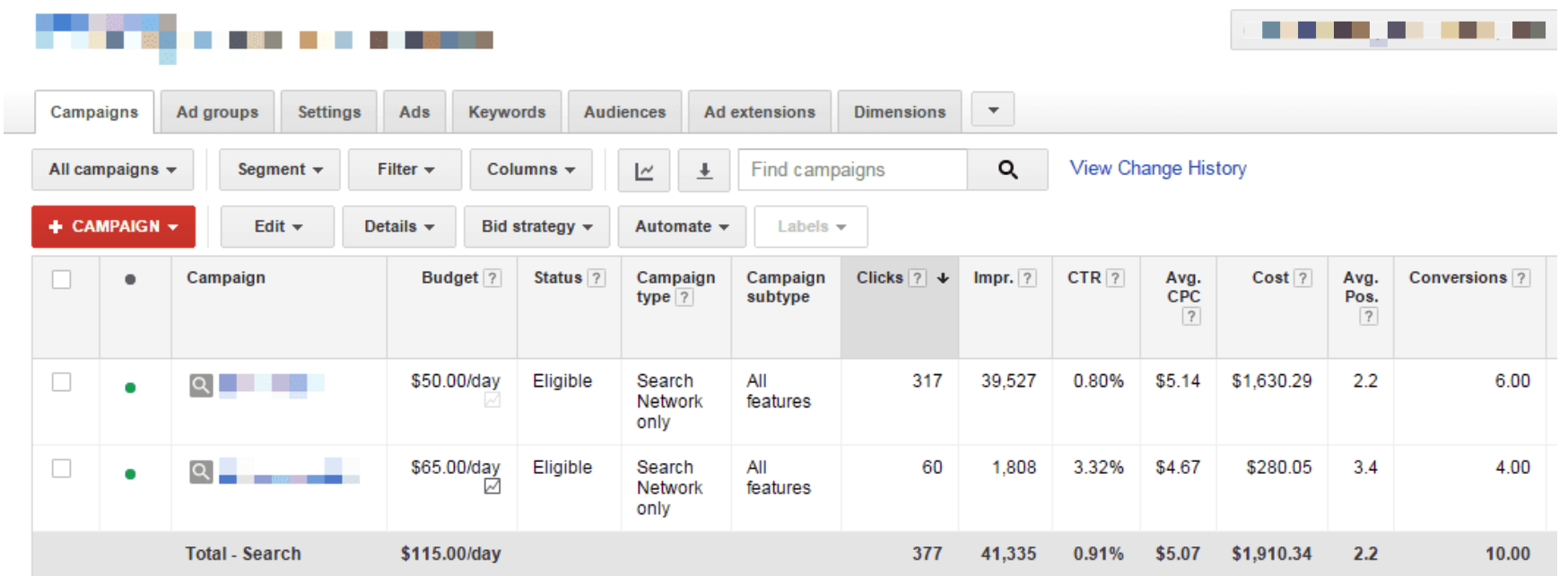
    With that success with Google Ads, we wanted to see if we could “stack” on more leads by adding Bing PPC to the picture. As you can see, he invested $1,910 in ad costs during those 30 days in Google Ads and collected ten confirmed online opt-in leads… and many other phone call leads. Counting the phone call leads brings his cost per lead down to under $100 per lead.

    Same Carrot Member Bing PPC Campaign

    Carrot Member Bing PPC Campaign

    Now let’s compare them both apples to apples across the board.

    Clicks:

    • Google Ads: 377
    • Bing: 338

    Google Ads had 11.5% more clicks by volume

    Impressions:

    • Google Ads: 41335
    • Bing: 24660

    Google Ads had 68% more impressions by volume

    Click Through Rate:

    • Google Ads: .91%
    • Bing: 1.37%

    Bing had a 50% greater click-through rate by a percentage

    Cost Per Click:

    • Google Ads: $5.07
    • Bing: $3.32

    Google Ads cost per click was 53% higher than Bing

    Conversions:

    • Google Ads: 10
    • Bing: 6

    Google Ads (for this specific market) only had 4 more online leads in total (doesn’t count phone call leads).

    Total Invested:

    • Google Ads: $1910.34
    • Bing: $1123.65

    Google Ads overall spending was 70% higher than Bing and yielded 40% more leads.

    Just one thing to remember from this test… the cost per lead in this campaign is higher than our typical cost per lead on PPC.  The client wanted us to test a set of 6,000 broad match keywords he received from a mentor… vs. our more targeted approach to PPC management.

    The cost per lead on that broad match keyword group is 5x higher than on our targeted group… for the same number of leads. But the client is ok with that higher cost per lead because his margins on deals are so high that it ensures he’s not missing any leads.

    Bing delivers lower search volume but a more attractive cost per lead. 

    Of course, you’ll get more impressions and clicks on Google Ads, but you’ll usually pay more per click for those visitors.

    It’s not that one is better than the other… this post is mainly to lay out the argument that Bing is a very valid PPC marketing platform that, in this month-long test, pulled leads that cost us less than we pay for leads from Google.

    More… Quick Microsoft Advertising Stats

    Here are some stats about Bing and Microsoft Advertising to keep your mind churning and informed.

    7 Reasons Why You Shouldn’t Ignore Bing PPC For Real Estate Leads…

    1. Bing PPC offers cheaper CPCs (costs per click) and potentially higher ROI 

    This is primarily because fewer investors use Bing over Google Ads. Bing Ads generally has lower competition than Google Ads, especially in the real estate industry. With fewer advertisers competing for the same keywords and targeting options, the cost per click (CPC) on Bing Ads tends to be lower. Real estate investors can use this lower competition to secure motivated seller leads at a more cost-effective rate.

    Here are some additional reasons by CPCs are lower on Bing:

    1. Cost-Effective Advertising: Lower CPCs on Bing Ads translate to lower advertising costs for real estate investors. By paying less per click, investors can stretch their advertising budget further, enabling them to reach more motivated sellers within their allocated budget. This cost-effectiveness can lead to a higher return on investment (ROI) for investors, as they can generate more leads and conversions for a lower cost compared to other advertising platforms.
    2. Targeting Specific Audience: Bing Ads allows precise targeting options, including demographics, location, and search intent. Real estate investors seeking motivated seller leads can leverage these targeting options to reach their desired audience more effectively. By narrowing down their target audience and focusing on specific geographic areas or relevant search terms, investors can ensure their ads are shown to users actively looking for real estate information or intending to sell their properties. This focused targeting can result in higher conversion rates and an improved ROI.
    3. Unique User Base: Bing has a distinct user base that often differs from Google’s audience. Bing users tend to be older, more affluent, and more likely to be homeowners. These characteristics align well with the target audience of real estate investors seeking motivated sellers. By advertising on Bing Ads, investors have the opportunity to connect with this specific user base and potentially find motivated sellers who are more likely to engage with their ads and pursue a real estate transaction.

    Considering these factors, Bing Ads can offer real estate investors seeking motivated seller leads a cost-effective advertising solution with cheaper CPCs and potentially higher ROI. By leveraging the lower competition, cost-effectiveness, precise targeting options, and unique user base of Bing Ads, investors can maximize their ad spend, generate more leads, and increase their chances of finding motivated sellers interested in their real estate offerings.

    2. The Expanding Reach of Bing PPC

    Bing PPC has experienced remarkable growth, solidifying its position as a formidable advertising platform. With the integration of Microsoft Advertising and Bing, its reach has expanded significantly, capturing a substantial share of search queries.

    In fact, Bing now powers over 30% of all search queries in the United States. Ignoring Bing PPC could mean missing out on a sizable portion of potential leads and lucrative real estate investment opportunities.

    3. Bing Ads offers new ad features!

    Since 2022, Microsoft Advertising (formerly Bing Ads) has introduced several changes to its ad structure to enhance the advertising experience for marketers. Here are some notable updates:

    1. Expanded Text Ads: Microsoft Advertising introduced Expanded Text Ads, allowing advertisers to create more compelling and informative ads. Expanded Text Ads feature additional headline and description fields, providing more space for advertisers to highlight their products or services. This update allows for more creative and engaging ad copy, improving click-through and conversion rates.
    2. Image Extensions: To make ads more visually appealing, Microsoft Advertising introduced Image Extensions. This feature enables advertisers to add relevant images to their ads, helping them capture the attention of potential customers. By incorporating visual elements into their ads, advertisers can effectively convey their brand messages and increase ad engagement.
    3. Callout Extensions: Callout Extensions allow advertisers to include additional text to highlight unique selling points, key benefits, or special features of their products or services. This update gives advertisers more flexibility to communicate essential information to potential customers and differentiate themselves from competitors. By leveraging Callout Extensions, advertisers can increase the relevance and impact of their ads.
    4. Dynamic Search Ads: Dynamic Search Ads (DSA) were improved to provide more accurate and relevant ad targeting. This feature enables advertisers to automatically generate ads based on the content and keywords on their websites. Microsoft Advertising’s DSA now offers improved page coverage and refined targeting options, ensuring that ads are shown to users actively searching for related products or services.

    These updates to the ad structure in Microsoft Advertising (formerly Bing Ads) offer advertisers more versatility, improved visibility, and better opportunities to engage with their target audience. By leveraging these features, marketers can create more impactful and effective ad campaigns on the platform.

    4. Syndication across the Microsoft Advertising Network

    Bing PPC allows real estate investors to syndicate their ads across the expansive Microsoft Advertising Network. This network includes popular platforms such as MSN, Outlook, and Microsoft Edge, ensuring broader exposure and increased visibility for investment opportunities.

    By leveraging the Microsoft Advertising Network, investors can reach a wider audience, attracting qualified traffic to their websites or landing pages and expanding their potential for successful real estate transactions.

    5. Bing PPC offers flexibility!

    The differences in Bing Ads ad groups can benefit real estate investors seeking motivated seller leads. Here’s how these differences can be advantageous:

    1. More Descriptive Ad Group Naming: With a higher character limit for ad group naming in Bing Ads, real estate investors can use more descriptive and detailed names. This allows investors to organize their ad groups to align closely with their real estate investment strategies.

      Using descriptive names, investors can easily identify and manage ad groups targeting specific geographic areas, property types, or other relevant criteria. This level of organization can streamline campaign management and make tracking the performance of individual ad groups easier.
    2. Inclusion of Search Partners by Default: Bing Ads includes search partners as part of the ad group targeting by default. Real estate investors using Bing Ads can extend their reach beyond Bing’s search engine to include partner websites such as Yahoo and other affiliated search networks.

      By default, investors can potentially reach a wider audience and increase the exposure of their motivated seller ads. This expanded reach can lead to more opportunities to connect with motivated sellers searching for real estate information on partner websites.
    3. Default Ad Distribution on Bing Ads: Bing Ads has a default ad distribution setting of “All” within an ad group. Real estate investors’ ads are automatically eligible to appear on Bing, Yahoo, and search partner sites without additional configuration.

      This broader ad distribution can increase the visibility of ads and generate more impressions, potentially reaching a larger pool of motivated sellers. Investors using Bing Ads can leverage this default setting to expand their ad reach and increase the likelihood of connecting with motivated seller leads.
    4. Ad Extensions at the Ad Group Level: Bing Ads allows real estate investors to set ad extensions at the ad group level. This gives investors greater control and flexibility in associating ad extensions with specific ad groups. Real estate investors can utilize ad extensions such as call extensions, site link extensions, or location extensions at the ad group level to enhance the visibility and relevance of their ads.

      By customizing and optimizing ad extensions at the ad group level, investors can provide additional information and relevant contact details to potential motivated sellers, increasing the chances of engagement and lead generation.

    Real estate investors can benefit from enhanced organization, broader ad distribution, and more control over ad extensions by taking advantage of these specific features in Bing Ads ad groups. These benefits can help investors effectively target motivated seller leads, increase ad visibility, and drive better engagement, ultimately maximizing their chances of connecting with potential motivated sellers and securing profitable real estate transactions.

    6. Bing Ads have better device targeting options. 

    Device targeting options in Bing Ads can benefit real estate investors seeking motivated seller leads. Here’s how real estate investors can leverage these options effectively:

    1. Mobile Device Targeting: Since many users now rely heavily on mobile devices for their online activities, targeting mobile devices can be a strategic move for real estate investors. Mobile targeting allows investors to reach potentially motivated sellers searching for information on their smartphones or tablets.

      By tailoring campaigns specifically for mobile users, investors can capture the attention of on-the-go sellers, increasing the likelihood of engaging with motivated leads.
    2. Location-Based Targeting: Bing Ads provides location targeting options, allowing real estate investors to focus on specific geographic areas known for motivated seller activity. By combining location and device targeting, investors can effectively reach potential sellers in their desired locations using mobile devices to search for real estate information. This precise targeting ensures that investors connect with motivated sellers in their target market, maximizing the chances of generating high-quality leads.
    3. All Device Targeting: Real estate investors can opt for all device targeting to ensure maximum campaign exposure and reach. By targeting all devices, including desktops, mobile devices, and tablets, investors can cover a broader audience and increase the chances of capturing motivated seller leads across various devices.

      This comprehensive approach allows investors to reach potential sellers regardless of their preferred device, ensuring a higher chance of engagement and lead generation.
    4. Bid Adjustments for Device Performance: Bing Ads allows investors to adjust bids based on device performance. By closely monitoring the performance of their campaigns on different devices, investors can identify which devices are driving the most conversions and adjust their bids accordingly.

      For example, if mobile devices show higher conversion rates, investors can increase their bids for mobile targeting to allocate a larger portion of their budget to the most effective device. This optimization strategy helps investors maximize their return on investment and generate more motivated seller leads.

    Real estate investors can utilize device targeting options in Bing Ads to connect with motivated seller leads. By targeting mobile devices, focusing on specific locations, using all device targeting for maximum exposure, and adjusting bids based on device performance, investors can enhance their campaigns’ effectiveness, increase engagement, and generate more quality leads from motivated sellers.

    7. Bing Ads platform is ideal for companies with a small budget!

    While Google Ads remains a popular choice, Bing PPC often offers a cost-effective alternative for real estate investors. In some instances, Bing PPC can provide a lower cost-per-click (CPC) compared to Google Ads, enabling investors to stretch their advertising budget further and achieve a higher return on investment (ROI).

    By optimizing campaigns and implementing strategic bidding, investors can maximize their ad spend on Bing PPC, attracting motivated prospects without breaking the bank.

    Is Bing PPC Right For Your Real Estate Investing Business?

    It can help you tap into new leads you’d never otherwise reach on Google. That’s for sure.

    If just maybe… especially if you need to start on a smaller budget to test the waters.

    If your advertising campaign is limited to a small geographic area, Google Ads might be the platform where you’ll gain significant search volume, depending on your keywords and match types. Higher search volume means more potential customers for your business.

    Yes, Google Ads is still the “empire” for paid search, with most of the market share. For that reason, Bing Ads is often an afterthought that doesn’t get much attention. But Bing has some unique capabilities that most folks do not use. If you optimize for these Bing Ads only features, you’re sure to increase performance significantly.

    There isn’t a right or wrong answer to advertising on Google Ads vs. Bing Ads.

    They’re both great platforms with their advantages and disadvantages. But the analyst inside of all great advertisers should prefer to test both.  See if you can stack on additional leads for motivated house sellers, cash buyers, and tenants… you name it… by adding Bing to the mix.

    You’ll see, in time, which performs better for your market and budget.

    Read this post if you want more great tips on effective PPC marketing.

    The Pros and Cons of Microsoft Advertising

    Let’s keep this simple and break down the pros and cons of Microsoft Advertising.

    Pros

    • Bing is the second-most-popular search engine. So if you want to put money somewhere other than Google, Bing is the place to do it.
    • Since Bing has less search traffic than Google, it also has less competition and a lower cost-per-click usually, so it can be less expensive to advertise.
    • Bing gives you more characters for your ad than Google, allowing you more room to convince people to click your result.
    • Bing shows more of its ads at the top of the page than Google does, which is helpful for the click-through rate since people don’t have to scroll down the page.
    • Almost 75% of Bing users are over 35, so Microsoft Advertising can be good for reaching an older audience.

    Cons

    • Bing can have lower search engine traffic (compared to Google), so potentially fewer leads.

    My recommendation? Start with Google Ads, and if you have the budget to spare and need a competitive edge, supplement your efforts with Microsoft Advertising.

    Still Have Questions?

    Still not sure if Microsoft Advertising is right for your business? That’s okay — it’s not always easy to know the right path to take when it comes to marketing. But the good news is that you don’t have to decide now.

    Why not try it out for yourself?

    You can create a Microsoft Advertising account over here and start driving traffic to your site immediately (and if you need a high-converting site out-of-the-box, sign up with Carrot).

    Who knows? Bing might give your business the competitive edge you’ve been looking for.

  • 5 Pre-Launch Steps to Set Your Real Estate PPC Campaign Up For Success

    5 Pre-Launch Steps to Set Your Real Estate PPC Campaign Up For Success

    Pre-Launch Steps to Set Your Real Estate PPC Campaign Up For SuccessWhen you click that big red launch button…

    Something’s gonna happen.

    Either the campaigns that you created will give you a healthy ROI — the phone will ring, leads will flow, and deals will close. OR… crickets.

    And if you’ve ever tried your luck at PPC ads for your real estate investing business before, then you’ve probably experienced just as many crickets as conversions (or maybe a few more of the crickets…).

    That isn’t because PPC advertising doesn’t work for the real estate industry. For many of our members at Carrot, paid ads drive business revenue BIG time. If you do it right, then paid advertising can become a real driving force for your business — a tool you can depend upon to create quick lead generation and revenue flow.

    But getting it right, of course, is sort of the issue.

    Truth is, the success of your PPC campaign for finding motivated searchers (buyers or sellers) depends largely upon one thing: how you prepare before you launch.

    Here are 5 pre-launch steps to give your real estate PPC campaigns the best possible chance of success

    Step #1: Do Market-Specific Keyword Research

    (Image Source)

    Perhaps the biggest mistake that new PPC advertisers make is launching a campaign without first doing market research.

    It’s remarkably easy to assume that you know your market already. After all, you’ve probably talked with your market, done at least a few deals, and maybe even lived in your area of operation for quite some time.

    Regardless, don’t skip this step. ;)

    Spending a little extra time to ensure you’re targeting the right people with your PPC campaign and writing copy that resonates with their problems, pains, fears, and desires is the single most powerful thing you can do to increase your ROI and website conversion rate once launched.

    In regards to PPC, keyword research is the equivalent of market research.

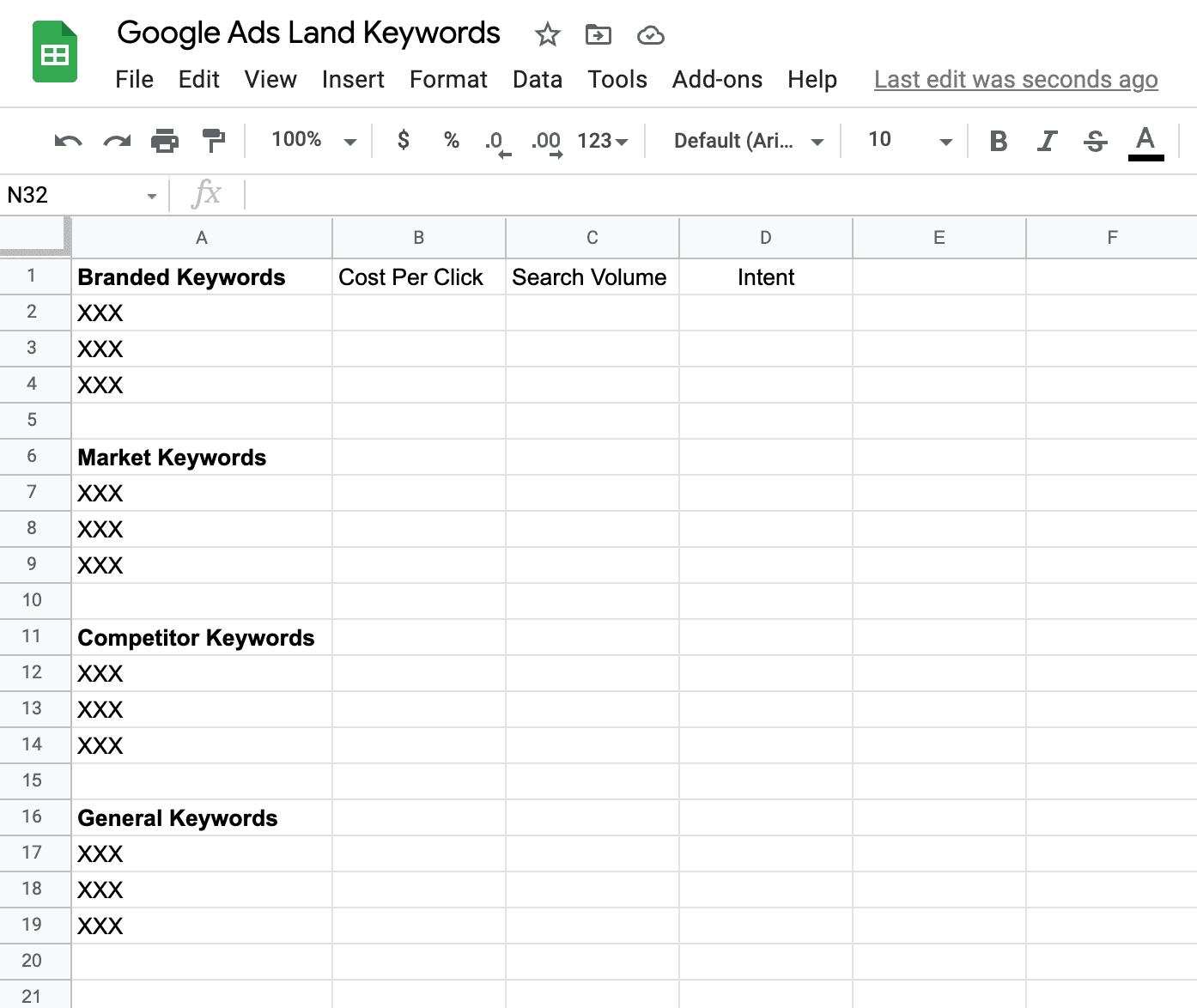
    You can use Google AdWords Keyword Planner and/or Ubersuggest to perform your research.

    Here’s what you want to pay attention to…

    • Competition — How many other people are competing for this keyword phrase? The more people you’re competing with, the higher your cost-per-click will soar. This isn’t necessarily a bad thing. So long as the keyword phrase is high value and you can afford the cost-per-click while maintaining a healthy ROI, then high competition might be an indicator of a valuable keyword phrase. If you have a smaller budget, though, then you might consider targeting something less competitive.
    • Suggested Bid — In Google AdWords Keyword Planner, this is the number that Google suggests you bid in order to get consistent clicks and impressions. When you see this number, keep your budget in mind and ensure that the two numbers line up for a healthy ROI.
    • Search Volume — This is the monthly number of people who search for a given keyword phrase every month. More search volume means more people to get your ad in front of. Low search volume means the opposite.
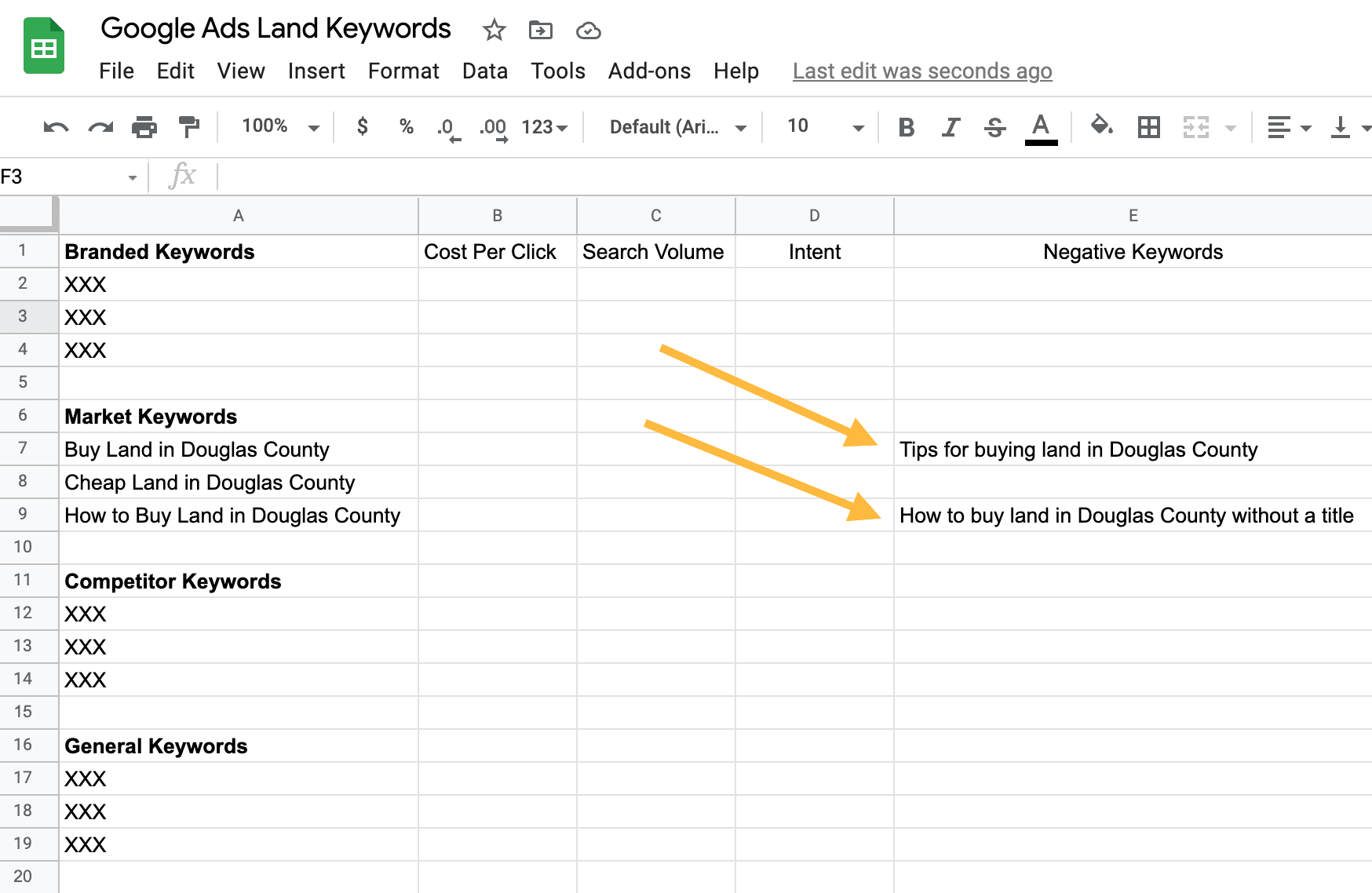
    • Intent — This is perhaps the most important part of your keyword research. What is the intent behind the keyword that you’re considering targeting with your PPC campaign? If the person is looking for a real estate agent and you’re a wholesaler, for instance, then the keyword won’t bring you many conversions. Regardless of search volume, competition, and suggested bid, the intent of the searcher, what they actually want when they type that into Google, should make the final decision about which keywords you target and which ones you throw out.

    Step #2: Analyze Your Competition

    (Image Source)

    In addition to doing market research, it’s also worth spending a bit of time doing competitive analysis.

    These are some of the questions you might consider asking yourself…

    1. What keywords is my competition targeting?
    2. What is my competition doing with their ads that I can do better?
    3. What is my competition’s budget?
    4. What keywords are bringing my competition the most results?

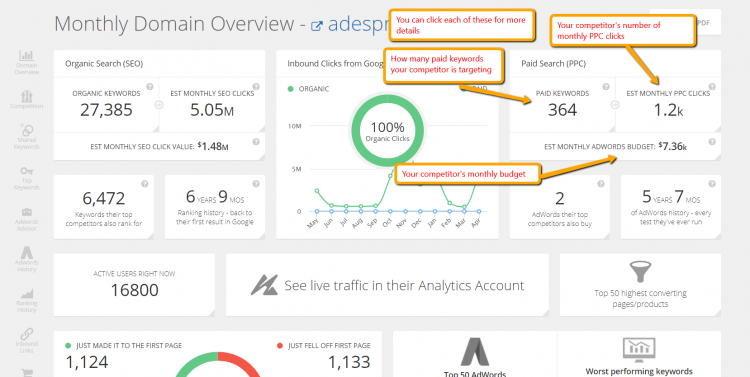
    Answering these questions can help you determine which keywords will be the most valuable for you to target. If, for example, your competitor has dedicated massive funds to a certain keyword phrase and you can’t beat their budget, you might consider targeting something else. Or if you find that they’re neglecting a certain keyword phrase altogether, you might try to exploit that.

    And you can answer a TON of these questions by searching your competitor’s domain in SpyFu — you get a few free searches every day (go incognito in your browser to get more searches once you run out).

    Step #3: Set a Realistic, Results-Based Budget

    (Image Source)

    Running a real estate PPC campaign is a bit like gambling. You spend money, hit a button, and hope that the magic machine pays you back.

    Of course, in PPC, you have far more control over the results of that button-hitting than you do at the local casino. Still, as when you visit a casino with a spending limit of a few hundred dollars (or a few thousand for you high-rollers), you should never launch a PPC campaign without first knowing your budget and the results you expect to get (realistically) from that budget.

    But how do you determine a reasonable cost-per-click and cost-per-conversion for your business in your specific market?

    Well, you just play off the numbers.

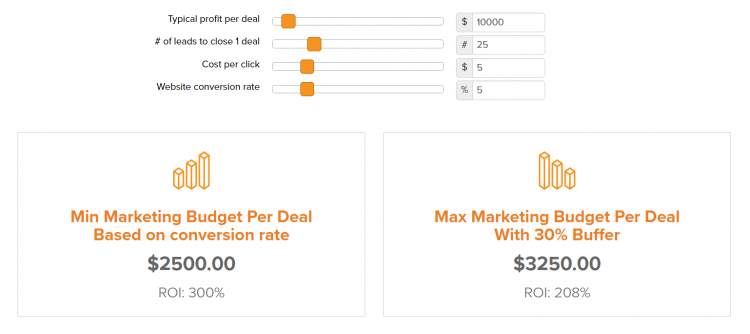
    And we have this awesome budget and ROI calculator to help you easily determine your minimum and maximum budget per conversion. If, for example, I expect $10,000 profit per deal, I close 1 in 25 leads, my cost-per-click is $5, and my website conversion rate is 5%, my budget would be between $2,500 and $3,250.

    In other words, I could spend up to $3,250 and still have a very healthy ROI for my business (208%, to be exact). And once you know your budget, it’s simply a matter of staying within that budget to generate leads and close deals. I love the way that Brian Rockwell put it in a CarrotCast case study.

    Step #4: Write Compelling Ad Copy

    (Image Source)

    When you go searching for something in Google (whether it be how to fix a faucet or reviews of Avengers: Endgame) you quickly determine which results you’re going to click on and which ones you’re going to scroll past.

    How do you determine that?

    By skimming the title tag and meta description of each result.

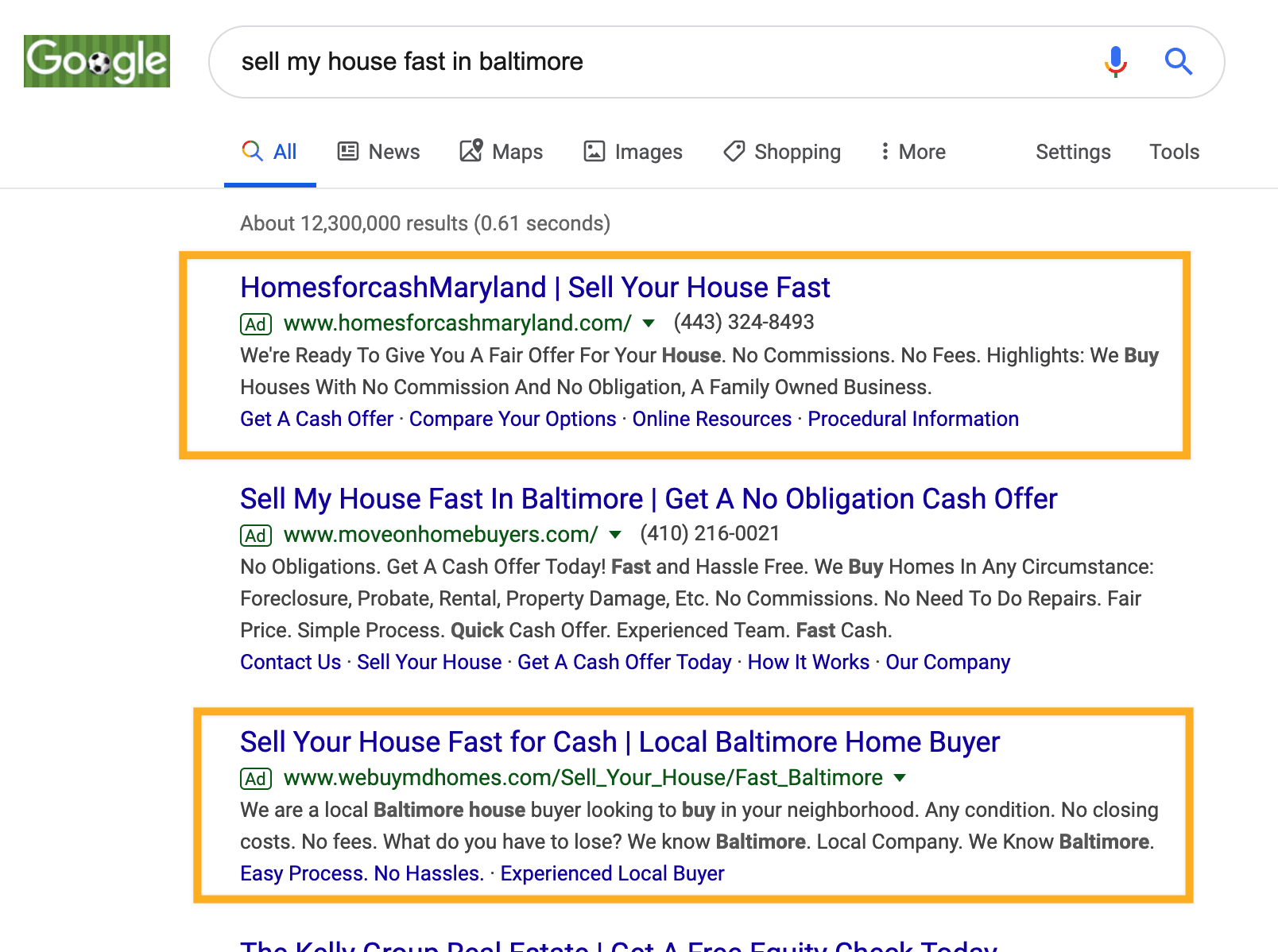
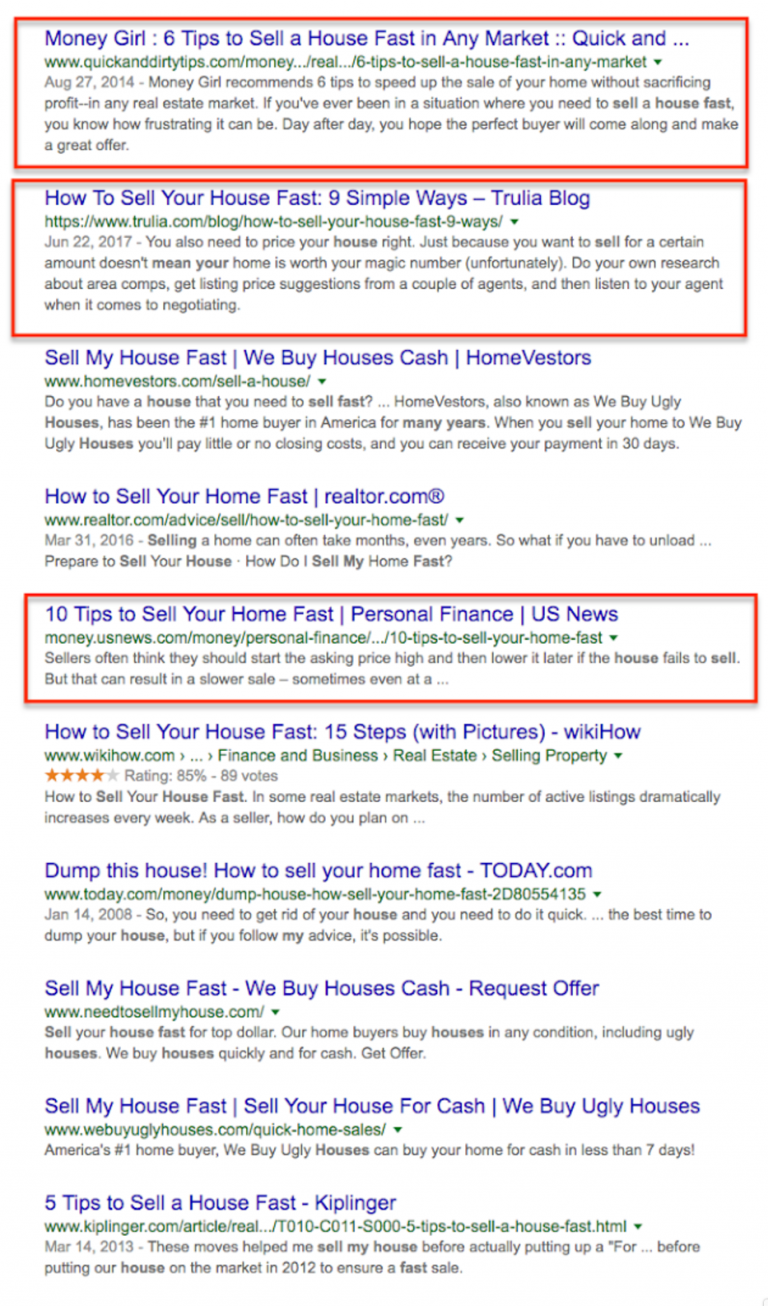
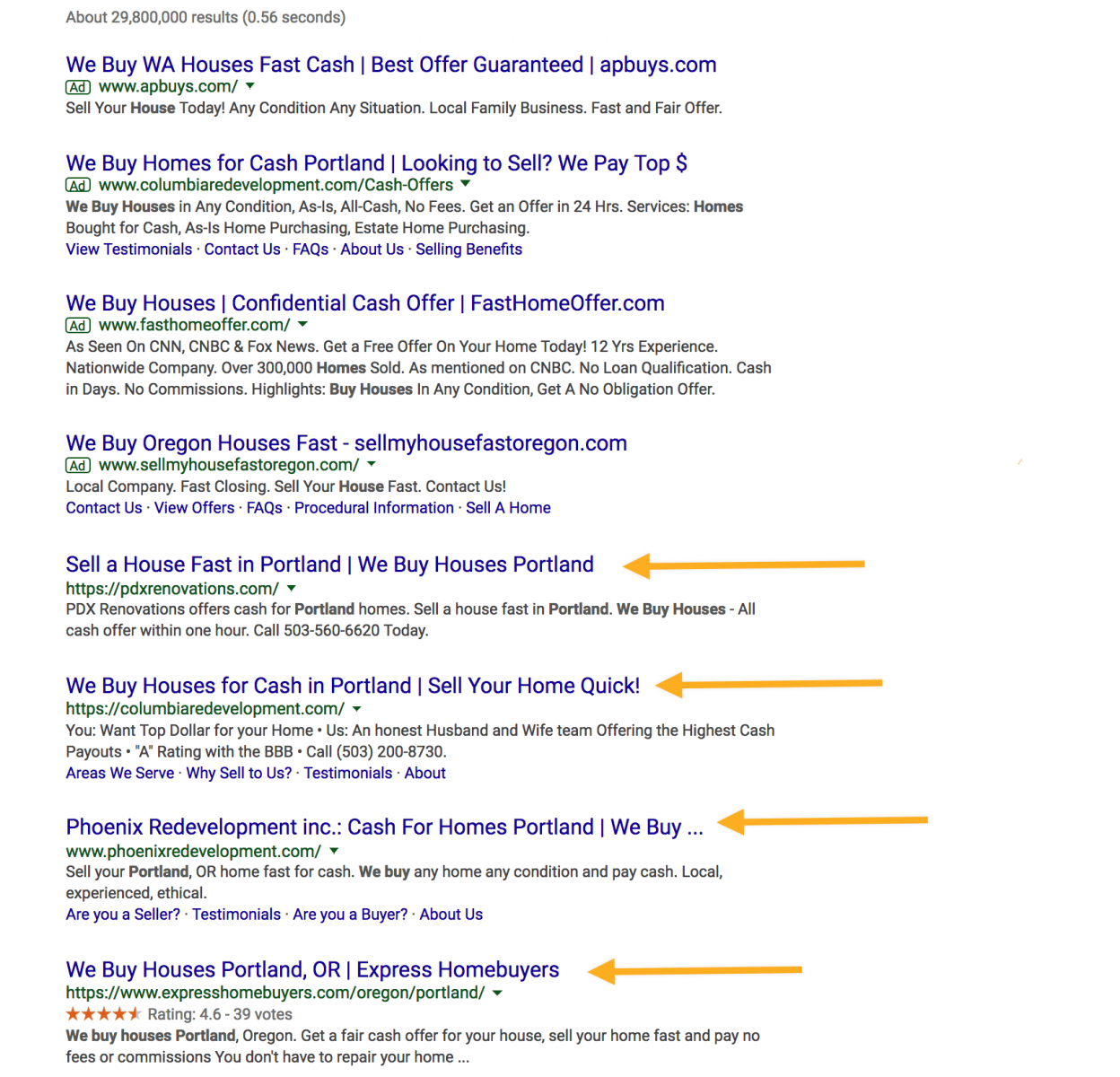
    If, for example, I was searching for “how can I sell my house fast”, these are my top three picks for what I would click on.

    Why? Well, it all has to do with the title and the meta description of those results and how well I think those results will solve my problem. The same is true for your PPC ads. When someone searches for something in Google, they’re looking to solve a problem. And your ad copy (the words for the title tag and meta description) need to promise to solve that specific problem for them.

    And the single most important thing you’ll write is the headline for your ad. If this doesn’t get people to click, nothing will.

    So spend a little extra time on this, run it by some friends if you have to, and make sure it’s primed to get your target market clicking.

    Remember, depending on what PPC marketing method you choose, AdWords, Facebook, or Bing, you’ll be limited to either the number of characters you can use within the ad or the amount of text you can use within a FB ad. Be sure to use this ad “real estate” wisely.

    Learn More: Real Estate Conversion Copywriting: How To Sell The “Click” With Your Meta Description And SEO Title

    Step #5: Create a High-Converting Landing Page

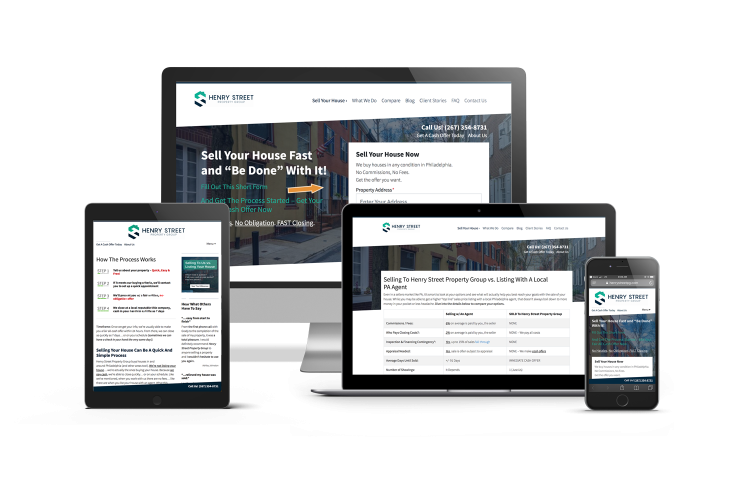
    The final thing you need to do before you launch your real estate PPC campaign to give it the best chance of success is building a high-converting landing page. In the field of online marketing, the landing page is the place where people will go once they click on your ad.

    The landing page needs to display content that reinforces your message contained in the ad. If your ads states you’ll give them a call in one hour, make sure your page also says one hour, not 24 hours.

    The lead form on your landing pages must also reinforce the search as well as trigger the searcher to take action. “Contact Us” or “Get My Cash Offer” are a couple of examples.

    Trevor explains landing pages and the importance of having an effective lead from here… Key Ingredients For Crazy High Converting Real Estate Lead Forms

    Ingredients For Crazy High Converting Real Estate Lead Forms

    If your real estate landing page isn’t optimized for conversion, then it doesn’t much matter how remarkable your targeting, your ad copy, or your budget is, no one is going to convert.

    At Carrot, we’ve tested our websites hundreds of times to ensure high conversion rates for each of our members. Which means when you send the right advertising traffic to a Carrot site, you’re going to get results. You can sign up over here to try us out for yourself (risk-free, with a 30-day money back guarantee)!

    Conclusion

    When you finally decide to click the big red button… we want you to get results — real, tangible, business-building results. We want you to double or triple your money, we want PPC to become a revenue-generating machine for your business, and we want you to no longer fear launching a campaign.

    But the only way to make that happen is to prepare before you hit the big red button.

    And by following the five pre-launch steps in this article, you’ll ensure that every campaign you launch gives you a healthy ROI, takes you one step closer to dominating your market, and drives real revenue for your business.

    If you have any additional questions about launching your upcoming PPC campaign, throw em’ in the comments and we’ll help you out. :)

  • SEO vs PPC For Real Estate Investors – Which Is Best? [Infographic]

    SEO vs PPC For Real Estate Investors – Which Is Best? [Infographic]

    The age-old question for real estate investors and agents… SEO or PPC for real estate investing leads?

    Which one do I start first, and which is right for me? Well, we whipped up a handy infographic to walk you through some of the most important things to consider when looking at SEO or PPC to help attract leads online for motivated house sellers, rent-to-own tenants, buyers, and any other type of lead.

    At first glance, you may be thinking…

    “But both SEO and PPC are basically going after the same people searching the same phrases… shouldn’t I just do both?”

    Choosing how to drive traffic to your real estate investing website and how to ramp things up is a pretty darn important decision. Yes, both are ways to get you in front of the motivated house sellers, cash buyers, tenants, rent-to-own tenants, note sellers… yadda yadda yadda… but both are fundamentally different, and they each have massive pros and cons that you should consider.

    For instance, as you’ll see below, the amount of time and money you have to invest in your online marketing will dictate whether SEO or PPC is best for you right now.

    One gets leads more quickly but requires a money budget to launch. In contrast, the other one takes longer to get results but can yield the highest ROI (return on investment) of any online marketing strategy we use.

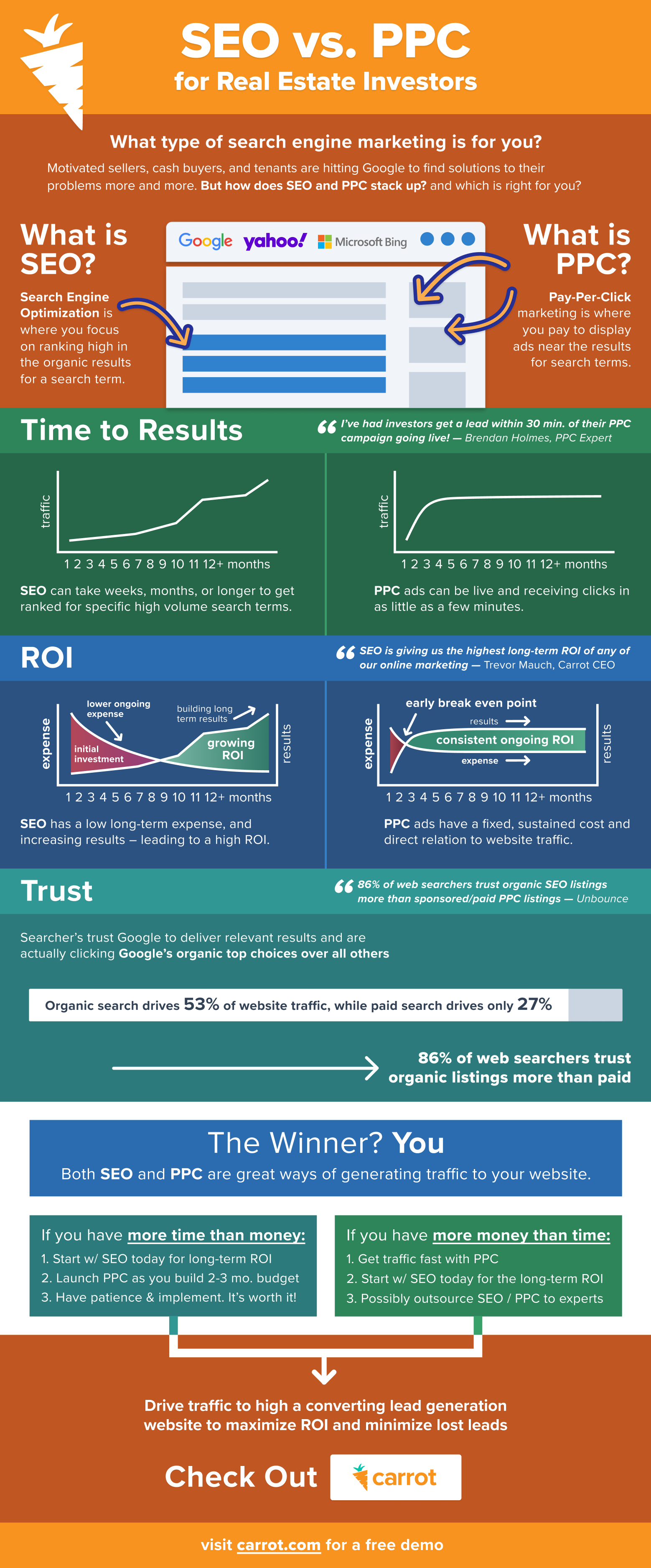
    Learn more about the differences between SEO and PPC marketing as a real estate investor in the infographic below, and if you enjoy it, share it online!

    SEO vs PPC For Real Estate Investors

    seo vs ppc for real estate investing leads carrot

    Share This “SEO vs. PPC” Infographic


    Let’s Sum It Up For You…

    When looking at SEO and PPC to attract real estate investing leads like motivated sellers, cash buyers, tenant-buyers, etc., here are a few things to consider.

    How SEO Can Help You As A Real Estate Investor Or Agent

    Any solid SEO strategy aims to get your real estate investor site to show up at the top of search engine results pages. And, even more importantly, in the top spots of Google, specifically. If you aren’t one of the sites that are on top, you won’t be getting the sort of traffic you need.

    SEO can also build trust in the eyes of the potential lead. Search trends have shown that 85% of clicks go to organic SEO.

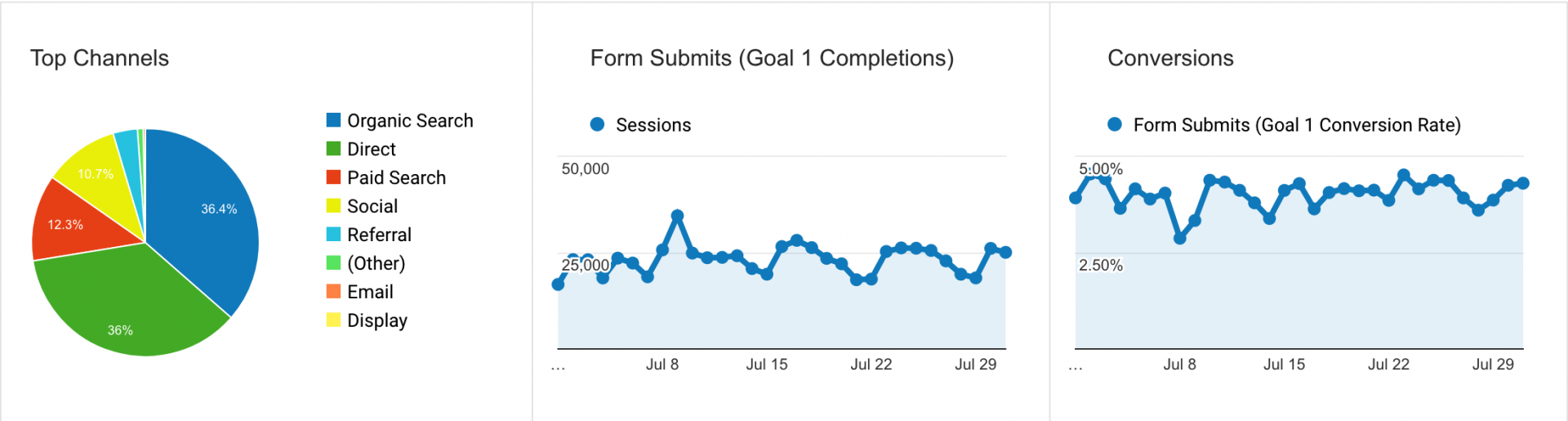
    The #1 lead generation source was “Organic Search,” a month-over-month occurrence. In a snapshot, Organic leads accounted for 36.4% of all leads. For reference, PPC accounted for 12.3%.

    Organic Search Leads Accounted for 10,547 leads from the 28,947 Carrot Members obtained in July 2018
    Organic Search Leads Accounted for 36.4% of All Carrot Member Leads in July 2018

    SEO is about building authority, demonstrating relevance, and matching your site to the right search keywords. It can be a long-term process, but one that is essential to your website’s performance. Once you have the building blocks to achieve high rankings in search engines, the sky’s the limit!

    SEO (Organic) Search Engine Results

    organic search results

    Benefits of SEO and Evergreen Marketing

    1. It’s free if you do it yourself

    A clear SEO benefit is that it’s free to do. Unlike PPC, you don’t have to pay for it. You just need to invest time in implementing the best practices across your site.

    But with that comes a whole checklist of ‘best practices, including making sure its search engine spider is accessible, responsive, has unique content, targeted keywords, and optimized metadata – just to name a few.

    Need a little guidance? Check Out: A beginners guide to SEO for real estate investors.

    2. It’s more likely to drive more consistent traffic in the long run (if you implement a solid SEO plan)

    That’s because people tend to be more attracted to SEO (organic) results because they trust them much more than a paid sponsored link.

    3. It will drive better ROI long-term

    The great thing about SEO is that once you’ve implemented the best practices onto your site, the only way is up. Make your way to the top, your brand is automatically perceived as reputable, and your ROI will continue to rise. In the long run, your investment and work into building those rankings go down as your traffic climbs… meaning a lower cost per lead.

    4. Not just for blog posts… try it on your YouTube videos for faster results

    YouTube is the second largest search engine in the world. Grab a little bit more of the search engine results page via video. Video is big now, and YouTube is hugely important to search results. Optimize your YouTube videos and descriptions with keywords that search engines like.

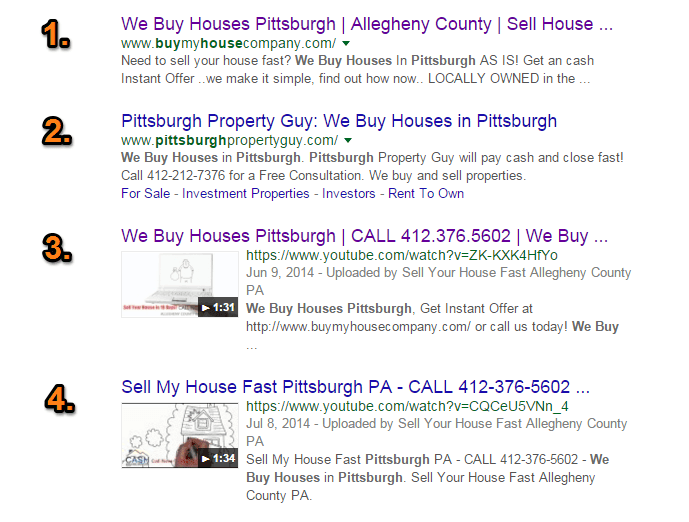
    First Page of Search Engine Results for We Buy Houses Pittsburgh

    first-page-search-engine-results-for-we-buy-houses-pittsburgh

    How PPC Marketing Can Help You As A Real Estate Investor Or Agent

    If you want the potential for immediate results or your website is in the process of ranking high but just isn’t there yet. PPC might be the way to go. If you have the budget, it’s possible to get an ad in the top four spots on the search results page reasonably quickly, but it might cost you.

    But…utilizing effective PPC techniques such as long-tail keywords and location targeting, you can build highly targeted campaigns. So, you can place ads in front of the right searcher at the right time.

    Overall, you must make sure you take the time to develop a strong PPC marketing strategy.

    PPC Benefits

    1. It offers instant results

    The most significant benefit to PPC is that you don’t have to wait around for that traffic to come. Set up an Adwords campaign, and you’ll start to see the results instantly – which is particularly helpful for investors just starting up.

    Here are 20 tips to get your Google Ads PPC marketing up and running.

    2. It’s highly targeted

    PPC offers the edge on conversions, with paid results more likely to convert. The great thing about PPC is that it is highly targeted to the customer, whereas organic traffic can be slightly unpredictable.

    Although you need to bid on keywords, Google also uses a quality score metric to decide how relevant your ad is to that user. So, you can be sure that when a person clicks on your ad, they will genuinely be interested in what you’re selling.

    3. It’s protected from the “intimidating” algorithm updates

    There’s nothing more frustrating for an SEO marketer than an algorithm update. The good news is that PPC is protected from algorithm updates, so you’ll still continue to see traffic heading to your site no matter what changes are made.

    Actual Stats On A Motivated Seller PPC Campaign
    motivated seller adwords account


    You Don’t Have To Decide On One Or The Other. Leverage Both SEO and PPC Together For Even Greater Results

    We usually start SEO and PPC in conjunction with each other. We start a PPC campaign to get leads in the short term and SEO to build up over the long term. You can amplify your overall results by using SEO and PPC together.

    Generate more exposure – An obvious benefit of combining SEO and PPC efforts is added visibility on the search engine results pages (SERPs). Dominating the SEO search results will significantly increase traffic and give the impression that you’re an established presence in the real estate investor market.

    Increase intent keywords – Simultaneously running SEO and PPC campaigns allows you to double the keyword data to analyze. Determine which SEO and PPC keywords have the highest conversion rates and use that information to optimize your strategy.

    Use high-performing ad copy and SEO content – If it works for PPC, it also often works for SEO. By determining which PPC ads result in the most lead conversions, you’ll know how to create title tags, meta descriptions, and page content for the real estate investor blog posts you write. The benefit is allowing you to potentially rank higher in organic search results. Using PPC, you’ll also quickly know what works and doesn’t. While completely testing titles and meta tags, strictly organic, can take a long time.

    Test keywords utilizing PPC before committing to SEO content – PPC ads are a great way to improve your SEO keyword strategy. As your long-term SEO keyword strategy develops, test the conversion rate of the keywords you want to rank for with PPC ads. You’ll get immediate feedback on the effectiveness of the SEO keywords you’re after and can tailor your investment strategy.

    Share This Infographic With Others And Get To Work!

    Driving traffic to a high-converting lead generation website is important. You can achieve high ROI using SEO, PPC, or in combination. This is why you might need to work with a search marketing team. If you need help, get in touch with us today. We can take on SEO and/or PPC marketing for you.

    If you’re already a Carrot Member, join us on the weekly Coaching Calls when we cover a wide range of strategy topics, including SEO and PPC.

    Not a Carrot Member yet? Take a demo of our online marketing software for real estate professionals. Be sure to hit us up with questions!

  • EP 63: #1 Real Estate PPC Metric: You Need To Build Into Your Real Estate Marketing Strategy w/ Adrian Nez

    EP 63: #1 Real Estate PPC Metric: You Need To Build Into Your Real Estate Marketing Strategy w/ Adrian Nez

    The #1 PPC Metric You Need To Build Into Your Marketing Strategy

    Listen to the CarrotCast Podcast and Subscribe Below!

    Change your mindset. Look at your marketing not as a cost but as an investment.  Adrian Nez

    We’re talking about lead generation on this call. But…it’s a little bit of a different one. I’m going to set the stage for you. Whenever we talk about lead generation, there are a few steps that we always want people to take because of a proven path. This is the model to follow that works, and it works over and over and over again.

    The first thing, you got to dial in your website. Nailing step one, getting a high-converting website with the right strategy.

    Step two is what we’re going to talk about today. You need to pick a traffic plan and get traffic and leads coming in soon, and one of the best ways to do that is with pay-per-click marketing, whether it’s through Google or Bing or even Facebook if you do it right. One of the things that most people don’t do is they don’t look at and they don’t focus on this one metric that Adrian and I on our team spent some time.

    We did a Facebook Live and what you’re going to listen to is actually the recording of a Facebook Live that we did yesterday, as of the time I’m recording this, where we walk through and the number one most important metric that I feel people should be looking at when it comes to paid traffic. If you follow this real estate PPC metric and then you follow our training on how to dial in your pay-per-click marketing through Google and Bing, you are going to succeed. Okay? It’s just going to happen.

    One of the things that most people don’t do is they don’t focus on this one metric that Adrian and I are going to cover. We walk through the number one most important metric that I feel people should be looking at when it comes to paid traffic. If you follow this metric and then you follow our training on how to dial in your pay-per-click marketing through Google and Bing, you are going to succeed.

    What is the number one most important real estate metric according to me when it comes to your paid traffic? Well, piggybacking off of a call I recent CarrotCast, we take a look at how to use simple math to really help your paid marketing become a lot more successful. This is going to help you do this one calculation that could change the game with your pay-per-click.

    Really dive in, nail this number that we’re going to give you. It’s going to take you five minutes to do your own calculation, and we’d love your feedback.

    Listen to our other episodes at www.carrotcast.com.


    Listen to the CarrotCast Podcast


    [podcast-subscribe]

    Enjoy this CarrotCast episode. Use this #1 Real Estate PPC Metric and Change from Marketing Cost to Marketing Investment.

    4:15 – Removing emotion from your marketing. Using simple math equations.
    6:00 – Adrian’s PPC journey. Why what he implements works so well in his market.
    7:15 – The main philosophy around this real estate PPC metric. Working the math to find your cost per lead.
    10:40 – What Adrian’s AdWords campaign looks like right now. His cost per lead and lead volume.
    15:30 – Taking a look at Adrian’s max cost per lead.
    23:15 – Factoring in the lifetime value of a client.
    30:35 – Adrian dives into his to his account in real-time.
    34:15 – Drilling down into your Analytics data to further optimize accounts.
    36:20 – The difference in mindset between success and failure. Jump over that hurdle.
    39:25 – Look at your marketing as an investment, not as a cost.

    [podcast-subscribe]

  • Ep 2: Advanced PPC Tips Higher Returns With Your Marketing w/ Dan Barrett

    Ep 2: Advanced PPC Tips Higher Returns With Your Marketing w/ Dan Barrett

    2016.7.1-CarrotCast-Dan-main

    You know that feeling when your Google Adwords PPC campaign just isn’t pulling the numbers you want?

    Ya, we do too. Google PayPerClick is its own animal and can be pretty intimidating sometimes.

    Even for people who are tech savvy and have the time to learn how to do PPC marketing well.

    Subscribe and rate us on iTunes

    But what do the experts, the people who do PPC marketing every single day… for active investors around the country… do to get the highest ROI out of their campaigns?

    What tips and tricks have they learned as they’ve driven hundreds of thousands (or millions) of clicks and hundreds of thousands of leads to squeeze more return on investment out of their PPC?

    Well, that’s what our guest today, Dan Barrett, and I chat about.

    Not only is Dan a superhero fan, as his office shows, but he’s a huge fan of data (like I am). Data is pretty nerdy, but it’s what pays the bills here at Carrot for our high achieving investor clients because when you have the data you have the advantage over those who don’t.

    So enjoy this conversation I have with Dan, CEO of AdwordsNerds, and get a glimpse into his world as an entrepreneur, what he’s passionate about, his story, but also his tips to ramp up the effectiveness of your Google PPC marketing for motivated house sellers.

    Oh, I almost forgot… make sure to download the Advanced PPC Marketing Guide + Top 804 Most Profitable House Seller Keywords report that we made in conjunction with Dan and his team.

    Enjoy :-)

    — Trevor

    Listen to the Podcast

    Subscribe To The CarrotCast On iTunes

    We sat down with Dan Barrett and had a CarrotCast conversation with him about: 

    • His story of how he took he has built his PPC company.
    • Why the workspace environment is important.
    • How and why he has found the real estate investor niche market.
    • How his team conducts PPC studies and tests.
    • Why he built a huge, very informational and complex PPC report.
    • What he looks for in ROI in his client’s accounts.

    Watch the Video Version

    Advanced PPC Tips Higher Returns With Your Marketing w/ Dan Barrett
    • Start – 12:22 – Dan and Trevor talk about their work environments and why their offices are set up the way they are
    • 12:25 – What the heck “AdwordsNerds” is.
    • 20:25 – How specializing in a niche real estate PPC marketing creates higher ROI.
    • 26:41-33:00 –  Is there a need to create specified landing pages for targeted search terms such as “sell a house in divorce”
    • 34:30-48:55 – Why does AdWords Nerds compile such exhausting levels of date when creating campaigns?
    • 47:00 – Understanding PPC ROI and the difference between targeted campaigns and broad 1000+ keyword campaigns.

    “If you’re willing to take a high cost per lead, you can get all the leads in the world as long as you’re willing to pay $10,000 per lead… If you want a lead for 50 cents, I can get that too… For everybody, it’s about finding that right place.”

    [cta offer=”ppcreport”]

    [podcast-subscribe]

  • 10 Must Bookmark Real Estate PPC Marketing Resources We Use (And You Should Too)

    10 Must Bookmark Real Estate PPC Marketing Resources We Use (And You Should Too)

    2016.06.4-ppcresources-main

    Have you heard of other real estate investors having amazing success with pay per click advertising?

    Of course, you have. Now might be the best time to educate yourself on PPC and find out how it can help your real estate business.

    We’ve compiled a list of the top PPC marketing resources we use so that you don’t have to go digging around trying to find where the best information on PPC is.

    Pay per click is still a growing advertising platform to using when trying to get more website traffic, get more buyer and seller leads and close deals.

    But… PPC advertising for real estate has gotten more complex over the last few year.

    When learning about Google Ads, FB, and other pay-per-click services, having an idea of what motivated sellers and buyers are searching for when they are looking to sell their house fast is very important. You need to do some research and educate yourself. Use these resources and tools to become a real estate PPC expert!

    So what tools do we use when we’re diving into our PPC marketing or the PPC marketing with our clients to help them crush it.

    The Top 10 PPC Marketing Resources And Tools We Use

    Google Ads

    Google Ads is the reigning champion of PPC. The Google Ads tool and the advertising network are second to none. Whenever we’re launching a PPC marketing campaign, we start with Google Ads, then expand as we see results.

    So, there is no better place to start your PPC education than with Google. These resources provided by Google are a mix of beginner and expert tips and tools. Before you begin your own AdWords campaign, start here and get educated.

    Resources that Google makes available to learn about PPC:

    Microsoft Advertising

    The number 2 search engine to generate motivated seller leads consistently is Microsoft. Although they’ve made huge competitive strides, it’s nowhere near Google. But, Microsoft is still an important and useful platform for showing real estate ads. It’s demographic tends to be slightly different than that of Google and is a less expensive cost-per-click alternative.

    Like Google, Microsoft Advertising offers its library of resources on how to use its PPC tools:

    Wordstream

    wordstream university

    [Image Source] Wordstream’s PPC University

    Who’s not looking to cut down their PPC learning time and, in return, reduce your management costs and get better results? Wordstream can be used as that go-to PPC source. As both a PPC tool and consulting agency, Wordstream has grown to become one of the most comprehensive resources for PPC knowledge, offering up full online training (for free) via their PPC University section. Also, check out their Grader tool. Submit your PPC account to see how it ranks and get weekly reports.

    We love Wordstream and recommend you check out the following:

    SEMRush – Traffic And Competitor Analysis

    semrush overview

    [Image Source] SEMrush

    Want to see what your biggest competitors are doing with their PPC marketing campaigns in their market?

    Well, tools like SEMrush can help you do just that.

    SEMrush is a keyword research tool with a database of over 35 million keywords and keyword phrases used to drive website traffic. The data is taken directly from Google’s organic search results as well as Google Ads. It is one of the best keyword research tools available. Best of all, you can use it as a spy tool. It currently offers a free (limited) version and a full, paid, version.

    Why we like SEMrush:

    • See your competitor’s SEO organic and PPC positions
    • Domain-specific keyword ranking
    • Study your competitor’s ad’s text
    • Find good long tail keywords
    • Comparison of domains by keywords
    • Compare various SEO and PPC metrics
    • See competitor backlinks
    • Detailed look at PPC ad campaign data

    Jon Loomer Digital – Facebook Marketing

    jon loomer 20 percent rule

    [Image Source] Jon Loomer

    Looking to do your own Facebook advertising and want to do it at a high level?

    For us, the go-to source for Facebook advertising is Jon Loomer’s Advanced Facebook Marketing. Jon’s educational content includes free workshops, podcasts, blog posts, and eBooks. All of these content sources cover the Facebook ad optimization and the latest Facebook ad news. Check out his:

    PPC Hero

    PPC Hero PPC resources

    [Image Source] PPC Hero

    One of our Core Values at Carrot is “Constant & Never Ending Incremental Improvement” and PPC Hero is one amazing resource to improve our own PPC marketing game.

    PPC Hero is described as ”PPC insights from the experts at Hanapin Marketing”. They provide in-depth how-to’s, case studies, and resource guides. Warning – you can get wrapped up reading all their useful information. Be sure to stay focused or use their search feature and type in the specific information you’re looking for.

    Moz

    Moz has built the reputation of being a go-to place for SEO. But…Moz also has a large portion of insights on PPC and internet marketing. They keep up with industry trends, cutting-edge news, and ideas to change your outlook on your PPC strategy. Read more:

    Google Ads Editor

    It’s called the “PPC Powertool.” Ads Editor is a free, downloadable Google application for managing large Ads accounts efficiently. Download campaigns, make quick and bulk changes with editing tools, then upload the changes straight to your AdWords account. There are many benefits to Google Ads Editor, but like to use it for the following:

    • You can remove duplicated keywords if you have extremely large campaigns that you download via a spreadsheet.
    • Create ad groups fast.
    • Replace bulk amounts of text.
    • It doesn’t require an internet connection so you can work offline.
    • Test bids using the advanced bid changes feature.

    Microsoft Advertising Editor

    Just like the Google Ads Editor, you can save time by managing your Microsoft Ads campaigns using Microsoft’s desktop application version. Microsoft Ads Editor is very similar to Google Ads Editor, so the learning curve is minimal. You can edit campaigns offline and publish changes when you are back online. You can also use Microsoft Ads Editor to manage your accounts in bulk, from the campaign level to as targeted as the individual ad level.

    Search Engine Land

    Search Engine Land, like Moz, has traditionally been considered an SEO resource. But they have many useful PPC content and guides to getting smarter at PPC marketing. To get started, check out these sections:

    Bonus: Carrot

    Don’t forget to bookmark our blog and guides as one of the leading real estate PPC educational resources.

    Have any special resources you use for PPC marketing?

    We’d love to hear them! Hit us with a comment below and join the convo!

    [cta offer=”ppcreport”]