

Author: cameronharris

  • A Look Back At The March Google Algorithm Update – A Win For Carrot Sites!

    A Look Back At The March Google Algorithm Update – A Win For Carrot Sites!

    A Look Back At The March Google Algorithm Update - A Win For Carrot Sites!

    Have you noticed any changes in your site’s search rankings since the March Google Algorithm Update? SEO experts detected significant tremors in mid-March, indicating another large-scale algorithm update by Google. The search giant confirmed the update’s completion on March 28, leaving website owners and SEO professionals to assess its impact on their online visibility.
    As with any significant core algorithm update, the details – and the effects – haven’t been immediately evident.  Generally, experts have indicated that this was a broad update, targeting all types of content rather than focusing on one particular area.  Additionally, it’s believed that this update wasn’t necessarily a penalty but instead a promotion or reward for great web pages.

    So, we dove into data from our Keyword Tracking Tool to answer the question: how did Carrot sites fare?

    First, a little about the data…

    Carrot’s Keyword Tracking tool has enabled thousands of our customers to track tens of thousands of keywords, resulting in a vast reservoir of SEO data that is one of the most comprehensive in the real estate industry.  We can aggregate this data and paint a picture of what happened on our network before, during, and after these large-scale Google algorithm updates.  This data lets us keep our finger on the pulse regarding what it takes to win with SEO in the real estate industry

    That said, this data represents precisely that – aggregate changes.  It’s important to monitor your own sites to see how algorithm updates impact the pages and search phrases you care about most.  

    Carrot’s SEO Keyword Tracking tool – the ultimate solution to skyrocket your website’s visibility on search engines and bring more motivated leads to your doorstep!

    Say goodbye to the hassle of manually tracking your website’s keyword performance and hello to effortless optimization with our user-friendly platform. Our advanced keyword tracking tool monitors your website’s ranking on major search engines and provides valuable insights on how to improve your SEO strategy.

    With Carrot’s SEO Keyword Tracking tool, you’ll have access to real-time data and metrics that will help you:

    • Identify high-performing keywords and optimize your content to rank higher
    • Track your competitors’ ranking and stay ahead of the game
    • Monitor the progress of your SEO campaigns and adjust your strategy accordingly
    • Analyze and improve your website’s on-page SEO factors, such as title tags and meta descriptions
    • Save time and energy by automating your keyword tracking process

    Don’t let your website get lost in the sea of competitors, start using the keyword tracking tool now! Not a Carrot member yet? Join today and start dominating search engine rankings!

    Overall, a positive update for Carrot sites.  Less volatility.  More upside.

    We wanted to look specifically at how Top 10 Rankings fared during and after this update finished rolling out.  Of all URL/keyword combinations tracked through our Keyword Tracking Tool, a little over 40% sit in the Top 10 of Google Search Results. That’s a lot of first-page real estate being claimed by Carrot members!

    And overall, there were more Top 10 Rankings following this update than there were prior to it. In other words, following Google’s algorithm update, even more of that first-page real estate is being claimed by Carrot sites.

    % of Tracked Keywords in the Top 10

    Unique URLs w/ Top 10 Rankings

    Pre-Update

    40.27%

    41.33%

    Post-Update

    3944

    4200

    After finding that there was a net positive in terms of sites and keywords now sitting in the Top 10, we want to paint a picture of how much volatility occurred.  Were there many rankings turnovers, or are the same sites and keywords ranking in the Top 10 now as before?

    Overall, this core algorithm update brought much less volatility and more upside than August’s Helpful Content Update.

    To determine this, we put each URL/keyword combination into one of three groups:

    • The “Maintained” Group – was in the Top 10 before the update and is still in the Top 10 following the update.
    • The “Lost” group – these were in the Top 10 before the update but are no longer sitting in the Top 10 following the update.
    • The “Gained” group – these moved into the Top 10 following the update.
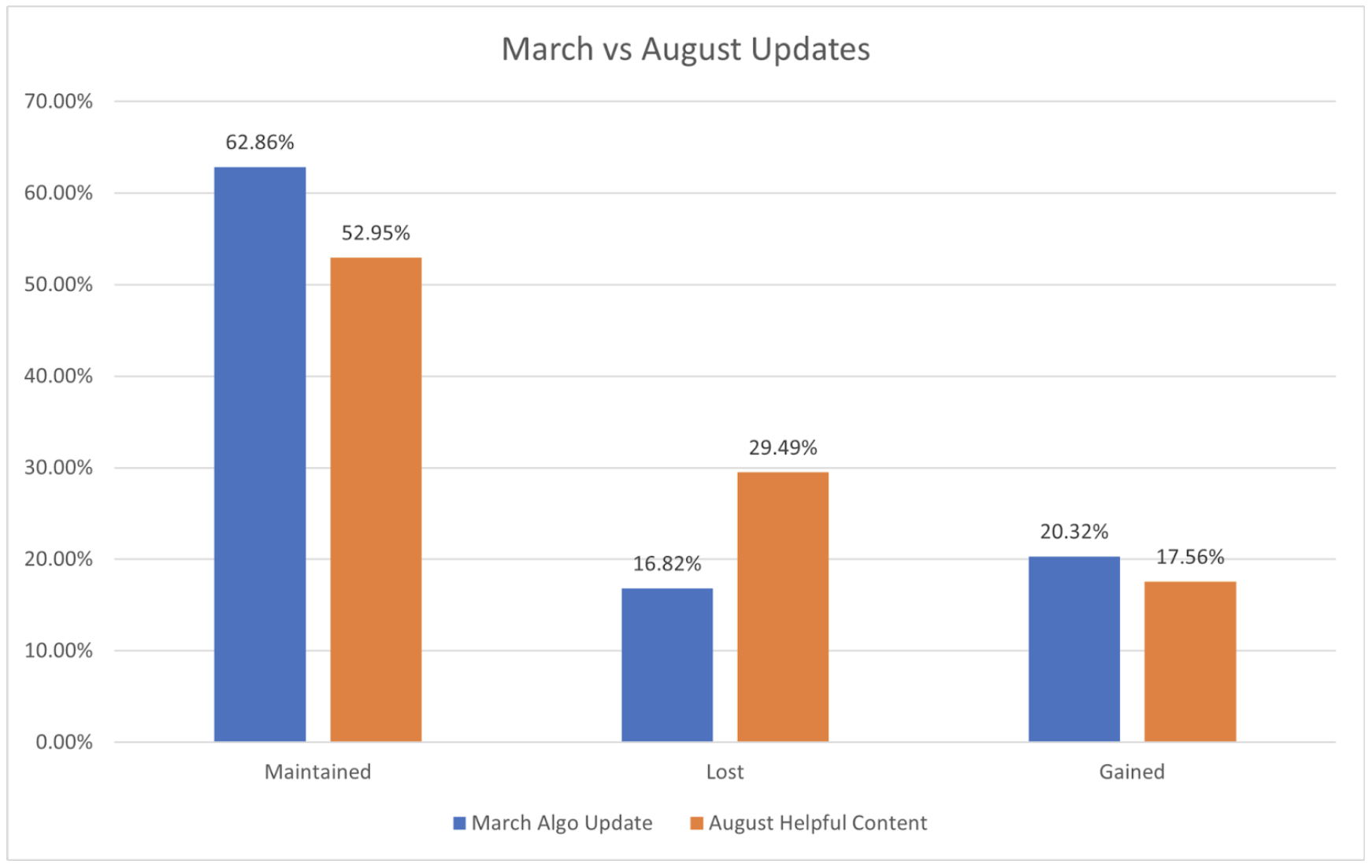
    March vs August Google Updates

    A few things immediately stand out.  First, there was much less turnover and volatility during this update.  Nearly 63% of the keywords we looked at fell in the “maintained” group, compared with only 53% during the August Helpful Content Update.

    When only looking at those in the Top 10 Rankings before the update, 78% of those keywords were still in the Top 10 following the update!

    Next, significantly fewer keywords dropped out of the Top 10 following this update compared to August.  And more keywords jumped into the Top 10 following this update as well.  All that to say, there was a lot more good than bad – which is always a win following a large-scale update.

    The overall impact is a net positive for Carrot sites – with more sites, URLs, and keywords in the Top 10 following the March Core Algorithm Update.

    What ranking positions were most impacted?

    Generally, we saw consolidation at the top of the search results page – meaning that more URLs and keywords improved their rankings within the Top 10 than those whose Top 10 rankings got knocked.
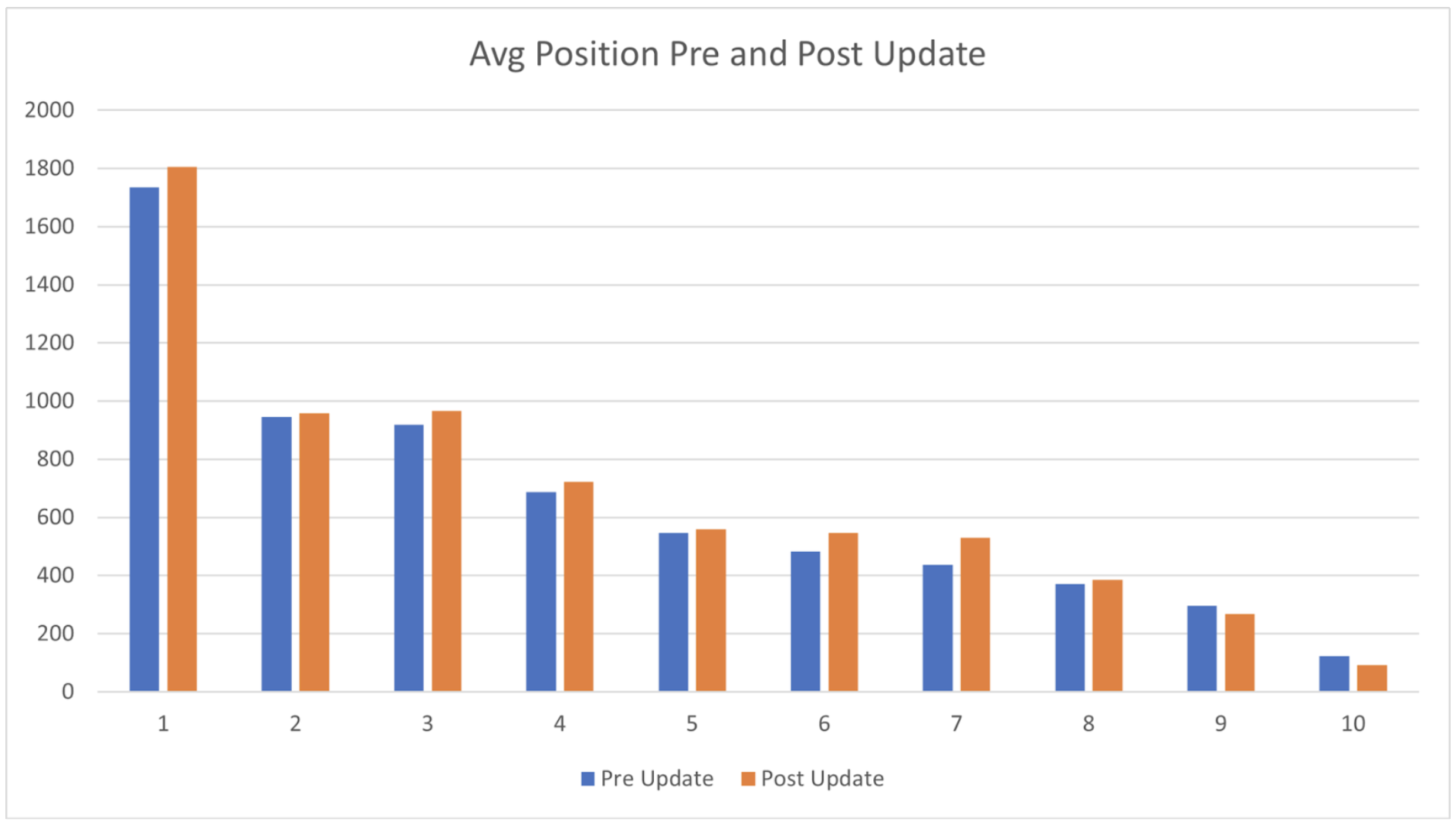
    Average position pre and post March 2023 update

    For positions 1 through 8, more keywords were ranking in that position following the update than before it.  We see this especially play out in the Top 3 rankings results.  The number of first-position keywords tracked through our Rank Tracker Tool grew to 1800+!

    This wasn’t only true because more keywords jumped into the Top 10, either!  The group of keywords already in the Top 10 before the update showed fairly significant positive growth toward the top of the search results page as well.
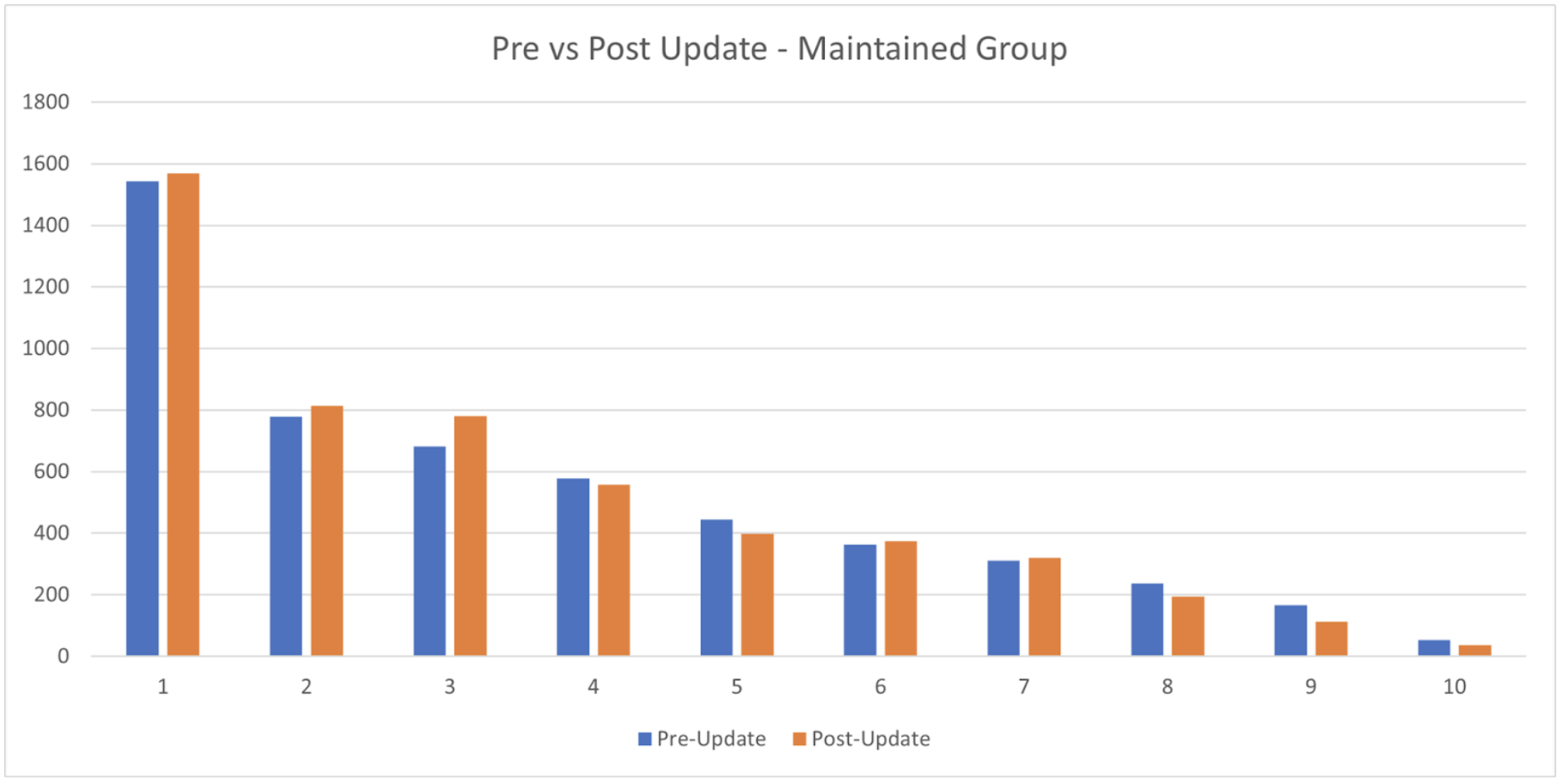
    Pre vs post Google Algorithm update - maintained group

    Overall, there was no rhyme or reason to which rankings positions were impacted.  The spread of keywords that dropped out of the Top 10 was pretty evenly spread in terms of the position they sat prior to the update.
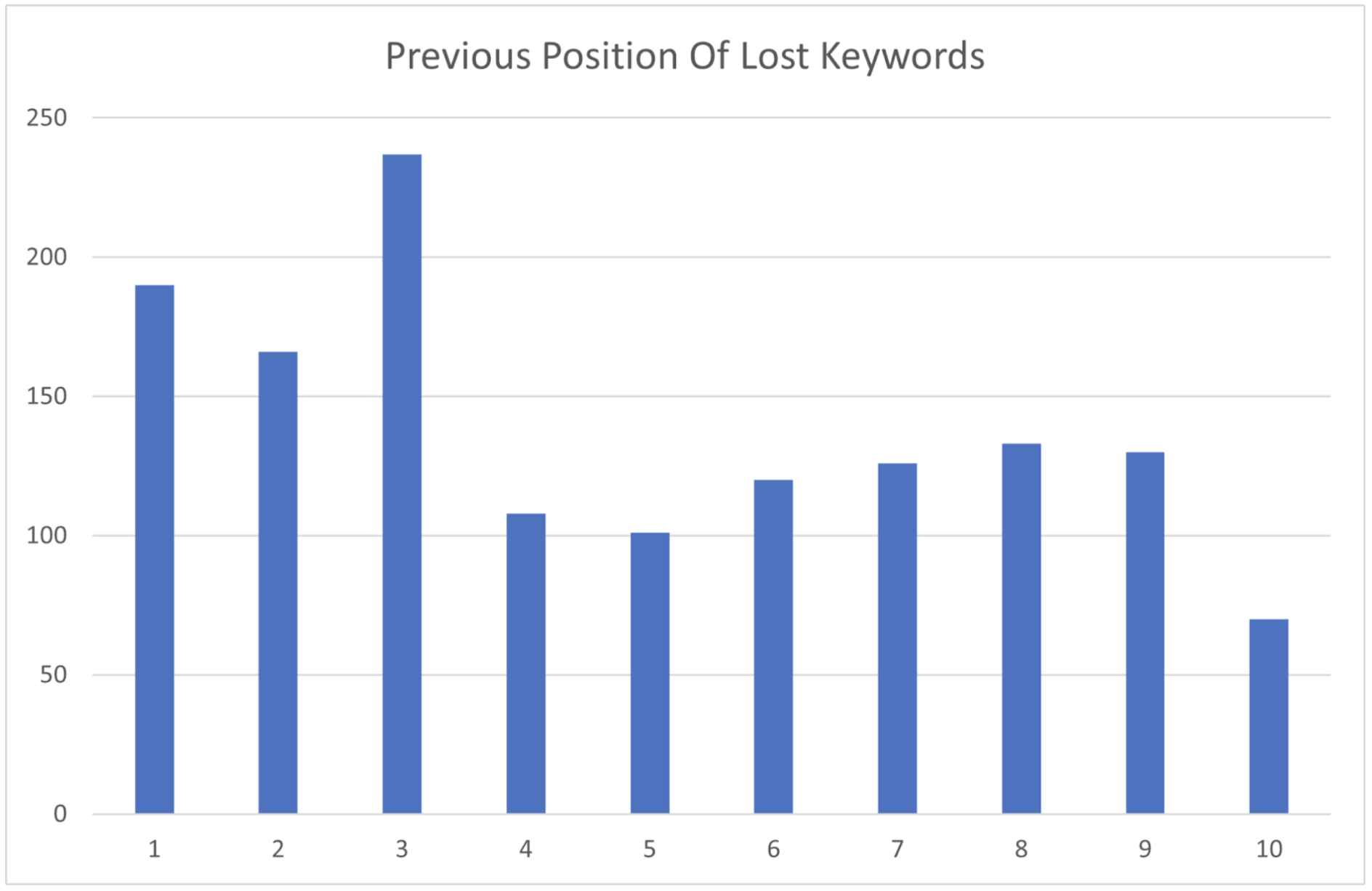
    March Google Algorithm Update previous position of lost keywords

    Similarly, the keywords that “jumped” into the Top 10 following the update were spread across the board.  Instead of only barely cracking the Top 10, some skyrocketed to the top one to three slots.
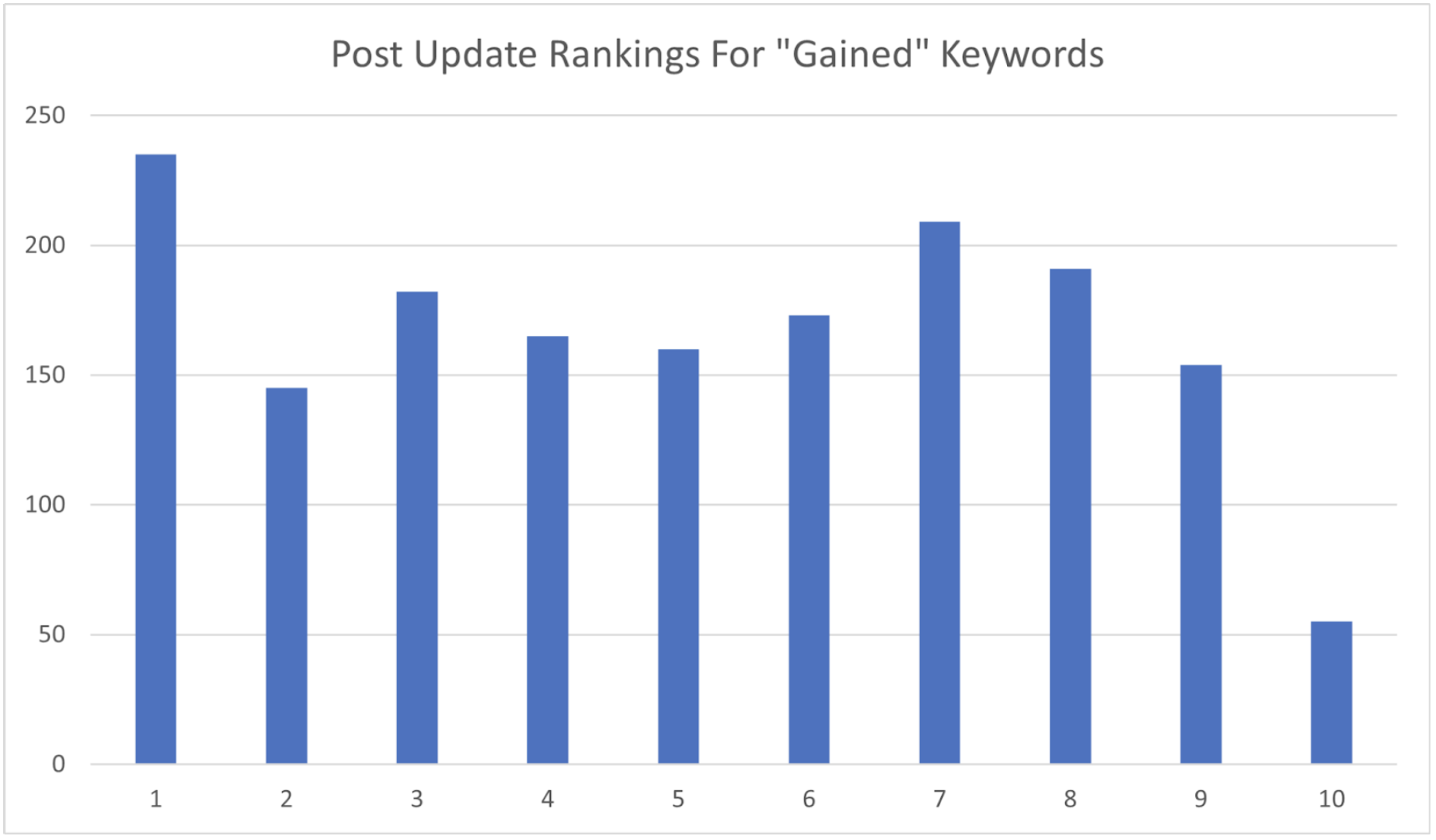
    Post Google 2023 update rankings for gained keywords

    Were any specific phrases impacted more than others?

    The short answer is … not really.  

    We took all of the search phrases and keywords that we analyzed, stripped out location-specific information, and performed some topic modeling to get an idea of what general “types” of search phrases were either lost or gained during this update.  There wasn’t a huge difference, but that may tell us even more about the details of this update!

    Note: the phrases in the “theme” column in each of the following graphics aren’t the search phrases themselves.  They’re just general topics representing many of the tracked keywords themselves.

    Theme

    Sell house fast

    Buy and sell houses quickly

    Cash buyers and reviews

    Avoiding foreclosures and wholesale properties

    Homes and properties in specific locations

    Real estate solutions and investment group

    Homes for rent and mobile homes

    Real estate buyers and cash offers

    Worth, homes, and properties in specific locations

    Inherited properties

    Count

    376

    301

    85

    76

    76

    42

    34

    23

    0

    0

    Topic models for lost keywords – as to be expected, we see a lot relating to primary Motivated Seller phrases.

    Theme

    Sell house fast

    Buy and sell houses quickly

    Cash buyers and homes for sale

    Houses for sale in specific locations

    Real estate solutions and investment group

    Inherited properties and selling homes

    Houses for sale in Florida

    Real estate buyers and foreclosures

    Real estate buyers and home buying process

    Real estate buyers and homes for sale in New Jersey

    Count

    560

    406

    346

    198

    127

    125

    88

    72

    43

    0

    And similarly, the topic models for “gained” keywords.  Overall, we see much of the same.

    In theory, we shouldn’t expect a ton of difference in “lost” and “gained” keywords or search phrases during a Core Algorithm Update.  That’s because these core updates aren’t focused on keywords themselves. Instead, they’re more broad-based and focus on website-based factors like E-E-A-T scores, high-quality backlinks using methods like HARO, and good, relevant content all-around.

    How should you respond to this update on your own site?

    There are a lot of unknowns when it comes to a Google Core Algorithm update.  Google certainly doesn’t reveal their “secret sauce.”  But because we know that they are generally focused on website-based factors like E-E-A-T scores, it is always a good idea to take a look at these things if the March Update negatively impacted your site.

    1. Content Quality – Ensure your content is unique, valuable, and informative to users.  Make sure it is up-to-date and in-depth.  Also, make sure it’s still relevant to what the end user may be searching for.  When it comes to SEO, you can never lose by taking another look at the quality of your content.
    2. Write with E-E-A-T in mind – E-E-A-T stands for Experience, Expertise, Authoritativeness and Trustworthiness.  Especially in the real estate space, showcasing credibility and expertise is increasingly important to capture top-ranking spots.  Build out your “About Us” page.  Highlight some testimonials from past clients.  Tell readers about how you are uniquely – and authoritatively – positioned to help them.  This matters just like relevant content!
    1. Check your backlink health – Any spammy or low-quality links in your backlink profile?  These could harm your site’s reputation and knock you down the search results page.  Disavow any spammy or low-quality links and make a plan to acquire some high-quality ones.

    We’ll call this round a win for Carrot.

    In the never-ending battle to secure the top spots on the Google search results page, we call the March Algorithm Update an overall win for Carrot websites and customers.

    More customers, more domains, and more keywords are ranking in the Top 10 after the update than prior to it.  And even better, more keywords are in the #1 spot at the top of the page!

    Be on the lookout for more reports like this as we put our first-class Ranking Tool – and the reservoir of data it creates – to use to keep you informed about what’s happening across the SEO landscape.

    Ready to take your real estate business to the next level?

    Join Carrot today and experience the power of a proven platform that generates leads and boosts your online presence.

    With Carrot, you get access to top-notch features like SEO keyword tracking, customizable websites, and lead management tools designed to help you close more deals and grow your business. Our world-class support team can always answer your questions and help you succeed.

    Join Carrot now and start winning in the competitive world of real estate.

  • Core Web Vitals & Page Speed – What To Do (and Not Do) with Your Website

    Core Web Vitals & Page Speed – What To Do (and Not Do) with Your Website

    By now, you’ve probably heard about Google’s upcoming Core Web Vitals update and are wondering what it means for your site, where you should be looking to learn more, and what you should be doing to prepare. 

    Back in June, we provided a brief overview of the Google update (officially titled the “Page Experience Update”) and an introduction to Core Web Vitals – the metrics playing the most prominent role in the update.  

    Recap:

    The Page Experience Update is introducing Core Web Vitals to Google’s search ranking algorithm for the first time.  Core Web Vitals are a series of pagespeed scores relating to how quickly a page loads, how quickly that page is interactive, and how stable that page is visually. Google started introducing elements of this update to their algorithm in mid-June, with the goal for it to play a full role by the end of August 2021.

    Check out our SEO News page to learn more.

    Over the past several months, our Carrot Engineering Team has been identifying, optimizing, and improving features and elements that directly contribute to better user experience and site speed metrics. 

    As that work continues to make our sites faster and better than ever, we’ve compiled some of the most common questions, issues, and misconceptions we’ve seen as a resource for you to be ahead of the game on your end.

    DO Understand Testing Tools

    We get this question a lot: how do you test your site speed and Core Web Vitals and what tool should you use?  At Carrot, we recommend using Google’s PageSpeed Insights Tool because – regardless of which tool you choose – the most important consideration is that you be consistent. 

    To us, using Google’s own tool makes the most sense.  If you’re using the Chrome Browser, the Lighthouse Tool in the Developer Tools is another great option.

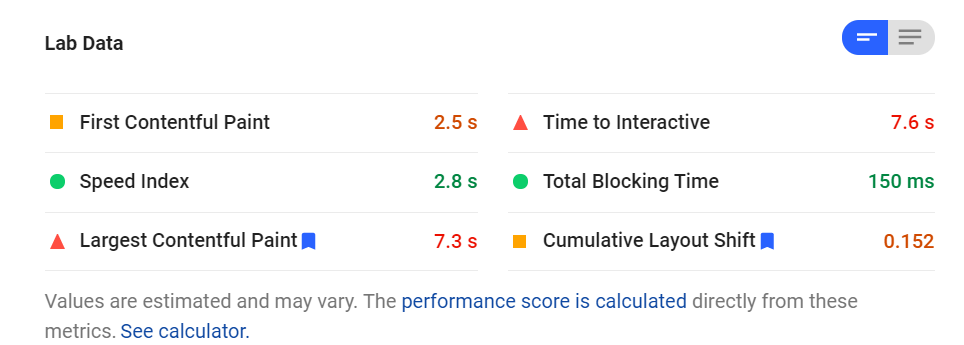
    That said, we always want to be sure that our members understand the differences and caveats between those snapshot scores provided by tools and the scores that are actually being used in Google’s algorithm. Google differentiates them into two categories: lab data and field data.

    Lab Data – Provided By Testing Tools

    Google Lab Data

    Lab data is exactly what it sounds like – data collected in a lab, or in this case, a single snapshot report performed by Google’s PageSpeed Insights Tool or any other third-party testing tool. 

    It uses your own browser or another emulated device to load your website in a simulated environment and capture the key metrics that contribute to Core Web Vitals and Page Experience.  These scores are meant to be consistent baselines and are not necessarily reflective of actual user experience. 

    Just like in a real lab, you want to control for all variables when running experiments and tests on your website.  Google’s page speed tool (and most other tools) do this by loading your site on a simulated older generation smartphone with only a 3G connection to determine mobile “site speed” scores. 

    This is meant to represent the absolute baseline and used as a tool for debugging any performance issues with your site.  It’s useful for looking at where you can improve your scores, but it’s not useful for understanding real user experience.  Most users are on newer mobile devices with better connections and WiFi. 

    Their experience is better than in the simulated snapshot and contributes to field data – the real scores used by Google’s search ranking algorithm. 

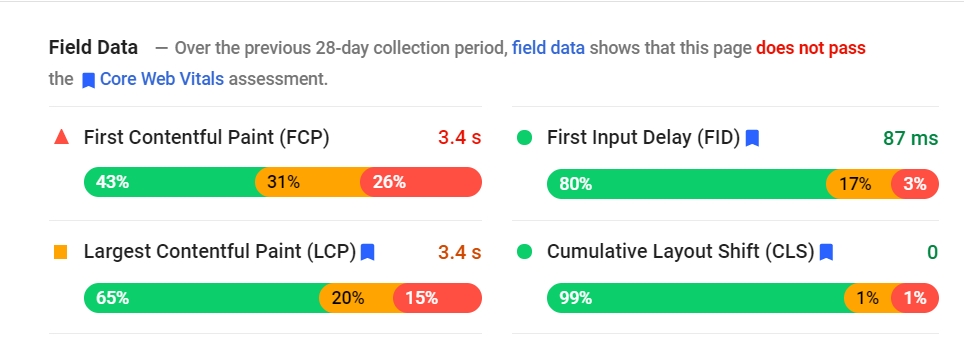
    Field Data – Provided By Real User Experience

    Like we said above – field data is what Google is actually introducing to their search algorithm.  It represents the actual user experiences collected by the Chrome User Experience Report (or CrUX) when users visit your site.  Google then looks at the 75th percentile of those scores, and that’s your actual “score” used by their algorithm.

    Just like with Google’s more commonly-known ranking indicators, we lose visibility and transparency the closer we get to the algorithm.  So while snapshot lab data scores can be accessed whenever we feel like running a tool, user experience field data is more ambiguous and inaccessible.

    There are two primary areas where you can gain insights about your real user experience scores if your site has sufficient traffic/data for Google to generate reports.  That’s in the Core Web Vitals tab of Google Search Console or at the top of reports in the PageSpeed Insights Tool.  

    For individual URLs, you may see an error – “Field Data — The Chrome User Experience Report does not have sufficient real-world speed data for this page.”  This means that there is not enough CrUX data available to generate a representative anonymous view of your performance.

    If you find this to be the case, no sweat – you just need more visitors, and the best way to do that is by focusing on generating great content first.

    This leads us into our next section…

    DON’T Stop Focusing On Content

    Under no circumstance should you stop what you’re doing to generate great content and drop everything to focus on Core Web Vitals.

    Here’s some guidance directly from the source – Google…

    “While page experience is important, Google still seeks to rank pages with the best information overall, even if the page experience is subpar. Great page experience doesn’t override having great page content.” – Understanding page experience in Google Search results

    In other words, page experience and site speed scores are just other ingredients in the complex recipe Google uses to produce search results and rankings. 

    Content is still king. 

    Relevant, useful, informative, and high-quality content will continue to outperform competitors and other websites – because, at the end of the day, a visitor is seeking content first.  Page speed is just another supplemental measurement.

    At Carrot, we have always excelled on the content side of things. That’s our bread and butter!  So while Google’s Page Experience Update is certainly something to keep an eye on now and in the future, we highly recommend that you continue leveraging our tools and investing your time, resources, and creative efforts to produce high-quality, relevant content above all else.

    Another note: Core Web Vitals will only apply to mobile search results.  Across our network, we see that nearly 40% of inbound traffic (and leads!) to Carrot sites still occur on desktop.  Those desktop search results will not be impacted by this update at all.  That’s why content is still so important. 

    DO Take A Minimalist (And Mobile First!) Approach To Design

    Because this update applies solely to mobile search, it underscores the importance of taking a mobile-first approach when looking at your website content and design.  Let’s face it – mobile has taken over. 

    As we mentioned, 60% of traffic across our Carrot network occurs on a mobile device.  Keep that in mind when thinking about how to layout and implement content on your site.  Sometimes, less is more.

    We recently did a series of conversion tests that reiterates this point. We found that simply reducing the amount of content in a website’s main hero section and form, could increase conversion rates by up to 50%! 

    This test confirmed our theory that by reducing the clutter that a visitor sees, they will be more likely to engage with the lead form.

    The same principle applies to site speed and performance.  Each additional element that you include on a page requires additional resources to process, render, and place that element on the page.  That results in additional time that it takes the page to load. 

    In the left image, the form is prominent and the page isn’t blocked from loading by resource-heavy elements. In the right image, there are more elements to load, and the form is pushed “below the fold.”

    The most common abuses of this also often incorporate some of the most resource-heavy elements – like pictures and videos placed all around the page, or high up near the top of the page. 

    While we encourage you to continue creating great content to highlight your credibility and experience, we also encourage you to be mindful of how, and where, you deploy that on your site.  Run snapshots before and after adding it and see how it impacts your scores. 

    At the end of the day, the goal of your site is to generate leads.  With so many users now browsing on their phones, it increases the importance of improving user experience in more ways than just site speed. 

    By taking a step back and considering how some of your content elements might be drawing attention away from conversion elements or impacting a visitor’s experience on your site, you’ll also be guaranteed to improve your site speed metrics at the same time. 

    DO Take Image Optimization Seriously

    While we are on the content note, we understand that there are naturally going to be images and graphics you want to include to help highlight your experience and improve your site aesthetic. 

    We highly recommend being cognizant of the various ways to ensure you aren’t overburdening your site’s speed and performance when adding images.

    For step-by-step examples, check out our image optimization guide.

    DON’T Weigh Your Site Down With Tracking Scripts

    Just like with content elements, too many unnecessary tracking scripts and third-party codes can also overburden your site and negatively impact your Core Web Vitals scores. 

    The same concept applies: each script or code snippet you add requires more resources to execute.

    We get it – some tracking scripts like Google Analytics, Google Ads, and the Facebook pixel might be necessary for your marketing if you’re making ad-buying decisions based on those metrics.  In this case, you have to consider it a trade-off. 

    In exchange for gaining visibility into those tracking metrics and insights, you’re negatively impacting your site speed marginally.  Which is more important to you?  In most cases, those tracking analytics will outweigh site speed.

    If you aren’t heavily and consistently using these tracking tools, perhaps consider what you really need and what you can get rid of.  Over time, the addition of individual scripts and code snippets can naturally bloat if not routinely audited for only the most necessary scripts.  This is one of the most common variables we see when reviewing customer site speed report results.

    Note: This also applies to any additional third-party scripts and services like chatbots, call tracking, etc.

    Finally, DON’T Freak Out…

    Core Web Vitals and Google’s Page Experience Update are certainly complicated, but by taking the time to understand the basics and paired with our Engineering Team’s work to optimize your site, you’ll be ahead of most site owners. 

    Screaming Frog analyzed 20,000 URLs last year, and only 12% of mobile sites and 13% of desktop sites passed the Core Web Vitals assessment. There is a lot of work for everyone to do, and we’re committed to continuing to provide you with the resources and updates you need.

    We’re thankful for a great community of members who are really supporting what we’re doing here at Carrot to help transform the way high-achieving real estate agents and investors use the internet to grow their real estate business.