
From $20k in Debt to Six-Figure Profits: A Deep Dive into Tyler Ford’s Journey
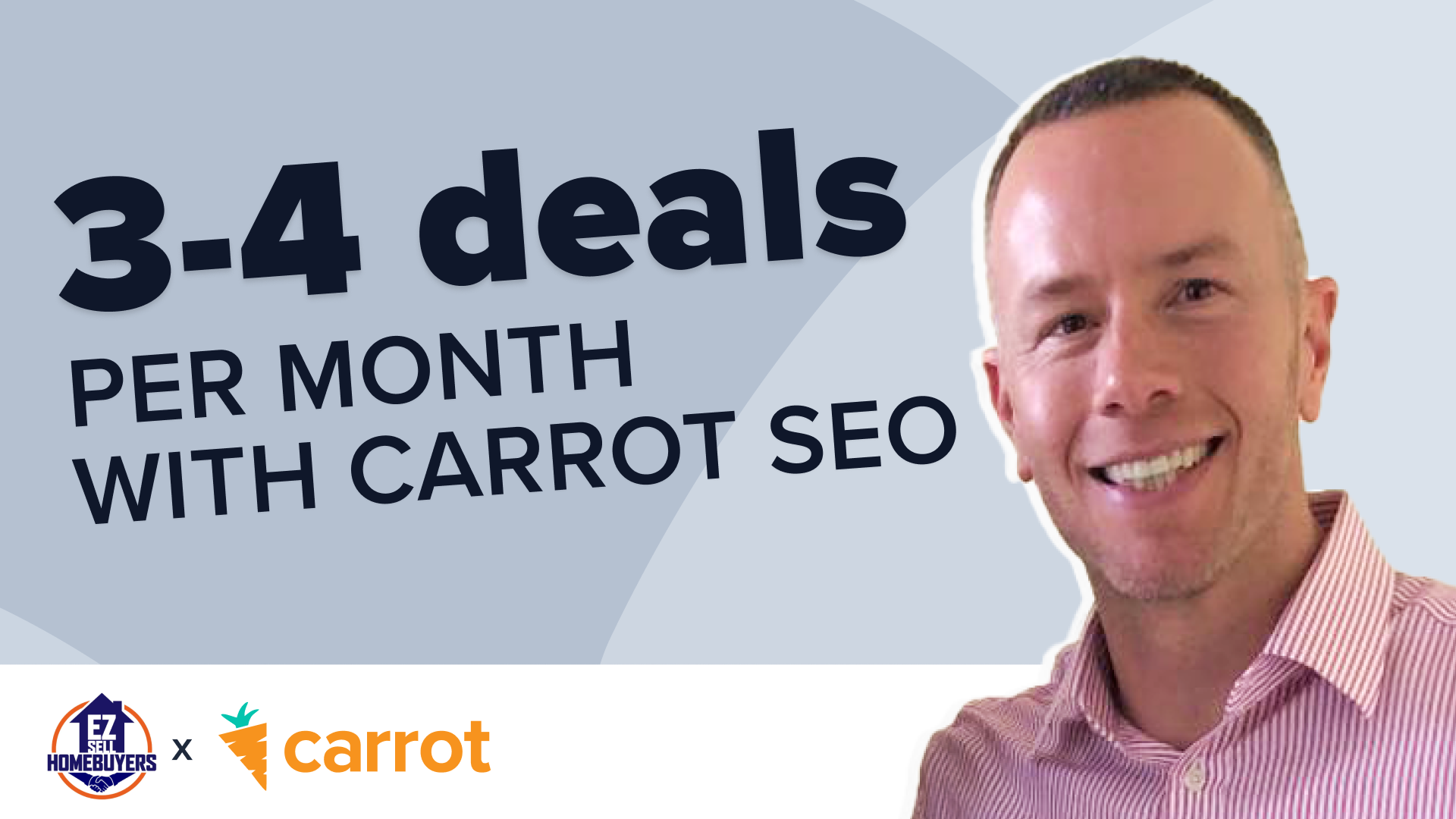
Tyler Ford generates nearly six figures monthly by closing just 2-4 real estate deals and credits mastering SEO and targeted lead generation as the key tools that helped him scale his business while working smarter, not harder.
Closing 2-4 Deals Per Month
$20-$30k Profit Per Deal
Targeted Lead Gen Through SEO Mastery
Tyler Ford completed his year-long goal of generating $200,000 in just four months by switching to Carrot.
Learn how he did it – and how you can too.
What I didn’t expect after switching to Carrot, is my lead to close ratio increased 50% on my offline leads!”
The Challenge: $20,000 in Debt and Struggling to Generate Qualified Leads
Tyler Ford started his real estate career using traditional marketing strategies but quickly realized they weren’t yielding the results he needed.
“I was spending a lot of time on tactics that weren’t bringing in the right leads. I needed a smarter way to grow.”
Despite his efforts, Tyler’s website and high Google rankings weren’t converting into profitable deals. He recognized that most real estate agents were overlooking off-market opportunities and needed a more targeted approach.
“I could drive traffic to my site, but without the right leads, it wasn’t translating into sales. I had to rethink my entire strategy.”
What was missing?
Tyler realized that focusing on traditional methods wasn’t enough—he needed to attract motivated sellers specifically looking for off-market deals.
Tyler pivoted his strategy toward mastering SEO and targeted lead generation, which allowed him to scale his business and close more profitable deals.
To grow his real estate business early on, Tyler Ford relied on traditional marketing methods but struggled to see meaningful results.
“When you’re using outdated strategies, it feels like you’re working hard but not getting anywhere—one month you close a deal, but the next, the leads dry up.
And while you might have some visibility online, it’s not converting into profitable deals.
It felt like I was doing all this work, but I wasn’t seeing consistent returns, and there was little I could do to change that with my current approach.”
The Solution: Master SEO and Targeted Lead Generation
Then, Tyler came across a Carrot webinar where Carrot CEO Trevor Mauch discussed the power of SEO and online lead generation.
“I immediately thought, “This is what I’ve been missing.” I wanted to attract qualified leads directly to my business, not rely on outdated methods.
I saw how focusing on SEO could completely transform my approach, and once I understood the impact, it was an easy decision to dive in.”
Tyler got to work mastering his SEO Approach and saw immediate results in generating quality traffic that turned into a consistent pipeline of highly motivated leads.
The Strategies: Tyler’s 8 Steps for Success
1. Complete Online Presence Overhaul
Tyler realized that having a website alone wasn’t enough. Even with good Google rankings, his old website wasn’t converting qualified leads. It’s like having a storefront on a busy street with locked doors and the lights off, making it impossible for potential customers to see what you have to offer.
2. Focus on One Thing: Master SEO
Tyler knew he needed to master one aspect of marketing instead of spreading himself too thin. He chose search engine optimization (SEO) because it would have the biggest impact on his online visibility. Rather than trying to learn multiple marketing tactics at once, he became a master of laser-targeted SEO.
3. Laser-Targeted SEO
SEO wasn’t just about attracting any traffic but about specifically targeting motivated house sellers actively searching for his services. Through meticulous keyword research, Tyler uncovered the “digital fingerprints” left by his target audience, optimizing his website to appear at the top of relevant search results.
4. Hyper-Relevant Local Content
Tyler didn’t just throw any real estate content on his website. He made sure everything was hyper-relevant to his local market in Arizona. By becoming the Arizona expert, he built credibility and trust within his local community, making him the go-to agent for potential clients.
5. Building Trust Upfront
Tyler avoided being the pushy salesperson. Instead of bombarding visitors with sales pitches right off the bat, he provided valuable content upfront. This made him a trusted advisor rather than just another salesperson, allowing him to build crucial relationships before asking for the sale.
6. Leverage the Power of Video
In today’s digital age, video is key. Tyler harnessed the power of video not just to follow trends but to personally and engagingly connect with potential clients. Videos showcased his properties, explained his unique approach to real estate, and allowed his personality to shine through, making the interaction more personal and authentic.
7. Data-Driven Decisions
Tyler meticulously tracked his website traffic, identifying what content resonated with his audience and led to conversions. This analytical approach allowed him to constantly refine and optimize his strategies based on real data, essentially playing digital chess and always thinking a few moves ahead.
8. Identify Your ‘Why’
The foundation of Tyler’s success was his clear ‘why.’ For him, it was about achieving freedom and flexibility, building a business that worked for him, not the other way around. Having a strong driving force behind your goals can be the difference between giving up when things get tough or pushing through.
The Result: Closing Consistent, Highly Profitable Deals Per Month
Tyler Ford’s story highlights a larger trend: achieving extraordinary results through strategic online marketing. From being $20,000 in debt, overwhelmed, and struggling to know if he should even continue his real estate journey to closing 2-4 deals per month with $20,000-$30,000 in profit per deal. Tyler knew he wouldn’t find the success he was after through luck or being in the right place at the right time. He chose to take control and created his own opportunities using his Carrot site and getting laser focused on generating the most motivated leads.
By focusing on core strategies like SEO, leveraging video, and making data-driven decisions, you too can unlock remarkable success.
Start Your Journey to Remarkable Success Today by Following Tyler Ford’s 8-Step Process
Tyler Ford completed his year-long goal of generating $200,000 in just four months by switching to Carrot. Learn how he did it – and how you can too.
$40k Profit per Deal: The Power of Inbound Marketing w/ Beau Hollis
SimplySold is a local, Louisville-based business that uses Carrot’s inbound marketing guidance and resources to gain new clients online. Here’s how they achieved a $40,000 per deal business using Carrot.
Snapshot:
Industry: Investor
Location: Louisville, Kentucky
Carrot Member Since: 2016
I had no world tech experience, and I just didn’t have an online presence. I didn’t want to have to build a website. So Carrot made that really easy for me.”
Beau Hollis is the founder of SimplySold in Louisville, Kentucky.
He’s been investing in houses for the past 7 years.
Currently, the majority of his business involves acquisitions that he does himself. He also has an acquisitions person and a full-time videographer.
It’s a low-key, small operation, but it has a high intention, and they go aggressively after deals.
“You know, I spend my time and effort and energy to do this business to provide for my family, not only money but years of my life, getting this up and going to have it, work is worth, the journey is not in vain.”
From Beau’s Carrot leads, his average profit per deal is nearly $40,000.
He’s done $400,000 in assignments in his Carrot site alone in the last six months.
Before using Carrot, he had no online presence and no experience in building websites.
“I had no world tech experience, and I just didn’t have an online presence. I didn’t want to have to build a website. So Carrot made that really easy for me.
Obviously, people cannot find you, people have no clue who you are, they can’t find your business, they don’t know if you’re in business at all, and so if they can’t find you, they can’t do business with you.
So you have no lead flow inbound from a website.”
At first, his vision was to dominate the outbound marketing space, whether it was cold calling, texting, or other things.
However, the lifespan of somebody doing outbound marketing all the time is limited.
“I have come from a background of sales, and I understand that you’re gonna do this one thing all the time, whether it’s cold calling or texting or putting out bandit signs, and there’s a lifespan to that.”
Outbound versus inbound leads are two things that are drastically different. Outbound leads are when you’re seeking out someone. A lot of work, effort, and energy is going into it before you even think about reaching out to the person.
Inbound marketing, or evergreen marketing, is a completely different mindset. You optimize your website with content: videos, blog posts, and testimonials.
Inbound offers a whole other world. People are seeking you out.
The challenge: Creating the path to the world of inbound marketing
This is a business to close deals. Serious real estate agents and investors want to make Evergreen inbound marketing a real avenue, not just a little street but a highway.
Evergreen inbound marketing takes a plan and plenty of patience. It takes a lot of video work on YouTube and on-page SEO with keywords and good content for high rankings.
My expectation was that I’m just going to turn it on, get it up and live and then it would just bring in the people just saying, please take my house, that’s why I thought it was at the beginning when I first got, I just got it up and I just had, I just had it out there, I didn’t do any kind of optimization. I did zero, absolutely zero customization to the website.
His website had been just sitting there for a long time. Years.
Then, Beau had a conversation with Trevor to get the ball rolling.
He started implementing on his website and using the tools Carrot provides our members. Keyword tracking, campaign tracking, video postings… and over time and hard work, Beau’s inbound marketing started to click.
Once he started optimizing his site, he could see a bit of movement in his rankings.
That movement proceeded forward for a year or two then it was time to dive into the PPC world of inbound marketing. The one-two punch of paid and organic traffic really exploded his business.
In 2021, Beau’s Carrot leads have had an average profit per deal of roughly $40,000.
In comparison, Beau’s outbound leads have had an average profit per deal of roughly half that.
The tools: Carrot features
Although the real estate niche can sometimes be inconsistent, Carrot brings consistency to Beau’s business. He can count on deal flow.
It’s good because when you can count consistent leads, it means that you’re not stressed all of the time.
For Beau, Carrot has become a hub that brings all his inbound marketing efforts together. Since he’s driving traffic from all inbound marketing efforts to his Carrot site, he can track performance across all campaigns and channels, giving him the clarity needed with his marketing.
Here are some of the tools Beau is using to tie together his marketing efforts:
Evergreen Training
Beau needed to get many unqualified outbound leads to close deals. More leads meant more time and expense to sift through the tire kickers.
He learned inbound online marketing with Evergreen content to attract the most qualified prospects. He’s built trust and credibility with them 24/7, 365 through his Carrot “Authority Hub.”
Automated blogs
Carrot’s content tools have allowed him to stand out in his market as an authority. This saves time and money and puts SimplySold at the forefront of its industry with expert quality content that he can customize for his needs.
Keyword Tracking
How do you know if your SEO rankings are climbing? Tracking is easy with Carrot. Simply input the keyword, and we’ll track where that particular term ranks each week, making optimizing accordingly easier!
Campaign Tracking Links
Learn how many leads you generate with your ads by following the conversions from them. Easily see which campaigns produce results and create a link to track click-throughs and leads better.
CarrotCamp
CarrotCamp is a place where people come to get inspired by other entrepreneurs, hear first-hand stories about how they built their successful businesses and strategies for success. The knowledge Beau has gained from meeting these individuals has been essential in helping him grow his own real estate investing business.
The results:
Beau has been successful in implementing an Evergreen inbound marketing plan. He went all-in and began building his SEO content, which he followed up with PPC. Now he has a team and consistently closes inbound deals to grow his business.
He also knows how to scale his business using Carrot and inbound leads.
What about you? Are you ready for consistent and predictable growth in your business?
Ready for Consistent Growth Like Beau?
Start generating high-quality inbound leads and build your authority in your market.
Why Organic Search Rankings Matter for HVAC Companies
Imagine a homeowner in the middle of a sweltering summer whose air conditioning suddenly fails. What’s their first move? They likely pull out their smartphone and search for “HVAC repair near me.”
HVAC Websites: Get your HVAC website turning into more leads and clients…
The companies at the top of the search results will most likely get the call. This underscores the critical importance of high organic search rankings for HVAC contractors. If your HVAC business isn’t showing up on the first page of search results, you’re missing out on potential leads and revenue. Organic search rankings are not just about visibility; they are a powerful driver of business growth.
SEO is no longer optional for HVAC companies; it’s a necessity. With thousands of potential customers searching for HVAC services online daily, standing out in the crowded market is crucial. SEO for HVAC ensures your services are prominently displayed when customers search, leading to increased website traffic, leads, and conversion rates. This guide provides actionable strategies for HVAC contractors to enhance their SEO, helping you tap into the vast online marketplace.
In this guide, you’ll learn the ins and outs of SEO tailored specifically for HVAC companies. We will cover everything from keyword research and on-page optimization to technical SEO and link-building strategies. By the end of this post, you’ll have a clear roadmap to improve your website’s organic search rankings.
Whether new to SEO or looking to refine your strategies, this guide will equip you with the tools and knowledge to increase your online visibility and grow your HVAC business.
Does your website check these 9 critical boxes? Use our free HVAC Website Checklist to find out!
SEO, or Search Engine Optimization, is the process of enhancing your website’s visibility on search engines like Google. For HVAC businesses, SEO is essential because it directly impacts how easily potential customers can find you online. By optimizing your HVAC website for search engines, you increase the chances of appearing at the top of search results when users look for HVAC services.
This visibility translates into more traffic, leads, and, ultimately, more business. Effective SEO for HVAC companies means leveraging your digital presence to attract customers who need your services.
Key Components of SEO
To maximize your HVAC company’s online visibility, it’s crucial to understand the three main components of SEO: on-page, off-page, and technical SEO.
On-Page SEO:
Content Quality: High-quality, relevant content is king. Ensure your content addresses common customer queries and incorporates HVAC keywords naturally, such as “HVAC repair” or “AC installation.”
Keyword Optimization: Use tools like Google Keyword Planner to find and integrate keywords your potential customers are searching for.
Meta Tags: Optimize your title tags and meta descriptions to be concise and keyword-rich. For instance, your homepage might have a title tag like “Professional HVAC Services – [Your City] | Expert Repair & Installation.”
Headers and Subheaders: Utilize H1, H2, and H3 tags to organize your content. This not only improves readability but also helps search engines understand the structure of your content.
Off-Page SEO:
Backlinks: Build a network of quality backlinks from reputable websites. This could include local business directories, industry associations, or satisfied customers.
Social Media Presence: Engage with your audience on platforms like Facebook and LinkedIn. While social signals aren’t direct ranking factors, they contribute to your online visibility and brand authority.
Customer Reviews: Encourage satisfied clients to leave positive reviews on platforms like Google My Business and Yelp. Reviews enhance your credibility and influence your rankings in local search results.
Technical SEO:
Page Speed: Ensure your website loads quickly. A slow site can deter visitors and negatively impact your search engine rankings.
Mobile-Friendliness: With more searches conducted on mobile devices, a responsive design is essential. Google prioritizes mobile-friendly websites in its search results.
Secure and Accessible Website: Make sure your site is secure (HTTPS) and easy for search engines to crawl and index. Tools like Google Search Console can help you monitor and resolve any issues.
By focusing on these key SEO components, HVAC contractors can increase their online visibility, attract more qualified leads, and grow their business.
Keyword Research for HVAC Services
Identifying Keywords
Effective keyword research is the backbone of a successful SEO strategy, especially for HVAC services. The right keywords ensure your content reaches the audience most likely to need your services. Here are some tips on identifying the best keywords for your HVAC business:
Start Broad: Begin with general terms related to your services, such as “HVAC repair,” “air conditioning installation,” or “furnace maintenance.”
Consider User Intent: Consider what potential customers are searching for at each journey stage. Are they looking for information or ready to schedule a service?
Incorporate Location: Since HVAC services are localized, include region-specific terms like “HVAC repair in ” or “air conditioning installation in .” This helps target users searching for services in their area.
Tools for Keyword Research
Several powerful tools can help HVAC contractors uncover the most effective keywords to target:
Google Keyword Planner: This free tool is a great starting point for discovering new keywords and seeing their search volume and competition level.
SEMrush: A comprehensive tool that helps with keyword research and provides insights into your competitors’ keywords and strategies.
Ahrefs: Offers a robust keyword explorer that can show you keyword difficulty, related keywords, and potential traffic estimations.
By utilizing these tools, you can refine your list of keywords to focus on those most relevant to your services and likely to drive traffic to your site.
Long-Tail Keywords
Long-tail keywords are longer, more specific keyword phrases that visitors are more likely to use when they’re closer to purchasing or booking a service. Here’s why they’re important for HVAC contractors:
Higher Conversion Rates: Because they are more specific, long-tail keywords often increase conversion rates. For example, “emergency furnace repair in ” targets a specific need, likely leading to a quicker conversion.
Less Competition: Long-tail keywords tend to have less competition, making ranking higher in search results easier.
Better Targeting: These keywords help attract users looking for exactly what you offer, increasing the likelihood of turning visitors into customers.
Incorporating long-tail keywords into your SEO strategy can significantly boost your visibility for specific searches, drawing in more qualified leads ready to engage with your services.
On-Page SEO Strategies for HVAC Websites
Effective on-page SEO is crucial for HVAC websites looking to improve their search engine rankings and attract more organic traffic. Here are some key strategies for optimizing your HVAC website and enhancing its online visibility.
Title Tags and Meta Descriptions
Title tags and meta descriptions are the first elements potential customers see in search engine results, making them vital for driving clicks and engagement.
Crafting Title Tags: Your title tags should be concise and descriptive and include your primary keyword, such as “SEO for HVAC.” Keep them under 60 characters to ensure they are fully displayed in search results. For example, “Expert HVAC Services—Reliable Repair & Installation in .”
Writing Meta Descriptions: Meta descriptions should briefly summarize the page’s content and encourage users to click through. Aim for 150-160 characters, incorporating relevant keywords and a compelling call to action. For instance, “Need reliable HVAC services in ? Our experts offer fast and efficient repairs. Contact us today!”
Content Optimization
High-quality, relevant content is the cornerstone of successful SEO. It helps search engines understand your site’s relevance and engages your audience.
Keyword Integration: Naturally incorporate your primary and secondary keywords throughout the content. For example, if discussing HVAC maintenance, phrases like “cooling services” or “air conditioning repair in ” should be seamlessly included.
Readability: Break up the text with short paragraphs, bullet points, and subheadings. This makes the content easier for visitors to read and digest.
Value-Driven Content: Address common questions and concerns of your audience, providing clear, actionable advice or solutions.
Image Optimization
Images enhance your website’s visual appeal and help convey your work’s quality. Optimizing them for SEO ensures they contribute to your site’s performance.
Alt Tags: Use descriptive alt tags for all images, incorporating relevant keywords. For instance, “HVAC technician installing a new furnace in .”
File Names: Rename image files to be descriptive and keyword-rich, like “hvac-installation-.jpg” instead of “IMG1234.jpg.”
Compression: Compress images to reduce file size and ensure faster load times, which improves user experience and boosts SEO.
Internal Linking
Internal linking helps distribute page authority and assists search engines in understanding your site’s structure. It also enhances user navigation, encouraging visitors to explore more of your site.
Link to Relevant Pages: Within your content, link to other relevant service pages or blog posts. For example, when mentioning AC repair, link to your dedicated air conditioning repair service page.
Use Descriptive Anchor Text: The clickable text of your link should accurately describe the linked page’s content, making it clear to users and search engines what they can expect.
By implementing these on-page SEO strategies, HVAC contractors can improve their website’s search engine rankings, increase their visibility, and attract more potential customers.
Improve Your HVAC Website Results
3.3 million leads and counting: now for HVAC companies! Our track record speaks for itself. Get ahead with exclusive early access!

Local SEO is a critical component of any HVAC contractor’s digital strategy. It ensures your business is visible to potential customers in your geographic area. Leveraging tools like Google Business Profile and maintaining consistent local citations can significantly boost your online presence. Here’s how to optimize your local SEO for HVAC services.
Claiming and Optimizing Google Business Profile
Google Business Profile is a free tool to manage your business’s appearance on Google Search and Maps. Here’s a step-by-step guide to setting up and optimizing your GBP listing:
Claim Your Listing: Visit the Google Business Profile website and sign in with your Google account. Search for your business and claim it if it already exists. If not, create a new listing.
Provide Accurate Information: Fill out all relevant business details, including your business name, address, phone number, and website URL.
Choose Relevant Categories: Select the most appropriate categories for your business. For HVAC contractors, options might include “HVAC contractor,” “Air conditioning repair service,” or “Furnace repair service.”
Add High-Quality Photos: Upload images of your team, equipment, and completed projects. High-quality photos make your listing more appealing and trustworthy.
Encourage Customer Reviews: Ask satisfied customers to leave reviews on your GMB listing. Positive reviews improve your local search ranking and build trust with potential customers.
Regularly Update Your Listing: Update your business hours, services, and contact information. Post updates about new services, promotions, or company news.
Local Citations and Reviews
Local citations mention your business’s name, address, and phone number on other websites and directories. They play a crucial role in local SEO.
Ensure Accurate Listings: Consistent and accurate listings on local directories (like Yelp, Yellow Pages, and local chamber of commerce websites) help improve your local search rankings.
Monitor and Respond to Reviews: Monitor reviews on platforms like Google, Yelp, and Facebook. Responding to positive and negative reviews shows you value customer feedback and are committed to excellent service.
Encourage Positive Reviews: Implement strategies to encourage customer reviews, such as follow-up emails after service or incentives for leaving feedback.
NAP Consistency
NAP stands for Name, Address, and Phone number. Consistency in your NAP information across all platforms is vital for local SEO.
Audit Your Listings: Regularly check your business listings on various online directories to ensure your NAP information is consistent.
Update Incorrect Information: Correct any discrepancies in your business name, address, or phone number immediately to maintain consistency.
Use a Standard Format: Adopt a standard format for your NAP information and use it across all listings and citations.
By focusing on local SEO and effectively utilizing Google My Business, HVAC contractors can enhance their visibility in local searches, attract more qualified leads, and build a strong reputation in their community.
Technical SEO for HVAC Websites
Technical SEO is the foundation that supports all other aspects of search engine optimization. Ensuring your HVAC website is technically sound will enhance user experience and improve search engine rankings. Here’s how to optimize your HVAC website from a technical standpoint.
Website Speed and Mobile-Friendliness
In today’s fast-paced digital world, users expect websites to load quickly and display correctly on all devices. Here’s why website speed and mobile-friendliness are crucial:
Importance of Page Speed: A slow-loading website can frustrate users and increase bounce rates, negatively affecting your SEO. Use tools like Google PageSpeed Insights to assess and improve your website’s load time.
Optimization Tips: Compress images, minimize CSS and JavaScript files, and leverage browser caching to enhance your site’s speed.
Mobile Responsiveness: With most searches now conducted on mobile devices, having a mobile-responsive website is essential. Google favors mobile-friendly sites in search rankings.
Responsive Design: Ensure your website adapts seamlessly to different screen sizes and devices. Test your site’s mobile responsiveness using Google’s Mobile-Friendly Test tool.
Structured Data and Schema Markup
Structured data helps search engines understand your website’s content better, which can enhance how your listings appear in search results.
Schema Markup for HVAC Services: Implementing schema markup specific to HVAC services can provide search engines with detailed information about your services, location, and customer reviews.
How to Implement: Use schema markup for local businesses, service offerings, and customer reviews to enhance search result snippets. Tools like Google’s Structured Data Markup Helper can assist in this process.
Benefits: Proper schema markup can lead to rich snippets, which provide more information to users at a glance and can improve click-through rates.
Site Architecture
A well-structured site architecture is crucial for both user experience and SEO. It helps search engines crawl and index your site more efficiently.
Intuitive Navigation: Design your site with a clear and intuitive navigation structure. Users should be able to find what they’re looking for within a few clicks.
Navigation Tips: Organize your pages into logical categories and use descriptive labels for menu items. Implement a breadcrumb trail to help users understand their location within your site.
Crawlable Structure: Ensure your site is easily crawlable by search engine bots. A clean and straightforward URL structure and an updated XML sitemap can aid in this process.
XML Sitemaps: Create and submit an XML sitemap to search engines to help them discover your pages. Regularly update the sitemap to reflect any changes in your site’s structure.
By focusing on these technical SEO aspects, HVAC contractors can provide a seamless user experience and ensure their websites are well-positioned in search engine rankings.
Link Building Strategies for HVAC Companies
Link building is a crucial aspect of SEO, significantly influencing your website’s authority and search engine rankings. By securing quality backlinks, HVAC companies can improve their visibility and credibility online. Here’s how to build a robust link profile for your HVAC business.
Importance of Backlinks
Backlinks, or inbound links, are links from other websites that direct users to your site. They are a key factor in how search engines determine the authority and relevance of your site.
Impact on SEO:High-quality backlinks from reputable sites signal to search engines that your content is valuable and trustworthy, which can boost your rankings. Conversely, low-quality or spammy backlinks can harm your SEO efforts.
Quality Over Quantity: Focus on earning backlinks from high-authority domains within your industry. A few high-quality links are more beneficial than numerous low-quality ones.
Local Partnerships and Directories
Leveraging local business partnerships and online directories can provide valuable backlinks and enhance your local SEO.
Local Business Partnerships: Collaborate with local businesses and industry partners to exchange backlinks. For example, you could write a guest post for a local hardware store’s blog, including a link back to your site.
Online Directories: Ensure your HVAC business is listed on reputable online directories such as Yelp, Angie’s List, and the Better Business Bureau. These listings often include a link back to your site and can improve your local search visibility.
Community Involvement: Participate in local events and sponsorships, and ensure these activities are mentioned on their respective websites with a link back to your business.
Guest Blogging
Guest blogging is an effective way to build backlinks while positioning yourself as an industry expert.
Identify Opportunities: Look for industry-related websites, blogs, or online publications that accept guest contributions. Sites focused on home improvement, energy efficiency, or local business news are great places to start.
Create Valuable Content: Write informative and engaging articles that provide real value to the readers. Incorporate your expertise and include a relevant link back to your HVAC website.
Maintain Relationships: Build relationships with the site owners or editors. A good rapport can lead to more guest blogging opportunities and additional backlinks in the future.
By implementing these link-building strategies, HVAC contractors can enhance their online authority, improve their search engine rankings, and attract more customers.
Conclusion
Optimizing your HVAC business for search engines is essential to running a successful HVAC SEO campaign, increasing your online visibility, and attracting more qualified leads. Throughout this guide, we’ve covered the key aspects of SEO for HVAC businesses.
Understanding SEO Basics: Recognizing the key components of on-page, off-page, and technical SEO and their importance in improving your HVAC website’s performance.
Keyword Research: Using tools and strategies to identify relevant and high-converting keywords that resonate with your target audience, including long-tail and localized terms.
On-Page SEO Strategies: Crafting compelling title tags, optimizing content and images, and creating a robust internal linking structure.
Local SEO for HVAC and Google My Business: Enhancing your local search presence by optimizing your GMB listing, maintaining NAP consistency, and leveraging local citations and reviews.
Technical SEO: Ensuring a fast, mobile-responsive website with a clear site structure and proper schema markup.
Link Building Strategies: Building a strong backlink profile through local partnerships, directory listings, and guest blogging opportunities.
Implementing these strategies can significantly improve your HVAC business’s online presence, driving more organic traffic and potential customers to your site. Start applying these techniques today, or seek professional SEO assistance to maximize your results.
Further Resources
For more information on SEO strategies and services tailored to HVAC contractors, visit Carrot.com. Our team specializes in helping HVAC businesses thrive online through proven SEO practices and cutting-edge digital marketing solutions.
In the highly competitive HVAC industry, having a solid online presence is crucial for attracting and converting potential customers. SEO Keywords for HVAC are the cornerstone of an effective digital marketing strategy, allowing HVAC companies to reach the right audience at the right time.
With the right keywords, you can significantly improve your search engine rankings, drive more traffic to your website, and ultimately increase your conversion rates.
HVAC Websites: Get your HVAC website turning into more leads and clients…
This blog post is designed to help HVAC companies understand the importance of using specific keywords tailored to various customer journey stages. By strategically incorporating these keywords, you can ensure that your content resonates with potential customers, providing the information they need and guiding them toward choosing your services.
We will give you the best 100 HVAC keywords and categorize them based on the stages of the customer journey:
Awareness
Consideration
Decision
You’ll learn which keywords to use when customers first identify their needs, compare options, and finally make a decision. Additionally, we’ll cover the significance of long-tail keywords and offer tips for effective keyword implementation to optimize your HVAC business’s online presence.
Table of Contents
Understanding the Customer Journey – Defining the Customer Journey: Awareness, Consideration, Decision, and the Importance of Tailored Keywords at Each Stage
Awareness Stage Keywords – Identifying Needs and Looking for General Information. Includes20 Awareness HVAC Keywords
Define the Customer Journey: The customer journey is the process that potential customers go through from the moment they realize they need the point where they make a purchase. This journey is typically divided into three key stages: Awareness, Consideration, and Decision.
Awareness Stage: At this initial stage, potential customers recognize a need or problem but are unaware of specific solutions. For HVAC services, this could mean a homeowner noticing their air conditioner isn’t cooling as effectively as it used to or an office manager realizing the heating system isn’t keeping the space warm enough.
Consideration Stage: Here, the customer has clearly defined their problem or need and is actively researching and evaluating different options. In the context of HVAC services, this might involve looking into various types of HVAC systems, reading reviews, comparing service providers, and seeking information on costs and benefits.
Decision Stage: At the final stage, the customer is ready to make a purchase or hire a service. They have narrowed down their options and are deciding which HVAC company to choose or which specific system or service to invest in.
Importance of Tailored Keywords:
Different keywords are essential at each customer journey stage to effectively guide potential customers toward your services. Here’s why:
Awareness Stage Keywords: Customers seek general information and solutions to their problems during this stage. Keywords should focus on educating and informing, addressing common issues and questions. For example, keywords like “why is my AC not working” or “benefits of HVAC systems” help capture the attention of those just beginning their search.
Consideration Stage Keywords: At this point, customers are comparing different solutions and providers. Keywords should be more specific and include detailed information about services, features, and comparisons. Keywords such as “best HVAC systems 2024,” “AC repair services,” and “HVAC installation cost” are crucial for attracting customers who are evaluating their options.
Decision Stage Keywords: Customers are ready to take action, so keywords should be transactional and geared toward conversion. Keywords like “book HVAC service online,” “emergency HVAC repair near me,” and “same-day HVAC installation” are designed to capture customers who are ready to make a purchase or schedule a service.
By tailoring your keywords to each stage of the customer journey, you can ensure that your content meets the needs of potential customers at every point in their decision-making process. This strategic approach enhances your SEO efforts and increases the likelihood of converting visitors into loyal customers.
Awareness Stage Keywords
In the Awareness Stage, potential customers are just beginning to identify their needs and are seeking general information to understand and define their problems. They might not yet know the specifics of what they need, but they are starting to look for answers to basic questions and general advice. This is where your content can significantly impact by providing valuable information and establishing your HVAC company as a trusted resource.
Keyword Categories:
Informational Keywords: These keywords target users looking for general knowledge and educational content about HVAC systems. They aim to answer broad questions and provide foundational information.
“HVAC basics”: Content focusing on the fundamental aspects of HVAC systems, explaining what they are, how they work, and their components.
“What is HVAC?”: Articles and resources that define HVAC, breaking down the acronym and explaining the purpose and function of these systems.
“Benefits of HVAC systems”: Posts that highlight the advantages of having a well-functioning HVAC system, such as improved indoor air quality, energy efficiency, and comfort.
Problem Identification Keywords: These keywords help users diagnose issues they are experiencing with their HVAC systems. By addressing common problems and symptoms, your content can help them understand their needs.
“Why is my AC not working?”: Guides and troubleshooting tips that help users identify potential reasons for their air conditioning issues.
“Signs your furnace needs repair”: Articles outlining the common signs that indicate a furnace might require professional attention, such as unusual noises, inconsistent heating, or increased energy bills.
“Common HVAC problems”: Comprehensive lists and explanations of typical HVAC issues that homeowners and businesses might encounter, helping them to recognize when it’s time to seek professional help.
Local Informational Keywords: These keywords are geared toward users looking for information about HVAC services in their specific area. They help you attract local customers who are searching for nearby solutions.
“HVAC services near me”: Content that highlights your company’s proximity and availability, making it easy for local customers to find and contact you.
“Best HVAC company in ”: Posts that position your business as a top choice in the local market, including customer reviews, awards, and testimonials to build credibility.
“Local HVAC experts”: Articles and pages that emphasize your expertise and experience in providing HVAC services to the local community, showcasing your knowledge of regional climate and common issues.
By strategically incorporating these awareness stage HVAC keywords into your content, you can attract potential customers who are just starting their search. Providing them with the information they need at this early stage builds trust and positions your HVAC company as the go-to source for reliable and helpful advice. This approach sets the foundation for guiding them through the subsequent stages of their customer journey.
Awareness Stage HVAC Keywords
HVAC basics
What is HVAC?
Benefits of HVAC systems
Why is my AC not working?
Signs your furnace needs repair
Common HVAC problems
HVAC services near me
Best HVAC company in
Local HVAC experts
How HVAC systems work
Types of HVAC systems
HVAC maintenance tips
Importance of regular HVAC servicing
Energy-efficient HVAC systems
HVAC system installation guide
HVAC troubleshooting tips
How to choose an HVAC system
HVAC system lifespan
HVAC safety tips
Benefits of HVAC zoning
Improve Your HVAC Website Results
3.3 million leads and counting: now for HVAC companies! Our track record speaks for itself. Get ahead with exclusive early access!
In the Consideration Stage, potential customers have clearly identified their needs or problems and are now actively researching and comparing various HVAC solutions. They seek more detailed information about specific services, products, and providers. This is the stage where your content can help them make informed decisions by offering comprehensive insights and comparisons.
Keyword Categories:
Service-Specific Keywords: These keywords are focused on the specific HVAC services that customers might be considering. They help potential clients find detailed information about your company’s services.
“AC repair services”: Content that explains the process, benefits, and typical issues addressed by professional AC repair services, highlighting your expertise and customer satisfaction.
“Furnace installation cost”: Articles that break down the costs associated with furnace installation, including factors that affect pricing and the benefits of professional installation.
“Duct cleaning services”: Informative posts detailing the importance of duct cleaning, the process involved, and how it contributes to improved indoor air quality and system efficiency.
Comparative Keywords: These keywords cater to customers who are comparing different HVAC systems, brands, or types of services. They provide side-by-side evaluations to help customers choose the best option for their needs.
“Best HVAC systems 2024”: Guides and reviews of the top HVAC systems available in the current year, comparing features, efficiency, and customer feedback to help customers make an informed decision.
“Top-rated HVAC companies”: Articles that list and compare the highest-rated HVAC companies based on customer reviews, industry awards, and service quality.
“HVAC vs. central air”: Comparative posts that outline the differences, pros, and cons of HVAC systems versus central air conditioning, helping customers decide which is better suited for their needs.
Cost and Pricing Keywords: At this stage, customers are also keenly interested in understanding the financial aspects of their potential investment. Keywords focused on cost and pricing help them budget and plan accordingly.
“HVAC service cost”: Comprehensive guides that provide average costs for various HVAC services, explaining what factors influence pricing and offering tips on getting the best value for money.
“How much does HVAC installation cost?”: Detailed breakdowns of installation costs for different types of HVAC systems, including labor, equipment, and any additional fees.
“Affordable HVAC services”: Posts that highlight budget-friendly HVAC service options, including promotions, financing plans, and tips for saving money without compromising on quality.
By integrating these consideration stage HVAC keywords into your content, you can effectively capture the interest of potential customers who are comparing their options and seeking detailed information. This approach enhances your visibility in search results and positions your HVAC company as a trusted source of valuable and comprehensive information, ultimately guiding customers closer to making a decision in your favor.
Consideration Stage HVAC Keywords
AC repair services
Furnace installation cost
Duct cleaning services
Best HVAC systems 2024
Top-rated HVAC companies
HVAC vs. central air
HVAC service cost
How much does HVAC installation cost?
Affordable HVAC services
Air conditioner maintenance
Furnace replacement options
Central air conditioning systems
HVAC financing options
HVAC brands comparison
HVAC reviews and ratings
HVAC system efficiency
Benefits of professional HVAC installation
HVAC system warranties
Smart thermostats for HVAC systems
HVAC filter replacement
Commercial HVAC services
Residential HVAC systems
Geothermal HVAC systems
Heat pump installation
AC unit replacement
Energy-efficient air conditioners
HVAC system upgrades
HVAC maintenance contracts
Best HVAC contractors
HVAC rebates and incentives
Decision Stage Keywords
In the Decision Stage, potential customers are ready to make a purchase or schedule a service. They have done their research, compared options, and now need specific information to finalize their choice. This stage is crucial for converting leads into actual clients, and using the right keywords can make all the difference. Transactional and brand-specific keywords play a significant role in ensuring your business is easily found and chosen by these ready-to-act customers.
Keyword Categories:
Transactional Keywords: These keywords target users who are ready to take action. They focus on facilitating quick and easy access to services, driving immediate engagement and conversions.
“Book HVAC service online”: Content that provides a simple and streamlined process for booking services directly through your website, highlighting the convenience and efficiency of online scheduling.
“HVAC repair near me”: Pages optimized for local searches, ensuring that your business appears prominently when customers search for nearby HVAC repair services, emphasizing your proximity and quick response times.
“Schedule AC installation”: Clear calls to action and detailed information on how to schedule AC installation services, showcasing the benefits of professional installation and the ease of booking with your company.
Brand-Specific Keywords: These keywords target customers who prefer certain HVAC brands or are looking for services related to specific brands. Highlighting your expertise with these brands can be a significant selling point.
“Trane HVAC systems”: Articles and landing pages that emphasize your experience and qualifications in installing, repairing, and maintaining Trane HVAC systems, along with customer testimonials and case studies.
“Carrier AC installation”: Content that showcases your proficiency with Carrier air conditioning systems, including the advantages of choosing Carrier and the benefits of your professional installation services.
“Lennox furnace repair”: Pages that detail your expertise in repairing Lennox furnaces, including common issues, repair processes, and customer satisfaction stories to build trust and confidence.
Local Transactional Keywords: These keywords focus on immediate, local services, targeting customers who need urgent or same-day assistance. They highlight your availability and readiness to meet customer needs quickly.
“24/7 HVAC repair ”: Content that promotes your round-the-clock availability for HVAC repairs, emphasizing your ability to respond to emergencies at any time, day or night.
“Emergency HVAC services ”: Pages dedicated to emergency services, detailing your rapid response times, the urgency of your services, and how to contact you in an emergency situation.
“Same-day HVAC installation”: Posts and landing pages that highlight your ability to provide same-day installation services, focusing on the convenience and efficiency of getting a new HVAC system installed quickly.
By strategically incorporating these decision stage HVAC keywords into your content, you can effectively capture the attention of customers who are ready to commit. This approach enhances your visibility in search results and ensures that potential clients find exactly what they need at the critical moment of decision-making. This, in turn, boosts your conversion rates and helps establish your HVAC company as the go-to choice for reliable and prompt services.
Decision Stage HVAC Keywords
Book HVAC service online
HVAC repair near me
Schedule AC installation
Trane HVAC systems
Carrier AC installation
Lennox furnace repair
24/7 HVAC repair
Emergency HVAC services
Same-day HVAC installation
HVAC tune-up
HVAC inspection services
Install HVAC system
Replace HVAC unit
HVAC duct repair
HVAC installation near me
AC tune-up services
Furnace repair services
HVAC cleaning service
HVAC repair cost
Emergency AC repair
Air conditioning installation cost
Furnace installation near me
HVAC maintenance near me
HVAC contractors near me
Best HVAC repair
Long-Tail HVAC Keywords for SEO
Long-tail keywords are highly specific, multi-word phrases that cater to niche audiences and detailed queries. While they typically have lower search volumes compared to broader keywords, they offer significant value in capturing precise user intent and improving conversion rates.
Long-tail keywords often reflect the detailed, specific questions or needs of potential customers, making them more likely to convert when they find exactly what they are looking for. By targeting these keywords, HVAC companies can attract highly motivated prospects and provide tailored content that addresses their specific needs.
Examples of Long-Tail Keywords:
“How to choose the best HVAC system for a small apartment”
Content Focus: Create detailed guides and articles that help apartment dwellers choose the most suitable HVAC system for their limited space. Discuss factors such as space efficiency, noise levels, energy consumption, and ease of installation. Include comparisons of different types of HVAC systems (e.g., ductless mini-splits, portable AC units) and provide recommendations based on apartment size and layout.
Why It Works: This keyword targets a specific audience with a particular need, leading to higher engagement and conversion rates. By addressing the unique concerns of apartment residents, you can position your company as a knowledgeable and reliable source for HVAC solutions in small living spaces.
“DIY HVAC maintenance tips”
Content Focus: Offer step-by-step guides, checklists, and video tutorials on performing basic HVAC maintenance tasks. Topics can include cleaning filters, checking thermostat settings, inspecting ductwork for leaks, and ensuring proper ventilation. Highlight the importance of regular maintenance in extending the lifespan of HVAC systems and improving energy efficiency.
Why It Works: This keyword appeals to cost-conscious customers and DIY enthusiasts who prefer to handle minor maintenance tasks themselves. Providing useful, actionable advice builds trust and positions your company as a helpful resource, increasing the likelihood that these customers will turn to you for more complex repairs or services.
“Energy-efficient HVAC systems for commercial buildings”
Content Focus: Develop comprehensive articles and case studies on the latest energy-efficient HVAC technologies for commercial properties. Discuss the benefits of energy-efficient systems, such as reduced operating costs, improved environmental impact, and potential tax incentives. Include comparisons of different energy-efficient models, as well as tips for retrofitting existing systems to enhance efficiency.
Why It Works: This keyword targets a professional audience concerned with operational costs and sustainability. By providing in-depth information on energy-efficient solutions, you can attract business owners and property managers who are looking to upgrade their HVAC systems. Demonstrating expertise in commercial HVAC solutions helps establish your company as a trusted partner for large-scale projects.
By incorporating these long-tail keywords into your content strategy, you can attract highly specific and motivated audiences. This approach improves your search engine rankings for niche queries and enhances your conversion rates by addressing potential customers’ precise needs and concerns. Providing detailed, valuable content tailored to these specific queries helps establish your HVAC company as a knowledgeable and reliable authority in the industry.
Additional HVAC Keywords
How to size an HVAC system
Best HVAC system for new construction
HVAC maintenance frequency
Benefits of programmable thermostats
HVAC system performance
How to clean HVAC coils
HVAC installation process
HVAC system replacement timeline
How to prevent HVAC breakdowns
Best HVAC system for large homes
HVAC system energy ratings
HVAC safety inspections
Benefits of regular HVAC inspections
How to choose an HVAC contractor
HVAC installation best practices
HVAC system repair tips
HVAC energy audit
HVAC system upgrade benefits
How to choose the right HVAC filter
HVAC system troubleshooting tips
How to improve indoor air quality with HVAC
HVAC system efficiency tips
Common HVAC installation mistakes
HVAC installation cost factors
HVAC repair service reviews
Improve Your HVAC Website Results
3.3 million leads and counting: now for HVAC companies! Our track record speaks for itself. Get ahead with exclusive early access!
Implementing SEO keywords effectively can significantly enhance your HVAC company’s online presence and search engine rankings. Here are some key strategies for content optimization, local SEO best practices, and useful keyword research tools.
Content Optimization:
To naturally incorporate keywords into your content, follow these best practices:
Write for Humans First, Search Engines Second: While it’s essential to include keywords, your primary goal should be creating high-quality, engaging content that provides value to your readers. Natural, readable content will also perform better in search engine rankings.
Use Keywords in Key Places: Ensure your primary keywords are included in strategic locations:
Title Tags: Incorporate the main keyword naturally into the title.
Meta Descriptions: Write a compelling meta description that includes the keyword and encourages clicks.
Headings and Subheadings: Use keywords in H1, H2, and H3 tags to structure your content.
Introduction and Conclusion: Mention the keyword early in your content and in the concluding section.
Body Content: Spread keywords naturally throughout the text, aiming for a keyword density of around 1-2%.
Use Synonyms and Related Phrases: To avoid keyword stuffing and enhance readability, use synonyms and related terms. This approach also helps your content rank for a broader range of related searches.
Create Comprehensive Content: Long-form content that covers a topic in-depth tends to rank better. Aim to provide thorough, valuable information that answers common questions and addresses the needs of your audience.
Local SEO Best Practices:
Local SEO is crucial for HVAC companies, as most customers search for nearby services. Here are some tips to optimize for local search:
Claim and Optimize Your Google My Business (GMB) Listing: Ensure your GMB listing contains accurate business information, including address, phone number, and operating hours. Add high-quality photos and encourage satisfied customers to leave reviews.
Use Local Keywords: Incorporate local keywords into your content, such as “HVAC repair in ” or “Best HVAC service in [Neighborhood].” This helps your business appear in local search results and Google’s local pack.
Create Location-Specific Pages: If your business serves multiple locations, create separate landing pages for each area. Customize the content to highlight services relevant to each location and include local keywords.
Get Listed in Local Directories: Ensure your business is listed in local online directories such as Yelp, Angie’s List, and the Better Business Bureau. Consistent listings across various platforms can boost your local SEO efforts.
Keyword Tools:
Effective keyword research is the foundation of a successful SEO strategy. Here are some recommended tools to help you find the best keywords for your HVAC business:
Carrot’s Keyword Explorer: This powerful tools helps you analyze your website & the competition’s website to find the right next keyword to target in your SEO strategy.
Google Keyword Planner: A free tool that provides keyword ideas and search volume data. It’s particularly useful for discovering new keywords and understanding their potential reach.
SEMrush: A comprehensive SEO tool that offers keyword research, competitive analysis, and rank tracking. SEMrush can help you identify high-performing keywords used by competitors and discover new opportunities.
Ahrefs: Another powerful SEO tool that provides in-depth keyword analysis, backlink tracking, and content research. Ahrefs can help you find keywords with high search volume and low competition.
Ubersuggest: A free tool by Neil Patel that generates keyword ideas and provides data on search volume, CPC, and competition. Ubersuggest is great for quick keyword brainstorming sessions.
Implementing these tips for effective keyword usage, optimizing for local search, and utilizing top-notch keyword research tools can significantly enhance your HVAC company’s online visibility. This approach will help you attract more targeted traffic, improve your search engine rankings, and ultimately drive more conversions for your business.
Unlock More SEO Potential with Carrot’s Keyword Explorer
While this list of the 100 best SEO keywords for HVAC companies is a great starting point, imagine having the power to uncover even more high-intent keywords tailored specifically to your business. That’s where Carrot’s Keyword Explorer comes in.
With the Carrot Keyword Explorer, you can dive deep into what people are searching for both nationally and in your specific market. This tool empowers you to discover additional keywords that can help you dominate your local SEO, outrank competitors, and attract more qualified leads.
By integrating this powerful feature directly into your Carrot website interface, you can continuously refine your evergreen SEO strategy and stay ahead in the competitive HVAC industry. Join Carrot.com today and give your business the edge it needs to stand out online.
Conclusion
In this blog post, we explored the importance of targeted SEO keywords for HVAC companies and how they can effectively attract and convert potential customers. We delved into:
Understanding the Customer Journey: We explained the stages of the customer journey—Awareness, Consideration, and Decision—and their relevance to HVAC services.
Awareness Stage Keywords: We discussed keywords that help customers identify their needs and seek general information about HVAC systems and services.
Consideration Stage Keywords: We highlighted keywords that customers use when comparing options and seeking detailed information about HVAC solutions.
Decision Stage Keywords: We covered transactional and brand-specific keywords that customers use when they are ready to make a purchase or schedule a service.
Long-Tail Keywords: We explained the value of long-tail keywords for capturing highly specific queries and improving conversion rates.
Tips for Effective Keyword Implementation: We provided strategies for content optimization, local SEO best practices, and recommended keyword research tools.
Ready to boost your HVAC company’s online presence and attract more customers? Start implementing these SEO keywords today!
We’d love to hear from you! Share your experiences with using SEO keywords for your HVAC business, or ask any questions you may have in the comments section below. Your insights and inquiries are valuable, and we’re here to help you succeed. Let’s start a conversation and build a community of HVAC professionals dedicated to optimizing their online presence.
Struggling to rank your real estate website in competitive markets? You’re not alone. SEO can feel overwhelming. So, instead of sharing opinions on what it takes to rank, we thought we’d let the data speak for itself.
We analyzed the top-ranking Carrot sites across 8 markets (6 large, 1 medium, and 1 small) for the most competitive keyword “Sell my house fast [location]” to answer this question: What specific actions are driving their high rankings?
Before listing the items for ranking, let’s clear the air first. Most people think that it takes YEARS to rank.
That’s not necessarily true.
See the image below, and you’ll notice that 45% of the top-ranking sites we analyzed are less than two years old, and 15% are less than one year old. So, the old adage “It takes years” wasn’t true for almost half of the sites we looked at.
So, if your SEO journey is starting, there’s hope,. That means the only reason those new sites are ranking (even in competitive areas like Dallas) is that they implemented these 8 factors.
[NOTE: We’ll list off in order from easiest/fastest to implement to hardest/longest]
1) About Page
This is the easiest and quickest thing you can implement today. All of the sites we analyzed had custom About pages. They didn’t use a generic one. You can find a complete guide here to create your own About Page.
Here are some quick tips for creating a stellar About Page:
Add a short bio and images of the team.
Be honest and accurate.
State your mission and core values.
SEO optimize your About Page for your company name and location.
The bottom line is to ensure you have location pages for each city/area you buy houses in.
2) Leverage Many Location Pages
All the newer sites that are ranking had this in common: They had many location pages.
A location page is a dedicated website page that targets a specific geographic area, also known as a “city page.” These pages are designed to target users in that particular location.
Example of location pages
For example, let’s say that our main URL and home page are “CarrotWillBuyYourHouse.com.” However, we’ll also have a page with a URL Auto Location Tool
Here’s a quick video on how to activate your location pages in minutes:
3) Video Marketing
All the newer ranking sites we analyzed have videos throughout (with the exception of one; however, that one made up for it with lots of organic keywords — more on this later).
What type of videos?
Home page video — In the hero section or right below is a video of the owner/team that summarizes what they do.
Video testimonials — Powerful social proof. Capture your sellers on video saying great things about you.
Google is giving more credence to websites with many videos; it’s what their users consume. It might seem daunting, but it can be as easy as pulling out your phone and hitting “record.”
These analyzed sites had a large number of organic keywords on the website and content. This does not mean you “keyword stuff.” Google will fiercely punish that. See our SEO Basic Guide on On-Page Content.
Keywords do one thing: They help the user and Google understand exactly who the website is for and what it does.
So, how do you add organic keywords (without “stuffing”)?
Fit in keywords naturally — in all the content, naturally “talk” about what you do. You don’t have to force keywords. Make it sound natural — Google can tell.
Publish frequently—Google loves active sites. That means publishing blog content regularly (at least once a week). Blog content will naturally contain these organic keywords.
5) Be Link Friendly
All the high-ranking sites had these two things in common:
Internal links & Backlinks.
Let’s break down each of them:
Internal Links
Internal linking is a crucial part of SEO that involves linking one page of your website to another page within the same site. Effective internal linking can help improve your website’s navigation, distribute page authority, and enhance the user experience.
You can accomplish this today by making sure the content on your site links to other pages and pillar content naturally.
Use descriptive anchor text — For example, if linking a “Foreclosure Pillar Content” within another page, use the anchor text “Foreclosure”, and embed the link within. Make sure the link and the anchor text accurately represent the content of the linked page to enhance both user experience and SEO.
Link deep within the site — Don’t just link to the homepage. Link to other location pages and pillar content.
Have pillar content. This means that only one core page or parent article talks about “Foreclosure” and another about “Probate,” etc. (for example). Don’t confuse Google by linking the same topic to multiple pages/articles throughout your site. We do this automatically for you in our Niche Authority Builder.
Don’t overdo it — Like keywords, don’t stuff the same article/page linking into content.
Use different formats — You can link within text and images.
Don’t force or confuse — Make sure the linking is accurate and matches the content. For example, don’t use the anchor text “Probate” and then link to an article on foreclosure.
Backlinks
Backlinks are like votes of confidence from other websites. When another site links to yours, it tells search engines that your content is valuable and trustworthy. The more quality backlinks you have, the better your site can rank in search results.
In all of the websites we analyzed, the top-ranking ones had, on average, over 600 backlinks with over 160 referring domains (other sites backlinking them). But don’t get too buried in the number of backlinks because the key here is quality. One high-quality backlink can be worth 50 low-quality ones. So it would help if you always aimed for high-quality backlinks.
What’s a high-quality backlink?
Any site that has a Domain Authority (DA) of 70 or higher. Use tools like Moz.com to see the DA score of a website. For example, Forbes.com has a domain authority of 94:
Is relevant — The more relevant the page/site, the more SEO “juice” it gives you with a backlink. For example, getting a backlink from Realtor.com would be great “juice.”
Has quality traffic — Hard to measure without tools, but backlink from a site that actually has users and quality visitors is a good quality backlink (Google can see if the site is just a “link farming” site where it’s only goal is to bring traffic (no matter the quality or intent of the traffic) for backlinks.
The more of these higher-quality links you get, the higher your Domain Authority score. The higher your domain authority, the more Google trusts you enough to rank you high.
How to get backlinks
If you’re saying, “Well that’s great, but HOW do I get a link to my website from a quality site like Forbes?”
Well, that’s where a backlink strategy comes in handy.
All the websites we analyzed have intentional backlink strategies.
Use HARO: Sign up for HARO (Help a Reporter Out) to get quoted by journalists and earn backlinks.
Become a Local Expert: Offer free consultations, host seminars, contribute to local charities, and participate in community events to build authority. For example, you are a part of your local REIA.
Share-worthy Content Creation: Regularly publish highly valuable content that makes others want to link back to your website. This could be controversial content, data, guides, or newsworthy pieces. In SEO this is referred to as link bait.
Guest Blogging: Write guest posts on relevant websites to gain backlinks and exposure.
Broken Link Building: Find and replace broken links on other sites with links to your content.
#Journorequest: Use this Twitter hashtag to find journalists seeking expert contributions.
Top-ranking sites typically hire agencies or have an in-house marketing team to gather monthly backlinks.
6) Testimonials
Every top-ranking site had testimonials. Google wants to ensure that it only sends its users to trusted sources. And the more natural testimonials you have, the more trusted you look. It didn’t matter if it was only text testimonials or videos, as long as you have a specific place where you house the testimonials.
At Carrot, we make getting testimonials on your website incredibly easy via our Testimonial Page.
Call back old sellers/clients and ask — It doesn’t hurt to call back the old sellers/clients and ask them about their experience and if they can give you a review.
Gather both text and video — you can ask for both from the same person to double up the content.
Add it to your process — Make sure that every time a deal is complete, you have it as part of your process to ask for a review/testimonial.
Include a drip—One of our go-to copywriters and the founder of OmniDrip adds a drip sequence for his clients that asks for reviews and referrals.
Ask for a Google review—If they’re willing to give you a review, ask them to leave stars and a review on your Google page.
Create a case study — Case studies can be a part of your content strategy to showcase social proof. Create a case study for every time you get permission to share a review/testimonial.
7) Have quality, authoritative content
The last piece of the puzzle, but the most important piece, is content.
Google has gotten really good at recognizing what good, trusted content looks like. The top sites all had very high “EEAT” scores (all above a “B”).
What’s an EEAT score?
An EEAT score stands for Experience, Expertise, Authoritativeness, and Trustworthiness. It’s basically a measure of the quality and trustworthiness of the content. It’s a framework used by Google to assess the quality of content and its creators. Here’s a breakdown of what they look for:
Experience: The site demonstrates first-hand involvement or personal experience in the subject matter.
Expertise: Shows a high level of knowledge or skill in a specific area.
Authoritativeness: Reflects recognition from others as a leading source of information.
Trustworthiness: Indicates reliability and accuracy, often bolstered by transparent practices and verified credentials.
How to increase your EEAT
Want to increase yours? Simply follow steps 1-6 in this article.
By simply following these steps already laid out for you above, you’ll naturally increase your EEAT score in Google’s eyes. Let me summarize it:
Have details and a custom “about” page
Use location pages
Have videos
Use lots of organic keywords via authoritative blogs
Gather quality backlinks
Have testimonials
By following these steps, you’ll quickly raise your trust in Google’s eyes and start ranking in your competitive market.
Conclusion: Unlock Your Real Estate Domination with Carrot Websites
To rank higher on Google and attract more qualified leads, you should focus your efforts on creating valuable and relevant content, building high-quality backlinks, and ensuring your site showcases your credibility & expertise.
And of course, do this on a platform that is SEO-optimized, has the tools to help you get all of this done in a fraction of the time, and is proven to get more #1 rankings than any other website provider in our industry, even against custom websites.
Hopefully, this gives you a clear roadmap to outrank your competition and generate more motivated leads through SEO.
We know that implementing these strategies takes time and expertise. Ranking #1 takes work. That’s why our platform and the team that comes with it are here to help you every step of the way.
Carrot websites are specifically designed to help real estate investors like you achieve top rankings and dominate their local markets. Our platform integrates all the SEO best practices you just learned, including:
Customizable About Pages: Showcase your expertise and build trust with prospects.
Automated Location Pages: Capture leads in every city and neighborhood you serve.
Seamless Video Integration: Engage visitors and establish yourself as a local authority.
Built-in SEO Optimization Tools: Optimize your content for organic keywords and maximize search engine visibility.
Backlink Tracking: Learn how to attract & analyze high-quality backlinks that boost your domain authority.
Brian started his journey as a coach and a middle-school teacher. Today, he’s a top real estate investor in Dallas, Texas who’s been making well above $100,000 per month from inbound marketing (SEO and PPC) and the Carrot system.
Launch the highest converting website in real estate in minutes.
Brian Rockwell with Sell Your House DFW, a Carrot member for about 14 months as of the time he hopped on a call with us, has been crushing the Dallas/Fort Worth market online with his real estate investing/wholesaling business.
Here is a recent text message he sent directly to Carrot’s CEO, Trevor Mauch…
“6 wholesale deals this month if all goes through. $124k… 4 ppc, 1 organic, 1 Facebook retargeting. 1 has closed the other 5 are under contract with a buyer and the last one waiting on a buyer. Carrot system is still rockin’” – Brian Rockwell
Listen in or read his story as an investor, where his leads come from, and what his inbound marketing strategy is that has led to $100k of consistent deals per month.
In high school, a friend of Brian’s introduced him to his dad. Brian’s father owned a roofing company and a few other businesses he had founded in a grass-roots sort of way. In a word, he was an entrepreneur.
It was the first time Brian remembers being introduced to an entrepreneur of that caliber. Someone who really knew what they were doing understood how to manage money and grow a business.
Needless to say, Brian was fascinated.
And from that day forward, Brian wanted to be an entrepreneur.
As time went on, he became increasingly interested in the real estate investor niché, dreaming of the day that he’d make it big.
But, what he didn’t know at the time was that he’d have to wait 12 years until that happened.
As Brian graduated from school and joined the sect we all refer to as family life, the importance of supporting his wife and kids rose to the top of his priorities.
In an effort to do so, he became a track, football, and baseball coach and taught classes as well. In other words, he became a phenomenal generalist, something he wasn’t particularly passionate about.
I mean, of course, that he wasn’t passionate about being a generalist. The coaching and teaching he loved. He was able to inspire students and co-workers daily and encourage them to be the best version of themselves that he could possibly imagine.
Brian’s evenings, lunch breaks, and weekends, though, were filled with his dream of becoming a real estate investor and being financially free — something he wanted to do but was unsure of how to do. He would scour real estate investor resources.
Particularly, he fell in love with biggerpockets.com.
For 5 years, this was his life. He dreamt of being a real estate investor and studied what that could look like in his free time. But most of his time was taken up by teaching, coaching, and family.
Eventually, Brian’s wife got a job that was capable of supporting the family, and he was free to pursue his passion.
Listening to the 3LPD training that we offer here at Carrot, Brian learned about the importance of building credibility and personality with your website.
So, he took extra time to add a picture of his family on the “about” page.
He even added a core values section to his website after researching other businesses’ core values and determining what he felt should define his business.
Besides these small changes to his Carrot website, he did very little. He customized some of the copy to fit his voice and added compelling testimonials.
Once his website was finished, he started marketing his new passion.
His original intention was to market his wholesaling business with traditional methods — direct mailing and what he calls “driving for dollars.” Basically, driving the streets looking for run-down houses and sending mail to those places.
He even got his first deal through traditional marketing methods, and he got a taste for success when he made $7,300.
But, as Brian mentions, “driving for dollars” wouldn’t be a sustainable marketing strategy.
As Brian grew tired of driving around every evening looking for possible clients, he knew something needed to change.
He discovered Carrot’s 3LPD training and devoted 5 hours a day for 3 weeks to the content, ingesting every soluble potential value from the modules.
Brian quickly learned that organic traffic strategies can take a long time to generate leads if you’re in a competitive market.
“I’m in Dallas, Texas,” he thought to himself, which is highly competitive.
Because of this, he turned his attention to Google Ads and learned what he knew nothing about.
His starting budget was a mere $1,200.
But after just one month of investing money into PPC, deals of value ranging between $10,000 and $20,000 started rolling in.
In his excitement, he invested more and more money into his PPC marketing.
Some might think he was too forward. But he wasn’t.
When discussing the topic, he said,
“Would you pay $3,000 to make $30,000? I don’t know about you, but I’d take that deal all day long.”
Brian’s perspective was that the more money he dumped into PPC, the more money he would make and the higher his ROI.
Brian started his journey as a coach and a middle-school teacher. Today, he’s a top real estate investor in Dallas, Texas, who’s making around $80,000 every month from his business.
He only does online lead generation — no more direct mail or “driving for dollars.”
Brian’s website is currently at the bottom of page one for his target keywords. And that’s starting to become a focus for him, but only now that he has the time and money to invest.
As he discusses his success, no one is more surprised than him as he says,
“It’s awesome because once you know the formula of how to do this, it’s just do it again and keep going and going and see how you can grow it.”
But what’s the formula?
How does someone go from a dreamer to a doer? How does a middle-school teacher become financially free through real estate investing?
Lucky for you, the answer isn’t as complicated as some people make it.
Brian boils his success down to one single solitary thing: trusting Carrot’s advice and implementing everything that they suggest.
That might sound a little sales pitchy coming from a content marketer at Carrot, but for Brian, that was exactly why he was successful.
He learned everything he could, took the recommended risks, and optimized his website with our suggestions.
The results speak for themselves.
So why not you?
Why not your business? Why not your website? Why not your family?
If Brian rose to real estate investing success from being a middle-school teacher, you can, too. Nothing makes Brian different than you except that he chose to implement everything he learned.
And oftentimes, the implementation makes the difference between someone who dreams of being an entrepreneur and someone who builds a successful business.
Brian is currently working to place his business in every city in Texas, and from there, who knows.
When you experience the kind of unexpected success that Brian enjoys, the sky’s the limit.
As a final piece of advice from the man who’s living your dream,
“Trust the system. That’s what I did. I put full trust in everything Carrot had to offer. Do your research. Be good at what you do. If you don’t have the skills, go learn new skills. Always push yourself. Always learn. At the end of the day, if you find something that you want to do, go all in 100%. Just kill it.”
Are you frustrated that your real estate website isn’t generating the expected leads? You’re not alone. Many agents and investors struggle to convert website visitors into clients.
The good news is that a few common mistakes can be easily fixed. In this blog post, we’ll reveal the top 7 real estate website conversion killers<< watch this video] sabotaging you and show you what to do instead.
Demo Carrot: How many deals are you losing to your competitor’s website?
The Problem: Having too many form fields and unclear calls to action (CTAs) creates a conversion roadblock. Visitors get intimidated by lengthy forms, and CTAs that don’t clearly communicate the benefit leave them unsure of what they’ll get in return for their information.
Data and Insights: Studies by HubSpot show that forms with fewer fields see significantly higher conversion rates. Unbounce research indicates that landing pages with 3 form fields convert at a rate 10.25% higher than those with 4 fields and a whopping 12.05% higher than those with 5 fields.
The Solution: Keep your forms short and sweet, with only 3-4 absolutely necessary fields. Focus on capturing essential information like name, email address, and phone number (if relevant). Here’s the breakdown of key fields:
Name: Personalizes the interaction and builds rapport.
Phone Number: Provides an alternative contact method, especially for urgent inquiries.
Email Address: Primary method for following up with leads.
Craft Clear and Actionable CTAs: Use strong verbs and specific benefits to entice visitors to take action. Instead of generic CTAs like “Submit” or “Send Message,” try these examples:
For property listings: “Schedule a Showing Today,” “Get Pre-Approved Now,” or “Download Your Free Home Buyer’s Guide.”
For general inquiries: “Get My Cash Offer,” “Connect with a Local Expert,” or “Start Your Home Selling Journey.”
By streamlining your forms and using clear CTAs, you’ll remove friction from the conversion process and encourage more website visitors to become qualified leads.
2. Cramming Too Much Info into Your Hero Section
The Problem: A cluttered hero section overwhelms visitors with information overload. They won’t know where to look or what action to take, leading to a missed opportunity to capture their attention and guide them toward conversion goals.
Clean Hero Section
Clutter Hero Section
Data and Insights: Studies by Crazy Egg show visitors typically spend less than 8 seconds on a webpage before deciding to stay or leave. This emphasizes the importance of a strong first impression, and the hero section is prime real estate for grabbing user attention. Unbounce research also indicates that websites with clear hero sections featuring a single, focused message see conversion rate increases of up to 93%.
The Solution: Keep your hero section clean and focused. Here are key elements for crafting a high-performing hero section:
Captivating Visual: Use a high-quality image or video that instantly grabs attention and reflects your area of expertise. This could be a stunning property photo/video showcasing the type of homes you sell, a happy client receiving keys, or a local landmark highlighting your service area.
Clear Headline: Craft a clear and concise headline that speaks directly to your target audience’s pain points and desires. Focus on the benefits you offer, using strong verbs and avoiding jargon.
Benefit-Oriented Text: Include a short snippet of text that elaborates on the headline and highlights a key benefit. Keep it concise (ideally under 100 characters) and focus on what visitors can achieve by working with you.
Prominent CTA Button: Don’t make visitors guess what to do next. Include a clear and contrasting CTA button that stands out from the background. The button text should be action-oriented and directly relate to the message in your headline and text.
By following these steps and prioritizing a clear, focused message in your hero section, you’ll increase engagement, improve user experience, and ultimately convert more website visitors into leads.
3. Not Addressing Client Needs and Objections Upfront
The Problem: Leaving website visitors feeling unsure if you can solve their problems. Many people searching for real estate investors or agents have specific concerns and anxieties. If your website doesn’t acknowledge these concerns, visitors may bounce or choose a competitor who seems to understand their situation better.
Data and Insights: According to a National Association of Realtors (NAR) survey, 82% of buyers and sellers say it’s very or somewhat important to work with a real estate agent who understands their needs. Furthermore, a study by Zillow indicates that 44% of potential sellers hesitate to list their home because of the perceived complexity of the process.
The Solution: Anticipate your ideal client’s worries and address them directly on your website. Here are some strategies to build trust and establish yourself as a solution provider:
Identify Common Pain Points: Research and understand the typical challenges faced by your target audience (buyers, sellers, investors). Consider factors like navigating the competitive market, financing complexities, or concerns about selling a house that needs repairs.
Speak to Their Emotions: Acknowledge their anxieties and frustrations with empathy. Let them know they’re not alone and that you’ve helped others in similar situations.
Showcase Expertise and Solutions: Highlight your qualifications, experience, and proven track record in overcoming these challenges. Provide specific examples of how you’ve helped past clients achieve their real estate goals.
Use Testimonials and Social Proof: Feature positive testimonials from satisfied clients who can vouch for your expertise and ability to address their concerns.
By proactively addressing client needs and objections upfront, you’ll build trust, alleviate anxieties, and position yourself as a valuable resource. This will lead to more qualified leads and, ultimately, more successful client relationships.
4. Not Including Credibility and Social Proof
The Problem: In the competitive world of real estate, building trust with website visitors is critical. Without establishing credibility and social proof, potential clients may hesitate to contact you, opting for agents who appear more established and reliable.
Data and Insights: Studies by BrightLocal show that 84% of consumers say online reviews influence their decision to use a business. Furthermore, research by Spiegel Research Center indicates that 91% of consumers read online reviews before making a purchase (which includes high-ticket items like real estate).
The Solution: Showcase your credibility and social proof strategically throughout your website, but especially prominently below your hero image where visitors land first. Here are some powerful trust signals to leverage:
Client Testimonials: Feature testimonials from satisfied clients who can speak to your expertise, responsiveness, and positive impact on their real estate journey. Testimonials with before-and-after stories or video testimonials can be even more impactful.
Logos and Awards: Include logos of reputable companies you’ve partnered with or industry associations you belong to. Display any awards or recognitions you’ve received to establish your credibility further.
Case Studies: Showcase detailed case studies that illustrate your problem-solving skills and successful outcomes for past clients.
Ratings and Reviews: Actively encourage satisfied clients to leave reviews on platforms like Google Business Profiles, Yelp, and Zillow. Display positive review snippets or star ratings on your website.
By strategically incorporating these trust signals, you’ll give website visitors a reason to believe in your expertise and feel confident choosing you as their real estate agent. This will significantly increase lead generation and conversion rates.
5. Not Including Personalization and Localization
The Problem: A generic website fails to resonate with your local market or target audience. It feels impersonal and doesn’t address their specific needs or preferences.
The Cost:
Reduced Engagement: Visitors bounce off quickly if the content isn’t relevant to them. Studies by Forrester Research show that personalized experiences can increase engagement by up to 40%.
Lower Conversion Rates: Generic websites don’t build trust or a sense of connection with visitors. This can lead to fewer leads, sales, or signups.
Missed Opportunities: By not tailoring your message to local audiences, you miss out on potential customers who might have specific needs or interests.
The Solution: Go Beyond the Basics
Using photos of yourself and your team is a good start, but personalization and localization involve a deeper understanding of your audience.
Here are some additional strategies:
Content Localization:
Language: Translate your website content into the languages your target markets speak.
Cultural Nuances: Adapt your messaging, imagery, and even humor to resonate with different cultures. For example, colors and symbols can have different meanings in various regions.
Local References: Use examples, statistics, or case studies relevant to your local audience.
Personalization Based on Data:
User Behavior: Track user behavior on your website to understand their interests and browsing patterns. Use this data to personalize content recommendations or product suggestions.
Location Targeting: Dynamically display content based on a user’s IP address or location settings. This could include highlighting local services, showcasing local client testimonials, or even displaying prices in the user’s local currency. Carrot has created a solution called Auto Location Pages for it’s members that not only makes it quick and easy to create location pages, but maintenance is a breeze.
User Preferences: Allow users to set preferences on your site (e.g., language, industry) to tailor their experience further.
Personalization and localization are ongoing processes. As you gather more data and feedback, you can continually refine your website to meet the needs of your audience better and maximize its impact.
6. Ignoring Your Mobile View
The Problem: A website that looks great on a desktop computer but is clunky, hard to read, or even unfunctional on a mobile device.
In today’s world, this is a major real estate website conversion killer. According to Statcounter, over half of all web traffic globally comes from mobile devices. If your website isn’t user-friendly on a phone or tablet, you’re essentially ignoring more than half of your potential audience.
The Impact: Here’s what you risk by neglecting your mobile view:
High bounce rates: Frustrated users will quickly abandon your site if it’s difficult to navigate on their phone.
Loss of sales: If users can’t easily find what they’re looking for or complete a purchase on mobile, they’ll likely take their business elsewhere.
Damaged brand reputation: A negative mobile experience can reflect poorly on your brand and make you seem outdated.
The Solution: Responsive Design is Key
Responsive design: This ensures your website automatically adjusts its layout and content to fit any screen size, from desktop monitors to smartphones.
Mobile-first approach: Many web designers now prioritize designing for mobile first, then adapting it for larger screens.
Testing is Crucial
Don’t just assume your site is mobile-friendly. Test it thoroughly on a variety of devices and screen sizes.
By prioritizing your mobile view, you’ll create a website that’s accessible and user-friendly for everyone, no matter what device they’re using.
7. Slow Loading Times on Your Site: The Enemy of Conversions
The Problem: In our fast-paced world, patience is thin. If your website takes too long to load, visitors will bounce before they even see your content. Website speed is crucial for user experience and conversion rates.
Here’s some data to consider:
Impact on Conversions: According to bidnamic.com, a 1-second delay in page load time can result in a 7% decrease in conversions. Another study by pagespeed insights found that a 3-second delay in loading time can increase the bounce rate by 32%.
Mobile Matters Even More: Mobile users are even less forgiving of slow loading times. Studies by Think with Google show that 53% of mobile site visits are abandoned if the page takes longer than 3 seconds to load.
The Culprits Behind Slow Loading Times:
Large Images and Videos: Unoptimized images and videos are some of the biggest culprits behind slow loading times.
Too Many HTTP Requests: Every element on your website, from images to stylesheets, requires an HTTP request. Having too many requests can slow down loading.
Poor Quality Web Hosting: Budget web hosting providers often overload servers, leading to slow performance.
The Solution: Speed Up Your Site for Success
Here are some strategies to combat slow loading times:
Image Optimization: Resize and compress images without sacrificing quality. Tools like TinyPNG and Smush can help.
Reduce HTTP Requests: Combine multiple CSS and JavaScript files into fewer files. Consider using caching mechanisms for static content.
Invest in Quality Web Hosting: Choose a reputable hosting provider known for speed and reliability.
Content Delivery Networks (CDNs): A CDN stores your website’s static content on servers around the world, delivering it to users from the closest location for faster loading.
By optimizing your website for speed, you’ll create a better user experience, improve conversion rates, and boost your search engine ranking (faster sites are often ranked higher).
Conclusion
In addition to the tips above, here are some other things to keep in mind:
Use high-quality photos and videos. First impressions matter, and high-quality visuals will help you make a good one.
Make sure your website is easy to navigate. Visitors should be able to find the information they’re looking for quickly and easily.
Use strong calls to action (CTAs). Tell visitors what you want them to do, such as “Contact us today” or “Get a free quote.”
Following these tips, you can create a real estate website that converts visitors into leads and clients.
Want help improving your website?
If you don’t have the time to optimize your website yourself, Carrot can help. We have a Marketplace where you can find designers and other professionals to help you create a high-converting website. Watch our YouTube videos for more tips on improving your website.
We hope this blog post has been helpful! If you have any questions, please leave a comment below.
We recently surveyed over 7,000 of our members to pinpoint the primary real estate investor websites that investors depend on in their day-to-day operations.
Demo Carrot: How many deals are you losing to your competitor’s website?
In this article, we will conduct an in-depth analysis of the top 10 real estate investor websites. We will shed light on why these real estate investor websites are indispensable resources for individuals currently engaged in real estate investing and those who are contemplating entering this field.
On average, 7x higher lead to deal conversion AND $13,930.15 in EXTRA profit per deal.
Leads generated through Carrot real estate investor websites experience a remarkable 7x higher conversion rate and yield 2.5x greater profitability than leads from non-Carrot sources (discover more about this here).
We wholeheartedly embrace our core values, and when it comes to our members’ success, we take “Adapt, Evolve, & Always Improve” and “Add Humanity To Business” very seriously.
Our commitment extends to staying ahead of factors that impact lead generation. This includes activities like developing new lead generation templates, staying abreast of Google’s algorithm updates, and relentless testing. Our goal is to continually uncover fresh and inventive methods to enhance the performance of our members’ websites.
Carrot continues to be an excellent option for real estate investors in 2025 for several compelling reasons:
High-Quality Real Estate Investor Websites: Carrot provides investors the tools to create professional and high-converting real estate websites. These websites are designed to attract motivated sellers, cash buyers, and other potential leads. The platform offers a range of customizable templates to suit various investment strategies.
SEO Optimization:Search engine optimization (SEO) is crucial for online visibility. Carrot websites are SEO-optimized, helping investors rank higher on search engine results pages (SERPs) and attract organic traffic. This can significantly reduce marketing costs and increase quality lead generation.
Content Marketing: Carrot offers content marketing features that enable investors to publish valuable, relevant, and engaging content on their websites. This content helps establish credibility, build trust with potential leads, and position investors as industry experts.
Lead Generation Tools: The platform provides lead generation tools and lead capture forms that prompt visitors to take action. Investors can capture contact information and other relevant details from potential sellers and buyers, allowing for personalized follow-up.
Conversion Optimization: Carrot is known for its focus on conversion rate optimization (CRO). The platform employs best practices and A/B testing to improve the conversion rates of websites continually. This means more leads and potential deals for investors.
Mobile Responsiveness: With an increasing number of users accessing websites via mobile devices, Carrot ensures that its websites are mobile-responsive. This enhances the user experience and ensures investors don’t miss out on mobile traffic.
Educational Resources: Carrot provides investors with a wealth of educational resources, including blog posts, webinars, and guides. These resources help investors stay informed about industry trends, marketing strategies, and best practices.
Community and Support: Carrot has an active community of real estate investors who share insights, tips, and success stories. Additionally, the platform offers customer support to assist users with any technical or platform-related issues.
Integrated CRM: Carrot integrates with various customer relationship management (CRM) systems, making it easier for investors to manage and nurture their leads effectively.
Performance Tracking: Carrot provides analytics and tracking tools that allow investors to monitor website performance, lead generation, and conversion metrics. This data-driven approach helps investors make informed decisions and refine their marketing strategies.
Customization Options: Carrot allows for extensive customization of websites, ensuring that they align with an investor’s unique brand and message. Investors can tailor their websites to specific niches and markets.
Competitive Pricing: Carrot offers pricing plans suitable for investors with various budgets, from beginners to seasoned professionals. Investors can choose plans that match their needs and scale as their business grows.
Carrot is a top choice for real estate investors due to its user-friendly website builder, SEO capabilities, content marketing tools, and commitment to conversion optimization.
The platform’s emphasis on education, community support, and mobile responsiveness makes it a valuable asset for investors looking to establish a strong online presence and generate motivated seller leads in a competitive real estate market.
Roofstock is a compelling option for investors that already have a real estate investor websites, especially those interested in single-family rental properties, due to its unique features and investor-focused approach. Here are some reasons why Roofstock is a good option:
Exclusive Marketplace for Single-Family Rental Properties: Roofstock offers single-family rental properties in various markets across the United States. Investors can browse through a wide selection of properties in different locations and find opportunities that align with their investment goals.
Certified Pre-Owned Homes: Roofstock’s properties are “certified pre-owned,” meaning they have undergone a thorough inspection and evaluation process to ensure they are in good condition and rent-ready. This gives investors peace of mind, knowing they are investing in well-maintained properties.
Tenant-Occupied Properties: One of the significant advantages of Roofstock is that many of its properties are already tenant-occupied. This allows investors to start earning rental income from day one without the need to find and screen tenants themselves.
Transparent Property Information: Roofstock provides detailed property information, including financial projections, rental history, property reports, and inspection details. Investors can access all the essential data they need to make informed investment decisions.
Property Management Services: For investors who prefer a hands-off approach, Roofstock offers property management services through its network of vetted property managers. This service helps investors efficiently manage their rental properties and optimize rental income.
In-Depth Neighborhood Data: Roofstock provides extensive neighborhood data, including crime rates, school ratings, and other essential statistics. This information helps investors assess the desirability and potential for rental demand in specific locations.
Mashvisor is a fantastic option for real estate investors for several reasons:
Comprehensive Property Analytics: Mashvisor provides in-depth property analytics and data for traditional and Airbnb investment properties. Investors can access key metrics such as rental income, occupancy rates, cash flow, cap rate, and more, helping them make informed decisions about potential investments.
AI-Powered Investment Tools: The platform utilizes artificial intelligence to offer predictive analytics and investment insights. Mashvisor’s algorithms analyze vast amounts of real estate data to identify lucrative investment opportunities and forecast property performance.
Property Search and Analysis: Investors can easily search for properties that match their investment criteria using Mashvisor’s intuitive interface. The platform streamlines property analysis, saving investors time and effort in finding the best investment deals.
Neighborhood Analysis: Mashvisor provides comprehensive neighborhood analysis, including data on property prices, rental demand, and investment potential. This information helps investors identify high-growth areas and pinpoint locations that align with their investment goals.
Heatmap Feature: The platform’s heatmap feature allows investors to visualize the potential rental income and Airbnb occupancy rates across different neighborhoods. This visual representation aids in comparing and selecting the most lucrative locations for investment.
Investment Property Financing: Mashvisor offers tools to estimate mortgage payments and financing options for investment properties. This feature helps investors assess the financial feasibility of their investments accurately.
Property Management Insights: Investors can access data on property management fees, enabling them to factor in these costs while calculating potential returns. This information is particularly useful for investors who are considering hiring property management services.
Historical and Forecasted Data: Mashvisor provides historical and forecasted data on property performance, giving investors a long-term perspective on their investments’ potential appreciation and cash flow.
Property Comparisons: The platform allows investors to compare multiple investment properties side by side, facilitating quick and effective decision-making based on data-driven insights.
Investment Strategies: The platform caters to different investment strategies, including traditional rentals, Airbnb rentals, and short-term rentals. Investors can tailor their searches and analyses based on their preferred investment approach.
Stessa is an excellent option for real estate investors due to its comprehensive suite of tools and features designed specifically for property management and real estate portfolio tracking. Here are some reasons why Stessa is a valuable platform for investors:
Portfolio Management Made Easy: Stessa simplifies the management of real estate portfolios by providing a centralized platform to track and monitor all properties in one place. Investors can easily view the performance of their entire portfolio at a glance, making it convenient to assess overall financial health.
Automated Income and Expense Tracking: Stessa automates the process of tracking income and expenses for each property. The platform integrates with bank accounts and property management software, automatically categorizing transactions and generating detailed financial reports. This feature saves investors significant time and effort on manual bookkeeping.
Property Performance Analytics: Stessa offers in-depth analytics and performance insights for each property. Investors can access metrics such as cash flow, net operating income (NOI), cap rate, and return on investment (ROI), enabling them to make data-driven decisions to optimize their portfolio’s profitability.
Document Management: Stessa provides secure cloud storage for all property-related documents, including leases, vendor contracts, and property photos. This organized document management system ensures essential paperwork is readily accessible when needed.
Tax Reporting Made Simple: With Stessa’s accurate income and expense tracking, tax reporting becomes seamless for real estate investors. The platform generates detailed tax-ready reports, simplifying the tax preparation process and potentially reducing accounting costs.
Property Insights and Alerts: Stessa’s platform includes AI-powered insights and alerts that notify investors about potential issues or opportunities within their portfolios. These proactive alerts help investors stay on top of maintenance needs, rent collection, lease expirations, and more.
Integration with Other Tools: Stessa seamlessly integrates with various popular property management and accounting software, allowing users to connect their existing tools and consolidate data for a more holistic portfolio view.
BatchLeads remains a strong option for real estate investors in 2025 due to its robust lead generation capabilities, customization options, and integrated tools for marketing and lead management. Its focus on data accuracy and off-market opportunities makes it a valuable asset for investors seeking to identify and capitalize on motivated seller leads in a competitive real estate market.
High-Quality Leads: BatchLeads provides access to a vast database of high-quality real estate leads. Investors can target motivated sellers, distressed properties, vacant homes, and more. The platform’s extensive data coverage ensures that investors have a wide range of lead options to explore.
Customized List Building: Investors can create customized marketing lists tailored to their specific investment criteria. This customization allows for precise targeting, enabling investors to focus on properties that align with their strategies.
Off-Market Opportunities: BatchLeads offers access to off-market leads, which are properties not actively listed on the MLS. This gives investors a competitive advantage, as they can identify opportunities before they become widely available to other buyers.
Skip Tracing: The platform includes skip tracing services, helping investors locate and contact property owners efficiently. Skip tracing can be a valuable tool for contacting motivated sellers and negotiating deals.
Integrated CRM: BatchLeads has a built-in Customer Relationship Management (CRM) system. Investors can manage their leads, track interactions, and streamline communication, improving efficiency in lead management.
Direct Mail and Marketing Tools: The platform offers integrated direct mail and marketing features, allowing investors to create and send targeted marketing campaigns. This feature simplifies the process of reaching out to potential sellers and engaging with leads.
Property Details and Analytics: BatchLeads provides comprehensive property details, ownership history, transaction history, and more. Investors can access valuable property insights to make informed investment decisions.
Data Accuracy: Data accuracy is crucial in real estate investing. BatchLeads places a strong emphasis on data quality, helping investors avoid wasting time and resources on inaccurate or outdated information.
Integration Capabilities: The platform may offer integrations with other real estate software and tools, enhancing its functionality and compatibility with an investor’s existing toolkit.
DealMachine is a valuable tool and platform that can greatly benefit real estate investors for several reasons:
Driving for Dollars Technology: DealMachine’s unique “Driving for Dollars” technology enables investors to find distressed or off-market properties by simply driving around neighborhoods. The app uses the phone’s GPS to identify properties and provides immediate access to property owner information for follow-up.
Direct Mail Marketing: DealMachine specializes in direct mail marketing for real estate investors. The platform allows investors to easily create and send personalized postcards to property owners in targeted areas. This direct mail approach can be highly effective in generating leads and identifying potential investment opportunities.
Lead Generation and Acquisition: With DealMachine, investors can use the platform’s built-in property research tools to find properties with investment potential. The app’s features, such as property information, owner contact details, and property history, help investors assess the viability of each lead and make informed decisions.
CRM Integration: DealMachine seamlessly integrates with popular customer relationship management (CRM) systems, allowing investors to manage leads, track progress, and streamline their workflow efficiently.
In-App Communication: The platform offers a built-in messaging system that enables investors to connect directly with property owners through text messaging or direct mail. This direct communication feature can help establish a rapport with potential sellers and increase the chances of successful negotiations.
Lead Scoring and Tracking: DealMachine provides lead-scoring tools to prioritize potential deals based on specified criteria. This feature helps investors focus on the most promising opportunities and manage their time effectively.
Property Analysis: DealMachine offers property analysis tools to help investors evaluate potential deals. By accessing property details and historical data, investors can make informed decisions and assess a property’s potential return on investment.
Mobile Accessibility: As a mobile app, DealMachine provides the flexibility and convenience for investors to manage their real estate activities on the go. Whether driving for dollars, analyzing properties, or communicating with owners, investors can access the platform from their smartphones or tablets.
BiggerPockets is a highly regarded and valuable resource for real estate investors for the following reasons:
Knowledge Hub: BiggerPockets serves as a vast knowledge hub for real estate investors at all experience levels. The platform offers a wide range of educational content, including articles, blog posts, podcasts, videos, and forums, covering various aspects of real estate investing.
Community and Networking: BiggerPockets boasts one of the largest and most active real estate investing communities. Investors can connect with like-minded individuals, network with experienced professionals, and participate in discussions to gain insights and valuable advice.
Forums and Q&A: The platform’s forums and Q&A sections allow investors to ask questions and seek guidance on specific real estate investment topics. Users can receive input from experienced investors, mentors, and industry experts.
Real Estate Calculators: BiggerPockets offers a suite of real estate investment calculators, enabling investors to perform in-depth financial analysis on potential properties. These calculators help users evaluate cash flow, return on investment, and other crucial metrics.
Marketplace: The BiggerPockets Marketplace provides a platform for buying, selling, and finding investment properties. Investors can access a wide range of real estate deals, including off-market properties and opportunities from other community members.
Supportive Community Culture: The platform fosters a positive and supportive community culture, encouraging investors to share their successes, failures, and lessons learned, creating a space for continuous learning and growth.
SparkRental is a good option for real estate investors for several reasons:
Tenant Screening Services: SparkRental provides comprehensive tenant screening services, allowing investors to make informed decisions when selecting tenants for their rental properties. This feature helps minimize the risk of rental income loss and potential property damage.
Rent Collection and Payment Services: The platform offers rent collection and payment services, streamlining the rental management process for landlords. This feature ensures timely and hassle-free rent payments for both landlords and tenants.
Rental Property Analysis Tools: SparkRental provides advanced rental property analysis tools that help investors assess the potential profitability of prospective investments. These tools include cash flow calculators, cap rate calculators, and investment property analysis reports.
Landlord Forms and Documents: The website offers a collection of landlord forms and documents, such as lease agreements and rental applications, saving investors valuable time and effort in creating these documents from scratch.
Focus on Passive Income: The platform emphasizes passive income strategies, guiding investors on how to build a portfolio that generates reliable and consistent rental income over time.
Personal Finance Tools: In addition to real estate-specific tools, SparkRental also offers personal finance resources and budgeting tools, allowing investors to manage their finances more effectively and make informed investment decisions.
PropStream empowers investors to rapidly create precise leads and marketing lists by leveraging over 120 property search filters and statuses. Whether you prefer customizing your filters or opting for pre-defined quick lists, our platform is your gateway to identifying motivated sellers, whether their properties are currently on the market or off-market.
PropStream remains a great choice for real estate investors in 2025 due to several key reasons:
Motivated Seller Leads: PropStream provides access to both on-market and off-market property listings. This is particularly valuable for investors seeking motivated sellers who might not actively advertise their properties. Access to off-market listings can give investors a competitive edge in finding lucrative deals.
Comprehensive Property Details: PropStream provides comprehensive property details, including ownership history, transaction history, tax information, and more. This wealth of information equips investors with the knowledge needed to negotiate favorable deals.
Integration Capabilities: It offers integration options with various real estate tools and software, enhancing its versatility and compatibility with an investor’s existing toolkit.
Extensive Data: PropStream offers access to an extensive database of real estate information. With over 120 property search filters, investors can narrow down their leads to target specific properties that match their investment criteria. This wealth of data enables investors to make well-informed decisions.
Customization: The platform allows users to set their own filters and criteria, tailoring their searches to their unique investment strategies. Whether you’re looking for distressed properties, foreclosures, or specific property types, PropStream can be customized to meet your needs.
Market Insights: PropStream offers valuable market insights and analytics. Investors can analyze property trends, neighborhood data, and market statistics to identify emerging opportunities and make informed decisions.
Time and Cost Efficiency: By streamlining the lead generation process, PropStream helps investors save time and resources. It eliminates the need for manual research and allows investors to focus on deal analysis and negotiation.
RealtyMogul is an excellent real estate investor websites option due to its innovative approach to crowdfunding and investment opportunities. Here are several reasons why RealtyMogul.com is a standout choice for investors:
Diverse Investment Opportunities: RealtyMogul offers a broad range of real estate investment opportunities, including commercial properties, residential assets, and specialized real estate projects. Investors can choose from various deals, allowing them to tailor their portfolio to their specific investment preferences.
Access to Institutional-Quality Deals: The platform curates investment opportunities from reputable real estate sponsors and partners. These projects undergo rigorous due diligence, providing investors access to high-quality deals that are typically associated with institutional-grade investments.
Passive Real Estate Investing: RealtyMogul enables investors to participate in real estate deals passively. Investors can co-invest with experienced real estate professionals, leaving the day-to-day management and operational responsibilities to the experts.
Investor Protection: RealtyMogul places a strong emphasis on investor protection. The platform conducts thorough underwriting and risk assessment for each deal, aiming to align investor interests with the success of the projects.
Low Minimum Investments: RealtyMogul offers relatively low minimum investment amounts, making it accessible to a broader range of investors. This feature allows individuals to diversify their investments across multiple projects, even with a modest initial capital.
Streamlined Investment Process: RealtyMogul simplifies the investment process, making it convenient for investors to participate in projects that align with their investment goals. The platform handles administrative tasks, allowing investors to focus on building their portfolios.
Real Estate Investment Trusts (REITs): In addition to individual property investments, RealtyMogul offers access to Real Estate Investment Trusts (REITs). REITs allow investors to pool their funds with others to invest in a diverse portfolio of real estate assets, providing further diversification and liquidity.
Exploring the extensive landscape of real estate investor websites can be overwhelming. Some websites focus on educating investors about the real estate industry and fostering peer connections.
With these cutting-edge technology-driven platforms, you take charge of your investment choices, determining where your funds are allocated and the depth of your financial involvement. Some platforms prioritize lead generation, while others excel in market analysis, property selection, and simplifying the investment journey.
We’re interested in hearing about the tools you rely on, too. Feel free to share your thoughts in the comments below; we’re eager to learn about your preferences and experiences.
“The only way to build authority is through content.”
If you’re serious about generating leads, real estatetestimonials can be a key content element because they are unbiased comments that prompt visitors to give you their contact information.
See How Carrot Works How many deals are you losing to your competitor’s website?
Key takeaway: 123% increase in leads for sites with personalization.
We compared a batch of our CSU member’s motivated seller sites over 6 months to see the difference in the lead count.
Now, there are, of course, other factors that play into site conversion. It’s also a great reminder that great-looking sites still need the personalization element to round out.
We compared member sites WITHOUT personalization on the homepage (no testimonials, photos of the member, etc.) and homepages CONTAINING testimonials (1-3) and a personal photo in the about section.
The result?
PROOF: 123% increase in leads for sites with personalization!
Our most engaged members create the most content and get the most leads.
Using real estate testimonials on your site in text or video, you introduce content that will authoritatively promote your business.
You should be using real estate testimonials to help establish credibility and authority. Quality testimonials increase conversions because they aren’t looked upon as sales pitches. If they come across in an unbiased voice, they will build trust. You’re using real people to show success in your service.
In the end, your testimonials will convert more visitors into buyers and sellers if you use them correctly.
According to a study… “Testimonials and case studies are considered the most effective content marketing tactics.” In short, in a crowded market like today, great testimonials for real estate agents and investors formatted correctly can boost your leads and deals. They help add credibility to an untrusting world.
Additionally, as those values go vertical, many aspiring wholesalers start flipping houses, making for increasingly saturated online spaces.
But before panic sets in, breathe. It’s not as bad as it sounds… well, but it’s also an opportunity. It’s a chance to flex your real estate muscles, to stand head and shoulders above that semi-debilitating clutter, to be the solution rather than contribute to the problem.
What I will teach you will apply whether you’re an investor, buyer, seller, or agent.
I will teach you how to build credibility by leveraging testimonials that shine.
Before we dive into our list of top tips, here’s what you need to know about testimonials and why they’re essential.
A real estate testimonial relays a story from a current to a potential client. The shorter, the better (unless you sacrifice quality). You don’t want an hour-long testimonial.
When a client has a great experience, let them share it. Get real testimonials. Potential clients experience shopping anxiety — you know, that feeling before buying something that says, “It costs too much. It’s not good enough. How do you know it’s what you want?” — and testimonials are one way of shooting down this discouraging devil.
The testimonial says, “Other people have worked with this company and had a good experience. I probably will too.”
Here are some examples from one of our member sites:
Example Real Estate Testimonials
Why are high-quality testimonials such a big deal?
If used correctly, testimonials for real estate agents and investors are important for website visitors (and your conversion rate).
They can…
Completely eradicate concerns that prospects had about working with your business.
Build immediate trust for who you are and what you do.
Convince prospects to give you their information via an opt-in form or call you on the phone directly).
Consider that 88% of consumers claim that they read at least 10 reviews before deciding whether they can trust a company or not (and they have to trust you if they’re going to work with you) or that 88% of people trust online testimonials just as much as personal recommendations from a friend.
To prove just how powerful testimonials can be (at least the conversion rate side of things), Unbounce reported on an A/B test. Ideal for testing, Version A and Version B are identical save for one difference: Version B includes a testimonial above the website’s opt-in form.
In the end, Version B increased the conversion rate by 34%.
Let’s put that in perspective for a wholesaler’s website.
Imagine you drive 1,000 website visits every month, generating 100 leads per month on your website (a 10% conversion rate — typical for Carrot websites), and you close 1 in 25 leads. That means you’re doing about 4 deals per month at, let’s assume, $10,000 profit per deal.
Boom — you add a glowing testimonial to your website and increase your conversion rate by 34%, from 10% to 13.4%.
Now, you will get more than 130 monthly leads with the same amount of traffic (1,000 website visits). And since you close 1 in 15 to 25 leads, you’ll now do more than 5 deals monthly with the same amount of website traffic.
You added $10,000 in monthly wholesale fees (from $40,000 to $50,000 per month) by putting a testimonial on your website.
And the same goes for real estate agents. You can increase your conversion rate and monthly income by adding excellent real estate testimonials to your website.
Of course, I’m not promising that you’ll get exactly those results. I’m just trying to illustrate how powerful a slight boost in your website’s conversion rate can be on your business revenue (at Carrot, we provide high-converting websites out-of-the-box for our members)… and that testimonials can help you achieve that slight, powerful boost.
But… all of this depends on using high-quality testimonials.
You Might Be Doing It Wrong
Most people have testimonials helpful in taking up website canvas, but little else.
To avoid spitting lousy devil killers, I will walk you through the four levels of a quality real estate testimonial. Unfortunately, most people are stuck in levels one and two.
P.S. – If you learn better through video – check out this podcast episode we did with two of the top investors in the Carrot community, where we walk through how to get testimonials, what questions to ask, and how to leverage them on your site!
Level 1: The Basic Real Estate Testimonial
The first level is your most basic testimonial:
“Hey, Mark was great to work with. – J.K.”
If a level one testimonial is on your website, it’s best to take it down. It’s not helping. There are no specifics. It doesn’t say what Mark did for you that was so great. It doesn’t say how Mark did it.
It doesn’t end there if this lack of context isn’t enough. The signature says, “J.K.,” the client’s initials. Although the testimonial is made a joke by the initials J.K. (if someone has these initials, don’t even get their testimonial…), initials, even without such inconvenient letters, are impersonal and potentially create distrust in the viewer.
A testimonial doesn’t always help your reputation. Level one testimonials, particularly, can damage it.
Level 2: Be Specific
Level two is better, but still in the sad zone 😢
Do not use painfully vague real estate testimonials.
“Mark did what he said he’d do, closed on time, and I refer him to friends. – John Kennedy”
It says Mark is reliable, timely, and good enough to get a referral. Level two is getting more specific.
When a testimonial is ambiguous, it can work against building trust for your business and create unease in the prospect’s mind. If this testimonial is real, why isn’t it more specific?
Notice, also, that the testimonial used the person’s name, John Kennedy, not his initials. However, skeptics abound even with a real name and an honest, mildly-specific testimonial. The more specific, the better… and fewer critics.
Here’s a sample of a good review for a real estate investor:
“Best Decision I’ve Ever Made!!! I was in a situation where I needed to get out of my house ASAP and Colby came through for Me!!! Nobody else will ever beat his services and I’m relieved I don’t have the financial stress any longer!!! I will forever be grateful for what he did for me!!!”
But specificity isn’t all that counts toward your level. Even if your testimonial is true, you must convince people it’s true. It’s all thanks to that crowded real estate space with no shortage of lies and deceit.
Level 3: Be Real
Unfortunately, being authentic isn’t enough in our world of “alternative facts” and reality television.
It’s tempting just to write your real estate testimonial under an alias name and throw it on your website to increase the conversion rate. It sure would take a lot less time, and it might even boost your conversion rate if you’re a great writer.
But chances are, the testimonial you’ll receive from someone who authentically loves your service will be far more powerful (and conversion-boosting) than something you throw together yourself. Plus, people can usually tell when a testimonial is fake.
You have to convince people you’re authentic.
How?
Well, levels three and level four testimonials seem more believable simply because they include a visual and they’re a bit more specific:
“I inherited a house and couldn’t sell it, but found Mark online. I was skeptical, but their offer was fair, we closed on time, and I’d work with him again. – John Kennedy – Tampa Seller”
Viewers will look at an image or video, and immediately, the dud of a testimonial becomes impactful.
The image could be a picture of you and the prospect at the closing table or their face. It could be you shaking their hand or a short video of them discussing the process.
Your only goal is to make it real, to make it believable. Don’t forget to include a short bio for the testimonial giver; tell the viewer who’s recommending you. Even something as short as “John Kennedy, Tampa seller.”
Here is an example of a good testimonial with an image of the client and the investor:
“Thank you for all your help and walking me through the mess I got stuck with. You explained everything and went over the contract step by step; never once did your answers change. You gave us all the information we needed and we could see you were serious about what you do. If someone asks if I know who could help them, I would not hesitate to name you as a reference as you are an honest person. Once again, thank you so much.” – Louise R. Friel
Level 4: Record Video Real Estate Testimonials
If you want to climb to the testimonial pinnacle, make a video. Record a video of the whole process of your client, recommending you, emotions, and all.
Video captures something text cannot: the human ability to communicate nonverbally. And that’s a powerful prospect.
Written Real Estate Testimonial Examples
Here are a few examples of good “real” written testimonials:
2nd Chance Investment Group
“Like many others in this unstable economy, and after looking into other organizations, such as Keep Your Home California, I exercised my options by contacting Second Chance Investment Group in Chino Hills, CA. It was the best phone call I could have made. Now I am doing better than ever – free of debt. And moving forward with a clear mind. Thanks, Ray Foster and Second Chance. Keep up the good work.” – Sheryl Brown-Pearce
Townsend Realty Group
“Townsend Realty Group has been the finest company to work with as we sell our home in Canton. We have sold several homes and have never had such a professional and compassionate company guide us through the process. Their realtors are always a phone call away and are readily available to help in any way. Their team made some great recommendations for selling our home, and they also helped us avoid pouring lots of money into getting the home ready for the market!” – Ray and Patricia Massengale
Florida Cash Home Buyers
“Thanks to all the fine people I have dealt with in the past 2 to 3 weeks. I especially like to thank Annette with the law firm. She was very helpful in processing the closing paperwork. Alejandro kept me aware of my need to show the property to various people. Thanks again to all that helped with the sale and closing.” – Glenda Skaggs
Video Real Estate Testimonial Examples
Here are a few examples of good “real” video testimonials:
Let me end with one final tip…
You Need to Ask Good Questions
Don’t forget to set yourself up for success at the gate. You must ask the right questions to get a high-quality real estate testimonial.
Here are some questions to ask to get POWERFUL testimonials:
What problem did you need to solve,and did we solve it as you expected? — You want to pull out the pain they were experiencing before working with you. What were they going through? Could they even sleep at night? What was the emotional pain like? How stressful was the situation?
Why did you choose to work with us? — You want to understand better what made them decide to solve their stressful situation by working with you. What was going through their head? What was the final straw that made them give you a call?
Why did you choose us instead of some other company? — Why not somebody else? This question will help illustrate your USP and what sets you apart from competitors in your market.
What was your favorite part about working with us? — Being on the other side of that stressful situation, what was the client most enjoyed most during the time they worked with you? It could be how fast you closed or how easy it was.
What surprised you about working with us? — Asking this question can get the client talking about the thing they loved about working with you that was the most unexpected (i.e., how you went above and beyond for them).
Elements of an Effective Real Estate Testimonial
Creating impactful testimonials for your business is essential. To ensure your testimonials stand out and resonate with your audience, here are some updated guidelines for 2025:
Precision Is Key: Dive into the specifics of your client’s experience to provide a clear and detailed testimonial.
Authenticity Matters More Than Ever: Share their genuine thoughts, emotions, and real-life experiences to establish trust and credibility.
Thorough Insights: Offer a comprehensive and well-rounded review, covering various aspects of their interaction or transaction.
Showcase the Benefits: Highlight the positive outcomes, advantages, or solutions that resulted from their journey.
Go Visual: Enhance your testimonial’s impact by including a photograph of yourself with the seller. For an even more engaging approach, consider recording a short video testimonial.
Personal Touch: Add a brief bio to your testimonial to help your audience connect with your background.
Thought-Provoking Questions: Guide your testimonial with thoughtful inquiries that provide valuable insights into their experience.
With these updated tips and examples, you can create compelling real estate testimonials that resonate with your audience.
Where to Place Testimonials on Your Website
When placing testimonials on your website, a few options exist. Some investors dedicate an entire page to reviews or testimonials, while others prefer to sprinkle one or two on their homepage and other landing pages. However, it’s important to remember that buyers and sellers researching and wanting to know you better are more likely to visit your reviews page, “How it works” page, or “Our company” page.
Placing testimonials on your reviews page can be especially powerful, as this is where potential customers will go to read about the experiences of others who have used your products or services. You may also want to consider creating YouTube videos showcasing your business on your homepage and city landing pages, as this has been shown to increase search engine rankings correctly.
While you may not see many people watching these videos on your landing pages, once they are shared on your reviews page and other platforms, they can be highly effective in building trust and credibility with potential customers.
Here are a couple of examples how Carrot members use testimonials:
Kind House Buyers – Reviews Page (scroll on the image to see the full page)
Simply Sold Testimonials Page (scroll on the image to see the full page)
Suppose you’re uncomfortable on video, email past clients the questions above and ask for their answers. Call a friend and ask them to vouch for your character if you can’t think of any clients who’d give you a testimonial.
As your business grows, you’ll get better real estate testimonials, improving your conversion rate even further. But it’s a process.
Testimonials can increase conversion rates if you use them correctly, and there are very few instances where a testimonial would hurt your conversion rate.
So work with what you have.
So embrace it; get some testimonials and add them to your website. Remember, a slight increase in conversion could mean thousands of dollars per month for your business.