
Category: PPC Marketing

  • Unlock Success: 14 Advanced Real Estate Facebook Ads in 2025

    Unlock Success: 14 Advanced Real Estate Facebook Ads in 2025

    The real estate marketing world changed in 2024 with increased enforcement of the Telephone Consumer Protection Act or the Application-to-Person 10-Digit Long Code (A2P 10DLC) regulations introduced to enhance transparency and reduce spam.

    In 2025, Facebook Ads for real estate will remain a powerful tool for grabbing attention and leaving a lasting impact on potential clients.

    This blog post dives into 14 examples of inspiring real estate Facebook Ads examples for 2024, spotlighting the latest trends and creative approaches that confidently set the industry standard.
    Learn The TRUTH About How Any Real Estate Investor Can Find Leads Online And Avoid Wasting Thousands Of Dollars

    14 Advanced Real Estate Facebook Ads in 2025

    Jump to each ad example:

    Real Estate Facebook Ads – Personalized Dynamic Ads:

    The concept of Personalized Dynamic Ads goes beyond traditional static advertisements, offering a dynamic and tailored experience for potential buyers by showcasing content uniquely relevant to each individual.

    Personalized Dynamic Ads leverage user data and behavior to deliver content that resonates with each viewer personally. This is achieved through real-time customization of ad elements, ensuring that the right properties are showcased to the right audience at the right time.

    Dynamic Ad Components:

    • Property Recommendations: Tailoring the ad content to showcase properties that align with the viewer’s preferences, previous interactions, and search history.
    • Pricing and Offers: Displaying real-time pricing updates, special offers, or personalized discounts based on user behavior and engagement.
    • Location-Based Information: Incorporating local amenities, schools, and attractions specific to the viewer’s location or the location of their previous property searches.
    • Call-to-Action Variations: Customizing the call-to-action (CTA) based on the user’s stage in the buyer’s journey, whether scheduling a tour, requesting more information, or making an offer.

    Benefits for Real Estate Agents and Investors:

    Unlike static ads, personalized dynamic ads can feature a variety of dynamic components, including:

    • Increased Relevance and Engagement: Personalized dynamic ads significantly increase relevance by tailoring ad content to individual preferences. This, in turn, boosts user engagement as viewers are more likely to interact with content that aligns with their specific interests.
    • Higher Conversion Rates: The dynamic nature of these ads allows real estate professionals to showcase a variety of properties or highlight specific features based on what is most likely to resonate with each viewer. This targeted approach contributes to higher conversion rates.
    • Enhanced User Experience: Personalized dynamic ads create a more seamless and enjoyable user experience. Potential buyers feel that the content is curated specifically for them, enhancing their perception of the brand and increasing the likelihood of positive interactions.

    Implementation Tips:

    • Utilize advanced analytics for marketing tools to gather and analyze user data effectively.
    • Collaborate with digital marketing experts to implement dynamic ad strategies across various platforms.
    • A/B tests different dynamic components to fine-tune ad performance and maximize results.

    Real Estate Facebook Ads – Emotive Storytelling Through Cinemagraphs:

    In the world of digital storytelling, real estate marketers are turning to an enchanting visual medium: cinemagraphs. Combining the dynamism of video with the subtlety of photography, cinemagraphs are captivating and emotive, making them an increasingly popular choice for conveying the unique stories behind real estate properties.

    Why Cinemagraphs Matter:

    • Extended Engagement: Unlike static images, cinemagraphs encourage prolonged engagement as viewers are captivated by the subtle, mesmerizing movements. This extended interaction provides more time for the property’s unique features to leave a lasting impression.
    • Differentiation in a Crowded Market: Standing out is essential in a saturated real estate market. Cinemagraphs offer a visually distinct and innovative way to showcase properties, differentiating your brand and listings from the competition.

    Strategic Implementation:

    • Highlight Unique Features: Use cinemagraphs to draw attention to the distinctive features of a property. Whether it’s a cozy fireplace, panoramic views, or a tranquil backyard, cinemagraphs can emphasize these elements in a visually compelling manner.
    • Create Atmosphere: Cinemagraphs excel at creating a specific atmosphere or mood. Whether you want to convey a sense of luxury, relaxation, or excitement, the subtle movements in cinemagraphs can evoke the desired emotional response.
    • Storytelling Narratives: Craft visual narratives for your properties. Cinemagraphs allow you to tell a story, guiding viewers through different spaces and creating a cohesive narrative showcasing a home’s flow and character.

    Benefits for Real Estate Agents and Investors:

    • Memorable Impressions: Cinemagraphs leave a lasting impression on viewers. The combination of motion and stillness creates a memorable visual experience that can influence perceptions and decisions.
    • Increased Social Media Engagement: On social media platforms where visual content reigns supreme, cinemagraphs stand out in crowded feeds. The engaging nature of cinemagraphs can boost social media engagement and encourage users to share your content.
    • Versatility Across Platforms: Cinemagraphs can be incorporated into various marketing channels, including websites, social media, email campaigns, and digital advertisements. Their versatility makes them a valuable asset in a comprehensive marketing strategy.

    Implementation Tips:

    • Collaborate with professional photographers and videographers experienced in cinemagraph creation. Focus on subtle, natural movements that enhance the property’s ambiance without distracting from its key features. A/B test different cinemagraphs to gauge audience preferences and optimize engagement.

    Real Estate Facebook Ads – AI-Powered Chatbots for Instant Engagement:

    In an era where instant communication is the norm, real estate marketers increasingly turn to AI-powered chatbots to facilitate immediate engagement and enhance customer interactions. These intelligent bots are reshaping how real estate professionals connect with potential clients by providing instant responses, valuable information, and a personalized experience.

    AI-powered chatbots leverage natural language processing (NLP) and machine learning algorithms to understand and respond to user queries in real time. This technology revolutionizes customer interactions in the real estate industry by offering instantaneous engagement, 24/7 availability, and valuable insights.

    Key Features and Benefits:

    • Instant Response: One of the primary advantages of AI-powered chatbots is their ability to respond immediately to user inquiries. This ensures that potential clients receive timely information, fostering a positive user experience and reducing the risk of losing leads due to delayed responses.
    • 24/7 Availability: Unlike human agents, chatbots don’t need breaks or sleep. They offer round-the-clock availability, catering to users’ needs in different time zones or those browsing properties outside regular business hours.
    • Personalized Interactions: Advanced AI algorithms enable chatbots to personalize interactions based on user data. Chatbots can offer tailored recommendations, property suggestions, and relevant information by analyzing previous interactions, browsing history, and preferences, creating a more engaging and personalized experience.
    • Lead Qualification: Chatbots can efficiently qualify leads by asking relevant questions and gathering essential information. This streamlines the lead qualification process and helps human agents focus on high-priority leads, ultimately improving conversion rates.
    • Appointment Scheduling: Some AI-powered chatbots are equipped with the capability to schedule property viewings, consultations, or virtual tours. This seamless integration simplifies the process for potential buyers, enhancing convenience and efficiency.

    Strategic Implementation:

    • Integration with Platforms: Integrate chatbots into your website, social media platforms, and messaging apps to meet potential clients where they are most active. This omnichannel approach ensures a consistent and accessible user experience.
    • Natural Language Understanding: Enhance chatbot capabilities by investing in natural language understanding technology. This allows chatbots to comprehend user inquiries, even if they are phrased in various ways, improving the overall user experience.
    • Data Security Measures: Implement robust data security measures to protect sensitive information shared through the chatbot. Building trust with users is crucial for the success of AI-powered chatbots in real estate.

    Implementation Tips:

    • Regularly update the chatbot’s knowledge base to keep information current and relevant.
    • Monitor user interactions to identify areas for improvement and refine the chatbot’s responses over time.
    • When more complex queries arise, provide a seamless transition from the chatbot to human agents.

    Real Estate Facebook Ads – Virtual Property Tours:

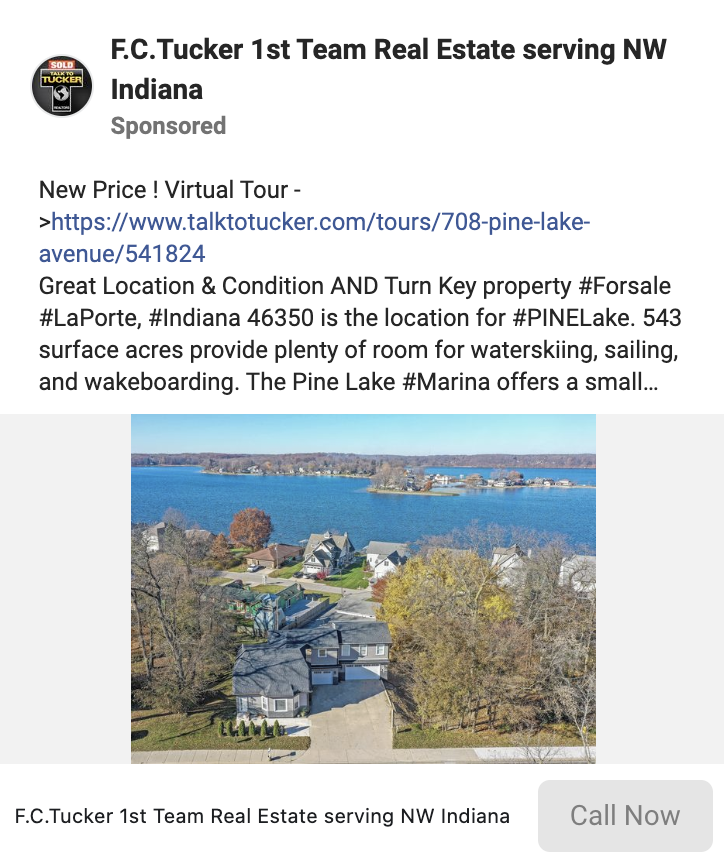
    As technology advances, virtual tours have become a powerful tool in the real estate industry, revolutionizing how potential buyers explore and experience properties. Virtual property tours provide an immersive and interactive experience, allowing users to enter a property virtually, examine its features, and envision their future living space.
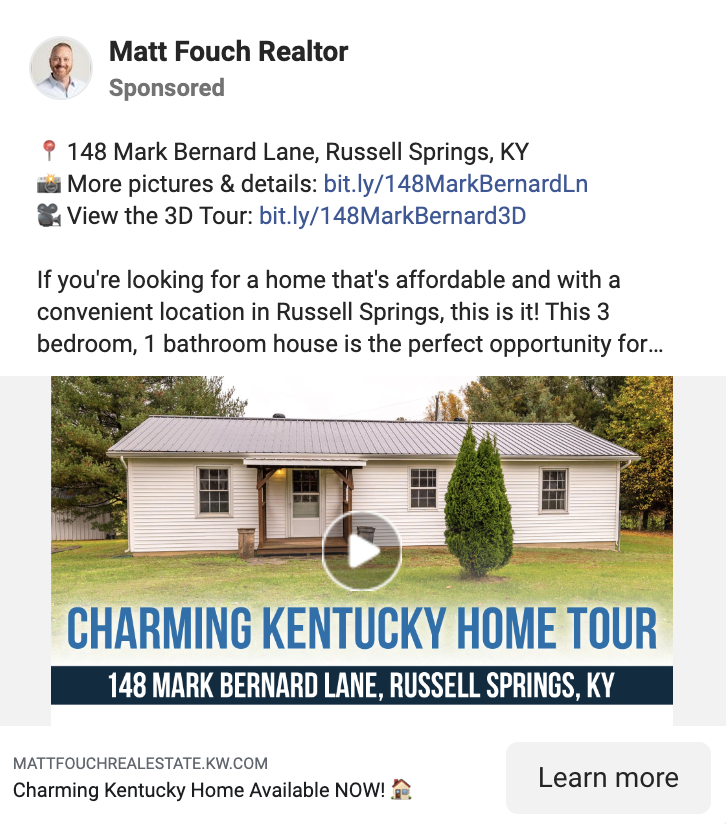
    Key Features and Benefits:

    • Immersive Exploration: Virtual property tours provide an immersive experience beyond traditional images or videos. Potential buyers can virtually explore every nook and cranny of a property, gaining a realistic sense of its layout, design, and overall ambiance.
    • Remote Property Viewing: Virtual property tours revolutionize remote property viewing, which is especially beneficial for out-of-town buyers or those unable to attend physical showings. This innovation in a globalized market empowers individuals to explore and evaluate properties from the comfort of their current location.
    • Enhanced Engagement: Virtual tours provide a higher engagement level than traditional media. Users actively participate in the exploration, deciding where to go and what features to focus on, leading to a more memorable and impactful experience.
    • Time and Cost Savings: Virtual property tours can save time and resources for real estate professionals and potential buyers. Instead of traveling to multiple properties, users can narrow their choices through virtual tours, making the property selection process more efficient.

    Strategic Implementation:

    • Professional Virtual Content Creation: Engage virtual content creators or agencies specializing in real estate virtual tours to ensure high-quality, immersive experiences. Professional content can significantly enhance the visual appeal and effectiveness of virtual tours.
    • Cross-Platform Accessibility: Ensure that your virtual tours are accessible across various platforms, including using VR headsets, smartphones, and desktops. This ensures a broader reach and accommodates users with different devices.
    • Integration with Online Platforms: Embed virtual tours into your website, property listings, and social media platforms to maximize exposure. Seamless integration allows potential buyers to access virtual tours effortlessly and enhances the overall online presence of your listings.

    Implementation Tips:

    • Provide clear instructions for users on how to access and navigate virtual tours.
    • Regularly update virtual content to reflect any changes in the property, ensuring accuracy for potential buyers.

    Real Estate Facebook Ads – Neighborhood Guide Ads:

    Adapt to the evolving needs of your audience, ensuring that the information provided remains relevant and valuable.
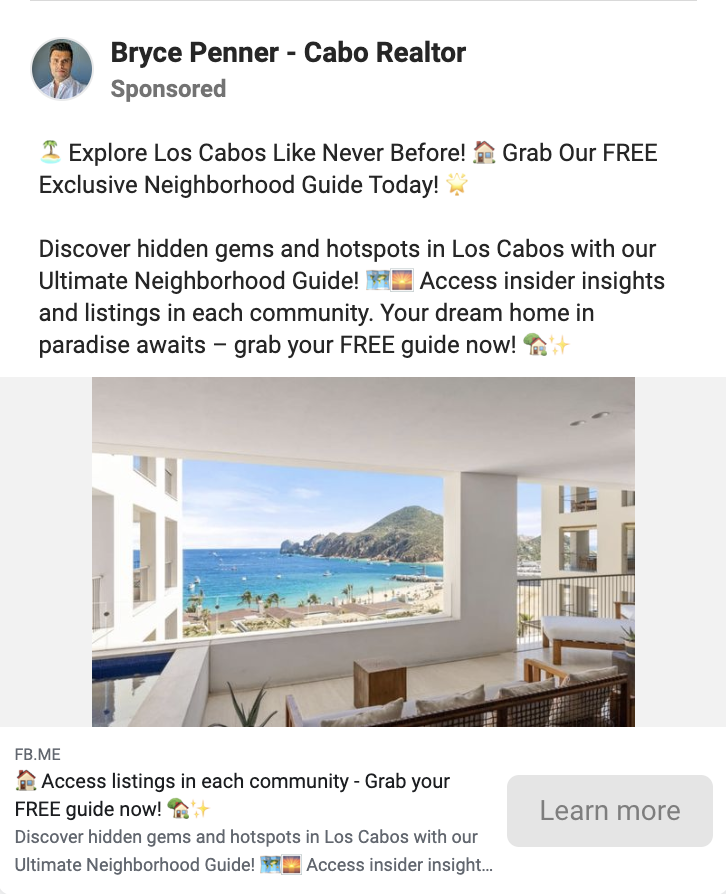
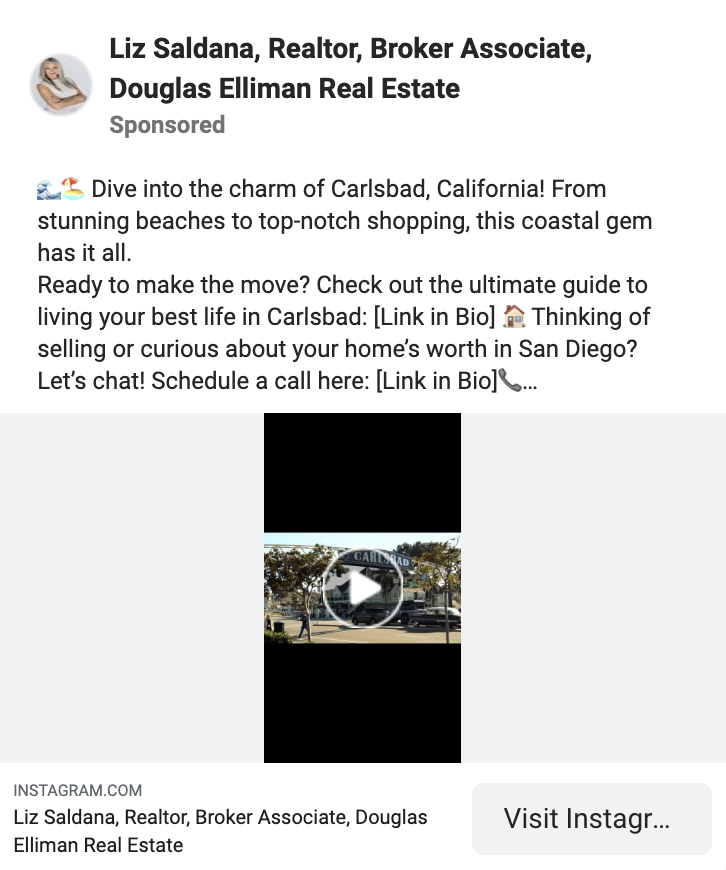
    Strategic Implementation:

    • Highlight Key Features: Strategically showcase the key features of each neighborhood, emphasizing factors like schools, parks, safety, and local culture.
    • Targeted Audience: Use real estate Facebook ads targeting features to reach potential buyers specifically interested in certain neighborhoods, ensuring your guides reach the most relevant audience.

    Implementation Tips:

    • Interactive Elements: Incorporate interactive elements such as maps, videos, and quizzes to make your guides more engaging and memorable.
    • Community Involvement: Collaborate with local businesses and residents to enhance the authenticity and credibility of your neighborhood guides.

    GIF-based Teasers for Property Launches:

    GIF-based teasers have emerged as a creative and attention-grabbing strategy, particularly for generating excitement around property launches. This innovative approach leverages the engaging nature of GIFs to provide a sneak peek into a new property, creating anticipation and sparking interest among potential buyers.

    Key Features and Benefits:

    • Visual Appeal and Engagement: GIFs are inherently attention-grabbing due to their dynamic nature. GIF-based teasers capitalize on this visual appeal to quickly capture the audience’s attention and keep them engaged during the brief animation.
    • Storytelling in Motion: GIFs enable real estate marketers to tell a concise visual story. Whether highlighting the exterior aesthetics, interior design elements, or the property’s surroundings, these short animations provide a narrative in a format that is easy to consume and share.
    • Creating Buzz for Property Launches: GIF-based teasers are particularly effective in building anticipation for upcoming property launches. By offering tantalizing glimpses of what’s to come, these teasers create a sense of excitement and encourage potential buyers to stay tuned for the full property reveal.
    • Social Media Shareability: GIFs are highly shareable on social media platforms. Their short and captivating format makes them ideal for sharing across various channels, amplifying the reach of property teasers and increasing the likelihood of virality within online communities.

    Strategic Implementation:

    • Highlight Unique Features: Use GIF-based teasers to showcase the distinctive features of a property. This could include panoramic views, state-of-the-art amenities, or architectural details that set the property apart from others in the market.
    • Countdown to Launch: Incorporate GIF teasers into a countdown campaign before the property launch. Each teaser can reveal a different aspect of the property, creating a sense of anticipation and encouraging potential buyers to mark their calendars for the official unveiling.
    • Cross-Platform Promotion: Share GIF-based teasers across various platforms, including social media, email newsletters, and property listing websites. Consistent cross-platform promotion ensures maximum visibility and engagement.

    Implementation Tips:

    • Keep GIFs short and snappy, focusing on key selling points.
    • Ensure that GIFs align with the overall branding and messaging for the property.
    • Monitor engagement metrics to gauge the effectiveness of GIF-based teasers.

    Real Estate Facebook Ads – Time-Limited Offers:

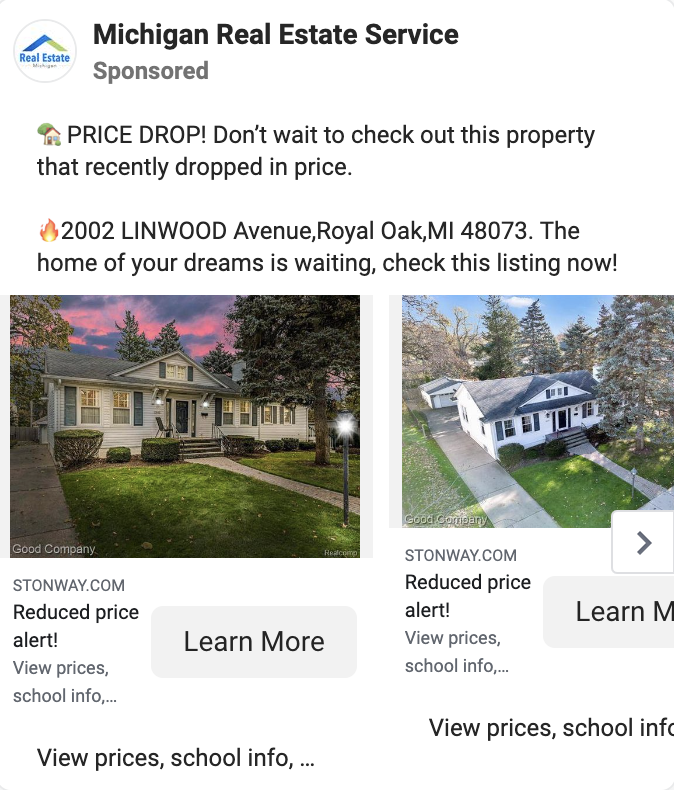
    The incorporation of Time-Limited Offers has proven to be a potent strategy for driving urgency and motivating potential buyers to take swift action. This real estate Facebook Ads approach involves presenting limited-time opportunities, incentives, or exclusive deals to create a sense of scarcity and prompt quicker decision-making among prospective property investors or homebuyers.
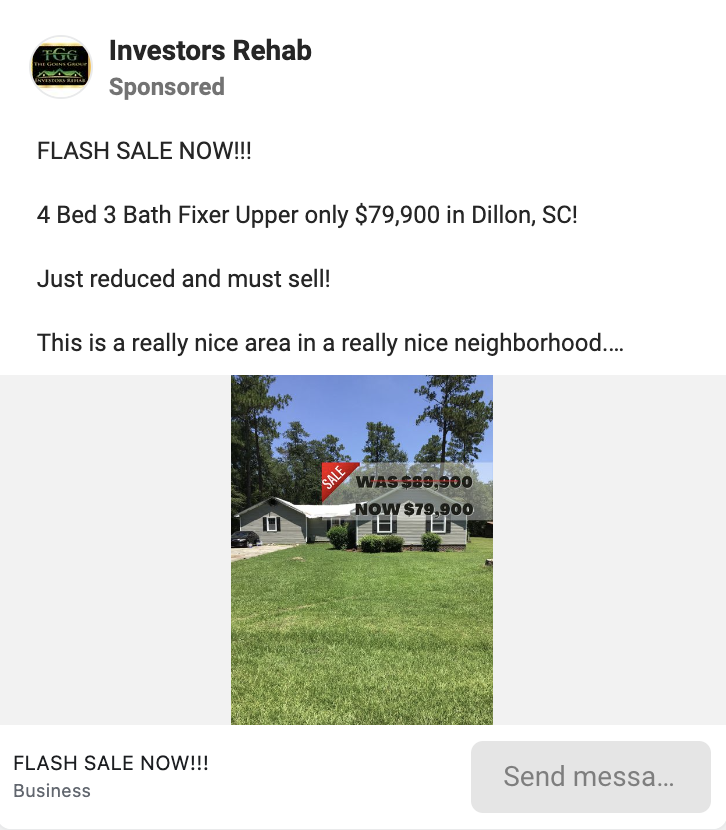
    Key Features and Benefits:

    • Urgency and Scarcity: The primary benefit of time-limited offers is their ability to instill a sense of urgency and scarcity. By setting a deadline, real estate marketers create a compelling reason for potential buyers to act promptly to secure exclusive benefits or savings.
    • Faster Decision-Making: The time constraint associated with exclusive offers accelerates decision-making. Prospective buyers are more likely to expedite their evaluations, negotiations, and ultimately, their purchasing decisions to take advantage of the limited-time benefits.
    • Enhanced Perceived Value: Limited-time offers contribute to the perceived value of a property. Buyers recognize that these exclusive deals are time-sensitive and may not be available in the future, adding a layer of exclusivity and attractiveness to the investment opportunity.
    • Lead Generation and Conversion: The sense of urgency generated by time-limited offers can stimulate increased lead generation and higher conversion rates. Potential buyers who might have been on the fence may be more inclined to act decisively to secure the exclusive benefits.

    Strategic Implementation:

    • Clear Communication: Communicate the terms and benefits of the time-limited offer. Transparency is key to building trust and ensuring that potential buyers fully understand the value they stand to gain within the specified timeframe.
    • Multi-Channel Promotion: Promote time-limited offers across various marketing channels. This includes leveraging social media, email marketing, website banners, and property listings to reach a broader audience and maximize visibility.
    • Align with Property Features: Ensure the exclusive offer aligns with the property’s unique features and selling points. This creates a cohesive marketing message and reinforces the value proposition for potential buyers.

    Implementation Tips:

    • Use compelling and visually appealing graphics to highlight the exclusivity and limited duration of the offer.
    • Provide a clear and easily accessible call-to-action, guiding potential buyers on how to take advantage of the exclusive offer.
    • Monitor and analyze the performance of the time-limited offer to inform future marketing strategies.

    Real Estate Facebook Ads – Testimonials:

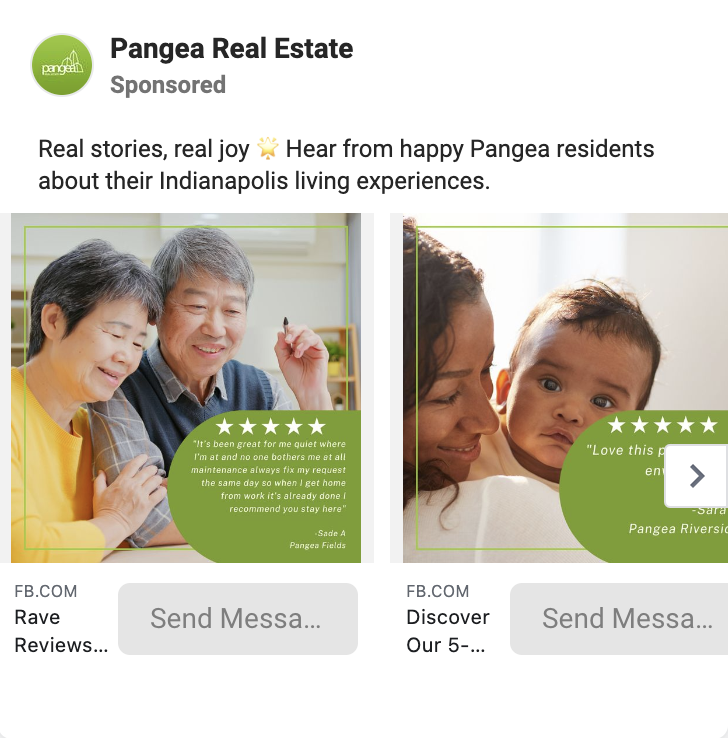
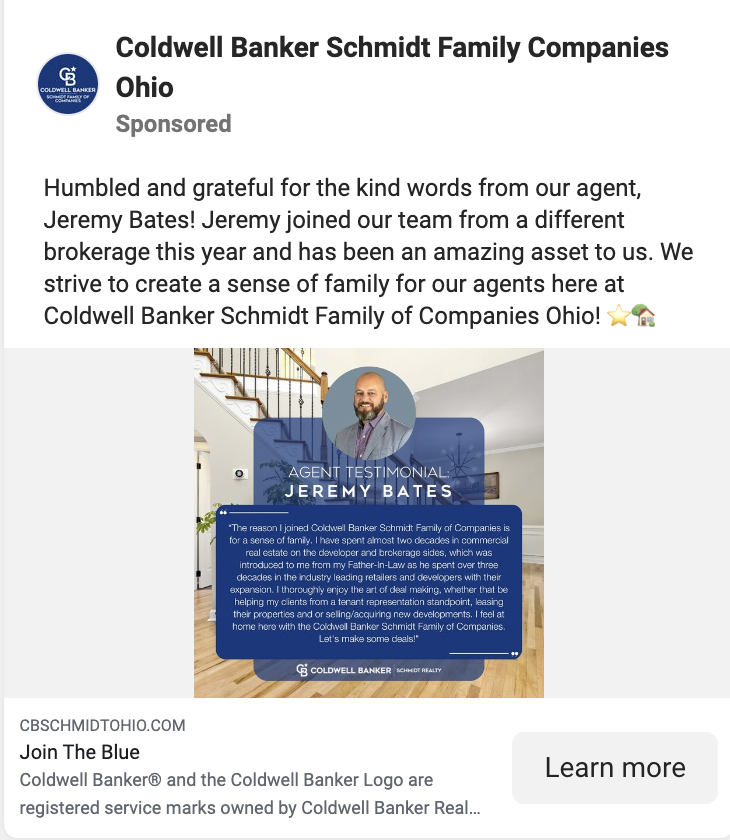
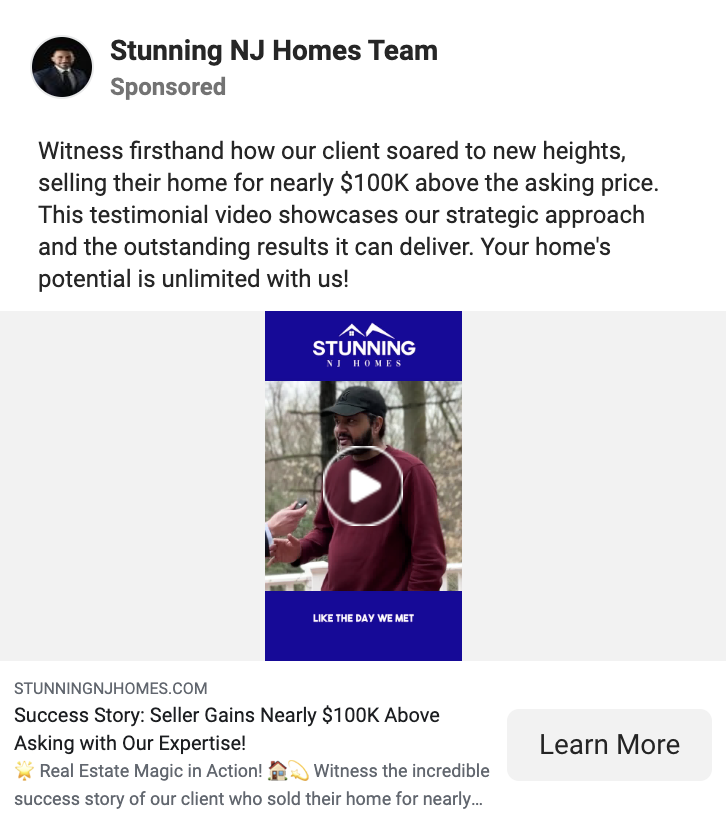
    Testimonials have acted as a compelling and authentic strategy to build trust, showcase client satisfaction, and humanize the buying or selling experience. This approach captures satisfied clients’ heartfelt stories and positive experiences through written or video testimonials, providing potential buyers with genuine insights into the real estate journey.
    Key Features and Benefits:

    • Authenticity and Trust-Building: Testimonials convey authenticity and sincerity that written testimonials may not fully capture. Seeing and hearing real clients share their positive experiences builds trust and credibility, as potential buyers can connect emotionally with the stories.
    • Humanizing the Experience: Testimonials humanize the real estate experience by putting a face and voice to the client’s stories. This personal touch helps potential buyers relate to the experiences of others, making the prospect of working with the showcased real estate professional more relatable and appealing.
    • Showcasing Diverse Experiences: A testimonial can showcase diverse client experiences. From first-time homebuyers to property investors, each testimonial can highlight different aspects of the real estate journey, resonating with a broader audience and addressing various concerns or considerations.
    • Differentiating Your Brand: In a competitive market, a testimonial can differentiate your brand by allowing satisfied clients to become advocates for your services. Positive client stories serve as powerful endorsements, setting your real estate agency apart and attracting potential clients who value the experiences of their peers.

    Strategic Implementation:

    • Varied Client Profiles: Include diverse clients in your testimonial to appeal to a broad audience. This could encompass different demographics, property types, and real estate needs to demonstrate the versatility and expertise of your services.
    • Compelling Storytelling: Encourage clients to share their satisfaction and journey with your real estate agency. Compelling storytelling enhances the emotional impact of the videos, making them more memorable and relatable.
    • Professional Production: When using video, invest in professional video production to ensure high-quality visuals, clear audio, and a polished presentation. Well-produced testimonial videos reflect positively on your brand and contribute to a more impactful viewing experience.

    Implementation Tips:

    • Obtain consent from clients before featuring their stories in testimonials.
    • Use snippets or highlights from the testimonial across various marketing channels for increased visibility.
    • Regularly update your testimonials with new client stories to keep the content fresh and relevant.

    Real Estate Facebook Ads – Offering a Free Home Valuation:

    Real estate Facebook Ads are a potent tool for investors and agents. Among the myriad strategies available, one that consistently proves impactful is the “Offer a Free Home Valuation” Ads. In this segment, we explore the significance of leveraging this approach to enhance your real estate advertising efforts.
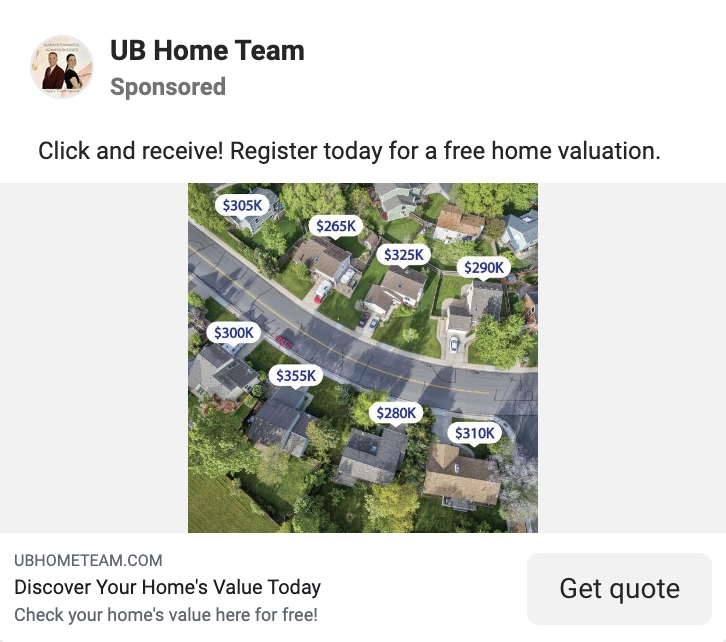
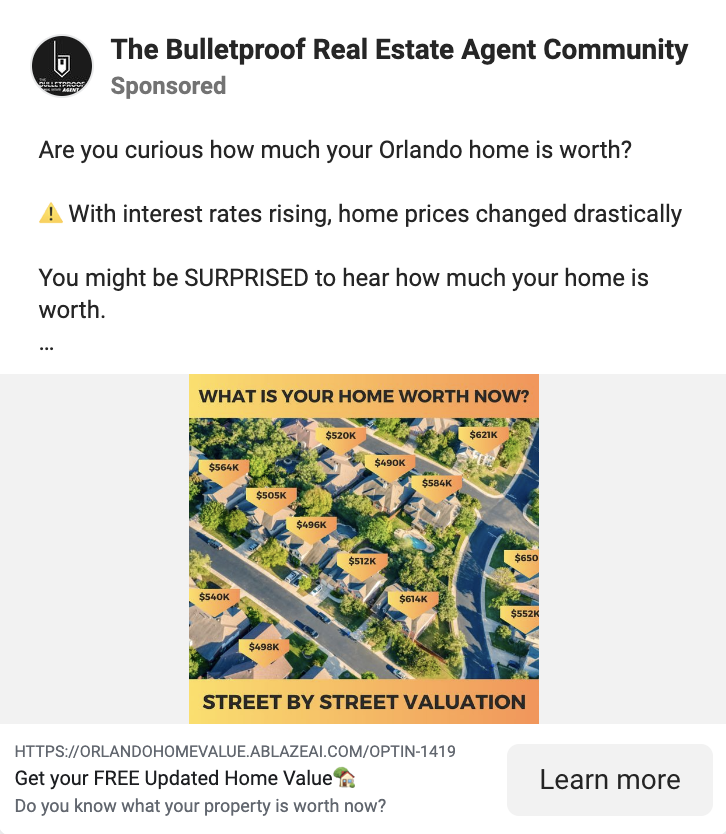
    facebook ads for real estate - home value report

    Key Features and Benefits:

    • Client Engagement: Initiate meaningful conversations with homeowners by offering them a valuable service – a complimentary assessment of their home’s market value.
    • Lead Generation: Capture leads effortlessly as interested homeowners willingly provide their details in exchange for the free home valuation.

    Strategic Implementation:

    • Clear Call-to-Action: Ensure your Ads have a clear and compelling call-to-action, guiding homeowners on how to avail of the free home valuation and encouraging immediate interaction.
    • Targeted Audience: Use Facebook’s targeting features to focus on homeowners within specific demographics or geographic locations, optimizing your reach and relevance.

    Implementation Tips:

    • Provide Transparency: Communicate the process of the free home valuation to build trust and encourage more homeowners to take advantage of the offer.
    • Follow-Up: Develop a follow-up strategy to nurture leads generated through these Ads, converting them into potential clients over time.

    Real Estate Facebook Ads – Localized Hyper-Targeting:

    Adopting Localized Hyper-Targeting allows professionals to refine their outreach efforts and connect with potential clients at a hyper-local level. This approach leverages advanced data analytics and geotargeting technologies to tailor marketing campaigns precisely, ensuring that messages resonate with specific audiences in localized areas.

    Key Features and Benefits:

    • Precision in Audience Segmentation: Localized Hyper-Targeting allows real estate professionals to segment their target audience precisely. By considering factors such as neighborhood demographics, income levels, and property preferences, marketers can tailor messages to specific subsets of potential clients.
    • Personalized Content: Tailoring content to the unique characteristics of a local area ensures that marketing messages resonate with the intended audience. From highlighting nearby amenities to addressing community-specific interests, personalized content enhances engagement and establishes a more meaningful connection with potential buyers.
    • Enhanced Relevance and Engagement: Hyper-targeting ensures that marketing messages are relevant and timely. By addressing individuals’ specific needs and interests in a localized context, real estate professionals can significantly boost engagement and capture the attention of potential clients more effectively.
    • Optimized Ad Spend: Localized Hyper-Targeting optimizes advertising budgets by focusing resources on specific geographic areas with higher conversion potential. This ensures that marketing efforts are directed towards audiences more likely to be interested in the featured properties, maximizing the return on investment.

    Strategic Implementation:

    • Utilize Geotargeting Technologies: Leverage tools to pinpoint specific locations and tailor marketing messages accordingly. This includes utilizing GPS data, IP addresses, and other location-based technologies to identify and target potential clients in real time.
    • Data Integration: Integrate local market data, demographics, and property information to understand the target area comprehensively. The more data available, the more precise the hyper-targeting strategy can be in addressing the unique needs of a particular locality.
    • Adapt Campaigns to Local Nuances: Consider the unique characteristics of each neighborhood or community when crafting marketing campaigns. Whether emphasizing school quality, nearby parks, or cultural attractions, adapting campaigns to local nuances enhances their effectiveness.

    Implementation Tips:

    • Regularly update and refine localized targeting parameters based on changing market dynamics.
    • Utilize analytics tools to measure the performance of localized hyper-targeted campaigns and adjust strategies accordingly.
    • Stay informed about local events, developments, and trends to continuously align marketing efforts with the evolving needs of specific neighborhoods.

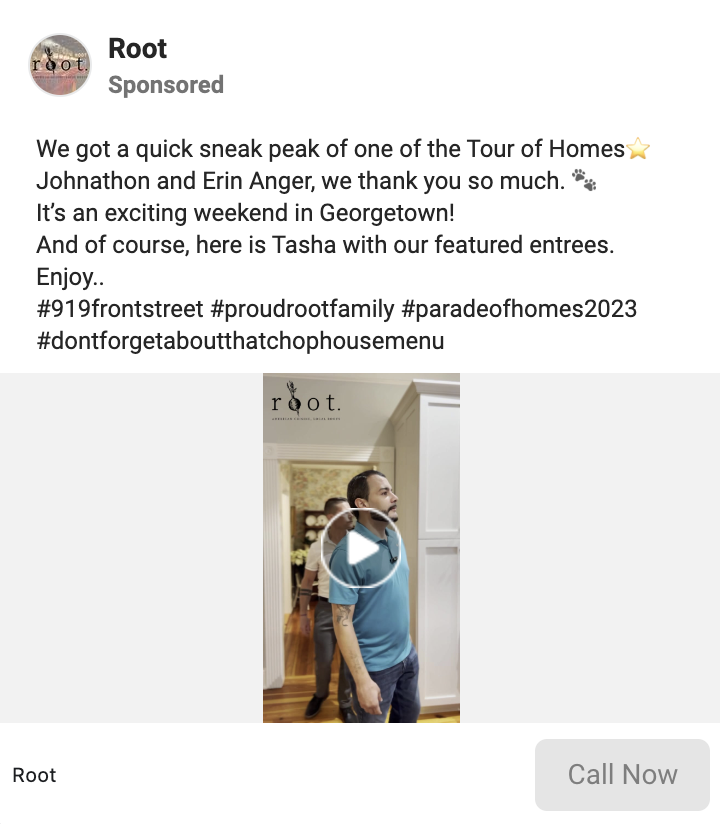
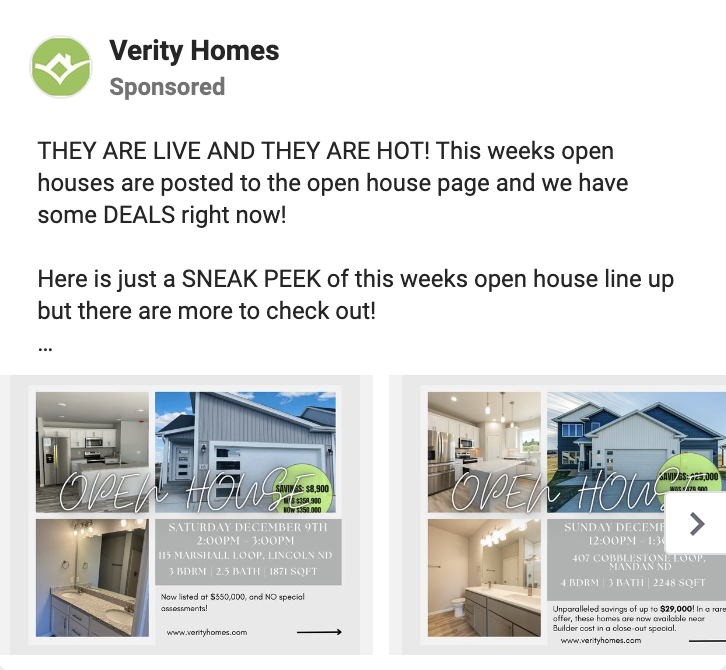
    Real Estate Facebook Ads – Behind-the-Scenes Sneak Peeks:

    Incorporating behind-the-scenes sneak peeks in your real estate Facebook Ads allows professionals to provide an insider’s view into the intricacies of property listings and the real estate process. This innovative approach goes beyond traditional marketing by offering potential buyers a glimpse behind the curtain, fostering transparency, and creating a more engaging and personal connection.
    Key Features and Benefits:

    • Transparency and Authenticity: Behind-the-scenes sneak peeks foster transparency by allowing potential buyers to see the effort and care invested in presenting a property. This authenticity builds trust and credibility, which is vital to establishing positive client relationships.
    • Engagement Through Storytelling: Sharing behind-the-scenes content allows real estate professionals to tell compelling stories. From the initial stages of property preparation to the final touches before a listing goes live, each step becomes a narrative that engages potential buyers and piques their curiosity.
    • Showcasing Expertise: Behind-the-scenes sneak peeks allow real estate professionals to showcase their expertise. From discussing design choices to explaining market trends, these peeks can highlight the knowledge and skills that set a real estate professional apart.
    • Building Anticipation: Offering a behind-the-scenes look builds anticipation among potential buyers. It creates a sense of exclusivity and involvement, encouraging individuals to stay engaged with the property listing and follow its journey from preparation to market debut.

    Strategic Implementation:

    • Capture Key Moments: Document critical moments in the property preparation process, from staging and photography sessions to discussions with clients or property owners. These moments humanize the experience and provide valuable insights into the investment in presenting a property.
    • Utilize Video Content: Video is a powerful medium for behind-the-scenes content. Visual storytelling enhances the impact of behind-the-scenes peeks, whether through short clips on social media or more extended videos on property listings.
    • Engage with Your Audience: Encourage interaction and engagement by inviting potential buyers to ask questions or share their thoughts during behind-the-scenes content releases. This two-way communication builds a sense of community and involvement.

    Implementation Tips:

    • Be consistent in sharing behind-the-scenes content to maintain audience interest.
    • Use behind-the-scenes peeks to highlight the unique features of a property and its distinct selling points.
    • Monitor audience feedback and adjust behind-the-scenes content based on what resonates most with your target demographic.

    Real Estate Facebook Ads – Market Insights:

    Market Insights have emerged as a strategic and engaging approach, enabling professionals to gather valuable market insights while fostering interaction with their audience.


    Key Features and Benefits:

    • Audience Engagement: Market insights involve the audience in the real estate conversation. Real estate professionals can build community by encouraging participation and interaction, keeping potential buyers and sellers engaged with their brand.
    • Real-Time Feedback: Unlike traditional market research methods, interactive polls provide real-time feedback. This immediacy allows real estate professionals to stay agile and responsive to changing market dynamics, adapting their strategies based on the most up-to-date insights.
    • Enhanced Personalization: Market insights enable real estate professionals to personalize their approach. By knowing the preferences of their audience, professionals can offer more relevant content, property suggestions, and services, enhancing the overall customer experience.

    Strategic Implementation:

    • Define Clear Objectives: Whether gauging interest in specific property features or understanding market sentiment, having a clear goal ensures that the market insights are meaningful and actionable.
    • Promote Across Channels: Promote market insights across various channels, including social media, email newsletters, and your website. Utilize the reach of different platforms to maximize participation and gather insights from a diverse audience.

    Implementation Tips:

    • Keep market insights and easy participation to encourage higher engagement.
    • Share insights from polls with your audience, demonstrating transparency and creating a feedback loop.
    • Review and update topics to align with market dynamics and audience interests.

    Real Estate Facebook Ads – Ephemeral Stories for Property Highlights:

    Ephemeral stories involve sharing multimedia content—such as images and videos—accessible for a limited time, typically 24 hours. When applied to real estate marketing, Ephemeral Stories provides a platform for professionals to showcase key features, behind-the-scenes footage, and other property highlights in a visually appealing and temporary format.

    Key Features and Benefits:

    • Foster a Sense of Urgency: The temporary nature of Ephemeral Stories creates a sense of urgency among viewers. Potential buyers are motivated to engage with the content promptly, ensuring they don’t miss out on exclusive property highlights or time-sensitive information.
    • Visual Appeal: Ephemeral Stories capitalize on the visual appeal of images and videos to convey property highlights in a captivating way. The dynamic nature of stories allows for a more immersive and interactive experience, enhancing the overall impact of the showcased content.
    • Highlight Unique Features: Ephemeral Stories are ideal for spotlighting specific features of a property, whether it’s a breathtaking view, a luxurious amenity, or a unique architectural detail. The temporary nature of the content makes these features stand out, encouraging potential buyers to take notice.
    • Encourage Engagement: Viewers can actively engage with Ephemeral Stories through reactions, comments, and direct messages. This interactive element fosters engagement and allows real estate professionals to directly communicate with potential buyers, answering questions or providing additional information in real time.

    Strategic Implementation:

    • Curate Compelling Visuals: Invest time in curating visually appealing images and videos that showcase a property’s most attractive and unique aspects. High-quality visuals contribute to the overall allure of Ephemeral Stories.
    • Create a Story Narrative: Develop a narrative for each Ephemeral Story to guide viewers through the property highlights. This could include a virtual tour, highlighting specific rooms, or providing insights into the lifestyle associated with the property.
    • Utilize Story Features: Leverage the features available within ephemeral story platforms, such as polls, quizzes, or swipe-up links for additional information. These features enhance interactivity and allow potential buyers to engage with the content actively.

    Implementation Tips:

    • Promote Ephemeral Stories across multiple platforms, including social media and messaging apps, to maximize visibility.
    • Use captions and overlays to provide context and additional information about the property highlights.
    • Monitor engagement metrics to assess the effectiveness of Ephemeral Stories and refine future content accordingly.

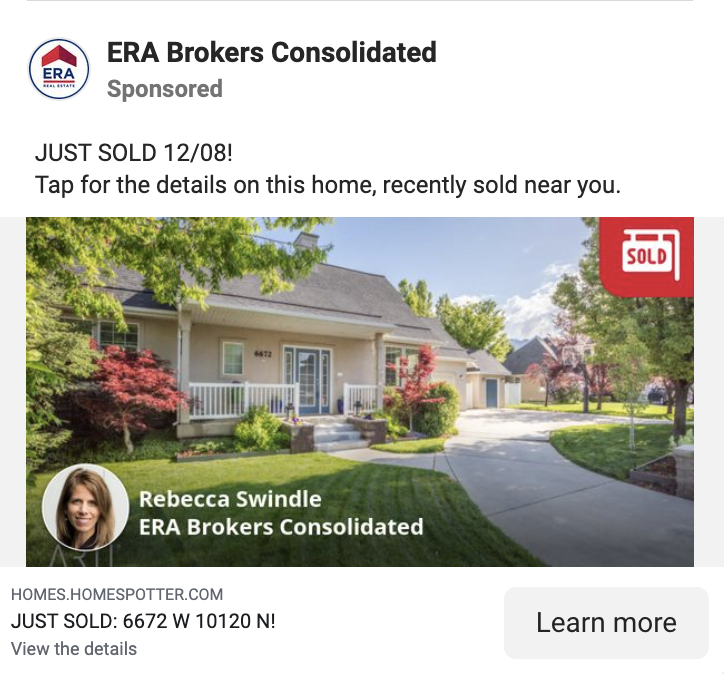
    Real Estate Facebook Ads – Highlight Recently Sold Listings

    One particularly impactful approach is the “Highlight recently sold listings” real estate Facebook Ads, a powerful narrative that encapsulates success and fosters trust among potential clients.
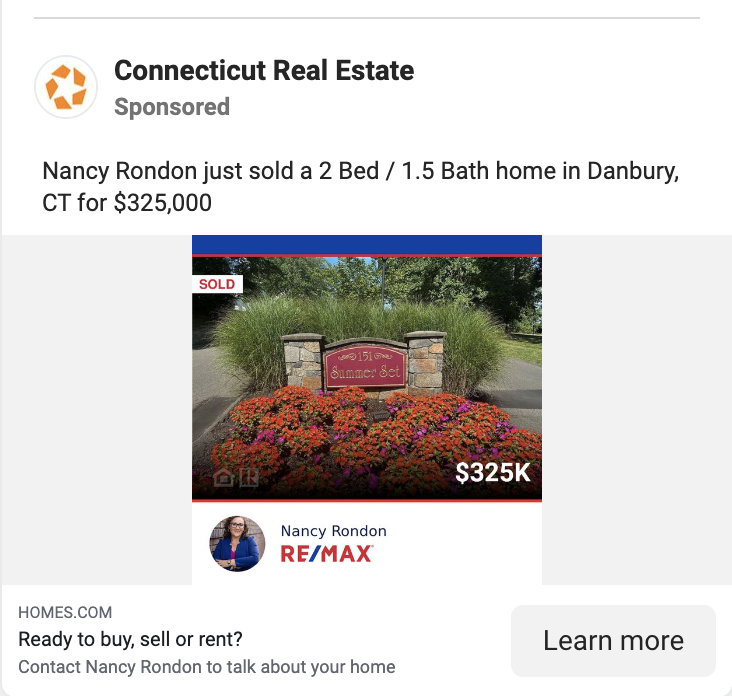
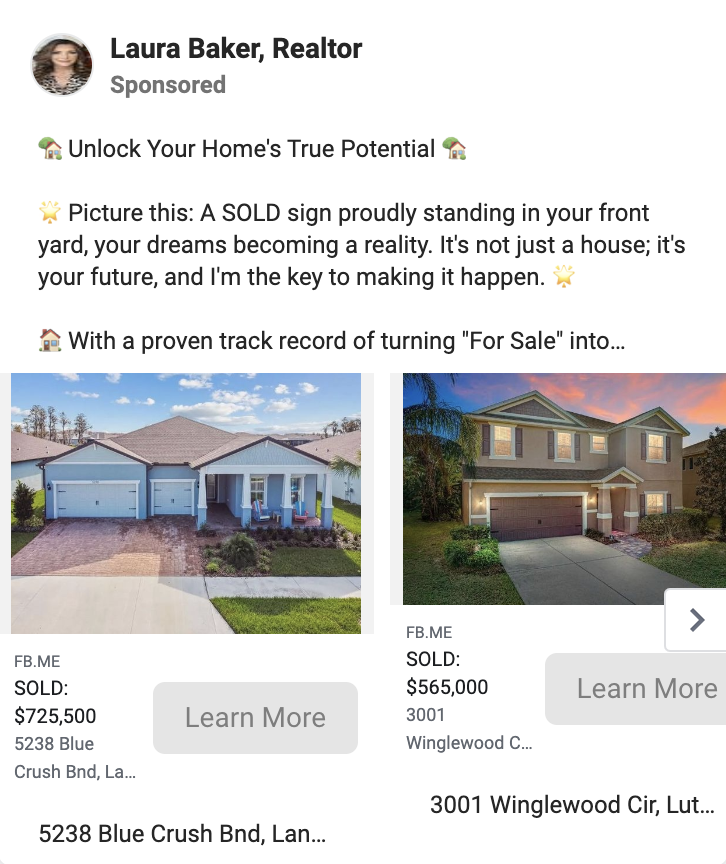
    Recently sold listings Ads go beyond showcasing properties—they tell a story of triumph, illustrating the dedication and proficiency of real estate professionals. These Ads serve as a visual testament to success, showcasing recently closed deals that exemplify expertise in the industry.

    Key Features and Benefits:

    • Visual Storytelling: Leverage the storytelling power of visuals to engage your audience emotionally and convey the diversity of your successful transactions.
    • Trust and Credibility: Establish trust by presenting a transparent track record of recently sold properties, reinforcing your credibility as a reliable and successful real estate professional.

    Strategic Implementation:

    • Diversity in Showcase: Strategically showcase various properties to cater to different preferences and demographics, expanding your reach and relevance.
    • Targeted Placement: Place your Ads strategically on Facebook to reach the right audience. Utilize the platform’s targeting features to maximize visibility and engagement.

    Implementation Tips:

    • Stay Current: Regularly update the recently sold listings showcased in your ads to reflect the dynamic nature of the market.
    • Encourage Engagement: Foster community by encouraging audience interaction through comments and inquiries, building trust and credibility.

    Conclusion:

    As we venture further into 2025, the real estate landscape continues to evolve, and these 14 inspiring Facebook Ad examples showcase the innovative and creative approaches defining the industry.

    By incorporating the latest technologies, embracing inclusivity, and staying attuned to market trends, real estate professionals can leverage Facebook ads to engage their audience, drive conversions, and stand out in a competitive market.

    Stay inspired, stay adaptive, and watch as your real estate Facebook ads significantly impact the year ahead.
  • How to Tell If My Real Estate Google Ads Campaign Is Working – Setting Up Conversion Tracking

    How to Tell If My Real Estate Google Ads Campaign Is Working – Setting Up Conversion Tracking

    2015.01.2-ppc-working-main

    A client of ours reached out and had dropped $5,000 in Google Ads costs over a few months on a campaign he was managing himself, but it wasn’t performing as he hoped, and he had no clue what parts of his PPC marketing were working and what factors were costing him money.

    In this post, we’ll walk you through the simple action we had him take that turned things around from $5k in losses to over $30k in profits… and the #1 mistake most newbie PPC marketers make that prevents you from knowing if your PPC marketing is working for your real estate investing business.

    I get asked this question all of the time…

    How do I know which keywords and ads are generating leads?

    Here’s my answer: if you don’t have the proper recording sources and/or analytic tools, you won’t know.  Google Ads campaigns will become a frustrating guessing game that may drain your budget.

    I also hear that Google Ads is an expensive waste of time and won’t generate leads.  That may be true… if campaigns are not created using an optimized campaign structure. If your PPC campaign is optimized, chances are you’ll be in the right position to be successful.

    PPC management can test the skills and patience of even the most experienced ad managers.  You may be thinking, “My campaign is doing OK right now,”

    But if you take a deeper look…

    • Is it as effective as it can be?
    • Is it efficient and structured in a way that isn’t confusing?
    • Are you continuously enhancing your return on ad spend?
    • Are you data-tracking keywords and ads?

    Without proper data tracking, knowing if your PPC campaign is working won’t be easy.

    Unlocking Profitability: 3 Powerful Tactics to Determine the Success and Failure of Your PPC Marketing Ads and Keywords

    Is PPC Good For My Real Estate Investor Business?

    How do you know? Here are a few ways to track your conversions so you know that your money is being invested wisely and not just thrown down into a black hole.

    PPC Tracking Tactic #1: Google Ads (Conversion Tag) 

    The BEST WAY.  

    A no-brainer is to set up your campaign using the Google Ads conversion tag.  Without implementing this tag on your site, you’re measuring keyword and ad effectiveness with a gut feeling.

    You or your account manager must know how a searcher landed on your site and what happened after they clicked on your ad. Did they fill in your lead form? Which keyword, ad, and/or ad group triggered the conversion?  Those questions will help you build and maintain a quality Google Ads campaign.

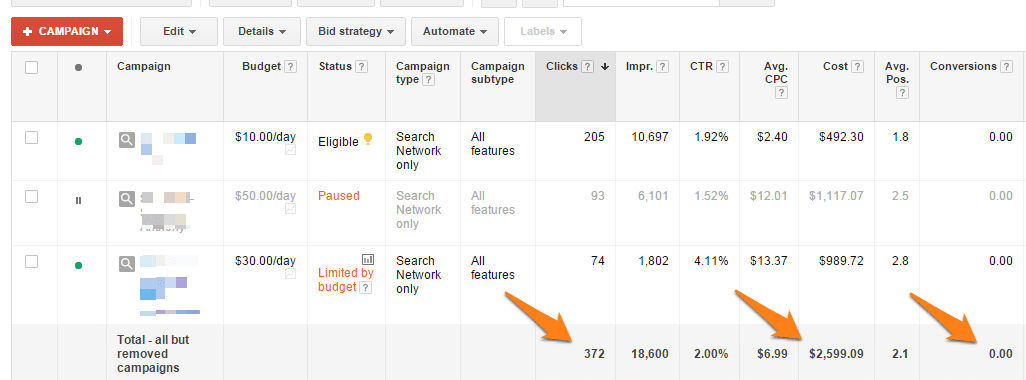
    Here’s an example of a Google Ads campaign that does not use the Google Ads conversion tracking tag.  It’s not that the Investor chooses not to because they choose to use a different company to host their website.  This “other” web service prevents them from placing a conversion tag on their site. Carrot real estate investor websites are built with the high-achieving investor in mind, making it crazy easy to add your conversion tracking tags.

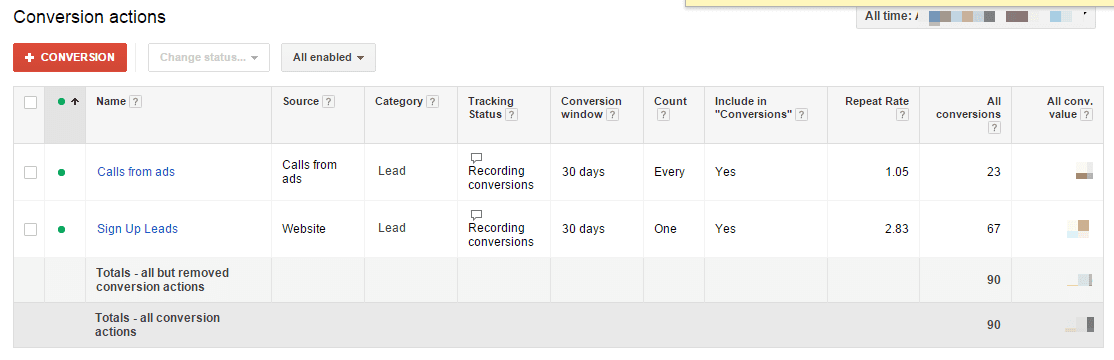
    You can see there has been $2599 spent on 372 clicks and 0 conversions.

    But… that’s not true. There have been 48 conversions (this Investor keeps track of conversions using their system)… $54 per motivated house seller lead! Not too shabby.  But an account manager would have no idea which keywords have to lead to those 48 leads.  We’re blindly leading the ship.

    A Google PPC Campaign Without Conversion Tracking = Throwing Darts Blindfolded

    Google AdWords conversion tracking

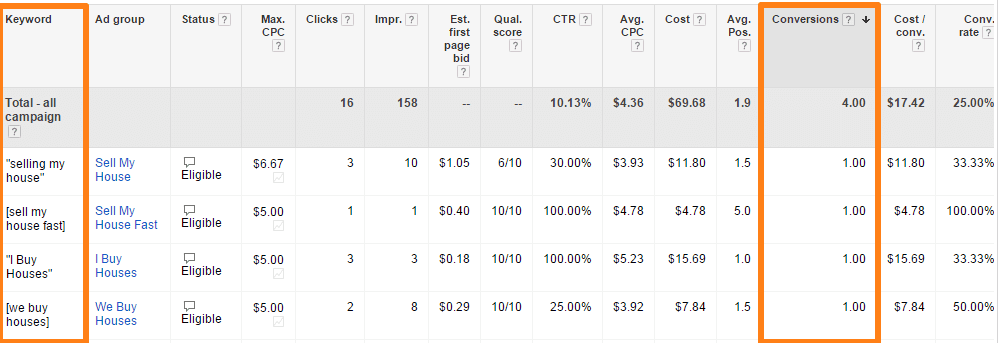
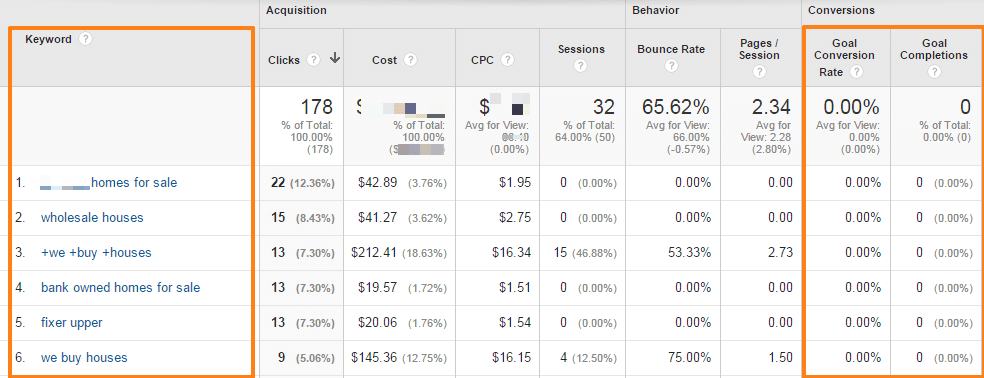
    This is what a campaign’s keywords should look like when the Google Ads conversion tag is properly implemented.  An account manager knows exactly what keywords need to be adjusted and tested.

    A Google PPC Campaign Using Conversion Tracking = Strategic ROI-Based Marketing

    google adwords real estate investor keywords

    The benefits of recording data — you will know which ads, placements, and keywords lead to conversions and are worth bidding on.  You’ll also know the reverse, which ad, placements, and keywords to pause.

    Pros and Cons Of This Tracking Method:

    • Pro: Helps you find exactly which ads, keywords, and ad groups are performing the best and worst so you can make smart decisions to drive up your return on investment
    • Con: Nothing… really. This method is highly recommended as long as your tag is installed correctly on your website and you record unique leads.

    Be sure to create a conversion tracking tag for your PPC leads.

    For Carrot members, you can place a conversion tracking tag on your “step-2” page to ensure tracking on all potential clients who have filled out one of your website forms.  Tags allow you to definitively know when traffic has come from your PPC campaign rather than from SEO, direct mail, etc… it also helps you drill down on exactly which keywords are producing profitable leads and which aren’t.

    You can use the Google Tag Assistant to double check the tag is reading your step-2 page.


    HOW CARROT MEMBERS CAN PLACE AN ADWORDS CONVERSION TAG ON THEIR CARROT SITE

    How to Create a Google Ad |  Carrots Weekly Live Coaching Calls for Real Estate Professionals

    Adwords conversion for real estate investing

    PPC Tracking Tactic #2: Google Analytics

    First… you’ll need to link your Google Ads account to your Google Analytics.  While you will be able to track conversions in Analytics, you won’t be able to know for sure which keyword or ad generated the click. This isn’t the best way to monitor the performance of your PPC campaign but it can be used to track overall lead volume.

    google analytics for real estate

    Pros and Cons Of This Tracking Method:

    • Pro: Gives you great aggregate data on the performance of your Adwords campaigns
    • Con: It doesn’t let you drill down too far into specific ads or, in some cases, specific keywords either, and doesn’t tell you exactly which leads came from where.

    PPC Tracking Tactic #3: The Carrot Lead Source Feature

    Like the information in Analytics, Carrot members can see which traffic source generated the lead, but again not a specific ad or keyword.

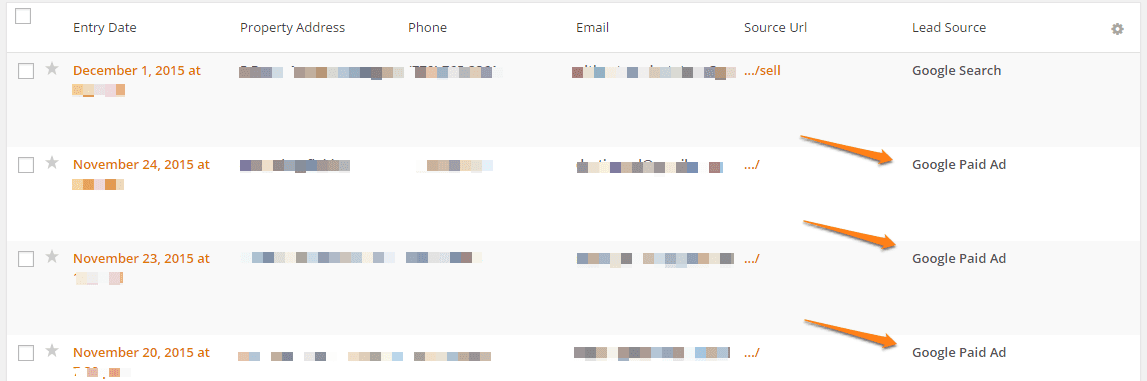
    The Lead Source Tracking is automatically tracked for every single lead that comes into an InvestorCarrot site You don’t have to do anything to turn it on. Just head to view your leads, and it’s right there.

    To find this info, log in to your Carrot site and view your leads. We’re currently working on a massive upgrade that will give more power and functionality to Campaign Tracking within your InvestorCarrot site. Keep an eye out for that release this spring!

    Carrot Lead Source Tracking Built Right Into All Of Our Websites

    Carrot Lead Form AdWords Lead Generation

    Pros and Cons Of This Tracking Method:

    • Pro: This Lets you see exactly where each lead came from so you can track the true profitability of your marketing. This, combined with the Google Ads Conversion Tracking tag, is the ideal setup to give you the whole picture.
    • Con: This tracking doesn’t give you any data about the ad that drove the lead.

    Key Strategies for Running a High-Quality Campaign and Positioning Your Ads for Maximum Impact

    To measure the effectiveness of your advertising campaign, you should monitor your investor transactions, whether buyer or seller, and keep track of new customers, requests for information leads, phone inquiries, and even organic website traffic.

    Here are some ideas that will help you not only determine the effectiveness of your ads but will also give you some new marketing ideas.

    Additional PPC Marketing Optimization Tips

    1. Compare your sales before, during, and after your ad campaign.

    Keep in mind that internet advertising often has a delayed affect and can then grow steadily.

    Transactions that result from your ads may not take place immediately. So be patient.

    2. Use a dedicated phone number to track inquiries.  

    Create a phone call conversion tag for AdWords or other internet marketing options.  Tags make it easy to identify and track phone leads positively.

    3. Here are several more that will help squeeze out that extra profit and return on investment… 

    • Set a PPC goal.  This could be the number of leads per week, month, or even a cost-per-lead target amount.  Whatever it is, though, write it down and constantly measure it.
    • Keep your campaign organized.  A messy campaign can cause confusion, waste spending, and ultimately leave you unmotivated.
    • Target the right keywords and limit the number of keywords. Yes, you can have too many.  The sound of 4,000 keywords might sound appealing. However, having too many keywords can lead to confusion and harm your campaign. Unless you are willing to create ad groups and ad text based around each keyword, AdWords potentially won’t give you a high enough quality score for ads to show in the highly regarded top three ad spots (41% of clicks come from the top 3 spots). You can also waste spending due to higher click costs and possible clicks from unrelated searchers.
    • Creating compelling ad copy.  Make a searcher want to click your ad. Read our blog post here, where we write about that.
    • Testing…testing.  Create numerous ads and be sure to test them to figure out which ones are more attractive.  Even minor changes, such as removing or adding a word in the ad headline, can make all the difference.
    • Use quality landing pages. Landing page experience refers to the relevant, helpful, and original content. Read this post to learn how city-specific landing pages help you get more traffic.
      Landing pages must offer trustworthiness and be easy for customers to navigate.  It also requires a quick loading page time and encourages customers to spend time on your site.
    • Make sure your call to action is clear. Tell the searcher what to do.  Don’t make them guess.
    • Put the focus on your potential motivated seller or buyer lead. Let them know why you’re better than the competition.
    • Always implement a conversion tracking tag. Yes, you might be able to track lead sources, but if you look at your Google Ads account, you won’t know which keywords and ads generate ROI. It will become a guessing game as to which keywords to pause potentially and which to be more aggressive with.

    Reasons Why You Should Start Conversion Tracking Today

    You must start to gain insight into what’s working within your campaign. Without that knowledge, your Google Ads campaign won’t be completely optimized. This will limit you from being able to make the necessary changes to attract more leads.

    You’ll also be able to improve your ROI.

    Clicks are not valuable unless they are converting into leads that turn into profitable deals over time.

    Tracking will reduce wasted ad spend, gain quality clicks, and improve ROI.

    With the data gathered from tracking, you can perform a better test on your campaigns and grow them to get even more conversions.

    Don’t Spend Another Dime On PPC If You Don’t Have Layers Of Conversion Tracking In Place

    Once our client turned on conversion tracking, he could quickly see which ads and keywords were a complete waste of money and which were bringing him solid leads. He trimmed off the stuff that wasn’t effective and ramped up the stuff that was. Within four months, he closed several deals that have brought in over $30,000.

    He possibly would have closed those deals without the tracking in place, but his profit would be far less because of the wasted marketing dollars he was spending before he had tracking in place.

    Tracking is essential… not just a “luxury.”

    Implement the Google Conversion Tag + make sure you’re using a website system that helps track your leads and tell you where each lead came from. That information alone could save you tens of thousands of dollars per year.

    There are a lot of factors, including time of the year, the state of the economy, and geographic location, which can make it difficult to accurately measure the success of your ads if you don’t use the proper tracking techniques.

    Compare the before and after advertising traffic from your Carrot website. Also, your PPC manager should be able to provide you with weekly and/or monthly PPC reports.

    You can also be proactive.  When talking with your leads, don’t forget to ask them the obvious question.

    How did they find your website?

    PPC might not be a cost-effective alternative in very competitive markets unless you can ensure a large enough marketing budget or be willing to limit your traffic if you’re using Bing… but either way… putting in place what you learned in this blog post is essential in competitive markets. Let your PPC be a great compliment to your SEO campaign.

    PPC data tracking is one of the most important parts of your PPC campaign.

    Interested in switching to Carrot so you can take hold of your online marketing once and for all and ramp up your ROI? Awesome! Take a demo and reach out if you have any questions!

    Question: If you’re doing paid marketing, are you using conversion tracking? Let me know below in the comments section!

  • Super-Charge Your Real Estate Investor Lead Generation with Facebook Ads

    Super-Charge Your Real Estate Investor Lead Generation with Facebook Ads

    Real Estate Investor Lead Generation with Facebook

    For those of you that know me, you know I’ve been a huge advocate of using Facebook ads to turbocharge your real estate investing business, especially as of late.

    There are only a few things that work really well to get deeply discounted properties (mailing, cold calling, and online ads).

    Because EVERYONE is mailing the cost per acquisition for mailers has gone through the roof.

    Cold calling works great, but it is something that most investors won’t do.

    This is where real estate investor lead generation with Facebook ads fit in: they are just as easy to scale as mailers and don’t require you to pound the phone all day. Unlike other forms of marketing, Facebook ads are extremely predictable.

    When you mail or cold call, there is a lot of variability on a month to month basis in terms of cost per lead. When it comes to Facebook, you know within a very narrow window what your cost per lead is.

    Another major benefit of Facebook ads is that they can also be turned up at a moment’s notice.

    So when you need more leads you can ramp up your campaigns, and vice versa.


    Facebook Ads for Real Estate: The Why and How of Getting (REAL) Leads


    Real Estate Investor Lead Generation with Facebook: Making Money on Facebook Leads

    Now that we know the benefits of Facebook Ads, let’s talk about the execution.

    The Targeting:

    For real estate investor lead generation it is crucial that if you are paying to show your ads, that you are showing the right people.  One of the main reasons why Facebook is such an incredible tool and why Facebook is worth so much money as a company is that Facebook knows everything about you.

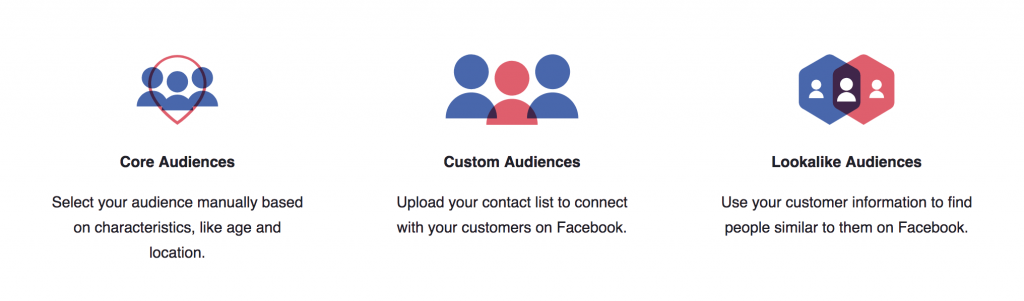
    Facebook ads targeting options
    Source: Facebook Business

    They know your age, whether you are a homeowner, what you like(and don’t like), and much more. And with this information, you can put your ads in front of only the people who are most likely to want to sell to an investor.

    There are two ways to achieve this:

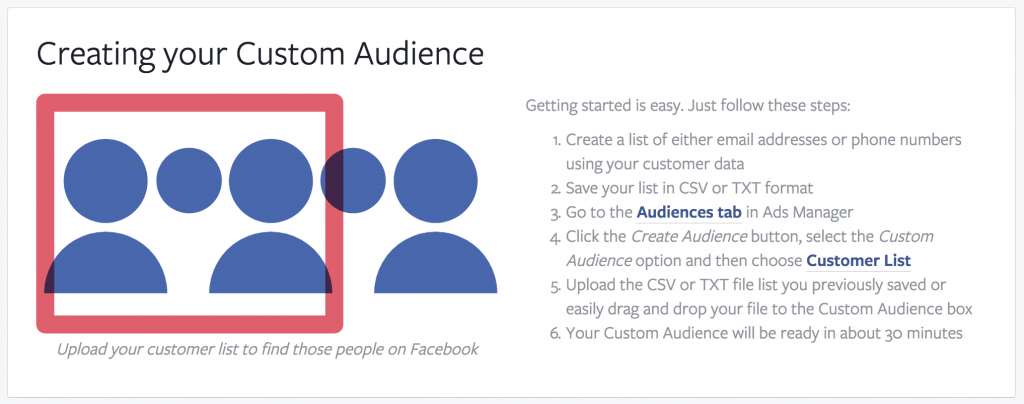
    Creating your Custom Audience
    Source: Facebook Business

    Already a Carrot Member? Check Out Carrot’s Facebook Leads Masterclass

    Learn how to drive leads to your site and build an audience with Facebook marketing.


    The Ad Itself:

    One important thing to understand about Facebook ads is that you are interrupting what someone is currently doing.

    They didn’t come on Facebook to see an ad.  They came to see what their friends were up to.

    So from a high level, it is critical that your ad stands out, or else it won’t even get noticed.

    There are a few important things to make sure your ad stands out.

    1. The image – this is the most important part of your ad, believe it or not. The picture is what “stops” the person from scrolling. If you can’t stop them from scrolling, they won’t read the ad and you are dead in the water.
    2. The wording – once the person “stopped” because of the image that you used, the next thing you need to master is the “copy” or the wording of your ad. Where most people make a mistake is that they write extremely “professional” ads. By professional I mean boring. Again, users aren’t going on Facebook to see ads and they will skip over them if it isn’t interesting. You need to tell a “story” more than list out the benefits of working with you. One thing to start doing immediately is to start reading the Facebook ads in your current news feed and look at how the good ones are written. Then copy the same style.
    3. Lead capture: how you capture your leads also makes a big difference. It is great for you to have a great image and great copy but if they are dropped to a website that doesn’t convert, it will all be for nothing. I’ve tried various sites and bar none carrot is the best performer. If you are spending significant money on Facebook ads, you NEED a Carrot site. The price is a drop in the bucket compared to what the ads cost and you will get more leads per dollar spent. One thing to note is that I used to have a non-carrot site that looked really pretty that did not convert. I see many people making this same mistake. Don’t repeat this mistake.

    You are probably thinking “I know that I need a great image and great copy” but how do I know what to do on Day 1?

    Can’t you just give me what is working?

    I have good news and bad news on this question.

    The good news is that anyone can figure it out fairly easily. The bad news is that it takes a little bit of work.

    The reason that I can’t just give you what is working for me is that what is working on Facebook changes over time. One of the drawbacks of Facebook ads is that you have to manage them. An ad that was working a month ago, might now work anymore.

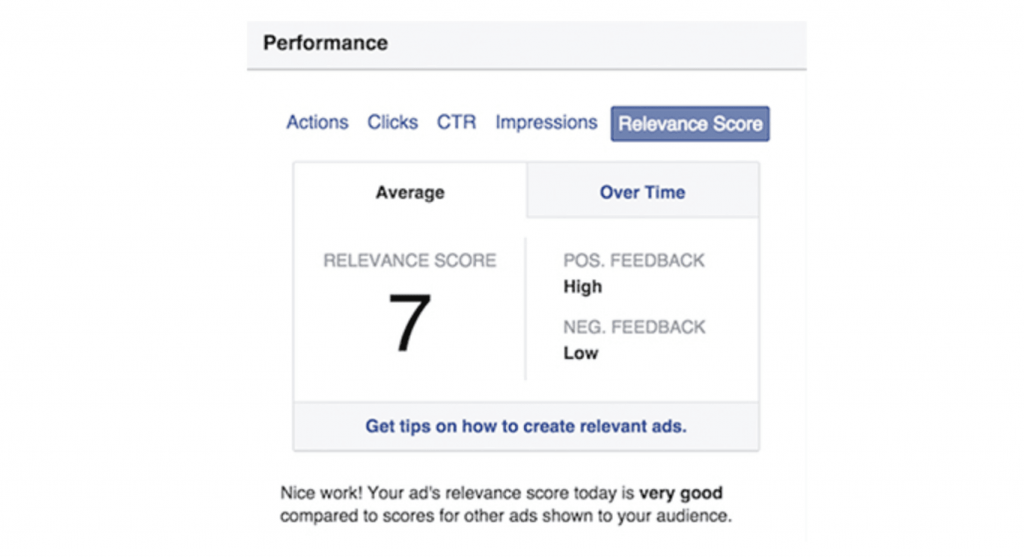
    The reason for this is what Facebook calls the “relevance score” The relevancy score is determined by how people respond to your ad. If you are serving up content that Facebook users find annoying, they will hide it.

    facebook ad relevance score
    Facebook Relevance Score. Source: Facebook Business

    Because Facebook makes its money by users being on Facebook all day every day, they don’t want to serve ads that are annoying to the users. So, what happens is that if everyone is hiding your ad, Facebook will show it less and you will pay a lot more per lead and eventually the ad won’t work at all.

    The good news is that it is really easy to figure out what is working with just a small amount of money using a concept called “split testing”

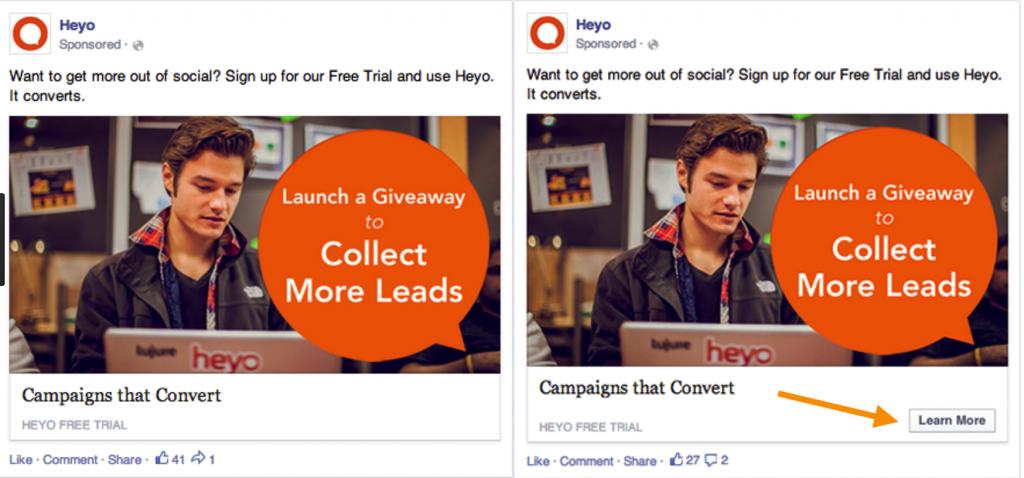
    Split testing is the process of comparing two ads with one different variable. For example two ads with the same wording but with different pictures. Or, leaving out a call-to-action:

    Split Test Facebook Ads
    Source: heyo.com

    You would run these ads together and see which one performs better and then spend more on the winner.

    The more that you split test Facebook ads, the better your cost per lead will be. This may sound like a lot of work, but if you are going to run Facebook ads, you need to do this or someone else needs to do this for you.

    When someone tells me that Facebook ads don’t work, I know it is either because they have not gone through the process of split testing OR they don’t know how to properly monetize the leads(which is going to be my last point related to facebook ads).


    How to Get your Online Real Estate Marketing to Play Nice With your Offline Marketing Efforts


    Monetizing Leads

    If you are going to spend the time and money to run Facebook ads, you need to maximize the return on your investment. MOST people aren’t doing this. There are three components to making money on Facebook Leads: converting leads into appointments, converting appointments into deals and maximizing your ROI on Leads

    1. Converting leads into appointments: you need to follow up with these leads as soon as possible and multiple times (I recommend calling/texting and emailing every day for the first 10 days). You also need a good CRM (I use Follow Up Boss) and a really good email sequence (mine was written by a good copywriter). It is also very important to know what to say when making these calls. My team has a free weekly training on how to turn these exact leads into appointments. To get free access go to www.oceancityweeklytraining.com and sign up for the Wednesday at 11 am free class. All of these follow up systems are used just to get the appointment (which is half the battle)
    2. Converting appointments into deals: Once you have the appointment, you need to convert it. Motivated sellers are NOT MOTIVATED BY MONEY so what you say and do on the appointments matters, big time. You need to say and do the right things when you get sellers face to face. To learn more about how to do that check out my free Tuesday at 10 am training at www.oceancityweeklytraining.com.
    3. Maximizing ROI on Leads

    Real Estate Investor Lead Generation with Facebook: You Have To Be Able To Maximize Every Lead That Comes In

    Where most people go wrong here is that they only make money 1 way on their leads and because of that they have a hard time getting a great ROI on their money. You NEED to be able to make money in multiple ways or else you will constantly battle for profitability. For comparison purposes, I get over 12x return on my money spent on Facebook.

    Examples of how to maximize every lead include:

    1. Retail leads – when the seller wants too much money for the house, you list the property or find an agent that can list it
    2. Wholesaling – for the deals that you don’t want or can’t fund
    3. Fix and flipping – for your high-profit deals
    4. Buy and hold great rental properties for long-term wealth

    If you aren’t utilizing the above 4 strategies it is going to be hard to compete with someone (like me) who can.

    Implementing all 4 of these strategies is not difficult, you just have to know how to do it.

    To learn all of my strategies on how to maximize leads go to www.realestateinvestingiseasy.com for a full training session on this exact topic.


    Already a Carrot Member? Check Out Carrot’s Facebook Leads Masterclass

  • EP 76: The Power of Recognizing the Pivotal Points in Life to Scale Up Your Real Estate Investing Business w/ Tim Oppelt

    EP 76: The Power of Recognizing the Pivotal Points in Life to Scale Up Your Real Estate Investing Business w/ Tim Oppelt

    Using the Pivotal Points in Life to a Scale Your Real Estate Investing Business

    Listen to the CarrotCast Podcast and Subscribe Below!

    I was confident like yeah I’m young but you can play tht in a positive way. I was like, yeah I’m young, I’m gonna hustle, I’m ambitious. You know I really need this so I’m going to work for you. And, it’s kind of how I played it and people respect that. You know I got a lot of “I what to help a young guy make it.” You know I think people root for that to, the bug. It’s bad in one sense but you can use it to your advantage.

    Tim Oppelt


    Tim Oppelt, from Opp Real Estate, has endured a lot. He’s worked one of the “worst” jobs possible, been laid off, and made some investing errors. But he’s a big believer in trying to do what you love and creating a new path for others. With that… He’s beginning to crush it!

    He wants to change some negative perceptions about entrepreneurs into a perception that maybe you can do what you want in life and succeed because you love doing it.

    Tim discusses spending hours and hours and dollars and dollars working on a website and online marketing but not getting a return. He found what wasn’t working and decided to join Carrot and dive into his online marketing head-on.

    Now he is having online marketing success by scaling your business.

    We dive into his strategy for phone leads, how he follows up with prospects, and the importance of creating amazing systems for his clients and marketing.

    Listen to other CarrotCast episodes at carrotcast.com.


    Listen to the CarrotCast Podcast


    [podcast-subscribe]

    Listen to this episode and create a path to scale your real estate investing business.

    1:45 – Why Tim is on the CarrotCast. Also, who he is and what his business looks like right now.
    3:55 – What drives Tim? What his main passions are right now?
    6:00  His path to real estate investing after being laid off from a previous job.
    8:15 – What was the first touch point in real estate and breaking down his direct mail strategy?
    10:50 – Saying “Just do it” and leaving the perfection vs. progress attitude for a bit.
    12:40 – Feeling that prospects are looking at you differently than others. How Tim got around the “your too young” mentality.
    15:15 – When did he move to more of a web-based marketing strategy? And what percent of leads and deals are coming in via the web vs. direct mail right now?
    18:40 – Why Tim joined Carrot.

    I saw real estate investor and website and thought I’m an investor and need a website it made sense.
    Tim Oppelt

    20:40 – What was wrong with his first AdWords campaign structure and how he fixed it.
    22:40 – There is more strategy than “implementing the thing”. How Tim’s marketing knowledge has upgraded his business and where he’s focusing most right now.
    25:50 – Where and how to scale up your real estate investing business.
    26:55 – Tim’s AdWords spending and how many deals he’s been pulling out.
    29:05 – What his online deal mix looks like.
    30:15 – Hiring his first assistant. Where he was in his business when he decided this would be the right move.
    32:40 – Testing phone calls: live answer vs. voicemail.
    36:15 – Hiring assistant number 2. Why he made this move and what tasks they are assigned.
    37:50 – What are Tim’s dreams, how much he’s working right now, and how much does he want to be involved in the future?
    40:30 – The biggest things he’s been able to pull from Carrot and implement into his business.
    43:20 – The pivotal point after being laid off when he took the plunge into real estate investing.
    44:25 – What book is he reading right now?
    45:30Tim’s advice for someone with or looking for an investor website. Would he recommend Carrot?


    [podcast-subscribe]

  • Real Estate Facebook Ads | The Why and How of Getting Leads [Infographic]

    Real Estate Facebook Ads | The Why and How of Getting Leads [Infographic]

    Real Estate Facebook Ads

    Facebook and real estate marketing are a match made in social media heaven.

    For Carrot members, Facebook is the third highest source of new leads, outperforming Google AdWords as well as organic search from both Bing and Yahoo.

    All told, Facebook has generated over 15,000 new leads since January of this year alone. And that’s leads. Not traffic, not visitors, not followers, not fans … real leads.

    Imagine the difference a few hundred new leads could have made in your business over the last year. Image what they could do for you in 2018.

    Simply put … that kind of lead-generating faucet is absolutely transformative.

    To illustrate how our clients do it, we collaborated with infographic making company, Venngage, to create this visual explanation.

    Real Estate Facebook Ads: The Why and How of Getting Leads [Infographic]

    [share]

    [share]

  • EP 67: Facebook Ads For Real Estate Agents: Framework That’s Proven to Work w/ Josh Schoenly

    EP 67: Facebook Ads For Real Estate Agents: Framework That’s Proven to Work w/ Josh Schoenly

    Facebook Ad Framework For Real Estate Agents

    Listen to the CarrotCast Podcast and Subscribe Below!

    There are lots of agents that love working with first-time home buyers. And, there are tons of agents that never want to work with first-time home buyers. You can go out and create that experience. You can go out and be intentional about attracting those people. Those perfect, right clients. Josh Schoenly

    In this episode of The CarrotCast, I have a special guest for you, Josh Schoenly. I have known Josh for years in different businesses that he’s owned. First of all, he’s one of the best dudes around. He’s ethical, honest, and knows what he’s doing. He’s a big, big, big sharer.

    But I wanted to bring him on because Facebook marketing became a topic, of course, over the past year that keeps on coming up more and more from our clients.

    On this episode, Josh walks through every single step of how to dial in your Facebook ads for real estate. From targeting to your ads and your landing pages. If you want to learn more about Josh or more from him, then go check out his website, clientalchemist.com. I’m excited to welcome Josh to the podcast and you guys to his world because he’s an amazing dude. I think you’re just going to love him.

    Also, we did a great podcast with Kylie Newbold, which I feel is the number Podcast episode on Facebook ads for real estate investors specifically. Go check out that episode here.

    Enjoy and check out more CarrotCast episodes at carrotcast.com.


    Listen to the CarrotCast Podcast


    [podcast-subscribe]

    Listen to this CarrotCast episode and start to embrace marketing for your business.

    2:30 – Introduction to Josh Schoenly.
    6:30 – Does that always need to be a grind phase when building up a business or can it be built with flexibility and leverage?
    9:25  What marketing resources Josh has used during his marketing journey?
    12:50 – One of the best ways to understand marketing is to take notes of what catches your eye. Start creating your own marketing swipe file.
    15:00 – Josh’s 4 step philosophy to Facebook ads for Real Estate Agents.

    1. Identify
    2. Attract
    3. Connect
    4. Converse

    23:00 – Putting your clients first. The importance of building relationships rather than chasing dollars.
    26:15 – Facebook marketing for long-term growth. Quick wins but also creating a foundation.

    Breaking down the 4 steps to Facebook ads for Real Estate:

    30:30 – #1 Identify – How to identify your Facebook audience and niche.
    37:15 – How Facebook “interests” targeting work.
    38:30 – #2 Attract – What types of ads are working for Agents, and how much are they spending.

    Do you need help calculating your marketing budget?

    Listen to: #1 PPC Metrics: You Need To Build Into Your Real Estate Marketing Strategy w/ Adrian Nez

    45:25 #3 Connect – What is your marketing objective, and where to send that traffic?
    49:15#4 Converse – How to nurture leads and create an ongoing follow-up system.
    53:30 – Telling simple stories within your marketing can go a long way for success.

    [podcast-subscribe]

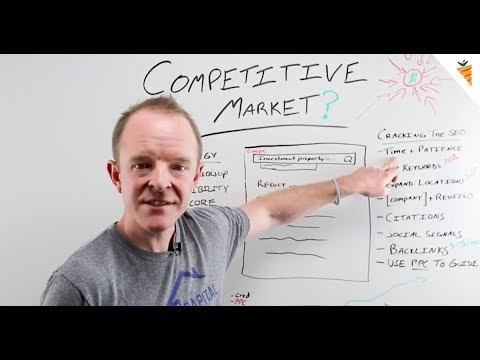
  • Real Estate Marketing Online: How to Rule With SEO In Competitive Markets [Whiteboard]

    Real Estate Marketing Online: How to Rule With SEO In Competitive Markets [Whiteboard]

    Real Estate Marketing Online: How to Rule Competitive Markets

    Transcript

    Are you operating in a really competitive market like a Houston or a Dallas or just a large market where there’s a lot of competition? Well, a lot of our clients are and every single week we do coaching calls on every Tuesday at 11 o’clock Pacific time for our care customers who are in content pro membership or above.

    And one of the main questions we get on a really consistent basis is, “Man, I’m in a crazy, competitive market. There’s a lot of other investors, investing there, and there’s a lot of other care clients there. Can I crack through it and how do I do it?

    The first answer is, “100% yes, you can.” That sounds like a political stump that I just did there, yes you can, yes you can do it, we have clients every single day who are going out there implementing the plan we lay out on these whiteboard strategy sketches, on our coaching calls in our training’s and in, through support and they follow these methods I’m going to show you to get that result. So I want you to know that it can be done, but you gotta follow this to a T and don’t come complaining to me if it doesn’t work if you don’t do these.

    Online Real Estate Marketing in Competitive Markets

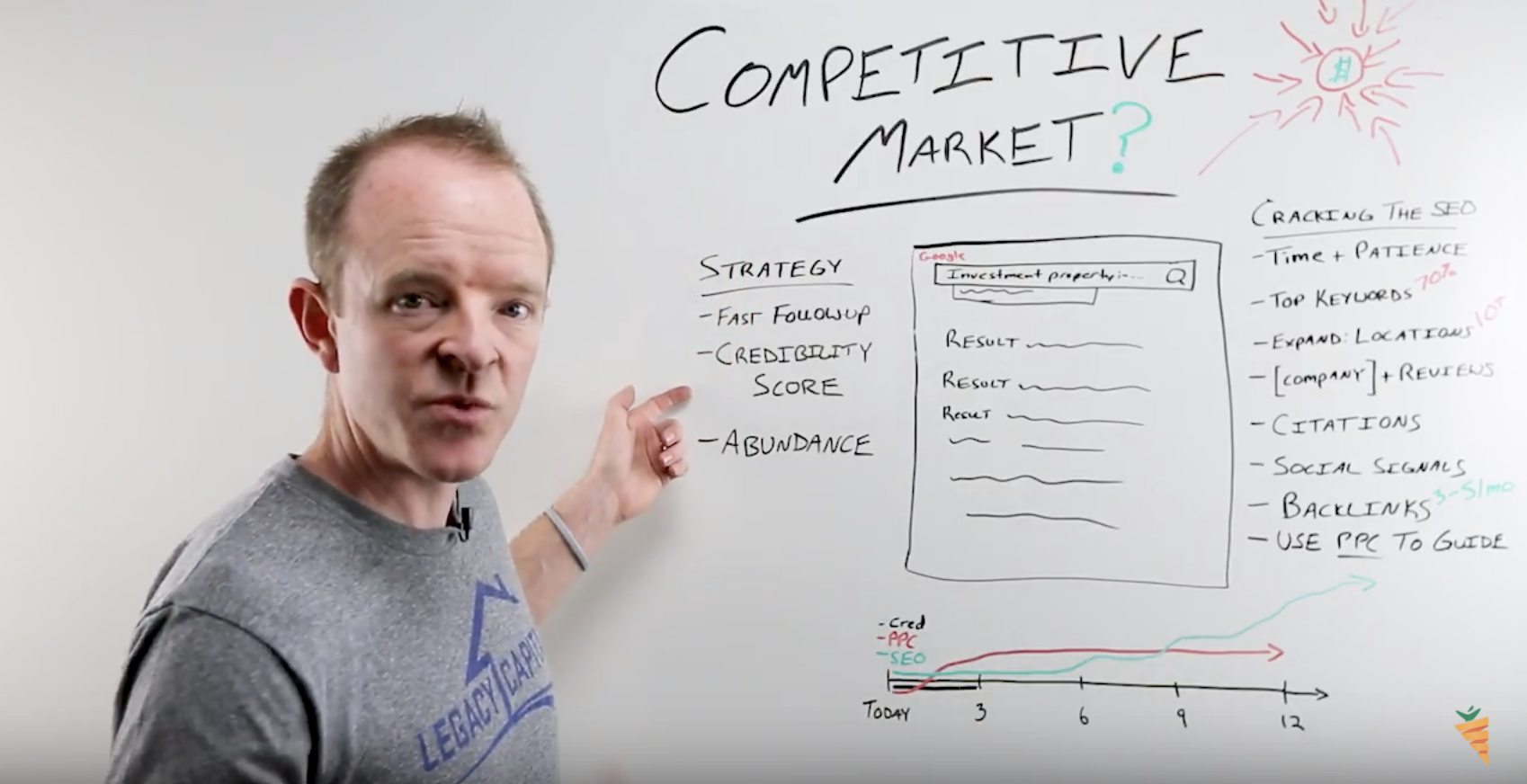
    OK, so here we go. So if you’re in a competitive market I’m gonna be kind of walking you through, how do you get in that search result for search engine optimization but also just in search in general, to get those consistent stream of leads coming in to fuel your business because when you’re in a large market like that you really can go deep in that market like we’ve talked about in other whiteboard strategy sketches you can go deep, and you can focus just in that market for the first year and get 30-40-50-60 leads a month if you really hit it hard, okay? And that can fuel your entire business 2-4-5-6-10 deals a month if you do it right.

    OK? So we want to get you here first of all, and we want to get you there through paid and through SEO in the competitive market. It’s going to be really hard to get really consistent, and a lot of momentum with just SEO okay? PPC is great, but you can stack on SEO to really add momentum over that year and this is kind of what we want to do.

    We’ve done a whiteboard Strategy Sketch on this exact topic before go check out youtube, go to YouTube.com and then go look up InvestorCarrot, find our channel, the first thing you need to do is subscribe to our channel the second thing you need to do is go search our channel for a video I think it’s called the 90-day marketing plan or something like that where we layout in a lot more detail what you should do in the first 90 days in any market to have leads coming in and to set yourself in a really, really solid foundation, okay? But we’re gonna give an abbreviated version of that today.

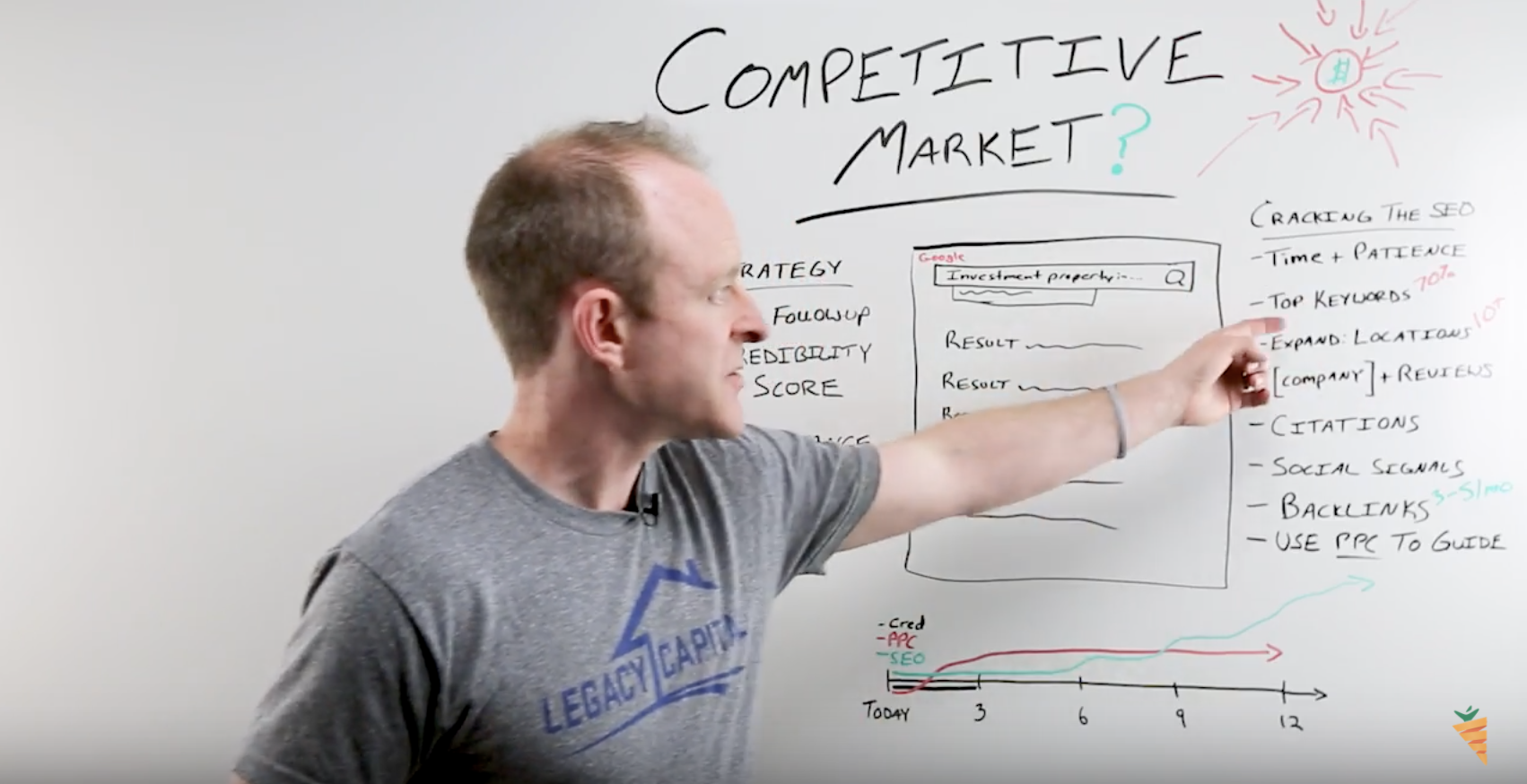
    So you’ve got here, and you’ve got twelve months out there and if you’re in a large market the first thing you need to do is we need to know that it’s going to take time, and we need to have a lot of patience, okay? Because with SEO, search engine optimization large market, it’s probably going to take you between 7, 8, 9, 10, 12 plus months to really get that momentum to get that ranking that’s going to get those leads to start trickling in and then start coming in more.

    I was talking to one of our clients yesterday, Martin, out of Phoenix, Arizona and he’s flipping a lot of houses, okay? Ten plus houses a month and when we were talking, you know a year ago he joined Carrot a little over a year ago he was in a very competitive market, he wanted to get some more organic traffic coming in, he was turning on PPC as well, but we’re like, you know what? I think that there’s going to be a great chance for you to crack into this market from a website that had never ranked in the top three pages of the main seller search phrases to what it is today getting really consistent leads, and he’s in top one-two-three rankings in google for the most competitive search phrases in Phoenix, how did he do that? The first thing, like I said, locked, and then it’s gonna take time, and he knew it, and he knew that he was going to have to be patient okay?

    Choosing Your Top Keywords

    The second thing, is we need to go out there and choose the top keywords, so what are those top keywords that are likely going to give us 70% or more of that traffic? For house sellers it’s likely your cash for homes, sell my house fast, insert city, we buy houses, insert city, there are a few others, just go to carrot.com/seo-bible, and you can check it out, we have a full report there that goes through all of the top motivated house seller keyword phrases for SEO, and you can check it out. If you’re doing pay per click go to carrot.com/ppc-keywords and oncarrot.com/seo-bible, and you can find both those reports where we give you all of the keywords based on our research, so we solved that one for you.

    keywords in real estate investing in competitive markets

    Alright but the first thing that we always like to do in a market, in a really competitive market is we’ve got to get leads coming in right now okay? If we don’t have leads coming in right now and it’s gonna take us 6, 7, 8, 9, 10, 12 months to start to get the real traffic to get traction and get deals in that market it becomes really, really discouraging, you know none of us want to be discouraged on our journey to grow our business or start our business so get pay per click going right away, okay?

    PPC Marketing

    In that first month to two months and it you don’t know how to do PPC we have a lot of resources on our blog you can check it out at oncarrot.com forward slash blog, or we have guides and resources and checklists on how to do it and we also talk about it all the time in our coaching calls if you are a carrot customer, and our three lead per day training okay also during that same time period during the first month to three months, in a competitive market the biggest thing we need to focus on is, how do you stand out from your competitors, how is it that your clients are going to chose you versus the 7, 8, 9, 10, 12 25, 30 other investors that are also vying for their business?

    The people that sent them that direct-mail piece, the people that have the bandit signs up in their neighborhood the people that are in the same rankings, the same paid search results that you’re competing for. Even if you get there, even if you get right here, and you don’t take care of the credibility piece then you’re not gonna win the game, the other people are going to win the game okay? So focus on that as a core strategy, what is your credibility score?

    Building Credibility

    We have a CarrotCast episode, which is our weekly podcast, just go to CarrotCast.com, and you can go directly to the CarrotCast to find our episode on credibility score. You can even go to Google and Google Investor Carrot credibility score or CarrotCast credibility score, you’re going to find that episode where we walk you through everything you need to do to ramp up your credibility whether you’re an experienced investor or brand new and set yourself apart. Also, we did a CarrotCast episode on USP, unique selling proposition, which in a competitive market that is a requirement, you’ve gotta have a unique selling proposition why people should choose to work with you versus someone else. Tackle those in the first three months.

    increase your website credibility score

    Get your PPC up and going, get leads coming in in the first several weeks get your first deal in the first month or two, and then during that time you’re setting up your SEO foundation the first one, two, three, four, five, six, seven months in a competitive market you’re likely going to get no leads so prepare for that mentally, okay?

    Consistency Wins the Game

    But after you start implementing that plan consistently over those months you’re gonna see a bump, and you’re gonna see another bump, and you’re gonna see another bump and around that 10 to 12,10 to 14 month time period if you’re implementing SEO well you’re gonna start to see those results coming possibly even quicker, okay? We have some clients in our concierge traffic service, which is a high-end service that we do internally for clients that are closing a lot of deals that are in really competitive markets that we were able to crack through the top five in the first five to six months and now we’re working on getting through that top three, but they’re already getting SEO leads in the first five to six months, that doesn’t always happen, but it can happen okay?

    So, make sure you’ve got that locked down in your mindset now if we’re going to go through on the SEO side of things in a competitive market here’s what we need to do, we need to go after the top keywords that are going to give you 70% of the traffic, go to those resources I mentioned before to find those keywords on PPC and SEO, okay then what we’re going to do next is expand locations immediately in that first one to three months at location-specific landing pages, We’ve done other whiteboard videos on this topic, and we teach in detail in our training if you’re a carrot customer in our blog we have a lot of free resources as well.

    So launch about ten location-specific landing pages and what those are, if you’re in Dallas, but there’s Ft. Worth and there’s a lot of other cities around Dallas that are suburbs or surrounding cities that you would also buy house in, launch pages on your Carrot site or another site that are specific to that location for your primary keywords, okay? For your primary keywords. And get at least ten of those up because those are going to be easier to rank for thank that primary large market of Dallas or Portland that big market and those rankings are going to happen faster so as you’re working on your SEO those are going to climb faster, your primary markets gonna climb a little bit slower, and they’re gonna rise together.

    Build Citations

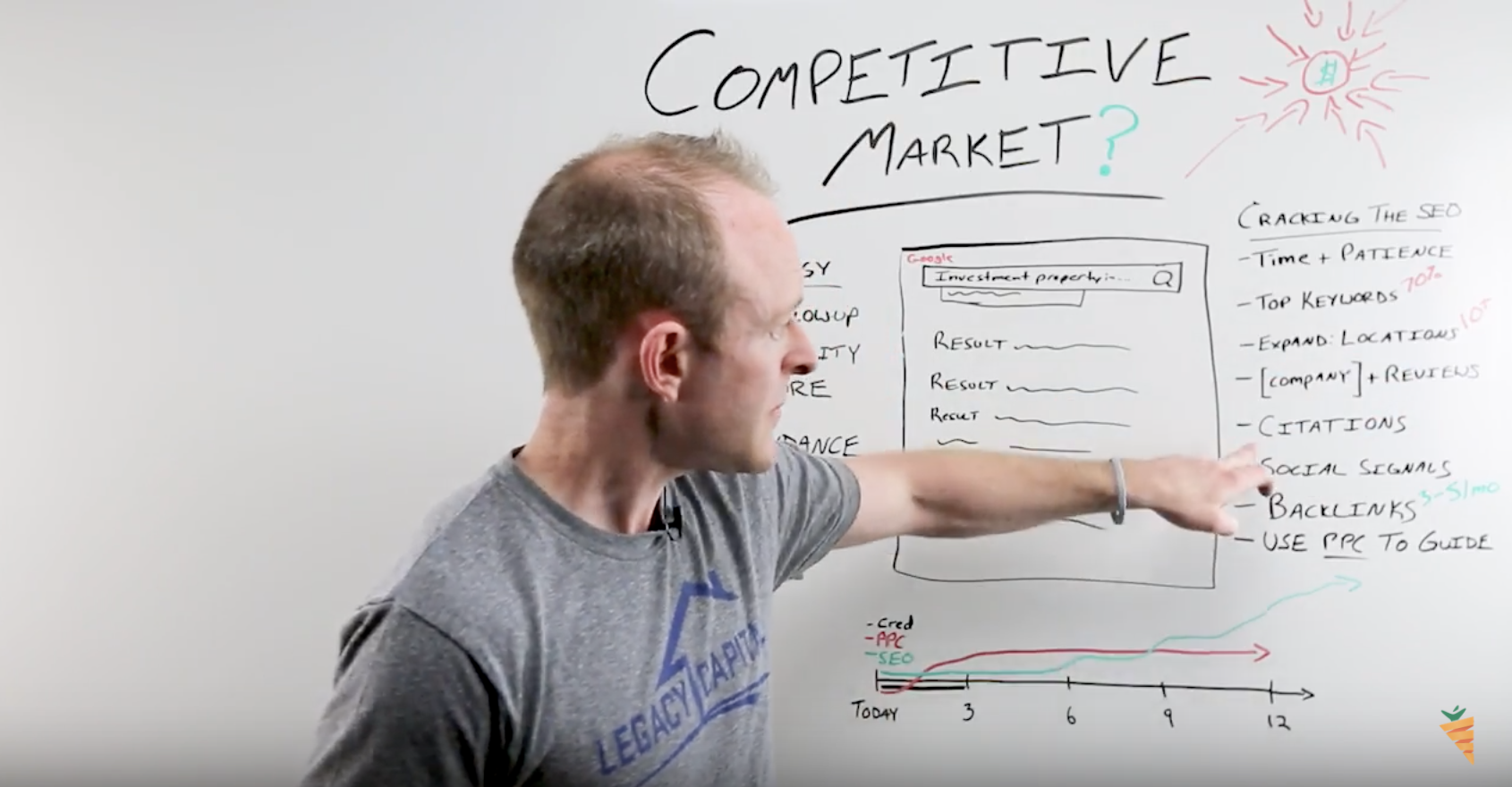
    Next, do your citations, okay? Go to our blog, carrot.com/blog we talk about citations. If you’re a Carrot customer we can do your citations for you in our marketplace so check out our marketplace but this sets the foundation for credibility for your website in that local market right here, optimize for your company name plus the word reviews ‘cuz if you’re doing pay per click, or you’re getting traffic, or you’re doing direct mail we need to make sure that you rank well for your company name when people are trying to research you to see if you’re legit, and you never want to lose any deals because someone googles that and then don’t find any good things about you okay?

    Building real estate citations

    So optimize your about page for company, company plus your reviews then go get a Better Business Bureau Profile pay that three – four-hundred bucks, whatever it is, and then drive your clients over there to do reviews and optimize it as well for this and that going to help you close more deals.

    Social Signals

    Next are social signals. Get five, ten, fifteen people to google plus your homepage and Facebook like it over the first two months, backlinks if you’re going to do your own SEO just grab for three to five backlinks a month it’s not a big deal, and we teach how to do this in blog posts, we teach how to do this in our coaching calls, and our three lead per day training, if you’re a member, has it very, very detailed okay?

    If you’re not a client we don’t sell that to the open public yet but we will if you’re watching this video after I publish this video just go to carrot.com/3lpd, don’t do it right now because nothing exists but if you’re doing this for several months, go to carrot.com/3lpd, you can check it out.

    PPC to Guide SEO

    Last, use PPC, use your pay per click data to guide you on your SEO that’s one of the biggest mistakes people make in competitive markets, is they use their pay per click and their SEO in silos, what we always like to do is launch your PPC campaigns, find out the ones that are converting into leads and turning into deals the most and then go after those keywords in your SEO so use PPC to guide you.

    I’m gonna wrap this up, fast follow-up is huge in that market, if you’re in a competitive market you need to be calling your leads back within minutes or answer them live. We’ve talked to many clients that as soon as they switch to answering their calls live from pay per click and SEO they started closing more deals okay? It’s a big deal.

    Answer them live and if you’re a Carrot customer turn on your text message notifications where you get a text message notification within seconds of a lead coming in, you’ll have a phone number there you can tap the phone number, call them up fast follow-up’s gonna help you cut through in that market. And then last, have an abundance mindset okay? One thing we always love to do is, there’s enough for everyone. There’s enough to go around for everyone; leads, deals, success, abundance, share that with people in your market, don’t try to hold all of your secrets in, the more you share, honestly the more comes back to you. So have that abundance mindset.

    Real Estate Marketing in Competitive Markets

    Alright, you’re in the competitive market, use that as a blessing, it’s a great thing for you, don’t say, “oh my gosh I’m in this crazy competitive market it’s going to be hard.” It will be work, but there are amazing, amazing things for you on the other side of it. When you have the patience and time locked in your brain you have the plan and you’re working with the right team. Alright? Go after it, tackle it, check out our other episodes of Carrotcast go to carrotcast.com and our other carrot whiteboard strategies sketches on our youtube channel just subscribe right here, here wherever the heck it is. Subscribe to our channel and you get updates as soon as they come out.

    Learn more on the Carrot YouTube channel and start growing your business by leveraging the web as a real estate professional!

  • EP 63: #1 Real Estate PPC Metric: You Need To Build Into Your Real Estate Marketing Strategy w/ Adrian Nez

    EP 63: #1 Real Estate PPC Metric: You Need To Build Into Your Real Estate Marketing Strategy w/ Adrian Nez

    The #1 PPC Metric You Need To Build Into Your Marketing Strategy

    Listen to the CarrotCast Podcast and Subscribe Below!

    Change your mindset. Look at your marketing not as a cost but as an investment.  Adrian Nez

    We’re talking about lead generation on this call. But…it’s a little bit of a different one. I’m going to set the stage for you. Whenever we talk about lead generation, there are a few steps that we always want people to take because of a proven path. This is the model to follow that works, and it works over and over and over again.

    The first thing, you got to dial in your website. Nailing step one, getting a high-converting website with the right strategy.

    Step two is what we’re going to talk about today. You need to pick a traffic plan and get traffic and leads coming in soon, and one of the best ways to do that is with pay-per-click marketing, whether it’s through Google or Bing or even Facebook if you do it right. One of the things that most people don’t do is they don’t look at and they don’t focus on this one metric that Adrian and I on our team spent some time.

    We did a Facebook Live and what you’re going to listen to is actually the recording of a Facebook Live that we did yesterday, as of the time I’m recording this, where we walk through and the number one most important metric that I feel people should be looking at when it comes to paid traffic. If you follow this real estate PPC metric and then you follow our training on how to dial in your pay-per-click marketing through Google and Bing, you are going to succeed. Okay? It’s just going to happen.

    One of the things that most people don’t do is they don’t focus on this one metric that Adrian and I are going to cover. We walk through the number one most important metric that I feel people should be looking at when it comes to paid traffic. If you follow this metric and then you follow our training on how to dial in your pay-per-click marketing through Google and Bing, you are going to succeed.

    What is the number one most important real estate metric according to me when it comes to your paid traffic? Well, piggybacking off of a call I recent CarrotCast, we take a look at how to use simple math to really help your paid marketing become a lot more successful. This is going to help you do this one calculation that could change the game with your pay-per-click.

    Really dive in, nail this number that we’re going to give you. It’s going to take you five minutes to do your own calculation, and we’d love your feedback.

    Listen to our other episodes at www.carrotcast.com.


    Listen to the CarrotCast Podcast


    [podcast-subscribe]

    Enjoy this CarrotCast episode. Use this #1 Real Estate PPC Metric and Change from Marketing Cost to Marketing Investment.

    4:15 – Removing emotion from your marketing. Using simple math equations.
    6:00 – Adrian’s PPC journey. Why what he implements works so well in his market.
    7:15 – The main philosophy around this real estate PPC metric. Working the math to find your cost per lead.
    10:40 – What Adrian’s AdWords campaign looks like right now. His cost per lead and lead volume.
    15:30 – Taking a look at Adrian’s max cost per lead.
    23:15 – Factoring in the lifetime value of a client.
    30:35 – Adrian dives into his to his account in real-time.
    34:15 – Drilling down into your Analytics data to further optimize accounts.
    36:20 – The difference in mindset between success and failure. Jump over that hurdle.
    39:25 – Look at your marketing as an investment, not as a cost.

    [podcast-subscribe]

  • The 5 Most Common Facebook Marketing Objections From Real Estate Investors

    The 5 Most Common Facebook Marketing Objections From Real Estate Investors

    Facebook Marketing for Real Estate Investors

    50. That’s the average number of minutes we spend on Facebook every day.

    It sounds crazy at first, but when you consider that Apple reported the average iPhone user unlocks their phone over 80 times a day, maybe it’s not that surprising. We love our mobile devices, and we definitely love Facebook.

    So we spend a lot of time on Facebook, but does that matter for Real Estate? Can all those hours spent on Facebook really translate into leads and deals?

    I’ve spent countless hours working with investors from all across the country and have assembled five of the most common misconceptions about Facebook marketing for Real Estate Investors.

    Here’s what they are and why they’re misguided.

    Objection #1: “Facebook Marketing for Real Estate Investors Is Too Expensive.”

    Imagine you found a vending machine, and every time you put 100 dollars in that vending machine, it gave you $500 back. How many times would you put in $100? Forever, right? You’d do it forever (or hire someone to do it for you) because you know there is a positive return.

    What if the vending machine started charging $300 in return for $500? Would you still keep feeding it money? Probably. If the price kept increasing, at some point, you might stop — at the very latest, you’d stop at $500 because now you are breaking even.

    Marketing is your vending machine. The deals produced from marketing are the output, just like the example above.

    Do you know, for your business, the maximum you can pay per lead and still remain profitable? If you don’t, figure that out today! Investor Carrot has a fantastic calculator you can use.

    “Expensive” is a relative term. You need to know your business in order to set appropriate expectations. If your ideal cost per lead is $200 and it takes 10 leads to close a deal, you might have to spend $2,000+ on marketing to get a deal. Too many people start a campaign and give up too early because they did not know their numbers and fail to clearly define success metrics.

    Truth: Expense is relative to return. Know your numbers so you can make smart decisions based on data.

    Objection #2: “I Didn’t See Leads Right Away. I Guess It Doesn’t Work.”

    In a perfect world, every marketing channel would provide immediate results. That’s the dream, but unfortunately, not the reality.
    Most campaigns take a time to build momentum. This is certainly true for Facebook. Several factors contribute to success such as budget, market size, existing traffic on your site (retargeting), market timing, and quality of ad content.

    Your first month will be your slowest month. If you have a few extra marketing dollars and want to give Facebook a try, make sure you really assess how committed you are. It’s possible, those few extra dollars are better spent on an existing channel such as PPC or direct mail. I suggest a commitment of at least 90 days – even better is 4 – 6 months – to fully realize the benefits of Facebook.

    Truth: Be committed. You need at least 90 days to build good momentum.

    Objection #3: “I Am Going To Clog My Friends’ Newsfeed With Ads.”

    Some people want to clearly differentiate their personal and professional social media lives.

    I’ve seen several incredibly successful investors openly sharing on their personal page, but if you fall into the “let’s keep it separate” category, there is good news – with Facebook Business Pages and powerful targeting options, you can run successful ad campaigns while keeping your personal feed clear for cat memes and cute pics of your friends’ kids.

    Truth: Your personal and business Facebook presence can be as connected or separate as you want.

    Objection #4: “I Need A Bunch Of Likes On My Facebook Page.”

    At one point, this was true.

    Several years ago, Facebook provided powerful organic (non-paid) reach to the fans of your Business Page. When The Color Run had over 4 million Facebook fans, we could post and get tens, even hundreds of thousands of people engaging on the post. It was thrilling to refresh the page and see the comment count jump exponentially. Then, almost overnight, Facebook announced they were changing their algorithm.

    The era of pay to play on Facebook began. The same type of post at The Color Run now created only a couple hundred engagements. We had spent thousands of dollars (and hours) creatively building our fan base, and now we could barely even reach a fraction of our potential. It was a hard pill to swallow, but in the digital world, the only constant is change.

    We adapted, and continued to see incredible success from our Facebook campaigns.

    Long story short, even if you had a bunch of likes on your page, you would still have to pay to reach them.

    Truth: Facebook Page Fans are now just one of many audiences you can target. Do not let building a fan base stop you from getting started.

    Objection #5: “It’s hard to find motivated sellers on Facebook.”

    Okay, this one is sometimes true. It can be hard. But here’s the good news — it’s hard for your competitors too, which means they likely aren’t doing it. That equates to untapped opportunity.

    Of course, not everyone on Facebook is a motivated seller, but it’s very likely that the motivated sellers in your area are on Facebook.
    You might be thinking, “yeah, but my typical deal is with someone in an older demographic.” They’re on Facebook too. In fact, 33% of all Facebook users are over the age of 45, and 17% are older than 55. That’s almost 1 in 5 people over the age of 55. And these people are clicking on ads. In some of my recent client campaigns, on average, 57% of leads came from people 55 and older.

    Truth: Using strategic targeting, such as custom and lookalike audiences, you can carefully target your ideal demographic.

    The Worst Myth Of All: “Facebook Isn’t Worth My Time.”.

    Finding motivated sellers on Facebook is a highly specific targeting challenge to be sure, but it’s that very fact that makes Facebook such an exciting avenue for your REI business.

    If it were incredibly simple, everyone would be doing it. Because it takes some finesse, Facebook remains a largely untapped resource to the most dedicated investors.