
Author: Jamie Saine

  • Top 5 Ways to Find Off-Market Properties (That Other Investors Miss)

    Top 5 Ways to Find Off-Market Properties (That Other Investors Miss)

    You don’t have to be lucky to get off-market properties as a real estate investor. You just need to know how to find them and how to get them to you before they go on auction sites, Zillow, or to a competitor. 

    These five proven methods show you exactly how to build that pipeline ethically, legally, and in a way that’s scalable. 

    KEY TAKEAWAYS

    • There are a variety of ways to attract off-market properties, and strategies that will fit any real estate investor’s budget. Some are more manual, some produce quick results, and some set you up for long-term success.
    • Real estate investors benefit from using multiple methods of attracting off-market properties to balance quick lead generation with long-term lead flow.
    • You can attract off-market properties with both online and offline methods.

    Attracting off-market investment properties is a good option for both new and seasoned real estate investors as there are multiple strategies and some budget-friendly options. Keep reading to see the top five ways to attract off-market properties, the pros and cons, and how to set up each one.

    Table of Contents

    1. SEO (The Best Way to Find Motivated Sellers)
    2. Driving for Dollars (Most Budget-Friendly)
    3. PPC Ads (Fastest) 
    4. Networking
    5. Radio Ads
    6. What’s next?
    Carrot icon
    Lead generation, at its best
    Attract, convert & close more motivated leads
    Try Carrot Today

    1. SEO (The Best Way to Find Motivated Sellers)

    When someone types “sell my house fast” into Google, you know they aren’t casual sellers — they need to sell now and are willing to accept a lower price for speed and convenience. That’s exactly who you want to attract.

    How do you make sure they come to your website? 

    It happens through SEO (Search Engine Optimization) — the process of getting your website to show up in top search results when sellers type phrases like “sell my house fast” or “cash offer for home” into Google.

    To tell Google what phrase you want a specific page to rank for, put the phrase or some variation of it in:

    • Your page title (what shows in the browser tab)
    • Your website address (the page URL) 
    • The page’s meta description (the short description that appears under your link in search results)

    For example, if you search for ‘sell my house for cash in Texas,’ the top-ranking websites have exactly what I described: 
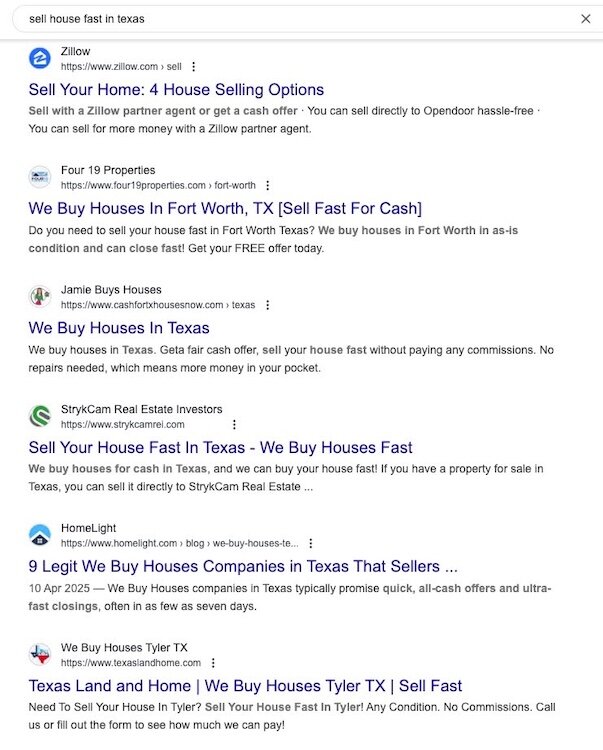
    If you look at “Jamie Buys Houses” in the screenshot above, it includes “We Buy Houses In Texas” in their title, “Texas” in their URL, and “sell your house fast without paying commissions” in their description.

    It’s also good to include the phrase you’re targeting at least a couple of times in the content of your page as well. 

    Look at Four19 Properties’ page for the keyword “sell my house for cash in Dallas.” They’ve included phrases like “sell house fast in Dallas” and “cash offer” on their page. 
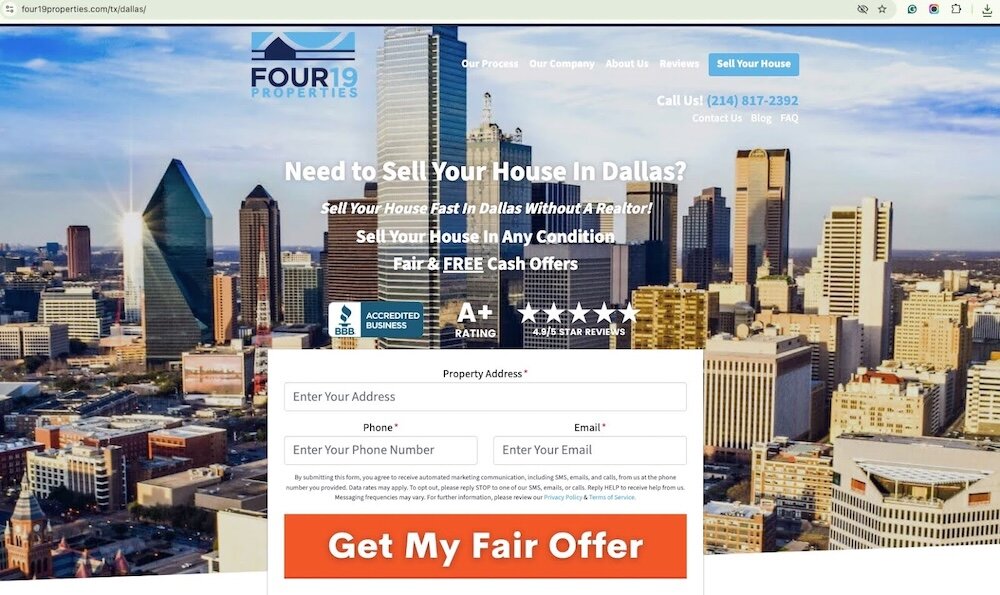
    Four19 Properties - Sell Your House in Dallas

    To find the right phrases to include on your page, you need to do keyword research. It is simply figuring out what words people actually type into Google when they’re looking to sell their house fast.

    Instead of guessing which search terms to target, keyword research shows you exactly what motivated sellers are searching for (the keyword) and how many people search for those terms each month (search volume).

    For example, you might discover that 720 people search for “sell my house fast Dallas” every month, but only 50 search for “Dallas home buyers.” 

    This tells you which phrase to focus on for better results.

    You can do basic keyword research using free tools like Google’s Keyword Planner or Ubersuggest. Just type in phrases you think sellers might use, and these tools will show you search volume data and suggest related terms you might not have considered. If you’re a Carrot member, Carrot also has a built in Keyword Explorer tool so you can easily find and implement the best keywords for your site.

    For a deep dive into real estate SEO best practices, check out the free guide Real Estate SEO: Top Strategies, Tips & Examples. It covers everything from keyword research to website optimization. 

    Pros of SEO for real estate investors: 

    • SEO leads convert at much higher rates because they found you, not the other way around. According to Carrot’s data, SEO leads generate approximately 2.5 times higher profit compared to leads from other sources. 
    • Unlike paid ads that stop working the moment you stop paying, SEO continues working for you 24/7 once you’re ranking well. You won’t have to spend time chasing leads. 

    Cons of SEO for real estate investors: 

    • SEO typically takes 3-6 months before you start seeing motivated sellers coming in. You need patience and can’t rely on it for quick deals when you’re just starting out.
    • Because it’s so effective, SEO is competitive. So it can be hard to rank for the high-intent keywords like ‘sell house in {city}, ‘sell fast for cash,’ etc. (To see how competitive top keywords are in your market, search your city with Market Scout.)
    • Getting your website to rank isn’t rocket science, but you’ll need to spend time learning the basics of keyword research, backlinks, etc. 

    If you don’t want to learn SEO yourself, there are real estate SEO experts you can work with.

    2. Driving for Dollars (Most Budget-Friendly)

    Driving for dollars is when you actively search neighborhoods for distressed properties that aren’t listed for sale. Though the name suggests driving, you can also walk, bike, or jog through neighborhoods — driving just covers more ground faster.

    Let’s look at five steps to make driving for dollars a success. 

    Step 1: Pick your target neighborhoods

    Start with areas you already know or where you’ve done deals before. Check your county records for zip codes with higher foreclosure rates or tax delinquencies — these often have more motivated sellers.

    It helps to schedule regular 30-minute driving sessions each week rather than trying to do it randomly. 

    Step 2: Look for signs of distress

    Look for homes with:

    • Overgrown yards
    • Peeling paint
    • Broken windows
    • Piled-up mail 
    • Or posted notices

    Record the address and move on. Being too obvious — like taking photos or lingering — can make neighbors uncomfortable. You can do more research later on. 

    Step 3: Leave a note (Optional)

    Leave a simple handwritten style note on the door letting the owner know you’re interested in buying. 

    You can write — “I noticed your house while driving by and wondered if you’d consider selling? Call me at [number].” 

    Or you can use pre-printed door hangers that look like they’re handwritten, like these from Ballpoint Marketing.

    Just respect “No Soliciting” signs and be considerate.

    Step 4: Research the property

    Before adding to your marketing list, quickly check if the property is already listed for sale (check Zillow or the MLS if you have access) to avoid wasting time on properties already on the market.

    Then, look up the property on your county assessor’s website (just google “[your county] property records” or “[your county] assessor”). This gives you the legal owner and usually their mailing address, which often isn’t the property address itself.

    If you can’t find the owner’s current contact information, use a skip tracing service like TLO, Batch Skip Tracing, or PropStream (costs typically range from $0.25-$1 per lookup). This will get you phone numbers or the email address of the owner. 

    Step 5: Reach out to owners

    Add these properties to your regular follow-up system

    For the highest response rates, use multiple contact methods — send a yellow letter or postcard first, then follow up with a phone call 3-5 days later. 

    Tracking which properties respond helps refine your targeting for future driving sessions.

    Pros of Driving for Dollars for real estate investors: 

    • Extremely low startup cost (just gas money to get started)
    • Lets you personally evaluate neighborhoods and property conditions
    • Can be done part-time during evenings or weekends

    Cons of Driving for Dollars for real estate investors: 

    • Time-intensive process requiring personal effort
    • Limited by how much ground you can physically cover
    • Not scalable without additional help or technology

    Can you do this virtually? 

    DealMachine is an app that lets you browse neighborhoods through Google Street View, without actually driving there. You can identify potentially distressed properties and mark them just like you would if you were driving. It’s great if you’re short on time or want to scout neighborhoods that are far from where you live. 

    To improve response rates, add a QR code pointing to your website to your postcards. When sellers scan the QR code, they’ll land directly on your site, where they can learn more about your services and see that you’re a legitamate business. 

    3. PPC Ads (Fastest) 

    If you have some marketing budget, PPC (Pay-Per-Click) ads and pay-per-lead services are the fastest way to generate deals.

    You set up your Google Ads account, create campaigns targeting keywords like “sell my house fast [your city],” and within hours people will be clicking and filling out forms.

    But competition is fierce, and hence expensive. 

    For example, when I searched for “sell my house for cash in Chicago” I saw 4-5 different ads. Meaning everyone is bidding on the same keyword.
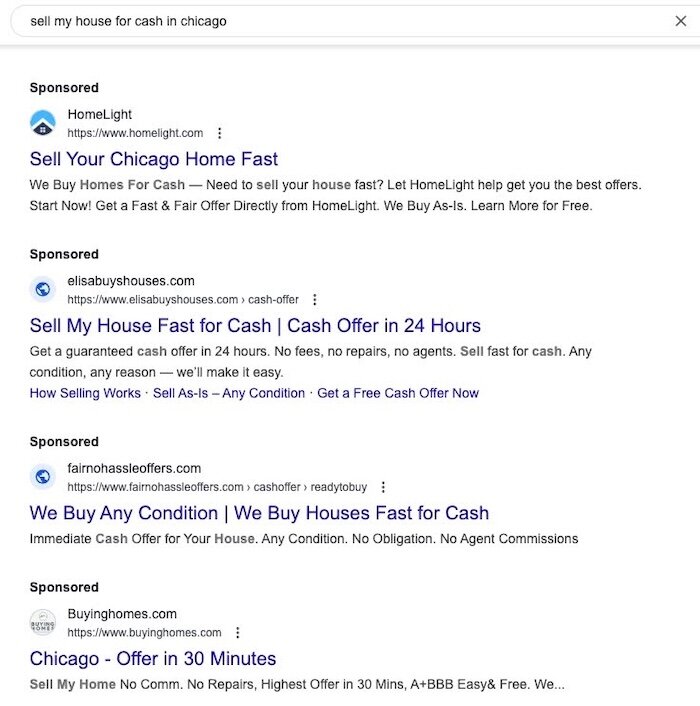
    When you have this many competitors, the cost per click skyrockets. 

    You might pay $15 – $50 just for someone to click your ad. If only one out of 20 people who click actually fill out your form, you’re looking at $300 – $1,000 per lead before you even talk to them.

    Here are three tips to make sure you’re not burning money on ads:

    1. Track every single keyword and ad. 

    Set up conversion tracking to see which exact keywords brought you actual seller calls. If you’re spending $500 on the keyword “sell house fast” but getting zero calls, turn that keyword off. 

    If “we buy ugly houses” is bringing quality leads for $50 per lead, increase the budget for that keyword. The goal is to not spend on keywords that won’t bring you quality leads. 

    2. Set up instant callback systems. 

    When someone submits your form, the system should immediately call both you and the seller, then connect you both on the same call within 30 seconds.

    Most investors wait 10-20 minutes to call leads back. By then, the seller has moved on or filled out three other investor forms.

    3. Your ad better stand out.

    In the example above, notice how each competitor tries to differentiate themselves:

    • “Cash Offer in 24 Hours”
    • “We Buy Any Condition”
    • “No Agent Commissions”
    • “Offer in 30 Minutes”

    You can’t just say “we buy houses.” You need a specific hook that makes people choose your ad over the others. 

    Facebook ads work completely differently than Google ads. 

    With Google, people are actively searching for you. With Facebook, you’re interrupting their scroll through family photos and memes.

    This means your creative needs to grab attention in under two seconds, and every single element of your ad needs to work together perfectly.

    Here’s how to structure a Facebook ad that actually converts:
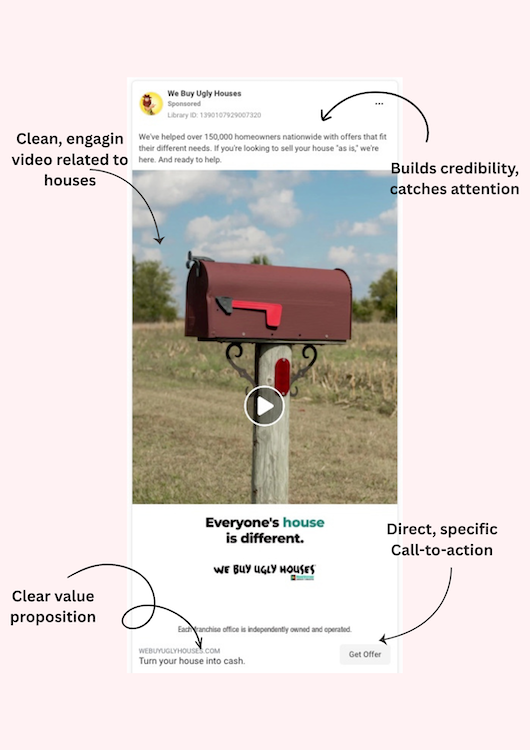
    1. A compelling description that builds credibility and captures attention
    2. A clean, engaging video (or image) related to houses
    3. A clear value proposition
    4. A direct, specific call-to-action button

    Pros of PPC for real estate investors: 

    • Generates leads immediately after campaign launch
    • Highly targeted based on specific keywords and search intent
    • Scalable by increasing budget as needed
    • Provides measurable ROI and performance data

    Cons of PPC for real estate investors: 

    • Requires upfront budget 
    • Google Ads has a learning curve
    • Lead costs vary widely depending on market competition (see the average cost-per-click for popular keywords with Market Scout)
    • Success depends on quick follow-up and conversion systems

    4. Networking

    You can’t buy houses from people who don’t know you buy houses. So you need to get the word out about what you do.  

    But that doesn’t mean you waste time at generic business events making small talk. You need to connect with people who either have deals or know people with deals.

    Here are some ideas: 

    Build professional networks

    Connect with estate sale companies, bankruptcy attorneys, and eviction lawyers. These people deal with motivated sellers every day.

    Insurance adjusters deal with the “3 Ds” — Death, Divorce, and Disaster. These are exactly the situations that create motivated sellers. Make connections with them. 

    Go to garage sales. 

    What do people do before they sell their house? They get rid of junk first. Walk up to someone running a garage sale and say “Hey, I’m not here to buy anything, but are you open to selling the house too?”

    Talk to everyone. 

    Tell every single person you meet that you buy houses. Your barber, server, Uber driver. Everyone either has a property problem or knows someone who does.

    Here’s proof this works:
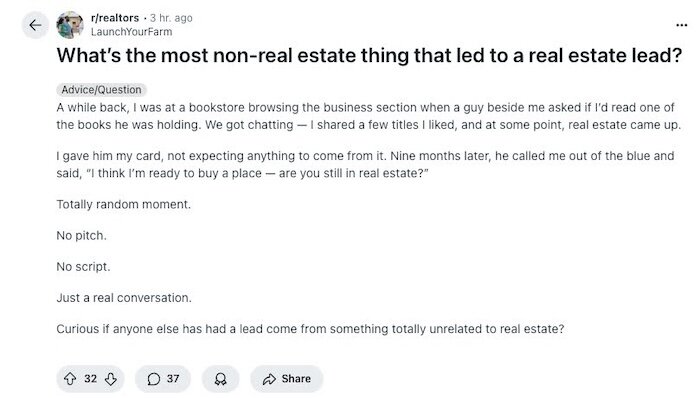
    Post on Facebook: “I need to buy a house this month. If you bring me a deal that closes, I’ll pay you $500-$1000.” Your network might connect you with someone. 

    Get to know a few real estate agents.

    Most agents can’t handle problem properties. Tell them: “If you get a hoarder house, something boarded up, or a place needing serious repairs, send it my way. You still get your commission.”

    Now when that agent gets a problem property listing, instead of dreading it, they immediately think of you. You become their go-to solution for deals that don’t work in the regular market.

    Pros of networking for real estate investors:

    • Gives you access to deals that never hit the market or listing sites
    • Professionals like agents and attorneys can pre-screen deals based on your criteria
    • Relationships tend to strengthen and improve over time

    Cons of networking for real estate investors:

    • Requires consistent follow-up to stay top-of-mind
    • Results often come in unpredictable waves rather than a steady flow
    • Hard to scale beyond your personal capacity to maintain relationships

    5. Radio Ads

    Radio can be an underrated way to generate motivated leads. There’s a misconception that they don’t work. But that’s because most investors pay way too much. 

    Check out this interview with Chris Arnold to learn more about how he relied on radio advertising to build and grow multiple companies.

    All Radio. All Virtual. How I Used Radio Ads to Build My Business and Lifestyle w/ Chris Arnold

    Here are the steps you can follow to get started with radio advertising:

    Step 1: Choose the right stations

    There are three main radio genres to target:

    • Urban stations – for deals in cities with younger demographics
    • Rural stations – for small town and countryside properties
    • Over 50 stations – for older homeowners who are more likely to sell

    Ask stations for their demographic breakdowns — listener data showing age, income, and location of their audience — and advertise on stations that match your seller persona. 

    Step 2: Negotiate pricing and secure good time slots

    Start with relationship building: Find a media buyer who already has relationships with radio stations. Solo investors rarely get the pricing they need to make radio profitable.

    Negotiate hard: Posted rates are just starting points. Most stations have flexible pricing, especially for longer-term commitments.

    Target prime listening times: Book morning and evening rush hours when people are actually in their cars listening.

    Write your own ads (avoid the station’s help)

    Radio stations will offer to help write your ad. Avoid them completely. They don’t understand how to position you to motivated sellers.

    This framework works great: 

    • Call out the problem your listener has
    • Present your solution
    • State who you are clearly
    • Give a clear call to action

    Keep it empathetic, not aggressive. 

    People are nervous and possibly heartbroken during the selling process. Don’t use harsh language like “We’ll stop your foreclosure now!” or “Get quick cash and leave your home!”

    Step 3: Set up your phone system before you launch

    Use easily memorable phone numbers for radio. Something with repeating numbers or similar sounds works best. People hear your ad while driving and need to remember your number instantly.

    You can also set up unique phone numbers for each station so you can track which ones generate the most calls.

    Pros of radio ads for real estate investors: 

    • Radio makes you sound like the established expert in your market compared to other investors
    • Most investors don’t use radio, so you’re not fighting five other “we buy houses” ads

    Cons of radio ads for real estate investors:

    • Without good negotiation skills or connections, you might pay $280 for what others get for $20
    • You need to answer live calls throughout the day, not just when your ad plays

    What’s next?

    Most investors spend all their time and money trying to get leads. They send out mailers, put up bandit signs, and make cold calls. But then what happens when someone actually calls?

    They write the person’s info on a sticky note, and forget to call them back for three days. 

    Getting leads is only half the battle. The real money comes from actually turning those leads into closed deals.

    That’s where Carrot comes in.
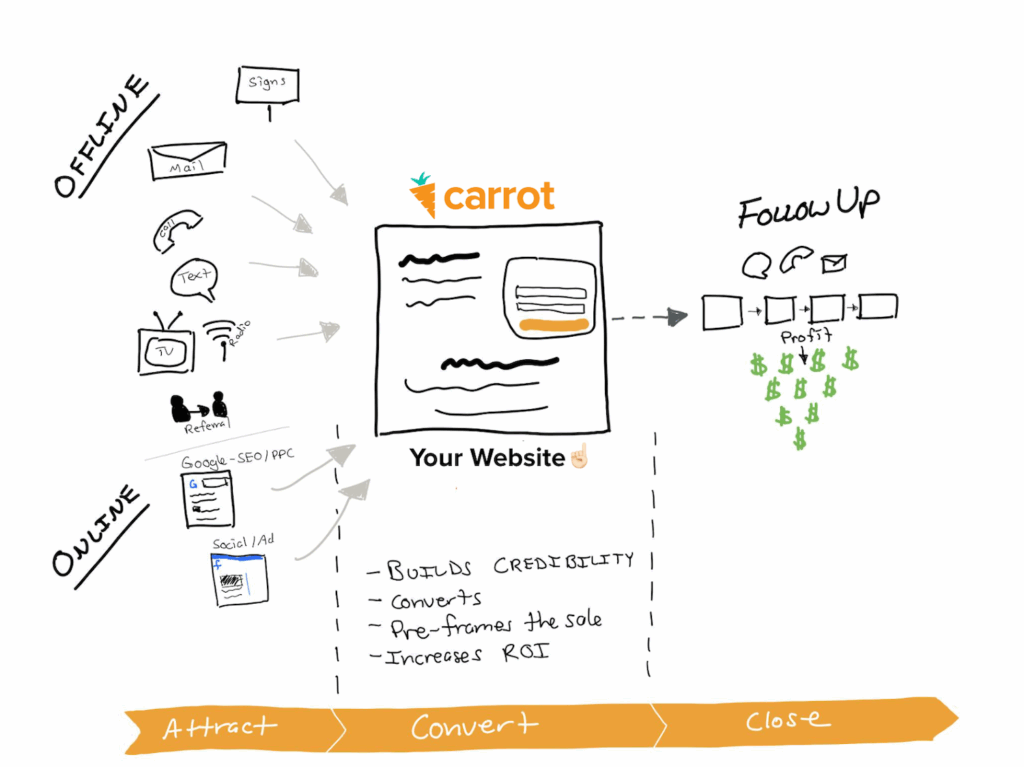
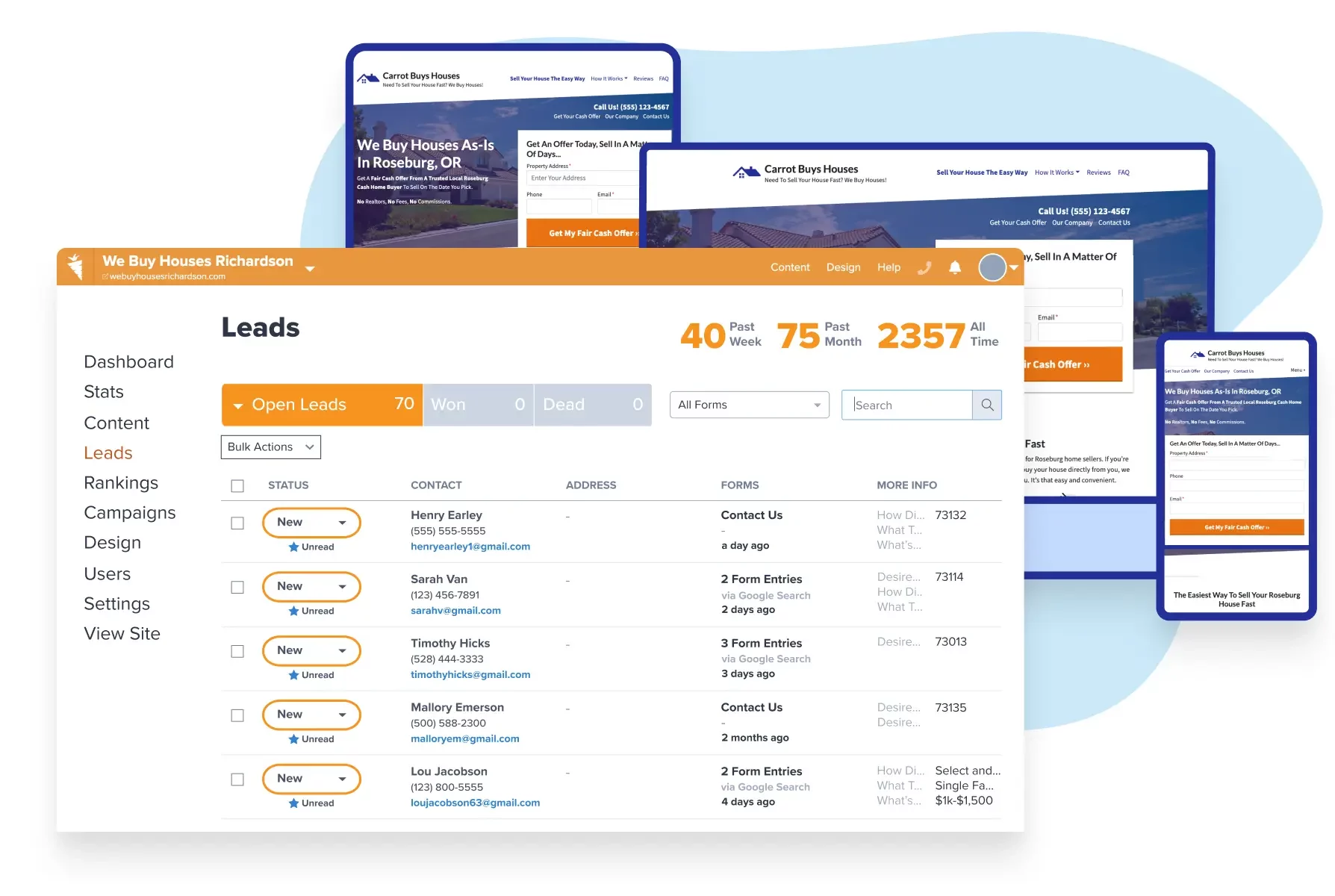
    It’s not just a website builder. It’s a complete system with CRM and digital marketing tools designed specifically for real estate investors to capture leads and turn them into deals.

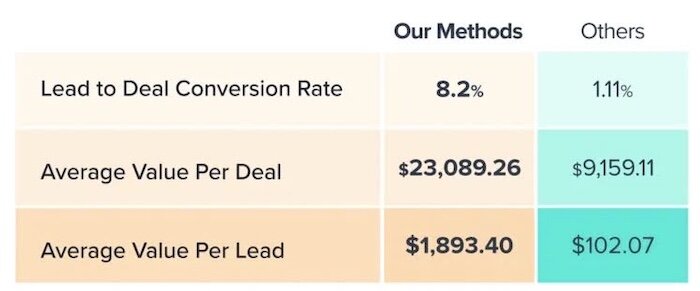
    The data proves it works: Carrot leads convert 7 times better and are 2.5 times more profitable than non-Carrot leads. The average Carrot lead is worth nearly $1,900 compared to just $102 for non-Carrot leads. 
    Even in competitive markets, investors with a Carrot website hold 45% of top search positions in most U.S. metros. With over 1 million motivated seller leads generated, the platform works whether you’re tech-savvy or not.

    Check out Carrot today and see why thousands of investors trust their websites, lead capture, and follow-up systems to this powerful platform.

    People also like …

  • 5 Ways to Attract Leads in a Competitive Real Estate Market by Standing Out Online

    5 Ways to Attract Leads in a Competitive Real Estate Market by Standing Out Online

    No matter what type of real estate investing you specialize in, finding the right deals makes or breaks the bottom line. And if you don’t want to spend all day, every day hustling and cold calling, having motivated leads come to you online is a great way to keep your pipeline filled.

    But how do you stand out in a crowded market and make sure leads find YOU first? Here are some actionable takeaways you can use to make yourself the most successful investor in your area.

    KEY TAKEAWAYS

    • Putting unique content on your website is key to ranking well in search engines and building trust with potential leads. If you use pre-written blog templates or an AI writing tool, take the time to add your own personality and insights before publishing.
    • Getting hyperlocal is a great way to stand out. People prefer working with someone they can trust, and they’re more likely to trust someone from their community versus a nameless, faceless investor.
    • Look at your competitors’ websites or top-ranking sites in other areas to figure out what you absolutely must have on your site and get inspiration for how to attract leads.

    In a competitive real estate market, you have to find ways to stand out. By doing your research, providing high-quality information on your website, and building trust by being hyper-local, you can stand out from the competition, attract leads, and fill your deals pipeline.

    Table of Contents

    1. Understand What You’re Up Against … and How to Stand Out
    2. Share Unique, High-Value Content
    3. Localize Down to the Neighborhood
    4. Showcase Your Local Knowledge
    5. Build a (Recognizable) Brand
    6. Be Yourself, Just Online
    Carrot icon
    Lead generation, at its best
    Attract, convert & close more motivated leads
    Try Carrot Today

    1. Understand What You’re Up Against … and How to Stand Out

    The first step of standing out is knowing your competition. Start by using Market Scout to see how difficult your investment market is, get marketing strategy recommendations, and see marketing insights like average website domain authority in your area, keyword difficulty, and how much paid ads cost.

    Glossary:

    • What is website domain authority? Domain authority is a score that measures your website’s quality and reputation based on key metrics like organic traffic, authenticity, and quality backlinks. While domain authority doesn’t directly contribute to search rankings, it is a good indicator of how search engines view your site. A higher domain authority score is better.
    • What is keyword difficulty? Keyword difficulty is a metric used to understand how many sites are targeting a specific keyword and, in return, how difficult it is to rank for that keyword. The higher the score, the more competition there is for that keyword.

    Now that you have a general understanding of the market and know what type of marketing strategies you should double down on (like SEO, content creation, or video), it’s time to dig deeper. Google keywords you want to rank for to see what information and linked websites come back in Google’s AI Overview and which webpages rank at the top of the search results. Take a look at these pages to see what they’re doing — what pages do they have, what kind of information do they share, what keywords are they obviously targeting? Use this as inspiration for what to include on your own website, then do it better!

    (Note: Don’t ever copy someone’s website, copy, blogs, or videos exactly. Use theirs for inspiration, but create your own content with your own spin and personality.)

    Do you find yourself saying, “But what about this?” when reading a competitor’s website? That’s a great signal that you should fill that gap!

    2. Share Unique, High-Value Content

    SEO trends are changing, but one thing remains the same: Search engines love unique content that is insightful, helpful, and answers common questions using the same language a searcher would use.

    In today’s online world, you can’t simply set up a website with basic pages and expect to rank or generate leads. You have to add additional topical pages, blogs, and FAQs to share your knowledge and gain a competitive edge.

    What questions have your clients asked in the past? What concepts do you find yourself explaining over and over? Are there any unique regulations or laws in your area that impact clients? These are all great topics for creating unique content on your site. 

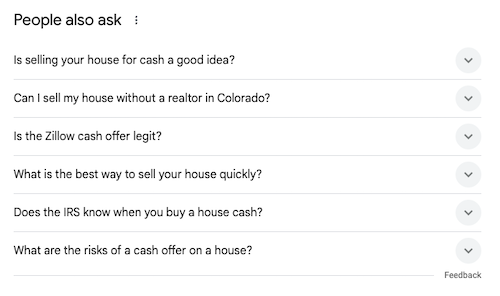
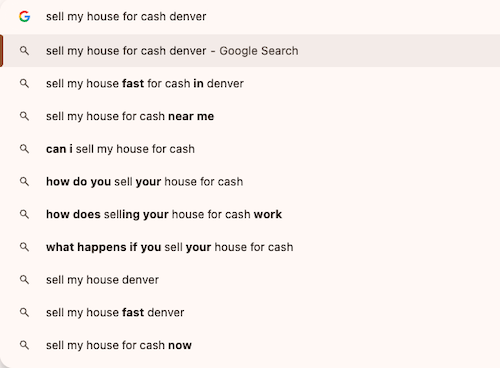
    You can also use Google’s autofill feature (start typing a search term and look at the phrases Google suggests) and the “People Also Ask” section of the search results to get ideas. These are based on real things people are searching for, so providing that information can help you attract leads.  

    Looking for unique topics to cover doesn’t mean you shouldn’t explain important terms or concepts your leads need to know just because everyone else does. Just focus on explaining it like you would in person, especially if your area has a specific dialect or uses certain terms. If you can, add details and data specific to your region (this is exactly the type of unique, high-value content search engines love).

    3. Localize Down to the Neighborhood

    Online search is becoming more and more localized. Even if someone doesn’t specifically search for something near them, search engines often serve up local results anyway. (Do a random Google search and scroll to the bottom of the first page. You might see a shockingly accurate location tag. My location changes when I’m five minutes away from my house because I’m in a different neighborhood within my city!)

    To make sure you come out on top either way, launch localized webpages targeting specific cities, towns, and even neighborhoods.

    What is a localized webpage?

    A localized webpage is a page on your website that uses a specific location as a target keyword. For example, if you’re a wholesaler in Colorado, you might have a webpage targeting Denver. The URL could be something like www.yourcompany.com/sell-house-fast-denver and the text at the top of the page (the H1) would say “Sell Your House Fast in Denver, Colorado.” This gives you a better chance of showing up in search results when someone specifically searches Denver or is in the Denver area.

    Set up webpages for more than one location

    But if you’re a real estate wholesaler in Colorado, you likely don’t only do deals in Denver. So you’ll want a localized page for every area you want to attract leads in — Lakewood, Westminster, Aurora, Arvada, etc. And remember how Google gets hyper-specific with your location? If you’re in an area with commonly used neighborhood names, set up localized pages for those as well. To keep with our Denver example, you might set up pages for West Highlands, East Colfax, or RiNo. This gives you a better chance of attracting attention from potential leads when they see that you really understand where they are.

    4. Showcase Your Local Knowledge

    Speaking of connecting with leads on a local level …

    Despite living in an always connected, global world, many people still like working with someone local. Think about the last time you needed a home contractor or mechanic. You might have Googled it, but you’re equally likely to have asked your friends, family, and trusted local network for a recommendation. People want to work with someone they can trust, and being local goes a long way in building rapport.

    Having a webpage targeting a specific town or neighborhood grabs attention, but what really builds trust is showing how much you know and understand the area. A few blocks can make a dramatic difference in many cities, and towns only a few miles apart might be night and day different when it comes to real estate. A big, national company won’t understand that.

    Look at each of those localized webpages you created and figure out what information you can add to highlight your knowledge of the area and give leads useful insights. A few examples include:

    • Highlighting deals you’ve done in the area
    • Sharing reviews or testimonials from past clients in that area
    • Explaining local regulations that may impact your leads
    • Calling out trends or local news that might be impacting the market in that area

    You can even stand in front of a recognizable neighborhood landmark and film a short video introducing yourself and your services using the specific area name.

    5. Build a (Recognizable) Brand

    Things like local videos published online help build your brand, which can go a long way in attracting leads and having leads choose you — especially in a crowded market.

    One of the five lessons shared in 5 Priceless Lessons from Million Dollar Investors is about getting personal and building a brand. It’s partially about putting people at ease as they decide who to work with, and partially about making sure you’re the one they think about right away when the time comes.

    “I want to make sure I have the brand so that if someone is thinking about selling their house in my market, they’re thinking about my company.” — Jeremy Resmer

    Traditional tactics like direct mail and bandit signs might help with this, but so do things like posting videos online or sponsoring a local little league team. Bigger ticket items like local TV or radio ads help with brand building, but if you’re creative and keep it local, you can find good opportunities to get your name, face, and logo out there.

    “Hey! I know you!” Real-Life Brand Building

    Justin Turner owns Turner Home Team in eastern North Carolina. Looking for a way to stand out and generate leads, he turned to a somewhat old-school method of advertising — billboards.

    “I’ve had so many people tell me they’ve seen my billboard. It leaves a lasting impression and brings more awareness than other campaigns,” Justin explained. “It makes me visible in my community in a way online ads can’t, helping me build real, local brand recognition that creates a stronger sense of trust.”

    It wouldn’t work without his website though. He warns this method (and any other offline outreach, like direct mail) relies on having a professional online presence.

    “[You have to have] a website people can research you on — they’re not going to do deals with some sketchy person just because of a billboard.”

    Since investing in billboards, Justin’s monthly organic brand searches on Google have more than doubled. After drawing in interested leads with the billboard, he uses his website to build trust and gain confidence by showcasing his experience, professionalism, honesty, and — most importantly — his team.

    “People trust those who they can relate to and understand.”

    Be Yourself, Just Online

    If there’s a theme to all of this advice, it’s to be authentic and helpful. Attracting leads is the name of the game, but the best way to do that is by remembering that leads are people.

    “This is a people business and real estate is a byproduct of what we do.”
    — Beau Hollis, 5 Priceless Lessons from Million Dollar Investors

    Do you find it easier to generate business face-to-face or by building in-person relationships? Bring that spirit and energy to your website. Using a few technical details shared in this post (like launching hyperlocal webpages) can get you in front of new eyes, but it’s up to the rest of your website content to sell your story. Be unique, be helpful, be approachable … be yourself.

    People also like …

  • 10+ Email Marketing Tips to Warm Up Cold Leads with Jay Schwedelsen

    10+ Email Marketing Tips to Warm Up Cold Leads with Jay Schwedelsen

    10+ Email Marketing Tips to Warm Up Cold Leads w/ Jay Schwedelsen

    You’ve probably heard the email advice: “Don’t use the word ‘free.’” “Keep your emails short or risk going to spam.” “Don’t use emojis in subject lines.” Turns out, a lot of that advice is outdated — and in some cases, flat-out wrong.

    Jay Schwedelsen, host of the popular marketing podcast Do This, NOT That, recently joined us on Carrot’s Evergreen Marketing podcast to share updated tips for successful email lead nurturing. Jay is undisputedly one of the top experts in the field and he shared 10+ tips and dispelled some popular myths around email. 

    If you’ve left email behind in your lead follow-up, it’s time to dust off your list. 

    “Your email list is probably the most important asset you have. Your email database is your owned asset. It is the only marketing channel for basically no money that you can communicate whatever it is you want to communicate at any given moment. There’s nothing else like that.” — Jay Schwedelsen

    Even if you are actively sending emails, you might be unknowingly making some mistakes that are hurting your engagement rate.

    Whether you’re an investor following up with cold leads, an agent sending out market updates, or just trying to figure out how to get more replies, there’s something in the episode for you. Here’s a sneak peek at three tips Jay discusses.

    Tip #1: Your emails don’t matter if they aren’t opened

    “A lot of times when we’re sending out an email, we’re worried about ‘oh what are we writing in the email?’ or ‘oh, what’s the offer?’ and that’s backward,” Jay explained. “If you don’t get the email opened, who actually cares what’s inside the email? So we have to get that email opened and the number one thing that’s going to get that email opened is the subject line.”

    When people look at their email inboxes, they scroll through quickly and decide what gets their attention. Jay contends that most people don’t read the entire subject line, instead focusing on the first few words.

    With that in mind, front-load your subject lines. Jay recommends starting a subject line with all caps or keeping it super short to make it stand out. Better yet, start your subject line with a number.

    “If you start your subject line with a number, your open rate will rise about 20%.”

    And forget about avoiding certain “spam trigger” words. It’s true that words like “free” or even dollar signs used to send your emails straight to the junk folder, but that’s not the case anymore. Feel free to write the most compelling subject line possible without avoiding important words!

    Need help with your subject lines? Check our Jay’s free subject line grader.

    Tip #2: Send more emails (yes, you read that right!)

    “You’re probably not sending out enough email. In the real estate market I see this a lot. People will get focused on their email sending for a month or two, and then they move onto something else, and they won’t send again for another 2-3 weeks or a month. The most important thing you can do to make sure you’re getting that business is to be sending enough. You need to be at least sending email weekly — at least!”

    Why? Because sending email frequently and consistently actually helps keep you out of the junk folder. It all comes down to email engagement, Jay explains.

    “If you don’t send enough email — and we see it in all the data — if you don’t send at least a weekly email to your database, you actually cannot generate enough opens and clicks to stay in that person’s inbox. It needs to be relevant stuff, it can’t be garbage. But sending out more email is step number one.”

    Since email engagement is actually what matters, Jay has a few tips to make sure people actually read and interact with your email.

    • Paragraphs should never be more than four lines.
    • Start your email with something super attention-grabbing. Don’t save the “hook” for the end … some readers won’t get there.
    • Restate the main point, offer, or action you want readers to take in a PS at the end of the email (to grab the attention of people who just skim).

    “When you have a PS with a call to action, a link in the PS, your click-through rates go up on average by about 15%.”

    Tip #3: Make your emails valuable

    “Don’t push offers until you’ve established the fact that you’re not annoying.”

    Let’s be honest, no one likes being sold to. But as real estate professionals and marketers, it’s our natural default to send offers and promotions. If you’re working on a cold list — or a new one — focus your first few emails on offering value to your leads.

    “For the first 4-5 sends, don’t promote anything. Nothing you send out should be a benefit to you the sender, it should only be a benefit to the individual you’re sending to. It’s hard to do because our nature is “sell, sell, sell” but you need to show the people in that database that you’re going to give them value.”

    Jay shares some ideas of valuable information to send your leads (you’ll have to listen to get his tips), but whatever you send can’t have a form in front of it. Offering value before asking for something builds trust and gets leads used to opening your emails. When you do send something promotional, they’re more likely to pay attention because of the relationship you’ve built.

    “It’s like dating. You can’t be just like ‘Hi, nice to meet you. Do you want to get married?’ It doesn’t work, it’s weird.”

    Tips #4-10: More gems from Jay

    In less than 40 minutes, Jay shares insights on not only how to successfully use email nurturing, but creative ways to grab attention and make your emails better every time. More tips covered in the podcast include:

    • Why the inbox promotions section isn’t as bad as you think
    • The best way to benchmark your email marketing success
    • How to get people to respond to your emails
    • Going beyond basic AI to really make your emails better (including using AI to analyze your competitors’ emails for new ideas)
    • Should you use emojis and memes in your emails?

    Stop Overthinking, Start Sending

    At Carrot, we talk a lot about building a business of freedom and impact. And email — done right — is one of the most powerful, low-cost tools you have to create conversations that lead to deals.

    So whether you’re following up with motivated sellers, re-engaging old leads, or just trying to stay visible, start putting these tips into practice. Then hit send. Test. Iterate. Improve.

    And remember: It’s not about perfection. It’s about progress.

    Listen to the full 10+ Email Marketing Tips to Warm Up Cold Leads w/ Jay Schwedelsen episode to unpack what’s actually working right now in email marketing. 

    PS – You can use these tactics in your automated outreach sequences in Carrot CRM!

  • Videos Increase Website Conversion Rates Up to 56% — Here’s How to Get Started

    Videos Increase Website Conversion Rates Up to 56% — Here’s How to Get Started

    Video content is the best way to boost motivated leads without requiring any extra website traffic. This article explains why video is a game-changer for website conversion, and shares practical tips to get the right video content on your website!

    Key Takeaways

    • Website visitors who start watching a video are 24% more likely to convert to a lead and visitors who watch an entire video are 56% more likely to convert!
    • You should have five types of videos on your website to share key information that visitors are looking for.
    • You can quickly and easily create videos with free tools like VN and Canva.

    If you want to increase your website conversion rate and number of motivated leads, read on to discover how to quickly add videos to your site.

    Table of Contents

    1. The Data Behind Why Video Matters
    2. The 5 Types of Videos Your Website Needs
    3. How to Produce Videos, Easily
    4. Where to Put Videos on Your Website
    5. Conclusion: Make 2025 the Year of Video
    Carrot icon
    Lead generation, at its best
    Attract, convert & close more motivated leads
    Try Carrot Today

    The Data Behind Why Video Matters

    Online video consumption is estimated to hit four hours per day in 2025, according to Oberlo. When sellers do their research on who to work with, they don’t just like to gather information via video, they expect it! That’s why it only makes sense that your website should include videos.

    It’s not just a matter of giving web visitors information in a format they prefer. Having videos on your website can dramatically improve your lead conversation rate (how many website visitors turn into leads). Based on recent data analyzed by Carrot, when a web visitor starts watching a video, their chances of converting to a lead increase 24% (over visitors who don’t watch videos). Visitors who watch an entire video have a 56% better chance of converting!

    Adding videos to your website also helps with SEO. Google places a lot of weight on “high quality” content that it believes will help users answer their questions and find valuable information. Since today’s users like to watch videos, Google likes when videos are available to answer their search queries. Answering common questions or covering popular topics lets you capture that search traffic more easily.

    As people watch videos on your site, they’re also inherently spending more time on the page. Google also views this as a positive indicator that your content (and by extension, your website as a whole) is valuable, which can positively impact your domain authority and search rankings.

    The 5 types of videos your website needs

    Videos are a great way to answer common questions, highlight your experience, and put visitors at ease about working with you. Think of video as your chance to be “face to face” before you ever meet a lead. You likely get some of your best deals by networking, so bring that same personality and energy online with video! Here are the most important videos to make for your website.

    Note: If you’re new to video, get our free Video Marketing Playbook for R.E. Investors for ideas, scripts, and easy steps to recording!

    1. “About ” Video

    Who are you? What’s your experience? Why should people work with you? Make a short video introducing yourself and let people get to know you so they feel comfortable reaching out. 

    Here’s a video that walks you through creating an “About us” video as a real estate investor or agent:

    How to Create an “About Us” Video for Real Estate

    2. Working with [Your Company Name] Video

    A “How it Works” video can put potential leads at ease by detailing what it’s like working with you. How does the process work? What steps can they expect? What objections might they have?

    3. Customer Testimonials

    Video testimonials from happy clients talking about what it’s like working with you and how pleased they are with the results are great on websites. Website visitors may be skeptical of a written quote, but watching people talk about their experience generates a lot of trust. 

    Here’s an in-depth video on exactly what to say to get perfect testimonials every time you close a deal.

    4. FAQ Videos: Explain Complex Topics

    Odds are your leads aren’t real estate professionals. They may even be dealing with a new-to-them situation, like selling an inherited home, renting-to-own, or selling a house fast for cash. Put them at ease by answering questions they’re likely to have. Leads want to work with an expert, so show off your knowledge!

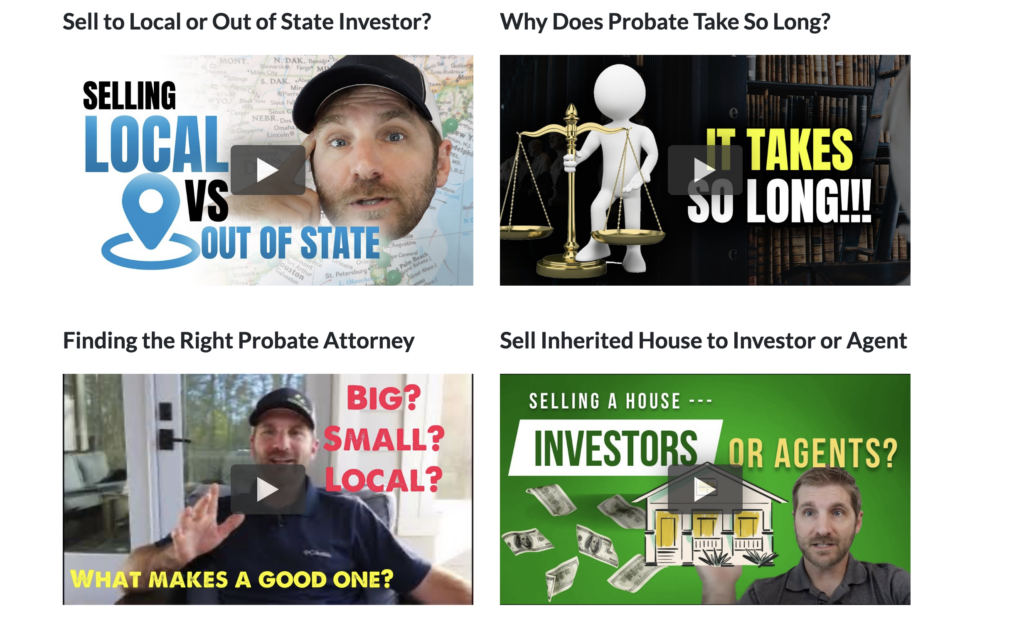
    Investor Brad Woodall is a prime example of someone who went all-in on creating videos that answer prospects questions. He doubled down on probate-related video content which he posts on YouTube and an entire video library on his Carrot website & now consistently generates high-quality probate leads because of it!

    FAQ Videos Example from Investor Brad Woodall

    5. Share Local Trends

    Talking about local trends are great videos to publish on social media channels, and they can add an engaging element to blog posts covering the same topic. If you’re discussing a particularly important trend that leads should know about, you can even add this type of video to your homepage while it’s a hot topic.

    Overall, videos build your credibility and put leads at ease, making them pre-disposed to want to work with you! 

    How to produce videos, easily

    Videos don’t have to be complicated or daunting, and you don’t need to start a YouTube channel or become a TikTok star (though you certainly can if you like making videos!). Today’s consumers are used to seeing natural, self-shot videos, so simple videos recorded on your phone or computer work just fine. There are even services that make it easy to produce animated videos if you’re uncomfortable being on camera (though showing your face will build stronger trust with potential clients).

    Don’t worry too much about the length of the video, both long and short videos have their place. Let the topic dictate the length of the video. And while you don’t have to worry about Hollywood standards, your videos should look nice and reflect your brand. Make sure the lighting is good and you have a non-distracting background. If you have shirts with your logo, consider wearing it in the video to reinforce brand recognition.

    Videos don’t need to be overly produced, but if you want to do a little editing or add your logo or contact information, we recommend finding a video editor on a website like Fiverr.com. If you’re more DIY, VN is a simple (free!) video editing software available for both Mac and PC. If you want to add music to your video, make sure you get royalty-free audio clips. You’ll also want an eye-catching “video thumbnail” (the image people see before clicking on the video). These are easy to create for free with tools like Canva, which has thousands of pre-built templates to match any style. If you’re creating several videos, choose one thumbnail style or one style per video type. This keeps your brand look consistent and professional.

    Where to put videos on your website

    You don’t want to cram all your videos onto one page, that would be overwhelming. Instead, think about where each type of vidoe makes most sense. If you were visiting a website, what type of information would you expect to encounter on each page? With that in mind, you want to make sure key videos are posted to your most high traffic pages — the home page, about us, and contact us pages for most real estate investor websites.

    Introduction videos and video testimonials in particular should be published on your homepage, about us page, and contact us pages — preferably toward the top of the page. In addition to generating the most traffic, these are also the highest converting pages, so putting videos here gets them in front of visitors at critical points in their journey. It also makes it easy for them to contact you immediately after watching the video — remember, visitors are significantly more likely to convert to a lead after watching a video!

    If you’re answering common questions, breaking down a topic, or discussing a local trend, add these videos to topical landing pages, blog posts, or niche credibility pages targeting the same topic and keywords. Publishing topical content on your website (especially around commonly searched questions or terms) will help you rank better in search results. The more valuable content you add to these pages — both written and video — the better chance they have of ranking.

    Carrot has a video post feature that makes adding this new content to your website even easier. Designed to help you get more leverage from videos explaining topics, trends, or answering questions, the VideoPost feature automatically transcribes your original videos into an SEO-optimized blog post. This is a great way to publish videos quickly.

    Here’s how easy it is to put video content on your website. This example ranked #1 for the keyword we were aiming for!

    Create Real Estate Video Content in Under 10 Minutes with Carrot's VideoPost

    Bonus video publishing tip: Post the same videos on YouTube. It’s easy to create a YouTube channel for your company on posting video to this popular platform give them an even better chance of showing up in search results. Make sure the video has a clear, accurate title with your target keywords and a good description with a link to your website. As a bonus, publishing videos on YouTube make them even easier to embed into your webpages, simply choose the Youtube block when editing the page and drop in the video URL.

    Conclusion: Make 2025 the year of video

    Video has been a popular way for Americans to consume information for years, and it’s only getting more popular. At the same time, competition in the real estate investing industry is getting stiffer, so any little tactic to give you an edge is a welcome advantage. Video could be the ticket to making you stand out, attract leads, and close more deals in 2025.

    In short, businesses that adopt video win far more often than those that don’t.

    Don’t overthink it and don’t be nervous about getting started, it’s not as hard as you think! For more on how to get started with video, check out Video Marketing for Real Estate: A Step-by-Step Guide.

    Happy filming—You’ve got this!

  • Real Estate Investors: The State of Marketing 2025

    Real Estate Investors: The State of Marketing 2025

    Real estate investing is an interesting industry…

    Some investors are all in, doing it as their full-time job. Others do a deal or two a year on the side. Some invest in marketing to generate leads, some rely solely on referrals. While there’s no right or wrong way, it’s always insightful to learn what others are doing and where they’re finding success.

    Key Takeaways

    • Most real estate investors do their own marketing, and they use an average of three strategies (mainly a website, social media, direct mail, and cold calling.
    • Real estate investors spend anywhere from $2,000 annually to more than $100,000 annually on their marketing budgets! The median budget for real estate marketing is $12,000 annually.
    • The average cost-per-click for a real estate ad was $25.20 in 2024.

    Whether you’re brand new to real estate investing or a seasoned pro, this report gives you good insights into what your peers are up to, industry standards, and how you stack up.

    Table of Contents

    1. Who are Real Estate Investors?
    2. How Much Time Do Investors Spend Marketing?
    3. Where Should Investors Focus Their Marketing?
    4. Marketing Budgets in 2025
    5. What to Expect from PPC & Paid Ads
    6. Your 2025 Playbook for More Deals

    Carrot icon
    Lead generation, at its best
    Attract, convert & close more motivated leads
    Try Carrot Today

    Who are real estate investors?

    To help shine some light on the state of real estate investment marketing, we surveyed 90 REI professionals — both Carrot members and non-Carrot members — to learn what marketing strategies they’re using, what their most effective lead generation channels are, their annual marketing budget, and how 2025 will be different from 2024. Investors of all experience levels and a variety of real estate investment specialties responded, providing valuable insights no matter where you are on your REI journey.

    Real estate investors mostly handle their own marketing

    For real estate investors, marketing is still very much a DIY endeavor. Fifty-seven percent of survey respondents report handling all marketing activities themselves, while 31% have some outside help. Only 12% of investors have agencies or freelancers handle all their marketing.

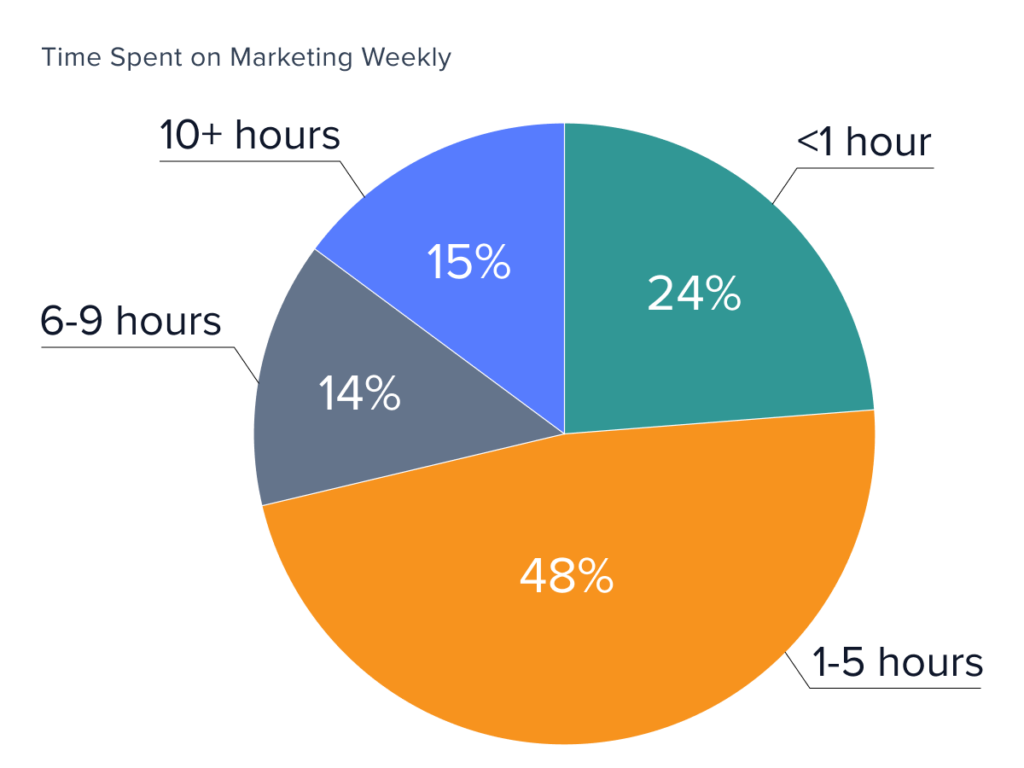
    Marketing activities make up only a fraction of a busy investor’s schedule though. More than 85% of survey respondents spend less than 10 hours per week on marketing activities, with nearly a quarter of respondents dedicating less than one hour per week. Things may change this year though, as an impressive 71% of investors plan on increasing their marketing time. Only 8% plan on decreasing the amount of time spent on marketing in 2025.

    Where should investors focus their marketing?

    With so little time dedicated to marketing, it’s important for investors to find strategies and tools that work well and fill pipelines. With a seemingly endless number of marketing solutions available, deciding which to focus on can be difficult. Most investors report using only a few solutions, with nearly 50% of investors using two to three marketing services. The most common are a CRM and website. Investing in a real estate CRM is a smart move in 2025 to keep all your leads (online and offline) organized and streamline follow-up. Investors still relying on spreadsheets for lead management risk falling behind their peers.

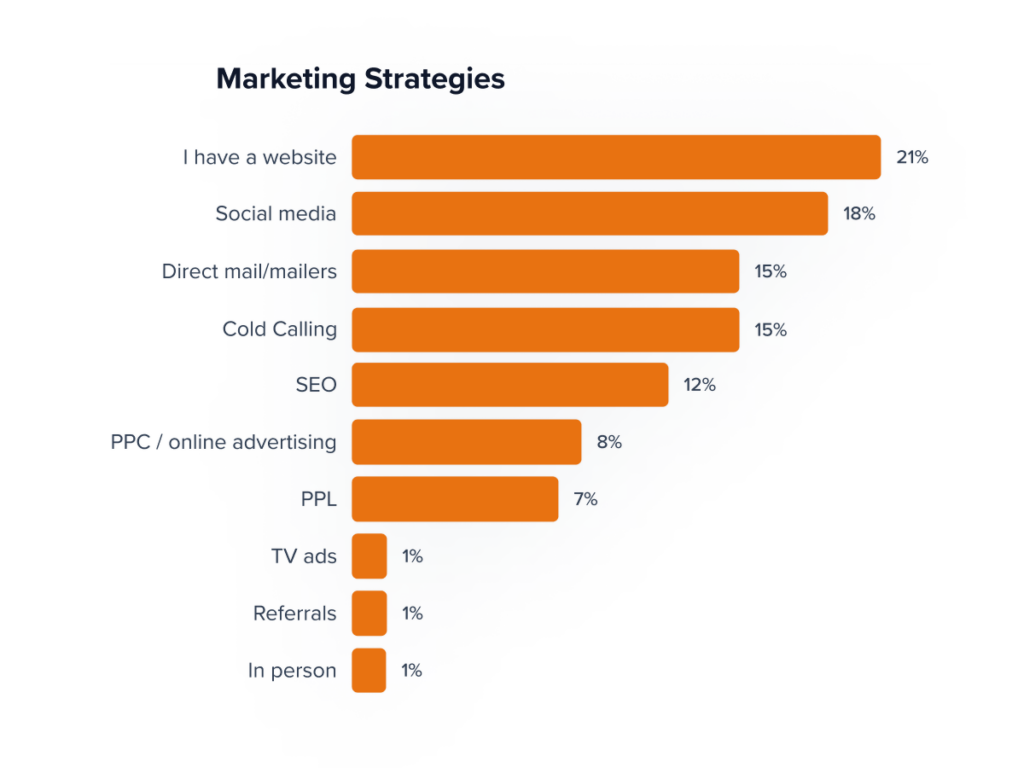
    Marketing tools support a range of lead generation strategies. The average investor works with three strategies to actively generate leads, but some use upwards of eight. Websites and social media are the most common, followed by direct mail, cold calling, and SEO, indicating that both online and offline lead generation tactics still work a successful investment business. The “tried and true” lead generation approaches aren’t fading, but successful investors are also expanding online to ensure they capture the maximum number of leads.

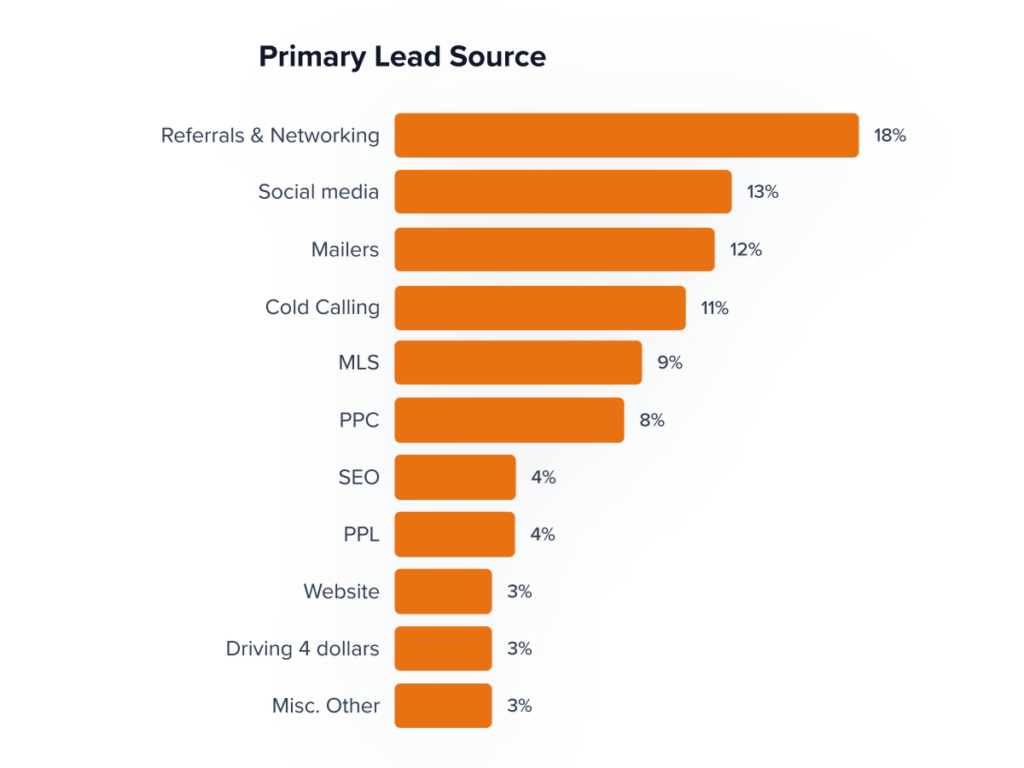
    While referrals and networking are the No. 1 source of leads for many investors, social media and direct mail are also top lead drivers. When planning your marketing strategy in 2025, a healthy mix of networking plus online and offline marketing has the best chance of driving success. Channels like direct mail & paid social media ads still work in 2025, but judging by the numbers, there’s low-hanging fruit in SEO.

    Note: The important part is to treat your website as the “hub” of your marketing — funnel your direct mail, social, PPC, etc., to your website so you can capture those leads more easily!

    To capture more leads in 2025, 65% of investors plan on adding additional marketing strategies. Only 3% intend to decrease their number of outreach channels. For those interested in increasing marketing, SEO, paid advertising, and pay-per-lead solutions are popular and effective for many successful investors. Having a high-converting website is also a key piece of the mix, as you need something to optimize for SEO and somewhere to point paid advertising. It’s also good practice to add a website to any offline outreach so potential leads can research you and verify your authenticity before deciding to reach out. When was the last time you worked with a company without checking them out online first?

    Marketing budgets vary wildly in 2025

    How much real estate investors spend on marketing annually ranges from less than $1000 for the entire year up into six figure sums. The median marketing budget amongst survey respondents is $12,000 annually, though investors who run online advertising likely have higher budgets. Eight respondents plan on spending less than $1000 on marketing this year, while 12 will spend more than $100,000. Three respondents report having a $500,000 annual marketing budget!

    And those budgets are only growing for many. Sixty percent of survey respondents are increasing their marketing budget in 2025, while 28% are keeping their budget the same. 

    How much investors spend corresponds somewhat to how long they’ve been in real estate. Newer investors naturally have a lower budget as they work to close their first few deals. Annual marketing budgets increase as investors become more seasoned, but stay relatively flat for investors with 1-9 years of experience.

    Interestingly, there isn’t a consensus on the primary lead source among the top spenders, nor on their most effective marketing strategy. While investors who spend more than $100,000 do utilize more marketing strategies (an average of five instead of three), some top spenders only rely on paid ads or cold calling. The most commonly used marketing strategies for this high-budget cohort are websites and direct mail.

    Meanwhile, those with the smallest annual budgets ($2,500 or less) rely on an average of two marketing strategies, mainly a website, social media, or cold calling. Their primary lead sources are more manual and low-cost options, such as referrals and social media.

    What to expect from PPC & paid advertising

    While only 8% of survey respondents invest in online advertising, it can be a lucrative lead source. To help investors who already run ads or those interested in expanding to PPC in 2025 understand what the investment looks like and what to expect, we asked our friends at Motivated Leads, a digital marketing agency specializing in online advertising for real estate investors, to share some insights.

    How much to spend on ads

    Last year, the median spend on Google Ads for Motivated Leads clients was $3,000 to $5,000 a month and the average cost-per-click (CPC) was $25.20. Investors running regular Google ads saw an average click-thru rate (CTR) around 5%, leading to an average cost-per-lead (CPL) of $250 or lower.

    Ads targeting Illinois, Kentucky, and Delaware had the highest conversion rates, with CPLs dancing around the national average:

    • Illinois: $207.18
    • Kentucky: $241.03
    • Delaware: $279.11

    However, things changed slightly for investors who used Google’s Performance Max advertising option. Performance Max can lower your CPC and CPL, however, it may result in less qualified leads without proper campaign optimization.

    Performance Max is harder to run and has broader targeting, leaving the algorithm to place ads. With this approach, your ads may appear on display, search, YouTube, Gmail, or other places and may appear to web surfers outside of your local area. This broader approach can impact lead quality because you have less control over who you’re targeting ads toward.

    Google’s “regular” search advertising gives you more control over who you’re targeting and where your ads appear, allowing you to specifically target searchers who are more likely to become leads. The cost per lead is higher in this case because you’re focusing on more qualified leads. Investors with smaller advertising budgets should focus on Google search ads and targeting the right keywords to get the most value from their investments. 

    The most effective advertising

    Focusing your ad budget on the right keywords and running ads at the right time can make your advertising dollars go further.

    In 2024, the highest-converting keyword themes for real estate investors were:

    • Sell my house fast
    • We buy houses
    • Home buyer

    Localizing your target markets and adding local terms to your keywords helps focus who sees your ads, improving lead quality. When adding a location name to keywords remember that your city name may not be unique. Are you trying to reach buyers/sellers in Portland, OR or Portland, ME? Make sure your ad account is properly set up to target the right area and that the landing pages your ads point to include the city AND state.

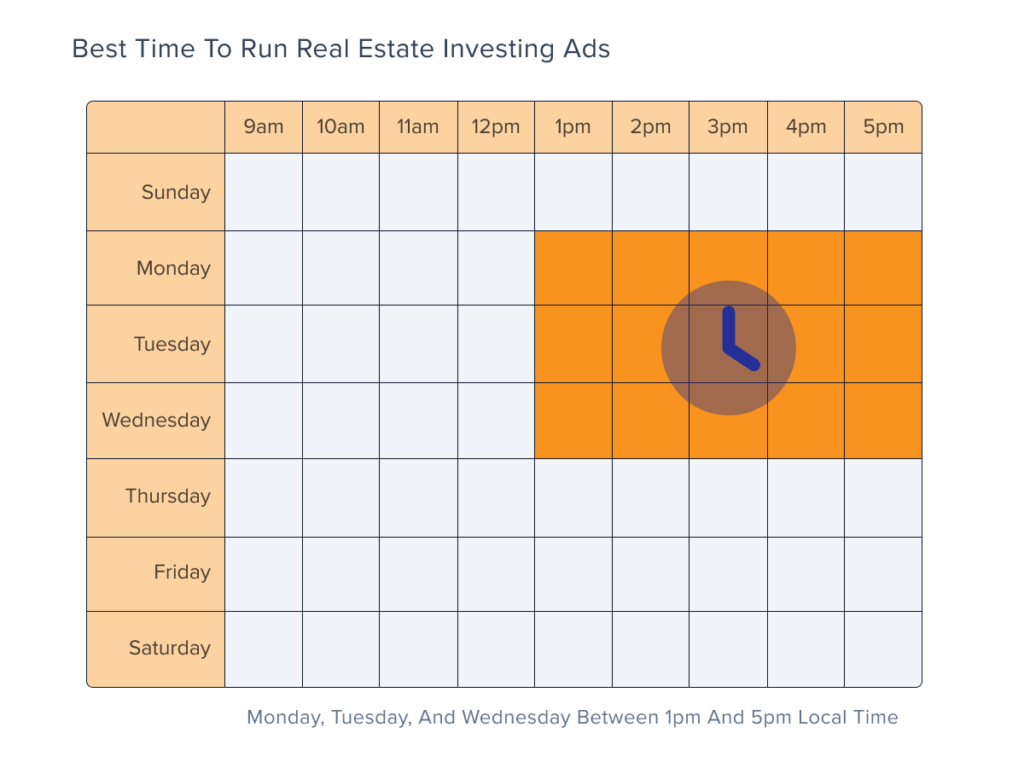
    Once your ads are set up, give them a better chance of being seen by running them at the best times. In 2024, online ads converted best on Monday, Tuesday, and Wednesday between 1pm and 5pm local time.

    Understanding online advertising trends from the past 12 months can help you plan your strategy for this year, but it’s important to remember that the world of online advertising can change quickly. Google algorithm updates and changes to the Google Ads platform can happen at any time and may impact how ads are set up and their performance.

    For example, Google Ads performance and strategy underwent notable changes between 2023 and 2024. The cost-per-click increased by 36%, while the click-through rate improved by 17%. Despite these shifts, the cost per lead remained virtually unchanged, with only a slight variation according to Motivated Leads.

    A major strategic difference lies in keyword usage. In 2023, marketers focused on phrase and exact match keywords. However, in 2024, Google’s updated keyword match type (leveraging signals and a searcher’s intent) prompted a shift toward broader but still highly relevant keyword themes.

    If you run your own ads, pay attention to any shifts or noticeable updates to make sure you maintain optimal ad performance. If you’re not comfortable running your own ads (or simply don’t want to become an online marketing expert), consider working with an advertising agency like Motivated Leads. (Need help finding a PPC service? Check out the Carrot Marketplace.)

    Your 2025 playbook for more deals & more revenue

    This survey proves there isn’t one right way to generate real estate investment leads. Find what works for you and your budget. If you’ve been avoiding certain marketing strategies, 2025 may be a good time to expand your reach and try something new. If you don’t have a website yet, this is the year to get online. A strong website serves as both a lead generation machine and a central hub for the rest of your online and offline marketing.

    Need help knowing where to focus this year? Here are some tips from Carrot CEO Trevor Mauch:

    🔥 1. Invest in Your Online Presence – Your website isn’t just a “nice-to-have.” It’s your 24/7 conversion hub. Make sure it’s optimized, fast, mobile-friendly, and ranking in Google. If you’re on Carrot, you’re already ahead of the game. If you’re not — it may be time to consider a switch.

    🔥 2. Optimize for Conversions – Most investors waste traffic. Don’t be one of them. Your website should be built to convert visitors into leads at the highest possible rate.

    🔥 3. Get Your Follow-Up Dialed In – Leads are ready to act NOW. If you’re not following up fast, you’re leaving money on the table. Carrot CRM helps you track, nurture, and close leads effortlessly.

    🔥 4. Take Action — Before Your Competition Does – 71% of investors are increasing their marketing in 2025. If you’re not doubling down, you may find yourself struggling to get the leads and deals you were used to getting last year.

    Take inspiration from these findings and double down on your marketing to make 2025 the biggest year yet!

  • Efficiently Manage Real Estate Leads & Deals with the NEW Carrot CRM

    Efficiently Manage Real Estate Leads & Deals with the NEW Carrot CRM

    Effectively managing leads and deals is one of the most critical elements of a successful real estate investing career. If you let leads slip through the cracks or don’t follow up on a potential deal in a timely and consistent manner, that deal will quickly disappear.

    Unfortunately, proper lead management and follow-up can be challenging or expensive. Either done manually with spreadsheets and direct outreach or with expensive tools.

    But not anymore!

    Introducing Carrot CRM for Real Estate

    We’re proud to announce an affordable real estate CRM designed to grow with your business, from just starting out to managing millions in deal pipeline. Carrot CRM is a robust lead management and outreach tool with the right features for every level of investing.

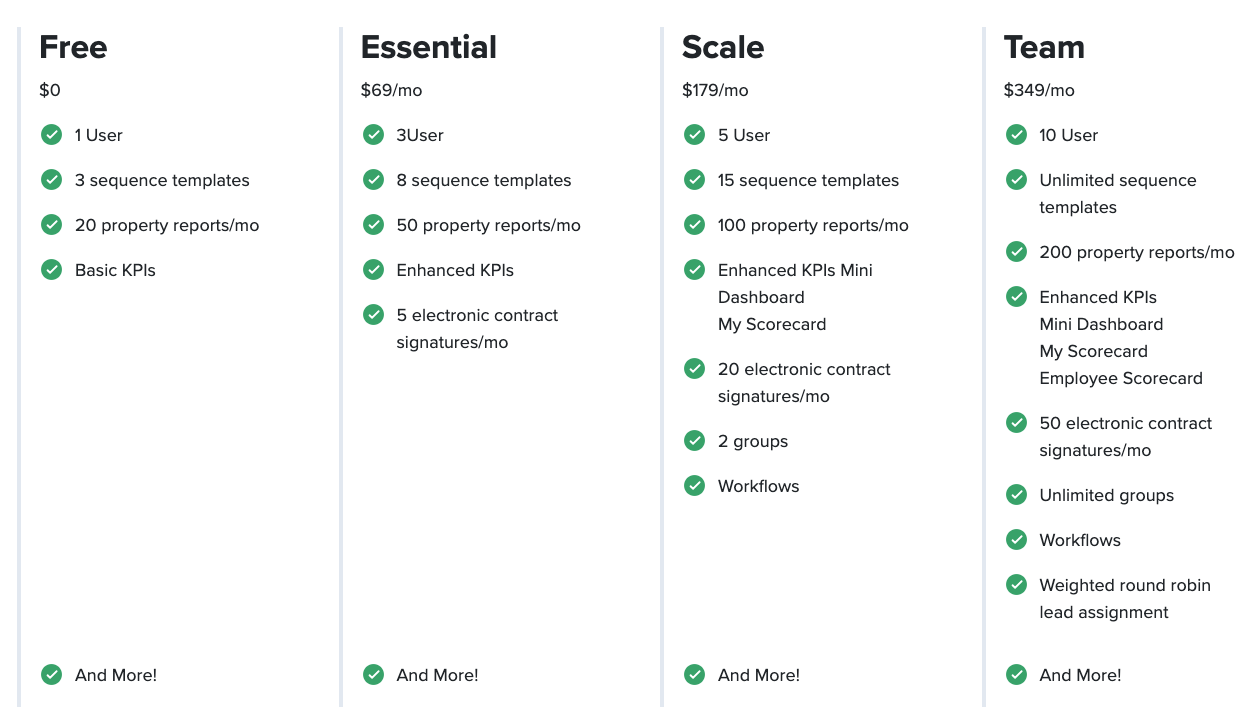
    carrot crm pricing

    No more relying on spreadsheets, paying for an expensive CRM before you need one or worrying about switching to a more robust solution as your business grows. Carrot CRM offers a free plan (no “free trial” … just free) and lets you upgrade as your business scales.

    This isn’t a half-built “add-on” feature, and you don’t need a Carrot website to access the CRM. Carrot CRM is available to anyone. It is an independent, world-class CRM incorporating the proven technology and features of InvestorFuse.

    Meet the All New Carrot CRM - Live demo & Q&A!

    Why You Need a Real Estate CRM

    There are many CRM solutions on the market, but the truth is that managing real estate leads and deals is very different than managing leads in other industries. Basic CRMs include fields like company information and budget, but they don’t give you space for factors critical to a real estate investor. Spreadsheets are customizable, but by the time you add all the information, they can become monstrously overwhelming.

    To adequately manage your real estate deals, you need a solution designed to surface information that’s actually important … without a lot of manual customization. Carrot CRM gives you the sophisticated tools and features needed to run a successful real estate business right out of the box.

    Key Benefits of Carrot CRM

    1. Real Estate-Specific Features: Carrot CRM is designed specifically for the unique needs of real estate investors, offering features like property data, occupancy status, and reasons for selling.
    2. Automation: The platform automates tasks like follow-ups and lead nurturing, saving you time and increasing efficiency.
    3. Integrated property data: Detailed property data directly in the app helps you make more informed decisions and better offers.
    4. Customizable Workflows: Tailor the CRM to your specific needs and preferences, ensuring it aligns with your business processes.
    5. Intuitive Interface: The user-friendly interface makes it easy to navigate and use the platform effectively.
    6. Comprehensive Data Insights: With detailed analytics and reporting, you can gain valuable insights into your lead generation and deal closing activities.

    By leveraging these features, real estate professionals can improve their lead management, boost productivity, and ultimately drive more revenue.

    Get Ahead of the Competition With a High-Performance CRM

    Carrot CRM Feature Highlights

    The InvestorFuse team spent years perfecting the features real estate investors find most useful to tracking, nurturing, and closing deals. They brought those key findings into the Carrot ecosystem, putting critical lead management tools at your fingertips in Carrot CRM.

    Action-Based CRM

    Improve your follow-up habits with an action-based CRM that hyper-focuses on the most important next step. Designed specifically for real estate investors, Carrot CRM makes it easy to set a next step that makes the most sense for that lead, whether that’s making a call or sending an offer.

    Easily see what needs to be done in the “Actions” tab so you can quickly check off your to-do list. You can also filter by “Pinned Opportunities”, giving your hottest opportunities the most attention. Missed a task? Overdue tasks are highlighted in red to get your attention. No more forgotten follow-ups!

    Automated Outreach Sequences

    Speaking of forgotten follow-ups, wouldn’t it be nice to automate follow-up actions so you don’t have to personally make every phone call, leave every voicemail, or send every text message or email? Think of all the time you could save and how many more leads you could work. Every level of Carrot CRM comes with Sequences, allowing you to automate your most successful outreach campaigns.

    Just set the type of outreach and the timing, add leads to the sequences and Carrot CRM does the follow-up for you. This is ideal for cooler leads who need a bit of nurturing or might not be ready to make a deal quite yet. Add them to a sequence so they’re not forgotten while you focus on more promising deals. Whether they’re ready in a few weeks or a few months, your outreach keeps going without taking up your precious time.

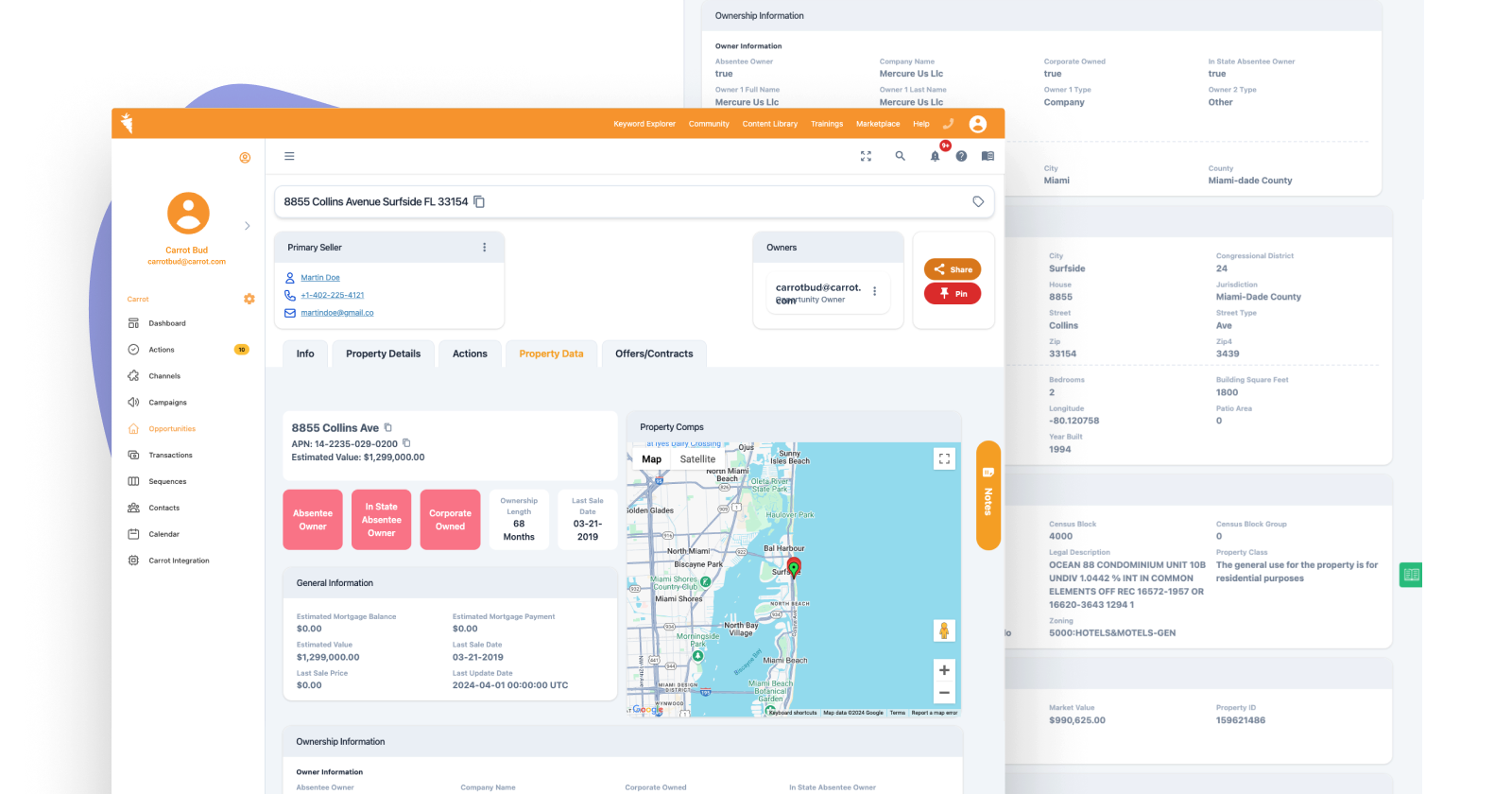
    Property Data Reports

    Having detailed property data lets you make informed offers. However, too often, real estate investors have to piece this information together from public records and expensive data solutions. Carrot CRM’s in-app Property Data reports show you key information about your opportunities, like:

    • Nearby comps
    • Ownership information
    • Property and lot specs
    • Tax information
    • Mortgage information and history
    • Sales history
    • Local demographic information

    These reports offer more nuanced details than public listing sites like Zillow or Redfin, giving you a true understanding of the property and the ability to target the right opportunities.

    Carrot CRM Property Report

    Opportunities Details

    All the details you need, all in one place. Carrot CRM is your opportunity action hub, from key opportunity and property information to notes and documentation storage. Set tasks and keep track of the results, see contracts and offers, and more in this all-encompassing view.

    Everyone has their preferred way of working, and we want to make it easy for you. Carrot CRM isn’t a one-size-fits-all solution. Choose from more than 35 data points to customize your opportunity view and see the details you care about most at a glance. Add custom tags for easy sorting and pin your hottest opportunities so they’re always at the top.

    Metrics Dashboard

    As your company grows, there’s more to keep track of. That’s where a robust metrics dashboard comes in. Carrot CRM’s dashboard surfaces anything you want to know about actions, opportunities, campaigns, sequences, and even team efficiency.

    Know exactly how many actions are due over the next week, how many are already overdue, which of your marketing campaigns lead to the most opportunities, how many leads are in automated sequences, and more. Choose the metrics and sections you want to surface to customize your dashboard experience. Knowing the current status of leads, opportunities, and actions keeps you on top of critical tasks so you can close more deals.

     Carrot CRM Dashboard

    Finding Success with Carrot CRM

    How does real estate CRM software change your day-to-day? It makes your lead flow simpler, your outreach more efficient, and tells you where you’re most successful. Having everything in one place, easy access to critical property details, and the ability to automate outreach lets you nurture more leads while giving more one-on-one focus to your hottest opportunities.

    With Carrot CRM, these efficiencies and insights are no longer restricted to large investors or companies with big budgets. Any investor at any stage in their journey now has access to critical CRM features that can help catapult their business to the next level.

    Transform Your Business with Carrot CRM

  • Want to make your website stand out? You’ll love block patterns!

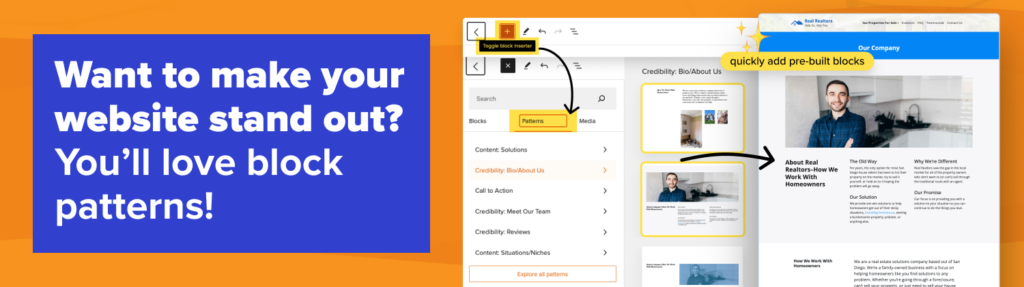
    Want to make your website stand out? You’ll love block patterns!

    There’s a fine balance between ensuring your website performs well and stands out. We’ve spent the past 10 years refining website templates for real estate investors, making them excel at ranking well in search engines, building your credibility, performing lightning-fast, and turning visitors into highly motivated leads.

    Carrot has expanded website customization options with new block pattern designs that allow real estate professionals to easily create unique, professional websites that reflect their personality while maintaining high performance.

    Key Takeaways

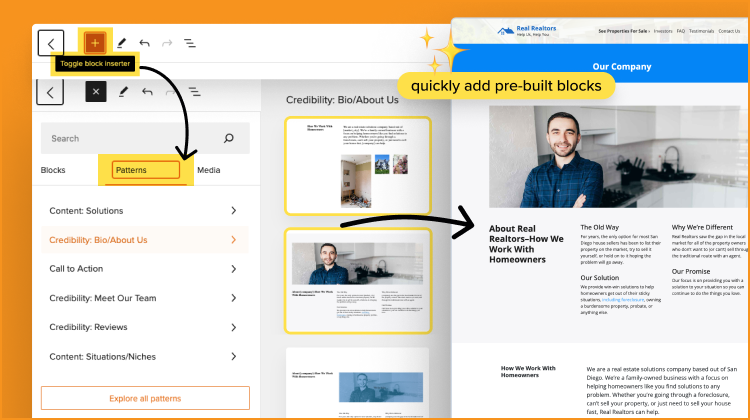
    • Block patterns are pre-designed webpage sections organized into categories like Call to Action, Content, Credibility, and Data that can be easily implemented without design expertise.
    • The patterns come pre-loaded with your brand colors for seamless integration and allow for customization to create visually appealing pages that stand out.
    • Using different block patterns helps break up text-heavy pages, making information more digestible for visitors and creating a more engaging user experience.

    With ongoing design improvements planned for the future, Carrot members can now better differentiate their websites from competitors while maintaining the high-converting, SEO-optimized foundation that drives lead generation success.

    Table of Contents

    1. What’s a “block pattern?”
    2. Block Pattern Categories
    3. Find your design
    4. More to come
    Carrot icon
    Lead generation, at its best
    Attract, convert & close more motivated leads
    Try Carrot Today

    But that doesn’t mean we don’t care about how your website looks. Your website is your online business card and should reflect your personality.

    That’s why we’re excited to announce that Carrot members now have even more website customization options! Did you know that Carrot has a team of in-house website designers dedicated to improving your site and Carrot experience? Well, they recently added 50 new block pattern designs so you can easily customize your website and make it look as unique as you are.

    What’s a “block pattern?”

    Think of each webpage as several sections stacked on top of each other. You have the “hero” section at the top of the page (usually with an image and the page title), then maybe a section of text or an image gallery, probably a “call to action” section that lets visitors easily contact you, a section that shows off your customer reviews, and so on. We pre-built many of these key sections as “block patterns.” It simply means a section pre-designed to serve a specific purpose. 

    We know it’s important to you that your site “doesn’t look like every other website.” Using block patterns is a great way to do that! Carrot offers a variety of block pattern styles for the most important sections of a site. All you have to do is pick your favorite style and add your information. You can use any block pattern on any page. The beauty of pre-built patterns is that you can customize the look of your website without being a web designer. With just a few clicks, you can quickly transform key pages from the out-of-the-box template into something that stands out and fits your style.

    Block Pattern Categories

    Finding a design to meet your needs can be difficult if you’re searching through a seemingly endless library of options. What if you use one and then find something you like better? Pattern Categories solve that problem.

    You can easily browse pre-built sections that meet your needs by deciding what you’re trying to accomplish with that webpage section.

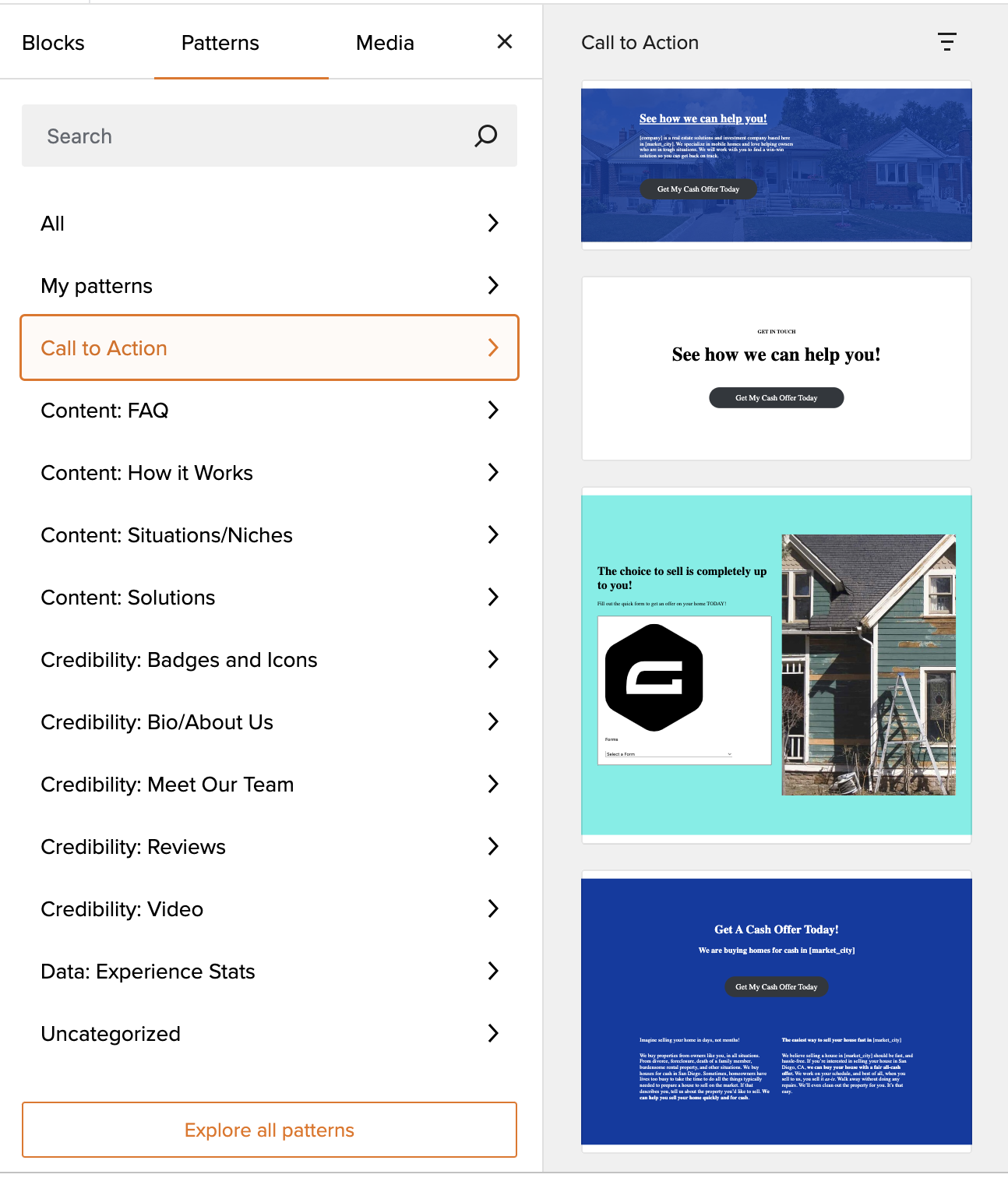
    Block pattern categories included:

    • Call to Action
    • Content: FAQs
    • Content: How It Works
    • Content: Situations/Niches
    • Content: Solutions
    • Credibility: Bio/About Us
    • Credibility: Meet Our Team
    • Credibility: Reviews
    • Credibility: Videos
    • Data: Experience Stats
    Carrot block patterns

    The patterns you see are pre-loaded with your brand colors, so they’ll seamlessly blend into your website’s look and feel. Feeling creative? You can edit these patterns and add content, then save them to “My Patterns” for easy use on other pages.

    Find your design

    Using different block patterns is a great way to break up a page and make it easier for visitors to process information. For example, you can replace a block of text with icons and short blurbs that draw attention and make a big impact. Select from over 500 pre-loaded icons across a dozen categories and customize your icon color so your site truly reflects your business.

    Whether you like sharing maximum information or prefer a sleek design, the block patterns give you options. Some patterns are text-heavy, others are very streamlined, and others stylishly mix images and text.

    The “Content: How it Works” and “Content: FAQ” patterns, in particular, offer a wide array of styles. If you have those sections on your website, now is a great time to revisit them and refresh your site design.

    Not sure exactly which block pattern you like best? Add the section to your page and scroll through the different pattern designs to see how they each look in real life.

    More to come

    That’s just the latest update. The Carrot design team is working on even more block patterns and other design options to let you customize and differentiate your site further. You can expect to see more features roll out over the next few months, so stay tuned!

    Take a free Interactive Carrot website demo and see how we can help you stop losing deals to an underperforming website!