Search results for: “ppc”

  • Carrot vs WordPress

    Carrot Websites vs. WordPress

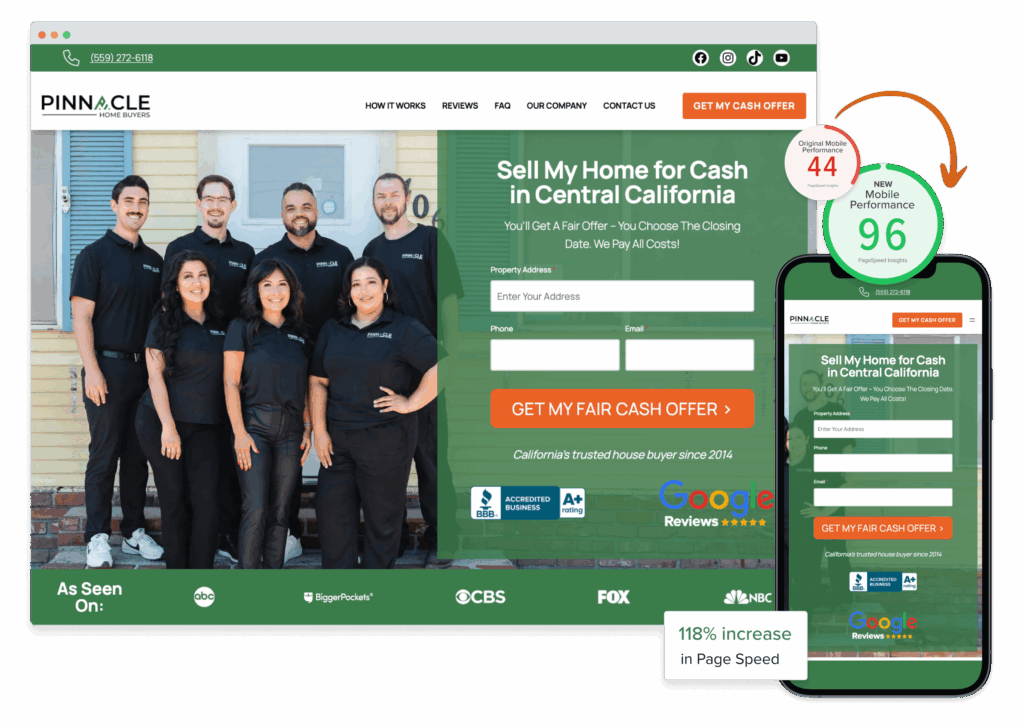
    Huge Boost in Page Speed and Conversion with One Site Change | Jason Pritchard, Pinnacle Home Buyers

    WordPress isn’t a lead generation website. Carrot is.

    There’s a reason that we specifically call Carrot sites “lead generation websites” — because that’s what they’re designed to do. WordPress offers pretty websites you can use for anything, meaning they’re not designed with lead generation in mind.

    We have spent 10+ years testing and optimizing Carrot website templates for peak lead conversion. Everything from what elements to include on a page, where forms should appear, what information those forms should ask for, and even the order of the pages in the navigation. It all makes a difference when you’re trying to generate leads, and it’s all baked into Carrot templates from the start.

    That’s why successful real estate investors prefer Carrot websites versus custom WordPress sites. At the end of the day, you need a website that generates leads. If your website isn’t optimized to convert visitors into leads, every missed opportunity is a direct hit to your potential revenue. With Carrot, the focus is on making every visit count, ensuring that your site pays for itself through its performance.

    I never got any leads from my old custom websites. They looked great, they just didn’t perform.

    Mike Wall

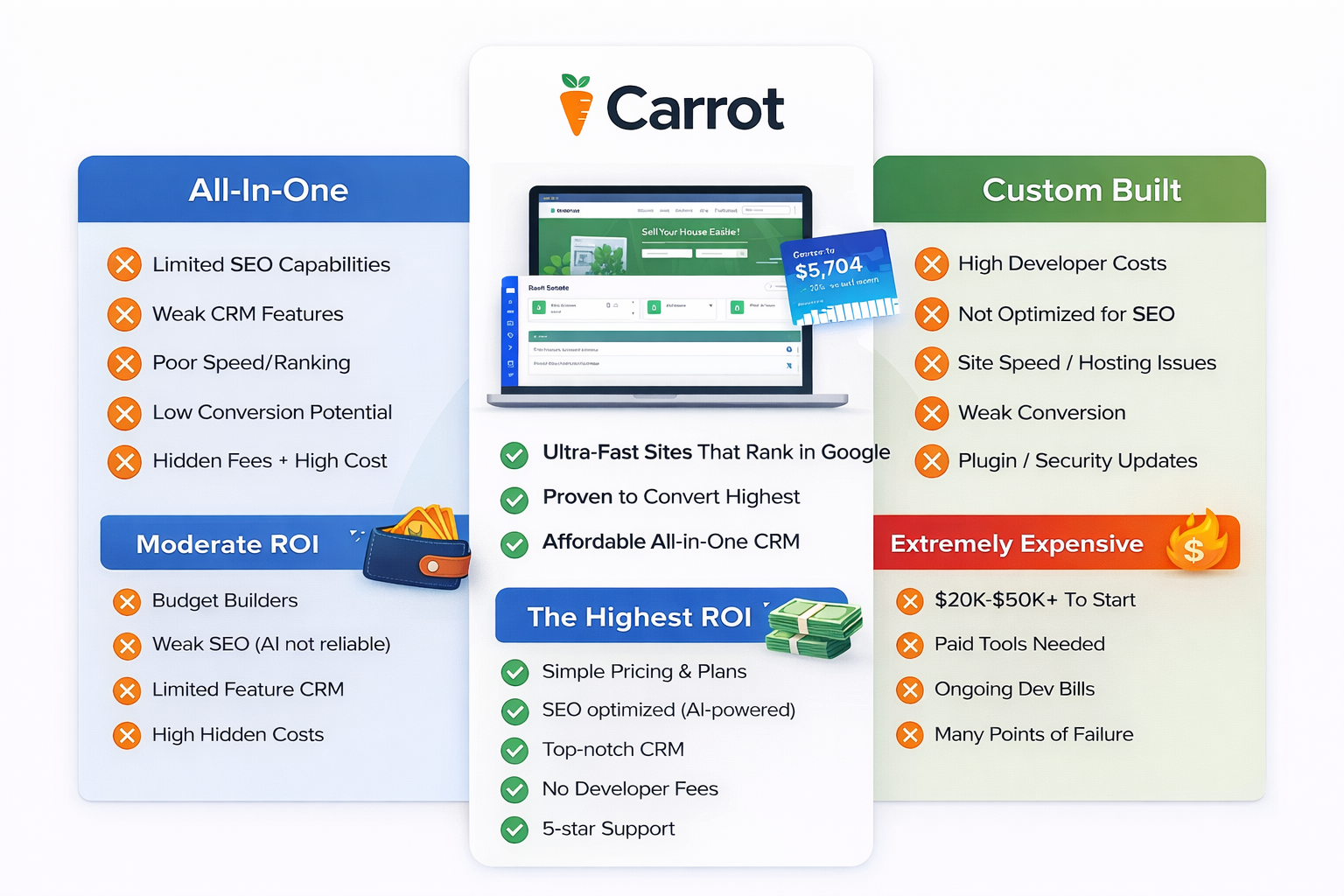
    Carrot Websites vs. WordPress Websites Feature Comparison

    MP logo Carrot logo
    Website with hundreds of design options and customizations green check red x
    High converting website designed to generate leads red x green check
    Plugin and security updates done automatically, without breaking your site red x green check
    SEO optimized starter content so you don’t need to write an entire website from stratch red x green check
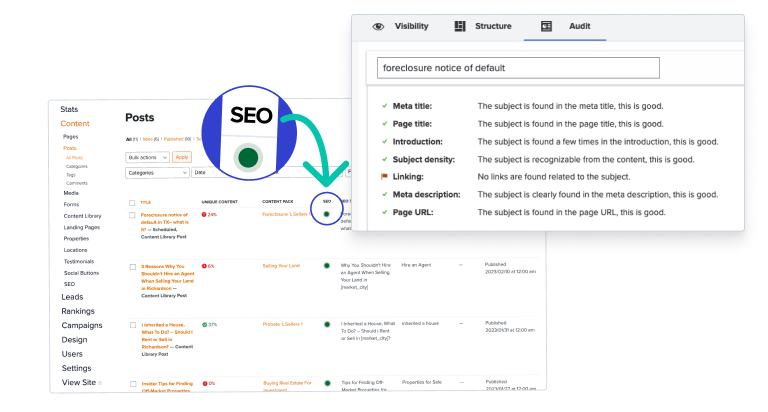
    A full suite of content creation tools to boost SEO (no need to download and maintain more plugins) red x green check
    Automatically created Location Pages to save countless hours red x green check
    Forms already in place & connected to a lead manager red x green check
    Built-in performance reporting dashboards red x green check
    World-class support with a 96% satisfaction rating red x green check

    I had a PPC vendor who built a super techy site that they swore would outconvert my Carrot site — it didn’t. I paid $5000 to have a custom site designed that was really pretty, but I got less leads. My expensive, pretty site was converting at 1-2% on SEO when my Carrot site was converting at like 8.5% on SEO.”

    Ryan Dossey

    “Unlike custom sites requiring endless trial and error, Carrot is built specifically for real estate investors.

    Keith Sant - Carrot Customer

    Keith Sant

    Carrot sites are great because you can literally have a full-fledged website up and running within 10 minutes. Like no joke… The best thing about Carrot websites is they take the headache out of the equation. You don’t have to figure out web hosting, installing WordPress, building forms, picking a theme, writing initial content, initial designs, and so much more. It just works.

    Jason Moss

    SEO & Brand Visiblity for Real Estate Investors, Moss Technologies

    3 reasons to choose Carrot vs. WordPress

    Site Speed & Reliability

    When setting up a WordPress website, you have to be careful about what theme you’re using, what plugins you add, and making sure nothing slows your site down. Often, sleek and fancy sites load very slowly — driving away leads before they even make it to your site. Carrot mitigates all these risks by setting you up with an optimized website out of the box.

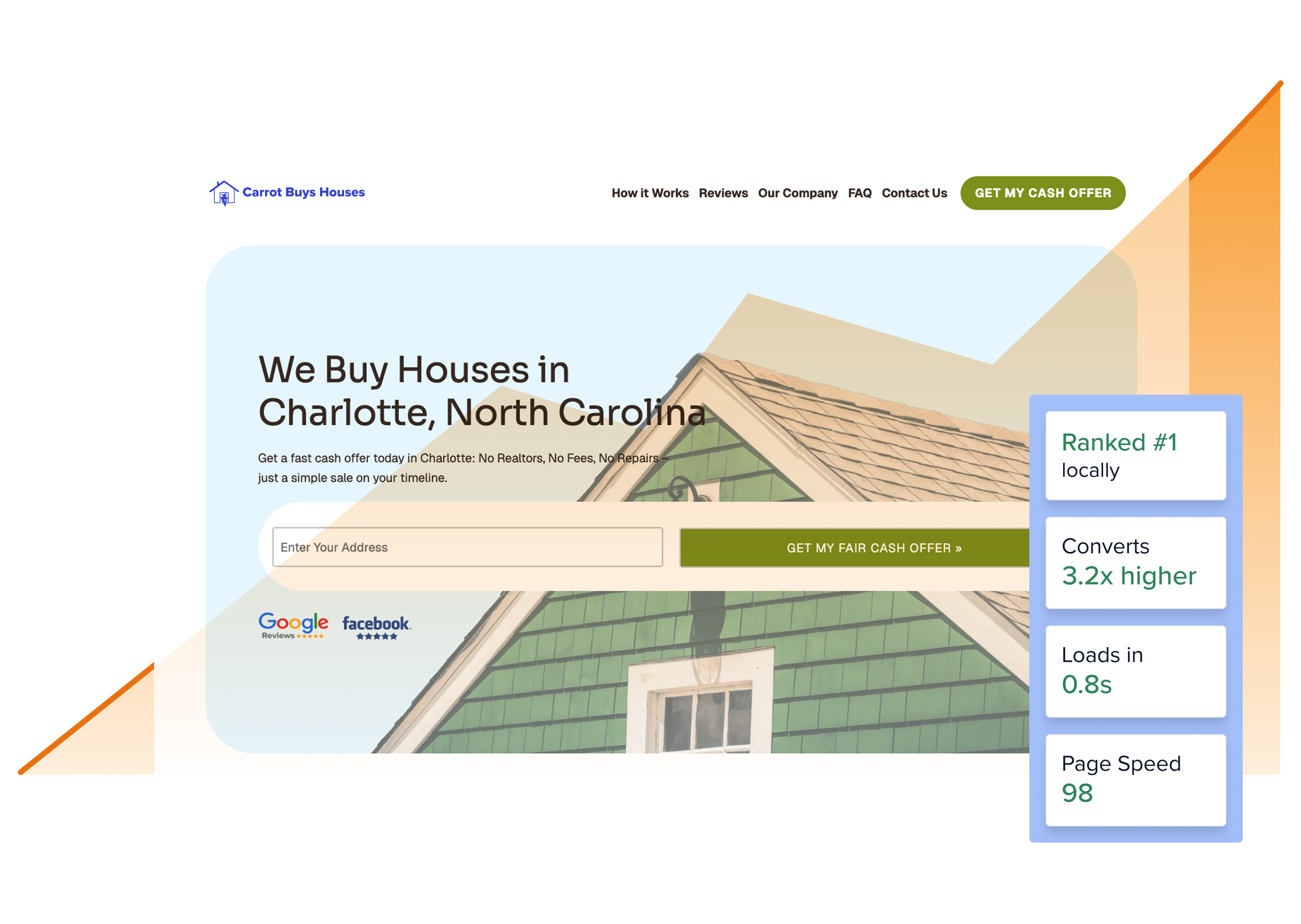
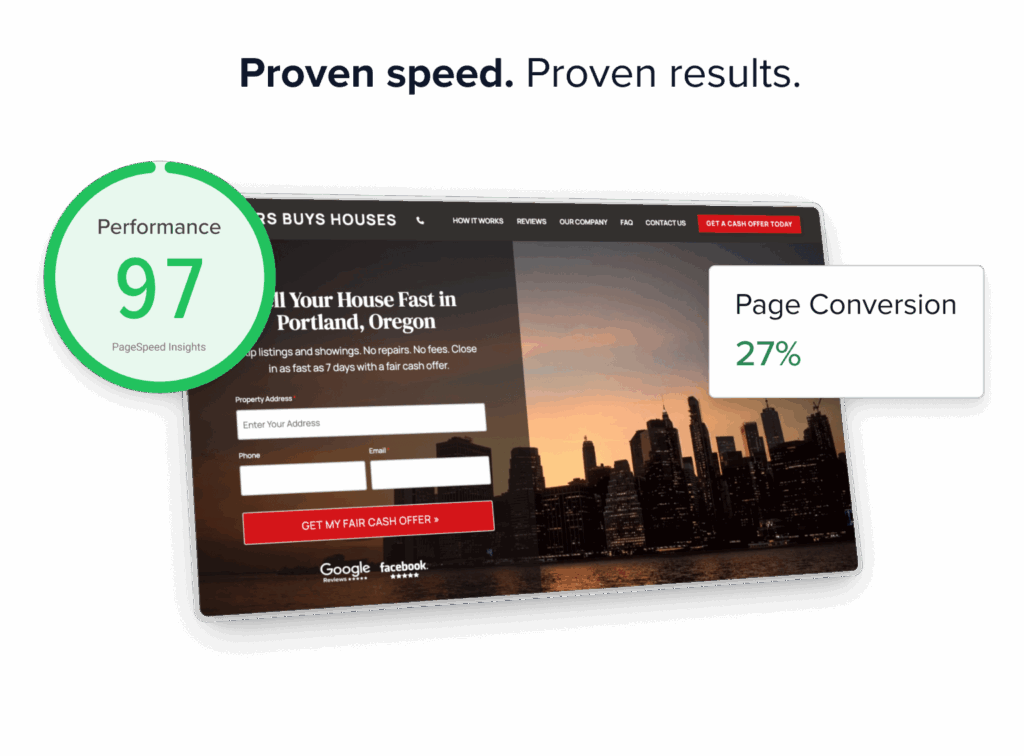
    Carrot dominates as the top leader for page loading speed with a score of 98 out of 100, beating WordPress by more than five points.

    2 icon

    Lead Generation & Conversion

    WordPress sites offer no built-in solutions for lead generation. You’re on your own to figure out what works when it comes to conversion. Do you want to spend hours setting up forms and building pages that don’t generate leads?

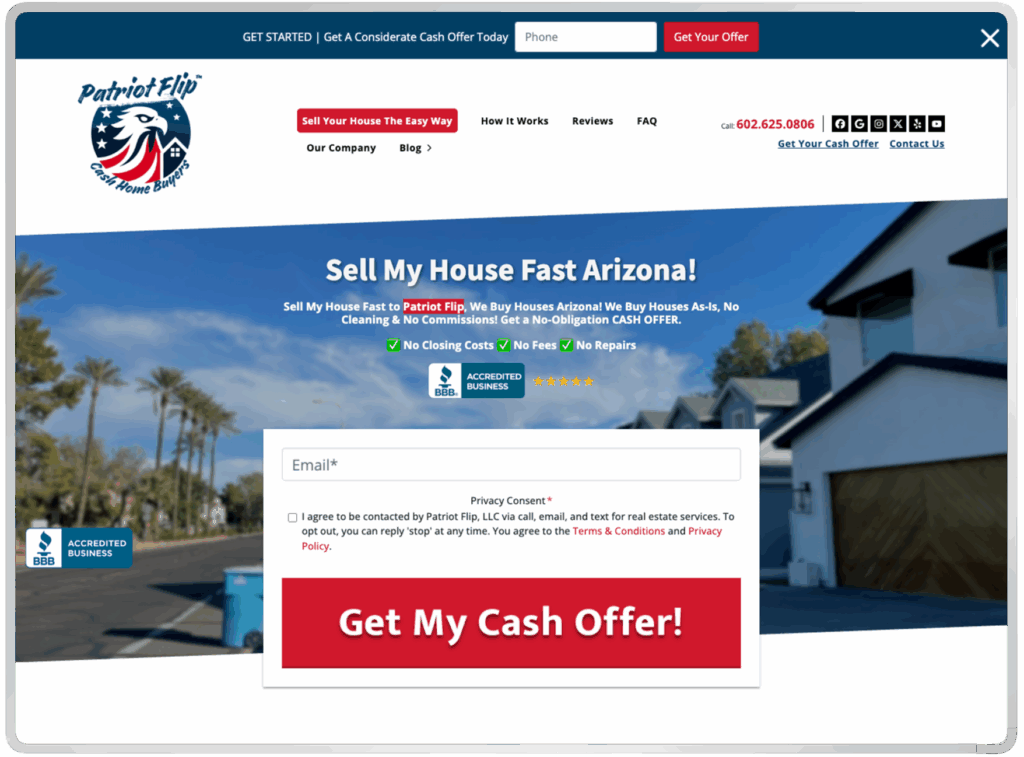
    Carrot does all of this for you using time-tested strategies backed by years of data. Not only do Carrot sites convert better, Carrot leads are proven to convert to deals 7x better than non-Carrot leads, and are 2.5x more profitable.

    3 icon

    SEO and Content Tools

    Starting with a WordPress site means starting from scratch. If you want tools to help you do keyword research or tracking, or to optimize your on-page SEO, you have to turn to third-party plugins that are often expensive and need regular security updates. Carrot sites are also already filled with optimized content, meaning you don’t have to spend weeks or even months writing all of your website content from scratch.

    Carrot provides built-in SEO and content generation tools, putting you a step ahead. These additional, deeper features give Carrot members the competitive advantage to rank higher in Google Search results and a better chance of appearing in AI responses.

    Carrot websites have better SEO than WordPress sites…every time!

    Carrot undeniably has the best real estate websites when it comes to ranking higher in Google search results thanks to constant research and optimization. The higher you appear, the more likely you are to be found by motivated leads.

    Keywords like “sell my house fast” are where Carrot customers thrive — and we have the data to prove it. In a study of 225 U.S. cities to see which websites ranked better for this specific keyword phrase, WordPress placed a very distant second to Carrot sites.

    of #1 search results for “sell my house fast” are Carrot sites

    of the top 3 search results are captured by Carrot sites across 225 U.S. Markets

    of WordPress customers claim top search results for “sell my house fast”

    See what Carrot can do for your lead generation

    Carrot websites have generated more than 1 million leads and counting. Our leads convert to deals 7x better than non-Carrot leads and have 2.5x the profitability. We’re confident that you’ll be excited to get started with Carrot once you’ve seen what we’re capable of.

    We have hundreds of authentic customer success stories

    You’ll be in good company when you make the switch. See why these customers switched to Carrot — and how they’ve used it to drive some serious results.


    “I can’t thank you guys enough. From the technical side, to the product, to the great customer service, and the great mindset and business building things that are beyond just the product you deliver”
    Eric Stanzyo – Hybrid
    See More Reviews >


    “There’s no need for me to become a subject matter expert on high converting websites when Carrot has already done that for me.”
    Adam New – Investor
    See More Reviews >


    “Every property we have to wholesale is a perfect lead magnet. It’s a landing page for more buyer leads”
    Karen Reynoso – Hybrid
    See More Reviews >

    Trusted by thousands of real estate professionals

    There’s a reason the top investors and agents choose Carrot. We’ve helped them grow their real estate businesses by providing industry leading tactics, training, and support to give them a predictable lead generation pipeline that increases profit. Carrot helps create businesses of impact and freedom and we’d love to help you too.

  • Top 5 Ways to Find Off-Market Properties (That Other Investors Miss)

    Top 5 Ways to Find Off-Market Properties (That Other Investors Miss)

    You don’t have to be lucky to get off-market properties as a real estate investor. You just need to know how to find them and how to get them to you before they go on auction sites, Zillow, or to a competitor. 

    These five proven methods show you exactly how to build that pipeline ethically, legally, and in a way that’s scalable. 

    KEY TAKEAWAYS

    • There are a variety of ways to attract off-market properties, and strategies that will fit any real estate investor’s budget. Some are more manual, some produce quick results, and some set you up for long-term success.
    • Real estate investors benefit from using multiple methods of attracting off-market properties to balance quick lead generation with long-term lead flow.
    • You can attract off-market properties with both online and offline methods.

    Attracting off-market investment properties is a good option for both new and seasoned real estate investors as there are multiple strategies and some budget-friendly options. Keep reading to see the top five ways to attract off-market properties, the pros and cons, and how to set up each one.

    Table of Contents

    1. SEO (The Best Way to Find Motivated Sellers)
    2. Driving for Dollars (Most Budget-Friendly)
    3. PPC Ads (Fastest) 
    4. Networking
    5. Radio Ads
    6. What’s next?
    Carrot icon
    Lead generation, at its best
    Attract, convert & close more motivated leads
    Try Carrot Today

    1. SEO (The Best Way to Find Motivated Sellers)

    When someone types “sell my house fast” into Google, you know they aren’t casual sellers — they need to sell now and are willing to accept a lower price for speed and convenience. That’s exactly who you want to attract.

    How do you make sure they come to your website? 

    It happens through SEO (Search Engine Optimization) — the process of getting your website to show up in top search results when sellers type phrases like “sell my house fast” or “cash offer for home” into Google.

    To tell Google what phrase you want a specific page to rank for, put the phrase or some variation of it in:

    • Your page title (what shows in the browser tab)
    • Your website address (the page URL) 
    • The page’s meta description (the short description that appears under your link in search results)

    For example, if you search for ‘sell my house for cash in Texas,’ the top-ranking websites have exactly what I described: 

    If you look at “Jamie Buys Houses” in the screenshot above, it includes “We Buy Houses In Texas” in their title, “Texas” in their URL, and “sell your house fast without paying commissions” in their description.

    It’s also good to include the phrase you’re targeting at least a couple of times in the content of your page as well. 

    Look at Four19 Properties’ page for the keyword “sell my house for cash in Dallas.” They’ve included phrases like “sell house fast in Dallas” and “cash offer” on their page. 

    Four19 Properties - Sell Your House in Dallas

    To find the right phrases to include on your page, you need to do keyword research. It is simply figuring out what words people actually type into Google when they’re looking to sell their house fast.

    Instead of guessing which search terms to target, keyword research shows you exactly what motivated sellers are searching for (the keyword) and how many people search for those terms each month (search volume).

    For example, you might discover that 720 people search for “sell my house fast Dallas” every month, but only 50 search for “Dallas home buyers.” 

    This tells you which phrase to focus on for better results.

    You can do basic keyword research using free tools like Google’s Keyword Planner or Ubersuggest. Just type in phrases you think sellers might use, and these tools will show you search volume data and suggest related terms you might not have considered. If you’re a Carrot member, Carrot also has a built in Keyword Explorer tool so you can easily find and implement the best keywords for your site.

    For a deep dive into real estate SEO best practices, check out the free guide Real Estate SEO: Top Strategies, Tips & Examples. It covers everything from keyword research to website optimization. 

    Pros of SEO for real estate investors: 

    • SEO leads convert at much higher rates because they found you, not the other way around. According to Carrot’s data, SEO leads generate approximately 2.5 times higher profit compared to leads from other sources. 
    • Unlike paid ads that stop working the moment you stop paying, SEO continues working for you 24/7 once you’re ranking well. You won’t have to spend time chasing leads. 

    Cons of SEO for real estate investors: 

    • SEO typically takes 3-6 months before you start seeing motivated sellers coming in. You need patience and can’t rely on it for quick deals when you’re just starting out.
    • Because it’s so effective, SEO is competitive. So it can be hard to rank for the high-intent keywords like ‘sell house in {city}, ‘sell fast for cash,’ etc. (To see how competitive top keywords are in your market, search your city with Market Scout.)
    • Getting your website to rank isn’t rocket science, but you’ll need to spend time learning the basics of keyword research, backlinks, etc. 

    If you don’t want to learn SEO yourself, there are real estate SEO experts you can work with.

    2. Driving for Dollars (Most Budget-Friendly)

    Driving for dollars is when you actively search neighborhoods for distressed properties that aren’t listed for sale. Though the name suggests driving, you can also walk, bike, or jog through neighborhoods — driving just covers more ground faster.

    Let’s look at five steps to make driving for dollars a success. 

    Step 1: Pick your target neighborhoods

    Start with areas you already know or where you’ve done deals before. Check your county records for zip codes with higher foreclosure rates or tax delinquencies — these often have more motivated sellers.

    It helps to schedule regular 30-minute driving sessions each week rather than trying to do it randomly. 

    Step 2: Look for signs of distress

    Look for homes with:

    • Overgrown yards
    • Peeling paint
    • Broken windows
    • Piled-up mail 
    • Or posted notices

    Record the address and move on. Being too obvious — like taking photos or lingering — can make neighbors uncomfortable. You can do more research later on. 

    Step 3: Leave a note (Optional)

    Leave a simple handwritten style note on the door letting the owner know you’re interested in buying. 

    You can write — “I noticed your house while driving by and wondered if you’d consider selling? Call me at [number].” 

    Or you can use pre-printed door hangers that look like they’re handwritten, like these from Ballpoint Marketing.

    Just respect “No Soliciting” signs and be considerate.

    Step 4: Research the property

    Before adding to your marketing list, quickly check if the property is already listed for sale (check Zillow or the MLS if you have access) to avoid wasting time on properties already on the market.

    Then, look up the property on your county assessor’s website (just google “[your county] property records” or “[your county] assessor”). This gives you the legal owner and usually their mailing address, which often isn’t the property address itself.

    If you can’t find the owner’s current contact information, use a skip tracing service like TLO, Batch Skip Tracing, or PropStream (costs typically range from $0.25-$1 per lookup). This will get you phone numbers or the email address of the owner. 

    Step 5: Reach out to owners

    Add these properties to your regular follow-up system

    For the highest response rates, use multiple contact methods — send a yellow letter or postcard first, then follow up with a phone call 3-5 days later. 

    Tracking which properties respond helps refine your targeting for future driving sessions.

    Pros of Driving for Dollars for real estate investors: 

    • Extremely low startup cost (just gas money to get started)
    • Lets you personally evaluate neighborhoods and property conditions
    • Can be done part-time during evenings or weekends

    Cons of Driving for Dollars for real estate investors: 

    • Time-intensive process requiring personal effort
    • Limited by how much ground you can physically cover
    • Not scalable without additional help or technology

    Can you do this virtually? 

    DealMachine is an app that lets you browse neighborhoods through Google Street View, without actually driving there. You can identify potentially distressed properties and mark them just like you would if you were driving. It’s great if you’re short on time or want to scout neighborhoods that are far from where you live. 

    To improve response rates, add a QR code pointing to your website to your postcards. When sellers scan the QR code, they’ll land directly on your site, where they can learn more about your services and see that you’re a legitamate business. 

    3. PPC Ads (Fastest) 

    If you have some marketing budget, PPC (Pay-Per-Click) ads and pay-per-lead services are the fastest way to generate deals.

    You set up your Google Ads account, create campaigns targeting keywords like “sell my house fast [your city],” and within hours people will be clicking and filling out forms.

    But competition is fierce, and hence expensive. 

    For example, when I searched for “sell my house for cash in Chicago” I saw 4-5 different ads. Meaning everyone is bidding on the same keyword.

    When you have this many competitors, the cost per click skyrockets. 

    You might pay $15 – $50 just for someone to click your ad. If only one out of 20 people who click actually fill out your form, you’re looking at $300 – $1,000 per lead before you even talk to them.

    Here are three tips to make sure you’re not burning money on ads:

    1. Track every single keyword and ad. 

    Set up conversion tracking to see which exact keywords brought you actual seller calls. If you’re spending $500 on the keyword “sell house fast” but getting zero calls, turn that keyword off. 

    If “we buy ugly houses” is bringing quality leads for $50 per lead, increase the budget for that keyword. The goal is to not spend on keywords that won’t bring you quality leads. 

    2. Set up instant callback systems. 

    When someone submits your form, the system should immediately call both you and the seller, then connect you both on the same call within 30 seconds.

    Most investors wait 10-20 minutes to call leads back. By then, the seller has moved on or filled out three other investor forms.

    3. Your ad better stand out.

    In the example above, notice how each competitor tries to differentiate themselves:

    • “Cash Offer in 24 Hours”
    • “We Buy Any Condition”
    • “No Agent Commissions”
    • “Offer in 30 Minutes”

    You can’t just say “we buy houses.” You need a specific hook that makes people choose your ad over the others. 

    Facebook ads work completely differently than Google ads. 

    With Google, people are actively searching for you. With Facebook, you’re interrupting their scroll through family photos and memes.

    This means your creative needs to grab attention in under two seconds, and every single element of your ad needs to work together perfectly.

    Here’s how to structure a Facebook ad that actually converts:

    1. A compelling description that builds credibility and captures attention
    2. A clean, engaging video (or image) related to houses
    3. A clear value proposition
    4. A direct, specific call-to-action button

    Pros of PPC for real estate investors: 

    • Generates leads immediately after campaign launch
    • Highly targeted based on specific keywords and search intent
    • Scalable by increasing budget as needed
    • Provides measurable ROI and performance data

    Cons of PPC for real estate investors: 

    • Requires upfront budget 
    • Google Ads has a learning curve
    • Lead costs vary widely depending on market competition (see the average cost-per-click for popular keywords with Market Scout)
    • Success depends on quick follow-up and conversion systems

    4. Networking

    You can’t buy houses from people who don’t know you buy houses. So you need to get the word out about what you do.  

    But that doesn’t mean you waste time at generic business events making small talk. You need to connect with people who either have deals or know people with deals.

    Here are some ideas: 

    Build professional networks

    Connect with estate sale companies, bankruptcy attorneys, and eviction lawyers. These people deal with motivated sellers every day.

    Insurance adjusters deal with the “3 Ds” — Death, Divorce, and Disaster. These are exactly the situations that create motivated sellers. Make connections with them. 

    Go to garage sales. 

    What do people do before they sell their house? They get rid of junk first. Walk up to someone running a garage sale and say “Hey, I’m not here to buy anything, but are you open to selling the house too?”

    Talk to everyone. 

    Tell every single person you meet that you buy houses. Your barber, server, Uber driver. Everyone either has a property problem or knows someone who does.

    Here’s proof this works:

    Post on Facebook: “I need to buy a house this month. If you bring me a deal that closes, I’ll pay you $500-$1000.” Your network might connect you with someone. 

    Get to know a few real estate agents.

    Most agents can’t handle problem properties. Tell them: “If you get a hoarder house, something boarded up, or a place needing serious repairs, send it my way. You still get your commission.”

    Now when that agent gets a problem property listing, instead of dreading it, they immediately think of you. You become their go-to solution for deals that don’t work in the regular market.

    Pros of networking for real estate investors:

    • Gives you access to deals that never hit the market or listing sites
    • Professionals like agents and attorneys can pre-screen deals based on your criteria
    • Relationships tend to strengthen and improve over time

    Cons of networking for real estate investors:

    • Requires consistent follow-up to stay top-of-mind
    • Results often come in unpredictable waves rather than a steady flow
    • Hard to scale beyond your personal capacity to maintain relationships

    5. Radio Ads

    Radio can be an underrated way to generate motivated leads. There’s a misconception that they don’t work. But that’s because most investors pay way too much. 

    Check out this interview with Chris Arnold to learn more about how he relied on radio advertising to build and grow multiple companies.

    All Radio. All Virtual. How I Used Radio Ads to Build My Business and Lifestyle w/ Chris Arnold

    Here are the steps you can follow to get started with radio advertising:

    Step 1: Choose the right stations

    There are three main radio genres to target:

    • Urban stations – for deals in cities with younger demographics
    • Rural stations – for small town and countryside properties
    • Over 50 stations – for older homeowners who are more likely to sell

    Ask stations for their demographic breakdowns — listener data showing age, income, and location of their audience — and advertise on stations that match your seller persona. 

    Step 2: Negotiate pricing and secure good time slots

    Start with relationship building: Find a media buyer who already has relationships with radio stations. Solo investors rarely get the pricing they need to make radio profitable.

    Negotiate hard: Posted rates are just starting points. Most stations have flexible pricing, especially for longer-term commitments.

    Target prime listening times: Book morning and evening rush hours when people are actually in their cars listening.

    Write your own ads (avoid the station’s help)

    Radio stations will offer to help write your ad. Avoid them completely. They don’t understand how to position you to motivated sellers.

    This framework works great: 

    • Call out the problem your listener has
    • Present your solution
    • State who you are clearly
    • Give a clear call to action

    Keep it empathetic, not aggressive. 

    People are nervous and possibly heartbroken during the selling process. Don’t use harsh language like “We’ll stop your foreclosure now!” or “Get quick cash and leave your home!”

    Step 3: Set up your phone system before you launch

    Use easily memorable phone numbers for radio. Something with repeating numbers or similar sounds works best. People hear your ad while driving and need to remember your number instantly.

    You can also set up unique phone numbers for each station so you can track which ones generate the most calls.

    Pros of radio ads for real estate investors: 

    • Radio makes you sound like the established expert in your market compared to other investors
    • Most investors don’t use radio, so you’re not fighting five other “we buy houses” ads

    Cons of radio ads for real estate investors:

    • Without good negotiation skills or connections, you might pay $280 for what others get for $20
    • You need to answer live calls throughout the day, not just when your ad plays

    What’s next?

    Most investors spend all their time and money trying to get leads. They send out mailers, put up bandit signs, and make cold calls. But then what happens when someone actually calls?

    They write the person’s info on a sticky note, and forget to call them back for three days. 

    Getting leads is only half the battle. The real money comes from actually turning those leads into closed deals.

    That’s where Carrot comes in.

    It’s not just a website builder. It’s a complete system with CRM and digital marketing tools designed specifically for real estate investors to capture leads and turn them into deals.

    The data proves it works: Carrot leads convert 7 times better and are 2.5 times more profitable than non-Carrot leads. The average Carrot lead is worth nearly $1,900 compared to just $102 for non-Carrot leads. 

    Even in competitive markets, investors with a Carrot website hold 45% of top search positions in most U.S. metros. With over 1 million motivated seller leads generated, the platform works whether you’re tech-savvy or not.

    Check out Carrot today and see why thousands of investors trust their websites, lead capture, and follow-up systems to this powerful platform.

    People also like …

  • Real Estate Investors: The State of Marketing 2025

    Real Estate Investors: The State of Marketing 2025

    Real estate investing is an interesting industry…

    Some investors are all in, doing it as their full-time job. Others do a deal or two a year on the side. Some invest in marketing to generate leads, some rely solely on referrals. While there’s no right or wrong way, it’s always insightful to learn what others are doing and where they’re finding success.

    Key Takeaways

    • Most real estate investors do their own marketing, and they use an average of three strategies (mainly a website, social media, direct mail, and cold calling.
    • Real estate investors spend anywhere from $2,000 annually to more than $100,000 annually on their marketing budgets! The median budget for real estate marketing is $12,000 annually.
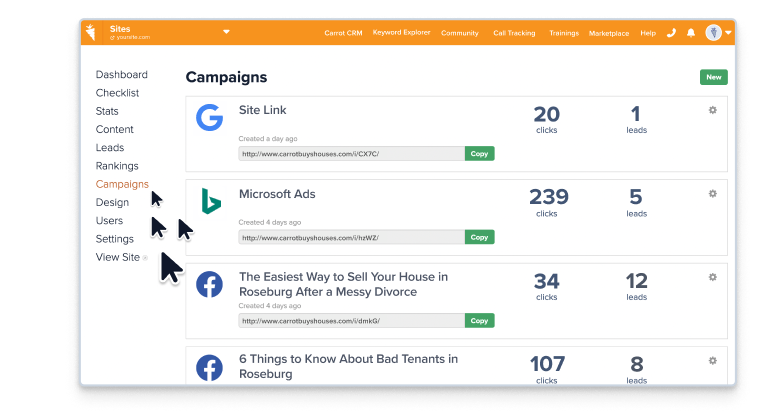
    • The average cost-per-click for a real estate ad was $25.20 in 2024.

    Whether you’re brand new to real estate investing or a seasoned pro, this report gives you good insights into what your peers are up to, industry standards, and how you stack up.

    Table of Contents

    1. Who are Real Estate Investors?
    2. How Much Time Do Investors Spend Marketing?
    3. Where Should Investors Focus Their Marketing?
    4. Marketing Budgets in 2025
    5. What to Expect from PPC & Paid Ads
    6. Your 2025 Playbook for More Deals

    Carrot icon
    Lead generation, at its best
    Attract, convert & close more motivated leads
    Try Carrot Today

    Who are real estate investors?

    To help shine some light on the state of real estate investment marketing, we surveyed 90 REI professionals — both Carrot members and non-Carrot members — to learn what marketing strategies they’re using, what their most effective lead generation channels are, their annual marketing budget, and how 2025 will be different from 2024. Investors of all experience levels and a variety of real estate investment specialties responded, providing valuable insights no matter where you are on your REI journey.

    Real estate investors mostly handle their own marketing

    For real estate investors, marketing is still very much a DIY endeavor. Fifty-seven percent of survey respondents report handling all marketing activities themselves, while 31% have some outside help. Only 12% of investors have agencies or freelancers handle all their marketing.

    Marketing activities make up only a fraction of a busy investor’s schedule though. More than 85% of survey respondents spend less than 10 hours per week on marketing activities, with nearly a quarter of respondents dedicating less than one hour per week. Things may change this year though, as an impressive 71% of investors plan on increasing their marketing time. Only 8% plan on decreasing the amount of time spent on marketing in 2025.

    Where should investors focus their marketing?

    With so little time dedicated to marketing, it’s important for investors to find strategies and tools that work well and fill pipelines. With a seemingly endless number of marketing solutions available, deciding which to focus on can be difficult. Most investors report using only a few solutions, with nearly 50% of investors using two to three marketing services. The most common are a CRM and website. Investing in a real estate CRM is a smart move in 2025 to keep all your leads (online and offline) organized and streamline follow-up. Investors still relying on spreadsheets for lead management risk falling behind their peers.

    Marketing tools support a range of lead generation strategies. The average investor works with three strategies to actively generate leads, but some use upwards of eight. Websites and social media are the most common, followed by direct mail, cold calling, and SEO, indicating that both online and offline lead generation tactics still work a successful investment business. The “tried and true” lead generation approaches aren’t fading, but successful investors are also expanding online to ensure they capture the maximum number of leads.

    While referrals and networking are the No. 1 source of leads for many investors, social media and direct mail are also top lead drivers. When planning your marketing strategy in 2025, a healthy mix of networking plus online and offline marketing has the best chance of driving success. Channels like direct mail & paid social media ads still work in 2025, but judging by the numbers, there’s low-hanging fruit in SEO.

    Note: The important part is to treat your website as the “hub” of your marketing — funnel your direct mail, social, PPC, etc., to your website so you can capture those leads more easily!

    To capture more leads in 2025, 65% of investors plan on adding additional marketing strategies. Only 3% intend to decrease their number of outreach channels. For those interested in increasing marketing, SEO, paid advertising, and pay-per-lead solutions are popular and effective for many successful investors. Having a high-converting website is also a key piece of the mix, as you need something to optimize for SEO and somewhere to point paid advertising. It’s also good practice to add a website to any offline outreach so potential leads can research you and verify your authenticity before deciding to reach out. When was the last time you worked with a company without checking them out online first?

    Marketing budgets vary wildly in 2025

    How much real estate investors spend on marketing annually ranges from less than $1000 for the entire year up into six figure sums. The median marketing budget amongst survey respondents is $12,000 annually, though investors who run online advertising likely have higher budgets. Eight respondents plan on spending less than $1000 on marketing this year, while 12 will spend more than $100,000. Three respondents report having a $500,000 annual marketing budget!

    And those budgets are only growing for many. Sixty percent of survey respondents are increasing their marketing budget in 2025, while 28% are keeping their budget the same. 

    How much investors spend corresponds somewhat to how long they’ve been in real estate. Newer investors naturally have a lower budget as they work to close their first few deals. Annual marketing budgets increase as investors become more seasoned, but stay relatively flat for investors with 1-9 years of experience.

    Interestingly, there isn’t a consensus on the primary lead source among the top spenders, nor on their most effective marketing strategy. While investors who spend more than $100,000 do utilize more marketing strategies (an average of five instead of three), some top spenders only rely on paid ads or cold calling. The most commonly used marketing strategies for this high-budget cohort are websites and direct mail.

    Meanwhile, those with the smallest annual budgets ($2,500 or less) rely on an average of two marketing strategies, mainly a website, social media, or cold calling. Their primary lead sources are more manual and low-cost options, such as referrals and social media.

    What to expect from PPC & paid advertising

    While only 8% of survey respondents invest in online advertising, it can be a lucrative lead source. To help investors who already run ads or those interested in expanding to PPC in 2025 understand what the investment looks like and what to expect, we asked our friends at Motivated Leads, a digital marketing agency specializing in online advertising for real estate investors, to share some insights.

    How much to spend on ads

    Last year, the median spend on Google Ads for Motivated Leads clients was $3,000 to $5,000 a month and the average cost-per-click (CPC) was $25.20. Investors running regular Google ads saw an average click-thru rate (CTR) around 5%, leading to an average cost-per-lead (CPL) of $250 or lower.

    Ads targeting Illinois, Kentucky, and Delaware had the highest conversion rates, with CPLs dancing around the national average:

    • Illinois: $207.18
    • Kentucky: $241.03
    • Delaware: $279.11

    However, things changed slightly for investors who used Google’s Performance Max advertising option. Performance Max can lower your CPC and CPL, however, it may result in less qualified leads without proper campaign optimization.

    Performance Max is harder to run and has broader targeting, leaving the algorithm to place ads. With this approach, your ads may appear on display, search, YouTube, Gmail, or other places and may appear to web surfers outside of your local area. This broader approach can impact lead quality because you have less control over who you’re targeting ads toward.

    Google’s “regular” search advertising gives you more control over who you’re targeting and where your ads appear, allowing you to specifically target searchers who are more likely to become leads. The cost per lead is higher in this case because you’re focusing on more qualified leads. Investors with smaller advertising budgets should focus on Google search ads and targeting the right keywords to get the most value from their investments. 

    The most effective advertising

    Focusing your ad budget on the right keywords and running ads at the right time can make your advertising dollars go further.

    In 2024, the highest-converting keyword themes for real estate investors were:

    • Sell my house fast
    • We buy houses
    • Home buyer

    Localizing your target markets and adding local terms to your keywords helps focus who sees your ads, improving lead quality. When adding a location name to keywords remember that your city name may not be unique. Are you trying to reach buyers/sellers in Portland, OR or Portland, ME? Make sure your ad account is properly set up to target the right area and that the landing pages your ads point to include the city AND state.

    Once your ads are set up, give them a better chance of being seen by running them at the best times. In 2024, online ads converted best on Monday, Tuesday, and Wednesday between 1pm and 5pm local time.

    Understanding online advertising trends from the past 12 months can help you plan your strategy for this year, but it’s important to remember that the world of online advertising can change quickly. Google algorithm updates and changes to the Google Ads platform can happen at any time and may impact how ads are set up and their performance.

    For example, Google Ads performance and strategy underwent notable changes between 2023 and 2024. The cost-per-click increased by 36%, while the click-through rate improved by 17%. Despite these shifts, the cost per lead remained virtually unchanged, with only a slight variation according to Motivated Leads.

    A major strategic difference lies in keyword usage. In 2023, marketers focused on phrase and exact match keywords. However, in 2024, Google’s updated keyword match type (leveraging signals and a searcher’s intent) prompted a shift toward broader but still highly relevant keyword themes.

    If you run your own ads, pay attention to any shifts or noticeable updates to make sure you maintain optimal ad performance. If you’re not comfortable running your own ads (or simply don’t want to become an online marketing expert), consider working with an advertising agency like Motivated Leads. (Need help finding a PPC service? Check out the Carrot Marketplace.)

    Your 2025 playbook for more deals & more revenue

    This survey proves there isn’t one right way to generate real estate investment leads. Find what works for you and your budget. If you’ve been avoiding certain marketing strategies, 2025 may be a good time to expand your reach and try something new. If you don’t have a website yet, this is the year to get online. A strong website serves as both a lead generation machine and a central hub for the rest of your online and offline marketing.

    Need help knowing where to focus this year? Here are some tips from Carrot CEO Trevor Mauch:

    🔥 1. Invest in Your Online Presence – Your website isn’t just a “nice-to-have.” It’s your 24/7 conversion hub. Make sure it’s optimized, fast, mobile-friendly, and ranking in Google. If you’re on Carrot, you’re already ahead of the game. If you’re not — it may be time to consider a switch.

    🔥 2. Optimize for Conversions – Most investors waste traffic. Don’t be one of them. Your website should be built to convert visitors into leads at the highest possible rate.

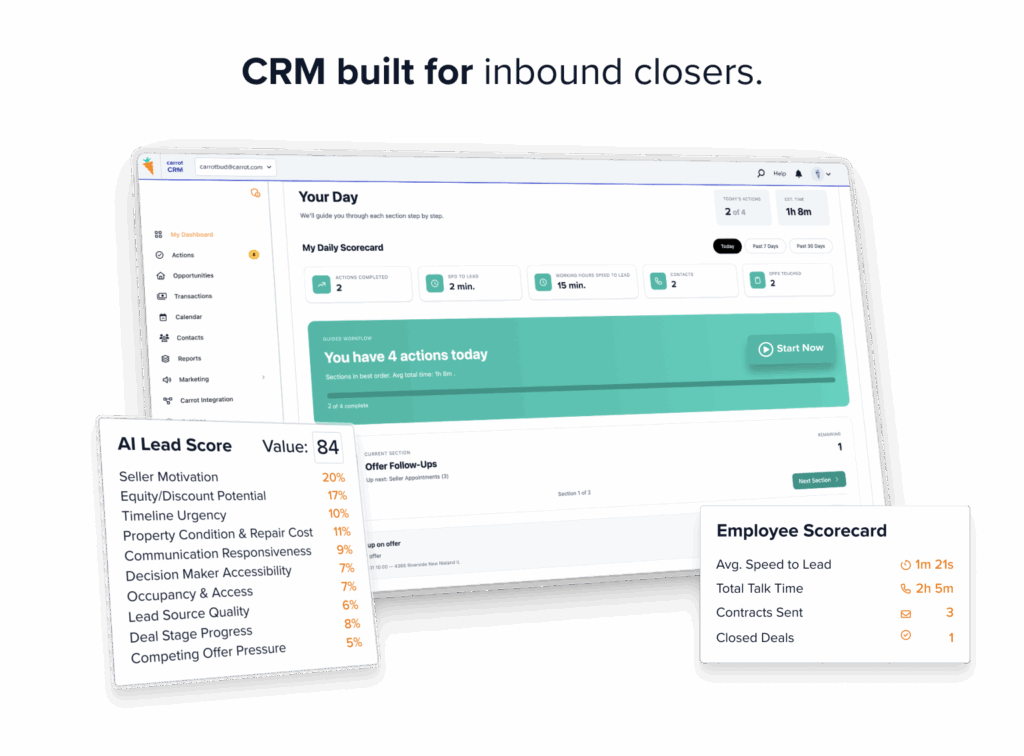
    🔥 3. Get Your Follow-Up Dialed In – Leads are ready to act NOW. If you’re not following up fast, you’re leaving money on the table. Carrot CRM helps you track, nurture, and close leads effortlessly.

    🔥 4. Take Action — Before Your Competition Does – 71% of investors are increasing their marketing in 2025. If you’re not doubling down, you may find yourself struggling to get the leads and deals you were used to getting last year.

    Take inspiration from these findings and double down on your marketing to make 2025 the biggest year yet!

  • Mike Wall – Success Story

    Mike Wall – Success Story

    From Zero to $100K/Month in 12 Months: How Mike Closes 3-4 Carrot Deals Every Month

    Investor/Agent Mike Wall turned EZ Sell Homebuyers into a steady business, closing 3-4 deals monthly with an average profit of $25,000 per deal by focusing on high-quality lead sources that saved him time & energy.

    From Zero to $100K/Month in 12 Months: How Mike Closes 3-4 Carrot Deals Every Month

    Closes 3-4 Deals Monthly

    $25k Profit Per Deal

    Over 400 motivated leads in just 1 year

    I never got anything from my old custom websites… You go where people are getting results. I saw people in competitive markets using Carrot, so I knew it was the platform I needed.”

    Take our free demo to walkthrough what Carrot can do for you.

    The Challenge: Chasing Unmotivated Leads & Overspending on Marketing

    Mike was a real estate agent with a brokerage of 20 agents, doing 300 deals per year, who dabbled as an investor but decided to get serious about it.

    It only took a few months into investing to get tired of chasing down unmotivated leads and competing against other investors for the same lead lists — cold calling, direct mail, text blasting, etc. He was spending time chasing dead leads and blowing his marketing budget without closing deals.

    Before Carrot, Mike paid $7k for two custom websites and spent $5k/month on offline marketing but was hardly getting any visits to his website and had ZERO leads. He’d wasted money and wasn’t standing out.

    “I never got anything from my old custom websites… You go where people are getting results. I saw people in competitive markets using Carrot, so I knew it was the platform I needed.”

    He realized it was time to rebuild his investing business on proven, consistent marketing sources. That’s when he found Carrot:

    Mike Wall Carrot website

    The Solution: Mike’s “AHA!” Moment – Finding Carrot & Dominating Google

    When Mike realized the most motivated leads were searching on Google, he started researching which website builder to go with. The AHA moment was when Mike was Googling “we buy houses” in competitive markets and found Carrot sites were the ones ranking.

    He noticed Carrot laid out a path for creating an inbound flow of leads like he was searching for – and that a Carrot site was the “hub” to send all your marketing to so it converts better.

    Step 1 was getting a Carrot site launched and doing the initial work to optimize it for SEO. Mike knew that SEO results take diligence and time, so to get leads immediately, he began sending Google Ads/PPC traffic to his new site.

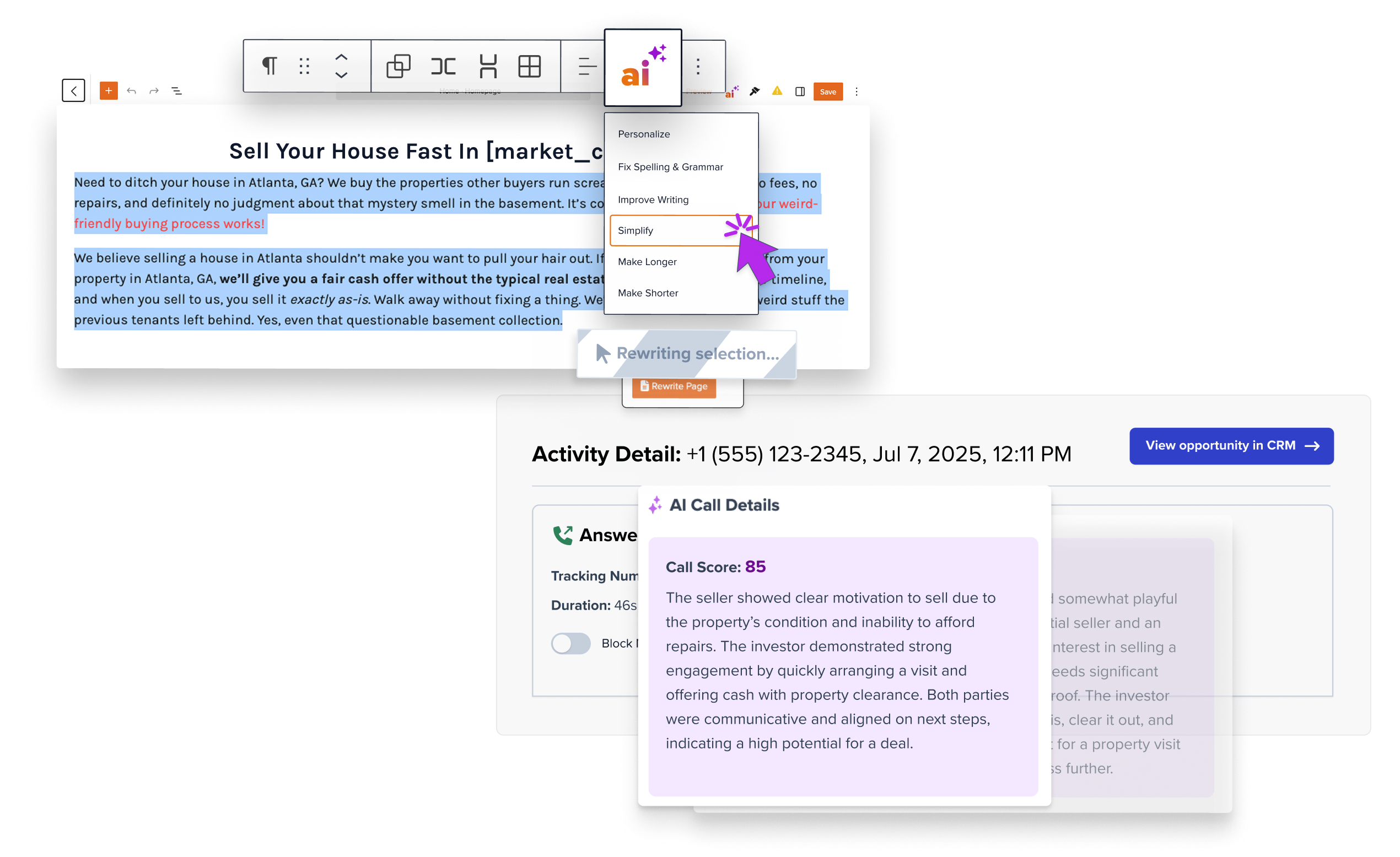
    Step 2 was logging into his Carrot site and using tools like the one-click Location pages, and Automated Credibility Posts, along with the AI rewrite tool to pump out content that would rank well in Google. He made sure to save time by following Carrots training and guidance every step of the way.

    427 Total Leads from Dec 2023 – Jan 2024

    Mike Wall Carrot.com Leads

    Mike’s 6-Month Plan to Generate Consistent Inbound Leads

    Month 1 – January 2024

    • Mike joined Carrot and personalized his site, adding testimonials, etc. He loved how quick and easy it was to launch his Carrot site.
    • Since Mike wanted his website to rank high in Google for terms like “sell my house fast Dayton, Ohio” so it would generate leads, he dove into Carrot’s comprehensive SEO training & free resources as opposed to hiring it out to one of our partnered SEO agencies.

    Months 2-3

    • Now that Mike had a grasp on SEO, he went to work. He launched “location pages” on his website for all the various locations he wanted to rank for and attract leads. This can be done in just a couple of hours with Carrot’s Auto Location Pages. Note: Did you know Carrot members who use Auto Location Pages generate 94.19% more traffic and 116.03% more leads per month than members who don’t?
    • He posted blog posts on topics like “how to sell my house during divorce” to help educate & convert prospects (and help rank in Google.) Carrot’s content tools tool makes this a breeze.
    • He used Carrot’s AI Rewrite tool to help make his Carrot-provided content more unique.

    I couldn’t survive without the SEO Tools…I love the SEO & content tools, but it’s more about combining everything.

    • He built out “citations” like a Google Business Profile, YellowPages, Yelp, BBB, etc. Carrot also offers a done-for-you option for citations.
    • With the work he put into Carrot, Mike began ranking in less than 3 months for some of his blog posts & location pages!
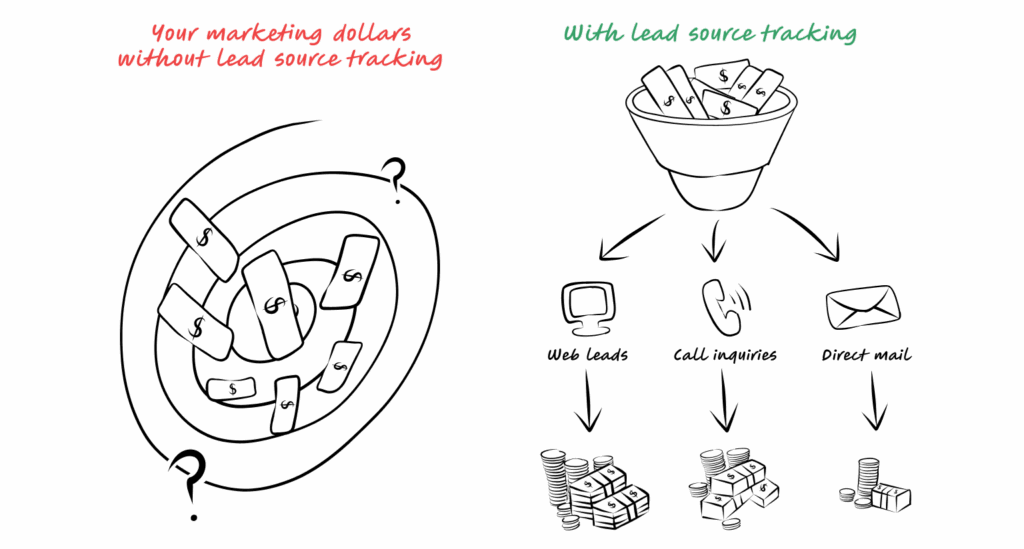
    • After tracking his progress in Carrot’s Domain Overview and using the Keyword Rank Tracker to track 53 keywords, he realized his location pages and blog posts were paying off! He’d achieved ranking #1 in many markets all over the state!

    • While Mike was working on his SEO, he hired a Google Ads/PPC service (Brendan from SoaringSEM) to run ads to produce quality, inbound leads. He gets steady ROI from this and continues to pay for Google Ads. You can find additional PPC & SEO agencies we trust & recommend in the Carrot Marketplace.
    Mike Wall keyword rankings

    Months 4-6

    • With most of the upfront work out of the way, Mike focused on getting backlinks to his website by creating or contributing to content on other people’s websites. Mike loves using the backlinks analysis tool to see which links give him the most SEO juice, like this article he contributed to.
    • He also got creative with blog posts, used ChatGPT to outline articles, used Carrot’s AI rewrite tool, and was getting even more leads from his market & around the state, even more motivated because they’re searching specific problems like “how to sell a house in probate” divorce, with termites, etc.

    Months 6-12

    • Mike was enjoying the fruits of his labor and continued to iterate by adding new content and discovering more keywords that other investors weren’t ranking for. He was also getting so many leads that he needed to keep better track. He’d been waiting for CarrotCRM to release and switched over from Follow-up boss to CarrotCRM to manage his leads and is loving it!

    The Result: Mike’s Path to $100k/Mo in Deals

    Mike Wall deal tracking
    Mike Wall deal results

    After 1 year with Carrot, Mike is averaging $75k-$100k profits per month (that’s 3-4 deals per month at $25k average profit per deal!) – All but two of the deals he closed this year were from SEO & Google Ads to his Carrot site, and those two were referrals from Carrot deals!
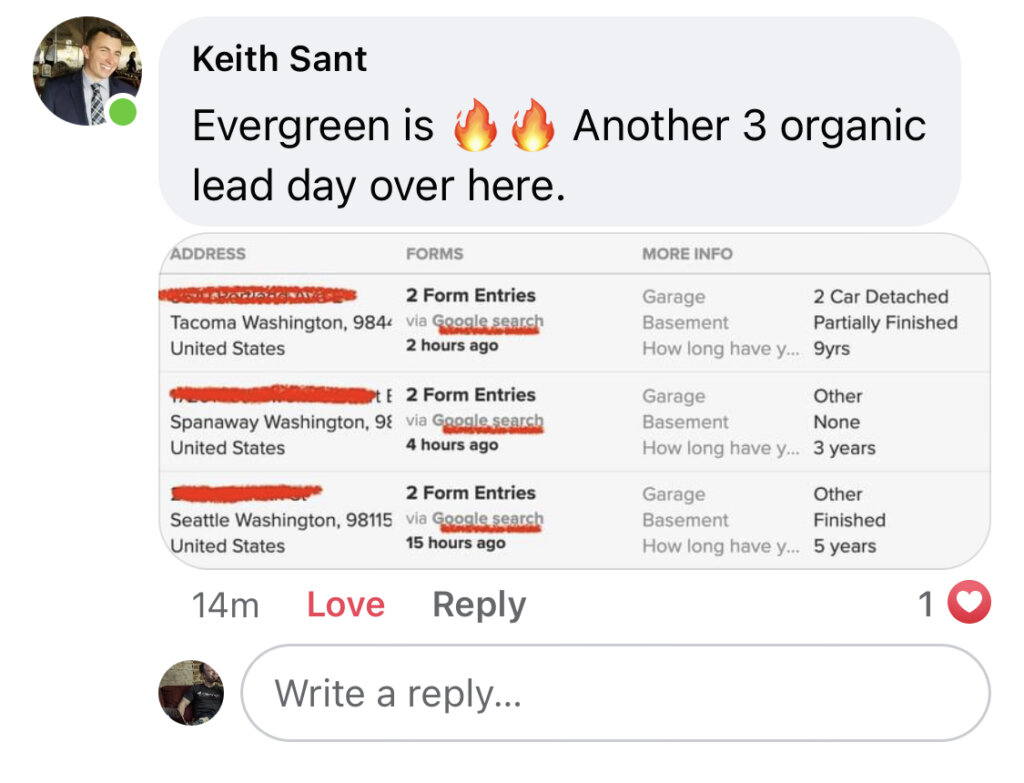
    Before Carrot (June 2024)

    • $5k/mo on ineffective offline marketing
    • $7k on worthless custom sites
    • ZERO leads

    After Carrot (January 2025)

    • Only $245/mo for Carrot, plus SEO Tools, Content Tools, Premium Designs, and Carrot CRM essential
    • Under $4,000/mo in done-for-you Google PPC Ads
    • Sweat equity creating content for his website and getting backlinks
    • Over 400 motivated leads in just 1 year

    Want Results Like Mike?

    Launch a website in just minutes and use our marketing tools to drive truly motivated leads, so you can close more deals.

  • How to Conduct Keyword Research for Google Ads for Real Estate Investors

    How to Conduct Keyword Research for Google Ads for Real Estate Investors

    Keyword Research for google ads for real estate investors

    Keyword research is the foundation of successful Google Ads campaigns. It helps you discover the search terms your ideal clients are using, allowing you to align your ads with their needs and intent. For real estate investors, targeting the right keywords is crucial for reaching motivated buyer and seller leads—those actively searching to sell quickly or find investment deals.

    In a competitive market, effective keyword research ensures you attract high-intent traffic, not just clicks. This guide is designed for real estate investors, particularly those using platforms like Carrot and will help you find and use the best keywords to optimize your Google Ads and maximize your ad spend.

    Why Keyword Research is Crucial for Real Estate Investors: Boost Leads and Slash Costs

    Real estate is one of the most competitive industries in online advertising, with countless agents and investors fighting for attention. Without a solid keyword strategy, your Google Ads can easily get lost. Keyword research is the key to standing out by targeting the exact search terms your audience is using.

    For real estate investors, reaching motivated sellers and buyers is essential. These leads are ready to take action, whether it’s selling their house fast for cash or finding investment properties. Keywords like “sell my house fast” or “cash home buyers” attract high-intent leads who need quick solutions.

    Precise keyword targeting ensures you spend your budget wisely, bringing in qualified leads rather than unqualified clicks. By focusing on phrases like “off-market properties” or “investment homes for sale,” you’ll connect with serious buyers and sellers in need of fast results.

    In a competitive niche like real estate, you need a focused strategy—and that begins with smart keyword research.

    Setting the Foundation: Understanding Search Intent

    Before diving into keyword research, it’s essential to understand the concept of search intent. Search intent refers to the purpose behind a user’s query on Google. There are three main types of search intent: transactional, navigational, and informational.

    • Transactional Intent: This type of intent indicates that the user is ready to take action, such as making a purchase or completing a form. In the context of real estate investing, keywords with transactional intent are often associated with users who are motivated to sell their property quickly or find investment opportunities, such as “sell my house fast” or “buy investment properties in .”
    • Navigational Intent: The user is looking for a specific website or platform. For example, a real estate investor may use keywords like “Carrot real estate website” or “best real estate investor tools” to directly find a product or service they’ve heard about.
    • Informational Intent: These users are seeking knowledge or research on a topic. In real estate, this could include searches like “how to sell a house by owner” or “real estate market trends 2024.” While important for brand visibility, these keywords typically lead to people who are still in the research phase and not yet ready to convert.

    For real estate investors focused on generating leads, the most valuable search intents to target are transactional and navigational. These users are further along in their decision-making process and are more likely to convert into leads. Transactional keywords are key because they signal immediate action. Navigational keywords, while often brand-specific, are also valuable because they indicate the user knows what they want and are actively seeking your service.

    Search intent directly impacts the type of ads you create and the keywords you prioritize. For instance, a person searching “sell my house fast” has clear transactional intent—they are looking for a quick solution, and your ad should reflect urgency and a direct call to action, like “Get a Cash Offer Today.” In contrast, someone searching for “real estate market trends 2024” is still in the research phase, so while they may not convert right away, nurturing these leads with content and retargeting ads can eventually pay off.

    Let’s take two examples to illustrate how search intent affects keyword strategy:

    • A person searching for “sell my home fast in ” likely has transactional intent. They want a fast, direct solution, making this keyword ideal for investors targeting motivated sellers.
    • Someone searching for “how much is my home worth” may be researching the market and not yet ready to act. While they may be worth capturing for long-term nurturing, this type of keyword would fall under informational intent.

    Understanding search intent allows you to align your keywords with your goals, ensuring that your ads are displayed to users who are most likely to convert. Focusing on transactional and navigational keywords can result in higher-quality leads and a more effective ad strategy for real estate investors.

    Step-by-Step Guide to Conducting Keyword Research for Real Estate Google Ads

    Option 1: Use Google’s Keyword Planner

    Google’s Keyword Planner is a powerful tool that helps advertisers discover relevant keywords for their campaigns. It provides valuable insights into keyword search volume, competition, and cost-per-click (CPC), making it an essential resource for real estate investors looking to optimize their Google Ads.

    By using this tool, you can find keywords that target motivated sellers and buyers, ensuring that your ads reach the right audience.

    How to Access and Navigate the Tool

    1. Create a Google Ads Account: If you haven’t already, sign up for a Google Ads account at ads.google.com. You’ll need to provide some basic information about your business.
    2. Access Keyword Planner: Once your account is set up, click on the “Tools & Settings” icon (wrench) in the upper right corner of the Google Ads dashboard. Under the “Planning” section, select “Keyword Planner.”
    3. Choose Your Option: You will see two options:
      • Discover new keywords: This option helps you find keywords related to your business or website.
      • Get search volume and forecasts: This option allows you to enter keywords and see their historical performance metrics.
    4. For the purpose of this guide, select “Discover new keywords.”

    Step-by-Step Process to Find Relevant Real Estate Keywords

    1. Enter Your Ideas: In the “Discover new keywords” section, start by entering terms related to your business. Think about phrases that motivated sellers or buyers might use. For example, you could enter “sell my house fast,” “cash home buyers,” or “investment properties.”
    2. Select Location and Language: Adjust the targeting options to focus on your specific market. You can set the location to your city or region to find local keywords. Ensure the language is set to your target audience’s language (typically English).
    3. Click on “Get Results”: After entering your keywords and adjusting the settings, click the “Get Results” button to see the keyword suggestions.
    4. Analyze the Results: You’ll be presented with a list of keyword ideas along with important data, including:
      • Average monthly searches: Indicates how many searches are performed on average each month.
      • Competition: Shows how competitive a keyword is, rated as low, medium, or high.
      • Top of page bid: Provides an estimated cost-per-click for that keyword.
    5. Filter and Sort: Use the filter options to narrow down your results. For example, you can filter by competition level or search volume to find the most relevant keywords for your ads.
    6. Select Relevant Keywords: Identify keywords that align with your goals. For example, look for terms like “we buy houses,” “quick cash offers,” and “sell my property fast.” These keywords indicate strong transactional intent and can help you reach motivated sellers.
    7. Add Keywords to Your Plan: Once you’ve identified a list of potential keywords, you can add them to your plan by clicking the checkbox next to each keyword and then selecting “Add to plan.”

    Example Keywords for Real Estate Investors

    Here are some example search phrases you might find using Google’s Keyword Planner:

    • Motivated Sellers:
      • “Sell my house fast”
      • “Cash offer for my home”
      • “Quick home sale”
    • Cash Buyers:
      • “Cash home buyers ”
      • “Sell house for cash”
      • “Buy my house cash offer”
    • Property Listings:
      • “Investment properties for sale”
      • “Foreclosed homes for sale”
      • “Off-market properties in ”

    You can efficiently identify and select the best keywords for your real estate Google Ads campaigns using Google’s Keyword Planner. This targeted approach will enhance your ability to connect with motivated buyers and sellers, ultimately driving more qualified leads to your business.

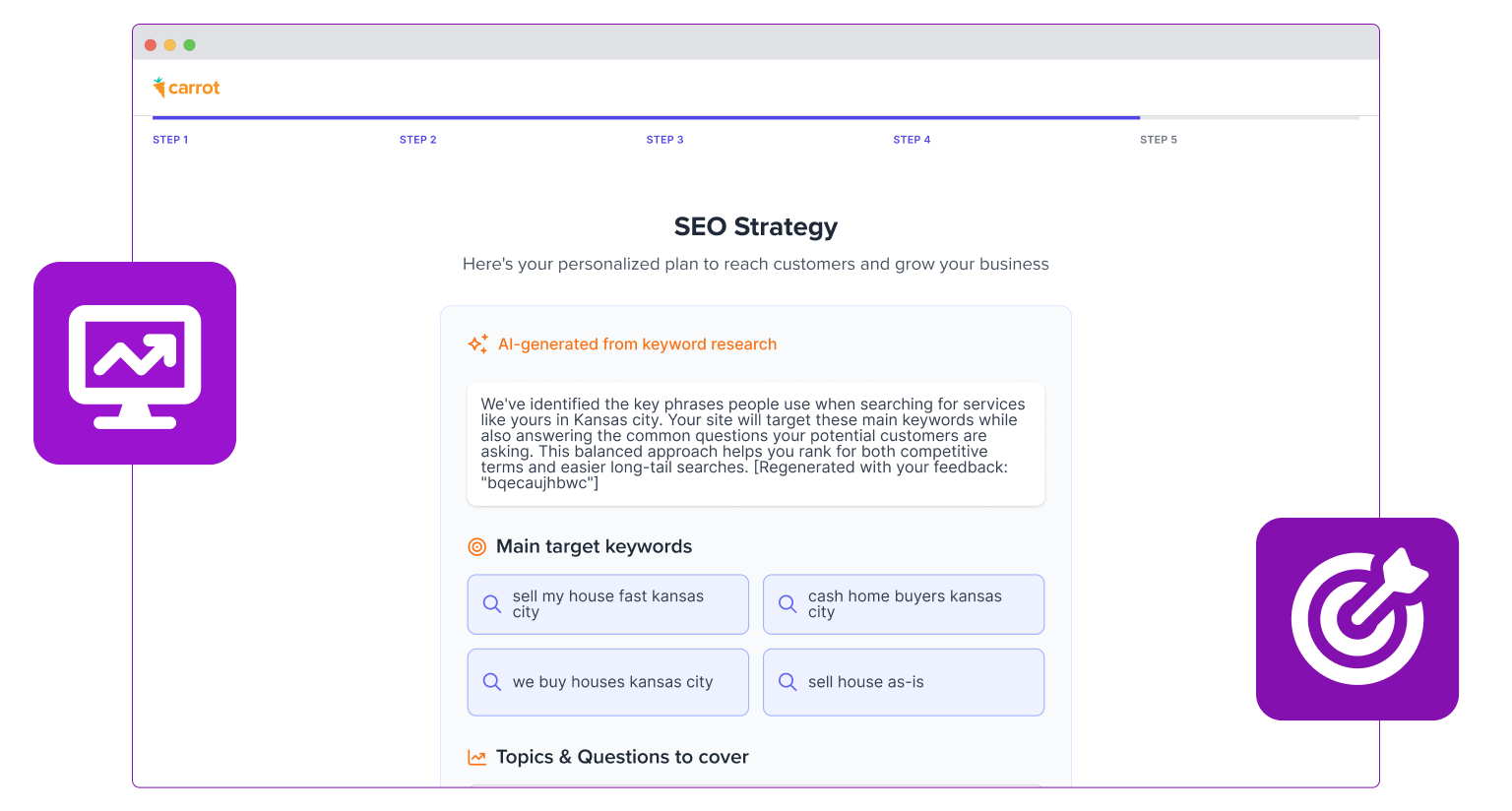
    Option 2: Leverage Carrot’s Keyword Explorer Tool

    Carrot’s Keyword Explorer tool is an invaluable resource specifically designed to help real estate investors discover relevant keywords and optimize their online presence. This tool is integrated directly into the Carrot platform, making it easy for you to find and utilize keywords that attract motivated buyers and sellers without needing to switch between multiple applications.

    How Carrot’s Keyword Explorer Can Help Real Estate Investors

    How to Do Keyword Research for Local SEO
    1. Targeted Keyword Suggestions: Carrot’s Keyword Explorer provides keyword suggestions tailored to the real estate market. This feature helps you identify the most effective keywords to reach motivated leads who are searching for solutions like yours.
    2. SEO and PPC Integration: The tool not only helps with Google Ads keyword research but also assists in optimizing your website’s content for search engines. This dual functionality ensures that your advertising and organic efforts are aligned for maximum impact.
    3. User-Friendly Interface: Carrot’s interface is intuitive and user-friendly, making it easy to navigate even if you’re not a tech expert. This accessibility means you can spend more time focusing on strategy and less time figuring out how to use the tool.

    Learn more about using Carrot’s Keyword Explorer tool in the in-depth tutorial.

    Benefits of Using a Tool Integrated into a Website Platform

    • Streamlined Process: Having the keyword tool integrated within your website platform means you can quickly move from keyword discovery to content creation and ad setup without leaving the Carrot ecosystem. This streamlining saves time and improves efficiency.
    • Real-Time Data: Carrot’s Keyword Explorer provides real-time data and insights, enabling you to make informed decisions quickly. You can adjust your strategy on the fly based on the latest trends and performance metrics.
    • Tailored to Your Niche: Unlike generic keyword tools, Carrot’s Keyword Explorer is specifically designed for real estate investors, ensuring that the suggestions you receive are relevant and actionable.

    Example of Uncovering Long-Tail Keywords Using the Carrot Platform

    To illustrate how to use Carrot’s Keyword Explorer to uncover valuable long-tail keywords, follow these steps:

    1. Access the Keyword Explorer: Log in to your Carrot account and navigate to the Keyword Explorer tool within your dashboard.
    2. Enter Seed Keywords: Start by entering a few seed keywords related to your business. For example, you might enter “sell my house fast,” “cash home buyers,” or “real estate investment.”
    3. Review Suggested Keywords: After clicking “Search,” the tool will generate a list of related keywords. Look for long-tail keywords—phrases that are typically three or more words long, as these often indicate stronger intent. For example, you might see suggestions like “sell my house fast for cash in ” or “best cash home buyers near me.”
    4. Analyze Metrics: Examine the suggested keywords for their search volume, competition level, and relevance to your business goals. Long-tail keywords often have lower competition but can lead to highly qualified leads.
    5. Select and Save Keywords: Choose the keywords that resonate most with your target audience and align with your campaign objectives. You can save these keywords for use in your Google Ads campaigns and website content.

    By leveraging Carrot’s Keyword Explorer tool, real estate investors can uncover valuable long-tail keywords that attract motivated buyers and sellers. This integrated approach not only enhances your advertising strategy but also strengthens your overall online presence, driving more qualified leads to your business.

    How to Analyze Competitor Keywords

    Analyzing competitor keywords is a crucial step in refining your keyword strategy for Google Ads. By understanding what keywords your competitors are targeting, you can identify gaps in your own strategy and uncover valuable opportunities to attract motivated buyers and sellers.

    How to Identify Competitor Keywords Using Tools Like Carrot Keyword Explorer, SEMrush, or Ahrefs

    1. Choose a Competitor: Start by identifying one or more of your key competitors in the real estate market. Look for businesses that operate in the same geographic area and target similar buyer and seller demographics.
    2. Access Your Chosen Tool:
      • Carrot’s Keyword Explorer: Log in to your Carrot account. Use the same instructions as above.
      • Ahrefs: Log in to your Ahrefs account and go to the “Site Explorer” feature.
      • SEMrush: Log in to your SEMrush account (or sign up for a free trial if you don’t have one). Navigate to the “Domain Analytics” section.
    3. Enter the Competitor’s Domain: In the search bar, input the URL of your competitor’s website and click “Search.” This will provide you with an overview of their website’s performance and keyword targeting.
    4. Navigate to the Keywords Section:
      • Carrot Keyword Explorer: Pull a report on your top 2-3 competitors’ sites and see their most popular keywords bringing them traffic.
      • Ahrefs: Click on “Organic Keywords” to see the keywords driving traffic to their site.
      • SEMrush: Click on “Organic Research” to view the keywords your competitor ranks for organically.
    5. Filter Keywords by Metrics: Use filters to narrow down the results based on criteria like:
      • Search Volume: Focus on keywords with substantial search volume.
      • Keyword Difficulty: Look for keywords with lower competition scores to identify more attainable targets.
      • Traffic: Check for keywords that generate significant traffic for your competitor.

    How to Evaluate Which of Your Competitors’ Keywords Are Worth Targeting

    1. Relevance: Ensure that the keywords are relevant to your business. Target keywords that align with the services you offer and the needs of your target audience, such as “sell my house fast” or “cash buyers for investment properties.”
    2. Search Intent: Consider the search intent behind the keywords. Focus on transactional keywords that indicate potential leads are ready to act rather than purely informational terms.
    3. Competition Analysis: Analyze the competition for each keyword. Use the tools to see how many advertisers are bidding on the keyword and how much they are spending. This can give you an idea of the keyword’s value and potential ROI.
    4. Gaps and Opportunities: Look for keywords that your competitors rank for but you do not. These gaps can represent lucrative opportunities for you to target in your campaigns.

    Example of Dissecting a Competitor’s Google Ads Campaign for Valuable Keyword Ideas

    To find the keywords your competitors are using and leverage Carrot’s Keyword Explorer, follow these steps:

    1. Access Carrot’s Keyword Explorer Tool

    • Log in to your Carrot.com account.
    • Navigate to the Keyword Explorer tool from your dashboard.

    2. Research Competitor Domains

    • In the Keyword Explorer, input the URL of a competitor’s website or landing page. This will allow the tool to analyze their content and provide keyword insights.
    • Click Search to see what keywords your competitor is ranking for organically.

    3. Analyze Competitor Keywords

    • Review the keyword suggestions that appear based on your competitor’s domain.
    • Focus on high-intent keywords related to real estate investing or home selling, such as “sell my house fast,” “cash home buyers,” or “investment properties.”
    • Pay attention to the search volume, difficulty, and click-through-rate (CTR) estimates to prioritize valuable keywords.

    4. Look for Long-Tail Keyword Opportunities

    • Scroll through the results for long-tail keywords—these are often less competitive and can provide opportunities for local targeting. For example, “sell my house fast in ” or “cash buyers [Location].”

    5. Refine Your List

    • Filter the results by relevance, competition, or search volume to create a refined list of keywords.
    • Export this list to compare it with your own keyword strategy or to test it in your Google Ads campaign.

    6. Incorporate Competitor Keywords Into Your Campaign

    • Take the top-performing keywords and incorporate them into your Google Ads campaign. Based on these high-performing terms, create new ad groups or update existing ones.

    7. Monitor and Iterate

    • Once you’ve implemented competitor keywords in your campaign, regularly monitor their performance. Use Carrot’s platform to track how well these keywords drive traffic and conversions, making adjustments as needed.

    By using Carrot’s Keyword Explorer, you can easily dissect a competitor’s campaign, find valuable keyword opportunities, and use this data to outperform them in your own Google Ads efforts.

    Long-Tail Keywords for Local Targeting

    Long-tail keywords are search phrases that typically contain three or more words and are highly specific to the user’s intent. In niche markets like real estate, long-tail keywords hold significant value. They not only help you target a more specific audience but also reduce competition, making it easier to rank in search engines and attract qualified leads. For real estate investors, long-tail keywords can connect you directly with motivated sellers and buyers in your local market.

    The Value of Long-Tail Keywords in Niche Markets

    1. Higher Conversion Rates: Because long-tail keywords are more specific, they often attract users who are further along in the buying or selling process. For example, someone searching for “sell my house fast in ” is likely ready to take action, increasing the likelihood of conversion.
    2. Reduced Competition: Long-tail keywords typically have lower search volumes, but they also face less competition compared to broader terms. This makes it easier to rank higher in search engine results and have your ads displayed to the right audience.
    3. Targeted Traffic: By focusing on long-tail keywords, you can draw in highly targeted traffic that aligns closely with your business objectives. This means your ads are more likely to be seen by individuals who are genuinely interested in your services.

    How Real Estate Investors Can Use Geo-Specific Long-Tail Keywords to Target Local Leads

    1. Identify Your Target Market: Start by determining the geographic areas where you want to focus your marketing efforts. This could be specific neighborhoods, cities, or regions.
    2. Incorporate Location into Keyword Phrases: Use your identified locations to create geo-specific long-tail keywords. This involves adding the city or neighborhood name to your main keyword phrase. For instance, instead of simply using “cash home buyers,” you would use “cash home buyers in .”
    3. Utilize Keyword Research Tools: Use tools like Google’s Keyword Planner or Carrot’s Keyword Explorer to identify local long-tail keywords relevant to your area. Search for phrases that potential sellers might use when looking for quick solutions.
    4. Test Variations: Consider different variations of long-tail keywords that may resonate with your target audience. For instance, you might try phrases like “we buy houses in ,” “sell my house quickly in [Neighborhood],” or “investors buying homes in [Location].”

    Examples of Long-Tail Keywords for Local Targeting

    Here are some examples of effective long-tail keywords for real estate investors targeting local leads:

    • “Sell my house fast in ”: This phrase directly targets homeowners who need to sell their property quickly and indicates a sense of urgency.
    • “Cash home buyers [Location]”: This keyword targets individuals searching for cash buyers in a specific area, showcasing your capability to provide quick and hassle-free transactions.
    • “Sell my property in [Neighborhood]”: This variation narrows the focus even further, appealing to homeowners in a specific neighborhood looking to sell.
    • “We buy houses in ”: This keyword signals that you are a buyer actively looking for properties, which can attract motivated sellers.
    • “Best real estate investors in [Location]”: This keyword helps position you as a reputable investor in your area, attracting potential sellers who are seeking trustworthy buyers.

    By leveraging geo-specific long-tail keywords, real estate investors can effectively target local leads, increase their visibility in search results, and ultimately drive higher-quality traffic to their ads and websites. This focused approach not only enhances your marketing efforts but also increases the likelihood of converting leads into sales.

    Negative Keyword Research

    Negative keyword research is a crucial aspect of optimizing your Google Ads campaigns. By identifying and utilizing negative keywords, you can prevent your ads from appearing for irrelevant search queries to your business. This helps to avoid unqualified clicks, which can waste your budget and skew your campaign performance metrics.

    Importance of Using Negative Keywords to Avoid Unqualified Clicks

    1. Cost Efficiency: Negative keywords help ensure that your ads are only shown to users who are genuinely interested in your services. By filtering out irrelevant traffic, you can maximize your advertising budget and improve your return on investment (ROI).
    2. Improved Click-Through Rate (CTR): When your ads appear for more relevant searches, you’re likely to receive a higher click-through rate. This not only boosts your ad performance but also enhances your Quality Score in Google Ads, which can lower your CPC over time.
    3. Better Lead Quality: By eliminating unqualified clicks, you increase the chances of attracting leads who are more likely to convert. This means you can focus on potential sellers and buyers who are genuinely interested in your services.

    How to Identify and Add Negative Keywords to Save Budget

    1. Review Search Terms Report: Start by reviewing your Google Ads account’s Search Terms report. This report shows the actual search queries that triggered your ads. Look for terms that are irrelevant to your business or that led to clicks without conversions.
    2. Identify Irrelevant Terms: Make a list of search queries that don’t align with your target audience or business goals. For example, if you notice terms like “real estate agent jobs” or “rental properties” leading to clicks, these should be added as negative keywords.
    3. Use Keyword Research Tools: You can also use tools like Google’s Keyword Planner or other keyword research tools to identify common terms that may not be relevant to your campaigns. Look for keywords that fall outside of your services or target audience.
    4. Create a Negative Keyword List: Once you have identified the irrelevant terms, create a list of negative keywords. This list can be organized into categories, such as job-related terms, rental property terms, or unrelated services.
    5. Add Negative Keywords to Your Campaigns:
    • In Google Ads, go to the “Keywords” tab for your campaign.
    • Click on “Negative Keywords” and then select “Add Negative Keywords.”
    • Enter your identified negative keywords or upload them in bulk if you have a long list.
    • Save your changes to ensure that your ads are no longer triggered by these terms.

    Examples of Negative Keywords to Avoid

    Here are some common examples of negative keywords that real estate investors might consider adding to their campaigns:

    • “Real estate agent jobs”: This term attracts individuals looking for employment opportunities rather than those interested in buying or selling properties.
    • “Rental properties”: If your focus is on buying homes or properties, you may want to exclude this term to avoid attracting renters.
    • “Free home appraisal”: This term might attract users looking for free services rather than those interested in selling their homes.
    • “How to become a real estate investor”: This term indicates a search for information on entering the industry rather than someone ready to buy or sell.
    • “Real estate courses”: Users searching for educational materials may not be looking to engage in a transaction.

    By conducting thorough negative keyword research and regularly updating your negative keyword list, you can enhance the efficiency of your Google Ads campaigns. This will help you avoid unqualified clicks, save your budget, and ultimately drive more qualified leads to your real estate business.

    Refining Your Keyword List Based on Search Volume, Competition, and Cost

    Once you’ve gathered a list of potential keywords for your Google Ads campaigns, it’s essential to refine it based on key metrics: search volume, competition, and cost. This process will ensure that you focus your efforts on the most effective keywords that align with your budget and marketing goals.

    How to Evaluate Keyword Search Volume and Competition in the Real Estate Niche

    1. Understand Search Volume: Search volume indicates how often a particular keyword is searched for in a given period, typically monthly. Higher search volume generally means more potential traffic, but it can also indicate higher competition.
      • Use Tools: Access tools like Google Ads Keyword Planner to get insights into the average monthly searches for your keywords. This tool will clearly show which keywords are frequently searched in your niche.
    2. Assess Competition: Competition reflects how many advertisers bid on a particular keyword. Keywords with high competition can be challenging to rank for, especially if you have a limited budget.
      • Competitive Analysis: In Google Ads Keyword Planner, you can see a competition rating (low, medium, or high) for each keyword. A high-competition keyword might require a larger budget to achieve visibility, while low-competition keywords could be more cost-effective.
    3. Consider the Niche: In the real estate niche, some keywords may have inherently high search volume and competition (e.g., “buy a house”) while others may be more niche-specific (e.g., “sell my house fast in ”). Focus on keywords that balance between relevance to your business and the likelihood of conversion.

    Balancing High-Intent Keywords with Affordability

    1. Identify High-Intent Keywords: High-intent keywords indicate the user is ready to act. For example, keywords like “sell my house quickly” or “cash home buyers near me” show strong intent and should be prioritized.
    2. Evaluate Cost Per Click (CPC): Along with search volume and competition, consider the estimated cost per click (CPC) for each keyword. This will give you an idea of how much you’ll need to budget for each click.
      • Finding Affordability: Compare the CPC with the potential return on investment (ROI) from leads generated through those keywords. If a high-intent keyword is too expensive, it might not be worth the investment compared to a more affordable option that also drives qualified traffic.
    3. Create a Balanced List: Aim for a balanced keyword list that includes a mix of high-intent, medium-competition keywords that fit within your budget. Prioritize those that align with your business goals and have the potential for higher conversions.

    Using Tools Like Google Ads Planner, Carrot’s Keyword Explorer or Third-Party Platforms for Detailed Data

    1. Google Ads Keyword Planner or Carrot’s Keyword Explorer:
      • Enter your seed keywords and view suggestions for related keywords, along with their search volumes, competition levels, and CPC estimates.
      • Use this data to filter and sort keywords based on your criteria, allowing you to create a focused and effective keyword list.
    2. Third-Party Platforms:
      • Consider using tools like Carrot’s Keyword Explorer, SEMrush, Ahrefs, or Moz for additional keyword insights. These platforms often provide more detailed data on keyword performance, including historical trends, organic traffic estimates, and competitor analysis.
      • These insights can help you identify emerging trends and keywords that may be gaining traction, allowing you to stay ahead of the competition.
    3. Regularly Update Your Keyword List: The real estate market can change rapidly, so it’s essential to regularly revisit and refine your keyword list based on performance data and changes in search behavior. Use your chosen tools to track which keywords drive the best results and adjust your strategy accordingly.

    By evaluating keyword search volume, competition, and cost, you can refine your keyword list to focus on the most effective terms for your Google Ads campaigns. This strategic approach will help you maximize your budget, attract high-intent leads, and improve your overall campaign performance in the competitive real estate niche.

    Testing and Iterating on Keywords

    Once you have refined your keyword list, the next step is to test and iterate on your keywords through small-budget campaigns. This process allows you to gauge the effectiveness of your selected keywords and make necessary adjustments to improve your overall ad performance.

    How to Test Your Initial Keyword List with Small-Budget Campaigns

    1. Set Up a New Campaign:
      • Create a new Google Ads campaign focused specifically on your refined keyword list. Set a modest budget that allows you to gather data without risking too much of your advertising budget.
      • Choose relevant ad formats, such as search ads, and create compelling ad copy that aligns with the intent of your chosen keywords.
    2. Implement Keyword Grouping:
      • Organize your keywords into tightly themed ad groups. For example, group keywords related to selling homes together and those related to cash buyers in another group.
      • This organization helps ensure that your ad copy is relevant to the keywords being targeted, which can improve your click-through rate (CTR).
    3. Launch the Campaign:
      • Once your campaign is set up, launch it and allow it to run for a sufficient period, usually a few weeks. This timeframe will give you enough data to analyze performance while avoiding premature conclusions.

    Monitoring Performance Metrics (CTR, CPC, Conversion Rate) to Refine Your Keyword Strategy

    1. Track Key Performance Indicators (KPIs):
      • Monitor essential metrics such as:
        • Click-Through Rate (CTR): Indicates how often people click on your ad after seeing it. A low CTR may suggest your keywords or ad copy need adjustments.
        • Cost Per Click (CPC): Understand how much you are spending for each click. This metric helps you assess the cost-effectiveness of your keywords.
        • Conversion Rate: This measures the percentage of users who take the desired action (e.g., filling out a contact form). A high conversion rate indicates that your keywords are effectively attracting the right audience.
        • Cost Per Lead (CPL): Understand how much you are spending to acquire each lead. This metric helps you evaluate the cost-effectiveness of your campaigns in generating qualified prospects.
    2. Analyze Performance Data:
      • After your campaign has run for a few weeks, review the performance data. Look for patterns in CTR, CPC, CPL, and conversion rates to identify which keywords are performing well.
    3. Identify Trends and Insights:
      • Determine if specific keywords consistently yield high CTRs and conversion rates. Then, prioritize these keywords in future campaigns.
      • Conversely, look for keywords with low-performance metrics. These may need to be paused or adjusted.

    Examples of Optimizing Keywords Based on Performance Data

    1. Adjusting Bids on High-Performing Keywords:
      • If you find that a keyword like “sell my house fast in ” has a high conversion rate and CTR, consider increasing your bid for that keyword to gain more visibility and traffic.
    2. Pausing Underperforming Keywords:
      • If a keyword such as “cash home buyers” has a low CTR and conversion rate, it may indicate that the keyword is attracting the wrong audience. In this case, pause this keyword to focus your budget on more effective terms.
    3. Refining Ad Copy:
      • If certain keywords are attracting clicks but not converting, analyze your ad copy. For example, if “cash home buyers near me” has a high CTR but low conversions, it might be worth refining the ad copy to better highlight your unique selling points or call to action.
    4. Adding New Keywords:
      • Based on performance insights, consider adding new long-tail keywords that align with high-performing terms. If “we buy houses in ” is successful, look for variations like “quick cash home buyers in [Neighborhood].”
    5. Implementing Negative Keywords:
      • As you analyze performance, you may discover terms that attract clicks but do not convert. For instance, if “real estate courses” is receiving clicks but leading to no conversions, add it as a negative keyword to avoid future unqualified traffic.

    By testing your initial keyword list with small-budget campaigns and closely monitoring performance metrics, you can refine your keyword strategy effectively. This iterative process allows you to make data-driven decisions, optimizing your campaigns to attract motivated buyers and sellers more effectively in the competitive real estate market.

    Pro Tips for Real Estate Keyword Research

    Effective keyword research for real estate requires a nuanced approach that goes beyond basic search terms. By employing specific strategies, you can better target motivated sellers and buyers, ultimately leading to improved ad performance and higher conversion rates. Here are some pro tips to enhance your keyword research process.

    How to Target Motivated Sellers with Emotional Keywords

    1. Understand Seller Pain Points: Motivated sellers often face emotional challenges related to their selling situation, such as stress, uncertainty, or urgency. Identifying these pain points can guide you in selecting emotional keywords that resonate with their needs.
      • Keyword Examples: Consider using keywords that evoke emotions or reflect urgency, such as:
        • “Sell my house quickly due to divorce”
        • “Need to sell my home fast for cash”
        • “Help selling my inherited property”
        • “Urgent home sale due to job loss”
    2. Create Compelling Ad Copy: Use these emotional keywords in your ad copy to connect with sellers on a personal level. Phrases like “stress-free home selling” or “quick cash offers” can attract those in distress.
    3. Test Variations: Experiment with different emotional phrases to see which resonates best with your target audience. A/B testing can be an effective way to measure engagement and conversion rates for various emotional keywords.

    Using Seasonal or Situational Keywords

    1. Identify Relevant Seasons and Situations: Different times of the year or situational contexts can influence sellers’ motivations. For instance, tax season often prompts individuals to consider selling their homes to access cash.
      • Keyword Examples:
        • “Sell my house before tax season”
        • “Home selling tips during foreclosure”
        • “Best time to sell a house in spring”
        • “Sell house fast before the holidays”
    2. Adjust Your Campaigns Seasonally: Tailor your ad campaigns to reflect seasonal trends. For example, if you notice that more sellers are looking to sell during the spring months, create targeted campaigns focusing on that timeframe.
    3. Utilize Current Events: Keep an eye on local and national events that may impact the real estate market. Keywords related to foreclosures, economic changes, or housing market shifts can attract motivated sellers during those periods.

    Keeping an Eye on Trending Search Terms in Real Estate

    1. Monitor Industry Trends: Stay updated with the latest trends in the real estate industry. Tools like Google Trends can help you track what keywords are gaining traction over time, allowing you to adapt your keyword strategy accordingly.
    2. Leverage Social Media and Forums: Platforms like Reddit, Facebook groups, or real estate forums can provide insights into what potential sellers are discussing. Look for common questions or concerns that may reveal trending keywords.
    3. Incorporate Long-Tail Variations: As new trends emerge, create long-tail keyword variations based on popular discussions or search terms. For example, if “cash home buyers” is trending, consider phrases like “best cash home buyers for fast sales” or “cash offers for houses in .”
    4. Review Competitor Keywords: Regularly analyze your competitors’ ad campaigns to see what keywords they are focusing on. This can give you insights into current trends and help you identify gaps in your own keyword strategy.

    By employing these pro tips for keyword research, real estate investors can effectively target motivated sellers and buyers, enhance their ad performance, and ultimately drive more qualified leads to their business. Adapting your keyword strategy to incorporate emotional, seasonal, and trending keywords will ensure you remain competitive in the dynamic real estate market.

    Conclusion

    In the competitive landscape of real estate, conducting thorough keyword research is essential for the success of your Google Ads campaigns. By understanding your target audience, evaluating search intent, and leveraging the right tools, you can identify keywords that attract motivated buyers and sellers. Effective keyword research helps you reach the right audience, optimizes your advertising budget, enhances lead quality, and improves your overall campaign performance.

    As you embark on your keyword research journey, use the tools and strategies outlined in this guide. From Google’s Keyword Planner to Carrot’s integrated Keyword Explorer, these resources will provide you with valuable insights and data to refine your keyword list and drive better results.

    Now is the time to take action! Use Carrot’s platform and keyword tools to enhance your keyword research process and launch winning campaigns that resonate with your audience. By focusing on the right keywords, you can position yourself effectively in the market, attract high-quality leads, and achieve your real estate investment goals. Start optimizing your campaigns today!
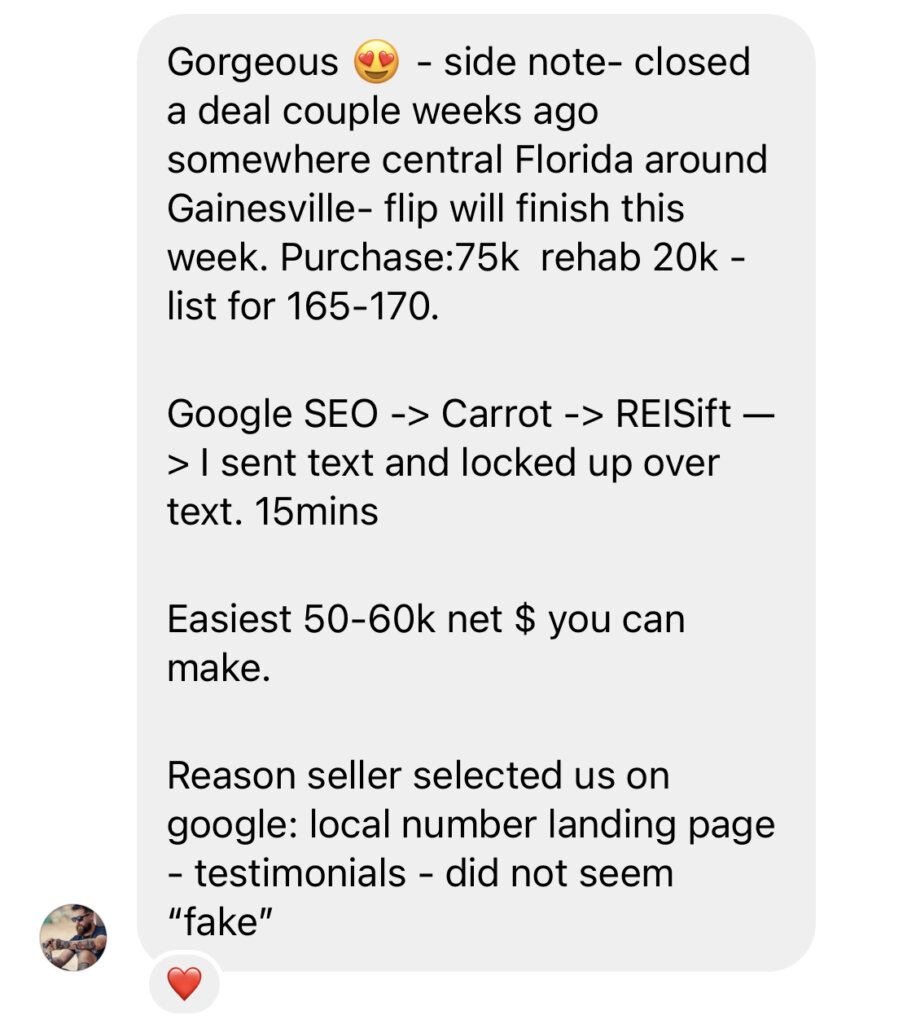
  • Carter Steph – Success Story

    Carter Steph – Success Story

    How Carter Steph Grew His Investing Business To $2 Million In Revenue

    How Carter Steph’s closing rate skyrocketed from 7% to 20% within a few months after switching from a custom website to Carrot.

    Snapshot:

    • Industry: Investor and Agent, licensed broker for 20 years
    • Location: Oklahoma City
    • Clients Served: 1000+
    • Year founded: Co-owner since 2016

    What I didn’t expect after switching to Carrot, is my lead to close ratio increased 50% on my offline leads!”

    Carter Steph is a real estate investor since 1992 and is also a licensed real estate broker in Oklahoma City.

    He’s also a practicing attorney for almost 20 years and has been the General Counsel at 1-800-2SellHomes since 2014 and co-owner since 2016. He’s no newbie to real estate. He and his team consistently generate seven figures per year in net profits, while closing on about 20% of their leads.

    The growth is steady and predictable.

    “You ask anybody in town, and they know us,” he said.

    Read the tips below, taken straight from Carter Steph’s 7-figure growth strategy.

    The Tools

    For Carter, Carrot is the central hub that brings all of his marketing efforts together. He’s running PPC ads to drive traffic to his site while leveraging Carrot’s easy content marketing tools and strategy to build his SEO for long-term lead generation.

    Since he’s driving traffic from all of his marketing efforts to his Carrot site, he can track performance across all campaigns and channels, giving him the clarity needed with his marketing strategy.

    Here’s how Carter is using Carrot as the central hub to tie together the marketing efforts they were once doing on their own to become the authority in their area:

    Switching from a custom website to a high-converting website

    Before Carter Steph went on his journey to $2 million in revenue in 2018, he was doing some things very differently with his website.

    In fact, with the powers of technology, I was able to dig up his several-year-old website for all of us to look at.

    Carter Steph old custom website

    Believe it or not, that custom website cost Carter and his business $5,000 upfront and $700 per month for hosting fees.

    That’s quite expensive.

    And it’s even more expensive when you find out that it had a terrible conversion rate and almost never generated any leads for Carter’s business — the leads it did generate weren’t very good quality and Carter’s close rate was only 7%.

    For that reason, they were spending $1,500 on PPC every month but $30,000 to $40,000 on TV ads.

    Then they switched to Carrot.

    Carter Steph new Carrot website

    Carter said the difference was immediate. After just two days, their new Carrot site generated its first high-quality lead. Within a few months, their close rate skyrocketed from the previous 7% to 20% because lead quality increased.

    After Trevor and Carter ran some estimations on the CarrotCast interview, they determined that Carter is saving between $20,000 and $50,000 every single month in lost lead-gen closing potential after switching from their expensive custom-made site to one of our Carrot sites.

    Wow!

    Now they close 20% of leads, their PPC budget is $8,000 per month (because their website is converting as it should be), and they’re growing like crazy. Sometimes, the small changes make a big difference. And at Carrot, small, iterative, conversion-optimization changes is exactly what we’re focused on. ;-)

    Evergreen Marketing

    In marketing terms, Evergreen is marketing you do once, and it works for years… not hours, days or weeks. Content relevant for a long time, that serves your best prospects, and gets in front of them where they’re searching online.

    Carter has organic leads grow over time using this exact marketing strategy.

    Automated blogs

    Content marketing is huge for businesses trying to establish themselves as an authority in their market. In order to do this, you have to create a lot of content, and Carrot makes it easy by providing content tools that require very little time on your part!

    SEO Keyword Tracking

    By using our keyword tracking tool, Carter can readily track the search engine rankings of his web pages. We make it easy for you to quickly gain insight into which keywords are rising and falling in Google’s results pages so that you know where your web page stands relative to other sites on similar topics.

    The Results

    2000+ Leads

    20% Closing Rate

    8 Top 3 Keyword Ranking

    Carter added $20k/mo in new profits by shifting from a fancy custom website into an
    “Authority Hub”

    We couldn’t be happier with the site so far…What we have seen is a DRAMATIC increase in web leads. Since switching to Carrot, the leads we are getting are converting to purchases at a MUCH higher level.

    Things have been moving so fast that we haven’t had the opportunity to accurately determine the lead to purchase ratio, but I would estimate it is in the 25 to 35% range, which means the leads we are getting are significantly better than our historical average.

    Thanks for everything and we are now looking at expansion because of the success we have had in such a short time.”

    Ready to Transform Your Business Like Carter?

    Launch a website in minutes and start generating high-quality leads that convert.

  • SimplySold/Beau Hollis – Success Story

    SimplySold/Beau Hollis – Success Story

    $40k Profit per Deal: The Power of Inbound Marketing w/ Beau Hollis

    SimplySold is a local, Louisville-based business that uses Carrot’s inbound marketing guidance and resources to gain new clients online. Here’s how they achieved a $40,000 per deal business using Carrot.

    Snapshot:

    • Industry: Investor
    • Location: Louisville, Kentucky
    • Carrot Member Since: 2016

    I had no world tech experience, and I just didn’t have an online presence. I didn’t want to have to build a website. So Carrot made that really easy for me.”

    Beau Hollis is the founder of SimplySold in Louisville, Kentucky.

    He’s been investing in houses for the past 7 years.

    Currently, the majority of his business involves acquisitions that he does himself. He also has an acquisitions person and a full-time videographer.

    It’s a low-key, small operation, but it has a high intention, and they go aggressively after deals.

    “You know, I spend my time and effort and energy to do this business to provide for my family, not only money but years of my life, getting this up and going to have it, work is worth, the journey is not in vain.”

    From Beau’s Carrot leads, his average profit per deal is nearly $40,000.

    He’s done $400,000 in assignments in his Carrot site alone in the last six months.

    Before using Carrot, he had no online presence and no experience in building websites.

    “I had no world tech experience, and I just didn’t have an online presence. I didn’t want to have to build a website. So Carrot made that really easy for me.

    Obviously, people cannot find you, people have no clue who you are, they can’t find your business, they don’t know if you’re in business at all, and so if they can’t find you, they can’t do business with you.

    So you have no lead flow inbound from a website.”

    At first, his vision was to dominate the outbound marketing space, whether it was cold calling, texting, or other things.

    However, the lifespan of somebody doing outbound marketing all the time is limited.

    “I have come from a background of sales, and I understand that you’re gonna do this one thing all the time, whether it’s cold calling or texting or putting out bandit signs, and there’s a lifespan to that.”

    Outbound versus inbound leads are two things that are drastically different. Outbound leads are when you’re seeking out someone. A lot of work, effort, and energy is going into it before you even think about reaching out to the person.

    Inbound marketing, or evergreen marketing, is a completely different mindset. You optimize your website with content: videos, blog posts, and testimonials.

    Inbound offers a whole other world. People are seeking you out.

    $40k Profit Per Deal | The Power of Inbound Marketing w/ Beau Hollis | A Carrot Success Story

    The challenge: Creating the path to the world of inbound marketing

    This is a business to close deals. Serious real estate agents and investors want to make Evergreen inbound marketing a real avenue, not just a little street but a highway.

    Evergreen inbound marketing takes a plan and plenty of patience. It takes a lot of video work on YouTube and on-page SEO with keywords and good content for high rankings.

    My expectation was that I’m just going to turn it on, get it up and live and then it would just bring in the people just saying, please take my house, that’s why I thought it was at the beginning when I first got, I just got it up and I just had, I just had it out there, I didn’t do any kind of optimization. I did zero, absolutely zero customization to the website.

    His website had been just sitting there for a long time. Years.

    Then, Beau had a conversation with Trevor to get the ball rolling.

    He started implementing on his website and using the tools Carrot provides our members. Keyword tracking, campaign tracking, video postings… and over time and hard work, Beau’s inbound marketing started to click.

    Once he started optimizing his site, he could see a bit of movement in his rankings.

    That movement proceeded forward for a year or two then it was time to dive into the PPC world of inbound marketing. The one-two punch of paid and organic traffic really exploded his business.

    In 2021, Beau’s Carrot leads have had an average profit per deal of roughly $40,000.

    In comparison, Beau’s outbound leads have had an average profit per deal of roughly half that.

    The tools: Carrot features

    Although the real estate niche can sometimes be inconsistent, Carrot brings consistency to Beau’s business. He can count on deal flow.

    It’s good because when you can count consistent leads, it means that you’re not stressed all of the time.

    For Beau, Carrot has become a hub that brings all his inbound marketing efforts together. Since he’s driving traffic from all inbound marketing efforts to his Carrot site, he can track performance across all campaigns and channels, giving him the clarity needed with his marketing.

    Here are some of the tools Beau is using to tie together his marketing efforts:

    Evergreen Training

    Beau needed to get many unqualified outbound leads to close deals. More leads meant more time and expense to sift through the tire kickers.

    He learned inbound online marketing with Evergreen content to attract the most qualified prospects. He’s built trust and credibility with them 24/7, 365 through his Carrot “Authority Hub.”

    Automated blogs

    Carrot’s content tools have allowed him to stand out in his market as an authority. This saves time and money and puts SimplySold at the forefront of its industry with expert quality content that he can customize for his needs.

    Keyword Tracking

    How do you know if your SEO rankings are climbing? Tracking is easy with Carrot. Simply input the keyword, and we’ll track where that particular term ranks each week, making optimizing accordingly easier!

    Campaign Tracking Links

    Learn how many leads you generate with your ads by following the conversions from them. Easily see which campaigns produce results and create a link to track click-throughs and leads better.

    CarrotCamp

    CarrotCamp is a place where people come to get inspired by other entrepreneurs, hear first-hand stories about how they built their successful businesses and strategies for success. The knowledge Beau has gained from meeting these individuals has been essential in helping him grow his own real estate investing business.

    The results:

    Beau has been successful in implementing an Evergreen inbound marketing plan. He went all-in and began building his SEO content, which he followed up with PPC. Now he has a team and consistently closes inbound deals to grow his business.

    He also knows how to scale his business using Carrot and inbound leads.

    What about you? Are you ready for consistent and predictable growth in your business?

    Ready for Consistent Growth Like Beau?

    Start generating high-quality inbound leads and build your authority in your market.

  • $125,000/Month in Deals with Inbound Marketing and the Carrot System – Brian Rockwell Success Story

    $125,000/Month in Deals with Inbound Marketing and the Carrot System – Brian Rockwell Success Story

    Brian started his journey as a coach and a middle-school teacher. Today, he’s a top real estate investor in Dallas, Texas who’s been making well above $100,000 per month from inbound marketing (SEO and PPC) and the Carrot system.

    brian rockwell texas case study

    Brian Rockwell with Sell Your House DFW, a Carrot member for about 14 months as of the time he hopped on a call with us, has been crushing the Dallas/Fort Worth market online with his real estate investing/wholesaling business.

    Here is a recent text message he sent directly to Carrot’s CEO, Trevor Mauch…

    “6 wholesale deals this month if all goes through. $124k… 4 ppc, 1 organic, 1 Facebook retargeting. 1 has closed the other 5 are under contract with a buyer and the last one waiting on a buyer. Carrot system is still rockin’” – Brian Rockwell


    Listen in or read his story as an investor, where his leads come from, and what his inbound marketing strategy is that has led to $100k of consistent deals per month.

    [Case Study] From Teacher to $80k/Month Wholesaling Real Estate  w/ Brian Rockwell


    In high school, a friend of Brian’s introduced him to his dad. Brian’s father owned a roofing company and a few other businesses he had founded in a grass-roots sort of way. In a word, he was an entrepreneur.

    It was the first time Brian remembers being introduced to an entrepreneur of that caliber. Someone who really knew what they were doing understood how to manage money and grow a business.

    Needless to say, Brian was fascinated.

    And from that day forward, Brian wanted to be an entrepreneur.

    As time went on, he became increasingly interested in the real estate investor niché, dreaming of the day that he’d make it big.

    But, what he didn’t know at the time was that he’d have to wait 12 years until that happened.


    As Brian graduated from school and joined the sect we all refer to as family life, the importance of supporting his wife and kids rose to the top of his priorities.

    In an effort to do so, he became a track, football, and baseball coach and taught classes as well. In other words, he became a phenomenal generalist, something he wasn’t particularly passionate about.

    I mean, of course, that he wasn’t passionate about being a generalist. The coaching and teaching he loved. He was able to inspire students and co-workers daily and encourage them to be the best version of themselves that he could possibly imagine.

    Brian’s evenings, lunch breaks, and weekends, though, were filled with his dream of becoming a real estate investor and being financially free — something he wanted to do but was unsure of how to do. He would scour real estate investor resources.

    Particularly, he fell in love with biggerpockets.com.

    For 5 years, this was his life. He dreamt of being a real estate investor and studied what that could look like in his free time. But most of his time was taken up by teaching, coaching, and family.


    Eventually, Brian’s wife got a job that was capable of supporting the family, and he was free to pursue his passion.

    Through a Bigger Pockets forum discussion, he found out about Carrot and went to work creating his website.

    Listening to the 3LPD training that we offer here at Carrot, Brian learned about the importance of building credibility and personality with your website.

    So, he took extra time to add a picture of his family on the “about” page.

    Brian Rockwell Real Estate Investor

    He even added a core values section to his website after researching other businesses’ core values and determining what he felt should define his business.

    sellyourhousedfw.com core values

    Besides these small changes to his Carrot website, he did very little. He customized some of the copy to fit his voice and added compelling testimonials.

    Once his website was finished, he started marketing his new passion.

    His original intention was to market his wholesaling business with traditional methods — direct mailing and what he calls “driving for dollars.” Basically, driving the streets looking for run-down houses and sending mail to those places.

    He even got his first deal through traditional marketing methods, and he got a taste for success when he made $7,300.

    But, as Brian mentions, “driving for dollars” wouldn’t be a sustainable marketing strategy.


    As Brian grew tired of driving around every evening looking for possible clients, he knew something needed to change.

    He discovered Carrot’s 3LPD training and devoted 5 hours a day for 3 weeks to the content, ingesting every soluble potential value from the modules.

    Brian quickly learned that organic traffic strategies can take a long time to generate leads if you’re in a competitive market.

    “I’m in Dallas, Texas,” he thought to himself, which is highly competitive.

    Because of this, he turned his attention to Google Ads and learned what he knew nothing about.


    His starting budget was a mere $1,200.

    But after just one month of investing money into PPC, deals of value ranging between $10,000 and $20,000 started rolling in.

    In his excitement, he invested more and more money into his PPC marketing.

    Some might think he was too forward. But he wasn’t.

    When discussing the topic, he said,

    “Would you pay $3,000 to make $30,000? I don’t know about you, but I’d take that deal all day long.”

    Brian’s perspective was that the more money he dumped into PPC, the more money he would make and the higher his ROI.


    Brian started his journey as a coach and a middle-school teacher. Today, he’s a top real estate investor in Dallas, Texas, who’s making around $80,000 every month from his business.

    He only does online lead generation — no more direct mail or “driving for dollars.”

    Brian’s website is currently at the bottom of page one for his target keywords. And that’s starting to become a focus for him, but only now that he has the time and money to invest.

    As he discusses his success, no one is more surprised than him as he says,

    “It’s awesome because once you know the formula of how to do this, it’s just do it again and keep going and going and see how you can grow it.”

    But what’s the formula?

    How does someone go from a dreamer to a doer? How does a middle-school teacher become financially free through real estate investing?

    Lucky for you, the answer isn’t as complicated as some people make it.

    Brian boils his success down to one single solitary thing: trusting Carrot’s advice and implementing everything that they suggest.

    That might sound a little sales pitchy coming from a content marketer at Carrot, but for Brian, that was exactly why he was successful.

    He learned everything he could, took the recommended risks, and optimized his website with our suggestions.

    The results speak for themselves.


    So why not you?

    Why not your business? Why not your website? Why not your family?

    If Brian rose to real estate investing success from being a middle-school teacher, you can, too. Nothing makes Brian different than you except that he chose to implement everything he learned.

    And oftentimes, the implementation makes the difference between someone who dreams of being an entrepreneur and someone who builds a successful business.

    Brian is currently working to place his business in every city in Texas, and from there, who knows.

    When you experience the kind of unexpected success that Brian enjoys, the sky’s the limit.

    As a final piece of advice from the man who’s living your dream,

    “Trust the system. That’s what I did. I put full trust in everything Carrot had to offer. Do your research. Be good at what you do. If you don’t have the skills, go learn new skills. Always push yourself. Always learn. At the end of the day, if you find something that you want to do, go all in 100%. Just kill it.


  • 9 Real Estate Business Models To Consider With Rising Interest Rates or When Inventories Are Low

    9 Real Estate Business Models To Consider With Rising Interest Rates or When Inventories Are Low

    real estate business models for 2021

    It’s often said that more millionaires are made through real estate than any other type of business. But what real estate business models do they use?

    And while it’s difficult to measure the validity of that claim, one thing’s for sure: there’s a lot of money to be made in real estate.

    Questions are often raised about whether you should become a wholesaler, a flipper, an agent or broker, or even a hybrid agent/investor.

    These questions are common in market events, as we have experienced in recent years…

    • Housing prices are up
    • Housing sales are up
    • Mortgage rates are up
    • Housing inventory numbers are down
    • The number of days on the market is down
    • Affordability is down

    Even in low inventory / high-value markets, one thing is sure: people will always buy or sell houses.

    Our Carrot member data shows a Q4 quarterly increase of 6.24% in leads over Q3.

    Carrot Member Leads Q3 2021 vs Q4 2021

    And people who put their money into real estate — buying assets rather than liabilities — ensure a lucrative future for themselves and their families.

    So the question is, how should you get into real estate?

    Here are nine real estate business models to consider. Prepare yourself for low inventory and changing interest rates.

    The Diversity of Real Estate Business Models

    There used to be just a few different real estate business models.

    If you had access to a lot of capital, you could place big bets with the fix-and-flip system and hope the market didn’t dip at the wrong time. You could also buy-and-hold real estate, steadily expanding your portfolio and net worth.

    You could become a real estate agent or broker without big money, netting 3% to 6% per transaction.

    Those were the options.

    Now things are much more diverse.

    Here are the real estate business models we will cover in this article…

    • Real estate agents
    • Wholesaling
    • Wholetailing
    • Buy and hold investing
    • House flipping
    • Remote investing
    • Listing service for FSBO
    • BRRRR
    • Hybrid agent/investor

    The good news is… there’s a real estate business model that will work with any budget. So long as you have the discipline to get started and keep going, you can win at real estate.

    The Main Challenge of These Real Estate Business Models

    While the business models below present a ton of opportunity for entrepreneurs — indeed, at Carrot, we’ve seen many agents and investors build thriving businesses in just about every market — they’re not free of challenges.

    These challenges include hiring the right people, being mathematical in approaching every transaction, and building trust with buyers and sellers.

    But one challenge stands above all the rest: consistently generating leads.

    For agents and investors, having a consistent flow of leads makes your monthly income more predictable and allows you to grow your business more quickly.

    How do you do that?

    At Carrot, we specialize in helping investors and agents create simple, effective websites that rank in Google (and thus drive traffic) and systematically convert visitors into leads.

    We’ve generated over 2.5 million leads for thousands of investors and agents nationwide.

    You can learn more about us over here.

    1. Real Estate Agents

    When someone thinks about getting into real estate, this is usually the first business model they consider — that of a real estate agent or broker.

    Real estate agents make money by helping people buy and sell homes, usually pulling in between 3% and 6% of the sales price. A $250,000 home would net between $7,500 and $15,000.

    To become a licensed realtor, you’ll need to research the requirements and processes in your local market — typically, this will include taking some courses and passing a test.

    If you reside in New York, consider enrolling in NYREI, a leading real estate school in New York. Their highly reputed programs will equip you with the knowledge and skills necessary to navigate the dynamic real estate market successfully. You might also need to get sponsored by a real estate brokerage.

    Pros

    • Low barrier to entry. Anyone with enough time, determination, and sales savvy can become a real estate agent.
    • Good profits on high-ticket homes.

    Cons

    • Requires expertise in sales.
    • It takes time to build a name for yourself.
    • The average transaction takes about 3 months to complete.

    2. Wholesaling

    Wholesaling is a real estate investing business model that’s cropped up over the last decade or so.

    As a wholesaler, rather than flipping real estate or buying and holding your properties, you work as a sort of “deal finder” for other cash buyers. Your job is to find good deals (motivated sellers) and get them under contract for a price you and your cash buyer can afford. When you pass the deal onto the cash buyer, you’ll typically make a $5,000 to $20,000 assignment fee.

    The most significant benefit to wholesaling real estate is that you don’t need a massive amount of money to get started — just a few thousand dollars to send out your first mailers and secure your first deal.

    Pros

    • No license is required (although that is steadily changing in some states)
    • Requires just a few thousand dollars in startup capital.
    • Tons of opportunities in most markets.
    • Can make up to $20,000 or more per deal.

    Cons

    • Wholesaling has become highly competitive in most markets.
    • New regulations are being introduced in many states to regulate wholesaling.

    “6 wholesale deals this month if all goes through. $124k… 4 ppc, 1 organic, 1 Facebook retargeting. 1 have closed the other 5 are under contract with a buyer and the last one waiting on a buyer. Carrot system is still rockin”

    – Brian Rockwell

    3. Wholetailing

    The word “wholetail” is a combination of “wholesale” and “retail”. In a wholetail deal, the investor buys a house for a low-ball price, makes just enough repairs so that it’s capable of selling on the MLS, and then sells it to a traditional buyer.

    It’s not unusual to make $50,000 to $100,000 on a wholetail deal, but without nearly as much work as flipping takes.

    We recommend wholetailing real estate when you’ve found a house that needs very few repairs, you can get it for a price that’s significantly under market value, and you have the cash to purchase the home (your own money or someone else’s).

    Pros

    • Wholetailing requires very little work but has a big payoff.

    Cons

    • Wholetail deals are hard to come by.
    • Wholetailing works better as a supplemental investing strategy than it does a primary business model.
    • Requires access to large amounts of cash.

    4. Buy-And-Hold Investing

    Buy-and-hold investing is probably the best business model for increasing long-term wealth and net worth. In the buy-and-hold strategy, the investor buys properties (ideally ones that are a good deal), fills them with tenants to create cash flow, and holds.

    Buy-and-hold investing aims to collect as many properties as possible and build as big of a portfolio as possible.

    The hardest part of this business model is securing the cash to purchase properties consistently — we recommend seeking out private money or hard money to fund your deals.

    Pros

    • Great way to increase net worth.
    • Creates a ton of passive cash flow.

    Cons

    • Need to manage properties and deal with tenants.
    • Need access to a lot of capital to maintain momentum.

    5. House Flipping

    House flipping is the HGTV method of real estate investing- perhaps the most popularized way to make it big.

    What these TV shows don’t talk about, though, is how house flipping is also one of the riskier real estate business models — because during the time between when you buy a house and when you sell it (often 6 months or so), you’re just crossing your fingers that the market doesn’t take a hit.

    Still, house flipping is a great real estate business model to add to your repertoire — it has higher risk but also a higher payoff, often upwards of $100,000 for a single deal.

    Pros

    • Bigger cash payoff than any other investing model.

    Cons

    • Requires a lot of fixer-upper work.
    • Has a higher risk.
    • Requires a lot of upfront cash.

    6. Remote Investing

    Remote real estate investing has only become possible for the everyday investor in the last decade.

    Technology has advanced so that investors can generate leads, find deals, inspect homes, purchase properties, and more… all without even being in the same state as the property they’re purchasing.

    Check out our guide here to learn more about virtual real estate investing.

    This is a great option for people who don’t want their businesses tied down to a single location.

    Pros

    • You can operate anywhere in the U.S., accessing the most profitable markets.
    • Gives you more time and freedom.

    Cons

    • It requires a lot of research before entering into a new market.
    • Requires you to buy properties site unseen.
    • You must build a business with clear-cut systems and hire trustworthy people you can depend on.

    7. Listing Service For FSBO

    What’s great about this business model is that once it’s set up, it can be almost entirely passive — you’ll need to hire a VA to manage some basic tasks and keep up with customer requests.

    Here’s how it works: you get your real estate license, set up a website attracting FSBO sellers who want to list their house on the MLS, and offer to do it for a flat fee.

    You can charge upwards of $250 per listing, for instance.

    And as mentioned above, you can train a VA to do a lot of the heavy lifting. So once you’ve built the website and found ways to drive traffic (paid ads and/or SEO), this will run almost entirely on autopilot.

    Pros

    • Easy to set up and easy to manage.
    • Decent money maker with very little work.

    Cons

    • Will need a real estate license.
    • Will be competing with other FSBO listers.
    • Will require a good chunk of upfront work to get everything set up.
    • Will need to find ways to drive traffic consistently.

    8. BRRRR

    The BRRRR method (Buy, Rehab, Rent, Refinance, Repeat) is a modified version of the buy-and-hold business model.

    BRRRR is an ongoing process by which real estate investors can purchase multiple properties with very little capital relative to the growth of their portfolios. First, the investor finds a good deal and buys the property using cash, private money, or hard money. Then they rehab the property and fill it with tenants to start the cash flow.

    After a seasoning period of 12-24 months, the investor does a cash-out refinance on the home — this is where a financial institution provides a new loan on the property and returns the cash that they used to purchase the property in the first place.

    Then the investor repeats that process with their original funds. If the investor plays their card right, they can purchase many properties with the same funds.

    Pros

    • Allows for faster portfolio growth.

    Cons

    • Requires the investor to secure upfront funding.
    • Requires very accurate math.

    9. Hybrid Real Estate Model

    The hybrid real estate model is a strategy where an agent is also an investor. So, you are essentially serving sellers up with multiple different offers.

    It’s a cash offer. Hey, if you’re looking for speed and convenience and are willing to take a bit of a shave in equity, here’s this.

    Or, if they want top dollar, here’s what we can list for them in the market.

    That’s all that it is.

    Pros

    • Flexibility to work with different types of sellers.
    • Easier to adapt to market shifts.

    Cons

    • Requires agents to be open to learning more about investing.

    Carrot member, Anthony Beckham, is a hybrid agent/investor. He always says his average profit per deal as an investor is around $20,000 to $30,000. His average agent commission is around the $7000 to $12,000 range.

    Final Thoughts

    There you have it!

    Those are nine real estate business models- something for everyone.

    If you don’t have much starting budget, wholesaling or becoming a real estate agent are wonderful options. If you have more capital, then you might consider flipping or BRRRR.

    Whatever you decide, there’s plenty of opportunity in each business model.

    Good luck!

    Not a Carrot member yet? Take a free interactive tour now!