Listen to the CarrotCast Podcast and Subscribe Below!
Place the power in others hands to find true freedom. Trevor Mauch
Dan Sullivan, one of the top coaches for many entrepreneurs, defined the “Ceiling of Complexity” as, long story short, an overwhelming feeling of the company running you, rather than you running the company. It is a common challenge for quickly growing companies. Life and business just got a lot more complicated than it used to be.
You might find yourself stuck with a feeling of immense pressure. The challenges and demands of running a business tend to drain you of your personal bandwidth. So what do you do?
On this episode of the CarrotCast, we’re going to discuss how to learn to manage and maintain growth. The best ways to manage the complexity of growing a business and how to replace that with simplicity.
Embrace the energy so that you are running your business or life instead of it running you.
The Ceiling of Complexity, Sabbaticals, and Energy Work As THE Key To Break Through Your Current Growth Ceiling
6:15 – What does the “ceiling of complexity” mean and how Carrot has started dealing with it. 9:35 – How to work smarter to work less. 11:20 – An exercise to document your work process to build a higher level of leadership rather than delegation. 14:00 – How to involve your team in crafting a plan to eliminate confusion. 17:40 – Why and how to take a sabbatical. Trevor’s lessons learned from taking a month break in 2016. Unleashing your team to allow them to make decisions. 25:40 – Why guiding your work through happiness and fulfillment is so important. Try an ENERGY AUDIT, if you don’t know what gives you energy and passion:
Listen to the CarrotCast Podcast and Subscribe Below!
Love the process. Love the game. Love the impact. When you love these things, that’s when you win. Trevor Mauch
It’s human nature to love THINGS. Cars, watches, houses, boats. And, that’s okay.
But on this episode of the CarrotCast I want to dive in a little deeper. How can entrepreneurs and leaders go from being successful to being significant?
We have to love the PROCESS not the thing. We need to avoid the need for validation and protection. Instead, we need to change the mindset around to loving the process.
The process of making a bigger impact on others lives. That’s when we win. That’s when we become SIGNIFICANT.
Every day think, “Who Do I Need To Show Up For?” That question separates ego and selfishness from compassion and love. The strong desire to really, really make a difference.
Listen to this episode as I walk through my visualization process and how I try to stay the course to make that bigger impact to change lives and generations.
How To Go From Being Successful To Being Significant And Impacting Lives
3:55 – Striving for validation. The second you buy “stuff” for validation, is when you start setting yourself up for failure. 6:00 – Falling into protection mode. When you start having to “protect” your things is when you start losing the game. You need to take a step back and start loving the process of being significant. 8:00 – Tactical mindset: Think “who do I need to show up for today?” 11:50 – Instead of cycling through your business, focus on creating a core mission. 14:40 – The value of making an impact based on what fires you up not the validation of your things. 18:15 – Love the process and invest in it. Ask yourself everyday “how significant can I be?”
LINKS TO ADDITIONAL RESOURCES FROM THIS EPISODE
How RJ Will Do $2M+ Flipping Houses In 2018 In 4 Different States: CarrotCast
Why You Need to Escape the Daily Grind Before You Regret Being an Entrepreneur w/ Trevor Mauch:CarrotCast
The #1 Core Thing to Simplify Your Life, Be Happier, Make a Bigger Impact, and Grow Your Income:CarrotCast
Excellent, so by now you’ve picked your niches, you’ve nailed your core values and your mission, you know which locations you’re helping serve your buyers and your sellers. Now here’s the fun part, we’ve already created those initial videos, now we get to go out there and do our business and document some of the things that we’re doing.
One reason that reality shows on TLC and HDTV, have really blown up over the past decade is that people are interested in what people do for work, and your business is no different. People are really interested in what you do for business. People love to see homes, people love to explore their area and they would love to follow you doing that.
I’m going to give you a few tips on what you can do on the weekly to daily basis, just with your cell phone to continually stay in front of your prospects, in front of your community to add value and build a relationship and build a connection, build trust, build honesty with them, just through regular content, showing them what you’re already doing in business.
Creating Weekly and Monthly Content Pillars
There are a couple of different things I want you to do. I want you to write down on a piece of paper right now, weekly and then monthly and I want you to create these weekly and monthly content pillars. This isn’t hard, this is literally less than 30 minutes a week is all it’s going to take you and less than 30 minutes a month for the monthly. So this isn’t hard, this is a couple of hours a month is all.
Every single person watching this has a couple of hours a month and if you don’t, you’re going to have a lot more time in two years to do whatever you want to do because you’re probably going to be out of business. I don’t want you to be out of business, so we’re going to help you guys stay in business.
Weekly Content
So, on the weekly basis, that weekly cadence is what I call on the job content. That’s the stuff where you’re answering questions that people commonly have about that type of property or that area. You’re addressing objections that you see come up quite a bit, you might be showing some interesting stuff because people like to see fun interesting stuff when they’re scrolling down Facebook or looking on Instagram, or YouTube.
You need to show some action. People want to see interesting things that are moving and I’m not just talking about you moving around the camera, I’m talking about one time you’re in the car doing it, another time you’re out there at a property with the client, another time you’re sitting in your office. So move locations because it’s interesting and people are going to start to really look forward to your videos and look forward to your content coming out.
On the weekly basis, once again, it’s on the job stuff. Again, I’m out at a river home and I keep on using this example because it’s such a good one, but what are the questions or objections that pop up with someone who’s looking to buy a home on the river? It’s probably not going to be a cheap house, so there’s a big financial stake there.
So you have to look at, “Well shoot, I know river homes so well,” the water situation’s always something that trips people up. Most people who’ve never bought a river home never know what to do. So I’m going to do a few videos on what you need to do with water and water rights and how do I get my drinking water and are you going to use a filtration system or is there a well? All those are critical things, if you’re the one doing that content, I’m going to work with you because you’re the expert and I don’t want to lose a ton of money buying a river home with Aunt Betty who just became a real estate agent last week.
There could be an amazing home on the river that’s got this killer pool, or it has this way cool retaining wall or something like that. Take out the camera and say, “Hey this is Mark, I’m out at a river home on the North Umpqua River. I just want to show you this pool, it’s an amazing pool, look at the view that it has. Look at all the possibilities you could have with a home on the river.”
What that’s doing, is building desire for that type of property that they’re already wanting, but they’re building desire for and you’re the person that’s helping them build that. Or there’s action, once again. You can be taking them on a little tour of different homes on the river and put all those little things out in little three, five, 10 minutes probably max, videos.
Monthly Content
Then on the monthly side of things, stand in front of a camera, or take out your phone, or whatever you want to do, and do some sort of a report because reports are something that builds expertise.
The other content types are fun, they build expertise as well, but the report is something they can look forward to the same content piece each month. Every single month, I get an email from this company that’s a real estate investment company and it shows the market snapshot and the market report and what’s happening right now. I open that one every single month because I want to know what’s going on.
I want to get ahead of the curve, I want to get ahead of what’s happening and your buyers and sellers are no different. If there’s a seller out there who are looking to sell, they want to know, “Should I be selling right now? Is it too late to sell? Is it too soon to sell? Is it a good time to sell?” Whatever it is, your monthly report should be addressing that.
If I’m a buyer, I want to know is right now the time to buy? “Should I be buying a property, should I wait to get a better deal? Are there good deals coming up? It’s the right time to buy? Are financing programs drying up? Could new ones be added?” This is where you can really do that with your monthly reports.
What is a Real Estate Niche Report
What is a monthly report? It should be an under 10-minute video ideally. The reason I’m saying a video is because anyone can do a written report. Anyone can just send an email that says, “Here’s a bunch of market stats.” All the other real estate agents in your market are already doing that.
You don’t win the market by doing what everyone else is doing. You win the market by being you and going out there and building brand, building trust, and building credibility. Showing them you’re the expert.
You could send out an with a bunch of words, but I would send out a video, put it on your Carrot website as a video post, so you take your YouTube video, you put in that URL, our system goes out and yanks out all the words, makes up blog posts for you, so now you can send people to that from Facebook and from YouTube to the actual full official monthly report with your video, with the written words below it and a call to action to connect with you.
Some other things you can do:
Get market stats.
Ups and downs of the market.
Is it the right time to sell?
Is it the right time to buy?
What’s happening with loan programs?
What events are coming up in the community?
So if part of your niches are based on families or certain segments of the community, let’s say you’re focused on retirees. In my monthly report, I’m going to go through the report with the frame, with the lens of how a retiree would be looking at the real estate market and what they would care about and then at the end I’m going to say,
“Hey, here’s some really cool events happening this next month in Roseburg. Here are these six things, these cool concerts and acts. If you want to check out more events, just go to our website forward slack events. There’s a whole list of events for retirees and for groups of people who love wine and who love wine country, just like me.”
So now I’m not only delivering information, but I’m also delivering things to do and they’re going to love you for that.
Go figure out your weekly cadence and your monthly report. This is a total of a couple of hours a month. All you have to do is put in a couple of hours a month, that’s less than one full day a year. One full day a year to stay in front of your prospects, to build trust, to build honesty, to build credibility.
People are going to notice you in town. They’re going to say,
“Hey, you’re the guy, you’re the gal that keeps on putting out that great stuff. Thank you for doing that.”
They’re going to tell other people about you and your business is going to grow and get momentum in the next six, 12, 18 months. So go execute the full plan, don’t get lazy. Execute the full plan and then be diligent with it. You’re going to see some really good momentum happening after that.
Last Tip
Make sure every video you do, you upload to YouTube, you upload to Facebook and then you upload it to video posts on your Carrot website to turn that into written words, so now you not only have Facebook, YouTube, you’re also going to have Google, Google organic results as another thing to help you get more traffic, build more credibility and to build your business.
Watch Other Videos in the Agent Niche Series:
Watch the next three videos in this four-part “Content Marketing for Real Estate Agents” series.
Listen to the CarrotCast Podcast and Subscribe Below!
I dont’ do well if I set small achievable goals. That to me does not excite me. I need to have the large goal because in my mind, I can see what I need to do to achieve the large goal. RJ Bates
I’m pumped about this podcast today. One thing that I love to do and also I hear this feedback from guys all the time in iTunes reviews and the reviews everywhere else and emails and Facebook messages I get from everybody, that they love case studies. You guys love case studies. You love to hear someone else’s journey, their successes, their failures, the things that they went through, the trials, the tribulations and what got them to where they are.
So I’m bringing on another one of our amazing clients, RJ Bates with Titanium Investments, today. And RJ is one of the top investors in Dallas, Texas, but also he’s branched out into multiple markets. He’s in the Hawaii market, he’s in the Anchorage, Alaska market now, and one back Midwest. And we discuss his journey here and his journey, it’s one that was really interesting. I found it fascinating because he’s a guy who kind of found himself falling into house flipping and wholesaling.
He didn’t set out to do that. He actually was a roofing contractor, hustling, selling roofs. And then one of his clients said, “Hey, can you also fix this rehab house?” And he’s like, “Man, I think that’s a good business opportunity.” Before you know it, he’s running a $2 million plus a year wholesaling and house flipping company based in Dallas, Texas, but in four different markets. You’re going to hear his journey, you’re going to hear his trials. You’re going to hear the things that he failed on early on. You’re going to hear why he has a business partner and how they work together.
And you’re also going to hear what works best for him for his marketing mix. He uses online a lot. He uses Facebook a lot. He’s going to talk about that, but he also breaks down the other things that are working insanely well in this cluttered market for him, even when he enters into new markets. Last, how does he enter into new markets? Because he’s just one guy with a business partner in Dallas there. How is that he’s entering into these new markets? Well, he talks about how he’s finding his boots on the ground people, business partners in those markets and how he structures it.
Without further adieu, welcome in RJ Bates from Titanium Investments into this podcast.
How RJ Will Do $2M+ Flipping Houses In 2018 In 4 Different States!
2:15 – Who is RJ Bates and what locations he’s currently investing in. Two of which aren’t the typical locations. 4:50 – What his company looks like right now: Team and deal volume. 10:30 – From Pizza Hut delivery driver to Roofing Contractor. RJ’s amazing journey into real estate investing. 16:15 – He went all-in into wholesaling in 2014. All-in close enough to have $11 before closing his first deal. 17:30 – How RJ stumbled upon InvestorCarrot (Carrot) and Trevor’s backstory about building Carrot sites in 2014. 19:45 – RJ’s vision as an entrepreneur and how that has changed over time. 20:45 – Creating a passive income goal of $100k per month. Why that is his “magic” number and why he focuses on large goals instead of small achievable ones. 29:00 – Changing the mindset around having employees. Scaling business by hiring the right team. 31:15 – Some of the limiting beliefs RJ had to deal with when starting out and struggling a bit. 34:20 – KEY things that must be in place before RJ expanding into a new market. 38:30 – What type of marketing platforms are working right now in specific markets. 40:35 – Breaking down RJ’s cost per deal within certain markets. 43:15 – MINDSET SHIFT: Finding your monthly budget by calculating your max cost per lead. 46:05 – How having a Carrot website has helped drive RJ’s offline marketing. 51:10 – Unpacking what ads are working on Facebook right now. 56:30 – What RJ’s marketing budget looks like and how he’s able to do so much and stay within this mark. 58:15 – What he’s seeing since Facebook has started stripping away some features.
LINKS TO ADDITIONAL RESOURCES FROM THIS EPISODE
#1 PPC Metrics: You Need To Build Into Your Real Estate Marketing Strategy w/ Adrian Nez: CarrotCast
Listen to the CarrotCast Podcast and Subscribe Below!
Let’s say I got divored and I got to another relationship. I’m going to be in the same mess. So, if I really want help and I really want to do right, what better way to practice than the mother of your kids. The person that you’re in it with now Adrian Nez
It’s 9:42 p.m. I’m looking at Venus up in the sky, and I’m thinking about this episode that you’re going to be listening to right now on how darn important it is in the whole scheme of things.
My good, good friend and obviously Carrot team member, Adrian Nez, actually spurred on this episode of the CarrotCast. We were on a team call about a week or two ago as of the time we recorded this, and he said, “You know what, Trevor, I’ve got a podcast idea that I really want to pitch you and I think it’s important.” We hopped on a call, and within 15 seconds, I’m telling him, “Dude, we are doing that because that’s so important.”
You’re going to hear some massive, massive vulnerability from Adrian himself who’s going through some big hard, emotional things in his life and his marriage right now.
You’re going to hear from me with some of my struggles in my marriage and some of the struggles that I’m going through. It’s not struggling with our marriage per se. It’s struggling that, how do I make it better? How do I serve my wife? How do I serve my kids much better than I am right now and how do I make sure to put them ahead of certain other things?
This episode is really pulling back. We’re not talking about lead generation. We’re not going to talk about SEO. We’re not going to talk about any of that kind of stuff. We’re going to talk about the stuff that’s insanely important. Those people that right now you possibly might be ignoring, you possibly might be not serving.
You possibly might be looking at people that you’ve never met before in a Facebook group, in a BiggerPockets group, somewhere online, or even a seller or a buyer out there. You possibly might be thinking of people you’ve never met before that are not in your family that you’re probably never going to speak with or maybe speak with once or twice, and you’re thinking how can I serve them, and you’re not thinking how can I serve my wife?
How can I serve my husband, how can I serve my spouse? How can I serve my significant other?
So, we’re going to dive into relationships in this call. It’s an insanely important topic for us entrepreneurs because ambitious people have a hard time turning it off. Ambitious people have a hard time justifying and reconciling when we need to be present. When we need to turn it off, and also what the next actions are. We’re going to get insanely vulnerable.
Adrian’s going to bring you up to speed on his own marriage. They’ve been on and off again. I’ve been helping him to guide him through the journey just support him as a friend, and he’s going to walk through what he’s going through and I hope you guys respect it. I hope you guys take some cues from it. I know I did in a big way, and also, hopefully, you have some introspection on where is it that you need to adjust yourself.
Adrian and I both walked through some things that are working for us to have better relationships with our spouses. I can use some big time encouragement on my end as well as we talk about later in this podcast.
All right. So we love you guys. Enjoy this podcast. Please share with someone who may be working too hard, who may be working too many hours, who may not be focusing on their spouse as much as they should. Please take it to heart. Give us a rating and review on iTunes if any of this hits you at your core.
Why Marriage Shouldn’t Be Run Like a Business and Many More Vulnerable Discussions
2:50 – True wealth can be right in front of us, but sometimes we don’t see it. 5:25 – Break out of the dangerous loop of feeling lonely. 6:45 – What one of the biggest homebuyers in America said about justifying the lack of being present with family while building a business. 8:00 – How Trevor felt during the first couple of years at Carrot. Grinding out 60+ hour weeks and a “near miss” that almost killed him. 13:30 – The phantom expense that can ruin relationships that comes with working so much. 14:53 – Tip: Don’t take advantage of your perception of what you think your spouse understands. 16:15 – Trevor’s path into his entrepreneurial ventures and how ego plays a role in most businesses. 21:45 – Where do you find happiness if it isn’t on the other side of achievement. 26:00 – At what point in a career do you recapture time. 28:00 – Why it’s important to surround yourself with a support team and fixing what is broken within a relationship rather than throwing it away. 32:50 – Having freedom, flexibility, and finances are great, but you need to create good relationship habits. Here are some tips. 44:15 – “Leave Dad alone, he has to work.” Adrian’s son said this to his sister one time on a Saturday morning. How this environment was created and how it’s being changed.
LINKS & PAST CARROTCAST’S FROM THIS EPISODE
Boston’s #1 Home Buyer Breaks Down His Journey and Real Estate Marketing Strategy w/ Tom Cafarella: CarrotCast
Do You Struggle With True Happiness? A Simple Hack To Go STRAIGHT To Increased Happiness:CarrotCast
Why Those Who Use Positivity Succeed and Those Who Don’t Fail w/ Trevor Mauch:CarrotCast
Listen to the CarrotCast Podcast and Subscribe Below!
Ride the wave that is given to you right now. Brad Chandler
On this episode of the CarrotCast, we welcome back Brad Chandler from Express Homebuyers.
Brad and I met about 3 years ago and he recently joined us for CarrotCamp 2018 Spring Edition.
We dive into the 3 Key Pivots he has made to go nationwide, ramp up to 25+ deals per month and doing more of what he loves.
These weren’t small moves. They required a switch in their model from heavier stress, fix and flip model, to the fairly chaos free wholesaling model they currently have.
Listen to some of the insights Brad has about both sides of the industry and why shifting to a predominant real estate wholesaling business is where they’ve found the sweet spot.
The KEY Pivots Brad Made To Take His Real Estate Wholesaling Business Nationwide, Ramp To 25+ Deals A Month, and Do More Of What He Loves
2:10 – What Brad’s real estate wholesaling business model looks like right now and how it’s evolved away from fix and flip. 5:20 – What his major stressors were during the fix and flip period ($34 million out on renovations). 7:10 – How much more work and time it is to go from 5 to 10 full-blown renovations. 9:50 – Why it’s so important to build your business model around you and your market. 12:00 – The main point about having CAPITOL. You need to have enough capital to renovate, have lenders, and be ready for liabilities. 13:05 – What type of offline marketing Express Homebuyers is currently doing. 14:05 – How long it took to get SEO rankings while expanding Nationally. 18:30 – What they do for backlink building and who they quickly build up content. 21:35 – What other platforms are they using to stack their lead sources. 24:10 – GENIUS tip Brad provided during CarrotCamp. 26:40 – How to gain an edge in a competitive market. 30:40 – The point when Brad decided to hire a CEO and take a step back to focus on other passions. 34:50 – Brad’s expectations from his coaching company and what has been working for his members. 44:15 – Upleveling and growing yourself, your mission, and your business.
LINKS & PAST CARROTCAST’S FROM THIS EPISODE
He’s Bought 2,000+ Houses. How? Brad Chandler with Express Homebuyers Unveils His Journey: CarrotCast
What’s Your Credibility Score? The Top 5% Of Earners Are Doing These “Simple” Things To Build More Credibility In A Cluttered Market:CarrotCast
How I 10x’d My Income And Found My Purpose With This 15 Minutes Per Quarter “Energy Audit”:CarrotCast
Listen to the CarrotCast Podcast and Subscribe Below!
The daily “Grind” is a mindset that you need to fix by empowering people and process. Trevor Mauch
There has been a lot of social media presence around grinding it out. Working 4 am to 8 pm. Glorifying the badge of honor or dishonor that I like to call the “Grind.”
The grind is a mindset, not an activity that you should willingly try to sustain and promote.
If you’re an entrepreneur and you’re grinding all of the time, you’re going to eventually break. Just like a cogwheel. If a cogwheel is constantly being overworked and under pressure, it’s going to fail.
Instead, shift that thought to building a business based on hard work, people, and process.
On this episode of the CarrotCast, I’m going to talk about my personal grinding experiences and how you can escape before you regret it.
Why You Need to Escape the Daily Grind Before You Regret Being an Entrepreneur
0:45 – What is the “Grind” and how to handle the buzz and glorification of grinding out work. 1:25 – Why grinding is not a badge of honor. 2:50 – Instead, escape the daily grind and work on focusing on making an impact. 4:00 – Why do we become entrepreneurs. 4:50 – The main problem with making the grind a lifestyle. 6:05 – An analogy of running a business is a like a gear or cogwheel. Why it eventually will wear out and break without proper maintenance. 8:00 – You do have permission to work hard. 9:30 – Why, as soon as you start making money, you need to turn it into people and process.
LINKS & PAST CARROTCAST’S FROM THIS EPISODE
Overworked And Struggling To Delegate Tasks? Listen To This… w/ Trevor Mauch: CarrotCast
How 5 Non-Negotiables for Business (and Life) Made Me A Better Entrepreneur w/ Trevor Mauch and Ed Gandia:CarrotCast
What I Told 53 Local Entrepreneurs About Life, Success, and Happiness w/ Trevor Mauch:CarrotCast
If you’re not getting many motivated seller leads to your real estate investing website, it’s for one of two reasons. Here, we’ll help you diagnose your “no leads” issue…
This post is going to help YOU break down the patterns that lead to success in real estate investment — with a special focus on online lead generation.
We’ve focused on what investors are doing right, so it only seemed fair to focus on what’s going wrong.
A few times a week the same thing happens, we get emails from non-Carrot members that look something like this:
“Help! I’m not getting many motivated house seller leads from my website and I don’t know why!”
It always stinks to hear that, but the good news is that most real estate investing websites struggle to generate leads for a few basic reasons.
So let’s dive in to get to the crux of the problem.
Getting leads online really equates to only two simple things. Traffic and Conversion. But before you get started, take a few minutes and watch…
It All Comes Down To Traffic and Conversion
Traffic – Are you getting traffic to your website? (ranking well for keywords that actually get enough searches to matter?)
Conversion – Does your website convert enough of those visitors to leads?
So, when someone emails in and asks for advice to get leads… it always comes down to those two things.
Traffic and conversion.
This post is mainly about the Traffic part since we already know the Carrot system converts (Conversion Examples:Here , Here , and Here ).
So first we look at the traffic… because if there isn’t any traffic going to your website… conversion doesn’t matter.
If your website is converting motivated seller leads at 15% (15 of every 100 visitors sends you their info, which is solid)… and you’re only getting 25 people to your website each month… that’s only about 4 leads per month.
Not much to build a business off of right?
So… here’s what we do.
We start problem-solving by asking the same questions. If you’re banking on SEO is a part of your traffic generation strategy… we’ll ask you this question first:
How much search volume is happening in your market?
In simple terms… are there enough people in the areas you’re targeting searching for the keywords in Google that your pages are ranking for?
Unfortunately, most of the time we get a “huh?” in response.
Then we explain:
Even if you’re ranking at the top of a search, no one is going to click your link if no one is searching.
Then a lot of times we’ll dive in and do a little bit of research, only to discover what we already know… that there’s little to no search volume in their market for the keywords they’re ranking for.
It’s like putting a great billboard on a dark back alley street that no one sees.
But put that same awesome billboard on a busy street… then it produces GREAT results.
[cta offer=”seobible color=”blue”]
Here are Some Examples For You
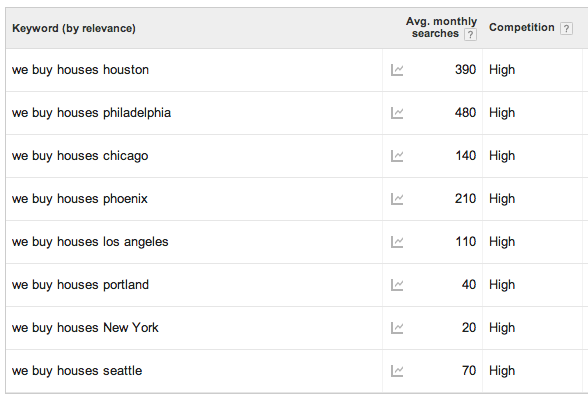
For a quick illustration of what I’m talking about, let’s look at some US cities and check out the search volume (using the keyword planner tool in Google’s Adwords) for a common search term in each market, “we buy houses [insert your city]”.
This term tends to be a popular search phrase across most cities in the US so it’s usually a great barometer in any market for the volume of “highly motivated sellers” in that market:
The Good – Below are numbers for average monthly searches for those terms in Google. You can note that some cities get MANY more searches than others… showing the potential SEO demand for that keyword.
Our barometer is anything over 30 per month is worth making a page for on your website with our SEO Grader tool to help you rank for that term.
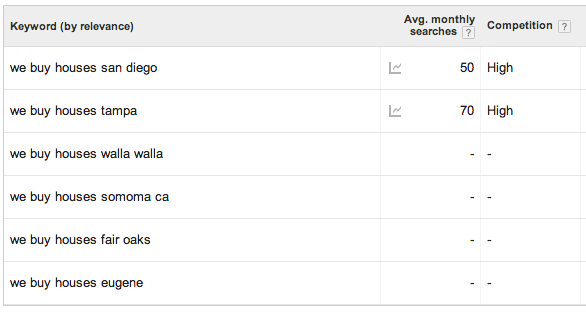
The Bad – Below are numbers in a few cities we grabbed out of thin air. One of the cities below is a city that a client of ours is ranked well for but emailed us saying he hadn’t been getting leads to his website.
Why? “we buy houses fair oaks” isn’t getting much search action. The Fair Oaks market may not be a great city to focus on for all of your online lead generation efforts.
Now, it’s important to realize a couple of things about that data:
Each of those is the average number of monthly searches over the last 12 months. It’s really common to see big spikes in search volume one month, followed by a major drop in traffic in the next if an economic event happened in that city causing more motivated sellers (a huge job layoff in the city, etc.).
Notice that the most populated city has the least amount of searches: In this example, Philly was searched 24x more often than NYC, although it has only 18% of the population.
Searches like these are often motivated by external factors
We originally wrote this post in 2014 when we did a Google search for “Philadelphia layoffs,” and at that time there were almost 4,000 teachers were laid off in June of 2013. The point is, when lots of people lose their jobs at once, it’s easy to imagine panicked sales taking place if folks can’t pay their bills.
These searches for the “we buy houses [insert your city]” and “sell my house fast [insert your city]” terms happen when people need fast answers (and you want to be in front of them when they search for those fast answers, like our client David Brown has been able to do).
They’ll often do a quick search, and if they find what they’re looking for, they’ll put in their information into a form and become a “lead”. If they don’t see what they want, they’ll keep moving until they find it.
But if SEO is your main marketing strategy, you won’t get any leads if there aren’t many searches for the specific phrases you’re ranking for.
Search Engine Optimization for Real Estate Investors Only Works When Enough People Are Searching The Phrases You’re Ranking For
Too many SEO services out there just focus on getting you rankings… because rankings are sexy right?
But those rankings don’t matter much if they’re for terms that only a handful of people are searching each month.
So what happens if you’re in one of those markets that aren’t getting many searches for the popular terms like “we buy houses [your city]” or “sell house fast [your city]”?
Does This Mean That You Should Abandon SEO When Searches Are Low?
Not at all!
In fact, it’s a really good time to build your business and get creative.
Remember, SEO is a long-term strategy. It’s not a short-term one.
And if you’re really wanting to generate consistent leads and dominate your local market online… you can still do that!
I just closed a deal from you guys, it was all because of your site and the credibility built in and all that. Going to be a really profitable deal, and I’m going to reinvest that going forward. You guys rock and I love the sites and everything you all do! – Joseph Sauter, Quick Cash Sale For You
While yes, there are some markets where there just aren’t a lot of motivated sellers searching online… but it doesn’t mean the sellers aren’t out there searching.
You just need to broaden out your keywords that you focus on your website so rather than banking all of your traffic on just the “we buy houses ” or “sell house fast ” keywords… add in others.
Not Getting SEO Leads? Here’s Your Plan Of Action…
Create some pages on your motivated seller website for “Focus Keywords” (use our SEO Grader tool to help you optimize these pages for those phrases very easily) like…
sell your house fast [insert city]
how to sell house fast in [insert city]
how can I sell my house fast [insert city]
sell my house for cash [insert city]
how to rent your house in [insert city] (many people who need to sell, just quit and settle for renting. Write an article on your blog!)
tips on selling your [insert city] house
… you get the idea.
If rather than trying to bank your lead generation on 1 term that only gets 30 searches a month… why not create some more pages on your website (InvestorCarrot makes that crazy easy) that are focused on other keywords ALSO in your market… so you have 15 pages ranking for search phrases that get 30 searches a month each.
Make sense?
If NOT, hit us with questions below and we’ll dive in and clarify for you… we’ll even get specific and help you figure it out for your own market through the comments section below.
Even if you’re in an area that doesn’t currently get a lot of search data… it’s worth it to rank well there.
When something happens in your market (like layoffs) that create a lot of demand for fast, cash buyers, you want to be first in line to capture those leads. Working on SEO now is critical to rank high when searches do pick up.
If you’re like most investors you’re deeply focused on your local market and what’s happening today. You’re only working to make deals happen soon, not years or months down the road.
That might be a mistake.
Too many investors are only thinking about short-term results… even though the best investment advice is always focused on long-term wealth-building, not scattered attempts to get rich fast.
If you’ve got the bigger picture in mind, there are a few ways you can grow your business:
Get inventory in other ways. Go old-school and start knocking on doors. Network. Partner up with companies who provide services to homeowners under financial distress. Put up signs. Advertise – good pay-per-click can be really helpful to capture the few searches that do exist. Since the leads are fewer, you’ll have to pay more to get them. That’s supply and demand.
Focus on growing a different list. If you’ve been trying to capture seller leads, shift your focus to building a list of cash buyers. Ditto on rent-to-own tenants. When inventory is tight there are lots of people looking for deals, so set up another site to grab those leads. If you hustle, you can find ways to profit from those lists, even when inventory is low.
Branch out to surrounding markets too. Too often people get stuck thinking that they need to work where they are, instead of going to find the place where they can add the most value. Start with other cities around you and see if there is more search volume in those cities. I know investors who have switched their focus away from the major metro areas and are focusing on smaller, blue-collar areas where there’s less competition from other investors. Once you’re really good at building lists, generating leads and doing deals, you don’t have to be geographically limited at all. With the right local partners, you can work anywhere.
Adjust your strategy. Too many investors and entrepreneurs get stuck on a particular path, and they lose their perspective on the big picture. They forget that they are subject to the whims of the market and that the market is entirely outside of their control. When there’s not a high rate of foreclosures, wholesaling and flipping get tougher. More competition + fewer deals = Lower profit margins.
Does that mean that wholesaling and flipping are bad strategies?
No, not at all – just that you’ve gotta pay attention to the conditions in your local market without forgetting the bigger picture.
Know Your Market And The Trends (Or we’ll help keep you up to date :-)
To illustrate, let’s do a quick Google Trends search in the US for “we buy houses” just to see how the graph moves around:
As you can see, there were a lot more folks searching for “we buy houses” back in the fall.
Overall in the US economy, we seem to be exiting a period of high fluctuation and returning to a slow, stable growth pattern.
And while trends in our market change… so do the things that sellers and cash buyers type into Google.
Just do your research (or follow us here on this blog and we’ll do it for you) and adapt on your website to focus on the keywords your market is typing into Google.
For now…
“we buy houses” and “sell house fast” (and related terms) are still some of the most popular for the ultra-motivated sellers
“investment properties in ” is a search term growing in popularity right now big time (GROW THAT BUYERS LIST!)
If your market doesn’t have many searches for those terms… consider going after other keyword terms like the ones I mentioned in this article… OR, branch out into other surrounding cities to capture search rankings in those ones too so you can do deals there too to increase your lead flow.
Sound like a plan?
Hit us with your questions about your market below… or questions about how to take this knowledge and use it on your own websites to get more traffic and leads this year.
Don’t Have Time To Focus On SEO But See The Value?
Think about this. If you’re investing in markets that get at least 30 searches a month for “we buy houses [insert your city]”… and don’t have the time or energy to focus on worrying about the SEO yourself… we can help.
If you’re interested in a long-term SEO strategy for your business, you should check out our SEO services… we’ll let you know if your local market has the search volume to make SEO worth the investment based on what we uncover.
Don’t have a website or want a system that works great to generate traffic and convert the leads?
Listen to the CarrotCast Podcast and Subscribe Below!
What can I do this quarter to work towards my unique abilities? Things that give me more energy when I’m done doing them than when I started and also so I can really unleash myself in this world by being more energized in the work that I do. I love to encourage other people. I love to do get them to do that work that energizes them. This process can change your life. Trevor Mauch
I was recently in Toronto at a Mastermind where one of the exercises was the 10-minute tactic, which is to come up with a framework and my 10-minute tactic was actually the winner. But, I had sorta a head start.
I’ve been using a similar framework within my quarterly tasks that I call the “energy audit”.
This framework only takes about 15 minutes per quarter to fill out, but it has taken me from doing things that sucked 75% of my energy to the exact opposite. I now spend somewhere near 75 or 80% doing things that give me energy and happiness.
These are the tasks that are built around your unique abilities and build up your happiness and income.
I was recently a guest on a podcast called the Two-Brain Podcast with Chris Cooper. Chris is the go-to business mentor for gym owners and more specific, Cross-Fit.
On this episode, Chris and I discuss the “energy audit” and how to fully take advantage of frameworks that can have a major positive impact on your life and business.
How I 10x’d My Income And Found My Purpose With This 15 Minutes Per Quarter “Energy Audit”
3:05 – How Trevor became an entrepreneur. 6:50 – How to find your unique ability is that gives you the most energy. 11:00 – Using the energy audit. 15:40 – The mindset behind outsourcing energy draining work. 19:00 – Declutter. Take a look at what roles you could be outsourcing first? 23:25 – How to overcome the negative thoughts about outsourcing your work.



![Content Marketing for Real Estate Agents | Crafting a Niche Report [Agent Whiteboard Series]](https://image-cdn.carrot.com/uploads/Featured-Image-124.png)