Author: Brendan Holmes

  • 6 Disadvantages of Social Media Automation For Real Estate And How To Fix It

    6 Disadvantages of Social Media Automation For Real Estate And How To Fix It

    2016.09.4-socialautomation-main

    I’ve got a pet peeve I need to get off my chest. Too many real estate investors and agents are killing their credibility by automating their social media posting. It could be you.  This is where utilizing automated posting tools such as Buffer, Hootsuite, and Tweetdeck for social media can come in handy… maybe you’re even using them.

    But are you using them the right way? Do you think that “any post on Facebook is a good post on Facebook?”

    Well, if you’re doing it wrong… you could be killing your credibility rather than making a better connection with people better.

    Before we dive into the dangers of social automation, you might be wondering why you even need to implement an active internet presence. Well… As of 2015, a full 92% of all home buyers — across every geographic region and age range — use the internet during their search. You must be actively marketing your website to reach your full potential.

    Why You Need Social Media Marketing

    • Increase website traffic and search rankings. For example, if every person who follows Carrot on Twitter Retweets this post, it increases the likelihood it will rank higher in Google’s search results page for variations of “social media for real estate.”
    • Raise brand awareness. Make it easier for your customers to find you.
    • Create a positive brand identity, therefore building credibility. By connecting with your customers on social media, you are more likely to increase customer retention and brand loyalty.
    • Build conversations. Also known as Conversation Marketing.
    • Increase opportunities to capture leads.

    6 Reasons Automating Your Social Media Posts Could Be Killing Your Credibility

    With every positive comes a negative, or at least a small risk of something going wrong.

    1. Robotic Automation

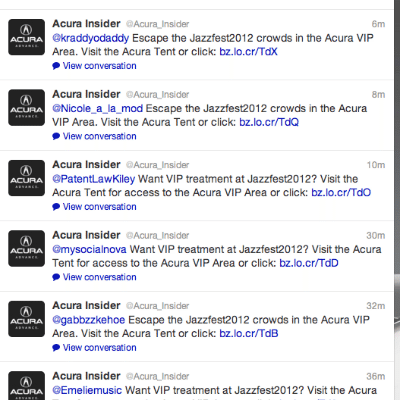
    It’s the classic story of Man Vs. Machine. Is bigger, faster, strong… better? Social media automation is easy. But, it’s also easy to come off sounding like a machine. While the posts may come from you, they can easily lack a personal touch that increases engagement and building relationships. If you tweet in real-time, you can show emotion, write genuine thoughts and show your brands charisma. You can lose that when you become robotic.

    automated social posts

    Image Source: Spokal

    2. Giving Yourself Away

    It can be obvious who is really at the posting controls. You could be giving yourself away by using social media automation. Third-party applications, while worth it for several reasons, tell your followers you used them to post your content. Facebook and Twitter posts show where the post was from. Such as “posted via Hootsuite”. The same can go for Buffer. This could irritate your audience because posts read as articles that are being “advertised” and not as invaluable pieces of your content.

    3. Scheduling Features Aren’t Your Best Buddy

    A mistake that is still common is posting too much. You don’t need to post content with the sole purpose of pumping it out as much as possible. Again, this is annoying and creates a negative image of your business and makes your business less genuine. We’ve seen investors who post every hour on the hour – and it’s very obvious there’s not a true person sitting behind that keyboard. Different social platforms require different schedule strategies. It might be required to test the number of times and days in order to find what the best times to post for you are.

    Here’s an example of a posting schedule:

    • Twitter: Post 2-4 times weekdays from 9am-7pm
    • Pinterest: Post 1-2 times daily. Choose days from 2pm – 4pm and 8pm – 11pm
    • Google+: Post 1-2 times weekdays 9am-3pm
    • Facebook: Post 1-4 times weekdays 9am – 12pm. And, 2pm – 5pm
    • Blog: Once or twice per week. Post Tuesday and/or Thursday at 11 am

    4. Spam

    No, not the food. The 25 tweets sent out last hour. Automation adds to the temptation to either tweet too often or bombards them with the same message. It does not take much to be considered a culprit of spamming. If caught, social media platforms can temporarily suspend your account.

    5. Using The Wrong Hashtags

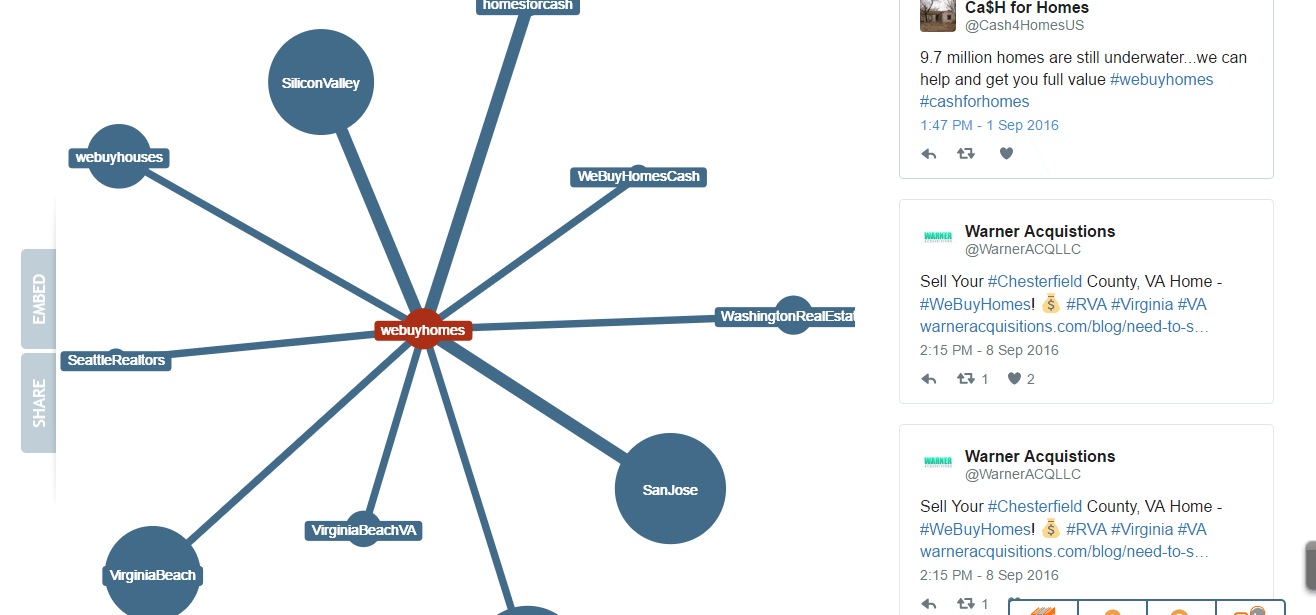
    Also, be aware of using automated hashtags. There are times hashtags are not what you thought they were. If you’re unsure of a hashtag, do a simple search using sources such as hashtagify.me.

    hashtag webuyhomes

    6. Carelessness

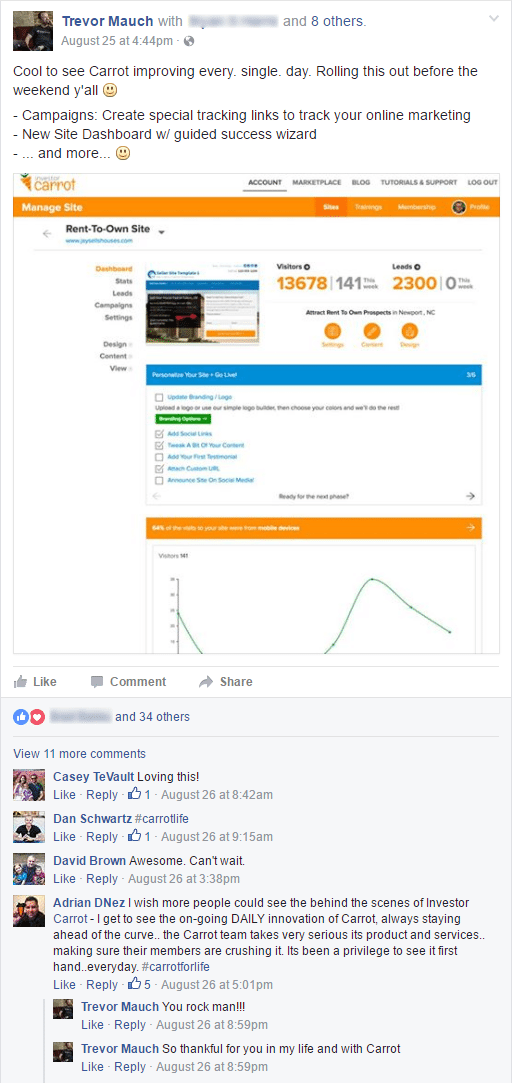
    You’re not done just because you published a bunch of content to Twitter and Facebook. Don’t forget to check and reply to questions and comments. You want that interaction. You must be prepared and interested in making real connections with your audience. That’s the fun part!

    respond to FB comments

    How To Properly Use Social Media Automation

    Of course, when done correctly and used judiciously, automated posting tools for social media can still be great time savers. Use these best practice automation tips to be present and successful on Twitter and Facebook.

    First… You must

    • Plan. Building a social media marketing plan is essential. Research your niche keywords and brainstorm content that will pull in your target audience. You could be writing towards motivated sellers, rent-to-own buyers, investment property seekers… whoever you’re targeting, make sure you have the right keywords.
    • Write amazing content. Make sure your content is offering valuable information to your target audience. Content isn’t always written. In addition to written content, create videos for YouTube showcase properties or create a Slideshare illustrating your buying process.
    • Establish a consistent brand image. Each social platform has its own identity and voice. Facebook is different than Instagram and Twitter. It can be easy to have your branding message become messy and inconsistent. If you feel like it’s getting out of control, take a step back, revisit your businesses core message, and get back on track being consistent.

    Then… You can

    • Use social media automation to fill your social media content calendar. Never be short of releasing high-quality content. You can release new content or repurpose some of your old, quality, content.
    • Use automation tools to find out the best time to post. Review your analytics. Test different days and times to find what times work best for your market.
    • Add personal touches to automated posts. Again, build your brand identity and credibility. Don’t be a mystery to your customers. Automate some casual posts so your audience feels like they know you and can feel connected to you and your brand.
    • Use automation to schedule your posts before you take an extended break. If you’re going to be away, schedule your social messages in advance. This will help you maintain a consistent social presence.

    Autoposting might be the only way you can achieve the ultimate goal of social media. Which, is connecting and communicating with your clients in a way build relationships and retention.

    Also be sure to read through Twitter and Facebook’s rules and best practices:

    Twitter Automating Tweets Rules and Best Practices
    Facebook Posting Tips and Best Practices

  • 10 Must Bookmark Real Estate PPC Marketing Resources We Use (And You Should Too)

    10 Must Bookmark Real Estate PPC Marketing Resources We Use (And You Should Too)

    2016.06.4-ppcresources-main

    Have you heard of other real estate investors having amazing success with pay per click advertising?

    Of course, you have. Now might be the best time to educate yourself on PPC and find out how it can help your real estate business.

    We’ve compiled a list of the top PPC marketing resources we use so that you don’t have to go digging around trying to find where the best information on PPC is.

    Pay per click is still a growing advertising platform to using when trying to get more website traffic, get more buyer and seller leads and close deals.

    But… PPC advertising for real estate has gotten more complex over the last few year.

    When learning about Google Ads, FB, and other pay-per-click services, having an idea of what motivated sellers and buyers are searching for when they are looking to sell their house fast is very important. You need to do some research and educate yourself. Use these resources and tools to become a real estate PPC expert!

    So what tools do we use when we’re diving into our PPC marketing or the PPC marketing with our clients to help them crush it.

    The Top 10 PPC Marketing Resources And Tools We Use

    Google Ads

    Google Ads is the reigning champion of PPC. The Google Ads tool and the advertising network are second to none. Whenever we’re launching a PPC marketing campaign, we start with Google Ads, then expand as we see results.

    So, there is no better place to start your PPC education than with Google. These resources provided by Google are a mix of beginner and expert tips and tools. Before you begin your own AdWords campaign, start here and get educated.

    Resources that Google makes available to learn about PPC:

    Microsoft Advertising

    The number 2 search engine to generate motivated seller leads consistently is Microsoft. Although they’ve made huge competitive strides, it’s nowhere near Google. But, Microsoft is still an important and useful platform for showing real estate ads. It’s demographic tends to be slightly different than that of Google and is a less expensive cost-per-click alternative.

    Like Google, Microsoft Advertising offers its library of resources on how to use its PPC tools:

    Wordstream

    wordstream university

    [Image Source] Wordstream’s PPC University

    Who’s not looking to cut down their PPC learning time and, in return, reduce your management costs and get better results? Wordstream can be used as that go-to PPC source. As both a PPC tool and consulting agency, Wordstream has grown to become one of the most comprehensive resources for PPC knowledge, offering up full online training (for free) via their PPC University section. Also, check out their Grader tool. Submit your PPC account to see how it ranks and get weekly reports.

    We love Wordstream and recommend you check out the following:

    SEMRush – Traffic And Competitor Analysis

    semrush overview

    [Image Source] SEMrush

    Want to see what your biggest competitors are doing with their PPC marketing campaigns in their market?

    Well, tools like SEMrush can help you do just that.

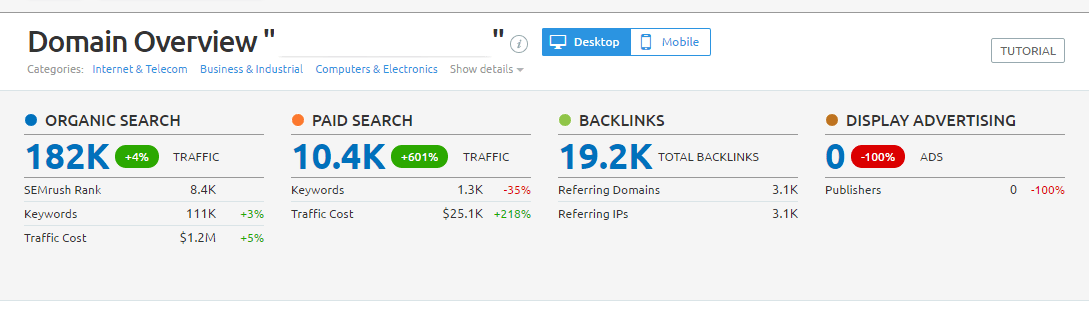
    SEMrush is a keyword research tool with a database of over 35 million keywords and keyword phrases used to drive website traffic. The data is taken directly from Google’s organic search results as well as Google Ads. It is one of the best keyword research tools available. Best of all, you can use it as a spy tool. It currently offers a free (limited) version and a full, paid, version.

    Why we like SEMrush:

    • See your competitor’s SEO organic and PPC positions
    • Domain-specific keyword ranking
    • Study your competitor’s ad’s text
    • Find good long tail keywords
    • Comparison of domains by keywords
    • Compare various SEO and PPC metrics
    • See competitor backlinks
    • Detailed look at PPC ad campaign data

    Jon Loomer Digital – Facebook Marketing

    jon loomer 20 percent rule

    [Image Source] Jon Loomer

    Looking to do your own Facebook advertising and want to do it at a high level?

    For us, the go-to source for Facebook advertising is Jon Loomer’s Advanced Facebook Marketing. Jon’s educational content includes free workshops, podcasts, blog posts, and eBooks. All of these content sources cover the Facebook ad optimization and the latest Facebook ad news. Check out his:

    PPC Hero

    PPC Hero PPC resources

    [Image Source] PPC Hero

    One of our Core Values at Carrot is “Constant & Never Ending Incremental Improvement” and PPC Hero is one amazing resource to improve our own PPC marketing game.

    PPC Hero is described as ”PPC insights from the experts at Hanapin Marketing”. They provide in-depth how-to’s, case studies, and resource guides. Warning – you can get wrapped up reading all their useful information. Be sure to stay focused or use their search feature and type in the specific information you’re looking for.

    Moz

    Moz has built the reputation of being a go-to place for SEO. But…Moz also has a large portion of insights on PPC and internet marketing. They keep up with industry trends, cutting-edge news, and ideas to change your outlook on your PPC strategy. Read more:

    Google Ads Editor

    It’s called the “PPC Powertool.” Ads Editor is a free, downloadable Google application for managing large Ads accounts efficiently. Download campaigns, make quick and bulk changes with editing tools, then upload the changes straight to your AdWords account. There are many benefits to Google Ads Editor, but like to use it for the following:

    • You can remove duplicated keywords if you have extremely large campaigns that you download via a spreadsheet.
    • Create ad groups fast.
    • Replace bulk amounts of text.
    • It doesn’t require an internet connection so you can work offline.
    • Test bids using the advanced bid changes feature.

    Microsoft Advertising Editor

    Just like the Google Ads Editor, you can save time by managing your Microsoft Ads campaigns using Microsoft’s desktop application version. Microsoft Ads Editor is very similar to Google Ads Editor, so the learning curve is minimal. You can edit campaigns offline and publish changes when you are back online. You can also use Microsoft Ads Editor to manage your accounts in bulk, from the campaign level to as targeted as the individual ad level.

    Search Engine Land

    Search Engine Land, like Moz, has traditionally been considered an SEO resource. But they have many useful PPC content and guides to getting smarter at PPC marketing. To get started, check out these sections:

    Bonus: Carrot

    Don’t forget to bookmark our blog and guides as one of the leading real estate PPC educational resources.

    Have any special resources you use for PPC marketing?

    We’d love to hear them! Hit us with a comment below and join the convo!

    [cta offer=”ppcreport”]

  • YouTube Optimization for Real Estate Investors | 10 Proven Strategies

    YouTube Optimization for Real Estate Investors | 10 Proven Strategies

    YouTube optimization for real estate investors has become indispensable in today’s competitive markets. With over 2 billion monthly active users, YouTube offers a vast audience for showcasing properties, sharing investment tips, and establishing your brand as a trusted expert in the industry.

    Video content is incredibly powerful in the real estate sector. Leveraging YouTube optimization for real estate investors can significantly boost engagement, build trust with your audience, and ultimately drive more leads and sales.

    Here’s a general overview of the trends within the real estate industry:

    1. Growing Popularity of Video Marketing: According to the National Association of Realtors (NAR), video marketing is increasingly popular among real estate agents and investors. Video content is effective in engaging potential clients and showcasing properties, which includes attracting motivated sellers.
    2. YouTube’s Reach and Influence: YouTube is the second largest search engine globally, with over 2 billion logged-in monthly users. This broad audience provides real estate investors with a significant opportunity to connect with motivated sellers through video content.
    3. Success Stories: Many real estate investors and agencies leverage YouTube to build their brand, educate potential clients, and generate leads. Successful investors often use video content to share tips, conduct property tours, and discuss market trends, which can attract motivated sellers.
    4. Industry Trends: According to a report by HubSpot, 54% of consumers prefer to see more video content from businesses they support. This trend extends to real estate, where video content is increasingly used to engage and attract sellers and buyers alike.
    5. Survey Insights: A survey by the National Association of Realtors found that 73% of home sellers are more likely to list with a real estate agent who uses video. While this statistic specifically addresses agents, it reflects the growing importance of video marketing in attracting sellers, including motivated ones.

    In this blog post, we’ll explore 10 actionable tips for YouTube optimization for real estate investors, ensuring you maximize your reach and impact. Whether you’re just starting or looking to enhance your current strategy, these tips will help you leverage YouTube to grow your real estate business.

    YouTube’s Reach and Impact on Real Estate

    • Massive Audience: YouTube has over 2 billion logged-in monthly users, with users watching over a billion hours of video daily. This massive reach provides an unparalleled opportunity to connect with potential clients.
    • Engagement Rates: According to recent studies, video content on social media platforms generates 1200% more shares than text and image content combined. For real estate investors, this means higher engagement and a greater chance of your content being seen by the right people.
    • Consumer Behavior: A survey by the National Association of Realtors found that 73% of homeowners are more likely to list with a real estate agent who uses video. Additionally, 70% of home buyers watch video tours of properties they are interested in.

    By understanding the importance of YouTube and learning from these success stories, you can see the potential impact video marketing can have on your real estate business. In the following sections, we’ll dive into specific strategies to optimize your YouTube channel and harness its full potential.

    10 Real Estate Investor YouTube Channel Optimization Tips

    1. Optimize Your Channel Name and Description
    2. Professional Branding
    3. Content Planning and Creation
    4. High-Quality Video Production
    5. Effective Calls to Action (CTAs)
    6. Engage with Your Audience
    7. Cross-Promotion
    8. Utilize YouTube Analytics
    9. Regular Content Uploads
    10. SEO Optimization

    Setting Up Your Channel

    Optimize Your Channel Name and Description

    Choosing the right name for your YouTube channel is crucial for YouTube optimization for real estate investors. Incorporating relevant keywords into your channel name can significantly boost your search rankings. Consider using terms like “Real Estate,” “Investing,” “Property,” or “Homes” alongside your unique brand name.

    For example, “Smart Property Investments” or “Real Estate Insights by [Your Name].” This helps potential viewers immediately understand your channel’s focus and enhances discoverability when users search for related content.

    Crafting a Compelling Channel Description with Relevant Keywords

    Your channel description is an excellent opportunity to tell your audience who you are, what you offer, and why they should subscribe. To maximize the effectiveness of your description:

    1. Start with a Strong Introduction: Briefly introduce yourself and your expertise in real estate investing.
    2. Highlight Your Content: Explain the type of content you create, such as property tours, market analyses, investment tips, and success stories.
    3. Incorporate Keywords Naturally: Use relevant keywords throughout your description to improve searchability. For instance, if you specialize in flipping houses, include phrases like “house flipping tips,” “real estate investment strategies,” and “property renovation guides.”
    4. Call to Action: Encourage viewers to subscribe and engage with your content, emphasizing the value they’ll receive by following your channel.

    Example:

    “Welcome to [Your Channel Name], your go-to source for expert real estate investment advice and property insights. As a seasoned real estate investor, I share valuable tips on house flipping, market trends, and smart investment strategies. Subscribe to join our community and stay ahead in the real estate game!”

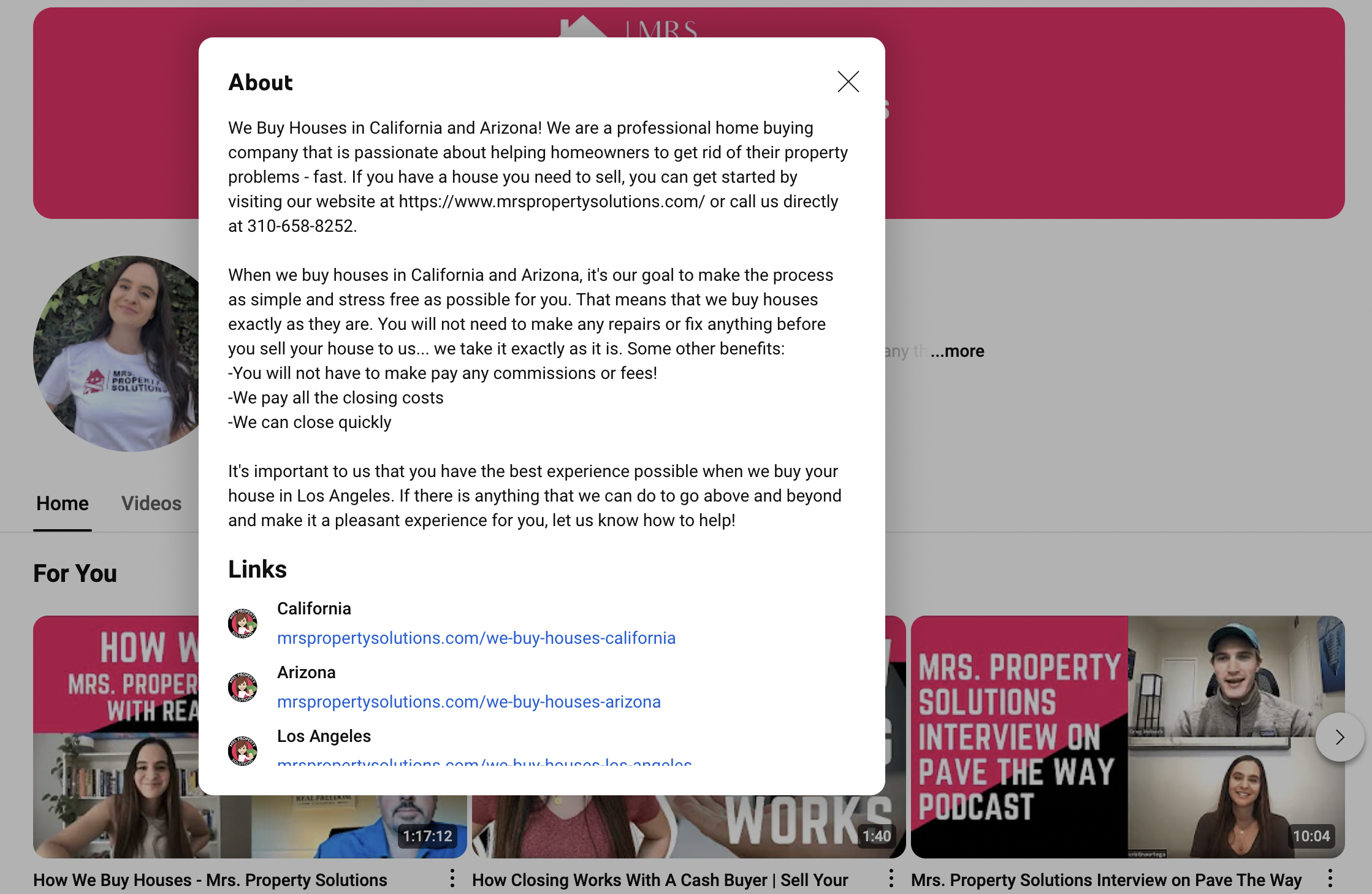
    Here’s a real example of Carrot member, Mrs. Property Solutions:

    Mrs. Property Solutions YouTube channel

    Professional Branding

    First impressions matter, and your channel’s visual branding is often the first thing viewers notice. A high-quality logo and channel art convey professionalism and help establish your brand identity. Your logo should be simple, memorable, and reflective of your brand. Meanwhile, your channel art should provide a clear, visually appealing representation of what your channel is about.

    Tips for Effective Branding:

    Express Homebuyers YouTube Channel Branding
    Express Homebuyers YouTube Channel Branding
    • Logo: Use clean lines and professional design. Avoid clutter and ensure your logo is recognizable even at smaller sizes.
    • Channel Art: Include your channel name, tagline, and a brief description of your content. Use high-resolution images and maintain a cohesive color scheme that aligns with your overall brand.

    Consistency in Branding Across All Social Media Platforms

    Consistency is key to building a strong and recognizable brand. Ensure that your branding elements (logo, colors, fonts) are consistent across all your social media platforms, including your YouTube channel, Facebook, Instagram, LinkedIn, and Twitter.

    This not only enhances brand recognition but also creates a cohesive and professional image.

    Steps to Maintain Consistency:

    • Unified Visuals: Use the same profile picture, cover photo, and color scheme across all platforms.
    • Consistent Messaging: Ensure your bio, descriptions, and tone of voice are aligned across all social media profiles.
    • Cross-Promotion: Regularly promote your YouTube content on other platforms and link your social media accounts to your YouTube channel to drive traffic and engagement.

    By optimizing your channel name and description with strategic keywords and establishing a consistent, professional brand, you’ll create a solid foundation for your YouTube presence. This will help attract more viewers, build credibility, and set the stage for successful video marketing in the real estate industry.

    Engagement and Community Building

    Call to Action (CTA)

    Effective calls to action (CTAs) are crucial for guiding your audience on what steps to take next and increasing engagement with your content, which is an essential part of YouTube optimization for real estate investors. Here are some effective CTAs to incorporate into your videos:

    1. Subscribe to the Channel: Always remind viewers to subscribe to your channel to stay updated with your latest content. Example: “If you enjoyed this video and want to see more real estate investment tips, don’t forget to subscribe and hit the notification bell.”
    2. Like the Video: Encourage viewers to like your video if they found it helpful or informative. Example: “Give this video a thumbs up if you found these property investment tips useful.”
    3. Leave a Comment: Ask viewers to share their thoughts, questions, or experiences in the comments section. This not only boosts engagement but also helps build a community. Example: “What do you think about this property? Leave a comment below with your thoughts!”
    4. Share the Video: Encourage viewers to share your video with friends or colleagues who might find it useful. Example: “Know someone who’s looking to invest in real estate? Share this video with them!”
    5. Visit Your Website or Social Media: Direct viewers to additional resources on your website or social media pages. Example: “For more in-depth articles and resources, visit my website at [YourWebsite.com].”
    6. Download Free Resources: If you offer free guides or checklists, invite viewers to download them. Example: “Download my free real estate investment checklist by clicking the link in the description.”

    Encouraging Viewers to Like, Comment, and Subscribe

    Consistently prompting viewers to like, comment, and subscribe is essential for growing your channel. Here are a few tips to encourage these actions:

    • Be Direct and Clear: Clearly ask viewers to like, comment, and subscribe. People are more likely to act when given specific instructions.
    • Incorporate CTAs Naturally: Integrate CTAs seamlessly into your video script, especially at the beginning, middle, and end of your videos.
    • Highlight the Benefits: Explain how liking, commenting, and subscribing will benefit viewers, such as staying informed about new content or joining a community of like-minded investors.

    Engage with Your Audience

    Responding to Comments and Messages

    Engagement is a two-way street and an important part of YouTube optimization for real estate investors. Actively responding to comments and messages shows your audience that you value their input and are interested in building a relationship. Here’s how to effectively engage:

    1. Timely Responses: Aim to reply to comments and messages promptly. This keeps the conversation going and demonstrates your commitment to your audience.
    2. Personalized Replies: Address commenters by their name and provide thoughtful responses. This personal touch fosters a stronger connection.
    3. Encourage Further Discussion: Ask follow-up questions to keep the conversation engaging. Example: “Great point, [Name]. What do you think about investing in multi-family properties?”

    Creating Community Posts and Polls to Engage with Subscribers

    YouTube’s community tab is a powerful tool for engaging with your audience beyond video content. Utilize community posts and polls to keep your subscribers engaged and involved:

    1. Regular Updates: Share updates about upcoming videos, market trends, or behind-the-scenes content. This keeps your audience informed and connected.
    2. Polls and Questions: Use polls to gather opinions or ask questions to spark discussions. Example: “What type of property tour would you like to see next? Single-family homes or condos?”
    3. Highlight Subscriber Content: Showcase comments or video responses from your subscribers. This not only acknowledges their participation but also encourages others to engage more.

    Tips for Maximizing Engagement:

    • Consistency: Regularly post updates and engage with your audience to maintain an active community.
    • Value-Driven Content: Ensure that your posts and polls provide value and are relevant to your audience’s interests and needs.
    • Encouragement: Thank your subscribers for their engagement and encourage them to continue participating.

    You’ll foster a loyal and engaged community by incorporating effective CTAs in your videos and actively engaging with your audience through comments, messages, and community posts. This will not only boost your channel’s growth but also enhance your credibility and influence as a real estate investor.

    Promotion and Analytics

    Cross-Promotion

    Cross-promotion is essential to maximize your YouTube optimization for real estate investors. Leveraging your presence on other social media platforms and email newsletters can drive traffic to your channel and attract a broader audience.

    1. Social Media Platforms:
      • Facebook: Share your videos on your personal and business Facebook pages. Join real estate groups and communities to share your content and engage with potential viewers.
      • Instagram: Promote your videos using Instagram Stories, IGTV, and posts. Tease upcoming content with short clips and use relevant hashtags to reach a wider audience.
      • LinkedIn: Post your videos on LinkedIn to connect with professional contacts and potential investors. Share insights and market trends to establish authority.
      • Twitter: Tweet about your new videos and include a link to your YouTube channel. Use industry-specific hashtags to increase discoverability.
    2. Email Newsletters:
      • Include Video Thumbnails: Use eye-catching thumbnails and brief descriptions of your latest videos in your email newsletters.
      • Call to Action: Encourage subscribers to click through to your YouTube channel to watch the full video. Example: “Check out our latest video on [topic] and gain valuable insights into [subject]. Click here to watch!”
      • Consistent Updates: Regularly update your subscribers about new content, upcoming videos, and exclusive insights.

    Collaborating with Other Real Estate Influencers and Channels

    Collaborations can significantly boost your channel’s visibility by tapping into the audiences of other influencers and channels. Here are some ways to collaborate effectively:

    1. Guest Appearances: Invite other real estate influencers to feature on your channel and vice versa. This introduces your audience to new perspectives and brings new viewers to your channel.
    2. Joint Webinars and Live Streams: Host live events with other real estate experts. Promote these events across both of your channels and social media platforms to maximize reach.
    3. Co-Created Content: Partner with other influencers to create joint content, such as market analysis, property tours, or investment tips. Share the content on both channels and cross-promote it.

    Benefits of Collaborations:

    • Increased Exposure: Reach new audiences who are already interested in real estate.
    • Enhanced Credibility: Association with other respected influencers can boost your credibility and authority.
    • Mutual Growth: Collaborations often result in a win-win situation, with both parties benefiting from increased viewership and engagement.

    Utilizing YouTube Analytics

    YouTube Analytics provides valuable insights into your channel’s performance, helping you understand what works and what doesn’t, which is key for YouTube optimization for real estate investors. Key metrics to monitor include:

    1. Watch Time: The total amount of time viewers spend watching your videos. Higher watch time indicates engaging content.
    2. Views: The number of times your videos are watched. This helps gauge your content’s popularity.
    3. Audience Retention: The percentage of a video watched by viewers. High retention rates suggest that viewers find your content valuable and engaging.
    4. Click-Through Rate (CTR): The percentage of people who click on your video after seeing the thumbnail. A higher CTR indicates an effective thumbnail and title.
    5. Subscribers Gained: The number of new subscribers acquired during a specific period. Tracking subscriber growth helps measure your channel’s overall progress.
    6. Engagement Metrics: Likes, comments, and shares. High engagement levels indicate that your content resonates with viewers.

    Using Analytics to Refine Your Content Strategy

    By analyzing these metrics, you can refine your content strategy to meet the needs and preferences of your audience better. Here’s how:

    • Identify Top-Performing Content: Analyze which videos have the highest watch time, views, and engagement. Create more content on similar topics or in similar formats.
    • Understand Audience Preferences: Look at audience retention graphs to see where viewers drop off. Adjust your content to maintain interest throughout the video.
    • Optimize Thumbnails and Titles: If your CTR is low, experiment with different thumbnail designs and titles to attract more clicks.
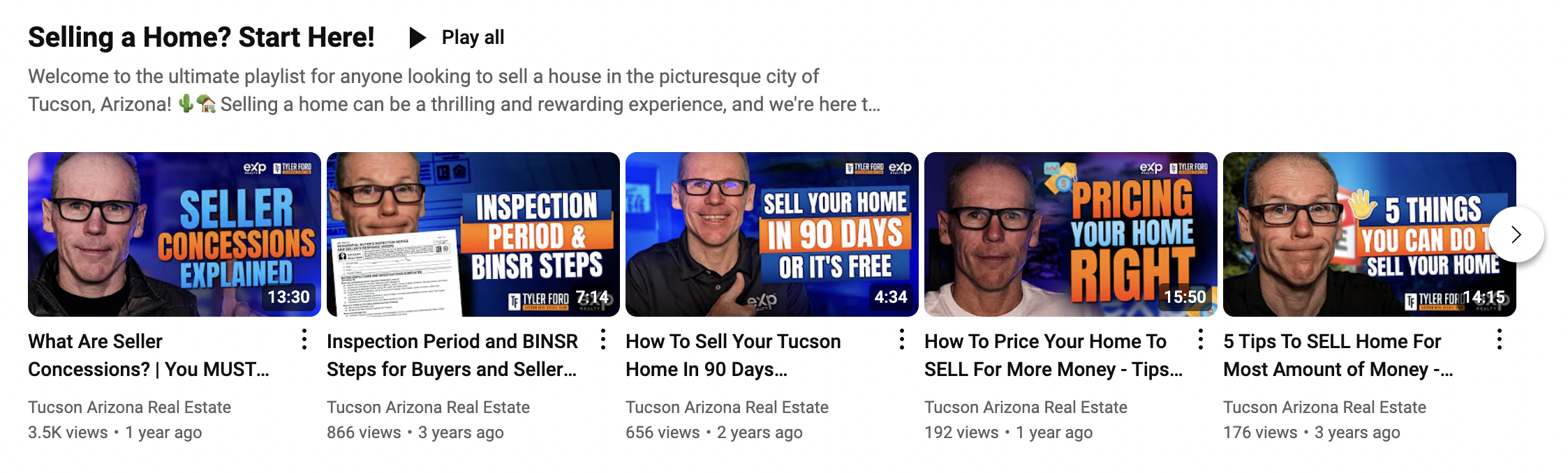
    Carrot member and hybrid investor/agent, Tyler Ford achieves a well thought out YouTube channel.
    • Tailor Content to Demographics: Use demographic data to understand your audience’s age, gender, and location. Create content that appeals specifically to these groups.
    • Track Trends Over Time: Monitor how your key metrics change over time. Identify patterns and adjust your strategy to capitalize on positive trends or address any declines.

    You can achieve sustained growth and success in your real estate investing journey by effectively promoting your YouTube channel through cross-promotion and collaborations and leveraging YouTube Analytics to refine your content strategy. These strategies will help you reach a wider audience, enhance engagement, and establish yourself as a trusted authority in the real estate industry.

    Conclusion

    Recap and Next Steps

    Summarize the Key Points Discussed

    In this blog post, we’ve explored several powerful strategies for YouTube optimization for real estate investors:

    1. Setting Up Your Channel:
      • Optimizing your channel name and description with relevant keywords to enhance discoverability.
      • Establishing professional branding through high-quality logos, channel art, and consistent visuals across all social media platforms.
    2. Content Creation:
      • Planning content that addresses your target audience’s needs and pain points.
      • Utilizing keyword research to integrate relevant terms naturally into video titles, descriptions, and tags.
      • Ensuring high-quality video production with affordable equipment and software.
    3. Engagement and Community Building:
      • Incorporating effective CTAs to guide viewers to like, comment, and subscribe.
      • Actively engaging with your audience by responding to comments and creating community posts and polls.
    4. Promotion and Analytics:
      • Cross-promoting your channel on other social media platforms and email newsletters.
      • Collaborating with other real estate influencers to reach a broader audience.
      • Leveraging YouTube Analytics to track key metrics and refine your content strategy based on data insights.

    Encourage Readers to Implement These Strategies and Share Their Success Stories

    Now that you have a comprehensive understanding of YouTube optimization for real estate investors, it’s time to put these strategies into action. Share your experiences and results in the comments section below or connect with us on social media.

    We’d love to hear about your journey and success stories! Share your experiences and results in the comments section below or connect with us on social media. Your insights could inspire and motivate other real estate investors.

    Mention Any Additional Resources or Tools for Further Learning

    For further learning and to enhance your YouTube optimization efforts, explore these additional resources and tools:

    • Carrot’s Video Marketing Playbook: Attract your most motivated prospects in under 20 minutes a week, no gear or tech expertise required. Includes Free scripts & 52 ideas.
    • TubeBuddy: A browser extension that helps with keyword research, video SEO, and analytics.
    • VidIQ: Another powerful tool for optimizing your YouTube content, providing insights into video performance and keyword opportunities.
    • Google Keyword Planner: Essential for conducting keyword research and finding relevant terms to incorporate into your content.
    • Canva: A user-friendly design tool for creating professional thumbnails, channel art, and social media graphics.
    • Adobe Premiere Pro and Final Cut Pro: Advanced video editing software for producing high-quality videos.

    Additionally, consider subscribing to industry-leading blogs and YouTube channels that focus on video marketing and real estate investing for ongoing tips and updates.

    By implementing these strategies and utilizing these resources, you’ll be well on your way to building a successful and influential YouTube channel as a real estate investor.

  • AdWords Nerds Review – PPC Service For Real Estate Investors

    AdWords Nerds Review – PPC Service For Real Estate Investors

    Is AdWords emptying your budget with little return? Are you managing your own campaign? If hastily created, PPC can be a money pit.

    PPC (PayPerClick) marketing is one of the online lead generation strategies we teach our Carrot clients to use to get traffic coming in while you build up your SEO and content marketing.

    Why?

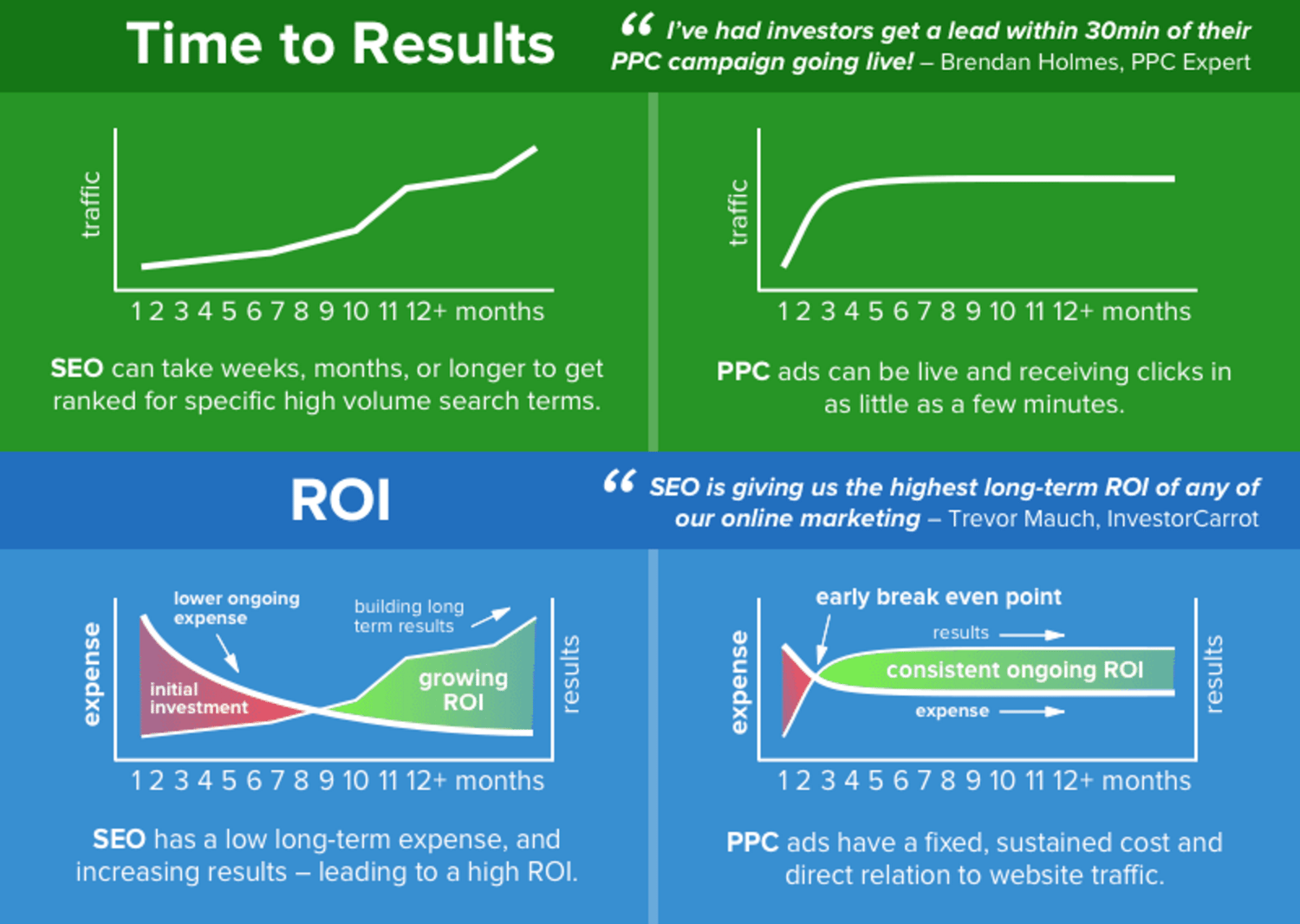
    Because SEO is a long term game (highly profitable but it takes patience)… while with PPC marketing you can have traffic and leads coming in, in hours or days.

    It’s not “one or the other”… it’s a matter of your real estate lead gen goals and which one or ones best fit into your overall time and money budget to reach the prospects that you need to keep growing your business.

    Like this chart shows…

    PPC Marketing Can Be A Critical Part Of An Overall Lead Generation Effort For Many

    seo-vs-ppc-roi

    With that said, if you know that PPC marketing can be a great tool for you and your real estate investing business, but just don’t have the time to learn it yourself, you need to seriously think about finding an amazing team to do the work for you.

    Who specializes in working with real estate investors and all of the intracacies involved.

    Who specializes in performance above all else, not just setting up and automating a PPC campaign.

    And who delivers amazing customer support that you’re used to as a Carrot client.

    So…

    We Welcome Our Latest Carrot Certified Partner To Our Community…

    CarrotCertifiedPartnerBadge_Vertical_150

    We’re excited to announce welcoming in AdwordsNerds to our Carrot Marketplace as our Carrot Certified Partner on the PPC marketing side of things.

    So, one of the first things you need to take into consideration before starting out in PPC is to perform a simple review Google search. Start the search by Googling terms such as “AdWords Nerds review” or “reviews of AdWords Nerds”.

    It’s important for you to have in mind how different PPC service companies have performed with past clients. Take a look at ratings, management fees, costs per conversions, lead generation, if you will have access to your account.

    There are some PPC consultants who might charge $150 to $5000+ per month or charge a flat rate per lead. Adding that optimized real estate PPC specialist is often the more “cost-effective” route than signing with a large agency.

    Those investors that try to manage their own AdWords campaigns usually become frustrated at quit. Leaving a bad experience.

    The solution: Hire a professional PPC service for real estate investors.

    AdWords PPC can be a very complex process. Without the proper guidance and education, one can become confused while wasting a lot of marketing dollars.

    With that, Dan at AdWords Nerds stepped up to the plate! AdWords Nerds is a certified InvestorCarrot PPC company and partner. Dan wrote a very detailed PPC guide that explains what things you should know about AdWords before you start advertising and spending money. This guide lays out the things you must know about AdWords before you start using it.

    [cta offer=”ppcreport”]

    Real estate investors have one of the toughest, weirdest, most complicated AdWords markets in the world.

    Dan came into investing after running AdWords campaigns in a dozen different industries. He worked with plumbers and coaches, plastic surgeons and ambulance companies.

    Not a single one of them had the sheer level of insanity found when he started digging into the world of online marketing for real estate investors.

    Why is that? Well, there’s a few reasons:

    High Potential ROI On Real Estate Deals Lends Itself To PPC Marketing

    Most businesses are trying to sell moderately-priced products. That places a cap on what can profitably be spent to bring in a new customer. But, real estate investors have more room in their budgets. Net profits can be upwards of $60k in deals. Even novice wholesalers can make over $10k in deals if they’re in a good market.

    All that profit means people are willing to spend a lot to get motivated seller leads – and competition can be fierce.

    Gathering Good Data On What Actually Works

    Over the last year Dan had the opportunity to look at dozens of different Investor AdWords accounts.

    He looked at hundreds of thousands of different keywords, ads, and landing pages. He saw bids as high as $150 a click…and as low as ten cents a click.

    You know what he found out? There is almost no hard data out there on what actually works. Without good data to fall back on, people share their personal experiences. For example, an investor might share his or her account that’s been really crushing it in their market.

    So what happens if you take that account and set it up in your neck of the woods? About 50% of the time, you’ll do great. And the other 50% of the time? Your account turns into a giant, smoking hole in the ground.

    That’s because so much of what determines a keyword’s profitability is unique to your market, your business, and your situation.

    What CRUSHES it in one market, may absolutely flop in another.

    “Picking the right keywords for your real estate AdWords campaigns is what makes the difference between making money and losing money”. Dan Barrett

    Know This – PPC Is Not SEO

    SEO keywords are pretty well-understood in the real estate investor space – companies like Investor Carrot have put out amazing guides on the topic, and SEO is easier for most investors to understand…after all, we all use Google to search for stuff.

    When you move those keywords to Pay Per Click, however, you start to run into problems.

    In Pay-Per-Click, we have to worry not just about what keyword we’re using, but how that keyword will be matched up with the search queries we want. And it’s not always obvious.

    Introducing! PPC Service For Real Estate Investors.

    Fast, Quality Leads Without Lifting a Finger

    PPC (PayPerClick) ads are a great way to get traffic to your website right away – without having to wait months for SEO.

    For our managed PPC service, you’ll work directly with the only Google Partner Agency that focuses specifically on Real Estate Investors – AdWords Nerds.

    Interested in PPC for Real Estate Investors? Find out more about AdWords Nerds and what they have to offer.

    View in Marketplace ›

    Learn more about AdWords Nerds in the Carrot Marketplace

  • April Harvest Report – Mobile Is Now & Top Lead Generating States

    April Harvest Report – Mobile Is Now & Top Lead Generating States

    investor carrot lead generation report

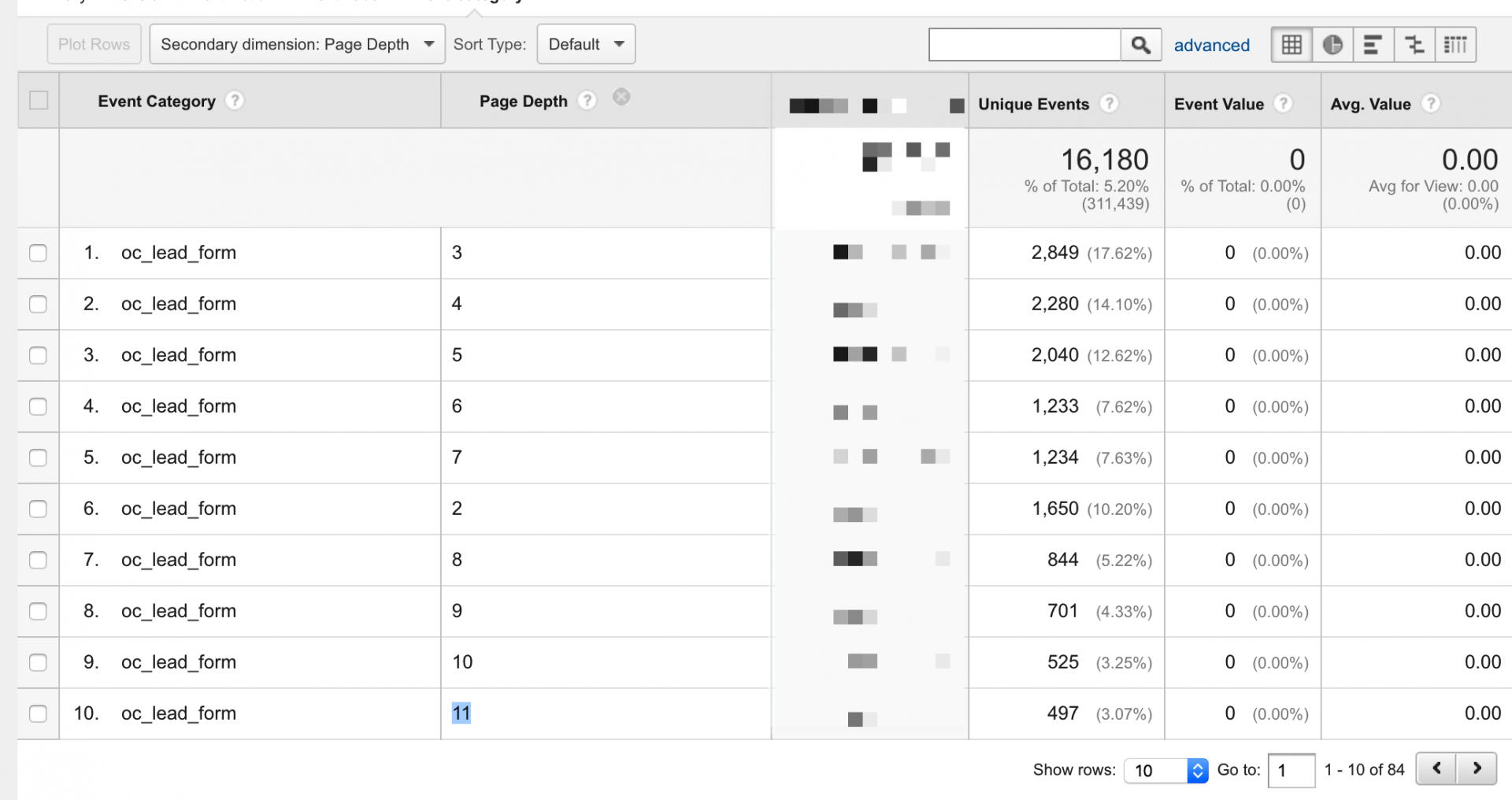
    Did you know most leads viewed 3-4 pages before they opted in? What does this mean for your website? This month we will quickly break down our leads by traffic source and then get into a few more interesting reports like “Page Depth”. We will show which states are generating the most leads and how many website pages are visited before a potential lead opts-in.

    A quick note, the purpose of our Carrot harvest reports is not to brag or boast. But, rather, we take pride in be transparent and sharing our data. This allow real estate investors a peek to see what is working for inbound online marketing.

    In today’s report we’ll dive into…

    • The opt in leads (this does NOT include phone call leads which easily doubles the amount of leads in total) for the month of April
    • The main lead sources (where are your leads coming from?)
    • Mobile keeps climbing
    • Which states have the highest conversion rates?
    • Why conversion rates are lower in a hot sellers market
    • How many pages do the majority of your leads view before they opt in (the case for websites vs. squeeze pages)

    For InvestorCarrot members, we hope you use the data found in harvest reports as an inspiration to know that your hard work will pay off and that implementing the training and resources will help you generate more traffic and convert more leads.

    For non-Carrot members, use this as research to find out what’s working in today’s market… and then get out there and implement these strategies on your websites!

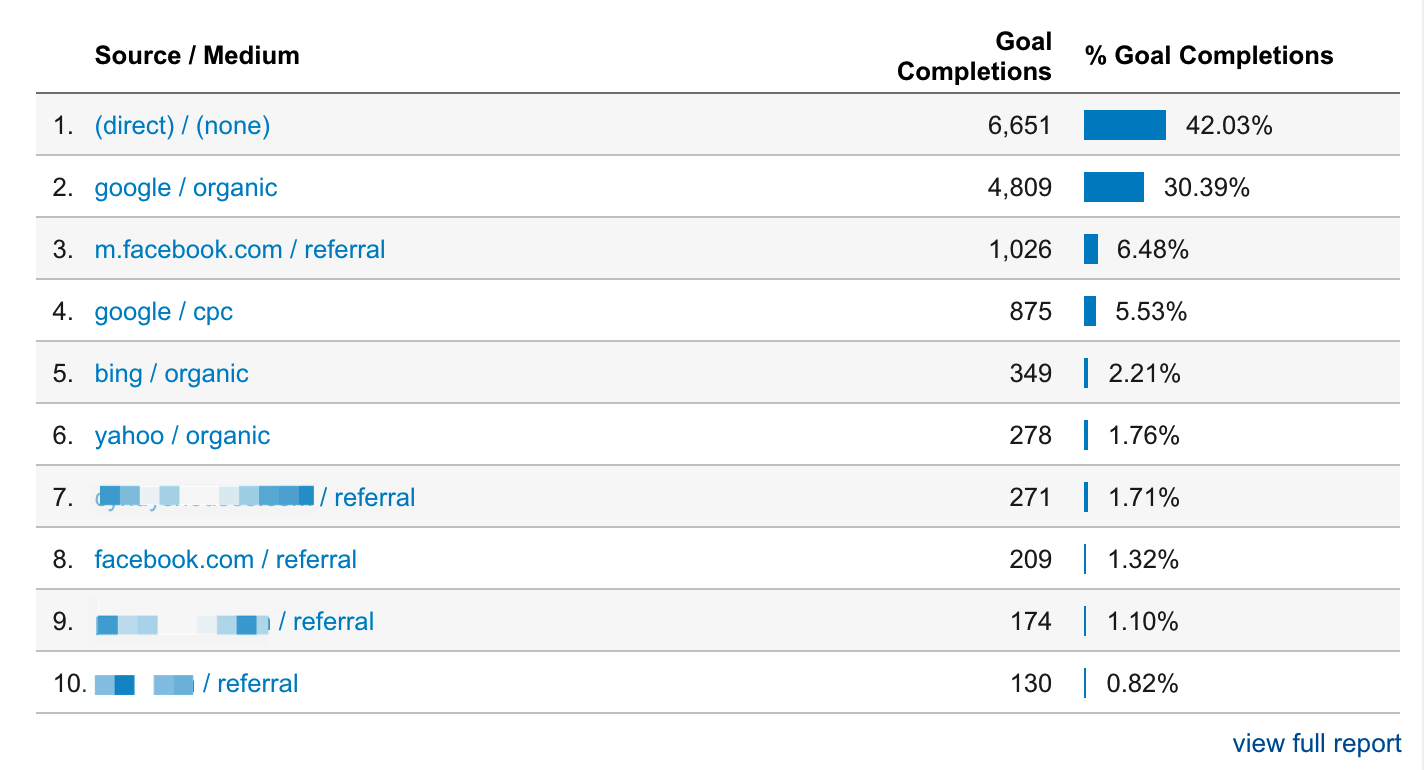
    Where Did The 15,825 Real Estate Investing Motivated Property Seller, Cash Buyer, Rent To Own, And Private Lender Leads Come From April 2016?

    Investor Carrot Client Leads April 16

    Real Estate Investing Lead Breakdown… this snapshot shows the breakdown of leads generated in the past 30 days through InvestorCarrot.

    Again, we don’t show these numbers to brag, although we are proud of our members and the numbers they’re pulling!

    We have always been transparent and honest because it’s breed into our Core Values. Our goal is to present this data in hopes that it helps you with your inbound marketing and real estate investor website optimization. We’re are always ready to help.

    As you can see, the vast majority of the leads in the past 30 days are from organic SEO. No surprise there. SEO is still the driving force behind inbound marketing.

    Google won’t give us the specifics on this direct/none data, but huge majority of those leads can be counted as SEO. While, another portion of those direct/none leads come from Craigslist ads. They show up in the “(direct)” section because Craigslist doesn’t allow live links in real estate ads any longer in the majority of cities… so people have to copy and paste the URL into the browser to go to the website… which would make it a “direct” link to the site.

    Mobile Is The Now (in a big way)

    We’ve talked about it many times… and will continue to do so… if your website isn’t AMAZING on mobile (NOT just “mobile friendly”) you’re losing leads.

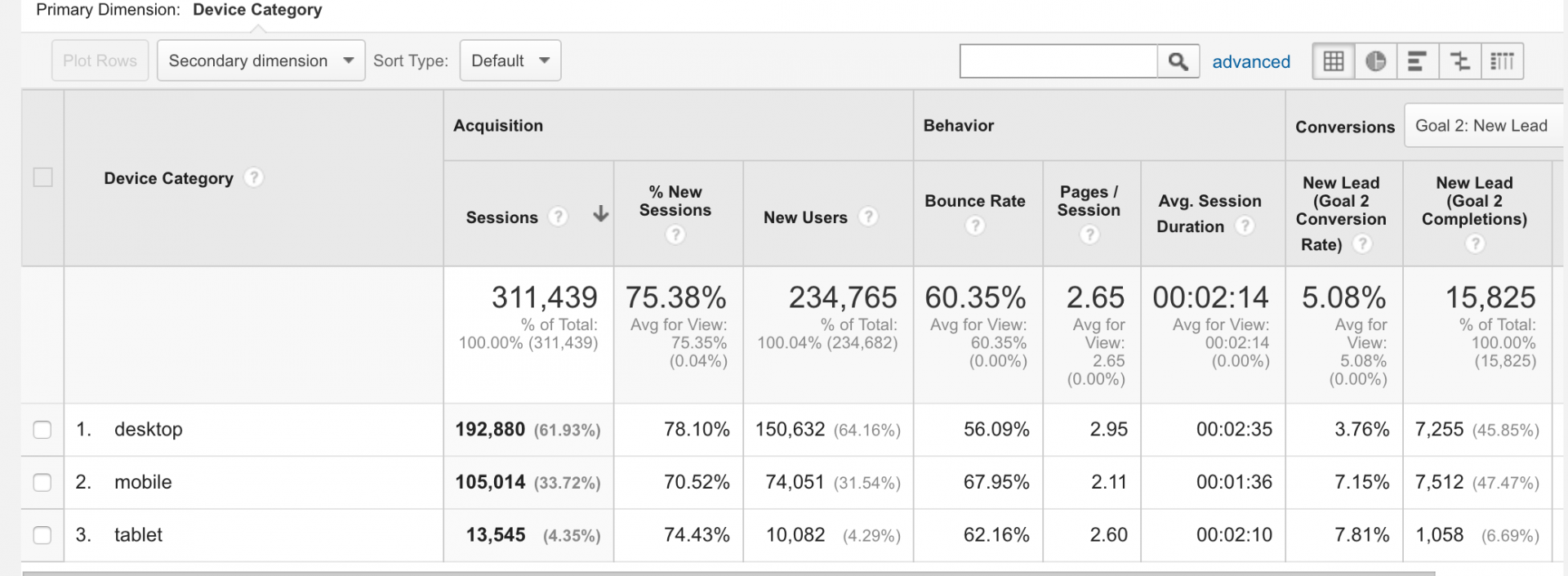
    Mobile Gets Fewer Visitors But MORE Leads

    Carrot mobile lead generation
    Mobile Optimized Websites… extremely important opportunity for real estate investors to capture and convert leads. Carrot sites are now consistently generating 50% of your leads… this is because we’ve focused so much on crafting a high performing mobile responsive design to convert… not just to be “mobile friendly”. Does your website convert well on mobile or is it just “mobile friendly”?

    Back in August we reported that mobile leads were the future. Now…mobile leads are consistently generating over 50% of leads in the device category. That shows how important it is to have a mobile responsive site ready for your potential leads.

    We say this all the time, but we really do love seeing our customers have success and grow personally and professionally. The reality now is that you must have a mobile friendly website. It needs to be quick and simple to use, or visitors are going to leave. That is why continue to test and improve our websites, to ensure they give your visitors the best experience possible.

    If you’re not a Carrot member and your website is not responsive and mobile friendly you must get a web developer to help you out. Or, jump on over to a mobile optimized Carrot site.

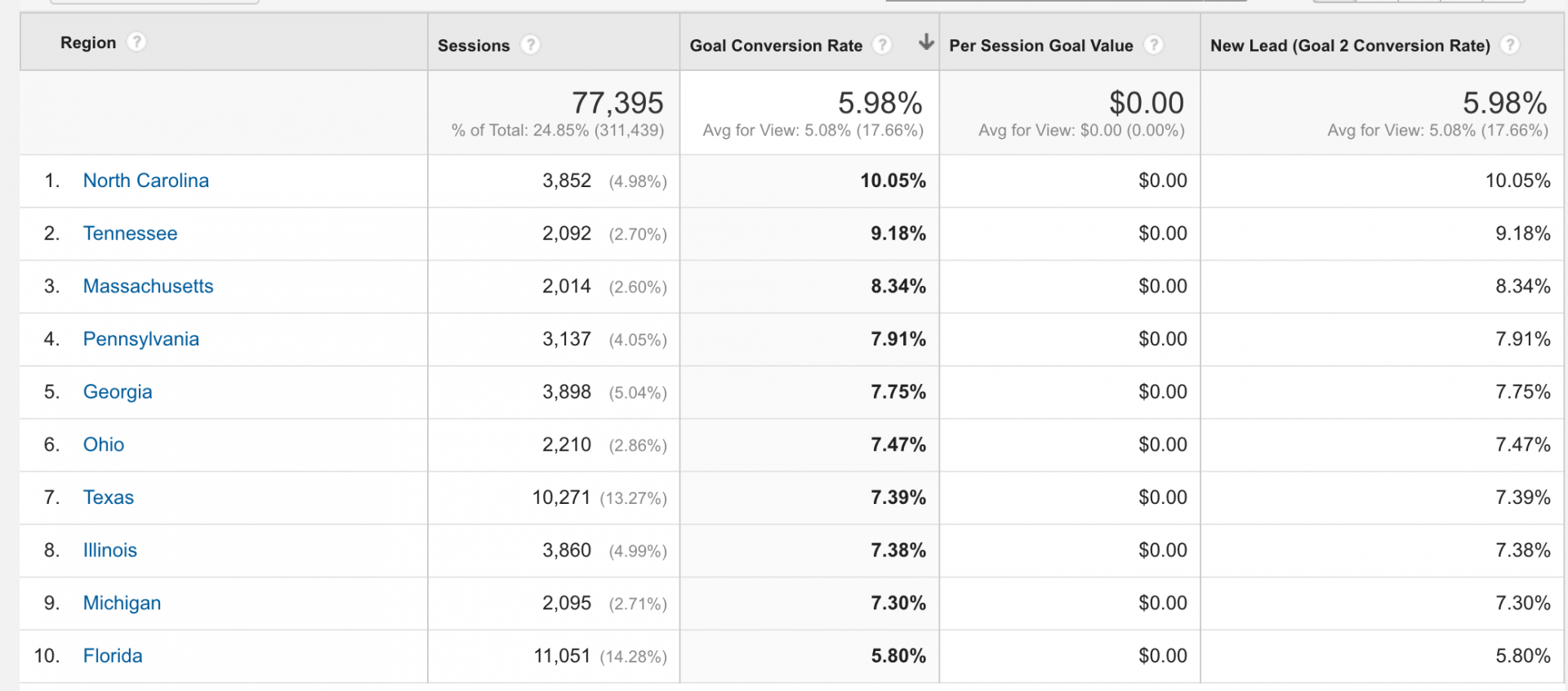
    Top 10 Lead Generation Conversion Rates By State (With At Least 2000 Sessions)

    We’ve published about this before, but as real estate markets heat up conversion rates for the wholesaler / flipper motivated seller website decreases a bit. If you check back on Harvest Reports from last year you’ll notice the conversion rates were a tad bit higher.

    That’s all normal in a hot sellers market and if you’re doing any direct mail you’re seeing the EXACT same thing happening as well. 2-3 years ago you could send out a 1,000 piece mailing and get X amount of leads… today you have to send out a 5,000 piece mailing to get the same amount of qualified leads.

    Why? It’s the market.

    When sellers have more options to sell they look more, they get the confidence that they can sell it themselves, they list with an agent because houses are getting above asking price offers in many places, and we all have to cut through more clutter that sellers are seeing in their everyday lives.

    Which States Have The Highest Average Conversion Rate In Today’s Market?

    Top real estate lead generating states
    See The Top Spots For Real Estate Investing Leads… North Carolina, Tennessee, Massachusetts & Pennsylvania round out the top 4 states for highest converting states. One statistic that is always a fun and interesting to take a look at is the lead conversion rate breakdown by state. In April, North Carolina earned the top spot followed closely by Tennessee.


    Why is that? A lot of the real estate market depends on where you are transacting your deals. These states typically perform higher than other states as far as conversion rate… but as I dive into below… very hot sellers markets tend to have lower conversion rates. So if your state isn’t on that list above, don’t sweat… it’s just a cool stat more than anything.

    So what can you do?

    Try and understand your leads better, what messaging do they respond to? To convert more visitors to leads, try switching up the copy in your hero section. Answer a question that they might have when they land on your site.

    Instead of offering them a quote, consider offering them a consultation call, a free estimate of their houses worth, or a custom solution to their housing situation.

    How Many Pages Did Visitors View Before Converting To A Lead?

    The age old battle of “squeeze pages vs. websites” will continue until websites are no longer a thing… but we usually try to take the data driven approach to what works. We’ve tested squeeze pages vs. mini sites setup the way we set them up (so every page is geared to convert a visitor into a lead very strategically) and for motivated house sellers our style of “mini site” has always performed better.

    But when we dive into the data even more… you see how darn important it is to your best leads to dive into the information on your website.

    Most Of Your Leads Like To See 3, 4, or 5 Pages BEFORE They Opt In…

    number of page visited before opt-in
    This report shows how many pages visitors landed on before opting-in as a lead.

    This month we also took a look at some different stats: How many pages did a visitor visit before turning into a lead.

    What should you do with this data?

    First off, if you only have a 1 or 2 page website… you should probably add more content and pages to your site. Build out an amazing About Page, a great FAQ page, describe how your process works, add in some city specific pages, and more.

    But make sure to structure your pages to all convert. You can use our FREE Conversion Rate Guide + Checklist here to help you make your website performs better.

    This type of data allows a journey into the psyche of a user. A large majority like what they see after visiting five or less pages. But, there’s still plenty that it takes 6,7, 8…to make the decision. Notice that two page visits is in the middle. Pretty cool stuff!

    It also shows the importance of optimizing all of your pages. Such as, making sure you capture and add testimonials to your site. If you need help, check out the various types of testimonials real estate investors can use to build credibility. There’s no better way to build trust with your customers.

    Take the time to personalize and search engine optimize your site. That time spend = High ROI.

    How Is Your Online Lead Generation Going For Your Real Estate Investing Business?

    If you’re interested in leveraging our Inbound Online Marketing platform at InvestorCarrot, our training, and our support team, take a demo or checkout our plans.

    Over the last several months we’ve been developing some new features to further real estate investor success. We’re proud to have announced our new robust analytics, slick dashboard, and fresh site design options. Check’em out here.

  • 11 Great Real Estate Investing Blogs We Marketing Geeks Love 

    11 Great Real Estate Investing Blogs We Marketing Geeks Love 

    2016.05.1-blogswelike-main

    There’s a fair number of real estate investor blogs out there, all tempting …. But, it’s hard to know which sites are truly trustworthy, educational, and informative. So, we went ahead and scoured the web to narrow it down some real estate investing standouts that we enjoy reading.

    Thanks to the well defined tips, information, and news on the housing, mortgage and finance industries that these sites offer, the blogs below offer great insights into the challenges that confront real estate investors. So check them out and bookmark your favorites to keep up with all things real estate. Also, be sure to check out our Carrot blog. We’re here to help investors and agents achieve their goals.

    Sure, you can use social media to gather your investor news, but not everyone wants to spend their days combing through their Facebook, LinkedIn and Twitter feeds. Save time by going straight to the source, the powerful blogs themselves.

    Real Estate Investor Blogs We Follow

    We left out some of the obvious amazing blogs in this round like BiggerPockets and a few others. For this post we wanted to highlight some of the lesser known blogs that may (or may not) be on your list yet.

    Let’s dive in!

    Joe Fairless at joefairless.com/blog

    top-real-estate-blogs-joe-fairless

    Joe has more of an active outlook on investing and life. He believes the most valuable resource we have is our time. He approaches his life in a manner of pursuing his passions and purpose. That purpose is helping others achieve financial success. His main focus is to place more investors in a “do more good” position in their lives.
    After leaving his career in adverting in 2012, Joe now controls over $21,000,000 worth of real estate. He knows what he’s talking about when it comes to real estate investing.

    While you’re reading through his site, check out his Crash Course on real estate investing

    Top recommended articles

    When Do You Walk Away From a Deal? When This Happens

    The COMPLETE Guide to Investing in Single-Family Properties


    Paula Pant at affordanything.com

    Paula was searching for an opportunity to bring freedom into her life. Like many others, she found it in real estate investing. Through dedication, she has now built a property portfolio strong enough to bring her consistent income while she pursues other interests.

    Top recommended articles

    The Incredible Power of the 1% Margin for Improvement

    I Don’t Know How to Invest and I’m Afraid of Making Expensive Mistakes

    Renting is Throwing Money Away … Right?


    Seth Williams at retipster.com

    top-real-estate-blogs-rei-tipster

    Seth is a top blogger and social media enthusiast in the real estate investment area. Seth is “here to show you how I’ve learned to eliminate the hassles, focus on what matters and make money.”  Seth’s blog articles cover a wide range of real estate topics and are very informative.

    Top recommended articles

    How to Invest in U.S. Real Estate as a Foreigner

    What’s Your Diversification Strategy?

    Automate Your Phone & Voicemail System


    Sharon Vornholt at Louisville Gals Real Estate Blog

    top-real-estate-blogs-sharon-vornholt

    Sharon has been part of the Louisville, KY real estate investing community since 1998. From her passion about real estate investing she has also become a blogger, coach and a podcast host.  Her podcast is called “Let’s Talk Real Estate Investing”. Not only is she an amazing Carrot customer herself but our CEO Trevor has been fortunate enough to be on her podcast a few times lately.

    Sharon’s real estate investing blog is driven around the basis of helping others build their business and dreams by providing quality content.

    In addition to the Louisville Gals Real Estate blog, Sharon has also written for numerous other real estate sites and publications, such as REI Wealth Magazine and BiggerPockets.

    Top recommended articles

    Women and Real Estate Investing; Are they Uniquely Qualified for this Business?

    So You Think You Want to Invest in Commercial Property?

    Check out Sharon’s amazing real estate podcasts at Let’s Talk Real Estate Investing

    Here’s Real Estate Quick Tips – Mindset Shift -Spending vs Investing – with Trevor Mauch


    Cris Chico at crischico.com

    top-real-estate-blogs-cris-chico

    Cris Chico was the first person to develop and perfect the concept of “virtual” real estate investing, where you can close deals literally from your laptop, from start to finish.

    He then streamlined his methods into a fully integrated system called Virtual Wholesaling.

    He has successfully wholesaled hundreds of residential properties all across America using his unique and groundbreaking system “Virtual Wholesaling”.

    Top recommended articles

    TARGET THIS TYPE OF SELLER TO FIND REAL ESTATE DEALS


    Matt Theriault from epicrealestate.com

    top-real-estate-blogs-matt

    Matt has been a full-time real estate professional since 2003. He has built a small real estate empire with hardly using one dime of his own money.   As an accomplished professional, he writes and teaches other to be successful in real estate investing and become a master of the “multiple streams of passive income” concept.

    Top recommended articles

    DEMYSTIFYING THE 7 MYTHS OF CLOSING YOUR FIRST DEAL

    5 SECRETS FOR THE (SOON-TO-BE) MILLIONAIRE REAL ESTATE INVESTOR


    Tom Krol from wholesalinginc.com

    top-real-estate-blogs-tom-krol

    Tom believes “smart wholesalers who want to win in today’s overcrowded marketplace MUST become master marketers.” Tom is an expert marketer and wholesaler. He started wholesaling houses and became one of the most successful flippers by closing more than 100 deals in his first 18 months of business.

    Top recommended articles

    Want to succeed at Wholesaling? It’s all in the Hustle!

    Top 8 Lists to Generate Motivated Sellers on Demand


    Mark Ferguson at investfourmore.com

    top-real-estate-blogs-investformore

    I love educating the world about investing in real estate and being a real estate agent. created “Invest Four More to help people become real estate investors either as rental property owners, flippers, wholesalers or even note owners.”  Besides blog posts, he also offers numerous investor podcasts. I am an investor, investing in today’s changing market. I am also an agent selling houses in today’s market.

    Top recommended articles

    How to Find a Real Estate Mentor

    Is the Pursuit of Money Making you Happy or is Ruining Your Life?

    With Housing Prices Increasing Should I sell My Rentals?


    Mike Hambright at blog.flipnerd.com

    top-real-estate-blogs-flipnerd

    You could call FlipNerd’s blog an advanced, expert-written, real estate investing information, and knowledge hub. Post topics include; making money, lifestyle, building wealth, networking, operations, and a general category.  It’s a one-stop for all of your real estate investor questions.

    Top recommended articles

    The “Capital Stack”

    Real Estate Crowdfunding Removes Borrowing Obstacles for House Flippers

    Leverage Changed My Life – It Can Change Yours Too

    Check out Sharon’s amazing real estate podcasts at Let’s Talk Real Estate Investing

    Here’s Real Estate Quick Tips – Mindset Shift -Spending vs Investing – with Trevor Mauch

    Also, don’t miss FlipNerd’s real estate podcasts at The FlipNerd Expert Interview Show

    Here’s  – Conversation Marketing in Real Estate Investing with Trevor Mauch


    J Scott at 123flip.com

    real-estate-investor-blogs-123-flip

    J Scott specializes in rehabbing and flipping homes. He blogs about his own property rehabs and flips, while also providing teaching videos and podcasts. He aspires to help investors learn who to be successful in the real estate investing industry.

    Top recommended articles

    How Best To Grow Wealth

    Building Your Balance Sheet


    Memphis Invest at blog.memphisinvest.com

    memphis-invest-real-estate-blog
    Memphis Invest is a family owned real estate investing company. Their blog tips for real estate investors and news about the real estate investing industry come from some of the brightest investors in the country. They also base their decision making on company core values and have established a customer-focused business strategy.

    NOTE FROM TREVOR: I’ve been fortunate to get to know the Clothier family well this past year and can’t say enough great things about their philosophy in business and their focus on great customer experiences for their investors. Definitely check out their blog and reach out to their team if you’re interested in working with them. They rock.

    Top recommended articles

    5 Ways Real Estate Investors Can Reduce Tax Liability & Increase Savings

    The Truth About Turnkey Real Estate

    Single or MultiFamily: Which is the Better Real Estate Investment? An in-depth study


    What Real Estate Investing Blogs Do You Love To Read?

    What blogs do you have on your computer that are “go-to’s” for you? Shoot them through the comments box below. We’d love to hear!

    There are a ton out there and we were only able to mention a few of our favorites here in this post… but watch out for future “roundup” posts where we highlight our favorite real estate investing podcasts, real estate marketing blogs, traffic and conversion blogs, and more.

    And also… make sure to dive into our blog some more here on our site to get insights on attracting and converting more inbound leads for your real estate investing business.

    Writing your own real estate blog posts? Need some inspiration? Check out 101 real estate blog ideas.

    Generate More Real Estate Investing Leads and Cut Through The Marketing Clutter In Your Market. Download out FREE Marketing Toolkit: Get Access To This Content Marketing Toolkit + Training For Real Estate Investors here!

    And take a Demo of InvestorCarrot today to leverage the same system 1000’s of other investors use to generate his online leads and deals each and every month.

    See InvestorCarrot In Action

  • How To Use Facebook Retargeting Ads To “Fetch Back” More Real Estate Leads

    How To Use Facebook Retargeting Ads To “Fetch Back” More Real Estate Leads

    2016.04.4-retarteting-main
    You know all of those sellers, buyers, and tenants who land on your real estate website but never fill out a form or give you call? (i.e. – most of your visitors) They bail from your site to never return. What if you could “fetchback” a healthy percentage of them and turn them into a lead and deal after they leave?  Well, you can (and we have been) do it with retargeting… especially Facebook Retargeting.

    Follow along with us as we walk through the steps to create a simple Facebook campaign to fetch back your lost leads.

    So put on your big boy (or girl) pants and roll up your sleeves for this really really detailed guide on getting your first Facebook retargeting ad launched today. It’s a doozy so hold on tight :-)

    So, What Exactly Is Retargeting / Remarketing Anyway And Who Should Use It?

    facebook-remarketing-realestate

    Raise your hand if you’ve ever visited a website (looking at shoes or even our site) and then magically you see ads on Facebook and other websites you’re on for that exact company or product?

    Ya, I think we all have.

    And retargeting ads return the best ROI that we see in any of our own marketing.

    Retargeting basically drives potential leads back to your website by targeting the users who have previously visited your website with ads on other websites… like Facebook… but didn’t opt-in or take a specific action.

    Once the visitor leaves your website they can be displayed customized ads as they move around the Internet. These ads bring your brand back in front of them, often generating the highest click-through and conversion rates of any type of online advertising.

    How Retargeting Works In Simple Terms

    Retargeting can be one of the highest return on investment paid advertising channels real estate investors and agents can use today.

    As far as what types of real estate investors or agents should be using retargeting / remarketing on Facebook in your business, if you’re doing any of these types of marketing actively below you NEED to be using retargeting.

    Are you actively marketing and driving traffic to your website right now using any of these? 

    • Direct mail – If you include your website or if people search on Google and land on your site, retargeting is a must.
    • PPC Marketing If you’re driving people with paid clicks through PPC, retargeting is a must.
    • SEO Working your butt off on that high ranking that’s generating traffic? Retargeting is a must.
    • Craigslist Yes, Craigslist is free, but may as well fetch people back who visit your site but don’t convert right away.
    • TV / Radio – People are likely hitting Google to research your company name or phone number and landing on your site. Retargeting is a must for you too.
    • Buying Leads – After you call a lead you bought, they’re hitting the web and researching you. If they land on your site, keep your name in front of them with Facebook retargeting

    If you’re doing any of those actively and investing money and time into them, retargeting will help you fetch back more of them who visit your website and turn them into more leads over time.

    If you convert just 1 more deal every year because of retargeting isn’t it worth it? I’d say so.

    Why Use Facebook Retargeting Specifically As A Real Estate Investor Or Agent?

    First off, marketing 101 is to deliver a targeted message to your best prospects where they already hang out.

    That’s why bandit signs can be so effective… because you’re putting your message in front of your prospects where they’re already driving.

    With retargeting on Facebook, according to a study, over 20% of all time spent online around the entire world is spent on Facebook. The average American spends on average 20 minutes per day on Facebook. So after your house sellers, buyers, tenants, lenders, etc. visit your website from your other marketing…

    … odds are they’ll likely be visiting Facebook sometime in the next 48 hours. This makes Facebook a great place to get in front of your best prospects where they are already hanging out.

    Like this…

    On Mobile And Desktop Retargeting (or remarketing), Ads On Facebook Get YOU In Front Of The Website Visitors Who Left Your Site.
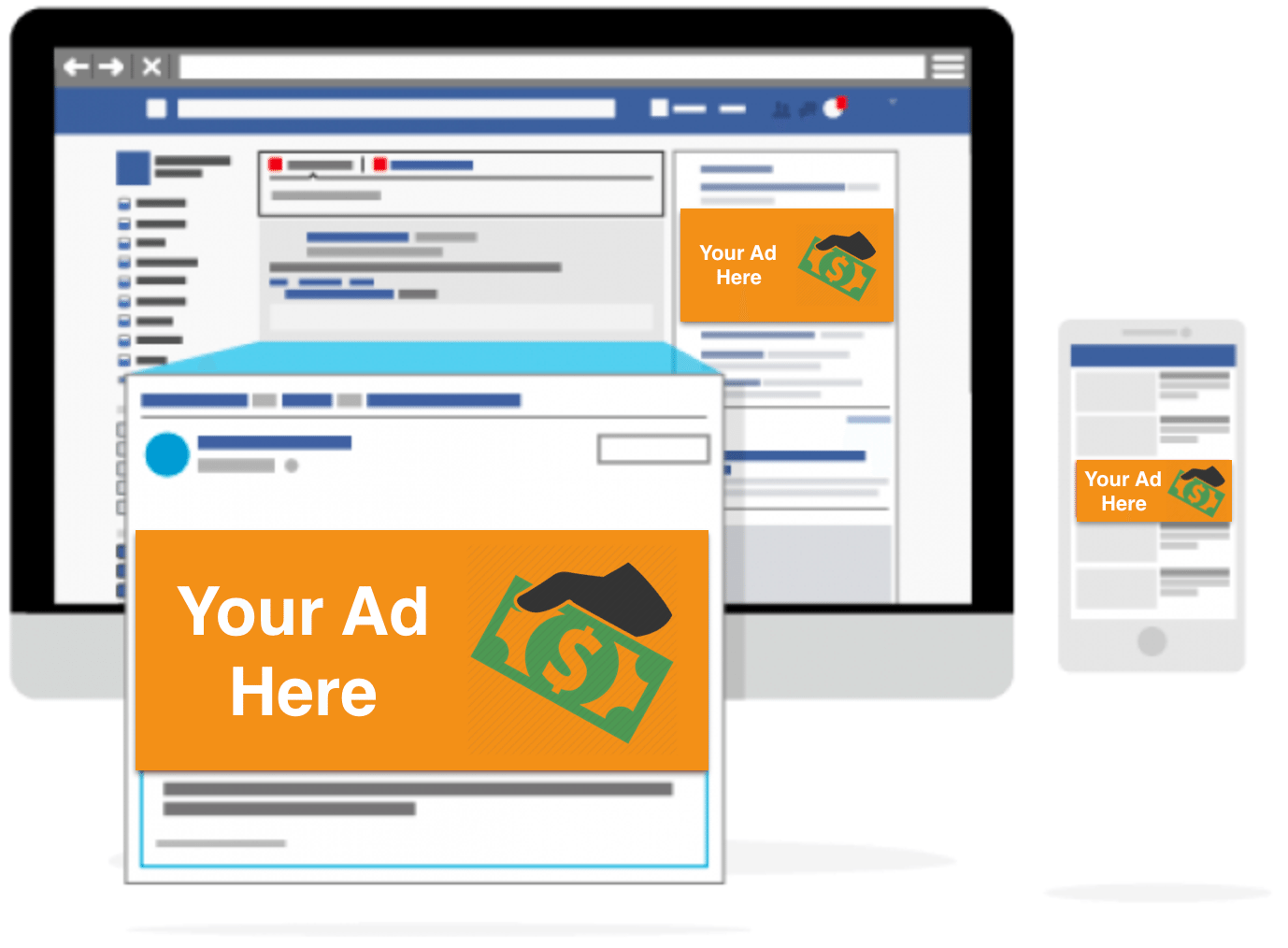
    facebook retargeting tips real estate investors

    By using Facebook retargeting ads, you get another chance to turn that visitor into a lead. Plus, because you already attracted them once to your site, you know what they are interested in and can more easily create ads that speak to their needs. This creates more engagement, more likes, and higher conversion rates.

    Let’s Get Your First Facebook “Retargeting” Ad Launched Today

    Retargeting can be very powerful for entrepreneurs and their businesses.

    But, most real estate investors and agents we talk to:

    • Launch a few Facebook campaign on their own and don’t see success, so they quit.
    • Attempt to set up a campaign, but get too confused by Facebook’s ad platform.
    • Don’t have time to educate themselves on how to do Facebook ads correctly and even try.
    • Don’t keep it simple stupid and over-think the process. Remember Facebook must make it simple enough for the everyday Joe to figure out.

    So if you’re ready to dive into it and get your hands dirty, by the end of this step-by-step guide you will be running your first retargeting campaign and turning all of those one-time site visitors into converted leads and closed deals.

    You’re going to have to roll up your sleeves and get a bit “geeky” with us. Cool?

    Setting up Facebook retargeting means you are going to have to handle a little bit of code, but not to worry, you don’t have to be a programmer to set this up yourself.

    So, what is this code you’re going to have to use?

    Facebook calls the code they require you to use “pixels”.

    How the New(est) Facebook Pixel Works

    There is one pixel per account.

    The pixel tracks website visits from your site back to Facebook so you can advertise to them (the whole point of retargeting).

    Then you can create a number of conversion events, “Custom Conversions” so you can track when a goal is reached.

    An example of a goal could be a lead opt-in or for someone who signed up to your real estate investing newsletter. You can create multiple conversions. That gets kind of advanced so let’s get the easy part out of the way first.

    IMPORTANT: You need to not only install the pixel but also set up what counts as a conversion. The following guide may look scary but it is actually pretty straightforward. Just take your time moving through the steps.

    Step 1: Get Your Facebook Pixel On Your Website

    The pixel is a very important piece to any retargeting campaign. This is because Facebook can only track your visitors when the pixel is on your site, so every day it isn’t installed means you will have fewer people to advertise to when your ads go live.

    The pixel should be placed between the <head> tags on every page you want to be tracked (usually, this means every page, as you can always get specific later). If you don’t have access to a programmer, you should be able to place the pixel yourself!

    If you’re already an InvestorCarrot member, it’s crazy easy to do yourself (takes about 20 seconds) OR you can just reach out to us and we’ll help you paste the code in and be done with it.

    Let’s get that Facebook Pixel.

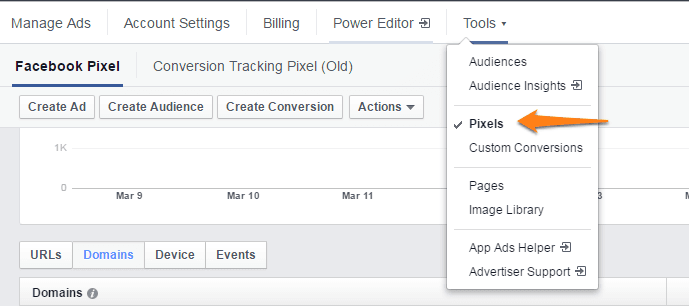
    Go to your Power Editor in Facebook (or business.facebook.com for your business Facebook account) and click on “tools” and on “pixels
    facebook-retargeting-pixels-step-1
    If you have already installed the pixel in the past, Facebook will automatically show the new pixel. Otherwise, Facebook will ask you to create a pixel and you can simply follow the brief instructions that show up.
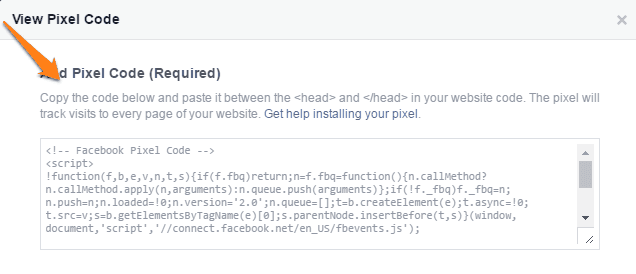
    facebook-retargeting-pixels-step-2

    Next, let’s put it on your website.

    If you have a non-InvestorCarrot website reach out to your web guy or dig around in the website code to find the <head> section of your code and put that pixel code on any page you want to retarget visitors from. We suggest putting the Facebook pixel on every page on your website.

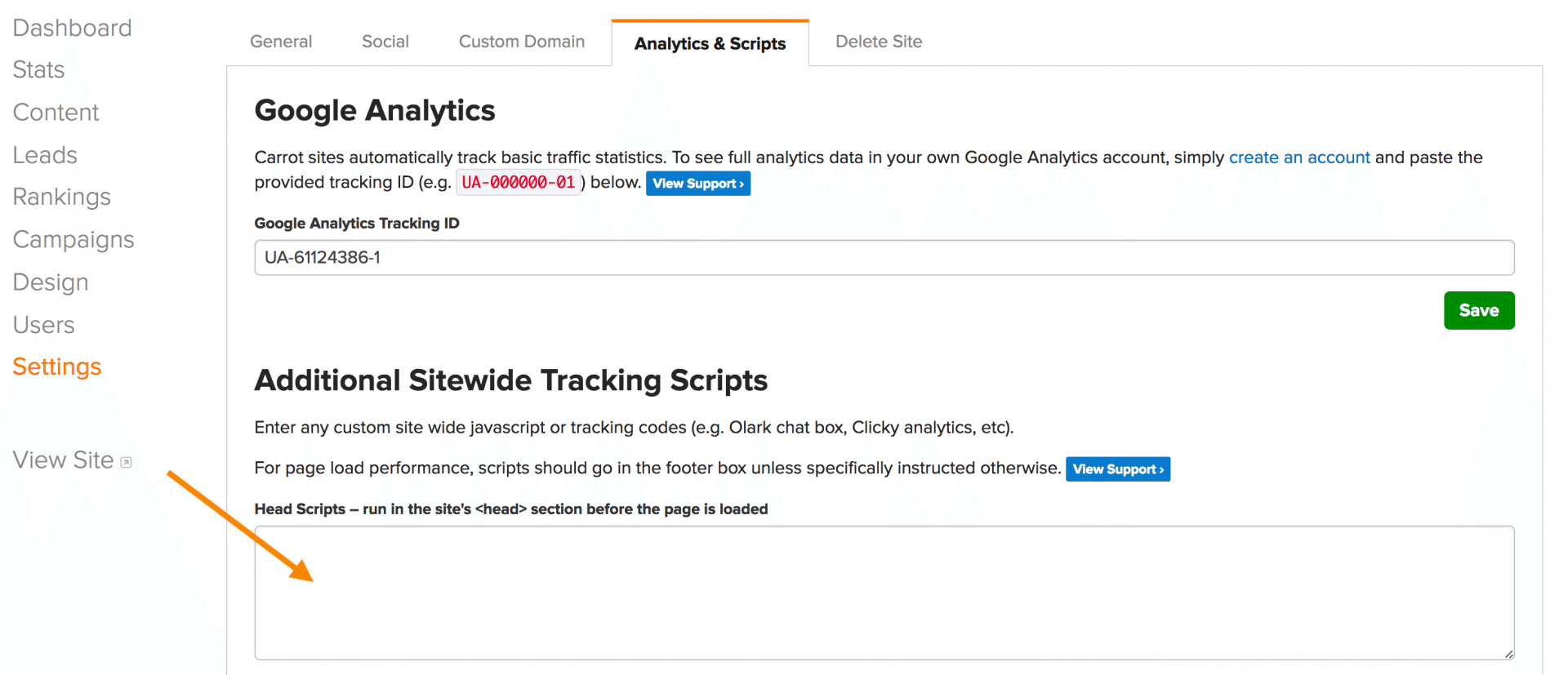
    If you’re a Carrot member, to add the pixel code to your site simply go to your Carrot “Manage Site” dashboard and go to Settings then Analytics & Scripts. Then paste that code in the big “Additional Sitewide Tracking Scripts” box (shown below). Hit Save and you’re done!
    Great!

    Step 2: Create A Custom Audience

    Now we need to tell Facebook who to serve up the ads to and to do that we need to create what they call a “Custom Audience” for those people who visit your website.

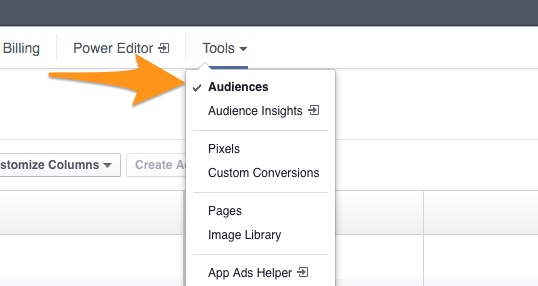
    To do that head back up to “Tools” and click “Audiences“.
    Ads_Manager

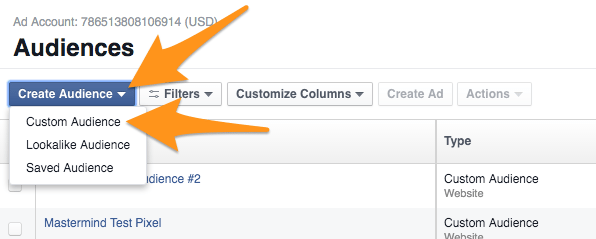
    Then click “Create Audience” and choose “Custom Audience“.
    custom-audience

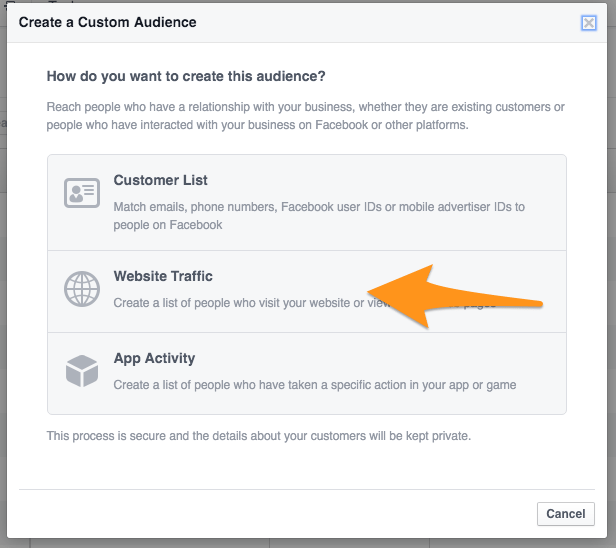
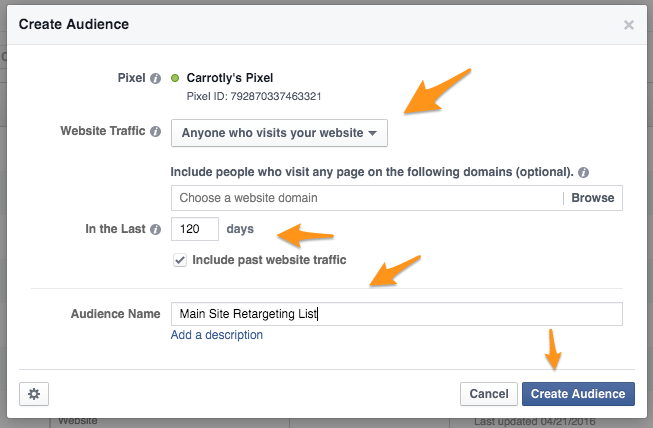
    Next, choose “Website Traffic“…

    Ads_Manager

    Next, we’re guiding you on the simplest way to launch a campaign so choose “Anyone who visits your website” then set the “In the last” for 120 days… meaning you’ll show ads to anyone for 120 days. The reason we do that is because it enables you to stay in front of them for several months in hopes that the timing will be right for them sometime during those 3 months to work with you.
    Ads_Manager

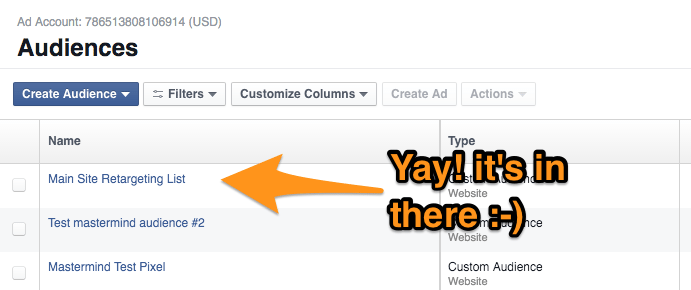
    Great! Your custom audience of your website visitors is setup and you should see it in the list. Now click that and let’s launch some ads.
    audience-success

    Now it’s time to start creating your ads!

    Advanced Tracking: Creating Custom Conversions So Facebook Can Tell You If Someone Turns Into A Lead

    If you’re using ads to drive people to your motivated seller page or other lead capture page, then you’ll need to use Custom Conversions.
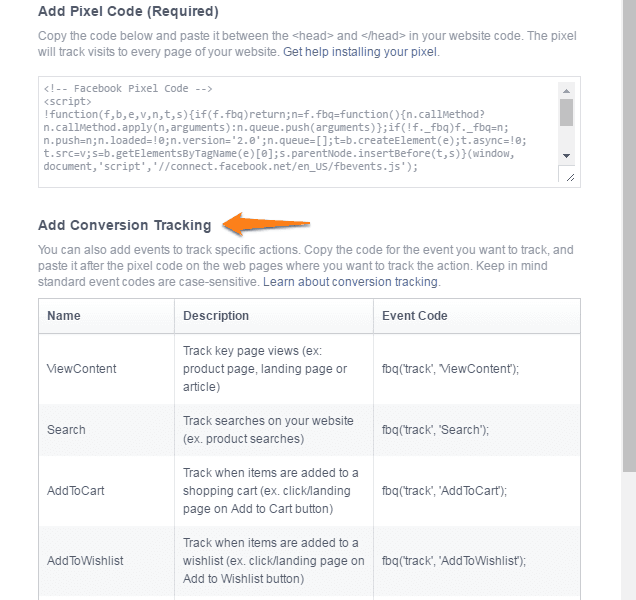

    facebook-retargeting-pixels-step-3

    Create A Custom Conversion Using The Power Editor

    Click Tools from the top menu
    Click Custom Conversions
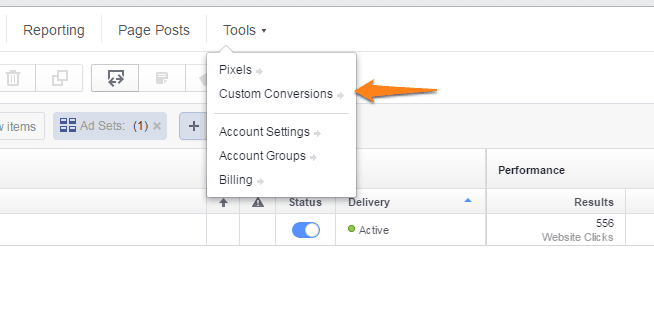
    facebook-retargeting-custom-conversion-1

    Click the “Create Custom Conversion” button at the top left and you’ll see something like this…
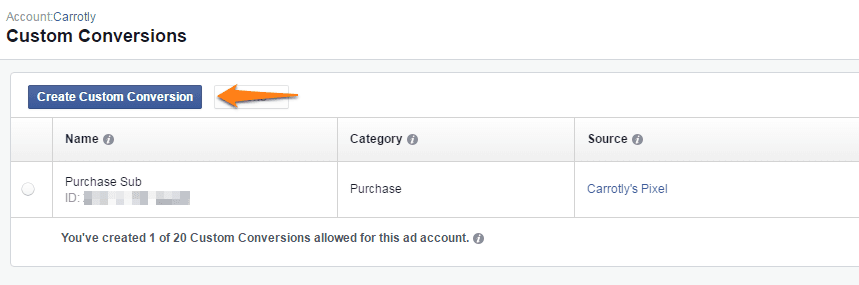
    facebook-retargeting-fixed-custom-conversion-2
    We are trying to help Facebook determine if a user who visited our website ended up converting.
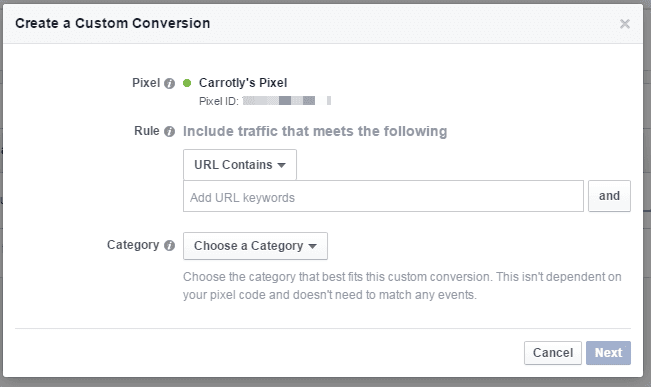
    facebook-retargeting-custom-conversion-3

    Under the rule, you’ll have three options…
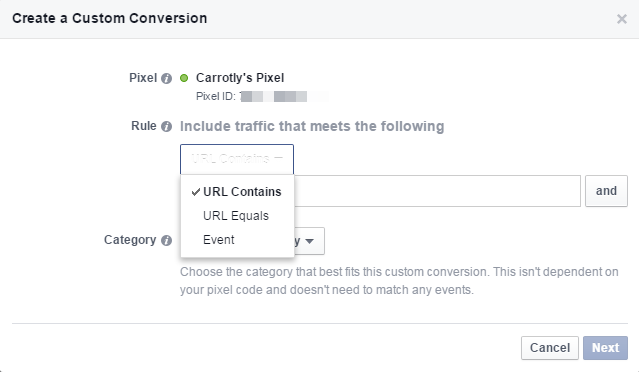
    facebook retargeting fixed custom conversion 4

    If you’ve created Website Custom Audiences before, you’ve seen “URL Contains” and “URL Equals” before. You can create a rule, for example, to help Facebook determine who filled out your Carrot step-2 form 

    • URL Contains: step-2/ OR
    • URL Equals: www.buymyhousecompany.com/step-2/ (it’s not required to use http:// or https://)

    You won’t need to include both contains and equals.

    Next, select the conversion your category. For real estate investors, “Lead” is the most common category.
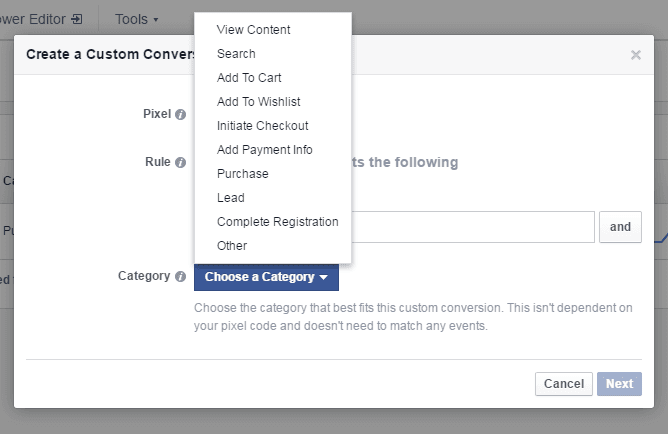
    facebook-retargeting-custom-conversion

    Options include:

    • View content
    • Search
    • Add to cart
    • Add to wishlist
    • Initiate checkout
    • Add payment info
    • Purchase
    • Lead
    • Complete registration
    • Other

    facebook-retargeting-custom-conversion-6

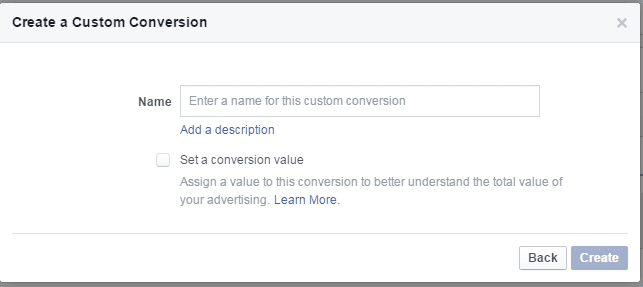
    Now you can name, add a description, and set a conversion value for your custom conversion. Once set, click create.

    Using Custom Conversions is a whole lot easier than using the old tracking pixel that was placed on all of your success pages. In the past, you had to manually copy and paste a unique code to the header of each page.

    Now, you don’t need to do any of that. Your code is already on the site. Simply tell Facebook what a conversion is and create it. It’s now that easy!

    BE AWARE: You can’t edit or delete a Custom Conversion once it’s been created. You can edit the name, but that’s it. If you have duplicate Custom Conversions, it might throw off your reporting.

    How do you know the conversion pixel is working?

    Facebook makes it easy by placing a little green dot with the word “verified” next to your pixels when they are up and working. In order for them to register as verified, all you have to do is visit a page where they are placed and then check again on Facebook. As long as someone has visited a page where your pixels are placed within the last 24 hours, they will show as verified when you’re in the pixel section (audience or conversion) of Facebook.

    Want to double check your pixel? Use this simple FB Pixel Helper Chrome plug-in.

    Step 4: Let’s Setup Some Simple Ads

    This is where the rubber meets the road. Getting ads created and live.

    To do this you’ll go back to that audience you just created and click “Create Ad“.
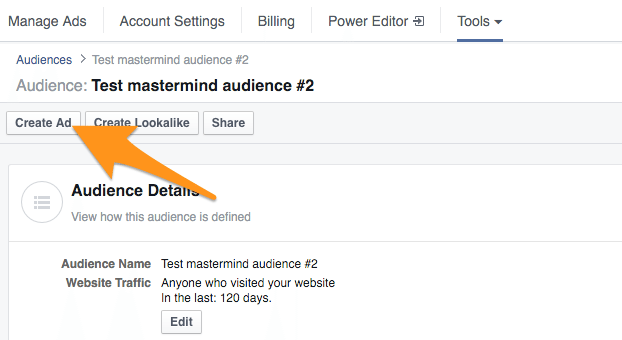
    create-ad

    Now let’s select the objective of the ad. We like to choose “Send People to Your Website” or “Increase Conversions To Your Website“.
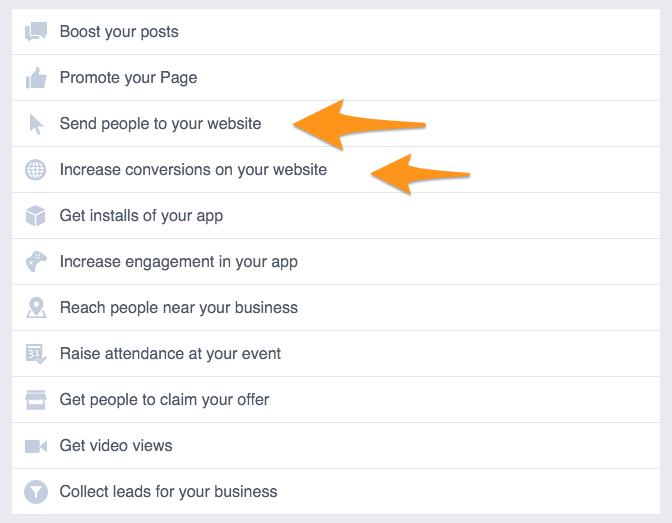
    send-ads

    Now let’s set your basic ad delivery settings and your budget.

    We suggest you start with $5 per day and check your results every day for the first week or to and adjust your budget accordingly. Also, select the settings as we have them below.
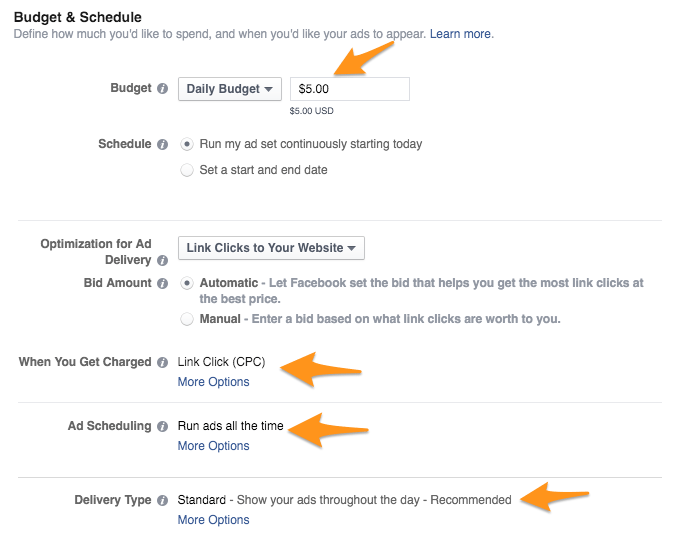
    budget_settings

    Last, we need to tell Facebook where we should serve up ads. Since they own Instagram that’s now an option. We usually exclude Instagram and the Audience Network as they haven’t been as effective for us. But for sure INCLUDE mobile as 80%+ of the traffic you’ll get from Facebook will be from mobile devices (which is why it’s important as heck to have a high performing mobile responsive real estate investing website).
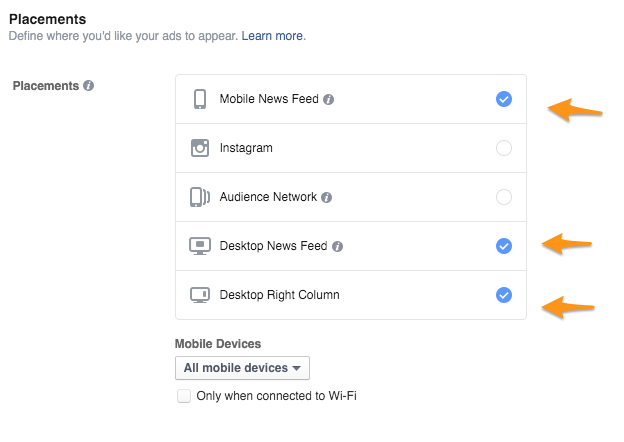
    placements-fb

    Scroll down and click “Choose Ad Creative” and let’s make some ads!

    There Are Two Main Parts To Each Ad

    The copy (text) and the image.

    Notice the big image + the text of a Facebook ad.

    facebook-retargeting-newsfeed-buymyhouse

    We like to focus on 3 types of ads:

    1. Social proof – Testimonial ads or things showing “others have been there before” and worked w/ you successfully
    2. Straight to the point – Like the ad above, we’re going straight to how we can help them or their problem. We’ll use these the most
    3. Attention grabbing – So people don’t get blind to your ads over time, we like to make some that are quirky and attention grabbing

    In this blog post, we’re going to just focus on getting an ad up and we’ll focus on the straight to the point ad. 

    Writing Facebook Ad Copy

    With your ad copy, being clever is much less important than keeping things simple, intriguing, and to the point.

    Even if you don’t have experience with creating ads, you should know exactly what speaks to your market audience.

    You know what fears they have, what their biggest problems are, and what some solutions to those problems might be.

    You should know all of this because this is you seller or buyer personas. With this information, you have what you need to get started creating ads.

    This post going to focus specifically on news feed ads since they look just like regular Facebook posts and are the simplest place to start.

    There are 3 elements to the copy in a news feed ad:

    • The main text that appears above the image
    • The headline that appears directly below the image and in larger font
    • The tagline that appears under the headline in smaller font

    For the main text, try starting with a question that eliminates anybody who wouldn’t convert anyways. This way you eliminate as many clicks that don’t convert as possible since you will possibly be paying for clicks.

    Examples:

    • “Are you struggling to find a way to sell your house?”
    • “Do you get stressed out by being behind on house payments?”
    • “Do you always hear about how effective selling to a Real Estate Investor can be
    • “Is it time to sell your house?”

    A Simple Example

    facebook-retargeting-newsfeed-ad-compressor

    And Another. Notice The Simple But To The Point Copy

    facebook-retargeting-newsfeed-buymyhouse-company-ad-2

    Your goal that if anyone answers the question with a no, they immediately move on and don’t click your ad.

    This reduces unnecessary traffic and makes everyone who does click much more targeted… which reduces your cost. Everyone wins.

    Additionally, try testing different message lengths in your ads. Have some be short and to the point, with just one main point or benefit mentioned. Try others that are much longer to point out more benefits. You won’t be sure what your audience responds best to until you test both.

    For the headline, make the benefits people will receive if they click on your link rather simple. Are you looking to buy their house fast? Spell it out with the headline so it’s impossible to ignore.

    The tagline portion of the ad is less important than the main text or the headline, but try driving a little more detail about what people are getting and tease them with some additional info. This way they feel the urge to at least click the link to learn more about the offer.

    Creating Ad Images

    While being an awesome ad designer can help, if you focus on creating images that stand out, you will still be way ahead of the game. Instead of trying to create an image from scratch using lots of graphics, use an interesting photo of yourself in action with bold text overlaid. Or even just an interesting real estate deal image.  Images that look appealing will go a long way towards grabbing your audience’s attention.

    Notice This Simple But Eye-Catching Image

    You don’t need to get fancy with your images, in fact, the simpler the fewer the words the more effective usually.

    Here are three sources to help you find images. Both free and paid.

    Stocksnap.io – Free

    Unsplash – Free

    Canva – Free and Paid

    Just be sure when using text on your images that you follow Facebook’s guidelines of not having more than 20% of the image contain text. You can use Facebook’s free grid tool to see how your ad measures.

    Make Multiple Variations Of Your Ad To Test

    Just so you can see which ad is working better, make a few variations of your ad to run on the same campaign at the same time. We’ll usually just swap out the picture and come up with a second variation of the text. Again, start simple with 2 versions of the main text and 2 images. This will create 4 total ads.

    Now you have a simple A/B test to start your campaign.

    investor-fb-ads-1

    A good rule of thumb is to let your ads run long enough to get a decent traffic before you make any decisions.

    Try to get at least 500 impressions, but even better if you can wait until 1,000 impressions before pausing the ad that isn’t performing. We’ll go in more detail how to optimize a Facebook retargeting ad campaign in another future post.

    Once you find a high performing ad, having both good click-through and conversion rates, start to create different versions of that ad. Test them all again to improve upon the best result.

    Then, just keep repeating this process and ads should continue to improve over time.

    Your total time each week to maintain your ad campaign will be literally less than 10 minutes once you get it launched.

    Step 5: Make Sure You Have Great “LeadSource” Tracking In Place On Your Website

    With InvestorCarrot we have built in “LeadSource” tracking on every Carrot website so you can tell where all of your leads came from.

    With InvestorCarrot We’ll Show You Where Your Leads Came From. Cool Eh?
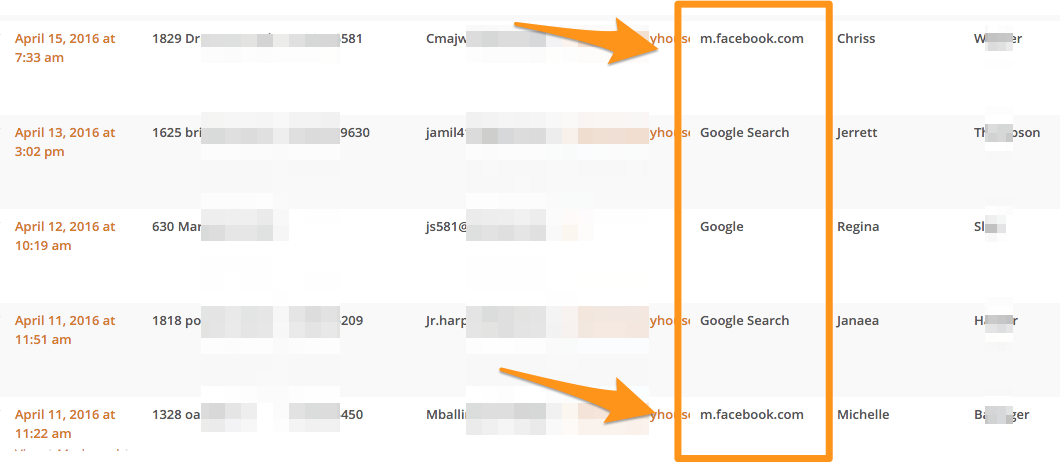
    carrot-lead-source

    But if you’re not an InvestorCarrot member, chat with your web guy or setup lead source tracking in your Google Analytics account. It’s not all that easy but you can totally get it done.

    Tracking where your leads came from is crazy important so you know which marketing is working well and what isn’t working well. As you can see in the image above, just in that one week period this Carrot client got 2 leads from his Facebook retargeting campaign… so he can tell it’s working and track it all the way down to exactly which leads came from Facebook.

    Not a Carrot member? Check out our plans or demo Carrot today.

    Is Your Ad Performing Well? Here are A Few Benchmarks

    Benchmark number will depend on the real estate market in your location. So, there are no 100% benchmarks to follow. You’ll gain a personal benchmark number over the time of your campaign.

    But, you can get general targets to help you set some goals in order to tell if the campaign is working.

    Click-through-rate for desktop news feed = 1%
    Click-through-rate for mobile = 2%
    Click-through-rate for sidebar = 0.1-0.2 %
    Cost per opt-in: $1-$3 (although if you have done the math on how well your lead funnel converts, you should know exactly what a lead is worth to you)
    Cost per lead: Start by aiming for a 2X ROI. For example, this means if you make a profit of $3000 on a deal, you should be looking to spend no more than $1500 in getting leads.

    Get Your First Facebook Retargeting Ad Rolling Today!

    Now you have the “why” you should start a Facebook retargeting campaign and how to get started with your first one.

    1. You’ve already attracted motivated sellers once to your site, so you know what content and images will attract them again.
    2. They are much more likely to click on your ads and to convert into a lead, compared to first-time visitors.
    3. A retargeting campaign is a perfect addition to your current marketing campaigns. It basically, enhances the work that you’ve already done.

    For easy access and to recap, below is a checklist of the exact steps you need to take in order to get everything running. Use this checklist when creating your campaign and start turning those visitors that leave your site after one visit into long-term customers.

    Download this Simple Facebook Retargeting Checklist

    [Free DownloadUse this checklist as a guide when creating your Facebook retargeting campaign.


    Need More Online Leads For Your Wholesaling / House Flipping Business?

    Generate More Real Estate Investing Leads and Cut Through The Marketing Clutter In Your Market. Download out FREE Marketing Toolkit: Get Access To This Content Marketing Toolkit + Training For Real Estate Investors here!

    And take a Demo of InvestorCarrot today to leverage the same system 1000’s of other investors use to generate his online leads and deals each and every month.

    See InvestorCarrot In Action

  • 6 Simple (but powerful) Questions A Six-Figure Per Month Wholesaler Asks Motivated House Sellers

    6 Simple (but powerful) Questions A Six-Figure Per Month Wholesaler Asks Motivated House Sellers

    questions to ask motivated seller leads

    Don’t you wish you could listen in while a 6 figure per month wholesaler talks to a motivated seller? Many real estate wholesalers focus so much on “getting the lead” that they forget that a huge leverage point in closing more deals in the first 3 minutes on the phone with a motivated seller.

    Bryan Harris

    Bryan Harris, the CEO of  Homes For 10k, a 6-figure per month investor and Carrot member from Memphis Tennessee hopped on and walked us through 6 of his most important questions he asks during the initial motivated seller prospect call.


    But first, Bryan wanted to stress the importance of perhaps the single most important (yet simple) thing that most investors just flat fail at that is costing them deal after deal without them even knowing it.

    Did You Know, You’re…

    100x-more-sales

    Talking with Bryan and several other real estate wholesalers and flippers who do $100k/mo in different markets around the country they always say they’re amazed at how few of their “competitors” call back the leads they get quickly.

    As InsideSales study said…

    ‘It’s like taking all of that money you spend on marketing and setting it on fire.”

    The bottom line there is a lot of competition, so call back your leads as soon as you get them in.

    There’s no such thing as too fast. Online leads can be a very impatient bunch. Competition can be Fierce. Leads have many other investors to contact, so they expect a very fast response to their inquiries. Ideally, you will respond to them with a phone call within a few minutes. Always be prepared to respond. Have your questions ready to go.

    You can be the best negotiator in the world… but if you’re not following Bryan’s advice above on calling back your web leads immediately… you’re competition could be grabbing deals out from under you before you even get the chance to call the seller.


    Quick Tip: Have your web leads instantly sent to your phone with a text message!

    seller-leads

    The Carrot Instant Text Message Lead Notification feature sends you a text message as soon as leads come in so you can tap a button and call back your web leads immediately.

    This feature alone could possibly save you from losing a deal or more every year and pay for your Carrot membership for years and years and years.

    Not A Carrot Member Yet? Take a demo to see why the top investors are all switching to Carrot!


    6 Simple High-Impact Questions to Ask Motivated House Seller Leads When You Call

    script for talking to motivated house sellers

    So, you got a lead that came in over the web, GREAT! You already know that you NEED to call them back immediately and that every minute that passes your chances at turning it into a deal goes down.

    Now, let’s dive into what Bryan Harris, a 6 figure per month wholesaler in Memphis says on the phone when he talks with motivated house sellers.

    Now let’s turn it over to Bryan! 

    Brendan: Bryan, it’s all, you man!

    Bryan: Awesome, I’ll just go ahead and dive in!

    Ok, so when I call back a motivated house seller I like to start the phone call very much like I’d start a call with a friend of mine. You don’t want to go straight to the numbers and the deal.

    I’ll dive into my basic structure for talking to motivated sellers in this post. I’m not really going to give a “motivated seller phone script” mainly because I feel that when you use scripts things don’t come off as authentic and real.

    So I’d be doing a disservice to you if I told you to “grab my script and just use this”.

    We’ll focus on the overall structure and mindset. Another great resource is my own coach Sean T. and this video he made about the process of talking with motivated sellers. It’s great so couple that with my 6 questions below.

    The first thing I ask house sellers when I reach them on the phone is…


    5 Signs You’re Likely To Fail As An Entrepreneur And Real Estate Investor


    Question #1: “How are you today?”

    I know you’re probably thinking, “Really? That’s one of the 6 questions?”. But it’s an important one. I ask this because I’ve found that people don’t care what you know until they know that you care.

    This question is about the RAPPORT building, that is a must when talking to sellers.

    You have to remember that there are hundreds of thousands of people doing exactly what you do, WHAT SEPARATES YOU FROM THE REST OF THE OTHER PEOPLE THAT WANT TO BUY THEIR HOUSE?

    People tend to do business with people that they like and a simple THOUGHT FELT QUESTION like “How is your day?” can separate you from the pack.

    One particular deal that comes to mind is the one that we recently obtained.

    A $170,000 property for $22,000 here in Memphis.

    That’s not a typo. 

    The seller told me she was bombarded by wholesalers. I asked her what stood out about me and our company and she said, she was about to lose her house to foreclosure and it seemed like I was the one who “cared” the most.

    Needless to say. $120,000 profit later CARING IS SHARING…lol.

    Question #2:  “What’s your reason for selling?”

    Knowing the motivation of your sellers is, of course, a big deal.

    I ask this question to determine motivation. If the motivation isn’t there, when you present your low offer, you have no purpose to reference.

    Motivation factor: The dire need for money to pay for college tuition that costs $5500 this semester.

    As an example a conversation may go something like this:

    Mr. Seller, I know you were asking for $29,000 and you may have others that have promised you more, but I can have $7,500 cash in your hand in 7 days and with that cash you can PAY FOR YOUR TUITION AND have $2,000 left for spending money

    And school starts in 3 weeks. I can close by mid next week so that you can MEET YOUR REGISTRATION DEADLINE.

    Too many investors discount the value they bring to the table with sellers and buyers and talk themselves out of a great deal. Find the true motivation and biggest pain point that the house seller has, and help them reach that goal as easily as possible. It could be a huge win-win for everyone.

    Finding the motivation allows you to take their minds off the low offer you have presented, and focus on being the SOLUTION to their problem.

    Question #3: “What is your name, number, and email?”

    Did you notice this isn’t the first thing I asked for on the call?

    A lot of people dive right in and ask for the contact info but what I’ve found is people can see it as threatening and putting the cart before the horse a bit. By this time I of course already have their phone number, but I’ll also confirm if this is their BEST phone number.

    The importance of this information is because the FORTUNE IS IN THE FOLLOW UP.

    TIP: EVERY SELLER NO MATTER WHAT GETS AN EMAILED CONTRACT OFFER FROM ME. EVERY SINGLE SELLER,  EVEN IF THEY REJECTED MY OFFER.

    And for the next year, they will receive an automated email and text from me monthly.

    Most people do business with you on the 5th through the 12th contact. So by you following up with leads, you OUT PERFORM 98% of your competition.

    Use automated systems such as AWeber or MailChimp for drip systems or do follow up emails for later dates. Or, Callfire for text deliveries.  Find a way to automate your follow up and your life will be much easier.

    InvestorCarrot integrates with Aweber and Mailchimp directly and makes it easy to get my leads into Callfire too.

    Question #4: “Are you the decision-maker?”

    This is a really important question.

    The last thing you want is to get down to it and the person you’re talking too can’t really make the decision on selling their house alone.

    I like to always double-check to make sure there isn’t anyone else on the title that need to sign in order to sell the property. If there are, find a time to discuss their options with all of the decision-makers present.

    This helps you avoid the “let me talk it over with my (fill in the blank)” 

    Knowing if you are speaking with the decision-maker is very important information needed upfront.


    Related Content: Real Estate Marketing: 8 Tips to Find Motivated Sellers on Craigslist


    Question #5: “Are there any mortgages, back taxes, liens etc.?”

    In addition to just the obvious reasons, this keeps down surprises… this question is a really great one to continue to build rapport.

    You may have made an offer based on the house being free and clear and not knowing there was a mortgage attached, you get to the closing table and find out there is an outstanding lien and the seller says, you didn’t ask that question.

    Always find out all of the details on the house so you don’t have any last-minute surprises when it comes time to close on the property.

    You’ll thank me later for this one.

    Question #6: “How did you hear about us?”

    This question is so so simple but very powerful.

    How many sellers have you asked this question recently?

    Not only does this question help them dig through their brain bank to remember what stood out about us… which helps validate their original decision to reach out to us… but this helps me spend my marketing dollars where I am getting the most bang for my bucks.

    Knowing where my leads come from is crucial information for any business.

    The vast majority of my deals come from my Carrot websites and PPC marketing

    If this question is not asked, you will need to review your business weekly.
    The majority of your leads may be coming from one specific source and the only way to effectively know is to ask this question.

    Now Get Busy + What Do You Ask Sellers When You Call Them?

    First, if you have some other things you talk to motivated house sellers about when you’re on the phone with them… let us know in the questions panel below! 

    Bryan! Thanks for dropping in here and passing along some simple but awesome advice for the newer real estate wholesalers and flippers out there looking for a script and questions to ask for motivated house sellers! We appreciate it and look forward to bringing you back and diving into even more advanced stuff next time!

    But for some inspiration, here is a Facebook post that Bryan recently posted that should get you fired up to achieve at a high level and to focus on what you do best and align with the people and systems that can help you succeed.

    bryan-harris-memphis-real-estate-coach

    So, given today’s challenging real estate market, you want to treat lead inquiries like diamonds.

    When you call your sellers… 

    1. Build rapport at the start
    2. Find out their motivation for selling
    3. Get their full contact info for followup
    4. Dig out any hidden details about the property / mortgage before they bite you
    5. Find out how they found you

    I’m sure there are many more questions you could ask, but these 6 should get you started.

    Download This Simple “6 Seller Questions”
    Checklist For Your Next Call

    [Free Download] 6 Initial Questions to Ask Motivated Seller Leads Checklist.
    Keep it near you for an easy reminder of the initial questions to ask.


    Need More Online Leads For Your Wholesaling / House Flipping Business?

    Generate More Real Estate Investing Leads And Cut Through The Marketing Clutter In Your Market.  Download our FREE Marketing Toolkit: Get Access To This Content Marketing Toolkit + Training For Real Estate Investors here!

    And take a Demo of Carrot today to leverage the same system that Bryan uses to generate his online leads and deals each and every month.