How do you get recommended in AI search? That’s a question many businesses are asking themselves right now … and one that will be increasingly important as AI search continues to grow in popularity.
While there’s no official checklist to make sure your business is recommended when someone uses AI or a chatbot, best practices for AI search visibility are emerging. And to help you focus your efforts even more, BrightLocal just put out an in-depth analysis of where major AI search engines pull citations from. (Big shoutout to BrightLocal for this amazing data!)
To help you focus your efforts (and make sure you don’t miss a critical AI citation source), I’m going to dive into the data that’s most relevant for real estate investors and local home service providers.
Key Takeaways
- AI search engines and chatbots are an increasingly popular way for people to gather information and answer questions. Appearing in an AI search result can improve your website traffic and generate highly motivated leads.
- Individual business websites make up around 93% of AI-cited domains, so make sure your website is structured correctly for LLMs.
- Online business directories are major sources of information for AI search results. Make sure you claim your business profile on each directory and match your NAP (name, address, phone number) across profiles so AI recognizes your business as a single entity across platforms.
Table of Contents
- Why AI Search Matters
- Most Common Sources Cited by AI Search
- Business Directories Play a Major Role in AI Search Results
- Most Important AI Sources for Service Providers
- Other Commonly Cited Sources for AI Search
- The Evolving World of AI Search

Why AI Search Matters
AI search engines — both the ones built into traditional search experiences like Google and chatbots like ChatGPT — are increasingly popular ways for people to gather information. Whether they’re asking an informational question like “how much does a new roof cost” or are looking for recommendations for the best local business, AI offers a more interactive search experience that lets users ask follow up questions and refine their search in a way that feels conversational and organic.
And that’s not just a hunch; we’re seeing it in AI usage numbers. In May 2026, Google reported some impressive numbers about adoption of its AI search features.
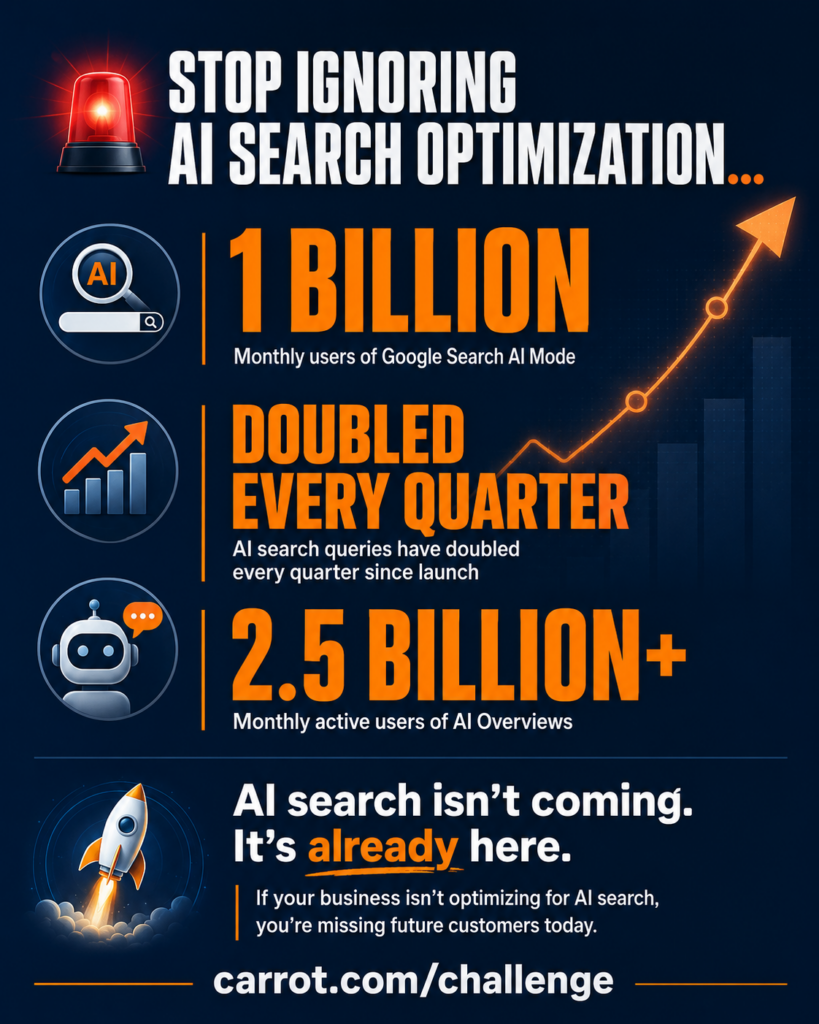
- AI Overviews has more than 2.5 billion monthly active users
- AI Mode passed 1 billion monthly active users just a year after its release
- Queries in AI Mode have more than doubled every quarter since the feature’s launch
It’s not just Google either. In late August, the European Union designated ChatGPT as a “very large online search engine.” It’s the first AI chatbot to receive that designation, according to Search Engine Journal. They reached this designation because ChatGPT has more than 159 million average monthly active recipients in the EU alone.
At the beginning of 2026, Search Engine Land reported that 37% of users start their search journey with an AI tool. Pew Research reported that 42% of US adults use AI chatbots to search for information. McKinsey put that number at 50%.
People are clearly using AI search.
But this usage also has an impact on traditional SEO and organic traffic. While chasing the number 1 spot in search results has long been an SEO gold standard, having that top “blue link” (the first non-paid search result spot) doesn’t have as big of an impact anymore.
Google has also restructured its search result pages, often putting AI overviews, Google Business Profiles, sponsored results (aka, ads), Reddit, videos, and discussion/forum links above organic links. SQ Magazine found that AI Overviews now appear on roughly 48% of all queries (a 58% increase since February 2025). That’s a lot of information and links to contend with before searchers reach the traditional organic website results.
This — and the increasing usage of chatbots to gather information — is leading us into an era of “no click” searching … meaning searchers get the information they want without ever clicking on a website. In the first four months of 2026, 68% of Google searches ended without a click, according to Sparktoro — a 12.5% increase from 2024.
On the plus side, searchers who do reach your site might be more motivated. Carrot’s own early research shows that traffic from AI referrals converts at 31% — a noticeably higher rate than other traffic sources. This may be because people trust AI recommendations or they’ve done a deeper level of research before reaching individual websites, so they’re further down their buyer’s journey.
Most Common Sources Cited by AI Search
Now that we’ve established that being recommended by AI is important to lead generation, let’s dig into the BrightLocal data to understand where AI gets its information from.
The good news for local business owners with a lead generation website is that around 93% of domains cited were individual business websites. Making sure your website has good site speed and follows AI SEO best practices gives you an even better chance at being cited for a relevant query.
An unsurprising finding is that Google Business Profiles (GBP) make up 28.5% of citations. A good GBP is particularly important for appearing in Google’s AI Overviews and AI Mode (duh). So make sure you claim your Google Business Profile!
One common citation source I was surprised by was Yelp. It’s the second most commonly cited source for AI Overviews and AI Mode. But it plays an even bigger role on ChatGPT thanks to a recently announced partnership. It’s now the most commonly cited source on ChatGPT. This is particularly important for home service providers like HVAC, roofing, plumbers, electricians, painters, and contractors. Not only does ChatGPT use Yelp as an information source, it actually inserts Yelp reviews, ratings, photos, and even the “Request a Quote” feature into the responses it provides.
Business Directories Play a Major Role in AI Search Results
Yelp isn’t the only business directory impacting AI search results. BrightLocal found that 451 unique directories were used as sources by LLMs. Here are the top five most pertinent to home service providers. (I skipped more commonly cited directories that don’t matter to businesses targeting local homeowners, like TripAdvisor and OpenTable).
| Cited Source | Percentage of Total Citations | Percentage of Businesses |
| Google / Google Business Profile | 28.63% | 94.17% |
| Yelp | 9.53% | 84.65% |
| 2.23% | 93.06% | |
| Better Business Bureau (BBB) | 0.33% | 29.30% |
| Angi’s List | 0.24% | 18.97% |
Google’s top three sources for AI Overviews and AI Mode are Google Business Profile, Yelp, and Facebook. ChatGPT favors Yelp, BBB.org, and Angi’s List (I removed TripAdvisor and OpenTable to get to a more relevant top three for home service providers).
Most Important AI Sources for Service Providers
BrightLocal was kind enough to drill their data down even further, so we can isolate the sources AI most commonly cites for service businesses. Plumbers even get their own micro drill-down.
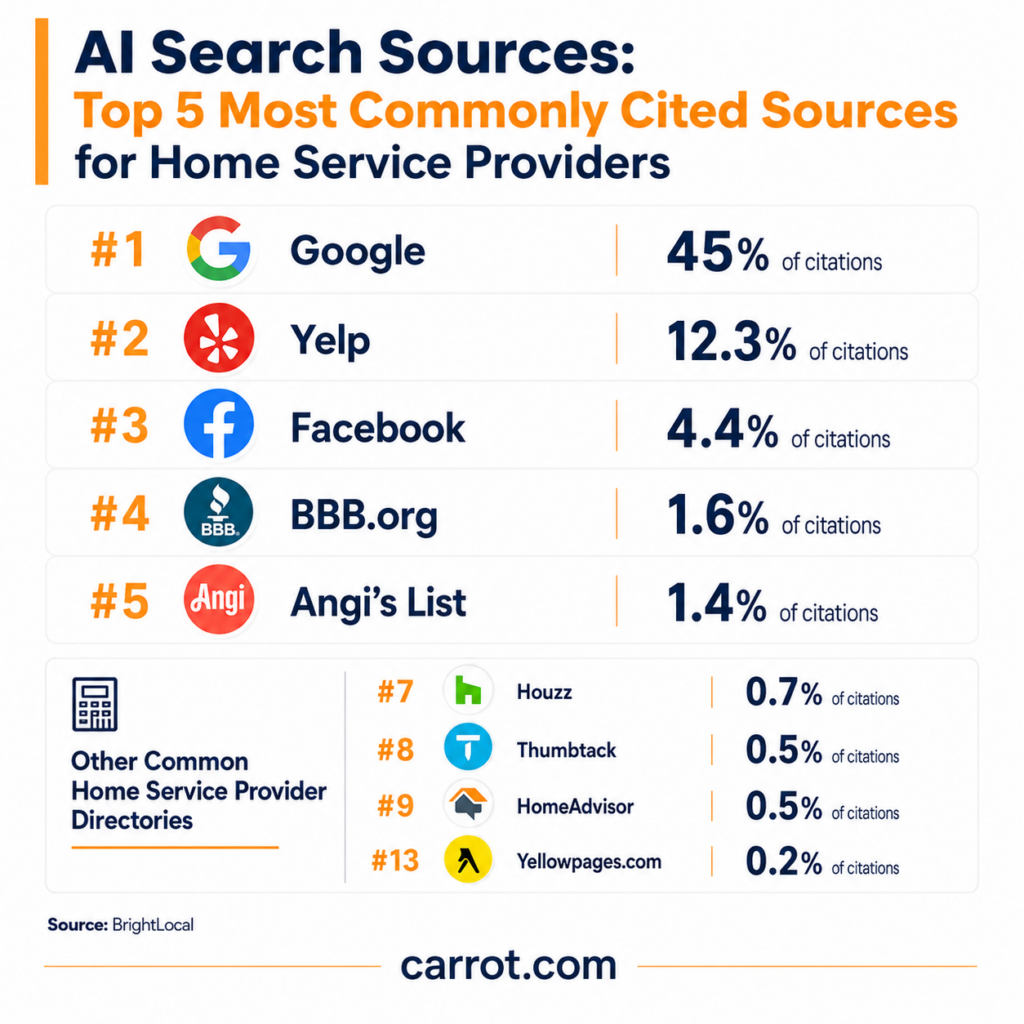
For service businesses, the top 5 most commonly cited sources are:
- Google: 45% of citations
- Yelp: 12.3% of citations
- Facebook: 4.4% of citations
- BBB.org 1.6% of citations
- Angi’s List: 1.4% of citations
Other common home service provider directories also appear on this list, including Houzz (#7 with 0.7% of citations), Thumbtack (#8 at 0.5%), HomeAdvisor (#9 at 0.5%), and Yellowpages.com (#13 with 0.2%).
The numbers for plumbers specifically are fairly similar, with a few notable deviations. This directory list is likely more helpful to home services specific providers (like electricians, roofers, etc.) than the list above (which can include things like dentists and veterinarians).
- Google: 54% of citations
- Yelp: 13.8% of citations
- Facebook: 3.1% of citations
- Angi’s List: 2.2% of citations
- HomeAdvisor 0.9% of citations
Interestingly, the Better Business Bureau dropped out of the top five for the plumbers list. It did come in at number six with 0.9% of citations but had fewer overall citations, which is why HomeAdvisor beat it out. This suggests that you should be listed with the BBB, but you may not need to invest in the accreditation.
An interesting note for home service providers, MapQuest (yes, the website we all used to print out directions before Google Maps and apps became a thing) appears in the top 12 for both the Services Businesses and Plumber lists. It ranks #6 (1.2% of citations) and #8 (0.9% of citations), respectively. So make sure you claim your business on MapQuest and ensure all the details match your NAP and company details on your website and GBP.
Other Commonly Cited Sources for AI Search
While online directories play a big role in AI search results, they aren’t the only sources. Other sources come into play strongly when searchers are looking for more information queries like how to questions, “best” recommendations, and comparisons. For savvy business owners, these types of queries are a great way to get your website cited.
News websites are also commonly cited. BrightLocal highlighted the top 20 most commonly cited non-directory sites and news websites make up 11 of them. So getting onto a local news segment as a featured business or by sponsoring a local event could give you an AI search boost.
BrightLocal also looked at the impact social platforms have on AI search results. The most commonly cited social media platforms by far are Instagram and Reddit. BrightLocal classified Facebook as a directory for their report rather than a social platform, so it’s not reflected in this category. But if it were, it would be #1. Worth noting, YouTube is number three, but only pulled 0.38% of total citations (compared to over 1.75% for Instagram and Reddit).
The Evolving World of AI Search
These insights are great and are invaluable to helping online marketers and business owners know where to focus to keep up with this nascent search tool. But the sources detailed in this post (or even in the broader report) aren’t the end-all-be-all. BrightLocal found that “a staggering 116,000 unique domains were cited” during their research, meaning AI is pulling from many other sources depending on the query.
You can dig into the full report and see the study’s methodology by visiting Top Sources and Directories for Local AI Search by BrightLocal.
For now, make sure your website is set up correctly for AI search (like all Carrot websites are out of the box), claim all your business profiles, and keep up with AI visibility best practices as they evolve.