Author: Jamie Saine

  • Carrot Website Editor & CRM Updates from Q4 2025

    Carrot Website Editor & CRM Updates from Q4 2025

    Happy New Year! I hope you had a wonderful and restful holiday season!

    The Carrot team made sure to take some time off, but before we did, we released some great new features in the last quarter of 2025. Check out what’s new with Carrot websites and CarrotCRM!

    Key Takeaways

    • New Carrot website design features and templates make it even easier to personalize the look of your site.
    • You can now individually edit Carrot auto location pages to make them even more customized and localized for your target area.
    • CarrotCRM “Your Day” surfaces the tasks due that day (or overdue!), gives you a time estimate for completion, and helps you tackle tasks right from the dashboard.
    • Carrot now offers agency-style “done for you” SEO services!

    Table of Contents

    Carrot icon
    Lead generation, at its best
    Attract, convert & close more motivated leads
    Try Carrot Today

    Carrot Website Updates

    Making your site look modern and stand out is important, and we want to make sure you have that ability while still maintaining an SEO-optimized, high-converting framework. With this in mind, we released some new web editing features that keep that successful foundation in place while making it easier than ever to customize the look, feel, and content of your site.

    New Ways to Customize Your Site to Stand Out

    One of the things we’re most excited about is the all-new Carrot website editor! Currently available for new motivated seller websites, this new editor makes it easier than ever to fully customize your site and have your chosen design elements automatically implement across the entire site.

    Start with your favorite modern template (we have four new ones with different vibes to match your business), make a few customization choices, and your site is ready to stand out for 2026. This new editor lets you set design preferences without adding custom CSS. Now, you can easily add design elements like:

    • Different font options
    • Rounded box corners
    • Drop shadows to make your site more visually dynamic
    • Eye-catching shaped dividers between sections (not just straight lines!)

    Carrot Friendly Website Template

    “Friendly” Template

    Carrot Professional Website Template

    “Professional” Template

    Carrot Classic Website Template

    “Classic” Template

    Carrot Simple Website Template

    “Simple” Template

    If you’ve been on the fence about getting a Carrot site, or think all Carrot sites “look the same,” this update is a game-changer. Now you can get a beautiful, modern-looking website that matches your brand with Carrot’s proven SEO foundation and tools baked in. 

    This is just the first stage of some really exciting customization options coming to Carrot soon. So stay tuned!

    Edit Your Auto Location Pages

    Creating hyper-local webpages helps you target leads exactly where they’re searching (and is great for AI search!). For instance, someone looking to sell their home fast in Beaverton isn’t going to look for a cash home buyer in Portland. They’re going to look for one in Beaverton. So even though you may do business in both places, you need to make that crystal clear on your website with individual location pages. 

    That’s why we’ve long offered Auto Location Pages. This feature lets you quickly launch area-specific pages with all your key information. But you may want to edit those pages to make them even more localized with their own photos, customer testimonials, and facts about that specific area.

    Now you can!

    If you have auto location pages, set some time aside early this year to fully customize them. Hyperlocal, original content is great for SEO and AI search optimization!

    CarrotCRM Updates

    CarrotCRM launched in December 2024, and over the last 12 months our team has been working non-stop to make it even better than its predecessor (InvestorFuse). (If you’re an InvestorFuse user, don’t worry, all these new features are available in IF3 as well!)

    An Easier Way to Tackle Your To-Do List

    CarrotCRM is an action-based system, making sure every opportunity always has a next step and due date. But we wanted to make working your leads even easier. Now, instead of filtering through all your outstanding actions and deciding where to start, we show you exactly what needs to get done today and in what order!

    “We’ve taken all of the thinking out of it,” said John Whitfield, a Carrot Product Manager and co-founder of InvestorFuse.

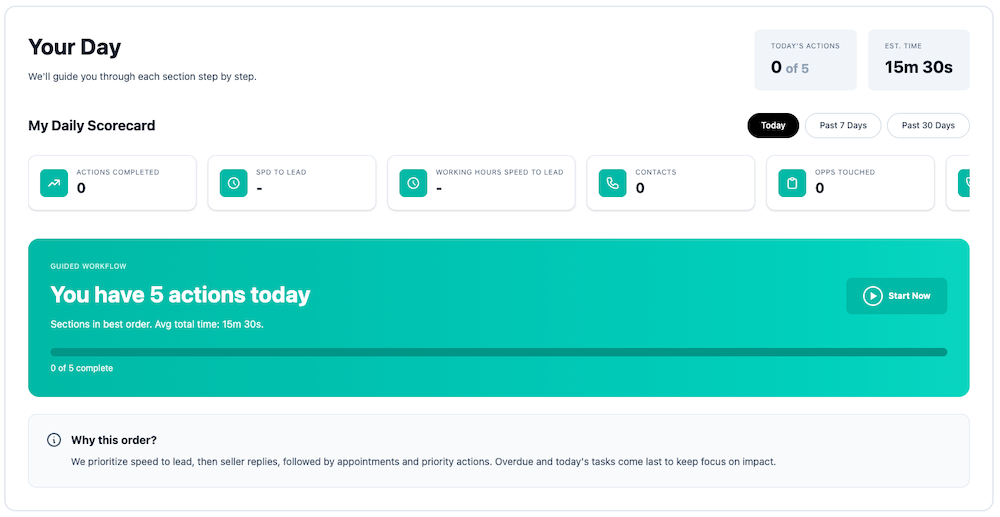
    The new Your Day section of the main CarrotCRM dashboard shows you:

    • How many tasks are due today (or overdue!) 
    • An estimate of how long completion will take
    • What order to tackle your tasks in
    CarrotCRM Your Day task list

    But we made it even easier to address that to-do list. Not only does Your Day surface what needs to be done today, CarrotCRM walks you through each task in order of importance. Simply hit the Start Now button and get to work. No more hunting around, no more wondering where to start, no more ignoring your tasks. Just pure productivity.

    “It’s another easy way for you or your employees to stay on task, tackling the most important things,” John added.

    Kanban View

    A popular request, you can now see your leads and their pipeline status in a Kanban style view! This popular view puts leads into vertical columns based on pipeline and stage, rather than a straight list view (which is also still available). Like most Kanban views, you can drag and drop the individual cards to update their status.

    Better Transaction and Disposition Management

    CarrotCRM transaction management features got an upgrade late last year, allowing teams to separate transaction management from disposition management. You can now assign individual owners and tasks, as wall as having separate areas for notes, for transaction management and disposition.

    This separation extends to the new Kanban view, where you can see Kanban boards for transaction statuses and disposition statuses. Large teams can also filter these views by individual assignee to keep a close eye on manager productivity and workload.

    Bulk Add Leads to Drip Campaigns

    Many users love CarrotCRM’s autonomous (AI) lead manager and drip campaign sequences for a zero-effort way of working leads. Now, you can bulk add lists of leads to a sequence to save time. If you have an old list of cold leads you want to re-engage, this is a great feature to use!

    Members with a Scale or Team plan now also have access to a new “Nurture Sequence” option that allows them to add leads to a drip campaign while keeping them in your active pipeline. While the traditional outreach sequences remove a lead from your active “Actions” pipeline until they reengage, the Nurture Sequences feature sends automated messages while allowing the lead owner to continue manually working and monitoring the opportunity. This feature is ideal for larger teams managing high lead volume with a lot of touchpoints per lead.

    New Carrot Services

    Did you know that Carrot offers services like website building? Well, late last year we added two exciting new services for members who prefer to be more hands-off — even after their site is launched.

    “Done for You” SEO Services

    All Carrot websites have a foundation of good SEO, but you still need to put in the work to optimize your site for your location and business — then regularly produce fresh content to keep it optimized. Understandably, some people want someone else to handle SEO for them. 

    This agency-style offering gives your site a super strong, personalized SEO foundation, then follows up with monthly optimizations to add fresh content, monitor success, and make any necessary adjustments when new Google algorithm updates roll out.

    If you’re just getting started, pairing the SEO services with a Concierge Setup gives you a truly personalized website optimized to stand out and dominate your market.

    Enhanced CarrotCRM Setup

    Every paid CarrotCRM membership comes with an integration specialist and setup help. But what if you have a complex use case or want to migrate from an existing CRM? Teams with complex needs can now get more help setting up their perfect CRM with CarrotCRM Boost

    This service helps teams set up the more advanced features of CarrotCRM, such as the AI suite, transaction management, and A2P 10DLC registration assistance. Set your team up for long-term success and start using CarrotCRM to its full capabilities faster.

    Feature Included Setup CarrotCRM Boost
    Discovery & Strategy Call Available Available
    Lead Migration Available Available
    Integrations Setup Available Available
    Campaign Setup & Labeling Available Available
    Training Call Available Available
    Channel Setup Only available with the Team plan Not available Available
    Campaign Autoresponders Setup Only available with Scale & Team plans Not available Available
    Contract Setup Not available Available
    A2P 10DLC Assistance Not available Available
    Autonomous Lead Manager (ALM) Setup Not available Available
    AI Lead Scoring Configuration Not available Available
    TV Dashboard Configuraiton Only available with the Team Plan Not available Available
    Transaction Management Setup Not available Available
    Check-in Call Not available Available

    Coming in 2026 …

    As always, this is just the tip of the iceberg. Each quarter we release amazing new updates, and 2026 is poised to be our most exciting year yet! Stay tuned for an even more exciting update to our website builder — one that will fully customize your website look, feel, copy, and SEO strategy right out of the gate in a matter of minutes. Plus more AI features and CRM tools!

    Happy New Year — let’s make it a great one!

  • What’s Changing with Real Estate Investing in 2026

    What’s Changing with Real Estate Investing in 2026

    Just like that, another year is almost gone. And what a year it’s been! From the impact of AI to increasing regulations on real estate wholesaling to a still questionable real estate market, 2025 kept investors on their toes and gave them a lot to think about.

    And next year is sure to be just as exciting! 

    To help you prepare, we talked to some real estate industry experts to get their predictions for 2026 and how investors can prepare.

    There will be more opportunity than ever in real estate over the next 5 years, but it’ll take a big change in how you do business. — Trever Mauch

    Key Takeaways

    • AI search and state regulations on residential wholesaling had a major impact on the real estate investing landscape in 2025.
    • Real estate investors need to step up their game in 2026. Those who aren’t ready to commit to better processes, tools, and talent will find themselves out of a job.
    • AI is going to be just as big — if not bigger  — in 2026 (surprise!). Real estate investors need to learn how to use it wisely and optimize for AI search.
    • 2026 will be the year of focusing on the right deals instead of just deal volume. This involves building the right relationships and taking the right approach to each opportunity.

    Table of Contents

    Carrot icon
    Lead generation, at its best
    Attract, convert & close more motivated leads
    Try Carrot Today

    Impacts to real estate investing in 2025

    In 2025, we saw some major impacts to real estate investing. You should know about all of these as we go into the new year.

    AI has a HUGE Impact on Search Traffic

    If your web traffic or leads have dipped this year, it might not be a softening market or increased competition. It might be the impact of AI search.

    AI has been a major theme of 2025 across all industries, and one of the most noticeable impacts is how it’s changed people’s search habits. While the old routine was to go to your favorite search engine and click on a link that looked relevant, AI has swept that process away almost entirely.

    A solid half (50%) of consumers purposefully use an AI search tool like ChatGPT, Gemini, or Perplexity, according to an October report from McKinsey & Company. And these folks aren’t just looking for information. The majority of users told McKinsey that “it’s the top digital source they use to make buying decisions.” Meaning they’re turning to AI for recommendations and insights, not just a list of potential services or providers. The report goes on to predict that AI search tools could reduce traffic from traditional search channels (like Google or Bing) by 20-50%.

    Even consumers still using a traditional search engine are likely to be hit with an AI result first anyway. The McKinsey report found that roughly 50% of Google searches return an AI Summary Overview, and the trends point to that number increasing to 75% of searches by 2028 (though I’d honestly be surprised if it takes that long). Real estate investors who have honed in their SEO to rank high in search results have a solid foundation set for AI search, but they can’t rest on their laurels.

    Learn how to adjust your SEO for AI search >

    Growing Real Estate Wholesale Regulation

    States regulating residential wholesaling is nothing new (it’s been happening since at least 2019, when Illinois updated its Real Estate License Act). This year, multiple states introduced, passed, or implemented their own wholesaling laws:

    • Pennsylvania began requiring people who wholesale residential real estate to have a real estate license beginning in January 2025.
    • Tennessee signed a wholesaling bill into law in late March 2025 that went into effect only two weeks later (on April 8, 2025).
    • Ohio’s Senate unanimously passed SB155 in June 2025 to introduce state wholesaling regulations, and the bill was signed by the Ohio governor late this year.
    • Oregon requires residential property wholesalers to register with the state, effective July 1, 2025.
    • Maryland’s wholesaling disclosure law went into effect on October 1, 2025.
    • Oklahoma started imposing several requirements and restrictions on licensed and unlicensed wholesalers on November 1, 2025.
    • Connecticut passed legislation (as part of its state budget) requiring real estate wholesalers to register with the CT Department of Consumer Protection starting July 1, 2026.
    • North Carolina introduced House Bill 797 in April 2025 that would impact wholesaling with an “effective” date of October 1, 2025. As far as I can tell, it’s still sitting with the NC Senate, but if you wholesale in North Carolina keep an eye out for potential legal requirement changes.

    This is a reminder to keep a close eye on the requirements and regulations in anywhere you wholesale real estate. Whether you’re just getting started or have been in the game for a while, things can change.

    For those hopeful of preventing strict regulations on wholesale real estate, presenting the right message could be key.

    “Wholesaling has been branded ‘predatory’ by the retail real estate lobby. In reality, the vast majority of wholesalers are doing a massive service to the market  — taking non-sellable real estate and getting more inventory on the market, solving problems agents can’t solve with a listing, tackling the hardest properties, increasing property values over the long term, etc.,” said Trevor Mauch, Carrot CEO.

    Communicating these benefits to lawmakers could help make sure sensible — rather than overbearing — regulations are put in place in states considering them.

    How the real estate market will change in 2026

    The state of the real estate market has been a hot topic for several years now, and it’s clear that investment opportunities have cooled off since their pandemic-years peak. But what wil happen in 2026 is anyone’s guess. Some real estate pros think it will be more of the same, while others feel the dam will finally burst.

    Dean Rogers, an expert flipper and wholesaler in California and trusted REI coach, doesn’t see things changing much. “The market will stay stagnant and relatively stuck.”

    But Brandon Jarvela, an 8-figure investor with more than 600 real estate students, thinks 2026 could be the year the REI space sees more movement again. “I think this could be the year of the inventory snapback. For the for two years, we’ve all been living in this weird low inventory limbo with pent-up sellers and confused buyers. I think that tension is gonna break. We’ve got a wave of financial pressure that’s hitting every day homeowners, and I think we’re gonna see a sharp rise in off-market opportunity for the investors who are prepared for that type of velocity. Investors who aren’t just cherry picking are gonna win big time.”

    Carrot CEO Trevor Mauch predicts real estate markets will stabilize a bit, with properties moving “a tab faster” than they did this year. But overall, he doesn’t see a huge change for next year. Those who want to survive, however, have to be ready to adapt.

    “We’re in a transitioning market, and there won’t be big appreciation like there was in 2020-2024. This makes it so flippers who didn’t operate effectively aren’t covered by price appreciation, which will thin out flippers. Wholesalers will also be thinned out in the market even further in 2026. Technology + laws + the market are forcing wholesalers and flippers to adapt. There will be more opportunity than ever in real estate over the next 5 years, but it’ll take a big change in how you do business.”

    Avrom Smith, owner of HAS Holdings LLC, also feels investors can no longer ignore regulations. “2026 will be no different from any other year in terms of deal opportunities. However, as a wholesaler, more states are beginning to regulate wholesaling, and it’ll be critical to have backup exit strategies in order to close deals.”

    Investors need to step up their game in 2026

    Trevor isn’t the only one who foresees the investor industry thinning out next year. Both Dean Rogers and Brandon Jarvela agree that things will get tougher and that investors who want to succeed need to adjust and overcome.

    “Wholesalers that operate like real business owners and real businesses will dominate,” Jarvela commented. “The hobby people, the side gig type people, the people still slinging contracts in group chat site, I think they’re gonna have a really hard time. 2026 is the year where wholesalers are gonna get real lead sources through PPC, through agent relationships, data data-backed lists. They’re gonna have real dispositions systems or they’re gonna get wiped out by regulation. Regulation is getting heavier and heavier. You see lower spread and increasing seller expectation, so the bar is officially gonna be set higher for investors.”

    Rogers agreed, noting that, “Investors have to level up their game. They have to lean into their systems even more, and they have to have better talent on their team. I think that everything has to bring the cream right to the top, so everybody’s gotta be on their A game to be successful. The biggest game changer is the talent piece. The people who are the best trained and are the best prepared are gonna be the ones who win. A lot of real estate investors will give up and the ones that don’t will rise to the occasion.”

    But with challenges comes new opportunity. Stefon Henry of PNW Home Offer believes “there will be more off-market sellers, which in some markets means increased competition. Opportunity will be better in sub-markets.”

    The key to keeping up, according to Avrom Smith, is to not ease up on marketing. “Marketing will continue to be paramount in terms of generating lead flow.”

    In fact, a small survey of real estate investors (conducted by Carrot) found that the majority plan to increase their marketing budget and the number of marketing channels they use in 2026.

    Trevor recommends doubling down on direct-to-seller marketing, especially online. “We’ll see more sellers seeking to sell online,” he believes.

    How to be a successful investor in 2026

    How exactly do you step up your game for 2026? A lot of it comes down to where you focus your energy and the relationships you build.

    “Master two things: speed and sophistication,” Jarvela said for 2026. “Speed to lead, speed to offer, speed to close. Then sophistication in your deal structure, like whether you’re doing innovations or doing creative finance. We use something called a retail buyer program, but also dispo optimization, JV workflows, all that stuff that separates the actual operators from the amateurs. I think 2026 is gonna reward investors who run these types of processes and systems and can solve more problems.”

    Several pros recommend focusing even more on the right deals next year.

    Stefon Henry recommends underwriting more conservatively in 2026. “Double down on lead quality, not lead volume. Find sellers who need speed + certainty more than the highest price.”

    Tony Stewart, owner of Property Peace in Ohio, agrees. “Be very strict in working with the real numbers and not speculating.

    “Focus on increasing margins, not higher volume. Fewer but better deals is the name of the game,” Trevor added. “Off-market property opportunities will increase in ‘26. Focus on expired listings, sellers in distress that need help, etc.”

    Trevor also recommends partnering more deeply with real estate agents. 

    “Most agents aren’t shifting to ‘hybrid,’ but they’re starting to get squeezed hard by a slow retail market and many deals can’t be done on the retail market, so they’re looking for opportunity to create new listings. Savvy investors will see agents as their best friends in 2026.”

    Another angle to explore in 2026 if you wholesale real estate is taking down more deals yourself. Take downs are going to be a key strategy to survive,” Trevor predicts. While this may be counterintuitive since you’re no longer wholesaling at that point, it’s a more advanced technique with better margins for investors who can pull it off.

    “The real opportunity is to actually become the buyer. Wholesalers currently lock up contracts, close a low percentage of them, and create a bad reputation. In 2026, become the actual buyer, taking the property down. If you can get 2-3x the profit taking the deal down, quick clean out, list aggressively at a low price to sell quick — do that versus wholesale. If you can’t get 2x taking it down, that’s when you wholesale instead. You should be in and out of a deal in 90 days, 120 days max,” he said. 

    When done right, this can give you an advantage over wholesale competitors, Trevor explained.

    “Educate the seller on what wholesale contracts actually say, ‘You see this says [this other investor] can back out of the deal all the way up to the day of closing, they aren’t putting up earnest money, etc, etc. With us, we are the buyer and we stand by it. We can and will perform.’”

    AI in 2026

    The investors who adopt AI as a team member, not just a shiny toy, are going to pull away from the pack fast. 2026 is the first year that a small team can operate with enterprise-level firepower. — Brandon Jarvela

    AI was big in 2025, and it’s not going to slow down in 2026. Almost every investor I talked to mentioned AI and everyone who responded to our survey said they will either increase their usage of AI or start using it.

    “AI will continue to rewrite the books. We haven’t even scratched the surface of its capabilities,” Avrom Smith predicts.

    “AI is going to outperform any and all lead generation, so focus on building a relationship with AI. Let AI get to know you, know your business,” another investor commented.

    AI has been a big topic of focus here at Carrot, with Trevor recently hosting two webinars on the subject:

    And hosting monthly interactive AI Search Visibility trainings. So it’s no wonder that he agrees AI is going to play a big role in real estate lead generation next year. He recommends focusing heavily on dialing in elements that help you rank in AI SEO and increase website conversion. 

    Join the next AI Search Visibility Challenge >

    Brandon Jarvela agrees that using AI wisely can have a major impact next year. 

    “Not the cheesy ‘AI wrote my email’ type stuff,” he said. “I’m talking about the real-time lead scoring, predictive, seller motivation, automated follow-up that sounds human, and even dispo engines that match buyers to deals instantly. The investors who adopt AI as a team member, not just a shiny toy, are going to pull away from the pack fast. 2026 is the first year that a small team can operate with enterprise-level firepower.”

    Prep for a Successful 2026

    While what will happen over the next 12 months is anyone’s guess, these real estate pros have been in the game for a while and know how to recognize a trend. At a bar minimum, pay attention to changing local regulations and DO NOT ignore AI. Whether you’re optimizing your brand presence for AI SEO or using AI tools to get more done in less time, its impact is here to stay and ignoring it will just make you fall behind. 

    What are your predictions for the real estate marketing and future of investing for 2026? Let us know in the comments!

  • Take Advantage of AI Search to Get Real Estate Leads

    Take Advantage of AI Search to Get Real Estate Leads

    How do you search for information these days? If you’re like the majority of Americans, you’re turning to AI more and more. According to a study by the Associated Press & NORC Center for Public Affairs Research, 60% of Americans use AI to find information — more than any other use case (like shopping or writing assistance). 

    Even if you’re not using a dedicated AI service like ChatGPT, you may have noticed that the top result for many Google searches is now an “AI Overview” generated by Google’s Gemini.

    So what does that mean for SEO and how you get found online when trying to generate real estate leads? While there’s no guaranteed way to make sure you appear in AI search results, there are best practices that give you a better-than-average chance. Let’s dive into how you can use AI search results to build your real estate business.

    Key Takeaways

    • There is no guaranteed way to make sure you appear in AI search results, but there are best practices that give you a better-than-average chance. Following these best practices now puts you ahead of the curve as AI continues to advance.
    • Have a clear, consistent business entity (complete, unique, and thorough information about your business) that appears on all your online profiles. If AI doesn’t know who you are or what you do, you won’t appear in AI results.
    • “Off page” signals are important to AI. Reddit is a great tool for building your off-page presence.

    Table of Contents

    Carrot icon
    Lead generation, at its best
    Attract, convert & close more motivated leads
    Try Carrot Today

    What’s Changed with AI SEO?

    The truth is, the rise of AI hasn’t dramatically impacted SEO best practices. Experts agree that key SEO cornerstones like producing high-quality, valuable content still have the biggest impact. Get more details in our June post, How AI is Reshaping SEO for Real Estate Investors: What You Need to Know in 2025.

    What we are seeing is that people are moving away from keywords and deeper into the “natural language” style of searching, where they type entire questions. Or in the case of AI search, they may even give AI engines like ChatGPT entire paragraphs worth of instructions to get highly tailored information.

    So, what does this mean for you and your online lead generation? First, you shouldn’t sit back and do nothing. AI search is still in its infancy, and if you wait to address it, you’ll find yourself behind in the years to come. What you should do is continue writing high-quality content and answering keyword-focused questions while also incorporating elements that we know AI engines look for.

    What do AI engines look for, and how do you get cited in AI search results? Glad you asked!

    Website Tweaks to Appear in AI Search Results

    Carrot CEO Trevor Mauch recently hosted a comprehensive webinar on Website Tweaks Investors Make to Rank in AI Search to Get Motivated Sellers. He covers what’s changed and how AI works, but most importantly, he gives actionable takeaways you can implement right now to improve your company’s AI visibility. 

    Here are a few highlights that give you a better chance of appearing in AI results.

    Solidify Your Entity

    What’s an entity? It’s complete, unique, and thorough information about your business. Who you are, what you do, and the services you offer in clear, consistent language that AI can read and understand.

    Start by crafting a clear, compelling bio that defines your business. This can include:

    • Your company’s mission and core values
    • Your Unique Selling Proposition (USP)
    • Your target client/ideal lead and service area
    • The services you offer or problems you specialize in solving
    • What makes you different from competitors
    • Company history

    Then make sure this bio is the same everywhere your business appears — your website, Google My Business profile, social media profiles, YouTube, BBB account, etc. Also make sure your company name appears exactly the same across all these platforms. As far as AI is concerned, Home Buyers, home buyers, and Homebuyers are all different.

    AI is powered by large language models (LLMs), whose entire job is to take in information. If you’re inconsistent or try to be too “cutesy” with your descriptions, the LLMs can’t process the data consistently and correctly. This means it won’t know when to serve up your information in an AI search. Put simply, if AI doesn’t know who you are or what you do, you won’t appear in AI results.

    Include AI-Friendly Elements on Your Website

    Remember, LLMs are simply a mechanism to take in data, so you need to make sure the data you give it is easy to understand and stands out. To accomplish this, make sure your website has these key elements that AI loves.

    Add FAQs to your key pages

    FAQs are one of the most concise ways to directly answer common questions — exactly what AI looks for. 

    Add well-structured FAQ sections to the bottom of key pages on your site, like your homepage, location-specific pages, and services pages. Don’t repeat the same FAQs on each page. Instead, address common questions that relate directly to that page. For instance, on your homepage you should explain the types of services you offer, who you help, and your experience, while on the services pages you can go into more detail about how that particular service works, who it’s a good solution for, and answer common questions or misconceptions about it.

    Make sure your FAQ sections follow the question and answer format. Not sure what questions to answer? Think about what questions you commonly hear from leads or go to Google and start typing in topics to see what auto suggestions appear. Be sure to use the language your leads do. While you might use the term “probate,” your potential leads might use something like “inherited house.” You don’t want to lose a lead just becaue they don’t know the technical jargon.

    Finally, ensure the pages FAQs appear on (and any important pages on your site) are indexable by search engines (found in the page’s SEO settings).

    A strong “About” page

    This is where you sell yourself — highlighting your experience and what makes you different. AI loves originality and uniqueness, so tell everyone why you’re different than other real estate investors. Imagine someone is searching for the best way to sell their home fast. Why should AI recommend you? 

    You don’t have to reinvent the wheel with this. How do you convince someone to work with you when you’re speaking in person? What really resonates with them or inspires confidence? Simply work those talking points onto your About page. Including stats is also good practice. Your numbers are yours, which is exactly the type of unique, original, statistical information AI prefers to surface. Consider including numbers like:

    • How many deals you’ve done 
    • Your average time to close
    • Average purchase price you pay for homes
    • How long you’ve lived/worked in this area
    • Think of other interesting stats about your business 

    In the spirit of building a consistent entity, include a “Find me on …” section where you link to your social profiles and other channels. This helps build that web of connections for LLMs, reinforcing the information you share.

    Need help writing a stellar About page? Check out our About Page Prompt for Real Estate Investors that makes the whole process painless!

    Clear sections with properly structured headers

    Put simply, LLMs are machines that scan your website for information. If it can’t process how that information is structured or “understand” what it says, you’ll never show up in AI. So traditional SEO tactics like using clear sections on your pages with proper header tags explaining what each section is about are more important than ever. (AI isn’t changing SEO best practices, it’s just reinforcing them.)

    A clear site structure (including a good sitemap, Robots.txt, and LLMs.txt file) makes it easier for AI to parse your information.

    Build Authority by Showing Proof

    If you want to be viewed as the best option in your area, you need to show that you’re the best. One of the best ways to do this is by showing what you’ve done and the real world results.

    Highlight your experience by showing homes you’ve purchased in the past (posting a photo of the home in the condition you bought it in can also give potential clients confidence that you’ll buy their house too). Lean deep into localization by listing street names or neighborhoods you’ve done business in. The more information you can share, the better. A statement like “I’ve bought over 25 houses for cash in the West Colfax area of Denver!” has more weight than simply “I buy houses for cash in the West Colfax area of Denver.”

    Add third party proof by telling customer stories about how you’ve helped. Better yet, get a video of them telling their own story. Even if you don’t have a full story to tell, try getting a photo with the person and paint a picture with a good caption like, “Super excited to work with Jenny! We just bought her Boylston St. house in Jamaica Plain as-is!” 

    Turn your Google My Business and social media profiles into powerful marketing tools by using reviews from those platforms on your website. Take a screenshot of the review (which gives it more authenticity) and post it as an image on your website. To make sure search engines crawl the image properly and understand the context, type whatever the review says plus your company name into the image alt text. Something like “Carrot Homebuyers review from Jenny C.: It was great working with Jamie, we got a fair price and closed in our tight timeline!” LLMs can’t “see” the image; it needs the alt text to know what it is and what it says.

    “Off Page” Signals Matter a Lot to AI

    All of the onsite tweaks are important to make sure AI knows what your business is and does, but that’s only part of the battle. More so than with traditional SEO, AI doesn’t care what you say about your business, it cares what other people say about your business.

    This is where many companies drop the ball. They optimize their website and business profiles, but they’re not engaging in and driving “off page” authority that’s increasingly important to AI. In a follow up webinar, Trevor covers The 3 OFF-PAGE tactics that drive 80% of AI SEO results

    Interested in the challenge mentioned in the webinar recording? Join the next AI SEO Challenge!

    What is an “Off Page” source and why does it matter?

    An “off page” source is simply any other website or platform that talks about your company but isn’t attached to your domain. This can be everything from YouTube and Reddit to media/press release sites to local business websites. AI search engines rely heavily on these third party sources, so you want to make sure you’re present and part of the conversation. 

    Here are some of the top off-page sources AI engines turn to for trust signals.

    Common off-page signals for ChatGPT, Perplexity, and AI Overview results include Wikipedia, Reddit, and YouTube.

    There are several ways to get your brand name out there — the webinar and AI SEO Challenge go into it in more depth. But one key thing to remember is to ensure your business name appears the same way every time to support your unified business entity. So whether you’re filming a video for YouTube, responding to a thread on Reddit, putting out a press release, or getting thanked as a sponsor on a local non-profit’s website, make sure your business name is the exact same every time.

    Your secret weapon to search dominance: Reddit

    Yes, Reddit, the discussion platform for everything from the latest news to super-niche fandoms. 

    Reddit is one of the most visited websites in the world, and in recent years, Google has given the platform even more visibility. Even outside of Google search’s AI Overviews, you may have noticed links to Reddit threads appearing higher in search results than blue links to individual websites. This is tied to Google’s “Helpful Content” algorithm adjustment. Google (and now AI search engines) see the real world discussions, insights, and opinions shared on Reddit as helpful to searchers looking for information. 

    And because there’s a subreddit for just about everything, there are great places for you to engage related to your business or your local community. Search for subs or even individual threads you can add value to. ADDING VALUE is key. Don’t walk into a thread trying to sell your service (that’s a good way to get yourself kicked out). Instead, answer the question with your expertise and insights. Be helpful. Showing off your expertise on Reddit (especially in a way that people find helpful and reward your comment with thumbs up) is a valuable indicator for LLMs that you’re a trusted source.

    (Carrot’s AI SEO Challenge dives deep into how to use Reddit to improve search visibility, including sharing a GPT prompt to make the process fast and repeatable!)

    Get Ahead with AI Search SEO

    AI isn’t going away. More AI search engines will enter the market, and younger generations are even more inclined to use AI search (74% of people under 30 use AI for search, according to the AP/NORC study). Creating a solid foundation of AI SEO best practices now sets you up for future success.

    This blog covers a few recommendations, but we go deeper in the actual webinars:

    The goal is to get AI to recognize, trust, and recommend you. While AI SEO isn’t terribly different than “traditional” SEO, there are some areas that carry more weight. If you ignore them now, you’ll be further behind as we get deeper into the age of AI. Implement these best practices now and you’ll be in a better position than your competitors who haven’t changed a thing.

  • How Lead Scoring Helps Real Estate Investors Find the Best Leads & Close More Deals

    How Lead Scoring Helps Real Estate Investors Find the Best Leads & Close More Deals

    Hey, I’m Jamie! I’ve been a professional digital marketer since 2010 and have spent a ton of time building lead scoring models over my career. So let me tell you all about lead scoring, how it’s useful, why it’s important, and how to set it up in a way that actually works for you. (Plus, I’ll share a template so you can build your own lead scoring matrix!)

    Key Takeaways

    • Lead scoring rates how well new leads fit your ideal customer profile based on their activity and details about the opportunity.  
    • Lead scoring helps you quickly identify the best leads, telling you where to focus your time and resources for the best chance of closing lucrative deals.
    • Real estate investors should use lead scoring to identify the most motivated sellers. You can do lead scoring manually with a spreadsheet or use an AI lead scoring tool.

    Table of Contents

    Carrot icon
    Lead generation, at its best
    Attract, convert & close more motivated leads
    Try Carrot Today

    Why Real Estate Pros Should Use Lead Scoring

    Professional marketers have used lead scoring for years, particularly at B2B companies. It’s one of the ways we decide who the sales team should spend time reaching out to. Put simply, lead scoring is a way to rate how well new leads fit your ideal customer profile based on their activities and details about the opportunity. 

    Real estate investment teams with high lead volume should definitely use lead scoring to prioritize the most promising leads. Without lead scoring, you’re likely treating each new lead the same when they, quite frankly, are not. This leaves you vulnerable to wasted time and missed opportunities. Not only does lead scoring tell your team which leads to focus on first, it also helps with lead distribution. Give higher score (more promising) leads to your more experienced managers to ensure deals are done quickly before someone else locks it up. Lower score leads can be routed to newer managers or assigned to AI outreach tools that collect additional information for you while your team focuses elsewhere.

    Even investors with more manageable lead volume can use lead scoring to decide which leads to follow up with first or more aggressively. If someone isn’t a good fit for your business or isn’t likely to turn into a deal, it’s not wise to spend the same amount of time, energy, and effort trying to close them. A low lead score tells you this quickly,

    Lead scores change over time based on the lead’s engagement and the intel you collect. This tells you if a particular lead is turning into a stronger opportunity or is becoming less promising. Working with up-to-date lead scores ensures you stay focused and don’t waste your time. If you’re doing lead scoring manually, be sure to update the score each time you gather new information. If the lead stops responding, this should also negatively impact their score. If you use an AI lead scoring tool, the score automatically updates over time and as new information is added to the opportunity. 

    Essentially, without lead scoring you’re flying in the dark or spending too much time manually reviewing each opportunity to identify the best ones. Focusing only on the best-fit leads helps you close more deals and stop wasting time.

    What Criteria to Use for Real Estate Lead Scoring

    Customize your lead scoring algorithm based on what you find most valuable. If you already have a defined Ideal Customer Profile, great! If not, take a second to jot down the attributes your perfect lead would have — the one that is a slam dunk deal that you’d love to see come through your pipeline.

    Do you have an ideal:

    • Seller/buyer motivation
    • Closing timeline/urgency
    • Ownership type
    • Decision maker
    • Property condition or location
    • Occupancy status
    • Lead source (e.g. PPC versus cold calling)

    Don’t forget to factor in less concrete criteria that nevertheless impact a lead’s willingness or ability to make a deal, like how responsive they are to your communications and if you know (or suspect) you’re not the only investor they’re speaking to. While these are harder to measure, they can have a big impact on opportunity potential. 

    These are just some examples of lead scoring criteria you can build into your model. You can make it as complex or as simple as you’d like based on your “buy box.” If you’re practicing manual lead scoring, I recommend keeping things simple so it’s easier to maintain as you gather new information.

    Want help planning your lead scoring matrix? This free Real Estate Lead Scoring Template is an interactive worksheet you can use to build your customized manual or AI lead scoring models.

    Over time, as you gain a better understanding of what makes a good or bad lead for your business, refine your scoring matrix. 

    Note: Be cautious of lead scoring programs that decide your scoring criteria for you. They often claim they analyze your deals to identify the most important factors and commonalities. But without full control over your lead scoring algorithm, you can’t ensure leads with a high score are truly a good fit. If you decide to change your business focus, these “smart” AI scoring models need time to adjust, meaning your lead scores are blatantly incorrect until they catch up.

    How to Set Up Lead Scoring

    In the most manual way, you can use a spreadsheet for lead scoring. Add all your criteria in the first column and define how you’ll score each value (our lead scoring template has this pre-setup for you). You can manually enter the values each time or build dropdown options to keep scoring consistent. Then use the SUM function to add up the individual scores to get a total. 

    If you’re lead scoring on a spreadsheet, I recommend using a single document to track scores for all your leads. This allows you to easily see which leads have the highest scores for outreach prioritization. You can even set conditional formatting to color-code leads based on their score (this feature is already built into the lead scoring template linked above).

    Every time you get a new lead, give them their own column in the spreadsheet and set their initial scores. Whenever you gather more information, adjust the relevant scores. You may want to add an additional row to keep track of their most recent lead score before adjusting any values so you can see if the score goes up or down.

    As you can see, this can be a tedious process to do manually and is vulnerable to scoring discrepancies because of user error or forgetfulness.

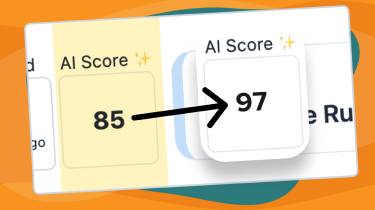
    AI lead scoring takes a little bit of upfront work (and an occasional tweak as you refine your process), but once the setup is done scoring is handled for you. Any time new information is gathered, the score updates. You don’t need to do anything special and there’s no risk of forgetting.

    Kyler Peters, Carrot customer

    AI lead scoring also allows you to add another layer of nuance to your sources — attribute weight. Does urgency, motivation, or property condition matter more to you than lead source or occupancy status? With AI lead scoring, you can tell the algorithm that some attributes are more important than others and should account for a larger percentage of the overall score. 

    With manual lead scoring, if you have 10 attributes, each accounts for 1/10th of the total score (unless you want to get into some seriously complicated spreadsheet formulas). But with AI lead scoring, you can tell the algorithm that seller motivation should account for 20% of the overall score while lead source is only 6%. So a high seller motivation score will drive the total score up while a high lead source score won’t have much impact on the total. This allows you to index off what matters most to you.

    There’s a worksheet for mapping out your AI lead scoring algorithm in the Lead Scoring Template, or you can build it directly in CarrotCRM’s AI Lead Scoring settings.

    Focus Where it Matters

    Lead scoring is a tried and true tool that marketing and sales teams have long trusted to identify the most promising leads. It’s not always perfect, but it can be a game changer, especially if you find yourself chasing bad leads. 

    Sophisticated real estate investors understand this and have adopted lead scoring in their real estate CRMs. The good news is you don’t have to be a high budget investor to use lead scoring! You can do it manually, or you can turn on AI lead scoring with a CarrotCRM account starting at just $69/month. AI usage is pay-as-you-go, so there’s no need to make a high value commitment!

    No matter your lead volume, lead scoring keeps you focused and helps flush out the trash early, giving you more time to work better deals. And in the numbers game of real estate investing, time matters.

  • 6 Things to Avoid When Choosing a Real Estate Investing CRM

    6 Things to Avoid When Choosing a Real Estate Investing CRM

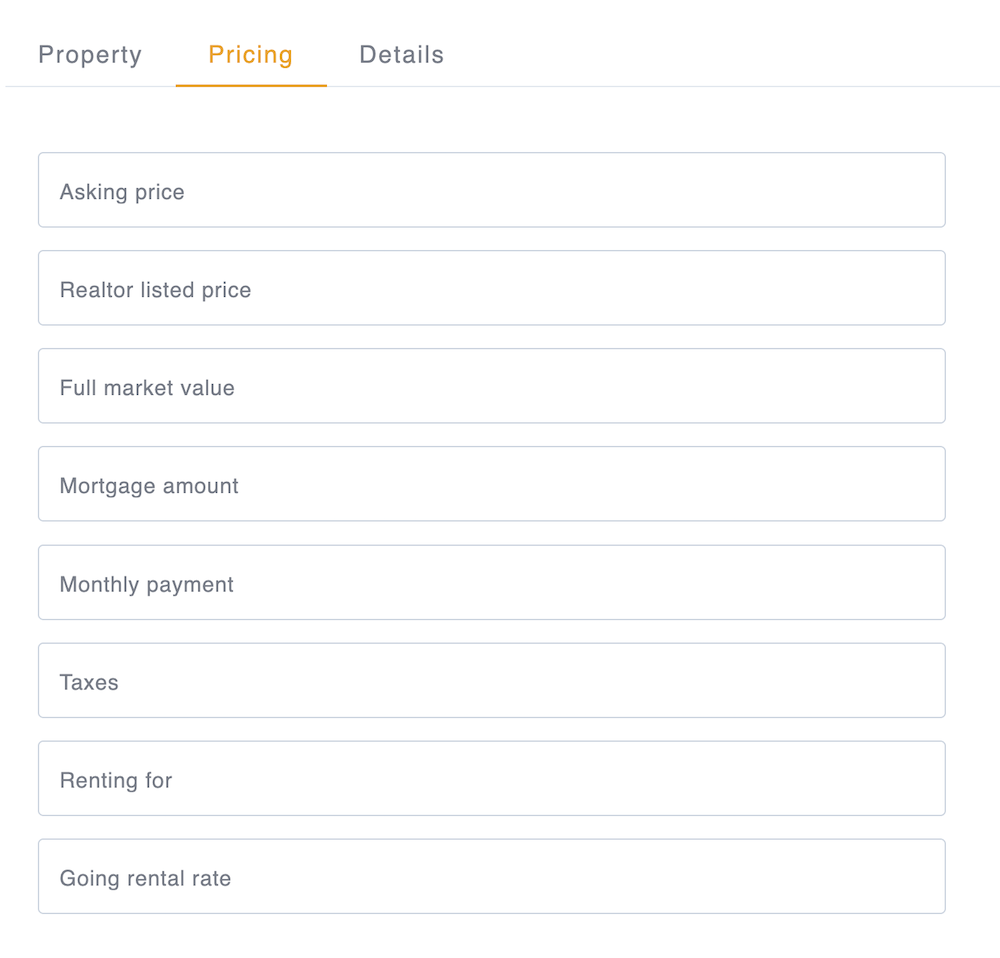
    If you’re a real estate investor, having a CRM designed for your needs is important. Generic CRMs don’t have the fields you need for details like property address, condition, asking pricing, etc., features like built-in maps and Zillow integrations, or follow-up tasks designed for real estate deal pipelines. 

    So if not all CRMs are a good fit for real estate lead management, what should you look for … and what should you avoid? This post goes over six key things to avoid when shopping for a real estate CRM.

    Key Takeaways

    • Real estate investors should choose a CRM designed for real estate. Generic CRMs don’t have the fields or features needed for real estate lead and pipeline management.
    • Choose a real estate CRM that has the features you need and will grow with your business, but don’t get distracted by too many unrelated features.
    • When choosing a real estate CRM, make a list of your desired features, ask for recommendations in a way that gives you usable insights, and get live demos from the CRM providers you’re considering.

    Table of Contents

    Carrot icon
    Lead generation, at its best
    Attract, convert & close more motivated leads
    Try Carrot Today

    What is a real estate CRM?

    CRM stands for Customer Relationship Management, and “a CRM” is software that helps you manage those relationships. CRMs provide a centralized place to store lead details, communication records, and activities, as well as set follow-up tasks and often include built-in options for communicating with leads via email, text message, or even calls. The goal is to help you actively keep track of leads and move them down the pipeline to a closed deal. Salesforce and HubSpot are some of the more well-known CRMs on the market, but they’re not designed for real estate professionals. 

    A real estate CRM is CRM software built specifically for real estate professionals, particularly investors, agents, and property managers. Popular real estate investing CRMs include CarrotCRM, InvestorFuse, Resimpli, and Left Main REI. These solutions offer information fields and features unique to real estate lead management, such as built-in property data, nearby real estate comps, and follow-up steps like “due diligence” that you won’t find in a generic CRM.

    When shopping for a CRM as a real estate investor, here are some key things to avoid to ensure you get a CRM that works well for your business.

    1. It’s not designed for real estate

    Handling a lead interested in selling their house to a wholesaler is very different than managing leads interested in buying enterprise software. Most CRMs have built-in fields for things like job title, company size, revenue, and buying roles — all fields that don’t make sense for real estate investors dealing with individuals.

    While you can customize most CRMs with custom fields, why spend the extra time trying to make something work when it’s not a good fit? Especially since there are CRMs designed out of the box for real estate investors.

    A real estate specific CRM has built-in data fields that make more sense for your use case. Fields like:

    • Property details
    • Estimated repairs needed
    • Outstanding mortgage information
    • Reason for selling
    • Time to sell
    • Occupancy details

    Think of all the information you (or your lead or acquisition managers) would gather when assessing an opportunity. That information needs a dedicated place to live. Choose a CRM that is already built for that information instead of spending time setting it up manually.

    CarrotCRM data fields

    Some real estate CRMs (like CarrotCRM) even pull much of this information into the opportunity for you via Zillow integrations and additional property data reports. This saves you time and gives you a better understanding of the property and potential deal value.

    2. It’s difficult to set up or use

    Speaking of not spending too much time setting up your CRM, that piece of advice also goes for dedicated real estate CRMs. Some are more complicated than others, and if it’s difficult to set up or use, you likely won’t end up using it.

    Choose a CRM that has onboarding assistance, and be mindful of the timeline for launch. Some highly customizable CRMs like Left Main REI and HighLevel require a large amount of expertise and time to implement (which also drives up the price).

    Don’t forget to look beyond implementation and consider what the day-to-day usage looks like. For instance, if the CRM relies on complicated workflows for lead nurturing, it could be overwhelming to set-up, use, and get value out of. Trust me, as a professional marketer for more than 15 years, I’ve spent plenty of time setting up automated workflows. It’s not a simple task, and it’s distributingly easy to mess up … meaning the workflow isn’t doing what you think it’s doing. Understanding automation can be full time job. Since marketing isn’t your full time job, look for a CRM with easy-to-use automations.

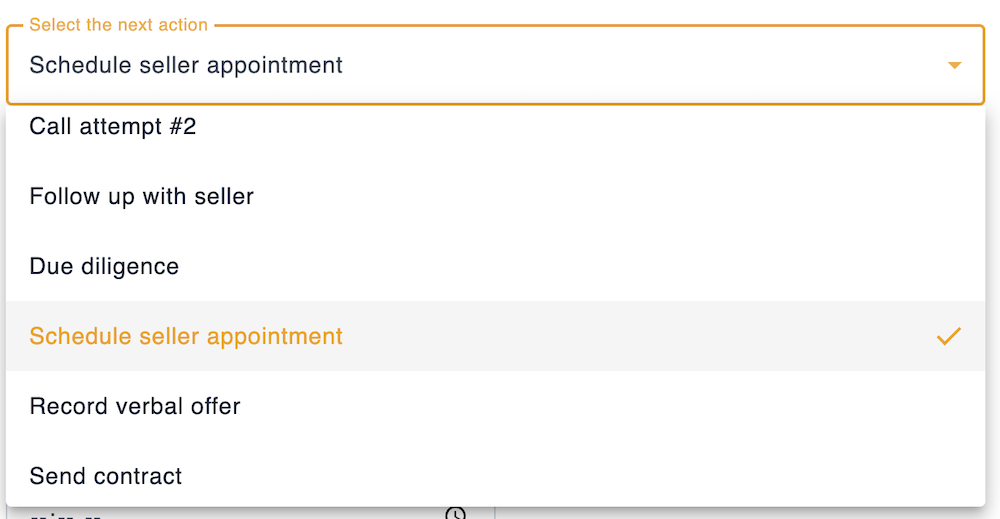
    Consider choosing an action-based CRM that drives activities to make sure deals keep moving. If your CRM is little more than an online to-do list, it’s not any more effective than keeping track of your leads and tasks manually. An action-based CRM helps you set the right follow-up tasks and makes sure you know what to do next, keeping you on track.

    CarrotCRM Follow Up Tasks

    For example, CarrotCRM’s action-based system does not allow you to complete an existing task without setting up the next follow-up step. This ensures you never forget what needs to be done or when the deadline is. Every CRM says it helps “keep leads from slipping through the cracks,” but if you forget to set the next follow-up step (or think you’ll do it later), that’s exactly what happens. CarrotCRM prevents that by making sure every lead always has a next step, owner, and due date. Then, these tasks get pulled into your My Dashboard view, ensuring nothing is forgotten

    3. It doesn’t have AI features

    Smart real estate investors use new AI tools to do more work in less time. Those who aren’t will to be increasingly left behind. With that in mind, don’t invest in a CRM that doesn’t have built-in AI.

    Kyler Peters

    Depending on your need and the CRM, AI can do everything from having information gathering conversations with leads, to making sure you’re aware if circumstances change and a lead becomes more or less likely to close, to nurturing cold leads. These tools save investors countless hours and help them focus their time and efforts on the most promising leads. Investors who continue to do everything manually will see themselves closing fewer deals in the months and years to come.

    CarrotCRM AI - Must-have features for a real estate CRM & lead follow-up

    Many CRMs are adding new AI features fairly often, so ask about features on the company’s roadmap when evaluating your options. If they’re not adding AI features at all, they’re likely to become outdated in the near future. (Be sure you understand the pricing model for any AI features. Some may be included in the base price, but many CRMs treat AI as an add-on with its own price.)

    If the CRM doesn’t have a specific AI capability you’re interested in, make sure it supports integrations that allow you to add that feature. Which brings us to our next thing to avoid …

    4. It doesn’t support integrations

    CRMs can be very feature-rich (sometimes too feature-rich, but more on that in a second), but if it’s a completely closed system that doesn’t allow integrations, you’ll find yourself trapped. Whether you’re integrating a lead source or connecting another tool, your CRM needs to be the hub for your lead management. It can’t be a hub if you can’t connect the data and tools that you need and use.

    Allowing integrations lets you use best-in-class solutions that fit your specific needs and preferences. You may want to integrate a tool that the CRM doesn’t have built in or use an alternative that you like better than the included capability. Using your preferred phone system is a great example. You should be allowed to use the tools and software you want, not what the CRM dictates.

    This is particularly helpful with AI tools. There’s not a single real estate CRM that offers every common AI capability. AI is too new, and companies are still building out their AI feature suites,  focusing first on the capabilities they think are most valuable to their users. Even as CRMs add new AI features, there are some AI tools that dedicated companies will likely be better at. AI voice solutions are the perfect example. It takes a lot to make an artificial voice agent sound real and engaging. Companies that focus only on AI voice are likely to perfect it before a CRM company creating its own in-house version.

    That’s another thing to avoid — CRMs that do too much.

    5. It has TOO many features

    This may sound silly, but hear me out — more features are not always better. All-in-one CRMs promise to let you handle marketing, lead generation, lead follow-up, and deal management all in one platform. That sounds enticing until you start looking more closely.

    All-in-one solutions have many potential pitfalls, but the main things to ask yourself are:

    • Am I paying for features I don’t want or use?
    • It does a lot of things, but does it do them all well?

    Best-in-Class versus All-in-Ones

    All in Ones vs Best in Class Real Estate Software

    Define what you want to accomplish with a CRM and your overall goals, then look into the features that will help you get there. If your goal is to close more deals, do you really need more leads (i.e. outbound marketing tools) or do you need to better handle the leads you have (i.e. a CRM that hyper focuses on working your lead database)? All the bells and whistles are attractive, but they can also distract you from the main task at hand or leave you with substandard features because a company is stretched too thin.

    6. It can’t grow with you

    While you don’t want a CRM that’s so feature-rich that it’s distracting, you do want to choose a CRM that has the right features to scale with your business. 

    Focus on lead management related features like campaign tracking, employee dashboards, and round robin lead distribution. These are in line with the main purpose of a CRM and help you effectively assign, track, and manage leads as your lead sources (marketing campaigns) and acquisition management team grow.

    Don’t forget to look at the CRM’s pricing model. While it may be affordable now, it might not always be that way. Does it grow in a sensible way, or does the price make crazy jumps if you need to add more users, contact records, or AI usage? Or worse, is the pricing behind a “Contact Sales” gate, meaning you have no idea what will happen to the cost as you grow?

    One of the worst things is having to switch your CRM. Moving to a new system takes a lot of time, effort, and learning, interrupting more important work. It’s better to find a CRM that is affordable and meets your needs when you’re just starting out, but that can grow with you as your business scales.

    How to find the right real estate CRM

    We’ve talked a lot about what to avoid when choosing a real estate investing CRM, but I don’t want this post to be disheartening! There are amazing CRMs for real estate investors available. Here are some tips on how to find the best one for you.

    Make a list of the features you need and rank each one by importance

    Just like with any important purchase, make a list of your must-have and nice-to-have features, then rank those in order of importance. Define your goals and work backwards to ensure you’re not distracted.

    This gives you a rubric to evaluate potential CRM providers. There may not be a perfect fit, but focusing on your must-have list will ensure your new CRM meets your main requirements.

    Download our Software Evaluation Matrix

    Be smart about how you ask for recommendations

    It’s natural to ask for recommendations from people you trust, especially with so many coaches in the real estate investing industry. Everyone has an opinion. The trick is to understand what you’re looking for and how well their recommendation aligns with your needs.

    When asking about real estate CRMs, here are a few key questions to get a real understanding of its fit and functionality:

    • What were you looking for in a CRM? (Make sure it aligns with what you want to accomplish. It may be a great CRM from the person you’re talking to, but not the right fit for you.)
    • What features do you use all the time? What are your favorites?
    • Is there something you thought you’d like, but actually never use?
    • What don’t you like about it?
    • Is there anything you feel it’s missing?
    • What made you choose this CRM? Did you consider any others?

    Pro tip: Avoid yes or no questions. These don’t give you the level of insight you need to make your own decision. 

    Get a live demo

    Even the most user-friendly CRMs can seem overwhelming at the start. Before committing, book a live demo to see it in action and ask questions. 

    Watching video reviews is a good start, but they aren’t interactive. Speaking to a professional who knows the software gives you a better understanding of how you’ll use it and the chance to ask clarifying questions or get a deeper demonstration of certain features.

    Armed with this list of things to avoid and a few steps to finding the right solution for you, you’ll have the perfect real estate CRM in no time!

  • What’s New at Carrot? Q3 2025 Updates

    What’s New at Carrot? Q3 2025 Updates

    We’re officially in the last quarter of 2025 (how did that happen?). And while Q3 included a good chunk of the summer, we didn’t spend the whole time on vacation! Instead, we were busy releasing new features and improving existing ones. Here’s a recap of some of the highlights from Q3 2025.

    Key Takeaways

    • New Carrot website subscriptions now include a mix of website, SEO, and content tools, plus integrations, with every price point.
    • Carrot offers CarrotCRM AI features and built-in Call Tracking.
    • Several small features and improvements were released to improve page load speed and overall performance for all Carrot websites.

    Table of Contents

    1. New Subscriptions
    2. New Features
    3. Performance Improvements
    4. What’s Coming from Carrot in Q4 2025?
    Carrot icon
    Lead generation, at its best
    Attract, convert & close more motivated leads
    Try Carrot Today

    New Subscriptions

    If you’ve looked at the Carrot pricing page lately, you might have noticed some changes. We’ve simplified our subscriptions so you get more baked-in features with fewer add-ons. 

    (If you’re a current Carrot member, don’t worry, your subscription is staying exactly the same. But if you want to change to one of the new plans, connect with our Support team using the live chat.)

    Our new subscription model follows a traditional “good, better, best” approach, giving you more features as you move up. But we made some critical changes to ensure that you’re successful no matter which Carrot subscription you choose!

    A few notable changes include:

    • Every Carrot subscription now comes with a mix of website, SEO, and content tools — no add-ons required. Key features like on-page SEO recommendations and the unique content scoring tool are included with the Starter subscription, ensuring you’re set up for SEO success from day one.
    • Integrations are now included! This change was the direct result of feedback from existing members. Carrot isn’t an all-in-one solution and we pride ourselves on letting you integrate your favorite tools. So we’re living by our ethos and including integrations with your subscriptions so you can build your ideal online lead generation hub.
    • Every Carrot subscription comes with Call Tracking!

    New Features

    We’re always looking for ways to improve Carrot, and last quarter saw a couple of very exciting feature releases!

    CarrotCRM AI

    The first set of CarrotCRM AI features technically came out in late June. But in case you missed the announcement in the haze of summer, it’s worth repeating here.

    CarrotCRM — a best-in-class CRM for real estate investors, formerly known as InvestorFuse 3.0 — offers a range of AI tools that highlight the most motivated leads, instantly surface critical information, and save investors hours of manual work.

    Want to see for yourself? All CarrotCRM users can try AI Lead Scoring and AI Summaries for free on five opportunities!

    Call Tracking 

    Understanding where your leads come from and which source generates the most deals is critical to smart marketing and budgeting. Why spend a lot of money and time on a lead source that never converts?

    Dedicated landing pages and forms are good for tracking online leads, but what if a lead calls you, either because they got your phone number from a piece of offline marketing (like direct mail) or because they found your phone number on your website but simply prefer to call than fill out a form? You can ask where they heard about you, but that information isn’t always reliable. 

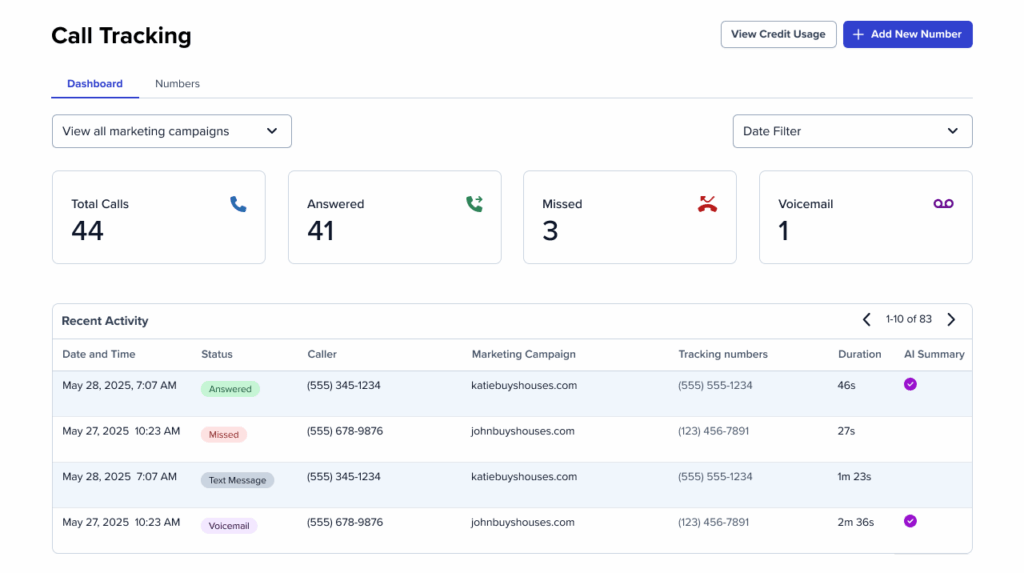
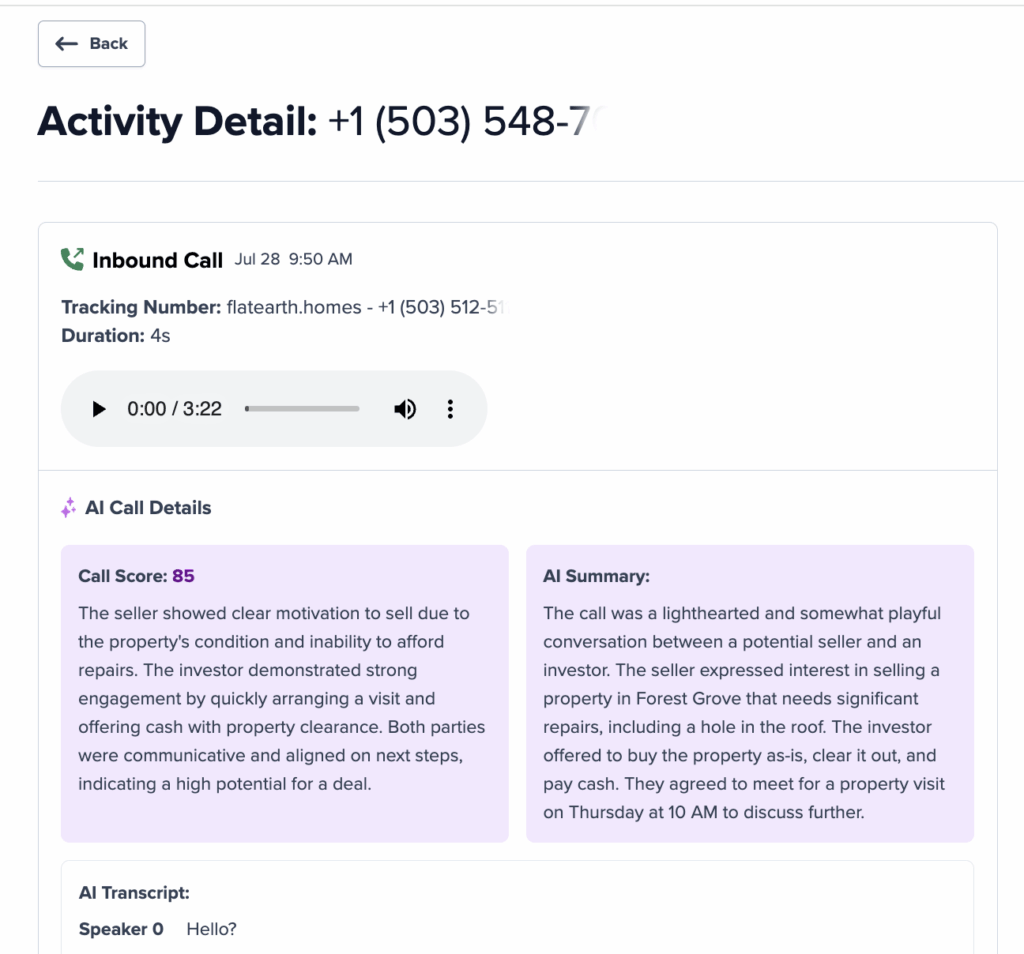
    With call tracking, you know without a doubt what piece of marketing drove that call. And now, Carrot members can access call tracking right within their website platform! With just a few clicks, you can get dedicated phone numbers for each of your marketing campaigns, and an insightful dashboard to pinpoint which campaigns are most successful.

    Performance Improvements

    Carrot’s top priority is making sure you have the best performance possible. But what exactly does performance mean? It means that Carrot websites are intentionally designed to load fast, be secure, show up when and where people are searching, and convert website visitors into leads. Here are some recent updates that ensure top-notch website performance.

    LLMs.txt for AI Discoverability

    We all know that AI search tools are becoming more popular. And built-in AI search results in Google are impacting the SEO landscape. To help Carrot members adjust to these shifts, we’ve now implemented LLMs.txt files on all Carrot websites.

    These files follow best practices for LLMs (large language models, the power behind AI tools) and include information such as site info, pages, and posts in a format that is easy for AI tools like ChatGPT and Gemini (Google’s AI search feature) to understand. The goal is to give the content on your website a better chance of showing up in AI answers when someone asks a related question.

    While the professional jury is still on on whether LLMs.txt files directly impact AI results, the way language models ingest information is changing everyday. Having an LLMs.txt file in place on your website ensures it’s formatted in a way that’s easily readable for AI.

    LLMS.txt Options for Your Carrot Website (for AI Discoverability!)

    Google Maps Load Time

    Embedding a Google map is a popular feature on real estate websites, but it can slow down your site load speed… which is bad for conversions. If your page takes too long to load, visitors are likely to hit the back button and look at a different site. The more visitors who bounce from your site, the more Google thinks there’s an issue, meaning you’ll start dropping in search result rankings. Overall, slow page speed is bad for business. We implemented a change in September to address this issue.

    We built a new drag-and-drop website element that replaces embedded Google Maps with a look alike option that doesn’t slow down page load speeds. In the past, when you embedded a Google map onto a webpage, it was live and interactive right away. This requires javascript to load with the page, slowing down overall page speed. The new Google Maps block pattern shows a preview of the map using your specific address. The map looks the same to a visitor, but doesn’t become interactive until the visitor engages with it.

    This one change improved site speed from 72 (a yellow warning score) to 90 (green)!

    Improving Site Speed with Carrot's NEW Google Map Feature

    Hide or Show Website Elements Based on Screen Size

    According to our data, 50% of visitors come to Carrot sites from desktops and 50% use mobile devices. That means your site needs to look good and perform well on all types of screen sizes. But you’re not a web designer, so how do you make sure that happens? Stop stressing over your design and let our built-in features handle it for you.

    One of our Q3 updates is the ability to show or hide certain parts of your website based on the user’s screensize. For instance, you can have an eye-catching arrow pointing to a form on the desktop view, but hide that element on mobile to make sure the form isn’t pushed too far down the page. This feature makes it fast and easy to ensure your site looks great and performs well on both desktop and mobile! 

    Responsive Block Visibility Feature for Carrot Websites

    Speed Improvement for Google Analytics Users

    Carrot websites have a certain amount of metrics built in, but the power of data and insights really shines when you have Google Analytics (GA) connected to your site. This allows us to pull even more data into your in-Carrot reporting dashboards. (Trust me, as a professional marketer, you 100% should have Google Analytics connected to your site!)

    But, just like embedding Google Maps, connecting GA is notorious for potentially slowing down your page load speed. To address this and improve your page speed, we now delay Google Analytics script loading by two seconds. This gives your pages a head start before analytics loads, allowing visitors to see critical information quickly. 

    On average, sites see a 5–10 point improvement on PageSpeed Insights scores from this optimization. This means stronger Core Web Vitals and better signals to Google — all of which helps your SEO and general visitor experience.

    Want Even More Performance Improvements?

    Want to dive even deeper into improving your website’s performance? Join Carrot’s Official Facebook Community – Evergreen Marketing for Real Estate, where we share results from Carrot Labs, our pet project where we continuously test new ways to improve performance. 

    What’s Coming from Carrot in Q4 2025?

    We have even more great updates coming in the next few weeks and months!

    More Design Customization

    Carrot website templates are designed very specifically for optimal lead conversion. We’ve literally spent years testing into our templates (there’s a reason we recommend the pages we do and have the navigation in a certain order … it’s because it improves conversion!).

    But you’ve been asking for ways to make your site look more unique and stand out from other Carrot-hosted sites. And we heard you.

    In May, we released new drag and drop block patterns — pre-built sections that you can use to add content, images, FAQs, testimonials, and more to your site in just seconds. Pick your favorites, put them wherever you want on the page, set your custom colors, and choose from hundreds of pre-loaded icons. Using these block patterns is a great way to customize the look of your site while maintaining its performance and hitting all your credibility factors.

    In Q4, we’re giving you even more template options, design elements, and customization options to make your site really stand out while maintaining its performance. Stay tuned, I expect the new templates to be released in early Q4! 

    Property Analysis & Offer Recommendation AI

    We aren’t done with CarrotCRM AI features! The next iteration will take Carrot’s Market Scout, property reports, and AI Summaries to the next level with an AI feature that analyzes an opportunity and suggests a good offer price based on your business parameters.

    Build What Matters: Create a Crystal-Clear Vision and Unlock New Tools to Close More Deals

    Make sure you start the video at 54:30!

    See you in Q4!

    That’s just a little preview of what we’re working on to close out the year. If you want to stay in the know and get some additional resources (like AI prompts to accelerate your business), make sure you’re part of Carrot’s Evergreen Marketing for Real Estate Facebook Group!

  • The Hidden Problems with All-in-One Software

    The Hidden Problems with All-in-One Software

    All-in-one software solutions have a lot of benefits. They give you access to multiple tools for a single price, they keep your data or assets centralized, and they cut down on daily “switching cost” — time wasted moving between apps. For some people, they’re a great option. But like most things, they’re not perfect and they’re not for everyone. It’s important to understand the downsides of all-in-one applications before making an expensive purchasing decision.

    Key Takeaways

    • All-in-one software has downsides that many people don’t consider, including paying for features you’re not using, wasting time on an overcomplicated system, becoming stuck in a single system, and settling for features that aren’t “best in class.”
    • All-in-one applications are good for some businesses, but businesses concerned with efficiency and growth should choose “best in class” solutions that meet their needs, help them grow, and are constantly improving.
    • In a survey conducted by Carrot, 60.4% of real estate investors said they’re willing to pay for the most effective tools, even if it’s different products versus an all-in-one marketing solution. When it comes to driving business, power and efficacy are more important than a wide selection of features.
    • You can audit how much you’re using your existing all-in-one software and how effective the features are with this free Software Usage Assessment Worksheet 

    Table of Contents

    1. Master of None
    2. All-in-Ones Offer Features in Place of Power
    3. Paying for Features You Don’t Need or Use
    4. Is Your All-in-One Actually Slowing You Down?
    5. Who are All-in-One Solutions Good For?
    6. Wait, doesn’t Carrot offer more than one solution?
    7. Understand the Benefits and Limitations
    Carrot icon
    Lead generation, at its best
    Attract, convert & close more motivated leads
    Try Carrot Today

    Everyone talks about the benefits of all-in-one apps. Now, let’s take a critical look at some of the downsides.

    All-in-One Software vs. Best-in-Class: What do you really need for your real estate CRM?

    Masters of None

    One of the first questions to ask yourself when considering an all-in-one is, “How good are the individual features?” While an all-in-one app may technically offer a feature, does that feature meet your needs and work well? If you were looking at just this feature, how does it compare to alternative solutions? Oftentimes, all-in-one solutions add features to make their product look more appealing and meet user wants, but it may be treated as just checking a box. A feature that doesn’t function well or live up to industry standards doesn’t really solve your need. If you’re relying on subpar features, your competition using best-in-class solutions will absolutely overtake you.

    Also ask yourself, “How often is each feature updated?” All-in-one providers often stretch themselves thin with complex feature suites, meaning many features are launched when they’re “good enough” and never updated or innovated. Large companies with hundreds of employees may be able to pull it off, but smaller companies don’t have the manpower to adequately maintain and support a large number of features — especially if you expect them to keep innovating to keep up with the market.

    Dedicated software providers aren’t stretched as thin, allowing them to put their full time, attention, and resources into maintaining, improving, and innovating a focused set of solutions.

    All-in-Ones Offer Features in Place of Power

    Do you want power and functionality, or do you want a lot of options that only work so-so? For companies that want to grow and succeed, the answer is clear — you want the tools that actually work.

    In a survey conducted by Carrot, 60.4% of real estate investors said they’re willing to pay for the most effective tools, even if it’s different products (versus an all-in-one marketing solution). When it comes to driving business, power is more important than a wide selection of all-in-one features.

    Companies that offer specialized software can build more features within that software. That one solution is their entire world, so they focus wholeheartedly on its effectiveness and depth. 

    Vetting and selecting different software may seem daunting, but if it helps you close more deals, it’s worth the effort. The key to building your own custom software suite is finding solutions that integrate well together. This lets you choose whatever solution works best for your needs, instead of simply taking the features and capabilities an all-in-one thinks you need.

    Pro Tip: If you do choose an all-in-one solution, make sure it allows outside integrations. Otherwise, you are fully locked into their features. If they change a feature, remove a functionality, or simply never improve their existing features, you’re stuck with what they offer. This also means you can’t use best-in-class tools that may offer a better experience or more functionality.

    Paying for Features You Don’t Need or Use

    Feature-rich all-in-one solutions often mean a lot of features that you’re paying for but not actually using. It may not sound like a big deal, but you could be wasting money on a subpar product.

    Here’s a quick way to assess an all-in-one’s fit if you already have one or if you’re considering one.

    Evaluating Your Existing All-in-One

    If you currently have an all-in-one solution, document how many of the features you’re actively using, then divide your total cost by that number to get a rough idea of how much you’re paying per feature (don’t forget to account for add-ons or usage-based pricing). If you want to take it a step further, give each feature you use a grade based on how effective it is and how much it meets your needs. If a feature has a low score, spend some time looking at single solution alternatives to see if switching would be better. While the standalone software might seem more expensive, consider how it will improve your efficiency, insights, lead generation, or overall revenue. If it will improve your business outcomes, it’s likely worth the price.

    Download our Software Usage Assessment Worksheet

    Assessing a Potential All-in-One

    If you’re considering an all-in-one, write down the problems you’re trying to solve, then evaluate its features. This way, you won’t be blinded by all the bells and whistles that you don’t actually need. Especially if you’re a newer investor, don’t overly plan for what you want to do; focus on what you need to do right now. If you’re not ready to spend the money on direct mail, you don’t need software that offers a direct mail option right now. Focus on one channel first, then, when you’re ready to expand, look for the right solution at the time.

    Alex Pardo - REI Marketing Advice

    For more beginner tips, download “5 Priceless Lessons from Million Dollar Real Estate Investors”

    Building your software suite as you go based on need ensures you always have the right-fit solutions in place rather than relying simply on what’s offered.

    Is Your All-in-One Actually Slowing You Down?

    It’s a common belief that all-in-ones cut down on switching costs — and that’s true. But they can also cause unnecessary distractions.

    When you’re in a single-purpose software, you’re doing one thing — editing your website, creating a marketing asset, following up with leads, whatever that software does. But if you’re in an all-in-one that does everything, it’s easy to get distracted by all the things you could be doing. You may go into the software to follow up with leads but find yourself building a new direct mail campaign. Before you know it, that lead follow up you were supposed to be doing is at best delayed, at worst completely forgotten.

    This is particularly true for teams. You may have good self discipline and focus, but can you say the same for everyone on your team. While teams may save time not switching between apps, they can also lose a lot of productivity to distraction or completing tasks that are more appealing but less profitable.

    Who are All-in-One Solutions Good For?

    All-in-one solutions clearly have their place (otherwise they wouldn’t be so prevalent). The key is understanding when an all-in-one is a good fit and when it might actually hurt your business.

    Who All-In-Ones are Good ForWho All-In-Ones Aren’t a Good Fit For
    One-person teams who want to move quickly and don’t have to worry about how a team works with the app.People managing teams who need to make sure the app is easy for everyone to use and keeps their team focused on the task at hand.
    Businesses that are comfortable with their current state and don’t want to scale.Companies that want applications that actively help them grow.
    People who are happy using the features offered and don’t want to look for better solutions or different feature sets.Teams that want the best-in-class tools with deep functionality to ensure maximum impact and efficiency.

    Wait, doesn’t Carrot offer more than one solution?

    It’s true, we do. We have Carrot Web and CarrotCRM. The difference is, it’s not a closed ecosystem. While the two softwares fully integrate and work wonderfully together, you can connect a different CRM to your Carrot website or use CarrotCRM with any other website or simply upload your offline leads. You don’t have to use them together and we treat them as two separate solutions.

    They also have different engineering teams who remain dedicated to maintaining and improving the individual products. CarrotCRM was originally InvestorFuse, and their entire engineering team joined Carrot when we acquired that company in XXXX.

    Because they’re treated separately, you see things like continuous solution improvements and new features being added to web and CarrotCRM designed to improve each solution experience.

    Here’s a quick recap of some of the most recent improvements and feature releases …

    Carrot WebCarrotCRM
    Call Tracking (but you can still integrate an outside solution if you prefer!)New AI features
    Site speed improvementsConstantly improving dashboards
    LLMs.txt file auto-generation to help with AI search visibilityKPI TV dashboard

    Understand the Benefits and Limitations

    At the end of the day, whether you choose an all-in-one or bespoke software comes down to your specific needs and values. But understanding the drawbacks as well as the benefits is an important part of the process.

    Take time to document what you’re trying to achieve, what’s most important, and what functionality you actually want out of software, then find the best solution. And remember, just because you’ve implemented one solution doesn’t mean you can’t switch. If it’s not working for you or your team, find something that does. Wasting time trying to make a poor fit work ultimately wastes money.

  • Why Call Tracking is the Most Profitable Real Estate Tool You’re Not Using

    Why Call Tracking is the Most Profitable Real Estate Tool You’re Not Using

    Whether you’re just starting out as a real estate investor or you run a multimillion dollar investment company, everyone wants to make sure the money they spend on lead generation actually lands deals. 

    The best way to do that is with campaign tracking (tying specific leads to their source, like Facebook, a direct mailer, or even a billboard or radio ad). That’s easy with specific landing pages and forms. But what if a lead calls you? Even if you ask where they heard about you, they may not remember or provide specifics. 

    Enter call tracking. Call tracking lets you put a unique phone number on all of your lead generation channels and campaigns so you know exactly where a lead came from. 

    And now, call tracking is built directly into your Carrot website and included in your subscription!

    Key Takeaways

    • Call tracking lets you identify which lead sources drive the most leads and deals, based on real data, not guesswork and gut feelings.
    • If you don’t have call tracking enabled on our website, you don’t know how many leads your site actually generates. Form submissions is an incomplete picture of a real estate website’s lead generation power (especially since 50.78% of web traffic comes from mobile devices, according to proprietary Carrot data).
    • Carrot AI Call Insights provides automatic call transcripts, summaries, a call rating, and actionable next steps so you know exactly what was discussed and which leads to work first based on their motivation and fit.

    Setting up call tracking gives you peace of mind that your marketing efforts work and allows you to focus on the areas that drive the best results.

    Table of Contents

    1. What are the benefits of call tracking for real estate investors?
    2. Who uses call tracking?
    3. How does Carrot Call Tracking work?
    4. How much does Carrot Call Tracking Cost?
    5. How does Carrot’s Call Tracking compare to other call tracking services? 
    6. Take your business to the next level with call tracking
    Carrot icon
    Lead generation, at its best
    Attract, convert & close more motivated leads
    Try Carrot Today

    What are the benefits of call tracking for real estate investors?

    Call tracking gives you a clear, accurate understanding of where each phone lead came from. Did they visit your website then call you? Did they see something on social media or get a specific direct mailer? Knowing where each lead came from lets you know what’s working.

    Say you’re trying out two different direct mail pieces. A lead calls and says they got your postcard. But you don’t know which one it is. You can ask them to describe it, but is that really how you want to spend your time on the phone with a new motivated lead? No! With call tracking, you can skip the entire “how did you hear about us” conversation because you already know based on the number they called. Over time, you’ll know which campaigns are the most effective based on real data tied to each unique number. 

    Call tracking is particularly important for understanding your website’s effectiveness. In 2024, 50.78% of traffic to Carrot-hosted websites came from mobile devices. And when people are searching on a mobile device, it’s easier to click on the phone number and make a call than it is to fill out a form. If you’re not attributing these calls to your website, you won’t have a complete picture of its effectiveness. You may even think your website isn’t generating leads when in reality it could be your biggest driver of calls.

    The funny thing is, most of my leads are coming from people who find the site but choose to call instead of filling out the form. I’ve started asking everyone how they found me and what made them reach out, and more and more people are skipping the form entirely and just dialing the number. … It’s happening so often that I wonder if it’s part of a bigger shift in consumer behavior.
    Jeff Tucker, Jeff Buys Houses Cash

    In addition to knowing which sources generate the most leads, pay attention to which sources generate the best leads — the ones that turn into deals more often or have the largest value. You might get 100 calls from direct mail pieces, but if none of them turn into a deal, then it’s not really a good lead source. Meanwhile, you might only get a few calls a month from your website, but if most of them turn into deals, that’s a great source! With the average real estate investor spending $1,000 a month on advertising, making sure every dollar works is critical. You need a way to track actual success when deciding where to spend your money and determining campaign ROI.

    Identifying your real lead and deal sources lets you turn off marketing methods that aren’t producing deals and focus your time, energy, and budget on the channels that actually generate revenue. If you’re a high lead volume business, knowing which channels convert to deals more often also allows you to prioritize new leads, focusing on the best lead sources first. 

    You may have a general idea of where your best leads come from, but not knowing for sure means you could be wasting money or time. Call tracking makes it crystal clear, no guesswork involved.

    Who uses call tracking?

    The beauty of Carrot’s built-in call tracking is that it makes this great feature accessible to any investor, without having to purchase a separate service. 

    Solo & Newer Investors

    When you’re a one-person team, your time matters even more. And if you’re newer to real estate investing, you might be particularly sensitive about your budget and profit margins. Built-in call tracking included with your website gives you an accurate understanding of lead generation effectiveness without shopping around for another tool or learning and integrating another system.

    It’s an easy, hassle-free way to understand how much revenue each advertising dollar generates so you can focus your time and money where it will have the greatest impact and accelerate your business.

    Team Managers

    Whether you manage a large team or work with a VA or two, visibility is key to ensuring your team (and business) is successful. Call tracking helps with this in two ways:

    1. It makes sure any marketing plans someone else puts in place are working (and not just wasting your money). If you don’t see any calls coming in from a specific campaign, that’s a sign you need to ask some critical questions about it.
    2. It provides insights into your VA’s or lead manager’s availability, responsiveness, and capacity. You can easily see the total number of calls, how many were answered, and how many were missed.

    At the end of the day, call tracking helps give you full visibility into what’s driving results, no matter who’s handling your marketing or fielding calls.

    How does Carrot Call Tracking work?

    Carrot’s built-in call tracking puts a unique, local phone number (different than your personal or business number) on your website. This tells you exactly how many phone call come from people visiting your website. Call tracking combined with the lead generation forms on your site give you a complete understanding of how many leads your site generates. 

    When you’re ready to turn Carrot Call Tracking on, simply:

    1. Select a number local to your area (this is important as it let’s leads know you’re a real, local person, not some nameless, faceless mega company).
    2. Connect your new number to a receiving line where you want calls forwarded.
    3. Connect your new number to the campaign you want to track
      • If you want to use the number to track phone leads from your website, Carrot will automatically replace the phone number currently on your site with the new tracking number! (If you have landing pages that already have unique numbers, we won’t change those).

    The whole process takes less than five minutes!

    If you want to add unique numbers to additional marketing campaigns or landing pages, simply add numbers to your account, assign them to a tracking campaign, and add them to your marketing. (Remember, for call tracking to work effectively, don’t use the same number across multiple campaigns or marketing channels!) 

    When a call comes in, it rings through to your receiving line. If you’re unavailable, the caller can leave a voicemail like normal and that message is tracked to the appropriate campaign in your call tracking dashboard. All calls are recorded so you can revisit them or use the AI Call Insights feature for additional insights. Whether you pick up or the lead leaves a message, a two-party consent message plays automatically before recording starts, satisfying the strictest state requirements. Recordings are stored for 30 days (60 if you have the AI Call Insights add-on). If you want to keep them longer, you can download recordings before they expire. 

    All inbound calls are automatically logged in CarrotCRM. If a matching opportunity exists, the call is attached. If there isn’t an existing opportunity for this lead, the system automatically creates one tagged with the campaign. If you use a different CRM, we’re working on a Zapier integration to push call details, recording URLs, and transcripts (when available) from your free CarrotCRM instance to your CRM of choice. Stay tuned for that update (or talk to one of our experts about switching to CarrotCRM!)

    If you miss a call or receive a text message to the tracking number, you’ll get an email with the caller’s number and a link to the recording (if they left a voicemail) or a copy of the text message they sent. These email notifications are great for on-the-go investors, letting you catch up on incoming calls or keep up with VA activity no matter where you are. Have some down time between meetings? Get everything you need to know about your latest lead and follow up now instead of waiting until you’re back in the office.

    Analytics & AI Call Insights

    The call tracking dashboard gives you a quick view into how many calls you’ve received and how many were answered, missed, and left messages. Each call log shows you the time, date, contact details, duration of the call, and provides a link to the transcript if you have AI Call Insights enabled. You can view all calls, or drill down into specific campaigns.

    AI Call Insights gives you even more useful information by providing:

    • Automatic Transcripts: Recorded calls are transcribed within ~2 minutes post-call. Transcripts feature speaker labels and remove the “um’s,” “so’s,” and pauses, giving you a clean view of who said what.
    • Call Summaries: Each call is distilled into a clear 2-4 sentence summary that captures the tone, urgency, and what was discussed.
    • Call Rating: AI analyzes the call based on critical factors like pricing alignment, urgency, and engagement then gives the call a 0-100 rating, allowing you to identify and prioritize the most promising calls first instead of wasting time on callers who aren’t serious yet.
    • AI Action Items: AI analyzes the call and pulls out bulleted action items so you know exactly what to do next.

    Transcripts and summaries automatically sync to the matching CRM opportunity so when you’re working a lead you always have the latest information. 

    AI Call Insights let’s you move faster and more intentionally. Instead of listening to a missed call  or relistening to a call when you’re ready to reach out again, you can save time by getting a quick recap instead. Not sure which lead to follow up with first? The Call Rating assesses a lead’s readiness and motivation and gives you a rating summary so you know what’s behind that assessment. These ratings help you prioritize the leads that are most likely to turn into deals. It’s similar to AI Lead Scoring, but specific to this call or text message and helps you move quickly with leads who are ready to sell before they move on to someone else.

    With the built-in AI features, you no longer have to upload a call recording into an external transcription service or load a transcription into ChatGPT to find the key points. You can also stop relying on virtual assistants to listen to all the calls and provide written recaps. It’s all down for you in a matter of minutes.

    How much does Carrot Call Tracking Cost?

    Carrot call tracking gives you one local number to use on your Carrot website, plus 100 recording minutes and 25 inbound SMS messages per month as part of your Carrot subscription. 

    If you reach 80% of your recording minutes or SMS limit, you’ll get an email alert letting you know you’re nearing capacity. If you go over the threshold, it’s $0.05 per minute and $0.03 per additional inbound SMS message. Keep track of your costs on the Usage and Costs page, which displays your real-time consumption, projected overages, and invoice history for full transparency.

    Need additional numbers for different marketing campaigns? No problem! You can add as many local numbers as you’d like for $3/month each. 

    AI Call Insights can be added to your subscription for $39 per month. (AI Call Insights is not part of the CarrotCRM AI feature suite. Turing on CarrotCRM AI features does not enable AI Call Insights.)

    How does Carrot’s Call Tracking compare to other call tracking services? 

    We believe that call tracking is a critical component of measuring your success and managing your budget and focus, so we worked hard to make it as affordable as possible. Because it’s fully integrated into our real estate website platform, we were able to make it part of the subscription and only charge for additional usage. Most other call tracking solutions (like CallRail) are standalone services that need to be connected to an external website.

    CallRail starts monthly subscriptions at $50/mo (plus the cost of your website as CallRail doesn’t offer this service). 

    Carrot Call Tracking vs. CallRail

    CallRailCarrot Call Tracking
    5 numbers5 numbers (1 included, plus 4 add-ons)
    250 minutes250 minutes (100 included, plus 150 overage minutes)
    $50/mo$19.50/mo

    Carrot Call Tracking vs. CallRail with AI Insights

    CallRailCarrot Call Tracking
    5 numbers5 numbers (1 included, plus 4 add-ons)
    250 minutes250 minutes (100 included, plus 150 overage minutes)
    AI insights & call transcriptionsAI insights & call transcriptions
    $100/mo$58.50/mo

    Take your business to the next level with call tracking

    Managing time, budget, and understanding your return on investment is critical for any business at any stage. Call tracking is another tool that gives you deeper understanding of what’s working and where to focus your efforts. For many real estate investors, it’s the missing piece to their reporting. You know how many leads you generate, how many turn into deals, how many form fills you get. Now it’s time to know exactly how many calls and text messages you get from leads, and exactly where they came from. Stop driving blind and start making smarter decisions based on real call tracking data to take your business to the next level.

  • Claim Hours Back Weekly & Close More Deals with CarrotCRM’s New AI Tools

    Claim Hours Back Weekly & Close More Deals with CarrotCRM’s New AI Tools

    Ai-Driven Acquisitions: The CRM Revolution That’s Changing Acquisitions Forever

    or see pricing here

    What would you do if you could claim back hours each week? Spend it with family? Dive back into the hobby that you’ve been neglecting? Double your annual revenue by closing more deals?

    For many people, the purpose of real estate investing is to buy back your time, freedom, and control of your life to do the things you love.

    But if you’re spending all your time generating leads and working deals, it can turn into a grind that doesn’t feel very fulfilling. 

    Carrot websites have long helped investors generate motivated seller leads. Then Carrot’s action-based CRM (built on InvestorFuse 3.0 technology) launched in 2024, helping investors hyper-focus on moving deals through the pipeline quickly. Now, we’re taking it a step further, giving you the ability to move faster, focus where it matters, and close more deals with even less manual effort.

    Meet CarrotCRM AI and InvestorFuse 3.0 AI.

    It’s the feature set that made Kyler Peters (of Nick Perry’s Want to Sell Now team — one of the highest volume teams in the country) say this:

    CarrotCRM AI’s first tools (available now with all paid plans) include:

    • AI Lead Scoring: Stop wasting time chasing the wrong leads. Focus on the highest quality leads based on the criteria that matter most to your business.
    • Autonomous Lead Manager: Have more conversations and gather important, qualifying information in the background while you focus on more important tasks.
    • AI Opportunity Summaries: Get caught up on every opportunity detail in just 30 seconds. Never miss important info and stop wasting time as you move between opportunities.

    Key Takeaways

    • CarrotCRM AI tools speed up a real estate investor’s ability to focus on the right opportunities and enable them to touch more opportunities in one day with less manual effort.
    • Using CarrotCRM AI saves hours weekly, allowing investors to message more leads and move between opportunities in just 30 seconds.
    • If you’re not leveraging AI in your acquisition engine as a core part of every step in the lead flow, you will be playing catch-up within the next 12 months.

    These game-changing AI features are available with both CarrotCRM and InvestorFuse 3.0. Keep reading to learn how they work, how they help, and how they’ll accelerate your investment business for a fraction of the time and money.

    Table of Contents

    1. How AI changes the game for real estate investors
    2. AI Lead Scoring: Give the right attention to the right leads
    3. Autonomous Lead Manager: Your built-in virtual assistant
    4. AI Opportunity Summaries: Remember every important detail in just 30 seconds
    5. What can you expect from CarrotCRM AI
    6. How do I get CarrotCRM AI?

    How AI changes the game for real estate investors

    AI is about acceleration and time savings. It’s about enabling the human to focus on the parts of processing a lead that they do best while AI handles the heavy lifting on repetitive tasks. Done right, it allows a solo wholesaler or flipper to punch way above their weight class and get more done with far fewer resources. For a big Investor, it saves dozens of hours per week and tens of thousands of dollars in labor cost, while allowing each lead manager the ability to handle up to 75% more leads each day. 

    We didn’t just make this up. We worked with high-volume investors like Nick Perry to develop and refine the AI tools now available in CarrotCRM and InvestorFuse 3.0 (they’re the same software, just under different brand names). Here’s what they have to say about these new features and the impact they’ve had on the team …

    AI has had such a huge impact on just about every facet of life lately. It’s time investors harness that power to streamline their work and make smarter decisions that lead to more deals and higher revenue.

    “At the end of the day, if you’re not leveraging AI in your acquisition engine as a core part of every step in the lead flow, you will be playing catch up within the next 12 months.” — Trevor Mauch, Carrot CEO

    AI Lead Scoring: Give the right attention to the right leads

    Let’s be honest, not all leads are created equal. Someone might just be exploring options, while another lead could have a lot of motivation to move quickly. Some properties could require so much work that it diminishes your profit margin, while others might just need cosmetic updates. The truth is, a lot of factors impact lead quality, and trying to sort it all out manually means you:

    1. Need to keep track of quickly changing information
    2. Make judgment calls on how certain factors impact a lead’s quality and upside potential
    3. Spend the same amount of time trying to qualify every lead

    Doing this on the fly leaves you open to mistakes, missed opportunities, and inconsistent decisions. 

    But you know what AI is GREAT at? Analyzing data and assigning leads a score. 

    That’s exactly what the AI Lead Score does. Start with our pre-built scoring scripts or create something completely unique to you, including different lead factors and deciding how much weight each one deserves. If your business focus changes or you find your best deals all have commonalities, simply update your lead scoring matrix and all your leads will be rescored, making sure the most promising opportunities always float to the top. 

    Because the system is AI-based, the scores aren’t static. As you work a deal and gather more information, the lead score updates. What once looked like a promising lead might cool down or turn out not to be a good fit. How long does it take you to recognize that change and move on right now? Often, the answer is “far too long,” and you end up wasting time on a deal that’s never going to close when you could be working other leads instead. AI Lead Scores recalculate every time new information is added to an opportunity or a new conversation takes place, letting you know if the lead is still hot or if it’s cooling down before you dedicate more time to it.

    Wondering what leads to work on today? Simply open your CRM and look for the highest-scored leads. Those are the closest to a deal and need your attention the most.

    No more arbitrary judgment, guesswork, or treating all leads the same. Now you KNOW which deserve your focus.

    Autonomous Lead Manager: Your built-in virtual assistant

    Remember those scenarios we outlined above about seller motivation and property condition? Knowing that info is critical to scoring a lead, but how long does it take you to gather that intel? How many phone calls, text messages, and emails do you send out each day just trying to gather the details you need to accurately assess an opportunity? How long does it take to onboard a new acquisitions manager or virtual assistant so that you’re not the one doing the ground work? 

    Now, it only takes 10 minutes.

    After a quick, easy setup, the new Autonomous Lead Manager (ALM) does the qualifying and outreach communication for you so you can focus on other (more important and lucrative) things. It’s not a static, pre-built drip campaign. It’s a smart, interactive bot that speaks like you and reacts appropriately to what the other person says. When it completes its goal or recognizes that it’s time for you to jump back in, it sets a task for you to follow up.

    Carrot CRM AI features - Autonomous Lead Manager

    Not only do ALMs handle the heavy lifting, it also means you can hold more conversations at once, increasing your active lead pipeline. If you’re manually texting someone, there’s a limit on how many active conversations you can have at one time (without eventually mixing up the details or missing a message). The ALM handles as many conversations as you need without getting tripped up. It’s like having unlimited VAs or acquisition managers for less than a penny per interaction. (Plus, you get unlimited ALMs with any paid CRM plan, putting your cost as low as $69/month plus small usage fees … that’s a lot of value for less than a fancy dinner.)

    Even better, Autonomous Lead Managers can be used for just about any goal-based communications, meaning you can automate almost all of your important but tedious outreach. Here are a few other examples of how CarrotCRM members use the ALMs.

    • Gathering customer quotes or reviews
    • Asking for property photos
    • Setting appointments
    • Following up with leads who have ghosted you
    • Working out deal details if someone is balking

    ALMs open up your capacity for communication, without stressing your bandwidth.

    AI Opportunity Summaries: Remember every important detail in just 30 seconds

    When it’s time to reach out yourself, knowing the opportunity’s details is critical (otherwise, you might waste time reasking the same qualification questions or risk sounding insensitive to the seller’s motivation). At best, it likely takes you at least five minutes to refresh yourself on an opportunity — longer if there have been a lot of interactions, it’s been a while since you looked at this lead, or someone else did the initial qualification.  

    If you’re working five leads per day, that’s 25 minutes or more you lose remembering details before you can even pick up the phone or craft a message. If you’re a high-volume team working 20-30 leads per day, that’s well over 1-2 hours of lost time! Now, what if getting a detailed summary of the opportunity only took 30 seconds (like it does with the new AI Opportunity Summaries)? You’d get back 90% of your lost time!

    CarrotCRM’s opportunity summaries let you dive into four key areas:

    • Overall Opportunity Summary: A recap of all the critical info you need
    • Property Details: A breakdown of all known property details
    • Seller Intent: Catching you up on the seller’s motivation and timeline
    • Communication Summary: So you know where the last communications left off and communication preferences

    The summaries are especially helpful if you’re working with different acquisition teams or virtual assistants, meaning data might not always be entered into the right field. Jumbled data means you could miss key information, even if you are looking deeply …or you have to spend even longer finding it. The AI summaries pull data in from everywhere, making sure it gets seen … even if it is in the wrong spot or buried in a weeks-old note.

    It’s time to harness the information you already have so you can actually use it (and get your time back!).

    What can you expect from CarrotCRM AI

    Above all, CarrotCRM AI features are built to work for you. That means they’re customizable to your needs. 

    You have full control over your AI Lead Scoring: the criteria it scores, how those criteria are scored, and the weight each one has. Having control over your own scoring criteria allows you to make adjustments whenever you need to. If you change your strategy or decide to focus on different qualification criteria, you can update scoring instantly … without having to wait for the machine learning to readjust. Other AI scoring solutions lock you into what they think is best or score based on previous deals. Meaning if you change direction, you’re at the mercy of their locked-in algorithm and will have to deal with incorrect lead scores until the AI catches up. How many missed deals could that be?

    You also have control over the Autonomous Lead Manager, from what its goals are to the language it uses and when it sends messages. It doesn’t take an engineering PhD to program either. Simply write in plain language (like “Ask why the lead is selling and their timeline to sell” or “Don’t send any messages after 9pm”) and the AI will understand. While ALM is still in beta testing, it will show you a preview of every message before sending, so you’re always confident in the message and language. Once you’re happy with your autonomous lead manager, you can turn the preview feature off and let it work quietly and efficiently in the background.

    How much does CarrotCRM cost?

    AI features are included with all paid CarrotCRM or InvestorFuse accounts at no additional monthly fee. During their beta period, the AI features charge on a per-usage basis, with most interactions costing a fraction of a cent. The exact cost of each usage varies depending on the amount of communication and analysis of each opportunity. For example, a new opportunity might cost around $0.02 to analyze, while an opportunity that’s been active for several months could average around $0.05. This approach ensures that you only pay for the resources you use. Curious about your exact costs? There’s a clear breakdown of your AI activities and their costs easily available in your CRM, so you can keep track of everything.

    Here’s an estimated average AI usage cost for each CarrotCRM plan (higher-tier plans typically handle more lead volume, meaning they’re likely using more AI features as well):

    • Essential: $2/month
    • CarrotCRM Scale (InvestorFuse Pro): $30/month
    • CarrotCRM Team (InvestorFuse Premium): $115/month

    Another way CarrotCRM is customizable and lets you control costs is your ability to select which AI features you want to turn on and which individual opportunities they’ll work on. For instance, if you have an opportunity that’s been in your pipeline for a while, you can turn off the AI Summaries and Autonomous Lead Manager but leave Lead Scoring on in case new data makes the opportunity hot again.

    How do I get CarrotCRM AI?

    CRM AI features are available with all paid CarrotCRM (or InvestorFuse 3.0) plans at no additional monthly fee — just pay for your exact AI usage. The features are simple to turn on and you can get started with AI in just seconds!

    If you’re already a paid CarrotCRM or InvestorFuse 3.0 user, you can turn on the AI features today in under “Team Settings” on the left-hand side of your CRM. Simply choose the “AI” setting at the bottom of the list. This view lets you turn on all of the AI features to select which ones you’d like to activate.

    To make it even simpler, you can click here to get directly to the AI settings in your account!

    If you’re a CarrotCRM free user … (upgrade in 3 clicks!)

    To access the new AI features, you need to upgrade to a paid CarrotCRM account. Plans start at just $69/month and come with additional features, like more property reports, additional templated outreach sequences, electronic contract signatures, and support!

    To upgrade your CRM, go to your Carrot account billing section by clicking on your user icon and selecting “Billing,” then click “Manage Membership” (or just use this link). Scroll down to the “CarrotCRM” section, and select your plan. Your CRM payments will match your Carrot payment type (either annual or monthly). Once you’ve selected your plan, scroll back up and click the “Review Changes” button on the right, then select “Pay Now” to finalize the changes. If you have any issues or questions, hop in the chat on that same page and shoot us a message.

    If you don’t have CarrotCRM yet …

    Signing up is easy, just choose the paid CarrotCRM plan that’s right for you. All the paid plans come with onboarding and support, so setting up your CRM or migrating from an existing CRM is simple. You can get up and running today!

    Here’s a peek at what you can expect from CarrotCRM:

    Want personal CarrotCRM demo? No problem!

    Once you have a paid CRM account, just follow the steps above to activate the AI features.

    These are just the first set of Carrot AI features being released. Stay tuned for more AI CM and website features later this year! In the meantime, go start your AI journey and let us know what you do with all your extra time.